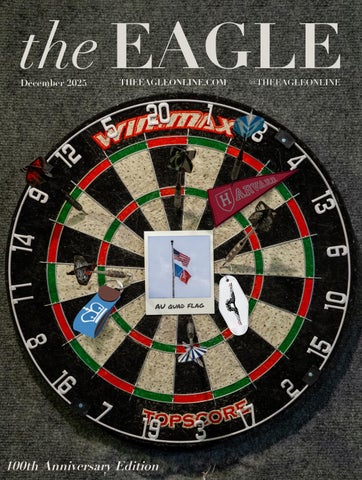
Delivering American University’s news and views since 1925
MASTHEAD
Photographers
Matheus Kogi Fugita Abrahão
Sydney Affolter
Lilly Barnett
Daisy Bateman
Zack Eljbeily
Maggie Fitzgerald
Carter Kim
Grace Kirk
Nolan Lee
Ethan Mahimainathan
Josh Markowitz
Kathryn Squyres
Videographer
Jolie Abdo NEWS
Managing Editor for News
Abigail Hatting
Administration Editor
Cara Halford
Campus Life Editor
Payton Anderson
Features Editor
Sam Skolnick
Local News Editor
Gabrielle McNamee
Investigations and Data Editor
Owen Auston-Babcock
News Staff Writers
Jumana Alsaadoon
Ella Altman
Sophia Cooper
Kadie Fishman
Kyle Galvin
Natalie Hausmann
Sophie Milner-Gorvine
Jake Mittleman
Rachel Novick
Adaobi (Myles) Nwatu
Isabella Polak
Yuri Perelman
Hannah Pietropaolo
Olive Redd
Siobhan Stubbe
Olivia Wood LIFE
Managing Editor for Life
Jessica Ackerman
Arts and Entertainment Editor
Alia Messina
Environment Editor
Conor Gillingham
Food, Wellness and Style Editor
Sydney Hemmer
Silver Screen Editor
Alfie Pritchard
Life Staff Writers
Abby Chamberlin
Sasha Dafkova
Kate Edwards
Max Grillo
Shawn Huynh
Gabby Landis
Anh Le (Mila)
Zoe Likely
Safia Malhotra
Connor McCreesh
Taylor Meredith
Lucia Murdoch
Vaughan Noble
Mina O’Dell
Faith Starchia
Cliff Vacin
Fatiha Washington SPORTS
Managing Editor of Sports
Penelope Jennings
Sports Beat Editor
Connor Sturniolo
Sports Feature Editor
Matthias Jaylen Sandoval
Sports Columnist
Cameron Harris
Sports Staff Writers
Ben Cunningham
Ben Epstein
Giorgia Horja
Daphne Klose
CORRECTIONS
The Eagle has a commitment to accuracy and clarity and will publish corrections or clarifications. To report a mistake, email the editor-in-chief at editor@theeagleonline.com.
MISSION STATEMENT
The Eagle, a student-run newspaper at American University, reports news involving the campus community and surrounding area. The Eagle strives to be impartial in its reporting and believes firmly in its First Amendment rights.
TheEagleOnline.com
Twitter: @TheEagleOnline
Facebook: fb.me/theaueagle
Instagram: @theeagleau
James Paponetti
Sela Quiniones
Max Ralph
Richa Sharma
Ella Wilson
OPINION
Managing Editors of Opinion
Alana Parker and Quinn Volpe
Satire Editor
Aidan Dowell
Satire Columnists
Dominec DiPietro
Jack Leary
Faiza Mujahid
Teddi Papish
India Siecke
Eric Steinberg
Staff Columnists
Ava DiGiacomo
Addie DiPaolo
Adria Liewewe
Adan Mandelbaum
Mari Santos
Sara Shibata
Avyay Sriperumbudur
Alice Still
Harry Walton EL ÁGUILA
Managing Editor for El Águila
Marina Caraballo
Assistant El Águila Editor
Jeronimo Freydell-Cristancho
El Águila Staff Writers
Nicole Eisner
Samuel Eyre
Diana Rojas Hernandez
Tobias Monteagudo Jackson
Diana Melgar
Alejandra Mora Ortega
Ben Parr
Sabrina Solares Lisboa
Ella Young
El Águila Copy Editors
Diana Melgar
4. ‘This clearly is a fascist takeover’
5. Growing influence of AI in AU classrooms
5. DC immigrant-owned businesses share success stories
6. The future of liberal arts
8. A snapshot of the AU student ‘news diet’
9. Getting to the Core: 100 years of AU curriculum
10. What is The Civic Life Initiative? LIFE
11. Songwriters Hub: a tight-knit community for original music on campus
12. 100 of American University’s favorite movies
13. DC birds and the conservation efforts to save them
13. District Irish Dance brings Gaelic culture to Tenleytown
My story on The Eagle is one of couches. I wrote my first breaking news story with Tyler Davis and Owen Auston-Babcock on the sticky plastic couch in The Eagle’s old office. My first cover story was written on the warm gray knit couch in ’23-24 Editor-in-Chief Abigail Pritchard’s sun soaked living room. Many nights covering protests and encampments ended by crashing on former Multimedia Managing Editor Izzy Fantini’s couch. And after being appointed Editor-in-Chief, I sat on ’24-25 EIC Abby Turner’s couch while she taught me the ins-and-outs of my new responsibilities, accompanied by the supportive presence of her ’24-25 Cat-in-Chief, Morey. These stories mark my milestones on The Eagle. However, what stands in my memory is the people who made my growth possible — people who inspired me to be better and pushed me to strive further. The Eagle taught me the tenants of journalism ethics, the practical skills of reporting and the fundamentals of The Associated Press style — but, most importantly, it has taught me that journalism is a human endeavor.
Last month, I had the privilege to tell that story at The Eagle’s 100th anniversary celebration. Afterwards, I talked to several alumni and friends of the paper about their own
Eagle couch stories, some of which I wouldn’t repeat in polite company. I couldn’t help but think about all the many people and the many couches that are part of The Eagle’s history. I am profoundly grateful to lead The Eagle in this historic year and it is with that gratitude in mind that our staff has put together this anniversary edition worthy of the milestone. Each of our sections has contributed a story with the 100 years of Eagle coverage in mind — on topics ranging from curriculum and women’s sports to movies and satire.
Thank you to Abigail Hatting, my partner in crime as news managing editor. This semester wouldn’t have been possible without having her to bounce ideas off of, or laugh off a hectic day with.
To Sabine Kanter-Huchting, who works wonders with the copy team everyday, and without whom this paper could not provide the accurate and informative content we’re known for.
To Marina Caraballo, who with caring and drive has breathed life into El Àguila and more than doubled the size of our Spanish-language section.
To Gavin O’Malley, whose wit is nearly as impressive as the Multimedia teams’ ability to wrangle photos and
graphics without fail. To Penelope Jennings and the Sports section for their incomparable dedication. To Quinn Volpe, Alana Parker and the Opinion section for keeping us informed on the campus pulse — and to Satire for reminding us all to take ourselves less seriously. To Jess Ackerman and Life for their creativity. To Neil Lazurus, who as diversity, equity and inclusion and community engagement editor, has brought together our staff to ensure that we create an even better paper for the next hundred years.
Thank you to Zach, Courtney, Heather, Brett and The Eagle’s Advisory Board for bringing our alumni together this year and always being there for our staff.
To Terry Bryant for stepping in as The Eagle’s advisory this year and Amy Eisman for providing the best council even in retirement.
And thank you to my friends, family and past editors who have been an amazing support system while navigating this incredible job.
This year, we are celebrating a 100 years of informative, relevant and creative student journalism. We want to reflect on The Eagle's century of contributing to conversations on campus and look ahead to many more years of engaging our community.
‘This clearly is a fascist takeover’ DC residents, commissioners report uncertainty from continued federal deployment
by Payton Anderson, Campus Life Editor and Kyle Galvin, Investigative Reporter
Editor’s Note: Mackenzie Konjoyan is a former staff member of the Eagle. She was not involved in the pitching, reporting or writing of this article.
He was wiping down the last tables inside the restaurant and fixing place settings and silverware. It was a morning like any other at Millie’s in Spring Valley — until two Immigration and Customs Enforcement officers walked through the door, demanding to speak to the manager.
“They told him that they needed to check all of our I-9 employee records,” said Samuel Rosenfeld-McMahon, a junior in the School of Public Affairs and a server at Millie’s.
Rosenfeld-McMahon said the officers visited Millie’s in May, along with other D.C. restaurants. Although the officers were referred to Millie’s corporate office, Rosenfeld-McMahon said the incident left a strain of anxiety on the workplace that has only grown.
“A good majority of our staff are Hispanic,” Rosenfeld-McMahon said. “Seeing the officers at our place of work just made some people’s worries a reality, which is very concerning.”
Months after the ICE officers entered Millie’s, the Trump administration declared a 30-day federal takeover of the city, claiming that “crime is out of control.” Although the takeover expired in September, federal agents are projected to stay in D.C. through November and stay possibly until summer 2026.
Continued federal law enforcement presence in D.C. brings increased fear among residents. Advisory Neighborhood Commission 1A05 Commissioner Christine Miller described the sentiment in her community with one word: “terror.”
“We have residents and members of our community who are not going to school, who are not going to their jobs,” Miller said. “Some aren’t even getting the basic necessities, like groceries.”
Miller, representative for the neighborhood of Columbia Heights in Northwest D.C., which has one of the largest Hispanic populations in the city, said there have been more ICE and federal arrests in her community than she can count.
“Nobody knows when and where they’re go-
ing to show up, and so it has just that unpredictability,” Miller said.
Miller said the ANC is working with D.C. Council members to ensure local government assists in remedying the lack of access to Medicare and food insecurity to immigrant populations amid federal funding cuts.
“I’m only one person, and we’re only 10 commissioners, but holding the District where we can accountable is something we are prioritizing,” Miller said.
Similarly, Darby Hickey, senior policy counsel of DC Justice Lab, said it is pushing D.C. officials to address the harm the takeover and deployment have caused the community.
“We’re doing a lot of traditional policy work of trying to give [D.C. officials] the information and the facts about why these are not the right re-
sponses and why,” Hickey said.
Hickey said this concern is relevant to how D.C.’s federalization impacted the homeless community. An August study said the daily cost of the National Guard deployment in D.C. was more than four times the cost of operating affordable housing for the city’s entire homeless population.
“[The Trump administration] wants harm to come to these communities, and in the form of policing and in the form of incarceration,” Hickey said. “They’re trying to manufacture a story about it.”
Kelsye Adams, a Free D.C. Project co-founder and organizing director of D.C. Vote, said D.C. and its residents do not want federal law enforcement in their communities, especially given that 13 police departments and over 30 supplemental government agencies already serve law enforcement functions in the city.
Rather, residents feel threatened by the Guard’s presence, according to Adams. She recounted hearing stories from community members of armed police and military troops standing outside of elementary schools.
“They have AK-47 machine guns in front of [our youth], and there’s no war happening outside of the students’ windows,” Adams said. “They’re very confused as to why they’re in a war zone, and the only people they’re seeing when they look at the mirror is themselves.”
Hickey said the Justice Lab is also working to correct the harmful portrayals of D.C. and communities like the homeless, something American University alumna and freelance journalist Mackenzie Konjoyan helped with this summer. As an editorial intern for Street
Sense, a media organization covering the homeless community in D.C., Konjoyan said she covered the encampment enclosures, which spiked after Trump’s takeover.
“We would go to the different encampments and witness the closures, talk to residents, just kind of be aware of the news there,” Konjoyan said.
Closing encampments decreased the homeless population in D.C. and pushed many people out to Virginia and Maryland, making it harder to find people to talk to, Konjoyan said. She said a lot of them “just started disappearing.”
“They were sometimes only given 24 hours’ notice,” Konjoyan said. “I was just frustrated that they had to pack everything up so quickly.”
In recent months, the federal government sent troops to other American cities. The National Guard began patrols in Memphis on Oct. 10, and 500 troops were deployed to an Army Reserve station outside Chicago on Oct. 8. Adams noted these cities, like D.C., have large populations of disenfranchised people and minorities.
“This clearly is a fascist takeover, and we’ve seen a domino effect of it,” Adams said.
But Adams said it’s important to prioritize joy right now.
“As long as we stay joyful in our work, and even through chaos, you know we will prevail,” Adams said. “As long as the people keep continuing to come out, the people keep continuing to hit the streets, we will prevail.”
AARON BUTLER JR./THE EAGLE
Growing influence of AI at AU
New Institute for Applied Artificial Intelligence expanding use
by Jake Mittleman, Student Government Beat Reporter
Evie Hall, a sophomore in the Kogod School of Business, once avoided artificial intelligence at all costs. Ever since the Institute for Applied Artificial Intelligence launched in April, Hall not only uses AI for studying; her professors encourage its use in class.
“I still don’t like using AI to write and produce creative content. That's just immoral to me,” Hall said. “But I’m happy that they are taking steps to include it in my education so I am better prepared to use it in my career.”
Gwanhoo Lee, a professor in Kogod and director of the Institute, said the main goal is to integrate AI into the classroom to prepare students for the future.
Training of professors in AI is also part of this integration. Lee said that approximately 90 percent of Kogod faculty integrate AI into their classes in some way, up from 50 percent last semester.
Angela Virtu, Kogod professor and associate director of the institute, is involved in the training of faculty and staff on ethical and effective AI use in the classroom.
With AI, it’s very much a mindset shift,” Virtu said. “Every single day, we have to make a conscious effort to try to get one percent better at understanding how this technology works.”
Virtu was one of two professors focused on AI and machine learning who were hired in 2023. Kogod also hired two new “Accomplished AI Scholars” this semester. Professors Henry Heo and Sun Joo Kim joined the Department of Information Technology and Analytics this fall, both with backgrounds in AI development.
Across campus, students have varying opinions about AI and its growing presence in the classroom.
Karenna Senske, a master’s student in the College of Arts and Sciences, believes AI has purpose in certain circumstances but is worried about how it might be used at the University to push “capitalistic ideas of making money.”
Ellie Casias, a freshman in the School of International Service, worries about the damage AI causes to the environment. According to a 2023 study, AI’s annual water consumption is projected to reach between 4.2 billion and 6.6 billion cubic meters by 2027, which is four to six times the annual water usage of Denmark.
“I’d be wary. In general, you should be wary of any new initiative or any new technology,” Casias said.
Outside of Kogod, AI integration at AU has been limited, but is increasing. This semester, the School of Communication hired a professor of AI and media, and CAS is currently searching for “AI-focused faculty across multiple disciplines.”
Kogod Dean David Marchick made clear that the institute was not specific to Kogod and he has been working closely with professors from all schools to expand the initiative in the coming year.
“The jobs of the future will require every student, every employee to be fluent in AI applications,” Marchick said.
administration@theeagleonline.com
DC Immigrant-owned businesses share success stories
‘It’s only their help and support that’s made it possible’
by Kadie Fishman, Local News Reporter
Economic crisis and an unstable government in Venezuela left Dario Berti to face a difficult choice. At his daughter’s request, Berti and his family packed up their business to move to D.C., leaving their home country in 2017.
Berti, a Washington College of Law alumnus, is the owner of Arcay Chocolates. He said he and his wife, Anabella Arcay, started their business in Ven-
ezuela in 2006. Arcay started as a master chocolatier and later received 42 medals at the International Chocolate Awards. Their son and daughter also work for the company.
“I feel so happy because what we do is we give joy,” Berti said.
They transferred their business to D.C., starting as a kiosk in Union Market. After the COVID-19 pandemic, the pair opened a location in Georgetown.
Arcay Chocolates is not the only success story — immigrant-owned businesses are an integral part of D.C’s culture and thrive with customer support, despite various obstacles.
The Popal Group, another family-owned immigrant business, owns D.C. restaurants Lapis, Pascual, Lutèce, Lapop and Maison Bar à Vins. Zubair Popal is the chief executive officer and owner and his wife, Shamin Popal, is the executive chef of Lapis.
The Popal family was forced to flee Afghanistan in 1978 following the Soviet invasion. In 2007, they established Napoleon Bistro, now Lapis, a modern Afghan bistro.
“Being an Afghan and providing service to consumers, actually, it gives a
great satisfaction when the people really enjoy the outcome of your work,” Zubair Popal said in an interview with The Eagle.
Not all immigrant-owned businesses are family operations. Dina Daniel, the chef and founder of Fava Pot, left Egypt, where her family still resides, in 2004. Despite this, Daniel found family at her restaurant.
[and] I have been blessed with a great community,” Daniel said.
“I have family away from my home country with my team, even though you are not blood related,” Daniel said.
Daniel said she started her business as a food truck in 2012. In 2016, she opened her first location in Dupont Circle.
These restaurants have adapted to different challenges. Due to the pandemic, Popal and Daniel added a to-go business and Berti started selling products online.
“I [was] blessed with very good landlords during the pandemic, where they worked with us to stay in business
Popal, Berti and Daniel all recognize that customer support paved their path to success. Berti said his favorite part about Arcay Chocolates is forming connections.
“I always say I have the sweetest job, but the sweetest thing about my job are my clients,” Berti said. “Purchasers give you the sense that you are not alone and that you are doing something unique for them.”
localnews@theeagleonline.com
ELIZABETH HOPPER/THE EAGLE
ZACK ELJBEILY/THE EAGLE
ZACK
ELJBEILY/THE EAGLE
The future of liberal arts
AU community reacts to changes amid crackdown on higher education
by Cara Halford, Gabrielle McNamee and Neil Lazurus, News Staff
When she commented on a TikTok video about conservative influencer Charlie Kirk’s death on Sept. 10, College of Arts and Sciences professor Mandy Berry did not expect her job to be threatened.
“I didn’t even think about it,” Berry said in an interview with The Eagle in reference to her comment, as it was buried beneath thousands of other responses.
After Kirk was shot at Utah Valley University while promoting his organization Turning Point USA, university professors across the country were doxxed or fired due to their comments about Kirk’s controversial stances.
Following Berry’s comments, the University received two emails calling to fire Berry for her remarks. The University did not disclose to Berry whether these emails were anonymous or not, or if they were from the same source. She said she is one of at least 10 AU professors who were doxxed — a form of harassment where private information, such as addresses and names of family members, is published online.
The fallout from Kirk’s assassination came on the heels of broader targeting of liberal colleges and universities, including freezing research grants, threatening to revoke federal funding to universities and rescinded international students’ visas.
The Trump administration has also invited all U.S. universities to participate in a compact that would enact preferential federal funding for schools willing to place a cap on international students, ban the consideration of race or sex in hiring or admissions, freeze tuition for five years and require standardized testing to become a part of the application process.
As a small, private, liberal arts university in the nation’s capital, questions about what these new policies could mean for the future of American University weigh on the minds of administrators, students and faculty members.
Berry said the University administrators handled her situation well, contacting her after receiving the messages and ensuring she felt safe. The school offered Berry software that would delete her data from the in-
Berry said she wishes the University had alerted the community to the threats.
“It’s not just the individuals, it’s our community, and I personally feel like AU has not been forthcoming about what our position is in relation to the Trump administration,” Berry said.
Berry said she understood why university administrators would be hesitant to speak out during a time when higher education is under such scrutiny, but worries how the mission of the University will change because of this.
Faculty Apprehension
A survey conducted by the American Association of University Professors in January found that nationally, more than one in three faculty members feel they have less academic freedom today than at any other period. More than half were concerned they would be harassed online for their teaching and views.
Lara Schwartz, a senior professional lecturer in the School of Public Affairs and director of the Project on Civic Dialogue, said these attacks on higher education did not begin with the current presidential administration and instead suggest a much deeper divide in America’s views toward colleges and universities.
tarianism this semester.
“In my view, the best thing that universities can do, and really all of us, is stand together,” Edelson said.
According to Schwartz, the early 2000s marked a
partisan shift in support for higher education, as Republicans weakened their support for universities and colleges, a move that became more prominent in 2016.
Schwartz cited the growing wage gap between those with and without college educations, which she said creates resentment and impacts voting patterns. In the 2024 election, college-educated voters favored thenVice President Kamala Harris over current-President Donald Trump, according to Inside Higher Ed.
“Universities themselves are not the cause of our economic system, but nonetheless it’s really easy to take people who are hurting and sort of blame higher ed,” Schwartz said.
An Oct. 15 Pew Research Center survey found 7 in 10 Americans said the U.S. higher education system is “going in the wrong direction.”
Concerns surrounding intellectual and political diversity have also put many universities under scrutiny.
“There’s a kind of panic … that there isn’t room for other voices and that there is a crisis of self-censorship and a lot of it is blamed on universities being liberal,” Schwartz said.
Chris Edelson, an assistant professor in SPA and a scholar on authoritarianism, said this targeting of higher education and free speech is part of a wider movement to silence dissidents, a tactic he said has been used in other countries that experience lapses in democracy.
“The United States has this image of itself, and many Americans do, as an exceptional country, as different from others, as having a specific kind of tradition in history,” Edelson said. “And it’s very difficult for people to understand that it is vulnerable to the same pressures and the same risks and dangers as other countries.”
Edelson voiced some relief that he has not faced any backlash from students or restrictions from the University’s administration for his teaching on authori-
John Bracht, an associate professor in CAS and the president of AU’s chapter of AAUP, also emphasized the importance of solidarity between university administrators and faculty at this time. In reference to doxxed faculty, Bracht said the University did a good job of providing resources and support.
Bracht said he is more concerned about the University’s approach to liberal arts education as a whole. He said recent faculty meetings with the Board of Trustees have made him feel the University is moving toward prioritizing “career readiness” and entrepreneurship over liberal arts education.
“Nationally, AAUP has been a drive of this ideal of what a liberal arts education can be, and academic freedom protects the ability for the faculty to basically do this. So we just have to protect academic freedom at all costs,” Bracht said.
Institutions’ response
Some universities and free-speech groups have sued the federal government in response to attacks on academic freedom and freedom of speech. According to a database from Inside Higher Ed, there have been over 50 lawsuits against new education policies.
The Knight First Amendment Institute at Columbia University has become one of these litigants, as it focuses on defending the freedoms of speech and the press in the digital age. Recently, the institute filed a lawsuit, on behalf of AAUP, against Secretary of State Marco Rubio’s policy to deport pro-Palestinian activists.
In late September, a federal judge ruled that the policy violated the First Amendment.
Ramya Krishnan, a senior staff attorney with the Institute, said it is victories like these that show why universities should continue to resist pressures from the current federal administration.
Some schools, such as Harvard University, have had federal aid and research grants terminated due to their resistance to the federal government. But Krishnan said even schools that have attempted to adhere to the administration’s policies aren’t safe.
“I think there are some promising signs that universities are learning that capitulation is not a sustainable strategy with this administration, that it is no guarantee that they will not be attacked for a second or a third or a fourth time,” Krishnan said.
At AU, administrators have largely chosen a quieter approach. Since Trump was inaugurated for the second time in January, the University has quickly rolled out a plan of response. It joined national coalitions of higher education institutions voicing support for universities like Harvard, while also launching new messaging
MATHEUS KOJI FUGITA ABRAHÃO/ THE EAGLE
around inclusive excellence and student belonging.
In May, the University announced it would be rebranding its Center for Diversity and Inclusion as the Center for Student Belonging. In August, the Center for Student Involvement updated its Recognized Student Organization (RSO) Manual, more than doubling its length and including new training requirements, advisor agreements and an updated Openness and Inclusion Expectation.
The RSO Manual’s Openness and Inclusion Expectation states that any organization’s constitution, mission, purpose statement, Engage profile and marketing material must clearly invite any students interested in the organization’s mission, purpose or goals.
“The Openness and Inclusion Expectations in the Recognized Student Organization Manual reflect AU’s long-standing requirement that all student organizations be open to all students,” Assistant Vice President and Deputy Chief Communications Officer Elizabeth Deal said in a statement to The Eagle. “Over the summer, CSI worked with recognized student organizations to incorporate these expectations through the annual renewal process.”
Student leaders across campus integrated these new expectations into their organizations’ Engage pages, governing documents and marketing materials, Deal wrote.
In an interview with The Eagle, University Vice President and Chief Communications Officer Matt Bennett said changes within CSI were done in consultation with and based upon feedback from students and faculty.
“The work that we are doing is always based on our commitments to inclusive excellence, our commitments to the mission of educating and creating knowledge, of promoting inquiry and thought and debate and dialogue and community. That’s where everything starts from,” Bennett said.
unique environment” was requiring the University to consider two perspectives: policy changes and “atmospheric pressure.”
Bennett described atmospheric pressure as the stress placed on higher education institutions following news stories emerging from and sanctions placed on universities like Harvard and Columbia.
Federal changes to Pell Grants and loan limits also present new challenges for administrators.
“You need to understand what might be happening in the world,” Bennett said. “You need to focus very clearly and very strongly on what we are doing, based on our mission, based on our principles, based on continuing to do that work going forward, and that's how we're approaching it.”
Student organization response
Much of the University’s response has affected student organizations that form the core of AU’s civic and cultural life.
For multiple student organizations, new university regulations have created additional barriers to participation. Since the RSO Manual’s update, Rabbana Bari, the president of AU’s chapter of the Muslim Student Association, said the MSA and other organizations have had multiple challenges with tasks like club registration and are concerned about their ability to speak out.
“We don’t know if saying something could put us at risk, both for e-board and club members,” Bari said.
Bari said multiple MSA members have also been doxxed as Islamophobia rises in the U.S.
Individual schools have responded in varying ways. Faculty in the School of Communication wrote an open letter reaffirming their commitment to free expression, the School of Education emphasized “equity amid change” in a statement to the campus community, the School of International Service sent out a newsletter on “Navigating Uncertainty” and CAS introduced a new Social Action, Justice & Performing Arts certificate linking the arts to civic engagement.
and the Kogod School of Business, have remained publicly silent.
the current “very difficult, very complex, very
“We’re doing everything that we can to keep our community safe, and to not have them be concerned by a lot of things at once,” Bari said.
Eli Givens, a SPA junior and e-board member for Guns Down DC at AU, said clubs and organizations on campus have been critical in offering students a community of like-minded individuals. Amid a changing political climate, Givens said it is communities of their peers that give them hope.
“We are not the first people ever to experience this level of fascism, we're not the first people to experience that in history — and the people in history fought back,” Givens said. “That gives me hope that we’re not the only ones, and we never have been.”`
SOE and speaker pro tempore of the senate, sponsored the referendum.
Though the referendum passed in March, Riggins said the University administration has been unclear about important details pertaining to compliance with Immigrations and Customs Enforcement orders — namely administrative warrants, documents the Immigration Defense Project calls a “ruse” to obtain consent to enter private property.
The University released some guidance on ICE in February, but clarifying University procedure responding to ICE is one of many issues upon which the administration “refuses to take a stance,” Riggins said.
In a statement to The Eagle, Deal said the University is composed of both public and nonpublic spaces: Public spaces are areas open to the general public, like the quad or the lobby of Bender Arena, and nonpublic spaces include residence halls, classrooms and other controlled-access areas.
Law enforcement officers may not enter “spaces that are not generally open to the public without a judicial warrant signed by a judge or prior authorization from the University,” Deal wrote.
Signs posted on at least some classrooms label the space as a private area. The designation establishes the spaces are intended for “instruction and other activities in pursuit of the University's mission.”
“The signs placed in academic buildings are for informational purposes only and serve as a reminder that classrooms are nonpublic areas intended for instruction and university activities, and that access is limited to faculty, staff, students, and invited guests,”
EAGLE
MATHEUS KOJI FUGITA ABRAHÃO/ THE EAGLE
not receive enough votes to be put on the ballot, club president and SIS junior Steven Mendell said.
“It’s a much more comprehensive way of protecting students than other protective laws and policies might not necessarily do, and so in its namesake, it forms a firewall to protect their information,” Mendell said.
Currently, Mendell and Amnesty International are working toward conversations about firewall policy with the University administration despite the referendum’s shortcomings in signatures. Without a speech protective policy in place, Mendell is concerned that students will shy away from controversial conversations and stop pursuing activism.
“If you don’t feel secure that your First Amendment rights are going to be enshrined and you think that you're going to be persecuted for them, then how can anything continue?” Mendell said.
Other student organizations have felt similar uncertainty as national tensions surrounding free speech have grown.
Charlie Murphy, a junior in SIS and co-president of Sunrise @ AU, said the student climate movement has become increasingly focused on protecting democratic freedoms and resisting authoritarian policies alongside their environmental advocacy.
“Sunrise was founded on the ideas of the Green New Deal and climate justice, but we’re now transitioning to fighting against the rise of authoritarianism,” Murphy said. “Our partnerships with FREE DC and Students Rise Up are showing that the student body is willing to fight back, not just for the environment, but for democracy itself.”
Murphy said the organization has participated in national coalitions, including Students Taking Action
for a New Democracy, which includes more than 30 universities. On campus, Sunrise plans to experiment with new forms of protest beyond walkouts, while navigating the University’s strict regulations on student organizations and protests.
“We’re still trying to play by these new rules, even as regulations get tighter,” Murphy said. “At the same time, AU hasn’t done much to repress our messaging, but they haven’t exactly been receptive, either.”
While Sunrise has avoided direct regulation from the University, unlike other organizations such as AU’s chapter of Students for Justice in Palestine, Murphy
said the group has faced online harassment, especially during their recent walkout with FREE DC on Sept. 9. Murphy noted increased negative comments on their social media platforms accusing student activists of “hurting” their peers or calling for universities to lose funding.
With federal funding for higher education shrinking and the University’s multimillion-dollar budget deficit, Murphy worries the University will eventually sign onto the Trump administration’s proposed compact, which would promise funding to universities in exchange for certain policy changes.
Riggins expressed a similar sentiment, concerned that the University’s existing financial burdens may influence administrative silence on divisive issues.
“We have always prided ourselves on student voice. When I was touring to come here, it was like, ‘Eagles are for change, AU was a place for changemakers,’” Riggins said. “Why isn’t the administration leading by example?”
news@theeagleonline.com
A snapshot of the AU student ‘news diet’
Habits, perceptions and trends for news consumption
by Natalie Hausman, Investigative Reporter
Students at American University have been labeled as some of the most politically active in the nation. But how informed are they?
The Eagle conducted a survey this semester on news consumption habits — the “news diet” of American University students.
Major findings from 114 student respondents included:
81 percent of students said they consume news daily, with online news sites and social media as the top two preferred platforms.
48 percent of students sometimes read The Eagle, 25 percent have read The Eagle at least once, 12 percent of students have never read it and 12 percent have never heard of it.
Nearly all, 94 percent, students said news was biased or partisan “always” or “sometimes.”
“It’s just the nature of most media these days,” Emma Spath, a junior in the College of Arts and Sciences, said. That’s why Spath said her go-to outlet is Straight Arrow News, a platform with the tagline: “Unbiased. Straight. Facts.”
Other students said they too see news bias, but don’t view it as innately negative.
Julia Lewis, a senior in the School of Public Affairs, works at a lobbying firm and said she has closely followed news updates on the government shutdown and listens to “The Headlines” from The New York Times each morning to prepare for work.
“I think bias is inherent in every single person and therefore every single reporter and every single news outlet,” Lewis said.
Students rely most on The New York Times for news, with 36 percent noting it as their most consumed source. The Washington Post came in second at 21 percent, and NPR followed at 15 percent.
Chinwe Okonkwo, a sophomore in the School of Communication, said she consumes news so she’s updated on the humanitarian crises she cares about in Gaza, Congo and Sudan.
Answers addressing the IsraelHamas war were most common in response to the question of which news topics most interest students, with 20 percent of respondents mentioning “Palestine” or “Gaza.”
Okonkwo said she reads Al Jazeera and watches independent Palestinian journalists like Bisan Owda and Plestia Alaqad, who post content on Ins tagram.
“She seems pretty young, maybe around my age, so it was a really emo tional journey to watch her through all these years,” Chin we said of Bisan.
While emotions drive news con sumption for some, news anxiety means avoidance for others.
“I’ve actually been trying to take a break re
cently,” Emily McKay, a sophomore in SPA, said. “Mental health is important.” Spath said while she has also avoided news lately, she’s hopeful a media shift away from pessimism may re-engage people.
“I think the role that media plays in society, it can’t really be underestimated,” Spath said. “And it really has to be rethought.”
news@theeagleonline.com
Getting to the Core: ��� years of AU curriculum
Faculty provide insight into ongoing changes amidst strategic plan process
by Sophie Milner-Gorvine and Olivia Wood, News Staff Writers
With a new strategic plan slated to go into effect in 2026, American University’s undergraduate Core curriculum will experience a “complete overhaul.”
The current AU Core — which includes AU Encounters, Habits of Mind, Complex Problems and more — was implemented in 2018 after the Faculty Senate’s unanimous approval. Cynthia Bair Van Dam, senior professional lecturer for writing and co-chair of the AU Core Implementation Task Force, worked for three years to design the current core curriculum.
Bair Van Dam questioned AU’s decision to overhaul the curriculum soon after the 2018 change, which remains in place. Previously, AU’s general education curriculum hadn’t significantly changed since 1989. She said overhauls usually happen every few decades.
Dean of Undergraduate Education Bridget Trogden said in a statement to The Eagle that while many institutions revise their general education programs every few decades, the gaps between, updates often leave students’ academic needs unmet, something she hopes to avoid at AU.
For Bair Van Dam, the AU Core goes beyond coursework: it’s an expression of the University’s values.
The introduction of AU Core in 2018 cemented a focus on diversity initiatives. Many of former AU President Sylvia Burwell’s first actions in 2017 involved diversity — such as the Inclusive Excellence Plan, which sought to increase students’ awareness of systems of power and privilege as well as BIPOC history.
Elizabeth Deal, assistant vice president and deputy chief communications officer, told The Eagle that AU’s effort to promote inclusion has not wavered.
“While we do not know the outcome of the new AU Core yet, we remain committed to fostering an inclusive community in a variety of ways, including teaching,” Deal said. “The core will be developed through a cross-section of faculty and will consist of our values as a university, including diversity.”
According to Bair Van Dam, students participated in designing the core and made many demands for diversity requirements at the “height of student engagement and advocacy.” Students particularly pushed for AUx II — which was significantly altered
last fall — and the Diversity & Equity requirement.
As AU finalizes the strategic plan and a new curriculum set to take effect in 2026, Bair Van Dam advised students to form ties with administrators.
“This is the time to make some noise and get involved, because pretty soon the window will be closed again,” she said. “You have this winter to make sure that you have seats at the table.”
History of AU curricula
Methodist bishop John Fletcher Hurst founded AU in 1893 as an educational institution where open inquiry, a commitment to justice and a pursuit of global understanding shaped future leaders.
AU’s general education system was intended to achieve that by encouraging students to explore ideas across perspectives.
In 1933, students spent their first two years building a broad multidisciplinary foundation before focusing on their majors.
By 1962, AU formalized a core curriculum: 38 to 43 credits in English composition, civilization studies, humanities, social sciences, natural sciences, mathematics and physical education. AU eliminated most distribution requirements in 1970, leaving just English composition and reading requirements.
The first general education program at AU, designed in 1989 and revised in 2009, sought to give students a broad foundation of knowledge across disciplines. By 2017, proposed changes emerged as Advanced Placement credits and double-counted courses began to weaken the shared academic experience.
A major change in 2017 was the introduction of Complex Problems, a mandatory first-year seminar designed to engage students in university-level inquiry by exploring social and conceptual issues from multiple perspectives.
Bair Van Dam said courses like Complex Problems gave faculty the freedom to teach subjects they were passionate about, even if those topics weren’t tied to a specific major. Changes like these, she said, are what make AU Core meaningful. What are AU’s strategic plans?
A university strategic plan is a comprehensive mission statement, typically implemented by new leadership, and includes everything from building community to altering coursework.
The 2019-2025 Strategic Plan implemented by
on “what can or should make AU distinctive” and is divided into the “5C’s”: Community, Career, Civic Pluralism, Curriculum and Curiosity.
The new curriculum outline asserts that the new core intends to emphasize workforce readiness, accelerated programs and artificial intelligence literacy.
Jeffrey Hakim, professor and chair of the Department of Math & Statistics, thinks these changes are vital.
“I believe that we should embrace AI,” Hakim said. “If we embrace it more, then people will not fall into the traps.”
Marianne Noble, a literature professor, said she’s witnessed a decline in intellectual curiosity and a possible rise in what she calls “transactionality” in the college experience.
“College should be about curiosity and learning more because you love it. But I do think that many students don’t see it that way. They’re much more looking for the skills that they need to succeed in a particular career,” Noble said.
To her, those skills are inherent to the college experience and don’t need to be the strategic plan’s focus. Bair Van Dam saw two sides to this point.
“It would be unethical for us to just take your money and not make sure that you’re prepared for the world,” Bair Van Dam continued. “But it’s also unethical if we see this only as a transaction, that you’re just here to get a piece of paper and get out.”
administration@theeagleonline.com
AARON BUTLER JR./THE EAGLE
Deep Dive into President Alger’s vision for AU What is The Civic Life Initiative?
by Sophia Cooper, News Staff Writer
Students at American University are delving into dialogue as a part of The Civic Life Initiative launched by President Jonathan Alger in September 2024.
The Civic Life Initiative brings people into conversation and engages students in practicing civic life through a series of events, programs and activities, according to its vision statement.
In an interview with The Eagle, Alger said that one of his reasons for coming to American University is to build on the historic strength of the University, which was founded by an act of Congress in 1893.
The initiative was created in the summer of 2024 by the then-newly appointed Alger. He was previously the president of James Madison University, where he created a similar initiative, The James Madison Center for Civic Engagement, in 2017.
Thomas Merrill, an associate professor in the School of Public Affairs, served as chair of the University’s Civic Life Steering Committee, a group of faculty and staff from across the University.
“We saw The Civic Life as an opportunity to reaffirm the fundamental ethical outlook of the university, which is that we are a community that tries to acquire the world that is willing to question conventional wisdom,” Merrill said.
The steering committee was set to operate for a one-year term, which expired at the end of the 2024-25 academic year. While active, the steering committee worked on developing the initiative’s vision statement, which was their biggest achievement, according to Merrill.
Merrill said the initiative is not only meant for people in SPA or the School of International Service, but for the whole University.
“Self-government happens in all kinds of different places in the world,” Merrill said. “It’s not just the White House, it’s not just in Congress. It’s in
your classroom, right where hopefully you’re helping shape the conversations. It’s in the dorm where you're trying to decide, ‘how do we live together?’ It's in clubs, it’s in unions.”
The work done by the steering committee has now “moved into other spaces,” according to Merrill.
The Civic Pluralism Working Group and the Curriculum Working Group will help continue informing the upcoming strategic plan. The strategic plan will be developed over the next few months as it takes recommendations from working groups and incorporates them into a “roadmap for AU’s future.”
The current strategic plan is set to end this year.
The Student Civic Fellows program is a major part of the initiative that works on multiple Civic Life events.
Within the larger program, there are two smaller fellowships: student fellows and faculty fellows who applied to be a part of the program.
Last year, fellows were facilitators for each of the Civic Life seminars in the spring. Fellows were put into groups with faculty members and assigned a question to lead a discussion on.
Amishai Goodman-Goldstein, a senior in SPA and a second-year student fellow, said he is excited about the initiative.
“I think it’s great that we get students an opportunity not just to take civic classes and learn about ‘here’s what it means to be an engaged citizen,’ but try to put that into practice in the campus community,” Goodman-Goldstein said.
Laila Kirkpatrick, a sophomore in SPA and the College of Arts and Sciences and a second-year student fellow, said that it’s key for people to recognize the purpose of the initiative itself.
“It’s important that people understand that the idea behind the Civic Life Initiative is to get people to understand how to have those conversations and have it respectfully and effectively rather than just debating people,” Kirkpatrick said. “Because I think those two things can get conflated in a way that's not necessarily correct.”
At a presidential speaker series event hosted in Bender Arena during family weekend this semester, Alger announced the creation of the Democracy Innovation Lab at the Sine Institute of Policy and Politics. The lab will be led by the Sine Institute Executive Director Amy Dacey and will bring together the Sine Institute, the Civic Life Initiative and the Civic Learning and Democratic Engagement
(CLDE) Coalition. The CLDE Coalition works to bring civic learning and democratic engagement to make it a priority in higher education and according to their website is working in partnership with more than 75 higher education and student success organizations.
Alger said the idea behind the Democracy Innovation Lab is to provide leadership on civil discourse and dialogue across differences, both on campus and nationally.
He said that 15 years ago, when he would talk about civic life, people would tell him that a university’s job was to produce specific majors. Now, Alger said, people like policymakers and parents understand how important encouraging dialogue is, and they “don’t take democracy for granted anymore.”
“A lot of societies are really struggling with this, with people being able to get along with people, being able to engage in dialogue across differences without vilifying each other,” Alger said in an interview with The Eagle. “If we can’t do it on a college campus, I don’t know where it’s gonna happen.”
Songwriters’ Hub: a tight-knit community for original music on campus
Ensemble offers multitude of resources for student bands and singers
by Alia Messina, Arts and Entertainment Editor
On Thursday nights, musicians across American University’s campus drop their homework, projects and responsibilities to spend a few hours together in the Katzen Arts Center writing, performing and sharing what fuels them most: original music.
Their space and creative forum is called Songwriters’ Hub, an open-to-all songwriting and performance workshop for student musicians, solo artists and bands. The brainchild of the University’s Orchestra and Symphonic Band Director Matthew Brown, the group has doubled in popularity each year since its introduction three years ago and has allowed student musical talent to perform on and off campus, find collaborators, get signed and flourish.
“I wanted to make something to support the endeavor of original songs,” Brown said. “Something that would be a great outlet for not only people who wrote songs, but people who were supporting musicians, like drummers, bass players, guitarists, keyboard players as well as audio engineers.”
The class — listed as MUSC-145 or MUSC045 for one or zero credits in the University’s course catalog — came to be because Brown would run into students after his late-night classical ensemble rehearsals sneaking around Katzen in search of open rooms for their rock bands to jam after hours.
The Songwriters’ Hub was then conceived as a dedicated ensemble-style class period for musicians on campus who wrote original songs, with the first official iteration being pitched to incoming freshmen via email in 2022.
Incoming students eager for a dedicated space to cultivate their own music on campus found themselves in the Katzen Recital Hall for the first meeting, listening to Catherine Brennan — a freshman then, but now a senior in the School of Public Affairs — interrupt Brown’s opening lecture to play the first original piece ever performed in the Songwriters’ Hub, “Masquerade.”
Songwriters’ Hub has gone through a few structural changes since its formation, as Brown continues to adjust the class to accommodate the
growing student roster’s genre and style interests. The fall 2025 structure of the course groups student musicians and songwriters according to the stage their original songs are in: Writer’s Room, Open Mic or Main Stage.
The Writer’s Room is the first step in the songwriting process and the core of Songwriters’ Hub. It consists of students bringing in original lyrics for a chorus, a verse, or even just a melody and workshopping with other members until it becomes a full-fledged song.
“I’m partial to the Writer’s Room because it’s the most raw,” said Liam Chapin, one of the founding members of Songwriters’ Hub and a graduate audio technology major who often produces for artists in the class.
“Everyone can put their heads together and think, what could we change here? Do we like the rhyme scheme? The melody? We really talk about composition.”
Open Mic is the middle breakout room and is an opportunity for students to perform finished songs in an acoustic, stripped-down form, accompanying themselves singer-songwriter style on piano or guitar. At every stage, students receive feedback and opportunities to collaborate with other musicians and producers in the class.
“I feel like my song ‘Masquerade’ grew, developed and matured through Songwriters’ Hub because there was a space to show it in different stages,” Brennan said. “People would give suggestions at every stage and I would take that into account to help develop it.”
Main Stage, the last breakout room, is reserved for student artists with bands and a setlist of finished original songs in their repertoire, or those with polished songs in search of a band to accompany them.
The workshop functions as a concert where musicians often jump in with their instruments to improvise additions to a student’s song as it is being performed.
Rhi Rueda, a junior in the Kogod School of Business’ business and entertainment program, had never been in a music group before joining Songwriters’ Hub.
“I came from a STEM high school where there wasn’t that much music,” Rueda said. “When I got to AU, I jumped into Songwriters’ Hub and showed off my song and then people just added to it naturally.”
Although Songwriters’ Hub was designed for on-campus musicians, Brown does not limit course eligibility to declared music majors or people with a musical background.
Alizeh Jawaid — known simply as alizeh on all streaming platforms — is another student songwriter who joined Songwriters’ Hub to sharpen her writing skills, only to find a band of musicians to perform with and carry her original tracks to a set at AU Student Union Board’s on-campus music festival, Amfest.
“It was so intimidating when I went for the first time,” Jawaid, a junior in the College of Arts and Sciences, said. “I remember hearing the first few performances and I was like, ‘Oh, I’m toast. I am not as good as these people.’ And then it turns out I was. Everyone was really, really kind and supportive.”
GAVIN O'MALLEY/THE EAGLE
Since joining Songwriters’ Hub and finding her artistic identity, Jawaid has grown into a performer. She recently opened with a 45-minute set of original songs for professional artist Ella Jane at Women in Audio’s free concert, Pink Noise, on Oct. 17.
“I’ve improved my songwriting skills and my theory knowledge and I feel like my skills have been growing exponentially,” Jawaid said.
On-campus success and recognition from clubs can take artists far, as most students part of the Songwriters’ Hub often find themselves being signed to Second District Records, the University’s student-run record label, after building a repertoire and performing live.
SDR offers more than performance and studio opportunities for artists, giving them the resources to turn their songs into music videos, master music for streaming services and help with promotional marketing.
As more student musicians and writers pour into Songwriters’ Hub, the structure of the class might change, but the benefits of creating a place for original music to grow, take shape and flourish remain the same.
“The biggest reward for me is seeing what they do, what they develop and how they find their people in Songwriters’ Hub,” Brown said. “It’s good for campus, not just good for the students.”
arts@theeagleonline.com
��� of American University’s favorite movies
See if your favorites made the list
by Gabby Landis Life Staff Writer
The results are in, and our list of American University’s 100 favorite movies is finally here.
In celebration of our 100th birthday, The Eagle polled 180 students, alumni and faculty members on their favorite movies. Respondents could put at least one and up to 10 favorites on their ballot.
The battle for first place was fierce, but one film emerged with a wide margin of support. To everyone’s surprise, Damien Chazelle’s Academy Award-winning “La La Land” claimed the title of the University’s favorite movie with 24 votes.
Looking downward, the rest of the top 15 were quite decisive, but close calls.
Greta Gerwig’s “Little Women” and the origi nal “Mamma Mia!” film by Phyllida Lloyd claimed second and third place, each earning 17 votes. Other films in the top 15 include Christopher Nolan’s “Interstellar” in sixth place, “Dead Poets Society” in ninth and “10 Things I Hate About You” in 12th.
Speaking of “Interstellar,” Nolan took the title of most popular director among respondents, having nine of his films make the cut.
Respondents were able to provide feedback as to why they chose particular films, with many citing their favorites’ emotional impact, good “vibes,” cinematic beauty, discussion of world events or the feeling of comfort they elicit — many childhood favorites cropped up.
One trend that emerged from the final list is that the results closely mirror Letterboxd’s list of all-time most popular films, as measured by user reviews. The list also includes films like “La La Land,” “Parasite,” “Eternal Sunshine of the Spotless Mind,” “Everything, Every where, All At Once” and “Knives Out” in its top 25.
Multiple popular franchises didn't make the top 25, such as “The Lord of the Rings,” “Star Wars,” “Harry Potter” and “The Hunger Games.” A few movies from these franchises made the top 100, but there was no such luck for “The Lord of the Rings” trilogy.
A couple of animated movies also placed in the top 50. Hayao Miyazaki, perhaps the greatest animator of our time, had five of his films represented in the top 100. His most popular film was “Spirited Away,” which took 20th place with eight votes. His second most popular film is my favorite, “Princess Mononoke,” which received seven votes.
Apart from the presence of multiple
nal list lacks diversity. White male directors were overrepresented, with a few exceptions like Gerwig, Miyazaki and Alfonso Cuarón. Powerful films centering diverse storytelling or crafted by nonwhite directors that made the final list include “Past Lives,” “Y Tu Mama Tambien” and “BlacKkKlansman.”
Did your favorite films make the cut? Take a look at the graphic, or the final tally from us @TheEagleAU on Letterboxd, to find out.
movies@theeagleonline.com
Alizeh Jawaid pictured performing at Women in Audio's Pink Noise concert.
DC birds and the conservation efforts to save them
Organizations make difference in protecting wildlife
by Mina O’Dell, Life Staff Writer
About every other week, the Birders of American University go birdwatching at Battery Kemble Park.
“Every time we’ve gone, we see something new, and that’s sort of the beauty of it,” club president Dante Arminio said. “I think D.C. is a really unique place, because it’s sort of in the midst of everything, and you can
always see something different no matter the season.”
Arminio and the Birders observe millions of birds that fly through D.C. every year. D.C. lies between many different bird migration cycles; Arminio explained the area is home to not just year-round cardinals, blue jays, goldfinches and mockingbirds, but also seasonal birds like summer carnages, an array of different types of warblers and more.
While migrating through D.C., birds often face challenges. Bird strikes and injury from physical obstructions are common. Chris-Ann Burton, the communications director for a local wildlife rehabilitation center called City Wildlife, said window collisions can kill billions of birds each year.
Arminio said AU’s Hall of Science is a frequent place for window collisions, as it is essentially a big glass pane.
But local organizations have stepped up to help. Prior to City Wildlife’s opening in 2013, there were no wildlife rehabilitation centers in D.C. A statement on their website said many injured animals in the District were unable to make the journey to the nearest wildlife rehabilitation center that was an hour away.
Burton said City Wildlife gets around 3,000 calls per year. Though birds victimized by window collision and house-cat attacks are their most frequent patients, they also treat local wildlife like squirrels, reptiles, amphibians and rats.
There are also advocacy groups to mitigate window collisions. Nature Forward has dedicated itself to environmental advocacy and educating the D.C. community in the early 1900’s. Jamoni Overby, a D.C. conservation advocate for Nature Forward, said that they partnered with City Wildlife in 2022. In collaboration with City
District Irish Dance brings Gaelic culture to Tenleytown
Studio full of community, passion and shared tradition
by Sasha Dafkova, Life Staff Writer
District Irish Dance Academy, located along Wisconsin Avenue in Tenleytown, offers a unique style of classes to all D.C. residents. The studio sits unsuspectingly between Mayflower Chinese Restaurant and the Chase Bank — just a short walk from where the American University shuttle drops students off for the Tenleytown - AU Metro station.
Joe Duffey is the proud founder, owner and creative director of the studio. Local to the D.C. area, Duffey graduated from George Washington University in 2013. He began his Irish dancing career at six years old, and has since performed in Williamsburg, Virginia, Orlando, Florida, London, various parts of Russia and in the Broadway production of The Riverdance Musical in 2015.
“I got to perform on some of the most prestigious stages with Michael Flatley, who was this kind of real icon of Irish Dance,” Duffey said.
After Duffey fulfilled his dreams of performing, he said it felt natural to start teaching in the District, a place that he has lived and called home for a large portion of his career.
As a dance style, Irish dance dates back to the 1400s and skyrocketed in popularity after the debut of The Riverdance Musical in 1994. Riverdance has a total of 18 scenes that are performed in seven-minute inter-
vals, each rich with Irish culture.
“I think that by nature, the art form of Irish dance and Irish music is infectious,” Duffey said. “It is a very satisfying visual art form and naturally, people get very curious about that.”
Stepdancing is integral to Irish history and heritage, as both a cultural celebration and an act of resistance. During the 17th century, England passed and enforced Penal Laws over their Irish colony. These laws targeted Irish Catholics and prohibited them from practicing all Gaelic traditions, including dance. Despite these laws, the Irish resisted by passing down this art form in secret. There are many kinds of Irish dance performed, but all of them emphasise quick and precise movements in the feet to keep in time with the fast-paced music.
“The notion of Irish dancing includes the ability to have rhythm, fancy footwork, but above all a solid internal drum beat, and when I dance, I literally feel myself creating rhythm and music. I feel complete,” Duffey said.
Today, Irish dance is performed during celebratory holidays and events to showcase national pride and in competitions across the globe.
Duffey’s studio emphasizes technique, tradition and teamwork since its beginning. The company’s number of enrolled students has been steadily growing fast since its opening.
District Irish Dance also maintains a great relationship with the Irish embassy and with the current
Wildlife’s Lights Out D.C. program, the organizations worked together with D.C. Council members on the Migratory Local Wildlife Protection Act, which was unanimously passed on Jan. 26, 2023.
Also known as the Bird Safe Buildings bill, it called for remodeling of buildings in D.C. to “incorporate bird-friendly measures to reduce the increasing number of bird fatalities caused by glass,” as reported by Overby. Measures included certain glass treatment products to prevent collisions.
Arminio said he understands the importance of conservation and advocacy work, given the community he’s found in a group brought together by local wildlife.
“I think it’s really our responsibility to protect all the species, especially as they migrate,” he said. environment@theeagleonline.com
ambassador, Geraldine Byrne Nason, who was an Irish dancer herself, according to Duffey.
“We had one class and rented a pilates studio in the area,” Duffey said. “It grew to two, three classes, and in our first year, we had 1,520 students and quickly sized up from there.”
Irish dance is not just for professionals or people who have a connection to Irish culture, Duffey said; it is a style that can be learned and performed by anyone.
“It doesn’t matter who you are or where you are from, there is something to gain from getting to do Irish
GAVIN O'MALLEY/THE EAGLE
MATHEUS KOJI FUGITA ABRAHÃO/ THE EAGLE
COURTESY OF DISTRICT IRISH DANCE
dance, but having said that I am really proud to be a kind of cultural institution,” Duffey said.
District Irish Dance is also no stranger to collaborating with American University. The studio took part in D.C. Art All Night this past September, where members of the American University and the Tenleytown community were able to tour District Irish Dance Academy’s studio and watch performances.
“It’s been wonderful to get to meet people in the neighborhood and community, and we can be a place, as a dance studio, that gives a sense of community,” Duffey said. “Especially for college students who have grown up dancing and want to continue to dance.”
Community, culture and discipline are the pillars of this small Irish dance studio. The classes that Duffey offers tie people back to their heritage and create new connections. It is a hidden center of life and art that deserves attention and happens to be right down the road from the University.
“I absolutely love getting to have a studio and creating a home for our community members and dancers,” Duffey said. “As long as we can continue to do that, I feel like we’re offering something unique to the D.C. area.”
arts@theeagleonline.com
Sustainable Habits at AU
Students lead charge toward zero-waste goal
by Fatiha Washington, Life Staff Writer
With AU’s ambitious goal to achieve zero waste by 2030, students and staff take everyday actions that make sustainability a commitment rather than a buzzword.
AU’s gardening class is cultivating a hands-on relationship with sustainability by engaging in eco-friendly practices.
“The best way to nurture your relationship with the Earth and Mother Nature is to start a garden,” Sky Chaus said, the course’s teaching assistant and a senior in the College of Arts and Sciences.
Chaus said experiential learning shifts students’ perspectives toward seeing sustainability as an ongoing practice rooted in everyday choices.
“They come to class happy and enthusiastic about their plants growing,” they said. “They’re sharing knowledge, building community, and thinking about sustainability in new ways.”
The class covers composting, waste diversion and the differences between industrial and backyard composting — key considerations for reducing waste.
“We talk about what is and isn’t compostable, and why the University can compost certain materi-
als while the community garden can’t,” Chaus said. “It helps students understand what zero waste actually looks like in practice.”
Every week, students grow edible and medicinal crops, preserve seeds and manage soil quality. The social aspects of agriculture, including food security and foraging, are also discussed.
“The garden is a beautiful symbol of resilience,” Chaus said. “It lets students reconnect with food — learning how to grow produce in small spaces and understanding the work that goes into it.”
Sustainability at AU also takes root in familiar locations, like The Bridge Cafe.
“All of our cups, lids, and straws are compostable, and we use glass milk containers instead of plastic,” Dalvin Perez, a senior in the Kogod School of Business and assistant general manager at the cafe said. “We compost our coffee grounds, tea leaves and even hibiscus from our drinks.”
However, Perez said there is limited awareness of the University’s zero-waste goal.
“I learned about the 2030 goal through my introduction to nutrition class,” he said. “For students who aren’t taking sustainability-focused courses, that knowledge might never reach them.”
He said faculty engagement plays a critical role in encouraging sustainable behavior. Perez credited AU’s Green Teaching Program, which honors professors who embrace practices like energy conservation and paperless classrooms.
“More professors should follow that model. It makes sustainability part of the learning experience,” Perez said.
Both Chaus and Perez said that long-term progress requires a cultural shift centered on accessibility, education and student engagement.
“Accessibility to knowledge and funds is one
of the biggest barriers,” Chaus said. “It can be difficult for students to make environmentally friendly choices when sustainable options cost more or when they don’t have the information. That’s why classes like ours matter — they make sustainability tangible.”
environment@theeagleonline.com
COURTESY OF DISTRICT IRISH DANCE
MATHEUS KOJI FUGITA ABRAHÃO/THE EAGLE
MATHEUS KOJI FUGITA ABRAHÃO/THE EAGLE MATHEUS
SPORTS
Sibling duos make their mark on AU sports
From childhood rivalries to college competition
by Richa Sharma, Sports Staff Writer
After visiting his older sister, Ella Shifflett, at American University over Labor Day weekend last year, Gavin Shifflett immediately knew he could picture himself in her position on American’s swim and dive team. But for this sibling duo, swimming together was not unusual.
The Shiffletts are one of several sibling pairs on the University’s sports teams. Whether as rivals or teammates, sibling duos are not unusual in college athletics. When one sibling receives the resources and training to become a Division I-caliber athlete, it’s often no surprise when their sibling follows in their footsteps.
Despite their two-year age gap, the Shiffletts swam on the same high school, club and summer teams in Swarthmore, Pennsylvania. With Ella Shifflett swimming distance events such as the mile and Gavin Shifflett specializing in sprints, the two don’t always overlap during training or meets. Still, they’re constantly near each other on the pool deck cheering each other on.
“It’s really something special having your sibling on your team,” Ella Shifflett said.
Over on the wrestling mats, freshman Cameron Milheim is wrestling alongside his older brother Kaden Milheim once again, continuing a tradition they’ve built their entire lives. They will soon be followed by their third
brother, Reagan Milheim, who committed to American last year.
The brothers from Muncy, Pennsylvania, have trained together since Cameron Milheim was 6 years old. Before committing to American, they wrestled together in high school and on a club team. When their father began his own club, they started to get serious about pursuing the sport further.
Training together growing up was always intense, but the Milheims are constantly pushing each other to improve.
“Being siblings, you obviously don't want to lose to the other one,” Kaden Milheim said. “It’s super competitive.”
When Kaden Milheim left for his freshman year of college, Cameron Milheim found it hard to adapt without his brother. While visiting and considering other colleges during the recruitment process, he always had American in the back of his mind.
Their reunion has already begun to pay off for them, with their season just getting underway.
“You want to see your sibling do the best they can,” Kaden Milheim said. “That comes with when they're struggling, or maybe they're not giving their best effort. You're going to be honest with them and give it to them straight because you care.”
Right around the corner from Bender Arena is another pair of athlete-siblings in the lacrosse program on Jacobs Field.
Growing up, lacrosse sister-duo Annabelle and Finley Jackson would go head-to-head in their backyard, competing for bragging rights. Annabelle Jackson often had an advantage, being three years older and playing attack, while Finley Jackson played defense. For the first time, the Maryland-born sisters are in the same program.
For Annabelle and Finley Jackson, playing together was an adjustment at first. Even though the sisters grew to better understand each other’s game as they got older, they were always separated at the team level.
Finley Jackson played junior varsity as a freshman during Annabelle Jackson’s senior year on varsity at Maryvale Preparatory School in Baltimore County, Ma. and they never played on the same club team. Their father coached Annabelle Jackson’s club and their mother coached Finley Jackson’s.
With Annbelle Jackson playing attack and Finley Jackson on defense, it’s less about their chemistry as players and more about adjusting to being in the same playing environment. They’ve gotten used to the idea of playing against each other in practice, just like they used to do in their backyard.
“It’s nice that we’re not competing for a spot or getting a shot,” Annabelle Jackson said. “There’s just something about a sibling connection.”
They may not have played on a team together until
recently, but they are the duo who know each other best on the field. Originally recruited to play on the team, Finley Jackson is now the team manager, but the sisters are still together on the field and on campus.
“She knows how I take criticism,” Finley Jackson said. “And if it’s coming from her, it means a lot more than someone who doesn't know me as well.”
sports@theeagleonline.com
GAVIN O'MALLEY/THE EAGLE
��� years of AU women’s athletics
Tracing connected histories of women’s sports and reporting on campus
By Penelope Jennings, Sports Managing Editor
In the first issue of The Eagle, published on Nov. 20, 1925, sits a story entitled “Women form athletic association.” The brief article describes the creation of the Women’s Athletic Association on campus, led by Mary Florence Morscher, Ruthie Rinkel, Dot Mehring and Vera Stafford. Morscher is also listed as the women’s sports editor in the masthead on page two.
The Eagle is celebrates 100 years of publication this fall, and all organized women’s sports on campus can be traced back to this same time period. The Eagle, in turn, has witnessed the careers of women athletes and reporters alike. Shannon Scovel falls into
both categories: Scovel was managing editor of The Eagle’s sports section from 2014-15 and then editorin-chief in 2015-16, all while competing on the Division I swim team.
“My experience as a woman in sports — that be-
ing something different than male athletes in sports — was an awakening that I had at AU,” Scovel said.
Scovel said that this awakening came in part from sports journalism classes taught by journalism professor Don Markus, who would host female reporters as guest speakers. It’s this experience and education
that gave her the confidence to enter male-dominated spaces, such as the college wrestling beat she now covers for as a reporter for NCAA.com.
Her time at AU coincided with one of the most successful periods for AU women’s sports. The volleyball team won the Patriot League tournament each year from 2013-2017, reaching the NCAA Sweet Sixteen in 2013 and the Second Round in 2015. Field hockey won the league in 2013 and 2016, winning NCAA Play-In games both years. Women’s basketball won the 2014-15 league tournament, the first in school history.
That team featured Jen Dumiak, who won Corvias Patriot League Female Scholar-Athlete of the Year and was admired by Scovel and others on campus.
The field hockey program also became one of
American’s most accomplished and storied programs. It’s second only to volleyball in Patriot League tournament titles and has the third-earliest first-reported intercollegiate game, behind the now-defunct football team and men’s basketball. The Eagle reported in the Nov. 1, 1927 issue that, “A.U.’s feminine cohorts will battle the Girl’s hockey team of George Washington University today at the Elipse. The girls promise to uphold A.U. honor to the best of their ability and hope to avenge the defeat of the football team earlier this year.”
sports@theeagleonline.com
Bright future for midfielder Troy Elgersma American
star is key player in recent success of men’s soccer team
By Ben Cunningham, Sports Staff Writer
Star Troy Elgersma has played soccer his whole life. Hailing from Redlands, California, Elgersma grew up surrounded by soccer as his dad played soccer in college.
Elgersma, a senior in the Kogod School of Business, plays center midfield for American; however, this year is different.
“At the beginning of his career, we played him more as an attacking player and this year we’ve played him more as a center midfielder,” head coach Zach Samol said.
Elgersma played at local club Pateadores before joining American.
“It was a huge time commitment, practices were like an hour away and three or four times a week,” Elgersma said.
For Samol, it was an event in Phoenix, Arizona, that sold the deal.
“We saw him with his Pateadores team, he had grown into his body and he was moving well. And you couple that with his brain and the soccer he had for us, it was like a no-brainer for us to get him to come here,” Samol said.
Elgersma’s talents have received further recognition: He was Patriot League Offensive Player of the Year last fall season, this season he is Preseason Pa-
triot League Offensive Player of the Year and just recently won Patriot League Midfielder of the Year. Most recently, he became Patriot League Scholar Athlete of the Year for men’s soccer.
Elgersma’s career total is 14 goals and 15 assists, totaling 43 points.
He’s embraced his role as a team captain.
“Being a leader means handling my stuff and being an impactful player in that way, but also making sure the team is functioning how it should,” Elgersma said. “I’m always trying to make the team as good as possible.”
An attacking player for three years, Elgersma now plays center midfielder.
“He’s taken that decision in stride and his mentality is whatever the team needs and whatever we need to do,” Samol said. “He really just cares about the team winning.”
Going forward, Elgersma is focused on the next level. “The pro calendar starts next semester and the [Major League Soccer] draft is coming up in December,” Elgersma said.
“I’m trying to play professional soccer, that’s all I really want to do with my life,” Elgersma said.
Samol also thinks Elgersma is headed for the pros.
“I think he’s very good and I think he will and his drive and his willingness to reach that goal as that’s going to get him there too,” Samol said.
Elgersma acknowledges his parents’ role in his career.
“Both of my parents have been so supportive throughout my whole journey. They’ve been able to visit out here from California. They’re super supportive, which is something I’m still thankful for,” Elgersma said.
sports@theeagleonline.com
2014-15 WBB team – first PL championship in program history. Photo by Shannon Scovel
Nov. 10, 2003 issue
JOSH MARKOWITZ/THE EAGLE
June 23, 2003 issue
Column: Do AU teams take the easy way out?
What goes into creating game schedules and what results they produce
by Cameron Harris, Sports Columnist
American University, a relatively small school in NCAA Division I athletics, uses different methods when creating non-conference schedules for each sport.
Some teams at American have packed their schedules playing the top teams in the country, while others play against comparable opponents.
I looked at some of American’s teams’ most recent schedules and spoke with coaches to gain insight into how their team crafts their schedule.
“Some people use scheduling to get as many wins as you possibly can, like cupcakes and you just want to feel good about now,” men’s basketball associate head coach Nate Bollinger said.
While this is a good method for teams that just want to stay high in the rankings before conference play, this is not a good idea for teams like American because it does not give players a challenge before the games become harder during the playoff push. For a smaller school like American to compete in basketball games in March, they have to build themselves up against stronger competition earlier in the season.
In basketball, one of the biggest sports for the NCAA, bigger teams often pay other teams to play them. American uses this as an opportunity to play games against some of the best competition in the country and to raise money for the AU Athletic Department.
Last season, the Eagles traveled to the University of North Carolina for a game against the Tar Heels, which have won multiple national championships and plays in one of the largest, most well-renowned arenas in the country. According to the Fayetteville Reporter, UNC typically pays opponents like American upwards of $80,000. This money helps the team fund the men’s basketball as well as other programs within athletics and the University.
American once again scheduled competitive games this upcoming season against Virginia, Wake Forest and Rutgers. These can be quite the experience for players as they get to compete in substantial environments, but they often lose by a considerable amount.
“We know the percentages aren’t on our side, but you want to win every game,” Bollinger said. Sometimes, a team can schedule a mix of competition, but it does not always reflect in results. This was evident on the women’s basketball team last season, which finished with no wins in non-conference play and only one win in Patriot League play.
Other times, teams will consistently schedule some of the best teams in the country. This is the case with American’s field hockey team, which plays many of the country’s top teams every season. In the fall of 2025, they faced four top-25 ranked teams: Duke, University of Pennsylvania, James Madison and Virginia Commonwealth University.
“We’re always trying to play teams from Power Four conferences, teams that have been in the NCAA tournament the previous season, and put ourselves on a trajectory so that we can compete not only against the best, but be ready for postseason play,” head field hockey coach Steve Jennings said.
I believe this is the most effective method of scheduling because of the results that it has produced over the past few decades. Since the Eagles joined the Patriot League in 2001, field hockey has won 16 regular-season championships, more than any team at American except for volleyball (17).
Another fun part of scheduling can be travel. As a D1 athletics school, some teams get the privilege of traveling to places far from D.C. Just this fall, the American men’s soccer team traveled over 2,000 miles to play two games in Southern California. Fans can travel along with these teams for the fun experience as well.
Teams can also learn from each other and themselves when creating their schedules. It’s about figuring out what works best for the team. Some programs at American are set in their ways because of previous success, while others clearly have some work to do.
Athletes deserve to play in competitive games to grow and fans deserve to watch their teams succeed against top teams. This is partially because those games can be more entertaining in the moment, but also because they can create opportunities to put American on the national stage.
American Uuniversity Athletics must ensure that
their teams create their schedules wisely, and if the results are not successful, then changes are needed.
Now, I am not writing this to criticize any teams. In today’s world of college sports, it has become increasingly difficult to schedule games based on any previous knowledge you have on an opponent.
The increasing use of the transfer portal makes creating a schedule even more difficult. A team may not look anything like it has in previous years, especially with bigger schools.
At American, teams should continue to utilize the surrounding competition, both the good and the bad. While the occasional long-distance trip can be good, a school with a smaller budget can get a lot out of local competition. In the D.C. and Baltimore areas alone, there are 11 other D1 schools that American University teams can compete against.
“We try to be very strategic about where we’re playing games,” Bollinger said.
Most, if not all, teams at American do a good job creating their schedules with the resources they are given. They just need to figure out how to get consistently positive results from it once it’s time for Patriot League play.
sports@theeagleonline.com
CAM HARRIS/THE EAGLE
EL ÁGUILA
Clubes latinos en AU enfrentan nuevas reglas y mayor supervisión
‘Se siente como si nos estuviesen censurando’.
by Nicole Eisner, El Águila Staff Writer, y Alejandra Mora Ortega, El Águila Staff Writer
Al inicio de este semestre, el Center for Student Involvement agregó 60 páginas al “Recognized Student Organization Manual”, un documento que proporciona las reglas que deben seguir las organizaciones, al igual que reglas de comportamiento. Los cambios han generado preocupación entre clubes latinos, que ahora enfrentan reglas más estrictas y mayores responsab ilidades.
Alrede dor del 12,3 por cien to de la población estudiantil de American University es hispana o latina, según
Data USA. Esto constituye una gran responsabilidad de representación en los estudiantes, medida que recae en las diferentes organizaciones y clubs latinos en el campus.
Muchas de las organizaciones se dedican a promover el aspecto cultural, tradicional y social de comunidades latinas, mientras que otras asumen un rol activista y colaboran con diversas organizaciones externas, como es el caso de AU League of United Latin American Citizens (LULAC), un club que trabaja en el liderazgo cívico y representación estudiantil para la comunidad latina en AU.
Alexa Ramos-Marquez, estudiante de segundo año en el College of Arts and Sciences y presidenta de LULAC, expresó su preocupación por el futuro del club y los cambios drásticos que surgieron y cómo estos podrían afectar la autonomía y las actividades del grupo. “Se siente como si nos estuviesen censurando”, dijo Marquez. “Si realizamos algo que no les agrada, podemos meternos en problemas”.
Un reporte de The Eagle a inicios de este semestre señaló que un grupo de asesores envió una carta advirtiendo sobre los riesgos del nuevo acuerdo, que asigna mayor responsabilidad a los asesores por las acciones de los estudiantes. La Universidad aclaró que no asumen responsabilidad legal personal según la política de indemnización de AU.
Otras universidades, como Vanderbilt, Emory y la University of Maryland, también han implementado protocolos similares para clarificar la responsabilidad de los asesores. Estas medidas han generado debates sobre la autonomía estudiantil y la supervisión administrativa.
Angella Pulido, estudiante de primer ño en el Kogod School of Business y miembro de Latinos en Acción, un club patrocinado por United We Dream, la organización juvenil de inmigrantes más grande de los Estados Unidos, concedió una entrevista con El Águila, en la cual resaltó la importancia de tener un espacio seguro en la Universidad.
“Para mí, tener un espacio seguro para hablar sobre estas cosas y además ser capaz de abrazar mi cultura es vital”, dijo Pulido. “Me hace sentir en comunidad cada vez que entro a uno de estos lugares. Especialmente en tiempos inse-
guros como estos, en los que puede ser que no me sienta tan segura fuera de estas comunidades”.
“Son un espacio seguro en donde cualquiera puede venir y escuchar los problemas dentro de la comunidad y encontrar maneras de apoyar a los latinos”, agregó Pulido.
elaguila@theeagleonline.com
América Latina frente a las urnas en una época decisiva
Chile y Honduras encabezan una temporada electoral intensa en América Latina
by Diana C. Rojas Hernandez, El Águila Staff Writer
América Latina se enfrenta a una época intensa. En 2025, Chile y Honduras celebrarán elecciones presidenciales que podrían definir el rumbo de estos países. Ya empiezan a perfilarse contiendas para 2026 en Colombia, Perú y Costa Rica. En estos tiempos de incertidumbre, la desconfianza por la política tradicional y la polarización crecen exponencialmente. Muchos ciudadanos, frustrados por la inseguridad e inestabilidad económica, se sienten atraídos por modelos políticos agresivos que prometen medidas drásticas y resultados rápidos. Las frustraciones se acumulan cuando las instituciones y las políticas públicas le fallan a la población, favoreciendo a unos pocos.
En Chile, la elección presidencial expone un clima político bastante polarizado. Por un lado, Jeannette Jara del bloque centroizquierda incluyendo los partidos Democracia Cristiana y Comunista, y por el otro lado, José Antonio Kast, candidato de la extrema derecha, alternan
por el primer lugar en las encuestas con niveles de apoyo entre el 24 por ciento y el 30 por ciento.
Kast se describe como la mano dura contra el crimen organizado y la solución ante la percepción de estancamiento económico de los trabajadores. Sus discursos asocian la migración con la criminalidad. Kast y políticos con ideologías similares avivan sentimientos anti-inmigrantes, difundiendo narrativas que generalizan, marginan y desinforman.
Jara se enfoca en los derechos sociales como la defensa de la clase trabajadora y políticas redistributivas, pero también ha impulsado la idea de una muralla digital con drones para las fronteras chilenas. Honduras celebró su elección presidencial el 30 de noviembre. Las primarias evidenciaron problemas logísticos y estructurales. El Consejo Nacional Electoral de Honduras ha sido sometido a duras críticas por sus fallas, la falta de transparencia, lo que ha fomentado aún más la desconfianza del electorado.
Las preocupaciones principales de los votantes son la seguridad, la economía, la corrupción y la garantía de elecciones limpias. Estos candidatos han
sido criticados por su falta de propuestas concretas para abordar los problemas del país.
Todo esto resalta la importancia de
que ciudadanos de países en América Latina participen activamente en sus democracias, exigiendo que los políticos rindan cuentas por sus acciones y no aceptando nada menos. No se puede permitir que discursos baratos o vacíos nos ganen, ni dejarnos vencer por la apatía electoral. Como muchos, anhelo una renovación política para América Latina porque esta región está llena de personas luchadoras que merecen un buen futuro y una gobernanza responsable que garantice su bienestar. Los estudiantes de AU, especialmente quienes tienen doble nacionalidad o raíces latinoamericanas, pueden consultar con sus consulados para averiguar cómo ejercer su voto desde el extranjero. Amigos y familiares de ciudadanos latinoamericanos deben motivarlos a ejercer su derecho al voto y mantenerse al tanto de los procesos electorales. No basta quejarse desde la distancia, nosotros debemos actuar.
elaguila@theeagleonline.com
SIMON BLANCO / THE EAGLE
GAVIN O'MALLEY/THE EAGLE
COURTESY OF LULAC
Felices ��� años The Eagle por muchos años más
Desde El Águila se reconoce como esta sección ha contribuido y aportado en el centenar del periodico estudiantil
by Sabrina Solares, El Águila Staff Writer y Jerónimo Freydell-Cristancho, El Águila Staff Writer
Muchos conocen a Gabriel García Márquez como el gran escritor que fue; pocos sabían que su carrera con las letras comenzó en el periodismo. Su conexión con el periodismo fue tal, que en una ocasión dijo que “el periodismo es una pasión insaciable que sólo puede digerirse y humanizarse por su confrontación descarnada con la realidad”, realidad que es deshumanizante y difícil de digerir cada día más y más.
Cien años atrás, en una realidad diferente pero igual de absurda y loca, surgió The Eagle. periódico que desde sus ini cios dio un espacio a los estudiantes para hablar de sus realidades, sus preo cupaciones y poner en tela de juicio acciones de directivos en American University. Ese es el mis mo espacio que se ha transfor mado, evolucionado y ha llegado a ser el motivo de celebración de este cente nario de años.
Aunque mucho más joven, también es motivo de celebración el hermano menor de The Eagle, El Águila. Como lo fue The Eagle hace cien años, El Águila ha sido un espacio para que estudiantes apa
tado a incluir a los hispanos y latinos de AU. A través de esta nueva sección, el periódico estudiantil de la Universidad podría conectar con comunidades que no siempre son representadas en los medios de comunicación.
integrantes de El Águila no eran más de cinco. Incluso, en un mo mento, este número se rebajó a tres. Dada la novedad de la sec ción se les asignaban no una sino dos posiciones a cada estudi ante dentro del periódico. Gracias a esto, los
Esa voz que en AU no solo se ve en sus estudiantes; se ve en los profesores y trabajadores que hacen de AU una experiencia única donde la diversidad y la multiculturalidad siguen siendo ejes centrales.
Adicionalmente, Batallas expresó la necesidad de promover y man tener estos espacios de periodismo en otros idiomas como manera de dar vuelta a la comunidad hispana y latina que ha contri buido a nuestra comuni dad.
por atraer esas comunidades que suelen no ser
Kado opina que El Águila no solo le abrió las puertas a aquellos que estén interesados en el periodismo en español dentro de AU. También puede ser una inspiración para otros grupos para que en un futuro
Sin embargo, esta cele bración no es exclusivamente para recordar y admirar lo que The Eagle y El Águila han hecho. Es un momento de planear para el siguiente siglo de operación del periódico, y de hacer un alto en el camino y pensar qué más se puede lograr.
La profesora Gemma Suñé Minguella, del departamento de Department of World Languages and Cultures, dijo que le gustaría ver contenido relacionado con la reivindicación de las comunidades hispanohablantes en American University y en los Estados Unidos.
“No nos vendemos bien”, dijo Suñé Minguella, haciendo un llamado a los estudiantes latinos e hispanos sobre la importancia de la creación y reportaje de noticias que enaltezcan la esencia, historia y cultura de estas importantes personas.
Que estos cien años de The Eagle sean una oportunidad para reflexionar y comprender la importancia de las lenguas, el periodismo y las expre-
munidad se sienta incluida con re
una muestra de cómo en AU se viven las dife
“[El Águila da] representación y eleva la voz de un grupo de personas que han sido históri camente dejadas atrás en el periodismo”, dijo
Latinoamérica traerá la lucha y la fiesta al Mundial
del 2026
Opiniones de los estudiantes y empleados de AU en el Mundial más competitivo del siglo
by Ben Cunningham, Ben Parr y
Tobias Monteagudo Jackson, El Águila Staff Writers
La Confederación Sudamericana de Fútbol, más conocida como CONMEBOL, terminó sus eliminatorias para el mundial 2026 el 9 de septiembre.
En este mundial el número de equipos ha crecido de 32 a 48. Para la CONMEBOL, significa que en lugar de tener cuatro equipos y uno pase a la eliminatoria, ahora son seis equipos y el séptimo pasa a la eliminatoria intercontinental.
Clasificados
En el camino a Qatar, tras dos años de competencia, Argentina, Ecuador, Brasil, y Uruguay pasaron directamente mientras que Perú perdió en el repechaje contra Australia para asistir a la copa del mundo en 2022. Los resultados de las eliminatorias para el mundial de 2026 fueron una sorpresa. Argentina, la campeona en Qatar, terminó con 38 puntos, seguida por Ecuador, Colombia, Uruguay, Brasil y Paraguay.
Milagros Curtis, una estudiante de primer año de Argentina en School of Public Affairs tiene esperanza de que ganen, pero está nerviosa.
“Tenemos un equipazo” Curtis dijo. “Pero es muy raro que un equipo gane dos veces consecutivas”.
Además, si Bolivia gana al repechaje intercontinental, volverán al Mundial 31 años después de su última participación. Paraguay también está regresando al Mundial después de 16 años desde su última participación.
Cultura y pasión
Para todos los países, el mundial significa una oportunidad para celebrar su cultura y mostrar el poder deportivo de su país.
dor de la selección.
Eder Ramos Rodriguez, un estudiante brasileño de primer año en Kogod School of Business, dijo “El equipo [brasileño] tiene jugadores talentosos y un manejador bueno, pero les falta química”, y añadió que el fútbol “nació en Brasil, está en la sangre. Todos lo juegan, es la vida”.
men que los boletos sean caros.
Valerie Garzón, una estudiante colombiana de segundo año de School of Communication, dijo que si el equipo encuentra la “combinación perfecta” podrán llegar lejos.
“La manera que juegan los jugadores de Colombia es como un baile. El fútbol es sinónimo con Colombia”, agregó Garzón.
“Llegar tan lejos [La Copa América 24] muestra que tenemos un equipazo y creo que vamos hacerlo muy bien en el mundial”, dijo la profesora Patricia Montilla Keeling de Department of World Languages and Cultures.
Ella también destacó a James Rodríguez como el “gran capitán” que guía el equipo colombiano.
Históricamente, Latinoamérica ha ganado 10 Copas del Mundo. Brasil lidera con cinco trofeos, pero no ha ganado desde 2002. La nueva generación de futbolistas brasileños como Vinícius Júnior y Raphinha trae esperanza a Brasil para recuperar la gloria de la Copa del Mundo. Brasil también cambió recientemente su entrenador y la leyenda Carlo Ancelotti tomó el puesto como entrena-
El Mundial desde el campus
Argentina es el actual dueño del trofeo y el país espera volver a ganarlo por cuarta vez con más magia por parte de la superestrella Messi. Uruguay tiene dos Copas del Mundo, pero busca sumar otra este verano con la ayuda del maestro del mediocampo Federico Valverde. Todos los demás países de Latinoamérica lucharán por ganar su primer título.
En el campus, la emoción ya se siente. La lucha por el Mundial del 2026 traerá la pasión y la lucha de Latinoamérica a Estados Unidos. Muchos estudiantes sueñan con ver a sus países jugar en Estados Unidos, aunque te-
Carmen Ruzza, profesora de WLC dijo que Argentina “puede fácilmente estar en el octavo o el cuarto de la final […] obviamente Messi puede crear un momento de magia, pero sin Messi el equipo también juega muy bien porque la mayoría de ellos juegan en los equipos principales de Europa”.
Opiniones sobre el nuevo formato
La expansión a 48 equipos genera opiniones mixtas, pero muchos creen que puede ser muy beneficioso.
“Ofrece oportunidades a países que no pudieron jugar antes”, dijo Max Heitner, estudiante de primer año de KSB.
La gente en contra del aumento en países afirman que la calidad de los partidos empeorará y que mirar todos los partidos será desagradable. Sin embargo, la mayoría creen que será interesante ver a los países nuevos jugar.
Richard Rodríguez, un estudiante puertorriqueño de primer año en el programa de CLEG habla de la importancia de ese mundial.
Rodriguez dijo que “va a ser un buen mundial para los latinos porque van a ver más países de la zona- más representación latina”.
El fútbol y la cultura latina
La conexión entre el fútbol y la cultura de los latinos es muy fuerte.
Kamilah Khweis, una estudiante ecuatoriano en su primer año de School of International Service, mencionó que durante el mundial anterior, su colegio canceló todas las clases durante el tiempo del partido de Ecuador para verlo en el gimnasio.
Entre los fanáticos más fervientes están los argentinos, quienes, según Ruzza “están absolutamente locos por el fútbol y es algo más que una religión. Los argentinos se unen a través de ese deporte”.
Esa pasión no es nueva. Keeling también recordó a los grandes jugadores de los noventa, como Carlos ‘El Pibe’ Valderrama y Faustino ‘El Tino’ Asprilla, quienes “crearon momentos inolvidables” y ella asocia el fútbol con “alegría, pasión, familia y momentos inolvidables”.
Todos quieren ganar. La Copa del Mundo es el evento deportivo más grande del mundo y para muchos es una forma de conectarse con otras culturas y sentirse orgullosos de su nación. Falta poco para que comience la Copa del Mundo, así que ponte la camiseta y calza tus botas, guayos, tachones, chimpunes o púas. ¡El Mundial ya casi está aquí!
elaguila@theeagleonline.com
SIMON BLANCO/THE EAGLE
Opinion: Your loneliness lines corporate pockets
The wellness industry weaponizes insecurity
by Harry Walton, Staff Columnist
The following piece is an opinion and does not reflect the views of The Eagle and its staff. All opinions are edited for grammar, style and argument structure and fact-checked, but the opinions are the writer’s own.
Detox teas. DIY Ozempic. Elderberry gummies at Eagle Express. Questionable wellness ‘solutions’ bolster a behemoth industry with a market size Fortune Business Insights predicts exceeding $3.3 billion by 2032 — fueled in part by a youth loneliness crisis.
Former U.S. Surgeon General Vi vek Murthy declared loneliness and isolation an epidemic and major public health concern in 2023 — acknowledging a new trend posing dire psychological consequences.
Lonely people are more vulnerable to men tal illnesses like anxiety and depression. And contrary to the community many internet spaces purport to provide,
loneliness impacts around one in three U.S. adults aged 18-25.
Clearly, this is something young people cannot find in their online affinity, begging the question: what are they finding?
In short, billions of dollars of market conditioning. Unsurprisingly, sad and lonely young people do not want to remain sad and lonely. The beauty and wellness industry capitalizes on this desire by marketing appearance and wellness improvement products as social
Hypercurated content begs a comparison to a favorite influencer, heightening individual insecurity. The dejected and lonely become lonely consumers, with algorithm-enforced insecurity shaping their purchases.
Internal shopping features on social media streamline this, enabling scrollers to address bad skin, bloat and anxiety in one TikTok shop order.
This convenience feeds the algorithm while allowing scrollers to remain in the isolation of their bedroom. This is harmful and often utterly useless.
Per the Newport Institute, psychological research urges the lonely to curb social media use, get adequate sleep, exercise more and expand their social circles. Psychological research does not direct the lonely to TikTok Shop apple cider vinegar gummies.
There is also economic hurt. Buying specialty skin-
Opinion: We
care products does not relieve isolation or its symptoms. Rather, it diverts users from the real work true wellness requires.
Social media apps are not the only substantiators; look no further than AU’s campus.
It is unlikely that any student seeks out “MultiVites” or elderberry supplements at Eagle Express. But it is telling of how pervasive medical mythology is, and how little we consider our personal proximity and involvement in the market.
Whatever the cause, young people must consider how they can extend comfort to those struggling with loneliness. Bringing belonging to one another may teach us to give ourselves grace, concurrently starving an industry that feeds off insecurity. We may then have some money for other things at Eagle Express.
Harry Walton is a sophomore in the School of Public Affairs and a columnist for The Eagle.
opinion@theeagleonline.com
can’t only care about sexual violence on campus when an incident occurs
We must demand University reforms until students’ needs are met
by Alice Still, Staff Columnist
Sexual violence on college campuses is a pervasive issue. One in five women are sexually assaulted while in college. For American University alone, that is nearly 1,000 of our peers.
While organizations on campus are committed to prevention and survivors’ rights, the support for action against sexual violence is fleeting. To only care when a horrific event is broadcast across campus is not enough. Research shows that less than a third of sexual assault survivors seek help, meaning there are likely unreported incidents of sexual violence occurring on our campus nearly every day.
We must demand that the University express commitment to engaging with students whose experiences can shape prevention efforts and increase support for survivors.
In the fall of 2022, a tragic and frightening incident of sexual violence
took place in Leonard Hall. While the perpetrator was arrested and pleaded guilty, the University did not take adequate action despite mass calls from stu dents to do so during the campus-wide walkout.
In response to the University’s con tinued inaction, students organized a sec ond protest the following year. Except for working groups and an amnesty policy, which allows students to report sexual violence without repercussions for sub stance use, most demands from the 2022 walkout remain unmet.
The amnesty policy has many flaws, including having stipulations for survi vors that should not exist.
There are multiple instances of stu dents being inappropriately recorded or touched on campus since the last demon stration. These represent a glimpse of the unreported incidents of sexual violence. There has been no widespread call for ac tion.
AU students have reported inept behavior from the Office of Equity and Title IX in campus instances of sexual violence. Students are constantly faced with apathetic, pitiless staff interactions and long wait times, which may put indi
viduals seeking help at increased risk.
The Title IX office’s commitment to “trauma-informed practices” and “trans-
better place than we found it, we must continue to make demands until we see meaningful change.
Alice Still is a junior in the School of Public Affairs and a columnist for the Eagle.
opinion@theeagleonline.com
ELIZABETH HOPPER/THE EAGLE
OPINION
Opinion: AU’s unintentional war against racial affinity groups
We must demand University reforms until student needs are met
by Sara Shibata, Staff Columnist
Editor’s note: The following piece is an opinion and does not reflect the views of The Eagle and its staff. All opinions are edited for grammar, style and argument structure and fact-checked, but the opinions are the writer’s own.
In a particularly busy cafe, I secured a subpar corner spot. A man beside me scribbled into his book, “Beloved” by Toni Morrison and the cafe bar displayed LGBTQ+ inclusivity with flags.
In the midst of it all, I removed language that promoted racial affinity groups in my club constitution. It felt like I was single-handedly sending my corner back in time.
A few weeks after the temporary pause on new club registrations, the Center for Student Involvement at American University introduced a new club manual, almost twice the length, with a section dedicated to openness expectations.
As an Asian American student — apparently serving the University with diversity points only when it’s convenient for them — I’m disheartened with AU pushing “inclusivity” policies to target affinity groups without listening to and respecting our voices.
My club, the AU Asian American Journalist Association, which is still working to be recognized by the University, was affected throughout the application process. We became a victim of AU policies that seemingly responded to the White House crackdown on diversity, equity and inclusion, forcing us to counter the role of affinity groups in providing a space to affirm each other’s shared experiences.
Affinity groups should have been consulted before implementing changes that essentially eliminated our ability to declare a club a safe space for marginalized groups.
As I write this, AUAAJA members are actively editing our constitution to remove words that suggest that we cater to Asian American, Native Hawaiian and Pacific Islander journalism students.
AAJA’s national organization has produced Pulitzer Prize-winning writers and offers scholarships and networking opportunities. For me, it represents proof that people who look like me can succeed in journalism.
Although AUAAJA was never about exclusivity, prioritizing club marketing towards the whole AU student body feels wrong. The University already required inclusivity in club clauses, but CSI’s new enforcement unintentionally targeted affinity clubs rather than uplifting already-vulnerable communities on campus.
AU Asian American Student Union, another impacted club, had its status set to “frozen” by CSI for suggesting that membership is identity-based, according to AASU senior advisor Kamila Park. Park expressed disappointment that CSI’s suggested revisions were implemented without including students in the conversations surrounding the new language.
AASU’s revised constitution reads as though the words “Asian American” are just an afterthought to language that treats “all students” as the default, rather than acknowledging that our community has specific needs. The mission statement begins with the phrase “open to all students,” even though the club’s focus is to support AANHPI students.
In an email obtained and reviewed by The Eagle, CSI told Park that AASU’s purpose in its constitution must be “revised to avoid suggesting that membership is identity based.” The revised clause restricts language that advocates only for AANHPI and intersecting communities, limiting the group from focusing on issues directly affecting them.
According to CSI in a statement
focus groups with students to inform updates to the new club registration process.” Those focus groups consisted of students representatives from AU Club Council and AU Student Government.
“Among other themes, feedback from students indicated the importance of evaluating organizations seeking recognition in terms of the extent to which they are open, inclusive and welcoming to students,” the statement from CSI’s Senior Associate Director for Training and Development Matthew Galewski read.
Even with the focus groups and surveys, no affinity groups — and, in turn, no spaces for Asian students — were notified. In implementing such strict enforcement of policies, CSI should have made the surveys mandatory or flagged their importance, especially for affinity groups who would be most affected.
CSI also emphasized in the statement that the Openness and Inclusion Expectations reflect the University’s longstanding requirement that all student organizations be open to all students. However, as a group that should be working to build and protect the AU community, it should not be difficult for CSI to recognize that the recent changes will have a detrimental impact on affinity
The lack of transparency throughout the process reflects the University’s superficial consideration for students of color. Instead of supporting students who were stripped of their ability to create a safe space, the University flashed its authority by forcing clubs to adhere to unnecessary policies, expecting us to be content with just existence.
AU was incorrect in making “inclusivity” additions that prey on affinity groups without our input. This move effectively prevents us from advocating for our own inclusion on campus in a way that acknowledges the specific challenges we face as students of color.
Students understand the difficult position the University is in. However, before a new policy or any written guideline, AU should’ve recognized the students who would be directly impacted and included these voices in the discussion. Even if the outcome had been similar, the University’s effort to ask for our opinions would have made us feel seen.
The University should never push students into a corner that sets them back in time, but rather, be a cornerstone of change and support during uncertain
Sara Shibata is a senior in the School of Public Affairs and the School of Communication
ELIZABETH HOPPER/THE EAGLE
which seagle writer you? are
Here at The Seagle, we hate the veil of anonymity between us and our loyal readers. If we could, we’d spend every moment by your side! But in honor of The Eagle’s centenary, take this quiz to see which Seagle writer you have the most in common with. They’ll be dispatched to you soon. Who is the best person
Former U.S. Secretary of Agriculture Tom Vilsack
Ellen
OG Anunoby
Malala Yousafzai
Jimmy Carter’s corpse
ME!!!!
Jack Leary
Defenestration
Loose
Pragmatic
Feelz
Hammurabi
Musk Awesome!
The Mickey Mouse Clubhouse
My house
The living one
Puppy pile paradise
Tent under I-95
Hotel Transylvania
Aidan Dowell’s house
Envy (wishing I had pride)
Pride :)
Greed
Lust
Gluttony
Sloth
College newspaper satire writer
Idiot Ménage à trois BLT
Cucumber sandwich
Chicken parm hoagie
Earl of Wawa
Former U.S. Secretary of Agriculture
Tom Vilsack
At least 7-foot-3
With my friends
Immortal
Desperate
Sooooo cute
Ottoman
Macrodata refiner
AI consultant
Consigliere
Dictator
Armed drifter
Arms dealer
Pronoun police
The McRib
Wawa Hoagiefest
The microplastics in my stomach
Your mom
Whip/Nae Nae
Vape tricks
Now the fun part: tally up your answers and see which letter you chose most. The letter you chose over the rest will reveal which of our writers might be your long-lost twin. And, please, try to hide your disappointment.
CONGRATS!
You’re most like…
A) Eric: If you’re most like Eric, take a good, long look at yourself in the mirror. What went wrong? Is it because you picked former U.S. Secretary of Agriculture Tom Vilsack, too? Well, YOU CAN’T HAVE HIM. He’s Eric’s, go find another celebrity (barely) crush.
B) Aidan: If you’re like Aidan, that means you’re one thing. No, not funny, or handsome or determined. You’re grotesque and spider-like. Come to think of it, you would be perfect for the elite squad of gangly white boys Aidan is putting together. Meet us tonight. Tell no one.
C) Domenic: If you’re most like Domenic, I’ve got two words for you: jackpot. Your countless lifetimes in the karmic cycle toiling away as pitiful pond scum have been rewarded. Make the most of this lifetime. Afterwards, it’s back to the pond for you, buddy.
D) Faiza: If you’re like Faiza, you thrive in chaos. You are unhinged but approachable: exactly how you’ll be remembered after establishing the world’s first feminist dictatorship. You’ll charm your enemies into surrender, rally your friends into co-conspirators and still make it to brunch. You will be feared and adored.
E) Jack: You’re most like Jack? Yikes. Our condolences. It’s not all bad. It’s kind of peaceful in a way, being so stupid. Kind of like a dog during nuclear war. No matter how bad things get, at least you only understand like 20 percent of it.
F) Teddi: If you’re Teddi, you’re gorgeous and dangerous: unmatched in wit and humility. Lucky for you, you can’t be self-deprecating when you’re hot stuff. Your jokes don't always land (because others are humorless). Knock knock… It’s yo momma? Who wrote that? You did, you beautiful genius.
G) India: If you’re like India, you’ve got a whole lot of vegetables in your salad. You’re a lover, you’re a resident of Tenleytown and you’re a fighter. You’re the American dream, and you’re a nuclear bomb. You’re bicurious and you’re completely asexual. And you’re scared, you’re so very afraid. Help.
Opinion Editor Alana Parker satire@theeagleonline.com
The Eagle’s editorial board is composed of its staff but does not represent every individual staffer’s views. Rather, it provides an insight into how The Eagle, as an editorially independent institution, responds to issues on campus.
In a time of increased scrutiny from the federal government and shifting national standards about diversity, equity and inclusion for higher education institutions, American University is being forced to reckon with a balance between its longstanding commitment to equity and its response to financial and political pressures. For many students and faculty, recent policy changes on campus signal that the University’s efforts to fly under the radar are coming at the expense of its most vulnerable communities.
Last month, the Trump administration issued a federal compact offering additional funding and support to universities that comply with a set of mandates. The compact encourages explicit protections for conservatives, while calling into question the very existence of
CROSSWORD
ACROSS
1. AU’s favorite movie
5. Eagle’s age + ____ = AU’s age
9. “HMU for a TBH and a ___” (or, see 17)
protected affinity spaces or clubs with an identity-based mission.
AU has not signed the federal compact; however, the University’s administration has implemented changes that, while presented as steps toward student belonging, mirror parts of the compact.
The University’s Center for Diversity and Inclusion was renamed the Center for Student Belonging in May. We find this change acceptable if it maintains the values that the University advertises and prides itself on, especially since the University lacks the resources to fight Trump.
More concerning is the renewed enforcement of longstanding rules stating that every campus club must admit all students who wish to join. The argument given is inclusivity, but the practical effect undermines safe spaces for vulnerable communities, makes club formation and management far more difficult and indirectly privileges conservative groups that face no tangible threat to their campus participation or speech rights.
The administration is acting defensively — making unilateral, vaguely explained decisions, seemingly in
10. ____etum, a designation earned by AU’s flora and fauna, Also a nature related federal holiday
12. Century, en español
16. Ave. that AU calls home
18. Cousin of com or gov
19. Super _____
20. With 21 Across, The Eagle’s month and day of birth
21. Last year with a fake ID (see 20)
22. Linda A. and H. Kent whose donation saved the School of Education
24. How many different ways can we say it? Its painted in red on every other page!
DOWN
2. Camp located on main campus during World War I
3. Cruciverbalist's favorite cream-filled cookie
4. “Yes… we know you studied abroad in Paris"
6. Radio station licensed to AU
7. Providing some of the best games on campus for a 100 years
8. Former AU president Cornelius whose school now bears his name
11. Kay frequenters might be
13. AU's NCAA League
14. Town at the top of the town
15. Upperclassmen’s name for a bus that no longer bares this word (also carbon neutral!)
16. Human freezer
17. AU’s is 67% (with 9)
23. Maybe not an Eagle’s home, but a bear’s or a dad’s
anticipation of external threats, and doing so at the cost of eroding its ethos as a changemaker.
Underlying this issue is AU’s financial vulnerability. The University does not have the vast endowments that some of the institutions targeted by the Trump administration have and is operating with a significant budget deficit, making the prospect of losing any federal support an existential threat.
We understand that this trust must be mutual, and that as students who have invested our time and money into the University, we benefit from its success. This is why the University must make a concerted effort to work with organizations like The Eagle and the Student Government to understand what students want and need.
In the battle between hiding and upholding its most cherished and advertised values, AU will be defined by how it reacts to this political moment and how it invests in both its students’ safety and their right to belong.