GCSE Options Evening December 2025
✔The aims of The Crypt School GCSE curriculum
✔The National Context
✔The two Crypt GCSE Pathways
✔Curriculum Choices & GCSE Subject Options
✔Destination information
✔Using data to help inform decisions
The Crypt GCSE curriculum aims to offer the following:
• choice
• academic rigour, intellectual challenge and high standards
• a set of qualifications that focus on quality and depth of learning
• a preparation for A Level study and the acquisition of the qualifications and skills needed for post-16 and post-18 learning and work
The curriculum also allows time for students to develop their personal skills, qualities and interests with many personal development options available to students: sport, music, D of E, the EDGE award etc. which are vitally important to students’ sense of wellbeing and personal growth, as well providing each student with a passport to their chosen career path in the future.
All GCSE courses are linear with all written exams sat at the end of Year 11.
Some GCSEs have Non-Examined Assessment (coursework). These tend to be the more practical subjects.
All GCSEs are graded from 9 to 1.
Grade 4 is considered a ‘pass’.
Grade 5 is a considered a ‘strong pass’.
The average grade achieved at Crypt in 2025 was a grade 7
External accountability framework (Attainment and Progress 8)
Schools are currently judged by the DfE on how well their Y11 pupils perform in their best 8 GCSEs. All schools are given an overall score for their GCSE results - Attainment 8 - and a score for the progress they make with their pupils - called their Progress 8 score.
All the information you need is on the school website. Please don’t panic we are not expecting a decision this evening! Key dates:
• Term 2 Subject-based talks assembly (completed)
• Term 2 mid year tests
• Term 3 subject talks in lessons
• Term 3 Year 9 mid year results sent home
• Term 3 parents/carers evening
• March 10th Deadline to submit choices
• April letter home to confirm choices for Y10/11
There is a core curriculum that all pupils study.
Pupils will then choose 1 of two different pathways to follow in Years 10 and 11.
Both pathways will lead to at least 9 GCSEs
All pupils must study:
o Mathematics
o English literature and English language
o Science (either as combined science or triple science)
o Humanities (either Geography, History or Religious Studies)
Additional elements on a pupils timetable:
o Personal education development lessons (PeD) – covering social, moral, spiritual and cultural themes; careers and other key skills to ensure each pupil’s personal development.
o Physical education (PE)
o Games
o Religious studies - covering critical thinking
All pupils must study: Mathematics
English Literature and Language
History, Geography or RS
PATHWAY 1
Combined Science + 3 options
PATHWAY 2
Triple science + 2 options
In Triple Science pupils are taught 3 separate sciences:
• Biology
• Chemistry
• Physics Each science is allocated 5 periods (so a total of 15 periods)
We would strongly recommend this pathway for any pupil considering any A-Level in Science, a scientific career, or competitive university courses.
•Students are taught sciences as 3 separate courses, by subject specialists.
•There is a total of 10 periods allocated to combined science.
•Some of the most challenging content is removed from the combined science.
Please feel free to contact our Heads of each science for more information:
• Chemistry – Mrs Gee
• Biology – Mr Passmore
• Physics – Mrs John
ART & DESIGN (3D DESIGN)*
ART & DESIGN (ART, CRAFT & DESIGN)*
BUSINESS STUDIES
COMPUTER SCIENCE
DRAMA & THEATRE STUDIES*
FOOD PREPARATION & NUTRITION*
FRENCH
GEOGRAPHY
GERMAN
HISTORY
MUSIC*
RELIGIOUS STUDIES (RS)
SPANISH
SPORTS STUDIES*
Practical subjects, if taken: we recommend that you study a maximum of two practical subjects * as the burden of coursework for pupils can be significant.
• We strongly recommend that all pupils take a language at GCSE.
• Year 9 pupils currently study either French, German or Spanish.
• Pupils can only opt to take a language at GCSE that they have studied in Year 9.
• If your child does study a second language outside school then we may be able to facilitate them in taking the exams in year 11.
• Students have to opt for either History, Geography or Religious Studies
• A Humanities subject, is one of the subjects that are considered ‘enabling’ subjects’ which will help prepare students for study at the top UK universities.
• Maintaining a broad and balanced curriculum (curriculum breadth) also ensures students have more A-level options available to them in Year 12
•Students can study all subjects if they wish
•Business is a new subject to all pupils
•We will be offering taster sessions in Term 3 to help students decide if the subject would suit them
•You can still study Business at A-level even if you have not studied it at GCSE (but you will need to study a humanities subject at GCSE to do so)
•Computer science is a popular and growing subject
•In order to study Computer Science, you need a Grade 3 (Gold) in the Entry Level Computer Science Award
•Mr Rice has written home regarding this
•We offer top set mathematicians the option to study the Further Maths qualification
•This is optional, and entries are decided in Y11 in consultation with pupils
•It is particularly useful for pupils thinking of studying A-level Maths (and maths at university)
There are a total of 50 periods within a 2-week cycle
Subject
English Language & English Literature 7 periods in Y10 8 periods in Y11
Mathematics 7 periods
Combined Science 10 periods in total
Separate science (Biology, chemistry, physics) 5 periods (total of 15)
All option subjects 5 periods
Personal education development lessons 2 periods in Y10 1 period in Y11
Religious Education 1 period in Y10
⮚Think carefully about the type of subject which suits your child
⮚Aim to get a balance of types of subject so your child will have a broad skill base
⮚Think carefully about what your child wants to do after GCSEs
⮚Look at entry requirements at A-level for specific subjects
⮚Our current entry requirements are on our website under ‘Prospectus’, then look at ‘Sixth form information booklet’
⮚These are subject to change – however they will give you an idea of entry requirements.
Don’t let your child…
⮚On the basis that a particular teacher is taking them at the moment
If studied, we recommend that you take a maximum of two practical subjects as the burden of coursework for pupils is significant.
The practical subjects are:
ART & DESIGN (3D DESIGN)*
ART & DESIGN (ART, CRAFT & DESIGN)*
DRAMA & THEATRE STUDIES*
FOOD PREPARATION AND NUTRITION*
MUSIC*
SPORTS STUDIES*
Students cannot study 2 x Art & Design
•Our aim is to fulfil each pupil’s option choices
•Occasionally this is not possible
•If we cannot fulfil your options, we will initially discuss reserves with the pupil, and we will also contact parents/carers
On a normal year all students in Year 9 remain in school to study GCSEs in Years 10 and 11.
Students in Year 9 do have the option to apply to study at the SGS Berkeley Green UTC https://academytrust.sgscol.ac.uk/sgs-berkeleygreen-utc
If you are considering this option please speak to me or email me so we can help you.
Students in Year 10/ 11 will be supported with Post-16 Options.
Most Crypt Students will remain in Crypt Sixth Form to study A Levels, with a few students supported to help gain an apprenticeship, or study in a local college
Students in Year 12/ 13 will be supported with Post-18 Options: most Crypt Students go on to university, with a growing number considering and taking up (Degree, or other) Apprenticeships
• Mid Year Exam data should help you understand where you child is relative to their year group.
• 60-65% of our GCSE grades are grades 7-9
• 99-100% of our GCSE grades are grades 4-9
• The majority of students will be suitable for the majority of courses.
• Use the working levels to help you identify strengths and weaknesses in practical subjects.
If you are unsure whether a course is suitable for your child please speak to their teacher at parents’ evening
• These are taken by the students at the start of Year 7, in September. If a student is away or does not start in September of Year 7, then they will take the test at a later date.
• Pupils get tested in 4 areas:
• Verbal (reasoning with words)
• Quantitative (reasoning with numbers)
• Non-Verbal (reasoning with shapes and numbers)
• Spatial reasoning (thinking with and mentally manipulating precise shapes)
• The document you have summarises the results.
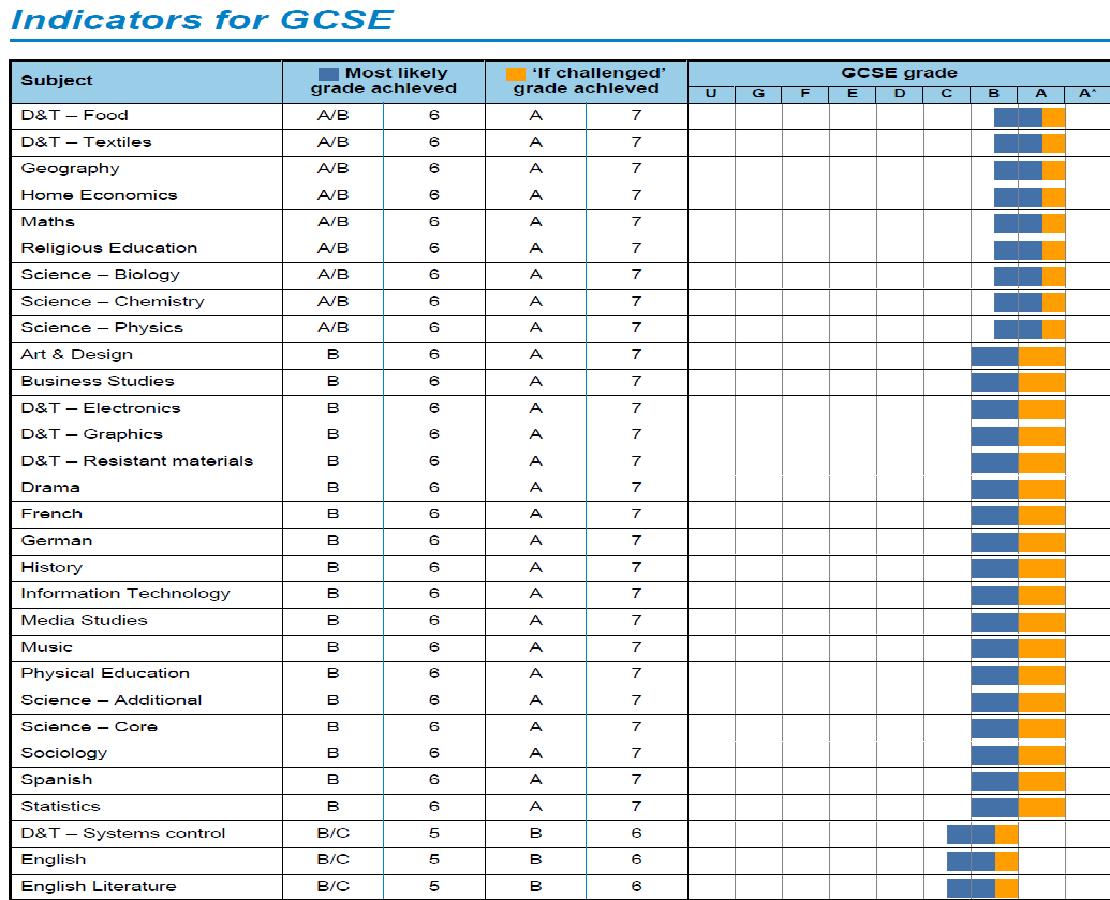
• Using historical data, you have also been given a guide to what outcome is likely for each student for a variety of subjects at GCSE.
• Look at the second page of the report.
• This outlines each pupil's profile for each test.
• It suggests where their strongest area is and suggests how they might learn – this is useful when developing revision techniques for GCSE preparation.
Below average (left of yellow zone) Average (in yellow zone)
Above average (right of yellow zone)
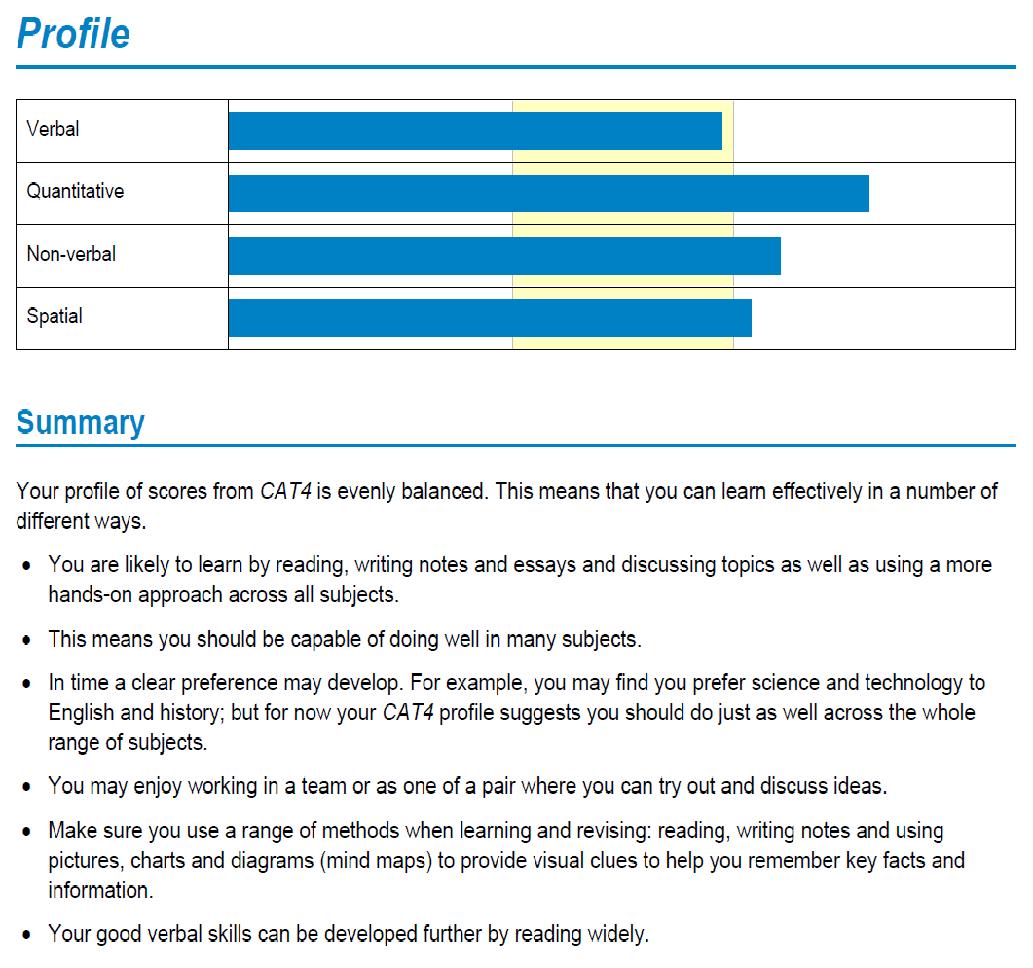
• Verbal reasoning – this is needed in subjects like English, History, Languages or any subject where you need to read and write carefully.
• Quantitative reasoning – this is needed in subjects like Maths, Science, Geography, DT and any subjects where you need to use formulae, diagrams and graphs.
• Non-Verbal reasoning – this measures the student’s general problem solving skills to solve problems in unfamiliar situations.
• Spatial awareness – comes naturally to most students. It is the ability to mentally manipulate images and perceive patterns between them.
• The fourth page shows the likely outcomes at the end of GCSE in selected subjects for a student.
• These subjects are supplied by the testing company NFER National Foundation for Educational Research (some of the subjects we do not offer).
• The indicators give a statistical prediction, not a prophecy of the student’s actual results.
• The student’s outcomes will also be determined by the student’s motivation and effort.
www.gl-assessment.co.uk
PLEASE REMEMBER THAT
1.The indicators give a statistical prediction, using historic data.
1.Subject teachers will set a Y11 target grade for each student based on previous performance and knowledge of the student.
1.The student’s motivation and effort play a HUGE part in the final exam outcomes.
On the website you will find:
⮚Frequently asked questions
⮚Copies of the options pathways
⮚GCSE Options booklet 2026-28
⮚Year 9 Options timeline
⮚This evenings powerpoint!
• Talk to subject teachers at parents evening.
• Talk to form tutors
• Speak to Miss Searle (Head of Year)
• Talk/Email to Mr Biggs about any timetable-related issues, or if you need any further support with options.
• Careers program to support students https://www.cryptschool.org/personaldevelopment/careers-advice-information-guidance
• Look out for articles about careers in the Heads weekly letter
• students can book appointments to see the careers advisor or ask their form tutor to do this for them.
• Mrs H Michaluk- Careers Advisor –hmichaluk@crypt.gloucs.sch.uk
• Mr C Germaine – Careers Leader –cgermaine@crypt.gloucs.sch.uk

Read options information booklet
Read the ‘frequently asked questions’ (on website)
Watch the careers recording by Mr Germaine (on website)
Checked what GCSEs are needed for A levels/ apprenticeships of interest
Linked subjects to career ideas
Match strengths/interests to option subjects of interest.
Research new subjects
Returned options form by the deadline
Please stay behind if you have any questions