recap:Season THE
BY LIAM SHARP | Sports Editor
Men’s basketball CONCORDIA LOST THE RSEQ

The Stingers men’s team finished second in the regu lar season with a 6-6 record. Concordia showed glimpses of a team that could run away with the RSEQ champion ship at times, but struggled to put everything together for extended stretches, particu larly on offense. Defensively,
the Stingers were suffocating by staying active on ball handlers, poking balls loose and forcing turnovers. They led the RSEQ in scoring defence, holding their opposition to 63 points-pergame on 38 per cent shooting.
Rastko Popovic, the Stingers’
BILLHARDSHIPSEXPERIENCINGSTUDENTSAFTER21
A joint study from Concordia and McGill highlight that religiously expressive minority a of Quebec the enactment of Bill 21
head coach, always emphasized the importance of defence. In basketball, he explained how offense can occasionally be hard to come by, even if a team is producing open looks at the basket. Players can only opti mize their chances of making
BY GABRIEL GUINDI News Editor
Teachers like Bouchera Chelbi, a Muslim woman who chooses to wear the hijab, have noticed changes in Quebec since the enactment of Bill 21. Grandfathered in after the legalization of the bill, Chelbi now has no chance to move up in her career as she is unable to be promoted due to Bill 21. Enacted in 2019, the bill prohibits the wearing of reli gious garments and symbols for workers in the public sector in government-run institutions like courthouses or schools.
“It changed a lot about my future plans, I can longer dream about having a higher position, I cannot change school boards. It changes a lot for me,” Chelbi explained.
As a member of the Coalition Inclusion Quebec and some one who is heavily involved in challenging the law, Chelbi feels that it has impacted her on both a career and personal level. Though leaving has crossed her mind, the priorities of being a wife and a mother have
a basket. Conversely, defence essentially boils down to effort and basketball IQ, elements of the sport that are much easier to control. Concordia instilled their coach’s philoso phy on most nights, but strug gled with mental lapses that
made her stay in the province.
“It makes me feel like I don’t fit anymore in the commu nity. Before the bill, I used to feel like I was free as any other woman in Quebec but after, it felt like suddenly I was a second-class citizen.”
A study conducted by researchers from Concor dia and McGill has uncovered harsh realities for the next generation of students, partic ularly minorities, entering the workforce, many of whom will likely be affected by Bill 21’s legislation. Students who wore religious symbols were at a higher risk of experienc ing discriminatory treatment as well as job prospect uncer tainty, prompting many of those surveyed to admit intend ing to seek work out of prov ince once their diplomas are obtained. Those surveyed felt that Bill 21 had affected their future career decision, espe cially due to experiencing an uptick in discrimination since the passing of the legislation.
Meir Edery, a third-year law student at Université de Montreal who wears a kippah,
would cost them down the stretch in important games.
In a year filled with uncer tainty, Olivier Simon was Concordia’s most consistent player once again. The fifthyear veteran earned first all-star team honours, finishing second
felt that Bill 21 has affected him, like many others who wear religious garb. “The law felt like a personal attack. Truth fully, it felt like something that the government was putting forward to show the population that these people are not wanted and valued as a part of society.”
Kimberley Manning, an associate professor in polit ical science at Concordia and one of the authors who helped conduct the study, was interested in researching the effects of students studying in sectors affected by Bill 21.
The majority of the 629 participants surveyed high lighted worsened percep tion of Quebec since the bill’s legislation, creating more divisiveness rather than its intended unification. “Our findings are suggesting a rise in discrimination. People who wear religious symbols are reporting that they’ve experienced more discrim ination since the passage of the law,” said Manning.
The law’s notion was intended
GRAPHIC BY LILY
McGill guard Jamal Mayali’s(10) drive to the basket is contested by Concordia rookie guard Alec Phaneu(4) in the RSEQ Finals on saturday PHOTO BY KYRAN THICKE
COMMENTARY FEATURES MUSIC SPORTS pg. 15pg. 13pg. 11 ARTS Liking rival teams can be a healthy way to enjoy sports Concert ClubperformanceMayhemReview:atSodaWhy do we dream?Inuit students fight for educationpost-secondary pg. 7pg. 6 Goodbye to my first apartment The Concordian TUESDAY MARCH 29, 2022VOLUME 39, ISSUE 23 CONCORDIA UNIVERSITY’S INDEPENDENT STUDENT NEWSPAPER SINCE 1973
IN
FINAL VS. MCGILL ON SATURDAY. THE FINAL SCORE WAS 48-46.
MINORITY
students have faced career uncertainty, discrimination, and
worsened perception
since
BATTLESTINGERSTO
BITTER END
In a professionalsuncertaintyhandledbasketballbothshortenedCOVID-year,Stingersteamsthelike Continued on page 2
COWPER
NewsTheConcordian
A Ukrainian family reunion in Montreal
The first of eight familiesUkrainianfunded and supported by Ukrainian Montrealers arrives in Canada, following invasionRussia’s of Ukraine
BY EVAN LINDSAY | News Editor
For the past month, Iana Shapovalova and her family have been raising money to bring eight families, a total of 37 people, to Canada from Ukraine. The first of these families arrived in Montreal on Friday, March 25.

The Shapovalovs are originally from Ukraine and the eight families they are trying to rescue are mostly their relatives.
Iana Shapovalova arrived in Canada in 2013 at 11 years old and until recently was living a normal life; a 19-year-old in her third year of CEGEP, under taking an internship in computer programming. But, following the news
that Russia had invaded Ukraine on February 23, Shapovalova and her family began doing everything they could to bring their relatives to safety.
“I cannot cry or anything, I gotta like, move, I gotta do stuff. Like, this is my way of fighting, to give them a hope, to give them the ideas of ‘Okay. We’ll make sure that you are okay,’” said Shapovalova.
Shapovalova and her family started posting on social media, working tirelessly and doing everything they could to bring their relatives to safety.
The GoFundMe page they started has raised $16,837 as of March 28. Initially, all of the funds were to
go to flights and visa applications, but the Canadian government has since made visa applications free for Ukrainian refugees. The first fami ly’s visa application process cost $855 CAD. Initially, the idea to raise money was difficult for her family.
“My family’s the kind of family that, you know, we’re gonna figure it out on our own. Like, we don’t really want to be like those poor guys that need help, you know. But at this point, you got to put yourself down because, you know, it’s for someone else. It’s for families,” said Shapovalova.
The thearrivingfamilyShapovalovaafteratairportin on page 4
to secularize the province, providing neutrality in govern ment institutions. Manning, however, has noticed from the study’s findings that it’s affect ing a higher concentration of people who are within the same communities but do not express themselves religiously.
“This goes way beyond the indi viduals wearing religious symbols. [It] is clear that people who do not wear religious symbols are expe riencing discrimination in the wake of the passage of this law,” she explained. Manning high lighted the bill’s lack of transpar ency has resulted in confusion among Quebecers attribut ing to a rise in discrimination among community members.
“There is a great deal of confu sion about this law, I think that our research findings and research findings from another study that was done by a professor out of UQAM are suggesting that among the general population there is confusion about what this means.”
This confusion has created a bypass for many people to single
out minorities, regardless of whether or not the Law applies to those accused. One respon dent reported a teacher telling an 11-year-old that she could not wear her Hijab due to the law, something which is patently false.
The results showed 51.8 per cent of those surveyed said that they are extremely likely to look for work out of Quebec as a result of Bill 21, while 77.9 per cent of respondents were considering leaving the prov ince for employment options else where. “I’ve decided to take the Ontario bar exam because I will likely go work in Ontario, where I feel more welcomed as a reli gious minority,” said an unnamed female law student at McGill.
As someone who will soon enter the job market for the first time in his life, Edery has to consider his future, as the bill prevents him from taking certain oppor tunities. “When I was looking at my career options, I knew that I was limited and it’s the first time I’ve ever been limited because of the expression of my reli
gion and that stung, because in the 21st century that shouldn’t be happening to anybody.”
Chelbi referring to feeling like a second-class citizen is a shared sentiment according to Manning’s study. Though a minority of people surveyed were in favour of the bill due to having once faced religious extremism from their native country, 70 per cent of respondents have developed a worsened perception of Quebec.
“That’s really significant, again this is a motivated group who responded to the survey but when you triangulate our results with the results from the recent polling that’s not insignificant. I think it’s really important that our policymakers pay attention to it and consider the negative impact this is having on people’s lives.” Teachers like Chelbi will continue to challenge the government in regards to the law for future generations of students hoping that they can work in a Quebec that favours religious expression.
MALE
“The
SINCE THE PASS -ING OF BILL 21, students who wear religous symbols... Said YES Said NO who’ve changed careers
Are more concerned about job prospects
Are looking for work outside of Quebec
Total respondents who wish to leave Quebec
“People have pointed out to me that wearing the hijab is ‘illegal.’” STUDENT, EDUCATION (MA) MCGILL, WEARS A HIJAB
“I was planning to complete my education in law school or teaching in the University but I changed my plan because I have no future in Quebec in these fields [... My family has] a sense of belonging to Quebec. I lived most of my life in Montreal and my husband was raised in Montreal, so it is hard to leave a city we love and have lived most of our lives in.” FEMALE STUDENT IN LAW AND SOCIETY PROGRAM, CONCORDIA, WEARS A HIJAB
“Many veiled women I know have not pursued what they really love to do and now they are in programs where they are not satisfied because of this law."
FEMALE STUDENT IN BUSINESS, AHUNTSIC CEGEP
“I’m basically banned from teaching because of something I wear [...] I will never compromise for the sake of a job.”
FEMALE STUDENT IN EDUCATION, MCGILL, WEARS A HIJAB
"How do you want me to change my career choice when I have invested my money and 7 years of my life in one field? [...] The only solution that I strongly consider is to change province to be able to teach and eventually work in the field of educational administration."
FEMALE GRADUATE STUDENT IN EDUCATION, MCGILL, WEARS A HIJAB [TRANSLATED FROM FRENCH]
"I
PHOTO COURTESTY OF IANA SHAPOVALOVA
TUESDAY MARCH 29, 20222
MINORITY AFTEREXPERIENCINGSTUDENTSHARDSHIPSBILL21 Continued from cover
Of
Faced increased discrimination Have changed career choice Know others
FEMALE
don't want to be seen as a burden. We want to do the job that interests us and not convert our colleagues or those around us.” FEMALE STUDENT TAKING LAW ORIENTED COURSES, CEGEP ST. LAURENT, WEARS A HIJAB "[...] in many cases it is students like myself who are not personally impacted but who will refuse to teach in Quebec in solidarity." FEMALE STUDENT IN EDUCATION, MCGILL “I’m north african with tanned skin tone, I’m irreligious and I’m afraid that Bill 21 would be amalgamed with ethnicity or”race.""
STUDENT IN LAW, UNIVERSITÉ DE MONTRÉAL
Quebec government is appalling. This law is sickening. I will never ever work in Quebec because of it.” FEMALE STUDENT IN EDUCATION, MCGILL 56.5% 26% 70.6%56.5% 69.5% 41.9%76.2% ... Over half of all respondents said they no longer wished to practice law or teach in Quebec.51.8%81% of all respondants *Out of 629 students surveyed, 177 reported they wore a religious symbol RESPONDANTS WHO WEAR HIJAB WEARS HIJABRESPONDANTS WHO WEAR HIJAB SOURCE: STUDY BY ELIZABETH ELBOURNE (MCGILL), KIMBERLEY ENS MANNING (CONCORDIA), ZACKARY KIFELL (MCGILL)
Continued
Maple Spring: Quebec student strike marks 10 years
BY HANNAH TIONGSON Assistant News Editor
darity. Benoît Lacoursière, a member of the FNEEQ, was one of the many teachers pres ent at the 2012 strike and was back to show his support.
“For us, it is a fundamen tal value to access educa tion, and solidarity is a fundamental value,” said Lacoursière. “It is import ant to continue to main tain this current struggle.”
The main message of the recent protest was to give students a voice and hope for their future educa tion. Speakers also called attention to unpaid intern ships and demanded free education at all levels.
change and to organize as students to kind of force that change upon insti tutions, rather than just as individu als trying to approach an institution with issues,” said Luna, a participant.
Though the occupation was a joint effort among students, a source clari fied both Arts and Science Federation of Associations (ASFA) and Concor dia Student Union (CSU) helped fund and provide food for the protest.
The group camped for three days and held general assemblies every night at 7 p.m. to discuss their demands about free education.
“We were trying to keep it under wraps. [...] It was mostly affin ity-based,” said Errico, one of the group’s security liaisons.
On Tuesday, March 22, hundreds of students gathered around Place du Canada to strike and mark the tenth anniversary of the 2012 Quebec strike against the provincial government and its increase in tuition fees. The demon stration was organized and led by several student associations across Quebec. While others were marching and blocking the streets of Montreal, dozens of Concordia students set up tents on the second floor of the Hall building to show their support.
At the march, Ludmila Hérault, a 17-year-old student and spokesperson for Collège de Bois de Boulogne, addressed her speech to the government of Quebec.


“Dear government, aren’t you supposed to encourage a world in which every individual would have the same rights?” Hérault asked. “A world in which education is not about money, or a world in which each person is given the same opportunities in order to build the future they wish?” Hérault added.
According to Gratuité Scolaire, 85,000 students from 50 student associations in Quebec planned to go on strike that Tuesday.
Among the different students asso ciations across Quebec demanding reduced fees was l’As sociation étudiante du Cégep de Sherbrooke (AÉCS) who travelled close to two hours to attend the protest.
“We came today [with] two buses from CEGEP Sherbrooke because we think that education is a right and not a privi lege,” said Hugo Forget, a member of the AÉCS.
Since 2006, annual tuition for under
graduate students in Quebec has increased by $111 every year. Today, tuition for an undergraduate student reaches $4,310, compared to $2,506 in 2006. The Quebec government recently announced a 5.4 per cent increase in spending on education.
Many demonstrators marched wear ing a red square of fabric to symbolize support for the 2012 student strike. The symbol has been used histori cally to represent students opposed to tuition increases and their supporters.
On March 18, 2011, the Quebec government, led by Jean Charest and the Quebec Liberal Party, announced a budget that hiked university tuition fees in what would amount to a 75 per cent increase from $2,168 to $3,793.
The decision to increase tuition fees sparked the longest student strike in history. From February 13, 2011, to September 7, 2012, student associ ations went on strike for an indefi nite period before Bill 78 was passed, which forced students to go back to class and limited their right to protest.
At the strike on Tuesday, the Fédéra tion nationale des enseigantes et ensei gnants du Québec (FNEEQ) walked alongside student associations in soli

“We are on their side not only in class, but outside in their demands, and then it is their turn to speak,” said Martine Huot, a professor at Cégep du Vieux Montréal.
Following Concordia’s School of Community and Public Affairs Students’ Association (SCPASA) assembly on March 16, many members of the SCPASA joined the free education strike.
“Today is about showing the students are capable of mobilizing and creating momentum for future movements,” said Joshua Sallos, a member of the SCPASA.
At Concordia University, the students who set up tents on the second floor of the Hall building to occupy the space requested to be referred to by their first names to demonstrate a group effort.


“We’ve been a group of non-hierarchi cal students who are looking to democ ratize education, to exercise our power and our right as students to demand
On Tuesday night, students shared their demands, writing them on a white board. A few requests included free education, commitment to divest, more voices in student government, disability justice, non-corporate education, better engagement from faculty, and more.
On Wednesday morning, Andrew Woodall, dean of students, was on-site to speak to the occupiers.
“My role is to develop relationships with the students, understand what they are doing and make sure that they have someone to whom they can reach out if there are any problems or concerns about logistics or anything else,” said Woodall.
The occupation ended on Friday following a teach-in rally where Indigenous leaders and activ ists spoke about the climate crisis at the Sir George-Étienne Cartier Monument in Mount Royal Park.
Students and teachers protest against tuition hikes and demand free education at all levels
Concordia students occupy the Hall building
Ludmila Hérault, a 17-year-old student and spokesperson for Collège de Bois de Boulogne
PROTEST The Concordian TUESDAY MARCH 29, 2022 3News
The class of life: Concordia’s new Kanye West course
 BY EVAN LINDSAY | News Editor CONCORDIA
Concordia has never had a short age of unconventional classes: Video Games and/as Literature, Science Fiction, The Movie Soundtrack, and Sexual Representation in Cinema are all examples of unique courses avail able to Concordia students that aim to put an academic lens to the world of art and pop culture. Concordia is hardly the first or only university to host classes such as these — the University of Victo ria at one point offered The Science of Batman and The Created Medieval History of J.R.R. Tolkien’s Middleearth — but one of Concordia’s newest courses may truly be the first of its kind.
Kanye vs. Ye: Genius by Design will be offered at Concordia in the fall of 2022, in the faculty of interdisciplinary stud ies in fine arts. The course was designed and will likely be taught by Yassin “Narcy’’ Alsalman, a rapper himself, who has long taught courses centered around hip hop at Concordia such as Hip Hop: Beats, Rhymes and Life.
This is not the first time that Alsalman has centered a course around one particular artist, having taught classes on Lauryn Hill and A Tribe Called Quest in the past.
“I’ve always taught my hip hop courses using artists or albums as a central theme and seeing how much influence Ye had on so many of my students throughout the years — I felt
this could be a compelling, interesting examination of one of the greatest artists of our generation,” said Alsalman.
Classes like this are Aslaman’s way of giving back to a culture that shaped who he is today.
“Hip hop is the most important culture of our generation. It requires to be studied and understood and respected. This is my way of giving back to a culture that birthed my entire way of being and sustenance,” said Alsaman.
The course will centre around much grander themes than just West’s own music and personal online hijinks.
“America and race, industry vs. artists, truth and consequence, media represen tation of the intellectual,” said Alsalman when asked about the course’s themes.
With a figure as controversial as West, the course is likely to elicit a multitude of reactions. This is some thing that Dr. Eldad Tsabary, the coordinator for Concordia’s electro acoustics department and unit head for the faculty of Interdisciplinary Studies in Fine Arts, is well aware of.
“As an academic course, I’m sure it’s going to be difficult sometimes and I’m sure it’s going to be emotional some times. But I think that’s also part of what Fine Arts is good at. You know, I like to study science. Arts is a really good vessel for exploring and study ing topics that do have a multi-lay
A UKRAINIAN FAMILY REUNION IN MONTREAL
Continued from page 2
A month of fundraising, numerous visa applications, phone calls, inter views and the direct help of a member of parliament (whose identity was not shared), culminated on a rainy Friday on March 25, when the first of eight fami lies funded by the Shapovalovs arrived.
Iana and her brother Illia arrived at the airport at 4 p.m. to meet their family. After the family of seven (includ ing two parents and their five chil dren) landed, they spent another six hours in the airport completing COVID protocols and immigration processes. There was only one other family from Ukraine coming in alongside them.
“They’re pretty much the first ones going through this process,” said Shapovalova.
Iana and Illia patiently waited at the airport the entire time, while their parents waited in the cars to bring them to their arriv ing relatives to their new home.
Iana’s father took on the role of keeping in touch with family in Ukraine whenever possible.
“Every call was just so important,” said Shapovalova. “Every call, I would just run downstairs just to listen to the conversation, because you never know if you’re gonna hear them another time.”
Hanna Pliushchakova is Iana Shapovalovas aunt and the mother of the first family to arrive. She spoke with The Concordian in an interview which Iana translated. “We never expected to be leaving this way,” Pliushchakova said. “We left when we saw that the danger was unavoidable.”
Pliushchakova said the trip was long and tiring but now that they are home and rested it is getting easier. The days leading up to their jour ney were naturally stressful as well.
“We were very worried not only because of this trip coming up, but also we couldn’t get in contact with some family members that are in Ukraine,” said Pliushchakova.
“There’s this part of worries and
ered kind of nature to them,” said Tsabary, who played a role in approv ing the course to be taught at Concordia.
West is both loved and loathed by many, but Tsabary and Alsal man have both made it clear that this course is not about sing ing his praises, or tabloid drama.
“You can study any topic of interest from the point of view of curiosity and discussion, right? And there’s a lot to discuss. You know, it’s not about putting Kanye on a pedestal,” said Tsabary.
While he is a fan of West’s work, Alsalman is also aware of his prob lematic nature. However, he has said it is not something that worries him when teaching this course.
“I don’t listen to the noise. As a cultural practitioner and professor, I have to look at things in totality and not do the internet skip rope around narra tive. I am also well aware of American media manipulation. That being said, there has always been problematic public moments with Ye and we will talk about those in a critical lens, as opposed to taking sides or blaming. I want to see why, not what,” said Alsalman.
“There is a lot of work that needs to be done around hip hop culture and representation of Black and Brown communities in our schools and I want to chip away at that at Concor dia and help build the presence
there are the anxious thoughts of ‘How is this going to go? What is this whole process going to be like, going somewhere?’ We have no idea.”
Coming from Mariupol, Ukraine the family had a normal life. Pliush chakova mostly stayed home with her children while her husband worked managing a chain of retail stores. Now they do not expect to ever be able to return to Ukraine.
“It’s a double feeling, one point of view is that everything there is destroyed and there is no way back because there’s nowhere to go,” said Pliushchakova.
“The second side of this was that we’re very, very glad that we can start from scratch here in Canada in a safe place.”
While many here in Canada are calling on their government to do more, Pliushchakova finds it diffi cult to ask for more support.
“It’s hard to tell because there’s this whole overwhelming feeling of getting this help already. The way that Canada is so open to Ukrainian refugees. It’s very, very touching for us and we’re very, very thankful.”
The Pliushchakov family will quar antine with a couple who has offered
more and more through my work.”
Ava Weinstein-Wright is a third-year student at Concordia in Honours Sociol ogy and Anthropology, who is signed up and is excited to take the course this fall.
“I think that music or TV shows or just even clothing and fashion can be a great gateway into further analysis such as political analysis, gender analysis, class analysis, like it’s really important.”
Even though she is excited to take the course, Weinstein-Wright has some concerns about it.
“My concern with this course is that people aren’t going to take it seriously considering the height and clout that it’s gotten consid ering it’s reached national news.”
The university has received a lot of media attention with magazines like Complex talking about the course – something that its future profes sor predicted, although not this early. “I thought this would happen while I was teaching but this was a pleasant boost and surprise,” said Alsalman.
When asked why students should take this course, Alsalman had one simple response, in a writ ten statement to The Concordian
“Because it’s the class of life (Kanye voice).”
the basement of their house. Eventu ally they will rent their own apartment, begin learning French and English and put their five kids into school.
On the day of the first family’s arrival and seeing her own family’s work come to fruition, Iana said she is speechless.
“I remember just going to bed and being like, if they can make it, to hear all of them. Like at least like three fami lies. That would be like a miracle. I’m definitely just, you know, speechless. It’s really hard to put it in words, I’m really happy for them,” said Shapovalova.
“But at the end now, you know, just seeing this generosity from people here. It’s such a big contrast to what is happening there. Basically, they’re just sponsoring my family and wonderful.”it’s
Hanna Pliushchakova’s family is the first of eight that the Shapovalovs hope to bring to Canada, with the second family arriving on March 28. Support ers can donate and follow the fami lies journies at their GoFundMe page.
The university is offering a first-ofits-kind course examining the life and work of Kanye West
GRAPHIC BY LILY COWPER
The Concordian TUESDAY MARCH 29, 20224 News
CommentaryTheConcordian
Sick of the Ick?
TALIA KLIOT ASSISTANT COMMENTARY EDITOR
You’re scrolling through your “For You” page when you come across a video of a woman imitating a man putting on lip balm. She purses her lips into a quasi duck-face and squints in concentration. Then, he applies the balm in sharp, equal circles, pinching the applicator with all his fingers with a fervor that seems like it could shatter the plastic.

Does this image revolt you? You might have a lip-balm-applying ick.

Though no one can pinpoint where exactly the term ‘ick’ originated, like most people, I first heard it mentioned in a TikTok. Shortly after I first came across it, the word ick became a common presence in group chats and conversations where roman tic prospects were being discussed.
Urban Dictio nary defines an ick as “some thing someone does that is an instant turn-off for you, making you instantly hate the idea of being with ingmyencapsulateswhichromantically,”themperfectlyunderstandoftheword.
Icks aren’t the same as red flags — they are trivial things that really shouldn’t affect one’s percep tion of a romantic partner, but end up having an overpowering effect.
For that reason, icks would be a fantastic topic for a research essay!
But for the sake of this article, I’m going to take a sillier route, and propose a deeper dive into the most ridiculous icks that I could find.

Using a question sticker on Insta gram (my favourite and most reli able way of gathering balanced and unbiased information, of course), I asked about the most insane icks that irk my followers or people they know. The results did not disappoint.
With this data, I’ve compiled a list of the top four most ridiculous icks, along with colourful commentary on the valid ity and/or absurdity of the ick produced by these inconsequential actions.
Country Roads Won’t Take Her Home
It’s 2 a.m. and the bar is clearing out. Your crush is sitting with abysmal posture when “Take Me Home, Coun try Roads” by John Denver starts play ing. They immediately shoot up and
nalist?” I asked myself a few weeks ago, on the train back home after being out working for 12 hours.
I kept holding back my tears for the entire hour-long train ride. I was exhausted, but refused to be upset about it.
That Saturday was the most emotion ally and physically challenging day. I woke up at 7 a.m., attended a meeting online for another job, went to a café to work on an article, attended a protest, then headed to the library to write another article on the demonstration.
“You love your work and everything you’re doing. You shouldn’t complain,” I kept whispering to myself as I sat on the train with my eyes half-closed.
begin slurring along with a soft south ern drawl. It’s haunting and glass-shat tering. In my books, this ick is absolutely valid — no one wants to be taken home after that display (though perhaps I’d consider it if Denver’s ballad was swapped with a Taylor Swift banger… is that just me?). I also love that this one has a story behind it; this ick would literally never cross anyone’s mind unless it happened to them.
Jacket Challenges
Do you know when you’re trying to put on your jacket and you’ve already got one arm in the sleeve, but you just can’t get the other to go in? There’s this ridiculous flailing and shimmying that occurs which instantaneously dimin ishes sex appeal faster than JMSB bros who teach you about crypto. While this paints a hilarious image, this ick just completely obliterates the Montreal dating pool. We all need to wear jack ets, and unfortunately, we can’t always dawn them oh-so gracefully.
Grammar-Gate
You can tell that a journalist submit ted this one. To them, there’s nothing less attractive than using the wrong “their,” and they’ll probably cut you off after one too many misplaced commas. I kind of get it — I love a prop erly positioned semi-colon as much as the next J-school gal, but I also want to stress the difference between gram mar mistakes because of not knowing or caring (ew, gross), and grammar mistakes because of a learning disability or having to write in language that’s not your mother tongue (completely under standable and DEFINITELY not an ick).
The Ping-Pong Run
There’s something intrinsically humil iating about chasing after a ping-pong
I’ve become chained to my work.
The religion of work ism has taken over my life.
“Workism” was defined by Derek Thompson a few years ago in The Atlan tic as, “the belief that work is not only necessary to economic production, but also the centerpiece of one’s identity and life’s purpose; and the belief that any policy to promote human welfare must always encourage more work.”


ball that has fallen off the table. You feel like a puppy play ing insteadexceptfetch,of
being flipping adorable, you’re lumber ing, clumsy, and are meekly crawling under a radiator to grasp a tiny white orb. It’s not a cute look. It’s also pretty universal — does anyone look good chasing after a ping-pong ball? But still, nothing screams sexy about that ordeal. The only solution: don’t play ping-pong in front of your crush, unless you plan on never dropping the ball.
In short, while some icks are simply hilarious, others pinpoint things that are just gross (see: crusty pasta sauce remnants around the corner of one’s lips). Yes, icks are often superficial and silly, but they add a sense of valid ity to a lack of romantic attraction that helps people to better understand their preferences. But perhaps the biggest ick of all is trying to over-an alyze them, so I’ll just quit while I’m ahead, and let them exist to entertain.
BY HANNAH TIONGSON Assistant News Editor
Last spring, I wrote an article about the hustle culture affecting my mental health and leading to burnout. A year later, I still struggle to find a healthy balance between work and my personal life.
My problem last year was that I felt a social pressure to overwork myself. I kept comparing myself with other people’s achievements and felt insecure about my work in journalism. At that time, I was even questioning my career choice.
Today, I have a similar problem — but now the pressure is coming from within. Though I finally love what I’m doing and take pleasure in writing arti cles, I’ve let my work define me and have left no space for other hobbies.
“Who am I apart from being a jour
This has been my routine and mantra for the past month.
Since February, I’ve been work ing three jobs. I work my nine-to-five internship during the week, then spend my weekends writing for The Concor dian and supervising Concordia’s Arts and Science Federation of Associa tions (ASFA) winter 2022 elections. My mind is constantly occupied with work.
This may sound exhausting to some, but I love it. I absolutely adore what I’m doing because it makes me feel so fulfilled. I get an adrenaline rush attending protests and know ing that the articles I write matter.
I feel as if I have a purpose. Though only one of the three jobs pays me well, I decided to take on as many jobs to fill my CV and feel accom plished. Yet, I can’t help but think
Working three remote jobs made it easier for me to let work define my worth and who I am. With my phone glued to my hand, it’s been challeng ing to disassociate myself from work. If I’m not working for my internship, I’m constantly looking for story ideas or responding to emails.
I no longer have time for leisure activ ities like reading, journaling, running… I tried squeezing in a day to ski every Sunday during the winter months. Even then, on the slopes, I was work ing! I kept check ing my phone and worked on the chair lift between the runs.
On top of that, the few times I go out and socialize with my friends, I find myself checking my phone.
A few weeks ago,
I was trying to get to know some one at a social event, and my phone kept buzzing. Work messages buzzed in my pockets every few minutes as I profusely apologized for the rudeness.
The worst thing was I didn’t even feel that bad because at that moment, if I’m being honest, I would have rather checked my phone than continued the conversation. I couldn’t enjoy my night until I was sure the work was done and settled.
I have yet to set boundaries to keep a healthy balance between work and my personal life but I can say that I’ve acknowledged that if I don’t change my work-life, I will have another burnout.
GRAPHICS BY MADELINE SCHMIDT
5TUESDAY MARCH 29, 2022
A deep dive into the most ridiculous icks
religionmyWorkism:new PERSONAL ESSAY How do you sepa rate your identity from your work when you’ve become a workaholic?
OPINION
GRAPHIC BY ZEZE
An ode to my first apartment
STORY AND PHOTOS BY ASHLEY FISH-ROBERTSON Arts Editor
When I think back to my first love, an image of a person doesn’t come to mind, but rather, a place: my first apartment.
It was a charming five-and-a-half located across from Rosemont’s Maisonneuve Park, and featured abundant natural light, worn-in hard wood floors, and an alley cat who regularly frequented the balcony. It also came with the lingering smell of cigarettes from previous occupants.
right down the hall, just a knock away.
Some of my best memories took place here, from cooking spaghetti together, to lounging on the balcony while listening to The Doors, to night strolls through Maisonneuve Park. Outside of this apartment, we all felt like misfits. And so, in this place, we resembled some sort of odd family, one that wasn’t bound by blood but instead by a shared space.
As anyone would probably tell you about their first place, it certainly wasn’t perfect; the ceiling in the bath room was gradually caving in, the kitchen sink had a tendency to clog, and the walls were thin enough to hear the neighbours argue over what to have for dinner. Still, despite all its flaws, I was 19 and was about to live with my two best friends. Life was golden.
Before moving into my dream apartment, I had left the province I grew up in for New Brunswick. It was during spring break of 2018 that I realized I wanted to move back home
to Quebec. I was residing in Freder icton, studying at the University of New Brunswick. Having spent most of my childhood living in a small village in the Argenteuil region of Quebec, I wanted to escape to somewhere new the second I finished my senior year of high school. As fun as it was to move to a city where I knew nobody, I began to miss the familiarity of home.
When I flew home to Quebec for spring break, my friends and I spent the night bar hopping in downtown Montreal. On the taxi ride back to our Airbnb, I remem ber being so mesmerized by the skyline, with its abundance of highrise condos and towering office buildings. Even at 3 a.m., the city was lively and teeming with pedestrians. It was exactly the kind of place where I could see myself living.
Back in Fredericton, I was used to most nights out ending around midnight. Everything moved so much slower on the East coast, something that I had enjoyed at first, but was beginning to grow tired of. When I returned back to Fredericton after spring break, I decided to finish my freshman year and move to Montreal as soon as I wrote my last exam.
When I moved back to Quebec, the apartment hunt began (and my god, was it excruciating). After countless visits, my roommates and I were running low on patience. It was on a humid evening in June that we finally found a place.
To call it a pigsty would be an under statement; the entrance closet, instead of housing shoes and coats, contained a
dard fictional narrative. Each episode has an overarching problem, a build-up, a climax, and a resolution.
The people that are portrayed fit into character roles that have been around since the begin ning of storytelling: protagonists, antagonists, love interests, etc.
I began to question how much of the stories are fabricated.
Each show is clearly packaged in a way that makes them easy to watch, through the use of common story tropes and themes that the viewer can recognize.
massive pyramid fashioned from empty beer cans. In the kitchen, the current tenants were gathered around a small table, smoking cigarettes and play ing cards, with empty Domino’s boxes scattered haphazardly on the floor.
We left feeling confused. Sure, the place was atrocious, we agreed, but did you see those windows? And those hard wood floors? And the double sinks? I’d watched enough house flipping shows to know what a good cleaning job could do, and so we figured that a make over would render the place liveable. It took many hours, but we succeeded.
In the months that followed, we all began to settle into our new indepen dent lives. We bought our own groceries (and quickly real ized how much it would cost to feed ourselves), we argued over whose turn it was to wash the dishes, and we learned to balance part-time jobs and school. It was simultaneously liberating and exhausting. I’m almost certain none of us knew at the time that 2018 would be the best year of our lives.
Our apartment became our one true safe haven, a place where we could escape to when faced with heartbreak, treach erous Canadian snowstorms, or just a bad day at work. Even when we were in our own rooms, we were comforted by the fact that company was

as a parody of the original. But it’s not, and it checks all the required boxes of a reality show, and has a solid viewership.
Nothing prepared me for the day I bid farewell to my first place. It was an immensely bittersweet expe rience. I often find myself thinking of my last moments in that apartment. I remember handing over our keys to the landlord and stealing one last glimpse of the empty living room before closing the door behind me. I made sure to sear that image in my mind because, frankly, I was — and still am — terrified of forgetting all the memories that took place there.
On days when I’m not pressed for time, I’ll walk past the apartment build ing. The curtains are still drawn wide open just as they had been when we lived there, affording prying eyes a glimpse into the modest but welcoming kitchen.


If I focus hard enough, I can picture my roommates and I still sitting around the table, each of us discussing our day with one another over plates of spaghetti.
Instead of focusing on the good byes, this is how I choose to remem ber my first year on my own: in the company of two of my favourite people.
TARYN MARTIN | Contributor
Reality TV is a defining facet of our era. Its emergence coincided with the beginning of television itself, and since has branched out into an innumerable amount of subgenres.
From game shows to survival shows, competition shows, dating shows, and many different varia tions on some sort of American family drama, each gives us a glimpse into the lives of different people. But how real are these perceived “glimpses?”
Not only are many popular real ity shows scripted, directed, and heavily edited, these shows are care fully constructed to mimic a stan
This is fair enough, since most of us enjoy consuming media that does not require much critical thought or dras tic change to our emotions. We watch it simply because it’s comforting.
Although we can accept that reality TV is a large part of our culture and used as a source of comfort for many people, it is important to acknowledge that reality TV is not a true representation of our reality.
Take reality TV show “Floribama Shore,” for example. A spin off of MTV’s classic “Jersey Shore,” the show features eight adults who live together in a house on the Gulf Coast. I’ve only watched the show in passing, but every thing about it is ironically bad (espe cially the name), so much so that it reads
Cast members Jeremiah Buoni and Gus Smyrnios play the roles of protag onist and antagonist respectively, with their rivalry extending through all four seasons. Smyrnios plays the black sheep of the crew, Buoni is the “hero,” who doesn’t shy away from confronting Smyrnios on his wrong doings. Cast member Nilsa Prowant fills the role of the sweet and pretty one, and Aimee Hall is the loud and outspoken one (you get the gist). The cast is branded as a family that, despite their differences, always make up
We watch this in relation to our own lives, classifying the characters as their tropes and their actions on camera, and nothing more. But these are real people, and this is not how reality works, and using this as a source of comfort can be troubling to our perception of life.
Like the original, “Floribama Shore” has its fair share of drama, scandals, fights, secrets, and sex.
In fact, reality shows can only exist on the premise of ubiquitous prob lems. Shows like “Keeping Up With the Kardashians” and “Real Housewives” thrive off interfamilial disagreements
and tumultuous friendships. View ers would be generally uninterested in a reality show that had no conflict — so why is it that we love watching all these disagreements and in-fighting?
It can be said in this case that media must imitate real life to be of any interest to us, which is the exact purpose reality TV serves. It capitalizes on the portrayal of our own insecurities and problems, and we consume it because it makes us comfortable with our imperfect lives.
Seeing someone make a fool out of themselves, or say some thing so tone deaf you choke a little just makes us… feel better.
The issue with reality TV, then, is that we perceive these people as real, as that is how they are portrayed. The stars are simultaneously characters and real people, but what we see of them is entirely constructed. By watching these shows, we accept that these people are just like us, because the lines between real and fake are completely blurred.
Although their problems might reflect on our own, the events are dramatized for the screen and there fore not a true representation of our realities. It is harmful to idol ize these people for being real as they are simply an illusion of what is real.
The final moments in our first apartment before we all parted ways
Our cozy living room
Me and my two roommates headed to Montreal for our very first day of apartment hunting
TUESDAY MARCH 29, 20226 Commentary
PERSONAL ESSAY You never forget your first love
Reality TV: The Illusion of Real OPINION Where does the “real” stop and the “fake” start?
FeaturesTheConcordian
Nunavimmiut Scholars: testimonies of purpose
Students from Quebec’s northernmost region go through thick and thin to have post-secondary education.
Four of them shared how they surmounted these challenges and what the future holds for them.
Ondecisive days, ambi tious Inuit students board Canadian North or Air Inuit-tagged planes with most of their belongings, saying goodbye to their families and hometowns.
Watching from their porthole, the lakes, rocky meadows and forests slowly dissolve into houses, highways, buildings and towers.
Between 1,100 to 1,900 kilometres separate Nunavik communities and Montreal. A select few decide to tackle this challenge in the pursuit of post-secondary studies.

Nunavik is Quebec’s northernmost region. It has 14 Inuit communities, Kuujjuaq being the most populous with around 3,000 inhabitants. Students from these communities must leave the region to access post-secondary studies. Four students shared their stories with The Concordian. The system in place
Before diving into the student’s stories, we need to summarise the system that is in place for them. Nunavik students wishing to pursue post-second ary education in the south must first apply for a sponsorship at the Post-Secondary Student Services department of Kativik Ilisarniliriniq, which trans lates as ‘school board in English.’ The institution provides financial, social, and academic support for students when moving to wherever they want to study.
However, even with all the support provided by Kativik Ilisarniliriniq, profound challenges remain.
The Kativik School Board estimates that “three
per cent of Inuit have a diploma of college studies, compared with 37.4 per cent for Quebec as a whole. The rate for a certificate, diploma or university degree is two per cent compared to 30.9 per cent for Quebec overall.”


In 2018, Quebec’s Ombudsman reported that, “Despite promising initiatives, access to postsecond ary studies remains difficult” in Nunavik. As a previ ous post-secondary director, Annahatak admits that seeing these statistics can be “quite disheartening.”
From his understanding, part of the prob lem is that “the few students who graduate high school are like superstars” in their communities. “They were the big fish in a small pond,” he said. “When they come here, they become a very small fish in a huge ocean, and that’s a big hit to the ego.”
Another problem is the lack of support post-sec ondary students have at the community level.
Annahatak said that students “do not get a lot of support for coming to school in general.” Having been a direc tor, he mentioned, “I knew there were some students who were actively discouraged from going to college.”
Because of this, Annahatak said that “there are no role models” for post-secondary students to look up to. He points out that the few graduates who are engi neers or lawyers were raised and educated in the south, putting them into a separate category altogether.
Michelle Smith, Métis Cinema-Communications teacher at Dawson College and principal investiga tor for the First Peoples’ Post-secondary Storytell ing Exchange research project (FPPSE), interviewed dozens of Indigenous students studying away from their home communities. A few of them were
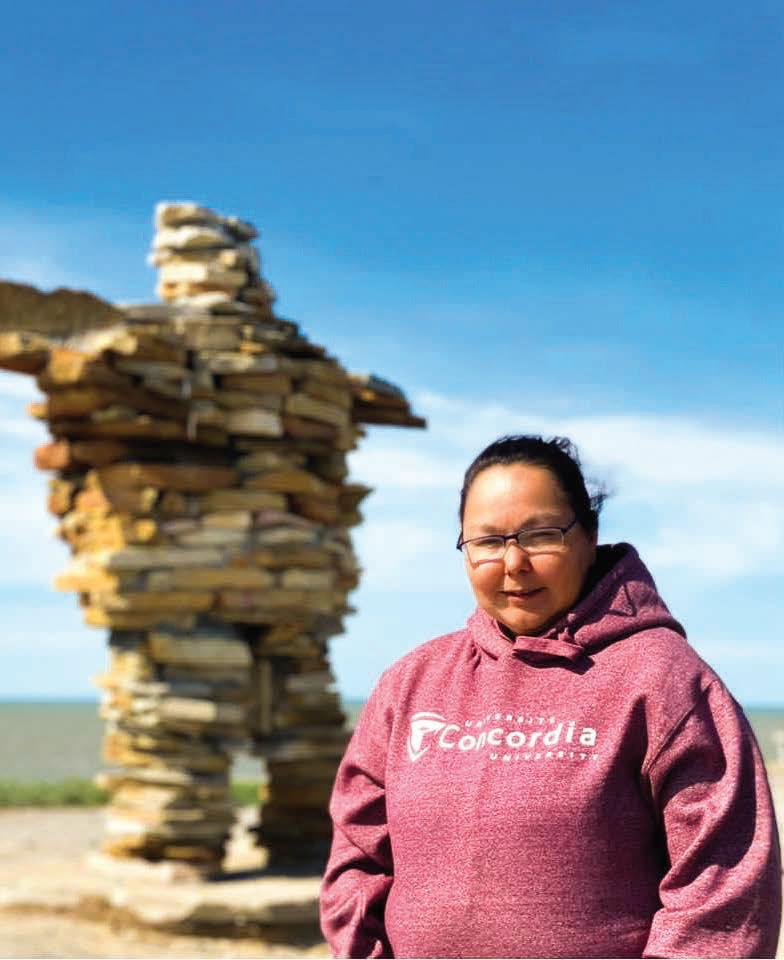
Ulayu Sequaluk, Kuujjuaq PSYCHOLOGY & FIRST PEOPLES STUDIES
Daphne Tooktoo, Kuujjuaraapik GRAPHIC DESIGN
Ayagutak May, Kuujjuaq POLITICAL SCIENCE & FIRST PEOPLES STUDIES
STORY AND PHOTOS BY CEDRIC GALLANT | Staff Writer
NOT PICTURED: Jason Annahatak, Kangirsuk MA IN PSYCOLOGICAL COUNSELLING & BUSINESS
TUESDAY MARCH 29, 2022 7
from Nunavik. Smith provided another perspective on the situation.
“On the one hand, [students] are trying to navigate the western system of learning to acquire skills that they did not build in high school,” she explained. “On the other hand, they are in this place of deep questioning about who they are and who they want to be.”
She said that these two factors alone can be overwhelming for students.
This western system of learning was a prominent aspect in Smith’s research. She said that “post-secondary systems are still modelled on a certain type of learning where reading and writing are really important qualities to have.”

“I see so many brilliant, young minds who are able to talk at length about deep knowledge and under standing of their culture,” she said. However, “writing this knowledge down in a formal structured essay with all the rules and expectations is not always going to happen, and it doesn’t mean that the person is not capable.”
Both Smith’s FPPSE project and the report made by Quebec’s Ombuds man concluded that there are many problems Kativik Ilisarniliriniq should resolve for better education in Nunavik.
There are no science or math prereq uisite courses in Nunavik, preventing students from partaking in science programs. Both reports suggest addi tional support for students to transition from high school to college and univer sity. There should also be more post-sec ondary options offered in Nunavik.
With this appropriate context laid out, we can now turn to the stories provided by our students from Nuna vik; looking at how their journeys started, the various challenges faced, and how they surmounted them.
The Birth of Purpose
From Kuujjuaq is Ayagutak May, a political science and First Peoples
studies student at Concordia. Fellow Kuujjuamiut (an Inuktitut word meaning “from Kuujjuaq”) is psychol ogy and First Peoples studies student Ulayu Sequaluk. From Kuujjuaraapik is graphic design student Daphne Tooktoo. Last but not least is Jason Annahatak from Kangirsuk. He has two master’s degrees; one in psycho logical counselling and the other in business. He was also the direc tor for post-secondary services in Nunavik for four and a half years.
All of their stories began with a purpose. May’s purpose first showed itself during her last two years of high school. Her Inuktitut teacher encour aged the school to add Inuit history as part of the educational curricu lum, and it was then that she was first exposed to the realities her ancestors faced through residential schools.
“I was not fully aware of what happened to my community, especially to my community,” she said. “Knowing that my family went through a lot of hard ships and trauma back in the day… that’s what moti vated me into doing some thing more.”
“Discovering more about my heri tage and colonization gave me ambition to help my community by pursuing a university degree.”
Even though Sequaluk lived in Montreal for years, she said that her purpose came when she returned home to Kuujjuaq after studying Global Makeup at Vancouver’s Blanche Macdonald Centre. She started working part time at the Nunavik Regional Board of Health and Social Services’ suicide prevention initiative.
“The work I was doing there was just more fulfilling. And given the very high suicide rate in Nuna vik, I just got really tired of seeing all my friends die… so I wanted to do something about it, and I did.”
Tooktoo said that she started post-sec
ondary studies long after graduating high school and raising her family. In 2014, she made the leap and enrolled in CEGEP. She first went to John Abbott College in the Graphic and Web Design program. Afterwards, she attended University of Victoria’s Visual Arts program in British Columbia. Now, she is continuing her degree at Concordia.
She said that “there are a lot of graphic designs on the web that are not translated into Inuktitut,” and she aims to create a larger Inuit and Indigenous presence on the web.

Annahatak’s story started with a desire for adventure. He said that he “wanted to experience some thing beyond high school, to live in a city and try something outside of a small town.” There are around 600 people in his hometown of Kangirsuk. He admitted that his journey was “a bit of a winding path.” He wanted to study business, but he felt his math
skills were not up to par. “I got discour aged, and went into social sciences, from there I started studying psychology.”
The Pitfalls
“It was very hard to be in class with so many people and adapt to the structure of how they teach,” May shared. “Homework was very new to me; it was like a pile of things that I had no idea what to do with.”
Tooktoo said that language was her toughest hurdle. “The most chal lenging part was my English, because it’s my fourth language,” she said. “I grew up learning Inuit and listen ing to Cree people. I went to a French elementary school and then I did CEGEP in English.” During class,
Ayagutak May studies political science and First Peoples studies at Concordia. After learning the history of colonization and the hardships her family faced, she was motivated to move south to pursue a university degree. CEDRIC GALLANT/THE CONCORDIAN
Daphne Tooktoo, a Graphic Design student at Concordia, in her hometown of Kuujjuaraapik. CEDRIC GALLANT/THE CONCORDIAN
TUESDAY MARCH 29, 20228 Features
she often had to check her dictio nary to know what everything meant.
Another core difficulty was homesick ness. May said that moving out “is a very emotional moment for us because we get homesick, we miss eating our country food and going camping.” Since the city is anything but a natural environment, both of these needs cannot be fulfilled.
Sequaluk added to this point by saying, “you go from 3,000 people in your hometown to a school of over 3,000 kids in a big city, the culture shock is huge.” She added that “a lot of people quit school, not because they can’t handle it. They quit because they’re homesick.”
Annahatak faced culture shock, home sickness, and a new system of learning at the age of 16. He lived in Montreal with his parents for a year. He couldn’t wait until the year was over so that he could go back to his community. He explained that the western system “felt sort of loud” to him.
“To some extent, there is a lot of emphasis put on talking,” he said. “You have to produce, you have to be out there and make space so you can be heard.” In the Inuit world, he said “there is more emphasis put on listening, being quiet and paying attention to your
environment.”
When Annahatak enrolled in CEGEP, it was a totally different story. Having been to high-school in Montreal, it gave him a head start, and he knew what he was getting himself into. However, he understood quickly that post-sec ondary education was also academ ically challenging. “It’s like going from the minor leagues to the major leagues in terms of what you need to produce and the quality of writing.”

However, in the end, all four managed to find their own strategies to make their university experiences enjoyable.
Strategies to surmount
May’s adapting process is still ongo ing. But she found comfort in bring ing her country food here to relieve her homesickness. Things like Tuktuk (caribou), Puijiviniq (seal meat), Iqaluk (fish), Mattak (beluga), among others, are her meals of choice.
She also added that having a child grounded her, even with all the respon sibilities that come with motherhood. “Ever since I had my daughter, I am more focused on what I want to do, I am more ambitious, and she makes me feel so much better when I am down south.”
Sequaluk said, “I make a real effort to practice my Inuktitut and do cultural
things while I am here, just so I don’t forget that part of my identity.” She followed by saying, “I think it’s just a balance, and I do realize not everyone handles being in the city all that well, and I don’t judge them when they go back up north.”
For Tooktoo, she doubled down on learning English. Now, she can attend school and under stand university-level language without the need of a dictionary.
What helped Annahatak was his friend group. He was surrounded by fellow Inuit students who were going through similar difficulties, although he admitted that he “did not try hard enough to make friends with non-In uit people” in CEGEP. In univer sity, he changed that for the better.
He advised all Nunavik post-sec ondary students to “have a sense of exploration. Even if the homework is unpleasant, it is part of the pack age of socializing, having fun and learning about life,” which makes the overall experience more enjoyable.
He kept this mentality when he trav elled all over the world, from South Africa to Hong Kong. That sense of exploration helped him rekindle his Inuk identity. “Once I started travelling, my identity became a source of intrigue and interest,” he shared. Some people would ask where his family name came from, and he said that “sometimes it started a really nice conversation where I got the chance to talk about Inuit people.” This made him take pride in who he was.
What’s to come
With time, the purpose that guided our storytellers through their hard ships helped them form clear objectives.
May has a distinct inspiration that helps guide her on her path: her aunt Mary Simon, Canada’s governor general.
For her, Simon is a beacon of inspiration, driving her to make a
change in her home community.
That change consists of joining Nunavik’s political sphere. May said, “my biggest goal would be for Nuna vik to become functionally self-gov erning in a way that fits Inuit concepts and ways of knowing. To give a posi tive and thriving environment for Nunavimmiut where trauma, substance abuse, and suicide could be decreased.”
Sequaluk’s goals are about reshap ing the field of psychology. If she gets a doctorate, she will create “Inuit-led and Inuit safe practices, because there is a lot of distrust within the healthcare system, especially for mental health.”
That strategy is about intertwining cultural practices with mental heal ing. It is called “on-the-land heal ing.” She followed this by saying that her method “would be to integrate on-the-land healing with psychological approaches [she] has learned in school.”
After the doctorate, she wishes to lead her own field of research and break new boundaries. However, she is aware that “a lot of academics do not regard Indige nous research as being serious. So, there is that hurdle to go over in the future.”

For Tooktoo, it’s about increas ing Indigenous and Inuit presence online. She knows that by herself, it is a task that would take many lifetimes.
While she currently makes websites and designs in Inuktitut, she wants to bring her knowledge to a new gener ation of young web designers to increase the online representation of Indigenous languages and art styles.
Years after graduating, Annaha tak still seeks out new experiences. During his time as post-second ary director, he started his second master’s degree in business. He now works in the economical development department of the Makivik Corpora tion, an Indigenous organization that helps develop businesses in Nunavik.
In terms of systemic issues, Anna hatak remains hopeful. He points out a couple of initiatives that have the potential to solve a few prob lems for post-secondary students.
He talked about Montreal’s Nuna vik Sivunitsavut, a one-year bridging program that teaches skills rooted in Inuit culture. He said that it “serves as a nice incubator where students build their self-esteem and collective pride.”
He also mentioned JUMP Math Canada, an online platform that helps educate students at home. In an arti cle for Nunatsiaq News, reporter Elaine Anselmi wrote that “It was conceived as a resource for educators to find lessons shaped by the Inuit world view,” supporting teachers and families alike. For Annahatak, these programs are steps in the right direction.
He acknowledged that sometimes, he feels there are no improvements. “Some days, I think we are regress ing.” However, he admitted that “there is very incremental progress.” Between laughs, he added, “prog ress that is going at a glacier’s speed!”
Ulayu Suqualuk was inspired to study psychology and First Peoples studies after working for the Nunavik Regional Board of Health and Social Services’ suicide prevention initiative. CEDRIC GALLANT/THE CONCORDIAN
TUESDAY MARCH 29, 2022 9Features
ArtsTheConcordian
BY VERONIQUE MORIN | Assistant Arts Editor
Multidisciplinary artist Justine Belle feuille is in the process of obtaining her BFA in studio arts at Concordia, where she previously completed the contempo rary dance major program. Her practice revolves around the themes of feminism and violence against women, ideas she explores in both of her preferred artistic mediums. Bellefeuille is currently work ing on the dance piece OVERLOAD, which will be presented at Tangente Danse from April 9 to 12. The choreog rapher first created this piece for five dancers in December 2019, and will now present an evolved version on stage. Comfortably seated on a wooden stool, with her elbows resting on the marble counter top of a café, Belle feuille shared her current passions and fascinations with The Concordian.
The Concordian: How would you describe your artistic practice?

JUSTINE BELLEFEUILLE: I do dance, as a choreographer more than an interpreter. I am also a visual artist. I work a lot in painting, oil paint ing more specifically. And recently, I have started to work with ceramics.

TC: How did you decide to develop those two artistic prac tices?
JB: It was really instinctive. In CEGEP, I studied visual arts. When I completed my degree, I wanted to study dance and to dive into this other medium, but visual arts was always in the back of my mind. I really liked it; I was very passionate about it. So, it is passion that led me to mix both. I think they inform each other. I don’t necessarily use visual arts objects in my dance projects, but in the movements’ aesthetic and in the costumes I create, my visual arts back ground appears. On the other side, movement can be very present in my paintings, and in my sculptural pieces.
TC: Have you created projects that mix both disciplines?
JB: I think both disciplines are omni present in one another, but my ulti mate goal would be to purposefully combine them. For instance, [for] my piece Pulpeux, which I created in March 2020, I started with painting. My goal wasn’t to work with dance, it was to create an image. Finally, after talking with a friend who is a dance performer, I realized that we could use [the paint ing] to create movements. Movement appeared from the shapes, the in-be tween spaces, the negative spaces that were created between the shapes and lines of the painting. The performer really followed those shapes to create other shapes in her body.
TC: What themes are you inter ested in?
JB: More and more I’m developing a feminist approach. Currently, I’m interested in violence against women,
be it extreme aggressions or impercep tible daily aggressions. Recently, I also started to question myself about my own relationship with my body as a woman. I am questioning myself about if we perform our femininity, what defines this femininity, what is it exactly. Is it influenced by the pressure of men’s gaze, or is it a pressure that we constantly put on ourselves?
TC: You are currently working on the dance performance OVER LOAD. How does your feminist approach appear in this work?
JB: For this piece, I am interested [...] in the violence against women, how we experience this and how we perceive this personally. Some of the inter preters in the piece may have experi enced such violence, others may have only witnessed it. But to be a witness is also something that is very hard to deal with. […] In the dance piece, each of the performers explores what this means to her. There is a lot of rage that comes out, there are a lot of contraction movements, spasms. During most of the piece, the performers are grouped together, which brings forward this idea of solidarity. They are a group, and they are [in] solidarity, but they also all live different things.
TC: How would you describe your creative process for this dance piece?
JB: For OVERLOAD, the initial idea was rage. I was looking at harassment at first. With the performers of the initial piece, we worked a lot with improvisa tion. There were more sensorial impro visations and more formal ones related to images. We tried to represent some thing, harassment for instance. It slowly diverged towards something more mini malist, more abstract. That was the beginning of the process. Now at the start of every rehearsal, we sit together to chat. We share situations that we have witnessed, information we have seen, statistics related to violence against women.
TC: Can you tell me about your recent discovery of ceramics?
JB: There is a very physical and tactile aspect to ceramics that I really like. There is also the aspect of reconnection with nature. I am currently taking a class during which we talk about the origins of clay, and where it comes from since it’s a material that comes from nature. Working with this material and knowing where it comes from creates a connec tion to the body, and to Earth. It’s very physical. Also, with ceramics, there are no limits. I can create what I want. It is a very fluid material. I can work however I want. And the glazes give me even more options. I am interested in the texture of chicken flesh. Therefore, I work with glossy glazes that can give a flesh-like effect. I had been looking for a long time for a material that could create this kind
of effect and now that I’ve found it, I explore it.
TC: How did you start working with chicken flesh?
JB: I have been working for a long time on this and I still question myself about it. It started with a project I did with chicken flesh in 2020. I took pictures of a raw chicken. I used these photographs to edit and cut them in Photoshop. I then recreated this new image in a tion.itscolour,withfascinated[haveSincepainting.then,Ibeen]it,foritsforconnotaItitled
this first piece Cocotte. There was a connota tion, a critique of alsodelicate,isviolentthingtheredead.itcruel,isvisceral.itflesh.bysostandIexplorations,myety.placewomen’sinsociThroughcurrenttrytounderwhyI’mfascinatedchickenIthinkisvery,veryTheresomethingsinceisraw,itisIthinkissomeveryalso.Itsensualandbutviolent.
TC: Do you have artis tic projects in mind for the future?
JB: I want to
rework Pulpeux. I would like to go back to this creation, there is really some thing to explore there. Also, the ceram ics aspect was recently added to my explorations. I would like to combine dance and ceramics. Ceramics also have a historical aspect related to women and their work and I would like to do more research on this side and to see how it can articulate itself in a more formal manner.
The studio arts student Justine Bellfeuille sat down with our assistant arts editor to discuss ceramics, working with chicken flesh, and more
ART EVENT ROUNDUP: MARCH artist of the week .
CATHERINE REYNOLDS/THE CONCORDIAN
TUESDAY MARCH 29, 202210
BY LILY COWPER AND ASHLEY FISH-ROBERTSON Creative Director, Arts Directon
On Thursday, March 17, a perfor mance in collaboration with Concor dia’s Music Department and the Concordia Laptop Orchestra (CLOrk) sought to explore and recreate a lucid dream state using impro vised sound, lights, and movement.

The fifth performance in an ongo ing series of mini-operas, Why Do We Dream? was put on by RISE, the newly-developed research cluster tied to Le PARC Milieux (part of Concor dia’s Milieux Institute). RISE, which stands for Reflective Iterative Scenario Enactments, is led by Dr. Eldad Tsabary, co-founder of Le PARC as well as asso ciate professor and coordinator of Concordia’s electroacoustics program.
Dr. Tsabary also works at the gradu ate level with students in Concordia’s Individualised Program (INDI), many of whom participated in the show. The applicant-led degree path allows students to combine interdisciplin ary subjects to forge unique research paths, making connections between diverse genres of study. It makes sense then, that their collaborative efforts would result in performances like Why Do We Dream?, described on the Facebook event page as “intersen sory” and “massively collaborative.”
All RISE performances are meant to operate in this way. Once an idea sparks interest, a research-creation team made up of Concordia professors and grad uate students collaborate to combine many different mediums and techniques into one show. Each RISE performance re-envisions a different fear-based “cataclysmic” disaster through the lens of an opera, while simultaneously pushing the boundaries of what it even means to create an opera. The intention is to investigate both human conscious ness surrounding various modern disasters, as well as the opera’s collab orative production experience itself.
Every mini-opera in the RISE series has been executed differently. The first two premiered digitally during the pandemic lockdowns. Mixed messages, No Pants was highly experimental, taking form as a live-streamed computer orchestra where COVID-related memos sent out by the university were used as libretto. In contrast, Personal Pandemic was a full-scale planned film
production with developed char acters, scripts and composers. The third perfor mance, Returning to the Trees was a stageless performance using experi mental recordings taken deep in the forest. A fourth opera, Cyber Identity Crisis, premiered privately last month to a small group of Art History students.
Why Do We Dream? was the natural next step for RISE organisers to chal lenge the traditional opera format.
The recent performance focused on an AI-controlled future and cyber surveil lance, exploring the lucid dream as the last frontier of unsupervised imagi nation. This in-person format inte grated many of the previous operas’ elements, complete with music by the CLOrk orchestra, strange costumes and masks by PhD INDI candidate Oonagh Fitzgerald, and live coding by Dr. Tsabary, a type of performing art where images and sounds are dynam ically projected by writing computer codes in an improvised manner.

Upon entering, it’s clear that Why Do We Dream? was meant to replicate what it might feel like to walk through someone else’s dream — or nightmare, depend ing on how you choose to look at it.
“It’s a dream,” Dr. Tsabary explained. “It’s supposed to be unexpected. I want whoever’s coming in to be overwhelmed by it.”
Wandering between the three rooms, actors, some masked and some not, sang and recited lines that sounded as if they’d been plucked directly from someone’s mid-sleep garble. According to Tsabary, the libretto was written using phrases pulled from actual dream journals.
Visitors who paid special attention to each room were afforded the chance to appreciate small, and at times unusual, details. In one room there were several dice, all positioned so that the number five was facing upwards. Several inquis itive visitors could be seen reflecting on these details, with some attempt ing to make sense of their presence.
The first room, with its profuse darkness, featured an individual sitting inside of a tent, surrounded by string lights. From inside the tent, the performer treated visitors to a simul taneously captivating and perplexing sonic experience consisting of eerie sound effects. These effects included squeaky violins being played, the
distant sound of alarms, and click ing noises. A breathtaking view of Montreal’s skyline served as the back drop, complementing the performance.
The second room was much more spacious, and featured a brilliant mix of artistic practices consisting of danc ing, painting, acting, playing music, and more. Walking into this room was disorienting to say the least. There was a lot to take in. Despite the diverse display of mediums all occupying the same space, the performance in this room maintained a remarkable unity.
The final room appeared to pay trib ute to the enigmatic and even spiri tual nature of our dreams. One person wandered around the room hand ing out tarot cards, while two actors sat on the floor of the room observ ing their own choice of cards. It was unclear whether they were satisfied or discontent with their choices. Addi
tionally, another person made the rounds of the room, handing visitors small white pieces of paper. Each of these papers had a message scrawled on them. For example, one of them, in delicate handwriting, read: “danc ing is like painting but with your body.”
It’s impossible to not appreciate the amount of work that went into bring ing this interdisciplinary event to life. Each space offered a unique oppor tunity for visitors to lose themselves in the unfamiliar, while perhaps reflecting on and attempting to deci pher their own dreams in the process.
RISE is one of several interdisci plinary initiatives at Concordia where researchers with diverse interests can come together using their unique expertise to explore artistic mediums while investigating important issues in society. Why Do We Dream? subtly showcased the in-depth works of both undergraduate and INDI gradu ate students who seem to not only be interested in the RISE experiment, but in collaborating with each other.
For this reason, the subject matter for this show was particularly fitting. The convergence of so many differ ent talents may have appeared odd or disorganized, like dreams tend to be, but that messy network of connec tions is likely the key to a more holis tic understanding of our modern world.
“I don’t see things as messy, I see them as [..] multiplicitous,” explained Dr. Tsabary, on the collaboration process behind Why Do We Dream? and previous RISE performances. “[It is] something involving a lot of people, each one contributing their own thing, and it comes together to be something very interesting.”
According to Dr. Tsabary, the next mini-opera in the RISE series will take place on April 7, and is an “opera about personal losses due to techno logical failures,.” The play will explore the immortality of online presence.
Keep up with RISE events and discussion sessions on riseop era.ca, or at Le PARC Milieux.
Why the last for the
Concordia Fine Arts students host “Why Do We Dream?”, an immersive and intersensory performance inspired by lucid dreaming. CATHERINE REYNOLDS/ THE CONCORDIAN
The Concordian TUESDAY MARCH 29, 2022 11Arts
PERFORMANCE
Do We Dream? The RISE Collective’s fifth experimental mini-op era explored lucid dreams as
frontier
unsupervised imagination CATHERINE REYNOLDS/THE CONCORDIAN
MusicTheConcordian
Enter Ellen Alaverdyan: young bassist extraordinaire!
game at the Chase Center, playing bass even during half-time in front of thousands of spec tators, and has been a host on Steve Harvey’s show called “STEVE on Watch.” Here she met none other than Bootsy Collins and members of Earth, Wind & Fire. Alaverdyan has also met musicians like guitarist Steve Vai, bassist Richard Bona, and Victor Wooten.
Is she small? Sure, but she packs quite the punch with her bass playing!TheConcordian sat down with Alaverdyan to talk about her music and goals.
THE CONCORDIAN : What’s your day-today routine like?
EA: Slap. I’m learning a couple of things on slap right now. I’m working on Victor Wooten’s lesson right now. He calls it “thumping and plucking.”
TC: Do you have any hobbies when you’re not playing music?
EA: Oh yeah, my main one is draw ing. I used to go to gymnastics but not anymore. I went to gymnastics in Cali and now we moved to Vegas so we’re trying to find a gymnastics place.
TC: How did the move change you in terms of music-making?
EA: It helped a lot because our old home was really small. Our studio back then was separate and we had to drive to it. Now in our new house, we made the studio in the garage. My dad still has his connections in LA and so we can still go back and record.
TC: What genre of music influ ences you?

figures. Who impacted you the most and why?
EA: You mean which ones made me most surprised and happy? The first one is Earth, Wind & Fire and the second is Steve Vai. I was imagining him with his long, black, curly hair in the movie Crossroads. He signed a pedal for me too, and we’re gonna keep it safe.
TC: I saw that you played bass for the Golden State Warriors game two weeks ago. What was your first thought when you were told you were going to play in front of thousands of people?
BY SARO HARTOUNIAN Assistant Music Editor
While scrolling through the music corner of Instagram, you may come across Ellen Alaverdyan: a nine-yearold bass player whose music chops cut through your daily intake of social media. Born in California to Armenian parents, Alaverdyan began playing bass naught but two years ago. She’s since made quite an impression on social media, showing up on many an artist’s radars.

In that short span of time, she has accomplished so much. Recently she opened for the Golden State Warriors
Ellen Alaverdyan: Usually I come back from school, then I’ll eat and watch something and then at 6 or 7 p.m. I’ll practice something if we don’t have anything to record, and then after that, I’ll play some video games if I have time and then go to sleep.
TC: Picture this: it’s your first time picking up the bass, how did you feel?
EA: Guess I’m going to have to flashback two years ago. At first, I thought it was a guitar but as I started playing the notes I felt that it wasn’t a low sound but more so a bigger vibration.
TC: What would be the next technique that you are going to learn on bass?
Charli XCX has had one of the most unexpected careers as a pop star in the last decade. Breaking out with a handful of large singles, and features on smash hits “I Love It” by Icona Pop and Iggy Azalea’s “Fancy,” Charli was shot into stardom.
EA: So right now I like funk. I’ve been getting into and listening to a lot of rock songs recently, but my main genre is funk. We’re talking old-school funk with Bootsy Collins, Kool & The Gang, and P-Funk.
TC: Speaking of Bootsy Collins. I watched you on Steve Harvey’s show, that was amazing! How did being on that show, on national TV change you?
EA: It made me feel a lot of emotions. I mainly felt surprised. I was actually kind of expecting Bootsy Collins because my parents kept telling me, “What if Bootsy Collins comes on, what are you gonna do?” but I didn’t expect Earth, Wind, & Fire would come on. I didn’t see it coming.
TC: You’ve met and spoken to a number of Influential musician
ect we have received from Charli since 2014’s Sucker . The PC Music label sounds preceding hyperpop that Charli embraced in recent years have dissolved into a more conventional sound.
EA: When I got on stage my first thought was “How was everyone going to react?” I wasn’t exactly nervous, moreso excited to play the bass. Once I started playing I could see people recording me and it made me feel a lot of things, mainly that they liked what I was playing. I was worried I would play the wrong note but even if I did, it’s not that much of a difference!
TC: What’s next for Ellen Alaverdyan?
EA: We have a couple of shows. Actually, a drummer from Japan is coming to play with me. For my band rehearsal a couple of students from the School of Rock, the singer and guitarist. We were going to go into a separate studio because my home studio can’t hold all of us. Basically in two months, we’re going to have a show and we’re playing mainly Led Zeppelin songs; “The Ocean,” “The Rover” — and “No One Knows” by Queens of the Stone Age.
QUICKSPINS
CRASH lacks the cohe sion and forward-think ing sonics of the work that has defined the recent years of Charli’s
BY OWEN COLE | Contributor
The first surprise in Charli’s career came in the form of 2016’s Vroom Vroom EP, enlisting bubblegum bass pioneer SOPHIE as executive producer, hot off the backend of her 2015 proj ect Product . SOPHIE was becoming one of the most in-demand produc ers, known for her deconstructed club sound with heavy left field tendencies, which made this EP cut out for a dance floor in the loudest nightclub in town, and not the FM radio waves.

After a pair of collaboration-ori ented mixtapes, and two more studio albums, Charli has (intentionally or not) become the figurehead of what came to be the “hyperpop” scene, blazing the trail for numerous artists like 100 gecs and Dorian Electra.
The 2017’s Pop 2 and 2019’s Charli became a harbour for this scene, with an all-star lineup of artists being featured across the track lists, all while also maintaining the pop sensibility that made her a star.
CRASH is the most radio-pop proj
CRASH comes loosely packaged with a plethora of pop and dance music influences through the decades.
Whether it’s the ’80s synth pop tinted “Good Ones” and “Lightning” to 2000s
ing from funky guitar lines, to big ’90s gated drums and 2000s Ibiza synths, the variety of sounds on this project can at times mix like water and oil.
Highlights like “Move Me” and “New Shapes” have immense vocal perfor mances and spotless production, but these highpoints only crop up in the first half, leaving CRASH feeling front loaded.
CRASH comes as a bitter end to her five album contract with Atlantic as Charli’s TikToks and tweets have not shied away from expressing her frustration towards PR and contractual commitments.
trance leads and 2-step drums of “Beg For You,” the project lacks the clear cut direction of her last two records.
Though going over well on Number 1 Angel, which like this project did not have a rock solid sonic identity , CRASH comes across as a bit of a jumbled mess. Disorientingly bounc
If CRASH is Charli’s out from this contract, and she was simply trying to just dump a more conventional pop album on Atlantic to sell, then she has done what she sought out to do. Major labels are notorious for editing artists into creative oblivion and CRASH could be a record that’s content got lost in translation. Though she may not have made a product that fully expresses her artistic direction, given full creative control, I am sure future projects will result in a full realization of another pop opus Charli surely has within her.
PHOTO COURTESY OF ELLEN ALAVERDYAN’S PARENTS
TUESDAY MARCH 29, 202212
INTERVIEW
career.Onlynine years old, Ellen sheds light on juggling bass, daily life, and friends WE RATE IT 5/10 TRIAL TRACK “BEG FOR YOU” FEAT. RINA SAWAYAMA
Concert Review: Mayhem at Club Soda, Montreal
BY JAKE BEACOCK | Contributor
Saint Laurent Boulevard is home to the Club Soda, a marvelous venue with a capacity of up to 975 standing guests. Their large capacity was suitable for a black metal show of Mayhem’s caliber.
In the lobby, the doors to the dance floor were rattling with the powerful sound of heavy guitars, a bone-rattling kick drum and the grueling growls of Midnight, the opening act. Their sound was incredibly powerful, though not as fast-paced as the headliner that would proceed them. Midnight’s vocals were clear and severe, backed up by wail ing guitars as they sang of sin, dark ness and death. Their fiery sound successfully provoked the crowd, preparing them for what was to come.
After spending Midnight’s set in the mosh pit, the silence set in as the crowd waited for Mayhem’s arrival. The band was timely, creeping onto the stage through red light and clouds of fog. Feeling like I had entered the dark dungeon of a secret society, I watched as the lights slowly grew brighter. Opening with “Falsified and Hated,” Mayhem was met with screams from the crowd. A rush of harsh guitar and ghoulish rasping kicked the show off, with a quick flash of blue light revealing the lead singer, Attila Csihar. He was dressed in many layers, with a tattered cloak on top. His face was covered in blood and corpse paint, and in his hands he held a cross made of bones.
The band would eventually swap out their battle jackets for black ritualistic cloaks, with Csihar donning pope-es que garb, upholding the theme of a high satanic priest preaching to his
devilish children. The stage would appear to be the inside of a cathe dral. Eventually, Csihar would be seen swinging a noose around, whis pering into the microphone over an ominous beat like a vengeful spirit.

During the band’s most notable song, “Freezing Moon,” the crowd rushed to the front of the stage and the mosh pit erupted with crowd-surfers, creat ing pushing and shoving galore. The pulsing lull midway through the song provided a smooth transition from the first verse’s fast pace to the sound of a more soothing embrace of death.
The most vicious mosh pit that night by far would be during “Chainsaw Guts fuck.” People were headbanging left and right. The thunderous hum of raspy guitar and bass accompanied melodic shrieks and the beating of a vicious kick drum. Several men were shirtless, sweating and panting as they sought out their next shove from a fellow fan.
The show came to a close surpris ingly early at around 11:00 p.m. The band members kindly threw picks and grasped hands with fans on their way off the stage. Overall, it was a beautifully dark, thrilling experience!
There was such a strong sense of spirit in the room through it all and it was an unforgettable night. To all metalheads of Montreal, if you haven’t had a taste of black metal yet, I’d recommend dipping your toes in by listening to a song or even attending a show (especially if you’re looking to mosh and headbang insanely hard).
seem to be into these days, they travel to space and rock out in astronaut gear.
JACOB “ANYTHINGWADE-VALLANCEBUTME”-MUNA

MUNA has nailed it once again. With their follow up to the viral queer love song “Silk Chiffon,” “Anything But Me” is a breakup bop and a wave goodbye to a toxic relationship, with killer lyrics.
NADIA TRUDEL “FEEL MY RHYTHM” - RED VELVET
On editioncontributor’sRepeat:
ANTHONY ISSA “TOTALLY FINE”PUP
Toronto group PUP dropped a banger song that pop-punk fans can enjoy in time for their next mental breakdown. With chunky guitar riffs and self-de structive lyrics filled with dark humour, “Totally Fine” is a great taste of what to expect on their upcoming album. The track is accompanied by a hilari ous music video about the band selling out, leaving the indie scene, and becom ing billionaires by building an evil real estate empire. Following the popular trend that all billionaire philanthropists
“Feel My Rhythm” might not cure your seasonal depression, but it might help. The song has this delusional opti mism that’s almost creepy: classic Red Velvet. Sonically it’s pretty, elegant, and dreamy, a true successor to their previ ous hit “Psycho.” It samples Bach, so mix classical strings with some modern pop, a trap beat, soaring chorus, fun rap verses, and signature Red Velvet vocals and you have a springtime anthem and homage to the beauty of art.
AARON BAUMAN “TROUBLES”DENZEL CURRY FEAT. T-PAIN
Denzel Curry’s gritty flow blended with T-Pain’s angelic vocals on this bouncy track creates a perfect song for a window-down cruise just in time for the sun’s return. This track comes as the final single of Denzel’s upcoming album’s rollout.
CURTIS SAVAGE “I’M NOT GONNA KILL YOU” - NEMAHSIS
Nemahsis’ track from her break out EP eleven achers is a soul-wrench ing demand to not be treated like a threat. She somberly reflects in this R&B ballad over the pressure she feels to repress her Muslim identity in her western surroundings. Her voice gently carries through the song as she laments on her frustration to be accepted.
OLIVER ENG “HEAVY” - NIGO FEAT. LIL UZI VERT
“Heavy” is what you get when you put Lil Uzi Vert on a drill beat and let talent do its thing. It’s catchy and a perfect representation of who NIGO and Uzi are as people. The song is loud, heavy and it shakes your body. You can’t go wrong with this one.
OWEN COLE “VOCODER” - FLOAT ING POINTS
Returning to his dancefloor roots, Floating Points has crafted one of the biggest club tunes of recent months. After playing a string of after-hours gigs with Four Tet and even Skrillex throughout the U.S., Floating Points seems hungry to get the dancefloor pumping once again after the more subdued Crush from 2019, and the new age/ambient jazz Pharoah Sand ers collaborative Promises from 2021.
SYDNEY GASTALDO
“WHAT HAPPENED TO THE CLASS OF ‘65?” - DAMIEN JURADO
I was first introduced to Jurado’s music through the show Shameless. Something about the song stuck out to me immediately and after the episode, I looked up the track that was played, “Beacon Hill,” and ended up listening to almost all of the singer/songwrit er’s discography. Jurado has been one of my favorite artists ever since and his newest single “What Happened To The Class of ‘65?” — a song which encapsulates what he does best: story telling. Overall, it’s a captivating track with intimate and vulnerable lyrics and beautiful instrumentalism.
JAKE BEACOCK “DRINK THE NEW WINE” - BAUHAUS
Recorded during lockdown last year, “Drink The New Wine” has come as a pleasant surprise for post-punk lovers. Bauhaus manages to main tain their unique essence: a spec tral, gothic sound that makes you feel beautifully delirious. Go on, take a sip!

Take a walk on the dark side, Norwegian black metal band Mayhem has returned to Montreal
Metal band Mayhem performaing at Club Soda in Montreal March 22. PHOTO BY JAKE BEACOCK
HERE is a playlist of all these hot bangers.
The Concordian TUESDAY MARCH 29, 2022 13Music
CONCERT
SportsTheConcordian
SEASON RECAPS: STINGERS BASKETBALL TEAMS BATTLE TO THE BITTER END
in the RSEQ scoring race and tallying a little over 16 points-per-game. In his 11 games played, he showed his versa tility beyond scoring, averaging 7.6 rebounds and 1.5 blocks per contest.
In his sophomore season with the Stingers, Sami Jahan built on his 2020 all-rookie campaign by making the second all-star team. Though he struggled with poor shot selection and questionable decision making at times, the Ontario native was never afraid of the moment. Jahan trailed only Simon in scoring for the team, and was Concordia’s primary ball handler when the Stingers offence stalled and was in desperate need for production.
Steve Mbida Abomo, a rookie forward from Cameroon, instantly made an impact for the Stingers on his way to making the RSEQ all-rookie team. He earned Popovic’s trust early in the season, starting in eight of 10 games and averaging the second most minutes on the team. Though Alec Phaneuf didn’t earn any individual honours in his rookie season, his unselfish ness on offence mixed with his defen sive awareness made the difference in a few competitive games. Alongside Jahan’s scoring instincts, the future is bright for the Stingers backcourt.

Women’s basketball
*Concordia lost in the RSEQ semifinals vs. UQAM last Wednes day. The final score was 75-68

The Stingers women’s team finished
first in the conference with a 9-3 record, winning the regular season title for the first time since 1998-99. Concordia won seven of their last eight, including a 100-44 beatdown of McGill in their final showing. Anything can happen in a bestof-one playoff format however, as the Stingers ran into a well-prepared UQAM team that managed to pull off the upset.
Whereas Popovic distributed the men’s team’s minutes throughout the regular season, women’s head coach Tenicha Gittens stuck to her most reliable weapons for larger stretches of games. Myriam Leclerc, Coralie Dumont, and Caroline Task played over 30 minutes a game for the women’s team, a significant load compared to Simon’s team-leading 27 minutes for the men. Gittens stuck to her veterans through thick and thin, regardless of their play.
On the other hand, Popovic constantly shifted the starting lineups and adjusted the minute load depending on the state of the game and who played well.
Despite a slow start to the season by her standards, Leclerc was Concor dia’s number one option on offence. Coming off a torn ACL in the 2019-20 season, once her confidence returned it was tough to ignore how crucial she was to Concordia’s success. The thirdyear guard earned first all-star team honours and was also nominated for the U Sports Tracy MacLeod Award, which recognizes perseverance and courage in the sport. For the season, Leclerc aver aged 16 points, 6.3 rebounds, 5.2 assists,
and 2.6 steals in nearly 36 minutes per game. She also led the nation in freethrow percentage at 95.9 per cent on 49 attempts. Gittens won Coach of the Year for the team’s strong regular season showing, and Stingers fifth-year guard Task joined Leclerc on the first all-star team. She was the team’s best three-point shooter by a wide margin when you factor in her high volume. Task shot 41.9 per cent on 74 attempts.
Dumont earned second all-star team
honours in her third year with the Stingers, imposing her will on offen sive boards and drawing fouls at an elite rate. Nelly Owusu was nomi nated for the U Sports Sylvia Sweeney Award, which is presented to the player who best exemplifies leadership and social commitment in women’s basket ball. Finally, centre Serena Tchida made the conference’s all-rookie team after a long-term knee injury kept her sidelined in the 2019-20 season
Concordia guard Caroline Task (7) led the Stigners in scoring with 17 total points in the RSEQ semi-finals on march 23,2022
PHOTO BY KYRAN THICKE
Concordia guard/forward Oge Nwoko (14) prepares to inbound the ball during the RSEQ semi-final match between Bishop’s and Concordia on Wednesday, March 23, 2022
PHOTO BY REUBEN POLANSKY
TUESDAY MARCH 29, 202214 BASKETBALL
Liking rival teams can be a healthy way to enjoy sports

 BY MARIA BOUABDO Assistant Sports Editor
Every sports fan has a favourite team. Some even have two or more for the same sport, which helps them follow different conferences or divisions. But how often does it happen that someone likes two rival teams? It’s rare, but not impossible.
Rivalries are one of the most fun parts of sports. It can even get to a point where you’re rooting for a team’s fail ure and not another team’s success.
If you’re as big of a hockey fan as anyone in Montreal, there is no way that you don’t absolutely despise the Boston Bruins or the Toronto Maple Leafs.
Or maybe there is.
Pia Yared, who has been living in Montreal since 2015, became a Cana diens fan the second she started living in Montreal. That was until last year, when she watched her first Leafs game and it was love at first sight.
“I just loved their energy, and how they played,” she said. “All it took was one game and I became a Leafs fan.”
She said she is now 55 per cent a Leafs fan and 45 per cent a Habs fan, but that it can fluctuate during the year.
Mitch Levis, a Montrealer and Base ball Québec umpire, also mentioned these numbers, but for the MLB.
He is 55 per cent a Cincinnati Reds fan and 45 per cent a St. Louis Cardinals fan.
Before that, Levis was a huge Expos fan, but he stopped following MLB alto gether after the Expos moved to Wash ington, D.C., and became the Nationals.
However, he got back into it in 2010 when he travelled to Cincin nati and went to a Reds game there, with the Cardinals visiting.
“On the Cards’ roster was Rafael Furcal, a player I had met as a child when he played for Atlanta. But on the Reds was all-star Canadian player Joey Votto,” Levis said, explaining
what helped him get back into watch ing MLB and following these two teams.
Although he doesn’t watch base ball during the regular season due to his busy schedule, Levis watches some games during the presea son and the playoffs. He also follows both teams in the news and on social media to keep up with everything.
He said if he were to watch his two favourite teams against each other, he would probably root for the Reds.
SportsCOLOUR
“But I’d also lean more neutral and hope for an excit ing pitching matchup,” he said.
Yared also said she doesn’t watch a lot of games during the regu lar season, but tries to keep up with the news as much as possible.
She mentioned she usually roots for the Leafs over the Canadiens when they face off, but hopes for a fun game, even if it’s not the outcome she expects.
“I try to go into it neutral and see how the game goes,” she said. “And if a team is too disappoint ing, I’ll cheer for the other one.”
This is exactly what happened in the 2021 playoffs. She went into it rooting for Toronto, but ended up cheering for Montreal the closer they got to winning the series.
At the end of the day, sports are meant to be fun and to bring people together. Everyone has unique sports experiences. You can like one team and be loyal to them until death. You can like a team, then decide you don’t like them anymore, and pick a new one. You can also not have a favour ite team, but instead just enjoy a sport.
Or, you can have two favourite teams that have a great rivalry, and enjoy every second of chaos you’ll witness.
Montreal says goodbye to memorable faces at NHL trade deadline
The Canadiens are doing everything right in the second half of the regular season, besides winning hockey games.
BY LIAM SHARP | Sports Editor
The new and improved Montreal Canadiens won’t make any noise this season, but are clearly trending upwards under interim Head Coach Martin St. Louis. In his short tenure thus far, he’s empowered the team’s youth and ener gized the franchise in a meaningful way despite the playoffs being completely out of the realm of possibility.
Jeff Gorton and Kent Hughes, the team’s executive vice president of hockey operations and general manager respectively, have also done their part in beginning a hopeful chap ter since joining the Habs. Here are my thoughts on their first trade dead line with the Montreal Canadiens.
The Florida Panthers acquire defenseman Ben Chiarot
Montreal received a first-round pick in 2023, a fourth-round pick in 2022, and a forward prospect in Tyler Smilanic. Considering how poorly Chiarot played for most of the regu lar season, it was shocking to see the Canadiens get three future assets back for the 30-year-old defenseman.
The Panthers were already among the best teams in the league, but were looking to improve and bolster up their defence ahead of the playoffs. It goes without saying Florida paid a hefty price for Chiarot, but shows how much they value his game, which tends to shine the brightest in the postseason when physi cality becomes of increasing importance.
The Colorado Avalanche
acquire forward Artturi Lehkonen
In return, Montreal got defensive prospect Justin Barron and a secondround pick in 2024. While the team has struggled all season, Lehkonen has been having the best individual season of his young career (29 total points in 58 games played). Beyond the stats, the 26-yearold forward plays with a high motor on a nightly basis, and can be a qual ity depth player on a contending team.
For the Habs, it made sense to move on from their hero from Game 6 of the Stan ley Cup Conference Finals against the Golden Knights. Colorado had to offer up a promising prospect in Barron, who should fit Montreal’s contending time line better. But the Avalanche are a much better team today with Lehkonen, even if he is due for a raise after the season.
The Edmonton Oilers acquire defenseman Brett Kulak
The Canadiens got back 26-yearold defenseman William Lagesson, a 2022 conditional second-round pick, and a seventh-round pick in 2024. This deal involves a couple of depth players and consequently made fewer headlines, but the Habs came away with a couple more future assets.
On paper, Kulak is an upgrade for the Oilers but he’ll need to regain his confidence and perform better to make this worth it for Edmonton. When he’s right, Kulak is a puck-mov ing, defensively sound player but moving a second-round pick for a marginal upgrade is a steep price to pay.
GRAPHIC BY MADELINE SCHMIDT
COMMENTARY
Being a fan of two rival teams isn’t easy, but it can be fun
GRAPHIC BY MADELINE SCHMIDT TUESDAY MARCH 29, 2022 15
SPORTS TEAM
EDITOR-IN-CHIEF HADASSAH EDITOR@THECONCORDIAN.COMALENCAR

MANAGING EDITOR MAGGIE MANAGING@THECONCORDIAN.COMMORRIS
CREATIVE DIRECTOR LILY CREATIVE@THECONCORDIAN.COMCOWPER
SOCIAL MEDIA MANAGER MICHELLE DIGITAL@THECONCORDIAN.COMLAM
FEATURES EDITOR MÉLINA FEATURES@THECONCORDIAN.COMLÉVESQUE
FEATURES ASSISTANT CHRISTINA MARANDO
NEWS EDITORS EVAN NEWS@THECONCORDIAN.COMGABRIELLINDSAYGUINDI
ASSISTANT NEWS EDITOR HANNAH TIONGSON
COMMENTARY EDITOR JULIETTE COMMENTARY@THECONCORDIAN.COMPALIN

ARTS EDITOR ASHLEY ARTS@THECONCORDIAN.COMFISH-ROBERTSON
ASSISTANT ARTS EDITOR VÉRONIQUE MORIN
MUSIC EDITOR GUILLAUME MUSIC@THECONCORDIAN.COMLABERGE
ASSISTANT MUSIC EDITOR SARO HARTOUNIAN
SPORTS EDITOR LIAM SPORTS@THECONCORDIAN.COMSHARP
ASSISTANT SPORTS EDITOR MARIA BOUABDO
PRODUCTION MANAGER SIMON PRODUCTION@THECONCORDIAN.COMPOULIOT
PRODUCTION ASSISTANT KIT MERGAERT
HEAD COPY EDITOR
HUNTER COPY@THECONCORDIAN.COMWALWASKI
COPY EDITORS LUCY FARCNIK CRIS DERFEL
PHOTO EDITOR CATHERINE PHOTO@THECONCORDIAN.COMREYNOLDS
PHOTO ASSISTANT KAITLYNN RODNEY
GRAPHICS EDITOR JAMES GRAPHICS@THECONCORDIAN.COMFAY
GRAPHICS ASSISTANT MADELINE SCHMIDT
VIDEO EDITORS ANTHONY-JAMES ARMSTRONG VIDEO@THECONCORDIAN.COMSTOW
REVENUE MANAGER REVENUE@THECONCORDIAN.COMBARBERIO
BUSINESS MANAGER
LITHUN BUSINESS@THECONCORDIAN.COMSARKER
BOARD OF
MASTHEAD Read More at theconcordian.com
MARIE
KATERINA
DIRECTORS MIA BOARD@THECONCORDIAN.COMAVIVACHLOËALEXMAGGIEANHOURYHOPEHUTCHINSLALONDEMAJERCZYKLILLIANROY CONTRIBUTORS AARON BAUMAN JAKE JACOBSYDNEYCEDRICOWENBEACOCKCOLEOLIVERENGGALLANTGASTALDOJAKEYB.GERMANTHONYISSATARYNMARTINCURTISSAVAGENADIATRUDELWADE-VALLANCE CONCORDIA NEWSPAPERINDEPENDENTUNIVERSITY’SSTUDENTSINCE1973 VOL 39, ISSUE 23 MARCH 28, 2022 COVER PHOTO BY KYRAN THICKE EDITORIAL OFFICE 7141 RUE SHERBROOKE O BUILDING CC #431 MONTREAL, QC H4B 1R6 (514) 848-2424 X7499 www.theconcordian.com insta @theconcordian twitter @theconcordian fb /theconcordian youtube subscribe to our channel
