

Sydney Williams Asst. A&L Editor
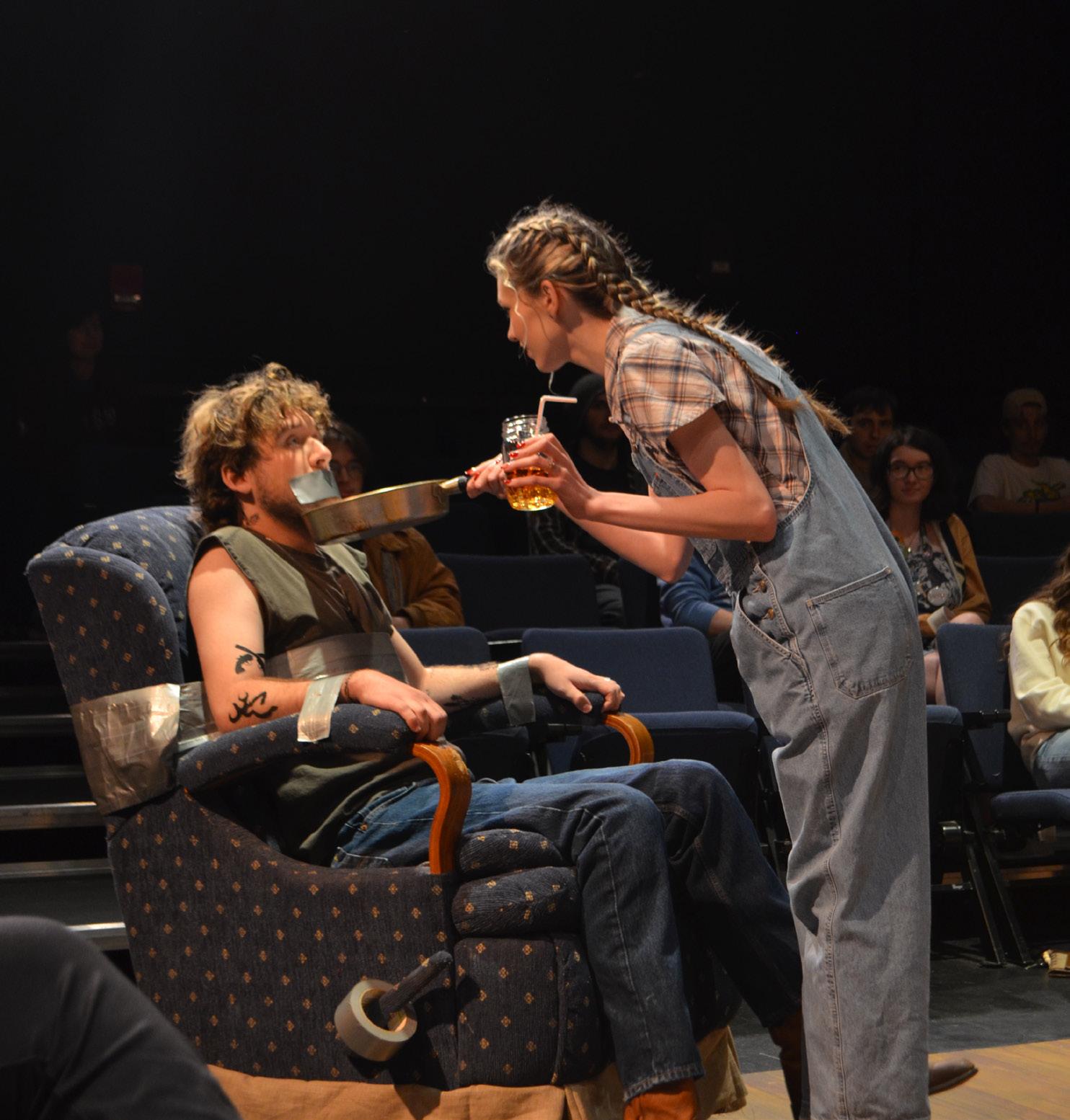
GCSU Theatre’s production of “Exit, Pursued by a Bear” opened with a man duct-taped to a chair and kept that same level of intensity throughout the show.
Directed by Chloe Butts, the play by Lauren Gunderson is set in the North Georgia mountains and was performed in the Black Box Theater on April 10-12.
The smaller space kept the cast close together and focused attention on the lead, Nan Carter, with other characters reacting to her choices.
“Nan Carter is the protagonist who stages the play within a play and is the character the audience is expected to put themselves in the shoes of,” said Olivia Langston, a senior English major who played Nan.
The story follows
Nan as she carries out a plan with the help of her friend Simon and a stripper named Sweetheart. They tape her husband, Kyle, to a chair and force him to watch reenactments of their relationship. The scenes move quickly between lighter moments and more uncomfortable ones, while the show continues to point back to the abusive relationship at its center.
See EXIT | Page 10
Bryan Cade Sports Editor
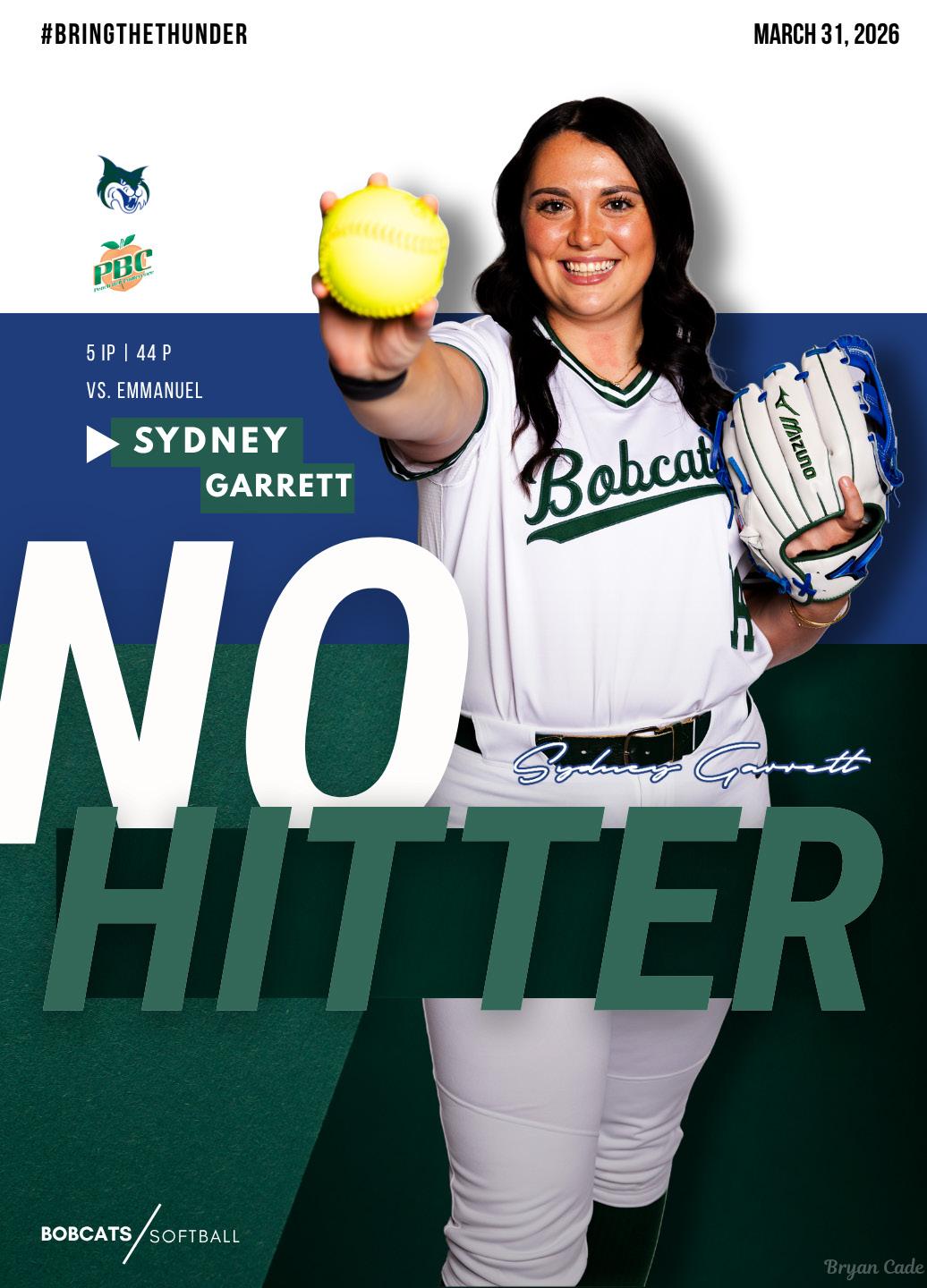
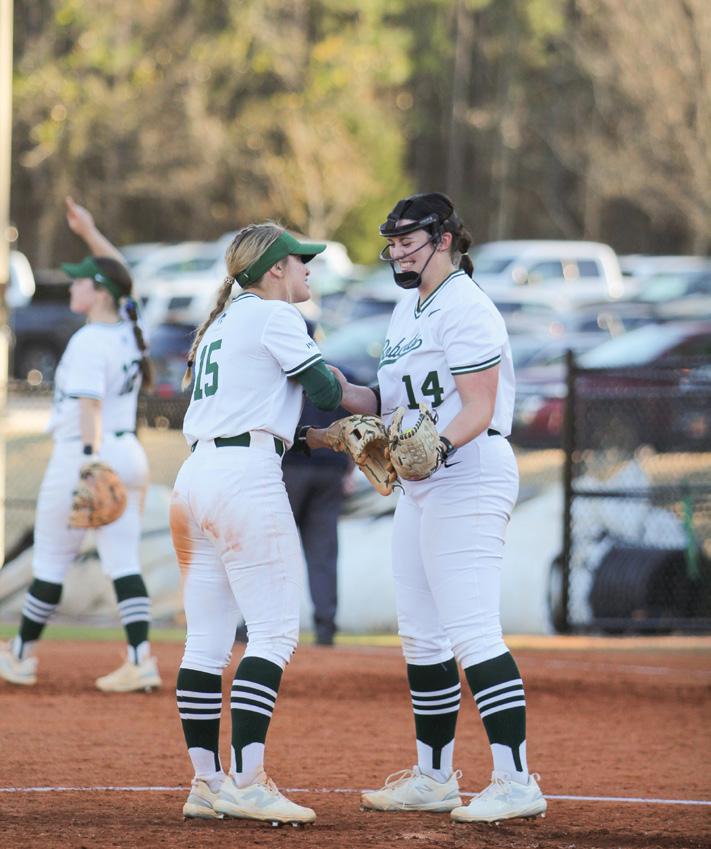
Sydney Garrett put on an alltime performance in the circle against Emmanuel University, pitching five no-hit innings to seal a Bobcat victory on March 31.
Garrett sealed the 15th no-hitter in program history and the first no-hitter for GCSU softball since March 7, 2015, on a day in which Marissa Boyette and Cassidy Rice combined for a five-inning no-hitter against Fort Valley State University.
“I honestly wasn’t aware I was throwing a no-hitter until the 3rd inning,” Garrett said. “Once I realized it, my main goal was to stay within myself and control the controllables because, at the end of the day, that’s all I can do.”
The victory extended the Bobcats’ winning streak to three games, which later reached 11 in a row. In the contest, Garrett threw forty-four pitches, and alongside the run-rule victory, the time of the contest ended in an hour and 19 minutes.
Besides the pitching aspect of a no-hitter, having a good defense behind you is essential to claiming history. Based upon Defensive Runs Scored data from FanGraphs, a reputable statistics tracker for Major League Baseball, the average DRS per lineup over the last 10 no-hitters is around 3.85 or an average of 12.8 based on seasonal data. Defensive runs saved help explain how important a great defense can be in a no-hitter, and the higher the DRS, the better.
See GARRETT | Page 6
Avery Geary Contributing Writer
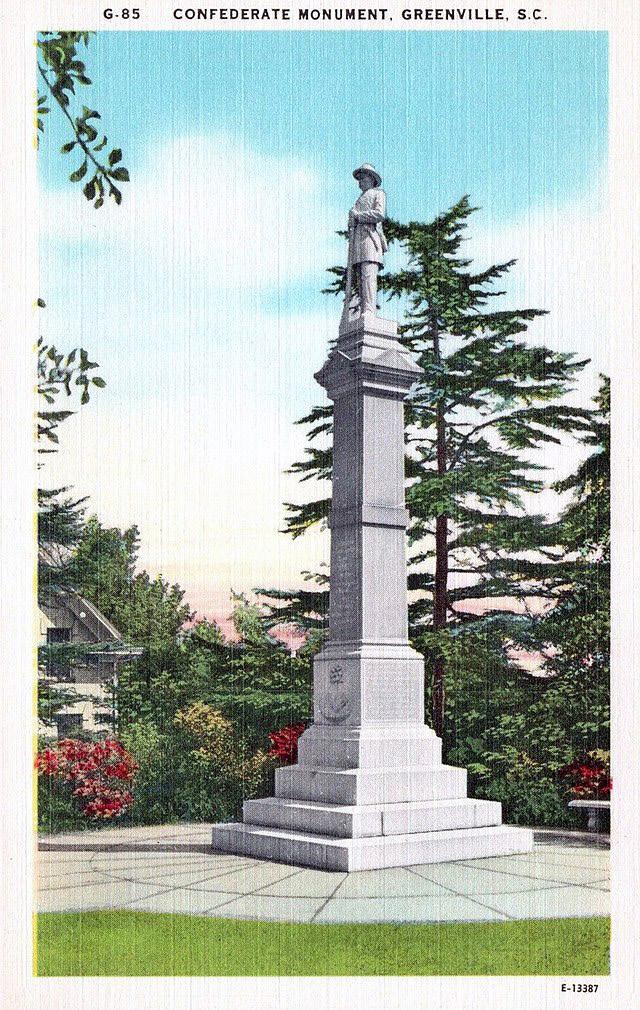
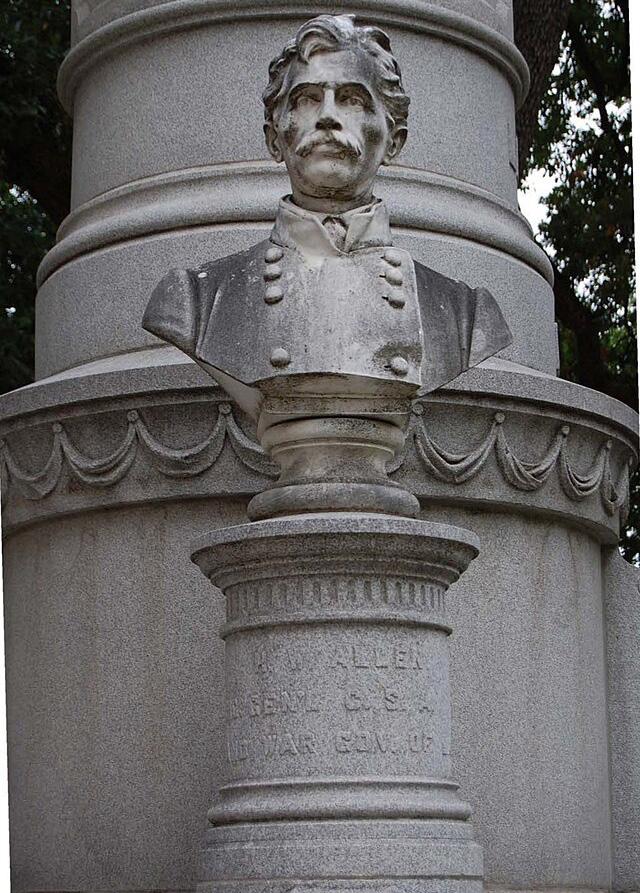
The Georgia House of Representatives voted Tuesday, March 31, against a proposal aimed at protecting Confederate monuments, highlighting the ongoing debate across the state and the nation over how history should be remembered and represented in public spaces.
In an article published by WADE.org, Senate Bill 175 would have granted legal permanence to monuments and allowed le-
gal action in cases of attempted removal or destruction. The bill also proposed relocating monuments to public sites rather than demolishing them if local governments declined to maintain ownership. Supporters framed the legislation as a way to preserve historical artifacts, while critics argued it would limit communities’ ability to decide what is appropriate for their public spaces.
Supporters of the legislation argued that it was not limited to Confederate memorials but applied broadly to all monuments
honoring the dead. Republican Rep. Alan Powell emphasized that point during the session of the Georgia House of Representatives on that Tuesday at the state capitol, attempting to shift the conversation away from the Confederacy specifically and toward a broader discussion of remembrance.
“I will not talk about history. I will not talk about the Confederacy. I am not going to talk about slavery,” Powell said. “This bill encompasses all monuments.”
James Cordero Contributing Writer
On March 29, the United Nations (U.N.) met in Brazil to discuss protections for 40 different species of migratory animals, ranging from the hammerhead shark to the snowy owl, which resulted in cross-border protections and a reopening of the global conversation surrounding species conservation.
The protections span over multiple borders. With some of the migratory species moving as far as continents apart, over 130 countries have agreed to the new measures.
“Protecting [migratory species] is extra challenging because they need all those habitats,” said Bruce Snyder, a professor of biology. “They are migrating for a reason, and you need to be able to protect every component for them to survive.”
There is also a level of ecological importance in the animals being migratory. Migratory species travel for a variety of reasons, such as looking for food, mating or escaping harsh weather, and those things are of-
ten interrupted by some form of human interaction, such as urbanization or deforestation.
Giant river otters, for example, migrate to follow food and find quieter habitats. Due to human interaction, the otters have had to travel further and for longer because they try to avoid human disturbance.
This meeting also serves to set a precedent for implementing new regulations in the future. Representatives in attendance discussed trying to provide a warning for what will happen if nothing is done to help the environment and expressed what else needs to be changed.
The Convention on the Conservation of Migratory Species, a treaty backed by the U.N., created a way to categorize the animals. Either they are appendix I, which requires multi-continental protection for species that are threatened by extinction, or appendix II, which fit under appendix I, but require assistance in actively moving across borders.
“These listings send a clear signal that the global community recognizes the urgent need to act for
Mary Ciucevich..............
Amelia McEwen.............
Julia Jensen......................
Jane Carr............................
Editor in Chief
species,” said Susan Lieberman, the Vice President for International Policy at the Wildlife Conservation Society.
Snyder noted that just the existence of the UN meeting adds to the discussion about environmental conservation on its own by signaling to the public that the issue is immediate enough to cause an assembly on a large-scale.
“One really great thing about things like this is it tells people that there is a problem,” Snyder said. “Without someone to look at the data and communicate that to the public, we don’t get that signal.”
Continuing open discussions about environmental conservation on more local lenses is an important way to spread awareness. Students, like Haley Hart, a sophomore special education major, believe that by talking about these issues on campus, students can become more informed about topics they may not have known about previously.
“Discussion brings more voices and interaction,” Hart said. “Voices lead to advocacy, which is always good.”

Managing Editor
Art Director
News Editor
Annalie Parker.................
Asst. News Editor
Bryan Cade.......................
Sports Editor
Joseph Palmese..............
Kate Walker...............
Sydney Williams.............
Isabella McComis..........
Asst. Sports Editor
Arts & Life Editor
Asst. Arts & Life Editor
Digital Media Editor
Reaghan Shehee............
Rebecca Ocampo..........
Haley Quimby..................
Mikkel Christensen.......
Digital Media Editor
PR Manager
Ad Sales Manager
Faculty Adviser
minds of some students.
Snyder believes participating in and learning about conservation is a way for people to reach those with more political or economic power. He
Some people on campus believe that the United States isn’t doing enough to accommodate the environment under the

Julia Jensen | Art Director
current administration.
said when citizens come together, they can make their voices heard and have a chance of reaching the government.
“One important aspect of policy making is stakeholders’ needs to be heard,” Snyder said.
Following the U.N.’s discussion about global-scale conservation, the topic of what the United States is doing to protect the environment is on the
“We have a really good framework for conservation, especially for endangered and threatened species,” Syder said. “I’m not sure how well it is being implemented though, it is a very challenging time for science in the US.”
There are many ways for citizens to learn about what’s happening in the world of conser-
vation. From social media to educated members of the community, such as Snyder, there are many opportunities for GCSU students to learn about these issues.
“There are plenty of resources online,” Weinmeister said. “Also, talk to people. There is someone in your town, no matter what town you are in in America, who cares about this stuff, and they are probably happy to talk about it.”
The protection of these animals is a potential starting point for further conservation on a global scale. The new protections come from the observation of what is lacking in many countries’ policies.
“If all these regulations didn’t exist tomorrow, people would be opportunistic,” Weinmeister said. “From a business perspective, it’s not cost-effective to look out for the conservation of animals.”
Students looking for more information on environmental conservation, on any scale, can go to Conservation International’s new page for any recent breakthroughs regarding modern conservation.
@TheColonnade @TheColonnade

Contributing writers are always welcome at The Colonnade. Contact thegcsucolonnade@gmail. com for more information.
If you have a tip or wish to contact The Colonnade, email thegcsucolonnade@gmail. com or message our Instagram @thecolonnade.
The Colonnade is now primarily published online. Read at issuu.com/thecolonnade or on bobcatmultimedia.com.
Continued from page 1
Opponents, however, said the measure risked promoting prejudice rather than preserving history. They argued that, regardless of how the bill was framed, Confederate monuments carry a specific historical meaning tied to slavery and racial oppression. Democratic Rep. Tanya Miller argued that Confederate monuments honor figures who fought to preserve slavery, making their presence in public spaces deeply controversial.
“The people who we are memorializing in these Confederate monuments went to war with their own countrymen over slavery,” Miller said.
The bill ultimately failed to pass the House, reflecting the divided opinions among lawmakers and constituents. While some saw the bill as a necessary protection of history, others viewed it as an obstacle to social progress and community autonomy.
Faculty at GCSU offered historical context for the ongoing debate, helping to frame the is-
sue beyond current political disagreements. History professor Aran MacKinnon said many monuments were created to present a selective interpretation of the past, rather than a neutral or comprehensive record of history.
“These monuments were designed to project a selective view of the Southern past and to invent new traditions that would serve as a symbolic bastion against change,” MacKinnon said, adding that they also functioned as resistance to racial equality.
Fellow history professor James Welborn expanded on that perspective, explaining that many monuments were erected during periods when social hierarchies were being challenged, particularly in the decades following the Civil War and during the Civil Rights Movement.
“They were for reasserting and perpetuating white supremacy and patriarchal authority in the social structures, cultural values and power dynamics of the American South,” Welborn said.
Philosophy professor Sabrina Hom added another layer to the discussion by emphasizing the importance of context when evaluating monuments. She suggested that not all monuments serve the same purpose or carry the same meaning, and that intent matters when determining wheth-
than something erected as a threat,” Hom said.
Students at GCSU reflected a range of views on the issue, illustrating how younger generations continue to grapple with questions about history, memory and public representation. Sophomore business management major Lorren Connelly said
er they should remain.
“If a monument is erected by a family or a community that wants to memorialize somebody important to them, it has a very different context
removing monuments risks erasing history, expressing concern that future generations may lose touch with the past.
“Taking away the statues is trying to cover up
past failures,” she said. “There is no reason to erase history by doing so.”
Junior history major Hannah Beth Chapman disagreed, arguing that the meaning of monuments is not fixed and can change over time as society evolves. She suggested that removing monuments can be a way of rejecting harmful symbols rather than denying history.
“Statues take on the symbolism of their time,” Chapman said. “Taking these monuments down is not erasure. It is taking down symbols of cruelty.”
Sophomore psychology major Peyton Gaines offered a more nuanced perspective, suggesting that the issue involves both acknowledging and correcting history. Gaines emphasized the importance of presenting multiple perspectives to better understand the past.
“The removal of the monuments is both erasing and correcting history,” Gaines said. “It is important to have items that depict all sides of history to have a better understanding of
events and their reasons.”
Despite their differing opinions, students generally agreed that decisions about monuments should involve broad input rather than being left to individuals or small groups. Many emphasized the importance of dialogue and collective decision-making in addressing such a complex and sensitive issue.
“No one should decide on their own because the debate has two sides,” Gaines said. “Maybe it should be a collective decision across different groups.” Chapman added that responsibility for such decisions should depend on ownership and jurisdiction, suggesting a layered approach to governance.
“If it is federal, then the government should decide. If it is local, then it should be a local discussion,” she said. Students who want to follow or participate in discussions about monument policy can monitor state legislation and take part in community forums or campus discussions.
Rosalyn Chapman Staff Writer
A new study published in “Environmental Pollution,” a peer-reviewed scientific journal, detailed in their May 2026 issue a study done on 85 tested sharks in the Bahamas area that had drugs such as cocaine, caffeine and several different painkillers in one-third of the tested sharks.
The study was conducted by Natascha Wosnick, a biologist at the Federal University of Paraná in Brazil, which is a country where studies on sharks have been performed a number of times.
Researchers have concluded that the main contributor to this outcome is human pollution that accumulates in sewage pouring out into the ocean. As a result, sea creatures become exposed to both legal and illegal substances, which can be harmful to their health.
These findings are not the first of their kind, as researchers at the same university found high concentrations of cocaine in sharks off the coast of Brazil in a 2024 study. The difference is that the previous study focused on muscle tissue, whereas this one focused on blood samples.
The presence of drugs in the sharks’ bloodstreams indicates that these exposures were recent.
“The best part about the
study is how this is going to capture everyone’s imagination because ‘Cocaine Bear’ was good, but ‘Cocaine Shark’ is a whole other thing,” said Melanie DeVore, a professor in the Department of Biology & Environmental Sciences.
Human pollution can affect the environment in
“As you move up in the food chain, and see that an apex predator, like a shark, has cocaine in its blood, it’s gonna trigger people’s attention,” DeVore said. “They’re gonna think, ‘If it’s that far in the food chain, we have a problem.’”
If harmful drugs are being found in sharks, who

damaging ways over time.
The more harmful substances are found within marine life, the more aware people become of how human waste affects living creatures.
Julia Jensen | Art Director
are at the top of the food chain, there is a high possibility that they are also affecting other sea creatures.
“What concerns me with the Brazilian study is find-
ing the levels of drugs really bad in crustaceans,” DeVore said. “If you have cocaine impacting crustaceans, that can be devastating to the lobster in Bahama streets.”
Tourism in the Bahamas is another contributor to this outcome. From cruise lines to summer vacations, thousands of people visit this area.
“Yes, sharks are important, but right now, I would be going after the conch, lobster, grouper and snapper,” DeVore said. “People visit and they want conch salad or conch fritter, so if people are consuming this, the drug itself is in the tissues.”
Although harmful substances are largely found in areas like the Bahamas, marine life in Georgia is affected by other contaminants. The GCSU Bass Fishing Team takes the necessary precautions to learn about the risks of ingesting contaminated fish and how it is an increasing possibility.
“Around Georgia, the fish that have the highest bioaccumulation are striped bass and catfish because of their lifespans,” said Drew Bates, a junior environmental science and biology major and Bass Fishing Team member. “I’m eating two to three servings of these fish every week, but I don’t think it’s a big deal.”
The team is able to access information that tells them what is safe to eat and what is not.
“What’s really nice is that the state puts out a data sheet every year of the recommended dosage from different water bodies for mercury and lead, which is the main bioaccumulator that we care about in Georgia,” Bates said. Brett Boswell, a junior environmental science major and fellow bass-fisher, reflects on the signs of pollution that they notice and how it is progressively getting worse.
“We see pollution everywhere we go,” Boswell said. “It is an increasing problem as the population increases. Companies do their part in minimizing sewage, but at the end of the day we can never really limit pollution.” Ultimately, to help resolve the issue, people can become more aware of how they take part in these issues and understand the effects they have on marine life.
“This news kind of opens your eyes to some things you don’t think about every day, especially in waters, whether it’s close to home or around the world,” Boswell said.
For more information on this study, students can check out Wosnick’s research in the journal, “Environmental Pollution.” There is also a 2023 documentary called “Cocaine Sharks” on the Discovery Channel that investigates this same issue.
Elizabeth Kohler Staff Writer
President Donald Trump addressed the nation on the evening of Wednesday, April 1, at 9 p.m. EST, to share information with the American people on the war with Iran and an updated timeline, saying that the war would end in the next two to three weeks.
Trump began the speech by praising the team at NASA for a successful launch of Artemis II, before quickly transitioning to the topic of the conflict in the Middle East. He spoke about Operation Epic Fury, the U.S. military campaign launched with Israel on Feb. 28 as an effort to keep Iran from obtaining nuclear weapon capabilities, and stated that it has been successful so far.
“Tonight Iran’s navy is gone. Their air force is in ruins. Their leaders, most of them terrorists, are now dead,” Trump said. “These actions will cripple Iran’s military, crush their ability to support terrorist proxies and deny them the ability to build a nuclear bomb.”
As a result of these
actions, a new regime has taken over the Iranian government, one that Trump seems willing to work with.
“Regime change has occurred,” Trump said. “The new group is
electric generating plants hard and probably simultaneously,” Trump said.
This would greatly impact Iran as it would cause widespread blackouts affecting hospitals, water treatment facilities
form Congress of military action and 60 days to complete operations.
After the 60 days are concluded, the U.S. must withdraw forces until Congress authorizes continued military action.

less radical and much more reasonable.”
However, Trump threatens that, should this group not agree to a deal to stop all nuclear weapon development in exchange for the U.S. halting largescale attacks, then he will order strikes against their energy plants.
“If there’s no deal, we’re going to hit each and every one of the
and food supply, according to TIME Magazine. The war was started with strikes from Operation Epic Fury ordered by Trump through executive action, without approval from Congress.
To do this, Trump utilized the War Powers Resolution of 1973, which states that without a declaration of war by Congress, the president has 48 hours to in-
Many students are upset with Trump’s decision to strike Iran and involve the U.S. in international affairs instead of focusing on domestic problems, such as the rising rate of everyday expenses.
“There are a lot of domestic problems that he said he would address in his campaign, and he has done none of them,” said Ethan Sherris, a freshman political science
and economics major.
“These foreign conflicts are only making the domestic problems worse.”
One such domestic concern is the increased rate of gas prices as a result of the war. A gallon, which once cost around $2 to $3 in January, can now run consumers up to $5 as of April, according to a graph released by the American Automobile Association (AAA).
This increase in gas prices is a result of Iran’s control over the Hormuz Strait, which, according to BBC, is one of the world’s busiest oil shipping channels that sees about 20% of the world’s oil and liquefied natural gas passing through it.
“The gas prices are really high. I literally spent $45 on ten gallons of gas two days ago,” said Mary Taylor, a freshman elementary education major.
A two-week ceasefire was announced on April 7, 38 days after the start of the war, on the condition that Iran opens the Hormuz Strait. This would allow ships carrying natural energy resources from the Middle
East to travel through the channel and reach countries in Asia, Europe, Africa and the Americas.
However, some students express uncertainty about how successful the ceasefire will be.
“The ceasefire is the right path, but that doesn’t mean that he’s going to take that path,” Sherris said.
Mackenzie Antis, a sophomore biology major, speaks of her concern about her belief in the president’s unpredictability, but thinks that the war will most likely conclude in his favor.
“He’ll eventually get what he wants out of this, but at the same time he is so unpredictable, he could decide he doesn’t like it anymore,” Antis said.
Students wanting more information on the war with Iran can find updates on the White House’s official page and their preferred news outlets. A recording of Trump’s national address is available to watch on YouTube or any major news network such as Cable News Network (CNN).
Amelia McEwen Managing Editor
A recently debated Georgia Senate Bill would require DNA samples from individuals placed in detention facilities who are charged with any misdemeanor or felony, reflecting the broader national conversation surrounding border security.
“I personally believe that the government taking DNA samples of people is unjust,” said Val Pelaez, a sophomore political science major.
“I fear that the bill was aimed more towards immigration because it gives enforcement an easier way to racially profile immigrants.”
President Donald Trump’s mass deportation agenda, adopted in his second term, cracks down on undocumented immigration with the intention of putting “America First” and prioritizing border security.
Detention centers have expanded, the goal of 1 million deportations per year has been established and state governments have begun to propose further legislation.
Multiple Georgia sen-
ators sponsored SB 116 in the hopes of expanding public safety efforts by providing law enforcement with more tools to solve crimes. Senator Timothy Bearden (R), the main sponsor, emphasized utilizing new DNA testing advancements to bring justice to victims of crimes.
The DNA samples would be collected through a process called DNA swabbing, which would require a simple mouth swab of the individual to be run through testing and placed in a database for future reference. It is typically required for those convicted of felonies, but SB 116 blankets misdemeanor crimes as well. Also, the individuals would not be required to be convicted, but charged with a crime lesser than felonies and also have detainer requests.
A formal response made by the Department of Homeland Security (DHS) says, “Partnerships with law enforcement are critical to having the resources we need to arrest criminal illegal aliens across the country.”
The conversation surrounding the bill has
extended further than individuals with detainer requests. One law professional in particular believes the imple-
notes the ethical implications of the bill in relation to its focus on minority populations.
“We’re basically build-
“They [lawmakers] need to understand how important a role the immigrant community plays,” said Geor-

mentation of this type of law could involve every American citizen in the near future.
“If we made this [DNA sampling] the standard practice, the government would, within a couple of years, be able to effectively identify any citizen,” said Nicholas Creel, associate professor of business law at GCSU. “At that point, there would be no more DNA privacy.”
Professor Creel also
ing a minority DNA database,” Professor Creel said. “Doing it to populations that we know are going to have an outsized effect on their privacy – That’s where it gets to be an even bigger deal with me.”
SB 116 is particularly tailored to individuals in detention centers, which are facilities where undocumented and suspected undocumented immigrants are held.
Julia Jensen | Art Director
gia State Representative Long Tran of District 80 (D). “Not just the legal immigrants, but undocumented immigrants as well, and how some of our industries are surviving because of them.”
“We don’t really know, as the public, how the detainees are treated,” Moreno-Cortes said. “We didn’t even know where he [Moreno-Cortes’ father] was or have communication with him for about three days… It is a little scary.”
As this national conversation surrounding undocumented immigration continues and more local legislation gets put on the floor, information can be found on the official Georgia General Assembly website, which uploads bills passed in the state of Georgia.
The Georgia Senate proposed the bill in January and failed to pass it before the end of the Georgia General Assembly legislative session, where state senators and representatives propose and pass legislation. Because it was introduced during the second year of the two-year legislative term, it will not roll over into next year’s session and will have to be reintroduced next spring to pass. Kevin Moreno-Cortes is a lifelong Georgia resident, native to Athens, whose father was recently deported. Seeing firsthand his father’s difficult experience with immigration enforcement and watching Georgia lawmakers push for SB 116 has raised his concerns surrounding transparency and treatment.
Jane Carr News Editor
A bill honoring conservative activist Charlie Kirk and expanding protections for student political speech won final approval Tuesday, March 31, in the Georgia General Assembly, advancing to the desk of Brian Kemp for consideration.
The Republican-led Georgia House voted 95-68 to pass Senate Bill 552, with most Democrats opposing the measure. The Senate later approved the bill 42-7. The legislation, titled the “True Patriotism and Universal Student Access Act,” would prohibit public schools from denying student groups access to facilities based on the political or ideological content of their meetings.
Kirk, who co-founded Turning Point USA, was killed last year during an event at Utah Valley University. Supporters of the bill say it memorializes his advocacy for conservative student voices while reinforcing constitutional protections for free expression.
Under the First Amendment to the U.S. Constitution, students do not shed their constitutional rights to freedom of speech or expression at the schoolhouse gate. However, those rights are not unlimited.
Supporters argue the measure will encourage civic engagement among stu-
dents. Lauren Jones, a senior criminal justice and political science major at GCSU and co-president of Turning Point USA on campus, said the legislation could strengthen student organizations.
“I believe that this legislation could have a meaningful impact on student organizations by reinforcing the idea that all student groups, regardless of political perspective, should have equal access to campus resources and recognition,” Jones said.
“By protecting organizations from being restricted based on viewpoint, the bill may help students feel more comfortable engaging in political dialogue.”
Jones emphasized the role of student organizations in fostering a deeper understanding of political beliefs.
“The focus of many political clubs on this campus is that there is a chance to engage and understand one’s view on a deeper level,” she said.
“The goal is to help students become more informed, on more than just a surface level.”
She pointed to campus events such as forums and discussions as examples of how political groups can promote civil discourse. “It digs deep into what different political ideologies truly mean,” Jones said. “That helps show what an organization represents and opens up environments
that breed understanding from another perspective.”
Other students expressed concerns about the bill’s potential consequences and its association with Kirk. Ava Miller, a sophomore marketing major, said the legislation raises questions about the boundaries of protected speech.
“I have personally never heard of political groups on campus being shut down unless they have been harmful to the community,” Miller said. “The
encourage people to use hate speech under the guise of being politically active,” she said. She added that the bill could have mixed effects on student participation. “I think certain people will begin to participate knowing that whatever they say will likely have no consequences,” Miller said. “I think other people will begin to be quieter about their views as they are now in danger of being debated and bullied.”
Civil liberties advocates,

bill itself and it being named after Charlie Kirk make me uncomfortable and confused.”
Miller criticized Kirk’s rhetoric, saying she worries the law could embolden harmful speech. “I worry a bill named after him would
Jensen | Art Director
including organizations like the American Civil Liberties Union, have historically warned that while free speech protections are essential, schools must still balance those rights against preventing harassment and maintaining
safe learning environments.
Mia Simmons, a junior political science major, said she does not expect the legislation to significantly change campus life at GCSU.
“In my time at GCSU, the university has always encouraged students to be civically engaged, no matter the political affiliation,” Simmons said. “Educational institutions are not meant to be an echo chamber, but rather a robust marketplace of ideas.”
Simmons said the bill’s intent is clear, but it may largely reinforce existing practices.
“It will strengthen the campus climate by advocating for free speech, encouraging students of all backgrounds to express themselves and find a community,” she said.
She also highlighted the importance of student-led organizations across the political spectrum. “Groups like Turning Point USA, Mutual Aid, College Republicans and Young Democrats all play a pivotal role on campus,” Simmons said. “They encourage civic engagement through service projects, forums and voter registration drives.”
As the bill heads to Kemp, it reflects a broader national debate over free speech on college campuses, one that continues to divide students, lawmakers and educators alike.
Jane Carr News Editor
Election season has arrived across the United States, with midterm and local elections scheduled for early November. This year’s contests are expected to be especially significant, as voters will decide control of Congress, Georgia’s governorship, the state’s General Assembly and numerous local offices that directly affect communities.
Midterm elections historically draw fewer voters than presidential contests, but recent data suggests participation remains substantial. According to the U.S. Census Bureau, about 52.2% of eligible voters cast ballots in the 2022 midterm elections, reflecting continued engagement despite a slight decline from 2018. However, turnout consistently varies by age, with younger voters participating at lower rates than older groups.
In Georgia, the stakes are particularly high. State leadership posi-
tions, including the governor and members of the House and Senate, will shape policies on education, economic development and healthcare. At the local level, elections for city councils, county commissions and school boards could lead to immediate changes in housing policies, infrastructure development and campus-adjacent issues that affect college students.
Students at GCSU say these elections carry real consequences for their futures.
Kindle Reeves, a senior biology major, said political outcomes can influence both academic and personal decisions.
“Elections shape our lives often through the policies of the elected. Economic changes can result in changes to plans for students who plan to study abroad or pursue graduate or professional school. They can additionally shape the political attitude and campus environment for a period of time,” Reeves said.
Reeves added that civic engagement is a key part of adulthood.
“I think staying informed and involved is a part of integration into society as an adult. Participation in society is important, as it helps shape our future as a community and makes students take responsibility for their actions.”
Other students emphasized the broader economic and accountability impacts of elections.
Stephen Giannou, a freshman history and philosophy major, said voting plays a role in maintaining government oversight.
“I think elections are important because, for one, they impact everyone. A lot of people don’t realize that politics can influence the economy drastically. The second reason I think they are important is accountability. I think a lot of people get wrapped up in the idea of being in a ‘swing state’ or ‘safe state.’ By going out and just voting and doing your
part, it helps to keep our elected officials in check. This will also make sure the issues you care about are followed through on,” Giannou said.
Giannou also pointed to how policy decisions affect students directly, particularly in areas like employment and housing.
“I think it is important for students to vote because they are some of the most impacted by
can determine whether or not graduating students are able to get jobs. It can also affect the amount of students colleges are admitting and even grad schools. On top of this, living situations are also impacted.
I often hear students talk about paying exorbitant prices for apartments while only receiving basic amenities. I think it’s important that students vote because that

political change. Their futures and living situation are on the line. The economy can impact hiring decisions, and that
Julia Jensen | Art Director
vote can help them to change their situations.”
Looking ahead, Giannou offered his own outlook on
the election cycle.
“I have a lot of predictions for this election season. I definitely see the house going towards the Democrats, and I think history agrees with me. As for the Senate, I am pretty split. I am deeply interested in the Texas senate race, and I think if that seat goes to a Democrat, we can probably see the senate go that way also.”
As Election Day approaches, national trends suggest turnout could again play a decisive role. Analysts note that higher participation in recent elections has been driven in part by increased political polarization and heightened public interest in policy outcomes. For students and residents alike, the upcoming elections represent more than a routine civic exercise. The results will help determine leadership at every level of government, shaping policies that influence education, economic opportunities and daily life in communities across Georgia.
Continued from page 1
Every no-hitter is always a team effort, and the Bobcats softball team has made the third fewest errors in the Peach Belt Conference.
“Something no one sees is the constant grind that the defense puts in every day at practice,” Garrett said. “I continue to trust the girls behind me because I know how hard they work and how they stay hours after practice just so they can perform and show up for the team. I have such a strong trust in the defense because I know they will give me their all, and of course, I give them mine.”
The senior from Chickamauga, Georgia, has been the glue for the rotation on the team, able to start a game and show consistency through each inning of her starts, or come out
of the bullpen and shut down an offense. In the Peach Belt Conference, Garrett leads the saves category, coming into the game in relief so often with 15, with the next closest at 2.
During the season, Garrett has pitched to an earned-run average of around 2.00, even dipping below it at times, which is elite. Garrett stands fourth in the conference rankings in earned-run average with 2.15, fourth in opposing batting average at .214, and fourth in strikeouts with 74.
Garrett credits both her dad and her coaches for her success and for her ability to throw unhittable pitches.
“I’ve been able to have unhittable pitches this season because I put in the work to be better for not only myself but for my team,” Garrett said. “I’m constantly watching film of myself to fix things to be the best version of my-
Maggie Hinton Staff Writer
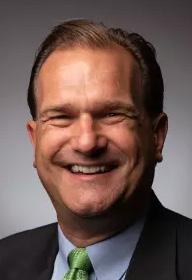
GCSU Director of Athletics Wendell Staton has led Bobcat Athletics since 2009, bringing decades of experience and a focus on student-athlete success to the program.
Staton’s journey in athletics began long before his current role, starting as a coach and returning to GCSU for a second time after years of experience in coaching and administration.
“This is my second time I’ve been at Georgia College,” Staton said. “I came here in 1991 as the assistant basketball coach on the men’s side because the person that I played for in college became the head coach here.”
After spending two years at GCSU early in his career, Staton and his family returned in 2009 when the athletic director position opened.
“We were very fortunate to be able to come back here,” Staton said.
His career includes coaching basketball, golf and cross country, along with teaching health and physical education before transitioning into administration and fundraising roles.
Staton said his connection to GCSU has remained strong over the years, both professionally and personally.
“It’s kind of a neat book-ended story to be honest,” Staton said.
During his time leading Bobcat Athletics, Staton has seen significant growth across the department while maintaining a strong focus on academics.
“I always say the university is on a spaceship going straight north,” Staton said. “And I like to think that we’re part of that ascension.”
He said one of the things he is most proud of is the academic success of student-athletes.
“The things that I’m most proud of would be our graduation rates that are the highest in the country for public institutions in Division II,” Staton said.
Staton emphasized that while college athletics have changed nationally, GCSU has stayed committed to its academic focus.
“We have held true
to the true scholar-athlete model,” Staton said. “That’s embedded in our DNA, that’s who we are.”
He said the most rewarding part of his role comes from relationships built with student-athletes over time.
“In my job, you don’t get into this job for the financial rewards, but you get something more beneficial than the financial rewards,” Staton said. “You get emotional paychecks that nobody else gets to get.”
He shared a moment that stood out to him involving a former student-athlete.
“I just got my placement for my residency in medical school, and I’m just calling people who’ve had an impact on my life, and you’re one of them,” Staton said, recalling the conversation.
Staton said moments like that are what make the job meaningful.
self. When I’m home, I am the person to go throw with my dad for two or three hours and work through things. What motivates me most is showing up for my team and for the coaches
who have given me this opportunity.”
When coaching a player throwing a no-hitter, making the decision to take the pitcher out of the game can become difficult. Many pitchers even argue with
coaches to stay in the game, but Garrett makes the decision easy for GCSU softball head coach Brittany Johnson.
“Syd is one who likes to take it pitch by pitch,” Johnson said. “She has a high standard for herself. So it doesn’t matter who she’s playing, she wants to play and pitch her best, and I feel she really executed that day.”
Garrett has continued to perform well for GCSU since her no-hitter, with her best performance since then coming against Clark Atlanta University on April 7, when she pitched seven innings of one-run softball, striking out six.
GCSU’s season starts to enter the tail end, as they approach their final 11 contests. Only two non-conference games remain, including their upcoming doubleheader against Fort Valley State University on Tuesday, April 14, in Fort Valley, Georgia.
“That’s the most rewarding part of the industry that we work in,” Staton said.
Looking ahead, Staton said his focus remains on continuing to build a strong, well-rounded program.
“The constant pursuit of excellence is always the goal,” Staton said.
He explained that this includes both on and off the field.
“I want our student-athletes to be involved in the community, be involved in clubs and organizations and be great students,” Staton said.
Staton also emphasized the importance of representing GCSU with integrity.
“When people see us come to town, I want them to say, I wish my university looked like that,” Staton said.
In addition to longterm goals, the department is also working on facility improvements, including renovations to the baseball and softball complexes.
Staton said these updates are part of the continued effort to enhance the student-athlete experience.
As GCSU continues to grow, Staton believes the university’s environment and values set it apart.
“I get to work with the best student-athletes in the country at the best place in the country for me,” he said.
With a focus on academics, character and competitive success, Staton and Bobcat Athletics continue to build on the program’s foundation. Students are encouraged to support GCSU Athletics, attend games and stay engaged as the department continues to grow in the years ahead.
Joe Palmese Asst. Sports Editor
Sports fans have long debated a question with no clear answer: What matters more to a team’s success — offense or defense?
Across America, the big four sports are considered baseball, basketball, hockey and football. Each sport has its own differences, but each sport consists of an offense and a defense.
Gene Wolfe, an American science fiction writer, once said, “The best defense is a good offense.”
Bear Bryant, a football icon who was the head football coach at the University of Alabama for 25 seasons, once said, “Offense sells tickets, defense wins championships.”
The pros and cons of the debate can be measured in different statistics and analytics. There is no “right” answer to the hypothetical question, but fans will continue to debate what they believe to be more important.
GCSU students weighed in on their personal opinions on whether offense or defense is more important to a team’s success.
“I like to think that a great defense has more potential to win championships compared to a great offense,” said Brendan Morse, a junior management information systems major. “Look at the [Seattle] Seahawks. They just won the Super Bowl. Sam Darnold was great but they won it all because of how good their defense was.”
This past season in the National Football League (NFL), the Seattle Seahawks defeated
the New England Patriots in Super Bowl 60. According to an article by the Sporting News, a media outlet covering sports statistics, stated that the
letic Association record. The University of Alabama led all of college football in scoring, putting up 48.5 points per game in 2020, according

Seahawks defense ranks sixth all-time in all of the NFL’s history in “Defense-adjusted Value Over Average.” (DVOA).
In football, the three phases of the game are offense, defense and special teams. Offensively, teams can score by either scoring a touchdown or a field goal. Defensively, teams aim to stop the opposing offense from scoring. Special teams come into play for kick-offs, punts, field goals, and kick returns.
“I think it depends on the sport if we are getting technical,” said Colton Lusk, a junior business major. “In [college] football, I think offense is more important personally. Look at the 2019 LSU offense. Joe Burrow could not be stopped. Alabama in 2020 with Mac Jones and DaVonte Smith could not be stopped.”
According to ESPN (Entertainment and Sports Programming Network), a sports media platform, the 2019 LSU (Louisiana State University) offense scored 48.4 points per game. Joe Burrow led the offense, throwing for 6,039 yards, a National Collegiate Ath-
to ESPN. Wide receiver DaVante Smith became the first wide receiver to win the Heisman Trophy Award since Desmond Howard won in 1991. Smith recorded 102 receptions and just two dropped passes.
“Yea a great offense is hard to stop but I think that a great defense doesn’t get the glory that it deserves,” said Liam Glass, a junior finance major. “Georgia’s defense in 2021 was elite. They had five get drafted in the first round [of the NFL Draft]. I’ll never forget how dominant that defense was.”
The University of Georgia brought home a national championship in 2021, its first since 1980. The defense was led by Travon Walker, who was the first overall selection in the NFL Draft in April of 2022. Walker recorded six sacks and seven tackles for losses, according to ESPN. Whether fans are fixated on a high-scoring offense or a dominant defense, the question remains unanswered. Coaches, players and fans will have opinions on the matter, just as GCSU students do.
Annalie Parker Asst. News Editor
In preparation for the 2026 World Cup matches taking place in North America this summer, Fédération Internationale de Football Association (FIFA) has implemented a mandatory three-minute-long hydration break in the middle of each half as a way to ensure players’ safety in harsh temperatures.
Cooling breaks have been utilized in past World Cups, first in Brazil in 2014, but only as necessitated by select periods of extreme heat. However, for the first time ever in the upcoming 2026 tournament, these breaks will be held regardless of the weather in the spirit of consistency. The first international friendly match took place on March 28 between the U.S. and Belgium.
“I do think that these hydration breaks are
necessary,” said Michael Edwardson, a junior marketing and accounting major. “We have seen multiple players struggle with the heat in the U.S., so I believe the players’ health and safety should be a priority.”
Despite the intention behind the mandate, it has raised concerns surrounding disruption to the flow of the game. Ac-
“cut the rhythm” of play.
“I think coaches are valid for being upset at the breaks because they recognize how unneeded they are,” said Kaiden Blazina, a freshman biology major. “I think that these hydration breaks are unnecessary for playing the World Cup because of the disruption of play and these players are already very fit.”

cording to USA Today, Mauricio Pochettino, head coach of the U.S. Men’s National Team, expressed annoyance at the rule, as he feels it has the potential to
Some of the selected stadiums across the continent, including Atlanta’s Mercedes-Benz Stadium, are equipped with a roof and air conditioning. These ad-
vancements have created additional controversy about the necessity of the hydration breaks in every game, as these features could potentially reduce the need for such accommodations.
“While playing inside these stadiums with AC and roofs, they should not need water breaks,” Blazina said.
USA Today reports that Belgium’s head coach, Rudi Garcia, on the other hand, believes the breaks are a useful coaching opportunity to take advantage of “to speak about strategy and plan.” Edwardson expressed agreement with this idea, even theorizing that the stoppage will prove to be advantageous for teams with a superior coaching staff.
“The breaks will allow coaches to deliver players instructions, meaning the more advanced coaches will be able to
make better use of this opportunity by making tactical tweaks midgame,” Edwardson said.
He feels that player safety is more important than game continuity and that these breaks should simply be utilized strategically as they will not pose a threat to gameplay.
“There are so many stoppages for fouls and injuries during games that these players are aware that they need to be switched on at all times, so this extra stoppage is no different,” he said.
Another aspect of the breaks that many fans have expressed skepticism about is their commercialization. FIFA is allowing companies to advertise during the breaks, which some GCSU students feel is unnecessary and disruptive to their enjoyment of the game.
“In their stance for consistency across all
Anakate Cox Staff Writer
From upset victories to busted brackets, this year’s Men’s NCAA Basketball Tournament (March Madness) has lived up to its name, delivering three weeks of intense competition and memorable gameplay that have kept GCSU students watching from the First Four up until the Final Four.
While most of the top-seeded teams and powerhouse programs advanced the farthest, early-round chaos and buzzer beaters defined the tournament and were some of the most memo-
rable moments from this year’s March Madness.
Close games were often determined by shot selection, turnover margin and free-throw efficiency in the final minutes. Starting out with 68 teams, the brackets narrowed down, and fans saw Illinois vs. The University of Connecticut (UConn) and Michigan vs. Arizona in the Final Four matchup, with each team relying on different tactical strengths.
For many students, the most impactful moments came from unexpected upsets or closecall games. Cameron Davidson, a sophomore marketing major, pointed to a major bracket disruption when a powerhouse was eliminated.
“Duke losing was a pretty memorable moment,” Davidson said.
Davidson even acknowledged late-game
action when recalling his reaction to watching the Final Four game matchup between Arizona and Michigan.
“In the final, when Arizona drilled back-toback players, I thought they were going to come back in the last 2 minutes,” Davidson said.
On Monday, April 6, Michigan defeated UConn in a gritty, hardfought championship game. Elliot Cadeau led the Wolverines with 19 points, while UConn’s Alex Karaban scored 17 points.
Michigan secured the Men’s NCAA national title with a 69-63 victory, earning its first championship title since 1989.
According to the Columbia Broadcasting System Sports, Michigan’s championship run now ranks among the most statistically dominant of any national
championship in recent years. Although the offense struggled in the title game, the Wolverines still reached an impressive total of 541 points in the NCAA tournament, which is the second-most points earned by a national champion.
Not every fan walked away happy. Seth Allen, a junior business marketing major, said watching his favorite team, the Florida Gators, lose during the Round of 32 was unforgettable. Jokingly, he said, “I can’t forget it, it haunts me every night.”
Still, Allen emphasized the significance of the tournament, adding that “March Madness is definitely up there with other tournaments like the NBA finals.”
Other students also highlighted personal disappointments with the results of this
games, the breaks seem to be more commercialized than necessary,” said Eni Bashua, a sophomore mathematics major.
Though he agrees that mandating the breaks is an efficient way to maintain fairness across matches, Bashua feels this does not justify allowing corporations to have a hand in them.
“I think they should have the breaks not because of the necessity, but for consistency and equality,” he said. “I don’t think [they] should be commercialized though.”
Friendly matches will continue in early June, and the tournament officially begins June 11. Whatever the effect of these hydration intervals may be on the upcoming matches, GCSU fans will continue to eagerly watch as their favorite teams battle for the title of FIFA World Cup Champion of 2026.
year’s tournament.
Will Chipman, a sophomore marketing major, highlighted the “UConn vs. Duke buzzer beater,” but noted inefficiencies from his own team. “I was rooting for Tennessee and they did horribly against Michigan, who went on to win,” Chipman said.

Grant Schelhammer, a freshman mass communications major, also described the performance of his favorite teams.
“Auburn didn’t make it to the tournament and UNC lost in the first round, so it was a pretty bad March Madness for the teams I rooted for.” Schelhammer said. Despite those frustrations, the overall reaction to the tournament remained positive. “I’d rate this tournament 8.75 out of 10,” Schelhammer said. “Among other sports’ post-season tournaments, March Madness is number one.”
Schelhammer’s perspective reflects a wider consensus that goes beyond preferred outcomes. The tournament’s structure–single elimination format and unpredictability–continues to make it one of the most engaging and highly anticipated events in sports.
Lillian Winn Staff Writer
As golf gained popularity on GCSU’s campus with the return of the Masters Tournament, students reacted to a recent accident involving the infamous golfer, Tiger Woods.
On March 27, Woods was arrested for a DUI outside of his home in Jupiter Island, FL, after colliding with a truck trailer. The accident caused his vehicle to roll and land on its side, and the golfer, unharmed, was able to crawl out of the passenger window to safety.
ESPN reported that the authorities found hydrocodone pills, pain-relieving drugs, in Woods’ pants pocket. Woods had been recovering from a leg injury resulting from a previous car crash in 2021, in which the golfer fractured his fibula and tibia in his right leg. He has suffered from chronic back and leg pain since the accident.
Police reported multiple symptoms, including profuse sweating and dilated pupils, which led them to believe that Woods was under the influence. While the authorities performed various sobriety tests on the golfer, he refused a urine test.
Woods spoke of his next steps regarding recovery in a recent article from the BBC, claiming he is “stepping away for a period of time to seek treatment and focus on my health.”
Not only did this accident cause a significant change in Wood’s life, but it has also caused people around the nation to form personal opinions on the golfer and his actions, including in Milledgeville.

Finley Pierce, a sophomore mass communications major, reflected on her familiarity with Tiger Woods.
“I’m fairly familiar with Tiger Woods and his career because I grew up in Augusta,” Pierce said.
“I’ve spent a lot of time around the game and know a lot of the players.”
She elaborated on the fact that she and her family members have all played golf and enjoy the game. Pierce continued to share her opinions on the incident, explaining that she was not surprised to hear about the car crash.
“It just sounds like typical Tiger Woods, honestly,” Pierce said. “In the past, I think he’s dealt with some anger issues, and he has definitely made some irresponsible choices.”
Drew Daniel, a freshman political science and criminal justice major, elaborated on Woods’ past record with similar accidents.
“He has had legal trouble in the past, including DUI’s,” Daniel said. “He has been known to struggle with substance abuse ever since his back injury.”
Daniel spoke further of how he thinks the situation should be dealt with legally.
“The fact that he is a professional golfer should have nothing to do with this arrest,” Daniel said. “He is a repeat offender, and the court system should judge that accordingly.”
Woods carries a great deal of fame and connections with brands.
Daniel explained his thoughts regarding Woods’ golfing career.
“I am torn between what should happen,” Daniel said. “On one hand, his run-in with the law is separate from his professional career, but he also represents the PGA [Professional Golfers Association] and is represented by certain brands that may see this as negative publicity.”
Pierce spoke further on what she thinks Woods’ future in the realm of golf might look like.
“I think he was super talented
Lily Mahaffey Staff Writer
While most Georgia College students spend their days moving between lecture halls and downtown Milledgeville, a lesser-known campus just minutes away offers forests, trails and outdoor programs designed to take learning beyond the classroom.
“One of my friends introduced me to fishing out there a few years ago, and since then, we go out there all the time, it’s very peaceful,” said Maddie Marx, a senior business management major.

and skilled at this game,” Pierce said.
“But I think it probably just means the end of the Tiger Woods era.”
Due to the outcome of this incident, Woods was not in attendance at the Masters Tournament, which took place in Augusta, GA, over the past weekend. His attendance was planned for multiple events leading up to the tournament.
Pierce advised students on a key takeaway from the incident.
“If you don’t feel like you can properly operate a vehicle, then have a friend do it,” Pierce said.
“Everybody should be held responsible for their actions, no matter who they are.”
To explore the incident further, students can view the Martin County Police body cam footage at: https://www.theguardian.com/ sport/video/2026/apr/03/bodycam-footage-shows-moment-tigerwoods-is-arrested-for-dui-video.
Within this slowpaced and peaceful setting, Andrew Carey, a senior business management major, uses the space as both a way to focus on academics as well as enjoy his favorite activities.
“I love to sit at the pavilion and do my school work,” Carey said. “ I also go fishing here pretty often.”
The pavilion, located right on the lake, has an abundance of picnic tables and rocking chairs for students to sit back, relax and take in the view. It is large enough for students to host special events or occasions to enjoy with family and friends.
That sense of calm and separation from the main campus is something multiple students emphasized. Whether
Students like Marx get introduced to the facility by word of mouth and attend East Campus regularly for outdoor activities. The 83 acres of land include forests, a lake, a challenge course and cabins used as classrooms for certain programs and major classes.
fishing by the lake, walking the trails or sitting at the pavilion, East Campus offers an environment that allows students to slow down and reset.
In addition to its recreational aspect, East Cam-
the appeal is simple.
“I think people who enjoy the outdoors and exploring would like it the most, anyone who is active and loves to discover new places to get away,” Marx said.
mend it to students, they usually don’t know what I’m talking about, but the nature trail, pavilion and pond are all beautiful places,” Carey said.
Students who frequently visit East Cam-

pus also serves as a space for hands-on learning and group activities. The challenge course, which includes climbing elements and team-building exercises, is often used by student organizations and classes, making it stand out from a traditional classroom setting.
For students like Marx,
Despite its range of offerings and activities, East Campus remains relatively less wellknown than other parts of campus. Students who are familiar with it say that a lack of awareness is the main reason students don’t take advantage of the facility more. “Whenever I recom-
pus often describe it as something many on campus simply haven’t discovered yet.
Madison Ginsberg, a senior marketing major, only recently learned about the space despite spending several years at Georgia College.
“I never knew about it until last year, and I do not think many people know it’s here either.”
The experience might offer more to students than they expect at first glance. The mix of fresh outdoors and quiet atmosphere can appeal to many different types of students here on campus, whether they are looking to stay active or just wanting a break away from the campus noise.
As more students look for ways to balance academic pressure with time outdoors, East Campus provides an option just minutes away, one that many say is worth discovering and checking out. The Outdoor Center’s address is 315 Lake Laurel Rd NE, Milledgeville, GA 31061.
“I would definitely consider it a hidden gem,” Ginsburg said.
James Cordero Contributing Writer
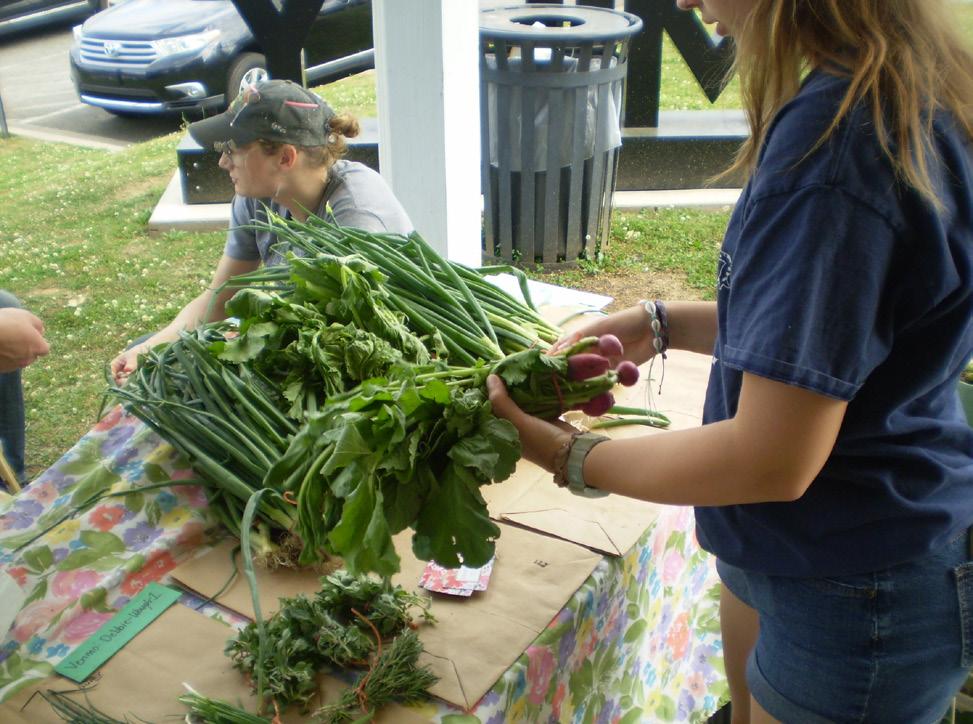
The Milly Market returned on April 3, after a brief hiatus, and the community has responded positively by showing up for the local merchants who sold a variety of products ranging from Goat milk soap to homegrown mushrooms.
The market serves as a meeting place for the community and an opportunity for local farmers to sell their products to a variety of students and Milledgeville locals alike.
The market is organized by Debbie Waugh and happens every first and third Friday of every month from 4 to 7 p.m., planned all the way to October. With prices ranging from a blackberry turnover of $4 to pure vanilla extract or candles for $25, there is something for everybody to buy.
“It’s super important to have these community events because it’s fun, and it’s a great way for local vendors to get out and show off their goods,” said Alexis Overton, a junior environmental science major.
Milly Market also matches The Supplemental Nutrition Assistance Program (SNAP), or Electronic Benefit Transfer (EBT), benefits dollar for dollar. Even though the market is accommodating to people with less money to spend, the patrons selling at the market don’t try to compete with stores.
“We don’t try to compete with Walmart, because sometimes their prices might be a little bit lower, but they don’t have farm fresh eggs,” said Elliot Perkins, who works with his wife, Andria, at Unity Grove Farms.
Stall owners and shoppers alike value the
affordability and accessibility of fresh fruits and vegetables that are organic and without any
goats’ milk at Bone Creek Farm, or Lisa Vaughn, who works with her husband at Ellis Mill.

pesticides. By making the produce more affordable, it means people are more likely to buy more products and eat healthier.
“The easier you are able to get something the more likely you are to use it,” said Overton. “The more likely you are to eat fresh fruits and vegetables, the healthier you can be because you are eating better.”
Perkins and many others at the market run their business with their family, like Alan Carr, who works with his wife to make soap made from
The market is also changing and improving as time goes on, and more people hear about the event. This year, Waugh introduced live music to the market, and stores move in and out depending on the season and who is available.
Community is built at Milly Market by the people who show up, who shop locally, interact with the shopkeepers and spread the word to other people about the market to other people.
“Just meet new people, let them know
Maggie Scarbrough Staff Writer
This spring, GCSU students shared their favorite TV shows and movies, offering recommendations for fellow students looking for their next binge-worthy entertainment and exploring what makes trending entertainment resonate with students today.
As streaming services continue to rise in popularity, many college students are drawn to them because of their accessibility, convenience and user-friendly nature. According to students, being able to relate to the characters and engage with the plot improves their experience. Streaming platforms like Netflix, Disney+, Hulu and Prime Video offer a wide range of genres that make watch parties inclusive and fun.
These platforms give students an escape from their busy, everyday lives, whether the genre is action, romance, science fiction or history. Students shared that they watch TV and movies not just for
entertainment, but also to create community and learn more about themselves.
“I’m currently watching ‘The Pitt,’ which is a really good show,” said Isabella Waddell, a junior liberal arts major.
“I’m about to start watching ‘Euphoria’ when it comes out.”
Waddell shared what shows she would recommend to other students based on their interests. From her experience, Waddell said she believes shows like ‘The Pitt’ cater to a more niche interest range, but that there are many other available options.
“If you’re not into medical stuff, then I wouldn’t necessarily recommend ‘The Pitt,’” Waddell said. “But I recommend any anime or live-action shows I watch to anybody.”
Hannah Lanoue, a senior marketing major, said that she enjoys less common, international shows that have a competitive aspect.
“My main [TV show] is ‘Taskmaster,’” Lanoue said. “It’s a European reality show that’s free to watch on YouTube.
about what we are having, come down and get to know everyone here,” Vaughn said.
There was also a chance to win free gifts if visitors completed a treasure hunt of what was sold, encouraging people to talk to all the vendors and see what was being sold at the market.
Milly Market is a welcome space where locals love to talk to each other and share their stories. Human connections can be a major
“The interaction between the community and ourselves is my favorite part.”
Fresh produce, refreshing drinks, live music, vitamin D and a welcoming community: all the things that make the Milly Market the place it is. If students need a space to relax at the end of the month, restock on fresh produce or a chance to interact with the community, the Milly Market is for them.
[The hosts] bring the comedians and contestants [to the set] and give them tasks to do.”
Lanoue noted how the show’s plot makes it easier for viewers to follow along compared to others.
feature for some individuals who participate.
“I like interacting with the people as they come through,” Perkins said.
er than a storyline plot, they keep viewers like Lanoue engaged and keep themes light.
Jenna Clinkenbeard, a sophomore art major, said that her favorite shows include teen romances, animated films

“It’s just a silly show,” Lanoue said. “It’s easy to watch, and I don’t have to put all my attention on it. It’s a great show, and everyone I know who has watched it has loved it.”
Reality shows remain popular both in the U.S. and internationally. For those who want to follow something oth-
and psychological thrillers.
“I’ve been watching ‘The Summer I Turned Pretty,’ and I just watched ‘Zootopia 2’ that came out,” Clinkenbeard said.
Clinkenbeard also said that she liked the bookturned-show “We Were Liars” on Prime Video.
“I would recommend [‘We
“Show up,” said Overton. “Go to community events, be a villager and spend some money. The easiest way to do it [build community] is to contribute.”
Were Liars’] to others,” Clinkenbeard said. “I liked it because it had an unexpected ending.”
GCSU students said they enjoy a wide range of media, with television and movies among them. Those like Waddell and Clinkenbeard engage with media that fit their interests, from medical dramas to romance and thrillers. According to Lanoue, a good show does not have to be serious or produced in the United States. Her statement shows that students with busy schedules can engage in entertainment that still allows room for multitasking. Students said they believe that sharing television and movie recommendations helps build connections on campus and meet people with shared interests. When students bonded over a specific television show or movie, they said that they could make observations about the plot, characters and setting. Through this, many students have formed meaningful conversations on campus, no matter what genre they prefer.
Continued from page 1
Langston said playing Nan meant balancing different sides of the character at once.
“It has been a uniquely rewarding experience because we get to see the story through her eyes in the moment as well as her looking back on her path and thinking about everything that went wrong in her efforts to make it right,” Langston said.
Throughout the play, Kyle remains physically still while the action unfolds around him. The scenes build toward a
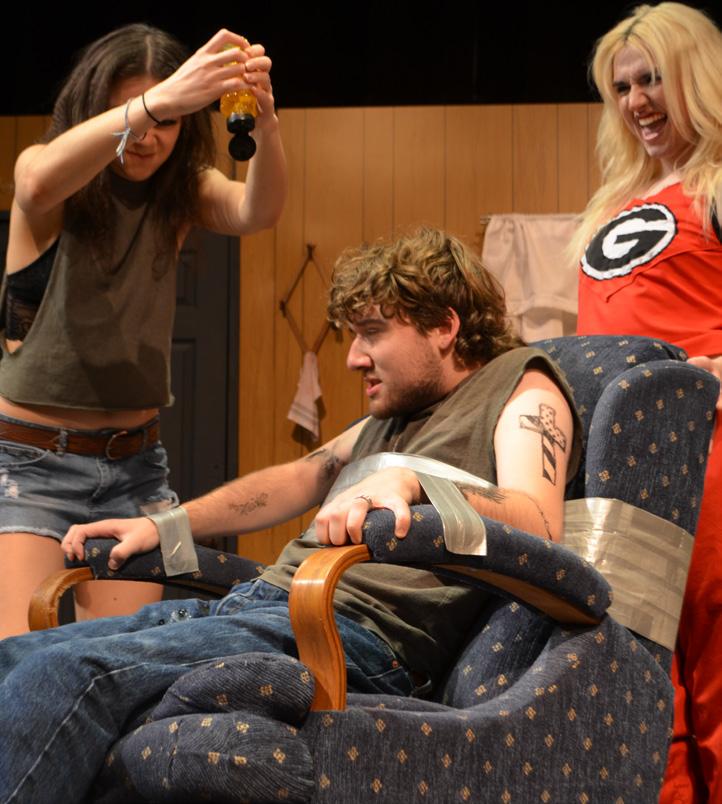
final moment involving meat and honey, part of Nan’s plan to make Kyle believe he will be left for the bears. The ending is followed by a bear’s roar, leaving it unclear whether he is actually harmed.
The title references William Shakespeare and comes from
a well-known stage direction in his play, “The Winter’s Tale.”
Behind the scenes, technical ele-
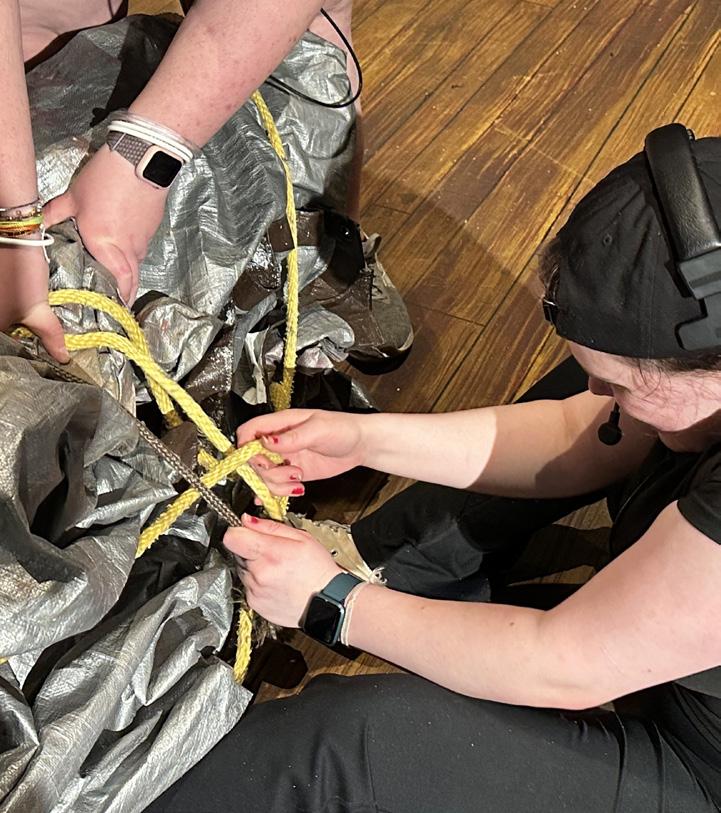
ments helped support the production. Madison Hildebrand, a sophomore theater major who worked as props lead and costume supervisor, said her role included preparing actors for unusual situations.
“I consider my job to be making the actors as comfortable as humanly possible with random stuff and things that don’t happen often, like being duct taped to a chair,” Hildebrand said.
She also noted that the production included a wide variety of props.
“For this show, there are a ton of props,” Hildebrand said. “There’s a lot of weird stuff that we had to make, like a dead deer.”
Hair and makeup design added more detail to each character. Sophia
Wilson, a senior theater major, said her work focused on matching each role.
“When it came to designing the looks for all of these characters, for example, Caleb’s character, we had to make sure we matched what the style was like for a gay person at the time,” Wilson said.
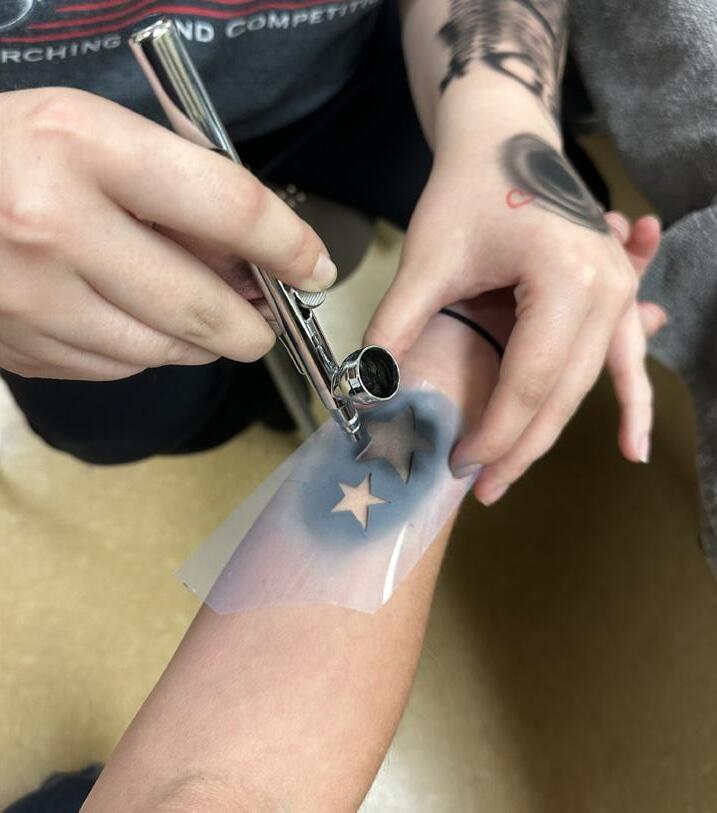
She also worked with Butts on Kyle’s appearance.
“I personally added tattoos,” Wilson said. “With the help of the director, we came up with the idea for Kyle, who is the male lead of the show, to have tattoos. It’s been really fun getting to come up with the designs, since I hand-stenciled them all.”
Wilson said the entire process reflected how the cast and crew worked together throughout the production.
“I think all of us are just so dedicated to this craft,” Wilson said. “We
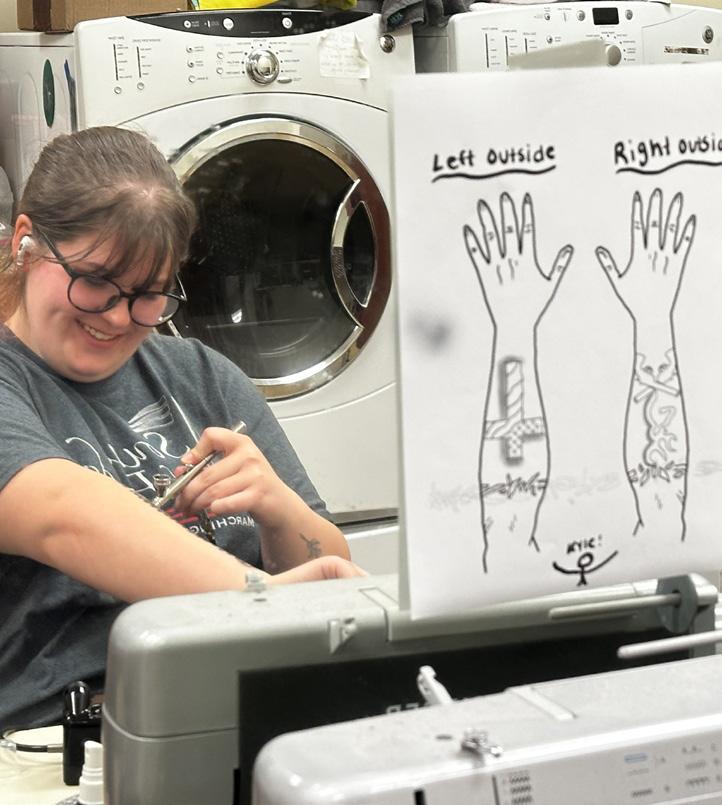
spend hours and hours here, but we all help each other out and we’re
all very supportive of each other.”
Langston said she hopes her character leaves a lasting impression on audience members, especially through its portrayal of abusive rela-
tionships and the challenges involved in confronting and leaving them.
“Chloe and I talked a lot about how there’s going to be at least one woman in the audience who sees herself in Nan,” Langston said. “My goal is for that woman in the audience to see herself as Nan in the beginning, and want to become Nan in the end.”
By the end of its run at GCSU, “Exit, Pursued by a Bear” remained focused on its subject matter. It balanced moments of levity with chaos to portray abuse without minimizing its impact, leaving the audience with both discomfort and release.
The Art Healthy Festival on April 11 brought together over 100 art and product vendors from across Georgia for a community-focused event on Front Campus.
With carnival games, a Bike Rodeo, caricature artists and live performances from dance groups, there was something for everyone to enjoy. Along with the entertainment, attendees also could take part in free health assessments, making it a perfect mix of creativity, wellness and community.
The street in front of Front Cam-

pus was closed off in order for the many booths to set up shop for the event. There was also a stage a DJ set up on Front Campus’s lawn to keep the atmosphere lively.
There were a variety of booths, in-
cluding art vendors, face painters, as well as food and drink options.
Addison James, a junior biology major, also attended the festival in search of a fun activity to do in town on a Saturday.
“I think it’s really fun,” James said. “There’s a lot of really cool, artsy things.”
Avery Geary, a freshman philosophy major, attended the Art Healthy festival because she loves viewing art and shopping.
“It’s very similar to Deep Roots, which I like because it makes it a little more manageable,” Geary said.
Deep Roots is an annual festival in the fall that has a large variety of vendors and music, and is a larger version of the Art Healthy festival.
Many booths during the Art Healthy Festival had handmade items, like 3D printed creatures, tumblers, crochet items, Greek life decor, college merch and decor and so much more.
“I feel very educated with the amount of art going around, and there’s also a lot more shops than I expected,” Geary said.
The vendors contributed to the atmosphere of the lively event by sharing their unique, handmade pieces that go beyond a simple product.
“[Art] can be used to communicate history, philosophy, even math and it’s a universally understood language between people and unites them together in many different ways,” Geary said.
Allison Bogler, a sophomore exer-
cise science major, passed through the festival after her sorority initiation.
“It’s important because people are able to express themselves in a way and show it to other people and art is just so abstract and it can be taken differently by everybody,” Bogler said.
Many GCSU and local high school clubs also had booths set up, including the GCSU Aquatic Sciences club.
Playing into the “healthy” part of the Art Healthy Festival, GCSU’s mobile health vans were set up.
GCSU nursing students were there volunteering and providing health checks for those who chose to do so.
The free, convenient health checks hold many benefits for the local community.
“I feel like they’re important to those who can’t afford to get them on their own,” Bogler said.
According to USA News, based on recent data, 16.4% of the population in Baldwin County, Georgia, lacks health insurance, which makes routine health check-ups difficult to access. High out-of-pocket costs often lead residents to delay or skip care.
“It could probably help people that aren’t able to get them regularly,” James said.
The health checks are also quick and convenient, whereas visiting a doctor’s office is often not the case, especially for busy parents or people with demanding professions.

However, GCSU students have access to Student Health Services, which covers health check-ups, sick visits, Gynecological exams, immunizations, physical exams and more.
“I think everyone deserves a chance to be checked up on, but for the students, I don’t really think it makes so much of an impact because we get free health checks anyway,” Geary said.
The festival also offered face painting, caricatures and bouncy houses, creating an environment for family fun for all ages. Students were even able to volunteer to supervise the bouncy houses for service opportunities.
“I think it’s a good opportunity to have things like this where people can come and show their creative side, and I think it gets the community together,” James said.
CATERWAUL: a shrill howling or wailing noise like that of a cat; commonly associated with a bobcat
By: Bryan Cade
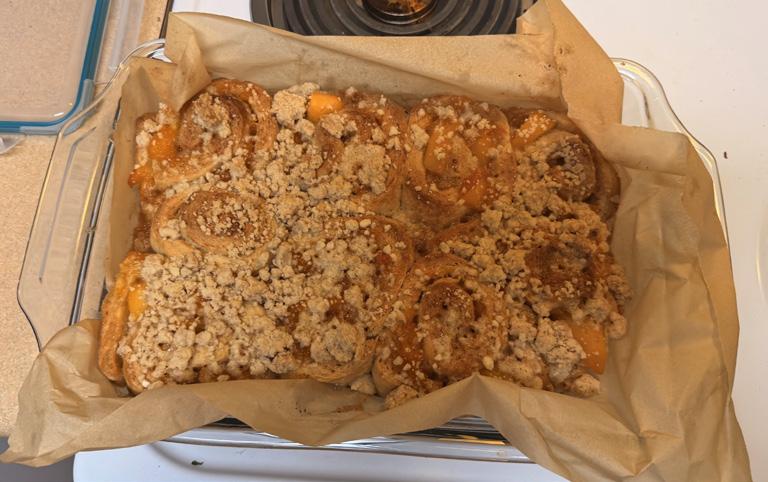
Peach Cobbler Cinnamon Rolls (No Stand Mixer & 2‑Can Method)
Adapted from Jocelyn Delk Adams’ recipe, using two cans of peaches and hand‑kneading.
Ingredients
Dough: Flour (3 ½–4 cups), sugar (¼ cup), rapid‑rise yeast (1 packet), salt (1 tsp), milk (¾ cup), water (¼ cup), butter (½ cup), 1 egg.
Peach Filling: 2 cans peaches (drained & chopped), brown sugar (½ cup), cinnamon (1 tbsp), nutmeg (¼ tsp), cornstarch (1 tbsp), lemon juice (1 tbsp), melted butter (2 tbsp).
Cinnamon Butter Spread: Soft butter (½ cup), brown sugar (½ cup), cinnamon (1 tbsp).
Glaze: Powdered sugar (1 ½ cups), cream/milk (2–3 tbsp), vanilla (1 tsp).
Instructions (Condensed)
Peach Filling: Cook peaches with sugar, spices, cornstarch, and lemon juice until thick and syrupy; stir in butter and cool.
Dough: Warm milk, water, and butter. Mix 2 cups flour with sugar, yeast, and salt. Add warm liquids and egg. Add remaining flour gradually, then knead by hand 8–10 minutes until smooth and elastic.
First Rise: Let dough rise 60–90 minutes until doubled.
Assemble: Roll dough into a 12×18 rectangle. Spread cinnamon butter mixture, then peach filling. Roll up tightly and slice into 12 rolls.
Second Rise & Bake: Place in greased 9×13 pan, rise 30–45 minutes. Bake at 350°F for 25–30 minutes until golden.
Glaze: Whisk glaze ingredients and drizzle over warm rolls.
Reference: Adapted from Grandbaby Cakes.
“Saint Patrick’s Day”
By: Jane Carr
Green comes loud that morning like a song I didn’t ask to hear, a fiddle scraping at the edges of a house that isn’t there. They dye the river reckless, turn the sky into a bruise of cheer, but I’m counting all the quiet things that only show up once a year. I see you in the clover, not luck, but something split into two, a symmetry of almost that never quite returns to you. The bells are ringing sideways, like they forgot what grief is for, while I’m in the doorway hearing footsteps on the floor that don’t come anymore. And I could swear the wind is humming some old tune you used to know, but it’s tangled up in bagpipes, and it’s nowhere where I can go. So I wear a shade of green that no one else can see, a dim and private color like the underside of memory. And somewhere in the shouting and the spilling of the beer, I’m holding to a quieter song that only you can hear.
On behalf of The Colonnade staff we would like to present our newest submission column, “The Caterwaul.” This is an opportunity for students to share their poetry, flash fiction, photography, drawing, comic strips and more. We are extremely excited to give students more of a place in the paper and for their creativity to be acknowledged and published. We encourage any and all students to reach out and ask questions. In the spirit of GCSU’s mascot, Thunder, the name of this column takes inspiration from all that is a bobcat. Caterwauling is the noise bobcats make often, and that is what The Colonnade intends to do with this column: make noise with your voice.
Interested in submitting?
If you are interested in submitting your work to be featured in The Caterwaul, consider this general info!
1. The content relates to or is catered toward GCSU students.
2. Your specific piece has not been published anywhere else.
3. Examples of submissions include; Photography, drawing, flash fiction, comic strips, poetry and more!