Issue 6 | Volume 107

Page 1


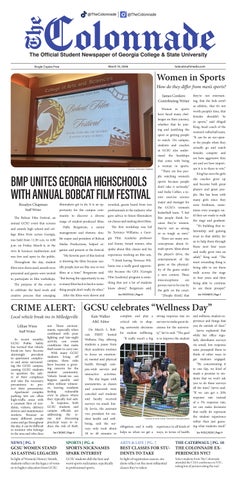
BMP UNITES GEORGIA HIGHSCHOOLS WITH ANNUAL BOBCAT FILM FESTIVAL

The Bobcat Film Festival, an annual GCSU event that screens and awards high school and college films from across Georgia, was held from 11:30 a.m. to 4:00 p.m. on Friday, March 6, in the Arts & Sciences Auditorium and was free and open to the public.

Throughout the day, student films were showcased, awards were presented and guests were invited to participate in film workshops.

The purpose of the event is to celebrate the hard work and creative process that emerging

filmmakers get to do. It is an opportunity for the campus community to discover a diverse range of student-produced films.

Halle Bergstrom, a senior management and rhetoric double major and president of Bobcat Media Productions, helped organize and present at the festival.

“My favorite part of this festival is showing the films because usually people just see like one or two films at a time,” Bergstrom said.

“But having the opportunity to see so many films back to back is something people don’t really do often.”

After the films were shown and

awarded, guests heard from two professionals in the industry who gave advice to future filmmakers on classes and making short films.

The first workshop was led by Terrence Williams, a Georgia Film Academy professor and Emmy Award winner, who spoke about film classes and his experience working on film sets.

“I think having Terrence Williams was a really good opportunity because the GFA [Gerogia Film Academy] program is something that not a lot of students know about,” Bergstrom said. Local vehicle break-ins

Women in Sports

How do they differ from men’s sports?

Women in sports have faced many challenges on their journey, whether that be joining and justifying the sport or getting people to watch. On campus, students and coaches at GCSU also understand the hardships that come with being a woman in sports.

“There are less people watching women’s sports because people don’t take it seriously,” said India Collier, a junior exercise science major and manager for the GCSU’s women’s basketball team. “I feel like people think because they’re women, they’re not as strong or as tough as men.”

There are many misconceptions about female sports. Ideas about the player’s drive, the entertainment of the game or the physicality of the game under a new context. These misconceptions are proven not to be true by the girls on the court.

“[People think] that

they’re not entertaining, that the kids aren’t as athletic, that it’s not worth people’s time, that females shouldn’t be in sports,” said Abigail King, head coach of the women’s volleyball team.

“It can be an eye-opener for people when they actually go and watch females compete and see how aggressive they are and see how important it is to them to win.”

King has seen the girls she coaches grow up and become both great players and great people. She has been with many girls since they were freshmen, sometimes even younger, until they are ready to walk the stage and graduate.

“It’s building that relationship and gaining trust in that ability for us to help them through those next four years and really grow into an adult,” King said. “The most rewarding thing is being able to see them walk across the stage in four years and then being able to continue to see them prosper.”

Lillian Winn Staff

In recent months, GCSU Public Safety has warned that vehicle break-ins have become alarmingly prevalent in apartment complexes and areas surrounding the GCSU campus, causing GCSU students to question the safety of their complexes and take the necessary precautions to protect their possessions.

Apartment complex parking lots are often high-traffic areas with a constant flow of residents, visitors, delivery drivers and maintenance workers. Because so many different people come and go throughout the day, it can be difficult to monitor who belongs in the area and who does not. These environments, especially when combined with poor lighting and late-night activity, can create conditions that make theft easier to carry out.

of Women’s

With many GCSU students living off campus, these risks have become a growing concern for the student community. Vehicle break-ins can happen quickly and often without witnesses, leaving residents feeling vulnerable even in places where they typically feel safe. In response, both GCSU students and campus officials are addressing the issue and discussing practical ways to reduce the risk of theft.

See CRIME | Page 4

education from GCSU.

On March 3, Bobcats FIRST hosted Wellness Day, offering students a pause from their academic routines to focus on emotional, mental and physical health through campus-wide surveys and interactive activities.

The day began with assessments, as classes and coursework were canceled and students and faculty received surveys via email. Emily Jarvis, the assistant vice president for student health and wellbeing, said the surveys only took about 30 to 40 minutes to

complete and play a critical role in shaping university decisions for student wellbeing.

“It really wasn’t a big

strong response rate on surveys to make great decisions for the university,” Jarvis said. “The goal is to improve the student

obligation, and it really helps us when we get a

experience in all kinds of ways, in terms of health

and wellness, student experience and things that you do outside of class.” Jarvis explained that while her office regularly distributes surveys via email, low response rates prompted them to think of other ways to get students engaged.

“By concentrating it to one day, we kind of made a promise to students that we won’t ask you to do these surveys all the time,” Jarvis said. “If we can get a 20% response rate instead of a 5% response rate, we can make decisions that really do represent the student experience rather than just guessing what students need.”

Courtesy of Rosalyn Chapman
GCSU students dub the best and worst sports nicknames, sepcifically in professional sports.
dents
CATERWAUL | PG. 10
Select students from The Colonnade attended the CMA conference in NYC, taking lots of pictures along the way!
WELLNESS | Page 9
Courtesy of Anna Leavitt, University Communications
See WOMEN | Page 5

GCSU continues Pre-Greek Week Glass Drive

GCSU’s Office of Sustainability and Office of Fraternity and Sorority Life are holding a “PreGreek Week Glass Drive” on March 4 and 25, and April 13-15 from 10 a.m. to 12 p.m. at the West Campus Glass Shed.

To donate, the Office of Sustainability is instructing students to only bring glass bottles, jars, etc. that are no bigger than 5 inches in diameter. They also ask that glass be organized into bags labeled with the associated organization.

When students arrive at the recycling shed, volunteers will be ready to weigh and log the pounds of glass for specific organizations.

GCSU implemented its glass recycling program in 2021 to increase its waste reduction portfolio.

Glass bottles or containers that are 4” or less in diameter can be recycled by tossing them into one of the designated collection bins on campus, according to GCSU’s Office of Sustainability. After that, the glass will be sorted by color and cleaned to remove la-

bels and residue. Next, glass is crushed into tiny pieces. Then, contaminants are removed from the glass and melted into new glass products.

“Oftentimes, glass can’t be recycled with other things,” said Hailey Meaders, a sophomore psychology major and a member of Delta Gamma. “It ends up in landfills, so it’s helpful to the environment to dispose of it properly.”

Recycling glass helps the environment by saving energy, reducing carbon emis-

the landfills,” said Kenadie Garcia, a freshman biology major and a member of Alpha Gamma Delta. “It’s always good to be self-conscious about what you’re putting into the environment.”

Participating organizations in the PreGreek Week glass drive will compete to donate the most glass, with winners earning points toward Greek Week.

Greek Week, which takes place April 13-19 of this year, is an annual competition between Greek organizations on

the year, organizations earn points towards Greek Week by logging service hours, participating in the Pre-Greek Glass drives and participating in Panhellenic events.

Ashlyn Rowland, a junior criminology and psychology major, is the Vice President of Panhellenic Relations for Delta Gamma. She is in charge of coordinating all things Panhellenic relations, representing Delta Gamma, including the Glass Drive.

“Greek life is participating in the Glass drive

sions, and replacing the need for raw materials.

“It’s important that we don’t just throw away all this glass that we use because there’s nothing to really break it down in

VOLUME 107 | NO. 6

Editorial Board

Mary Ciucevich..............

Amelia McEwen.............

Julia Jensen......................

Jane Carr............................

Editor in Chief

campus. Different competitions that make up Greek Week are the Glass Drive, trivia, various intramural sports, Sing, Step and Greek Goddess.

However, throughout

Managing Editor

Art Director

News Editor

Annalie Parker.................

Asst. News Editor

Bryan Cade.......................

Sports Editor

Joseph Palmese..............

Kate Walker...............

Sydney Williams.............

Isabella McComis..........

Asst. Sports Editor

Arts & Life Editor

Asst. Arts & Life Editor

Digital Media Editor

Reaghan Shehee............

Rebecca Ocampo..........

Haley Quimby..................

Mikkel Christensen.......

Digital Media Editor

PR Manager

Ad Sales Manager

Faculty Adviser

also contributing to the benefit of the environ-

year’s Greek Week for the third year in a row.

ment. The competition encourages participants to collect as much glass as possible to benefit their organization while also promoting recycling and helping the environment.

“The importance of the glass drive is to ensure people learn the importance of disposing of glass the proper way and to encourage a friendly competition within Greek life,” Rowland said.

“My roommates and I have a growing collection of glass to donate for the drive,” Meaders said. Many students will stockpile and save up their glass items, starting months before the first glass drive. Additionally, students who have a heart for volunteering or have a need for service hours can sign up to volunteer at the glass drive drop-offs on GivePulse.

to better dispose of glass and help keep our planet cleaner,” Rowland said.

The glass drive contributes to the Greek Week competition by fostering competition while

The Glass Drive is a very popular competition in Greek Week because many students utilize glass in their daily lives. Beverage jars, pasta sauce cans and candle jars are the most popular elements noticed in the glass drive.

Rowland mentioned she has been saving her glass since the previous

“Being Greek is doing good,” Meaders said.

For more information, contact the Office of Sustainability at 478-4457016 and @gcgogreen on Instagram and the Office of Fraternity and Sorority Life at @gc_fsl on Instagram. To volunteer, visit the GCSU Sustainability Givepulse.

@TheColonnade @TheColonnade

Contributing writers are always welcome at The Colonnade. Contact thegcsucolonnade@gmail. com for more information.

If you have a tip or wish to contact The Colonnade, email thegcsucolonnade@gmail. com or message our Instagram @thecolonnade.

The Colonnade is now primarily published online. Read at issuu.com/thecolonnade or on bobcatmultimedia.com.

Isabella McComis | Digital Media Editor

Women’s History Month: GCSU’s lasting legacy

The history of Milledgeville’s women’s college

During Women’s History Month, students at Georgia College & State University have a unique reason to reflect on the legacy of women in higher education, as for nearly 80 years, from 1889 until 1967, the university operated as a women’s-only college.

According to the eighth annual announcement and catalog of GCSU’s original title, the institution first opened its doors in Milledgeville as Georgia Normal and Industrial College, a school designed to train women for careers in teaching, business and vocational fields.

Baylee Dean, a senior marketing major, said she was aware that Georgia College had once been a women’s college, but she was surprised to learn how recently the transition to coeducation happened.

“I did know that Georgia College was a women’s college, but I didn’t know it was until 1967,” Dean said. “That’s honestly kind of crazy because

that’s pretty recent, but it’s also super awesome.”

Dean feels that knowing the campus was originally built to educate and empower women makes her appreciate the university even more.

alumni, said she was not initially aware of the university’s background when she first enrolled.

“I thought it was just like a normal college, and then I found out it used to be an all-women’s

“Our campus is still very much predominantly women, and I think that makes sense since we started as a women’s college,” Dean said. “It makes me feel really good and really safe knowing there are so many amazing women who go to this school.”

Some students did not already know the university’s history as a women’s college, but say learning about it deepened their appreciation for the institution. Montana Brooks, a former philosophy major and current GCSU

college that turned coed,” Brooks said. “I thought it was very cool because when you think about universities in the past, they were very male focused, so it’s interesting to hear there was a place that was all women.”

Brooks also said the university’s culture has a nature of inclusivity compared with larger universities.

“I feel like Georgia College overall feels more inclusive,” Brooks said. “There’s not really a sense that something is just for men or that wom-

en can’t do certain things. It feels more like, ‘Of course you can do this.’”

Over the years, the college evolved alongside changing expectations for women’s education. It later became Georgia State College for Women and eventually Women’s College of Georgia before becoming coeducational in 1967.

When the college first opened, it welcomed 88 students representing 52 counties across Georgia. By the end of the first session, en-

natural sciences, English, stenography and drawing. These courses were designed to prepare women for professional careers and leadership roles at a time when higher education for women was far less common.

One influential figure in the college’s early history was mathematics professor Alice Napier. Napier taught at the college for more than 40 years, beginning in 1893, and became widely respected among students and faculty. In 1943,

rollment had grown to 171 students from 75 counties, demonstrating an early demand for higher education opportunities for women.

Students at the time studied subjects such as teaching, mathematics,

she was voted the institution’s “all-time greatest teacher.” Her legacy continues today through Napier Hall, a residence hall named in her honor.

Marin Carter, a senior business major, expressed that she feels the

university’s background as a women’s college is something that still resonates with students today.

“Knowing that this school was originally created to educate and empower women makes me really proud to attend Georgia College,” Carter said. “It shows that women here have always been encouraged to lead, succeed and support each other.”

Carter said the legacy of women’s education can still be seen in the ambition and confidence of many students on campus.

“It’s inspiring to know that generations of women before us helped create the opportunities we have today,” Carter said.

More than a century after its founding, Georgia College continues to evolve, but its roots as a women’s college remain an important part of its identity. For many students, that legacy serves as a reminder of the opportunities created by the generations of women who studied, taught and led on campus long before them.

Possibility of decreased taxes on menstrual products

Georgia’s House of Representatives passes tax cut bill

Lawmakers in the Georgia House of Representatives have proposed House Bill (HB) 1144 that, if passed, will make menstrual products exempt from the 4% state sales tax by labeling them as essential goods for four Saturday to Sunday weekends out of the year.

The bill, titled Georgia Hygiene Essentials Tax-Free Period, is a moderately bi-partisan proposal, sponsored by five democrats and one republican. The effort is spearheaded by Kim Schofield and the democratic minority leader, Carolyn Hugley.

The proposal is part of a larger push to make menstrual products more affordable and accessible, but GCSU students are saying that it is not enough.

“It’s kind of a slap in the face,” said Sanai Irving, a junior English creative writing ma-

jor. “This is the bare minimum that could be done for reproductive rights and health.”

Menstrual products are expensive for most, which has led to nationwide conversations about “period poverty,” the term used to describe the lack of suitable menstrual products and education.

Although the bill is an attempt to combat period poverty, students believe that four weekends out of the year will not make a real difference.

“It would be more meaningful if they got rid of the tax entirely,” said Rhylinn Hendrickson, a sophomore philosophy major.

The National Organization for Women states that the average woman spends about $20 on menstrual products per cycle, leading to an estimated average of $18,000 spent on period products over her lifetime.

The passing of HB 1144 will make it eas-

ier for more exemptions to be placed on the sale of menstrual products in the future.

“It’s a step in the right direction, but it feels incredibly limited,” said Lillie Wright, a freshman psychology major.

According to the National Organization for Women, the inability to afford or access menstrual products has forced women to make makeshift menstrual products out of toilet paper or other wadded up paper material, which can cause toxic shock syndrome, yeast infections and urinary tract infections.

“Menstrual products are a basic health necessity and crucial items, so it doesn’t make sense to tax them in the first place,” Wright said. “It’s clear that women’s health needs aren’t being taken as seriously as they could be.”

With the bill, menstrual products would join items such as pre-

scription medications and some groceries that are considered essential in Georgia and are exempt from the sales tax.

The tax holiday would take place in each quarter of the year, creating eight tax-free days. The weekends would be chosen by the state revenue commissioner and posted online. Because the bill only targets state sales tax, local sales tax would still apply.

Many proposals like this have been made before, such as the Georgia Senate Bill 297, sponsored by Senator Randy Robinson (R). SB 297, which would also create an exemption from sales and taxes for certain menstrual products, has been pending for review under the Finance Committee in the Senate since Feb. 27, 2025.

“It’s better than nothing, but I just feel as though having that unnecessary tax in general has been detrimental to

everybody who has to suffer with such things,” Irving said. “I mean, pads and period products are so expensive.”

A bill must go through five steps in the House before it can move on to the Senate: a first reading to introduce the bill, a second reading to formally assign it to a committee, a committee review to debate and amend the bill, a rules committee review to decide whether the bill will be scheduled for a vote and then a full vote and floor debate.

A majority vote is required for a bill to move

to the Senate. The bill will repeat the steps in the Senate, and only when both chambers approve the final bill can the governor choose to implement or veto it. HB 1144 has gone through the first two steps and has officially been assigned to the Ways & Means committee. If passed, Georgia would join 28 other states that currently exempt period products from taxation. For more information on the proposal, students can visit the Georgia General Assembly website.

Julia Jensen | Art Director
Reaghan Shehee | Digital Media Editor
Courtesy of Special Collections, Ina Dillard Russel Library

STUDENTS REACT TO TRUMP’S STATE OF THE UNION ADDRESS

On Tuesday, Feb. 24, President Donald Trump gave the annual State of the Union address, which became the longest of its kind at 108 minutes, in anticipation of America’s 250th anniversary.

The address is delivered to the president’s cabinet, U.S. Congress members, Supreme Court justices and his family and personal guests. It covers status reports on the current conditions of issues such as the economy and national budget, but also typically includes the president’s priorities and legislative proposals for the remainder of his term.

Trump opened the address by recalling his previous delivery of the State of the Union address one year ago, stating that he “had just inherited a nation in crisis,” according to AP News. He expressed pride in the country’s differences from that time, citing lowered inflation and reduced illegal immigration as his accomplishments.

Many politically involved GCSU students watched the address to keep up with current events and form educated opinions on the country’s condition.

Jackson Austin-Cruse, a junior nursing major and member of the Mutual Aid Society, felt that the speech was an attempt to improve Trump’s

CRIME

low approval ratings.

“It felt like he was trying to appeal to centrist/ people who don’t stay politically literate,” Austin-Cruse said. “Most of his claims are not backed up by any form of metrics, and I thought

and co-president of GCSU’s chapter of Turning Point USA, shared her thoughts on Trump’s border security policies and how he approached the issue in his address.

“I think the biggest issue with immigration is

into that,” she said.

The address was delivered with an overall optimistic and patriotic tone, including references to the upcoming 2026 World Cup matches and the 2028 Olympics, both of which will

vestment accounts are opened for children, as an efficacious step toward American prosperity.

However, despite the president’s reports of a flourishing economy and overall thriving state, many stu-

he was constantly trying to appeal to emotion so people would look past the corruption of his administration.”

Austin-Cruse also expressed his disagreement with the president’s recent foreign endeavors that were framed as successes in the address.

“Most Americans don’t want the U.S. to be involved in the Middle East, nor do they want billions of taxpayer dollars to go to Israel,” he said.

Lauren Jones, a senior political science and criminal justice major

Continued from page 1

Sarah Blonde, a sophomore accounting major, shared her personal experience with the issue and described how her apartment complex has attempted to alert residents about the recent incidents.

“My apartment complex has sent messages to all the residents about people breaking in and how to keep your car safe,” Blonde said. Blonde said that although she has not personally seen GCSU Public Safety officers responding to incidents at her off-campus complex, she believes campus officials are likely taking steps to address the issue in areas under their jurisdiction.

The recent reports of vehicle breakins have made Blonde more cautious about her own habits and safety routines. What once seemed like a routine part of daily life, parking and leaving her vehicle, now carries a bit more uncertainty.

“The break-ins recently have made me kind of nervous. I’ve definitely been more mindful about what I leave in my car,” Blonde said. “It makes me scared to drive places alone in the evenings because I don’t want to return to my car having been or currently being broken into.”

Though the incidents have caused anxiety for some students, many have begun taking proactive steps to reduce the chances of becoming a target. For Blonde, that means

that our system is both corrupt and slow,” Jones said. “I agree with border control, specifically being a country that has rules and regulations, but I do think that there needs to be some reform made within the immigration system itself.”

Jones believes the topics addressed should have been supported with more evidence and elaboration.

“We’re dealing with complex issues, and sometimes there needs to be more transparency to what’s going

being more deliberate about how and where she parks her vehicle.

“Locking my car every time I get out, removing everything from my vehicle, parking where the [apartment] camera and my Ring can see my car,” Blonde said.

Other students have had similar experiences and concerns. Ellie Moore, a sophomore nursing major who also lives in an off-campus apartment complex, said that the recent incidents have made her and her roommates more aware of potential risks.

“Personally, with the recent vehicle break-ins, my roommates and I definitely feel a little concerned,” Moore said. “I’ve been woken up several times on several nights to car alarms going off.”

Hearing alarms in the middle of the night has heightened the sense of unease among residents in her complex. Moore explained that while the complex does have some form of security, it does not always feel sufficient when incidents occur.

“They do have a courtesy officer, but it’s kinda hard to get a hold of him. And by the time they get here, I feel like a car could’ve been broken into,” Moore said.

Moore also described infrastructure issues that may contribute to the problem. Although the apartment complex is supposed to be secured by a gate, she said it is frequently broken, allowing virtually any vehicle to enter the property.

She explained that because the gate is often not functioning, there is little control over who enters the parking lot, whether they are residents or

take place in the U.S.

“I think everyone can agree that when the USA Men’s Hockey Team entered into the chamber, it was quite the patriotic spectacle,” said Owen Jordan, a junior economics and political science major and Vice Chairman of GCSU College Republicans.

Jordan agreed with Trump’s claims that his policies are leading the country in a positive direction, citing initiatives such as “Trump Accounts,” a program where government-funded in-

dents believe this to be a misguided facade.

Charles Reynolds, a junior mass communications major and member of the Mutual Aid Society Executive Council, expressed distaste with Trump’s optimism, which he believes to be completely unsupported by facts.

“It seemed to me that his characterization of the economy and affordability was nearly completely incongruent and out of step with the reality that most working-class Americans

not. This lack of reliable access control can make it easier for individuals with bad intentions to move through the area without drawing attention.

While many of these incidents occur off campus, university officials still encourage students to follow basic safety practices wherever they park their vehicles.

In response to the recent incidents, Wes Hardin, Director of Public Safety and Chief of Police at GCSU, provided advice for students regarding vehicle safety on campus and in surrounding areas.

- Chief Hardin Community awareness and timely reporting are among our strongest crime-prevention tools.

“In nearly every case nationwide, unlocked vehicles are targeted first. Visible property increases the likelihood of forced entry,” Hardin said.

Hardin explained that certain conditions often make vehicles more attractive targets for burglars. Among the most common factors are visi-

face, even as he cloaked his speech in populist rhetoric,” Reynolds said.

Reynolds felt that the address represented a trend within the administration of being out of touch with the people they claim to represent.

“I found the claim that Trump has shepherded a ‘turnaround for the ages’ in the American economy to be laughably inaccurate and insulting to the life of the average working citizen,” he said.

Additionally, Reynolds disagreed with the policies pushed in the address, as he believes they target and marginalize undeserving individuals and communities.

“I would stand vehemently against the continual use of taxpayer resources towards DHS [Department of Homeland Security] and ICE [Immigration and Customs Enforcement] terror campaigns in American cities, as well as the further crackdown on voting rights based on revisionist lies surrounding the 2020 election,” Reynolds said. The State of the Union address continues to raise political and ethical discussions, both encouraging open discussion and fostering heated debate.

Students interested in being politically active on campus should refer to the Government and Sociology page under Student Organizations on the GCSU website.

ble valuables left in plain sight, unsecured firearms left inside vehicles and cars that are left unlocked.

To reduce the risk of theft, Hardin encourages students to make careful decisions about where they park and what they leave behind in their vehicles. Simple actions, such as removing valuables, locking doors and choosing well-lit parking areas, can significantly reduce the likelihood of a break-in. He also emphasized the importance of community awareness and reporting suspicious activity. According to Hardin, one of the most effective ways to prevent crime is for members of the community to stay attentive and communicate with authorities when something seems unusual.

“We would much rather respond to something that turns out to be nothing than to miss an opportunity to prevent a crime,” Hardin said. “Community awareness and timely reporting are among our strongest crime-prevention tools.”

As incidents of vehicle break-ins continue to concern students living both on and off campus, officials say cooperation between residents, students and law enforcement remains key to reducing theft and maintaining safety throughout the community.

If students see suspicious behavior or an active crime on campus, they should reach out to the GCSU Department of Public Safety at 478-445-4400 (emergency) or 478-445-4054 (non-emergency).

House of Representatives

WOMEN

Continued from page 1

Many people look for community in sports, and women who play, manage or coach the game are no different. The connections and the people they meet are driving factors for many, both directly on and off the court.

“I want to be an athletic trainer when I graduate,” Collier said. “So, I feel like I made that connection. And every time I’m at a basketball game, I’m talking to her, coaches to the players and what they like and making new friends.”

Another possible effect of

the community formed in sports is the inspiration that comes from watching someone play the game at an elevated level. Seeing other women in sports can serve as a driving force for both high school-level and younger women.

“[Watching the women’s basketball team play is] really empowering to women, because there are a lot of girls in high school who think ‘maybe I’m not good,’ or ‘maybe I won’t do it in college,’ and it gives them that motivation to keep going,” Collier said.

It is not only people on the sidelines who recognize, appreciate and are inspired

by the amount of work the players put into the game. Some players find motivation in their teammates who push them to become better.

“Many people look up to professional players, but the people that have impacted me the most are my own teammates,” said Kimber Kent, a sophomore exercise science major and player for the women’s softball team at GCSU. “I look up to all of them in different ways; they help me push myself and get better each day.”

While many GCSU players look up to their teammates, they do not look down on themselves or feel infe-

rior when comparing their sport to the male counterpart.

“I don’t believe I’ve ever thought of myself as inferior to male players,” Kent said.

King wishes the same level go and try, and don’t be afraid to go and try in a situation where you might be the only female. You’re probably going to get bumped around and you can’t join and can’t be part of it, but go do it because you’re

ter than half of them, at least.”

What is the easisest sport? The MLB lockout

GCSU students debate the age-old question

Students across GCSU’s campus shared their opinions on which sport is the easiest to play, showing how controversial the topic is.

When it comes to the hardest sports, students pointed to games requiring focus, skill and physical or mental strength.

Students discussed what makes certain games approachable, how skills and effort vary across sports and which activities they personally enjoy. Many said their opinions depend on past experience, natural ability and what they find fun, which is why the “easiest” sport is different for everyone. Other students focused on what sport they would encourage their children to play, considering both skills that carry over and experiences they’ve enjoyed themselves.

Taylor Horton, a freshman biology major, said pickleball stands out as one of the easiest to pick up.

“I’d say pickleball because the rackets are lighter, you can play doubles and the court is smaller, so you don’t have to run as much,” Horton said. “It’s fun, you can get a game going really fast, and you

don’t need a ton of experience to start playing.”

Alayna Cobb, a freshman elementary education major, also weighed in on easy sports.

“For me, lacrosse is the easiest because there’s less body contact,” Cobb said. “You can focus on moving around and having fun without worrying too much about getting hurt, and it’s still active and exciting.”

Horton said soccer is her top choice for her future children.

“If I were to raise a kid, I’d probably encourage them to play soccer because it’s what I grew up on, it’s really fun and it teaches teamwork, endurance and coordination all at once,” Horton said.

Dom Gerome, a freshman psychology major, said baseball is his top choice.

“I’d have my kid play baseball because it lets them use skills from other sports and builds handeye coordination,” he said. “It helps them move easily from one sport to another, and it’s a good mix of teamwork and individual focus. Plus, it keeps kids active without being overwhelming.”

Gerome also said he would want his kids to have a creative outlet as well, outside of sports.

“They should also play

a little bit of video games with a controller like Xbox or PlayStation to keep creativity and enjoyment,” said Gerome.

When it comes to the hardest sports, students pointed to games requiring focus, skill and physical or mental strength.

Cobb said gymnastics is one of the toughest sports to be great at.

“You have to be really strong both in your body and your mind,” Cobb said. “It’s not just about flexibility or strength, it’s about focus, timing and practice every day. I think that’s why it’s so tough compared to other sports.”

Gerome added that baseball and hockey can be difficult as well.

“Baseball is tough because hitting the ball is really hard, and hockey is challenging because you have to skate and use a lot of hand-eye coordination at the same time,” Gerome said.

Students’ answers showed that sports are deeply personal experiences. What’s easy or hard depends on past experience, natural ability and what someone enjoys. Some praised teamwork-focused sports, while others focused on the physical and mental demands of more challenging games.

Whether it’s a fun and approachable sport like pickleball, a skill-building game like baseball, or a mentally and physically demanding sport like gymnastics, students across GCSU recognize the value in participating, enjoying and learning from sports.

GCSU sports continue on campus as the men’s baseball team will play a triple-header against Columbus State at John Kurtz Field, in Milledgeville, on March 13-15.

Is 2025 baseball’s final year?

Opening day for the Major League Baseball season is approaching in late March, but it appears it will look different in 2027 as the MLB’s Collective Bargaining Agreement (CBA) will expire.

The MLB’s CBA is a contract in which players, represented by the Major League Baseball Players Association (MLBPA), and MLB team owners agree on revenue sharing, player earnings, and rules around the game. It is a labor agreement between the two sides.

The current CBA contract is set to expire on Dec. 1, 2026. If a new CBA contract is not agreed upon before the Dec. 1st deadline, a lockout is expected to follow. A lockout consists of all MLB businesses shutting down.

MLB is known for its unique system without salary cap rules. MLB owners can spend as much money on players as they like. Unlike the National Football League, where there is a salary cap, meaning teams can only spend so much money on players, the MLB has a luxury tax.

The MLB luxury tax (Competitive Balance Tax) comes into play when a team spends more than $244 million. Teams are taxed at 20% of their revenue above the tax threshold. After a second year, teams are taxed 30% of their revenue. Finally, after three years over the threshold, teams are taxed at 50% of their revenue and subject to penalties in the MLB draft.

“I think it is stupid that us fans have to suffer the loss of no baseball, possibly because a bunch of rich owners won’t agree to pay players more,” said Lorenzo Weaver, a junior management information systems major. “The fans are the reason baseball is so profitable, so why should us fans have to bear the consequences of a disagreement?”

A major part of the upcoming dispute between the MLBPA and the owners is the disparity of revenue sharing. Big market teams, like the Los Angeles Dodgers and the New York Mets, have ignored the luxury tax in the past few seasons, spending north of $500 million on payroll. This stems from big-market teams having highly profitable television

contracts and higher team revenue.

Smaller market teams, like the Tampa Bay Rays and the Pittsburgh Pirates, average a team payroll of $100 million. These teams can replicate the revenue of big market teams. This results in a clear disparity of play on the baseball field.

A big argument that will be discussed in the 2026 Winter Meeting between the MLBPA and the owners is the salary cap. Players have been vocal about their strong opposition to a salary cap be-

cause it threatens their potential earnings. Players have always had the chance to maximize their earnings, and a salary cap threatens that. Owners across the MLB have been advocating for a salary cap to decrease the disparity in payrolls.

“I know that there are a bunch of factors that go into a new CBA agreement, but I think it’s stupid that the owners want a salary cap,” said Brady DeCan, a senior business major. “Baseball has never needed a salary cap, so why put one in place now. These small-market owners that do not spend money have the money, they just do not spend it, which is stupid.”

Lockouts in the MLB are not exactly common, as there have been just four lockouts in the history of the MLB, the last one dating back to 2011.

A lockout simply is a work stoppage. All business across the MLB will halt, as players are not allowed in facilities, free agents can negotiate contracts and more. The last lockout in MLB history was from 1994 to 1995. The lockout lasted 232 days, resulting in the cancellation of the 1994 World Series.

“I think that the disparity between good teams and bad teams is as bad as it has ever been,” said freshman Jace Weir, a junior marketing major. “Something has to be done to fix the overall product of the game. I’m not sure what the solution is, but something has changed.”

Courtesy of Emilie Theado
MLB commisioner Robert Manfred Jr.

GCSU’s men’s club Lacrosse recap

After opening the season 2-0, GCSU’s men’s club lacrosse team aimed to continue its early momentum during a weekend series against Florida A&M and South Florida on Feb. 28 and March 1.

The Bobcats won both matches, 9-6 over University of South Florida and 10-9 over Florida A&M. The victories extended the Bobcats’ strong start to the season and showcased the team’s ability to compete in close matchups. With the team maintaining their composure and pulling ahead when it mattered

I would not trade it for the world, and it gives me a chance to stay in shape.
-C.B. Ritter

most, they have set themselves in a successful position.

Team Captain, Antonio Caiazzo, a sophomore premed major, discusses the importance of the team and why their club is essential.

“It’s important to raise awareness for the club and bring together a group of guys who have a common bond for the sport,” Caiazzo said.

Many students on campus may be unaware that GCSU offers a club lacrosse team. This is something players hope changes as the program continues to grow. The club provides an opportunity for students to stay competitive on campus while also building a close-knit community.

“It’s a really unique sport not a lot of people know about, especially in the south,” said Cager Perry, a freshman education major. “Getting the opportunity to play big teams like USF helps get our name and knowl-

edge of the sport out there.”

Lacrosse has started becoming more prominent in the south, expanding beyond its original strongholds in the Northeast. With more high schools and colleges adding programs and expanding opportunities, players in these regions get a chance to explore a new sport and build a lasting relationship with teammates.

“We have won our league’s championship the last two years and would like to go for another win this season,” said CB Ritter, a sophomore political science major.

Still remaining undefeated, the Bobcats have a lot of anticipation for what’s to come in the remainder of their season and the possibility of another championship run. The team is focused on refining their strategy, building chemistry and facing increasingly competitive opponents.

For many players, the club offers more than just com-

petition on the field. The experience of playing, traveling for games and representing GCSU has made the club an important part of students’ lives on campus.

“I would not trade it for the world and it gives me a chance to stay in shape, make friends and play the sport I love,” Ritter said.

Many students have they have been enjoying their time being a part of the club.

The team is hoping to inspire more students to try lacrosse and help them be a

great representation of GCSU.

“Anyone who played in high school, whether you were super competitive or just played for fun, should give our team a shot”, Ritter said.

Their next game is set to take place on March 3 at 11:00 a.m. against Georgia Southern at home. They encourage anyone and everyone to come out and support the team. For more information on how to sign up or to look at the future game schedule, their instagram panhandle is gcsu_mlax.

GCSU students opinion on athelete’s nicknames

Bryan Cade Sports Editor

Nicknames have always been a part of American sports, and while some are so wellknown that athletes are generally known more by their nicknames than by their real names, others have historically been less popular.

In 1936, Walker Smith Jr., an elite American boxer of his time, was even regarded as the greatest boxer of all time and was given the nickname “Sugar Ray Robinson” for a myriad of reasons.

The “Sugar” portion comes from women dubbing the boxer as “sweet as sugar,” while the remainder of the nickname stems from Smith borrowing a friend’s boxer card because of his being below the age requirement.

Smith’s name is usually recognized as the first major nickname for an athlete in America, with the name so iconic that his real name is

often less well known than the alternate name.

While Smith’s nickname was generic but good for its time, right-handed pitcher Hugh Mulcahy played baseball during a similar time, yet the out-

“Losing Pitcher” for the remainder of his career.

“I would say the best nickname I’ve ever heard for a player is ‘Poop,’” said Parker Davis, a sophomore environmental science major. “I’ve never thought that

come for his nickname ended differently.

While he was never one of the league’s worst players, he was part of some poor Philadelphia Phillies teams between 1937 and 1940, leading to four seasons with 16 or more losses, including a league-leading 16 in 1938. This led to Mulchay being dubbed

anyone would want to be referred to as that.”

Former University of Kentucky defensive lineman Cory Johnson was nicknamed “poop,” which originated during training camp, when he explained to local media that his ability to maintain weight despite his size was because he “poops so much,” and

his teammates stuck with the nickname.

While his collegiate career never led to the NFL draft, he did return a 77-yard fumble recovery for a touchdown against the University of Tennessee in 2015, and later played for the Atlanta Falcons and Kansas City Chiefs.

Chad Johnson, one of the better wide receivers of the last two decades, legally changed his name to Chad Ochocinco from 2008 until 2012 to keep his nickname during the latter portion of his career.

Johnson, who donned the number 85 during his time in the league, wanted to wear an “Ocho Cinco” nameplate on the back of his jersey in order to match the number on his back. After the league fined him for the stunt, between 30 and 50 thousand dollars, Johnson legally changed his name and played under the new name to end his career just to spite the league.

“I don’t know too many nicknames, but I definitely know Magic Johnson,” said Noah Rodriguez, a sophomore environmental science major. “His nickname is iconic, and he’s been mentioned even in pop culture.”

Earvin “Magic” Johnson received the nickname from iconic Lansing State Journal sportswriter Fred Stabley Jr. when he was 15, back in 1974. Following a high school game, Johnson’s box score read 36 points, 18 rebounds and 16 assists, in which Stabley dubbed Johnson as “Magic” to describe his all-around performance.

While there are many iconic basketball nicknames, like the aforementioned “Magic” Johnson, Charles “Chuck” Barkley, Shaquile “Shaq” O’neil and Michael “Air” Jordan, there have also been historically unpopular nicknames in basketball.

Ruben Patterson, self-nicknamed “The

Kobe Stopper,” became a short-lived, ironic nickname when Patterson boldly claimed he could easily defend the top player in the league, Kobe Bryant, who also had a powerful nickname: The Black Mamba. Patterson, who stuck to the nickname, made sure he made it known that his defensive prowess could lock down a player like Bryant. However, the nickname quickly became ironic. Bryant, throughout his 20-season career, averaged 25 points, 5.2 rebounds and 4.7 assists, yet in games against Patterson, Bryant averaged 29.3 points, 6.6 rebounds and 4.8 assists in the 23 games against the socalled “Kobe Stopper.” Nicknames are important in American athletics, and many become so well-known that they quickly outshine the athlete’s real name; however, there are miscues in the process, and it is not always perfect.

Chad Johnson
Courtesy of Emilie Theado

Career Center holds Campus and Summer Jobs Fair

GCSU’s Career Center held the Campus and Summer Jobs Fair in Magnolia Ballroom on March 4 from 11 a.m. to 1 p.m. to allow students to ask questions and make employment plans for the approaching summer and fall semesters.

Students from all majors, years and backgrounds were invited to bring their resume and meet local employers, summer camps and campus departments. During the fair, students learned about different career opportunities and resume-building skills.

Daniella Pittman is the internship coordinator for the Career Center. She believed that the fair was a minimal-pressure way to encourage students to explore GCSU’s many career opportunities.

“I think [the fair] is a great way to get people thinking about what their summer plans are going to look like,” Pittman

said. “I think for students who are looking for internships, it gives them a chance to see what’s out there, who’s out there and what they’re hiring for.”

Pittman said that she has noticed the benefits of this event on students’ resumes. She noted that students across all years can learn valuable skills from recruiters and employers.

“If they’re able to get an op-

talking with the recruiters and seeing what they’re looking for can be very helpful.”

Pittman believed the personalized experience students received from the fair will contribute to their future academic and professional success. She emphasized the importance of showing up and being consistent.

“I think this gives [the

portunity out of this, it helps build that resume for the next steps,” Pittman said. “But also

students] a unique one-onone interaction with the employers that you wouldn’t get

without coming to the career fair,” Pittman said. “Recruiters tend to remember you if they see your face several times.”

Freshman exercise science major Kaelyn Sweeney said she wants to apply for a first-year guide position so she can make a positive impact on incoming students.

“I feel like when I had [a guide] freshman year, it was really helpful to see all the events,” Sweeney said. “I want to do that for the freshmen next year to be someone they can ask questions to.”

Sweeney believed that becoming familiar with one’s major and utilizing human resources can help with the internship process.

“For internships, I want to go into PT and talk to current students or ask older students what they’ve done to prepare for an internship,” Sweeney said.

Classes at GCSU everyone should take

Oftentimes, for students, the most memorable class in college isn’t always a required course for their major, but unexpectedly fun electives or classes that developed professional skills, so students across majors shared the courses they believe every Bobcat should experience before graduating.

Piper Weatherly, a sophomore biology major, said her most mem-

Weatherly felt that because many people have been affected by drugs, either personally or through someone they know, it is useful for students to have accurate information and a better under-

also gaining knowledge that they can apply in the real world outside of the classroom. Other students said their most impactful courses helped them to grow within their major and confirm their career goals.

Hannah Evans, a sophomore education major, said her favorite class that she has taken so far at GCSU was Invest Critical Contemporary Issues in Education.

“I took the class in the fall as a freshman, so

orable elective was Substance Use and Abuse.

“It was one of the most interesting courses I have taken,” Weatherly said.

“I think it is important for students to take this class so they can become more informed about both legal and illegal drugs. The course covered topics like proper overdose response protocols and the ways drug use intersects with laws.”

standing of these issues. Courses like Substance Use and Misuse allows for students to explore topics outside of their major while

I was brand new to college classes,” Evans said. “It was the beginning of my journey as an education major and helped my dreams to feel like

a reality. Even for students who aren’t education majors, the class is beneficial because it helps you develop useful life skills like communication for different audiences, how human development works and even planning skills, creativity and the ability to think on your feet.”

While education courses can influence the way future teachers think about their career, other classes help students develop practical skills they can use in everyday life. For many students, introductory business courses offer lessons that can be useful on a day-to-day basis.

Zac Miller, a sophomore business major, described the impact of his accounting class, Accounting Principles I.

“Taking an accounting class changed the way I think about money and financial decisions in my own life,” Miller said.

“I found the position on Instagram over the summer, and I thought it would work really well with my schedule,” McElwaney said.

For McElwaney, being able to work with others was beneficial for her. She believed that community fosters connection, even in a professional setting.

“I love being able to interact with all the students on campus every day,” McElwaney said. “I feel like it’s helped me grow, just getting to know other people.”

The Campus and Summer Jobs Fair brought students together and provided career opportunities across various fields. For those who were unable to attend, the next job fair will be the Spring Career and Graduate School Fair at Centennial Center on March 11.

Presenters at different booths were there to provide more information and links to interested students. Junior marketing major and student advisor Macey McElwaney believed that her position in the advising center aligns with her personal goals.

“It helps students better understand budgeting, taxes and how businesses manage their finances while getting a stronger overall understanding of how the economy works.”

Beyond courses focused on career preparation, some classes provide students with opportunities to explore interests outside of their major while having fun.

Cameron Davison, a sophomore marketing major, described how he enjoyed taking Music Appreciation.

“One of the best parts of the music appreciation class was getting the opportunity to attend live concerts,” Davison

said. “As a music lover, it gave me a new appreciation for different styles of music and the work that goes into a performance. I think it’s a great class for any student because it encourages you to step outside your usual interests and experience something new.”

Students said the classes that stand out the most are often the ones that leave a lasting impact on things other than grades. Whether they help students prepare for a future career, develop practical life skills or discover new interests, these courses play an important role in shaping the college experience.

Reaghan Sheehee | Digital Media Editor

Students react to online sensation: “Punch” the monkey

A baby monkey

named Punch captured the internet’s attention after videos of him being rejected by his mother and clinging to a small stuffed orangutan for comfort in his enclosure began circulating widely across social media and quickly went viral.

For many viewers, the tiny toy quickly became the most memorable part of the story.

“It’s just so saddening that he had to go through all of that, but I was comforted a little by him having the stuffed toy to play with, at least that could bring him some security,” said Peyton Eley, a senior business major.

In many clips circulating online, Punch can be seen dragging the plush orangutan across the concrete floor of

FESTIVAL

Continued from page 1

his enclosure. The moment deeply resonated with viewers, who quickly flooded the comment sections with sympathy for Punch and admiration for his stuffed companion.

The emotional reaction online intensified after footage showed Punch being pushed around by other monkeys in his enclosure.

Many viewers said the moment made them feel protective of the young monkey and saddened by his isolation.

Mallorie Swartz, a sophomore mass communications major, said she could not help but root for the vulnerable monkey.

“I wanted to cry,” Swartz said. “It was so sad. Why did they beat him up like that?”

Punch’s story spread rapidly across social

The second workshop was led by Austin Koch, a GCSU mass communication professor and filmmaker, who spoke about the process of making one of his own short films on a low budget.

“I always love hearing from Austin because he is such a wonderful filmmaker and just a really fun person to hear from,” Bergstrom said.

Additionally, Bergstrom remarked on what a meaningful event this is for both students and the GCSU community.

“It allows students that aren’t a part of film programs to see what it is like to be a film student and just bring light to

media platforms, where users shared clips, reactions and updates about his life. While viral videos often come and go quickly, the emotional pull of Punch’s situation has kept people talking.

The combination of

safe space have caused a lot of us to see it and have an emotional response,” Eley said. “Since we all feel so emotionally connected to the story, when we get an update we keep talking about it even more, which con-

Punch’s situation and the stuffed toy made the story especially powerful for viewers.

“I think the fact that others in his enclosure area are mistreating him and the cute factor of his stuffed toy being his

the film program that we have at GCSU,” Bergstrom said.

Isabella Guidera, a senior mass communication major and vice president of Bobcat Media Productions, was also a part of the organization of this event.

“The high school students in attendance are able to come and see how much we care about film as well as how much work GCSU puts in,” Guidera said. “I think that it encourages students to come here.”

Bearing in mind that only a few high school and college films are chosen for awards, each film is evaluated through a fair process.

that the plush animal deserved its own fan page.

The widespread reaction highlights how quickly emotional stories can spread online, especially when they involve animals.

Alyssa Rasnoczi, a freshman music therapy major, said the story resonated with people because many could see a reflection of their own experiences in Punch’s situation.

that is often filled with arguments and negativity, she said stories like Punch’s give people a moment to pause and connect over something simple and positive.

“It serves as a reminder that we all like good things, no matter the political situation or societal norms,” Rasnoczi said.

tinues to spread awareness of the situation.”

The stuffed orangutan quickly became more than just a toy. It turned into a small source of comfort during a difficult moment. Some social media users even joked

“A lot of people have experienced belittling and negative interactions for being different, myself included,” Rasnoczi said. “Punch’s story is one of resilience, and one people could use as inspiration or hope.”

Even though the story centers on a small monkey, Rasnoczi believed the reaction says something about the online world itself. In a space

A small monkey, a stuffed toy and a situation that feels unfair created the kind of moment that people naturally want to respond to and share. Viewers across the internet have found themselves invested in Punch’s story.

For many students at GCSU, the viral moment has shown how one small and unexpected story can briefly shift attention away from the usual noise of social media.

edged for their hard work.”

Throughout the day, various genres were presented, such as horror, true crime and comedy.

On the other hand, Bobcat Media Productions does not have a say in awarding college films, considering that the club consists of college students.

Along with students in attendance to receive awards, aspiring filmmakers at GCSU showed up for the festival to gain insight on other student films.

“My favorite part about the festival is definitely the awards,” said Hanna Lovern, a sophomore mass communication major. “I love getting to see students acknowl-

“For high school films, Bobcat Media Productions votes for which films should receive awards,” Guidera said. “We go onto Film Freeway, which is a festival submission website, and discuss our favorites.”

“My favorite short film that I saw was ‘The Casanova Killer’ for sure,” Lovern said.

“The more experience I can get my hands on the better,” Lovern said.

For students interested

“I’m an avid consumer of true crime and their ability to make the film interesting yet respectful was really nice to see.”

In the future, Lovern hopes to be a part of making a short film so that one day she can be recognized at film festivals.

in learning how to get involved with film on campus, Bobcat Media Productions meets at 5 p.m. every Tuesday in Terrell Hall

Julia Jensen | Art Director
Courtesy of Rosalyn Chapman

Bridgerton season four: the art of yearning

OPINION

In recent memory,

In a time when romance often unfolds through quick text messages, dating apps and social media, the newest season of “Bridgerton” reminds viewers that love does not have to move quickly to feel powerful, but rather, the show leans into something slower and far more satisfying: yearning.

As someone who has read the books that inspired the series, I went into the fourth season with high expectations. The show is adapted from the novels by Julia Quinn, and Benedict Bridgerton’s story has long been a favorite among readers.

I was curious to see how the show would bring that romance to life on screen, and I can confidently say that I loved this season. While there are differences between the novel and the television adaptation, the emotional heart of the story, the longing between Benedict and Sophie Baek, remains intact.

Yearning is the emotional backbone of the season. The quiet glances across crowded rooms, restrained conversations and tension simmering beneath the surface are not simply storytelling techniques. They are the art of longing.

By stretching emotional anticipation across eight episodes, the series shows that sometimes the most powerful part of romance is the waiting.

The season follows Benedict Bridgerton, the artistic and often restless second Bridgerton son. Previously portrayed as carefree and reluctant to commit, Benedict’s outlook begins to change after he meets a mysterious woman at a masquerade ball hosted by his mother. Known

WELLNESS

Continued from page 1

only to him as “The Lady in Silver,” she immediately captivates him during their brief but unforgettable encounter.

Unbeknownst to Benedict, the woman is Sophie Baek, a maid who escaped her difficult home life to attend the ball in disguise. She disappears before revealing her identity, leaving Benedict determined to find her. Their story unfolds as a Cinderella-like romance across the season’s eight episodes, as they reunite under different circumstances while class differences and Regency-era expectations threaten to keep them apart.

For me, this slow unfolding is exactly what makes the story so compelling. In a world where television romances often move quickly, I appreciate how “Bridgerton” allows emotional tension to build. Each moment of hesitation, each glance and each nearly spoken confession adds to the sense that their love is something worth waiting for.

This tension is especially visible in Benedict’s actions throughout the season.

“The way Benedict spent days drawing detailed sketches of Sophie before even know-

After completing the assessments, students transitioned into Fresh Check Day, which featured twelve interactive booths centered on different areas of wellness. Physical health activities included goat yoga, aqua massages and an inflatable obstacle course, while mental health screenings and informational materials were also available. Students could visit art stations and create words-of-affirmation crafts for emotional well-being.

“The afternoon is when we really wanted to focus on student well-being,” Jarvis said. “When students did eight booths, they got a prize, really just encouraging them to get out, do something to fill their own cup and take a break in the semester.”

ing who she was, and how he was visually unwell when he couldn’t track her down, is yearning at its finest,” said Kylie Totten, a senior middle grades education major.

Moments like these highlight why audiences continue to love the show. While “Bridgerton” is widely known for its elaborate costumes, dramatic ballrooms and orchestral covers of modern pop songs, its true strength lies in emotional storytelling.

I think yearning is particularly important for our generation. Modern relationships often move quickly, and dating culture can sometimes feel transactional. Watching a story where two people genuinely long for each other, where they hesitate, struggle and ultimately choose each other despite obstacles, feels refreshing.

“Audiences are drawn to stories of anticipation and longing because it gives us a sense of hope,” Totten said. “Everyone wants to feel wanted, and when audiences see someone pining after someone they are indescribably in love with, it gives us a sense of fulfillment.”

Benedict’s character development also plays a major

Students who visited eight of the twelve booths received a free lunch and their choice of a T-shirt or a ticket to build their own bobcat stuffed animal. While some students expressed mixed feelings about the mandatory aspect of the day, many said they still enjoyed the activities.

“It can be fun, but when they’re mandatory, then it just feels like something you have to do,” said Abigail Crosby, a freshman chemistry major. “But I really liked painting a bird house and the bracelet making.”

Delaney Riley, a freshman psychology major, said she especially enjoyed goat yoga and art activities.

“I did like watching all the goats and goat yoga – it was super cute, getting to pet them,” Riley said. “I also liked the watercolor booth.”

For other students, especial-

role in the season’s emotional depth. Actor Luke Thompson discussed the complexity of his character in an interview with The Hollywood Reporter.

“He’s developed this exterior that’s very amenable, like nothing bothers him, yet clearly there is this side of him running away from something,” Thompson said. “It’s like trying to compartmentalize your life, this reluctance to give someone everything.”

That internal conflict ultimately leads to one of the season’s most memorable moments: Benedict’s confession to Sophie.

“I stay away because you consume me,” he tells her in the season’s fourth episode. “My eyes search for you in every room I enter. My heart beats when you are near. The reality of you has become more tantalizing than any fantasy ever could be, and one I cannot live without.”

For readers of the original novels, the season includes several changes from the book version of the story. As someone who has read the source material, I noticed these differences right away.

However, I actually enjoyed many of the changes because they allowed the show to expand certain moments and deepen the emotional tension between the characters. The adaptation keeps the spirit of the story while still giving audiences something new.

Ultimately, I believe this season proves why “Bridgerton” continues to resonate with viewers. Beneath the elaborate costumes and glamorous ballrooms is a story about longing, hope and the courage it takes to pursue love despite the obstacles in the way.

For me, “Bridgerton’s” fourth season captures the essence of what makes romance stories so powerful: the anticipation before everything finally falls into place. If you enjoy slow-burning romances, emotional tension and stories that make you root for love to win, then this season is absolutely worth watching. Whether you are a longtime fan of the books like I am or someone discovering the story for the first time, this season beautifully demonstrates the emotional power of yearning.

ly those in rigorous programs such as education and nursing, Wellness Day provided a meaningful break from demanding schedules.

“Honestly, I was really excited for Wellness Day,” said Emmie Carter, a junior middle grades education major. “If we went to Wellness Day, then we didn’t have to go to placement, and I thought it was a really good way to build community inside of the college and also show care for students.”

Beyond activities and incentives, students reflected on the broader meaning of wellness in a college setting, noting the importance of prioritizing self-care.

“I think wellness as a student is being able to self-reflect and see where you’re at emotionally and cognitively and assess those things for your health overall,” Carter said.

Riley noted that a key part of

general wellness is balancing emotional and mental health amid a busy academic and social life.

“Wellness means just balancing everything really well with emotional and mental health and social life and also all the academic things and just making sure you’re taking care of yourself,” Riley said.

At the end of the day, Jarvis said she hoped students walked away feeling refreshed and supported by the university.

“I hope that they really understand that GCSU cares about them as more than just people in the classroom,” Jarvis said. “We care about you as whole, people who are growing and learning and we want to be a part of that. With all the smiles I’ve seen all day, I think students are really getting that.”

Julia Jensen | Art Director
Sydney Williams | Asst. Arts & Life Editor

The Caterwaul

CATERWAUL: a shrill howling or wailing noise like that of a cat; commonly associated with a bobcat

A message from the Colonnade staff

On behalf of The Colonnade staff we would like to present our newest submission column, “The Caterwaul.” This is an opportunity for students to share their poetry, flash fiction, photography, drawing, comic strips and more. We are extremely excited to give students more of a place in the paper and for their creativity to be acknowledged and published. We encourage any and all students to reach out and ask questions. In the spirit of GCSU’s mascot, Thunder, the name of this column takes inspiration from all that is a bobcat. Caterwauling is the noise bobcats make often, and that is what The Colonnade intends to do with this column: make noise with your voice.

Interested in submitting?

If you are interested in submitting your work to be featured in The Caterwaul, consider this general info!

1. The content relates to or is catered toward GCSU students.

2. Your specific piece has not been published anywhere else.

3. Examples of submissions include; Photography, drawing, flash fiction, comic strips, poetry and more!

4. Submissions are due on Fridays to be included in the following Issue.

Turn static files into dynamic content formats.

Create a flipbook
Issue 6 | Volume 107 by The Colonnade - Issuu