COLLEGIAT ETIMES


LETTER FROM THE EDITOR: CONTINUING ON DIGITALLY
Ava Garrison | Incoming Editor-in-Chief
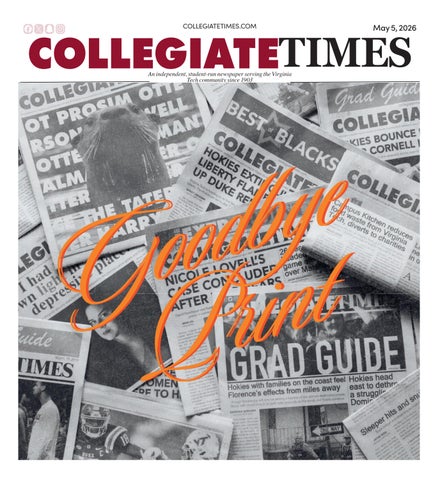
Collegiate Times will be going completely virtual and will no longer have print copies.
The Collegiate Times began printing in 1903 and has always had a paper edition as Virginia Tech’s oldest newspaper.
In 1998, the website began as an asset to the physical editions.
While our physical print has been every other week more recently, the boxes haven’t been empty for 123 years, and in August 2026, they will be.
As we begin this new phase of the CT by saying goodbye to print, our core values will stay the same.
According to the CT’s website, our core values are:
“Impartiality means reporting, editing, and delivering the news honestly, fairly, objectively, and without opinion or bias.
Credibility is the greatest asset of any news medium, and impartiality is the greatest source of credibility.
To provide the most complete report, a news organization must not just cover the news, but uncover
OUR CORE VALUES
Impartiality means reporting, editing and delivering the news honestly, fairly, objectively and without opinion or bias.
Credibility is the greatest asset of any news medium, and impartiality is the greatest source of credibility.
To provide the most complete report, a news organization must not just cover the news, but uncover it. It must follow the story wherever it leads, regardless of any preconceived ideas on what might be most newsworthy.
The pursuit of truth is a noble goal of journalism. But the truth is not always apparent or known immediately. Journalists’ role is therefore not to determine what they believe at that time to be the truth and reveal only
it. It must follow the story wherever it leads, regardless of any preconceived ideas on what might be most newsworthy.”
Moving digitally is a way for the CT to move forward with industry changes and new industry standards.
Journalism is a fast-paced field, and digital editions are one way to keep our organization at the head of local news.
Our audience of current students and alumni will be able to read our editions as soon as possible, no matter where they are. Digital editions are open and accessible to all.
As the incoming editor-in-chief, this transition is crucial to our organization and I am committed to ensuring that the CT has a seamless, smooth transition into an all-digital space.
In the upcoming year, the CT will continue to commit time and resources to social media and marketing as an asset to our new
that to their readers, but rather to report as completely and impartially as possible all verifiable facts so that readers can, based on their own knowledge and experience, determine what they believe to be the truth. When a news organization delivers both news and opinions, the impartiality and credibility of the news organization can be questioned. To minimize this as much as possible there needs to be a sharp and clear distinction between news and opinion, both to those providing and consuming the news.
Voice your opinion. Send letters to the Collegiate Times.
365 Squires Student Center
Blacksburg, VA, 24061
opinionseditor@collegiatetimes.com
All letters must include a name and phone number. Students must include year and major. Faculty and staff must include position and department. Other submissions must include city of residence and relationship to Virginia Tech (i.e., alumni, parent, etc.). We reserve the right to edit for any reason. Anonymous letters will not be printed.
Letters, commentaries and editorial cartoons do not reflect the views of the Collegiate Times. Editorials are written by the Collegiate Times editorial board, which is composed of the opinions editors, editor in chief and managing editors.
online presence.
Newsworthy, credible information is the CT’s priority and that will continue moving forward.
The CT editorial team and writers are saying “goodbye” to print and saying “hello” to a new phase of our organization.


COLLEGIAT ETIMES
NEWSROOM 231-9865
Editor-in-Chief: Michaela Scott (editor@collegiatetimes.com)
Managing editor: Ayisha Surani
Design editor: Annmarie Leake
Assistant Design editors: Caroline Rogers, Sarah Jordan, Mx Zaleski, and Alana Vernon
Copy editors: Emily Southern, Olivia Guy and Amanda Donndelinger
News editors: Erin Bailey and Ava Garrison
Assistant News editors: Hannah Skemp and Julian Namez
Lifestyles editors: Emma Duncan, Cat Pizzarello and Ella Winterling
Sports editors: Sam Mostow, Thomas Bray and Dylan Tefft
Assistant sports editors: Brody Bryan and Alex Winn
Opinions editosr: Jenna Mason and Mohib Amjad
Assistant Opinions Editors: Shelby Brann and Emily Urda
Photo editor: Hamad Alhendi
Assistant Photo editor: Riley Thompson
Have a news tip?
newstips@collegiatetimes.com
BUSINESS STAFF 231-9860
Business manager: Greg Patterson
The Collegiate Times, a division of the Educational Media Company at Virginia Tech, was established in 1903 by and for the students of Virginia Polytechnic Institute and State University. The Collegiate Times is published every Tuesday of the academic year except during exams and vacations. To order a reprint of a photograph printed in the Collegiate Times, visit reprints.collegemedia.com. The Collegiate Times is a division of the Educational Media Company at Virginia Tech, Inc., a 501(c)3 nonprofit with a mission to provide educational experience in business and production of mass media for Virginia Tech students. © Collegiate Times, 2020. All rights reserved. Material published in the Collegiate Times is the property thereof, and may not be reprinted without the express written consent of the Collegiate Times.
Advertisements do not necessarily reflect the opinions of the Collegiate Times. Read about our organization’s Core Values online at collegiatetimes.com.
Assistant Lifestyles editors: Samuel Harvey and Bailey Linza
ETHAN CANDELARIO / COLLEGIATE TIMES Stack of Collegiate Times newspapers, Nov. 13 2021.
THE COLLEGIATE TIMES TO EXPAND ITS SOCIAL MEDIA PLATFORMS IN 2026
Max Painchaud | Copy Editor
With the loss of print copies, social media plays a big role in driving people towards the website.
The Collegiate Times will continue to expand its social media presence in 2026 after developing a social media team in fall 2025.
While the CT has used social media in the past decade to promote some of the newspaper’s content, there has never been a designated team for the job.
In recent years, Faith Casey, a junior majoring in multimedia journalism, has solely managed the CT’s social media presence. However, since fall 2025, a team of over 50 students has evolved that focuses on creating a large social media presence for the newspaper.
Now, Casey serves as the Business Manager for the CT.
When asked about how the social media team is using various social platforms to promote stories and events, Casey said, “Now, I still post as much as I can throughout the week to promote the stories with just a template. Although I could be a bit better about it. That’s why we’re still expanding to get more hands on board. But we have also started using reels to either amplify our current stories or bring light to new events that maybe aren’t being covered. There are so many good opportunities for video that we’re trying to take advantage of. Reels have been the most experimental thing we’ve done; we’re really playing around with what they can be.”
As a designated team develops and more content is created, Casey hopes that social media will give the newspaper more traction.
“I really hope social media can not only further establish the presence of the CT as a campus newspaper but also keep us updated with the constantly
changing journalism world,” Casey said. “Whether people like it or not, social media is where many younger generations mainly get news. I would be lying if I said I didn’t get news from Instagram. So we have to be on top of that. We need to find new ways to communicate these important stories to our readers in an appealing way but is still reliable and impactful.”
Campus-wide events where the CT tables will also be advertised on social media in the coming semester. “We usually try to promote the CT for Gobblerfair and Gobblerfest each semester to get the word out. Next semester, I plan to go a little heavy on promoting the socials team in particular since we’re so new,” Casey said.
All sections of the newspaper and other information regarding the CT will be promoted on the different social media platforms. Casey stated that the team is also open to having different forms of content on their social media.
“I love all our sections, and they all do great things. The CT is always happy to have new people join for whatever they would like! I’d love to encourage people to bring new ideas to the table, too, if there’s anything else they’d be interested in that we may not have at the CT currently,” Casey said.
Additionally, with the CT no longer offering print versions of their stories, Casey is looking to create more attraction toward the online newspaper accounts so that VT students can still interact with stories and the organization digitally.
“We really want to get people to the website, especially since we’re losing the weekly print. Social media will now be more important since there won’t be

any physical issue for people to grab. It’s a lot of figuring out what works and what people are interested in,” Casey said. “The biggest question is what makes people want to visit our website. But we still have to prioritize relevant, accurate, credible and impactful news and storytelling above all. We can’t get lost in the marketing aspect because that’s not what is most important.”
Casey explained that she wants the CT to be more well-known on campus, and believes increasing the organization’s social media content and presence will allow it to do so.
“As a whole, social media really serves as a way to reach new audiences. It promotes the stories and allows for more people to stumble upon us. If I’m honest, the CT is not super well-known on campus. But that’s what I want to change, and social media is a huge
part of that. We got over 1 million profile views last semester, which is a big deal for us. I just promoted six new managers and divided up the team a bit to create some more organization. It’s all trial and error, and while it has been a bit stressful building this section with no previous structure to refer to, it’s also been such a crazy learning opportunity,” Casey said.
For more information about joining the social media team, contact faithcasey@vt.edu.

@COLLEGIATETIMES
CAT PIPER / COLLEGIATE TIMES Student scrolling through social media on her phone.
AFTER 123 YEARS, COLLEGIATE TIMES LEAVES PRINT BEHIND
Benjamin Woltman | News Writer
Many college newspapers have transitioned to fully digital due to students getting their news virtually.
With this issue, Collegiate Times has published its final print edition after 123 years and over 3,000 weekly issues. The transition marks the end of an era for Virginia Tech’s independent student newspaper and reflects a broader trend happening in both college and professional journalism.
The Collegiate Times launched in 1903 and was a sports-focused publication in a time when print was the primary way individuals got their news. Newspapers were the only way to communicate information on both local and campus events. In 2007, when CT’s website broke the story of the April 16 shooting, the gap between digital and print journalism was evident. CT was the first media outlet to report it, starting online coverage at 9:47 a.m. The New York Times linked to CT’s coverage from its homepage. Digital
media had moved at a pace that print couldn’t keep up with. By the time the weekly edition was printed, the story had become international news.
The pandemic accelerated the shift to digital media. In 2023, about 46% of student newspapers surveyed reported printing fewer copies than before COVID. The reasons were always the same: declining print advertising revenue, fewer student subscriptions and the fact that most college students get their news digitally. The rise of digital media has contributed to many newspapers going fully digital.
Indiana University’s Indiana Daily Student transitioned to online-only after university administrators halted print editions. The Daily Iowan at the University of Iowa switched to printing just once a week in 2023 to prioritize
24/7 digital coverage. The Minnesota Daily, a once-daily print at the University of Minnesota, is now fully digital. The Diamondback at the University of Maryland also discontinued regular print editions.
This change isn’t unique to college papers. The Atlanta JournalConstitution, a major regional outlet, phased out its entire print edition by the end of 2025. The Star-Ledger in New Jersey published its final print edition in early 2025.
Distributing newspapers also costs money that posting digital stories doesn’t. Advertising revenue moved to Facebook, Instagram and TikTok because it allows for more viewers and targeted advertising.
What comes next is a website that can publish stories 24/7 if needed. Reporters
who can break news in real-time instead of holding stories for print deadlines. Video, audio, interactive graphics; tools that didn’t exist when print was dominant.
CT is still one of the primary sources for local news in Blacksburg and on campus. That doesn’t change going digital. But going fully digital gives CT cheaper operations, better tools and faster breaking news coverage. However, there are some costs with the switch. No more print editions stacked in the student center. No more old headlines framed on walls. No more collecting issues from games or campus moments as physical keepsakes. @COLLEGIATETIMES

HOW NEWS OUTLETS USE PAYWALLS
Marley Vann | News Writer
Paywalls
In a digital world, news outlets have found a way to create revenue besides advertising: through paywalls.
Paywalls are a digital gate that restricts visitor access to some or all of a news site’s content until they’ve paid a fee. This fee could be for a single article, which is a micropayment, or a paid subscription. There are four different types of paywalls: freemium, metered, dynamic and hard, but they all have one goal: convert visitors into subscribers.
Freemium paywalls allow the site to have free articles as a way to entice the user to read more in-depth articles that are blocked. National Geographic follows this freemium paywall with subscriber-only articles with a lock symbol next to the title. Metered or soft paywalls let users read limited content during a set time. The New York Times, for example, allows its users to read a limited number of free articles in a month and then recommends
a subscription. The New York Times’ online subscriptions have risen to more than 12 million subscribers as of early 2026.
A dynamic paywall is a subset of the metered paywall, enabling machine learning and artificial intelligence to tailor a digital subscription offer based on user interest and behavior. In early 2025, The Financial Times, with its tech partner Zuora, launched a dynamic paywall that became a key driver for subscription growth with a 92% conversion rate.
A hard paywall is the strictest type, restricting visitors from viewing any content. This paywall is most useful for established media with a well-developed audience, like The Athletic.
No matter the type of paywall, paywalls are a method of monetization for news sites that allows them to have influence over some of their revenue.

@COLLEGIATETIMES

GOODBYE PRINT: ALUMNA PRISCILLA ALVAREZ RETURNS TO THE NEWSROOM
Willow Musterman | Lifestyles Writer
CNN Correspondent Priscilla Alvarez reflects on her impact as a journalist, transcending the method of newspaper distribution.
Priscilla Alvarez, a current CNN correspondent and former editor-in-chief of the Collegiate Times, took a blast to the past on April 17, visiting her old stomping grounds. She took the time to meet with a few current members of the newspaper to tell her story.
“I joined the Collegiate Times shortly after coming on campus as a freshman,” Alvarez said. “I remember walking through this exact same door, and it was bustling.”
Alvarez majored in multimedia journalism and world politics and policy at Virginia Tech from 2011 to 2014. She came in as a news staff writer her freshman year.
“Everyone was working on articles, and it made me excited,” Alvarez said. “The entire team here was willing to have
me on board and teach me the ropes, and that was it. The rest is history.”
She was an active member of the Collegiate Times throughout her time in college, going from news writer to editor-in-chief. The newspaper laid the foundation for her future career in Washington, D.C.
“I felt like (the Collegiate Times) gave me the space to grow as a reporter and understand how to ask questions,” Alvarez said. “It helped me come out of my shell as a reporter and feel safe doing it.”
After being a big part of the organization for three years, Alvarez was made editor-in-chief for her senior year. This gave her the power to guide the Collegiate Times as a whole.
“As editor-in-chief, I was able to
oversee the journalism coming out of the Collegiate Times, and it felt competitive to local newspapers here at the time,” Alvarez said. “It felt important.”
With a passion for journalism, the first steps start in the newsroom on the third floor of the Squires Student Center here at Virginia Tech.
“I remember graduating and feeling very proud of the work we had done here,” Alvarez said. “I credit a lot of what I have accomplished to the Collegiate Times.”
No matter how news is spread, whether it be via print or digital, the impact made is the same. With the Collegiate Times evolving to keep up with a digital world, it is important to note that the articles written still hold the same value.
“Most of my lines now are digital,
and they carry the same weight to me,” Alvarez said. “It doesn’t matter what form it comes in.”
While many things have changed in the newsroom since 2014, the passion for writing and telling stories has been constant.
“Everyone who’s walked in here has really cared about serving the students and the surrounding community, and doing so with great reporting, be it sports, be it lifestyles, be it news,” Alvarez said. “I hope that it continues and that everyone who comes through here feels proud of what they did here.” @COLLEGIATETIMES

GOODBYE PRINT: REFLECTING ON THE MOVE TO FULLY DIGITAL
Sam Harvey | Lifestyles Assistant Editor
The current and incoming editors-in-chief reflect on moving from print to digital format.
With a plethora of information available at the tap of a finger, it is not uncommon for the majority of one’s media to be consumed through digital sources. The National Library of Medicine reported that college students average 8.5 hours of screen time per day. This may seem alarming, but it is a reflection of the influence technology has on how we interact and navigate the world around us.
As social media platforms and online news sources take center stage in the world of news consumption, the Collegiate Times has made the decision to follow suit and go fully digital starting this fall. Members of the Collegiate Times editorial staff offered their thoughts on the decision to move away from traditional printed issues.
“The Collegiate Times has been
printing since 1903. However, many studies show media has transformed so much to a digital format over time,” said Michaela Scott, editor-in-chief of the Collegiate Times and senior studying multimedia journalism. “While our papers aren’t being picked up as much anymore, we’ve had 1 million views on our Instagram page and thousands of clicks on our website.”
Despite the popularity of digital formats, printed issues still hold value to the writers and editors themselves.
“It’s just something you can archive and come back to years later,” Scott said.
For readers yearning to read printed stories again, incoming editor-in-chief Ava Garrison, a junior studying multimedia journalism, shared some exciting news.
“I have plans to print the (April 16)
Remembrance edition not only because it’s the Remembrance edition, but also because it’ll be the 20th anniversary,” Garrison said.
Other annual issues, such as Goodbye Grads, will also make a comeback in print next year.
Both Scott and Garrison voiced positive outlooks for the future of the Collegiate Times success in the new digital era.
“In this day and age, digital editions are just as important as print and honestly just as exciting,” Garrison said. “It’s way more accessible to show people, to give employers and to give your parents.”
“It’s definitely a bittersweet moment in our history,” Scott said. “I know we will evolve and continue to put out our best and most accurate work.”
Digital issues can be viewed on the Collegiate Times website or on the official Instagram account.

THE END OF AN ERA: STUDENTS AND STAFF REFLECT ON THE SCHOOL NEWSPAPER’S FINAL PRINT ISSUE
Cat Pizzarello | Lifestyles Editor
As the Collegiate Times fades out of print, the Virginia Tech community shares their pros and cons on the media decision.
Hidden among Hokie Stone buildings, the Collegiate Times newspaper boxes play their game of hide-and-seek around Virginia Tech’s campus. Every Tuesday, students are able to find the newest editions of the print paper, a tradition that has been dwindling in the past few years.
On Tuesday, May 5, 2026, these newspaper boxes will host their last issues. For many readers, this is somewhat of a bittersweet moment as the print issue of Collegiate Times takes its final journey around campus.
“I feel really surprised and kind of sad that they’re going to stop their print issues because I feel as though we are headed to a very digital environment and world, and I feel like it loses its luster,” said Shemaiah Palma, a junior studying biochemistry. “I usually read the print editions. I didn’t even know there was a digital one because I assumed that it was always printed.”
The decision to stop printing comes primarily from readership surveys, conveying that the Collegiate Times audience primarily consumes news digitally. Given the high cost of production, the switch to an all-digital format helps allocate funds to online projects and accessibility to all readers.
“It’s sad, but not unexpected,” said Justin Patrick, a senior studying multimedia journalism. “Anybody who’s growing up in today’s age has kind of seen the downfall, getting rid of more physical copies of really anything, and it’s shifting more digital.”
Newspapers alike everywhere have been transitioning from print to primarily digital production. For many publications, the shift is financially necessary, but it raises ongoing questions about the future of print and the role of digital news.
“There’s a death of local news reporting right here,” said Megan Duncan, a multimedia journalism professor. “We don’t have any hubs of people who can serve the watchdog function or tell people how they can get involved in their community. That’s
why a strong, local student newspaper is really important for local media consumption, digital or print.”
As smaller papers experience less reporting and visibility, digital publishing is appealing to keep readership up. According to Pew Research, about 96% of adults use the internet in some way, making digital news easily reachable to a wide range of audience members with different interests.
“Digital media is more convenient,” Duncan said. “I also think there’s something about having a newspaper show up on your doorstep or having to walk by the bins on your way to class that kind of encourages more engagement. Certainly, there are ways like pushing notifications or email newsletters that you can get people to read digital news media as well.”
Print versus digital — on one side, digital information is accessible quickly. On the other hand, reading media digitally can be difficult for some people with pop-up ads and distractions.
“I learn more when it’s physically in front of me,” Palma said. “Whenever I scroll on TikTok, I don’t really learn anything. I lose all of it entirely, but I feel like if it’s on paper, I keep the knowledge inside my brain.”
In an ever-growing digital world, students might spend all day on their devices between academics, social life and work or internships. Patrick expressed that physical media can be a break from the digital world in which students live.
“To the students who read the paper, I think it was definitely an escape of sorts,” Patrick said. “For me, it was definitely an escape to get my news from something other than pixels on a backlit TV or phone. I don’t think anything is replacing that, which is sad to say. (When reading print,) I’m not distracted by the notification that came up on my phone or this email I just got. When it was just me and this paper, I could read at my own pace and not worry about what else was popping up.”
Although the medium plays a role in

CAT PIZZARELLO / COLLEGIATE TIMES
Cat Pizzarello holds Best of Blacksburg 2026 print copies.
the reactions to the Collegiate Times stopping print, nostalgia plays a part as well. For some, a print newspaper acts as somewhat of a time capsule for on-campus memories captured by student writers and reporters.
“It’s something that, especially for visitors, they can take home with them,” Duncan said. “Those are the kinds of things people love to put in their scrapbook, hang on their walls.”
Even with that sense of nostalgia, the shift highlights how media consumption continues to change. The possibilities of technology are constantly being pushed and altered as audiences engage with news in new ways. In the coming semesters, the Collegiate Times is planning to increase visibility and reporting on social media, as well as continue to revamp its website.
“Times are changing, and we have to adapt,” Duncan said. “There are a lot of possibilities for digital. It’s probably the right move, even if we have that nostalgia for the print. There are a lot of successful university newspapers that have gone all digital, and we just have to think of how we can adapt to that.”
Despite the shift in format and
personal preferences, the role of the Collegiate Times within the Virginia Tech community remains unchanged. For Patrick, its core purpose is simple: to serve Virginia Tech.
“I think of anything, to me, it (the Collegiate Times) shows our culture as a community here at Virginia Tech, something that existed before I was even a thought,” Patrick said. “It’s pretty cool just to see how it’s grown and adapted to the years, but at its core, it’s still serving the same purpose, and that’s to feed the media and news to students to keep them updated. It shows how Virginia Tech is very much rooted in its identity.”
As the Collegiate Times moves into its digital era, its audience will likely continue to share their opinions and challenge them. Through it all, what remains is the mission of the paper: to serve the Virginia Tech community through independent, student-led reporting on campus life, news and issues affecting students.

GOODBYE PRINT: WHERE LIFESTYLES LIVED BEST
Emma Duncan, Cat Pizzarello and Ella Winterling | Lifestyles Editors
The Collegiate Times lifestyles editorial staff, past and present, reminisce on the lifestyles section and look forward to the new digital phase.
The role of a newspaper editor can be very rewarding. From helping new writers learn the ropes to completing a difficult story and, most notably, holding the work you helped create in your hands. However, as the 2025-26 academic year comes to a close, so does the Collegiate Times’ chapter of printing issues.
For a lifestyles editor, whose content focuses on student life, music, events and local history, the print medium showcases how culture is a social construct with very physical manifestations.
A 2025 study from Title Media found that readers agree, explaining “Despite the dominance of digital in day-to-day media use, 60% of respondents said they prefer to consume their lifestyle content in print, putting print well ahead of social media (53.3%) and websites/apps (46.7%).”
Until now, readers have grabbed a fresh copy every other Tuesday to learn about local restaurants, read music reviews and reflect on campus trends. For many, reading a physical copy of the Collegiate Times is in their weekly routine. Next year, all they’ll have to do is open their browser or log onto their preferred social media account.
This shift in the medium struck current and past lifestyles editors in many ways.
Molly Dye started with the Collegiate Times lifestyles section during the pandemic, working her way up from staff writer to co-editor through her graduation. She majored in communication sciences and social inquiry, graduating in spring 2022. Despite being largely virtual, she cites the Collegiate Times as a way that she stayed involved socially.
“My favorite part (of lifestyles) was the opportunity to meet and interview lots of different people involved,” Dye said. “I got to chat with a lot of really interesting people from the student body.”
While Dye loved being able to see the lifestyles section’s hard work being put into a physical medium, she understands the need to transition to exclusively digital publication.
“There’s something really special about reading from a physical newspaper or a book or a journal that digital reading can’t really replicate,” Dye said.
“At the same time, I definitely understand and appreciate how digital media is more accessible to all types of readers, and it seems to be the preferred way that people ingest news and media these days. I wouldn’t want the CT or any other newspaper to lose readership or not be keeping up with the times.”
John Battiston joined the Collegiate Times in between his sophomore and junior years, marking his academic transition from architecture to multimedia journalism. He was brought on as assistant editor of the lifestyles section over the summer and served in an editorial capacity for the next two years.
“I wanted more than anything to write about culture — not just music, film and TV, but the trends, movements and events that connected Hokies outside of the classroom,” Battiston said. “Lifestyles mirrors the heart of the college experience, and the student culture at Virginia Tech was just so vibrant, I wouldn’t rather have written or edited for any other section.”
As a second-generation Hokie whose parents attended in the 1980s, Battiston was bummed by the news, acknowledging how the shift not only affects how we deliver content but also how students may receive it.
“Every genre of journalism is important in its own way, but lifestyles content is most helpful in that it shows readers what they might hold in common with one another outside their nominal, surface-level demographics,” Battiston said. “There’s something refreshing and hopeful about reading an article by a fellow student and realizing that you’re not the only one who gets creeped out when you use that bathroom at Hokie Grill or that it’s okay to feel scared as a shy, out-of-state freshman who doesn’t know anyone else at Tech, let alone in your dorm. Writing that amplifies the experiences that connect us rather than divide us is essential to keeping readers
tethered to their humanity in an increasingly cynical media landscape and world at large.”
Emanda Seifu joined the Collegiate Times her freshman year of college, as soon as she reached the Hokie-stoned walls of campus. Through the years, she studied computer science, but her passions expanded far beyond code. As a lifestyles writer turned section editor and then eventually managing editor, the Collegiate Times became a constant in her life as a Hokie until she graduated in May 2024.
“I had done journalism throughout high school. I really enjoyed it, and I love the sense of community that it provided,” Seifu said. “Coming into college, it was kind of a no-brainer that I would look to the CT to kind of find that same sense of community.”
Seifu fell in love with the lifestyle culture right from the start, noting its lively, energetic atmosphere. From there, she continued to discover her love for seeing the work around her and earning the privilege to be the one editing it.
“When people had something to write about, they were all in. Everybody’s bringing their unique experiences into how they write,” Seifu said. “I really enjoyed not only being able to write, but also being able to edit and kind of seeing all the amazing ideas the people around me were coming up with. I really liked that sense of ownership around my own work.”
Emma Duncan, Ella Winterling and Cat Pizzarello serve as lifestyles section editors for the 2025-26 academic year. As they transition into new roles, postgraduate life for Duncan, head lifestyles editor for Winterling, and managing editor for Pizzarello, they acknowledge the significance of their position.
For Winterling, taking on the role of head lifestyles section editor in the new phase brings a bittersweet excitement. Print will be dearly missed, but in moving to a fully digital publication, adapting to change is necessary. Maintaining the core of lifestyles, a section highlighting
the Virginia Tech and Blacksburg communities, through this transition is what she looks forward to most.
For Pizzarello, being a lifestyles editor has been such a rewarding experience and a stepping stone as she rises to managing editor next semester. Regardless of her higher position, she plans to continue attending lifestyle meetings, lifestyle writing and being around those she loves. As the Collegiate Times transitions away from print, she can’t wait to be a part of the publication’s next chapter and continue to enjoy the company of those who make it special.
For Duncan, leaving the Collegiate Times during a time of transition feels awfully poetic. Each year, the paper and each section within it transform into something new. This year is no different, but completely different. Next year, new editors will enter the Collegiate Times newsroom for production Sundays to make the fully-digital paper their own. Incoming freshmen will have no memory of picking up a copy near the bus loop.
A small yet lasting part of the Virginia Tech experience is no longer, but the purpose of the paper and the purpose of lifestyles remains.

OPINIONS
THE LAST PRINT ISSUE ENDS A CHAPTER, BUT NOT THE STORY
Mohib Amjad | Opinions Editor
Print issues end, but its stories still live.

I still remember the first time I picked up a paper copy of the Collegiate Times. There was something different about it. Maybe it was the fact that it was physical. It had pages you could flip through, ink that rubbed onto your fingers, stories written by students who were figuring things out in real time just like everyone else on campus. It felt real in a way that digital articles sometimes do not.
Now, with this being the final print issue, I have found myself thinking a lot about what the CT has meant to me. I will miss the print edition more than I can probably explain, but I also know the CT is bigger than paper. The format may be changing, but what made it special is still here.
My journey with the CT started my freshman year at Gobblerfest. I saw the booth with stacks of newspapers sitting out front. I have always liked writing because it helps me clear my mind
and organize my thoughts, but I never pictured myself joining a newspaper. I was double-majoring in engineering and business, not journalism. It did not exactly seem like the obvious path for me.
Then I met the opinions editor at the time. She talked to me about writing for the section and convinced me to come to a meeting.
I showed up not knowing what to expect. I thought it would be formal and intimidating, maybe everyone would already know what they were doing and I would feel out of place. Instead, people were just talking. About news, classes, random topics, life — everything. That was the moment I realized this was the kind of group I wanted to be around.
These were people who cared about ideas. People who could disagree without being disrespectful. People who were thoughtful, funny and genuinely
interested in the world around them. In college, those kinds of spaces matter. They can be rare, but the CT became one of those places for me.
As much as I appreciated the people, I would be lying if I said print was not a huge part of the appeal.
There is something about seeing your work in print that feels different. I think every writer at the CT, whether they admitted it or not, wanted it that moment. You wanted to grab a copy, show your friends, send a picture to your family or pin it to your wall like it was a trophy.
When my first article was printed, that is exactly what I did.
The piece was called “Presidential debates: More than just words.” I picked up copies, gave them to friends and put one up in my room so anyone who walked in would see it. I was proud of it. Not because it was perfect, but because it was mine.
Then something happened that I never expected. One of my professors, Jennifer “Jenny” Lawrence, read it.
Honestly, when I first found out, I was terrified. Having a professor read your opinion piece can feel a little dangerous. But she liked it. She even gave me extra credit for it, which might still be one of the most unexpected benefits I have ever gotten from writing.
More importantly, it started a relationship with Ms. Lawrence that made my college experience better.
After class, we would end up talking about politics, current events or whatever else was happening in the world that week. Those conversations made me enjoy class more, and I often looked forward to staying afterward just to keep talking.
That connection also led me to spend more time at the Writing Center. Eventually, I took the course and became a coach there myself.
Looking back, it is funny how one article created a chain reaction. You write something because you care about
it, and suddenly it opens doors, creates friendships and changes the direction of your college experience.
That is what the CT did for me. So yes, I am going to miss print.
I will miss seeing stacks of papers around campus. I will miss flipping through pages to see who wrote what. I will miss the feeling of publication day and knowing something you worked on had become real and tangible.
But I also understand why this change is happening.
The Collegiate Times is still the Collegiate Times, whether it’s printed or solely published online. It still stands for student voices, honest reporting and meaningful conversation. It still gives students a place to speak, question and create.
Those values do not disappear just because the presses stop.
If anything, adapting now may be exactly what the CT needs. Times change, readers change and media changes. If you refuse to evolve, you get left behind.
So while this final print issue feels emotional, it should also feel hopeful. This is not the end of the CT; it’s just the next version of it.
And I have no doubt it will continue to thrive. I will always be grateful for the copies I carried back to my dorm, the articles taped to my wall and the memories tied to print.
But what made the CT matter was never the paper itself.
It was always the people, the conversations and the voices behind it.

ETHAN CANDELARIO / COLLEGIATE TIMES
Stack of Collegiate Times newspapers, Nov. 13 2021.
MOURNING PRINT MEDIA TRADITIONS
Kristina Dabaghyan | Opinions Writer
The loss of print media transcends a physical loss; it’s the loss of tradition, ritual and memories.
How often have you taken note of an elderly gentleman reading the newspaper out and about? How frequently have you noticed the smell of book pages as you flip through a novel? Growing up, did you ever use newsprint for arts and crafts? Did you take advantage of your local library? Was it on your bucket list to be featured in your town’s paper at least once?
These are all questions that will, in time, cease to exist. Those opportunities will dwindle out as news cubbies scattered around towns, at ice cream parlors and outside grocery stores, or across Virginia Tech’s campus, slowly vanish. The high stacks of local papers will soon be desolate, empty and removed entirely.
With the ending of newspaper print, not only within the Collegiate Times but throughout the news industry, comes a reflection on what physical media brought us: memories that hold lasting impacts on humans — traditions that future generations will never have the chance to experience.
“It sounds sorta cheesy,” said Maddie Izzo, a freshman majoring in accounting and business analysis, “but my grandfather liked to read the news in the mornings during breakfast. Sometimes he and my grandma would solve the puzzles in there and let me help.”
Classic print traditions you see both in entertainment like movies and shows, and in real life, will come to an end as the digital era consumes our means of news. It’s important to remember the customs that once were, and acknowledge their significance that we may have once taken for granted.
I’ve always been an avid reader, and whenever I get my hands on a book, on nearly every occasion, I try to get a whiff of the “book smell” emitting from the pages. The nostalgic scent takes me back to elementary school years, memories of exploring my nearby library in Denver and choosing a new selection of books to get me through the month, or when I first picked up Harry Potter and refused to put it down.
That has long since changed. A few years ago, I purchased a Kindle. I now

rarely find myself picking up a physical copy of a book anymore, even in school. With everything being digital, it’s much more convenient to be a couple of clicks away from accessing texts and novels, as opposed to having to lug around each copy on your person.
I can appreciate the easy access, but a part of me yearns for the familiar past of physical media, back before things felt as dystopian as they do in modern times. The swift development of online media began fairly recently and has only progressed over the years. In spite of the boom of digital media occurring around the years I was born, my peers and I can still recall vivid and nostalgic memories surrounding physical print from childhood.
“I never really read a lot, but I still always used newspapers and books,” said Maya Laliker, a freshman majoring in health and exercise science, “like in elementary school for blackout poems, or scrapbooking, assigned readings, that kind of thing.”
Physical media is deeply ingrained in the lives of those born who are in college
now or have already graduated, but it’s slowly dissipating from younger generations. Current reports say elementary schools are blending both digital and physical print activities with the use of tablets and Chromebooks. The mere thought of print media slowly disappearing can be rather frightening to those who regard it as a daily medium in their lives.
Laliker went on to say, “Plus, you sort of see newspapers everywhere, even if you don’t read them. Like on campus, I see the bins with copies, or at home, I see similar things when I go downtown.”
Newspaper cubbies and stands are a typical sight to see in all sorts of towns. Whether it be local, urban or rural, news leaves its mark on streets and sidewalks. Though we are rapidly transitioning to a world where the quick skim of a paper turns into a brief swipe of the thumb on one’s phone.
Even within the Collegiate Times stands a staff tradition. A tradition in hopes of securing a spot in the paper at least once in one’s time as a writer. Once it was announced that print would end
by spring 2026, editors were making their best attempts to ensure that the writers who had yet to accomplish this goal got their articles published in the physical copies at least once before the print stopped. It’s not only saddening because the traditional print, which has run since 1903, is ceasing, but the traditions that the writers themselves have adopted are also being forced to come to a close.
As we look into a possible future in which physical print will fade in coming generations, with Virginia Tech’s campus being one to demonstrate the beginning of the end for physical media, it’s vital to reminisce on the traditions that made print so valuable. As the Collegiate Times concludes its manufacturing of the physical paper, as the ink stops, the papers burn and become forgotten and tossed away like the cubbies, let us together mourn the loss of the classic that once was print media. In that, celebrate the memories of it we hold near and dear.
THE WEIGHT OF PAPER: THE IMPACT OUTLASTS THE INK
Jenna Mason | Opinions Editor
Although print media is fading, the impact of student journalism and the Collegiate Times remains intact.
For many student journalists and writers, the first time seeing their byline in a Collegiate Times print edition wasn’t just a career milestone — it was proof. Proof that your words mattered enough to occupy a physical space in the world. Proof that someone had deemed your voice worthy of the ink, the paper and the distribution across Blacksburg.
Now, that moment will no longer exist. Not because student journalism is dying, but because the medium that gave it weight — literally and metaphorically — is disappearing. The Collegiate Times’ transition to digital-only publishing isn’t unique. Publications across the globe are making the same choice, driven by economics and the reality of how newer generations consume news. But in our decision to adapt, we need to name what we’re losing: the physical proof that this work matters.
Former opinions editor, Olivia Nelson, describes how working behind the scenes of the paper is essentially your receipt of the hard work that goes into making a physical print issue.
“I think when you do work behind the scenes on a paper, you realize how much time and dedication goes into actually printing it,” Nelson said. “And so that physical copy was always just a reflection of that, and I know a lot of writers and people who worked on the editorial staff really appreciated it because we worked so hard to get there.”
Digital publishing doesn’t diminish the work editors and writers do. The reporting is just as rigorous, the writing is just as sharp and the hours are just as long. However, it does remove the physical evidence of that labor. A web page or PDF doesn’t carry the same ceremonial weight as a newspaper that you can hold, fold, pin to your wall or even dig out of a box 20 years later.
Collegiate Times writers have always kept their issues: their first article, coverage of major campus events, pieces that had personal meaning and the Goodbye Grad piece to remember it all by. Those papers aren’t just keepsakes; they’re artifacts of a version of student journalism that won’t exist for future
writers.
In my opinion, the question isn’t whether or not we should mourn print; that ship has sailed. The question is: What do we carry forward when the tangible proof is gone?
“I would want them to continue to value accuracy in taking your time to do thorough research and finding great interviews, because I think that’s what sets publications, like well-respected publications, apart from other places you may receive news,” Nelson said.
This is the argument that student journalists need to make, loudly and repeatedly, as print disappears. The medium may have changed, but the mission hasn’t. Opinion writing, especially, depends on credibility. It’s not enough to have a hot take; you need evidence, context and fairness. Social media has made it easier than ever to publish an opinion — any opinion, for that matter. The CT’s job is to publish informed opinions, grounded in research and presented with care.
There’s a real risk that without print, student journalists will start to feel like their work isn’t being taken seriously anymore. It’s a completely valid concern. Digital content is ephemeral: It gets published, shared, scrolled past and forgotten. There will be no new stacks of newspapers in the newsroom or a tangible archive proving that this work happened and mattered.
But the audience won’t disappear just because the newspaper boxes will. People will still follow the publication online. The Blacksburg community — students, faculty, locals, alumni — will still turn to the Collegiate Times for news, opinions, lifestyles and sports. They will turn to us for the student perspective on campus and beyond because people still want accurate and reliable information; they’ll turn to us over social media as long as we continue to earn their trust.
“I also want them to know that no matter that, you know, there’s not a print issue anymore, that there’s someone still out there reading your work,” Nelson said. “I still stay in touch with the CT

and look at articles that come out. And I’d like to think that the community is still out there listening to what the CT has to say. And regardless of there being no print issues anymore, I would like to think that they’re still going on to the internet and following the CT and hearing those voices developing stories and supporting our students.”
The challenge now is to maintain the sense of weight and permanence that print provides, even as we publish into the digital void. That means holding ourselves to the same standards we always have. It means treating every article as something worth keeping. It means remembering that journalism isn’t disposable just because the format has changed.
Print gave student journalism legitimacy by default. The physical object commanded respect. Now we must earn it with every story.
To the next generation of CT writers: Your work still matters. The hours you spend reporting, the care you put into your arguments, the risks you take in sharing your perspective — they all still
count, even if there’s no printed page to show for it.
And know that someone is still out there reading your work, taking it seriously and remembering it. Not because it’s printed, but because it’s good. It isn’t the medium, but the commitment to doing journalism that matters.
That’s the real archive — not the paper, but the impact.

PHOTO COURTESY OF THE LA TIMES
‘SOMETHING YOU CAN HOLD’: WHAT THE COLLEGIATE TIMES IS LEAVING BEHIND
Thomas Bray | Sports Editor
The Collegiate Times is printing its final issue on Tuesday, May 5. Newspapers across the country are disappearing. That’s just what’s happening.
Nathaniel Adibi didn’t know until I told him. The former Virginia Tech defensive end — four-star recruit from Hampton, Pittsburgh Steelers draft pick, Hokie for four years — paused when I broke the news.
“Oh no,” he said. “The print copy is gone?”
Adibi played at Virginia Tech from 2000 to 2003. His younger brother, Xavier, followed him to Blacksburg a year later and is now an inside linebackers coach on James Franklin’s staff. The Adibi name has been part of Virginia Tech football for more than two decades.
Nathaniel was part of a defense led by Bud Foster, and the Collegiate Times covered all of it. His team was in print, week after week, on pages that got picked up, folded and carried across campus.
He read them.
“After my games, I was more interested in seeing what the university was saying about us as a team,” Adibi said. “And just seeing if I was in a good picture.”
There’s one photo he still thinks about. It was Thursday, Sept. 18, 2003. Hurricane Isabel had knocked out power to nearly 1.8 million people on the eastern side of Virginia, but on the western edge of the storm, 65,000 fans showed up anyway to Lane Stadium — all of them in orange. Then, No. 8 Virginia Tech against Texas A&M, nationally televised, mid-hurricane. Kevin Jones ran for 188 yards on 30 carries through a steady downpour, and the Hokies won 35-19. Somewhere in the middle of it all, during a timeout, Adibi raised his hands toward the visitors’ section. Tens of thousands of fans in orange, stood up.
“That was my favorite photo of all time,” he said.
The Collegiate Times had it.
However, what Adibi remembers most about the coverage isn’t the coverage itself, but the honesty of it. Student journalists were calling it straight.
“They were going to tell the truth about what was going on,” he said. “Whether we were doing well or bad, they’re going to tell the truth.”
Virginia Tech’s student newspaper was staffed by students who sat in the same classroom buildings and bars as these athletes.
“It’s coming from my peers,” Adibi said. “I respected their opinion because it was very honest.”
His family back in Hampton didn’t follow the paper closely. The drive down from Hampton and back didn’t leave much time for it, but the photo from the Texas A&M game made it home. He made sure of that.
“I sent them that (issue) so they could see that photo,” Adibi said.
That’s what print does. It travels. It gets mailed, framed, held up under a kitchen light in Hampton so a family can see what their son looked like when 65,000 people stood up with him in a tropical storm.
“There’s nothing better than something you can hold, feel, touch and really have something that’s real,” Adibi said. “I hate that it’s going to a whole digital thing.”
For the writers and photographers who covered him, he had a message prepared.
“First and foremost, I want to say thank you,” Adibi said. “Y’all did a wonderful job in regards to just being honest, telling us the truth and keeping us abreast of what was going on.”
Adibi is glad the digital version continues, but he knows something is different now.
Some things you can hold. Some things you can’t.


Former Hokies football player Nathaniel Adibi reflected on his time at Virginia Tech and his experiences with the CT.
PHOTO COURTESY OF THE COLLEGIATE TIMES
Nathaniel Adibi (83) raises his hands during a timeout in then-No. 8 Virginia Tech’s 3519 win over Texas A&M on Sept. 18, 2003.
TOP VIRGINIA TECH SPORTS MOMENTS COVERED BY THE COLLEGIATE TIMES IN PRINT
Dylan Tefft | Sports Editor
From Gibboney Field to Lane Stadium, the Collegiate Times has penned the stories of Virginia Tech sports.
You can’t separate the Collegiate Times from the biggest moments in Virginia Tech sports history. Since 1903, when the football team played on Gibboney Field — the site that now contains the Drillfield — the CT has been on location, covering Hokies sports thoughtfully and dutifully.
The newspaper actually started as a sports-focused outlet, and though it has grown beyond that, it has never lost it. And how could it? Sports, and the stories they produce, are woven into the fabric of this institution. They’ve just needed someone to write them down.
That being said, I type this as the last in a long line of sports editors to chronicle those games, athletes and stories in print. There is no solace in that for me. I care about the legacy of print news far more than my own — however much of that I can gain from a student newspaper — but I understand that times change. At the very least, the Collegiate Times sports section and its stories will endure online, so please follow us on social media and on our website going forward.
I digress. In the interest of honoring our many print editions, here are some of the most formative and unforgettable Virginia Tech sports moments that the CT has covered in its newspapers.
Jan. 16, 1996: “Hokies hook ‘Horns, 28-10, in Sugar Bowl stampede” — Jason Monks
Where the writer is now: Monks seems to have briefly covered Hokies football for The Washington Post, but no other information could be found.
In legendary head coach Frank Beamer’s ninth year at the helm, Virginia Tech football beat No. 9 Texas 28-10 in the 1995 Sugar Bowl at the Superdome. The victory, and the 36-29 win over No. 13 Virginia before it, established Tech football as a legitimate national threat under Beamer and quarterback Jim Druckenmiller, whom Monks interviewed for the story on-site in New Orleans, Louisiana.
“Everybody out there thought we should never be here,” Druckenmiller said. “The only people who believed we belonged was ourselves.”
Funnily enough, the story did not go in print until Jan. 16, 1996, which was 17 days after the Sugar Bowl. Winter Break limited operations at the CT even then. Before getting into the game, Monks backed up Druckenmiller’s quote by painting Tech’s underdog status, even calling recently retired ESPN Analyst Lee Corso a “sincerely apologetic naysayer.”
The rest of the story is highlighted by what was a stout Hokies rushing defense, which allowed Texas just 78 yards on 2.8 yards per carry. There is one other piece about the Sugar Bowl in that CT issue, titled “Tech flanker swings momentum” by Mark Wolff. The story is a feature about receiver Bryan Still flipping the script against Texas with a 60-yard punt return touchdown that started a 28-0 “flurry” for the Hokies. Still won the Sugar Bowl MVP after recording 179 all-purpose yards.
“It was a goal of mine,” Still said of receiving the award. “It was a dream of mine to play well, make big plays and it came true today.”
Jan. 18, 2000: “Freshman quarterback steals the show in Tech defeat” — Jed Hurt, Sports Assistant
Where the writer is now: Hurt is the vice president of Production and Operations at 4Topps, a Winston-Salem, North Carolinabased designer and manufacturer of seating for sports stadiums and entertainment venues.
That probably would not have been my choice of headline to communicate the program’s first — and only — National Championship game appearance, but it isn’t a wrong one. In the 2000 Sugar Bowl, freshman quarterback Michael Vick put together 225 passing yards and one touchdown to go along with a rushing score and 97 ground yards. The Newport News native’s performance was not nearly enough to win the 2000 Sugar Bowl, though, not with undefeated Florida State scoring a whopping 46 points on Bud Foster’s defense.
Still, Hurt and the CT were again in Louisiana to cover the biggest game in Hokies sports history. I liked his lede quite a bit:
“Strange things can happen in New Orleans — a city with a mystic past intertwined with voodoo and black magic. The Nokia Sugar Bowl was no different.”
Hurt was right — Tech outgained FSU in rushing and total yards, but still lost by a wide margin. He also wrote that one thing wasn’t so strange: Vick.
“Boy, he is something,” legendary Florida State head coach Bobby Bowden said of Vick after the game. “I knew he was good, but I didn’t know he was that good.”
Virginia Tech may not have won the 2000 National Championship, but, for a program that hasn’t been back since — or gotten particularly close — it remains the closest the Hokies have ever come to the summit of college football, and a source of hope that they can one day return.
July 1, 2004: “A Warm ACCeptance” — Adam Abramson, sports editor
Where the writer is now: Abramson serves as the CEO and founder of Row Z, a creative agency specializing in Name, Image and Likeness brand campaigns. Abramson worked as a director and producer of digital content on The Late Late Show with James Corden before that.
Here’s a quick but monumental story with a sick headline. Joining the ACC transformed Virginia Tech athletics from the top down and, in many ways, made the program what it is today.
Before the move, Tech had strong football momentum, but the Big East was in a perpetual state of change and the Hokies had an outsider identity nationally. When Tech officially joined the ACC on July 1, 2004, it entered a more natural geographic, financial and competitive conference, joining major athletic programs it was in proximity to like Virginia, North Carolina, Duke and Clemson.
Abramson’s piece details VT’s messy entrance into the ACC, which was expanding but aiming only to add Miami, Syracuse and Boston College from the Big East, which would’ve left Tech in a sorely weakened conference. The lawsuit, led by Virginia Tech, Pittsburgh, West Virginia and Rutgers, was essentially an attempt to stop the ACC from raiding the Big East.
However, political pressure by Virginia’s government helped get the Hokies into the ACC instead. With UVA already in the conference and holding a vote on the matter, state officials questioned why Virginia should support a move that damaged the Commonwealth’s other major football program. That pressure helped push Tech into the ACC instead of Syracuse, which joined later.
“Today is the beginning of a new era for Virginia Tech Athletics,” Abramson wrote. March 28, 2008: “Hokies pull off monumental upset” — Ed Lupien, CT sports reporter
Where the writer is now: Lupien is a business development advisor, hydrogen at Shell.
All due respect to Ed Lupien, but this headline might not have done the story justice. It describes Virginia Tech softball legend Angela Tincher’s no-hitter against the American national team, ahead of the 2008 Beijing Olympics.
The national team had won 185 pre-Olympic exhibition games, going back to 1996. Plus, it defeated DePaul, 23-0, earlier that day. But in front of 2,135 fans in Oklahoma City, Tincher shined.
The senior put up seven no-hit frames, accruing 10 strikeouts in the process. Her one blemish was a second-inning walk to current Athletes Unlimited Softball League coach Kelly Kretschman. Otherwise, she struck out national team members Caitlin Lowe, Natasha Watley, Jessica Mendoza, Crystl Bustos, Stacey Nuveman Deniz, Jenny Topping, Tairia Flowers and Lauren Lappin.
The Hokies won the game, 1-0, off an RBI single from Caroline Stolle, scoring Anna Zitt. The contest technically didn’t count in the standings, but it took place en route to Tech’s only Women’s College World Series appearance. Tincher’s No. 1 jersey is retired and commemorated on the right-field wall at Tech Softball Park, too.