
COLLEGIAT ETIMES








VIRGINIA TECH CELEBRATES 26TH ANNUAL GRADUATE EDUCATION WEEK
Sarah Lindauer | News Writer
Virginia Tech celebrated graduate students through various Blackburg and D.C. VT campuses during Graduate Week.
From March 23 to 27, Virginia Tech will host Graduate Education Week to honor approximately 6,500 graduates. Events will be held on Virginia Tech’s Blacksburg campus and in Washington, D.C.
Graduate Education Week honors graduate students, graduate advisors and graduate faculty. The week highlights the importance of graduate education. The celebrations help participants learn about the contributions of graduate students to teaching and research. Virginia Tech will host professional development opportunities and celebratory events.
At Virginia Tech, graduate students pursue over 80 fields, which helps support labs, research, classrooms and administration.
This year’s theme is Graduate Education for Good. The theme
OUR CORE VALUES
Impartiality means reporting, editing and delivering the news honestly, fairly, objectively and without opinion or bias.
Credibility is the greatest asset of any news medium, and impartiality is the greatest source of credibility.
To provide the most complete report, a news organization must not just cover the news, but uncover it. It must follow the story wherever it leads, regardless of any preconceived ideas on what might be most newsworthy.
The pursuit of truth is a noble goal of journalism. But the truth is not always apparent or known immediately. Journalists’ role is therefore not to determine what they believe at that time to be the truth and reveal only
symbolizes how change stems from dedication and community.
Monday, March 23
- Off to a Good Start: Donut and Coffee Drop-In (Blacksburg Campus)
- Good Writing, Good Citing: Using iThenticate (Zoom)
- Cafe Connect: Kick-off to Graduate Education Week (D.C. Campus)
- Coffee and Conversation (Roanoke Campus)
- A Wickedly Good Celebration of Graduate Education (GPD/GPC Appreciation) (Blacksburg Campus)
- Grad Movie Night at The Lyric: Movie TBA (Blacksburg Campus)
- Good to Go: ETD Review and Submission Tips (Zoom)
Tuesday, March 24
- Defying Writer’s Block: Writing Retreat (Blacksburg Campus)
- The Emerald Welcome: Applicant
that to their readers, but rather to report as completely and impartially as possible all verifiable facts so that readers can, based on their own knowledge and experience, determine what they believe to be the truth.
When a news organization delivers both news and opinions, the impartiality and credibility of the news organization can be questioned. To minimize this as much as possible there needs to be a sharp and clear distinction between news and opinion, both to those providing and consuming the news.
Voice your opinion. Send letters to the Collegiate Times. 365 Squires Student Center
Blacksburg, VA, 24061 opinionseditor@collegiatetimes.com
All letters must include a name and phone number. Students must include year and major. Faculty and staff must include position and department. Other submissions must include city of residence and relationship to Virginia Tech (i.e., alumni, parent, etc.). We reserve the right to edit for any reason. Anonymous letters will not be printed.
Letters, commentaries and editorial cartoons do not reflect the views of the Collegiate Times. Editorials are written by the Collegiate Times editorial board, which is composed of the opinions editors, editor in chief and managing editors.
Zoom Session (Zoom)
- Burnout Workshop (Roanoke Campus)
- Flying High with Your CliftonStrengths (Blacksburg Campus)
- Alexandria Business Meet-up (D.C. Campus)
- C.A.L.M. Bingo (Blacksburg Campus)
- DCAP - Scriptless in Seattle - Ticket Giveaway (Blacksburg Campus)
Wednesday, March 25
- Graduate and Professional Student Senate (GPSS) 42nd Annual Research Symposium and Exposition (Blacksburg Campus)
- No Wizard Required: Smart Strategies for the Job Search (Zoom)
- GLC Cafe: Good Coffee + For Good Friendship Wall (Blacksburg Campus)
- Bingo Night (D.C. Campus)
- Defying Distance (Blacksburg Campus)
- Good Writing, Good Citing: Using iThenticate Thursday, March 26
- “Those Who Don’t Try, Never Look Foolish” Hokie Hiccups: Graduate School Edition (Blacksburg Campus)
- D.C. Region Research Showcase (D.C. Campus)
- Navigating PI and Student Expectations Workshop (Roanoke Campus)
- GAI For Good: Creating Functional and Productive GAI Graduate Course Policies (Zoom)
- GLC Cafe: Good Dog Cafe + Green Elixir Mocktail Station (Blacksburg Campus)
- Movie Night at AB1 (D.C. Campus) Friday, March 27
- Sustainable Transportation Bike Tune-up and Ride (D.C. Campus)
- Prepared, Polished & Popular: Strategies for Interview Success (Zoom)
- Coffee with Cranwell (Roanoke Campus)
- DC Big Cook Out + Chillfield Truck (D.C. Campus)
- If We Work In Tandem: EGE Mentoring + Wellbeing Workshop for Students (Blacksburg Campus)
- Big Cook Out + Emerald City Selfie Station (Blacksburg Campus)
For more information on event registration, times and additional details, visit Virginia Tech’s Graduate School website.
COLLEGIAT ETIMES
NEWSROOM 231-9865
Editor-in-Chief: Michaela Scott (editor@collegiatetimes.com)
Managing editor: Ayisha Surani
Design editor: Annmarie Leake
Assistant Design editors: Caroline Rogers, Sarah Jordan, Mx Zaleski, and Alana Vernon
Copy editors: Emily Southern, Olivia Guy, Amanda Donndelinger
News editors: Erin Bailey and Ava Garrison
Assistant News Editor: Max Painchaud
Lifestyles editors: Emma Duncan
Assistant Lifestyles editors: Cat Pizzarello and Ella Winterling
Sports editors: Sam Mostow, Thomas Bray and Dylan
Tefft
Opinions editor: Jenna Mason
Assistant Opinions Editor: Mohib Amjad
Photo editor: Hamad Alhendi
Assistant Photo editor: Riley Thompson Have a news tip? newstips@collegiatetimes.com
BUSINESS STAFF 231-9860
Business manager: Greg Patterson (business@collegemedia.com)
MEDIAMATE 888-897-7711 collegiatetimes.com/media_kit/ orders@mymediamate.com
The Collegiate Times, a division of the Educational Media Company at Virginia Tech, was established in 1903 by and for the students of Virginia Polytechnic Institute and State University. The Collegiate Times is published every Tuesday of the academic year except during exams and vacations. To order a reprint of a photograph printed in the Collegiate Times, visit reprints.collegemedia.com. The Collegiate Times is a division of the Educational Media Company at Virginia Tech, Inc., a 501(c)3 nonprofit with a mission to provide educational experience in business and production of mass media for Virginia Tech students. © Collegiate Times, 2020. All rights reserved. Material published in the Collegiate Times is the property thereof, and may not be reprinted without the express written consent of the Collegiate Times.
Advertisements do not necessarily reflect the opinions of the Collegiate Times. Read about our organization’s Core Values online at collegiatetimes.com.
Marley Vann | News Writer
The CLAHS took VT students to the NBC4 news station during spring break.
During spring break, a group of College of Liberal Arts and Human Sciences students visited the NBC4 News station in Washington, D.C. on one of the Hokie Treks.
A trek is a career experience that immerses students with professionals, alumni and workplace environments. This first-hand experience is to connect, explore and bridge gaps between the classroom and the workplace.
The treks assist students in understanding a job in media, and are designed
to help students create a clearer sense of interests and goals in their future careers.
CLAHS students immersed themselves in the NBC4 station to experience the newsroom and speak with professionals. Jessica Faith, a StormTeam4 meteorologist, spoke about what it takes to connect audiences with weather and how she makes her own weather chart.
Dante Wilson, a news production manager at NBC4, explained the process of jobs in a studio and his own path
in journalism. Michael Goldrick, vice president of news at NBC4, discussed the history of NBC4 and offered advice to Virginia Tech students in the media industry.
Kate Renz, assistant director of employer relations and career services and the organizer of this trek, explained how the trek went. “The NBC trek was a highly valuable experience,” Renz said. “Students were engaged, asked thoughtful questions and made meaningful connections with news
professionals. Overall, it was successful in helping students gain insight into the media industry and feel more confident about pursuing opportunities in that field.”
Students can learn about Hokie Treks through email announcements, Career Corner newsletters and social media. To participate in a trek, students must apply.
CLAHS HOKIE TREK TAKES STUDENTS TO NBC4 NEWS STATION LIFESTYLES
SUNSET STATE OF MIND: THE BEST VIEWS IN BLACKSBURG
Sam Harvey | Lifestyles Writer
Lifestyles writer, Sam Harvey, shares the most breathtaking spots to catch sunset views in Blacksburg.
With spring fast approaching, days are getting longer and the sky is getting clearer each week. As the flowers present their colorful petals, so do opportunities to bask in nature’s beauty. In lieu of the busy middle weeks of the spring semester, some Hokies may be searching for a chance to unwind while still taking in the warmer weather and fresh air outside.
One of the most calming and scenic activities available to Blacksburg students is a clear sunset view. These picturesque scenes can create a dazzle of warm colors as the day winds to a close. Here are four of the best sunset spots in Blacksburg to brighten up the day of even the most overwhelmed student.
Smithfield Road
Between the Smithfield Horse Center and the William M. Etgen Large Animal Learning Center meanders Smithfield Road. Located in the heart of Virginia Tech’s School of Animal Sciences, this highly walkable route runs alongside an expanse of green pastures.
These fields are home to both cattle and horses that the SAS uses for
research and interactive learning. At sunset, the majestic figures of horses are silhouetted against the evening sky. With stables and barn animals against the horizon, a sunset here can be a calming, rural retreat. Smithfield Road is a 10-minute walk from Duck Pond Lot, making access easy.
Blacksburg Municipal Golf Course
Just up the hill from South Main Street on Graves Avenue, the Blacksburg Municipal Golf Course provides a somewhat removed view above the hustle and bustle of Downtown Blacksburg. Beyond the trimmed grass and sandtraps is an expansive view of the town.
Looking westward, viewers can easily spot iconic Virginia Tech landmarks, including Slusher Tower and Lane Stadium. At sunset, the Hokie Stone edifices are bathed in a shower of orange light. Further in the distance are the outlines of the Blue Ridge Mountains. In a halo of fading sunlight, these already impressive views become even more breathtaking.
Drillfield
Perhaps the most popular sunset spot for students is the Drillfield. As the atrium of campus life at Virginia Tech, the expanse of the Drillfield offers enchanting views once the sun begins to set. Dorms located on Drillfield Drive, such as Main Campbell and Main Eggleston, have convenient access, making them prime spots to view sunsets from inside.
Lying out a towel or picnic blanket in the grass can create a relaxing and sentimental way to view the painted skies with friends or significant others. Sunset pictures here are sure to capture some quintessential moments in Virginia Tech student life.
Bald Knob
For more adventurous sunset chasers, Bald Knob offers an unobscured, cliff-top view of the surrounding Blue Ridge Mountains. This one-mile hike begins at the Mountain Lake Lodge, roughly 25 minutes away from campus. After climbing the rocky trail, hikers are welcomed by the sprawling expanse of mountainous terrain below. While exercising caution of course, sunsets
can be viewed while sitting on the edge of granite cliffs that jut out a few feet from the main outcrop. At sunset, the lush forest greenery beyond the cliffs is colored with a warm glow. If the timing is right, grand pictures of the mountain silhouettes against the fiery sky can be photographed from any vantage point on the lookout. Although the hike may be slightly challenging for some with its 400 feet of elevation gain, the views from Bald Knob make it well worth the effort.
Whether it’s a quiet stroll on Smithfield Road or an adventurous journey to Bald Knob, Blacksburg has a plethora of unique locations to heighten any sunset viewing experience. From the comfort of a dorm room to the edge of a cliff, these locations can create memories to last a lifetime.

AN INSIDE LOOK AT THE LIFE OF A STUDENT PHOTOGRAPHER DURING THE SPRING SEMESTER
Benjamin Gozzi | Lifestyles Writer
For Sydney Haddox, capturing senior portraits is more than clicking the camera.
For a graduating senior at Virginia Tech, the spring semester is a season filled with profound emotions. The dwindling of time becomes less of an afterthought and more of a constant presence. Conversations shift from summer getaways to postgraduate life. The once-guaranteed ease of returning for another fall semester suddenly fades away as every new memory seems to have a “last …” attached.
Yet, in this uniquely poetic time every Virginia Tech student inevitably finds themselves in, beauty remains. As the days until one’s last “Enter Sandman” jump as a student come closer, the season can often spark feelings of gratitude, joy and pride at the successes one has achieved while in Blacksburg.
Sydney Haddox, a third-year marketing major with a specialization in digital media, is one of many Virginia Tech students charged with capturing that beauty. An accomplished photographer with experience in event, food, nature, sports and portrait photography, Haddox has utilized her skill set to produce graduation photos for those looking to savor the memories of their time in southwest Virginia.
“I’m incredibly grateful to have the opportunity to capture such an important milestone for so many Virginia Tech seniors,” Haddox said. “Being able to combine my creativity with celebrating such a meaningful moment in someone’s life is what makes senior photography so rewarding to me.”
For Haddox, serving as a student photographer for a large clientele of Hokies means her schedule is booked and busy as the semester draws to a close. While a consistent work-life balance is integral to the success of both her academic commitments and her photography career, it’s not unusual to work around the clock.
“Toward the end of March and throughout April, I typically have at least one shoot scheduled every afternoon.
During peak weeks, I also book sessions in the mornings whenever my schedule allows,” Haddox said. “Staying organized with my calendar and editing workflow helps me make sure every client still gets the attention and quality they deserve.”
Getting to the day of a shoot is often a team effort between Haddox and the client she’s working with. After finding a suitable time within both parties’ schedules, the photographer will work to make the shoot a comfortable, inviting experience for the student in front of the camera, often recommending poses that exude confidence and joy.
“I take pride in personalizing their experience every step of the way,” the junior said. “I take time to understand their vision for the photos and what locations, outfits or styles they have in mind.”
On the day of the shoot, Haddox can often be found at some of the most aesthetically pleasing spots around campus. Popular spots include the front steps of Burruss Hall, the practice fields of Lane Stadium, Hahn Horticulture Garden and the Pylons, which are a
personal favorite of the photographer.
“These spots are especially meaningful to many students because they are iconic parts of campus and represent the Virginia Tech experience,” Haddox said. “(The locations) give seniors a great variety of backdrops that capture both the tradition and natural beauty of campus.
While photography is one of the most easily accessible forms of visual media — whether it be over social media or sifting through a gallery — it could be argued that it’s also one of the most misunderstood. Picturesque captures are not simply churned out at the blink of a camera shutter; the effort needed to produce stunning images often involves much more than the average shoot day.
Because of this, Haddox envelops herself in a regimented post-production plan once a shoot concludes, often consisting of image selection, base editing and final touches to reach an eye-popping product. Depending on the purchased gallery size, the editing process often takes twice as long as the shoot.
“I typically spend around one hour on the shoot itself, depending on the client and the locations they choose,” Haddox said. “After the session, I usually spend about two to three hours editing the full gallery. … I follow a specific routine during my post-editing process.”
The busy schedules and long hours become worth it for Haddox as the final gallery is formed for a client. To be at the helm of such a memory-making endeavor is an opportunity that she says she will never take for granted.
“Photography is such an important way to freeze a moment in time, and graduation is one of those milestones that deserves to be remembered forever,” Haddox said. “I love knowing that these photos will always remind them of their hard work, their college experience and everything they accomplished during this time.”
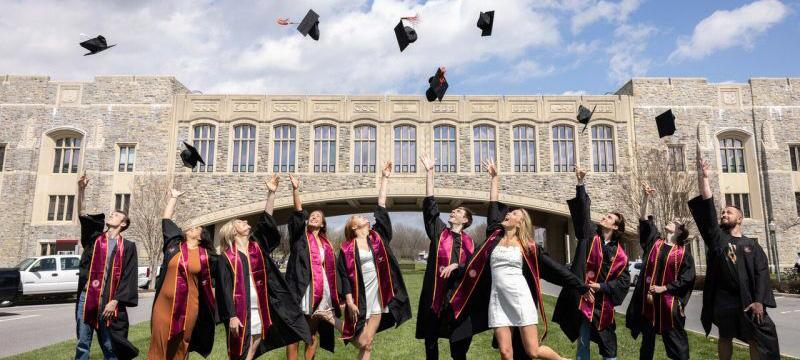
PHOTO COURTESY OF VIRGINIA TECH NEWS
Virginia Tech graduates celebrate in front of the Torgersen Hall bridge.
A LIFE MEASURED IN RELATIONSHIPS OPINIONS
Alexandria Lilly | Opinions Columnist
What does it mean to live a life welllived? The answer relies on how we prioritize our time and values in life. These choices ultimately shape our sense of purpose and the direction our lives take.
Health care professionals and wellness experts highlight that sleep, nutrition and exercise are the cornerstones of a healthy life. While these habits are essential, they do not fully answer a deeper question: What makes life fulfilling? If you find yourself wrestling with this question, it may be worth reflecting on not only your habits, but also the people you spend your time with.
The Harvard Study of Adult Development, one of the longestrunning studies on human well-being, found that strong relationships are a consistent predictor of long-term happiness and health. Relationships and the people we surround ourselves with influence our day-to-day habits as well as our values and how we spend our time. Because of this, investing in relationships is ultimately a commitment to well-being.
However, building meaningful connections isn’t easy, especially in college. Despite living among thousands of peers, many students struggle with loneliness, feeling unsure how to move from casual to close friendships. Notably, programs at Virginia Tech aim to change this.
In fall 2023, a pilot course, based on a program originally developed at the University of Virginia, called The Connection Project, launched at Virginia Tech. The course is designed to support students in building meaningful relationships through guided conversations, reflection and shared experiences.
Since then, the program has grown rapidly. This semester, The Connection Project includes 125 student participants and 26 facilitators. Additional facilitators are currently being trained, as the application season remains open.
Life
is about more than likes; it’s about human connection.
The program is grounded in research, showing that students who participate experience decreased feelings of loneliness and increased feelings of belonging.
For Colleen Driscoll, one of the program’s founders at Virginia Tech and assistant director for Mental Health Initiatives, the goal is to help students build connections that extend far beyond the classroom.
“We see these students becoming friends in their class, and then they take social skills practiced in class to build friendships and relationships with people outside of class,” Driscoll said.
Studies highlight that people who live the longest, healthiest lives are those who feel satisfied with their relationships, whether that means having one or two deeply meaningful friendships or a broader network of community. However, relationships today are not only shaped by the people around us, but also by the technology in our pockets.
Our phones compete for the same attention that in-person relationships need to grow. According to a 2025 study by Fluid Focus, college students spend an average of 5.5 hours per day on their smartphones, adding up to roughly 25 years over a lifetime.
At Virginia Tech, efforts to help students rethink that dynamic have expanded through Hokie Wellness’s digital well-being initiative. Laurie Fritsch, assistant director of Hokie Wellness, founded the program with the goal of encouraging students to become more intentional with technological device usage.
Early efforts included environmental interventions across campus: JOMO boxes, conversation cards, banners and classroom slide decks that encouraged students to rethink their phone habits. Over time, those efforts evolved into digital well-being challenges that invite students to experiment with small changes in how they use their technology. Now, the initiative also promotes
these challenges through digital wellbeing peer educators and is currently recruiting students to join the program.
In spring 2023, Virginia Tech was recognized by the Digital Wellness Institute as the first Digitally Well University in the world, illustrating how impactful this initiative is across campus.
“One simple change can make a significant difference,” Fritsch said. “For both focus and enhanced conversation and connection, physical separation from your phone is key.”
Some research has found that even having a smartphone nearby reduces cognitive capacity. In a culture where our devices are almost always within reach, that suggestion may seem small, but taking a break from your phone may create space for something many students say they want more of in their lives: deeper conversations, stronger friendships and a greater sense of belonging.
Taken together, initiatives like The Connection Project and Virginia Tech’s digital well-being efforts point to a similar idea: Meaningful relationships don’t happen by accident. They require attention, reflection and the courage to step outside of our routines.
In our daily lives, we have countless opportunities to interact with our peers, to smile at a classmate and strike up a conversation, or even check in on a friend. Yet so often, these moments go unnoticed because our attention is shifted to our digital devices. Cultivating in-person connection requires a conscious effort and willingness to step away from our digital routines.
One way to start is by trying a digital well-being challenge, like those offered by Hokie Wellness. Another option could be enrolling in The Connection Project, which Driscoll acknowledges can feel intimidating at first.
“It’s a big leap,” Driscoll said. “But if you can find the courage to enroll, we will support you in building connections — and it really does pay off.”
In the end, a life well-lived isn’t built in your calendar or your notifications. It’s built in the conversations you choose to stay present for. Even though connection takes courage, it is one of the most rewarding things we can do, opening the door to deeper friendships and a stronger sense of belonging.
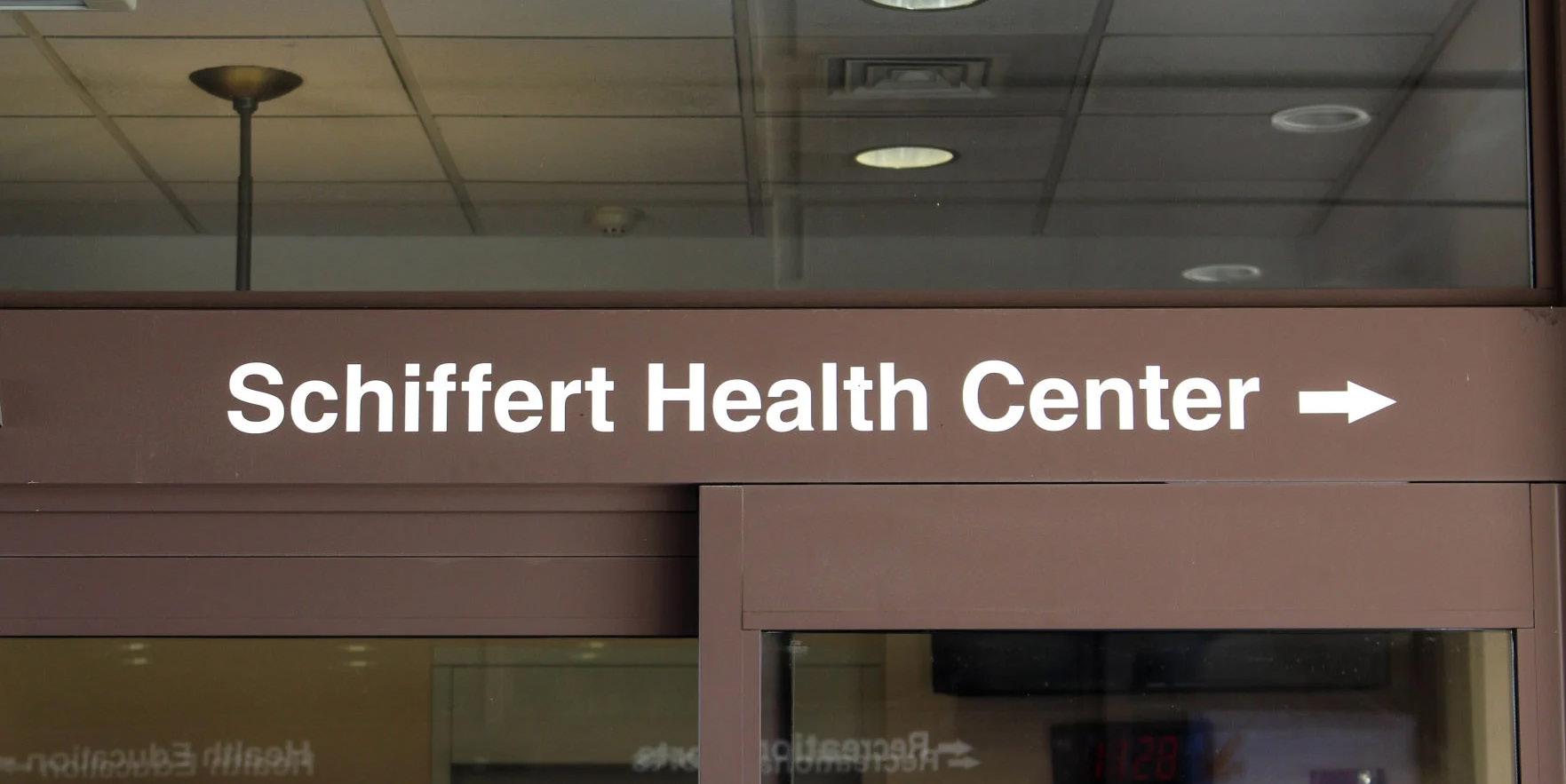
BILLY CLARKE / COLLEGIATE TIMES
The signage above the automatic sliding doors of McComas Hall, signifying the entrance to Schiffert Health Center, Oct. 3, 2016.
ARTIFICIAL INTELLIGENCE IS STEALING THE J OB MARKET: HERE’S HOW
Emmie Crump | Opinions Contributer
The rise of artificial intelligence is reshaping the workforce.
I used to work as the manager for my local aquatic facility. It was a decent gig — I got paid $15.50 for overseeing lifeguards and operators and dealing with routine inspections — until it wasn’t. Multiple guards started reporting to me that they’d been underpaid for the number of hours they’d worked. At the time, payroll was left to the devices of our treasurer, whose record-keeping skills had caused far too many discrepancies. Surprisingly, the pool’s president asked me to take over the position.
Although skeptical, being a bright-eyed 16-year-old eager to climb the job chain to impress future employers, I said, “Yes, of course. Of course I’ll fix this.” I spent hours tediously combing over calendars, doublechecking that I’d calculated everyone’s pay correctly. Now, if there’s anything more terrifying than putting your wages into the hands of a teenager fresh off the skillet, it’s putting your wages into the hands of AI. Artificial intelligence is a labor thief — and it’s a darn good one. We need to proceed with vigilance.
Our culture witnesses AI everywhere now. I once saw a photo of a brilliantly-colored iceberg at sunset being posed as a real photograph on Facebook. AI doesn’t
just fabricate this fake art out of thin air — it steals data from real artists, such as film designers, musicians and other creatives. These artists, many of whom rely on their intellectual property to make a living, are being exploited by AI megacorporations that reap all the benefits.
Similarly, college seniors are scrambling to find companies to hire them post-graduation. I’m sure you’ve heard the murmurs and subtly tenacious jokes from classmates and colleagues about future joblessness. Unfortunately, they’re not so far off.
A Stanford University study revealed how workers aged, “22–25 in AI-exposed fields experienced a 13 percent relative decline in employment.” That’s not a minor statistic. AI is eating up a significant portion of the entry-level opportunities typically catered towards graduates.
These entry-level positions are the exact kind of positions young workers utilize as career-boosting launch pads. If these launch pads and critical resume-builders are being taken away, how will novice professionals acquire an in with their target corporations?
A major concern within the scope of using AI is its ability to be regulated. AI is developing at a rapid pace; reportedly,
it’s “getting twice as good at the rate of about every seven months,” according to Sky News. This momentum is only picking up. This leads to Congress and American unions creating labor laws with nothing stable to grip onto when producing AI-related enactments. We can’t make regulations when we don’t know what we’re regulating.
And what about surveillance pay? Surveillance pay, also known as algorithmic wage discrimination, is an AI-driven process that uses data and surveillance methods to compensate individual workers with differing, and often lower, wages.
Processes like these gather information about workers, including their location and previous work ethic habits, to offer the lowest pay the professional is predicted to accept. AI is preying on the eagerness of individuals looking to make a livable wage and capitalizing on their ignorance of being able to obtain something better.
There’s also the attribution issue. When AI creates something closely stylistically comparable to that of an artist, who’s actually getting accredited for these artistic endeavors? In the majority of cases, it’s the artificial creator — not the
human one. Additionally, this raises ethical and legal questions about how stylistic plagiarism should rightfully be dealt with, in terms of who actually owns an uber-specific style in their work.
Another concern that’s often overlooked is who’s actually monitoring and facilitating artificial intelligence. A lot of companies managing AI hire workers I’d refer to as underpaid babysitters; Global employees who aren’t paid enough for monitoring content and classifying information. Many of these global staff rely solely on AI data categorization and management as their entire income. This quickly turns substandard, especially considering labor laws in less-developed countries are often poorly managed.
So, if you think handing over the fate of your pay to a 16-year-old pool manager isn’t the sharpest idea, consider just how fatal the ramifications are of handing them over to an artificial intelligence system entirely out of your control. AI might not take over the world — but the workforce? That’s always a possibility.
PAYWALLS AND PHYSICAL MEDIA
Japna K. Sethi | Opinions Contributer
The replacement of physical media has led to unprecedented growth of paywalls.
The world we live in is so complicated with how news occurs and spreads in the blink of an eye. So much information is at our fingertips. Especially now, there is an emphasis on staying informed and up to date with current events. Along with that, you need to know where to get it and whether it’s accurate. Is it biased? Is it reputable? Then, you look up a publication, and before you can even read an article, you get hit with a huge paywall. Making quality, up-to-date news inaccessible to many people.
The five biggest newspapers in the U.S include The Wall Street Journal, The New York Times, USA Today, The Washington Post
and the Los Angeles Times. Four out of the five of these hit you with paywalls right after you choose your first article, with USA Today being the only site where you can read their articles for free without being asked to pay for a subscription.
Despite free usage, you are still inundated with hundreds of advertisements, sometimes in between every other paragraph of the article. This makes it very difficult and sometimes frustrating to read. You shouldn’t have to choose between paying a premium and being bombarded by distracting ads.
This isn’t just a problem with big publications. Local newspapers are also mainly
pay-to-read. Recently, like many of my peers, I’ve been wanting to be more informed on local news. My local paper in my home state of New York is Newsday, a paper dedicated to reporting on events in the New York City and Long Island areas.
Unfortunately, for thousands of Long Island residents, you have to pay for a subscription just to stay informed in your own community. This goes for not just physical newspapers but also online articles. This lack of free, accessible news makes reading articles not just unattainable but also discourages people from wanting to read the paper. The Pew Research Center found
that “just 1% say they pay for access when they come across an article that requires payment.”
Likewise, 10% of Americans who don’t pay for the news say that their biggest reason why is that it’s too expensive. This financial barrier to access is a big factor in why some people simply choose not to read the news. The Northwestern Local News Initiative stated, “In the past year alone, 500 of the largest daily and weekly newspapers in the United States have lost an estimated two million print and digital readers, according to data from the Alliance for Audited Media. Since 2005, overall circulation has decreased by more
@COLLEGIATETIMES
continued from page 6
than 75 million, or more than 60%.”
It’s no wonder why people are so discouraged, with the average print subscription to a major publication costing $20 to $40 per month. Digital publications can cost anywhere from $10 to $20 per month. Though these prices can vary, it’s still an extra financial expense for the average consumer. This can make people look at news as an inconvenient subscription rather than a serious way to stay informed, with print news and general physical media taking the biggest hit because of it.
The newspaper industry has shrunk dramatically since 2005; over the past two decades, more than 3,300 newspapers have
ceased printing. This decline of physical papers has especially affected smaller, more local news outlets. For example, the Collegiate Times itself will soon stop printing physical copies of its issues by the end of this semester.
You will no longer be able to walk into SquiresoranyotherbuildingwithaCollegiate Times box and pick up the paper. We will be a fully digital publication as of fall 2026. This was especially disheartening for me to hear since the reason I found out about writing for the Collegiate Times was through an ad for an interest meeting in the paper.
All of these aspects of the state of current news outlets create a landscape where prices
for both big and small publications are going up while readership and physical printing are going down. So what’s the solution?
We need to make the digital versions of publications free and accessible to the public. Digital platforms should be seen as a way to expand the reach of information to more people, not just another way to bring in more subscriptions. Using advertisements to help pay for the site and wages of the staff that help keep the paper running is reasonable. Although these advertisements should not impede the readability of the article or, at times, annoy the reader.
Physical newspapers also need to be seen as more of a daily ritual than an expensive
medium that’s on the decline. It should be encouraged for people to read the daily paper or to have what should be an inexpensive subscription to their local paper. It would be so fun to grab some coffee and a newspaper with some friends and look through the paper.
At the end of the day, I encourage all of my fellow Hokies to take advantage of their resources. In a time where staying informed can be expensive, I encourage everyone to use their Virginia Tech email to get a free academic pass to the New York Times. Information should be free and accessible for all.
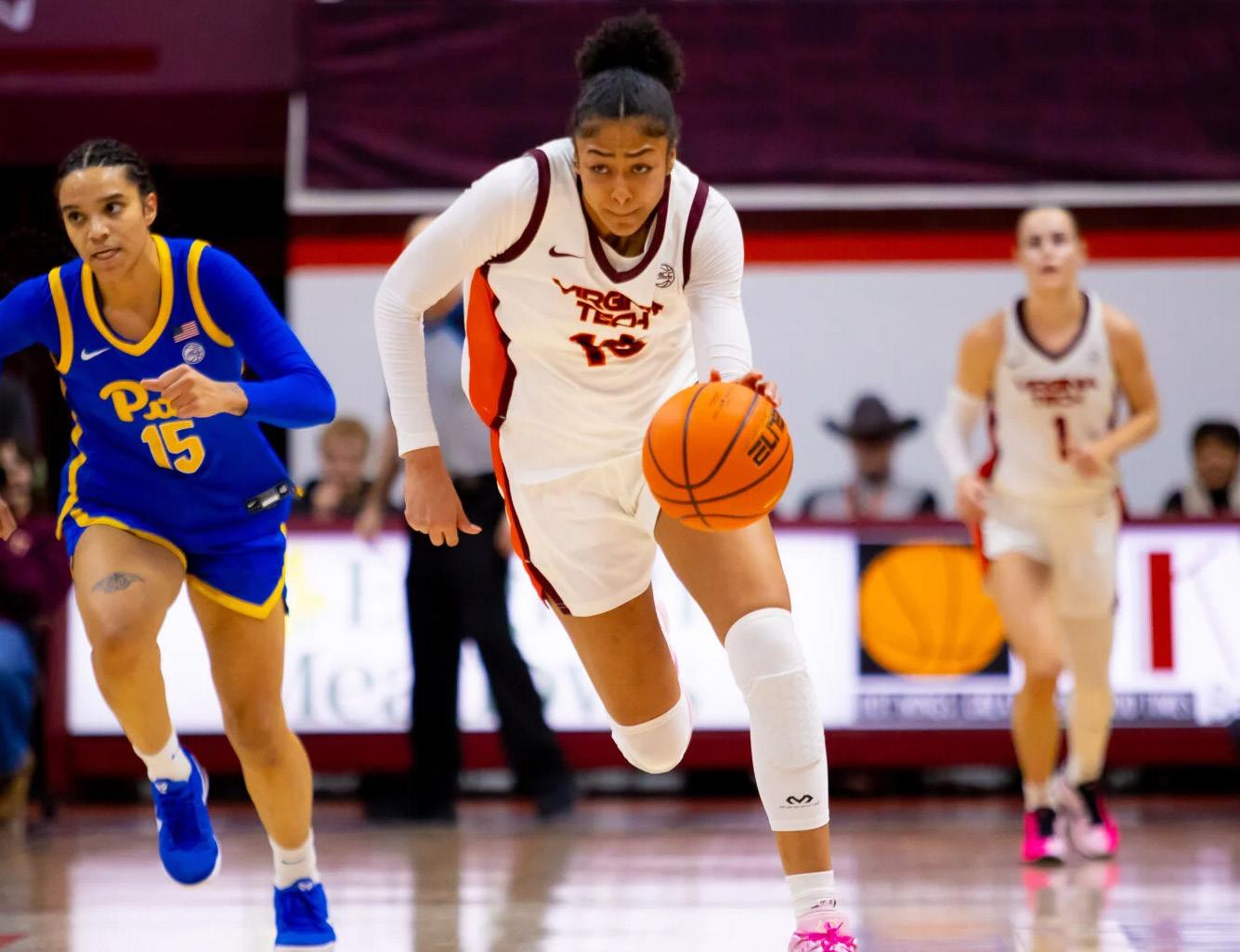
VIRGINIA TECH FALLS TO OREGON IN FIRST ROUND OF NCAA TOURNAMENT
Brody Bryan | Sports Writer
The Hokies ended their season in Austin on Friday.
As the clock struck midnight on Virginia Tech’s 2025-26 season, Hokies guard Mackenzie Nelson offered a blunt assessment — “I just don’t think we came ready to play.”
The Hokies fell to Oregon, 70-60, in the first round of the NCAA Tournament on Friday in Austin, Texas.
“Just so proud of our team,” said Hokies head coach Megan Duffy. “Today was not the best over the course of 40 minutes, but the way each one of (the players) has grown and really shaped and molded this year, from the summertime to now, has been a joy. Today is disappointing. … Just really excited about what they’ve done this season.”
The Hokies were outscored 22-11 in the first quarter, a frame in which they shot 4-of-18 from the field compared to the Ducks’ 10-of-14.
“I think we got a little razzled in the beginning,” Nelson said. “We calmed down a little bit.”
Oregon extended that lead to 13 points early in quarter two, but with help from its bench, Tech whittled the deficit to as little as two midway through the frame.
Forward Mel Daley tallied eight points on 4-of-7 shooting, and sophomore forward Kayl Petersen connected from beyond the arc to cut into the gap.
“They were great,” Duffy said of Tech’s bench. “To see them step up in a huge moment in the NCAA Tournament was phenomenal. … That group of women who really stepped up for little things for us in that second quarter was awesome.”
Two points were the closest the Hokies would get, though. The Ducks took a six-point
lead into the locker room at halftime and dominated the third quarter.
Oregon went on an 18-0 run early that period, fueled by Tech’s missed shots and fouls. By the end of the surge, the Hokies found themselves in a 22-point hole with just over 13 minutes left in the game.
“I think they just capitalized on a lot of our mistakes,” said Hokies forward Carys Baker. “We just didn’t really close that gap, so I think it just started on our defense. … We just made a couple of mistakes, and we weren’t able to communicate fast enough what was going on.”
Tech inched closer in the fourth with a couple of brief scoring runs, but it was too late to put a dent into the Ducks’ lead. Baker hit from deep with two seconds left to cut the deficit to 10, but as the clock hit zero at the Moody Center, it was Oregon moving on to face Texas.
Baker paced the Hokies with 21 points and shot 8-of-15 from the field. She was 5-of-8 from three and grabbed 14 rebounds, leading all players. No other Tech player scored in double figures.
The Hokies shot 31.8% from the field in the loss — their lowest mark since a 62-51 home win over Georgia Tech on Feb. 22.
“(Oregon) is a good defensive team,” Nelson said. “They’re physical, and they were connected all game. I think that made (scoring) difficult, but I think a lot of it was us. We missed easy shots, easy putback layups, easy pull-ups that we always make.”
The loss ended the second year of Duffy’s tenure in Blacksburg; a year in which the Hokies’ win total improved by four games,
and they returned to the Big Dance for the first time since 2024.
“I think this has been such a fun group to coach,” Duffy said. “I don’t know if every head coach can say that about their team. They make me laugh every day, they drive me crazy some other days. They’re really good young women that are trying to figure out how to build a program, and love each other every day.”
“On the basketball side, we still had players
in new roles this year, trying to figure out how to, like Mackenzie, be a bit better point guard than you were last year, and she exceeded that. Carleigh and Carys, with the weight of the world on their shoulders some days, just help them navigate through that. It’s been fun, and their hearts are always in the right place.”
RILEY THOMPSON / COLLEGIATE TIMES
Virginia Tech Hokies forward Carys Baker (10) drives the ball forward on Jan. 29, 2026, in Blacksburg, VA.
BASEBALL SALVAGES SERIES BEHIND GRIFFIN STIEG’S SEVEN-STRIKEOUT START
Alex Winn | Sports Writer
Last Sunday, Virginia Tech baseball picked up their second ranked win of the season.
CHARLOTTESVILLE, Va. — The Hokies defeated No. 14 Virginia, 6-3, off the back of Griffin Stieg, who picked up the win after six innings on Sunday afternoon.
“We pitched really well, got a good start from Stieg,” said Virginia Tech head coach John Szefc. “If people are winning in this park as an opposing team, they have to get a good start.”
Virginia Tech (9-9, 2-4 ACC) won Game 3 of the Commonwealth Clash against in-state rival, No. 14 Virginia (16-4, 4-2 ACC) after dropping the first two games. Stieg gave the Hokies his best start of the young season, which was key after their starting pitchers went down with injuries on Friday and Saturday. The Cavaliers’ offense wasn’t as potent as it had been in the prior two games, only accumulating 10 baserunners after putting 35 total runners on the bases in the first two games.
The contest started as a pitchers’ duel. Neither team got a run across in the first three innings after scoring a combined 11 runs in the first three innings of the previous two games. The stalemate was broken in the top of the fourth inning by Hokies designated hitter Hudson Lutterman, who jacked a three-run shot into the left-field bleachers, scoring second baseman Ethan Ball and outfielder Treyson Hughes.
“A (pitcher) makes a mistake, then a guy hits a home run, and to our benefit it was a three-run homer,” Szefc said. “You start giving up three-run innings, probably not gonna win that. That’s just the way baseball is.”
During the first two matchups of the series, each time the Hokies scored runs in the top of an inning, they were promptly met with runs by the Cavaliers in the bottom — except in the fourth inning of Game 1. in the bottom of the inning, except in the fourth inning of Game 1. This time, Virginia didn’t respond. Stieg allowed a baserunner in the bottom of the fourth inning and walked off the mound still up 3-0.
The Hokies didn’t waste an
opportunity to hang more runs on John Paone in the fifth inning. The inning started with a walk and a hit by pitch from Paone, ending his outing. He left two baserunners on for Virginia righthander Lucas Hartman.
Hokies first baseman Sam Grube immediately greeted Hartman with a double that scored Anderson French, who walked to start the inning. Grube’s double was followed by the Hokies outfielder Nick Locurto grounding out and scoring shortstop Pete Daniel, who Paone had hit, while advancing Grube to third. Finally, Grube scored on a wild pitch by Hartman, putting the Hokies up 6-0.
Six runs were all the Hokies needed to be victorious, even with Virginia responding in the bottom of the fifth inning with shortstop Eric Becker’s solo home run.
Stieg threw a clean sixth inning and was pulled to start the seventh. He finished with seven strikeouts and allowed only one run — all while picking up Tech’s first pitching win by a starter this year.
“Stieg is an experienced guy that’s been around a little bit,” Szefc said. “He has a feel for how to set guys up and finish. He’s pitched in this park before; he knows what the deal is. He’s a veteran guy.”
Virginia tried to mount a comeback in the bottom of the seventh, with Antonio Perrotta’s two-run bomb, but it was to no avail. The Hokies turned to left-hander Brody Roe and right-hander Preston Crowl to close the game and received eight clean outs, six of which were strikeouts.
“The guy that’s probably going under the radar was Brody Roe,” Szefc said. “The fact that he was able to come out, face the left-handed hitters and kind of set up Crowl to have success.”
Virginia Tech picked up its second straight ranked Sunday win to salvage a series, just as it did last weekend against Georgia Tech.
“We just need to play more,” Szefc
said. “We’ve only played 19 games. It gives me a reason to be optimistic.”
The Hokies will look to carry the momentum of their win into a weekday game against VCU. They host the Rams on Wednesday, March 18, at 3 p.m. ET on ACCNX.