
COLLEGIAT ETIMES
An independent, student-run newspaper serving the Virginia Tech community since 1903



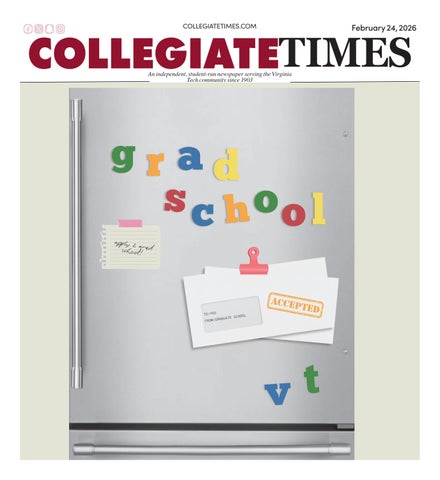
r





d s c h o o l






FROM:GRADUATE SCHOOL TO:YOU



HOKIE DAY 2026: STUDENT REPRESENTATIVES AT THE VIRGINIA GENERAL ASSEMBLY
Natalie Shannon | News Writer
Students on the Undergraduate Student Senate spoke to the General Assembly about university funding.
On Feb. 3, 17 representatives from Virginia Tech’s Undergraduate Student Senate traveled to Richmond, Va, to advocate for university funding faceto-face with legislators at the Virginia General Assembly.
The Undergraduate Student Senate is a group of students who serve as representatives of the university student body with the primary goal of “exuding servant leadership in the spirit of Ut Prosim” as well as working to “ensure that there is representation for undergraduate students at every level of university governance, if there isn’t that, we’re carving pathways to get those students represented,” said Emma Roshioru, a senior pursuing a double major in political science and public relations, in addition to serving as the acting president of the senate.
OUR CORE VALUES
Impartiality means reporting, editing and delivering the news honestly, fairly, objectively and without opinion or bias.
Credibility is the greatest asset of any news medium, and impartiality is the greatest source of credibility.
To provide the most complete report, a news organization must not just cover the news, but uncover it. It must follow the story wherever it leads, regardless of any preconceived ideas on what might be most newsworthy.
The pursuit of truth is a noble goal of journalism. But the truth is not always apparent or known immediately. Journalists’ role is therefore not to determine what they believe at that time to be the truth and reveal only
As president, Roshioru is responsible for “representing the student body in areas that are predominantly filled by administrators.” As the leading voice for undergraduate student affairs, she also attends meetings and advocacy trips like Hokie Day to magnify the student opinion at the state level.
“Students from the undergraduate student senate are selected through an application process in which they are then able to represent the university and share students’ stories and interests up in Richmond at the general assembly,” Roshioru said.
The Virginia General Assembly — made up of the House of Delegates and the Senate of Virginia — are the central lawmakers for the state of Virginia. Thus, these legislators are responsible for delegating funds
that to their readers, but rather to report as completely and impartially as possible all verifiable facts so that readers can, based on their own knowledge and experience, determine what they believe to be the truth.
When a news organization delivers both news and opinions, the impartiality and credibility of the news organization can be questioned. To minimize this as much as possible there needs to be a sharp and clear distinction between news and opinion, both to those providing and consuming the news.
Voice your opinion. Send letters to the Collegiate Times. 365 Squires Student Center Blacksburg, VA, 24061 opinionseditor@collegiatetimes.com
All letters must include a name and phone number. Students must include year and major. Faculty and staff must include position and department. Other submissions must include city of residence and relationship to Virginia Tech (i.e., alumni, parent, etc.). We reserve the right to edit for any reason. Anonymous letters will not be printed.
Letters, commentaries and editorial cartoons do not reflect the views of the Collegiate Times. Editorials are written by the Collegiate Times editorial board, which is composed of the opinions editors, editor in chief and managing editors.
to public universities like Virginia Tech. At Hokie Day, the main goal of the advocacy is to share student perspectives to give legislators student insight on the impact of university funding.
“A lot of our legislators are a lot older than we are and they’ve been out of school for a long time,” Roshioru said. “In their positions, they see a lot of numbers, they see a lot of data, but then when they aren’t seeing the people that the data is actually impacting, it makes it a lot more difficult to act consciously in those decisions.”
Lindsay Ricci, the vice president of issues and policy for the USS, a sophomore studying political science and one of the student advocates present at Hokie Day, shared this sentiment of the importance of seeing your constituency.
“We usually don’t have (student) representation in these spaces. It’s to represent our best interest,” Ricci said.
Ricci explained how valuable it is for legislators to see and hear the first-person perspectives of students who are impacted by the budget rather than the usual “pitch of statistics” they receive.
Ricci shared that affordability was one
of the main points of advocacy from the students regarding the proposed budget.
“I talked about affordability and how that was a big factor for me in pursuing higher education and how Virginia Tech was one of the most affordable options for higher education while also providing a great quality of education,” Ricci said.
Additional main budget line items students advocated for this year included an expansion of Virginia Tech’s medical school, which would allow for double the number of students per class, and supporting the funding for the Virginia Military Survivors & Dependents Education Program. VMSDEP provides tuition assistance to veteran dependents and spouses in pursuit of educational goals. If students have any questions, messages or campus concerns they would like to be raised, they can share them with the senate by filling out this form.

COLLEGIAT ETIMES
NEWSROOM 231-9865
Editor-in-Chief: Michaela Scott (editor@collegiatetimes.com)
Managing editor: Ayisha Surani
Design editor: Annmarie Leake
Assistant Design editors: Caroline Rogers, Sarah Jordan, Mx Zaleski, and Alana Vernon
Copy editors: Emily Southern, Olivia Guy and Amanda Donndelinger
News editors: Erin Bailey and Ava Garrison
Assistant News editor: Max Painchaud
Lifestyles editors: Emma Duncan
Assistant Lifestyles editors: Cat Pizzarello and Ella Winterling
Sports editors: Sam Mostow, Thomas Bray and Dylan
Opinions editor: Jenna Mason
Assistant Opinions editor: Mohib Amjad
Photo editor: Hamad Alhendi
Assistant Photo editor: Riley Thompson
Have a news tip? newstips@collegiatetimes.com
BUSINESS STAFF 231-9860
Business manager: Greg Patterson (business@collegemedia.com)
MEDIAMATE 888-897-7711 collegiatetimes.com/media_kit/ orders@mymediamate.com
The Collegiate Times, a division of the Educational Media Company at Virginia Tech, was established in 1903 by and for the students of Virginia Polytechnic Institute and State University. The Collegiate Times is published every Tuesday of the academic year except during exams and vacations. To order a reprint of a photograph printed in the Collegiate Times, visit reprints.collegemedia.com. The Collegiate Times is a division of the Educational Media Company at Virginia Tech, Inc., a 501(c)3 nonprofit with a mission to provide educational experience in business and production of mass media for Virginia Tech students. © Collegiate Times, 2020. All rights reserved. Material published in the Collegiate Times is the property thereof, and may not be reprinted without the express written consent of the Collegiate Times.
Advertisements do not necessarily reflect the opinions of the Collegiate Times. Read about our organization’s Core Values online at collegiatetimes.com.
Tefft
APPLICATIONS OPEN FOR 20262027 UNDERGRADUATE STUDENT SENATE POSITIONS
Laura Pajoma | News Writer
The Undergraduate Student Senate’s application for the 2026-2027 year is open and closes March 1.
The application process for the 20262027 Undergraduate Student Senate is now open to all undergraduate students at Virginia Tech.
The deadline for applications is March 1 at 11:59 p.m. Students have the opportunity to apply for leadership positions that will directly shape the future of the Hokie community.
The USS was officially established in the spring of 2021, following its transition from the Student Government Association. The creation of the USS was driven by the need to update Virginia Tech’s student governance system to
more accurately reflect the diverse needs of the student body. Since then, the USS has been dedicated to serving and representing the Hokie community in shaping university policies and decisions.
As one of Virginia Tech’s five university senates, the USS plays a critical role in improving the student experience. Through shared governance, USS members represent student interests on university committees, provide input on policy recommendations and vote on university-wide issues that impact students.
This year, the USS application process offers several leadership positions, including USS President, Vice President for Issues and Policy, Vice President for Strategic and Inclusive Affairs, Vice President of Finance, Vice President for Shared Governance and Vice President for Administration.
These positions are open to students who have previously served on the USS. For those new to the USS, there are openings for Senator-at-Large, which has 31 open positions that represent the general undergraduate student body. Additionally, there are 41 seats open


for College Senator, representing the student bodies of specific colleges.
Following the March 1st application deadline, the 2026-2027 USS election results will be announced on March 31. For more details and to apply, visit the official USS application webpage.
@COLLEGIATETIMES


Applied Biotechnology & Molecular Biology (M.S.)
Develop advanced laboratory skills to address real-world challenges in biotechnology and molecular science.
Counselor Education & Supervision (Ph.D.)
Advance counseling practice through leadership and research focused on diverse populations.
Educational Leadership (Ed.D.) Offered Fully Online
Master the intersections between healthcare and data to inform effective decision making for public health initiatives.
English for Speakers of Other Languages (M.Ed.) Offered Fully Online
Gain advanced skills to teach, assess and support English learners in diverse classrooms.

VIRGINIA SET TO RAISE MINIMUM WAGE
Matthew Lortie | News Writer
Virginia will raise the minimum wage in 2027 and 2028 following passed legislation from the House and Senate.
On Feb. 16, Virginia’s Senate passed legislation to increase the state’s minimum wage over the next two years. Starting with an increase to $12.77 per hour on Jan. 1, 2026, the new legislation will see a raise to $13.75 in 2027 and $15.00 in 2028.
Following Abigail Spanberger’s win in the gubernatorial race last year, the minimum wage raise has been a priority for Virginia Democrats. The bill was previously introduced in 2025, but was vetoed by former Gov. Glenn Youngkin.
“I look forward to signing this legislation into law to give Virginia workers a pay raise,” Spanberger said, “I’m grateful to the members of the General Assembly who have made stronger wages for
working Virginians a priority.”
Virginians are cautiously optimistic about this change and how it will affect the different areas of the state.
“It’s good to pay workers more, but I don’t think a marginal increase will change circumstances,” said Samuel Klemic, a former Virginia Tech student who now lives in Northern Virginia. “NOVA is famously expensive. … You could not live there on minimum wage.”
While the raise is significant, it is only one part of the Virginia Democrats’ intent to address concerns about affordability. Gov. Spanberger’s “Affordable Virginia Agenda” was recently passed by the General Assembly, with bills aiming to cut prescription drug costs, reduce
utility prices and expand affordable housing.
Affordability is one of the most pressing issues Americans face currently. With President Donald Trump’s upcoming State of the Union speech expected to focus on affordability, Gov. Spanberger has been chosen to deliver the Democrats’ official response.
Having campaigned on lowering costs for families, Gov. Spanberger is seen by Democrat leadership as a model for the future of the party.
“Virginians and Americans across the country are contending with rising costs, chaos in their communities, and a real fear of what each day might bring,”
Spanberger said.
A LOOK INSIDE THE GRADUATE LIFE CENTER LIFESTYLES
Grace Belcher | Lifestyles Writer
Beyond a quiet study spot, the GLC serves as a hub for graduate life, dining and connection.
Undergraduate students have several places around campus to call their own, as most Virginia Tech students are pursuing bachelor’s degrees. For students pursuing a master’s or doctoral degree, the Graduate Life Center is a place with their needs at the center. Yet for many undergraduate and graduate students alike, the building remains an afterthought, a place they walk by without thinking.
The GLC offers far more than most students realize — from reservable event rooms to relaxing study or meeting spaces. It’s a unique community designed with grad students in mind, a distinction that sets it apart from the rest of campus. The building is also a residence hall, housing 179 students in Donaldson Brown. According to those who know it best, learning to use it to its fullest potential makes all the difference in the graduate experience.
“I chose the GLC because it offers a quieter,
more focused environment compared to traditional apartments or undergraduate housing,” said Apple Zhou, a senior studying computer engineering who resides in the GLC at Donaldson Brown. “I wanted a place where it’s easier to study and connect with other graduate students who have similar academic goals and schedules.”
Zhou was drawn to the GLC year after year because of its encouraging atmosphere she felt she could excel in.
“The atmosphere is calm, respectful and supportive. People are friendly but also mindful of each other’s time and space,” Zhou said. “It feels like a balance between independence and community — residents can socialize when they want while still having a peaceful place to work and relax.”
That balance plays out in the spaces she and other students return to most, such as study lounges, communal kitchens and common areas. Residential Well-being
Student Leaders in the GLC at Donaldson Brown host hall events in these spaces.
“They were worthwhile because they provided a low-pressure way to meet other residents and take a break from academic work,” Zhou said. “Even simple activities helped build connections and made the building feel more like a community rather than just a place to live.”
The GLC also has an auditorium, a large event space and conference rooms for students, classes, organizations and staff teams to reserve and utilize.
“I think some larger event rooms and certain shared spaces are underutilized because residents may not always know they’re available or how to reserve them,” Zhou said.
Hokie alumni studying at the university before January 2025 would recall an Au Bon Pain location in the GLC. However, summer 2024 renovations saw the removal of all
three ABP locations on campus. The Squires Student Center location became Corner ‘24, the Goodwin Hall location became Viva Too and the GLC location became Ducky’s Bubble Tea.
The addition of Ducky’s has made the GLC even more appealing for undergrads and grads alike, as it provides an upbeat environment to grab a treat and study. It became not just the graduate building, but a desirable location for productivity. The space invites you to slow down, grab a sweet treat and get some work done.
Whether it’s attending a casual event, grabbing a bubble tea or even taking a class there, GLC rewards those who engage with it. For graduate students keeping up with busy schedules and rigorous academics, having a place like that can matter more than they expect.
@COLLEGIATETIMES

FROM STUDENTS TO TEACHERS: VIRGINIA TECH’S MASTER’S PROGRAM SHAPES FUTURE EDUCATORS
Willow Musterman and Annie O’Connell | Lifestyles Writer and Lifestyles Contributor
The Elementary Education master’s program equips future teachers for real classrooms.
Every elementary school classroom starts with a former student who decided to make a difference. The Elementary Education Master’s Program at Virginia Tech guides students toward success by preparing them to meet the needs of all learners and offering firsthand classroom experience.
“What really sets us apart is our cohort model,” said Donna Fortune, the program coordinator for elementary education. “Our students go through the program together, building a genuine professional community with one another — and we don’t just teach best practices: We model them.”
Virginia Tech aims to lead by example, striving to produce successful and prepared educators. The Elementary Education Master’s Program is designed
to foster resilient, adaptable individuals ready to embrace the ever-changing educational ecosystem.
“I became the program leader in 2018, so I’ve really had the opportunity to watch this program grow and evolve over the last 10 years,” Fortune said. “Over the years, we’ve really worked to make sure our program keeps pace with the changing landscape of education.”
The Elementary Education Teacher Preparation Program helps students transition into the classroom. Through observation, lesson planning and hands-on experiences with elementary students, the program helps make this change nearly effortless.
“We begin in the first summer with two foundational courses — early literacy instruction and early grades
math instruction,” Fortune said. “In the fall, students take five content methods courses covering curriculum and instruction, upper math, upper reading, social studies and science.”
Throughout this program, students can go beyond gaining knowledge and skills in the field of education.
Fortune said she hopes students gain “confidence in their content knowledge, confidence in their ability to build relationships with students and families, and confidence to be reflective and keep growing long after they leave our program.”
She also hopes they gain a deep sense of purpose, emphasizing the longlasting influence of elementary teachers on students.
“Elementary school teachers have
such a profound impact on children during some of the most formative years of their lives, and I want our graduates to carry that with them every day,” Fortune said.
Among the 15 master’s programs in education, Elementary Education is students’ top choice. Fortune attributes this success to the graduates who thrive in real classroom settings. More importantly, she believes people have a desire to make a difference.
“People want to make a difference, and they see teaching young children as one of the most meaningful ways to do that,” Fortune said. “Virginia Tech has built something that people believe in, and I think that speaks for itself.”
@COLLEGIATETIMES

ON YOUR TIME: COMPARING THE TRADITIONAL AND ACCELERATED MASTER’S PROGRAMS
Bailey Linza | Lifestyles Contributor
As seniors weigh post-grad plans, Virginia Tech provides flexible routes to advanced degrees.
When undergraduate students reach their junior and senior years of college, many start to think about what to do after graduation. Some decide to go directly into the job market, while others may choose to continue their academic career in higher education.
For current and prospective Hokies, the Virginia Tech Graduate School offers over 120 master’s and doctoral degree programs, many of which are ranked highly by U.S. News & World Report. The school prides itself on guiding graduate students to achieve in academia, but also in developing character, helping experienced learners “connect, succeed, and stand out.”
Traditional master’s degrees and programs
When students consider obtaining a master’s degree, they need to prepare for the application process. For Virginia Tech’s Graduate School, the formal application is not always the only thing a student must submit; some programs request transcripts, letters of recommendation and graduate school readiness exam scores.
Students don’t have to go through the application process alone. Many Hokies recall their professors being a source of support and encouragement during the transition.
“One of my professors actually brought it to my attention. She was like, ‘You should think about going to graduate school here,’” said Derek Johnson, Jr., a first-year graduate school student in the School of Communication Reputation Management program. “I didn’t even know if I was graduate school material.”
Thinking about higher education can cause anxiety for students feeling unsure if they are qualified, whether they don’t feel that they belong, are enduring burnout or don’t clearly understand their long-term goals.
“One thing my mom used to always tell me is if you’re going to do something, be the best at it,” Johnson said. “I felt like graduate school was the next stepping stone to be better in my major.”
If accepted into the Graduate School, it typically takes graduate students one and a half to two years to complete their master’s
degree. Some programs may take longer to finish, depending on specifications and the rigor of coursework.
Accelerated master’s programs
If the traditional two-year master’s program doesn’t fit a student’s timeline, Virginia Tech also offers accelerated master’s programs, allowing current undergraduate students to earn their master’s degrees while completing their bachelor’s degrees. To make use of this program, students must be current Virginia Tech students.
There are two ways to be enrolled in the accelerated master’s at Virginia Tech. Students get to choose if they want to be in the UG/GR or the Dual program. The UG/GR track requires students to have a 3.3+ GPA to be considered for the application.
Furthermore, courses taken within the last two semesters of a student’s undergraduate career are double-counted for both degrees. For the Dual path, students must have above a 3.0 GPA. In this strategy, undergraduates will select up to 12 credits from their bachelor’s degree to only count towards their master’s degree.
“The main benefit is time,” said Benjamin Levy, a mathematics student in the accelerated master’s program. “Also, coming through the accelerated program internally, actually, was probably a safer option. … It does help with a lot of competition.”
It is convenient for students to enroll in the accelerated programs because of future planning and overall time management. Some departments at Virginia Tech are more diverse and willing to accommodate students better as well. However, there have been some recent changes that have led to less leeway for students in the programs.
“You can’t take a graduate-level course unless you’re in graduate school, usually, but in math, all you had to do was ask the professor and they would say, ‘Yeah, sure.’ I really liked how much freedom I was given in the math department,” Levy said. “Unfortunately, the College of Science has actually backed off on this. They changed it so that you can’t take 5000-level courses unless you’re a senior and you can’t take 6000-level courses unless you’re a graduate student.”
In addition to losing out on higher-level classes, there are other disadvantages that come with the accelerated master’s programs.
“Administratively, it’s been a little bit of a nightmare. I had to like hunt around to be added to the mailing list. For a long time, important emails that were being sent to all the graduate students weren’t getting sent to me, because of the way I came in,” Levy said. “(My) Graduate Student Activity Report was never sent to me, and I missed mine. … It’s really important. It’s how you get funding.”
Some other problems that accelerated master’s students have encountered are not being able to teach as a graduate student and not being able to access the same resources as regular graduate students.
Other graduate opportunities
In addition to obtaining credits, graduate students may participate in hands-on projects with undergraduates, write a thesis or serve as a graduate assistant or graduate fellow.
In the School of Communication, graduate assistants teach COMM 2004 Public Speaking, helping students understand speech techniques, interpersonal communication theories and presentation skills.
Most programs utilize graduate assistants to help with grading, occasional teaching and student support, serving as a connection between the student and the professor.
The Residential College at West Ambler Johnston invites graduate students to participate in the dorm’s Living Learning Program as graduate residential fellows. Their responsibilities are creating relationships with residents, planning community events and participating in stewardship roles, among other duties.
This program not only provides experience in building community and mentorship, but also an important benefit for graduate students: housing.
“When I was looking into doing graduate school, I was like, ‘How am I going to live? How do I find housing and everything?’” Johnson said. “One of my colleagues is actually a graduate residential fellow here
and I spoke with him about it and he was saying, ‘You should look into this. It’s a possible opportunity.’ Housing was definitely a plus, but also it’s just about being able to give back to a community that gave so much to me.”
Advice for choosing a path
Irrespective of what path students decide to take, the professors, advisers and colleagues of graduate and accelerated master’s students have significantly inspired and made an impact on students.
“Well, I think the truth is, like any department, it’s the people. I am very fond of the people that I’ve been lucky enough to work with,” Levy said. “My adviser has been a really fantastic mentor to me. In fact, right before we met for the interview, we were working on some research. … I think, overall, there are a lot of really good people who believe in their students in the math department. I really liked that.”
Whether students join a traditional program or the accelerated master’s, many experience a change of character as they better understand higher education’s expectations and sacrifices.
“Get comfortable with being uncomfortable,” Johnson said. “Because if I wasn’t uncomfortable, I wouldn’t have asked that faculty member or the graduate residential fellowship about opportunities.”
At the end of the day, it is up to the student what they desire to do with their life and future. Despite that, it is also key to listen to experienced students who have gone through this journey. One academic course of action may take longer than the other, but it depends on the person getting the degree.
“If you’re doing what I’m doing, and you’re doing a thesis in the accelerated program where it takes you half as much time, it’s going to take you half as much time,” Levy said. “You’re not necessarily going to get a better education if it’s faster. It’s different from a bachelor’s degree. In your master’s, they really want you to demonstrate that you have learned the material.”
PHYSICAL PRESERVATION: THE IMPORTANCE OF TANGIBLE MEDIA IN THE DIGITAL AGE
Emmie Crump | Opinions Contributor
As the CT says goodbye to print media, remember that not everything has to be strictly digital.
I was sitting in on one of my section meetings for the opinions team when I heard a fellow editor announce the upcoming discontinuation of Collegiate Times’ physical edition. I had been caught in my head, focusing on the most recent story pitch I had lined up to discuss, but this comment piqued my attention. Collegiate Times is the oldest newspaper in Blacksburg and began printing in 1903 at Virginia Tech; surely this couldn’t be the case. But a statement of confirmation was all I needed to hear the truth: As of fall 2026, the paper is moving fully digital.
This is not a statement I’d wanted to hear, and I know I can’t be the only one. There’s something I find inexplicably desirable about holding a crisp, physical copy of the Collegiate Times in the lobby of Newman Library with a chilled beverage before classes. This may sound trite and outdated, like I’m some sort of 60-year-old professional gearing up for my day, but it’s the truth. The characteristic newspaper stands sprinkled intentionally throughout campus and Blacksburg, typically well-fed with pristine editions, will soon sit empty and dark. I’d be lying if I said this wasn’t an emblem for the fallout the digital era has left us in.
In the midst of the digital era, physical media is getting trampled by e-books, mobile applications and video games. There’s not necessarily an issue with the upsurge in digital content — we’re adapting to an increasingly technology-dominated world in the only way we know how. But digital media should supplement pre-established physical means, not replace them. There’s still merit in experiencing our cultural progressions tangibly.
Something many of us are guilty of is the endless nature associated with doomscrolling. Digital media is dangerous in that it’s an endless vortex of bottomless press. When we’re scrolling the internet for news stories
or entertainment, we’re feeding into a sort of “rabbit hole” effect. It’s easy for us to have our attention directed to a relevant website and then find ourselves seamlessly slipping into an online shopping frenzy. With physical media, consumers are limited to a single book or article where they can visibly track their progress in lieu of browsing through immeasurable lengths of online material.
There’s an additional social aspect to physical media that we can’t quite replicate electronically. Video games can indeed be played with friends across the world — I’ve played multiple online games with friends in both Africa and Nevada simultaneously — but physical board games curate a “third space” that encourages a more multifaceted social interaction. These third spaces, which include libraries, coffee shops and community centers, are imperative for finding a sense of identity and community. Digital spaces can’t replicate these extra environments that require palpable presence because they limit users to a two-dimensional screen.
Another matter in question is digital fragility, a concept that expresses the rate of nonfunctionality a specific technology takes on. The datedness of an article or resource found solely online is at jeopardy to digital documented memory. In tandem with this, we don’t actually have ownership over a specific online medium — TV shows, video games, providing that of Nintendo’s recent contract, and social media content is solely rented. We don’t actually possess any of our favorite sitcoms or first-person shooter games — we’re sold rights to them.
I can confidently say I own various copies of the Collegiate Times. They’re proudly displayed on my bookshelf, a reminder of the work my colleagues and I have put into the newspaper. Additionally, the CT newsroom has picturesque stacks of amber-tinted
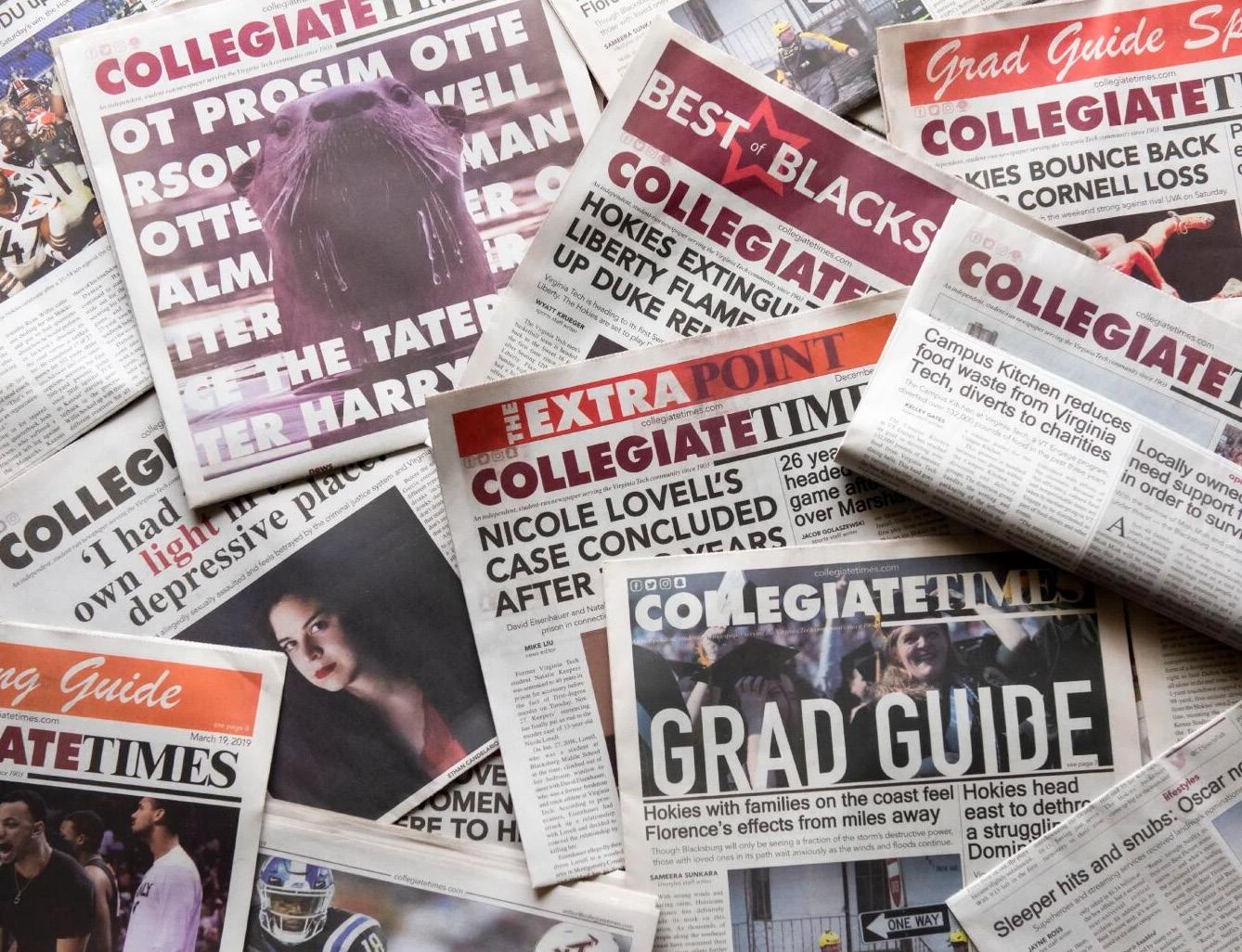
papers from previous years, a physical archive of the generational labor students have put into the paper. Yet, how will this documentation be securely preserved once the edition moves fully electronic?
This isn’t just an archival complication. Studies show that reading comprehension is more effective when readers pick up a paperback instead of booting up the laptop. Furthermore, we tend to have a deeper personal connection when we hold items such as vinyl records, magazines and video game cartridges. These objects aren’t just forms of entertainment or informative pieces; they’re markers of our identities and visual reminders of our fluidity as individuals.
With the pace at which our world is moving regarding technological advancements and artificial intelligence, it’s unrealistic to claim we
can disregard digital media entirely. Likewise, this doesn’t mean we should dilute our consumption of tangible media. In our currently overcomplicated, fast-paced environment, we will always need a space where we can shut off the distractions, close the door and recharge with a game of Monopoly, a favorite record or a comforting book. Maybe the Collegiate Times is moving fully digital, but that doesn’t mean everything else should. All I can say is that I’ll miss my mornings with the CT newspaper in my hand. I hope you will, too.
ETHAN CANDELARIO / COLLEGIATE TIMES Stack of Collegiate Times newspapers, Nov. 13, 2021
CANCEL CULTURE HAS GONE TOO FAR
Caroline Kobin | Opinions Contributor
The public is no longer holding people accountable; they’re destroying reputations.
We live in a time where people are more aware of the impact of their words and actions than ever — and that’s a good thing. But as someone who believes in second chances, I don’t think we can ignore how quickly that awareness can turn into intolerance. What began as a push for accountability has evolved into a system that often prioritizes punishment over understanding.
A single mistake — even one made years ago, in private or without harmful intent — can be enough to erase a person’s opportunities, reputation and sense of belonging. Cancel culture often leaves no room for context, no space for growth and no belief that people can evolve. It treats human beings as finished products rather than works in progress, and that’s a standard none of us could meet.
We forget, far too easily, that nobody is perfect. Human beings make mistakes constantly — careless comments, bad days, poor judgment are all moments we wish we could take back. Yet cancel culture encourages people to sit behind a phone screen and decide someone else’s fate as if they’ve never slipped up themselves. Imperfect people punish other imperfect people for being imperfect. It doesn’t make sense.
Have you ever accidentally liked something on Instagram and immedi ately panicked, wondering how it might be interpreted? Or posted something without realizing how it could be taken out of context? That’s the reality people live in now — walking on eggshells, analyzing every joke, every reaction and every click, trying to predict whether someone online might twist it into something offensive.
It’s wise to be mindful of our words and behavior, both online and in public, but there has to be space for human error. Even simple slip‑ups, like misgendering someone uninten tionally, can spark outrage that ignores the difference between a mistake and malice. People mess up all the time; it’s part of being human. But when a misstep is made without ill intent, why should it cost someone their reputation? We all
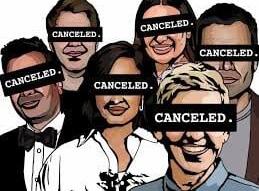

stumble, we all say the wrong thing, and yet from behind our screens, we act as if we’re qualified to decide someone else’s fate. It’s a harsh, unforgiving standard — and it’s exactly why grace matters.
Some cancellations stem from genu inely harmful behavior — situations where accountability is necessary and justified. When someone engages in violence, harassment, exploitation or uses their power to harm others, public criticism is a natural response. Think of cases involving sexual misconduct, hate speech or clear patterns of abusive behavior. These are moments where society has every right to demand conse quences, transparency and change.
But then there are the cancellations that make far less sense, like the ones that expose how quickly online outrage can spiral into something disproportionate. Celebrities have been canceled for being
“dismissive” during a meet and greet, for posting about their expensive bottle of wine, for wearing an outfit someone found offensive or for making a clumsy joke years before they were even adults. People have lost job opportunities over decades‑old tweets written when they were in middle school. Others have been dragged for mispronouncing a word, misunderstanding a trend or simply having an awkward moment caught on camera. These aren’t crimes. They’re human moments, and yet the internet treats them like moral failures.
If a celebrity is rude once, the narrative becomes that they’re an awful person. If someone has a bad day, it’s broadcast as evidence of their true character. But would anyone want their worst day — the moment they snapped, or misspoke or acted out of stress — turned into a viral clip for millions to
judge? Would anyone want to be defined forever by the version of themselves that existed at their lowest? Would you want that for yourself?
Cancel culture claims to promote accountability, but too often it promotes humiliation. It leaves no room for growth, no belief in redemption and no understanding that people are allowed to evolve. A society that expects perfection from everyone will end up destroying people for being human. And if we’re honest, none of us would survive the standards we impose on others.
PHOTO COURTESY OF THE FOOTHILL DRAGON PRESS
SUFFREN SPARKS WOMEN’S BASKETBALL TO WEST COAST WIN OVER CALIFORNIA
Brody Bryan | Sports Writer
Tech won both of its games in The Golden State.
On the back end of its two-game West Coast road trip, Virginia Tech earned a hard-fought win over California on Sunday, 68-58, sweeping the trip after knocking down Stanford on Thursday.
“Absolutely gritty 40 minutes,” said Hokies head coach Megan Duffy postgame on the Virginia Tech Sports Network. “Not pretty basketball by both teams throughout the game, but on the back end of this West Coast trip, we were just saying, ‘Empty the tank, everything we can do.’”
Junior guard Samyha Suffren paced the Hokies with 19 points despite coming off the bench. Suffren shot 7-of-12 from the field and grabbed three boards to add to her effort.
Suffren has shot 44.8% from the field and averaged 9.1 points per game this season after a shoulder injury cut her
2024-25 campaign short.
Carleigh Wenzel (15 points), Kilah Freelon (12) and Carys Baker (10) also scored in double figures. Freelon led all players with 10 rebounds.
Freshman guard Aliyahna Morris led the Golden Bears with 15 points on a 4-of-12 shooting clip. Junior guard Lulu Twidale, Cal’s top scorer entering Sunday, was held to four points, going 1-of-8 from the field and 0-for-5 from beyond the arc.
Both teams struggled from threepoint range, as Tech shot 1-of-5 from deep and Cal went 3-of-16.
The game opened as a defensive struggle, with the two teams shooting a combined 3-of-11 to start. Tech trailed 13-12 at the end of the first quarter, but a 21-point second frame gave the Hokies a 33-29 lead at the half.
Defensive prowess returned in the second half, with the teams going a combined 6-of-22 from the field in the third quarter. Cal outscored the Hokies 14-11 in that frame to cut Tech’s lead to just one point heading into the fourth.
However, a strong fourth quarter from Wenzel and Suffren helped the Hokies hang on, ultimately pulling away and winning by double digits. The Hokies went 13-of-14 at the free-throw line in the fourth, hitting important shots down the stretch to hold on to their late lead.
Tech as a whole was 25-of-29 at the line on Sunday. The Golden Bears were 19-of-27.
The Hokies have now won nine of their last 11, and are finding their rhythm just before March. They have already exceeded their win total (19) and conference win mark (nine) from
2024-25, with 20 and 10, respectively, entering the final three games.
Coming into Sunday’s contest, Cal had won six of its last seven, with its sole loss during the stretch coming at the hands of then-No. 7 Louisville.
Tech just barely missed out on the NCAA Tournament last season, but is projected to be in as a 10 seed this year, according to ESPN college basketball analyst Charlie Creme.
The Hokies will return home on Feb. 19 to host No. 22 North Carolina at 6 p.m. ET.
WOMEN’S BASKETBALL DROPS OVERTIME CONTEST TO NORTH CAROLINA
Sam Mostow | Sports Editor
The Tar Heels rebounded from a rough first half to steal the game in extra time.
You don’t need to be a basketball expert to know that only hitting five shots across 23 attempts in the first half is not a recipe for winning a game. Same with only converting one of 11 attempts in the second quarter. But against the odds, No. 22 North Carolina came back to beat Virginia Tech women’s basketball, 66-63, in overtime at Cassell Coliseum on Thursday. The Hokies (20-8, 10-6 ACC) missed their final eight shot attempts and didn’t hit a field goal during the last 3:57 of overtime, while the Tar Heels (22-6, 11-4 ACC) missed every shot — excluding free throws — after the last 3:41 mark.
“Late in that game, in the fourth quarter and overtime, (North Carolina) made huge plays,” said Virginia Tech head coach Megan Duffy. “We had a couple different breakdowns, and I felt like they took advantage of everyone late. I really believe
we had our opportunities. Just didn’t have enough execution down the stretch.”
Both teams traded 10-0 runs during the first half. Tech built a 16-3 run to build a seven-point advantage in the second quarter, while holding Carolina to a 5-of-23 shooting clip in the first half. Plus, Hokies guard Carleigh Wenzel spent much of the first half on the bench with two fouls.
“I was really proud of our bench, the way they came in,” Duffy said. “I didn’t feel like we missed a beat. … Our lead extended, which is an awesome thing. That’s not always the case when you lose somebody like Carleigh for a few minutes.”
The Hokies remained ahead for 30:54, including down the stretch. Carolina nabbed a lead with 3:53 left in the fourth quarter, courtesy of a layup. The two teams went back and forth through the remainder of regulation. Tech guard Samyha Suffren
hit an and-one layup to regain a 55-54 lead. After another 3-pointer by the Tar Heels, Suffren tied the game with a layup with 26 seconds remaining — forcing overtime.
Carolina shot 2-for-5 in the extra five minutes, while Tech went 2-for-12. The Tar Heels’ four made free throws in the final 90 seconds made the difference.
“Those little things added up at the wrong times,” Duffy said. “… You can maybe get away with that a little bit earlier in the game and you can adjust, but (the second half and overtime are) when you really got to lock in.”
Suffren and forward Carys Baker led Virginia Tech with 15 points apiece, plus Wenzel added 14 of her own. Forward Kilah Freelon threw in six points, 10 rebounds, three blocks and a steal. Guard Mackenzie Nelson scored seven points and notched a team-high four assists.
Tar Heels forward Nyla Harris scored 15 points and grabbed nine boards. Guard Elina Aarnisalo tallied 13 points, guard Lanie Grant totaled 12 and guard Indya Nivar finished with 10.
Thursday’s contest was a litmus test for the type of team the Hokies can expect to face late in the season, as the ACC and NCAA Tournaments approach. In Charlie Creme’s latest ESPN NCAA Tournament projections, North Carolina sits as a No. 5 seed while Tech is on the No. 10 line.
Before that, though, the rest of the regular season awaits. Virginia Tech will play its penultimate regular-season contest against Georgia Tech at home on Sunday at 2 p.m.
MOSTOW: WE NEED MORE TRANSPARENCY IN COLLEGE ATHLETICS
Sam Mostow | Sports Editor
The NCAA’s status quo is antiquated and needs to be changed.
The Collegiate Times filed a public records request with Virginia Tech via the Freedom of Information Act on Dec. 30. In part, the request read, “I am requesting an opportunity to review all signed contracts between Virginia Tech and its NCAAaffiliated student-athletes signed since July 1, 2025.”
On Jan. 7, we received the following message: “The requested records are considered scholastic records concerning identifiable individuals. Accordingly, your request is denied. See §2.2-3705.4(A)(1) of Virginia’s Freedom of Information Act.”
We tried again on Jan. 8, asking the university to redact all personally identifiable information. The school’s response was the same as its previous denial, though it tossed in an addendum: “Please note that the scholastic records exclusion applies to the entire content of the record and therefore there is no duty to redact.
See §2.2-3704.01.”
To the best of my knowledge, Virginia Tech is not violating any laws by withholding this information. The NCAA’s structure designates athletes as students, with their records no different from those of anyone else enrolled in the university, meaning their information is protected under scholastic records exemptions. But in practice, student-athletes are employees and should be treated as such.
For decades, the NCAA prohibited athletes from receiving compensation in any form to preserve amateurism. It maintained the idea that athletes were being paid through admittedly valuable college scholarships. But as television deals grew exponentially through the late 20th and early 21st centuries, coaches, athletic directors and administrators began receiving seven-figure contracts, while the athletes who risked their health to create the product received nothing.
The Supreme Court’s 2021 decision in NCAA v. Alston, which allowed athletes to begin profiting off their name, image and likeness, launched a windfall against the status quo. The decision was designed to, in theory, allow athletes to profit from jersey sales and commercial appearances. So, if Hokies quarterback Kyron Drones wanted to appear in a T-Mobile advertisement, he was free to do so — and
receive compensation for it.
The result: Alumni, boosters and entrepreneurs affiliated with various universities formed “collectives” — third-party organizations to which the schools encouraged their fans to donate. The collectives would subsequently pay the athletes without the universities being directly involved. It became a tax on fans; the schools couldn’t pay athletes to represent them, but fans could. Cody Campbell, a Texas Tech football alumnus and oil executive, famously spearheaded fundraising efforts at his alma mater, donating at least tens of millions of dollars for facilities upgrades and NIL payments. It’s no coincidence that, in 2025, the Red Raiders won their first football conference title since 1994. The richer your college is, the better athletes you can acquire and, generally, the better your programs will fare.
The structure changed on July 1, 2025, when the House v. NCAA settlement went into effect. In short, schools are allowed to share revenue with their athletes up to roughly $20.5 million. Most of that money is directed toward football, as most schools’ most profitable sport, but a portion of the pot gets distributed to men’s basketball, women’s basketball and other non-revenue sports.
Now, universities are directly contributing to athletes’ salaries. Namely, Virginia Tech is gradually raising student athletic fees by 136% from the 2024-25 to 2028-29 school years to help foot the bill. These public institutions, including Virginia Tech, receive funding from state and federal governments. That is not necessarily a bad thing; athletes should receive compensation for the services they provide the university, just as professors, coaches and administrators do. The rules should be the same across the board.
Anyone can file a FOIA request and obtain a university employee’s contract. It’s how Tech Sideline and The Roanoke Times confirmed the terms of former head coach and current defensive coordinator Brent Pry’s contract and amended buyout agreement, weeks before Virginia Tech announced it. That does not apply to athletes at the moment. Sure, they are students, but they sign contracts — some
reaching seven figures — just like coaches and professors. They should be held to a similar standard.
Federal legislation is a solution, though don’t expect anything to pass any time soon. The SCORE Act, introduced by Rep. Gus Bilirakis, R-Fla., would prevent college athletes from receiving employee status. Sen. Maria Cantwell, D-Wash., introduced the SAFE Act to counter it. Neither bills have received a floor vote, and the House of Representatives and Senate are both unlikely to vote on either proposal during the 119th Congress.
This issue is complicated. I do not envy athletic directors and university administrators across the country, since they are forced to handle and adapt to a situation many of them did not generate. Mark Owczarski, Virginia Tech’s interim vice president for marketing and communications, compared the current collegiate athletics landscape to building an airplane midair.
“It’s a big, complicated issue,” Owczarski said. “… Give grace to the people that you’re asking questions to. … This is a good example of building it on the
fly.”
We absolutely should give grace where it is due. The universities are not in an easy situation; they are up to their necks in lawsuits to uphold the NCAA’s status quo, which is antiquated and needs to be changed.
But we must reject the notion that college athletes are not professionals. They are. They are some of the best in the world at what they do, and their sports are a job. They have every right to be compensated for their labor; in fact, they should be. However, we — as the public, as students supporting the athletic department, as taxpayers — have a right to know how much they are being compensated.
A true model may exist in the future, featuring collective bargaining agreements and union contracts, akin to professional leagues. Until then, more transparency is necessary across the country, and disclosing financial information is in the public’s best interest.
HAMAD ALHENDI / COLLEGIATE TIMES
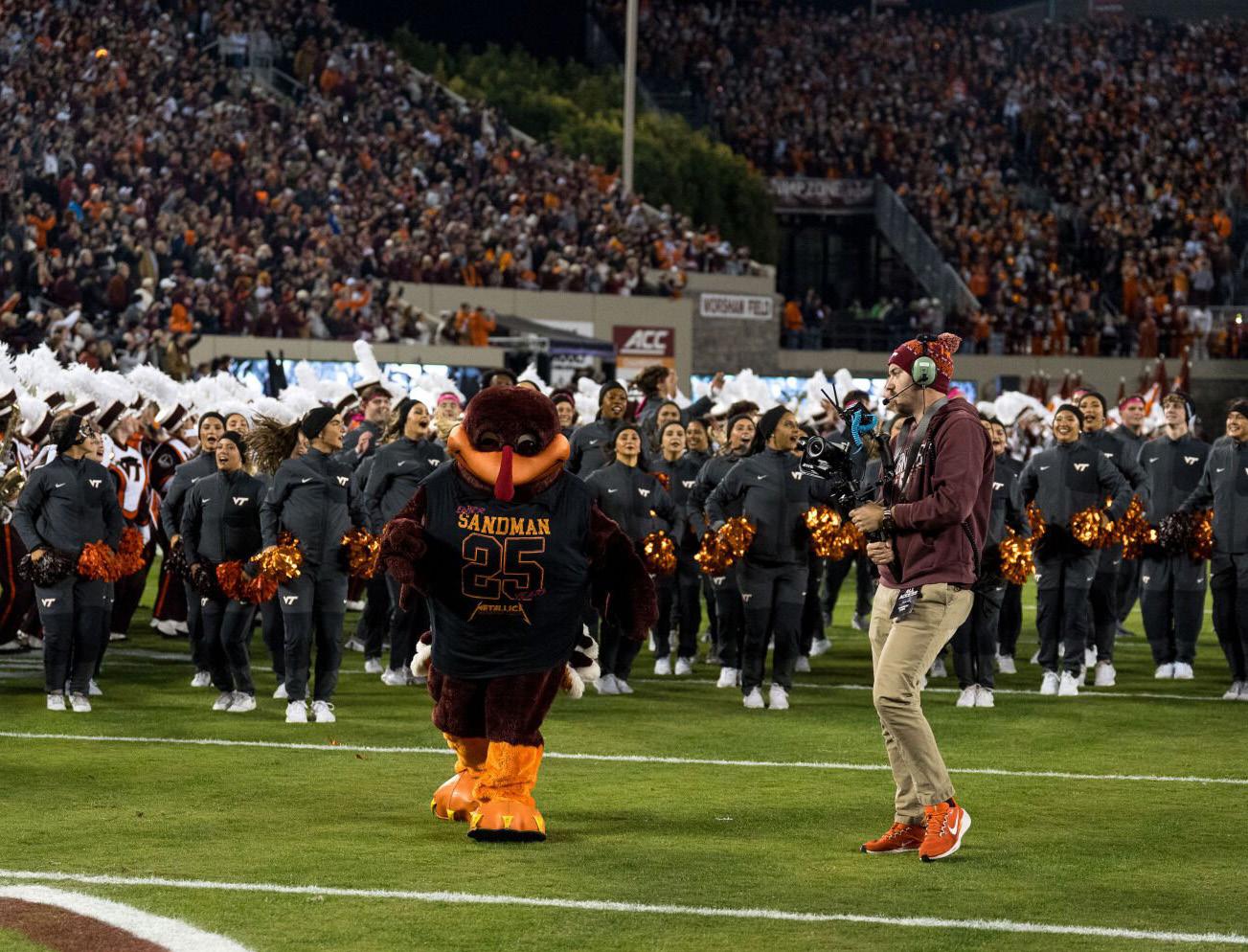
Hokie Bird and the Spirit Squad jump during the performance of Enter Sandman on Friday, Oct. 24, 2025, in Blacksburg, Virginia.