
EL CENTRO NEWSLETTER

Winter 2026

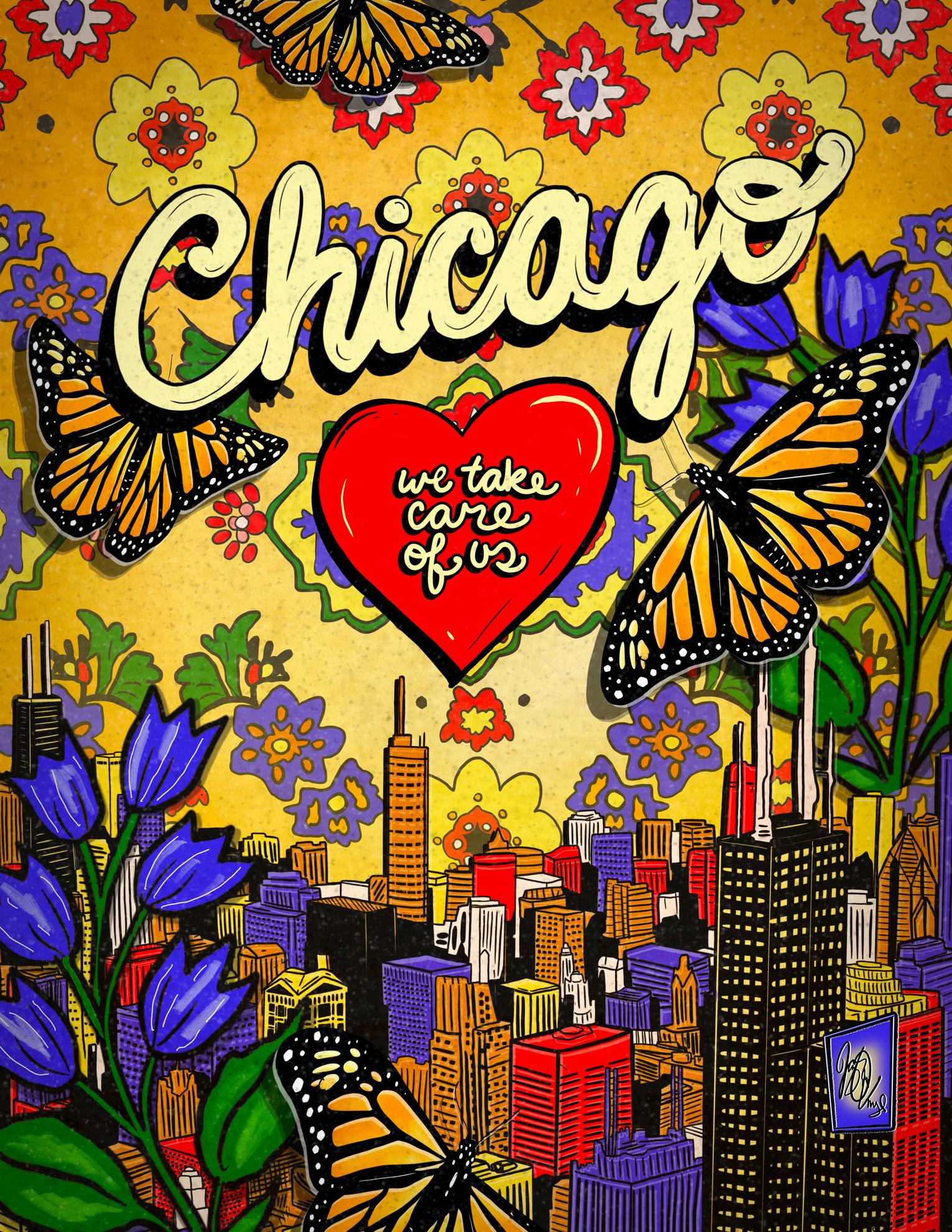

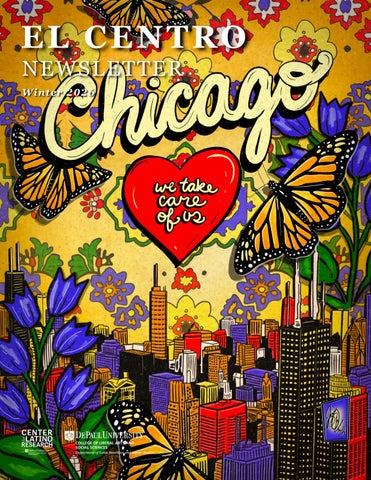
ON THE COVER ON THE COVER

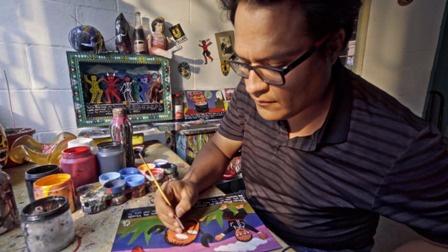
JazRodriguez|Instagram:@jazonvinylart
Jaz Rodriguez is a passionate artist who has a unique ability to capture the essence of things she loves through her illustrations and paintings With a focus on Chicago, movies, music, pop culture, and flowers, Jaz's artwork is a delightful blend of nostalgia and joy.
Growing up in the vibrant city of Chicago, Jaz developed a deep appreciation for its iconic landmarks, rich history, and diverse culture. Her love for the city is beautifully reflected in her artwork, as she brings to life her favorite restaurants, bars, towering skyscrapers, and charming neighborhoods.
Movies and music hold a special place in Jaz's heart, and she believes in the power of visual storytelling Through her art, she creates captivating scenes inspired by beloved films and iconic musicians, transporting viewers to a world of imagination and emotion Her attention to detail and ability to capture the essence of characters and musical moments make her work truly enchanting
Pop culture is another element that influences Jaz's artistic expression. From iconic TV shows to beloved comic book characters, she celebrates the nostalgia and joy that these cultural touchstones bring to our lives. Her artwork serves as a time capsule, reminding us of the moments that have shaped our collective memories and identities.
In addition to these themes, Jaz finds inspiration in the beauty of nature, particularly flowers. Through her vibrant and intricate floral illustrations, she aims to evoke a sense of serenity and appreciation for the simple yet profound wonders of the natural world Her artwork reminds us to pause, breathe, and find solace in the delicate petals and vibrant colors that surround us
Jaz's ultimate goal as an artist is to create a bridge between the viewer and their own nostalgic feelings She believes that art has the power to connect us to the people, places, and things we love, reminding us of the joy they bring to our lives. With every stroke of her brush and every line she draws, Jaz invites us to tap into our own memories and emotions, sparking a sense of wonder and connection.
STATEMENT CLR MISSION
The Center for Latino Research (CLR) strives to open and sustain dialogues that foster the empowerment and advancement of Latinx communities. To that end, the CLR creates learning opportunities for students and supports scholars in their research, while forging collaborative relationships with local, national, and international research partners. We also publish an award-winning scholarly journal, Diálogo, and sponsor many activities on campus, including film series and speaker series.
ABOUT LATIN AMERICAN & LATINO STUDIES
The Department of Latin American and Latino Studies (LALS) explores the myriad contributions of Latin Americans and Latinx people to the global community. The department’s programs emphasize the profound linkages that have emerged between Latin America and the United States, particularly through the construction of Latinx communities in the U.S. We also critically analyze the complex intersections with Indigenous, African, European, Semitic, Arab, and Asian communities throughout the Americas.
Edited and Designed by:
Gigi Lara Goutam Kumar
Michelle Cisneros
Published by:
The Center for Latino Research and The Department of Latin American and Latino Studies at DePaul University
Letters from the CLR DIRECTOR & LALS CHAIR
Dear readers,
Bad Bunny’s recent performance at the Superbowl halftime show pulled off an extraordinary feat: despite aggressive attempts by cultural fearmongers to provoke outrage over the fact that Bad Bunny’s songs would be in Spanish, it was hard not to get carried away by the positive and electrifying vibes of the show, even if you don’t know a word of Spanish Bad Bunny salsa’ed elegantly with Lady Gaga (who sang in English, by the way), exhorted viewers to believe in their own value, and concluded the show by invoking a vision of love and unity that embraced the entire American hemisphere. In a time of negativity and division, the show gave us an entry point for collective joy and belonging beyond language.
We all need a little joy and togetherness during these cold Chicago winters, so we hope you’ll enjoy how this issue of El Centro provides a glimpse of all the fascinating work in which our community is engaged I hope you’ll either see yourself already reflected in these pages, or consider them an open invitation to get involved, participate in our events, and share your work with us, too Join us! You are welcome here
~BillJohnsonGonzález
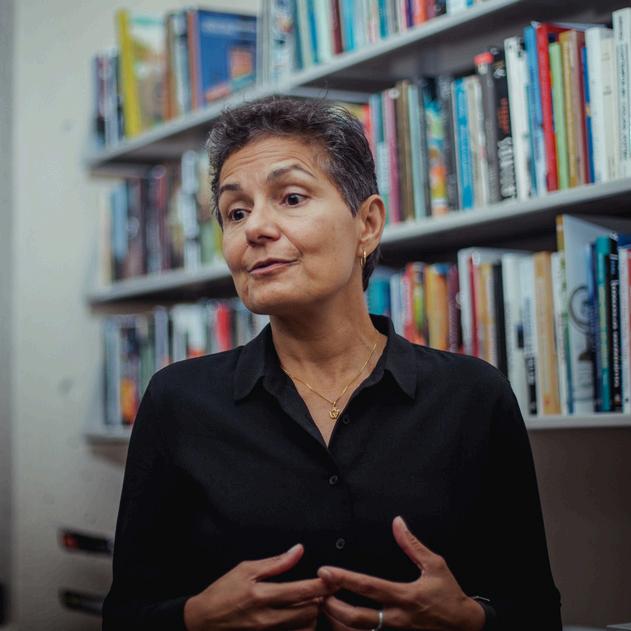
Letter from the LALS Chair
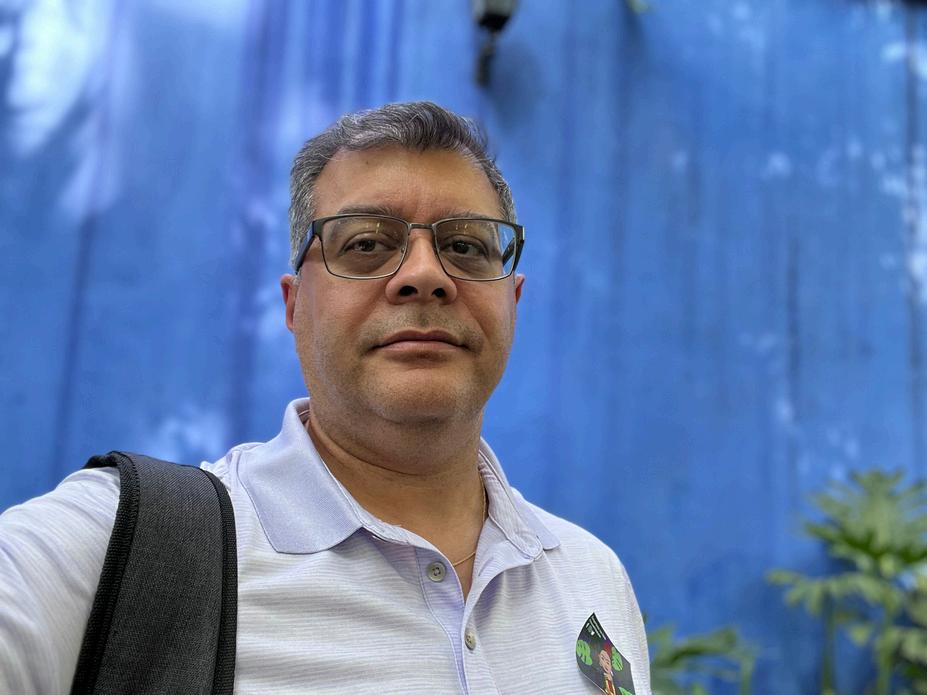
Letter from the CLR Director
Hola lectores,
As winter drags on with frigid temperatures, we hope this newsletter brings a measure of warmth and joy As always, I am deeply proud of the students, staff, and faculty in LALS and CLR whose collaborative efforts make this publication possible It offers a window into our DePaul familia our shared work, commitments, and projects
The articles and interviews in this issue reflect the passion, creativity, and dedication of our alumni, students, and faculty. We are thrilled to highlight how they embody the Vincentian mission of social justice through their research, teaching, service, and future aspirations. Whether via professors (Gavin, Rodriguez, Peña) who engage students in projects that connect them to the lived realities, politics, and cultures of Latin American and Latino communities; current students (Nolasco), who dedicate countless hours and exceptional skills to advocacy and service for immigrant communities; or distinguished alumni who break new ground while returning to mentor and inspire future generations, their stories affirm the profound importance of our work
At a moment when departments and centers like ours face increasing pressures and challenges, it is essential that we make evident our value and contributions. We must continue to remind our broader community that the work carried out in LALS, CLR, and across our interdisciplinary programs is not peripheral, but vital to the strength of our university, and to the well-being of our society.
Warm saludos, ~LourdesTorres
CLR ADVISORY COMMITTEE
Marisa Alicea, Professor, Vincent DePaul Professor School of Continuing and Professional Studies
Carolina Barrera Tobón, Associate Professor Modern Languages
Rocío Ferreira, Associate Professor | Modern Languages
Martha Martinez-Firestone, Associate Professor and Director of Undergraduate Program | Sociology
Julie Moody-Freeman, Associate Professor, African and Black Diaspora Studies | Director, Center for Black Diaspora
Core Faculty
Jacqueline Lazú, Associate Professor, Vincent DePaul Professor | Modern Languages
Jesús Pando, Associate Professor, Chair Physics and Astrophysics, College of Science and Health
Carolina Sternberg, Professor Latin American and Latino Studies
Joe R. Tafoya, Assistant Professor | Political Science
LALS FACULTY
Lourdes Torres, Vincent DePaul Professor, Chair Latin American and Latino Studies
Carolina Sternberg, Professor Latin American and Latino Studies
Yoalli Rodriguez Aguilera, Assistant Professor Latin American and Latino Studies
Affiliated Faculty
Marisa Alicea, Professor, Vincent DePaul Professor School of Continuing and Professional Studies
Luisela Alvaray, Associate Professor Media and Cinema Studies
Glen Carman, Associate Professor Modern Languages
Delia Cosentino, Professor History of Art and Architecture
Rocío Ferreira, Associate Professor Modern Languages Department Chair, Women's and Gender Studies
Bill Johnson González, Associate Professor, English Director, Center for Latino Research
Jacqueline Lazú, Associate Professor, Vincent DePaul Professor Modern Languages
Jordan Levy, Assistant Professor Anthropology
Martha Martinez-Firestone, Associate Professor, Sociology Director, Undergraduate Sociology Program
Susana S. Martínez, Associate Professor, Modern Languages Director, Peace, Justice & Conflict Studies Program
Elizabeth Millán, Professor, Chair Philosophy
Heather Montes-Ireland, Associate Professor Women's and Gender Studies
Jesse Mumm, Professional Lecturer Latin American and Latino Studies
Camila Gavin, Social Transformation Research Collaborative (STRC) Post-Doctoral Fellow | Latin American and Latino Studies
Juan Mora-Torres, Associate Professor History
Vincent Peña, Assistant Professor Journalism and Sports Communication, College of Communication
Xavier Pérez, Assistant Professor Criminology
Olga Salazar Pozos, Assistant Professor Spanish, Modern Languages
Lydia Saravia, Professional Lecturer Writing, Rhetoric and Discourse
Monica Reyes, Assistant Professor Writing, Rhetoric and Discourse
Ana Schaposchnik, Associate Professor History
Jose Soltero, Professor Sociology
Sonia Soltero, Professor, Chair Leadership, Language and Curriculum, College of Communication
Rose J. Spalding, Professor, Vincent DePaul Professor Political Science
Joe R. Tafoya, Assistant Professor Political Science
FACULTY & STAFF ANNOUNCEMENTS FACULTY & STAFF ANNOUNCEMENTS

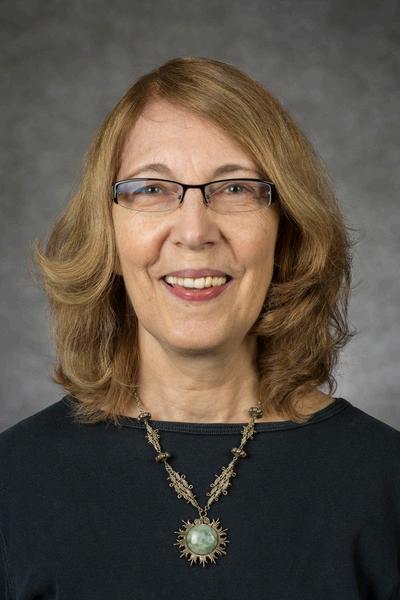
CAROLINA STERNBERG
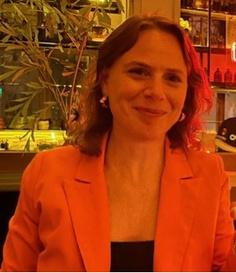
In mid-November 2025, Dr. Carolina Sterberg was invited to present her paper, “Gobernanzas Urbanas Neoliberales: Espacios, Cultura y Discursos en Buenos Aires y Chicago,” at the Centro de Estudios Urbanos y Ambientales of El Colegio de México in Mexico City (November 10, 2025). She also recently published a review article, “Review of the Fourth Global Carework Summit 2025, ‘Histories and Futures of Care,’” in the International Journal of Care and Caring. During the second week of March 2026, she will participate in-person in a seminar titled, Cities and Black Studies, in Salvador, Brazil, in collaboration with professors and researchers from the Universidade Federal do Bahia, among other institutions and local activists. Finally, she was awarded the Faculty Summer Research Grant 2026 to advance her project, Intersecting Geographies: Race, Whiteness, and Urban Transformation in Salvador (Brazil) and Chicago (US).
HEATHER MONTES IRELAND
Professor Montes Ireland was honored to be recognized with the 2025 Excellence in Teaching Award by the Quality of Instruction Council at Academic Convocation on September 3, 2025 This award recognizes significant achievement in teaching, pedagogical innovation, and a commitment to the university’s teaching mission
ANA SCHAPOSCHNIK
Professor Ana Schaposchnik’s chapter “Peru” was recently published in The Cambridge Companion to the Spanish Inquisition.
ROSE SPALDING
Professor Rose Spalding presented her paper "After the Ban: The Return of Industrial Mining in El Salvador and Costa Rica" at the January 8-9, 2026 workshop of the Research Group on Mobilization, Extractivism and Government Action (MEGA) at Tulane University She will present a revised and updated version of this paper at the 2026 Congress of the Latin American Studies Association meeting in Paris, France, May 26-30,2026.
FACULTY & STAFF FACULTY & STAFF
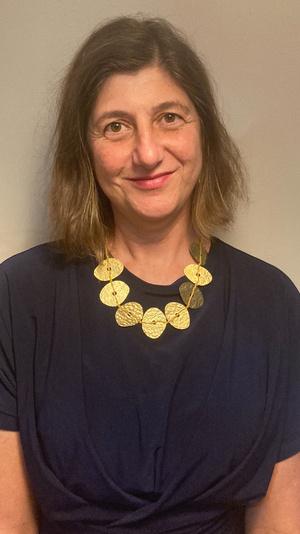
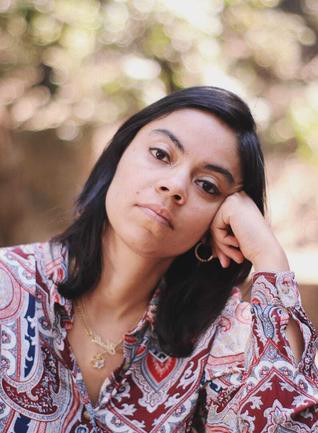
DELIA COSENTINO
Currently on research leave, Dr. Delia Cosentino is taking an art historical lens to the work of Jesuit philosopher Francisco Xavier Clavijero, whose history of the Mexica (published in Italy in 1780) established important narratives and imagery for 19thcentury Mexican Independence. In January of 2026, she shared some of this work for the Centennial Celebration of the Conference on Latin American History (CLAH) at the Newberry Library and is preparing a conference paper for the College Art Association in February. This past fall, Dr. Cosentino gave talks at Harold Washington College on Ignacio Marquina’s Reconstruction of the Aztec Sacred Precinct, and for the Chicago lawfirmFerrazzano,Kirschbaum&NagelbergLLPonIconsofMexicanArt
YOALLI RODRÍGUEZ
Dr Yoalli Rodríguez Aguilera traveled to New Orleans to participate in the American Anthropological Association meetings, where they presented the new book, Fugitive Anthropology: Embodying Activist Research, a collective volume in which they are a contributing author, published by the University of Texas Press Their scholarship continues to gain international reach This December, Dr Rodríguez Aguilera will travel to Frankfurt, Germany, as a guest lecturer at Goethe University, where they have been invited to speak in the Winter Lecture Series of the Fixing Futures Research Group They are deeply excited for this opportunity to share their work with new audiences and to continue building transnational conversations on extractivism, ecological grief, and the intimate politics of land and water in Afro-Indigenous territories.
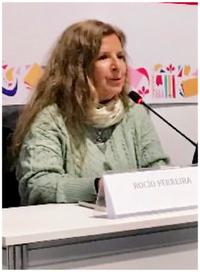
ROCÍO FERREIRA
In the second half of 2025, Dr. Rocío Ferreira presented and published portions of her ongoing research project on new memory narratives of the Peruvian internal armed conflict. In July, she organized a panel for the 45th Congress of the International Institute of Ibero-American Literature (IILI) and delivered a talk titled “Subjectivities, Cultural Practices, and Disruptive Feminine Memories.” In November, her new article, “Female Bodies in Transition in the novels La mujer cambiada and Nada que declarar by Teresa Ruiz Rosas,” was published in Espinela: Revista de Literatura (Pontificia Universidad Católica del Perú), vol 13, no 13, pp 22–29
ANNOUNCEMENTS ANNOUNCEMENTS
LYDIA SARAVIA
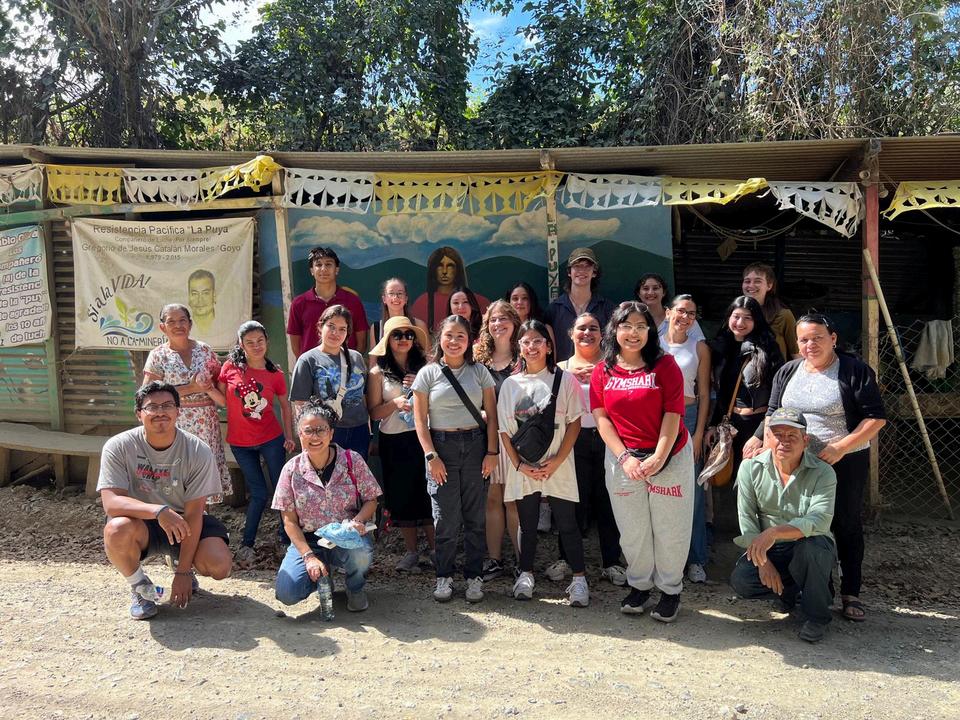
Over the 2025 winter break, the first DePaul cohort traveled to Guatemala as part of an Identities Abroad program. For 11 days, the group met with local organizers, community members, artists, activists, and Indigenous leaders to learn about the different actions and programs that work to defend human and environmental rights in Guatemala. For example, students met with Indigenous Leaders of 48 Cantones in Totonicapán and learned about their efforts to maintain the Mayan Forest of the area. Students also met with community members of La Puya resistance, who peacefully fought and won against a mining company.
The program will be offered again in December 2026. Students interested should visit DePaul’s Study Abroad website and apply for Identities Abroad: Guatemala. The program is tied to LSP 200, which will be offered in Autumn 2026. Students who have taken LSP 200 can take the course to fulfill Experiential Learning requirements.
JESSE MUMM
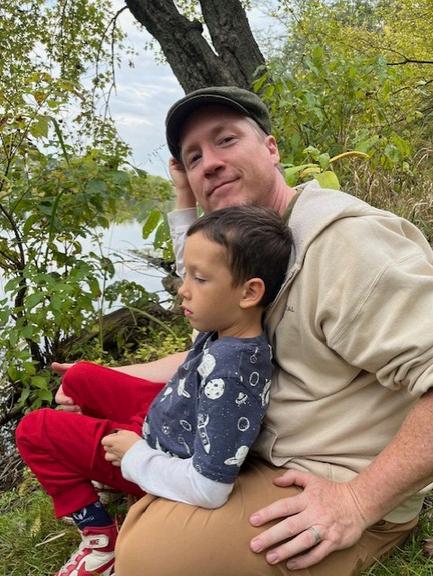
Dr Jesse Mumm just sent his book proposal to New York University Press for When the White People Come: Gentrification and Race in Black and Latino Chicago Jesse was a featured speaker at Illinois State University where he presented more recent research on parallels to Latin American maroonage and mestizaje in the native, Black and Latino history and contemporary presences in Kankakee County He also organized a panel for the American Anthropological Association on “Maroons, Indians and Others: Ghost-hunting Black, Native and Latino Cultural Exchanges in Outlaw Geographies” with our own Symone Johnson, Robert Keith Collins, and Monica Rickert, cofounder of the Center for Native Futures He hosted Lourdes Torres as a guest speaker at Cameron Elementary in West Humboldt Park where his son Oisín attends, as the Bilingual Advisory Committee considers becoming a Dual Language School And he was a featured panelist on “Strategies to Halt the Housing Crisis” at a Housing Policy Roundtable hosted by State Senator Graciela Guzmán
2025-2026STRCFellows
Faculty Research Fellows
Xorla S. Ocloo
Michael McIntyre
Faculty Professional Development Fellows
Amor Kohli
Shiera Malik
Postdoctoral Fellow
Camila Gavin
Graduate Fellows
Rosbel Garza-Hernandez
Sukhmani Mandair
Bridget Salada
Undergraduate Fellows
Karmen Johnson
Angelique Lara
Kei Smith
Robyn Underwood
Zoe-Anna Wilson
Vivian Wong
2025FallSymposium
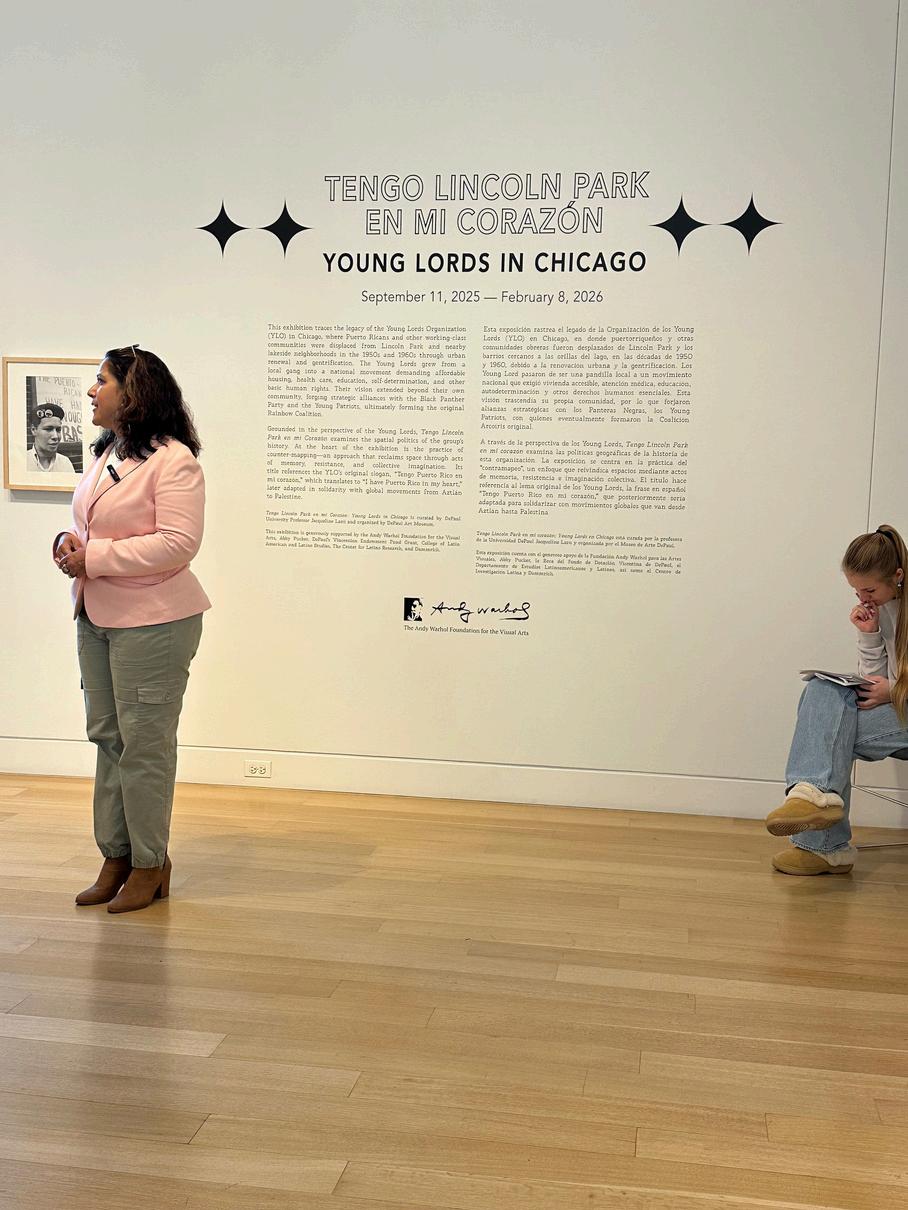
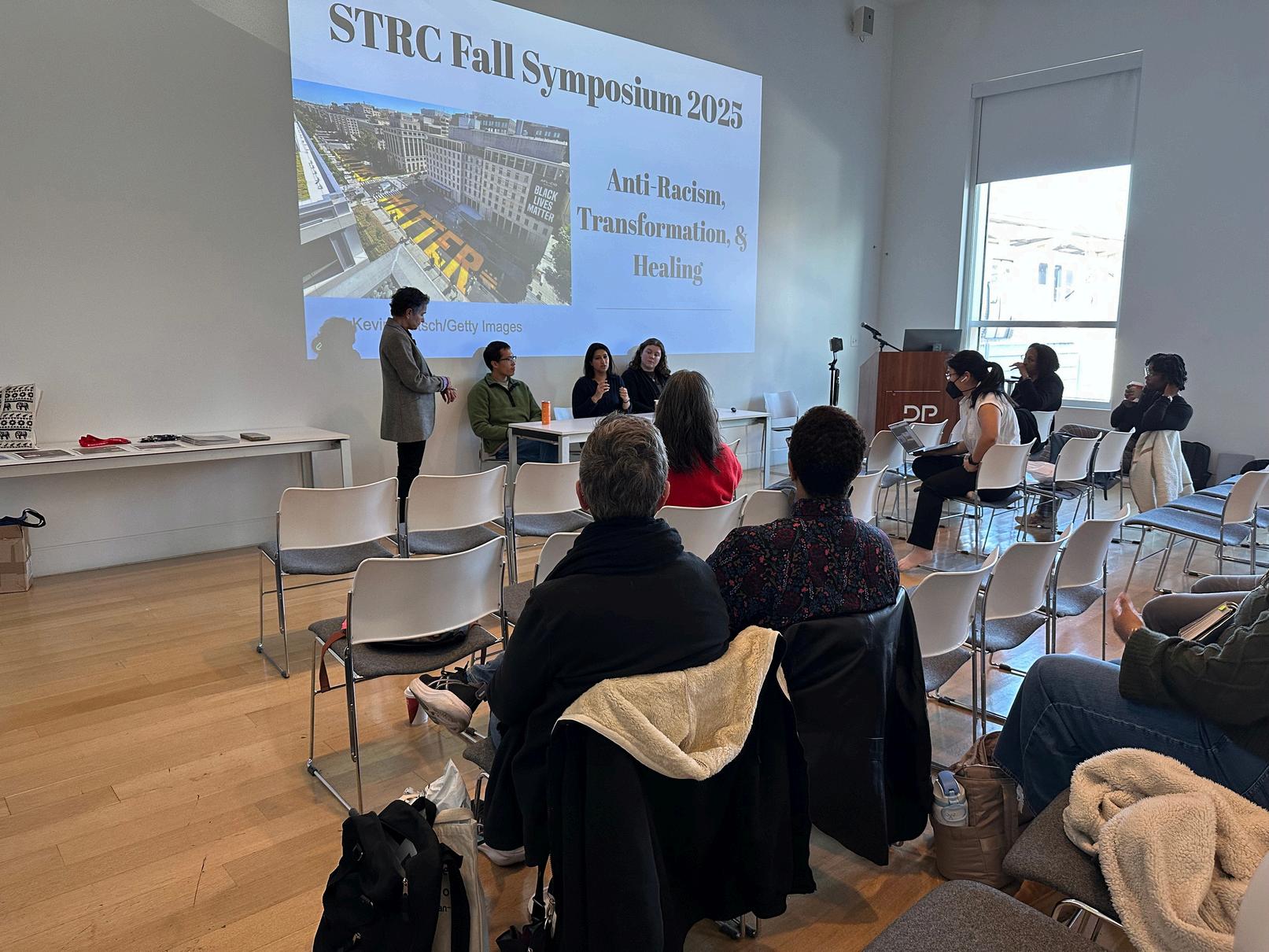
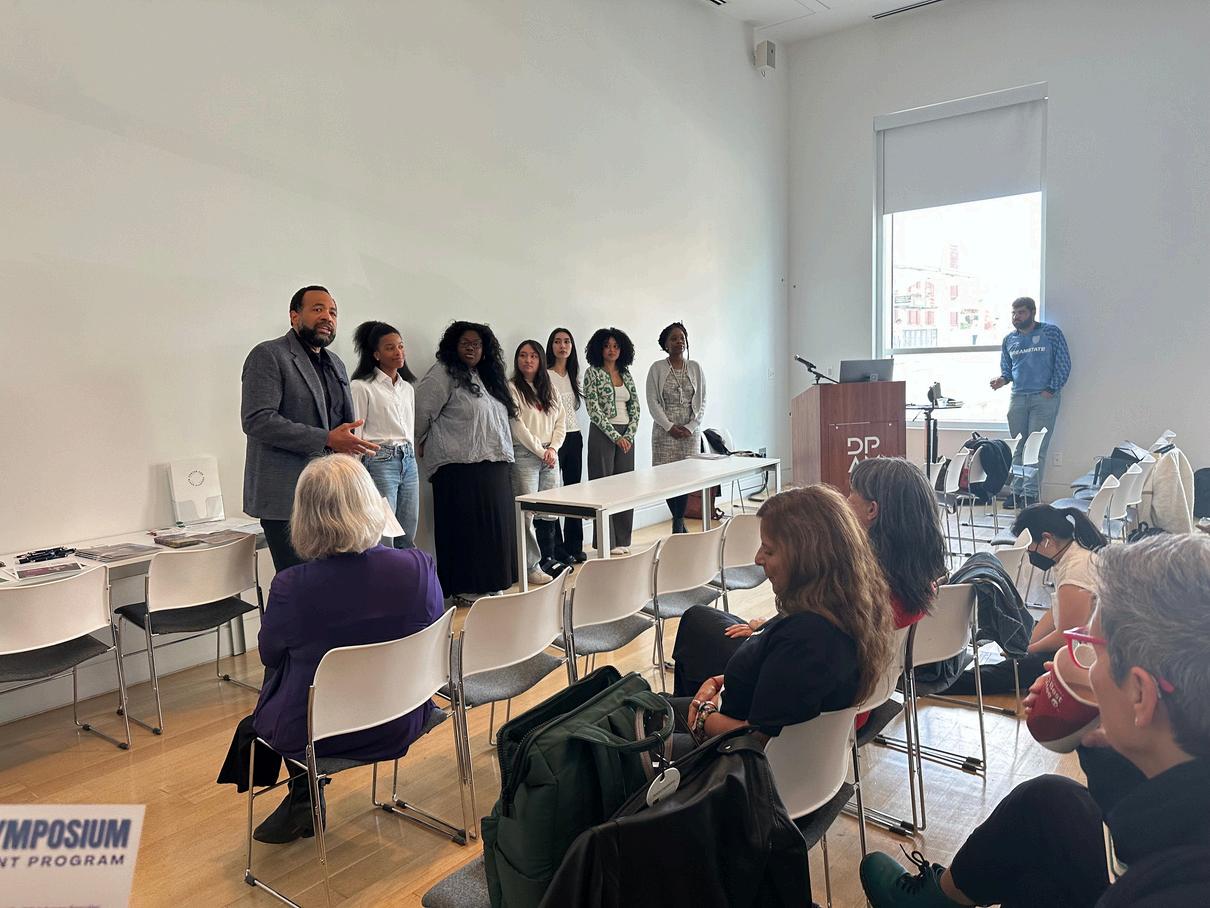
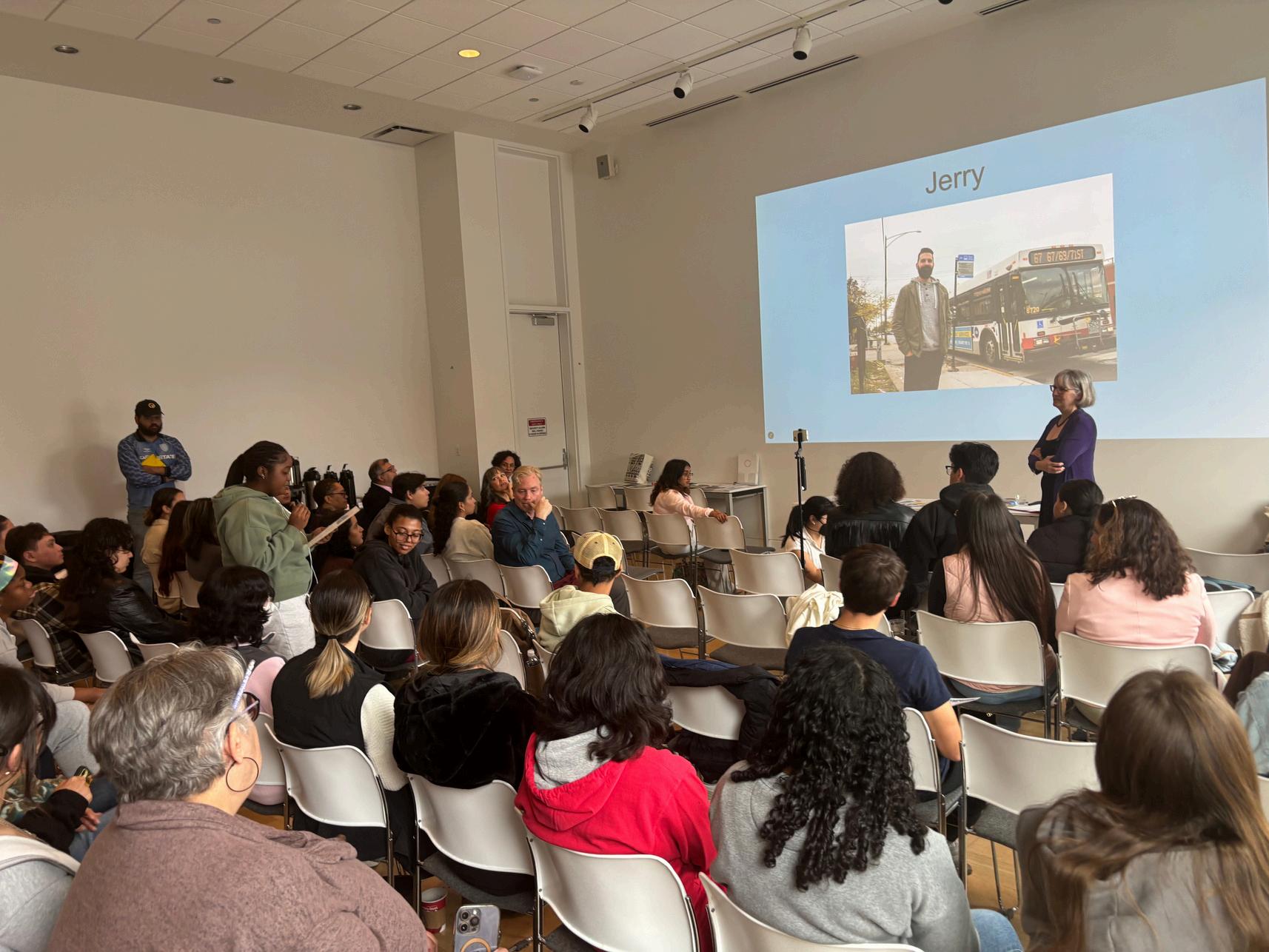
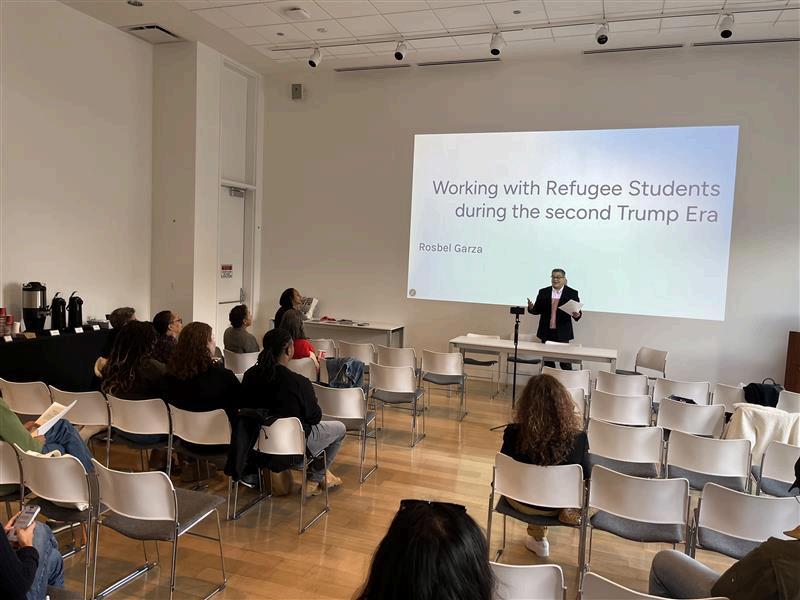
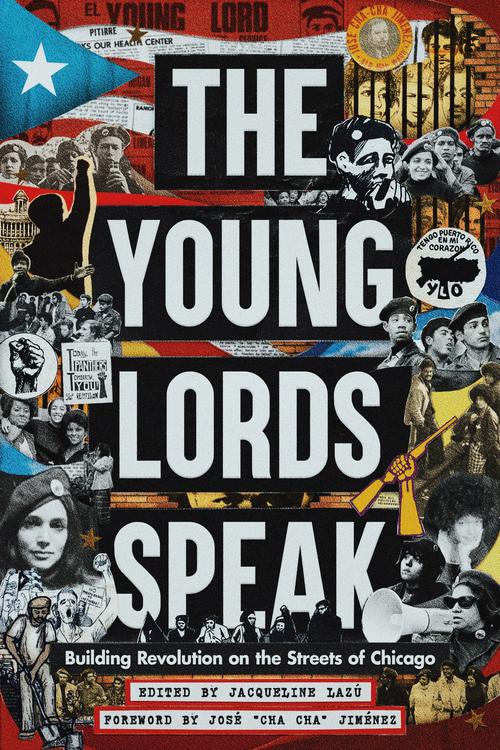
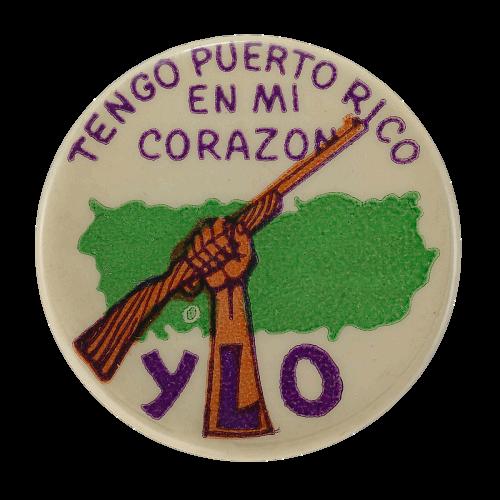
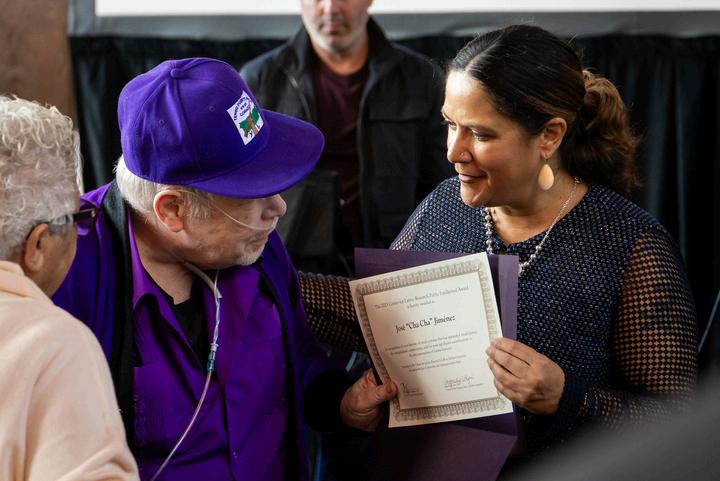
On Tuesday, October 21 , the Social Transformation Research Collaborative held its 3 Annual Symposium This year ’ s theme was Anti-racism, Transformation, and Healing. The symposium featured a gallery tour of Dr. Jacqueline Lazu’s “Tengo Lincoln Park en mi Corazón: Young Lords in Chicago” exhibition at the DePaul Art Museum, keynote speeches from Dr. Maria Krysan from the University of Illinois, Chicago, and Dr. Lisa Cacho from the University of Virginia Our graduate and undergraduate fellows presented their research, as well as our faculty and Postdoctoral fellows. Thank you to everyone who participated and celebrated the STRC’s accomplishments! st rd
Interested in joining us next year?
Applications for the STRC Faculty Research Fellowship and STRC Faculty Professional Development Fellowship are now open!

New Coordinator SocialTransformation ResearchCollaborative’s

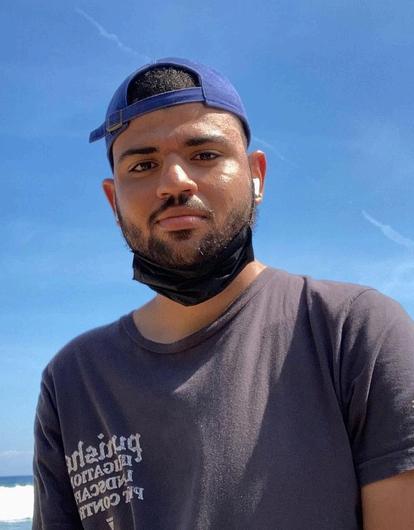
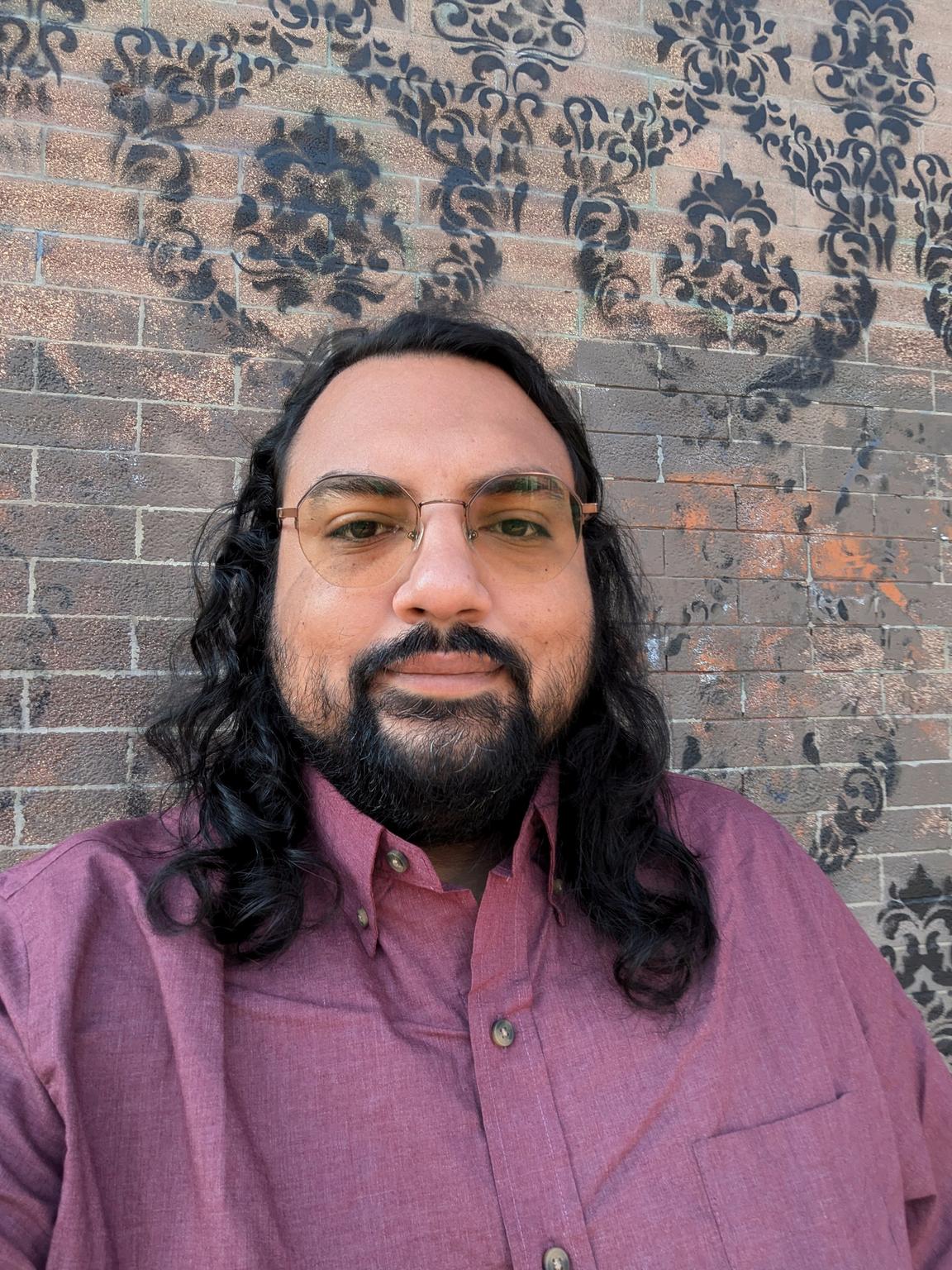
Emilio Diaz , is the newest STRC Coordinator. He was formerly a Graduate Student Assistant and then Department Assistant for the Center for Latino Research and the Department of Latin American and Latino Studies. He was born in Lansing, Michigan, but raised in Aguadilla, Puerto Rico. Emilio holds a bachelor's degree in Graphic Design and Digital Media from the Interamerican University of Puerto Rico-Aguadilla. In 2024, he moved to Chicago to start his Master’s in Digital Communication and Media Arts at DePaul University and expects to finish his program in 2026 For five years, he has hosted a podcast called Cannes I Kick It, diving into the world of film festivals, which has been featured as one of Vulture.com’s “13 Best Film Podcasts, According to a Film Critic” in 2022. He hopes to use his time in academia to examine film festivals as centers of prestige, artistic socialization, and global politics.
The 2026 STRC Undergraduate Research Fellowship nomination and application cycle are now open!
The STRC Undergraduate Research Fellowship (SURF) is open to LAS students by nomination. Academically outstanding rising juniors or seniors who are interested in pursuing a humanities research project on some aspect of the histories and cultures of people of color, in the US or in diaspora, are eligible. Students must also have a declared major or minor in the College of LAS.
What is it?
The STRC Undergraduate Fellowship will provide six undergraduates with a $5,000 stipend and free tuition to attend a required 5-week Summer Session I research methods course.
The course, entitled “Research Methods in the Interdisciplinary Humanities,” is an in-person, 5-week, 4 credit-hour seminar in interdisciplinary humanities research methods and will be led by Dr. Chernoh Sesay.
In order to apply students must first seek a nomination from an LAS faculty member.
ForafulldescriptionoftheSTRC UndergraduateResearchFellowship, visitourwebsiteat go.depaul.edu/strc
“Opportunities>ForCurrentStudents”
ImportantDates ImportantDates
FacultyNominationperiod: Feburary23-March13,2026
StudentApplicationperiod: April9-April27,2026
Lengthofthefellowship: June15-December15,2026







FAREWELL , Miguel!

In the summer of 2024, Dr. Miguel Ángel Castañeda joined DePaul as the STRC Humanities Postdoctoral Fellow in the Department of Latin American and Latino Studies.
In the fall of 2025, he joined the University of California, Davis, serving as Chancellor Postdoctoral Fellow in the Chicana/o/x Studies Department.
The CLR, LALS, and STRC team appreciates your work and impact! We wish you the best of luck and cannot wait to follow all of your accomplishments!
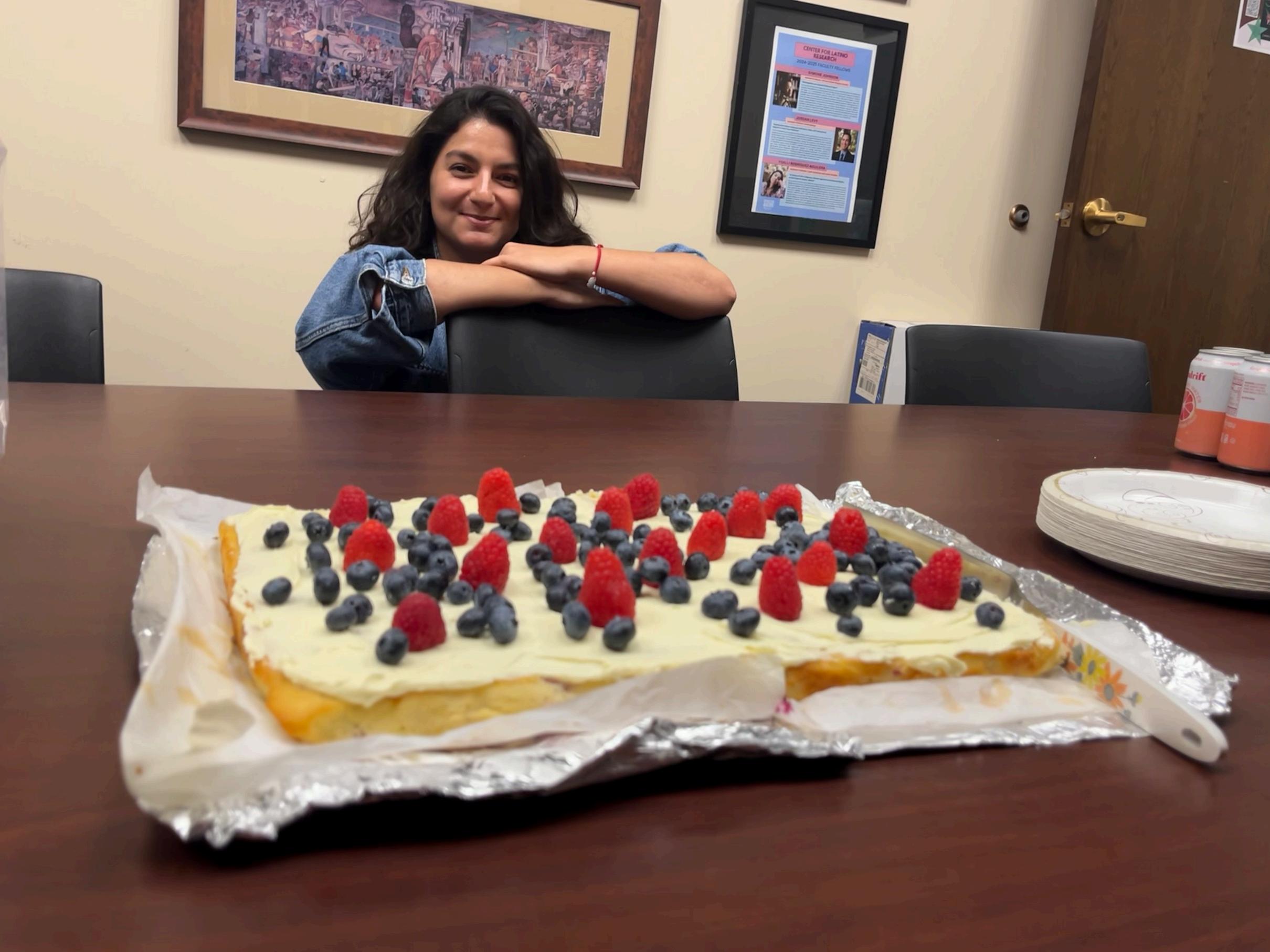
Alejandra Delgadillo joined the CLR/LALS family in the fall of 2017 as an Undergraduate Student Assistant. In February of 2019, she became the CLR/LALS Department Assistant while completing her graduate studies. In January of 2022, she became the STRC Coordinator.
Thank you for the dedication and contributions you ’ ve brought to the CLR, LALS, and the STRC!
Best wishes moving forward. We’re excited to follow your future accomplishments at SEIU!
FAREWELL, ALEX!

Join us for a conversation with
MONDAY,APRIL13
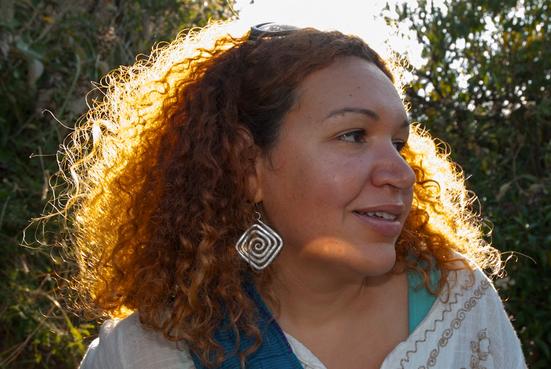
DR. LORGIA GARCÍA PEÑA
Join us for a conversation with Princeton University scholar, writer, and activist Dr. Lorgia García-Peña, who will discuss Suzan Beraza’s film, Massacre River: The Woman Without a Country (2019).

6:00-7:30PM ARTS&LETTERS103
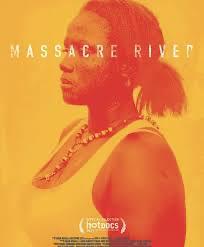

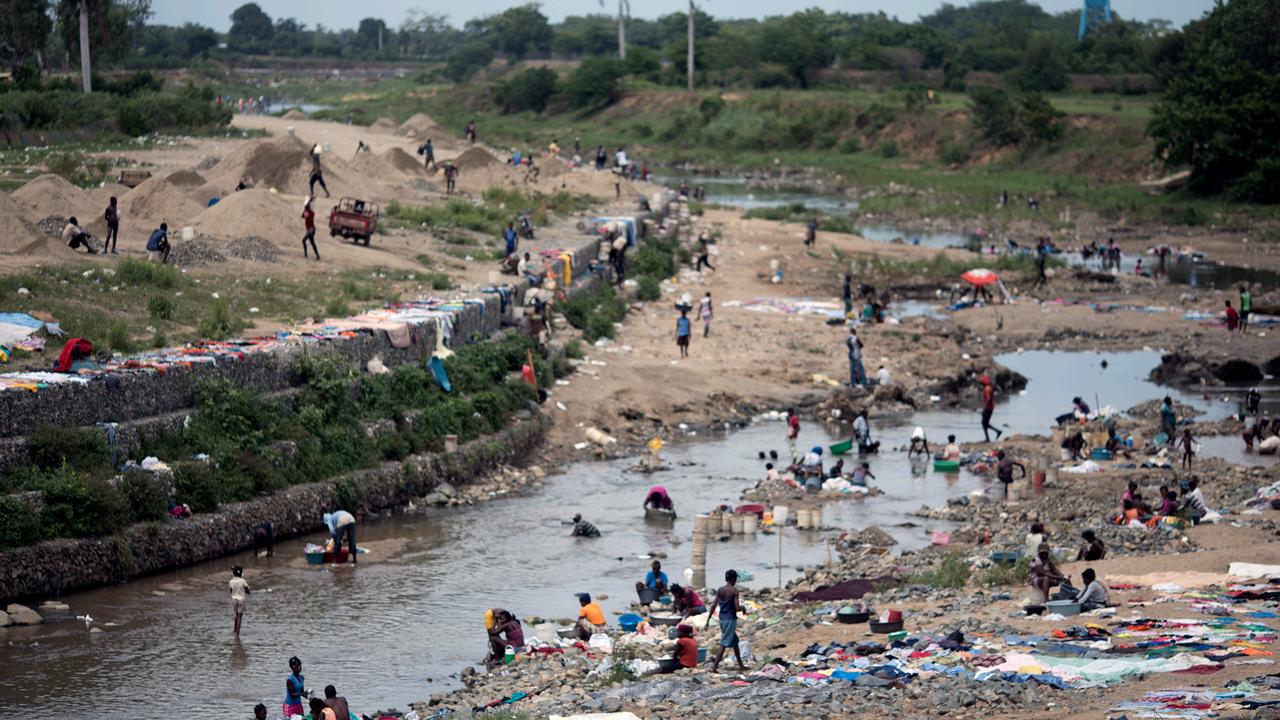
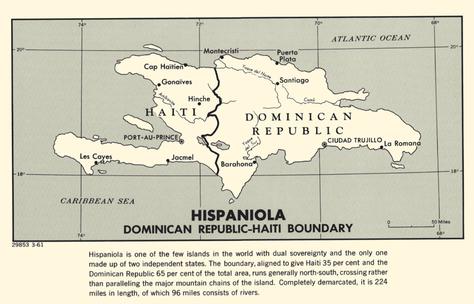
The film centers on Pikilina, a Dominican woman of Haitian descent, who is rendered stateless, along with over 200,000 others, after changes in the Dominican Republic’s birthright citizenship law. The film brings to light important transnational themes of migration, identity, belonging, and citizenship.




STRC Spotlight: Dra. Camila Gavin
Radical Praxis & Historical Memory
Written by Angelique Lara

Dra Camila Gavin is a 2025-2026
Postdoctoral Humanities Fellow for the Social Transformation Research Collaborative in the Latin American and Latino Studies Department. Angelique Lara conducted an interview with her in December of 2025 to learn more about who she is and how her work through the STRC has folded into her life's experiences, teaching at DePaul, scholarship, and social-justice-rooted research goals.
SCHOLARSHIP
Dra Gavin’s interest in scholarship began long before entering the world of academia As a secondgeneration Chilena, she grew up hearing stories from her mother about the Allende Administration, from 1970 to 1973, when Salvador Allende was the Marxist president of Chile During his presidency, Allende sought to enrich and uplift working-class communities with free access to cultural institutions and the arts. Access to culture was one of many programs created by the Allende government to meet the needs of the people, such as access to education and housing. Hearing anecdotes from her mother's childhood like being bused to and fro the ballet was immensely influential to Dra. Gavin’s developmentasalearnerandfuturescholar.
She “ was not a good student in K-12” because the version of history taught to her in primary, middle, and high school was never true to her experiences or upbringing. While studying sociology in undergrad, Dra. Gavin learned that an interdisciplinary approach would better suit her desire to answer specific questions using methodologies highlighting intersectionality and resistance Attending university and learning diverse histories rooted in liberatory practice and Marxist theory inspired Professor Gavin to pursue a PhD in Ethnic Studies at the University of California, San Diego Now, Dra Gavin claims her place in academia and social movements as an interdisciplinary scholar of immigration, gender,socialmovements,andculture.
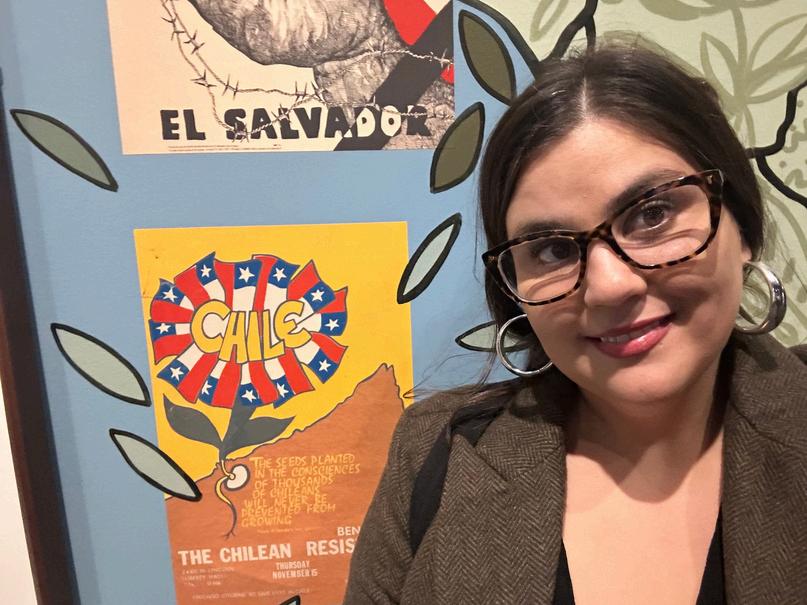
Her research is motivated by the history of struggle and resistance in Chile and its transnational applications to Chilean migrant communities in the UnitedStates.
REVOLUTION, COUNTER REVOLUTION, & THECHILEANDIASPORA
Dra. Gavin’s research centers on collecting and preserving the narratives that emerged during Allende’s pro-working-class revolution. She is equally committed to understanding how Augusto Pinochet’s right-wing counter-revolution influenced a multigenerational, transnational group of Chilean exiles This population of exiles was hunted and faced unimaginable torture, fleeing Chile because of their persecution by the dictatorship The methods of terrorization were taught to the Chilean military by the United States as part of a large effort made to “modernize” Latin American militaries throughout the second half of the 20th century: “The U.S. was disseminating these torture techniques to target leftists. It was all about maintaining capitalism and profit for the United States.” Dra. Gavin explains the irreparable trauma surging from the Pinochet dictatorship, contrasting it with methods of education and resistance to the aggressive, authoritarian neoliberalismimposedbyAugustoPinochet.
In considering revolution, counter-revolution, and the Chilean diaspora, Dra Gavin focuses on how Chileans were treated upon arrival in the United States, often denied refugee status, and the ways this forces Chilean communities to merge and theorize alongside other marginalized groups. She deals with the reconciliation of Chilean exiles migrating to the place that destabilized their home.
A lot of people felt guilt, like they needed to continue to struggle here. Because of the centrality of popular education during the Allende period, people knew about the Black Power movement and the Chicano movement. So, they knew that the US is very heterogeneous and that there are all kinds of people. There are a lot of struggles here, too.”
Correlating the parallel social movements of the '60s and 70s in the United States to Chileans who fled early on, 'cutting their teeth' in the revolutionary process, is essential to the kind of coalition-building work Dra Gavin considers in her research, with the end goal of preserving diasporic memory Remembering the Allende period reminds us that social and economic liberation is possible when the voices and needs of the people are at the forefront of government, when an organized people become the government: “I cannot get lost in the sense of hopelessness because to me that's to dishonor them [Chilean Exiles]. I will never do that. We owe it to them because they've shown us that it's really possible.”
STRC, THE CLASSROOM, AND COMMUNITY OUTREACH: TEACHING AS PRAXIS
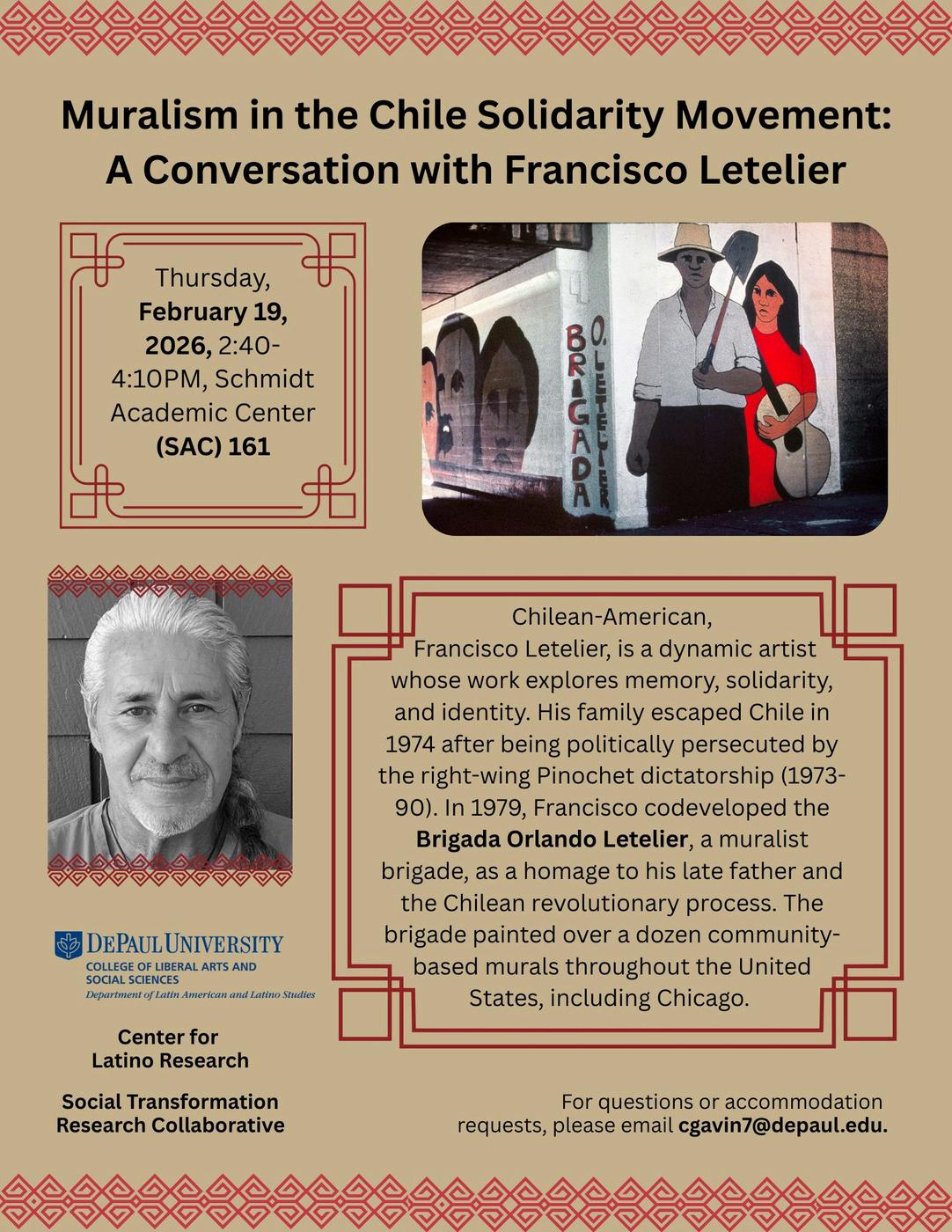
As an STRC Postdoctoral Humanities fellow, Dra. Gavin has been given resources to bridge her research, the work she does in the classroom, and work in the community: “I love the STRC program. It’s a very relational space in terms of looking at solidarities and shared histories of different groups of people” Dra Gavin, with sponsorship from the Social Transformation Research Collaborative, the Center for Latino Research, and the Latin American and Latino Studies Department, has invited Francisco Letelier to speak at DePaul on February 19th Francisco Letelier is a muralist and the son of Orlando Letelier, a central economist to Allende’s process of nationalizing copper.
The nationalization of copper was instrumental in creating social programs supporting the working class. It was also a major reason for U.S. intervention and support of the counterrevolution in Chile, as their profits from the copper industry were at stake. In 1976, Orlando Letelier was murdered using a car bomb, through Operation Condor Francisco’s mural work is instrumental in reconstructing public history and the perception of the Allende period. Dra. Gavin believes that having him speak at DePaul, to her class and members of both the DePaul and the Chilean Diasporic communities will help her as well as others reconstruct Chilean history using art, knowledge, and action, “The STRC really provides a lot of these possibilities for us to bring the people that we ' re reading about or studying, so students can learn from them.”
Dra Gavin consistently engages her students through coursework and interdisciplinary theoretical frameworks, with real-world applications beyond the classroom In the Fall, she taught LST 307: “Growing Up Latinx in the US.” The course coincided with an immensely challenging time for Latinx people in Chicago, with I C E violence being so central to the city’s social, political, and emotional landscape: “We tried to structure the class in a way that accounted for the moment Because of the service-learning component of the course, we ended up doing an art show based on the experience of growing up Latinx. It was a fundraiser for one of the rapid response teams here in Chicago that was responding to ICE in our neighborhoods. Students were really happy to be able to respond to that particular historical moment because many of them were very personally affected by what was happening.”
In transforming teaching into praxis and the classroom into an intellectual sanctuary, Dra. Gavin is doing essential work in higher education: pushing her students to both think critically and engage with Latinx politics, history, art, and communities outside of the classroom. Her creation of community in the classroom enables and empowers students to create change. Dra. Gavin is leading her own revolution, one classroom at a time.

LA HISTORIA ES NUESTRA: CHILEAN EXILE MEMORY PROJECT
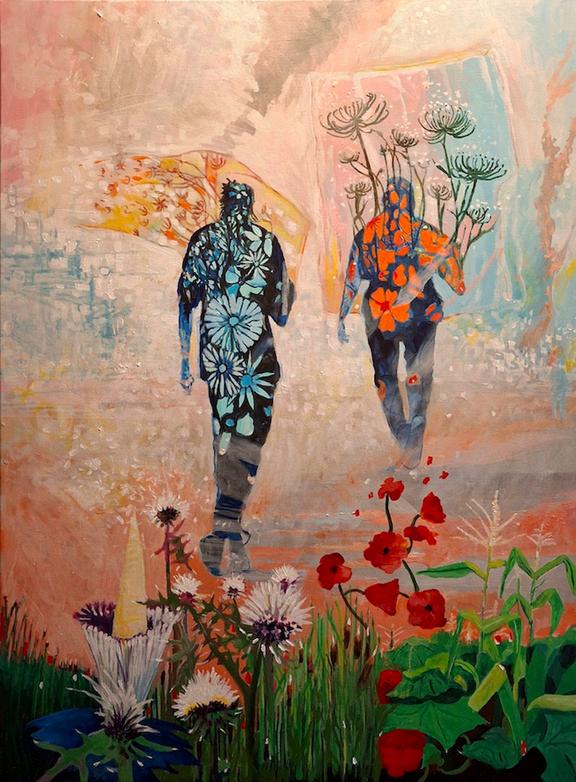
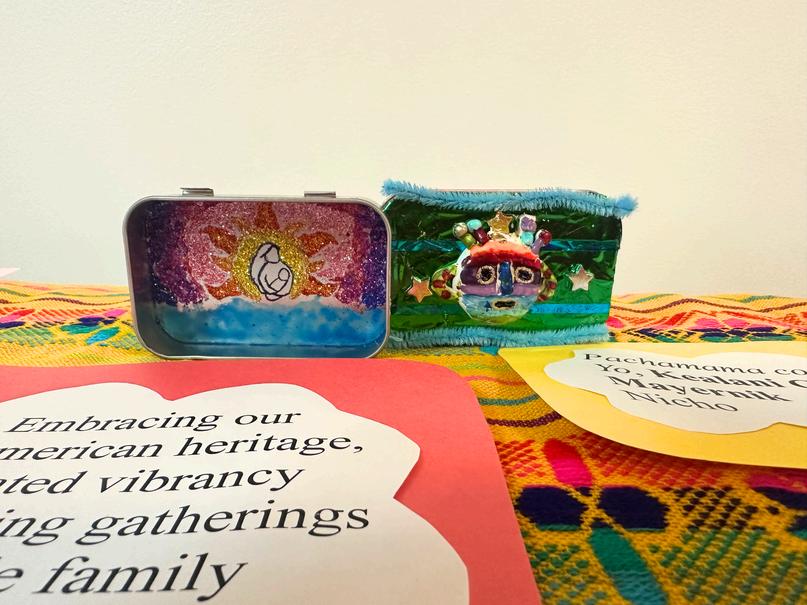
As part of her work at DePaul, and through the STRC program, Dra. Gavin is working on “La Historia es Nuestra: Chilean Exile Memory Project”. The project is named after Salvador Allende’s infamous last speech, in which he addressed the Chilean people during the military coup that ended Chilean democracy and killed him, leaving el pueblo with the final words: “La Historia es Nuestra”, “History is ours ” . Dra. Gavin’s project centers on the voices of the exiles who fled after Allende’s passing and survivors of the Pinochet dictatorship. Over the years, she has collected archival material such as documents, photographs, and interviews to preserve and store for public interpretation Currently, they are being housed by the DePaul library, where staff is helping her digitize the materials These materials tell the story of Chile past and present and serve as poignant reminders of the danger that a lack of humanity and a surplus of greed and power can have on an entire generation As the Chilean exiles grow older, Dra. Gavin expresses an urgency to collect as much archival information as possible before it is lost to time, space, or historical amnesia.
“They have a lot to teach us about how to wage struggles. They are people who have really shaped both U.S. politics and culture in ways that I haven't necessarily been acknowledged. We haven't looked at the ways their experiences with these processes of revolution and counter-revolution have shaped how organizations or cultural spaces rooted in leftist politics emerge. I feel like particular urgency with time to collect all of those things. Because of the rise of right-wing politics globally, I feel like they can help guide us moving forward, both giving us the hope that is so necessary right now, but also, in terms of strategy How do we fight it?”

ALLENDE’S LAST WORDS
Herbarium by Francisco Letelier
Student Work from LST 307 Fundraiser

theSAVE DATE
FELLOWS
FELLOWS TERTULIA
JOIN US FOR SHORT RESEARCH PRESENTATIONS FROM OUR 2024 - 2025 CLR FACULTY FELLOWS AND A 2024 - 2025 STRC PROFESSIONAL DEVELOPMENT FACULTY FELLOW!
TUESDAY, FEBRUARY 10TH, 2026
LOCATION: TBA (LP CAMPUS)
4:30 PM - 6:00 PM
Dr. Symone Johnson
Assistant Professor | Dept. of African and Black Diaspora Studies "Reintegration as a Sacred Political Project"
Dr. Jordan Levy
Assistant Professor |Dept. of Anthropology
"Reading the Political Landscape: Resistance, State, and Transnational Migration in Post-Coup Honduras"
Dr. Yoalli Rodríguez-Aguilera
Assistant Professor | Dept. of Latin American and Latino Studies
"A History of Afro-Indigenous Women Against Environmental Racism on the Coast of Oaxaca, Mexico"
Dr.Carolina Sternberg - STRC Professional Development Fellow
Assistant Professor | Dept. of Political Science
“Inclusiveness and Equity in Chicago? An Analysis of Lori Lighfoot’s and Brandon Johnson’s Rhetoric and Policies“
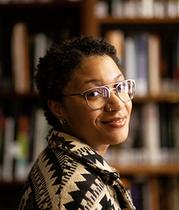
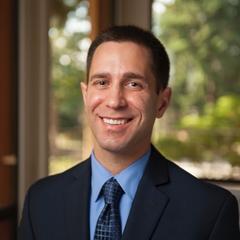
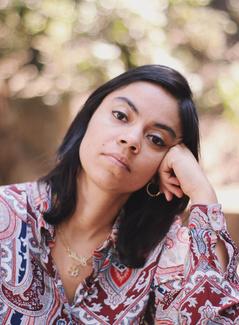
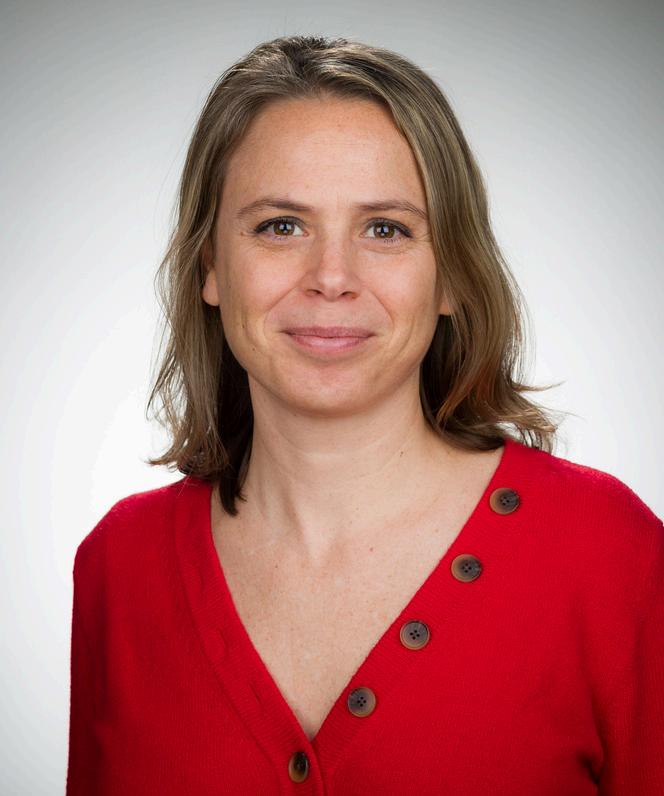
Dr. Symone Johnson
Dr. Yoalli Rodríguez-Aguilera
Dr. Jordan Levy
Dr. Carolina Sternberg
CENTER FOR LATINO RESEARCH 2025-2026 FACULTY FELLOWS
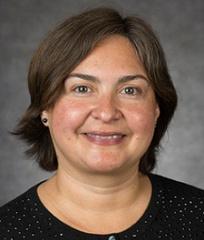
Susana Martínez
Associate Professor | Director of Peace, Justice & Conflict Studies Program
Chicago’s Central American Peace and Sanctuary Movements: A Historical Memory Project
Chicago has a long history as a sanctuary city This historical memory project connects past and present social justice activism by studying Chicago’s role in the movement to provide sanctuary to Central American refugees beginning in the 1980s Steeped in the Central American peace and solidarity movements, Chicago organizers created an interfaith coalition to reject the U S government’s Cold War agenda My primary goal is to spotlight Chicago’s understudied sanctuary activism by collecting oral histories of community members and consulting the recent donation of the Chicago Religious Leadership Network archives to the Richardson Library Several CRLN members were and continue to be active social justice leaders in the community My goal is to contextualize the oral histories within a larger context of Peace Studies and immigrant justice activism I am prepared to interview Central American community members in Spanish to add their lived experiences and critical perspectives to historical spaces where their voices have often been silenced In addition to publishing an article on my findings, I plan to introduce students to this important activism and advocacy work throughout my interdisciplinary teaching at DePaul
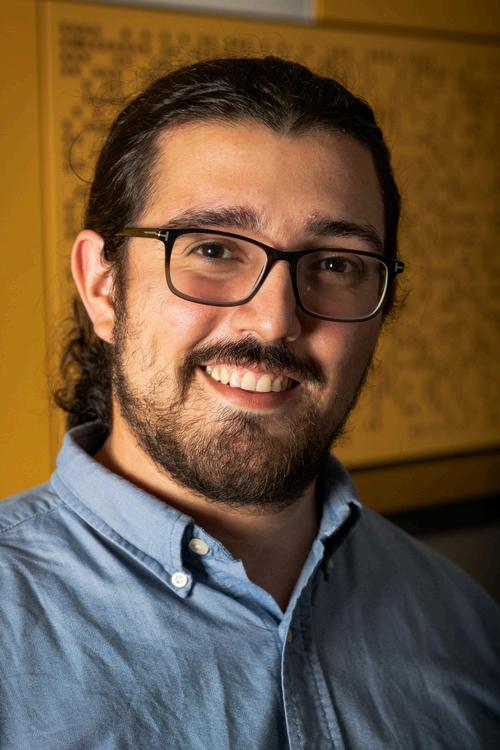
Vincent Peña
Assistant Professor | Sports Communication
From the Locker Room to the Press Box: Understanding How Latino Sports Figures Navigate Politics and Policy in the Age of anti-DEI
This study explores how Latino athletes, journalists, and sports professionals are navigating the growing backlash against diversity, equity, and inclusion (DEI) initiatives, particularly under the Trump administration By using sports as a political platform, recent anti-DEI efforts have had disproportionate effects on communities of color including Latinos Through qualitative interviews this study will examine the personal and professional challenges Latinos face in this shifting climate and attempt to shed light on how these policies impact one’s identity, career opportunities, workplace culture, treatment, and the overall inclusivity of American sports
Olga Salazar Pozos
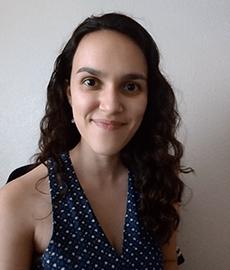
Assistant Professor | Spanish, Modern Languages
Mourning Together: Artistic Interpretations of Mexico’s War on Drugs
In The Restless Dead, Cristina Rivera Garza asks: What is the ethical and aesthetic significance of the literature and art produced in the context of war? This question is especially salient to Mexico, where the ongoing War on Drugs has produced a human rights crisis that has been worsened by impunity and the constant criminalization of the victims In cases like this, where the circumstances create feelings of social fear and a separation between those directly affected and not affected by human rights violations, it becomes imperative to reestablish social connections and to mobilize collective responses against the war nationally and internationally, as this forces the State to respond The question is: how to mobilize such responses? “Mourning together,” my book project, seeks to contribute to this debate by analyzing the answers provided by an emerging culture in Mexico: a mourning culture By tracing and characterizing this movement through the study literature and documentary films, I seek to demonstrate how the mourning culture has contributed to diluting criminalizing narratives, constructed other ways of understanding human rights violations from a site of care and affect, and established or reestablished social connections between victims, readers, and spectators
Carolina Sternberg
Professor | Latin American and Latino Studies
I aim to examine the dynamics of the intersection between gentrification and race in Salvador, Brazil and Chicago, USA two cities with long histories of racial segregation and urban transformations that impact Afro-Brazilians’ and African Americans’ access to affordable housing Drawing from recent publications on gentrification, neoliberalism, and anti-Black rhetoric in Salvador along with my ongoing research, I plan to conduct qualitative research in Salvador to later drawn comparisons with Chicago This research will examine how anti-Black rhetoric, upgrades to the physical environment, and the growing presence of the white population in two Afro-Brazilian neighborhoods in Salvador have influenced increases in property and rent values, further limiting Afro-Brazilians' access to affordable housing
Unearthing Racial and Urban Dynamics in Salvador (Brazil) and Chicago (US): Race, Gentrification and Whiteness
2025-2026 CLR FACULTY FELLOWS SPOTLIGHT: DR. VINCENT PEÑA
LATINXS
IN SPORTS IN AN AGE OF ANTI-DEI
Interview by Emilio Díaz
Vincent C. Peña is an assistant professor in sports communication and journalism. He received his Ph.D. in journalism and media from the University of Texas at Austin and an M.A. from the University of NebraskaLincoln. He has worked as a writer and editor at various publications, such as SB Nation, Salon.com, Yahoo Sports, and The Salt Lake Tribune. At DePaul, he also serves as the co-advisor of the award-winning student chapter of the National Association of Hispanic Journalists (NAHJ). He is also an affiliate faculty member of the Latin American and Latino Studies Department.
I am an assistant professor here at DePaul in Journalism and Sports Communication. I teach in both departments. Most of the skills classes I teach in Journalism are related to sports, like sports podcasting, reporting, stats, and analytics. I also teach the Sports Meeting Society Capstone. As a researcher, I am deeply interested in sports' place in society, especially in the ways it might influence or shape it, rather than being shaped by it. I like to say that my research lies at the intersection of sports, culture, politics, and media.
Why are you interested in sports as an academic topic?
We think of sports as entertainment, but they are much more than that; much more than a leisure activity or exercise. They shape a lot of what we do, especially in the United States. You can argue that the NFL and football are the most significant cultural forces that we have in our country, just based on the sheer attention they receive. A lot of my research before has focused on representation and media. I do a lot of work about the ways Black, Latino, women, and trans athletes are portrayed in both sports media and broader media.
I also have another line of inquiry I focus on: critical cultural work. I'm living within theory, and thinking about what it all means in the bigger picture by criticizing structures and systems. Within that, as a Latino man, often my work focuses on that community. But, I try to do interdisciplinary and intersectional work, so very often it's thinking about everything.
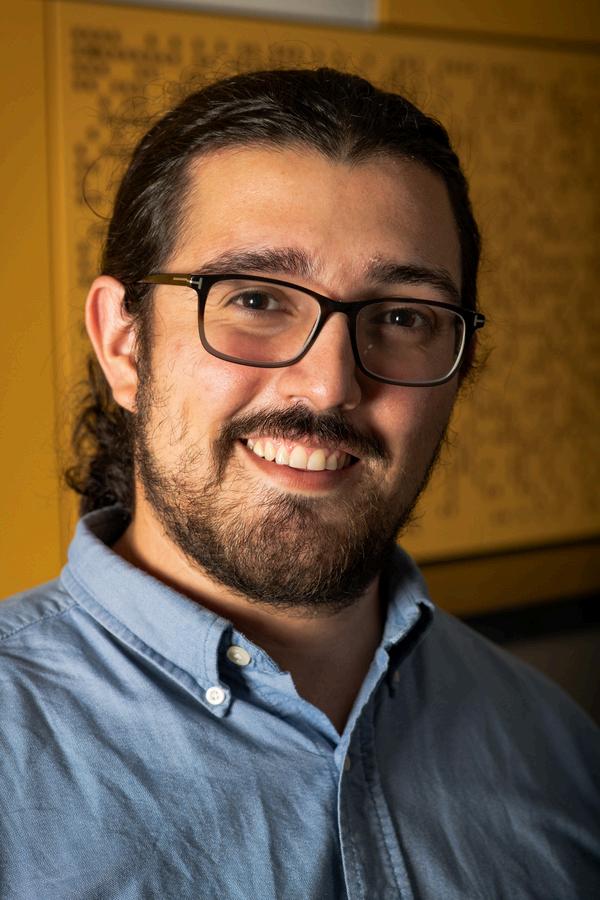
Tell us about your CLR Fellowship Project. The project I'm working on is tentatively titled “From the Locker Room to the Press Box: Understanding how Latino Sports Figures Navigate Politics and Policy in an Age of Anti-DEI.” We've seen this antiDEI shift across all parts of our society, spearheaded by the Republican Party, and you can say Donald Trump at the top. It is not just him or right-wing politics that are driving this. We're seeing a massive shift toward a term that came into vogue less than 10 years ago. Diversity, equity, and inclusion is not something we all grew up with.
I'm interested in the way these DEI policies might impact people working in sports who define Dr. Vincent Peña
themselves as Latino, with the understanding that how people identify themselves might differ. Whether it's athletes, journalists, other sports professionals, marketers, or people who work in communications for athletic departments and sports teams, both on the collegiate and professional levels. Seeing how they're navigating these ongoing efforts to roll back DEI, both how they think about it and how it's impacted sports. Given the inequalities of sports and sports history, Latinos are an important group to focus on.
The anti-DEI movement is happening in the media, the entertainment industry, schools, and higher education. It’s happening simultaneously with a concurrent push to get rid of immigrants in this country. When we think of immigration, we often imagine immigration across the Southern border, meaning brown people. i.e, Latinos. Because of these two concurrent forces, this project is crucial to understanding the way people working in sports navigate DEI and anti-immigration rhetoric. Donald Trump comments on whether or not certain leagues should do anti-DEI stuff, but the NFL might be the only league that's not beholden to him. Professional sports might be the only institution that is in some ways, insulated from influence, politically or otherwise.
I'm curious about the workplace dynamics: how it's impacted career trajectories, career opportunities, and how people are navigating the ways they identify themselves in these spaces. Are you less likely to say you're Latino on your LinkedIn or Twitter account? Are people pushing back? What level of dissent or acceptance is there to these initiatives? Given the diversity of the Latino community, to what extent do people agree with these changes, and are they on board with them?
How do you feel that Latinos fit into this conversation about sports and DEI?
Latinos are already the largest group of minorities in the US. There are predictions that by the 2050’s, Latinos will be the largest ethnic group in the country. But they are vastly underrepresented in sports, and especially in major American professional sports. It's important to say American there because, when you involve international sports, it gets more
complicated. In American sports the big four leagues (NFL, NHL, NBA, MLB) plus professional women's sports we see an over-representation of Black athletes. In certain sports, like baseball or hockey, there is an over-representation of white athletes. Populations in major sports are not reflective of the broader American population, not only among athletes, but also in the demographic makeup of journalists and other people working in these spaces. Sports journalism is vastly white and male.
It is important to understand that anti-DEI efforts are not just being implemented by one entity; it’s the administration infiltrating local governments and public and private companies. It's a societal change. While a lot of it is not necessarily based in sports, we can think of a number of anti-DEI examples that are targeted at sports, like the exclusion of trans athletes in these spaces. And, the reversal of social justice and racial justice messaging from certain teams and leagues. Latinos, generally speaking, are underrepresented and understudied, so this is an opportunity to make up that gap in our understanding of sports.
You teach classes on sports podcasting, which is a subset of media that has exploded in popularity in recent years. What are the effects of this medium on the diversification of media and Latinx people in media? Podcasts have kind of leveled the playing field. They have provided opportunities and an avenue for inclusion that otherwise might not have been there. More people are able to hop on a podcast or make their own podcast because the barrier of entry is very low; you don't even need a microphone. As I teach in my class, if you have a phone that has a recorder, you can make a podcast. This means, especially in media organizations, any entity that has historically had disparities in racial and ethnic diversity, like Latinos people who have long been left out of conversations in the national and local media have more opportunities.
They can talk about or report on their favorite teams, even if they're not employed or working for traditional or established media outlets. It's been
great not just for Latinos, but for other racial and ethnic groups The largest sports media company in the U.S., ESPN, had ESPN Deportes and other Spanish-language content. But when there are cuts, those are some of the first things to get cut, and those people lose their jobs. Now, there is a space where people serve more direct and specific audiences. If you're Spanish-speaking or Latino in this country, you might not have gotten that from typical news organizations. This allows other people to get involved.
For my students, they are interested because they see everyone has a podcast now There are fewer limitations, restraints, and expectations and many different podcasts with a variety of formats and levels of professionalism You can talk about things that are unprofessional or not safe for work on podcasts, and it's all cool. I can find a niche and a space to carve out that I might not have been afforded before.
College athletics is undergoing a lot of change, with athletes being able to make money. The increased mobility of college athletes through the transfer portal and the increasing disparity of funding at athletic facilities across the nation. Are college athletics going to be a factor in your project? Do you think that it is a backbone of what we need to be talking about when we're talking about anti-DEI in sports?
College sports do factor quite large in my analysis I'm not exactly sure how and to what extent yet, but one thing I do know at the college level, is that Latino athletes are vastly underrepresented relative to their place. Latinos are underrepresented in college spaces. That's why the–now non-existing Hispanic Serving Institution designation was created, because the goal was to more readily mirror what the population looks like. It's important to understand that there are a lot of Latinos who work in sports, college athletic departments, and journalism. They are here, they do exist, and there are a lot of them. However, there is still a large disparity, and I'm wondering what that looks like
For instance, at DePaul, we're at a private Catholic school in Chicago, very “blue” Chicago. We were impacted by some of this stuff, but our freedom to speak and to research the things that we're interested in, to talk about them, and even put them on our websites is much different than people in Texas, Tennessee, Alabama, or Florida, where there's legislation limiting what people can and cannot say. Texas A&M fired a professor for talking about Plato, because it was going to be about race, gender, and identity. Understanding what that looks like in college athletics and how that impacts Latinos at the collegiate and professional level is important.
As you mentioned, your project is going to involve conversations and questions with Latino Sports figures across different facets of sports. What are the questions that you are most excited to ask them? What are you mostexcitedtolearnfromthem?
I'm most excited to learn what the diversity of responses looks like. One thing about this interview work is, I'm beholden to who responds to my interview inquiries. I'm curious as to who might be interested in talking, and whether or not people are willing to talk about it. I wonder if even reaching out to them about DEI and anti-DEI puts them in a precarious situation to begin with; whether or not they agree with or reject the premise of what I'm doing.
I am most intrigued by what that diversity looks like. I've been surprised by the voting habits of the Latino community at large, especially by the variations by state. In some places, that community may be more liberal, and in others it's more conservative, based on the community and the specific ethnic group or national origin. I’m often thinking about how not everyone thinks like my Hispanic community back home, especially in sports. Sometimes it's assumed that because people like the same sports team, or because we have the same background or identity, that everyone kind of agrees with you. I think my research constantly disprovesthat.
The Center for Latino Research
2026 - 2027 Faculty Fellowship Program
TheCLRFacultyFellowshipisanannualcompetitionopentoallDePaulUniversity full-time,tenuretrackfacultyinanydiscipline.Thefellowshipissupportedbythe CollegeofLiberalArtsandSocialSciences,andgrantsrecipientsaone-quarter teachingrelease(2classes)forresearchandwritingonLatinAmericanand/orU.S. Latinoissues.Inaddition,theCLRprovidesupto80hoursofstudentresearch assistanthelpduringtheresearchperiod.Withinoneacademicyearfollowingthe fellowshipperiod,recipientsareaskedtosubmitafinaloutomeorpublication,and todoashortpublicpresentationoftheirwork.
2026-2027CLRFacultyFellowshipApplicationRequirements AnupdatedCurriculumVitae
ForLASfaculty,anonlineendorsementfromthefacultymember'sDepartment Chair/ProgramDirector.ApplicantsfromcollegesoutsideofLASshouldsecurean endorsementfromtheirDeanbeforebeginningtheapplicationprocess. Projectmaterials,outlinedintheApplicationGuidelineswhichcanbeaccessedHERE orbyvisitinggo.depaul.edu/clr
Ifyouhaveanyquestions,pleasecontact: BillJohnsonGonzálezatbjohns58@depaul.eduor MarcelaL.RealesVisbalatmrealesv@depaul.edu
BOOK CLUB
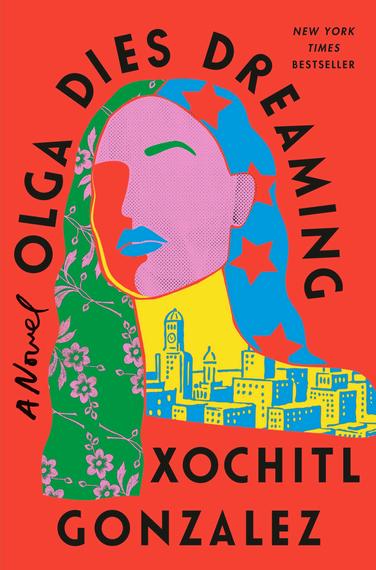
OLGA DIES DREAMING
by Xochitl González
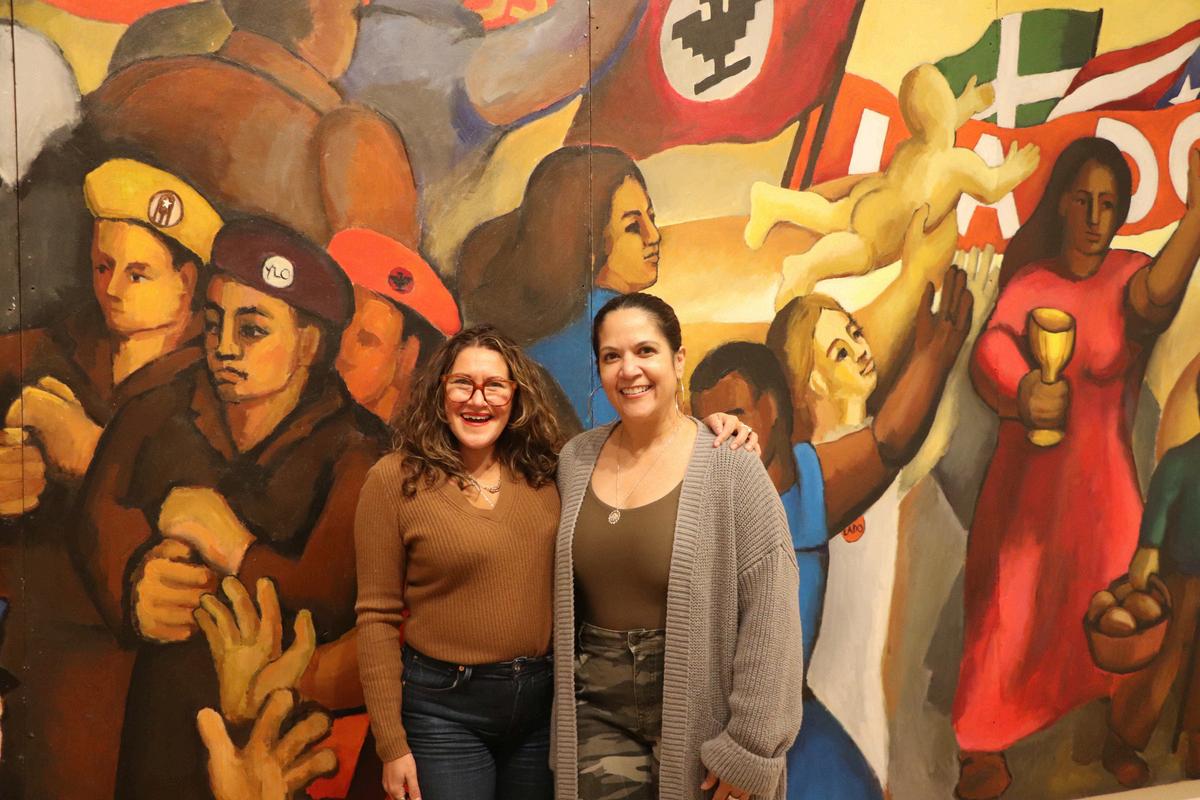
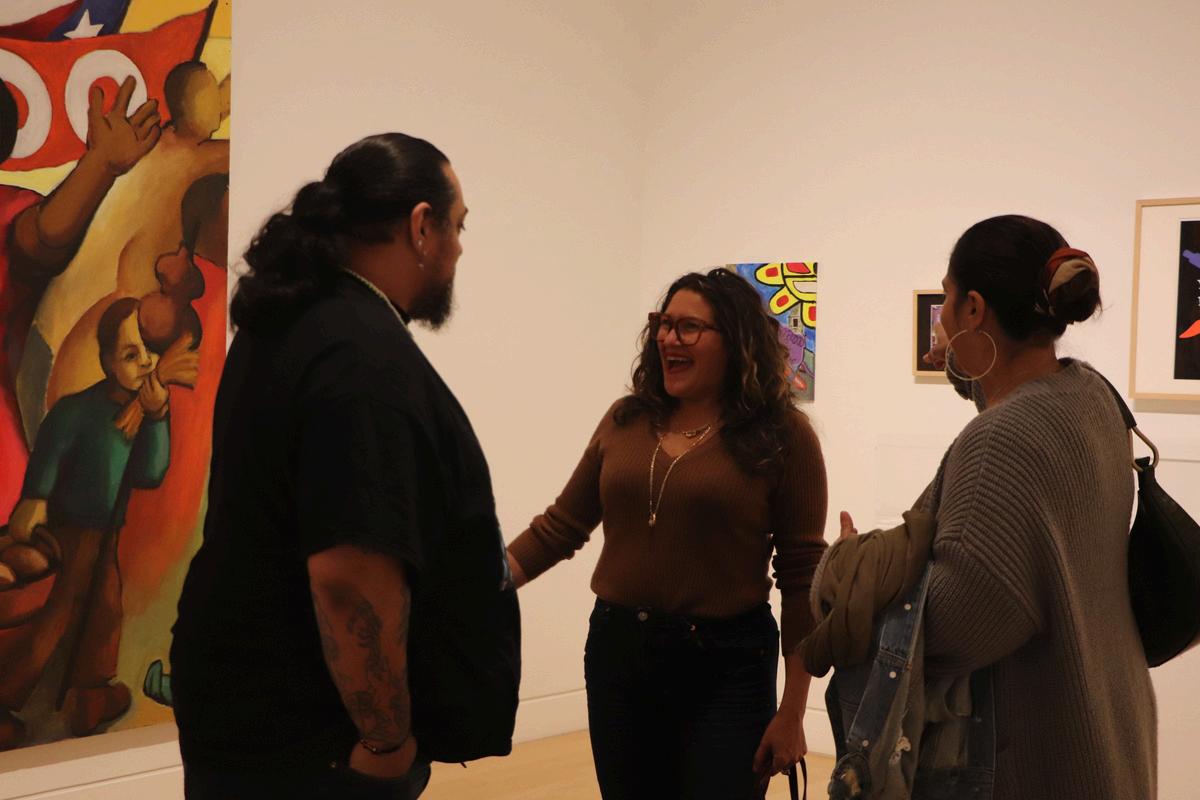
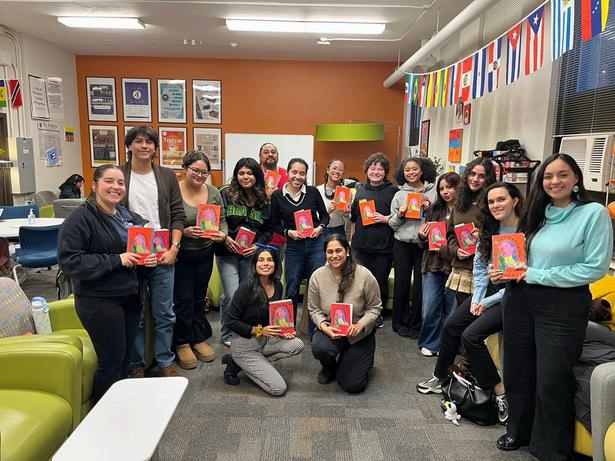
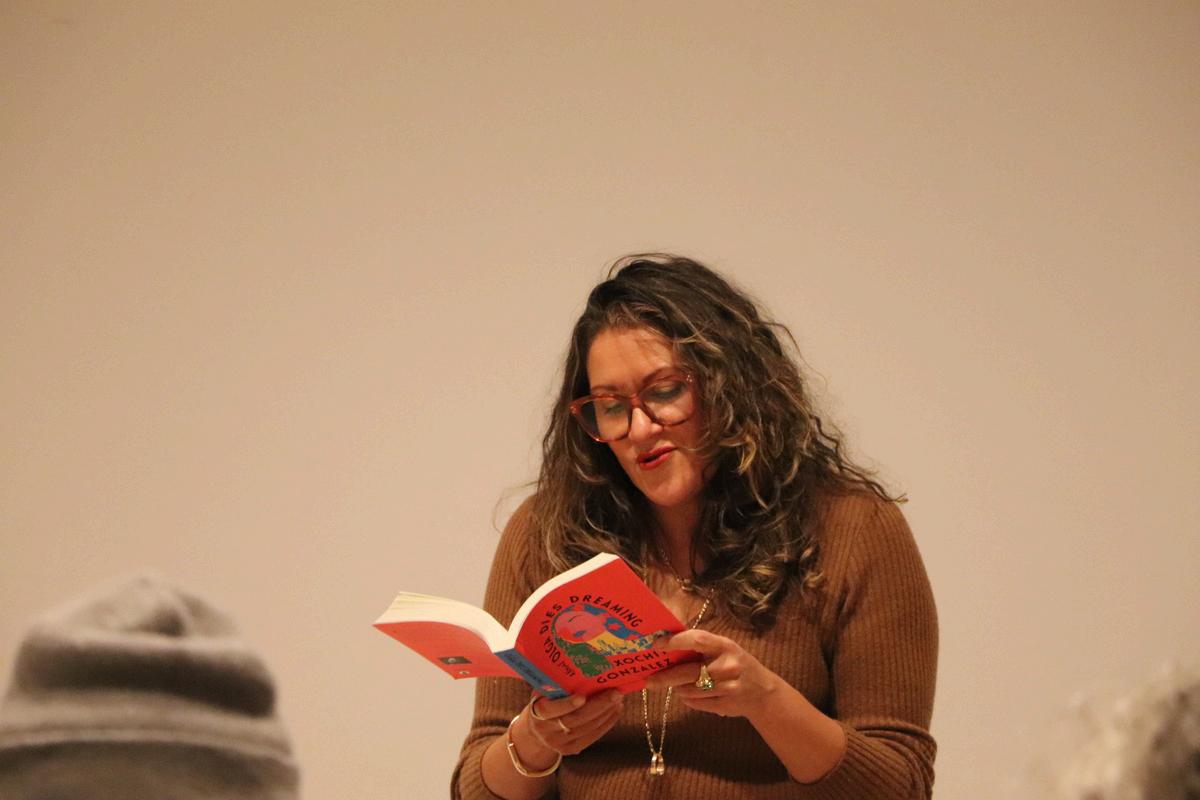
In the fall, our Latinx book club discussed Xochitl González’s Olga Dies Dreaming. A New York Times Bestseller, that tells the story of Olga, a Puerto Rican wedding planner in New York, as she reckons with Hurricane María's aftermath and the return of her long-lost mother, a former Young Lord. On Wednesday, November 19, author Xóchitl González visited DePaul to talk about her award-winning novel, the 2025 Chicago Public Library One Book One Chicago selection. She read an excerpt from the book, spent time answering questions from the audience, and held a book signing afterward. It was wonderful to meet her!
Thank you, Xóchitl, for visiting and engaging with our DePaul community! As well as our Latinx Book Club attendees for their reflection and conversation!
Notes on Xochitl Gonzalez’s Olga Dies Dreaming
Olga Dies Dreaming is a novel that provides DePaul students, staff, and faculty with topics for reflection and contemplation, especially given our institutional history and current political climate The book covers a variety of themes, such as the US colonization of Puerto Rico, gentrification, racism, capitalism, domestic violence, and the pursuit of the “American Dream,” among others, using characters as vessels for expression and representation. This book holds special relevance to the DePaul community because of its portrayal of the Young Lords.
The intricate and dramatic life of Olga, a revered wedding planner in New York City and daughter of an absent Young Lord, provides readers with the foundational understanding of the complexity of Latinx identity; in Olga, we see a story of success, and at the same time, a site for rhetorical and literal violation Olga’s understanding of the world around her is shaped by the hardships in her life and within the relationships she holds dear
At DePaul, we are familiar with the Young Lords Organization’s struggles for liberation, coalition building, racial equality, and the fight against gentrification in Lincoln Park The book extracts the organization's name from their good work, not contextualizing the community-building efforts they spearheaded and participated in, such as the Rainbow Coalition, formed in partnership with the Black Panther Party and the Young Patriots to challenge power structures In associating the antagonist mother figure, Blanca, with the Young Lords, but not fully explaining who the Young Lords were, Gonzalez muddies an essential history of activist work with rejection and lovelessness
Olga Dies Dreaming provides us with space to critically engage with our surroundings and the systems we take part in. Our futures lie in our ability to understand and interpret the past. I invite you all to read the book with a critical eye. Notice the ways the author chooses to portray Latinx identity and relationships from a range of perspectives, including race, gender, sexuality, and nationality. Where does nuance slip through the silences? How does Gonzalez’s portrayal of Olga’s mother lend itself to warping a history we know well at DePaul?

Olga Dies Dreaming was definitely not my book of the year, but it forced me to consider my role in writing and reimagining history as a student of color I hope it makes you consider yours
Angelique Lara Undergraduate Student Assistant Center for Latino Research Latin Americna & Latino Studies Department
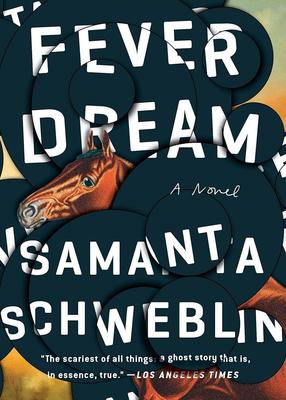
bySamantaSchweblin
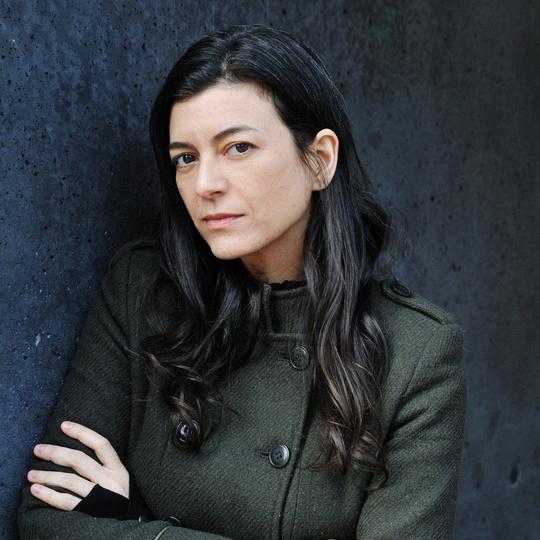
A young woman named Amanda lies dying in a rural hospital clinic. A boy named David sits beside her. She’s not his mother. He's not her child. Together, they tell a haunting story of broken souls, toxins, and the power and desperation of family.
Fever Dream is a nightmare come to life, a ghost story for the real world, a love story and a cautionary tale. One of the freshest new voices to come out of the Spanish language, Samanta Schweblin creates an aura of strange psychological menace and otherworldly reality in this absorbing, unsettling, taut novel.
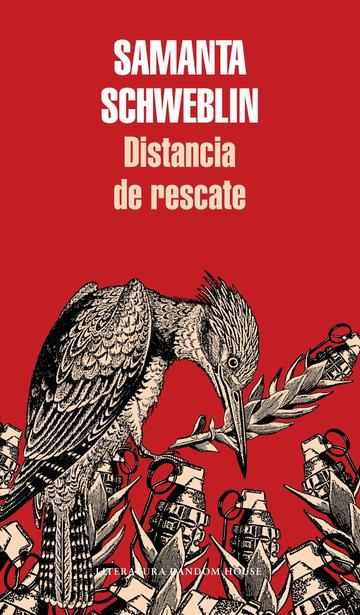
The first 15 students to register receive a free copy of the book
Sponsored by:
Discussion will happen in English, but the original text is in Spanish We encourage students to read in whichever language they prefer!
Tuesdays: FEB 17 MAR 3 4:30 - 5:30 PM at the Latinx Cultural Center
REGISTER HERE Discussion Dates clr@depaul.edu

MEXICAN CINEMA

Four Student Short-Films from the Escuela Nacional de Artes Cinematográficas | UNAM Alma mater of Guillermo del Toro and Alfonso Cuarón


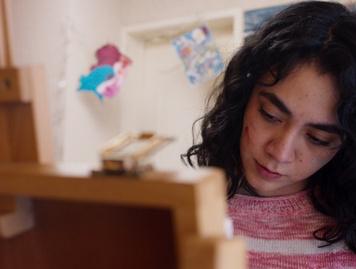
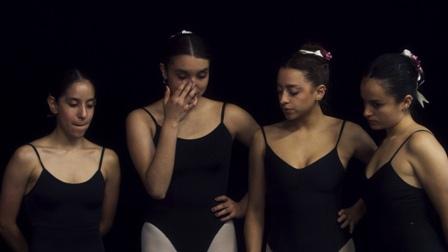


MONDAY, FEB. 16 11:20AM - 12:50PM LPSC 220

SCAN TO REGISTER

CLR/LALS External Advisory Board Members
Maria G. Arias
Principal, Maria Arias Solutions
BA, Political Science, DePaul University, 1983
Martin Arteaga
President, Green Building Partners, Inc.
BA, Political Science, DePaul University, 2000
Trish Brown Cordes
Master of Public Service Management, DePaul University, 1983
Leonard Domínguez
Secretary, Little Village Rotary Club of Chicago
BA, Economics, DePaul University, 1967
Yvette Flores
Managing Partner/Director, Cardinal Green Investments LLC
BA, Sociology, DePaul University, 1986
Marisol Morales
Executive Director, Carnegie Elective Classifications, American Council on Education
BA, Latin American Latino Studies; MA/MS International Public Service Management, DePaul University, 1999
Maria Pesqueira
President, Healthy Communities Foundation
BA, Latin American Studies, DePaul University, 1990
Edgar Ramírez
President/CEO, Chicago Commons Association
BA, Political Science/Latin American Studies, DePaul University, 2000
Ulises Iván Sánchez
Human Resources Officer/U.S. Department of State
BA, Leadership and Human Resources Management, DePaul University, 2015
MS, Human Resources, DePaul University, 2016
Lou Sandoval
President/CEO, Halo Advisory Group
BS, Biochemistry, DePaul University, 1988
CLR/LALS EXTERNAL ADVISORY BOARD MEMBER’S SPOTLIGHT:
Martin Arteaga
Interview by Goutam Kumar
I was born and raised in Chicago, in the Pilsen neighbourhood I actually started going to DePaul during high school, when I was part of a program called DePaul STEP I've been going to DePaul since my freshman year of high school every Saturday to do advanced science, advanced mathematics, English literature, and stuff like that. So, DePaul has been part of me for many years. I grew up in a working-class family. My parents worked at a cookie factory, Nabisco. They make Chips Ahoy and Oreo cookies. So, my livelihood was made on those cookies. But I graduated from DePaul and majored in political science. After leaving DePaul, I started my political life. I ran political campaigns across the country. I interned in Washington, D.C. for the Congressional Hispanic Caucus Institute.
I ran several campaigns for the National Democratic Party across the country, in the Quad Cities, Los Angeles, and Denver So, campaigns were a big part of my life right after DePaul But then I came back to Chicago and started what I call the second part of my life I still did politics, but then I entered academia I worked for Northwestern University I was running a program called the Summer Research Opportunity Program, SROP I worked there for a couple of years, and then I moved over to the University of Illinois, where I was in charge of the South Campus development, MBE, WBE participation, making sure that minorities and women got a chance to take part in the different developments that the university was having in the University Village area.
After that, I went into construction because I saw that there was a lot of money in that industry. I went back to school for construction management and started working for big construction firms that were contractors for the Chicago Public Schools. I got to work on the Brown Lane Reconstruction Project. Major stuff, right? Not everybody walks into that kind of project. I was very fortunate to have some good experiences. And I did that until the economy collapsed and President Obama took over. I was let go by my company at that time So, I went off on my own and started my general contracting business I've been going strong since 2010 Now we're in 2025 I did take a small break in between to run for political office in the city of Chicago
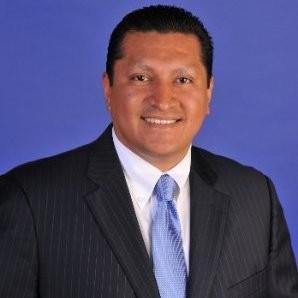
I ran for alderman in 2015, trying to relive my political times again from the perspective of being a candidate But I think God had different plans for me And even though it was a great experience, I returned to construction, and we started Green Building Partners, which is my current company We do general contracting, development, real estate investments, Airbnbs, all that kind of stuff I always tell people, you make a left, then you make a right, and then you makeanotherleft
How did your time at DePaul shape your leadership style andthelong-termcareerpath?
DePaul contributed a lot to my career, leadership style, everything. The Vincentian service-based learning and going on trips were important. I did a couple of the spring break service trips. All my other friends were going to Cancún or somewhere else to go have fun, and I was going on a service learningtripwherewehelpedcommunitiesindifferentparts of the country. I think some of those values helped me out, but also campus life at DePaul. I started the first Latino fraternity at DePaul, Sigma Lambda Beta, and they're still on campus. There was a need because at that point, Latinos only made up a small percentage of the student population. It gave me a place at DePaul where I could grow my leadership skills, and it gave me the ability to coordinate with other schoolorganizations IstartedtheLatinoFest Idon'tknowif it's still going on or not, but it allowed me to grow my wings, ifyouwill So,DePaulisakeycontributortowhoIam
MartinArteaga
How do you embed Green Building Partners’ family-led values and community focus into your daily operations andprojects?
The family values we have are reflected in the company in several ways Our core is our people, and they come with personal problems, family issues, and the same challenges anyonefaces I’vehadsituationswhereaworkerdidn’thave acarbecauseitbrokedown,sowecreatedaprogramwhere we give them a loan to buy a car and deduct it little by little atnointerest They’reabletokeeptheirwages,maybepaya hundred dollars a week, and still get to work and live their lives We’ve also volunteered as a company to help with community service when opportunities come our way. Sometimes it’s a mom who broke her leg and needs her bathroom remodeled so she can use a shower instead of a tub. Sometimes it’s an older woman with gaps in her home whereheatisescaping,andcoldairiscomingin.We’vehad situations like that where we were able to improve someone’s living conditions. We also give scholarships to the children of our employees so they can go on to college. Whether it’s helping our people or the community, any way thatwecanhelp,wewill.That’swhatwebelievein.
Of your major projects, including the CTA Brown Line expansion, which taught you the most, and what lesson stillguidesyoutoday?
The CTA Brown Line expansion and the UIC campus development happened when I was a project manager for another company, and that experience still shapes my work today A lot of what I learned there I carried with me into thenewcompany Whenyou’reyoungandstilllearning,it’s importanttolearnonsomebodyelse’sdimebeforegoingoff on your own venture, because you’ve already learned the professional way to do things A lot of people start a new business from ground zero without knowing how a true professionalcompanyoperates,andtheyendupwingingit. That’s the whole reason we have internships. They’re training grounds that prepare you for what to expect after college.
Those lessons were especially valuable on major projects. Nothing really scares me now. When I walk into a project, and someone is panicking about structural issues, I tell them to relax. I used to build train stations, so I know how to handle it. I learned how to deal with big work. I always tell people, give me the hard stuff, not the easy stuff. The hard stuff pays more because you’re solving problems that otherscan’torwon’tbecausetheythinkit’stoorisky
The lessons I learned on complex, large-scale projects allow me to look at my day-to-day work and make decisions that feeleasytome I’mabletomakedealshappen,bringpeople together, and coordinate meetings with plumbers, electricians, andHVACteamsbecauseIlearned
construction on the job, and now bring that experience into my company
What inspired you to join the LALS/CLR External Advisory Board, and how do you see your experience contributingtoitsmissionandcommunities?
I don’t do what I do expecting recognition, but being recognized as a DePaul alum who could add value to the board meant something to me
I bring the best of both worlds I’ve worked on the governmental side and the private side, and through that experience, I’ve built strong connections I think bringing those experiences together on behalf of DePaul, the Latino community, and the Latin American and Latino Studies Department could be valuable.
The Center for Latino Research played a major role in shaping my experiences when I was a student. I was able to go to Cuba, where I met Fidel Castro, one of those historical figures you’re unlikely to see again. That two-week trip, funded by DePaul, changed how I viewed life and politics, not just from a U.S. perspective, but globally.
Meeting Cuban university students and having dialogue about the issues Latinos face in the U S while learning about the challenges they face in Cuba, was powerful Along with the programming of the Center for Latino Research, that experience shaped who I am today I wanted to give back, which is why I decided to join the board
What advice do you have for young Latino students or aspiring leaders who want to make an impact in both publicserviceandtheprivatesector?
My advice to young Latinos is don’t be afraid to take a stand or to execute big plans. Too often, the education system shapes us to follow the rules, fit into a box, get a good job, and live a predictable life. I come from an entrepreneurial world where there is no box. It’s what you create.
No matter what field you’re studying, when you look at major companies like Microsoft or Apple, you see the same story. They started in a garage, and that story can be replicated. So dream big, go after what you want, and seek people who are already in that world and can help you move faster.
Steve Jobs once said someone from HP gave him free parts because he asked It’s in the Bible, ask and you shall receive You have to go out and ask for help I’m always willing to mentor young people, the same way someone helped me along the way Nobody gets through life alone Don’t be afraid to ask for assistance, find a mentor, and take that next step Take that leap
From FM Waves to Activism
Storytelling of Latino Voices through Community Radio
Throughout the 2025 fall quarter, students explored the relationship between community radio and Latino migrant communities in Chicago, focusing on radio as a platform for social justice With community partner, Lumpen Radio, students in this class were guided through scriptwriting, interviewing, editing, and post-production of community audio portraits for radio broadcast.




AQAQ
AInterviewed by Michelle Cisneros
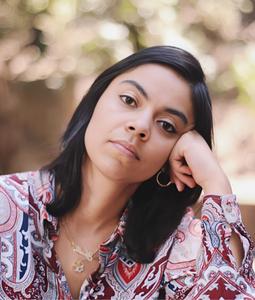
Dr. Yoalli Rodríguez Aguilera is Assistant Professor of Latin American and Latino Studies at DePaul University. They earned a Ph.D. in Latin American and Latino Studies and Anthropology from the University of Texas at Austin. Dr. Rodríguez Aguilera is an interdisciplinary scholar whose work explores the intersections of gender, race, and environmental justice in Afro-Indigenous communities in Mexico.
This class was so special to me because I was able to collaborate with a local community organization, Lumpen Radio, a radio station at its core dedicated to centering the voices of different communities in Chicago For this class, we were interested in exploring how a radio can empower Latinx communities by creating audio stories The process of students doing the interviews with people in the community, giving feedback to students and seeing their progress, from choosing their topic, to producing and post-producing, and finally broadcasting live on the radio in the final event of the quarter
QHow would you describe the class experience this past fall, and what stood out most during the process?
AThe collaboration with Lumpen R course’s structure and pedagogy of Lumpen Radio, Stephanie Manr support of the Humanities X stud allowed us to build a bridge betw communities, and the university W every class,combining her experti my knowledge in ethics, commun feminist pedagogies, as well as ke Dr Carolina Sternberg , Sandra Tr I feel we created a very well-roun
What was your initial vision for the course, and how did it evolve? What did students learn from creating communitycentered audio work?
The vision was to create a safe space for students to explore the role of community radio in empowering Latinx communities in Chicago The reality overcame the vision, since the students created a variety of subjects based on their interests, which became interesting, and I learned a lot from the interviews and the students
Students learned about the importance of community radio in fostering collectivity, caring for each other, and centering voices that are often not heard, while also providing accurate information through in-depth research They also learned ethical practices for interviewing, editing, and storytelling, and, of course, for broadcasting the audio story and inviting community members and family to listen
QHow did the collaboration with L course, and how did this class di classroom experiences?
Collaborating with Lumpen Radi classes, and, of course, the final s Listening to the final audio storie amazing; the subjects ranged fro vendors to horror stories to coffe others The community event in N students and I live-broadcasted t Radio in person We had a beaut members, friends, and communit part of it It was a lovely and pow
The hardest challenge was that, the city, we had to change some modify them for the students' se Lumpen Radio team, such as Cha and of course Stephanie, Luz, an had the appropriate equipment, successful in their audio stories
What were the most meaningful and challenges of the course?
POETAS: Olivia MacielEduardo ArochoJosé Bono RovirosaDaniel BorzutzkyMarta CollazoAngélica DávilaJorge García de
la FéSilvia GoldmanRuth LlanaMiguel MarzanaMiguel Méndez ArbizuElizabeth NarváezYolanda NievesRafael Ortiz CalderónFermina PonceMargarita SaonaLuis TubensOm UlloaCrystal Vance GuerraFebronio Zatarain
ARTISTA PLÁSTICA: Esperanza Gama
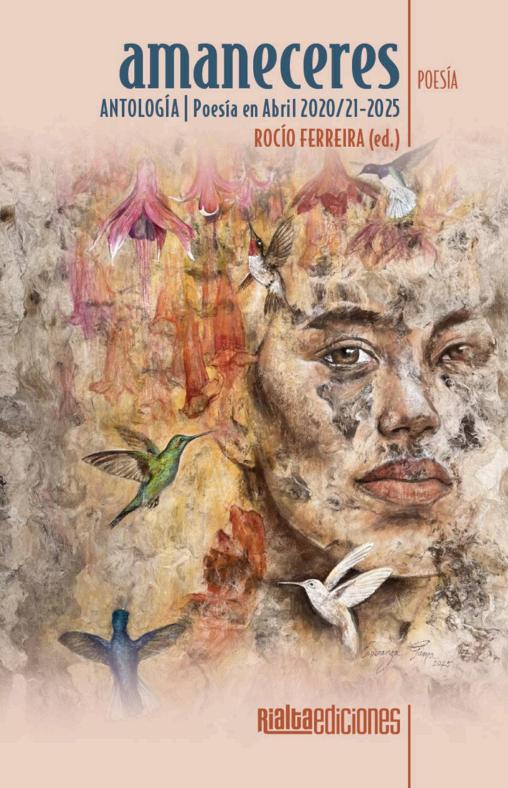
5 de marzo | 6-8:30 PM
Arts & Letters 104 2315 N Kenmore Ave Chicago, IL 60614
C L R @ D E P A U L . E D U
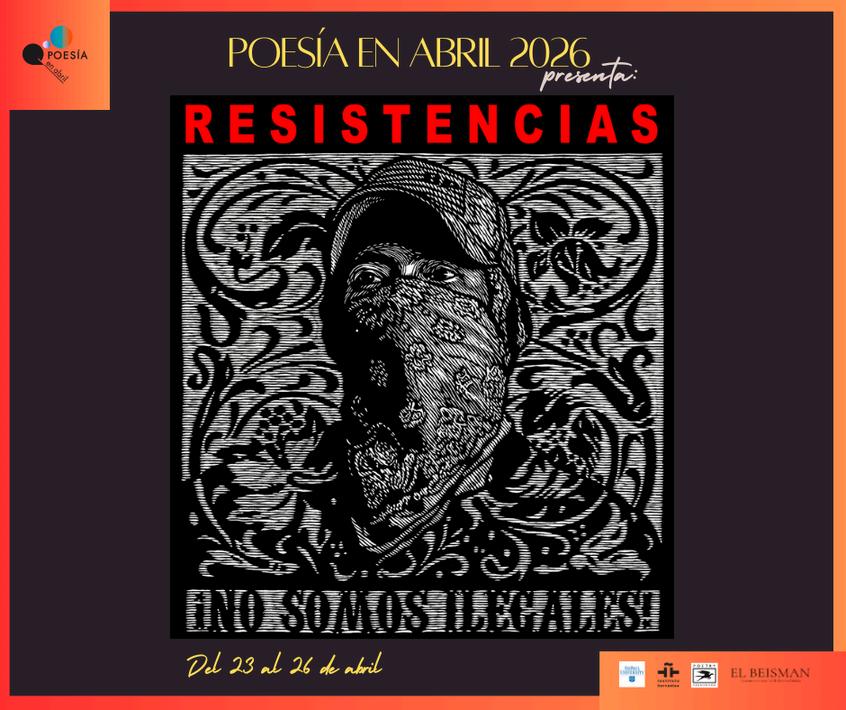
The Midwest’s most important Spanish-language poetry festival returns in 2026 with the theme RESISTENCIAS a celebration of community endurance, love, resilience, and the transformative power of words.
Many Chicagoans find connection through cultural heritage and the arts. DePaul University’s 18th annual Poesía en abril (“Poetry in April”) festival brings local and global communities together for four days of live Spanish-language poetry and musical performances by Latine artists.
The festival will take place April 23–26, beginning with an inauguration and open dialogue on April 23 at DePaul’s Lincoln Park Campus. Guest poets from Puerto Rico, Mexico, Argentina, Spain, Peru, Colombia, Bolivia, El Salvador, and Chicago will participate throughout the festival.
All events are free and open to the public and will include musical guests, literary dialogues, workshops, and the announcement of the Juana Goergen Poetry Award winner. For more information visit: https://poesiaenabril.com/
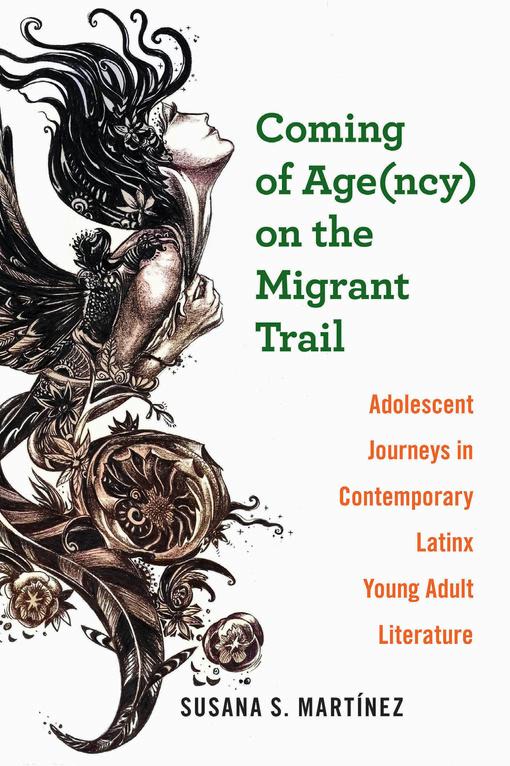
Coming of Age(ncy) on the Migrant Trail
Adolescent Journeys in Contemporary Latinx Young Adult Literature
Susana S. Martínez
Susana S. Martínez’s Coming of Age(ncy) on the Migrant Trail maps the contours of agency in young adult literature involving Latine/x migrant youth a project that could not be timelier given anti-immigrant hostility, LGBTQ+ book bans, and intense scrutiny of how we teach about race. Martínez leads readers chronologically and geographically from the 1980s Central American civil wars north through Mexico during the war on drugs to the recent experiences of those living undocumented in the United States, showing that YA is an ideal medium through which to tease out those stories of Central American migration that are often subsumed within Latine/x studies and to combat stereotypes of young migrants. Viewed through the lenses of intersectionality and racialized capitalism’s politics of disposability, the novels in question contribute to timely antiracist pedagogical discussions where youth emerge as catalysts for social change. By including nonLatinx authors who wrote about the Guatemalan and Salvadoran civil conflicts alongside authors from the Central American diaspora Marcia Argueta Mickelson, Jennifer De Leon, and Bessie Flores Zaldívar among them Martínez invites us to reflect on solidarity in contentious times.
Susana S. Martínez is Associate Professor in the Department of Modern Languages at DePaul University.
For appearance and publicity inquiries: OSUP publicity@osu.edu
For course adoption inquiries: OSUP courseadoption@osu.edu


192 pp
Hardcover $139.95
Paperback $34.95
Ebook $34 95
“While young people, and particularly young people seeking refuge, are at the mercy of oppressive systems, Martínez sheds light on the ways they discover and enact their power. Her nuanced analysis makes visible the ways that global capitalist policies and processes on both sides of the border directly impact people ” Amina Chaudhri, author of Multiracial Identity in Children’s Literature
“Martínez deftly uses data and social scientific research alongside her analysis of young adult novels to contextualize the causes of youth migration and to counter xenophobic ideologies that position migrants as criminal, deportable bodies ” Cristina Herrera, author of ChicaNerds in Chicana Young Adult Literature: Brown and Nerdy

LALS STUDENT SPOTLIGHT: MICHELLE NOLASCO
ROOTED IN COMMUNITY, DRIVEN BY CHANGE
Interview by Marcela L. Reales Visbal
My name is Michelle Nolasco I am a senior studyi Political Science and Latin American Latino Studi at DePaul I'm currently 21 years old, and I'm fro Orland Park, a southwest suburb, so I commute school almost every day It's tiring, but it's definite worth the trip, especially with the experience I've h throughout my entire four years at DePaul M parents are undocumented immigrants from Mexic and I have a younger sister She and I were both bo in the United States
DePaul has been a wonderful experience, not only learn more about Political Science and Lati Studies, but also a way to explore who I really am I've discovered a lot about myself and where I come from, and the potential that I have to create meaningful change in the future
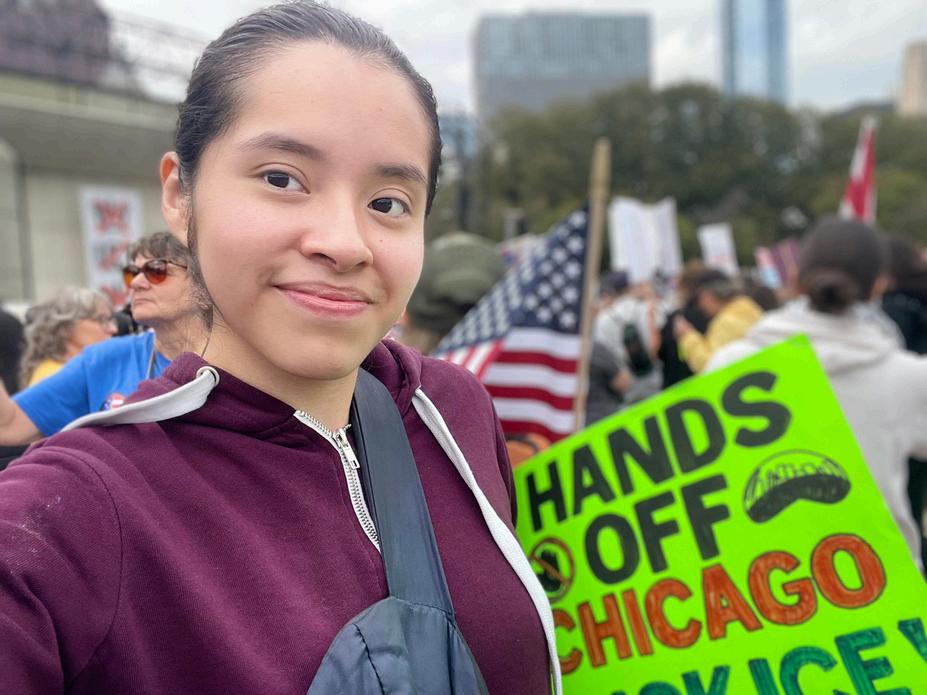
Michelle attending the 2nd No Kings Protest in October 2025
I was hesitant at first to double major in Political Science and Latin American and Latino Studies because I did not know what benefits it could bring for me Back in freshman year, I took a seminar class with Professor Jesse Mumm, and he was the one who brought it to my attention to either double-major or minor in LALS At first, I told him I was not planning to double major But I really enjoyed taking LALS classes, and little by little, I realized how many connections LALS classes have with Political Science That's what I really enjoy about my education, that I'm able to take a theme, a topic, a key figure from one class and somehow bring it to a different class
It was the beginning of my junior year when I made an appointment with my advisor I told her about my interests, about being an LALS/Political Science double major, and she said, “ go for it ” I think that is one of the best decisions I've ever made in my life I'm really grateful to Professor Mumm for encouraging me to become a double major
In my studies, I have learned about social movements. Latinos have been a powerhouse of various social movements, such as A Day Without Immigrants and the May Day protests. Those are my
favorite protests that I've studied. I learned how my family, particularly my dad, was involved in the 2006 protests. He walked out, and he marched alongside millions of others in Chicago to advocate against a House bill that would have made any undocumented immigrant a felon. I didn't know that my dad was part of it until I watched a documentary about Elvira Arellano and her son, Saul, in one of my seminar classes. It was about immigration experiences, and that's when I first discovered that my dad was actually part of the movement, just by watching the documentary. My mom has also been political in combating discrimination and unequal pay in the workplace, especially in the food service industry. I get really overwhelmed by the fact that even though my parents might be undocumented, my family can't really be politically engaged through voting. But they still have a voice when it comes to joining other people in protests.
What have been some of your favorite Latin American Latino Studies courses?
I can never forget the very first class that I took with Professor Mumm, which was on Mexicans in Chicago. Despite being Mexican and going to Little Village and Pilsen for services, groceries, and food, I had no idea how Mexicans arrived here in the first
place It was more like an intro course on where Mexicans came, and that definitely opened a lot of opportunities for me
In another class in my sophomore year with Professor Mumm, Mexican communities in Chicago, we discussed different issues in Chicago and how the Latino population is dealing with them That was also where I had to complete my 25 hours of community service I partnered with Enlace Chicago in Little Village, where I translated immigration documents at a time when a lot of newly arrived migrants were coming into Chicago, and they were applying for asylum and work permits. A lot of the backbone of all these translations and court hearings was done by non-profit organizations. I love talking about immigration, so partnering with a non-profit and trying to translate documents from Spanish to English was really helpful, and it was a way for me to also practice Spanish again. I also got to meet a lot of people. I sat with them and listened, and felt what they were feeling at that time, just being in solidarity with them, and showing dignity to them, too.
That led me to later do community service with the DePaul Community Service Association (DCSA). Now I currently serve as a Site Coordinator for Catholic Charities in partnership with DCSA. I started by feeding a lot of newly arrived migrants, including families, when many shelters were located in the area. But unfortunately, little by little, those shelters started disappearing. However, regardless of that, helping to translate and feed these newly arrived migrants during my time was great.
Since you're graduating, what are some of your plans for the future? How has the LALS major prepared you for your next steps? At the moment, I'm still undecided about what I want to do, but I think the best idea for me is to take a gap year, figure things out, and continue being involved in the community. When I reflect on how I started to where I am now, I feel that being in community has definitely helped me reach new connections, bring new experiences, and learn more about myself. I aspire to pursue a future career as a politician at the federal level, representing and advocating for Latino communities, undocumented families, and underrepresented voices.
My academic goal is to obtain a PhD in Political Science It would be an honor to have that Not only being the first member in my family to have a PhD, but also a way to show my dedication to school and my passion for politics
Shout-out to Professor Jesse Mumm for being a huge inspiration and for introducing me to the LALS department in the first place A huge shout-out to the Latinx Cultural Center for being welcoming whenever I show up, Vincentians in Action, the DePaul Community Service Association, DePaul Young Democratic Socialists of America, DePaul Model United Nations, and Catholic Campus Ministry. And in general, the entire LALS department. We're so small, we're so underrepresented, but we are strong. I really hope that the administration actually takes a look at us, sees the impact that this major and minor has on so many será vencido
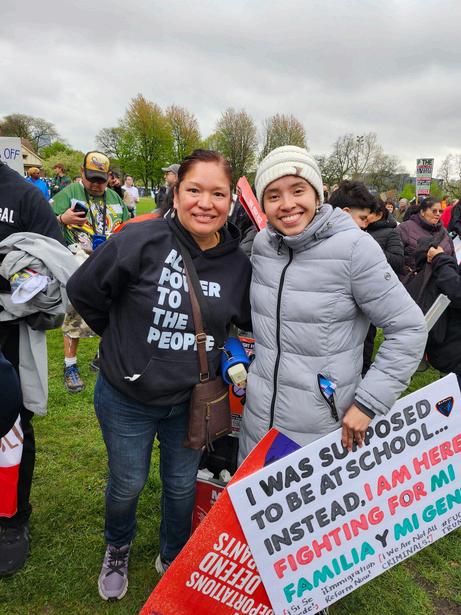
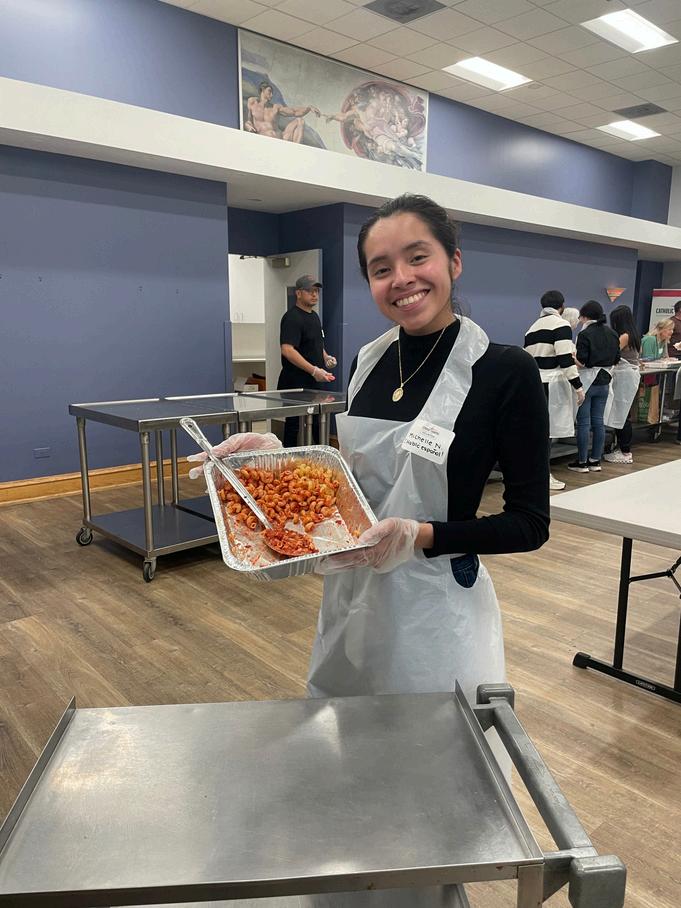
Arellano at the May Day Protest 2025 (top) and serving food during Tuesday Night Supper service
RECAP
Museum Visit
“Aquí en
Chicago” exhibition at the Chicago History Museum
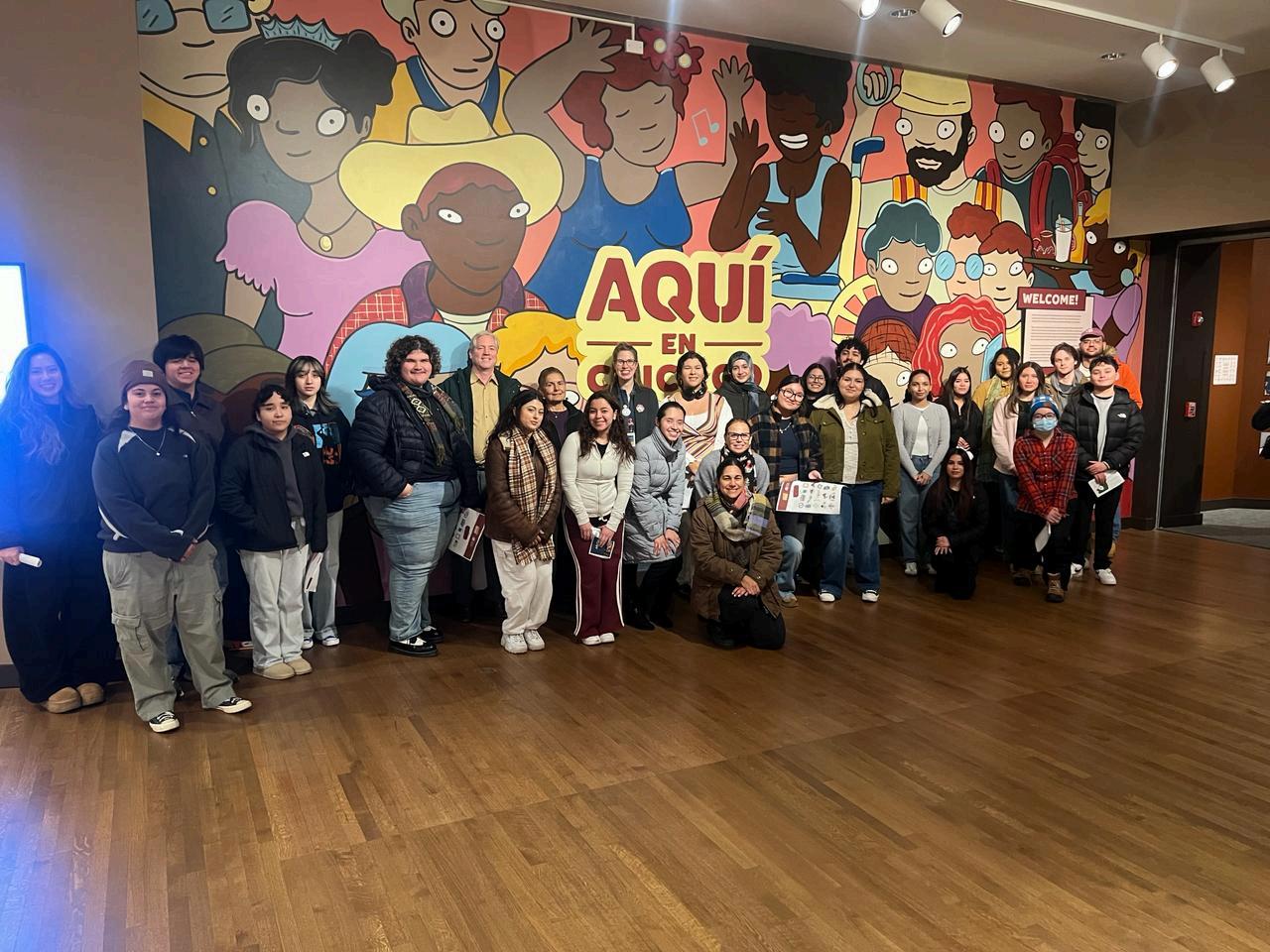
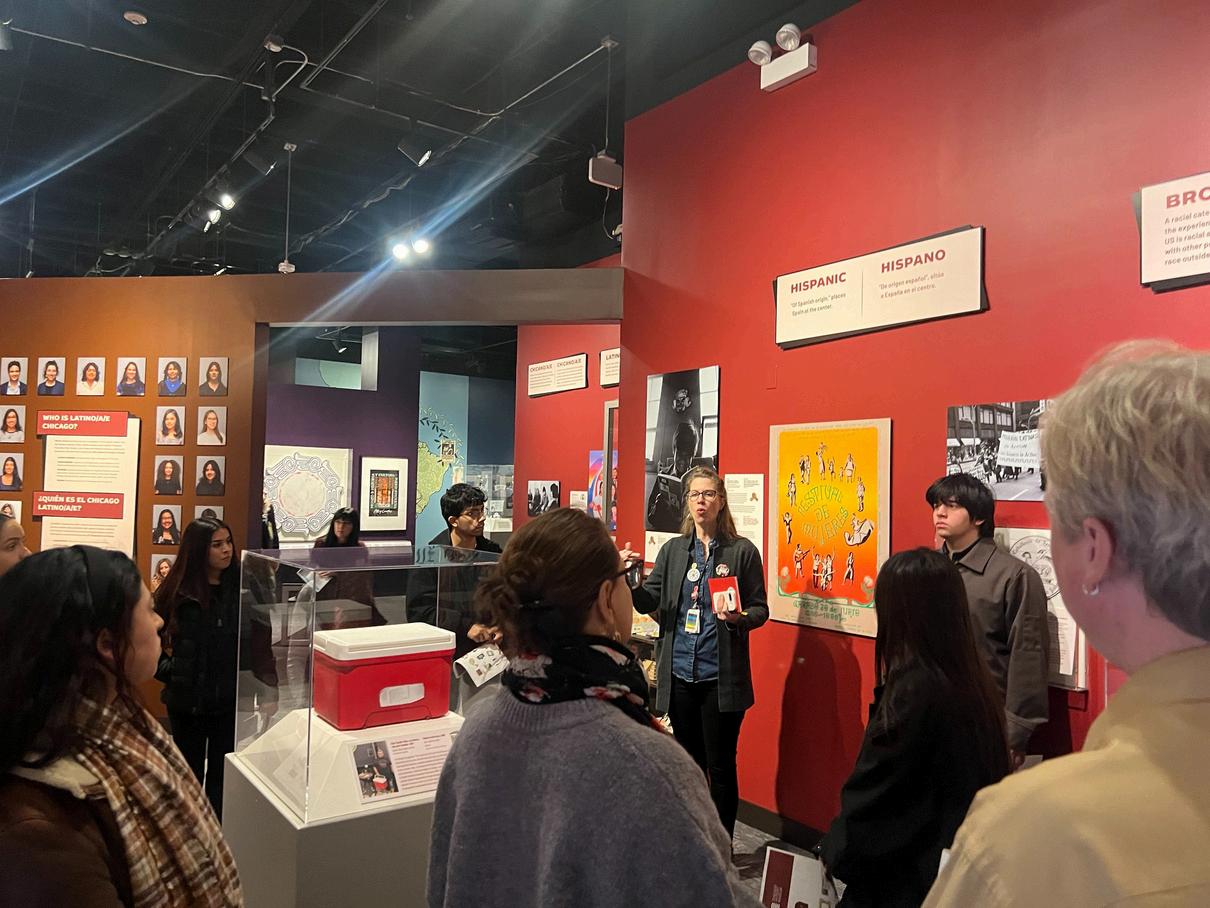

OnTuesday,November11,theCLR andLALSsponsoredavisittothe ChicagoHistoryMuseum(CHM)to see“AquíenChicago,”anew exhibitionhighlightingthehistory, contributions,andthepersistent culturalpresenceoftheLatinx communityinChicagoandthe surroundingsuburbs.Thegroup includedstudentsfromDr.JesseMumm’s“LatinosintheUS”courseandDr.CarolinaSternberg’s “StruggleandResistanceinLatinAmerica”course.
Wehadaguidedtourbythecuratoroftheexhibition,ElenaGonzales,whoexplainedthattheexhibition wasdevelopedindirectresponsetoa2019protestbystudentsfromtheInstitutoJusticeand LeadershipAcademyinPilsen,forthelackofLatinxrepresentationattheCHM.
Youdon’twanttomissit!
*Entry to the CHM is free for DePaul University students, faculty, and staff
Community Spotlight Community Spotlight
MAYDA ALEXANDRA DEL VALLE
POET LAUREATE POET LAUREATE
Mayda Alexandra Del Valle is a recognized poet, performer, and interdisciplinary artist. She’s a proud native of Chicago’s South Side of Puerto Rican heritage. Her literary contributions include the acclaimed
collection A South Side Girl’s Guide to Love and Sex (Tia Chucha Press) and The University of Hip-Hop, which was awarded the prestigious 2016 Drinking Gourd Chapbook Poetry Prize from Northwestern University Press.
Del Valle has been recognized through the Chicago Poet Laureate program, a collaborative initiative between DCASE, the Chicago Public Library, and the Poetry Foundation launched in 2023. As part of this honor, which awards $70,000 to support the commissioning of new poems and public programming, she serves as a vital ambassador for Chicago’s literary and creative communities.
We are excited to see the Del Valle’s wonderful work! Felicidades!



LATINX LATINXOPEN HOUSE
On October 2nd, the Center for Latino Research, Latin American and Latino Studies Department, Latinx Cultural Center, and Latines Empowered at DePaul came together to host an open house. Thank you to all of the students, staff, and faculty who joined. It was a vibrant and educational event!

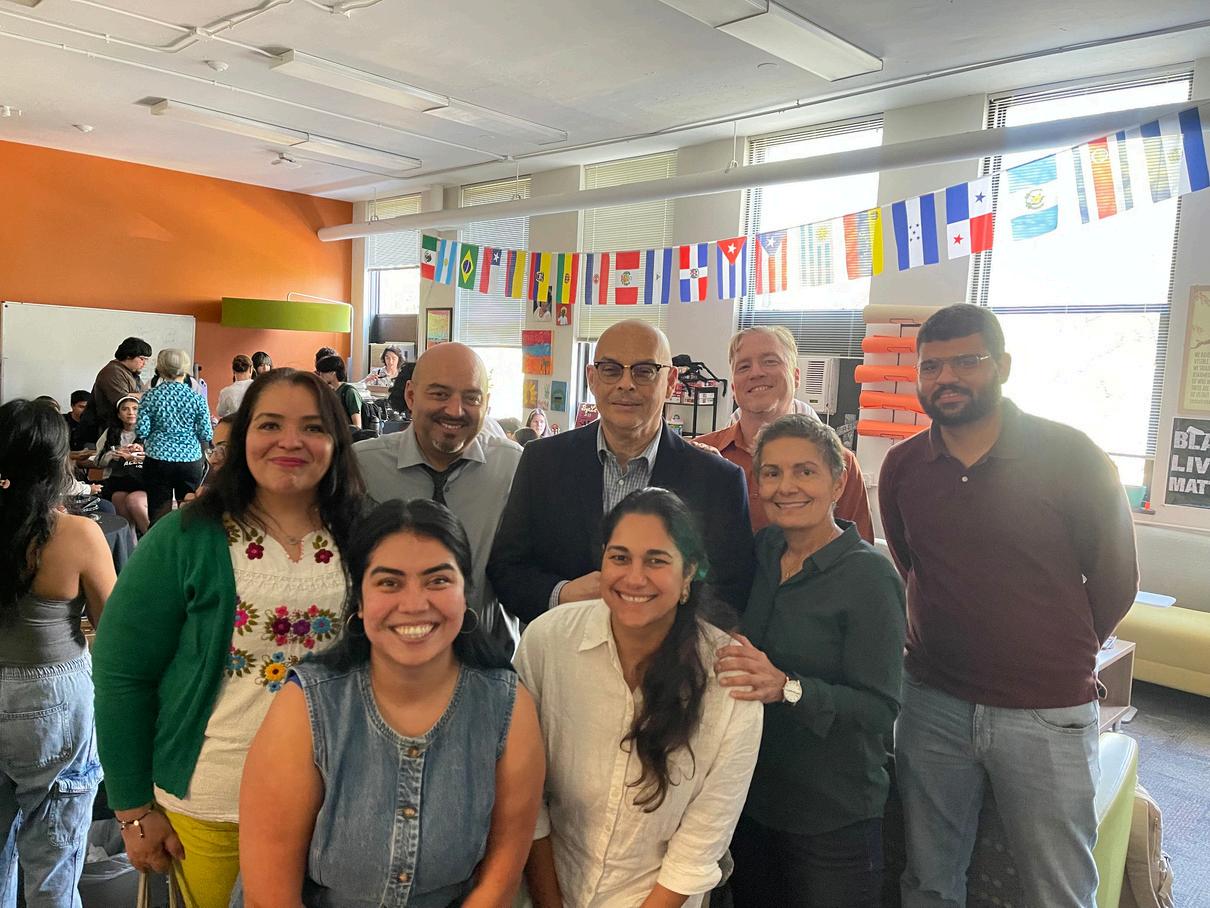

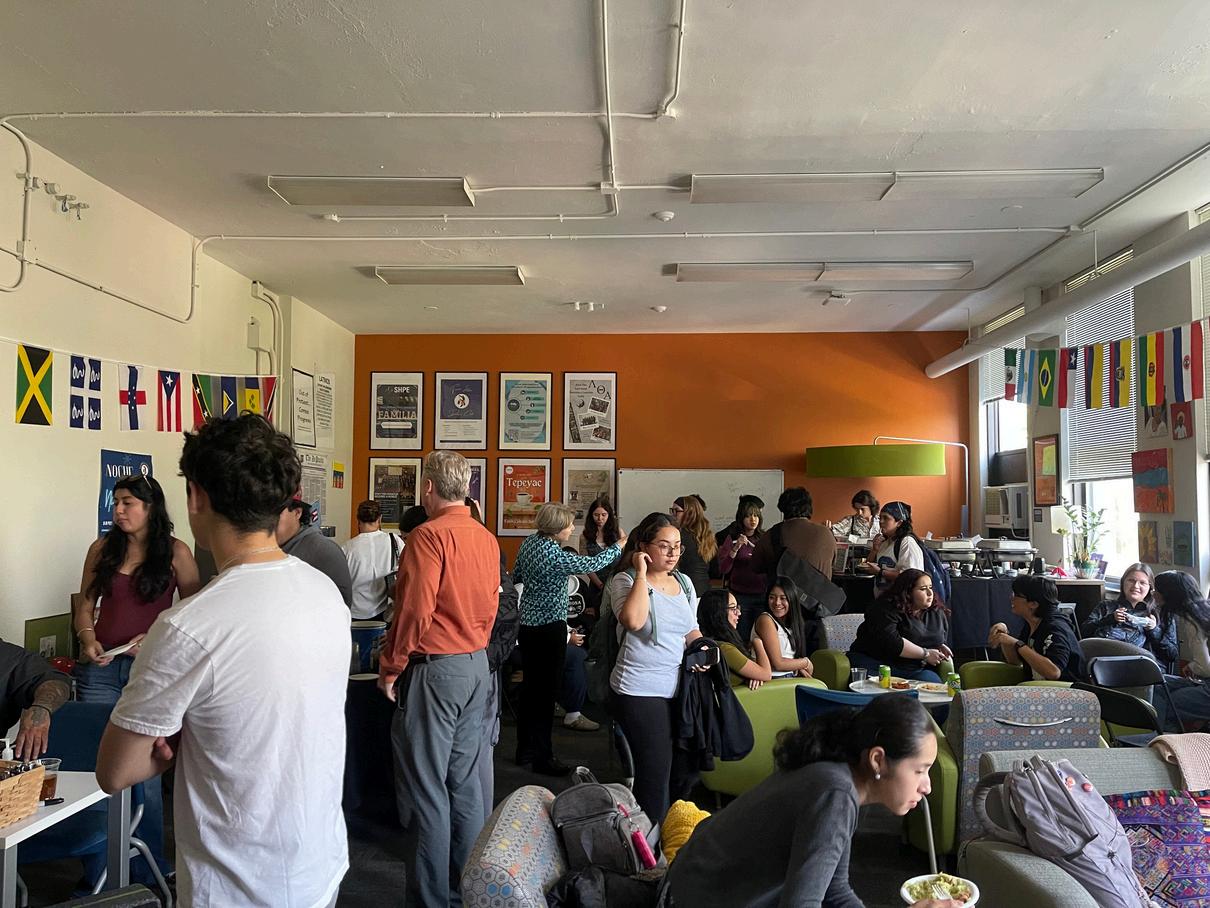


LATIN AMERICAN AND LATINO STUDIES
This interdisciplinary department explores the broad dynamics shaping Latin American & Latinx experiences and draws courses and insights from multiple fields. The Department of Latin American & Latino Studies also serves to deepen Latinx students’ awareness of their cultural heritage.
CORE COURSES
Camila Gavin
T/Th 1 00- 2:30 PM
Lourdes Torres
M/W: 1:00 - 2:30 PM
LST 201: Struggle and Resistance in Latin America*
LST 202: Constructing Latino Communities*
OTHER COURSES IN LST/LALS
LST 145/HAA 145: Arts of Americas
LST 207/ABD 206 : Afro-Caribbean and Afro-Latin America
T/TH:9:40-11:10am
M/W:9:40-11:10am
LST 217/SOC 217: Working in A Globalized World Async
LST 226/PSC 226: Latino Political Behavior
T/TH:11:20-12:50pm
Dr.SarahHolman
Dr.JacquelineLazú
Dr.MarthaMartinez
Dr.JoeTafoya
LST 300 section 304/SPN262E: Women and Film RocioFerreira
LST 306: Latino Communities in Chicago
LST 308: Motherhood in Latino Communities
LST 312/LGQ 397: Latinx Sexualities
LST 310 Section 301 /PAX 372: Trauma Art and Resistance
LST 310 Section 302/CES 403: Cities and Racial Formations
LST 310 Section 303: Latinx Psychology
Other departments - courses of interest:
ANT 201: Anthropology/Ethnographic Methods and Practice
HST 367: US Mexican Borderlands
SOC 290: Capitalism and US Immigration
**Spanish courses can be used for the major/minor in LST

@LALS depaul
W:6:00-9:15pm
T/TH:11:20-12:50am Dr.JessieMumm
T/TH:4:20-5:50pm
*These courses fulfill Liberal Studies SCBI requirement LST 306 and LST 308 fulfill Liberal Studies experiential learning requirement
Dr.HeatherMontesIreland
M/W:9:40-11:10am TBA
M/W:1:00-2:30pm
W:6:00-9:15pm
T/TH:4:20-5:50pm
Dr.JericaArents
Dr.CarolinaSternberg
Dr.GremlinUlerio
T/TH:1:00-2:30pm Dr.JordanLevy
M/W9:40-11:40pm Dr.JuanMora
T/TH:1:00-2:30pm

Dr.JoseSoltero
Formoreinformation,contact ltorres@depauledu
Contact Us
LALS | CLR
Lourdes Torres
LALS Chair ltorres@depaul.edu
Bill Johnson González
CLR Director bjohns58@depaul.edu
Marcela L. Reales Visbal
CLR Assistant Director mrealesv@depaul.edu
Gigi Lara
Student Assistant alara26@depaul.edu
Michelle Cisneros
Student Assistant mcisne11@depaul.edu
Goutam Kumar
Graduate Student Assistant gkumar5@depaul.edu

Follow us on Instagram @clr depaul @lals depaul
Email us clr@depaul.edu lals@depaul.edu
Call us (773) 325-7316 (773) 325-4818
Visit us 2320 N Kenmore Ave
Schmitt Academic Center (SAC), 5A-H Chicago, IL, 60614

Like us on Facebook Center for Latino Research-DePaul University
The Department of Latin American and Latino Studies-DePaul University