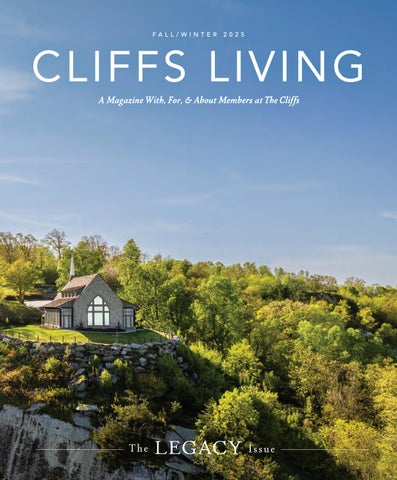
CLIFFS LIVING
A Magazine With, For, & About Members at The Cliffs

![]()


Across seven private club communities, life at The Cliffs is shaped by extraordinary landscapes and intentional design—where Western Carolina mountains, Lake Keowee, and award-winning fairways become the backdrop to a life well lived. Through Cliffs Realty, ownership is a thoughtful, guided experience, connecting you to properties that reflect your vision of a perfect place to call home.
With one club membership, you’ll get unlimited access to everything The Cliffs has to offer.

of

LETTER FROM THE EDITOR
Editor Hailey Wist reflects on the stories and moments that define Cliffs Living.
GATHER
Take a look at some of the festive gatherings hosted by The Cliffs.
BLUE RIDGE FAIRWAYS
Professional golf takes center stage in the Blue Ridge with a PGA TOUR event and the Carolinas Open.
BLESS YOUR HEART
Explore our favorite Southern sayings, where language carries history, humor, restraint, and meaning.
SMALL WONDERS
Three members find meaning outdoors through fishing, photography, and quiet connection.
DESIGNING COMMUNITY
Leading architects shape our communities through buildings that honor landscape, wellness, and shared living.
WILD DESIGN
Landscape architect Kenny Collins champions native-forward gardens, blending beauty, biodiversity, and stewardship. 14 20 96 7
CAMP SUMMER
A century-old Carolina camp tradition shapes confidence, independence, and lifelong connections.
THE HOME TABLE
An inside look at Chef Francis Turck’s effortless in-home dinners, where hospitality feels personal.
HOME AT THE CLIFFS
Step inside the lives of members Jay and Kathy Campana and Sandy and Perry Helm.
SIGHTS AND PEOPLE OF THE CLIFFS
A Sunday croquet tradition at Walnut Cove blends friendly competition, laughter, and classic style. 50 42 86 28 76 104 64 110 118
Explore this collection of images shared by our talented members.
IN THEIR OWN WORDS
Vincent Fournier shares his journey to building thoughtful homes and lasting community at The Cliffs.
LAST LOOK


EDITOR AND DESIGNER
HAILEY WIST
MANAGING EDITORS
KRISTIE HARRIS
ERIN FORRET
COPY EDITOR
SUNNY GRAY
PUBLISHER THE CLIFFS
JEFF ABBOT
AMY ANDERSON
GRAHAM BEACH
RHONDA CALDWELL
JAY CAMPANA
KATHY CAMPANA
KENNY COLLINS
LUCINDA DETRICH
NATHAN DURFEE
CONTRIBUTORS
ARTMASLYANA
JOEL CALDWELL
VINCENT FOURNIER
ROBERT GOMEZ
HEATHER HAMBOR
STEPHANIE HUNT
SANDY LANG
PATRICK O’BRIEN
JOANNY PALSSON
ZACK PEELER
NICK RIDDLE
SPECIAL THANKS
JIM HANNAN
SUSAN HANNAN
PERRY HELM
SANDY HELM
LOUISE LE GARDEUR
DANIEL LIBESKIND
LAURIE METZGER
GRANT MOSES
BOB PHILLIPS

CHRIS RANDOLPH
CHRIS SHOPE
TIM SLATTERY
SARA SMITHSON
KEITH SUMMEROUR
FRANCIS TURCK
JORDAN UPPLEGER
MARY VILLMOW
MARKI ZANDER
3851 Highway 11, Travelers Rest, SC 29690 864.249.4379 | cliffslivingmagazine.com | magazine@cliffsliving.com
For advertising, additional copies, or to distribute at a business, please inquire at magazine@cliffsliving.com. Advertisement herein for any product or service does not constitute or imply its endorsement, recommendation, or favoring by The Cliffs or its affiliates. Cliffs Living is published two times a year by The Cliffs. All rights reserved. Reproduction in whole or in part of any material in this publication without publisher’s permission is strictly prohibited.

Fulfillment often comes from paying close attention: to light on the water, to movement in a stream, to the simple pleasure of being outside with purpose.
As the season shifts and the days stretch longer, there’s a natural rhythm to life at The Cliffs. This issue explores the Art of Living : the ways members spend their time, connect with the landscape, and experience a life that feels both active and fulfilling.
In “Small Wonders” (pg. 42) we meet three members whose outdoor pursuits—whether fishing, photography, or quiet observation—draw them deeper into the landscapes that surround them. Their stories are a reminder that fulfillment often comes from paying close attention: to light on the water, to movement in a stream, to the simple pleasure of being outside with purpose. That same sense of connection carries through “Wild Design” (pg. 64), where thoughtful gardening becomes an act of stewardship. Planting native species is more than an aesthetic choice; it’s a way to participate in a larger ecosystem, and to feel rooted—quite literally—in the place you call home. “The Home Table” (pg. 86) highlights another essential part of life at The Cliffs: gathering. I spent an evening at the Hannan home as Chef Francis Turck prepared dinner for their friends. As the sun went down over Lake Keowee, the conversation flowed, the meal unfolded, and the evening lingered. It was a reminder of how good life can be here.
This issue is about those moments—the small, meaningful choices that shape a life well lived. I hope these stories inspire you to step outside, pull up a chair, and savor the art of living.

Hailey Wist | Editor and Designer
To submit photos, story ideas, or feedback about Cliffs Living, email magazine@cliffsliving.com. We also encourage you to help grow our community by sharing Cliffs Living with family and friends, and then invite them to join you here as a member.

With over 70 homes constructed throughout The Cliffs communities, Evergreen is here for your homebuilding needs. We are a full service custom building company that prides ourselves in the quality and craftsmanship we provide to our customers. We are also proud of the relationships we have built with our clients along the way. Evergreen is an original member of The Cliffs Preferred Builder program and look forward to discussing your new home in The Cliffs.


Private jet charters for executives, business owners, and avid travelers who prioritize time, comfort, and exceptional service. Our tailored flying experience is crafted to optimize productivity, relaxation, and convenience throughout your trip. Travel Wisely.


Throughout the year, The Cliffs hosts dozens of soirees, golf tournaments, and events for members and their guests. Here’s a snapshot of a few gatherings from this past Fall and Winter.
PHOTOGRAPHS by ZACK PEELER


In 2026, professional golf returns to Western North Carolina with the Carolinas Open at The Cliffs at Mountain Park in July, followed in September by the inaugural Biltmore Championship Asheville—part of the PGA TOUR’s FedExCup Fall—marking the Tour’s first appearance in the Asheville area in more than eighty years and placing the region firmly back on the national golf map.
STORY BY JOANNY PALSSON


In 2026, professional golf will return to Western North Carolina. From September 17–20, the inaugural PGA TOUR Biltmore Championship Asheville will debut at The Cliffs at Walnut Cove, marking the PGA TOUR’s first appearance in the Asheville area in more than eighty years. The announcement introduces a new chapter for the region and positions Walnut Cove as one of the most distinctive venues on the FedExCup Fall schedule.
The tournament will bring more than one hundred PGA TOUR players to a course renowned for its elevation changes, strategic design, and the rolling contours of the Blue Ridge Mountains. The Jack Nicklaus Signature layout at Walnut Cove has long been regarded as a course that challenges players through nuance rather than brute force. Subtle terrain shifts, disciplined approach angles, and the balance between risk and control define the experience—a contrast to many traditional PGA TOUR setups. As Jordan Uppleger, Vice President of PGA TOUR Events, explained, “Anytime you get on a signature Jack Nicklaus course, it provides a really, really challenging competitive setting for our athletes,” a feature well suited to the PGA TOUR’s vision for a fall-season test.
For the PGA TOUR, selecting Walnut Cove was the result of history, familiarity, and proven championship potential. The property previously hosted a Korn Ferry Tour event, an experience that left a lasting impression. “We were familiar with the property from that perspective, and we knew that it could host championship-worthy golf,” Uppleger said.
The tournament’s name reflects the partnership behind it. The Biltmore Championship Asheville is supported by title sponsors Biltmore Estate and Explore Asheville. Their involvement underscores a collaborative effort to showcase one of the region’s most compelling destinations on a national stage.


“Anytime you get on a signature Jack Nicklaus course, it provides a really, really challenging competitive setting for our athletes.”


Asheville’s growing reputation as a hub for food, arts, and outdoor recreation further elevates the significance of hosting a PGA TOUR event. The landscape’s natural beauty will shape the experience for both players and spectators, adding to the tournament’s appeal.
Preparations for the Championship are already underway, with planners, partners, and the Walnut Cove community working to ensure the course and its surroundings meet the demands of a PGA TOUR event. From agronomic planning to spectator routing and hospitality, the effort reflects both the scale of the Championship and the pride the region takes in hosting it. Uppleger emphasized the strength of the partnership, noting the warm welcome and enthusiasm from The Cliffs community as “a true sign of success.”
The tournament also highlights the area’s potential as a long-term competitive golf destination. While Western North Carolina has long been celebrated for its scenic courses and strong recreational golf culture, securing a PGA TOUR event reinforces the region’s standing within the sport. Walnut Cove’s selection signals confidence in its infrastructure, community support, and the unique experience the course can offer players and fans. As Uppleger noted, “Highlighting The Cliffs is a fantastic way to show how beautiful the area is.”
The Biltmore Championship Asheville marks a pivotal moment for golf in the Carolinas. It brings professional competition back to a region rich in natural beauty and hospitality, while also serving as a meaningful opportunity to spotlight Asheville as it approaches the two-year anniversary of Hurricane Helene, driving renewed tourism and national attention. As anticipation builds, Walnut Cove is poised to introduce a national audience to a course and community that has long been celebrated.

“It’s championship yardage with great greens and great conditioning…it’ll be a great test of golf.”


The Cliffs at Mountain Park will proudly host the 2026 Carolinas Open, bringing one of the region’s most enduring championships to a venue known for its thoughtful design and strong ties to competitive golf. Scheduled for July 13–16, the event will draw top professionals and amateurs from across North and South Carolina to compete on a course that rewards precision and strategy.
Mountain Park’s routing—walkable, naturally contoured, and seamlessly integrated with the landscape—offers a balanced but demanding test. Its riverfront movement and risk-reward opportunities make it an ideal stage for a championship with a history spanning more than a century. “Every hole out there is really memorable,” said Jeff Abbot, Executive Director of the Carolinas PGA. “It’s championship yardage with great greens and great conditioning… it’ll be a great test of golf.”
For generations, the Carolinas Open has served as a proving ground for emerging talent and a stage for competitors who have shaped golf in the region. With more than one hundred years of history, its lineage includes revered names such as Bobby Locke, Dow Finsterwald, and Davis Love Jr.—all a testament to how deeply golf is woven into the fabric of the Carolinas.
The Gary Player signature golf course’s setting further elevates the championship experience. Situated in a valley along the riverbed, Mountain Park offers a distinct links-style character and a dramatic finishing stretch. “The final three holes will have incredible theater,” Abbot noted, highlighting the long par-three at sixteen, the drivable par-four at seventeen, and the par-five closing hole where momentum can shift instantly. It’s a layout built for excitement and a worthy champion after fifty-four holes.
Tournament week will also include a Monday Pro-Am supporting PGA REACH and its PGA HOPE programs for veterans. As preparations begin, the Carolinas Open stands as a reminder of the tradition and longevity of competitive golf in the region. In 2026, one of the Carolinas’ most storied events will once again unfold on a course that embodies the heritage of golf in the Southeast.
Language in the South has always been more than communication; it is texture, rhythm, and inheritance.


STORY BY HAILEY WIST ILLUSTRATIONS BY ARTMASLYANA
These sayings are born from heat, hospitality, and a way of life shaped by kinship. Many of the region’s most recognizable expressions began with Scots-Irish settlers, blended with African American vernacular traditions, and settled in through generations of storytelling. Today, they are part of the landscape—phrases that may draw a laugh, soften a truth, or signal familiarity.

Take “fixin’ to,” perhaps the most quintessential Southern future tense—“I’m fixin’ to go fishin’.” Life in this region isn’t rushed; it bends around daylight, weather, and the rhythms of home. “I’m fixin’ to go” nods to that inheritance—time can wait a moment, and there’s no need to hurry what will unfold anyway.
“Bless your heart” is another expression that reflects the South’s layered emotional code. At its warmest, it is comfort, an acknowledgment of hardship or frustration. Yet it can also serve as a polite buffer for criticism—a way to maintain grace while still telling the truth. The duality is the point. Southern language often carries kindness on the surface, complexity beneath.
does not simply mean about to. It signals preparation, intention, and the acknowledgment that movement begins in the mind before the body follows.


From the farm and field comes “That dog won’t hunt,” a phrase that once described a hound unable to work but now applies to any idea lacking sense or substance. Southern speech has a reputation for being slow or lyrical, but phrases like this prove it has always prized clear judgment earned from experience.
On the more playful end of the spectrum sits “catawampus,” meaning crooked or slightly off-center. The word likely evolved from a blend of early American slang and Scots-Irish sound patterns, shaped by a culture that enjoys the feel of language as much as meaning itself. Southern phrases are memorable not just for what they express but also for how they land in the mouth— rhythmic, and sometimes humorous.


“He’s too big for his britches”
cuts pride down to size without raising its voice.
And then there is “grinnin’ like a possum eatin’ a sweet tater,” an expression rooted in the region’s close familiarity with its natural world. The image is specific, vivid, and entirely local. Southern language often comes from what was observed long before it was written down. It captures satisfaction with a kind of unselfconscious delight; the South has always known how to savor joy.
“Sweatin’ like a sinner in church” ties together climate and culture in a single phrase. The Southern summer is legendary, and the church is a longstanding social anchor. The humor acknowledges both without judgment: everyone is human, everyone is hot, and everyone is trying their best to stay composed.
“Hold
offers a gentle break—make some space between decision and action.
“Don’t poke the bear”
is as much wisdom as warning— choose your battles, and choose them sparingly.


“Hush your mouth”
is a phrase that is less about silence than about tone—a signal that something is better left unsaid, at least for now.
“Slower than molasses in January”
remembers a time when molasses thickened in a cold pantry and simply had to be waited on.

is the kind of observation born from looking closely and knowing there’s a particular kind of fullness that leaves no room for more—literal or otherwise.
Together, these expressions tell a story. They reflect a place where speech is slow not because thought is slow, but because words are chosen with care. They carry memory, humor, and history—a living lexicon shaped by land, work, community, and time. Even as the South continues to evolve, these sayings endure, out of nostalgia, but also because they continue to fit the world they describe.


isn’t about sweetness; it’s about familiarity, affection, the greeting of kin.


“As pretty as a peach”
is both a compliment and a regional emblem—beauty measured in color, softness, and ripeness of the moment.
“Y’all”
(and its emphatic cousin, “all y’all”) may be the most democratic word in the Southern lexicon. It is an answer to a grammatical gap—a plural you that gathers people in. “Y’all” is inclusive by nature, warm without being familiar, efficient without being abrupt. And when clarity truly matters, “all y’all” leaves no one behind—an unmistakable widening of the circle.


We are a dedicated team of conscientious craftsmen who handle every aspect of the home building process from grading the site to finish carpentry. Our distinct team-oriented approach allows our craftsmen to pour the best of their craft into every detail of your new home or remodel, which results in dreams realized by our clients, and unparalleled examples of craftsmanship in each detail of the projects we undertake.
MORE ABOUT OUR APPROACH


For ears BOGARI has been se ng the trend in fine contemporar f rnishings and has been promo ng the rban lifest le to the fast gro ing Green ille area. We offer f ll interior design ser ice ith a commitment to high q alit merchandise and the highest le el of c stomer ser ice.


Locally and nationally recognized for excellence in design and construction, Gabriel Builders blends precision, artistry, and personalized service to bring luxury custom homes to life.
From interior design to fine wood craftsmanship, our in-house team ensures no detail is overlooked.
Schedule a consultation today and take the first step toward your luxury custom home.

864.879.3035 | GabrielBuilders.com


From hiking and fishing to photography, The Cliffs is an ideal backdrop for creativity and connection. Meet three members who grab their gear, pull on hiking or wading boots, and head out into nature for the hobbies they love.
PHOTOGRAPHS BY NICK RIDDLE
Size matters in fishing—typically, the bigger, the better. But for Mary Villmow, her pursuit is the tiniest of fish. On hikes lately, she’ll bring her micro fishing gear. The telescoping pole isn’t much bigger than a chopstick, the line nearly as thin as human hair, and then a super-tiny hook baited with a morsel of worm.
What she seeks are the typically overlooked minnows and nongame fish hovering on the bottom of chilly forest streams, each smaller than your index finger. She says her two most prized catches are the creek chub (the tiniest she’s caught on a hook) and the colorful tangerine darter (brilliant turquoise-green and orange). Both are among the 140 or so native freshwater fish species of the Carolinas.
“I’d snorkeled in the Caribbean and Hawaii, but I had no idea of the mysteries underwater here—fish, mussels, salamanders, leopard frogs, aquatic turtles—just a whole host of beauty.”
Once she coaxes a wild fish onto the hook, The Cliffs at Mountain Park homeowner typically will gently transfer it briefly to a water-filled viewing box—getting a clear view of the fish and its fins when raised, how they naturally look in the water. She takes photographs to help her identify the fish, and then uses jeweler’s tools to remove the hook—everything is mini-sized and carefully done. It is a bit like field biology. Villmow notes that her catchand-release hobby is much more akin to birdwatching than to traditional fishing. (In Japan, micro fishing has been popular for centuries.) She’s keeping a life list of the species she’s caught and observed—to date, totaling about
two dozen species caught on a hook and another dozen observed while snorkeling or netting fish in nearby streams as a volunteer at various conservation events.
Her passion for the tiny fish is new. Originally from Chicago, Villmow and her husband, Keith, first visited The Cliffs in 2019. Both entering retirement years, her husband was interested in the golfing opportunities, and she was excited about hiking and biking. Villmow, who has a liberal arts degree and worked in marketing, says she’d always been “a real city girl.” While she didn’t grow up fishing, the move to South Carolina kindled an interest in science and biology.
“I was amazed by the beauty of the Southeast,” Villmow says, and she eagerly began to learn more about the plants, animals, and ecological diversity in the region. Eventually, she enrolled in the twelve-week Master Naturalist course through Clemson University. And it was during the comprehensive sessions—covering everything from geology to tiny invertebrates, plant biology to water quality—that she learned about the myriad of native species in the rocky beds of local streams and rivers.
Among the many bodies of water she’s fished and explored are the clear waters of Terry Creek and the Saluda River on the Valley and Mountain Park golf courses, as well as the Chattooga River watershed, Long Shoals Wayside Park, and other fishing holes along the Cherokee Foothills Scenic Highway. Her gear is so minimal that she says she often has it with her, just in case she happens upon a stream. “It’s a fun little hobby—there’s a thrill you get,” she says. “If anybody’s interested in micro fishing, I’m happy to introduce them to it.”


“I HAD NO IDEA OF THE MYSTERIES UNDERWATER HERE—FISH, MUSSELS, SALAMANDERS, LEOPARD FROGS, AQUATIC TURTLES—JUST A WHOLE HOST OF BEAUTY.”
“I’LL GET UP BEFORE DAWN AND HEAD TO A LOCATION AND WAIT FOR THE SUN TO COME UP.”


“It’s kind of amazing when you sit quietly in the morning,” says Laurie Metzger, who likes to wake early enough to be on her dock on Lake Keowee before the sun rises. “I walk down to the dock with my coffee and my dog, and I watch these amazing sunrises.”
She and her husband built their home on the water with a wide southeastern view, so she has an especially good vantage point for observing—a lone fisherman, scullers rowing, a heron fishing, otters, beavers, and foxes.
The scenery at The Cliffs at Keowee Falls captivates Metzger, who notes that there’s an especially beautiful quality to the light on the lake happening about thirty minutes before full daylight. She started bringing her camera to the dock to try to capture it. From the first image, she was hooked. Before shifting her focus to parenting during her son’s and daughter’s childhood, Metzger worked in banking and then as an industrial photographer and a portrait photographer. The lake images were her first foray into landscape and waterscape photography.
Metzger photographed Lake Keowee pre-dawn on more than 450 days during the pandemic. In those unusual times, it was a way “to try to find the beauty in the world,” she recalls. And she shared her photography, posting daily images to social media. That led to sales and gallery showings—she’s now a member of the Art Gallery on Pendleton Square. Her passion for photography continues, and she says local hikes are a source of inspiration. Metzger is a co-leader of a hiking
group at Keowee Falls, with outings on Tuesdays from fall to spring. Through these hikes, she’s discovered other locations for her early-morning photography.
“I’ll get up before dawn and head to a location and wait for the sun to come up,” she explains. Several of her favorite spots are along hiking trails that she can walk to from home. Or she’ll drive to an overlook on the way to Cashiers, toward Sassafras Mountain, Pretty Place, or Table Rock. Once her Sony camera is securely on the tripod and she’s framed the shot, she says she’ll typically leave the shutter open for long exposures—five to twenty seconds. “That really enriches the colors, and if there’s water, it makes the surface glass-like.”
Metzger says she’s regularly scanning the horizon for photo subjects. “I keep my camera in my car,” she notes, recalling a recent drive when she stopped at a cotton field and photographed the rows. “I probably hung out for a half hour.”
She prefers to print the images in larger sizes, typically ranging from 30x45 up to six feet wide. Most are purchased by individuals for their walls at home, but she donates work to the Cliffs Residents Outreach annual auction and has a photograph hanging in the Keowee Falls Clubhouse. The subject of that print is the view from Pounding Mill Overlook on the Blue Ridge Parkway. Metzger says she arrived that day to “a low-lying fog, so it’s a very ethereal scene.” And she captured it during those magical minutes she loves, just before sunrise.
Dr. Bob Phillips was a dentist for thirty years at his practice near Philadelphia before he and his wife, Mitzi Cole, started looking for a retirement locale. A friend asked if they’d ever visited Western North Carolina. They hadn’t and soon booked a trip. Cole immediately fell in love with Asheville. And from his first look at the mountains, Dr. Bob was sold. He’d been fly fishing since he was twelve years old, so he was excited about the possibilities in North Carolina. He remembers walking into an outfitter’s shop on that first trip and asking if there were any good trout streams nearby. The shopkeeper unfurled a map so densely marked with locations that Dr. Bob realized he might never get to them all. But he wanted to try.
Phillips and Cole built their house in The Cliffs at Walnut Cove and moved in during the spring of 2019, after their youngest daughter graduated from high school. Dr. Bob was busy exploring nearby fishing spots when he suddenly had to put his outdoor pursuits on the back burner—that December, he was diagnosed with leukemia. For the next two years, he’d seek chemo and then stem cell treatments, including new techniques at the Duke Cancer Institute’s bone marrow clinic. It was a difficult time, simultaneous with the pandemic, so family visits were rare. Dr. Bob remembers a particular day when he was feeling especially low, and a nurse asked him to imagine his happy place. He closed his eyes and described what he saw. “I’m standing in a small stream. I feel the
water on my boots. I see the trees. That’s where I want to get back to—to get healthy, and to get strong again.”
The Navy veteran resolved he’d beat cancer, and eventually he did. (He still returns to Duke every six months for checkups and has remained cancer-free.) Able to fish again, he stepped up his outings. Dr. Bob now sets out on hikes to fly-fishing streams two or three days a week—often three or four miles to get to a remote spot. “I don’t like to fish around too many people. It’s more about observing what else is out there. I sit on a rock and just watch the water come over it. I notice the lichen. I’ve seen hellbenders [large salamanders] right at my feet that didn’t even see me.”
And he’s never troubled by weather, he says, likely because he grew up fishing on chilly, wet days in Pennsylvania. “When it’s cold and snowy here, I go out anyway,” he says. “The fish don’t care, they’re already wet.”
On the days he’s not fishing, Dr. Bob golfs or volunteers—he’s thankful he was able to help charitable efforts after Hurricane Helene in 2024. And when he does catch a fish, he always releases it. His favorites to find are wild brook trout, rainbow trout, and brown trout. He can still picture a beautiful brook trout from last fall. “About seven inches long, he was the prettiest I’d caught all year.”
And whether he catches twenty fish or none at all, he says he feels lucky to be outside in nature. “Having been at death’s door a couple times, I think, yeah, appreciate everything.”
“I
SIT ON A ROCK AND JUST WATCH THE WATER COME OVER IT. I NOTICE THE LICHEN. I’VE SEEN HELLBENDERS RIGHT AT MY FEET THAT DIDN’T EVEN SEE ME.”


At The Cliffs, some of the country’s leading architects are demonstrating how thoughtful architecture can enrich community living and the way we inhabit it.

To enter a building is to step into a dream.
After all, that’s where most buildings begin: in the swirl of Sunday afternoon post-nap musings. On a walk in the woods or around a lake, the mind wildly wandering. With curious jottings on the back of a cocktail napkin. The dream is sketched out on paper and refined through a 3D CAD rendering, eventually evolving into blueprints. Then, finally, nail by hammer by foundation pour, that dream becomes reality. Somehow, those initial sketchy scribblings coalesce into floor joists and framing, and voilà, a building. “Architecture is not based on concrete and steel and the elements of soil. It’s based on wonder,” said the Polish-American architect Daniel Libeskind. And when that wonder is activated, when architects dream big, that built reality—the roof overhead, those soaring ceilings, those interior and exterior spaces—retain their sense of wonder.
That’s the goal at The Cliffs, where South Street Partners has tapped some of the country’s leading architecture firms to dream boldly while creating the marquee public buildings anchoring The Cliffs communities. “The remarkable landscapes which unfold across The Cliffs seven communities are a constant source of inspiration and present endless opportunities to weave buildings into these spectacular natural settings,” says Chris Randolph, managing partner at South Street Partners. Across their portfolio of properties, South Street Partners works to ensure the built environment blends seamlessly with the natural environment, enhancing quality of life and the community’s sense of connection and wellness. At The Cliffs, this is evident in the thoughtful designs behind The Cliffs at Keowee Springs Clubhouse, designed by Hart Howerton; The Lake Club at The Landing, designed by Lake Flato; and the new Sports Pavilion at The Cliffs at Mountain Park, designed by Summerour Architects.
According to the architects at the New York- and San Francisco-based firm Hart Howerton, it’s time to rethink the “clubby” clubhouse. The days of dusky interiors, heavy drapes, and rooms filled with the aroma of cigar smoke are in the past, giving way to more modern offerings like pickleball, padel, and yoga with stunning mountain views right outside.
Instead of closed off and closed in, the Hart Howerton team envisioned the new Keowee Springs Clubhouse as an open—and open-air—invitation to awe. The hilltop site overlooking the 18th hole had already been selected and cleared when Hart Howerton was brought on. Upon seeing the panoramic view, the firm capitalized on the abundant natural light and spectacular vistas to create a dynamic gathering spot for family-focused experiences.
“We are an interdisciplinary firm—we do master planning, landscape architecture, and interiors, as well as building architecture—so we’re always thinking as much about the outdoor rooms as the indoor,” says Tim Slattery, partner at Hart Howerton. “We wanted people to feel they were arriving not to a building but to nature. The breezeway creates an arrival experience, opening through and into the building, which then opens onto a courtyard framing the view.” Poured-form concrete pillars give depth, while wood beams and a metal roof make for the muted exterior, “a quietness that blends with the landscape,” adds Slattery, “then on the inside, there are pops of color, the light and darker blues, and big windows everywhere.”
Slattery and his colleague Louise Le Gardeur envisioned the clubhouse as the “great room” for the broader community, a central gathering spot where members can come for Pilates in the morning, grab a latte and a barstool to catch up with friends at the sunny blue and white coffee bar, then return later for a sunset cocktail and dinner in one of the various dining rooms. Or, better yet, stay all day, enjoying the fitness room, conversations on the patios, or reading in the library. A hinged window in one bar opens to an outdoor patio in good weather. Kids can run around in the courtyards, while adults relax at the wine bar. “We wanted a variety of spaces connected by breezeways, a plan that’s inviting and intimate for the couple having a quiet dinner in the off-season and works equally well when the whole membership is here for a Fourth of July barbecue,” says Slattery.
Hart Howerton also designed residences at the adjacent Clubhouse Village. “We respected the vernacular of the area,” says Le Gardeur. “The homes all have a connection to the outdoors and a nod to traditional materials and colors, but are a little lighter and brighter, because that’s what people want and need these days. We’re so often in front of our computers, what we’ve designed offers a relief, with more connection to the outside, lots of porches and gardens.” The cohesively designed homes at Clubhouse Village are all about being energized by the outdoors, promoting walkability and bicycling with their proximity to the clubhouse pavilion and nearby amenities.


LAKE FLATO
Below the hills and lapping the shore of Lake Keowee, The Lake Club at The Landing, designed by the Texas-based firm Lake Flato, similarly takes its cues from the natural setting. The Lake Club is smaller than the clubhouse, but no less loaded with thought and intention. “We envisioned The Lake Club as a threshold to the water’s edge, framing the community recreation space while nestling it amidst the lakeshore landscape,” says Graham Beach, Lake Flato’s lead architect on the project. A series of boardwalks, pavilions, and pools terrace down the slope leading to Lake Keowee and a protected swimming cove. The pavilion’s vertical timber structure, with honeyed exposed beams beneath a metal roof and a modular wing of elevated horizontal wood slats, hovers above the land, treehouse-like, echoing the serene, wooded surroundings and rooting the architecture in the forested landscape. Inside are changing rooms, a restaurant, and a fitness facility. “The structures offer breezy shade during the day and are an inviting spot for a drink by the firepit at night,” says Beach. “It’s all about comfortable places to come together, relax, and maybe splash around a bit, while still feeling connected to the land.”
At the lake, boat slips make watersports readily accessible, with the lakeside Paddle House offering a convenient gathering spot and point of arrival or departure for water activities. Lawns and trails connect the pavilions to the Waterscape community of lakeside homes that Lake Flato also designed as part of the master plan. “Density here is desirable,” says Beach. “These two groups of unique residences in proximity to each other and The Lake Club add vibrancy and support the fabric of the community.” To the east is The Cove, where clustered homes share outdoor spaces and a generous lawn, perfect for group picnics, events, or fierce bocce competition.
To the north side of The Lake Club, The Treetops homes are nestled among the tall pines, with expansive windows offering views of the lake and surrounding woods. All the homes feature open kitchens and familyoriented living spaces, some with bunk rooms and lofts, and screened dining porches overlooking Lake Keowee. A network of trails leads to the dock and the clubhouse. “We designed this lakeside community for exploration and connection, both to fellow neighbors and to the outdoors,” Beach says.
When South Street Partners tasked Keith Summerour of Atlanta-based firm Summerour Architects with designing a new Sports Pavilion for The Cliffs at Mountain Park, Summerour drew inspiration from the region’s history. “Because of the hills and steepness in the Upstate, farms here tend to be smaller and the settlers’ barns not as large as elsewhere in South Carolina. We modeled the Sports Pavilion on that scale, a building that feels agrarian but approachable, with a cleverness in the use of materials associated with a barn,” Summerour says. “We wanted it as open-air as possible, so when you enter through a tall one-story portal, it looks like a foyer without doors, like a deconstructed barn or house.” There are openings where windows would go, but no windows—it’s all open air. Horizontal slats form the entranceway, and those deconstructed columns do double duty as lighting in the evening. “We placed garden lights inside the columns, and when the light hits the slats, it spills out to the surrounding area,” he adds. “The result is an interesting, romantic reflection in the water, which makes it feel different at night than during the day.”
Summerour wanted the Sports Pavilion architecture to “touch the water as closely as possible,” which reflecting light helps achieve. “These lit columns of slats magnify the effects of the water, and anytime you have a watering hole and an ability to cook or entertain next to it, that’s going to be a magnet. We want to draw people here, and entice them to stay.” Summerour’s design also incorporates indoor space for fitness and dining, while tennis, pickleball,
and padel courts, along with other sports amenities, complete the complex. “Health is the new luxury,” he adds, and social interaction is as much a component of health and well-being as physical activity. To that end, Summerour designed spaces that both honor nature and nurture community. “Instead of a pool that’s wide open, we wrapped cabanas around the arbors, so sunbathers and swimmers feel less exposed. Those sheltering principles make people feel more comfortable,” he says.
As Summerour, Beach, Slattery, and Le Gardeur all know, “a design isn’t done until someone is using it,” as noted interactive designer Brenda Laurel once said. That’s why Summerour hopes for time to sit poolside at the Sports Pavilion, maybe sip a drink, and observe how long people linger, how they move about enjoying different aspects of the club. “My hope is that they stay all day,” he says.
Creating spaces where relaxed, happy people can enjoy being together in a sublime mountain setting was the goal, and by all accounts, these architects have achieved it. The proof isn’t in the pudding as much as in the pools and pavilions, and in the laughter emanating from them. In the smiles of members milling about the courtyard at the Keowee Springs Clubhouse, or sharing a meal at the Sports Pavilion, or meandering along the trails at The Landing. The proof is how these thoughtfully designed spaces define the public realm and even private residences at The Cliffs, fostering a sense of well-being and communal connection. Or how, as Winston Churchill once quipped, “We shape our buildings; thereafter they shape us.”


Golf Ridge
SCAN THE QR CODE TO LEARN MORE ABOUT OUR NEW HOMES THAT NEIGHBOR THE SPORTS PAVILION.


Horticulturist Kenny Collins is redefining what it means to design for the future, creating spaces that are as enduring as they are alive.


Kenny Collins is on a mission to define the
As the owner and CEO of DabneyCollins, a design-build firm based out of Upstate South Carolina, Collins is often asked to create gardens rooted in the formal, meticulously controlled traditions of European countries. But his vision tells a different story. The New American Garden, as he sees it, blends structure with softness, weaving ecological function into elegant design. It’s a reimagined landscape, where natural edges support biodiversity, and beauty emerges through balance.
According to Collins, it all begins with a simple change in plant palette. “Often when I suggest native plantings to clients, they throw up the red flag. But they don’t realize that there are tons of plants that can be incorporated beautifully.” Butterfly milkweed, purple coneflower, bee balm, asters, swamp sunflower, coreopsis, goldenrod—all of these plants work alongside structured, linear elements and tried-and-true traditional garden plants, such as American boxwoods. “Gardens provide a valuable window into the changing seasons and wonder of the natural world,” Collins tells me. “Connection to nature is essential, and the more diverse and considered the plant palette, the more ecologically functional the system.”
Collins designs for a future where the structural elegance of well-designed gardens coexists with the wilder flora and fauna of the surrounding environment. “Even a single backyard can make a big difference. We can have well-functioning spaces that enrich our lives and also support the ecosystem we’re a part of.”
LEFT: THE GARDEN OF A HOME IN THE CLIFFS AT KEOWEE SPRINGS


Collins graduated from Clemson University with a degree in horticulture and a passion for creating outdoor spaces. Twenty-five years on, DabneyCollins has staff with expertise in landscape architecture, design, and construction. “Design is limited based on the ability to construct. You might have great ideas, but how do you put them together? As we’ve matured, we now have staff who can construct almost anything."

Soil pH: naturally acidic to slightly acidic
· Texture: loamy, rocky, or sandy, depending on slope and drainage
· Moisture: varies by microclimate; consistent rainfall supports rich plant diversity
· Microclimates: cooler in elevation; mild winters and moderate summers

· Support local pollinators and wildlife
· Improve soil structure and fertility
· Reduce erosion and stormwater runoff
· Require less irrigation and maintenance
· Create beauty that evolves through all four seasons
Collins believes that supporting the natural world and making your backyard an extension of the larger ecosystem, albeit with considerable refinement, elevates the garden experience. “If you look at a family that is thriving energetically, there’s this exchange that happens between one person and the next. That doesn’t stop with people. It also applies to nature. If you have that vibrant system around you, that richness, how would that change how you love your family, love your home?” But it’s not just about energy. “We have to get back to using the things nature has given us with purpose. It reduces your maintenance, increases your family’s interconnectedness, builds soil, and creates habitat, both for your family and the larger ecological community. Let the land guide the process.”
Collins is passionate about outdoor living spaces. Whether it's a pool or a fire pit, his designs focus on “opening up the home” and creating space for outdoor entertainment and engagement. Collins’s philosophy informs his process, letting the land dictate the design, with the goal of minimizing soil disturbance. “We use plant material, as much as possible, to retain soil,” referencing materials like trees, climbing hydrangea, and grids of rebar that host a living “green wall.”
According to Collins, “Every good landscape has layers. It's like a picture frame.” Perennial beds or annual plantings only look good for half the year, so you don’t want to plant them alone. “They don’t shine during the dormant season, so up front, we plant perennials behind an evergreen

border, so they pop up in all their glory during the growing season, but while dormant, you have that evergreen border.”
Thoughtful layers offer year-round beauty.
Beyond the manicured space, you have to blend back into the woods or the edges of the property line. Collins recommends strategically placing evergreen trees that create privacy and establish sightlines while also incorporating and expanding the native space. “Red maples, eastern redbuds, white oaks…we have a lot of eastern cedars that blend well with nature. Ideally, it doesn’t look too ‘landscapey,’ but blends with what’s already existing. At the very edge, you have an evergreen privacy screen.”
Increasingly, Collins sees potential along the edges of property lines and community roads to plant native species—grasses like little bluestem, muhly grass, Indian grass, and switchgrass paired with native herbaceous plants. “We can create a soft, easy-on-the-eyes habitat that saves on your maintenance budget and is a better visual.”
Erosion control remains a top priority for design-build projects in the mountains. While mulch has historically been used as a cover for disturbed soil, it lacks sustainability and offers only short-term erosion prevention. Instead, reestablishing the soil with a diverse mix of native ground cover is far more effective and enduring.
Collins wants to use native plants to reestablish areas that are prone to erosion. His “native mix” is a triple win: it holds the soil, preventing erosion, while also supporting biodiversity and, importantly, providing browsers an alternative food source to your garden. It also creates a great-looking space that doesn’t require herbicides or weekly maintenance.
Collins’s suggestion: “Let it grow. Once a year, have someone go in and remove the invasive plants, and after a few years, it’ll acclimate.” These native meadows will contribute seasonal interest, providing homeowners with a dynamic landscape that changes throughout the year, one they will look forward to observing.

White Oak ( Quercus alba)
A keystone species. White oaks support hundreds of species of caterpillars, which are critical food for birds, and produce acorns that sustain wildlife from fall through winter.
Eastern Redbud (Cercis canadensis)
One of the earliest spring bloomers, providing vital nectar for native bees emerging from winter. Its seeds also feed birds, and its size makes it ideal for residential landscapes.
Serviceberry (Amelanchier arborea)
Highly valuable for wildlife, offering early flowers for pollinators and summer berries for birds. Its multi-season interest makes it both ecologically and aesthetically strong.
Switchgrass (Panicum virgatum)
A native warm-season grass that stabilizes soil, improves water infiltration, and provides nesting habitat for birds. Excellent for meadows, borders, and restoration work.
Purple Coneflower (Echinacea purpurea)
This is a pollinator powerhouse that supports bees and butterflies throughout summer, with seed heads that feed birds well into winter.
Butterfly Milkweed (Asclepias tuberosa)
Essential for monarch butterflies as a host plant, while also attracting a wide range of native pollinators. Thrives in welldrained soils common in the region.
Black-Eyed Susan (Rudbeckia hirta)
Fast-establishing and long-blooming, it provides abundant nectar and pollen and is especially valuable in early restoration plantings.

American Beautyberry (Callicarpa americana)
Its vivid purple berries are an important fall food source for birds. The plant also supports native insects and thrives in woodland edges.
Southern Magnolia (Magnolia grandiflora)
Beyond its iconic presence, it offers habitat and nesting cover for birds and supports native beetle pollinators that predate bees.
Blue Wild Indigo (Baptisia australis)
A deep-rooted perennial that improves soil health through nitrogen fixation and supports specialist pollinators, particularly native bees.


Comprehensive wealth management helps bring your vision to life.


Whether you’re planning for retirement, pursuing new endeavors, or transferring wealth to those closest to you and the causes you care about, let us help in crafting a legacy as splendid as The Cli s.
Based in Asheville, our wealth advisors now o er the extensive resources of a national trust bank, including:
• Integrated Financial Planning and Investment Management
• Access to Alternatives and Private Capital
• Strategic Tax Planning and Return Preparation
• Estate Planning and Trust Administration
• Donor-Advised Fund for Planned Giving
• Private Banking Services
We listen, understand, and tailor our approach to fit your unique journey. Let us guide you through a retirement filled with peace, prosperity, and purpose.
Schedule your personal consultation today. amgnational.com/boysarnold/cli s
Our luxury residential and resort communities are de ned by quality, lasting value, and a commitment to designing with nature. Known for thoughtful planning, timeless architecture, and world-class amenities, these highly regarded communities o er residents access to outdoor pursuits and wellness in naturally inspired settings. Each community fosters a strong connection –to place, to people, and to the environment. Discover ownership in one of our coveted residential communities today. It’s time to revel in the now.


For more than a century, the mountains, forests, lakes, and cool air of the Carolinas have drawn generations of children to camp—attracted by the same natural beauty and sense of freedom that continue to draw members to The Cliffs today.

These camps didn’t arrive by accident; they were established where the landscape invited exploration, independence, and time outdoors. In many ways, the camp tradition reflects the values that shape life here now: a reverence for unspoiled nature, a belief in the formative power of place, and an understanding that the most lasting experiences are built season after season. This is why camp remains such an enduring part of the region’s story—and why it belongs in ours.
STORY BY HAILEY WIST
Afternoons at Camp Greystone unfold along the edge of Lake Summit in Western North Carolina, where campers paddle, swim, and gather as the day winds down. Laughter carries across the water and into the surrounding hills, a familiar sound at a place that has welcomed generations of girls. Founded in 1920 by Dr. Joseph R. Sevier, Greystone has spent more than a century helping girls build confidence, independence, and character.
Still owned and directed by the Sevier family five generations later, Greystone balances deep tradition with thoughtful evolution. Its 150-acre campus stretches from the lake to the hillside and includes stables, open-air pavilions, art studios, cabins, and wooded paths. The setting is simple, purposeful, and designed to support a full and active camp life.
Greystone’s foundation is spiritual, but its approach is practical and welcoming. Mornings begin with devotion and gratitude, setting a steady tone for the day. Campers choose from more than sixty activities—from horseback riding and canoeing to dance, drama, fencing, and pottery—each offering opportunities to try something new, develop skills, and grow through encouragement.
Traditions remain at the heart of the Greystone experience. Flag ceremonies, council fires, closing vespers, and shared meals connect campers across decades. Many families return generation after generation, finding that while the years pass, the rhythms, places, and moments that define camp remain largely the same.
Greystone offers girls time away from distraction, space to build friendships, and the chance to grow in confidence, and consideration for others. It is an experience shaped by consistency, care, and the lasting impact of time well spent.


Situated in the Blue Ridge Mountains just outside Asheville, Camp Rockmont for Boys is more than a summer camp; it’s a place where boys discover a deep sense of belonging. For over seventy years, Rockmont has combined the best of classic camp adventure with a deep commitment to character, confidence, and community.
Days at Rockmont are filled with mountain biking, boating, rock climbing, expansive adventurous games, blacksmithing, and time spent around the campfire. But beyond the activities, something deeper happens: boys discover courage, responsibility, and belonging. Guided by caring mentors and surrounded by the beauty of nature, campers learn to take healthy risks, build lasting
friendships, and gain a sense of independence that endures long after summer ends.
Rockmont welcomes boys from across the globe. Through nightly cabin devotions, camp gatherings, and weekly council, boys encounter a faith that feels real, grounded, and personal.
From the youngest Bear Campers (rising 1st–4th grade) to the oldest Mountain Campers (rising 7th–10th), each boy finds his place and is celebrated for who he is. Whether it’s the sound of laughter echoing across Lake Eden or the quiet pride of earning a skill patch, Rockmont offers a rare and transformative experience: a screen-free place for boys to be fully alive, outdoors, and themselves.


Follow the road past Brevard and into the forest, where waterfalls trace the rock and wildflowers line the path. There you’ll find Rockbrook Camp for Girls, founded in 1921 by Nancy Barnum Clarke Carrier, great-granddaughter of P.T. Barnum—a woman who believed that joy and courage belong together.
Rockbrook’s 240-acre campus is its own world of mossy boulders, stone lodges, and rhododendron tunnels. Architect Richard Sharp Smith, who worked on the Biltmore Estate, designed its earliest building, giving the camp an enduring sense of place.
Each summer, campers shape their days through over forty activities that blend art, sports, and exploration, including ceramics, weaving, hiking, theater, horseback riding, and kayaking. Rockbrook’s philosophy—choice and challenge— invites girls to find growth in both success and laughter.
The heart of Rockbrook is its community. Evenings gather everyone for songs in the dining hall or at the lakeside “Spirit Fire”, a tradition glowing since the 1920s. The stories told there echo through generations—each flame a link in a chain that stretches back a century.
Rockbrook remains what it has always been: a place where girls are encouraged to try new things, to explore nature, and to find freedom in the process. Its magic is not nostalgia but continuity, providing proof that imagination, zany fun, and independence never go out of style.


High above Tuxedo, North Carolina, on 900 acres of rolling forest, Falling Creek Camp sits where the fog meets the ridgeline. Founded in 1969 by Jim and Libby Miller, it was created as the brother camp to Greystone, rooted in outdoor adventure.
The first thing you notice at Falling Creek is the sound: hammer on anvil from the blacksmith shop, boots on gravel, voices carrying from the lake. Every space hums with purpose. Boys choose from over thirty activities, including rock climbing, archery, riflery, mountain biking, kayaking, and woodcraft. Multiday trips into Pisgah National Forest and Dupont State Forest push campers to test endurance, teamwork, and trust.
At its heart is the Falling Creek Code—Warrior Spirit, Servant’s Heart, Moral Compass, Positive Attitude. This isn’t just a slogan; these are the invisible rules of camp life, shaping how boys support one another and approach challenges.
Evenings bring reflection around the fire. Counselors encourage stories, songs, and small acts of leadership.
The lessons last longer than the season: that real courage includes humility, and that friendship forged in rain and mud can feel like family.
When the fog burns off the mountains each morning, the camp comes alive again. Falling Creek endures as a place where strength is shaped not by competition, but by the climb itself.


How Chef Francis brings restaurant-level dining into members’ homes with ease, warmth, and a personal touch.
For nearly two decades, Senior Executive Chef Francis Turck has been a familiar presence within The Cliffs. Known not just for his cooking but also for the sense of warmth he brings into every space he enters, his work stretches far beyond the clubhouse kitchen. While he leads the culinary program at The Cliffs at Keowee Vineyards, he also moves between properties, assisting with projects, supporting other teams, and, most memorably, bringing the restaurant experience directly into members’ homes.
These in-home dinners have grown into something of a tradition. What began as the occasional special request has evolved into nearly fifty intimate evenings each year, many with families he has known for decades. Some dinners are
Story by Hailey Wist || Photographs by Nick Riddle
celebratory: anniversaries, birthdays, or reunions. Others are more interactive, where family members gather around the kitchen island to chop, stir, and laugh through the first course before settling into a more formal dinner. Each experience is tailored, with a unique feel to each event.
The personal connection of cooking in members’ homes is what keeps Francis committed to these evenings. In the clubhouse, he knows members’ preferences, but in their homes, he steps into something fuller, meeting pets, seeing how families gather, and observing how friends from out of town settle into a member’s carefully built space. It becomes less about a menu and more about creating a moment that feels effortless for the people who live there. “They realize how easy entertainment can be,” he said. “We handle everything from beginning to end so they can actually enjoy their evening.”
The dinner he recently hosted at Susan and Jim Hannan’s home especially captured that spirit. It began with a personalized menu, shaped around the season, dietary needs, and the couple’s preferences. After the initial phone call, Francis crafted a full write-up of the proposed courses for approval—a small but meaningful detail that ensures the experience feels curated and thoughtful.


Chef Francis was great and quickly came up with a menu that matched the theme. He also was able to accommodate our dietary restrictions. Everything was so delicious and beautifully presented.


The hosting experience was very easy. They planned the menu, brought all of the food, a server—they even did the dishes. The server was great and she set up everything, made sure every need was met throughout the evening.


On the day of the dinner, he and his team arrived with everything needed: from plates, glassware, and cookware to carefully selected ingredients. By the time guests entered the kitchen, the stage was set.
The meal opened with passed hors d’oeuvres as guests mingled with cocktails. Once seated, the guests enjoyed panseared Alaskan halibut over a watercress risotto, accompanied by charred tomato sauce and baby vegetables. Local produce shaped much of the dinner, featuring tomatoes, fresh herbs, and soft spring greens that mirrored the brightness of spring. The main course, a pistachio-crusted rack of lamb served with scalloped potatoes and an apricot demi-glace, leaned deeper and richer.
As is often the case with these dinners, wine became its own small ritual. The Hannans have an impressive wine cellar, and Francis worked directly with the host to choose pairings— walking the space together, discussing flavor profiles, and selecting bottles that would complement both the food and the tone of the evening.
By the time dessert arrived—a crisp meringue pavlova, with Meyer lemon curd and berries—the kitchen was spotless, so clean it looked untouched. The guests lingered at the table, unhurried, talking long past the final course. That unhurriedness is what Francis considers the true beauty of an in-home dinner. There is no rush, no pressure, no sense of a restaurant’s rhythm or pace. His team moves quietly in the background, serving each course, introducing each dish, explaining where an ingredient came from or why something was prepared a certain way. It becomes a shared experience shaped around the space and the people at the table.
The guests lingered at the table, unhurried, talking long past the final course. That unhurriedness is what Francis considers the true beauty of an inhome dinner.
Cliffs Builders, our dedicated in-house team at The Cliffs, delivers a seamless, personalized homebuilding experience—offering thoughtfully designed floor plans in one of our neighborhoods or on hand-selected homesites. Guided by expert design collaboration and a commitment to exceptional quality from start to finish, Cliffs Builders is ready to help bring your vision to life.
Now Building in Walnut Cove, Mountain Park, and Keowee Springs.


Q Where are you from and how did you get here?
A Kathy: I am from Toledo, Ohio. Jay’s from a suburb of Detroit, Michigan.
Jay: When we got married, we moved to Pasadena, California, for a job opportunity. I am in the retail car business. We lived there for five years, had both the boys. Then we moved back to Vero Beach, Florida. After about thirty years in the business, we started looking for a second home. We had a friend from Vero Beach who had a home in The Cliffs at Keowee Vineyards, and he invited us to visit. I took one look at the golf course and the lake, and that was it. We bought our first property here in 2013.
Q Why did you choose Keowee Vineyards?
Kathy: Well, the funny part is we didn’t even look at any of the other communities! For Jay, the golf course is just something you don’t really see anywhere, with so many holes on the water. And having access to the other communities at The Cliffs is incredible. And it was just such a different topography than Florida!
Jay: Keowee Vineyards is a Tom Fazio-designed golf course and I just love him as a designer. I think ours is the most beautiful of all the lake courses.
Kathy: We originally built a house on the lake. It was a storybook setting, such a beautiful spot. We had a boat, jet skis…but then it was time to let someone else enjoy it!
Jay: We’ve lived in five houses here since 2013. Real estate is a bit of a passion for us. And The Cliffs is the most unique club opportunity in the U.S. Seven golf courses, seven clubhouses—there’s nothing like it.
Q How do you spend your time here?
A Kathy: It’s about golf and the lake. We brought our boat up the first year and thought we would trailer it back and forth. But we decided to leave it here. We absolutely love the lake.
Jay: We are also pool people. With this house, we put three and a quarter acres together. It gave us a lot of privacy and space for a pool. And I’m also a car guy. I have a car collection that I show in The Cliffs car show every year.
Q Tell me about your sons!
A Jay: Christopher is thirty-three, married to Alyssa. Anthony is thirty-five. They both went to Florida State to play lacrosse.
Kathy: Christopher and Alyssa have an eighteenmonth-old daughter. Her name is Leyla. She is precious! Jay: The great thing about The Cliffs is the legacy membership. Our boys have been legacy members since we joined. So they come up, bring friends, and stay here even if we’re not home.
Q What is your life like in Keowee Vineyards?
Kathy: We love the people in Keowee Vineyards. We moved here full-time in 2020. They did such a wonderful job still letting people live a nice lifestyle, while staying safe. I started walking every day and ladies in the neighborhood started joining me. Suddenly, I had this amazing group of friends. We were walking six miles a day. Now we are such a tight community. We travel and celebrate special occasions together.
Q Sounds like you fit in a lot!
A Kathy: The wellness center is amazing. The kids love it too. I walk with my friends, use the wellness center, and take classes. The instructors are great. Now they have physical therapists, massage therapists; they’ve really done a nice job providing something for everyone. They also do a doggy parade for Halloween, a boat parade at Christmas, dining on the golf course—there are so many fun events throughout the year!

Q Where are you from?
Sandy: I was born in New York City. I started out at Sarah Lawrence College as a music major and theater major and went to work for a talent agency right out of college, which later became part of William Morris. After a few years in New York, I really felt like I needed to get back to my music, so I went up to Boston to the Berklee College of Music, then worked at the American Repertory Theater at Harvard as their casting director and company manager. After that, I left the East Coast, had my ski-bum years in Colorado, moved into corporate recruiting, and eventually got recruited to Southern California. Perry: I was raised in Seattle, Washington. I went to the Air Force Academy for two years during Vietnam, decided not to make a career of it, then went to the University of Washington. After college, I worked with car dealerships and manufacturers all over the country.
Q How did you meet?
A Perry: I was transferred to Southern California and met Sandy on Match.com.
Sandy: I was recruited to go to work for the dot com that owned Match.com. Perry and I were both going through divorces. When we matched, I was living in Pasadena, and he was in Burbank—twelve minutes away from each other.
Q How did you make your way to The Cliffs?
A Sandy: During the pandemic, we decided we didn’t want to live on the West Coast anymore. Perry’s family had passed away, and mine lived on the East Coast. We didn’t want to go to the Northeast, and we thought we might like Asheville. We came out here to look around, and a friend recommended we visit The Cliffs. We did a discovery weekend in The Lake Region, but it didn’t click. Then we came up to The Cliffs at Glassy. This was the second house we looked at. The view just grabbed us both. We were sitting on the plane filling out the
offer paperwork, and by the time we landed back in Los Angeles, we had an accepted offer.
Q Tell me about the community here.
A Sandy: Perry is very involved with CRO [Cliffs Residents Outreach]. I am a member of the Social and Communications committees and lead the Newcomer’s Connections Committee with two other women. When someone moves to Glassy, we pair them with a resident to answer questions and introduce them to the neighborhood. Perry and I sing with the Glassy Choir, and I also sing with North Greenville Choral Arts. There’s a really vibrant art and music community in the area.
Q Tell me about CRO!
A Perry: CRO started here at Glassy, and I went to a meeting because I wanted to get involved with something—I couldn’t just play golf. We help out in the community: we’ve provided virtual reality headsets to Landrum Middle School, support book vending machines at several elementary schools, and set up a strings program at North Greenville University. We started a summer camp with Steps to Hope for children of domestic violence. Recently, we provided $5,000 to create a prom for special-needs kids in Spartanburg County School District One called The Rhythm of Joy. It brought tears to my eyes.
Q What else do you like to do here?
A Perry: We play a lot of golf. And we love biking! We’ve been on a lot of cycling trips all over the world. My daughter and I ride in the Gran Fondo every year. Glassy is a nonstop party. We could go out every night! Sandy: I’m in a book club. I play with the Women’s Golf League, he plays with the Men’s Golf League. We have more friends than we ever had anywhere else we’ve ever lived. The quality of our friendships here is amazing.


222 Creek Stone Court
$4,970,000
Luxury lakefront property with panoramic lake views and elevated finishes
5 Bedrooms | 6 Bathrooms, 2 Half Baths | 6000+ sq. ft
KEOWEE SPRINGS

1067 Cliffs Vista Parkway
$4,900,000 A secluded lakefront escape, privately situated in a quiet cove and cul-de-sac.
4 Bedrooms | 4 Bathrooms, 1 Half Bath | 4,600-4,799 sq. ft .
KEOWEE SPRINGS


213 Waterscape Drive
Exceptional lakefront home with lake views and modern finishes.
4 Bedrooms | 4 Bathrooms, 1 Half Bath | 5,400-5,599 sq. ft.
SPRINGS
$6,490,000


108 Ivey Hollow Court
$5,649,000
Modern luxury designed for entertaining, with poolside living and lake views.
4 Bedrooms | 4 Bathrooms, 2 Half Baths | 5,600-5,799 sq. ft KEOWEE SPRINGS


BUILDING A CUSTOM HOME AT THE CLIFFS SHOULD BE AS REWARDING OF AN EXPERIENCE AS LIVING HERE.
Excellence in custom home building requires innovation, vision, and a commitment to exceeding expectations.
The Cliffs Preferred Builders Program brings together the region’s finest custom home builders, offering a superior building experience defined by impeccable quality, thoughtful design, meticulous attention to detail, and seamless collaboration—from start to finish.


Director of Construction for Cliffs Builders, Vincent Fournier, shares the more personal side of his work and what it means to build community.
Who is Vincent Fournier? I am a husband and father of two. I’ve always had an affinity for putting things together; as a kid, I loved to play with Legos, puzzles, and virtually anything with a lot of parts. My parents must have had a good bit of fun teaching me to clean up. I have a bachelor’s degree in civil engineering, and after graduation, I teamed up with two friends, and without much experience, we started a general contracting company. To this day, I consider it the hardest thing I’ve ever done. We barely made a living, but we learned very valuable lessons; that experience still informs my decisions today.
In 2015, I was offered a job with a general contractor that operated on private islands in the Caribbean. Being single and without kids, I took the leap. It was in the British Virgin Islands that I met my wife, Brianna. Brianna took a job with The Cliffs, and we moved to the Upstate in 2020. I was hired on shortly after. We love it here. The weather is fantastic, the people are friendly, and there are so many opportunities to enjoy the outdoors. The Cliffs is absolutely stunning, and I feel a great sense of pride in being able to contribute to
welcoming members to their new homes here.
In September 2025, I took on the role of Director of Construction for Cliffs Builders. Operating exclusively within The Cliffs, we have grown steadily by embracing a philosophy rooted in craftsmanship, collaboration, and a deep respect for the unique landscapes that define the region. Our development over the years reflects far more than an increase in project volume; it reflects an evolution in how thoughtfully homes and neighborhoods can be built when a company commits itself to both place and people.
One of the foundational drivers of Cliffs Builders’ growth is our relationshipdriven approach to homebuilding. Unlike large, multistate homebuilders that spread operations across broad markets, we have chosen a narrower but deeper path. Our team works almost exclusively with residents who have chosen The Cliffs for their scenic beauty, recreational appeal, and lifestyle amenities. This design-build process is inherently personal. For me, being present in the field and meeting our customers in person is very important. Many are building retirement


I take real pride in knowing that the homes we build are part of something larger: thoughtfully designed neighborhoods that respect the land, honor craftsmanship, and welcome people into a way of life they’re excited to begin.

homes, multigenerational gathering places, or long-term family legacies. Working with individuals requires a true commitment to partnership. The emotional reward of this process often equals the technical accomplishment. For me, few moments are more gratifying than handing over the keys to a home that began as a sketch and evolved through hundreds of decisions. To see homeowners walk through their finished spaces—with awe, relief, and excitement—is to witness the culmination of months or years of shared effort.
Cliffs Builders’ main undertaking has been its semi-custom neighborhoods. These projects require a unique blend of foresight and trust. We have a lot fun imagining what future homeowners will want their home to feel like. Creating a neighborhood within The Cliffs means understanding the architectural language, environmental considerations, and lifestyle patterns that define each location. These neighborhoods
must harmonize with the surrounding natural beauty—the Blue Ridge Mountain vistas, serene lakeshores, rolling Carolina hills—while providing the living experience that residents of The Cliffs expect. Ultimately, the growth of Cliffs Builders mirrors what matters most to me personally. As a husband and father, I think a lot about what makes a place truly feel like home—spaces where families gather, traditions start, and neighbors become friends. I take real pride in knowing that the homes we build are part of something larger: thoughtfully designed neighborhoods that respect the land, honor craftsmanship, and welcome people into a way of life they’re excited to begin. Being entrusted with that responsibility is something I don’t take lightly. At the end of the day, I’m proud not just of what we build but also of the sense of belonging we help create for the families who choose to make this area—and The Cliffs—a meaningful part of their lives.


INTRODUCING THE under construction in The Landing at Keowee Springs

On Sunday afternoons, the croquet crowd turns out in classic whites with mallets in hand. The group meets every other Sunday from spring through October, drawing over twenty players for matches that are equal parts strategy, competition, and big laughs. Open to all members!


