THE
CityREVIEW NewRochelle January 20 & 27, 2017 | Vol. 5, Number 3 | www.cityreviewnr.com
In state address, Cuomo proposes legislative reform
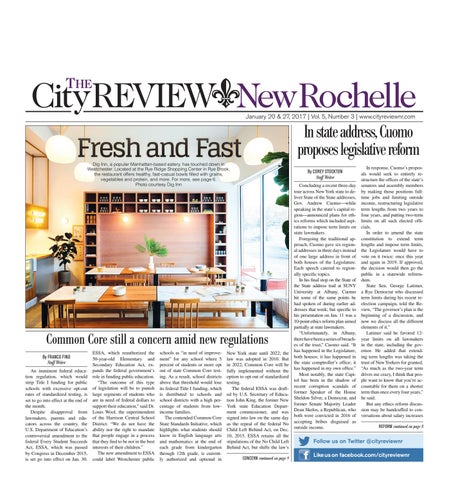
Fresh and Fast Dig Inn, a popular Manhattan-based eatery, has touched down in Westchester. Located at the Rye Ridge Shopping Center in Rye Brook, the restaurant offers healthy, fast-casual bowls filled with grains, vegetables and protein, and more. For more, see page 6. Photo courtesy Dig Inn
By COREY STOCKTON Staff Writer
Common Core still a concern amid new regulations By FRANCO FINO Staff Writer An imminent federal education regulation, which would strip Title I funding for public schools with excessive opt-out rates of standardized testing, is set to go into effect at the end of the month. Despite disapproval from lawmakers, parents and educators across the country, the U.S. Department of Education’s controversial amendment to the federal Every Student Succeeds Act, ESSA, which was passed by Congress in December 2015, is set go into effect on Jan. 30.
ESSA, which reauthorized the 50-year-old Elementary and Secondary Education Act, expands the federal government’s role in funding public education. “The outcome of this type of legislation will be to punish large segments of students who are in need of federal dollars to support their education,” said Dr. Louis Wool, the superintendent of the Harrison Central School District. “We do not have the ability nor the right to mandate that people engage in a process that they find to be not in the best interests of their children.” The new amendment to ESSA could label Westchester public
schools as “in need of improvement” for any school where 5 percent of students or more opt out of state Common Core testing. As a result, school districts above that threshold would lose its federal Title I funding, which is distributed to schools and school districts with a high percentage of students from lowincome families. The contended Common Core State Standards Initiative, which highlights what students should know in English language arts and mathematics at the end of each grade from kindergarten through 12th grade, is currently authorized and optional in
New York state until 2022; the law was adopted in 2010. But in 2022, Common Core will be fully implemented without the option to opt out of standardized testing. The federal ESSA was drafted by U.S. Secretary of Education John King, the former New York state Education Department commissioner, and was signed into law on the same day as the repeal of the federal No Child Left Behind Act, on Dec. 10, 2015. ESSA retains all the stipulations of the No Child Left Behind Act, but shifts the law’s CONCERN continued on page 9
Concluding a recent three-day tour across New York state to deliver State of the State addresses, Gov. Andrew Cuomo—while speaking in the state’s capital region—announced plans for ethics reforms which included aspirations to impose term limits on state lawmakers. Foregoing the traditional approach, Cuomo gave six regional addresses in three days instead of one large address in front of both houses of the Legislature. Each speech catered to regionally specific topics. In his final stop on the State of the State address trail at SUNY University at Albany, Cuomo hit some of the same points he had spoken of during earlier addresses that week; but specific to his presentation on Jan. 11 was a 10-point ethics reform plan aimed partially at state lawmakers. “Unfortunately, in Albany, there have been a series of breaches of the trust,” Cuomo said. “It has happened in the Legislature, both houses; it has happened in the state comptroller’s office; it has happened in my own office.” Most notably, the state Capitol has been in the shadow of recent corruption scandals of former Speaker of the House Sheldon Silver, a Democrat, and former Senate Majority Leader Dean Skelos, a Republican, who both were convicted in 2016 of accepting bribes disguised as outside income.
In response, Cuomo’s proposals would seek to entirely restructure the offices of the state’s senators and assembly members by making those positions fulltime jobs and limiting outside income, restructuring legislative term lengths from two years to four years, and putting two-term limits on all such elected officials. In order to amend the state constitution to extend term lengths and impose term limits, the Legislature would have to vote on it twice: once this year and again in 2019. If approved, the decision would then go the public in a statewide referendum. State Sen. George Latimer, a Rye Democrat who discussed term limits during his recent reelection campaign, told the Review, “The governor’s plan is the beginning of a discussion, and now we discuss all the different elements of it.” Latimer said he favored 12year limits on all lawmakers in the state, including the governor. He added that extending term lengths was taking the trust of New Yorkers for granted. “As much as the two-year term drives me crazy, I think that people want to know that you’re accountable for them on a shorter term than once every four years,” he said. But any ethics reform discussion may be handcuffed to conversations about salary increases REFORM continued on page 8
Follow us on Twitter @cityreviewnr Like us on facebook.com/cityreviewnr