Since 1897

Since 1897

Alleges slow progress
BY CRYSTAL LEWIS clewis@thechiefleader.com
Despite safe-staffing laws enacted by the state in recent years, a recent study from the New York State Nurses Association found that just one-third of surveyed hospitals complied with the mandate to publicly post staffing plans in all hospital units and failed to staff intensive care units at the required nurse-to-patient ratio more than 50 percent of the time.
In 2021, state lawmakers passed laws requiring hospitals to establish committees to set safe-staffing ratios. NYSNA, which represents more than 42,000 nurses statewide, gathered and analyzed staffing data from more than 60 hospitals to determine the effectiveness of the laws.
The resulting report determined that, as of November, 55 percent of hospitals were publicly posting their actual staffing levels in every unit, while 62 percent of facilities posted staffing plans, but only in some units.
Between Jan. 1 and Oct. 31, NYSNA members reported staffing
levels for 532 shifts from 32 critical care units across 20 hospitals. More than half the time, those facilities failed to staff ICU and critical-care patients at the 1:2 nurse-to-patient ratio required by a staffing rule enacted in June 2023, according to the respondents.
“Hospital administrators continue to hire and schedule too few nurses to meet safe staffing standards, and many employers do not comply with procedural elements of the law meant to improve collaboration and transparency,” the report concluded. “Without strong implementation and enforcement of the law, it is difficult to measure its impact on hospital safety. However, we do know that the law has yet to deliver the kind of transparency and accountability that would ensure that all New York hospitals meet safe staffing standards.”
Although the vast majority — 90 percent — of hospitals’ clinical staffing committees regularly meet, only half have implemented solutions generated by the committee, according to the report. It also noted that when the committees were first formed, some hospital administrators attempted to exclude union leader nurses from the committees, even though the law
‘Hospital administrators continue to hire and schedule too few nurses and many employers do not comply with procedural elements.’ — NYSNA report
required half of the committee to consist of peer-selected nurses.
The findings prompted the union’s leadership to call on hospitals to follow the safe-staffing directives and on the state Department of Health to use its enforcement powers.
“Safe staffing continues to be New York nurses’ top priority, because we know that upholding these safety standards will keep our patients safe and improve hospital care everywhere. New York needs a strong staffing law that works for nurses and patients and holds hospitals accountable,” NYSNA President Nancy Hagans said in a statement. “We will continue advocating to increase implementation and enforcement of the staffing law, as well as other policies that help recruit, retain and train enough nurses for quality patient care.”
Report: DOH ‘hampers efforts’
The union also noted that, although the law allows the DOH to impose fines or other civil penalties on hospitals that fail to submit or follow corrective action plans, health officials have not yet used these powers.
The DOH disputed this, noting that it issued its first $2,000 fine under the staffing law in March 2024.
NYSNA also slammed the DOH for failing to follow the spirit of the law — which aimed to increase transparency about a hospital’s staffing levels — by providing staff-
See NURSES, page 2
City’s Law Department, which runs the insurance program, cited over 10,000 times for legal infractions each year since the pandemic
BY MAXWELL PARROTT New York Focus
This story originally appeared in New York Focus, a nonprofit news publication investigating power in New York.
After his second debilitating injury at work, Derrick Baker decided it was time to retire.
Baker had worked in juvenile detention for 29 years, most recently as a supervisor at Crossroads, one of two New York City–run centers troubled by routine violence and workforce injuries. In November 2022, he tore the tendons and cartilage in both of his arms and reinjured a knee that had undergone joint replacement when he intervened in a scuffle with an incarcerated youth.
Within a day, Baker filed a claim for workers’ compensation, the state program that provides medical treatment for injuries on the job and cash for recovery time. But to get his benefits, Baker first had to get a workers’ comp insurance provider to accept his case.
Unbeknownst to him, he was stuck with the insurance carrier that had amassed more penalties
for mishandled and delayed cases than any other in the state: the city of New York.
“They were dragging stuff out,” Baker said. “And when it finally went through, they contest everything.”
If you’re a payroll employee in New York state, your employer is probably required to pay for a workers’ comp insurance policy. Some, like New York City, operate their own “self-insurance” system.
Insurers are supposed to start making workers’ comp payments within 18 days of the injury. In Baker’s case, it took New York City nearly four months.
The state Workers’ Compensation Board has cited the New York City Law Department, which runs the city’s insurance program, for legal infractions over 10,000 times each year since the pandemic.
From 2019 through 2023, it received three penalties for every four new workers’ comp cases it processed. Those included over 34,000 penalties for late filings and nearly 29,000 for other procedural violations like failing to properly pay claimants.
“They are late with almost every request and document,” said Derek Robinson, the legal services vice president of SSEU Local 371. “It significantly delays claimants’ payments and treatments.”
For comparison, the New York State Insurance Fund, the state-managed workers’ comp in-

After prisoner dies following beating BY RICHARD KHAVKINE richardk@thechiefleader.com
The head of the state’s correction system has instituted steps to curtail the use of excessive force by officers following what he called the “killing” of Robert Brooks, the prisoner who died at an upstate prison following a brutal beating by officers last month.
Department of Corrections and Community Supervision Commissioner Daniel F. Martuscello III also called for a change in culture within the state’s 42 prisons following Brooks’ death Dec. 10. Brooks died at an Oneida hospital after enduring a severe beating by several officers in the Marcy Correctional Facility infirmary.
Among the policy changes are an expansion of body-camera protocols, with officers now obliged to activate and turn on the cameras whenever they directly engage with prisoners. He has also directed daily audits of the cameras’ use.
Body-camera footage of Brooks’ beating released by the office of Attorney General Letitia James last week is without sound because the COs did not activate them. Martuscello has also called for the increased presence of senior officers within the jails, who must now respond to medical facilities following uses of force, altercations or medical emergencies involving staff and inmates.
“As Commissioner, I am committed to the utmost transparency and accountability in this matter. This was a killing, and people will be held accountable,” Martuscello said in a statement. The executive director of the Correctional Association of New York, Jennifer Scaife, noting the new policy, said jail officials need to do more to quell violence by officers, namely by installing stationary cameras throughout the system. She also called for all COs to be equipped with body-worn cameras. According to Scaife, just one-fourth of
Won 4 terms unopposed; Idlett steps in as Rikers faces continued scrutiny
BY RICHARD KHAVKINE richardk@thechiefleader.com
Patrick Ferraiuolo has done his time. After nearly 43 years with the city’s Department of Correction, the last 15 as president of the Correction Captains Association, Ferraiuolo has left his post.
The union leader, whose last full term was consumed by near-anarchic conditions on Rikers Island brought about at least in part by the plummeting officer headcount that followed the pandemic, is leaving of his own accord.
Ferraiuolo said he has promised his members that the day he wasn’t fully committed to the task, whether to attend meetings or even a fraternal party, he would leave. “I’d only be cheating my membership, and it wouldn’t be fair to them,” he said.
Aside from the post’s required commitment, he said, there is another, perhaps even more pressing reason for his departure: “The other part of it was, you know, life is only given to you once,” said Ferraiuolo, who will settle in Florida. “I want to start enjoying myself a little more,” he said.
Ferraiuolo, 66, started with the department in 1982, assigned to the Correctional Institution for Men (since renamed the Eric M. Taylor Center) on Rikers. Two years later, he was transferred to the Manhattan House of Detention in lower Manhattan. He earned his promotion to captain in 1987 while at The Tombs, and returned to the CIFM, working the housing areas for two years. He was then posted to the intake area on a DOC prison barge for a few months, before moving to the Otis Bantum Correctional Center on Rikers in the winter of 1990.
Shortly after his return to the penal island, Ferraiuolo was elected a union delegate. In 1999, he was elected the CCA’s sergeant-at-arms, earning a spot on the union’s executive board that he would keep for the next 25 years. From financial secretary, he was promoted to first vice president, under then-union President Ronald W. Whitfield. Following Whitfield’s retirement in April 2009, Ferraiuolo stepped up to lead the union, something he had aspired to since joining the union. He was elected, unopposed, to the first of what would be four full terms in 2011. He won reelection, each time unopposed, in 2015, 2019
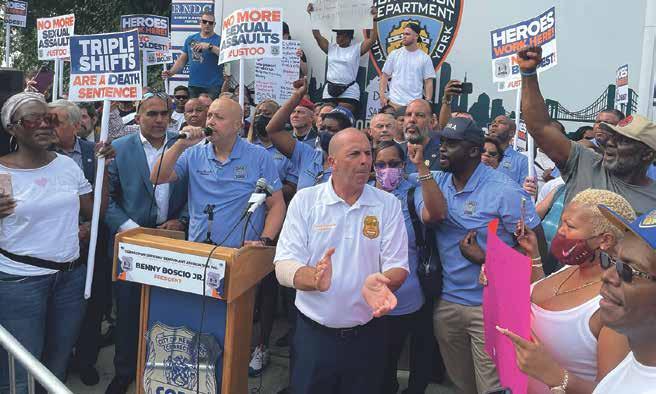
and again earlier this year. His vice president since 2021, Paul Idlett, a 25-year DOC officer, took the union’s leadership reins Jan. 1.
A heady time for city jails
Ferraiuolo’s departure comes at a heady time for the DOC and the jail unions. While conditions on Rikers have improved since the chaotic period that followed the pandemic, a federal monitor is still in place. And, in late November, the federal judge overseeing a consent decree in place for a decade found the city in contempt over conditions there, a determination that paves the way for federal receivership, something Ferraiuolo, the other union leaders and Mayor Eric Adams all oppose.
Although Chief U.S. District Judge Laura Taylor Swain determined that the use-of-force rate and other evidence of violence, selfharm, and death had not improved and even worsened since the decree was put in place, Ferraiuolo has noted improvements. He said he was “baffled” at the judge’s findings.
“Percentage wise, if I were to guess from three years ago, they’re down at least 50 percent,” he said of uses of force by officers and of assaults on DOC staff. He credited the department’s former commissioner, Louis Molina, who served in that post for just under two years
Continued from Page 1
ing deficiency reports to hospital leadership rather than with clinical staffing committees, and also requires that the reports remain confidential for a 45-day period.
Between October 2022 and October 2023, the DOH received 387 allegations of staffing law violations. It investigated 121 claims, completed 45 investigations and substantiated just five complaints, according to a DOH report cited by the union.
“The DOH’s slow implementation of the law, almost from the moment the Legislature passed the law, has hampered efforts to measure and achieve safe staffing standards in every New York hospital,” the NYSNA report stated.
A DOH spokesperson said that the department “remains committed to implementing” the clinical staffing laws.
“To date, the Department has resolved 1,992 complaints and issued 40 Statements of Deficiencies related to [the law],” the spokesperson said. “The Department will continue to enforce the law as necessary to ensure compliance, including enforcement against hospitals found to be in violation of the law. It is important we also recognize the health care worker shortages in our state, which underscore the importance of expanding common sense scope of practice changes.”
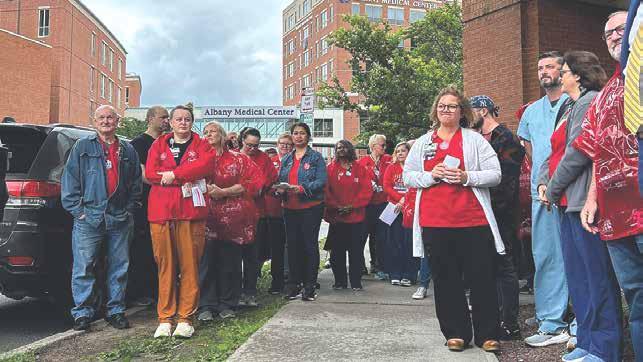
The union highlighted how the DOH’s failure to enforce safe-staffing laws has impacted Albany Medical Center, which had a 25-percent vacancy rate as of July. Although Albany Med nurses began filing staffing complaints with the DOH in November 2023 and state health officials visited the hospital in June, union members said they were kept in the dark about the findings of a resulting staffing-deficiency report shared with hospital leadership.
Albany Medical Center’s CEO, Dennis McKenna, announced during a press conference that the hospital was out of compliance with staffing standards for 480 out of 20,640 shifts, but the union not-
ed that the staffing committee was only given a “cherry-picked summary of the report.”
“I’m on the hospital clinical staffing committee, and we’ve worked with administrators and submitted a plan to the DOH that outlines that the nurse-to-patient ratio [in] my unit shouldn’t exceed one nurse to five patients,” said Jaimie Alaxanian, a nurse and staffing committee member at Albany Medical Center. “The CEO keeps talking about this plan being such an accomplishment, but it’s not being implemented. The only way to implement this plan is to hire and retain more nurses.”
But the report also highlighted cases where the DOH’s enforcement of safe-staffing laws made a difference, including at Vassar Brothers Medical Center in Poughkeepsie. Nurses at the facility tracked staffing levels from January to October 2023 and found that the hospital was only in compliance with its required staffing levels 5 percent of the time.
Nurses submitted complaints to the DOH, which launched a probe that found 47 staffing violations. The staffing committee came up with a corrective action plan that included adding 10.4 full-time employees to the float pool and an additional registered nurse residency program to help recruit staff.
“I started collecting this data because we felt we were being ignored constantly. When the DOH finally met with the staffing committee after their investigation, the nurses and techs were so happy that someone was finally acknowledging what we were going through,” said Vassar nurse Margaret Franks, NYSNA’s treasurer. “Instantly, we started seeing change. But it required speaking up and having the DOH hold the hospital accountable.”
The union called on the DOH to increase public reporting of actual staffing levels in hospitals across the state, to enforce mandated safe staffing standards, and to restore nurse training programs that were scaled back during the pandemic.
starting in late 2021, for reinstating inmate programming and pushing for more staff.
The fear is that a federal takeover will dilute the DOC unions’ power and even instigate an override of collective bargaining provisions by appointed officials, including one
that demands that captains’ positions be backfilled since the vast majority of officers in that title are considered supervisors. “We argued that they were putting everybody in jeopardy, inmates, including officers, by not having the correct supervision,” he said of what led to an
arbitrator’s decision some 25 years ago whose provisions have since been enshrined in the CCA’s contracts.
Ferraiuolo is otherwise skeptical that a federal takeover would achieve much. “There’s still violence in the jails, but no receivership is going to stop a bad inmate from assaulting a correction officer,” he said. “What jail is ever going to be perfect? We’re housing bad people. It’s not like they’re quiet boys.”
The solution, and officers’ most useful implement, he said, is the availability of punitive sanctions for problematic inmates, provisions that have been the subject of tugs of war between progressive members of the City Council and prisoner advocates on one side and the DOC’s unions and Adams on the other. “We don’t have those tools anymore,” Ferraiuolo said. Staff, too, is an issue, Ferraiuolo and other DOC union officials have said. Although the federal monitor overseeing the jail system has consistently cited the DOC’s “very rich complement of staff,” as one of his recent reports put it, Ferraiuolo said the department’s contingent of roughly 560 captains is at least 200 short of what’s needed.
Call it, for now, 201. But although he is leaving his title, Ferraiuolo said he will remain part of the union. “I am staying on as a benefits consultant because I really believe they need that,” he said. “And I didn’t want to just fall out of the loop completely.”
BY CRYSTAL LEWIS clewis@thechiefleader.com
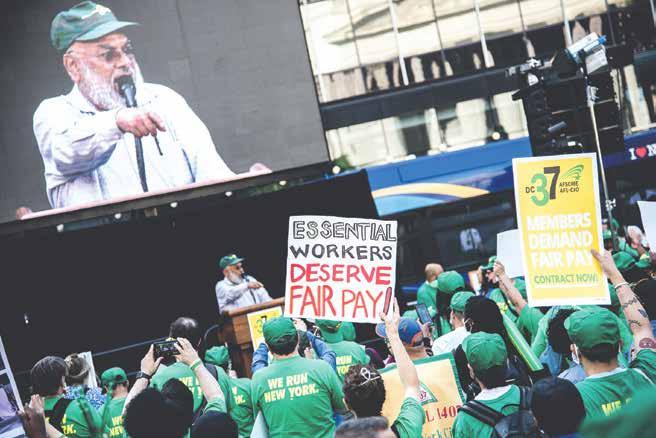
Anthony Lackhan of the Members In Charge slate narrowly won the race for president at District Council 37’s Local 1549 in the union’s recent runoff. After none of the four candidates for president earned a majority of votes in the local’s November election, the two top candidates, Lackhan and Team Forward’s Debbie-Ann Gutierrez, faced each other in a runoff mail ballot election. In a tight contest, Lackhan secured 569 votes to Gutierrez’s 542 votes, according to certified results from the American Arbitration Association posted on the local’s website. The votes were counted on Dec. 20.
“I’m excited to have won,” Lackhan said during a phone interview. But he lamented the poor turnout: although 10,841 mail ballots were sent to members, just 1,136 were turned in.
“I thought the turnout was still low, but we will emphasize the need for participation in the local — that’s our first order of business,” he said.
Lackhan said he thinks disillusionment is the prime reason for the poor turnout. “I believe members have lost faith in the union,” he said.
Lackhan will serve as the first president of Local 1549 since the union was placed under administratorship by the American Federation of State, County and Municipal Employees in September 2022 after a draft audit found “serious”
financial deficiencies. The local’s officers, including Eddie Rodriguez, who had been president of Local 1549 since 2001, were immediately removed from their positions, and Rodriguez was expelled months after the administratorship was imposed.
Lackhan, an eligibility specialist who has been a Local 1549 member since 2010 and is a longtime shop steward, said his other goals are to make sure members’ needs are taken care of during contract negotiations and to strengthen the cohort of shop stewards.
“A lot of the facilities I’ve visited don’t have a full complement of shop stewards. We’re going to run special elections to have those spots filled,” he said.
Other races will be rerun
A mix of candidates from both slates won their races: from the Team Forward slate, Vanessa Reed won the executive vice-president position, while Hope Lawrence won the election for recording secretary. Two of the three trustee positions went to Team Forward’s Gladys Little and Andrea Andrades.
Lisa Rhymer won the second vice-president position running on the Members of Charge slate. Other winners from that slate included Joseph Rodriguez, who won one of the sergeant-at-arms positions, Sonia Rodriguez, who was chosen for one of officer-at-large roles, and Ana Deluca Mayne, who won the last of the three trustee positions.
Lackhan said he has already had conversations with some of
the members of the opposing slate. “We’re ready to go to work. We’re already functioning as a team,” he said.
But some of the races haven’t finished yet: although runoff elections were held for the remaining three officer-at-large and two sergeantat-arms positions, an error on the runoff ballots means that the races must be rerun. A date for the rerun elections has not yet been set, according to Lackhan.
And although the secretary-treasurer race was declared — in which Team Forward’s Yolanda Holliday won with 500 votes to Honda Wang’s 492 votes — Wang successfully contested the election.
“The election committee met and heard [from] everybody involved in the secretary-treasurer race on Dec. 16. The election committee recommended the rerun,” Wang said during a recent phone interview. “The vote was held shortly thereafter during the special membership meeting.”
More than three-quarters of the members at the meeting who voted support a rerun of the secretary-treasurer race, according to poll results obtained by The Chief.
Wang expressed satisfaction that the race will be rerun. “I feel good because it feels like we have the wind behind our backs with Tony’s win,” he said. “Ultimately, this team is built around democratizing our union and fighting for what our members care about.”
Lackhan added that once the final rerun elections are completed, “We’re ready to rock ‘n’ roll.”
Continued from Page 1
surer that covers 2 million employees — around seven times the size of New York City’s public sector workforce — received less than half as many procedural complaints.
A spokesperson for the Law Department noted that it offers workers claiming injuries a program called salary continuation, which allows employees to use their vacation and sick days to continue getting paid while the city investigates a case. As a result, 80 percent of workers receive “timely initial payments,” the spokesperson said. The city is supposed to reimburse the time off after the fact, though workers and attorneys say that often doesn’t happen fully. For around a month and a half, Baker said, his salary was covered by a grant that the city offers exclusively to the victims of a workplace assault. But for about two months after that ran out, he was left without any income and unable to get the city’s insurer to return his calls.
“They put you through the ringer. They pretty much ignore you and make it seem like you’re bugging them,” he said.
Once Baker got his back pay and realized that his payments of around $400 per week were not going to cover his financial needs, he decided to return to work and risk reinjuring himself for the eight months it took him to reach early retirement.
“They want you to come here and give your all, and they don’t give a damn about you once you get injured. You’re no good to them,” Baker said.
Lawyers expect that even more workers’ comp cases could be mishandled as the result of a recent statewide policy change that tightened the timeframe for workers’ comp insurance carriers on lost wages payments.
The Law Department conceded that “staffing remains a challenge as we process this huge volume of claims under worker compensation rules that have grown exponentially more complex over the last decade.”
After Baker’s doctor recommended surgery on both of his shoulders, the Law Department disputed the procedure on his right side. He’s in the process of appealing the clashing diagnosis by an independent medical examiner — one of the insurance-hired medical practitioners who scrutinize workers’ compensation claims.
“I’m used to that,” he said, referring to a prior workers’ compensation case he had to file in 2003 that resulted in two knee replacement surgeries as a result of a similar workplace incident.
“It took 13 years for me to get my replacement,” Baker said.
Incentives of the insurance-boss
New York City’s sluggish response times stem from a stagnant Law Department budget that has overburdened its staff attorneys. Worker-side lawyers say that the agency’s staff often effectively work as both attorneys and paralegals on cases. They lack relevant information before hearings, causing them to request extensions or make mistakes.
The agency often misses the deadline to approve or reject an application. When it does approve a case, it’s then often late to pay back the lost wages.
“At times they don’t send my check and I have to inform my attorneys,” an ACS worker testified to the state Senate. “I was employed by the city of New York since 1985 and I have never experienced such indignation.”
The gaps can spell financial crisis for workers.
“I see that with a lot of people who have horror stories, where they’ve been waiting for months and never got paid, and they’re in a situation where they have to borrow money, take a loan,” another retired ACS worker, who asked not to use their name, told New York Focus. The state fines insurers for breaking the 18-day timeline — but it’s effectively a slap on the wrist. It costs carriers $50 for each 10-day period that a transaction or requested filing is late.
“The Law Department, they’re a different animal. I mean, they really could care less what the board

supervisor, endured months without income and faced prolonged battles with New York City’s workers’ compensation system after a debilitating workplace injury.
tells them to do or not to do,” Alex Rosado, a workers’ comp attorney with a number of city-employed clients and the co-chair of the New York Workers’ Compensation Alliance.
City workers face a different set of issues in accessing the other core function of workers’ comp, which guarantees medical treatment for on-the-job injuries. When they seek to get medical procedures approved, lawyers report that deadlines are consistently unmet or extended for almost every step of the process.
The problems may arise in part from the structure of self-insurance. Unlike worker benefits such as unemployment insurance, workers’ comp payments come directly out of the employer’s pocket. When the boss is also the insurance carrier, hurdles to accessing benefits lower company costs.
“Self-insured [carriers] by nature are more inclined to dispute claims simply because it’s directly their money,” said Rosado.
In general, lawyers say, the cost-saving incentive can lead self-insured employers to contest or delay more cases than private insurance companies.
In 2009, the state’s 9/11 Worker Protection Task Force found that New York City appealed World Trade Center recovery and cleanup cases at a higher rate than the private sector or the city’s police, fire, and sanitation departments, which are covered by separate carriers.
But according to Rosado, the Law Department isn’t unusually aggressive in formally contesting cases — perhaps because they don’t have the resources to be.
“I don’t think they have the sufficient personnel to dispute these cases to a large extent. So they cherry pick what they’re going to dispute,” Rosado said.
Indexing wars
In July, the Workers’ Compensation Board updated a process it refers to as “indexing” cases, a step that starts the countdown to the insurance company’s deadline to accept or dispute a claim. Starting in the 2000s, the state Workers’ Compensation Board protracted this process so that claims could sit in limbo while insurers gathered extra information.
Now, insurance companies will have an automatic deadline to pay out wages.
Worker-side attorneys argued that for workers without a lawyer, the old system largely amounted to a flat denial of these benefits. That system required injured or sick workers to actively push their cases forward, so if you didn’t know how to navigate the byzantine legal system, your case was unlikely to reach the finish line.
The change got through despite Governor Kathy Hochul’s opposition. Last year, advocates with the Workers’ Compensation Alliance drafted a bill that would have required the board to automatically index all cases and guarantee a hearing to workers who ask for one. After passing the legislature, it was vetoed by the governor at the behest of self-insurers, workers’ comp insurance lobbyists, and the Workers’ Compensation Board itself. The change in indexing ultimately came after a lawsuit resulted in the state’s top court ordering the board to reconsider the process.

BY DUNCAN FREEMAN dfreeman@thechiefleader.com
Before he began his 18-week stint at the FDNY’s probationary firefighter academy, Dylan DiLevo jokingly told his wife that he planned to be the academy class’ valedictorian.
Halfway through the course, however, DiLevo found he was ranked fourth among the more than 280 recruits in his class: The goal he had set in jest, he thought then, could in fact come to fruition.
On Friday, DiLevo stood before 288 of his fellow classmates on the stage of the Colden Auditorium at Queens College to address the latest group of probationary firefighters graduating into service, as is custom for the classes’ valedictorians. Formerly an FDNY EMT, DiLevo told the FDNY officials, fellow probies and their friends and families gathered Friday morning that he, like many others in his class, still couldn’t believe that he had made it as a firefighter.
“If you told me two years ago that I would be walking across the
stage, graduating as a probationary firefighter, I would have told you that you were crazy,” DiLevo said.
“But the world works in mysterious ways.”
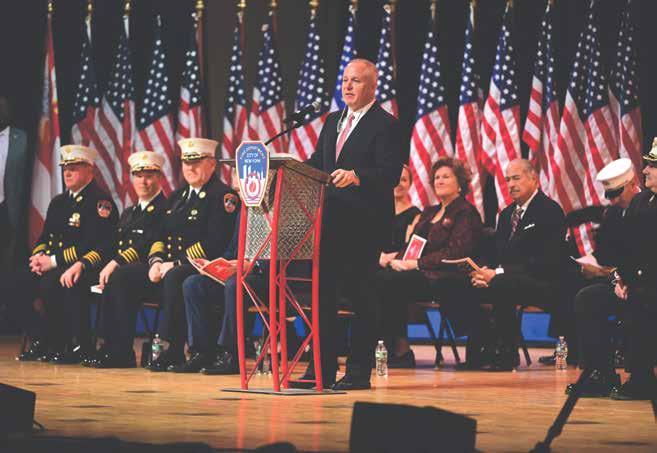
The graduation ceremony, held just days after Christmas, was the second one in 2024 and the first since FDNY Commissioner Robert Tucker was appointed in August.
The earlier July class of 284 probationary firefighters was former Commissioner Laura Kavanagh’s last.
In his remarks, Tucker said that the day would always be special to him, just as it’s special to the probationary firefighters and their families, because it is the first class of probationary firefighters that he graduated. He told the newest Bravest to continue to read, be curious and ask questions in their firehouses and reminded them that they are “obligated to act with respect and with honor.”
“These first years out of the academy will form the foundation of your time as a New York City firefighter,” Tucker said. “The skills
you learn will be with you for the rest of your life.”
According to the FDNY, there are 28 veterans of the U.S military in the 289-member graduating class. About half of the probies are white, 23 percent are Hispanic and 21 percent are Black. Just 2 percent are Asian and 1 percent are Native American. There are also four women. One of them, Victoria Meyers, said that becoming a firefighter gives her pride.
“You know you have to have a lot more sense of responsibility with the shield on your helmet and know that you’re serving more than just yourself,” she said. Less than 1 percent of the department’s firefighters are women and more than 70 percent are white.
In his remarks, DeLivo encouraged his fellow graduates to seize the opportunity they’d been given. “As our instructors would always say, we got the winning lottery ticket, a ticket worth blood, sweat and tears,” he said. “And today we finally get to cash it.”


‘They cherry pick what they’re going to dispute.’
— Alex Rosado, WORKERS’ COMP ATTORNEY
While the new policy will lighten the burden for workers, lawyers expect it could exacerbate the Law Department’s rate of late penalties.
“Having dealt with the city for 25 years and coming to understand that the city lacks resources in examiners etc., it is reasonable to assume that the increase in indexing of cases will translate into an increase in the number of penalties,” Rosado said.





Higgledy-piggledy
To The ediTor:
A government shutdown was avoided when a bipartisan bill passed Congress overwhelmingly. But the bill did not include funding for the World Trade Center Health Program that serves those who were sickened at the site of the 9/11 attacks. Why not?
President Donald Trump’s advisor/boss Elon Musk blocked support for a previous bill that included such funding. But neither Musk or Trump said anything about the Health Program, which also has strong bipartisan support in Congress.
Musk simply demanded the cutting of “pork.” So why did that get translated into cutting the Health Fund?
Now what’s often described as pork is less than 1 percent of the budget. After all, cheese museums are not that expensive.
The defense budget includes hundreds of billions of dollars of waste. But this corporate welfare is never called pork.
So the health fund is mysteriously eliminated from the budget. I guess nobody wants to take credit for something so indefensibly evil.
Richard Warren
Silence kills
To The ediTor:
Once again, NYC police are grappling with another officer suicide. Regrettably, tragedies like these are not foreign. Since 2010, more than 50 NYPD officers have died by suicide. Then-NYPD Commissioner James O’Neill declared that cops were facing a mental health crisis. His sentiments remain accurate, because police officers are more likely to die by suicide than by other work-related tragedies. Policing is an increasingly taxing occupation.
The unavoidable stressors include staffing shortages, rotating shifts and constant responses to traumatic incidents. These recurring challenges were exacerbated by the pandemic and defund-the-police rhetoric. Police officers experience traumas more frequently than the general public. Cops therefore
are at greater risk for incurring health ailments associated with unmanaged stress.
However, the frequency of trauma exposure is only part of the problem. The true calamity is police officers’ unwillingness to seek mental health assistance. Despite some progress, policing remains a male-dominated profession. Arguably, machismo is an integral part of police culture and fortifies the misguided belief that cops are invincible and shouldn’t show their emotions. In addition to mental illness being a perceived sign of weakness, cops generally believe their department’s policies do not support officers who request help.
Research suggests when cops seek counseling, they are labeled and their career is adversely impacted. Sadly, these outcomes fortify the stigma associated with mental illness and block cops from seeking assistance. This is tragic because the prevalence of mental illness among police officers is well-documented.
Because stigmatization prevents cops from receiving help, police agencies need a paradigm shift. Although changing police culture is daunting, the transformation must begin with policies such as mandatory mental health screenings and annual wellness training.
James T. Scott
The writer is an associate professor of criminal justice at Albertus Magnus College and a retired sergeant with the Connecticut State Police
Past imperfect
To The ediTor:
Can we please keep crime news stories in perspective? That is, considered in terms of relative importance?
Luigi Mangione is charged with murdering health care insurance
CEO Brian Thompson. Our president-elect, Donald J. Trump, incited an insurrection at the Capitol to undo a presidential election that threatened the lives of the vice president and members of Congress, and led to the loss of lives of five police officers. Which criminal should I fear the

most, an assassin who is charged with killing one businessman (and has been arrested and indicted), or someone who will be our president in less than a month who is responsible for causing imminent threats to members of Congress, caused the deaths of police officers, caused serious injuries to many other cops and civilians, and threatens to destroy our justice system?
Michael J. Gorman
To The ediTor:
To all those mourning the 2024 election: Free advice worth what you feel it is worth. The internet has a wealth of information about what Candidate Trump did correctly and Candidate Harris did not. Run for district leader or state committee and/or network with local, regional, and national Democratic clubs. Strategize for the 2028 Democratic campaign, don’t repeat Harris failures, and replicate Trump successes.
Lamenting Trump’s shortcomings and the election results accomplishes nothing, especially in New York, which Harris — of course — won handily. It is boring me.
I admire the “anti-Trump brigade’s” civic mindedness. I would never discourage someone from writing to the newspapers. But our city, state and country are facing tremendous challenges. Surely there are more productive uses of this wonderful newspaper’s letters section.
Nat Weiner
To The ediTor: Luigi Mangione has been charged with both murder and terrorism for gunning down Brian Thompson, the CEO of UnitedHealthcare. As a story in the New York Times put it, “The killing … gave rise to a debate about the frustrations that Americans have with the health insurance industry – the high costs, denials of coverage and what many say is the industry’s prioritization of profits.”
That debate is what C. Wright Mills called the “the sociological imagination.” This is the ability of individuals to connect their personal troubles with the social issues that create those personal troubles. An example of a personal trouble involved UnitedHealthcare, the Medicare Advantage conglomerate. When the company, with profits of $22 billion in 2023, rejected the claim of Carly Morton for surgery to correct nMALS, an extremely painful condition, it was a personal trouble for Carly and her family. Cigna Healthcare’s denial of coverage for 17-year-old leukemia victim Nataline Sarkisyan to get a needed liver transplant turned into personal trouble for her and her grief-stricken family.
An example of a social issue is when, as Derrick Crowe with People’s Right Action Institute pointed out, each year private health insurance companies issue 248 million medical rejections, either through prior authorization or care denial.
See LETTERS, page 5
BY BERNARD WHALEN
Desperate times call for desperate measures.
Mayor Eric Adams’ recent appointment of Jessica Tisch as police commissioner is reminiscent of another troubled New York City mayor’s gambit to save his political career. In December 1928, Mayor Jimmy Walker found himself in a precarious position.
The NYPD scandal at that time — its inability to solve the murder of notorious gambler Arnold Rothstein — was dragging down his administration just as he was gearing up for reelection. Much like Adams, Walker had doled out important political posts to cronies and let them run their agencies roughshod. He and his police commissioner, Joseph Warren, had at one time shared a law office. While Warren himself wasn’t corrupt, he was not the dynamic leader the police department needed at that time. In fact, after Rothstein was shot, Warren let the chief of detectives take an extended vacation, leaving the investigation with little oversight. With the chief of detectives out of the way, the investigation fell into the hands of the chief of the Confidential Squad, Lewis “The Honest Cop” Valentine. This worried Walker since Valentine might uncover something that would lead back to the administration. That was the last thing Walker could afford. That meant one thing: Warren, who had practically ceded control of the po-
lice department to his underlings, had to go, much in the same way Adams forced Police Commissioner Edward Caban to make a hasty exit while still claiming he had his full support.
When Warren received the news that he was out, he grumbled to the reporters that he had wasted three years as police commissioner toiling for the city. Ironically, the man Walker handpicked for the position had no desire to become police commissioner. His name was Grover Whalen (no relation) and he managed the famous Wanamaker’s Department Store. His job paid 10 times the police commissioner’s salary, an unheard of $100,000 per year during the Depression.
Much like Jessica Tisch, he was considered very wealthy. But he possessed excellent managerial skills and was well-known to all New Yorkers as the face of the city’s famous ticker-tape parades. He had also served as spokesman for Walker’s predecessor, Mayor John Hylan. Walker arranged for Whalen’s department salary to be put in escrow while he served as police commissioner, so he would not lose money by accepting the post.
The first thing Whalen did after he was sworn in was to fire the chief of detectives and the chief inspector. The men he put in their place were well respected superior officers. He ordered a thorough review of the Rothstein investigation. Although the reassessment implicated a highly decorated detective, Whalen was
unable to get a conviction of either the detective or the alleged murder suspect.
He demoted Valentine to captain and jettisoned him to a command in Long Island City where he was no longer a threat to Walker or even lowly patrolmen who Whalen said no longer had to worry about plainclothes spies from the Confidential Squad peeping around the corner. He also created the first comprehensive department manual so members of the force could have a handy reference to guide them through their daily duties. He used his business connections to provide new eight-point uniform caps to all patrolmen free of charge. These reforms went a long way to restoring the public’s confidence in the police department and the patrolmen’s sense of morality. Walker’s plan worked. He easily defeated Fiorello La Guardia in 1929. With that out of the way, Walker was overheard on election night saying, “Now Grover can go.”
If Eric Adams is successful in his reelection bid, it will be in part because Tisch did his dirty work by ridding the NYPD of people he himself was reluctant to cast aside and the reforms she has already started to put in place. The question is, will she be rewarded for her hard work, or be told it’s time to go?
Bernard Whalen is a former NYPD lieutenant and the co-author of “The NYPD’s First Fifty Years” and “Case Files of the NYPD.”

BY DAVID MIRTZ
Local Republicans are still giddy about the results of Nov. 5, continuing to call it a decisive rejection of progressive and “woke” politics. Writing in the New York Post a few days after the election, Republican City Council Member Vickie Paladino lectured Democrats to “look in the mirror” after their election loss.
The election certainly was a rejection of the gross caricature of progressive politics that flooded the media environment, but it was also about much more than Paladino would likely care to admit.
The vote increase on the GOP line and the consequent drop on the Democratic line were not separate events. Rather, the result was an expression of voters’ discontent with the status quo. Trump’s advantage was his ability to position himself as the anti-establishment candidate, including the Republican establishment. Democrats ultimately lost the election because they were seen as representing a deeply flawed status quo. While Democrats lost an election, Republicans lost their party to a demagogue and self dealer who is poised to impose authoritarian rule on the country, and Republican elected officials seem prepared to let him. But Paladino wants the Democrats to look in the mirror.
Reagan, Bush Picks
years of been Justices the more have women is 4 over decision to African-Amerhe we qualified comical if ignoJobs the and What an President for selectblue-ribbon apconfirm or politicontext is Ronto woman immedifrom find obvious1991,
Contrary to the Queens Council member’s opinion, Democrats ran a decidedly “unwoke” campaign and more importantly failed to offer voters a social and economic agenda that poll after poll has shown a broad cross section of voters support: Medicare for all or a robust public option, free community college, childcare and universal pre-K, investments in the care economy and a Green New Deal. Appeals to save democracy, a very real challenge now, failed to land because many voters didn’t see its impact on their daily lives.

the expression of working class politics independent of the two major parties.

George Herbert Walker Bush had to replace the first African American, Thurgood Marshall. He looked all over the country and the “most-qualified” was Clarence Thomas, also an African-American? Of course not. Clarence Thomas is an African-American conservative and he got the gig.
The result is that tens of thousands of voters, mostly registered Democrats, make a conscious decision to vote on the WFP line in general elections and for WFP endorsed candidates in Democratic primaries. Disciplined voters who understand the use of fusion voting to fight right-wing extremism, corporate power and advance working people’s interests.
the systems and institutions that have caused Americans to lose faith in government. Our philosophy must make clear that the real threat to democracy is widening economic inequality and the colossal power of big money in politics…. The Democratic Party must lay out a new vision of economic security and independence for working families.”
Continued from Page 4
It’s also a social issue when, as Wendell Potter, author and former health care executive, pointed out, 100 million Americans have medical debt. Most of these people have health insurance but can’t get the companies to pay for their needed care. It’s highly unlikely things will change given the economic and political power of not only Medicare Advantage companies, but also Big Pharma, major hospitals and medical associations. Each has an incentive to maximize profits at the expense of patients and taxpayers. The result is expensive and poor health care coverage, in contrast to peer countries that provide universal coverage.
Howard Elterman
To The ediTor:
the decadence of gross mismanagement.
Gross mismanagement has severe consequences, whether due to deep-rooted organizational dysfunction, misinterpretations in jurisdictional staffing formulations, within contractual or statutory obligations, misuse of workforce resources, poor data integration or other factors. It leads to long-term neglect as disinvestment becomes insurmountably intertwined with managing government resource assets.
This waste accumulates as sunk failures, where costs can exponentially grow and last for decades, and within multiple government administrations, when expenditures are sustained without adequate purpose.
These failures in governance expose society to vulnerabilities as a backdraft of indifference is sustained within a societal decline. Moreover, haphazard leadership erodes public trust in the government’s ability to operationalize a workforce in the service of its people.
To comply with the law, each administration must conduct due diligence and provide detailed empirical evidence of its operative budgetary prerequisites and their derivatives.
The Biden administration’s refusal to squarely confront the Israeli government’s ethnic cleansing campaign in Gaza and the West Bank just underscored people’s view (especially that of young voters) that our country’s leaders too often “play politics” with people’s lives. It becomes easier to understand how a voter in New York City could cast a vote for Trump and then also for Alexandria Ocasio-Cortez.
Expect a Top Candidate
Let’s please stop the nonsense in this country. We have never had an African-American woman on the court. Biden will not be selecting a cashier from Stop-and-Shop or a pilates instructor from the local sports club. He will select a highly educated, highly credentialed woman who attended a top college, top law school, clerked for a Justice, served on the Federal appellate court and all the other “credentials” deemed necessary in this day and age for a Justice.
As people take a closer look at the election results, a different story will take shape. It’s one that makes the argument that voters gave Trump a mandate and shifted right a thin one. In ballot measures across the country, voters stepped up to protect reproductive rights and raise the minimum wage.
Republicans hold Congress by the slimmest of margins — by five in the House and six in the Senate. In New York, Proposition 1, which enshrined reproductive rights, won majorities across the state and three Congressional seats flipped back into the blue column. The state Senate and Assembly remained firmly in Democratic hands.
The attacks on this decision should be seen for what they are. They are idiotic political theater from a cohort that sees even a tiny effort at progress as threatening the white male position in society.
Vincent Scala is a former Bronx Assistant District Attorney. He is currently a criminal-defense attorney in New York City and its suburbs.
In contrast to the Democratic vote drop in New York, the Working Families Party line maintained vote totals closer to the high water mark of 2020. Ever since former Governor Andrew Cuomo vindictively raised the threshold for political parties to maintain ballot status, every two years the WFP campaigns to carve out a political space on the ballot for

BARRY LISAK
and by deducunder Act mar(MFJ), separately household spouse 2021 the dollar and and 65 and blind instandard individuals statuses. 2018 2025,
BY BARRY LISAK
additional deduction because she is 70 years old. Her standard deduction for 2021 is $14,250 ($12,550, the standard deduction for 2021, plus $1,700, the 2021 additional standard deduction for the singles who are over 65 or blind).
Example 2
In 2021, Nicole and her spouse are joint filers. Both qualify for an additional standard deduction because they are both over 65. Their Form 1040 standard deduction is $27,800 ($25,100, the 2021 standard deduction for joint filers, plus 2 x $1,350, the 2021 additional standard deduction for married persons who are over 65 or blind).
The above examples reflect the benefit of the new standard deduction. Millions of taxpayers won’t be itemizing this year to reduce their Federal income-tax bill.
A recent letter to The Chief agrees that Democrats have helped American workers and that Republicans have done harm. But the author suggests that 2024 was a referendum on the past four years only. Fair enough. During this time, 16 million Americans found jobs, the most in any single presidential term, and GDP grew by $7.375 trillion, another record. Biden passed the first infrastructure bill since Dwight Eisenhower; but just 32 Congressional Republicans backed the bill.
FRIDAY, FEBRUARY 25, 2022
The contribution of those voters? They were a central partner in the successful Proposition 1 reproductive rights campaign and the margin of victory in Josh Riley’s congressional race north of the city. Imagine also, in this moment, a New York Governor Lee Zeldin. In 2022, after stepping in with a vigorous campaign, WFP voters were the margin of victory for Kathy Hochul.
To the Editor: On Feb 19, the NY Daily News published an article entitled, “As NYC Correction Commissioner Molina cleans house, critics worry he’s coddling jail unions.”
Tellingly, Democratic Congressional candidates such as Riley, Pat Ryan, in the state’s 18th Congressional District, and John Mannion, in the 22nd, who chose to run on the WFP line, significantly outperformed those candidates, such as Tom Suozzi in the 3rd District, and Laura Gillen in the 4th, who didn’t.
Electing a handful of progressive champions will not be enough to turn the tide on the authoritarian challenge we face. Neither will an agenda that does not recognize the central problem of corporate power in politics and how that power has gamed the system against working people. But a broad pro-democracy coalition based on challenging corporate power and actually improving people’s lives could.
THE CHIEF-LEADER wel-
MAGA politics thrive on division and fear. Blocking the MAGA agenda will require a collaborative effort. Misogyny and racism still hold sway with a significant minority of voters. While breaking that hold will take more than an election, but voters have shown an openness to a broad populist agenda both economic and social that can be built on.
The WFP saw vote growth in upstate rural counties, which includes the 20,000 Republicans who voted for U.S. Senator Kirsten Gillibrand on the WFP line.
Whether it’s a newly elected Mayor, Governor or President, every new administration replaces personnel, notwithstanding their work performance. No reason is needed to remove someone in an appointed position within NYC government with the exception of the Commissioner of the Department of Investigation, even though there is more than enough justification to fire all the top managers in DOC.
Top managers likely get their jobs through political connections and serve entirely at the pleasure of the Mayor. Moreover, the personnel that Louis Molina removed were in charge of critical units which they failed to lead effectively.
MAGA Republicans such as Paladino will try to capitalize on their uptick in votes, to narrow what is politically acceptable to versions of their right-wing policies and talking points. Voices independent of the corporate power that otherwise hold sway over the politics of the two major parties will be crucial. As Lieutenant Governor Antonio Delgado pointed out in a recent New York Times op-ed evaluating the 2024 election, “This presents an opportunity for Democrats, but only if we are willing to challenge
DOC was on the brink of an implosion as a result of the feckless leadership of Vincent Schiraldi and his coterie. Now Schiraldi, who was the worst DOC commissioner in its 127-year history, is questioning Molina’s personnel decisions.
How is it that Schiraldi, a so-called juvenile-justice reformer and expert, failed so miserably in managing DOC?
How is it that Oren Varnai, the head of DOC’s Intelligence Bureau and a “former covert officer in the CIA,” could not stop the scourge of gang violence from dominating and ravaging Rikers? Varnai, at least, must be commended for wishing Molina success, and I must say he has impressive credentials.
How does Sarena Townsend, the Deputy Commissioner for Investigations and a former prosecutor who preferred departmental charges on thousands of uniformed staff—resulting in scores if not hundreds of correction officers being fired or forced to resign—now cries foul when she gets fired ?
comes letters from its readers for publication. Correspondents must include their names, addresses and phone numbers. Letters should be submitted with the understanding that all correspondence is subject to the editorial judgment of this newspaper. To submit a letter to the editor online, visit thechiefleader.com and click on Letters to the Editor.
criminals and probably require arrests, prosecutions and imprisonment?
A go-it-alone approach advocated by some on the left would be a deadend as would excluding the voice of progressives as some have suggested. In New York, fusion voting is an important coalition-building tool because, unlike many other democracies, the American electoral system necessitates that effort before an election instead of just after.
The challenge to American democracy began long before Trump. Appeals to defend and restore democracy must go beyond the immediate challenges of a Trump administration and make the case to voters how democracy can work for working people.
If the homeless who are removed from the subways refuse to cooperate with programs designed to help them turn their lives around, what are the penalties? Will they be arrested or placed in secure mental facilities where they will be less likely to do harm to others?
Successful transformational politics must be rooted in people’s lives. Democracy begins at the kitchen table as much as at the ballot box. The road ahead must have the lives of working people, in their totality, as its starting point.
Economic security, healthy lives, safe communities, a sustainable future for our children and the right of people to be who they are, without fear. For those with that same vision, the WFP can be an important partner.
Those homeless people who are mentally or emotionally incapable of living safely with others have to be “imprisoned,” either in prisons (if convicted of crimes) or in secure mental institutions. Those who refuse to cooperate with reasonable and necessary treatment from qualified and competent authorities have to be treated the same way—prison or secure mental facilities.
David Mirtz is a co-chair of the New York City Working Families Party.
Only those homeless who cooperate with those who provide necessary treatment, and can live peacefully with others, should be placed in housing in the neighborhoods in all five boroughs of the city.
MICHAEL J. GORMAN
As a former DOT official, I notice infrastructure. I have seen more roads resurfaced, repaired and rebuilt in the last three years than in the previous 30 years, combined. Next the CHIPS Act (220 GOP Congressional “no” votes), which is completely revitalizing the city of Albany. Billions of private dollars are pouring into our state’s capital as Albany is poised to become the East Coast’s Silicon Valley. The PACT Act (185 GOP opposed) demonstrated Biden’s commitment to our military by compensating soldiers and family members poisoned by burn pit smoke and other toxins. Finally, the Inflation Reduction Act (zero GOP support) includes generous rebates and tax credits for upgrading home heating and cooling systems. My wife and I saved a bundle by renovating our 25-year-old systems. I will also mention that Biden was the first president to walk a picket line with striking workers. Presidential historians rank him as the most pro-union president since FDR. Of course, the knock on Biden is inflation. Yet, it was worse and lasted longer under Ronald Reagan. I lived through it. My wife and I purchased our first home in 1987. The best rate we could get was 10.75 percent on a 15-year fixed mortgage, nearly double today’s rates. In 2022 (the worst year), inflation averaged 8 percent; in 1981, it averaged 10.3 percent.
The absence of comprehensive measures within budgetary outlays is negligence. Document your needs and maintain your records to measure your competency to serve the people. Present the facts clearly and concisely in detail and take every appropriate action to achieve positive outcomes. Remove the ambiguity within assumptions from your constituency and leaders. Present truths to the clear signs of vicarious liability when they fail to take action for the betterment of society. The truths will be self-evident. A leader’s actions to structure a sound government will be observed. American democracy will continue to prevail. In times of challenge, future leaders will rise. As they say, elections have consequences.

William D. Colón
To The ediTor: Congratulations to my fellow 2024 “Letter to the Editor” writers. Surveys reveal that reader letters are among the most widely read and popular sections of newspapers. Most newspapers will print letters submitted by any writer regardless of where they live so long as the topic is relevant to readers. Snappy introductions, a good hook, timeliness, precision, an interesting or different viewpoint all increase odds of publication. Papers welcome letters commenting on their own editorials, articles or previously published letters to the editor.
Joseph Cannisi
To The ediTor: Regarding Mayor Eric Adams’ crack down on overtime for NYPD, FDNY and two other NYC agencies following the alleged sex-for-OT affair: Leaders bear the burden of proof, and ethical governance requires understanding the difference between fiscal prudence and
I’m grateful that The Chief affords both me and my fellow letter writers the opportunity to express our views, as well as our differing opinions on issues of the day. Please join me along with your neighbors in reading The Chief. Patronize their advertisers; they provide the revenues necessary to keep them in business. This helps pay to provide space for your favorite — or not so favorite — letter writers.
Larry Penner

depending on your withholding. This is because of adjusted tax brackets and a larger standard deduction, among other tax changes. Here’s a detailed look at these adjustments: • Standard deduction changes for 2024. Standard deductions are set amounts by which taxpayers can lower their taxable income based on their filing status. For the tax year 2024, the standard deduction for married couples filing jointly rises to $29,200, an increase of $1,500 from 2023. For single taxpayers, the standard deduction rose to $14,600, a $750 increase from the previous year.
creases to $23,000 from $22,500 annually. The IRA contribution limit for 2024 is $7,000, a $500 increase from 2023.
• Tax bracket changes in 2024. With new tax brackets in 2024, some taxpayers may find that their tax bill is lower than expected. For example, if you earned $46,000 in 2023, you were in the 22-percent federal income tax bracket. But with the same $46,000 income in 2024, you’d be in the 12-percent tax bracket.
• Retirement plan contribution changes. For 2024, taxpayers can increase their contributions to tax-advantaged retirement savings accounts. In 2024, the plan in-
Schiraldi praises his managers who created a “war room” to redeploy staff on an emergency basis. That “war room” should have also been utilized to generate and implement new policy to stop the devastating inmate violence that inflicted pain and suffering on officers and inmates alike. Further, the now-garrulous Schiraldi was speechless when the unions continuously sounded the alarm regarding chaos, bedlam, lawlessness and gross mismanagement by top bosses. Commissioner Molina is addressing all those issues. Neither Schiraldi, nor any of his senior managers, have the credibility or standing to
To the Editor: The proposed New York Health Act would provide on a statewide level what Medicare-for-All would provide nationwide. Yet in recent issues, it has been claimed that the reason some unions oppose this is because the medical plans they already have provide benefits that this proposal would not include. Now as a retired transit worker, I have always had good health coverage since I started working for the system in 1979. But one friend who was an excellent Transport Workers Union Local 100 rep had serious health issues before he recently passed away. He had a stroke while he was still working, and had to fight numerous large bills for medical care that was supposed to be covered. I remember him saying, “I have great coverage as long as I don’t get sick.” Under the New York Health Act, patients would not have to worry about fighting bills. They would not
• “529” account changes. Leftover funds in 529 education accounts can be rolled over tax-free to a Roth IRA. There is a $35,000-lifetime cap. Yearly rollover amounts can’t exceed the annual pay-in limit for Roth IRAs, which is $7,000 for 2024. The 529 account must have been open for more than 15 years. More next week, when I’ll go over other tax changes for 2024. Barry Lisak is an IRS enrolled agent specializing in personal and small business taxes for 30 years. Any questions can be directed to him at 516-829-7283, or mrbarrytax@aol.com.

Staten Island, NY – June 14, 2024 – Grand Union Holistic Solutions is proud to announce the opening of its new private outpatient Alcohol & Drug Treatment Clinic on Staten Island. This state-of-the-art facility is designed to provide comprehensive, patient-centered rehabilitation services to individuals seeking to overcome alcohol & substance abuse and achieve lasting recovery.
At Grand Union Holistic Solutions, we believe in a holistic approach to treatment that goes beyond addressing the symptoms of addiction. Our dedicated team of professionals works closely with each individual to develop a personalized treatment plan tailored to their unique needs and goals. Our mission is to support our patients’ journey toward improved overall health and wellness.

Grand Union Holistic Solutions is a leading provider of outpatient rehabilitation services, specializing in a holistic and personalized approach to addiction treatment. Our mission is to support individuals in their journey to recovery by addressing their unique needs and promoting overall health and wellness.
We provide all DUI/DWI and Impaired Driving programs in conjunction with all NYS OASAS regulations along with the NYS Department of Motor Vehicles.
Our licensed Substance Abuse Professional (SAP) is available for all Department of Transportation screenings.
Unfortunately, we do not accept any Medicaid or Medicare plans.
1. Personalized Treatment Plans: Each patient receives a customized treatment plan that incorporates a variety of therapeutic approaches to address their specific situation. Our goal is to ensure that every individual receives the care and support they need to succeed in their recovery journey.
2. Comprehensive Services: Our clinic offers a range of services, including individual and group therapy, medication-assisted treatment, holistic therapies, and wellness programs. We aim to provide a well-rounded approach to rehabilitation that promotes physical, mental, and emotional well-being.
3. Experienced and Compassionate Staff: Our experienced professionals are committed to providing compassionate care in a supportive and nurturing environment. We understand the challenges of addiction and are dedicated to helping our patients achieve their recovery goals.
4. Focus on Overall Wellness: We believe proper recovery involves more than overcoming addiction. Our programs are designed to help patients improve their overall health and wellness, including physical fitness, nutrition, and mental health.
5. Community Support: As part of our commitment to the Staten Island community, we offer resources and support to families and loved ones affected by addiction. We strive to create a supportive network that fosters long-term recovery and resilience. “We are thrilled to bring Grand Union Holistic Solutions to Staten Island,” said Jeff Klien, ESQ, Founder and CEO of Grand Union Holistic Solutions. “Our patient-centered approach and holistic treatment methods are designed to empower individuals to overcome addiction and lead healthier, more fulfilling lives. We look forward to making a positive impact in the community.”
This facility offers transportation assistance. Ask them about it when you call.
For more information about Grand Union Holistic Solutions and the services we offer, please visit our website https://grandunionholistic.com, contact us at info@guhsolutions.com, or call 929-487-0003
Hours of operation:
Sunday: Closed
Monday: 9 am-8 pm
Tuesday: 9 am-5 pm
Wednesday: 9 am-8 pm
Thursday: 9 am-5 pm
Friday: 9 am-8 pm
Saturday: Closed


Intervention from Musk, Trump scrapped original deal
BY DUNCAN FREEMAN dfreeman@thechiefleader.com
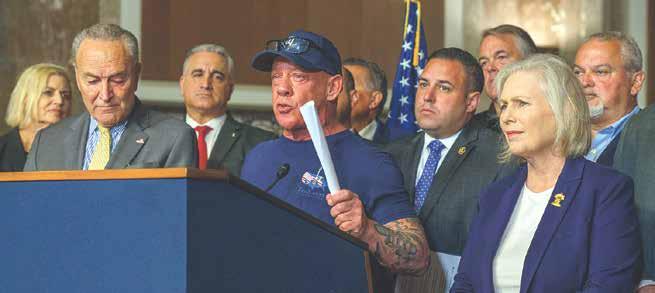
In mid-December, New York Senators Chuck Schumer and Kirsten Gillibrand announced a long-sought triumph for 9/11 first responders: they had secured funding for the World Trade Center Health Program through 2040 in a proposed bipartisan budget deal.
The program, initially established in 2010 by the James Zadroga 9/11 Health and Compensation Act, supports more than 137,000 people but has been running short on funds as the number of first responders and survivors falling ill has increased in the last decade.
Earlier this year, advocates warned that, without congressional intervention, the program would
have to start making cuts by 2027. The senators’ announcement of a funding deal was a rare bipartisan success story in a bitterly divided Washington, D.C., and a victory for advocates who’ve had to repeatedly ask Congress to properly fund the program. But less than a week later, the funding deal for the program was scrapped, along with the rest of the hundreds of billions of dollars packaged in a stopgap funding measure designed to keep the federal government running into March.
A late intervention by Elon Musk, the world’s richest person, and President-elect Donald Trump scuttled the bill. Musk, the owner of Tesla, SpaceX and the social media site X (formerly Twitter), has been empowered by Trump to co-chair the nascent Department of Government Efficiency and complained that the stopgap measure was bloat-
WTC, page 9
CSEA, one of New York State’s largest public employee unions, is seeking resumes for a Labor Relations Specialist for our Commack office to serve the Nassau County area of Long Island, New York State. The position requires extensive knowledge of labor relations, ability to negotiate/administer collective bargaining agreements, resolve employer/employee conflicts, represent members in employment matters, prepare cases for arbitration. Responsibilities include working with union activists to engage members at their worksites and in their communities. A successful candidate should be self-directed, maintain schedule and workload, and be able to operate within a team. Operate independently & schedule workload.
Notice
against it may be served and shall mail process to: 260 West End Ave., Apt 5A, NY, NY 10023, principal business address. DE address of LLC: 850 New Burton Rd., Ste. 201, Dover, DE 19904. Cert. of Form. filed with DE Sec. of State, 401 Federal St., Dover, DE 19901. Purpose: all lawful purposes. 121924-10 12/27/24-1/31/25
Salary is $73,409 plus a $3,000 location benefit differential on place of residence and excellent benefits including health, vision, and dental coverage; generous paid time off, defined pension and transportation stipend.
CSEA, one of New York State’s largest unions, is seeking resumes for a Labor Relations Specialist to serve Westchester County in New York State. Responsibilities include working with union activists to engage members at their worksites and in their communities and negotiating /administering collective bargaining agreements. Operate independently & schedule workload.
Salary $62,231 with excellent benefits and location pay of $900.
Qualifications: High School/Equivalency with 3 years full time related experience OR BA in labor relations or a related field or acceptable combination of work experience and education. Drivers license/car for business use.
Notice is hereby given that a ONPREMISES RESTAURANT-LIQUOR license, application number NA-034023-143672 has been applied for by DOMINICAN BAR & RESTAURANT CORP., to sell at retail, LIQUOR with BEER and WINE, in a Restaurant establishment, under the Alcoholic Beverage Control law at 25A EAST 170TH STREET BRONX, NY 10452 for on premises consumption. 121924-6 12/27/24-1/3/25
Driver’s license/car for business use. High School/ Equivalency & 3 years full time related experience or BA in related field or acceptable combination of work experience and education.
Labor Relations Specialist and Contract Administration Specialist –Downstate New York
To apply, please visit cseany.org/jobs, email to cseajobs@cseainc.org or send resume to: Director of Human Resources PO Box 7125 Capitol Station, Albany, NY 12224
CSEA, one of New York State's largest public employee unions, is seeking resumes for Labor Relations Specialist and Contract Administration Specialist serving the Long Island areas of Nassau and Suffolk counties, New York City and Westchester county. Requires knowledge of labor relations, ability to negotiate/administer contracts, resolve employer/employee conflicts. Operate independently & schedule workload. Salary $60,565 with excellent benefits/career ladder. Drivers license/car for business use. High School/Equivalency & 3 years full time related experience or BA in related field or acceptable combination of work experience and education.
Email cseajobs@cseainc.org or send resume to: Director of Human Resources PO Box 7125 Capitol Station, Albany, NY 12224
Please note LRS-LI/CL on all correspondence.
Please note LRSWest/CL on all correspondence. Labor Relations Specialist Westchester County
Email cover letter and resume to cseajobs@cseainc.org or send to: Director of Human Resources PO Box 7125, Capitol Station, Albany, NY 12224

decedent’s mother, as and for her distributive share pursuant to EPTL 4-I.
bond; H. Granting such other relief and further relief as may be just and proper. Dated, Attested and Sealed, December 11, 2024 (Seal). HON. RITA MELLA, Surrogate. DIANA SANABRIA, Chief Clerk. Name of Attorney: Carl Lucas, Esq. Telephone No.: 212-8593468. Email: esqcarl@gmail.com Address of Attorney: 30 Wall Street8th Floor, New York, NY 10005 - Of Counsel to: KAHN GORDON TIMKO & RODRIQUES, P.C. [Note: This citation is served upon you as required by law. You are not required to appear. If you fail to appear it will be assumed you do not object to the relief requested. You have a right to have an attorney appear for you.] PROOF
NOTICE OF FORMATION OF TAJ Multiservice LLC. Articles of Organization filed with the Secretary of State of NY (SSNY) on 8/30/2024. Office location: New York County. SSNY has been designated as agent upon whom process against it may be served. The Post Office address to which the SSNY shall mail a copy of any process against the LLC served upon him/her is 7014 13th Avenue, Suite 202, Brooklyn, NY 11228. The principal business address of the LLC is 228 Park Ave. S, #756412, New York, NY 10003. Purpose: e-Commerce. 121924-11 12/27/24-1/31/25
Notice is hereby given that a ONPREMISES RESTAURANT-LIQUOR license, application number NA-034024-201983 has been applied for by NELLY’S MOFONGO RESTAURANT CORP., to sell at retail, LIQUOR with BEER and WINE, in a Restaurant establishment, under the Alcoholic Beverage Control law at 287 WINDSOR NEW WINDSOR, NY 12553 for on premises consumption. 121924-5 12/27/24-1/3/25
Notice is hereby given that an OnPremises Food & Beverage-Business Liquor License, NYS Application ID NA-0370-24-146207 has been applied for by Baker Falls Enterprises LLC to sell beer, wine, cider and liquor at retail in an on-premises Food & Beverage Business-Liquor establishment. For on premise consumption under the ABC law at 192 Allen St New York NY 10002. 121924-2 12/27/24-1/3/25
Notice is hereby given that an OnPremises Restaurant-Liquor License, NYS Application ID NA-0340-24145441 has been applied for by First Avenue Dining LLC to sell beer, wine, cider and liquor at retail in an on-premises Restaurant-Liquor establishment. For on premise consumption under the ABC law at 135 1st Ave New York NY 10003. 121924-1 12/27/24-1/3/25
GP 1470 HOLDINGS LLC, Art. Of Org. filed with SSNY 12/16/24. Office Location: NY County. SSNY designated as agent for process. SSNY shall mail a copy of any process to: c/o Leech Tishman Robinson Brog, PLLC, attn: Leonard B. Nathanson, 885 Second Ave., 3rd Fl, NY, NY 10017. Purpose: Any lawful act or activity. 121624-2 12/27/24-1/31/25 FAMILY COURT OF THE STATE OF NEW YORK - COUNTY OF
child and awarding guardianship and custody of said child to the petitioning authorized agency as provided by law. **You can use this link: https://notify.nycourts. gov/meet/0kwsxw and enter your name **OR CALL: (347) 378-4143 and enter Conference ID: 832363329# For additional information about virtual court proceedings, visit: https:// nycourts.gov/appear PLEASE TAKE NOTICE that if guardianship and custody of the child are committed to the Petitioner, FORESTDALE INC., the child may be adopted with the consent of the authorized agency, without your consent and without further notice to you. In the event of your failure to appear, the Court will hear and determine the petition as provided by law. Your failure to appear shall constitute a denial of an interest in the said child which denial may result in the transfer or commitment of the child’s custody and guardianship, and/or the adoption of said child, all without further notice to you regarding said child. Your failure to appear on the above date shall constitute a denial of your interest in this child and in opposing this petition which may result, without further notice to you, in the court proceeding in your absence, granting the petition, terminating your parental rights and the transfer or commitment of the child’s care, custody or guardianship to the Petitioner and the Commissioner of the Administration for Children’s Services or in the child’s adoption in this or any subsequent proceeding in which such care, custody or guardianship or adoption of the above-named child may be at issue. Dated: December 20, 2024, Queens, New York. BY ORDER OF THE COURT (Hon. Emily Ruben, J.F.C.). 122624-1 1/3/25
Notice of Qualification of Vertica Operations Group, LLC. Authority filed with NY Secy of State (SSNY) on 12/12/24. Office location: New York County. LLC formed in Delaware (DE) on 12/10/24. SSNY is designated as agent of LLC upon whom process against it may be served. SSNY shall mail process to: 28 Liberty St, NY, NY 10005. DE address of LLC: 1209 Orange St, Wilmington, DE 19801. Cert. of Formation filed with DE Secy of State, 401 Federal St. Ste 4, Dover, DE 19901. Purpose: any lawful activity. 122624-5 1/3/25-2/7/25
Notice of Qualification of Soltage Landco, LLC. Authority filed with NY Secy of State (SSNY) on 12/10/24. Office location: New York County. LLC formed in Delaware (DE) on 3/1/24. SSNY is designated as agent of LLC upon whom process against it may be served. SSNY shall mail process to: 28 Liberty St, NY, NY 10005. DE address of LLC: 1209 Orange St, Wilmington, DE 19801. Cert. of Formation filed with DE Secy of State, 401 Federal St. Ste 4, Dover, DE 19901. The name and address of the Reg. Agent is C T Corporation System, 28 Liberty St, NY, NY 10005. Purpose: any lawful activity. 122624-4 1/3/25-2/7/25
Notice of Qualification of FLATIRON IP LLC. Authority filed with NY Dept. of State: 12/10/24. Office location: NY County. LLC formed in DE: 10/11/24.
Continued from Page 8
ed and failed to align with Trump’s priorities.
‘We will be back’
Instead of the original package, the House and Senate passed, and President Joe Biden signed, a much smaller funding bill to keep the government operating into the new year. First responders, advocates, union leaders and those who inhaled toxic fumes at ground zero, so close to having long-term funding guaranteed, are now staring down the possibility of cuts to the health care program in 2027 and more months of lobbying in Washington to prevent tens of thousands of Americans from losing out on crucial care.
“We were told they would never forget, but yet again, here we are,” Jim Brosi, the president of the Uniformed Fire Officers Association, said in a statement following the funding packages’ breakdown. Brosi personally lobbied members of Congress this year to expand 9/11 healthcare funding, his first full year running the FDNY officers’ union.
“Firefighters, police officers, EMTs and civilians were asked to put their health and safety aside to help the rescue and recovery effort,” he said. “Now we are dying because of that effort, and the nation’s lawmakers have turned their backs on us instead of helping us to live longer. We will be back down in D.C as many times as it takes to demand the promise made to all responders and survivors is kept.”
More FDNY firefighters have died from 9/11 illnesses than died the September day the towers collapsed. Of the 137,000 people on the World Trade Center Health program as of September, more than 35,000 have been diagnosed with cancer.
Gary Smiley, who responded on 9/11 as a rescue paramedic, expressed outrage that the funding package was abandoned due to Musk’s interference. Smiley, now the liaison to
the WTC Health Program for the union representing the FDNY’s EMTs, paramedics and fire inspectors, said that lawmakers were failing in their duty to “take care of heroes.”
“It’s outrageous that after a bipartisan congregation of congress people proudly announced full funding, that outside actors decided the funding was waste,” Smiley said in an interview Monday. “People battling serious illnesses shouldn’t have to go into another year worrying about coverage.”
New York Democrats in the House and Senate were outraged by Musk’s and Trump’s interference as well, with Gillibrand saying in a statement that 9/11 responders “are real people, not political chess pieces.”
“I am deeply disappointed by the decision to not include the World Trade Center Health Program in the government funding bill,” the senator said. “Thousands of Americans risked their lives to protect our country in its darkest hour, and it is now our responsibility as members of Congress to be there for them as they continue to battle the horrific health ramifications from that day and the many days after.”
Gillibrand and Schumer have also championed legislation that would create regulations on the lithium-ion batteries found in electric bikes which have caused at least 260 fires this year in New York City. That initiative did not get passed this year either. Musk criticized the original spending package which included the 9/11 health care funding as soon as its details were released. He wrote in posts on X that the legislation was “one of the worst bills ever written,” and that “any member of the House or Senate who votes for this outrageous spending bill deserves to be out in 2 years!”
“The voice of the people was heard,” he posted on X after the original funding package was abandoned. “This is a good day for America.”
The Department of Citywide Administrative Services established a 135-name list for Industrial Hygienist on October 9, 2024. The list is based on Exam 2029, which was recently held. Readers should note that eligible lists change over their four-year life as candidates are added, removed, reinstated, or rescored. The list shown below is accurate as of the date of establishment but list standings can change as a result of appeals.
Some scores are prefixed by the letters v, d, p, s and r. The letter “v” designates a credit given to an honorably discharged veteran who has served during time of war. The letter “d” designates a credit given to an honorably discharged veteran who was disabled in combat. The letter “p” designates a “legacy credit” for a candidate whose parent died while engaged in the discharge of duties as a NYC Police Officer or Firefighter. The letter “s” designates a “legacy credit” for being the sibling of a Police Officer or Firefighter who was killed in the World Trade Center attack on Sept. 11, 2001. Finally, the letter “r” designates a resident of New York City.

The current minimum salary is $35.90 per hour for a 40-hour work week, increasing to $42.24 in the sixth year. Benefits include, but are not limited to, night and weekend salary differentials, paid holidays, vacation and sick leave, a comprehensive medical plan and a pension plan. The application fee is $85.
THE JOB Light Maintainers, under supervision, install, inspect, test, alter, maintain and repair lighting and other electrical systems in MTA New York City Transit facilities, such as subway tunnels and elevated structures, bus depots and repair shops, subway car yards and barns and other NYCT buildings and structures. They also keep records, drive motor vehicles and perform related work.
Some of the physical activities performed by light maintainers and environmental conditions they experience are working on or near train tracks where live high voltage equipment is present; working outdoors in all weather conditions; using ladders to climb onto and off trackways; hearing warnings (bells, whistles and vocal sounds); working on elevated structures; driving, loading and unloading trucks; and
lifting heavy material and equipment.
Light maintainers may be required to work various shifts including nights, Saturdays, Sundays and holidays
REQUIREMENTS
By Jan. 15, applicants must have either 1) completed a four-year fulltime apprenticeship in the electrical, electronic, or electro-mechanical trade recognized by the New York State Department of Labor, the U.S. Department of Labor, or any state apprenticeship council that is recognized by the U.S. Department of Labor; or 2) Three years of electrical experience installing, maintaining and repairing lighting systems, conduit work, wiring and fixtures. At least two years must be at the journey-level. One year of non-journey level experience may be substituted with education as follows: a) Graduation from a trade school or technical school with a major course of study in electrical, electronic or electro-mechanical technology, or a closely related field, totaling a minimum of 600 hours; or b) Graduation from a vocational high school with a major course study in electrical, electronic or electro-mechanical technology, or a closely related field; or c) Graduation from an accredited college or university with an AAS degree or higher in electrical, electronic, or electro-mechanical technology or a closely related field. Applicants are responsible for determining whether they meet the qualification requirements. They
may be given the test before it is determined whether applicants meet the qualification requirements.
Applicants with a Class A or Class B commercial driver’s license valid in the state of New York may be considered for appointment to a position through a process called selective certification. Those who qualify for selective certification may be given preferred consideration for positions requiring this license. Those appointed through selective certification may be given preferred consideration for positions requiring this license. They must maintain this license for the duration of their employment in the title.
Those with a Class A or Class B commercial driver’s license should follow the instructions given on the date of the practical skills test to indicate their interest in such selective certification. The selective certification requirements may be met at any time during the duration of the list.
Those who meet the requirement at some future dates should submit a request by mail to the address in the job announcement. They should include the examination title and number, their Social Security number and the selective certification they are requesting in the correspondence.
THE TEST Applicants will be given a competitive practical skills test, for which a test date and location will
be assigned. Applicants cannot request that their scheduled test dates or locations be changed unless they meet the conditions in the “Special Test Accommodations” in the job announcement. The practical skills test may measure knowledge, skills and abilities in the following and other related areas:
• Basic electrical theory: Knowledge of electrical principles and theories, and how to apply them safely
• Electrical equipment: Knowledge of electrical devices and principles; ability to install, maintain, troubleshoot/test with standard testing equipment and repair electrical devices utilizing safe work practices
• Lighting and other electrical systems – Knowledge of the safe installation, testing, maintenance and repair of lighting and other electrical systems
• Schematics: Ability to read and interpret specifications and drawings
• Tool usage: Ability to properly select and safely use materials, machinery and tools of the electrical trade.
A passing score is 70 percent. Your score on this test will be used to determine your place on the eligible list.
Veterans’ or disabled veterans’ credit will be granted only to eligible passing candidates who request that they be applied. The credits should be requested at the time of application but must be requested before the date the eligible list is es-
Below is a roundup of New York City and State exams leading to public-service positions. Most of the jobs listed are located in the New York Metropolitan area and upstate.
There are residency requirements for many New York City jobs and for state law-enforcement positions.
Prospective applicants are advised to write or call the appropriate office to make sure they meet the qualifications needed to apply for an exam. For jobs for which no written tests are given, candidates will be rated on education and experience, or by oral tests or performance exams.
DCAS Computer-based Testing and Application Centers (CTACs) have re-opened to the public. However, due to the ongoing COVID-19 pandemic, walk-ins are no longer accepted and appointments must be scheduled online through OASys for eligible list or examination related inquiries.
All examination and eligible list related notifications will be sent by email only, you will no longer receive notifications via the US mail.
All new hires must be vaccinated against the COVID-19 virus, unless they have been granted a reasonable accommodation for religion or disability. If you are offered city employment, this requirement must be met by your date of hire, unless a reasonable accommodation for exemption is received and approved by the hiring agency.
For further information about where to apply to civil service exams and jobs, visit the thechief.org/exams.
The Federal Government has decentralized its personnel operations and holds few exams on a national or regional basis. Most Federal vacancies are filled by individual agencies based on education-and-experience evaluations. For information, contact the U.S. Office of Personnel Management or individual agencies, or see www.usajobs.gov.
CITY EXAMS
➤
ROOFER–45 eligibles (Nos. 1-45) on List 3083 to replace 1 provisional in DOE.
SHEET METAL WORKER–11 eligibles between Nos. 8 and 25 on List 2085 to replace 1 provisional in Police Department.
SPECIAL CONSULTANT (MENTAL
HEALTH STANDARDS AND SERVICES)–253 eligibles between Nos. 1 and 253 on List 1177 to replace 1 provisional in DOHMH.
STOCK WORKER–7 eligibles between Nos. 26 and 249 on List 2100 to replace 1 provisional in Fire Department.
WATER USE INSPECTOR–23 eligibles between Nos. 4 and 89.5 on List 3007 to replace 29 provisionals in DEP.
PROMOTION
ADMINISTRATIVE STAFF ANALYST–3 eligibles (Nos. 3, 13 and 14.5) on List 9536 for 2 jobs in DOE.
ASSOCIATE URBAN PARK RANGER–45
eligibles between Nos. 1 and 60 on List 3547 to replace 10 provisionals in Department of Parks and Recreation.
PRINCIPAL ADMINISTRATIVE ASSOCIATE–303 eligibles between Nos. 324 and 825 on List 1507 for 3 jobs in HRA/DSS.
SUPERVISOR BRICKLAYER–12 eligibles between Nos. 1 and 15 on List 3592 to replace 1 provisional in Department of Transportation.
SUPERVISOR I (SOCIAL SERVICES)–301 eligibles between Nos. 297 and 617 on List 521 to replace 6 provisionals in HRA/DSS.2w
Rehabilitation Counselor III $49,306-$102,986 60019830 Correction Officer
CR(D) Cytotechnologist I $43,863-
CR(D) Cytotechnologist II $52,099$108,383
7095 CR(D) Cytotechnologist III $66,357$132,168
61-639 CR Librarian I $43,000-$61,333
60-180 CR Librarian I, Bilingual (Spanish Speaking)
5263 CR(D) Medical Technologist I $31,963-$74,978
5002 CR Nurse Practitioner I (Acute Care) $59,507-$108,383
5003 CR Nurse Practitioner I (Adult Health) $59,507-$108,383
5004 CR Nurse Practitioner I (Community Health) $59,507$108,383
5005 CR Nurse Practitioner I (Family Health) $59,507-$108,383
5006 CR Nurse Practitioner I (Gerontology) $59,507-$108,383
5007 CR Nurse Practitioner I (Neonatology) $59,507-$108,383
5008 CR Nurse Practitioner I (Obstetrics/Gynecology) $59,507$108,383
5009 CR Nurse Practitioner I (Oncology) $59,507-$108,383
SUFFOLK COUNTY
EXAMS
➤ CLOSES JANUARY 15 0766 Office Systems Analyst I $49,642
Bay Management Specialist I $53,969
Entomologist $63,919
tablished.
Appointees must have a motor vehicle driver license valid in the State of New York. They also must obtain a learner’s permit for a Class B commercial driver license within 90 days of appointment and must obtain a Class B CDL to satisfactorily complete the probationary period. The Class B CDL may not have any restrictions which would preclude the performance of the duties of a light maintainer and must be maintained for the duration of employment in the title.
Appointees who are active members or who were discharged in the past year from the military or New York National Guard and have experience driving a commercial motor vehicle in the military or National Guard may be eligible for a waiver of the commercial driving skills test through the New York State Department of Motor Vehicles.
Medical guidelines have been established for the position of light maintainer and appointees will be examined to determine whether they can perform the essential functions of the position.
They also must pass a drug screening in order to be appointed, and if appointed, will be subject to random drug and alcohol tests for the duration of employment. For complete information on the position, go to https://new.mta. info/document/158506.
BY DAVID BAUDER Associated Press
For the press heading into a second Trump administration, there’s a balancing act between being prepared and being fearful.
The return to power of Donald Trump, who has called journalists enemies and talked about retribution against those he feels have wronged him, has news executives nervous. Perceived threats are numerous: lawsuits of every sort, efforts to unmask anonymous sources, physical danger and intimidation, attacks on public media and libel protections, day-to-day demonization.
In a closely-watched case settled over the weekend, ABC chose to settle a defamation lawsuit brought by the president-elect over an inaccurate statement made by George Stephanopoulos by agreeing to pay $15 million toward Trump’s presidential library.
“The news media is heading into this next administration with its eyes open,” said Bruce Brown, executive director of the Reporters Committee for the Freedom of the Press.
“Some challenges to the free press may be overt, some may be more subtle,” Brown said. “We’ll need to be prepared for rapid response as well as long campaigns to protect our rights — and to remember that our most important audiences are the courts and the public.”
One prominent editor warned against going on war footing with an administration that hasn’t taken office yet. “There may be a moment to cry wolf here,” said Stephen Engelberg, editor-in-chief of the nonprofit news outlet ProPublica. “But I don’t think we’ve reached it.”
Trump: ‘Our press is very corrupt’
At a news conference in mid-December, Trump said that “we need a fair media” and discussed some potential and ongoing legal cases he has against news outlets.
“We have to straighten out the press,” Trump said. “Our press is very corrupt, almost as corrupt as our elections.”
News organizations are heading into the second Trump era weak both financially and in public esteem. To a large extent, Trump sidestepped legacy media outlets during
his campaign in favor of podcasters, yet still had time for specific beefs against ABC, CBS and NBC.
The Trump team knows that many of its followers despise a probing press, and stoking that fury has political advantages. Two examples in the campaign to install Trump nominee Pete Hegseth as defense secretary shows how routine reporting activities can be characterized as an attack.
When The New York Times was tipped to an email that Hegseth’s mother once sent to him criticizing his treatment of women, it called her for comment. Penelope Hegseth later told Fox News that she perceived that as a threat, even though it enabled the newspaper to report that she had quickly apologized for sending the email and says she doesn’t feel that way about him now.
Pete Hegseth also used social media to say that ProPublica — he called it a “Left Wing hack group” — was about to knowingly publish a false report that he hadn’t been accepted into West Point decades ago. The news site had contacted him after officials at the military academy contradicted Hegseth’s claim of acceptance. Hegseth provided proof that those officials were mistaken, and ProPublica never published a story.
“That’s journalism,” noted ProPublica’s Jesse Eisinger. But a narrative had taken hold: “ProPublica’s botched Pete Hegseth smear,” the New York Post called it in a headline.
During the presidential campaign, Trump sued CBS News for the way it edited an interview with opponent Kamala Harris; suggested ABC News lose its broadcast license for fact-checking him during his lone debate with Harris; and successfully called for equal time on NBC after Harris appeared on “Saturday Night Live.” In the Stephanopoulos lawsuit, the ABC anchor said Trump had been “found liable for rape” in writer E. Jean Carroll’s civil trial, when he had not. Days after his news conference, Trump filed a lawsuit against the Des Moines Register in Iowa and parent company Gannett for publishing results of a poll shortly before the election that suddenly had him behind Harris. He said that amounted to “fraud and election interference.” He eventually won the

state handily.
Trump engages with the mainstream media — besides the news conference he gave a newsmaking interview to NBC’s “Meet the Press” last month — but journalists have to be alert to how their work will be portrayed. Trump’s appointments, and what they’ve said about journalists, have raised alarms.
Kash Patel, Trump’s choice to lead the FBI, said on a podcast last year that “we’re going to come after people in the media who lied about American citizens.” Two appointees who have expressed hostility toward the media will be in a position to impact the work of journalists: Brendan Carr as chairman of the Federal Communications Commission and Kari Lake as director of Voice of America.
Public outlets facing danger?
News organizations are worried that a Justice Department policy that has generally prohibited pros-
ecutors from seizing the records of journalists in order to investigate leaks will be reversed, and are already urging journalists to protect their work. “If you have something you don’t want to share with a broader audience, don’t put it on the cloud,” ProPublica’s Engelberg said.
During the first Trump administration, some journalists who covered immigration issues were pulled aside for screening and questioning. The Reporter’s Committee wonders if this might happen again — and whether similar practices might extend toward reporting on expected deportations.
The literary and human rights organization PEN America is concerned about journalists facing physical danger and digital hostility. It may have seemed like a flippant remark to some of his supporters when Trump, months after an attempt on his life, said at a rally that he wouldn’t mind if somebody had to “shoot through the fake news” to get to him. But it wasn’t for people
standing on media risers.
“It’s important that the president act with responsibility to reduce physical violence against the press rather than encourage it,” said Viktorya Vilk, PEN America’s program director for digital safety and free expression.
Sen. John Kennedy of Louisiana recently introduced a bill that would end taxpayer funding for public radio and television, a longtime goal of many Republicans that may get momentum with the party back in power. Some U.S. Supreme Court justices are eager to revisit a legal precedent that has made it difficult to prove defamation against news organizations.
It’s apparent that the new administration will come after the press in every conceivable way, former Washington Post editor Martin Baron said recently on NPR. “I do think he will use every tool in his toolbox,” Baron said, “and there are a lot of tools.”
In 2024, artificial intelligence was all about putting AI tools to work in several spheres
BY MATT O’BRIEN and SARAH PARVINI Associated Press
If 2023 was a year of wonder about artificial intelligence, 2024 was the year to try to get that wonder to do something useful without breaking the bank. There was a “shift from putting out models to actually building products,” said Arvind Narayanan, a Princeton University computer science professor and co-author of the new book “AI Snake Oil: What Artificial Intelligence Can Do, What It Can’t, and How to Tell The Difference.”
The first 100 million or so people who experimented with ChatGPT upon its release two years ago actively sought out the chatbot, finding it amazingly helpful at some tasks or laughably mediocre at others. Now such generative AI technology is baked into an increasing number of technology services whether we’re looking for it or not — for instance, through the AI-generated answers in Google search results or new AI techniques in photo editing tools.
“The main thing that was wrong with generative AI last year is that companies were releasing these really powerful models without a concrete way for people to make use of them,” said Narayanan. “What we’re seeing this year is gradually building out these products that can take advantage of those capabilities and do useful things for people.”
At the same time, since OpenAI released GPT-4 in March 2023 and competitors introduced similarly performing AI large language models, these models have stopped getting significantly “bigger and qualitatively better,” resetting overblown expectations that AI was racing every few months to some kind of better-than-human intelligence,

Narayanan said. That’s also meant that the public discourse has shifted from “is AI going to kill us?” to treating it like a normal technology, he said.
AI and your job
Some workers wonder whether AI tools will be used to supplement their work or to replace them as the technology continues to grow.
The tech company Borderless AI has been using an AI chatbot from Cohere to write up employment contracts for workers in Turkey or India without the help of outside lawyers or translators.
Video game performers with the Screen Actors Guild-American Federation of Television and Radio Artists who went on strike in July said they feared AI could reduce or
eliminate job opportunities because it could be used to replicate one performance into a number of other movements without their consent.
Concerns about how movie studios will use AI helped fuel last year’s film and television strikes by the union, which lasted four months. Game companies have also signed side agreements with the union that codify certain AI protections in order to keep working with actors during the strike.
Musicians and authors have voiced similar concerns over AI scraping their voices and books.
But generative AI still can’t create unique work or “completely new things,” said Walid Saad, a professor of electrical and computer engineering and AI expert at Virginia Tech.
“We can train it with more data
so it has more information. But having more information doesn’t mean you’re more creative,” he said. “As humans, we understand the world around us, right? We understand the physics. You understand if you throw a ball on the ground, it’s going to bounce. AI tools currently don’t understand the world.”
Saad pointed to a meme about AI as an example of that shortcoming.
When someone prompted an AI engine to create an image of salmon swimming in a river, he said, the AI created a photo of a river with cut pieces of salmon found in grocery stores.
“What AI lacks today is the common sense that humans have, and I think that is the next step,” he said.
An ‘agentic future’
On quarterly earnings calls this year, tech executives often heard questions from Wall Street analysts looking for assurances of future payoffs from huge spending on AI research and development. Building AI systems behind generative AI tools like OpenAI’s ChatGPT or Google’s Gemini requires investing in energy-hungry computing systems running on powerful and expensive AI chips. They require so much electricity that tech giants announced deals this year to tap into nuclear power to help run them.
“We’re talking about hundreds of billions of dollars of capital that has been poured into this technology,” said Goldman Sachs analyst Kash Rangan. Rangan is bullish about its potential and says that AI tools are already proving “absolutely incrementally more productive” in sales, design and a number of other professions.
Vijoy Pandey, senior vice president of Cisco’s innovation and incubation arm, Outshift, predicts that
eventually, AI agents will be able to come together and perform a job the way multiple people come together and solve a problem as a team rather than simply accomplishing tasks as individual AI tools. The AI agents of the future will work as an ensemble, he said.
Future Bitcoin software, for example, will likely rely on the use of AI software agents, Pandey said. Those agents will each have a specialty, he said, with “agents that check for correctness, agents that check for security, agents that check for scale.”
“We’re getting to an agentic future,” he said. “You’re going to have all these agents being very good at certain skills, but also have a little bit of a character or color to them, because that’s how we operate.”
Gains in medicine
AI tools have also streamlined, or lent in some cases a literal helping hand, to the medical field. This year’s Nobel Prize in chemistry — one of two Nobels awarded to AI-related science — went to work led by Google that could help discover new medicines.
Saad, the Virginia Tech professor, said that AI has helped bring faster diagnostics by quickly giving doctors a starting point to launch from when determining a patient’s care. AI can’t detect disease, he said, but it can quickly digest data and point out potential problem areas for a real doctor to investigate. As with other arenas, however, it poses a risk of perpetuating falsehoods. Tech giant OpenAI has touted its AI-powered transcription tool Whisper as having near “human level robustness and accuracy,” for example. But experts have said that Whisper has a major flaw: It is prone to making up chunks of text or even entire sentences.