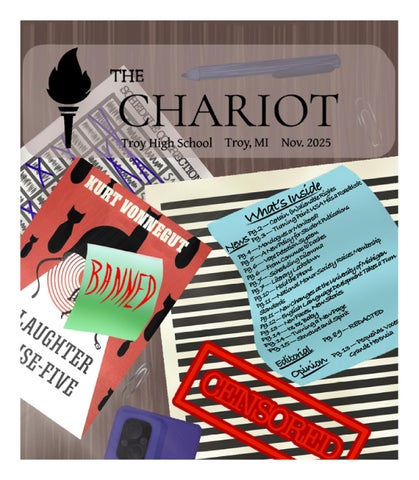
The Chariot is Troy High School’s newspaper, made for the students, by the students. The content of The Chariot varies from article to article, however, each article is based on a wide area of research. The Chariot staff and editorial board selects stories based on their relevance and emotional value to our community. The Chariot prioritizes covering stories from a wide range of perspectives and aims to report with accuracy and impartiality. The Chariot staff and editorial board take responsibility for selecting stories that are relevant to our community.
The Chariot operates under a process of administrative review. Although the process of finding, writing, conceptualizing and designing belong to the students, administration has the final say before publishing. The process of review never leaves Troy High School before publication. Expressing the view of the entire diverse student body of Troy High School has always been its focus.
Certain (In)alienable Rights
The gray area of law at school.
Henry McBrien // Publications Editor
The United States Constitution is universal. One would be right to assume that the articles and amendments that make up the Constitution are equally as universal. However, much of life is not black and white, especially the law. The Fourth Amendment grants freedom from unreasonable searches and seizures. In a poll of Troy High Students, 61% of respondents noted that they thought they could refuse a search by a teacher. But it is not that clear cut in school. What are your rights really?
According to the Fourth Amendment, “The right of the people to be secure in their persons, houses, papers, and effects, against unreasonable searches and seizures, shall not be violated, and no warrants shall issue, but upon probable cause.” Essentially, a student may not be searched unless probable cause is found or a warrant is issued. However, this is not necessarily the case in schools.
According to school resource officer Brian Jones, “Probable cause is a higher burden of proof, where I must prove that a crime has or is about to be committed in order to search someone or something.” This differs from the standard used
in schools, reasonable suspicion. Reasonable suspicion, according to Jones is, “the suspicion that crime would be afoot without proof, necessarily.”
Chris Rich, a former family and juvenile law attorney, weighed in on the ability of teachers to search students under such conditions: “It is true that the standard of proof is lowered to reasonable suspicion in schools.” However, students still have certain reservations at school. “They cannot necessarily go rifling through your bags, but a basic pat down can be satisfied with a lower burden of proof.”
In terms of the actual protocol for searches at school, Vice Principal Dan House explains, “If we got a report from a teacher, [the student] would be taken down to the office and given a quick pat down. Males search males and females search females.” In addition, students are not necessarily given the right to an attorney before or during the search.
“We need to act expeditiously, so parents or lawyers may not be contacted prior to a search.”
Searches will often be accompanied by questioning from administration. According to Rich, “Of course, Miranda can apply, but it’s such a grey area.”
Rich refers to Miranda v. Arizona, 384 U.S. 436, which held that, “Unless adequate preventive measures are taken to dispel the compulsion inherent in custodial surroundings, no statement obtained from the defendant can truly be the product of his free choice.” Essentially, a person must be warned against self-incrimination before questioning, and a person must voluntarily waive their Fifth Amendment right, which is still applicable in schools, though it may be up to the interpretation of a court.
“The law is complicated, that’s why we have courts,” according to Rich. “People, often unfamiliar with the law, like to think of it as black and white when really it isn’t. Tread carefully.”
Poll conducted via social media and in person with 20 respondents.
This article does not constitute legal advice. No warranty whatsoever is made that any of the above information is legally accurate and does not substitute the advice of a legal professional. For legal assistance, contact the State Bar of Michigan.
SCAN FOR OUR ONLINE EDITION
Turning Point USA Hits a Roadblock
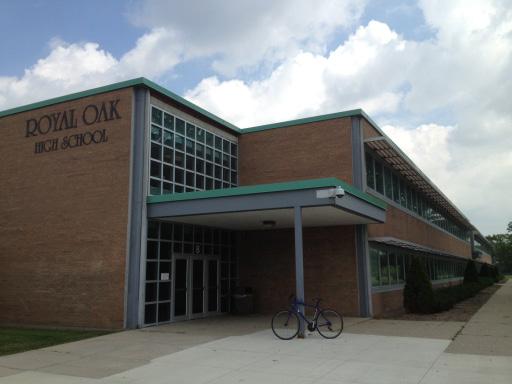
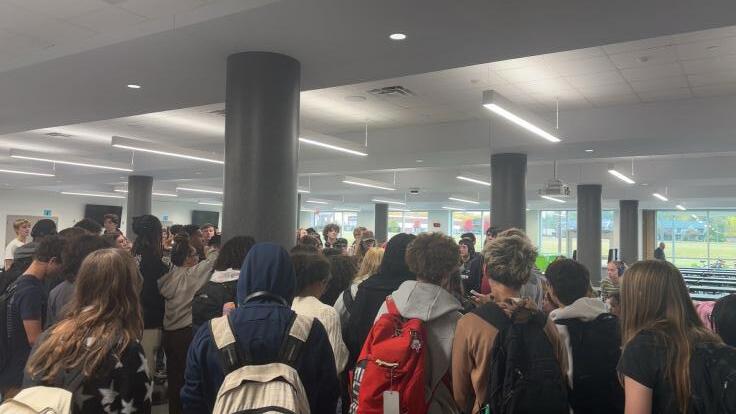
Royal Oak High School students protest co-founder Charlie Kirk’s nonprofit Turning Point USA. Roberto Nicolas-Piña // Staff Reporter
On Wednesday, Oct. 22, 2025, the students of Royal Oak High School staged a protest against the establishment of a Turning Point USA chapter at the high school. Turning Point USA is a nonprofit organization co-founded by controversial political figure Charlie Kirk that advocates for open discussion of conservative politics to be brought to high schools and college campuses around the country. Once TPUSA had announced it was launching its chapter at Royal Oak High School, talks of protest almost immediately spread through social media, leading to a walkout the next morning.
Lenna Landis, a student protester, says that the students’ reason for the protest largely consisted of the idea that “TPUSA isn’t just a political and governmental organization, but a group organized to belittle and diminish minorities.” The pushback against TPUSA was not rooted in the contrasting political ideals, but in what they believed the group represented beyond political division.
Adeline Penchoff, student writer for The Acorn, Royal Oak Highschool’s Newsmagazine, adds a suspected reason for the pro-
test: “[TPUSA] said they were nonpartisan, but then promoted negative things about those [marginalized] groups.”
Multiple students describe how they do not feel comfortable with the presence of the club, like student protester Leo Hessel. “Personally, I don’t want that club in our school, I don’t think it stands for what the community is about or what the school represents.” Students stress that the protest against TPUSA was built primarily on ideas of anti-hate, which they believe their school should stand for.
Despite being against the establishment of TPUSA, the protesters express that if the organization operates as advertised, TPUSA should have a chance to meet. Due to the limited opportunities the TPUSA chapter in Royal Oak has been given to meet, concrete ideas on how the club will work within the school have yet to be established. Landis openly admits, “I think we should be open to the idea of at least letting them have their first meeting.”
The protest itself was a peaceful attempt to get the Royal Oak High School administration to hear out
the students’ complaints about bringing TPUSA to the school. “It was promoted as a peaceful protest, I think that was a great idea and I think it was perfect for something like this,” Landis says. She adds that students had also complained about the behavior of some students who joined the protest. “It was too much; we didn’t get much done, it was a lot of arguing, yelling and talking over each other.”
Less involved students express their disappointment in how certain participants had handled themselves. Penchoff admits, “I personally never went just because I heard about how negative it was.”
Leo Hessel also recounts how students had responded online to the announcement of TPUSA by targeting the club’s faculty advisor. “He’s been getting a lot of hate mail, which is something I also feel isn’t a part of what the protest is about,” he describes.
The administration was cooperative with the protest as Hessel describes how Principal Daniel Loomis tried to address the students’ concerns even though his efforts were met with pushback. “He was responding in a way which I thought was very courteous and respectful, but the students kept taking it really personally and it felt like they thought [administration] was attacking them and trying to keep them quiet,” Hessel says. He critiques the composure students had kept when in discussion with Loomis, “People were booing him out of the cafeteria
and shouting at him and that’s when I started to realize, this is probably not gonna go how I was hoping.”
Penchoff speaks of the misplaced attitude towards the school’s principal, “Everyone was coming after the principal and making rumors that he supported white supremacy.”
After the protest, promoting conversation between the protesting students and administration has remained a consistent goal. Landis explains, “We’re trying to get small groups of people to meet with the superintendent and voice their opinions,” adding that the school district’s administration has
been able to keep a healthy level of cooperation.
The operation of the TPUSA chapter in Royal Oak High School remains to be a controversial topic between students and administration. As of Nov. 10, TPUSA has had their first meeting; the school is still testing the waters of formally integrating the club. Whether Turning Point USA becomes a lasting part of Royal Oak High School or fades away amid its controversy, the protest has sparked a wider conversation of free speech, communication, and respect within the school.
Photo courtesy of The Oakland Press
Photo courtesy of Wikipedia
Photo courtesy of Lenna Landis
Monologues or Monitored?
The suspension and cancellation of late night hosts has posed the question to viewers, is this censorship or coincidence?
Isela Mulcahy // Business Editor
In the past six months, Columbia Broadcasting System, known as CBS, decided on July 17, 2025, that the “The Late Show with Steven Colbert” will end in May 2026. Stephen Colbert hosted “The Late Show” for 11 years. While it was cited by the network as a purely financial decision, Colbert’s active opposition to President Donald Trump and the Republican party caused speculation that the decision could have been politically motivated.
In response to the show’s cancellation, Trump actively celebrated on X (formerly known as Twitter), stating that he “absolutely love[d]” that Colbert was fired and even suggesting Jimmy Kimmel “was next to go in the untalented late night sweepstakes.”
Subsequently, Jimmy Kimmel’s suspension from “Jimmy Kimmel Live!” on the American Broadcasting Company (ABC), came on Sept. 17 this year, two days after Kimmel gave a controversial monologue regarding the death of political figure, Charlie Kirk. Kimmel commented that the way Trump grieves Kirk is not
how one grieves a friend. In actuality, it is equivalent to how a “4-year-old mourns a goldfish.” In response, Trump again took to X and celebrated by calling Kimmel a “loser” and “totally untalented.”
Ryan Werenka, an Advanced Placement United States government teacher at Troy High School, comments on these suspicions, stating “Many people think that ABC was pressured by the federal government” as a form of punishment for “speech that the government did not like.” Even stating that in terms of the restrictions placed on Kimmel’s speech because he was taken off air, he “can see why so many free speech advocates were uncomfortable.”
Ultimately, “Jimmy Kimmel Live!” was resumed because ABC received strong backlash to his suspension, as 4.1 million cancelled their Hulu subscription and 3 million canceled their Disney Plus subscriptions. In retaliation, Trump commented on X threatening ABC by mentioning his 2024 defamation lawsuit against them, and how
“last time [he] went after them, they gave [him] 16 million dollars.” Through these public social media posts and the actions of the networks, viewers are questioning if the influence of politics on nationally televised free speech goes against the Constitution.
Werenka clarifies that the First Amendment states that, “Congress shall make no law abridging freedom of speech.” It does not, however, mention one’s employer abridging their freedom of speech. Whether or not the network was politically pressured can bring up a “thorny first amendment issue.”
One also has to take into consideration the morality of the situation, as well as the political viewpoint. Senior Sarah Lee, Vice President of Troy High School Model United Nations defines free speech as “being able to apply [her] thoughts without consequences from government, whatever administration or authority figure.” Therefore it is ultimately up to the reader to decide if this is pushing the boundaries of free speech politically or socially.
A New Policy for Student Publications
How administrative review impacts Troy High School student organizations. Jiwoo Park // Editor-in-Chief
Recently, Troy High School organizations have undergone changes pertaining to administrative review. The administrative team started implementing the review process earlier this year, when the 2015 school board policy was brought to their attention. Essentially, Assistant Principal Kerry Brennan and Principal Remo Roncone view publications beforehand, including the newspaper, yearbook, literary magazine, announcements and student government videos. The policy requires “a partnership between our student groups and then our administration team,” according to Brennan, “where we’re working together to make sure that ultimately what is created doesn’t put anybody in a position legally that could be a negative experience.”
The policy can affect student organizations differently. The literary magazine, The Mosaic, revived only last year, and adviser Joseph Verhelle sent their draft once to administration. He explains that the review process hasn’t affected the magazine or members to much extent, the only change being the schedule. The team
will need to implement time for the administrative re view to be able to print the magazine on time. “We have to push everything up to make sure that we get it to the printer by the deadline,” Verhelle says. He is unsure yet of the necessary time to allot.
However, members cu rating the magazine “might feel a little bit nervous to select submissions that might be a little bit more evocative or might push vi olent or overly vulnerable” works, according to Ver helle.
As for the yearbook, The Gladiator, the admin istration has a live view of the book with access at all times because of its size. Additionally, the publication plans out the year in the summer. “It’s called our ladder,” adviser Emily Rusk says, “so we have every page and spread and the topic all laid out at the beginning of the year. So everything that we’re going to cover is already there.” This allows the administration to look at the specific spreads they need to.
The publication and its practices have not been affected, according to Rusk, and she details that “it hasn’t really felt much like we’ve been told that we can’t do certain things or cover certain events a certain way, mostly just because what we’ve done is really rooted in tradition, so we’ve already been doing it for so long.”
Rusk and Verhelle express similar beliefs that their publications may be impacted differently than others. Rusk says, “I think there’s some
differ
ences between the newspaper and yearbook publications where I could definitely see those hard hitting stories that sometimes can be controversial. I could see those giving people a little bit of pause where if we’re being completely honest, we’re not writing controversial things in the yearbook, right? Like we’re here to celebrate the school and its achievements and the students too and their stories.”
For the announcements, adviser Harriet Clark is part of the review process. “I don’t have to send videos to admin before they run, but we brain storm what we’re going to do, and then the kids do the vid eos,” Clark explains. If there is anything she believes is ques tionable or defying rules or the law, then she shows them. “So I do show them them pe riodically. It’s not like we film on Monday, before they air on Tuesday, they must go through an administrator.”
Additionally, this process has been ongoing in Clark’s ad visory since before last school year. This school year, Clark sent three videos to admin istration and removed their uploads. They were ultimately removed because they violated
to stop our students from talking about those things.”
She further details the biggest reason to request changes would be anything causing harm, including any hate speech.
The review process affects advisers as well as administration. Rusk describes it to be almost like a safety net for advisers. She says, “It doesn’t feel like so much pressure on me as an adviser to make the ultimate decision where you’ve heard of, of advisers being terminated from their positions because of things that were printed or misprinted or misquoted or things like that.”
Administration, Rusk and Verhelle plan to set a more detailed and communicative procedure following the recent
we can make anything work, and I want to make it work.”
Because the review process is “something that we’re all just trying to navigate,” according to Rusk, it may take time to obtain a successful process.
Nevertheless, Brennan assures, “It’s a partnership, and I am on your team. I am here to support you. Talk through anything you want.”
In April of 2024, Troy High School installed vape detectors in several bathrooms as an effort to reduce vaping on school grounds. The small white devices, which look similar to smoke alarms, can detect chemicals from e-cigarettes and alert administrators when triggered.
Assistant Principal Kerry Brennan says the decision came after staff noticed vaping becoming more common among students.
“We decided to install the vape detectors not because of one incident, but because we have had instances of vaping, and we always want to do what we can to help students make better choices,” Brennan says. The detectors are meant to create a consistent and quicker way to respond when incidents happen.
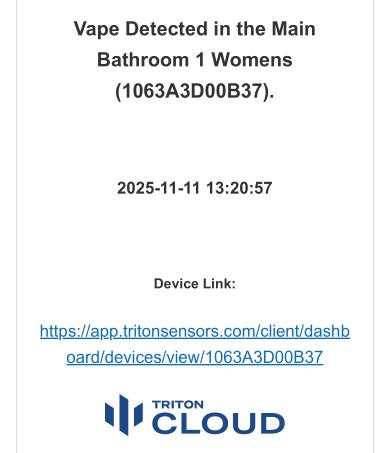
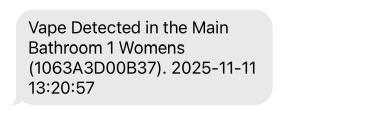
Each device connects to an app that alerts the Shield safety team and administrative staff in real time. When one goes off, an available team member checks the restroom that sent the alert and reviews nearby hallway cameras to see who entered or exited around that time. “There are no cameras in the bathrooms. We always make sure to respect students’ privacy,” Brennan says.
Once an alert is confirmed, staff speaks with the students involved to determine what happened. If
Vape Detection System
Exploring how Troy High School tracks vaping. Lexi Benedict // Staff Reporter
vaping is verified, the student is brought to one of the administrator’s offices. Brennan adds, “The goal is not to punish, but to help students make better choices.”
“Ultimately, we want all our students to be safe and healthy,” she says. “If you decide to vape at school, you should be held accountable, but it should always be a learning opportunity.”
While administrators describe the detectors as a safety measure, many students have mixed feelings about them. “They don’t really work,” Source 1 says. “People still vape in the bathrooms. Some even try to break them.”
The detectors have made some students more careful, but not enough to stop, according to Source 2: “Students do it anyway. They just find other bathrooms or locker rooms without them.”
Source 3 agrees that the detectors do not seem to stop vaping: “I’ve seen someone blow smoke right at one and nothing happened.” However, the full efficiency of the detectors is difficult for students to monitor as they do not emit a visible signal in the restroom when vape is detected.
Source 3 feels that the primary purpose of the detectors is to deter vaping, instead of punishing vaping: “It’s more just to scare people
than actually do anything.”
Some students say they have been called down or searched after a detector went off. “They searched my bag, my pockets and my shoes,” Source 2 says. “They didn’t find anything, but it was random and uncomfortable.”
Brennan says the administration handles these situations carefully and respectfully. “We follow
consistent procedures and make sure students are treated fairly,” she says. “We never want to embarrass them, but we also have to take the alerts seriously.”
When asked what could actually help students stop vaping, most students and admin agree that education and support would be
more effective than punishment.
“Suspending someone for a few days doesn’t help,” Source 1 says. “If they really want people to stop, they should focus on showing how bad vaping is instead of trying to control it.”
Though vaping is a topic covered in-depth in the school’s required health program, Source 3 suggests that further education from experts can make a bigger difference. “If actual scientists came in and explained what vaping does to your lungs, it would probably have more of an impact than detectors,” says Source 3.
Brennan says the school shares that goal and connects students with resources such as Troy Youth Assistance for additional support. “We installed them to encourage students to make better decisions and to communicate the fact that we do not tolerate any substance abuse at Troy High.” she says. “At the same time, we want to offer meaningful help to anyone who needs it,” she adds.
Since the detectors were added, Brennan says most families have supported the decision: “Our families understand that we installed the vape detectors to help our students and make Troy High [School] as safe as possible.”
“Most students don’t mind the
From Commas to Dashes
AI and its prominent impacts in the classroom. Manasvi Mummaneni // Staff Reporter
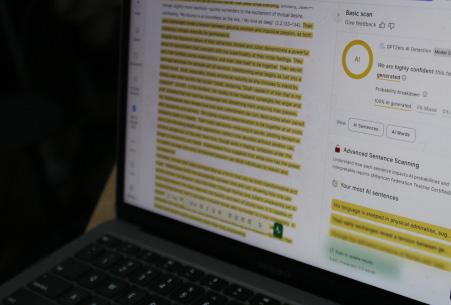
Entering the 2025-2026 school year, Troy High School continues to enforce its plagiarism policy, which states that any student that turns in work that is not their own will receive disciplinary action. As the orientation packets passed out to the student body earlier this year state, artificial intelligence (AI) is considered a form of plagiarism.
AI use in classrooms has been an ongoing occurrence, affecting the learning experience from multiple perspectives. Lisa Knudson, English teacher at Troy High School, claims that AI “hits the English department pretty hard.”
Multiple English teachers have been receiving AI-generated work from their students.
“When it comes to essays, I feel like I can’t trust anybody anymore,” says Knudson. “It’s created double, if not triple, the grading time, because I have to go through each individual paper and run it
through different [AI] checkers.”
As AI chat bots like ChatGPT and Google Gemini rapidly evolve, multiple students are seemingly growing dependent on them.
Andre Collaku, English teacher at Troy High School, believes that “AI hurts way more than it helps the student.” He says, “Every time I go into my class, there’s one student trying to AI something or another.”
Similar to Knudson, Collaku has dealt with the drawbacks of English students submitting AI-generated essays. Collaku says that some students who “write something really good” often lie about using AI when asked. He claims that he gives AI-generated work a zero and warns his students ahead of time.
“I would rather have you come clean and tell me you need help and I’ll help you,” Collaku expresses.
In terms of the effects of AI on students, many of the teachers respond with concern. “It doesn’t teach them anything,” says Knudson. “I teach seniors, and you guys are going to college next year, and I don’t want you relying on AI and turning in work that you didn’t do.”
Collaku emphasizes the idea of students missing out on the process of deep thinking. “School and education, and especially English class, is not about whether you have the right answer or not,” he
claims, “When you read a text and you analyze a text, you’re working out a specific part of your mind that is used for critical thinking.” He adds, “It’s kind of like a stone sharpening steel.”
While AI use in the classroom may be deemed negative in certain scenarios, AI has been used in the classroom to aid ELD, English Language Development, students with their learning process.
Christina Rick, an ELD and English teacher at Troy High School, elaborates on the many ways that ELD students benefit from AI.
“It takes a lot of pressure off of [ELD] students. They can do their homework more efficiently and spend less time word-toword translating,” says Rick. However, Rick goes over the plagiarism policy with her students to help them understand the differences between using AI as a tool and claiming its work as their own.
installation. If anything, they’re glad they can use the bathrooms without distractions,” says Brennan.
The added surveillance makes Source 3 uneasy. “I think they’re being a little bit too controlling,” Source 3 says.
The administration has not decided whether to expand the system to more restrooms, but Brennan says the school will continue to evaluate how well the detectors work and whether any updates are needed. “We may continue with the current vape detection system or look at other companies,” she says.
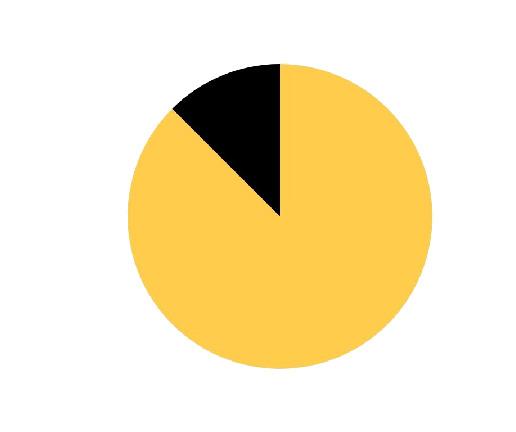
Although opinions differ, vaping remains a problem that will not be solved overnight. According to the Food and Drug Administration Youth Tobacco Survey, at least 7.9% of high schoolers reported current vape usage. “I think students vape for two main reasons: to look a certain way in front of their friends or to relieve stress,” Brennan says. “The best way to cut down is by helping them understand the risks and giving them real support.”
While multiple teachers have concerns about AI within the classroom, a couple of students explain how they use AI to improve their learning experience. Senior Sanjana Prabhu says she uses AI to help, “dumb down certain topics that [she] might be struggling with.”
Prabhu expresses that AI offers “that quick, convenient, almost like teacher and mentor role,” for when she doesn’t have direct help from her teacher or classmates.
Senior Varsha Rajesh explains how she feeds AI her notes or a specific reading and has it “give [her] practice questions to use to kind of study.”
Overall, Rajesh expresses that she thinks “AI is going to be beneficial if we learn to use it in the right way.”
While AI softwares are continuing to advance, their role in the classroom raises many questions and concerns.
Administrative view of a vape detector alert photos courtesy of Kerry Brennan
Adminsitrative text alert of detector going off photos courtesy of Kerry Brennan
Scheduling Dilemma
How new scheduling limits have affected students and staff this year.
Sabrina Ahmed // Staff Reporter
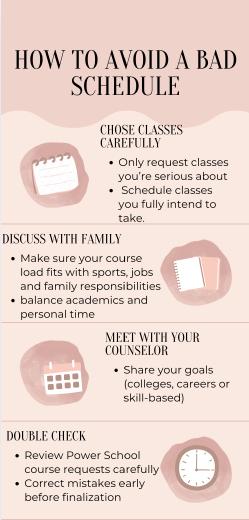
As the 2025-2026 school year kicks off, schedule changes have created a bit of chaos at Troy High School. Many students have experienced difficulties when requesting schedule changes. According to the counseling department, changes are now limited to specific cases. These exceptions include: missing a class required for graduation, not meeting a prerequisite, needing to recover credit or having fewer than six classes. Requests to change lunch periods, teachers or class difficulty levels are not accepted. Others mentioned being placed in alternative classes when preferred classes were available.
Junior Gabriel Vimmerman who recently moved into the district, was unwillingly put in Advanced Placement Economics instead of regular Economics. Vimmerman explains that although his counselor did not approve his schedule change request, the experience ended up motivating him to improve academically: “When you’re denied a schedule change, it kind of incentivizes you to try harder.”
Senior Ava Shammas also shared that she faced difficulties adjusting her
schedule earlier this year. According to Shammas, her counselor told her the change could not be made. She shares, “It definitely affects my stress because I’ve already gotten comfortable in this class, but I won’t be able to continue it next semester.”
Counselor Thomas Keegan expresses, “We do our best as a district to give students all the choices that they are requesting. In doing so, decisions are made regarding the number of sections and the amount of teachers that are available to teach the sections which limits the availability for movement in schedules.”
To further explain these limitations, Assistant Principal Jesse Allgeier highlights how tightly the schedule is built each year, “When students submit course requests in the spring, those numbers determine how many sections of each class will run the next year. Once the master schedule is finalized, most classes are filled to capacity, which makes schedule changes extremely limited.”
Senior Jude Rhey states, “Even though my mom emailed explaining that I was not required to take calculus, my counselor said it was in my best interest to stay in Calculus AB.”
Keegan emphasizes to students, “As counselors, as we continue to move forward in making schedule selections in the spring, we are going to continue emphasizing to students making sound decisions for the courses that they want in the upcoming years because we work so diligently to get them the classes that they’re requesting.”
Allgeier also shares advice for preventing scheduling issues in the future, “Students can prevent schedule issues by following teacher recommendations, talking with parents about their workload, and understanding that course selections will not be changed unless there is a highly extenuating circumstance.”
While many students have voiced frustration over the limited flexibility in schedule changes this year, counselors and administrators emphasize that these restrictions have become more strict due to class sizes and to maintain specific enrollment numbers.
Literary Lockdown
How does book removal work at Troy High School?
Michelle Fedosseev // Public Relations Editor
According to Amanda Fisher, English Curriculum Director for the Troy School District, “Book banning as a whole takes away a student’s right to choose, limits interests and curiosities, has a defeating impact on educational goals and standards, affects all students unfairly and lessens options of books that focus on marginalized groups.”
Book restrictions at Troy High School do not follow the same standards as a typical legal “ban” would. Instead, a “Materials Review Process” is followed. Books are attained through a selection process and closely monitored by Toni Isaac, Troy High School Library Media Special ist, who purchases books and media for the school library. At tempts at book removals are frequent within Troy High School. Every month during the 2024-2025 school year, a new book from the Troy High School library was challenged for removal by paren tal objections. In the 2025-2026 school year, the parental objections began with a total of seven challenges, with content review meetings scheduled up until the end of this school year.
In the words of Isaac, “Meetings typically last about an hour and a half. We review what the parents’ objections to the book were. We look at book reviews and also literary criticism, and discuss whethnot the book meets the standards for book selection. We also discuss if the book is appropriate for the high school level, and if the book should remain on the shelves or not.” Afterwards, an anonymous vote is conducted, and based on the results, the decision is submitted to Superintendent Dr. Richard Machesky. After Dr. Machesky’s approval, the decision to keep or remove a book is final. After challenging a book once, for seven years, parents cannot challenge that book a second time.
Isaac describes the detailed steps of the process: “If a parent has a question about a book, the poli cy is that they are supposed to bring that book to my attention, and then I will read the book. If I agree with the parent that the book is not high school appropriate, then I might remove it from the library collection.”
If a parent is unhappy with the decision to keep a book on the shelves, the next point of contact would be Remo Roncone, the building principal. After this, the chain of command escalates. “The next step would be for [the parent] to submit a formal complaint, and then a committee would be formed, which consists of an administrator from our school, an administrator from any other school that owns a library, myself, any other librarian that has that [challenged] book in their library, a parent, and at the high school level, also a student,” says Isaac. Usually, a curriculum staff is also involved; for example, a head of the English department. In this committee, reviewers are given a copy of the book in their chosen format: e-book, print book, or audiobook. They are given an appropriate amount of time to read the book, typically within a month, then a second meeting is convened to discuss.
As for what the most common reason for a challenge is, Isaac explains, “LGBTQ has been probably the most common complaint in the Troy School District and nationwide. It’s been LGBTQ or minorities being represented. Also nationwide, not at Troy High School, [it has been] historical books that tell history in a way that is painful to know about because our history isn’t sunshine and rainbows.”
Christine Dipilato, Assistant Superintendent of the Troy School District, states: “It is important for our students to understand the history of book banning, the threat of removing voices and histories from our world, and the importance of reading and learning through diverse perspectives. Reading is a way for us to learn about our history, to learn about the experiences of others, to grow as individuals. Books can act as mirrors and windows: mirrors that provide us with stories and characters who we can connect with and grow personally and windows that provide us with a view into worlds and experiences we may not know.”
This month, the 2007 novel “19 Minutes” by Jodi Picoult, will be in the process of review. This book follows the story of events leading up to a school shooting and the aftermath of the incident. A decision on removing the book has not been made yet.
[REDACTED]
The
consensus of the editorial board on the topic of administrative review.
Simar Kaur Chudda, Maria Papalois, Julia Triculescu // Copy Editors Graphics by Shae Howard // Design Editor
Administrative review is a newly implemented process that requires The Chariot and the Troy High School administrative board to work together to ensure that all news put forth by the newspaper is appropriate for the viewing of a high school audience. It requires
The Chariot to send their final drafts to the administrative board for a thorough review in which the board has the capability to require The Chariot to remove information from the article or discard the article entirely.
This new policy applies to all content The Chariot publishes, which in-
ry Brennan, Troy School District Assistant Superintendent, Troy High School Principal and Troy High School Assistant Principal, respectively, spoke to The Chariot team in order to bring an issue in the newspaper’s mission statement to the staff’s attention. At the time, the mission statement affirmed that The Chariot operated under an open forum: free to publish all material and speech protected under the First Amendment. However, Section 2000.05 of the Troy School
tion, by students or others, while observing all applicable legal requirements.” As such, The Chariot has updated its mission statement to reflect the board policy and is now exercising administrative review. The aforementioned policy was bought by the district from Miller Johnson Policy Services, an education law firm that writes and sells school policies in bulk. The editorial board supports the conclusion that the bulk buying of the policy could have been a factor in the implementation of the closed forum. The entire policy, titled “Communication,” takes up just half of one page in a 43-page-
cludes not only their print issues and online articles, but also any social media posts. This process of review never leaves Troy High School prior to publication.
Administrative review was implemented following the November 2024 edition of The Chariot which included news articles covering the topics of underage sex, illegal drug usage and online sports gambling. Shortly following its publication, Troy High School administrators removed the physical newspapers from the classrooms they had been distributed to, eventually returning them to The Chariot’s classroom.
On February 28, 2025, Christine DiPilato, Remo Roncone and Ker -
District board policy from 2015, unenforced and unheard of for the previous decade by any publication in the district, states that all student-run publications in the district operate under a closed forum and exercise administrative review: “Where deemed necessary, the [Troy] School District reserves the right to prohibit communica -
long document. Its language is also very vague; for example: “The Superintendent, in consultation with building adminis-
EDITORIAL
trators, may develop and implement regulations for the posting and distribution of other information.” No further information is given on what those regulations might be or how they could be implemented. In short, the physical administrative review process in use since February 2025 is not explicitly written, let alone detailed, anywhere in the Troy School District’s board policy.
Prior to administrative review, The Chariot’s writing process moved from interviews to drafting to editing and then to finalization of an InDesign page; however, after the adoption of the policy, administrative review has been inserted twice within this process: after editing and after finalization. This process is lengthy and time-consuming, requiring considerable effort from both parties.
In the most literal sense, journalism is the activity or profession of writing for newspapers, magazines or news websites and preparing for the news to be broadcast. It upholds the values of honesty and integrity, taking
all measures necessary to ensure that the news put forth is both factually accurate and nuanced. To accommodate for administrative review, we have found ourselves under pressure to rush our writing process. Publication dates have needed adjustment as well. Our ability to uphold the values of journalistic integrity has been compromised.
The most intrusive effect of the change is the addition of fear into our processes. The anxiety over covering any topics that can, by any stretch of the imagination, be considered taboo or inappropriate has led us to confine our
vision into a box. The traditional definition of journalism is the unbiased pursuit of the truth. It is especially difficult to maintain our former mindset, where there is now a possibility that the words we write might not make it to print. Our sessions of brainstorming have become quite familiar with the phrase “I don’t think we can do that.” The very root of every edition we create has shifted. Our ideas have bounds on them.
In the past, when The Chariot operated as an open forum, we held full control and bore all legal responsibility regarding the content published. Any consequences regarding legal
issues brought up against the publication, i.e. libel, would have been The Chariot’s to bear exclusively. All legal fees would have to have been provided by the students with no official support from their advisor or the school administration, as well. Under a closed forum, any legal claims brought against the newspaper–be it content, interviews or structure–will be the administration’s responsibility. In essence, this would legally protect student reporters. As a result of the shift from open forum to closed forum, the administration is now entirely liable for all issues that may arise as they now oversee every step of publication. It is unclear what the further ramifications of the policy will entail on The Chariot. We anticipate that as we work with the policy through a few issue cycles, the ambiguous details of the policy will be addressed. The policy itself is not incredi-
bly explicit, many of the details are subjective
such as whether or not a work “advocates the use or availability of any substance or material that may reasonably be believed to consti -
board has not censored any articles, however, The Chariot does not have this guarantee in the future. Though the current board may be reasonable and understanding of The Chariot’s work, a future board may not be. Due to this lack of security, our newspaper’s future holds uncertainty and concern. Although uncomfortable with this new process, The Chariot strives to continue pursuing reliable and accurate reporting. We hope to maintain a positive and con-
tute a direct and substantial danger to the health or welfare of students.”
This policy raises questions regarding what differentiates reporting and advocating. When covering controversial topics such as drugs or other difficult topics, it is difficult for us to discern what can be construed as reporting versus advocating. Currently, we are unsure as to what procedure to follow in the event that The Chariot team and administrative board disagree over an article and its implications. Thus far, the administrative
structive relationship with the review board throughout this process.
Hold the Phone
An overview of the Troy School District’s new phone policy and staff and students’ thoughts of it.
Shae Howard // Design
Editor
On the first day of the 2025-2026 school year, Troy School District high schoolers noticed a change in their schools’ treatment of technology. Before, teachers had individually managed their classroom’s phone policies, but there were now new rules in place across the board. This change, though a welcome relief for teachers, has caused students to voice worries about their accommodations and responsibility.
The policy states, “We believe that excellence is best achieved in an environment free from the distractions of personal technology.” Personal technology, as defined on the district’s website, includes cell phones, AirPods and other electronic devices. Technology provided by the district, such as computers and iPads, have not been affected.
Orchestra director Wendy Stuart comments on the ways in which this new policy has benefited her students’ learning. Though she knows students won’t always prefer it, “[she has] found it to be very helpful in keeping students’ attention on actually playing the music during class.”
As Stuart teaches large classes often containing 35 to 60 students, she has, in previous years, struggled with ensuring that they pay attention. “[The students] have music stands in front of them, so it’s always been very easy for students to hide their phones.”
Some of Stuart’s students have commented on
her steadfast following of the new policy. Junior Noah Kwok mentions how “if I’m using my phone when I enter the Orchestra room, even before the class starts, I still get yelled at.”
Kwok does not particularly mind the school’s motivation for setting the rule, however. “I think the concept behind it is understandable. For a lot of classes, a lot of students are using their phones when they’re not supposed to,” he says, a statement several other Troy High School students have backed up.
Freshman Naida Demirovic adds that although some students cannot handle keeping their phones with them, she does not “think that it has to affect a lot of people that can handle it.”
Despite these new rules only coming into play at the district’s high schools this fall, the middle schools have had phone bans for some time before now. “At Smith last year it was super strict, as well,” Demirovic comments.
The personal technology ban implemented at the district’s middle schools does, indeed, exhibit more control than the ones in place at the high schools. Phones are not to be used during school hours, which includes passing time, lunch, bussing to and from school and extracurricular activities. By contrast, high school students are allowed to use their devices anytime outside of class.
The district’s reasoning for applying the rules, ac-
cording to Stuart, is due to the sheer number of distractions personal technology has caused in the past. “I think it’s been coming for a while,” she concludes.
Junior Meera Ravi, however, believes that the dis trict’s current solution does not account for all students. “They’re mostly trying to give you a black-and-white, ‘this is a problem and this is the answer,’ when you can’t really do that with this kind of problem,” Ravi claims. She goes on to add that while students becoming distracted is a concern, it doesn’t excuse ridding them of their emergency commu nication devices.
“Just in case, what if there’s an emergency that you need to know but you can’t know if your phone’s at the front of the classroom and you’re at your desk in the back?” She mentions several examples of such emergencies: house fires, break-ins, or deaths in the family, for instance, are things she feels students de serve to know about as soon as the information is avail able to them.
Ravi agrees that phone regulation is necessary for students. However, she dis agrees with the methods the district has introduced this year. She says that given the power to speak to district administration, she would tell them to “change it back to the previous policy, but enforce it a little better. Maybe on a test day, your phone should be in the front to minimize any cheating, and then on a regular day I think it should be okay to
have your phone with you, either in your pocket or in your backpack next to you, but you should have a warning if you’re on your phone for a reason other than an emergency.”
lieves this new policy has been integrated well and without issue. While she does “think that it’s always preferable to allow students to learn self-control, that hasn’t been the case,” which
students to discreetly play games and check their messages.
Stuart, by contrast, be-
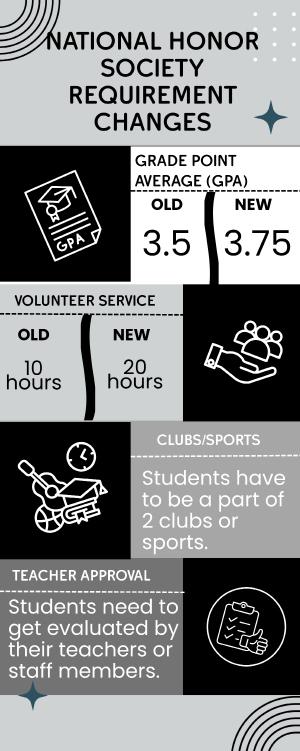
National Honor Society Raises Membership Standards
A guide to the new academic, service and leadership requirements for 2025–2026.
The Troy High School National Honor Society, also known as NHS, has changed its entry requirements, which will affect future students who aim to join the organization.
Marissa Drake, who is in her second year as an adviser of the National Honor Society, explains the current entry process: “Students with a current 3.5 GPA unweighted will get an invitation to apply. At that point, they will apply, and they will need 10 hours of volunteer service from prior [organizations]. They will need to be a part of two clubs or sports, one or the other or both. They will also need to get evaluated by their teachers or staff members.”
In the future, the requirements for admittance will become more rigorous. These changes will be implemented gradually based on a student’s graduation year. For the class of
Vildan Carsancakli // Staff Reporter
2029 and beyond, the GPA requirement will increase to 3.75. Additionally, the required hours of volunteer service will increase from 10 hours to 20 hours.
According to Drake, it is an honor to be in the National Honor Society. The advisers need to have these expectations of doing the correct service, of being good leaders and characters in school because the participants in the National Honor Society are the top students in school.
Drake’s opinion on the effects of the changes is that “[they] might cause some more challenges that are arising in terms of kids not having the eligibility to be a part of it. But I think once they are actually in the National Honor Society, it will be a big change in front of your school.”
Drake adds that less students are applying because the
requirements are stricter. She explains the possible changes in the future: “The GPA requirement is going up, and that it will be for the current freshmen [who] are here right now. And then anyone [who is] coming in the future, it’s going to go to a 3.75. Again, based on how big our organization was, we had pretty much a fourth of our school in the National Honor Society, and I don’t really think that represents what the National Honor Society is as a whole. But other than that, mostly everything will stay in place.”
Lisa Kline, who is in her second year as an adviser for the National Honor Society, clarifies the application process: “[Students] used to have to submit community service, and I don’t know that over the last couple of years they’ve had to do that, so we’ve reinstated it. This year’s admissions class had to
submit 10 hours. Next year, if you apply, I believe [the requirement is] 20 hours.”
Kline also points out the effects on the number of participants: “I don’t think it affects [the number of participants] right now unless students just don’t want to fill out the paperwork. But I do think it could impact students in the freshman class and beyond because the grade point average (GPA) is higher.”
For the Class of 2029, the requirements for joining the National Honor Society will be stricter. According to the advisers, this will lead to a more impactful group of students participating in the future.
New Changes at the University of Michigan
As the University of Michigan implements an Early Decision program, applicants begin to wonder how this affects admission Gabby Shaya // Public Relations Editor, Graphic by Roberto Nicolas-Piña // Staff Reporter
In July of 2025, the public University of Michigan announced the implementation of their new early decision Program. Applying early decision means the applicant is making a legal binding agreement with the University of Michigan where they must attend if accepted. With this new program, students across the globe wonder what this means for their application regarding what plan to apply through: early action, regular decision and now early decision. This fall is the very first season where students can apply early decision to the University of Michigan. Troy High School has always been known for its competitive academic environment. Kim Bryant, a University of Michigan representative for Troy High School, revealed that as of the 2024-2025 school year, 292 of graduating Troy High School students applied to the University of Michigan, with
118 receiving an acceptance.
In fact, Troy High School is the second biggest feeder school to the University of Michigan in the state. The facts speak for themselves: students at Troy High School want to attend this university, meaning several students will apply through the early decision Program. Senior Andrea Lopez explains why she is applying through the new program: “Right now there are not any statistics or anything, depending on if it’s easier to get in or not, so I thought you might as well apply early decision, see what happens. It seems like the best choice for me right now because I am going to apply to the Ross School of Business.” Students could be taking a risk by applying through this program, as there is not much history on it as of now. However, to show one’s full commitment to attend the University of Michigan, applying early decision has prov-
en to be the way to go, as Lopez states, “I don’t see myself anywhere else other than the University of Michigan. So I thought, ‘if I get in I get in, if I don’t, then I don’t.’”
There is not much data on this new program, so applicants may question the benefits. Emma Hauberg, Troy High School Counselor, educates students about the potential advantages with applying early decision: “As some would say, you’re showing them you’re all in and so they are more likely to accept you. That is the perspective of early decision application.”
In addition, senior Noah Kamugunga comments, “I think I need to maximize my chances to get in [because] there’s nowhere else I would prefer to go.”
Students are catching on to the idea that applying early decision can benefit their chances, as they are showing full in-
terest in the specified school. “It’s a commitment not everyone is willing to take. I am getting evaluated by less people,” Kamugunga adds, assuming less people will apply with early decision because it’s a new process and could be risky.
With the early decision program being new with no data, people are assuming not many will participate in this application plan, applying early action or regular decision.
A common misconception is identifying the difference between early action and early decision. Hauberg clarifies: “early action, you are letting yourself choose later. Once you know how much money you’re getting from each school, maybe things change in the next six months and you don’t want to move as far away from home.”
Although early action and early decision have the same deadline, essentially early action allows more flexibility and is
non-binding. Most importantly, Hauberg emphasises that in a case where you are applying to a competitive school, early decision can help a student’s chances of getting in.
Questions will continue to linger within Troy High School and several other high schools until admissions are released, but the outcomes of applying with the University of Michigan’s early decision program are currently unknown, meaning students can be offered opportunities they could not have been offered without the program.
English Language Development Takes a Turn
An overview on how recent changes are impacting English language learners.
Yusra Mohammed // Staff Reporter
U.S. President Donald J. Trump’s administration pulled back support for English language learners in August of 2025, after the administration designated English as the official language of the United States in March of 2025. This has caused Michigan to instate new requirements in all school districts for the 2025 to 2026 school year and beyond.
Michigan is now meeting minimums in instructional time for English learners due to the risk of budgeting cuts if they do not comply. Furthermore, the Michigan Department of Education is demanding schools to meet the requirements of hours and the hiring of enough English Language Development (ELD) specialists within four years.
ELD accommodates all students who need help learning English. For instance, in previous years in the Troy School District, classes were made for students depending on their English level. These classes were ranked from least proficient to most proficient. These were not just for English Literature, but also for other subjects, such as specialized ELD history classes. However, Michigan is now commanding schools to have specific instructional time limits for each student depending on their knowledge level. Furthermore, they have now removed the ranking system and are placing English learning students with different knowledge levels in general education classes
with their same grade level peers who may or may not be in ELD, except for beginners. These are co-taught classes that have a teacher teaching the actual content and an ELD specialist who helps students with the language aspect of it.
Christina Rick, an ELD Specialist who teaches English learning students at Troy High School, emphasizes how worried she was in the beginning: “I was nervous how students would feel in terms of comfort level and academic level and that social feeling of being who you are.” She continues: “At first it felt intimidating and now I do see students still feeling less comfortable than they did when they were in my sheltered classes but I don’t think it’s bad to feel slightly uncomfortable sometimes because that’s often where the biggest growth happens.”
However, Rick has seen a positive impact on these changes. As the weeks go by, she has seen growth and development from her students. She now feels excited about the impact these changes could have. She states, “Students are feeling a part of what Troy High is and feeling like they belong and making more friends.”
“I think that keeping students in the center of everything and keeping students in mind, that’s the goal,” says Rick.
Caterin Hernandez, a sophomore at Troy High School who is an English learner, expresses the impact that these changes had on her, “I think [they impact
me] in a good way to learn more and [at] first it was difficult for me because I am new [to] English.” Hernandez illustrates that these changes were difficult at first, but she soon started to feel more comfortable.
Sophomore Sukhmani Jalf, another English learner, demonstrates the same feelings: “First it was harder, now it is easy for me.”
Despite the Trump Administration’s relinquishment of support for ELD students and Michigan changing their policies, Troy School District staff and students are managing to overcome these obstacles and are now more comfortable with these new rules because of the progress students are showing.
New Faces, New Stories
The experiences of recent immigrants at Troy High School.
Sofia Varela Almaguer// Staff Reporter, Graphic by Jiwoo Park // Editor-in-Chief
Every year, new students from all over the world arrive at Troy High School. Speaking English with people who have it as their first language can be a source of fear for them, especially if it is their first time facing a situation like this. They may struggle and try to adapt their language into the English grammar, and that could be a barrier for them to learn at school or even participate.
Renata Barrera, a freshman student from Mexico, who arrived no more than a month ago, claims that “It’s difficult for me to learn it because I can’t understand it very well. There are many things that, even though I studied a little there in Mexico, it’s not the same as here.” (translated to Spanish: “Se me hace difícil aprenderlo porque no logro comprenderlo muy bien. Hay muchas cosas que, aunque estudié un poco allá en México, no es lo mismo que aquí.’’)
The international students usually arrive at the English Language Development (ELD) class, which helps students who speak a foreign language at home to practice and improve their English skills. Many students build strong connections with people inside this class even if they don’t speak their same native language. They find help with each other and have more confidence at school. The students who enrolled in these classes meet Christina Rick, the ELD Specialist that has been working almost 10 years at Troy High School.
Rick is heavily involved in helping ELD students acclimate to the school. She explains how she pairs new students with current students to help guide them, specifically considering previous students she has had who speak the same language. Rick states, “I message the [current] student on Schoology or I go to their classroom, and I explain ‘we have a new student who speaks the same home language as you. Would you like to walk them around for the day and be their helper person?’” When they meet their “guide” they feel more secure walking around the school, and also it is
better for them to know more about the school by asking questions.
The students have to take a test called WIDA (World Class Instructional Design and Assessment) which helps students who are learning English in school. It provides tools and tests to understand how well students can speak, write, listen and read. The test is given every year to measure the student’s skills. Teachers can know what kind of support each student needs and help them to improve and succeed in their classes.
WIDA is a consortium of states, territories and federal agencies that creates standards, assessments and professional development for teaching and assessing multilingual learners. If they have a range of 1.0-3.0 score in the assessment; they are automatically in the program of ESL and they are signed in the class of “EL Tutorial” a class to support students with accessing academic content. It is to make them feel more confident, knowing how to do the things that they’re learning in all of their classes. The classroom is supported by two other teachers, Leticia Held and Sangita Sharma. With Rick, they are in charge of providing support as the students complete their assignments. They review concepts that students learned in another class, assist students in completing their assignments, help students study for a test, or simply provide support with comprehending a topic from school.
For example, some of the students used their iPad to communicate with others. Kwak Yejin shares, “I used my iPad for translation. If I have words that I don’t know, I use Google translation or ask ChatGPT, and I use it more in physics and history.”
As Troy High School welcomes students from across the world, each student’s journey is different, filled with challenges and goals. Behind every new face is a new story.
Pequeñas Voces, Grande Herencia
Pieza de opinión sobre como el Mes de la Herencia Hispana merece más reconocimiento en Troy High School.
Sara Gonzalez // Staff Reporter
Desde el 15 de septiembre hasta el 15 de octubre se celebra el Mes de la Herencia Hispana, fechas que coinciden con los días de independencia de países hispanos como El Salvador, Honduras, Guatemala, Nicaragua, México y Chile. Fue creado por el presidente estadounidense Lyndon B. Johnson en 1968 inicialmente por una semana y extendido a un mes por el presidente estadounidense Ronald Reagan en 1988 con el fin de conmemorar, recordar y honrar la cultura e historia hispana en los Estados Unidos.
Troy High School es una escuela muy diversa cuando se trata de culturas, la hispana siendo una de ellas. Troy High cuenta con un 0.1% de hispanos que hablan español en casa y que su idioma primario es español, y así no sea mayoría, la cultura hispana merece más reconocimiento para los pocos que estamos aquí. Siento que es parte fundamental para hacernos sentir presentes en la escuela y es tanta la costumbre de que estudiantes nieguen su cultura que nadie hace nada al respecto.
Los hispanos resaltamos porque somos personas muy alegres, carismáticas y que nos hacemos notar donde quiera que vamos. Lo raro de todo esto es que el ambiente es diferente en Troy High School y siento que eso no se ve aquí. He sido una estudiante en Troy High School desde noveno grado y el único “reconocimiento” al mes de la herencia hispana viene de parte del Departamento de Español, un ejemplo siendo un día de zumba exclusivamente
to en Troy High School. Este conflicto no lo noto tanto con las demás culturas. En Troy High School tenemos varias asociaciones de estudiantes como el Black Student Union o Xavira, un equipo de baile indio mezclando Bollywood con elementos de hip-hop, entre otros.
En cambio, solo hay un club de español, ningún equipo de baile o organización formal, y la mayoría de miembros, por no decir todos los miembros, no son hispanos, solo personas interesadas en el idioma. Desde mi punto de vista, cuando hablo con hispanos, la mayoría del tiempo nunca llegan a admitir su etnia, solo cuando hago preguntas como “¿de dónde eres?” o “¿hablas español?” de resto, nadie se siente lo suficientemente seguro o confiado para admitirlo por su cuenta y aún así, después de responder a mi pregunta es como si no hubiéramos hablado de nada. Cuando hablo sobre reconocimiento, me refiero a los hispanos sintiéndose orgullosos de mostrar su identidad en la escuela: orgullo para cada vez que alguien les pregunte, ellos responder, “sí, soy hispano/a” fuerte y claro y que no pasen de eso como si su propia historia no tuviera importancia. Claramente con esto no me refiero a que vayan caminando con la palabra “hispano/a” escrita en la frente. Pero en momentos se puede notar hasta la vergüenza o negación de algunos de admitir su cultura y eso definitivamente no está bien y más en un espacio diverso donde nos tenemos que sentir seguros y cómodos. Me gustaría ver en el futuro más hispanos demostrando su orgullo cultural en Troy High School, creando alguna unión como los antes mencionados o teniendo más actividades por parte de
On Sept. 29 at around 1 p.m., Immigration and Customs Enforcement (ICE) agents were seen in the underconstruction homes in the Leonard neighborhood. This enforcement action, also known as a raid, lasted around thirty minutes and at least one arrest was made.
The neighborhood next to Leonard Elementary School has recently been under construction. Marilena Chis, the mother of a senior at Troy High School and a resident in these homes, was a witness to these events: “[I] never thought that something like this [would] happen right behind our backyard, in the middle of the day and most disturbing that this was just
ICE, ICE, Baby
The recent effects of ICE raids in Troy, Michigan.
Dayana Ochoa Delgado // Staff Reporter
[a couple] hundred feet from the elementary school.” This event happened so abruptly that Leonard Elementary School, a four minute walk away, went into lockdown. Leonard Elementary School has chosen not to comment on this subject.
After President Donald Trump’s re-election, there was a shift of focus to immigrants in the US which has caused prevalent issues in local communities. These events are shared through social media, like the Metro Detroit Instagram account that has posted videos of arrests, and word of mouth. Gabriel Triculescu, a practicing immigration lawyer and parent of a senior at Troy High School, has been working on cases based
in the Metro Detroit area. When asked about ICE’s arrest process, according to Triculescu: ICE raids begin from internal investigations, prior removal or-
ders or target priorities; not phone calls. ICE does not notify schools, local police, school districts, or community institutions. Places such as schools are seen as “sensitive locations,” dis-
couraging ICE raids unless necessary.
On Jan. 27, 2025, the Troy School District sent out an email regarding ICE raids in school: “As mandated by federal law, The Family Educational Rights and Privacy Act (FERPA) strictly prohibits the release of student information without parental or guardian consent unless legally required.”
ICE raids becoming more common cause more people to be exposed to these possibly inappropriate scenarios. Chis states, “Seeing these ICE agents running through our backyards towards the construction site, fully armed, was chaotic and scary.” She continues, “I do not think this was handled
appropriately. It should never disturb the peace in and so close to a school.” As these raids continue it’s important to stay aware, and conscious of the reality of “news stories.”
As said by Gabriel Triculescu, “Immigration enforcement is not only a legal matter — it is a human story. Behind every arrest is a family, a workplace and children who may wake up not knowing if a parent will return home. Regardless of one’s views on immigration policy, compassion and accuracy in reporting matter.”
Turning a New Page
On Nov. 4, 2025, Troy residents voted on a $137 million bond proposal that included $75 million to fund a new 90,000 square foot library facility on the Civic Center campus. The bond failed by roughly a 44/55 margin of “yes” to “no” votes, according to unofficial election results from the City of Troy.
Motion for a new library building has been underway since as far as 1998, when it was listed as a priority in Troy’s 20-year vision document. In 2023, the Troy Public Library’s five-year strategic plan found the current building to be “deficient,” according to Emily Dumas, Director of the Troy Public Library.
On June 14, 2025, the Troy City Council voted 6-1 approving the 2025 bond with a proposal for a new library building.
According to Bob Bruner, Deputy City Manager of the City of Troy, the library building has long been “functionally obsolete.”
Built in 1971 before both the Internet and the 1990 Americans With Disabilities Act, the building lacks technology and accessibility features. There are also concerns about public safety, sustainability and building maintenance.
In 2024, mold in the outdated ventilation system and a “big power outage caused by bad infrastructure” cost nearly
$400,000 total to fix, recalls Phillip Kwik, Assistant Director of the Troy Public Library.
“Water intrusion is ongoing,” adds Dumas, with one occurrence of “15 different leaks in one week” in the summer of 2025.
Dumas notes that these are issues “waiting to happen” in an old building, leading to “costly fixes that add no public value.” Dumas explains, “stuff like fixing a door just to make it work properly doesn’t make the services any better for the public, but it’s something that needs to happen.”
The Troy Public Library website also states that the current building is “vastly-undersized.” In 1984, with a city population of around 67,000, the library was expanded to its current size of 50,000 square feet. But with Troy’s now-population of around 90,000, its 0.57 per capita square footage is “well below the national average of 0.9 to 1.2 square feet.”
states the Troy Public Library. Renovations also would not fix issues in the building layout pertaining to “technology, staff and public safety, accessibility and sustainability.”
“We could do something short of this, or do we want to do it right?” says Kwik.
The library has had no major renovations or expansions since 1984. At today’s construction prices, a complete renovation of the current building is estimated to cost over $42 million. But “such a facelift and expansion would not add enough much-needed floor space, keeping the building undersized for use as a modern library,”
The lack of space and strains the library’s programming and services. Any new addition comes “at the expense of something else,” says Dumas. She recalls that when a quiet study area was added in the Teen and Adult section of the library, the library collection had to be cut down by seven rows of shelving.
“There’s no room to
A screen capture of a video of the raid recorded by Marilena Chis
Every year, a new group of students from Troy High School takes over the Troy Colts Line, better known as the TC line.
The TC Line participates in activities and helps to organize events such as the pep assembly. Mostly, they attend football, volleyball and soccer games. Senior and TC Line member Mya Weaver says they “start chants, take pictures and make TikToks.”
As the heads of the student section, the TC Line has rules to follow. Yousef Melolain, senior and member of the TC Line, states, “I don’t know if this is a real rule or an unspo-
Structure and Spirit
A closer look into the TC Line’s organization and rules.
Robin Monroy Shaydurova // Staff Reporter
ken rule, but everyone on the TC line just reposts all the stuff [posts from the TC Line’s social media].”
Weaver adds on, at games “we have to be respectful of the other team: no swearing, no posters against the other team.”
According to Karen Baird, Troy High School’s Athletic Director, the school tries “to abide by the Michigan High School Athletic Association and Oakland Activities Association rules.” These rules mainly try
to not distract the game by avoiding noisemakers such as megaphones, whistles and portable speakers.
Line at games. Baird states, “The deer head [is] only allowed at home games.”
The Troy School District also has a rule based on Canela, the Troy High School deer mascot head, implemented for the TC
When it comes to planning activities, senior and member of the TC Line, Sabrina Gaul, says, “Our heads are Ryan Christensen and Nicholas Kamagunga. They kind of organize a lot of the stuff together.”
To organize with administration, Baird explains, “We start the year. And then we just kind of keep connecting with [the TC Line]. Like,
The Troy Public Library looks to next steps after voters defeat the proposal for a new library building. Ivy Qin // Staff Reporter
expand. We’re landlocked,” says Kwik. “It’s like a big family trying to live in a small home.”
Despite these limitations, the Troy Public Library remains the “number one most-visited public facility in the City of Troy,”according to Troy Mayor Ethan Baker. The library received nearly 350,000 visitors in the 2024-2025 fiscal year and sponsored 960 programs for over 29,000 attendees with its only two meeting rooms. There are over 59,000 active Troy Public Library card holders spanning twothirds of Troy households.
“We have A-plus services here,” Baker con-
cludes, “but we have a D-plus building.”
The bond proposed a new, three-story library building with modern infrastructure and technology, study rooms, a maker space, a large children’s play area and family bathrooms, all of which are common requests from patrons.
Moving forward, the possibility of a new building is uncertain. “There will be no new Troy Public Library building in the near future for several years,” says Kwik. “Library staff will use our existing fund balance” to “put together a Plan B” addressing the most pressing issues such as
“shortage of staff working space, failing infrastructure of the building and community demands.”
“What we’re going to be faced with is some difficult choices,” says Dumas.
The Troy City Council is expected to discuss the future of a new Troy Public Library and other capital needs at a meeting in mid-January of 2026.
Until then, the Troy Public Library remains loyal to servicing its nearly 350,000 annual visitors and the Troy community. “It is the place you can go, no matter who you are, to get resources,” says Keegan Sulecki, Head of Youth Services at the Troy Public Library. “The important
what do you guys need? What do you want? Like, how can we help you?... Overall, it’s just making sure we keep the connection with them. And understanding the ins and outs and helping each other out with that.”
Throughout the school year, the TC Line members look into getting, “as many people involved in the sport games and like school spirit as we can so that everyone can have a good time at Troy High [School],” Gaul shares.
Photo courtesy of @ tcline2026
thing for us is continuing to do the right thing.”
“I’ve never been part of a library that’s so well used, but also so well loved,” says Dumas. “If people aren’t regular us-
ers of Troy Library, they may not see what an impact it really does have on people, but it does.”
BeFit Runners
RUN WITH US
FOR ALL FITNESS LEVELS
5K, 10K, HALF AND FULL
MARATHON
Personalized running and strength plans
Follow up and guidance by certified coaches
Strength training routines, warmups and stretches designed by personal trainers
Virtual group classes FOR RUNNERS: yoga, strength, cycling... you will never be bored!