ISSUE 96
SUMMER 2018
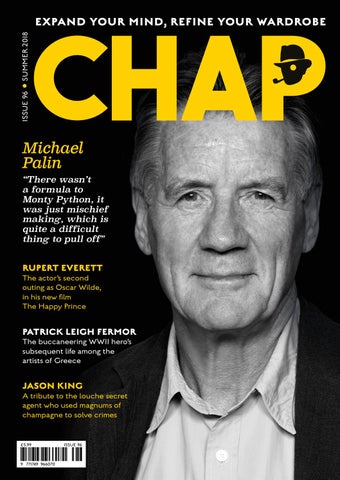
EXPAND YOUR MIND, REFINE YOUR WARDROBE
Michael Palin “There wasn’t a formula to Monty Python, it was just mischief making, which is quite a difficult thing to pull off”
RUPERT EVERETT The actor’s second outing as Oscar Wilde, in his new film The Happy Prince
PATRICK LEIGH FERMOR The buccaneering WWII hero’s subsequent life among the artists of Greece
JASON KING
A tribute to the louche secret agent who used magnums of champagne to solve crimes
£5.99
96>
ISSUE 96
771749 966070 9 9 771749 966070
THE CHAP MANIFESTO 1 THOU SHALT ALWAYS WEAR TWEED. No other fabric says so defiantly: I am a man of panache, savoir-faire and devil-may-care, and I will not be served Continental lager beer under any circumstances. 2 THOU SHALT NEVER NOT SMOKE. Health and Safety “executives” and jobsworth medical practitioners keep trying to convince us that smoking is bad for the lungs/heart/skin/eyebrows, but we all know that smoking a bent apple billiard full of rich Cavendish tobacco raises one’s general sense of well-being to levels unimaginable by the aforementioned spoilsports. 3 THOU SHALT ALWAYS BE COURTEOUS TO THE LADIES. A gentleman is never truly seated on an omnibus or railway carriage: he is merely keeping the seat warm for when a lady might need it. Those who take offence at being offered a seat are not really Ladies.
44
4 THOU SHALT NEVER, EVER, WEAR PANTALOONS DE NIMES. When you have progressed beyond fondling girls in the back seats of cinemas, you can stop wearing jeans. 5 THOU SHALT ALWAYS DOFF ONE’S HAT. Alright, so you own a couple of trilbies. Good for you - but it’s hardly going to change the world. Once you start actually lifting them off your head when greeting passers-by, then the revolution will really begin. 6 THOU SHALT NEVER FASTEN THE LOWEST BUTTON ON THY WAISTCOAT. Look, we don’t make the rules, we simply try to keep them going. This one dates back to Edward VII, sufficient reason in itself to observe it. 7 THOU SHALT ALWAYS SPEAK PROPERLY. It’s really quite simple: instead of saying “Yo, wassup?”, say “How do you do?” 8 THOU SHALT NEVER WEAR PLIMSOLLS WHEN NOT DOING SPORT. Nor even when doing sport. Which you shouldn’t be doing anyway. Except cricket. 9 THOU SHALT ALWAYS WORSHIP AT THE TROUSER PRESS. At the end of each day, your trousers should be placed in one of Mr. Corby’s magical contraptions, and by the next morning your creases will be so sharp that they will start a riot on the high street. 10 THOU SHALT CULTIVATE INTERESTING FACIAL HAIR. By interesting we mean moustaches, or beards with a moustache attached.
22
116
CONTENTS 8 AM I CHAP?
Those who dare submit themselves to the ultimate sartorial assessment face admiration or opprobrium
14 T HE BUTLER
Mr. Bell gives specific sartorial advice to confused gentlemen
18 P EACOCKS AND MAGPIES
Our new antiques experts, Peter Gosbee and John Minns, give insider tips on acquiring objets d’art
FEATURES 22 JULIETTE GRECO
Doctor of Dandyism Sunday Swift on ‘rebel dandizette’ Juliette Gréco and how she emerged from postwar Paris
28 O CEAN LINER CHIC
Sandra Lawrence boards a vessel from the Cunard Line to reveal the sartorial comme il faut of the ocean liner
34 I NTERVIEW
Mr. B the Gentleman Rhymer meets British comedy legend Michael Palin
•
SUMMER 2018
34 SARTORIAL FEATURES
LONGER FEATURES
44 FASHION PHOTO SHOOT
100 T HE HEP CATS
54 ROWING BLAZERS
107 J AQUES OF LONDON
60 J OJO ELGARICE
112 P HILIP LARKIN
We took some modern-day dandies to Mr. Fogg’s Residence in Mayfair to blend in with the opulent surroundings
Liam Jefferies meets the American designer who has revitalized the British Boating Blazer An encounter with a Sheffield vintage impresario and doyen of the city’s most desirable vintage clothing store
62 K OY CLOTHING
A British company that brings the brightness of Kenyan fabric to the Britain, and in turn support the African tribes from which it originates
66 G REY FOX COLUMN
David Evans packs away his winter wardrobe and extolls the virtues of Panama, linen and corduroy for the warmer months
70 S HOOTING THE CUFFS
How this ancient gentlemen’s ritual remains steeped in masculine meaning to this day
72 T WEED ON FILM
Our American sartorial correspondent looks at tweed garments in the history of British and American cinema
80 W HAT KATIE DID
Vintage lingerie from an established and respected British brand favoured by those who like every layer to cut the mustard
83 V ESTA TILLEY
Holly Rose Swinyard on the Victorian male impersonator who unwittingly contributed to the Anarcho-Dandyist revolution
88 F ASHION PHOTO SHOOT
A selection of sensational summer outfits, from Land Girls to Sea Captains to Chap Olympians
Olivia Bullock on the 1940s street style that originated in Harlem and somehow ended up in Shoreditch – but not quite
Nancy Alsop meets the scion of a family that invented modern chess, croquet, table tennis and Ludo
Ferris Newton reassesses the poetry of the Bard of Hull
116 JASON KING
After the demise of actor Peter Wyngarde earlier this year, Steve Pittard looks at the enduring charm of his greatest creation
122 R ESTAURANT REVIEW Simpson’s in the Strand
VINTAGE EVENTS 128 V INTAGE EVENTS GUIDE
A comprehensive guide to the season’s specialist vintage festivals around Britain
REVIEWS 136 B OOK REVIEWS
Self & I, In Byron’s Wake, Fighters and Quitters, The House of Nutter and Elisabeth’s Lists
144 C HARMED LIVES IN GREECE
A new exhibition at the British Museum collects the work of Patrick Leigh Fermor, John Craxton and Nikos Ghika
150 THE DAM BUSTERS
The 75th-anniversary restoration of this classic film
152 F ILM
Darcy Sullivan on an entire season of Oscar Wilde productions
162 CROSSWORD
Cover photograph: John Swannell
ISSUE 96
28
Travel
OCEAN LINER CHIC Sandra Lawrence on sartorial elegance and deck etiquette from the golden age of the ocean liner
“The Duke and Duchess of Windsor never travelled with less than 90 pieces of personalised Maison Goyard kit. When Cunard suggested they were having difficulties storing so much baggage, the Windsors changed operator”
F
rom the late 19th century to the early 1960s, ocean liners ruled the waves. Gigantic monoliths built using the latest engineering techniques, they were also shop windows for cutting-edge design. Newer ships such as Normandie and the Île de France were early adopters of the moderne style. We call it Art Deco. The only way to experience full liner luxury was in first class, on the top decks. Second class passengers were expected to share cabins with strangers, while the poor sods in ‘steerage’ spent their days and nights in sweltering dormitories well below the tideline. Not that anyone would know about either of these lowly underclasses from the battery of magazines, movies newsreels and wireless broad-
casts. Fred Astaire and Ginger Rogers glittered their way across the Atlantic in the 1937 musical Shall We Dance, while Marilyn Monroe twirled every millionaire on board round her diamond-clad little finger in the 1953 classic Gentlemen Prefer Blondes. She had a point. The great liners were the place to find millionaires – and celebrities. Rudolph Valentino, Noel Coward, James Stewart, Duke Ellington, Cary Grant; every crossing boasted a firmament of stars, as well as royalty. King George VI was a frequent traveller but his dazzling older brother Edward, and his equally dazzling wife Wallis Simpson trumped all. If you travelled first class, you hobnobbed with Quality. But what to wear? Modern ships were floating
29
Interview
MICHAEL PALIN Mr. B The Gentleman Rhymer met comic legend Michael Palin, to discuss Ripping Yarns, Monty Python’s Flying Circus, travel attire, notebooks and Yorkshire accents
“I was able to make people laugh, and you gravitate towards other people with your sense of humour and you end up with a circle of people who are slightly subversive gigglers”
Was there a point where you ever developed a Yorkshire accent? You tend to pick up your accent from your parents, and mine were Oxford English, I suppose. But if I was with certain people I’d begin to pick up a Sheffield accent. But since then I’ve done loads of Yorkshire characters, in Ripping Yarns and so forth, and I realised I’m actually very fond of Sheffield, even though I haven’t lived there for 50 years. I think the place where you were brought up has a very strong influence on you; it’s bound to, as a lot of your first impressions all come from your first 20 years.
Y
ou were born in Yorkshire. You’ve had lots of Yorkshire characters, but was your family steeped in Yorkshire from way back? My mother and father weren’t Yorkshire people. We ended up there because my father was an engineer. It was during the Depression in the 1930s and he couldn’t get any work down in the south, so he ended up working first in Hull, then Leeds, and then he went to Sheffield towards the end of the 30s, where he found work with a company called Newton Chambers, who made lavatories and things like that. It’s gone down in the files, from some journalist, that they made lavatory paper, but that’s not quite right
I once went on holiday with some friends from Leeds, and by the end of it, I was speaking Leeds. I find that when I’m with Yorkshire people [breaks into broad Yorkshire accent] it’s lovely, I kind of get very easily into it… It’s a very comfortable accent,
34
Photo © Mr. B The Gentleman Rhymer
and I’m sure he wouldn’t like to have been remembered as a man who made lavatory paper!
STEWART WEARS: SUIT: DOLCE & GABBANA SHIRT: DARCY CLOTHING SHOES: J. FITZPATRICK RINGS: THE GREAT FROG AND SEVENTH CIRCLE ARTWORKS
HOLLY WEARS: 1940S DRESS TROUSERS FROM HAPPY DAIS VINTAGE VINTAGE TAILCOAT FROM EBAY WHITE SHIRT FROM MARKS AND SPENCER HAND-MADE BLACK WAISTCOAT SILK TOP HAT FROM VINTAGE TO VOGUE, BATH MOSS BROS WHITE BOW TIE H&M BLACK PATENT SHOES
Sartorial
ROWING BLAZERS Liam Jefferies meets the man behind a company that has set out to create the perfect boating blazer
T
“Like the court liveries and armorial devices of medieval Europe, rowing blazers are ceremonial vestments, worn to emphasise both community and difference: to impress, intimidate, and influence”
here are few items of clothing more in line with the ideology of Chappishness than the blazer. A three-piece tweed whistle will always serve as a winter staple, but for a single garment that denotes both a sense of old-world savoir-faire and go-to-hell exuberance, only a blazer will suffice. The origins of the blazer lie with the sport of rowing. Originally, a blazer was defined as a flannel sport coat, unlined, without vents and with easily accessible patch pockets and a striking design in line with the early sporting attire of the time. The primary concept of the blazer was practicality, from the hardy towel-like flannel material, cut for athletic pursuit and to defend from inclement weather, to the bright colours, designed to stand out in the water and aid spectators in determining which crew was which. The Oxford-Cambridge races began in 1829, with Henley Regatta following a decade later. The earliest adopted use of the moniker ‘blazer’ was
used in reference to the bright red jackets of the Lady Margaret boating club, Cambridge (Est. 1825), discovered in The Cambridge University Almanack & Register from 1852. Oarsmen, infatuated with their hard-earned apparel, began to sport them on land and before long the practice was adopted by cricket, polo and rugby players too. By the 1890s the blazer was already an integral part of a chap’s daily dress.
54
An intriguing tradition in Dutch rowing is that blazers are handed down the generations, and as a result are generally quite ill-fitting. Another rule states that a blazer may only be washed when a varsity race is won, and as such, a vast amount are seen stained with river water, sweat and ale. It is this sense of cavalier casualness that made the blazer the ‘hoodie’ of its day, crossing sartorial lines between formal and casual not seen since the Oxford shirt. The story of the Rowing Blazers brand begins with Dr. Jack Carlson, American archaeologist, author, three-time member of the US national rowing team and all-round chap of the highest order. Having won the Henley Royal Regatta and the Head of the Charles Regatta, Jack is also a World Championship bronze medalist and has a Ph.D. in archaeology at Oxford. During his time at Oxford, drawing on an obsession with heraldry, vexillology, menswear and academia, Jack wrote the acclaimed tome Rowing Blazers, a celebration of the history and construction details of the jacket he knows down to the last stitch. The chief source of inspiration behind the Rowing Blazers brand is a direct result of the cataloguing of traditions, rituals and myths surrounding rowing culture, alongside heraldic blazonry, sartorial irreverence, cryptic nuance and those-in-the-know homage. All Rowing Blazers’ garments are handmade in New York City, using high quality wool and cotton sourced
in Great Britain, Italy, Japan and the United States. As Jack himself puts it, “Like the court liveries and armorial devices of medieval Europe, the street gang colours of Compton, and the patches and badges of the Hell’s Angels, rowing blazers are tribal totems. They are ceremonial vestments, worn to emphasise both community and difference: to impress, intimidate, and influence.” There is a wealth of idiosyncratic and varied garments to choose from in the Rowing Blazers catalogue, each complementing
55
Bond’s brown barleycorn tweed hacking jacket in Goldfinger has taken on something of a divine status in the community of sartorial appreciation.
Sartorial
TWEED ON FILM Nick Guzan looks at the role of tweed jackets in cinema, from slick British secret agents to sporty San Francisco cops
D
“Old school members of 007’s circle such as gadgetmaster Q had worn fine traditional examples of tweed, but it wasn’t until Goldfinger in 1964 that Sean Connery’s sophisticated spy wore tweed on screen”
uring the early decades of cinema, tweed was just as ubiquitous on the silver screen as it was in real life, often worn by honest, homespun gentlemen of taste. Think James Stewart in one of several tweed suits during George Bailey’s fateful Christmas Eve in It’s a Wonderful Life (1946) or John Wayne’s Irish tweed sports jacket making a positive impression when his character returns to his ancestral home in The Quiet Man (1952). Lovely examples, to be sure, but nothing groundbreaking in terms of how it was worn. Even the more villainous tweed wearers of this era were still urbane chaps with traditional inclinations toward the art of dressing, from Clifton Webb’s scheming snob Waldo Lydecker sporting a double-breasted tweed suit in Laura (1944) to James Mason’s charismatic Philip Vandamm donning a series of odd waistcoats with his grey tweed suit in North by Northwest (1959). Then came the 1960s. Every era has looked to the future to some extent, but the swinging sixties was one of the first decades in modern history
where youth was taking the lead across the globe. The less informed may consider tweed to be professorial or old-fashioned, which is certainly not to the fabric’s detriment, but this rugged sportswear was rejuvenated in 1960s cinema, for a brief but brilliant flash as the suiting of choice for youthful rogues on both sides of the Atlantic. In Hitchcock’s The Birds, (above) released in 1963, Rod Taylor’s Mitch Brenner is a successful and swaggering Bay Area lawyer, the type who
73
Warren Beatty wears a brown herringbone three-piece tweed suit in Bonnie and Clyde, 1967
has a family home a few hours up the coast in the smaller coastal hamlet of Bodega Bay. Though he wears a wool suit in the city, Mitch sports tweed in this more bucolic, homey setting, donning a fine mixed grey tweed suit worn with a white shirt and silk tie for his younger sister’s birthday party. The jacket blends American tailoring with sporty English details with its “shapeless” sack jacket, structured shoulders, slanted flapped hip pockets and ticket pocket, close three-button front, and short double vents. The following year found James Bond sporting tweed on screen for the first time. It wasn’t the
debut of tweed in the James Bond series, of course; how could such a quintessentially English franchise not feature tweed in its first two films? Old school members of 007’s circle, such as the gadgetmaster Q , had worn fine traditional examples of tweed, but it wasn’t until Goldfinger in 1964 that Sean Connery’s sophisticated spy wore tweed on screen. Bond’s brown barleycorn tweed hacking jacket in Goldfinger has taken on something of a divine status in the community of sartorial appreciation. Of course, it may help its case that Connery wore it during some of the film’s most iconic scenes, from a statue-shattering encounter with Oddjob to piloting his gadget-laden Aston Martin DB5 through the mountains of Austria. Nonetheless, the jacket is one of the few of 007’s garments to appear in more than one film, as Connery would wear it the following year in Thunderball. Both films feature the jacket with a beige shirt and brown silk tie – knitted in Goldfinger, grenadine in Thunderball – with taupe trousers and high-top brown suede derby shoes. At this point in the series, Sean Connery’s
“Bond’s hacking jacket in Goldfinger is one of the few garments in more than one film, Connery also wearing it in Thunderball” 74
Warren Beatty wears a brown herringbone three-piece tweed suit in Bonnie and Clyde, 1967 Steve McQueen in a brown herringbone tweed sports jacket in 1968’s Bullitt
THE QUIET MAN John Ford’s cinematic love letter to his ancestral home remains a perennial St. Patrick’s Day favorite, even if it is a somewhat overly sanitized depiction of Irish life in the 1920s. Based on a 1933 short story by Maurice Walsh, The Quiet Man stars Ford’s favorite actor John Wayne as Sean Thornton, a former boxer from Pittsburgh who is returning home to reclaim his family’s land in Ireland. The setting, Inisfree, is fictional, but much of the movie was filmed on location in western Ireland around the village of Cong, County Mayo. With his tweed jacket, flat cap and flannels, Sean Thornton looks every bit the native Irishman when he arrives by train at Castletown. “He didn’t have the look of an American tourist at all about him,” Father Peter Lonergan (Ward Bond) remarks with approval in his narration. Many of the costumes were tailored by the O’Máille family, who continue to sell Irish country clothing at their shop in Galway. Their web site proudly states that John Wayne and Maureen O’Hara both visited its store for their characters’ costumes, making it highly likely that John Wayne wore authentic, locally hand-woven Irish tweed for his role in this most Irish of movies. Sean’s tweed is a herringbone twill weave of beige and light brown yarns to create an overall tan effect, with a slight cast toward taupe. The single-breasted jacket has notch lapels that are often worn with the back collar flipped up for a touch of insouciance. The notch lapels and the welted breast pocket have ‘swelled edge’ seams. The jacket also has straight-jetted hip pockets in line with the lowest button. Although Sean’s tweed jacket is pure Ireland, his button-down collar shirt, striped tie, and v-neck jumper are indicative of his Americanization. Both Ford and cinematographer Winton C. Hoch won well-deserved Academy Awards for their work on The Quiet Man.
Bond had established a uniform for himself of a two-button lounge suit – often in shades of grey – tailored by Anthony Sinclair, with a pale blue Turnbull & Asser ‘cocktail cuff’ shirt and navy grenadine tie. The hacking jacket in Goldfinger marked one of his first deviations from this uniform, though Bond remains generally true to his usual taste, wearing solid colors, side-tab adjuster trousers, and grenadine or knitted ties. Tweed thus became more commonly seen on fashionable male figures of the mid-sixties, from 007 to Michael Caine’s synonymous character in Alfie. A sophisticated secret agent and a playboy in swinging London are natural candidates as style icons, but it’s hard to imagine bestowing a similar honour on a small-time Texas desperado during the Great Depression. Yet Warren Beatty’s larger-thanlife interpretation of the criminal Clyde Barrow in Arthur Penn’s stylized drama Bonnie and Clyde (1967) featured the gang leader in a variety of natty duds that likely shared little in common with the backseat wardrobe of the real-life hoodlum. Costume designer Theodora Van Runkle dressed her protagonists in an intentionally anachronistic fashion, evoking the 1930s but adding modern touches, which would speak to audiences of the late ’60s, who embraced the look and attitude of the ‘romantic’ outlaws. A standout of Beatty’s wardrobe appears midway through the film, as the gang takes over a bank for a smooth and successful heist. The setting is a summer afternoon in a dusty small town in Texas, yet Clyde strides into the bank beautifully attired in a brown herringbone tweed three-piece suit, complete with half-belted ‘action
Though they serve the same great city of San Francisco, Harry Callahan’s manner of wearing a herringbone tweed sport jacket is a business-friendly, conservative ying to Frank Bullitt’s freewheeling yang.
back’ jacket, Panama hat, spectator shoes, and green polka-dot tie. Despite the weather, tweed appeared to be the fabric of choice for the male members of the gang that day; Clyde’s brother Buck (Gene Hackman) sports a taupe birdseye tweed three-piece suit, and juvenile lackey C.W. Moss (Michael J. Pollard) diverts from his usual denim in his plaid tweed sports jacket.
Bullitt of the San Francisco Police Department, he looks rather unremarkable – particularly for McQueen’s standards – in a dark navy lounge suit, light blue shirt and olive foulard tie. Both his attire and the film’s narrative refer to the police procedural of the previous decade’s Dragnet and M Squad. The next day, we realize this is something different. Bullitt glides down the iconic streets of San Francisco in a highland green Ford Mustang GT390 fastback, stepping out in a rich brown herringbone tweed sport jacket that remains a sartorial point of interest fifty years later, with its American sack cut, 3/2-roll button front, ticket pocket, short double vents and irregular tobacco-brown suede elbow patches. McQueen insouciantly eschews a traditional shirt and tie – even when on duty – and instead opts for a navy knit rollneck jumper, charcoal flannel trousers and snuff-brown suede crepe-soled playboy boots from Hutton. Joe Friday’s wardrobe this surely is not. After a decade of cheeky, charming cads who flouted criminal codes and conventions, American cinema in the 1970s saw a return to venerating law and order. Pragmatic police officers like Bullitt were out, and a new breed of laconic lawmen like ‘Dirty Harry’ Callahan were in, upholding the truth and
“Every Dirty Harry movie would feature Clint in a stylish new tweed jacket, though the Bullitt days of a cop in cool rollneck and boots was out” The great Van Runkle was only getting started. After the success of her costume design debut in Bonnie and Clyde, her next project would showcase an outfit considered by many to be the pinnacle of 1960s cool: the shooting jacket, rollneck and suede boots of Steve McQueen’s eponymous detective in Bullitt (1968). When we first meet Lieutenant Frank
77
nothing but the truth. Though they serve the same great city of San Francisco, Harry Callahan’s manner of wearing a herringbone tweed sport jacket is a business-friendly, conservative ying to Frank Bullitt’s freewheeling yang. In the first scenes of Dirty Harry (1971), Clint Eastwood set an iconic standard for this uncompromising detective by donning a contemporary grey tweed jacket over a pale blue shirt, deep red sleeveless sweater and a silk repp tie in navy and red to bring both garments together, uttering “Do you feel lucky, punk?” while aiming his .44 Magnum at a – spoiler alert – ultimately lucky bank robber. The palette is no coincidence, as Inspector Callahan is presented to us as a ‘red, white, and blue’ allAmerican lawmen at the height of the Nixon era. Every subsequent Dirty Harry film would thus feature Clint in a stylish new tweed jacket, though the days of the cool cop in a rollneck and boots was out, replaced by a dedicated detective in an officefriendly button-up shirt, tie and brogues.
They say fashion is cyclical, and tweed appears to be making a revival in the current decade on both sides of the criminal fence. The Shelby family in Peaky Blinders conduct their violent business in natty tweed three-piece suits and caps, while Benedict Cumberbatch drapes his incarnation of Conan Doyle’s greatest invention in a long Irish tweed greatcoat in Sherlock. It’s not just the Brits who are continuing this legacy of tweed as the preferred fabric for defiant characters. While dressing Ryan Reynolds’ insouciant gambler for Mississippi Grind (2015), costume designer Abby O’Sullivan informed me that she took cues from the rebellious all-Americans played by Paul Newman, Robert Redford and Steve McQueen in the 1960s and 1970s. The jacket she envisioned (pictured above) would be “an idealization of a certain type of man and visually complex enough to stare at on screen for long periods.” What did she eventually choose? A micro-checked sports jacket in hand-woven Harris Tweed. n
78
B LO O D, SW E AT A N D T W E E DS MARK BEAUMONT’S L AT E S T C H A L L E N G E
TICKETS FROM
T h e R .Wh i t e’s Pe n n y Fa r t h i n g 1 h o u r Wo r l d Re co r d a t t e m p t … l a s t b ro ke n a t He r n e H i l l Ve l o d r o m e i n 1 89 1 !
£39
Ma r k B e a u m o n t : the man who c i r c u m n a v i ga t e d t h e wo r l d o n a b i c yc l e i n 78 d a y s l i n e s u p his latest super h u m a n c h a l l e n ge
F R I DAY 1 5 JUNE 2O18 USE CODE
CHAP241 AND BRING A PAL FOR
FREE!
T I C K E TS
0 87 1 2 3 1 0 8 4 7
O R
C Y C L I N G R E V I VA L . C O M CYCLINGREVIVAL
@ CYCLINGREVIVAL
WORLDCYCLINGREVIVAL
He r n e H i l l Ve l o d r o m e a n d G r i f f i n S p o r t s G r o u n d D u l w i c h Vi l l a ge , Lo n d o n our PArtners
MODEL: Francois Delplancq (right) with friend Francois wears: Vintage three-piece suit from Falbalas, St Ouen Flea Market, Paris. PHOTOGRAPHER: Xavier Buendia
MODEL: Dandy Wellington LOCATION: The annual Dandies and Quaintrelles Seersucker Social, Washington D.C. CLOTHING: Mostly seersucker PHOTOGRAPHER: Rose Callahan
Thelonious Monk and friends outside Minton’s Playhouse in New York
musicians’ liberal and carefree lifestyle, adopting their fashion, streetwise attitude and even their slang. These ‘white negros’ (as Norman Mailer called them in his book of the same title) absorbed the frenzy of live Bebop like an addiction, with performances usually confined to small bars, intimate clubs and cellars, played by a small combo of saxophone, trumpet, double bass, piano and drums. Its addictive adrenaline spread from East Coast New York to West Coast LA, led by its figureheads Charlie ‘Bird’ Parker, Thelonious Monk and Dexter Gordon. Lester Young was ‘The Hipster’s Hipster’; Dizzy Gillespie was its sartorial ambassador. Recognised for his cosmopolitan style, Trumpeter Gillespie’s signature beret became a Hepcat talisman. Worn for practicality, not only for stuffing into a pocket for safekeeping, having lost numerous hats, but also, on occasion, providing an adequate mute for his trumpet. Gillespie’s creative flair and sartorial influence was infectious. A photograph of Dizzy with his fly undone (accidentally) spawned an overnight trend for ‘flying low’. He also endorsed fashion brands
such as Fox Bros, who produced several accessories imaginatively labelled ‘Bop ties’, ‘Bop caps’, ‘Bop crushers’ and berets. They even manufactured a copy of a leopardskin jacket after Gillespie had worn one. Billy Eckstein, another fashion pioneer of the Hipster milieu, created the ‘Flex roll collar’. Dubbed The ‘Mr. B Collar’, it had an expandable high-roll collar, allowing for the swelling of his neck while playing the trumpet. The collar formed a letter B, worn over a Windsor-knotted tie, and assured the wearer he could achieve ‘The Mr. B look’. Jazz singer Babs Gonzales sported the ‘Jazz bow tie’ designed by his then girlfriend. It was the size of a king-size cigarette and was little more than a piece of cloth over a sliver of wood. Despite the few musicians setting sartorial standards, the definitive insignia of the coolheaded, confident hipster was the porkpie, fedora hat or beret, worn with dark rimmed glasses, pinstripe double-breasted suits and a neckerchief. The intention was never to create a fashion statement – that would have suggested triviality and sensationalism. These artists took themselves seriously, with an
102
Duke Ellington playing Sister Rosetta Tharpe’s guitar, with Cab Calloway at the piano
Harry Gibson – the first hipster. Born Harry Raab in the Bronx in 1915, Harry Gibson grew up around Harlem, where he learned jive talk and developed a frenetic jazz piano style in the speakeasies. When Fats Waller recruited him in 1939 as his intermission act, Raab took his new stage name, Gibson, straight from a gin bottle. While playing at jazz clubs along the ‘Swing Street’ stretch of 52nd Street at night, he started referring to his audience as ‘hipsters’, and then adopted the title for himself, penning a song, Handsome Harry the Hipster:
They call him Handsome Harry, the Hipster/He’s the ball with all the chicks/He plays piano like mad, his singing is sad/He digs those mellow kicks Gibson was loved for his manic stage presence and songs about sex and drug use, both of which he enjoyed tremendously, culminating in 1947’s Who Put the Benzedrine in Mrs. Murphy’s Ovaltine? His piano style mixed hardcore, gutbucket boogie rhythms with ragtime, stride and jazz. In the 1950s his career went into decline, overshadowed by the arrival of rock ‘n’ roll, and after a brief comeback in the 1980s, Harry took his own life in 1991.
103
King’s fab finery, celebrating Carnaby Street chic, features a canary kaftan, snakeskin jacket, and black leather jumpsuit‌ unzipped to the navel to show off his manly chest rug and medallion.
116
Television
The Swinging Detective Steve Pittard pays tribute to Jason King, the exotic creation of Peter Wyngarde, who passed away earlier this year
W
ith his snazzy suits and penchant for paisley, Jason King cut quite a dash when Department S aired in 1969. The Interpol offshoot consulted King if anything baffling cropped up. Jason, by dint of being an accomplished crime author, drew on his creative bent to help fathom the mystery. Originally the character was earmarked to be a tweedy Oxford don but Peter Wyngarde, given carte blanche, transformed the role into a decadent dandy – essentially Wyngarde himself writ large. The spin-off series, Jason King, elevated the outré operative to an international heartthrob. In 1971, at the height of King mania, ‘Jason’ became the most popular boy’s birth name in England. The unabashed ‘leg man’ chaired the Miss World contest, while his Zapata moustache, thickset sideburns and bouffant coiffure adorned adverts for
Tabac, propelling the fragrance to topple Old Spice as the best-selling Christmas cologne. Peter was massive Down Under. Australians voted him the hottest man on the planet. Upon his arrival at Sydney airport, the sex god was mobbed
“Such is his fame that he leaves one contact address as simply ‘Jason King, Egypt’. Threatened with extradition, King inspects the plane ticket and drolly quips: “Thank you for your concern, but I never fly economy” 117
Art Review
L-R: Nikos and Barbara Ghika, John Craxton, Patrick and Joan Leigh Fermor, Hydra 1958. Photo: Roloff Beny © Library and Archives Canada
CHARMED LIVES IN GREECE Ghika, Craxton, Leigh Fermor
Gustav Temple on an exhibition at the British Museum that brings to life a neglected 20th century flowering of art and literature on the Greek islands
T
SOE officer on Crete, preparing for a mission documented in Ill Met by Moonlight by one of his comrades, William Stanley Moss. Operation Moonstruck was beset by difficulties, resulting in Leigh Fermor being marooned on the island for two months in the company of a rag-tag band of local soldiers, sheep thieves and buccaneers, waiting for his comrades to be shipped in. When they finally landed, on 5th April, 1944: “Moss turned to see his friend striding down the beach with the dashing style of a pirate. Unlike Rendel, Paddy looked rugged but faultlessly groomed. His skin was tanned by the sun and he appeared fitter than Moss had ever seen him. ‘He wore a smart moustache,’
he tour-date list for this exhibition gives a sense of the artistic journeys taken by its subjects: Nicosia, Athens, London. Opening at the British Museum earlier this year, Charmed Lives in Greece brings together the work of a Greek painter, a British painter and a British literary and military legend. Patrick ‘Paddy’ Leigh Fermor (1915–2011) is probably already a familiar name to readers of this journal. His unusual career began with a two-year walk across Europe at the age of 19, which led to a lifelong love of Greece and a string of travel books. He spent a year during the Second World War as an
144
John Craxton, Still Life with Three Sailors, 1980-85. Tempera on canvas. Private Collection, UK. © 2018 Craxton Estate/DACS
Moss noticed, ‘and sported a fine Cretan waistcoat, a long wine-coloured cummerbund into which was thrust an ivory handled revolver and a large dagger; a pair of riding breeches and tall black boots … Leigh Fermor’s first concern was whisky, followed by cigarettes.” (From The Ariadne Objective, Wes Davis.) Operation Moonstruck was the second attempt
to land enough SOE agents on Crete to carry out Patrick Leigh Fermor’s plan to capture General Kreipe, the German Commander on the island, and ferry him to Cairo, thus weakening the already crumbling Nazi morale enough to make an allied invasion plausible. The Italians, also based on Crete, had already surrendered but the Germans were not giving up without a fight, Commander Kreipe declaring, even after being captured, that they would fight “to the very last cartridge.” Patrick Leigh Fermor, along with Moss, Xan Fielding, Sandy Rendel and John Pendlebury, had been chosen for this mission for their intimate knowledge of the Greek islands and the language spoken by the shepherds and warriors who inhabited them. They spent most of their time there disguised as locals, living in caves and scouting about the mountains on reconnaissance missions.
“Patrick Leigh Fermor and his comrades spent most of their time disguised as locals, living in caves and scouting about the mountains on reconnaissance missions” 145