
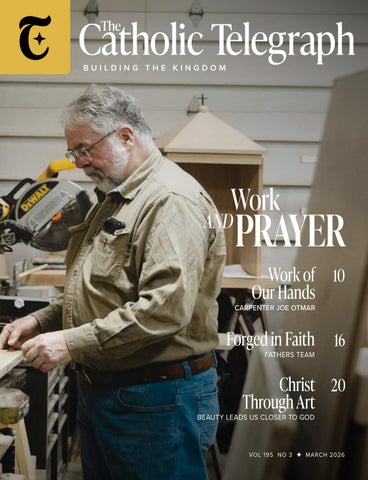
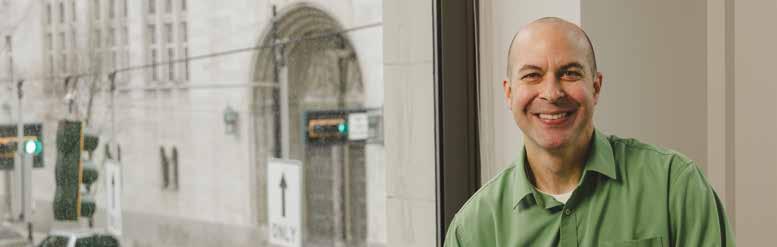
The month of March is traditionally the month of St. Joseph, and that is a key reason we landed on the theme “Work & Prayer.” As Catholics, we recognize that we have a lot to do to build up the Kingdom of God on earth, and St. Joseph is a perfect model for us to follow when faced with such a daunting task.
While no words spoken by St. Joseph were passed down to us, we know from Scripture that he was a “righteous man” and obedient to God’s will. Our traditions tell us that he worked hard and prayed hard. One thing I admire most about St. Joseph is his trust in the Lord. Although a descendant of King David, by worldly measures he was a small man with humble means. And yet, he accepted the monumental call to be the husband of Mary and the foster father of Jesus.
We associate Joseph with work because he was a carpenter and it is easy for us to imagine him working hard to provide for the Blessed Mother and the Christ Child in those mysterious hidden years. We also know that he must have been a prayerful man, chosen by God for such a unique role. But when I think of the dynamic between work and prayer, I can’t help but think of the story from the Gospel of Luke when Jesus visited His friends Mary and Martha.
If you are anything like me, you see yourself in and sympathize with Martha. She is stressed out, trying to make everything perfect, while her sister simply sits quietly at the Lord’s feet. When Martha complains that Mary is not helping her and asks Jesus to intervene, He tells her that she is “worried and distracted by many things.” That’s me as well!
I often let the pressures of work and the anxieties of life affect my relationships, especially with the Lord. I know I should depend more on God and center my life around Him, but I find myself instead drifting from one concern to another and acting as if I need to control everything. In other words, I’m not balancing work and prayer well.
Martha and my problem is not that we are busy but rather uncentered, and perhaps, lacking in some of St. Joseph’s trust in the Lord. Martha’s sister Mary is focused and anchored in the “one thing necessary.” One suspects that even if she helped with the household tasks, she would not be “worried” and “distracted” by them but would offer them up to the Lord. In contrast, if Martha or I were sitting by the Lord, we would still be distracted and divided, thinking about all the things we need to get done.
When I am completely honest with myself, I realize I turn to prayer more when I’m desperate, almost as a last resort, even though I know everything I do should be rooted in prayer. I also realize that I worry too much and let concerns get the better of me instead of placing them at the foot of the Cross.
Lucky for me, we are just beginning Lent—a blessed time the Church gives us each year to look hard at our lives and get rid of distractions and whatever hinders our relationship with the Lord. It is a time to reflect on our need for God and realize we are not alone in the work we must do. God is working within us, as long as we remember to lean on Him. St. Joseph pray for us!
Editor’s Note:
The February edition of The Catholic Telegraph featured an article titled “Three Words That Change Lives” written by MaryBeth Sproull. The first paragraph of the story was inadvertently left out of the magazine. I regret and apologize for this error. The complete article can be found by scanning this QR code.

David Cooley
cteditorial@catholicaoc.org
Publisher: Archbishop Robert G. Casey
Editor: David Cooley
Graphic Design: Stephen Sullivan
Media Sales: Deacon Graham Galloway
New Media / Circulation: Greg Hartman
Photography: Mary Fleisher
Social Media: Taylor Motley
Video: Margaret Swensen

Father David Endres
is professor of Church history and historical theology at Mount Saint Mary’s Seminary & School of Theology.


Dr. Kenneth Craycraft
holds the James J. Gardner Chair of Moral Theology at Mount St. Mary’s Seminary & School of Theology. He is the author of Citizens Yet Strangers: Living Authentically Catholic in a Divided America.
Dr. Andrew Sodergren
is a Catholic psychologist and director of psychological services for Ruah Woods. He speaks on the integration of psychology and the Catholic faith. He and his wife, Ellie, have five children.
Fr. Jacob Lindle

was ordained a priest for the Archdiocese of Cincinnati in May 2022. He is presently studying for a Doctorate in Patristic Theology at the Pontifical Gregorian University in Rome.


Dominick Albano
is a passionately Catholic husband and father of four boys. He has been writing, speaking, and leading Catholic retreats for more than 20 years. He is the co-founder of the National Society for Priestly Vocations.
Katie Sciba
is a national speaker and Catholic Press Award-winning columnist. She and her husband Andrew were married in 2008, and are blessed with seven children.

Michelle Wirth Smith
has served as the archdiocesan Archivist since 2019, bringing a Cincinnati-born passion for preserving Catholic history. She earned her Master of Library & Information Science degree from Kent State University.
Want to reach out?
cteditorial@catholicaoc.org
Let us pray that nations move toward effective disarmament, particularly nuclear disarmament, and that world leaders choose the path of dialogue and diplomacy instead of violence.
In 1955, Venerable Pope Pius XII established the Feast of St. Joseph the Worker. On a day that is celebrated internationally as May Day, with a focus on the rights of workers, Pius XII sought to unite work with prayer. The Holy Father hoped that we would place ourselves under the caring intercession of St. Joseph and find ourselves strengthened for our daily labor through the gift of faith and the grace of prayer.
St. Joseph, in his life here on earth, came to understand well the necessary balance of work and prayer. As a skilled carpenter, he dedicated many hours to the labor of woodworking. But we know that, as he found himself caught up in the story of salvation with his Holy Family, he would find himself needing to be strongly tethered to God and filled with grace in order to capably face the daily challenges of work and life.
Besides serving as a model of work and prayer, St. Joseph can also teach us the value of work and rest. We see in the gospels that Joseph was a dreamer. Awaking from restful slumber, he would better understand the “why” of his daily labor and the “where” of his life’s destination. God had a plan for Joseph. By stepping away from his saw, his plane, and his lathe, Joseph could close his eyes and see more clearly how God was with him and how God was reassuring him to remain diligent in his labors, dedicated to faith and prayer, and devoted to his family.
So many of us find our daily labors exhausting. The work of each day—whether at an office, a factory, a farm, or a school—can leave us feeling burdened and overwhelmed. Juggling the demands of a job, a family, and all our other responsibilities can cause many
of us to develop insomnia. The worries of life, compounded by the worries of the world, can easily trigger some bad habits for far too many of us. Rather than closing our eyes to dream, we find ourselves awake and staring at a screen.
But the world of gaming, videos, social media, or anything else that we might use to distract us cannot replace the gift of a good sleep. We need to follow the example of Joseph, investing in our work each day while allowing ourselves to rest each night. “To sleep, perchance to dream,” Shakespeare’s Hamlet once pondered. But where Hamlet would say, “aye, there’s the rub,” Joseph calls us to faith and not to despair. Joseph experienced himself the Divine Presence that comes to us in sleep, and he promises us the same.
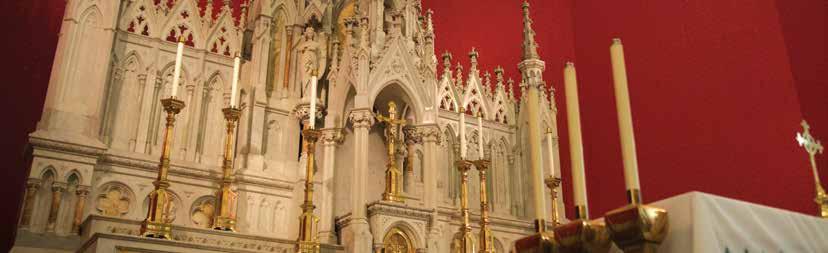
We seek St. Joseph’s intercession. With two feast days, on the nineteenth of March and the first of May, the Church clearly wants us to lean on Joseph and to learn from him. His intercession can assist us to deepen our faith, inspired by the pattern of the holy builder’s life. We ask St. Joseph to lend a hand as we construct a life for ourselves that resembles his, a life built on a foundation of good work and virtuous prayer.
May St. Joseph help us to find balance, especially when our life and our world seem off kilter. Through peace-filled rest and grace-filled prayer, may we find ourselves strengthened to face the challenges of each day. And, when fear and uncertainty engulf us, may we follow the direction of St. André Bessette and “Ite ad Joseph.” Going to Joseph, and following his example, we will no doubt find ourselves encouraged and strengthened to face the challenges of each new day. ✦

En 1955, el Venerable Papa Pío XII instituyó la fiesta de San José Obrero. Al escoger esta fecha, un día que se celebra internacionalmente el Primero de Mayo, con un enfoque en los derechos de los trabajadores, el Pío XII buscó unir el trabajo con la oración. El Santo Padre esperaba que nos colocáramos bajo la intercesión solícita de San José y nos encontráramos fortalecidos para nuestro trabajo diario mediante el don de la fe y la gracia de la oración.
San José, en su vida aquí en la tierra, llegó a comprender bien el equilibrio necesario entre el trabajo y la oración. Como carpintero experto, dedicó muchas horas al trabajo de la madera. Pero sabemos que, al encontrarse inmerso en la historia de la salvación con su Sagrada Familia, él se encontraría necesitado de estar fuertemente unido a Dios y lleno de gracia para poder afrontar bien los desafíos diarios del trabajo y de la vida.
Además de servir como modelo de trabajo y oración, San José también puede enseñarnos el valor del trabajo y del descanso. Vemos en los evangelios que José era un soñador. Al despertar de su sueño reparador, comprendería mejor el “por qué” de su trabajo diario y el “dónde” del destino de su vida. Dios tenía un plan para José. Al alejarse de su serrucho, de su cepillo de carpintero y de su torno, José pudo cerrar los ojos y ver más claramente cómo Dios le acompañaba y cómo Dios le estaba asegurando que permaneciera diligente en sus labores, dedicado a la fe y a la oración, y devoto a su familia.
Muchos de nosotros encontramos nuestras labores diarias agotadoras. El trabajo de cada día—ya sea en una oficina, una fábrica, una granja o una escuela—puede hacernos sentir agobiados y abrumados. Hacer malabarismos con las exigencias de un trabajo, una familia y todas nuestras otras responsabilidades puede
hacer que muchos de nosotros desarrollemos insomnio. Las preocupaciones de la vida, sumadas a las preocupaciones del mundo, pueden fácilmente desencadenar malos hábitos en muchos de nosotros. En lugar de cerrar los ojos para soñar, nos encontramos despiertos y mirando una pantalla.
Pero el mundo de los juegos, los videos, las redes sociales o cualquier otra cosa que podamos utilizar para distraernos no puede sustituir el regalo de un buen sueño. Necesitamos seguir el ejemplo de José, invirtiendo en nuestro trabajo cada día y permitiéndonos descansar cada noche. “Dormir, tal vez soñar”, reflexionó una vez Hamlet de Shakespeare. Pero donde Hamlet diría: “Sí, ved aquí el grande obstáculo”, José nos llama a la fe y a no desesperarnos. José experimentó personalmente la Presencia Divina que viene a nosotros en el sueño, y nos promete lo mismo.
Buscamos la intercesión de San José. Con dos días de fiesta, el 19 de marzo y el 1 de mayo, la Iglesia quiere claramente que nos apoyemos en José y que aprendamos de él. Su intercesión puede ayudarnos a profundizar nuestra fe, inspirados en el modelo de vida del santo carpintero. Pedimos a San José que nos ayude a construir una vida que se parezca a la suya, una vida construida sobre la base del buen trabajo y la oración virtuosa.
Que San José nos ayude a encontrar el equilibrio, especialmente cuando nuestra vida y nuestro mundo parecen desequilibrados. Que, a través de un descanso lleno de paz y una oración llena de gracia, podamos encontrarnos fortalecidos para afrontar los desafíos de cada día. Y, cuando el miedo y la incertidumbre nos envuelvan, sigamos la dirección de San Andrés Bessette e “Ite ad Joseph ”. Yendo hacia José y siguiendo su ejemplo, sin duda nos sentiremos animados y fortalecidos para afrontar los desafíos de cada nuevo día. ✦
Q: Why do priests wear black with a white collar? What is the history and significance?
The colors of the vesture that clergy wear are diverse: from the white worn by the pope, to the bishops’ purple, to the black of diocesan priests. In each case, there is meaning and tradition behind them.
As the Church advanced in age, separate clothing developed for the liturgy (known as vestments) and everyday wear. At first, priests’ everyday clothing was not distinct from that of others, even non-Christians. It seems that for the first 500 years of Christianity, the priests, whether St. Peter, St. Clement, or St. Augustine, did not wear distinguishable dress outside of the Mass.
Those who did wear distinctive dress were often the monks, who adopted simple, long, dark-colored robes. The color was likely chosen for practical reasons—easier to care for and keep clean. As religious life developed, each order’s habit came to signify membership in the community. For instance, Cistercians and Dominicans wore white, and Carmelites and Franciscans wore brown.
Diocesan priests, however, were not bound by the habit. It became common in the sixth century for them to wear cassocks, a long, ankle-length garment derived from ancient Roman dress. These were of various colors, including white, blue, or even green, until the thirteenth century, when black was adopted as the proper color for diocesan priests. At the same time, clergy were forbidden to wear ostentatious clothing or jewelry.
In the United States, diocesan priests wore the same clothes as other people—shirts, ties, and frock coats— until the late 1800s. Attire had to be practical and easily
laundered, especially for missionaries, including those who rode a circuit on horseback.
The U.S. bishops met in 1884 and mandated the black cassock for parish priests when they performed liturgical duties. They also allowed for a shorter garment, still black in color, to be worn while traveling or recreating. In each case, the Roman collar was required to distinguish their attire from that of the laity. This evolved into the clerical shirt or the shirt with a jacket. While some priests wear cassocks, others find black shirts and pants more practical; it is a matter of the priest’s preference.
Current church law requires that clergy “wear suitable ecclesiastical garb in accord with the norms issued by the conference of bishops and in accord with legitimate local custom” (Code of Canon Law, 284). Though black is normative, white garments are permitted in some places, especially in warmer climates. While distinctive dress is encouraged, it is not necessary at all times: for instance, priests usually wear non-clerical attire when exercising or performing manual labor.
While some Protestant clergy wear similar vesture, the black shirt and white collar remain the most recognizable attire for Catholic priests. The choice of black has taken on a spiritual meaning. The dark color has been variously interpreted to represent poverty, the priest’s death to the world, or the need for mourning for sin. The collar has been associated with obedience.
A priest’s black attire is a visible expression of his identity and provides opportunities for ministry. It is not unusual for people to approach a priest in public, even one they do not know, to ask for advice, support, or prayer. Just as the “habit doesn’t make the monk,” clerical attire doesn’t make the priest, but it is a sign to others that goes back centuries. ✦





Every year, we are reminded that Lent should not merely be about giving up habits or pleasures, but also adding some positive spiritual discipline. We might give up caffeine or alcohol, for example. Or we might add a spiritual or corporal work of mercy, such as praying the office or visiting the sick. Of course, many of us engage in both kinds of Lenten disciplines, depriving ourselves of some good, while adding good works. The two approaches, both of which many of us practice, can actually be analyzed in distinct ways, as they may provide different spiritual blessings.
As a threshold matter, it is important to distinguish giving up some vice or bad habit from giving up some otherwise good pleasure or convenience. Of course, if Lent is a helpful catalyst for giving up a vice, that is a bonus. But giving up a vice should not be a temporary measure, but rather a permanent one. Spiritual (and probably physiological) benefit follows the elimination of a harmful habit. So, if Lent is a good time to throw off some bad habit, who could complain?
But the real spirit of giving something up in Lent is not about things we shouldn’t be doing anyway. Rather, Lenten sacrifice ought to involve some material comfort or otherwise good thing. For example, if we regularly drink too much alcohol, Lent might be time to examine whether we should be drinking at all. But if we are otherwise moderate drinkers, temperately enjoying alcohol with friends or family or around meals, giving this up for Lent is of greater spiritual value than giving up something we shouldn’t be doing anyway. And, of course, many of us give up things that are good but disposed to abuse, such as meat, sweets, TV, or social media.
Giving up some comfort or good pleasurable activity is a reminder of the suffering of Jesus during his 40-day sojourn in the desert. And that calls to mind the 40 years
of Israel’s wandering in the desert, homeless, often hungry, and discouraged. By depriving ourselves of good things, we join the suffering of Jesus. This has spiritual benefit for ourselves, of course. Even more importantly, however, we can intend our deprivation for the souls in purgatory or some friend or family who is suffering some illness, disease, or misfortune.
This reminds us that Jesus did not come so that we will never suffer, but rather that our suffering can be both redeemed and redemptive. Of course, suffering must be properly intended. If we give up grudgingly or resentfully, there may perhaps be some physiological benefit, but the spiritual benefit will be elusive. Suffering per se is of little value. Intentional suffering is grace-bearing and salvific.
When God created all things, he pronounced them “very good” (Gn 1:31). But it only took two more chapters of Genesis for God’s very good work to be degraded by sin. In the fall of the man and woman in the Garden of Eden (Gn 3), God’s perfect, complete creation became compromised and corrupted. By asserting their own moral autonomy, the man and woman in Eden fell short of the complete good for which they were created. St. Augustine later defined “evil” as the “privation of good.” This means that evil does not have its own “being.” Evil does not “exist.” Rather, evil is the corruption of existence, which is to say that evil is the corruption of good.
The human quest after the Fall, then, is the restoration of God’s original goodness. This can summarize the entirety of salvation history, in fact. Even in Genesis 3, God declares that He will set in motion the process by which His perfect, but fallen, creation would be restored to its original goodness—its original perfection. God alone offers the means of that restoration through a pure act of grace. But, of course, to receive that gift, we must cooperate with
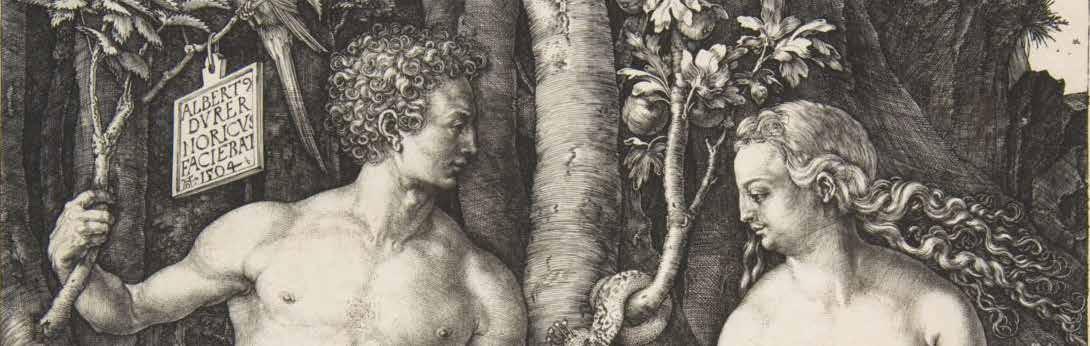
God’s offer through our express assent to the message of the Good News. In other words, we cooperate in our own re-creation by saying Yes to God in contrast to the No of Adam and Eve.
This brings us back to Lent. In this time of reflection, repentance, and reconciliation, God continues to make us whole again—to restore us to the full, original goodness in which he created us. Put another way, Lent is a time of moving toward perfection.
In the Sermon on the Mount, Jesus concluded the first part of His discourse by telling His listeners, “So be perfect,
just as your heavenly Father is perfect” (Mt 5:48). The Greek word for “perfect” is derived from the same word (“telos”) that He uses from the Cross in John 19:30, when Jesus says, “It is finished.” Which is to say, Jesus “perfected” His work in an act of complete self-giving on the Cross. This is the same work to which we are called, especially in this season of Lent. It is not “giving up,” but rather “giving to.” We give ourselves to God through works of prayer, sacrifice, and mercy. And as such, we participate in that original goodness by and for which we are created. ✦
BY KARY ELLEN BERGER
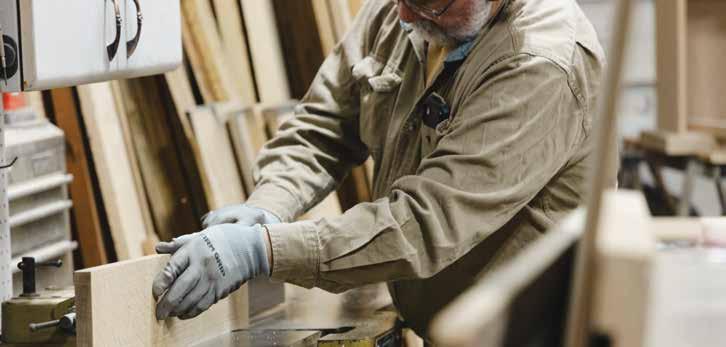
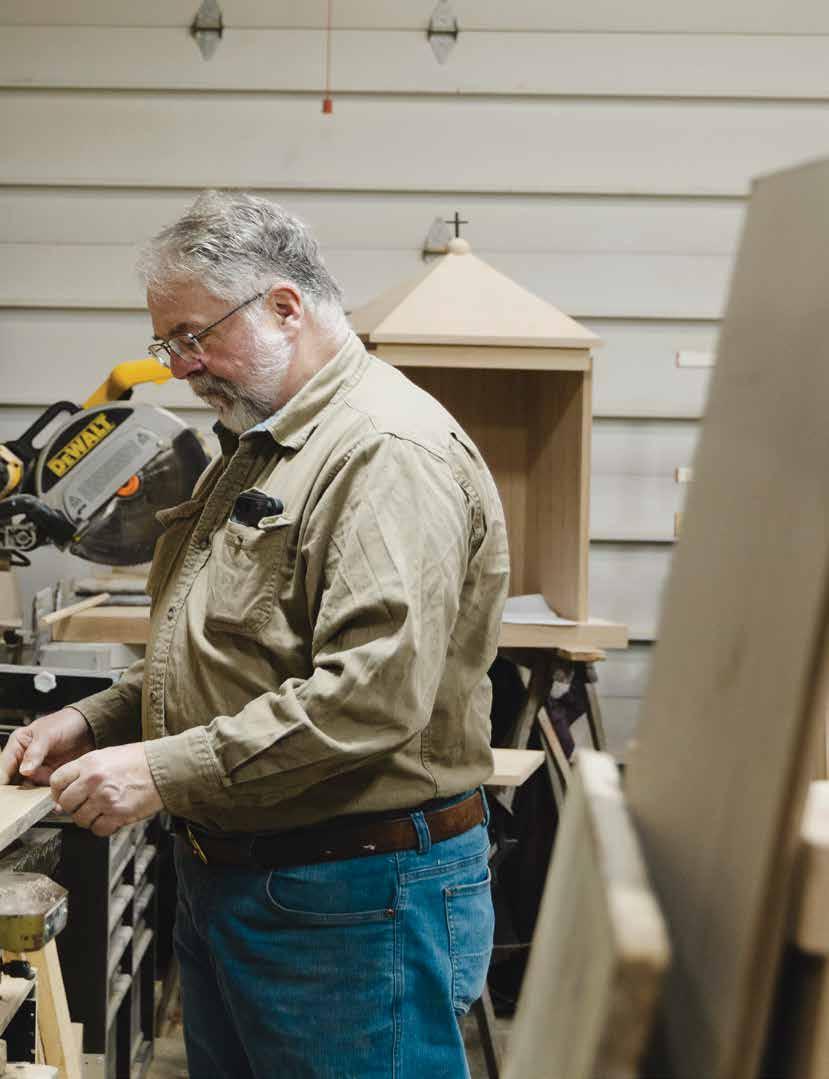
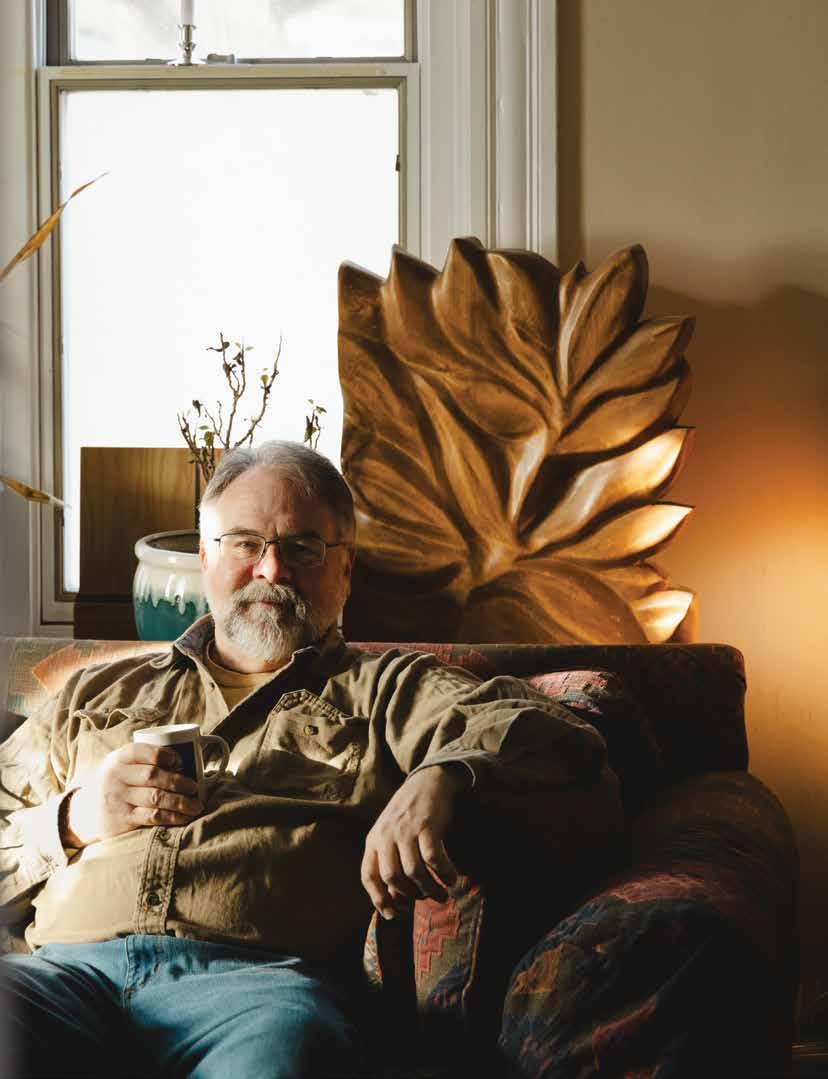
When master carpenter Josef Otmar steps into his workshop, he does so with an unusual posture for a craftsman, one of listening. Silence, he says, is not empty. It is where God speaks and the work of Otmar’s hands begins.
For Otmar, woodworking is not simply a trade, it is a vocation shaped by prayer, attentiveness, and trust. That calling is taking tangible form at the new Roger Bacon High School chapel, where he is crafting the altar furnishings with the care he believes is owed to sacred space. These pieces, he says, are meant to not only serve a purpose, but also reflect reverence.
“This isn’t for the head of Ohio State’s house or the president’s house. It’s God’s house,” said Otmar. “And the tabernacle is God’s house within God’s house.”
Creating liturgical furnishings requires both skill and surrender, he said. Designs may begin with a plan, but he remains open to guidance in unexpected directions.
“Liturgical furnishings don’t always turn out the way you think they will,” Otmar said. “You think you know what you’re going to do when you start, but then the Holy Spirit intervenes and says, ‘No, you’re going to do this.’”
That openness led him to the Roger Bacon Chapel project, which he sees as clearly providential—God directing the work of his hands. A simple introduction unfolded into an invitation to shape the chapel’s most sacred elements.
“That’s not happenstance,” Otmar said. “That’s God saying, ‘Get up early and go help out your buddy,’ and then watch everything else fall into place.”
For the chapel, Otmar crafted the tabernacle, altar, ambo, presider’s chairs, and credence table. Each piece was
intentionally designed with simplicity in mind, reflecting the Franciscan spirit that guides the space. He chose quartersawn white oak, wood known for its subtle shimmer that enables beauty to emerge quietly rather than through ornamentation.
“You have God’s glory and God’s beauty, but also the simplicity of the Franciscan order,” Otmar said. “That balance matters.”
Otmar approaches each task with prayerful awareness. He speaks of designs forming in his mind before he ever picks up a tool and of being drawn back to the workshop with a sense of purpose and peace.
“You’re called to a higher level of spirituality when you’re doing this kind of work,” Otmar said. “You ask yourself, ‘Am I worthy to be the one whose hands touch this?’ Because it is sacred.”
For Otmar, the work of his hands is ultimately an act of trust. In the quiet of the shop, he creates space for God to lead, believing that when hands are open in service, they become instruments of something far greater.
“Silence is where you hear God,” he said. “You just have to be willing to listen.”
Within the walls of Roger Bacon Chapel, that listening has taken shape in wood and form, offering a lasting reminder that when work is entrusted to God, it becomes prayer itself. ✦
You can see Josef Otmar at work on The Catholic Telegraph YouTube page.

BY LISA FLETCHER
She arrived on campus searching for something she couldn’t yet name.
The University of Cincinnati buzzed around her with the usual flurry of classes, sports, and social events, but for Zeta Washington, a California native, a quiet restlessness had begun to take hold. She hadn’t grown up Catholic and had never been baptized. Faith, she admits, had never been a central part of her life. “I often tried to find fulfillment in other things,” she recalled, “like sports, my social life, partying, and just making as many friends as possible.”
Beneath the surface, something was stirring. By the end of her freshman year, that restlessness had deepened into a
longing for something more—a sense of peace and purpose that she couldn’t yet put into words. She began attending a non-denominational church, where, for the first time, she encountered Christ in a personal and tangible way. “I learned that all He wants from us is a true relationship with Him,” she said. “That was life changing.”
Still, something was missing.
As Zeta continued to grow in her relationship with Christ, deeper questions emerged—about truth, faith, and what it truly meant to follow Him. Those questions eventually led her to Catholic Bearcat, the campus ministry serving students at UC.
Catholic Bearcat exists to meet students exactly where they are, said John David Kimes, Campus Minister. “I am continually in awe of how the Lord is at work at the University of Cincinnati—through our priests, our St. Paul’s Outreach (SPO) and FOCUS missionaries, and, most importantly, through our students.”
Zeta first encountered Catholic Bearcat through student Mass and the welcoming presence of students outside the church. “I was the kind of person who sat in the back pew and just took it all in,” she said. Over time, she joined a small-group Bible study through FOCUS, one of the missionary organizations serving on campus.
It was here, in the intimacy of a small group led by Catholic peers, that Zeta began to explore the faith deeply, asking questions and discovering answers in the Bible that pointed her to the Church. She recalled how her prior experience with non-denominational Bible studies emphasized the New Testament, but as she began reading the Old Testament, she saw the continuity of God’s plan—a plan the Catholic Church had preserved for centuries.
“A large part of our efforts is centered on small groups and Bible studies,” Kimes explained. “They provide an intimate and personal setting for students to grow in their faith and in relationship with one another. We consistently reinforce to our students that they are on mission—called to encounter others intentionally and invite them closer to the Lord.”
For Zeta, that invitation changed everything. “The teachings of the Catholic Church didn’t simply answer my questions,” she said, “they pointed me to Jesus in ways I had never experienced before.”
Though Mass initially felt unfamiliar—the standing, kneeling, and reverence for the Eucharist—she felt a tug she couldn’t ignore. “Eventually, I stopped pushing off God’s call, and I joined OCIA to start the process of becoming Catholic,” she said.
Her journey into the Church coincided with a profound personal loss: stepping away from collegiate volleyball, which had long defined her identity. “What was at the time the most important thing in my life, He completely took away,” she said. “But at the same time, His love and mercy completely flooded my mind, heart, and soul.”
In April 2025, Zeta was baptized and received into the Catholic Church. “Despite the loss and emptiness I felt at the time, I also never felt so whole,” she said. “Worldly things come and go, but the Lord will always be there as long as you let Him in.”
Stories like Zeta’s are not uncommon at Catholic Bearcat. In 2025, as many as 280 students participated in small groups, more than 400 attended Sunday Mass, and 222 students went on retreats—with another 130 participating early this year. Twenty-five students are currently part of the OCIA process, and dozens more are actively discerning their faith.
“Testimonies are powerful because they make what is invisible visible,” said Kimes. “Zeta’s story is a compelling witness to how many of our students have experienced a shift in how they view the world and what truly matters, moving toward a focus on the One who is everything.”
The success of UC’s campus ministry program—as well as campus ministry at Miami University and Wright State University—relies not only on the dedication of staff and student leaders, but also on the financial support from the Catholic Ministries Appeal.
The ministry’s essential needs include the costs to operate the Catholic Center, host evangelization and formation events, and support student participation in retreats and conferences, Kimes said. “Our financial need is real, and CMA’s support has been instrumental in making this ministry possible.”
In 2025 alone, Catholic Bearcat reached hundreds of students through small groups, Sunday Mass, retreats, and leadership programs. “Students experience authentic freedom and radical joy,” said Kimes. “The Holy Spirit is clearly at work here.”
For Zeta, Catholic Bearcat has provided more than spiritual formation, it has built lasting friendships and mentorship. “I have met some of the most important and influential people in my life,” she said. “The strong Catholic men and women I consistently surround myself with truly push me to become a better person. Fr. Tim (Fahey) and Fr. Jeff (Stephens) have also been incredibly helpful. They’re not just priests, but friends and spiritual guides.”
Zeta now helps lead Bible studies herself, walking with students who are just beginning to ask the same questions she once did. “If you feel that tug in your heart, just don’t ignore God,” she said. “He’s waiting to welcome you—just like He welcomed me.” ✦
Stories like this are made possible by the generous, sacrificial gifts made throughout the archdiocese to support the ministries of the Catholic Ministries Appeal (CMA). Visit CatholicAOC. org/CMA for more information.
CHRISTIAN ANTHROPOLOGY | Andrew J. Sodergren, M.T.S., Psy.D.
Note: This article is part of an ongoing series on Pope St. John Paul II’s “Theology of the Body” (TOB).
We have been unpacking Pope St. John Paul II’s meditations of Ephesians 5, in which the late pope emphasizes the “mutual submission” of husband and wife out of reverence for Christ. The traditional term for this reverence is pietas, which connotes a holy fear, respect, and awe. The basic idea is that when I have an awareness of the presence of Christ dwelling in my spouse, it should move me to such profound reverence that I freely “submit” my desires, preference, even my very self to my spouse, seeking her good before my own.
All of this is well and good, but what of St. Paul’s admonition specifically to wives to be subject to their husbands as to the Lord (Eph 5:22)? According to John Paul II, the core of St. Paul’s teaching in Ephesians 5 is that “the community of the spouses” is “born on the foundation” of their “reciprocal submission” based on reverence ( pietas) for Christ dwelling in each other (TOB, 89.6). In his view, “Love excludes every kind of submission by which the wife would become a servant or slave of the husband, an object of one-sided submission. Love makes the husband simultaneously subject to the wife, and subject in this to the Lord himself, as the wife is to the husband” (89.4).
For Pope St. John Paul II, mutual submission implies a shared reverence to Christ expressed in the love and conduct of both spouses toward each other. It is also a mutual renunciation of any inclination to dominate or control the other. To dominate one’s spouse violates that dignity of the person and Christian vocation of marriage. Rather, Christian spouses are called to model their love after that of Christ and the Church, in which the central dynamic is self-gift and receiving the other as gift. This entails placing the good of the other before one’s own good to the point of total self-sacrifice while also receiving, welcoming, and accepting the priceless gift of the other.
It is only in light of this understanding that we can accurately understand St. Paul’s image of the husband being “head” of the wife as Christ is “head” of the Church. To be “head” in this context means to lay down one’s life out of love for the other as Christ did. To be subject then means to lovingly receive the sacrificial self-gift of the other and respond reciprocally. This headship and subjection does NOT imply any domination of one spouse over the other. Rather, headship and submission mean giving and receiving love. The model of this love is Christ’s love for the Church, expressed through His total, salvific gift of self on the Cross. This is not just an ideal but the concrete calling of every Christian spouse:
“Marriage corresponds to the vocation of Christians only when it mirrors the love that Christ, the Bridegroom, gives to the Church, his Bride and which the Church … seeks to give back to Christ in return. This is the redeeming, saving love, the love with which man has been loved by God from eternity in Christ. … Marriage corresponds to the vocation of Christians as spouses only when precisely that love is mirrored and realized in it” (90.2-3).
Having Christ as “the source” and “model” of their mutual submission ennobles the vocation of Christian spouses as a true path to holiness, conferring on the marital relationship “a deep and mature character” (89.4). According to Pope St. John Paul II, living this vocation of mutual submission out of reverence for Christ, opens spouses to a gradual psychological and moral transformation through the grace of their sacrament. As they grow ever more united in love, they simultaneously grow in transformative union with Christ dwelling in their midst. Such is the awesome gift of the sacrament of marriage. ✦



HOW FATHERS TEAM HELPS MEN UNITE WORK AND PRAYER
BY KARY ELLEN BERGER
To be a Catholic father today is to live at the intersection of faith, family, and responsibility. It is a calling shaped by prayer and presence, providing and protecting, and learning how to love well in the middle of everyday life. Fathers Team exists to help men live that calling with intention, rooted in Christ and strengthened by brotherhood.
Begun 36 years ago at College Hill Presbyterian Church, Fathers Team was founded by Dr. Ron Rand as a place where men could gather to read Scripture, support one another, and put faith into action. Over time, the ministry found a strong presence in Catholic parishes and continues to thrive in places such as St. Gregory the Great Family of Parishes (which includes Immaculate Heart of Mary, Guardian Angels, and St. John Fisher), where Tim Arnold and Todd Schneider serve as Fathers Team members.
“The original purpose was to use the Word of God to help fathers build healthy relationships with their wives, children, friends, and God,” said Arnold. “During the early years of raising a family, men get swallowed up by work. We are focused on providing, but we are not always good at maintaining friendships or nurturing our faith.”
Fathers Team creates space for men to reflect on who they are called to be, not only as workers or providers, but as Catholic husbands and fathers.
“Men are hard-wired to be providers and protectors,” said Schneider. “Fathers Team helps men step back and look at their lives more holistically. It brings faith, family, and daily responsibilities together instead of treating them as separate compartments.”
In 2024, the ministry underwent a rebranding effort to better reflect its mission and expand its reach. Its purpose is now captured in a simple phrase: “Forged in Faith, Bonded in Brotherhood. We stand together, united in Christ in a safe place where vulnerability and authenticity thrive, allowing us to support one another as we navigate the challenges of our faith.”
“When we asked men why they kept coming back, the word ‘brotherhood’ came up again and again,” said Schneider. “But it had to be rooted in faith. This is not just about friendship. Men wanted to grow closer to God alongside other men living the same realities of marriage, fatherhood, and work.”
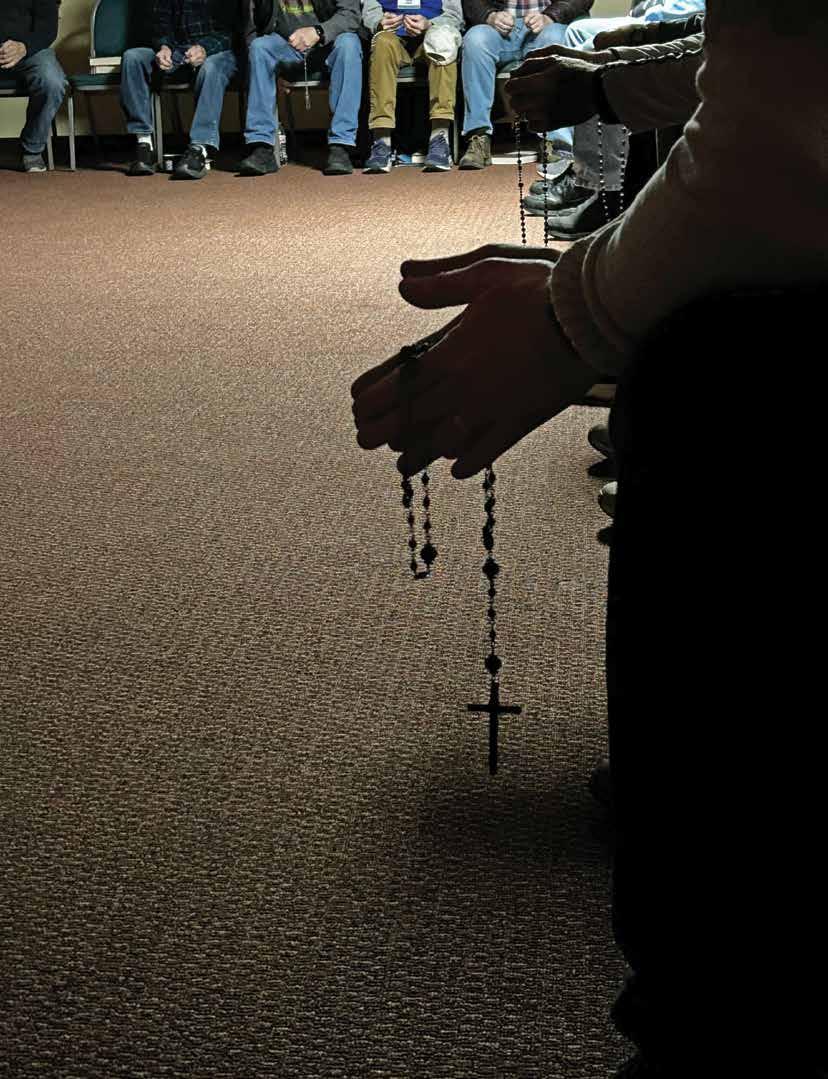
Fathers Team meets weekly, often early in the morning before the workday begins. Some men arrive even earlier to pray the Rosary together. Meetings include Scripture, prayer, and reflections on topics that connect Catholic teaching to real life. Those topics range from vocation and
marriage to work, joy, suffering, and the cultural pressures that shape family life.
Small group discussions form the heart of each gathering.
“The small group is where men can speak honestly about what they are carrying,” said Arnold. “Work stress, job loss, retirement, illness, grief, or struggles at home. When those things are brought into prayer, something shifts.”
Through these conversations, men begin to see their daily work not as an obstacle to faith but as a place where faith can be lived.
“Work becomes something men can offer back to God,” Arnold said. “Instead of pulling them away from prayer or family life, it becomes part of how they live out their vocation.”
Firmly grounded in Catholic teaching and sacramental life, Fathers Team welcomes all Christian men. Participants are encouraged to attend Mass, return to the sacraments, and deepen their prayer lives; always in a way that meets each man where he is.
Looking ahead, the men hope the ministry continues to form men who understand the lasting impact of faithful fatherhood.
“When men live their faith as fathers and husbands, it strengthens families,” said Schneider. “And when families are strengthened, communities are strengthened too.” ✦
For more information about Fathers Team or assistance starting a Fathers Team at your parish, contact Tim Arnold at 513-919-3682, tarnold4683@gmail.com or Todd Schneider at 513-787-0981, toddschneider443@gmail.com.
“On the day which is called Sunday we have a common assembly … and the memoirs of the Apostles or the writings of the Prophets are read. ... Then, when the reader has finished, the president of the assembly verbally admonishes and invites all to imitate such examples of virtue. Then we all stand up together and offer up our prayers, and … bread and wine and water are presented. He who presides likewise offers up prayers and thanksgivings (‘eucharistias’) … and the people express their approval by saying ‘Amen.’ The Eucharist is distributed and consumed by those present, and to those who are absent, it is sent through the deacons. The wealthy, if they wish, contribute whatever they desire, and the collection is placed in the custody of the presider. With it … he takes care of all those in need” (First Apology, 67).
That was written in A.D. 150 by a pagan philosopher named Justin, who converted to Christianity and later died for the faith. Now 1,876 years later, we still do every Sunday what he wrote above: Liturgy of the Word, Liturgy of the Eucharist, the homily, the great Amen, the collection! And in case you had any doubts, Justin also lets us know that the Eucharist is really “the flesh and blood of Jesus who was made flesh” (66).
Justin Martyr is what we call an “apologist,” a defender of the faith. We have this account of the Mass because Justin was writing to the Roman emperor to set false rumors straight: the early Christians weren’t cannibals, as some people claimed, but they did mystically partake in the flesh and blood of Christ.
Justin not only defended Christianity against rumors, he also presented, in full intellectual force, the Gospel as the fulfillment of all Old Testament prophecies and the fulfillment of the stirrings for God in each restless human heart. In his great defense of the faith, Justin is the first writer to develop two key points in Catholic theology: Mary is the New Eve (Dialogue with Trypho, 100) and the destiny of human persons is “to become gods” (124).
What is hinted at in Justin, though, becomes beautifully elaborated in the Church’s first theologian. Writing around 180 in France, St. Irenaeus still breathed the air of the Apostles: he was a disciple of St. Polycarp who was a disciple of St. John, and he saw it as his mission to defend the apostolic faith against the threat of Gnosticism.
The Gnostics were comprised of various esoteric groups who claimed to know what Jesus really taught rather than what the Catholic Church and her bishops claimed He taught. Essentially, the Gnostics denied both the goodness of creation and the reality of the Incarnation. In his systematic, elbow-to-the-face takedown of Gnosticism, Irenaeus became the first theologian to thoroughly develop and draw out rich implications of the apostolic faith.
Perhaps the most striking example of Irenaeus’s theological depth comes from his meditation on Mary. If we carefully studied Luke 1 (or John 2 and 19 or Revelation 12), we would find that Scripture has a whole lot to say about Mary. Irenaeus is the first writer to substantially unpack the mysteries which Scripture itself contains and which Tradition faithfully passed down.
St. Cyril of Jerusalem
St. Gregory of Nazianzus
St. Gregory of Nyssa
St. Ambrose
St. John Chrysostom
St. Jerome
St. Augustine
St. John Damascene St. Cyril of Alexandria
St. Leo the Great St. Gregory the Great St. Maximus the Confessor
Irenaeus makes explicit what Scripture tells us implicitly: just as Christ is the New Adam (Romans 5, 1 Corinthians 15), Mary is the New Eve. Listen to how clearly he puts it: “the knot of Eve’s disobedience was untied by Mary’s obedience. What Eve bound through her unbelief, Mary loosed by her faith” ( Against the Heresies, III, 22, 4) .
Speaking of the mysteries of Scripture, what does it mean when Psalm 81 says, “You are gods?” Jesus Himself mentions the verse in John 10, and Justin says that, somehow, this is the hope of Christians. Irenaeus dives deep to draw out the significance of what later writers will call “divinization.”
Obviously, we humans can’t become God as God is God, because we are created and finite beings whereas God is uncreated and infinite. On our own, we are mortal and perishable. If we had union with God, though, we could share and participate in His immortality and imperishability and thus become godlike.
This is precisely how Irenaeus explains the Incarnation: “For the Word of God became man, and He who is God’s
Son became the Son of man to this end, that man, having been united with the Word of God and receiving adoption, might become a son of God” ( Against the Heresies, III, 19, 1).
I feel almost sinful for writing so little about these two key Fathers, but I hope this, at least, is clear: the story of salvation is superabundantly glorious, and it is your story. Scripture is the inexhaustible and inspired record of its promise, and Tradition is its unfailing messenger. As Justin and Irenaeus show us, moreover, this story is not just a fact; it is also an invitation. What Jesus did in His Incarnation and what Mary lived, with a singular grace, is also extended to you, especially through the liturgy: become the son or daughter of God that you were baptized to be. ✦
Fr. Jacob Lindle, ordained a priest for the Archdiocese of Cincinnati in May 2022, is presently studying for a Doctorate in Patristic Theology at the Pontifical Gregorian University in Rome.
Saint Justin Martyr, The Fathers of the Church, vol. 6 (Catholic University of America Press, 1969) St. Irenaeus of Lyons, On the Apostolic Preaching, Popular Patristics Series, (St. Vladimir’s Seminary Press, 2003)
Andrew Hofer, OP, Divinization: Becoming Icons of Christ through the Liturgy (Hillenbrand Books, 2015)
Luigi Gambero, Mary and the Fathers of the Church (Ignatius Press, 1999)
Brant Pitre, Jesus and the Jewish Roots of Mary (Image, 2018)
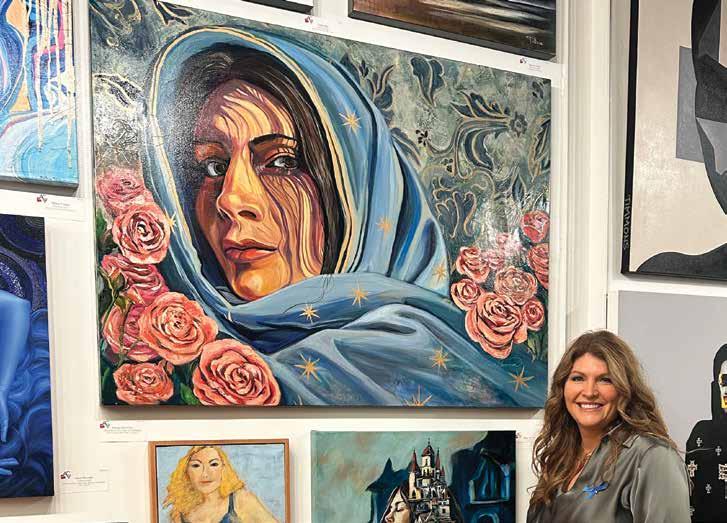
BY SUSAN BERGMAN
As a busy mom of eight, Marcie Stammen of North Star rarely stopped to think about her journey with art. Looking back, she can see how God planted this gift in her early years and gently drew her back to it when the time was right.
“I always loved to draw and sketch, and my mom took notice of my abilities,” she said. “She took me to see my great-aunt, who was an artist, for lessons. Her hands were bent with age, but she could still draw beautifully. It was amazing to see, and I picked up on it easily.”
From that spark, art became a thread woven throughout Marcie’s life. She studied art in college, but as her family grew, creative pursuits faded to the background. “For a long time, it was just a hobby,” she said. “Motherhood was my priority, but when all the kids went to school, I started painting again.”
That return to art came with both nerves and a touch of grace. When asked to paint a mural of the Last Supper for a neighbor’s dining room, Marcie felt rusty and unsure, but the project renewed her. She started taking online classes to fine-tune her skills, including one focused on finding her artistic voice. At first, she was frustrated because she only drew what she saw, but through prayer and discernment, she created a portrait of Mother Teresa. In that moment, she realized her voice as an artist was meant to bring others comfort, hope, and peace through spiritual art.
“Visual art helps others encounter Christ through images,” she said. “It is a good complement to our faith. We see so many unholy things in the world today. Sacred art is different. It is what we and our society need.”
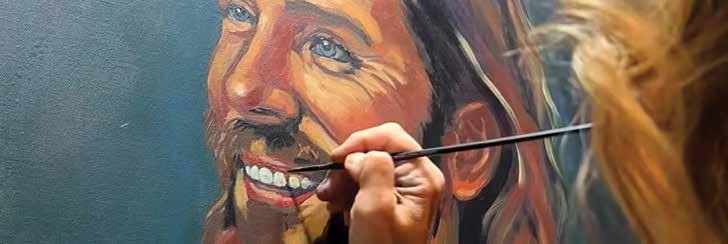
From then on, Marcie’s art became more than images. It became woven into her prayer life. She began incorporating old Scripture text from hymnals and antique Bibles into her pieces. She found herself painting while listening to sacred music and noticed how much peace it brought her. Curious, she researched the connection between artistry and anxiety. “Looking back, I see what God was doing,” she said. “Painting calmed me, and I wanted to share that gift of peace with others.”
Her reflection “Art and Anxiety” grew from those insights and is now a free guide that helps others explore creativity as prayer. In it, she invites readers to meditate on images, doodle in journals, or let daily tasks become prayers. “God is the Creator, and we are made in His image,” she said. “That means we are all capable of creativity. It doesn’t have to be perfect to be prayerful.”
Marcie’s work began impacting others in new ways. She recently led two live-painting fundraisers in the Archdiocese of Cincinnati that raised more than $10,000 for parish missions. At an event for St. John the Baptist Church in Maria Stein, she created an image of the historic church before the devastating fire of May 2025 and incorporated pages from an 1883 German Bible she found at the nearby retreat center. “I sat down and prayed, and God pointed it out to me,” she said. “If something happened to my parish, I would be devastated. I wanted this piece to be a prayer of hope for their future.”
Looking ahead, Marcie hopes to continue merging her artistic talent with fundraising for nonprofits and Catholic ministries. Her prayer is simple: may God use my brush to inspire faith, healing, and generosity.
“I want people to know that beauty can lead us closer to God,” she said. “Art is not just decoration. It is prayer, healing, and evangelization.” ✦
Saturday, March 28
Explore Marcie Stammen’s reflections and artwork, including her free resource, “Art and Anxiety,” at artbymarcie.com. Take a morning to rest, connect, & get inspired by the beauty of your vocation with the
St. Monica-St. George 9 AM–12 PM
Open to women 16–35 (under 18 needs a chaperone)


BY PATRICIA MCGEEVER
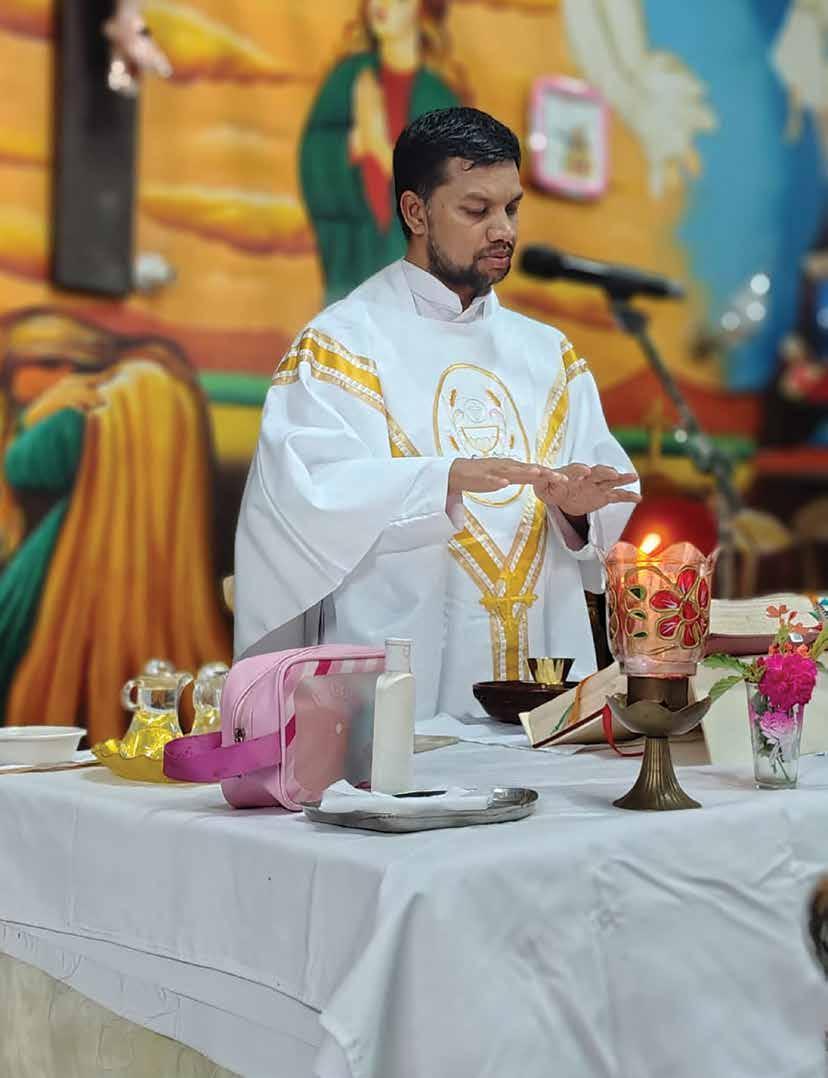
When Fr. Deva Kuma says Mass at his 14 remote mission stations in India, he wears vestments made by volunteer seamstresses living here in the Archdiocese of Cincinnati.
“From the bottom of my heart, I thank you so much for your Mass vestments,” he wrote, expressing his gratitude to the Notre Dame Tabernacle Society. “My heart is overfilled with joy and happiness just because of your generosity of heart in sending the Mass vestments and holy rosaries and holy pictures of Jesus and St. Anthony. You really made my day so joyful.”
For decades, the Society’s seamstresses, based out of Queen of Peace Parish in Hamilton and St. Henry Parish in Dayton, have sewn and sent vestments and Mass kits to missionary priests around the world. Each priest receives four chasubles and four matching stoles. Last year, they sent sets to priests in India, Ghana, Malawi, Nigeria, Tanzania, and Uganda.
“We were able to fill over 109 requests in 2025,” said Tina Trimbach, president of the group. “We sent out 351 vestments, 11,765 rosaries, and 46 Mass kits.” To put this in perspective on an individual level, seamstress Teri Dean shared, “In just over four years, I’ve made 120 vestments. Since each priest receives four vestments, I’ve personally outfitted thirty of them.”
However, their work could soon be hampered as the seamstresses from Queen of Peace, who order the fabric and send the shipments overseas for both parishes, are losing their current meeting space in the basement of a parishioner’s home. The space was designed especially for this ministry, so the women are currently seeking a new spot to set up shop this summer for their weekly meetings.
Their counterparts at St. Henry each work primarily out of their own homes, meeting weekly in a donated space for adding the finishing touches to their vestments.
“We are very fortunate to have a location right across from the church that used to be the old township hall,” said Jean Stachler, a seamstress at St. Henry Parish. The building’s owners generously allow the group to operate there at no cost, where four sergers and a sewing machine are set up.

The ministry’s work continues to spread by word of mouth among priests in need, and the volunteers enjoy hearing from those who receive a shipment.
“Thank you for your Mass vestments,” wrote Fr. Damien Seusi from his parish in Malinyi, Tanzania, adding, “God Bless your work and your ministry.” And from Uganda, Fr. Jude Onyango wrote, “Thank you, and God bless the work of your hands. I promise to pray for you always.”
The women say the future of their ministry and its location are in God’s hands, and they have faith He will help them find a new space. They know they can count on the prayers of the hundreds of priests who’ve received their handiwork.
The Society also appreciates material support and seeks additional volunteers beyond the current members. “We can always use donations because we buy our own fabric, and that has gone up in price,” said Trimbach. “Our shipping costs have gone up substantially, [too]. The other thing we can use is additional sewers, whoever God sends our way.” ✦
For more information on the Notre Dame Tabernacle Society or to support their work, visit www.notredametabernaclesociety.org

What remains of Archbishop John Baptist Purcell’s life survives in fragments of brittle letters, handwritten ledgers, and the early pages of The Catholic Telegraph Gathered together, they reveal not just a figure from the past, but a man constantly at work: writing, building, teaching, and defending a growing Catholic community in an often-hostile city.
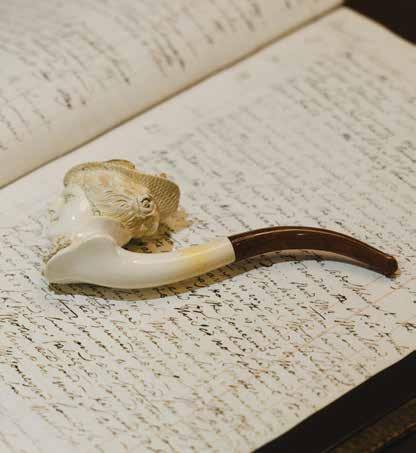
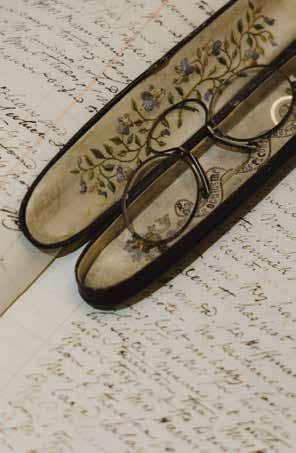
The records also reveal something quieter and more enduring; they suggest that Purcell understood the daily labor of a bishop, like any honest work, as something worth being offered to God. This conviction is visible both in Purcell’s words and the ordinary objects he left behind: his journal from the 1830s, pair of glasses, gardening hat, and smoking pipes.
The journal itself, kept from 1833 to 1836, is modest in size and practical in tone. Purcell records observations, plans, and concerns of a young diocese still finding its footing. Writing for a successor he assumed would come soon was an act of trust, a quiet acknowledgment that the Church belonged not to him, but to God. His careful planning became a form of prayer, rooted in humility and hope.
The journal carries an unintended irony. When Purcell set pen to paper, he could not have known that he would lead the Church in Cincinnati for fifty years, one of the longest episcopal tenures in U.S. Catholic history. Born in Mallow, County Cork, Ireland, Purcell himself had arrived in Cincinnati as an immigrant, and he would shepherd an archdiocese whose rapid growth was fueled in large part by successive waves of newcomers, whose faith and labor brought vitality to the Church.
In a young nation still finding its identity, being Catholic was often difficult and unpopular. Yet Purcell persevered, standing with his people and helping the Church take root. Many Catholic families today can trace their roots to those same immigrants of his time, who arrived seeking opportunity, only to encounter deep suspicion and open prejudice.
Perhaps the most striking items in the archives are the simplest ones. Purcell’s pipes, glasses, and gardening hat bear the marks of ordinary use. They remind us that even archbishops live embodied human lives; reading, tending the soil, pausing for rest. These humble objects strip away titles and accomplishments and reveal a man shaped by the rhythms of work and prayer familiar to us all.
The future of the Church, like its past, will be built not only through grand moments, but through faithful daily work. Purcell’s life reminds us that holiness is not separate from our labor, but grows within it, when work and prayer are patiently woven together, day after day. ✦
Purcell starts in 1833: 16 churches, 7,000 Catholics, 14 priests
Purcell dies in 1883: 500 churches, 500,000 Catholics, 480 priests
Religious Orders Introduced–
Men (9): Jesuits, Franciscans, Lazarists, Fathers of the Precious Blood, Passionists, Fathers of the Holy Cross, Fathers of the Holy Ghost, Brothers of Mary, Brothers of the Poor of St. Francis
Women (10): Sisters of Notre Dame of Namur & of Muelhausen, Sisters of the Precious Blood, Ursulines, Sisters of the Good Shepherd, Sisters of Mercy, Sisters of the Poor of St. Francis, Little Sisters of the Poor, Ladies of the Sacred Heart, Sisters of the Third Order Regular of St. Francis, Sisters of Charity.
SHINE ON | Dominick Albano
I’d rather have one pair of hands put to work than a million pairs of hands clasped in prayer.
Driving to school over twenty years ago, I read that bumper sticker on the car in front of me, and I’ve never forgotten it. The message felt more than wrong… it felt threatening. And I didn’t know why. I think I do now.
The bumper sticker doesn’t just say that work is better than prayer. It says prayer is pointless. Wasteful. Truly, good for nothing.
Pray as if everything depended on God. Work as if everything depended on you.
That quote is sometimes attributed to St. Ignatius (it’s got a very Jesuit flavor, doesn’t it?), but I don’t think we can be certain. Either way, it feels a little closer to something we can agree with, right? Pray hard. Work hard. But when I first heard that quote—maybe in college?—it still felt like something was off. It has this sense that: God’s going to do His thing, you’re going to do your thing, and they don’t really intersect. And that can’t be right.
The theme for this month’s issue is Work & Prayer, and I had been reflecting on these topics and praying about this article when I met with Sherry Weddell, a well-known pastoral theologian and the author of Forming Intentional Disciples (a truly paradigm-shifting book for those who work in ministry).
I wasn’t interviewing Sherry for this article, but one of her comments made me think about the topic. She spoke about how God chooses to include us (humanity generally, but also each of us specifically) in His work. That is His choice, and He will not do the work without us. It’s something like…
God has a plan. And his plan includes you and your work.
The good work God has planned depends on God and you, working together, because that is how He intended it. And that is the tension of prayer. Prayer and work. They seem like opposites, but they aren’t. Prayer feels like a plea. Work
feels like an action. But in God’s economy, both amount to the same: A rightly ordered relationship with God.
Don’t pray as if everything depends upon God, Don’t work as if everything depends upon you, Pray and work as if everything depends on a cooperation between you and God, because that is how He designed it.
The idea reminds me of a favorite Scripture passage on prayer. Everyone has likely heard Luke 11:9, “And I tell you, ask and you will receive; seek and you will find; knock and the door will be opened to you.” But few people remember Luke 11:5-8.
Right after teaching the Lord’s prayer—and right before our famous “ask and you will receive ” verse—Jesus tells a poignant and powerful story of a man who receives unexpected visitors late one night. The man doesn’t have any food to offer his unexpected guests, so he goes next door to ask his neighbor for some bread. The neighbor tells him to go away because it is late and he is already asleep. And then Jesus gives us this practical and beautiful instruction:
I tell you, if he (the neighbor) does not get up to give him the loaves because of their friendship, he will get up to give him whatever he needs because of his persistence.
– Luke 11:8
What’s Jesus telling us about prayer? It’s not just the asking, but the how that matters. Why? Does God need to be convinced? Are we changing His mind? No.
God has a plan, and you—your work—is a part of it. Prayer and work. Doing something and praying. They’re not at odds. It’s not one or the other. It is not that one depends on God and the other depends on us. We believe in a God who has chosen to include you in His good work.
When I change the oil on my truck, I often invite my kids to help. Not because I need their help. But because it is delightful to work with them.
God doesn’t need your work or your prayer ... God finds you delightful.
Working with you is delightful for Him. ✦
CATHOLIC AT HOME | Katie Sciba
“Do you know the Litany of St. Joseph? Have you prayed it?” This is how I answered an incoming call from a priest friend. I was in the process of reading Fr. Don Calloway’s Consecration to St. Joseph and felt as though the included litany was a huge discovery. I couldn’t believe I had never come across it as a cradle Catholic.
My priest wasted no time: “Yes. Which was it? Which title of his got you?”
Among the litany’s eloquent and powerful titles for St. Joseph was one that especially grabbed my attention: Savior of the Savior. Such words are loaded with holy implications and heroism, yet like St. Joseph himself, are simple and straightforward. Blessed William Joseph Chaminade wrote, “To give life to someone is the greatest of all gifts. To save a life is the next. Who gave life to Jesus? It was Mary. Who saved his life? It was Joseph.”
Recognizing St. Joseph as Savior of the Savior doesn’t imply that St. Joseph redeemed Jesus in a messianic way. Rather, it points to the protection given the Christ Child by His earthly father. It was when an angel appeared to him in a dream that St. Joseph was instructed to immediately take “the child and his mother, flee to Egypt, and stay there” to evade King Herod’s murderous pursuits of eliminating believed competition for the throne (Mt 2:13). Scripture indicates no doubt, pride, or questioning from Joseph, only obedience to the angel’s direction. From that obedience, the Lord’s life was saved, allowing for the glorious “hidden years” of His upbringing.
It was in this stand-out instance that St. Joseph earned the title Savior of the Savior, but what blew my mind was that he continued to embody it through faithful fatherhood, marriage, and provision for his family. The Heavenly Father and all-knowing Creator of the Universe entrusted His only Son to an ordinary man’s protection, obedience, and daily labor. In other words, St. Joseph’s guard over and preservation

of the Lord’s life was a constant event, one that has huge implications for Catholic families now.
As Christians, we focus primarily on the ministry of Jesus. Of course we do. Christ’s preaching, Passion, Death, and Resurrection are the whole point, and they sustain us spiritually. But those aspects of the Lord’s life are firmly scaffolded by His time with His parents. Jesus spent most of His years living in a home with His family. He was fed, taught, loved, and protected. There was stability and faithfulness in the environment where Jesus grew, and it was St. Joseph who had the concrete means of providing all of the above. Aren’t we working toward the same objectives? As parents, we guard our children’s innocence, create a stable home for them, choose obedience to faith when it’s inconvenient, and keep an environment and lifestyle that welcomes the Holy Trinity. God could have spared Jesus from Herod by any other way, but His choice to use a mother and father in a home means family isn’t just a common human formation. It’s an instrument of salvation.
Joseph never spoke a word in Scripture, but his actions saved the Savior; which means your unseen faithfulness, quiet consent to God’s call for your soul, and perseverance in marriage and parenthood are a mystical continuation of Nazareth. Every Catholic home can become, by St. Joseph’s example and intercession, a place where the Savior is saved. Be at peace—none of us are doing this flawlessly. In fact, the simple, steady efforts of marriage, family, and work can feel impossible from season to season. Though husband and father, St. Joseph stands apart from Mary and Jesus in that he was not preserved from Original Sin, yet he was chosen to guard the Redeemer. Confronted with the physical and spiritual demands of your family, take courage in the grace God provides. Ask confidently for prayers and help from St. Joseph, the man who once guarded the Redeemer and now guards the families who call upon him. ✦
BY MATT HESS
Catholics tend to collect rosaries without intending to form a collection. Each rosary recalls memories of special people, places, and sacraments, such as Grandpa’s First Communion rosary or the one you purchased while visiting Fatima.
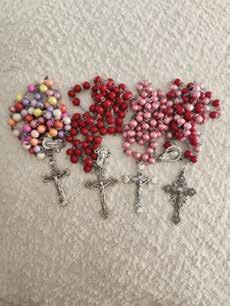
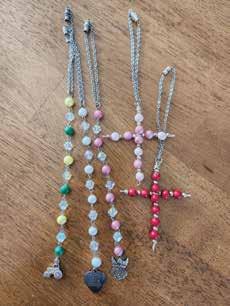
Jean Richmond has been helping people throughout the northern part of the archdiocese and beyond to preserve memories and offer them up in prayer through her business, Roses to Memories. She forms flower petals, often from roses, into keepsake rosaries and other items, such as bracelets, key chains, car crosses, or suncatchers.
The project began 22 years ago with Jean and her mother, Betty Jutte, when their family endured a difficult time of transition. There was collective grief following a
number of successive deaths in the family, and Jean was balancing a house full of kids. “It was a way of relieving stress and working from home,” said Jean, who agreed to partner with her mom when her mom suggested the project.
The pair experimented with different methods of making beads from flowers. “Mom and I learned through trial and error,” Jean said. “It took about a year to figure out.” Through persistence, they found that roses, with just a little bit of help, make the best beads for rosaries, and “we literally rolled with it,” Jean laughed.
It is fitting that the root of the English word “rosary” means “rose garden” or “garland of roses.” Each time we pray the Rosary, Catholics can see it as offering a bouquet of roses to Our Lady. Moreover, there is a tradition of making
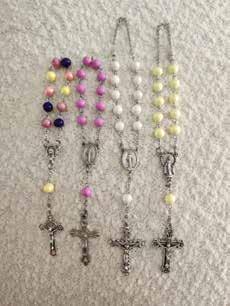
rosaries from roses that goes back to the Middle Ages.
Their basic process includes grinding the flowers down, adding a compound, then waiting for them to dry to a consistency at which they can be rolled into beads. Jean assures customers, “Every bead is handmade, hand rolled, and hand pinned.” It is a meticulous process that takes time and care to ensure that each piece is of heirloom quality. When they first began making beads, the process was a little different, and Jean and Betty could only take roses. Today, the process can be applied to any flower from any event. Flowers brought to Jean’s house come from weddings and funerals of loved ones, along with prom corsages, anniversary bouquets, and flowers from other events.
It’s a special way of helping people and life events live on, well after the accompanying flowers do. The rosary’s flower beads remind their recipients to lift up in prayer those people associated with the event.
Naturally, Jean meets people in various states of life. “I don’t always ask about the flowers people bring in,” she said, “I follow their lead and let them share what they want to.” When clients do talk about their flowers, it helps them grieve a loss or share a new joy in life, and Jean is there to listen and honor that moment in their life by her work.
A change in Betty’s health caused her to step back from the project about three years ago, after nearly 20 years of working on it together. Jean reflects at times on the value and meaning of Roses to Memories and wants to ensure its future: “I wanted it to continue when Mom became sick. If possible, I would love it to stay in the family.”
While she doesn’t know how many rosaries they made from flowers over the years, it must be in the thousands. Jean estimates that she makes about 400 each year.
“Imagine if they were all just prayed one time, how many prayers that would be,” she said. The impact of the grace unleashed is unknowable, but awesome all the same.
Jean’s work through Roses to Memories helps preserve moments and people in the hearts and minds of those who bring their flowers to her. These keepsakes, often rosaries, connect flowers to faith and lift up people, places, and experiences in prayer. ✦
If you would like more information, you can find Roses to Memories on Facebook or call Jean Richmond at 419-852-1903.


Never Quit, Never Give Up, Finish Your Race
BY SARAH WELLS
When Bonnie Sartin finished tidying up the sanctuary of St. Francis Xavier Church and returned to the undercroft, a chorus of parishioners surprised her as they sang “Happy Birthday” in front of a huge cake. It was a simple show of their appreciation for her significant service to the parish community. Little did they know, this was the first birthday party Bonnie ever had, and she was in her 60s. She had walked into the church a few years prior, in 1993, during a season of deep grief.
“After my husband and my mother died, I was walking by, and I came in and started crying,” she shared. “This little priest walked over to me and said, ‘Honey, what’s the matter?’ I said, ‘My husband and my mother just died, and I don’t have a job, and I need money.’” When he asked Bonnie what she could do, she answered, “Absolutely nothing,” to which he responded, “That’s what God’s looking for!” She started coming every day and is now indispensable to the parish’s functioning, but even more, she’s a beloved member of the community.
Born in Lexington, Kentucky, Bonnie and her twin sister, Tomie Faye, were abused as children by their father. Their mother relinquished them to an orphanage in Covington, and they never saw her again. Bonnie eventually married and moved back to Lexington, where she raised her family of five children: Rose Elizabeth, Toni Lynn, Mary Jo Dulji, Teresa Rae, and William Thomas. She lost touch with her son, William, when he left home at 16, and her second-eldest daughter, Toni, passed away from pancreatic cancer in 2022. But she is proud of her many grandchildren and great-grandchildren, and she recently became a great-great-grandmother.
A traumatic assault Bonnie experienced in Lexington spurred her family’s move to Cincinnati, where she now volunteers at an organization that helps women in crisis situations. “This is my plan from God,” she said. “I go to a crisis center and talk with [the women there]. Sometimes I go to court with them. God’s got me through a lot.”
When she speaks of the tragedy and loss she’s experienced, there is not an ounce of bitterness in her tone: “God has me here for a reason. People ask me, ‘How can you be alive after
what you’ve been through?’ I say, because God has my back, God has my back.”
In 2010, Bonnie added a part-time sacristan role at the Cathedral Basilica of St. Peter in Chains to her other roles at St. Francis Xavier. Coming from a Baptist and Seventh Day Adventist background, she joined RCIA classes at St. Peter in Chains and finished them at St. Francis Xavier, where she became Catholic. For 18 years, she was the wedding assistant there. Having stepped down from that role, she continues to assist with funerals, baptisms, marriage prep, janitorial duties, and anything else the parish needs.
She also sang in the choir for 16 years and has worked closely with the parish office staff, where she admits her weakness is answering the phones. “When the phone starts ringing, I go the other way!”
Bonnie gathers community wherever she goes. Since she doesn’t own a car, she often walks through downtown Cincinnati, offering a friendly wave to everyone she encounters and earning the nickname “The Waver.”
Bonnie has also exemplified Jesus’ command to forgive. In a pivotal moment, Bonnie forgave her father on his deathbed. “I had to go to release myself,” she said. “That was the hardest thing in this world to forgive him … [but] it took a lot of the burden off me.”
Now 84, Bonnie has run 190 races and hopes to make it 200 by the end of her life. She can be found traversing Cincinnati’s riverfront parks with her walker, connecting with fellow walkers and runners, who all know her by name.
Having previously suffered from suicidal thoughts, Bonnie attributes being alive today to the Holy Spirit’s intervention: the races she has run reflect a deeper determination to show her gratitude for the life she’s been given. When asked what she wants people to glean from her story, Bonnie refers to Hebrews in saying, “Never quit, never give up, always finish the race” (cf. Heb 12:1).
As for the church family she found at St. Francis Xavier, Bonnie says, “This place here has saved my life, this church here is my home.” ✦

BY GAIL DEIBLER FINKE
St. Lawrence was one of seven deacons appointed by Pope Sixtus II, who was executed while saying Mass during Emperor Valerian’s reign. Given three days to bring all the churches’ treasures to the city prefect, Deacon Lawrence instead gave all he could away and told the prefect the Church’s treasures were its poor and crippled. Martyred by being roasted alive on a gridiron, he is famous in legend for telling his executioners, “Turn me over, I’m done on this side!” He’s the patron saint of librarians, cooks—and comedians.
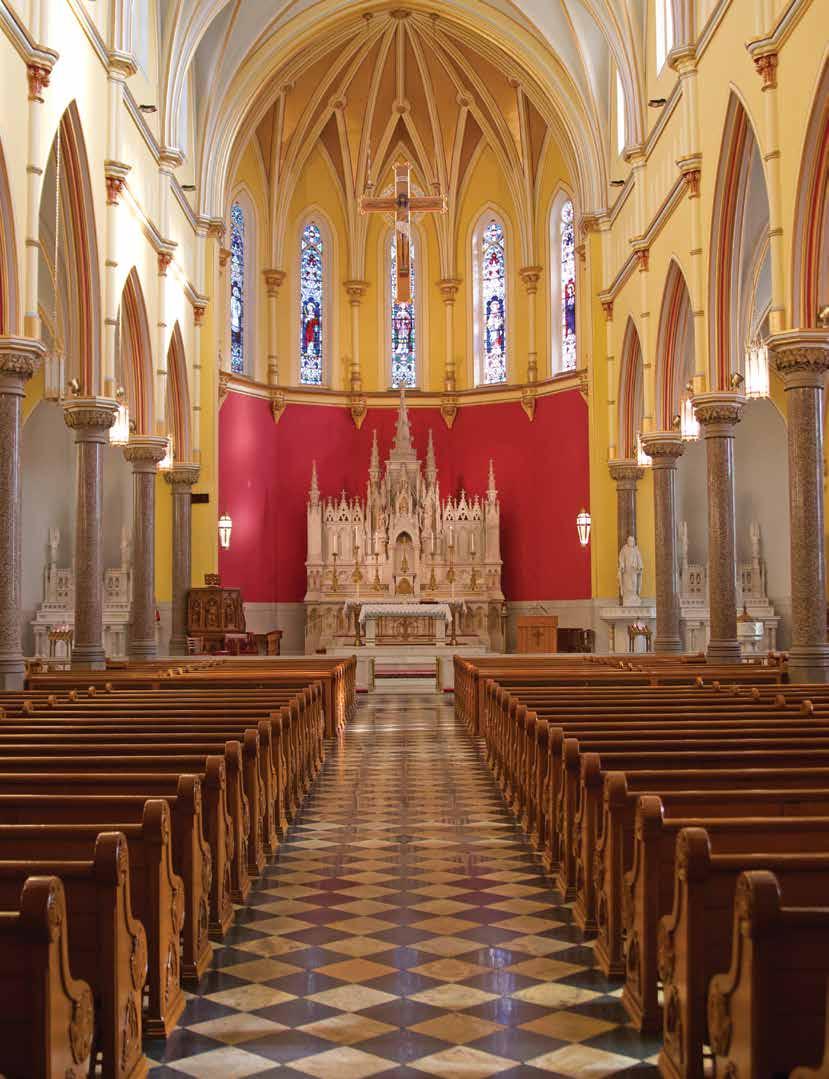
St. Lawrence Church in Price Hill began as a parish for German immigrants, who hired one of the most popular Germanborn church architects in America to design the immense and elaborate Gothic building. Parishioners worshiped in a basement area they called “the catacombs” while the church was built in stages.
The parish was formed at Mount St. Mary’s Seminary (located then in Price Hill), and its original building opened in 1870 as a combined church and school.
The cornerstone for the current church was laid across the street from the original building. Designed by Adolphus Druiding, the elaborate stone building cost more than $100,000.
The church was finished and dedicated. It features an ornate exterior: a large number and variety of stained and art glass windows, the largest made in 1912 by the Emil Frei Art Glass Company of St. Louis; an elaborate carved high altar made of marble and onyx; marble side chapels and communion rails; a carved and gilded organ loft supported by metal pillars; extensive carved Gothic woodwork; a gilded groined ceiling with carved details; and three towers—the highest reaching to 189 feet.
Recent renovations include a diamond-paned stone floor installed in 2022 and a massive new organ to replace the 1901 organ from G.G. Hook & Hastings, which featured almost 3,000 pipes. Designed to custom specifications from the Rudolf von Beckerath company in Hamburg, the new organ has nearly 3,500 pipes and took more than two months to install in fall 2025. It is the largest pipe organ in the archdiocese.
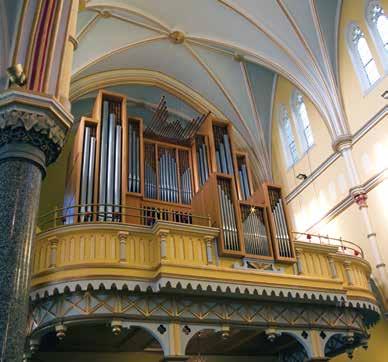
1 Custom pipe organ, the largest in the archdiocese.
2 Massive bells in the bell tower—“Lawrence Joseph” (4,263 lbs.) and “Augustine Mary” (2,250 lbs.).
3 Towers with spires.
“The new organ is a North German Baroque Revival, most suited for music of that genre and traditionally-based liturgy and hymnody. But it’s also flexible enough for a wide scope of classical organ music for all periods. It was expanded to accommodate a large choir, which gives it even further flexibility.” –John Valentine, Organist and Director of Music
BY MATT HESS

Many Families of Parishes in the Archdiocese of Cincinnati see a permanent deacon at Mass, especially on the weekend. A 2023 survey by the archdiocese reported that there were nearly 200 permanent deacons in our 19 counties in Southwestern Ohio.
And, well over three quarters of those deacons are married, uniting their call to ministry with their vocation to married life. We celebrate World Marriage Day every second Sunday of February, and it is worth looking at such a deacon and his wife’s example to appreciate the balance and mutual enrichment such couples can find in this unique and blessed position.
Gregg and Deb Elking of St. Bernard Church in the St. Henry Family of Parishes is one such couple, married 27 years this year.
“Deb and I both say we would’ve never envisioned this in our lives,” said Deacon Gregg. “Of course, we had our
plans when we first got married, but God had His.”
In the mid-2000s, the Why Catholic program to deepen one’s faith came to the then St. Henry cluster of parishes. Deb was interested but Gregg, although searching for something more in that period of his life, was hesitant.
“Long story short, this program led me to a profound prayer experience and encounter with God,” Deacon Gregg said. He found not what he was looking for, but Who he was looking for: God. And God placed in his path the right people, in the right places and at the right times, to lead Gregg to the diaconate. The catalyst, however, was Deb. “God used my wife to bring me into this program,” he said.
Together, the Elkings discerned and learned during the five years of permanent diaconate formation.
“When Gregg started his classes, I would type up his hand-written papers and was more of a scheduler for him,”
said Deb. She also conferred with him while planning her second-grade religion classes. They often discussed what Gregg was studying at the time, which led both to deepen their knowledge and love of Jesus.
On the discernment end, Deacon Gregg said, “God was using the Sacrament of Marriage to help me discern the call to the diaconate.” The grace received by the couple through this sacrament heightened their awareness of the Spirit’s action in their lives. They talked through the timing of it all and how God was preparing both of them for this step.
Deacon Gregg was ordained in Spring 2019, and the couple still collaborates; now, to further the Church’s mission in the St. Henry Community while also deepening their bond of marriage.
Their discernment continues, particularly to balance their schedules, as Deb explained: “The balance of diaconate life and family life has been hard at certain times, so I have to have a lot of patience to remember he is working for the Lord.”
“We have to keep God, marriage, family, work and the diaconate in proper order,” Deacon Gregg said. As a permanent deacon, due consideration must be granted to the first vocation of marriage. When things get busy, it is important to remember that it’s okay to say “no” to simply keep one’s life and vocations in proper balance.
They discovered a beautiful consequence of embracing the diaconate in the ability for husband and wife to minister side by side.
“Deb is a bigger part of this ministry than anybody truly realizes,” said Deacon Gregg. “Most of what she does is just unseen.” Beyond reminders and scheduling, Deb sacrifices her time and talents to help him, even if only to give him space to recharge from a week of work and a Saturday afternoon of ministry.
through the lens of grace. Grace from the sacraments gives them strength in times of need and joy, when the fruits of their labors are reaped. “We realize that the grace that came from the Sacrament of Holy Orders not only affects me as a deacon, but her as my wife,” Deacon Gregg said.
As we focus on the font of grace that marriage can be, the Elkings are a snapshot of the gift that the permanent diaconate has been—not only to individual couples or their local churches, but to all of God’s people. ✦


A visible way their marriage enriched Deacon Gregg’s ministry has been through mentoring couples preparing for marriage. Together, they share insights and offer support from personal experience.
The Elkings are also united in ministry through St. Henry’s baptism program. “Deb and I recently began teaching baptism class together,” said Deacon Gregg, “but one of the joys for me is that my wife will help me as a baptism assistant.” Deb not only makes sure the rite proceeds seamlessly, but also helps in forming young parents to pass on their faith.
They have both come to see these blessings and challenges

w/ purchase of King’s Hawaiian Fish Deluxe (at regular price) Exp 04/26/26

Born in Britain, St. Patrick grew up not believing in God. Irish pirates captured him when he was 16 and sold him as a slave in Ireland, where he was forced to look after sheep. After six years, he escaped and returned to Britain and his family and devoted his life to Christ.
St. Patrick became a priest and eventually a bishop, then traveled back to Ireland as a missionary so he could teach the people about God. He used examples to explain the mysteries of the faith in simple ways, such as comparing a three-leaf clover, or shamrock, to the Holy Trinity. He said that the shamrock has three leaves, but it is only one plant. In the same way, God is three Persons—Father, Son, and Holy Spirit—but one God.
There is a popular legend about St. Patrick driving snakes out of Ireland, but instead of actual snakes, this symbolizes that he drove evil out of the land by converting pagans to Christianity. God used St. Patrick’s kidnapping to convert the Irish people; in our lives, God uses the bad times to bring about a good we do not always see. We must be patient and trust Him.

We celebrate St. Patrick’s Day March 17 to remember how he lived his life entirely for Jesus, and that we are called to do the same. We can pray St. Patrick’s prayer: “Christ with me, Christ before me, Christ behind me, Christ in me, Christ beneath me, Christ above me, Christ on my right, Christ on my left, Christ when I lie down, Christ when I sit down, Christ when I arise, Christ in the heart of every man who thinks of me, Christ in the mouth of everyone who speaks of me, Christ in every eye that sees me, Christ in every ear that hears me.”

Patrick Ireland Trinity Shamrock Snakes Convert Britain Clover Green Bishop
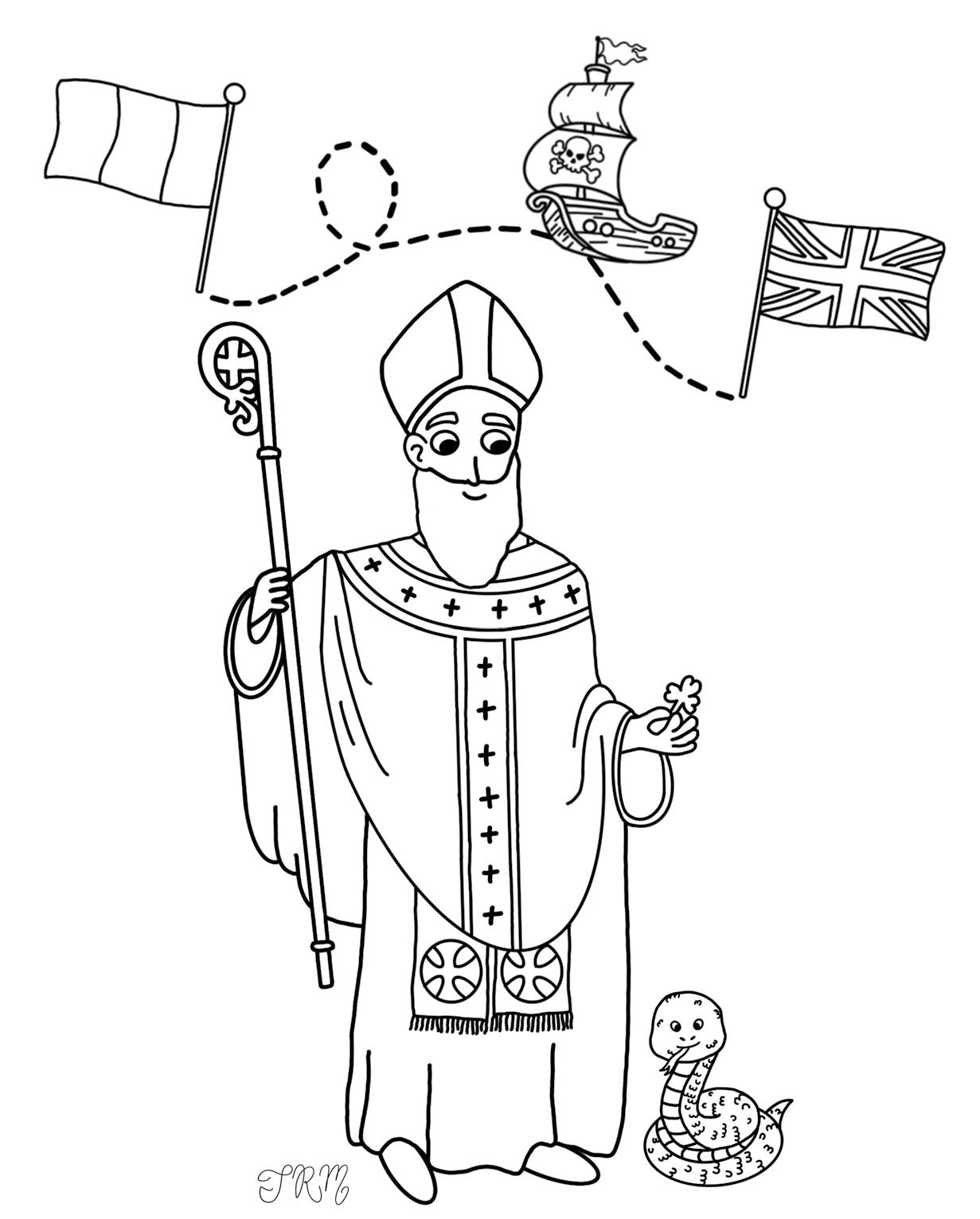
BY EMILY STIMPSON CHAPMAN; ILLUSTRATED BY DIANA RENZINA | WORD
As I look at our tattered children’s Bible, memories of poring over its pages as a young girl flood my mind. Back then, the stories seemed almost like fairy tales—of promisesignaling rainbows, trumpets that break down walls, young girls who become queens, and dream-interpreting men. What I didn’t realize until years later, however, is how watered down these children’s bibles can be.
Last summer, I decided to take an alternative road by dusting off our RSV version, starting with Genesis, and reading a chapter to my children each day. You can imagine how long this lasted with three children under the age of five. “Where are the pictures, mommy?” “What is a serpent?” “What KIND of fruit was it?” These are just a few of the questions that halted my every 10 words, prompting my abandonment of a shortlived goal. There had to be a balance between reading the entire Pentateuch to preschoolers and leaving them believing a cartooned version, right?
Enter The Story of All Stories: A Story Bible for Young Catholics, written by Emily Stimpson Chapman and published by Word on Fire! Beautifully decorated with countless illustrations by Diana Renzina, every page captures the attention of each listening ear (including my husband’s). This has become the highlight of our evening routine. Our first grader and preschooler wait with bated breath for the next story, and their cries for “One more chapter!” when I replace the silk bookmark always make me smile. As a former theology teacher, I love the last page of each chapter, which summarizes key points and connects them to Church teaching or other parts of the Bible. This is essentially typography for kids—showing how events in the Old Testament prepared the people of God for the coming of Christ. Additionally, quotes

from the Fathers and Doctors of the Church are woven throughout each Biblical narrative.
What sets The Story of All Stories apart from other child-focused Bibles lies in its heart. Other children’s Bibles often have multiple books of the Bible summarized onto one page, omitting key facts and people. While they follow the Bible’s general timeline, they do not help children learn the intentional order of Scripture. The Story of All Stories delves much deeper into salvation history, using a lens of adventure to discover often-skipped-over plots and figures from both the Old and New Testaments. In reading this Bible to my children or letting them read it when they are of age, I am confident they are truly receiving this element of the Deposit of Faith in its fullness.
The lovely illustrations, coupled with the sound content, set the tone to enable each child to encounter their Creator with childlike wonder and amazement, in whatever way He chooses to speak to them at that time. This Bible will be read and reread by our family for years to come. And it makes a perfect baptismal or first Communion gift!
In a world that loves to bombard us with content that damages our children’s souls, this invaluable resource introduces them to what truly is the Story of All Stories. Let us, then, sit back and be inspired by their faith, as Christ meets them on these beautifully gilded pages! ✦
A mother of four young children, Sarah Rose Bort is a graduate of Franciscan University. She is passionate about bringing people to encounter Christ through the true, the beautiful, and the good.

ACROSS
1 St. ___ Diego
5 Celestial being
10 Increases
14 Trial fig.
15 Actor, of “Young Frankenstein” fame, who was a novice in the LaSalle Brothers
16 Group of birds
17 Marcel Marceaux
18 De Valera of Ireland
19 ___ du soleil
20 Overjoyed
22 Occasional
24 Is aware of
26 Gaslight, for one
27 Fiddle-playing, Christian-hating ruler
29 Commandment that forbids bearing false witness
34 Word on a cartoon flag
38 Openings
40 Achille-___
41 Margarine
42 Ahead of the rest
44 The Mass is both a sacrifice and a ___
45 Airplane! for example
47 Trillion (pref.)
48 Catch sight of
49 Chat
51 Yahtzee cubes
53 “When we eat this bread and drink this ___…”
55 Falls found in the Diocese of Saint Catharines
60 The other half of the Archdiocese of Goulburn
65 Meager
66 Musical instrument
67 Exodus mountain
69 Hindu goddess of fire
70 Bk. of the Pentateuch
71 “We praise you, we bless you, we ___ you”
72 Archdiocese in Latvia
73 Actress Lancaster
74 Leases
75 Bambi, for example DOWN
1 Only apostle whose martyrdom is recorded in the Bible
2 Beneficial
3 Hindu principle of life
4 Russian negatives
5 One of the young men cast into the furnace
6 “…___ thousand times…”
7 School rooms
8 Quickly form a union?
9 Lost love of “The Raven”
10 Father, in the Bible
11 David asked Saul if he pursued a “___ dog” (1 Sam 24:15)
12 507, to Nero
13 Agreement
21 Aachen article
23 Altar balustrade
25 “___ us peace”
28 Chose (with “for”)
30 Favorite food of Isaac
31 Colors
32 Snare
33 ___ Name Society
34 Pear
35 Fido’s brand?
36 Night light
37 Blunder
39 He established Notre Dame
43 Appeases
46 Moses’ was radiant after he spoke with the Lord
50 Officer of a university




52 “Eye has not seen, ___ has not heard…”
54 One of the seven deadly sins
56 Watch over
57 Texas student
58 A place to be “home, home on”
59 “If anyone says, “I love God,” but hates his brother, he is ___.” (1 Jn 4:20)
60 ___ of Canon Law
61 Son of Eve
62 Intellect
63 Second letter of the Greek alphabet
64 Ever and ___
68 Catholic actor Carney

FINAL WORD | Laura Jordan Roesch
From his humble birth to his public ministry, Jesus exemplified the image of the servant leader. His example urges us to put our own ambitions aside as we follow His path. To truly lead, we must walk not at the head of the pack but in the shoes of those who follow.
At Catholic Social Services of the Miami Valley (CSSMV), that is our mission: to serve as Jesus did, without regard for self, status, or prestige. Our mission is rooted in Catholic social teaching, a framework of ideas designed to guide individuals and institutions in creating a just society where human dignity is respected. We stand in solidarity with all people, but especially the poor and the vulnerable.
As I discovered early in my journey, volunteering can shape both career and faith. It offers practical experience that can lead to fulfilling work, while providing encounters that deepen our relationship with God.
At CSS, staff and volunteers walk the path of kindness and regard for all people, no matter their trials and brokenness. They provide a lifeline of support, knowing that sometimes the smallest touch makes the biggest difference. Following this path is a way of living out the Gospel in the world, embodying Christ’s love for all people. As we give of ourselves, we receive the grace to grow in compassion and purpose—becoming, in the words of St. Teresa of Avila, “the hands and feet of Christ” in our time.
As the leader of this visible and viable Catholic social service agency, with all the responsibility that entails, I
As we give of ourselves, we receive the grace to grow in compassion and purpose— becoming, in the words of St. Teresa of Avila, “the hands and feet of Christ” in our time.
Since 1921, our agency has focused on the needs of those who lack food, shelter, comfort, and guidance, and we have walked not in front but alongside people in need on their journey. Over those 100 years, there were many changes. Programming shifted with the community’s needs to address: a growing population of older adults, mental health, tornado recovery, family violence, infant mortality, food scarcity, lack of affordable housing, and refugee resettlement. How we work has evolved, but the mission itself is timeless.
In college, I found my vocation through volunteering as the experiences led me to Catholic Social Services (CSS), 37 years ago, and it became my career and my passion. As my time here concludes, I will continue to be strengthened by the many lessons learned, the stories of the people served, the commitment and excellence of the staff, and the generosity of supporters.
I learned that CSS volunteers are a special group, full of kindness, empathy, and commitment. To give of oneself in this way provides riches that cannot be measured. Truly, volunteerism is the ultimate fulfillment of the “Love in Action” Pillar of Beacons of Light.
strove to embrace servant leadership as the foundation of my path. Dedication to this task deepened my faith and broadened my worldview. Serving in this way with a sense of hopefulness has been both a privilege and a joy. In my heart, I am an optimist. I believe that lives can change, dreams can be achieved, and God is with us always, showing us the path. ✦
Laura J. Roesch has been the Chief Executive Officer of Catholic Social Services of the Miami Valley for the last 16 years. She began her social work career at CSSMV 37 years ago and was appointed CEO in 2009. Her last day at CSSMV is Feb. 27, 2026, and beginning March 1, she is the new Executive Director of The Glen at St. Joseph, a nonprofit in Dayton.