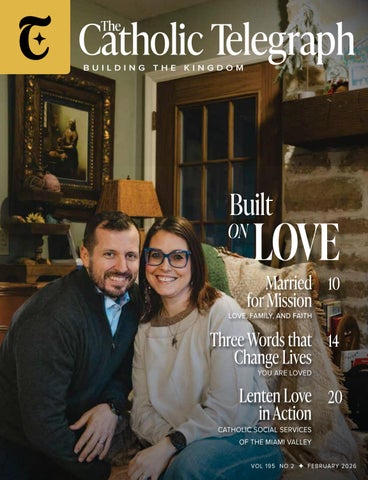
At RetireMed, strengthening our community is woven into everything we do. Whether we’re supporting local organizations—like our partnership with the Alzheimer’s Association—or helping families navigate health insurance, we believe in making a difference together.
As the new year begins, our focus remains on you. Whenever you need family, individual, or Medicare guidance, we’re here for you every step of the way.
Contact us to make sure you have the right coverage for 2026. Our advisors are ready to assist in reviewing, renewing, or switching your health coverage with confidence.
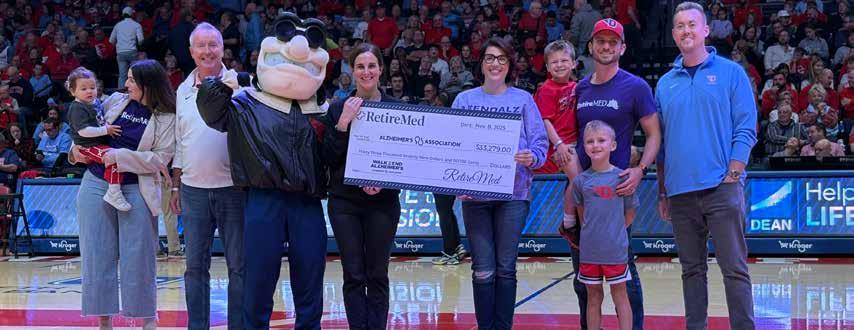
Photo: RetireMed’s CEO, Marisa O’Neill, and fellow employees presented a check for over $33,000 to the Miami Valley Chapter of the Alzheimer’s Association at a recent University of Dayton Men’s Basketball game.
In her Story of a Soul, St. Thérèse of Lisieux recounts a time when she struggled to understand her vocation within the Church. During prayer, she opened her Bible and read: “But strive for the greater gifts. And I will show you a still more excellent way” (1 Cor 12:31). Continuing to read through the next chapter, she reflected on St. Paul’s analysis that even the most amazing talents people possess are nothing without love. In that moment, in her words, she discovered that “charity is the excellent way that leads most surely to God.”
St. Thérèse found peace and joy when she realized that her vocation was love, and that love was everything
According to our Catholic faith, love is far more than a feeling or fleeting emotion. It is the very heart of Christian life and the foundation of all moral action.
In St. John’s exclamation that “God is love” (1 Jn 4:8), we discover the profound truth that love is not merely something God does, but who He is. To love, then, is to participate in the divine life.
In building up the kingdom of God on earth, we must recognize that everything we do must come from a place of love. We know that if we are going to transform our families and our communities for the better, we must adhere to the great commandment to love one another as the Lord has loved us.
Love is inseparable from truth. To love someone does not mean affirming everything he or she does or desires; rather, it means willing his or her authentic good. And Truth is ultimately a Person—Jesus Christ, who is the full expression of God the Father’s love for us. He is the foundation upon which we must build.
Only in Christ can we begin to understand what it means to love our neighbors as ourselves. Jesus models for us a balance of love and truth, offering mercy without ignoring sin and offering compassion without compromising the call to conversion.
Publisher: Archbishop Robert G. Casey
Editor: David Cooley
Graphic Design: Stephen Sullivan
Jesus teaches us what love truly is through the commandment He gave his disciples, “Love one another as I have loved you” (Jn 13:34) and through His own perfect example. He does not reveal love abstractly, but through His self-gift on the Cross, commanding us to imitate Him on the path to discipleship, renewal, and eternal joy.
We are called to practice love daily—in families, friendships, and communities—allowing God’s grace to transform human love into a reflection of His divine charity.
Returning to St. Paul’s first letter to the Corinthians we find some of the most beautiful words ever written about true love:
Love is patient and kind; love does not envy or boast; it is not arrogant or rude. It does not insist on its own way; it is not irritable or resentful; it does not rejoice at wrongdoing but rejoices with the truth. It bears all things, believes all things, hopes all things, endures all things. Love never ends.” – 1 Cor 13:4-8
When St. Thérèse read these words, she realized that “we can’t all be apostles, prophets, doctors, etc., that the Church is composed of different members, and that the eye cannot be the hand at one and the same time.”
Perhaps we can all take some comfort in that, too, and focus more of our energy on “the excellent way”—our vocation to love, which will joyfully lead us to our destination.
Media Sales: Deacon Graham Galloway
New Media / Circulation: Greg Hartman
Photography: Mary Fleisher
David Cooley
cteditorial@catholicaoc.org
Social Media: Taylor Motley
Video: Margaret Swensen


Father David Endres
is professor of Church history and historical theology at Mount Saint Mary’s Seminary & School of Theology.


Dr. Kenneth Craycraft
holds the James J. Gardner Chair of Moral Theology at Mount St. Mary’s Seminary & School of Theology. He is the author of Citizens Yet Strangers: Living Authentically Catholic in a Divided America.
Dr. Andrew Sodergren
is a Catholic psychologist and director of psychological services for Ruah Woods. He speaks on the integration of psychology and the Catholic faith. He and his wife, Ellie, have five children.
Fr. Jacob Lindle

was ordained a priest for the Archdiocese of Cincinnati in May 2022. He is presently studying for a Doctorate in Patristic Theology at the Pontifical Gregorian University in Rome.


Dominick Albano
is a passionately Catholic husband and father of four boys. He has been writing, speaking, and leading Catholic retreats for more than 20 years. He is the co-founder of the National Society for Priestly Vocations.
Katie Sciba
is a national speaker and Catholic Press Award-winning columnist. She and her husband Andrew were married in 2008, and are blessed with seven children.

Michelle Wirth Smith
has served as the archdiocesan Archivist since 2019, bringing a Cincinnati-born passion for preserving Catholic history. She earned her Master of Library & Information Science degree from Kent State University.
cteditorial@catholicaoc.org
Let us pray that children suffering from incurable diseases and their families receive the necessary medical care and support, never losing strength and hope
In the delightful classic movie The Bells of St. Mary’s, Bing Crosby and Ingrid Bergman star as a priest and a religious sister serving at the above-mentioned parish and its school. Ingrid Bergman plays Sr. Benedict, a school principal with both principles and a heart to match. Having given the students an assignment to write a report on the five senses, Sr. Benedict invites Patsy to give her report. Patsy, with the generous help of Bing Crosby’s Fr. O’Malley, presents this report to Sr. Benedict on the “six” senses:
“To see, to hear, to taste, to smell, to feel, to be. And the most important is the last. The sixth sense is to be able to enjoy the five senses properly.
To be—that’s what really matters. It’s like a world inside us, and it’s up to us what we make of it. We see others, we hear others, we know others with our five senses; but how do we ever know ourselves?
Through common sense. Common sense is an internal sense, whose function it is to differentiate between the various reports of the senses, or to reduce these reports to the unity of a common perception. Two great words, “to be.” Other words grow out of them: “I am,” “you are,” “he is,” “we are,”‘they are;’ that sort of takes in everybody.
As Shakespeare said, ‘To thine own self be true, and it shall follow as the night the day. Thou canst not then be false to any man.’ And he was so right, Sister! He was just talking about the sixth sense. To put it in my own words, ‘to be, or not to be—that is the question.’”
Whether it was Shakespeare or Patsy who said it, “being” is found at the heart
of life’s biggest questions. Understanding how and why God made us can be of great assistance to understanding who we are called to be. When we possess a selfunderstanding that is rooted in our being as God’s beloved creation, we can more easily live out our lives in the love for which we have been created. We can hear the voice of God resound through all of creation, taste and see the goodness of the Lord, smell the rich and wonderful fragrance of life, and feel the joy that comes to us as God’s children. Our “being” impacts our “doing.” The great commandment of love becomes something we do because of who we have discovered ourselves to be. Love is no longer simply a noun; it becomes a verb, expressed with intentional action. Charity becomes our common practice because of who we are. Rather than just a passive emotion or feeling, love becomes our daily choice to live in kindness, patience, service, and sacrifice.
This month the Church will enter the season of Lent. Together we will embark on a 40-day journey of prayer and penance that will lead us onward to the joy of Easter. We make this journey with Jesus by our side. Through His own life, death, and Resurrection, Jesus reveals to us the pathway to follow. The Way of Christ leads us from self-centeredness to selfsacrifice, from indifference to compassion, and from being random wanderers to becoming intentional pilgrims, choosing with thought and care each step we take.
May we have the common sense to see the wisdom of following the Way with Jesus, so that we may be renewed in our discipleship here on earth and rejuvenated by the promise of heaven, where love shall come to its fulfillment and our senses shall truly be awakened. ✦

En la encantadora película clásica Las campanas de Santa María , Bing Crosby e Ingrid Bergman interpretan a un sacerdote y una hermana religiosa que sirven en la parroquia mencionada anteriormente y su escuela. Ingrid Bergman interpreta a la Madre Benedicta, una directora de escuela de buenos principios y un buen corazón también. Después de haberles dado a los estudiantes la tarea de escribir un informe sobre los cinco sentidos, la Madre Benedicta invita a una joven llamada Patsy a dar su informe. Patsy, con la generosa ayuda del Padre O’Malley interpretado por Bing Crosby, presenta este informe a la Madre Benedicta sobre los “seis” sentidos:
“Ver, oír, oler, gustar, tocar y ser. Y el más importante es el último. El sexto sentido consiste en poder disfrutar adecuadamente de los cinco sentidos.
Ser, eso es lo que realmente importa. Es como un mundo dentro de nosotros que nos da lo que ponemos en él. Con nuestros cinco sentidos vemos a los demás, oímos a los demás, conocemos a los demás; pero, ¿cómo nos conocemos a nosotros mismos?
A través del sentido común. El sentido común es un sentido interno, cuya función consiste en distinguir las diversas informaciones de los otros sentidos, o en reducir estas informaciones a la unidad de una percepción común. Es una gran palabra, ‘ser’. De ella se derivan otras palabras. ‘Yo soy’, ‘tú eres’, ‘él es’, ‘nosotros somos’, ‘ellos son’; y en ellas está incluido todo el mundo.
Shakespeare dijo: ‘Sé fiel a ti mismo, y acompañado siempre de tu espíritu, no habrá falsedad para con nadie’. ¡Y tenía muchísima razón! Se refería al sexto sentido. Y por eso yo me pregunto ‘Ser o no ser: ésa es la cuestión”.
Ya sea que lo dijera Shakespeare o Patsy, el “ser” se encuentra en el centro de las preguntas
más importantes de la vida. Entender cómo y por qué Dios nos creó puede ser de gran ayuda para entender quiénes estamos llamados a ser. Cuando tenemos una comprensión de nosotros mismos que está arraigada en nuestro ser como creación amada de Dios, podemos vivir más fácilmente nuestras vidas en el amor para el cual hemos sido creados. Podemos escuchar la voz de Dios resonar a través de toda la creación, saborear y ver la bondad del Señor, oler la rica y maravillosa fragancia de la vida y sentir la alegría que nos llega como hijos de Dios.
Nuestro “ser” impacta nuestro “actuar”. El gran mandamiento del amor se convierte en algo que hacemos debido a quiénes hemos descubierto que somos. El amor ya no es simplemente un sustantivo; se convierte en un verbo, expresado con acción intencional. La caridad se convierte en nuestra práctica común debido a quiénes somos. En lugar de ser sólo una emoción o sentimiento pasivo, el amor se convierte en nuestra elección diaria de vivir en bondad, paciencia, servicio y sacrificio.
Este mes la Iglesia entrará en el tiempo de Cuaresma. Juntos nos embarcaremos en un camino de 40 días de oración y penitencia que nos llevarán a la alegría de la Pascua. Recorreremos este camino con Jesús a nuestro lado. A través de su propia vida, muerte y resurrección, Jesús nos revela el camino a seguir. El Camino de Cristo nos lleva del egocentrismo al autosacrificio, de la indiferencia a la compasión, y del vagar sin rumbo a convertirnos en peregrinos intencionales, eligiendo con pensamiento y cuidado cada paso que damos.
Que tengamos el sentido común de ver la sabiduría de seguir el Camino con Jesús, para que podamos ser renovados en nuestro discipulado aquí en la tierra y rejuvenecidos por la promesa del cielo, donde el amor llegará a su cumplimiento y nuestros sentidos serán verdaderamente despertados. ✦
QUESTION OF FAITH | Fr. David Endres
Q: I sometimes hear about Catholics who seek an annulment so they can remarry in the Church. Could you explain the process and its importance?
When a Catholic couple gets a divorce, they often believe they can no longer practice the faith. Some presume that divorce means an inability to receive the sacraments, and if they wish to remarry, it must be through a civil ceremony or before a non-Catholic minister.
It is true that the Church has an elevated understanding of marriage: it is an unbreakable covenant that reflects God’s faithfulness to humanity. This covenant is made by the spouses, who freely exchange their vows with one another, promising to love and honor each other throughout their lives. God blesses these covenants, raising them to the dignity of a sacrament.
However, there can be situations when a valid marriage does not occur, even when one or both spouses intended it to be valid. The Church does not nullify or annul marriages; rather, when a marriage results in divorce, one or both spouses may request a determination of whether a valid marriage existed. During this time of determination, the two parties to the original marriage can continue to receive the sacraments, presuming they have not sought to remarry.
To remarry in the Church, the husband or wife must first have this determination made for the prior marriage. This process usually begins through speaking with a priest, deacon, or lay minister specifically trained to help in this process. There can be many reasons why a marriage was not valid, such as one or both spouses lacked the maturity to enter into marriage, some aspect of consent was withheld at the time of marriage, one or both spouses were not open to children, or force or fear entered into the decision to wed.
Those who petition for an examination of their marriage must answer a questionnaire about themselves and their spouse. Both spouses are invited to participate but both are not required. The completed questionnaires and testimony from individuals who knew the couple at the time of the wedding are forwarded to the diocesan tribunal that is either in the place where the marriage occurred or where one or both spouses currently reside.
The process can take a year or more, depending on how long it takes to gather the required information and for the tribunal to make a determination. Both parties will be updated on the proceedings and have the right to review the testimony and, if necessary, appeal. There are no fees for most marriage cases.
If a marriage is determined to have not been valid (commonly called “annulled”), then both former spouses are free to marry in the Catholic Church insofar as their previous marriage is concerned. A caution may be offered to one or both to address a particular matter in order for them to enter a healthy and fruitful marriage in the future.
For a spouse to remarry, he or she would then follow the same process as a first marriage, including marriage preparation with a priest or deacon. The person preparing the couple will be attentive to what prevented the first attempted marriage from being valid.
While the process may seem legalistic, those who participate in it often find it to be healing and to become a way of moving forward. It demonstrates the Church’s desire to accompany people, even through less-than-ideal situations. What may initially appear as an obstacle to Catholic practice often becomes the path toward greater self-knowledge, spiritual recommitment, and renewed participation in the Church. ✦





A CLOSER LOOK | Dr. Kenneth Craycraft
In the 33rd and final canto of Dante’s epic 14th century poem, Paradiso, St. Bernard guides Dante to the destination of his pilgrimage, where he achieves the Beatific Vision. Dante describes his final ascent to Paradise in terms of the restoration of balance, harmony and order—heavenly perfection, one might say. But he could not achieve this vision with his own unaided sight. Indeed, the harmony of Heaven was foreign to his fallen human perception. Similarly to the mathematician’s inability to “square the circle” (failure to find a formula to convert the area of a circle to the exact area of a square) Dante could not see the harmony of the universe with his own eyes of finite and fallen reason.
As a geometer struggles all he can to measure out the circle by the square, but all his cogitation cannot gain
The principle he lacks: so did I stare at this strange sight, to make the image fit the aureole, and see it enter there.
His inability to grasp the harmony of Heaven on his own caused Dante to realize the futility of trying to know and love God through his own feeble effort. He could not make the final ascent on his own; he had to be carried to the ultimate destination of rest in God.
But my own wings were not enough for this flight, Save that the truth I longed for came to me, smiting my mind like lightning flashing bright.
Dante discovered two truths as he approached both the Heavenly vision and the end of his poem. The first is that his effort alone is not sufficient to scale the heights of the celestial realm. He cannot square the circle. But the second truth was revealed to him simultaneously with the first. The truth he sought was not accessible by his own effort, but it was attainable by the helping grace of God.
Both truths “smote” his mind. The penny dropped. He had his “aha” moment. And the result was his ultimate surrender to the love of God.
Here ceased the powers of my high fantasy.
Already were all my will and my desires
Turned—as a wheel in equal balance—by The Love that moves the sun and the other stars.
The square was circled; equilibrium was restored.
This most famous stanza in all of The Divine Comedy illustrates Dante’s understanding that when all has been finally consummated, one power will be revealed to prevail above all things. It was love that created the universe; love that sent the Son to redeem fallen creation; and love that finally orders all things “as a wheel in equal balance.” This tells us nothing less than that we have a divine mandate to consider love the sole motivating principle of our lives.
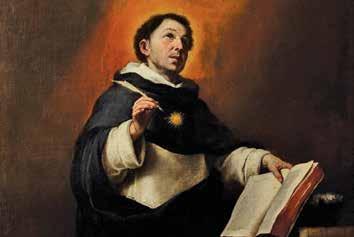
But what is love? And how is it expressed in the Christian tradition? The most common answer is drawn from St. Thomas Aquinas. “To love,” the Angelic Doctor explained, “is to wish good to someone.” This is the “default” definition in any Catholic discussion of love. Love is the virtue of willing the good for another. Indeed, in Dante’s native Italian, a common way to tell someone you love them is to say, “ti voglio bene” —literally, “I wish you good.” This is commonly thought of as “Platonic” love, a term of warm, heartfelt affection for very close friends or members of one’s family.
But while a very good definition, it doesn’t quite work in the context of the ultimate stanza of Paradiso. To will the good of someone implies the potentiality of some lack of good in that person. But that makes no sense if God— who is all good—is the object of our love. Thus, “I wish you good” is neither the expression nor the meaning of the last line of Dante’s epic poem, which uses the Italian word “ amore,” as in “l’amor che move il sole e l’altre stelle.”
“To love is to wish good to someone.”
Aquinas
To understand that love, “the love that moves the sun and the other stars,” it is helpful to invoke one of the (at least) four Greek words for love: eros, the rough equivalent of the Italian amore. Indeed, Eros and Amore are the respective Greek and Roman names for the god of love and desire.
In common English usage, we typically think of eros as the root for our word “erotic,” and we usually define it very narrowly as something like romantic sexual attraction (or even forbidden pleasure). But as a rough equivalent of the Italian amore, eros has a much broader definition in classical and historical Christian usage. Eros is not confined merely to sexual attraction (often confused with lust). Rather, eros is properly understood as the faculty by which we are attracted to any object we desire, and from which we expect pleasure or satisfaction. In this sense, it is appropriate to express our
love for God as a form of eros Eros is the motivating faculty for moving toward our desire.
And what greater desire can we have than to be in the presence of God? Of course, many of us are familiar with another Greek word for love, “agape.” Indeed, this is the word that Christ uses to describe the greatest commandment, to love God and our neighbor, in Matthew 22:37-39. This is the kind of objective, dispassionate, unconditional love that corresponds to the theological virtue of charity. But Dante teaches us that it is not just proper, but very good, to desire God as the lover pines for his beloved. That is the “love that moves the sun and the other stars.” ✦

FAMILY, AND FAITH
BY LISA FLETCHER
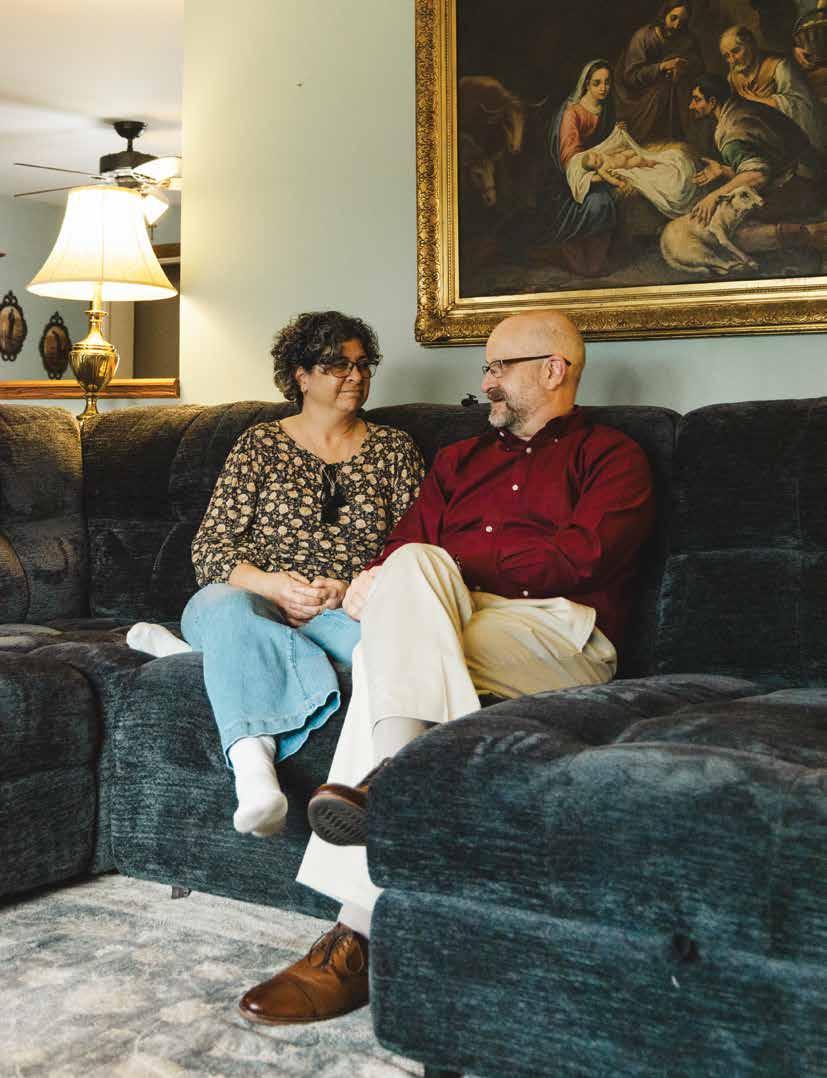
Marriage is a journey of love, faith, and grace. Across the Archdiocese of Cincinnati, Catholic couples have been discovering that the true beauty of marriage lies in more than companionship: it is a living sacrament, a daily opportunity to grow in holiness together. True partnership means supporting one another through life’s joys and challenges, celebrating God’s blessings, and leaning on faith when times are difficult.
From young couples just beginning their sacramental journey, to parents navigating the demands of family life, to longtime spouses sharing decades of wisdom and service, the following stories shine a light on the depth and richness of a faith-filled marriage. They show that marriage is not only about staying together but also lifting one another closer to God every day, in ordinary and extraordinary moments alike.
family,
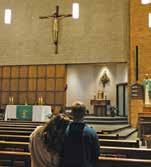
Tyler and Kaitlyn Goecke’s story began at Wright State University, where they crossed paths through mutual friends and shared athletic circles. “We both competed in athletics and saw each other regularly,” they recalled, “until we finally got to know one another.”
That connection deepened through Wright State’s Catholic Newman Center, which became foundational for both their relationship and faith. Raised Catholic, Tyler shared that he had remained connected to the Church, but meeting Kaitlyn marked a turning point.
“I started taking my faith more seriously once Kaitlyn and I met,” he explained. “The Newman Center played a big role for both of us. We met other Catholic couples who inspired us to live more virtuously, and our lives have definitely improved since that change. I’ve loved re-discovering the beauty of our Catholic faith.”
Kaitlyn’s journey was different but no less profound. Baptized Catholic as an infant, she did not actively practice the faith until Tyler invited her to Mass.
“I completed OCIA and received the rest of my sacraments after Tyler brought me to Mass,” she shared. “I began to fall in love with the Mass, the other Catholics I met, and how our relationship changed. I think being baptized as a baby gave me just enough grace to come back, and I’m very thankful for the journey I’ve been on.”
The couple married on July 20, 2024, at St. Brigid Church, Xenia in the St. Michael the Archangel Family of Parishes. They welcomed their first child, a daughter named Lucia, in May 2025.
Like many young couples, Tyler and Kaitlyn faced challenges early, most notably a season of long-distance dating when Tyler transferred to the University of Illinois during Kaitlyn’s OCIA process.
“The FaceTime calls and lack of time together were
tough,” they admitted. “But it gave us both a chance to grow closer to the Lord as we prepared for marriage.”
Today, faith is central to their marriage and family life. “Living our faith is the only way to survive marriage,” Tyler reflected. “God’s grace has saved us more than a few times. We push each other, hold each other accountable, and keep each other on the path to Heaven.”
They’ve embraced daily Mass when possible, family prayer, monthly confession, and intentional spiritual habits—knowing their daughter will one day look to them as examples.
“Our priest told us during marriage prep that the greatest gift we can give each other is salvation,” they said. “Holding fast to that advice has helped us every day.”
To newly engaged couples, their advice is simple but countercultural: “Care more about your marriage than your marriage day. The wedding is just the beginning.”
Marriage shaped by grace and perseverance
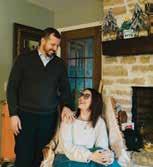
Courtney and Kelley Brown, members of St. Bernard of Clairvaux, Taylor Creek (Mary Queen of Heaven Family of Parishes), met during a college newstudent welcome event—a meeting that Courtney still recalls vividly.
“At the first moment I saw her, I wanted to meet her,” he remembered. “But I was discerning religious life, so I decided to pursue a holy friendship.”
Kelley, however, had a different first impression. “I ignored him,” she said frankly. “I thought he was cocky, and I was ending a relationship.”
What began as friendship slowly unfolded into something deeper. They married on June 14, 2003, and are now parents to ten children—eight on earth and two in heaven.
Baptized Catholic, they both experienced personal conversions in their youth—Courtney in high school and Kelley in college. Since then, faith has shaped every part of their lives.
“Our faith is the center of everything we do,” Courtney explained. “It’s the lens through which we see our marriage, our children, and the world.”
Their marriage, like many, has not been without hardship. “Challenges are inevitable,” Courtney acknowledged. “Some we’ve overcome. Others we continue to walk through.”
A particularly difficult season came about ten years into their marriage, when busyness and exhaustion created distance. Through prayer, honest conversation, and the grace of the sacraments—especially confession—they began a journey of healing.
“It was messy. It was hard,” Courtney said. “But it was holy.”
That experience shaped both their marriage and their ministry. Courtney now serves as executive director of Ruah Woods and has spent years, often alongside Kelley, helping couples navigate their own struggles.
Their family rhythms—shared prayer, family meals, confession followed by pizza, and intentional time together— anchor their home in faith.
“Marriage is incredible, even when it’s hard,” Courtney admitted. “Pray together. Look each other in the eyes. Do something fun regularly. And remember—your spouse is the person God placed beside you on the path to Heaven.”
Greg and Stephanie Schutte met as students at the University of Dayton, where both were active in campus ministry. Their paths first crossed through the 7 p.m. Sunday Mass choir, an introduction that soon grew into a shared vocation rooted in faith. Married on October 16, 1993, they now celebrate more than 30 years of marriage.

For Couples preparing for marriage following a death of a spouse or a declaration of nullity.
Engaged couples will hear stories from married couples who have experienced the loss of a spouse, the pain of a civil divorce, the process of seeking a declaration of nullity and the challenge of raising children in a blended family.

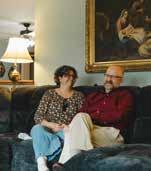
Raised Catholic, both Schuttes credit campus ministry with deepening their faith and shaping their understanding of marriage as a calling. Surrounded by other young couples committed to living out Church teaching, they found early support that carried into married life.
Natural Family Planning strengthened that foundation as it challenged them to integrate faith more fully into their relationship. “It really changed how we understood marriage,” Greg said. “Not just as an idea, but as something we had to live.”
Their marriage also faced seasons of difficulty. Different communication and conflict management styles—combined with the demands of raising a growing family—created tension, particularly about a decade into their marriage.
“We were busy and functional, but not always connected,” Stephanie shared.
That season became a turning point. Through prayer, honest self-reflection, and the sacrament of confession, the Schuttes found healing and renewed purpose. “God shifted our focus from blaming each other to looking inward,” Greg said. Their experience eventually led them to marriage ministry. Greg, a licensed clinical social worker, now serves as senior director of Marriage Works! Ohio. Together, the Schuttes speak at marriage retreats and formation events, sharing candidly about struggle, grace, and growth.
For them, being missionary disciples begins at home. Parents to seven children—one in heaven—they learned to balance ministry with the daily realities of family life.
Francis de
Parish | May 2, 2026 | 9 a.m. to 4 p.m. For more information or to register scan the QR code
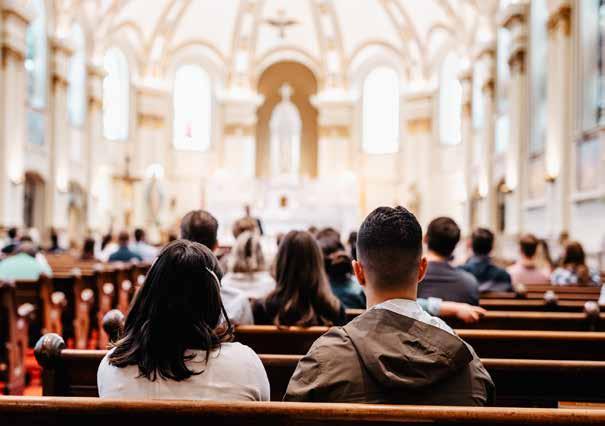
“Our first responsibility is to our marriage and our family,” Stephanie said. “Everything else flows from that.” Their advice to young couples is simple but demanding: protect your marriage.
“Marriage is your path to holiness,” Greg emphasized. “Give it time. Be present. Let everything else serve that
More than three decades in, the Schuttes’ witness points to a quiet truth of the Sacrament of Marriage: lasting love is not sustained by ease, but by grace, commitment, and the daily choice to walk together toward Christ.
Though their journeys differ, these three couples share a common truth: marriage is lived out through daily choices— to pray, to remain, to forgive, and to trust that God is at work even in the hardest moments.
In their faithfulness, these witnesses offer hope, not just to one another but to the entire Church. ✦
CHRISTIAN ANTHROPOLOGY | Andrew J. Sodergren, M.T.S., Psy.D.
Note: This article is part of an ongoing series on Pope St. John Paul II’s “Theology of the Body” (TOB).
We have been following Pope St. John Paul II’s meditations on the Letter to the Ephesians in which St. Paul draws an analogy between Christ’s relationship with the Church and the relationship between Christian spouses in marriage. As we previously discussed, this analogy ought not be taken too literally as the relationship between Christ and the Church differs from the relationship among spouses in very significant ways, since Christ is the divine Creator, Savior, and head of the Church, whereas the relationship between spouses in Christian marriage is a relationship between two persons of equal dignity.
Indeed, before exhorting wives to be subject to their husbands, St. Paul exhorts all Christian spouses to “be subject to one another out of reverence for Christ” (Eph 5:21). As we began to explore last time, Pope St. John Paul II believed that the submission described by St. Paul is “not one-sided submission” but mutual submission out of reverence for Christ. In order to understand Christian marriage and Pope St. John Paul II’s teaching on the mutual submission of spouses rightly, we must keep in mind that when we are baptized, we are incorporated into Christ who comes to dwell within us, making us Christians (i.e., “little Christs”).
Consider what the Catechism of the Catholic Church (CCC) teaches us about the sacrament of marriage: “According to the Latin tradition, the spouses as ministers of Christ’s grace mutually confer upon each other the sacrament of Matrimony by expressing their consent before the Church” (CCC, no. 1623). This matrimonial consent “consists in a ‘human act by which the partners mutually give themselves to each other’” (CCC, no. 1627). Notice that it is the spouses who are the ministers of the Sacrament of Matrimony, which they confer on each other through their mutual gift of self, expressed through their free consent and consummation. Indeed, as Pope St. John Paul II taught, “marriage is realized through a reciprocal gift, which
is also a mutual submission,” and “Christ is the source and … model of that submission” (TOB, 89.4). When a Christian man and Christian woman make a spousal gift of self, they give and receive Christ dwelling in each other and cooperate with Him who makes their union sacramental and indissoluble. Thus, both husband and wife are Christ to one another.
Awareness that one’s spouse belongs to Christ and has Christ dwelling within, should awaken a profound reverence for him/her that penetrates every aspect of the marital relationship. The traditional term for this reverence is “pietas” or fear of the Lord, which involves awe and wonder for all that is sacred. It is this reverence or pietas for Christ dwelling in Christian spouses that motivates their mutual submission: “Such pietas, which springs from the profound consciousness of the mystery of Christ, must constitute the basis of the reciprocal relations between the spouses” (TOB, 89.1). Pope St. John Paul II went on to teach that such awareness of Christ dwelling in the other “must be spiritually present in the reciprocal relation of the spouses … penetrating their hearts, kindling in them that holy ‘fear of Christ’ (i.e., pietas) … [and] must lead them to ‘be subject to one another’” (TOB, 89.2).
By submitting to my spouse, I am submitting myself to Christ. By reverencing my spouse, I am reverencing Christ. This does not mean that spouses cannot speak up about maltreatment or express personal wishes and desires with the reasonable expectation that they will be heard and appropriately considered. This teaching on mutual submission also leaves up to the discernment of each couple how they will go about making decisions together, including models in which one spouse consistently defers to the other, perhaps due to having greater knowledge or expertise in a particular area. Rather, as we will reflect on further next time, mutual submission refers primarily to how Christian spouses love each other, modeling their love on Christ’s spousal love for the Church that led Him to lay down His life to redeem and sanctify her. ✦
“ ... marriage is realized through a reciprocal gift, which is also a mutual submission,” and “Christ is the source and … model of that submission” – Pope St. John Paul II
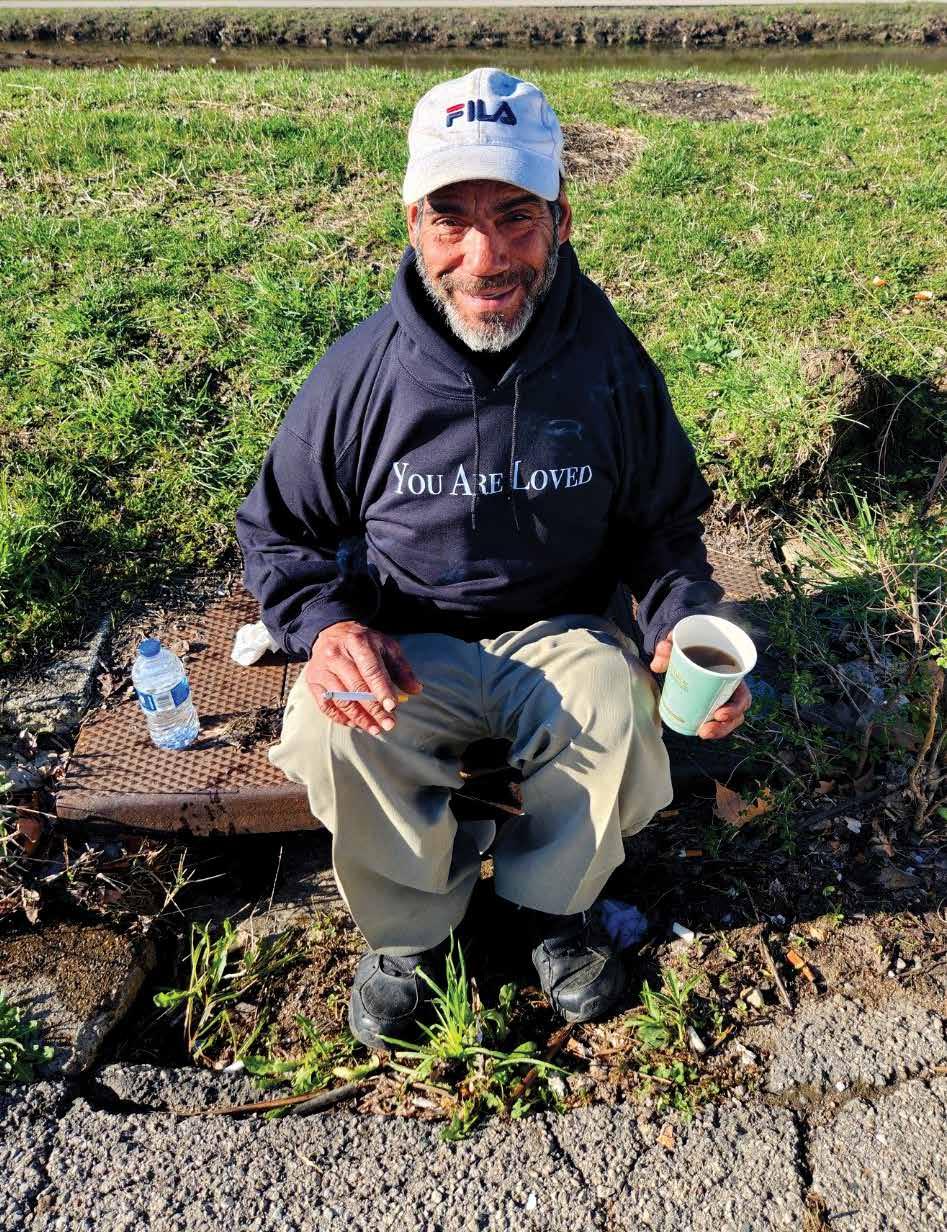
BY MARYBETH SPROULL
In 2019, Kenney felt called to start a clothing line, but wasn’t sure where to begin. So, he turned to the Lord and attended SEEK, a five-day experience where thousands of Catholics gather together to encounter Christ through prayer, Adoration, the sacraments, and inspiring speakers. While there, he asked God what He wanted from him and this clothing line. Immediately, in his mind’s eye, Kenney saw a young girl who appeared to have been crying. She looked in a mirror, and her tears stopped when she saw the words “You are Loved” written on her shirt. He knew then what to do, and the You are Loved Mission was born. Today, what started with T-shirts for purchase has grown into so much more.
Through his mission, Kenney brings love to the people who are homeless or in prison and to youth in the archdiocese. “God’s love is the foundation we all have to start from, because it opens our hearts,” Kenney said. “The goal here is to meet people in the poverty of loneliness and bring them to Christ.”
T-shirts can be purchased, including a buy-one-gift-one package so you can give a shirt, too. Kenney and volunteers also hold “Coffee on the Street,” where they hand out T-shirts, coffees, and business cards that say, “You are Loved,” to those in physical and spiritual poverty. They sit with people who are homeless and drug addicts, talking with them, sharing the Gospel, and building up the Kingdom of God. Kenney has painted murals in downtown Dayton and visits homeless shelters, men’s and women’s prisons, and St. Peter’s Youth Ministry. “I’m basically a full-time missionary,” he said. On top of all that, he is the coordinator for the archdiocese’s prison ministry.
Through You are Loved Mission, Kenney has encountered numerous people whose lives were changed simply by hearing about the love of Christ. “It’s amazing what the Lord can do through simple acts of love, like walking with people in prayer,” Kenney said. “No one is too far from God’s mercy.”
There are countless stories that demonstrate God’s mercy, but Kenney has experienced a few extremely powerful examples. When he was helping a man move into an apartment from a supportive housing shelter, they picked up items stored at his sister’s house. She suffered from cancer, so Kenney prayed with her, asking God to protect and heal her. A few weeks later, he got a call: she was in complete remission—her cancer had disappeared entirely!
Another time, a man reached out to Kenney through Facebook to buy T-shirts because he was entering prison soon and wanted to share the mission’s message as much as possible. Now in prison, the man is discerning religious life and has been pen pals with Kenney the entire time.
But Kenney doesn’t want to stop here; his future goals for You are Loved Mission include expansion. He brought on another missionary like himself this year who helps with Coffee on the Street, connects with parishes, visits shelters, and fundraises. He would love to add more people to his team in upcoming years and dreams of purchasing a trailer to store mission supplies. With this, he could take his ministry and outreach to new places, such as parish festivals, and have easier access to his supplies.
In a world where people’s lives seem dominated by social media and the internet, Kenney strives to be present in the here and now to witness to people and bring God to those who need His love the most. ✦
Within the long history of slavery and racism in the United States, there are thousands of rarely told stories. One such story is that of the Randolph Freedpeople.
Thanks to an exhibit hosted by the Missionaries of the Precious Blood and Sisters of the Precious Blood, the Archdiocese of Cincinnati Anti-Racism Task Force was able to embark on a pilgrimage to Carthagena this past September, to learn about this tragic story and the lessons it still holds for today.
The Randolph Freedpeople were enslaved men, women, and children (about 400 people) emancipated upon the death of their enslaver, John Randolph, in 1833. Randolph not only restored their freedom, he procured substantial lands for them in Mercer County.
However, because Randolph left conflicting wills concerning their emancipation, it took 12 years of court processes before they were freed.
Then, starting in Virginia, the group endured hardships on a lengthy journey by wagon, paddleboat, canal barge, and on foot before reaching New Bremen, where 3,200 acres awaited them. As they camped in tents along the way, they hoped the end of their journey would be a fresh start.
Sadly, instead of a happy ending, they were met in New Bremen by an angry mob that refused to let them settle in the area. Local residents even passed resolutions resolving not to share their community with black people.
The group ended up settling in Piqua, Troy, and other communities well north of Cincinnati, which were also sites of racial unrest at the time. Still, the freed individuals found jobs and settled where they could, integrating into surrounding communities.
Early in the 1900s, surviving members of the group hosted reunions and eventually mounted legal challenges for the return of their promised land. Their case made it to the Ohio Supreme Court, but it ruled that the case’s statute of limitations had expired, so the group was never granted restitution.
In September, the Anti-Racism Task Force brought approximately 70 people on the Pilgrimage for Racial Justice. They began at the St. Charles Center in Carthagena, which was founded by Charles Moore, who was himself formerly enslaved. At each stop, pilgrims learned the location’s significance then had time for prayer and reflection on Church teaching.
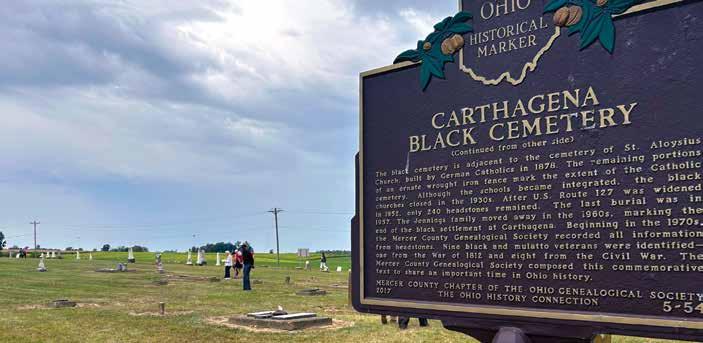
The first station of the pilgrimage taught the history of the first black settlers in that area of Ohio in Mercer County. Next, the group visited a black cemetery that predated the Civil War and sits adjacent to St. Aloysius Catholic Church and its cemetery. Andrew Musgrave, director of the Catholic Social Action Office, couldn’t help but notice the stark contrast between the cemeteries’ preservation.
“This church has, like a lot of older churches do, a cemetery,” he said, noting that it is well maintained and respected. “But off to the side is the black cemetery; much of it is in disrepair and disregard.”
The pilgrims next visited the former Emlen Institute, a school that taught black and Native American students in the 1840s. It moved to Pennsylvania in 1857, and its land became home to the Congregation of the Most Precious Blood.
The final exhibit on the tour highlighted the Randolph Freedpeople. The pilgrimage ended with Mass with the Church of the Resurrection Choir.
Precious Blood Fr. Tom Hemm was instrumental in bringing the Randolph exhibit to the St. Charles Center and noted that pilgrimages like this help us remember our “sinful past.”
“This is a very grounded way to say, wait a minute, this happened here,” Fr. Hemm said. “The challenge, of course, is people will say, ‘Well, that was then, and what do we do now?’ But the Church itself is much more vocal now about the needs for reparation and reconciliation; and that we not forget and that we seek healing today.”
Musgrave echoed that sentiment, noting several reasons it is important to keep tragic parts of the past in mind.
“We recognize and honor that every single person, regardless of race, nation, and creed is born in and has the image and likeness of God—has dignity from God,” Musgrave said. “Our Church, while not unique among churches, is definitely at the forefront of talking about and advocating the dignity of all people from the first moment of conception to the last moment of natural breath. We have a commitment to that in a myriad of ways, and our Church does tremendous work in honoring the dignity of others.”
It is incumbent upon us to look back in history, Musgrave said, to see when people failed and recognize that there were flaws both within the Church and the broader culture and community that allowed or led to the perpetration of injustice.
“History is rife with examples of injustices rearing their ugly head at different times over different periods
and largely because people were ignorant of what happened in the past,” he said. “Today, maybe because people are not aware of it—or don’t acknowledge it, or don’t believe it, or don’t care— injustice persists. I think in the Randolph Freedpeople case, you have an example of a group of human beings born with God’s dignity, who were treated with the utmost disrespect, neglected, and treated as less than human.
“If we don’t recognize that and remember that and learn from that, it is bound to happen again.”
The Anti-Racism Task Force meets on the fourth Monday of each month. If you are interested in joining their discussions, contact the Catholic Social Action Office at csa@catholicaoc.org. ✦
Saturday, March 28

Tertullian
Ignatius of Antioch
St. Clement of Rome St. Justin Martyr
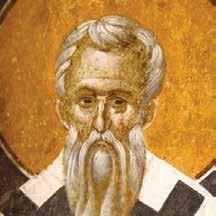
God is real. You know how I know? Because the Catholic Church still exists. Think about it: the visible Church of God was founded (Mt 16:18) almost 2,000 years ago upon a volatile fisherman from Galilee (approximately nowhere according to the Roman Empire), and after a whole host of saints and sinners and the rise and fall of kingdoms, that same visible Church exists today led by Peter’s 266th successor, Leo XIV. I will not leave you orphans, Jesus said (Jn 14:18), and His word is true: invisibly, He has poured out the Spirit of adoption into our hearts by which we cry “Abba Father” (Rom 8:15), and visibly, He has always given us priests, bishops, and a pope (Papa, , a dad) to lead the Church on earth while He reigns in heaven. God always provides and protects, and He always gives us providers and protectors—some of whom we call Church Fathers. This month, we begin with St. Clement of Rome and St. Ignatius of Antioch, who are named Apostolic Fathers because they were in immediate contact with the Apostles themselves. So, how did these dads defend and develop the divine deposit of faith?

St. Clement was the fourth pope (after Peter, Linus, and Cletus) and we only have one work from him: 1 Clement (either AD 70 or 97), a letter responding to a schism in the Corinthian church where lay persons who were jealous of the hierarchy broke communion and tried to create their own clergy and church. Pope Clement was having none of it. Just as Paul previously corrected the church in Corinth through letters, Clement took up the quill, from the city where Paul shed his blood, to bring the Corinthians back into communion with the apostolic Church. As he
Cyprian
defended the Church against schism, Clement provided us with the earliest testimony of apostolic succession outside of Scripture. He explains that, like links in an unbroken chain, bishops connect us to the Apostles, who connect us to Christ, who connects us to God. Already, in the first century, Peter’s third successor explains:
“Our Apostles also knew, through our Lord Jesus Christ, that there would be contention over the bishop’s office. So, for this cause, having received complete foreknowledge, they appointed the above-mentioned men, and afterwards gave them a permanent character, so that, as they died, other approved men should succeed to their ministry.” (1 Clement 44:1-2)
The Catholic Church didn’t create the hierarchy: we received it from Jesus and the Apostles. And Clement shows us that this authority is not about power for itself; it is God’s gift to serve charity and unity.
And what about St. Ignatius? He was the third bishop of Antioch, where Peter was first bishop before going to Rome. Ignatius followed in Peter’s footsteps after he was arrested and brought in chains to the Eternal City. Along the journey, Ignatius wrote six letters to local churches and one to Church Father St. Polycarp. These are must-reads: they are from AD 107 and are some of the most eloquent and passionate testimonies to the Faith of all time. Like Clement, Ignatius was passionate to defend Church unity:
“Shun schisms, as the source of troubles. Let all follow the bishop as Jesus Christ did the Father, and the priests, as you would the Apostles… Wherever the bishop appears, there let the people be; as wherever Jesus Christ is, there is the Catholic Church.” (Smyrnaeans, 8)
St. Cyril of Jerusalem
St. Gregory of Nazianzus
St. Gregory of Nyssa
St. Ambrose
St. John Chrysostom
St. Jerome
St. Augustine
St. Cyril of Alexandria
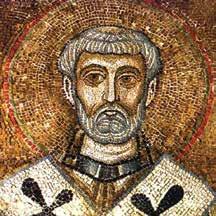
Ignatius was the first to call the Church “Catholic,” and he did everything to protect her universal (catholic) unity. A big obstacle to this unity was the heresy called Docetism, which held that Christ only seemed to be a man and only seemed to suffer and die, while He was “really” only a spirit. In defending the Church against this heresy, Ignatius not only provided another powerful explanation of Church unity and hierarchy, he also provided a powerful witness to the Church’s Eucharistic faith. Listen to what he says about the Docetists who don’t go to Mass:
“They abstain from the Eucharist and from prayer because they do not admit that the Eucharist is the flesh of our Savior Jesus Christ, the flesh which suffered for our sins and which the Father, in His graciousness, raised from the dead.” (Smyrnaeans, 6)
St. John Damascene
St. Maximus the Confessor
St. Gregory the Great
St. Leo the Great
Christ Jesus gave His real Flesh for the salvation of real people, and we mystically partake of this real Flesh at every Mass. Already in the year 107, we find testimony that the real Jesus founded the real Catholic Church, which is continued through real bishops and centered on the real Presence of Jesus in the Eucharist. It is a real faith worth living for, and as both Clement and Ignatius show us, it is a real faith worth dying for. ✦
Fr. Jacob Lindle, ordained a priest for the Archdiocese of Cincinnati in May 2022, is presently studying for a Doctorate in Patristic Theology at the Pontifical Gregorian University in Rome.
The Apostolic Fathers, “The Fathers of the Church,” vol. 1 (Catholic University of America Press)
Kenneth D. Whitehead, One, Holy, Catholic, and Apostolic (Ignatius Press)
Joe Heschmeyer, The Early Church Was the Catholic Church (Catholic Answers Press)
SUSAN BERGMAN
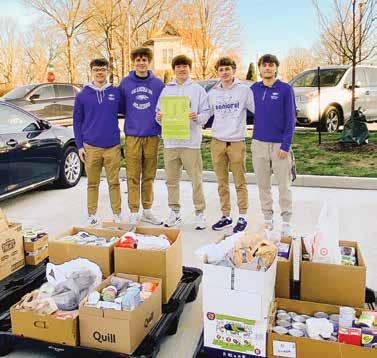
When Catholic Social Services of the Miami Valley (CSSMV) launched the Lenten Love in Action campaign in 2023, their goal was simple: celebrate the good already happening in our neighborhoods and inspire even more of it. Seeing countless small acts of kindness quietly unfolding in schools, parishes, and ministries, they wanted to lift those stories up, honor the people behind them, and remind us that love, when lived out, becomes a powerful force that draws communities together.
The campaign began with the idea to amplify positive impact through social media. By tagging partners and shining light on their efforts, CSSMV set out to show what collective action can look like when it is guided by faith. But what started as a simple, intentional outreach has grown into something organic and deeply connected. Hope Gebhart, Marketing and Communications Coordinator for CSSMV, noted that the biggest shift has been momentum: “The first year, we were reaching out to gather stories. Now, people are coming to us, and community members mention the posts at events. It’s incredible to see the connections being made.”
Lenten Love in Action is rooted in one of the most challenging teachings from the Gospel of Luke, the parable of the Good Samaritan, a teaching that aligns with the core value of Beacons of Light. In the story, Jesus invites us to see every person as a neighbor and reminds us that mercy often requires stepping beyond comfort and expectation. The campaign lifts up modern expressions of this truth in students mentoring younger peers, parishes organizing donation drives, and ministries responding to hunger and hardship. These simple, quiet gestures reveal how holiness can unfold in everyday moments. “Love transcends barriers,” Gebhart shared. “Through the campaign we are able to witness that truth over and over.”
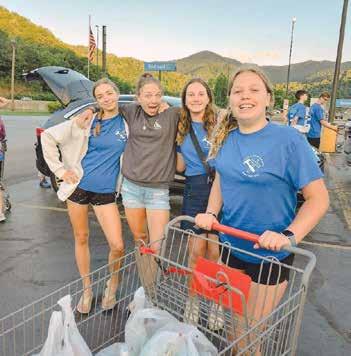
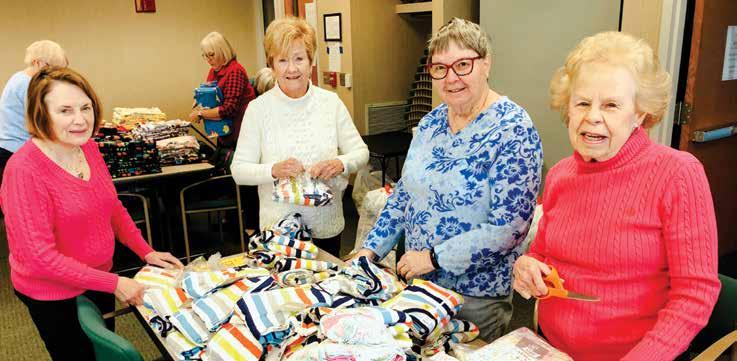
Throughout the 2025 Lenten season, countless stories revealed the vibrant diversity of service given across the region. Gebhart highlighted specific examples: the ongoing work of the Sisters of the Precious Blood, the Box of Love project at Holy Angels Catholic Church, and the Christ Child Society’s commitment to families and children. Each story is different, but together they paint a picture of people stepping forward for a shared purpose.
Students, in particular, have responded with enthusiasm and pride. Being featured in the campaign helps them see that their efforts, no matter how small, make a difference. For young people, these early experiences of service can shape a lifelong desire to lift others up. “They begin to understand that small acts of kindness can have a real impact,” Gebhart said. “It motivates them and affirms their gifts.”
That inspiration has carried outward. Schools, inspired by one another, began launching their own service projects. Deliveries to the CSSMV food pantry is one especially meaningful service given to CSSMV, as it operates the largest food pantry in the Dayton area, serving roughly 140 households every weekday.
Behind the scenes, the work of gathering these moments has become a ministry of its own. What once relied primarily on emails is now fueled by conversations, relationships, and social media posts that draw people closer to CSSMV’s mission. And unexpected partnerships often form, strengthening the network of care throughout the community.
Looking ahead, CSSMV hopes to expand Lenten Love in Action beyond the Lenten season. There is “so much good happening all year long,” said Gebhart, adding that the team is excited to explore new ways to celebrate service, deepen collaboration, and continue sharing stories that unite and inspire.
Asked what she would say to readers preparing their hearts for the Lenten season, Gebhart offered a gentle invitation: “Take a moment to reflect on the unique gifts God has given you, and consider how one of those gifts could help someone else. Take action, and don’t be afraid to share your story. You will inspire others. Together, these small steps can spark a wave of goodness throughout our community.”
In a world hungry for hope, Lenten Love in Action continues to shine a warm and steady light, reminding us that kindness grows best when it is shared and that every act of love, no matter its size, carries the power to transform. To submit a service story, contact Hope Gebhart at gebharth@cssmv.org or visit the CSSMV’s Facebook and Instagram pages. ✦

BY PATRICIA MCGEEVER
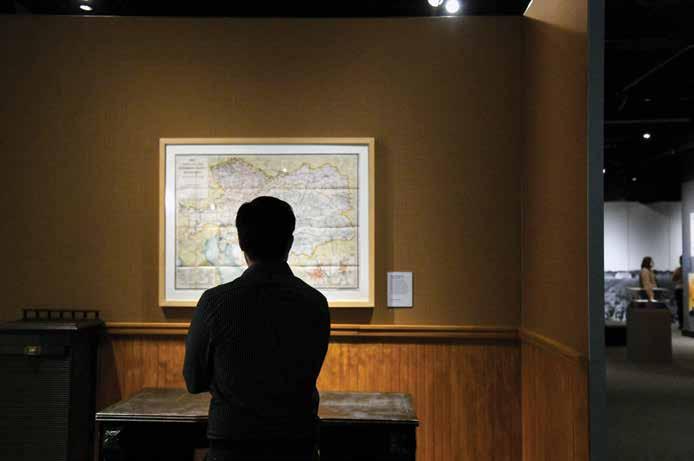
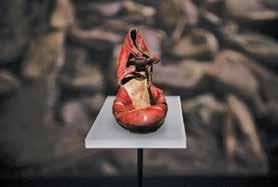
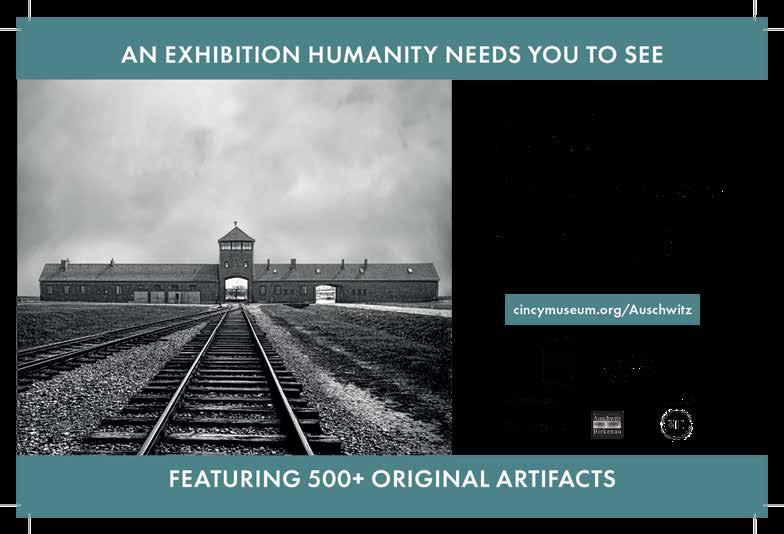
lone little shoe with the sock still inside stands encased in a glass cube as evidence of the Nazi’s cruelty and inhumanity. It is one of the 500 artifacts and 400 photographs on display at the Cincinnati Museum Center as part of the exhibition: “Auschwitz. Not long ago. Not far away.” It’s the most comprehensive collection of items dedicated to the history of Auschwitz that has ever been presented in the United States. The shoe’s mate was not recovered; neither was the child who wore it. He or she was likely one of the 1.1 million people murdered at the infamous concentration camp.
“I think it’s really important for us to understand the evil that has been perpetrated by people who called themselves Christians and to understand the severity of what can happen if people don’t stand up, if people don’t speak up,” said Andrew Musgrave, the Director of Social Action for the Archdiocese of Cincinnati.
This is the only stop in the Midwest for the exhibition and its last planned stop in the U.S. The first portion of the exhibit lays the groundwork for the happenings in Germany and Poland at the time. It explains how the once bustling town known as Oświęcim became Auschwitz, which now exemplifies the worst things human beings can do to each other.
In addition to Jews, tens of thousands of Poles, Sinti, Roma, Soviet POWs, Jehovah’s Witnesses, and homosexuals were rounded up and forced into work camps or the gas
chamber. Their baggage, clothing, and belongings were looted by SS officers, much like the soldiers who cast lots for Christ’s garments during His Crucifixion. Among the victims highlighted is a young Polish priest named Maksymilian Maria Kolbe, who secretly heard confessions in the camp and encouraged others to pray. He traded places with another prisoner who was facing certain death—that man survived the war. Father Kolbe died a martyr and was canonized a saint in 1982.
“This [exhibit] has been described as the closest thing to [having] an experience on the ground in Poland because of [its magnitude] … the diversity and number and size and scope of the artifacts,” said Jackie Congedo, CEO of the Nancy & David Wolf Holocaust and Humanities Center. The center partnered with the Museum Center to bring the exhibition to Cincinnati.
According to President and CEO of the Cincinnati Museum Center Elizabeth Pierce, it’s a “huge” deal to have this exhibit at Union Terminal.
“It’s an incredible collection,” she said. “To have the Auschwitz-Birkenau Museum come here and say, ‘Yes this is a place that will take care of the objects and story appropriately. We endorse bringing it here with enthusiasm.’ That is just a huge recognition of Cincinnati, the way Cincinnati likes to do business, the way we collaborate,” said Pierce.
The exhibit is displayed in the very building, Union Terminal, where Holocaust survivors arrived in our community with meager belongings to begin the next chapter of their lives. Six local stories are highlighted in videos with biographies of the persons featured assembled.
“We wanted to spotlight the role this building and the city played in the story,” said Congedo. “It has never been integrated with a local story to the degree we’ve [done] here.”
Visitors need at least two hours to absorb the information they’re seeing and hearing and to grasp what it took for survivors to rebuild their lives.
“This didn’t have to happen,” said Congedo of the atrocities at Auschwitz. “It happened because everyday people made everyday choices in everyday moments. So, the question we have to ask ourselves: what choices are we making in everyday
moments that bend our nature to better or worse outcomes?”
The exhibition shows what can happen when one man’s hatred and rhetoric can whip up supporters and get seemingly ordinary people to do unspeakable things.
“Because of the solidarity and the unity we have with the Jewish people, it’s really important for us to be part of this,” said Musgrave, regarding Catholic attendance at the exhibition. “It would be a shame to have access to this type of history, these relics, this memorial and not go and see it while we can.” ✦

Auschwitz. Not long ago. Not far away. runs through April 12, 2026. Use the QR code for an exclusive discount. Save $3 with code FAITH.
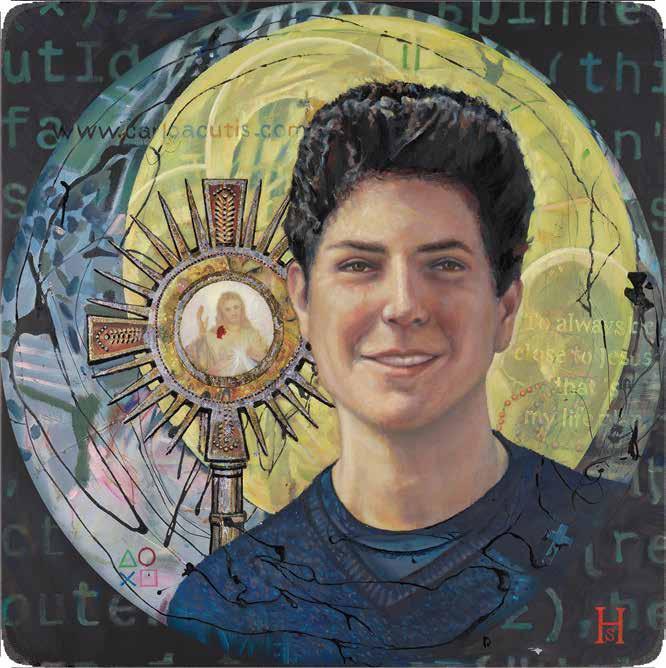
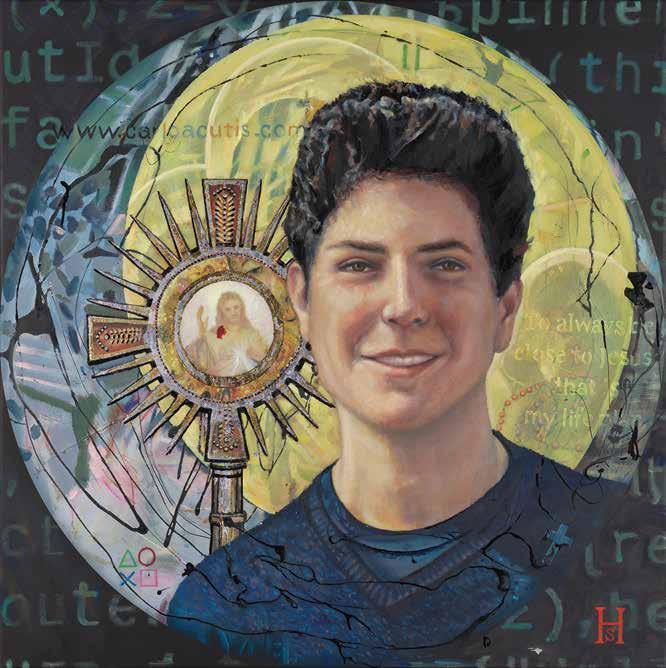
CATHEDRAL BASILICA OF SAINT PETER IN CHAINS: FEBRUARY 10 – 12, 2026
Tuesday, February 10 Wednesday, February 11 ursday, February 12
11:30 AM Opening Mass, Reception of the Relic ~ Archbishop-Emeritus
Dennis M. Schnurr, celebrant
12:15 PM Veneration begins following Mass
1:30 PM Talk by Monsignor Anthony
Figueiredo from Assisi –“Saint
Carlo Acutis: An Ordinary Life Turns Extraordinary”
3:00 PM Talk by Holly Schapker –“ e Art of Modern Sanctity”
4:00 PM Rosary in the Blessed Sacrament Chapel
6:00 PM Veneration ends
7:00 PM Youth and Young Adult Gathering with Fr. Kevin Scalf –Prayer with Saint Carlo
9:00 AM Veneration begins
10:00 AM Talk by Holly Schapker –“ e Art of Modern Sanctity”
11:00 AM Rosary in the Blessed Sacrament Chapel
1:30 PM Talk by Monsignor Anthony
Figueiredo – “You too can be a saint!” Carlo’s Five Steps to Being a Saint
3:00 PM Rosary in the Blessed Sacrament Chapel
5:00 PM Veneration ends
9:00 AM Veneration begins
10:00 AM Talk by Monsignor Anthony Figueiredo – “I will give you signs that I am with God” Graces and Miracles through Saint Carlo’s Intercession
11:00 AM Rosary in the Blessed Sacrament Chapel
1:30 PM Talk by Holly Schapker –“ e Art of Modern Sanctity”
3:00 PM Rosary in the Blessed Sacrament Chapel
4:15 PM Veneration ends
5:15 PM Closing Mass ~ Archbishop Robert G. Casey, celebrant

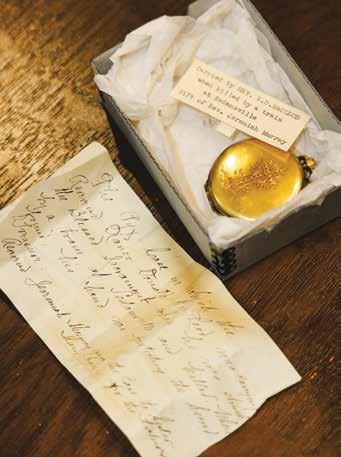
It’s surprising how often the smallest objects hold the heaviest stories. A small metal pyx once moved through the world, carried urgently toward someone in need. Now it sits motionless in the Archives, cool and silent. Between its swift journey and its settled rest lies a story of love that didn’t arrive where it intended, but it arrived all the same.
On June 30, 1865, Rev. Xavier Donald MacLeod set out to bring Communion to a woman who had fallen ill. He carried the Eucharist with him in that pyx, tucked close as he traveled. While crossing the train tracks on his way to the sick call, he was struck and killed. The woman survived her illness, but he did not survive his journey to her. What was meant as Christ’s presence in her suffering became Christ’s own mercy for him instead, a quiet grace that found him at the moment he needed it most.
Before going to the small parish of St. Vincent de Paul in Sedamsville, Rev. MacLeod had spent years shaping minds as a seminary professor. But it was in the field, walking alongside people, that his heart truly showed. One writer recalled that “hundreds of section men on the two roads between Cincinnati and Lawrenceburg” knew him and were known by him, and they held deep respect for the “positive yet good-natured priest.” Obituaries spoke of his “excellent qualities of the heart” and “restless and vigorous intellect,” but it was the quiet consistency of his care, his willingness to answer every call no matter how small, that left the most lasting impression. It is no surprise, then, that he “died on an errand of duty and mercy,” living out in his final moments the devotion that had defined his ministry.
As one of his own verses suggests, he understood generosity not as sentiment but as the shape of a life:
He is dead, whose hand is not opened wide, to help the need of human brother, He doubles the life of his life-long ride, who gives his fortunate place to another. And a thousand millions of lives are his who carries the world in his sympathies. To deny is to die!
I wasn’t there, of course. I learned the story long after. And yet, every time I hold that little pyx, I feel the weight of it. Not the metal, but the love inside the act it represents. It’s a love expressed not in grand gestures but in willingness—the willingness to go, to serve, to show up for someone else’s need.
The Archives are full of objects whose stories have settled into silence. But every so often, one unsettles the dust and reminds us of what truly holds the Church together. We talk about building communities, ministries, families, and hope, but beneath all our plans and efforts, it is love that gives all else its purpose.
This pyx doesn’t just tell the story of one priest’s final journey; it tells the story of a life built on a love offered without hesitation. His story reminds us that love’s paths aren’t always straight, but Christ meets us all the same— often in places we never expected and always exactly where we need Him most. ✦
SHINE ON | Dominick Albano
It’s February, and for some people, this month symbolizes love. It makes them think of Valentine’s Day or maybe, the coming of Lent… or just taking time away to someplace warmer. For me, when the calendar turns to February, I can only think of one thing:
Baseball season is upon us.
I know, I know—it’s probably a little early for many people. The die-hards know when pitchers and catchers report to spring training in Florida or Arizona, but the rest of the world still considers baseball a summer activity. And February feels pretty far away from summer.
But for me, February doesn’t just have me thinking about Major League Baseball. It has me thinking about the teams I’ll be coaching this coming Little League season and the games that are right around the corner.
What I’ve learned from coaching baseball over the years has very little to do with winning games—and almost everything to do with how we love the people entrusted to us.
I coach both my 10- and 12-year-old’s teams—10U and 12U, respectively. Believe it or not, we’ve been practicing since December, and our first tournaments begin in March. So, it’s around this time of year that I start thinking about the preseason parent meeting, held during the week before our first games.
A good amount of time goes into preparing my comments. Many topics are pretty standard: how we approach playing time and positions, when and how parents should come talk with me regarding an issue, behaviors I’d like parents to avoid… that sort of thing.
But the most important thing I try to communicate to parents is this:
Be your kids’ biggest fan.
Too often, you see grown men yelling, “Don’t worry, you’ll get ’em next time!” to their favorite Major League player after a strikeout—but yelling, “C’mon, bud, what are you swinging at?!” to their own 10-year-old after the same thing happens. It’s all well-intentioned. Parents want their kids to have fun and do well. They get nervous for their kids and react out of that nervous energy—sometimes saying or doing things they regret—rather than being a source of calm amid the storm. Parents think they can help their child do better next time by yelling instructions, now.
So, I tell parents: your kid doesn’t need you for motivation. He wants to succeed more than anyone else
wants him to succeed. He doesn’t need you for coaching— I’ve coached about 400 games, and I take this responsibility seriously. The one thing he does need?
His biggest fans...
… Those people who will cheer him on no matter what. Who believe in him completely. Who think he’s the best kid on the field regardless of the outcome of a single at-bat or a single game.
Baseball, more than any other sport, is built on belief. It’s a sport where you fail more than 60% of the time. It’s a sport where they literally track your mistakes and display them on the scoreboard for all to see. If you go to the plate expecting to strike out, you probably will. If you go to the plate expecting to hit a home run, you’ll probably still strike out. And yet, somehow, you still have to step into the box believing that something good is going to happen—hoping for something you can’t be sure of.
I tell my baseball parents all this, not just because I want the team to play well, but because I want the team to be built on something greater than winning, or fun, or even skill development.
I want the team to be built on love.
This might not be the language I use with parents. To them, I say my goal is to help these kids become the best versions of themselves, on and off the diamond. But in reality, love is the reason for the game. Love is the reason for the team.
If the team is built on love, it can’t fail.
You can strike out.
You can make an error.
You can lose the game.
But you can’t fail when the whole thing is built on love.
Because “love never fails.”
—1 Corinthians 13:8
As we prepare for Lent, take a look at the different areas of your life, and consider what you’re building on. Move past the obvious. Sure, we all know our parenting, our marriage, and our relationship with God should be built on love. Go deeper... Think about how you approach your work, coaching your kids’ team, or serving on the parish council.
Ask yourself:
What would this look like if it were built on love? ✦
CATHOLIC AT HOME | Katie Sciba
When I met my husband, there was something fantastically different about him. I was surrounded by faithful friends, each unreservedly devout, but Andrew’s closeness with Christ was contagious.
While we dated long-distance, I went from hardly praying the Rosary to faithfully reciting it daily at the same time Andrew did. It helped bridge our geographical distance and made me feel more connected to him. Despite being fueled by enthusiasm and the novelty of our relationship, my attempt to stay close to Andrew yielded a devotion to our Lord and His Mother that I hadn’t experienced before. There was a grace in our relationship that took me further up and further in with my own love for Jesus. So, when he popped the question, the answer was as clear as the diamond on my finger: If dating Andrew brought stronger devotion to Christ, then marriage with him was my path to being with Christ for eternity.
The grace from those starry-eyed early days upheld us
“Stay as Christ stays” has become my foundational motto for every circumstance in our marriage. I have to remember how Jesus remains with souls both in the gospels and now. The Lord stays with us both as a collective church and individually, and when He does, it’s intentional, patient, joyful, and loving.
When Jesus stays, He doesn’t begrudge the commitment, He relishes it.
There’s no wish that He could be somewhere else, He’s fully present. It’s this example from our Lord that can act as an examination of conscience for us. Does your husband or wife know that you remain in the marriage intentionally, patiently, lovingly, and joyfully? Does he or she know that so firm are your mind and heart that when distractions and temptations come, you know to return to an imitation of Christ?
Even writing it out, I’m struck with the impossibility of it all, even with 17 years under my belt. Still, that’s what
... Jesus remains with souls both in the gospels and now. The Lord stays with us both as a collective church and individually, and when He does, it’s intentional, patient, joyful, and loving.
when real life settled in, especially when it came to being merciful with each other. Simply put, mercy is when the capable act for the incapable. It’s remarkable, isn’t it, how marriage gives you endless chances to show mercy like this?
There was the time I racked up a small debt, and my husband, who had every right to be upset, said we would handle it together.
When the job that made him miserable just about broke him, I wrote him a check from our emergency fund that started the business he’s still running.
Every time he’s tugged me out of bed when I’m pregnant and every time one of us extends empathy and forgiveness when the other does wrong, we depend entirely on the Lord’s strength.
“Hey, good news!” I announced to Andrew last summer on our 17th anniversary. “I figured out what marriage is.”
He raised his brow in amused curiosity, “I’m looking forward to this.”
“Neither one of us is going anywhere. We’re supposed to stay the way Christ stays.”
Catholic marriage is. We stay, and we help each other along a heavenward course in circumstances of varying gravity, directing and offering each other to Christ while doing our best impressions of His mercy and fidelity. It’s a lot. It’s too much, actually, for us to make good on our end of the covenant without the example and grace of God.
Look at your own marriage, however young or experienced it is, and identify when grace and grit took hold, helping you to imitate Jesus in your fidelity. Ask the Lord to give you eyes to see how He upheld you and continues to do so.
After 17 years of for better or worse, I told Andrew that we have concrete evidence that we’re both here to stay; not in a lifeless fashion that collects dust, but in the same way the Lord stays with us. His obvious presence in our beginning and in every instance of support since gives us confidence that we’ll have more experiences of grace and mercy as we add years to our marriage. ✦
BY DAVID COOLEY
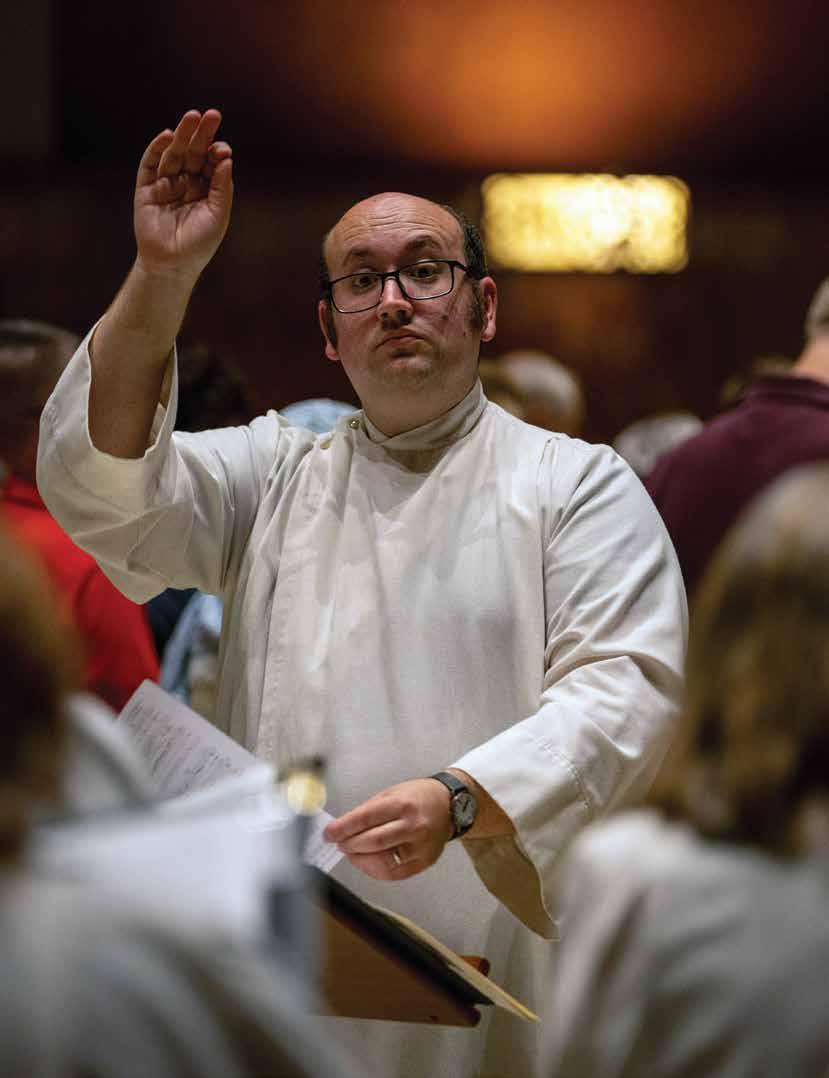
Sacred music holds a central place in Catholic worship. An integral element of the liturgy, it elevates the soul toward God, fosters communal unity, and deepens the faithful’s encounter with divine mysteries. Rooted in Scripture and Church tradition, it beautifies prayer, promotes contemplation, and distinguishes itself from profane forms of music by its sacred purpose and artistic dignity.
Dr. Christopher Holman is passionate about the power of sacred music and thrilled to have a role in promoting it across the Archdiocese of Cincinnati through the formation of future priests. He is the current Director of Music, Assistant Professor of Music, and Director of the Sacred Music Institute at Mount St. Mary’s Seminary & School of Theology (MTSM). In many respects, he has been preparing for these roles since he was very young.
Perceptive even at that young age, Dr. Holman noticed the profound effect music had on the congregation.
“That church was very close to closing, and at that point, they hadn’t had music for a year,” he said. “Once they started singing together as a community again, many who had not been to church for a long time started coming back. Seeing that transformation had a profound impact on me.”
Dr. Holman ended up playing every weekend at four churches—of different denominations—and found he enjoyed hearing the varied perspectives on the Gospel readings each week. That began his journey in and dedication to church music.
He earned five music degrees: a Doctorate of Philosophy in Music from the University of Oxford; a
“The first post I had as a church musician was at a Methodist Church. They called my piano teacher … and asked, ‘Do you have any students who could play for us?’ I think they were expecting her to send an older student, and she sent 12-year-old me.”
Master of Arts in Specialized Music Performance from the Schola Cantorum Basiliensis in Basel, Switzerland (which he received while being a Frank Huntington Beebe Fellow); a Master of Music in Organ Performance from the University of Houston; and Bachelor of Music degrees in Organ and Vocal Performance from the University of Illinois.
With research interests in historical musicology, medieval liturgical practice, and historical performance practice, Dr. Holman has lectured at the University of Oxford, Trinity College Dublin (Ireland), and the Sorbonne in Paris. He has been a regular presenter at major international conferences, is an accomplished organist, won the Albert Schweitzer Organ Competition in 2010, then performed at many of the world’s top venues for organ recitals, including on the two oldest organs in the world, in Sion, Switzerland, and Rysum, Germany.
Before arriving at MTSM in July 2025, Dr. Holman served for three years as the Director of Music at St. Gertrude Church in Madeira, where he established a Sacred Music Series that brought world-class performers from around the country to St. Gertrude for concerts, meditations, and liturgies.
When not working, Dr. Holman enjoys spending time with his wife, Cynthia, an accomplished opera singer who has performed all over the world. Their immediate family consists of a basset hound, a cat, and two very large rabbits.
As he settles in at the seminary, Dr. Holman recognizes the importance of forming future priests.
“I see the formation of future priests as one of the most significant responsibilities of the Church today,” he said. “My vision is for the men to have a very broad grounding in music— basic skills in singing and basic knowledge of music, history, and how the Church plays a role in the patronage of the arts throughout history.”
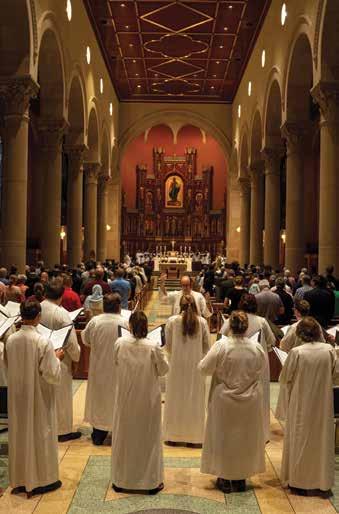

Dr. Holman believes that what the future priests learn while in seminary will echo in the lives of the faithful, including their understanding of sacred music and the liturgy.
“On a practical level, the magisterial documents of the Church tell us a lot about sacred music and what is envisioned in the liturgy, and yet, what we see in many parishes is something that looks quite different from that,” he said. “I don’t make a value judgment on that being better or worse, it’s just that there is a disconnect, which is a part of reality. And so, what I’m particularly interested in is helping the men to recognize these differences, develop the skills to be good pastors, and help people pray through music in whatever form that looks like in their parish setting.” ✦ For more information about the Sacred Music Institute

w/ purchase of King’s Hawaiian Fish Deluxe (at regular price)
Note: “K of C” indicates a Knights of Columbus council is sponsoring the fish fry.
All Saints (Kenwood) Feb. 20, 27; Mar. 6, 13, 20, 27.
Ascension (Kettering) Mar. 27.
Carroll High School (Dayton) St. Pat’s Fest Fish Fry: Mar. 13.
Catholic Kolping Society (New Burlington)
Feb. 20, 27; Mar. 6, 13, 20, 27.
Chaminade Julienne Catholic High School (Dayton) Saturday, Mar. 21.
Church of the Resurrection (Bond Hill) Feb. 27; Mar. 6, 13, 20, 27.
Church of the Transfiguration (West Milton) Feb. 20; Mar. 27.
Church of the Visitation of the Blessed Virgin Mary, K of C 3698 (Eaton) Mar. 6, 13, 20.
Guardian Angels (Cincinnati) Feb. 20, 27; Mar. 6, 13, 20, 27.
Good Shepherd (Cincinnati) Feb. 20, 27; Mar. 6, 13.
Holy Cross Immaculata (Cincinnati) Apr. 3 (Good Friday).
Holy Family (Middletown) Feb. 20, 27; Mar. 6, 13, 20, 27.
Holy Name of Jesus (Trenton) Feb. 20, 27; Mar. 6, 13, 20, 27.
Holy Trinity (Dayton) Feb. 20.
Holy Trinity (Norwood) Feb. 20.
Immaculate Conception, K of C (Celina) Feb. 13, 20, 27; Mar. 6, 13, 20, 27.
Immaculate Heart of Mary (Anderson Twp.)
Feb. 20, 27; Mar. 6, 13, 20, 27.
K of C 1683, Northside (White Oak) Feb. 20, 27; Mar. 6, 13, 20, 27; Apr. 3 (Good Friday).
K of C 624 (Springfield) Feb. 20, 27; Mar. 6, 13, 20, 27.
K of C 1272 (Wapakoneta) Feb. 20; Mar. 6, 20; Apr. 3 (Good Friday).
Old St Mary (Over-the-Rhine) Along the Bockfest Parade Route Mar. 6.
Our Lady of Sorrows (Monroe) Feb. 20, 27; Mar. 6, 13, 20, 27.
Our Lady of Victory (Delhi) Feb. 18 (Ash Wednesday).
Our Lord Christ the King (Mt. Lookout) Mar. 13, 27.
Queen of Peace (Hamilton) Feb. 20, 27; Mar. 6, 13, 20, 27.
Sacred Heart, K of C 8115, Fr. Roettele (Fairfield) Feb. 20; Mar. 13; Apr. 3 (Good Friday).
St. Aloysius (Shandon) Feb. 20, 27; Mar. 6, 13.
St. Benedict the Moor (Dayton) Feb. 20, 27; Mar. 6, 13, 20, 27.
St. Bernadette (Amelia) Feb. 20, 27; Mar. 6, 13, 20.
St. Boniface Church (Northside) Feb. 20, 27; Mar. 6, 13, 20, 27.
St. Cecilia (Oakley) Mar. 6, 13.
St. Charles Borromeo School (Kettering) Mar. 21.
St. Clare (College Hill) Feb. 20, 27; Mar. 6, 13, 20, 27.
St. Columban (Loveland) Feb. 20, 27; Mar. 6, 13, 20, 27.
St. Columbkille, K of C 3369 (Wilmington) Feb. 20, 27; Mar. 6, 13, 20, 27.
St. Elizabeth Ann Seton (Milford) Feb. 20, 27; Mar. 6, 13, 20, 27.
St. Francis de Sales (Lebanon) Feb. 20, 27; Mar. 6, 13, 20, 27.
St. Gertrude (Madeira) Feb. 20; Mar. 6, 20.
St. Ignatius of Loyola (Monfort Heights) Feb. 20, 27; Mar. 6, 13, 20, 27.
St. James the Greater (White Oak) Feb. 20, 27; Mar. 6, 13, 20, 27.
St. John Neumann (Cincinnati) Feb. 20, 27; Mar. 6, 13, 20, 27.
St. John the Baptist (Dry Ridge) Feb. 20, 27; Mar. 6, 13, 20, 27.
St. John the Evangelist (Deer Park) Mar. 6, 20; Apr. 3 (Good Friday).
St. John the Evangelist (West Chester) Feb. 20, 27; Mar. 6, 13, 20, 27.
St. Julie Billiart (Hamilton)
Feb. 20.
St. Lawrence, K of C (Price Hill)
Feb. 18 (Ash Wednesday), 20, 27; Mar. 6, 13, 20, 27.
St. Louis Church & School (Owensville) Feb. 20, 27; Mar. 6.
St. Margaret of York (Loveland) Feb. 20, 27; Mar. 6, 13.
St. Mary/Our Lady of the Hills (Hillsboro)
Feb. 20, 27; Mar. 6, 13, 20, 27.
St. Mary of the Woods, K of C 4378 (Indian Lake)
Feb. 20; Mar. 6, 20; Apr. 3 (Good Friday).
St. Maximilian Kolbe (Liberty Twp.)
Feb. 20, 27; Mar. 6, 13, 20, 27
St. Michael (Mount Orab)
Feb. 20, 27; Mar. 6, 13, 20, 27.
St. Michael (Sharonville)
Feb. 20, 27; Mar. 6, 13, 20, 27.
St. Peter (New Richmond)
Feb. 20, 27; Mar. 6, 13, 20, 27.
St. Philip (Morrow)
Feb. 20, 27; Mar. 6, 13, 20, 27.
St. Thomas More (Withamsville)
Feb. 20, 27; Mar. 6, 13, 20, 27.
St. Saviour (Sycamore Twp.)
Feb. 20.
St. Susanna (Mason)
Feb. 20, 27; Mar. 6, 13, 20, 27.
St. Veronica (Mt. Carmel)
Feb. 20, 27; Mar. 6, 13, 20, 27.
St. Vincent Ferrer (Kenwood)
Feb. 20; Mar. 6, 20.
St. William (Price Hill)
Feb. 20, 27; Mar. 6, 13, 20, 27.

Scan above for the latest Fish Fry updates!

OUR LADY OF LOURDES | WESTERN HILLS
GAIL DEIBLER FINKE
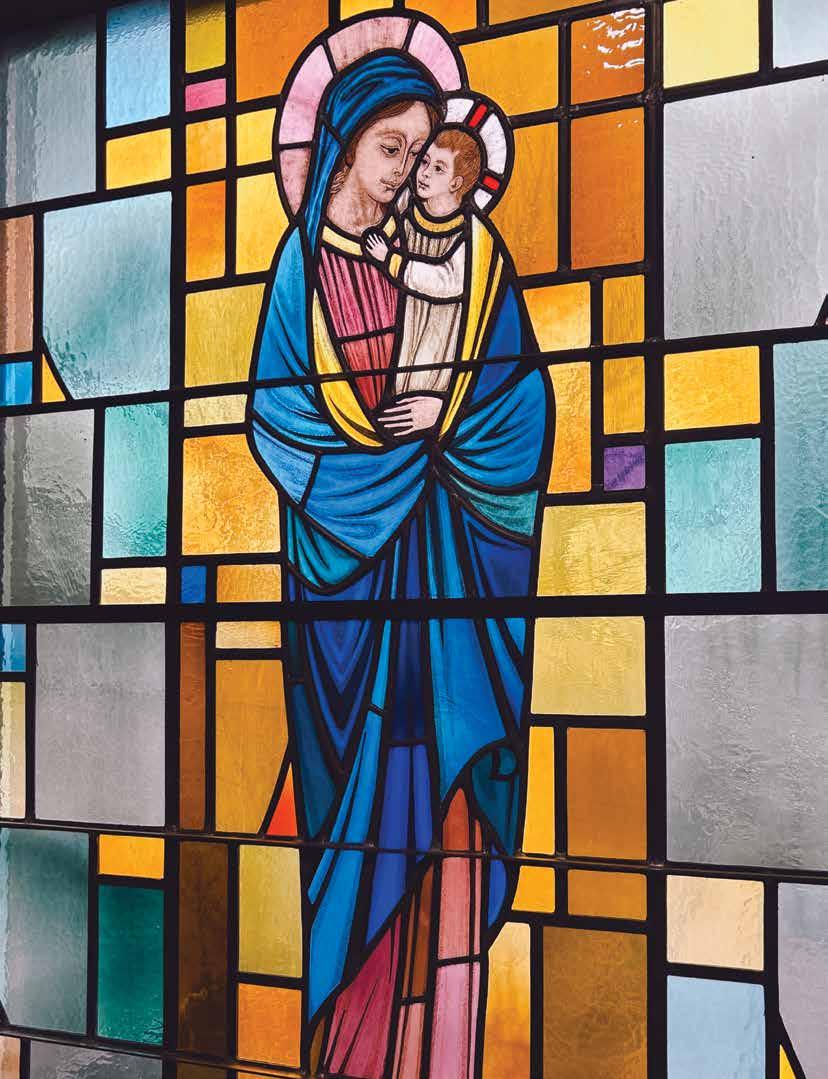
When Bernadette Soubirous, a poor peasant girl from the town of Lourdes near the French Pyrenees, first reported that a beautiful “small young lady” appeared to her at a cave in February of 1858, no one believed her. A clear spring appeared from the mud at the site during one of the 18 apparitions, and the young lady eventually identified herself as “the Immaculate Conception”—words Bernadette did not know. Bernadette was canonized in 1933, and the grotto and miraculous spring became a major pilgrimage site that now includes three basilicas and other buildings. The Feast of Our Lady of Lourdes is February 11.
First Mass celebrated April 17, Easter Sunday, at the home of Dr. Charles Murray. The first church, a white frame building designed by Kunz & Beck, is finished six months later, and the parish holds its first festival in 1928.
1948
First part of the school building built; the cafeteria and gym are used for Mass.
1960
Eight-classroom annex (St. Bernadette Hall) built; convent, now the parish office, is completed a year later.
1967
Current brick church completed, designed by Cotter & Associates, with a traditional, cross-shaped floorplan.
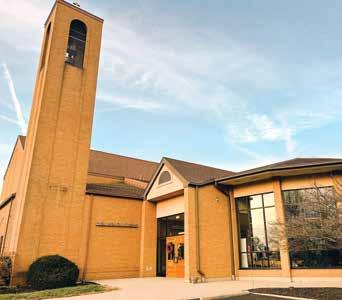
Altar crucifixes: the crucifix from the original church is located in the youth center; a “Resurrection crucifix” from the 1967 building hangs in the gathering space; and a new crucifix of Christ Crucified, made in Italy and donated by a parishioner during renovations, is suspended over the sanctuary.
Complete renovation of the church, including raising the ceiling; reorienting interior from facing west to facing north; moving sanctuary from west wall to a free-standing dais; constructing new exterior gathering space with peaked roof and curtain glass walls, each with a central contemporary stained glass panel; moving baptismal font to gathering space; and moving tabernacle to a side chapel area. Panels of the marble high altar are incorporated into new altar and lectern. After efforts to save the old frame church failed, it’s demolished and a new school gym, computer lab, library, and art room are constructed in its place.
Parish incorporated into a new Family of Parishes, Family of the Most Holy Eucharist, with St. Catharine of Siena, St. Aloysius Gonzaga, St. Martin of Tours, and St. Antoninus parishes.
Tabernacle moved to a stand behind the altar, and baptismal font moved to the side chapel in its place.
“The grotto is more than stone and water; it is a living reminder of our parish’s devotion to Mary and of the healing presence of Christ. It is a place where visitors can pause, pray, and feel the peace that has blessed generations of parishioners. It is the place where we have come together for countless parish rosaries or to say our favorite parish prayer, The Memorare.”
– Deacon Mark Madden
Grotto: a freestanding stone structure replicating the Grotto at Lourdes, including statues of St. Bernadette and Our Lady and a water feature. Built in 1949 to replace a small, indoor replica left of the church altar, the new Grotto was originally situated on Glenway Avenue, then briefly slated for demolition when the original church building was demolished. After parishioners rallied to save it, Fr. Edward Rudemiller negotiated to buy and demolish a home at the Grotto’s present location, in a garden courtyard off Rosebud Avenue. It was moved in pieces in 1999. ✦
MICHAEL MOMPER
A good romantic comedy not only has you laughing, it also says something edifying about human relationships. It should reach beyond the low-hanging fruit of vulgar bedroom jokes to instead amuse us with the love-struck antics of its protagonist(s) in a way that bolsters one’s belief in the goodness of a romantic relationship. And like a loving relationship, a good romantic comedy has no love affair with cynicism, nihilism, meanness, or cruelty. Within this framework of comedy that uplifts and is life affirming, there remains room to tackle difficult questions, and Billy Wilder’s 1960 masterpiece The Apartment does just that, perhaps more skillfully than any other romantic comedy ever made.
The story follows C.C. Baxter (played by Jack Lemmon), an insurance clerk who lends his apartment to higher-ups at his company for their extramarital affairs. This seedy side-hustle gets Mr. Baxter the promotions he desires, but his conscience soon sounds the alarm as he realizes the very real human cost of his actions. Wilder’s superb script is uproariously funny at times and certainly laid the groundwork for many films to come. But it also deftly explored two major themes we can unpack in a Catholic framework: ambition and sacrificial love.
steps on the countless women being used and thrown away by the company’s powerful men.

Baxter’s ambition is certainly the driving force for his scandalous practice, and Wilder uses images of keys and thresholds to convey his willingness to “deal with the devil.” Jeff Sheldrake, the head of personnel at Baxter’s company, is devilish in how he uses women across the company in his own extra-marital affairs and how he routinely offers Baxter rewards for access to the apartment key. As Baxter continually steps over this threshold, he
This exploration of ambition at all costs is constantly thought-provoking, and it recalls other film classics that tackled this theme. It’s A Wonderful Life does so through the character of Mr. Potter, a real estate mogul in a small town who attempts to coax good and honest people into raw deals to satisfy his own avarice. Consider Winston Churchill in Darkest Hour, where he refused to cooperate with evil and take the easy route to pleasing Parliament. Baxter eventually discovers this: if he wants to find love, if he wants to feel whole, he can no longer compromise with evil and let the devil in the door. While the company men slink in the mire of romantic trysts, it becomes clear that only contempt is left in their wake. Their wives are betrayed, their mistresses left unfulfilled and vengeful, and all the women are used, lied to, and then discarded. This awakens a disgust in Baxter that finally animates him to question his decisions. The only antidote to this type of lust is sacrificial love. Love cannot be parasitic consumption. The higher-ups in Baxter’s office use these women as objects of lust, as stress-relievers, as clandestine delights soon to be shut away. The women are consumed, made to sacrifice themselves for the quick enjoyment of the powerful. This is not only a direct inversion of the love shown in every Eucharistic sacrifice, it also flagrantly violates St. Thomas Aquinas’ principle to love others by “willing their good as other.”
Love is necessarily sacrificial; it requires a denial of self. In St. Paul’s letter to the Ephesians, he implores the
people to “walk in the way of love, just as Christ loved us and gave himself up for us as a fragrant offering and sacrifice to God.” When love is discussed in Scripture, it is always tied to sacrifice and service of others—if we use another person for our selfish enjoyment or as a steppingstone to a coveted promotion, we violate this required stewardship. And after all, for what good does it profit a man to gain the world, but lose his soul?
So, this season, revel in the truths that you can ponder from The Apartment and watch it, because, like its amusing poster says, “There is little like it… love-wise, laugh-wise, or otherwise-wise!” ✦

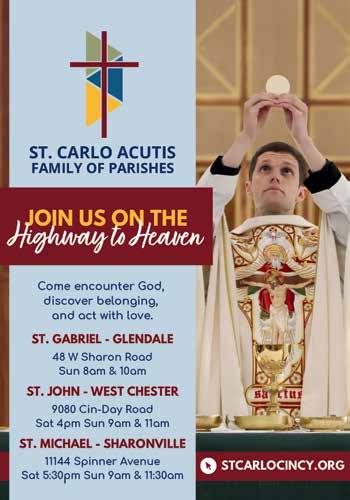

Little is known about St. Scholastica’s life, but her influence on the Church is undeniable. She was the twin sister of St. Benedict, whom she loved dearly. Born around 480 to wealthy parents in central Italy, they grew up together until he left for Rome to continue his studies. Scholastica, however, consecrated her life to God when she was very young.
She eventually founded a religious community for women in Plombariola, a neighborhood five miles from where her brother governed a monastery in Monte Cassino. The twins visited each other once a year, meeting in a farmhouse because Scholastica was not permitted inside the monastery. They spent these happy times discussing spiritual matters.
According to the Dialogues of St. Gregory the Great, Benedict and Scholastica spent their last day together in prayer and conversation. It was around the year 543, and Scholastica sensed her death was close at hand, so she begged Benedict to stay with her until the next day. He refused because it would break his own Rule to spend a night outside the monastery. Scholastica then asked God to let her brother

remain, and He granted her request through a severe thunderstorm that prevented Benedict and his fellow monks from leaving.
The next morning, after a long pious discussion, they parted ways. Three days later, Scholastica died. In a vision, Benedict saw her soul ascending into heaven. He honored her memory and was buried with her just a few years later. The witness of these siblings teaches the value of holy friendships that mutually build each person up and give glory to God. St. Scholastica’s feast day is February 10.

Scholastica Benedict Twins Monastery Rule Community Spiritual Thunderstorm Prayer Friendship
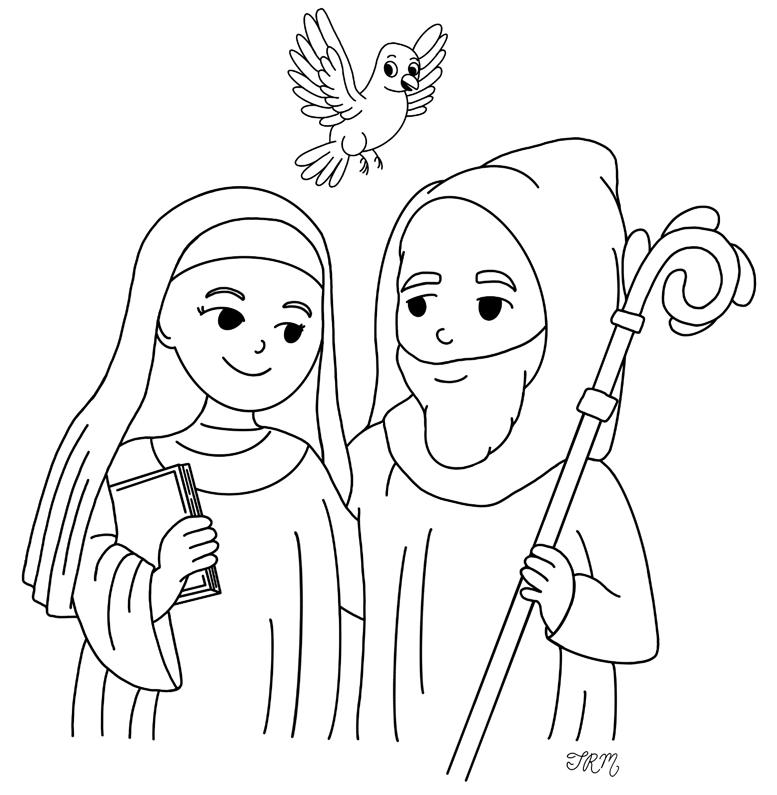
“Then Vespers lights the lamps of praise / and Compline rests our pilgrim days. / Seven-a-Day I bow my chin / and once at night to conquer sin. Amen”
In an age of ultra-fast publishing and overlycartoonish illustrations, A Very Little Office of Compline shines in its careful thoughtfulness. While our public libraries are stuffed with fluff, this understated book is refreshing. At 40 pages and six and a half by four inches, it’s the ideal size for little hands, as evidenced by my six-, four-, and two-year olds “taking turns” carrying it around the house. The layout is simple and uncluttered, which is a relief for overstimulated parents and young readers alike.
Those familiar with the ancient Liturgy of the Hours prayer will recognize the poems, as author Bo Bonner refreshes psalms, readings, and prayers from the options for Night Prayer, or Compline. But even if one is unfamiliar or out of practice, this is a great way to ease back in. Bonner’s poems are delightful and memorable, reminiscent of collections like When We Were Very Young by A.A. Milne, creator of the beloved children’s character Winnie the Pooh (illustrated by E. H. Shepard). A Very Little Office begins with a short poem explaining the seven “hours” of prayer that make up the rhythm of the daily Liturgy: “Matins speaks from silence deep/ as Lauds, the dawning harvests reap.” It continues with the Incipit, opening chant, Lectio Brevis, short reading, and Confiteor, followed by a series of psalms and hymns.

young children, these images of pious religious help me feel we are joining the monasteries and convents, whose days are structured around the rhythm of prayer.
I’ve never seen a children’s prayer book with such delightful, simple, yet sophisticated artwork. For the Christmas season, the “Little Chapter and Verse” is accompanied by a painting of the Blessed Mother, a donkey, and an ox adoring the Christ Child: “But Lord, You are among us/ and Your name is invoked upon us/ may Your love never forsake us/ Our Lord and God above us. / Thanks be to God.” My toddler’s favorite image is of the mother hen and her chicks that accompanies the “Versicle”: “The apple of Your eye/ keep us/ Under Your wing’s shadow/ protect us.”
Two stunning watercolor illustrations by Gwyneth Thompson-Briggs beautifully accompany each poem, one image depicting a theme of the prayer or psalm and the other an image of a religious in a prayerful posture, complete with flowing habit. As a parent reading to my
The book concludes with four Marian antiphons and helpful instructions for when to pray them in the liturgical year. Again, each re-imagined prayer has a matching illustration to help children understand the meaning. The abbreviated poem of the Salve Regina includes an illustration of Mary with her mantle held out to shelter two kneeling people asking for her intercession:
Our Queen and our hope toward thee we grope in this valley of exile and tears turn merciful eyes
O Advocate wise on us, ‘til thy fruit, Christ, appears.
It’s refreshing to present children with something so lovely with which to pray, and it’s a delight to pray with them! This simple book is a beautiful and effective way to introduce children to the Liturgy of the Hours and makes a great gift for a first communicant. Truly, this book is perfect for a family with many ages and is a lovely addition for your home library. ✦






Sr. Mary Garascia, CPPS
Longing for light, we wait in darkness. Longing for truth, we turn to you. Make us your own, your holy people, light for the world to see … Make us your living voice … Make us your bread … shared until all are fed … let us be servants to one another, making your kingdom come. – “Christ, Be Our Light,” Bernadette Farrell
This well-loved song expresses the mission statement of our Catholic Church, why it exists and what it’s about. Lent begins on February 18, the season each year when our Church asks us to renew our membership commitment to this mission.
Unfortunately, we often miss this communal purpose of Lent. It is right there in the Ash Wednesday scriptures. Any organization is only as authentic and effective as its members, and so, in our first reading from the Old Testament, the prophet Joel is urging an assembly to renew itself. Then, Paul tells the Corinthians in his epistle that we are ambassadors for Christ as if God were appealing through us. And in our Gospel, Jesus tells us not to be pretend members, aka hypocrites, but authentic ones, whose good actions are not done to impress others but instead flow from a personal relationship with His Father. We receive ashes together in this special liturgy to show that we are in this renewal together
Now, about an action you might take for Lent this year... Instead of giving up something, is there a positive action that could strengthen your local Catholic community and your commitment to it? Perhaps, it may just be to show up more often or to interact with the other folks who attend with you, so that you can, by listening to them, understand their joys and sorrows. Perhaps, it may be by affirming something about your local community or expressing to leadership a need going unmet and offering to help address it. Other ideas are yours to develop!
Sin has a big place in Lent, and sometimes, it may be overemphasized. Our new pope is an Augustinian, and St. Augustine (d. 430) shared deeply helpful thoughts about sin. He perceives our discipleship journey as
developmental. Our normal moral development moves toward God, toward holiness, and away from sin. It does this, Augustine said, because of God’s freely bestowed grace, which precedes any impulse of ours, accompanies us, and follows us to sustain our efforts to love God and neighbor. Augustine also speaks of regenerative grace, which finds us in whatever stage we are, forgives our past sins, and enables us to progress (The Enchiridion 118 & 119); or as that old gospel song says, If I fall, I know he’ll understand.
So, when we consider approaching the Sacrament of Confession during Lent, it is important that we do not see ourselves as defined by our sin. We are only human beings, still on the journey. When we approach the priest, we do so knowing that we are representatives of our Church and that even our most private sin limits us from fulfilling the Church’s mission to be Christ’s light to the world.
And God, as we all know, forgives upon our contrition and reception of the Sacrament of Confession, where we are reconciled with Him and the Church. It is also a special source of the sustaining grace Augustine spoke about. Especially during Lent, it is very appropriate to receive this sacrament in a communal celebration.
So much more could be said about Lent than this little essay can convey! But, perhaps, in these days before Ash Wednesday, these thoughts can start us thinking about how to live Lent this year. ✦
Sr. Mary Garascia, a member of the Sisters of the Precious Blood, was active in teaching, parish ministry, and leadership for many years. She is now retired and lives in Dayton.