
By Stéphanie Grégoire Contributor
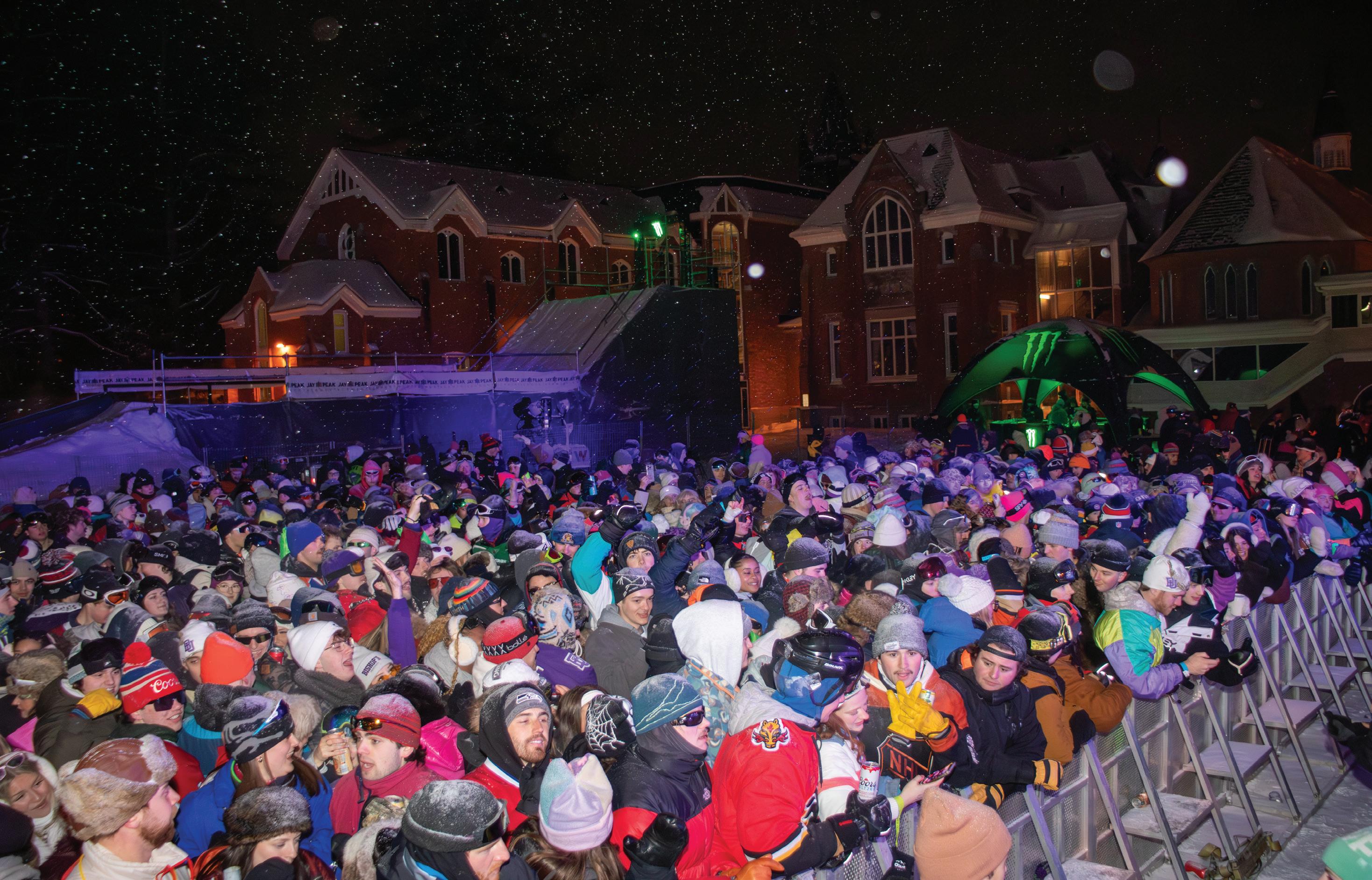
February at Bishop’s University wouldn’t feel the same without Winterfest, one of the most anticipated events of the year. For about 20 years, Rail Jam and Winterfest concert have been long-standing favourites, drawing crowds, celebrating campus culture and bringing some much-needed warmth to the coldest weeks of the semester. As magical as Winterfest looks from the outside, it doesn’t come together with the snap of a finger. Behind the music, the ski tricks and the excitement, are months of planning, problem-solving and countless late-night energy drinks. Here’s how Winterfest 2026 took shape behind the scenes:
Planning begins long before the first snowfall
Although most people would assume Winterfest planning starts
sometime after Halloween, the process actually begins in June. The earliest planning stage focuses primarily on Rail Jam: securing the rails, ramps and stage rentals, and confirming technical logistics that make the event possible. Around the same time, the team begins scouting potential artists for the concert. As summer turns to fall, the SRC Events Team grows. The Event Coordinators join the effort, and planning becomes more intensive. By September, brainstorming sessions for potential DJs are in full swing.
After weeks of research and outreach, the team secured Ian Asher, an emerging DJ from Los Angeles, as the headliner. By the end of January, the full lineup was finalized. This year’s Winterfest also spotlighted student and local talent, including DJREW, who won Battle of the DJ during O-Week, and RIENDO, an up-and-coming DJ from Sutton.
Continue on page 8
Kai Luginbuhl, News Editor » thecampus.news@gmail.com
By Kai Luginbuhl News and Associate Editor
Another Winterfest is in the books. This past weekend continued another year of tradition, in more ways than one. The weekend started off on Thursday at The Gait with a series of great music sets. The Sunburns, an Ottawa-based band that features Bishop’s own, Max Harrison, on guitar, opened the weekend with a packed performance. Following the live band, another Bishop’s student, Ben Meekin, “DJ Meeks,” entertained the crowd with his DJ set. The night ended with the closing act My City. Many students stayed late that Thursday night, but that did not slow them down because the following day, those same faces were found on Church Street for the second annual 2v2 Hockey Tournament.
The 2v2 tournament was planned and promoted well in advance, with prizes, DJs and giveaways for players and attendees to enjoy. Over 200 students were in attendance, including players representing BU club hockey, Lacrosse, Ottawa and Toronto, who all competed throughout the afternoon while supporters watched.
EDITOR-IN-CHIEF
Rianna Ostrosser thecampus.editor@gmail.com
SENIOR COPY EDITOR
Olivia Norby thecampus.copyeditor@gmail.com
JUNIOR COPY EDITOR
Eryn Costello
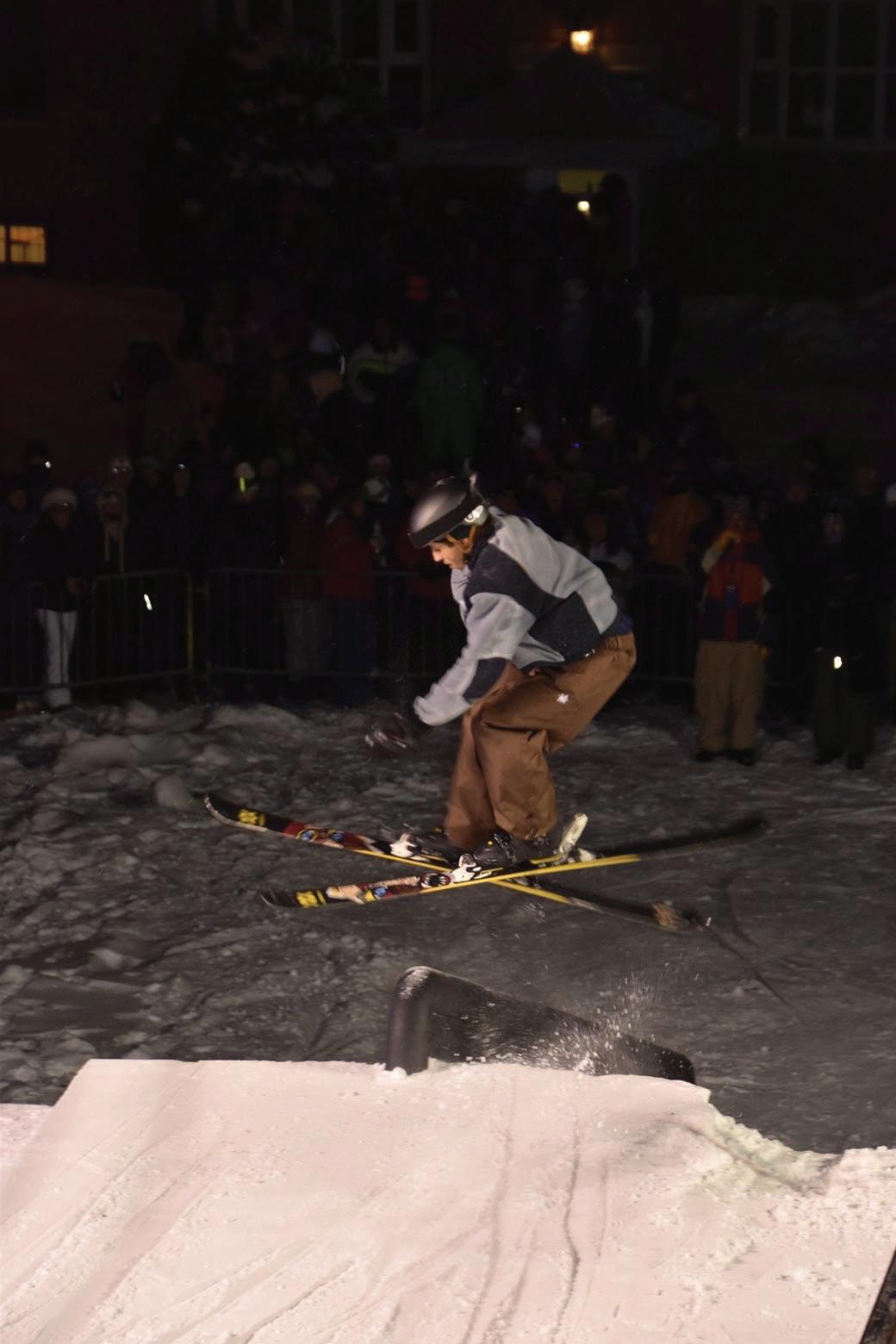
Later that same night, students attended an annual backyard party that included skiing and snowboarding tricks for the crowd. Students had a great time socializing while watching the festivities. While many students love the official, planned events of Winterfest, many older students recall a time when offcampus gatherings were just as important as the official ones. Bishop’s has changed in many ways over the past number of years, but those who are about to graduate find great pleasure in seeing students continue to show up for off-campus events
to uphold Bishop’s traditions.
Despite the activities on Thursday and Friday, Bishop’s students still had a lot of energy when Saturday arrived. With the Rail Jam starting at 6 p.m., there was a huge turnout to watch. Following a successful Rail Jam, there were several standout openers, culminating in a performance by Ian Asher, a popular DJ whose top song has nearly 100 million streams on Spotify. The performance got off to a shaky start due to technical difficulties; however, he kept the audience engaged as the issues
were quickly resolved and he delivered a strong performance.
The successful completion of Winterfest was a crucial one for both the SRC and the student body. The students of Bishop’s showed up and proved why Winterfest is the most beloved and storied event on campus. With the future of both the Rail Jam and Winterfest not yet confirmed for next year, this year running smoothly was a huge win for those who are hoping for a Bishop’s Winterfest 2027.

LAYOUT EDITOR
Abigail Epstein thecampus.layout@gmail.com
ASSOCIATE EDITOR
PHOTOGRAPHER
NEWS EDITOR
Kai Luginbuhl thecampus.news@gmail.com
OPINIONS EDITOR
Anya Mullen
thecampus.opinions@gmail.com
FEATURES EDITOR
thecampus.businesseditor@gmail.com
STAFF WRITERS thecampus.juniorcopyeditor@gmail.com
DIRECTOR OF FINANCE
Frederic Grenon thecampus.business@gmail.com
Emilie Vadeboncoeur
Pranav Buchineni thecampus.photographers@gmail.com
GRAPHICS EDITORS
Gabrielle Lalonde & Latoya Simms
Kai Luginbuhl thecampus.associateeditor@gmail.com graphicseditor.thecampus@gmail.com
DIRECTOR OF MARKETING & COMMUNICATIONS
Lauren Root
thecampus.features@gmail.com
SPORTS EDITOR
Owen Kitzan
thecampus.sports@gmail.com
ARTS AND CULTURE EDITOR
Jillian French
thecampus.artsculture@gmail.com
Megane Masson & Jon Roach
THIS ISSUE’S CONTRIBUTORS:
Addison Walker
Francois Leblanc
Henri Dessureaux
Journey Badarti
Leah Courrier
Jayme Marteniuk @thebishopscampus Instagram
Leighton Geraghty
Piper Howell
Rosie French
Sara Scafuro
Stéphanie Grégoire
Zachary Bombardier
By Kai Luginbuhl News and Associate Editor
Felipe Iannacone, Grace Cordeiro, Iliana Rawlyk, Josef Spence, Lukas Vieira, Mya Laforest, Rafiki Ngeze and Taliah Dumas Stephenson have been named to the 2026-27 SRC Board of Student Representatives. Students may have noticed that this board was compiled without a voting election, and a yes/no vote for members was not given. Worrying that the decision was made without say from the student body is understandable; however, these results are due to two key bylaws (one of which is new this year), so that the SRC can keep unfilled vacancies to a minimum.
For the SRC Board of Directors, there is a required minimum of six members and a maximum of nine. In the case that there are more than nine candidates in the running, there
would be an election to decide which candidates would become members. This process involves debate nights, advertised campaigns, and the student body voting. This year, there will be no voting election. This is because there are only eight candidates in the running, which falls within the frame of required members. In previous years, these eight would be subject to a yes/no vote from the student body; though, a new bylaw was introduced this year which took away that voting process. Therefore, as long as the candidates pass a vetting process, they will automatically be named members. According to the SRC, this system is more in line with municipal elections and other similar boards. The SRC believes this change will result in fewer unfilled positions and a more streamlined process. Starting May
1, 2026, until Apr. 30, 2027, these eight candidates will be representing the rights and voice of students, and will make key decisions on how the SRC exercises its power, budget, strategic direction, advocacy efforts and ownership consultation. One of the main responsibilities of your SRC Board of Representatives is to uphold the standards, bylaws and policies, guiding the organization forward while keeping the core values of the SRC. Some of their many day-to-day operations include managing the SRC clubs’ funding, making important decisions for SRC events and keeping a transparent, diligent record of their actions.
There will be a meet-and-greet held on Tuesday, Feb. 24, at 8 p.m. in The Gait, where students can get

to know who will be representing them for the upcoming year. It is highly encouraged that students attend so that they can get a clear understanding of the agendas and personalities of the board. The opportunity to get to know the board and SRC leadership would normally have been given during the election process, but the student body can instead take it now.
By Leah Courrier Contributor
Big Buddies is in full swing with tons of fundraising events to kick off this winter semester. The Sleds for Smiles’ second annual fundraiser took place on Jan. 30, where brave, cheerful students endured the cold weather to support Big Buddies. There were glow sticks and tons of laughs! Following the first successful fundraiser of the new year, the second one quickly followed.
This past Winterfest, execs and Bigs kindly collected their cans to donate for our second can drive of the year. The drive was supported by not only the Big Buddies community but also friends, family, the lacrosse team and the hockey
Tteam at the 2026 2v2 Winterfest hockey faceoff, where collection bins were placed. There was a huge turnout, and it’s safe to say it was a great weekend to plan this can drive. But don’t worry, Gaiters, the fundraisers do not stop there! The wellness event Sweat for Big Buddies, is coming up in March, where you can ‘sweat it out’ during Yoga, Zumba and HIIT classes. The event is located at the Sportsplex, and it is only $5 per person. We’ll also be hosting our St. Patrick’s Day can drive, third drives a charm! Lastly, stay tuned for Big Buddies as we finish off the year with a clothing drive in April, just in time for your end-of-semester clean out.
The dedicated executive team of 11 Bishop’s students collaborates all year long to plan student-run
fundraisers so we can plan eight safe and fun events for the kids. Some examples of the awesome events we host are themed parties i.e., a Glow Party, Valentine’s Day Bash, Winter Wonderland and many more. We also make an effort to plan field trips for the kids, and this year we have two: O-volt and a Sherbrooke Phoenix game. Big Buddies has been active for over 20 years, building tradition and lasting connections within the Bishop’s community. “We don’t focus much on academics at the events; it is a lot more about the bond and having a good time and creating that relationship… a lot of fun experiences that kids might not have had previously,” said Big Buddies Co-Lead Katherine Figueriredo.
Big Buddies is more than a club; it
is recognized as a mentorship program that is dedicated to fostering a sense of involvement between Bishop’s University students and children in the surrounding Eastern Townships. Big Buddies is always looking for new students to join and be a part of our team. Stay tuned on our Instagram page @bigbuddies_ bu to hear more about openings for the 2026-2027 school year and to support our upcoming fundraisers!
he Campus acknowledges that the land on which we operate is stolen land, the traditional territory of the Abenaki people. We live, learn, work, and play on this land, home to Indigenous peoples still living. Canada was founded through colonization, a system rooted in oppression and the abuse of power over others, continuing to affect First Nations, Inuit, and Métis communities today. As a student newspaper, The Campus has a responsibility to highlight truth. We are committed to prioritizing underrepresented voices in our community and proactively highlighting Indigenous peoples’ histories and ongoing realities, including their resilience and achievements. We recognize our work plays a role in shaping public perceptions, being able to call-out injustice but also call-in action. We emphasize that we must go beyond a land acknowledgement, which is only one step towards reconciliation. It is the stories in our paper – told with respect, accuracy, and integrity – and the respect and humility we show to the land and others that is more important than what is written in a land acknowledgement. Actionable steps to go beyond a land acknowledgement include educating ourselves and others, and supporting Indigenous traditions, movements, and businesses. —The Campus Team
By Anya Mullen Opinions Editor
Word of mouth at Bishop’s is more powerful than any app can be. For better or for worse, information spreads like wildfire here at BU. Everyone knows everyone, whether through work, class, sports or other activities around campus. At a school with just under 3,000 students, everyone is in such close quarters that it’s hard to stay out of the loop most of the time, and everyone here is a massive interconnected web.
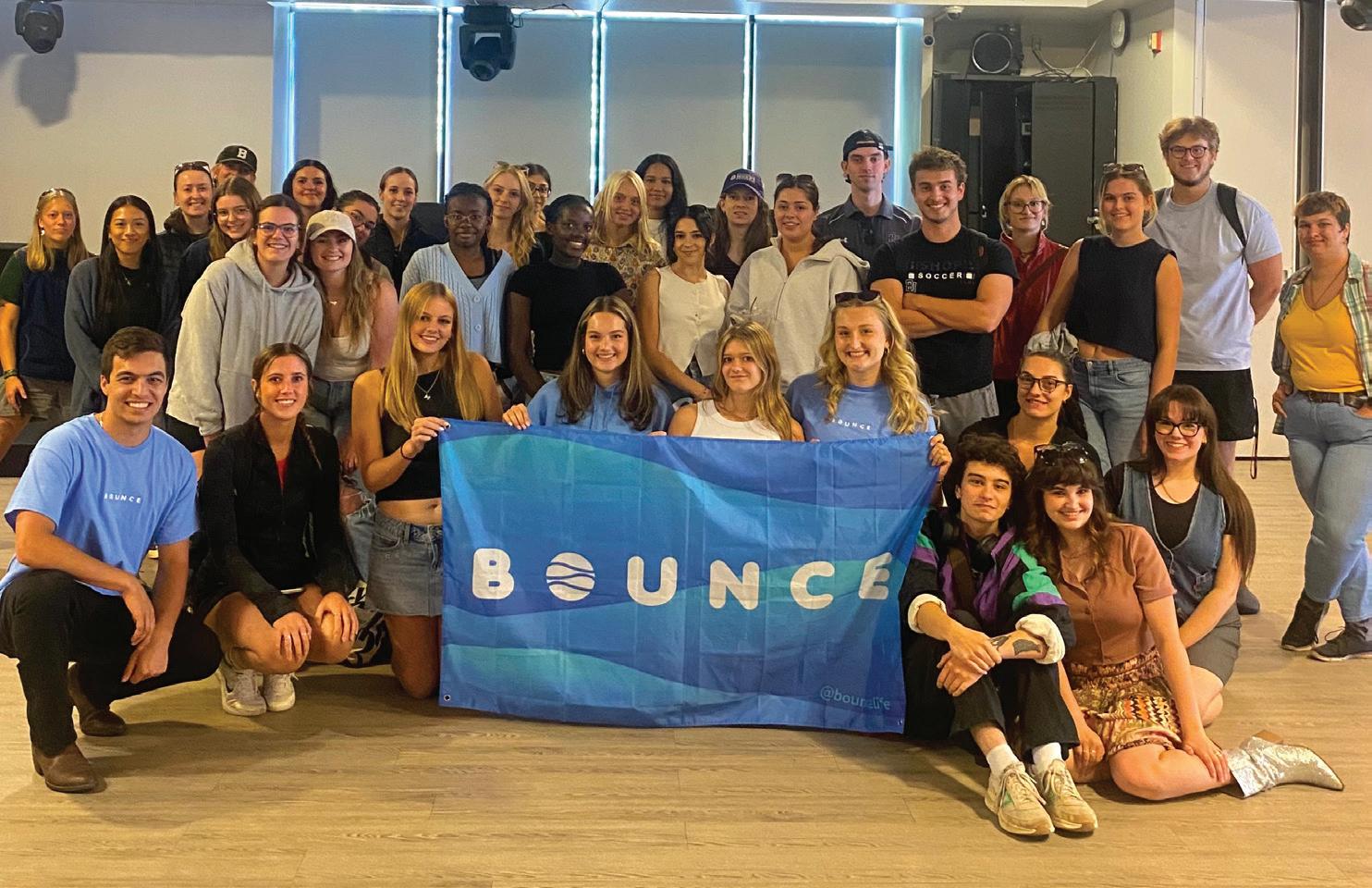
Most, if not all, student-run clubs at BU have Instagram pages where they post about what their club is up to. For people who don’t have Instagram, there is the Dish, and the events page on the University website. Before Bounce came along, there was no shortage of people knowing about and attending events.
It seems to me that the main draw of Bounce is to collect
payments, and with very few paid events at BU, it seems to me that the app has very little purpose or necessity at our university. I was looking at the Bounce life website, and they advertise that they are present at multiple universities across Canada including UBC, Dalhousie, Queens, Western and of course Bishop’s. For large ticketed events at schools like UBC with almost 60,000 students on their Vancouver campus alone, I can see how Bounce could be very useful for organizations. But for a school like ours where the Fashion Show tickets can be sold in person in the sub, isn’t it better that we are able to buy a ticket from a person instead through an app that is taking a cut of the ticket sale? I think we are lucky to go to a school where a paid event is an anomaly, not the norm. The Fashion Show is a fundraiser; of course I want to buy a ticket! On the other hand, as co-lead of BU Outdoors, I am always trying to make sure that our club’s events are inclusive and as inexpensive as
possible.
For a small BU Outdoors hike where I can personally reach out to every participant if I need to and where any money exchanged will be a $5 bill given to someone who volunteered to drive to the trailhead, I don’t see the point in Bounce being involved whatsoever. As the leader of a club, it was frustrating to be told to use Bounce when
we already had organized systems in place that worked. Our system of using Google Forms worked better not only because we don’t need to collect payment, but also because we are able to collect all necessary information from participants in one place.
I’m not sure how Bounce ended up here, but I think they should bounce back to the big universities where their system works better.
By Addison Walker Contributor
Istarted noticing little things at first.
The way French people stand at a café counter like they have nowhere else to be. The way they sip espresso slowly, even on a weekday, even when it’s cold out. The way they don’t rush through meals, even if it’s something simple. The way they dress like they’re going somewhere important, even if they’re just walking to the tram. The way people sit on benches and just… sit. No phone, no pretending they’re not alone.
Slowly, without me even realizing it, these little habits started changing the way I moved through my own days. Being abroad forces you into presence in a way that’s almost impossible to recreate at home. Everything is unfamiliar at first, the streets, the language, the rhythm of daily life. Because of that, you can’t run on autopilot. You have to pay attention. You have to look
up. You have to be in the moment, even when you’re tired or lost, even when you’re overstimulated.
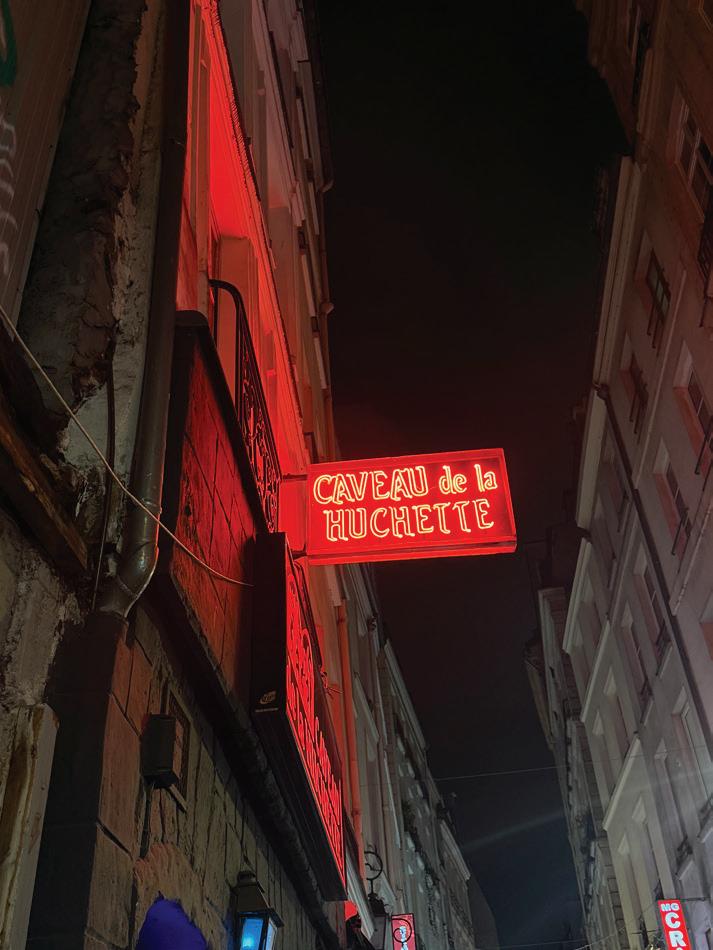
I felt that most intensely one night in Paris. I ended up in a jazz club. It was the kind of night I knew was going to be a core memory while it was happening. It was loud and packed, the kind of place where the air feels thick with energy. The music sounded like Paris itself, dramatic, effortless, and a little wild. It rose and fell in waves, like it was flirting with the crowd. One moment it was slow and smoky, the next it was fast and bright, pulling people to their feet without asking permission. It didn’t feel like a performance. It felt like the room had been given a pulse and everyone there had shown up ready to be part of something.
And then there was the swing dancing. People weren’t just watching, they were moving. Couples were spinning, strangers were grabbing each other’s hands, laughing, missing steps and getting back into rhythm. It was so cool seeing people from completely
different places, different languages, different lives, all packed into one room, united by the same music. No one looked self-conscious. No one looked like they were trying to be cool. Everyone just looked alive. What hit me most wasn’t even the fact that I was in Paris at a famous jazz bar. It was how fully I was there. I wasn’t thinking about my phone. I wasn’t planning what I had to do the next day. Just me, in a city I once only knew through movies, completely absorbed in the sound, the movement, the energy of the room and the feeling of being surrounded by people who didn’t know each other but were connected anyway having the time of their lives.
That’s what being abroad has given me: not just memories, but presence. It’s taught me that the biggest impact doesn’t come from seeing the Eiffel Tower or a perfectly planned itinerary. Sometimes it comes from the random night that hit you in the chest and makes you realize how much life is happening
right now. You don’t need a perfect day to feel alive, you just need to be somewhere that makes you pay attention. And once you experience that kind of presence even for one night you start realizing how much of life you’ve been rushing past. And now I’ll be chasing that feeling everywhere.
Anya Mullen, Opinions Editor » thecampus.opinions@gmail.com
By Piper Howell Contributor
When February hits, classes, assignments and midterms can start to feel relentless, which is why Winterfest could not come at a better time. Through music and traditions like the Rail Jam, Winterfest is more than just a seasonal event. It fosters the sense of culture and community that shapes Bishop’s. Winterfest disrupts the usual flow of school in the best way possible. For a few days, students are less focused on deadlines and more focused on being present with the people around them.
This year’s Winterfest felt especially significant. Thanks to effort from the SRC, BU Snow and dedicated students, the Rail Jam was able to take place once again. Witnessing the fight over Rail Jam was a reminder of how much work
goes into sustaining traditions. The Rail Jam is an integral part of Winterfest but also of Bishop’s as a whole—it is a recognizable part of Bishop’s culture and according to some protesters, the reason they choose to study here. Its continuation this year represents the commitment students have for preserving traditions that shape our campus.
Winterfest also brings people back to Bishop’s. Friends, family and alumni came from all over for this event, reinforcing how returning to Bishop’s is like coming home. At a small university like ours, community is a fundamental part of the experience. Being able to foster relationships outside of the classroom is crucial and strengthens the idea that Bishop’s is more than just a school; it’s a place that connects people long after graduation.
Thursday’s Pong Palooza and
White-Out Blizzard night were the perfect activities to get everyone in the right mood, but Saturday evening in the quad captured Bishop’s sense of community best. A space on campus that is usually filled with pedestrian traffic as students walk between classes became a place where the energy shifted and people shared a unique experience. The music magnified those memories, creating an incredible atmosphere. After hearing Ian Asher perform Is It Desire, I know that song will always bring me back to Winterfest 2026. At the same time, watching BU’s own DJs and band perform highlighted the talent we have in our student body.
During my first year at Bishop’s, Winterfest made me feel a part of something bigger than myself, connecting me to a tradition that’s been around for over a decade. Now, experiencing Winterfest in my second year made me realize that it’s more than a weekend of events; it’s a reminder of what makes Bishop’s special. It celebrates our traditions, brings people together and creates a sense of belonging and connection.
By Rianna Ostrosser Editor-in-Chief
For the majority of the student body, Winterfest is known for its rail jam, live DJs and stylish winter outfits. From behind the bar, however, I saw a different side of the university’s biggest winter event. One where the experience is defined as much by logistics and teamwork as music and atmosphere.
This year’s event was the coldest Winterfest in the past five years, creating challenging conditions for the nine bartenders scheduled across four bar counters and a ticket booth. To manage the cold, we were provided with heating pouches, which we stuffed in our pockets, gloves and boots. The simple measure made a noticeable difference in both comfort and efficiency throughout the night.
Despite the size of the team being a lot larger than a regular Gait night, staffing levels were necessary, not excessive. The larger staff allowed
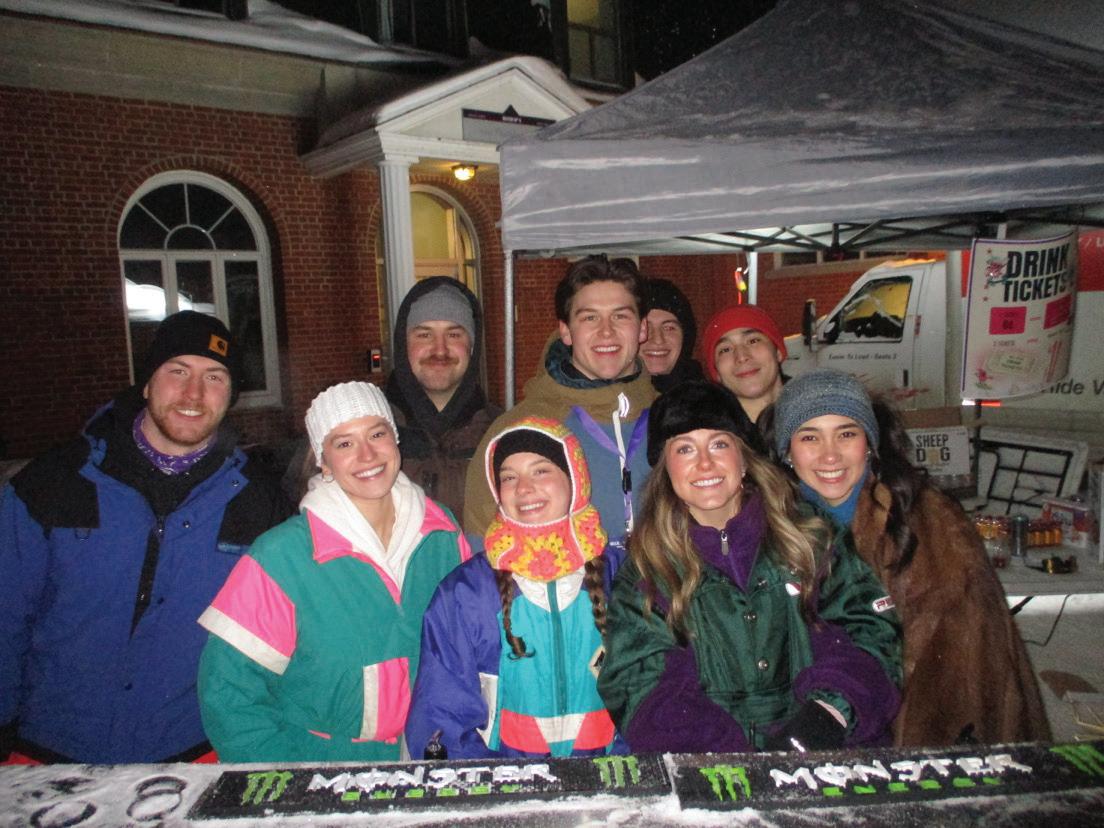
us to rotate positions throughout the evening, switching between pouring drinks, restocking supplies and selling tickets. The rotations also ensured coverage remained consistent if we needed to take a brief break inside Bandeen Hall to warm up. Support from the Students’ Representative Council also played a significant role, with SRC
members assisting with ticket sales and checking in regularly with staff, to help maintain steady operations during peak rushes. The event was also sponsored by Monster, whose presence contributed to the highenergy atmosphere that defined the night.
Winterfest is one of the
university’s largest annual events, drawing a massive crowd to the Quad. While working the event might seem like a disadvantage, it offers a perspective most attendees don’t see. From behind the bar, I could watch the Rail Jam and hear the DJ set, all without purchasing a ticket, while also getting paid.
The fast pace of the night required constant communication among staff. We were constantly monitoring one another’s workload, coordinating our rotations and ensuring everyone took breaks. That cooperation was key to maintaining both efficiency and energy. Although working in the cold was challenging, the night’s organization made the event manageable and enjoyable to work.
Winterfest is not just a major campus event, it is also a demonstration of how preparation and teamwork can turn even the coldest conditions into a fun and successful event.
Owen Kitzan, Sports Editor » thecampus.sports@gmail.com
By Owen Kitzan Sports Editor
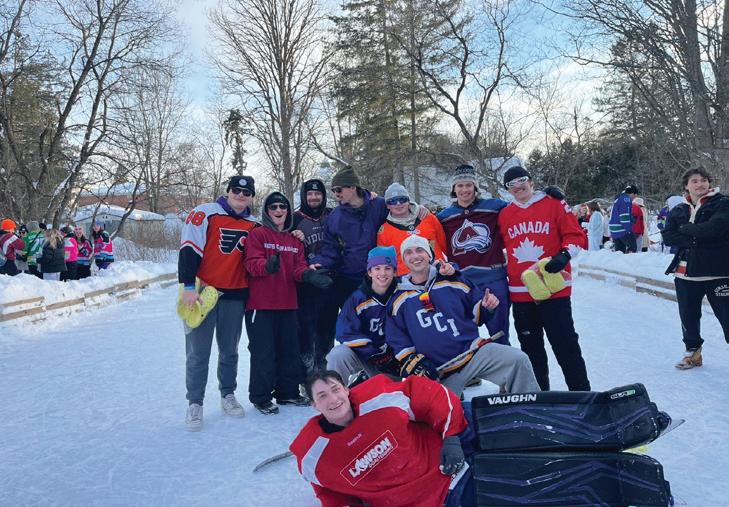
Amongst a weekend jampacked with Winterfest activities, some students took it upon themselves to help add to the magic of the event by hosting their own outdoor hockey tournament. For the second year in a row, fourth year students, Kai Luginbuhl and Owen Grand, built a rink in the backyard of the house they rent and hosted a tournament for the student body to get together and enjoy an afternoon together.
The tournament featured sixteen teams of two players across four conferences in a win or go home format. BU Club Hockey, the BU Lacrosse team, team Ottawa and team Toronto made up the conferences, with eight players from
each category representing their respective sides. I was fortunate enough to participate in the event as a last second spare for team Ottawa in the event due to a dropout from one of their members. It was a day that to me symbolized BU culture, with varsity sports teams, club teams and students with no athletic affiliation at the school competing against each other to try and claim the title.
Even more than the competition though was the aspect of community that shone through in the event, with hundreds of students coming out to spectate the event and cheer their friends on. It was an incredible atmosphere as a player with a wall of people surrounding you while yelling and screaming from all around making you forget how tired your legs were or how much your
lungs may be burning. It was a day that encapsulated the culture BU has put in place perfectly, a small community who is passionate in everything they do, whether it be a football playoff game or a backyard hockey tournament.
While I was knocked out by the eventual winners, Max Harrison and Simon Vendetti, they managed to bring home the win for team Ottawa, offering me a bit of consolation. Despite Harrison and Vendetti bringing home the title, the true star of the show was Luke Richardson, who played fifteen consecutive games as the goaltender, taking very little rest time throughout, something that sparked a lot of admiration amongst his peers as they all tried to imagine themselves doing the same.
By Jonny Roach Staff Writer
For the first time since midNovember, the Bishop’s men’s basketball team sits atop the latest USports men’s basketball ranking. Rising victorious in six of the last seven, it’s undeniable that Canadian University basketball runs through Lennoxville, QC.
On Jan. 29, the Gaiters hosted the Concordia Stingers for the second of three straight home games. After a slow start to the quarter, Bishop’s rallied back to lead 15-13 after the first ten minutes. The second frame saw much of the same, the all-around scoring from Bishop’s 20-point effort succumbed to a 35-29 lead at halftime. The contest resumed in quarter three with business as usual, while Concordia fell under the pressure of a growing lead in an energetic swamp to produce a poor effort offensively. The purple and white had their third straight 20-point quarter scoring outburst to close out the Stingers 75-58.
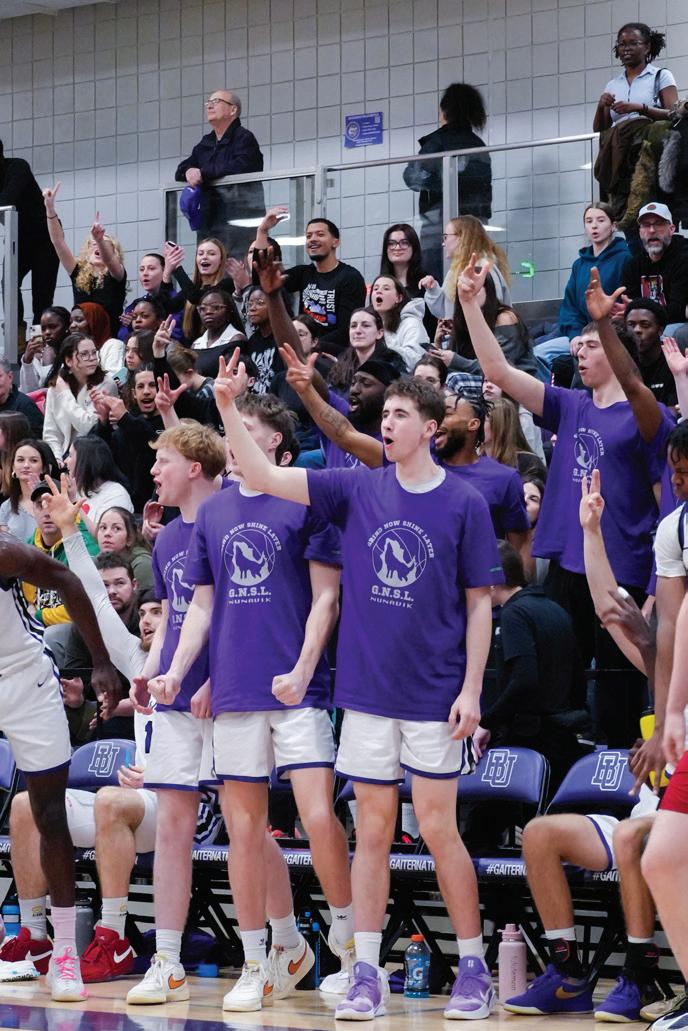
The Gaiters were dominant the whole way in this one, never relinquishing their first quarter lead for the remainder of the game. Forward Reggie Jean Seraphin led the way with a 17-point and 10-rebound doubledouble and four blocks, while Charles Robert posted ten points and eight rebounds of his own, and Yve Nsanzinshuti provided ten points off the bench. The third
straight home affair was a matchup with the McGill Redbirds on Feb. 5, in another packed Mitchell Gymnasium. Forward Etienne Gagnon began the onslaught with eight points in the opening stanza, leading to a 21-17 lead after one. The Bishop’s brand of basketball was on full display in quarter two as they outscored the Redbirds 24-6, showing everyone high-level play on both ends of the floor. Entering the third quarter with a 45-23 lead, the depth of this team continued to extend the lead with ten of Bishop’s 18 points coming from off the bench. Despite the growing lead, the guys posted another 24-point quarter to send McGill home defeated 87-53.
Etienne Gagnon’s all around play (17 points, 12 rebounds, one assist, two steals, and one block) earned him a coveted quintuplesingle in the box score, supported by Zach John’s 13 points off the bench, and Charles Robert, Ulrich Larochel and David Navarro’s nine points apiece to win big.
Many of the students responsible for both hosting and participating in it are looking at graduating this year, and hope the event remains as a winterfest tradition at Bishop’s. The tournament provided a great opportunity for people from all around the school to interact and engage in a day full of winter fun in a stressful time period for many with exams and practicums quickly approaching. Until next year BU!
The Gaiters are playing elite basketball on both ends of the court, and the numbers back that up significantly. This unit can score the basketball in so many ways; among the best in the league in three-point percentage (33.4%, 29 attempts/game), top five in shooting percentage (45.6%), top five in points per game (86.0), number two in offensive efficiency (1.082 points per off. possession) and have outscored opponents in all competitions this year by an average of 15.1 points per game. On the defensive end, the Gaiters are no joke either; top three in rebounding (43.9 per game), top five in fewest points allowed per game (69.8), top three in opponent shooting percentage (38%) and number three in net efficiency (+0.195 per total possession).
As we round out the end of the regular season, be sure to clear your schedule for potential playoff home games in March, and tune in Saturday, Feb. 21, for what will likely be a battle against the Laval Rouge et Or for homecourt advantage in the RSEQ playoffs.
Owen Kitzan, Sports Editor » thecampus.sports@gmail.com
By Leighton Geraghty Contrubutor
Over the course of the past two years, I have been very fortunate to work closely with the Women’s Basketball program. Last year, saw a historic season from the team as they made their way to BC in March as representatives of the RSEQ conference at the USports Final eight. The veteran presence of the Gaiters helped them beat Laval in the RSEQ finals. This veteran squad was equally matched by the hungry recruits brought in. One of them in particular is Shaylan Greaves. The Châteauguay native was a pest on the ball and always put others before herself. In the semi finals matchup against McGill, Greaves was granted Player of the Game due to her resiliency on the glass,
hard dough defence and ability to generate offence through her vision. This game saw legendary Coach Eddie Pomykala congratulate Greaves as she had the best zero point performance in school history. Some may think of this as an insult but it is far from it. Without Greaves on the court the end result could have been very different.
Over the course of the summer, I worked alongside Shay for the Bishop’s Day Camp. We developed a great friendship, and I got to know who Shay is off of the basketball court. Of course, like any other friendship, we would make fun of one another, and I would poke fun at the fact that she dropped zero points in the semis. Well that came quite fast to bite me in the butt, as early in the preseason this year, she scored a career high of 34 points in
a win over nationally ranked UNB. In her sophomore year, Greaves really established herself as one of the top threats on the Bishop’s roster. On the court, Shay is quite literally a dawg. She can score from anywhere, breakdown the defence with her vision and shut down your best player. Now, let’s get to know who she is off the hard floor and in her everyday clothes.
LEIGHTON: “Outside of basketball, what makes you happy?”
SHAY: “Something that makes me happy outside of basketball is truly just spending time with the people that I care about. Whether that’s family or friends here in Sherbrooke or back in Montreal, for me that time spent is the best time spent.”
LEIGHTON: “Post-graduation, what are you inspiring to do?”
SHAY: “After graduation, I know I want to help children, whether that’s in teaching or social work. I just want to be impactful to the younger generation.”
LEIGHTON: “Why Bishop’s?”
SHAY: “At first, I didn’t know much about Bishop’s until I got recruited here. When I came on my visit, that’s when I was able to make up my mind and wanted to come here mainly because this school feels like a community. I enjoyed the fact that even when I’m not super close to my family in Montréal, I have built and have a supported group of people here at Bishop’s.”
By Henri Dessureaux Contributor
Coming off a three game win streak, the Gaiters Women’s Basketball team turned their eyes to the team ahead of them in the standings as playoffs continue to approach. With McGill directly in front of them, BU welcomed them to Mitchell Gym to look to close the gap between the two sides.
Both sides came into the affair knowing that a loss would likely hurt their position in the standings heading into playoffs, and it showed early on. McGill jumped out to a quick lead in the first, but a surge from the Gaiters in the second quarter helped them take a 32-28 lead into half-time. Both teams came out looking to lock each other down the rest of the way, as each team traded nearly identical blows with one another the rest of the way down the stretch, tying the third quarter 10-10 and the Martlets winning the fourth quarter 15-14. This wouldn’t be enough to help them claw back though as Bishop’s won a nailbiter at home by a score of 56-53. Eve Atchampone led the way with 15 points for the Gaiters, while Zou Boithias locked up a 10-point, 11-rebound “double-double” in the
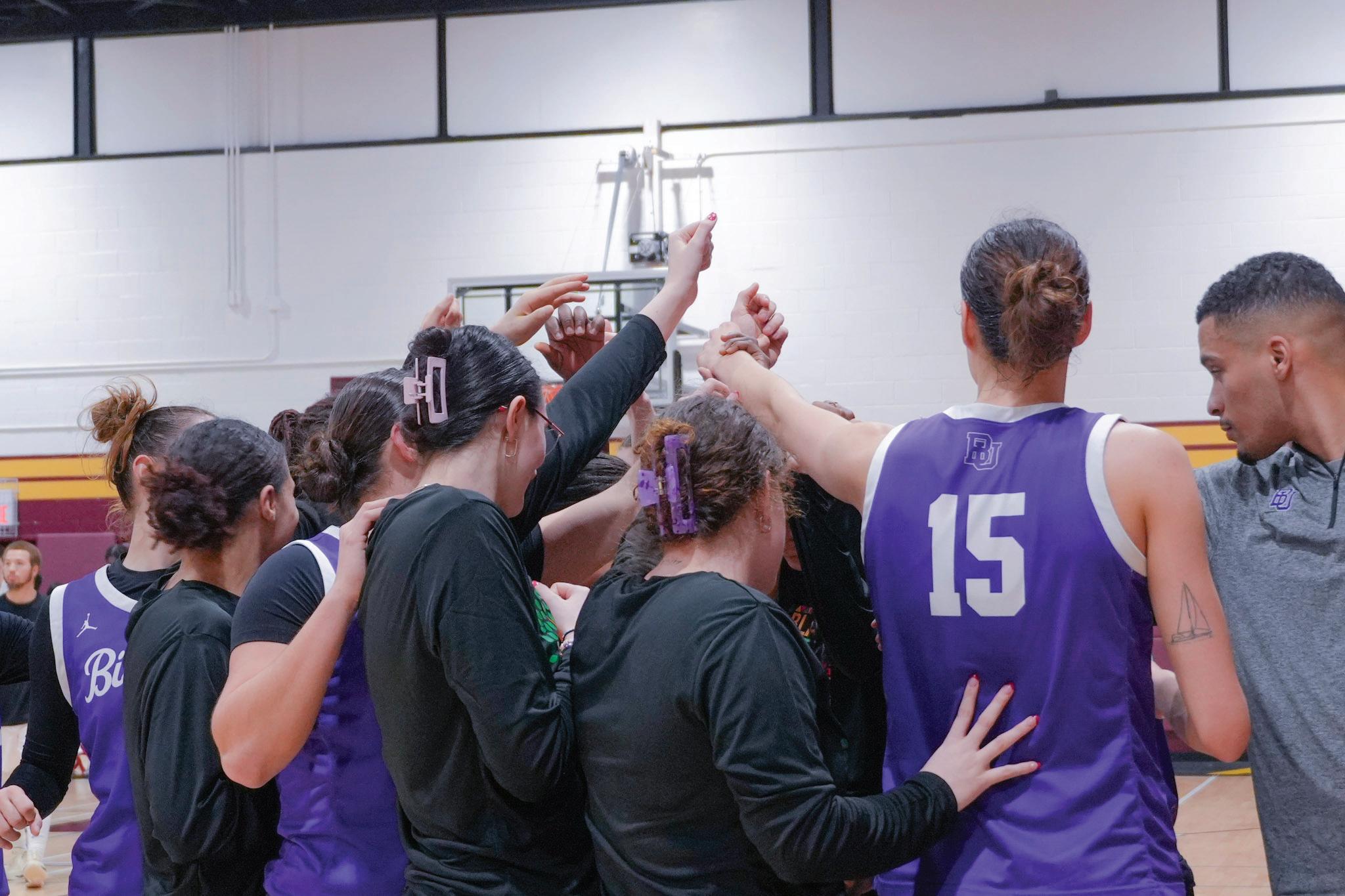
BU win.
After managing to slightly close the gap on McGill in their massive win, the team then traveled down to Montreal to face off against the Concordia Stingers. The Gaiters came into this contest missing Eve Atchampone from the lineup, a test of the resilience of the BU side without their top scorer being available. The first quarter was close as BU led by three points, before managing to increase their lead to 27-15 at the half way mark. The Stingers must
have had a good half time speech as they came out and lost the third quarter only 18-17 before outscoring the Gaiters 18-7 in the fourth quarter and nearly capping off a comeback. BU managed to hang on for a 52-50 win, an impressive showing of their resilience in the absence of their top scorer. Sabryna Purich led the way with 17 points for Bishop’s en-route to the win.
In what would be the team’s final home game of the regular season, they hosted Senior Night,
a game dedicated to all of the team players graduating this year. Moments like those are a reminder of how far they have come as both athletes and people in their time at Bishop’s and a testament to what it means to be a Gaiter.
Their opponent for Senior Night was UQAM, a team who has yet to win a game this year. The first quarter proved to be close as Bishop’s only led 21-19, the smallest margin they would lead by the rest of the way. 26 second quarter points helped propel the Gaiters to their eventual 80-48 beatdown of UQAM, a perfect sendoff at home for all the members graduating this year. Sabryna Purich once again led the way scoring 25 points en-route to the victory, while Zou Boithias secured another “double-double”, with 17 points and 12 rebounds.
While this is the team’s last home game of the regular season, they still have a game remaining as well as playoffs. Feb. 21, the team will travel to Quebec City to take on the number one team in RSEQ, ULaval. Stay tuned to find out when and where their playoff games will take place, we hope to see you come out and support your Gaiters!
Lauren Root, Features Editor » thecampus.features@gmail.com
Continued from page 1

Navigating unexpected challenges
Every major event comes with surprises, and Winterfest is no exception. In November, just three months before the big weekend, the University imposed changes to the traditional Rail Jam. This meant revisiting months of planning at a moment when timelines were already
tight. After a series of constructive discussions with the University’s operations teams, a solution was reached that maintained the spirit of the original Rail Jam, while making it more sustainable. Collaboration with BU Snow also played a crucial role, ensuring that the final setup delivered the level of entertainment students have come to expect and love.
The final week
The week leading up to the event can only be described as controlled chaos. It’s the last push when deliveries arrive, the structure gets built, decorations go up and every remaining detail demands attention. It is the time that requires the most coordination between all stakeholders such as Buildings and Grounds, Health and Safety,
By Francois Leblanc Contributor
On Feb. 3, the ART LAB welcomed a new activity: The Wellbeing Art Workshop. This activity explores how expressing emotions, perceptions and bodily sensations artistically can contribute to positive mental health.
The event was hosted by Mikayla Kaminski, a psychology student who taught the attendees not only about art therapy but also about African meditative humming. Admission was open to all students. One by one, the participants introduced themselves, stating the program they were in and why they had decided to come. Students from a variety of disciplines and departments came together through their shared love of art, giving them the chance to meet others with similar interests. A student in business stated that he attended the event since art is his hobby, and he believed this workshop would be a much-needed break from stressful schoolwork.
The workshop was divided into two activities; the first being blind drawing. To kick the activity off, the participants were blinded with white scarves. We were handed
Security, volunteers and the SRC Events Team. During this week, the team finalized the decorations, prepared the Gait for Pong Palooza and the Gait Night, and set up the Quad. They also coordinated the remaining logistics with sponsors and external teams, confirmed volunteers’ roles, and completed all technical and safety checks to ensure everything was ready for Winterfest.
The people who make Winterfest possible
The event relies on volunteers, security staff, marshals, the Health and Safety team, Buildings and Grounds, Gait staff and the SRC Events Team. All of them pour hours of work and energy into making it possible. Whether it was setting up the Quad, preparing decor for The Gait, scanning tickets or putting on
bracelets with frozen fingers, each person involved played a critical role in shaping the incredible Winterfest experience.
When everything came together
Seeing more than 1400 students and visitors gathered on campus, bundled up in the cold, laughing, dancing and celebrating, makes every hour of planning worth it. Winterfest isn’t just another event. It’s a tradition that brings the Bishop’s community together during the darkest, coldest part of winter, exactly when connection matters most.
And Winterfest 2026 delivered exactly that: connection, celebration and memories we’ll be talking about long after the snow melts.
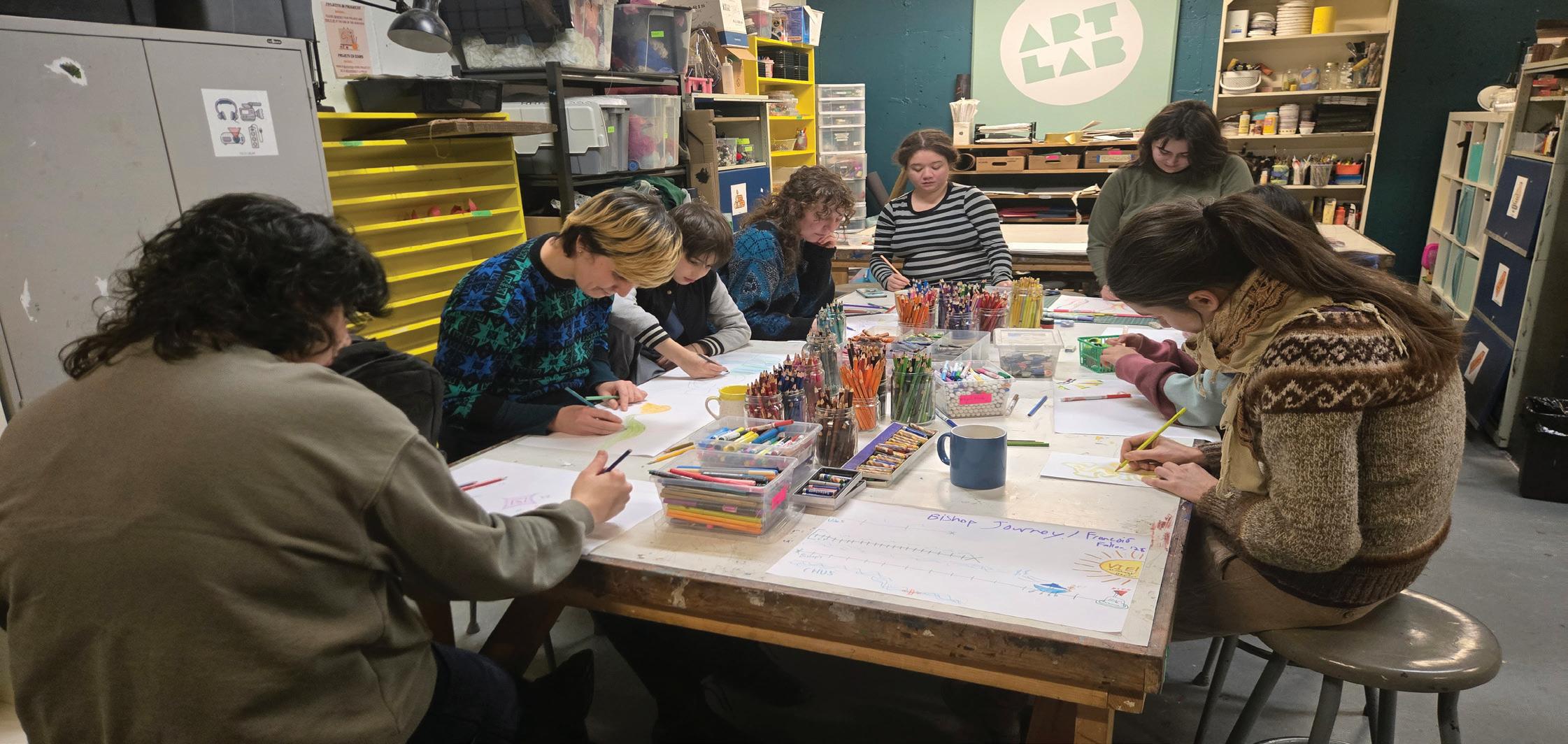
two different coloured pencils to draw figures with their thoughts and movements. There were two large drawing sheets; once participants finished the first, we moved on to the second sheet. The goal of this was to use the experience you learned from the first page on the second one. The participants learned from this experience that all first steps must be taken with experience before growing in their field after graduation in the work market. This activity was a fun and subtle reminder that improving
your work skills can be done in fun ways, like through drawing. The second workshop was drawing alongside music. One of the musical tracks was “One’s Summer Day from Spirited Away” by Joe Hisaishi. The participants were handed pencils of all types, pastels, ink, wood, etc., to draw whatever their minds conjured. The goal of this exercise was to relieve the stress of schoolwork from people’s minds and serve as a creative outlet to escape academic pressures.
The workshop concluded with an overview of what this workshop brought into perspective and what it taught.
Then, all participants did the African humming and repeated words indicating that the person speaking (us) is a radiant being, made of light and well-being. One of the attendees, Mélodie Tardieu, said, “This was a very fun activity that allowed me to reconnect with moments of simplicity. Hope this activity comes back again!”
Lauren Root, Features Editor » thecampus.features@gmail.com
By Lauren Root Features Editor
Last week, I had the privilege of talking to Duncan Crabtree, class of 2020, about his time at Bishop’s and what his life has looked like post-graduation.
Originally from Toronto, Ontario, Duncan found Bishop’s on a ski trip to the Eastern Townships. While he was in the area, Duncan’s mom suggested taking a campus tour at Bishop’s. On his tour, Duncan’s student tour guide, Shane, was so passionate that he inspired Duncan to attend Bishop’s. After that, Duncan’s top university choice was Bishop’s. Duncan majored in history, and in his third year, he added political science as a double major.
Duncan was heavily involved in school activities while at Bishop’s. In his fourth year, he was the copresident of the Academic Honour Society, while also being involved with the History Society. Duncan was also a part of the Model UN class. Due to COVID-19, his trip to the UN Headquarters in New York
City was cancelled. Duncan was also an inaugural member of the Gaiters Cross Country Ski Team.
At the end of his Bishop’s academic career, Duncan was working as a research assistant for Dr. Manore, when she suggested that he get into judicial history.
After his 2020 graduation, Duncan enrolled in a micrograduate program through Bishop’s, earning his certificate in 2021. After that, Duncan went on to attend the University of Toronto’s law school. While at UofT, Duncan was part of a fundraising group that partners with charities to support Indigenous peoples. As a coleader for this event, Duncan helped organize a silent auction and a trivia night. He was also involved with the Rights Review, which is part of the international human rights program at UofT law.
After he graduated from law school, Duncan began practicing corporate law. He likes the fast-paced nature that corporate law allows. He enjoys working under pressure and also loves the motivation that
comes with it. Duncan works on transactions, and he enjoys playing a role in the growth of a company and the changes people are making.
Recently, Duncan attended a Bishop’s alumni event in Toronto, and notes that it still has a major impact on his life. While he’s still learning what it’s like to be an alumnus of Bishop’s, Duncan is enjoying the transition. He is still in contact with many of his Bishop’s friends, and travels regularly to see them.
“It’s a really supportive community,” Duncan said as he reflected on how Bishop’s helped him after he left Lennoxville. Connecting with alumni helped Duncan during his job search and helped guide his career path.
Duncan believes that many of the skills he learned during his time at Bishop’s helped him later on in life. History helped him develop critical thinking skills and formulate arguments, while political science helped him learn how to distill complex information.
To close our conversation, Duncan

and I spoke about how Bishop’s provides unique opportunities for students at the undergraduate level. He mentioned how much leadership students can take while they’re at Bishop’s, which is something not every university has.
Thank you, Duncan, for taking the time to sit and talk about your time at Bishop’s! We hope to see you back on campus again soon.
By Rosie French Contributor
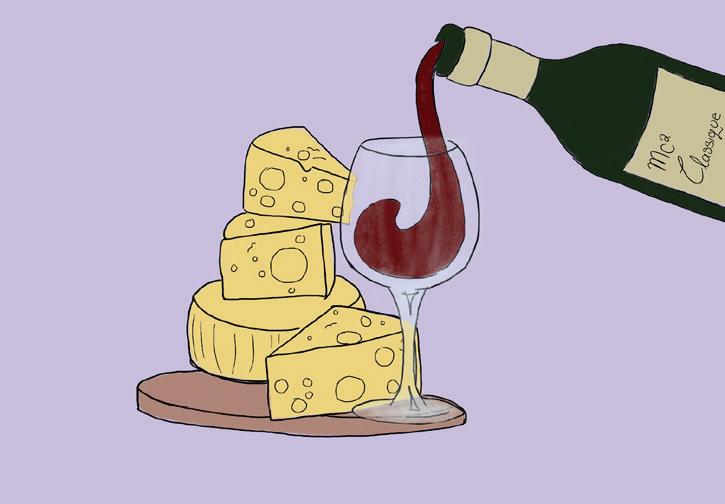
The Natural Sciences and Mathematics Wine and Cheese was hosted last Tuesday, Feb. 3, and had a large turnout of over 60 people.
This event is hosted annually and is a chance for students to connect with faculty from their department in an arguably more agreeable environment than classrooms, as well as to meet other students in their program. Alongside mingling over snacks and drinks, name tags and printed questions for students and faculty were provided to encourage conversation. Some students stayed for the whole 5 .p.m to 7 p.m. run, and others zipped in before or after their classes as they passed by The Gait.
Although this Wine and Cheese didn’t quite gain the same line-
dancing notoriety that the Education Wine and Cheese reached back in the fall, students enjoyed playing pool and foosball, chattering and lingering around the bar. The Chemistry Club, Pre-Med Club, and Astronomy, Math and Physics Society were all present to connect with new students interested in getting involved.
Serena Duperron, a biology student, had a positive experience. “It was good to catch up with others in my program, and the atmosphere was inviting,” she said. “The snacks were very satisfactory.” The delectable assortment included four varieties of cheese, radishes, dried cranberries and other charcuterieadjacent foods. The cheese was the first to go.
As students trickled in, a tally was set up for how many from each program were present. The final
stats included the largest turnouts from physics and biology, a handful of people representing computer science, math and biochemistry, and a proportionally huge turnout from chemistry despite the small program size. Luminaries in attendance included Dr. John Ruan, Dr. Valerio Faraoni and Dr. Karl Gagnon.
The event was hosted by me, the Natural Sciences and Mathematics senator, and Maya Gibson, the SRC Student Success Manager. “We were glad to see so many people show up and get conversations going,” Maya said. “It’s a great opportunity to meet new people and to talk with your teachers.” Students may be glad this event was held before the onslaught of midterms, when student-teacher rapport is still high.
Snippets of conversations overheard gave some more insight into student perspectives on the event.
“Can I get another drink ticket?”
“I’m sick of this cold weather.”
“Did you finish Dr. Nelson’s assignment?”
“Imagine having all these people on LinkedIn, dude.”
This type of high-brow conversation is expected of the Natural Sciences and Mathematics cohort. We look forward to the next opportunity to get these great minds all in one room.
By Jillian French Arts & Culture Editor
On Friday, Feb. 13, the Bu Arts Festival hosted an Odyssey teaser, evoking Greek myth of constellations and divine navigation as part of the Arts Fest constellation theme. Students and faculty gathered in the LLC Agora (a fitting location!) to hear about the constellations in the tale and listen to readings. Students from the classics department took turns reading in fifteen minute intervals from book five of The Odyssey, which begins with Odysseus still trapped on Calypso’s island, longing for a return to his homeland Ithaca and his wife Penelope. The students read from Emily Wilson’s 2017 translation, notable as the first translation completed by a woman.
Book five opens with a council of the gods, where Athena entreats Zeus to set Odysseus free from Calypso’s
island, where he has been captive for seven years due to Posiedon’s wrath. Zeus agrees, and Odysseus sets sail on a raft he constructs. In anger, Poseidon destroys the raft in a storm, and Odysseus only manages to escape with aid from the sea nymph Io.
Before the readings, Dr. Jenn Cianca, chair of the Classics, Liberal Arts and Art History departments, opened the event with a brief lecture on constellations in Book Five. The constellations Orion and The Pleiades (The Seven Sisters) guide Odysseus as he leaves Calypso’s island on his makeshift raft. In Greek mythology, the Pleiades were the seven daughters of Atlas, who lost their protection when Atlas was condemned to carry the world. They were hunted by Orion until they were turned into doves, and later constellations, by Zeus. When Orion died, he too became a constellation, and the great hunter became locked in the stars in
unending pursuit of the seven sisters.
Zachary Bombardier, a second year history student with a minor in classical languages, attended because of his fondness for The Odyssey. He was struck by the visceral imagery of a line from Book Five when Odysseus struggles against Poseidon’s storm: “Just as when an octopus is dragged from its lair, and pebbles cling to its suckers, so pieces of skin were torn from his strong hands on the rock.”
Carlota Rodrigues, a classics student, said she attended the event because “It’s a great way to keep Humanities alive and thriving! And it’s really interesting to hear everyone’s different way of approaching the text.” She was also excited for the other events the Arts Festival offered during the week, like the outdoor movie night and masquerade ball, saying, “It’s great for the community!”
The event precedes the much anticipated release of Christopher
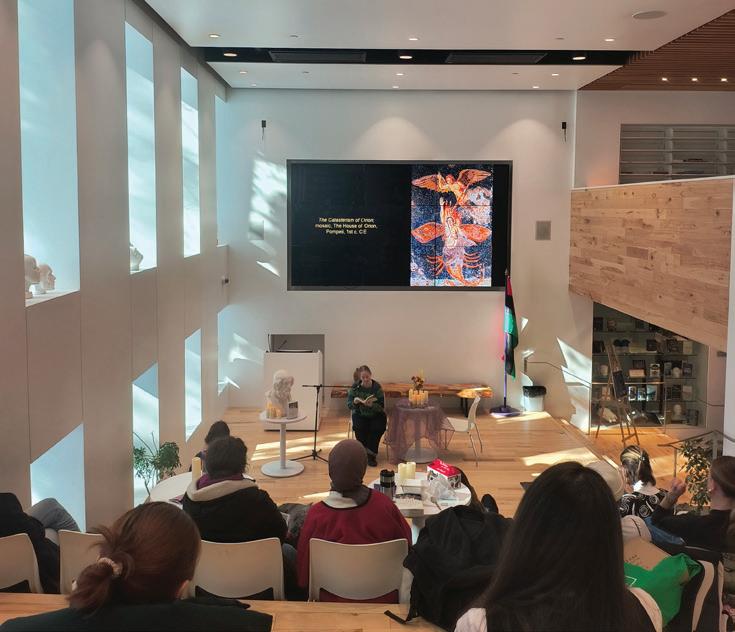
Nolan’s Odyssey movie, which, like the book, will follow Odysseus on his ten-year journey back to Ithaca. One attendee of the teaser said, “I thought Zendaya and Matt Damon would be here, but this was pretty cool too.” Along with the Odyssey reading, the Arts Fest wrapped up a successful and well-attended week of galleries, performances, and events on Saturday with the Masquerade ball, their closing event.
By Journey Badarti Contributor

The annual TheatreActiv festival just wrapped up again this year, running two alternating nights (night A and night B) in the Turner Studio theatre from Feb. 3 until Feb. 8, featuring performances ranging from short monologues to hour-long plays. During intermission, we had live music in the Turner lobby played by lovely musicians from the BU Music Society.
On Night A (Feb. 3, 5 and 7), we saw Til Skype Do Us Part, (directed by Ely-Jeanne Gauthier, stage manager and assistant directed by Tallula Russel) a futuristic drama about a failing post-death long-distance relationship using an app that allows you to skype your dead significant other; a masterful abridged rewrite of the classic
absurdist play Rosencrantz and Guildenstern are Dead (directed by Emmett Tinning and Shannon Gaskarth, stage managed by Fiona Tremblay) and some interactive improv games from the BIT Improv Troupe.
On Night B (Feb. 4, 6 and 8), we saw a dramatic soliloquy taken from Henry VI (directed by Gus de Medecis and stage managed by Carson Jaacks) Beer Girl (directed by Frankie James-Brennan and stage managed by Brook Garneau), a comedy about alcohol addiction and a woman made of beer cans, as well as the culmination of one students’ honour’s project.
I sat down with Tomas Peck, the writer, director, and composer of Diogenes and Alexandre, the musical comedy performed on Night B that explored the coincidental meeting of two distinctive historical figures in Antiquity, and his stage manager, Dale Miner.
INTERVIEWER: Could you introduce the play? How would you describe your vision, briefly?
TOMAS: I started writing this musical upwards of five years ago, after I was inspired by a variety of articles and internet bits about Diogenes. “Mr.
Cynical” was the first, and from it the other songs were formed. I barely had any concept of a story really, and it sort of came forth from testing out song concepts or having fun with the lyrics - for example why not have a Blues song in here?
INTERVIEWER: How was the process of creating it? What inspired you to write about this encounter?
TOMAS: Overall, it was a very slow process. Sometimes you don’t have an inkling of inspiration, and many times I put this thing on a backburner. And often when I was inspired to write, I would completely change the script! Having the opportunity to finally put it on stage has been an interesting feeling. There is a degree of finalityyou need to have a final and satisfying version of the script really - but when you are also the director for it, there are so many more things to consider and add, and you really must dig into what you’ve written. I am, however, so glad for the team I got with me; the actors, stage managers, designers and choreographers want this show to happen just as much as you, and so their ideas and discoveries are just as important to the final product!
INTERVIEWER: Dale, how has the tech side been for you? What has been the biggest challenge?
DALE: Well, it’s a musical, so there are more cues than you would expect, and we have got to coordinate our light and sound cues with live music, which is another interesting challenge. We rely on the musician to know when he’s supposed to start playing –he starts, and we plan our visual cues to him. We use follow-throughs when we can, but we don’t rely on them, instead we use sequences of “GO’s” which require the lightboard operator to know what they’re doing. Otherwise, the technical cues are no problem.
The festival as a whole turned out to be a success, due to the efforts of the cast, crew and designers who worked tirelessly and selflessly to turn a vision into reality – and the coordinators were pleased to find that the risk they took in planning six alternating nights over the usual four succeeded in attracting a breadth of audience participation.
We can’t thank those who attended enough! We hope to see you for the New Plays Festival next fall.
By Abigail Epstein Layout Editor
TheSun in Pisces illuminates the sunken for the surface, bringing this zodiac cycle to close come Feb. 18.
Aries: If you’ve had a social season so far, now is a prime time to take a breath for yourself. Till a journal or a houseplant. Tend to physical and spiritual ecology.
Taurus: Imagine new kinds of present, from the inside out. Tilt your chin up to the stars and give pictures to your dreams. Name new constellations.
Gemini: There is a cloud in the air that acts as a stage for your flexible persona. If you take this route, avoid the spotlight. Embrace ambiguity.
Cancer: Take the long route, for the sake of personal discovery. Leave mechanistic notions of time alone for a while. Endings will arrive, naturally.
Leo: Examine your role as a link within chains, but don’t be weighed down by “strength.” You’re more push and pull than ebb and flow right now. Pursue diverse conversations.
Virgo: Something impulsive tempts you to test partnerships by bungee jumping off of bridges. Have a hand on your rope at the ready, but hold the other one out as well. You may be surprised at what lands before the fall.
Libra: The breezy call for balance is suggestive of a bullet journal. Draw out the sensible by aestheticizing your routine. Don’t be afraid to be abstract.
Scorpio: Accept the invitation to dip your toes into new hobbies. If you have the bandwidth, be indiscriminate – at least, as an experiment. Refuse limitations.
Sagittarius: Explore what “home” means, borrowing songs from the year you were born. Follow trains of thought down to your heart-station. Treat your space to memory’s decoration.
Capricorn: To fine-tune your reading skills, wrap yourself in wallpaper. It’s funny how a room talks to a special kind of listener. Try new angles on your eyes and ears.
Aquarius: Approach the thought of equilibrium by staying the extra second still. Range doesn’t always even out, especially on an emotional register. Reset your sense of “reach.”
Pisces: You have a brightness in your eye that sees through odd fogs, and an intuition that vibrates in the moment’s frequency. Take a stroll past your usual limits. Expand your bank of secrets.
For you to take with as many grains of salt as there are stars in the sky.


By Zachary Bombardier Contributor
Made out of Sound, the third collaboration between guitarist Bill Orcutt and drummer Chris Corsano, feels less like an encounter with a finished object and more like entering into a living, complex system. Across seven tracks, Orcutt and Corsano create sounds that behave like a frenetic ant colony and its capricious movements. The result is an exaltation of life, though an exaltation that is shadowed by a recurring awareness of death.
With an easy, tender guitar and sparse drumming, “Some Tennessee Jar” contains, in miniature, the album’s argument. The jar, both holding and held, symbolizes the reciprocity between life and death: life sustains itself through death and death sustains itself through life. Roles reverse. The ant colony dies. The hunter becomes the hunted. This shifting duality is a constant throughout the album, as the untameable dialogue between Orcutt and Corsano oscillates between triumph and melancholy.
Exaltation always returns and balances the album’s gloomier reflections. “Man Carrying Things” is intense as it stages the first organism to play in the drama between life and death. The drums are swift and muscular like burrowing tree
roots. Orcutt’s guitar harps amidst cymbal crashes like a singing bird hidden in the dense crisscross of branches. Man is alert and rejoices in his lucidity. Midway through the song, however, something catches his hunter’s eye and he settles down, the dialogue between guitar and drum hushed with a mystery on the cusp of revelation. A wolf. The drama peaks in “How to Cook a Wolf” when man begins his pursuit: angular guitar lines fire against a battering, ecstatic rhythm as man and wolf tussle and exchange violent shrieks, growls and hisses.
The hunt is successful. “Thirteen Ways of Looking” meditates on death as digestion slows the well-fed man. To look in thirteen different ways means to look from the other’s eyes: the man identifies with the wolf and recognizes that he too will die one day. “The Distance of Sleep” drifts from meditation to drowsy as the man is blanketed in gentle dynamics and restrained playing, a prelude to his dream of “The Thing Itself” where the noumenal mystery of life’s creative power are revealed through knotty drums and a pealing guitar, his appreciation renewed for the living’s fragile, phenomenal garb. Man awakes in “A Port in Air” and accepts the circle of life: the song echoes the gentle, mournful playing of “Some Tennessee Jar,” this time accompanied by the fresh, warm flow of acceptance. Man no longer resists death or renounces joy.
Jayme Marteniuk, Economics & Business Editor » thecampus.businesseditor@gmail.com
By Jayme Marteniuk Economics & Business Editor
Every spring, students update their CVs, refresh their LinkedIn profiles and begin the annual search for summer employment. For many, summer jobs are for more than just spending money. They help cover tuition, rent and living expenses while also building experience for future careers. But this year, landing a summer job feels harder than ever.
The numbers support that feeling. According to Statistics Canada, the unemployment rate for youths aged 15 to 24 reached 14.7 per cent in September 2025, significantly higher than the national average. More notably, the unemployment rate for students returning to school after the summer was roughly 17.9 per cent, one of the highest rates recorded outside of the pandemic period. These figures reflect a tightening labour market that is disproportionately affecting young workers.
Part of the issue is simple supply
and demand. Recent reporting shows that summer job postings in Canada declined sharply compared to the previous year, particularly in sectors that traditionally hire students, such as hospitality, recreation and retail. At the same time, the youth population has grown, meaning more students are competing for fewer roles. For many applicants, this has translated into sending out dozens of applications with little to no response.
“Since January, I’ve applied to over 30 jobs and only heard back from one,” says Sara Scafuro, a fourth-year student at Bishop’s University. “It feels like everyone is hiring, but no one is actually hiring students.”
Another factor is the changing nature of entry-level work. Employers are increasingly turning to automation and digital tools to handle routine administrative or customer service tasks. While artificial intelligence is often discussed in the context of corporate jobs, it is also reducing the number of basic, hourly roles that once served as stepping
stones for students. At the same time, many job postings now require prior experience, creating a frustrating paradox for first-time job seekers.
Economic uncertainty may also be playing a role. With higher interest rates over the past two years and cautious consumer spending, some businesses have slowed hiring or reduced seasonal staff. For employers, bringing on fewer workers can be a way to manage costs during uncertain periods. Unfortunately, students are often the first to feel the impact.
Despite the challenges, career advisors suggest that students are not powerless in this market. Applying early is increasingly important, as many companies begin recruiting months before summer begins. Demonstrating transferable skills such as leadership from campus clubs, volunteer work or group projects can also help candidates stand out. Networking remains one of the most effective tools; referrals from professors, alumni or community connections can significantly increase the likelihood of securing an interview. Some
students are also broadening their search beyond traditional job boards by reaching out directly to local businesses.
The reality is clear: this is not just a matter of individual effort. Structural shifts in the labour market are making summer employment more competitive for students across the country. However, understanding these trends can help students adapt. In a tighter job market, preparation, persistence and differentiation matter more than ever.

By Sara Scafuro Contributor
For decades, the “dream” for young professionals meant climbing the corporate ladder in Toronto, Montreal or New York. Long hours, competitive salaries and the hustle culture mentality were almost badges of honour. But recently, something has shifted.
More and more young professionals are looking across the Atlantic and asking a different question: What if success doesn’t have to mean burnout?
Welcome to the European dream.

balance.
In many European countries, the standard workweek is shorter than in North America. Countries like France legally cap the workweek at 35 hours. Paid vacation time is not a luxury, it’s mandatory. Four to six weeks of paid holiday per year is common.
Compare that to Canada, where many entry-level professionals receive two weeks of vacation and often feel pressure to “prove themselves” by staying late.
For students entering competitive industries like business, marketing, finance and consulting, this difference matters.
Wages vs. lifestyle
It’s true that salaries in Europe can be lower than in major North American cities. However, the conversation is shifting from “How much do you earn?” to “How much do you keep and how do you live?”
In many European countries, healthcare is universal, public transportation is efficient and urban design reduces the need for cars. While taxes may be higher in certain parts of Europe, out-of-pocket expenses for essentials are often lower. The result? A different financial trade-off.
Young professionals are starting to prioritize stability, public services and lifestyle over maximizing salary alone. The appeal isn’t just about money, it’s about quality of life.
Mobility and global experience
Europe also offers something
incredibly attractive to young professionals: proximity.
With dozens of countries connected by short flights and high-speed trains, living in Europe often means weekend trips to other cities and cultures.
International experience signals adaptability, cultural awareness and independence, all qualities employers value. In an increasingly global economy, understanding multiple markets isn’t just interesting, it’s strategic.
For students who are already thinking about international internships or graduate programs abroad, Europe feels accessible and exciting.
The burnout generation is rethinking success
Gen Z is entering the workforce with different priorities than previous generations. After watching older generations face burnout, rising housing costs, and economic instability, young professionals are questioning the traditional “grind now, live later” model.
The pandemic accelerated this mindset shift. Remote work proved that productivity doesn’t require constant physical presence. It also forced many people to reevaluate what actually matters.
For Bishop’s students preparing to graduate, the definition of success is less about status and more about sustainability. A balanced life, meaningful work and personal fulfillment are no longer secondary goals, they are central.
Europe, with its labour protections and cultural emphasis on leisure, aligns with that shift.
It’s not just a fantasy
Of course, moving abroad comes with challenges. Visa processes, language barriers and competitive job markets are real obstacles.
However, the growing interest among students suggests something important: young professionals are thinking globally. They are not limiting their ambitions to one country or one system.
For Bishop’s students studying business, marketing, economics or international relations, Europe represents opportunity, not just geographically, but ideologically. It represents a different way of structuring work and life.
The bigger question
The real reason Europe is becoming the new dream may not be about geography at all. It may be about values.
Young professionals are redefining what ambition looks like. They are asking whether high salaries are worth high stress. Whether there are alternative systems that better support long-term happiness. For many, Europe symbolizes that alternative.
The growing interest to move abroad signals a shift in priorities. The next generation of professionals isn’t just chasing opportunity, they’re chasing balance.