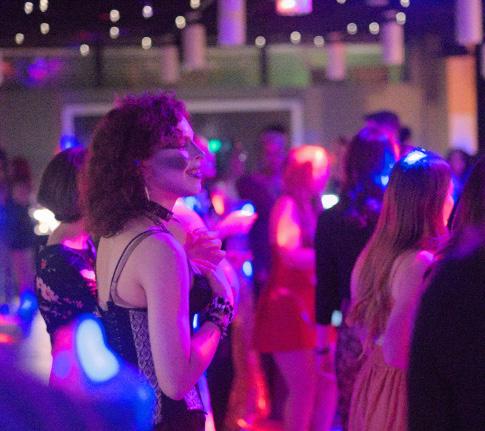

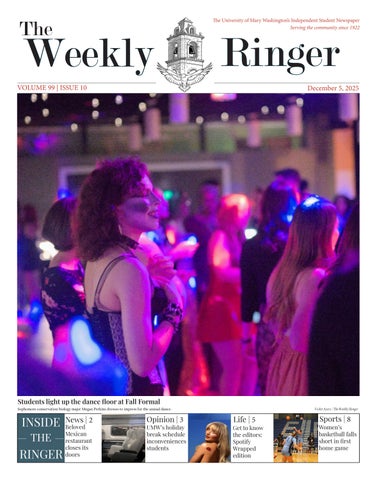
Sophomore conservation biology major Megan Perkins dresses to impress for the annual dance.
Violet Ayers / The Weekly Ringer
Editor-in-Chief
Callie Harkins
Executive Editor
Ky Huynh
ZAHRAA MOHAMMED Staff Writer
weeklyringer.executive@gmail.com
Associate Editors
Emma Kingkeo
Grace Wagner
Thomas Jackson
News Editor
Meaghan Van Dyke
Opinion Editor
Ella Cordle
Life Editor
Chloe McCann
Sports Editor Enya Cea-Lavin
Online Editor Sophia Tompkins
weeklyringer.online@gmail.com weeklyringer.sports@gmail.com weeklyringer.life@gmail.com weeklyringer.opinion@gmail.com weeklyringer.news@gmail.com weeklyringer.associate@gmail.com
Photography Editors
Anna Goodman
Violet Ayers
weeklyringer.photos@gmail.com
Copy Editor
Kyra Donlon weeklyringer.copy@gmail.com
Faculty Advisor
Sushma Subramanian
Corrections
Please report any corrections to Callie Harkins at weeklyringer.eic@gmail.com or Sushma Subramanian at ssubrama@umw.edu
Advertisement
Please directs all advertising inquiries to Callie Harkins at weeklyringer.eic@gmail.com. weeklyringer.eic@gmail.com ssubrama@umw.edu
Bell tower logo designed by Bernadette D’Auria ‘22
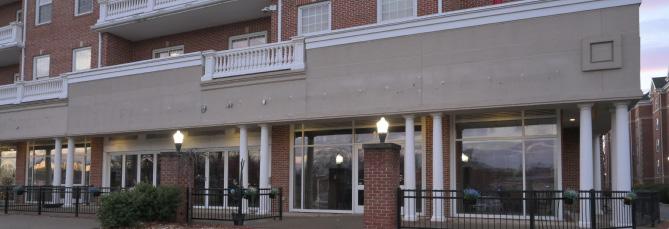
On Nov. 15, Rey Azteca announced the sudden closure of their Eagle Village location on Facebook. Opened in December 2020 near Eagle Landing, the Mexican restaurant quickly became a convenient gathering spot for students to meet with friends and family.
“From the bottom of our hearts, THANK YOU for all the unforgettable moments — the smiles, the celebrations, the family dinners, and every plate you enjoyed with us,” the Facebook post said.
While rumors of the restaurant’s closure have been floating around since last fall, the loss of the off-campus dining option took many by surprise.
“I was just talking about going to eat there tonight,” said Kai Pilot, a UMW student pursuing his master in education.
Kiah Simmons, a junior communication and digital studies and computer science double major, was also surprised by the closure.
“I’m upset about it. I probably went there every other month, something like that. It was a comfort thing that I always went to when my parents were here.”
- Adrienne Womack
“I didn’t even know,” said Simmons. “It made me really upset because I thought they were just doing renovations, because I saw that they were taking all of the stuff out of the building and all of a sudden there’s this giant red sign that says ‘Sorry, we’re closed.’”
Executive Director of University Communications Amy Jesse says the vacancy opens up the space for storage and potential future program use, since the university owns the building.
“UMW will utilize spaces in the building for additional university partnerships
and for programmatic spaces,” Jessee said. “We’ll need swing space when we renovate the fine arts buildings, and we are exploring space options for additional healthcare program offerings.”
“It’s kind of sad. I would have liked to go and also just do more exploring over there. I mean, I’m new on campus.”
- Anna Gough
Rey Azteca was just steps away from student housing and served as a popular dining option for those looking for a bite off campus. The restaurant’s absence was immediately felt by some students who frequent the spot. For junior geology major Adrienne Womack, the Hispanic food provided her with a reminder of home.
“I’m upset about it,” said Adrienne Womack, a junior geology major. “I probably went there every other month, something like that. It was a comfort thing that I always went to when my parents were here.”
The Eagle Village location was not just a go to location for delicious meals, but also a gathering place for students and Fredericksburg locals to enjoy a safe space and community. The closure leaves a gap for many patrons, including freshman Anna Gough, wishing they had gone sooner.
“It’s kind of sad. I would have liked to go and also just do more exploring over there. I mean, I’m new on campus,” Gough said.
Simmons also discussed the inconvenience that the closure of the Eagle Village location creates and that she doesn’t agree with it being a space designated to a UMW-specific program.
“There was a post office, a nail place. Like, these are very much community centered spaces,” she said. “And now they’re talking about turning these community centered spaces into UMW centered spaces.”
She continued, “There are so many empty buildings on campus that they can utilize for these things that they don’t.”
Many students, such as Matt Ramsey, a sophomore history and education double major, can’t imagine the space as anything other than the Mexican restaurant.
“Students of UMW, sure, we’re getting the benefit of using it as an artistic space, but I don’t really care,” Ramsey said. “I like my Mexican food, and I like it five steps away from my apartment.”
Rey Azteca’s closure comes after other restaurants, such as Sweet Frog and Patriot Subs, closed recently in the same shopping center.
“Our other two remaining vacancies are actively being leased throughout the reconstruction” said Emily Roberts, the marketing and communications personnel for Broad Reach, the retail company in charge of Eagle Village.
“There was a post office, a nail place. Like, these are very much community centered spaces, and now they’re talking about turning these community centered spaces into UMW centered spaces.”
- Kiah Simmons
Rey Azteca currently operates a second location in the Central Park shopping center.
While the exact purpose of the empty space is still undecided, Rey Azteca in Eagle Village remains irreplaceable in many students’ minds.
“What would I like to see there?” said Abby Powers, junior biomedical sciences major. “I’d like to see Rey Azteca. I’d actually like it to come right back.”
Meaghan Van Dyke contributed to reporting for this article.
THOMAS JACKSON Associate Editor
Thanksgiving break is a time for rest, relaxation, and, for the fortunate ones, fun memories with friends and family. For students across the country, especially those of us in college, Thanksgiving break also acts as the flagship for exams—foreshadowing the upcoming sleepless nights and impending doom that are associated with this time of year.
Unfortunately for smaller Virginia universities, Mary Washington especially, the positioning of break and finals week, as well as the length of the actual break, is more of a burden on students than a freedom.
The biggest issue in this case is the length of the break. Mary Washington students started break on the Wednesday of Thanksgiving week, giving three days of class off. Schools like Virginia Tech, Virginia Commonwealth University and James Madison University all had break start that Monday, giving students nine straight days off to prepare for their end of classes.
For anyone saying nine days is too many, there is definitely an argument to be made there, but the true injustice lies in the Monday and Tuesday of Thanksgiving week. There is often a mixture of attitudes associated with how professors should handle those two days before break. Some professors opt to outright cancel classes or at least have a class that doesn’t cover content so heavily. The other side of the spectrum is professors who make those classes necessary, sometimes having content or assignments that are essential to the final. I’m not making an argument that professors should always cancel or always have class; the issue is when a lot of the class doesn’t show
up, the choice is usually out of their hands.
In the three years I’ve been here to witness the week of Thanksgiving break, there is a good chance I haven’t had a class without over 80% of students missing. In these instances, would it be better to still have the class and leave the absent students behind, or change the class and have the students’ attendance that did show up be almost meaningless?
A gripe with this is that students don’t think any work should be done over before or over break. As a student paying for college, doing any work over break is your prerogative, but some professors expect a lot of their last non-final assignments due the week after break. Therefore, by giving the entire week off to work on assignments, students don’t have to worry about getting back so soon or doing the work that comes with any families celebrating Thanksgiving instead of schoolwork.
The second piece of the puzzle is the relationship between break and finals week. For example, the University of Virginia has the same Thanksgiving break, so its problems should be the same. UVA, however, was wise enough to push back its examination period to the week after, giving students two weeks to end classes and prepare for finals.
Unfortunately, Mary Washington’s schedule is not unique in this regard. Looking at some of the smaller schools in the state, colleges like Randolph-Macon, JMU, Old Dominion University and Longwood all have the same Thanksgiving break and finals week as us. This leads to all students having the same issue of what to do during break. Leaving early or staying for the two days of classes, doing heavy work during break or putting it off for the last week of classes, and for anyone with work due
right after break, getting all of that done while still trying to make time for the season.
A common misconception I hear when the topic of Thanksgiving break is brought up is that smaller universities have smaller breaks more often, compared to bigger universities having bigger breaks less often. This is just flat-out not true. Comparing academic schedules, UMW starts the same week as most of the aforementioned schools, ends the same week as most and has the exact same breaks as other schools, with the only exception being the shorter Thanksgiving break.
Traffic and trying to coordinate coming back to school can lead to unnecessary stress for students and families alike. That is also just for in-state students who can comfortably drive home for break. Anyone having to take a plane, train or automobile across Virginia state lines will have to figure out any tickets they may need and when they need to leave in order to make it home on time. Due to this, the best course of action would start with having every university give the week off, which gives students time to pack anything they may need and make it home in time to do work. Using staggered breaks to let students leave when they want could really help universities. Whether it’s leaving during the actual week or leaving sometime over the weekend.
Looking at all of these parts as a whole, having a shorter break followed by only a week of class before finals leads to students being more stressed than necessary. It is also extremely unfair when compared to how much time other universities get in the same state.
ELLI CUSSON Staff Writer
Now that students are back from the Thanksgiving holiday, final projects and exams are underway. With that comes hours of studying and preparation to achieve a passing grade. Except that projects are debatably more intense and informative than final exams. This is because of the time students spent and their articulation of the covered material.
There’s a saying that you should be able to give an explanation to someone else to prove you fully understand the taught concepts. Because of this, professors incorporate final projects to provide students with the opportunity to show their comprehension of the subject being taught. It requires students to set aside more time to flesh out ideas, conduct research and synthesize findings into something cohesive.
Since UMW offers a variety of classes, not all projects are the same. There are essays, group assignments, presentations, art projects and more, whereas the average test will be multiple-choice with a list of what you should study beforehand. Projects have students apply various skill sets to relay parts of the class in unique ways, which can lead to better retention. They also enhance creativity by acting as a platform to practice executing an idea. Final assignments such as these are similar to tasks some might complete in their future work field, compared to how little testing might appear.
Depending on the class you’re in that gives final exams, the test will be made up of cumulative questions from the whole semester, or from the most recently covered content. When studying for them, you’ll most likely review notes, slides and recorded lectures. However, you’re not
challenged to present the information in your own way. Therefore, those who participate in final projects might have a more complex understanding of class material. Additionally, when it comes to tests, some students put little to no effort into studying and still achieve a passing grade. Projects force students to spend time on an assignment and leave no room for wasting time. For this reason, there’s a demographic of students who prefer this final exam method. They realize that less time is necessary.
“Final projects offer alternative ways to engage students with their classes. They require more time and effort to finish, but provide students the chance to display comprehension compared to the stressful circumstances of an exam.”
- Elli Cusson
For final projects, your knowledge will be put to the test. Especially if it has to do with research. You must provide a claim that can withstand opposing arguments with evidence. Only that way will you have shown that you’ve taken other ideas into consideration. Multiple-choice tests rely on information that does not require students to search for an argument. You will give an answer, but it doesn’t need to be explicitly supported. The answer will be right or wrong depending on the pre-written choices that have been provided.
In my experience, when finished tests are handed back to the class, not all professors will supply the answers to the mistakes you’ve made. I argue that you should be able to understand your mistakes rather than to frankly be told yes or no. With projects, professors provide feedback that informs students of possible criticisms or clarification. The feedback gives an explanation to students to comprehend their mistakes while challenging their improvement. Additionally, there’s the issue of test anxiety. A portion of students struggle with the implications of a time limit and unexpected questions. It can impact their performance, even if they know what’s being tested. Although some projects require a presentation, there’s still time to rehearse and perfect what they like to say before the due date.
With projects, students acquaint themselves with the information they’ve been taught and become confident in what they are sure of. Since projects are assigned with a rubric to follow, we can use our time wisely. Having a guideline allows students to follow what their professor actually wants them to commit to memory. You could spend hours studying for a test, focusing on multiple concepts, only to have them not be included on the exam. That’s a waste of time that could’ve been spent elsewhere.
In conclusion, final projects offer alternative ways to engage students with their classes. They require more time and effort to finish, but provide students the chance to display comprehension compared to the stressful circumstances of an exam. It is harder to forget weeks of continuous effort than an all-nighter of studying.
TOMPKINS Online Editor
As winter break approaches, it is time for me to determine what my winter break To-Be-Read will be. During the school year, I find that it’s hard to read as much as I want to. I lack the time to read for fun because the work I have for my classes usually takes priority over reading for fun. The books I put on this winter’s TBR are books I added this year or in late 2024 and that I have chosen to read over break because they were high up on my list in terms of interest.
“The Actor as Storyteller” by Bruce Miller
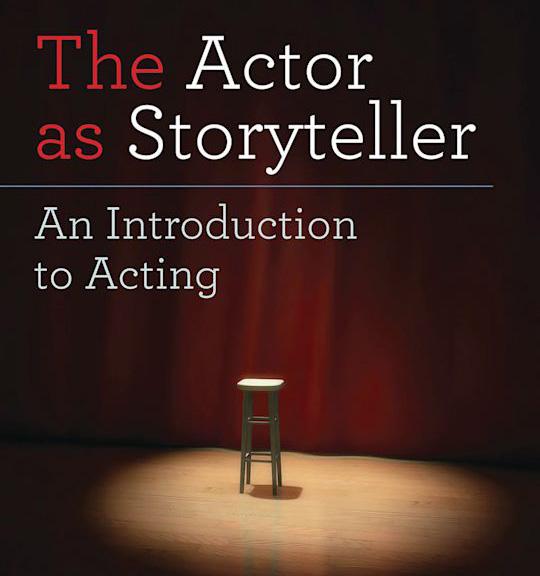
Why I want to read it: This was a book that we had readings out of in my acting class. I found the readings for this book to be very informative and fun. I have been wanting to read the rest of this book since I took the class. Even though I am not an actor, I want to learn more about that aspect of theatre because it will help me understand more of what an actor does to prepare for a show.
“Hungerstone” by Kat Dunn

Why I want to read it: The premise of this book always seemed interesting to me. It feels like they took some well-known tropes and put them together as a Beauty and the Beast retelling, and I am eager to see how they do it.
“The Wren in the Holly Library” by K. A. Linde

been playing this game for years, and once she joins, she will not escape. @authorkalinde
Why I want to read it: The premise of this book always seemed interesting to me. It feels like they took some well-known tropes and put them together as a Beauty and the Beast retelling, and I am eager to see how they do it.
“Secrets of the Deep” by Marisa Noelle

Since her brothers death, Cordelia has avoided the ocean. When she finally gains the courage to finally go back into the ocean, she discovers a suprising secret: she is a mermaid. She is entrusted with a relic, and it is up to her to break the curse that traps the mermaids in the water. The selachii, mysterious shark shapeshifters, also want the relic. Cordelia doesn’t know who to trust. Trusting her head will lead to betrayal, and trusting her heart will keep the mermaids cursed. @marisanoelle77 / Instagram
Why I want to read it: I have always loved mermaids When I was little, I decorated my room in mermaid paintings and sea creatures and picked up every mermaid book I could find. When I found this book, I knew immediately it was gonna be a book I knew I’d want to read. I was excited to read about a mermaid who hates water.
“The Case of the Curious Client” by T. G. Campbell

The Bow Street Society is a
of
Garnering their individual
detectives in
from their occupations,
serve as the
investigators for society. The society is hired by
to find his missing friend. When their clients’ credibility is cast into doubt, the society must consider whether they have been sent on a wild goose chase. Events take a dark turn, and the society must race to solve the case and save the life of the client. @bowstreetsociety / Instagram
Why I want to read it: I have always loved reading mysteries, so when I found a mystery series that highlighted the “ordinary jobs” people had during the 1890s in London, I was excited to grab the first one. Most mysteries I have read have been about experienced detectives who are really good at solving mysteries, but these guys are amateurs. They haven’t combed over every detail of a case for fun or are natural at telling if you are lying. This makes me want to read this book because I want to know how they use their everyday occupation to solve the case.
GRACE WAGNER Associate Editor
Each year, The Weekly Ringer’s editors take a step back from the whirlwind of articles, captions and headlines to reflect on something more personal: the music that carried us through the year.
In this edition of our Music Year in Review, we turn inward, highlighting the songs and artists we kept on repeat and became part of our daily routines. From late-night layouts to between-class editing, music shaped our moods, sparked our creativity and helped us navigate the rhythm of student life.
As editors juggling deadlines, coursework and campus chaos, we found that music offered a rare kind of calm and connection. Whether it was rediscovering old favorites or stumbling across unexpected gems, each track became a tiny anchor in a busy year.
Across the semester, our playlists shifted with the pace of campus life. Some weeks called for soft acoustics and steady beats. Others demanded anthems loud enough to cut through the noise. No matter the mood, the right song always seemed to find us when we needed it most.
As we look back on another year of news, we’re reminded that music shaped not just the work we created, but the experience of creating it.
Grace Wagner, Associate Editor and junior communication and digital studies major:

Violet Ayers, Photo Editor and senior computer science major: Emma Kingkeo, Associate Editor and junior CDS and marketing double major:


Chloe McCann, Life Editor and sophomore communication and digital studies major:

Kyra Donlon, Copy Editor and junior English major:

Callie Harkins, Editor-in-Chief and senior political science and CDS double major:

Enya Cea-Lavin, Sports Editor and senior English and lingustics major:

Thomas Jackson, Associate Editor and junior English major:

Sophia Tompkins, Online Editor and junior theatre and CDS double major:



Meaghan Van Dyke, News Editor and junior English major:

“Party 4 u” was such a moment in my life. I’m pretty sure I listened to it the entire 8 hour plane ride once. TRUST I will always love a song I can romanticize my life to.




Anna Goodman, Photo Editor and sophomore communication and digital studies major:

I
a
Ky

MEAGHAN VAN DYKE News Editor
The Crime Column is based on UMW Police reports from Nov. 19 to Dec. 3.
Petit larceny
On Nov. 11 at 8:13 a.m., there was case of destruction of property at the University Center. This case is pending.
Vandalism
On Nov. 9 and Nov. 10 at 11:00 p.m., there was case of vandalism at Alvey Parking Deck. This case was referred to O.S.C.A.R.
Vandalism
On Nov. 14 at 7:44 p.m., there was case of vandalism at Madison Hall. This case was referred to R&R Lock.
Larceny false pretense
On Nov. 17 at 10:00 a.m., there was case of larceny false pretense at UMWHQ. This case is pending.
Extortion
On Nov. 24 at 10:03 a.m., there was case of extortion at UMWHQ. This case is pending.
Vandalism
On Nov. 25 at 8:07 a.m., there was case of vandalism at Westmoreland Hall. This casewas referred to O.S.C.A.R.
CAROLINE PREUSS Staff Writer
The University of Mary Washington has launched Eagles in Flight, a new State Council of Higher Education for Virginia-funded college access program that works with local middle and high schools to support low-income and Pell-eligible students through early advising, academic mentoring and guided steps to college enrollment.
According to the Eagles in Flight website, the program aims to prepare high schoolers before, during and after the college preparation and application process.
“At the University of Mary Washington, we believe that the journey to college begins long before senior year,” the website reads. “Through our early high school programs, we’re dedicated to supporting students who are exploring their potential, building confidence, and preparing for life as future Eagles.”
“Together, we can create a more intentional bridge from high school to UMW that supports students before, during and through their first year.”
- Justin Wilkes
Ultimately, the program is focused on making UMW more approachable for candidates still considering applying for college.
“By engaging students early through programming, activities and experiences, Eagles in Flight aims to increase post-secondary enrollment among students who may not initially see a college path in their future,” said Dean of Admissions Melissa Yakabouski. “By providing a UMW team to mentor and support these students while also engaging their family members, we hope to put Mary Washington at the top of their college list, bringing UMW closer to the Commonwealth’s goal of 25% Pell-eligible enrollment.”
Eagles in Flight is structured as a long-term program that follows students beginning as early as eighth grade through 12th grade. Participants then continue receiving support through high school graduation and the transition to postsecondary education.
The target population includes students from low-income households, students eligible for free and reduced lunch, likely Pell-eligible students and others who may have limited access to college
preparation resources.
Each year, partner schools can recommend rising ninth graders for participation.
“We hope to recruit up to 75 Eagles each year to start as 9th graders,” Yakabouski said.
Students are identified using a combination of academic indicators, attendance data and measures related to financial need. UMW and partner schools coordinate to determine which students may benefit most from consistent academic advising and college-readiness support.
UMW provides a “Flight Crew,” a team responsible for delivering advising sessions, workshops, mentoring and campus-based programming.
“Admissions is primarily working with 11th and 12th graders, while the Flight Crew will support students beginning in 9th grade,” Yakabouski said.
Throughout the year, participants receive one-on-one advising, small group mentoring and opportunities for academic planning. The program also includes summer activities such as day camps, bootcamps and college readiness sessions designed to support academic and personal development.
Eagles in Flight also includes programming for families. Parents and guardians can take part in workshops focused on FAFSA completion, college search processes, financial aid and methods for supporting student success in high school. This support is intended to provide families with structured information relevant to the admissions and financial aid process.
“This program follows UMW’s history of supporting successful access programs such as the James Farmer Scholars and the Rappahannock Scholars,” Yakabouski said.
While UMW defines enrollment at any postsecondary institution as a successful outcome, the direct admission route provides students with a clearly defined entry option to the university.
STARS is listed as a supporting partner for the program. STARS Ambassadors, trained UMW student leaders, may assist with mentoring, small group sessions and student-support components of the program. The level of collaboration between STARS and the Flight Crew may vary as implementation progresses.
“We see tremendous opportunity to partner on in-school engagement, peer mentoring, and collaborative campus visits that build awareness and confidence for college-bound juniors and seniors,” said Justin Wilkes, Director of the STARS Office. “Together, we can create a more intentional bridge from high school to UMW that supports students before, during, and through their first year.”
“This program follows UMW’s history of supporting successful access programs such as the James Farmer Scholars and the Rappahannock Scholars.”
- Melissa
Yakabouski
UMW submitted the grant proposal in February. It was approved in May, and hiring began over the summer.
“The director began in September and hit the ground running to design the program and identify prospective partner schools,” Yakabouski said.
UMW is currently signing agreements with four high schools across two districts for the first year.
The program is still in its early rollout phase. Public information does not yet include an official launch date, the full list of partner schools or the number of students in the first cohort. More details are expected as UMW expands school partnerships and adds additional cohorts.
THOMAS JACKSON & COLE RASMUSSEN Associate Editor & Staff Writer
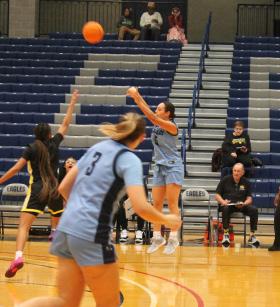
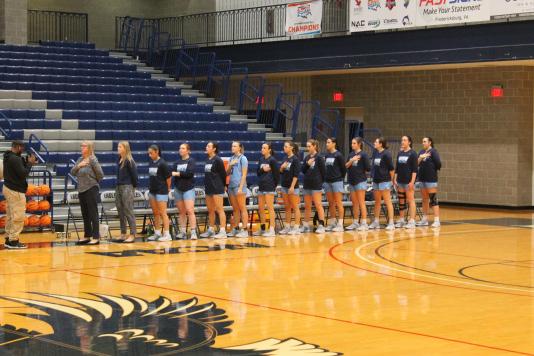
The University of Mary Washington’s women’s basketball team lost to Randolph College 46–49 last Tuesday on account of a late comeback from the Wildcats. With this being the Eagle’s first home game, emotions were high with the excitement of wanting to give a good performance in front of the home crowd.
“We were really excited since it was our first home game,” said freshman business administration major Julianna Fisher. “I think we just really were hyped up to play on our home court. We had a really good feeling going into it.”
This sentiment was shared by her teammates, who are getting more and more confident as the season goes on.
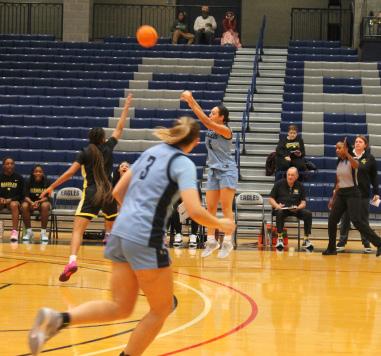
“I feel a lot more confident going into a game now vs. the beginning of the season,” said freshman business administration major Ainsley Phillips. “I know what I can do and my role on the team and I know what I have to do to execute.”
UMW took an early lead, ending the first quarter with 15 points to the Wildcats six. The Eagles continued working on extending their lead before the end of the first half. The offensive front was led by sophomore biomedical sciences major Juliona Mabie and junior biology major Maddy Jenisch, who had 14 and 11 points, respectively.
Thanks to a late stint of free throws and one three-pointer in the second quarter, UMW went into the half only leading by five points.
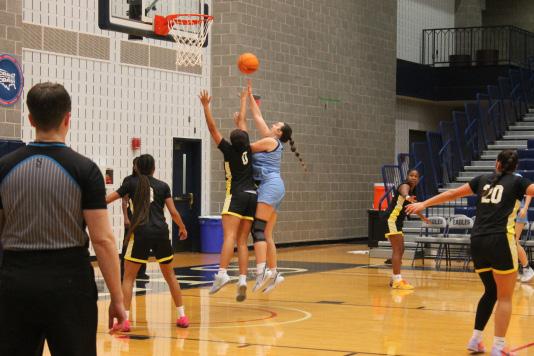
Mary Washington kept the game close through the third and fourth quarter, but a detrimental turnover allowed the Wildcats to obtain the ball and draw a costly foul with 10 seconds remaining in the game. Only being down by one point at that time, Randolph made both free throws before drawing anoth-
er foul with two seconds left in the game to expand their lead, resulting in the final score of 49–46.
Despite the close loss, Fisher relies on tight bonds after games to keep spirits high and the team focused.
“Next semester I see myself just continuing to fill my role on the team and helping my teammates get to where they need to be.”
- Ainsley Phillips
“I think that we have just a really tight bond in our team so we just make sure that everyone’s spirits stay high and that we just make sure that we are staying focused, like, outside of practice as well,” she said.
Fisher believes the team had good moments, with the Eagles going 15 for 49 from the field, shooting the same 31% as the game before.
“I think we had a lot of good moments,” she said. “I think we had some good shots and we had really good defense this game. So I think that’s the best thing that we learned from them.”
Following this loss, the Eagles went on the road Wednesday at Southern Virginia University losing 42–54 to bring their season record to 2-7.
With the end of the year quickly approaching, players like Phillips are looking at how they continue to grow and help their team next semester.
“Next semester I see myself just continuing to fill my role on the team and helping my teammates get to where they need to be,” she said.
The Eagles next game will be Dec. 6, against Dickinson College at home in the Roy Rosner Arena.
“A positive I’ve taken from this semester is appreciating the opportunity I’ve been given and working hard because I know not everyone gets to play their sport in college,” said Phillips.
ENYA CEA-LAVIN Sports Editor
Track and Field
Dec. 5 at Virginia Wesleyan First Chance Invitational
Men’s Basketball (6-0) Nov. 22 vs. Carthage College Dec. 6 vs. Dickinson College
Women’s Basketball (2-7) Nov. 25 vs. Randolph College (46-49)
Dec. 3 at Southern Virginia University(42-54) Dec. 6 vs. Dickinson College
Men’s Rugby (3-4) Dec. 6 vs. St. Thomas University
Women’s Rugby (4-3) Dec. 7 vs. James River Christmas 7s Games