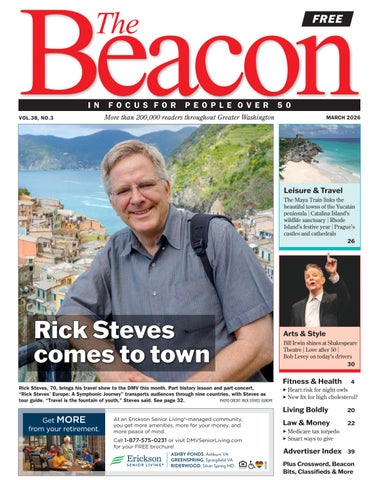
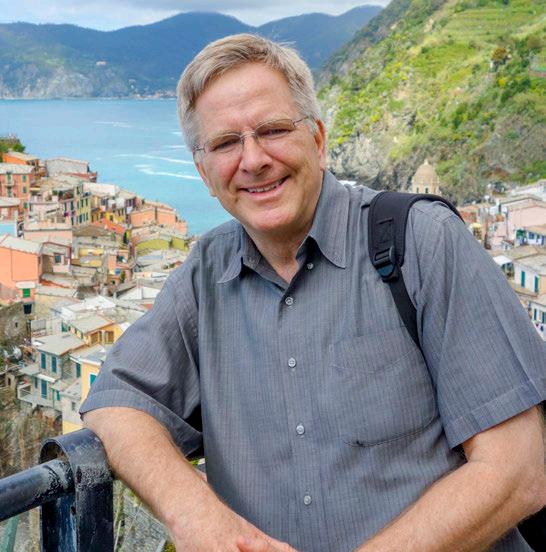
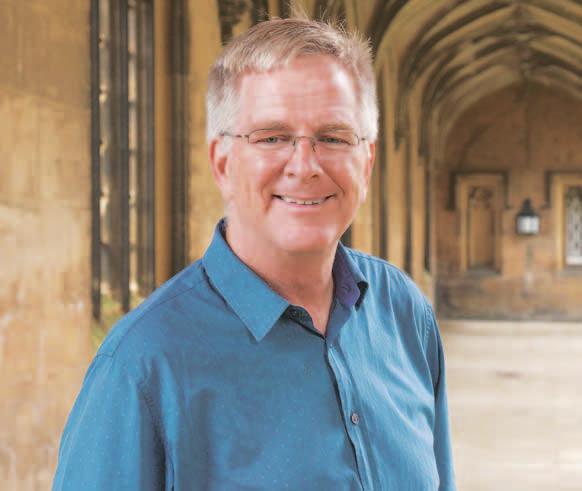
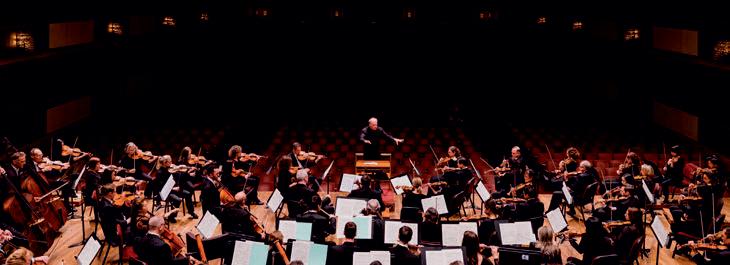
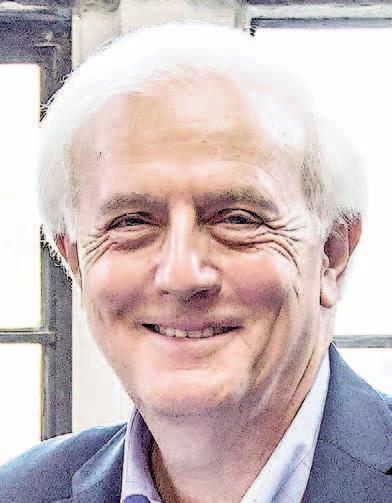
Rick Steves, 70, brings his travel show to the DMV this month. Part history lesson and part concert, “Rick Steves’ Europe: A Symphonic Journey” transports audiences through nine countries, with Steves as tour guide. “Travel is the fountain of youth,” Steves said. See page 32.
PHOTO CREDIT: RICK STEVES’ EUROPE
Following a legacy
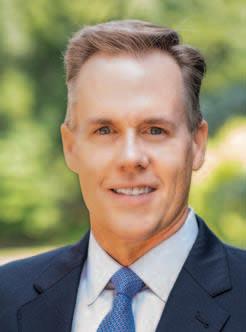
For those who regularly read this column, you know that our founder, Stuart Rosenthal, recently retired. As the new publisher, I’d like to introduce myself and share my vision for the future of the Beacon
I joined this team more than 20 years ago, working closely with Stuart and his wife, Judy, our president, in every facet of the business. It has been an honor to serve alongside them.
Now my mission is to maintain the cultural foundation and integrity that have made this paper the most respected resource for seniors in the Baltimore and Washington metropolitan areas.
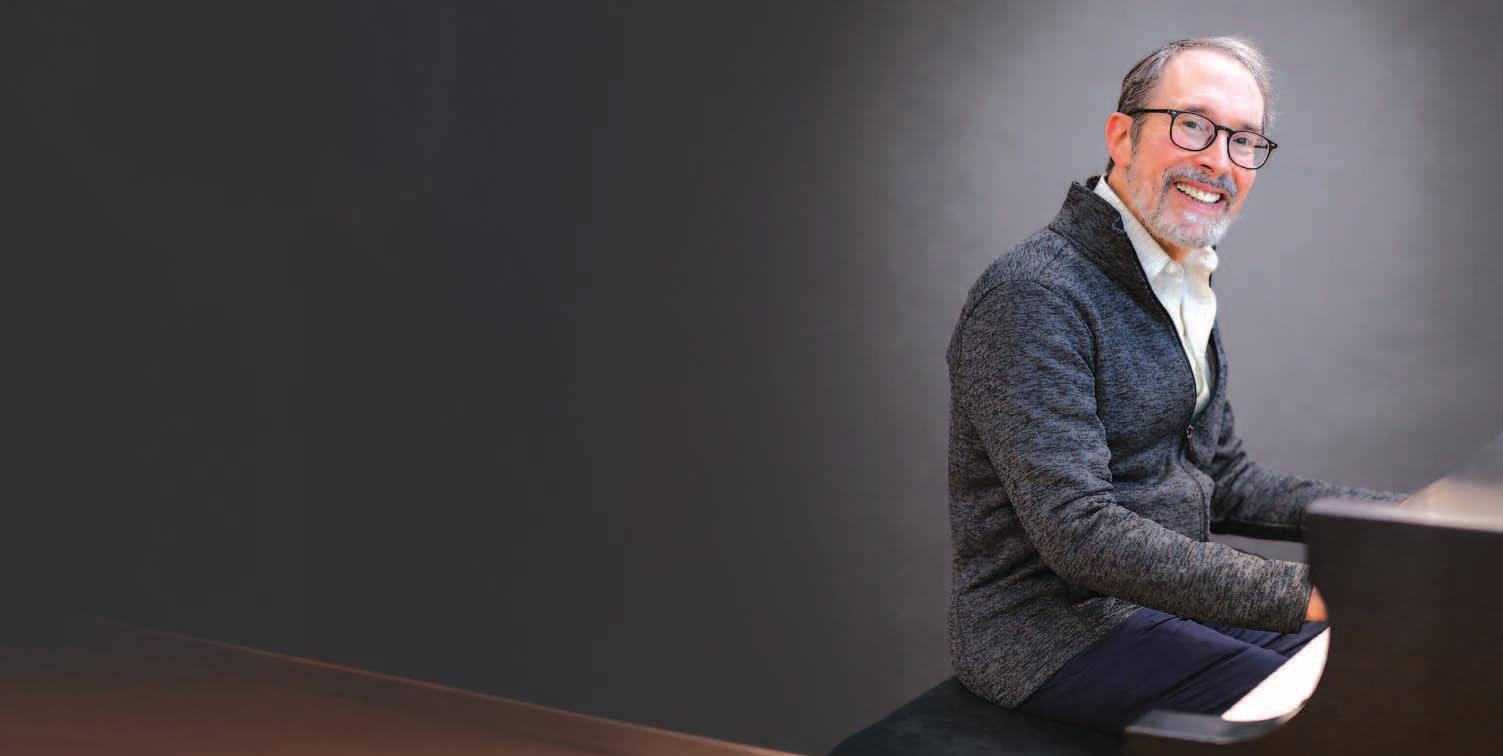
When Stuart first approached me about his desire to step back from the Beacon to “recreate himself” as a pianist, I was thrilled. I knew he always loved composing, and seeing him pursue this passion reminds us all that it is never too late for a new chapter. I’m confident his new venture, StuartsMelodies.com, will be a hit.
FROM THE PUBLISHER
By Gordon Hasenei
As an Army veteran, “Duty, Honor, Country” was ingrained in me through countless pushups and years of service. I feel a profound sense of duty to you, our readers, and I intend to honor the Rosenthals by building upon the legacy they created.
After the initial excitement, reality set in: With the founder gone, what would happen to our team and our readers? I jumped at the opportunity to buy the Beacon because our story isn’t finished.
We are reinventing ourselves, and I have big ideas. Those who know me know I don’t shy away from hard work — and I plan to have fun doing it.
My first order of business was forming a partnership with Steve Gurney, our new
The Beacon is proud to serve you.
The
associate publisher and the founder of ProAging.com.
If you aren’t familiar with Steve’s work, I highly recommend exploring his online community and publications, which offer a comprehensive look at senior-related issues. His knowledge and expertise will be a massive asset as we grow and evolve.
This merger significantly enhances our ability to share vital information with seniors, families and caregivers.
In an increasingly polarized world, we believe we are truly “Stronger Together.” Wouldn’t it be refreshing if more people felt this way?
The last few months have been a whirlwind, but another trait Uncle Sam indoctrinated in me was the ability to multitask and adapt. I thrive in complex environments and am always driving forward. Together with Steve Gurney, I look forward to providing even more resources, information and fun for our community of loyal readers.
I’ll admit, being a Baby Boomer still freaks me out. It’s only when I look in the mirror that I realize I’m 64. How did I get here so fast?
But being a Boomer doesn’t mean slowing down. Between hitting the gym (I’ve been lifting for 50 years), skiing and tackling
my own yard work, I’m staying “youngish.” To quote the poet Dylan Thomas, I will not go gentle into that good night!
Please join me in wishing Stuart and Judy success and fulfillment on their new journey. Leading such a well-respected publication for 37 years is a monumental achievement.
I am proud to have been part of their story, and I hope to make them — and you — proud of what we create next. I know how loyal you have been to the Beacon, and I look forward to earning that same trust and loyalty in the years to come.
As I begin my own new chapter as publisher, I want to ensure the Beacon continues to serve your specific needs. I invite you to share your thoughts on what topics you would like to see covered or how we can better support you in the coming months.
Please feel free to reach out to our team via our website, follow our latest updates on the Beacon Facebook page or send us a Letter to the Editor (see below).
Your voice is the heart of this publication, and I look forward to hearing from you as we move forward — together.
Beacon
IN FOCUS FOR PEOPLE OVER 50
The Beacon is a monthly newspaper dedicated to inform, serve and enter tain the citizens of the Greater Washington D.C. area, and is privately owned. Other editions serve Greater Baltimore and Howard County, Maryland.
Subscriptions are available via first-class mail ($50) or third-class mail ($20), prepaid with order. D.C. and Maryland residents: add 6% for sales tax. Send subscription order to the office listed below.
Publication of advertising contained herein does not necessarily constitute endorsement. Signed columns represent the opinions of the writers, and not necessarily the opinion of the publisher.
Gordon Hasenei, Publisher, CEO
SteveGurney, Associate Publisher
MargaretFoster, Editor
KyleGregory, Art Director
RogerKing, Vice President of Operations
Advertising Representatives:
Jill Joseph, Steve Levin, M.K. Phillips, Alan Spiegel
Submissions: The Beacon welcomes reader contributions. Deadline for editorial is the 10th of the month preceding the month of publication. Deadline for ads is the 15th of the month preceding the month of publication. See page 39 for classified advertising details. Please mail or email all submissions.
Copyright 2026
Inc.
Letters to the editor
Readers are encouraged to share their opinions on any matter addressed in the Beacon as well as on political and social issues of the day. Mail your Letter to the Editor to The Beacon, P.O. Box 2227, Silver Spring, MD 20915, or email to info@thebeaconnewspapers.com.
Please include your name, address and telephone number for verification.
Dear Editor:
Mr. Rosenthal, thank you for founding this amazing paper, which I look forward to every month. Enjoy your new adventure.
I have enjoyed the articles discussing the ups and downs of retirement. It’s true that having a purpose makes a difference. Retirement shouldn’t be about doing nothing but about living at a different pace.
Community centers are a great place to start, since they are free and offer opportunities to get out of the house and meet other people.
Learn a new language, try a new recipe, take a class, read a book outside of your usual genre. Just try something different for the sake of trying it.
Chris B. Via email
Dear Editor:
Thank you for your latest and last column for the Beacon. I’ve always enjoyed your column and have saved some over the years that hit home for me, such as the February 2020 one about wonder and creativity.
You’re such an inspiration to artists, writers and musicians, as well as to the general population, encouraging them to pursue any passion they have in life. I wish you the best in pursuing a full-time career
in creating music.
Dear Editor:
Amanda K. Daisey Via email
I read your newspaper every month. The new inclusion of the column “Love after 50” is extremely smart and very touching; the first one was absolutely terrific.
The article on prescriptions was fantastic, and your other articles were quite good also.
Terrific newspaper — and this new column is a nice addition.
Harvey Sherman Potomac, MD
Dear Editor:
After I was let go from my federal government contract at the National Institutes of Health due to cost cutting, I decided to keep my 50-year-old hands busy.
I collaborated on a book with my 80year-old aunt, poet Nancy C. Allen (graduate of Woodson High School in Virginia).
We self-published a book of her poems with my photographs. I used my uncle’s camera, which he brought back from his U.S. Army service in Korea. So the book, titled Whispers of Song, was a full family affair. Vincent Lee Smith Washington, DC
Living Heart-Healthy at The Carnegie
In February, we recognize American Heart Month and its importance for our overall well-being. At The Carnegie at Washingtonian Center, heart-healthy living isn’t just highlighted in February; it’s a daily focus woven into every aspect of the experience in a Kisco Signature Community.
Vibrant, heart-healthy living is encouraged at every age and level of living. Members at The Carnegie are motivated to embrace routines that nourish their bodies and uplift their spirits. Through engaging fitness opportunities, personalized wellness programs, and nutritious dining options, The Carnegie empowers its members to prioritize heart health while living an all-inclusive lifestyle.
Through purposeful programming and a supportive community, The Carnegie provides all the tools that allow members to immerse themselves in a lifestyle that enhances independence and enriches their overall well-being. Amenities, programs, and services at The Carnegie allow members to thrive physically, emotionally, and socially. Through a partnership with the Osher Lifelong Institute at Johns Hopkins University, The Carnegie makes lifelong learning easily accessible by providing members a robust calendar of lectures, workshops, and educational programs that encourage curiosity and continued learning.
The Art of Living Well: Tailored, Whole-Person Wellness for Each Member
At The Carnegie, members can participate in elevated, customizable wellness activities designed to meet their unique needs, interests, and abilities. Spanning all nine dimensions of wellness, these offerings create a purpose-driven
lifestyle that engages the body, mind, and spirit. With state-of-the-art equipment, expert nutrition guidance, and personal training support, The Carnegie’s advanced culture of wellness is woven into everyday life. Members have access to all the resources needed to enjoy an enriched, active, and fulfilling lifestyle.
As part of its comprehensive wellness philosophy, The Carnegie partners with Lifetime Fitness to offer members a wide range of weekly classes for all levels of living, ensuring everyone can engage in heart-healthy movement. Additionally, the community’s partnership with EmpowerMe further enhances this whole-person approach by providing
on-site clinical support, therapy services, and proactive health guidance, delivering personalized care that strengthens mobility, vitality, and overall well-being.
Wellness at The Carnegie is also shaped by the community itself. A member-led walking club brings neighbors together for fresh-air movement, social connection, and a shared commitment to heart-healthy habits. It’s one more way that members take an active role in shaping the vibrant lifestyle that defines the community.
The Carnegie is a community that prioritizes and promotes wellness uniquely, and the benefits are immediate. “Every member at The Carnegie possesses their own journey, which is exactly why our programs are designed to meet you where you are,” says Jypsy Bailey, General Manager at The Carnegie. “Our holistic approach recognizes that wellness stems from the connection between mental, emotional, and social well-being.”
A Heart-Nourishing Dining Experience
Living a heart-healthy lifestyle often starts with what is served at the table. Members at The Carnegie enjoy chef-prepared meals and five-star service centered around flavorful, balanced nutrition where each member’s specific dietary needs are considered. There is no shortage of options, with each dining location offering its own specially curated menu.
Ensuring that no details are overlooked, Carnegie’s team of culinary experts brings passion, creating an immersive and unforgettable experience. With six dining venues on the property and choices between upscale, private, and lounge-style settings, members receive nothing short of an exceptional experience.
The culinary team has mastered the balance
between nutrition, smart ingredients, and flavor. “Dining at The Carnegie is an experience that begins as soon as you walk through the door and doesn’t end until you leave the room,” says Bailey. “Each dish is thoughtfully prepared, with an unwavering commitment to quality and the finest ingredients brought to every table.”
Experience a level of personalization and luxury that only The Carnegie can provide. Schedule a personal visit to explore our community and amenities that set us apart. To learn more about life at The Carnegie, please visit lifeatthecarnegie.com or call 240-570-7269.
Welcome to The Carnegie, where health and wellness take on a new meaning.
The Carnegie at Washingtonian Center
Fitness & Health
HOPE FOR HOSPITALS
Pfizer tests new vaccine nationwide to prevent potentially fatal C. diff infections
AN APPLE A DAY
The old adage has some truth to it: Apples can lower the risk of many diseases
LOWER CHOLESTEROL
Scientists are developing a gene-editing treatment that could be a one-time fix
WHOOPSIE DAISY
Getting clumsy? That’s normal as we age, but check your meds and get enough sleep
How late nights can affect the heart
By Lauran Neergaard
Being a night owl can be bad for your heart.
That may sound surprising, but a large study found people who are more active late at night — when most of the population is winding down or already asleep — have poorer overall heart health than the average person.
“It is not like, that, night owls are doomed,” said research fellow Sina Kianersi of Brigham and Women’s Hospital and Harvard Medical School, who led the study. “The challenge is the mismatch between your internal clock and typical daily schedules” that makes it harder to follow heart-healthy behaviors.
And that’s fixable, added Kianersi, who describes himself as “sort of a night owl” who feels a boost in his “analytical thinking” after about 7 or 8 at night.
Heart disease is the leading cause of death in the U.S. The American Heart Association has a list of eight key factors that everyone should heed for better heart health: being more physically active; avoid-
ing tobacco; getting enough sleep and a healthy diet; and controlling blood pressure, cholesterol, blood sugar and weight.
Where does being a night owl come in?
That has to do with the body’s circadian rhythm, our master biological clock. It follows a roughly 24-hour schedule that regulates not just when we become sleepy and when we’re more awake but also keeps organ systems in sync, influencing things like heart rate, blood pressure, stress hormones and metabolism.
Everybody’s circadian rhythm is a little different. Prior research had suggested night owls might have more health problems, as well as risk factors like higher rates of smoking and less physical activity, than people with more typical bedtimes, Kianersi said.
Large study pool
To learn more, Kianersi’s team tracked more than 300,000 middle-age and older adults in the UK Biobank, a huge health database that includes information about people’s sleep-wake preferences.
About 8% of those people classified themselves as night owls, more active physically and mentally in the late afternoon or evening and up past most people’s bedtime. About a quarter were early birds, most productive in the daylight hours and likewise early to bed. The rest were average, somewhere in the middle.
Over 14 years, the night owls had a 16% higher risk of a first heart attack or stroke compared to the average population, the researchers found.
The night owls, especially women, also had overall worse cardiovascular health based on meeting the heart association’s eight key factors, the researchers reported last month in the Journal of the American Heart Association
Unhealthy behaviors — smoking, insufficient sleep and poor diet — appear to be the main reasons.
“It comes down to the problem of a night owl trying to live in a morning person’s world. They’re getting up early for work because that’s when their job starts, but it may
not align with their internal rhythm,” said Kristen Knutson of Northwestern University, who led recent heart association guidance on circadian rhythms but wasn’t involved in the new study.
That affects more than sleep. For example, metabolism fluctuates throughout the day as the body produces insulin to turn food into energy. That means it might be harder for a night owl to handle a highcalorie breakfast eaten very early in the day, during what normally would still be their biological night, Knutson said.
As for sleep, even if you can’t meet the ideal of at least seven hours, sticking to a regular bedtime and wake time also may help, she and Kianersi said.
The study couldn’t examine what night owls do when the rest of the world is asleep. But Kianersi said one of the best steps to protect heart health — for night owls and anyone — is to quit smoking.
“Focus on the basics, not perfection,” he said — again, advice that’s good for everyone. AP
Medicare helps older smokers kick the habit
Dear Savvy Senior,
Does Medicare offer any coverage that helps beneficiaries quit smoking?
—New Beneficiary
Dear New,
If you’re ready to quit smoking, Medicare can indeed help! Medicare Part B covers up to eight face-to-face counseling sessions per year to help you kick the habit, and if you have a Medicare Part D prescription drug plan, certain smokingcessation medications are covered as well. Here’s a guide to help you get started.
It’s never too late
Tobacco use is the leading cause of preventable illness, responsible for an estimated one-fifth of deaths in the United States each year.
According to the Centers for Disease Control and Prevention (CDC) 8.3% of Americans age 65 and older still smoke. Many older smokers indicate that they would like to quit, but because of the nicotine, which is extremely addictive, it’s very difficult to do.
But research shows that quitting, even after age 65, greatly reduces your risk of heart disease, stroke, cancer, osteoporosis and many other diseases. It also helps you breathe easier, smell and taste better, and can save you money. A $8 pack-a-day smoker, for example, saves about $240 after one month without cigarettes, and nearly $2,880 after one year.
How to quit
The first step you need to take is to set a “quit date,” but give yourself a few weeks to get ready. During that time, you may want to start by reducing the number or the strength of cigarettes you smoke to begin weaning yourself off.
Also check out over-the-counter nicotine replacement products — patches, gum and
lozenges — to help curb your cravings (these are not covered by Medicare). And just prior to your quit day, get rid of all cigarettes and ashtrays in your home, car and place of work, and try to clean up and even spray air freshener. The smell of smoke can be a powerful trigger.
Get help
Studies have shown that you have a much better chance of quitting if you have help. So, tell your friends, family, and coworkers of your plan to quit. Others knowing can be a helpful reminder and motivator.
Then get some counseling. Don’t go it alone. Start by contacting your doctor about smoking cessation counseling covered by Medicare and find out about the prescription antismoking drugs (bupropion and varenicline) that can help reduce your nicotine craving.
You can also get free one-on-one telephone counseling and referrals to local smoking cessation programs through your state quit line at 800-QUIT-NOW or call the National Cancer Institute free smoking quit
line at 877-44U-QUIT.
It’s also important to identify and write down the times and situations you’re most likely to smoke and make a list of things you can do to replace it or distract yourself.
Some helpful suggestions when the smoking urge arises are to call a friend or one of the free quit lines, keep your mouth occupied with some sugar-free gum, sunflower seeds, carrots, fruit or hard candy, go for a walk, read a magazine, listen to music or take a hot bath.
The intense urge to smoke lasts about three to five minutes, so do what you can to wait it out. It’s also wise to avoid drinking alcohol and steer clear of other smokers while you’re trying to quit. Both can trigger powerful urges to smoke.
For more tips on managing your cravings, withdrawal symptoms and what to do if you relapse, visit 60plus.SmokeFree.gov. There are also a variety of helpful quit smoking apps you can download, like EasyQuit, QuitNow and Quit Genius.
Send your questions or comments to questions@savvysenior.org, or to Savvy Senior, P.O. Box 5443, Norman, OK 73070.
SAVVY SENIOR
By Jim Miller
Practice thoughtful grief etiquette online
By Feature Impact
These days, news of a death can spread online in seconds, often before people have notified close family members privately. That’s why grief experts urge people to rethink how they share condolences, tributes and loss-related information on social media.
“Grief etiquette is about putting the needs of the grieving family first, not our urge to say something publicly,” said Dr. Camelia L. Clarke, National Funeral Directors Association (NFDA) spokesperson, funeral director and grief educator. “Just because information can be shared instantly doesn’t mean it should be,” she added.
Social media has become a common place for sharing condolences, tributes and memories. However, grief experts caution that, without thoughtful consideration, online posts can unintentionally cause harm. Knowing when to post, what to say and when to remain silent can make a meaningful difference for families experiencing loss.
Grief etiquette refers to the unspoken guidelines for how individuals acknowledge death, loss and mourning, particularly online.
According to Clarke, one of the most important principles is restraint.
“When a death is shared online too quickly, families can feel exposed and overwhelmed at a moment when they’re still processing the loss themselves,” she said. “Waiting is an act of compassion.”
Best online practices
As social media continues to play a role in modern mourning, grief professionals encourage users to pause before posting and consider a few key guidelines. Consider
this advice from the experts at the NFDA:
Let the family lead. Don’t post about a death until the immediate family has made it public.
Ask permission. Obtain consent before sharing photos, stories or tributes.
Reach out privately first. A direct message, call or handwritten note can be more meaningful than a public comment.
Avoid speculation. Don’t ask about or share details regarding the cause of death.
Offer ongoing support. Grief extends far beyond the first days or weeks after a loss.
What to say (and avoid)
When expressing condolences online, experts recommend simplicity, sincerity and sensitivity. Messages that acknowledge loss without attempting to explain or minimize it are often the most supportive.
Helpful phrases include:
“I’m sorry for your loss.”
“Thinking of you and your family.”
“I’m here if you want to talk or need anything.”
By contrast, well-meaning cliches can unintentionally cause harm. Phrases such as “They’re in a better place” or “Everything happens for a reason” may reflect the speaker’s beliefs, but they can feel dismissive to someone grieving.
“Grieving people don’t need answers — they need presence,” Clarke said. “Listening matters more than saying the perfect thing.”
Resources for families and friends
As digital spaces continue to shape how people communicate during life’s most
GRIEF , page 6
MAIL OR EMAIL FOR FREE INFORMATION
For free materials about area housing communities, just complete and clip this coupon and mail, or take a picture and email, to the Beacon.
Housing Communities
District of Columbia
o Asbury Dwellings (See ad on page 19)
o Chevy Chase House (See ad on page 15)
Maryland
o Bethany House (See ad on page 17)
o Brooke Grove (See ad on page 13)
o Carnegie at Washingtonian Center (See ad on page 3)
o Charles E. Smith Life Communities (See ad on page 9)
o ChurchillSeniorLiving (See ad on page 12)
o Grandview,The/Erickson (See ad on page 7)
o Homecrest House (See ad on page 14)
o Park View Bladensburg (See ad on page 10)
o Park View Columbia (See ad on page 10)
o Park View Emerson (See ad on page 10)
o Park View Laurel (See ad on page 10)
o Riderwood/Erickson (See ads on pages 1, 7)
Virginia
o Ashby Ponds/Erickson (See ads on pages 1, 7)
o Culpepper Garden (See ad on page 11)
o Greenspring/Erickson (See ad on page 1, 7)
o Reserve at Falls Church (See ad on page 5)
o Tribute at the Glen (See ad on page 17)
o WoodleighChase/Erickson (See ad on page 7)
Clinical Studies
o C. diff Vaccine Study (See ad and article on page 6)
o Smell Test Study (See ad on page 6)
Care options, costs, and how to plan ahead with confidence
WEDNESDAY, MARCH 11, 2026 2:00 – 3:30 PM
THE RESERVE AT FALLS CHURCH
7115 Leesburg Pike, #104 | Falls Church, VA 22043
In partnership with Colleen Duewel, Founder of LionHeart Eldercare & Consul ng, and Mitch Falter, Financial Planner and Co-Founder at ReFrame Wealth.
RSVP: eventsfc@eslliving.com or call 571-717-0020 PLANNING FOR INDEPENDENCE
Check the boxes you’re interested in and return this form to: The Beacon, P.O. Box 2227, Silver Spring, MD 20915 or take a picture and email to housing@thebeaconnewspapers.com.
Health Studies INFORMATION ON AREA CLINICAL TRIALS
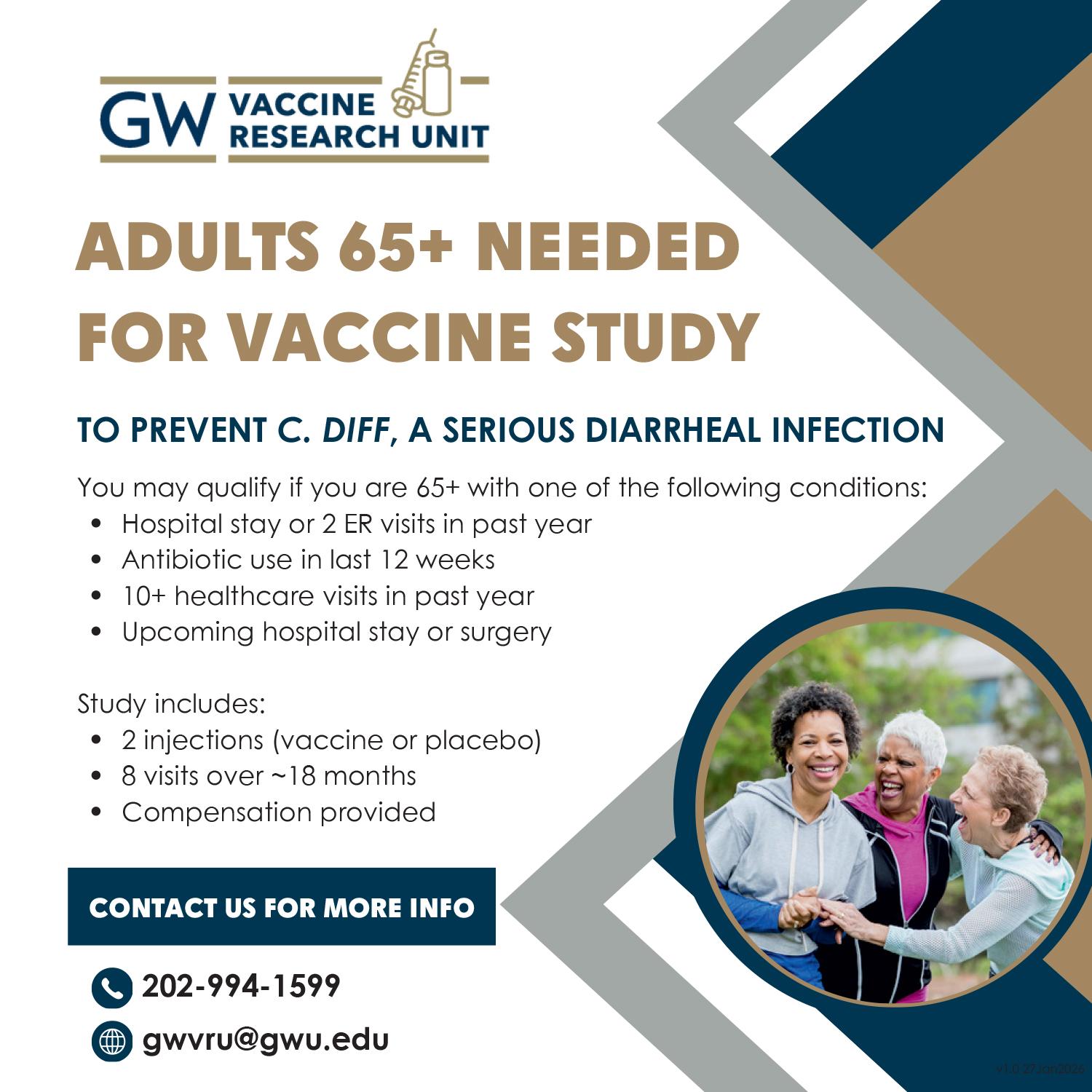
GW tests Pfizer’s new vaccine for C. diff
By Margaret Foster
If you’ve ever been hospitalized, you may have heard of C. diff. Short for Clostridium difficile , the highly contagious drugresistant bacteria infects half a million people every year, killing almost 30,000 Americans annually.
Scientists first identified C. diff in 1935, but in recent decades, due to antibiotic overuse, it has reached epidemic levels, particularly in hospitals. It causes severe diarrhea, fever, nausea and bloody stools. Most (80%) of the people who die from these infections are over 65.
Now Pfizer is testing a vaccine that could
BEACON BITS
Mar. 19
DEATH CAFÉ (VIRTUAL)
prevent C. diff infections.
If the vaccine works, “it would enormously cut down on illness and deaths — and costs to the healthcare system overall, by billions of dollars,” said Dr. David Diemert, director of George Washington University’s Vaccine Research Unit.
George Washington University is one of the 83 locations of the research study, known as the Beethoven study. Sponsored by Pfizer, the Phase III clinical trial will evaluate the safety and effectiveness of an investigational vaccine, which has not yet been approved by the FDA.
According to the CDC, C. diff spreads
This free program from AARP’s Senior Planet provides a safe space for conversations about death and dying. Each discussion usually covers beliefs, thoughts and feelings related to death. Moderated by an end-of-life doula, this free group meets on Thu., March 19 from 3 to 4 p.m. on Zoom. Join by using meeting ID 857 4081 7042, clicking the link at bit.ly/SeniorPlanetDeathCafe, or call in by dialing (888) 788-0099. For more information about this program, call (888) 713-3495.
when people touch contaminated surfaces or don’t wash their hands. Hand sanitizer doesn’t kill C. diff.
You’re most likely to contract C. diff five to 10 days after starting antibiotics.
“One of the main complications of taking antibiotics is that they can lead to C. diff, a serious gastrointestinal infection that can cause not only diarrhea and be uncomfortable for the person who’s affected, but it can lead to major complications that require hospitalization, and in the worst cases even require surgery to remove part of the intestine,” Diemert said.
Recruiting people 65 and up
People over 65 are eligible for the study if they took an antibiotic within the past three months; or were hospitalized within the past year; or had frequent visits to the doctor within the past year. (The trial is only for people who have never been diagnosed with C. diff.)
Pfizer will compensate participants for their time.
Three in-person visits
The study requires at least three in-
Grief
From page 5
difficult moments, experts agree empathy, patience and respect remain timeless.
Take the
Test Challenge Today Smell
Ongoing smell loss may be one of the most important signals of brain health as we age.
A new study from The Michael J. Fox Foundation for Parkinson’s Research is exploring this link. We’re calling on everyone with and without Parkinson’s to request a simple scratch-and-sniff test and contribute to important research.
Request your test at or scan the QR code.
Request your test at 877-525-PPMI (7764) mysmelltest.org/beacon or scan the QR code.
person visits to GW, located in Foggy Bottom in Washington, D.C. Diemert’s team will also keep in touch by phone at least three times. If patients happen to have gastrointestinal symptoms, Diemert’s team may ask them to come into the office again.
The first visit will last about two hours to fill out paperwork and receive an injection in their upper arm “just like a flu shot,” Diemert said. Six months later, they will get the second and final dose in a visit that will take less than an hour.
One group of people will receive two doses of the investigational vaccine (a traditional vaccine, not an mRNA or live vaccine). The other group will get two doses of a placebo (a saline shot).
On average, each person is expected to keep in touch with the research team for up to three and a half years.
If scientists can find a way to prevent C. diff , it would be a major medical breakthrough.
“It’s a really serious infection, and it’s a major problem, especially in hospitals, because C. diff can be transmitted between patients,” Diemert said.
For more information, call (202) 994-1599.
“Grief is deeply personal,” Clarke said. “When we slow down and lead with compassion, we honor both the person who has died and those who are left to grieve.”
To learn more about how to support a grieving person and access free, expertreviewed resources for navigating grief, expressing condolences and supporting loved ones before, during and after a loss, visit RememberingALife.com, an initiative of the NFDA.
This article was sponsored by the National Funeral Directors Association.
Study links Agent Orange to melanoma
A new study found U.S. veterans exposed to Agent Orange face a higher risk of developing a rare and often overlooked form of melanoma that appears on the hands and feet, and under the nails.
Researchers reported in JAMA Dermatology that veterans with documented exposure to the herbicide had significantly higher odds of developing acral melanoma, a subtype of skin cancer that forms on the
palms, soles and nail beds.
Unlike most melanomas, which are associated with ultraviolet radiation, acral melanoma develops in areas not typically exposed to the sun. It can resemble a bruise under a toenail or a dark patch on the bottom of a foot — locations that are easily missed and not commonly associated with skin cancer.
Because of its unusual appearance and location, acral melanoma is often diagnosed at later stages, when treatment is more difficult and survival rates are lower.
The researchers analyzed 20 years of Veterans Health Administration data, comparing more than 1,200 veterans diagnosed with acral melanoma with more than 5,000 veterans without melanoma. Veterans exposed to Agent Orange had about 30% higher odds of developing the disease.
The findings suggest Agent Orange may
be an under-recognized risk factor for acral melanoma, particularly for veterans who may not view themselves as at risk for skin cancer because of limited sun exposure or darker skin tones.
“Identifying exposures that may increase risk can help inform earlier recognition and, ultimately, earlier diagnosis when treatment is most effective,” said Marc Hurlbert, chief executive officer of the Melanoma Research Alliance and a principal investigator on the study.
Senior author Dr. Rebecca I. Hartman of Brigham and Women’s Hospital said acral melanoma behaves differently from other melanomas and often responds less well to current therapies.
“Acral melanoma has a poorer prognosis than the more common cutaneous melanoma because it is often diagnosed at later stages,” Hartman said. “Identifying risk factors is critical to improving detection and outcomes.”
Agent Orange was used extensively during the Vietnam War, and exposure has been linked to several cancers and chronic illnesses. These findings add to evidence the herbicide may also affect the skin in ways not reflected in traditional melanoma awareness efforts.
Acral melanoma has also been associated with sex, race and ethnicity, and prior skin lesions. Researchers said the study supports treating the disease as distinct from sun-driven melanomas that dominate public education campaigns.
For veterans, the research highlights the importance of examining less visible areas of the body, including the bottoms of the feet, between the toes and under the nails. Changes in nail color, dark streaks or unexplained spots on the palms or soles should be evaluated by a healthcare provider, especially for those with known Agent Orange exposure.
Researchers said the findings could help guide future screening strategies for higherrisk populations and encourage further study of why acral melanoma differs biologically from other skin cancers. Find more information at curemelanoma.org.
UVA maps brain’s blood pressure control center
Doctors usually focus on a person’s average blood pressure to prevent heart disease and stroke. But research increasingly shows that how much blood pressure fluctuates from moment to moment is just as important. In fact, excessive fluctuations are a strong predictor of heart disease, stroke and brain injury.
Now the University of Virginia School of Medicine’s Department of Pharmacology has identified a group of nerve cells in the
Best
Why choose Best Senior Care?
•
•
•
Does an apple a day keep the doctor away?
By Maggie Aime
An apple a day alone won’t save you a trip to the doctor, but it may be a good start toward better health. The phrase “An apple a day keeps the doctor away” comes from an old Welsh saying that encouraged eating apples at bedtime to ward off illness. While they’re not quite the medical miracle the saying makes them sound like, apples do have many health benefits.
1. May support heart health: Apples contain soluble fiber that can help lower lowdensity lipoprotein (LDL) cholesterol levels. LDL is considered the “bad” cholesterol since high levels can lead to plaque buildup in your arteries, which can cause heart issues.
Health News
From page 8
brainstem — which controls vital automatic functions — that act as a stabilizing system for blood pressure.
The new research, funded by a National Institutes of Health grant, suggests these cells help prevent fluctuations in blood pressure.
“What we found is that a loss of just a few hundred nerve cells leads to unstable blood pressure even though the mean blood pressure was normal,” said UVA’s Stephen Abbott, PhD, the lead investigator of the
Apples also have polyphenols, which are plant compounds that may help reduce the risk of cardiovascular disease.
2. May manage and lower the risk of Type 2 diabetes: Despite their natural sweetness, apples have a low glycemic index, meaning they don’t cause big spikes in blood sugar. The fiber in apples slows down how quickly sugar is absorbed, helping to keep your levels steady.
The polyphenols in apples may also help your body use insulin more effectively.
3. May protect cells from damage: Polyphenols and vitamin C in apples act as antioxidants. These substances help protect cells from oxidative stress, which is linked
study. “This shows that the system that keeps blood pressure steady from moment to moment is no longer working.”
Published in the journal Circulation Research last month, the findings could open the door to treatments to stabilize blood pressure and prevent those harmful effects.
“Our work emphasizes a new appreciation for how we think about blood pressure problems,” Abbott said. “It’s not just about lowering the numbers; it’s about keeping blood pressure stable from moment to moment.”
to chronic conditions like heart disease and cancer. Eating apples regularly may help your body boost its natural defenses against cell damage.
4. May reduce inflammation: Chronic inflammation is at the root of many serious health problems. Quercetin, a type of polyphenol in apples, helps lower levels of substances that trigger chronic inflammation and calm the body’s immune response. Over time, this may help reduce your risk of conditions linked to long-term inflammation, such as arthritis and high blood pressure.
5. May support gut health : Apples have pectin, a substance that acts as a natural thickener. Pectin feeds the good bacteria in your gut and helps them thrive. These friendly bacteria support digestion,
help reduce inflammation, and keep your gut healthy. A healthier gut helps maintain a strong immune system and may even influence your mood and mental wellbeing.
6. May help manage weight: Because they’re high in water and fiber, apples can help you feel full longer. People who regularly eat apples tend to have better overall diet quality and lower obesity rates. Plus, the polyphenols in apples may help reduce visceral fat (a type of belly fat linked to metabolic problems).
7. May lower cancer risk: While apples aren’t a guaranteed protection against cancer, including them in your diet may help lower
University of Virginia
Decid senio chan will f ding to transition to a or living community is nges you or your loved face What if you could ones trade
comm hs that keep families k,” hear resident stor nance on ies
We will discu
• The Wait-a waiting for options. uss: and-See Trap: Why r a crisis limits your
• The Wellne comprehen services he your indep
• Real Storie residents w time and e ss Advantage: Our sive programs and lp you maintain endence longer. s: Hear from ho reclaimed their nergy.
Could gene-editing fix high cholesterol?
By Lauran Neergaard
Scientists are testing an entirely new way to fight heart disease: a gene-editing treatment that might offer a one-time fix for high cholesterol.
It’s very early-stage research, tried in only a few dozen people so far. But geneediting approaches being developed by two companies show hints that switching off certain genes could dramatically lower artery-clogging cholesterol, raising hopes of one day being able to prevent heart attacks without having to take pills.
“People want a fix, not a bandage,” said Dr. Luke Laffin, a preventive cardiologist at the Cleveland Clinic.
After co-authoring a promising study published in the New England Journal of Medicine, Laffin said he was flooded with queries about how to participate in the next clinical trial.
Everyone needs a certain amount of cholesterol. But too much, especially of a “bad” kind, called LDL cholesterol, builds plaque in the artery walls and is a main driver of heart attacks and strokes. Cardiovascular disease is the nation’s — and world’s — leading killer.
Millions of people take cholesterol-lowering medicines such as statins, the cornerstone of treatment. But many still struggle to lower their cholesterol enough, and sticking with the drugs for life is difficult, with some quitting because of side effects.
Why genes matter for cholesterol
While your diet contributes to cholesterol levels, your liver produces the cholesterol your body needs, and genes play a role in how it’s managed.
Some people inherit genes that trigger very high cholesterol. Others have cholesterol that’s naturally extremely low over their
lifetime and seldom develop heart disease.
Years ago, Dr. Kiran Musunuru, a cardiologist now at the University of Pennsylvania, reported some of those lucky people harbor a mutation that turns off a gene named ANGPTL3, lowering their levels of both LDL cholesterol and another bad fat, triglycerides.
Separately, geneticists at UT Southwestern Medical Center found still other people’s extremely low LDL was due to loss of function of another gene named PCSK9.
“It’s a natural experiment in what would happen if we actually changed the gene,” said the Cleveland Clinic’s Dr. Steven Nissen, who with Laffin oversaw an ANGPTL3 study funded by Swiss-based CRISPR Therapeutics.
What early gene-editing studies show
Today there are injected medicines that block proteins produced by the PCSK9 and
MOST COMMUNITIES ARE 62 AND BETTER
ANNE ARUNDEL COUNTY
The Greens at Hammonds Lane: 410-636-1141
Park View at Furnace Branch: 410-761-4150
Park View at Severna Park: 410-544-3411
BALTIMORE CITY
Ednor Apartments I: 410-243-0180
Ednor Apartments II: 410-243-4301
The Greens at Irvington Mews: 227-240-8179
The Greens at Irvington Mews II: 240-209-4809
Park Heights Place: 410-578-3445
Park View at Ashland Terrace: 410-276-6440
Park View at Coldspring: 410-542-4400
BALTIMORE COUNTY
Cove Point Apartments I: 410-288-2344
Cove Point Apartments II: 410-288-1660
Evergreen Senior Apartments: 410-780-4888
The Greens at English Consul: 410-789-3000
The Greens at Liberty Road: 410-655-1100
The Greens at Logan Field: 410-288-2000
The Greens at Rolling Road: 410-744-9988
Park View at Catonsville: 410-719-9464
Park View at Dundalk: 410-288-5483 •
55 & Better
Park View at Fullerton: 410-663-0665
Park View at Miramar Landing: 410-391-8375
BALTIMORE COUNTY (CONT.)
Park View at Randallstown: 410-655-5673
Park View at Rosedale: 410-866-1886
Park View at Taylor: 410-663-0363
Park View at Towson: 410-828-7185
Park View at Woodlawn: 410-281-1120
EASTERN SHORE
Park View at Easton: 410-770-3070
HARFORD COUNTY
Park View at Bel Air: 410-893-0064
Park View at Box Hill: 410-515-6115
HOWARD COUNTY
Park View at Colonial Landing: 410-796-4399
Park View at Columbia: 410-381-1118
Park View at Ellicott City: 410-203-9501
Park View at Ellicott City II: 410-203-2096
Park View at Emerson: 301-483-3322
Park View at Snowden River: 410-290-0384
PRINCE GEORGE’S COUNTY
Park View at Bladensburg: 301-699-9785 •
55 & Better
Park View at Laurel: 301-490-1526
Park View at Laurel II: 301-490-9730
ANGPTL3 genes in the liver, thus helping the body clear away cholesterol.
The new research uses CRISPR, the Nobel Prize-winning gene-editing tool, to try switching off one of those genes in people at high risk from uncontrolled cholesterol.
In one study, 15 adults received a single infusion of tiny particles that carried the CRISPR tool to the liver, switching off the ANGPTL3 gene inside that organ’s cells.
Within two weeks, those getting the highest dose saw their LDL and triglyceride levels both drop by half, Laffin and Nissen reported in November.
Boston’s Verve Therapeutics, a subsidiary of pharmaceutical giant Eli Lilly, earlier reported that its PCSK9-targeted editing infusion cut LDL cholesterol by a similar amount in a small study.
Both companies’ initial studies were done in Australia, the U.K. and other countries. A Lilly spokesperson said U.S. study sites are opening. A next-step study of CRISPR Therapeutics’ approach should start later this year, Nissen said, with sites yet to be announced.
There are major safety questions to be answered, cautioned Dr. Joseph Wu of Stanford University, who wasn’t involved in either study.
CRISPR-based therapies for any disease haven’t been used enough to know longterm safety — and the particles carrying the gene-editing tool can irritate or inflame the liver, he said. Another unknown is whether gene-editing hits only the intended target.
That’s why for now, studies largely target people at very high risk.
What to do now for better heart health
Whether gene editing eventually pans out, the American Heart Association lists eight key factors for better heart health that everyone could work on now.
Some involve lifestyle. Eat a hearthealthy diet with lots of fruits and vegetables, whole grains and healthy fats like those found in nuts. Maintain a healthy weight. If you smoke, quit. And get enough sleep.
Also, be physically active, as exercise can increase so-called good HDL and help lower triglycerides.
On the medical side, control your blood pressure — levels measuring less than 120 over 80 are optimal. Diabetes also harms the heart, so control your blood sugar.
As for cholesterol, keeping levels of that “bad” LDL kind at 100 is considered fine for healthy people. But once people develop high cholesterol or heart disease, guidelines recommend lowering it to at least 70, even lower for those at high risk.
Colorectal cancer is on the rise under 50
By Lauran Neergaard
Colorectal cancer is a threat not just to older adults but increasingly to young men and women, too. It’s now the top cancer killer of Americans younger than 50.
“We’re now starting to see more and more people in the 20-, 30- and 40-year-old range developing colon cancer. At the beginning of my career, nobody that age had colorectal cancer,” said Dr. John Marshall of Georgetown University’s Lombardi Comprehensive Cancer Center.
That trend “is shaking us all, to be blunt,” said Marshall, who is also chief medical consultant to the Colorectal Cancer Alliance.
Here’s what to know about colorectal cancer — at any age — and how to protect yourself.
How common is colorectal cancer?
More than 158,000 cases of colorectal cancer will be diagnosed in the U.S. this year, according to the American Cancer Society. Among all ages, it’s the nation’s second leading cancer killer, behind lung cancer — expected to claim more than 55,000 lives this year.
For the population overall, cases and deaths have inched down in recent years.
Apples
From page 9
your risk of certain types of cancer. Regular apple consumption has been linked to a reduced risk of breast, lung and colorectal cancer. Polyphenols may help stop abnormal cells from multiplying and trigger the death of damaged cells.
8. May support brain health: As you get older, your brain becomes more vulnerable to oxidative stress, which is
That’s thanks in part to screening tests that can spot tumors early, when they’re easier to treat — or even prevent them if doctors find and remove precancerous growths.
Who’s most at risk?
The vast majority of colorectal cancer cases and deaths still are in people 50 and older. That older age group has seen the most progress, with deaths dropping by about 1.5% a year over the past decade, according to cancer society statistics.
But while it’s still relatively rare in the under-50 crowd, their colorectal cancer diagnoses have been rising since the early 2000s.
And last month, cancer society researchers reported that colorectal cancer mortality in Americans under 50 had increased by 1.1% a year since 2005, becoming the deadliest cancer in that age group. This year, the society estimates 3,890 people under age 50 will die of it.
Risk factors at any age include obesity; lack of physical activity; a diet high in red or processed meat and low in fruits and vegetables; smoking; heavy alcohol use; having inflammatory bowel disease or a family history of colorectal cancer.
linked to memory problems and dementia. The antioxidants in apples, especially phloretin, may help protect brain cells from this damage and reduce inflammation that can lead to cognitive decline.
Health delivers relevant information in clear, jargon-free language that puts health into context in peoples’ lives. Online at Health.com.
Marshall advises everyone to eat lots of fruits and vegetables and whole grains.
“Meat’s not evil,” but eat less of it, he said.
And a recent study found that a threeyear exercise program improved survival in colon cancer patients and reduced cancer recurrence.
What are the symptoms?
Symptoms include blood in stool or rectal bleeding; changes in bowel habits such as diarrhea, constipation or narrowing of stool that lasts more than a few days; unintended weight loss; and cramps or abdominal pain.
“Don’t ignore symptoms. Get it checked,”
Marshall stressed. Survival is far more likely when colorectal cancer is diagnosed early, before it spreads.
When to get screened
Medical guidelines say the average person should start getting screened at age 45 — too late for some adults.
How often people need to get checked depends on the type of screening they choose.
There are a variety of options, including yearly stool-based tests or colonoscopies that may be done every 10 years as long as no problems were found. There’s also a newer blood test for adults 45 or older.
Simple steps can make you less clumsy
By Howard LeWine, M.D.
Q: I’ve always considered myself clumsier than most people. Now that I’m in my 60s, it’s getting worse. Why is age a factor, and what steps can I take to overcome it?
A: Age-related changes can make all of us clumsier. Still, you need to consider whether you have developed a medical condition responsible for the difference now. For example, if your clumsiness has worsened over a short period or has resulted in a fall, you should get a medical evaluation.
As we age, many factors tend to impair smooth, agile and coordinated movements. For example:
Declining hearing, vision and touch
sensitivity. Common causes include hearing loss; reduced visual acuity, peripheral vision and depth perception; and diminished sense of touch in the hands and feet.
Nervous system changes. The brain, spinal cord and sensory and motor nerves undergo changes that lead to slower processing speeds and a reduced ability to react to obstacles and distractions.
Loss of muscle strength, power and flexibility. When older people start to lose balance or fumble a dish when trying to place it in the cupboard, their muscles don’t have the same ability to adapt and keep them from falling or dropping the dish.
Changes in the balance system. The
delicate balance system, housed in our inner ears and parts of our brain, functions less efficiently.
Medications. Many drug side effects, such as drowsiness from older antihistamines like diphenhydramine (Benadryl) or dizziness or lightheadedness from blood pressure drugs, can contribute to clumsiness.
Lack of attention and focus. This increases the chance of dropping an object, bumping into something or falling down.
Impact of health conditions. Chronic health conditions like arthritis, diabetes or Parkinson’s disease can make clumsiness even worse.
While many of the above factors cannot be reversed, there’s a lot you can do to help mitigate clumsiness and avoid injury:
• Practice activities that both strength-
BEACON BITS Mar. 17
FREE YOGA CLASS
en your hand grip and boost fine motor skills. Squeeze a tennis ball two or three times per day, gently stretch your fingers often, do jigsaw puzzles, or button and unbutton a shirt.
• Stay physically active. Exercise routines that incorporate balance, such as tai chi and yoga, can be beneficial. Also, do resistance training two to three times a week to build stronger muscles.
• Make quality sleep a priority. Inadequate and poor-quality sleep will decrease focus and stability, exacerbating clumsiness.
Howard LeWine, M.D., is an internist at Brigham and Women’s Hospital in Boston and assistant professor at Harvard Medical School. For additional consumer health information, visit health.harvard.edu.
Try a free, gentle yoga class designed for older adults who prefer a slower pace. This mixed-flow class incorporates both mat and standing poses. All skill levels are welcome to join. The class takes place on Tue., March 17 from noon to 1:30 p.m. at the Cleveland Park Library, 3310 Connecticut Ave. NW, Washington, DC. For more information and to sign up, email clevelandparklibrary@dc.gov, call (202) 282-3080 or visit bit.ly/flooryoga.
CAREGIVER SUPPORT GROUP
Apr. 9
This free support group provides a safe, welcoming and confidential space where caregivers can share their experiences, connect with others on a similar journey, and receive guidance from an expert. It takes place on Thu., April 9 from 3 to 4 p.m. at Great Falls Assisted Living, 1121 Reston Ave., Herndon, VA. For more information, email mperkins@greatfallsassistedliving.com or call (571) 520-2708.
alid Senior Smar A v rTTrip, Reduced Fare SmarTrip or Metro Access SmarTrip card is required for Metrobus.
UPCOMING SEMINARS & CLASSES
As experts in senior care, Brooke Grove Retirement Village is pleased to offer seminars and classes that promote physical, spiritual and mental well-being.
All programs will be held in-person in the Gathering Room at Brooke Grove Rehabilitation and Nursing Center, located at 18131 Slade School Road on the Sandy Spring, Maryland, campus of Brooke Grove Retirement Village. Register as indicated below or contact Toni Davis at tdavis@bgf.org with questions.
LIVING WELL SEMINAR: “KEEPING SENIORS SAFE”
Presented by Bill Peyser and the Montgomery County Department of Police THURSDAY, MARCH 19
10:30-11:45 A.M.
In this interactive discussion, get an overview of how scams are perpetrated and in-depth guidance to help spot and stop fraud before it is too late. We will focus on the manipulation techniques scammers use and discuss some of the most prevalent scams, phishing campaigns and fraudulent text messages, and show you how to identify the red flags.
FREE. To register, visit: bit.ly/ScamFreeMeBG
CAREGIVER SUPPORT GROUP FOR LOVED ONES LIVING WITH DEMENTIA
Offered in partnership with MedStar Health’s Center for Successful Aging & Ellis House
SECOND & FOURTH FRIDAY OF EACH MONTH 1-2 P.M.
Sponsored by the Alzheimer’s Association, this group is designed for family, friends and others engaged in the care and safety of someone touched by dementia. In this safe and confidential environment, you can develop informal and mutually supportive social relationships, gain understanding, share caregiving tips and discover other helpful information.
FREE. To register, visit: bit.ly/BGAlzSupport
EXERCISE FOR PARKINSON’S
Offered in partnership with the Parkinson’s Foundation, NCA
MONDAYS & WEDNESDAYS 12 NOON-1 P.M.
This class for those with Parkinson’s or other neurodegenerative diseases aims to improve posture, balance and circulation while also increasing strength, muscle control and mobility.
FREE. To register, visit: bit.ly/BGRVParkExercise
LIVING WELL SEMINAR: “SUPPORT MENTAL AND COGNITIVE HEALTH THROUGH NUTRITION & LIFESTYLE”
Presented by Lisa Jo Finstrom, MS, CNS, LDN THURSDAY, APRIL 16 10:30-11:45 A.M.
Learn evidence-based information to help you or a loved one optimize mental health and avoid cognitive decline. We’ll delve into nutrition and lifestyle considerations with time for questions.
FREE. To register, visit: bit.ly/NutritionBG
Let’s reconsider what ‘aging well’ means
By Alina Tugend
Warren Mullisen, 81, of Culver City, Calif., was a runner all his life and competed in numerous marathons.
But a few years ago, he slipped on loose gravel while running up a trail and fell backward, hitting his head. He suffered a brain injury that impaired his balance.
“The legs don’t seem to move when I’m trying to run,” he said. Despite physical therapy, his neurologist said that most likely won’t change.
It has been, he said, “a daily struggle of coping and adjustment.”
Facing declining abilities is always hard, especially in a society where the pressure to “age well” is so prevalent.
The habits for a happy retirement are fairly clear — exercise, build social networks, take up hobbies, volunteer — and the promised benefit is that you can remain active and alert as the years pass. Those benefits might not always follow, though.
Most people experience growing older as a combination of delights and difficulties. All of us face the same struggle: The body or mind (or both) stops performing as well as it used to. Yet we continue to compare our-
selves to others or to our younger selves.
“A lot of the struggle comes from the gap between what aging ‘should’ look like in the modern narrative and what aging actually looks like for real people,” said Pouyan Golshani, an interventional radiologist.
“I’ve watched older adults thrive once they stop judging themselves against their younger brain. It’s not about outrunning limitations — it’s about staying curious and adjusting with dignity.”
What is aging well?
When viewed simplistically, the concept of “successful aging” can too easily translate into the idea that people have somehow failed if they’re not healthy, fit and financially well off in later years.
“There is this sort of odd American thing where we believe that we can always be the exception, and somehow the exception becomes the goal or the standard,” said Michelle Putnam, director of the Gerontology Institute at the University of Massachusetts, Boston.
Most people say they want to age well, but what exactly does that mean?
A 2024 international survey found that
among the almost 2,000 people who responded, the most prominent theme when asked to define aging well was “active, independent and engaged.”
“That is in contrast to the conception that successful aging is solely or predominately related to the absence of disease or decline,” the authors wrote.
A recent Pew Research survey on how Americans think about aging and experiences found that 67% of those 65 years and older believe they have control over their physical health and 60% over their physical mobility. Fewer than half (47%) believe they have control over their mental sharpness.
The reality is, according to the U.S. Census, that almost a quarter of those 65 and older have a disability. That number nearly doubles, to 46%, for those 75 and older.
Other factors that influence aging
Of course, research has repeatedly found that those with lower household wealth or socioeconomic status see greater declines in numerous areas — including physical capabilities, cognitive function and social engagement — than those in wealthier households.
The Pew survey found that some 61% of those with higher income say they are aging extremely or very well, compared to 51% of those in the middle-income tier and 39% of those with lower income.
The model of aging successfully — and blaming individuals if they fail to live up to it — makes “many assumptions about what’s been available to people over their life course,” Putnam said.
“Particularly in later life, in order to really get to that spot where you’re doing fantastic and you don’t have a lot of health problems,
you probably had health insurance your whole life,” she pointed out. “You probably had a job that wasn’t crazy physically demanding. You probably didn’t experience a lot of physical violence or abuse.”
Lessons learned about aging well
Almost everyone faces physical and mental decline as they age, but that doesn’t mean those symptoms are solely due to getting older. Sometimes, too much or the wrong medication can cause confusion and memory loss, mimicking dementia.
Physical or occupational therapy can help improve strength and mobility at all ages. If your doctor or other medical provider is dismissive of your concerns, seek out another.
If a physical or mental limitation does prevent you from doing something you once enjoyed or that gives you a sense of worth, take time to acknowledge and grieve that loss.
It can help to consult with an expert. Occupational therapists trained as driver rehabilitation specialists, for example, can evaluate older drivers and, in some cases, offer ways to help them continue driving.
Some communities can make easy, inexpensive changes to make aging easier, such as installing benches in grocery stores and other places for a brief respite or toning down background music to make it easier for people to hear.
“Being more inclusive of older adults is good for everybody, and sometimes that gets lost,” Putnam said.
A longer version of this story first appeared in Kiplinger Personal Finance Magazine, a monthly, trustworthy source of advice and guidance.
Lori Sepich smoked for years and sometimes skipped taking her blood pressure medicine. But she never thought she’d have a heart attack.
The possibility “just wasn’t registering with me,” said the 64-year-old from Memphis, Tennessee, who suffered two of them 13 years apart.
She’s far from alone. More than 60 million women in the U.S. live with cardiovascular disease, which includes heart disease as well as stroke, heart failure and atrial fibrillation. And despite the myth that heart attacks mostly strike men, women are vulnerable too.
Overall in the U.S., 1 in 5 women dies of cardiovascular disease each year, 37,000 of them from heart attacks.
Cardiovascular disease is “the No. 1 killer of women. It will affect you or someone you know,” said Dr. Sharonne Hayes, a cardiologist at the Mayo Clinic in Rochester, Minnesota. “Knowing what to do if you have symptoms of a heart attack and taking action if you do, that’s really important.”
Reduce risk of heart attacks
There are several ways anyone can reduce their risks.
The American Heart Association has created a list called “Life’s Essential 8”: eat better, quit tobacco, get healthy sleep, be more
active, control cholesterol, and manage weight, blood sugar and blood pressure.
Dr. Stacey Rosen, association president, advises getting regular checkups to talk about these preventive measures, keep tabs on your health and discuss any family history of heart problems.
Doctors also suggest discussing risk factors that uniquely or disproportionately affect women.
Women are more likely to have autoimmune conditions like lupus or rheumatoid arthritis, which cause inflammation that can raise heart disease risk. They’re also more likely to suffer from depression, which is associated with inflammation and unhealthy behaviors like staying in bed.
Other conditions associated with an increased risk of cardiovascular disease are a history of high blood pressure or diabetes while pregnant, miscarriages or stillbirth. Hot flashes and night sweats during menopause have also been linked to a greater risk of high blood pressure and other cardiovascular risk factors.
Not like the movies
When people think about heart attacks, many envision a middle-aged man suddenly clutching his heart and falling to the ground. But in reality, Hayes said, “it’s not going to probably be one of those Hollywood
heart attacks.”
Chest pain or discomfort is a usual symptom, but far from the only one.
“What’s different about women is that they are more likely than men to have other symptoms as well,” Rosen said.
Those include back pain, shortness of breath, cold sweats, tiredness, nausea, lightheadedness, an anxious feeling, jaw pain and finger tingling.
Experts aren’t sure exactly why symp-
toms differ between men and women, but some research suggests that physiological differences may play a role.
Another difference: Symptoms may come on a bit more subtly for women than men. Hayes hears a common refrain from patients: “I got the symptom and it waxed and waned a little bit over time, but I knew something wasn’t right.”
MEDICARE ASSIGNMENT ACCEPTED
LENARD H. HAMMER, M.D., F.A.C.S.
GORDON LUI, M.D.
SCOTT B. BECKER, M.D.
YIYUN ZHOU, M.D.
What is A-fib and how do doctors treat it?
By Mike Stobbe
Daniel Moore was about 30 years old the first time it happened. At the end of a long, hot, stressful day, he chugged an ice-cold glass of milk.
“It felt like a bunny rabbit trying to jump out of my chest,” said Moore, now 60. Moore, a radiologist, knew what it was: A-fib. Short for atrial fibrillation, A-fib is a quivering or irregular heartbeat that is a worrisome stage-setter for blood clots, stroke and heart failure.
Some researchers believe more than 10 million Americans have it — most of them older. And it’s expected to become even more common in the years ahead.
One reason A-fib diagnoses are increasing is that smartwatches and other devices can detect erratic heartbeats.
Still, University of Utah heart researcher Dr. T. Jared Bunch sees reason for optimism.
“Even though we see more of the disease, we’re better at treating it,” said Bunch, who co-authored a book on A-fib.
Symptoms include shortness of breath
A-fib occurs when the heart’s upper chambers, called the atria, beat out of sync with the lower chambers, the ventricles.
Heart attacks
From page 15
Take immediate action
“If you think that there’s even a chance that you’re having a heart attack, that’s when you call 911,” Rosen said, adding that it’s better to “err on the side of overconcern than err on the side of minimizing something that could be quite serious.”
Doctors recommend taking an ambulance
Not everyone is aware something is wrong, but some people suffer alarming symptoms like a pounding heartbeat and shortness of breath.
“I definitely have no exercise tolerance when I’m in it,” Moore said. “I can’t run. Walking is tiring. I get a little light-headed standing up.”
The heart can surpass 200 beats per minute for someone with A-fib, more than double the 60 to 100 beats typical for a healthy adult’s resting heart rate.
Symptoms can come and go, and it’s not usually life-threatening by itself. But the erratic beating can lead to blood pooling in the heart that can become clots in days or even hours. Those clots, in turn, can travel to the brain and cause strokes.
A-fib also can increase the risk of developing ventricular fibrillation, a more serious condition.
Studies have suggested 15% or more of strokes can be tied to A-fib, and that the percentage rises in older people. The condition is one reason that U.S. stroke deaths rose in the last decade, although the stroke death rate has dipped in the last few years.
What causes A-fib?
Researchers attribute A-fib to damage in the heart’s upper chambers and its electri-
to the hospital, which is more equipped to handle emergency situations than urgent care centers or a doctor’s office.
Any delays in getting the right care could be harmful or even deadly.
“If you wait too long,” Rosen said, “the damage can be more significant.”
Don’t be in denial
When Sepich had her first heart attack, she waited too long. She had largely been
cal signaling. Genetics can play a role, but other contributors include high blood pressure, diabetes, stress, sleep apnea, smoking and alcohol.
Those harms accumulate over time, which is one reason why the condition tends to hit older adults. About 70% of A-fib cases are people 65 and older.
Viruses can also pose a threat because they can affect the proteins behind the heart’s electrical signals or prompt an immune response that damages heart tissue. Covid-19 is among the list of viral culprits, and likely contributed to A-fib in some patients, experts say.
Treatment options
There’s no cure, but a number of therapies can help manage the problem.
“We’re miles beyond where we used to be” in treating A-fib, said Dr. Laurence Epstein, of Hofstra University and Northwell Health. “The technology has really evolved.”
One initial treatment is a “cardioversion,” which involves using a defibrillator to deliver an electric shock to the heart to restore rhythm. It’s often successful, but sometimes only temporarily.
For some patients, doctors may recommend implanted devices. Pacemakers can regulate heart rhythm, and a device called
in denial about her heart problems since being diagnosed with severe, hereditary high blood pressure at 17.
On Easter Sunday 2005, she woke up to extreme chest pressure, nausea and pain radiating down her arms.
“I chose to ignore those signs that day because I was absolutely in shock,” she said. “I was scared.”
She eventually went to the ER at her doctor’s urging, where she wound up having
a Watchman can close off a clot-prone area of the upper heart.
And then there’s ablation. It’s a procedure in which a doctor uses heat, cold or electric pulses to zap certain areas of the heart, creating scars that block faulty electric signals.
How to lower your risk
People can lower their risk of developing A-fib by living a healthy lifestyle. That includes exercising, getting enough sleep, eating a healthy diet, managing high blood pressure and avoiding tobacco and alcohol.
Doctors also have long warned about excessive levels of caffeine, although some new evidence suggests that at least a little may be fine. One small study published recently found that patients who averaged one cup of caffeinated coffee a day saw less recurrence of symptoms than those who abstained entirely.
If symptoms do develop, it’s important to take them seriously, said Amy Stahley, who was first diagnosed three years ago.
Stahley, a nurse and dean of Davenport University’s College of Health Professions in Michigan, went to bed one night, and her heart began racing to more than 150 beats per minute. She immediately went to a hospital.
“If you’re feeling a little off, get it checked out,” she said. AP
six stents placed and spending a week in the hospital. Sepich now keeps her blood pressure under control, hasn’t smoked in more than two decades and exercises almost every day.
She urges other women to be honest with themselves about heart disease.
“I could justify my actions from denial. I could just be like, ‘Oh, it’s not gonna hurt you,’” Sepich said. “Well, it does hurt you. It can kill you.” —AP
Can you reverse and prevent gum disease?
By Harvard Health Publishing
The term “gum disease” sounds serious, and it is. Advanced stages cause bone and tooth loss, which affect your ability to eat, speak clearly and socialize.
Even early stages of gum disease are risky, increasing the chance of developing heart problems, Alzheimer’s disease and other chronic conditions. Fortunately, simple steps can reverse and prevent the early stage of gum disease, which is called gingivitis.
What is gingivitis?
When you have gingivitis, the tissue at the base of your teeth, called gingival tissue, becomes inflamed or swollen. The most common form of gingivitis happens when food particles and other substances build up around your teeth, causing sticky plaque and hard tartar to form at and below your gums.
“In the early stage, this buildup isn’t harmful if home care and regular dental cleanings can keep the inflammation in check,” explains Dr. Tien Jiang, an assistant professor in oral health policy and epidemiology at the Harvard School of Dental Medicine.
However, ongoing inflammation from gingivitis, especially as it travels below the gum line, can lead to an irreversible form of gum disease called periodontitis, which can damage the tissues and bones that sup-
port your teeth. (Dental X-rays may be needed to see if the inflammation from gum disease has become periodontitis.)
In addition, studies have shown that having gum disease can put you at higher risk for heart attack, stroke and dementia.
Causes and symptoms
Certain risk factors increase your chances of getting gingivitis, including: poor dental hygiene, smoking, diabetes that isn’t well controlled, infections elsewhere in your body, misaligned teeth, unclean mouth appliances (such as braces or dentures) and certain medicines.
If gingivitis develops, you might not even know it; initially, gingivitis is usually painless. As it progresses, gingivitis symptoms can include: red, sensitive or swollen gums; gums that bleed when you brush or floss your teeth; and bad breath or mouth sores.
Treating gingivitis
Regular cleanings from a dentist or dental hygienist can remove plaque deposits before gingivitis causes more serious problems. The dental team has special tools that can scrape under the gumline.
If your gums are sensitive after cleanings, rinse your mouth with warm water mixed with table salt twice a day, taking acetaminophen or ibuprofen or both.
“If the gingivitis was extensive, you may need to allow up to two weeks for the tissues in your mouth to recover,” Jiang said. You can ask your dentist to go over toothbrushing techniques with you, as well as whether you could benefit from an electric toothbrush, a special toothpick or a water flosser.
Reversing and preventing gingivitis at home
Brushing teeth at least twice a day, and flossing at least once a day, can help reverse and prevent gingivitis.
Jiang recommends brushing in front of a mirror in a bathroom with good lighting. She suggests pulling back your lips to look
in a mirror for plaque at the gumline, or feeling with your tongue after brushing to search for rough areas of plaque.
If you spot remaining plaque, angle your toothbrush to better reach those areas. If you repeatedly miss certain areas, try replacing your toothbrush head. Often, a smaller toothbrush head can do a better job of getting to hard-to-reach areas.
Your dentist also may recommend antiplaque or anti-tartar toothpastes or mouth rinses.
Identifying hot spots
Not sure if you’re brushing adequately?
Inspired Apartment Living In The Heart Of Rockville
Our smart studio, one-, and two-bedroom apartment community is thoughtfully designed for adults 62 and better. Bethany House offers comfort, convenience, and connection.
Bethany House is a perfect place to call home in Rockville!
Amenities
Laundry Facilities
Elevator
Landscaped Courtyard
On-Site Parking
On-Site Management
On-Site Maintenance
Public Transportation
Spacious Closets
Large Windows
Central Air Conditioning
Twinbrook Metro Rooftop Space Walk-in Closets*
News from the Montgomery County Recreation Department
proof of address; our front desk staff can sign you up and take your photo for your account.
MONTGOMERY COUNTY
Recreation
Montgomery County Recreation is working to serve residents ages 55+ with affordable, accessible programs.
We operate seven Senior Centers and 13 Community Centers that offer a wide selection of daily events and activities, classes, intergenerational opportunities, computer education, fitness rooms, a lunchtime meal program, dance classes, health programs and much, much more. Recreation isn’t just about exercise; it’s about community and connection!
Our centers strive to offer programs with broad appeal and are open to anyone 55 and older who walks through our doors.
A perk available to all County residents is FREE center membership passes that provide free admission to any Senior Center or Community Center operated by Montgomery County Recreation. The free pass provides access to fullyequipped fitness rooms, open gym (drop-in) activities and game rooms at any Community Recreation Center during regularly scheduled hours. The free pass does not include admission to aquatic centers.
To get your free pass, simply visit your local Community or Senior Center with
The newest facility, the recently opened Center in downtown Silver Spring, is a true gem. The facility is located on the lower three floors of the remodeled Elizabeth House, an affordable, independent senior housing community. The new facility offers a combination of aquatics,
Senior Centers
Damascus Senior Center: (240)777-6995
Holiday Park Senior Center: (240)777-4999
Long Branch Senior Center: (240)777-6975
Margaret Schweinhuat Senior Center: (240) 777-8085
Nancy H. Dacek North Potomac Senior Center: (240)777-4805
Wheaton Senior Center: (240)773-4830
White Oak Senior Center: (240)777-6944
Silver Spring Recreation and Aquatics Center: (240) 777-6900
Active Adult Centers
Bauer Drive Community Recreation Center: (240)777-6922
Clara Barton Neighborhood Recreation Center: (240)777-4910
Clarksburg Park Building: (240)777-4925
senior, and community center programs.
To learn more about Recreation Department programs, visit our webpage at: montgomerycountymd. gov/rec. For programs for older adults, call (240) 777-4925.
We invite you to visit one of our Senior Centers or Community Centers. Call first about our hours of operation.
Gwendolyn Coffield Community Recreation Center: (240)777-4900
East County Community Recreation Center: (240)777-8093
Germantown Community Recreation Center: (240)777-8098
Jane E. Lawton Community Recreation Center: (240)777-6855
Longwood Community Recreation Center: (240)777-6920
Mid-County Community Recreation Center: (240)777-6820
Plum Gar Community Recreation Center: (240) 777-4919
Potomac Community Recreation Center: (240) 777-6960
Marilyn Praisner Community Recreation Center: (240)777-4970
Ross Boddy Neighborhood Recreation Center: (240)777-8050
Serve a stew with mashed potatoes or veggies
By Pamela Anderson
Cooking with wine always feels elegant and elevated. This Vegetable Bourguignon, from my cookbook I Love You: Recipes from the Heart is hearty and satisfying. And it’s always good for leftovers.
Serve it with a mashed vegetable — potatoes or celery root (also known as celeriac). Parsnips can work too.
In this recipe, I call for celeriac because I enjoy sneaking in new things for my family to try. My dad had no idea he was eating mashed celery root instead of his regular potatoes at a Sunday meal... and almost fainted when I told him. Gotcha!
Vegetable Bourguignon with Mash
Servings: 6
Ingredients:
For the bourguignon
1/3 ounce dried porcini mushrooms
2½ cups boiling water
2½ tablespoons extra-virgin olive oil
1 yellow onion, finely chopped
4 garlic cloves, minced
2 large carrots, cut into chunks
2 celery stalks, cut into chunks
Fine sea salt
1 tablespoon tomato paste
1 tablespoon all-purpose flour
1 cup red wine
Gum disease
From page 17
This might be a concern if you’ve lost hand dexterity, and wielding a toothbrush is tough. But give yourself some credit.
“Most people do a good job removing plaque from the smooth or chewing surfaces of their teeth,” Jiang said, “but you need to pay attention to other places where
½ small bunch (about 100 g) lacinato kale, center ribs removed, leaves chopped
1 tablespoon balsamic vinegar
Freshly ground black pepper
Chopped flat-leaf parsley, for garnishing
For the mash
3½ pounds potatoes or celeriac (about 2)
6 garlic cloves, sliced
¼ cup butter or plant butter
3 tablespoons sour cream or vegan sour
cream
Fine sea salt
Freshly ground black pepper
Directions:
Make the bourguignon: Preheat the oven to 350° F. Place the dried porcini mushrooms in a small, heat-proof bowl and pour the boiling water over them. Set aside to soak while you cook the vegetables.
Warm the olive oil in a Dutch oven or other heavy-bottomed pot over medium heat. Add the onion and cook, stirring occasionally, until softened and golden, about 5 minutes. Add the garlic and cook, stirring constantly, for 1 minute. Add the carrot, cel-
plaque sticks, such as the gumline or between teeth, in order to avoid gingivitis.”
ery, and ½ teaspoon salt and cook, stirring occasionally, until the vegetables are tender. Stir in the tomato paste and flour and cook for another minute. Pour in the wine, stirring and scraping the bottom of the pot to loosen any golden bits. Add the soaking liquid from the porcini mushrooms (give the porcinis a quick chop and add them as well) along with the sliced fresh mushrooms.
Tie the thyme, rosemary and bay leaves into a little bundle with a piece of twine and add to the pot. Cover the pot and put in the oven to cook until the vegetables are very tender and the stew has thickened slightly, 20 to 30 minutes.
Meanwhile, make the mash: Peel the celeriac or potatoes and cut into large chunks. Place them in a medium saucepan with the garlic and cover with cold water. Bring to a boil and cook, uncovered, until tender when poked with a fork, about 15 minutes. Drain. Return the drained potatoes
or celeriac and garlic to the pot, add the butter and sour cream, and mash until smooth and creamy. Season with salt and pepper to taste.
Remove the bourguignon from the oven. Mix in the kale, cover the pot, and return it to the oven to cook for a final 10 minutes or so, until the kale is tender. Stir in the vinegar and season with pepper and ½ teaspoon salt. Taste and add another little pinch of salt if you like.
Serve the bourguignon garnished with chopped parsley alongside the mash.
Pamela Anderson, author of I Love You: Recipes from the Heart, is an actress, activist and lifelong cook and homemaker. Excerpted from I Love You by Pamela Anderson.
Happy March! This month allows us to “spring forward” and embrace a new season of growth and renewal. It also marks the end of the first quarter of the year. Please know that the Department of Aging and Community Living (DACL) has been diligently at work on your behalf since the very beginning of this year.
Just last month, we had the opportunity to share that work with the entire District during our annual Performance Oversight Hearing before the Committee on Executive Administration and Labor, chaired by Councilmember Anita Bonds. I was honored to testify about the progress we have made together and the meaningful ways DACL and District residents continue to work hand in hand.
Our focus remains clear: expanding access to vital services, combatting senior isolation, strengthening nutrition and wellness programs, and continuing to show up for older adults in every ward. District seniors, I want to extend my warmest gratitude to you for consistently showing up, staying engaged, and supporting our efforts. This work would not be possible without you.
It also would not be possible without the dedicated DACL team members who serve you each day. As we embrace this new season, March also brings meaningful opportunities to recognize the professionals and leaders who make our mission possible. This month, we observe National Nutrition Month, National Social Work Month, and Women’s History Month, each reflecting the heart of the work we do at DACL.
In honor of National Nutrition Month, I would like to extend my sincere appreciation to our incredible Nutrition Services team. Their dedication ensures that seniors across the District have consistent access to healthy, nourishing meals. Because of their hard work and commitment, nearly 900,000 meals were provided to seniors throughout the District in Fiscal Year 2025 alone. That impact represents far more than a number — it reflects care, dignity, and daily support for our older adults.
To further support healthy eating, in addition to our more than 40 community dining sites, we expanded our reach last year by adding two new locations in Ward 7: The Pennsylvania Avenue Baptist Church
DACL Celebrates the 3rd Annual Red, White, and You
Love was in the air at our Red, White, and You Valentine’s Day celebration!
DC seniors gathered for an afternoon filled with music, laughter, sweet treats, and heartfelt moments. From dancing to reconnecting with friends, it was a beautiful reminder that love, community, and joy have no age limit.
Thank you to everyone who joined us to celebrate the heart of our city — our seniors!
(3000 Pennsylvania Ave. SE) and Zion Baptist Church of Eastland Gardens (1234 Kenilworth Ave. NE). If you have questions about nutrition services or community dining sites, please call us at 202-724-5626.
March also marks National Social Work Month.
DACL is fortunate to have a dedicated team of social workers within our Adult Protective Services (APS) division. APS works to protect vulnerable adults from physical, financial, or emotional abuse, as well as neglect and self-neglect. These team members ensure that residents in need of protection are connected to critical services and support. To report allegations of abuse, neglect, self-neglect, or exploitation, please call the APS Hotline at 202-541-3950, available 24 hours a day, seven days a week.
Finally, March is Women’s History Month, a time to recognize the women who continue to blaze trails and
create lasting change in every community they serve.
We see this leadership reflected in women such as Mayor Muriel Bowser, the only three-term mayor in the District’s history, and pioneers like Virginia Ali, owner of the historic Ben’s Chili Bowl. I also have the privilege of working alongside an all-women senior leadership team at DACL that continues to leave a meaningful mark on the services we provide to seniors across the District. I could not be prouder of their leadership and dedication.
As we step into this new month, I wish you a joyful and fulfilling March.
In Ser vice,
Charon P.W. Hines Director, Department of Aging and Community
Living
DACL’s Performance Oversight Hearing
Last month, the Department of Aging and Community Living (DACL) proudly testified at our Performance Oversight Hearing before the Committee on Executive Administration and Labor, chaired by Councilmember Anita Bonds. We highlighted the incredible
progress made over the past year, expanding access to vital services, combatting senior isolation, strengthening nutrition and wellness programs, and continuing to show up for DC’s older adults in every ward!
Living Boldly is published by the Information Office of the DC Department of Aging and Community Living for DC senior residents. Advertising contained in the Beacon is not endorsed by the DC Department of Aging and Community Living or by the publisher.
Director
Charon P.W. Hines
Editor Amanda Washington
Photographer Estefani Legge
Money Law &
See story on opposite page.
Serious medical diagnosis? Take these steps
By Thomas C. West
As a wealth manager, I often guide clients through unexpected financial and healthcare challenges, including receiving a lifealtering medical diagnosis.
According to the National Institutes of Health, 85% of Americans over 65 have at least one chronic health condition, and 60% have at least two chronic conditions.
Receiving a diagnosis of a serious condition, such as cardiovascular disease, cancer, chronic respiratory disease or diabetes, can bring up a wide range of emotions.
Many people feel shock, fear or anxiety as they process what the diagnosis means for their future.
Others may feel sadness, frustration or even denial, especially if they were not expecting the news. Some might experience relief if the diagnosis explains ongoing symptoms and opens the door to treatment.
If you’re affluent, financial security may not be your primary concern, but structuring wealth to align with new health realities is crucial.
When faced with such news, the first step is to organize your priorities and ensure that your healthcare, legal and financial
strategies support your evolving needs.
1.Establish a healthcare plan
Your medical diagnosis will dictate various aspects of your future planning. Consider asking your healthcare team these key questions:
•What does your treatment plan entail?
•Where will you receive care — in your home, a specialized community or a hospital?
•Who needs to be involved in your care management?
•How might your health change over time?
•Who in your circle — family, friends or medical professionals — will take an active role in making decisions with you?
Whether your top priority is staying at home, ensuring your spouse’s financial stability or securing the best medical care available, identifying these objectives early leads to a more effective financial plan.
2.Organize your finances
Once your healthcare plan is clear, the next step is reviewing your financial landscape. As your medical professionals will have a plan for your health, your financial team will need to come up with a plan for your finances based on your diagnosis.
Even for high-net-worth individuals, cash flow, liquidity and asset structuring are vital to ensuring financial stability through medical transitions, and organizing these key items is essential.
Here’s a list of what you will need to do:
Inventory your assets. Create a detailed list of all assets, including real estate, investment accounts, business holdings, valuable personal property and any other financial resources.
Identify and project income sources. Assess all sources of income, including Social Security benefits, pensions, veterans’ benefits, annuities, dividends, rental income and other passive income streams.
Evaluate healthcare and long-term care costs. Examine current and projected medical expenses, including insurance coverage, out-of-pocket costs, and potential long-term care needs.
Review ownership structure and estate planning. Confirm that beneficiary designations are up to date. Review the ownership structure of investment accounts, trusts and real estate to ensure they align with estate planning goals.
cision-makers — such as power of attorney agents, trustees or financial advisers — are still the best individuals for the role. Consider their financial acumen, trustworthiness and willingness to act in your best interest, and update documents as necessary.
A well-prepared financial plan should address not only current needs but also future scenarios, including increased healthcare costs, the need for more structured wealth distribution strategies, or potential liquidity needs in the future.
Consider how these expenses will impact overall cash flow and whether adjustments to spending or investment strategies are necessary.
3.Legal considerations and estate planning
Next, update your legal documents accordingly, including:
•Wills and trusts that reflect your new healthcare and financial priorities
•Powers of attorney for financial and healthcare decisions, ensuring the right individuals are authorized to act on your behalf if you were to become incapacitated
Don’t get hit by the Medicare tax torpedo
By John J. Gardner
When retirees map out income in retirement, most think about their tax bracket, investment returns and required minimum distributions (RMDs).
What often gets overlooked is how Medicare premiums can rise dramatically if income crosses certain thresholds — a penalty known as the income-related monthly adjustment amount (IRMAA).
For higher-income retirees, IRMAA can quietly erode thousands of dollars a year. Worse, it can be triggered by financial moves that seemed smart at the time, like a Roth conversion or capital gains harvest.
This is what some advisers call the Medicare “tax torpedo” — an unexpected hit to your retirement budget that lurks beneath the surface. Like any hidden threat, you don’t always see it until it’s too late. Here’s what you need to know and how to sidestep it.
What is IRMAA?
Medicare Part B and Part D premiums are based on modified adjusted gross income, typically from your tax return two years prior. In 2025, for example, Medicare will look at your 2023 tax return.
For 2025, the base premium for Part B is $185 per month. But if your income in 2023 rose above $106,000 (single) or $212,000 (married filing jointly), surcharges kick in.
These surcharges can push Part B premiums as high as $628.90 per person, per month, not including the extra cost for Part D coverage.
Over a couple’s lifetime, these hidden costs can easily run into the six figures.
How the ‘tax torpedo’ strikes
The danger is that IRMAA thresholds are cliffs, not gradual phase-ins. Even one dollar over the line moves you into a higher premium bracket. This means a one-time event — selling property, a Roth conversion, taking
a large IRA distribution — can inflate
Medicare premiums for an entire year.
Consider this example:
To determine a couple’s 2024 Medicare premiums, let’s look at their income from two years before. Their modified adjusted gross income (MAGI) was $205,000 in 2022, just under the threshold for that year of $206,000. So, their Medicare premiums for 2024 stay at the base level of $174.70/month each.
The next year, they sell some stock, pushing their 2023 MAGI to $213,000. They’re only $1,000 over the limit, but now their 2025 premiums jump to $259/month each, an increase of $74/month over the base premium of $185.
That “extra” $1,000 in income cost them each nearly $900 in higher premiums for the year. And that’s only for Medicare Part A. Add in the IRMAA surcharge for Medicare Part D, and each person would pay a little over $1,050 per year in higher premiums —
for a grand total for the couple of over $2,100. They don’t call it the Medicare torpedo for nothing. One dollar over the limit, and — boom — you’re hit with a penalty that feels wildly out of proportion.
Strategies to avoid the hit
Fortunately, careful planning can help retirees stay clear of the Medicare torpedo: 1.Time Roth conversions carefully. Roth conversions can be powerful for longterm tax efficiency, but if done too aggressively, they can spike MAGI and trigger IRMAA.
In my practice, I’ve seen retirees save tens of thousands over their lifetime simply by timing Roth conversions before age 65. 2.Manage RMDs with QCDs. Once RMDs begin at age 73, those withdrawals count toward MAGI.
A qualified charitable distribution (QCD)
See DIAGNOSIS , page 25 See TAX TORPEDO , page 25
Morningstar’s Christine Benz suggests smart ways to gift money to family.
What to know before making financial gifts
By Christine Benz
If you have gifting to loved ones on your mind, here are some considerations related to taxes and logistics.
Unless you’re writing a check from your bank account, the logistics of gifting funds can get a bit complicated.
If you want to gift from your IRA, for instance, your only option is to sell a chunk of it, then pay any taxes due, then write a check. That’s not terrible, so long as you understand the tax implications.
IRA withdrawals are typically subject to ordinary income tax, along with penalties if you’re not yet 59½. You could also trigger some knock-on tax effects like the incomerelated monthly adjustment amount. In other words, gifting from your IRA isn’t as seamless as making a qualified charitable distribution from your IRA or naming someone as a beneficiary of your IRA.
Things can also get tricky if you want your financial gift to go toward an investment account for someone else. It’s straightforward if you’re giving a gift to an adult with an eye toward setting them on an investing path: The recipient will have to set up the account, whether an IRA or a taxable brokerage account, and you can then write a check or transfer funds directly to the financial institution.
If you’re giving an investment gift to a child, you have options.
1.529 : This is best if you know the money will be for college. It will compound tax-free and skirt taxes upon withdrawal for qualified higher-education expenses. Plus
you’ll typically get a state tax break on a contribution to your home state’s plan.
2.UGMA/UTMA (Uniform Gifts/ Transfers to Minors Act) : This is an open-ended way to save for minor children. There are no strictures on how the money is ultimately used, and the assets can be invested in almost anything. Note that UGMA/UTMA assets may reduce a student’s eligibility for financial aid.
3.IRA (if the child has earned income): Funding an IRA can ensure that a young adult fully benefits from compounding for retirement, and the IRA wrapper offers tax benefits.
But the young person needs to have earned enough compensation (from work) in a given year to cover the amount of the IRA contribution you’re making on their behalf, though the contribution doesn’t have to come directly from the young adult’s own coffers.
Gift tax: a nonissue for most
If you give $19,000 or less to any one individual in a single year, there are no reporting or tax requirements. Married couples can give twice that amount with no tax or reporting requirements.
Even if you give more than $19,000 to an individual in a single year, it’s not automatically subject to gift tax. Rather, anyone exceeding the gift-tax threshold in a single year must file the gift tax return form, and that excess amount counts against their lifetime exclusion amount.
Only when those excess amounts (com-
bined with the value of the individual’s estate) exceed the lifetime exclusion amount — currently nearly $14 million — does anyone actually owe taxes on those gifts. So that’s not a barrier for most people.
Tax benefits are limited
Because the lifetime gift/estate tax exclusion amount is currently so high, avoiding estate tax shouldn’t be a major motivation for most people to gift assets to individuals during their lifetimes — at least for now.
The estate tax exclusion has been much lower in the past and could go lower again: It was $2 million as recently as 2008, for example. Moreover, some states, like Maryland, levy their own estate taxes, and in most cases, they’re lower than the federal threshold.
In contrast with making gifts to qualified charities, you won’t be able to earn a tax deduction on your gift to an individual. The exception is a contribution to a 529 college savings plan; you may be eligible for a state tax deduction or credit.
In a similar vein, gifting appreciated assets is unlikely to remove the taxes due on the gains, though it will shift the tax burden to the recipient.
This article was provided to The Associated Press by Morningstar. For more personal finance content, go to morningstar.com/personal-finance.
I’m a Seniors Real Estate Specialist® who is steeped in knowledge and experience. My unique marketing and master negotiating skills are For your free copy of my “R Guide,” “Market Ready Guid “Senior Living Community D download them from the “R
wrapped up in kindness, h protective care. I guide yo sell for top dollar while sup with the very best resource When it’s time to Rightsize I am the Realtor® you wan
your onestyy, , and ou in how to pporting you es. eyour home, nt to call. section of Eri call me direct a personal co estate needs
Diagnosis
From page 22
•Healthcare directives specifying your preferences for medical treatment
•Beneficiary designations on retirement accounts, insurance policies and investment vehicles
Estate planning is not just about wealth transfer but also about ensuring that your wishes regarding healthcare and financial management are followed precisely.
4.Communicating with successor decision-makers
The final step is sharing your updated plan with those who will fulfill your wishes, including your family members, trustees, executors, financial advisers and healthcare
Tax torpedo
From page 22
allows individuals to give up to $108,000 per year for 2025 (or $216,000 for a married couple) directly from an IRA to a qualified charity, satisfying their RMD without increasing income. In 2026, those figures rise to $115,000 for individuals and $230,000 for couples.
3.Harvest gains strategically. If you need to sell appreciated assets, spread the sales across multiple years or pair them with deductions to keep MAGI under the threshold.
4.Use tax-efficient withdrawal sequencing. Coordinate withdrawals from taxable, tax-deferred and Roth accounts to smooth income over time, rather than creating spikes.
5.Appeal when life changes lower your income. Medicare allows appeals for IRMAA if income has dropped due to events like retirement, divorce or the death of a spouse. Many retirees overlook this opportunity.
proxies or designated decision-makers.
Having open conversations ensures that your financial, legal and healthcare plans are executed smoothly when the time comes, avoiding unnecessary stress for your loved ones.
A shocking medical diagnosis can be overwhelming, but by aligning your wealth management strategy with your new reality, you ensure that your assets support your priorities, allowing you to focus on what truly matters — your well-being and quality of life with your loved ones.
Thomas C. West, CLU®, ChFC®, AIF® is a contributing writer to Kiplinger.com.
Too often, retirees think of tax planning and Medicare planning as separate issues. In reality, they are deeply intertwined. The same strategies that save you on taxes can backfire if they push you over an IRMAA threshold.
The good news is that IRMAA is a planning risk — not an unavoidable fate. By anticipating how income decisions affect Medicare premiums, you can preserve more of your wealth and keep retirement costs under control.
People always joke about hindsight being 20/20, but what no one talks about is how to use foresight to look ahead and insight to make meaningful adjustments today.
Like a ship avoiding a torpedo, even a slight course adjustment now can create a dramatically better outcome down the line.
This article was written by and presents the views of our contributing adviser, not the Kiplinger editorial staff. You can check adviser records with the SEC or with FINRA.
If you need to file a tax return this year, you can do so for free through the IRS at IRS.gov/FreeFile if your 2025 adjusted gross income was below $89,000. If you need assistance, contact the Tax Counseling for the Elderly (TCE) program. Sponsored by the IRS, TCE offers free tax preparation and advice to middle- and low-income taxpayers age 60 and older. Call (800)906-9887 or visit IRS.treasury.gov/freetaxprep to find services near you. You can also receive tax help through the AARP Foundation’s Tax-Aide program. Call (888) 227-7669 or visit AARP.org/findtaxhelp for more information. You don’t need to be an AARP member to use this service.
Ongoing
SENIOR PLANET TECH HOTLINE
Do you have questions or need help with Zoom, setting up an email, or knowing what to consider when buying a new computer? Senior Planet from AARP’s free hotline, open Monday through Friday from 9 a.m. to 8 p.m., can answer most of your tech questions. To speak with a technology trainer, call (888) 713-3495.
Leisure & Travel Leisure &
Ride the new Maya Train through Mexico
By Edward Warner
A new rail line spanning the circumference of Mexico’s Yucatán peninsula now offers easy access from Cancún to many of the lovely, less-visited towns of the region.
Called Tren Maya, the rail line was completed in December 2024 at a cost of $20 billion. Among its 24 stations are Cancún International Airport; Izamal, with its Mayan pyramids; and Valladolid, a Spanish colonial city where you can watch an evening light show projected onto a 1552 convent.
The train’s other stops include wellknown tourist destinations like the Mayan ruins at Chichén Itzá and the Caribbean resort of Tulum, as well as less-visited destinations like Mérida, which is the capital of Yucatán and the peninsula’s biggest city.
Beautiful Mérida
Historic Mérida, considered the safest city in Mexico, is the perfect place to begin exploring the peninsula, which extends into the Gulf of Mexico and the Caribbean Sea.
Known as the “White City” for the aging limestone mansions that line its central avenue, Mérida was a boomtown in the 1800s, when henequen, a plant local to the peninsula, was used to manufacture ropes for the shipping industry. With the arrival of synthetic substitutes in the 1940s, Mérida’s economy crashed, but the recent influx of tourists and expats has revived this lovely city.
Great places to stay are in henequenraising haciendas or in the lively neighbor-
hood near Santiago Church. Don’t miss the Santiago Market, which features Taqueria La Lupita, highlighted in Netflix’s “The Taco Chronicles,” and the English Library, where visitors can borrow a book, sip coffee or take a yoga class.
From Mérida, you can go by car or bus to Río Lagartos, a charming coastal town where small boats take tourists into a nature preserve to see its flocks of flamingos.
Low-key Playa del Carmen
For those who want to stay at a hotel on the beach but far from the glass-box-monoliths of Cancún, there’s another Tren Maya destination worth visiting: Playa del Carmen.
Here hotels aren’t taller than five or six stories, and its promenade, Quinta Avenida, is lined with stores and restaurants and open only to bikes and pedestrians.
In Playa del Carmen, a fun place to stay is the Colosio neighborhood, which has plenty of small, locally owned hotels as well as corner stores stocked with fresh avocados and pineapples. Explore the area around Parque la Ceiba, where gigantic trees shade play structures, art installations and a coffee shop.
Two colonial towns
For a Spanish colonial immersion, check out the towns of Izamal and Valladolid, both only a couple of hours from the airport via Tren Maya. The two are among the few Yucatecan towns designated by the government as Magical Towns.
Izamal is known as the “Yellow City,” as its downtown colonial buildings, including a large former convent, were all painted yellow for the 1993 visit of Pope John Paul II. (Supposedly, he liked the color.)
While the convent is eye-catching, the biggest draws are the town’s lively market, the restored monastery (across the street) and two Mayan pyramids, both of which you can scale — unlike Chichén Itzá.
One pyramid is relatively small and sprawls across a city park, but the other occupies the landmass of a city block and offers wide-ranging vistas across the largely flat Yucatán Peninsula. Often, they’re devoid of locals or tourists.
The town of Valladolid also has two impressive colonial buildings: a monastery located near its arts district and a cathedral across from its central park. There, in the evening, a laser light show is projected onto the church’s exterior, telling the story of Mexico’s history.
Those who enjoy Mexican folk art will also want to tour Casa de los Venados, the mansion of a wealthy retiree who collected crafts from all over Mexico.
Swimming in cenotes
Valladolid has another draw: cenotes. These underground freshwater ponds are one of Yucatán’s natural wonders.
Most cenotes are in privately owned caves outfitted with stairs, lighting and
guides. You put on a life jacket and float under the stalactites, watching tiny fish flit about as sunlight pours in from the hole in the cave’s roof.
In Valladolid, the grandest is Cenote Zaci, a huge open-air pool located downtown by the central market. It’s open 10 a.m. to 5 p.m. daily, and admission is about $10.
Another is Cenote Suytun, about 15 minutes away (also about $10). This one features a hole in its ceiling that brings a “spotlight” of sunshine onto the cave’s waters. A two-cenote complex is nearby.
About an hour from Valladolid is the fascinating city of Tizimín. It too has a big, open-air cenote, Kikil, located a quick cab ride from the station. Admission is about $10 for adults — but watch your step on the slippery wooden staircase down to the water!
If you go
Round-trip tickets to Cancún start at $562 on Southwest. Note that the area is under a Level 2 travel advisory of “exercise increased caution.”
From Cancún’s airport, four daily trains, with one-way tickets starting at $50, go to Mérida. Tren Maya runs six trains daily to Valladolid ($25 one-way from Cancún International). Tickets can be purchased in Tren Maya stations or online. Keep in mind
Historic Mérida, long considered the safest city in Mexico, is home to a 500-yearold cathedral. Now you can get there from the airport by train.
Santa Catalina’s buffalo herd remains on the Southern California island after a 1924 movie shoot. See story on opposite page.
The Yucatán peninsula has thousands of limestone sinkholes, or cenotes, to cool off in. This one, Cenote Samula, is located 10 minutes from the train station in Valladolid.
SoCal’s Catalina Island has a magical vibe
By Don Mankin
Twenty-six miles across the sea, Santa Catalina is a-waiting for me.
In 1957, the Four Preps crooned about an “island of romance” off the coast of southern California. Back then, the song caught the imagination of this anxious, tortured, barely pubescent 14-year-old with visions of swaying palm trees, balmy breezes and California blondes.
Now, 70 years later, an older, wizened version of that teenager was heading to that island of romance with his wife, Katherine (previously blonde, now white-haired), for a two-night excursion unlike anything else on the U.S. mainland.
Santa Catalina, as it is formally known, was originally inhabited by various Native American tribes, then claimed by Spain and later by Mexico. It became part of the United States, along with the rest of California, in 1848.
In 1919, William Wrigley Jr., of chewing gum and Chicago Cubs fame, bought most of the island and invested millions to develop the resort town of Avalon, its only incorporated city. His descendants created the Catalina Island Conservancy in 1975 to preserve the rest of the island.
This magical island, with its Mediterranean vibe, is the perfect side trip on a visit to Southern California, a refreshing counterpoint to Disneyland, Venice Beach or Hollywood. Although it’s part of Los Angeles County, it feels like a trip to another country.
Only 4,000 people live on Catalina, but with one million visitors a year, it can be crowded during the summer. The recent best-selling book, Nightshade , by famed mystery writer Michael Connelly is set in Avalon and may bring even more crowds during high season. Fortunately for Katherine and me, it was almost deserted during our visit in January.
Getting there is (almost) half the fun
The fun begins with the Catalina Express, a scheduled passenger service offering frequent trips from Long Beach, just south of Los Angeles, the starting point for our trip. The Express also runs ferries from San
Mexico
From page 26
that most of Tren Maya’s stations were built at each city’s edge to minimize the destruction of existing buildings. That means you’ll likely need to catch a cab or Lyft to your hotel.
However, if you want to arrive in the center of any of these towns, or want to get there outside of the Tren schedule, nearly all Yucatecan cities are served by Autobuses de Oriente (ADO).
Thankfully, you don’t have to wait in line or trust your rusty Spanish to buy tickets: ADO’s smartphone app lets you buy tickets in English, then display them to the driver as you board.
Pedro, just southwest of Long Beach, and Dana Point, further south in Orange County.
Our trip, on a comfortable high-speed catamaran, took about an hour — a scenic jaunt that began with views of downtown Long Beach, then the Queen Mary and the massive cranes of the port of Long Beach before the boat headed out into open water.
As we approached Avalon, we saw the iconic Catalina Casino at the far end of the harbor. At 12 stories high, it’s the largest building on the island, and architecturally distinct in art deco and Mediterranean styles. Despite its name, it was never used for gambling but primarily as a venue for movies and dances. It is still used as a theater as well as for community events and festivals.
At the other end of the harbor is the pier for the Catalina Express. Curving between the pier and the casino, the harbor is dotted
with all kinds of boats at anchor, a narrow beach and a promenade lined with shops, restaurants and boutique hotels. Off the walkway, houses and apartment buildings extend for a few blocks, then thin out on the brush- and tree-covered hills above the town.
Exploring Avalon
For our two-night visit, we stayed at the historic Atwater Hotel, located near the promenade. The hotel was built by the Wrigley family in 1920 and named after William Wrigley’s daughter-in-law, Helen Atwater.
The charming lobby is decorated with artifacts from Helen’s life, including various board games, the original Wrigley safe from Chicago, and several musical instruments, including a full-size harp. It was the first time I have ever been directed to my room by looking for the “elevators behind the accordion.”
We dropped the luggage off in our room and took a leisurely stroll on the promenade. We checked out the Casino, some historic buildings associated with the Catalina Island Yacht Club, founded in 1925, and the Tuna Club (not a sandwich), one of the oldest fishing clubs in the world, founded in 1898.
The next morning, we hiked the steep Country Club Loop that heads uphill from downtown Avalon, then descends along winding streets past quaint wooden houses precariously perched on the hills above the town.
The 1.5-mile walk was challenging at first, but the elevated views of downtown Avalon and the harbor were well worth it.
The island’s interior
In the afternoon, we went on a threehour “eco tour” through the interior of the
This year is a good one to visit Rhode Island
By Martha Steger
Providence, Rhode Island’s capital city, aims to live up to its moniker as “The Creative Capital,” with an exceptional March — and year — planned for its visitors.
The city’s Providence Culinary Collective, a four-day food and wine festival, returns March 26 to 29, celebrating the chefs, restaurants and makers shaping the city’s dining scene.
Providence is positioning itself as an easy, food-forward base for soccer fans who’ll be coming from all over the globe for this summer’s anticipated FIFA World Cup matches in nearby Foxboro, Massachusetts, 20 miles away.
As a critical Revolutionary War state that helped lead the push for independence, Rhode Island is also staging special events for America’s 250th anniversary.
Providence’s annual historical event, Gaspee Days, in June, takes on new meaning in this semi-quincentennial year. The story behind the event began in 1772, when local patriots burned the British revenue
schooner HMS Gaspee in an act of defiance. Today these remembrance days begin with an arts and crafts festival from May 23 to 25, and include a parade, a colonial encampment and the blessing of the fleet — all symbolizing the state’s enduring independent spirit that contributed to the birth of a nation.
Art and architecture
More history is on view at the state’s impressive capitol. The 1904 building is not only a National Historic Landmark but has the world’s fourth-largest self-supported marble dome, behind St. Peter’s Basilica, the Minnesota State Capitol and the Taj Mahal. Visitors can take self-guided tours with brochures or audio devices. An online 3-D tour is available for anyone who can’t visit in-person.
About a 20-minute walk from the capitol, the Rhode Island School of Design (RISD), established in 1877, is a museum as well as a college. Visitors can experience more than 2,135 of the 100,000 works of art and
design in its collection, in addition to faculty and graduate students’ works on display.
RISD’s gift shop across the street from the museum is a good place to pick up unique gifts, such as scarves and jewelry, some of which are made by the college community.
When I visited last fall, I took a tour of Johnson and Wales University’s Culinary Art Museum, offered by appointment only. With notable alumni such as Emeril Lagasse, the college’s museum is a specialized repository for culinary history, with a collection of more than 250,000 artifacts ranging from historic cookbooks to tools and kitchen equipment.
The museum also plans events, special exhibitions and expert-led demonstrations.
For a visit from the Society of American Travel Writers last November, Chef Peter Reinhart demonstrated how to make the perfect Alfredo sauce — which we naturally sampled.
We then sought out more of the city’s artisans beyond RISD, including a live painting session at the Providence Art Club, before we headed to dinner at Track 15, the city’s food hall, located in a former train station.
Afterward, adjacent to the Providence River, we ambled along the path for the much-touted WaterFire presentation, in which floating cauldrons of fire light up the river. The spectacular Saturday night shows
will start up again in late May.
Some of us capped off the night with drinks at the James Beard Award-winning Gift Horse raw bar and restaurant before heading the next morning to South County, Rhode Island.
Southern Rhode Island
The Margin Street Inn in the town of Westerly is a destination in itself. Built in 1849 on the banks of the Pawcatuck River, the inn offers luxury rooms in two beautifully renovated Colonial and Classical Revival-style guest houses.
The inn’s six acres include two docks for visitors who wish to come and go by water or just explore the river. We enjoyed afternoon refreshments in the river-view sunroom and a European-fare breakfast of frittatas, homemade granola and fresh fruit served in the beautiful dining room with a fireplace.
My favorite South County attraction is almost an afterthought: The giant, ecoconscious and whimsical Thomas Dambo Trolls — large sculptures the Danish artist made from reclaimed wood — promote nature, art and recycling. The trolls, on which visitors climb and drape themselves, provide a perfect photo-op.
For more information, see goprovidence.org, southcountyri.com and visitrhodeisland.com.
Tour Prague’s castles and cathedrals
By Rick Steves
Prague is one of Europe’s best-preserved cities, having been spared from last century’s bombs. Nowhere is this more evident than in the hilltop Castle Quarter, which dominates the skyline. Filled with high art and grand buildings from the past 1,200 years, this area is packed with history. Even today, you feel like clip-clopping through these streets in a fancy carriage.
Dominating the neighborhood is Prague Castle, where Czech leaders have ruled for more than 1,000 years. The castle is hailed as the biggest anywhere, with a 1,500-foot-long series of courtyards, churches and palaces.
My first stop was St. Vitus Cathedral, the most important church in the Czech Republic — and the most crowded part of the castle complex. The centerpiece of the cathedral is Alphonse Mucha’s masterful 1931 Art Nouveau window depicting the saints Methodius and Cyril, widely considered the fathers of Slavic-style Christianity.
The historic heart of the church is the fancy Wenceslas Chapel. It contains the tomb of St. Wenceslas, patron saint of the
Catalina Island
From page 27
island in an open four-wheel-drive vehicle offered by the Catalina Island Conservancy. Access to the interior is limited, so the only way to see it in a vehicle is on a private tour. Hiking and backpacking, with permits, are also allowed.
Our guide, Christian, was excellent, pointing out native and invasive plants, describing wildlife conservation efforts over the years and recounting the history of the island. He was particularly passionate about emphasizing the Wrigley family’s role in
Czech nation (and the “Good King” of Christmas carol fame), who united the Czech people back in the 10th century. A rare example of a well-educated and literate ruler, he lifted the culture, astutely allied the powerless Czechs with the Holy Roman Empire, and began to fortify Prague’s castle as a center of Czech government.
For centuries, Czech kings were crowned right in front of Wenceslas’ red-draped coffin.
The new king was handed a royal scepter, orb and sword, and fitted with the jeweled St. Wenceslas crown. Wenceslas’ story may be more legend than history, but he remains an icon of Czech unity whenever the nation has to rally.
Jousts and ousts
After crossing the square, I visited the Old Royal Palace, seat of Bohemian princes since the 12th century. Back in the day, the palace’s large hall was filled with market stalls, giving nobles a chance to shop without actually going into town.
The space was even big enough for jousts, with a staircase that was designed to
promoting conservation on the island, which is home to bald eagles, foxes, sea lions and a legendary herd of 150 buffalo.
The highlight of the trip, aside from the views of the rocky coastline, was spotting some of the massive, shaggy beasts, descendants of a small herd left on the island after a movie shoot in the 1920s.
Our short, sweet excursion brought me back to that time many years ago, when, as a young teenager anxiously facing an unknown future, I first heard those lyrics and dreamed of a life that seemed hopelessly out of reach. Who knew back then that I would be visiting the “island of romance”
let a mounted soldier gallop in. Until the late 1990s, this is where parliament gathered to elect the president.
This palace was also the site of the world’s most famous political defenestration — a literal one. When two regional governors for the Catholic Habsburgs clamped down on religious freedom in 1618, angry Czech Protestant nobles poured into their office and threw the two governors out the window ( fenestra in Latin). The two survived, but the incident kicked off the devastating Thirty Years’ War — and gave us a term for getting rid of bad politicians.
Finally reaching the bottom of the castle complex, I wandered into Lobkowicz Palace, which displays the private art collection of a prominent Czech noble family.
A highlight is the fabulous audio guide, narrated by members of the Lobkowicz family, including the prince of the palace himself, William Lobkowicz. Formerly a Boston realestate broker, William returned here in 1990 to reclaim his family’s properties and eventually restore them to their former state.
The audio guide brings the place to life
years later with my beloved wife?
The trip was well worth it, from Long Beach to Catalina, from then to now.
If you go
Round-trip ferry tickets to the island on the Catalina Express are around $80. Other hotels on the island, aside from the Atwater (visitcatalinaisland.com/hotel-atwater), include the Zane Grey Pueblo Hotel (zanegreyhotel.com), the former home of the
and lets you get to know the family, who lost all their possessions to the Nazis, got them back after World War II, and then lost them all again to the communists.
After turning in the audio guide, I gave the clerk my business card and told her to thank the prince. She asked me if I’d like to meet him. Believe it or not, William and his wife Sandra ended up taking me through the palace for a more intimate peek at things. We talked about post-Nazi restitution challenges and triumphs, and the fact that many nobles have gotten a bad rap since the French Revolution. As William put it, “We’re just real people who own lots of big palaces.”
On reflection, I decided “noble” might now best describe the ef fort William and his family are making to preserve valuable pieces of the Czech cultural heritage.
Rick Steves (ricksteves.com) writes European guidebooks, hosts travel shows on public TV and radio, and organizes European tours. Email Rick at rick@ricksteves.com and follow his blog on Facebook.
renowned novelist, and Mt. Ada (visitcatalinaisland.com/mt-ada), the former home of William Wrigley Jr. and his wife, Ada.
As you might expect, fresh seafood reigns supreme on the island. We ate at the Bluewater Grill on the water one evening and the more casual Lobster Trap on the other; both were excellent.
For more information on Catalina Island in general, go to visitcatalinaisland.com or catalinaconservancy.org.
Peace of Mind is Priceless
Arts & Style
page 32.
At 75, Bill Irwin revels on stage again
By Lynda Lantz
Bill Irwin, a Ringling Brothers-trained clown and Tony Award-winning actor, has long been drawn to the works of the Irish playwright Samuel Beckett. With his oneman creation On Beckett, he draws you into that magic circle too.
In his current venue at the Shakespeare Theatre Company, Irwin delivers a funny, engaging and deeply personal exploration that relies as much on clowning slapstick as it does on analysis of scenes and even lines of Beckett’s absurdist, often bleak plays. Some have called this production, which debuted at New York’s Irish Repertory Theatre eight years ago, a master class or lecture. But the performance is warmer and more intimate than that, as if you’re being entertained by a funny, thoughtful dinner guest.
On an austere stage with only a podium and platform, Irwin lays down the ground rules and greets the audience with partial lights up. He invites us to become a part of his experiment, in which he alternates between recitations of Beckett’s works and his own musings.
In the first half of the show, Irwin performs from Texts for Nothing and The Unnamable,
including: “I say to the body, ‘Up with you now,’ and I can feel it struggling, like an old hack foundered in the street, struggling no more, struggling again, till it gives up.”
Beckett’s narrator finds movement nearly impossible. Meanwhile, our guide, freshfaced Irwin, looks and moves years younger than 75. He takes the onslaught of Sisyphean speech and punctuates it with a gesture or a stomp. He underscores the humor with shifts in tone, wry expressions and awkward postures.
Irwin speaks his lines with a slight Irish accent, although, as he tells us, the Irish Beckett wrote in French and translated his work into English. Irwin marvels at that unwieldy artistic process and confides how memorization brings the actor into intimate contact with language. Irwin’s commentary must be every bit as memorized as the Beckett excerpts, but he delivers it in a conversational, easygoing manner.
Plenty of physical comedy
Between bouts of Beckett, Irwin shares his connection to the work, including a frigid study-abroad visit to Northern Ireland. Beckett had a connection to slapstick
through regular childhood visits to Dublin’s vaudevillian variety theater. Clowns, as Irwin demonstrates, distract and amuse with slides and stumbles that upend the reliable expectation of movement.
With an equal mix of skill and wide-eyed confusion, Irwin treats us to an old clowning bit when he repeatedly swings and misses an invisible golf ball. In his goofy persistence, the audience sees not only Stan Laurel and Buster Keaton but also Beckett’s befuddled strivers.
Costumes
create a mood
Beckett has dictated precise and strict stage directions, about which his estate is unforgiving. Characters Estragon and Vladimir in Waiting for Godot, for example, are required to wear bowler hats. While the bowler may carry additional symbolism within the play, Irwin notes that the hats would also have been familiar to Beckett in his youth around Dublin in the early 20th century. Irwin dons and removes multiple bowlers, highlighting another similarity between clowning and Beckett, and he toys with the notion of how another hat might change the meaning of a Beckett play.
Of course, Beckett never wrote anything about clown pants. Over the course of this performance, though, Irwin marks phases by pulling on pairs of increasingly voluminous clown pants. Through his posture and exaggerated movements, Irwin uses the loose clothing to relieve or, in other instances, underline the confinement of Beckett’s
characters (courtesy of costume consultant Martha Hally).
The main event: Godot
The second part of the performance dives into Beckett’s most popular work, Waiting for
Rick Steves, photographed above at Cambridge University, has spent a third of his life traveling abroad. See cover story on
Bill Irwin performs his one-man show On Beckett at the Shakespeare Theatre Company through March 15. Irwin won the Tony Award for Best Actor in a Play for his 2005 performance in Who’s Afraid of Virginia Woolf?
See BILL IRWIN, page 32
Rick Steves’ Symphonic Journey comes to VA
By Margaret Foster
Rick Steves has been called a travel guru, a TV personality and a hippie backpacker. But he prefers the term travel teacher. Since the late 1970s, Steves, now 70, has been teaching others how to travel.
“In a lot of ways, travel is a fountain of youth,” he said in an interview with the Beacon. “You can travel with a youthful spirit.”
This month, he’ll give audiences an armchair tour of Europe in “Rick Steves’ Symphonic Journey.” Accompanied by the Fairfax Symphony Orchestra on March 29, Steves will act as a tour guide of sorts as he introduces the stirring sounds of Verdi, Beethoven and Strauss, along with video footage from nine countries, including our own.
Part history lesson, part concert, the Symphonic Journey was Steves’ idea, he said.
“I have the love of music, the historical background, the passion for tour guiding, and a huge reservoir of beautiful images that I can share on the big screen when we play the music of the Czech Republic or England or Norway or Italy, so we can take people there visually.”
The concert, which has already toured Cincinnati and will head to four other cities this month, begins in America, with our scenery and and music, but the idea is to understand the patriotism of other countries.
“You feel the pitter patter in your heart when you hear ‘America the Beautiful,’ and then you go to Austria, and you think, ‘Oh, the people here love their waltz,’ and you go to Norway, and think, ‘Oh, the people in Norway love their fjords and their [Edvard] Greig,’” Steves said. “As a tour guide, I’ve always been sort of a crusader against ethnocentrism.”
From hippie backpacker to TV star Steves was born in Barstow, California, but when he was 12 his father, a piano tuner and importer, moved the family to the Seattle suburb of Edmonds, Washington. His parents brought him to Norway to visit relatives when he was 14, and he was hooked.
The day after Steves graduated from high school, he and a friend, Gene Openshaw, backpacked around Europe on $3 a day in “the best trip of my life,” he said on X last year. Thus began a lifetime of travel.
At the University of Washington, Steves
Bill Irwin
From page 30
Godot. Irwin has performed in that play more than once, notably on Broadway with Nathan Lane, John Goodman and John Glover in 2009. Irwin describes a transatlantic rift — the pronunciation of “Godot” in the States as compared to the UK.
Irwin diagrams the case for a political Beckett — while sliding on a pair of oversized shoes to complement his baggy trousers —
majored in business administration and European history, the perfect combination for his life’s work. At first, he dabbled in teaching travel classes through the university as well as piano lessons, which he’d taught since high school.
“I used to be a piano teacher. That was the only other job I’ve ever had,” said Steves, who still plays piano.
The summer after his college graduation, however, a pivotal trip to Asia changed his trajectory. On that trip, Steves, then 23, discovered 10 countries with his travel buddy Openshaw.
“Good travel is more than selfies and bucket lists,” Steves later wrote in his book about that trip, On the Hippie Trail from Istanbul to Kathmandu . Instead, the goal should be to “come home with that most valuable souvenir: a broader perspective.”
Small beginnings
When he returned from Asia, Steves made some life changes. He transformed his hometown piano recital hall into a lecture hall and began a career as a travel teacher, launching a business he called Europe Through the Back Door.
Two years later, he self-published his first guidebook with that name. Today he has more than 50 titles in print, and his company, Rick Steves’ Europe Inc., has more than 100 employees and is still based in Edmonds.
Steves ventured into public television in 1991 with 30-minute segments on budget travel. With his boyish, average-Joe manner and gee-whiz curiosity about people and places, Steves convinces viewers that they, too, can learn to navigate the Paris Metro and the alleys of Athens.
Since 2000, he has hosted a TV series on PBS called “Rick Steves’ Europe,” which brought him international fame. The show, which celebrated its 25th anniversary last fall, has aired 157 episodes over 13 seasons. The latest season, which included episodes in Iceland and Poland, aired in October.
In each segment, Steves meets with locals, sharing fondue in Switzerland or learning a Hungarian folk dance. His good humor and humility come through in the blooper reels at the end of each episode.
‘Love your neighbor’
Steves made headlines last year for what he called “the best Christmas present I
before launching into the downtrodden Lucky’s famous climactic monologue.
Irwin’s analysis of language is exciting, for example, when he breaks down the tragic implications of a single shift of “us” to “me” in two lines in this play where, as he puts it, “nothing happens twice.”
The performance flows cheerfully, not just through Irwin’s masterful acting and seamless comedy, but also aided by his explicit verbal cues, such as “now we are at the point.” These prompts are helpful in a
Rick Steves takes a break from filming an episode in Italy’s Dolomites. Steves conceived “Rick Steves’ Europe: A Symphonic Journey” 10 years ago and will narrate the show to a live audience in Fairfax, Virginia on March 29.
could give myself.”
Steves, who had previously donated a $4 million apartment complex to the YWCA of Seattle to house single mothers, purchased the nearby Lynnwood Hygiene Center for $2.5 million.
Last fall Steves noticed an article in his local newspaper about the impending closure of a hygiene center, a building where people can shower, do laundry, pick up used clothing and even fix their bicycles.
“I didn’t even know what a hygiene center was,” Steves said. “And I thought, are you kidding me? We can’t afford that?...Well, somebody’s got to step up, and I’ve got the money, so I just bought the hygiene center,” he said.
He not only sympathizes with unhoused people, he said, but also lives by the credo “Love your neighbor.”
“I was unhoused in all my early travels, that’s for sure. I know the value of a shower and the value of a good meal and the value of a roof over your head. Of course I’m a privileged, white American man, so I can’t pretend to understand what it’s like to be a homeless person in the streets.”
Empathy and fearlessness are the natural byproducts of seeing the world, he said.
“A lot of people don’t know the joy of giving, and that’s a function of fear. And I’m not afraid because I travel. I’m not particularly courageous; I’ve just had the opportunity to travel,” Steves said.
Steves frequently gives inspirational talks
performance that lacks the scenes that would normally set the pace of a play. It’s always longer to travel somewhere when you’ve never been there before.
Other team members behind this successful man include sound designer M. Florian Staab, tour production manager Lunar Eclipse Productions, tour lighting supervisor Avery Reagan, tour audio supervisor Alex Brock, tour producer Bryan Hunt, and production stage managers Lisa McGinn and Natalie Hratko.
about how travel can be a “political act” by changing our world views.
“Tragically, I think we have a problem where a lot of comfortable and wealthy Americans are more afraid of homelessness — and angry about homelessness — than they are compassionate about homelessness. That’s not who we are. We’re better people than that, but fear gets in our way,” he said.
Steves has seen first-hand how other countries support their unhoused population and knows we can do better.
“We can be people that want walls, or we can be people that want bridges. And I think the best way to be a society we’re proud of, and the best way to actually be safe, is to have more bridges and less walls,” he said.
Still hiking
Despite a prostate cancer diagnosis and surgery in 2024, Steves still keeps a rigorous travel schedule. He estimates that he’s spent a third of his life traveling. This winter he spent a week hiking in the Dolomites.
“I’m doing my best to keep mobile, but yeah, I’m getting older,” Steves conceded. “But in my travels, I’ve learned that age only matters if you’re a cheese,” he joked. “I just keep on moving.”
The Fairfax Symphony Orchestra will perform “Rick Steves’ Europe: A Symphonic Journey” at the George Mason University Center for the Arts in Fairfax, Virginia, at 5 p.m. on Sunday, March 29. For more information, see ricksteves.com/symphony or fairfaxsymphony.org.
This funny and insightful peek into the language of a complex playwright leaves fans and newcomers eager to experience more. The play, with a run time of 90 minutes without intermission, runs through March 15 at the Michael R. Klein Theatre at the Lansburgh, 450 7th St. NW, Washington, DC. Tickets range from $39 to $120. People over age 60 receive a 10% discount or a 35% discount for Wednesday noon matinees. For tickets, visit shakespearetheatre.org or call the box office at (202) 547-1122.
PHOTO CREDIT: RICK STEVES’ EUROPE
MARCH EVVENTS
ea Noseda Gianandr W Wiinter Daydre
Gianandrea No & Simon Trpče
Gabriel Fauré’s Pelléas e programthenworld-re
Simon élisande eams oseda eski et M e Suite opens the nownedpianist SimonTrpčeski
program, then worldrenowned pianist Simon Trpčeski dazzles us with Camille Saint-Saëns’ Piano Concerto No. 5, “Egyptian.” The evening concludes with a Tchaikovsky’s Symphony No. 1, “Winter Dayydreams.”
Gianandrea Noseda , conductor Simon Trpčeski , piano
Mar. 6 & 7 | Concert Hall
Gianandrea Noseda Brahms Symphony No. 3
Carlos Simon W Woorld Premiere
NSO Music Director Gianandrea Noseda leads the world premiere of Carlos Simon’s Double Concerto Suite W Waarmth and complexity unfold in Brahms’ Symphony No. 3.
Gianandrea Noseda , conductor
Ying Fu , violin
ymond T Ra Tssai , cello
NSO Presents Alexandra Dovgan
A “revelation” at the 2018 International Grand Piano Competition in Moscow where she stormed to victory at
Competition in whee she stormed to victory at the age of 10, Alexandra Dovgan has become a teenage piano phenomenon with sold-out concerts worldwide. Witness her extraordinary talent in a performance of Chopin’s passionate Piano Sonata No. 3, Prokofiev’s complex Piano Sonata No. 2, and more. Please note: the NSO does not perform on this program.
Mar. 14 | Concert Hall
er Chamber Pla
Spring
Kennedy Cent ayyers SpringConcert
Concert
Comprising titled musicians of the NSO, this acclaimed ensemble presents an afternoon of chamber music masterworks by André Previn, Johannes Brahms, and Richard Strauss.
Ricardo Cyncynates , violin
Heather LeDoux Green, violin
Daniel Foster , viola
David Hardy , cello
Lambert Orkis , piano
Mar. 15 |
Told through a mesmerizing hybrid of animated and live action filming, a magical Sprite embarks on a musical journey through the inner workings of an orchestra! yed b njo Most e oy by y ages 5+
Mar12–14|ConcertHall
12–14
Mar. 29 | Concert
een
yncynates do C Ricar Heathe
oster Daniel F David
What to consider when dating a widower
Q: How do you woo a widower? And does it make a difference that I’m not a widow or if I knew his late wife?
Tamara, Washington, D.C.
A: This is an interesting question, and it’s one many older women may be pondering, considering the lack of older available men. Coupled or not, women over 50 outnumber men in this age group.
made about waiting for her friends to die so she could date their husbands?
Factor in the relationshipstatus detail, however, and the ratio becomes even more lopsided. Almost half of all women 65 and older are single, according to the Pew Research Center, compared with 21% of men in this age group.
By Laura Stassi
When an older man becomes newly available through widowhood, there may be a tendency to want to pounce, for lack of a better word. He was married, after all, so he must be “a good one,” and he’s no longer taken!
Women who were close to the dearly departed wife might be especially inclined to consider the widower a desirable partner. Remember that clumsy joke Martha Stewart
But as one widower told me, stumbling through dating made him realize that while he knew how to make his marriage work, that didn’t make him an expert on romantic relationships. Just because a widower clicked with one woman for a committed partnership doesn’t necessarily mean he’ll click with another.
Also, widowers may be less inclined than divorced men to recouple, according to a study from the Journals of Gerontology, which counted couples who were married as well as those who were cohabitating.
“I dated a widower when we were both in our 50s,” Amy told me via a social media post. “Though we had a strong connection, he was honest about wanting to date around” instead of being exclusive. “By the way,” Amy added, “his wife had been dead three years when we met.”
Regardless of what a widower’s future relationship plans might be, he needs time and space to process his loss before moving
on. Tamara, I’d recommend treading lightly, with the aim of developing a friendship first, and then see where that eventually may lead.
One guest on my podcast told his story. Peter Lichtenberg, a geriatric neuropsychologist in Michigan, was widowed young, and 11 months after his loss, he started dating again.
“When you’re dating while you’re still grieving, you’re vulnerable,” he said. Eventually, he remarried but quickly came to regret it.
“I was in a fog, in a way,” Peter told me in a Dating While Gray episode. “I mean, I really expected for the relationship to be the same” as his first marriage, “and also, I was really wanting some normalcy to my life again.”
Peter’s second marriage ended in divorce. He subsequently tied the knot again — but sadly became a two-time widower when this wife died. Peter is now married, happily so, for a fourth time. He says among his wife’s many good qualities is her ability to respect his need to remember his two deceased wives in various ways, including establishing scholarships in their respective memories.
“When you’re widowed, that relationship continues, in a way, and you’re trying to find the place in your life that works for both”
the past and current relationships, Peter said. “And that is very different from divorce,” he added, “where you’re clearly trying to let go for good.”
Peter would advise anyone dating a widower to share and embrace memories in ways that don’t interfere or get in the way of their own relationship.
So dating a widower may sound daunting, Tamara, but you may find that the effort is worth it. At least two readers think so:
“I’m dating a widower. He’s great!” wrote Linda in a social media post. “But I do wonder if I am a ‘rebound’ or if he’s processing grief. Who knows?” she added. “We are ALL a little goofy, or a lot goofy.”
“My partner is a widower with a 43-year marriage, and I am divorced after a 35-year marriage,” Elizabeth wrote. “The issue is not widowed versus divorced in my mind because we had both done the emotional work we needed to do to grieve our previous relationship, and we knew what we wanted and needed from a new one.”
“This has been a very easy relationship,” she added, “for both of us.”
Laura Stassi is host of the podcast Dating While Gray: The Grown-Up’s Guide to Love, Sex, and Relationships and author of Romance Redux: Finding Love in Your Later Years. Send your questions to Laura at newloveafter50@gmail.com.
LOVE AFTER 50
On the road, Father didn’t always know best
If you had a father like mine, the following scene will spark memories.
The family is out for a drive in the 1950s. Dad, of course, is behind the wheel. Some nearby motorist commits a sin —perhaps not signaling, perhaps not jackrabbiting away from a red light fast enough.
And then Dad would snort: “Women drivers!”
Or, if my mother wasn’t there, something more pungent.
By Bob Levey
His response was automatic. Women, he would often say, belonged in the kitchen, and maybe the garden, but not on the highway.
Dad was correct in one way. Female drivers in his day were much less experienced than male drivers, because sexism had denied them the chance to get that experience.
Oh, you need to go to the grocery store, Mother? Walk.
Oh, you’re meeting a friend for lunch? I’ll drive you.
Oh, you need to meet the kids when school lets out? The family bicycle is right over there.
Dad was correct in another way, too. If safe driving depended on good reflexes —
it did, and it does — men had far more experience at cultivating them. Why? Because that same sexism denied women the chance to play competitive sports.
Men were better at anticipating the moves of the other drivers because that skill was incubated in basketball. They were better at judging speed because that skill was critical in boxing. They anticipated when to bounce into the next lane because running backs in football exhibit that skill all the time.
Women of his day? They played a little field hockey, some tennis, some golf. But anything that raised a sweat was considered unladylike, by men and most women alike.
I love to tell today’s teenage girls about the rules that governed basketball in my day.
Women’s teams had six players. Three played on one half of the court and three played on the other. The rule makers — men, no doubt — didn’t want the little ladies to get too overheated.
Today? The tables have turned so completely that it would make my father’s head spin.
Women drive 18-wheelers. Women drive
buses. Women drive taxis. Women do most of the family schlepping to appointments, soccer practices, shopping and social events.
How safely do they do it? The insurance industry knows the answer.
More than 70% of all accidents are caused by a male driver, according to the latest trade association figures.
Speeding? Recklessness? Following too
closely? Changing lanes without looking or signaling? Yes, indeed, guys: You’re the ones who do all of it.
And the younger the guys are, the more likely they’ll cause wrecks, the industry tells us. Why do you think that men pay more for car insurance? Meanwhile, the last vestige
ENJOY MUSIC? MUS ENJ ? SIC JO
Scrabble answers on p. 35
Crossword Puzzle
Innocent Beasts By Stephen Sherr
Across
1. He thinks he’s better than you
5. In the middle of a car wash
10. Those with late bedtimes
14. Currency used by Gregory Peck in Roman Holiday
15. Not showing a test pattern
16. Prepare onions for chili
17. Those who resent having to get up early to find worms
19. Amy’s partner on Weekend Update
20. Mama’s baby, papa’s ___
21. Vanderbilt or Villanova’s logo
22. ID export
23. Those who go straight to the puzzle page every month
26. ___ sixth grader (preteen)
29. Violated the honor code
30. DFW data
31. One of 150 biblical hymns
34. Catch ___ Zs
37. After moose, the next largest type of deer
38. Historian’s word
39. Bedevil
40. Rosebud (if spoilers are OK for an 85-year-old movie)
42. Blood’s partner
44. “The Biggest Little City in the World”
45. Start to resent
47. Becomes less demanding
49. Mammals that did not get their daily 80-pounds of grass yet
53. To any degree
54. Jeff Lynne’s band before The Traveling Wilburys
55. Obtain furniture to stage a house
59. Travel by foot
60. They do not get to come to Churchill Downs
62. Best cards, in War
63. Result of exposure to allergens
64. JD Vance, for one
65. Back talk 66. Use force
67. Obtain a brownie point
Down
1. Powerful move in multiple sports
2. Girl : Canada :: ___ : Granada
3. Swingers’ party
4. Challenges for free drinks
5. Have a bawl
6. Compatible with all brands
7. Risk taker
8. The less popular song, usually
9. A B.S. usually requires four
10. Groups of eight notes
11. Symbols of peace
12. Hermit
13. Prepares for the next bout
18. Uh-huh
22. Mai ___
24. Its first POTUS was Lincoln
25. Name of more than 4,000 U.S. streets
26. Extra charges
27. “___ All Work Out” (Tom Petty song)
28. Items in gag-shop cans
32. Gain wisdom
33. Suffer from a dead battery
35. It may be improved on Restaurant: Impossible
36. Executive Office of the President, in briefs
41. Without canine companionship
42. Prepare rice at Panda Express
43. The first three letters many people say each year
44. Sign up for a conference room
46. ‘net address
48. He made the Kessel Run in 12 parsecs
49. Big laughs
50. City between Albany and Syracuse
51. Coil spring shape
52. First words on many Valentine’s Day cards
56. On a naval excursion
57. Psychic
58. Broadcaster of NBA Countdown
60. ___ Blinded Me with Science
61. Next after FDR
Bob Levey
From page 35
of underpinning for my dad’s attitude has melted away.
Women now play almost every sport and exercise regularly. They not only sweat; they learn all about anticipation and handeye coordination, same as the guys.
It wasn’t just on family drives that automotive sexism flourished. Return with us now, kiddies, to the days of driver’s education class in high school.
My instructor — always male — would give the boys much more behind-the-wheel time than he’d give the girls. And once a young woman turned the key, the patronizing was as thick as mud.
“Now, you sure you’re ready, dear?”… “You remember which is the gas and which is the brake, right?”… “Always grip the wheel tightly at 10 o’clock and 2 o’clock, OK?”
No boy ever got such questions.
Of course, comeuppance is ageless. Every generation delivers it. In my family, the zinger was delivered by my younger brother.
We were out for a family drive. I was something like 10. My brother was something like 8. My dad had to brake sharply to avoid a nearby car. He uttered his usual imprecations.
My brother was sitting on the side of our car closest to the offending motorist. He took a look.
“Hey, Dad!” he announced. “The driver is a man!”
I can’t say that my father changed his tune when he drove in the future. But I can say that the embarrassment on his face evoked a ton of giggling by his sons.
As one of my bosses used to say: As a general rule, generalizing is wrong. Today’s female drivers prove the case, every day.
Bob Levey is a national award-winning columnist.
ONE BIG HAPPY By Rick Detorie
BEGINNERS LATIN DANCE
Join Arlington County Parks & Rec for beginner Latin dance classes every Thursday from 4 to 5:30 p.m. at Lubber Run Community Center. Learn the basic steps of salsa, merengue, cumbia and bachata. This free class takes place at 300 N. Park Dr., Arlington, VA. To register, visit bit.ly/LatinDanceArlington. For more information, call (703) 228-7783 or email ebravo@arlingtonva.gov.
ART OF WOMEN GALLERY TOUR
Celebrate the creativity and resilience of women-centered art in the collection of the National Museum of Asian Art during Women’s History Month. Docent-led tours will highlight the often-overlooked contributions of women in art — as artists, subjects, patrons and collectors. This free tour happens daily in March from 2 to 3 p.m. Meet at the B1 Lobby in the East Building of the Asian Art Museum, 1050 Independence Ave. SW, Washington, DC. No reservation is required. For more information, call (202) 633-1000.
WOMEN WRITERS MIXER
Mar. 15
Join other women writers in DC to talk shop, network, and just hang out. Please bring a drink or an appetizer that serves six. This free event is scheduled for Sunday, March 15 from 4 to 5:30 p.m. at The Writer’s Center, 4508 Walsh St., Bethesda, MD. Register at bit.ly/womenwritersmixer. For more details, call (301) 654-8664.
PAY-WHAT-YOU-CAN MUSIC EDUCATION CLASSES (VIRTUAL)
Encore University provides a range of supplemental music education classes for singers and anyone interested. The classes meet via Zoom for one hour each week from 4 to 5 p.m., continuing for 10 weeks. Thanks to AARP, all classes are pay-what-you-can. To see the schedule and register, visit encorecreativity.org/encore-university. For more information, call (301) 261-5747 or email info@encorecreativity.org.
FREE PIANO RECITAL
Hear local pianists perform works by Mozart, Chopin, Schumann, Scriabin, Granados, Percy Grainger and more at this free concert on Sun., March 15 at 3 p.m. at St. Columba’s Episcopal Church, 4201 Albemarle St. NW, Washington, DC. Followed by refreshments. No RSVP needed. Presented by the Adult Music Student Forum, amsfperform.org.
THE SNOW QUEEN MUSICAL
Bring the grandkids to The Snow Queen, a musical fairytale retelling of the classic Hans Christian Andersen story. In partnership with The Montgomery Playhouse, the performances take place Friday at 7:30 p.m., Saturday at 11 a.m. and 2 p.m. and Sunday at 1 and 4 p.m. through March 22 at the Arts Barn, 311 Kent Square Rd., Gaithersburg, MD. Tickets are $16 and can be purchased at bit.ly/TheSnowQueenmusical. For more information, email artsbarn@gaithersburgmd.gov or call (301) 258-6394.
BEACON BITS
The Beacon prints classified advertising under the following headings: Business & Employment Opportunities; Caregivers; Computer Services; Entertainment; For Sale; For Sale/Rent: Real Estate; Free; Health; Home/ Handyman Services; Miscellaneous; Obituaries; Personals; Personal Services; Vacation Opportunities; and Wanted. For submission guidelines and deadlines, see the box on page 39.
CAVEAT EMPTOR!
The Beacon does not knowingly accept obscene, offensive, harmful, or fraudulent advertising. However, we do not investigate any advertisers or their products and cannot accept responsibility for the integrity of either. Respondents to classified advertising should always use caution and their best judgment.
EMPLOYMENT & REAL ESTATE ADS:
We will not knowingly or intentionally accept advertising in violation of federal, state, and local laws prohibiting discrimination based on race, color, national origin, sex, familial status or handicap in connection with employment or the sale or rental of real estate.
A HOME HEALTHCARE - Experienced nurses, CNA, GNA are available 24/7. Cooking, companionship, personal care, housekeeping, driving. Full/Part-time or live-in care. 15 years’ experience. 240-533-6599.
MOBILE HAIR & NAIL SERVICES - WE COME TO YOU. Professional Licensed Hair Stylist. Women and Men’s Services - All Hair Types. Cuts, Styles, Roller Sets, Color, Perms, Men’s Cuts & Facial Grooming, Manicures & more. Call 301-338-8251.
LIVE-IN CAREGIVER AVAILABLE – southern Montgomery County needed (Rock, Beth, SS). I am employed, but can provide housekeeping, laundry, directed cooking, bathing assistance, etc. Seeking discounted rent in exchange for services. I’ll be more than a caregiver, I’m looking to become a friend and companion. Experienced, but not certified. No driver’s license. Female. Languages: Amharic and Intermediate English. References available. Call/Text 240-476-5063 for more information.
COMPUTERS, TELEVISIONS, CELL PHONE
Help For Seniors. We offer patient and thorough help for seniors with all matter of technology. We come to your home. We service MD, VA and DC. Call Senior Tech Pro at 301-337-0028. Available 24/7 Ask for Philip.
MUSICAL ENTERTAINMENT BY MARK HANAK! I provide 60-minute shows based on music from the 1930s thru the 1970s. Also performances featuring Broadway, Hollywood, Swing and Patriotic music. All my events are fun, lively and encourage audience participation. I can also provide elegant piano music for your next event. Call 301667-5899 or email MarkHanakMusic@yahoo.com.
GARDENS OF FAITH. Burial vault for 2 Asking $10,000. Individual burial lots $3000 each. Call Jim 443-425-4127.
CEMETERY PLOTS Fort Lincoln Cemetery. Brentwood, MD. 4 plots Section K-B Lot 30 Sites 1-4. Single depth. Monument privilege. Number of plots and PRICE NEGOTIABLE. Contact Steve Frank. stevefrank22@verizon.net. 301-8075645.
NEW WINDOWS FROM WINDOW NATION. Special money saving offer zero down, zero payments, zero interest for TWO years AND buy 2 windows and get 2 FREE! Offer is valid for select models. Labor not included. Other restrictions apply. Call Window Nation today! 855-9092278.
NOW LEASING — Affordable 1-Bedroom Senior Apartment (62+) in Washington, DC. Friendship Area | Immediate Move-In Available. Discover comfortable, affordable living at our 62+ senior apartment community in the heart of Washington, DC’s Friendship neighborhood. 1Bedroom Apartment Home. Starting at $1,384/month (50% AMI). Washer & Dryer in Unit. Residents Pay Electric & Water. Amenities Include: Fitness Center, Yoga Studio, Onsite Hair Salon, Hobby Room, And more! Income Requirements: Minimum Income: $38,161, Maximum Income: $54,150 (per 50% AMI guidelines). Affordable senior living in a vibrant, amenity-rich community! Contact us for open house dates and times. Call Today: 301-453-4655.
FREE FITNESS EVALUATION and I come to you. I have over 17 years of successful personal training and rehab experience. I work with clients of all ages, fitness levels, also clients with injuries and with illnesses. Please call Anthony at 410-739-3318.
IT’S NEVER TOO LATE TO CHANGE YOUR MIND. At Mindcraft Hypnotherapy you can create the changes you want to live a life you love. Phobias - Grief - Habits - Pain - Limiting beliefs. Silver Spring, MD 20902. 240-426-2401 mindcrafthypnotherapy.com
DISCOVER NORTH STAR NAVIGATORS: Your Trusted Partner in Elder Support Services. At North Star Navigators, we are dedicated to making a positive impact in the lives of our aging population. We understand the challenges that come with aging and are driven by a personal quest to enhance the well-being of seniors. Our telehealth services include: - Comprehensive Assessments & Recommendations - Golden Years Planning - Healthy Ship (Membership). Get Ready to Set Sail with North Star Navigators! Where YOU remain the Captain, and our Stars guide the way. Visit NorthStarNavigators.net or call 833-735-1983 for more information. Your Trusted Team: Anchored in Compassion, Driven by Passion.
DENTAL INSURANCE from Physicians Mutual Insurance Company. Coverage for 400 plus procedures. Real dental insurance - NOT just a discount plan. Do not wait! Call now! Get your FREE Dental Information Kit with all the details! 1-844-366-1003 www.dental50plus.com/320 #6258
MOBILEHELP, America’s Premier Mobile Medical Alert System. Whether You’re Home or Away. For Safety and Peace of Mind. No Long Term Contracts! Free Brochure! Call Today! 1240-650-9189.
PORTABLE OXYGEN CONCENTRATOR May Be Covered by Medicare! Reclaim independence and mobility with the compact design and long-lasting battery of Inogen One. Free information kit! Call 855-851-0949.
SLOWING DOWN AFTER 44 YEARS OF CONTRACTING. Small to medium jobs mainly residential but will do some commercial work. Will work all over the DC area. $45.00 from arrival on job. Andy Gigliotti 703-906-5429.
SETTLING AN ESTATE? Downsizing Specialists, LLC can help with the overwhelm. Our proven process helps you thoughtfully decide what to keep, gift, sell, donate, or discard with compassion and clarity at every step. Services include estate liquidation, downsizing, estate sales, storage unit clean-outs, junk removal. We buy estates, vehicles, & houses. Free estimates. Local. Family Owned. Licensed. Insured. Better Business Bureau A+ Certified Call/Text Philip 301219-3600 DownsizingSpecialists.com DON’T LET THE STAIRS LIMIT YOUR MOBILITY! Discover the ideal solution for anyone who struggles on the stairs, is concerned about a fall or wants to regain access to their entire home. Call AmeriGlide today! 1-866-3655170.
NO MORE CLEANING OUT GUTTERS. Guaranteed! LeafFilter is the most advanced gutter protection for your home, backed by a no-clog guarantee and lifetime transferable warranty. Call today 1-855-977-6078 to schedule a FREE inspection and no obligation estimate. Plus get 20% off! Seniors and military save an additional 10%. Restrictions apply, see representative for warranty and offer details.
ESTATE PLANNING - FREE CONSULTATION! Understand your options and achieve your goals! Get recommendations for fully customized legal documents —- choose estate managers, beneficiaries to inherit assets and guardians for minor children; avoid probate, family disputes and guardianships; protect assets and preserve public benefits with trusts; make provisions for pets and charities; understand estate tax and inheritance tax implications. Proposal includes asset protection and tax evaluation. Trustee & Beneficiary Representation | Probate | Trust Litigation. Justin M. Ginsburg, Esq., LL.M. | Elville and AssociatesRockville/Columbia/Annapolis | justin@elvilleassociates.com | (443) 393-7696 | Maryland/DC/US Tax Court. Interpreters available.
PARTICIPANTS NEEDED! Join our hearing research study to find ways of improving listening in noisy situations. Who: Native English speakers between 60-85 years old with normal hearing. What: You will listen to speech while we monitor your brain activity and complete training sessions at home. Where: University of Maryland, College Park (training will take place at your home). How long: ~3 hours/week for 6-7 weeks. Please contact Charlie Fisher at hearing@umd.edu or (301) 615-3867.
BECOME A PUBLISHED AUTHOR. We want to Read Your Book! Dorrance Publishing-Trusted by Authors Since 1920. Book manuscript submissions currently being reviewed. Comprehensive Services: Consultation, Production, Promotion and Distribution. Call for Your Free Author’s Guide 1833-992-0110 or visit dorranceinfo.com/beacon
CONSUMER CELLULAR - the same reliable, nationwide coverage as the largest carriers. No long-term contract, no hidden fees and activation is free. All plans feature unlimited talk and text, starting at just $20/month. For more information, call 1-833-742-1303.
DIRECTV - All your entertainment. Nothing on your roof! Sign up for Directv and get your first three months of Max, Paramount+, Showtime, Starz, MGM+ and Cinemax included. Choice package $84.99/mo. Some restrictions apply. Call DIRECTV 1-888-572-4953.
BOOKSHELVES OVERFLOWING? Boxes of books? Stacks of CDs? We’ll haul them off — FREE pickup, same day service available. Easy declutter, no stress. Call 703-980-7421 or mdbookpickup@gmail.com.
PAYING TOP CASH FOR ANTIQUES AND COLLECTIBLES. Housecalls made with prompt, courteous service seven days a week and 25 years of experience! Buying toys, trains, militaria, glassware, advertising merchandise, paper items and much more! Contact Mason or Megan at: 443-306-8816.
WANTED: OLDER VIOLINS, GUITARS, BANJOS, MANDOLINS, UKULELES. Musician/collector will pay cash for older acoustic string instruments. Jack (240) 731-5353, leave message & phone number.
CASH FOR ESTATES; moving, downsizing, single item, or whole estate. I buy a wide range of items. Gary Roman, TheAtticLLC.com. 301-520-0755.
CASH FOR RECORDS, CDS AND DVDS. Best price guaranteed. Free appraisals. All types of music {33, 45, 78 & CDs.} Also buying turntables and stereo equipment. Will make house calls with CURBSIDE PICKUPS. Call or text Steve at 301-646-5403.
ALWAYS BUYING SILVER, gold-filled & gold jewelry, Old Silverware & holloware marked “Sterling,” old fountain pens, old tobacco pipes, dental gold, the old stuff... What do you have? Call or text Alex at 571-426-5363. DMW area I’ll pick up!
I BUY GUNS: Military/Civilian & MILITARY MEMORABILIA. I am a licensed Firearms Dealer and can legally purchase from you. I also buy medals, uniforms & insignia. Tim Frank 301-2010241. historian1975@gmail.com. www.midatlanticmilitaryantiques.com
CASH FOR JEWELRY: Buying jewelry, diamonds, gold, platinum, silver, watches, coins, flatware, etc. Ask for Tom. Call anytime, 301-6548678 (Reg. 883).
LADY LOVES PRETTY AND INTERESTING THINGS: art, bric-a-brac, dishes, figurines, jewelry, pottery and silver. One item or entire estate. Personal favorites include Herend, Royal Copenhagen, Scandinavian pottery and glass and vintage Christmas and Halloween. Call Susan (301) 785-1129. MD PML 2753.
WILL BUY MILITARY, WWII, WWI, Civil War memorabilia items. Uniforms, weapons, helmets, photos, war souvenirs, medals, photos or any other items associated with U.S., German, Japanese or other military history. Call Dave (240-4640958) or email (david.obal63@gmail.com).
WE PURCHASE ESTATES — Large or small. House calls made seven days a week. Buying furniture, art, glassware, pottery, decorative arts, jewelry, silver, coins, etc. Vintage preferred. Call Tom, anytime, day or night. All calls returned. 301-654-8678. COINS, STAMPS, PAPER MONEY, & AUTOGRAPHS WANTED. Paying top prices. Free estimates — Will travel. No collection too large or too small. 50 years of experience. Licensed. Member of major associations. Call Dirk at 301-7045453 or email dirkkitchin@earthlink.net.
TAX PREPARATION. Licensed CPA 35+ years, reasonable rates; will travel within 20 miles. Located in Gaithersburg MD near Rte 270/370. DIANE CHRISTEN CPA; dianechristen@aol.com; 240-355-1135 cell.
UP TO $15,000.00 OF GUARANTEED LIFE INSURANCE! No medical exam or health questions. Cash to help pay funeral and other final expenses. Call Physicians Life Insurance Company866-212-1092 or visit www.Life55plus.info/beacon
THE BATHROOM OF YOUR DREAMS in as little as 1 day. Limited Time Offer - $1000 off or No Payments and No Interest for 18 months for customers who qualify. BCI Bath & Shower. Many options available. Quality materials & professional installation. Senior & Military Discounts Available. Call Today! 1-855653-0087.
BEACON BITS
GREENBELT STROLL
Join the Great Greenbelt Volksmarchers for this free five- or 10mile walk through historic Greenbelt on mostly paved, well-groomed, wheelchairaccessible trails. Bring your pet along on Sat., March 14 from 9:30 to 11:30 a.m. Meet at 15 Crescent Rd., Greenbelt, MD. For more information, email GreenbeltMVA@gmail.com or call (571) 217-9851.
LIBRARY SPRING BOOK SALE
Friends of the Beatley Central Library will host their Spring Book Sale from Tue., March 17 (members’ preview only from 3 to 7:30 p.m.; memberships available at the door) through Mon., March 23 (with a $10 bag sale from 10 a.m. to 3 p.m.). Regular hours are Wednesday and Thursday from 10 a.m. to 7:30 p.m., Friday and Saturday from 10 a.m. to 4:30 p.m., and Sunday (half-price day) from 1 p.m. to 4:30 p.m. Hardcovers, paperbacks, children’s books, media and all other genres are for sale at the Charles E. Beatley Central Library, 5005 Duke St., Alexandria, VA. For more information, call (703) 746-1702 or visit beatleyfriends.org/booksale.
HOW TO PLACE A CLASSIFIED AD
All classified ads must be submitted and paid for online, via our website, www.thebeaconnewspapers.com/classifieds
Deadlines and Payments: To appear in the next issue, your ad text and payment must be entered by the 5th of the preceding month for Baltimore and Howard County editions; by the 20th for Washington edition.
Cost will be based on the number of characters and spaces in your ad:
• $25 for 1-250 • $35 for 251-500 • $50 for 501-750 (maximum length).
The website will calculate this amount for you.
Note: Maryland contractors must provide a valid MHIC number.
• Each real estate listing qualifies as one ad. • All ads are subject to publisher’s discretion. Payment will be refunded if unacceptable for any reason.
To place your classified ad, visit www.thebeaconnewspapers.com/classifieds