










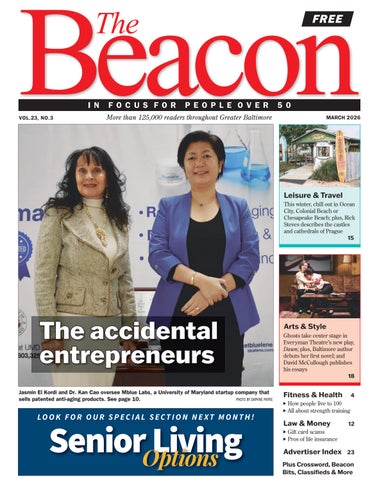
Jasmin El Kordi and Dr. Kan Cao oversee Mblue Labs, a University of Maryland startup company that sells patented anti-aging products. See page 10.
PHOTO BY DAPHNE PAYNE
For those who regularly read this column, you know that our founder, Stuart Rosenthal, recently retired. As the new publisher, I’d like to introduce myself and share my vision for the future of the Beacon
I joined this team more than 20 years ago, working closely with Stuart and his wife, Judy, our president, in every facet of the business. It has been an honor to serve alongside them.
Now my mission is to maintain the cultural foundation and integrity that have made this paper the most respected resource for seniors in the Baltimore and Washington metropolitan areas.
upon the legacy they created.
When Stuart first approached me about his desire to step back from the Beacon to “recreate himself” as a pianist, I was thrilled. I knew he always loved composing, and seeing him pursue this passion reminds us all that it is never too late for a new chapter. I’m confident his new venture, StuartsMelodies.com, will be a hit.

By Gordon Hasenei
As an Army veteran, “Duty, Honor, Country” was ingrained in me through countless pushups and years of service. I feel a profound sense of duty to you, our readers, and I intend to honor the Rosenthals by building
After the initial excitement, reality set in: With the founder gone, what would happen to our team and our readers? I jumped at the opportunity to buy the Beacon because our story isn’t finished.
We are reinventing ourselves, and I have big ideas. Those who know me know I don’t shy away from hard work — and I plan to have fun doing it.
A free adult dance class, in partnership with Dance Baltimore, focuses on line dancing and encourages movement and well-being. It takes place on Thu., March 26 at 11 a.m. at the Creative Arts Center, Central Library, 400 Cathedral St., Baltimore. Registration isn’t required. For more information, call (410) 396-5430.
My first order of business was forming a partnership with Steve Gurney, our new associate publisher and the founder of ProAging.com.
If you aren’t familiar with Steve’s work, I highly recommend exploring his online community and publications, which offer a comprehensive look at senior-related issues. His knowledge and expertise will be a massive asset as we grow and evolve.
This merger significantly enhances our ability to share vital information with seniors, families and caregivers.
In an increasingly polarized world, we believe we are truly “Stronger Together.” Wouldn’t it be refreshing if more people felt this way?
The last few months have been a whirlwind, but another trait Uncle Sam indoctrinated in me was the ability to multitask and adapt. I thrive in complex environments and am always driving forward. Together with Steve Gurney, I look forward to providing even more resources, information and fun for our community of loyal readers.
I’ll admit, being a Baby Boomer still freaks me out. It’s only when I look in the mirror that I realize I’m 64. How did I get here so fast?
But being a Boomer doesn’t mean slowing down. Between hitting the gym (I’ve
been lifting for 50 years), skiing and tackling my own yard work, I’m staying “youngish.”
To quote the poet Dylan Thomas, I will not go gentle into that good night!
Please join me in wishing Stuart and Judy success and fulfillment on their new journey. Leading such a well-respected publication for 37 years is a monumental achievement.
I am proud to have been part of their story, and I hope to make them — and you — proud of what we create next. I know how loyal you have been to the Beacon, and I look forward to earning that same trust and loyalty in the years to come.
As I begin my own new chapter as publisher, I want to ensure the Beacon continues to serve your specific needs. I invite you to share your thoughts on what topics you would like to see covered or how we can better support you in the coming months.
Please feel free to reach out to our team via our website, follow our latest updates on the Beacon Facebook page or send us a Letter to the Editor (see below).
Your voice is the heart of this publication, and I look forward to hearing from you as we move forward — together.


The Beacon is a monthly newspaper dedicated to inform, serve and enter tain the citizens of the Greater Baltimore area, and is privately owned. Other editions serve Howard County, Maryland and Greater Washington, D.C.
Subscriptions are available via first-class mail ($50) or third-class mail ($20), prepaid with order. Maryland residents: add 6% for sales tax. Send subscription order to the office listed below.
Publication of advertising contained herein does not necessarily constitute endorsement. Signed columns represent the opinions of the writers, and not necessarily the opinion of the publisher.
Gordon Hasenei, Publisher, CEO
SteveGurney, Associate Publisher
MargaretFoster, Editor
KyleGregory, Art Director
RogerKing, Vice President of Operations
Advertising Representatives: Jill Joseph, Steve Levin, M.K. Phillips, Alan Spiegel
Ana Preger Hart, Assistant Editor Tori Cleveland, Editorial Assistant
Stuart & Judy Rosenthal,Founders


The Beacon, P.O. Box 2227, Silver Spring, MD 20915 (410) 248-9101 • Email: info@thebeaconnewspapers.com Website: www.theBeaconNewspapers.com
Submissions: The Beacon welcomes reader contributions. Deadline for editorial is the 1st of the month preceding the month of publication. Deadline for ads is the 1st of the month preceding the month of publication. See page 23 for classified advertising details. Please mail or email all submissions.
Readers are encouraged to share their opinions on any matter addressed in the Beacon as well as on political and social issues of the day. Mail your Letter to the Editor to The Beacon, P.O. Box 2227, Silver Spring, MD 20915, or email info@thebeaconnewspapers.com. Please include your name, address and telephone number for verification.
Dear Editor:
Thank you, Stuart Rosenthal, for your latest and last column for the Beacon. I’ve always enjoyed your column and have saved some over the years that hit home for me, such as the February 2020 one about wonder and creativity.
You’re such an inspiration to artists, writers and musicians, as well as to the general population, encouraging them to pursue any passion they have in life. I wish you the best in pursuing a full-time career in creating music, and thank you for inspiring me to become a full-time writer.
Amanda K. Daisey Baltimore, MD
Dear Editor:
Mr. Rosenthal, thank you for founding this amazing paper which I look forward to every month. Enjoy your new adventure.
I have enjoyed the articles discussing the ups and downs of retirement. It’s true that having a purpose makes a difference. Retirement shouldn’t be about doing nothing but about living at a different pace.
Community centers are a great place to start, since they are free and offer opportunities to get out of the house and meet other people.
Learn a new language, try a new recipe,
take a class, read a book outside of your usual genre. Just try something different for the sake of trying it.
Chris B. Via email
Dear Editor:
As a new retiree — two months and counting — I couldn’t agree more with Richard Himmer on the need to redefine retirement (“Ditch traditional retirement expectations,” February 2026).
After a 40-year career in publishing, I woke up the next morning lamenting the loss of the structure and purpose that work had provided.
Like many others I fell victim to the “traditional mindset” that Himmer argues needs changing: I was too fixated on saving money instead of paying attention to what replaces work.
I have since slowly started to fill the void, beginning with taking an exercise class and starting a French conversational group. I am also looking into doing more volunteering and writing.
Himmer’s article is a must-read for anyone aiming to reimagine what a meaningful retirement looks like.
Joe Lustig Via email


i et!W er y to inter is no ov v ye Whhile t can bring cozy moments ty d q an quuiet beautyy, , it can also uec uce uniq introd qu chhallenges to e mf safety fetyy, , co foort, and w ll-being. em Cold t mpperatures, shorter daayys, and icy conditions can v a makke e it harder to stay y active e and ff hic , w connected wh ch can affeect both t phhyysical heal hand emotional resilience.
At Family & Nursing Care, we understand that maintaining wellness during winter means more than avoiding slips or bundling up against the cold — e w s a it’ abbout supporting th whhole person through movement, nutrition, and companionship.



encourage them to keep moving, stay socially engaged, and find comffoort in everyday routines — w whhether that’s sharing a meal, takkiing a short walk, or simply ennjjoying conversation.”
Cold weather often means spending more time indoors, o f w whhich can contribute t feeelings of isolation or the “winter a blues..” Stayying engaged through conversation, hobbies, and social connection can greatly improve mood and overall well-being.
Staying Safe and Cfbl
w Icy sidewalks and snowy y driveways can increase the risk of falls, one of the most common s f winter hazard foor older adults. A f feew small precautions — r erf wearing prop foootwear, , clearing walkkwways, and ensuring adequate lighting indoors and out — can ig diff make a b ffeerence.
a Caregivers can also play y an essential role by assisting with mf ff mobilityy, , offeering a steady ar foor f balance, and helping clients safeely ennjjoy the season.
“Winter wellness is about y f maintaining both safeety and joy, , ” , V said Kelly Salb Viice President v of Client Ser viicesat Family & Nursing Care. “Caregivers not a only help clients stay y warm and secure at home, but also
Caregivers can help by encouraging favorite activities, preparing nourishing meals, ies f and creating opportunit foor meaningffuul companionship — ll l d f l
tsf all vital ingredien foor emotional health.
e w Th wiinter months are also a s—w time to strengthen bond wiith , f familyy, frriends, and caregivers ay ac m w whho bring warmtth to e ch dayy. . y ug ’st W Whhether it thro ghashared story, , f a cozy afternoon inside, or a safe e ir o o en outing t njjoy y the crisp a r, , these small moments of connection ig k can make e the season br ghter and y hier f healt foor everyoone. mi utho rea Tol To learn more abbout owwFa illy t y c a r & N Nuursing Care e can n conne yoou iv r i ov r y o yoour lovveed ones witth careeg veers af iv g ac rtsta up w whhosuppo stayyin ct vee, saffee, l us a al r in g a annd engaaged this w ntter, , calll at t i e ur w i 410-697-8200 or visit t o weebbsitte r mily atf at fa a ilynnursingcaree.com.
Caring for someone with dementia?
Johns Hopkins has some sleep tips
STRONGER LONGER
Lifting weights, squatting and rowing are great ways to keep bones strong
HAPPY HABITS
Gratitude, friends, nature and volunteer work can give you a sunny outlook
LEG CRAMP OR LUNG CANCER? Leg cramp with shortness of breath, weight loss or fatigue requires a doctor
By Lauran Neergaard
You finally got a doctor’s appointment. Getting the most out of that visit requires some advance preparation. Even the professionals plan ahead.
“It is really hard — even for me, as a doctor, going to see my own family doctor — to remember the things that I wanted to bring up,” said Dr. Sarah Nosal, president of the American Academy of Family Physicians.
“The worst is when you’ve had that moment with your doctor” only to recall another problem after walking out, she said. “You’ve lost that time.”
Her top tip: Bring a list of symptoms and questions to show the doctor at the start of the visit. The first item should be your top concern, but seeing the full list helps your doctor prioritize what’s most medically urgent.
“I’m actually going to be able to see, is there a red flag?” explained Nosal, who has some additional advice about prepping for a typical primary care visit.
Some illnesses require specialists like a cardiologist or rheumatologist. But regardless of your age or how healthy you are, research has long shown that a relationship with a primary care provider is important.
Your primary care doctor monitors your overall health. It might be a family physi-
cian like Nosal, who cares for all ages, or an internist. Some patients choose gynecologists or geriatricians, while others may have a team that includes nurse practitioners or physician assistants.
Primary care is more than preventive checkups to help avoid illness, such as vaccinations, cancer screenings or health advice. It also includes detecting and treating common problems like high blood pressure, and helping to find and coordinate specialty care.
“That ongoing relationship also helps me know your ‘normal,’” Nosal explained. “If something’s different or changes or you feel off, when you tell me that information and I also have known you over time, we can really figure out together what’s going on.”
Family medical history is critical — and needs regular updating. Know what diseases your close relatives have had and how they fared. For example, if Type 2 diabetes runs in the family, or Grandma had a stroke, or someone had cancer at a young age, that information could help tailor your preventive care, Nosal said.
Filling out paperwork from home makes it easier to check medicine bottles for the name and dose. Include both prescription and over-the-counter medicines, pills or creams — and don’t forget vita-
mins and supplements.
Why are the latter important? Some can interact with prescription medicines. For instance, Nosal cited some patients whose longtime treatments quit working after they started taking turmeric, a spice also sold as a supplement.
Also before your visit, check if the doctor received records of recent lab tests, hospitalizations or visits to other health providers, since electronic medical records aren’t always automatically shared.
Keep a running list of questions
Some symptoms are bad enough to prompt an urgent visit. But if you’ve got a checkup coming, whether it’s routine or to follow up on health problems, start a list of questions in advance.
Notice a pain when you move a certain way? Chatting with a friend who just got a colonoscopy and wonder if you’re due? Put those on your list right away, before you forget — and be specific in describing symptoms.
Nosal keeps a running list on her phone and, ahead of visits with her own doctor, sends it as a heads-up through her patient portal. Patients also can include their list on visit check-in forms.
The idea is to address the most urgent questions first, rather than patients run-
ning out of time before raising a key concern. Nosal said questions about mental or sexual health and wellness especially tend to come up at the last minute.
Whatever the medium, “please bring that list,” she said. “That’s the most critical of all pieces.”
People may know to ask questions about treatments, such as how well they work and what side effects to expect. But it’s also important to understand why a doctor makes a particular diagnosis or, conversely, isn’t as worried about a symptom as you might be.
Don’t hesitate to say, “Explain to me what else could be going on,” Nosal advised. “What would be the next step? How would you evaluate that for me, to know if it’s this or that?”
Most health advocacy groups also advise bringing along a friend or relative, especially if you have serious or multiple health problems. They can help ask questions and take notes. Or ask if you can record the appointment on your phone.
“Whether you are 20 or you are 85, you will not remember everything from your medical visit,” Nosal said. © 2026 The Associated Press. All rights reserved.
By Richard Eisenberg
For his new book, Healthy to 100 , longevity researcher Ken Stern wanted to answer a question that nagged him: Why do so many people in some European and Asian countries live long, healthy lives, and how can Americans be like them?
So, for six months in 2024, he traveled to five of the most successful aging nations — Italy, Japan, Singapore, South Korea and Spain — to find out why their average life expectancies were often six years longer than ours and to interview residents in their 70s, 80s, 90s and 100s.
Stern, founder of The Longevity Project research initiative and host of the Stanford Center on Longevity’s Century Lives podcast, discovered a surprising common thread: It wasn’t about how the older
residents took care of their health, ate, exercised or managed their finances. It was about their strong social connections.
Other longevity researchers have also seen a link between social connection and extended, healthy lives.
In Healthy to 100 , Stern writes that Brigham Young University professor Julianne Holt-Lunstad reviewed 148 global studies and found social connection increased the likelihood of surviving in any given year by more than 50%.
“When people ask me how they can be socially connected, they’re generally thinking about how to be the life of the party. That’s not what it’s really about,” said Stern. “It’s about putting people next to people in a purposeful way.”
Stern offers four ways to foster social connections, based on what he learned:
Japan offers a great model, Stern said. “Japan is famous for its stressful work culture, but its work economy for people in the second half of life is rather different,” he said. “It’s built around part-time work and being with other people.”
Japan gives employers financial incentives to support older workers and has the highest percentage of people over 65 who work — roughly 25%. The country’s Silver Jinzai jobs program has found part-time jobs for nearly 700,000 residents over 60.
One poll found that 80% of older Japanese workers said they’re employed because it’s good for their health and for social connection, Stern said.
Stern suggests older Americans look for jobs at the 3,000 companies and organizations that have taken the AARP Employer Pledge,
committing to age-inclusive workforces. He’s also a fan of encore careers, where people over 60 work to find meaning and purpose.
Some social connections exist with family, friends and work colleagues. But, Stern said, they can also come through daily interactions with “consequential strangers” — like people you chat with on a bus.
Intergenerational housing and activities boost social connections, too. In Singapore, 90% of homes are owned by the government, which offers a tax incentive for people living within a kilometer of other generations.
“Singapore works obsessively to keep generations together in housing,” Stern said.
By Laura Fisher
Colorful, nutritious winter vegetables — crops that thrive in the cooler months or are harvested in the fall and maintain their flavor and health benefits throughout the winter — play an important role in the eating-seasonally movement.
This lifestyle trend, which promotes packing your plate with food grown naturally at that time of year in your region, is enjoying a resurgence of late.
And it’s no wonder, as seasonal produce
From page 4
To avoid being isolated in the U.S., Stern said, you might consider moving into multigenerational housing. He also recommends looking for a place where you’ll participate in activities with other residents, such as an active-aging retirement community.
During his travels, Stern noticed that Spain and Italy are bonding younger and older community members by making senior centers intergenerational.
To find similar programs, he said, consult the Generations United advocacy group/Ohio State University list of U.S. places pairing younger and older people.
Take advantage of lifelong learning Educational classes were abundant in the countries Stern visited.
In South Korea, for instance, virtually every municipality has a lifelong learning institute. Italy is home to the University of the Third Age, whose 6,000 mostlyretired members have taken more than 160 courses. Singapore’s National Silver Academy offers a variety of courses for older citizens.
is known to be especially nutrient-dense, extra flavorful, cost-efficient and environmentally friendly. While they vary according to where you live (California, we are all jealous of your year-round bounty), there are plenty of fresh winter veggies available across the country during chilly months. Here are a few favorite winter vegetables to encourage you to eat seasonally all year round.
1. Winter squash: Winter squash includes varieties of hard-skinned squash —
“Learning is not something we stop doing at 18 or 21,” Stern said. “It’s something we need to do over the course of our lives.”
He recommends looking for local college discounts for older learners. Many states provide essentially free tuition to people over 60, he noted. Some public universities waive tuition and most fees, too. Online classes are an option.
Volunteer regularly
Stern’s book cites studies showing that volunteering can improve older adults’ physical and mental health. Volunteering may slow the aging process.
He saw elder volunteers all over Italy; older people typically staff senior services there. “Italy really invests in volunteerism,” Stern said.
The more time you spend volunteering, the larger the health returns, Stern said.
All in all, Stern said, rethinking social connections comes with reconceiving what the second half of life can be.
“People have exercise plans and nutrition plans,” he noted. “They need to start having social connection plans.”
© 2026 The Kiplinger Washington Editors, Inc. All rights reserved. Distributed by Tribune Content Agency, LLC.

such as acorn, butternut, kabocha and delicata — that are harvested in the fall, and can be stored and eaten all through the cooler months.
Winter squashes are incredibly versatile, whether you choose to blend, roast or bake them. Try out all the different types, as each squash is uniquely flavorful.
2. Potatoes: As if we needed more reasons to love potatoes, everyone’s favorite tubers are a great choice for eating seasonally in winter. Potatoes are readily available year-round due to how well they keep when stored properly. Typically, spuds are harvested in late fall, but depending on your climate, they may be fresh even in the middle of winter.
3. Brassicas : The brassica family in-
cludes some of the most nutritious and versatile produce out there, including broccoli, cauliflower, cabbage, Brussels sprouts and the lesser-known kohlrabi. Brassicas shine when roasted to caramelization in the oven, thrown into stir-fries or sliced thinly in salads.
4. Hearty greens : Cooking greens like escarole, endive, kale (which is technically a brassica) and radicchio (which is purple, not green) are at their best when grown at cooler temperatures — crisp, sweet and not too bitter. Try them sautéed, braised or as part of a hearty winter vegetarian meal mixed with grains, pesto and a nutty crunch.
For free materials about area housing communities, just complete and clip this coupon and mail, or take a picture and email, to the Beacon
Housing Communities
o Charlestown/Erickson (see ad on page 7)
o Christ Church Harbor Apts (see ad on page 19)
o Oak Crest/Erickson (see ad on page 7)
o Park View Laurel (see ad on page 14)
o Park View Towson (see ad on page 14)
o Park View Fullerton (see ad on page 14)
o Park View Rosedale (see ad on page 14)
o Pickersgill (see ad on page 8)
o Roland View Towers (see ad on page 11)
o Virginia Towers (see ad on page 13)
o Warren Place Senior Apartments (see ad on page 9)
o Westminster House (see ad on page 21)
Clinical Health Studies
o Exercise & Sleep Study/mPATH (see ad on page 6)
o Caregiver & Sleep Study/TAILOR Sleep (see article on page 6 and ad on page 7)
o Smell Test Study (see ad on page 6)
Check the boxes you’re interested in and return this form to: The Beacon, P.O. Box 2227, Silver Spring, MD 20915 or take a picture and email to housing@thebeaconnewspapers.com.
By Margaret Foster
Dementia affects the entire family. Because dementia patients often wake up at night, wander away, or confuse night and day, their family caregivers can suffer, too.
Now Johns Hopkins researchers, led by Dr. Junxin Li, are conducting a new study focused on helping those caregivers.
Called Tailor-S, the week-long study is tailored to the different needs of each patient and their caregiver. The good news is that it can be done entirely from home.
More than 70% of dementia patients report sleep issues.
That’s “because dementia damages the internal clock,” said Youngmin Cho, co-
investigator of the Tailor-S study. “For people living with dementia, sleep issues are a daily struggle.”
In turn, the patient’s lack of sleep affects others in the household.
“Over 60% of dementia caregivers experience poor sleep,” he said. “They are exhausted, and it makes the caregiver burden even worse.”
The Tailor-S study is focused on the caregiver because “caregivers are the ones who know the dementia patient best,” he said. “We wanted to hear their own voices to make our program more effective.”
Hopkins researchers hope the study will “empower the caregiver to understand dynamic sleep issues and allow them to manage nighttime issues more effec-
CHANA’s Elder Abuse prevention program provides free, confidential support to older adults facing abuse and those worried about potential abuse. CHANA offers crisis intervention, safety planning, legal help, individual counseling, support groups, shelter and more. To get assistance for yourself or a loved one, call (410) 234-0030.
tively,” said Li, principal investigator of the Tailor-S study.
The study takes place within the home, thanks to technology.
Hopkins researchers will bring two wrist monitors to your house, ask some questions and give some recommendations that may help the patient sleep.
For instance, they may suggest reducing light and noise, increasing humidity in the bedroom or getting more physical activity during the day.
People with mild to moderate dementia who are 65 and older and live in the Baltimore area are eligible for the study. Their caregivers are eligible if they stay overnight at least three days a week.
5. Parsnips: A cool-season root vegetable that is largely underappreciated, the parsnip has been described as “a carrot on steroids.” Its unique, strong-yet-sweet taste doesn’t fully develop until its roots are exposed to near-freezing temperatures for two to four weeks. Peaking in fall and early winter, it makes the perfect ingredient for hearty cold-weather soups and stews. Cooking parsnips is similar to working with carrots and potatoes, as they can be
MEDITATION CLASS
Both the dementia patient and their caregiver will wear the wristband, which monitors their activity in real time, for one week.
After a week or two, Li’s team will return to the home to check in and see how the strategies helped the family.
“This process not only identifies sleep problems but also provides guidance and potential strategies to improve their rest,” Li said.
In the future, Li said, Hopkins hopes to expand the program to more families with dementia.
“Ultimately, the data and experiences gathered in this phase will allow us to develop a truly comprehensive, tech-assisted sleep intervention designed for the real world.”
For more information, email TAILOR Sleep@jh.edu or call (443) 333-9398.
boiled and mashed, roasted and even sautéed.
6. Leeks: Leeks bring aromatic flavor and silkiness to your favorite winter comfort foods. A milder-flavored member of the onion family, this underrated yet versatile vegetable tastes best after a frost and is often available locally throughout the winter months.
Real Simple magazine provides smart, realistic solutions to everyday challenges. Online at www.realsimple.com.
© 2026 Dotdash Meredith. All rights reserved. Used with permission. Distributed by Tribune Content Agency, LLC.
Visit Kadampa Meditation Center of Maryland on Wed., March 4 from 6 to 7 p.m. to join a meditation class with prayers for world peace. This class aims to help bring more positivity and peace into your daily life while overcoming negative thought patterns. The suggested donation is $5. The address is 900 E. Northern Pkwy., Baltimore. For more information, email peace@meditationmd.org or call (410) 243-3837.
are looking for
adults (65+) to participate in a research study on personalized exercise. Learn how a tailored exercise program can help you feel stronger and improve your health and well-being. You will be compensated for your time and participation upon successful completion of the study.
For more information, please scan the QR code, call 443-692-7169 or email mpathstudy@jh.edu



By Laura Ungar
When Sarah Baldassaro turned 50, she took stock of her health and began working with a fitness coach on strength training, a type of exercise that’s crucial for women in midlife.
“Now I would say I’m stronger overall than I ever have been at any age,” said Baldassaro, 52, of Alexandria, Virginia. “My fitness level is much more like when I was in my early 30s.”
Medical experts say strength training keeps bones and muscles healthy after menopause, when estrogen loss speeds up a reduction in bone density and contributes to the gradual loss of muscle mass.
This type of exercise — which involves working against resistance — also helps women maintain a healthy weight.
“People underestimate how powerful it is,” said Dr. Christina DeAngelis, an OBGYN at Penn State Health.
But what should your workout look like and how do you get started?
What is strength training?
Physical therapist Hilary Granat said bone and muscle health are intertwined: When muscle pulls on bone during resistance training, it stimulates bone-building cells.
Resistance can come from dumbbells, free weights or machines such as rowers.
One example of a strength training exercise is the chest press, which involves lying back on a bench or the ground, pressing weights up from chest level and then lowering them.
It’s important to work “close to muscle failure,” said Granat, who owns Core Total Wellness in Washington, D.C. “You really have to push yourself.”
That means lifting weights that are heavy enough to be challenging and doing somewhere between six and 30 repetitions.
You’ll know you’re working hard enough if you start slowing down in tempo or speed or can’t do another repetition in good form, she said. A good rule of thumb for an exercise like a bicep curl is to lift weights somewhere between 5 and 20 pounds, with novices starting at the lower end.
Baldassaro has worked her way up to 20 pounds for some exercises, incorporating techniques she learned from Granat.
She said her coach has helped her expand her workouts beyond mostly cardiovascular exercise.
While she still does aerobic exercises, “the strength training has really been the difference maker for me,” she said.
No weights? No problem
Building up bones and muscles doesn’t
necessarily require equipment. You can also do pushups, squats, lunges, sit-ups, crunches or planks. Another good exercise is squatting down with your back against a wall.
Even the simple act of getting into and out of a chair can be helpful, DeAngelis said.
“You have to engage your core going from sitting to standing,” she said. “That also allows you to work on your coordination and balance.”

There’s also what Granat calls “impact training” — exercises like walking, hiking, running, jumping, skipping and climbing stairs. On the high-impact end of the spectrum is a “rebound jump,” which involves jumping up and down from a step 10 to 30 times.
“We’re not talking about jumping hard and fast and a lot,” she said, adding that three times a week is enough.
Caregivers and their loved ones are invited to a study about sleep and daily life. You will join a guided conversation, and both will wear a Fitbit for a week to track sleep patterns. Your insights will help design a tailored home-based sleep support program. Compesation will be provided.
Principal Investigator: Dr. Junxin Li | I R B: IRB00513086




By Howard LeWine, M.D.
Q: While I know that feeling happy is better for a person’s health, what can you do if you are not naturally a happy person?
A: A sunny outlook is linked to lower blood pressure, a healthier response to stress and a better functioning immune system; and it can motivate people to be more active.
Research suggests that genetics determines about half of a person’s general disposition. Some people are just naturally happy.
However, for the rest, happiness is under their control, according to Dr. Robert Waldinger, director of the longest-running study on happiness: the Harvard Study on Adult Development.
“Even if you don’t consider yourself a happy person, there’s a good chance you have some power to change it. What’s important is to practice regular acts of happiness, activities linked with improving mood and optimism.”
Here are some examples you can try: Stay connected. There’s a strong link between happiness and close relationships with family and friends. “Personal connection creates emotional stimulation, which is an automatic mood booster, while isolation is a mood buster,” says Waldinger. Make efforts to expand your social circle.
Volunteer. Studies have shown that volunteering provides a sense of purpose, which can improve your mood. The effect is especially strong in older adults. Find volunteer opportunities in your area that match your interests through the VolunteerMatch network.
Find your inner child. Revisit the activities that gave you joy as a child or young adult. What made you happy then? Pick up the hobbies, games, sports or other interests from your youth.
Invest in experiences. It doesn’t need to be a big-ticket adventure. For instance, opt for dinner at an ethnic restaurant, a matinee at the theater or a visit to an art exhibit. The investment can have lasting impact, too, as the experiences create pleasant memories that you can reflect on when you need a mood boost.
See green. Numerous studies have found that happiness correlates with time spent in urban green spaces like parks, gardens and riversides. Any kind of interaction with the outdoors can have the same effect, such as hiking a trail, walking the beach or exploring nearby woods.
Break up your routines. People feel happier when they have variety in their daily routines. Even small changes can have a significant impact.


Pickersgill assisted living residents are rarely in l their rooms! Instead, , theyy’re out and about— participating in a community activity or event or dining with friends.
A place of beauty

Living in n this community—ttucked d into a beautiful West Towson neighborhood —you or your loved one beau njoy a warm welcome and daily activities, and they’ll appreciate the will enj paths, beautifully landscaped grounds, lovely gardens and more. walking path
A place of caring

Embrace gratitude. Look around and feel grateful for what you have instead of reaching for something new, hoping it will make you happier. Practicing gratitude for as little as 10 to 15 minutes a day can enhance emotional wellness.
Smile more. Research has found that smiling can improve your mood, just as scowling can make you feel angrier and frowning can make you feel sad.
Q: I am having a hard time accepting a decline in my exercise capacity. What can I do to regain my enthusiasm to get to the gym?
A: There comes a time when all of us can no longer run as fast or far as before, hike trails with ease or play sports at the same skill level or intensity. We will also have less endurance and need more time to recover.
Whether due to aging, injury or health issues, when the body can no longer perform like it once did, people can experience bouts of grief as they try to confront this new reality.
A tangible loss like physical decline can make you feel discombobulated about who you are now and what the future holds. This constant ruminating can lead to prolonged bouts of sadness and isolation that, if not dealt with, can pro-
From page 7
Don’t forget about balance
Experts say middle-aged women should also perform balance exercises, which play a crucial role in preventing falls that can break or fracture bones.
gress to depression.
By acknowledging diminishing strength and stamina, you can then focus on adaptations that can be healing and healthy. Here are some strategies that can help.
Change your mindset. Make peace with the fact that you have aged. Sure, it’s painful and frustrating to deal with an aging body, but focus on accepting physical changes as a new chapter in your life, not the end of the story.
Focus on now. Instead of dwelling on what you can’t do, focus on what you can. You can still accomplish a lot working with what you have.
Adjust your goals. There are many things that you can continue doing with some planning and modification. I regularly ride a stationary bike several times per week. Over the past year, my average watts for a one-hour ride have declined by 15%. While I don’t like it, I have reset my goal to achieve this new lower level of intensity on my rides.
Talk about it. Start by reaching out to your friends. Consider seeking professional counseling if it’s affecting your mood so much that you have stopped exercising.
© 2026 Harvard University. Distributed by Tribune Content Agency, LLC.
standing on one leg while brushing your teeth for around 30 seconds.




Each assisted liv g resident enjoys three chef-prepared meals per day, ing re y services, medication administration, help with daily housekeeping and laundry se quest, and all included in a reasonable monthly tasks and more—always by reques o all of the fee. Each h resi s dent also has access to all Pickersgill ameni l ties. private, full bath, and residents are
These include tai chi, yoga or even
All of these exercises are great for younger people too, experts say, especially since bone mass peaks at 25 to 30 years old and slowly begins to lessen around age 40.
After seeing how strength training has improved her life, Baldassaro advises others: “Don’t wait. Get started.” —AP

Our assisted living g residences include a priv wish. This is a lifestyle dedicated to encouraged to decoraate their homes as they al staff. independence and assured by a caring, professionalfessionalstasttaff.
Call
today for more information or to schedule your personal tour.






I live in Denver Broncos territory here in Colorado, and recently, I was watching a documentary about John Elway when something he shared stopped me cold.
Elway talked about the loss of his twin sister to lung cancer at the age of 42. She had never smoked, and, according to public interviews, she dealt with unexplained leg cramps early on.

That detail didn’t sound like a typical lung cancer symptom, and it made me curious. I wanted to understand if there was a connection. As it turns out, there can be.
By Suzy Cohen
Her passing was officially attributed to lung cancer, and that’s where I’ll leave her personal story, with compassion and respect.
Leg cramps are usually harmless. Dehydration or low magnesium are common causes. People stretch, apply heat, drink electrolytes, take a supplement, and go on with their day.
But occasionally, a persistent cramp is more than tight muscle fibers. Sometimes it’s the first domino in a longer chain of events.
Conditions like lung, pancreatic, kidney or ovarian cancer — and sometimes blood cancers like multiple myeloma — can create body-wide changes long before anyone notices classic warning signs. It isn’t common, but it’s possible, and that’s why being tuned in to your body matters.
Symptom of serious health issues
One connection involves blood clotting. Cancer can increase the risk of developing deep vein thrombosis.
A cramp that is actually a clot might feel
like a charley horse that won’t let go, a heaviness in the calf, or a dull ache with warmth or swelling. In some patients, that type of leg pain shows up before the cancer is diagnosed. Electrolyte imbalances are another possibility. Cancer anywhere in the body can influence minerals like potassium, calcium and magnesium. When those shift, muscles can misfire and cramp. Additionally, reduced oxygen delivery or pressure on nearby nerves may contribute to persistent cramping, sometimes long before a cough ever appears.
Medications can confuse symptoms. What seems like “just a cramp” is sometimes side effects in disguise.
Diuretics for blood pressure can drain electrolytes. Statins may contribute indirectly through CoQ10 depletion. Steroids can shift minerals. Some antidepressants and other common drugs can alter the body’s balance as well. (You can look up your own medications at my website, drugmuggers.com, if you’re curious.)
None of this means a leg cramp is cancer. It almost always isn’t. Most of the time, cramps are ordinary, fixable and nothing to fear.
But if a cramp keeps returning on the same side, comes with swelling or warmth, shortness of breath, weight loss or fatigue, or simply feels different than the everyday soreness of life, please ask a doctor to evaluate it. Simple information can change a disease’s trajectory.
That documentary made me wonder how many people are rubbing a calf at
If so, join a free educational workshop to learn why your indexed annuity may not be performing well and your options.
You owe it to yourself!
Two Dates Available: Thursday, March 19 6:00–6:30 PM Saturday, March 21 2:00–2:30 PM

night, unaware of what their body is trying to say. If this column prompts even one doctor’s visit that might have been put off, it matters.
You can read the full article, plus access 1,000+ health topics and tips, at suzycohen.com.
This information is opinion only. It is not intended to treat, cure or diagnose your condition. Consult with your doctor before using any new drug or supplement.
Suzy Cohen is a registered pharmacist and author of The 24-Hour Pharmacist and Real Solutions from Head to Toe







By Margaret Foster
As John Lennon once sang, “Life is what happens to you when you’re busy making other plans.”
Scientist and college professor Dr. Kan Cao had spent most of her career studying a rare disease, progeria, which causes premature aging in children.
Eleven years ago, in her research lab at the University of Maryland, Cao noticed something unusual: Cells with misshapen, diseased nuclei suddenly looked plump and healthy when accidentally exposed to a common lab stain called methylene blue.
“That happens in scientific research a lot,” Cao said in an interview with the Beacon . “We want to research A, have a hypothesis, but in the end, we discover B.”
First, Cao published her findings on progeria. Then she did what most scientists do: asked another lab to repeat the experiment.
The other lab “actually observed the same thing,” Cao recalled. “Then I became more serious” about methylene blue, both to extend the lives of those with progeria and to preserve the skin cells of people as they age normally.
When Cao told the university about her findings, they were as excited as she was.
Its Ventures program, which helps the school’s faculty and students commercialize their research breakthroughs, paired her with an alum, Maryland entrepreneur Jasmin El Kordi, as her CEO.
Today their company, Mblue Labs, has almost a dozen products in its Bluelene skincare line. Now in their seventh year, they opened their own warehouse and logistics office in Beltsville, Maryland, in September.
“We’re not a beauty company,” said El Kordi. “We’re a scientific company that made an incredible discovery that reverses human aging.”
Cao, who grew up in China, received her undergraduate degree in biology in Nanjing. She moved to Maryland to attend graduate school at Johns Hopkins.
With a Ph.D. in biology, Cao began her postdoc in genomics at the National Institutes of Health in 2005. That’s when Francis Collins, longtime director of NIH, tapped her to start researching progeria. In his lab, Cao’s experiments were “exquisitely designed and beautifully conducted,” Collins told the University of Maryland.
Cao became one of the country’s leading researchers on the disease and con-

Jasmin El Kordi, left, and Dr. Kan Cao, right, are the CEO and chief scientific officer of Mblue Labs, which formulates a line of 11 anti-aging Bluelene products. The University of Maryland company made the U.S. Department of Commerce’s list of top 100 small businesses in 2024.
tinued that research at UMD’s Department of Cell Biology and Molecular Genetics, where she would discover the effects of methylene blue.
‘Magic molecule’ Invented in 1876 by a German chemist, methylene blue is a type of salt that can
pass through both fats and water. “If it gets into your skin, it’s very soluble — it can go through lipid, it can go through water — so it gets all the way to the cells, to the mitochondria inside your cells, and it comes in and acts as a natural antioxidant,” Cao said.









Over the years, doctors have used methylene blue to treat malaria, cancer, septic shock and other diseases. A handful of studies suggest it may even treat Alzheimer’s disease.
“We believe methylene blue is a magic molecule, and anti-aging is only one of its functions,” Cao said.
More commonly, though, surgeons and lab technicians use it as a dye.
That’s how Cao’s lab discovered “quite by accident,” she said, that methylene blue had anti-aging properties. After an undergraduate student cross-contaminated the skin samples, he noticed that the cells had improved.
“It helped the progeria, and it helped the healthy control samples as well,” Cao said, noting that the healthy skin cells were from people of all ages.
By the end of 2017, Cao began making prototypes of facial cream, experimenting with different scents like lavender and rose and giving them to friends as holiday gifts.
“My lab was smelling very good during that time,” she said.
Many of the recipients asked for more — an early sign of success.
Just before Mblue Labs’ official launch, TV star Kevin Harrington of ABC’s Shark Tank endorsed the woman-owned company. Since then, it has sold its Bluelene products on Amazon and through its website, bluelene.com, growing by 40% to 80% year over year.
“We have a really good product that works, and so we are able to retain our customers at a rate of 65.2%, which is tremendous in the industry. So, customers stay with us because our product works,” El Kordi said. “There’s no wild marketing. We really deliver what we promise.”
As Mblue Labs enters its eighth year, the woman- and immigrant-owned company based in Bethesda is making significant ripples in the marketplace. Last year, the U.S. Chamber of Commerce included it on its list of the top 100 small businesses in America.
One of the secrets of its success has been the University of Maryland’s wellappointed lab, partially funded by a state program called Maryland Industrial Partnerships. Mblue Labs was able to launch with just $150,000 from TEDCO, Maryland Technology Development Corporation.
“We’re very fortunate to be a University of Maryland portfolio company — and they do own a small part of the company,” El Kordi said. “Part of it is having the lab. We have our own scientists in the lab doing the work, but you can imagine how expensive it would be to build such a lab on our own.”
In the meantime, the University of Maryland secured a U.S. patent on the topical use of methylene blue, which it shares with Mblue Labs. Unfortunately that patent hasn’t given the company sole control over the common ingredient. If you search Amazon for methylene blue, for instance, you’ll find all kinds of oils and creams containing it, not just Bluelene products.
“It’s really the Wild West, so companies will go and use our ingredient; they really don’t care that there is a patent,” El Kordi said.
Other “nefarious actors,” as she calls them, simply add more methylene blue to their products, regardless of the potential side effects (a smurf-like blue tint to the skin).
“They’ve formulated outside our patent range, which means they’re giving you more methylene blue than is really good for you,” El Kordi said.
However, going to court can cost tens of millions of dollars. With little protection for
her discovery, Cao has accepted the competition as a form of validation of her work.
“As a scientific researcher, I have to say, it’s rewarding to see people find that, oh, methylene blue really is useful,” she said.
“When we first talked about it back in 2018, everybody was like, ‘What’s methylene blue?’”
A strong bond
Meanwhile, Cao continues her research on progeria. Her most recent findings, published last year in the Aging Cell journal, could lead to new treatments. With 11 products on the market and
several others in the pipeline, including a hair-growth serum this spring, the two women have formed a bond that makes their company stronger.
When they met in 2018, Cao said, “I feel like we clicked. Nowadays, she said, “Sometimes I end up talking to Jasmin more than I talk to my husband. We talk a lot, just as mothers.”
Cao and El Kordi, who each have two grown sons, may have fewer wrinkles than most working mothers. Both of them, of course, use Bluelene products every day. For more information, visit bluelene.com or call (800) 988-8068.






Will you accidentally disinherit your grandchildren? See story on page 14.
By Roxanne Bland
Scammers have become more sophisticated, especially those that use artificial intelligence (AI)-generated fake websites, emails and texts that are convincing to the undiscerning — and sometimes even the discerning — eye.
The IRS is warning that email addresses might be spoofed, communications might contain realistic-looking case numbers, and caller-ID masking on phone calls can fool many.
Even worse? Phone scams are sometimes carried out using “deepfake” AI voice software, where the generated voice sounds like a real person.
To help protect yourself, watch out for three of the most common IRS scams.
Requests for gift cards are a common tactic. Gift card scams might involve a fraudster contacting a taxpayer via email, text or via social media, posing as an IRS official.
The scammer might:
• Demand immediate payment to resolve a fake tax liability
• Call or leave a voicemail informing the victim they’re linked to criminal activity
• Harass a taxpayer into paying a fictitious tax or penalty under threat of arrest or deportation
Victims are told to purchase gift cards to satisfy the amounts supposedly “owed.”
The scammer then instructs the taxpayer to provide the gift card number and PIN.
To protect yourself, remember the IRS will never demand immediate payment of taxes by gift card. The federal tax agency will mail an official letter, including a statement of tax liability, to those who owe taxes.
When it comes to charities, scammers pretend to be or to represent legitimate nonprofits such as the Red Cross or Salvation Army, pressuring would-be donors to give quickly.
If the donor gives, the money never reaches the charity; it goes into the scammer’s pocket.
To avoid being taken advantage of, always:
• Ask the fundraiser for the charity’s exact name, website and mailing address to independently confirm the information. Then use the IRS’ Tax-Exempt Organization Search tool (TEOS) to verify if an organization is a legitimate tax-exempt charity.
• Resist being pressured. There’s no need to rush. Legitimate charities are happy to get a donation at any time.
• Never give more information than what is needed. Treat your personal information like cash, and hold it close.
• Never donate to a charity that requests charitable donations via gift card, peer-to-peer apps, cryptocurrency or wire transfer. If payment is requested in any form other than check or credit card, it’s a scam.
With the use of generative AI, fake emails, texts and websites seem more credible than ever before.
As Kiplinger has reported, in a “phishing” scam, fraudsters send an email to trick people into revealing sensitive or personal information.
“Smishing” serves the same purpose, except the scammer sends the message via text.
Scammers impersonate tax authorities to steal personal and financial data.
Sometimes they demand money, but not always.
Don’t click on links or attachments. That can compromise your computer or
phone by installing malware that searches for personal and financial data on your computer’s hard drive.
If you’re unsure, call the phone number posted on the IRS website to verify.
Unfortunately, scammers are a scourge we must live with. The best defense we have is to stay vigilant by keeping up our electronic security protocols, staying informed about events that might affect us, and reporting any scam we encounter to the IRS.
To report IRS impersonation scam calls, call (800) 366-4484 or forward the email directly to the IRS at phishing@irs.gov. For text messages, forward the suspicious message to 7726 (SPAM) to alert your carrier, then forward the sender’s number and message content to phishing@irs.gov with the subject line “Text.”
If it’s a social media scam, send the full website address of the phony profile to the IRS by emailing phishing@irs.gov with the subject line “Social media.”
© 2026 The Kiplinger Washington Editors, Inc. Distributed by Tribune Content Agency, LLC.
Unfortunately, the SECURE Act of 2019 made it more difficult for the beneficiaries of IRAs and other retirement accounts to postpone distributions from these inherited accounts. No longer can most non-spouse heirs “stretch” these accounts out over their lifetimes and thereby preserve favorable tax deferral options.
Instead, as a result of the new law, if you inherit an IRA from someone who is not your spouse, you generally must withdraw the assets in the account within 10 years.
options more attractive for estate planning.
Ed Slott, a recognized retirement and IRA expert, argues that life insurance “is not only the single biggest benefit in the tax code, but is also the most cost-effective way to protect a large IRA” for beneficiaries.

By Elliot Raphaelson
The 10-year rule applies to both traditional IRAs and Roth IRAs, and for most beneficiaries the law change has limited the possibilities of tax-deferred growth.
As a result, regulations associated with the SECURE Act have made life insurance
According to Slott, the SECURE Act makes life insurance a much better estate planning vehicle than an IRA. Those with high-value IRAs who wish to preserve wealth for their heirs should consider drawing down IRA funds at the lowest possible tax cost and moving funds earmarked for beneficiaries to life insurance.
The result will be larger inheritances, more control and less tax. After all, there is no income tax to beneficiaries from proceeds from life insurance. That means fewer required minimum distributions (RMDs)
and a reduction in stretch IRA problems.
Life insurance can simulate the stretch IRA without the tax implications. In addition, life insurance is a better planning option for second marriages, and solves potential qualified terminable interest property (QTIP) issues.
Life insurance, Slott argues, can double as a tax-free retirement account. It can create additional tax-advantaged funds when other retirement plans are maxed out.
The cash value of life insurance can be used in lieu of taxable retirement funds to lower taxes in retirement, resulting in a tax-free income stream in retirement. Distribution will not create stealth taxes.
There is also less investment risk and tax risk associated with life insurance.
Insurance proceeds are tax-free; tax-free cash is always the best source of money, and also solves many non-tax problems.
A non-spouse beneficiary of a traditional IRA will be subject to income taxes on withdrawal from traditional retirement accounts; recipients of life insurance proceeds are tax-free.
Long-term care riders can be used, which would reduce benefits for beneficiaries but would protect your beneficiaries from expensive nursing home costs.
If a surviving spouse is due to inherit a traditional IRA, the availability of tax-free insurance proceeds would allow him or her to fund conversion to a Roth IRA.
Not everyone is insurable; you must medically qualify for coverage. There is no tax deduction when you purchase. It is not flexible in the early years after purchase. Life insurance is associated with long-term planning; funds are not liquid in
By Ashley Terrell
The death of a spouse is traumatic. Rather than having time to grieve, the surviving spouse has to make decisions and handle a daunting number of legal procedures and forms when all they really want to do is take the time to process their loss. Adding to the unpleasantness, they often quickly discover the financial implications. In what’s known as the widow’s penalty, losing a spouse can frequently pose a triple threat to the survivor’s financial situation.
The most obvious change, for retired couples who collect Social Security, is that the survivor now only collects one check per month, whereas the couple had been collecting two.
The surviving spouse will get the higher of the couple’s individual benefits, but it’s still likely to be a significant loss of income.
Similarly, if one person has a pension and they pass away, that income will either stop entirely or will be reduced as the pension converts to a survivor’s benefit pension.
At certain income levels, the death of a spouse can even impact the cost of Medicare. Medicare Part B and D premiums are calculated based on modified adjusted gross income. These premiums could cost more even if the surviving spouse’s income drops by nearly half.
Far less obvious, but arguably more damaging, is that the widow or widower will no longer be able to file a joint tax return.
There’s a grace period of one year after their spouse’s death, or two years if the couple has qualifying children, during which the survivor can continue filing jointly. After that period ends, they must file a single tax return.
That means their tax brackets can shift, often considerably. For example, in tax year 2025, a retired married couple filing jointly will hit the 22% marginal tax rate with an annual income of $97,000. But if one spouse dies, the single-filer survivor will hit the 22% bracket at $48,500.
As icing on the cake, the standard deduction for taxpayers who switch from joint to single filing is cut in half.
Clearly, the widow’s penalty adds a great deal of financial misery on top of an already painful life event. However, there are ways to lessen its impact.
Frequently, when I take on married couples as clients, I notice aspects of their financial plans that seem solid until you factor in the widow’s penalty, at which point the plan becomes a tax trap that will spring when one spouse passes away.
Retirement income can be divided into two main types: taxable and non-taxable.
Taxable income includes streams such as required minimum distributions from a 401(k) or IRA, while non-taxable income streams come from vehicles such as Roth 401(k)s and IRAs, indexed universal life policy death benefits and, for qualified medical expenses, withdrawals from health savings accounts.
By structuring retirement income to reduce the reliance on taxable sources, you can partially circumvent the widow’s penalty.
Often, when one spouse dies, the survivor decides to downsize and sells the home they shared. Many know that when someone inherits a home, it steps up in basis.
For capital gains purposes, the home is considered to have been purchased at its value at the time it was inherited rather than when it was actually bought.
A surprising number of clients come to
Take advantage of AARP’s Tax-Aide program, which offers free tax help to taxpayers over 50 with low-to-moderate incomes. Consultations are available at locations across the Baltimore area. To find a nearby location, visit aarp.org/money/taxes/aarp-taxaide/locations or call (800) 775-6776.
Baltimore County residents age 60 and older qualify for discounted rides, ranging from $3 to $12, through the CountyRide program. A small bus transports residents to medical appointments, stores and other destinations within the county, as well as to Baltimore City hospitals. To sign up for CountyRide, call (410) 887-2080 or fill out a registration at any county senior center.
GriefShare is a nondenominational support group for people grieving the loss of a loved one. The group meets every Tuesday from March 3 to June 2, from noon to 2 p.m., at Valley Presbyterian Church, 2200 W. Joppa Rd., Lutherville. Each week covers different topics, so you can join anytime. For more information, call (410) 828-6234, email church.office@valleypca.org or visit griefshare.org and enter code 21093.
me unaware that when a spouse dies, a step-up in basis also applies. In community property states, the home is eligible for a 100% step-up in basis; in non-community property, the step-up is 50%.
Either way, that represents a significant capital gains savings potential.
If one spouse was earning significantly more than the other, and that spouse delays taking Social Security benefits until age 70, their widow can keep the higher Social Security benefit when they die, and that benefit will be boosted by 8% for each year they delay between ages 67 and 70.
With careful planning, couples can enter
retirement secure in the knowledge that, whichever spouse passes away first, the survivor’s exposure to the widow’s penalty will be minimized.
This planning is complicated, with many nuances to be aware of. It’s important to work with a trusted financial adviser who can help guide you to the right plan for you and your unique situation.
Ashley Terrell is an investment adviser representative at Burns Estate Planning & Wealth Advisors in West Palm Beach, Florida. This article was written by her and presents her views, not those of the Kiplinger editorial staff.
© 2026 Kiplinger Consumer News Service. Distributed by Tribune Content Agency LLC.

















By Patrick M. Simasko
When setting up a retirement account, most of us fill out the beneficiary paperwork by naming our spouse or children.
Estate planning attorneys are familiar with the routine: The client names their spouse as the primary beneficiary and their children as contingent beneficiaries — focusing solely on the fact that they want their accounts to avoid probate.
But what happens if one of those adult children dies prematurely? In far too many cases, the grandchildren are unintentionally excluded, even when the intent was to provide for them.
The boilerplate forms provided by financial institutions generally do not handle multigenerational planning well and rarely accommodate the special considerations that arise in second marriages, special-needs situations, minor beneficiaries or those with
serious drug or alcohol problems.
However, naming a trust — not individual children — as the contingent beneficiary of IRAs and 401(k)s can help avoid these issues.
It is common practice to name a spouse as the primary beneficiary of a retirement account and the children as contingent beneficiaries.
However, if a child dies before the account owner, many beneficiary forms default to a “per capita” distribution. This means that the deceased child’s share is not passed down to their children (i.e., the account owner’s grandchildren).
Instead, it is divided equally among the surviving children. This runs contrary to the wishes of most clients, who expect that a predeceased child’s share would be
passed down to their children “per stirpes.”
Here’s a clear illustration: Let’s imagine your father has recently passed away, leaving your mother to inherit his $1 million IRA. She names her two children as equal primary beneficiaries.
Tragically, her eldest son passes away before she does. When Mom eventually dies, her IRA is distributed entirely to her surviving child. Her two grandchildren — the children of her deceased son — receive nothing.
Now, the surviving child is left to decide whether to gift a portion to their nieces or nephews. If they do, complex tax issues arise. The surviving child would be responsible for paying the income taxes on the IRA distribution, likely at the highest tax rate possible.
Naming a trust as the beneficiary (after the
The Greens at Hammonds Lane: 410-636-1141
Park View at Furnace Branch: 410-761-4150
Park View at Severna Park: 410-544-3411
BALTIMORE CITY
Ednor Apartments I: 410-243-0180
Ednor Apartments II: 410-243-4301
The Greens at Irvington Mews: 227-240-8179
The Greens at Irvington Mews II: 240-209-4809
Park Heights Place: 410-578-3445
Park View at Ashland Terrace: 410-276-6440
Park View at Coldspring: 410-542-4400
Cove Point Apartments I: 410-288-2344
Cove Point Apartments II: 410-288-1660
Evergreen Senior Apartments: 410-780-4888
The Greens at English Consul: 410-789-3000
The Greens at Liberty Road: 410-655-1100
The Greens at Logan Field: 410-288-2000
The Greens at Rolling Road: 410-744-9988
Park View at Catonsville: 410-719-9464
Park View at Dundalk: 410-288-5483 •
55 & Better
Park View at Fullerton: 410-663-0665
Park View at Miramar Landing: 410-391-8375
Park View at Randallstown: 410-655-5673
Park View at Rosedale: 410-866-1886
Park View at Taylor: 410-663-0363
Park View at Towson: 410-828-7185
Park View at Woodlawn: 410-281-1120
EASTERN SHORE
Park View at Easton: 410-770-3070
Park View at Bel Air: 410-893-0064
Park View at Box Hill: 410-515-6115
Park View at Colonial Landing: 410-796-4399
Park View at Columbia: 410-381-1118
Park View at Ellicott City: 410-203-9501
Park View at Ellicott City II: 410-203-2096
Park View at Emerson: 301-483-3322
Park View at Snowden River: 410-290-0384
Park View at Bladensburg: 301-699-9785 • 55 & Better
Park View at Laurel: 301-490-1526
Park View at Laurel II: 301-490-9730
spouse) of a retirement account can address many of the problems described above.
To qualify as a “designated beneficiary” under IRC Section 401(a)(9), the trust must be a valid see-through trust. This means the trust must:
• Be valid under state law
• Be irrevocable or become irrevocable upon death
• Have beneficiaries identifiable in the trust document
A copy of the trust, or a list of beneficiaries, must also be provided to the plan administrator by October 31 of the year following the participant’s death.
Here are some practical tips for implementing a trust-based beneficiary designation:
• Always name the spouse first when appropriate. A spousal rollover offers the most favorable tax treatment.
• Use the full legal name of the trust. This includes the date as the contingent beneficiary. For example, “The Simasko Family Trust dated January 1, 2020.”
• Avoid generic language like “my living trust” or “the trust I created.”
• Indicate per stirpes or per capita treatment inside the trust, not on the designation form.
• Review and update both the trust and beneficiary designations regularly, especially after births, deaths or divorces.
While naming individual children as retirement account beneficiaries is simple and tax-efficient, it carries risks.
Trusts allow attorneys to create a tailored, multigenerational plan that aligns with a client’s real intent. They protect assets, ensure consistent treatment and provide flexibility that forms alone cannot. In the end, a properly structured trust designation is not only a legal tool but a vehicle of control, continuity and peace of mind.
© 2026 The Kiplinger Washington Editors, Inc. Distributed by Tribune Content Agency, LLC.
From page 12
the short-term. And of course, policy premiums must be continually paid to keep the policy in effect.
Bottom line: From an estate planning viewpoint, life insurance options offer significant advantages for many people. It can provide larger inheritances, more control and less taxes for beneficiaries. In addition, it is much more likely that future regulations will provide more advantages for life insurance options than for retirement account options. Congress seems to be anxious to pass legislation that will result in higher taxes from beneficiaries of retirement accounts and within shorter time frames.
Elliot Raphaelson welcomes your questions and comments at raphelliot@gmail.com. © 2026 Elliot Raphaelson. Distributed by Tribune Content Agency, LLC.

The Rod ‘N’ Reel Resort in Chesapeake Beach, Maryland, hosts concerts in warmer months. See story on page 17.
By Glenda C. Booth
Winter at 40-ish degrees had arrived, and I inched toward the ocean through two traffic jams. Clutching the steering wheel on the Chesapeake Bay Bridge, I plowed on through the Maryland countryside in a steady, dreary rain.
At my Ocean City hotel check-in, the clerk chirped, “You have a great view of the ocean, and your room is all warmed up.”
This was a perfect welcome for my winter beach vacation at this popular playground.
I was at the shore to savor the winter season, a time when all the rabble-rousing college kids are gone, amusement parks are closed and most of the piercing, tattoo and souvenir shops are boarded up.
The rhythm of the waves always soothes the soul. In the off-season, though, the beach is clean and practically deserted except for gulls and shorebirds. The rising sun over the Atlantic is mesmerizing.
With my binoculars, I studied more than 50 gulls flocked together on the sand and counted 25 oystercatchers — eye-catching, 16-inch-long, black-and-white shorebirds with red-yellow eyes and red-orange bills.
The beach in winter is a perfect retreat for slowing down, decompressing and rejuvenating. My ocean-view room on the seventh floor became my cocoon.
If you want to venture out, there’s plenty to do in Ocean City in the winter. Room rates
are discounted, more oceanside rooms are available, and restaurants are slow-paced. Parking is easy, and there are no lines.
On a therapeutic stroll along the threemile boardwalk, I nabbed a few gifts at bargain rates at some open shops.
I chomped down a 16-ounce cup of fresh-cut Thrasher’s french fries in the sun, accompanied by opportunistic gulls awaiting a dropped morsel. I hung out at local eateries that stay open all winter and mingled with locals, who confided they were glad summer was over.
A must-see stop is the Life-Saving Station Museum, built in 1891, pre-Coast Guard, which was home to men who patrolled the beach until 1915. From there, they monitored the ocean for shipwrecks and ships in trouble. If the incidents were 30 yards out, they took a surfboat out, shot out a line with a breeches buoy and pulled the men in distress into the boat.
The museum displays an older iron “lifecar” that rescuers used to cram in four or five men. George Hitchens, a Smith Island keeper, once said, “I’ve helped save many a sailor from a watery grave.”
On the lighter side, the museum has an exhibit on the evolution of bathing suits, live Chesapeake Bay fish and sand samples from around the globe.
At the Museum of Ocean City, located in a former bank building, I learned about


hotels and amusements of old and the really old: a mastodon tooth, indigenous peoples’ grinding stones, projectile points and tomahawk heads.
About eight minutes out of town, I explored the largely undisturbed Assateague Island National Seashore, best known for its 80 or so free-roaming horses. This barrier island, “an island on the move,” is a refuge of pounding waves, shifting sands, maritime forests, saltwater wetlands and mudflats. I caught a glimpse of the ponies and a few birds and noticed egret, raccoon and fiddler crab tracks.
My next stop was Colonial Beach, a small, laid-back town of 4,000 people about two hours south of Baltimore.
Called the “playground on the Potomac” in the late 1800s steamboat era, the waterfront town was popular with Washingtonians who sailed down and frolicked in wool bathing suits. I didn’t try that.
Here, the waves don’t roar because it’s on the Potomac River, which is three miles wide at this point. Still, I enjoyed the beautiful sunrises, the boardwalk, the soaring bald eagles and the cormorants, flying with wings askew.
Alexandria resident Katya Wanzer likes how “friendly everyone is in Colonial Beach,” she said. It has a “good mix of people, including military, retirees, gay-friendly
[people] and small-business owners.”
Most restaurants and shops are open in winter. I warmed up with locals at a chili cookoff at Colonial Beach Brewing. Later, I bought shell art at the CB Creative Art Center and indulged in bingo and karaoke at local pubs.
Always up for a museum, I checked out the Colonial Beach Historical Society and Museum, housed in an 1885 building. Exhibits tell the area’s story with artifacts like a Pissaseck tribe’s stone tools, oyster shells, pottery, mortars and projectile points dating from 500 B.C. to 1,000 A.D.
Displays of Colonial Beach’s pre-bigbox-store life reminded me of my smalltown childhood: items from a former Amoco Station, the Gem five-and-dime and Cooper’s Department Store, whose motto was “We Sell Everything.”
Some of the old medicine bottles and remedies like toothache drops recalled my grandmother’s doctor’s home visits and his compassionate care.
I was entranced by the trains at CB Train Junction, a museum-shop where owner Mike Byle tutored me on model trains. He started in 1957 with his first model train set; today, his trains buzz around on ping-pong tables topped with miniature villages.
Next I wandered through the Riverboat on the Potomac, a casino and restaurant,
By Rick Steves
Prague is one of Europe’s best-preserved cities, having been spared from last century’s bombs. Nowhere is this more evident than in the hilltop Castle Quarter, which dominates the skyline. Filled with high art and grand buildings from the past 1,200 years, this area is packed with history. Even today, you feel like clip-clopping through these streets in a fancy carriage.
Dominating the neighborhood is Prague Castle, where Czech leaders have ruled for more than 1,000 years. The castle is hailed as the biggest anywhere, with a 1,500-foot-long series of courtyards, churches and palaces.
My first stop was St. Vitus Cathedral, the most important church in the Czech Republic — and the most crowded part of the castle complex. The centerpiece of the cathedral is Alphonse Mucha’s masterful 1931 Art Nouveau window depicting the




saints Methodius and Cyril, widely considered the fathers of Slavic-style Christianity.
The historic heart of the church is the fancy Wenceslas Chapel. It contains the tomb of St. Wenceslas, patron saint of the Czech nation (and the “Good King” of Christmas carol fame), who united the Czech people back in the 10th century. A rare example of a well-educated and literate ruler, he lifted the culture, astutely allied the powerless Czechs with the Holy Roman Empire, and began to fortify Prague’s castle as a center of Czech government.
For centuries, Czech kings were crowned right in front of Wenceslas’ reddraped coffin. The new king was handed a royal scepter, orb and sword, and fitted with the jeweled St. Wenceslas crown. Wenceslas’ story may be more legend than history, but he remains an icon of Czech unity whenever the nation has to rally.
After crossing the square, I visited the Old Royal Palace, seat of Bohemian princes since the 12th century. Back in the day, the palace’s large hall was filled with market stalls, giving nobles a chance to shop without actually going into town.
The space was even big enough for jousts, with a staircase that was designed to let a mounted soldier gallop in. Until the late 1990s, this is where parliament gathered to elect the president.
This palace was also the site of the world’s most famous political defenestration — a literal one. When two regional governors for the Catholic Habsburgs clamped down on religious freedom in 1618, angry Czech Protestant nobles poured into their office and threw the two governors out the window ( fenestra in Latin). The two survived, but the incident
kicked off the devastating Thirty Years’ War — and gave us a term for getting rid of bad politicians.
Finally reaching the bottom of the castle complex, I wandered into Lobkowicz Palace, which displays the private art collection of a prominent Czech noble family.
A highlight is the fabulous audio guide, narrated by members of the Lobkowicz family, including the prince of the palace himself, William Lobkowicz. Formerly a Boston real-estate broker, William returned here in 1990 to reclaim his family’s properties and eventually restore them to their former state.
The audio guide brings the place to life and lets you get to know the family, who lost all their possessions to the Nazis, got them back after World War II, and then lost them all again to the communists.














After turning in the audio guide, I gave the clerk my business card and told her to thank the prince. She asked me if I’d like to meet him. Believe it or not, William and his wife Sandra ended up taking me through the palace for a more intimate peek at things. We talked about post-Nazi restitution challenges and triumphs, and the fact that many nobles have gotten a bad rap since the French Revolution. As William put it, “We’re just real people who own lots of big palaces.”
On reflection, I decided “noble” might now best describe the effort William and his family are making to preserve valuable pieces of the Czech cultural heritage.
Rick Steves (ricksteves.com) writes European guidebooks, hosts travel shows on public TV and radio, and organizes European tours. Email Rick at rick@ricksteves.com and follow his blog on Facebook.
© 2026 Rick Steves. Distributed by Tribune Content Agency, LLC.








From page 15
and watched patrons take their chances on simulcast horse races, Keno and lotteries. While its entrance is in Virginia, part of the building extends over the water into Maryland.
Dining options in Colonial Beach range from homestyle Southern to Italian and, of course, fresh seafood from the Chesapeake Bay, only 35 nautical miles away. Locals brag that there’s only one chain restaurant, a McDonald’s.
The beach in winter can be nippy outside, but there are plenty of ways to warm up and indulge in the serenity.
For more information, visit ococean.com and visitcolonialbeachva.com.
By Cherrie Woods
Sometimes you just need a getaway that doesn’t require a plane ticket, a strategy or more than a small suitcase. For me, that place is Chesapeake Beach, Maryland — a town where I can breathe, write and remember what peace feels like.
I discovered Chesapeake Beach about four years ago, when a friend invited me down for the day. As we drove south from Baltimore, the scenery turned greener, and my stress dissolved.
After our late lunch overlooking the Bay at the Rod ‘N’ Reel Resort, we took a leisurely walk on the nearby beachfront boardwalk. In this beautiful, serene setting with no crowds, relaxation enveloped me.
What I especially appreciated was that this escape wasn’t too far from my home in Baltimore. Plus, it’s accessible by train and rideshare, so you don’t have to drive there. Thanks to this ease and affordability, I get away to Chesapeake Beach two to three times a year.
At the place where I love staying, the Rod ‘N’ Reel Resort, I always choose a room with a view of the Bay. The resort has an excellent selection of restaurants: CBQ, specializing in mouthwatering barbecue; the modern 1936 Bar & Grill, with incredible views of the Bay and the soon-to-open renovated dining room.
For the smell of sea air, I enjoy walking on the grounds to check out the gazebo, moored boats and walkways that extend over the water. Nearby is The Dock outdoor bar and a bandshell with live concerts (only open in warmer months).
Rod ‘N’ Reel Resort also houses a charter fishing boutique where you can book boats and buy all types of marine equipment. And for those who enjoy gambling, there are two floors of video pull tab machines.
Within walking distance of the resort is a
grocery store, pharmacy, pizza place and Chinese restaurant. Not far are additional restaurants, including Abner’s Crab House, Traders Seafood Steak & Ale, and Baia Coastal Italian Kitchen & Wine Bar.
Also nearby is the boardwalk, mostly designed for residents but with public access. Nothing compares to walking on an uncrowded beachfront with clean sand and the sound of the waves.
After several trips to Chesapeake Beach, I made time to visit the Railway Museum. As a former museum employee who loves all things history and culture, I enjoyed the small museum, open from April to October.
How fortunate that on my first visit, a silver-haired volunteer on duty turned out to be a fellow poet. As we chatted, he shared some of the history of Chesapeake Beach.
The town was chartered by the Chesapeake Beach Railway Company in the 1890s to become a resort town.
The resort, opened in 1900, was a lavish destination that featured a 1,600-foot overthe-water boardwalk with amusements like a carousel and roller coaster, hotels, including the luxurious Belvedere, a casino and a racetrack.
Chesapeake Beach was popular with Washington, D.C., residents who visited via a dedicated train as well as Southern Marylanders and Baltimoreans, who came by steamboats.
A combination of factors, including a fire at the Belvedere, the railway’s closure (due to the rise of the automobile) and the economic depression in the mid-1930s, led to the resort’s shutdown.
The volunteer also told me that the town’s segregation laws were enforced until the 1960s. As a Black woman, that was par-



ticularly sobering. On that visit, I wrote a poem that was published last year in The Pen Woman called “A Change Has Come.”
The poem ends, “Now I can walk on the boardwalk / Dine at the restaurant / And marvel at the tides / Grateful for the changes they bring.”
For me, Chesapeake Beach is where nature, history and creativity come together in a way that nourishes me. Knowing its

history gives my visits a deeper resonance.
If you go
For those like me who may not like to drive, take the MARC train to New Carrollton station. From there, an Uber or Lyft can take you to the Rod ‘N’ Reel Resort in 30 to 40 minutes for under $50. Off-season rates at the resort start at $96 per night. For more information, visit chesapeakebeachmd.gov.


















By Dan Collins
The more a daughter knows the details of her mother’s life, the stronger the daughter.
—Anita Diamant
In some families, if a mother keeps her past secret, her daughter may grow up feeling distressed and lost.
That scenario is played out in dramatic fashion in award-winning playwright Tuyet Thi Pham’s work, Dawn, now at Baltimore’s Everyman Theatre.
Pham is center stage, and not just as the playwright. An Everyman resident company member, she portrays Mother, a deeply wounded soul who attempts to hold herself and what is left of her family together through her Buddhist faith.
The first scene opens on Mother as a young woman (Ashley D. Nguyen) in Cambodia under Communist dictator Pol Pot and the infamous Khmer Rouge. As bombs explode outside hospital windows, Mother grasps her dead infant as Doctor (Taylor Witt) implores her to give up the child. The struggle that ensues serves as a metaphor for what will be Mother’s lifelong battle to come to grips with her loss.
This conflict leaves lasting scars on
Mother’s second daughter, Mary (Nguyen). She rejects her mother’s belief, which is grounded in Buddhism and Asian culture, that spirits of deceased relatives remain among the living and interact with them.
Mary, in turn, resents being forced to play second fiddle to a dead sister she never knew.
Trying to restore calm between the two is Sam (Witt), Mary’s boyfriend, who, despite his ever-present smile and positive attitude, is buffeted about by the storm raging between mother and daughter. We learn that there is more than a lost child haunting Mother. Director Seonjae Kim transports us back to Mother’s past: 1970s Cambodia and a “re-education camp” where she had to submit to the advances of the Commune Director (Tony K. Nam).
Amid this dynamic is another ghost: Father, who has recently died. As tradition requires, this brings Mary and Mother together for 100 days of mourning. The resulting proximity leads to a clash between the two: Mary’s “irresistible force” — a demand for love and attention — versus Mother’s “immovable object” — lifelong pain and guilt.


Will Mary and Mother find healing and connection? What is the meaning of the scrap of paper that Mother keeps with her and treasures? Can they find a way to honor the memories of their dead loved ones, or will these ghosts stand between Mother and her surviving daughter? Will peace come with the dawn?
Playwright Pham deserves tremendous credit for creating a nuanced, multi-layered work of powerful emotional peaks and valleys in a tight 90-minute production.
Despite the disturbing themes, she peppers her play with bits of comic relief. Father, we learn, embraced Catholicism which, as
Ongoing
Mother quips, was “just something else the French left behind,” referencing the French occupation of her native land.
Director Kim and the creative team of Paige Hathaway (scenic design), Juan Juarez (lighting), David Burdick (costumes), Adam Mendelson (sound) and Chris Carcione (projection) do a masterful job in weaving together two worlds, one in a war-torn past, one in the complicated present.
Dawn continues its run at the Everyman at 315 W. Fayette Street in downtown Baltimore through March 1, 2026. For tickets, visit everymantheatre.org or call the box office at (410) 752-2208.
You can now visit Bromo Seltzer Arts Tower on Saturdays from 11 a.m. to 4 p.m. Explore artist studios, view the building’s museum on the 15th floor, and enter the clock room (admission is $8)to see the world’s largest four-dial, gravity-driven, non-chiming clock in action. The address is 21 S. Eutaw St., Baltimore. For more information, visit bromoseltzertower.com or call (443) 874-3596.
LUCREZIA BORGIA CONCERT OPERA
Mar. 4
Opera Baltimore’s latest production, Donizetti’s Lucrezia Borgia, explores scandal, secrets, political ambition, family ties and deadly betrayal in Renaissance Italy. The performance takes place on Wed., March 4 from 7:30 to 10 p.m. at The Engineers Club inside the Garret-Jacobs Mansion, located at 11 W. Mt. Vernon Pl., Baltimore. Tickets start at $15. For more information and to purchase tickets, visit bit.ly/LucreziaBorgiaBaltimore or call (443) 445-0226.
By Laura Sturza
After 20 years as a journalist, Patricia Vido was convinced she couldn’t write fiction, but at 75, the Baltimore author launched her debut novel in February.
For Love of Billie, Vido’s adult comingof-age novel, is “the story of a father-son love triangle and the power and pull of first love,” she said.
From the mid-1970s until the mid-1990s, Vido wrote for the Pittsburgh region’s Valley News Dispatch, covering news and later serving as a features editor.
In 2004, she movedto the Baltimore area and applied her writing skills to public relations and fundraising for nonprofit organizations, including Girl Scouts of Central Maryland and Community Health Charities of Maryland.
While she wanted to try writing fiction, she was concerned because she was accustomed to writing succinctly.
“Newspapers tell a story in one graph: who, what, when, where, why. It was daunting to think about writing 300 pages,” Vido said.
‘Sit down and write’
When she retired and had the time to devote to writing, she decided to stretch herself.
Vido read how-to books about writing, joined writing critique groups, ordered videos from The Great Courses program, and took classes at Baltimore County Community College. She describes these years of study as a kind of personal MFA program, covering topics such as outlining a novel, character development and self-publishing.
For those interested in writing their own
Mar. 26
book, she recommends these forms of immersion, but the essential step, she said, is to get words on the page.
“At some point, they just have to sit down and write,” she said.
Writing to keep sharp
Vido isn’t alone in realizing her writing dreams after age 60. Amelia Hill’s 2023 article in The Guardian reports that the literary world is moving away from an obsession with youth. Hill cites experts who say that “older, unpublished writers are now at a premium — with radical, edgy women aged into their 80s particularly sought-after.”
Like many older adults, Vido has experienced mild cognitive decline, but working on her book has kept her mentally sharp.
“I still go into the pantry and can’t remember what I went to get, but I remember everything that’s in my book,” she said.
“The characters are like real people to me; they continue to live in my head. The fact that I can encompass all this in my mind really shows me that I am still cognitively there.”
Book about growing up
Initially, Vido thought she would write about a workplace love affair, but as the characters unfolded, she discovered a different throughline.
In For Love of Billie, 12-year-old Finn is smitten with his father’s beautiful 25-yearold female coworker, Billie. The son enters a rivalry with the father he idolizes. (Billie is merely nice to the boy; nothing develops beyond Finn’s innocent infatuation.)
The story follows Finn through high
EXHIBIT AND RECEPTION
Visit the Hal Gomer Gallery at Chesapeake Arts Center through April 7 to experience the fifth annual exhibition celebrating Women’s History Month. This year’s theme, HER Maryland: Stories that Inspire, showcases the stories of Maryland icons through art and history. An opening reception with complimentary drinks and snacks takes place on Thu., March 26 from 6 to 8 p.m. Chesapeake Arts Center is located at 194 Hammonds Ln., Brooklyn Park. For more information and to RSVP, visit bit.ly/HERMaryland or call (410) 636-6597.
school and college, where he has his first actual romances with age-appropriate girls.
The book explores tragedy, dramatic family dynamics and the contrast between infatuation and love. While it is a young man’s coming-of-age story, it was written with women in mind.
“Though the main character is male, there are strong women in it,” Vido said.
She was drawn to telling Finn’s story after creating a character who is introspective, sensitive and prone to magical thinking.
“I saw him as being in touch with his feminine side,” she said.
Foremost, the book is a story of Finn’s journey to adulthood.
“I’m 75, and I just love coming-of-age stories,” Vido said, adding that it will appeal to people of all ages because the theme of growing up is timeless.
“It can remind us that we are the main characters of our lives, and we’re all trying to figure out who we are and who we want to be.”
Upon receiving the first copy, Vido said she was “positively giddy. I’ve been beaming since I got it done … and as I read through it, I’m very proud of it.”
The entire process has left her grateful for all the help she has received. Vido appreciates how teachers, her editor and fellow writers helped her realize this dream,
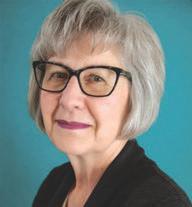
noting that she learned from other participants in classes and workshops. Their encouragement was essential to her success.
Sequel in the works
Vido is already planning a sequel novel: Finn at Forty, in which readers would learn how he’s doing in midlife.
For Love of Billie launched on February 14. The book is available on Bookshop.org, Amazon and on Vido’s website, patriciavido.com.
















By Andrew DeMillo and Anita Snow History Matters
, by
David McCul-
lough, 192 pages, Simon & Schuster, 2025
The late Pulitzer Prizewinning historian David McCullough told an audience in 2012 that writing history was like working on a detective case.
“And once on the case, you want to know more and more and more,” he said in remarks at Dartmouth College. “Follow your curiosity.”
One thing that’s clear after reading History Matters, a posthumous collection of McCullough’s writings and speeches that include his Dartmouth remarks, is how much the revered historian practiced what he preached.
ing and narrative writing for historians. Another tribute to novelist, painter and historian Paul Horgan shows how McCullough approached his writing with a painter’s eye.

The book is an enjoyable complement to McCullough’s canon of works that include biographies of John Adams and Theodore Roosevelt, and a reminder of why he was one of the greatest historians of our time. They also offer a glance into his approaches to reading and writing.
In a tribute to the late novelist Herman Wouk that’s part of the collection, McCullough underscores the importance of feel-
The writings also include a short history of his typewriter, a second-hand Royal Standard that he bought in 1965 and used to write every one of his 12 books. A recommended reading list from McCullough underscores how much he viewed literature as necessary for understanding history.
Throughout the book, McCullough’s remarks display concerns about the consequences of historical illiteracy. His pieces also illustrate the power of helping out younger writers and connecting with them.
Overall, the collection offers a brief introduction to McCullough for readers not familiar with his works but one that pales to the value of reading his books. Hopefully, it will provide inspiration to readers to delve into McCullough’s writings.
Andrew DeMillo
The Roma: A Traveling History, by Madeline Potter, 272 pages, Harper, 2025
The Roma: A Travelling History is a fascinating look at a marginalized and misunderstood group of people who have encountered hostility for centuries.
Written by Madeline Potter, a scholar of 19 th-century Gothic literature, the new book recounts how members of the group long have been maligned, enslaved, deported and murdered.
Potter, who grew up Romani in postCommunist Romania, weaves together bits of memoir with her archival research into what is described as the first contemporary history of the Romani people.
Instead of being raised in an intricately carved horsedrawn “vardo” that traveled from camp to camp, Potter passed her childhood in a towering Soviet-style highrise, a more typical upbringing as the Romani people increasingly leave life on the road to become “settled.”
In her book, Potter carries us from England, where she currently lives, to Romania, Bulgaria, Hungary, Austria, Germany, France, Spain, the U.S. West Coast and finally to Sweden.
In Spain, they have been known as Gitanos. During Spain’s 1749 “Gran Redada de Gitanos” (Great Gypsy Roundup), some 10,000 Roma were detained, and families were separated, with the men sent to work in shipyards and the women and children to factories.
In Nazi Germany, the Reich Office for Combating the Gypsy Menace set the scene for the Roma and related Sinti people to be rounded up and sent to concentration camps alongside Jews, members of the LGBTQ+ community and other minorities. As many as 500,000 Roma and Sinti are estimated to have been murdered by the Nazis and their collaborators during that period.


Despite the continued discrimination, the Roma have made important cultural contributions, Potter writes. Potter mentions Carmen Amaya, a Spanish Romani who was known in the mid20th century as the world’s best flamenco dancer. Composer Franz Liszt was so enamored of Hungarian Roma traditions that he absorbed them into his 19th-century work.









Potter tells of how King Henry VIII passed the “Egyptians Act” in 1530, calling for the Gypsy people to be expelled from England due to their alleged crimes, including “robberies,” “palmistry” and “deceit.”
Believed to have migrated from northern India to Europe some 1,500 years ago, and with a language rooted in Sanskrit, the Roma at one time were thought to have originated in Egypt.





“There is much sadness in our history, and much pain,” Potter writes. “But importantly it’s not pain that beats at the heart of our story. On each step of my journey, I encountered the wondrous stories of those who have decisively resisted their marginalization, who have refused to be silent and whose stories continue to inspire the Roma today.” —Anita Snow © 2025 The Associated Press. All rights reserved.
Jewish Community Services welcomes individuals experiencing memory changes and their care partners to Memory Café, a friendly, relaxed space to connect, socialize, and enjoy refreshments and activities. This free event happens on the third Tuesday of each month from 2 to 3 p.m. at the Edward A. Myerberg Center, 3101 Fallstaff Rd., Baltimore. Pre-registration is required at bit.ly/JCSMemoryCafe.

Q: For those of us women who would prefer to meet people in real life, where do men of a certain age go?
I’m very active and go to lots of things with friends, but we never meet single men. There’s a Meetup group in my city that has happy hours for singles 50-plus. They’re really fun — but 80% women.
—Margaret, Texas
A: Available older men, where are you? So many inquiring minds — not just Margaret’s — really want to know.
game lecture.

By Laura Stassi
“My girlfriends and I go to the theater or to a baseball game or to some sort of art event,” Michele, who lives in Washington, D.C., told me in the 2020 episode of “Dating While Gray,” my podcast. “There will be five or six of us attractive, intelligent, sophisticated, ‘gotit-going-on’ kind of people, and we will say, ‘Where are our guy counterparts? Where are they?’”
More recently, Anastasia in Maryland asked, “Why don’t men join the kind of exercise activities where women are? I know a lot of great women in my Pilates and pool aerobics classes, and it seems like it would be a positive way to meet.”
OK, women, I promise you: Available older men exist in the wild. But it might not be so obvious because they’re far outnumbered by available older women. In the older dating pool, there are 5 million more single women 50 to 74 then men in that age range. As we grow even older, the ratio becomes even more lopsided.
Like you, Margaret, my photographer friend Jen found Meetup.com groups and other organized activities to be overwhelmingly female. She participated anyway and eventually met her now-husband in a cycling group. They were friends for a while before their relationship turned into something more — which brings me to my long-
Participating in activities we enjoy will at least lead to meeting likespirited people and, hopefully, friends. If romance develops, all the better.
Monica and Don, for example, were both married when they met briefly at work. A few years later, they ran into each other at a yoga studio/gym. Over a five-year period, they became friends. After the yoga studio closed, they lost touch. Two years after that, nowdivorced Monica discovered through a Facebook post that Don’s wife had died. She waited a month and then reached out to say if he needed a friend, she was there. Slowly and steadily, new love blossomed.
Back to Meetup.com, which is also an app: A few years after I interviewed Michele, she reached out to tell me about a group in the D.C. area formed by one of her male high school friends. It’s called 51+ Fit, Active, and Social, and it compiles activities for the more than 2,700 members: hiking, biking, kayaking, dancing and attending museum and theater events.
Anastasia told me that while she walks and hikes, arthritis prevents her from playing pickleball — and that’s too bad. Personal experience tells me a lot of older available men are on the courts.
That includes my friend John in Virginia. He squeezes in play time when he’s not at the paint or hardware store to pick up supplies for home-renovation projects. John also attends his university’s alumni club events and tells me his single male friends do, too.
Here are some other places you just might find older available men:
“When the weather is amenable, I hang out in parks, [one of] which abuts a senior center that shows free movies on Monday
and Friday afternoons. I also attend many, many NYC cultural events, many of them free.” —Barry in NYC
“Before I met my new partner, I went to hear live music. My wonderful wife died over 15 years ago. I was already involved in the indie music scene because I’ve hosted house concerts since 2004. So after she died, I went to hear music several times a week just to get out of the house. There were often a lot of single people. I got a handful of dates that way, and even dated someone for about
eight months. Going to local music venues can be a great way to meet people, especially smaller venues like music cafés or smaller clubs as well as house concerts, all places where people hang out and talk before and after.” —Ryan, Maryland
Laura Stassi is host of the podcast “Dating While Gray: The Grown-Up’s Guide to Love, Sex, and Relationships” and author of Romance Redux: Finding Love in Your Later Years. Send your questions to Laura at newloveafter50@gmail.com.










Across
1. Suffers water damage
5. Obsessively follow cyber-trails
10. Extra sleeping spot in an Airbnb
14. Complain about a bad fishing hole
15. Small Toyota from the ‘90s
16. Going into game-seven
17. Oxygen producer
18. Some songs on SeriusXM’s Met Opera
Radio channel
19. Use closed-captions
20. O, E, and Y
23. Toda : Madrid :: ___ : Madridn’t
24. Centerpiece of a witch’s kitchen
25. The Northern Pygmy, Western Screech, and 12 other species
32. Santa ___ winds
35. When a.m. becomes p.m.
36. Go off like a car alarm
37. King David’s musical instrument
39. Make zzz’s
42. It was blocked from number one by Da Ya Think I’m Sexy? in 1979
43. Best Picture of 2024
45. Cheeseheads and the Dawg Pound
47. Present from van Gogh
48. Assignment for the worst offenders
52. Crunch, naval officer of breakfast
53. “The trouble with a kitten is that eventually it becomes ___” (Ogden Nash)
56. What comedians get for killing
63. Island birthplace of US citizen Nicole Kidman
64. Goes on a rampage
65. Top-quality
66. Fall victim to Knight Rider’s Oil Slick button
67. He sang “Everybody Wash” on the first episode of Sesame Street
68. Get ___ the ground floor
69. Use a Remmington Quiet-Riter
70. Bob, who formed The Silver Bullet Band
71. Being nothing more than
By Stephen Sherr
1. Canadian sketch comedy show that also appeared on NBC
2. Hammerin’ Hank
3. ___ spine (became more assertive)
4. USA Swimming sponsor, since 1985
5. Relaxation destinations
6. Source of poi
7. “I highly doubt that”
8. Take a ___ faith (be bold and confident)
9. Neighbor of Serbia
10. In a peaceful manner
11. “I have finished my message”
12. Achievement
13. Word on Buzz Lightyear’s foot
21. Croquet or badminton venue
22. Raise or raze, but not rays
26. The shortest part of UCLA
27. Rob Reiner, to Carl
28. Binary switch type
29. Three-card monte, or Connect Four
30. Killer whale
31. Easy to get to by foot
32. Whale hater
33. Prefix meaning “one-billionth”
34. Pretty maids all in ___
38. Prevent from happening
40. “Go team, go!”
41. Dir. the Cowboys fly to play the Commanders
44. “What a shame”
46. Smelting waste
49. Future fungi
50. At the top of one’s game
51. Jewish toast
54. Do penance
55. Just Denny Doherty in The Mamas & the Papas
56. Table-assigner
57. Like Pinot Noir, but not Pinot Grigio
58. Lion tamer’s prop
59. ___ time, no see
60. It’s like kissing your sister
61. Junkie
62. French name meaning “born again”
The Beacon prints classified advertising under the following headings: Business & Employment Opportunities; Caregivers; Computer Services; Entertainment, Financial, For Sale; For Sale/Rent: Real Estate; Free; Health; Home/ Handyman Services; Legal Services; Miscellaneous; Personals; Personal Services; Vacation Opportunities; and Wanted. For submission guidelines and deadlines, see the box on the right.
CAVEAT EMPTOR!
The Beacon does not knowingly accept obscene, offensive, harmful, or fraudulent advertising. However, we do not investigate any advertisers or their products and cannot accept responsibility for the integrity of either. Respondents to classified advertising should always use caution and their best judgment.
EMPLOYMENT & REAL ESTATE ADS:
We will not knowingly or intentionally accept advertising in violation of federal, state, and local laws prohibiting discrimination based on race, color, national origin, sex, familial status or handicap in connection with employment or the sale or rental of real estate.
DRIVERS WANTED / GREAT FOR RETIREES / Locally 35-year-old family-owned company is looking for dependable people to make delivers to businesses. / Make your own schedule / Call (410) 234-3100 for more information and schedule an appointment to apply.
MOBILE HAIR & NAIL SERVICES - WE COME TO YOU. Professional Licensed Hair Stylist. Women and Men’s Services - All Hair Types. Cuts, Styles, Roller Sets, Color, Perms, Men’s Cuts & Facial Grooming, Manicures & more. Call 410-415-1760.
PATIENT, PRACTICAL, PERSONAL & INPERSON, 20+ years experience. Don’t let tech frustrate you. Get comfortable & confident with smartphones, tablets, laptops, TV, Alexa & more. Learn how to avoid scams. Julia: 443-4362612, tech.coach4all@gmail.com
SAVVY SENIOR TECH HUB - Friendly 1:1 tech support designed for seniors! Learn smartphones, tablets & computers at your own pace. Patient instruction, affordable rates. Don’t let technology intimidate you - master it! Call/text Stefan at 443-281-3638.
PRIME TIMERS OF BALTIMORE is a welcoming community for mature gay and bisexual men. The Prime Timers offer social activities that cater to the mind and body. We meet for dinners, a book club, potlucks, hiking, tours, bowling, and more! Join us! Visit baltimoreprimetimers.org or email info@ptbalto.org for info.
UP TO $15,000.00 OF GUARANTEED LIFE INSURANCE! No medical exam or health questions. Cash to help pay funeral and other final expenses. Call Physicians Life Insurance Company866-212-1092 or visit www.Life55plus.info/beacon
GARDENS OF FAITH. Burial vault for 2. Asking $10,000. Individual burial lots $3000 each. Call Jim 443-425-4127.
NEW WINDOWS FROM WINDOW NATION. Special money saving offer - zero down, zero payments, zero interest for TWO years AND buy 2 windows and get 2 FREE! Offer is valid for select models. Labor not included. Other restrictions apply. Call Window Nation today! 855-909-2278.
DISCOVER NORTH STAR NAVIGATORS:
Your Trusted Partner in Elder Support Services. At North Star Navigators, we are dedicated to making a positive impact in the lives of our aging population. We understand the challenges that come with aging and are driven by a personal quest to enhance the well-being of seniors. Our telehealth services include: - Comprehensive Assessments & RecommendationsGolden Years Planning - Healthy Ship (Membership). Get Ready to Set Sail with North Star Navigators! Where YOU remain the Captain, and our Stars guide the way. Visit NorthStarNavigators.net or call 833-735-1983 for more information. Your Trusted Team: Anchored in Compassion, Driven by Passion.
PORTABLE OXYGEN CONCENTRATOR
May Be Covered by Medicare! Reclaim independence and mobility with the compact design and long-lasting battery of Inogen One. Free information kit! Call 855-851-0949.
DENTAL INSURANCE from Physicians Mutual Insurance Company. Coverage for 400 plus procedures. Real dental insurance - NOT just a discount plan. Do not wait! Call now! Get your FREE Dental Information Kit with all the details! 1-844-366-1003 www.dental50plus.com/320 #6258
MOBILEHELP, America’s Premier Mobile Medical Alert System. Whether You’re Home or Away. For Safety and Peace of Mind. No Long Term Contracts! Free Brochure! Call Today! 1240-650-9189.
THE BATHROOM OF YOUR DREAMS in as little as 1 day. Limited Time Offer - $1000 off or No Payments and No Interest for 18 months for customers who qualify. BCI Bath & Shower. Many options available. Quality materials & professional installation. Senior & Military Discounts Available. Call Today! 1-855-653-0087.
DON’T LET THE STAIRS LIMIT YOUR MOBILITY! Discover the ideal solution for anyone who struggles on the stairs, is concerned about a fall or wants to regain access to their entire home. Call AmeriGlide today! 1866-365-5170.
All classified ads must be submitted and paid for online, via our website, www.thebeaconnewspapers.com/classifieds Deadlines and Payments: To appear in the next issue, your ad text and payment must be entered by the 5th of the preceding month (for Baltimore and Howard County editions); by the 20th (for Washington edition).
Cost will be based on the number of characters and spaces in your ad:
• $25 for 1-250 • $35 for 251-500. • $50 for 501-750 (maximum length). The website will calculate this for you.
Note: Maryland contractors must provide a valid MHIC number. Each real estate listing qualifies as one ad. All ads are subject to publisher’s discretion. Payment will be refunded if unacceptable for any reason.
NO MORE CLEANING OUT GUTTERS. Guaranteed! LeafFilter is the most advanced gutter protection for your home, backed by a noclog guarantee and lifetime transferrable warranty. Call today 1-855-977-6078 to schedule a FREE inspection and no obligation estimate. Plus get 20% off! Seniors and military save an additional 10%. Restrictions apply, see representative for warranty and offer details.
CONSUMER CELLULAR - the same reliable, nationwide coverage as the largest carriers. No long-term contract, no hidden fees and activation is free. All plans feature unlimited talk and text, starting at just $20/month. For more information, call 1-833-742-1303.
BECOME A PUBLISHED AUTHOR. We want to Read Your Book! Dorrance Publishing-Trusted by Authors Since 1920. Book manuscript submissions currently being reviewed. Comprehensive Services: Consultation, Production, Promotion and Distribution. Call for Your Free Author’s Guide 1-833-992-0110 or visit dorranceinfo.com/beacon
DIRECTV - All your entertainment. Nothing on your roof! Sign up for Directv and get your first three months of Max, Paramount+, Showtime, Starz, MGM+ and Cinemax included. Choice package $84.99/mo. Some restrictions apply. Call DIRECTV 1-888-572-4953.
PAYING TOP CASH FOR ANTIQUES AND COLLECTIBLES. House calls made with prompt, courteous service seven days a week and 25 years of experience! Buying toys, trains, militaria, glassware, advertising merchandise, paper items and much more! Contact Mason or Megan at: 443-306-8816.