NEWS
Renovated trading room offers new ammenities to Mays Business School through ConocoPhillips partnership A2
Renovated trading room offers new ammenities to Mays Business School through ConocoPhillips partnership A2
Student-run beverage cart brings culture to community
By Ava Whelan Life & Arts Writer
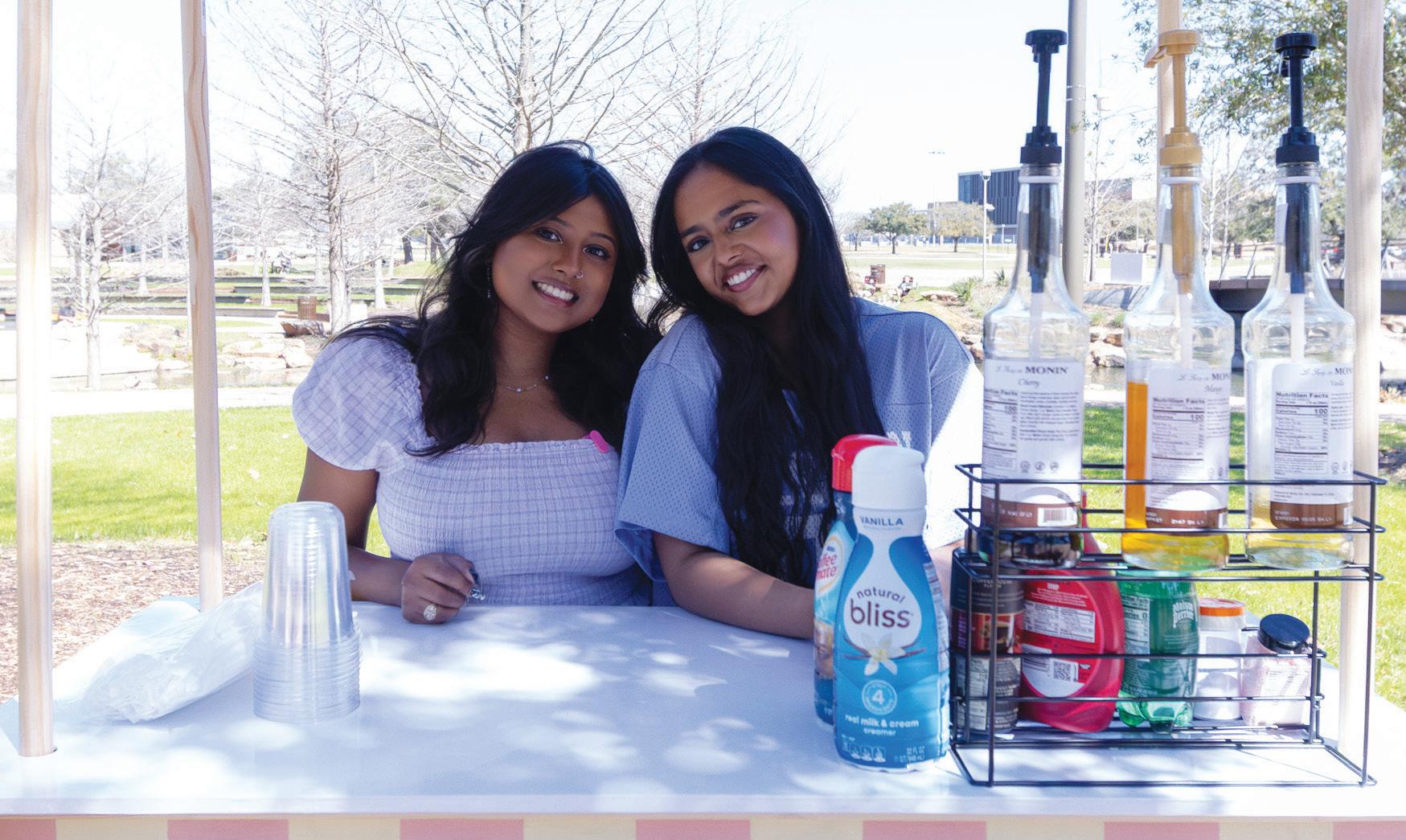
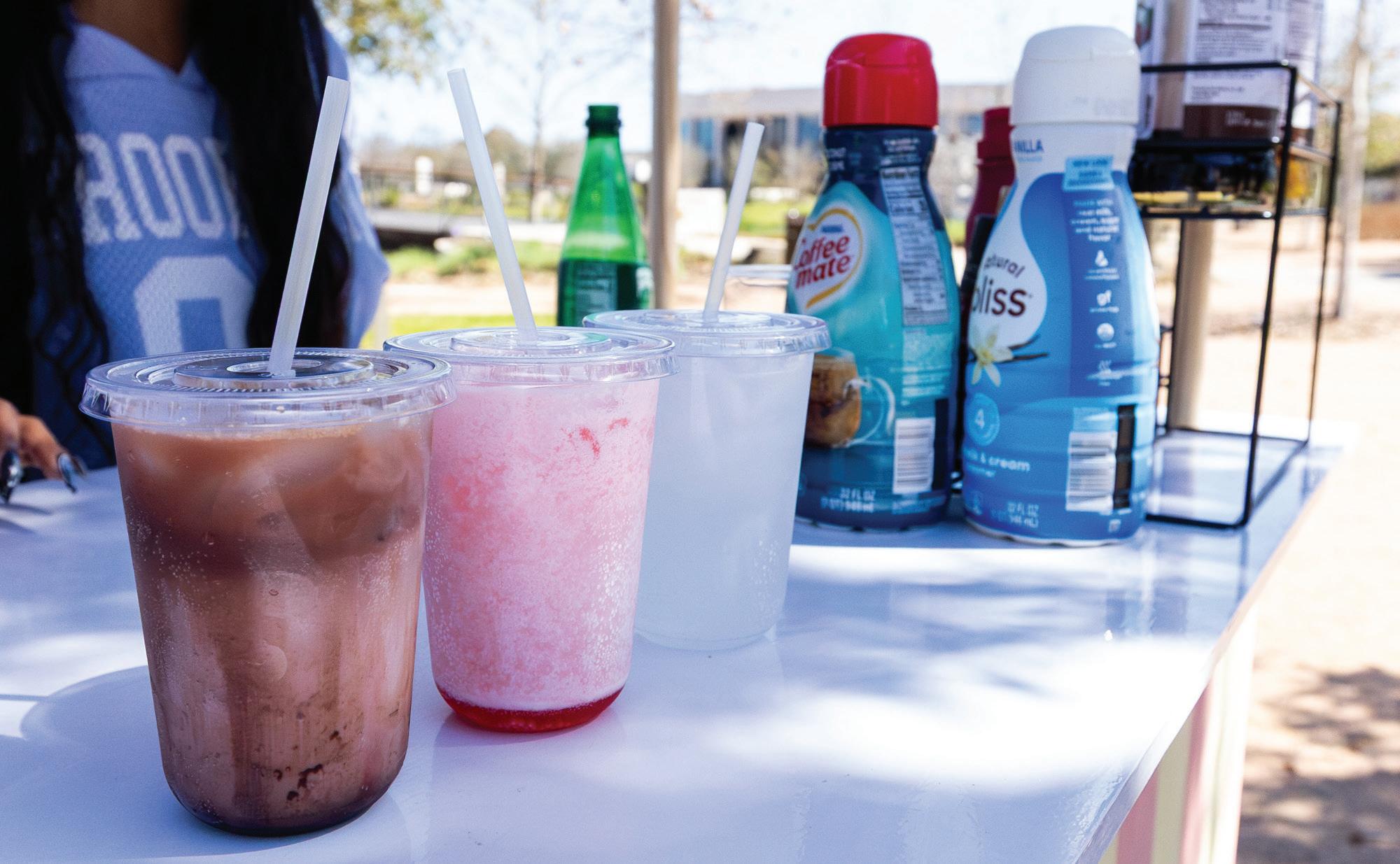
Behind a handmade cart, sodas fizz over ice as vibrant fruit syrups and vanilla-coconut cream swirl together in colorful layers. The sweet scents of citrus, berries and spice hang in the air, as curious customers gather to watch drinks be crafted by hand.
Flavor Drop is a specialty beverage cart featuring dirty sodas with a twist: Indian fusion drinks and tea. After their soft launch in early February, the business has appeared at local pop-ups and events across Bryan-College Station, including the McFerrin Center Student Marketplace and the Rountree Market.
Working behind the cart are electronic systems engineering technology senior Likitha Joneboina and supply chain management senior Neharika Vajinapalli. Having met through Aggie Entrepreneurs, the two quickly became business partners and friends, founding Flavor Drop out of their shared love for soda and their heritage.
“We wanted to do something with food because it attracts everybody, all ages and types of people,” Joneboina said. “Since it’s not coffee or matcha, I feel like it’s even bigger of a market … it’s an all-day thing.”
Flavor Drop operates out of a colorful handmade cart that is fully portable and collapsible, which Joneboina said makes transportation to pop-up events easier. One week of measurements, carpentry, painting and teamwork resulted in a homebase for their business to start operating from, a process Vajinapalli documented and recorded.
“I pitched to [Vajinapalli], and she was like, ‘You’re crazy, but okay,’” Joneboina said. “That weekend, we went to Home Depot and bought wood. We actually built the whole cart ourselves, then painted it and ev-
erages featured on Flavor Drop’s menu: dirty sodas, authentic Indian drinks and a combination of the two — Indian fusion dirty sodas with popular flavors from the region. Originally popularized in 2010 by Utah-based drink chain, Swig, the dirty soda craze has quickly spread nationwide. Seeing the drink’s rise in popularity, Vajinapalli said she noticed a gap for dirty soda in the local beverage market in Bryan-College Station.
Alongside dirty sodas, Flavor Drop’s menu also introduces customers to drinks commonly enjoyed across India. Currently, the beverage cart offers chai — a blend of black tea, spices and sugar topped with oat milk — and Mumbai lime soda, a take on traditional Nimbu soda.
I want it to be more than just us making money because it was not about that. It was purely to do something together, but also to raise awareness of the authentic Indian style and flavors.
Neharika Vajinapalli
“Within India, there are a lot of different sodas, too,” Vajinapalli said. “One of them is called Nimbu soda, also known as lime soda. So Indian lemonade, but instead of the traditional sweet taste, it’s definitely more salty and sour but also refreshing.”
Supply Chain Management Senior and Flavor Drop Co-Owner
erything.”
“First, we wanted to make a joint business together,” Vajinapalli said. “Second, we’ve always wanted to mix our heritage, Indian culture and everything, with something that we love, being food and drinks. There’s not really like any sort of soda place nearby. … We decided we would use our network to hop on to that and create Flavor Drop.”
Away from the cart, both owners run their own individually creative businesses. Vajinapalli, a licensed nail technician running Made2Polish, and Joneboina, a henna artist, referred to themselves as “super entrepreneurs” and said they wanted to work together to reach a broader audience.
While considering portability, the pair also wanted to draw parallels to their Indian heritage, where Joneboina said it is common for vendors to sell their products from carts or wagons. Vajinapalli elaborated on the importance of first impressions, saying that a cute, aesthetically pleasing cart could ease the uncertainty of those trying authentic Indian drinks for the first time.
“In India, there are many people who sell [products] from carts or wagons,” Joneboina said. “They walk around the streets, and whenever people like what they see, they come up and buy it. We wanted to keep that part authentic with it, too, but take a more aesthetic take on it.”
Joneboina discussed a blend of three bev-
After securing a 10-seed, A&M men’s basketball prepares to face Saint Mary’s in first round of March Madness A5
Confluence of traditions: A&M students celebrate Lunar New Year, Lent, Ramadan
Religious, cultural observances coincide in Aggieland
By Tejas Murali Life & Arts Writer
On Feb. 27, Aggie Park was electrified with lanterns, traditional Asian performances, red envelopes as hundreds of students celebrated the arrival of what they hoped would be a fruitful new year. Elsewhere across campus, a group of Muslim students concluded their day-long fast for Ramadan with iftar, a meal taken in communion at sunset. Meanwhile, Catholic Aggies, many of whom wore a symbolic cross of ash on their forehead to commemorate Ash Wednesday, were beginning a 40-day season of almsgiving of their own leading up to Easter.
This year, the start of the Asian Lunar New Year, the Islamic holy month of Ramadan and Ash Wednesday, the start of the Catholic Lent period, all fell within a day of each other, the former two having been observed on Feb. 17 and the latter on Feb. 18.
This Lunar New Year marked the beginning of the Year of the Horse. Vietnamese Student Association, or VSA, Vice President of Operations and electrical engineering senior Cindy Luu considers the festival an important part of her life, one she grew up celebrating with her family.
“Lunar New Year means the whole family coming over, cooking lots of food,” Luu said. “Growing up, I would have to wish people things, and older people would give you red envelopes and stuff. All those little traditions, hanging out with family, going up to markets to buy flowers or fruits and making the house look all nice, it makes me feel warm inside.”
Lunar New Year also holds religious and symbolic significance for Luu, whose family is Buddhist and visits a Buddhist temple during the festival. Luu recalls performing the traditional lion dance on various stages to symbolize the warding off of evil spirits and occasionally bless local businesses.
According to Luu, the community is the most enjoyable part of Lunar New Year, though it looked different this year celebrating it away from family and with peers in Aggieland instead. VSA hosted a Lunar New Year celebration at Aggie Park featuring various traditions, including the lion dance and martial arts performances, red envelopes and Vietnamese cuisine for attendees.
“It felt kind of sad because I didn’t get to see my family, but it was also bittersweet because I got to celebrate with my friends and host a huge festival,” Luu said. “The festival, to me, had to be grand, had to be a place for people to find that home.”
As a Vietnamese woman practicing Catholicism, Emma Nguyen ‘26 honors some Lunar New Year traditions such as dressing in traditional wear, attending mass delivered in Vietnamese and eating Vietnamese food with her family, while also observing the 40-day Lent period through fasting, almsgiving and prayer.
“Because we’re observing the passion and the death of Christ, we abstain from eating meat on Fridays, which is the same day that he died,” Nguyen said. “People also take personal fasts, I know a lot of people will give up sweets. … I’ve given up on saying no to things that are hard. So for me, this Lent is focused on being able to say ‘Yes’ to hard things, even if I feel like I’m not good at it or I don’t like the feeling of discomfort.”
For future menu drops, Vajinapalli revealed they want to introduce mango lassi, a blended drink made with mangoes and yogurt, and falooda, a dessert drink made with ice cream and rose.
However, Flavor Drop’s specialty lies in its fusion of Indian drinks and dirty soda, which Vajinapalli said gives the cart a unique angle in the wide and competitive soda market. Incorporating flavors popular in India, such as guava, mango, lemon and lime, brings what Vajinapalli described as a refreshing twist to their menu.
“That’s where we bring in different syrups,” Joneboina said.

Attendees of the Ash Wednesday mass received ashes on their foreheads, symbolizing the sins of humanity and the idea that humans are born of dust and will eventually return to it. Although it is not a Holy Day of Obligation, which is a mandatory observance for Catholics, many who have fallen away from their faith or have not practiced it for a while still come back to this simple tradition, according to Nguyen.
“Being able to participate in these traditions alongside fellow Catholics my age, Catholics all around the world and Catholics in the past and knowing that we are all connected by the same faith is so beautiful to me,” Nguyen said. Nguyen believes that fasting has helped grow her relationship with Christ and pushed her to try new things, like learning Vietnamese and playing the guitar, despite the challenges these tasks have posed.


Phillips 66 Trading Room serves as improved home of various Mays programs
By David Swope News Editor
The newly renovated Phillips 66 Trading Room, Mays Business School’s specialized learning center for students to gain handson experience in investing and trading, held its grand opening on Feb. 24.
In partnership with ConocoPhillips, the trading room added 25 Bloomberg Terminals and now features seating for 50 students, whiteboards, LED projectors and a small workroom. Inside is also a Kiodex Risk Workbench, a trading and risk management platform commonly used in commodity trading.
The Phillips 66 Trading Room, originally established in 2000 and renamed in honor of the ConocoPhillips partnership, is home to multiple student programs within the college.
The reworked space serves as a hub for the school’s nationally recognized Trading, Risk & Investments Program, or TRIP, and other student-managed funds such as The Reveille Fund.
Within these organizations, students widen their knowledge of various markets by managing portfolios under the guidance of experienced instructors.
In particular, TRIP students focus primarily on energy and commodities trading, while those who work on The Reveille Fund concentrate on capital markets, man-
aging capital on behalf of the University of Texas/Texas A&M Investment Management Company.
For these programs, the Phillips 66 Trading Room is where the grunt work takes place.
On the trading floor, students gain access to a wide variety of amenities and services that are used in the industry to analyze complex financial markets. Chief Investment Officer and Professor of the Practice Brent Adams ‘89 believes that mimicking the real-world environments students will
tools now offered in the Phillips 66 Trading Room is Bloomberg Terminals, giving students access to industry standard financial software that would normally cost $30,000 per subscription.
“Bloomberg is kind of the standard bearer for the industry,” Adams said. “ … You know, I’ve worked on trading floors for 30 years; it’s a real trading floor.” Adams noted that while the Phillips 66 Trading Room offers students a state-ofthe-art facility, a trading floor is more than just a space. The programs’ successes do not
I think it kind of speaks volumes that a company like ConocoPhillips is investing so much money into our program. I think it kind of speaks volumes to the program’s development and the value we provide to companies.
Justin Brown Finance Junior
work in after graduation is paramount to preparing them for a career in finance.
“We have, in this center, we have all the cutting-edge tools that you would need for commodity trading,” Adams said. “So anything that you would have a trading floor in Houston, or New York, or Geneva, London, Hong Kong, wherever it is, you would have here on the banks of the Brazos River in College Station.”
One of the most notable cutting-edge
depend solely on their amenities, but also the culture of the students who use them.
“It’s not just a physical place, it’s a living, breathing organism, right,” Adams said. “I could go put 20 people in a room, and that’s not going to make money, it’s not going to earn a return. But it has to come together just the way a football team has different positions … There’s lots of people that have different talents, different skills, look at different things, but it all comes together.”
The floor’s uses extend beyond serving these programs, however, also functioning as a venue for other campus activities such as the BP Trading Competition.
As an introduction to TRIP and the operations of a trading floor, students enroll in FINC 368, Trade Floor Dynamics. Finance junior Justin Brown, a first-semester TRIP student taking the course, believes the Phillips 66 Trading Room’s amenities and the program’s curriculum are invaluable assets.
“I think that learning how to utilize these softwares is super beneficial because the majority of people coming out of college have no idea how to use any of this, simply because they don’t have access to it,” Brown said. “I think that being in a high-impact program like TRIP and getting that early introduction to software like Bloomberg, for example, really just puts you ahead of the competition.”
The unveiling of the Phillips 66 Trading Room is not the first time ConocoPhillips has partnered with A&M. The energy giant is a long-standing partner of the university, having funded multiple programs and recently sponsored the ConocoPhillips Collaboration Plaza, a 27,300 square-foot outdoor space in the heart of the Mays Business Education Complex.
Brown said the company’s partnership with the school is not only indicative of TRIP and its other programs’ prestige, but the skills Mays equips its students with.
“I think it kind of speaks volumes that a company like ConocoPhillips is investing so much money into our program,” Brown said. “I think it kind of speaks volumes to the program’s development and the value we provide to companies.”
Investigators discover disease origins, guide interventions to improve public health overseas
By Yelisey Romanov News Reporter
A Texas A&M research team identified Brucella abortus as the bacteria driving the spread of brucellosis in Cameroon’s livestock; the discovery overturns decades of assumptions and gives public health officials in the region a concrete target for controlling the disease.
The principal investigator, Dr. Angela Arenas-Gamboa, associate professor in the Department of Veterinary Medicine & Biomedical Sciences, led the team throughout the four-year study.
A board-certified clinical pathologist by training, Arenas-Gamboa built her research career around zoonotic diseases, or illnesses transmitted from animals to people. The field is defined by protecting animal and human health in tandem and understanding the importance of the human-animal connection in diseases.
“If we can prevent the diseases in animals, we could prevent them in humans, making a very big impact,” Arenas-Gamboa said. Brucellosis, a zoonotic bacterial infection, can affect livestock and be transmitted
to humans through the consumption of raw milk and dairy products. Because of its potential to cause severe and chronic illness in humans, it continues to pose a notable public health concern in many regions worldwide. In the United States, the disease has been nearly eradicated, with fewer than 200 cases reported each year. That near-absence, while a public health success, makes it difficult to study domestically.
“The best place to study it and come up with new knowledge and interventions is in countries where the disease is endemic. That’s why we ended up in Cameroon,” Arenas-Gamboa said.
However, targeting an endemic region brought its own set of immediate challenges.
“Even though Cameroon is in Africa, and Africa is known to be endemic with high prevalence, we didn’t know anything specific about Cameroon,” Arenas-Gamboa said. “There was no data. So we had to start the planning process from scratch.”
Building that foundation required a massive, nationwide surveillance effort. The team combined practical fieldwork with statistical modeling to map the disease from the ground up.
“In order to have an idea of what is happening in the country, you need this number of animals throughout this part of the country, and you need to collect samples,” Arenas-Gamboa said. “Then the veterinar-
ian comes in and says what the appropriate samples are based on how the disease behaves.
With the methodology in place, the team had to figure out how to navigate the country’s cultural boundaries to reach the farmers and access the livestock.
“Because we don’t speak the language and don’t know the local context, we recruited three Ph.D. students who were from the region. They were in charge of not only collecting the samples, but most importantly engaging the farmers and explaining what we were doing,” Arenas-Gamboa said. “You’re not only collecting samples, but you’re training people and teaching them about the disease. They’re basically getting trained to be the next generation of scientists in the country.”
The students’ extensive fieldwork ultimately paid off, yielding the data needed to effectively combat the disease. The team discovered the brucellosis outbreak was being driven by Brucella abortus, a species of bacteria that causes reproductive failure in cattle and debilitating, wavelike fevers and joint pain in humans.
“If you don’t know what species is present and you go in and try to control Brucella suis, but you don’t have it in the country, are you accomplishing anything? No,” Arenas-Gamboa said. “A lot of countries do that. They assume they have Brucella melitensis and go in and do an intervention on
that. That wastes money, time, effort and credibility, because people don’t see results and stop trusting the process.”
Armed with this information, local health and agricultural leaders can now begin developing policies focused on controlling the disease’s spread in cattle populations.
“By understanding that the main problem comes from the cows, not from the sheep or the dog or the pig, you can tailor interventions toward that specific animal population,” Arenas-Gamboa said. “You teach the farmer, you push vaccination, you teach the veterinarian, you teach the ministry of public health. Their focus should be on livestock.”
With the animal results of the study now published, the team is turning its attention to the human population.The next phase of research will attempt to measure how widely brucellosis is circulating among people in Cameroon and how often it is being contracted.
“What we are going to do next is look at the prevalence in humans, see if doctors are actually aware of the disease and whether it is being misdiagnosed,” Arenas-Gamboa said. “We actually published a paper showing that brucellosis is frequently misdiagnosed as malaria. If a patient is not getting better on malaria treatment, they might have brucellosis.We also need to start developing vaccines for animals and for humans and new diagnostic tests.”
By Sam McMahan News Reporter
The growing practice of recruiters selecting young athletes as early as elementary school to specialize in one sport and undergoing intensive training regimens in preparation for increasingly competitive college athletics is contributing to increased injuries, surgeries and burnout among student-athletes by the time they reach high school and college, according to the American Orthopaedic Society for Sports Medicine.
Instructional assistant professor in the Department of Kinesiology & Sport Management at Texas A&M Alison Soltis said that high-intensity training is good for young individuals in grade school, and that they need to learn to put their all into what they do. However, the problem lies with scenarios in which kids are not allowed to branch out to other sports and figure out what they love doing, leading to single-sport specialization.
“I am not a fan of high-intensity specialization before early adolescence,” Soltis said. “Before roughly age 12, sports should emphasize play, broad skill development, body awareness and enjoyment — not yearround performance pressure. Professional organizations such as the [National Strength and Conditioning Association] consistently
note that early specialization increases the risk of burnout and overuse injuries.”
Soltis discussed how specialization, especially for those soon to be in high school, can have damaging effects on one’s physical and mental capabilities during adolescence.
“Young athletes should be encouraged to try multiple sports and delay specialization until around 12-years-old or later,” Soltis said. “This will reduce injury risk, increase broad physical skills and proprioception and reduce mental and emotional burnout. When young athletes choose to focus on one sport later in adolescence, it is more likely to come from intrinsic motivation, passion and joy for the sport, rather than external pressures.”
Clinical Associate Professor and Program Director of Performance Physiology and Strength & Conditioning at A&M Bryan Mann, Ph.D., described how early specialization damages the overall performance of an athlete.
“The ones who benefit from early specialization are the clubs who promote them, and the ones who lose are the athletes,” Mann said. “The year-round play leads to increased level of burnout and injury, capping the total level of performance that could be had by the athlete from having experience in different sports which would give them different strategies to enhance their primary sports performance.”
Young athletes are exposed to true excellence and achievement, which, as Soltis explained, is derived from a sincere and genuine passion for the sport athletes choose to pursue.
Alysa Liu, the gold medalist in women’s
figure skating at the 2026 Winter Olympics, is a recent example. She began a rigorous training process that led her to retire in 2022 due to burnout.
However, she eventually returned to competing on the condition that she would maintain control over her training regimens and no longer undergo restrictive and unhealthy requirements, according to Yahoo Sports.
Early specialization can also lead to college and even high school athletes enduring injuries that require surgeries, such as the Tommy John surgery, a common intervention for baseball pitchers due to overuse of and strain on the elbow. A study from the National Library of Medicine, or NLM, found that there is an increase in injuries with athletes who began specializing before high school.
“These individuals, as well as those with high training volume prior to high school, had increased rates of injury and injuries requiring surgery,” the study reads.
Recruiters who use this method may believe that early specialization helps future players better hone their skills at an early age.
The same study from the NLM found that athletes who specialized before high school were at greater risk of injury, also concluded that student athletes who specialized prior to high school had better recruitment and scholarship numbers.
“NCAA Division I athletes who specialized in their varsity sport prior to age 14 were more likely to be recruited and receive an athletic scholarship,” the study reads.
This is concurrent with another study
published by the NLM that shows the earlier a person is introduced to a specific activity, the more proficient that person will become in said activity.
“It is widely accepted that children should be introduced to sports, music or languages early in their life if they are to develop a high proficiency,” the study reads.
“We suggest that acquiring fundamentally new skills that cannot be derived from skills already possessed is the most effective before adolescence.”
Another study from 2018 found that 95.5% of student-athletes were satisfied with their choice of sport. However, the NCAA revealed that there has been a growing concern over the stress and mental health of college players as well as an emphasis on the need for more mental health resources.
Early sports specialization is a relatively new and growing phenomenon in youth sports, so the data will be late to reflect the changes in burnout, injuries and overall dissatisfaction.
Soltis explained that above all else, those who participate in sports and dream of playing for a university should enjoy what they do. Exercise in and of itself is beneficial for every growing adolescent but should never push someone so far that they become discouraged from doing what they love, she added.
“At a foundational level, I hope all kids have access to sports they enjoy,” Soltis said. “Physical activity supports both mental and physical health and helping children develop a positive relationship with exercise is so important.”
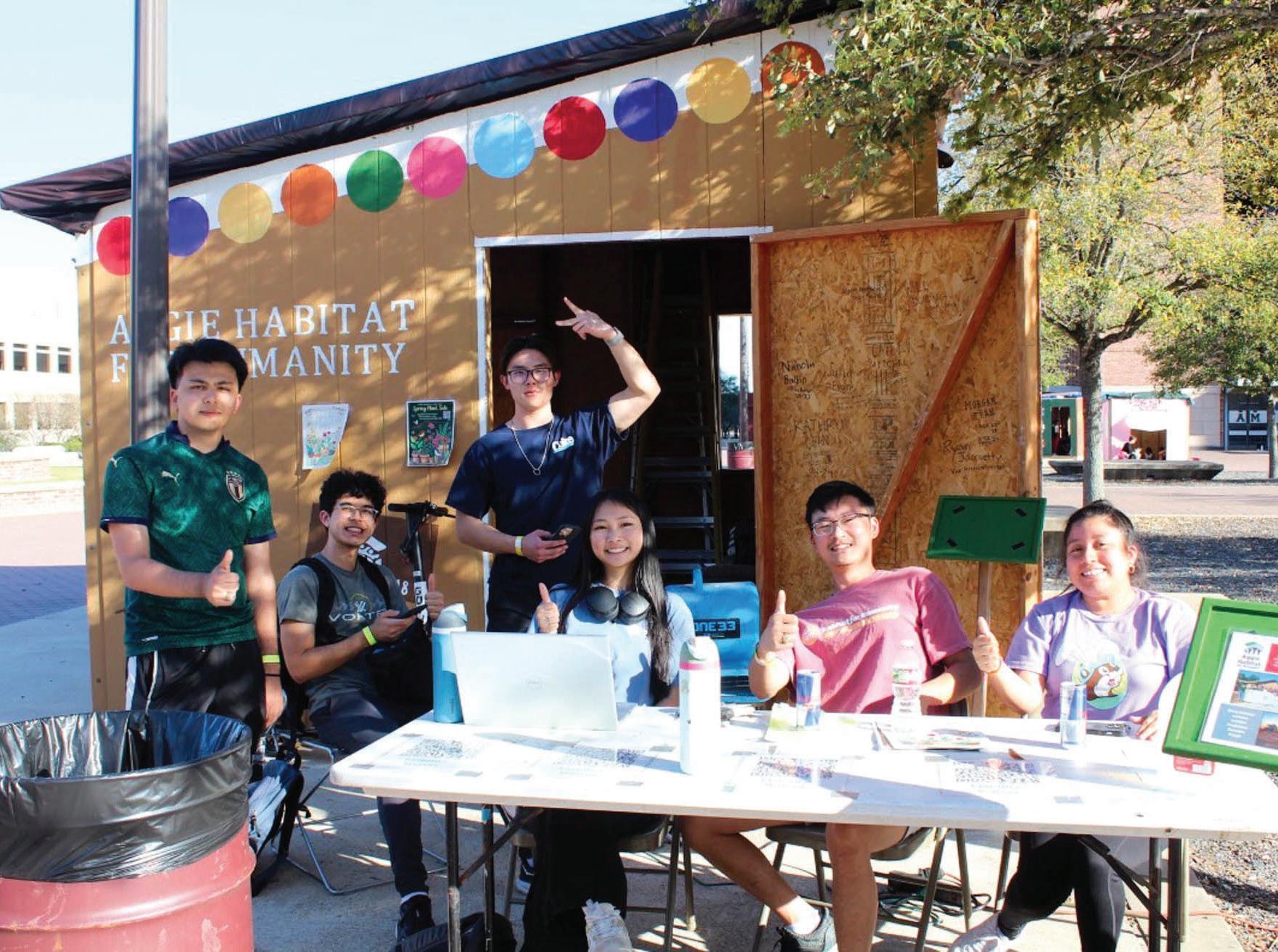
Aggie Habitat for Humanity raises awareness for affordable housing through annual event
By Jolie Jackson News Reporter
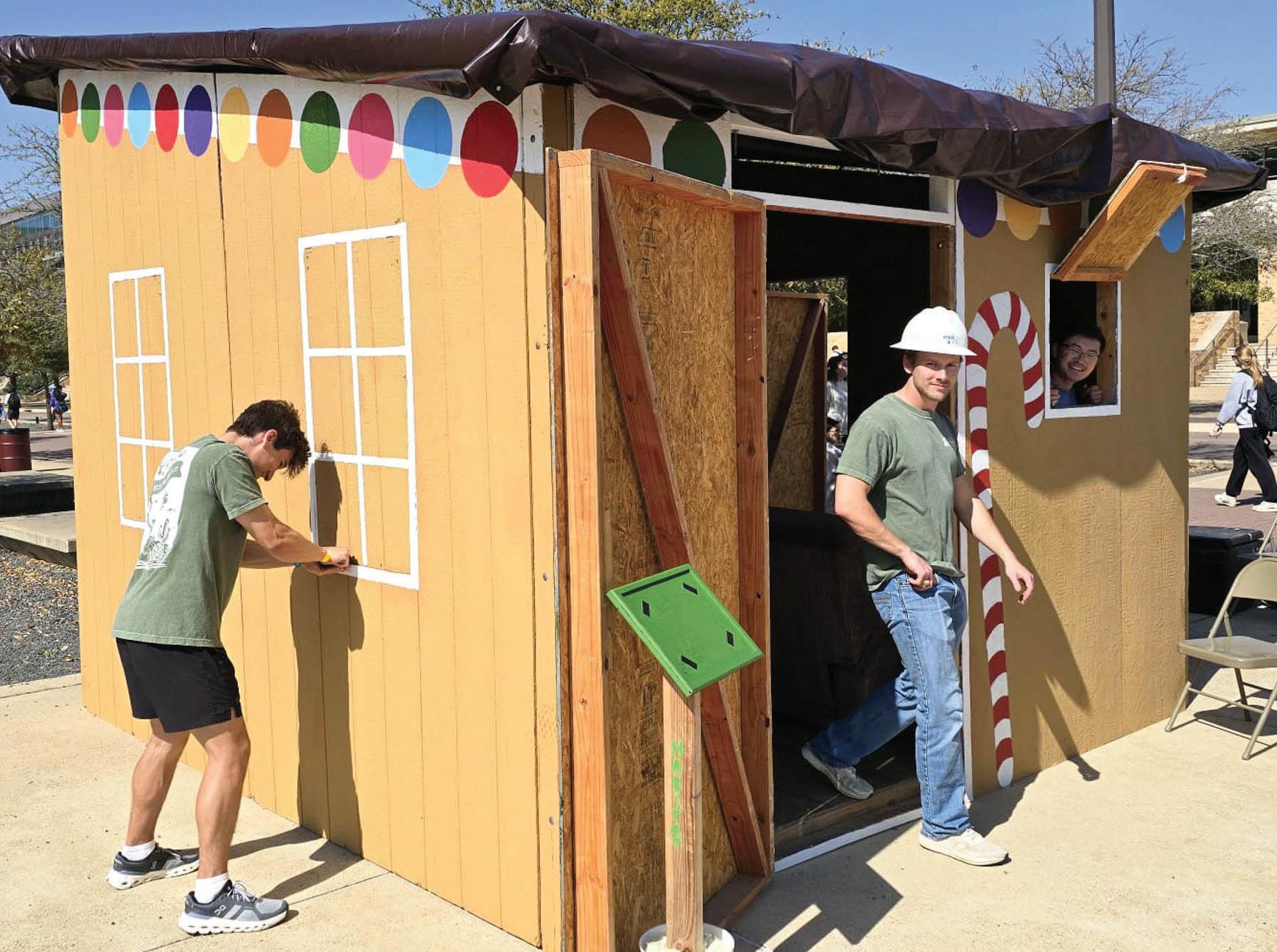
Aggie Habitat for Humanity is hosting its annual Shack-A-Thon fundraiser, designed to raise money for affordable housing in the Bryan-College Station area. The event will occur from Monday, March 23-27 at Kyle Field Plaza.
Spaces at Kyle Field Plaza were auctioned off to Texas A&M organizations, which are responsible for designing and building a shack in their designated areas. Organizations will be given different time slots on Monday to assemble their shack, and at least one person must remain in the shack at all times for the duration of the event.
The funds generated from Shack-AThon go directly to BCS Habitat for Humanity, a local branch of the international Habitat for Humanity nonprofit organization.
Families from around the world can apply for a Habitat loan with a zero-interest mortgage, and, if approved, Habitat for Humanity will partner with them to build a home. Many applicants are first-time homebuyers who may not be able to afford a traditional mortgage.
According to the Aggie Habitat for Humanity website, “September 2023 marked the completion of our first Aggie Habitat home fully funded by our organization.”
While Shack-A-Thon raises funds for Habitat for Humanity, it also spreads awareness of the need for safe, affordable housing.
“Living in the shacks gives people a taste of what many families are experiencing around just their local community,” Aggie Habitat for Humanity Director of Outreach and chemistry junior Alex Mejias said. “It’s definitely not always the most pleasant. In the past, there’s been rain and inclement weather, so you might get a little wet.”
Most of the organizations that participate in Shack-A-Thon are freshman leadership
organizations. According to electronic systems engineering technology junior Jad Haddad, his experience in Shack-A-Thon as a freshman still impacts him to this day.
“I think it is important for freshmen to experience events such as Shack-A-Thon because it allows them to meet like-minded individuals going through the same growing pains and adjustments that college brings about,” Haddad said. “I 100% believe Shack-A-Thon helped me develop stronger connections with others, as shared experiences are always a great way to get to know how a person acts in different scenarios.The shared memories of building and having to stay in the shack overnight are still with me as a junior.”
As participants live at Kyle Field Plaza for a week, Aggie Habitat for Humanity makes safety accommodations to ensure that students will have the best experience possible. A&M’s emergency medical services will have EMTs on site, and additional patrol cars will monitor the area. Participants must also check in as they enter the event and wear designated wristbands.
Mejias also believes Shack-A-Thon can lead to stronger connections between students.
“One thing that Habitat stresses is the unity of people by building communities,” Mejias said. “So, as all of these organizations come together, oftentimes they’ll help each other build their shack. So it has that effect as well, sort of bringing people together around what many people would consider a great common goal.”
The goal of uniting people through building community stems from Habitat for Humanity’s Christian roots. The organization is rooted in 1 John 3:18, which reads: “Let us not love with words or speech but with actions and in truth.”
“Christ always talks about helping others and helping those who have been outcast, as He healed the blind and dined with sinners,” Mejias said. “So that is what ShackA-Thon is all about, helping out our fellow man and woman. Just by living there, even though not everyone gets a take home message, they certainly experience what it’s like to live in a not-stable home.”
What do the results mean for the future of the film industry?
By Joshua Abraham Associate Opinion Editor
There aren’t many things that can compare to the Super Bowl, but for a cinephile, the Academy Awards far exceed any hype a mere football game can bring to their life. Months of speculation, movie screenings and awards tracking all lead up to that long-awaited one night of the year during which the most prestigious cinematic accolades are handed out and film history is made.
This year, films like “Sinners” and “One Battle After Another” dominated the show, with the latter taking home six Oscars by the night’s end, including the coveted Best Picture.
But an Oscar isn’t just given out without any repercussions; it’s an indicator for what the film industry is trending toward. Many conclusions may be drawn from the night’s winners, as the Academy Awards are a big tell of what we can expect for the future of film.
Horror makes history
After many years — and by many I mean an insufferable number — of prayer and hopefulness from horror fans, the academy decided it was finally time to give the genre the respect it deserves.
Year after year, we have seen movies that should’ve been in Oscar contention but never quite seemed to meet the standards of an “Oscar-worthy” film. From Toni Collette’s lack of Best Actress recognition for her role in “Hereditary” — one of the greatest snubs of all time — to “The Shining” receiving no nominations and Demi Moore’s infamous “The Substance” loss to Mikey Madison’s “Anora,” this year’s show finally seemed to do the horror genre justice, with Amy Madigan winning Best Supporting Actress for her role in “Weapons” and Michael B. Jordan claiming victory for Best Actor, alongside another three wins for “Sinners.”
There’s no reason why horror films should be deprived of awards recognition. This beloved genre consistently performs at the box office, proving time and again that it is a real craft deserving of the academy’s acceptance. The night’s results are a step in the right direction for the long-overdue acknowledgement of the greatness of these kinds of movies.
Timothée Chalamet gets hit hard

Many different campaigns have devel oped strategies for ensuring their victory in the war of awards success, whether that be releasing a film during the fall season for prime theatrical viewing or covering the press trail to promote their candidacy for an award.
But how does one single-handedly lose an award in just a matter of weeks? Has there ever been a battle tactic for that?
There is now, and we can thank Timothée Chalamet for it.
After winning the Critics’ Choice Award and the Golden Globe in his respective category, he was considered a lock for the Academy Award for Best Actor. But after his loss to Jordan during the Actor Awards, his apparent arrogance on the press circuit and a now-costly comment targeting the opera and ballet world slowly caused the award to slip from his hands.
But we didn’t need to wait until the final 30 minutes of the Oscars for this big reveal; it was clear from the start of the show that what he thought was going to be a legendary day quickly turned into a night he is now trying to forget.
He was forced to take hit after hit during host Conan O’Brien’s opening monologue targeting his now infamous comments, as everyone in the room turned away from the starboy, making him the laughing stock of the night.
As the jabs kept coming, it became ob-
vious he definitely didn’t want to play this game anymore; his smile faded after each joke, and by the time Jordan accepted the award that was once figuratively in his hands, it had outright vanished.
The academy evidently put its foot down, conveying through its decisions that it didn’t like what Chalamet stood for, punishing him and the entire movie for his controversial stance as “Marty Supreme” won none of its nominations.
It’ll be interesting to see what one of this generation’s biggest stars decides to do next, but rest assured that he will turn the emotions felt during the award ceremony into fuel as he continues his chase for gold.
Film popularity matters
This year has solidified a long-debated theory for what actually matters when it comes to winning an Academy Award.
If you look at the past few years, Best Picture has consistently been a toss-up between blockbusters like “Oppenheimer” and indie darlings such as “Everything Everywhere All At Once” and “Anora,” with no one being able to pin down what exactly contributes to success on awards night.
But the answer has finally become clear: People need to actually care about the movie.
When “CODA” won Best Picture in 2021, everyone was confused — and peo-
ple are still just as confused in retrospect due to its continued lack of popularity, for even after winning several Oscars during a year made awkward by COVID-19, no one seems to remember it.
In contrast, Best Picture winners since have been at the forefront of pop culture, garnering conversation for months on end that propelled them to winning the award. This wasn’t only because a bunch of critics liked them, but also because audiences connected with them.
Both “Sinners” and “One Battle After Another” were this year’s leading films for the show’s top award, with each having made over $100 million at the box office. The praise and discourse that accompanied each of these movies helped elevate their respective cultural standings, setting in motion the successful run of each film in winning awards. It’s not enough to be “the little indie that could,” hoping its lack of stature against much bigger movies pushes a narrative for a win. No one is going to want to vote or advocate for a movie if no one has seen it, much less heard about it.
Audience impact matters now, and it’ll only be a matter of time until we see a field of films that have grossed millions of dollars and are beloved by audiences.
Joshua Abraham is a kinesiology senior and associate opinion editor for The Battalion.
Harry Styles’ long-awaited fourth studio album is here
By Thea Findlay Opinion Writer
Rating: 9/10
“WE BELONG TOGETHER” was found plastered across major cities at the beginning of this year — a callback to “Love On Tour,” Harry Styles’ massive world tour that concluded in 2023. Soon after, the line was featured in the catchy chorus for his lead single, “Aperture.”
After two years of sparsely scattered photographs — mainly featuring his new hobby of running marathons — Styles has reentered society with his highly anticipated fourth studio album “Kiss All The Time. Disco, Occasionally.” While he broke his tradition of naming a song off each of his albums after a piece of fruit, Styles kept his collaboration with longtime producer Kid Harpoon, leaving fans shocked to hear a new synth-pop feel, differing from what people have heard previously.
“You can move forward when you acknowledge the things you don’t know and therefore give yourself the space to let light come in,” Styles said on The Zane Lowe Show in regards to “Aperture.” That beautifully sums up this album thematically, if not musically: A story about our souls in relation to time is surely discovered through his craftsmanship of sound and lyricism.
The five-and-a-half minute journey of “Aperature,” his first track, leads us to his decree that “Time won’t wait on me,” setting the tone for time to reappear as the double-edged sword which may bring the stresses of choice or freedom.
You Listening Yet?” makes you want to rock while he says, “This unpredictable fun is fun if you know how,” in regards to his previous question, “Now you’re all out of choices, are you listening yet?”
A break in the album is apparent with the middle four tracks that slow the pace down and offer fans a taste of his lyricism, a Styles staple that hasn’t quite found its way into this album but was prominent on his first three studio albums. Styles takes this time to declare, “You just need a little love” and
as Styles asks, “But I‘m scared if we’re both right, does that mean we’re not aligned?”
In classic Styles fashion, we are whipped into his most exciting song as “Pop” plays immediately after his ballad break. He’s delightful and playful as he looks back flirtatiously for the first time since “American Girls.” A balance between the inevitable ticking of time may feel unbearable, but Styles decides that it can also lead anywhere, sometimes with our best interests in mind of pure ecstasy.
transitional crossroads. Just a second ago, I was grooving, and now, Styles has taken me back down to the slower, stripped acoustic sound of “Paint By Numbers.” He sings, “It’s a lifetime of picking from one or the other,” as a candid phrase for the weight we may feel in mourning our unlived moments due to the choices we make.
The synth beat that drives the album returns on “Carla’s Song,” as Styles calmly sings, “It’s all waiting there for you, I know what you like,” to lead the album out on a positively inspirational note. He suggests at the end of his 12-track creation that maybe our connections with each other could be the love and care we all need that keeps us going each day. This album may sound different from his previous works, and if the trendy EDM synth and repetitive lyrics aren’t your style, then so be it. But he did say he found inspiration in Berlin clubs, and have you heard any DJ sets recently?

Styles’ second and third tracks, “American Girls” and “My friends are in love with American girls” keep the new synth sound going with lighthearted fun. These first two songs of the album are perfect for the local pop radio stations he is used to dominating, as they’re quick and catchy with repetitive choruses to dance beats.
The first official dance break, however, begins with “Ready, Steady, Go!” as Styles experiments with a seemingly handheld radio mic, and the upbeat drumline of “Are
“Playing the waiting game, but it all adds up to nothing” in tracks “Taste Back” and “The Waiting Game,” respectively.
His transition into the latter songs of his emotional break begins with an introspective moment for Styles rather than his usual analysis of others’.
My personal standout of the album, “Season 2 Weight Loss” lets his voice shine and blend with the new synth sound, and a cinematic moment backs his song “Coming Up Roses” with a swoonworthy symphony
This, of course, leads us to the flamboyant 70s disco-themed “Dance No More.”
Although it’s got funk, he may need to enunciate on tour because it’s difficult to decipher whether he says, “‘DJs don’t dance no more,’ they said” or “DJs don’t dance no more, they sit.” Either way, both work equally well for the message of the song, as the funky tune ends on a quirky chant: “Respect, respect your mother.”
This album is a perfect representation of growing up and finding yourself in the
The beats are basically the same for five hours straight! Yet, when I listen to the album in my young adult years, I hear myself in it. The fears that come with a ticking clock toward new periods of my life are broken up by the excitement I feel from the people around me. Styles portrays his own juggling game of maturation with a complimentary mix of dance numbers and emotional moments.
Periods of growth are never straight lines from darkness into the light. Styles explores this balance of jumbled-up fun and lurking what-ifs as if time acts as both a constraint and our freedom.
He spends eight songs asking rhetorical questions to himself and the audience, and it’s in these moments that I was truly able to grasp why I find so much comfort in this album. Reflection is necessary for the continuous movement forward in our personal evolution to become more thoughtful and grounded individuals.
“Kiss All The Time. Disco, Occasionally.” sets out with a clear goal of dance and accomplishes it wonderfully. Styles has proved that his difference doesn’t dull but rather presents an opportunity to hear his poetic and intentional thematic albums set against a new musical backdrop.
Thea Findlay is a communication junior and opinion writer for The Battalion.

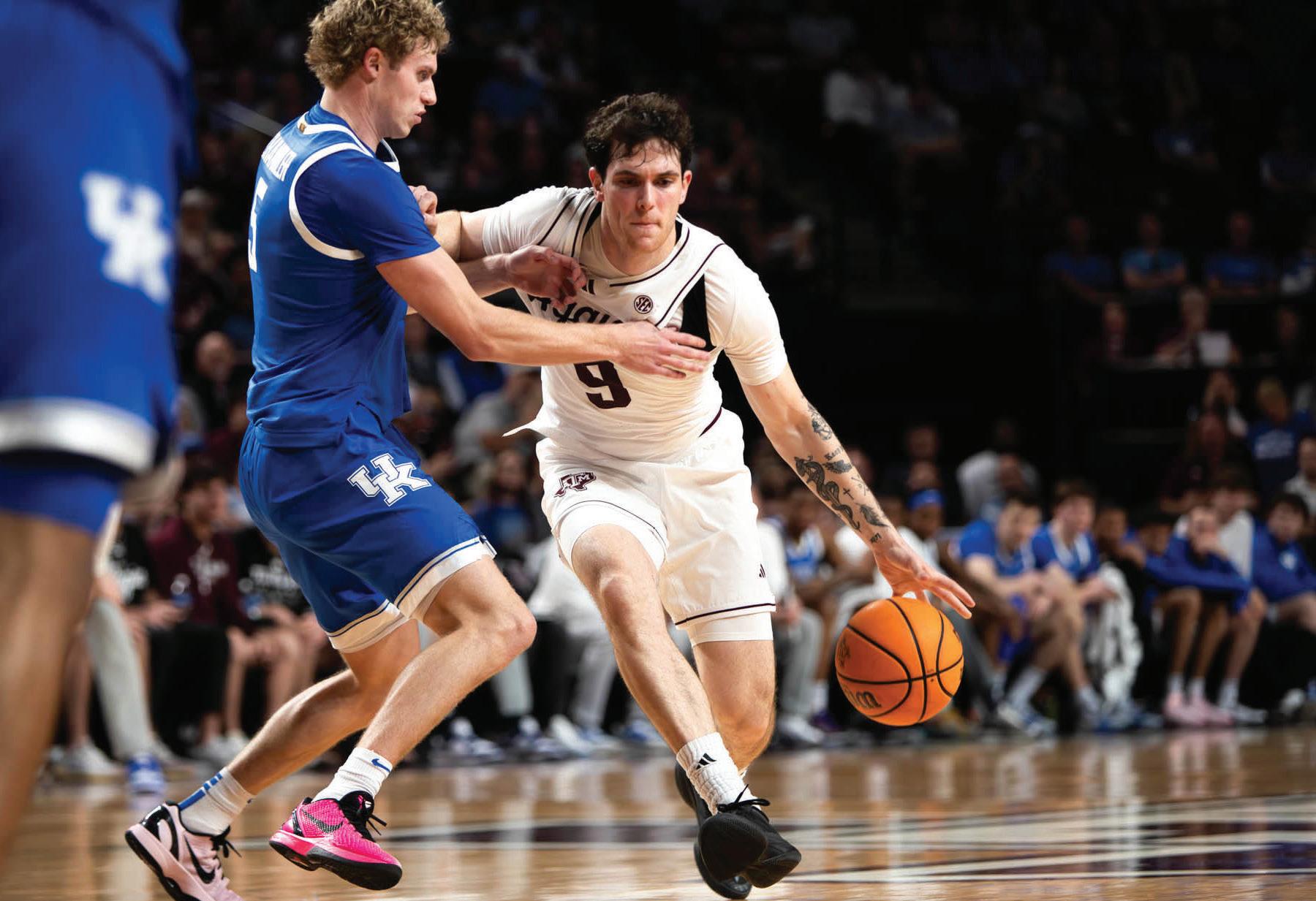
A&M dances into first-round of NCAA Tournament, hopes to stay on beat through March
By Trey Bohne Sports Writer
In the words of Kevin James, “God bless our troops, God bless America, and gentleman, start your engines!”
March Madness has finally arrived.
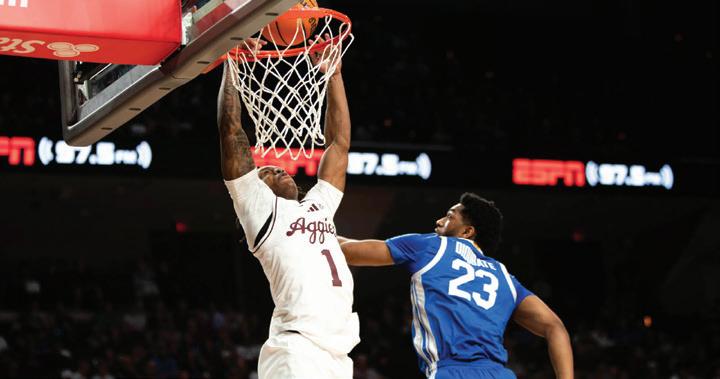
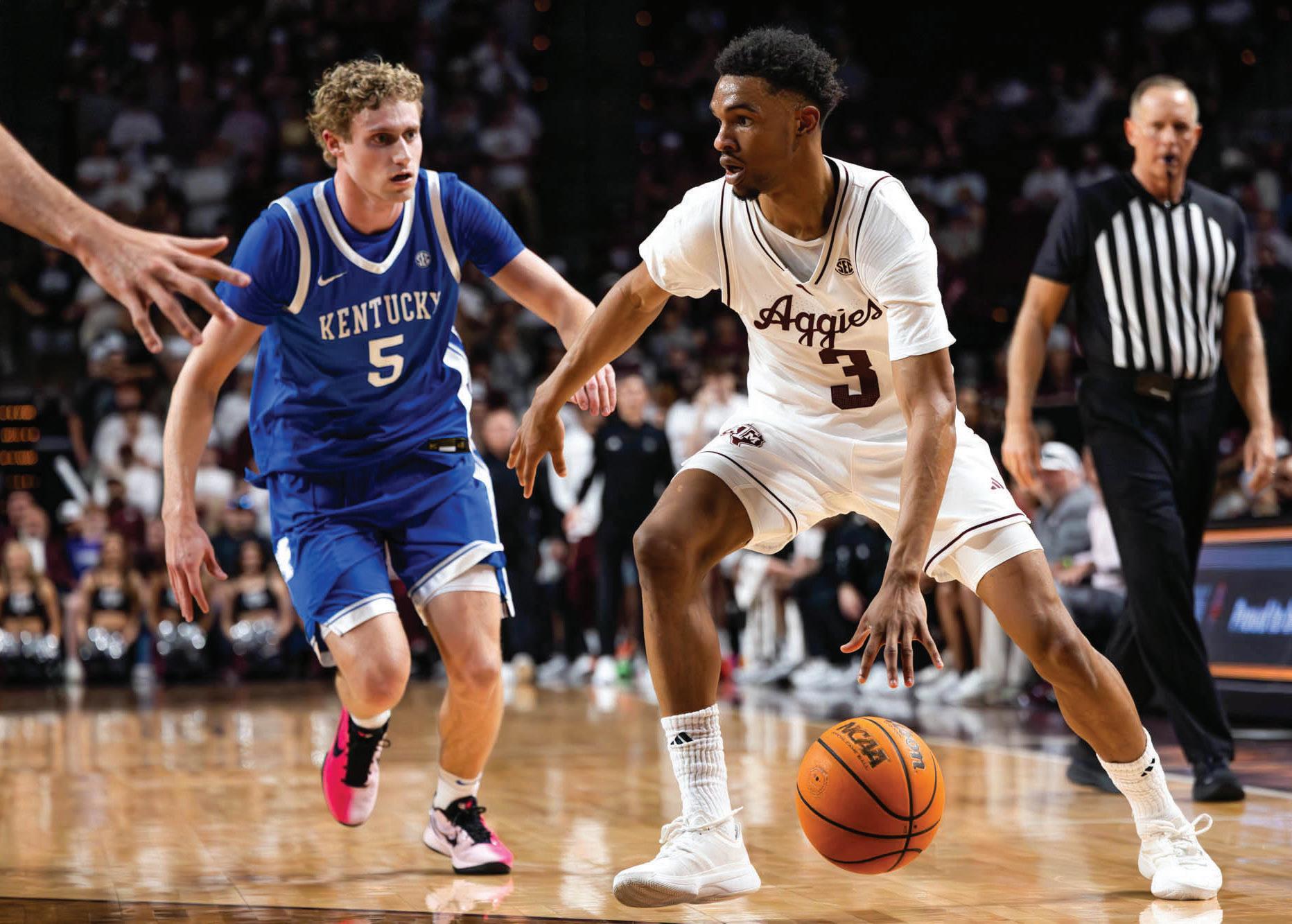
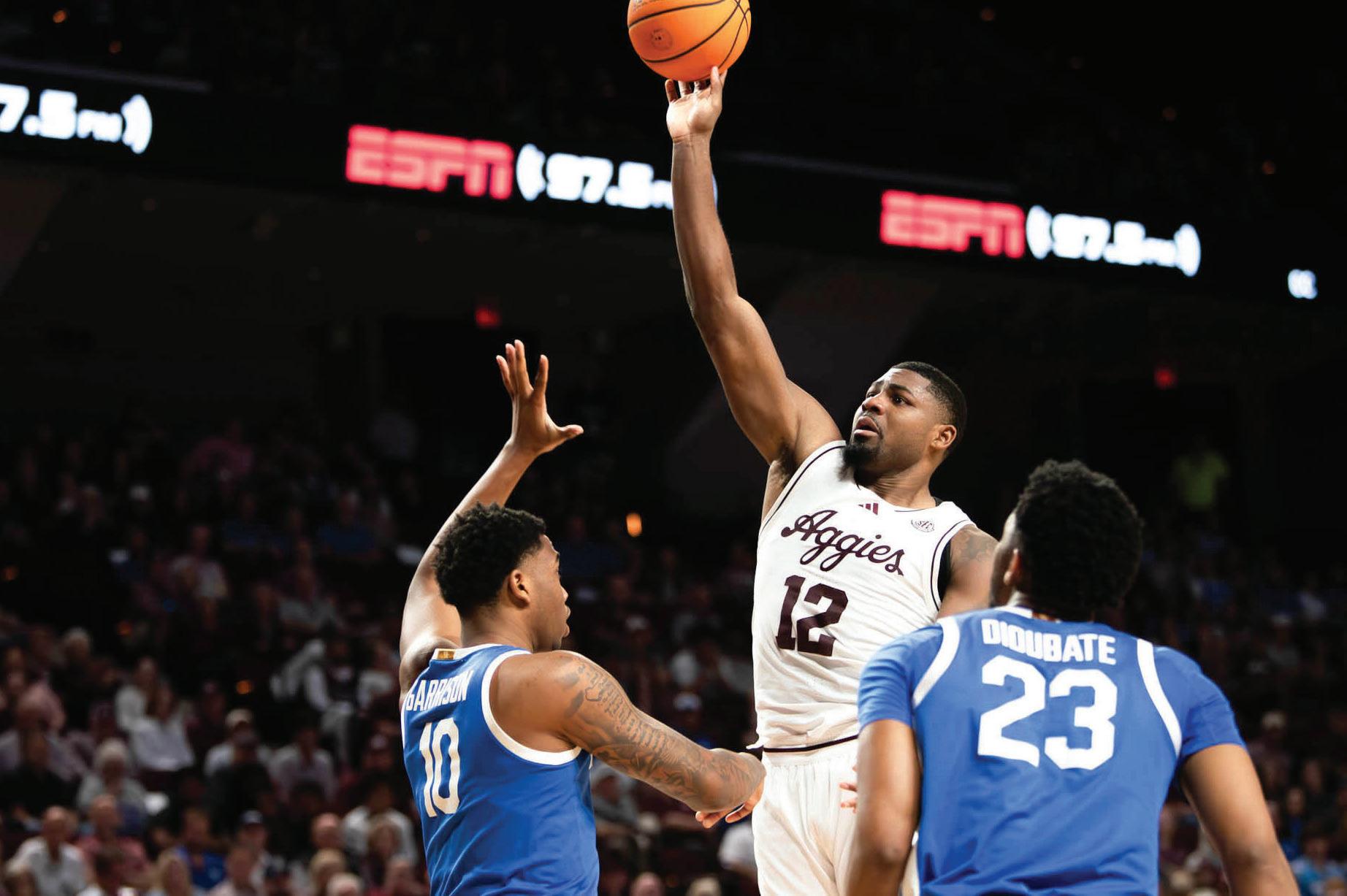
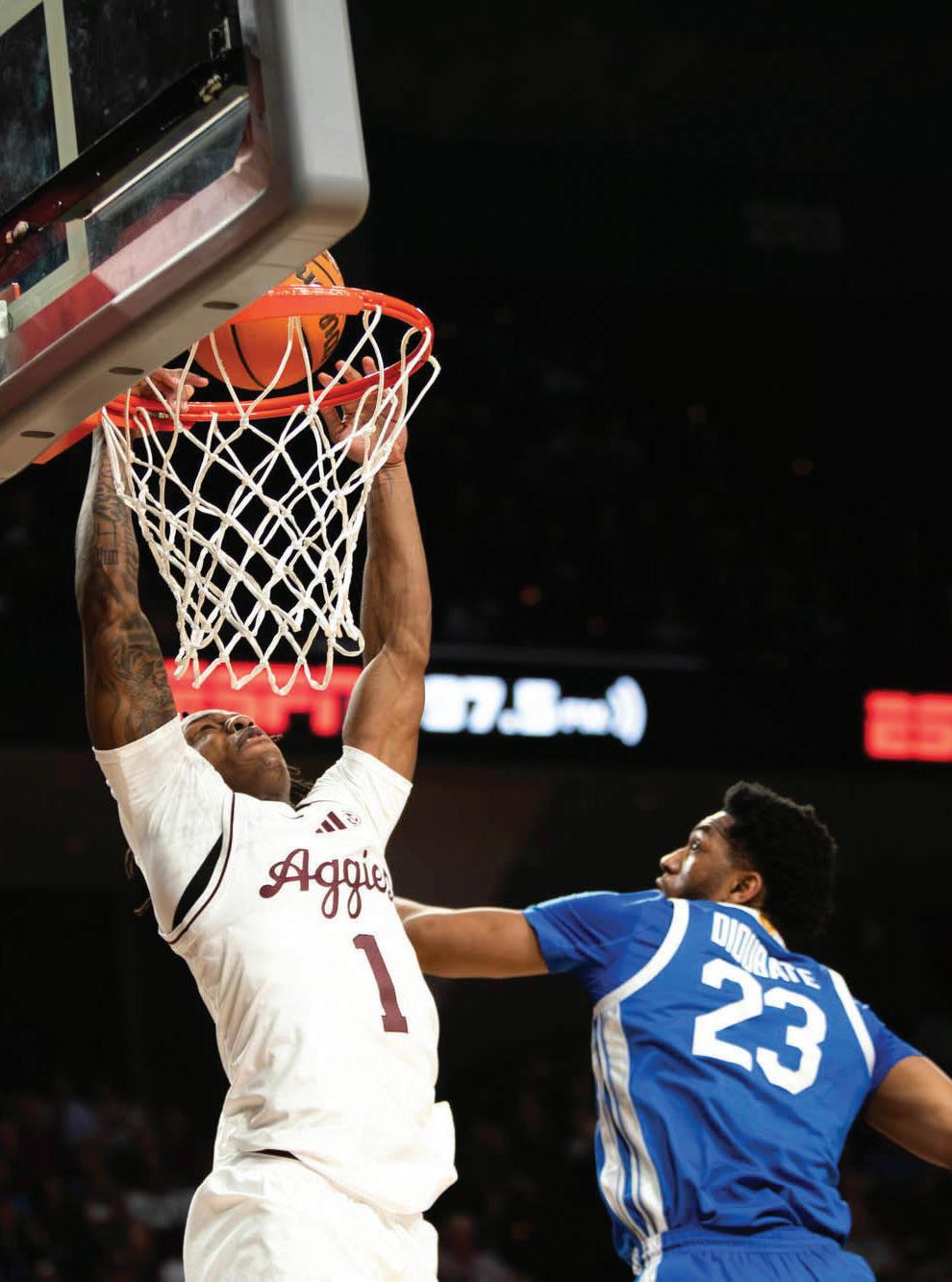
Texas A&M men’s basketball earned a 10-seed in the 2026 NCAA Tournament and will face 7-seed Saint Mary’s in the first round on Thursday, March 19, with tipoff set for 6:35 p.m.
The Aggies reside in the tournament’s South Region and will make their fourthstraight March Madness appearance, this time stepping onto the Paycom Center hardwood in Oklahoma City as 3.5-point underdogs with a 46.8% chance of victory, according to ESPN Analytics. Despite claiming the lower seed, A&M has hope for its 7-10 matchup, since in NCAA Tournament history. No. 10 seeds hold a 38.9 win percentage in the first round, with a 62-97 record against No. 7 seeds since the tournament field expanded in 1985. In their first year under head coach
Bucky McMillan, the Aggies surpassed their preseason projections, finishing the season tied for fourth in the Southeastern Conference with an overall record of 21-11.
“When they tip that ball up, it hits you that you’re playing for a national championship,” McMillan said after the March Madness Selection Show. “You can either go to be a part of the show and part of the circus, or you can go to play good basketball. We want to be back here next weekend talking about the Sweet 16.”
Saint Mary’s finished the regular season at No. 21 in the AP Poll with a record of 27-5. Despite an early exit in the semifinal round of the West Coast Conference Tournament, the Gaels’ 16-2 conference record secured the WCC regular-season title. Making its fifth straight March Madness appearance, Saint Mary’s has advanced to the NCAA Tournament’s second round in 3 of the last 4 years.
Any championship run is defined by one metric: Who is hot right now? In their last five games, the Aggies were outscored by their opponents 434-407 for a record of 2-3. However, the Gaels outscored their last five opponents 382-339 for a record of 4-1.
“Nothing really matters until March,” senior guard Rylan Griffen said after the March Madness Selection Show. “You get remembered for what you did in March, not anything you did before that. It’s a new



season right now for everybody. There are no redos this time.”
Who can better defend the 3-point shot?
Both A&M and Saint Mary’s are known for shooting the ball from downtown.While the Aggies shoot 36% from three, the Gaels have a slight edge beyond the arc, shooting 39%. According to the Pomeroy College Basketball Ratings, A&M ranks 47th in 3-point percentage, while Saint Mary’s ranks 13th.
The two teams excel in defending the deep ball, with both Aggie and Gael opponents shooting just 31% from three.
At the end of the game, the difference between advancing to the second round and facing an early exit is free-throw shooting. Though A&M shoots a competitive 74% from the charity stripe, Saint Mary’s leads the country, shooting 81%.
“They’re a dangerous team, like they all are,” McMillan said. “That’s the nature of the NCAA Tournament. It’s always going to be a tough matchup. If you play well, you give yourself a chance. That’s what it comes down to.”
The winner of the

















Beware of Dawgs: Aggies take on Bulldogs in top-25 matchup
By Noah Ruiz Associate Sports Editor
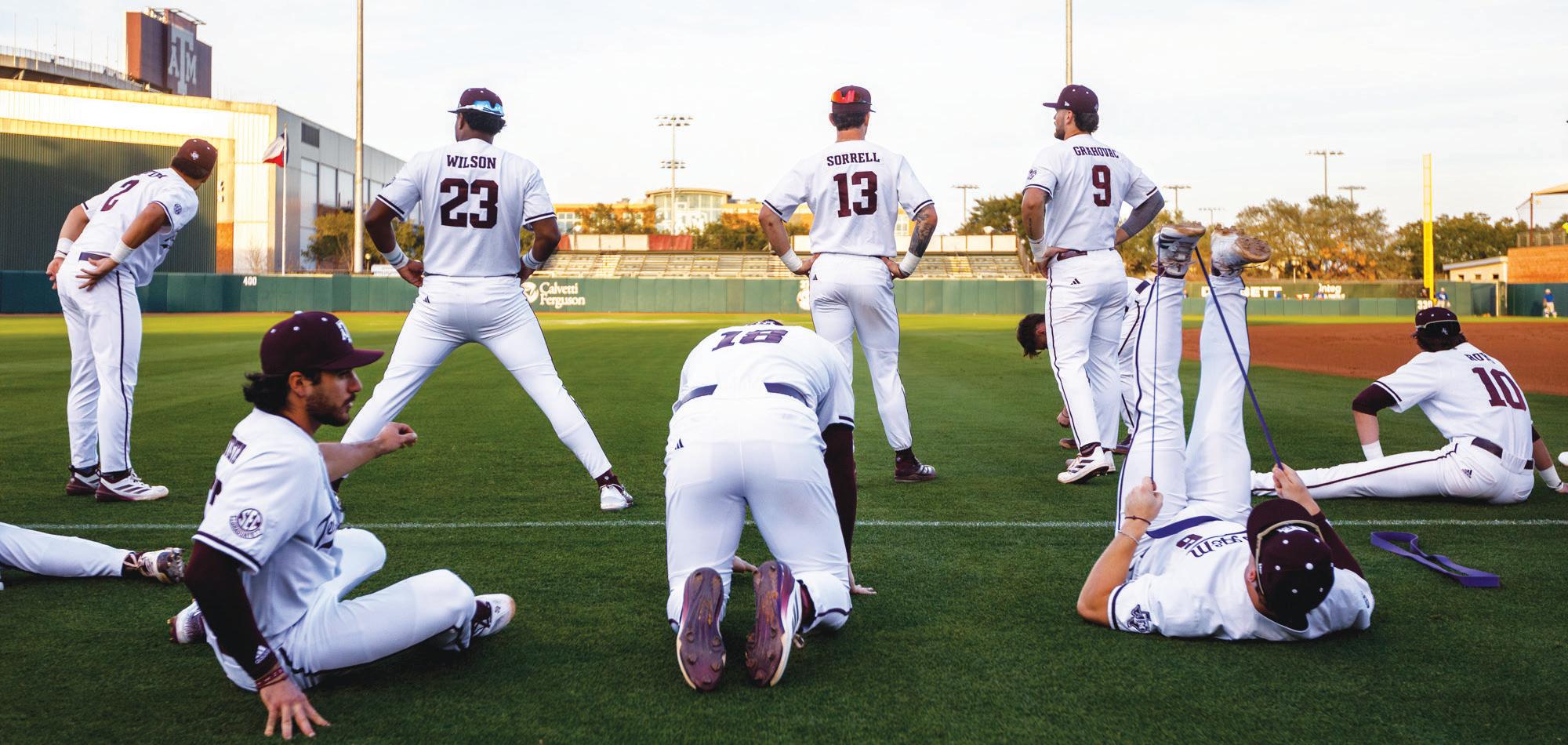
After falling to its first Southeastern Conference opponent, No. 23 Texas A&M baseball returns to Olsen Field to avenge its faults and attempt to claim its first victory in conference play against No. 7 Georgia. The Bulldogs turned a go-ahead then-No. 19 Tennessee Volunteer home run into the final out of the series on Sunday, March 15, thanks to a spectacular play off the center-field wall and will be hungry to dispatch another perennial contender.
But it won’t be such an easy task, as head coach Michael Earley’s squad has shown tenacity in the face of adversity. In Game 3 against then- No. 9 Oklahoma, the Aggie bats rallied from a 6-0 deficit to tie it up at 11-11 in the top of the eighth inning, though their pitching was their ultimate undoing at the bottom of the frame, with a go-ahead walk plating the Sooners.
Even so, junior center fielder Caden Sorrell has continued to put the SEC — and MLB scouts — on notice as he belted his ninth home run of the season against the Sooners, bringing his team-leading RBI total to 33. With an unblemished fielding
percentage, Sorrell has been the backbone of an A&M resurgence since missing out on the postseason in 2025.
While Sorrell might lead the Aggies in longballs, the Bulldogs lead the entire country. A jaw-dropping 66 homers is the mark set by Georgia in the early weeks of the season, with junior catcher Daniel Jackson’s 14 leading his squad and sitting at second in the nation. Although 30 homers behind Georgia with 36, A&M ranks 15th nationally in the same category and fourth in conference.
The Maroon and White’s own homeplate defender, junior C Bear Harrison, has been a baseball magnet through his first 16 starts, as the former Saint Mary’s transfer ranks 14th in the country with 11 hit-bypitches. Just ahead of him is junior third baseman Tre Phelps, whose 14 puts the Atlanta native at sixth.
Phelps, however, is not the only Atlantan poised for a Texas-sized impact in the second week of SEC play. Sophomore right fielder Terrence Kiel II, who also hails from the Peach State, will have Georgia on his mind with his 19-game on-base streak at stake. Walks, hits and hit-by-pitches are all part of his repertoire in his team-leading 24 runs.
The embers from a fire of runs may be on the precipice of igniting a full-blown Aggie Bonfire, as the long-awaited return of
senior designated hitter Wesley Jordan and junior second baseman Chris Hacopian has sparked a renewed maroon and white blaze, the pair having left scorch marks in their limited time at the plate. Against Oklahoma, their combined eight RBIs and six walks provided vital fuel to the A&M-scoring machine and gave a glimpse of its maximum potential.
Pitching-wise, the Bulldogs have two surefire aces with the stuff to put away the red-hot Aggie bats. Friday-night starter junior right-handed pitcher Joey Volchko leads Georgia with 32 strikeouts and a 4-0 record, but his 3.81 ERA gives A&M an opening to exploit, especially with the Maroon and White’s .329 batting average.
On the Aggies’ side of the mound, the potential loss of graduate student RHP Josh Stewart puts an already depleted bullpen at the mercy of the A&M starters’ hot-andcold pitching.
A 3.81 ERA as a staff puts the Bulldogs in position to jump out early on the Maroon and White. Despite this, redshirt junior left-handed pitcher Shane Sdao remains A&M’s steady arm, posting a 3-0 record with 27 strikeouts.
Of those with at least 10 starts for Georgia, all but one have a batting average over .300, a testament to its offensive capability to generate runs from anywhere in the batting order. Additionally, 10 Bulldogs have
multiple home runs this season, as do the Aggies, with a massive piece of said production coming from freshman sluggers.
Freshmen 3B and shortstop Nico Partida and Boston Kellner have started every game at their respective positions and have a combined eight home runs and 29 RBIs. While making just 11 appearances, freshman outfielder Jorian Wilson, who could prove impactful as a pinch runner, has also gotten in on the fun with two longballs of his own.
But even with the efficiency of their young talent, the Aggies will have to face another Bulldog with more homers than the three aforementioned combined: senior first baseman Brennan Hudson. In 19 appearances and 16 starts, Hudson has gone yard 11 times and is fifth on th team in RBIs.
While a less-than-ideal start to SEC play, A&M is still leaps and bounds ahead of its start a season ago, when it started 10-9 after being swept by then-No. 17 Alabama. Posting a 16-3 record through the first weekend of their current conference slate, the Aggies have a small hill rather than a steep mountain to climb to keep their push going for a regional-hosting bid.
The Maroon and White will begin their three-game series versus the Bulldogs on Friday, March 20, with first pitch scheduled for 6 p.m.
Wacha, other stars speak on how WBC environment brings out elements of college baseball on world stage
By Ian Curtis Senior Enterprise Reporter
During Team USA’s pool stage game against Great Britain in the World Baseball Classic in Houston, a curious phenomenon appeared in the crowd.
“Ball 5! Ball 5! Ball 5!”
Far from the confines of Olsen Field, pockets of Daikin Park adopted one of Texas A&M baseball’s most iconic traditions, the “Ball 5” chant, yelled by Aggie fans when an opposing pitcher walks a batter on four straight balls, then counting upward until the pitcher finally throws a strike.
In this case, though, the opposing pitcher was representing Great Britain on the international stage.
The chant’s appearance at the WBC had a special impact on one player in particular — pitcher Michael Wacha, the only Aggie on the Team USA roster.
During batting practice before the USA’s matchup against Mexico two days later, Wacha said that he was hoping the chant might make an appearance during the tournament.
“We’re in Houston, a lot of Aggies in here,”Wacha said. “And so, I was kind of expecting it, you know, in pregame, if it ever got to that situation. And sure enough did, and there was quite a few of them. So it was very cool to see.”
Wacha has pitched in a variety of settings over his journeyman career. The Kansas City Royal is on his sixth MLB squad, including a lengthy stint on the St. Louis Cardinals, where he pitched in the 2013 World Series as a rookie and was named the 2013 National League Championship Series MVP.
But, he said, few environments compare to representing the USA on an international stage.
“It’s a pretty incredible feeling being able to put on this jersey, having that USA across your chest,” Wacha said. “It’s, you know, something that I was lucky enough to do
in college, playing for the USA collegiate team. And I remember that just being one of the coolest feelings. And now, getting to be able to put this jersey on again with the big leaguers, it’s hard to describe in words, it really is. Just incredibly honored to be able to represent this country, represent my family, represent my hometown, represent the Royals.”
Of course, all of that wouldn’t have happened if Wacha hadn’t been recruited out of Pleasant Grove High School in Texarkana by former Texas A&M head baseball coach Rob Childress.
“It’s definitely very cool to be able to get up to put on this uniform,” Wacha said. “You know, I was a small-town kid, you know, growing up in Texarkana, Texas, and not a lot of college offers or anything like that, and not the most highly recruited guy. But, I feel like a lot of hard work and a lot of dedication to this game and your craft can take you to places that you could never believe.”
During his time in Aggieland, Wacha was named a Freshman All-American by Louisville Slugger in 2010 and a Third Team All-American by Baseball America in 2011.
He also pitched in the 2011 Men’s College World Series for the Aggies and said that pitching in the WBC felt similar to playing on the biggest stage in college baseball.
“Those were the biggest games of my life up to that point,” Wacha said. “And so those feelings are still the same feelings that I feel out there on the mound, you know, whenever I’m pitching in a postseason game, pitching the World Series, pitching in this WBC, it’s those same types of feelings. And so the more you can get those reps, the more you know how to kind of handle those types of environments. And so, Texas A&M was a was definitely a huge part in that.”
But Wacha wasn’t the only player to compare the WBC to playing in Omaha, Nebraska, in the MCWS.
Team USA pitcher and Cy Young Award winner Paul Skenes — who won the MCWS with LSU in 2023 — said before the Americans’ matchup against Great Britain that the WBC felt more like college baseball than anything else he’s done.
“I almost think the World Baseball Classic is a little closer to college baseball than

Major League Baseball,” Skenes said. “Obviously, you’ve got 17-year-olds out there, and you’ve got 43-year-olds out there, too. It’s kind of a good mix. But just seeing how guys play the game, the enthusiasm, the energy in the clubhouse, in the dugout, on the field, in the stands, everything, it reminds me a lot of college in some ways. It’s funny how a lot of stuff changes, but at the end, it’s kind of all the same.”
And Team Italy outfielder Jac Caglianone
— who played against Texas A&M in the 2024 MCWS for Florida — said that Omaha is the only environment he’s played in that compares to the pride and passion fans show at the WBC.
“Against, like, [the] USA and Mexico, that was probably the best environment I’ve played in,” Caglianone said before Italy’s quarterfinal matchup against Puerto Rico. “But Omaha is definitely up there. It’d probably go this then Omaha, for the most part.”
Crowds and environments became a common narrative throughout the WBC.
One Aggie in Houston was a part of a band playing bomba and plena music while supporting Puerto Rico against Italy, and Team USA and New York Yankees star Aaron Judge called the crowd during the USA-Mexico game “the best environment I’ve played in.”
But Wacha took time to shout out the A&M students of Section 203 at Olsen Field for the environment they created and helped bring to Houston.
“They bring the energy every game,” Wacha said. “ … I still hear from fellow teammates, fellow people around the big leagues that are like, ‘Man, we hated playing at Olsen field.’ … I feel like it’s one of the best home-field advantages in college baseball. And it was very cool to see the other night, I felt like there was definitely some Aggies out here with the ‘Ball 5’ chant. It was cool to see that as well.”







By Brody Vaughn Sports Writer
Following a ranked series win over thenNo. 17 LSU, No. 15 Texas A&M softball will welcome Kentucky into Davis Diamond for a weekend series, as the Maroon and White attempt to continue their hot start to Southeastern Conference play. The Aggies look to reclaim the all-time series against the Wildcats, eyeing three potential wins that would put A&M above .500 against Kentucky all-time.
A&M’s first SEC series saw it go 2-for3 against LSU, only dropping Game 3 on March 16. The Aggie offense was too much for the Tigers to handle, belting 16 hits and three home runs over the three-game stretch.
Game 1 saw the Aggies explode offensively on the back of junior first baseman
Mya Perez, who went 3-for-3 with a double and a home run. Pitching held things down from the circle, with sophomore right-handed pitcher Sydney Lessentine grabbing her eighth win of the season en route to the Aggies’ 7-2 victory.
Game 2 saw similar dominance from the circle, but the A&M bats struggled overall. Perez was the lone star in the middle game, contributing all three runs of the contest with a two-run homer and a single that knocked in another for a final score of 3-2.
Their momentum slowed even further in the conclusion of the series, for Game 3 didn’t go the Aggies’ way once the Tigers’ bats came alive.
Lessentine only made it through four innings, giving up three runs, and a relief appearance from sophomore left-handed
pitcher Kate Munnerlyn didn’t ease the pressure, with the latter giving up four in just 1.1 innings pitched. LSU figured out that walking Perez was a better alternative than her leaving the yard, as her four intentional walks stalled the A&M offense to just two runs in a 7-2 defeat.
Apart from Perez and senior third baseman Kennedy Powell, the A&M offense has been lacking substance, as the two corner infielders were the only two Aggies to have more than two hits over the opening conference series.
A&M will need to see production increase across the batting order if it wants to replicate its second-place SEC finish in 2025.
Pitching-wise, Lessentine will be the key to a deep run. The Alamogordo, New Mexico native lasted four innings in both of her starts and gave up two earned runs in both contests. Getting some complete
games from her could keep the Aggies in low-scoring matchups when the offense is struggling to plate runs.
Although having an identical record to A&M on the season, Kentucky has heavily struggled so far in SEC play. After taking just 1-of-3 games against an unranked Auburn team, Kentucky got run-ruled in all three matchups against then-No. 5 Florida.
Senior catcher Karissa Hamilton is a bat Aggie pitchers will need to keep an eye on. Her team-leading .421 batting average, as well as five home runs, will be a nuisance to keep off the bases. A&M will also have to take care of Kentucky arms in the circle, with none better than junior RHP McKenzie Oslanzi, who has posted a 2.18 ERA to this point in the season.
The three-game series will kick off on Friday, March 20, at Davis Diamond at 6 p.m., with the series continuing through Sunday, March 22.
both teams, as neither scored more than 15 points in a quarter.
By Roman Arteaga Senior Sports Writer
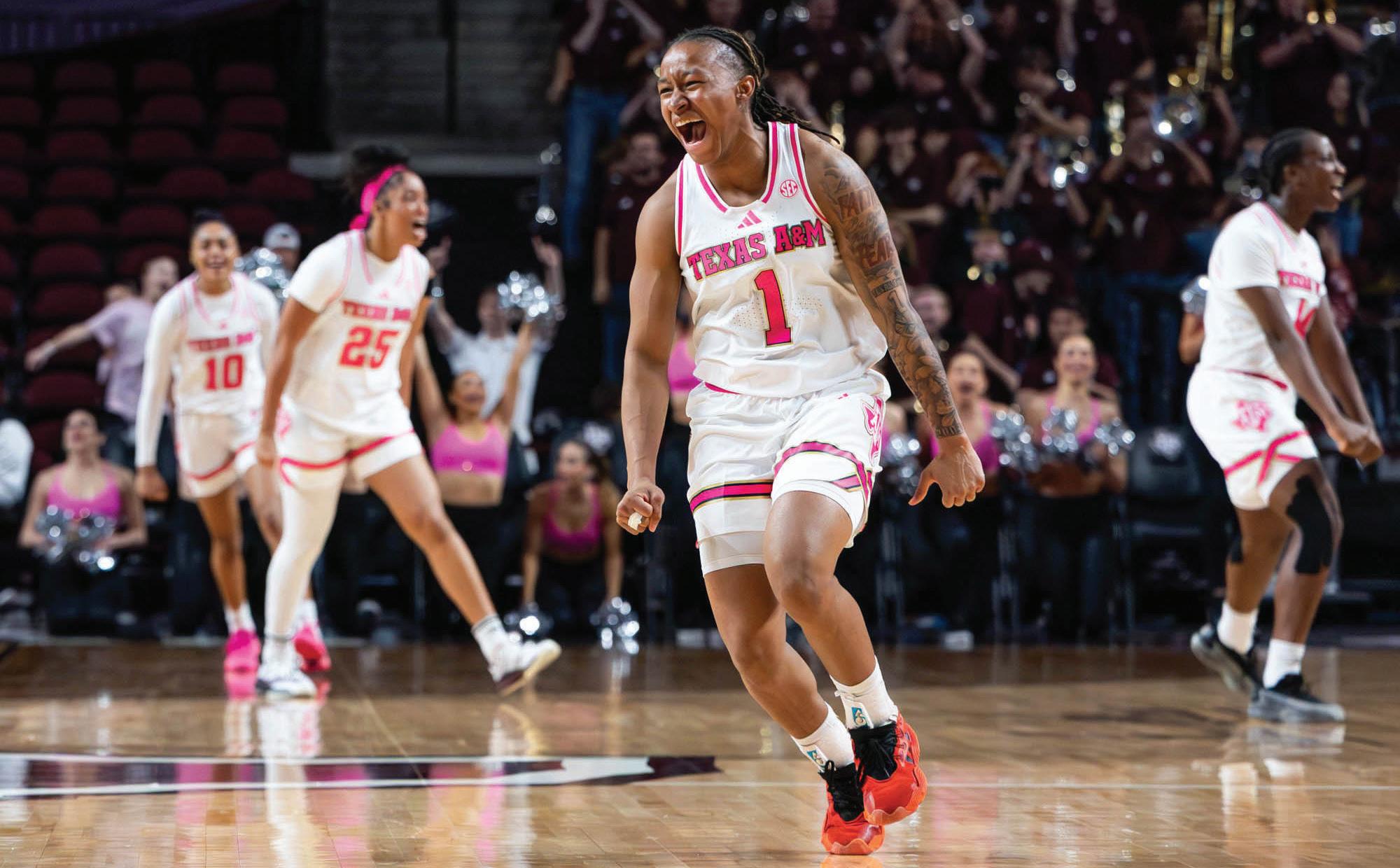
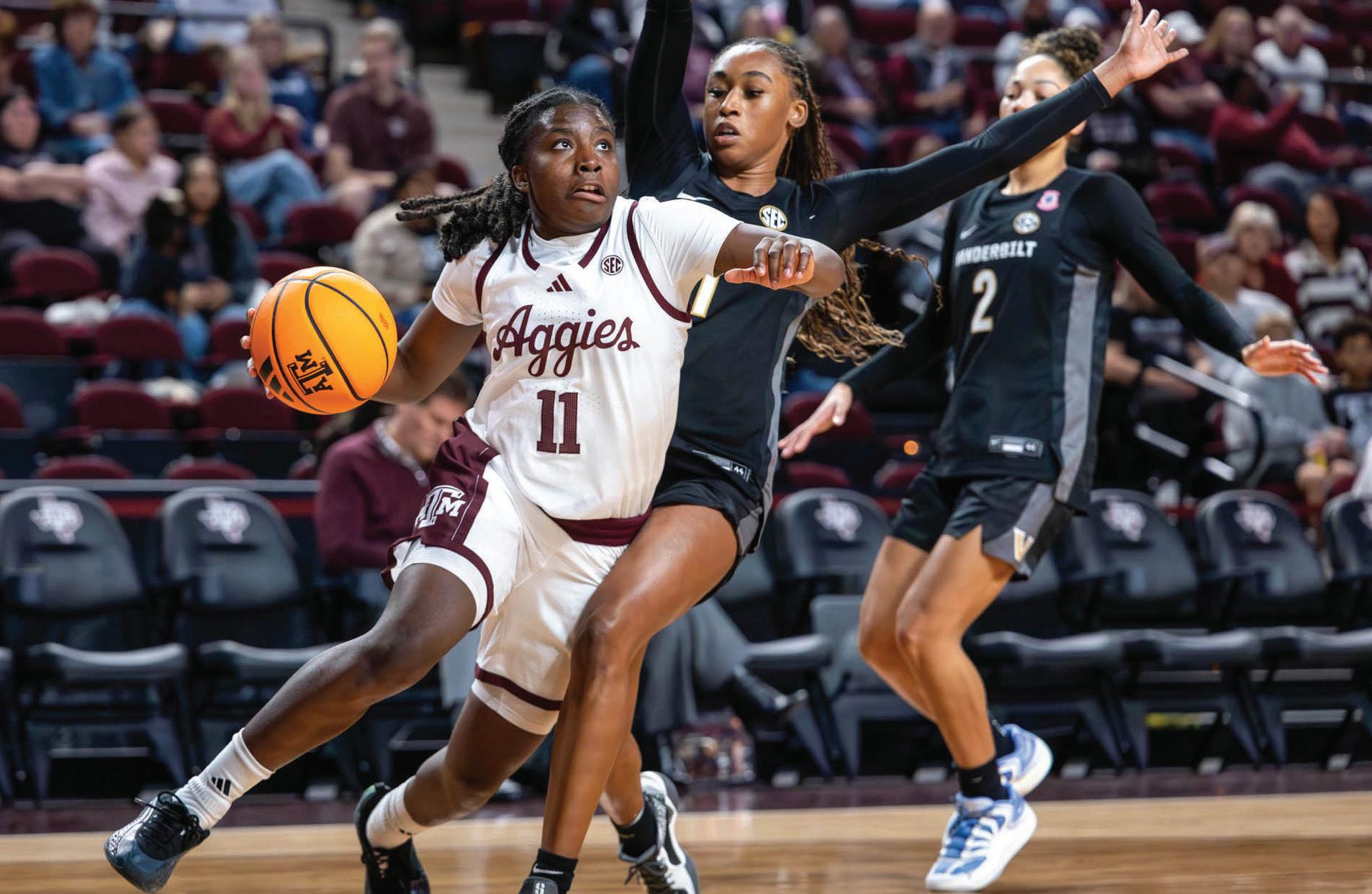
Following a devastating one-point loss to Auburn in the first round of the Southeastern Conference Tournament, 1-seed Texas A&M women’s basketball now focuses its attention on the Women’s Basketball Invitation Tournament. Claiming a top seed, it will take on McNeese State at Reed Arena.
Though they only posted a 14-12 overall record prior to the SEC Tournament, the Aggies were flying with five consecutive victories against big-time competition. Led by senior guard Ny’Ceara Pryor and junior forward Fatmata Janneh, the Maroon and White outplayed multiple ranked opponents, including then-No. 21 Tennessee and then-No. 19 Ole Miss. With plenty of momentum still intact, the Aggies are looking to dominate in their upcoming matchup.
With a 28-5 overall record, McNeese State has been red-hot all season. Prior to its loss against 3-seed Stephen F. Austin in the 2026 Air Force Reserve Southland Conference Basketball Championships, McNeese State went on an absurd 21-game winning streak.
Led by freshman F Dakota Howard and graduate student G Arianna Patton, the Cowgirls dominated the SLC, earning a spot in the WBIT. Though it has yet to face any ranked opponents, McNeese has the defensive fortitude to hang with power conference opponents.
In their last matchup against the Tigers, the Fightin’ Farmers stayed poised, holding their own but ultimately falling short, 4950. Fundamental defense was on display by
The Maroon and White’s charge was led by Pryor, who tallied 25 points and six steals along with four assists. Junior G Janae Kent added on seven points, four rebounds and two stocks to keep the Aggies on par with the Tigers. Although A&M held a one-point lead with 11 seconds remaining, a nice play by Auburn set up the open layup that sealed the game.
If A&M wants to win this matchup, it needs to take care of the basketball. The Cowgirls are known for forcing turnovers and will be sure to pressure the Aggies’ guards throughout the game. Dominating the boards is also essential, as it will give them more opportunities for points and keep McNeese’s second-chance points down.
In its last matchup against SFA, McNeese State put on a defensive clinic. Led by Howard’s 23 points, seven steals, three assists and one block, the Cowgirls pressured the Lumberjacks’ guards, forcing 24 turnovers. When it was all said and done, the Cowgirls recorded 16 steals while holding the Lumberjacks to just 32% shooting from 3-point range.
However, while it forced tough shots, McNeese struggled shooting the ball, knocking down just 39% of total field goals while shooting an abysmal 25% from three. Despite the great defense demonstrated by the Cowgirls, the Lumberjacks still came out on top with the 71-59 victory.
If McNeese wants to reign supreme, it needs to continue defending at an all-star level. Forcing turnovers and creating fastbreak opportunities will be crucial in its success.
The stage is set for a showdown at Reed Arena as the Cowgirls will visit the Aggies on Thursday, March 19, with tipoff set for 7 p.m.