
SPORTS Big game hunting: A&M men’s basketball seeks wins over Florida, Missouri in twogame home stand at Reed Arena A6

SPORTS Big game hunting: A&M men’s basketball seeks wins over Florida, Missouri in twogame home stand at Reed Arena A6
SPORTS
From Kyle Field to Cortina Sliding Centre, a Winter Olympian’s unorthodox path to biggest global stage of his career A8

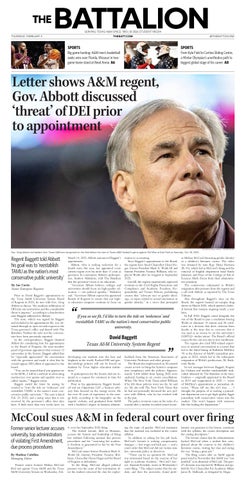
Regent Baggett told Abbott his goal was to ‘reestablish TAMU as the nation’s most conservative public university’
By Ian Curtis Senior Enterprise Reporter
Prior to David Baggett’s appointment to the Texas A&M University System Board of Regents in 2023, he met with Gov. Greg Abbott to discuss “the insidious infiltration of DEI into our universities and the considerable threat it imposes,” according to a handwritten note Baggett addressed to Abbott.
The note, which was signed by Baggett and included in his appointment file, was obtained through an open records request to the Texas governor’s office and shared with The Battalion. Neither the note nor the conversation have been previously reported.
In the correspondence, Baggett thanked Abbott for considering him for appointment to the Board of Regents, the nine-member panel of governor appointees that oversees 12 universities in the System. Baggett added that he “especially appreciated” his conversation with the governor and made it clear that he would oppose DEI efforts if appointed to the board.
“You can be assured that if you appoint me to the BOR, I will be a stalwart in advocating meritocracy over quotas and equality over so called ‘equity,’” Baggett wrote.
Baggett ended the letter by stating he wanted to “turn the tide on ‘wokeness’ and reestablish TAMU as the nation’s most conservative public university.” The note is dated Feb. 23, 2023, and a stamp notes that it was received by the governor’s office four days later. A little more than two weeks later, on
March 14, 2023, Abbott announced Baggett’s appointment.
Abbott, who is seeking reelection for a fourth term this year, has appointed every current regent over his more than 11 years as governor. In a statement, Abbott’s spokesperson, Andrew Mahaleris, told The Battalion that the governor’s focus is on education.
“Governor Abbott believes colleges and universities should focus on high-quality education — not political agendas,” Mahaleris said. “Governor Abbott expects his appointed Boards of Regents to ensure that our higher education campuses continue to focus on
tration in accounting.
Since Baggett’s appointment to the Board, the regents have hired Chancellor Glenn Hegar, former President Mark A. Welsh III and Interim President Tommy Williams, who replaced Welsh after he resigned in September 2025.
Last fall, the regents unanimously approved revisions to the Civil Rights Protections and Compliance and Academic Freedom, Responsibility and Tenure Policies, prohibiting courses that “advocate race or gender ideology, or topics related to sexual orientation or gender identity,” in a move that prompted
If you so see fit, I’d like to turn the tide on ‘wokeness’ and reestablish TAMU as the nation’s most conservative public university.
David Baggett Texas A&M University System Regent
developing our students into the best and brightest in the world. Radical DEI and gender-ideology policies will not be forced on students by Texas higher education institutions.”
A spokesperson for the System did not respond to a request for comment in time for publication.
Prior to his appointment, Baggett founded and ran Opportune LLP, a business advisory firm focused on the energy sector. He has over 40 years of experience in the energy field, according to his biography on the regents’ website, and graduated from A&M with a bachelor’s degree in business adminis-
backlash from the American Association of University Professors and other groups.
The Board also implemented an AI-assisted course review to bring the System’s campuses into compliance with the policies. Approximately 5,400 syllabi from Spring 2026 were analyzed, leading to six course cancellations.
When The New York Times asked Williams if he felt those policies went too far, he said no. He also told The New York Times that he had not personally discussed the new policies with Abbott, who he has worked with in the past.
The policy revisions come in the wake of a scandal after a student recorded senior lectur-
er Melissa McCoul discussing gender identity in a children’s literature course. The video was obtained by state Rep. Brian Harrison (R-10), which led to McCoul’s firing and the removal of English department head Emily Johansen and Dean of the College of Arts & Sciences Mark Zoran from their administrative positions.
The controversy culminated in Welsh’s resignation after pressure from the regents and a call with Abbott, as reported by The Texas Tribune.
Also throughout Baggett’s time on the Board, the regents banned on-campus drag shows in March 2025, which spurred a federal lawsuit that remains ongoing nearly a year later.
In Fall 2024, Baggett voted alongside the rest of the Board to pass a resolution forcing Welsh to eliminate 14 minors and 38 certificates in a decision that drew criticism from faculty at the time due to concerns that it was used as an excuse to cut the university’s LGBTQ+ studies minor. The Board’s official reason for the cuts was due to low enrollment. The regents also cited DEI-related experience in internal conversations as a reason that led to the failed hiring of Kathleen McElroy ‘81 as the director of A&M’s journalism program in 2023, which led to the subsequent resignation of Welsh’s predecessor, M. Katherine Banks.
In text messages between Baggett, Regent Jay Graham and another unidentifiable individual obtained by The Battalion at the time, Graham — originally appointed to the Board in 2019 and reappointed in 2025 — wrote of McElroy’s appointment as journalism director, “Please tell me this isn’t true. … I thought the purpose of us starting a journalism department was to get high-quality Aggie journalism with conservative values into the market. This won’t happen with someone like this leading the department.”
Former senior lecturer accuses university, top administrators of violating First Amendment, due process procedures
By Mathias Cubillan Managing Editor
Former senior lecturer Melissa McCoul
filed suit against Texas A&M and the Texas A&M University System on Wednesday, Feb.
4, over her September 2025 firing.
The federal lawsuit, filed in Houston, accuses the System and leadership of firing her without following internal due process procedures and for “exercising her academic freedom as guaranteed to her by the First Amendment.” McCoul names former President Mark A. Welsh III, Interim President Tommy Williams, Chancellor Glenn Hegar and the Board of Regents as defendants. In the filing, McCoul alleged political pressure was the cause of her termination after the student criticized the class for explor-
ing the topic of gender. McCoul maintains that the material was included in the course syllabus.
In addition to asking for her job back, McCoul’s lawsuit is seeking compensatory damages — lost wages and back pay — and a court order that McCoul did not violate state law, university policy or directives.
“There can be no question Dr. McCoul was terminated based on the exercise of her right to academic freedom,” McCoul’s lawyer, Amanda Reichek, wrote in Wednesday’s court filing. “The subject matter that the student, and then the university, found prob-
lematic was germane to her lesson, consistent with the syllabus, the course description and the catalog description.”
The lawsuit claims that the administration backed McCoul when a student first complained about the content in the children’s literature course, visiting her class and saying she was “doing a great job.”
The filing comes after an A&M appeals panel ruled in November that A&M was “not justified” in its dismissal of McCoul. The panel’s decision was rejected by Williams and upheld by Vice Chancellor For Academic Affairs James R. Hallmark, as delegated by Hegar.
Aggies gather at Academic Plaza to protest Board of
By Taryn Stilson News Reporter
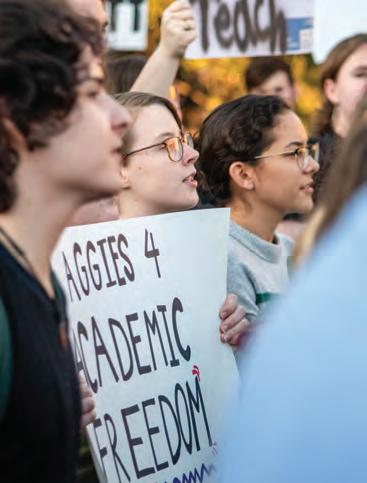
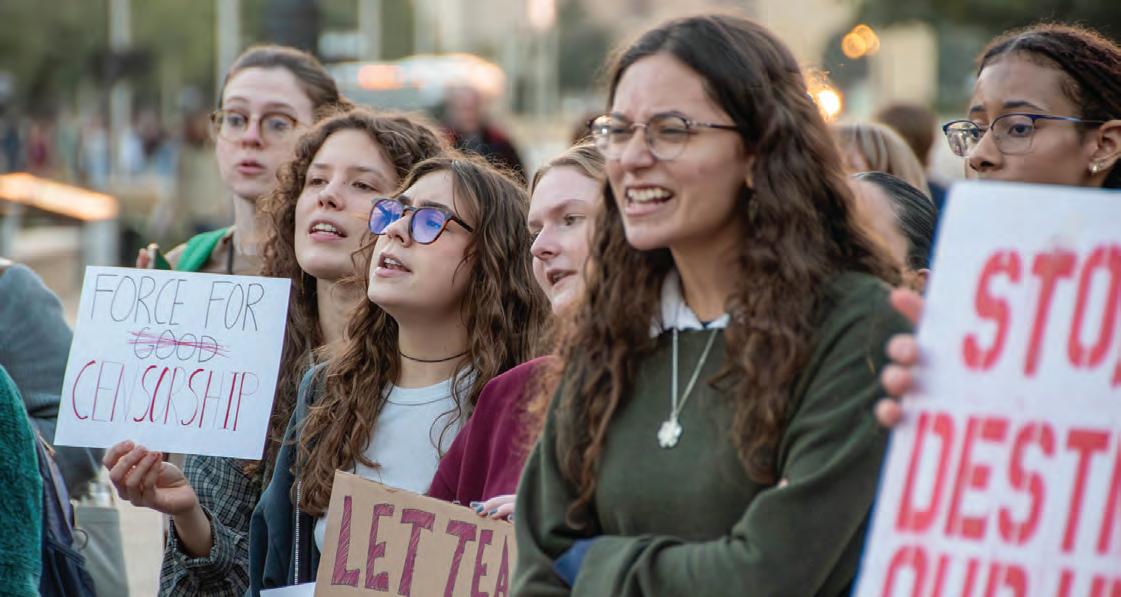
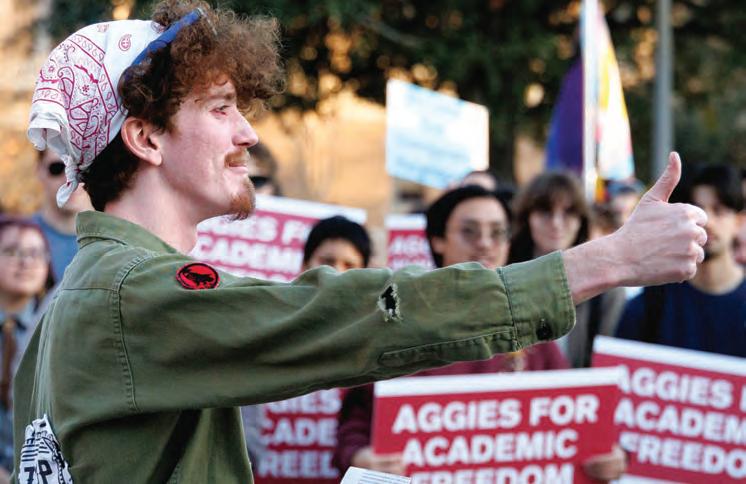
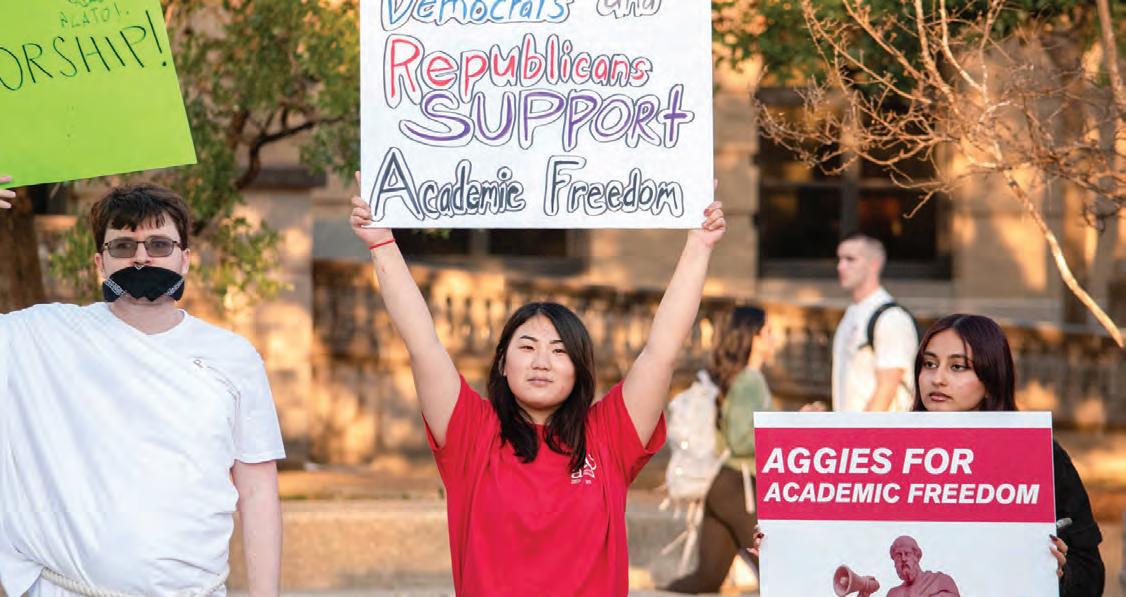
Students and professors at Texas A&M gathered for a demonstration in support of academic freedom at Academic Plaza on Jan. 29.
A&M’s American Association of University Professors, or AAUP, chapter led by President Leonard Bright, Ph.D., organized the Aggies Rally for Academic Freedom. The event welcomed all students and professors to protest the new academic policy approved by the A&M University System Board of Regents.
Demonstrators formed a circle below the feet of the Lawrence Sullivan Ross Statue at the Academic Plaza.They hoisted signs reading “Let the professors teach,” “Freedom to teach, freedom to learn” and “Don’t tread on higher ed!” While the crowd chanted “Education is our right!” some demonstrators sat on benches along the periphery, holding signs that said, “Do not Demand that I lie by omission,” While another read, “In the end the party would announce that two and two made five and you would have to believe it,” in reference to George Orwell’s “1984.”
Made effective in December, revisions to the Civil Rights Protections and Compliance policy, the policy requires that each A&M System campus president must personally approve courses whose content pertains to “race or gender ideology” before their instruction is permitted.
The Board also voted to approve a Freedom, Responsibility and Tenure policy that prohibits faculty from deviating from the approved material on each course syllabus. Both policies have been enforced starting in Spring 2026 at all 12 branches of the System, including the College Station campus, according to the A&M University System.
To open the evening, Bright stepped into the center of the protestors. He gave a speech encouraging them to fight for “academic freedom,” stand in solidarity with one another and convey to the university the importance of academic freedom to current students, faculty and the broader discussion of higher education.
“We are here demonstrating to Texas A&M that we care about this, and we care about this university,” Bright said. “This is an important issue, and if you don’t want to listen to one faculty, how about listening to dozens of faculty? If you don’t want to listen to one student, how about listening to thousands of students? This is just a fragment of people who stand behind us.”
Just three days after the spring semester started, Bright’s graduate-level course, Ethics and Public Policy, PSAA 642, was canceled by the university due to its discussion on how race, gender and other social factors can influence policymaking.
“It was an effort to stop discussions, and students are going to suffer [because of this],” Bright said. “You get a degree from the Bush School to go work for the broad, diverse world out there. That diversity can’t be erased, and you can’t walk out there assuming there’s no differences to be paid attention to.”
After Bright’s message, economics graduate student and Texas State Employees Union member Roman Vale led demonstrators in a series of chants. “Education is our right, that is why we have to fight! Unionizing is our right, that is why we have to fight!” protestors shouted.
One protester went through the crowd, handing out stickers with the words “Don’t muzzle academic freedom” above a picture of Reveille. AAUP faculty, dressed in neon vests with anti-censorship pins, demonstrated near the edge of the circle. Students with A&M’s MOVE Texas chapter also walked among protestors, encouraging them to register to vote locally.
“Academic freedom should be a right for us at Texas A&M University,” associate professor María Esther Quintana Millamoto, Ph.D., said “Students need to be exposed to all sorts of topics and matters, especially global matters. That’s why I believe that this censorship goes against academic freedom and doesn’t allow us to do our jobs in meaningful ways.”
Psychology senior Justino Russell added a different viewpoint to the scene, claiming conservative voices are those being silenced.
“We’re getting pushback about how this is all about censorship and academic freedom, but censorship that’s happening is self-censorship of conservative students and teachers,” Russell said. “[Academia] is selectively editing specific facts that will point to a specific view of history. And that’s very harmful because it makes people hate the things they shouldn’t hate because they have a misinformed view of history.”
Bright made his way back to the center of the protestors to conclude the night with some final words of encouragement.
“One thing I want to leave you here with is that Aggies Gig ‘em, but we don’t gag ‘em,” Bright said. “We’re going to fight until hell freezes over, and then we’re going to fight on the ice.”
The demonstration ended as the crowd thanked Bright with applause and a standing ovation.






By Jenica Panicker Life & Arts Writer
Memorabilia, posters and vinyls line the walls as the steady hum of music and laughter fills the KANM Student Radio station. A bookshelf crammed with CDs holds every genre of music imaginable, small capsules of sound that will soon be played live on the air. The rooms hold microphones and equipment — vessels ready to share the voices of Texas A&M students to the community.
Since its inception in 1973, KANM Student Radio has shared the voices of Aggies through its online site, but now those voices will be amplified to the community through a different means: radio. A recently secured FM broadcast channel will make the station available to locals. Residents can expect to hear a variety of music and shows on the air.
“If you’re listening for an entire day, I would guarantee that you’ll hear at least 20 different genres, and you’ll hear so many different perspectives,” KANM Station Manager and electronic systems engineering technology senior Nayab Warach said. “I think that’s just the beauty of student radio.”
Starting as a small local station at A&M with only an online presence, the studentled organization has grown to almost 300 members with a diverse range of interests. DJs are able to broadcast tunes, talk shows and create community among its members and listeners.
“It’s really a community for students at A&M to come together and meet likeminded creatives to express themselves,” Warach said. “To have an outlet for any creative ambitions and to create a sort of safe space at such a large university.”
As the organization has grown, so has the push to shift the radio station from a webbased service to a live radio station capable of reaching more people.
The FM frequency elevates the traditional radio experience by providing
clearer quality and easier access.
“Back in the 70s, we started out with a very weak AM radio signal,” Warach said. “Then we transitioned to cable TV, and then we transitioned to internet radio, but we’ve never achieved that goal of having an FM broadcast radio signal until now.”
Warach said this remains even more important in the precarious age of written and spoken media. As bigger corporations tend to overshadow local radio stations, Warach said there is value in amplifying student voices.
“In a time where media is slowly being consumed by, meaning bought out by corporations, the local radio station is dying,” Warach said. “So, the fact that A&M was willing to help us invest in ensuring that our student voices can be amplified in this time when so many universities are choosing to take the opposite route is an amazing investment in A&M students and alternative voices.”
History junior Hayden Lovelady said that this is why the station focuses so much on individuality and the human process.
“Nothing’s automated,” Lovelady said. “So everything that comes out of our broadcast is intentional, and it brings a certain level of humanity to the airwaves in many ways where the soul is kind of being lost in some instances.”
After years of communication, license approvals and on-site oversight, the broadcast in the Bryan-College Station area will be available on channel 106.7. Specific shows, music and lineups can be found on KANM’s website.
To celebrate the success, KANM hosted a public launch party on Jan. 30 at the Liberal Arts and Arts & Humanities courtyard that included a ribbon-cutting ceremony, crafts and live DJs.
Electronic systems engineering technology sophomore Grayson Barger said its purpose was for a time and space for members to mingle and meet other likeminded individuals.
“KANM is more than just a radio station,” Barger said. “ … This FM frequency just allows those voices to be amplified even more.”
Class of 2026 to release purchasable watch featuring Aggie symbols, preserving nostalgia, funding campus
By Tejas Murali Life & Arts Writer
In honor of Texas A&M’s 150th anniversary, the Class of 2026, in partnership with AXIA Time, plans to release a custom-designed watch licensed by A&M and packed with design elements referencing Aggie traditions. After obtaining licensing approvals and finalizing arrangements, the Class of 2026 intends for the watch — which will have Corps of Cadets and potentially former student variants — to be available for order within the coming months.
The watch has been in the making since November 2025 when AXIA Time representative Troy Schnack reached out to Class Councils about creating a watch for A&M’s 150th anniversary that would simultaneously support the class fund. AXIA Time, a reputed watchmaking company, is the official horologist for the College Football Playoffs, United States Naval Academy and several state flagship universities.
Class Councils organizes some of the most prominent A&M traditions — including Ring Dance, Fish Fest, Elephant Walk, Pull Out Day and Legacy Night — and were exploring ways of financing them as it has increasingly posed budgetary concerns. Killing two birds with one stone, the watch will not only embody Aggie traditions, but will also aid in helping Class Councils continue to fund and host these traditions.
“Essentially, [Schnack] had some mockups of what he wanted it to look like, but he said in the email that we had full autonomy for the design, for the purpose and what we wanted this to look like,” Senior Class President and finance senior Josh Sanders said.
“He did disclose that a portion from each sale will go to our class fund and that our class, the Class of 2026, will get a 10% dis count for every watch. So we saw it as such a great opportunity; one, to help build and keep our traditions, which are the actions that speak louder than words, and two, to make this a timepiece that we can wear in the future.”
The watch was designed with nu merous references to Aggie traditions. These details include common A&M symbols such as the 12th Man and a silver case fit with gold accents to represent the Aggie Ring. Other references can be found on the watch buckle, most no tably the A&M Ring Crest and “RELLIS” inscription around the rehaut. Along the face, “Force for Good” reads at the 12 o’clock position and “Class of 2026” and “EST. 1876” circle the dial.
“So truly, it’s all here to emphasize the things that matter the most, that Aggies want to hold close,” Sanders said. “It’s something that they can wear in an interview, it’s something they can wear to game day, just an everyday time piece to symbolize the 150th anni versary of Texas A&M and our class being the 150th class at A&M. It kind of just pulls all these little meaningful easter eggs together, and we’ll tie our student body together with a timepiece that directly relates and gives back to Texas A&M.”
In addition to the Class of 2026 watch, a Corps watch will also be made with unique design details pertaining to Corps traditions. The buckle will feature the Corps stack, while the rehaut will read “Return With Honor” at the 12 o’clock position. The in ner frame of the dial will have “Corps of

Cadets” printed at the 6 o’clock position. These design aspects were decided on in collaboration with Corps Commander and civil engineering senior John Andruss. “We met with [Andruss] individually and asked what we wanted the Corps watch to look like, and he was amazing in that whole process,” Sanders said. “And we met with our Class Cabinet, discussed what was meaningful, because at the end of the day in a watch, you don’t want to
According to its mission statement, Class Councils serves to enhance traditions, as well as serve and unite the Aggie commu-
“Our mission is to build spirit by unifying the classes through Aggie traditions,” Sanders said. “And I think in a sense, this watch does no less than exactly what our mission statement is. It unifies our class in every single aspect, and every single watch that’s purchased is going to enhance the traditions and continual improvement of the Aggie community.”
In addition to the watch serving as a fundraising initiative, it will also be positioned as a recognizable Aggie memento, upholding spirit long after graduation, Class of 2026 Treasurer and finance senior Martin Mulinix said.
“I’m so prideful of our class and of the university and think that this is something I can carry close to myself for a long time, ” Mulinix said. “It’s a way to give back to the class that has given us so much, and it’s an official timepiece for our class to represent the 150th anniversary of Texas A&M. So it’s a really unique accessory to our graduating class.”


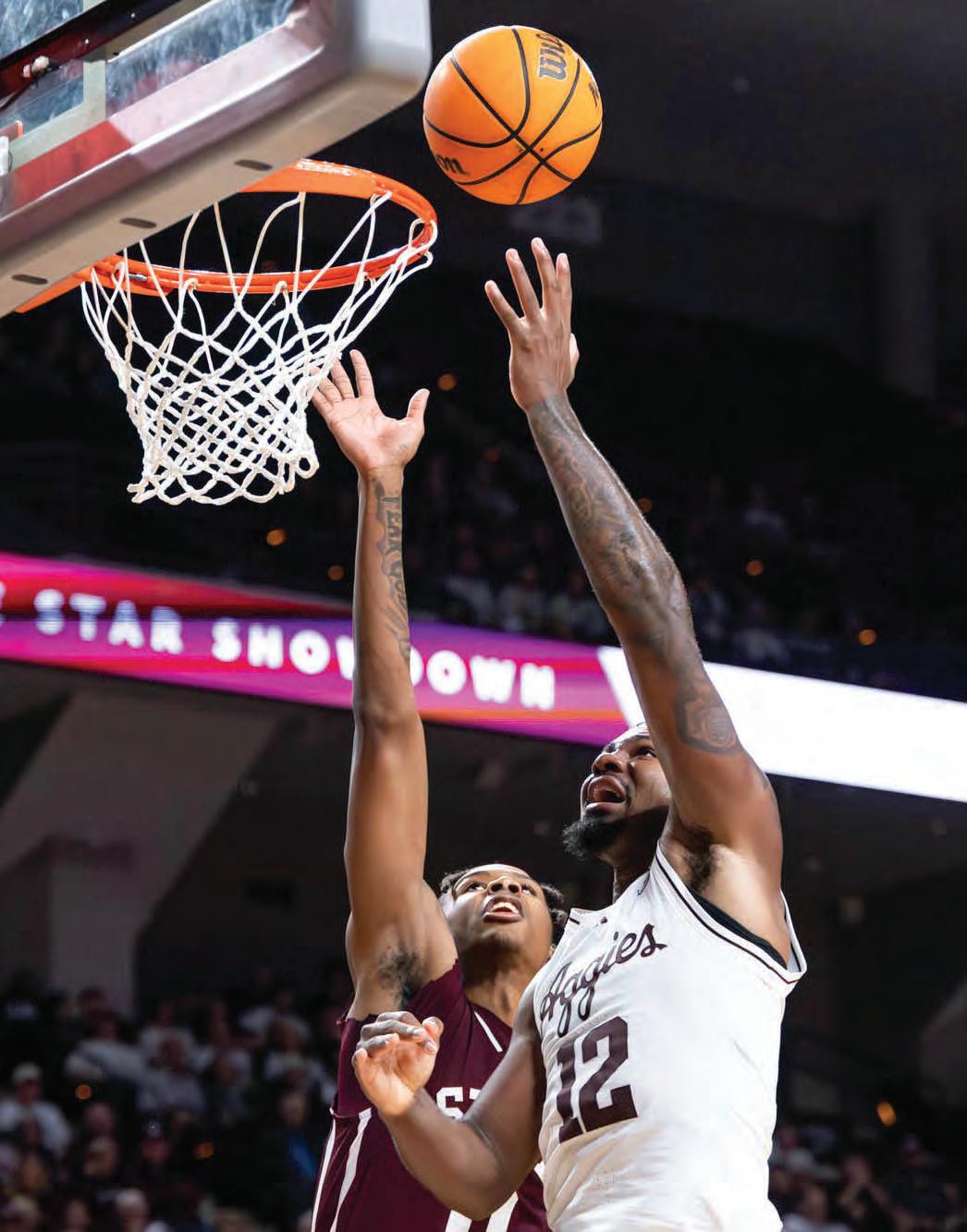
Aggies looking to exact revenge on Gators, wrangle Tigers sixth straight time
By Noah Ruiz Associate Sports Editor
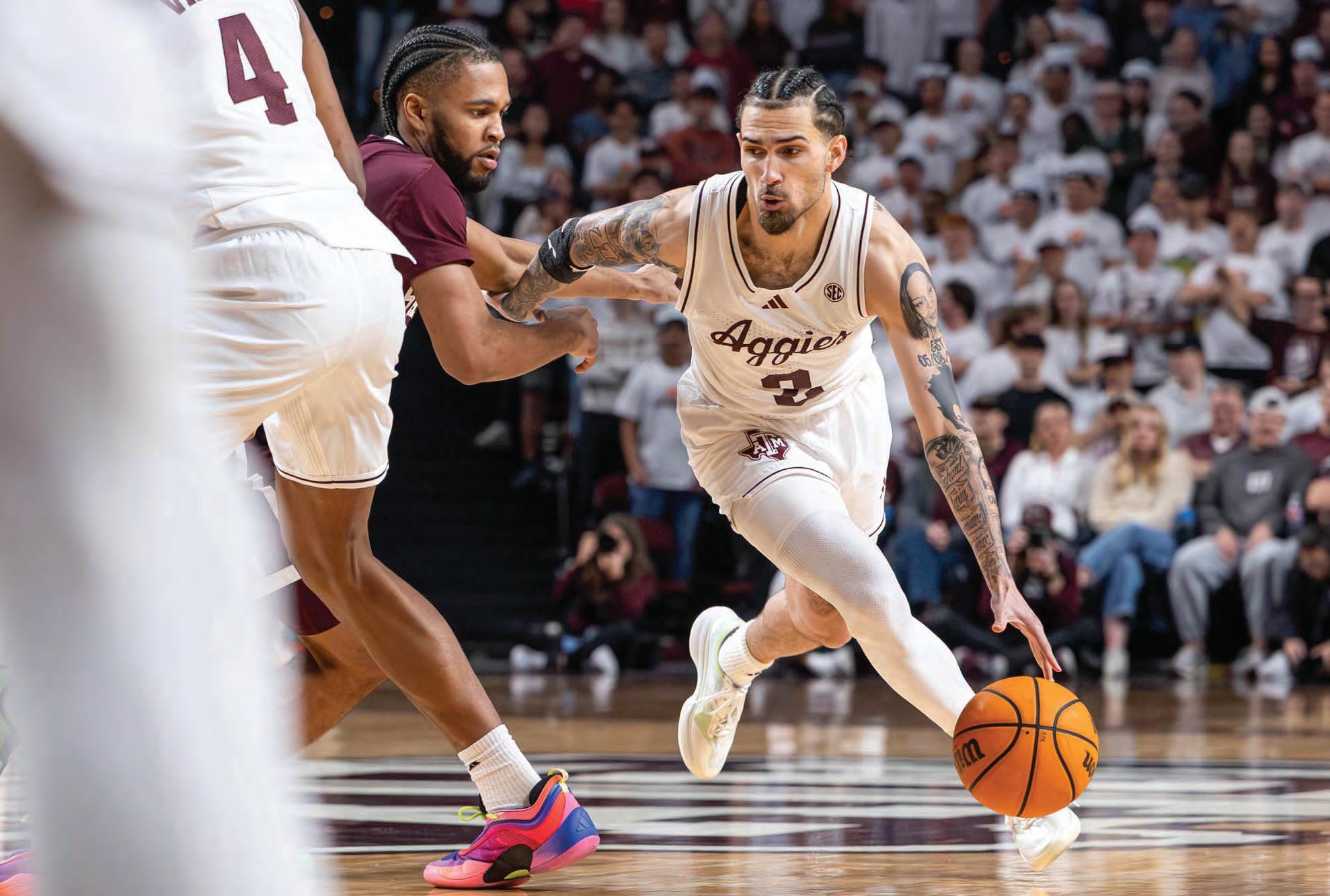
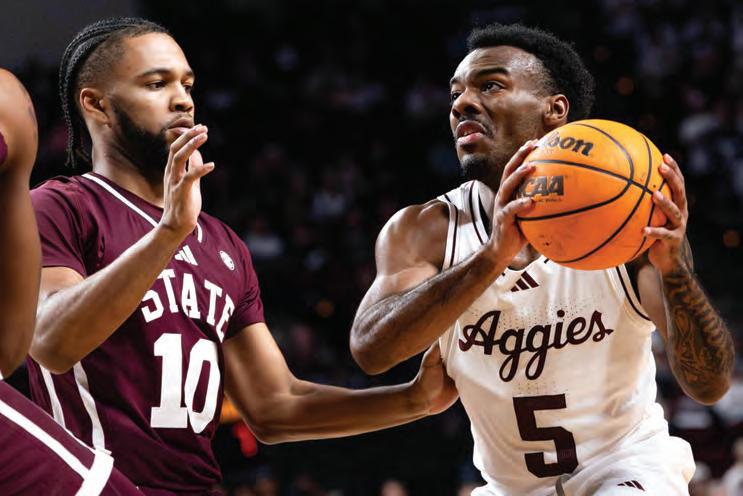
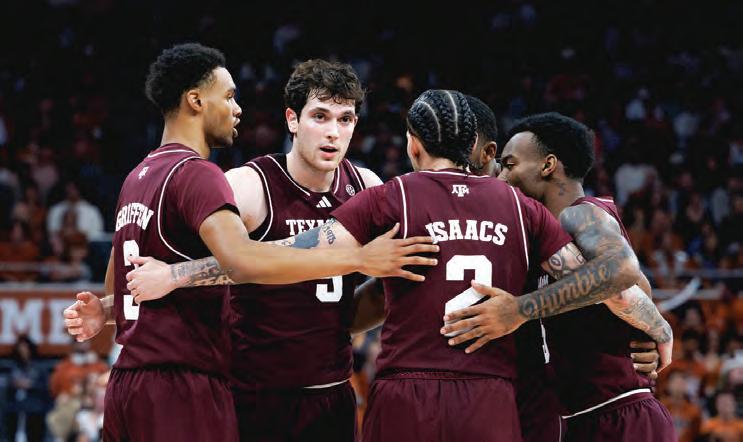
Knee deep in the thick of the Southeastern Conference regular-season title race, Texas A&M men’s basketball has been surging since the start of league play. From 10 double-double performances out of graduate student forward Rashaun Agee, to the growing synergy between head coach Bucky McMillan’s squad, the Aggies are clicking as they seek their fourth straight NCAA Tournament bid.
But before it looks too far ahead, A&M finds itself in a full-length episode of “The Crocodile Hunter,” where Agee and his Aggies will be wrestling big game as they play host to No. 17 Florida on Saturday, Feb. 7, and Missouri on Wednesday, Feb. 11.
Trophy hunt
After winning the national championship last season, the Gators got off to a rocky start, as back-to-back losses against then-No. 4 Duke and then-No. 5 UConn dropped Florida to a measly 6-4 record on Dec. 9, 2025. But like swamps in the Sunshine State, caution should always be exercised — even with no perceived danger — for a reptilian threat could be lurking just below the water’s surface.
Since then, Florida has charged back into
the hunt for a spot in the Big Dance, winning 10 of its last 12 matchups and putting up a 7-2 record in the SEC. Junior F Thomas Haugh has been paramount in the Gators’ midseason revival, leading them with 17.6 points per game. He adds a respectable 6.4 rebounds per game as well, but few have been as effective as junior center Rueben Chinyelu and junior F Alex Condon.
The upperclassmen stars have created one of the country’s top board-crashing duos, averaging 11.3 and 8.1 rebounds per game, respectively. The former’s total is first in the SEC and fourth in the nation, while the latter is ranked third in the conference. However, sandwiched between the two Gators is Agee, who averaged nine rebounds per game, prior to the game against Alabama on Feb. 4.
The Maroon and White will need the best out of the man McMillan calls “Grandpa,” but he is not the only Aggie who has been dealing damage around the court. Another man with a nickname — though perhaps more intimidating — is sophomore guard Rubén Dominguez, the one that A&M faithful know as the “Spanish Sniper.”
Not even Hernán Cortés could have conquered Aggieland the way Dominguez has in just a few short months, breaking A&M’s program record for 3-pointers in a single game with 10 in just his sixth contest with the Maroon and White. Now 21 games in, Dominguez has the second-most treys in the conference with 68 and is second out of the Aggies with 12.9 points per game.
But even with an old man and a conquistador, A&M will still need all hands on deck
to send Florida back to the swamp with its tail tucked between its legs, especially with sophomore G Boogie Fland at the ready.
The Arkansas transfer has fit in perfectly with his new squad, leading the Gators in assists per game with 3.9 as he circulates the flow of traffic for their offense. But defense is where Florida shines, leading the SEC in rebounds per game with 46 and ranking in the top five for points allowed per game and blocks.
With all that in mind, the Aggies will need to play true to their full-court press and uptempo identity to rattle the Gators, as Florida will be prepared to show the nation why it is still capable of competing for a championship.
Tiger-taming trifecta?
Sometimes, new regimes push the same agendas. While McMillan is certainly not promoting former head coach Buzz Williams’ style of play, especially since the Aggies are averaging almost 20 points more per game under McMillan than under the now-Maryland boss, there is something that remains: the goal to render all the Tigers of the SEC to mere housecats.
A season ago, Williams’ final A&M squad bested Auburn, LSU and Missouri, with the midweek matchup versus the latter opening the door for McMillan’s rookie crew to replicate the same feat.
-Chomping with the same bite force as the Gators, the Tigers will be baring their teeth, hungry for an upset like the one they pulled off against the reigning national champions back on Jan. 3.
Senior G Mark Mitchell has been the do-it-all machine for Missouri, leading the Tigers in both points and rebounds per game with 17.5 and 5.5, respectively. But Mitchell is not the only X-factor in Columbia, Missouri, as graduate student Gs Jacob Crews and Jayden Stone average north of 10 points per game.
While Missouri maintains a slight height advantage, A&M has grown accustomed to taking on taller opponents and has delivered results even when the starting five are off the court. The Aggies’ 91.8 points per game are ranked third in the country, as are their 38.3 bench points per game, with each individual ready to do their part.
The spotlight plays no favorites for the Maroon and White, with fifth-year G Ali Dibba’s 15-point performance against Georgia and graduate student F Zach Clemence’s seven 3-pointers against South Carolina serving as testaments to what Bucky Ball can do.
With a win over Missouri, A&M would not only secure another critical SEC victory, but also extend its streak over the Tigers to six straight games. McMillan has had the luxury of entering into the Maroon and White’s rivalries on the winning side, but as the season draws closer to its end, each game is its own uphill battle.
Tearing through the conference is no easy task, especially with a rookie SEC head coach, but perhaps A&M has finally found the winning formula to capture its first regular-season championship since 2016. Even so, McMillan has his Aggies
and


After year of ineligibility due to SEC transfer rules, sophomore outfielder looks to turn preparation into action
By Mathias Cubillan Managing Editor
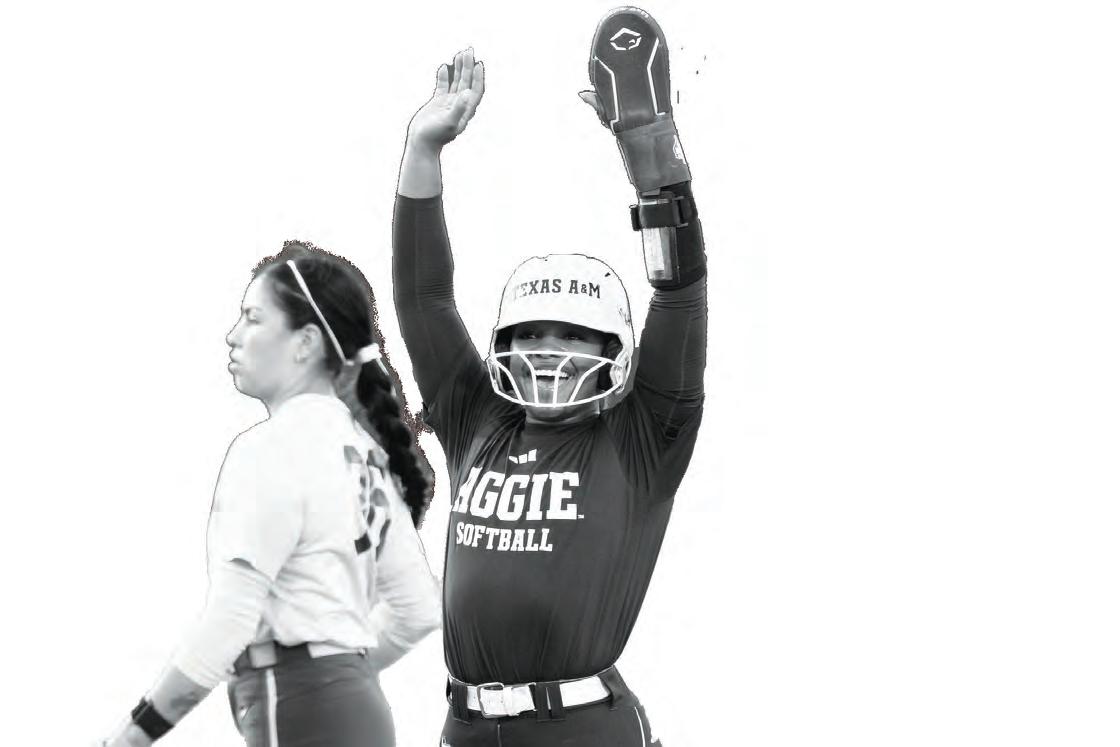
Sophomore outfielder Ariel Kowalewski
understood how loud David Diamond could be without even stepping inside the base paths.
She felt the stadium shake as her teammates rounded the bases, she experienced the applause as Texas A&M softball thanked the 12th Man after wins, she saw the Aggieland sunlight refract through the iridescent bubbles that swarmed the air as home runs soared over the wall.
But she couldn’t participate.
She had to watch from the dugout — banished to the batting cages as Southeastern Conference midyear transfer rules held her out of the 2025 season. Present but unavailable, she waited. Now, Kowalewski is expected to be a key cog in a maroon and white machine that is looking to build on one of the best seasons in program history.
“It just really amazes me how much different it can be like when you’re not able to play compared to when you actually can get out there and do something,” Kowalewski said.
Despite a season out of the spotlight, her name is familiar to collegiate softball fans. In her freshman season with the Florida Gators, Kowalewski — known simply as AK to teammates and coaches — hit .308 and eight home runs, none more important than her two-run bomb in the Women’s College World Series against perennial steamroller Oklahoma.
“I didn’t know it was gonna go over at the time,” Kowalewski said. “ … I think we were down, and I hit it over, and that put us up if I recall. In that at-bat, I was really focused and really just trying to lock in, do the best I could for my teammates and just be in the moment.”
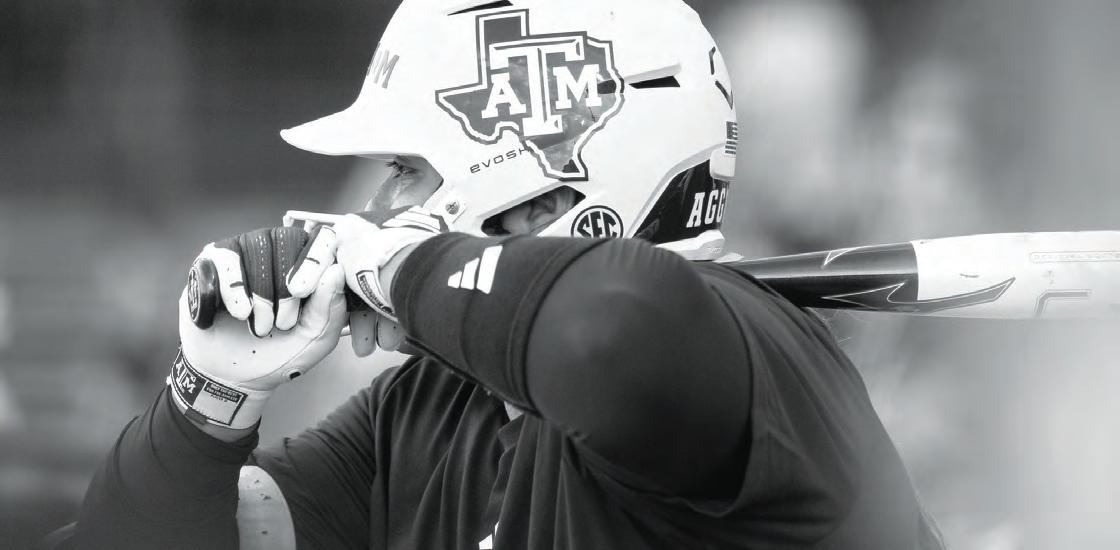
Five-game showcase headlined by battle against No. 1 Texas Tech, pitcher NiJaree Canady on Saturday, Feb. 7
By Mathias Cubillan Managing Editor
Before the 2025 season — and the careers of several program pillars — abruptly came to an end in the NCAA regionals, Texas A&M softball was on a magic carpet ride.
The psilocybin-laced trip saw the Aggies sit at No. 1 in the polls, dismantle the eventual champion Texas Longhorns 14-2 in the SEC Tournament and be named co-champion of that same tournament.
As No. 11 A&M turns the page on last season’s disappointment with this weekend’s Aggie Classic, the team has found a new identity — settled on by the team after an hour of deliberation — despite having question marks throughout the roster.
“[2025] fuels us a lot, especially the people that were here, the returners,” senior third baseman Kennedy Powell said. “I think we’ve also had to understand and realize that that was last year. It happened, and we don’t forget about it, but we also understand that this is a new team. This is a new year, so we have to create a new identity for ourselves. We have to create a new standard for ourselves. … The theme for our team this year is ‘never out of the fight.’”
A&M will use the Aggie Classic to tinker with its lineup and iron out the kinks in the pitching rotation with a doubleheader against Abilene Christian and Utah State on Thursday, Feb. 5, and two games against Providence on Friday, Feb. 6, and Sunday, Feb. 8.
The main event, however, is a duel with No. 1 Texas Tech on Saturday, Feb. 7, who was not only the runner-up last season, but is the most expensive roster in the sport’s history. Led by all-world senior right-handed pitcher NiJaree Canady, the Red Raiders are expected to build off of head coach Gerry Glasco’s 54-14 debut season.
“We’re like, man, we got Tech on Saturday,” Powell said. “That’s crazy to open up the season. I mean, we are excited to play. We’re excited to not be playing each other. … It’s so much fun to be a part of such a big matchup like that that everyone’s been looking forward to. So I think, you know, we’re ready, and we’re excited to play.”
Junior first baseman/designated player
Mya Perez is A&M’s answer to Tech’s star power. A member of the All-SEC Preseason Team, Perez will look to improve on her 16 home runs and school-record 73 RBIs from last season.
Head coach Trisha Ford confirmed that the specifics of her lineup haven’t been hammered out, with five players competing for three outfield spots, including Georgia transfer sophomore OF Paislie Allen and newly eligible sophomore OF Ariel Kowalewski.
In the circle, A&M is losing one of the shiniest arms in school history in Emiley Kennedy, who’s now playing in the Athletes Unlimited Softball League.
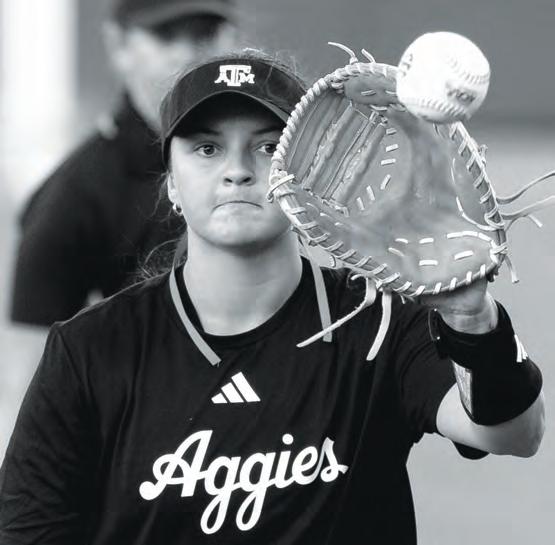
To buoy the loss, Ford brought in Missouri transfer senior left-handed pitcher Taylor Pannell, the NCAA’s Division I save leader with 24.
The changeup specialist joins sophomore right-handed pitcher Sydney Lessentine and junior RHP Sidne Peters in the rotation, giving the Aggies a staff built more on diversity of skillset than the true ace they had with Kennedy.
“There’s going to be some opportunities, I think, this weekend that we’re going to be
able to kind of showcase what they have,” Ford said. “I think it’s going to be important for us as we get going, and we get ready for the conference season for us to have a good understanding of what each pitcher can do and what that looks like, so that we are ready for conference play.”
Lessentine echoed the sentiment, expressing belief in the new dynamic within the pitching staff off the heels of her record-breaking freshman campaign.
“Our saying this year is ‘one circle, one standard,’” Lessentine said. “Pitching staff together, we’re all in it together.We’re going to work together to beat teams. So I’m just excited to see how we all work.”
Despite the expected hubbub of the ranked intrastate battle on Saturday, Ford downplayed the importance of the result, instead stressing the importance of the Aggie Classic as a diagnostic for the coaching staff to evaluate the team against new opponents.
“It’s really about taking care of business, and what I mean by that is playing clean defense.” Ford said. “ … I think having discipline in the batter’s box, I think any sign of a good team is when you make it hard, so you make pitchers go deep into counts. … And then I think it’s being efficient in the circle. I think those three things are going to be critical for us to be successful this year.”
The coaching staff’s perspective attempts to snuff out the flame of fan expectation that will burn from outside the building, reframing the event as an opportunity for the new faces dotted throughout the Davis Diamond dugout to establish a culture.
“I think that’s what’s so great about Texas A&M is there’s no egos,” Ford said. “We just want to do really well.We want to work our
it.”
At the time, Florida seemed like a fairy tale fit. Growing up in Richmond, Kowalewski watched the Gators routinely reach Oklahoma City and saw a program that had it all.
“They were a good school, competitive, had everything I wanted at the time,” Kowalewski said. “So they checked all my boxes at the time.”
While the decision to move east was never really in question, Kowalewski said A&M was involved in her recruitment process. The Fort Bend Travis High School alum visited campus and met with then-head coach Jo Evans and faculty from her desired College of Engineering.
“It’s just at the time they were obviously building our program here, and so I just felt like Florida was a better fit for me at the time,” Kowalewski said.
However, Kowalewski decided to enter the transfer portal in December 2024 — notably after the SEC deadline for spring sports — citing a desire to compete closer to home. That drive brought her back to College Station, where her sister, biomedical engineering senior Amber Kowalewski, attends A&M.
The move led her to head coach Trisha Ford and the rest of the Aggie staff, who were coming off an NCAA Super Regional appearance.
“[Ford] wants to compete,” Kowalewski said. “She wants her players to want to have the grit and the competitiveness every time. Always giving 100%, and I feel like she really gets the best out of players just because she pushes you so hard, and I really just liked their coaching style. I liked [Associate Head Coach Jeff] Harger’s hitting. I like [assistant coach Russ Heffley]. … I just loved everything about the coaching staff.”
The transfer came with the knowledge that she would have to sit out the spring season, but — unbeknownst to the staff and Kowalewski — she would have to sit out fall ball, too. The time off forced a reset. Without games to prepare for, Kowalewski got back in the lab and started working on what she could control.
“Focus on everything you can do to get yourself better and prepared for the next season that you’re gonna be able to play,” Kowalewski said. “Like really in the weight room, lock in mentally on video, preparing for games, act like you’re still about to go out there and have to play, but don’t take anything for granted. Do everything at your best as you would as if you were to be playing. Just don’t let off the gas I would say.”
That extra work and preparation — including battling through a concussion and a knee injury — caught the eye of Ford, who already confirmed that the sophomore will “be at the top of our lineup and do some damage” in 2026.
“I feel like I’ve been waiting forever to get AK out on the field,” Ford said in a fall press conference. “So SEC rules, it’s a complete year she has to sit. … I come into the office on Saturday to get some things for the game, and who is in the cage hitting? AK. … All I can say is I’m very confident that the game is going to pay her back for all of her patience and her work.”



























In an Aggie story straight out of a Benjamin Knox painting, Boone and Chloe met on the sidelines of an A&M football game while Boone was visiting his former teammates.
ing Center in Lake Placid, New York, and the ice tracks of Europe where Boone and Chloe had split their time between training and competition, the Niederhofers moved to Midland, and settled in for a more traditional life.
By Ian Curtis Senior Enterprise Reporter
Like many college football players, former Texas A&M wide receiver Boone Niederhofer had a simple goal: keep playing football for as long as he could.
He had a solid career as a walk-on, recording 29 catches for 293 yards and a touchdown during his sophomore year in 2014. That dream came to a sudden end, however, in the regular-season finale against LSU his senior year, when he tore his ACL.
His goal of participating in the Aggies’ Pro Day — and an outside shot at a professional football career — was over.
“I almost had to let that dream go, and you kind of have to mourn that a little bit,” Boone said. “I definitely was sad that I didn’t get that opportunity. But, I believe that in all things, that all things work for good. So I held on to that.”
Nearly a decade later, Boone will be the first Aggie in school history to compete in the Winter Olympics when he takes to the ice in Cortina, Italy, later this month as a push athlete on the United States’ Olympic four-man bobsled team.
The past 10 years have been an up-and-down journey for Boone — not to mention, a delicate balancing act between bobsled training, working full-time and raising a family. But it has culminated in an opportunity that has made the struggle worth it.
With a view looking out over the peaks of the Dolomites in Cortina, Boone thought for a moment about what he’d say to his past self after his football career ended.
“I would just say that, you know, ‘It’s going to lead to something better,’” Boone said. “I would have never guessed that my life went in the direction that it did. And I’m really thankful for that.”
From gridiron to ice track
The first thing to know about Olympic bobsledding is that it’s not quite as fancy of a life as it sounds, Boone’s wife, Chloe Niederhofer, said.
“The sport is not glamorous,” Chloe said. “People will see the sport every four years when they watch the Winter Olympics, and people just sort of assume, ‘Oh yeah, I bet those people are paid,’ or ‘You know, I bet they get a lot of help and fundraising.’ …
You have to be scrappy and fight for yourself in the sport to be successful.”
Chloe said — jokingly — that she was hoodwinked. She started dating a former Aggie football player with a petroleum engineering degree and a stable job in the oil sector. But after a layoff and an out-ofthe-blue invitation a few months later, she found herself with a jobless bobsledder.
“Bobsled was always a part of our relationship,” Chloe said. “And I always thought it was just so cool, like such a random adventure.”
Boone’s introduction to the sport of bobsled came via former 12th Man Sam Moeller, who invited him to a bobsled combine taking place at A&M in 2018. He impressed USA Bobsled and was invited to participate in a rookie camp before competing in International Bobsleigh and Skeleton Federation, or IBSF, events.
While Moeller was a driver, Boone found his calling as a push athlete, one of the team members who pushes the several-hundred-pound carbon-fiber vehicle at
But Boone kept his Olympic hopes alive. He had a bobsled trainer send him workouts, despite him not officially training with USA Bobsled at the time. He set up a home gym, ran sprints in a field and kept up the hard work.
“If we, back then in the early days of our marriage — where the Olympic dream kind of fell apart, and we didn’t have any money, and we were newly starting a family — could look forward and see where we are now, it would just be such a cool feeling and testimony of how far the Lord has brought us,” Chloe said. “And it all started with just an attitude of being open-handed and trusting what God is doing, even when we really don’t understand it or can’t see it, and choosing to keep being disciplined and keep training even if that dream doesn’t work out.”
He didn’t let that stand in the way of his career or family obligations. In fact, it was the opposite. Those family-first moments actually made him a better athlete, Chloe said.
a dead sprint before hopping into the sled.
Boone isn’t the only converted athlete on this year’s Olympic roster. The other bobsledders Boone has met — including the three teammates in his sled for the games — have backgrounds in college football, collegiate track and field, skiing and other sports.
“[Bobsled] is definitely something to keep in mind if you do not make it to the next level in your sport, but have a dream of continuing to be an athlete,” Boone said.
“My whole life, all I ever wanted to be was an athlete from a young age to even now. I still kind of have to pinch myself sometimes that I, even at 32, still get to be an athlete and train for a sport that I love.”
Balancing act
The journey hasn’t come without its share of struggles, though. While Boone was able to help qualify driver Frank Del Duca for the 2022 Winter Olympics in Beijing, the USA was not granted a spot for the third sled that Boone competed in throughout the season in that Olympics by the IBSF.
The dream looked like it was over. Far from the U.S. Olympic & Paralympic Train-
“A lot of small moments of choosing discipline over comfort and choosing to maybe not train a day when he knows we need a Sunday afternoon as a family,” Chloe said. “Like, ‘I’m not going to go to the field and run sprints today. And if that makes me fall behind my fellow athletes, that makes me fall behind.’ And instead, we’ve sort of looked back and realized those moments of rest as a family actually helped him recover and be stronger.”
When an opportunity to prepare for the 2026 Winter Olympics presented itself, the Niederhofers felt called to give the Olympic dream one more shot. Boone does have a full-time job, of course, but his bosses at Civitas Resources have allowed him to work remotely over the half-year stretch of training and competition before and during the Olympics.
“[We] recognized him as a good fit, both from a character and integrity standpoint, but also from a technical standpoint,” Michael Schwarz, Boone’s boss at Civitas, said. “We kind of looked at it as a unique opportunity to support somebody and a pretty exciting
pretty once in a


Texans need to pay attention to 5-year-old
By Sidney Uy Opinion Columnist
The Lone Star State is becoming an unscrupulous laboratory for federal immigration enforcement and all its $85 billion faults. Detainees of the President Donald Trump administration’s mass deportation campaign are being forced out of their homes and thrown into Texas detention facilities. The latest victim forced to inhabit an overcrowded camp was a 5-year-old child.
Liam Conejo Ramos was barely a foot taller than the unmarked SUV’s wheels he was shuffled into on Jan. 20. Grabbing Ramos’ Spider-Man backpack, an ICE agent dressed in all black towered over him and ushered the 5-year old into the van.
It is a haunting image.
This blatantly capricious grab-and-go technique is sedimented by the fact that “Miranda warnings” do not apply to immigration proceedings since they apply to criminal cases not civil ones, despite Secretary of Homeland Security Kristi Noem repeatedly claiming detainees as “criminal illegal aliens” and “domestic terrorists.” White House Deputy Chief of Staff Stephen Miller even directed ICE to priori-
tize large numbers of arrests, not necessarily those convicted of a crime.
This perversion of law enforcement and rhetoric holds together a larger, brutal mosaic of baton-shattered car windows, broken-up families and crushed aspirations for the “American Dream.”
Many detainees have been snatched up by federal agents when attending their immigration hearings, striving to attain legal status and residency. While obeying the law, they were still being punished.
What non-charge would Ramos have to answer for? Did this preschooler pose a threat to our country? Embedded in an agenda to catch and store immigrant children in detention camps is an insufficiently explained goal to meet conveniently lucrative deportation quotas.
It’s becoming increasingly harder to ignore the reality that the brute-force execution of this agenda has always been its purpose:The function of ICE and Customs and Border Protection presence in Minnesota, or at least what they may celebrate as “mission accomplished,” is exactly what it has carried out, including the killings of citizens Alex Pretti, Renee Good and the six people who have died in ICE detention facilities this year, that we know of.
As ICE-related shooting deaths occur nationwide, will a child be next to die in custody? Do we trust the system enough to seek justice internally? Ramos is the fourth
child to be taken by ICE from his school district and uprooted from his home in Minnesota. A “bright young student” who’s missed by his classmates and teacher is held in a detention facility in Texas.
According to Congressman Joaquin Castro, Ramos’ father, Adrian Alexander Conejo Arias, told him that, “Liam has been very depressed since he’s been at Dilley, that he hasn’t been eating well.”
The Ramos family entered the United States legally, pursuing legal status and posed no safety risks to their community, but the Department of Homeland Security described Arias as an “illegal alien.”
However, he doesn’t have a criminal record in the U.S. or in his native country of Ecuador; Ramos’ family has a pending asylum case and no deportation orders. In fact, those taken to the center in Dilley do not possess a criminal record and were most likely in the middle of being legally processed, another example of politicians trying to seize optics and not working toward the public interest.
Crammed in the courtyard of the South Texas Family Residential Center are families who face inhumane conditions.

Choosing not to vote doesn’t signal wisdom — it cedes influence to those who do
By Prachi Arora Opinion Writer
You’ve probably heard it before: “I’m not voting because the system is broken.” Among young constituents, political disengagement is increasingly framed as proof of critical thinking rather than complacency. Cynicism is packaged as awareness, and skipping elections is cast as a form of protest.
But reality is far less flattering; opting out doesn’t dismantle the system, but rather hands control to others, leaving your voice unheard. Apathy is not a moral stance — it’s a political choice with real consequences.
Young people often justify their apathy by saying that the political system is broken, leaders are corrupt and the electoral process itself is a failure. They say voting is useless when neither party adequately represents their views, all the candidates are compromised and lobbyists and special interests are in control.
But by completely withdrawing from participation, you guarantee tuition will keep going up, action on climate change will remain stalled, threats to reproductive freedom will persist and officials will continue to fail in ensuring public safety.
Sitting out doesn’t impact who sits on school boards, city councils, county commissions or other such decision-making entities whose policies shape people’s everyday lives. Sitting out isn’t resistance — it’s surrendering your rights.
The consequences of disengagement are not hypothetical. When young people don’t vote, older or more committed individuals continue to dominate local and state elections that shape our communities.
School boards make their decisions based on elections that can be decided by fewer than a thousand votes in small districts. City councils make decisions about policing budgets, parks and housing access, yet voter turnout among younger people remains shockingly low. National primary candidates are elected by highly engaged small voting blocs, setting into place a political agenda that’s unrepresentative of the general constituency for years afterward.
STEM major skill sets are needed in the courtroom, too
By Maeva Elizabé Associate Opinion Editor
“But why study neuroscience just to go into law?”
“Won’t that put you at a disadvantage? I mean, you’ll be lacking the necessary background knowledge and skill set, right?”
“A scientific career would fit you like a glove.”
Well, the gloves are coming off.
What you are reading, at this very moment, is my intellectual property.
The words I’ve placed on this page, how I’ve chosen to string those words together and arrange them in coherent sentences — it’s all my intellectual property. On paper, I am but the manifestation of my thoughts, devised and compiled and presented for scrutiny.
Beyond this document, I can be characterized by my engagement in the study of intellect. As a pursuant of a neuroscience degree, I am, by the curriculum’s nature, exposed daily to the intricate biological machinery that enables the cognitive wheels of the human psyche to churn out revolutionary ideas, innovative solutions to the most pressing issues and, occasionally, compositions for student newspapers.
Compositions such as this one.
So when I employ this intellect and utilize the three-pound core of human advancement — that carries far more weight than merely its own — to produce the aforementioned intellectual property that you now peruse, it could be contended that I am partaking in, and you are directly experiencing, the tangible exemplar of my academic focus.
Similarly, much like how the transcription of my own intellectual property upon this sheet is a translation of my studies, so too is the case for inventors seeking to materialize the culmination of their professional life’s work into a patent’s filing.
It is thus my interest in exploring the intricacies and logistics of intellectual property law lies in my admiration for the discipline’s intersection between science and law, abstraction and reification: taking the seeds of novel thought that we nurture within our minds and judiciously planting them without, so that they may take root in society and implement change for the better, whether be it in the technological, industrial, medicinal or other such domains.

When young people sit out, they outsource decisions regarding tuition policy, abortion access, climate regulation and other such pressing issues without having any say in what happens.
Voting is power. It’s a tangible way of ensuring that your values are accounted for in governmental decisions. Every ballot is an opportunity to shape policies, elect leaders and decide which communities are prioritized. Disengagement is not neutral — it actively dictates election outcomes. Saying “I don’t vote because no candidate is perfect” is much like refusing to water a garden because there are weeds.
Inaction doesn’t stop the weeds from growing; it just lets them take over.
Furthermore, abstention from the polit-
ical process only exacerbates existing inequities. The communities most likely to be systemically disadvantaged — lower-income neighborhoods, racial minorities and students — are already structurally disadvantaged in political participation. By choosing to abstain, youth, who are often a large demographic of non-voters, only worsen the power gap. Young people who refuse to vote swing the political pendulum toward the interests of older, wealthier and more consistent voters.

As an individual deeply immersed within the scientific sphere, I wholly understand the desire of and incentive for inventors striving to safeguard their intellectual riches, their situation being a parallel to that of investors wishing to secure the handling of their financial assets: Both are bearers of “currency” that will undoubtedly ensure a prosperous future — for themselves or for society — and thus their “capital” must be protected.
But while the value instilled in owning stocks, bills and ingots of gold is rather a social construct, and their dispossession may thus only affect the bereft individual materialistically, the pirating of cognitive treasures before they can be legally transferred from the vault of one’s mind to that of an office building is a greater offense indeed.
Intellectual property isn’t just the compilation of graphemes and numerals into a docket, but rather the physical representation of oneself, the embodiment of one’s mind and one’s thoughts. Its worth lies entwined with the fabric of our being; the loss of one’s intellectual property could very well symbolize the unraveling of one’s identity.
If we examine the truth in René Descartes’ assertion that to think is to be, then the appropriation of another’s intellectual property would, by extension, mean the pilfering of an individual’s life essence. Consequently, orienting myself toward practicing intellectual property law represents more than simply discovering a profession — it is protecting human rights.
But would you believe that this is a conclusion I reached without ever having considered dipping my toe into the waters of a political science program, despite drawing a connection to a value so deeply entrenched in their teachings?
Arguably, I have been just as well prepared — if not even more so — as the next philosophy, English or history major when it comes to leveraging the buzzy hot topics that will surely shadow every not-so-leisurely step as I venture down a winding legal career path.
So there’s no need for the stigma.
It is entirely plausible to straddle the thin line between science and law, professions that are characterized by a relationship portrayed as quite contentious, yet is in fact so analogous. The ingenious, analytical mind; the work ethic of steel; the determined spirit unbroken by relentless rigor and paradoxically fueled by burning the midnight oil — it is truly a rapport created not in the laboratory, nor called forth in the courtroom, but reaped from the hard labor sown by aspiring scientists and attorneys alike.
The ostensible gap merely needs a bridge, and we STEM majors are it.
Maeva Elizabé is a neuroscience junior and chemistry minor and associate opinion editor for The Battalion