LIFE & ARTS
Four years after Russia’s invasion of Ukraine, consul general speaks at Annenberg Presidential Conference Center A3

SPORTS
After disappointing 2025 season, No. 25 A&M baseball begins with Tennessee Tech in Year 2 under Michael Earley A6
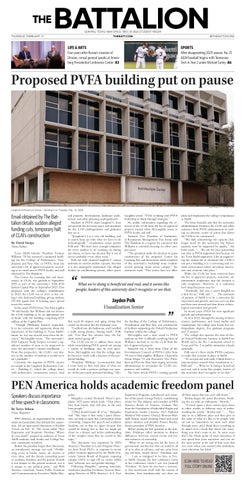
Four years after Russia’s invasion of Ukraine, consul general speaks at Annenberg Presidential Conference Center A3
SPORTS
After disappointing 2025 season, No. 25 A&M baseball begins with Tennessee Tech in Year 2 under Michael Earley A6
Email obtained by The Battalion details sudden alleged funding cuts, temporary halt of CLAI’s construction
By David Swope News Editor
Texas A&M Interim President Tommy Williams ‘78 has removed a proposed building for the College of Performance, Visualization and Fine Arts, or PVFA, from the university’s list of approved projects, according to an email sent to PVFA faculty and staff obtained by The Battalion.
The Center for Learning Arts and Innovation, or CLAI, was greenlit in September 2025 as part of the university’s 2026-2030 System Capital Plan in September 2025. First proposed with the college’s establishment in 2022, the CLAI was to serve as the college’s sole dedicated building, giving students 187,000 square feet of learning space spread across five stories.
In the email, PVFA Dean Tim McLaughlin ‘90 told faculty that Williams did not believe the CLAI building to be an appropriate use of funds, with the building comprising $235 million of the Capital Plan.
“Though [Williams] listened respectfully to my entreaties and arguments about the importance of the building to Texas A&M’s future, he was not swayed away from his decision,” McLaughlin wrote. “The university’s 2024 Capacity Study Report revealed a significant number of areas to be improved to serve the university’s current enrollment. … From this perspective, the CLAI’s cost relative to the number of students it would serve isn’t justifiable.”
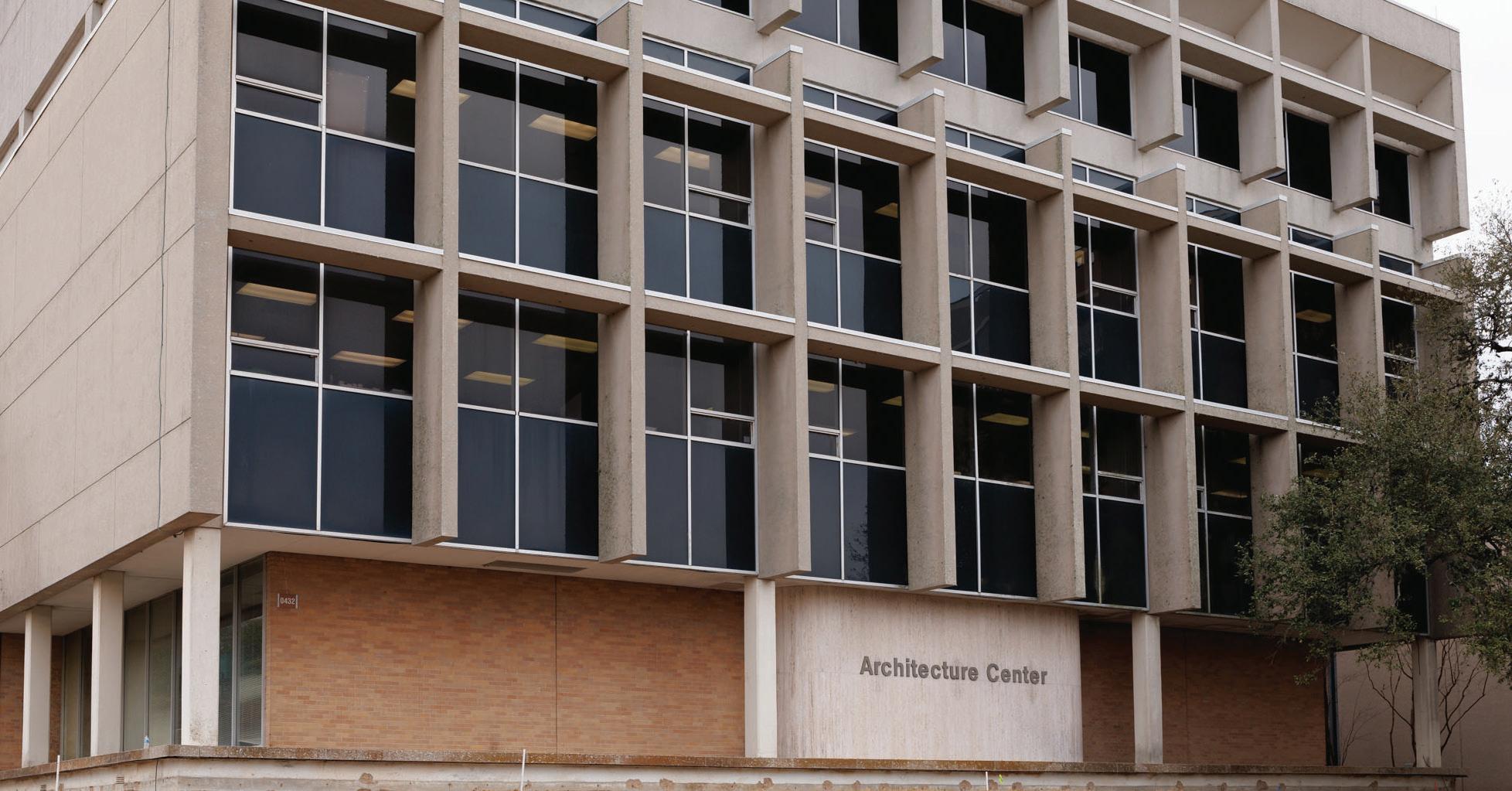
Currently, the majority of PVFA courses are taught in the Langford Architecture Center – Building C, which the college shares with architecture, construction science, land
and property development, landscape architecture and urban planning undergraduates.
Students in PVFA claim Langford C does not provide the necessary space and amenities for the 3,100 undergraduates and graduates that use it.
“[Langford C] is a very old building, and it cannot keep up with what we have to do technologically,” visualization senior Jayden Polk said. “We don’t have enough computers for every student to be working on during our classes, we have one elevator that is out of service probably every other week.”
Polk not only claimed Langford C cannot maintain its current student capacity, but that it is also improperly maintained. She alleged broken air conditioning systems, office spaces
Laughlin wrote. “I’ll be working with PVFA leadership to think through strategies.”
No public information regarding the removal of the CLAI from the list of approved projects existed when McLaughlin wrote to PVFA faculty and staff.
Assistant Vice President of Institutional Reputation Management Tim Eaton told The Battalion in a request for comment that Williams is currently focusing on other campus issues.
“The president made the decision to pause construction of the proposed Center for Learning Arts and Innovation while members of the university’s leadership team evaluate several pressing needs across campus,” the statement reads. “This action does not affect
What we’re doing is beneficial and real, and it seems like people, leaders of this university don’t recognize or see that.
Jayden Polk Visualization Senior
that reach 90 degrees and aging wiring that caused an electrical fire her freshman year.
“I walked into the bathroom, and I smelled a really strong plasticy, fuming smell,” Polk said. “Less than five minutes later, the fire alarm started going off.”
The CLAI was set to address these issues while consolidating PVFA, spread out among a variety of buildings, into its own space.
Now, McLaughlin says that the college may be forced to work with a fraction of the proposed funding.
“President Williams recommended that I come back to him with ideas of what we would do with a portion, perhaps one quarter, of the previously promised funding,” Mc-
the funding of the College of Performance, Visualization and Fine Arts, nor construction of facilities supporting the Virtual Production Institute within the college.”
McLaughlin sent a mass email to PVFA students on Feb. 6 officially notifying them of William’s decision to cut the CLAI from the list of approved projects.
Attached was a letter from Chair of the Development Council of PVFA Cedric Sims ‘94 sent to McLaughlin, Williams, Chancellor Glenn Hegar ‘93 and Executive Vice President and Provost Alan Sams urging university administrators to reconsider the CLAI’s importance and viability.
The letter details PVFA’s existing growth
plans and emphasizes the college’s importance at A&M.
The letter formally asks that the university administration reinstates the CLAI and offers assistance from PVFA administrators in crafting an alternate course of action that allows the CLAI to be constructed.
“We fully acknowledge the capacity challenges faced by the university but believe quantity must be supported by quality,” the letter reads. “… We ask for your partnership not only as PVFA supporters, but because we are Texas A&M supporters. Like an engineering lab, animal lab or chemistry lab, CLAI is not just a building; it is a convening and creation environment where invention, innovation and creativity take place.”
While the CLAI has been removed from the list of approved projects, university administration emphasizes that the decision is only temporary. However, it is unknown how long that pause may be.
“Essentially, this was a carrot dangled on a stick for us,” Polk said. “ … The statement of purpose of A&M is to be a university for innovation and growth, and you can’t say that and then turn around and shut down technological innovation and growth.”
In recent years, PVFA has seen significant growth and advancement.
As of in 2022, through the joining of dance science, performance and visual studies and visualization, the college now boasts five undergraduate degrees, five graduate programs and 12 minors.
The college also operates the state-of-theart Virtual Production Institute at A&M-Fort Worth and is the No. 1 animation school in Texas and No. 2 in public animation schools nationally.
Polk says it’s these strides PVFA continues to make that cements its place at A&M.
“It’s not just arts and crafts, I think there’s a misconception around what visualization is,” Polk said. “ … What we’re doing is beneficial and real, and it seems like people, leaders of this university don’t recognize or see that.”
Speakers discuss importance of free speech in classrooms
By Taryn Stilson News Reporter
PEN America, an organization for writers, artists and journalists that defends free expression, led an open-panel discussion at Rudder Tower on Feb. 10. The event, titled “Free Expression and Academic Freedom: Where do you stand?” amassed an audience of Texas A&M students, staff, faculty and College Station community members.
Before the panelists began their discussion, an introductory message was read. “Prohibiting access to books, music, art, movies or even ideas, and the threats censorship poses to academic freedom, and the pursuit of truth is not unique to this present moment, nor is it unique to any political party,” said PEN America consultant, Senior Public Relations and Communications Executive Malka Mar-
golies.
Margolies recited Heinrich Heine’s prophetic 1823 quote which reads, “That where they burn books, they will also, in the end, burn people.”
“[This] should haunt all of us,” Margolies said. “My hope is that today’s panel discussion can help us open this conversation about censorship, campus free speech and academic freedom, not so that we agree, because that would be boring, but so that we might get closer to a deeper and richer understanding of the complex issues that are central to this topic.”
The discussion was organized by PEN America’s Freedom to Learn Program Director Amy Reid, Ph.D., in response to recent policy revisions approved by the A&M University System Board of Regents requiring campus CEOs to sign off on course syllabi that “advocate race and gender ideology.”
Following Margolies’ opening statement, moderator Jonathan Friedman, Systems Managing Director of PEN America’s U.S. Free
Expression Programs, introduced each member of the panel: George Packer, contributing writer for The Atlantic and member of PEN America Board of Trustees, Graham Piro from the Foundation of Individual Rights and Expression, Sandra Cisneros, 2015 National Medal of Arts winner, Gloria J. Browne-Marshall, Emmy award-winning writer and social justice attorney and Jennifer Finney Boylan, former president of PEN America.
Before posing his first question to the panelists, Friedman called attention to distinct differences between current events and former instances of censorship.
“What we are seeing now [is] the force of government and the fear that can instill in all of us to obey in advance, and stay away from any red lines, trickle down.” Friedman said.
“
… I am so intrigued to be here at Texas A&M, because the first conference room in the conference center I saw was [named] ‘Freedom.’ So how do you have a university that intertwines itself with the notion of freedom, then simultaneously says there are
all these topics that you can’t talk about.” Boylan began the panel discussion, breaking the ice with an enthusiastic “Howdy.”
“A book opens a door, stories open doors to other worlds, to different ways of understanding the world,” Boylan said. “ … They take us to a different place and they give us the sense of what it’s like to be people who are not us. Sometimes we meet each other through story, and I think there is nothing to be afraid of in a book that shows you something you don’t want to see. In some ways that’s the whole point of your education, if you spend four years anywhere and you are the same person at the end of four years that you were when you entered that institution, your education has failed.”

By Yelisey Romanov News Reporter
Researchers with Texas A&M’s Department of Psychiatry and Behavioral Sciences are working to create a genetic map that could explain the origins and causes of psychiatric disorders.
For the better part of a century, clinicians have relied on behavioral checklists and subjective analyses to classify psychiatric conditions. Rulebooks such as the Diagnostic and Statistical Manual of Mental Disorders, or DSM, have evolved to include diagnostic parameters such as specific lists of symptoms, disorder classifications, frequency and severity, among other variables.
The problem with the DSM, however, is its subjectivity; researchers and physicians frequently disagree on the diagnosis of disorders. As a result, the DSM offers a comprehensive, yet deeply subjective, guide to identifying and categorizing mental illnesses.
“Most DSM diagnoses focus on going into a clinic and being assessed for a range of potential disorders,” professor and co-author of the study Brad Verhulst, Ph.D., said. “What happens is a clinician or an assessor asks the patient a question, and then the patient responds back to them. You end up having to interpret what they’re saying, and of course, there’s a lot of individual differences in how people respond.”
Furthermore, there are biases that can occur during clinical assessment and lead to an incorrect diagnosis.
“It would be really nice to have a more objective, independent way of classifying people and of diagnosing people,” Verhulst said. “That, however, is currently science fiction. But that’s where we want to go with this. The more we understand the biology of psychiatric disorders, the better and closer we’re going to be to improving diagnostic techniques and improving treatment.”
The project was conceived in 2010 when researchers in psychiatric genetics realized that no single lab could gather genetic data from millions of people on its own. To overcome this limitation, Verhulst’s laboratory joined the Psychiatric Genomics Consortium, or PGC, an international group of researchers that pool genetic data to study psychiatric disorders and their shared genetic risk.
Verhulst’s research group collaborated with the PGC’s Cross Disorder Analyses Working Group to find overlaps in data across disorders. To accomplish this, they analyzed massive datasets generated by the PGC’s disorder-specific working groups — teams that narrow their focus to single conditions like schizophrenia or depression.
“Each disorder has its own working group,” Verhulst said. “You’ve got major depression, they have a working group; you’ve got schizophrenia, they’ve got a working group, and they focus all of their efforts there. Our project looks across the working groups and says, ‘Okay, depression and schizophrenia and obsessive-compulsive disorder have all started finding things. Let’s look at whether some of the findings from one disorder are also popping out in another disorder.’”
The analysis revealed a genetic landscape in which the boundaries between diagnoses are far more subtle than the DSM suggests. The study uncovered that the same genetic risk factors often contribute to multiple psychiatric conditions. Most surprisingly, disorders such as schizophrenia and bipolar disorder shared most of their genetic signals, with very few genes unique to any single condition.
“Our hope is that we can use these findings, both in this study and in the broader genomics community, in order to develop novel treatments, develop newer, better treatments,” Verhulst said. “Because there hasn’t been a new class of drugs for psychological and psychiatric problems in about 30 years. They made better SSRIs [selective serotonin reuptake inhibitors], but they haven’t made new classes of drugs.”
A crucial caveat, however, is that the individual isn’t solely shaped by genetics — the environment plays an equally important part in disorder development.
“It’s important to understand that genes aren’t destiny,” Verhulst said. “That’s a classic thing every time you take a genetics class at an undergraduate level: Your genes aren’t destiny. We don’t necessarily have the same kind of treatment, or same kind of biases, or stigma towards people with heart disease or cancer as we do towards people with psychiatric problems. So we need to reduce that stigma as a society. That involves becoming more inclusive, allowing for people to be who they are and accepting people with whatever limitations and strengths that they may have.”



By Taryn Stilson News Reporter
The Texas A&M University System Board of Regents convened at its first board meeting of 2026 to present System updates to attendees and receive reports from five university committees on Feb. 4-6.
The main session, held in the Bethancourt Ballroom of the MSC from 10:15 a.m. to 4 p.m., was open to the public. It followed an executive session, closed from the public and held from 8:15 to 10 a.m. in the Board of Regents Annex at the MSC. The latter was organized to continue discussions from the previous executive session held on the afternoon of Feb. 4.
During these sessions, agenda items such as the “Approval of Amendments to the Bylaws of the Board of Regents,” “Authorization to Negotiate and Execute Two Amended and Restated Ground Leases with Life Tower Owner, LLC for a Mixeduse Development Project” and “Approval of Appointment of Board Members to the Board of Regents Committee on Medical and Health Affairs” were discussed.
Following the main session’s translocation to Bethancourt Ballroom, the meeting was called to order by Chairman Robert L. Albritton ‘71. A&M System Presidents and CEOs were in attendance, with seats in the back saved for community members.
“We on the Board want to thank everyone here and those back on their campuses who are working on the System’s 2026 course review,” Albritton said. “We appreciate everyone’s diligence to ensure Board policies are implemented officially and effectively.”
Albritton gave the floor to Chancellor Glenn Hegar ‘93, who gave the room a System update regarding the System’s new academic policies and accomplishments.
“Before Spring 2026, 5,400 course syllabi were viewed, and hundreds of questions were resolved at the department and college level directly between faculty and academic leadership,” Hegar said. “This resulted in six course cancellations, with 48 non-core and graduate-level courses receiving exemptions for educational reasons. And the Women’s and Gender Studies program is being wound down due to sustained low enrollment and academic considerations.”
Hegar added that A&M formally launched a new partnership with the United States Space Force that will bring a fourweek captain’s leadership course, led by Space Training and Readiness Command, to the Bush School of Government and Public Service.
Following the System-wide updates, the Committee on Academic and Student Affairs presented to the Board. Assistant Dean for Artificial Intelligence Arnold Castro ‘17 spoke on behalf of the committee about AI at Mays Business School.
He began his presentation with a simple definition of AI, then transitioned into discussing how Mays will prepare students to utilize AI as a tool, ensuring they are prepared for rapidly evolving career fields.
“Most jobs remain safe from being fully automated today,” Castro said. “What is far more common is that tasks get automated and roles change. The risk is not always that the job disappears; often, the risk is that this job changes quickly, and we do not prepare people for the new expectations. That is a training and transition challenge, and it is exactly where a university like Texas A&M can lead.”
Castro also updated the Board on how the recent launch of the Artificial Intelligence in Business minor added during Fall 2025 has supported student readiness and efficiency. Concepts he pitched to the Board included the integration of an “AI Interview Coach” and “AI Sales Coach” to be used by Mays students as tools to prepare for job interviews and simulate real-world situations where they can apply problem-solving skills learned in the classroom.
“Our goal is simple: We want our students to graduate in a world that has already changed,” Castro said. “We want them to be marketable because they can apply these tools to real problems.”
Board members followed up with questions for Castro, including “Is there a way [A&M] can use AI to help students with degree planning?” in reference to alleviating student stress about enrolling in specific courses at the right time. Castro replied that this can be looked into for future implementation as a feature available to students.
The next report from The Student Conduct Working Group was presented by A&M Fort Worth Vice President for Professional Schools and Programs Robert B. Ahdieh.
Ahdieh began the presentation with a statement on this group’s role within the System to “review student conduct and academic misconduct processes of the Texas
A&M University System.” Since the group was charged in September 2025 with reviewing the processes, they have also sought to “ensure the fairness, consistency and integrity of student conduct processes,” Ahdieh said.
“We looked at the policies in other universities, identified a set of peers that are known for doing this well and looked at the policy of [the Board of Regents],” Ahdieh said. “Then we collected data from all of the 12 System schools to understand what is happening on the ground in these areas.”
Ahdieh’s recommendations for the Board were to review A&M core courses to ensure they align with university missions and policies and a revision of A&M’s Academic Mission Statements and Program Inventory policy to include “verbiage changed to specify the review period necessitated by national changes and accreditation agencies and practices.”
Ahdieh’s update detailed a briefing to the Board about the 11 programs across the System that were either consolidated or terminated. This included the Ph.D. program in applied physics at A&M, the Master’s of Science in Early Childhood Education at A&M-Corpus Christi and the Bachelor of Arts in Spanish at A&M-Kingsville.
These updates concluded the meeting of the Committee on Academic and Student Affairs and a recess for lunch was called. The meeting resumed at 1 p.m., when the Committee on Research kicked off the afternoon session with updates on the Research Excellence Fund and presentations from A&M researchers. Professor of Veterinary Pathobiology in the College of Veterinary Medicine and Biomedical Sciences at A&M, Scott Dindot, Ph.D., started the session with a presentation on his research. Around 2:30 p.m., the Committee on Facilities Planning & Construction presented to the Board. The presentation included a request for full Board approval for the start date of the Poultry Science Center Project at A&M to be added to the 2026 calendar year.
Final items on the afternoon agenda included the meeting of the Committee on Audit and Risk Management and the Committee on Finance. Chief Auditor Amanda Dotson presented the Monthly Audit Reports and Audit Tracking Reports on behalf of the committee. She was followed by a Financial Status Update by Vice Chancellor and Chief Financial Officer Ryan Griffin on behalf of the latter. Following the approval of each regent, the meeting adjourned.
by students.
By Adhithi Shankar Life & Arts Writer
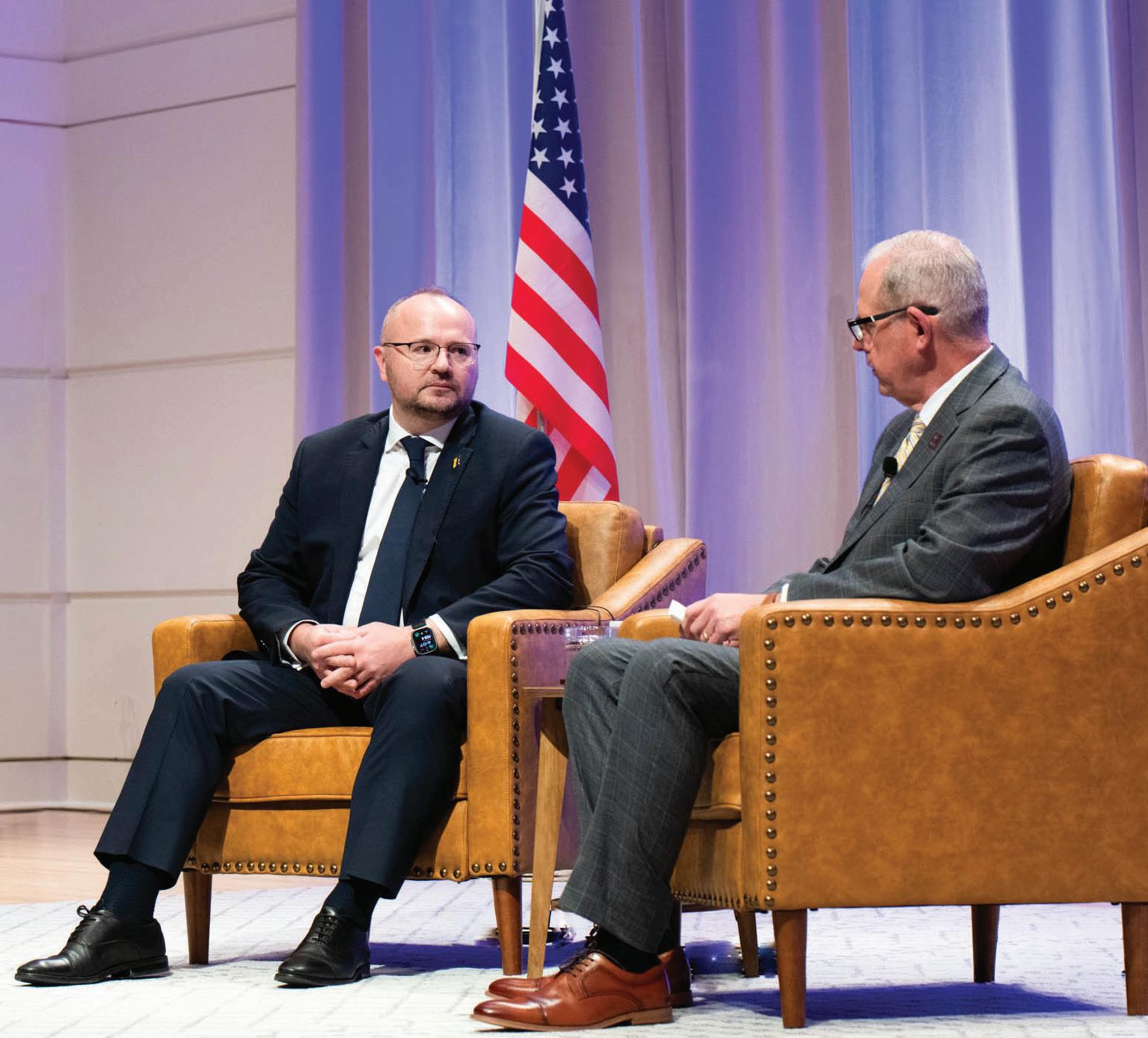
On Feb. 24, 2022, citizens around the globe woke up to headlines announcing that Russia had launched a full-scale invasion against Ukraine. Now, as the four-year anniversary of the initial attack approaches, the ongoing war is no longer at the forefront of the news cycle. To combat this lack of representation, three campus organizations came together to host a visit from Consul General Vitalii Tarasiuk of the Consulate General of Ukraine in Houston on Feb. 4. The event, “A Fair Peace for Ukraine,” was a collaboration between The Ready Room, the Ukrainian Club and the Scowcroft Institute of International Affairs.
International policy graduate student Adel Hussain is a member of The Ready Room, an organization run by intelligence studies students at the Texas A&M Bush School of Government and Public Service. With a career background in European security affairs, and now as a master’s student, Hussain said he is more dedicated than ever to raising continued awareness about the ongoing conflict.
“With the way news cycles work, other things have been happening around the world and have risen to prominence,” Hussain said. “Ukraine’s story has really just remained in the background. The story I’m trying to say, by bringing in Consul Tarasiuk, is that this is still a real war. This is a deadly war.”
“A Fair Peace for Ukraine” was structured as a discussion between Consul Tarasiuk and Dean of the Bush School John Sherman ‘92, with Sherman asking questions submitted
“We’re here to provide these opportunities [for students] to engage on the big issues,” Sherman said. “So having the opportunity to bring in a consul general to hear the perspective from Ukraine, I think, is a very rare and very special chance for our students to engage directly on one of the key topics that we’re facing. That’s what we’re all about at the Bush School, but also, specifically at the Scowcroft Institute.”
As a research institute housed within the Bush School, the Scowcroft Institute focuses on areas of security, international relations and global leadership.
“Scowcroft is always bringing in distinguished visitors,” Hussain said. “So it’s a great opportunity for people around campus to understand how A&M is contributing to foreign policy discussions.”
A&M’s contribution to the warfront goes much deeper than most Aggies may realize; Tarasiuk said that the hard-working students at A&M have helped forge connections between College Station and Kyiv.
“Since we arrived here to open the consulate in December 2021, there were a number of initiatives with Texas A&M, like with the [Norman] Borlaug Institute for International Agriculture,” Tarasiuk said. “And with the BUILD team that converts shipping containers into hospitals, six of those have already been shipped to Ukraine.”
Former United States Ambassador John Hennessey-Niland is the director of the Scowcroft Institute. When considering the invasion of Ukraine, he offered an empathetic perspective and stressed the importance of staying compassionate.
“Irrespective of politics and where you may stand on how much or how little this matters to the United States, I would just ask that people consider the human dimension,” Hennessey-Niland said. “No heat, no power, no job to go to, bleak future. I mean, I don’t think anyone would wish that for anyone else. And if we start

at that humanitarian level, there’s common ground.”
One of Tarasiuk’s points was that the men, women and children of Ukraine have been facing military hostility for nearly 12 years, long before headlines broke across the world.
“Russia’s aggression against Ukraine started in 2014 with the annexation of Crimea and hostilities in the eastern parts,” Tarasiuk said. “So if you put that into context, the aggression against Ukraine has lasted much longer than four years.”
With this in mind, Sherman echoed the importance of staying educated on the conflict in Eastern Europe, despite how far away or long ago it may seem.
“We have a short attention span,” Sherman said. “You’ve heard a lot of other things in the news lately, with the Middle East conflict, negotiations over Greenland and other things that stay at the forefront. But this is so important because where this goes, a lot can go with the eastern flank of NATO, Poland, the Baltics.”
Ultimately, according to Tarasiuk, “A Fair Peace for Ukraine” was a resounding success.
On the evening of Feb. 4, the Annenberg Presidential Conference Center was teeming with nearly 300 students, faculty and community members from around the Bryan-College Station area waiting to hear the consul general speak.
“If it’s not in the news, that doesn’t mean it’s over, or that it’s less hard,” Tarasiuk said, addressing the crowd. “In fact, it’s become more gruesome, more cruel. When you go to bed in your apartment and Russia is shelling overnight, you don’t know if you’re going to wake up the next morning.”
Audience members were visibly moved by Tarasiuk’s testament to the resilience of the Ukrainian people despite their struggles. At the end of the discussion, the crowd rose for a standing ovation.
“The world order as we know it is at stake,” Tarasiuk said. “And if we can unite together in Ukraine, we can uphold it.”
By Ava Whelan Life & Arts Writer
Beneath a shaded canopy of sprawling branches, generations of couples have gathered for photos, proposals and traditions in hope of manifesting good luck and everlasting love. Until last spring, no one had ever examined what was happening beneath the surface.
For over 100 years, the Century Tree has been widely recognized by Aggies as a symbol of tradition and romance. Located in front of the Academic Building, the tree is believed to bring lifelong luck to couples who walk under its branches. Over time, the Century Tree has become a popular location for marriage proposals, earning it its nickname, the “sweetheart tree.” The sprawling live oak was one of the first trees planted on Texas A&M’s campus, with records dating its origin back to 1891.
Last March, the Geographic Information Science and Technology, or GIST, program partnered with the Department of Geology & Geophysics to give the Century Tree its first-ever scientific checkup. Led by A&M Associate Professor of Geography Dan Goldberg, Ph.D., a team of undergraduate students and professors used ground-penetrating radar, or GPR, to reveal the tree’s underground root system and overall health.
“We had the opportunity to use GPR,” Goldberg said. “It’s a piece of equipment that geography students don’t typically get to use. We were just kicking around ideas of what to go out and measure and the Century Tree was brought up.”
This project was a part of the GIST program’s senior capstone course, in which undergraduate students complete a semester-long project to gain hands-on experience with real-world technology. While it began as an idea developed in the classroom, it quickly turned into a campuswide project, recruiting then-undergraduate GIST students Claire Lifrieri ‘25 and Jason Salazar ‘25.
“During the equipment demonstration, one of the things talked about was tree roots and health,” Lifrieri said. “We were like, ‘We know a big tree we could check out.’ We want to protect and preserve the legacy; this is one way technology can help support the preservation of it.”
Providing expert GPR guidance was geology and geophysics professor Mark Everett, Ph.D., and then-undergraduate geophysics student Sofia Hernandez ‘25. Managing the device for the geology department, Everett has used GPR for a large range of projects, including scanning archaeological sites, medieval buildings in France and coastal beaches. Hernandez brought equipment experience and project aid from her previous studies on tree roots. Together, they taught Goldberg, Lifrieri and Salazar how to properly scan the tree.
“[GPR] is like a radio antenna that sends a signal out and penetrates into the ground,” Everett said. “[The signal] will then propagate through the ground and reflect off any discontinuities or any changes in the subsurface material. The reflected signal will come back up and be detected at the receiver antenna. There’s a transmitter and receiver going on; the reflection is governed by changes in the soil properties.”
In healthy trees, roots contain much more water than the dry surrounding soil. With GPR’s ability to detect changes in moisture underneath the surface, it can accurately trace a tree’s underground network. Scanning the Century Tree would allow specialists to monitor growth and study its hidden changes over time, a process Everett described as similar to a medical diagnostic imaging procedure.





















Michael Earley,
By Noah Ruiz Associate Sports Editor
As the late D’Angelo once said, “Like the rails that cross the trains, like the blood in your veins, I will never betray my heart.” Sure, he was talking about the complex idea of passion and the persistence of his love for another, but, then again, loyalty to No. 25
Texas A&M baseball is more like this short verse from a neo-soul song than one might think, especially on Valentine’s weekend.
From the piercing horn of the Wellborn locomotives to the rousing yells of the Aggie faithful, Olsen Field has been a powerhouse of competitive baseball as the Maroon and White have made it to Omaha, Nebraska, twice in the last four years. But the honeymoon stage only lasts so long.
4.64 ERA may spell doom as the Aggies have more than just homegrown talent.
Returning to his home state of Texas is senior INF Jake Duer, who led FAU in batting average with a whopping .428 before an injury derailed what would have been a legendary season. A fellow transfer, and perhaps A&M’s most impactful newcomer, is junior INF Chris Hacopian. A 2025 Second Team All-Big 10 selection, the former Maryland Terrapin started all 52 games, batting .375 with 12 doubles, 14 home runs and 61 RBIs. The addition of both of those strong bats is a necessary step in replacing former star center fielder Jace LaViolette, who holds the record for most home runs in an A&M career.
Maroon blood in your veins
In America, it’s the land of second chances and, at A&M, it’s a chance to be part of something bigger than yourself. So when graduate student RHP Josh Stewart traded his burnt orange in for maroon and white, it was a combination of the two.
a 2.01 ERA in 28 relief appearances.
A betrayal of heart
The transfer portal and search for the big stage play no favorites, especially in the case of junior RHP Juan Vargas. After leading Tennessee Tech with eight saves in 2025, the young Panameño decided to take his talents to the next level in the Southeastern Conference with A&M.
The Aggie’s bullpen and starting rotation will be operating under a microscope, as it has already lost sophomore LHP Caden McCoy and experience is a fleeting resource. Even so, the batting order has just the right amount of gunpowder to spark a maroon and white explosion of offense.
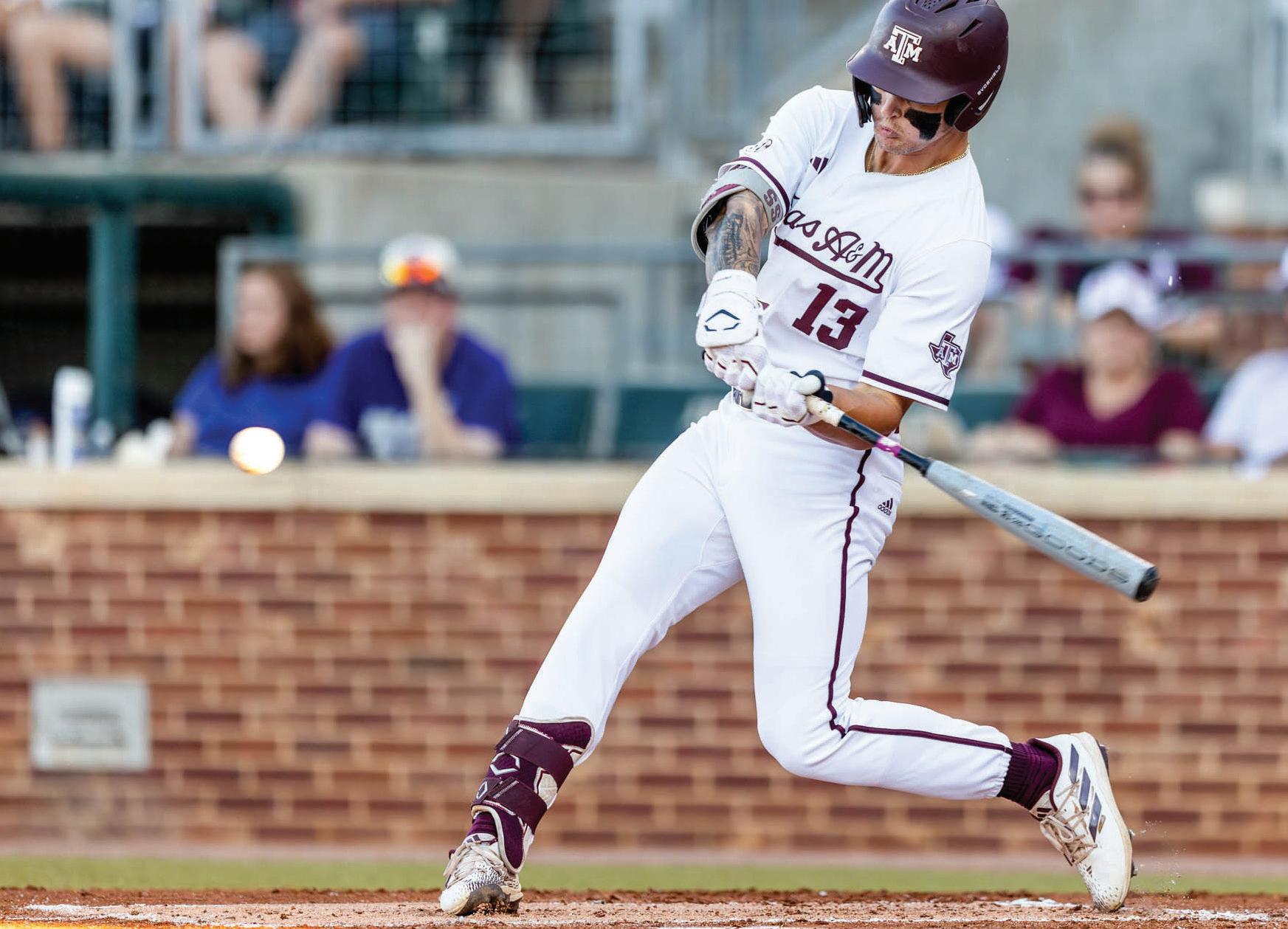
Sophomore OF Terrence Kiel II will be breaking baseballs — and perhaps rival fans’ hearts — while love is in the air this Valentine’s weekend, as he will be dead set on building off his stellar, 45 RBI rookie campaign.

After being just a few outs away from the 2024 national championship, A&M had a down year in head coach Michael Earley’s rookie season, to say the least. But with some counseling, coastal star power and returning leadership, Tennessee Tech may be the first victim on the A&M revenge tour starting on Friday, Feb. 13.
Rails that cross the College Station trains
Chosen as the 12th Man for 2026, Stewart has embodied the Spirit of Aggieland, battling a season-ending injury in his first appearance in 2025 after posting a 3.00 ERA in the Aggies’ most recent College World Series run. Additionally, when a surprise coaching change occurred the day after coming a game short of the championship, Stewart was undeterred, reaffirming his commitment to A&M in a simple Instagram caption: “An Aggie does not lie, cheat or steal or tolerate those who do. Thank God for Aggie Baseball.”
Kiel will be an integral part of an experienced corps of returning bats such as senior INF Ben Royo and junior catcher Bear Harrison, who combined for 20 homers and 67 RBIs in 2025. Outside of prolific returners, freshmen and transfers will be the arrows to Cupid’s bow of baseball romance.
One mo’gin

On the note of loud noise coming from the Wellborn tracks, don’t be fooled into thinking every one of them is a train — a few of them might be emanating from the bat of a handful of dynamic junior sluggers.
Redshirt junior left-handed pitcher
Shane Sdao’s story is quite similar to Stewart’s, as the promise of his 2025 campaign was also lost to injury. However, that has not diminished his resolve, as he is in a prime position to be an all-conference starter in his return to the mound after compiling a 5-1 record and 2.96 ERA in his sophomore season.
Similar to a vocal artist’s outward expression to the “one who got away,” Aggie fans, too, are calling out to what once was. Like a lost love, A&M has found itself adrift in a sea of broken dreams, clinging to a raft born from a broken heart ravaged by a championship loss and a disastrous season.

Returning to Olsen Field are a couple of Preseason All-SECers, junior infielder Gavin Grahovac and junior outfielder Caden Sorrell. As key pieces of the Aggies’ 2024 playoff run, the pair has accounted for 48 home runs in its four injury-filled seasons.
But now at full health, Grahovac and Sorrell will be the leaders on offense for A&M as Tennessee Tech is slated to start its most battle-tested starter, senior right-handed pitcher Jaxon Pease. His junior season saw him post a 5-3 record in 14 starts, but his
But as D’Angelo demonstrated in his appearance in the legendary album “The Miseducation of Lauryn Hill”, sometimes the greatest artists turn down the spotlight for a feature role every once in a while — enter the closing role. Junior RHP MJ Bollinger was another Owl poached from the American Athletic Conference, where he served as FAU’s closer with 11 saves and
But that’s the beauty of the diamond’s mystique: It hides its volatile nature in a trance, one that has been rocking the very souls of baseball fans everywhere since Amherst College defeated Williams College, 73-32, in 1859. But as with flowers on a special day — or a sandwich for those easier to please — baseball, like love, can find itself reenergized with the right combination of effort, buy-in and of course, unity between two parties.
So perhaps the rift between Omaha and A&M will not perpetuate, not without a fight from the latter, longing to hold its one true love tight one mo’gin that will begin this Friday at 6 p.m.




No. 8 Texas A&M softball prepares to compete in 5-game showcase in Sunshine State, face pair of ranked opponents
By Brody Vaughn Sports Writer
Entering Week 2 of tournament season, No. 8 Texas A&M softball will continue its strong start at the Clearwater Invitational in Clearwater, Florida, at the Eddie C. Moore Complex. The Aggies will take on three teams that played in the 2025 NCAA Tournament — the same tournament in which A&M lost its own regional to Liberty.
The Maroon and White enter the Clearwater Invitational with a 4-1 record following the Aggie Classic in College Station. Opening day was nothing short of dominant for A&M, grabbing two run-rule victories over Abilene Christian and Utah State. Day 2 saw another run rule in Game 1

against Providence before A&M suffered its first loss of the season to No. 1 Texas Tech on Day 3 while setting a weekend-long Davis Diamond attendance record with 8,456 fans. The Aggies held their own against superstar senior right-handed pitcher NiJaree Canady, but the bats couldn’t get going enough to make a comeback, falling 3-2.
“There’s a reason why I wanted to play them,” head coach Trisha Ford said about their matchup with Texas Tech. “I have a feeling that we could see them later on in the year. So, I didn’t want that to be the first time that we faced them. There’s nothing that’s really sticking out to me that like, ‘Oh, we did this really bad.’”
A&M got a chance to right the ship on Day 4 in another matchup against Providence, squashing the Friars for the second time in three days, 8-2. Senior first baseman/designated player Micaela Wark was the standout Aggie in Week 1, launching a home run in 4 of 5 games and ending the tournament with a .533 batting average.
The Aggies will continue to fine tune their lineup heading into the tournament. A&M used a league of substitutions in all of




its matchups, with 16 players getting an atbat. The Aggies also used five pitchers over the weekend, each of whom contributed to a sub-two ERA.
“It’s just really a confidence boost,” sophomore right fielder Ariel Kowalewski said about watching a variety of teammates get at-bats. “I feel like just being able to see everybody get their hits and then just being behind them and trusting in everybody.”
A&M will face two ranked opponents on Friday, Feb. 13, against No. 23 Oklahoma State and No. 19 Duke. Similar to the Aggies, both squads suffered an early loss in the regional round of the 2025 NCAA tournament.
Oklahoma State is coming off a 3-2 start, taking care of its unranked matchups but suffering two losses, including a runrule defeat at the hands of No. 17 Stanford. Duke enters the matchup 4-1, only suffering a close loss to Boston on opening day.
A&M will face NC State on Saturday, Feb. 14, who opened its season with a 2-3 start, including losses to then-No. 13 LSU and Nevada.
On Sunday, Feb. 15, the Aggies will fin-
ish the tournament with games against two unranked foes in Northwestern and James Madison. Northwestern made an appearance in the 2025 NCAA tournament before being eliminated in Round 1.
For the Aggies, this weekend will be about continued improvement and defending their preseason ranking. While looking impressive in Week 1, the Fightin’ Farmers dropped their only ranked matchup played this season, so A&M will need to prove itself against a field of ranked opponents in Florida.
“Offensively, I feel like there were some things that obviously we could continue to work on, but maybe some situational hitting,” Ford said on adjustments the team needs to make heading into Clearwater. “We had runners at first and second this last game in particular, and they were obviously throwing us in. And so, being able to have better at-bats in those situations, kind of work through that a little bit.”
The
Aggies prepare for battle against No. 19 Commodores, underwhelming Rebels
By Matthew Seaver Sports Editor
After a red-hot start to Southeastern Conference play, Texas A&M men’s basketball has since come back down to Earth, dropping a pair of games to Alabama and then-No. 17 Florida, the latter of which saw the Aggies start a miserable 1-for-27 from the field. Now 7-3 in conference play and with their season ramping up, the Maroon and White have no choice but to buckle up for their next brace of opponents.
First, A&M will mosey its way up to Nashville, Tennessee, for a date with No. 19 Vanderbilt on Saturday, Feb. 14. Following its Valentine’s Day outing, A&M will settle back in at Reed Arena to welcome Ole Miss on Wednesday, Feb. 18. The Commodores and Rebels present a barrage of artillery to prepare for if the Aggies want to stay in contention for the SEC regular-season championship.
“It’s inevitable that in a basketball season that you’re going to have ebbs and flows, they’ve been a part of it,” head coach Bucky McMillan said. “But they have a maturity to them, and this is the great part about basketball, unlike football that you don’t have to wait a whole week to play.”
The Aggies walk into Memorial Gymnasium as underdogs, which is a feeling all too familiar for the Maroon and White. During McMillan’s first season in charge, the Aggies were predicted to finish 13th in the SEC, according to the preseason coaches poll.
However, Bucky Ball has taken one of the toughest conferences in the country by storm, putting A&M atop the SEC before its most recent defeats. Even after a historically horrific beginning to the brawl with Florida, A&M inched back in the game thanks to McMillan’s system.
“Think of our road games,” McMillan said. “We’re an underdog at Texas, won. Underdog at Georgia, won. Underdog at Auburn, won. Double-digit almost-underdog at Tennessee, double overtime, right? Big underdog at Alabama, shot away, right? We’re an underdog versus Florida, didn’t play well, right? Started the game 1-for-27 from the field, and guess what? Our guys fought it hard enough that it was still just a 10-point game.”
Vanderbilt will aim to derail A&M’s underdog campaign, led by sophomore guard Tyler Tanner. The undersized-yet-athletic Commodore averages 18.6 points per game — the fifth most in the SEC — while also
contributing a team-best 5.3 on offense to go along with 2.5 steals on defense.
However, the Vanderbilt offense is certainly no lone wolf on the hardwood, with Tanner flanked by graduate G Duke Miles and senior forward Tyler Nickel. Keeping the Black and Gold’s Cerberus-style offense domesticated is going to be essential for the Aggies to lock up another resume-boosting victory.
This matchup is certainly one to hammer the over on for any bettors, as both programs are among the upper echelon of scoring offenses. However, these two defenses are nothing to slouch at either, with Bucky Ball’s signature full-court press versus Vanderbilt’s nine steals and five blocks per game. A&M has proven time and again its ability to dominate opponent territory, and McMillan is well aware of how competitive SEC play is.
“I don’t think Vanderbilt’s going to feel sorry for us and say, ‘You know, we’ll take it easy,’” McMillan said.
After facing Vanderbilt, A&M hits the railroad back to College Station for a showdown against Ole Miss. The Rebels won three games in a row earlier this season — including an overtime victory over the then-No. 21 Georgia Bulldogs — before dropping five straight conference matchups.
The Rebels’ offensive artillery is led by senior G AJ Storr, who averages 13.7 points per game as of Feb. 10. Despite leading the team in scoring, the journeyman ball handler was benched by head coach Chris Beard following an apparent conflict over Storr’s lack of effort.
With Storr now subject to being a sub stitute, senior F Malik Dia has taken the reins of Ole Miss, putting up 12.9 points, hauling in 6.1 rebounds and posting one block a game. Fueling Dia’s fire is senior G Ilias Kamardine. The Marseille, France native, who was deemed eligible after going unselected in the 2025 NBA Draft, is averaging 11 points and 3.7 assists in his first season of collegiate basketball.
With the NCAA Tournament slow ly approaching on the horizon, A&M will rely on its high turnover rate to keep Ole Miss from hurting the Maroon and White’s resume. The Aggies currently boast a trio of Quad 1 wins to pair with a foursome of Quad 2 wins, a more than surprising start in Year 1 under McMillan. If A&M wants to make a Cinderella run, not dwelling on its fault of form is the first step in unleashing the underdog Aggies.



“Champions act like champions before they’re ever champions,” McMillan said. “Not just when it’s going good, right? And it’s been going good, but how do we respond?”

Red-hot Aggies shoot to declaw litter of kittens amidst Southeastern Conference schedule, build win streak
By Dylan Fonville Sports Writer
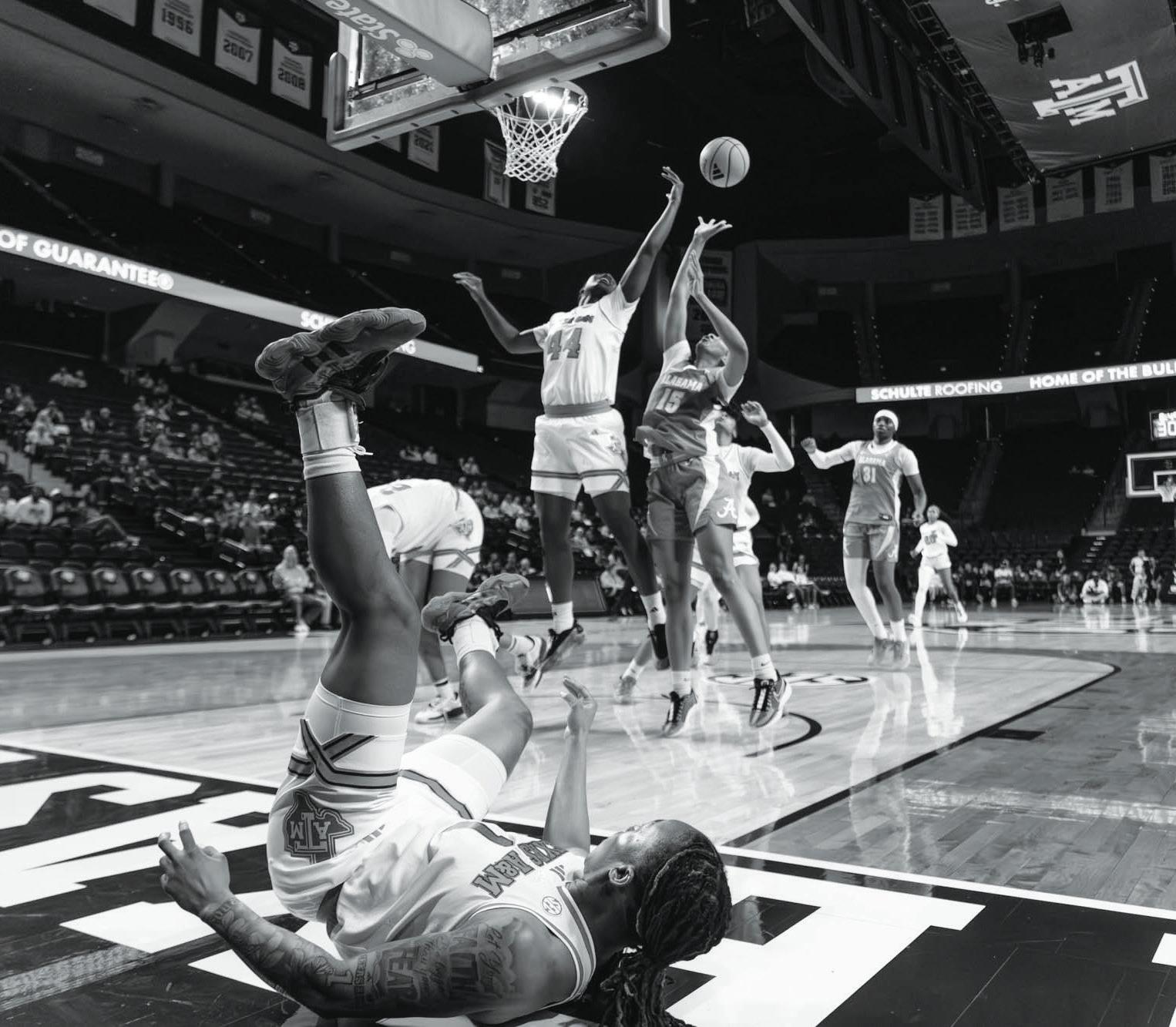
Despite a rocky start to conference play, Texas A&M women’s basketball is riding a new wind after its first ranked win of the season over then-No. 21 Alabama at Reed Arena on Feb. 8.
The Aggies continue their difficult series of league opponents when they face the No. 18 Kentucky Wildcats at Memorial Coliseum in Lexington, Kentucky, on Thursday, Feb. 12, and the Auburn Tigers at Reed Arena on Sunday, Feb. 15.
The Maroon and White are 9-10 with a conference record of 2-8 and are looking to chip away at opponents to improve on their No. 14 ranking in the Southeastern Conference. This will be no easy feat, considering their track record of losing by 20-plus
points to over half of the SEC opponents they have faced thus far.
“I think we’ve probably had some momentum since Missouri,” head coach Joni Taylor said after the win over Alabama. “It’s just been slowly getting better and better, and that’s just our players trusting the process, believing in us, believing in each other, and showing up everyday, blocking out the noise and just coming to work with their hard hat on.”
The success story of the season has been senior guard Ny’Ceara Pryor, who is consistently getting buckets with a season average of 15.5 points per game and a season high of 24 points against Kansas State on Nov. 16, 2025.
An all-around player, Pryor has consistently contributed to the team’s victories this season, averaging an impressive 4.4 rebounds and 6.7 assists.
A&M now finds itself in the middle of the tornado that is SEC play. The Aggies have repeatedly spoken about the need to finish out games against conference opponents, and, despite their measly second-half track record, Pryor believes that the win over Alabama may have been the turning
point.
“The third quarter was literally something we talked about, that was literally our worst quarter,” Pryor said. “Today, I mean, they scored 25, but we scored 19. To come back and beat them in the fourth [quarter], it just speaks volumes to who we are and who we can be.”
The Aggies had a season-low seven turnovers against the Crimson Tide, serving as a major factor in their win and momentum shift. If the Maroon and White are able to force turnovers all while limiting their own, they may be a fierce competitor against the rest of the litter.
If there is any Wildcat the Fightin’ Farmers need to worry about on their trip to Lexington, it is junior center Clara Strack. She has proven herself as a threat on the court, leading her team in points, rebounds, steals and blocks per game. Strack has transformed herself into a defensive monster, ranking second in both rebounds and blocks in the SEC. Accompanying Strack is senior G Tonie Morgan, who is second in the league in assists. The Aggies will need to play strong interior defense to cage her and the rest of the Wildcat roster.
Following the matchup against Kentucky, A&M will return to Reed Arena to face off against Auburn with hopes of keeping its momentum alive.
While the Tigers’ sit behind the Aggies at No. 15 in the conference and boast a 2-9 record in SEC play, the Maroon and White nonetheless have their work cut out for them, as the Tigers too pulled off an upset win over the then-No. 21 Alabama Crimson Tide on Jan. 15.
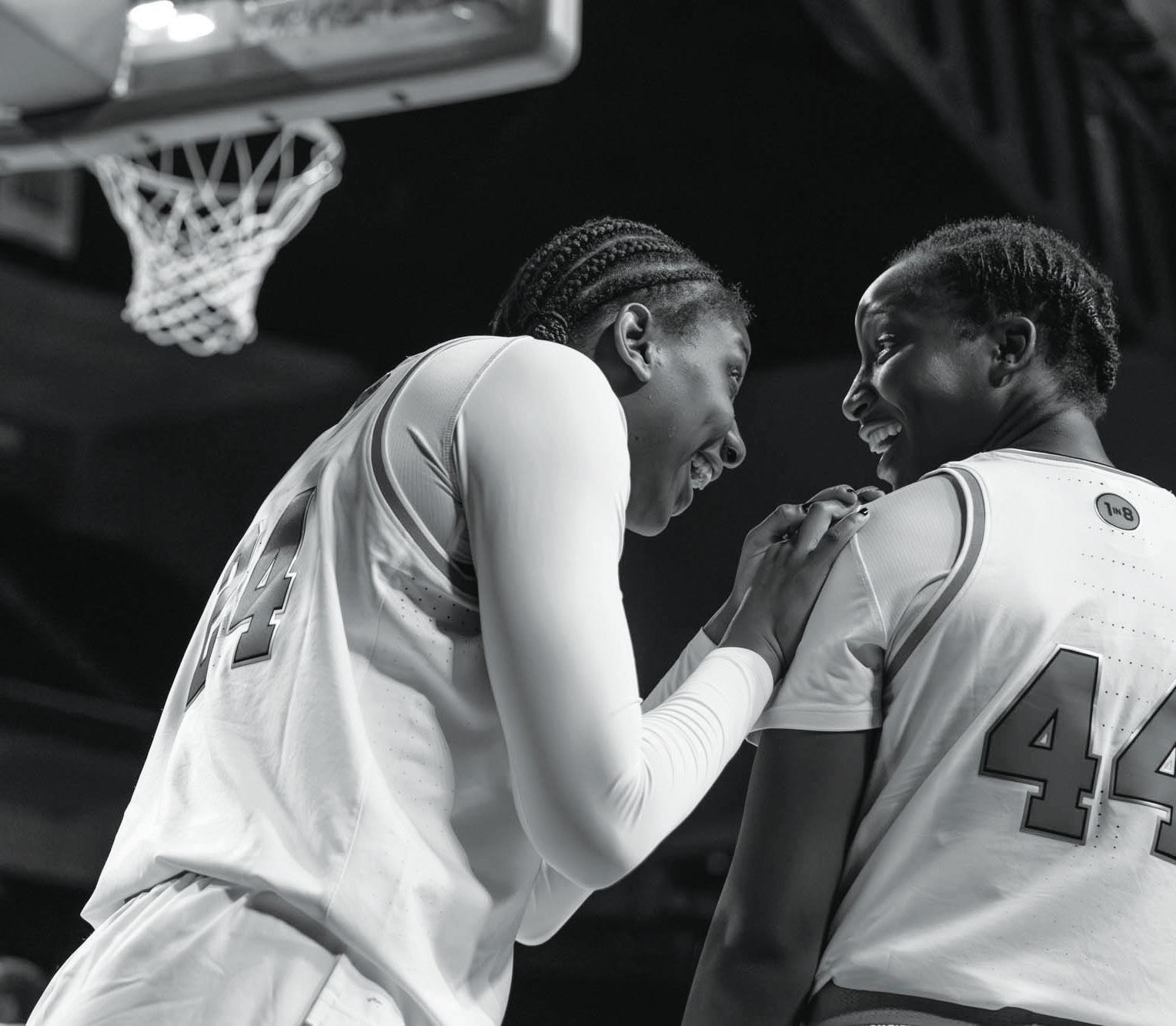
In order to extend Auburn’s six-game losing streak, A&M and junior forward Fatmata Janneh will need to rely on a budding team chemistry — something displayed in its upset win against Alabama.
“When I had seen her throw that ball I looked at her like, ‘Nah, why would you throw that?’” Janneh said about a turnover in the game against Alabama. “Then after that she was like, ‘You know what, you’re right,’ and then we and we literally snapped, we forgot about it and on to the next, because we knew we had a game to win.”
To turn the season around, the Aggies will need to continue their “on to the next” mentality, as they look to capitalize on their new-found momentum in conference play.
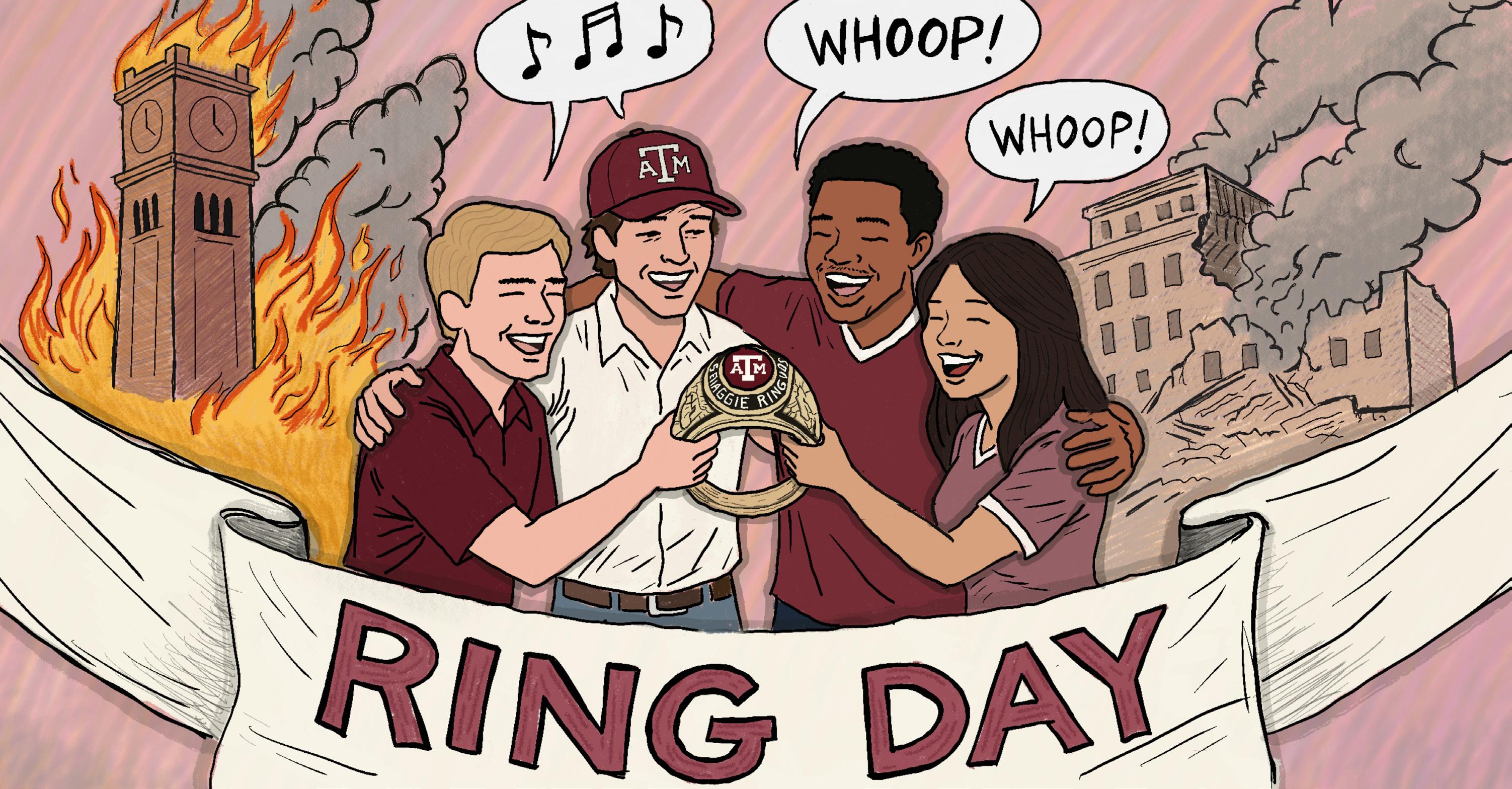
Failing leadership weakens Texas A&M’s proud identity
By Wyatt Pickering Opinion Columnist
Texas A&M isn’t normal.
Besides being obsessed with football, what school has an avant-garde parade during the Halloween season with flaming torches, pumpkins and candy? Strange, I know, but these traditions being passed down from class to class are what make our university unique compared to our counterparts — including our ugly burnt orange rivals in Austin.
Beyond these traditions, A&M prides itself on its mission and Core Values. With a guiding principle to “develop leaders of character dedicated to serving the greater good,” our university takes this objective to heart by giving its students and faculty the resources and examples necessary to fulfill this arc that lies dormant within all of us.
However, the Core Values that make these traditions great and the systems that support them are under attack by our administration and its attempts to appeal to political forces that betray our academic freedom.
A&M has been in the headlines now more than ever before, and not for good reasons. On Jan. 30, a news release from A&M detailed the cancellation of six courses, including ones that explored public policy ethics and world religions. Additionally, the Women’s and Gender Studies program
was eliminated, citing low participation rates and violations of the Civil Rights Protections and Compliance and Academic Freedom, Responsibility and Tenure policies revised by the Board of Regents in Fall 2025.
These choices have outraged both concerned students and professors, leading to the regular occurrence of protests and even spurring some of our most loyal Aggies to make statements denouncing A&M’s actions.
One of these opinions is that of Jon Hagler ‘58, a prominent A&M donor. In a commentary piece published by Dallas Morning News titled “Aggie donor: Regents have failed to protect TAMU’s independence,” Hagler describes his frustration with the System’s failure to support its students and professors. He alleges the Board of Regents has neglected to uphold the Texas Education Code, which states that every Texas university must “protect intellectual exploration and academic freedom.”
It’s apparent that this controversy covers much more than canceled courses. We must answer the question of what academic freedom is and the responsibility our Board of Regents has in “protecting” students from controversial issues. We cannot claim to be a university that develops “leaders of character” if we refuse to engage with the issues of diversity, equity and inclusion in the classroom setting. It goes to prove we fear backlash more than the actual issues we are trying to understand.
However, this overreach by the System has not been without consequences. Former senior lecturer Melissa McCoul, who was fired last semester for discussing gender identity in her children’s literature course, filed a lawsuit alleging she was wrongfully terminated and her First Amendment rights were violated. The defendants named are former A&M President Mark A. Welsh III, Interim President Tommy Williams ‘78, Chancellor Glenn Hegar ‘93 and the Board of Regents.
The lawsuit also claims that Gov. Greg Abbott’s chief of staff personally called Welsh demanding her termination, and that Executive Vice President and Provost Alan Sams was told not to give McCoul the required hearing before her expulsion.
In a statement made by the Texas American Association of University Professors, McCoul expressed, “There’s no satisfaction in doing this, only sadness. Teaching at A&M was my dream job: I got to welcome incoming Aggies every fall and congratulate graduating seniors every spring.”
This lawsuit will be pivotal in deciding whether A&M can continue in its practice of punishing professors for speaking without fear in their classrooms. For many, it’s a step in the right direction to protecting our professors from overzealous appointed officials who dislike ideas that oppose their worldview.
Like McCoul, I take no pleasure in criticizing A&M. This university has provided me and many of my peers with access to amazing opportunities to learn and give
back to those who are important in our lives, and I have enjoyed becoming involved in many of its defining traditions, from Silver Taps and Muster, to even getting my own Aggie Ring. These traditions are based on our Core Values, but they should embody everything we stand for as a university — not just customs to be passed down. What good is RELLIS if we fail to uphold its principles in situations like this?
It’s a complicated time to be an Aggie. I will always be proud of the university I attend and the experiences it has given me, but that does not protect it from accountability.
Through all those experiences, I have realized that it’s not the administrators, former students or influential Texas politicians that have made our traditions special, but rather the students and faculty that have risen to the challenge and built an A&M better than when they found it. Knowing this makes it even more frustrating when weak leaders bend to the will of our state government and limit our agency in our education. Students and professors make A&M great — not our administration. Yet the latter worsens it for the former and harms our reputation and education. It’s time to recognize that this System is incredibly broken and seeks to satisfy politicians before its students.
Wyatt Pickering is a business honors and finance junior and opinion columnist for The Battalion
‘Avada Kedavra’ might be unforgivable, but people aren’t
By Marie Kneeland Opinion Writer
“Mr. and Mrs. Dursley, of number four, Privet Drive, were proud to say that they were perfectly normal, thank you very much.” Have I upset you yet? No? Okay.
“Sydney Sweeney has great jeans.” How about now?
If you’re lost, let me enlighten you: The aforementioned sentences are pulled from some of society’s most infamous “canceled” figures. The first is a quote from “Harry Potter,” the second a catchphrase from an American Eagle jean campaign. Both waded into some hot water and were immediately “canceled.”
But what does that even mean?
I wish I could say there’s a straightforward definition, but there isn’t. While some dictionaries may interpret the term in various ways, like deciding to stop supporting someone, the truth is that the meaning varies from person to person.
One thing I’d like to make clear from the start is that “cancel culture” and facing the consequences of your actions are two completely separate things.
Here’s a scenario: You run a popular company, offering a product many people like. For the sake of this illustration, let’s say you’re selling University of Texas buttons. Then you commit a crime — which surprises no one, given your alma mater — and naturally, the sales of your company plummet immediately. That is not cancellation. That is the natural consequence of your actions. Now, to flip the script: You run a popular company, selling a product many people like. Then you make a post that Texas is the best school ever — a blatant lie — and your customers take to the internet, enraged and ready for some retribution.
“This seller is an idiot!” they scream. “Stop supporting them under any and all
circumstances! Never let the world forget!”
That is cancel culture at its finest.
The difference is this: If the legal world is the judge, it’s a cause-and-effect relationship with natural consequences. If the internet is the judge, it’s cancel culture.
There’s your definition in its checkerboard straightforwardness. Is it per fect? No. But neither are people. Cancel culture, like anything else, is a tool — just as it can be used to bring things to light, it can easily be wrongful ly wielded like a giant baton to beat people over the head with until they crumple up and disappear.
With that established, it’s time to talk about the cancellation of “Harry Potter.”
Grab your butterbeer.
It’s not uncommon for buzzwords like “canceled” to be thrown around in an attempt to get a rise out of the casual viewer, and boy, did the casual viewer have a field day with J.K. Rowling. After the author made several inflammatory posts on X, the adoration and apathy ofspectively, turned to hate. Cries to stopry Potter” franchise and the wizarding worldlowed halls of the internet as actors from the movies spoke out against the author and “#canceljkrowling” began
games and books were released and sold at the same staggering numbers as ever before. They even announced a new television show.
Evidently, we moved on — but why?
Maybe it’s because, at the end of the day, the world isn’t going to tilt on its axis because of that post you reshared. Maybe, despite what more vocal influencers claim, an uninformed TikTok isn’t the way to enact change. The rise and quick dissolution of the “Harry Potter” hate is proof of this.
The internet is a mastermind machine at giving its users the semblance of power. Cancel culture is a placebo pill: It allows you to think you have some modicum of influence when, in reality, you’re just another casual scroller making an impassioned comment based on information you’ve been fed.
And then it all just … The talk fizzled out.
“Harry Potter” merchandise,

Or maybe we moved on because people are tired. They’re tired of having agendas shoved in their face, tired of being told what they can and can’t support and tired of living in fear of having an opinion. That exhaustion was a downhill trek with only one destination — the cancellation of cancel culture.
It’s time we all set our phones down and use our own thoughts to make decisions instead of consuming the thoughts forced down our throats with every movie, advertisement and article. Everyone is entitled to their own views and the freedom to express them whether or not others agree with them or deem them “correct.”
But wait! Calm the chorus of disapproval! Freedom of speech doesn’t mean that everything said or posted is morally perfect and righteous — I’ve seen some wild takes in my time — however, this is not the time to “cancel” celebrities merely because you disagree with them.
No one is infallible; no one is incapable of mistakes. We are all messy, erring people in a fallen world. I would dare to hope that forgiveness is something we all want more of.
Marie Kneeland is an English freshman and opinion writer for The Battalion