January 1 - 10, 2026
Page 1
Volume 1 | Issue 1
Transportive stories by island-born hands, across shores
Patawid: The Legacy of the Baguio City Public Market
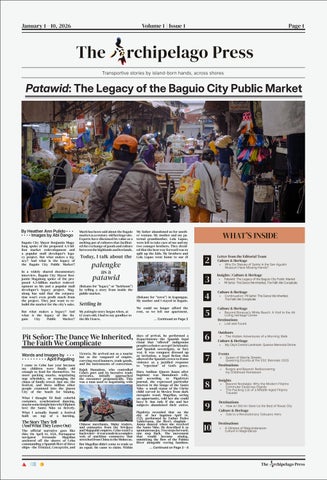
By Heather Ann Pulido Images by Abi Dango Baguio City Mayor Benjamin Magalong spoke of the proposed 4.5-billion market redevelopment and a popular mall developer’s legacy project. But what makes a legacy? And what is the legacy of the Baguio City Public Market? In a widely shared documentary interview, Baguio City Mayor Benjamin Magalong spoke of the proposed 4.5-billion market redevelopment as his and a popular mall developer’s legacy project. Magalong has said that the corporation won’t even profit much from the project. They just want to rebuild the market for the city’s sake. But what makes a legacy? And what is the legacy of the Baguio City Public Market?
Much has been said about the Baguio market as a century-old heritage site. Experts have discussed its value as a melting pot of cultures that facilitated the exchange of goods and culture between the highlands and lowlands.
Today, I talk about the
My father abandoned us for another woman. My mother and my paternal grandmother, Lola Lupao, were left to take care of me and my two younger brothers. They decided that the best way forward was to split up the kids. My brothers and Lola Lupao went home to our ili
palengke as a
patawid (Ilokano for “legacy” or “heirloom”) by telling a story from inside the public market.
Settling In My palengke story began when, at 12 years old, I had to say goodbye to the life I knew.
(Ilokano for “town”) in Kapangan. My mother and I stayed in Baguio. We could no longer afford the rent, so we left our apartment. ... Continued on Page 3
WHAT’S INSIDE
2
Letter from the Editorial Team Culture & Heritage
3
Insights | Culture & Heritage
4
Culture & Heritage
5
Culture & Heritage
»
Patawid: The Legacy of the Baguio City Public Market Pit Señor: The Dance We Inherited, The Faith We Complicate
» »
»
Pit Señor: The Dance We Inherited, The Faith We Complicate Words and Images by April Pagaling I came to Cebu last year because my children were finally old enough to fend for themselves. No more packing snacks, negotiating nap schedules, or managing the chaos of family travel. Just me, the festival, and three million other people crammed into the Queen City of the South for Sinulog.
Victoria. He arrived not as a tourist but as the vanguard of empire, carrying royal banners, trade goods, and the instruments of conversion. Rajah Humabon, who controlled Cebu’s port and its lucrative trade networks, initially approached the encounter pragmatically. This was a man used to negotiating with
What I thought I’d find: colorful costumes, synchronized dancing, maybe some insight into why Filipinos love the Santo Niño so fiercely. What I actually found: a festival built on top of a burning.
The Story They Tell (And What They Leave Out) The official narrative goes like this: On April 14, 1521, Portuguese navigator Fernando Magellan anchored off the shores of Cebu commanding a Spanish fleet of three ships—the Trinidad, Concepción, and
Chinese merchants, Malay traders, and emissaries from the Srivijaya and Majapahit empires. Cebu wasn’t a backwater—it was a node in a complex web of maritime commerce that stretched from China to the Moluccas. But Magellan didn’t come to trade as an equal. He came to claim. Within
Hara Amihan (Queen Juana after baptism) was Humabon’s wife, and according to Pigafetta’s journal, she expressed particular interest in the image of the Santo Niño—a small statue of the Christ child carved in Mexico from dark mesquite wood. Magellan, seeing an opportunity, told her she could have it—but only if she and her subjects abandoned their anitos. Pigafetta recorded that on the day of her baptism—April 14, 1521, performed by Father Pedro Valderrama, the fleet’s chaplain— Juana danced when she received the Santo Niño. He described it as spontaneous joy. Two steps forward, one step back. The movement that would become sinulog, mimicking the flow of the Pahina River alongside waving bamboo. ... Continued on Page 3 - 4
6
Destinations
Lost and Found
Outdoors »
The Hidden Adventures of a Morning Walk
Culture & Heritage »
7
Continuation: Pit Señor: The Dance We Inherited, The Faith We Complicate
Beyond Boracay’s White Beach: A Visit to the Ati Living Heritage Center
»
»
days of arrival, he performed a Requerimiento—the Spanish legal ritual that “offered” indigenous peoples a choice: accept Christianity and Spanish sovereignty, or face war. It was conquest dressed up as invitation, a legal fiction that allowed the Spanish crown to frame violence as a justified response to “rejection” of God’s grace.
Why Do Statues of Saints in the San Agustin Museum Have Missing Hands?
My City’s Central Landmark: Quezon Memorial Shrine
Events »
Queen of Manila Streets: Queering Escolta at the ESC Biennale 2025
Destinations »
Burgos and Beyond: Rediscovering my Childhood Hometown
8
Insights
9
Destinations
» »
»
How an Old Inn Gave Us the Best of Roxas City
Culture & Heritage »
10
Beyond Nostalgia: Why the Modern Filipino Commuter Deserves Dignity The Packing List of a Middle-Aged Filipino Traveler
Ode to a Revolutionary Cebuano Hero
Destinations »
A Glimpse of Maguindanaoan Culture in Magindanao
January 1 - 10, 2026
Page 2
Culture & Heritage
Editorial Team
Letter from the Editorial Team On Home and Storytelling as the Compass that Leads Us There
Severino Profeta Reyes
For some, home is a memory that dwells underwater, rises above it, or lives in the sky. For others, it is familiar arms; a place of grounding or leaving.
FOUNDING EDITOR
For our fledgling team, it’s a space where we open each other’s doors with that tropical “Tuloy po kayo” (Welcome! Please come in) and sit down for each other’s stories, however jarring, well knowing that it is in them that we can understand ourselves deeper and the roots that bind us together.
Allandale Antenero
As we take flight, we explore the many meanings of homes. Through the raw, decolonial lens of the boldest Filipino writers in the motherland and in the diaspora, we hope to share the wildly complex spirit of our home, the Philippines. We hope that through weekly storytelling, you will feel that warm, familiar feeling when a Filipino puts a hand on the knob and greets you with a sunkissed “Tuloy po kayo.” That you find that the best part of you is home.
FOUNDING TRAVEL WRITER
Gretchen Filart
MANAGING EDITOR
Monica Manuel
MARKETING COORDINATOR
Maia Imperial
EDITORIAL DESIGNER
Why Do Statues of Saints in the San Agustin Museum Have Missing Hands? Words and images by Jade Mark Capiñanes “The fear of the Lord is the beginning of wisdom,” the proverb goes, and when I was a kid I took this quite literally. Images of Jesus Christ, or any religious figure for that matter, genuinely terrified me. I’d scramble to switch off the TV whenever ABSCBN aired the three o’clock prayer. The sight of Christ in white, beams of light radiating from His heart, accompanied by that deep voice solemnly announcing, “Pumanaw ka, Hesus,” was simply too much for my young nerves to handle. Sleeping alone in our room was its own nightly ordeal because a portrait of the Virgin Mary hung on the wall, her eyes seemingly following my every move. One of my earliest memories—which I’m still not entirely sure was real or just a fever dream—is waking up to see our Santo Niño glowing and floating. Make of that what you will. Luckily, I’ve since outgrown that fear. So when I visited the San Agustin Museum for a field trip, I managed to enter the place, housed within the convent of the San Agustin Church, without trembling or making the sign of the cross every five seconds. The San Agustin Museum showcases a wide array of religious artifacts: statues of saints, crucifixes, liturgical vessels, and vestments. One thing I immediately noticed, though, was that many of the statues lacked hands. When I asked our professor, who served as our tour guide, about the disfigured statues, he explained that their missing hands had either been damaged or stolen. So much history in what isn’t even there.
How Museums Narrate Story History is always a bit of a construct. Filipino historian Ambeth Ocampo even writes that “history need not be confined to the written word.” Artifacts—like the items you find in museums—also tell stories, which means they too are selective narrators, choosing what gets remembered and what gets conveniently forgotten. And museums, for all their hushed voices and climate-controlled galleries, have never been neutral. Before becoming the public spaces we know today, they were private and exclusive—the original VIP lounges, if you will. In Ancient Greece, they were temples dedicated to the Muses, daughters of Zeus and goddesses of the arts, from whom the word “museum” is derived. These
places, filled with tomes and other important artifacts, were reserved for the best scholars of the time; they served as sites where knowledge was pursued and accumulated. During the Renaissance, museums took the form of cabinets of curiosities—rooms brimming with special collections of rare natural and historical relics. Owned and maintained by aristocrats—like the famous ones belonging to French King François I and Austrian Archduke Ferdinand II—access was limited to the elite. Early museums, then, were as much status symbols as they were physical spaces. Since they contained the bulk of human knowledge at the time, possession and entry meant displaying, amassing, and maintaining power. Even though most modern museums are now open to the public, they can still uphold certain values, sometimes troubling ones. Even respected institutions can push specific historical narratives, especially those tied to the Western colonial project. Take London’s British Museum, for instance. Vox, not exactly pulling punches, has a YouTube video titled “The British Museum is full of stolen artifacts,” which explains how the museum acquired relics during Britain’s centuries-long imperial conquests and how it resists claims from countries wanting back their cultural and historical items. One top comment even quips that the only reason the British Museum doesn’t contain the Pyramids of Giza is because they’re “too big to ship.”
and the elite who shaped policies that determined how life unfolded for the local population. So the San Agustin Museum, being situated within these two historical structures, is concrete proof of how Philippine history is deeply rooted in the colonial legacy of Catholicism and Spanish rule. It’s hard not to marvel at the church’s architecture once you’re there, with its imposing stone facade and intricate baroque details. The church, which has survived a pirate attack, a fire, and a war, physically embodies the enduring Spanish influence in the Philippines. Grand interior spaces, ornate decors—the layout of the building itself reinforces how central the Catholic Church has been in shaping Philippine society. Within the museum, the curation of items further supports this narrative. The emphasis on religious artifacts, ecclesiastical art, and historical documents related to the church reflects a perspective that once again foregrounds Catholicism in Filipino identity and culture. But isn’t it only natural for a museum associated with a church to mainly display religious items and artworks? Sure. The key point here, though, is how these artifacts are presented and interpreted within the museum. It’s worth noting that there’s an entire room dedicated to the arrival of the Spaniards, particularly Augustinian friars, in the country, as if suggesting that Philippine history only began when the country, as Yoyoy Villame memorably sang, “was discovered by Magellan.”
search conducted by Augustinian friars, where one wall showcases original lithographs of Philippine flora. (It was there that I learned that Gregor Mendel, the father of genetics, was actually an Augustinian abbot.) The exhibit implies that the Catholic Church isn’t entirely allergic to science: through the efforts of the Church, the museum seems to say, human knowledge expanded, and the country progressed. They brought us religion, yes, but hey, they also brought us botany.
CONTRIBUTING WRITERS April Pagaling Benj Gumabat Bernard Supetran Christian Sangoyo Christine Fernandez Gelyka Ruth Dumaraos Heather Ann Pulido Jade Mark Capiñanes Marky Ramone Go Nine Andres Kara Santos Karlo Lagman Sevilla III Ron Cruz Timothy Jay Ibay CONTRIBUTING PHOTOGRAPHER Abi Dango
But this framing of Philippine history tends to muffle other perspectives that might complicate this narrative. The only photos of locals I saw were located in that part of the museum. They depict Augustinian missionaries surrounded by young Filipino students—the visual language of benevolent guidance, teacher and grateful pupil. Similar “lowly” depictions of indios can be found throughout the museum. On a large wooden cabinet, you’ll find carvings depicting our ancestors engaging in everyday activities. The Spaniards, meanwhile, appear in more “civilized” roles such as administering infrastructure projects or composing music. The message:
for individuals with Chinese surnames, whom I can only assume are wealthy entrepreneurs. Their presence in the crypt underscores the close connection between the church and the ruling elite. The crypt doesn’t evoke benevolence so much as it rather inadvertently presents the church as a symbol of prestige. We like to say death is the ultimate equalizer, but step into the crypt and you quickly realize that apparently, even in death, there’s a VIP section.
culture and progress are things we owe to the Spaniards—which any self-respecting historian will tell you is hardly the case. The archipelago had thriving trade networks, sophisticated social structures, and rich cultural traditions long before the galleons arrived. But you wouldn’t necessarily know that from walking through these halls.
understandable for the San Agustin Museum to prioritize its religious heritage and institutional legacy, it’s equally important for it to recognize its role as a cultural institution, one that should aim for critical engagement with history, not just celebration of it.
And here is the museum’s most glaring omission: it overlooks the resistance movements and the long struggle for independence that rose in response to colonial rule. Museums, whether religious, secular, or something in between, hold immense power to form how we understand the past. While it’s
What Narrative Does the the San Agustin Museum San Agustin Museum Tell? What Doesn’t Want You to Think Now, can the same thing be said— or at least asked—about the San Agustin Museum? Does it promote a certain view of history? Start with its location. The San Agustin Museum sits inside the convent of the 400-year-old San Agustin Church, the oldest church in the Philippines. The museum and the church are essentially the same structure, sharing walls and hallways. The church has been a major center of worship for generations, drawing Catholic pilgrims year after year, especially during Holy Week when people do their Visita Iglesia circuit and try not to melt in the Manila heat. The church also sits smack dab within the walls of Intramuros, the beating heart of Spanish colonial Manila. Before the Japanese occupation reduced much of it to ruins, these walls held the offices of the colonial government, the stronghold of the Catholic Church,
If Jose Rizal’s novel Noli Me Tangere taught Filipino high schoolers one thing—at least in the way it’s traditionally taught—it would be that Spaniards weren’t exactly kind to us indios, to put it mildly. They subjected us to polo y servicio. The friars, who spoke incessantly of God, were hypocrites who would even throw tantrums if you dared serve them chicken neck and wings in their tinola. To this day, this idea persists in media, like in the hit teleserye Maria Clara at Ibarra. San Agustin Museum doesn’t want you to think that. Not all areas of the museum focus on religious themes, for example. There’s a library, though it mostly holds theological texts, so religious-adjacent at best. There’s also a gallery dedicated to natural re-
Why We Need a Nuanced View of History
One of the most telling parts of the museum is the crypt. Many of those interred there are prominent members of Spanish colonial society: government officials, military leaders, and clergy. Some spots are still vacant, but they’re already reserved, mostly
People can debate the positive contributions of the Church or Spain, and there will always be examples to point to. Leaving out alternative narratives, however, flattens our history and diminishes the richness of what we have and could have. A statue of a saint without hands may be intriguing on its own, but we also have to be curious about where those hands have gone. Were they stolen? Damaged? Lost to conflict or time? Those missing hands, both literally and figuratively, would offer us a more complete picture.
Insights | Culture & Heritage
January 1 - 10, 2026
Patawid: The Legacy of the Baguio City Public Market Continued from front page My mother worked as an all-around assistant/vendor at her friend’s building at Hilltop. In return, my mom and I were given a small room in the back. We moved to the heart of the market in the summer of 2009. Vendors ordered barako and instant coffee from my mother to fight the cold before dawn and shake off sleep after noon. Peddlers carrying big
thermoses in large plastic hampers would get their hot water from our puwesto, too. To keep up with the demand, my mother had to wake up at 3 or 4 a.m. every day to heat water in time for her earliest customers. I was a shy kid who always had her nose in a book, so I mostly stayed in our room. But every now and then, my mom would ask me to refill thermoses and deliver cups of coffee to her customers. I learned how to speak with different kinds of people. I became especially close to Ate Amy, a college student who managed the sari-sari store out front. On the sidewalk, I brought coffee to Auntie Lita, a rotund Batangueña selling alamang, and a lovely couple from Buyagan, La Trinidad selling rock salt. Auntie Zeny was taller and fairer than her husband, Uncle Roger, so they were often teased for being an unlikely pair. Across the street was Kuya Michael, a Maranao Muslim who sold ready-to-wear (RTW) clothes and liked his coffee black. I later found out that the quiet old man selling sili by the electric pole was the father of Rey Tam, the famous knockout boxer who was our kailyan (Ilokano for kababayan, or “townmate”) from Kapangan. Soon, the maze of sidewalk vendors and makeshift stalls along Block 4 looked more like home to me.
Finding Family It has always amazed me how everyone seems to know everyone in the market. If a vendor ran out of the exact type of sili you needed, they would point you in the direction of someone who might have it. When one vendor had to run to the bathroom, their neighbor would sell their goods for them. Some marketgo-
ers would leave their bags or even their kids with trusted vendors while they scoured the palengke to complete their shopping list. I myself had done my fair share of tending to Ate Amy’s store whenever she went to church. Of course, most of the time, it was Ate Amy who took on the task of tending to me while my mother ran errands. When Ate Amy graduated and left Hilltop, an Ifugao family supplying all kinds of saba took her spot. Since then, I never had to buy bananas—and for a long
time, I didn’t want to. Seeing mountains of them every day was enough. Holidays in the market were busier and noisier. Our puwesto never closed, not even for Christmas. Sometimes, my mom and I would join her friend’s family for noche buena. But sometimes, we stayed home. In the morning, our neighbors would give us the best of their
Pit Señor: The Dance We Inherited, The Faith We Complicate Continued from front page But joy under duress is complicated. This was a woman whose gods had just been consigned to fire, whose husband had entered a political alliance with armed foreigners, whose world was being reordered in real time. What looks like joy in Pigafetta’s account might also have been performance, strategy, or the ritual embodiment of grief.
What the Fire Didn’t Destroy
Magellan left Cebu days later for Mactan, where Lapu-Lapu’s warriors killed him on April 27, 1521. The Spanish fleet limped away. The Santo Niño disappeared into Cebu’s collective memory for forty-four years. When Miguel López de Legazpi returned in 1565 to finish what Magellan started, he came with overwhelming force: five ships, 500 soldiers, and explicit orders to establish permanent Spanish control. When a village refused to submit, Legazpi’s men razed it. In the ruins of a burning nipa hut, soldier Juan Camus reportedly found the Santo Niño intact, preserved in a wooden pine box lined with flowers. It was wearing simple clothing—a flounced shirt and a red velvet bonnet—and holding a round ball without a cross, with a small golden necklace around its neck. The elaborate royal vestments, crowns, and scepters would come later, added over centuries by Spanish
colonial administrators and devotees who dressed the image like a king. Legazpi interpreted this as divine endorsement—proof that God wanted Spain to rule these islands. He built a church on the spot where the image was found, which became the Basilica Minore del Santo Niño, the oldest Roman Catholic church in the Philippines. The statue itself is small—barely 30 centimeters tall—but it carries enormous symbolic weight. It was carved in Mexico, survived a shipboard fire during the Pacific crossing (which darkened its wood), disappeared for over four decades, and re-emerged unscathed from another fire. This triple survival became the core of its miraculous reputation. In 1740, Pope Clement XII granted the image canonical coronation, elevating it to one of the most venerated objects in Philippine Catholicism. In 1965, Pope Paul VI declared the church a Minor Basilica. In 2021—exactly 500 years after the first Catholic baptisms in the Philippines—both the Santo Niño image and the Basilica were declared National Cultural Treasures by the National Museum, recognized for their “outstanding historical, cultural, artistic and/or scientific value.” Today, the statue is encased in bulletproof glass inside the basilica. It is dressed in different vestments throughout the liturgical year—
noche buena in Tupperwares. We shared all sorts of food and stories while the rest of the city slept in.
Painful Separations In August 2010, hundreds of stalls in Block 3 and Block 4 were demolished to make way for the Uniwide market rehabilitation. The city government said that most stalls in the area were illegitimate anyway. I will not forget the sight of our neighbors, whose faces were contorted by grief and frustration as they looked at the ruins of their stores. I remember that the stalls at the new Block 3 and 4 were distributed via lottery. Many of our friends did not “win” a spot. Some were lucky enough to find a puwesto in the market. But some, like Kuya Michael, were forced to find business elsewhere. When Block 4 reopened, the carinderias and dry goods were placed on the upper floor. Since they were right across from us, the carinderia owners became our regular customers. During hard times, my mom and I ate lunch at Florencio’s Eatery on credit. We would also get diket – pancakes with peanut butter and condensed milk – and an assortment of sweets from Block 4 and the aunties who roamed the streets with bilao. My mom would get snacks for two and pay for them the next day.When Mama died suddenly, the merienda
vendors and carinderias forgave our debts. Even the Indian loansharks who used to shout expletives at my mom stopped coming to collect. Our friends from the market went to my mother’s wake and offered condolences. When it was time to count the abuloy, I found worn 20s and 50s wrapped in a long list of familiar names.
sometimes as king, sometimes as priest, sometimes in the regalia of specific devotions. Pilgrims press against the barriers, holding up their own Santo Niño replicas to be blessed by proximity.
The Dance That Carried Forward
But here’s what’s crucial: the sinulog dance predates the Santo Niño. Pre-colonial Cebuano communities already had ritual dances that mimicked the movement of rivers, the sway of bamboo in wind, the rhythms of planting and harvest. The two-steps-forward, one-stepback pattern wasn’t invented by Hara Amihan’s “spontaneous” joy— it was already embedded in the kinetic vocabulary of the islands. What Christianity did was redirect it. The dance survived by changing what it pointed toward. Instead of honoring water spirits or ancestral presence, it now honored the Christ child. The kubing (indigenous bamboo percussion) and drums that once accompanied ritual offerings to local deities now accompanied Catholic procession. This is how colonization works when it’s thorough: it doesn’t erase the old forms—it repurposes them. It takes the body’s memory and gives it a new script. The sinulog became Catholic, but the movement itself remembers something older. By the time the Spanish formalized the Sinulog Festival in the 17th century, it had become a hybrid form—indigenous choreography performing Christian devotion,
Entering a New Decade When I moved into an apartment in late 2022, I was delighted to finally have privacy. I liked not having to pass a hundred strangers on my way to the toilet. I loved having running water when I turned on the tap. I learned what it was like to open a window to a quiet street. But I’ll admit: my body found it hard to relax. It was as if I needed the constant buzz of vendors and sellers to feel at ease.
Page 3 unscrupulous sellers. I’ve complained about the stench of sewer water and trash more than most. Twice, I lost my mobile phone to pickpockets. My legs and lungs always burned on the uphill climb to my house. For years and years, I
So, when Block 4 was engulfed by flames in March 2023, my heart exploded. The carinderias that fed me and my mother were reduced to ashes. Our friends, once displaced by Uniwide, were once again weeping over the loss of stalls they worked so hard to rebuild. I watched this unfold in the news but could not bear to see it up close. But because my brother was still staying in our old room at Hilltop, I had to go. Weeks after the fire, I steeled myself as I hiked to Hilltop from Magsaysay Avenue. I saw that the vendors from Block 4 were on the sidewalk and in the middle of the road, selling vegetables and wagwag like it was 2009 again. My tears rushed like stormwater cascading down Hilltop Street.
Saying Goodbye? The palengke has been my home for nearly two decades. It cared for me when I was orphaned. It cares for me today despite my leaving. And just as the palengke has taken care of me, it has looked out for the greater community During the pandemic, market vendors gave away unsold produce every Saturday afternoon. Until now, on any given day, you can get affordable gata, lana, moma, kalabasa flowers, and other hardto-find ingredients in the market. From your suki, you’ll get an extra piece or two, especially towards the end of the day. You could call it a modern-day binnadang, og-ogbo, or bayanihan. I’d say the palengke is like a reliable kailyan. That’s its magic. That’s its patawid. Still, I know that the average Baguio citizen does not love the market as much as I do. I understand that. After all, I’ve slipped on the wet market floors more often than others. I’ve gotten less-than-fresh meat and fish from
wrapped in Spanish pageantry. The irony is that this hybridity is what allowed the dance to persist. If it had remained purely “pagan,” it would have been suppressed. If it had been purely imported Catholicism, it wouldn’t have resonated with local memory. The sinulog survived by being both and neither.
Cebu, Last Year: Spectacle and Sweat
was ashamed to admit that I lived in the stinky, slippery Baguio market. Knowing this, I will say there is no one in the world who wants a cleaner and safer market more than the vendors and their suki. Our City Council has less than a month to accept or reject the big mall developer’s bid to redevelop the market. But if you ask me, it’s the entire city that’s at a crossroads. If we say goodbye to the public market as we know it and give it to a corporation, what happens? They’ll tear it down. In its place, they will build a shopping center and multi-level parking lot beside the new, four-story “palengke” building. If replacing people, places, and a way of life with a commercial complex is this government’s patawid, then I want none of it. I worry that I do not have enough goodbyes left in me. More crucially, I worry about how many goodbyes Baguio has to say before it realizes it no longer recognizes itself. Editor’s note (January 8, 2026): After much backlash, the mall developer withdrew its PHP 4.6B proposal. Magalaong is keen to reopen talks on the market’s modernization.
geography of barangays, riverine trade routes, and pre-colonial settlement patterns. You can still trace where the shoreline used to be before reclamation pushed it further out. The Basilica sits near what was once the heart of the port district, where Chinese junks, Malay praus, and later Spanish galleons would have anchored.
Landing at MactanCebu International Airport, I was immediately disoriented by scale. The “Queen City of the South” wasn’t the provincial cousin to Manila I’d half-expected. Glass towers caught the afternoon light. Shopping m a l l s
I spent the days before Sinulog wandering this palimpsest of a city. I visited heritage houses along Sikatuna and Zulueta Streets, their capiz windows glowing like honeycombs, wooden barandillas carved in lace patterns. I ate at pungko-pungko stalls where workers squatted on low benches, plates of puso (hanging rice) and fried chorizo balanced on their knees. I stood in the old Parian district—once Cebu’s Chinatown, where mestizo merchants built fortunes on the galleon trade— and tried to imagine what it
sprawled across reclaimed land. Restaurants and bars pulsed past midnight. This was a city that had absorbed centuries of trade, colonization, and globalization and emerged as something restlessly modern.
looked like before the Americans bulldozed half of it for wider roads.
But underneath the skyline, the old colonial grid still holds. Spanish-era street names—Colon, Magallanes, Legaspi—overlay a much older
And everywhere, already, was the Santo Niño. In taxi dashboards. In storefronts. On murals painted across entire building sides. Cebu doesn’t just host the Santo Niño—it organizes itself around the image.
Culture & Heritage
January 1 - 10, 2026 The schedule collapsed entirely. What should have been a tightly coordinated event turned into a test of endurance. I felt terrible for the dancers—mostly kids— who had to brave the extreme heat with no water stations in sight. My smartwatch logged 15,000 steps that day, most of them walking in circles trying to find a spot with shade, trying to navigate the chaos. Inside, the production was enormous. Over 3,000 performers across different contingents, each representing schools, barangays, corporations, or cultural groups. There’s the “sinulog-based” category, which requires dancers to use the traditional two-steps-forward, onestep-back rhythm. Then there’s the “free interpretation” category, which allows contemporary choreography, hip-hop elements, acrobatics—basically anything that loosely references Cebuano culture or the Santo Niño narrative.
The Basilica: Devotion Behind Glass In the days leading up to the festival, I tried multiple times to get inside the Basilica to see the original Santo Niño. Each time, the crowd was too dense. Thousands of devotees flocked to have their own Santo Niño images blessed by priests. Parents brought children—even infants— to be touched with holy water and blessed in front of the image. The line snaked around the block. Families camped on the steps. Street vendors sold candles, rosaries, anting-anting medallions side by side. The sacred and the commercial collapsed into each other without friction. The Basilica itself feels like a fortress. Thick stone walls, iron grilles, guards at every entrance. The Santo Niño is locked behind bulletproof glass now, protected from the very crowds who venerate
it. You can’t touch it. You can’t get close. You can only press forward with your own replica and hope proximity transfers some grace. Inside, the air was thick with incense and body heat. People knelt on marble floors worn smooth by centuries of knees. They whispered petitions, lit candles, took photos with their phones held high. An elderly woman wept openly in front of the image. A young couple held hands and prayed for a child. A man in a wheelchair was pushed to the front by friends who wanted him closer to the glass. Faith is messy. It doesn’t fit neatly into theological categories or historical analysis. It happens in the press of bodies, the flicker of votive light, the hoarse whisper of a prayer you’ve said so many times the words have worn smooth.
The Grand Parade: Choreography and Chaos By the time the Sinulog Grand Parade rolled around, I’d already walked enough of Cebu to earn blisters. The parade route stretched through the city streets down to the SRP (South Road Properties) grounds, a massive reclaimed area that now hosts the main performances. Getting in was a disaster. Thousands of people bottlenecked at the gates. Organizers couldn’t agree on which entrance was actually open. Police waved us in conflicting directions. The heat was punishing—midday sun with no shade, asphalt radiating heat like a griddle. I watched contingents of child dancers, some no older than six or seven, standing in full costume and makeup, sweating through their sequined tops, waiting for hours past their scheduled performance time.
The Complications We Carry After the parade, I sat in a carinderia near the old downtown, eating bulalo and trying to process what I’d seen. The broth was rich and sticky on my lips. Around me, families ate in comfortable silence, workers scrolled their phones, and a group of students debated the best contingent performance. It occurred to me that most people at Sinulog aren’t thinking about
Page 4 But syncretism isn’t a neutral academic term. It’s what happens when you’re not allowed to practice your religion openly, so you hide it inside the colonizer’s symbols. It’s what happens when forgetting means cultural death, so you remember by performing the new script with the old choreography. The sinulog survived because it became Catholic. If it had remained purely “pagan,” the Spanish would have suppressed it as devil worship. If it had been purely imported
violence of conversion, the way indigenous knowledge systems were systematically dismantled and replaced. We can’t celebrate the Santo Niño without acknowledging that its arrival marked the beginning of 333 years of Spanish colonial rule. This doesn’t mean we stop celebrating. But it does mean we complicate the story we tell ourselves. The standard narrative frames Sinulog as pure devotion, a joyful expression of faith. And for many
The costumes were spectacular: feathered headdresses taller than the dancers, beaded bodices that caught the light, flowing capes in neon green and electric blue. Some contingents went maximalist—giant mechanical props, pyrotechnics, dancers on stilts. Others stayed traditional— simple Filipiniana ternos, bamboo poles, and live drumming. What unified everything was the relentless rhythm. Drums pounding. Brass blaring. The sinulog beat so consistent it burrowed into your skull. Even hours later, I could still hear it—boom-boom-chak, boom-boom-chak—the soundtrack looping endlessly in my head. The official Sinulog theme song and “I Love Cebu” played on repeat until the lyrics wore grooves into my brain. Exhausted didn’t cover it. But even through the disorganization and the heat exhaustion, there was something undeniable about watching hundreds of bodies moving in synchronized precision. The collective energy was electric. Watching the parade, I kept thinking about what this choreography represents. These are Cebuano bodies performing their own history—or at least, a version of it. The narrative they’re dancing is Magellan’s arrival, the queen’s conversion, the miracle of the Santo Niño’s survival. But the form of the dance—the steps, the rhythms, the collective synchronization— comes from somewhere older. It’s a palimpsest in motion. Spanish Catholicism written over indigenous ritual, written over contemporary spectacle, written over civic pride and tourism revenue and the sheer joy of moving together in public space.
What Devotion Looks Like After 500 Years Around the SRP grounds, vendors sold Santo Niño images in every size—pocket-sized keychains, foot-tall statuettes, life-sized replicas in glass cases. You could buy the image dressed as a doctor, a farmer, a king, or a warrior. One stall sold a Santo Niño in basketball shorts. There was something deeply Filipino about this proliferation. We don’t keep our sacred images in hushed churches behind velvet ropes. We bring them into the street. We dress them up. We put them in our cars and our shops and our living rooms. The Santo Niño isn’t distant— it’s intimate, accessible, almost casual. But this intimacy also carries the weight of history. Every Santo Niño image in Cebu is a descendant of the one Magellan gave to Hara Amihan. Every “Pit Señor!” chanted in the streets echoes back to that first coerced dance. The devotion is real—I don’t doubt that for a second. But it’s devotion is shaped by 500 years of colonization, syncretism, and survival.
colonial violence. They’re not interrogating the origins of the dance or the coercion embedded in the Santo Niño story. They’re just there— participating in something bigger than themselves, honoring a tradition passed down through generations, feeling connected to their city and their history and each other. And that’s fine. That’s probably how culture works most of the time—unreflectively, through participation rather than analysis. But I couldn’t stop thinking about the burning. About Hara Amihan watching her anitos consigned to fire. About forty-four years the Santo Niño disappeared—long enough for anyone who remembered the original context to die. About Legazpi building a church on the ashes of a razed village and calling it God’s will. What does it mean to celebrate a festival born from this?
Syncretism as Survival There’s a word for what Sinulog represents: syncretism—the blending of different religious or cultural traditions into something new. Scholars use it to describe how colonized peoples adapted to imposed belief systems by folding their old practices into new frameworks.
Spanish devotion, it wouldn’t have resonated with local memory. The dance persisted through deliberate ambiguity—performed with such conviction that eventually no one could say where indigenous ritual ended and Catholic devotion began. This is the genius and the tragedy of colonial survival. We keep our culture by transforming it into something the colonizer can’t quite recognize as resistance. The Santo Niño itself is syncretic. It’s a Mexican-carved statue that survived Spanish fire, disappeared for forty-four years, re-emerged from Filipino flames, and became the Philippines’ most beloved Catholic image. It represents Christ, yes, but it also functions like the anitos it replaced—a material object that mediates between the human and the divine, something you can touch, dress, carry, speak to directly. Filipino Catholicism is full of these doubled meanings. We pray the rosary, but we also wear antinganting. We attend Mass, but we also consult albularyo healers. We venerate saints, but we also pour offerings for ancestors. The Church tried to draw clear lines between Catholic and “pagan,” but we’ve spent 500 years blurring them.
What We Inherit, What We Choose I left Cebu sunburned, dehydrated, and still humming the Sinulog beat. My feet ached. My photos were mostly blurry from being jostled in crowds. I never made it inside the Basilica to see the Santo Niño behind its bulletproof glass. But I came away understanding something I hadn’t before: Sinulog isn’t a relic of the past. It’s a living negotiation between what we were told to worship and what we refuse to forget. The festival celebrates survival—not just the Santo Niño’s miraculous preservation through fire, but the survival of the dance itself, the survival of a distinctly Cebuano identity through centuries of colonization, war, dictatorship, and globalization. The fact that three million people still show up every January to dance in the streets is its own kind of miracle. But survival came at a cost. We can’t talk about Sinulog without talking about the burning of the anitos, the
people, that’s exactly what it is. But for me, walking through Cebu last year, I couldn’t stop seeing the layers beneath the joy—the coercion that started it all, the erasure that made it necessary, the stubborn persistence of bodies that kept dancing even when the music changed.
Pit Señor: A Prayer and a Question “Pit Señor” means to call, to ask, to plead to the king. It’s a prayer,
urgent and direct. But I wonder: who are we really calling to? The Santo Niño, yes. But also, maybe, the ancestors whose spirits were burned. The dancers who kept the sinulog alive when it could have been lost. The water that keeps flowing, two steps forward, one step back, refusing to be still. Sinulog is what we inherited. It’s complicated, contradictory, and shot through with violence and resilience in equal measure. We didn’t choose this history. But we’ve made it ours anyway, pouring our grief and our hope and our stubborn joy into a dance that refuses to be just one thing. That’s the uncomfortable truth of Filipino Catholicism, and maybe of Filipino identity itself. We didn’t choose colonization. We didn’t choose the Santo Niño. But we’ve carried both forward for 500 years, transformed them into something distinctly ours, and danced with them until we can no longer remember what came before. The festival will happen again next year. The drums will pound. The dancers will move. Three million people will flood Cebu’s streets, chanting “Pit Señor!” with voices hoarse from devotion and heat. And the sinulog will continue—two steps forward, one step back— carrying everything we’ve forgotten and everything we refuse to let die.
Culture & Heritage | Destinations
January 1 - 10, 2026 Words and images by Kara Santos
Beyond Boracay’s White Beach: A visit to the Ati Living Heritage Center
Boracay is renowned for its powdery white sand, beach resorts, and vibrant nightlife. Most tourists go here to party and unwind. But for the Ati, the island’s original inhabitants, tourism has come at a steep price.
fishing, and gathering. In one corner, baskets and traditional wooden implements were displayed. A glass case displayed an assortment of shells, pottery, and relics.
One poignant display pointed out: “The dark color of our skin soon made people call us dumi (dirt) on the white and fine sand of a paradise-like island.”
Tourism started in the 1970s as
Maria shared how “parts of Boracay
visit some sacred sites, caves, and burial sites as access has been gated off), she said, recounting how they’re blocked by security guards outside luxury resorts. One panel detailed their struggles to
During a recent trip, I found myself visiting Bihasin: The Ati Living Heritage Center, a small community museum that tells the story and struggles of the Ati. Located along the road in Bolabog, it’s easy to miss if you’re not looking for it. Upon entering, I was greeted by Maria* (not her real name), who led me to a native hut with a sandy floor.
Despite this, they still live in fear of being edged out completely and lament the impact on the environment.
While there’s no entrance fee to visit, donations are accepted. As a way to preserve their identity and generate income, they’ve also embarked on livelihood programs offering handicrafts, bath soaps, and other items for sale.
One display recounts how the name Boracay was derived from a combination of two Inati words, bora (bubble) and bukay (sand). The Ati ancestors named it so because of the way the white and powdery sand of Boracay resembled the bubbles that form along the island’s shores.
Some exhibits detailed the history of early settlements, rituals, and sacred sites. The Ati traditionally lived in caves and sustained themselves through hunting,
Certificate of Ancestral Domain Title (CADT) recognizing its rightful claim to a 2.1-hectare portion of Boracay. Additional land was later awarded for agricultural use, leading to initiatives such as a dragonfruit farm.
“Dumami ng dumami masyado ang mga resort. Dati wala ka na malakaran sa beach, kulang na lang ilagay nila mga mesa sa dagat,” (The number of resorts just grew. There was a time, you could barely walk along the beach, they might as well have put tables in the water), she said, describing the situation before the massive island rehabilitation in 2018 and pandemic closures somewhat slowed down development.
The center’s name, Bihasin, is an Inati term that means “wealth” or “treasure.” This reflects Ati’s beliefs that their lives, community, and the island itself are the true sources of shared wealth.
“Dati naglalaro lang kami diyan sa White Beach pero ngayon, parang hindi na kami welcome,” (The white beach used to be our playground, but we no longer feel welcome there),” Maria told me.
Page 5
Exiting from the back of the village took me to a tiny beachfront cove where Ati kids were playing next to boats. Compared to the bustling atmosphere of White Beach, Bolabog still feels calm and peaceful for now. But as I watched windsurfers catching waves, I felt a sense of dread, seeing how upscale hotels have already crept up along the stretch and large structures looming in the hills. early backpackers “discovered” the island. Migration brought foreigners from other countries and different parts of the Philippines, impacting the Ati’s simple and nomadic lifestyle. Because of commercial interests, the Ati were pushed back from the beachfront and forced to abandon their ancestral homes.
were sold to business people and corporations” piece by piece, which led them to establish the small community in Bolabog. “Hindi na kami makadalaw sa mga dating lugar na kinalakihan namin, mga kweba at libingan dahil sa mga bagong hotels,” (We can no longer
reclaim their heritage and ancestral lands, including the assassination of Dexter Condez, a prominent Ati community youth leader and spokesperson. In 1997, the community united under the Boracay Ati Tribal Organization (BATO). In 2011, it was eventually granted a
The Ati believe that tourism and development shouldn’t come at the expense of the natural environment. If only all businesses felt the same way.
was about as laid-back and touristfriendly as any island destination I’ve had the pleasure of exploring.
islands of Bohol and Cebu. It’s exponentially more affordable than booking a trip to Boracay or Siargao. And with the right “Piso Fare” skills, a trip to Siquijor possibly costs just as much as the gas and toll fees required for a drive up to La Union.
Bihasin: The Ati Living Heritage Center is located in Boracay, Aklan, Philippines.
thought it would have a go at Lost and Found and that sort of island gentrification.
How a middle-aged man suffering from burnout momentarily found his mojo on the island of Siquijor. Words and images by Timothy Jay Ibay I was in the midst of a midlife burnout episode. But it was also my girlfriend’s birthday, and she was in the mood to go on a holiday. With the energy of an economy in recession, I hopped on a flight to Dumaguete to board a short ferry ride to the island of Siquijor. In spite of the mental health tribulations I was navigating, I managed to do some YouTube research. I got a motorbike rental reco from a random vlogger and figured that, apart from a room for the next few days, it was all the arrangement we needed. As we were handed the keys to a beat-up 125 Honda Beat, I noticed row upon row of shiny scooters (and dual sport bikes) right past the jetty port exit. Fifty pesos cheaper was the deal we got in exchange for barely any tire treads, headlights, taillights, and helmets. Thanks, vlogger.
Initial Impressions It was raining as we made our way to the town of San Juan, testing the limits of what little traction our scooter had. It was a quick ride to what I would eventually learn to be the primary area in Siquijor if you’re fond of spending time by the beach. San Juan looked like it had seen places like its namesake in La Union or General Luna in Siargao,
While I didn’t see the herds of city transplants and scenesters you would in LU or Siargao, I did see a number of Caucasian retirees with their Filipina wives in establishments that were empty. As I rode past these bars and restaurants, I sensed that a feasible business plan was the least of their worries.
Island Curious But what Siquijor lacks in trendy scenes, it makes up for in micro adventures. The island is relatively small. If you tried, you could probably circumnavigate its entirety in a couple of hours. And if you wanted to, you could easily spend a day exploring its lesser-known beaches, cliffside spots, and quiet corners, and find your curiosity rewarded. Perhaps sensing that I needed it, Chrissy allowed me to ride wherever I felt like pointing the front wheel, basically taking charge of her birthday trip. Thanks to Julia Baretto’s vlog, I had a list of places where we could enjoy craft beers, decent meals, and aesthetic spots. However, I also planned to get lost.
Lost and Sound It’s hard to get lost in Siquijor, though. The charming island is so small that you could venture into random backroads, go up, down, and around hills, and eventually find yourself either back on the main circumferential road or on the way to one of its tourist spots. In the 90s, Siquijor was steeped in tales of witchcraft, mystical healers, and supernatural beings. But when I was trying my best to avoid the tourist trail and meander around the island’s upland villages, all I saw were friendly faces.
Welcome Reprieve Save for when an elder masseuse whispered what sounded like an incantation stitched from old tongues into Chrissy’s ear to remedy a stubborn shoulder pinch, and when I passed a woman with unruly locks and a blank, eerie stare who had seemingly lost her way, I never felt like we were in any sort of paranormal danger. In fact, Siquijor
I’m not sure how much of an impact Anne Curtis’s viral fairy walk had on Siquijor’s economy, but I imagine the island to still be one of the more underrated holiday destinations in the country. If you’re up for semi-raw explorations, I highly recommend spending a couple of days in Siquijor, ideally stitched with trips around its jump-off point, Dumaguete, and its neighboring
I could tell you that our weekend escape to Siquijor magically restored my zest for life. But that would be a lie. I came to Siquijor burned out by self-imposed benchmarks and the inability to let go of the abundance of prior years. I left, unknowingly taking the first steps towards healing.
January 1 - 10, 2026
Outdoors | Culture & Heritage
Page 6
The Hidden Adventures of a Morning Walk Words and images by Christine Fernandez Morning comes, and I’m wide awake even before the alarm goes off. In just three hours, I’ll need to start work—a day full of codes, client calls, and problem-solving. I’m an IT consultant by profession, and to put it simply, my work feels like I’m endlessly solving puzzles. Some days, the challenges are small and manageable, but more often than not, they’re complex, keeping my mind constantly engaged. Relaxing isn’t easy when your brain is always in overdrive. It’s a little ironic how my “commute” to work is just two steps from my
bed to my desk. What should be the simplest part of my day often ends up feeling like a blur, with no real shift between home and work. Unlike going to a physical office, where you can engage in a delightful catch-up with colleagues, working from home offers no break, no transition—just a straight dive into the digital world. That’s why, a few months ago, I turned to walking. What started as a curious challenge to push myself— seeing if I could exercise every day for a month - quickly became something more. It wasn’t just about fitness; it was about finding a small adventure in the routine. Each morning walk felt like a mini exploration, a chance to reset and clear my mind.
My route is modest. It won’t make it into travel magazines, and there are no jaw-dropping mountain vistas or pristine beaches in sight. Yet, each step brings new discoveries, hidden moments that make the walk feel like an adventure. At 7:00 a.m., the streets are calm, and neighbors come out to sweep their front yards or walk their dogs. With trees everywhere, birds chirp their familiar melodies. The air is fresh, and the world feels like it’s waking up with me. And the best part? I carry nothing but my house keys. No laptop, no deadlines, no notifications— just the simple act of walking. Some days, comfort wins. I linger in bed a little longer, telling myself I deserve the rest. But I’ve noticed
something interesting. The days I skip my walk, I feel like a delusional lover. Focus eludes me just like my object of affection. Yet, on the days I walk, even if only for 30 minutes, I feel a quiet surge of energy, as if the day has already begun to reveal itself to me. Walking then becomes more than just exercise. It’s my way to step into the day with purpose and curiosity.
leaves, and even that cool, aloof, yet kind-eyed neighbor walking his dogs. These small moments, so easy to overlook, have come to feel like sparklers of my day.
I’ve added small twists to keep it interesting. Some mornings, I let my feet take me to a nearby café for iced coffee, a sweet treat before the chaos of work begins. On other mornings, I bring my phone and capture fleeting glimpses of beauty like a banaba tree showing off its blooms, its vibrant purple petals complementing the clear, hot summer sky. These are the quiet adventures that reveal themselves if I’m paying attention.
More than anything, these morning walks have taught me the value of taking small steps. On days when I feel too lazy to move, I start by washing my face and putting on sunscreen. Before I realize it, I’ve already put on my shoes and cap, ready to walk outside. In a job that’s all about sitting, staring, and typing, moving purposefully, even for just a short while, feels like a wrecking ball breaking through the monotony of my routine. It reminds me that life isn’t just about solving puzzles; it’s about noticing the small moments in between, the hidden adventures that don’t need deadlines or to-do lists.
Walking has also become a lens through which I see my village differently. I notice details that are often ignored: the squirrels traversing electrical wires, the way sunlight filters through mango
So now, each morning, I step outside. I breathe. I walk. Every walk feels like a small adventure, and by the time I return to my two-step commute, I’m ready to take on both work and life with renewed energy.
A Day in My City’s Central Landmark: Quezon Memorial Shrine
shares historical similarities with what the Palestinians have been suffering under Israel.
Words and images by Karlo Silverio Lagman Sevilla III
Visitors can also take a more intimate look at Quezon’s personal and political lifestyle. Exhibited are his belongings like clothes, bed,
the Commonwealth government, the gold-inlaid chest that was the repository of the original copy of the 1935 Philippine Constitution, the Gallery of Doña Aurora Quezon, as well as articles and documents pertinent to his political career. There are also paraphernalia that offer a glimpse of World War II, like the soldiers’ uniforms and the fashion of the common Filipino during the Commonwealth era and prior.
Inside Quezon City Memorial Circle (QCMC) is the most distinguished landmark of the city, the towering white structure that is also the largest (conjugal) memorial shrine in the Philippines: the Quezon Memorial Shrine. At its equilateral triangle base is the Quezon Museum, wherein lie the remains of the former Philippine Commonwealth president Manuel Luis Quezon (August 19, 1878 – August 1, 1944) and his wife, First Lady Doña Aurora Quezon (February 19, 1888 – April 28, 1949). The Quezon Memorial Shrine, dedicated to the former president who is the subject of a recent controversial eponymous biopic, is a 66-meter-high white tower with three pylons and an observation deck. It is crowned by three mourning angels, each representing the nation’s three main island groups of Luzon, Visayas, and Mindanao. The plan to erect the memorial was launched in 1945, but due to financial constraints, it was completed only in 1978. It was designed by architect Federico Ilustre, while the trio of wreathbearing angels was designed by Italian sculptor Francesco Riccardo Monti. On August 1, 1979, the remains of Quezon were transferred there as its intended final resting place, while the remains of Doña Aurora followed in 2005. It was declared a National Cultural Treasure in 2021. The first time I entered the Quezon Museum was in the 1990s. I was then amused by the dioramas depicting various Philippine historical events. Memory being fickle, I don’t remember much else. Only in November last year did I return before noon, initially not allowed entry. (The security guard advised that they were spraying insecticide and they would open again by 2:00 p.m.)
To pass the waiting time, I decided to see another popular spot inside QCMC—the Presidential Car Museums—where I laid eyes on the luxurious line of official motorized carriages that ferried our republic’s presidents, past and present.
of the Quezon administration’s resettlement and development program in Mindanao which soughtto address the land problem in Luzon,
Along the walk back to the museum, I met two women who asked me what was inside. Assuming the role of a tour guide for a minute, I told them it was the remains of the late president inside.
The last station inside the museum is the Quezon Mausoleum. At the center of the circular crypt is the elevated marble sarcophagus that is the final resting place of the former president. A few feet across is the altar niche that contains the remains of Doña Aurora.
“He’s dead?” one asked. “Yes. If he turns out to be alive inside, I’ll run!”
On a second level stands a statue of a proud Quezon delivering a speech, sculpted by National Artist Guillermo Tolentino. Finally, the dome ceiling— the center of which is a circular aperture surrounded by three identical sculptures of carabao heads through which sunlight radiates down to fill the solemn hall. Here, you can pay respect to the Filipino president and statesman who lived, survived, and maneuvered through his legal and political career with the full might of the US Empire breathing down his neck until his very end.
Three decades on, and I was impressed by its vast improvements. The walls are now adorned with a visually arresting timeline of the former president’s biography and the periods in Philippine history that he lived through and impacted. The contents of the timeline are expectedly flattering to the former president, but an attempt at balance was also discernible. It mentions that he sympathized with the causes of the Sakdalista armed movement, featuring his 1937 statement on the matter. It also cites the failed uprising, along with a photo of the fallen rebels massacred by government troops. There is also a large photo, encased in glass, of Quezon signing the Suffrage Law which finally allowed Filipino women to vote. One wall exhibits photos and texts about the former president’s role in saving Jews from persecution in Europe by opening the country to refugees in 1937. Another features a map of the Philippine archipelago and points out the areas where the scattered guerrilla movements continued to fight even after the surrender of the US forces in 1942, during the Second World War. Conspicuously absent is any mention
and the resulting dispossession of land of the Moro people who have been residents of the South for centuries. Today, it is argued that the experience of the Bangsamoro
books, diplomas, photographs, and portraits, along with personal items of Doña Aurora’s. One will also find a replica of his presidential office, the humongous original dry seal of
January 1 - 10, 2026
Page 7
Events | Destinations
Queen of Manila Streets: Queering Escolta at the ESC Biennale 2025
Carrying the festival theme, “Tambay lang,” this year’s Biennale spotlighted London-based walking artist Alisa Oleva and Pasig-based performance maker and cultural worker Istifen Dagang Kanal and asserted that lingering is a right and, especially for those pushed out of public space, is a form of resistance.
Words and images by Benj Gabun Sumabat It was my first time going to Escolta. Coming from the province, my idea of Manila had been shaped mostly by films—jeepneys rumbling through crowded streets, vendors shouting over the noise, traffic forever threatening to spill past its limits. For days, I had been preparing myself for that version of the city. Yet on the afternoon of December 7, 2025, the Manila streets felt muted. The usual humidity clung to my skin, but the air carried a strange stillness, as if the city had momentarily forgotten itself. A faint scent drifted between buildings, mixing with exhaust and something floral I couldn’t quite place. As we walked toward the First United Building, formerly the Perez– Samanillo Building, its presence pulled me in. Designed in 1928 by Andres Luna de San Pedro, its Art Deco façade glowed dully in the afternoon light. The chipped egg-white paint peeled like old parchment; the curved balustrades resembled calcified vines crawling across the structure. It reminded me of the ancestral houses back home— weathered, persistent, held together by memory and slow decay. Yet around it, modern Manila pulsed: LED billboards screaming for attention, delivery riders weaving through chaos, office workers power-walking
as if racing time itself. The clash was unmistakable—old Manila standing its ground in a city that rarely pauses long enough to look anyone in the eye. For a moment, I felt as though I had stepped into a Nick Joaquin story. Growing up in Cagayan, my family warned me relentlessly about Manila. Ingat. Delikado ang kalsada. Under Duterte’s regime, the streets became synonymous with fear—sites of surveillance, checkpoints, and
EJKs that left families in mourning and neighborhoods in quiet, unspoken grief. Public space felt weaponized. I learned to treat streets not as extensions of community but as thresholds of danger. Manila existed in my imagination as a place one survived, not lived in.
Yet that day, the city shifted before my eyes. The ESC Biennale 2025—98B COLLABoratory’s biennial gathering of artists, installations, and wandering spectators—offered me a new narrative. The festival theme, “Tambay lang,” appeared unassuming, even casual, but its simplicity carried a quiet defiance. It asserted that lingering is a right. That presence—especially for those pushed out of public spaces— is a form of resistance. “Tambay
lang” reclaimed the street as a site of rest encounter, and community in a city that often demands movement, invisibility, or caution. This year’s Biennale spotlighted London-based walking artist Alisa Oleva and Pasigbased performance maker and cultural worker Istifen Dagang Kanal.
It was Istifen’s that cracked Escolta open. Before the performance, I saw the queer kids first. They had transformed the shadowed corner of the First United Building into an impromptu dressing room. One kid dabbed loose powder onto a friend’s cheek; another traced a wing so sharp it could slice the afternoon light. Their white gowns—some too long, some pinned hastily at the waist— fluttered whenever motorcycles sped by. Softness against concrete, glitter against exhaust fumes, queer joy shimmering in a space never built with them in mind. Around them stood the “Mothers” and “Queens,” adjusting wigs, snapping open fans, offering lastminute banter and guidance with the steady authority of people who have survived much—people long relegated to the margins of our own streets. Activists held placards calling for accountability, healthcare, and the end of HIV/AIDS stigma. The scene felt like a counterhistory: a colonially built street finally holding the bodies it once tried to erase. Escolta, long shaped by commerce and colonial memory, was allowing itself to be rewritten.
Burgos and Beyond: Rediscovering My Childhood Town There were afternoons at the school playground with my uncles, catching ararawan—or mole crickets. We’d fry them for snacks, sometimes for dinner. And oh, I would never forget the evening when Lola came home with palakang bukid and how my grandfather, Papang Mateo, got mad at her for making us eat frogs.
A short detour from the town, there’s the Don Islao Farmhouse, a fivehectare dragon fruit orchard where my Auntie Hilda works as a farmer. We were fortunate to get a glimpse of this place and see how dragonfruits are being harvested. This farm has provided a stable livelihood for some townsfolk and produced export-quality fruits we crave for.
Words and images by Gelyka Dumaraos Coming home to the place where I spent my childhood often stirs nostalgia. Walking through familiar streets and seeing how life grew and changed brings sadness, longing, and happiness all at once. But as years passed by, I learned to accept that going back to my childhood hometown is finding joy in memories, and moving forward with what’s left to rediscover. In conversations where people ask where you came from, I’d say I grew up in Pangasinan. Some would assume it’s Dagupan or maybe Lingayen. Perhaps because these towns are more popular. When I say Burgos, their faces go blank. So, I add, “It’s near Alaminos,” and suddenly the lightbulb flickers on, and they’d say, “Ah, Hundred Islands!” Ironically, I never set foot on Hundred Islands until I was already working. My mom hadn’t been there. My grandparents never saw it. I grew up with my maternal grandparents in this sleepy western Pangasinan town, 30 minutes from Alaminos City. Life in Burgos was simple and humbling. It’s slow, quiet, and people knew each other’s mothers and what everyone was doing for a living. Vivid memories of childhood were filled with playing around our old house, helping my grandmother, Mamang Loring, sell rice cakes on weekends or set up pop-up stalls during fiestas, spending afternoons at the town plaza, and attending church on Sundays in a handme-down dress that was either bought from a thrift shop or given by my grandmother’s well-off acquaintances. My Lola would take me to the town proper, where we would make a long-distance call to my mother in Manila, telling her I got my first pair of earrings. We’ll then go to the market and buy fish that my lola would ferment into padas, a salty condiment best paired with fried fish.
Life then was warm, uncomplicated, and full of love. It’s the kind a probinsyana, a lola’s girl, holds on to when life eventually sends her somewhere far, somewhere loud and overwhelming—that is, the city.
My vacations in Burgos would not be complete without hitting the public market. I spent many mornings here selling puto and karyoka, made by my late Auntie Lorna and Mamang Loring.
The leaving and regret When I left for Manila to study, everything changed without warning. I never knew that growing up meant growing away. I never really had the chance to spend more time with my grandparents before they passed, and that regret has never gone away. It’s gentle but permanent. Now, years later, when I return to Burgos, the pull is a tad bittersweet. Like stepping into a house that remembers you, even though the people who kept it alive are no longer there. Despite this, I wanted to go back, not because I am still grieving, but because I wanted to take the child in me back to her hometown. Burgos feels different now. I’m seeing it through eyes that once belonged to a child, and now belong to a wanderer of life.
Sand, salt, and sunset When the pandemic was over, I had the chance to appreciate my little hometown and its neighboring towns. The beaches, farms, markets, food, and the daily roadside life. Conversations on a veranda. Cousins who are now adults, the familiar laughter, memories from old relatives I barely recall, but still listen to because these are the people and the community that raised me. An hour from town is Cabongaoan Beach, a stretch of creamy sand where the sea can be both gentle
where both locals and tourists jump into the rough waters with a kind of reckless joy. Though a part of Agno, people often associate it with Burgos because it is only a few meters away from the rocky beach.
in homes where safety is conditional, where queerness is a secret or sin. For us, the street becomes refuge—dimly lit tambays, whispered confessions, stolen moments of becoming. We learn to build community in the inbetween spaces. As National Artist Ricky Lee wrote in Si Amapola sa 65 na Kabanata, bahagi ka ng lahat—you are part of everything. That line finally felt tangible. These kids weren’t intruding on the street; rather, they completed it. Writing this now, I write for the queer child in me. I dream of a world where no queer kid grows up thinking their existence is unworthy—that they may not only claim their space but also learn how to carve it. When the parade finally moved, Escolta shifted. The city—harsh, unpredictable— felt momentarily gentle. For an afternoon, the streets belonged to us. For an afternoon, we were home.
Watching them, I wondered: What could my childhood have been if I had this? patience and hard work, and buy small sacks for a year-long supply.
and unruly depending on the wind. It is not a perfectly curated beach, not the type designed for postcards. You’ll hear families singing in karaoke on one side, then a group of fishers carrying their catch-of-theday on the other. Walk further north, and one can find the Death Pool, a natural basin carved by waves,
If I had been allowed to be soft, seen,
“Bahay, Bata, Bakla: Paraduhh” unafraid? Many queer kids grow up
During recent visits, my cousin Butz would prepare dinengdeng for us, a hearty soup of fresh vegetables – eggplant, saluyot, okra, and whatever is available in the backyard. Pair it with fried bangus with bagoong, lasona (small onions) and tomatoes — ah, it’s heaven on a plate. These, along with pakbet, igado, papaitan, and dinuguan are the dishes we grew up with. I am blessed to still get to taste these hearty dishes, sometimes I just wanted to cry out of pure joy and longing and relive memories of family meals at our veranda.
and karyoka are always present and we must not forget to place atang or food offerings beside the photo frames of the departed. On a visit to my cousin in the nearby town of Infanta, we went home with a bag of fresh okra, mung beans, and saluyot she picked herself in her backyard. For them, it was nothing, just like an ordinary day, giving out fresh produce to visitors or neighbors. But you see, I find joy in these small things that I remember them clearly up to this day.
Coming back home I often think about how close I grew up to all of this, yet how little I understood. Today, I feel like I am gathering pieces of a place I once took for granted. These coastlines and fields are new to me, yet old to the land. They existed long before I learned to see them, and long after the people I loved were gone. We don’t have vibrant bars or curated cafés. Just humble eateries, old bakeries, and aunties and uncles who have been selling from the same stalls for decades. My little hometown never tried to impress anyone. People here
Thirty minutes south, in Macalang, Dasol, I found another beach tucked beside the main highway. Nipa huts line the shore, and families gather for boodle fights while waiting for sunset. For a more secluded beach spot, there’s Tambobong Beach, a peaceful getaway that requires an hour-long bumpy ride. I realized my grandparents lived their whole lives just a short distance away from these places, yet they never needed to dip their feet into the sea or sit by the shore to affirm that life was good. For them, the heart of the town was enough, or maybe work is a priority that lounging by the beach feels like a luxury they could not afford. On the way home, you’ll find salt fields by the roadside, where farmers harvest the day’s yield by hand. Salt piles sit in small mountains. Sometimes we stop to watch them work, in awe of their
During our yearly padasal (praying for departed loved ones), we’d prepare simple Pangasinense delicacies. Puto calasiao, tupig,
simply live and let things be, and I love every bit of it. And maybe that’s why coming home feels like healing and a lot like rediscovery.
January 1 - 10, 2026
Page 8
Insights
is a toxic tendency to view Filipino endurance as a badge Catalunan Grande. It is 10 kilometers Beyond Nostalgia: Why the Modern There of honor. We applaud the commuter who wakes up at 4 a.m. to away. In a jeepney, this distance is for three hours. We treat survival like a spectator sport. But a war of attrition. Here, it is just a Filipino Commuter Deserves Dignity queue when we glorify the struggle, we excuse the systems that cause it. ride. I hear a high school student
Words and images by Nine Andres The Eraserheads’ “Waiting for a Bus” lyrics play on a loop in the back of my mind. Waiting for the bus. Laundry on my back. But this is not a music video. There is no slow-motion camera pan or color-graded nostalgia. There is only the thirty-seven-degree heat that sticks my shirt to my spine and the smell of exhaust fumes settling deep in my lungs. It is a Saturday. I am tired. And I am angry.
Words and images by Benj Gabun Sumabat
For decades, we have been told a specific story about the Filipino jeepney. We call it the “King of the Road.” We splash it on postcards and tourism reels. We sell it to the world as a vibrant, chaotic masterpiece of ingenuity. Foreign vloggers come here, cameras in hand, and marvel at the “charming” experience of crouching inside a rolling tin can painted in neon. They call it culture. They call it authentic. But they do not have to ride it to work every single day. A jeepney rattles to a halt in front of me. It is already bursting at the seams. Bodies are pressed against bodies in a sweaty, uncomfortable intimacy that no one asked for. The barker looks me in the eye and shouts the great lie of Philippine transport. “Kasya pa!” (It still fits!) I look inside. There is no space. To get in, I would have to contort my limbs, crush my knees against a stranger, and inhale the scent of 20
So here you are, the point in your life when the pre-trip preparation demands more time than the actual flight. You used to pack in 15 minutes, five of which were spent in an internal dialogue about whether two pairs of underwear were enough for a four-day trip. But that was another life, another version of you. At twenty-three, you were basically Dora the Explorer but with worse financial decisions and an unhealthy devotion to piso fares. You traveled like the world was ending next week, because with your budget and life choices, it almost always felt that way. And then time passed, life happened. Not quietly, but with the subtle aggression of reflux esophagitis and hip joints clicking when you stand up. Suddenly, travel became tamed, itineraries gentler, and trip fanfares muted. The deceleration was not a tragedy; it was a recalibration. Your packing routine, once effortless, has evolved into an elaborate ceremony: a choreographed dance of necessity, vanity, biology, and social obligation.
The Skin Care Process Sometime in the late 2000s, a beach trip only meant SPF 8 tanning oil, which was basically coconut-scented bravado. Hydration? Skincare? Those are for white people. Being Asian came with a birthright to impossibly good skin, so you rinsed your face with cold water, prayed for the best, and faced life button-nose first. Now—older, wiser, and with your Asian card slowly declining—things have changed. This isn’t “skin care” anymore. It’s calculated risk mitigation. And calling it a ritual feels too modest: it is a process complete with its own flowcharts. Facial wash, AHA peel, niacinamide toner, retinol serum, ceramide serum, moisturizer, sunblock, and a fine mist made of babies’ tears. You moisturize not out of vanity, but as a coping mechanism. You apply SPF not for beauty, but because UVA rays now feel like personal attacks. In truth, skincare has become a small act of kindness toward the person you’re still becoming. Aging may be inevitable, but feeling defeated by it is optional.
The First Aid Bag (a.k.a. Mercury Drug Sampler Kit) Your old travel medicine pouch used to contain exactly one thing: paracetamol. Sometimes, you didn’t even bring that. Today is a different story. You no longer sprint across cities for “mustsee” spots. No more partying in Pub Street until 3:00, then waking up at 4:30 for sunrise in Bayon Temple. You move slowly now, because you finally listen to your body and accept that FOMO is just capitalism in a 60-liter TNF backpack. Your first aid bag includes maintenance pills for hypertension, melatonin to trick your circadian rhythm into obedience, probiotic pills, Gaviscon, vitamin supplements, and an apothecary’s rack of Tiger Balm ointment, White Flower liniment, Poy Sian inhaler, and Katinko oil in all four variants. Scratch that. The Katinko collection deserves its own bag. Newbie TSA officers look at your luggage like you’re launching a small, contrabandscented pharmaceutical startup.
The Work Laptop: A Necessary Evil Your external hard drive used to contain 3,000 photos of the same church, taken at slightly different angles. Now your camera roll holds only three types of photos: random street cats, unflattering selfies, and pictures of receipts for post-trip accounting. You already ditched the heavy DSLR and its multiple lenses. Most gadgets are gone except for one: the evil book, the corporate-issued laptop. You promised yourself this trip would be different. No interruptions. No emergencies. No Slack messages beginning with “Hi, sorry, quick question lang…” But you’ve lived long enough to know the truth. At some point, someone at work will need rescuing to prevent the office from spiraling into a dismal, post-apocalyptic wasteland. So you bring the work with you, not out of guilt, but out of institutional trauma.
other people’s exhaustion. I wave it away. I let the vehicle sputter off into the haze. I choose to wait in the heat rather than degrade myself for a seat. We need to stop romanticizing this. This is not resilience. This is suffering wrapped in bright colors. There is a toxic tendency to view Filipino endurance as a badge of honor. We applaud the commuter who wakes up at 4 a.m. to queue for three hours. We praise the mother who makes a five-hundredpeso budget stretch into a Noche Buena feast. We treat survival like a spectator sport. But when we glorify the struggle, we excuse the systems that cause it. The “King of the Road” is failing its subjects. It is physically painful to ride. It is unsafe. It creates a barrier to dignity that no amount of cultural nostalgia can justify. Then the bus arrives. This is the Interim Bus Service. It is part of the modernization that so many purists love to hate. But as the doors open, I do not feel a loss of culture. I feel the air conditioning. I step inside with my son. We do not have to fight for territory. There is a queue. There is a system. It is December 2025, and the rides are free this month to help us adjust to the routes, but I would gladly pay for this feeling. It is the feeling of being human. We sit down. The seats are cushioned. A PA system announces the next stop: Petron Bangkal in
ask the conductor how much the fare is. The conductor smiles. “Walay bayad, dong.” No charge. This is what dignity looks like. It is boring. It runs like clockwork. It is quiet. I have walked the streets of Singapore, Hong Kong, and Bangkok. You can measure the respect a government has for its people by how they move them from point A to point B. Public transport is a necessity. It should not be a Herculean task. It should not be an obstacle course that leaves students smelling like road dust and workers exhausted before they even punch the clock. I know the counterarguments. I know this shift hurts the traditional drivers. That is a painful reality and one that the local government must address through the subsidies and transition programs they have promised. We cannot leave the drivers behind. But we also cannot hold the entire commuting population hostage to the past. We can honor our history without forcing our bodies to endure it. Culture is fluid. It evolves. The jeepney had its time, and it served us when we had nothing else. But we deserve more than just survival now. We deserve to arrive home with enough energy left to love our families. I look out the window of the airconditioned bus. I see the heat waves shimmering off the asphalt. I see the chaos outside. For the first time in years, I am just a passenger. I am not a warrior. I am not resilient. I am just going home.
The Packing List of a Middle-Aged Filipino Traveler An existential manifesto disguised as a pre-departure checklist (Part 1 of “The Mundane Series”)
Words and images by Ron Cruz Maybe it’s a Filipino thing. This instinct to overperform, to be indispensable, to carry the burden of proving we deserve our seat at the table, even on vacation. So, it becomes a conscious acceptance that your carry-on is part personal effects, part emergency helpdesk.
The Groceries: Pasalubong or Pasabuy (Lines Are Blurred) This is where your 23-kilogram baggage allowance goes to die. You tell yourself you’re packing light, but somehow you’re stuffing ginisa mix, Magic Sarap, dried mangoes, and—if you’re into a highrisk lifestyle—Tender Juicy Hotdog and cans of Purefoods or Delimondo corned beef. These aren’t for you. These are for your Filipino friends abroad whom you’ll be meeting for coffee. Friends who will pretend they don’t need anything more but will absolutely snatch your Katinko haul with the speed and precision of a trained pickpocket. While the world follows geopolitical and cultural trends for migration patterns, the Filipino diaspora could simply be mapped by tracking where the TJ hotdogs end up.
As we get older, that tolerance shortens. Say, to five days. So you bring an emergency stash of bagoong, buro, and pinakurat—tiny ambassadors of Filipino comfort that turn strange kitchens and unfamiliar Airbnb corners into small, edible pieces of home.
Flavors for the Soul
Travel has changed, yes. But so have you.
Abroad, breakfast usually begins optimistically: perfectly poached Eggs Benedict, al dente rigatoni all’Amatriciana, flaky “kwasong” or whatever the local specialty is. But after a few days, your palate begins to revolt, staging a coup against foreign seasoning or the lack thereof.
After three decades of surviving questionable hostels and whirlwind weekend escapes, you’ve embraced exactly what you need. You’ve made peace with unpretentious itineraries and with the inevitable revenge of uric acid. Your packing
list now reads like a love letter to comfort, practicality, and the awareness that your body now charges convenience fees. Maybe this is what midlife travel truly becomes. No longer a search for new places or a pursuit of adventure, but a kinder negotiation with ourselves. And everything you bring— topical ego-preservation serums, potentially illegal inhalers, precolonial condiments, work portals, crisis-adjacent dread masquerading as melatonin—tells the story of someone who still travels, still explores, but now does it with precision, intention, and a slightly more responsible liver.
January 1 - 10, 2026 Words and images by Christian Sangoyo “This inn is old and very creepy. We probably should find another place to stay,” I thought to myself.
Destinations | Culture & Heritage the resort prices were a bit on the prohibitive side. We’re spending a week in this city, so we took the half-half approach: stay at the city center for half the week, then the other half at Baybay Beach. For the first leg, we got a cheap
How an Old Inn Gave Us the Best of Roxas City house in Zambales!” she exclaimed. Ghosts peering out of the closet in the middle of the night—or even during the day—were the farthest things from her mind. After a cup of coffee at the veranda, I actually began to like the vibe of this place—wooden floors, wooden walls, wooden ceiling, wooden stairs, wooden everything. In its central living room, an Ambassador sala set sits—very similar to what our lolas have—and a console table, with an Amorsoloish painting hovering above it. The only thing missing, really, was a set of giant wooden spoon and fork hanging on the wall, and the illusion would’ve been complete. We decided to stay. And it proved to be a good thing—else, we would never have experienced Roxas City the way we did if we immediately packed our bags and left for Baybay Beach.
I was chagrined when the wife declared how charmed she was with Halaran Plaza Inn. It was obviously a turn-of-the-century house, converted into a lodging for travelers looking for a place to bed down in the middle of the city.
room at the city center, right beside the town plaza. In front is an old Spanish-era cathedral, which was flanked by the handsome city hall.
Roxas City was our exit for our Western Visayas adventure. With a kid in tow, our traveling husbandand-wife tandem flew to Iloilo, crossed the waters of Guimaras, and went back to the city before taking a long-ass bus ride to Roxas City, where we would fly back to Manila.
With its premium location, it was bang for the buck… which brings us back to how ancientlooking the place was, and how the probability of the whole house being haunted was pretty high.
We thought of staying along Roxas City’s Baybay Beach, but
Off the inn’s side, a veranda opens to a view of the Panay River.
But the wife’s confidence and excitement reassured me. “It reminds me so much of my lola’s
Early mornings found us at the nearby city market, checking out the produce being hawked along the aisles before proceeding to our favored carinderia, Mang Inaso. How it got its name, I was unable to ask. I was too busy devouring their sumptuous dishes—crunchy shrimplets, grilled liempos, massive tunas, fish sinigang, smoky pork sisig—on the cheap. We’d then walk along the river esplanade, watching the many bangka plying its narrow channel as fishermen threw their nets into the water—something I haven’t witnessed in a city river before.
Ode to a Revolutionary Cebuano Hero Words and images by Bernard Supetran As a frequent visitor to Cebu City, I have been passing through a major road which intersects the thoroughfares of this urban center in Central Visayas. The road is General Arcadio Maxilom Avenue — formerly or more popularly known as Mango Avenue — which cuts across a long stretch around the iconic Fuente Osmeña rotunda. Unfortunately, for many locals, the name still doesn’t ring a bell despite the man’s immense contribution to Cebu’s checkered history during the Philippine Revolution. The history geek in me led to an internet search of his life, and how worthy he must have been to replace the name of the province’s popular tropical fruit. Tan Cadio, as he is fondly called, hails from the seemingly obscure town of Tuburan, two hours northwest of the city. Born on November 13, 1862,
Pantaleon “Leon Kilat” Villegas. After the latter’s murder in 1898 in Carcar by fellow Cebuanos, Maxilom took the reins of the Revolution against Spain and was briefly named the provincial governor after driving away the colonizers.
observance, which nearly got battered due to the successive natural calamities that hit Cebu. While the event is an annual thing, this year’s edition was somewhat
He later initiated the local chapter of the Katipunan secret revolutionary movement under the command of the flamboyant Negrense General
soaked up inside. It was heavenly.
Without much to do in the city center itself, we’d usually take a jeep-tricycle-bus combo to interesting places nearby, like the Panay Cathedral, whose claim to fame is its bell, the biggest in Asia. Or the abandoned resort along one end of Baybay Beach, which has earned the moniker of being the “Alcatraz of Capiz.” Or we’d hike to some lighthouse, never mind being eaten alive by mosquitoes en route.
Halaran Plaza Inn is located in P. Gomez corner Washington Street, Roxas City, Capiz.
We talked about a potential visit to the hero’s hometown. That serendipitous discussion came into fruition this November, not just as a touristic trip, but a historically significant visit to be the guest speaker at the general’s 163rd birth anniversary
Finally, we’d be back at the old house— or more aptly, a home. We’ve come to love it for what it was and for what it made us experience in Roxas City. And yes, absolutely no ghosts too.
Other times, we’d just sit on one of the benches in the plaza next to our lodging, shoot bugtong riddles with Kid A, as people and tricycles pass us by. We’d be back by late lunch, often at Mang Inaso—again. I mean, why waste a perfectly good carinderia? We’re only here for a couple of days, so might as well make the most out of it. Afternoons, we’d be found checking out street food stalls at the plaza. While most of them hawk the usual Pinoy balls, we found one standout vendor who sells homemade veggie fish balls. Dipped in manong sauce, it was amazingly crispy outside, and all that sweet spicy sauce
personnel, barangay officials, academic and business community, and civil society groups in attendance.
Beyond Maxilom: Tuburan’s Tourism Emerging Spots
After a long bout with paralysis, Maxilom passed away on August 10, 1924 in his hometown. His funeral cortège, which was joined by revolutionary figures including General Emilio Aguinaldo, stretched some four kilometers and still stands as the longest in provincial history.
Early this year, I crossed paths in Mindanao with then-Tuburan Mayor Democrito Diamante.
Our day would end in a resto bar, with a few beer bottles accompanying our dinner. While the one we tried was quite dark, it sat along the river and made for a pleasant experience.
and manmade hideaways. Tuburan, which originated from the Visayan word “tubod” or spring, takes pride in its series of natural springs that abound around the town’s nooks and crannies, the most popular of which is the Blue Hole. The springs are supplemented by a pristine river system, rugged mountain cliffs, century-old Avatar-like hardwood trees, and an enviable vast coastline of powdery beaches. A must-see is Tuburan 360, a classy mountain resort and restaurant offering an unhampered 360-degree view of the terrain and the biodiversityrich Tañon Strait on the horizon. It also boasts of a vibrant upland coffee farming industry and export-quality bamboo gardens, both providing alternative livelihood and economic activities to the locals.
special due to the use of the 19th-century rayadillo uniforms of Maxilom and the Filipino Republican Army soldiers, which I and the honor guards donned. According to Diamante, who now acts as consultant for the municipal tourism office, the event is a reminder of Maxilom’s legacy, which brings a sense of pride and inspiration to the people of Tuburan and Cebu.
he grew up to be a school teacher in his hometown and held many public positions before becoming the municipal mayor in 1892.
Some days, we’d witness a procession of the faithful, spilling out of the 300-year-old cathedral after a morning mass and toward the market. Our feet would then lead us to the side of the church, where a slew of makeshift stalls sell souvenirs and what-nots. We’d have a cup or two of fifteen-peso instant coffee— the kind that lugaw vendors pour hot wate into straight from an old plastic thermos—as we eavesdropped on lolos and lolas’ early morning banter.
He carried on the fight against the United States, but had to capitulate in late 1901 after years of fierce resistance versus the far superior new colonial power.
A Curious Quest That Led to a Real-Life Celebration
Page 9
He intimated plans for a more extensive study on Maxilom’s biography and other lesser-known personalities of the Revolution and the Second World War, and the redevelopment of a Heroes Park and a museum at the old municipal hall as an ode to homegrown heroes. The commemorative program was capped by a floral offering at Maxilom’s monument at the public plaza (led by yours truly, as a historical impressionist of the general), with government officials and employees, uniformed service
Beyond Maxilom’s legendary exploits, the town he put in the limelight is poised to be the next tourism hotspot with its diverse natural features
With the confluence of culture, adventure, nature, and exciting stories in between, Tuburan may indeed live up to its moniker of being the “spring of success”.
January 1 - 10, 2026
Page 10
Destinations
A Glimpse of Mindanaoan Culture in Maguindanao Words and images by Marky Ramone Go A decade ago, the mere mention of Maguindanao—a province in the Bangsamoro Autonomous Region in Muslim Mindanao—was enough to strike fear, its name inseparable from the grim headlines of 2009. But as justice took its course and the political climate
began to settle, the province emerged from the long shadow of its past. Today, a shift is underway: toward its culture, its stories, and the landscapes that have remained largely unseen. Maguindanao may not appear on the usual tourist itinerary, but it is a place that rewards those willing to look beyond reputation and toward discovery.
Return to Blue Lagoon This is not a reference to a Brooke Shields movie, but to my second visit to one of nature’s more peculiar wonders. Located in the town of Datu Odin Sinsuat, “Blue Lagoon” is a circular lagoon seemingly carved out of a random patch of land. Just a stone’s throw from a local community and the main road, it’s highly accessible yet carefully maintained by the locals.
The Art of Inaul and Community Craft
the streets with dancers draped in luminous fabric.
The province’s cultural traditions surface most colorfully in the inaul, a handwoven textile whose intricate patterns and vibrant palette reflect the heritage of Maguindanao’s Muslim communities. On wooden looms, weavers combine dozens of threads to create cloth that carries both beauty and meaning. Colors are symbolic: red for bravery, yellow and orange for royalty, black for dignity, green for peace, and white for either purity or grief. An annual Inaul Festival celebrates this enduring craft, filling
In the town of General Salipada K. Pendatun, mothers derive additional livelihood by transforming the region’s prolific water hyacinths into baskets, mats, and household goods. Training programs have allowed inaul weavers to incorporate basketry into their skillset, reinforcing an economy rooted in craft and community. The municipality itself honors a pioneering figure: Salipada Khalid Pendatun, the first Filipino Muslim to become a lawyer, brigadier general, and later, a senator, and governor.
Waterfalls, Trails, and the Pink Mosque
Christian and Muslim workers, its bubblegum-colored façade is as notable as the message it was intended to convey.
Higher in the province, on the slopes of Upi, a network of gentle trails leads visitors to modest but striking waterfalls, including Ranao Pilayan Falls. Reaching the cascade requires
Meanwhile, in Datu Odin Sinsuat, the White Mosque, or Masjid Al-Nasser Abpi, stands out beautifully, especially against the backdrop of the dusk sky.
only a brisk 10-minute walk from the trailhead, offering a peek into the upland landscape of the province. Symbols of unity also rise from Maguindanao’s plains. In Datu Saudi Ampatuan, the Masjid Dimaukom, also known as the Pink Mosque, stands as an emblem of interfaith cooperation. Built in 2013 by both
The Teduray’s Tradition Deeper into the province, in Barangay Limpongo in Datu Hoffer Ampatuan, the Teduray live between Maguindanao del Norte and Maguindanao del Sur. One of the indigenous groups of Mindanao, their name derives from tew, meaning “people”, and “duray” (a tiny bamboo hook), symbolizing their skill in fishing and crafting finely made rattan and bamboo goods. The women of the Limpongo Women and Youth Association preserve techniques passed down through generations, providing both income and a means of sustaining cultural heritage. Such encounters hint at the layers of tradition that flourish across Mindanao. In this small
Measuring roughly 70 to 80 feet across, its waters gleam an electric blue Gatorade hue. Surrounded by centuries-old trees, the pool radiates beautifully under the seeping sunlight, inviting one for a dip or a plunge. On my return here, we were able to share a breakfast platter of local delicacies with some community members, affording me a wonderful experience of the place and its friendly people.
barangay alone, handicrafts embody stories of ancestry, resilience, and the patient work of handing down knowledge from one generation to the next. These moments represent only a fraction of what we have discovered on our journey through Maguindanao, which is steadily redefining itself. “I hope you find time to return, as we still have a lot of beautiful nature and fascinating cultural sites to show you,” one of our guides and a staff member at the provincial tourism office told us. Away from its past reputation, rich culture still exists among communities committed to keeping their heritage alive, complemented by natural attractions that continue to reveal themselves to those willing to look beyond the headlines.
January 1 - 10, 2026
Volume 1 | Issue 1
Page 11
Let’s sail.
The Archipelago Press Address: 630 1st Avenue, PMB, 318, San Diego California, USA 92101 Phone number: +6195191063 Email: info@thearchipelagopress.com Website: www.thearchipelagopress.com
Social media: www.facebook.com/thearchipelagopress https://www.instagram.com/thearchipelagopress https://www.tiktok.com/@thearchipelagopress https://x.com/TheArchipelagoP https://www.youtube.com/thearchipelagopress
Legal disclaimer: The views and opinions expressed in this newspaper are those of the authors and do not necessarily reflect the official policy or position of The Archipelago Press.