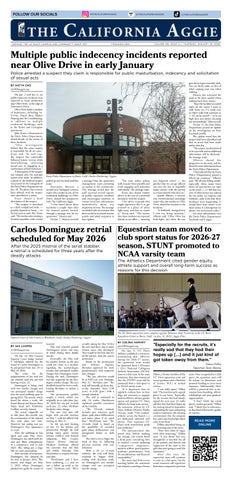
Police arrested a suspect they claim is responsible for public masturbation, indecency and solicitation of sexual acts
BY KATYA OKS city@theaggie.org
On Jan. 2 and Jan. 6, six
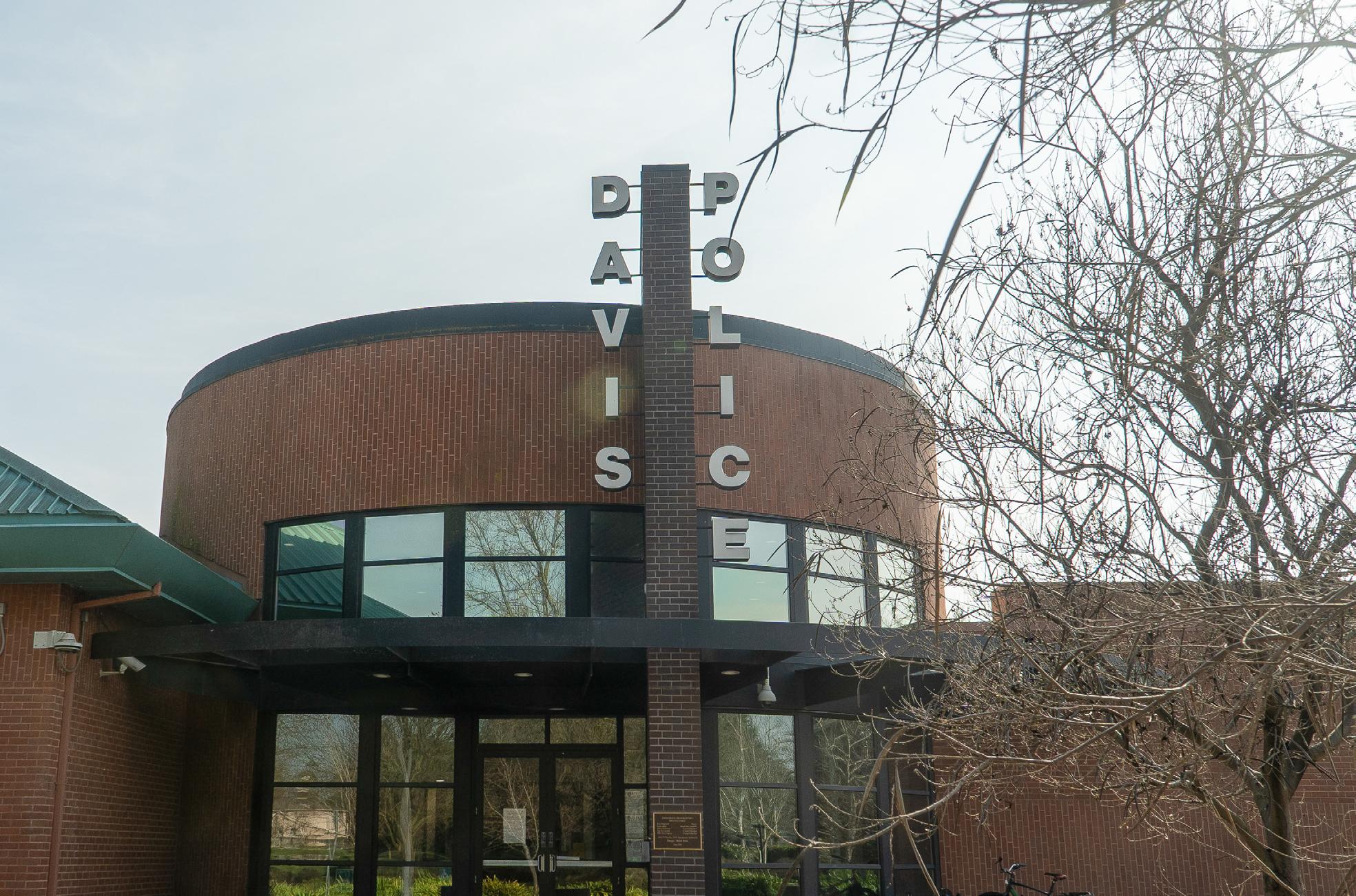
public indecency incidents were reported to local authorities near Olive Drive, at the edge of Downtown Davis. Olive Drive holds a number of businesses, including InN-Out, Dutch Bros, Blake’s Heating and Air Conditioning, in addition to multiple residential buildings, such as the Ryder and Lexington apartments.
John Evans, a lieutenant in the Davis Police Department, shared details on the nature of these incidents.
“[Our investigators] believe that the same suspect is responsible for all six cases,” Evans said. “In each case, the suspect has reportedly followed female victims while masturbating, soliciting sexual acts or engaging in a combination of both behaviors.”
A description of the suspect was released after the multiple reports were made. In addition, a photo of the believed suspect was posted on the Instagram of the Davis Police Department on Jan. 20. The photo has recently been deleted, with the suspect now identified as a minor.
Evans shared a brief description of the suspect.
“The suspect is described as a dark-complected male — possibly Spanish or Asian — in his late teens to early 20s,” Evans said. “He was last seen wearing a hooded sweatshirt with a hood
pulled up over his head and blue jeans.”
Alexandra Mancia, a second-year biological sciences major who resides in one of the residential buildings on Olive Drive, shared her perspective with The California Aggie.
“I first heard about these incidents a couple days after the [winter] quarter started, through a message sent by my apartment,” Mancia said. On Jan. 7, Mancia received
a message from the apartment management team providing an update to the community. The message noted that the staff received several reports of public exposure incidents and encouraged residents to contact local law enforcement immediately about any suspicious activity. The message concluded with an assurance that there would be increased security patrols and asked recipients to stay vigilant.
After the 2025 mistrial of the serial stabber, a retrial is scheduled for three years after the deadly attacks
BY GIA LOOMIS city@theaggie.org
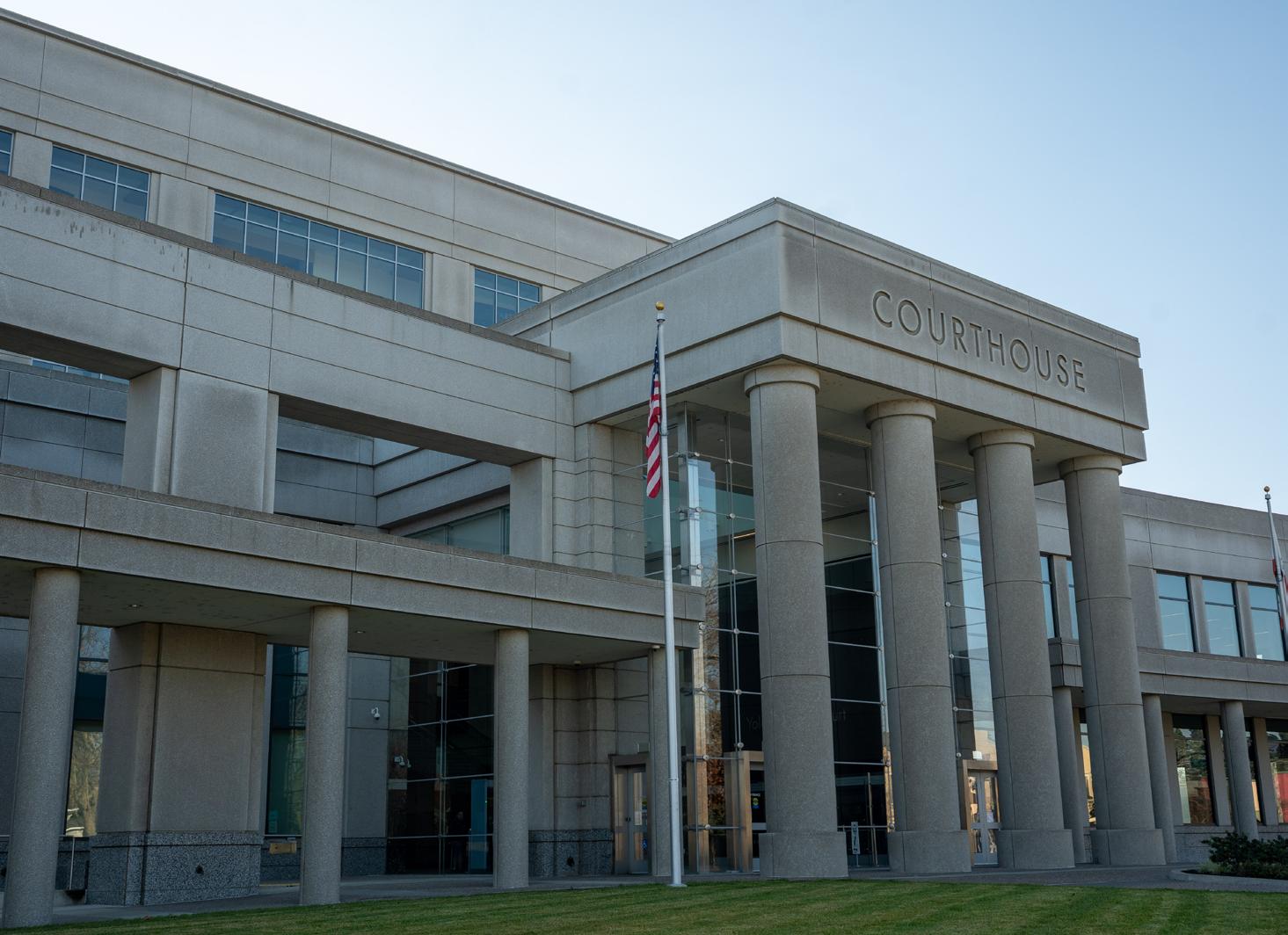
On Jan. 22, Yolo County Superior Court Judge Samuel T. McAdam ordered for the retrial of Carlos Dominguez to be postponed from Jan. 20 to May 18, 2026. The order for the postponement of the trial was not released until the pre-trial hearing on Jan. 22.
Dominguez is being tried with two murder charges and one attempted murder charge after his serial stabbing spree in spring 2023. The attacks, which lasted for about a week, left David Breaux and Karim Abou Najm dead and Kimberlee Guillory severely injured. The retrial, originally set to take place this month, was the continuation of the mistrial that took place last June. However, last spring was not Dominguez’s first appearance in court. After the stabbings in late April and early May 2023, Dominguez was ruled unfit for trial and likely schizophrenic in a competency trial in July 2023. This ruling put a large halt on court proceedings.
After months of treatment, Dominguez was deemed fit for trial in January 2024. This second trial began on May 5, 2025, where Dominguez pleaded not guilty by reason of
insanity. This trial centered around Dominguez’s intent and state of mind during these deadly attacks.
Eventually, the May trial hit another barrier, as the jury could not come to a decision regarding the second-degree murder and attempted murder charges that Dominguez faced. During the trial, Dominguez was also acquitted on the firstdegree murder charge. The jury deadlock lasted for over a week, leading McAdam to declare a mistrial.
The prosecution quickly sought a retrial, which was originally set to take place Jan. 20, 2026, but was put on hold until Jan. 22, when McAdam declared a date change. The new trial date will begin with pre-trial motions on May 7, with the official trial starting on May 21. At the pre-trial hearing on Jan. 22, the defense and prosecution brought up trial setting issues given various witness conflicts and delayed subpoenas. Yolo County Deputy District Attorney Matthew DeMoura offered the concerns that led him and Public Defender Dan Hutchinson to request the later trial date.
“Hutchinson and I have been conferring, [...] and we sent a follow up email to the court,” DeMoura said. “We’re
actually asking for May 18 [for the new trial date], due to some witness issues that developed. That would be the best date for all the parties, with the court’s permission.”
Based on the prosecution and defense’s requests, McAdam approved the trial’s postponement, with respective date changes.
“The jury selection would be at 9:30 a.m. [on] Thursday, May 21,” McAdam said. “The trial will basically go from dayto-day thereafter from 9:30 [a.m.] to 4:30 [p.m.] with a normal schedule.”
The trial is estimated to take 10 weeks. Hutchinson explained possible extensions of the timeline.
“The 10-week estimate includes jury selection, guilt phase, guilt phase deliberations and sanity phase if we reach that,” Hutchinson said. “The 12-week [trial] is based on the possibility of extended guilt phase deliberations and unexpected delays or dark days.”
The trial is set to begin the week of May 21, following pre-trial motions with jury selections.
With a 10- to 12-week estimate, the trial will likely conclude in August 2026, ending with decisions made on Dominguez’s two murder charges and one attempted murder charge.
“For your safety, please walk in pairs when possible and avoid engaging with unknown individuals,” the message reads. Evans also shared similar advice in the case of a potential encounter with the suspect.
“Our advice to people who might experience this is to get yourself to a place of safety right away, and then to report it,” Evans said. “The sooner that these incidents are reported directly to our office — meaning
our dispatch center — the quicker that we can get officers out into the area to hopefully make contact with the person to at least identify who they are.”
Janelle Alberto, a secondyear environmental toxicology major who also resides on Olive Drive, shared her reaction to the incidents.
“It definitely changed how I view my living situation,” Alberto said. “Olive Drive has little light, [so] when the sun
Equestrian
goes down it gets extremely dark. You can barely make an idea of who’s coming your way when walking.”
Mancia also reiterated the need to be more careful when walking back from classes.
“Since the incidents occurred right on the street I used to walk home on, I’ve made sure to either walk with someone or — if I am by myself — to be on high alert and always checking my surroundings,” Mancia said.
On Jan. 21, the Davis Police Department posted an update on the investigation on their Facebook profile.
The update noted that the suspect had been identified and that an arrest had been made earlier that day.
“The suspect was determined to be a juvenile and no additional information will be disclosed,” the message reads.
Alberto shared her perspective on the arrest, and the desire for more information from the Davis Police Department.
“I feel relieved that the Davis Police [Department] posted a follow-up response,” Alberto said. “We all were feeling unsafe, especially when many front doors [of apartments] are right on the street. [...] I feel that not a lot of information was relayed [by the police to] students and residents, aside from that these incidents were happening. It would [have been easier] to be more aware if a description [or photo] was announced earlier.” For more information, visit the Davis Police Department’s Facebook and X pages.
The Athletics Department cited gender equity, athlete support and overall long-term success as reasons for this decision

BY COLINA HARVEY sports@theaggie.org
On Jan. 9, UC Davis
Athletics published a statement announcing that, effective during the 2026-27 season, the equestrian team would be demoted from a Division 1 (D1) National Collegiate Athletic Association (NCAA) team to a club team. In the same statement, they also announced that the STUNT team will be promoted from a club sport to an NCAA varsity team.
“It is important that we regularly evaluate how we best align our resources to support student-athletes, advance gender equity, and position UC Davis Athletics for long-term success,” the statement, written by UC Davis Athletic Director Rocko DeLuca, reads. “Our studentathletes across the board [...] are dedicated, talented, and driven. They represent UC Davis with tremendous pride and excellence.”
The announcement also noted that, before making the change, the school hired a third-party consulting firm to conduct a review analyzing “competitive alignment, student-athlete participation, academic performance, Title IX considerations, and financial sustainability.”
The team had little-to-no warning before the statement was released, according to Emma
“Especially
for the recruits, it’s really sad that they had their
hopes up [...] and it just kind of got taken away from them.”
Dillon, a former member of the UC Davis equestrian team and recent graduate with a Bachelor of Science (B.S.) in animal science.
“I was really upset,” Dillon said. “The team has such a special place in my heart. Especially for the recruits that had already signed for next year, it’s really sad that they had their hopes up for starting school in September and starting the team and getting ready to experience this amazing environment that the program has, and it just kind of got taken away from them.”
Dillon described being on the receiving end of the news.
“They were kind of vague with their reasoning,” Dillon said. “It just didn’t feel very thoughtful or heartfelt for all of the parents and alumni and supporters of the team or the girls that were going to read [the statement].”
After this year, the equestrian team will continue to exist as a club sport, but the team’s resources will experience limitations compared to previous
years. Once recognized as a club sport, the equestrian team will be reliant on donations and personal funding to cover team expenses. Additionally, there will be a potential loss in oncampus horse boarding, athletic scholarships and post-graduate opportunities.
“I don’t think the [club sport] coaches get paid,” Dillon said. “I think they’re volunteers, so that kind of limits the quality of coaches.

The winter quarter concert will feature Rocco, Sarah Kinsley, a pre-show art gallery and more

BY MIRIAM RAMAKRISHNAN
arts@theaggie.org
In the midst of classes, midterms and the never-ending tule fog, the music scene at UC Davis doesn’t stop kicking.
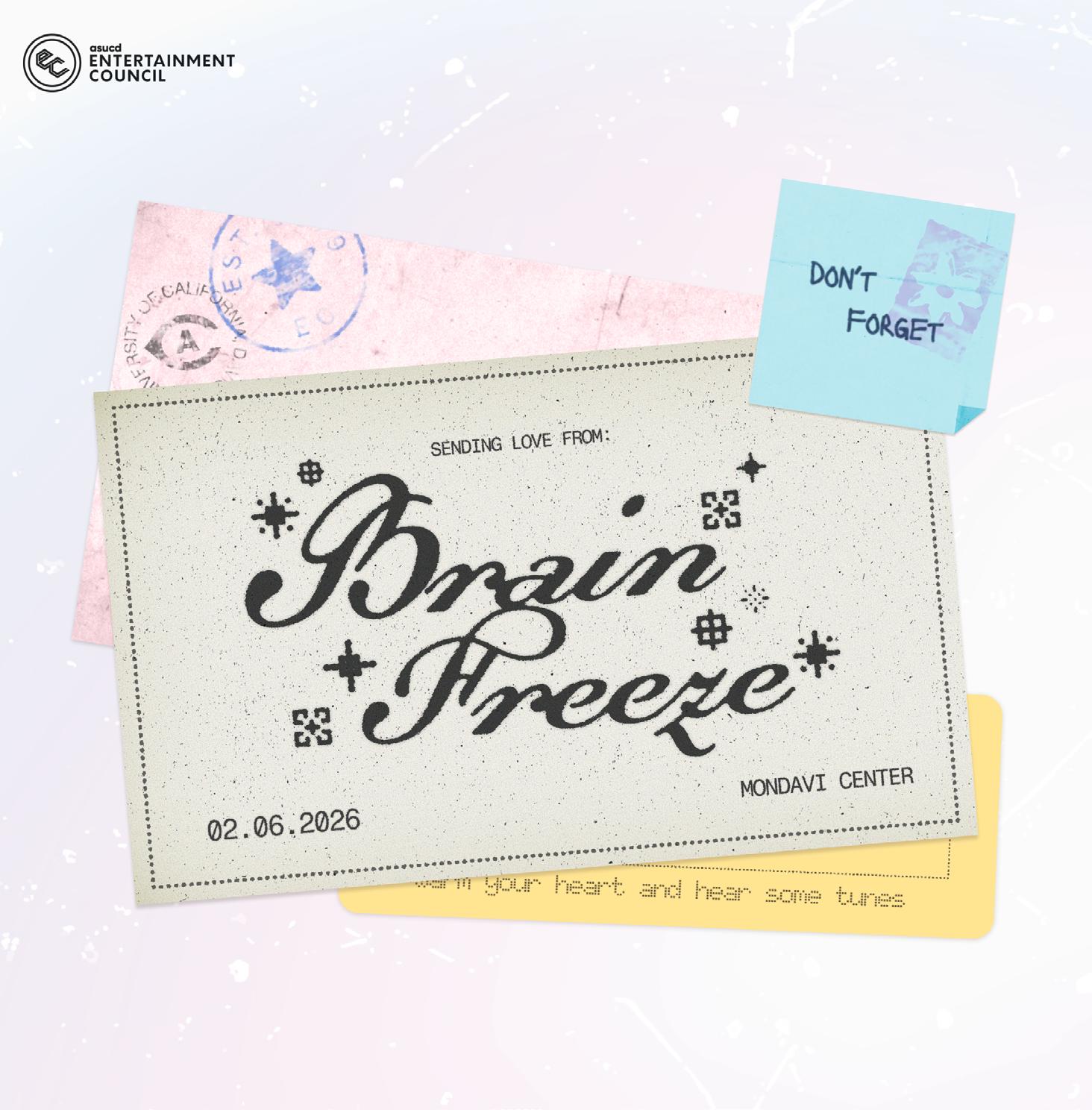
Brainfreeze, the annual winter concert hosted by ASUCD’s Entertainment Council (EC), is set to return at the Mondavi Center on Feb. 6 at 6:30 p.m.
Previous headliners have included Raveena, No Vacation and Luna Li — indie artists that captured the hearts of hundreds of UC Davis students over the past three years.
Bowen Song, a second-year computer science and cinema and digital media double major, attended Brainfreeze 2025 with headliner Luna Li at the
Vanderhoef Studio Theater.
“It was an experience being able to watch a multiinstrumentalist within the ambience of a slightly more informal venue,” Song said. “This, combined with the vibe of [Li’s] music, created an unforgettable event. I’m so excited to see how the intimacy will transfer into a bigger venue.”
This year, Brainfreeze’s has expanded to feature three performers: Rocco, Sarah Kinsley and thebandfriday.
Continuing the trend of spotlighting rising artists, this lineup blends dreamy bedroom pop with art-house energy.
EC Unit Director Eddie Kim, a fourth-year human biology major, shed light on the process of choosing artists for Brainfreeze 2026.
“[EC] looks closely at music trends, past event turnouts and
most importantly, our student feedback forms,” Kim said.
“Our goal is always to book artists who match the event vibe, while connecting to the UC Davis community as closely as possible.”
Kim also offered a view into the work EC put into the event behind the scenes.
“Once an artist is confirmed, there is a heavy logistics phase that includes advancing production, hospitality, backline needs and coordinating schedules with the venue, production teams and artist management,” Kim said. “Most attendees only see the final performance, but there are months of coordination and planning that go into making the night better for all attendees.”
Stylistically, Kim and the EC aim to organize events that align with the musical tastes of as many UC Davis students as
SMUD cited environmental impacts, legal uncertainty and rising costs in its decision to cancel its power purchase agreement BY KATYA OKS city@theaggie.org
On Jan. 5, Sacramento Municipal Utility District (SMUD) cancelled its power purchase agreement in Coyote Creek. This decision followed a November meeting where the project was initially approved.
SMUD is one of the nation’s largest communityowned electric service providers, which aims to provide reliable and affordable electricity to Sacramento County. According to their website, SMUD leads industry efforts in energy efficiency programs and in finding solutions which are sustainable and beneficial for the surrounding environment.
In 2021, SMUD signed a power purchase agreement with D.E. Shaw Renewable Investments (DESRI), which was meant to help SMUD reach its clean energy goals. The project was to take place in Coyote Creek, which spans over a thousand acres in the Sacramento area.
The project quickly became controversial, facing extensive community backlash from local environmental groups and concerned citizens.
Gabrielle Katanic, a local activist and member of the Sacramento Valley Chapter of the California Native Plant Society (CNPS), reflected on why she got involved. The Sacramento Valley Chapter CNPS is one of the main litigants and primary coalitions that’s been organizing a lot of the events surrounding the project.
“It felt like a conundrum, because normally I’m really prorenewable energy,” Katanic said. “But when I found out about where this project was located, and the level of destruction that was going to be happening, I was horrified. I’ve seen firsthand how special those ecosystems are and how much they provide [for us], like carbon sequestration, which is crucial to our climate goals.
This [project] is not the way; we do need to lean into green energy, but not by destroying intact habitats.”
Cynthia Ball, a second-year sociology major, also expressed her concerns over how the Coyote Creek project engages in a form of green-washing. Greenwashing is defined as a marketing tactic used by companies to mislead individuals into believing that such entities engage in sustainable practices when in reality they do not.
“[The Coyote Creek Project] brings up the problem with greenwashing being used as a tool to benefit profit-hungry companies,” Ball said. “Land is thought of as something that is supposed to be ‘developed,’ which is true for most humans. However, when possible, land in California needs to be left undisturbed to allow for wildlife to persist.”
On Nov. 18, the Sacramento County Board of Supervisors held a meeting which discussed moving forward with the project and included a public comment section.
“I got to the County Board of Supervisors meeting and was blown away: the entire county board meeting room was packed,” Katanic said. “There were over 150 public comments made, and we were there for five hours. And [the public comment section was] just person after person after person coming up and saying, ‘this is not a good project,’ ‘this is a bad project,’ ‘this is not green energy.’”
Despite public criticism, the supervisors unanimously approved the Coyote Creek Agrivoltaic Solar Project.
“I think at that point, there was a feeling like they were probably going to have it move forward regardless,” Katanic said. “So the coalition — this is a group of nonprofits, community members and other people that care about this project — organized a community meeting. This was an opportunity for people to get together, find out more about the project and then also find out how they could get involved.”
In a written statement that came out on Jan. 5, SMUD explained why they cancelled the agreement.
“Due to project
uncertainties, SMUD announced today that they will not be purchasing power from the Coyote Creek project,” the statement reads. “Some of the uncertainties include: supply chain constraints, rising prices, tariffs, schedule delays, environmental impacts and pending litigation.”
Katanic shared her reaction to the news.
“It was shocking,” Katanic said. “We’ve been fighting really hard, but to be able to see the results of that was amazing. It felt really good to our community to have our voices heard.”
Although Katanic expressed relief at the cancellation, she also explained that the Coyote Creek project could still move forward.
In a written statement, DESRI confirmed that they were “moving forward with the development.”
“Unfortunately, we did hear a couple of days after that [decision] that the solar developer DESRI said that they were planning on moving forward with the project regardless,” Katanic said. “Our hope is that because there is so much opposition, we can still fight back. There are three separate lawsuits that have been filed to try to stop this project: one from the recreation community, one from the environmental community and then also one from the local tribes [the Wilton Rancheria tribe].”
Katanic expresses hope and urges people to get involved.
“We have a new website up — savecoyotecreek.com — and we’re trying to make that kind of our central hub where people can get information about the project,” Katanic said. They can read the latest news updates, any upcoming events and an action list will be posted there.”
Ball also expressed the same sentiment.
“Follow @ sacramentofoodforest and @ talktomenerdy on Instagram; they are involved at the local level on this issue and post how you can show up as a concerned community member.”
possible.
While EC’s annual Sunset Fest event highlights more R&B and rap artists, Brainfreeze characteristically showcases a more mellow and experimental sound.
“We felt that thebandfriday’s indie pop energy, Sarah Kinsley’s atmospheric and emotionally driven sound and Rocco’s crowd-engaging style can give students a mix of familiarity and discovery,” Kim said.
Kinsley, a music theory graduate from Columbia University, initially broke into the music mainstream through her alternative-pop track “The King,” which went viral on TikTok in 2021.
Her classical training is evident in her layered arrangements, which balance a variety of different elements with intimate pop sensibilities.
Rocco, a musician from New Jersey, borrows energy from household indie names such as Rex Orange County and Clairo. He thrives on introspective lyrics and quiet grooves, creating a sound that is both familiar and distinctive.
Originating from Malibu, the duo behind thebandfriday met in kindergarten and grew up together to create music that spans several genres. Their long-standing, creative partnership shines through in their music, evident in their seamless blending of instruments and vocals that produces a rare, authentic chemistry.
Unique to this year’s Brainfreeze is the pre-show art gallery — created in partnership with The Basement Gallery, the Mondavi Center’s second floor will become an exhibition space featuring the work of UC Davis
student artists. Paige Sin, a first-year biological sciences major, shared her anticipation after purchasing tickets — priced at $12 for orchestra seating and $8 for all other sections.
“I love that we, as a school, are able to host performers in a space right on campus,” Sin said. “With how expensive concert tickets can get, I’m grateful that I’m able to see talented rising artists here at a reasonable price.” Brainfreeze will take place on Feb. 6, with doors opening at 5:30 p.m. and performances beginning at 6:30 p.m. Opened on Jan. 20, a limited number of tickets are currently still available on EC’s website, along with frequently asked questions and more information regarding the venue.

Student units are bracing for a 10% cut across the board amid deficit, decreases in student enrollment
BY AALIYAH ESPAÑOL-RIVAS campus@theaggie.org
The Associated Students of University of California, Davis (ASUCD) will begin its 2026-27 budget hearings in late February, as the student government confronts an ongoing $400,000 deficit and university enrollment issues.
ASUCD is both an employer and the governing organization for UC Davis’ undergraduate student body. It oversees a $22 million budget, accounting for over 30 units and services that serve the student population. The Association regularly employs about 1,600 employees yearly, with half of its operating budget going toward student wages. Some of its most visible units include Unitrans, Picnic Day, the Coffee House (CoHo) and The Pantry.
This year, ASUCD faces two major challenges, which have resulted in a 10% budget cut across the board. First, at the end of last year’s budget hearings, the Association was left with a $400,000 deficit due to lower-than-expected income and the expenses from the different units, commissions and committees.
This year, the Association wants to avoid increasing the deficit, according to Controller Trinity Chow, a fourth-year neurology, physiology and behavior major and ASUCD’s chief financial officer.
“While we don’t necessarily intend that every single dollar that we had accounted for will be used and there will probably be some that carry forward, it’s generally not a good business practice to be running in a deficit,” Chow said. “This year, we are trying to be a little bit more mindful about that and not run into the red this year.”
Internal university operations also pose a significant hurdle for ASUCD. UC Davis is projected to have a decrease in enrollment over the next 10 years, according to Chow. This decline is expected to reduce ASUCD’s income, which is largely funded by student fees. In the 2025-2026 finalized budget, the ASUCD student fee accounted for over $5.6 million of the total budget. The Association hopes to build infrastructure within its budget to compensate for the decrease over the forthcoming years, according to Chow.
“The amount we get from that [ASUCD] service fee does depend on how many students
are attending and are paying tuition for that year,” Chow said. “We’re anticipating that we will lose a couple $100,000 to a little bit more than $1 million in the next 10 years from just decreased enrollment. We’re trying to create infrastructure that best adjusts for that.”
A prospective budget — drafted by the ASUCD Executive Office and presented by ASUCD President Amrita Julka, a third-year political science and human development major — is set to be presented to the Senate next month for approval or amendment.
“We are in a pretty big deficit, a problem that has continued since last year,” Julka said. “We need to decrease everything by 10%. So about 8% is from the deficit, and about 2% is what the [UC Davis] administration told us we can expect because of the student fees.”
Given the cut, Julka emphasized that ASUCD plans to focus on safeguarding basic needs services.
“We are definitely prioritizing basic needs above all else,” Julka said. “We are going to look to improve efficiency, so students don’t feel that decrease, specifically with units like The Pantry. With all these cuts, there are some places where some units
may have to scale back more than others just to prioritize basic needs for students.”
One of the non-basic needs units is the Entertainment Council (EC), responsible for hosting concerts and other entertainment events for students. Unit Director Eddie Kim, a fourth-year human biology major, said his department is aware of the effects the budget cut will have on EC’s programming.
“The cut is definitely understandable, with staff and operational costs going up with inflation,” Kim said. “But that also means that the prices of artist bookings, production, talent — all of that is also increasing, which kind of puts us in a hard position to keep up the quality of events that we are able to push out. There has to be
some changes in the artist lineup or production that we currently have to comply with that 10% cut.”
Last year, EC faced scrutiny from many students following the decision to charge students for Lawntopia tickets following a $180,000 budget cut in the 2023-2024 academic year. This year, Kim explained, students will be charged for Lawntopia again, with the hope of finding larger venue options to maintain affordable prices for EC events.
“We’re hoping to increase capacity for any venue that we use, for either Brainfreeze or Lawntopia,” Kim said. “We hope to keep the prices affordable for all students, and if anything, try to lower the cost for student attendance for all these bigger events.”
Unlike other units, the
Purpose of the Study:
To gather health and nutrition data from the population of Davis, CA and surrounding areas.
What you will do: Complete an online questionnaire about your stress levels and causes of stress, your body measurements, food consumption, and gut health.
CoHo and Unitrans operate on a separate budgeting process due to their unique management by career university staffers, while still benefiting from student funds. In the 2025-2026 finalized budget, Unitrans was given over $9.9 million for their expenses and salaries, and is projected to narrowly recoup their costs. The CoHo, given $6.3 million for their expenses and salaries, has a projected profit margin of $224.23. At the moment, it is
You may participate if you are: 18–65 years old
• Currently living in Yolo, Sacramento, Solano, Sutter, or Placer counties
• Able to complete an online questionnaire in English
Back-to-back wet winters have ended drought conditions, but state officials warn that stronger storms are increasing flood risks across the region
BY MICHELLE BEKHTEL city@theaggie.org
After consistent winters of intense rainfall, California has entered 2026 in a dramatically different water landscape than just a few years ago. While California is no longer experiencing drought conditions, experts warn that wetter winters do not signal stability. Instead, they highlight a growing pattern of climate whiplash: rapid swings between extreme dryness and extreme storms that communities like Davis must prepare for.
Jason Ince, the information officer at the California Department of Water Resources (DWR), spoke about the effects of climate change.
“California has the most variable season-to-season climate in the continental United States,” Ince said. “It is always possible to swing between extreme wet and dry conditions.”
Ince cautioned that drought recovery and flood risk are deeply intertwined. The result is a future that is simultaneously drier, hotter and more flood prone.
“Periods of intense dryness could be followed or even punctuated by extreme precipitation,” Ince said. “A warmer atmosphere can also hold more moisture […] increasing the potential for extreme rainfall events and flood hazards.”
Ince spoke about how atmospheric rivers — long, concentrated bands of moisture that deliver most of California’s annual precipitation — play a central role in both ending droughts and triggering floods.
“They can bring both flood hazards and water supply relief,” Ince said. “That is why understanding these storms is becoming more important in the 21st century.” To improve forecasting, DWR partners with institutions such as the Center for Western
Weather and Water Extremes (CW3E) at Scripps Institution of Oceanography, along with the National Oceanic and Atmospheric Administration (NOAA), the U.S. Air Force and the U.S. Army Corps of Engineers. These collaborations help track storms over the Pacific and translate data into flood forecasts, reservoir operation and emergency response planning.
For Davis residents, flood management infrastructure is already part of the daily commute. The Yolo Bypass, visible from I-80, acts as a massive pressure release valve for the Sacramento River during high water events. Ince spoke about this concept in action.
“This corridor takes high water off the Sacramento River and diverts it to wetlands,” Ince said. “It creates habitat for fish and bird species, recharges groundwater and lowers the flood risk for downstream communities.”
Major upgrades are also underway across the region. The U.S. Army Corps of Engineers is expanding the Sacramento Weir, a manmade dam that raises the water level of the Sacramento river, doubling its capacity to move water into the bypass. DWR is also working with the Corps on strengthening levees along the American River to safely route flood flows through the region’s largest urban corridor. These projects are part of the Central Valley Flood Protection Plan, the state’s long-term strategy for reducing flood risk.
Ince stressed that infrastructure alone is not enough.
“Be prepared, be aware and take action,” Ince said.
Taking action involves knowing whether a home is in a floodplain, keeping an evacuation kit ready, monitoring weather forecasts and avoiding driving through flooded roadways.

“Every fall, DWR flood staff travel the state to meet with local emergency
Davis celebrates the 32nd annual Martin Luther King Jr. Day at Veterans Memorial Theater
From speeches to singing, the theme of this year’s celebration was “Injustice anywhere is a threat to justice everywhere: protecting democracy and freedom of speech”
BY PIPER AWEEKA
city@theaggie.org
At 10:30 a.m. on Monday, Jan. 19, the parking lot of the Davis Veterans Memorial Theater was close to capacity. Approaching the doors of the building, each attendee was welcomed with a program for the 2026 Martin Luther King Jr. Day event handed out by Assistant City Manager Kelly Stachowicz. Planned by the
City of Davis Human Relations Commission, the theme of this year’s celebration was “Injustice anywhere is a threat to justice everywhere: protecting democracy and freedom of speech.”
After a brief welcome from the Human Relations Commission, Mayor Donna Neville greeted the seated audience of the Veterans Memorial Theater.
“It’s really, truly an honor
for me to be here today to recognize the legacy of Dr. King and the incredible, hard work that all of you have been doing, [...]” Neville said. “Over this past year where it seemed like our democracy was being torn apart at the seams [...] all of you acted. You stood up and defended democracy, and I’m deeply grateful for what you’ve done.”
Before concluding her speech, Mayor Neville had a message for the attending youth. Reminded of her experience as a child during the Civil Rights unrest, Neville spoke words of advice.
“But to you young people who are sitting here in the audience, I want to urge you to take away the same lessons that I took away from those early years, which is that we need to stay hopeful,” Neville said. “We have to look beyond ourselves and always, always have to speak up, speak out, and do everything
we can to fight against racial and social injustice [...] So thank you for being here. I know you could have maybe been somewhere else.”
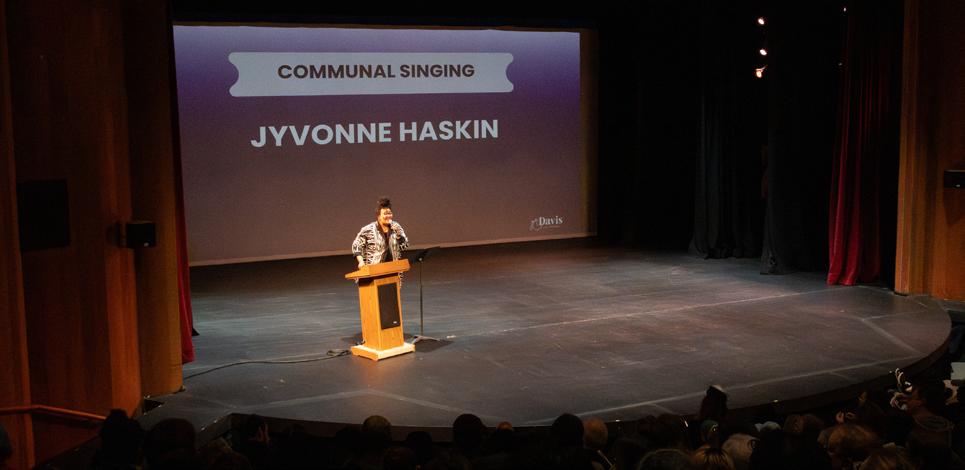
The Black National Anthem, sung by local mother-daughter duo Dzokerayi Minya Mukome and Chiyedza Mokume initiated the rest of the celebration. With presentations ranging from poetry reading by Davis Poet Laureate Mercedes Ibañez, to performances by the children of PAACD (Parents of African American Children Davis) and professional Singer Jyvonne Haskin, as well as video productions by DaVinci High School students.
Skylar Harris, a third year religious studies major at UC Davis, concluded the celebration by giving this year’s feature speech.
“Walk in grace,” Harris said. “Let it move you towards love and action, because that is how we get justice from our hearts
“We always have to speak up, speak out and do everything we can to fight against racial and social injustice.”
Donna
Neville Davis Mayor
to the community, then towards nations.”
Outside the theater, Raina Carr, an attendee, held her daughter in arm while explaining her family’s connection with the Davis MLK Jr. celebration.
“My grandfather was a part of the [Selma Freedom] march [...] His name was Terry Turner,” Carr said. “He was also very active in the Civil Rights Movement here in Davis. We’ve been coming here for a few years now, bringing the little ones and making sure the tradition lives on.” Rachel Hartsough, Arts and Culture Manager for the City
She won’t be the last to die in vain

BY SAGE KAMOCSAY skamocsay@ucdavis.edu
On Jan. 7, 2026, Renee Good was shot and murdered by an Immigration and Customs Enforcement (ICE) agent near her home in Minneapolis.
Video footage shows several agents stepping out from an unmarked car in ski masks and approaching Good’s vehicle.
One ICE agent reached inside her car and shook the door handle aggressively, likely in an attempt to open her car door. Fearing for her life, Good sped off. But as she did so, an ICE agent shot three times into her car windshield.
She may have already been dead by the time emergency medical technicians (EMTs) rushed out of their ambulance and onto the scene. Witnesses watched in despair as the ambulance drove away quietly and unhurriedly — there was no life to save. There was no reason to speed to the hospital, or to count down the seconds in desperate hope that they could get Good to a doctor in time. She had just dropped off her 6-year-old son at school.
Good did not deserve to die. She was no murderer, no terrorist, no extremist — she was a beloved community member, friend, daughter, wife and mother. She had three children from two marriages: a 15-yearold, a 12-year-old and a 6-year-
old, the youngest of whom had already lost his father in 2023. She and her wife, Becca Good, had just moved to Minneapolis and were raising her youngest child together as a family. Now, Becca Good is left alone to care for her stepson.
“I am now left to raise our son and to continue teaching him, as Renee believed, that there are people building a better world for him,” Becca Good said in a statement to Minnesota Public Radio (MPR) News.
“The people who did this had fear and anger in their hearts, and we need to show them a better way.”
Much like Good’s family, America has also suffered a tragedy. This is not the first time ICE agents have shot or killed American citizens — in just the first year of President Donald Trump’s second term, ICE has shot 16 people. This fact should be a shock to all who hear it. The rapid militarization and escalation of violence within ICE has been ramping up since Trump began his second term more than a year ago. However, for the first time, we have seen the system kill an innocent citizen so publicly and brutally, garnering greater national unrest than before. This is not to detract from the deaths of innocent non-citizens at the hands of ICE, but rather to show an escalation of force against the very people ICE is allegedly supposed to protect in
Go sip the tea

For years, I have shirked participating in gossip, believing it to be the product of idleness. Gossip has always felt invasive, but its modern vilification led me to reconsider why exactly I react so poorly to the spread of information, despite it remaining one of the few primal tendencies we have retained socially. Recently, Mindy Seu’s interview on Kareem Rahma’s “Subway Takes” prompted me to look more closely at why I judge gossip (and those who partake in it) so harshly.
In 2018, Silvia Federici, a Marxist feminist scholar, tracked the etymology of the term “gossip.” Her research found that gossip, which once originated to empower women, ultimately shifted to usurp their power. The word “gossip” — derived from the Old English term “godsibb” meaning “godparent” — came to refer to female friends who were invited to attend a birth, and later shifted to ‘anyone engaging in familiar or idle talk.’” In Federici’s essay, “Witches, Witch-hunting, and Women,” she discussed how women spoke less as a result of the rise of patriarchy as the dominant order.
Rooted in misogyny, then, the independence and social strength that women gained from gossiping with each other began
to threaten the proportionate power of their male counterparts. During that time, the rhetoric of unemployment (which I previously associated with habitual gossip) automatically included women. Men desired female subservience, conscripting them into the role of “gossips” if they felt threatened in their positions of power.
Mindy Seu, American designer, researcher and technologist, quite poignantly noted this phenomena in her episode on “Subway Takes.”
“One man’s s*** talk is another woman’s safety net!” Seu wrote.
Seu understood gossip to be an information system that once mobilized women and allowed them to manage their domestic affairs effectively. In her talk, she encouraged us to participate in gossip even more than we already do, imploring us to think of it like whistleblowing: gossip is necessary for exposing social crime. The #MeToo movement — originating from the “whisper network” — is a prime example of the necessary power of gossip, contributing to the rise of women speaking up without fear of retaliation.
Gossip has always been positioned as crass and unbecoming, which we engage in with such frequency that it now requires slang. One claims to be “spilling the goss,” “the tea” or “the beans.”
Latinos join ICE for job security, but they should rethink their positions
BY SABRINA FIGUEROA AVILA sfigueroaavila@ucdavis.edu
With the recent murder of Renee Good in Minnesota, Immigration and Customs Enforcement (ICE) is currently under a microscope — and deservingly so. As attention grows, so does the question of who makes up ICE and why they willingly work against their communities.
order to advance the interests of the federal government.
ICE is an agent of fascism. When we see the deaths of people like Good, we should understand them to be the same as any murder by Benito Mussolini’s Italian police state.
Just like Italy in World War II, the Trump administration has formulated a brutal regime to systematically destroy all those it deems as the lowest class (along with some collateral damage), using the power of what is essentially a homeland military. Without completely dismantling ICE and preventing further militarization and mobilization of state police and federal agents, we seek to suffer the same tragic fate that any other fascist state has: complete oppression of the civilian population and years of brutal violence.
Good’s murder will not be the last perpetrated by ICE, nor was it the first. Already, we’ve seen more instances of ICE brutality: Alex Pretti, a 37-yearold nurse in Minneapolis, was shot on Jan. 24 — and he’s not the only victim that has suffered at the hands of ICE in the past week. Marginalized communities have been violently oppressed by ICE and its predecessors for decades in much the same way. As the public finally wakes up to the reality of state violence, we should seek to avenge all those whose lives were cut short by it.
While ICE agents are made up of many different races and ethnicities, what is most surprising to many is that Latinos make up 24% of ICE agents. However, as someone who grew up in the Latinx community, I can say that this doesn’t shock me — that doesn’t make it any less disturbing.
The thing with Latinos in the United States is that our privilege is based on our proximity to whiteness — that is, how “white passing” we are. Because the U.S. has historically been unkind, cruel and prejudiced against racial minorities, many Latinos have chosen to identify as white when they can and when it benefits them. Going far deeper than that, the community has its fair share of colorism and racism dating all the way back to colonization of the Americas.
The statuses of “legal” or “illegal” create a deeper divide amongst the community as well. For example, back when César Chávez was active in fighting for campesinos’ and farmworkers’ rights, Chávez and the United Farm Workers (UFW) union were against undocumented Mexican immigrants and together formed a private Border Patrol. Chávez argued that immigrants were used as strikebreakers and as a way to drive wages down for campesinos who were citizens. While it’s true that the labor of undocumented immigrants is exploited, this specific narrative only furthered the “vs” versus “them” mentality. Since the U.S. has allowed

ICE to racially and ethnically profile people for their inhumane operations, this is a time where many Latinos are trying to separate themselves from the target group. Wearing an ICE vest allows people to assimilate into what they perceive to be “American” or what the current administration tells them is “American.”
While this specific divide surely plays a part in the significant Latino makeup of ICE, it also has to do with class. Latinos in the U.S. make up 28% of the population in poverty, according to 2020 Census data.
A recent study by David Cortez, an assistant professor of political science and Latino studies at the University of Notre Dame, revealed that one of the main reasons why Latinos join ICE is for job security. Sylvia Newman was one of the ICE agents that Cortez interviewed.
“I was at the bottom, bottom bracket, you know?” Newman said. “I worked two jobs […] I was a single parent […] I had just gotten divorced and had a 2-year-old and a 3-year-old and I needed a job with a little more security.”
With high unemployment rates, there is a “surplus labor force,” or a greater number of people seeking jobs than there are jobs available. If you’re in serious circumstances and need a stable income quickly, a federal enforcement job is
an easy fix with benefits and security. Combine your financial insecurity with the government’s white supremacist agenda, and suddenly, there is a job for you — your economic desperation turns into economic exploitation. Undocumented or not, being in a constant state of survival is being used against you. The zero-sum game is not you against your own community members, it’s against a government that doesn’t truly care about you. The more you do the dirty work for them, the more you continue to lose. Turning into the oppressor of the people within your own community keeps the community as a whole — including you — oppressed. Attempts of assimilation into whiteness or into being more “American” is inherent to these operations, too. No matter what, in joining ICE and staying, you are implicitly stating that you’re different from people within your community who are undocumented and that you’re okay with benefitting from someone else’s loss. However, let it be known that without an ICE vest and a facecovering, the government sees us all the same. The truth is, all Latino ICE agents should be uncomfortable with being preyed on and with their positions. This should not be your last resort; there will always be more ethical ways for you to survive.
Searches for ‘Somali IQ’ spiked in December — the answer people found was
a lie
BY MILES BARRY mabarry@ucdavis.edu
Since December 2025, the Trump administration has been conducting brutal immigration raids in the Twin Cities, Minnesota. Thousands of armed federal agents have descended into the area, many of whom received minimal background checks and only 48 days of training.
These agents shot and killed Reneé Good, a poet and mother of three, in front of her partner. They violently arrested United States citizens — including a 20-year-old who was dragged through the snow while screaming, “I’m a citizen.”
Plainclothes officers have even been stationed in hospitals, interrogating patients and staff based on their appearance.
President Donald Trump has claimed that the activities of illegal immigrants, particularly those of Somali descent, justify this violence. He has called people from Somalia “garbage,” and said that “we don’t want them in our country.” His administration has focused particularly on the Feeding Our Future fraud case, in which approximately 70 Minnesotans — the majority of whom are Somali Americans — were charged with stealing $250 million in federal child nutrition funds during the COVID-19 pandemic. But ironically, the scheme’s ringleader was Aimee Bock, a white woman. The vast majority of Minnesota’s 80,000 Somali residents are U.S. citizens who had nothing to do with the fraud, and are now being subjected to mass raids and warrantless arrests in what Minnesota Attorney General Keith Ellison has called “a federal invasion.”
As these horrors continue, conservatives have deployed another, somehow more sinister justification for the violence: intelligence quotient (IQ). This week, Trump, speaking in front of a crowd at Davos,
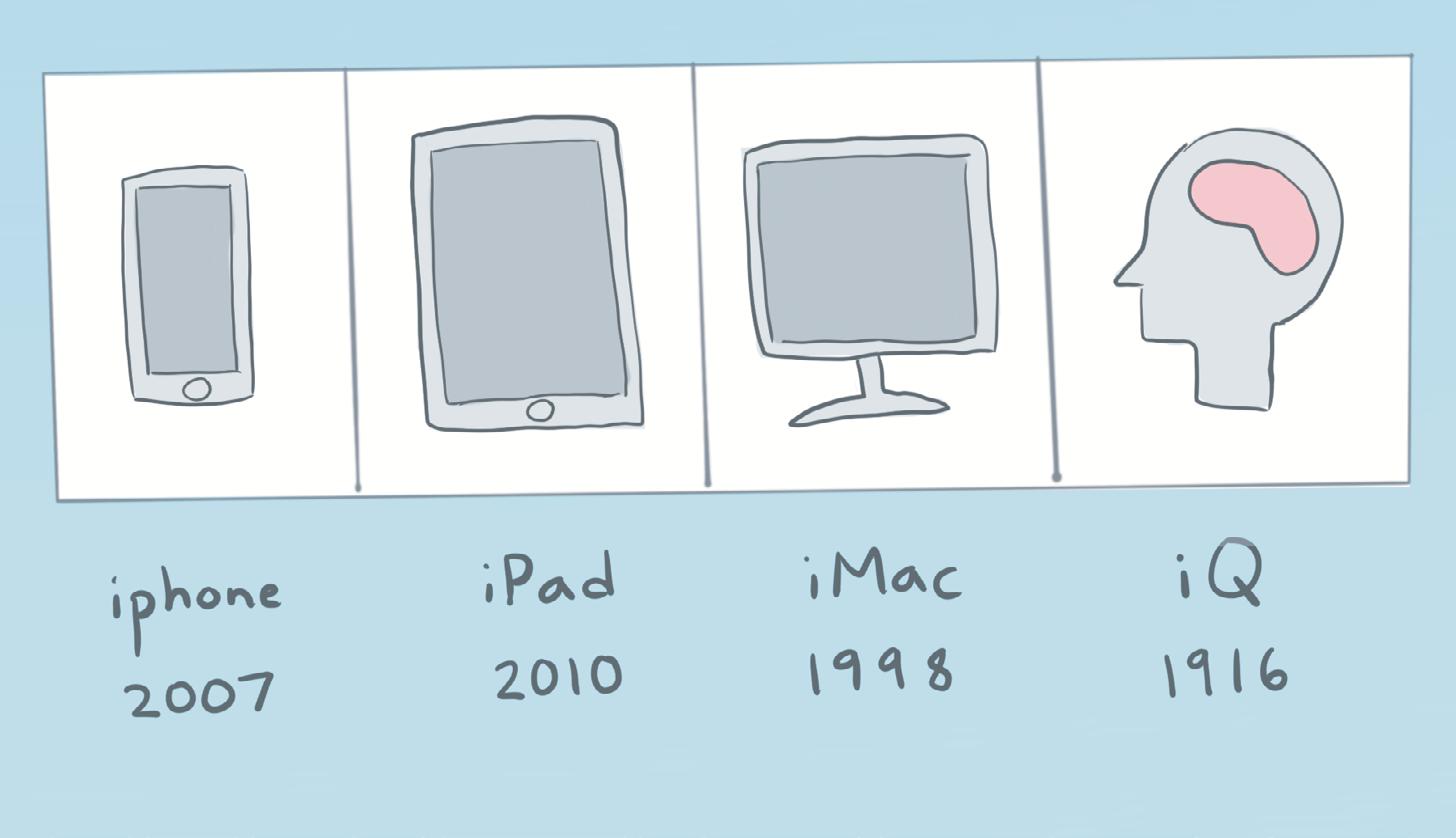
Switzerland, said, “I always say [Somalians] are low IQ people.” Daily Wire Host Matt Walsh, who has 6.5 million followers on X, posted that “the average IQ in Somalia is 68, which is below the line for mental retardation.” After Reneé Good was killed, he wrote that she “gave her life to protect 68 IQ Somali scammers.”
This “68 IQ” claim traces back to Richard Lynn, a disgraced professor and selfidentified “scientific racist,” who set out to prove that different races have different average IQs in the 1990s. He did so by cherry-picking small studies that showed lower IQs for inhabitants of sub-Saharan African nations, and higher IQs for European nations. Some of the samples he used are almost laughably misleading — according to Professor Rebecca Sears, “Eritrea’s ‘national IQ’ is estimated entirely from small samples of children living in orphanages; Congo’s ‘national IQ’ is estimated from one sample of 88 schoolchildren in their 6th year of schooling.” The recently frequently-cited Somalian national IQ of 68? This was estimated from a sample of children living in a refugee camp in Kenya.
Lynn’s “National IQ” is a garbage study, and IQ in itself is a garbage metric.
“[IQ] mostly measures extreme unintelligence (learning difficulties), as well as, to a lesser extent (with a lot of noise), a form of intelligence, stripped of 2nd order effects — how good someone is at taking some type of exams designed by unsophisticated nerds,” statistician Nassim Taleb wrote in an article published on Medium.
Despite these flaws, IQ has found particular purchase in Silicon Valley, where many figures within tech — particularly Elon Musk, JD Vance and Sam Altman — treat it as a measure of human worth. Musk has endorsed tweets claiming that Black students at historically Black colleges have IQs approaching “borderline intellectual impairment.”
Bay Area In-Vitro Fertilization (IVF) startups promise babies with higher IQs, echoing the goals of eugenicists in the 1920s. While it may seem ironic that these intelligenceobsessed tech elites give so much credence to a bad, outdated metric, I think it is intentional. Once you start digging, you will find that an uncomfortably large faction of tech elites are influenced by the same eugenic logic that produced the “68 IQ” falsehood. I believe that the tech industry’s cultural influence is an underrated factor
in the legitimization of IQ as a rationale for deportation or worse. Posters on tech forums LessWrong and HackerNews obsess over their IQ, sharing tips to increase it.
Some of Silicon Valley’s favorite philosophers explicitly racialise intelligence, including Nick Bostrom, who has said that Black people “are more stupid than whites,” and Curtis Yarvin, who advocated for the use of IQ to disqualify Black voters in post-apartheid South Africa. This high-tech race “science” simultaneously provides the intellectual cover for the brutality in Minneapolis and St. Paul. It reframes the violent expulsion of Somali Americans not as a human rights abuse, but as a rational “optimization” of the population. The same figures now racing to build artificial “superintelligence” have staked their worldview on a metric derived from refugee children in Kenyan camps. As they try to convince you that intelligence is the only thing that matters, ask yourself: Is intelligence even a meaningful, measurable quality?
Disclaimer: The views and opinions expressed by individual columnists belong to the columnists alone and do not necessarily indicate the views and opinions held by The California Aggie.
A list of local resources for knowing your rights, engaging in safe reporting and supporting your community
WRITTEN BY THE EDITORIAL BOARD
On Jan. 24, Immigration and Customs Enforcement (ICE) agents shot and killed Minneapolis resident Alex Jeffrey Pretti. While President Donald Trump’s administration claimed Pretti was “brandishing a gun” in an attempt to “massacre law enforcement,” video evidence from various angles directly contradict these accusations. Prior to being attacked, Pretti was engaged in his right to record officer activity, attempting to put himself between an ICE agent and a civilian woman when he was pulled to the ground.
Following the murder of Renee Good on Jan. 7, the federal government continues to defend the lethal force exercised by ICE in Minneapolis through a disgusting misrepresentation of the city’s residents. Vice President JD Vance called Good’s death a “tragedy of her own making.”
“This is a guy who’s actually done a very, very important job for the United States of America,” Vance said in a White House press conference, with regard to Jonathan Ross, the ICE officer who killed Good. “He’s been assaulted, he’s been attacked, he’s been injured because of it. He deserves a debt of gratitude.”
As federal agents run rampant through Minnesota, fear — and misinformation — is more widespread than ever. While civilians continue to mobilize, immigration raids
also continue to escalate in violence across the country.
On the local level, Davis’ Human Relations Commission held an Immigrant Safety & Solidarity Forum on Jan. 22, highlighting the voices of both undocumented Davis residents and leaders of local support organizations. Community speakers expressed the need for a higher concentration of free legal support, amplified education through bilingual Know Your Rights training workshops and visible, symbolic support for immigrants as they navigate the fear of leaving their homes, sending their kids to school and continuing to show up to work.
As Davis community members, the Editorial Board urges you to educate yourself as much as possible. What should you do when you encounter potential ICE officers on campus or in your city? How can you protect yourself and your neighbors?
Your rights if ICE approaches you:
Regardless of immigration status, you have the right to remain silent under the Fifth Amendment of the U.S. Constitution. You do not have to answer any questions about your citizenship status or where you were born — UC Davis Immigration Law Clinic Co-Director Amagda Perez advises that if you don’t fully understand a question or why officers are asking it, you should remain silent until receiving legal counsel. ICE officers do not have
the right to enter your home or business without a judicial warrant. ICE warrants of removal or deportation do not give officers the right to enter homes without consent, according to the UC Immigrant Legal Services Center.
You are not required to sign anything requested of you. Especially if you do not fully understand the forms being given to you by officers, exercise your right to refuse signing any forms without first acquiring legal counsel.
How to engage in safe, reliable reporting: Contact your local Rapid Response Network Hotline, Migra Watch (RRN). Operated by NorCal Resist, the Sacramento Rapid Response Network Hotline will send trained legal observers to gather information and document ICE activity in reported areas. If you observe potential ICE activity, call the Sacramento RRN Hotline at (916) 3820256 and provide them with as much information as possible in regards to what you saw and where you saw it. Do not post unverified sightings to social media without confirmation. Vague social media posts and warnings spread without proper vetting can spread unnecessary fear and undermine the work of local organizations as they aim to keep people properly informed. If you record ICE activity, share your video footage with a local organization, like NorCal Resist, before spreading it on your own.
The war over controlling language is deeply rooted in historical and legal implications
BY
vmzanzot@ucdavis.edu
Hell will be “raised” when a woman is waiting to be made a “girlfriend,” “wife” or “mother” (if she wants it). Hell can “knock on your door” to hand you “drugs” (prescription) when it used to hand you “drugs” (recreational). Hell has “swallowed us whole” when a “poet and mother of three” is made a “domestic terrorist.” Definitions are a powerful tool.
The power to control language is an invisibility cloak. It’s a way to hide in plain sight: to produce into material reality a constructed truth. The war over controlling language is the most important political debate today.
This discourse over discourse is a manifestation of political division and a debate over how we define people, social experiences, political happenings and places. It is putting language to lived realities to identify and explain the world around us.
A definition is a “brand” in a singular word — the words I am calling “definitions” are, linguistically, the nouns we use to define proper nouns. For instance, Nestle as a chocolate is clearly distinct from Nestle as a conglomerate. These definitions are crucial to recognize, as their ramifications are both historic and legal. When we say ‘‘history is written by the victors,” we are perpetuating implications we sometimes do not recognize. The
expression cannot fully explain how we are part of a living, ongoing history. Everything that is produced today informs the way you and I perceive the world; it also shapes the way our stories will be seen and picked apart going forward. We learn people to be villains or heroes in real time, and one day, a class on the history of the United States will critically study what we said, broadcast, protested, mourned and celebrated. Working in tandem with the ongoing social narrative is the legal network. The case Regina v. Ojibway, which discussed whether a pony with a feather pillow as a saddle is a bird, exemplifies my point; the court said, “We are not interested in whether the animal in question is a bird or not in fact, but whether it is one in law.” The law runs on definitions, which then guide conduct. In law, how we choose to define behavior has implications for each case and the overarching framework.
Renee Good’s life and death have been entangled in the battle of definitions, implicated in history and the law alike. Good was shot and killed by an Immigration and Customs Enforcement (ICE) agent in Minneapolis on Jan. 7. At different points, from different politicians, she has been framed as a monster or a martyr.
Vice President JD Vance referred to Good’s actions, reversing away from the ICE agent in her car, as “classic terrorism.”
You have the right to record local police, ICE, state and federal officers as they act out public duties. Despite officers repeatedly knocking phones out of the hands of Minneapolis residents and claiming they cannot record, observers have the right to document what they’re seeing as long as they’re not interfering with the actions of officers.
If you feel safe enough, record activity at a distance, verbally narrate what you’re seeing and state the date and time. If an officer approaches you and tells you to step back, record yourself doing so, narrate your own actions and reiterate that you’re exercising your right to document public activity.

Good is not legally “a terrorist,” so coming from a trained attorney, this is particularly terrifying. She is a woman who has now been enshrined in history next to this definition. It only makes sense that this be considered a mistake, as the law will make known, but that does not relieve her from the ignorant eyes. Definitions have consequences, and there is a particular statutory definition, codified in law, that outlines what it means to be a terrorist. History and the law will wrestle with her — people must be careful how they proceed.
However you may have learned of Good, she can teach us why the war over controlling definitions is one worth the cost. It will be messy, there will be victims (there already have been) and it will mostly be hard: but it is a war that must be fought. Globally, it is clear that how we position people, circumstances, countries or cities shapes a material and social reality.
This is a truth we know and live — every time we repost someone like Good’s story on Instagram, or ask someone when they’re officially going to be a couple.
Definitions have power; be cautious as to how you define yourself and especially the world around you.
Disclaimer: The views and opinions expressed by individual columnists belong to the columnists alone and do not necessarily indicate the views and opinions held by The California Aggie.
Editorial Board
ALYSSA CREVOISERAT Editor-in-Chief
MAYA KORNYEYEVA Managing Editor
VINCE BASADA Campus News Editor
JORDAN POLTORAK City News Editor
MOLLY THOMPSON Opinion Editor
ZOEY MORTAZAVI Features Editor
SAVANNAH ANNO Arts & Culture Editor
MEGAN JOSEPH Sports Editor
KATIE HELLMAN Science & Tech Editor
Managing Staff
JENNA LEE Photo Director
NOELLE ESCALANTE Layout Director
SAVANNAH BURGER Design Director
SAM RUIZ New Media Manager
KAYLIE HUANG Social Media Manager
JULIAN MONTANA Website Manager
JULIA CROSSAN Distribution & Outreach Director
YILAN LI Translation Director
CARMEN RODRIGUEZ-ZARATE Translation Director
JENNY DYE Copy Chief
ALYSSA PULIDO Copy Chief
LAURIE PEDERSON Business Development Manager

BY NEVAEH KARRAKER nakarrakert@ucdavis.edu
Time is both our greatest ally and our biggest constraint.
There’s never enough of it, and we’ll never be satisfied. We desperately try to grasp at time, as we watch it slip between our fingertips like water. If only we could have more time before the coldness of grief seeps in, before we succumb to phase changes — before it’s “too late.”
There’s this inherent pressure we feel about the concept of aging and the erosion of familiarity, which creates a need to prove something to time — that we can and will beat it. We acknowledge the imbecility of it, and yet we still try; we’d rather fail at the things we love than fail by never taking the chance. In this way, life is too short to be “realistic.” Instead, we’re optimistic in our delusions that the pursuit of our goals is feasible and that contentment surely should follow. At least, that’s what we tell ourselves.
University is a constant internal battle of comparison — the feeling of always falling behind everyone else, whether it’s in our careers, grades, relationships or any other parts of our lives that we may envy. But in this comparison, we forget the beautiful, paradoxical nature of time; we forget the luxury of it.
Time is precious. It’s one of the most valuable things we have, incomparable to material wealth. None of us possess the same amount. The stress that
we feel about this lack of time redirects our attention away from the reality that we’re actually in the middle of everything we once prayed for. So, we need to become comfortable in our discomfort — without it, we cannot grow. Our discomfort with time is just proof of the progress we’ve already endured. More importantly, we need to appreciate this chapter in our lives. We’re never going to get it back, and while this reality is melancholic, it’s also a luxury. There’s beauty in the fact that bad things pass, that we have time to prepare for a future, and that we can live every fleeting moment to its fullest possible extent.
To do this, we need to fully extrapolate the position that’s been handed to us. Even if we’re not exactly where we want to be, our life is only imprisoned in our minds. By converting our daily routines, our diurnal worries and our demure hobbies into small experiences — simply by mindset — we’ll find our lives rich in passion, curiosity and laughter. Those are the moments that we’ll look back on and wish to savor with the full intensity of our senses. Many of those who surround us who have different goals will tell us that the decisions we make are a waste of time, especially while in college. That narrative is wrong. Being a full-time student sometimes means forfeiting certain opportunities that others have (like traveling), but in no way should we be ashamed of the ambition we have or the things
we relish. In the same way that we each have our own allotment of time on this Earth, we also get to control how we spend it. One thing we do have as college students is flexibility; we’re incredibly lucky to have the luxury of time to bask in as we figure out our careers, identities and communities. If we’re dissatisfied with what we’ve accomplished or the way that we’ve lived, that mental tension should push us to strive for better. And yet, the constant approach of time is terrifying: What if we choose the wrong path?
Being right should never be the goal; perfection is the enemy of progress. There is no “right” path, and, even if there was, ponder this: Is it really such a terrible thing to stumble or dabble in small samples of life? In trial and error, we accumulate lessons, skills and a deep love for challenge — not a museum of enervating failures. With persistence, we’ll eventually discern that the path we take twists and bends and leads us exactly where we were meant to be, bestowing us with a collection of memories along the way.
If we define living based solely upon our accomplishments, we’re never truly living. Nothing is a waste if it’s about experience. Let the time that you do have be enough.
Disclaimer: The views and opinions expressed by individual columnists belong to the columnists alone and do not necessarily indicate the views and opinions held by The California Aggie.

BY ZOEY MORTAZAVI arts@theaggie.org


Album: “Portrait” by Samara Joy (2024)
Samara Joy is a truly incredible jazz vocalist. Her technique is flawless, and her tone and range are beyond impressive — I might be a jazz fan already, but Joy is genuinely a thrill to listen to. Her 2024 album “Portrait” is one of my most recent music favorites, beginning with a magical rendition of Nat King Cole’s “You Stepped Out of a Dream.” A five-time Grammy winner, Joy reinvents jazz standards in addition to crafting original songs, and her vocal abilities are stunning throughout. Other personal favorites on the album include “Now And Then (In Remembrance Of…),” “Reincarnation Of A Lovebird” and “No More Blues.”
I don’t think it would be at all dramatic to call her a generational talent; even if you’re not a jazz fan, this album — and Joy’s repertoire in general — is definitely worth a listen.
Book: “Anywhere But Here” by Mona Simpson (1986)
This coming-of-age story is one of my favorites. Set in the ‘60s and ‘70s, the story follows Ann August and her mother, Adele, as they move from Wisconsin to Beverly Hills in search of an idealized lifestyle. Ann’s skeptical view of the world resonated with me when I first read this book. To this day, I appreciate Simpson’s informal but personal prose as Ann adapts to the move, navigates conflict with her mother and grows into a new person. She is nostalgic for her life back home, wishing to be anywhere but where she is, and explores her past in tandem with her rapidly changing present. While I enjoyed the 1999 film adaptation starring Natalie Portman and Susan Sarandon, it fails to delve into as much of Ann and Adele’s family history as the novel itself does, which explores their relationship with past trauma. This book is one that I used to re-read on family road trips, and I definitely recommend it if you’re looking for a story that will make you reappreciate familial sacrifices — despite the complicated dynamics that mother-daughter relationships so often bring.
Song: “Deyar” by Shahram Shabpareh (1993)

This Persian song is a great one to dance to, and you might not notice from a first listen that its lyrics are deeply nostalgic. The song delves into feelings of missing one’s homeland — or “diar” in Farsi — and only having one’s faith to rely on when you’re away from the place that is dear to both your heart and history. This message deeply resonates with people from all walks of life who have emigrated, faced displacement or have left their homelands for other reasons. Exemplified by “Deyar,” Iranian music has a way of combining upbeat instrumentals and vocals with deep, pensive lyricism. This song is one that I definitely recommend; amidst ongoing conflicts in Iran, it’s more important than ever to uplift the culture by appreciating its many facets. Persian dance music, whether or not you understand its lyrics, is definitely worth listening to; “Deyar” is a great place to start.
Movie: Amélie dir. Jean-Pierre Jeunet (2001)
This is one of my favorite movies of all time, and one I just recently rewatched after returning from a semester study abroad program in Paris. Maybe the currently gloomy Davis weather is making me nostalgic for the film’s brightly-colored recreation of Paris, but regardless, the film’s cinematography alone makes it worth watching. The main character, Amélie, played by Audrey Tautou, begins conducting small acts of kindness (and the opposite, for those who deserve it) for strangers and friends in her life. Her character is memorable, endearing and impossible not to root for. “Amélie” is charming, romantic, witty and well-crafted. In particular, its iconic soundtrack features instrumentals that show a clear love for the city of Paris. The score, composed by Yann Tiersen, matches the energy of the film perfectly. I often listen to the soundtrack while studying or doing household tasks, which I also highly recommend.
From amateur to professional, UC Davis faculty, alumni and local residents describe their exploration into the world of puppets
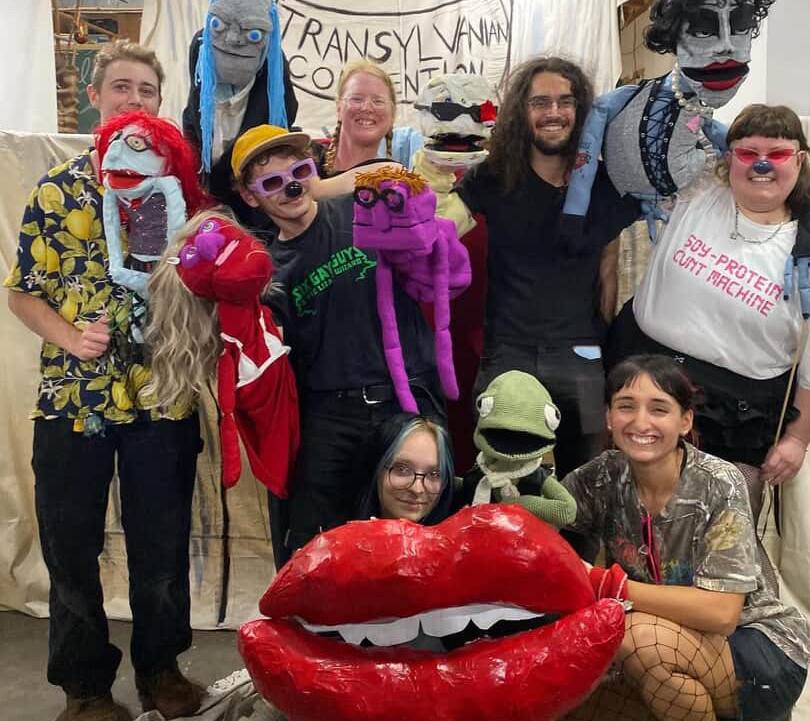
BY HANNAH OSBORN arts@theaggie.org
For the first time in 45 years,
“The Muppet Show” will return to screens in a special television event to celebrate the acclaimed program’s 50th anniversary on Feb. 4. The show, as well as other Jim Henson projects such as the longrunning Sesame Street, represent the staying power of puppetry in small screen media and its generational impact among not just American audiences, but on an international scale.
However, the art of puppetry is not restricted to television — in fact, it has a long history spanning across nearly all cultures and time periods. In Davis, this interest in the mimicry of life is expressed on multiple levels of experience, from professional productions to community-based clubs.
Throughout the years, the UC Davis Department of Theatre and Dance has staged a number of performances implementing puppets. Scene Shop Supervisor Catherine Kunkel explained one instance of the use of puppets in university shows; in a spring 2024 staging of “She Kills Monsters” — a play built off of the world of Dungeons & Dragons — multiple puppets were utilized to portray a wide array of beasts.
“There were some questions as to how many props and puppets we’d be able to borrow from other theatres, so I created scale models of multiple puppets and created a wooden mockup of a three-foot-tall Kobold, which is a dragon-like creature seen in Dungeons & Dragons,”
Kunkel said. “I padded out the wood armatures with foam and paper mâché, while strategic use of fishing line allowed the puppet to be controlled with one hand.”
In 2007, Artistic Director of Sacramento-based Puppet Art Theater Co. Art Grueneberger directed a fully-puppetified production of “Man of La Mancha.” Part of a thesis project for his UC Davis Master of Fine Arts degree in acting, Grueneberger used life-sized puppets to represent the characters within the show. Grueneberger discussed the audience reaction to the reveal.
“You’re in the show about 15-minutes before a puppet is ever revealed,” Grueneberger said. “When I do a kid show, a puppet comes up and the kids are going crazy, right? [In ‘Man of La Mancha’] it’s all adults in the audience, and I feel this collective ‘hmm.’” Grueneberger then discussed the experience of watching an audience come to believe in a puppeteer’s presentation.
“At the end of that production they were on their feet,” Grueneberger said. “And if you can get [adults] to fall in love with puppets, if you can get them to begin to care about these inanimate objects — that to me is the biggest magic trick I’ve ever pulled off.”
Grueneberger also touched on the impact that puppetry as an artform possesses, providing an example from a production of “A Thousand Cranes,” where the main character is a young girl (depicted by a puppet) dying from cancer as a result of the 1945 atomic bombing of Hiroshima.
Exhibition Department Head Susie Kantor discusses the inspiration behind the new Manetti Shrem installation
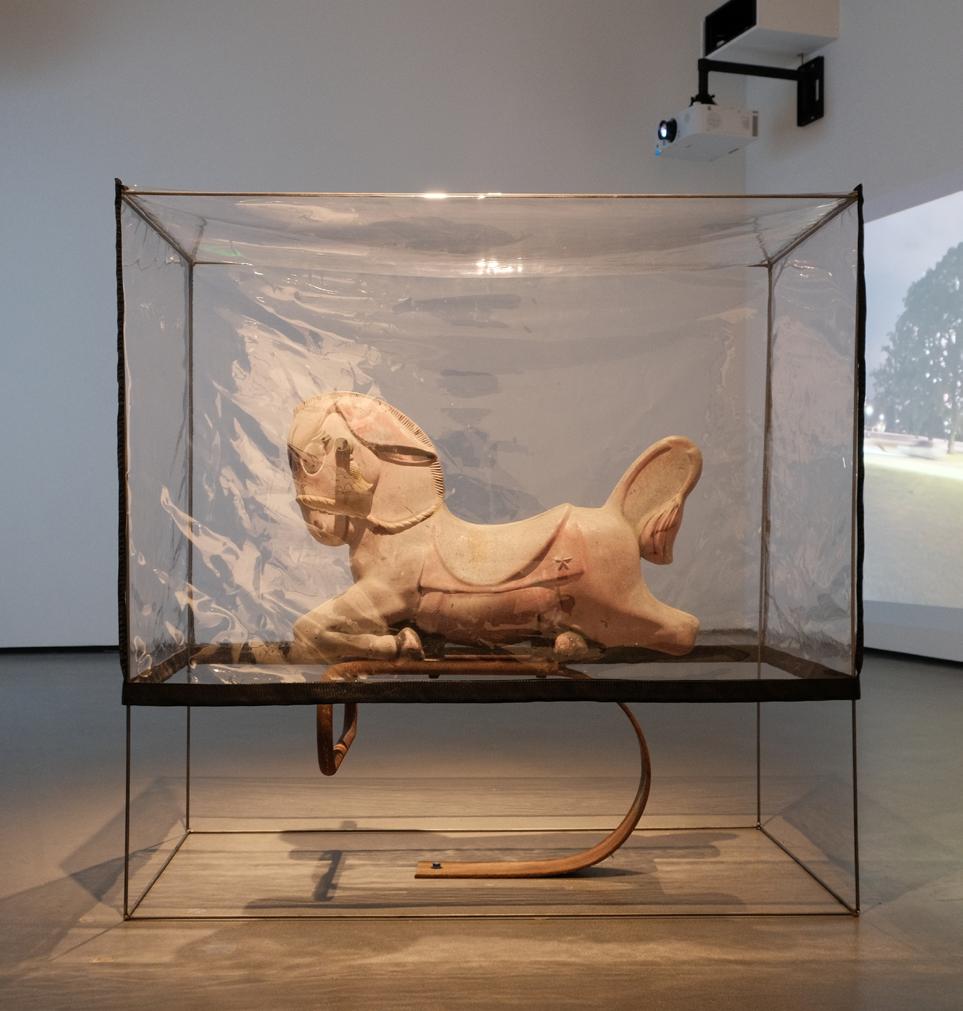
BY JONAH BERMAN
department head at the museum.
The two met nearly a decade ago and first collaborated at the Yerba Buena Center for the Arts. Kantor remarked on the multiplicity of meanings the Manetti Shrem exhibition offers.
“It’s about mourning, it’s about loss, it’s about connections across time and space,” Kantor said.
“It’s also about value. When I think of the title ‘Weights & Measures,’ I think of a scale that’s balancing. You’re thinking about the worth of something, the weight of something, the value of it.”
“Weights & Measures” builds on many of the concepts Khoury explored in her solo exhibition “Umm” (2023), which was shown at the Wexner Center for the Arts in Columbus, Ohio. The title for that exhibition referred both to the transliteration of the Arabic word for “mother” and the Egyptian singer Umm Kulthum, who was known as the “Voice of Egypt.” Khoury’s work has often focused on the cultures and histories of North African and Southwest Asian nations.
In Khoury’s new exhibition, lyrics from a stanza of one of Kulthum’s songs are displayed on a wall in the piece “Untitled (Al-Atlal),” reading: “Give me my freedom / Release my hands, / When will this captivity end, / When the world is before us.”
While the lyrics ostensibly concern a painful relationship, they can also be read as a plea for the end of colonial structures, according to Khoury. In addition, the letters, while appearing light and puffy, are actually made from heavy brass. The double meanings on display in “Untitled (Al-Atlal)” are emblematic of many of Khoury’s sculptures, which resist easy understanding and singular interpretations.
“[Khoury] works a lot in metaphor,” Kantor said. “She’s talked about how her work is political, but sort of not obviously; sort of oblique. But there’s a lot of references in her work. She’s never going to say, ‘This is an exhibition about X, Y, Z and I’m talking about these things.’ It’s meant to be a bit of a discovery.”
One notable progression in “Weights & Measures,” compared to Khoury’s earlier work, is the difference in scope.
“When I first met her, she was working a lot smaller in scale,” Kantor said. “I think her scale has exploded a lot in the past couple of years.”
No work in “Weights & Measures” is more exemplary of this than “The Elephant in the Room,” a tower which greets viewers as they enter the exhibition. Centered around a staircase
which spirals exactly once per minute, the 12-foot-tall sculpture is immensely rich with commentary. Inspired by North African and Southwest Asian-style clock towers and marketplaces, the piece invites the viewer to interrogate the importance of ruins on our view of history. As implied by the title, “The Elephant in the Room” also includes life-sized, unglazed ceramic tusks, which were intended to have a similar appearance to actual ivory.
On one side of the exhibition space, a duck coated in gold lies atop a book discussing anthropology. On the other, multiple jars of olive oil, produced by a family in Palestine, are stacked in a small tower. Meanwhile, an hour-long looping audio track plays, which includes one of Kulthum’s songs and various sound fragments. The track was produced for the exhibition in collaboration with multiple DJs and composers. The frequent utilization of found materials and cultural artifacts is indicative of Khoury’s anthropological background, which is one of the recurring subjects that ties together her body of work. Khoury, through her sculptures, uses casts of objects — from breads to gym equipment to Thanksgiving turkeys — to comment on how our society assigns value to
everyday items.
“She describes a lot of the things that she’s interested in as both ubiquitous and unwanted,” Kantor said. One of the exhibition’s works, “Untitled (Numbers/ Puppets),” was also displayed in “Umm.” The piece consists of steel pipe numerals hanging from the ceiling, resembling marionettes in structure. The numbers appear as different years when viewed from different angles, representing dates of American imperalism in the Middle East. Here, Khoury conveys a nuanced and multifaceted perspective on memory and time in these nations.
“Sometimes, history is nothing but a collection of dates and who tells the story about them,” Kantor said.
When discussing what she hopes students and museumgoers will gain from the exhibition, Kantor reemphasized the importance of each viewer finding their own meaning within the work.
“I hope what they take out of it is that there’s no one right answer,” Kantor said.
“Particularly with this exhibition, there’s so many things you can take out of it, and I want people to have that freedom.”
Golden State’s politics beyond
LAILA AZHAR features@theaggie.org
As soon as the clock struck
8 p.m. Pacific Standard Time (PST) on the night of the 2024 presidential election, the state of California was called for Democratic candidate Kamala Harris.
“At the top of the hour, 11 o’clock here, East NBC News can project that Kamala Harris will win in the state of California,” the National Broadcasting Company (NBC) news broadcast announced immediately following California polls closing. States including Pennsylvania, Michigan and Wisconsin — whose polls had closed hours earlier — were still considered too close to call.
This was no different in the 2020 presidential election; California polls closed, and the state’s 55 electoral college
votes were instantly awarded to Democratic candidate Joe Biden. Barring abrupt and dramatic political upheaval within the next two years, this will more than likely remain true in the 2028 election.
About half of California’s registered voters are Democrats, while about 25% are registered Republicans. Democrats tend to be clustered in the urban cores of the state, notably the Bay Area and Los Angeles, while much of the state’s rural areas — making up the majority of the state geographically, not populationwise — tend to vote Republican.
California is undoubtedly a Democratic stronghold.
Democrats have won the state in the past nine presidential elections, likely contributing to its reputation as a staunchly leftleaning state amongst critics and supporters alike.
A 2019 Wall Street Journal op-ed described the state as “the far left coast.” Michael Shellenberger’s book “San Fransicko: Why Progressives Ruin Cities” (2021) criticized the policies and leadership in major cities, including Los Angeles and the titular San Francisco.
To many, this association between California
and liberal policies seems as naturally occurring as the state’s sunny weather. But, below the surface, California has a complex political landscape.
As UC Davis history Professor Kathryn Olmsted explained, the state wasn’t always viewed this way.
“I think, quite naturally, we think of California as this deep blue state, because it has been, for the last couple of decades,” Olmsted said. “But really, for a long time, until the 1960s, it was quite a conservative state. And then it sort of went back and forth. The legislature was mostly Democratic, but there were a lot of Republican governors who were very conservative.”
Olmsted is the author of “Right Out of California” (2017), a book which chronicles conservative backlash to The New Deal and labor organizing in 1930s California. This backlash, she argued, laid the groundwork for the modern conservative movement.
religion, and it’s about home and it’s about traditional values, and the liberals are assaulting all of those things — it isn’t just economic issues, it’s cultural issues — they could get a lot more people in their coalition.”
Additionally, Olmsted described the process by which agribusiness leaders adopted anti-statist rhetoric.
“With the New Deal and Franklin Roosevelt, the national policy really changed,” Olmsted said. “The federal government, at first tentatively — and definitely very tentatively for farm workers — started to say, ‘Well, no, you can’t do that to your workers. They have the right to join a union, you can’t refuse to negotiate with them, you can’t beat them up if they’re on a picket line.’”

The new web app matches students with potential partners and helps them try to find love
GRACIELA TIU features@theaggie.org
Date Drop, a compatibilitybased matchmaking platform, has recently launched at UC Davis and is now available to students. Run by The Relationship Company, the web application is now free for all UC Davis students, providing weekly curated matches every Tuesday. Students confirm their UC Davis email, fill out a 10-minute questionnaire about who they are and what they want in a relationship and from there, they begin to receive their weekly matches.
campus having its own account. For UC Davis, the official website is ucd.trydatedrop.com and the Instagram handle is @ucddatedrop.
Weng detailed how Date Drop reaches students at a particularly impactful time in their lives and helps them take advantage of the college experience.
Appealing to anxieties about religion, gender roles and family — hallmarks of today’s conservative movement — is a strategy often thought to have emerged in the ‘70s, with the nationwide legalization of abortion. Olmsted’s book, however, traces this movement back to post-New Deal California, where leaders in local unions and communist organizations, and a socialist candidate for governor, Upton Sinclair, were described as holding radical and threatening views on gender by their opponents.
“It was hard to get, in a democracy, a lot of people to vote for you by saying, ‘We think that big businessmen should be able to do whatever they want,’” Olmsted said. “They could talk about freedom, but it didn’t get them a majority. But if they said conservatism is about freedom, and it’s also about


VRITI SHAH features@theaggie.org
In a new age of technology, the endless scrolling through the corners of the Internet has never felt so inevitable. But, after viewing a long series of videos featuring DIY crafts, war crimes, miscellaneous ads and political revolutions — why is it so hard to stop scrolling? This incessant scroll has been characterized as a new term: the doomscroll.
Although it may seem like an amusing and relaxing activity, many argue that doomscrolling has overwhelmingly negative effects on physical and mental health, productivity and sleep. Others agree that doomscrolling is integral toin generational desensitization due to the influx of negative videos. Research reveals that, “brain rot leads to emotional desensitization, cognitive overload, and a negative selfconcept.,” according to the National Library of Medicine.
UC Davis students have shared their own varying opinions and experiences with doomscrolling.
“Well, it [doomscrolling] gets in the way of just, like, wasting time,” Jaden Michel, a third-year human development major, said.
“Mental stimulation is a big thing, just kind of like not finding joy in the silence anymore [and] every free moment is used to doomscroll. And so, it’s hard to really stay present, which —- as a person and student —- that makes life a little more difficult and less fun.”
Michel continued to share the emotional turmoil and exhaustion caused by doomscrolling. For example, a study from the Economic Times tracked the psychiatric symptoms of adolescents with no prior mental health diagnoses before and after COVID-19. After the study, 45% of the participants displayed psychiatric symptoms — seemingly largely due to their screen time.
“It’s like the emotional whiplash of it all,” Michel said.
“It makes it hard to feel like you have a lot of control over, like, how you affect the world, because it’s just like coming out in all directions. At least for me, it makes it harder to empathize with a lot of people just because I feel like I am already being pulled in so many directions, with my emotions [...] with the scrolling.”
It’s true that many find
doomscrolling is often becomes an emotionally grueling activity. Even others who have found ways to avoid the endless scroll are concerned about the effects of doomscrolling.
“For me personally, I don’t have much trouble with scrolling,” Love Carion, a firstyear neurobiology, physiology and behavior major, said. “But, I have heard of it, and I think it definitely could affect, you know, if you have something important you need to do.”
Carion continued to discuss the factor of declining attention spans in new generations.
In fact, sources suggest that Gen Z’s attention span averages around 8 seconds, declining from 12 seconds compared to millennials.
The availability of shortform 3 to -60 second videos on popular platforms — including TikTok, Instagram and YouTube — contributes to a surge in short attention spans, largely making doomscrolling seem even more inescapable.
“You get very easily distracted [while doomscrolling], especially because a lot of people have short attention spans,” Carion said. “So, it’s harder to stay focused on what you need to do and sometimes doomscrolling may seem like a better option because it’s more entertaining and, you know, it goes by fast.” It is true that doomscrolling can become a hindrance to productivity. With the craving for scrolling, it can become more difficult to stay motivated and get work done.
“It [Ddoomscrolling] just generally makes me less productive,” Phoebe Abriso, a first-year English and international relations double major, said. “It takes time away from me being able to do other things like my homework and studying.”
While many big businessmen had supported government intervention in the form of agricultural subsidies and breaking up strikes, New Deal policies marked a shift.
“This drew an outsized reaction from a lot of big businessmen,” Olmsted said.
“They started using a lot more anti-statist rhetoric that we would recognize today as more right-wing libertarian: ‘We should have the freedom to do whatever we want, and the government is interfering with our freedom to refuse to recognize the unions.’”

“We’ve built a world that atomizes people — despite all our connectivity, people are lonelier than ever,” Henry Weng, founder of The Relationship Company and Date Drop, said. “Our mission is to push against that. We want to build systems that help people find meaningful relationships, because the people in your life are really the most important variable.”
Date Drop is the company’s first product, founded by Weng in 2025 under the original name, “Senior Scramble.” Weng described the motivation behind the first launch, noting how subsequent interest from other grade levels led him to create a more polished version of the platform.
“I noticed this sentiment among seniors at Stanford wanting to meet people and invest in relationships during their last year — there was this feeling of, ‘I’ve been here four years, and there are still so many people I’ve never crossed paths with.’ So I built a pretty scrappy matchmaking form.”
Months after its upgrade from “Senior Scramble” to “Date Drop,” the web app is now live at multiple universities, with each
“Date Drop is for college students looking for meaningful relationships — over 90% of our users say they’re interested in something long-term,” Weng said. “College is a unique window: you’re surrounded by people your age, figuring out who you are, all within a mile radius. But somehow, it’s still hard to meet the right people. That felt like a problem worth solving.”
Weng noted that, while other dating apps may feel designed to keep you on the app, he specifically designed Date Drop to get users off the platform and give them opportunities to make deeper connections.
“Honestly, I wouldn’t even describe us as a dating app,” Weng said.


Volunteers collect fruit from residential trees to combat hunger and food waste
BY SONJA WOOLEY city@theaggie.org
Davis Community Harvest is celebrating 15 years of volunteer organizing in town. The nonprofit was established by Davis residents Linda and Joe Schwartz along with Greg and Pam Gibbs to combat food insecurity. Davis Community Harvest collects fruit from residential trees from over 200 homes in Davis and distributes the produce to those in need like the Davis Community Meals and Housing organization, low income housing communities and the Yolo Food Bank. They work with local volunteers and UC Davis service groups and have harvested and donated over 500,000 lbs of fruit as of October 2025.
Linda Schwartz says they were inspired to found Davis Community Harvest by other volunteers in the Bay Area and by Greg Gibbs’ experience working on the Obama Campaign in Davis.
“[Greg] received a letter from Obama after [he] was elected suggesting that people had done such a good job community organizing and urging people not to drop [the campaign] and to keep doing things in their community,” Schwartz said. “I heard about a program in Mountain View called Village Harvest and they were very generous with their help and their expertise.”
Davis Community Harvest in turn inspired fellow volunteers and Woodland residents to launch their own Woodland Community Harvest in 2010.
Joe Schwartz spoke about his experience starting the organization.
“At the very beginning [the biggest challenge] was building a network of home owners and volunteers who wanted to harvest,” Schwartz said. “So we spent every Saturday at a table down at the farmer’s market. We’d bike around town [looking for] a tree with lots of fruit on it. You could drop a flier in a mail box so we did lots of that recruiting to build up — we were starting from zero.”
Community Harvest now has over 400 volunteers on their email list database.

Executive Director of the Yolo Food Bank, Karen Baker spoke about Davis Community Harvest’s impacts.
“The Community Harvest of Davis is an extraordinary partner in that they are providing critically important fresh produce to the food insecure of Yolo county,” Baker said. “That is the most incredible contribution you can make and they’ve been doing it for years. For so many families, produce is what makes the big nutritional difference, making sure that not only are you no longer hungry but that you’re healthy.”
Baker explained the importance of having fresh fruits and vegetables available for the community.
“Shelf stable food is often easier for people to give and we certainly need shelf stable food but to be able to get fresh produce consistently is just critically important, “ Baker said.
“But that produce bag is really a standout. Because in a lot of places that have food banks they don’t have the same supply of fresh produce that yolo county is able to provide. We’re kind of renowned for the fact that the food we provide to people includes a bag of fresh produce and it’s groups like Community Harvest of Davis that make that possible.”
Baker highlighted the importance of Community
BY IQRA AHMAD arts@theaggie.org
/
Harvest’ work, particularly during the past year.
“This year I think is one of their all time highs. They’re providing over 8,366 lbs of donated produce,” Baker said. These extra donations come at a time when food insecurity in California is projected to increase.
HR 1, a federal law passed in June of 2025 and named the ‘One Big Beautiful Bill’ by President Trump will likely make it more difficult for Americans to receive food aid from the Supplemental Nutritional Assistance Program. HR 1 tightens work requirements for veterans, those experiencing homelessness and those who’ve graduated from foster care among other restrictions.
Baker spoke about the expansion of the Yolo Food bank’s services since June of 2025.
“We were given a very early headsup [from Yolo County] that the likely impact of HR 1 would be an additional five thousand people coming to our distributions needing resources,” Baker said. “Right now we’re serving 30,000 households a month. That’s a big increase.”
Volunteers can join Davis Community Harvest by calling (530) 759-9792 or emailing info@harvestdavis.org or donate to the Yolo Food Bank at https:// yolofoodbank.org/.

BY MADELYN SEVIGNY city@theaggie.org
Esbenshade, Martin Barnes, Annie and Jeff Main and Ann M. Evans in 1976, becoming one of the first farmers markets in California. Nearly all of the founding members went on to become farmers, with many still selling at the market today. The Davis Farmers Market
has a very close relationship with the Davis Food Coop, with many of the same members involved in starting both organizations, according to the Davis Food Co-op’s website. The relationship is mutually beneficial, as the Coop guarantees to buy food that isn’t sold at the Saturday market.
The market started with three farmers and some produce, but has now transformed into the thriving marketplace that it is today with the steady inclusion of more vendors and the building of the Farmers Market Pavilion in Central Park. The market now hosts 90 vendors on Saturdays, with an estimated 500,000 annual visitors, according to Randii MacNear, the executive director of the Davis Farmers Market Alliance. MacNear emphasized the importance of the market’s Farm to School program, which funds school gardens and lunch programs, as well as provides unique educational opportunities.
“The Davis Farm to School program is this full circle thing where you start with the kids as soon as they enter school,”
On Jan. 21, the Women’s Resources and Research Center (WRRC) and Middle Eastern North African and South Asian (MENASA) Resource Center co-hosted “Confronting Western Beauty Standards: A Conversation with The MENASA Resource Center.” The event featured scholar staff from both centers, who led a discussion on the role Western beauty standards play in shaping beauty ideals and social structures, as well as their contribution to the “othering” of non-Western femininity.
Located on the second floor of the Student Community Center, the MENASA Resource Center hosts a variety of events and offers resources to provide academic and interpersonal support, leadership opportunities and more.
“The MENASA Resource Center provides holistic support for communities by fostering belonging, support and empowerment,” an anonymous MENASA scholar staff member said. “We aim to create an affirming space rooted in community, care, advocacy and shared-identity.”
Similarly, the WRRC functions to serve as a valuable resource available to students who are seeking to challenge systems of oppression and affirm gender equity. Open from 10 a.m. to 5 p.m. Monday through Friday, the center aims to provide education, advocacy and a safe,
inclusive space for students, according to their website. Through various workshops and events, the WRRC encourages open dialogue around gender and social justice.
Held at the Joy Fergoda Library on the first floor of the WRRC, organizers set up a comforting discussion space for attendees of the Western beauty standards conversation circle.
Surrounded by books, guests were invited to sit at a large table and enjoy complimentary samosas and chai.
Western beauty standards have long been understood to shape women’s and girls’ relationships with their bodies by promoting unattainable ideals that deplete space for cultural and individual differences, according to a study conducted by Ashley Mckay et al. (2018) and published by the International Journal of Gender and Women’s Studies. These standards — pale skin, small noses, slim bodies — are often seen as primary hallmarks of beauty and womanhood.
“Western beauty defines beauty as an assimilation to whiteness,” WRRC Community Organizer Ashley Hanks, a second-year sociology major, said. “It defines a standard of beauty as set by social norms, media or other institutions to gain as close a proximity to whiteness as possible. These standards matter because they’re reinforced in the interactions we have with each other, in the ways that we internalize them and how we project them online and to others.”
In the student-led conversation, attendees discussed how beauty standards shape not only self-image, but also access and opportunity. This idea was touched on by Leah Donnella in her article for NPR.
“One thing to keep in mind is that beauty is a facet of power,” Donnella wrote. “Being considered beautiful can help you gain access to certain spaces, or increase your power in certain settings. By the same token, a perceived lack of beauty, or a refusal or inability to conform to certain beauty standards, also has really tangible consequences.”
The discussion at the WRRC also sparked more general reflections on how beauty and womanhood are defined in Western culture and how those definitions disproportionately affect women of color and individuals from ethnic communities.

From homemade syrups to candles: Eiar Studio and the Pink
UC Davis alumni create a community-oriented vegan cafe in a unique downtown space
BY AMBER DUHS features@theaggie.org
Downtown Davis is home to a myriad of small businesses, from thrift stores to coffee shops; it’s an extension of campus and a second home to many students. Among the many businesses students will pass on a daily basis is a pink house, home to both candles and vegan drinks: Eiar Studio and their Pink House Cafe.
MacNear said. “They become your change agents, they become your thinkers.” The farmers market also provides support for individuals in need of nutritional assistance.
People with CalFresh and Electronic Benefits Transfer (EBT) can use their benefits at the market and are provided with fruit and vegetable vouchers.

Eiar Studio began as the brainchild of UC Davis alumna and small business owner Diosa De Guzman, a 2025 graduate with a Bachelor of Science (B.S.) in genetics and genomics. With in-house candles and unique scents, she sold her candles in various stores near her hometown in the Bay Area.
As students at UC Davis, De Guzman and her co-owner — Arham Farooqui, a 2025 UC Davis alumnus who received a B.S. in biochemistry and molecular biology — noticed multiple holes in the general Davis area: a lack of wellconstructed third spaces and a lack of vegan options. So, with graduation ahead and ideas brewing, they sought to create a welcoming space for students, by students.
“A cafe was always something we wanted; to slow down a little bit because [science, technology, engineering, math] (STEM) can be very demanding, especially at UC Davis,” De Guzman said.
Downtown Davis has many cafes and spaces where students spend their free time, but this doesn’t necessarily mean they’re tailored specifically to student needs.
“The main cafes that are here, in my experience at least, [are] grab and go situations,” Farooqui said. “We want [Eiar]
to be a space where everyone can hang out.”
Eiar Studios is split into two parts: Eiar, which sells candles and hosts workshops and community nights to help bring students together outside of the classroom, and the Pink House Cafe, their mobile coffee cart that allows students to grab a drink and study anywhere in their indoor space or outdoor patio.
The combination of coffee shop and candle studio may seem random. However, Elodie Chien, a first-year environmental science and management major, noted that this atmosphere is what makes it particularly warm and welcoming.
“Eiar has such a warm presence whenever I walk in,” Chien said. “There is space to talk with your friends or study quietly. They always have calm music going and candles burning, so it’s honestly just like a picture-perfect study spot or chill space.”
The Pink House Cafe is a vegan establishment, coming from De Guzman’s personal background and experience as a UC Davis student.
“I’m vegan and have been for a few years — unfortunately, there [are] not a lot of options in Davis, but there’s a community
here,” De Guzman said. “That’s a market that’s been untapped, and it’s been difficult, especially as a student.”
De Guzman’s goal with the cafe is to offer a space for vegan or plant-based students to have those options, beginning with vegan drinks and slowly expanding their menu to include vegan pastries and food options as well.
Beyond their vegan menu are their unique flavor blends found in their coffees and teas.
From Hochija to Earl grey tea lattes — all served only with oat milk — their housemade syrups and flavor combinations take inspiration from both De Guzman’s and Farooqui’s cultural backgrounds. “I look into where I come from, what I’ve experienced,” De Guzman said. “I [was] not born in the United States [...] so a lot of the flavors I missed — a lot of the flavors I grew up with — unfortunately are not readily available here, and especially in Davis.”
Growing up in the Bay Area, De Guzman shared, allowed her to experience cultural diversity and indulge in diverse foods and flavors; a gap she noticed while attending UC Davis, and one which she hopes to slowly fill with Eiar.

Enter digits from 1 to 9 into the blank spaces. Every row, column and 3x3 square must contain each digit. Each Sudoku has a unique solution that can be reached logically without guessing.
Answer to previous puzzle 01/22/26

should still be vigilant even during warmer weather conditions.
Throughout budget hearings, senators will make their suggestions for each unit, proposing and voting on amendments. Unit directors will be present to justify and explain their budget, and members of the public are invited to comment on a particular service, though the final decision will be made by the Senate.
“Ultimately, it is up to the Senate to decide what they would like to change about the budget,” Julka said. “If they want to maybe only cut one unit by 5%, and in turn they are cutting someone else by 15%, that’s up to them, but we are being very equal in our 10%.”
FROM PAGE 3
During major storm events, DWR operates the State-Federal Flood Operations Center, which coordinates statewide flood response and works closely with the National Weather Service (NWS).
Ince explained the preparation that DWR takes each year and how the center maintains stockpiles of floodfighting materials, deploying trained flood-fight specialists when needed.
“Every fall, DWR flood staff travel the state to meet with local emergency response agencies and ensure clear lines of communication,” Ince said.
This year, DWR held 14 regional meetings and prepositioned more than 4.3 million sandbags and 191 flood-fight material containers across California. In Yolo County, the NWS Sacramento office issues public warnings when the Yolo Bypass begins to fill; alerts that residents are urged to follow closely. Ince warns that residents
“Hotter, drier periods will be punctuated by more powerful storms,” Ince said. “Even in periods of drought or extreme dry conditions, California must still be prepared for floods.”
The state’s climate adaptation strategy includes expanding groundwater recharge during flood events, modernizing reservoir operations with improved forecasting and investing in updated water infrastructure. The rapid shift from the driest three-year period on record to the flood-filled winter of 2023 is a reminder of how quickly conditions can change.
For communities like Davis, drought recovery is not the end of the story. It marks the beginning of a new era of climate variability; one that demands preparation, awareness and resilience.
Frequently found at the Saturday Farmers Market selling his “Love your neighbor” signs, Hirsch spent the morning passing out heart shaped stickers to those entering the celebration. Hirsch, wearing a green baseball cap that read “I [heart] trees,” echoed the loving, empowered sentiment of all others in attendance at the 32nd annual celebration.
“Davis is a beloved community, we have our struggles, we have our disagreements,” Hirsh said.. “You can see it at city council.,” Hirsch said. “But most of us speak from the heart and we get involved and we critique and we argue because we care about this community.”
As attendees of this year’s MLK Jr. Day’s event prepared for their march to the Central Park Solidarity Space, Hirsch’s words came to mind.
“Love is a robust term. Love is getting involved and caring because the opposite of love is not hate, it’s apathy.”
The sooner we realize this fact, and the sooner we begin to fight back, the fewer innocent lives will be lost at the hands of a violent and belligerent regime. We must rise up against Trump’s white supremacist agenda in order to save ourselves from our own devastation.
Disclaimer: The views and opinions expressed by individual columnists belong to the columnists alone and do not necessarily indicate the views and opinions held by The California Aggie.
You don’t need to be part of ICE to get out of poverty. At some point, you have to ask yourself if money and privilege is more important than morality. This is not the time to separate our Latinx community further — it’s a time to band together to fight economic, racial and ethnic injustices.
Disclaimer: The views and opinions expressed by individual columnists belong to the columnists alone and do not necessarily indicate the views and opinions held by The California Aggie.
The entire concept of spillage, which we frequently use as a metaphor in this context, seems messy. Posturing gossip as “unwanted” reinforces the belief that disclosure of information is negative and untoward.
Finding the line between healthy and unhealthy gossip, however, can be tricky. An experiment conducted by
psychologist Terence Dores Cruz noted how gossipers felt more inclined to pass on true information when both parties moved in different circles. When gossipers had a conflict with the other party, they tended to be self-serving, and their “gossip was less trustworthy,” according to Cruz. Although gossip can serve to democratize information, it still requires rules. The practice itself isn’t necessarily undemocratic or emancipatory, but instead is the iron fist deciding who has a voice and when. To prevent distrust within relationships, we must always evaluate whether a secret is to be kept or whether it is necessary information to disclose. Irresponsibly recounting another’s story for no collective gain cannot serve as a relational tool. Inversely, shielding information from another under the guise of keeping beneficial insight for yourself — in other words, “gatekeeping” — is equally harmful. Ultimately, defining gossip for yourself is important; the extent to which you would like to engage with it or integrate it into your life might vary. While the practice of gossip can be a useful network that works to inform people about their world, it remains a resource that we are underusing, and one that we must ensure is not misused. Vilifying gossip altogether has militaristic origins rooted in power, so “sip the tea” while it’s still hot and offer some to another who needs it. Remember, however, to ingest all gossip cautiously and to always investigate your sources.
Disclaimer: The views and opinions expressed by individual columnists belong to the columnists alone and do not necessarily indicate the views and opinions held by The California Aggie.
“There were three puppeteers operating the puppet, and when she was finally dead, all three of us stood up and walked away from her,” Grueneberger said. “When an actor dies on stage, the lights go down and you know that the actor gets up and walks off stage. But with a puppet, there was something about the puppeteer, the life force of the puppet walking away, that was so much juicier to me, and I was hooked.” This enthusiasm for puppetry is shared by the Davis Puppetry Club, which primarily operates out of Third Space Art Collective. Launched in the summer of 2024, the club offers a place to workshop the creation of puppets and the production of several shows, such as a past Pride performance and a “Rocky Horror Puppet Show.”
Lou Taylor, a member of the club and a volunteer for the
art collective, shared the reasons behind their interest in puppetry.
“Puppets can do so much by just wiggling around,” Taylor said. “Even puppets that don’t speak or don’t have facial features are able to create so much emotion and personality. I have always been a kind of a quiet person or someone that doesn’t share a lot of personal emotions openly, which makes someone like me with a big love for theater drawn to puppets. You can be as hidden or as seen as you’d like.”
While a wide array of materials can be used to create puppets, club members expressed an emphasis on the use of recyclable materials, a sentiment echoed by Third Space Art Collective’s free art supply pantry. The club aims to be a point of accessibility into the arts, and welcomes anyone who wants to express their creativity; a viewpoint shared by Davis Puppetry Club Founder August Page.
“Anyone can be a part of puppetry, because puppetry can be anything,” Page said. “Like to sing? Singing puppet. Like to draw? Work on sets. Like to write? Write scripts.”
If you’re looking forward to the return of “The Muppet Show,” you don’t have to wait until Feb. 4 to experience puppetry. Grueneberger’s Puppet Art Theater Co. tours all over California, performing hundreds of shows a year. Additionally, UC Davis Theatre and Dance continues to debut new productions, finding various ways to tell stories with life-like props.
The Davis Puppetry Club will also be doing a short performance at Third Space Art Collective with UC Davis’ Sapphic Club during the next 2nd Friday ArtAbout on Feb. 13. For anyone interested in exploring the world of puppetry, the Davis Puppetry Club meets every second and fourth Tuesday from 6 to 8 p.m. at Third Space Art Collective.
While the exhibition is already available to the public, there will be an official opening via the Manetti Shrem’s annual Winter Season Celebration on Feb. 1, featuring both Kantor and Khoury in discussion with one another. The free event will be from 2 to 5 p.m. at the Manetti Shrem museum.
Kantor expressed her delight in getting the opportunity to formally introduce the new exhibition to the Davis community.
“We’ve had all these discussions throughout this process where it’s just been the two of us [Khoury and I],” Kantor said. “I’m just excited to share that energy with everyone else.”
Abriso continued to share one of the damaging effects of doomscrolling — provoking high levels of desensitization among users.
“It definitely makes people [desensitized], since they’re always seeing such bad things,” Abriso continued, “Like, when something [bad] actually happens, they’re unfazed by it and unbothered. I think there’s a lot of AI content that I see when people are doomscrolling. Which, I don’t know how to feel about. I just think it’s bad and it’s hurting our attention span[s] for sure.” With doomscrolling on the rise, many students are interested in strategies to stop the scroll. Carion shared her tactics to put her phone down and focus on other interests.
“Personally, I just make sure that I use my phone as an award or reward,” Carion said. “So, as soon as I’m done with everything I need to do, I’m like, okay, I can use my phone now. Or, if I just need to take a break, then I’ll let myself take a break.” Carion continued to share her insight on the necessity of balance and moderation while scrolling.
“In order to learn [effectively], we have to focus on this one [objective],” Carion said. “But, [while doomscrolling] if we’re focused on so many other things [we can’t learn]. I think to an extent it’s okay, but I think to a certain extent it’s not.”
Amidst ongoing events in the U.S. and around the world, it is clearly difficult to not occasionally fall into the doomscrolling trap. Regardless of the impacts of doomscrolling on an individual level, students at UC Davis recommend finding balance and moderation when engaging with short-form content.
“We need to stay informed, but not at the expense of our mental health,” Dr. Aditi Nerurkar, a lecturer in the Division of Global Health and Social Medicine at Harvard Medical School, said in an article for Harvard Health Publishing. “And cutting back is not about abstinence; it’s about decreasing reliance.”
“We wanted, essentially, to bring home here,” De Guzman said. “The Bay Area is so diverse; you can find anything and everything there, and there [are] always new things popping up and new things for you to try. Doing Pink House and Eiar [in Davis] allows us to do that.” Their intentionality with their space, flavors and offerings are evident in their work to curate an inviting space, from their foster dog Bruce hanging out in the shop to checking in with students on how they’re enjoying their time at UC Davis.
“My favorite thing about going to Eiar is the friendliness of both Diosa and Arham, the owners,” Chien said. “They [have] created such a lovely space and are so welcoming to everyone that comes in, along with serving delicious drinks.”

UC Davis undergraduate students organize a local physics conference in lieu of annual Conference for Undergraduate Women and Gender Minorities event
BY EKATERINA MEDVEDEVA science@theaggie.org
In response to an unforeseen cancellation of the annual American Physical Society Conference for Undergraduate Women and Gender Minorities in Physics (APS CU*iP) at UC Davis, undergraduate students at the Women and Gender Minorities in Physics Club (WiP+) took the initiative to organize a local physics conference, welcoming students and speakers from UC Davis and the greater Sacramento area.
“WiP+ was originally planning to help out with [APS] CU*iP, but it got cancelled for our region,” Conference Lead Lynsey Hsieh, a third-year physics major, said. “People were still interested, [so] a vision to create a conference was born.”
The event, set to take place on Feb. 7, 2026 at Roessler hall, will feature talks by UC Davis Physics alumni, industry and graduate school workshops, Crocker Nuclear Laboratory tours, an undergraduate poster session and more. The conference aims to provide an opportunity for learning about physics and, more generally, science, technology, engineering and mathematics (STEM) undergraduates of all backgrounds to network and explore the numerous paths in physics.
The conference will spotlight student research, ranging from condensed matter to astrophysics, as well as talks about navigating non-traditional
career paths in physics and managing the challenging aspects of being in the field.
The conference committee leads and volunteers highlighted “building a sense of belonging to the community” as one of the principal objectives of the event.
“I think the goal of the conference is to make the physics community feel more welcoming,” Evelyn Pizer, a fourth-year physics major and poster committee lead, said. “I want every attendee to walk away from the conference with something interesting that they learned — something that resonated with them — and to have made a new friend.”
Ann Leker Wallace, a third-year atmospheric science and physics double major and merchandising and outreach lead, echoed this sentiment.
“I hope that students come out feeling like they have a space in the community, which is something I struggled with coming into physics,” Wallace said.
The conference leads also emphasized that, unlike many other department events which may seem restricting — such as seminars and colloquia — this conference is a low-stakes way to get involved in the community and research; one that is tailored specifically for undergraduates starting out their STEM journey.
“It will be a great opportunity to meet new friends in the department, connect with professors, interact with graduate students and maybe even find some research you want to get involved in,” Melissa Rosowsky, a fourth-year physics major and
workshop committee lead, said.
“It is also meant to be a lowstakes way to present research [and] practice networking within a community. Talking to professors or other people further along in their career than you are can feel quite intimidating, and we want to break that stigma by building skills together.”
Several committee members who attended the APS CU*iP in the years prior said that they found the experience to be one of the most empowering in their physics careers, inspiring them to bring the opportunity back to their community despite the challenges that organizing such an event poses.
“It has been difficult at times with scheduling and compromising, but overall, I liked collaborating with my peers and professors to put this conference together,” Pizer said. “It has been a very uplifting experience, and I can’t wait to see how it turns out.”
Lucian Angle, a fourth-year physics major who volunteers in budgeting the funds and organizing the catering, further elaborated on the conference.
“What is exciting about [the conference] is that undergrads are doing this,” Angle said. “This is not an official thing under UC Davis, but more of a smallscale effort by a dozen dedicated students putting their time and thought into it.”
During the conference, the attendees who signed up will be provided with a free lunch. At the end of the day, there will also be time allocated to social events to foster conversation and
Scientists predict the expansion of the universe using Finsler gravity and highlight the limits of using just one model
BY EMILIA ROSE science@theaggie.org
Where is the center of the universe? If we go back 13.8 billion years — over three times Earth’s age — current theories predict the universe existed as an infinitesimally small region containing everything we know.
Suddenly, this incredibly hot and dense region rapidly expanded, growing exponentially and cooling as energy converted into matter — the source of every object in the universe. This event was aptly called the Big Bang. Since then, the universe has cooled substantially, but has yet to cease its expansion.
Now, our intuition expects that when something blows up and expands, there must be a center that it all expands from.
If you pump air into a balloon, then it’s natural to assume that all of the rubber lining expands outward from the center.
So, if it also expanded, where can we find the center of the universe? Surprisingly, the cosmos does not abide by this initial intuition. Imagine it like bread: If you heat the dough, every part expands away from every other part, not from the center. There is no need for a center. The universe is remarkably similar in that it has no center. Space itself, the fabric of existence, is growing, and as we continue into the future, there will be more space between everything.
Interestingly, in 1998, two scientists, one of whom won the 2011 Nobel Prize in physics, inferred that the expansion of the universe was actually accelerating. Our current models suggest that the universe had two distinct phases of acceleration — one right after the Big Bang and one around 9 billion years later.
The more recent cause of acceleration suggested the existence of something that must be creating a negative pressure for space itself to expand. This theoretical source of acceleration is known today as dark energy.
Distinguished professor in the UC Davis Department of Physics and Astronomy and a pioneer in the field of cosmic acceleration, Dr. Andreas Albrecht, explained his interpretation of dark energy.
“Dark energy is something

that can push matter apart,” Albrecht said. “The gravity we know every day pulls things together […] so we need something to represent the pushing apart. And we don’t really know what it is, but we call it dark energy.”
Dark energy is not a physical substance, as far as scientists know; you can’t run an engine or charge a flashlight with dark energy.
“Dark energy is usually a catch-all for whatever it is that you stick in [the equations],” Albrecht said. “It’s sort of this extra thing you need to put in to fit the data.”
Rather than discovering the existence of this mysterious substance, scientists found that the expansion of the universe was accelerating; the gravitational equations they had didn’t match this observation. To make up for it, scientists added a new mathematical term: a logical step for them to explain the cosmos.
However, a new paper from the University of Bremen suggested a different approach to explain the expansion of the cosmos. The team at the Center of Applied Space Technology and Microgravity (ZARM) at the University of Bremen used a geometric model called Finsler gravity, which is more often used to describe the gravitational behavior of gases in space. When the team at ZARM applied this to the large scale of the universe, they discovered that it predicted the observed acceleration

The conference is held with support from the Physics and Astronomy Club at UC Davis, as well as members of the Physics and Astronomy Department faculty and student volunteers. Liz Santillan, a fourth-year physics major in charge of leading communications with prospective keynote speakers, highlighted the instrumental role that faculty played in the initial stages of organizing the conference.
“Professors Robin Erbacher, Matthew Citron and Shirley Chiang helped us a lot during the planning stage in narrowing down the rough draft, and Professor Lloyd Knox offered guidance with resources and choosing speakers,” Santillan said.
Rosowsky hopes that students will remember the conference for years to come, and that it will serve as a positive landmark for their continuing interest in the field of physics.
without any mathematical term for dark energy needed.
So, which model is correct? Does dark energy truly exist, or is it an unnecessary mathematical term that we added?
The answer is that we don’t know. The universe runs on so many patterns, some of which are nearly impossible to predict: like asking where the center of it all lies. To make up for this uncertainty, we use mathematics and its predictable structure to explain the unexplainable in science.
Researchers across cosmology and physics tirelessly attempt to unite quantum mechanics and general relativity into one beautiful model. So far, we have not gotten the desired returns. Using one mathematical model to describe the behavior of the universe might be possible, or it might not be.
“Science succeeds, not because we know the right way forward, but because different people try different ways forward and eventually one of them works,” Albrecht said. “Where do we invest ourselves? Where do we invest our efforts?”
Regardless of whether we can find a unifying model — one that would explain not only the mystery of accelerated expansion but also many other mysteries in the cosmos — the different theories we create each move humanity forward, even by just a little.
BY NAREN KRISHNA JEGAN science@theaggie.org
“Avatar: Fire and Ash,” released on Dec. 19, 2025, was undoubtedly a memorable theater experience for many students over winter break. What is not often discussed when examining the cinematic world of “Avatar,” however, is the level of biodiversity of Pandora — the moon of interest in the story.
The study of evolutionary biology focuses on the origin of life and how organisms have undergone sequential genetic, behavioral and morphological changes across major time periods. Pandora’s lush environment features trees and plants, capable of making large interconnected roots that communicate across the whole moon.
Jonathan Eisen, a distinguished professor who studies the evolution, ecology and function of microbes — especially those that interact with plants and animals — provided insight into how plants on Earth communicate in comparison to the neural signals that plants on Pandora use for communication.
taxa,” Eisen said. “Animals have invented a specialized type of signalling using nerve cells, [...] and plants do not have the same kind of cell. However, plants have a diverse array of signalling and communication methods, including, in some cases, the use of electrical signalling pathways that work in ways similar to what is seen in nerves in animals.” Eisen continued to discuss the ways in which plants interact with other life forms.
“Other methods for plant communication include release of volatile compounds into the air, transport of chemical compounds in their circulatory systems, release of compounds into the soil to communicate with and interact with other organisms and more,” Eisen said. Interactions between microorganisms in the soil are a vital component of plant life.
Certain bacteria and plants work to create a mutually beneficial relationship through a process called symbiosis.
Daniel Potter, the chair of the Department of Plant Sciences at UC Davis, conducts research on plant systematics, classification and taxonomy of fruit, nut crops and the native flora of California. He explained these plant-microbe interactions.
“I want to truly thank all of the student volunteers, committee leads and faculty who have been working to make this conference a success,” Rosowsky said. “I hope the conference, though it’s just one day, will have a lasting impact on people’s experience in physics and adjacent fields.” For more information about the conference, visit their official website.

more parasitizing the fungus. Sometimes, the plant is using the fungus to parasitize another plant,” Potter said. Potter introduced a group of fungi called Mycorrhizae, which are able to perform crucial symbiotic functions with certain plants.
“These mycorrhizal, referring to the fungal relationships between nitrogen-fixing bacteria in many plants, especially in the legumes, […] greatly enrich their ability to fix nitrogen, or have fixed nitrogen readily available […] in the root nodules, which contributes to nitrogen cycling for all organisms,” Potter said. The interface between plants and microbes is crucial to all life; nitrogen-fixing bacteria contain a protein that specifically evolved to capture and break down atmospheric nitrogen into usable forms. These bacteria consume and process nitrogen that plants or other organisms that benefit from these relationships can use; in return, they get resources such as sugars and storage that allow them to grow.
“Every organism on the planet has communication methods, and each lineage has evolved some novel ones and also inherited ones from its ancestors that are then shared with other
The botany of the world of “Avatar” draws strong roots from the actual principles of botany and agriculture on Earth. Although we may be a ways away from discovering new life in outer space, we can rely on our growing knowledge of botany and biology to understand how new forms of life can evolve and interact with each other in comparison to life on Earth. connections.
“Seed plants, generally, have relationships with fungi in the soil that vary from symbiotic and mutualistic, where the fungus is getting some benefit, and the plant is either getting some benefit or is actually
The Aggies fall against Santa Clara University but defeat Fresno Pacific University
DANIELLE WIRNOWSKI sports@theaggie.org
On Jan. 17, the Aggies hosted both Santa Clara University (SCU) and Fresno Pacific University (FPU) for the first double header in the 2025-26 men’s tennis season.
The Aggies went up against SCU at 10:30 a.m., followed by FPU at 2:30 p.m.
“At the beginning of the season, it’s actually pretty common to have double headers,” Lucas Bollinger, a fourth-year political science major and a member of the UC Davis men’s tennis team, said.
“It’s kind of to get your guys conditioned.”
There were a total of nine sets for each match, with three doubles teams and six singles sets. Four players for the Aggies played both doubles and singles matches, demonstrating two different strategies.
“Singles are more about settling into the match and are a little more passive in the beginning,” Bollinger said.
“Since the points are faster [in doubles], I’m thinking about being very aggressive.”
In the first match against the SCU Broncos, three of the nine sets were unfinished; one of these sets was a doubles team featuring Bollinger and Kurt Miller, a third-year human development
major. Despite the unfinished double by Bollinger and Miller, the other two doubles teams finished their sets, but could not equalize against the Broncos. The Aggies lost their first match 4-1 to the Broncos, with Bollinger winning his singles set 6-0 for both games.
The other three singles matches, two of which went unfinished, were lost against the Broncos. Dylan Paterson, a firstyear economics major, went into a tie-breaker for his last game against the Broncos, 6-1 in the first set, 7-6 in the second and 8-6 in the tiebreaker.
“That was kind of a bummer, but we’re getting better throughout the season,” Bollinger said. “And I’m excited for our next match.”
The team showed their dedication and winning energy in the second match of the day against FPU. The Aggies went into the match with the same setup of doubles and singles as the matches against SCU, and left with more victories. Despite four matches ending prematurely and being deemed unfinished, the Aggies were competitive and kept the scores close.
“If we go out there, we play our tennis,” Bollinger said. “If we’re aggressive, coming in with a good mindset, we should win the match.”
The Aggies finished 4-0 against Fresno Pacific. Bollinger
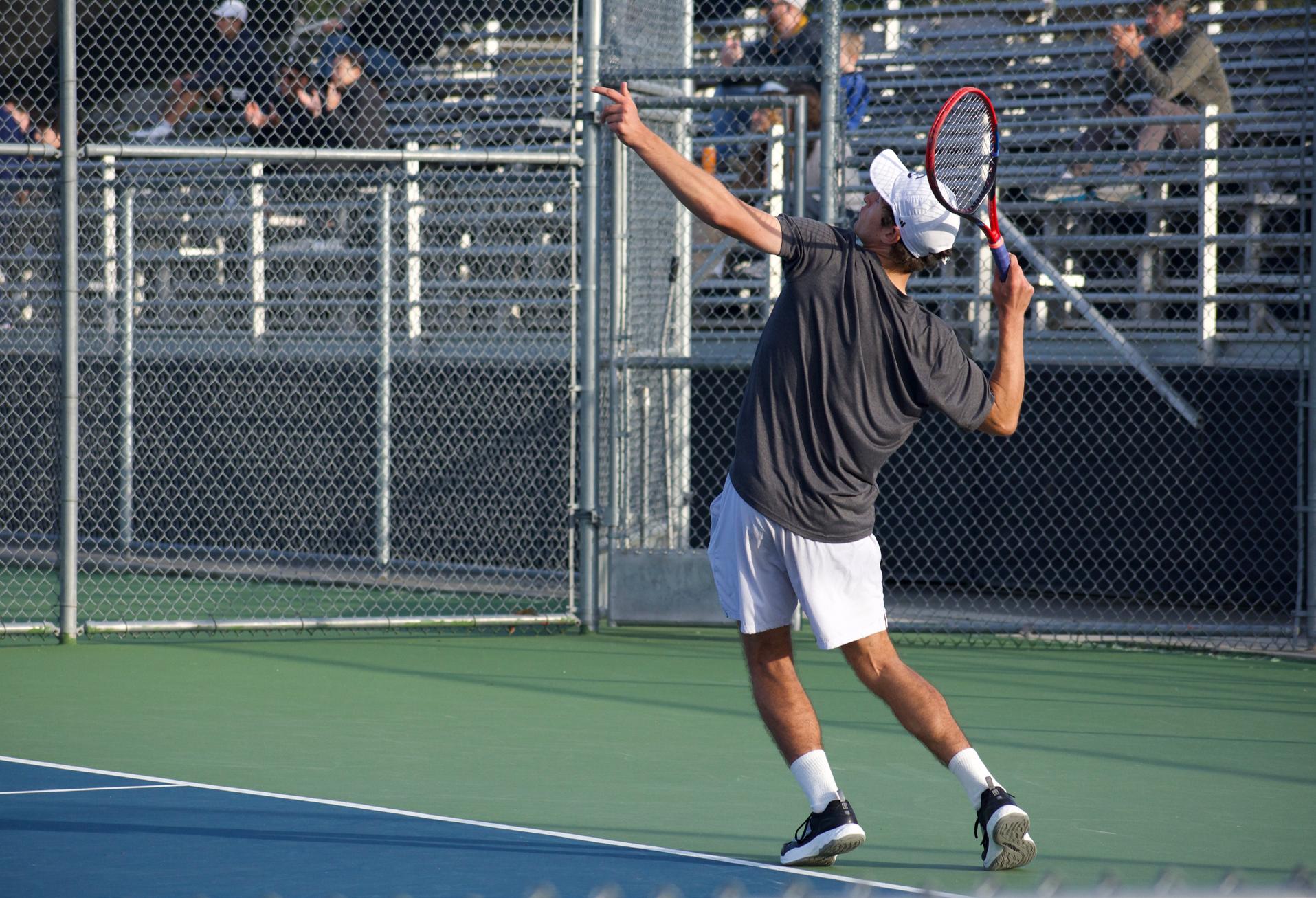
and Miller won their doubles match with a tiebreaker of 7-6 and 7-2, while Paterson and Perry Di Giulio, a second-year communication major, won 6-2. Bollinger, Di Giulio and Kaveh Taheri, a second-year

Sussex, a second-year undeclared major, both scored 21 points respectively, accounting for just over half of the Aggies total points. Norris also led the Aggies in rebounds, with a total of 12. This season the Aggies have continued to perform strongly, only suffering a few losses.



undeclared major, won their singles sets scoring 6-4 and 6-1, 6-1 and 6-0, 6-1 and 6-1, respectively. The other three matches went unfinished after the Aggies secured the fourth overall point, recapping
a formidable and aggressive rebound performance.
“I feel like if I play the way that I’ve been playing recently, I’ve got a shot to win,” Bollinger said, reflecting on future matches. “And I feel like the
National Hockey League action from coast to coast

EMMIA J RIVERA sports@theaggie.org
On Monday, Jan. 19, the Florida Panthers hosted the San Jose Sharks in their second matchup this season. The Panthers and the Sharks last faced each other in November 2025, where the Sharks defeated the Panthers 3-1. The faceoff was Panthers forward Matthew Tkachuk’s first time playing this season, after surgery to repair a torn adductor muscle and sports hernia on Aug. 22.
“I will say, it was such a relief and nice to be out there,” Tkachuk told the National Hockey League (NHL). “The first period was weird, just a little strange. Nothing mimics a game. The second felt better, the third felt back to normal.”
Unfortunately, Tkachuk’s debut was dampened by the Sharks, who won the Jan. 19 match 4-1. Prior to the match against the Panthers, the Sharks won five of their seven previous games.
Key players for the Sharks were Alex Nedeljkovic, who made 35 saves, and Will Smith, Vincent Desharnais and Mario Ferraro who scored in the second period.
“We stuck with it, sacrificed a lot, and committed to playing solid defense,” Nedeljkovic said. “When the time came, we got rewarded.”
Panthers players Eetu Luostarinen scored, and Sergei Bobrovsky made 24 saves for Florida, but could not find the equalizer.
With 14 minutes left in the game, a rare goalie fight broke out between goalies Bobrovsky and Nedejikovic. The altercation started in the third period,
when the Panthers’ forward
Evan Rodrigues delivered a tough check into the boards on the Sharks’ defenseman Desharnais. Sharks players rushed in to defend Desharnais, with Nedeljkovic also getting involved in the scrum.
Seeing the situation, Panthers goalie Bobrovsky skated the length of the ice to confront Nedeljkovic, dropping his gloves and initiating a oneon-one fight.
“I went to make sure to get him and let him know,” Nedelijkovic said. “I felt just like I made a decision and went straight into it.”
Bobrovsky ended up receiving the upper hand, but both goalies received a 5-minute major penalty for fighting and an additional 2-minute penalty for leaving the crease to take part in the altercation.
In Northern California, the Anaheim Ducks hosted the Los Angeles Kings for a Southern California rival face-off on Jan. 17.
The Ducks and Kings went to overtime, with the Ducks center Mikael Granlund scoring with 57.4 seconds remaining; this was Granlund’s ninth goal of the season.
Ducks right winger Beckett Sennecke assisted Granlund for the goal after preventing Kings left winger Kevin Fiala from getting a shot off on a breakaway at the other end of the ice.
“That’s the effort we need,” Granlund said. “We’re giving us a chance to win these games, and getting those persistent [efforts] to be able to win these games. And that’s what I mean by playing
We’re playing the right way right now, and we need to keep doing that.”
Mason McTavish scored, Ville Husso made 17 saves and the Ducks won three straight (24-21-3) following a nine-game losing streak (0-8-1). They also won 3-2 in a shootout against the Kings in Los Angeles on Friday. In recent news, Kiefer Sherwood was traded by the Vancouver Canucks to the San Jose Sharks. In return, the Sharks gave up a second-round pick in the 2026 NHL Draft, a secondround pick in the 2027 NHL Draft and defenseman Cole Clayton.
“Obviously, [I was] a little caught off guard,” Sherwood said. “First and foremost, I’m really thankful for everything that the city and this organization have given me. And I know they say you earn it, but you’ve got to have the opportunity, and as a guy that has been a late bloomer, it’s everything I could have hoped for and more, and this is really a special place to play.” Sherwood was a former forward for the Canucks, who led the team with 17 goals in 33 games. In 309 regular-season games with the Anaheim Ducks, Colorado Avalanche, Nashville Predators and the Canucks, he has 121 points (60 goals, 61 assists) and two points (one goal, one assist) in eight Stanley Cup Playoff games. On the