


Senate Bill #22, which unanimously passed, leading to a $1 per hour pay raise to most ASUCD employees
BY VINCE BASADA campus@theaggie.org
ASUCD Internal Vice President Aaminah Mohammad called the Nov. 26 senate meeting, held over Zoom, to order at 6:10 p.m. She then read the UC Davis Land Acknowledgement.
With several senators absent due to prior commitments and other difficulties joining the Zoom, the table moved to pass the consent calendar of legislation while a quorum was present.
Senate Bill (SB) #20, allocating $90 to the Office of Senator Sabah Nabiha for a transfer student event, and SB#21, implementing accessibility requirements for ASUCD websites and social media pages, both passed unanimously.
Te table also approved a resolution to urge the US Forest Service to enact the National Old-Growth Amendment, protecting old-growth trees from logging and commercial exchange without issue.
Continuing legislative discussion, the senate unanimously passed SB#22,
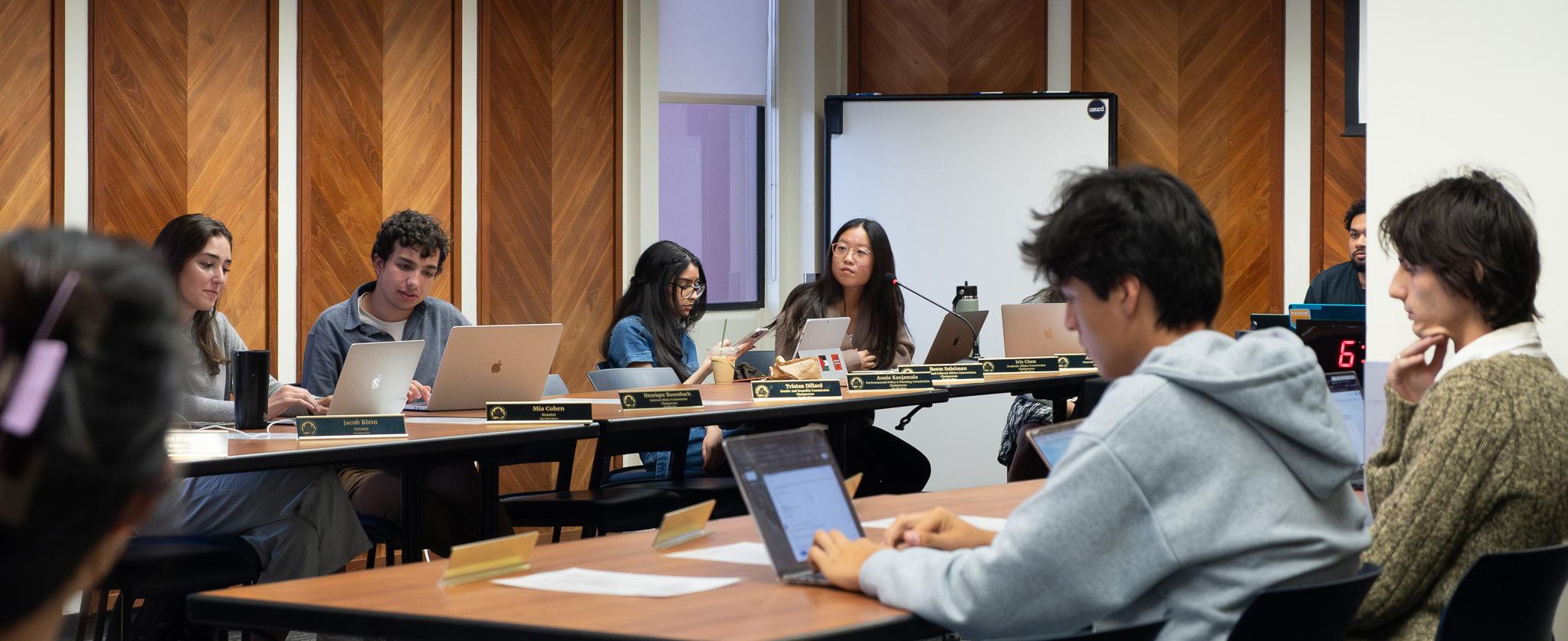
increasing the hourly wages of most ASUCD workers by 50 cents. It allocates $151,844.12 for the wage increases for the upcoming winter and spring quarters, to take efect in January 2025.
Alongside a previous budget allocation, the passing of SB#22 means that the majority of ASUCD workers will experience a $1/hour raise starting in 2025.
Senator Max Gouvalaris stated a concern after the bill’s passing that
the focus of the senate had been on worker retention and not on worker appreciation.
“I think the vast majority of the discussion [over SB#22] was extremely misplaced,” Gouvalaris said. “We are here to support our workers. I’m incredibly alarmed by the tone-deaf nature of [the] dialogue on this bill.”
ASUCD President Gaius Ilupjeu reassured him that the bill’s focus on retention was done to take advantage of university policies that allow ASUCD to
UC Davis students discuss what image of UC Davis best represents the school and its history
BY AMBER WARNKE features@theaggie.org
Te debate over whether or not the cow should replace Gunrock as the UC Davis mascot has been going on for years. In 2022, 73% of students voted to change the mascot to a cow in the spring elections for the ASUCD. However, concerns over how difcult re-branding would be, as well as what alumni would think, led to the choice to institute the cow as the ASUCD mascot, rather than as the UC Davis mascot. Nevertheless, the debate about which mascot would better represent the UC Davis community has lasted since this decision over two years ago.
Diego Tolliver, a third-year materials science and engineering major, weighed in.
“I think the cow is just a better representative of the spirit of the school in general,” Tolliver said. “Everything is cow-themed already. And the mustang is kind of a thing of the past.” Tolliver proposed “Bucket” as a name for the potential cow mascot, and suggested that another reason the cow is the right mascot choice lies in how people often perceive UC Davis.
“I’ve heard of people kind of using ‘Davis as a cow school’ as a little bit of a derogatory thing,” Tolliver said. “But if we were to change our mascot to a cow, it would be kind of reclaiming that.” Tolliver also pointed out that
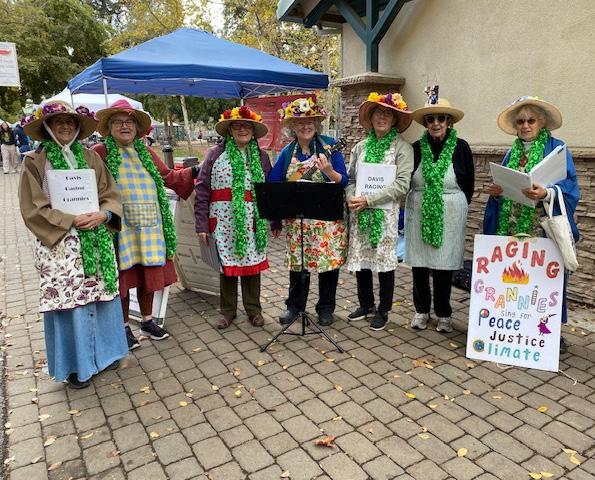

the cow mascot would suit Davis’ agriculture-heavy culture.
“I think it would be better to have a cow,” Tolliver said. “[Horses] are not as much of an agricultural thing as cows are, so that fts that a lot better.”
Jack Manly, a fourth-year history major, takes a very diferent approach to the issue.
Tere is no such thing more agricultural than a horse,” Manly said. “It was horses that were used historically to till the felds, pull the plows, take farmers from one place to another. Horses have been an integral part of agriculture since we tamed them. I see no reason why we should switch to a cow.”
Manly went on to clarify the reasons behind his opinion.
“I think [Gunrock] then and still now represents the ideas of Davis as a campus and as a community,” Manly said. “I think it’s important also that we honor our history, which I feel strongly about as a history major.”
Te real-life Gunrock was actually named Gun Rock and was a Toroughbred, not a Mustang as the current mascot is. Gun Rock was born in 1914 to Rock Sand, the British Triple Crown Winner in 1903. He lived at UC Davis from 1921 to 1931, and while he did compete in races, Gun Rock did not land any signifcant wins. Instead, he was mainly considered valuable as a breeding horse. During his time at UC Davis, Gun Rock was bred with a whopping 476 mares, siring many notable racing horses.
Manly considered Gunrock a
valuable symbol that represents UC Davis students.
“I think Gunrock represents the hardworking and motivated drive that all Aggies possess when it comes to academics,” Manly said. “Speaking from my personal opinion, I view horses as animals that have that drive, that motivation. Cows don’t evoke the same image. Tey evoke a wandering laziness, which is not what I believe that Davis currently represents, has represented in the past or will represent in the future.”
Manly also refected on his experience as the Gunrock mascot at the 2024 Big West Conference basketball game.
“It’s hard to not feel connected when you are the embodiment of something, even if for a short period of time,” Manly said.
“Being inside the Gunrock costume has only amplifed that connection and passion I feel for it as a mascot.”
Grace Zurof, a frst-year graduate student at the School of Education, said she considers Gunrock to be unique from other university mascots.
“What other school has an anthropomorphic blue horse as their mascot who’s ripped AF?” Zurof said.
She believes that Gunrock, standing apart from any other mascot, captures the spirit of UC Davis in a special way.
“It plays into the beauty of Davis in that we may not be like the biggest UC, but it’s still something that makes us fun and quirky,” Zurof said.
increase wages in order to keep workers and express appreciation of the work of all student employees.
Tis [raise] is not something we had to do, but we felt that we had to,” Ilupeju said. “Our underlying intention is always to do right for our workers.”
Ilupeju also said he had tried to push through a $2 to $3 wage raise, but was limited by University of California policy.
Te senate also passed SB#15 to update personnel bylaws to match
current internal practices. Quarterly reports from the Aggie Reuse Store, the Aggie Arts Committee and the Campus Center for the Environment were reviewed by the table before completing ex-ofcio and elected ofcer reports. Te meeting was adjourned at 7:32 p.m.
The measure on last November’s ballot raised Davis’ sales tax from 8.25% to 9.25%
KAYLA TRAN / AGGIE

BY RORY CONLON city@theaggie.org
Measure Q, which passed in November 2024 with a 64.2% majority, raised the sales tax in Davis by one percent, from 8.25% to 9.25%. It is set to generate about $11 million worth of tax revenue annually.
Residents will pay more for taxable goods purchased in Davis, with notable exceptions being on purchases of groceries and prescription medicine.
In an FAQ section on Measure Q, the city of Davis listed purposes the money can be used for.
“Measure Q is a general tax, which means it can be used for any city governmental purpose,” the city of Davis website reads. “This includes maintaining public safety and emergency response; addressing aging infrastructure needs; maintaining and improving our roads, bike paths and parks; providing afordable housing support and addressing impacts of homelessness; providing programs to community members of all ages; and taking actions that reduce greenhouse gas emissions and address climate change.”
Te city estimated that it would have $6.3 million, or 7.5% of the General Fund for the 2024-25 year. Since the city aims to maintain a baseline of 15% in the General Fund Reserve, supporters for the measure argued that more money was needed.
Supporters for Measure Q included all members of the 2024 city council and fve former Davis mayors. In a statement in favor of the measure, the fve former mayors reiterated the importance of increasing city revenue to provide adequate services for residents.
Te City of Davis has worked diligently to manage existing resources efciently, trimming expenses while protecting residents’ services and staf positions,” the argument in favor reads. “Now we need to catch up to infation, increasing costs and our growing population.”
Tose against Measure Q included Elaine Roberts Musser, a former chair on the utilities and Senior Citizen Commission; Mark Mezger, the president of the Yolo County Taxpayers Association; and three others. Teir statement outlined questions on how taxpayer money would be allocated by the city and alleged that the city is paying “exorbitant salaries” to senior management and frefghters.
“Te real problem is our Davis City Council has irresponsibly granted excessive salary increases to senior management and firefighters while the city is in dire fnancial straits,” the argument against reads. “Te latest salary increases granted by the current Davis City Council will cost taxpayers millions of dollars over the coming years.”

New California law raises the penalty of repeat drug and theft crimes to a felony
BY YUENJO FAN city@theaggie.org
On Dec. 18, Proposition 36 was enforced as an efort to combat drug and theft crimes statewide. A measure on the 2024 election ballot, the proposition was voted on by Californians, with a 68.4% majority voting, translating to a popular vote of 10,307,296.
Tis proposition comes in response to 2014’s Proposition 47, which recategorized theft of less than $950 and illegal drug possession under a specifc weight as misdemeanors rather than felonies. Now, 10 years later, Proposition 36 has taken a diferent trajectory.
A recent press release by the Yolo County District Attorney’s office afrmed the county’s law enforcement efort to support the newly passed law.
“Yolo County law enforcement ofcials stand united to immediately enforce the laws that were amended or created by Prop. 36,” the press release reads. “Among the key provisions are: mandated treatment for individuals who are charged with their third drug possession ofense; elevate theft ofenses to felonies after a second conviction; aggregating multiple thefts to meet the felony threshold amount of $950; and advising convicted drug dealers that if they continue to sell drugs and someone dies, they can be charged with murder.”
On Dec. 20, two days after the law went into effect, Yolo County pressed its frst Proposition 36-related charges against a suspect for repeat drug possession and multiple suspects, including a Davis resident, for theft crimes after two or more previous convictions.
Trough these statements, including a recent social media post by Yolo County’s District Attorney Jef Reisig, local prosecutors recognize Proposition 36’s impact. On X, formerly known as Twitter, Reisig expressed his support for the newly implemented law.
“Prop 36 ofers real healing potential through court-supervised mandated treatment for individuals who simply can’t stop using hard drugs like fentanyl, heroin and methamphetamine,” the post reads. “Prop 36 will save lives.”
Te proposition aims to decrease crime rates and discourage repeat ofenders from committing drug or theft crimes. Yet, objectors fear the new law may cause more harm than good.
California’s Voter Information

crime prevention, treatment, and rehabilitation,” the guide reads.
On the other hand, the District Attorney’s Ofce refuted these claims in the press release, voicing additional support for Proposition 36.
“[Proposition 36] restored the ability to achieve the objective of holding people accountable for their actions and mandating services to those who are severely addicted or mentally ill,” the press release reads.
More information about Proposition 36 and other new laws can be found on the California Voter Information Guide website.
BY ALMA CULVERWEL city@theaggie.org
I love selling my
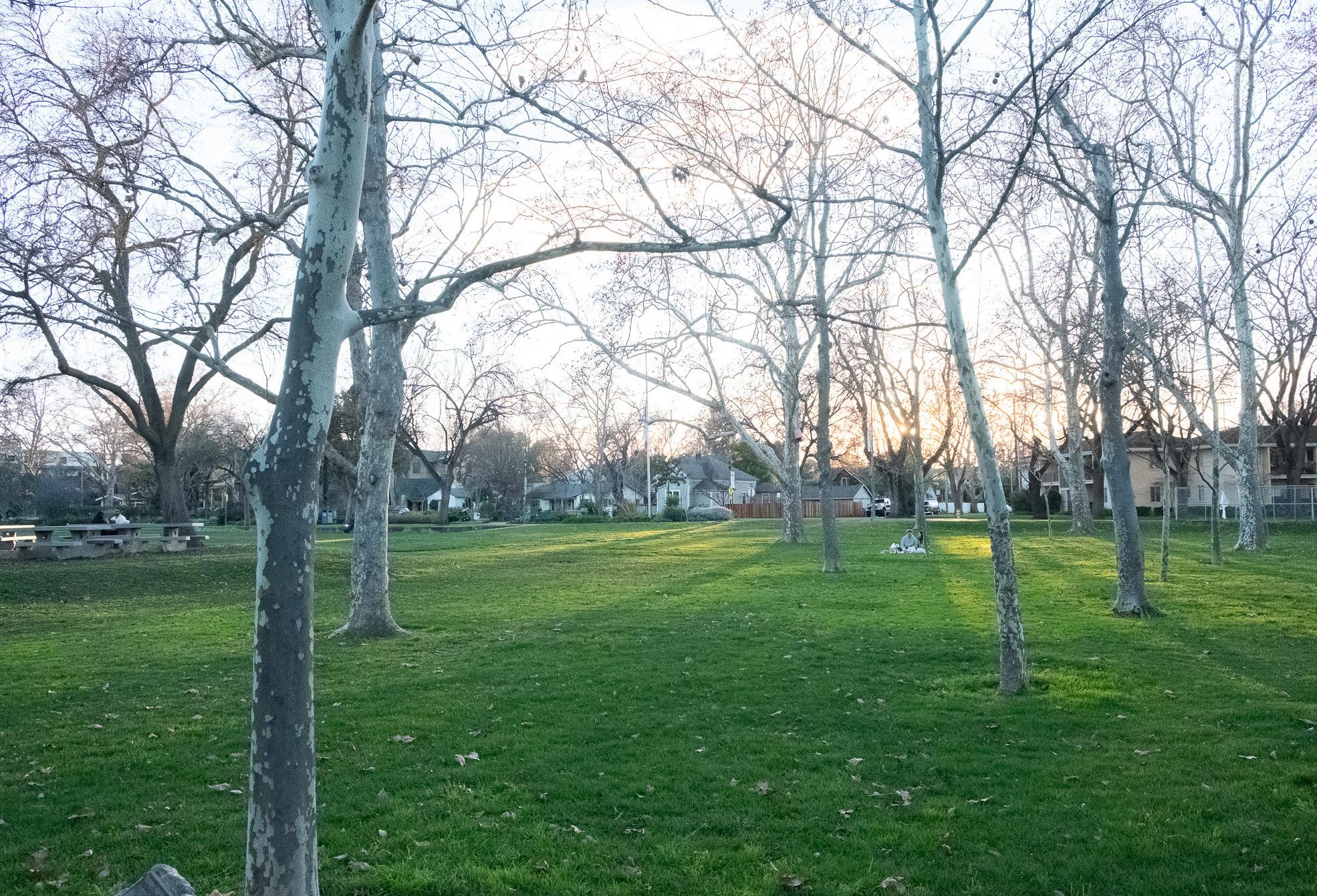
crochet pieces at the farmers market,” Duggan said. “Trough this, I’ve gotten to witness how Central Park is loved by so many families and students alike. It will be so nice to see the impact of these renovations on such a special area.” Abby Greenberg, a third-year psychology major, also expressed her appreciation for Central Park.
“Central Park is such an amazing place that I have so many great memories associated with,” Greenberg said. “It’s such a nice area to meet up with friends or even just stroll through.” Te Great Lawn’s new infrastructure and improvements ensure the space will remain functional and inviting
for events, recreation and gatherings, regardless of weather conditions. Charlotte Franklin, a recent UC Davis alum, reflected on her fond memories of Central Park.
“My senior year, I lived just a few blocks away from Central Park,” Franklin said. “My roommates and I loved going to the weekly farmers market and taking walks through the park. Tough I no longer live in Davis, it’s always a highlight for me when I come back to visit, and I can’t wait to see how these renovations pan out.”
As the Assembly of the Academic Senate votes on the proposal this April, students and faculty face challenges in advocacy
BY KHADEEJAH KHAN campus@theaggie.org
In April 2025, the Assembly of the Academic Senate will be voting on A-G/H Ethnic Studies, a proposal that would require high school students to take a non-additive, one-semester ethnic studies course for admission into the University of California. Tis proposal was previously postponed at the Dec. 12 Meeting of the Assembly.
California Governor Gavin Newsom signed Assembly Bill (AB) 101 in October 2021, requiring the completion of a one-semester ethnic studies course for high school graduation starting with the class of 2030, according to Newsom’s website. Te bill states that in the 2025-26 school year, California schools are required to begin ofering ethnic studies courses. While AB 101 is already California law, authors of Area A-G/H Ethnic Studies believe that adopting the proposal will place the UC system in a position of leadership and guidance for school districts who are fulflling the new requirement.
Natalia Deeb-Sossa, a professor of Chicano and Chicana Studies at UC Davis, expressed her opinions on the purpose of the proposal.
“We already have our knowledge and critical understanding of our histories, cultures, intellectual traditions, lived experiences and social struggles,” Deeb-Sossa said. “But the reality is that our history, the history of Chicanx, Latinx, Asian American, Black and Native American people has never been taught in K-12.”
When making the proposal, various studies that were considered have shown that students who have taken ethnic studies courses prior to college admission earn higher standardized test scores, grade point averages and increased school attendance, according to Deeb-Sossa.
Because A-G/H Ethnic Studies is non-additive, the requirement does not necessarily have to be fulflled through a separate ethnic studies class, but can instead be fulflled through an overlay — an already existing course that meets ethnic studies course criteria, according to the bill.
A Legacy of Advocacy
Ethnic studies is a feld born from student advocacy and protest at San Francisco State University (SFSU) in the 1960s, according to Christine Hong, a professor of critical race, ethnic studies and literature at UC Santa Cruz. A coalition of students from the university’s Black Student Union, Latin American Students Organization, Asian American Political Alliance and more formed the Tird World Liberation Front (TWLF) in 1968, where they

demanded the establishment of ethnic studies programs that taught the experiences and history of their communities, according to an article by KQED. As the movement grew, in 1969, UC Berkeley students formed another Tird World Liberation Front and UC Davis students launched the Tird World Forum, a student-run and published newspaper in 1970, according to the UC Davis Library website.
Hong said that the historic origins of ethnic studies emerged out of student demand.
“When students are demanding a feld, they’re pointing to ways in which student success can be supported,” Hong said. “Tis was true with Area (A-G/H) Ethnic Studies as well. It was students who initiated it.”
Today, students continue to carry on the legacy of advocating for ethnic studies with student organizations like the UC Students Association (UCSA), who represent over 230,000 university students. Currently, four UC student governments have passed resolutions in support of Area A-G/H Ethnic Studies: UC Davis, UC Santa Cruz, UC San Diego and UC Riverside.
For UCSA President Aditi Hariharan, the legacy of student advocacy within California is an inspiration. However, she said recent policies restricting protest through time, place and manner are concerning, as she recognizes the impact of student protest historically, especially in the creation of
ethnic studies.
“Ethnic studies is the forefront of why the UC Student Association even exists right now,” Hariharan said. “Student support for ethnic studies is not quiet. It is not hidden. It is loud, and we are strongly in support of it.”
Hariharan took her frst ethnic studies class at UC Davis — an experience that she described as “revolutionary.” She believes that the Area A-G/H Ethnic Studies proposal is essential to serve California’s K-12 population, 80% of whom are students of color.
“I’ve never seen my race accurately represented to the proportion of students of South Asian heritage who I know go to the school,” Hariharan said. “When I went to my frst ethnic studies class, it felt revolutionary in the sense of pulling apart all of these academic works that I had thought as foundational and unquestionable and realizing that there was so much more to explore and question.”
TWLF met challenges during the creation of ethnic studies with many students often facing police violence and arrests. Today, the struggle continues in the process of the Area A-G/H Ethnic Studies proposal.
Hong expanded on the exclusion of students in legal decisions.
“Te baton has been passed from one generation to another of students who have fought for ethnic studies,” Hong said. “Tat baton has been passed to us too. But where are the students
represented in the decision-making process? Why is it that students who are calling for ethnic studies are not lifted up in the system-wide Academic Senate and the Academic Assembly?”
A Series of “Procedural Irregularities” Since 2020, the proposal has undergone a series of votes and what authors of the proposal describe as “procedural irregularities.”
Te proposal itself was initially approved by the Board of Admissions and Relations with Schools (BOARS) in late 2020. BOARS then voted in November 2021 to approve course criteria and once again in June 2023, which would allow for the proposal to be sent to the Academic Council. However, a third vote occurred in BOARS in November 2023 against approving the course criteria — six votes against, fve votes approved and one abstained.
For Dylan Rodríguez, a professor in the Department of Black Study and Department of Media and Cultural Studies at UC Riverside, this process has been marked by “layers of insult.”
Tat’s unheard of for the same thing to be voted on three times and for people to keep calling for votes, to keep calling for reviews, and so forth and so on,” Rodríguez said. “It is not only inconsistent, hypocritical and the worst type of double standard, it’s a complete obliteration of any notion of integrity or the Academic Senate review process.”
Sean Malloy, a professor of history, critical race and ethnic studies at UC Merced, believes that these instances refect institutional racism that scholars in ethnic studies experience far too often.
“The white supremacy of the Academic Senate does not generally manifest in terms of racial slurs or people showing up wearing hoods,” Malloy said. “It shows up in the kind of proceduralism that marks some kinds of knowledge as legitimate and some kinds as requiring extra layers of proof.”
Beyond the meetings, this process has taken a toll, according to authors of the proposal and advocates. Some described experiences with receiving death threats, being held to a double standard and experiencing faltering health.
Deeb-Sossa shared her experiences with the continued struggle of including ethnic studies in K-12 education.
“I have been at the university for 18 years (going on 19 years), and to continue feeling that our felds and our scholarship is completely devalued at this level is deeply wounding,” DeebSossa said.
Te Road Ahead Following the postponement vote at the Dec. 12 meeting, some groups in opposition of the proposal, including FAIR for All, celebrated the postponement claiming that the proposal is “political and sectarian.”
Te Assembly of the Academic Senate will vote on Area A-G/H Ethnic Studies on April 17, 2025. Newsom’s January budget will likely impact the level of support and opposition in the April meeting, according to Academic Senate Chair Steven Cheung, as he cited funding as a point of debate in the December meeting. If approved, the criteria will be sent to UC President Michael V. Drake and will be presented to the UC Regents.
“A lot of it will be contingent on what happens with the governor’s budget,” Cheung said. “If it looks like it will be supported by the governor, (April) will be a very active meeting.” For ethnic studies scholars like Hong, the proposal’s impact extends beyond the feld of ethnic studies, but instead, all of California.
“Ethnic studies actually diversifes and expands the applicant pool not only to the UC but also to the professional and graduate schools,” Hong said. “If UC faculty in non-ethnic studies disciplines want their own feld to have a vibrant future, they have to think much more broadly and critically about K-12 education than many of them are doing right now.”
President Gaius Ilupeju delivered his State of the Association speech and outgoing senators said their farewells
BY VINCE BASADA and MADISON PETERS campus@theaggie.org
ASUCD Internal Vice President
Aaminah Mohammad called the Dec. 5 senate meeting to order at 6:22 p.m., before reading the UC Davis Land Acknowledgement.
Te meeting began with a State of the Association given by ASUCD President Gaius Ilupeju, in which he gave an overview of the various successes and achievements across many ASUCD units including the Bike Barn, the Housing and Transportation Advocacy Committee and Unitrans (which was awarded $1.6 million this summer in Federal Transit Administration Discretionary funds for its phase 2 bus electrifcation project).
“We’re not just acting as student representatives, we’re functioning as civic leaders,” Ilupeju said. “Our decisions don’t just afect student life, they reshape the very fabric of our community.”
Ilupeju also noted that ASUCD was working on relaunching the Tipsy Taxi, a currently defunct service that helps students get safe rides home, sometime in winter quarter 2025. He also lauded the recently approved ASUCD base pay raise to $17 and the continuation of the Causeway Connection bus service through 2027, as well as announced the merger of the Housing Undergraduate for Advising Students, an ASUCD unit, and Aggie House, a student-run transitional housing shelter.
Tis merger represents much more than organizational efciency,” Ilupeju said. “It’s about creating an atmosphere that includes a support system for students facing housing insecurity.”
Ilupeju then talked about the impacts that ASUCD has on the surrounding community.
“I see [our accomplishments]
as proof of what student leadership can truly mean when it’s backed by competence, commitment and courage,” Ilupeju said. “We’re not just preparing for the real world. We’re already shaping it. One decision, one program, one student at a time. Tat is ASUCD’s legacy. We’re more than the student government, we’re the heartbeat of UC Davis. What we do here is love in action.”
Ilupeju’s speech, which counted the members of the Judicial Council, several ASUCD committee chairs and executive stafers among its attendees, was well received with applause. The table then filled the eight empty seats of the External Afairs Commission. Confrmed as Vice-Chair was Benjamin Wynd, a fourth-year sustainable environmental design and political science double major.
Confrmed as commissioners were: Adam Price, a third-year neurobiology, physiology and behavior major, Anika Aggarwal, a third-year political science
major, Annelise Oprea, a second-year environmental policy and planning major, Aubri Lee, a second-year environmental science and management major, Phoenix List, ta hird-year international relations and philosophy double major, Robi Castaneda, a thirdyear music and political science double major, and Sharada Mahesh, a thirdyear economics major.
Ten, Senator Jacob Klein gave his farewell address as an outgoing member of the table. Klein, a two-term senator and third-year political science — public service major, started of with advice for the incoming senators and his successors.
“Te most productive senate tables I’ve been on have actually worked together despite diferences and created good projects, so I hope the future senate table can do so as well,” Klein said. He ended his speech by thanking his colleagues and emphasizing the importance of collaboration.
“Tanks to everyone who I’ve been working with in diferent capacities,” Klein said. “All the work everyone does is really important. Make sure the vibes are working and please respect people without violating the ASUCD Constitution.” Te fve interim senators who had served throughout the fall quarter — Max Gouvalaris, Sabah Nabiha, Tianneh Garcia Bonardi, Noblejot Singh and Luis Garcia — also gave short farewell remarks before the six new senators took their oaths of ofce and their seats on the table. In order of their swearing-in were: Solana Rodriguez, a second-year political science — public service major, Jenna Younes, a third-year international relations major, Nanki Kaur, a thirdyear biomedical engineering and South Asian studies double major, Zack Dollins, a frst-year political science major, Umar Shaikh, a second-year political science major, and Lexi Raben, a frst-year environmental sciences and
management major.
After the new senators had settled in, they heard a presentation from the UC Davis chapter of the California Public Interest Research Group (CALPIRG), a student-directed activist group. Member-at-large Reid Alton, a thirdyear psychology major, said that the group’s plans for next quarter include targeting ocean polluters, addressing fashion waste and organizing a week of action for homelessness.
Next, International Student Representative Muhammad Waqar gave his ofce’s quarterly report, followed by the Ethnic and Cultural Afairs Committee’s report presented by Chair Reem Suleiman. Te senate also heard from Mental Health Initiative Unit Director Daezhon Gilbarg, a third-year psychology major, and Housing and Transportation Advocacy Committee
Chair Christina Smith, a fourth-year political science — public service major.
Te senate proceeded to take an hour break for a closed session before returning at 9:47 p.m to complete the elected ofcer and ex-ofcio reports.
After public comments, the senate considered old emergency legislation including Senate Bill (SB) #25 and Senate Resolution (SR) #3. SB#25 serves to clarify the process of amending the Policy on Ethical Spending, and SR#3 affirms the ASUCD Senate’s support of the UC Ethnic Studies requirement.
Both pieces of emergency legislation were passed unanimously.
The table approved several Memoranda of Understanding, which included a commitment to funding Cal Aggie Camp through 2029 and an agreement to work with Aggie Compass to administer the ASUCD Transportation Grant for Financially Disadvantaged Students.
After the approval of previous meeting minutes, the senate adjourned at 10:39 p.m.
STEPHANIE CHEN / AGGIE
BY VIOLET ZANZOT vmzanzot@theaggie.org
of the United States elected a “strongman” — who, according to NPR, is “someone who represents democracy as weak and ineffectual, presenting himself as the only one who can not a historical fgure, politician or notable “strongman” (but a strong man nonetheless), is often characterized as tough and brave — maybe even handsome. More than that, he is notable because he represents a feeling of safety. He represents the idea that a person is more than their qualities: A person shapes an environment. While his rugged features are great, his ability to be infuential is derived from his impact on culture. When the glasses come of and the cape goes on, Superman is the hero protecting the safety of the citizens of Metropolis –– or at least, that is how he impacts the culture of the city.

Seasonal affective disorder and the terrible, horrible, no good, very bad day
BY MOLLY THOMPSON mmtthompson@ucdavis.edu
Now, this is not to say that politicians are heroes by any stretch of the word, but they are comparable in the sense that they are able to shape culture in a way that is unique from the individual attributes that defne them. In other words, politicians are impactful outside policy because of their ability to shape perspectives.
First, one must understand what is meant by culture. Tis word we tend to throw around may be best explained as the reasoning behind our seemingly random actions; In other words, culture is meaning. It is a set of shared beliefs, values and customs.
Claude Levi-Strauss distinguishes between culture and nature as the diference between “the raw and the cooked” — culture is the place where meaning comes from.
So, if culture is the process through which we create reasoning for our actions, it turns out to be a pretty big deal. Similarly, when someone wields the ability to shape culture at large, it tends to be important. It seems though, that this power is often ignored. Te people who we chose to bear such great signifcance are often analyzed in every way other than their infuence on culture. Politicians are remembered for their distinct attributes, the historical moments they experienced and important legislation they passed, not the underlying waves of change that
society. history, we often separate cultural shifts from politicians. Maybe you learned about the extraordinary movements of the ‘60s and ‘70s, as well as how they seemed to dissipate going into the ‘80s. However, seldom are the movements discussed in tandem with the atmosphere created by the time’s respective politicians. Ronald Reagan’s platform of the “War on Drugs” and “Reaganomics” falls almost exactly as these cultural movements are noted as faltering. Tere is a connection. Instead, typically in study, politicians are remembered separately from societal trends. Franklin D. Roosevelt is best known as the “President during World War II”, the founder of the New Deal and the only president to ever serve three terms in ofce. Richard Nixon will forever be tainted by the Watergate Scandal. Bill Clinton is marked by his relationship with Monica Lewinsky. Joe Biden has come to be known for his age and all of the trials and tribulations that came with a post-COVID-19 world. More than these facts and markings of signifcance, each of these men have shaped culture by setting a standard for what is acceptable in society.
Politicians have the ability to be impactful — dangerous even — because their infuence allows them to shape societal norms. Not only do policies change, but conversations shift, depending on the politicians of that time. By controlling the conversation, politicians can dictate the norm. Teir role as the intermediary between government and the public allows them to create and then explain meaning behind the actions made by our governing body.
The most recent election perfectly exemplifes this idea. Kamala Harris represented a clear and dramatic shift toward modernization. As a minority who emphasized social issues and redistribution, her platform was designed to highlight the change in culture she would bring about. Donald Trump’s “Make America Great Again” encapsulates traditional ideals, or a return to a culture that once existed. Each person changed the conversations that were being had across the country.
If you’ve been to the Activities and Recreation Center (ARC) recently, you’re likely familiar with the fun, seemingly random exit polls the staf often pose on a little whiteboard for gym goers to vote on as they leave. I saw one during the week after daylight savings time ended, asking whether seasonal depression “hit you like a truck” or if you were “still okay somehow.” Tere were a lot of responses on both sides (and some other creative responses), but it appeared that most people felt like they’d been run over by the proverbial 18-wheeler that is seasonal depression. I guess it helps to know that I’m not alone.
While SAD can occur during the summer months (often with slightly diferent symptoms), it’s most common in the winter, afecting millions of Americans every year to varying degrees. Interestingly, it’s also more common

More accurately known as seasonal afective disorder (or SAD, appropriately), seasonal depression causes many people to experience depressive symptoms during the winter months. This can include or be accompanied by increased levels of anxiety, fatigue, pessimism, irritability, lack of motivation, inability to concentrate and physical ailments, among many more possible symptoms.
in northern areas, which receive less daylight hours during the winter season. Te National Institute of Mental Health (NIMH) emphasizes that the root causes of SAD are still being determined, but a lot of data and research on it does already exist. As it turns out, decreased exposure to sunlight is one of the leading culprits. Depending on location, we can get around five to six fewer hours of
daylight in the winter than the summer here in the United States. With stormy, cloudy weather commonly occuring in the winter, we often get even less sun exposure than that.
But why does this even matter? Why do we even need sun exposure? Firstly, it helps us regulate our circadian rhythms and can dictate the quality of our sleep. Sleep has a powerful impact on physical health, mental health, emotional well-being, productivity and mood. Especially in the morning, sunlight can help set our internal clocks. Oftentimes, because of lowered sun exposure and as a general pattern that exists in conjecture, people with SAD tend to produce excess melatonin — a hormone that helps maintain a normative circadian rhythm — causing exhaustion and oversleeping.
Te most important thing we get from the sun is vitamin D. Ultraviolet (UV) rays from the sun help our bodies make the nutrient, which is necessary for bone health, blood cells and our immune system (another reason why we can be more susceptible to viruses and infections during the winter).
Put the phone down and go read a book or something
How
our phones monopolize our free time
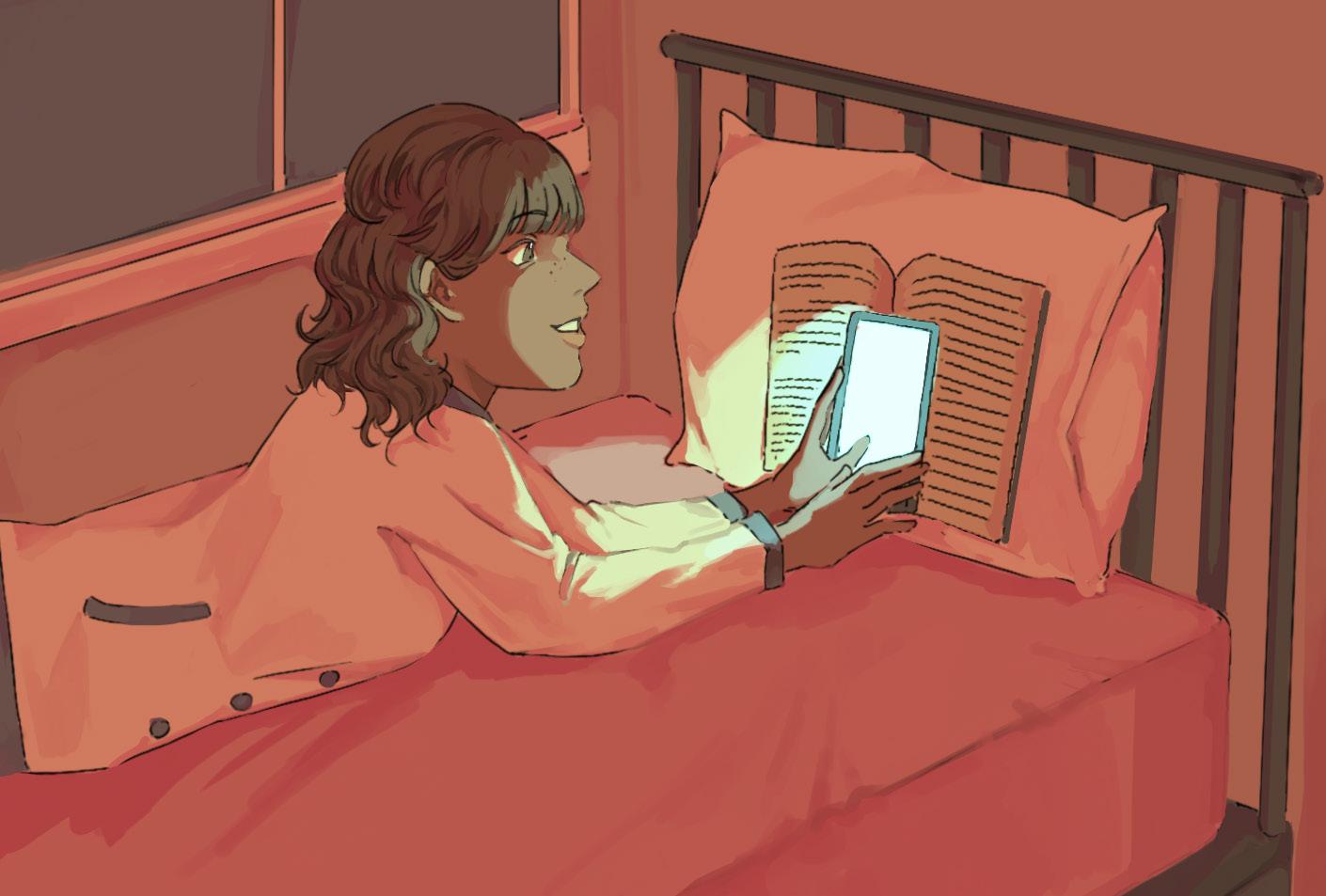
CRYSTAL CHEN / AGGIE
BY TARA ROMERO tcrome@ucdavis.edu
“What did you do over break?” — the dreaded question for all of us social media addicts. You don’t want to admit that you spent the majority of your break watching fan-wars unfold on Twitter and clocking in for a six-hour night shift of unconscious scrolling on TikTok. Instead, you lie and say you read a book that you actually read three years ago (your class acquaintance doesn’t need to know that).
However, many of us are not as alone as we think in our high daily
Researchers visiting UC Davis are unsatisfied with their catering options

BY ALLISON KELEHER
Recently, the Department of Agricultural and Resource Economics (ARE) hosted three traveling researchers. It was a pleasant afair composed of a guest lecture, several meetings and an ending presentation. Many connections were made and networks were expanded. An overall exceptional experience, and it was only 11 a.m.
“So, what’s for lunch?” one researcher asked whilst clutching his fairly large belly.
The ARE faculty grinned from ear to ear, as they had secured an elite dining experience — the Segundo Dining Commons. However, just as it made the ARE faculty smile, it wiped the smile of of the traveling researchers’ faces. When asked for a statement, the second researcher announced: “It was really disappointing to be treated so poorly. I wanted something classy for lunch. Something like catered Panera Bread.”
Te three researchers dragged their feet all the way to the Segundo Dining Commons to get their meal. One researcher chose a burger with curly fries, another a salad and the third refused food on principle. Overall, this once amazing day was quickly taking a turn for the worst.
After lunch, the third researcher was scheduled to present — however, he was extremely hungry due to his protest of the food ofered at the dining commons. So, he presented with an attitude and answered every question irritably. In order to mend this once beautiful relationship, the ARE faculty decided to purchase a Snickers bar from a vending machine for this researcher. However, it ruined what was left of their working relationship because it turned out that he was allergic to peanuts. While tension was building in the department, several squirrels outside began to listen in on the commotion and pass on the message. After about an hour, everyone at UC Davis had heard about the drama. Squirrels are very popular.
Tus, a plan was hatched to earn the respect of the researchers once again. It started with Gunrock, who acquired a very large stainless steel pot which he placed over a bed of coals in the Memorial Union (MU). One by one, squirrels from all over campus acquired bits of food to add to the pot. One group of squirrels even trekked all the way to the student farm to get some nice vegetables.
Slowly but surely, the pot began to be filled with veggies from the student farm and chicken stock from Te Pantry — someone even tried to put a wild turkey into the pot before
Gunrock intervened. When Gunrock wasn’t looking, a group of geology majors slipped some stones into the soup, claiming that rocks make every meal taste better. As the makeshift soup simmered, Gunrock would stir occasionally with a large wooden spoon.
At around 5 p.m., the soup was about fnished and ready to serve. Te researchers were angrily getting ready to leave when they were redirected to the MU to have some soup. Hundreds of UC Davis students gathered in the MU to witness the mending of friendship through soup.
At this point, Gunrock had an apron on and began ladling out bowls of soup for the researchers. Although they were still upset, the soup smelled very scrumptious, so they couldn’t resist a taste. A couple slurps later, these researchers were hooked, claiming that this was the “best soup they’d ever had.”
Te campus rejoiced, and students began to line up for their share of the friendship soup. After enjoying a hearty bowl served by Gunrock, everyone lived happily ever after. Te end.
Disclaimer: (Tis article is humor and/or satire, and its content is purely fctional. Te story and the names of “sources” are fctionalized.)
screen time hours. Te average amount of time Americans spend on their phones is four hours and 37 minutes each day. Although we typically spread out our phone usage throughout the day, we end up spending almost a quarter of our waking hours glued to our phones. We have all undoubtedly read or heard about the thousands of scientifc studies that warn us of the negative efects of too much screen time. From mental health to digital eye strain to sleep quality, the studies point to limiting social media and screen usage. Despite knowing this information, we still open up TikTok and watch clips of
a sitcom on two times the regular speed with a Subway Surfers playthrough in the background. Knowing the health effects of high screen time doesn’t necessarily deter us — these health effects feel distant and out of our direct control. We can acknowledge the risks, but think, “Well, maybe for other people, but it probably, defnitely doesn’t afect me.”
Another argument against social media usage is that it makes us less productive — any time we spend on our phones is time we could be working. Perhaps, instead of watching two-hour long YouTube video essays, we could instead write our own essay that we have been procrastinating on. In America, we live with a constant “grind-set” mindset where, if we are not being productive, we are doing something wrong. In other words, any time spent on our phones is a “waste of time.” Tis argument has a point, but I think it is founded in the wrong perspective. People do need a block of time during which they are not productive: leisure time. Leisure time is a portion of the day set aside for people to unwind from their various responsibilities. A 2015 study from UC Merced demonstrates how leisure time helps us improve our mental health and well-being.
SEASONALDEPRESSION on 11 SCREENTIME on 11
It’s time to start making
Studies indicate that having an enemy is actually good for you
BY MADISON SEEMAN meseeman@ucdavis.edu
As children, we’re often discouraged from using the word “hate.” It’s a “strong” word, adults tell us. But I say that now is the time for strong words; We’ve been told for far too long that hatred kills your soul and bitterness is the enemy of joy. I think it’s time we embrace our natural instincts and fll our hearts with the singular focused ray of hatred that is having an enemy.
Tanks to an anonymous study I saw on TikTok yesterday, we now know that having an enemy is good for you. Blaming all of your problems on someone is healthy: It lowers your cholesterol, or something like that. When the good goes bad, how do you cope? Sure, you can try yoga or deep breathing or even meditation, but those solutions are all massively unrealistic (and a little boring). Having an enemy is not only realistic and attainable — it’s exciting. Take last Tursday for example. It started raining, which would’ve been fne if I hadn’t been carrying a small paper model of my room for class. Ten, my AirPods died, I ran into my ex and worst of all? When I went to the bathroom after class, the toilet seat was warm. My soul was dying, and I needed a savior. Tis is where the enemy comes in.
Geniveve Williams. In fourth grade, she invited everyone except for me to her dog-themed birthday party, even though she knew I was the biggest dog afcionado in class. In the eighth grade, she told Anthony from math class I liked him and then asked him out a week later. In senior year? I don’t even want to talk about it.
But on Thursday, I found out Geniveve Williams had joined a pyramid scheme. I felt validated — vindicated even. I could feel the joy of her poor decision making healing the scars that day had left on my soul. I felt my vigor for life renewing and my motivation for my chem assignment building back up. I felt a profound sense of peace knowing
that wherever I was, Genieveve Williams was doing worse than me.
It’s just like that famous Winston Churchill quote: “Having enemies makes you a better person” (or something like that). Te anger Adrian from anthropology inspires in me gives me the adrenaline I need to get that paper in on time. Talking smack about Sara from sociology is the perfect warmup for that fnal presentation. Hating Kevin the misogynist gives me feminist points.
I interviewed my friend David Kim, who has a lot of enemies, to get to the bottom of the benefts.
“It’s the only reason I’m passing my classes,” Kim said. “Take Emily for example. She’s involved in all the stages of my academic process. I rant about Emily to warm up for assignments. I blame Emily for all the things I get wrong. And, when I’m done, I hatescroll through her Instagram as a little treat.”
Olivia Joy — another expert enemyhaver — gave me the inside scoop on how she collects so many enemies.
“I don’t discriminate; Anyone can be an enemy,” Joy said. “Tat guy walking too slow? Yeah, he’s my enemy now. Te girl that won’t stop asking questions in the 8 a.m. lecture? Nails on a chalkboard. My class crush has a girlfriend? New enemy unlocked.” Whether having an enemy is a coping mechanism, a hobby or a passion, there’s something in it for everyone. So, when the fre alarm goes of at 2 a.m. again, blame your ex-roommate. When you’re late to a pop quiz, blame that pompous electric scooter rider. When you fail a quiz, blame Kristin (she knows what she did). Te world is your oyster, and anyone can be an enemy.
Disclaimer: (Tis article is humor and/or satire, and its content is purely fctional. Te story and the names of “sources” are fctionalized.)
This year’s peaceful transfer of power upholds democratic values
BY
WRITTEN
THE EDITORIAL BOARD
Tis week marks the fourth anniversary of the Jan. 6 Capitol riot at the United States Capitol in Washington, D.C. A symbol of governance and democratic stability, the Capitol was besieged by a violent insurrection that has forever changed our country.
On Jan. 6, 2021, Americans and people around the world watched in shock as rioters, fueled by discontent over the 2020 Presidential Election results, stormed the halls of Congress. Tey aimed to disrupt the certifcation of the election results, leaving a lasting sense of distrust in the nation’s democratic processes.
Te events of Jan. 6 were not spontaneous; they were carefully devised. Weeks of misinformation, baseless claims of election fraud and provocative language led to this action. President Donald Trump, along with his allies, planted doubt about the legitimacy of the 2020 Presidential Election results, falsely claiming the election had been “stolen.”
“All of us here today do not want to see our election victory stolen by emboldened radical-left Democrats, which is what they’re doing,” Trump said in his speech on the morning of Jan. 6, 2021, in Washington, D.C. “And stolen by the fake news media. Tat’s what they’ve done and what they’re doing. We will never give up, we will never concede. It doesn’t happen. You don’t concede when there’s theft involved.”
He further encouraged division and election fraud with his comments
about Former Vice President Mike Pence. Additionally, Trump urged his supporters: “We are going to the Capitol.” Tese remarks left many feeling uneasy, and his supporters saw them as a call to action. Te result was a violent breach of the Capitol, which led to fve deaths, injuries to more than 140 police ofcers and a forever scar in American history.
For many, the insurrection served as a wake-up call, exposing the vulnerabilities of our democratic institution and the fragility of our nation, further deepening political divides.
In the aftermath, eforts have been made to hold those who participated in the insurrection accountable.
Hundreds of rioters have faced prosecution for their role in the Capitol attack, including Trump. He has faced investigations for his role in inciting the mob, spreading false election fraud claims and failing to swiftly stop the violence once it began. However, the legal proceedings are ongoing, especially now that Trump has regained the presidency in 2024, which may afect the legal consequences of his actions.
Since the insurrection, nearly 1,600 individuals have been prosecuted for their involvement in the riot. Yet, Trump has suggested the possibility of pardoning those convicted of participating in the Capitol attack. It remains unclear what further consequences, if any, will be faced by the rioters or the president for their actions on the day of the insurrection.
Jan. 6, 2025 marks another important moment: the day the
Electoral College votes were ofcially counted and ratifed, confrming Trump’s victory in the 2024 presidential election. Vice President Kamala Harris presided over the certifcation of Trump as the ofcial 47th president of the United States, following her loss in the race.
Harris, unlike Trump in 2021, conceded without insinuating any wrongdoing or fraud in the election results. Tis year’s peaceful transfer of power by President Joe Biden and Vice President Harris stands in stark contrast to the chaos four years prior. Te 2025 inaugural ceremonies were marked by a tone of unity, despite ongoing national divisions, with leaders from across the world emphasizing the importance of collaboration.
Te smooth transition of power reinforced a commitment to democratic norms. It served as a reminder that even in times of political division, the core principles of government and democratic institutions can prevail.
As we look to the future, the lessons of Jan. 6 should not be forgotten. It is a shared responsibility of both lawmakers and citizens to uphold democratic principles and accept election outcomes peacefully.
As we remember the lives lost and the damage done to our nation, let us maintain our commitment to justice, truth and unity. While this year’s peaceful transfer of power was a step in the right direction, it is crucial to continue reinforcing the principles of democracy and close the chapter on this regretful moment in history.
Influencers are trading in authenticity for opulence
BY JHANA RHODES jsrho@ucdavis.edu
After an excruciatingly long night of non-stop stressing and studying — and even more stressing over fnals week — I fnally decided to scratch the itch in my brain and reward myself by watching TikTok videos. After an hour of scrolling through my For You Page, my free time was nearing an end, and I was still unamused.
To experience the joy fnals week had stolen from me, I decided to redirect myself to the search bar and visit the page of one of my favorite content creators. However, I was left disappointed. While scrolling through their videos, I noticed a trend; their once authentic, relatable videos had all been exchanged for two-minute promotional ads and showcases of their luxurious lifestyle. I couldn’t relate to anything on their page. Like an uninterested cat whose owner had returned from a long vacation, I couldn’t care less.
Disappointed, I quickly realized that the creator who was once a social media influencer I found relatable wasn’t so relatable anymore. Don’t get me wrong — infuencers don’t owe their
followers anything, and they can live their lives however they want to. Even so, I don’t remember the last time a mainstream infuencer felt authentic.
Now that I think about it, there isn’t a day when infuencers aren’t called out for being “problematic.” Whether it’s for promoting a product they’ve never used a day in their life or for being “out of touch,” one thing is clear: Infuencers aren’t as relatable and authentic as they once were. Te sudden change from seemingly humble beginnings to living life like an Upper East Sider, has some followers questioning: Why have we followed them in the frst place?
Some people follow content creators so they can live like them. Tey shop the places they shop and buy the products they buy — all because one person infuenced them to do it. Others follow their favorite content creators because they fnd them funny or because they’ve formed a parasocial connection with them, as if they were a close friend. Tough there are many reasons why
Editorial Board
CHRIS PONCE Editor-in-Chief
ALYSSA CREVOISERAT Managing Editor
MADISON PETERS Campus News Editor
HANNAH SCHRADER City News Editor
MAYA KORNYEYEVA Opinion Editor
ZOEY MORTAZAVI Features Editor
ANA BACH Arts & Culture Editor
MEGAN JOSEPH Sports Editor
KATIE HELLMAN Science Editor
JENNA LEE Photo Director
ARIANA NOBLE Layout Director
LANHUI ZHEN Design Director
JOANNE SUN Social Media Manager
AARON POTTER Website Manager
CASSIDY GILLIS Distribution & Outreach Director
TIFFANY HE Copy Chief
JENNY DYE Copy Chief
SAMUEL RUIZ Translation Director
ILEANA MERAZ Translation Director
LAURIE PEDERSON Business Development Manager
individuals choose to consume media from their favorite infuencers, the reason people likely started following them was because of their authentic and transparent persona. If you’re unfamiliar with what I’m referring to when I say
authenticity, here is what I mean. Being authentic doesn’t necessitate that infuencers have to tell you all of their secrets or never tell lies. It simply means that they are someone who you can connect with, perhaps for the way they embraced the same faws that you have or a similarity in their lifestyle. However, in a rapidly growing society that prioritizes
consumerism and luxury lifestyles, authenticity has become more rare. Capitalist companies tend to propel overconsumption through social media platforms like TikTok in order to maximize pro f t. T ey may pay infuencers to promote their products
Sentimentality drives the book industry during the holiday season
BY ABHINAYA KASAGANI akasagani@ucdavis.edu
Winter is magical in its crispness and twinkle of soft lights, in the warmth of traditions passed down over generations. Te season is one of sentimentality, and, for the book industry (just like any consumerist industry), this is the time to shine. More than any other season, winter leverages this yearning for connection and nostalgia, fueling a surge in book sales and readership. Te holidays have long been intertwined with the act of storytelling. Whatever this looks like for you — whether you are reliant on a warm book by the fre or another task of intellect and care — it is hard to disregard that binge-reading has found its way into tradition. Tis sentimentality is what the season is built on: It is a time for refection and giving. Books can be great for this, since they are less presents and more companions during the cold — as gifts, they imply care. Te discounts aren’t too bad either.
Not only does the holiday season invite guilt-free consumption, but
the long nights and shorter days ofer us such time. Te quickness of life is halted, however temporarily, and people fnd themselves curled up indoors, seeking the wisdom and kindness of a book. Holiday breaks become perfect opportunities to recenter oneself, revisit old favorites and discover new ones. Seasonal genres tactfully leverage this desire for comfort and familiarity with cozy mysteries, holiday romances and festive cookbooks. Nothing is too gauche for the season that greets. Publishers and booksellers alike have perfected the art of aligning themselves with what the season demands. Te weeks leading up to Christmas see an infux of special editions, gift sets and limited-time promotions: It is almost foolish not to participate. From Black Friday to Christmas, books are featured in sales campaigns as ideal gifts. Audiobooks and eBooks, along with digital platforms and subscription services like Audible and Kindle Unlimited, are in equal demand, rising in popularity as technology reshapes the way we consume stories during these travel-heavy months. Te tangible joy of holding a physical copy persists,
yet this promotional tactic spares no format. Winter is also synonymous with a revival of Christmas-themed media — new songbook editions, re-releases of Christmas carols and sheet music collections. Tese re-releases are often promoted by contemporary artists who leverage this sentimentality to further feed into the con of seasonal media consumption, a product of the enduring appeal of holiday traditions. Winter is a season that embraces storytelling in all its forms, linking together generations and memories to inspire new ones. In Iceland, for instance, the Christmas Book Flood takes center stage, encouraging one to gift books to those they love. Tis leads to a massive surge in book sales during December, as families exchange books on Christmas Eve and spend the night reading them. Pop-up bookstores and literary booths at holiday markets cater to shoppers seeking meaningful gifts, while libraries and community centers work to foster good winter reading habits. Many host seasonal programs, such as storytime for children, holiday craft workshops and book clubs focused on winter-themed literature.
Tese events not only promote literacy but also strengthen the community’s propensity for reading. It is, after all, a time for turning over a new leaf. Ultimately, reading in winter is almost sacred. Te world grows quieter, and the rustling of pages gets louder. Te season stretches and folds, inviting us to ask our questions and have them answered. Te act of reading is as common this time of year as a Mariah Carey re-release. Winter reading, apart from being especially lucrative for the book industry, is a form of self-care. Te season
to their audience and encourage them to continuously buy more and more. However, because consumers are buying short-term trending products, when the trend is over, so is the desire to keep the product. Ultimately, this leads to problems such as mass waste, environmental pollution and, of course, disingenuous influencers who are promoting these products in exchange for proft.
Tat being said, instead of forcing influencers to change, you should instead fnd creators that align with your views and beliefs. As humans, it is in our nature to want to seek things that we have a connection to. Terefore, I encourage you to seek out infuencers whose videos you truly enjoy — there are still so many amazing online creators out there who’ve maintained an authentic persona and have a large following. All you have to do is seek them out.
Disclaimer: Te views and opinions expressed by individual columnists belong to the columnists alone and do not necessarily indicate the views and opinions held by Te California Aggie.
encourages introspection, and books are there to hold your hand through it all. No book leaves something to be desired — there is always something to learn. Decide now what story will keep you company this chilly winter; Remember, time is of the essence.
Disclaimer: Te views and opinions expressed by individual columnists belong to the columnists alone and do not necessarily indicate the views and opinions held by Te California Aggie.

Jim Henson’s Muppets need to be recognized for their impact
BY AALIYAH ESPAÑOL-RIVAS
arts@theaggie.org
A “Muppet” is more than just a puppet. Te term, coined by legendary puppeteer Jim Henson, is a combination of the words “puppets” and “marionettes.” Henson created the frst muppet in 1955 and since their inception, Muppets have evolved into pop culture phenomena. From Kermit the Frog to Elmo, muppets have transcended the bounds of time and age. However in recent years, their fate for forthcoming generations remains to be a constant battle of underutilization and undervalue.
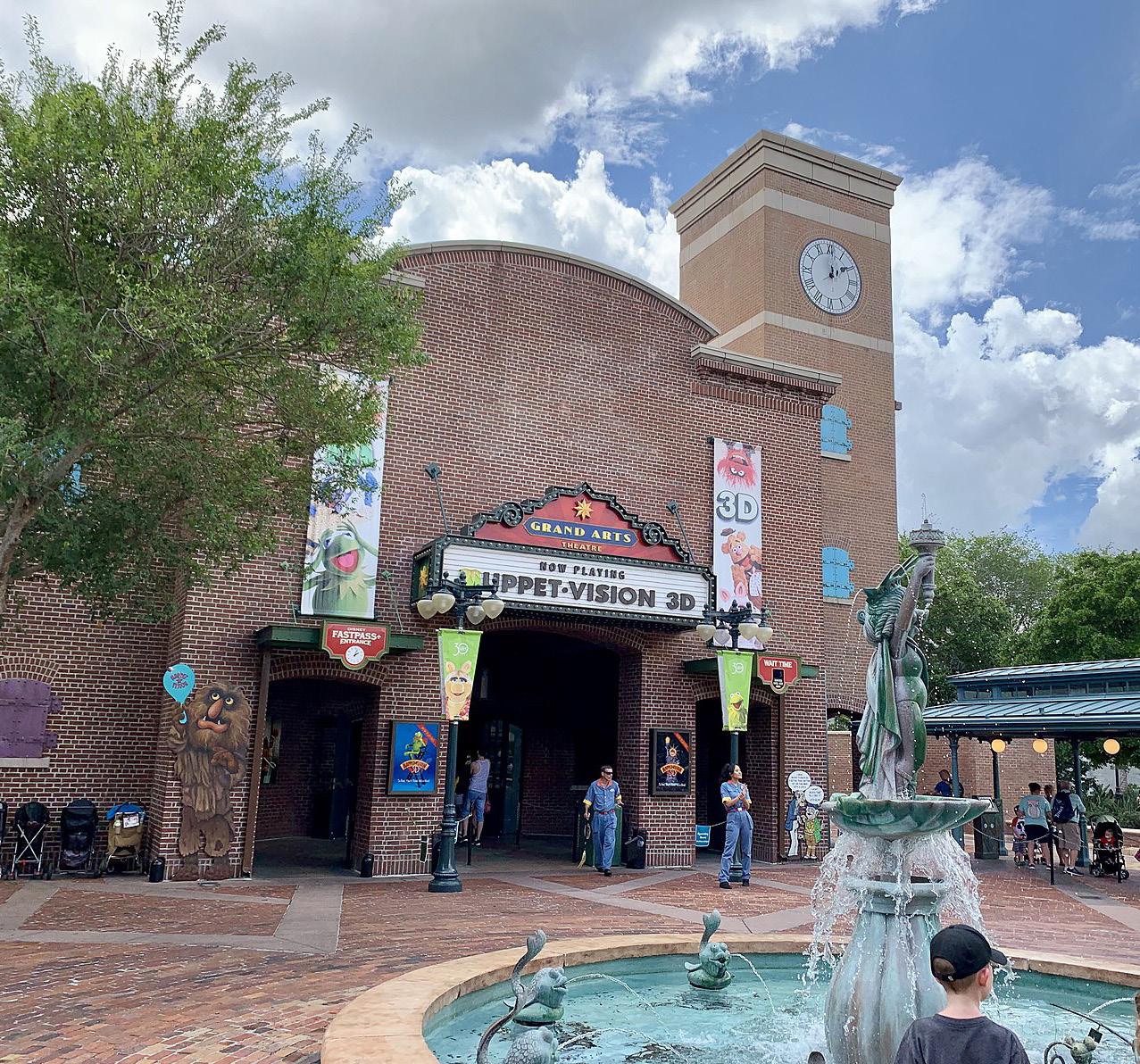
On November 22, 2024 the ofcial Disney Parks Blog announced the closure of “Muppets Courtyard,” a designated area dedicated to Te Muppets” in Disney World’s Hollywood Studios park. Tis closure includes “Muppet*Vision3D,” the sole Muppet-themed attraction in all 12 of Disney’s parks. Opened in 1991, the attraction takes guests through a tour of Muppet Studios, with the usage of 3D, special efects and animatronics.
“Muppet*Vision3D” would also be the last Muppet project made by Henson himself before his death in 1990.
However, this news came as no shock to park goers due to the decline in popularity of the franchise. “Te Muppets” which include and are not
limited to: Kermit the Frog, Ms. Piggy, Fozzie Bear and Gonzo, began their start in 1974 on “Te Muppet Show,” a children’s sketch comedy show that mixed the Muppets interacting with real-life celebrities. Te show aired for fve seasons and spawned six flms from 1979 to 1999 before Disney acquired “Te Muppets” franchise in 2004.
After Disney’s acquisition, “Te Muppets” has not seen a successful interjection into mainstream media since the release of “Te Muppets” flm in 2011 and its sequel, “Muppets Most Wanted” in 2014.
Further muppet fate would falter, as on December 13, 2024, a spokesperson for Max (HBO’s streaming service) announced that HBO would not continue producing new episodes of the children’s show “Sesame Street” after the release of the 56th season in 2025.
“Based on consumer usage and feedback, we’ve had to prioritize our focus on stories for adults and families,” a Max spokesman said. “And so new episodes from ‘Sesame Street,’ at this time, are not as core to our strategy.”
“Sesame Street,” also a Henson creation, began airing on Public Broadcasting Service (PBS) in 1969, to create educational children’s programming that bridges the inequality gap for low-income families. PBS produced the show for nearly 50 years before Sesame Workshop, the non-proft studio behind “Sesame
Street” sold the producing rights to HBO in 2016 due to increasing costs and loss of revenue. Tus, all new episodes of “Sesame Street” would be released to HBO platforms frst, before airing on PBS nine months later.
As the future fate of all Muppets remains uncertain, it is now undoubtedly important to recognize their signifcance in society. As children have shifted from sitting in front of televisions to mobile devices, Henson’s creations serve as a reminder of the ideals children’s media should uphold.
“Sesame Street” is a hallmark of children’s television, not only teaching children basic math, language and empathy skills, but also covering heavy topics such as grief, homelessness and racism in an easily comprehensible way.
Te Muppets” teach the importance of teamwork, perseverance and fun, bringing a smile to all audiences.
Te Muppets,” whose versatility is evident through their various adaptations of classic stories like “Te Wizard of Oz” and “A Christmas Carol,” can still have an impact on audiences today. Since their creation, Henson’s Muppets have made a positive impact on audiences of all ages — regardless if you grew up on any of the franchise’s content. As for “Sesame Street,” fans can be hopeful that future generations will always have the knowledge passed down from Elmo, Big Bird and Oscar the Grouch.

BY ELIZABETH BUNT arts@theaggie.org
Movie: “A Complete Unknown” dir. James Mangold (2024)


Released only a few weeks ago, “A Complete Unknown” is the new biopic of Bob Dylan’s early life. Te flm follows the frst few years of Dylan’s career from his arrival in New York as an untested 19-year-old to his controversial performance at the 1965 Newport Folk Festival. Timothée Chalamet nails the part of young Dylan, and his performance is matched by Monica Barbaro’s portrayal of folk legend Joan Baez. Led by their convincing embodiment, the flm does a fantastic job of giving viewers a glimpse into the folk music scene of the 1960s. No prior music history knowledge is required to enjoy “A Complete Unknown” — anyone with any amount of appreciation for good music will love watching this movie and will fnd themselves adding more Dylan to their usual playlists.
Book: “A Room of One’s Own” by Virginia Woolf (1929)
One of Virginia Woolf’s best known works, “A Room of One’s Own” is an extended essay on the topic of female artists. Over the course of roughly 100 pages, Woolf argues that feminine genius has been stifed by social conditions throughout all of human history. In her most convincing anecdote, she suggests a scenario in which Shakespeare had a sister with an equal amount of poetic talent but who was never given the opportunity to prove it. Originally given as two lectures at women’s colleges, Woolf fnishes with a call to action, demanding that young women continue creating art despite the social obstacles. Tough a work of nonfction, “A Room of One’s Own” is fast-paced and easy to read. It is accessible and thoughtprovoking for any level of reader.
Show: “Abbott Elementary” by Quinta Brunson (2021)


The Blackpink singer brings authentic experiences into her debut album
BY NATALIE SALTER
arts@theaggie.org
“Ladies and gentlemen, I present to you, the ex,” singer-songwriter Rosé said midway through “Toxic Till Te End,” the third single of her debut album “Rosie.” Tis playfully earnest declaration between chorus and verse befts the song itself — a postbreakup anthem refecting upon the rollercoaster of emotions experienced within a fraught relationship, yet it is just as easily taken as a brief summary of the thematic thread which Rosé weaves through the album’s 12-track run. A front-to-back listen of “Rosie” paints a picture of a tempestuous relationship intertwined with the singer’s personal insecurities and the unpredictability of fame, all to create a deeply honest and infectious debut album.
Tough “Rosie” is her solo debut, New Zealand-born Korean singer Rosé has been no stranger to the spotlight. Since 2016, Rosé has comprised onefourth of the massively popular K-pop quartet Blackpink. Te image that she and fellow members Jennie, Jisoo and Lisa have built for themselves as a group is one that radiates selfconfdence and a coolly unbothered attitude toward haters and exes alike. In her October 2024 announcement for “Rosie” on Instagram, Rosé made clear that in her new solo venture, she intends to
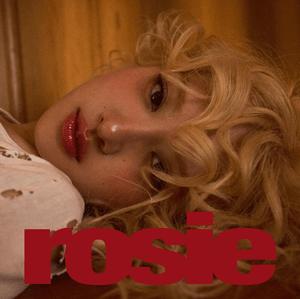
journal of mine.” True to her words, the album — which released on Dec. 6, 2024 — is bursting with the sort of raw emotions and wholehearted expressions of inner fears that would not be out of place scrawled across the pages of a diary.
Te opening track, “Number One Girl,” which was released as a single in November, 2024, delivers most on this promise.
“Tell me that you need me, tell me that I’m loved,” the lyrics read, her voice flled with emotion as the music gradually swells. “Tell me that I’m worth it, and that I’m enough / I need it and I don’t know why.”
Anyone looking for a new bingeable show should defnitely put “Abbott Elementary” on their list. “Abbott Elementary” is a mockumentary sitcom set in an underfunded public school in Philadelphia. It features a cast of dedicated, underpaid teachers trying to give their students the best possible chance of success. While silly and satirical, “Abbott Elementary” is also a very wholesome show, making each episode a very “feel-good” experience. Fans of “It’s Always Sunny in Philadelphia” should defnitely make a point to watch “Abbott Elementary” to prepare for the collaboration season coming out shortly.
Album: “Diamonds and Rust” by Joan Baez (1975)
“Diamonds and Rust” is a classic folk album put together by Joan Baez in 1975, and I included it here as a pairing with “A Complete Unknown.” Made up of a compilation of covers and original compositions, it showcases Baez’s incredible voice and songwriting ability. It is theorized that the title track, “Diamonds and Rust,” was written about Baez’s tumultuous relationship with Bob Dylan, ofering her side of the story covered partially in the Dylan biopic.
Gone is the efortless detachment she exuded as a member of Blackpink, replaced with an undisguised exposure of her desperate need to be wanted and loved.
Interestingly, “Number One Girl” is somewhat singular on “Rosie.” More often than not, Rosé occupies herself with an unnamed ex rather than herself. Tough the frst half of the album is more diverse in its oferings, lyrically and sonically, the latter end of it is flled with lamentful odes to an interred love that melt together into an ocean of embittered metaphors and sorrowful piano melodies. Listeners who came to the album from its wildly successful debut single, “APT” — which features singer Bruno Mars and earned worldwide recognition enough to give Rosé’s album an extra boost in the public eye — might fnd themselves more pleased with the frst stretch of the album than the second. “APT” remains a highlight of the album, with its earworm of a guitar rif and playful lyricism. It’s delightfully fun even months later. Te album’s preoccupation with Rosé’s ex rather than herself does not mean that its breakup-driven songs are weak, however. On “Toxic Till Te End,” Rosé refects upon the aforementioned relationship and its rottenness to the very core. After all, her ex enjoyed playing literal and emotional chess with her and stealing her Tifany rings — how could she not see the red fags?
“I’ll never forgive you for one
thing, my dear / You wasting my prettiest years,” the lyrics read during the bridge, both a despairing recognition of lost time and a coy jab at the unrelenting beauty standards which celebrities like herself are constantly subject to.
Cleverly, she introduces an additional layer of emotional complexity to the track by acknowledging her own part in the relationship’s toxicity, using “we” as often as “you” to make clear that she was an accomplice in their worst moments.
Even if a handful of songs on “Rosie” are a little shakier than others, the highs are high enough to keep the album afoat. “Drinks or Cofee” uses an R&B-inspired instrumental as backdrop to Rosé’s more mischievous side; “Gameboy” is addictively catchy and utilizes simple wordplay to great success.
For all her melancholy, Rosé is efortlessly confdent when she chooses to be; In spite of her promises that she would be open with her insecurities on “Rosie” in order to be as authentic as possible, she triumphs the most when she is entirely unafraid to be herself. Whether that self is sending bold drunk texts or giving firtatious glances from the wallfower benches, she’s what makes the album so great — and one can only hope we’ll see more in Rosé’s future.
Here is a recap of some notable 2024 trends as well as what might flourish in 2025
BY DEVANSHI AGNIOTRI arts@theaggie.org
2024 was an eventful year, to say the least. As usual, a number of trends cycled in and out, TikTok phrases took over everyday language and relevant culture stayed harder and harder to keep up with. Luckily, 2024 did leave us with trends that became part of people’s lives and made life a little more exciting than 2023.
Artifcial Intelligence (AI) had a huge presence in 2024, with many companies continuing to provide AI services, such as Google Gemini and Microsoft Copilot. AI also became an educational tool as people learned how to personalize it for themselves — tailoring it to their study habits and academic needs.
In other culture news, a certain green album took over the summer of 2024. Pop artist Charli XCX released “Brat” on June 7, 2024, which led fans to claim the summer as “Brat Summer.” Te iconic shade of green on the album cover became the color of the summer, while “Brat Summer”
embodied refreshing, wild party energy with euphoric club music that continues to play in the winter months.
As with every Olympic year, the Paris 2024 Summer Olympics took over social media feeds from July 26, 2024 to August 11, 2024. Notable United States, as well as international, athletes used their own social media platforms to capture the experience, with Stephen Nedoroscik, “Pommel Horse Guy,” stealing the show and helping to lead the U.S. men’s gymnastics team to their frst podium fnish since 2008.
Aside from sports, a certain mufn became popular. Norwegian swimmer Henrik Christiansen spoke of his love for the chocolate mufns in the Olympic Village cafeteria, leading everybody to scavenge for a dupe as soon as possible or even become eligible for the next Olympics for this mufn.
As usual, new words were added to people’s lexicon with the help of Instagram Reels and TikTok. The word “demure” was heard in almost every conversation in August due to its popularity on social media. Additionally, the magnitude of social media’s reach was also prevalent when election season
rolled around. All individuals of the ballot utilized TikTok to connect with new voters and provide a new interest in politics among younger generations.
As 2025 begins, it is expected for a minimalistic approach to trend for the beginning of 2025, as “Project Pan” resurfaced and was popularized near the end of 2024 on social media. Project Pan is a challenge where people photograph empty bottles of their skincare, makeup or other self-care products and track their spending through what they have used.
“Instead of celebrating makeup hauls and constant new releases, the panners want to use what they have— and take a more mindful approach to consumerism,” a Vogue article reads.
As one year comes to a close, another year begins flled with the same desire to keep up with what popular media fxations and wellness habits will make it into your own routine for 2025 — or at least, January. Te trends that pop up throughout the year keep life exciting and provide new interests and activities for people to indulge in. Cheers to a new trend cycle in the New Year!


BY IQRA AHMAD arts@theaggie.org
Te countdown reaches its fnal seconds, freworks light up the sky and streamers burst into the air as cheers of “Happy New Year!” echo around the world. In homes and gatherings, traditions unfold — some eat grapes for good luck under their tables, others write down wishes and make vision boards and many set their sights on the future with New Year’s resolutions. But why do we make these annual promises to ourselves? Let’s dive into the history behind this long-lasting tradition. Te tradition of celebrating the New Year with rituals dates back thousands of years, with the Babylonians being among the frst to observe the occasion marking the spring equinox. Teir festivals centered on thanking the gods for a good harvest, rather than making personal resolutions, according to an article by National Geographic. Te vows made during these celebrations were intended to fulfll their commitment to the gods.
While the Babylonians began the tradition, the Romans took the basic idea of a New Year celebration and refned it into a celebration similar to what we now recognize. Romans defned Jan. 1 as the “New Year” in circa 46 B.C., incorporating an idea of spiritual renewal and resolving to restart their years by changing daily habits, according to National Geographic.
As part of their New Year rituals, the Romans would give one another fgs, honey and other foods symbolizing abundance and prosperity, according to an article by CNN. Tese gifts were not only a gesture of goodwill but also a way to invite good fortune for the
year ahead.
In addition to the exchange of gifts, they believed that working on the frst day of the year, even if just for a short time, would set a positive tone and bring good omens for the months to come. Tis combination of symbolic gifts and meaningful actions was thought to ensure a fruitful and successful year. These age-old traditions were eventually brought to early America, where people adopted the practice of making resolutions to improve their attitudes and set personal goals for the year ahead. It is recorded in the 19th century that resolutions became more secular and focused on introspection of the self and society, according to National Geographic. It was a time when individuals began to examine their character, values and roles within a rapidly changing society. Tis era marked a significant shift in how resolutions were viewed, turning them into reflections on self-discipline, social responsibility and the pursuit of personal growth rather than solely relying on external forces or religious guidance.
Today, this tradition continues globally, though the nature of resolutions has evolved. While many still resolve to improve their health, fnances or relationships, the modern twist often includes setting intentions for personal growth, mindfulness or even tackling new challenges.
Despite the changing times, the underlying desire for self-improvement and a fresh start remains a central theme in the way we celebrate the New Year. So while you make your resolutions, take a moment to refect on the history behind them that has been passed down through generations.
The podcast serves as a creative space to discuss the experiences of humanities students

BY JULIE HUANG arts@theaggie.org
Te start of winter quarter and the new year is an excellent time
The “Bookish” podcast discusses topics relevant to humanities students. (Bookish / Courtesy) acknowledges how parents may react in a skeptical manner when it comes to making certain choices, while also emphasizing how important it is to fnd support from peers with shared experiences and fellow English majors who they can empathize with.
Melissa and Lani and edited by John Yarbrough, the undergraduate-based podcast aims to provide
and
for literature students to discuss literary studies and the arts through a myriad of angles, with the overall goal of carving out a space specifcally for students interested in humanities and the arts. In hosting this literature-focused podcast at UC Davis, where attention toward STEM subjects can feel widespread and inescapable to students, Melissa and Lani hope to touch on topics specifcally relevant to humanities students and the issues that come up when navigating university on a humanities pathway. Episode six of “Bookish,” for example, discusses the anxieties and uncertainties of choosing an English major when it comes to the resulting career outcomes, which are not always straightforward. Te podcast
A primary goal of “Bookish” is to bring together students and faculty in an environment that is less structured than academic settings usually are. Hosting faculty such as English Professor Gregory Dobbins, as well as graduate and undergraduate students, Melissa and Lani strike a conversational tone while remaining informational. Each guest on the podcast brings their own interests and perspectives on the broad categories of literature and
humanities-related subjects, infusing every episode of “Bookish” with a distinct personal charm that cannot be easily replicated. It follows that the podcast covers a wide variety of topics all falling under the purview of literature, such as Irish literature, being neurodivergent in academia, queer and transgender poetics, disability studies, environmental humanities and the journey of obtaining a Ph.D. in literature. During each episode, Melissa and Lani also often commiserate about the little details present in the reality of being an English major, touching on things like how a reading-heavy course load may cause declining motivation to read for pleasure or acknowledging the
strange experience of being a humanities student during the widespread growth of Artifcial Intelligence chatbots like ChatGPT.
The content of the podcast is complemented by the gentle, warm atmosphere running through each episode. Troughout the six episodes currently available on the podcast’s channel, it is clear that Melissa, Lani and John hold genuine passion for their goal of creating a inviting space dedicated to literature students and the unique issues and circumstances they face, as well as thoughtful care for each of the guests they invite onto “Bookish.”
The gothic
how the understanding of vampires has changed over time
Students and professors share their thoughts about society’s obsession with the supernatural
BY JENEVAH HARRISON features@theaggie.org
Te supernatural has long been a source of fascination, refecting the fears, hopes and beliefs of societies throughout history. From medieval rituals to modern horror flms, these stories evolve alongside humanity, ofering glimpses into how people make sense of the unknown.
For UC Davis English Professor Tiffany Jo Werth, the connection between language, rituals and the supernatural is a window into the mindset of pre-modern societies. Werth referenced a text taught in her course, Literatures in English I: to 1700, titled “a little charm for when you get a side ache.”

Fast forward to the 17th and 18th centuries, and the supernatural took on new shapes in literature, with vampires emerging as enduring symbols of society’s anxieties. The gothic horror genre especially brought these creatures to life, embodying society’s fears of the unknown.
One of the most wellknown examples, Bram Stoker’s “Dracula” represents the fears and uncertainties of the late Victorian era.
“Stoker’s original treatment of the vampire myth, which predates his novel, expresses the racial and sexual hangups of the late Victorian period,”
BY EVELYN SANCHEZ features@theaggie.org
Finally living away from signifcant parental supervision for the frst time in years, students are naturally excited for the endless possibilities that arise in college. Some of such possibilities include getting tattooed for the frst time or getting a piercing aside from earlobes.
Body modifcations have a rich and varied history, where the first known evidence of tattoos dates back to 4000-3500 B.C.E. Indigenous Polynesians tattoo intricate geometric designs to express personality and identity; Likewise, the Maori people use the medium to display status and signifcance via facial tattoos, and some communities within sub-Saharan Africa practice the body modification of cicatrization where soot or ash is rubbed into a deep cut to produce a raised scar.
tattoos at Death or Glory, a tattoo and piercing shop in Downtown Davis. Being the closest shop to campus, it tends to be Davis students’ go-to spot for when they’re looking into getting body modifcations for the frst time.
“I got my nostril when I was 16 and tattoo when I was 17, with parental consent,” Nirvana Nejad, a third-year English major, said.
Nejad’s frst tattoo and piercing were done at a tattoo shop in Fairfax, Virginia, and, already knowing that they wanted more body modifcations coming into college, it was a matter of “how many” instead of “when.” Tey have since also been tattooed at Death or Glory in Davis.
“I’ve known since I was a little kid that I wanted tattoos,” Nejad said. “If anything, I respect the art form and the culture surrounding tattooing more than I did after coming to college.”
community for the small group of people who choose to have their bodies decorated in some way or another,” St. Clair said in an interview for the non-proft Folkstreams. “I choose to pursue my profession with intelligence and skill, wishing not to ofend anyone, but instead with my love of mankind, do what good I can before I die.”
Faria said that she plans to get a shark tattoo on her arm to commemorate her dog’s name and a pumpkin on her left shoulder to remember her late aunt who nicknamed her “pumpkin.” An avid animal lover with countless pets, Faria memorializes her love through her tattoos.
Lima shared that he finds importance in the aesthetic value of tattoos and prefers those that refect his interests and personhood.
“For me, this little charm illustrates how diferently the premodern world understood the presence of the supernatural,” Werth said.
Tis specifc poem contains a list of rituals that are meant to produce a healing remedy, which includes both physical actions, such as taking medicine and spiritual actions such as recitations and chants.
“Tey suggest that to be healed, going to the pharmacy for a prescription might not be enough,” Werth said. “Te healing entailed was in some ways more holistic than our own as it included both a physical as well as spiritual component.”
Werth explores how these rituals offered reassurance in times of uncertainty. Whether seeking healing or protection, the supernatural was deeply entwined with everyday life, which Werth describes its representation in literature as “connecting words and physical properties.”
“Tey are, like prayers, a kind of insurance against uncertainty,” Werth said. “It also indicates the imbrication of the physical world with the supernatural — both benefcial and malicious.”
Te “prayers” within the poem reflect a broader representation of early supernatural beliefs within this period, emerging primarily as tools to ward of what was deemed to be ‘evil,’ which Werth defnes as any kind of supernatural fgure.
Davis English Professor Jeffrey H. Solomon, who frequently examines how supernatural narratives refect societal shifts, said.
Solomon reflected on how the novel’s themes of controlling women’s bodies and fears of race mixing mirror the anxieties of this era.
“We keep updating and changing to suit our evolving cultural needs,” Solomon said.
Over time, the vampire has transformed from a villain into a more complex fgure.
“Looking at the genre with a more technical narrative perspective, we can see that the vampire has shifted from villain to hero (of sorts) in the postWWII period, when there’s been a corresponding turn in our culture to gradually embrace outsiders and antiheroes,” Solomon said.
The vampire, which Solomon describes as an “other” fgure and a physical embodiment of the nonnormative qualities of humanity, became a representation of a path toward societal change. As society has become more open to general diversity and the existence of suppressed identities, the vampire plot subsequently shifted into a more positive light.
The most recent adaptation of this phenomenon can be seen in F.W. Murnau’s 1922 and Robert Eggers’ 2024 flm versions of “Nosferatu,” where the vampire is described as a true embodiment of evil.
VAMPIRES on 9
Despite the varied significance around the world, it is difcult for some students to lightly shrug of the burden of the task. Taboos surrounding piercings and tattoos remain prevalent in many cultures, such as Japanese culture associating tattoos and piercings with yakuza violence and even banning tattoos in certain public spaces. However, a short stroll through campus would reveal a more lenient attitude toward body modifcations.
“I’d be a diferent person if I still lived with my parents,” Alana Faria, a fourth-year history major, said. “I think I’d be less likely [to get tattoos] because even though I liked tattoos, I thought they’d look bad on me. But college taught me it doesn’t matter how they look on you as long as you like them.”
In an environment where everyone is striving for professional success, the burden of social norms is lighter when your fellow historians and doctors are also getting tattoos that have signifcant meanings to them — and even ones that don’t.
“Being surrounded by so many people where stuf like tattoos and piercings aren’t looked down upon, as well as having a lot of friends that had these body modifcations, made me feel a lot more comfortable getting the tattoos and piercings I wanted,” Cris Lima, a fourth-year physics major, said. “I probably would’ve ended up with at least one small tattoo, but I probably wouldn’t have gotten piercings of any kind.”
Faria and Lima both got their frst
Despite their reputation to some, tattoos hold and refect sentimental value for many people, and the designs often extend beyond simple decoration or a spontaneous decision. Contrary to them often being seen as impulsive, the college setting allows students to view tattoos as a form of art.
Te more time I spent at tattoo shops and talked to people that work there, I realized that getting tattooed is an act of incredible trust with a stranger,” Nejad said. “You’re trusting someone to permanently change your body while they deliberately cause you pain. I think the profession comes from a place of loving people and art.”
Nejad cites a tattoo sheet dedicated to Leonard Stoney St. Clair, a circus performer and tattoo artist who learned tattooing during his time as a performer, which deeply resonated with her. Te sheet was
committed to the history and art of the practice.
“I am in the business of rendering a service to this
“My second tattoo is a physics equation with a little nerdy design [because] at heart, I am a nerd and a physics major,” Lima said. “My third one is a Queen of Hearts, which is my favorite single card in a deck. I also like playing card games, but it’s mainly for the design.”
Despite the value such body modifcations hold, it can still be scary for students returning home for breaks to families that do not share the same sentiment.
“Each passing tattoo and piercing has gotten better, so, [for] like the frst tattoo ever, they freaked out a little,” Lima said. “But they’ve become more okay with it to the point now with my recent tattoo, my mom reacted with a sunglasses emoji.”
Nejad’s mother has also adjusted to the idea of tattoos and piercings — her mother simply wanting her to “slow down.”

Widespread societal attitudes will continue changing, but the culture of body modification will always remain an important art form to many people — both in and out of college.
BY JALAN TEHRANIFAR features@theaggie.org
With the holiday season behind us, it is the perfect time for students to kick of their search and applications for summer 2025 internships. While six months might seem far away, many companies start seeking student interns well in advance. In fact, most internship applications open as early as December, with deadlines typically falling between January and March.
Fortunately, UC Davis has several resources available for students through the Career Center. An important resource available to UC Davis students is Handshake, a job board that connects employers only with university students and alumni, unlike other platforms that serve a broader audience of applicants. UC Davis students automatically have Handshake accounts, allowing students to simply log in with their UC Davis Kerberos to activate it.
Handshake is used to search and apply for jobs and internships, schedule appointments with career advisors at the Career Center, sign up for company interviews and connect students with other students. The Career Center suggests keeping your Handshake profle up to date to improve your chances of getting an internship, as well as your resume.
“The more details you provide about your academics and experience, the easier it is for Handshake to tailor jobs and internships for you,” the Career Center website reads. “Employers can also contact you through Handshake, so having an updated profle allows them to see your accomplishments and skills that they may be looking for.”
Shreya Rupani, a fourth-year sociology major, said that Handshake has been helpful in getting her in touch with employers.
“I took a career-building seminar course one of my frst quarters here, and the instructors taught us how to create our Handshake profles and turn our resumes into sections on the app,” Rupani said. “I haven’t applied for any internships or jobs on there, but I get contacted by a lot of hiring managers who have seen my profle and think I would be a good ft for their company.”
Rupani said that it’s good to have your profle active even if you aren’t looking for a job at the moment. She
emphasized Handshake’s ability to introduce diferent companies.
“I really like that companies are able to reach out to students on the platform because you get to hear from diferent companies that you may not have known exists and see what positions they generally look for,” Rupani said.
“My major is pretty broad, and I can apply what I have learned to a lot of diferent types of positions, so it’s nice to see what’s out there.”
UC Davis’ on-campus internships and research opportunities can also be found on Handshake. UC Davis staf and departments post opportunities and job descriptions at the beginning of each quarter, as well as when positions become available throughout the quarter.
Melayna Ramos, a third-year forensic chemistry major, found her oncampus internship through Handshake with UC Davis Intercollegiate Athletics.
“Around this time last year, I was looking for any job or paid internship on campus, because it was convenient to work where you go to school,” Ramos said. “I came across an internship opportunity to flm for the UC Davis football team during winter ball and throughout the 2024 football season. I didn’t really have any experience in camera work, but that’s the great thing about on-campus internships — they take the time to teach students the skills they need to be successful.”
Te job application process through the Handshake app was easy, according to Ramos. Having her resume already saved in her account allowed her to apply with one click.
“All I had to do was flter my search for on-campus jobs and internships, and it immediately gave me a list of all the openings,” Ramos said. “I didn’t use any keywords since I wasn’t looking for anything specifc, but I found a lot of positions that I was interested in. All I did was click apply — I didn’t get sent to an external tab — and I selected my previously uploaded resume and submitted it.”
Having a resume already drafted and ready to upload to Handshake makes applying to internships easier. Ramos said that the advisors at the Career Center were helpful in resume writing, as she was able to go to resumewriting workshops. “I went to one of the workshops the Career Center hosts, and they showed
my examples of good resumes and helped me fgure out what skills and experience to prioritize,” Ramos said. “I was also told it’s important to tailor your resume to the job or internship you’re applying for, so I always make sure to do that too.”
When looking for internships, it’s difcult to know what type of workplace and industry would be a good ft. A great place to start is by attending a career fair, which is hosted by the Career Center four to six times a year, as it allows you to meet employers and ask questions about positions before applying.
Te Career Center also recommends that students attend information sessions and career fairs to learn about career options, network and explore opportunities.
Natalie DiMeglio, a 2024 UC Davis graduate with a degree in cinema and digital media, held two internships as an undergraduate student. A helpful resource for her was the on-campus
Involvement Fair, which introduced the opportunity to join Aggie Studios, an ASUCD production group, according to DiMeglio. Tis opportunity led to her internship with UC Davis Strategic Communications, as networking with students in the same feld allowed her to learn about more internship openings.
“My internship was with Aggie Studios and UC Davis Strategic Communications in the visual communication department,” DiMeglio said. “Both of my internships opened my eyes to the possibilities out there in creative felds despite what people say about them. It made me realize how much I love what I do and that being able to get paid for it was possible.”
Internships are a great way to test whether you want to pursue a career in a certain feld. For DiMeglio, her internships reinforced her desire to work in the creative media industry.
“Both of my internships opened my eyes to the possibilities out there in creative felds,” DiMeglio said. “My
current job is a production assistant and photographer with the Los Angeles Kings, NHL, and I also am a contracted photographer with the Los Angeles Clippers, NBA.”
Career Fair dates and employer lists can be found on the Career Center website, as well as on the Handshake platform. For students who are not looking for internships just yet, Career Fairs are a great opportunity to network with employers and build relationships for the future. Networking is crucial to career building — something that DiMeglio recommends.
“I think my best advice to students would be to talk to people and make connections,” DiMeglio said. “No matter the feld you’re in, a lot of the rough market is about connections. I had so many people I looked up to in the industry and so I fgured if I wanna be where they are, I need to talk to them — and so I did.”
Enter digits from 1 to 9 into the blank spaces. Every row, column and 3x3 square must contain each digit. Each Sudoku has a unique solution that can be reached logically without guessing.
Answer to previous puzzle 12/5/24


employees an appropriate amount.
Zurof also acknowledged that having Gunrock represent UC Davis in athletics was more ftting than a cow, since cows don’t “really strike fear into other schools.”
However, one hangup she had about Gunrock was his representation in the infamous “Daddy Gunrock Senpai” fanfction, which has been widely circulated on Instagram since 2021. Te fan fction and the fan art did not make me proud to be an Aggie,” Zurof said. [Tat’s] one thing I want to be remembered by.”
Benton Buecker, a second-year environmental policy and planning major, also spoke to the way the mascot should represent UC Davis culture. However, he feels that cows better capture this spirit.
“Davis for the most part is this chill little college town where we have tons of access to nature,” Buecker said.
“And I think that if we want to attract new students, I think that we should lean into the cow messaging.”
Buecker continued to describe the lack of connection between the student body and the current UC Davis mascot.
“I don’t think many people have any sort of emotional connection to Gunrock,” Buecker said.
Buecker believes that the merchandise already being more cowfocused points to the existing afection students have for cows over Gunrock and pointed out how other schools’ mascots represent their cultures more closely.
“You think of UC Santa Cruz, they’ve got the banana slugs, which I think is hilarious because it totally fts with their Redwood, laid-back vibe,” Beucker said. “And I think for Davis, we should have a mascot that represents our vibe and our campus, which I don’t think a blue horse does very well.” He also criticized the need for mascots to be “hyper-masculine predator-type things,” believing that a cow might change that stereotype.
“Te mascot should be a cow because, sorry, Gunrock, you’ve been dead for a hundred years,” Buecker said.
Manly stands in opposition to this viewpoint and wanted to make something clear.
“Tere is a room in the heart of the Aggies for both Gunrock and the cow,” Manly said. Tere is room for both in this ecosystem.”
“Until recently, Davis staf salaries were well below regional averages,” the rebuttal statement reads. “Trough careful management, we have brought our public employees, including frst responders and frefghters, to regional pay parity. Te City’s most recent fnancial audit, certifed by an independent audit frm, concluded the City appropriately accounted for its revenues and expenditures.”
Similar measures that involved adopting a sales tax were on the ballot in other cities in Yolo County like Woodland, West Sacramento and Winters. While Woodland’s Measure U (“Emergency Services and City Improvement Measure”) failed, West Sacramento’s Measure O (“Sales Tax for City Services Measure”) and Winters’ Measure S (“Emergency Services Measure”) passed.
Measure Q is set to stay in place unless it is repealed or amended by voters.
Now, with the results settled and the inauguration impending, Trump represents more than his potential policy changes or even his cabinet. He represents a shift in perspective, demonstrating that the American people accept his behavior as a popular standard, even as exemplary action. Conversations will cascade down from the White House, just as they always have.
Disclaimer: Te views and opinions expressed by individual columnists belong to the columnists alone and do not necessarily indicate the views and opinions held by Te California Aggie.
“I’d argue that F.W. Murnau’s early flm ‘Nosferatu’ is the closest in spirit to Stoker’s novel, where the vampire really is a horrible monster,” Solomon said. Film viewers at Davis, including Violet Ichel, a second year design major, felt like the vampire’s on-screen presence was uncomfortable. Te vampire was terribly scary; however, at the same time, he was also alluring, almost in a sexual way,” Ichel said. This ongoing reimagining and cultural relevance of the vampire myth highlights the enduring power of the supernatural as a narrative device — one that is consistently used in creative media including flms, books and TV shows, as well as intellectual and cultural studies like Solomon described. Trough its many iterations, the supernatural, with vampires as an everpopular example, remains a profound lens for exploring the ever-changing boundaries of cultural, moral and existential understanding.
The local organization tackles important issues through song
BY LAILA AZHAR features@theaggie.org
Te Davis Raging Grannies are a chapter — or a “gaggle,” as they call it — of the international organization of Raging Grannies.
Te frst Raging Grannies was a group of women in Canada. In 1987, in response to the presence of United States Navy warships and submarines in Victoria, they launched a series of creative protests, often including singing songs and dressing up in costumes.
“Young people that see us are often surprised,” Lynne Nittler, a founding member of the Davis chapter of Raging Grannies, said. “Tey probably think: ‘Tese are old ladies, what are they doing out here?’”
Dressed in wide-brimmed hats decorated with flowers, patterned aprons and feather boas, the Davis Raging Grannies can be found singing songs such as “Deck the Halls (of Congress)” and “I’m Dreaming of a Trump-Free Christmas.”
The subject of the songs often have to do with serious issues such as climate change and voting rights. But their weekly rehearsals are flled with positivity. Te women check in with each other, laughing and chatting as they make revisions to their songs. For them, activism also includes building a community.
Te Davis chapter was formed as a direct response to the 2016 election, a time during which many people were looking to get involved in politics.
“Most of us grew up during the ‘60s
and ‘70s, and we were kind of steeped in activism,” Jeanette Vance, a member of the Davis Raging Grannies, said.
“[It was] the Vietnam War,” Nittler said. “As the guys in our classes went of and fought, some didn’t come back.”
When she first saw a notice recruiting women for Raging Grannies, Vance was reminded of the activism that occurred around her during the years of the Vietnam War.
“I wasn’t active at that time, but I was just starting to vote, so I was voting for all the peace candidates,” Vance said. “But when Trump was elected, it fipped a switch in my mind. I saw that notice and thought, this would be so good for me — to be with other people that felt the same thing and to make some noise, to protest.”
Since then, the Davis Raging Grannies have sung at the farmers market, marched in the Picnic Day parade and participated in protests such as the Women’s March in Sacramento and the Climate March in San Francisco.
Nittler said they aim to bring an air of positivity to politics.
“There’s enough bitterness and negativity out there,” Nittler said. “Even if something has a serious meaning, if you say it couched in a song it becomes an earworm. [People] remember the idea, or just laugh, not because the topic is not a serious one, but because that can break down barriers.”
Hearing political messaging coming from a group of “grannies” is surprising for some. Te members of Davis Raging Grannies believe it is precisely that surprise which makes their message memorable.
“In general, the whole idea of
dressing up like grannies is to appear like harmless little old women,” Vance said.
Vance also said that the positive feelings of affection surrounding grandmothers helps to push their message.
“Yes, everyone has good feelings about their grandmother,” Vance said. “To try and shake them out of their complacency presents a contrast; Here’s something that you didn’t expect to have teeth behind it, but there’s a real purpose.”
For the group, providing inspiration to younger generations is a key part of their mission.
Zara Hashim, a third-year psychology major, spoke on the group’s impact in inspiring important conversations about activism.
“A lot of Gen Z’s political engagement happens online,” Hashim said. “Groups like the Raging Grannies are a great example of the fact that we shouldn’t forget the importance of building community and engaging with politics locally.”
Despite the fact that the group feels discouraged by the results of the recent election — as it was Trump’s frst election in 2016 that sparked the chapter’s inception — the Davis Raging Grannies have hope for the future.
Tat’s one of the things that I’ve found the most satisfying about being a part of the group too, is the idea of passing on the torch to the next generation,” Nittler said. “We want to engender the idea that activism and wanting to do something to try and make the world a better place can start when you’re young, but it can continue your whole life.”
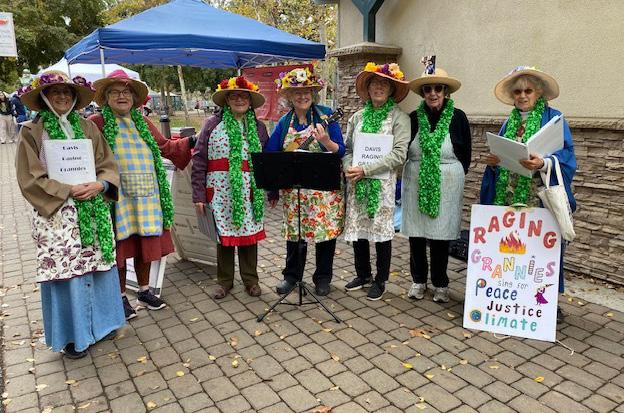
The Try Before You Buy program encourages students to test out classes for free for the first two weeks of every quarter
BY RACHEL GAUER features@theaggie.org
With a new year and new quarter now in full swing, many students are inspired to set goals involving ftness and recreation. The Activities and Recreation Center (ARC) on campus tends to attract students who fock toward its doors with the intention of building healthy habits. Tough some may prefer a more individualized routine, the ARC ofers a number of Group Exercise classes for those who might want a guided workout or a social, community-based ftness opportunity. Living Well ofers Group Exercise classes, Small Group Training classes, Dance and Martial Arts classes for students who have a variety of interests in recreation and ftness. Tis quarter, Group Exercise classes will include Zumba, cycle classes, yoga and a variety of strength training classes. Small Group Training classes will ofer powerlifting, pilates and a variety of strength training activities. Classes that fall under the martial arts section include boxing, Jiu-Jitsu, Muay Tai and self defense training classes. Dance classes will be ofered in salsa and bachata, hip-hop and ballroom, as well as Latin and swing. For students who may be interested in the variety of classes ofered but are not ready to fully commit to a quarter pass, Living Well ofers a Try Before You Buy program that allows students to try out unlimited classes for the frst two weeks of every quarter. Tis quarter, the trial period will occur from Monday, Jan. 6 until Friday, Jan. 18.
Elise Ayala, a fourth-year applied mathematics major and group exercise instructor through Living Well that
teaches Party Cycle, Cycle and body strengthening classes throughout the week, outlined the Try Before You Buy program.
Te Try Before You Buy program is a great opportunity that the Living Well program ofers at the start of each quarter,” Ayala said. “It’s a great time to try out as many classes as you are interested in to see if you would like to purchase the pass for the quarter.”
After Jan. 18, students must have a class pass to attend, which costs $35 per quarter; However, Ayala noted that students can apply for a fee waiver to attend the classes for free. Te pass allows students to attend as many classes throughout the quarter in whatever activity the pass is purchased for.
Many students take advantage of the program to experience ftness classes they perhaps have had only limited experience with or to simply try something new, for free. Anusha Aggarwal, a third-year political science major who is on an exchange year in Davis from London, participated in the Try Before You Buy program last quarter and plans on trying out more classes in winter.
“I tried the Salsa & Bachata class — I thought it was good fun, but I did not continue afterwards because I just didn’t have time and had course clashes,” Aggarwal said. Aggarwal plans on attending the Party Cycle classes, which is a spin-bike cardio class with upbeat music and party lights, during the two-week trial period and, depending on her schedule, will consider purchasing the pass.
For Ayala, becoming an instructor was a result of her taking classes at the ARC and fnding an interest in the program.
LIVINGWELLCLASSES on 11
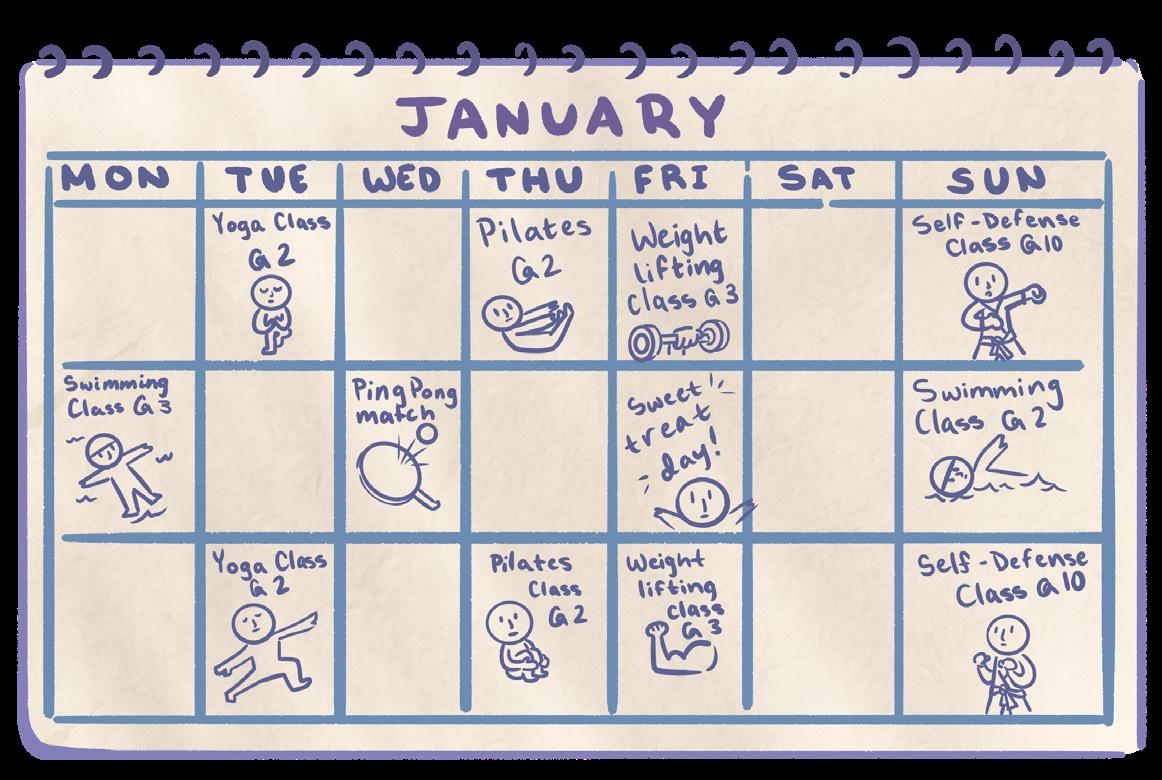
Lashkara dance team fosters commitment, talent and community building
BY GRACIELA TIU
features@theaggie.org
Lashkara, UC Davis’ premiere Bollywood Fusion dance team, prides itself on the talent, community, passion and hard work of its members. Whether it be through their choreography, practices, performances or their overall bond as a team, Lashkara at UC Davis exceptionally impacts its members, the school community and beyond.
“Lashkara strives to spread cultural diversity through Bollywood Fusion dance by blending traditional and modern elements of dance into its set,” Sumit Mantri, a second-year computer science and statistics double major, said.
“Te team refects these values by incorporating innovative, traditional choreography as well as a mix of both modern and traditional music.”
Ani Chiplunkar, a secondyear statistics major, described how Lashkara’s signifcance extends beyond just dance.
“At the end of the day, Lashkara is more than just a dance team or a set of people,” Chiplunkar said. “It’s a purpose. We perform a plethora of dance styles and tailor them to a theme in order to satisfy the purpose of really moving people and showing how passion can bring out the best of us.”
Members of the team recognize how their commitment to their work is driven by a common love for what they do.
Te drive that we have to dance is refected through our dancers,” Dhwani Shetty, a second-year materials science and engineering major, said. “Passion is what fuels us; it’s how we perform as a team, do things as a team and bond as a team — over our love for dance.”
The team’s performances range between multiple dance styles but are combined into one performance.
“Te style and energy of a typical Lashkara performance is very versatile,” Shetty said. “We have an eightminute segment that we perform at competitions and it includes various dance styles such as Bhangra, Bollyhop, Bollywood, contemporary, hip-hop and more. Each of these requires diferent types of energy.”
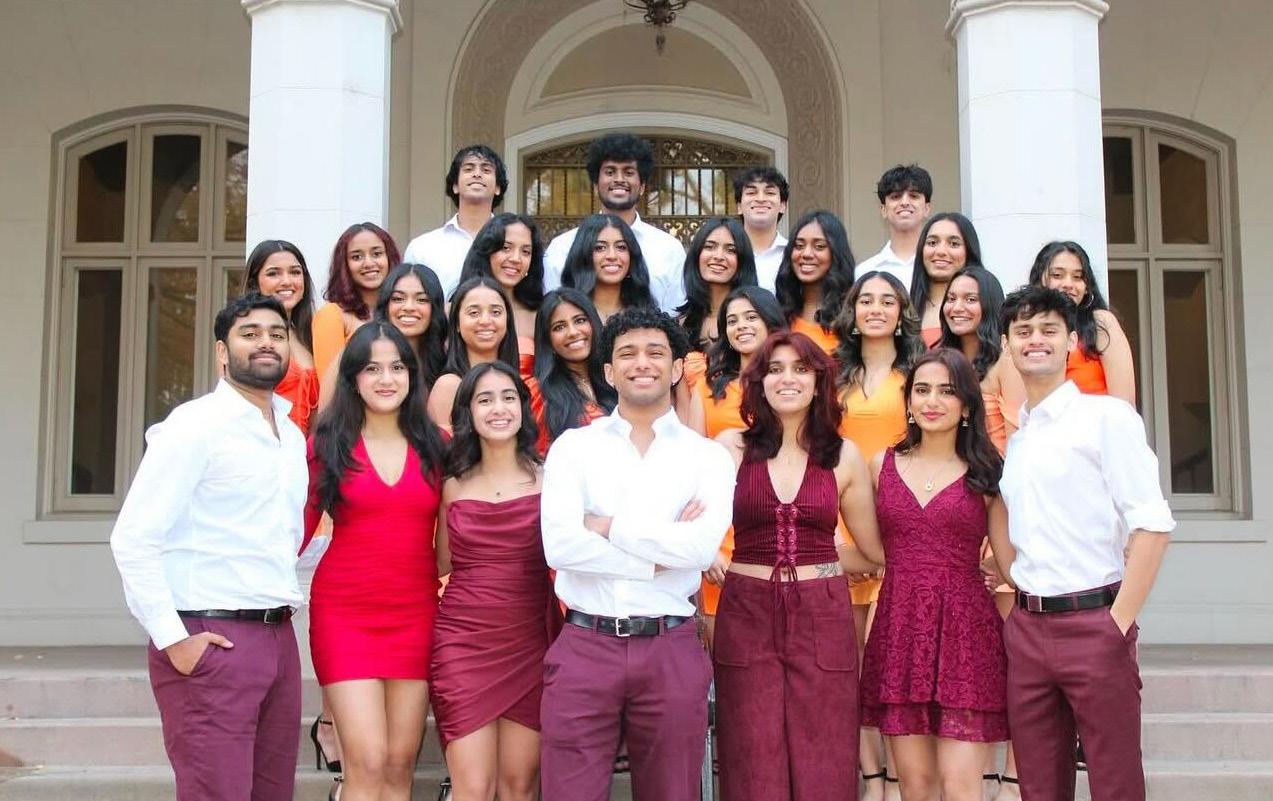
Mantri refected on what made him feel inclined to try out for the team.
“Before Lashakra, I had little to no dance experience, but dance is something I’ve always been interested in,” Mantri said. “So I decided to give it a shot, and I came to the realization that this is something I truly enjoy. Not just the dancing, but the community and connections that you build through the team.”
One of the most important pieces that ties the team together is their frequent practices.
“A typical week involves structured practice sessions, often fve times a week for three hours a day, focusing on choreography, cleaning, stamina building and synchronization,” Mantri said. “Before a performance or competition, rehearsals and hours do intensify, and mock performances are held to ensure our readiness so we can go into our competition confdent in our set.”
Despite the long hours of practice
for the team, some members said that the time commitment actually benefts their academic performance.
Te practices are long, but it’s helped me learn how to manage my time better,” Shetty said. “I know I have dance at 8 p.m. and I have to fnish everything before then, so it really helps structure my schoolwork.”
UC Davis Lashkara has around four performances a year that they travel to, depending on which competitions the team qualifes for. One of the most memorable ones for the team in the past year was University of Georgia (UGA) India Night in Athens, Georgia.
“I would say UGA India Night 2024 was the most memorable performance for me in Lashkara as I’d never performed before on stage, and we ended up having to perform frst for the event,” Mantri said. “Before performing, I peeked out from the backstage curtains, and I saw thousands of people in the audience, and heard people chanting our team name. I was
nervous to my core and had a huge adrenaline rush. And when going onto the stage, I carried that adrenaline rush through with me for the performance and was hyped to showcase our set.”
Chiplunkar also explained why UGA India Night was such a special performance for the team.
“It was our frst competition, and we had all the odds stacked against us — logistical problems, technical issues, the entire circuit and people at our own school doubting whether we’d place or not,” Chiplunkar said. “Placing at that competition really set the tone for a west coast team to make a big impact on the circuit, and that’s exactly what we did. So it was a memorable performance, because it proved to myself and others that really, if you put your mind to something, you can defy all odds, no matter how much they’re stacked against you.”
Members including Mantri believe that a big part of what makes the group
so special is the diferent talents that each individual member brings to the team.
“Every team member has their unique strengths that are utilized for diferent aspects of our set,” Mantri said.
“Some people are really imaginative and artistic, so they become interested in the production part of our performance, and some people are creative, so they’re inclined to begin creating choreography. Tese strengths don’t go to waste, and they defnitely positively impact our set.”
Trough all of their practices and performances, the team’s members believe that one of the most rewarding aspects of the dance team is the community they’ve created.
“It’s just so special, because we all got so close over a short period of time,” Shetty said. “We haven’t known each other for that long, but it feels like we have known each other for a really long time because we spend so much time together.”
The UC Davis Coffee Center is looking to make UC Davis one of the top places for coffee research and education
BY KATELYN BURNS science@theaggie.org
What began as an introductory chemical engineering course has become a center dedicated to cofee research and education.
courses at UC Davis is ECH 001: Design of Cofee — An Introduction to Chemical Engineering. Started by Professors of Chemical Engineering and

One of the most popular undergraduate elective
SAVANNAH BURGER / AGGIE
Co-Directors of the UC Davis Cofee Center William Ristenpart and Tonya Kuhl, the course gives students hands-on experience with engineering and science principles using cofee. Students also get roasting and brewing experience using the Cofee Brewing Control Chart, which uses factors such as total dissolved solids (how strong the cofee is), extraction yield (what fraction of mass was taken out of the solid cofee grounds into liquid phase) and brew ratio (the ratio of water to cofee grounds used). Te whole process of roasting and brewing cofee really is chemical engineering,” Kuhl said. Following the success of the Design of Cofee course and with the support of faculty interested in cofee and the cofee industry, the Cofee Center was built. Te building remodel was entirely
funded by donations, and the Cofee Center was reopened in spring 2024. It has an espresso lab, pilot roastery, analytical lab, green bean storage, sensory booths and more.
“[Te Cofee Center is] the nation’s frst academic center located on a college campus focused on cofee,” Ristenpart said. “Te idea is to have everything you need for advanced cofee research and advanced cofee education under one roof.” Te Cofee Center may have built of of the success of the chemical engineering department’s Design of Cofee course, but it is meant to serve as a nexus for all cofee research on campus.
Timothy Styczynski, head roaster for the UC Davis Cofee Center, facilitates the material-handling side for graduate students at the Cofee Center during their research projects. Tese projects include AnokyeBempah’s research into titratable acidity, which is a measure of total acid concentration.
“[Anokye-Bempah] found that there’s a bell curve of increase [where the data increases to a peak before decreasing] in titratable acidity of roasted cofee across the production cycle,” Styczynski said. “Tat had never been done before.” Styczynski also discussed Roastpic, an app developed by UC
Davis computer science students for evaluating cofee beans.
“A couple of computer science students, who also happen to be Q graders — which is similar to a sommelier for wine [but for cofee] — helped develop an app that uses a calibrated sheet for measured color using your cell phone’s camera,” Styczynski said.
Styczynski also discussed his hopes for future research at the Cofee Center.
“Te hope is that we’ll be able to do a green cofee defects study,” Styczynski said. “Right now, the rules about defects date back almost 150 years, and they’re really a subjective view on something that’s good or bad about the green cofee.”
Cofee, while incredibly complex, is under-researched. From taste to sustainability to climate resistance to green cofee defects, there is a lot of room for improvement when it comes to the current cofee production processes.
“For something that is so valuable as a commodity — the monetary value is immense and the social-economic value is incredibly important — there’s very little research in cofee,” Styczynski said.
Johns Hopkins researchers have trained a robot to perform surgical skills completely autonomously
BY NAREN KRISHNA JEGAN science@theaggie.org
We all have likely heard of or used AI. Playing a pivotal role in many innovations in technology and medicine, AI has made a remarkable impact in such a short amount of time. From creating algorithms that can detect cancers to automating follow-up messages with patients, there are many aspects in which we can use AI for our beneft. Currently, a team of researchers at Johns Hopkins University aims to implement AI in the feld of robotic surgery.
Surgical robots, such as the da Vinci surgical system, were introduced in the early 2000s, marking an innovative leap in surgical technology. As skilled as surgeons are, they are limited by tremors when handling their instruments, along with a limited range of motion. Surgical robots can substantially reduce these problems by eliminating the tremors and providing motion in ways that humans cannot replicate.
Although robots are used for these surgeries, they are controlled by specially trained surgeons. In real time, the operation site is displayed in high defnition to a surgeon, who manipulates their tools using a console on the robot. Te console transfers the surgeon’s hand movements into robotic motions to perform procedures such as lacerations, suturing and cauterizations.
Recently, at Johns Hopkins University, researchers have used artifcial intelligence to successfully
Vitamin D is also incredibly important for our mental health, as it impacts the molecules in our brains that allow us to keep our serotonin — acting as a neurotransmitter that helps regulate our moods — levels up. So, less vitamin D from less sun exposure can keep those molecules from adequately doing their jobs, leading to lower levels of serotonin in the colder, darker months. Without sufcient serotonin, we can feel destabilized.
Te good news is that there are things we can do to take care of ourselves during these dark and stormy nights. Utilizing supplements is a popular and efective treatment strategy; Melatonin, for example, is abundantly available over the counter.
A common misconception about melatonin is that it works as a sedative, even though it doesn’t — it’s a hormone that our bodies produce naturally that helps regulate our sleep and wake cycles, rather than simply putting us to sleep. Common practice is to take fve to 10 milligrams about 30 minutes before we want to go to sleep, although it doesn’t necessarily work that way. Instead, I suggest taking a smaller dose (up to one milligram) several hours before going to sleep and taking it every day. Tis will help realign our circadian rhythms over time, which is how melatonin normally functions. Overdoing and misusing melatonin can actually worsen symptoms of insomnia and drowsiness during waking hours, so it’s important
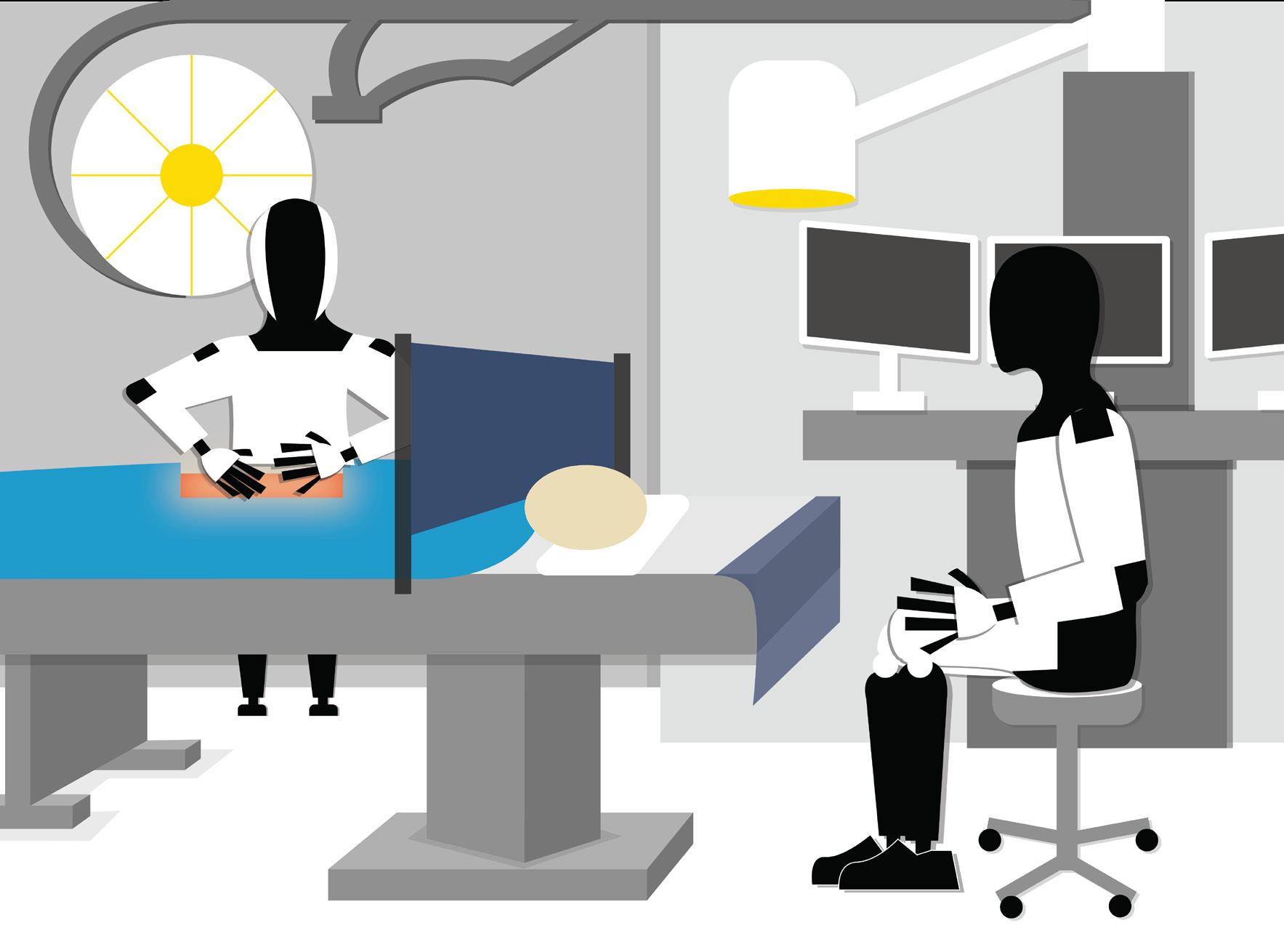
on the implications of this new technology.
“... Tis marks a signifcant step forward toward a new frontier in medical robotics,” Krieger said. “[Te model]... learns things we haven’t taught it… If it drops the needle, it will automatically pick it up and continue.”
Dr. Arnauld Bewley, an otolaryngologist at UC Davis Health, has worked with surgical robots and has positive expectations for automated medical robotics.
“AI is used more and more every day in the clinic… We must learn how to embrace it as a tool to help us perform our jobs better,” Bewley said. “[I hope] to see the automated da Vinci and other surgical robots be used for general surgical procedures… As for more complex procedures, we’ll have to see how the technology comes along.”
Te quick learning curve of the robot serves as one of the team’s primary areas of focus. Traditionally, training a surgical robot would involve hand-coding every step, which would be an inefcient use of time and resources. Lead author Ji Woong “Brian” Kim said the current algorithm takes a diferent approach to tackle the problem.
STEPHANIE CHAN / AGGIE
train a surgical robot to perform basic surgical skills completely on its own.
Te team, which included Stanford University researchers, used imitation learning by feeding a machinelearning algorithm hundreds of videos of surgical procedures. Ten, the team was able to train a da Vinci robot using this algorithm to perform three essential tasks in surgery: manipulate a needle, lift body tissue and suture. Although da Vinci systems are
to be patient. Vitamin D is also an easy-to-acquire supplement, and, unlike melatonin, it’s hard to overdose on it. Unlike other vitamins like vitamin C, vitamin D is fat-soluble rather than water-soluble. With vitamin C, any excess that you ingest will just be fushed out of your system through your kidneys. On the other hand, because vitamin D is fatsoluble, your body will absorb what you take in.
Te amount that each person needs varies based on age, region, diet (how much vitamin D you get from the foods you already eat), skin color and body size, among other factors. Te Mayo Clinic notes that beyond 4,000 international units (IU) per day is unsafe, and most drug store supplements contain half of that or less. Vitamin D defciency is also very common; Te last time I asked my primary care doctor how much I should be taking, she said that she’s never seen anyone have lab results that showed enough vitamin D — do with that information what you will.
Of course, supplements and selfcare practices aren’t magic. Even if we make ourselves into perfect pictures of health on paper, chances are our seasonal depression won’t disappear.
It can certainly make a big diference, but it’s not a panacea. I’ve personally found that prioritizing time with my social circle makes a signifcant diference. Surrounding myself with people who give me love has proven to be incomparably rejuvenating time and time again, similar to fnally charging your phone enough to turn of lowpower mode. Be extra gentle with yourself now that the days are shorter and the winds
widely used, they have notoriety for being imprecise. To resolve this issue, the team trained the robot to perform these tasks with relative positioning instead of absolute positioning: the movement of each joint on the robot was based on the related movements and locations of each individual joint rather than the position of the joint in each frame for all videos. Because every surgeon has their own preferences for locations of their tools, using the exact
have turned cold and unforgiving. Take care of yourself, but also cut yourself some slack. Yes, it’s hard to feel optimistic when it’s dark at 4:30 p.m., but don’t forget that the sun will always come out tomorrow.
Disclaimer: Te views and opinions expressed by individual columnists belong to the columnists alone and do not necessarily indicate the views and opinions held by Te California Aggie .
Although we are not being “productive” in the corporate sense, we are actively doing something that we love. Spending time on our hobbies helps us feel more fulflled in our lives. Phone usage and social media masquerade as “leisure time” but, in reality, do not make us feel any more fulflled (as leisure time ideally should). Our phones take up all of our leisure time and leave us with no time in the day to do anything we actually care about.
We owe it to ourselves to cut down our screen time. Life goes by too fast for comfort and we lose so much time simply staring at a screen. If we have an extra four hours and 37 minutes in the day, then we have so much more time to do all the things we want to do. Finally go to Mary L. Stephens Davis Branch Library and pick up that book you have been wanting to read. Learn how to perfect your favorite dish. Go for walks. Volunteer
location of every tool in the model would provide a wide range of values which could potentially lead to inconsistent performance. On the contrary, using relative locations allows for the model to pinpoint a much more accurate way of location, angle and force required to perform the tasks.
Professor Axel Krieger from the Johns Hopkins Department of Mechanical Engineering commented
for your community. Get really into building puzzles for a month. Try out a new hobby and hate it, but that’s okay because at least now you know that you hate it. Tere are endless ways to spend your new time away from your phone. Replacing your screen time with fulflling leisure time will not only diminish the negative health efects of screen usage, but improve your overall well-being. Now, when someone asks us what we did over break, we won’t feel ashamed in our answer — because we know that we spent our time doing something meaningful to us, whatever that might be.
Disclaimer: Te views and opinions expressed by individual columnists belong to the columnists alone and do not necessarily indicate the views and opinions held by Te California Aggie.
Ayala began taking cycling classes through the ARC her frst year and later became certifed as an instructor. She explained how the classes and community she has found have impacted her college experience. “I wanted to become an instructor, because I have such a passion for cycling and workout classes in general, and I feel that they are a great way for a community to be built and to provide a comfortable space to exercise,” Ayala said. “I have really enjoyed teaching group exercise classes and have now
“Even with a few hundred demos, the model is able to learn the procedure and generalize new environments it hasn’t encountered,” Kim said.
Innovations like surgical robots push the boundaries of both medical technology and engineering, and they serve as the starting point for the development of many future technologies. Tere is signifcant potential for automated surgery to become a prevalent part of our future; with innovations like these, that stage is becoming closer and closer.
been teaching for six quarters.” Sachi Khurana, a fourth-year mechanical engineering major, is also a cycle instructor through Living Well. She commented on how she frst became interested in leading cycle classes.
“I got hooked on cycle classes the summer before college,” Khurana said. “I really wanted to become an instructor because I loved how cycling made me feel and I wanted to give that to others.” Khurana suggested that any gym goer utilize the Try Before You Buy program to test out what fitness methods and classes work for them.
“I would 100% encourage students [...] to participate in the Try Before You Buy program,” Khurana said. “I think it’s an awesome way to try something new. You can try out as many formats and instructors as you like to fnd what you enjoy the most.
For a more extensive schedule of times and lists of classes ofered through Living Well, visit the Class Schedules page on the UC Davis Campus Recreation website.

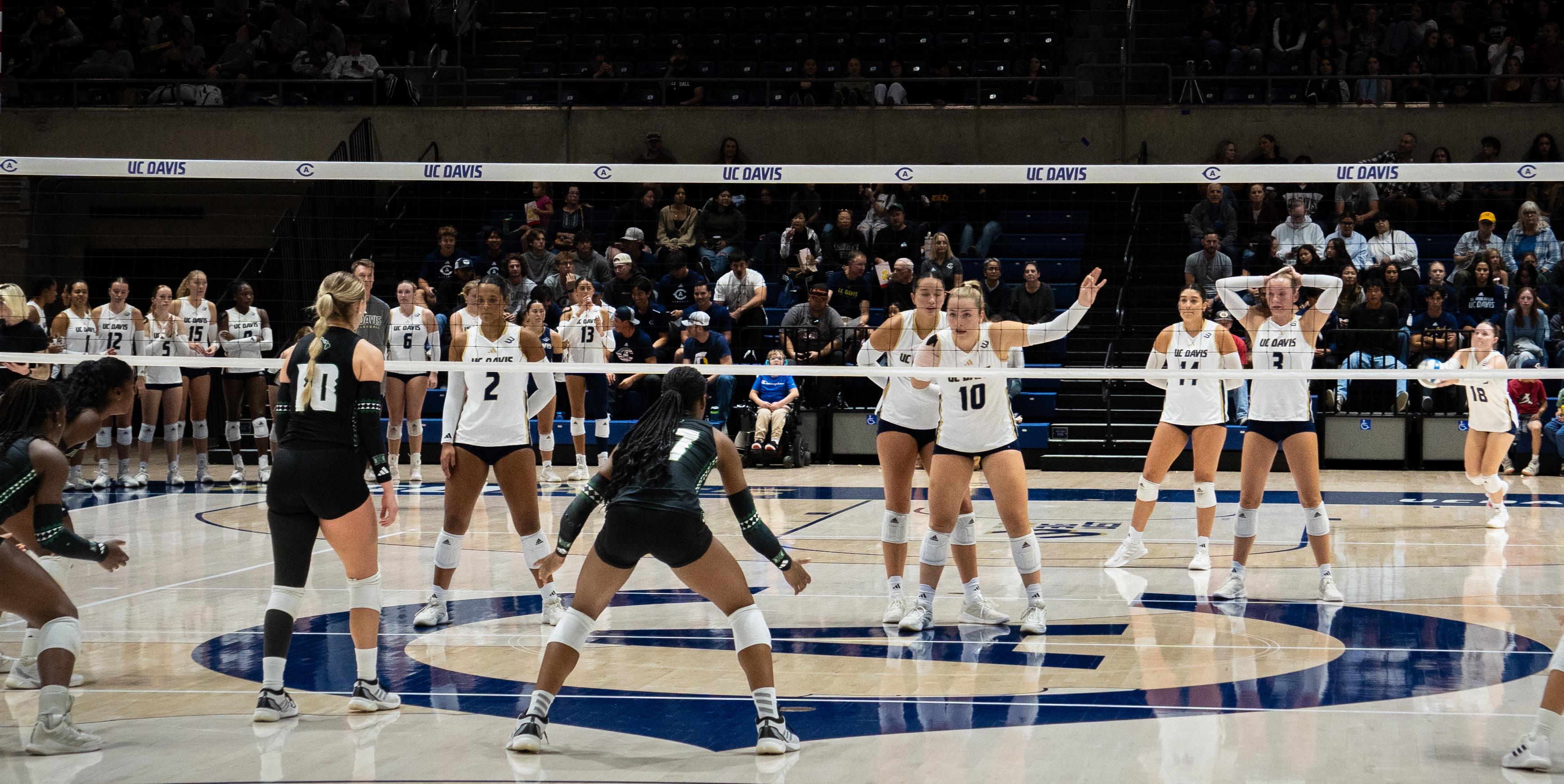
BY ABIGAIL DESA sports@theaggie.org
Te UC Davis women’s volleyball team wrapped up their season, celebrating a series of historical achievements for the Aggies. With a major nine-game winning streak and a collection of victories against powerhouse teams, the Aggies secured second in the Big West Conference for the frst time since 2009 and marked their return to the top three, which hasn’t happened since 2014.
Amongst the many frsts for the Aggies this year was a win against UC Los Angeles, the frst in program history in non-conference play. UC
West Conference which made their loss a big shake-up for the season’s projections.
Davis also notes record-breaking attendance for a home game with fans showing up to support the team and witness the phenomenal match. Te Aggies started their winning streak with a three-set win against UC San Diego in their second Big West season game. Tis game showcased the Aggies’ tenacity, proving how they are able to bounce back following a loss against California State University, Long Beach two days prior.
On Oct. 4, in Mustang territory, the Aggies defeated California Polytechnic State University, San Luis Obispo for the frst time since 2015.
Picked as the League Favorite in the preseason poll, Cal Poly has been a consistent top contender in the Big
After two more victories and a continued winning streak of four games, the Aggies faced the Rainbow Wahines of the University of Hawai’i and prevailed in a four-set battle. Tis marks another achievement for the team as it is their frst triumph over Hawai’i since 2013. With these wins against key fgures in the Big West Conference, the Aggies cemented their presence as a dominant force in the league. Following their win in Hawai’i, the Aggies celebrated four more victories against California State University, Bakersfeld, California State University, Northridge, UC Irvine, and California State University, Fullerton. Te streak was then broken by UC San Diego in a hard-fought fve-set match. Following the UCSD loss, the Aggies were additionally set back by a close game with Cal State, Long Beach where they sufered another defeat.
Although the Aggies would overcome the upset with a win against UC Riverside, the players fell short in their home game rematches with Hawai’i and Cal Poly. In the Big West Volleyball Tournament, the team faced Hawai’i for the third time this season in an electric match to break the 1-1
tie in their previous encounters. Te showdown ended in a tough loss for the Aggies, as they battled through a fve-set game, with the ffth set narrowly going 13-15 in favor of the Rainbow Wahines. While their season had a tough end, as a whole the Aggies were successful in showing the fortitude and drive of both the players and the program. Although the entirety of the roster played a part in the program’s accomplishments, several key players had stand-out performances throughout the season. Notably, Olivia Utterback, a fourth-year human development major, Ally Chandler, a second-year undeclared major, Jade Light, a third-year aeronautical engineering major, Ximena Cordero Barr, a frst-year landscape architecture major, and Mia Starr, a second-year undeclared major, all played vital roles in fueling the team’s victories. Utterback, an opposite hitter for the Aggies, leads the team on many fronts. She has the most kills on the team with 422 kills and has the second-most service aces on the team (39). For her excellence in her position, Utterback was nominated for the 2024 AVCA Pacifc All-Region Honorable Mention and 2024 All-Big West Conference First Team. Chandler, a middle blocker, also
received a nomination. Chandler is nominated for the 2024 All-Big West Conference Second Team. Being No. 1 in hitting percentage in the Big West (0.373) and having the second-highest number of blocks on the UC Davis team (81). Chandler is undeniably integral to the roster. Also nominated for the 2024 AllBig West Conference Second Team is outside hitter Light. Light has the most service aces for the Aggies, scoring 40 aces overall, and in the conference has the second-highest number of aces (28). Light is also seventh in the conference for kills, with 3.48 kills per set. Additionally, setter Starr and libero Cordero Barr are nominated, with Starr being a 2024 All-Big West Honorable Mention and Cordero Barr on the 2024 All-Big West Freshman Team. Starr had a team high of 1,177 assists overall with 9.87 assists per set. Cordero Barr had an all-around successful season in kills, assists, service aces and a notable 239 digs. Placing second overall in the Big West Conference demonstrates the capability of the UC Davis women’s volleyball program. Proving expectations wrong and charting their path, with these new achievements the UC Davis Aggies are set for a bright future and more successful seasons ahead of them.
The Aggies look to improve their 8-6 record in upcoming conference games
Recap of the 2024 UC Davis women’s volleyball season BY
COLINA HARVEY sports@theaggie.org
While classes ceased for winter break and students left campus, the UC Davis men’s basketball team continued its season, playing fve games over the break. Te Aggies had a decent start to the season with a 5-4 record, going 2-0 in conference games. On Dec. 14, the Aggies took on rival Sacramento State in a non-conference away game. While the Sac State Hornets came out of the gate with a 12-1 lead in the frst three minutes, the Aggies steadily gained momentum. Tey tied the game at 25-25 with seven minutes left in the frst half, managing to go into halftime with a three-point lead.
Te Aggies continued to score and went on to win the second half, completing the game with a 69-62 win over the Hornets. While the game was close, it was clear in the last few minutes that the win belonged to the Aggies. On Dec. 18, UC Davis took on the University of Idaho Vandals back on Davis turf. Te Aggies earned a victory earlier in the season on Idaho’s home court in a close 79-75 win. Tis rematch gave the Aggies a chance to go up 2-0 against the Vandals.
Te Aggies gained an early 10-2 lead, with seven of those points belonging to Pablo Tamba, a fourthyear communications major and forward. Te team maintained that lead throughout the entire frst half, going into halftime with a score of 32-25. TY Johnson, a fourth-year communications major and guard, led the Aggies in scoring, contributing 11 points in the frst half. In the second half, the Idaho Vandals’ scoring stalled out at 30 points while the Aggies went on a 10-point run, increasing the score gap to 16 points with 13:56 left in the game. Ten, the Vandals went on a run of their own, scoring nine straight points and cutting the Aggie lead to seven. However, this was not enough
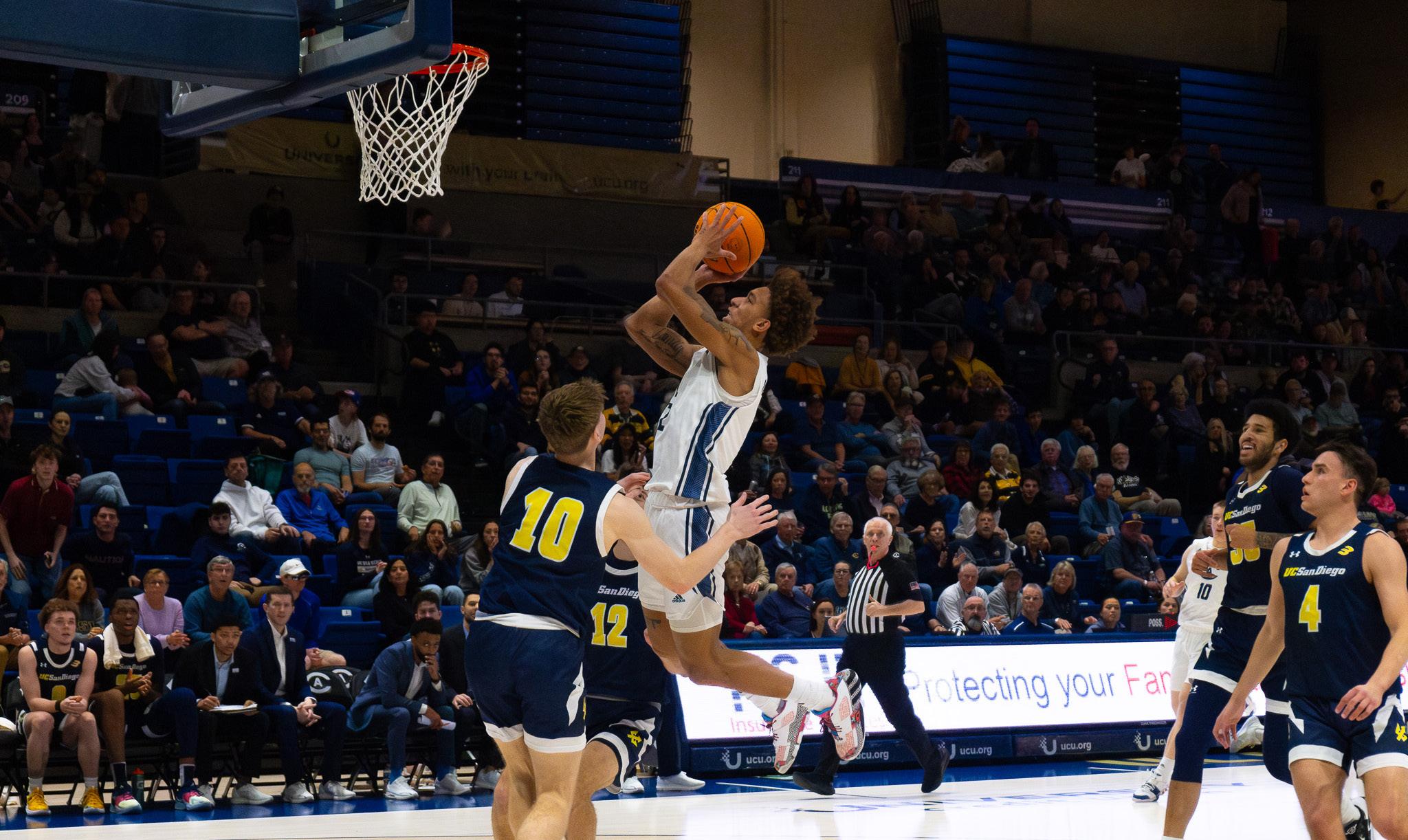
to defeat the Aggies, who went on to win 74-66. Niko Rocak, a fourth-year graduate student and forward, delivered an impressive double-double with 11 rebounds, four of which were ofensive, and scored 13 points. In addition to Johnson’s 11 points from the frst half, he scored another eight points in the second. Te win against the Idaho Vandals marked UC Davis’ fourth straight win, however, this streak was then ended by the Pepperdine University Waves on Dec. 21. Pepperdine got of to a quick lead, outscoring UC Davis by 10 points within the frst six minutes. Teir lead continued to grow steadily, reaching 24 points at the half and 39 points by the end of the game. Carl Dougherty Jr., a third-year human development major and guard, came of the bench to lead the Aggies in scoring. His 11 points made him the only Aggie in double digits for the match, while fve Pepperdine players
were able to reach this threshold. Te Waves’ strong shooting coupled with the Aggies’ 18 turnovers contributed to the UC Davis loss. Back at their home court on Dec. 28, the Aggies faced the California State University Maritime Academy Keelhaulers. Tis time, the roles were reversed — the UC Davis Aggies were able to dominate the game and earn a win.
Te Aggies maintained a lead throughout the entire game after quickly amassing a 19-point lead within the frst 10 minutes of play.
Te Aggies’ seven three-pointers on 50% three-point shooting in the frst half aided the Aggies in entering halftime with a 41-point lead. UC Davis continued to control the game throughout the second half, ultimately winning 109-46.
Many of UC Davis’ key players performed well in the victory, including Johnson, Tamba, and Daugherty Jr. Leading the pack was Johnson who
recorded a double-double with 21 points and 10 rebounds, three of which were ofensive. Tamba contributed 13 points on perfect shooting from the feld and Nils Cooper, a second-year human development major and guard, put up seven rebounds and eight points. Te win against Cal State Maritime marked their last nonconference game of the season. On Jan. 2, the Aggies looked to improve their 2-0 conference record, traveling to Bakersfeld to face the California State University, Bakersfeld Roadrunners. Te two teams appeared to be evenly matched throughout the frst half, with the largest lead by either team being only six points. UC Davis trailed by three points at halftime, despite Johnson’s 10 points. In the second half, the Roadrunners maintained their lead — a lead that began to grow. Te Aggies fought to get back in the running, narrowing the lead to only three points with 4:38 left
in the game. However, CSU Bakersfeld’s CJ Hardy made it difcult for the Aggies to stay in the game, scoring an impressive 14 points within the last fve minutes of the game. Te game ultimately fell out of reach for the Aggies when Hardy stole the ball from Johnson, took it to the other end of the court and dunked, bringing their lead to eight with only 1:04 minutes to play. Te game ended in a 64-75 loss for the UC Davis Aggies, bringing their conference record to 2-1, and their overall record to 8-6. Despite the loss, the team showcased their determined spirit and hard work on the court — Johnson, notably, had a dominant performance by putting up 26 points and eight rebounds. Overall, the men’s basketball team had a very successful winter break and will be looking forward to their next home game against Cal State Fullerton on Jan. 9 at 6 p.m.