A 60-year-old nurse was killed in the collision, with the other rider sustaining injuries
BY CARLO FALLA city@theaggie.org
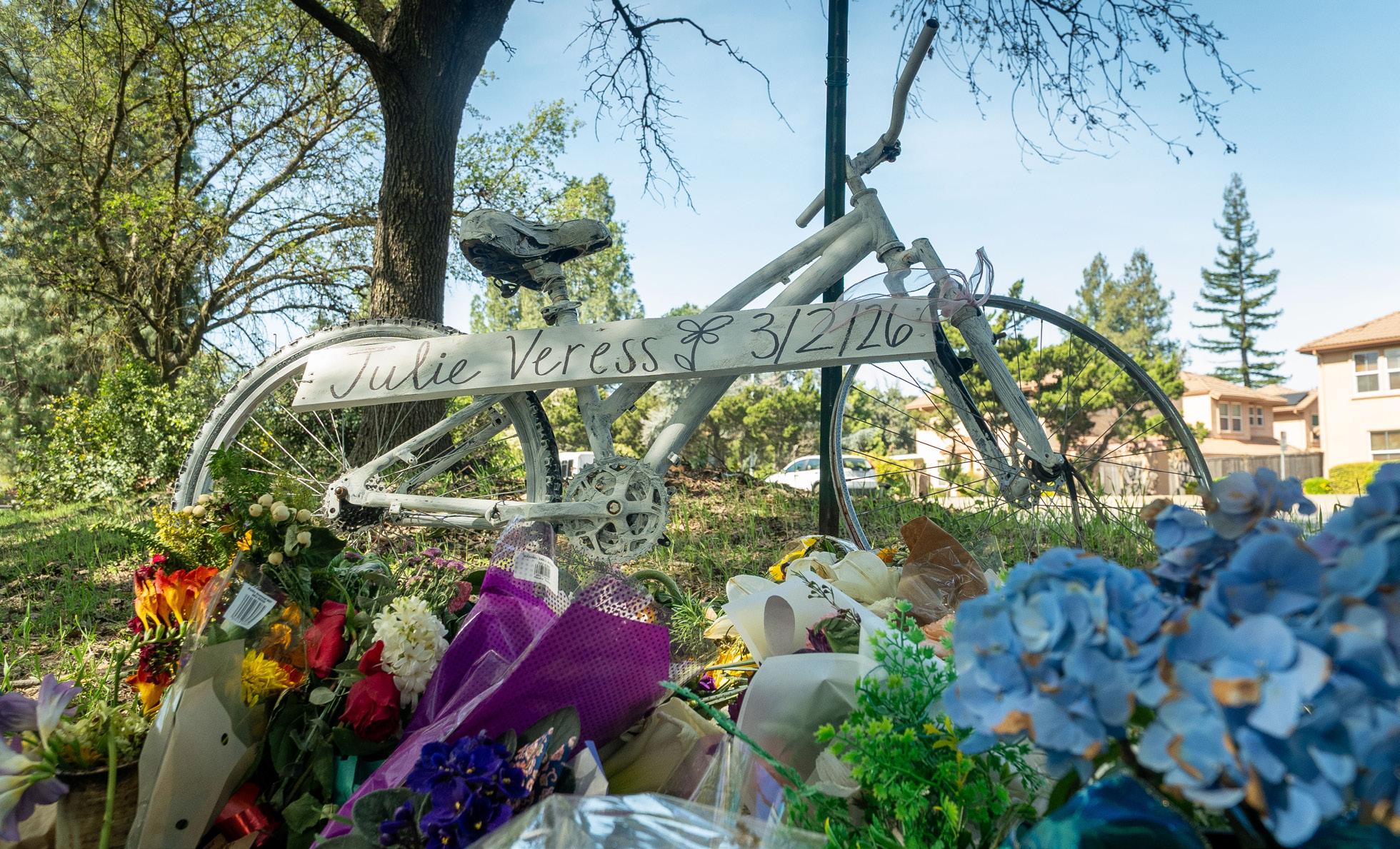
On March 2, a fatal bicycle accident occurred on Covell Boulevard at 2:48 p.m., according to the Davis Police Department.
Julie Veress, a 60-year-old nurse, was killed in the collision and pronounced dead at the scene. Another victim of the incident, a 16-year-old boy, was sent to the hospital with minor injuries.
The crash occurred on a designated bike path near Davis High School. The boy, who was riding an electric bicycle, has been cooperative with investigators. The identity of the boy remains anonymous, given that he is a minor.
Lieutenant James MacNiven of the Davis Police Department spoke to KCRA3 on March 3, explaining that the investigation is ongoing.
“At this point in the investigation, we don’t know the context of the actions between the two parties that led up to this terrible and tragic incident,” MacNiven said.
Veress worked at the Sutter Davis Hospital as a registered surgery nurse. She was also a mother of two and an avid biker in the Davis community. In a statement, Sutter Health spoke regarding the passing of Veress.
“We are heartbroken by the
loss of a valued member of our team following a tragic incident in the Davis community,” the statement reads.
Davis is often regarded as the “Bicycle Capital of America.” Around 50% of students on campus utilize bikes to get around town and
UC Davis Iranian Student Organization unites community amidst U.S.-Israel war with Iran
With war affecting families abroad and differing opinions in the diaspora, ISO remains open to all
BY RIVERS STOUT campus@theaggie.org
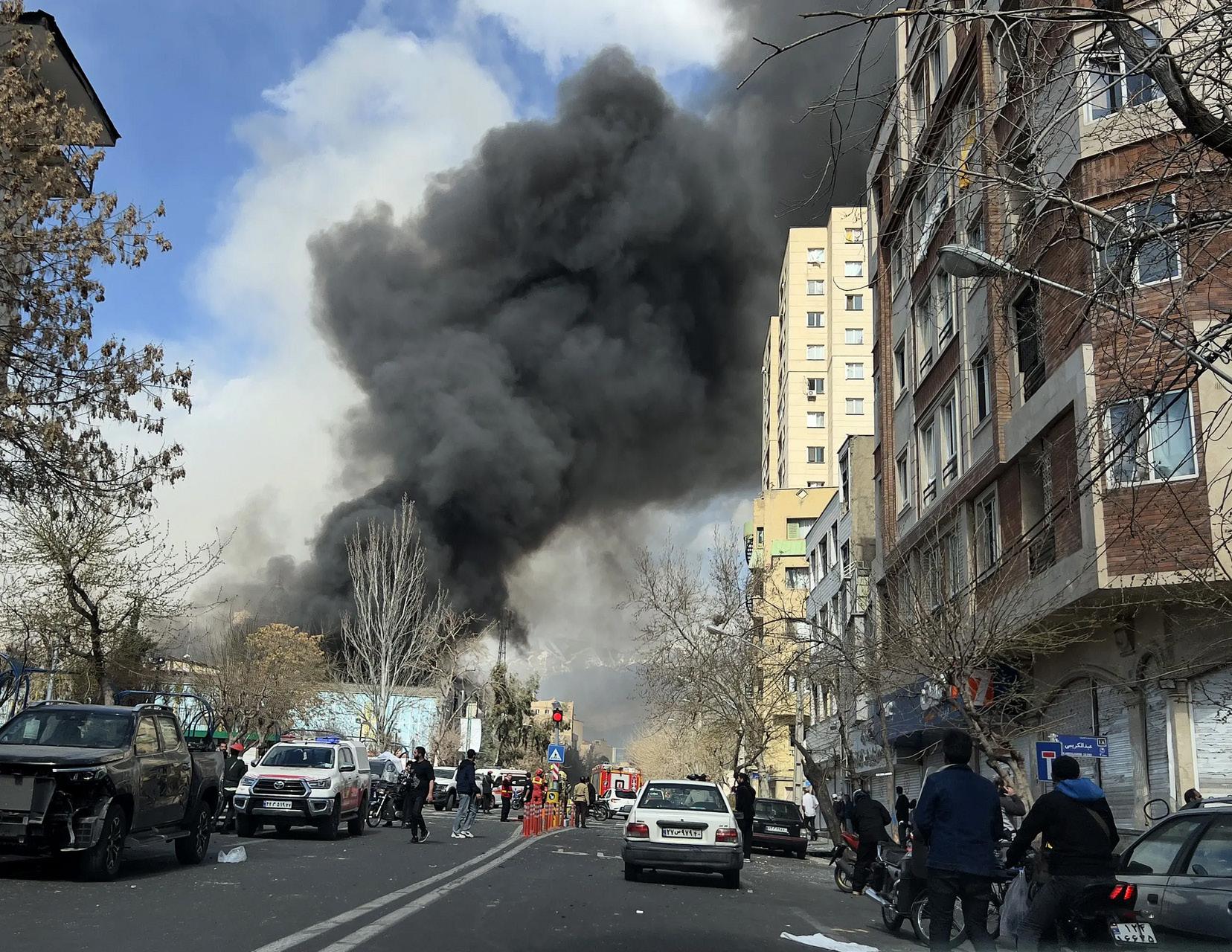
Some 8,000 miles away, the ripples of the United States and Israel’s war with Iran are being felt by California’s Iranian American community. At UC Davis, the Iranian Student Organization (ISO) has been working to provide comfort and gathering spaces for students affected.
The club has attempted to act as a unifying space for all Iranians on campus, regardless of their political beliefs, according to ISO President Ava Jabbari, a fourth-year environmental policy analysis and planning and international relations double major.
“We condemn the killings of our peoples, and we condemn the oppression of our peoples along with any other groups,” Jabbari said. “Iran is a diverse place, and we also recognize that there are varying opinions about this within the Iranian American community and the Iranian diaspora. So, our goal is to unite people.”
The war started with a joint strike, commenced on Feb. 28 by the U.S. and Israel to dismantle Iran’s security apparatus, titled Operation Epic Fury. So far, the war has led to the death of Iran’s Supreme Leader Ayatollah Ali Khamenei, several other leaders in the nation and of around 1,000 other people in the Middle East — including 168 students and teachers at an all-girls school. While many celebrated
the death of Khamenei — the country’s supreme leader since 1989 — Jabbari said that Iranian Americans in Davis largely fall on two opposing sides with regard to military intervention.
“A lot of Iranian Americans have been asking for intervention, ever since December,” Jabbari said. “Some Iranians in the diaspora do not support that. There’s been other evidence showing that any foreign intervention in the Middle East in general usually leads to further destabilization in the region, rather than any true liberation in the region. But now that there has been further intervention initiated, there has been more disagreement between Iranians in the diaspora.”
In a recent letter to Congress, President Donald Trump said it was “not possible at this time to know” the scope and duration of further strikes on Iran. Nations along the Persian Gulf continue to report missile and aerial attacks as Iran retaliates and targets U.S. and Israeli allies, including Qatar and Bahrain.
Debates over the future of Iran have occurred off and online, according to ISO Social Media Coordinator Brian Borhany, a fourth-year international relations major. He noted that the differences in opinion have threatened solidarity among Iranians and those in the Iranian diaspora.
“We’ve had some arguments over Instagram or even in person [between] members of our community not agreeing with something,” Borhany said. “We’re all on the same side here, it’s just the politics
that are driving a stake into our community.”
ISO has sought to bring Iranian Americans together through events, hoping to create shared safe spaces during this time of hardship.
“So many of us cried that night — so many of us,” Shaina Taebi, a second-year political science and philosophy double major, said about a recent ISO vigil.
Taebi, who also hosts the KDVS public affairs show The Missing Middle East, said the vigil connected her with others carrying the same emotional burden.
“I hadn’t heard from my family in Iran, and there was a lot of stress and grief that everyone was carrying,” Taebi said. “In some sense, it’s so sad that we have to be here commemorating the loss of so many innocent lives, but at the same time, it was beautiful that we could be there for one another and to be able to have the space to support one another.”
Taebi explained that, for her, ISO has risen to the task of maintaining a degree of apoliticality while providing a space for Iranian Americans to gather as a community.
“With everything that’s going on in Iran, you can’t fully escape the political conversation,” Taebi said. “But I think that ISO has done such an amazing job at balancing this delicate line between maintaining a safe space for everyone and making sure that everyone’s opinions and ideas are being heard.”
the university campus, with 12% of Davis adults commuting by bike within the city. Despite the bike culture and infrastructure embedded in the streets of the city, accident rates have been shown to increase, with collision rates rising by 43% in 2022 compared to 2019.
The Davis Institute of Transportation Studies conducted a study based on accident rates in 2021. The study found that based on a projected population of e-bike users, 7.3% would be injured and admitted to the hospital on campus, while another 27%
off campus would need to visit the emergency room with injuries, but not be admitted. The off-campus rate of e-bike collisions was significantly higher than the 12.9% for traditional bicycles.
Lieutenant John Evans of the Davis Police Department commented on bike safety protocols in a web article.
“At this time we don’t have anything further to offer except that we ask everyone to keep themselves as safe as possible when riding their bikes, whether on the road or on bike paths,” Evans said. “Please wear your helmets, reflective clothing at night and when dark, follow the rules of the road and pay attention to what is going on around you.” A memorial has been started on Covell Boulevard, where passersby can leave flowers and pay their respects in honor of Veress.
2-year-old videos showed a member holding a duck at gunpoint, members chanting in front of a dead duck
BY AALIYAH ESPAÑOL-RIVAS campus@theaggie.org
Resurfaced video of an Alpha Gamma Rho (AGR) fraternity member abusing a duck and of others around a dead bird hung indoors has ignited a controversy over the fraternity’s conduct and resulted in several reports to the Davis Police.
The video, posted on the r/UCDavis subreddit page on March 4, showed an unidentified individual wearing an AGR hat chasing a duck with a gun on the AGR house’s front lawn. In a subsequent clip, the same duck was seen in a cage with another duck that appeared to be injured. In the video’s final clip, three unidentified individuals dressed in formal suits are seen chanting while standing near a dead duck hung from a ceiling fan.
Officers and Yolo County Animal Control were dispatched to the AGR house on the afternoon of March 4 following multiple tips, according to Davis Police Department Lieutenant John Evans. Following communication with fraternity leadership and an investigation of the house, police determined that the resurfaced videos were taken two years ago.
“We found that the video was taken about two years ago, and the person that was depicted in the video no longer lives there and is no longer attending UC Davis,” Evans said. “The officers determined that, although the actions that were depicted on the video were disturbing, that
there was in fact, no violation of state law that occurred.”
Evans also said that the investigation is now closed and that the individuals involved were contacted.
“There are a lot of things that aren’t necessarily against the law that you still shouldn’t do,” Evans said. “People see images and videos that are super disturbing and upsetting to them, but it still doesn’t necessarily mean that it violates the law. I can understand why people don’t like it and why they’re upset, but at the end of the day, for our department there’s just not really much there as far as a criminal complaint.”
Multiple Reddit users expressed disgust and anger with the actions displayed in the videos, with some calling for the fraternity to be disbanded.
“No excuses for abusing animals, none,” one commenter said. “For those who don’t seem to care about abuse of animals, look at it like this, animal abusers are statistically more likely to abuse humans; this is well proven. Take their charter, UCD.”
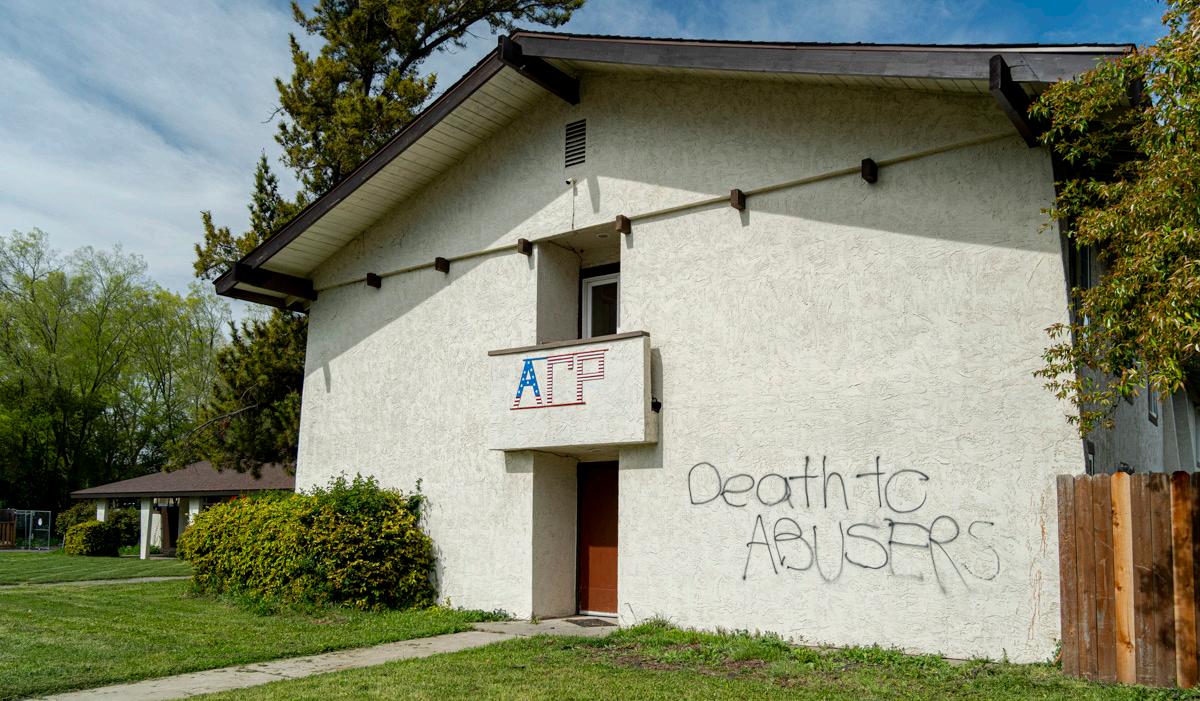
A small group of protesters gathered at the AGR house in North Davis, Saturday, March 7. AGR members called the Davis Police Department and asked for extra patrol ahead of the protest after receiving threats online and getting their house egged, according to Evans. The house has also since been vandalised, with the phrase “Death to Abusers” spray-painted on an exterior wall.
The California Aggie reached out to the AGR Davis Chapter President and the fraternity’s
national headquarters for comment but received no official response in time for publication.
AGR is under investigation by the Student Conduct and Integrity Office for an undisclosed matter and has ceased operations, according to the UC Davis Center for Student Involvement, which advises Greek life operations. AGR was previously levied with violations of hazing in November 2025. Until the investigation is over, the chapter is barred from holding official meetings and participating in social events. Alpha Gamma Rho was originally founded at Ohio State University’s College of Agriculture in 1903, with the four pillars of “recruit, commit, educate and recognize.” Its philanthropic causes include Ducks Unlimited, a private organization committed to the conservation of wetlands and habitats for North American waterfowl.
UC Davis’ AGR Phi chapter opened in 1923; it is one of 12 standing fraternities within UC Davis’ Interfraternity Council (IFC).
The IFC was unaware of the actions in the video until they resurfaced earlier this week, according to IFC President Maksymilian Wozniak, a thirdyear aerospace engineering major. “The incident was two years ago, and it was kept within the fraternity, as far as we know,” Wozniak said. “Obviously, the IFC condemns all forms of hazing and animal abuse and condemns the actions of the former members of AGR.”
The food bank is offering dates, maamoul and other foods in order to provide more culturally conscious offerings
BY KHADEEJAH KHAN campus@ucdavis.edu
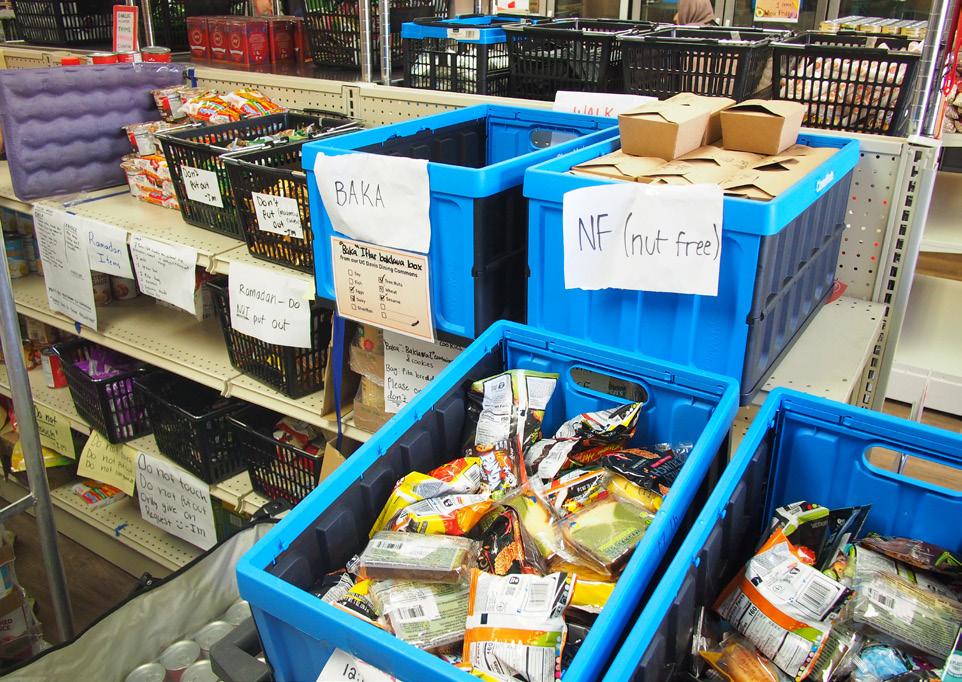
Aside from the normal fare students might find when visiting The Pantry at the Memorial Union, visitors can now find new special items for Ramadan.
Part of an effort to incorporate more culturally relevant items to students, the on-campus food bank is offering a series of Ramdan items through March 19. The limited-time items include oatmeal cups, milk boxes, granola bars, maamoul (Middle Eastern butter cookies), dried mango, dates, softprepackaged croissants, Biscoff Cookies, instant ramen noodles and Ensure Vanilla Drink. These items can be accessed upon request by asking attendants at The Pantry.
The Pantry is a studentrun unit of ASUCD, providing students with food and other basic essentials like hygiene products. Students can order items from The Pantry in advance through their website, or visit in person at the Memorial Union, Room 177. The Pantry is open on weekdays from 10:30 a.m. to 6 p.m. and on weekends from 12:15 to 2 p.m. Ramadan is the ninth month of the Islamic calendar, during which Muslims fast from sunup to sundown. At the time of sunset, Muslims break their fast with dates.
“We’re trying to also just make a more inclusive space in general because it’s not like people’s culture just goes away the second a holiday ends.“
Andie
Tarabzooni ASUCD Pantry Unit Director
Tarabzooni, a fourth-year economics and communication double major, aimed to ensure that all items were meaningful and beneficial for fasting students.
“Each thing had a purpose when we were choosing them,” Tarabzooni said. “What we ended up going for was a premade kit or box that you could pick up which has dates and traditional food that you could break your fast with. It mainly focuses on the fact that your glucose levels are pretty low after fasting for a long day.”
Tarabzooni also recognizes that months like Ramadan carry memories of culture, family and home for students across campus. They hope that through providing cultural items, The Pantry can address food insecurity while making students feel seen.
“I think it’s really important to us to create a space where everyone feels included, because it’s one thing to be food insecure and not be able to access food, but I feel like being able to
be represented within food is important,” Tarabzooni said. “It brings me a certain amount of warmth to know that people might just have more emotions connected to it.”
The Pantry consulted student organizations like the Muslim Student Association (MSA) to ensure that offerings were relevant and beneficial for students observing Ramadan.
MSA Secretary Aliza Shahab, a fourth-year managerial economics major, said that she is grateful to have been a part of the process.
“This means a lot for our students who have to be on campus during Ramadan and who are really struggling to find spaces that provide resources during this month, because Muslims are spiritually and academically really busy,” Shahab said.
ASUCD Senator Jenna Younes, a fourth-year managerial economics major, was also consulted in the process of choosing items. She expressed her hope that The Pantry’s offerings — alongside oncampus events like the ASUCD Iftar — will help Muslim students find community throughout the month.
“The Pantry’s offerings were chosen very intentionally to make sure students have access to foods that they might have eaten with their families and loved ones during Ramadan,” Younes said. “Ramadan is a time for community-building on the UC Davis campus. There is always something happening.”

‘Embrace the absurd’: DFS reflects on attending the event as college students in the industry
BY MIRIAM RAMAKRISHNAN arts@ucdavis.edu
If you like movies a tad more than the average person, the Sundance Film Festival is not an unfamiliar event. In fact, the independent movie celebration has existed annually for almost 50 years in Park City, Utah, premiering now-classic indie films Little Miss Sunshine (2006), Napoleon Dynamite (2004), The Blair Witch Project (1999) and more.
In 1981, Sundance Founder Robert Redford created the Sundance Institute, a nonprofit designed to support indie filmmakers through workshops and mentorship programs — cementing Sundance’s subsequent legacy as the most significant experimental movie festival in the country. In 2023, the cumulative online and inperson attendance for Sundance was close to 450,000 people.
UC Davis’ very own Davis Filmmaking Society (DFS) took a trip to the esteemed festival in January 2026, bringing student directors to the big stage. DFS President Manuel Maravilla, a fifth-year cinema and digital media major, spoke on the importance of the club’s opportunity to join such a large cinematic space.
“[Sundance is] a moment where we can really galvanize our base to show them that it takes a village to make a movie,” Maravilla said. “By bringing our members over and showing them the greatest version of what finishing your project looks like, it allows a lot of people to fall in love more deeply with filmmaking.”
DFS Treasurer Kayla Tran, a third-year communication and cinema and digital media double major, shed some light on how the club afforded the trip — each member paying individually for their Sundance admission ticket.
“Most of the funding was through the CFC [Club Finance Council] grant created by the Center of Student Involvement,” Tran said. “We’re incredibly grateful that we were able to get funding from UC Davis itself because going to Sundance is a huge educational learning
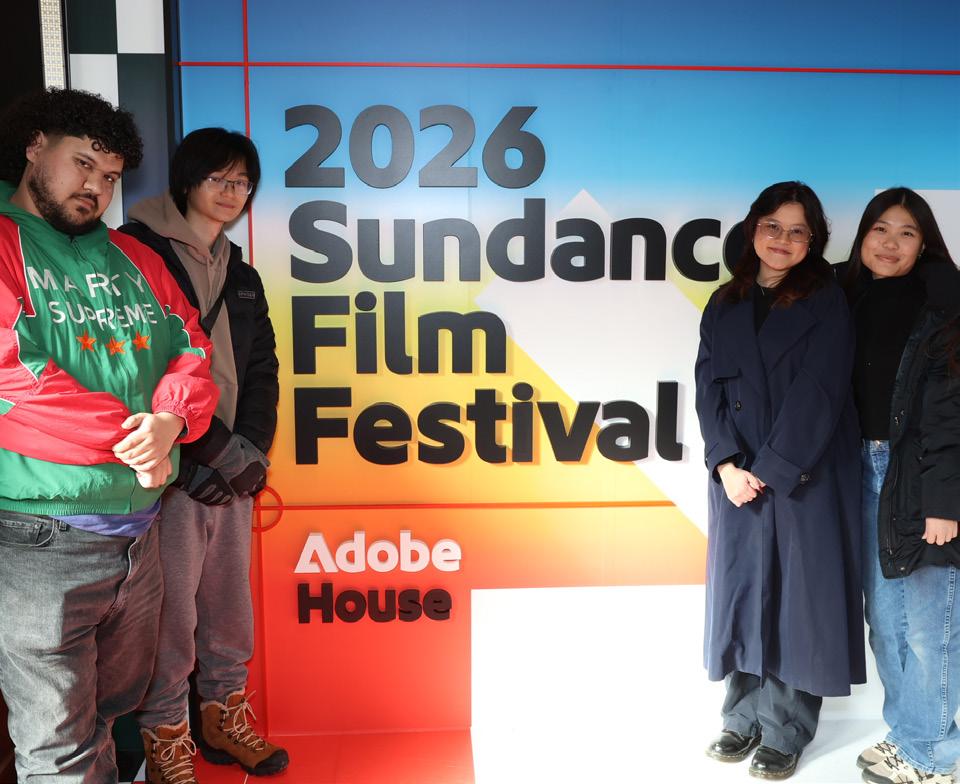
experience, especially for those interested in filmmaking.”
DFS Vice President Aaron Nguyen, a fourth-year molecular and medical microbiology major, also shared what attending Sundance as a student meant to him.
“[Sundance] is a place where filmmakers from all over the world can come together and collaborate with each other,” Nguyen said. “I love that aspect of Sundance, where we as college students can connect with people from the industry.”
When asked about their favorite conversation from the festival, Maravilla and Tran brought up the same answer.
“We met with Kristina Mueller, the creative director of Sundance, and she’s involved with what the Sundance Festival’s brand identity looks like — the trailers and graphics change every year, and she basically runs all of that,” Tran said. “Being able to hear her perspective on what it’s like handling the creative direction of a film festival was really enlightening.”
Maravilla added that Mueller gave DFS advice regarding their own film festival, planned for spring quarter 2026.
“It was kind of reassuring to hear that what we’re doing is what [Mueller] recommended us to do,” Maravilla said. “Something that really stuck with me, though, is that she really wanted us to embrace the absurd a little bit. Anything that gets attention that’s a little funny, a little weird, [she wants us to] go for it.”
Tran emphasized the importance of college students partaking in independent film, especially in large spaces like Sundance, which may be intimidating for budding filmmakers.
“To be able to put UC Davis on the map and to show that there are students at the school dedicated to independent filmmaking is critical,” Tran said. “I’ve met students from across the country who have their own projects and are doing their own things to really put themselves out there, and to meet other filmmakers who are like-minded in wanting to save indie film is amazing.”
Maravilla emphasized that there was a bigger meaning behind the Sundance trip than the physical journey itself.
“Going to Sundance was such an important thing for us, and it sort of opened our eyes to the fact that student organizations should be doing stuff like this more often,” Maravilla said. “Everyone should try getting closer to their worlds because it really is a beautiful thing, and it really helps get students motivated for the future of their field.”
DFS hosts their winter quarter meetings on Thursdays from 6 to 7 p.m. in the Art Annex. Their aforementioned film festival is set to take place next quarter. To learn more, visit their Instagram page @ davisfilmmakingsociety.
The meeting was disrupted by arguments between attendees and Beth Bourne over school solicitation BY SONJA WOOLEY city@ucdavis.edu
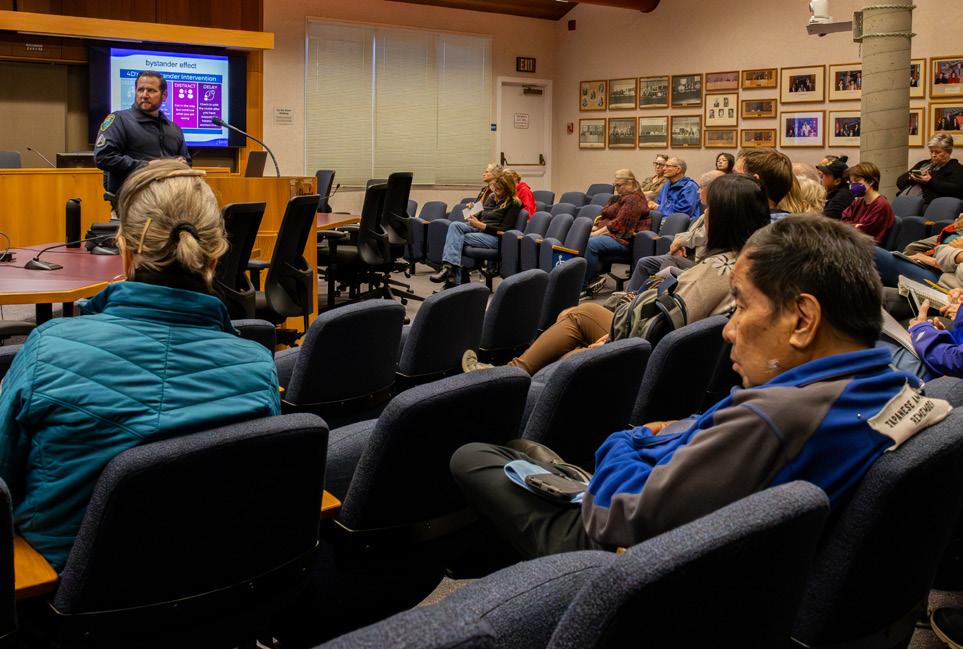
The Davis Police Department hosted a Community Public Safety Training at City Hall on March 3. The meeting, which was meant to train Davis residents on de-escalation skills, ended in a shouting match between participants.
The Community Public Safety Training was led by Davis Police Sergeant Matthew Muscardini and Davis Emergency Dispatch Supervisor Tanya Baumeister. They presented on how to de-escalate a situation when dealing with someone experiencing a mental health crisis. The training also covered when to call 911 and how to give the best information to dispatch officers.
Heather Caswell, owner of the Wardrobe Boutique in Davis, attended the meeting. She began the Subcommittee on Safety for the Davis Downtown Business Association, is involved in the Safer Davis Program and is the co-founder of the Davis Community Vision Alliance. She encouraged Davis Police Officer Lawrence Turner to organize the event.
Caswell spoke about what motivated her efforts to improve community safety.
“I’ve had a repeat offender threaten my life and my staff member’s life,” Caswell said. “So
a restraining order was filed, and it was a very difficult process. I would say another hope of mine is that that process becomes easier.”
Another attendee, Janice Lott, owner of Davis Newsbeat, also discussed her concerns about crime in Davis.
“Because we live in the downtown, we see many different people,” Lott said.
“Over the years, we’ve been robbed [and] we’ve been shoplifted, so there are many reasons why we’ve needed to have a good relationship with the local police department. A lot of these teaching techniques are the techniques I’m very familiar with, but it’s good to have a refresher.”
In addition, residents in attendance expressed their anger at Beth Bourne, a local activist known for her anti-trans rhetoric, who also attended the meeting. Over the past month, Bourne has shown up outside of Winters Middle School, Harper Junior High School and Da Vinci High School in Davis, filming students as they leave their classrooms while attempting to debate them about transgender rights. On Feb. 13, Bourne was accused of kicking a student protester at Da Vinci High School. Near the end of the presentation, participants asked Sergeant Muscardini whether the police could intervene against
solicitors outside of schools who they felt were harassing students, and in response, Muscardini addressed their concerns.
“We defer to school staff,” Muscardini said. “They’ll call us if they need us. If someone calls outside and we need to respond, we link up with school staff first and then ask them what they would like to be done or what can be done. We don’t just go to schools and start taking action.” Bourne began using her phone to record the meeting, which angered several participants.
“She’s going to post it, and then we’re going to be doxxed,” one participant said, “That’s her modus operandi. And even if you don’t say anything, she’ll dox you, and then you have the crazies come after you with death threats. This has happened over and over and over again with this individual, Beth Bourne.” Bourne addressed the crowd in response.
“I’m speaking out on what is obviously a medical scandal, and that’s why I do go in front of schools, and I’ve only done it a couple times.” She was shouted down by participants, and the meeting ended soon after.
Caswell shared a statement about the disruption to the Community Public Safety Training.
“I was sorry to see this valuable Public Safety Training session, presenting important and helpful de-escalation techniques, get disrupted by impolite members of the community who sought to use the event to advance their own political agendas. These disruptors hijacked the essential question and answer period and stole time from many members of the public who took time out to meet with the Davis Police Department about this issue. Their conduct was uncivil, disruptive and unworthy of our community. We are better than this.”
With spring elections around the corner, the table discussed who should and should not be able to endorse candidates
BY AALIYAH ESPAÑOL-RIVAS campus@theaggie.org
With student government elections fast approaching, concern over the next election’s rules became a key topic of discussion at the latest meeting of the ASUCD Senate on March 5.
Namely, the decision to allow units, committees and commissions to endorse ASUCD candidates was debated during consideration of Senate Bill (SB) #74. Authored by Senator Aaron Heth, the bill sought to make multiple reforms to the ASUCD election bylaws, including changes to the timeline, indictment process, social media policies and endorsement rules.
The main point of contention with the table was over proposed changes to endorsement violations.
“With the exception of The California Aggie and KDVS, ASUCD Units shall not endorse any individual candidate but shall have the discretion to endorse ballot measures or fee referendums,” the ASUCD election bylaws read.
ASUCD currently oversees over 30 units that are independently managed and operated by students for the benefit of the undergraduate population. Both The Aggie and KDVS are media units and have greater editorial control and independence than other units.
Heth opposed the current bylaws, stating that either all units should be allowed to endorse or none at all. He also introduced the idea of barring committees and commissions — legislative bodies operating under the Senate — from making endorsements in the future.
“I think it makes more sense to allow individuals to endorse candidates versus entities within [ASUCD],” Heth said. “I think
it would be wrong just as much for the entire Senate to make endorsements for candidates, [and] I think it would not be right, necessarily, for a commission or a committee to make endorsements.”
ASUCD currently has six presiding commissions whose chairpersons sit in on Senate meetings, including: External Affairs, Internal Affairs, Academic Affairs, Gender and Sexuality (GASC), Ethnic and Cultural Affairs and Environmental Policy and Planning. Additionally, ASUCD has 20 legislative committees that oversee internal, external, philanthropic and programmatic matters.
Heth continued, arguing in favor of “all-or-nothing” endorsements to make the rules fairer across ASUCD.
“If we do want to keep a committee and commission endorsement, I think it’s important to be equitable, and how we do that is [by allowing] for units to also make endorsements as well,” Heth said. “Many units are not commercial, many units are not making money at all, but they still represent important interest groups within the Association, and they don’t have the ability to make endorsements.”
Internal Vice President (IVP) Dhilena Wickramasinghe proceeded to question Heth on whether committees or commissions were consulted prior to the bill. Heth responded, stating that he spoke briefly to one commission chair and understood that the proposal was unpopular among commission members.
“I understand that the commissions are not supportive of it, and I can see where that’s coming from,” Heth said.
While commission chairs cannot vote on legislation, many of them were caught off guard by SB#74 after not being consulted on the matter.
“I think it’s kind of unfair that you’re bringing commissions and committees into this conversation without talking to any other commission and committees besides the people you’re introducing this shit to,” GASC Chairperson Catalina Silva-Oliveira said.
“It’s important to recognize that not talking to us [committees and commissions] is a little disrespectful. We’re the ones that educate people, that represent communities, so I think it’s totally fair and within our right to endorse candidates that represent our best interests.”
International Student Representative Robi Castaneda alleged that Heth and Senator Ezra Rubin, a co-author of the bill, are potentially using SB#74 to further their political goals in the spring elections.
“I would also like to point out that [it] is very coincidental that the very time that Senator Heth and Senator Rubin choose to disenfranchise our commissions and committees, it is the same time that we have noticed multiple rumors — and tell me it’s a rumor — but it’s clear that maybe you [Heth and Rubin] want to run for elections,” Castaneda said.
Both Rubin and Heth were elected in the 2025 fall election, with their Senate terms lasting through the end of fall quarter 2026. Positions open in spring 2026 include the joint president and IVP ticket, External Affairs vice president and the two student representative positions.
Castaneda continued, comparing SB#74 to gerrymandering.
“We’ve seen many examples of gerrymandering within the United States, where senators on the left and right side choose to alter the elections code in their states in order to gain votes,” Castaneda said.
SENATE on 9
The expanded public-safety plan includes doubled police staffing, mutual aid support and enhanced enforcement
BY MICHELLE BEKHTEL city@theaggie.org
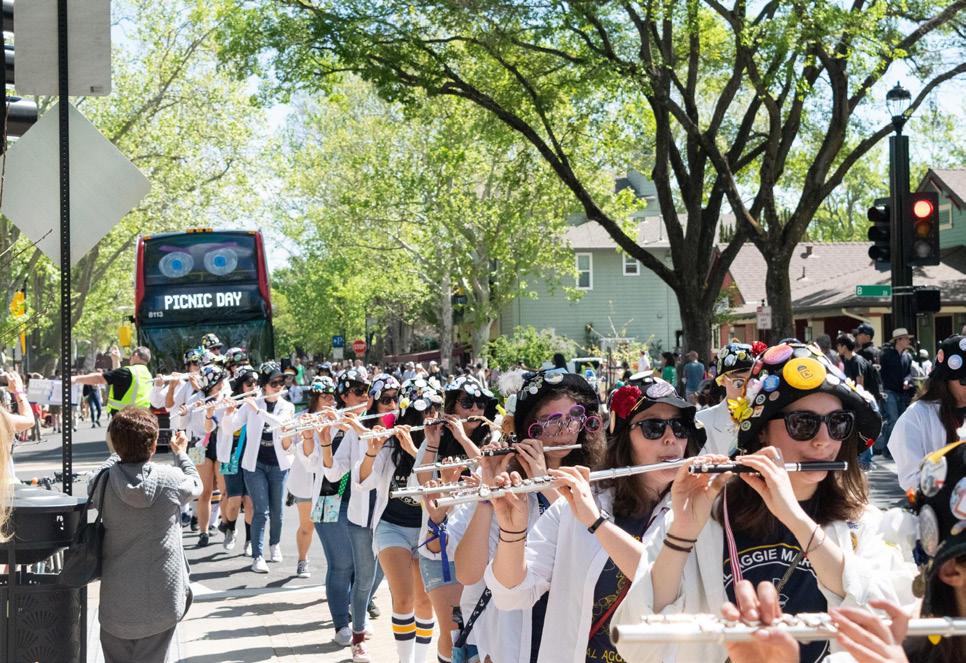
The City of Davis has released an expanded safety plan for Picnic Day 2026, introducing new staffing levels, traffic controls and enforcement strategies in anticipation of one of the city’s largest annual events. The measures are designed to manage the several thousands of visitors who flood into Davis each year for the parade, campus festivities and downtown celebrations.
This year’s plan includes a major increase in police staffing. Davis Police Lieutenant John Evans explained that the department is preparing for the scale of the crowds that typically arrive for the event.
“Picnic Day attracts tens of thousands of people to Davis,” Evans said. “By increasing law enforcement staffing, we aim to provide a stronger, more visible presence that can better address high-volume crowds and potential public safety issues.”
In addition to doubling local staffing, the city will rely on multiple mutual aid partners. Evans explained that coordination with outside agencies is already underway.
“We are using mutual aid partners, such as UC Davis, to assist with staffing the parade,” Evans said. “Police officers from other jurisdictions will also be embedded with Davis Police officers to augment our units and provide support as needed.”
Traffic management will also look different this year. The city plans to place additional barricades and expand roadcontrol operations to keep vehicles and pedestrians moving safely through congested areas.
Evans explained that the city’s goal is to prevent gridlock as the population temporarily swells.
“Because Picnic Day essentially doubles the community’s population for the day, these measures aim to improve safety and mobility for everyone attending,” Evans said.
Alcohol-related enforcement will be another priority. The
Davis Police Department will meet with bars in Downtown Davis ahead of the event, in coordination with the state’s Alcohol Beverage Control (ABC). in order to reinforce responsible service expectations.
“These measures are intended to reduce excessive intoxication, limit risks associated with overservice and support overall public safety while allowing the community to celebrate responsibly and support local businesses,” Evans said.
Evans explained that the city will also activate Safety Enhancement Zones: designated areas where certain violations carry higher fines during the event period.
“Alcohol-related violations, including open containers, minor in possession and noise violations, would be typical examples,” Evans said. “The purpose is deterrence.”
Other components of the city’s plan include the use of drones for situational awareness, expanded Davis Fire Department operations to handle increased call volume and activation of the city’s Emergency Operations Center to coordinate responses throughout the day.
Evans explained that the police department views community cooperation as an essential part of the safety plan.
“Picnic Day is a shared celebration, and keeping it safe and enjoyable is a shared responsibility,” Evans said. “By working together, we can ensure Picnic Day isn’t only fun
and vibrant, but also safe and welcoming for everyone who lives, works and visits Davis.”
In addition to the city’s preparations, Picnic Day organizers emphasized that the expanded safety plan reflects months of joint coordination between the student-run Picnic Day Board, UC Davis and the City of Davis.
“As representatives of the Picnic Day Board, both the Vice Chair and I have served on a joint committee with campus partners and the city from the start,” Picnic Day Chair Trinh Vo said. “The expanded safety measures are part of a collaborative planning process that has been in place from the beginning.”
Vo and the rest of the board fully support the city’s updated plan, noting that it aligns with the event’s long-standing goals.
“We have provided input throughout and fully support the city’s updated plan,” Vo said. “It reflects our shared commitment to making Picnic Day 2026 safe, welcoming and enjoyable for everyone.”
She encouraged attendees to take part in the board’s own safety initiatives as well.
“We encourage attendees to sign the Picnic Day Pledge and take that first step in helping us create a positive experience that showcases the best of our community,” Vo said. For more information on the updated safety guidelines, visit the City of Davis website.



How can I date while I’m depressed?
Dear Aggie,
I want to be in a meaningful relationship, but I feel like lately I’ve been too depressed to put myself out there. I’ve never had a long-term relationship, and I crave that kind of intimacy, but over the past few months I’ve been so unmotivated and exhausted that I can barely get through my day sometimes, let alone put in the effort to find, build and cultivate a relationship. Sometimes I think that having a partner to support me would be really helpful, and it makes me feel worse to be so lonely, but I just can’t get over the hill of finding someone in the first place. It’s a self-fulfilling prophecy — how can I get out of this?
— Sisyphus
Dear Sisyphus,
I find that a lot of internet advice about dealing with depression (or periods of depression) boils down to “work on yourself” (read: focus on improving your perceived flaws, become more physically fit, more conventionally attractive) or “go to therapy.” I hope I can give you more interesting advice here. Don’t waste your time with dating apps; rather, trust that you’ll meet someone through a mutual friend, in the CoHo or in lecture someday. You’ll strike up a conversation, make long eye contact while you laugh together, get their number, go for a walk, grab a drink, see a movie, fall in love and begin to build a life together. This will all happen when you’re confident enough to strike up a conversation with a stranger, energetic enough to communicate consistently, fulfilled enough to be a good conversationalist and grounded enough not to worry if they don’t text you back for a day or two. Right now, it sounds like you’re not in that position (which is okay!). At the moment, your primary aim should be working through your mental health struggles before you try to date. If you don’t, having a partner to support you won’t be helpful. You’ll worry about being a burden and not being energetic enough to spend time with them. Being in a relationship while you’re personally unfulfilled is likely to only make you more unhappy and to create new anxieties.
So, the age-old question: How to get happier? Therapy does work, but other things do too. I think these fall into two broad categories:
The first is scaffolding — relatively easy-to-build additions to your daily routine that help you construct something better. These are all completely cliché (my eyes glaze over every time I get told to sleep at least eight hours), but frustratingly, they do work. So, sleep at least eight hours per night, take a short walk or bike ride in the morning to get some sunlight, drink more water and consume more vitamins and exercise.
Simultaneously, aim to do little things that break up your routine: Buy a plant, drive to Pink Dozen donuts early on a weekend and buy a cruller, learn to cook with a cast iron skillet (they make the best fried eggs), buy same-day Student Rush tickets at the Mondavi Center ($10) and see a show, laugh with friends on a weeknight or maybe buy a pair of floor speakers on Facebook marketplace, set them up in your room and listen to music while laying on the carpet.
As all of this is happening, try to make yourself busy. Don’t overwork yourself, but get involved — a campus job, a club, rec sports, anything that puts you in a room with people regularly. That being said, depression does have other biological causes that may not be solved by “joining a club” and “cooking with a cast iron pan.” But I also think that a certain portion of it can be caused by a gap between how you are living and how you’d like to be living — there are little things that can close that gap. And then one day, you’ll realize the sadness has gotten quieter — not because someone else filled it, but because you did.
At the same time, though, remember that it’s okay if you can’t do all of this on your own. While it’s inevitably hard to feel like you’re missing out on having a romantic partner to support you, other close friends and family members can be really good parts of your support system too. Becoming comfortable within yourself is certainly not easy, but you don’t have to do it in isolation; lean on your community, and hopefully they’ll be able to surround you with love and care. Do what you can, but give yourself grace. Don’t beat yourself up if things don’t happen linearly or if it takes a long time, this is a really hard thing to do. But with time, some inspiration and a good social network, I hope that you’ll find more peace.

The
Board of Peace is not about peace at all

BY SABRINA FIGUEROA AVILA
sfigueroaavila@ucdavis.edu
After three years of Israel committing genocide against Palestinians, a United Statesbacked ceasefire was proposed in October 2025. However, the ceasefire is fragile, and remains a serious threat to the future of Palestinians. Israeli airstrikes have killed 600 people since the ceasefire was adopted, and Israeli Prime Minister Benjamin Netanyahu has threatened to resume Israel’s offensive tactics if Hamas doesn’t disarm within 60 days (as of mid-February).
It’s clear that tension in the region is high, especially as restriction of humanitarian aid to the occupied Palestinian territories causes the conditions to remain dire. In an effort to address this, President Donald Trump announced a Board of Peace to oversee his ceasefire plan in September 2025. He
appointed himself as chairman — ironic in light of his recent declaration of war on Iran, among other events of his term. Initially, the Board of Peace was established by a United Nations (U.N.) Security Council resolution to focus on implementing Gaza peace plans. Yet, the charter explained that world leaders would be invited to join as “member states would be limited to three-year terms unless they pay $1 billion each to fund the board’s activities and earn permanent membership,” according to an article by Reuters.
Trump also made clear, at the first board conference on Feb. 19, that the board would expand beyond Gaza and begin tackling conflicts worldwide, eventually overseeing the entire U.N. If this happens — and I wouldn’t put it past Trump to make it so — it could undermine the existing international legislative bodies. This move may be an attempt to aid U.S. attempts
Why Anthropic was right to say “no” to the Pentagon
BY MILES BARRY mabarry@ucdavis.edu
On Feb. 27, United States Defense Secretary Pete Hegseth directed the Pentagon to designate Anthropic as a “supply chain risk to national security” after the company refused to allow unrestricted military use of its artificial intelligence (AI) model, Claude. A supply chain risk designation is a legal mechanism under federal procurement law designed to protect U.S. military and government systems from infiltration or sabotage by adversarial actors. This empowers the government to exclude a vendor from defense contracts, and more consequentially, to prohibit any contractor, supplier or partner doing business with the military from conducting commercial activity with the designated entity. This is an unprecedented step from the Department of Defense (now the Department of War) — the supply chain risk designation has never been used against an American company, let alone one of America’s leading AI companies. It also appears
as though Anthropic received this designation for ideological reasons; their Chief Executive Officer Dario Amodei stated that the Pentagon took issue with Anthropic (in my view, sensibly), preventing them from using Claude for two specific purposes: domestic surveillance and firing autonomous weaponry. Now, because Anthropic maintained these two red lines, they will lose military contracts (Lockheed Martin, a defense contractor, has already begun to purge Claude from their supply chain) and may be unable to work with other big-name companies in contact with the military depending on how courts interpret the decision. They will be forced to spend money challenging the decision in court, and face major reputational damage — whether the courts side with them or not. While the federal government using AI for domestic surveillance and firing autonomous weapons sounds terrifying and dystopian, giving a billionaire corporate executive the power to regulate the military also sounds horrible. Most objections to Anthropics’ red lines sound something like this: Why should Anthropic, a
Really? Not even a thank you?
privately owned, profit-seeking company, make policy decisions about how the (theoretically) publicly accountable government uses its technology? To answer this question: Anthropic has the right to make the government’s use of their technology conditional because we live in a free enterprise system. While the American ideological left is (for good reason) highly critical of large corporations, these businesses are made up of individuals. In Anthropic’s case, many of these individuals left other AI companies specifically because they wanted to build technology responsibly — Hegseth is essentially compelling these engineers to build something they believe to be dangerous. This should trouble anyone who values individual liberty. Anthropic’s second red line — prohibiting its models’ use in firing autonomous weaponry — isn’t even a significant deviation from other operational limitations in military contracts.
BY NEVAEH KARRAKER nakarraker@ucdavis.edu
The lack of situational awareness on campus has become enraging. Between classes, I’ll be walking with a friend behind someone in the middle of the sidewalk, headphones blaring and trudging along slow enough that a line forms behind them.
In the next instant, an electric scooter rider will zip past through the crosswalk, almost striking out the entire group like bowling pins as they cut off a biker. Once I reach the library, I’ll open the door for someone who will thank me by physically pushing past me without a glance of acknowledgement. And then, when it seems like it can’t get any worse, I’ll find a group of students conversing loudly on the fourth floor, heedless of others studying for important exams or of their insensitive volume.

The carelessness of others generally isn’t a valid reason to create a scene, but the annoyance and frustration steadily brew. Coming from someone who grew up in a friendly surf culture, it was quite a shock for me to move to a place where not everyone acts like a chatty Trader Joe’s employee. Instead of smiles and waves, I get nasty looks, subtle comments and rude manners.
The population density on college campuses like UC Davis has largely increased, with over 40,617 students enrolled in 2025 (down 1.5% from the high of 41,000 students
in 2024). The number of applications is increasing each year. Classrooms are overfilled as students struggle to get off the waitlist for major-required courses, and study spots around campus become increasingly hard to find. This population density could contribute to the absent-minded culture, as people become unconcerned with their actions in the belief that they will most likely go unnoticed. And to the majority, it does.
But this pattern is silently observed.
The worst part is that it’s encouraged instead of addressed; it’s not just the growing collegiate bodies or the collective craving to watch anime while commuting, but the way in which society accepts bad manners. The notion of being perceived as “cool” or “nonchalant” inadvertently disavows accountability and edifies this behavior.
In grade school, we’re taught the basics of being a bystander versus being a bully. In college, while we may stand up for others with political rallies or protests, it’s become acceptable to be a bystander to rudeness. We let it slide time and time again; modernity has desensitized sincerity and stamped indifference — or nonchalance — as a cultural status symbol. Ironically, we complain that the environment we reside in is unhealthy.
Just like how students endeavor to create a more politically and economically stable world, we have the power to change societal norms with visible consequences: public
shaming.
Embarrassment is one of the most powerful emotions — it’s been unexplored and heavily avoided. The more it’s induced, the more its intense unfamiliarity and unpleasantness catalyze change. By weaponizing embarrassment as a form of gentle social pain, we can reform our culture.
Where I grew up in Santa Cruz, it’s common to volunteer to teach kids to surf, swim or lifeguard. If one kid is misbehaving, the blunt style of surf communication means that the instructor will call them out in front of their friends. The discomfort is healthy because it stimulates accountability and prevents future misconduct. While not every insignificance on college campuses should be confronted, overcoming fear of awkwardness is central to rectifying etiquette. A simple “excuse me” or forward look can serve as a necessary reminder that the world doesn’t revolve around one person and that inattention is, in fact, noticed.
Public shaming is a vital tool in healthy social reform, but it’s important to exercise it with a kind intent. Politeness has become a strange boldness that we don’t employ enough. It’s not something to be ashamed of; it’s incumbent to create a thriving, collaborative community.
Disclaimer: The views and
May discussed the Equestrian Team reclassification, immigration enforcement, campus safety and AI policy
WRITTEN BY THE EDITORIAL BOARD
On March 3, The California Aggie’s Editorial Board spoke with Chancellor Gary May, Associate Chancellor and Chief of Staff Carl Engelbach, Chief Vice Chancellor of UC Davis Finance, Operations and Administration Claire Shinnerl, Vice Chancellor for Diversity, Equity and Inclusion Renetta Tull, Chief Campus Counsel Mike Sweeney, Director of Athletics Rocko DeLuca, Academic Senate Chair Kadee Russ and Associate Vice Chancellor for Student Life, Campus Community and Retention Services Sherri Atkinson.
Below is a transcript of the meeting that has been edited for length and clarity.
The Editorial Board:
On Jan. 9, the UC Davis D1 Equestrian Team was recategorized as a club team and the STUNT team was moved up to D1 status. Can you talk a little bit about what went into the decision and how the university is supporting athletes on the equestrian team during the transition?
May:
I think the most important thing to start with is that, you know, we are very committed to our student athletes in supporting them and that none of this had anything to do with the performance or the
sport or the student athletes. I personally have a great deal of admiration and affection for those student athletes. They’ve been to my house on multiple occasions.
This is much more about a management decision. After a really comprehensive review of Athletics, we have asked the entire administrative and academic units on the campus over the past academic year, past year to fiscal year, to think about ways to reduce cost. We actually gave targets and we’re trying to climb out of a structural budget deficit and a years-long journey to do that. Athletics was not left out of that process. They also had to address some of the cost concerns.
Equestrian is one of the most resource-intensive sports that we have. So after a third party review, [DeLuca] made the difficult decision to transition equestrian from a Division 1 sport back to its status as a club sport — which it had been for most of its history.
Rocko DeLuca, Director of Athletics:
Obviously, the financial sustainability of the program with escalating costs related to care of the animals — in addition to the program itself — is unlike any of our other programs. The other element that weighed into the decision is that we’re only one
of 14 schools that operate a dual discipline program, and the sport has been emerging with the National Collegiate Athletic Association (NCAA) for 28 years.
With no clear path forward to be a Championship Status Program, and with STUNT being recently named an NCAA championship from the program and multiple Division 1 Programs here in California, we felt that it was the most strategic and less impactful of all the recommendations that we put forward.
Obviously, we know it has an impact, but to impact one program and the staff was just an unfortunate byproduct of that. But, again, we are supporting the student athletes who are interested in transferring. Transfer opportunities [for] any Division 1 sport are limited, but our compliance staff is supporting them as they’re seeking to go elsewhere.
We’re also helping those who want to remain at Davis. They’re going to keep their scholarships, they’re going to keep the academic advising and tutoring and all the things we provide on the academic side of the house. The only difference is their competitive opportunity will be part of the club.
Editorial Board: Since the decision was announced, there’s been a lot of vocal support from students, parents and people in
the community. Do you think there’s a chance that they’ll be reinstated as a D1 team in the future?
DeLuca: Right now we’re focused on supporting the programs we have and then elevating STUNT. It probably will not be in my tenure if equestrian’s looked at as a future opportunity. I never say never.
Editorial Board: After recent anti-Immigration and Customs Enforcement (ICE) protests on campus, how is the university working to support students and ensure that immigration enforcement stays off campus? And what resources are recommended for students that are concerned for their safety or safety of their peers?

Editorial Board
ALYSSA CREVOISERAT Editor-in-Chief
MAYA KORNYEYEVA Managing Editor
VINCE BASADA Campus News Editor
JORDAN POLTORAK City News Editor
MOLLY THOMPSON Opinion Editor
ZOEY MORTAZAVI Features Editor
SAVANNAH ANNO Arts & Culture Editor
MEGAN JOSEPH Sports Editor
KATIE HELLMAN Science & Tech Editor
Managing Staff
JENNA LEE Photo Director
NOELLE ESCALANTE Layout Director
SAVANNAH BURGER Design Director
SAM RUIZ New Media Manager
KAYLIE HUANG Social Media Manager
JULIAN MONTANA Website Manager
JULIA CROSSAN Distribution & Outreach Director
YILAN LI Translation Director
CARMEN RODRIGUEZ-ZARATE Translation Director
JENNY DYE Copy Chief
ALYSSA PULIDO Copy Chief
LAURIE PEDERSON Business Development Manager
Enter digits from 1 to 9 into the blank spaces. Every row, column and 3x3 square must contain each digit. Each Sudoku has a unique solution that can be reached logically without guessing. Answer to previous

BY ALYSSA JAZMIN PULIDO arts@theaggie.org

Song: “La Media Vuelta” by Luis Miguel (1994
Luis Miguel’s version of “La Media Vuelta” — originally written by José Alfredo Jimenez and which translates to “The Half-Turn” — takes on a ranchera-bolero form with its horns, strings and classical guitar. It raises the tempo from the original song and really draws out the story presented by the speaker about renouncing and scorning his ex-love while retaining control over her (very anti-feminist, if we’re being completely honest). What makes this song special to me is the memory of harmonizing with my mom, who had me practice with her until I could get the tone right. As this piece is more concerned with its classical quality, I can appreciate the musical aspect more than its lyrical side, which is something I don’t often do when listening to music. For anyone who has adopted their music taste from their mom, this is one of those songs that brings me comfort while I’m away from home and missing her, singing along to Miguel’s music in the kitchen.
Album: “Amor Prohibido” by Selena (1994)
Keep the microphone far away from me if we ever do karaoke and any song on the “Amor Prohibido” album comes up. This is the kind of music you belt your heart out to, and if you’re like me, you put it on loudly in the background while washing dishes, sweeping floors or making pozole. In her fourth studio album — which translates to “forbidden love” — Selena gracefully combines cumbia, ranchera, Latin rock and elements of pop to create a beautiful Tejano sound that portrays the spirit of Mexican American music. The central cumbia rhythm in the majority of the album makes you want to do nothing but dance — something we all need as we approach finals season to lift our spirits and get us out of our seats. My favorite song on the album, “No Me Queda Más,” is a heartbreaking ballad that recognizes how beautiful it is to love someone, even when it’s unrequited. Even if you don’t understand the language, it’s easy to be mesmerized by the elegant arrangement of trumpets, violins, acoustic guitar and of course, Selena’s longing voice, as it is with the other songs on the album.
Album: “Dark & Wild” by BTS (2014)

As the release of BTS’ new album draws nearer — March 20, for those interested — “Dark & Wild” takes me back to their rebellious-emo-lover-boy era, which was essential to my teenage years. The album features a mix of hip-hop, R&B, incredible vocals and some of the boys’ most iconic rap lines — “Yes, I’m a bad boy, so I like bad girl.” With their raw teenage angst displayed across the album, both in their desire for success and search for identity, it’s incredible to see how far BTS has come in establishing themselves as international K-pop legends. I can listen to this album on repeat and feel a spark of confidence in myself and a drive to follow through with all my ambitions. It’s the best pick-me-up album, not only because of that intensity in their lyrics, but also because of their yearning for love in songs like “Embarrassed,” “24/7=Heaven” and “Outro: Do You Think It Makes Sense?”
Book: “100 Love Sonnets” by Pablo Neruda translated by Stephen Tapscott (1986)
The first poem I ever read by Pablo Neruda was titled “A callarse,” which some translators have interpreted as “Keeping Still” or “Keeping Quiet.” So, when I stumbled upon this bilingual collection of Neruda’s 100 love sonnets at Logos Books, I was curious to see how Neruda’s beautiful lyricism and evocative imagery would have been interpreted by the translator. It’s difficult to translate a poem, especially a sonnet, while keeping in mind its structure, form and meaning. While I do feel that some of the poems were translated more literally, Stephen Tapscott does a great job of illustrating Neruda’s obsession and love for his wife, Matilde Urrutia. I can open this book up to any poem and find it to be full of emotional lyrics that draw from images of the Earth and the sensuality of love. Thanks to its bilingual aspect, these poems are meant to be shared, and what meanings don’t survive in translation are saved by Tapscott’s preservation of Neruda’s voice — captivating and full of passion.
Students marked the event with music, community and reflection
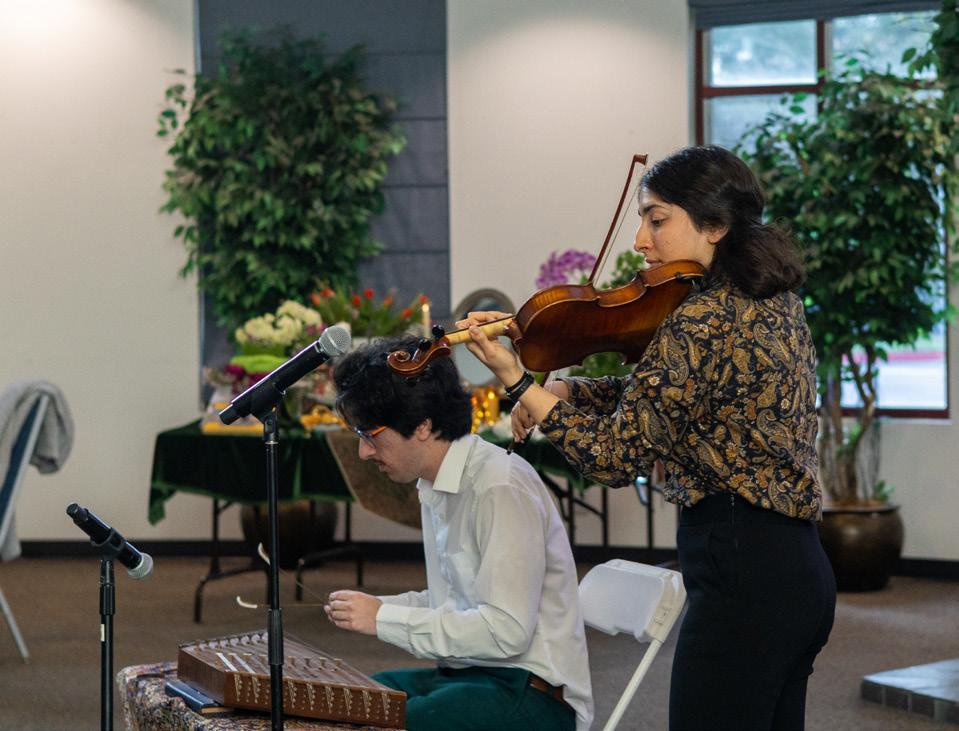
UC Davis students Negar Agah and Remi Seddigh perform
“Jaane Maryam” at the Iranian Students Organization’s annual Nowruz event held at the Walter A. Buehler Alumni Center on March 7, 2026. (Tatev Sergoyan / Aggie)
BY IQRA AHMAD arts@theaggie.org
On March 7, the Iranian Student Organization (ISO) welcomed students, families and community members to celebrate Nowruz, the Persian New Year, in an evening that showcased performance and tradition at the Walter A. Buehler Alumni Center. ISO also recognized the Cross Cultural Center in their support and commitment to sharing the Nowruz celebration with the UC Davis community.
Observed on the spring equinox, Nowruz — which translates to “new day” — marks the arrival of the season and is celebrated across Iran and by many communities throughout the region and Iranian diaspora.
The ISO event offered students and community members the opportunity to engage with Iranian music and culture through live entertainment. Reaching capacity, the event had over 100 attendees and featured performances by board members and local music ensembles.
ISO partnered with Uncle David’s Grill House and Bostantea to provide dinner to attendees, including authentic Persian dishes such as khoresh ghormeh sabzi (Persian herb stew), khoresh gheymeh (split pea stew), kabob koobideh (grilled beef kabob), joojeh koobideh (chicken kabob), saffron rice, grilled tomatoes and salad shirazi (Persian cucumber and tomato salad).
For ISO President Ava Jabbari, a fourth-year environmental policy analysis and planning and international relations double major, Nowruz has long been one of the most meaningful ways she connects to her heritage. Raised in North America but closely tied to family in Iran, Jabbari described
Nowruz as deeply personal and rooted in community.
“It was always something that stayed at home,” Jabbari said. “But that’s why I think my mom wanted us to go to Iran so often during those months, usually March to April, so that we could have that time and connection and authentic experience.”
She recalled childhood traditions centered around the haft-sin, a ceremonial display featuring symbolic items of renewal and abundance for the new year. “haft-sin translates to ‘seven seen,’ seen is the letter for ‘S’ [in Farsi],” Jabbari said. “[On the haft-sin] there’s samanoo (wheat pudding), somagh (sumac), serkeh (vinegar), senjed (dried oleaster fruit), sabzeh (sprouted wheat or lentils), seer (garlic) and sekke (coins).”
Jabbari shared that the haftsin is an important and personal tradition that has allowed growth and reflection of the items displayed on the altar. In particular, Jabbari touched on the tradition of having a goldfish on the haft-sin as a symbol of movement and vitality in the new year.

Mitski’s ‘Nothing’s About To
8th studio album employs memorable literary references to construct a

catalogue.
Mitski constructs the thematic world of “Nothing’s About To Happen To Me” with an architect’s hand. Her feelings belong to places: a lake, a darkened tunnel, a small town, a house in which silent dogs mournfully gather. Mitski herself has cited Shirley Jackson’s novel “The Haunting of Hill House” as a primary inspiration for the album. The record’s cover also pointedly features yellow wallpaper as its backdrop.
Likewise, the music video for “Where’s My Phone?” features Mitski hiding inside a house, descending into a frenzied rage as hordes of strangers discourteously press their faces to her windows and wander inside. Her world has boundaries, walls, doorways and windows, that are encroached upon despite her best efforts.
“Nothing’s
Perhaps the unique perspective of this album owes itself to Mitski’s other pursuits — namely, her work composing lyrics for a stage adaptation of “The Queen’s Gambit.” Here, she operates not unlike a director, carefully composing sets and arranging players. The album harnesses a unique sense of place and space that sets it apart from its
predecessors.
This small-scale perspective renders Mitski equal parts vulnerable and self-aware. In the album’s opening track, “In A Lake,” she explains that, “I’d never live in a small town, I’ve made too many mistakes,” but “in a big city, you can start over.” And yet, she spends the duration of the record within this small town, full of memories and regrets.
“In A Lake” is immediately one of the album’s best tracks, with its warm yet sorrowful melody brilliantly backdropping Mitski’s melancholic musings. Another gem is “Cats,” which echoes “My Love Mine All Mine” with its simple, ephemeral perspective on love.
“You say it’s so hard, but it feels simple to me,” Mitski sings, defining peace as two cats sleeping beside her and the song’s subject every night.
Mitski struggles against the reality of the 21st century on “Where’s My Phone?,” the album’s grungiest and most chaotic track. Her anxious, angry voice rings out over a jagged guitar in the chorus; the experience of listening to the song is intense and almost overstimulating at times, a reflection of the uncomfortable emotions it grapples with.
“I just want my mind to be a clear glass, clear glass with nothing in my head,” pleads Mitski midway through the song, while the wild sonic landscape suggests that her mind is anything but clear.
“If I Leave” is a standout on the album, finding Mitski grappling with the decision to walk away from the one person who sees her clearly. “But who else could love me quite as kindly as you?” she wonders. The song’s production — beginning restrained and moody before lurching into a cacophony — harkens back to the production of “Bury Me At Makeout Creek” and makes for a thrilling listening experience. On “Instead of Here,” a calmer track that more closely resembles the restrained production of “The Land Is Inhospitable and So Are We,” Mitski’s desire for the peace of isolation shines through once more.
“To feel like myself again, I won’t be here,” she sings. “I’ll be where nobody can reach.”
The album’s second single, “I’ll Change For You,” employs Mitski’s strengths as a vocalist, as her voice soars and cries out that “if you don’t like me now, I’ll change for you.” It is an achingly beautiful track that maturely explores her desire
to be whatever someone else wants so long as it ensures their love for her.
“Nothing’s About To Happen To Me” is diverse in its offerings, ranging from hopeful to morose. “Rules” is shiningly upbeat with its bright horn melody, while “Dead Women,” the album’s darkest track by far, is fittingly slow and haunting. On “Charon’s Obol,” Mitski fascinatingly invokes the ancient Greek tradition for which the song is named. In a house where other girls have died before her, the subject of the song decides to start a new life, choosing to “be the token coin in its mouth” in reference to the Greek tradition of placing a coin in a deceased person’s mouth to pay for passage across the River Styx.
“Maybe with enough time tending to that ground, she can heal the heart of her house,” sings Mitski. In spite of the morbid images Mitski draws upon and all the references to isolation and death that fill the album’s 11-track run, she leaves the listener with a bit of hope, once more landing that delicate balance between accepting the pain of the world and dreaming of a day when it may become just a little better.



BY DOMENICA PELOSO features@theaggie.org Union].”
From UC Davis’ noble Gunrock to UC Berkeley’s Oski, almost every college campus has a mascot. But amidst banana slugs, bruins and bobcats — one suited figure stands out among the rest. Namely, the neon orange Carrot Guy who has simultaneously captured the adoration, whimsy and utter confusion of 20 different California colleges.
Carrot Guy stands out not only due to his general vegetable-ness, but because of his seemingly altruistic motives: to hand out free carrots and engage with students.
“We have this sheet, and it’s like our Carrot Bible,” Davis Carrot Guy No. 1, a first-year animal biology major, said. “It tells you the way Carrot Guy should be. He should be kind, courteous, but above all, he is supposed to be nonconfrontational.”
In fact, all 30 Carrot Guys are explicitly instructed to not be bothersome.
“That’s one of the most important things about Carrot Guy; he’s not encouraging you to come talk to him,” Davis Carrot Guy No. 2, a first-year psychology major, said. “You’re not coming up to people and you’re not pushing. You’re just Carrot Guy — it’s not like the petitioners at the [Memorial
Though Carrot Guy’s free produce and playful personality initially draws students in, often what keeps them lingering is the curious whiteboard he displays. On this board, there is an alluring selection of carrotthemed goodies, ranging from shot glasses to pens to keychains.
The catch is, in order to “win” one of these tempting accoutraments, one must scan the provided QR code, download the Carrot app and answer the Daily Dig: a question-based prompt that changes every 24 hours.
For example, the most liked prompt under the official Instagram @carrotguy account simply states: “Say something totally absurd.”
In December of 2022, founder and Chief Executive Officer (CEO) of Carrot, James Tashjian, officially launched a prototype app to the students at UC Los Angeles (UCLA) and the University of Southern California. After collecting feedback, Tashjian returned to UCLA, where a team of student engineers developed a marketready app in December of 2024.
The Carrot app is promoted as a healthy alternative to social media, prioritizing genuine connections over algorithms and advertisements.
“We believe that questions and answers are the best way to dig deeper relationships,” Tashjian said. “The person
asking the question is interested in learning more about someone else, and the person answering is revealing something about themself. So, that mutual vulnerability leads to better friendships.”
That being said, it is no secret that platforms such as Reddit and Quora are already based on this same philosophy. So, what makes Carrot different?
“The daily questions are curated to help someone express themself — to feel seen, to feel heard, to feel known,” Tashjian said. “But the problem with that is, we didn’t think anybody would do it. Nobody’s going to go around answering random questions, even if you tell them it’s good for friendship. That is, unless you pay them.”
Students who answer the Daily Dig are rewarded with Carrot Coins, which can be used to buy mystery prize boxes containing $100 Amazon gift cards, collectible GIFs, one month free of Carrot Plus and more. However, what most students do not recognize is the cryptocurrency aspect of Carrot Coins.
“It’s a real digital currency, so you can transfer them out of the app, swap them for U.S. dollars and cash out,” Tashjian said. “But very few students do that, because they’re not very into crypto. They think it’s weird, they think it’s for old people, they think it’s
complicated and they’re just not into it. That being said, students think it’s a crypto app when it’s merely a feature. You can enjoy the app completely without any crypto at all.”
From a business standpoint, Tashjian’s endgame for Carrot is ultimately to solve the customer feedback loop problem via incentivization.
“When you get off a Southwest flight, you get an email that says: ‘How was your flight on a scale from one to 10?’” Tashjian said. “Or, when you step out of a Bank of America, you receive an email that says, ‘How was your banking experience on a scale from one to 10?’ Nobody answers those emails. But, if Carrot had a sufficient enough user base, perhaps when Bank of America or Southwest sends you Carrot Coins alongside a customer review prompt, sure, I’ll tell you my flight had excellent leg room.”
With summer just around the corner, the Carrot app has plans for innovations: including an android-friendly version, an in-app merch store, an interactive mini game and plans to expand Carrot Guy nationwide.
Although there are no current vacancies for the position of Carrot Guy, perhaps hearing about the experiences of previous students will serve as inspiration, or perhaps deterrence, for prospective Carrot Guys.
“It takes a certain kind of person to be Carrot Guy,” Davis
Carrot Guy No. 2 said. “I will do tai chi, some people will do yoga in the carrot suit, I’ve raced people down in the grass, I’ve tried to hit a kick-flip on a skateboard in the carrot suit. You have to be a sort of ‘out there’ kind of person.”
Carrot Guy No. 1 went on to describe a particularly memorable YikYak post, which involved Gary May, Gunrock and Carrot Guy yaoi.
“They featured [us] with a pregnancy test, and that’s me discovering it,” Carrot Guy No. 1 said. “Personally, I wouldn’t react like this because I wouldn’t be involved with these two.
Maybe Gunrock.”
Perhaps the most outrageous story comes from UCLA, where the first Carrot Guy attended university.
“He asked me to run in the UCLA Undie Run,” Tashjian said.
“I did not know what that was; I thought it was a marathon in underwear, so I okayed it. Low and behold, I did not know that everyone would be inebriated and drunk, and the love for Carrot Guy was expressed by picking him up and throwing him around, and so he got pretty beat up.”
When asked how long they plan to carry on the torch of Carrot Guy, both UC Davis students said they hope to maintain their positions for as
long as possible. “Everybody’s always so happy to see him,” Davis

definitely one of the best gigs I’ve ever had.”
The beginner-friendly club encourages students to embrace culture through dance community
BY HANNAH OSBORN arts@theaggie.org
Dance is an activity that can enchant and bring people together; however, it can also be intimidating. Maybe you’ve never danced before, or maybe you’ve danced but want to find a new community or style to learn. UC Davis has no shortage of opportunities, one of which is Baile de Fuego.
Baile de Fuego, a Latin dance club at UC Davis, hosts a dance lesson and social hour every Sunday from 6 to 8 p.m. in Hoagland Hall 113. Lessons taught this quarter have included dances like bachata, salsa, zouk, banda and kizomba.
Vice President Shelby Hulse, a fourth-year animal science major, shared the motivation behind the club’s dedication to regular lessons and socials.
“We do our very best to offer the community a space to come and dance,” Hulse said. “We like to guarantee that it’s free.” The effort to make a social space on campus for people to participate in Latin dance has made an impact upon attendees, as shared by Dance Team Lead Jimena Arango, a third-year animal biology major.
“My first year on campus, I was away from home,” Arango said. “Coming up here, I didn’t really have any friends or family [nearby]. When I heard that
there was a club on campus that does bachata, salsa and all this stuff every Sunday, I wanted to learn more about it.”
Arango discussed the friendship and community that members can find in the club.
“I came and connected with a lot of friends, and now I dance every Sunday,” Arango said. “It really fulfills my heart and is able to allow me to connect to my culture again, even though I’m away from home. ‘A home away from home’ — cliche, but it’s true. A lot of the friends I met went to Baile de Fuego. It’s a passion I’m able to pursue while in college.”
This sentiment was shared by Events Coordinator
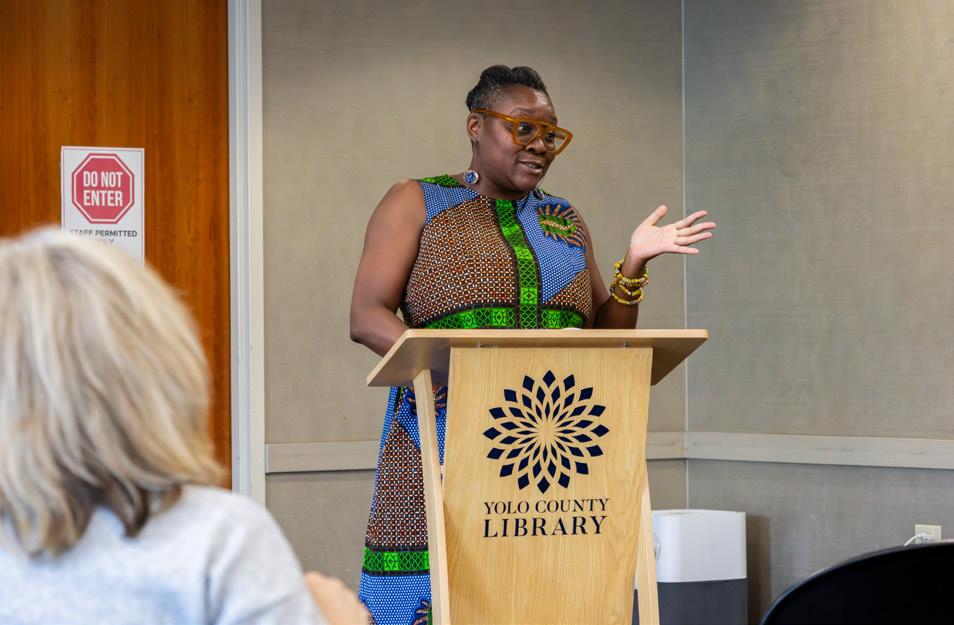
Atuahene outlined findings from her new book ‘Plundered: How Racist Policies Undermine Black Homeownership in America’
BY MICHELLE BEKHTEL
city@theaggie.org
Legal scholar Bernadette Atuahene spoke at the Yolo County Library on Feb. 25 about her new book, “Plundered: How Racist Policies Undermine Black Homeownership in America,” and presented research on Detroit’s property tax foreclosure crisis. The event was hosted by Thomas Joo, a professor at UC Davis School of Law.
Atuahene, a professor at the University of Southern California Gould School of Law, described findings from years of ethnographic research conducted in Detroit. Her work focused on how property tax administration contributed to widespread home loss among Black residents.
Detroit illegally overassessed 53% to 84% of homes each year between 2009 and 2015, violating the Michigan Constitution’s property assessment limit, according to Atuahene. A Detroit News investigation later estimated that homeowners were overtaxed by at least $600 million during that period.
Atuahene explained that many residents lost fully paid-off inherited homes due to inflated tax bills. “Individual efforts are no match for broken systems,” Atuahene said.
She highlighted stories of those who were qualified for a poverty tax exemption, but were unable to access it due to administrative barriers.
“Tens of thousands of people were charged taxes they were never supposed to be paying,” Atuahene said.
During the talk, Atuahene also outlined what she described as “racist policies” that shaped Detroit’s housing landscape, including redlining, racial covenants, blockbusting and urban renewal. She contrasted the experiences of two families from her research — one African American and one Italian American — to illustrate how these policies produced divergent outcomes despite similar economic starting points.
“What’s visible is the Black community,” Atuahene said. “What’s invisible are the layers and layers of policies that undermined their ability to build and retain wealth.”
Atuahene also discussed her work as a co-founder of the Coalition for Property Tax Justice, a Detroit-based group
that advocates for homeowners affected by overassessment. She said the coalition has helped halt approximately 13,000 tax foreclosures since 2020 and has assisted more than 1,000 residents in securing federal relief funds. The group has also secured $6 million in compensation from the City of Detroit, according to Atuahene.
“This is just the beginning,” Atuahene said. “If residents were overtaxed by $600 million, then $6 million is nowhere near enough.”
During the Q&A portion of the event, audience members shared personal experiences with housing discrimination. One audience member spoke of a moment in time in which she and her black partner moved to a neighborhood in Massachusetts, and had begun to receive countless hateful voicemails.
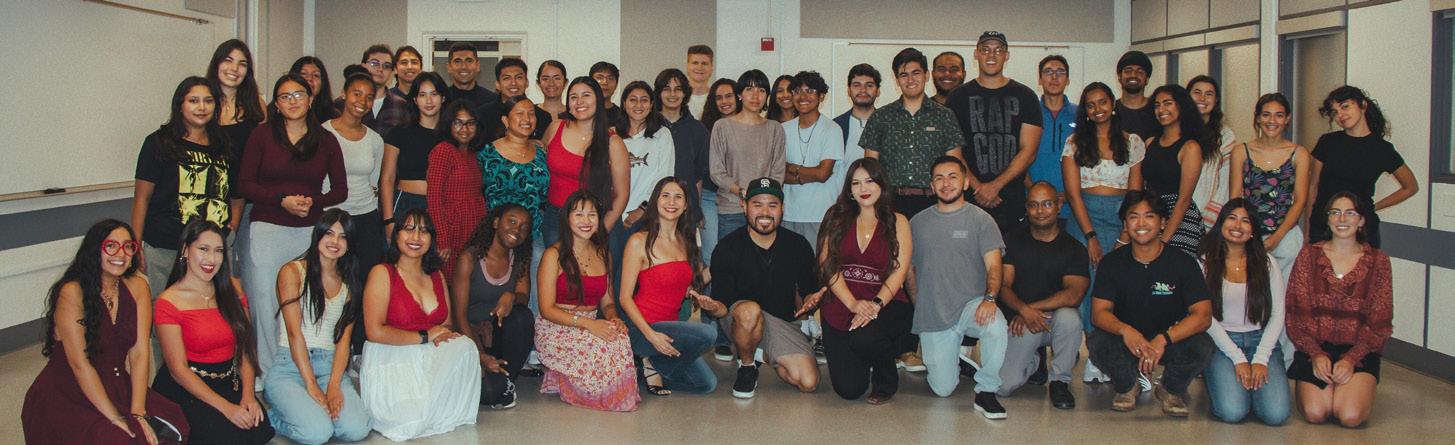
Marilu Zunuz, a second-year biochemistry and molecular biology major.
“I’ve been dancing for less than two years, and I started dancing because of this,” Zunuz said. “It’s an environment that when I first came in, I really felt at home. It’s a community that’s open to all: beginners and people that have been dancing for years on end. It’s just a really great place to not only make friends and be social, but to network: to feel at home, to feel safe.”
The club works to create a feeling of safety with partner dancing by making participants aware of a sign-in sheet and safety form at the beginning of every lesson.
“I always do our safety announcements,” Hulse said. “That’s really important for us: that everyone who comes to dance with us knows they can tell the board about anything, and we will handle it on the spot. They have access to a link where they can say anything they want anonymously.”
The club’s efforts to cultivate a safe and respectful atmosphere has drawn in Davis community
members, not just students, to take part in dancing, learning and socializing.
“Our club is not just for students,” Zunuz said. “It’s for the whole community, and it’s free to all. That’s what I really like.”
The mission of the club as a fixture of the community includes an effort to provide lessons from experienced dancers.
“We really prioritize getting trained professionals,” Hulse said. “We’re so grateful that they give us their time. I’ve had people travel up to three hours to give us a free dance lesson, and it truly means everything. Some of them are alumni from UC Davis.”
The lessons offer a focused and relaxed learning environment. The instructors demonstrate the steps while allowing time for chatting between partners in order to create a familiar space where attendees can laugh at their own mistakes.
“It’s always fun,” Hulse said. “This is a very comfortable, lowstakes environment. We’re all
learning, we’re all growing and we just really like to give that opportunity to people.” Baile de Fuego has collaborated with other campus organizations, opening their club to invite in new people and furthering connections across the Davis community. These have included hosting Sigma Pi Alpha, Lambda Theta Phi and La Familia at their Sunday socials.
“People have loved collabing with us, and we love collabing with a lot of different clubs,” Zunuz said. “We want to create a safe environment where people feel welcome — especially [firstyears] — and they can come and just relax [and] not have to think about school or work or what’s going on in their personal life. They can just come and dance. That’s our main goal.”
The hour-long lesson is followed by a social hour, in which the connections in the club and friendly atmosphere are palpable. Hulse shared that often, attendees don’t want the night to end.
“People are here, people are happy,” Hulse said.
BAILEDEFUEGO on 9
Gender disparity and misogyny in the 2026 Winter
BY VRITI SHAH features@theaggie.org
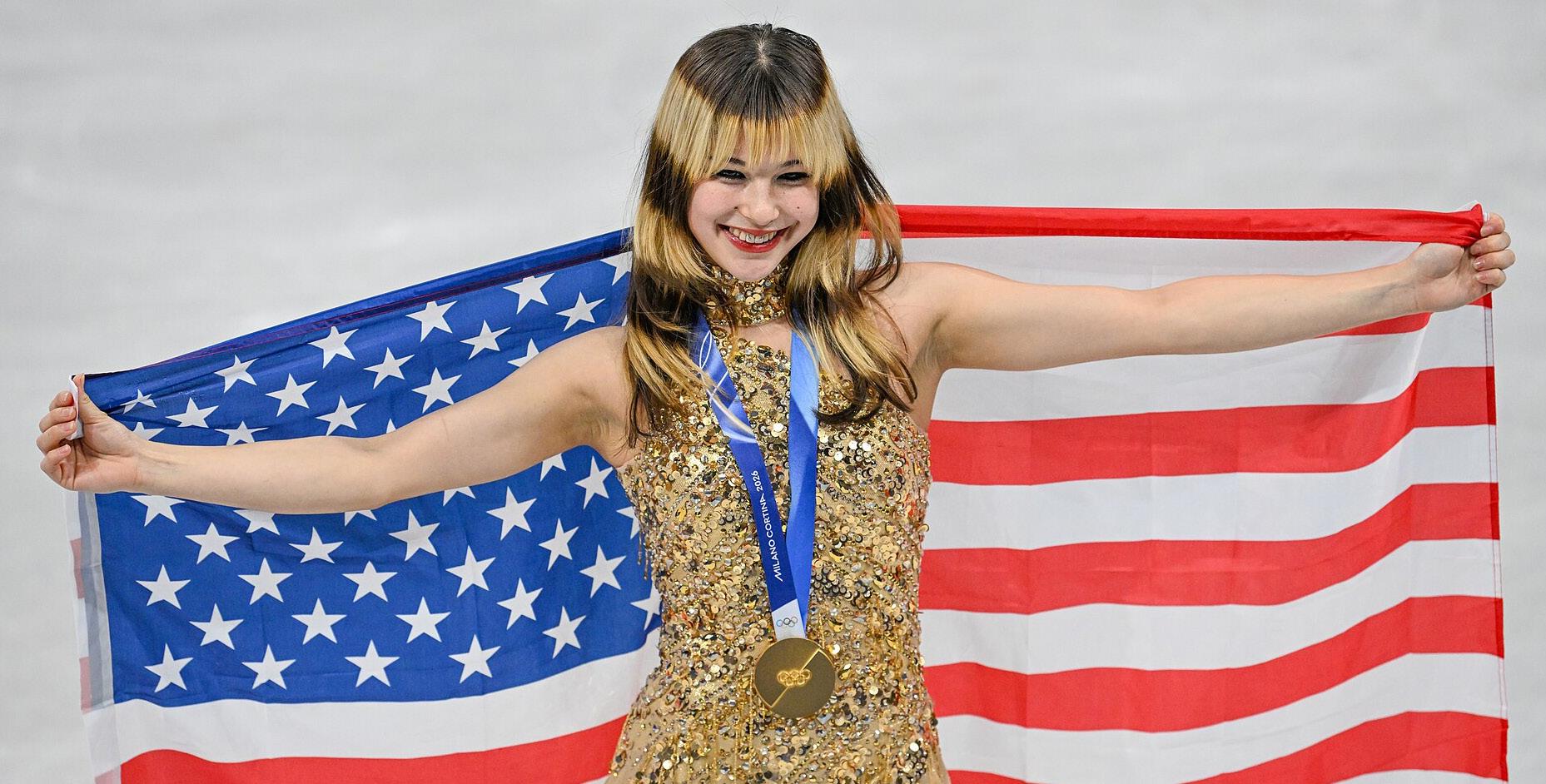
The recent Winter Olympics ended with many victories for the United States. These include 12 gold, 12 silver and nine bronze medals — with a total of 33 medals this year. This places the U.S. second internationally for the number of medals won in the 2026 Winter Olympics.
Along with the celebration of the nation’s vast wins, however, came the sexualization and patronization of its female Olympians. After the U.S. men’s hockey team won gold in the Winter Olympics for the first time in 46 years, they were congratulated by a phone call from President Donald Trump. During the phone call, Trump invited them to celebrate at the State of Union address. On the same call, he mocked the women’s team.
“I must tell you, we’re gonna have to bring the women’s team. You do know that,” Trump said in an interview with ABC
“[If he did not invite the women’s team,] I do believe I probably would be impeached.”
The women’s U.S. hockey team also won gold — their first gold medal since the 2018 Winter Olympics. The women’s team declined Trump’s invitation to the White House after their win due to conflicting schedules. Much of the media reacted with outrage to Trump’s comment and the response of the men’s hockey team. A petition with over 20,000 signatures was created to call on the men’s hockey team to apologize and to not attend the State of Union address in solidarity with the women’s team.
Students have their own varying opinions regarding the misogyny these female Olympians have faced.
“I obviously don’t agree,” Anna Maffia, a third-year chemistry major said. “I think that’s pretty sexist. I think that if they are representing the country, they have to represent both sides of the country [...] the women’s and men’s teams.”
It is true that the phone call between the president and the athletes was representative of the country. However, others believe that this is normalized behavior.
“I think [misogyny is] pretty common for women’s sports, to be honest,” Ava Keochekian, a second-year biological sciences major, said. “Even though they’re playing the same sport [and] they’re equally as athletic, they’re typically seen as lesser. It’s pretty awful to see [the men’s hockey team situation] coming from not viewers, but other Olympians.” Stephanie Morales, a fifthyear psychology and human development major, believed that Trump’s comment was a showing of patronization to the women’s hockey team.
“I feel like they didn’t really view the women’s team as serious,” Morales said. “I mean, since they only invited them in, and then they were like, ‘Oh, I guess we’ll have to invite the women, you know, since we invited you guys.’”
The ordinance aims to strengthen Davis’ sanctuary city doctrine
BY YUENJO FAN city@theaggie.org
On Feb. 26, the Human Relations Commission met to discuss and review the draft of Davis’ Sanctuary City Ordinance.
Directed by the Davis City Council to initiate the ordinance draft, the Human Relations Commission composed a draft of 10 main principles, which was forwarded to Jeff Reisig, the Yolo County district attorney. Though not planned to be the city’s only response, the ordinance is meant to cover a wide scope of issues traditionally proposed.
Kevin Baker, co-chair of the Human Relations Commission, briefly described the process behind creating the ordinance draft.
“In our proposed principles, what we tried to do was address the scope of issues that have been proposed in similar local government ordinances,” Baker said. “We have [also] heard many good ideas that are outside the scope of traditional Sanctuary City Ordinances that we are familiar with that we believe to be fully considered.”
Davis adopted a Sanctuary City Resolution in 1986, but the city has never adopted a formal ordinance. A resolution serves as a statement of intent, while an ordinance acts as a legally binding document that applies to the entire city.
The proposed ordinance includes outlawing city resources to assist immigration authorities, prohibiting the disclosure of residents’ immigration status and recommending the development of a community notification system.
Davis City Attorney Inder Khalsa spoke on her review of the ordinance and its relationship with federal regulations.
“Our primary concern in adopting an ordinance is that it would be preempted by federal law,” Khalsa said. “What this means is that in the United States, immigration law is solely a federal matter, and it is enforced solely at the federal level. Local governments do not engage in immigration enforcement. That said, we also have no obligation to assist with federal law enforcement, and there is a long line of cases that says that the federal government cannot use local government to enforce federal law.”
Khalsa noted how the California Values Act, also known as SB54, set forth principles to guide her revision of the ordinance draft.
A 2022 piece of legislation that restricts cooperation between local and federal immigration enforcement agencies, the law teeters on the fine line between federal and state rules.
“We are attempting to expand upon SB54 to increase the protections that the City of
The plan aims to retain and encourage small businesses and continue to attract visitors
BY KATYA OKS city@theaggie.org
On March 3, Davis City Council met to discuss an Economic Development Strategic Plan. The Plan outlines economic development goals and the ways in which the city should implement them in the next 3 to 5 years.
The initial presentation was led by Katie Yancey, the Davis economic development director, and was then followed by a public comment section and the council members’ discussion on how to move forward. Before the presentation began, Yancey discussed the goal of the presentation and the Plan.
“[The Plan] is intended to articulate very immediate and near term revenue generation interventions [which] align with the city council’s existing goals, visions and policy statements that are primarily located within the general Plan,” Yancey said.
Yancey then shared her vision for the Plan. She explained her hopes that the Plan will maintain a high quality of life for Davis community members while keeping “the university-oriented, small city feel,” according to the slides. Yancey also expressed her wishes for Davis to get “regional recognition” for tourism, aiming to focus efforts on downtown attractions.
To achieve this, Yancey emphasized the importance of diversifying the tax base in order to take some pressure off local citizens.
“Diversifying the tax base means that the city isn’t relying solely on sales tax or property taxes or on circulating earned income generated by its major employers,” Yancey said. “This broader base creates more stable and predictable revenues and puts less pressure on the residents and the businesses to fill gaps with sales tax increases or parcel tax increases, many of which are no longer available, and increases the city’s capacity to fund services, infrastructure and amenities.”
Davis is home to many local small businesses; Yancey discussed some ways to ensure that they continue to thrive in the community.
Davis is providing to our whole community,” Khalsa said. “We are trying to do so in a way that does not push it so far that we are standing in the way of federal law enforcement.”
Ultimately, the changes that Khalsa made to the commission’s ordinance draft were mainly regarding its language, particularly in clarifying certain terms such as “immigration activity.” Khalsa explained how she opted for a conservative approach to the ordinance to avoid the legal pushback an aggressive ordinance might provoke.
“The city receives substantial federal funding,” Khalsa said. “[It] is used for critical social services as well as infrastructure, and one of our considerations as city staff is to not have an ordinance to conflict with any contractual language that is currently in our grants from the federal government. [...] Some of the funds we do receive goes to critical affordable housing services, homeless services and other social services that the city provides that we frankly have no alternative funding sources for.”
However, the Human Relations Commission questioned certain changes, particularly the removal of the community notification system for federal law enforcement activity.
Davis Police Chief Todd Henry addressed the commission’s concern, citing
This month’s Ramadan offerings are not the first time The Pantry has provided culturally themed items. For Lunar New Year in February, they stocked egg tarts, sesame oil, fortune cookies, meat floss, Hi-Chew candies, matcha red bean cake, Meiji Chocorooms, soy sauce packets, ginger root and mung bean.
deconfliction, a law enforcement tactic that minimizes miscommunication to prevent friendly fire incidents.
“[If] our officers come in contact with [federal agents] and they come out of a car holding a weapon, now our officers are in a potential blue on blue situation,” Henry said.
“My concern would be that if we disclose this information, [federal agencies] would simply stop notifying us.”
Henry also noted that not all federal agencies engage in immigration enforcement and that communication between the Davis police and federal agencies is common. He explains
perform a task (in this case, firing a weapon without a human in the loop), so they prohibit the government from carrying out that task within the lines of their contract.
that a notification system would impede deconfliction and potentially jeopardize the safety of Davis’ law enforcement officers.
However, not all community members present at the meeting were satisfied with the proposed ordinance. Spear, a public commenter who chose to only share their first name, voiced a need to do more.
“As a concerned community member, I am not excited to hear the city take a conservative approach to a federal government acting extrajudicially and above the law,” Spear said. The sentiment was similarly shared by others present at the
meeting, who took aim at the District Attorney’s conservative approach.
Their concerns primarily stemmed from a belief that the city has not done enough to protect its undocumented immigrant population. The Human Relations Commission will continue further talks with the District Attorney’s Office and the Davis Police Department before forwarding a final copy to the Davis City Council. The Human Relations Commission meets every month on the fourth Thursday of each month. More information can be found on their website.
should be focused more on their character than their looks. Maffia went on to share her thoughts on how female athletes are viewed in the media.
“Collaborating with our local chamber, our local nonprofits, our local business groups [...] [will] all help to streamline business support.”
Yancey then concluded the presentation by stating the importance of continuing to expand outside of traditional revenue models.
“Simply put, innovation isn’t optional here in Davis,” Yancey said. “It’s important for us to figure out how to innovate our economic development approaches. [...] Because of limited vacant land, sluggish commercial demand and the heavy reliance on a universitydriven economy, [the traditional revenue model] no longer generates enough fiscal stability to meet the community’s expectations.”
The meeting then opened to a public comment section. Carrie Rohrbach, the executive director of the Davis Chamber of Commerce, spoke in support of Yancey’s Plan and the importance of the city’s collaboration with local businesses and organizations.
“This proactive engagement reduces friction, increases transparency and ensures that businesses have a clear channel for input and support,” Rohrbach said. “We strongly believe this partnership adds tangible value not only to our members, but to the broader Davis community. When the city and the Chamber collaborate effectively, our local economy is more resilient, our businesses are more informed and our community is stronger as a whole.”
Georgina Valencia, a Davis resident, brought forth some important factors to consider in the implementation of the Plan.
“One [thing to consider] is metrics,” Valencia said. “What are the metrics going to be? How do you define success, and how are you going to measure that? That’s going to be important to economic development.
“Partnering with local agencies [and] organizations, along with state and federal agencies that support small businesses [means] that the city can do more with less and ensure that these businesses have the resources, the visibility, the advocacy and the market conditions that they need to thrive by being both proactive and responsive to small business needs,” Yancey said.

The Pantry has also offered cultural snacks at the Mobile Pantry, their pop-up food cart. For winter quarter, the Mobile Pantry can be found every Tuesday at the Student Community Center (SCC) and Thursdays at the Activities and Recreation Center (ARC).
Tarabzooni hopes to keep the cultural food offerings around. They are currently asking students visiting The Pantry to suggest foods they would like to see stocked in the future, in an effort to better represent the student population.
“We’re trying to also just make [The Pantry] a more inclusive space in general, because it’s not like people’s culture just goes away the second a holiday ends,” Tarabzooni said. “If people do have ideas at any point, we still want [them] to be shared.”
“However, it seems like that is not a pattern just occurring in the U.S. government, but also occurring within the ASUCD Senate. [Heth and Rubin] have consistently failed to attend multiple commission [meetings], and knowing that these commissions might not support them, chose not to repair the relationship but actively chose to disenfranchise their vote.”
Rubin provided a response to Castaneda’s allegations.
“I have no intentions to run for office,” Rubin said. “I will not be running for office in the spring, and I think it is completely inappropriate that you are alleging that of me and suggesting that I’m engaging in corrupt practices. It is completely unacceptable, and it will be clear in week one of spring quarter — so shame on you.”
Several other senators, chairpersons and elected officials spoke out on the matter, noting that it was too close to the election season to possibly change the bylaws. They ultimately opted to table the bill until the following week’s Senate meeting. The authors committed to reexamining which units, if any, should be able to endorse before reconsidering the bill.
A military contract may require a fighter jet to only be used in certain conditions, according to Dean W. Ball, who wrote AI policy in the opening months of the second Trump administration. Use outside of these limits would break its warranty. Anthropic follows this trend; they believe that their product is unable to safely
However, the implications of their first red line — preventing Claude’s use in domestic surveillance — are more contentious. The Pentagon argued that this restriction was unnecessary given existing law already constrains domestic surveillance: the Fourth Amendment, the Foreign Intelligence Surveillance Act (FISA) and Department of Defense (DoD) directives all impose limits on intelligence collection targeting Americans.
Anthropic’s position is that those laws aren’t strict enough. They stated that, “under current law, the government can purchase detailed records of Americans’ movements, web browsing, and associations from public sources without obtaining a warrant.” Yet, in theory, this should be rectified by the passage of a new law, not a private company’s military contract.
I believe that Anthropic is doing something very important by maintaining these red lines and acknowledging that our lives aren’t only constrained by humans anymore. Any free enterprise argument (like the one made above) presupposes a tension between two types of actors: governments and firms. Firms constrain human behavior through prices, and governments constrain human behavior through laws (enforced by threat of violence). The integration of AI into policy decisions has introduced a third actor: algorithms. When a human intelligence analyst recommends a surveillance target, there is a chain of reasoning that can be scrutinized, challenged and held accountable. When an AI system does the same thing at scale, that chain dissolves.
Philosopher John Danaher called this phenomenon “algocracy”: governance by algorithms we cannot fully understand but are compelled to obey. Anthropic’s red lines are, in effect, an acknowledgment that existing legal frameworks were designed to constrain human decision-makers, not algorithmic ones. Until the law catches up to this reality, we should be grateful for these “red lines” drawn by private actors.
“We genuinely have to kick people out [when the room reservation is up]. I love the people, and I also want to keep learning. I learn every time.”
If you feel an inclination to learn to dance, but fear embarrassment, Baile de Fuego is a space to learn and socialize with others, free of judgment. Baile de Fuego meets Sundays, 6 to 8 p.m. at Hoagland Hall 113, and their March 15 meeting will be a social event with opportunities to help fundraise for the club.
More information about their meetings can be found on their Instagram @ ucdbailedefuego.
They were later able to track down the voicemails and the source was from a single household in which neighbors would collect to send out the voicemails. The police were contacted to assist the issue and the pair stopped receiving the calls.
In response, Atuahene emphasized that individual prejudice often reflects broader policy structures.
“This hatred was manufactured,” Atuahene said. “It’s because of the federal government and red lining, where the very presence of black people could reduce property values. If we understand that the way America likes to understand this, it is individual hateful people, right? That’s not the way to understand this. There are certain racist policies that manufactured the reason they didn’t want black people in their homes,” Atuahene said.
She emphasized a focus on systemic factors, rather than narratives of personal failure. Atuanene concluded her talk with a call to action.
“Those of us who care about justice have to make the invisible visible,” Atuanene said.
It is true that there is a belittling view toward women in this conversation. Others believe that this behavior has been seen before from Trump.
“It was just not new behavior from the president,” Morales said. “I mean, we shouldn’t expect it, but it’s just crazy to see that phone call get out and see how the government views women in general.”
Alysa Liu, a 20-year-old U.S. figure skater who recently won gold in the 2026 Winter Olympics, has faced online comments regarding her selfexpression — including her hair, piercings and style. After winning her gold medal, Liu posed for a photo sticking her tongue out. Commenters described this photo as “goonbait” — a slang term used when sexualizing a person. This led to nonconsensual artificial intelligence-generated nude photos of Liu and other female athletes.
“If it’s to do with her selfexpression, I know some people are really talking about her hair and stuff and questioning sort of like what the expression of femininity looks like in that sport,” Maffia said. “And I think it’s more like we should just be focusing on her character.” It is true that female athletes
“It seems like she’s just a force of positivity,” Maffia said. “And, I think that should be more [of] the conversation. Like, why does it [matter] what people do to their hair?” These UC Davis students had differing opinions on the treatment of female athletes in the media.
“I think they should obviously be seen as more equal,” Morales said. “Because, I mean, they both won [...] gold medals. So I don’t understand, like, what’s the difference? Only
9
Retention is also really important. We just lost two coffee shops downtown. [...] I think to be proactive about that is really important for the community too.” Elaine Roberts Musser, another public commenter and Davis resident, highlighted the importance of diversifying the taxes.
“It is highly unlikely another tax measure would be approved by voters, not after the last sales tax increase was squandered on city employee salary increases rather than on infrastructure repair as promised,” Musser said. “This is all the more reason to push for more economic development, along with streamlining our zoning and permitting processes to make for a more business-friendly environment. This city council needs to approve the economic development director’s proposal and support her in any way they can.”
To conclude, Mayor Donna Neville discussed the next steps in implementing the presented economic development Plan. Although supportive, Neville stated that she would want further landscape analysis provided before more changes can be made.
“So [for the] first [motion], we would approve the strategic Plan,” Neville said. “The second, we would approve the staff’s request to do this initial tax, property tax and sales tax analysis.”
The tax base analysis would include the city identifying existing budget gaps and deficits, and then figuring out new pathways for addressing such. More updates and information are available on the City of Davis website.

UC Davis researchers receive a $4.9 million grant to further develop self-cloning crops
The technology provides a cost-effective method to help small-scale farmers increase yield
In January 2026, UC Davis
researchers at the Sundaresan
Lab received a $4.9 million Gates Foundation Grant to further develop a novel technique, synthetic apomixis, that produces clonal hybrid seeds. Their research also received the $500,000 VinFuture Prize in December 2025.
Intraspecific hybridization is a process where two “genetically distinct” plants of the same species are crossbred to produce a set of desirable traits in the next generation, such as drought resistance or higher yield, according to the University of Arkansas.
However, when hybrids mate with each other or selffertilize, these beneficial traits (hybrid vigor) can be lost in subsequent generations. During meiosis, parental DNA is reshuffled before it is packaged into reproductive cells (gametes), each of which are genetically distinct. Then, in a process called fertilization, the maternal and paternal gametes fuse, forming a fertilized egg that develops into an embryo. The embryo later develops into a seed. Therefore, the same set of alleles (versions of a gene) will not be present in every individual of the next generation.
Thus, with traditional methods, farmers must purchase a new set of hybrid seeds each year. For farmers in developing countries, however, this may not always be financially feasible, according to the Innovative Genomics Institute (IGI).
In a study published in Nature in 2018, researchers in Sundaresan’s lab group proposed a novel solution for hybrid rice plants to generate clonal offspring asexually: synthetic apomixis.

First, researchers knocked out three genes using Clustered Regularly Interspaced Short Palindromic Repeats-associated protein 9 (CRISPR-Cas9): REC8, PAIR1 and OSD. Doing so inhibited meiosis, resulting in “unrecombined” and “diploid” male and female gametes, according to the study.
Next, researchers expressed the Baby Boom 1 gene (BBM1) in the diploid egg cell, triggering the unfertilized egg to develop into an embryo without the need for fertilization (parthenogenesis), according to IGI. BBM1 is a gene that was discovered by Imtiyaz Khanday, an assistant professor of plant sciences at UC Davis and a researcher in Sundaresan’s lab.
Since 2018, researchers have expanded the use of synthetic apomixis to monocot crops other than rice, such as maize, according to a UC Davis press release. The terms monocot and dicot refer to the number of leaf-
like structures (cotyledons) that emerge from the embryo after germination. A monocot has one cotyledon, while a dicot has two.
With the grant funds, the Sundaresan group hopes to apply synthetic apomixis to dicots, such as Indian mustard.
“It may be more complicated to move [synthetic apomixis] into dicots, because the embryo initiation process is a little different — but I’m hoping that in five years, we’ll have the technology working,” Sundaresan said in a UC Davis press release.
Sundaresan further commented on the long-term implications of this technology in a Dec. 8, 2025 UC Davis press release.
“Our invention, [synthetic apomixis], means that the benefits of hybrid crops will become available, equitable and accessible to farmers all over the world,” Sundaresan said.

BY EMILIA ROSE science@theaggie.org
As many know, the dinosaur-filled “Jurassic Park” movies aren’t exactly known for their scientific accuracy. In fact, it is well understood that the ginormous, scaly creatures depicted in those films are missing quite a few feathers and some key traits that more realistic depictions of dinosaurs have today.
Among the dinosaurs that scientists have revised their understanding of, the Spinosaurus is one of the betterknown examples. Even recently, new fossil evidence is shaping how we imagine this popular species.
Far away from where scientists originally hypothesized the Spinosaurus to have lived, an excavation in modern-day Niger unearthed a new species of the creature — known as Spinosaurus mirabilis.
After its discovery, the large, curved crest atop its head caught the eye of scientists and the public alike. Covered in the same material that makes up our
fingernails — keratin — this ornamental bone would have jutted out like a spike from the top of the Spinosaurus’ skull.
UC Davis Paleontologist
Tracy Thomson shared a few ideas as to what the potential function for this crest could have been.
“The most common interpretation of paleontologists put forth for unusual structures like this [crest] is display, either to signal members of your own species or to [signal] other species, like for warning or scaring predators,” Thomson said.
The discovery of even a single crest is of major significance; scientists may use it to rethink not only body structure, but also behavior, communication and ecology of dinosaurs.
But here’s the thing: the Spinosaurus has been reconstructed over and over again. Evidence originally pointed paleontologists towards the idea of a semi-aquatic Spinosaurus that lived on the ancient Cretaceous coasts. With the new fossil evidence, scientists predicted that this related species
may have also resembled a crested predator that lived in the rivers of ancient forests. This dinosaur and our concept of what it truly looked like has changed throughout the years.
Why does our image of these dinosaurs constantly shift? Will we ever know what they and their world truly looked like?
“I think one of the primary drivers of these different interpretations is the fact that the fossils are incomplete,” Thomson said. “Complete, articulated dinosaur skeletons are rarely found, and so a lot of what the animal would have looked like is based on what we know from other, closely related species.”
Each fossil discovery reshapes our understanding just a little bit. This dominoes into larger, more macro-shifts in scientific interpretations of behavior, ecology and lifestyle — not because the science is unreliable, but because researchers learn new things.
If scientific understanding of dinosaurs, such as the Spinosaurus, constantly changes, what does that say about how we reconstruct the past? We might never truly know the past, but we always have our best guesses. James Griesemer, professor in the UC Davis Department of Philosophy, expanded on the glimpses of history that science can provide.
“Science is always uncertain, and evidence is always ‘fragmented,’ though not always literally fragmented like the scattered and incomplete set of fossil bones of an extinct Spinosaurus,” Griesemer said. “Knowledge about anything — anything empirical, anyway — is never complete.”
The crest of Spinosaurus mirabilis might have little significance on its own, but its very presence in the context of what we once knew grants it a greater significance about our understanding of the past.


BY DANIELLE WIRNOWSKI sports@theaggie.org
The 2026 Winter Olympics were held in Milan and Cortina d’Ampezzo, Italy, from Feb. 6 to 22. From Feb. 6 to 19, short track and figure skating events were held at the Milano Skating Arena: “one of Europe’s premier sports facilities,” according to the official Olympics 2026 website.
The five competition events under figure skating are men’s single skating, women’s single skating, pair skating, ice dance and team events. The team events are as follows: ice dance free dance, pair skating free





skating, women’s single staking free staking and men’s single skating free skating. The team events contribute points out of 10 toward the country’s total points, rather than medals.
The countries that participated in the team events were Japan, Georgia, the United States, Italy and Canada.
U.S. skaters Madison Chock and Evan Bates ranked first place in ice dance free dance with a score of 133.23, earning 10 points for the team.
Ellie Kam and Danny O’Shea ranked fourth place in pair skating free skating with a score of 135.36, earning seven points for the U.S.
Amber Glenn ranked in third place for women’s single skating free skating with a score of 138.62 points, earning eight points for the U.S. Ilia Malinin, skating for the U.S. in the men’s single skating free skating, ranked in first place with a score of 200.03, earning 10 points.
Ice dance consists of two sub-events: rhythm dance and free dance. Each team competes in the rhythm dance event, but only the top 20 ice dance couples qualify for the free dance and move on in the competition. There were a total of 23 skating teams across 15 countries.
Three skating couples from Team USA qualified for the free dance event, ranking second, fifth and 11th place. Chock and Bates ranked second place, earning the silver medal with a combined rhythm and free dance score of 224.39. French skaters Laurence Fournier Beaudry and Guillaume Cizeron ranked in first place, taking the gold with a combined score of 225.82.
Similar to the ice dance events, pair skating has two sub-events: the short program and free skating. Each team competes in the short program, with only the top 16 pairs qualifying for free skating. There were a total of 19 pairs across 14 nations.
Two skating pairs from the U.S. qualified for free skating and ranked seventh and ninth place. Emily Chan and Spencer Howe ranked in seventh place, with a combined score of 200.31 from the short program and free skating.
Women’s single skating and men’s single skating functioned similarly, with a short program event as a qualifier for the free skating. For both events, only the top 24 skaters qualify for free skating. A total of 29 skaters participated in each gendered event, spanning across 22 countries for the women’s event
and 21 countries for the men’s. All three skaters for the women’s single skating from the U.S. — Alysa Liu, Isabeau Levito and Amber Glenn — qualified for free skating and ranked in third, ninth and 13th place, respectively. Liu ranked first place in free staking and earned the gold medal, with a total combined score from the short program and free skating of 226.79.
The Aggies were outperformed by UC Berkeley, Stanford and Saint Mary’s in their other matches

BY COLINA HARVEY sports@theaggie.org
On Feb. 27, the UC Davis beach volleyball team took a short road trip to the Bay Area to compete in the Battle of the Bay tournament hosted by UC Berkeley and Stanford University.
The beach volleyball team played in one tournament this spring prior to the Battle of the Bay: the Canyon Classic, hosted by Grand Canyon University. They struggled at this tournament, losing to Arizona State University, University of Arizona and Texas Christian University before besting Colorado Mesa in their last game of the tournament.
Their first matchup of the weekend was against the California State University, Sacramento (CSUS/Sac State) Hornets. This was the only game of the tournament where they faced a Big West Conference opponent.
In the first match, Kirra Martin, a third-year molecular and medical microbiology major, and Kinley Lindhardt, a graduate student at the UC Davis School of Management, defeated their Sac State opponents in two sets. Although the Hornets were close behind in the first set, losing 2119, the Aggies won the second set with a score of 21-13.
The second match to finish saw Kendal Steller, a second-year managerial economics major,
and Morgan Gillinger, a secondyear human development major tied up the game with a threeset loss. The Hornets edged the Aggies out in the first set, 2220. In the second set, the Aggies fought hard, winning a close set 24-22. However, the Aggies could not win in the tiebreaking set, losing by a narrow margin.
In the third match, Emma Johnson, a fourth-year human biology major, and Alexandra Leal, a third-year environmental engineering major, beat their Hornet opponents in two sets, 21-16.
Skye Smolinski, a thirdyear design major, and Kate O’Steen, a fourth-year human development major, were the players to clinch the overall win for their match. The first set was tight, but the Aggies took it, and, in the second set, they crushed the Hornets and secured the win.
The last pair to finish was Kimi Waller, a fourth-year nutrition science major, and Ella Erteltova, a Master of Management graduate student. Although they lost their match to Sac State, the Aggies remained uplifted as they had already won the first game.
Their second game of the day was against the home team, the UC Berkeley Golden Bears. The Aggies struggled against the Golden Bears, losing all five matches.
Steller and Gillinger were the lone pair of Aggies to win a set against UC Berkeley, securing the first set in their match.
However, they were not able to win the next two sets, allowing the Golden Bears to take the match. On the second day of competition, the Aggies took on the Stanford University Cardinal on their home turf. The Aggies struggled against the highly ranked Cardinal and once again lost every match. This time, Martin and Lindhardt were the only players to win a set against their opponent, though ultimately losing. They fought hard in the tiebreaking set and forced extra points before Stanford took the set 22-20. The Aggies’ last game of the tournament was against the Saint Mary’s College Gaels. In the first match to finish, Steller and Anna Braun, a fourth-year viticulture and enology major, lost in two sets to their opponents. In the second match to finish, Martin and Lindhardt equalized, beating their opponents in two sets. However, the Gaels prevailed in the three remaining matches and won the game, but the Aggies pushed them to three sets in each match.
On March 13, the Aggies will travel to San Luis Obispo, Calif. for the Mustang Roundup, where they will play four matches, including one against Big West Opponent California State University, Northridge. Then, on March 21, they will travel to Long Beach, Calif. to compete in the Big West Challenge.