
By JORDAN DONEGAN & SIENNA REINDERS
As the Trump administration continues to enact legislation attacking Diversity, Equity and Inclusion (DEI) initiatives and practices within educational institutions, Fordham University said that it remains committed to fostering an educational environment that promotes its Jesuit values of inclusivity and cura personalis
“Our focus is on continuing to provide programs and opportunities that support all students in ways that are consistent with our values, requirements under federal law, and federal grant-funding regulations,” said university spokesperson Jennifer Petra in an email statement to The Ram.
Since the start of his second term, President Donald Trump has passed numerous executive orders demanding an end to DEI initiatives in federally funded programs, such as educational institutions and the military. Most recently, on March 26, Trump issued his Executive Order 14398, “Addressing DEI Discrimination by Federal Contractors,” which requires all federal contractors, including Fordham University, to implement clauses in federal contracts stating that they will refrain from engaging in any “racially discriminatory DEI activities.”
The Trump administration defines such practices as “disparate treatment based
on race or ethnicity in the recruitment, employment (e.g., hiring, promotions), contracting (e.g., vendor agreements), program participation, or allocation or deployment of an entity’s resources.”
This executive order is the second passed by the Trump administration that specifically targets DEI in educational institutions. On his first day in office, Trump signed Executive Order 14173, “Ending Illegal Discrimination and Restoring Merit-Based Opportunity,” which similarly restricts federal contractors from facilitating DEI programs.
A month later, all federallyfunded Pre-K–12 schools, colleges and universities received a “Dear Colleague” letter from the Department of Education’s Office for Civil Rights threatening the loss of funding to institutions that did not comply with the termination of race as a factor in programs of higher education, including admissions and hiring.
Since then, Trump has taken many other actions targeting higher education institutions that, as according to his administration, have engaged in DEI violations. Two institutions that have been in the spotlight regarding these attacks include Columbia University and also Harvard University, which have both faced funding cuts.
More recently, prior to the March 26 executive order, the General Services Administration (GSA) proposed a draft revision
of its Financial Assistance General Representations and Certifications, which are legally binding attestations that the recipients of federal funding have to agree to. The revision would require recipients of federal grants, loans and other federal financial assistance to align with the Trump administration’s definitions and interpretations of what is and isn’t considered lawful regarding DEI.
As is the case with most higher education institutions, Fordham relies on federal funding to operate. According to the United States’ federal spending database, Fordham received $36.5 million in federal funding in 2024 and $81.9 million in federal funding in 2025 — the notable increase from 2024 to 2025 can be attributed to the $52 million grant from the Environmental Protection Agency that Fordham received, which was later terminated.
So far, in the 2026 fiscal year, Fordham has received $10.2 million in federal funding.
The database indicates that the majority of Fordham’s federal funding comes from the Federal Pell Grant Program and additional funding comes from the Federal Work-Study Program, Federal Supplemental Educational Opportunity Grants and research grants.
The actions taken by Trump during his second term have threatened federal funding to higher education institutions, which includes the federal
By SIDNEY BLASCO FEATURES EDITOR
The Rose Hill post offices’ weekday working hours are 8 a.m. to 3 p.m. Monday through Friday, and 9 a.m. to 2:30 p.m. on Saturday. Comparatively, the Lincoln Center campus mail room hours are 9 a.m. to 5 p.m. Monday through Thursday, and 11 a.m. to 7 p.m. on Friday.
Many Fordham University students who reside both on and off campus rely on Rose Hill’s post office, located in the basement of the McShane Student Center, to receive and send mail. Students pick up a paper slip from their P.O. Box, hand it to a post office worker, sign their name and receive their package.
The hours are determined by the United States Postal Service (USPS) regulations and the staff union. Since the
staff are unionized, their shift hours are non-negotiable, and if they work overtime, they are paid time and a half.
The Rose Hill post office has six full-time employees working Monday through Friday, and has 13 student workers total. De Castro said he has one worker who comes in on Saturday from 6 a.m. to 2:30 p.m.
While housed on Fordham property, the Rose Hill Post Office is an official contract station for the United States Postal Services, according to the Post Office Administrator, Ysmael De Castro.
“We sell stamps to you, money orders we do, we do all the business that a regular post office does, so we have to abide by their rules and regulations as well,” De Castro said.
SEE MAIL ROOM, PAGE 5
By SIENNA REINDERS EDITOR-IN-CHIEF
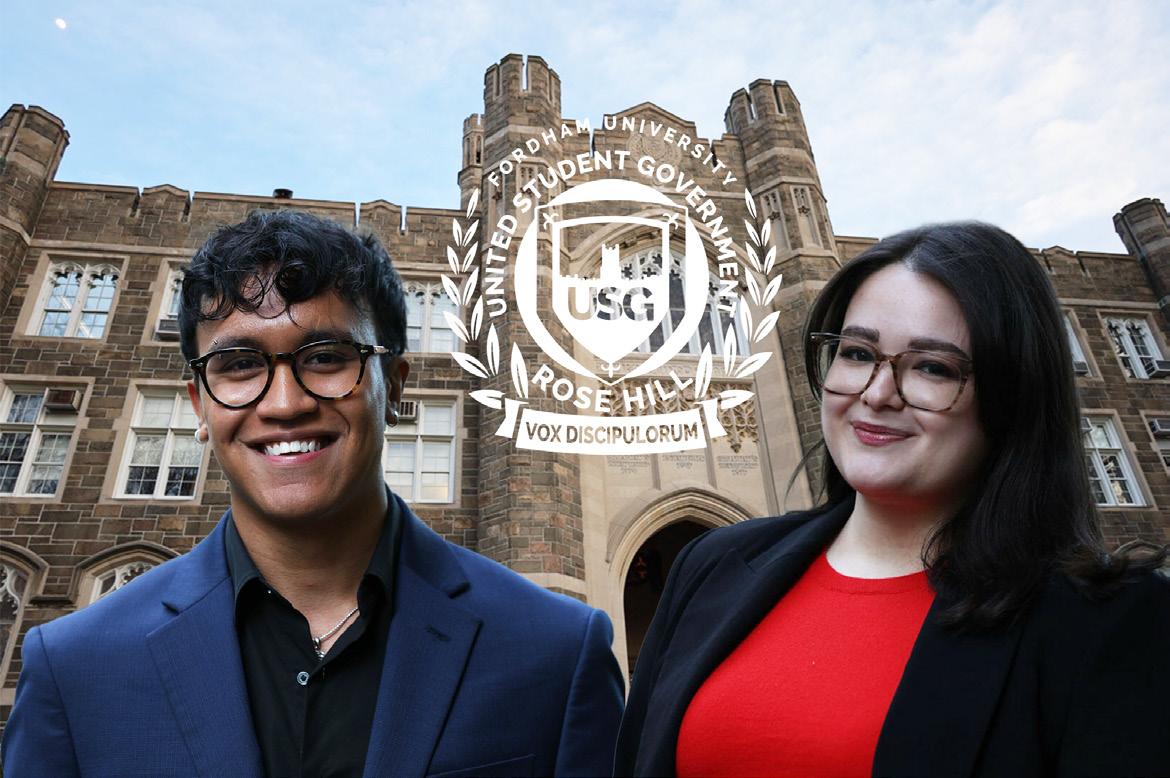
Madeline Ando, FCRH ’27, and Ayden Johnson, FCRH ’27, have won the positions of executive president and executive vice president, respectively, for the Fordham University Rose Hill United Student Government (USG) for the 2026-27 academic year.
Election voting was available for all Fordham students at the Rose Hill campus and opened on April 20, at 12 p.m. It was set to close April 21, at 5 p.m. However, due to an issue that resulted in executive ticket
ballots cast between 12 and 1 p.m. on April 20 being canceled, voting was extended until 6 p.m. on April 21, according to an email sent to some voters by current Executive President Lucas Hjertberg, FCRH ’26. Hjertberg called the problem a “technological error.”
The election results were shared with The Ram by USG Executive Vice President Andrew McDonald, FCRH ’26. Ando and Johnson received 1,038 votes. Their opponents, Ashley Garcia, FCRH ’27, and Yeonsu Son, FCRH ’27, got 536
SEE USG, PAGE 5
Fire Alarm April 19 4:10 p.m.
On Sunday, April 19, at 4:10 p.m., there was a fire alarm in 2357 Hughes Avenue (Hughes House). The supervisor and FDNY responded. The investigation revealed no smoke or fire.
The supervisor reset the alarm panel and prepared a work order to have the system inspected.
Criminal Mischief April 18 1:36 p.m.
On Saturday, April 18, at 1:36 p.m., a student reported someone banging on their off-campus residence door causing damage. The supervisor responded. The investigation revealed the offender banged on the reporter’s door because the reporter had a late-night party causing the reporter to be distressed and cause damage to the reporter’s door. The offender fled prior to the supervisor’s arrival. The supervisor contacted the NYPD to respond and prepare a report.
Self-Defense Club
The Student Self-Defense and Awareness Club, in collaboration with Fordham’s Department of Public Safety, will be hosting their final selfdefense class this semester on Thursday, April 23, from 7:30 - 8:30 p.m. in the Lombardi Fieldhouse, Court 1.
The class is a mediumimpact, medium-contact workshop for beginners, but all students are welcome to join. No previous experience or skill is required and we welcome students of all fitness levels.
Follow The Fordham Ram on Instagram, Facebook, TikTok and X @TheFordhamRam
Thursday April 23
Victoria Justice Guest Speaker ... Fordham Prep 7 p.m.
CAB’s guest speaker for Spring Weekend is Victoria Justice, who will be doing a Q&A with students. Doors open at 6:30 p.m., first come first serve.
By DECKER ROSSI ASST. NEWS EDITOR
Fordham University’s acceptance rate has declined by 11% for the class of 2030, from 58% to 47%, according to an article from Fordham Now. The article also reported a 23% increase in applicants from the previous year, bringing the total number to over 54,000.
This acceptance rate decline represents “a dramatic shift in selectivity over last year,” according to Fordham Now.
The average grade point average (GPA) among admitted seniors for the class of 2030 was 3.77, compared to the admitted senior GPA for the class of 2028, which was 3.78. Fordham remained test-optional this cycle, and year-over-year for the fall 2024 application cycle for the class of 2029, there was a 6.2% decrease in students admitted without test scores, falling from 66.2% to 60%.
Vice President of Enrollment Strategy explained what these statistics mean for people’s perception of Fordham.
“While we are becoming more selective in a statistical sense, our goal isn’t exclusivity for its own sake,” Gratale said in an email to The Ram. “The ‘admitted class’ profile — with an average GPA of 3.77 — shows that we are attracting some of the most talented students, and that naturally raises the bar.”
Gratale also said what factors he believes led to the increase in applications and decrease in acceptance rate.
“I believe this is driven by a ‘perfect storm’ of factors: our location in a thriving NYC, our commitment to Jesuit values that resonate with students who want to be changemakers, a sharpened brand identity that more accurately depicts Fordham’s distinction, and the relentless ground-work the admissions team has done over the last year to grow consideration among prospective students using high-touch experiences,” Gratale said. “College students are increasingly looking for an education that offers both rigor and purpose, and they are finding that here at Fordham.”
According to administrators, this shift reflects broader, long-standing efforts by the
university’s administration and admissions department to bring down the acceptance rate. The Ram, along with The Observer, attended a press conference with university President Tania Tetlow in October 2025 where she spoke about the recent statistics and explained that the administration was focused on lowering the admissions rate because of its impact on student’s college decisions.
In a recent press conference that Tetlow held with The Ram and The Observer, she attributed the lowered acceptance rate and increased application to the university’s recent rebranding.
“I am so proud of our marketing and communications team,” Tetlow said. “They’ve done brilliant work that’s gotten national news coverage on its own with the quality of the work.”
Vice President of Marketing and Communications Justin Bell explained some of the work his department did that helped Fordham become more nationally recognized.
“Through marketing, communications, events, and experiences, we help in fostering relationships between Fordham and prospective students, which in turn grows interest and applications to ultimately land strong incoming classes,” Bell said in an email to The Ram. “Over the last year, our teams have collectively overhauled nearly every touchpoint throughout the recruitment journey to integrate our new brand identity, including webpages, email marketing, printed collateral, the college fair experience, and more.”
Dean of Admissions Patricia Peek also spoke on how Fordham’s rebrand helped change its admissions statistics.
“Building on the launch of Fordham’s evolved brand, we have been collaborating on new ways to get our Fordham message out to prospective students, which is resonating with both students and families,” she said in an email.
“Institutions utilizing the Common Application averaged a 5% increase in applications compared to the same point last year. Our increase was significantly higher — 23% as of now.”
One factor playing into the acceptance rate decline is the use of Common App when applying to colleges, which makes the college application process easier, according to Peek. Through the accessibility of this centralized application option, the acceptance rate can increase not because fewer students are admitted, but rather because there are many more applicants.
Peek and Tetlow also discussed the phenomenon of the enrollment cliff, a birth rate decrease resulting from the 2008 economic recession that was said to start impacting higher education institutions this year, creating uncertainty for application numbers.
“We have been speaking about the ‘enrollment cliff’ data for about a decade. It is here,”
Peek said.
Tetlow also explained that Fordham’s increased application rate and decreased acceptance rate represent success in this
Friday April 24 Running
Keating Steps 4 p.m.
The Fordham Running Club is having their last week of runs of the semester. Bring your running shoes and student ID to Keating steps for an afternoon run.
Saturday April 25 Spring Weekend Concert
Martyrs’ Lawn 12 p.m.
Performers Natasha Bedingfield and Del Water Gap will be performing at the Spring Weekend concert. Get ready with your friends and enjoy the music.
year’s admissions cycle despite the enrollment cliff.
“I am extremely excited about the statistics. They are even more dramatic, considering that in the higher ed marketplace, this is the year of the enrollment cliff we’ve been talking about forever, when there are fewer college-age students demographically, because 18 years ago was 2008 in the recession, and the birth rate dropped. So we’ve been sort of waiting for this moment to hit,” Tetlow said at the recent press conference.
Tetlow also said that marketing strategy was part of the university’s efforts to counter the projected decline in college applicants.
“This was definitely a time when it mattered that we not only invest in what makes Fordham special, but we tell that story better,” Tetlow said.
Despite the administration’s position that the rebranding was a success due to the resulting admissions statistics, many students had mixed reactions about the university’s efforts to decrease the acceptance rate. Katerina Kleinschmidt, FCRH ’27, expressed concern about Fordham’s priorities but also acknowledged the value in being more selective.
“It feels like Fordham is taking shortcuts to improve the school’s outer-facing reputation without taking the substantive, internal strides to improve our education,” Kleinschmidt said. “With that being said, there is value in comprising your student body of high-performing, motivated individuals.”
Other students were more positive about what the recent admissions statistics entail for the university. Cecelia Lewin, FCRH ’27, noted that a lower acceptance rate could benefit Fordham.
“Lower acceptance rates usually align with people’s perspectives of it being a ‘better’ school. Exclusivity equals desirability,” Lewin said. “I think honestly there was just a surge in applications … The change in [the] logo brought a lot of publicity.”
Vice President of enrollment strategy Michael Gratale, did not respond to a request for comment, and Jennifer Petra, university spokesperson, was not available for comment.
Sunday April 26
Eucharistic Procession
Keating Hall Blue Chapel 12 - 1:30 p.m.
Following 11 a.m. Mass at the University Church, reflect on how we bring the Body of Christ to the world as we process through campus with the Holy Eucharist.
Monday April 27 Jazz Ensemble Concert
Pope Auditorium 4 p.m.
Featuring jazz vocal singers and jazz combos, get your yearly dose of jazz from Fordham’s own jazz people. Great vibes, great pieces, bring a friend and get hype.
By EMMA LEONARDI NEWS EDITOR
The Fordham Univeristy United Student Government’s (USG) Diversity Action Coalition (DAC) hosted their annual Bronx Appreciation Week from Monday, April 13, to Saturday, April 18. The committee held one event each day to immerse students in Bronx culture and to show their appreciation for Fordham’s surrounding neighborhood.
The committee began the week by holding an event titled “Celebration of Bronx Visual Arts” on April 13, where two local artists came to Fordham to present their work. The event was held in the McShane Campus Center Great Hall.
The first artist, Edwin Pagán, shared his photography in a presentation titled, “‘Throwback:’ A Documentary Photo Essay of the South Bronx.” His photos ranged from scenes of children playing in the street under a burst fire hydrant in the heat of summer to more familial ones.
The second artist was Antoinette (Annie) Legnini, who shared her artwork through a presentation titled, “‘Bronx Faces’ & ‘Street Shrines’ Collections.” Legnini’s first collection, according to her website, is a series that combines the stories of Bronx locals with mixed media art.
For the second event of the week, held on Tuesday, April 14, DAC collaborated with
the Campus Activities Board (CAB) to put on a screening of “The Get Down,” directed by Baz Luhrmann. The series was marketed as a Netflix original series showing the rise of hiphop and youth culture in the Bronx community. Alongside the screening, they had a raffle where attendees could give money ($3 for one entry and $5 for two) for the chance to win New York Yankees tickets for April 17, or AirPods, with all of the proceeds going to SoBro.
SoBro, according to the description on their website, is an organization “committed to making the South Bronx affordable, economically productive, and healthy for our community.”
On the third day, DAC held a Bronx Food Fest, where local restaurants served food. Admission into the Bronx Food Fest event, as well as food, was free for all students. The event was aimed at sharing the tastes of Bronx cuisine with Fordham students. The restaurants that participated were Parrilla Latina, Golden Crust Caribbean, Mezza Luna Pizza, Colima Taqueria and Barino’s Market.
The fourth event was a faculty lecture on Fordham and the Bronx. Professor and Chair of the African and African American studies department Jane Edward, Ph.D., gave a presentation titled, “From the Continent to the Borough: African Diaspora Influence in the Bronx,” while professor Mark Naison, Ph.D., gave a talk entitled, “How Immigration Makes The
Bronx — And New York City — Great!” Pugsley’s Pizza was served at the event.
The event held on the fifth day was the Bronx Appreciation Week’s Music Night. DAC held a night of live music featuring Fordham student performers Drew Torres, Jack Wenz and Maria Schroeder and Badger Scratch, hosted in Fordham’s own Rodriguez’s Coffee House.
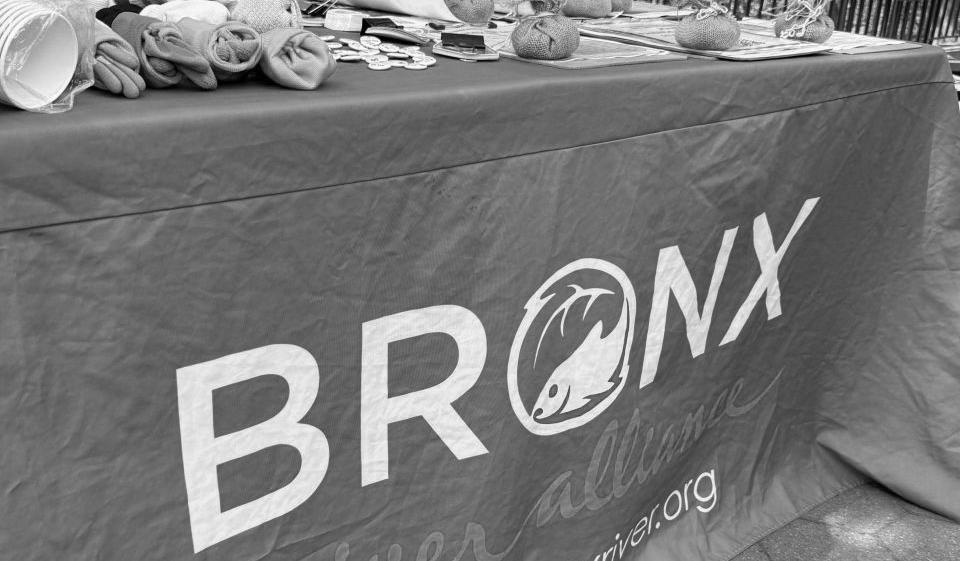
For the sixth and final event, students gathered on the sunny Saturday morning of April 18, volunteering to clean up the Bronx River Forest in partnership with the Bronx River Alliance.
Vice president of DAC Laila Sayegh, FCRH ’27, shared the amount of time put into this week of events.
“DAC is divided into six subcommittees, and although Bronx Appreciation Week
(BAW) is a single week late in the spring semester, the BAW subcommittee operates from the beginning of the school year, starting in September,” Sayegh said in an email. “The goal is to create a holistic program that showcases different aspects of The Bronx’s history, culture, and community in an intentional and engaging way.”
Sayegh shared more on her favorite event to organize: the “Celebration of Bronx Visual Arts.”
“Ever since I joined DAC as a freshman, one of my favorite events to attend is the Visual Arts night,” Sayegh said. “Not only do we get to admire incredible art and talent, but through exploring the works of these different artists, we’re also getting a lesson on history and culture…You realize how many voices and perspectives
are out there that don’t always get institutional recognition, and I’m glad that through BAW we’re able to expose some of the student body to this rich culture beyond our gates.”
When asked about why Fordham students should attend events like this in the future, Sayegh cited caring for the Bronx community as a motivation.
“I think students should care because we’re living in the Bronx, but it’s really easy to go through four years here without actually engaging with it in a meaningful way,” Sayegh detailed. “And beyond that, it’s about being more aware of the community we’re a part of. We hope to help students recognize that there’s a lot happening right outside our gates and it’s worth paying attention to.”
By SIENNA REINDERS EDITOR-IN-CHIEF
The Fordham University United Student Government (USG) met on April 16 to hear delegate reports, pass budget requests and pass proposals.
Executive President Lucas Hjertberg, FCRH ’26, opened the meeting by asking if there were any delegate reports. Residence Hall Association (RHA) delegate Hannora Ragusa, FCRH ’26, said that on April 22, RHA will be hosting a petting zoo event, and on April 23, they will have a Pugsley’s pizza truck in front of the McShane Campus Center.
Reserve Officers’ Training Corps (ROTC) delegate Roger Chmielowiec, FCRH ’27, announced that ROTC would be having a “pie in the face” event on April 17, where students could pie ROTC cadets in the face.
USG then diverted to budget requests. Vice President of Facilities and Dining Madeline Ando, FCRH ’27, requested the use of discretionary funding to purchase keychains for everyone on her committee
to commemorate their time working in Facilities and Dining. She noted that her committee does not have the remaining funds necessary to cover the $94 cost of the keychains. Vice President of Gabelli School of Business (GSB) Hunter Gholson, GSB ’26, offered to donate $60 of funding from his committee to help cover the costs.
Gholson then requested to purchase stress balls, stickers, succulents, plant starter kits and donut holes for his committee’s Earth Day events. Gholson also requested funding for napkins, awards, centerpieces and paper plates for the GSB Year in Review dinner.
Next, Senator Regan Healy, FCRH ’28, presented a request on behalf of Vice President of Communications and Marketing Yeonsu Son, FCRH ’27, who was absent, for a Canva Pro subscription for Son’s committee. Continuing on Son’s behalf, Healy also requested Chick-Fil-A for the Communications and Marketing committee’s endof-the-year event.
Hjertberg decided to wait
to vote on Son’s budget requests until she was present and could provide more information. However, they voted on the other requests, which all passed unanimously.
Senator Megan Ruzicka, FCRH ’27, then presented a proposal for a chronic illness workshop series. She said the series would include educational components and a student panel. She added that Counseling and Psychological Services were already on board with the idea and that she planned to involve the Fordham College Rose Hill (FCRH) Dean’s Council with the event as well. USG voted on the proposal, which passed unanimously.
Next, first-year Senator Henry Carstens, GSB ’29, presented his commission’s Contraceptive Policy Proposal to amend Fordham’s policy on contraception distribution. He said that they will be talking to Dean of Students at Rose Hill Kevin Williams in the coming weeks regarding the proposal. USG voted unanimously to pass the proposal.
Hjertberg then gave USG updates. He noted that
the “Meet the Candidates” event for Senate positions would take place after the USG meeting at 8 p.m. He continued that “Meet the Candidates” for the executive ticket and executive board positions would occur the following night at 6 p.m. Hjertberg also announced that he and Gholson have a meeting scheduled with Vice Provost for Student Success Elizabeth Rainey on April 22 to discuss USG’s FCRH mentorship program proposal. He also announced that the USG inauguration would take place on April 27, at 6 p.m., in the McShane Campus Center, room 311.
During the executive board report, Vice President of Sustainability Ayden Johnson, FCRH ’27, said that his committee is prepared for their Earth Week events, which will start on April 20. He also said they are having conversations with the Office of Residential Life to gather donation bins for the end-ofyear move out.
Vice President of the USG Committee on Sexual Misconduct Aidan Costella,
FCRH ’27, announced that his committee’s annual clothesline project, a visual display set up around Edwards Parade using decorated shirts to spread awareness about sexual and domestic violence, is starting the week of April 20 and added that the display would be up for the whole week. He also said that on April 21, various healthfocused departments on campus would be tabling on Edwards Parade, and that the event would include a Mister Softee ice cream truck.
Costella also said that his committee will be having an upcoming “make one take one” tabling, where attendees will be able to make a package that will be donated to a local shelter in the Bronx and take a package with them.
Ando announced that her committee will be having a tabling event on April 22, from 11:30 a.m. to 2 p.m., and that they will be giving out chicken and beef sliders, mini carrot cakes and mini strawberry cheesecakes.
USG’s next meeting is schedueled to take place on Thursday, April 23.
funding that Fordham receives. Petra said that during this time, Fordham has continued to follow legislation that directly impacts the university while also simultaneously upholding Fordham’s values.
“We are closely monitoring federal guidance and executive actions to ensure the University remains in compliance with applicable laws and regulations,” Petra said. “At the same time, we remain firmly committed to our mission as a Catholic Jesuit institution — one that emphasizes education, access, and care for the whole person.”
Historically, Catholics and Jesuits have affirmed DEIrelated frameworks through the Catholic Church’s social teachings of “belonging, dignity and justice.” More specifically, Catholics and Jesuits have argued for practices of diversity, equity, inclusion and belonging in education, stating that these practices are rooted in Catholicism.
Executive Director of Campus Ministry Phillip Judge, S.J., explained that while DEI has traditionally not been included in Catholic social teaching, principles of inclusion and equity are upheld by Catholic doctrine.
“I think this is very much a battle about terminology,” Judge said. “Before we used the term DEI, we always talked about inclusiveness. We always talked about Jesus’ ministry as being one of inclusion, and in Catholic social teaching and also just in Catholic reading of Scripture.”
These same Catholic and Jesuit social teachings are those that define Fordham’s operations, according to the university’s mission statement, which states that Fordham is “Guided by its Catholic and Jesuit traditions.”
Fordham’s Current DEI Practices
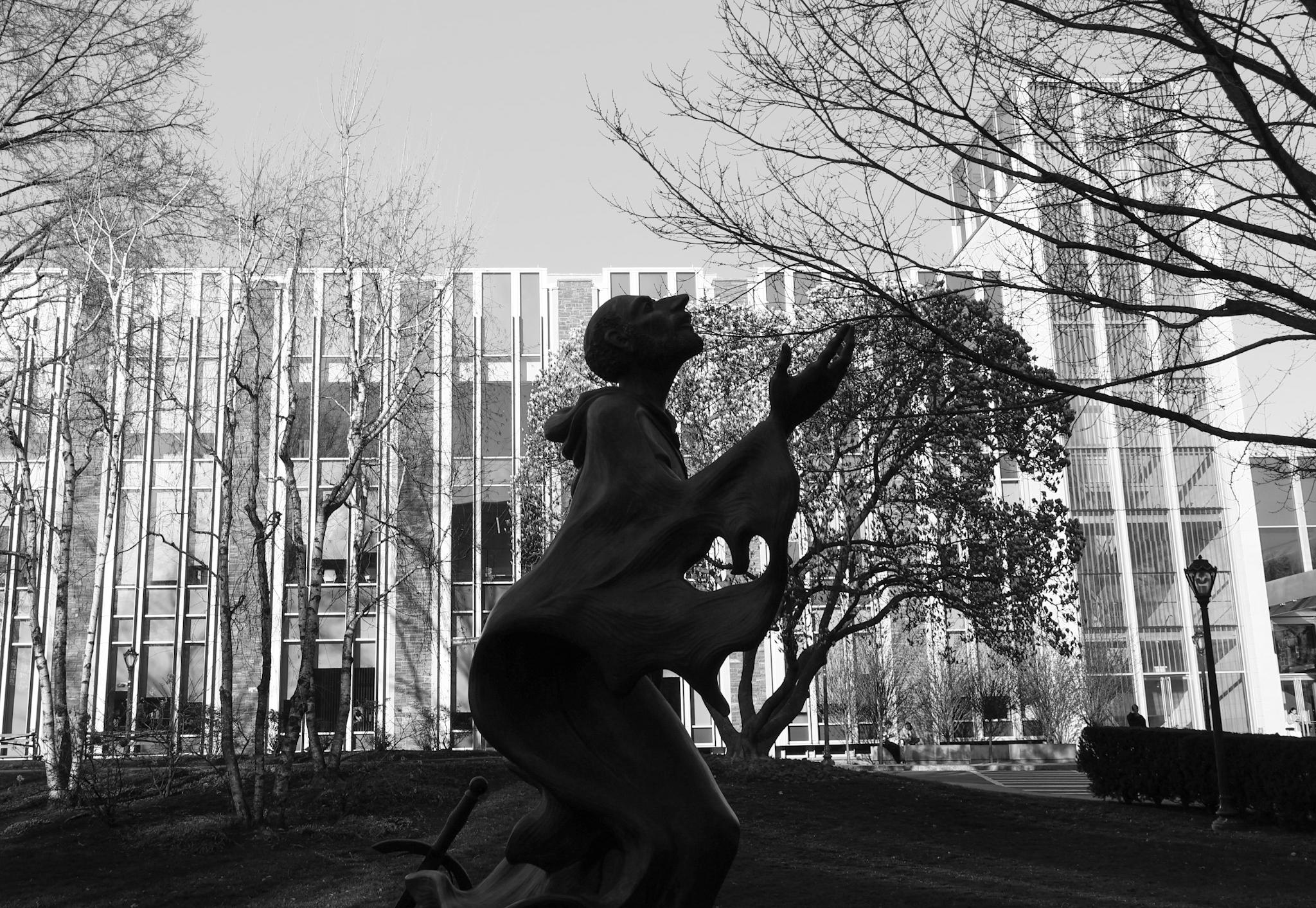
As it currently stands, Fordham has several programs and initiatives related to DEI. In 2020, Fordham initiated a “Diversity and Inclusion” action plan that aims to recruit a more diverse student body through strategic admissions strategies. Additionally, the plan strives to diversify Fordham’s faculty and foster partnerships with outside Bronx-based organizations.
Fordham’s Office of Equity, Inclusion and Opportunity says it is part of Fordham’s overall dedication to “create and sustain a diverse, inclusive, and just campus community in which all members thrive through strategic and purposeful collaborations across the university and in our neighboring communities in the Bronx and Manhattan.” Their website states that their mission and vision are ingrained in Fordham’s Jesuit identity.
The Ram reached out to Vice President for Equity and Inclusion James A. Felton III, who declined to comment on the recent developments at the
federal level and their impact on Fordham’s DEI practices.
The Fordham Office of Multicultural Affairs (OMA) also works to implement programs that facilitate diversity, equity, inclusion and belonging. Their website states that their mission “show[s] commitment to the Jesuit ideas of caring for the whole person and striving for the greater good to cultivate an intentional and conscious Fordham community.”
The Ram reached out to officials from OMA to ask about the impact of federal developments on their current programs; however, they also declined to comment.
The university’s webpage “Updates on Evolving Political Landscape” contains a section titled “Diversity and Inclusion,” which underlies diversity, equity, inclusion and belonging as an integral part of a Jesuit education.
“We embrace diversity, equity, inclusion, and belonging principles as central to our Jesuit mission —and as part of our commitment to promote understanding, solidarity, and a sense of study toward others and our broader community,” reads the website.
In addition to efforts within its administrative offices, Fordham has several studentrun initiatives aimed at fostering inclusion among the Fordham community. One such initiative is the United Student Government’s Diversity Action Coalition (DAC), which organizes student programming and collaborates with various members of the university administration to highlight underrepresented spaces at Fordham. Their goal, according to USG Vice President of Diversity and Inclusion Laila Sayegh, FCRH ’27, is to give a voice to underrepresented groups on campus and facilitate programming that allows them to feel more included.
Regarding recent federal actions, Sayegh explained that Fordham has not made any concrete changes to their DEI
policies at an administrative level that she is aware of, but that her committee did have to brainstorm different approaches to their training programs when restrictions from the federal government emerged.
“We were a little bit nervous when the federal restraints idea first rolled out,” Sayegh said. “We don’t want to be like imposing DEI. We don’t know how that’s going to get interpreted.”
Sayegh also said that her committee ultimately decided to work with OMA to expand their student programming, because she believes that the student-led programming, which she described as a “bottom-up” approach, would make Fordham less vulnerable to federal restrictions.
“We reoriented to a DEI education lens, and that really has to do with programming, because student programming is less vulnerable to being shut down, just as long as it’s for educational purposes rather than like a formal DEI training,” Sayegh said. “I feel like if we were to do educational events under the guise of not being oriented towards diversity, it would be seen more as okay.”
How is Fordham University responding?
In terms of how Fordham as an institution is responding to these executive orders and changes at the federal level, Petra outlined that, given that the federal guidelines and mandates are continuously changing, the university has refrained from making any formal discernments as to how these proposals might impact Fordham.
“The definitions and parameters outlined at the federal level continue to evolve, so it would be premature to make broad determinations about what may be considered discriminatory practices, as well as the potential impact of the General Services Administration proposal,” Petra said. She also explained that the university has undergone a broader shift in its DEI practices.
“As part of Fordham’s natural
also help people understand what potential biases that they may have or that there might be, and also be aware of how to handle situations in groups that have a multiplicity of areas of different people of different backgrounds,” Adenjano said.
Adenjano also explained her observations of the impact that the recent federal developments have had on Fordham’s student body.
“I think it definitely makes students feel scared. It could definitely make students feel hopeless,” Adenjano said. “But I feel like that’s what the federal government wants. It wants you to decide to cut things off before they even do anything, and they might not even do anything, and so I think it’s up to us to stay strong and not feed into the fear tactics.”
institutional evolution, we have transitioned away from a standalone diversity and anti-racism framework and embedded those priorities directly into the University’s strategic plan,” Petra said. “This approach ensures that equity, inclusion, and belonging are not isolated initiatives, but instead are integrated into the core of how the University operates moving forward.”
Petra said that going forward, the university aims to continue upholding Fordham’s values.
“Ultimately, our goal is to remain grounded in our mission while adapting responsibly to a changing environment,” Petra said. “We are committed to supporting our students, faculty, and staff in ways that are thoughtful, inclusive, and sustainable over time.”
At a general press conference with The Ram and The Observer, Fordham President Tania Tetlow detailed her stance and opinion on Trump’s March 26 executive order.
“Some of the administration’s orders seem to go beyond what is actual statutory law in ways that create potential constitutional problems,” she said. “A lot of those orders are currently the subject of constitutional challenges and litigation, so to suddenly tie federal funding to compliance with things that may or may not be legal creates both confusion and real hardship.
When she was asked whether Fordham would add clauses to its contracts to comply with the executive order, Tetlow said she expects the legislation to be taken to the courts.
“My hope is that this will be resolved in the courts before it comes to that,” Tetlow said.
Why is DEI Important?
Some Fordham students outlined the importance of DEI initiatives in universities and higher education institutions.
Deborah Adenjano, FCRH ’26, the DAC current DEI subcommittee head, detailed her stance on what defines DEI.
“DEI, I think, is to help create more cultural competency, and
She also argued that there are some things that the federal government cannot restrict, despite their efforts.
“Even if Trump said, ‘let’s get rid of Black History Month,’ we’re still going to celebrate Black History Month, so I still kind of feel like, sure, the federal government could try to be more restrictive, but that won’t stop anything,” she said.
Professor of religion and President of the Fordham chapter of the American Association of University Professors Thomas Beaudoin said the Trump administration’s actions against DEI represent an attempt to control the intellectual life of educational institutions.
“It’s dangerous to higher education to have government interference like this in the intellectual mission of the university,” Beaudoin said. “The search for truth, which is certainly core to a Jesuit mission like that of Fordham University, a search for truth needs to be carried out. Unimpeded.”
He further explained how the government’s actions against DEI hinder universities from furthering this search for truth.
“The way that quest for truth relates to DEI is if we have a system that subtly or overtly keeps certain voices, has kept certain voices muted in the conversation, or unfairly advantaged other voices, then we need to have ways of adjusting for that and be intentional about it,” Beaudoin said. “The point is that the university be a place of welcome for everyone, and that all voices count as equal and all voices count as meaningful in the conversation.”
When discussing the Jesuit education specifically, Judge explained that the principles of equity and inclusion are integral.
“Even if you look at the whole history of Jesuit education, it began as an attempt to bring people education who wouldn’t otherwise have had it. Right from the beginning, our point was to include people who were excluded from this,” Judge said. “So, our job has always been to be inclusive,” Judge concluded.
When asked about whether their operating hours could be extended, De Castro said it would not be feasible.
“No, that would not be possible,” De Castro said. “The post office has to close at 3:30. No, that’s an impossibility to change that. It’s impossible.”
A survey conducted by The Ram on Fizz, which received 1,447 responses, had found that 87% of students are dissatisfied with Fordham’s current mailroom hours.
Student Eva Verstegen, FCRH ’28, said she feels like she always needs to plan her day around getting her mail.
“It feels like I always need my package and I can’t get it, and I think that they should be open more to be more accessible for students,” Verstegen said.
De Castro said that the university has conducted several time and motion studies, which is a method of observing and timing steps of a task to find the most efficient way to do it.
“When we do time and motion study, we concentrate on allocating manpower funds
to where the university needs it,” De Castro said. “We have conducted several motion studies and the manpower and the funds that are allocated for the post office is best served in this schedule.”
Natalie Sheehan, GSB ’28, said she usually picks up her packages immediately after receiving the email confirmation.
“Usually I go immediately because I’ll already be in McShane for something else,” Sheehan said. “Or I just wait until the next time I’m in McShane.”
However, Sheehan said she could see them extending their hours to 5 p.m.
“I understand how, if you had a class in the morning and you had something to pick up, like if your class gets out at 2:15 p.m., now you’ve already lost your chance for the day,” Sheehan said.
However, if the students are unable to pick up their package, then they can have someone else pick up their package for them by sending an authorization email to the post office.
“When the person comes to the window, they have to show
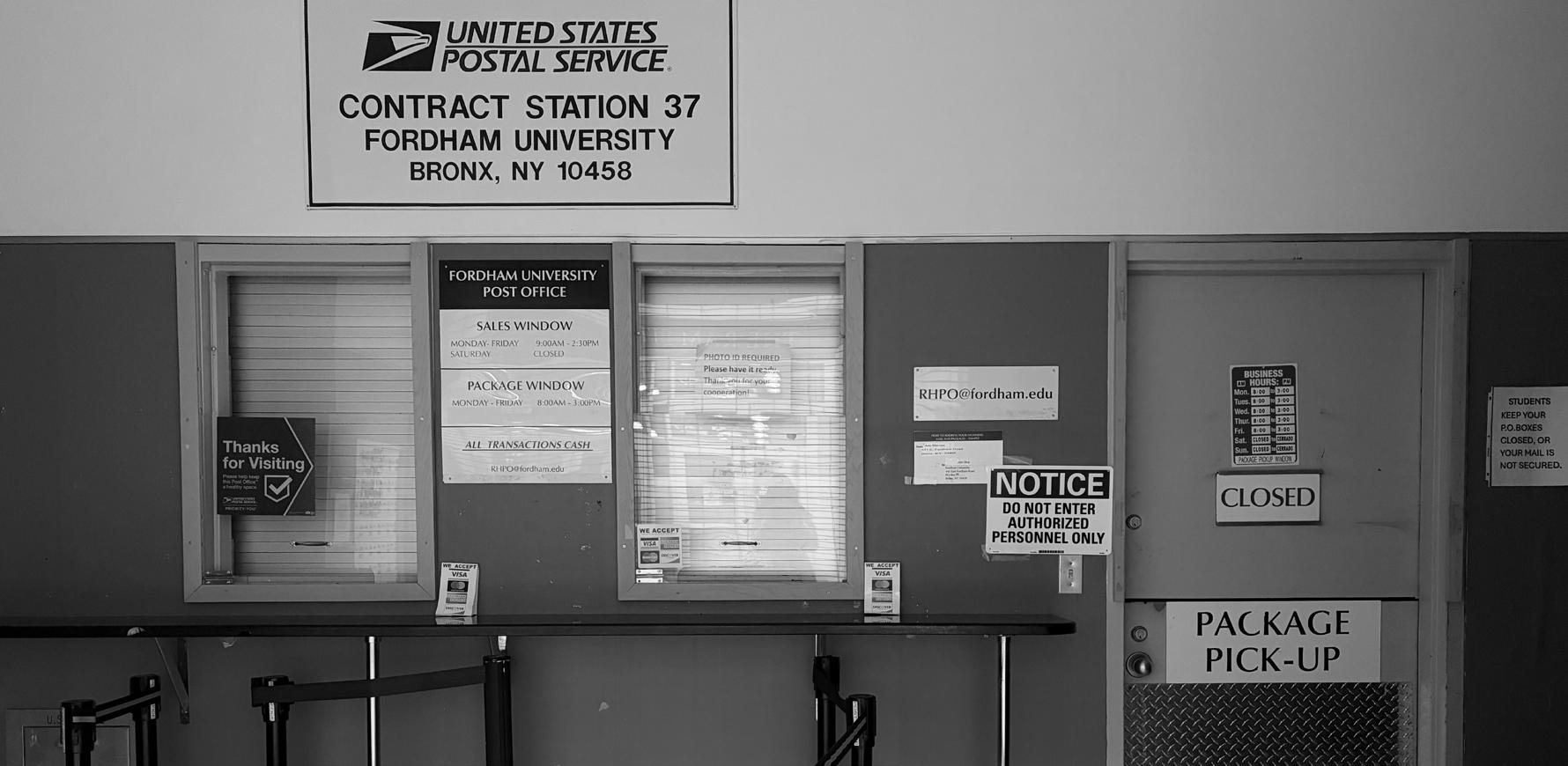
us a proper ID corroborating their name, and then we give them the package,” De Castro said.
Regarding student concerns about the post office hours, De Castro said they come once in a blue moon.
“I mean, we’ve gone now for years without a complaint or concern about our hours,” De Castro said. “I’ve been here 16 years and I’ve been in charge of the post office for 16 years, and I can tell you I’ve only heard maybe two or three concerns,” De Castro said.
One student, Teddy Williams, GSB ’28, said he wishes the mail room were open later, and said 7 p.m. would be a more reasonable closing hour.
“I wish it was open later; I feel like everybody does,” Williams said. “I feel like a lot of the other places [are] — like the dining hall’s open until seven, Dagger John’s open later — so why not keep the mail room open as there’s traffic around that area.”
Although the post office is just a place for students to
collect packages, De Castro said the most rewarding part of his job is seeing everyone happy.
“[Students] order everything online from a toothbrush to research and homework and everything,” De Castro said. “Everything comes through us and it’s just very rewarding that at the end of the day, everybody’s happy. Everybody gets their package.”
As of now and for the foreseeable future, there will be no change to the Rose Hill post office hours.
votes. Mike Rodriguez, FCRH ’27, and Moustafa Amer, FCRH ’27, also received 13 votes as write-in candidates.
Ando serves during the 2025-26 school year as the vice president of Dining and Facilities. In this position, she passed a proposal to extend the Marketplace’s operating hours, an initiative that is now being worked on by the Fordham administration. Ando also worked with Facilities Management to create paid internship positions that are for Fordham students in that department, as well as started a program with the Commuting Students Association to fund meals for commuter students.
During the 2025-26 school year, Johnson serves as the vice president of Sustainability. In this position, he worked with Facilities and Management and the Students for Environmental Awareness and Justice club on the restoration of St. Rose’s Garden. He also worked with Ando to pass a proposal to add stickers to campus building windows to prevent birds from colliding with the glass. The proposal was passed by Vice President of Administration Marco A. Valera and is currently being implemented.
Ando and Johnson’s campaign centered around advocacy, action and spirit, according to their campaign platform. They said they plan to advocate for increased support for students on campus, improving dining options, expanding on-campus career-centered job opportunities for students and adding swings to the Rose Hill campus as well.
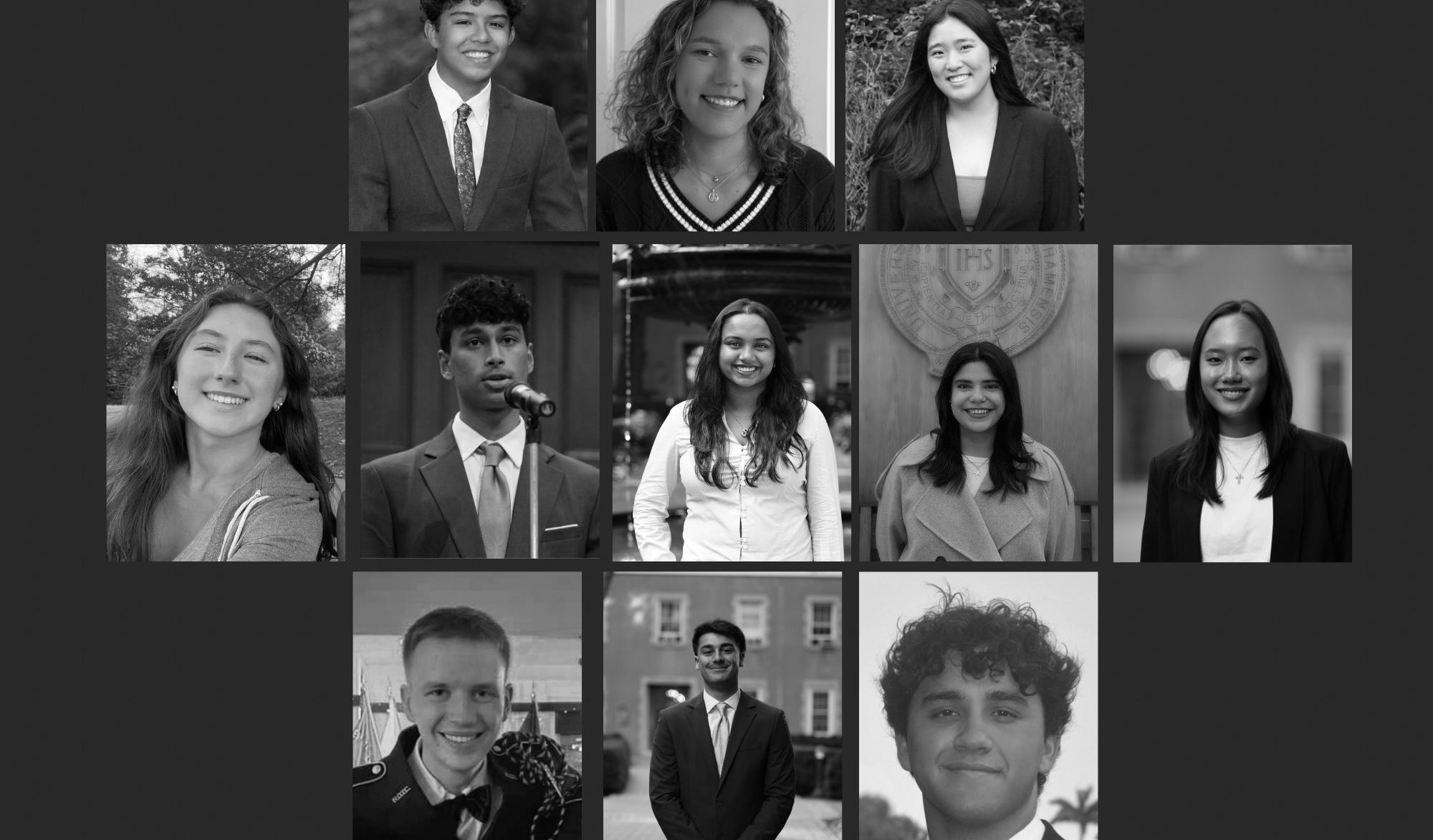
“We’ve been out campaigning since the beginning. We faced a little setback at the start, but, you know, we picked ourselves up, and just seeing the outpouring love and support of the community just made our hearts very happy,” Ando said on behalf of her and Johnson.
“Regardless of the outcome we were just so glad that we encouraged so many voters to actually engage in student government elections.”
Compared to the 1,104 votes in the 2025-26 USG election, the turnout was 43% more this year, with 1,587 total votes.
The Ram asked Ando and Johnson how they feel about stepping into their new positions next school year.
“We are really excited for next year and what comes of us being in the business that we are,” Johnson said.
“We’re rising seniors from two
different sides of campus and we’re really excited to put our brains together and run student government.”
Ando added to Johnson’s comments, explaining that running for the executive ticket has been a long time coming.
“Aydan and I have been toying with the idea of running for the executive ticket from the beginning, but one of the most important things we kept asking ourselves is whether we were ready to take on this role and whether we would do the student body a disservice by being executive president and vice president,” Ando said.
“We just hope we can live up to the legacy of everyone who’s come before us and fulfill our promises of keeping the student body in mind with whatever we do and being as transparent and open and welcoming as we possibly can be.”
The remaining members of the executive board for the 2026-27 academic year are as follows:
Aidan Costella, FCRH ’27, will serve as vice president of Health and Security
Daniel Rodriguez-Meneses, FCRH ’28, will serve as vice president of Diversity and Inclusion
Roxana Villanueva, GSB ’27, will serve as vice president of Gabelli School of Business
Grace Shin, FCRH ’28, will serve as vice president of Fordham College Rose Hill Berkeley-Ayne Dorsten, FCRH ’27, will serve as vice president of Operations
Siri Bhat, GSB ’27, will serve as vice president of Budget and Finance
Roger Chmielowiec, FCRH ’27, will serve as vice president of Student Experience Jenny Hong, FCRH ’27,
will serve as vice president of International Integration
Demitrius Farias, FCRH ’28, will serve as vice president of Sustainability
Lauren Gracia, FCRH ’29, vice president of Facilities and Dining
The class senators for the 2025-26 academic year are as follows:
Serving on the Senate for the class of 2027, Catherine Dalton, FCRH ’27, and Megan Ruzicka, FCRH ’27, will serve as the Fordham College at Rose Hill senators, Carter Soderberg, GSB ’27, and Nigel Thompson, GSB ’27, will serve as the Gabelli School of Business senators and Anna Gayton, FCRH ’27, will serve as a Fordham College Rose Hill senator for the class of 2027 in the swing chair.
For the class of 2028 Senate seats, Regan Healy, FCRH ’28, and Whitney Egbe, FCRH ’28, will serve as the Fordham College Rose Hill senators, Jason Vo, GSB ’28, and Theo Yonly, GSB ’28, will serve as the Gabelli School of Business senators and Erin Maguire, FCRH ’28, will serve as a Fordham College Rose Hill senator for the class of 2028 in the swing chair.
Finally, the class of 2029 senators will be Maya Derico, FCRH ’29, and Evelyn Maravilla, FCRH ’29, who will serve as the Fordham College Rose Hill senators, while Henry Carstens, GSB ’29, and Elijah George, GSB ’29, will serve as the Gabelli School of Business senators. Domenick Fedele, FCRH ’29, will serve as a Fordham College Rose Hill senator for the class of 2029 in the swing chair.
By JORDAN DONEGAN ASST. NEWS EDITOR
Fordham University STEM students Lianna Cutter, FCRH ’27, and Jenna Cain, FCRH ’27, were recently awarded the highly competitive Barry Goldwater Scholarship, inducting them into a 40-year legacy of esteemed scholars and STEM-related researchers.
Established in 1986, the Barry Goldwater Scholarship is one of the most prestigious awards for undergraduate students engaged in research within the STEM realm. It aims to recognize those students who demonstrate exceptional promise and are making advancements in their fields. Cutter and Cain were both selected out of a large pool of roughly 5,000 national applicants for their research experience, academic excellence and potential for their future careers in science.
Cutter said the experience of winning this award was surreal, drawing on previous students she had seen receive this scholarship.
“I knew about the Goldwater as this incredibly prestigious award that the smartest people I knew were winning,” Cutter
said. “I never really thought that one day, that was going to be me.”
Both students are already engaged in distinct yet rigorous research initiatives at Fordham laboratories under the guidance of Fordham faculty and professors, on top of a plethora of other activities.
Cutter, who is originally from Costa Rica, joined Fordham biochemistry professor Ipsita Banerjee, Ph.D.’s research lab early on during her Fordham career with no prior research experience. For the past three years, she has been working with peptide-based treatments for aggressive triple-negative breast cancer.
“Our lab designs small molecules based on specific receptors on specific types of cells,” Cutter explained.
“The idea is that by designing these small molecules to bind to specific receptors, we can increase specificity and reduce the toxicity of chemotherapeutics.”
In addition to this research, Cutter works on a human epilepsy clinical research project affiliated with institutions such as New York University and Mount Sinai. She has
presented her work at multiple conferences around the country, and she described this award as a validation of the hard work she has engaged in during her time at Fordham.
“It’s validating, not in terms of recognition, but because it shows that all of the time and effort — late nights and weeks in the lab — actually meant something,” Cutter said. “It makes me feel like I’m moving in the right direction.”
After graduating from Fordham, Cutter aspires to enter an M.D.-Ph.D. program where she can continue her research on cancer treatments while engaging with and helping people directly. She said she will use the $7,500 of scholarship money in various ways.
“The funding is definitely going towards tuition,” Cutter said. “[It is] also [going] toward things like MCAT preparation materials. It’s very helpful in a practical sense; it takes some of the financial pressure off and lets me keep focusing on my research and plans.”
Much like Cutter, Cain engages in research initiatives at Fordham. In the summer of 2022, Cain walked into Fordham bio-organic chemistry
professor Nicholas Sawyer, Ph.D.’s research lab as a high school student to shadow an undergraduate researcher for the summer. Now, Cain is helping to lead a research initiative specializing in how peptides can be applied in advancing drugs for life-threatening diseases like diabetes and cancer.
Cain explained that this award served as an external validation of the hard work she is putting in during her undergraduate years.
“It was so exciting. I was really proud of myself for getting this recognition,” Cain said. “It felt quite nice to know that I am doing good work and being impactful in the scientific community.”
Sawyer explained that Cain stands out as a student and researcher for a variety of reasons, including her ambition and persistence in succeeding and growing.
“There are moments in any project where you have to change the weather to change direction completely, and she was the one who would say, ‘Let’s try one more experiment.’
That kind of persistence is rare, and it’s what allowed her to succeed in such an ambitious project,” Sawyer said.
Sawyer elaborated on what Cain brings to his research lab.
“She has what I would argue is a trifecta of traits: intelligence, ambition and leadership,” Sawyer said. “She doesn’t just run experiments and hand over the data; she thinks critically about what it means and what to do next, and more often than not, her instincts are what made this project work.”
Cain said that she plans to pursue a Ph.D. program in chemical engineering, and wants as well to research renewable energy. She elaborated on the many benefits this award entails.
“Another benefit of it is you then get to be a part of a network of these Goldwater scholars,” Cain said. “[There are] a lot of programming opportunities within that, so you get to meet students from other institutions that are doing research and are really passionate about it as well.”
Cain and Cutter’s recognition marks the third year in a row in which two Fordham students have been awarded the Barry Goldwater Scholarship. For both of them, this is a significant step towards their future goals in STEM.
GABRIEL CAPELLAN ASST. OPINION EDITOR
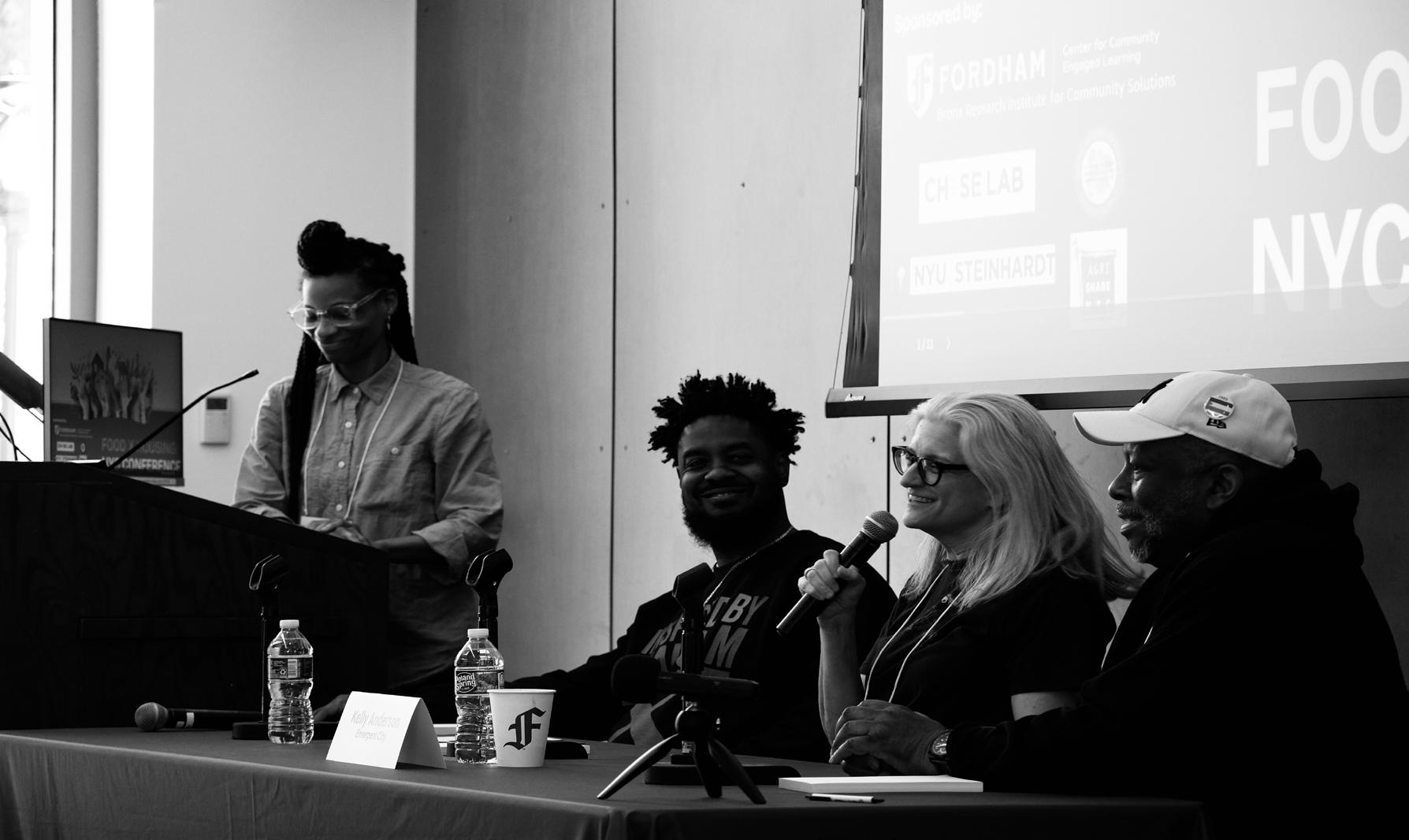
The Critical Health+Social Ecology Lab held its first-ever Food x Housing conference on Saturday, April 18. It was organized by associate professor of psychology Shellae Versey, Ph.D., and Henry Obispo, leader at ReBORN Farms in food activism and food sovereignty. The conference had two sessions: the first one centered around discussions on how New Yorkers can achieve food sovereignty, and the second examined housing justice and held a film screening.
To open up the conference, Versey presented her Black Farms Project, which highlighted how oppressive social systems and practices, such as food deserts and local retail buying fruits and vegetables in bulk, restrict food access to lowerincome people of color. To combat inaccessible food, she said that Black farmers are needed and should be properly supported, as they understand the needs of the people in these lower-income communities.
While Versey acknowledged that getting more Black farmers will take time, she suggested that people should grow food in their homes, which will allow people to take action on the food they are consuming. In an email to The Ram, Versey detailed the importance of this event to the Fordham student body.
“[The event helps] to raise awareness about conditions and systems that impact
everyday New Yorkers … Housing instability is at an all-time high in the city, and across the US, nearly 20% of college students experience food insecurity,” she said. “These rates are typically higher for Black and Brown students.”
The next aspect of the conference was a presentation on AgriShare, an app and website platform where users can find local farms and growing spaces in New York City. It was developed by Angela C. B. Trude, assistant professor and director of New York University’s Food and Nutrition Ph.D. Program, Ciara Sidell and Will Thompson. During the demonstration, audience members used the app and tested its features such as the map filter, entering data on new farming areas and customizable avatars.
Obispo then took charge of the following section of the conference, holding a discussion with local activists surrounding the challenges they face regarding food sovereignty.
“Coming from the Caribbean, you can see that we’re very landrich and natural resource-rich,” Obispo said in his opening remarks at the panel. “There’s this idea of land-rich and cashpoor, we’ve been fooled that the land actually isn’t that rich … Food sovereignty asks us ‘who controls the land? Who controls the production? Who controls the distribution?’”
The featured panelists included Eloísa Trinidad from the Chili on Wheels Project and Jenna Rice from the Corbin
Hill Project. Rice and Trinidad were asked how to identify communities in which people don’t have control over their food. Trinidad said it is the lack of choice people had in the food they eat; Rice responded similarly that retailers buy in bulk due to it being cheaper and lower quality.
The second half of the conference commenced with a screening of “Emergent City,” directed by Kelly Anderson, a film and media studies professor at Hunter College. The documentary explored how residents of Sunset Park, a neighborhood with a history of environmental racism, faced rising rents and what that meant for the neighborhood moving forward.
After the screening, Anderson
hosted a “talk-back” with Michael Partis, executive director of the Red Hook Initiative and Rob Robinson, adjunct professor of urbanism in the Design and Urban Ecology program at Parsons School of Design at the New School. The talkback explored ideas of housing justice and food sovereignty, and their intersections.
Robinson drew on the power of local governance to combat food sovereignty and housing justice.
“When we organize our local governments, to state to federal governments and let them know governments must abide by the Universal Declaration of Human Rights, the founding document of the United Nations, which Eleanor Roosevelt helped draft,” he said.
“It has been a strong ground-up grassroots movement to make this movement happen.”
Partis also emphasized the great importance of grassroots organizing and ensuring your day-to-day service workers are on board with organizing for better housing and food security.
The event ended with Versey thanking the audience for coming to the event and briefly recapping the mission.
“To bring together [such] a diverse audience — tenant organizers, urban growers, researchers, filmmakers, policy practitioners and people with lived experiences to connect the dots of inequality,” Versey said. “This intentional diversification of the audience is necessary since the solutions, like the problems, are connected.”

Serving the Fordham University campus and community since 1918
The Fordham Ram is the university journal of record. The mission of The Fordham Ram is to provide a forum for the free and open exchange of ideas in service to the community and to act as a student advocate. The Fordham Ram is published every Wednesday during the academic year to all campuses.
Website
TheFordhamRam.com
Email Address theram@fordham.edu
Editor-in-Chief
Sienna Reinders
Managing Editor
Ian Nelson
Production Editor
Sarah Verrastro
Editorial Director
Molly O’Connor
Multimedia Director
Hannah Sullivan
Business Director
Nishanth Aduma
News Editor
Emma Leonardi
Features Editor
Sidney Blasco
Assistant News Editors
Jordan Donegan
Decker Rossi
Opinion Editor
Loresa Zeqiraj
Assistant Opinion Editors
Erynn Sweeney
Gabriel Capellan
Culture Editors
Lara Ejzak
Makenzie Smith
Assistant Culture Editor
Kelly Buban
Sports Editor
James Nelson
Assistant Sports Editors
Molly Friedman
Ethan Bess
Copy Chief
Indigo Towers
Executive Copy Editors
Emily Mitton
Emma Kelner
Elaina Gibson
Photo/Graphics Editors
Emily McCall
Wilson Speller
Digital Producers
Haniyyah Usmani
Han Le
Marisa House
Advertising Directors
Violet Wallace
Juan-Pablo Valencia
Rishika Lingamdinne
Faculty Advisor
Beth Knobel
Editorial Policy
The Fordham Ram’s editorial reflects the editorial board’s opinions or views. Opinion Policy
The opinions expressed in this publication are those of the authors. They do not necessarily reflect the opinions or views of The Fordham Ram.
Submission Policy
The Fordham Ram Reserves the right to reject or edit any submission for any reasion, without notice. Submissions become the exclusive property of The Fordham Ram. No part of The Fordham Ram may be reproduced without written consent.
Correction Policy
The Fordham Ram is committed to fair and accurate reporting. If you are aware of an error, please contact us at fordhamramonline@gmail.com
So many of us are the children of immigrants, or are immigrants ourselves. So many of us see our parents putting themselves last so that we can be first. My parents have always put my needs above their own, keeping my sister and I at the center of their lives. They have always tried to give me everything I wanted and somehow knew what I didn’t even open my mouth to ask for. They gave me a childhood bigger than what we could afford. I’m rich in experiences because of how my mom has wanted to see me grow in every way and because of how hard my dad has worked throughout the years. My dad taught me confidence, my mom taught me perfection. I’m privileged not just because of the life I am able to live, but more so because of the two individuals who gave it all to me. Committing to Fordham was an extremely difficult decision. We were stuck between two options: Fordham and The City College of New York. The former was convenient, but expensive, the latter would be a train ride away, but more affordable. The pros and cons had to be weighed heavily, because there would be a loss and a gain either way. However, it was visiting Fordham’s campus that solidified our decision. I was struck by the beauty of this lovely Rose Hill campus, of course, but
it was the people here that blinded us to any other option. Everyone’s willingness to help and stop to answer questions, whether it be an administrator or even passing students, made us see the heart that lives on this campus, one as big as Eddies.
We knew Fordham was it, but the money weighed on me like nothing else did; it weighed on me more than the joy I felt radiating off campus grounds. I remember standing outside Thebaud Hall with my parents on May 1, commitment day. My parents told me that it was okay, because, “Your education is above all else. What else would we work for if not to provide for you.” There are no words to capture the way I felt then, or even now writing this. A prayer and a payment later, I was officially Fordham bound! And I remain eternally grateful for the burden they willingly carry on their shoulders so that I can continue to live in convenience.
A few weeks away from graduating high school, it hit me that I had not used my surroundings to their fullest, and there was no time left. Four years had gone by quicker than I had expected, and I was distraught. I promised myself right then that I’d hold onto the years of college, that I wouldn’t let them pass me by. I promised myself that I’d be involved in everything I possibly could, that I’d expand on who I was so much
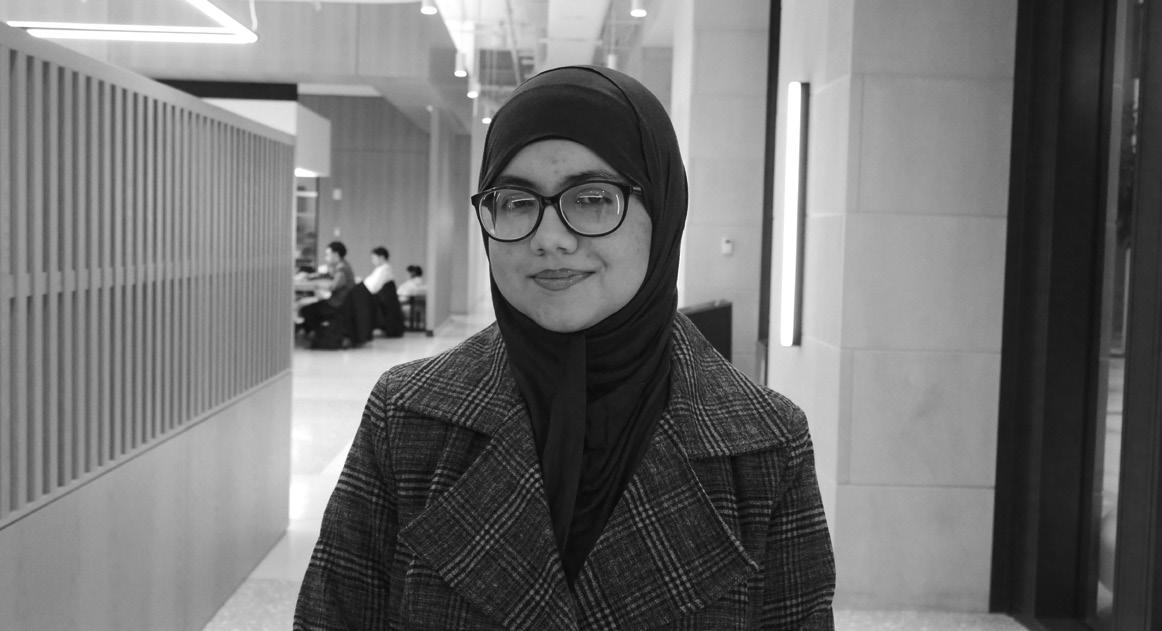
that I’d live these four years instead of watching them pass by from the sidelines. Now I’m a week away from finishing my junior year. In two months I’ll be a senior and I think I’ve fulfilled that promise, Alhumdulillah. I’m so incredibly grateful for all that I’ve been able to experience at Fordham. The many amazing people I’ve met, the experiences I’ve had and the club positions I have the opportunity to hold could not have been done anywhere else. It had to be Fordham. While I do have one full year left, it already feels like the end is here. After a semester, I’ll be signing off from The Ram, one of the first organizations I got involved in. In just my first year, I was talking to production editor emerita Hannah Boring, FCRH ’25, at the club fair on my first day of classes, wanting to try this out, but worrying about my writing style. I had become increasingly anxious about others seeing my writing and if it would even fit in “the
right way” for a newspaper. Hannah, you’re out and about in the world now, but thank you for guiding me toward copy nights. Thank you for making me feel like I was doing something meaningful by coming in every Monday to help copy edit, because that’s what gave me the confidence to apply for a staff position that year. And the next. And the next. I love The Ram and I love the Commuting Students Association — my second family with so many other commuters I have been able to connect with. I love orientation and Senior Week, I love MODE Magazine and all of the organizations I’ve had the privilege to be a part of. My parents have gone above and beyond to pave the way for me, and Fordham taught me how to pave my own way after that. I used to pass Fordham on my way to elementary and middle school. The other day, I put all the schools I’ve gone to into Google Maps and they formed a circle. It was always going to be Fordham.
The United States meets all of the qualifications to be considered an empire. The birth of our nation came from violent colonization by European power, followed by a long history of expansion into Indigenous lands excused by manifest destiny and now into our modern era global invasions. This culture of war, as some refer to it, has built an ego within our country as “winners,” with many believing that we deserve control of any lands we want. But who are we sending into these wars, and how are we supporting them upon their return?
A major point of controversy in military recruitment practices is the so-called poverty draft. This term refers to the military’s targeting of low-income youth, often people of color, making them disproportionately likely to enlist due to a lack of options in the labor market, or feeling like they have no other choice due to financial constraints restricting them from pursuing other opportunities, like attending college. While there has not been solid evidence to show a
significant wealth disparity in enlisted soldiers, studies have found that those from upper-class families are significantly less likely to enlist right out of high school.
Recruitment in high schools can be one of the more popular places for this targeting. If schools allow employers or other post-graduate opportunities to recruit on their campuses, they must also allow equal time for the military to recruit. Additionally, high schoolers are recruited through the Junior Reserve Officers' Training Corps (JROTC). Lowincome communities have remained the main focus for these targeted military recruitment practices in high schools. Students with college interests and those from higher-income backgrounds have the lowest interest in military service. This could be somewhat impacted by the presence — or lack thereof — of military recruiters in their high schools, or simply because they have more options and the privilege of choice due to their socioeconomic status.
At an incredibly fragile
time in their lives, on the cusp of change and adulthood, high schoolers are especially vulnerable to this recruitment. When our country’s social programs do not work to support the futures of all of our youth, not just the upper class, the underprivileged are left alone to figure out what they need to do to survive. While the military can be a viable option for those who want to serve, high school students should not feel backed into a corner, as if they have no choice. Without even focusing on the horrors of war and abuses within the military, the future when soldiers return from deployment can be quite bleak. Mental health conditions, including PostTraumatic Stress Disorder, depression, suicide and substance abuse are unfortunately common in servicemembers.
Approximately 21 veterans die by suicide every day, a statistic that is 50% higher than the general U.S. adult population. Additionally, as of January 2024, the U.S. Department of Housing and Urban Development
estimated 32,882 veterans were experiencing homelessness. While this is an 8% drop from January 2023, it is still a very high number that could and should be addressed.
These statistics are horrible to face, but it doesn’t have to be this way. If the U.S. government diverted some of the $2.03 trillion available to the Department of War towards supporting our veterans, we could have social programs prevent mental health-related deaths and get veterans off of our streets and into safe homes.
If the government wants to continue putting its people at risk in wars that are of no benefit to the country, they need to first focus on supporting the individuals they are sending out to fight for it. Our youth should not feel backed up against a wall in order to push them into the military, but if they choose to enlist, they should be guaranteed a strong support system while they are deployed and upon their return home.
By HAILEY BAKER STAFF WRITER
One of the first lessons we are taught as children is that if you don’t have anything nice to say, don’t say anything at all. President Donald Trump’s rhetoric surrounding the war in Iran shows how far U.S. political discourse has deviated from that societal standard and why that shift matters. When the stakes involve war, civilian casualties and global instability, words are not harmless. Unlike hurt feelings on a playground, a president’s language carries real-world consequences.
Trump’s recent threats toward Iran, including warnings of catastrophic destruction, signal a willingness to escalate conflict in ways that could put millions of people in danger. With ongoing negotiations, uncertain ceasefire conditions and international actors offering
conflicting accounts, such harsh and harmful rhetoric risks deepening fear, confusion and instability worldwide.
On Easter Sunday, April 5, Trump further escalated that rhetoric, posting a message to his Truth Social account that threatened the destruction of Iranian infrastructure. He posted, “Tuesday will be Power Plant Day, and Bridge Day, all wrapped up in one, in Iran. There will be nothing like it!!! Open the [retracted] strait, you crazy bastards, or you’ll be living in Hell - JUST WATCH! Praise to Allah. President DONALD J. TRUMP.” This bizarre statement invoked violence and seemed to mockingly praise God in the same breath, blurring the line between political messaging and moral justification.
A week later, on April 12, Trump posted an AI-generated image depicting himself as a

Jesus Christ-like figure before deleting the post on Monday. The same day, Trump posted a lengthy statement criticizing Pope Leo XIV, calling him “weak on crime” and “very liberal.” The post followed a 60 Minutes segment highlighting the Vatican’s criticism of the Trump administration’s war with Iran, with a group of U.S. cardinals skewering the war and saying that it did not meet the Church’s criteria for a “just war.”
As laid out by the Catechism of the Catholic Church 23072308, “The fifth commandment forbids the intentional destruction of human life. Because of the evils and injustices that accompany all war, the Church insistently urges everyone to prayer and to action so that the divine Goodness may free us from the ancient bondage of war. All citizens and all governments are obligated to work for the avoidance of war.” In 2266, it states, “However, as long as the danger of war persists and there is no international authority with the necessary competence and power, governments cannot be denied the right of lawful self-defense, once all peace efforts have failed.”
Trump’s rhetoric undermines the moral conditions required for a just war, as he is not taking every precaution possible to de-escalate conflicts and remain at peace. Throwing out profanities and insults is not diplomatic in the slightest. Instead, it directly escalates war and tensions. Threatening
destruction contradicts “last resort” thinking. Reckless rhetoric like this undermines moral legitimacy, showing that Trump is taking just war theory and Christian values as anything but serious. Just war theory argues for jus ad bellum with the international legality of a war depending on its just cause, proper authority, last resort, proportionality and reasonable chance of success.
In a Palm Sunday homily, Pope Leo declared, “Brothers and sisters, this is our God: Jesus, King of Peace, who rejects war, whom no one can use to justify war. He does not listen to the prayers of those who wage war, but rejects them, saying: ‘Even though you make many prayers, I will not listen: your hands are full of blood’ (Is 1:15).” Following this statement, the chairman of the U.S. Conference of Catholic Bishops’ Committee on Doctrine Bishop James Massa explained, “When Pope Leo XIV speaks as supreme pastor of the universal Church, he is not merely offering opinions on theology, he is preaching the Gospel and exercising his ministry as the Vicar of Christ. The consistent teaching of the Church is insistent that all people of good will must pray and work toward lasting peace while avoiding the evils and injustices that accompany all wars.”
Trump’s failure to do so is especially evident in his April 7 post threatening mass destruction of Iranian civilization, where he states that “a whole civilization
will die tonight, never to be brought back again.” While later the same day, Pakistan brokered a two-week ceasefire between the U.S. and Iran that consists of a halt to attacks and a temporary reopening of the Strait of Hormuz, Trump’s rhetoric left lasting harmful impacts. This ceasefire has been tumultuous and under threat ever since its implementation, fostering fear and uncertainty.
The language a president uses in times of global strife and conflict is essential for promoting peace efforts. Rhetoric emphasizing mass destruction, mockery or moral ambiguity directly influences how the general public and global leaders perceive and respond to conflict, how diplomacy is conducted and how escalation becomes more likely. Language can become part of the weaponry and war itself, with the power to narrow or expand peace efforts.
Just war theory and Catholic teaching hold restraint, proportionality and the preservation of human life as essential principles of peace, with action and intentions. It becomes dangerous territory when speech deviates from those principles. Global leaders have a grave responsibility to recognize the impact of their words and to think before speaking (or posting), so that their rhetoric may emphasize peace, diplomacy and a path away from conflict and towards restraint.
By LORESA ZEQIRAJ OPINION EDITOR
The U.S. and Europe have had occasional tension since World War II, but under the second Trump administration, this relationship has drastically shifted — becoming strained, where it used to be cooperative. The latest catalysts of this fractured relationship surround disputes over the future of Greenland, support in attacking Iran and general disagreement where foreign affairs are concerned. While stern decisions from European leaders may prompt extreme responses from President Donald Trump, ultimately, this end to the appeasement of our tyrannical president is a necessary development — crucial to the preservation of American democracy and prevention of all-out nuclear warfare. Trump’s foreign policy is dangerous to the U.S. and the world as a whole. In order to contextualize the severity of Trump’s foreign policy, we can examine the U.S.-Europe relationship since WWII and events of the 20th and 21st centuries. Since 1949, the North Atlantic Trade Alliance (NATO) has forged a strong alliance between the U.S. and Europe, which was driven by a focus on security, economic independence and shared
democratic values. While today’s tensions may seem out of character for countries apart from an alliance, it resembles disagreements seen during the Vietnam War (1955-1975), the Suez Crisis (1956), U.S. invasion of Iraq (2003) and the Russian invasion of Ukraine (ongoing).
In Vietnam, European countries refused to provide troops, and France even withheld diplomatic support to the U.S. Similarly, when the U.S. decided to invade Iraq, France and Germany refused to support an attack on President Saddam Hussein’s government, which created a rift between the two European states and U.S. officials leading military operations. The Suez Crisis displayed an act of resistance from the U.S. When France, the UK and Israel invaded Egypt in an attempt to regain control of the Suez Canal and remove Egyptian President Gamal Abdel Nasser from power, the U.S. intervened and employed economic pressure to stop this mission. As anyone would expect, this attempt strained relations between the U.S. and its key allies during the Cold War.
Since his return to the Oval Office, Trump has revoked a substantial amount of military aid to Kyiv and openly commended Russian President Vladimir Putin. Given that all of
Western Europe sees Putin as a threat, loud approval of his aggressive actions in the region by Trump has inevitably threatened European leaders, who now worry for their own national security. On top of this, a higher burden falls on European states to defend not only the sovereignty of Ukraine but also their own, as Russia is viewed as a threat to Western democratic ideology.
Another display of hard power occured early on in Trump’s second term, when the U.S. began imposing tariffs on many countries. This placed economic pressure on Europe with new foreign policy, otherwise known as his global trade wars. For example, in April of this year, Spanish Prime Minister Pedro Sánchez refused to allow U.S. forces to use military bases for a strike on Iran, and as a result, Trump threatened to cut all trade with them. Last year, Trump also insisted that all NATO countries raise their military spending to 5% of their gross domestic product, and Spain refused. Trump has expressed frustration and disappointment with NATO allies as well, and he has threatened to leave the alliance twice this year. However, this hasn’t been enough to cause European leaders to falter.
History will show just why
appeasement can be so dangerous. Europe is a place that knows the policy of appeasement all too well, given the evolution of the Third Reich and enabling of Hitler. Modern leaders should recognize the signs of authoritarianism and make sure history does not repeat itself. Prime ministers of the UK, Spain and Italy, along with President Emmanuel Macron of France, have blocked U.S. aircrafts from using their bases and have moved to decline collaboration in attacking Iran.
Denmark has rejected U.S. attempts at acquiring Greenland and even the Vatican has criticized our president.
In response to the dispute over Greenland, Trump threatened to impose new tariffs and the European Union also threatened counter-tariffs. Thankfully, it seems like global leaders are finally fed up with Trump acting as an international bully who utilizes hard power tactics to dictate the world order.
It is evident that other countries have believed for a while that our democracy is in danger. But now that this threat concerns world peace, it’s crucial that these leaders remain steadfast in opposing our current administration’s policies, and fight their shameful attempts at perpetuating war and terror by controlling the world’s economy.
The U.S. has officially withdrawn from the Paris Agreement, World Health Organization and 31 U.N. entities. These decisions from the Trump administration point to a future of U.S. isolationism. The current administration is making enemies of virtually every other country and government, and if the U.S. eventually withdraws from NATO, our current government will effectively be ruining future generations of U.S. foreign relations and disregarding decades of international development. As much as European countries depend on our support, we also depend on them, and while the Trump administration pretends we do not need their resources right now (which evidently isn’t the case) we can’t risk future national security at the hands of one irrational leader. We know that when countries feel threatened they build up their defenses and this has historically led to war due to an increase of paranoia, skepticism and the tendency to attack before being attacked. This isn’t a far-fetched reality of our foreseeable future — it’s a possible progression of the international order if Trump keeps retaliating against allies of the U.S.
Pose the question, “What is socialism?” on any street in the United States and you will receive a cascade of conflicting, misinformed responses. Misconceptions about democratic socialism in practice have plagued American political discourse since the 1950s, fueled in part by the legacy of McCarthyism. One of the most persistent misconceptions is the claim that Nordic states represent examples of democratic socialism in practice. In reality, this categorization is false and these claims misrepresent the core principles of a democratic socialist society.
The Nordic states are examples of social democracies, not democratic socialist systems. They remain firmly embedded in the capitalist system, relying on socialist reforms to soften the economic burdens of capitalism and manufacture a facade of equality. The Nordic models simply put a Band-Aid on the harsh reality created by capitalist systems, mitigating a degree of inequality without fundamentally altering the underlying capitalist structure that produces it in the first place. While a social democracy undoubtedly improves the lives of citizens under capitalism, it is far removed from our end goal and because of this, we firmly reject it.
So, what really is democratic socialism?
Democratic socialists recognize that all of the crises defining modern society are not isolated issues; rather, they are symptoms of deeper structural and systemic problems. These issues, including discrimination, homelessness, endless wars, climate change, fascism and poverty, can all be attributed to how capitalism prioritizes profit and greed over basic human needs. A system designed
to exploit the many in order to concentrate wealth and power in the hands of a few cannot be meaningfully reformed to produce equality. The social democratic model does not defeat the root of exploitation and inequality, which is why these issues continue to plague Nordic states. Democratic socialists reject the idea that a t ruly equitable society can be produced through a welfare state and regulated markets, and we demand a more powerful solution.
The democratic socialist solution entails a complete abolition of capitalism in favor of a socialist system, in which the economy is publicly controlled to provide for the people and not to extract profits for private entities. In this model, workers exercise control over their workplaces rather than remaining subject to the topdown rule of their bosses. Its central principle is clear: democracy should not be limited to the ballot box but extended into every industry that shapes everyday life in the U.S.
While this type of economic structure is often dismissed as unrealistic, doomed to fail or believed to cause companies to immediately collapse, these claims are ignorant of the fact that this model already exists in practice, on a small scale.
As of 2025, 22% of New York’s electric grid is controlled by the New York Power Authority (NYPA), a stateowned entity that provides New Yorkers with electricity at a reduced cost because it is not driven by profit extraction. The NYPA demonstrates a powerful truth: when profit is removed from the equation, affordability and public needs become a priority. This model also allows the state to impose strict employment standards for unionization and workers’ rights, including requiring complete unionization

throughout the economy.
Despite immense disapproval from Democrats and Republicans, members of the Democratic Socialists of America (DSA) in the New York State legislature passed the Build Public Renewables Act (BPRA), which gave NYPA the authority to build publicly-owned renewable energy, cutting electricity costs and helping to meet the Climate Leadership and Community Protection Act (CLCPA) mandated climate goals. This initiative has already proven effective, as NYPA plans to build nearly 5,000 megawatts of publicly-owned energy. This addition alone could power thousands of homes for New Yorkers at an affordable cost, and it is one of the many climate goals included in the CLCPA.
The BPRA also has strict workers’ rights standards, as explained by the NYC-DSA Ecosocialist Working Group: “Workers made the world. Now they’ll save it with standards set by the AFL-CIO that ensure prevailing wage, diversity in hiring and more. Also establishes the Office of Just Transition to protect NYPA and unionized fossil workers’ pay and benefits

while helping them move to renewable roles.”
And yet, despite the immense power this bill gives the state to dramatically improve the lives of every New Yorker, liberal Democrats like Governor Kathy Hochul are refusing to fully implement it. Their refusal to cooperate with the bill’s demands has encouraged DSA to expand our electoral power in order to challenge both Democrats and Republicans and force the state to utilize its authority to protect the people it is intended to serve. The resistance to this act from “progressive” Democrats also highlights the limits of incremental reform within the capitalist system and underscores the need for a deeper structural change.
The current establishment figures are interested in upholding the capitalist system that operates for profit, and democratic socialists will continue our fight to implement our economic model.
Democratic socialists recognize that this model is not the endpoint but rather a glimpse into what is possible. We will continue pushing for the complete public takeover of the energy grid through campaigns to establish the Mid-Hudson Valley Power Authority and take down Con Edison in favor of state ownership, but we will not stop there. Our fight will not end with partial reforms or isolated victories and we will continue our fight until every aspect of the economy is transformed into a system where the working class can exercise democratic control and decision-making over their work and lives.
From an early age we are taught to equate the capitalist system with freedom, to believe that if we work hard, we are automatically guaranteed upward mobility and dignity. In reality, pathways towards mobility are often far narrower than we are led to believe, structured in a way that preserves existing social hierarchies and concentrates opportunities for those who are already at the top. This narrative obscures how power is actually distributed under the capitalist system and it persists not because it is true but because it serves the
people in power who benefit from lying to us. A democratic socialist society is not a fantasy world and it becomes a real possibility the moment that we understand that we have all been lied to and decide to fight for the future of the world as a whole.
We would like to share a quote from author Ursula K. Le Guin: “We live in capitalism. Its power seems inescapable. So did the divine right of kings. Any human power can be resisted and changed by human beings. Resistance and change often begin in art, and very often in our art, the art of words.” Le Guin expresses how despair is the capitalist system’s greatest ally, encouraging us to believe that no solution is better than our current system, that resistance is futile, that the world will always remain as it is. That belief is precisely what enables capitalists to continue their destruction of human lives while diminishing the voices of the working class, leaving us to be ignored.
But this story collapses the moment we recognize the truth: the CEOs need us, the workers, not the other way around. Without us the economy does not run. Real power has never belonged to the CEOs or those at the top; it has always depended on our labor. Fight not just for yourself, but for your neighbor, your family, your coworkers and for everyone whose right to fulfill their basic needs is compromised by a system that prioritizes profit over people. This is about justice, guaranteeing the survival of our society and the right of every person to live a dignified life. As we say in DSA, “a better world is possible,” but we must first come together to defeat this system of exploitation.
This article was written on behalf of the Fordham Young Democratic Socialists of America (YDSA) which is an unofficial club.
By ANTHONY KOROLOS CONTRIBUTING WRITER
There was a collective joy on campus as everyone checked the weather app and saw a beautiful forecast of 80 degrees with a UV index of eight last week. This perfect combination has an unspoken power that makes every student around campus want to sit outside on a big patch of grass and bask in the sun with their friends. From Spikeball
to homework outside, or simply tanning, Fordham’s campus felt alive and, for me personally, made me fall in love with it all over again.
When reflecting on the treacherous winter that students across campus dealt with, including two blizzards and temperatures in the negatives, many students felt isolated on campus due to spending the majority of their time indoors. This ultimately led to many students commiserating
about their experiences with seasonal depression. As beautiful and fun to play in as the snow can be, two and a half straight months of snow, with classes canceled and little time spent outside, students were not only bored, but stuck spending time in the dorms. Students needed something that the darkness at 5 p.m. and trekking through the snow-covered streets couldn’t provide.
I remember the very first
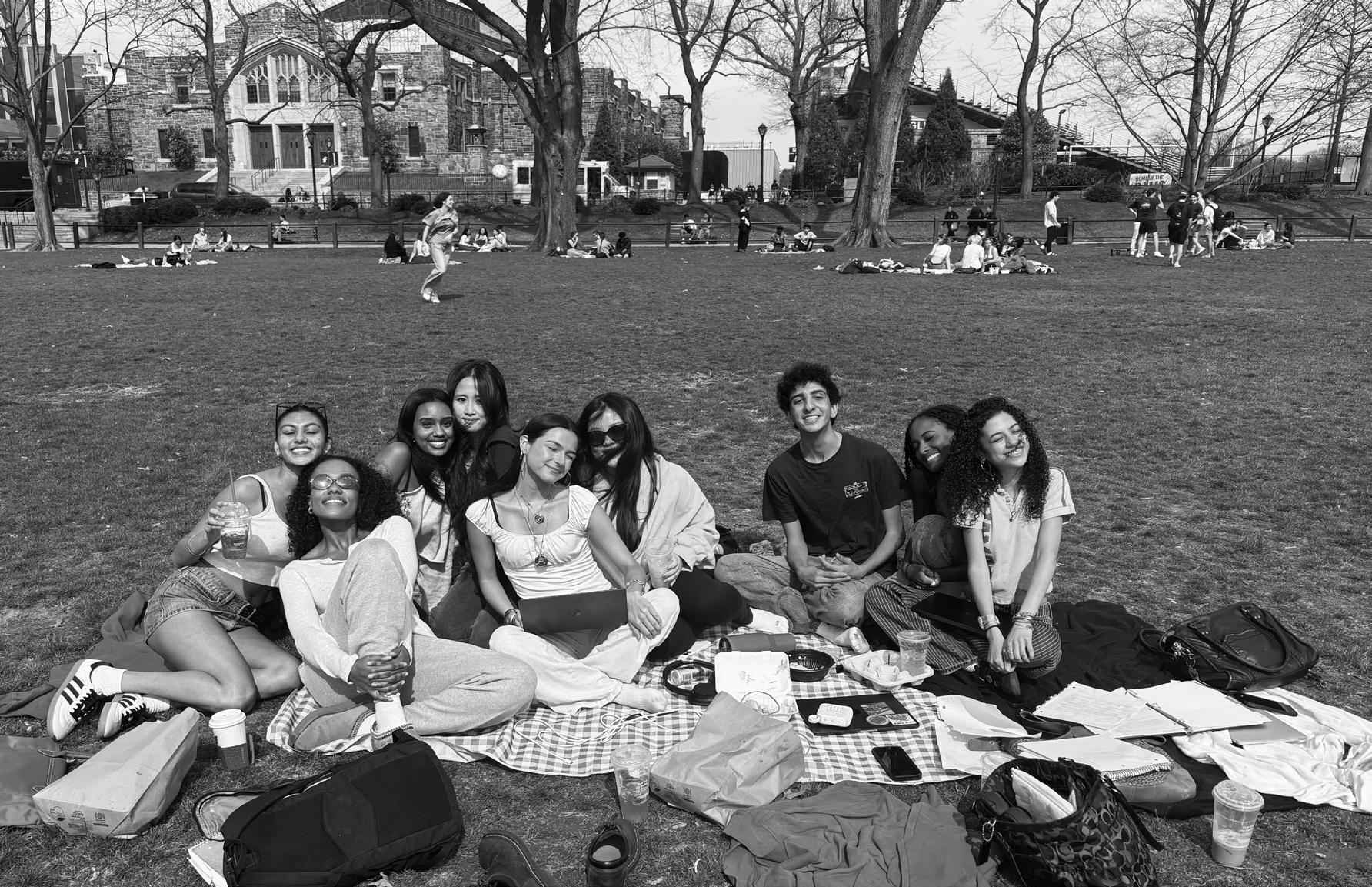
time it finally happened: It was a Thursday, with the weather forecast calling for temperatures in the high 70s and a UV index of eight. Students on and off campus immediately grabbed their Spikeball nets, picnic blankets and texted all their friends to meet outside on Edwards Parade. Its ideal location, right in the middle of campus with a beautiful view of Keating, provides a place where all students can gather and is large enough to collectively take a break from work, classes, being inside and just enjoy the warmth.
Eleanor Brown, FCLC ’29, said, “Sitting on Eddies is a nice break from the city, and a true Fordham student experience.”
A central theme is the community aspect of Edwards Parade, and I think that speaks to the issue winter brings up.
Hannah Butler, FCRH ’29, commented on how “it gives [her] a sense of community and makes [her] feel more connected with all of the students.” The winter forces students to find a sense of community and socialization only within their classes or dorms, so the school feels much smaller than it truly is.
However, many students
mention how they feel as though they are able to see so many different grades, groups of people and feel a part of one greater school and community, a genuine mission of college. Sofia Downes GSB ’29 added that “Eddies feels like a bonding experience at Fordham when practically every student is out with their friends. You see people you know and meet people you don’t. It’s great after such a long winter.”
Fordham, especially as a first-year, can feel extremely small: everyone lives on the same side of campus, you mainly take core classes and you mostly socialize within your grade. However, Eddies challenges this by bringing people together from the entire student body, seeing people you don’t normally interact with or see, with the common goal of simply enjoying the warmth. Although students typically sit with their friends or even alone on Eddies, the gates around it and the small area compared to somewhere like Martyrs’ lawn, force students to be a lot closer together, allowing for Spikeballs to be flying around, music to overlap and conversations to intersect with people around you, allowing a greater community to form.
By KELLY BUBAN ASST. CULTURE EDITOR
As a kid, going to get ice cream after dinner was a luxury. Not inherently due to the large amount of sugar the dessert would give me at 7 p.m., but due to the fact that there was only one ice cream place in my small town. So I submitted to having ice cream bi-monthly at the local spot called Charlie’s.
However, when I had private swim coaching lessons once a week 30 minutes away, I would beg my mom to stop at the one frozen yogurt place in the surrounding area: Tasty Waves. Despite this being about 10 years ago, Tasty Waves solidified my love for sweet treats, and specifically frozen yogurt, with its endless toppings and flavors to choose from, making it so special. Tasty Waves and froyo have lived in my mind rent-free ever since, and now with the resurgence of frozen yogurt in New York City, 2026 really is the new 2016.
With the term “Fat Friday” in mind, every week since the start of this semester, on Fridays my best friend and I have journeyed to a new frozen yogurt shop in the city. Birdie’s, Mimi’s, 16 Handles, Culture, Madison Fare, Butterfield Market, Go Greek; you name it and I have tried it.
So here are my thoughts on each new frozen yogurt creation:
Starting with the classic 16 Handles (I’m calling it classic as it was featured in “Sex and the City” back in the early 2000s), they understand the assignment. They have not attempted to reinvent the wheel, rather they boast a selection of over 40 plus toppings from fresh fruit to cereal to try and all of their flavors are simple. Their prices are fair for the amount you’re getting, as well as a punch card that rewards you with a free yogurt after 10 trips.
Mimi’s was not my favorite, contrary to its popularity. It was overpriced ($27 for a medium with toppings) and had limited topping choices. There were few seating options inside the store, which took away from the relaxing environment needed to truly enjoy frozen yogurt.
Madison Fare, Go Greek and Culture are all marketed as being “healthier” with their tart, Greek honey and original flavors tasting more similar to an actual yogurt than anything else, minus the characteristic sour taste. They are all on the thicker end of consistency and offer a main topping as a sort of drizzle, whether that be Nutella, honey or a fruit sauce. My least favorite place was Butterfield Market. Not only was it difficult to get to, but it
also felt like more of a market add-on than a place to get froyo. Also, Butterfield Market was fundamentally different from frozen yogurt. From the first bite, I could tell that it was actually soft serve, which was a really big let down in my eyes.
The one reigning supreme over all of these locations was Birdie’s Frozen Yogurt in the West Village. Not only were all of the employees nice, but the toppings, flavors and overall quality were superior.
So, why is froyo going viral again? This isn’t an accident in my eyes. The frozen yogurt boom of the early 2010s collapsed partly because the product got lazy — watery bases, fake flavors and places were charging $12 for a cup that tasted like something mediocre. So people moved on. Ice cream shops got creative and soft serve leveled up. Froyo seemed simply finished.
But here is what has changed: this new wave of froyo shops actually cares. They’re sourcing real yogurt cultures, offering seasonal flavors, hiring people who think about the texture, tang and topping combinations the way a chef thinks about a dish. The overall product improved, leading to it being more popular on social media, as influencers noticed. This gave us college folk something
to flock towards.
In an era of hyperpersonalization, the froyo bar is genuinely democratic in a sense. You build exactly what you want, pay by weight and no two cups are the same. It’s participatory food where you’re not just a consumer, you’re the chef for five minutes. It is an experience people can share together, giving it a reason to invoke such a rapid and wide spread.
My verdict on froyo?
I am 100% here for the
well-deserved hype. Not every trend deserves its moment, but this one has earned it. The shops are better, the product is better and the culture around it is genuinely fun. Although my best friend and my’s Fat Fridays originally started as a bit, they have evolved into something that is now the highlight of my week, and I will simply have to keep trying each of these new froyo places as they come to join the competition for which is the best in New York City!

By GABRIEL CAPELLAN ASST. OPINION EDITOR
I find it insane that people think jazz is dying. I find that to be further from the truth than anything. Jazz has so many genres and forms, including smooth, freeform, bebop, swing, contemporary acid and so much more. These genres can be mixed, and with that, we get something called “jazz fusion.” Jazz has modern impacts on pop, salsa, R&B, hip hop and other genres. We have to thank jazz for so much, and to give recognition to this incredible genre, I present Lucious Crawford.
Lucious Crawford, FCRH ’28, is a student composer and a stellar tenor saxophonist. Hailing from Washington, D.C., he’s a student of jazz. His music is meant for the soul, and he’s a natural bandleader. He’s extremely passionate about the things he does, and he does them while wearing his heart on his sleeve.
Jazz was all around him during his childhood, from his family to teachers; they were the reason he became interested in music. He was originally a classical violinist until his sister inspired him to start playing the saxophone, and he followed in her footsteps. “If it was up to me, then or
now, she’s way cooler than I am, so I just did what she did,” he said. Crawford was also in an after-school youth band led by his teacher. “He brought me into this band called the Saints Band … and from there I learned how to be a jazz musician,” Crawford said. Because of this, Crawford fell in love with jazz. “It was just kind of freeing. It’s way different than the classical structure… I can kinda do anything I want and get away with it ... That liberation keeps me here,” he said.
When Crawford arrived at Fordham, he was an economics major, and now he’s a music major with a minor in African and African American studies. He made the switch because he knew jazz was his calling. “Profit was not going to be chosen over what I thought I was put on Earth to do. These days, I’m happy that I made that decision, that I didn’t just sit in economics and wait for the moment Blue Note walks in and signs me, you know, I’m taking initiative on it myself,” he said.
Crawford draws inspiration from Duke Ellington, one of jazz’s greatest composers and bandleaders, and lives by Ellington’s words when it comes to composing. “‘Music is music no matter how you
define it, and it just has to sound good and that makes it music.’ That’s all I aim to do,” Crawford said. “That’s all I care about, especially when composing is, you know, it’s ‘do people like it?’ ‘Do I like it?’ If both of those things are true, then it doesn’t matter what anyone else is thinking.”
Crawford is very soft-spoken and has a good heart. He’s humble but knows where to take a stand with his art and passion. His personality and social skills are what allow him to continue to do what he does, along with being an incredible musician. “I think I just try my best to be a good person and that kind of brings the opportunity,” he said.
Josh Cheng, FCRH ’29, a friend of Crawford, had some words as well. “I visited Fordham as a senior in high school, and I reached out to Lucious because I saw him on one of the admitted [student Instagram] pages, and watching Lucious play in this room, right here actually, was one of the reasons why I chose Fordham because I loved seeing the culture and the way how he interacted with his friends and which is a big inspiration,” Cheng said. “He is just really passionate about what he does. He puts his soul into things and he’s
helped me to see that no matter what you choose to pursue specifically, it’s important that you’re pursuing it for the right reasons and not for reasons of external validation.”
When asked about his album “Ballads N’ Blues” and its creation, Crawford said, “I took the onus… on me to ask them, you know, to record in their basement and so we did. We had a really good time doing it, ended up being a ten-song
album and I released it within the next two weeks because I thought it was that good. Luckily, it’s done well, so I couldn’t be happier about it.” Crawford’s impact on the Fordham jazz scene is intangible. He’s only a sophomore, and he’s already done so much and will continue to do more. His growth and talent are something anyone can look up to, regardless of whether they’re a jazz musician or not.
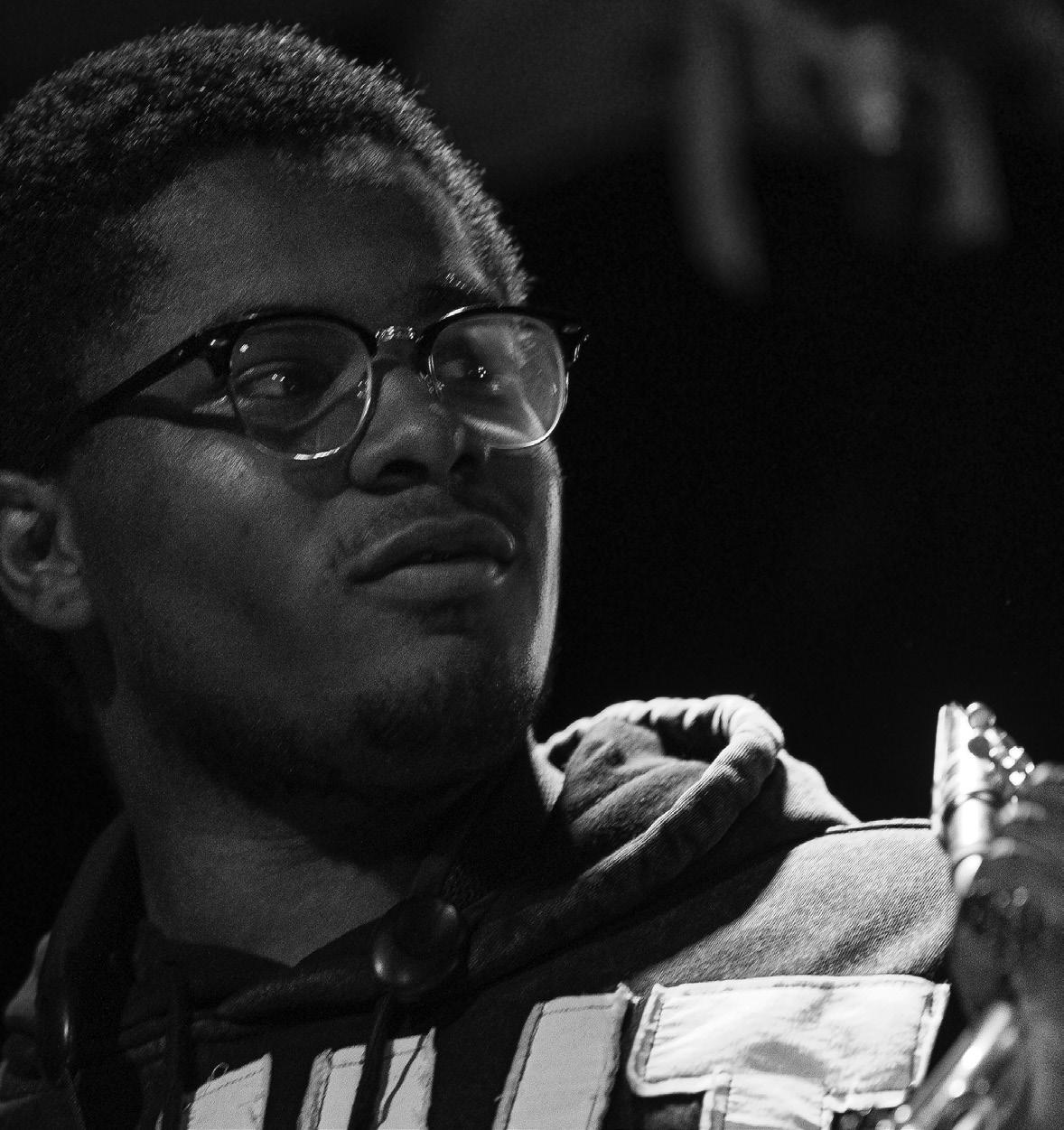
By EMILY GALLAGHER CONTRIBUTING WRITER
There are few things in life that rival the first warm day of spring in New York City. It feels as though the city breathes a sigh of relief for the seasons changing, and the warm air and sun are rewards for surviving the harsh, bleak and seemingly never-ending winter. Throughout all seasons — but especially spring — Central Park acts as a magnet, drawing people into all of its various nooks and crevices.
Central Park is a key landmark of New York City. Although not the largest park the city has to boast, it still spans over 800 acres and is a must-see for all tourists, while being a staple for locals. There is no shortage of pathways one can take in the park, and there are multiple unique features and sections that are worth a visit.
My personal favorite part of the park resides in its center. It is home to the Delacorte Theater, an open-air amphitheater that performs various Shakespeare plays during the summer, dubbed Shakespeare in the Park. It is free to the public if you secure a ticket, whether by lining up the day before a performance or through a digital lottery. The theater underwent renovations costing over $80 million this past summer, bringing increased
accessibility, improved lighting systems and more sustainability, so it’s worth a visit this summer.
Right next to the theater is Belvedere Castle, a miniature castle that was built in 1869. This castle’s lookout view offers some of the most stunning views of Central Park and is a remarkably beautiful spot in the park. Whether you want to view the city skyline or the lush Great Lawn, the castle is an ideal viewing spot. Inside, visitors can observe artifacts as part of natural history exhibits and access the castle’s visitor center and gift shop. This is my personal favorite spot in the park — having a castle in the center of the city is such a cool feature.
Another spot in the park that is worth checking out is Bethesda Fountain, located directly next to The Lake and Bow Bridge. The fountain itself is worth taking the time to observe due to its neoclassical design featuring an elegant statue of an angel perched atop the downward flowing water.. Beyond this, it offers a scenic view of the arched bridge and a look at the boathouse where you have the opportunity to rent out your own personal rowboat.
In the southeast part of the park is the Central Park Zoo. While we are lucky enough as Fordham students to have the impressive Bronx Zoo just a short walk off of campus,
this is another option if you are searching for more zoos to check out. It is certainly smaller in scale but still has a solid selection of interesting animals, including penguins, lemurs and snow leopards. It is conveniently located, with easy access to both the Upper East Side and Midtown. However, it does end up looking a bit lackluster when compared to the Bronx Zoo.
Central Park is home to so many beautiful gardens, with one of my favorites being the Conservatory Garden. Within this garden are three different areas with their own distinct designs and feel: French-style North Garden, the Italianate Center Garden and the Englishstyle South Garden. If you ever
want to feel like you’re walking in the European countryside, I would highly recommend checking out these gardens. They’re free to the public and filled with perfectly trimmed hedges, intricate botanical arrangements and charming statues that will transport you to a completely different location.
Even if it is not one of these attractions, Central Park offers something for everyone. There are so many artists, musicians and dancers; everywhere you look, there is some distinct performance going on. With all of the attractions and events, it’s impossible to ever be bored walking around.
Being in Central Park — or any part of New York City really — serves as a reminder of just
how diverse New York is. It is so entertaining to observe the thousands of people walking through the park and make up various backstories about each person’s life, which I personally think is an underrated pastime. If you want a place to play tennis, softball, a spot to walk your dog, listen to music, read, draw, picnic, have a deep conversation or perform just about any hobby, Central Park has you covered.
All in all, you are missing out if you don’t take the opportunity to check out Central Park this spring, especially while everything is in full bloom. While the main green spaces are often packed, there are always more hidden gems to find within the park.

By LARA EJZAK CULTURE EDITOR
Entering the throes of finals season and days and nights spent laboring away in Walsh Library, there exists a desire for an escape from the everimpending doom of the student grind. Fortunately, Fordham’s abundant offering of cultural and performative clubs provide performers and students with these brief reprieves from academia, and with a plethora of upcoming articles and finals determining the fate of my GPA creeping closer, I was ready to dive into a cultural immersion.
On the characteristically dreary day that was Sunday, April 19, these escapist dreams were met in the form of a ballet show. I took a trip with Fordham Rose Hill’s ballet troupe, the
Fordham Jetés, down the rabbit hole in Collins Auditorium at their performance of “Alice in Wonderland.”
As someone not extensively familiar with the plot or details of the story of young Alice and her fantasy world, I feared that I would struggle with following or maintaining engagement throughout the performance, but by the end of the first act, such worries were laid to rest.
Even without knowledge of what was being played out on stage, the dancers’ physical and storytelling abilities, the set design and the stage production curated a spectacle that kept me smiling like a Cheshire Cat.
The exposition of the ballet showed Alice, played by Lillian Choe, FCRH ’29 and her sister, played by Izzy Kamikawa, FCRH ’26 reading and playing outside and depicted the process

of Alice following the White Rabbit and drinking a series of elixirs to shrink to the appropriate Wonderland size. The props used represented this transformation of the protagonist. During the show, the stage props themselves were simple yet effective tools to the storytelling of the entire production, differentiating the various settings and characters.
The White Rabbit character, played by Tim O’Brian, FCRH ’28, cuts through Alice’s fear and confusion of being transplanted into this foreign fairytale world, and their duet dances always had an air of cheer and uplift. O’Brian’s technical dance abilities contributed to his compelling portrayal of his character, leaping and bounding across the stage, while Choe’s more gentle, delicate movements displayed the spirit of a young girl frolicing and navigating new and fantastical lands.
Each character had their own unique styles of dance on stage. The Caterpillar had a fluid, slinky motion in her number that carried the more subdued, alluring mystique of the bizarre that the character is known for. On the other hand, the Queen of Hearts, played by Eliot Richards, FCRH ’26, and her entourage of cards encapsulated her cutthroat nature with their more rigid and angular performance.
Each of the Queen of Hearts’ numbers were distinct in their
drama and pretentious tone. Her dance with the White Rabbit did an especially good job of conveying their respective characters, with the Queen bossing around the Rabbit, who had a consistent face of worry and apprehension throughout their joint performance.
While Richards and O’Brian embodied their respective roles’ commanding and acrobatic attributes, the other leads gave an equally impressive showing of their roles.
Julia Morales, GSB ’26 gave a perfectly enticing and unsettling representation of the Cheshire Cat, showcasing her flexibility during her solo performance, incorporating elements such as backbends in her dance and always sporting that signature grin, hammering home her character’s mischievous nature.
Similarly, the Mad Hatter, played by Rebecca Lothson, FCRH ’26, had a fittingly quirky and avant-garde dance number and costume. The accuracy and adherence to personality that each of the dancers depicted their roles with made the viewing experience just that much more fun to watch.
While each of the solo and character-specific numbers built the world and established the people in the show, the larger group numbers provided the more whimsical content in the ballet. Each ensemble number had my eyes fixed on the movement on stage, exhibiting the coordination and stage
awareness of the performers. In both the cards’ and flowers’ dances specifically, I witnessed just how well the dancers kept symmetry and tempo with each other.
I would be remiss to not make any mention of the non-dance elements involved with this production. As a former stage crew geek, I had a special reverence for the set designs and backdrops used in the show. The lighting correlated well with each scene, and there were special moments where the Queen of Hearts would take to the stage and be accompanied by a flash of reddish hues shining on the stage. Each aspect of this show was extensively rehearsed and tailored to make the show the best that it could be.
“Alice in Wonderland” as performed by the Fordham Jetés was the ideal fanciful show for these dragging endof-semester days. Moments of suspense and humor permeated the two acts and kept the audience entertained, and the dancer’s artistic and physical abilities kept me in awe that the people I was seeing on stage were the same people I see walking around campus and in classes. If you were unable to make it to this performance by the Jetés, be sure to follow their Instagram and stay posted about when you can next experience your peers pirouette and plié on stage and through the air.
By JULIA TYNAN CONTRIBUTING WRITER
With so many streets in New York City, how do you decide where to spend your time? For me, the answer was East 10th Street in the East Village. Within minutes of walking, it became clear that this street had a distinct character. If you’re looking for a street filled with charm, creativity and everyday city life, East 10th Street offers a meaningful experience to anyone willing to slow down and truly explore.
This street balances historic character with modern culture. Both a residential and lively destination, it’s home to cafés, shops and creative spaces. Its slower pace offers a calmer atmosphere than most of Manhattan, without losing the city’s energy.
I began my day at Lê Phin, a relaxing café known for its warm and inviting atmosphere. The interior’s cozy seating and greenery create a tranquil environment. The menu focuses on Vietnamese coffee, tea and matcha, featuring flavors like lotus seed, pandan and sesame. I ordered a Vietnamese iced coffee, recommended by the barista, and it had a smooth,
sweet and rich taste, which was an ideal start to my day.
From there, I walked to Tompkins Square Park, which was lively, with skateboarders practicing, a guitarist playing music and groups of people gathered on the grass, enjoying their day. This park felt like a central meeting place for people to come together in the community. Nearby was Tompkins Square Library, a branch of the New York Public Library, offering a quiet study escape from the surrounding activity.
Continuing along the street, I stopped at Limited to One, a record store known for rare records. The store specializes in indie, punk, emo and hardcore genres, making it a destination for dedicated music fans. Even for someone casually browsing, flipping through the records felt like an authentic experience in itself.
A few doors down, I visited Kalsang Pottery, an exquisite storefront selling handcrafted ceramics. Each piece is handthrown, including mugs, vases and bowls that balance function with artistry. The store feels personal, as if every object had its own story through the detail and uniqueness of each piece. Another memorable stop
was Crystal Garden, a spiritual shop filled with plants, jewelry and crystals. The storefront itself draws you in, with plants, flowers and succulents. Inside, the soft music and welcoming staff made a relaxed atmosphere and shopping experience.
After exploring the shops, I headed to Apollo Bagels and ordered a bagel with cream cheese. This popular spot lived up to its reputation, with its efficient service, fresh bagels and satisfying flavors.
Next, I stopped at Matcha House for a strawberry matcha, which had smooth, earthy flavors balanced by subtle sweetness. Watching the baristas prepare the drinks added to the experience, highlighting the care put into each order. The shop itself was quaint, reflecting the neighborhood’s authentic character.
Nearby, I passed Sundaes and Cones Inc., a popular spot for ice cream, especially on a spring or summer day. I then stumbled upon a pop-up vintage clothing shop, advertising a buy-three-get-one-free deal. Inside, racks of unique pieces offered something for anyone interested in fashion.
I ended my afternoon near St. Mark’s Church in the Bowery, where I found a bench to take
time to relax and read. The area carried a serene atmosphere, making it ideal to reflect after a full day of exploring. East 10th Street captures numerous qualities that define New York City, blending art, history, community and culture. Historically, the street developed as a residential area in the 1830s, featuring Italianate-style homes near Tompkins Square Park. By the 1950s, it had become a center of art, with many artist-run galleries. Although many of the galleries no longer exist, their influence on artistic culture remains relevant to the neighborhood. In 2012, part of the street was designated a historic district to preserve
several of its original buildings (Art in the Village).
Some streets in New York City are meant to be rushed through, but East 10th Street encourages you to linger. Tucked into the heart of the East Village, the tree-lined street offers a quieter contrast to the city’s fast pace, yet still reflects its creativity and character. Whether it’s the smell of fresh coffee from a cafe, the sound of music coming from a record store or the energy of a nearby park, the street reveals something new along every step. East 10th Street is an ideal destination for an afternoon in the city, that invites you to relax, enjoy and experience life.
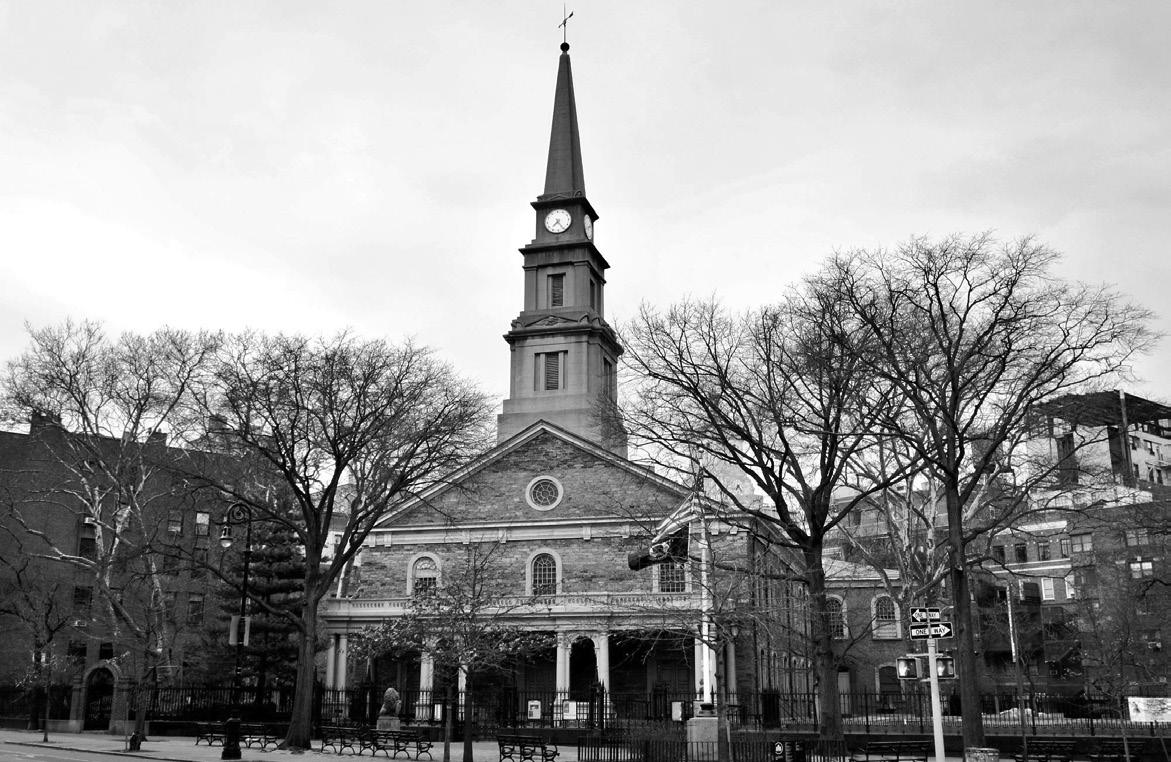
By WILSON SPELLER PHOTO EDITOR
I’ve seen “Sinners,” an original screenplay directed and written by Ryan Coogler, eight times. So to say I loved the film would be an understatement. “Sinners” is an ineffably powerful, touching and beautiful film, centered around incredibly important and complex concepts, including the blues, African American Christianity and conjure. These concepts are integral to the African American experience as well as to the historical realities of people in both Africa and the United States, and they are not to be portrayed or understood in a vacuum. Instead, as Coogler accomplishes in “Sinners,” they must be treated as overlapping concepts and realities that have shaped many aspects of African American culture throughout history.
Coogler has stated in interviews that “Sinners” was inspired by his Uncle James, who loved blues music and shared this love with young Coogler. After James’ passing, Coogler would listen to the blues, and he described his listening experience as “conjur[ing his] uncle.”
This statement from Coogler resonated with me for two reasons. For one, I took a class called The Spirituals, The Blues and African American Christianity last semester.
In taking this class, my understanding of the blues as a condition, as well as a genre of music that narrates engagement with historical conditions of the human spirit, deepened.
Another aspect that I brought to viewing “Sinners” was that my grandfather was a blues musician. As a child, I would go to his shows and listen to him play in the living room. At the time, I did not understand the complexities of the blues and could not fully appreciate the genre. However, as I grow older, I am starting to appreciate it more and more as a musical genre, a cultural artifact and a reminder of some of my fondest memories with my grandfather. Watching “Sinners,” there were many moments when I was almost transported back in time to when I sat listening to my grandpa play, moments that made me love and appreciate the film that much more.
“Sinners” begins with a flashforward, with Sammie Moore stumbling into church with his clothes ripped, his face lacerated and his guitar broken. Sammie’s father, Pastor Jedidiah, beckons his son, calling him to the lord and asking him to “leave those sinnin’ ways where they lie,” as a cross hangs pointedly in the background. This tension between African American Christianity and the blues is felt throughout the film.
Although making and/or enjoying the blues and being religious are not necessarily mutually exclusive, historically, the blues often aren’t concerned with religion. For the most part, the blues are worldly, meaning they narrate engagement with historical conditions without respect to God, or instead with regard for the human spirit rather than the divine spirit. The blues are also inherently functional, a resource through which people were trying to answer and deal with the realities they faced in early 20th-century America. In this sense, “Sinners” portrays the blues incredibly well. In a monologue as the characters are driving through the cotton fields towards the Juke, Delta Slim, an older blues player, recalls his friend Rice being lynched. Near the end of the scene, Slim breaks out into a spontaneous hum, vocalizing his feelings of grief, sadness, anger and despair. He is singing the blues, and in doing so he is able to grapple with the reality in which he lives, a reality that is unforgivingly oppressive and actively works to negate his subjectivity. The blues, however, also convey a sense of celebration and joy under these conditions. What Coogler called the “surreal montage” in the Juke Joint reveals this fact. As Sammie introduces himself to the audience in the Juke, we
cut to a scene of Delta Slim describing the blues as something that “wasn’t forced on us like that religion,” something “we brought ... from home” and most importantly, something that is “magic[al]” and “sacred.” Slim is directly describing to the audience how important and impactful the blues are. What follows is what I could only describe as a transcendental spiritual experience. Coogler and cinematographer Autumn Arkapaw weave viewers through the Juke as Sammie plays and sings, and as figures from the past, present and future dance, sing and play along. Figures range from traditional African dancers to futuristic electric guitar players, all in one space, at one time. The scene is the film’s magnum opus: It conveys the immortality of both the blues and the African American
experience, suggesting that the blues is foundational to current music and culture, but also comes from a long line of tradition that originates in Africa.
The film ends how it began, with Sammie entering the church after the events of the film. His father’s pleas compel him, and he is forced into choosing between the blues or Christianity as we see him shaking and staring at his nearly destroyed guitar. We then cut to Sammie driving through the cotton fields, as he triumphantly grips the guitar tightly to his chest, a powerful image that affirms Sammie’s autonomy, courageously choosing the blues, even after being through hell on earth. The film is nothing short of genius, capturing the profound impact and significance of the blues and Black culture.

Across 3. Guess who's jealous of Adele? 5. Have you ever tried this one?
7. Evil Boy, River Peepers, Fish of a Scale
9. Shocking: her new album title has more than four letters.
11. Magician? Monster? Mother? Mayhem!
12. I need a bad bleep, um...
1. Ooh that sounded really bratty!
2. I could say so many things about her, but I'll narrow it down to 13.
4. We're bringing back the monarchy for this midwest princess.
6. She's not from Massachusetts, but she is pretty wicked.
8. Summer isn't over yet!!
10. Wendy Williams once called her Dula Peep.
By JOE HENRY ASST. SPORTS EDITOR EMERITUS
Fordham Women’s Tennis hasn’t dropped a point in six weeks. Now, the Rams stand just three matches away from their second Atlantic 10 (A-10) title in program history.
Fordham packs its bags for the A-10 Championships in Orlando, Florida, riding its second-longest win streak since digital record-keeping began in 2006 — but with unfinished business to tend to.
The Maroon and White capped off their regular season with another 4-0 trouncing of an A-10 foe, this time directed towards the University of Rhode Island. Enjoying sunny skies and temperatures in the upper 60s, Fordham defended the Hawthorn/Rooney Courts Saturday afternoon, climbing to 13-9 overall, 5-0 in conference and 8-0 at home.
The Rams extended their winning streak to nine matches — they’ve outscored opponents 45-0 in that span — and finished the regular season a combined 23-0 against A-10 opponents when counting up all team points.
In the nine-game stretch, which started March 8, Fordham captured 99 of 110 finished sets, making up for a 3-8 start to the campaign by winning 10 of its last 11.

Saturday, Fordham won its ninth straight doubles point to open up the early afternoon affair. Senior Nevena Kolarevic and junior Julianne Nguyen paired for a 6-0 sweep at No. 1, while junior Lily Chitambar and freshman Valerija Kargina clinched the point with a 7-5 finish in the middle court. For just the second time during the Rams’ streak, both those wins were needed. Sophomores Paola Dalmonico and Catalina Padilla dropped the No. 3 match, 6-3. With both sides onlooking, Chitamber and Kargina pulled out their sixth straight win as a tandem to send the Rams to singles up 1-0.
Carrying over her momentum, Kargina waltzed through her No. 3 matchup, 6-1, 6-1, to build on the lead. The reigning A-10 Rookie of the Week has won a team-high eight straight in singles. In fact, she’s won with such dominance and speed that, even though the team often plays clinch scoring, all 21 of her singles matches have finished.
Fittingly, Chitambar finished next, taking home a sixth straight win of her own, 6-0, 6-4, at court No. 5.
Kolarevic — the reigning A-10 Player of the Week — was on the doorstep of another Rams point, leading 7-6 (7-2), 4-1, when Nguyen wrapped
up a 6-0, 6-4 win to end the match. Between doubles and singles, Nguyen has now won each of her last 16 completed matches.
The Rams are headed south to the United States Tennis Association National Campus for the 12-team A-10 tournament, where the winner will take home the A-10 title and receive an automatic bid to the NCAA Championships.
Fordham received the No. 1 seed and earned a bye; on Thursday, they will play the winner of Dayton University and Duquesne University’s matchup in Wednesday’s opening round. The semifinals are slated for Friday, and a champion will be crowned Saturday.
With the win, Fordham Women’s Tennis will earn their second A-10 Championship, and their first since 2022 — but to do so, they will have to get through Virginia Commonwealth University (VCU). VCU has won nine of the last 12 A-10 titles and ended Fordham’s season last year in the semifinals. VCU just narrowly edged Fordham for first in the preseason poll and also carries an unblemished 5-0 A-10 record into Orlando, where they hold the No. 2 seed. While Fordham’s path remains uncertain, a battle of the Rams feels fated with a piece of A-10 history at stake.
By GRACE MCCARRON SPORTS EDITOR EMERITA
What began as a year of optimism for many tri-state area hockey fans quickly turned into the opposite. The New York Rangers, New York Islanders and New Jersey Devils all missed the playoffs this season, the first time all three have been eliminated in the history of the NHL.
Each team this season had a different story, and each had different flaws that plagued them throughout the season. The Rangers, who finished 34-39-9 at the bottom of the Eastern Conference, came out of the gate slowly in October. It took them a month to record a win at Madison Square Garden, and they were shut out in their first three home games. Things continued to spiral into the new year, and general manager Chris Drury published “A Message from Chris Drury to Our Fans” on Jan. 16, sharing plans for a “retool” around core players. Drury’s sentiments indicated that the team would begin to look different over the coming weeks and months, and this turned out to be the case. Star Artemi Panarin was dealt to the Los Angeles Kings on Feb. 4. Others, such as Carson Soucy, Sam Carrick and Brennan Othmann, were gone as well. The team turned to younger players in the waning weeks of a disappointing season,
and they delivered.
In 49 games, Gabe Perreault netted 12 goals and added 15 assists. Will Cuylle, Noah Laba, Adam Sykora and others made their presences known. They ended the season 12-10-3, perhaps allowing fans to leave the 2025-26 campaign behind with a slightly less bitter taste in their mouths. Blueshirts fans will be dialed in to see what other moves Drury makes to reshape the roster over the summer.
Out east, things were more positive for the Islanders, despite the sour ending. They wrapped with a record of 4334-5 and were gunning for the playoffs for much of the season, to the surprise of many around the hockey world. A big part of this success was the performance of rookie phenom Matthew Schaefer, the first overall pick in the 2025 draft. Schaefer now has a slice of the record for most goals by a rookie defenseman, tying Brian Leetch with 23.
The Islanders’ locker room has been incredibly complimentary of the 18-year-old since he stepped onto the ice. The team was cruising near the top of the Metropolitan Division until a skid in the last few weeks of the season took them out of contention in a tight Eastern Conference playoff race. The skid grew so ugly that head coach Patrick Roy was fired on Easter Sunday with four games left in the regular season. Pete DeBoer took

his place, and he appears to be here to stay under a contract that covers the next three seasons.
It’s unclear, however, if captain Anders Lee will remain with the team. He’s an unrestricted free agent at age 35, but he has expressed a strong desire to stay with the team. General Manager Mathieu Darche, coming off his first season with the team, indicated a desire to negotiate an agreement with Lee if it makes sense for both sides. In Darche’s words: “I told Anders I’d love to see him play his 1,000th game with the Islanders…The question is, do we get to an agreement that makes sense for him and for us?”
While Isles fans are surely sad to miss the playoffs, bright spots, including Schaefer, a 10-0 record in overtime and
another great year by goaltender Ilya Sorokin, should make them feel good about the future of the team.
The Devils ended their season 42-37-3, ten points ahead of the Rangers, for seventh in the Metro. Things started off well for New Jersey with an eight-game winning streak to open the season, but the tide changed. Injuries, which seem to be a frequent culprit of the Devils’ struggles, hampered their play in the middle of the season. Even with a 14-10-1 run after the Olympic break (which was highlighted by Devils player Jack Hughes scoring the goal that secured team U.S.A.’s gold medal), the Devils missed the mark for the playoffs.
The General Manager and President of Hockey Operations Tom Fitzgerald was fired on
COURTESY OF PURESPORTSNY
April 6, and Sunny Mehta was announced as his replacement the following week. Mehta returns to the organization after spending four seasons as their director of hockey analytics from 2014-18. Bright spots, beyond Hughes making Olympic history, included Jesper Bratt recording his fifth consecutive season with at least 70 points. Mehta will have decisions to make over the summer, including how to manage lackluster goaltending and whether to extend captain Nico Hischier, whose seven-year deal expires in 2027 and becomes eligible for an extension July 1.
For hockey fans in the tristate area, there’s a lot to look forward to as each of the three teams moves on from their 2025-26 campaigns and seeks to improve going forward.
By DEREK BEAULIEU CONTRIBUTING WRITER
One of the biggest stories in baseball going into Opening Day of the 2026 season was the San Francisco Giants’ new manager, Tony Vitello. While new managerial hires occur all of the time, the newest trend for MLB managers has been acquiring those with very little experience to coach at the highest level. Vitello, for instance, has only coached at the college baseball level, a far cry from the MLB. Teams seem to be looking for new perspectives, skewing away from the Tony La Russas of the world in favor of younger managers. However, is the new age of managers prospering? And how important is it for managers to have coached or played at a high level of their sport?
Vitello’s MLB managing career was off to a bad start, with the Giants suffering a home sweep at the hands of the New York Yankees. Considering that Vitello’s lineup was unable to muster their first run until their third game, it’s hard to blame the manager for the team’s lackluster performance. The Giants then went 9-10 in their next 19 games, an improvement from their slow start, but not up to par with their preseason expectations. Standing at last in the division behind the Colorado Rockies, of all teams, is not a good look for a first-year manager, especially one who has already been so scrutinized due to his lack of experience. Still, I believe it is too early to judge a manager by his first 20 games, so maybe

another example couldn’t hurt.
Craig Stammen, manager of the division rival San Diego Padres, follows similar circumstances to Vitello. He was named the manager of an MLB team out West after only one and a half years of experience coaching as an assistant in the Padres’ farm system. However, his real experience came on the field as a former relief pitcher for 13 seasons in the MLB — half of which came with the team he now manages. Having last pitched in the 2022 season, he never became too far removed from the game, and it wouldn’t be a bad gamble to assume a long career in the MLB would make him at least an average manager.
Unlike Vitello’s struggling Giants, Stammen’s Padres have
Each week, The Fordham Ram’s Sports section honors two athletes for their on-field performances as “Athletes of the Week.”
Junior Julianne Nguyen has been a crucial part of Women’s Tennis’ historic run. Most recently, Nguyen aided in the Rams’ victory over the University of Rhode Island. Nguyen and Nevena Kolarevic dominated in their doubles match, winning 6-0 before Nguyen won her singles match 6-0, 6-4.
Sophomore Anthony Grabau powered the Rams’ offense to their three game sweep of La Salle University. Grabau collected five hits, two of which were home runs, totalling six RBI’s. Grabau’s performance was recognized with the A-10 Player of the Week award. Anthony Grabau Sophomore
enjoyed a much hotter start, as they won 15 of their first 22 games and are only 0.5 games behind the juggernaut Los Angeles Dodgers for the lead in the National League West. However, a key thing to remember is that Stammen inherited a much better roster than Vitello, who took over a solid but flawed team that hasn’t had a winning season. The 2025 Padres finished with a 90-win season and a wildcard spot, while the Giants last season were the perfect definition of mediocre, finishing with both 81 wins and losses.
So two managers, both with very little experience, have started their 2026 seasons in different ways. However, there are too many variables to know if the manager has caused the team’s performance, or if the
team is to blame. To get a better idea of how a manager’s experience can impact their role and performance, let’s take a look at what the fans and experts consider to be the best managers of the last century.
Dave Roberts, the current manager of the Los Angeles Dodgers, is widely considered one of the best managers in the current MLB landscape. He was a player for many teams over a 10-year MLB career, one of those being the Dodgers, and he then became a coach for the Padres from 2010 to 2015. Interestingly, he was the manager of the Padres in 2015 for one game after the earlier manager, Bud Black, was fired midseason. Roberts’ Padres would lose that one game 9-1, and then Roberts was demoted back to a bench coach after
being replaced by Pat Murphy. Roberts would then join the Dodgers in 2016, and the rest is history. He would find near immediate success, appearing in five World Series and winning three of them. While we don’t know how Vitello and Stammen’s managerial careers will play out, it certainly seems like prior experience can’t hurt when managing a professional ball club. Different managers have all had different levels of success with different amounts of experience, so it really can be hard to value how good or bad a future manager will be when they join a new club. It all may come down to luck; then again, MLB teams create formulas to limit the amount of luck and chance they need to take when doing just about anything for their future success.
By JAMES NELSON SPORTS EDITOR
Since Tyson Fury’s return to boxing in 2018, his name has consistently been attached to one fellow heavyweight: Anthony Joshua. The two British world champions have a long history of trash-talking each other on social media, through interviews and in-person exchanges. After Fury’s decision victory over Arslanbek Makhmudov, Netflix announced that Fury and Joshua agreed to finally fight in December. While public opinion on the matchup generally leans towards Fury being the favorite, these fighters are at unique points in their careers; this fight is years after fans would have liked. Still, seeing them cross paths after almost a decade of speculation will be surreal.
Over the course of Fury’s career, he has earned a reputation as being nearly impossible to knock out. While he’s suffered his fair share of trips to the canvas, he always finds a way back to his feet, somehow becoming a sharper boxer after eating hard punches. Considering his 6’ 9”, 270-pound frame, Fury is impressively difficult to hit; he seamlessly mixes

slips, rolls and blocks to narrowly avoid even the most extensive combinations. While Fury didn’t appear at his best against Makhmudov, he still rather easily outpointed the Russian phenom.
The key for Fury is one of the oldest adages in boxing: stick and move. When Fury is right, he is almost a textbook boxer.
Fighting behind his jab, finding openings for body punches in the clinch, using footwork
to cut off the ring and using his right hand sparingly. When Fury is off, he finds himself backing up under pressure, throwing sloppy punches and leaving his chin available.
At a record of 35-2-1, Fury has only been defeated by Oleksandr Usyk, who is widely recognized as the top heavyweight fighter in the world. In order to overcome Joshua, Fury needs to keep from engaging in brawling. The more
technical the fight, the longer it will go. The longer the fight goes, the greater the advantage Fury has.
The embodiment of Fury’s boxing career is the 12th and final round of his first fight with power-puncher Deontay Wilder. After suffering a brutal two-punch combination sending him crashing to the floor, Fury managed to get back up before the ten-count. Normally, after a fighter gets up from a knockdown, all facets of their game worsen. In this case, Fury got up with a vengeance, outboxing Wilder in the last minutes of the fight. This and many other moments are part of why virtually no one in the boxing community is anticipating that Fury will get knocked out.
For Joshua, the uglier the fight, the better chance he has. Joshua’s right hand may not be the most powerful Fury has faced, but it is certainly capable of impacting the fight. 26 of Joshua’s 29 victories have come by knockout. Joshua most recently squared off against influencer-boxer Jake Paul in a bizarre mismatch. The far bigger Joshua had the advantage in both skill and physicality, knocking Paul out in the sixth round.
Unlike Fury, Joshua has been knocked out on multiple occasions, more often than not because of lazy defense. While imperfect, Joshua’s fundamentals are still strong. As opposed to Fury, who fluctuates between long- and short-range offense, Joshua prefers to stay on the outside, throwing fewer punches, but packing power in each. Given that Fury surpasses Joshua’s height, reach and weight, Joshua may not be able to implement his usual game plan of striking from afar.
In order for Joshua to win, he must continuously trap and hurt Fury, a task easier said than done. Unfortunately for Joshua, his biggest weakness plays into one of Fury’s strengths. Joshua routinely gets tired in the later rounds of fights, leading to worse technique and poor decision-making. Fury’s superior stamina, clinch-heavy approach and remarkable ability to box well in the final rounds give him an edge in the fight. Joshua should aim to end the fight early with a stiff overhand right. If he doesn’t, he will find himself in deep waters with an aging but dangerous Fury. If history is any indicator, Fury is the wrong fighter to bank on knocking out.
By MOLLY FRIEDMAN ASST. SPORTS EDITOR
This summer, 16 Canadian, Mexican and U.S. cities will play host to the renowned FIFA Men’s World Cup. Excitement is building across the U.S., as we will see the world’s best play on our home turf, only the third time the massive tournament has been held in North America. While conversations revolve around the stars and big matchups yet to come, discussing the event’s economic impact is unavoidable. Although the united bid across three countries aimed to leverage existing infrastructure, the economic strain will be felt at the local and global levels.
This event is expected to be a revenue engine for the host countries. The projected global economic output of the North American World Cup is $80.1 billion, and the U.S.’s economic output is $40.9 billion, according to Inside FIFA. With 6.5 million visitors expected, this group will generate a significant share of revenue for the host countries. Accommodations and daily expenses are rising for visitors, driving the cost of amenities and hotel prices through the roof. We are also seeing indirect tax revenue from hotel occupancy, sales and income taxes. The sheer length of this extensive event, spanning over a month, rakes in millions for the hosts.

A combination of broadcasting rights, ticket sales and marketing is bringing in another massive sum. According to Inside FIFA, “television broadcasting rights and marketing rights will contribute an overall share of 75%,” with Fox and Telemundo handling all the streaming for the 104 matches. Additionally, this is the first World Cup where brands can enter dedicated collaborations directly connected to the FIFA World Cup. We have already seen several big names, such as Visa, Coca-Cola and Marriott Bonvoy, take advantage of this opportunity to boost their income, according to the Sports Business Journal.
While the World Cup often brings anticipation and high spirits, organizing an event
of this scale is a logistical nightmare for host countries and public transportation systems. To avoid complete collapse, in early 2026 the U.S. government stepped in and budgeted approximately $100 million to be split across the 11 U.S. host cities for effective public transportation operations and security.
While government aid is helpful, many cities are still struggling to fund their transportation systems. Connecting New York City and New Jersey has proven easier said than done. While NJ Transit has agreed to act as an official transportation for the matches, it is not coming cheap. According to Fox 5 New York, the current NJ Transit bill is $48 million, and the state
has to find funding for it. Additionally, FIFA will provide official New York-New Jersey bus service running to and from Manhattan and MetLife Stadium all throughout the event. According to Politico, “[t]he state’s public transit agency said Friday it plans to charge 40,000 World Cup goers $150 to get to MetLife Stadium for each of the eight matches in the state.” New Jersey is in uproar over this news. While moving around the New York City area has never been easy, this seems excessive.
Other cities have adopted different methods for funding and operating public transportation systems, in line with those that may be more effective. According to NBC 10 Philadelphia, the Philadelphia public trans-
portation system, SEPTA, has partnered with Airbnb to offer free rides to fans after matches. This is a useful strategy for using the new brand agreements to alleviate the city’s financial burden. Kansas City, on the other hand, has adopted a much more affordable method to get fans to the game. According to KCUR, “For World Cup ticket holders, Kansas City will run $15 shuttles to the stadium on game days.” Additionally, the city provides free public transit between the airport and downtown, elevating the fan experience.
While tax revenue is proving positive for many areas, some U.S. states had to sign forced tax expectations, significantly lowering their output. FIFA mandated that many states, such as Florida, Georgia and Missouri, pass laws exempting World Cup tickets from sales tax, according to the Institute on Taxation and Economic Policy. This tax, which is slashing budgets for crucial pieces of state infrastructure, such as education and road maintenance, significantly undermines the tournament’s positive economic outcomes. While the FIFA World Cup is an excellent opportunity for economic growth through tourism and marketing, the financial burden of the event’s sheer scale is often overlooked amid the excitement. We must now sit and wait to watch whether the logistical upheaval of organizing this event is worth the gamble.