

By SIENNA REINDERS EDITOR-IN-CHIEF
The Fordham University United Student Government (USG) is in the midst of lobbying the university administration for an amendment of the current contraceptive distribution policy to allow community members to distribute contraceptive materials on campus property. This has been a subject of discourse on campus for at least 60 years.
Fordham’s current policy on contraceptives allows for their possession on campus but prohibits their distribution on university property, at university events or with the use of university resources. The policy makes exceptions for medical conditions such as menstrual cycle irregularities and polycystic ovary syndrome, which can be treated with the use of hormonal contraceptives.
USG wants an amended policy that allows for the distribution of contraceptives on university property, while maintaining the provision prohibiting distribution at university events or with the use of university resources. Senator Henry Carstens, GSB ’29, said the policy is not intended to elicit university endorsement of contraception, but rather to give autonomy back to its students and allow students to freely distribute contraceptives.
“One of the big mischaracterizations of what we’re trying to do here is we’re not trying to
seek funding,” Carstens said. “We’re not seeking even outright support for this, or allowing us to be at, like, big university-sponsored events. All we’re saying is, if I, right now, wanted to give you a condom, that’s not illegal [according] to the student handbook.”
In being a Jesuit institution, Fordham’s current policy is rooted in Catholic doctrine. The Vatican first released language on contraception in Pope Pius XI’s 1930 encyclical Casti Connubii, which stated that “any use whatsoever of matrimony exercised in such a way that the act is deliberately frustrated in its natural power to generate life is an offense against the law of God and of nature, and those who indulge in such are branded with the guilt of a grave sin.”
Executive Director of Campus Ministry Phillip Judge, S.J., explained that, as a Jesuit university, Fordham follows Catholic social tradition and teaching and promotes Catholic values. The university aims to uphold Catholic morality, which includes values like promoting free speech and the unionization of workers on campus, as well as opposing artificial contraception, according to Judge.
“A Catholic university tries to follow Catholic tradition in terms of the scholarship it encourages and provides,” Judge said. “If something is not allowed, then the university is a Catholic institution and shouldn’t allow it.”
The Catholic Church is also against any promotion of the use of contraceptives, which is reflected in Fordham’s policy. In upholding this doctrine, the University Health Center (UHC) does not provide any form of contraception except for any documented medical reasons, but they do provide testing for sexually transmitted infections (STIs). The student handbook states that the university’s primary method in addressing concerns about and preventing STIs and HIV/AIDS is educational.
“Fordham University endorses the understanding of human sexuality that is consonant with Catholic tradition. This approach finds its central principles in a view that is inherently linked to mutual fidelity in family living,” the handbook states. “Although this perspective informs our programs at Fordham, it is not inconsistent with this outlook to also ensure that comprehensive information on human sexuality be made available to the University community. Fordham recognizes that responsible sexual behavior involves both a grasp of ethical and moral principles and a fully informed view of human sexuality.”
Judge added that educating students on contraception does not violate Catholic doctrine.
“It [doesn’t] mean that just because something is immoral, that people shouldn’t know about it,” Judge said. “Even education
By EMMA LEONARDI NEWS EDITOR
The Fordham University College at Rose Hill (FCRH) Honors Program celebrated 75 years since its establishment in 1951 with an exhibit highlighting the important work done by its students and a panel discussion with faculty members involved with the program on March 2.
Olena Nikolayenko, professor of political science and Director of the FCRH Honors program, who moderated the panel discussion, had explained the purpose of the exhibit in an email to The Ram.
“The exhibit demonstrates how the Honors Program has remained the same at its core, but it has also changed with the times,” Nikolayenko said.
“Since its inception, the Honors Program has placed great emphasis on academic rigor, study abroad experiences, and a
sense of community.”
She also commented on the program’s evolution over the course of its 75 years of existence and how that history was embedded in the exhibit.
“The exhibit demonstrates how the Honors Program’s student body evolved from a select group of male students in the 1950s to a diverse group of students from across the United States and around the world in the 2020s,” Nikolayenko said.
She detailed the items on display that students could observe if they visit the exhibit.
“This exhibit draws upon items from the University’s Archives and Special Collection,” Nikolayenko said. “Exhibition items range from Fordham University yearbooks and Fordham Ram newspaper articles to Honors Program print material and photographs,
SEE HONORS, PAGE 5
By EMILY TONNA
EXEC. COPY EDITOR EMERITUS
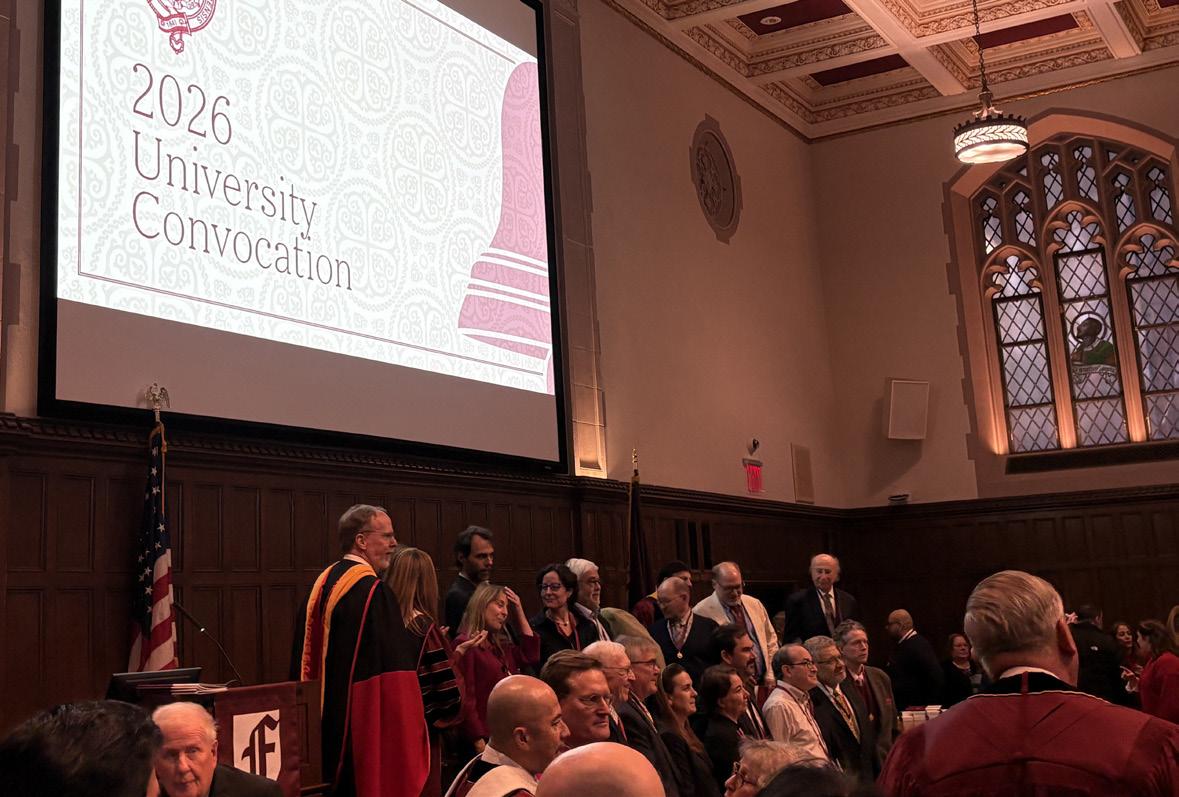
Fordham University hosted its 95th annual University Convocation on March 4, where university leadership celebrated 68 of its faculty’s milestones and honored their service to Fordham.
President Tania Tetlow was one of the many university leaders in attendance and commended the faculty for their decades of contributions.
“This is a moment that matters more than ever, and [with] the chaos and uncertainty of the world, we
remember the sacredness of our work, of how precious it is — not just to us — but to every student whose lives we transform with opportunity,” Tetlow said. “We could not do it without each and every one of these people.”
The Bene Merenti Medal, the Archbishop John Hughes Medal and the 1842 medal were presented to the faculty based on their time at Fordham and the work they do for the university.
Diane Howitt, the executive director of the New York City SEE EVENT, PAGE 5
Fire Alarm
March 4
2:20 a.m.
On Wednesday, March 4, at 2:20 a.m., the fire alarm went off in Queens Court. The supervisor responded and the investigation revealed a battery charger on top of a desk was on fire. The supervisor used a fire extinguisher to put out the fire. FDNY responded and the students were relocated. Facilities personnel responded to clean the room and fans were used for ventilation.
Fire Alarm
March 5
11:40 p.m.
On Thursday, March 5, at 11:40 p.m., a fire alarm went off in Martyrs’ Court LaLande/Goupil.
The supervisor and FDNY responded and the investigation revealed a student cooking food triggered the alarm. The supervisor ventilated the area and reset the alarm panel.
Stuck Elevator
March 13
2:10 a.m.
On Friday, March 13, at 2:10 a.m., there was a stuck occupied elevator in Salice Conley Hall. The supervisor responded, freed the student and notified the elevator company. A technician responded to inspect the elevator.
Stuck Elevator
March 13
10:30 a.m.
On Friday, March 13, at 10:30 a.m., there was a stuck occupied elevator in Salice Hall. The supervisor responded and notified the elevator company. A technician freed the occupant and inspected the elevator.
Follow The Fordham Ram on Instagram, Facebook, TikTok and X
@TheFordhamRam
Thursday March 19
St. Patrick’s Day Takeover
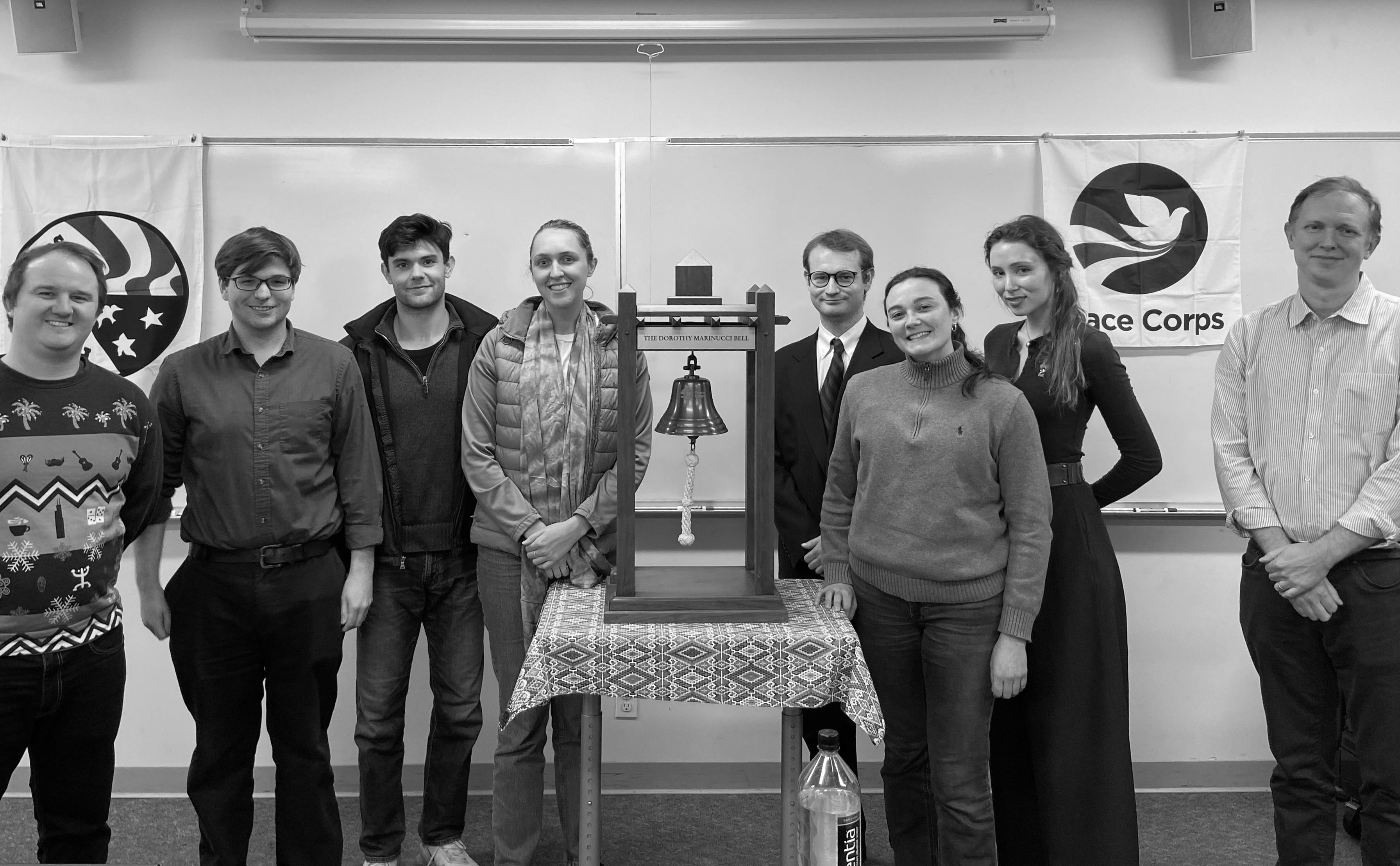
On March 5, Fordham’s international political economy department (IPED) program hosted a lecture which featured certain returned Peace Corps volunteers who discussed their experiences giving back to communities abroad, along with opportunities available to students.
The event was part of IPED’s regular lecture series, which hosts a weekly lecture focusing on a variety of topics. This event coincided with Peace Corps Week and marked the
65th anniversary of the Peace Corps organization. Organizers
Donna Odra, associate director for IPED, and Jet Pacapa, GSAS ’27, said the lecture was intended to introduce undergraduate students to the program and show them what service abroad is like.
“It’s really to promote the Peace Corps to the undergrads,”
Odra said. “Over the years, especially during COVID, they had to close down, and now they’re trying to ramp up operations, and I think this is a good time to promote [the] Peace Corps, to explore it as an alternative option after graduating from Fordham.”
The Peace Corps is a twoyear service program where volunteers travel to a foreign
environment in the world and complete a service. It is open to all United States citizens and includes certain benefits upon completion.
According to Pacapa, this was the first time the weekly lecture series was dedicated specifically to the Peace Corps. According to Odra, this is the first step towards bringing Fordham back to it rank as one of the top feeder schools for the Peace Corps.
“We don’t really have an inhouse Peace Corps program for undergrads here in terms of recruitment,” Odra said.
There are less people working in the Northeast recruitment office, and Fordham is trying to help, said Odra.
The lecture focused on several former Peace Corps volunteers who are now students studying in Fordham’s graduate IPED program, as well as faculty who previously served in the organization. They told stories from their time volunteering and also discussed how their experiences shaped their paths.
“From the moment I stepped foot in Navut, she was… she was my mom,” said Sydney Clapham, a returned Peace Corps volunteer from Fiji. Clapham was talking about the woman she helped to grow her clothing business.
“Now she’s got this thriving
business, and it continues to grow and grow, and I’m so, so thankful that I got to be a part of building that,” Clapham said.
Tymber Felts, GSAS ’27, volunteered in Ecuador. She said the experience of living and working in a new country can expose people to different cultures and viewpoints.
“I think what most volunteers take away is that really getting to know your community and getting to know the people there is what really makes Peace Corps special,” Felts said. “Because at the end of the day, we realize
we’re not so different from everybody else, and Peace Corps really lets you see that.”
Fordham has a 25-year long relationship with the Peace Corps through the Coverdell Fellowship, a scholarship program that supports returned Peace Corps volunteers who are pursuing graduate studies.
“That is one of the perks of being a Peace Corps volunteer,” Odra said. “After you’re done with your service, when you come back to the U.S., among the benefits is that you can be eligible to receive a scholarship to attend a university for grad studies. And that’s what we’re managing here at Fordham.”
Returned volunteer from Kenya and IPED graduate student Trevor Cox, MA ’27,
Friday March 20
Men’s Tennis v. Fairfield U.
12 p.m.
St. Patrick’s Day is taking over the marketplace. There will be a table where you’ll have the chance to test your luck to win a prize in a coin toss game.
Rose Hill 3 p.m.
Men’s tennis team is playing against Fairfield University at home this Friday afternoon. Support our tennis boys as they hit some balls!
Saturday March 21
Rod’s Battle Of The Bands
Rodrigue’s Coffee House 1 p.m.
Rods is hosting a battle of the bands, with the lineup to be announced. Tickets are free for students. The winners will open for Spring Weekend.
Sunday March 22
Hour Retreat: Thrive For Life ... University Church 12 p.m.
Join campus ministry for a dive into compassion and mercy with a reflective conversation about the Thrive for Life prison project. There will be a hands on project.
talked about his experience serving abroad and gave his perspective on why students should volunteer.
“It’s only half the length of undergrad and it’s not as much work as undergrad,” Cox said. “It’s a nice breather before you start a full-time job.”
He also noted that it’s up to each individual to make it their own experience.
“It’s pretty low pressure, and you’re not supervised,” Cox said. “So, you know, some people, they don’t do much. I did some, I think. Other people did more than me, but other
people did way less.”
Pacapac said that hearing his RPC friends talk about their experiences and telling stories as volunteers abroad is entertaining, whether or not it’s a serious story.
“Hopefully they think about serving. It could be with Peace Corps, it could be also with other organizations, but for them to know that there is value in living overseas and helping communities overseas,” said Odra.
The takeaway for student attendees was to inspire them to explore the world around them, according to Odra, whether through the Peace Corps programs offered or any other global experience initiatives of interest.
Monday March 23
Copy Editing for The Ram
McShane, B-52 5:30-9 p.m.
Copy edit for The Ram from 5:30-9 p.m. in B-52 (around the corner from Dagger Johns). Come and go as you please and there will be pizza!
By SIDNEY BLASCO FEATURES EDITOR
Campus ministry hosted an event with Fordham University students and St. Ignatius Middle School (SIS) students, where they made lunch packs for a local Bronx food pantry. This event was part of a seven-year-long ongoing partnership with Campus Ministry and the SIS.
On Wednesday, March 9, Robert Parmach, senior director of Ignatian Mission and education, and Alex Hufford, S.J., bought $100 worth of bread, squeezable jelly, Jif peanut butter, CapriSun juice pouches, Welch’s fruit snacks, paper bags and napkins for the lunches. Although the program’s budget was not large, donations and discounts enabled them to purchase the necessary materials, according to Parmach.
By early Friday afternoon, those supplies were packed into a Ram Van with two Fordham students and driven roughly 30 minutes from Rose Hill to SIS in the South
Bronx by Parmach. For about an hour, the Fordham pair and 13 middle schoolers had an afternoon of service, mentoring and reflection led by Hufford and Parmach.
Parmach said this program focused on three touchpoints: community service, Ignatian reflection and informal mentoring.
“So this idea of really trying to connect the head, heart and hands in many ways to show that we’re operationalizing what our shared values are about,” Parmach said.
The event kicked off with everyone gathering in a circle and introducing themselves.
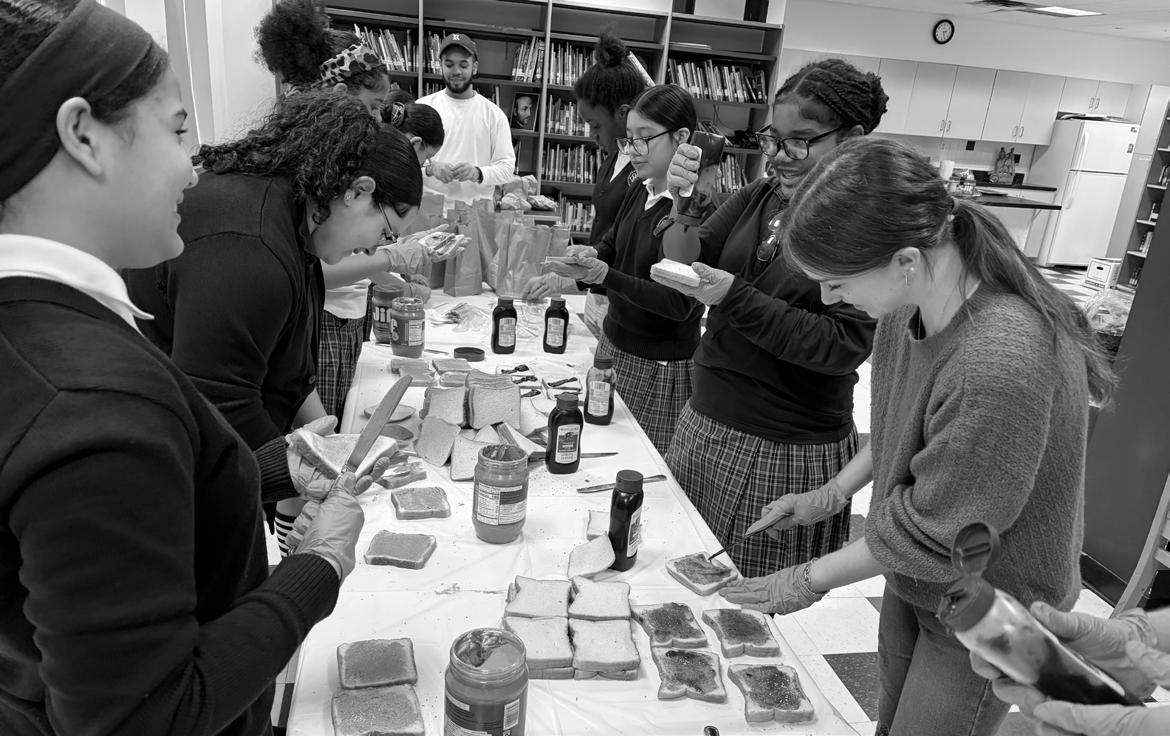
Afterwards, the group set up a tabling station designed as an assembly line for peak performance. Juice boxes and Welch’s fruit snacks were at the head of the line, with sandwich-making materials positioned in the middle and the packing station at the end.
Students split off into groups with one Fordham student per section, and everyone worked in tandem to assemble peanut butter and jelly sandwiches.
“We are doing it
meaningfully, we’re doing it intentionally, but also having fun during that period,” Parmach said.
Within about 50 minutes, the group produced more than 200 peanut butter and jelly sandwich packs.
One SIS student said she felt “overjoyed” running back and forth between stations, serving as the “runner.”
While there were 13 SIS students, only two Fordham students ultimately attended, despite five signing up in advance. Factors such as the program taking place on a Friday could have affected the turnout, according to Parmach, but this ratio of students is preferred.
After the packs were assembled and distributed into five bags, the tables were cleaned up and everyone gathered in a circle for a short reflection. SIS students described the experience with single-word reactions such as “teamwork,” “gratitude” and “fun.”
The reflection segment is an important part of the program, according to Parmach.
“Obviously, we want to do something meaningful, but the real focus is less on that and more about the experience,” Parmach said.
“They’re collaborating, they’re engaged, they’re laughing and having fun. We do a common reflection and ultimately, there’s some mentoring going on.”
There are several events that are part of the “Missionin-Action” program and held each semester, such as making school supply packs for the New York City Housing Authority kids.
“We’ve done some mentoring sessions there that had music college preparedness. We had another one during the holiday season,” Parmach said. “So we try to find creative ways to reflect, to come together and to do some mentoring.”
The black garbage bags full of the homemade lunchs packs were ultimatley given to the food shelter.
“Take a chance,” he said. “You’ll meet other Fordham students. You’ll learn a lot about yourself. The events are always organized and there’s an intentionality behind it.”
By SIENNA REINDERS EDITOR-IN-CHIEF
The Fordham University United Student Government (USG) met on March 5 to discuss budget requests, the upcoming USG elections and the town hall event scheduled for March 20.
Executive Vice President Lucas Hjertberg, FCRH ’26, began the meeting by noting Executive Vice President Andrew McDonald’s, FCRH ’26, absence due to a preplanned spring break trip.
Hjertberg then gave new business updates. He said there will be a special election for the class of 2028’s Gabelli senate seat as a result of Khoi Dinh’s, GSB ’28, resignation. He announced Senator Audrey Shooner, FCRH ’28, as the February senator of the month and Fordham’s Black Student Alliance (ASILI) as the February club of the month. He said that they would wait to present ASILI’s award until the next meeting, since several USG members were absent.
Charm, a Fordham club aimed at publishing students’ psychology research, gave a new club presentation.
Lindsay Laubacher, FCRH ’26, Evelyn Leadholm, FCRH ’27 and Isis Ordaz, FCRH ’29, explained that the club would also connect undergraduate students with graduate students and faculty members for research projects. They requested $500 per semester to fund a website platform for publishing student research, Mail Chimpand events that
would include guest speakers.
USG voted on the following budget requests: the request from Charm, a request from Senator Domenick Fidele, FCRH ’29, for a tabling event for the contraception policy commission, a request from Vice President of International Integration Jenny Hong, FCRH ’28, for a microgreens plant tabling event for the sustainability committee, another request from Hong for pizza for an upcoming sustainability committee event and a funding request for Steeped Stories Cafe, a new club. All budget requests, with the exception of Steeped Stories Cafe’s, were approved.
Hjertberg then announced that the upcoming USG elections will begin with an informational meeting on April 1. Candidates will submit signatures by April 10, after which they can begin campaigning. There will be a Meet the Candidates Night in Keating third on April 17 from 6 to 8 p.m. The voting form will open at 12 p.m. on April 20 and close at 5 p.m. on April 21. Inauguration day is set for April 23.
Hjertberg also announced that Fordham is hosting a TEDx event on March 26 at Lincoln Center. The event will feature speakers including Northwell Health CEO Emeritus Michael Dowling, MSW ’74, “Survivor” winner Natalie Anderson, GSB ’08 and Brevitē co-founder Brandon Kim, FCRH ’15.
During the E-Board report, Vice President of Budgets
and Finance Peter Grimes, FCRH ’26, said that the Office of Student Involvement ran out of club funding this week, but confirmed he had a meeting with Assistant Dean for Student Involvement Catharine McGlade, and they will be getting more money soon.
Vice President of Student Life Luc Angus, FCRH ’26, said that his committee is working on creating a new award in honor of Olson Saez, a member of the Campus Operations staff at Rose Hill who recently passed away, to recognize faculty members who are “unseen heroes.” Voting for this years’ recipients will be restricted to USG members and will take place at their March 26 meeting. They plan to open voting to all students in the future.
Vice President of Fordham College at Rose Hill Mary Hawthorn, FCRH ’26, said that she talked with Dean of Arts and Sciences Jessica Lang earlier that week about the ongoing core revision process. She also said that Student Wellness is working on planning this year’s, “The Walk,” which will take place on April 20. She announced that there will be an upcoming event for students who are studying abroad in the spring of 2027.
Vice President of the Gabelli School of Business Hunter Gholson, GSB ’26, said that they sent about 500 postcards to admitted students, with the 15 committees writing eight to 10 of them each.
Vice President of Diversity, Equity and Inclusion Laila Sayegh, FCRH ’27, announced that they received a $150 donation from the history department for Bronx Appreciation Week. She also said that they are working to plan an event to celebrate Women’s History Month.
Fidele presented updates on behalf of Vice President of Dining and Facilities Madeleine Ando, FCRH ’27, who was absent. He said that in a meeting with Fordham dining, they discussed student complaints about the long lines at the egg station in the Marketplace. She was told that they are looking at solutions to reduce wait times but that the culprit to the issue is the plethora of large egg orders, with some containing up to seven eggs. They also discussed student concerns about food poisoning, and Ando was told that students who experience food poisoning should reach out to Fordham Hospitality and give as detailed of a report as possible so that they can look into it.
Hong gave updates for the International Integration committee, stating that they are planning alumni events, excursions and are working on a proposal for a Global Transition Program. She also said they have been working on expanding the available languages listed on Fordham’s admissions website to make it more accessible for international students.
Fidele presented updates
for the Governing Documents Commission and said that they are working on amending the election code to allow anyone to update it. They are also working on a proposal that would allow USG members to endorse candidates during future USG elections. He said the latter change would be implemented for the upcoming election.
Senator Henry Carstens, GSB ’29, gave updates for the Contraceptive Policy Commission. He said they are conducting a survey of student opinions regarding the current contraception distribution policy, which was sent out on March 4.
Regarding the upcoming USG Town Hall, he said there will be several Instagram posts providing information on the event, which is on March 20 at 6 p.m. in the Great Hall. Carstens asked Hjertberg for updates on food for the event, who deferred to Assistant Director for Student Leadership and Engagement Joshua Somrah, FCLC ’20. He said they are still trying to confirm whether they can get Chick-fil-A catered and told Carstens to anticipate having to choose an alternative dining option. Regarding the contraceptive proposal process, Carstens said the next step will be talking to higher officials at Fordham.
During the senate reports, class of 2027 senator Megan Ruzicka, FCRH ’27, announced that there will be a BINGO fundraising event on March 19 in Keating First.
on artificial contraception isn’t seen as promotion of that contraception, in the same way that talking about suicide is not necessarily promoting suicide.”
The Ram reached out to President Tania Tetlow and Associate Vice President for University Communications Jen Petra regarding the policy amendment process and the university administration’s position on USG’s proposal, but they declined to make a statement at this time. The Ram also reached out to UHC Director Maureen Keown who also declined to make a statement.
Records show that discourse and education efforts concerning contraception at the university have been ongoing since the 1960s. However, the student handbook archives don’t show a contraception policy until at least 2008. While Fordham does not have publicly accessible digital archives of the student handbook, The Ram was able to obtain physical copies of the 1978-88 Student and Residential Life Handbook, 1988-89 Student Handbook, 1989-90 Residential Life Handbook, 1990-91 Student Handbook and 2007-08 Student Handbook, and found that none of these editions included a policy on contraception. The Ram was unable to obtain handbook archives for any editions past 2007-08, so it is unclear when the university’s contraception policy had been implemented. However, Wayback Machine, an internet archive, shows that the policy was included in the 2015 handbook, meaning it was likely added between 2008 and 2015. Judge, who started his position at Fordham in the fall of 2024, said he was unaware of when the policy had been implemented. History of Contraception Policy and Advocacy at Fordham
Past coverage by The Ram and The Fordham Observer shows that discourse regarding contraception at Fordham and student advocacy in support of contraception resources dates back to at least 1967.
In the May 5, 1967, issue of The Ram, an article titled “TMC Petitions University for Contraception Advice” detailed a petition created by a group of women at Thomas More College (TMC), Fordham’s women’s college at the time. The petition, which reportedly received at least 175 signatures, asked the university to provide the women with information on contraception and off-campus resources.
The New York Times published an article in its May 11, 1967 issue, which had revealed that Fordham’s administration had agreed to meet the students’ request. The article stated that the lectures would begin the following fall and would include information on “contraceptive devices,” with a goal of sex education. According to the
article, a Fordham official said that “the program did not mean any departure from the Roman Catholic Church’s opposition to artificial birth-control devices.”
On Oct. 10, 1967, Fordham held their first event in the sex education series, according to an article in the Oct. 6, 1967, issue of The Ram.
Several other articles detail ongoing efforts by Fordham’s administration with providing students with education on contraceptives throughout the latter half of the 20th century.
In October 1990, Fordham held an AIDS Awareness Week, according to an article in the Nov. 7, 1990, issue of The Observer, to inform students about who could contract AIDS and how it spreads. At the event, Fordham professor David Koch, who at the time taught a class titled AIDS and Psychology, spoke about abstinence and outercourse as two methods to avoid contracting AIDS. He also spoke about contraceptives as a form of protection for those who do choose to have intercourse.
Additionally, a Ram article titled “Fordham’s realistic new approach to sex on campus” from Nov. 29, 1990, spoke about a Freshman Symposium class that had a class period dedicated to contraception. The article stated that during the class, oral birth control and condoms were passed out for educational purposes.
According to the student handbook archives, The Ram found that prior to having their explicit contraceptive policy, the only policy in the student handbook related to contraception and STIs was the AIDS policy, which was found in the 1990-91 and 2007-08 editions of the student handbook.
“Fordham University as a Catholic University endorses the understanding of human sexuality that is consonant with Catholic tradition,” the AIDS policy, which was the same in both editions, stated. “Although this perspective informs our programs at Fordham, it is not inconsistent with this outlook to also ensure that comprehensive, current, and accurate information on human sexuality be made available to the University community.”
As according to Senator Domenick Fedele, FCRH ’29, Fordham’s Residential Life Handbook has also historically included a “Moral Growth and Responsibility” policy which mandated that students practice abstinence before marriage. This policy can be seen in the 1989-90 handbook pages obtained by The Ram. The policy still appears in the current student handbook, although the wording has changed and no longer mandates abstinence.
Although the various student handbook archives do show that Fordham’s contraception policy was created sometime between 2008 and 2015, past newspaper coverage shows that Fordham’s
administration began taking actions in order to prevent the distribution of contraceptives on campus in 1989.
An article in the Sept. 7, 1989, issue of The Ram, which was titled “Magazine with Condom Banned on Campus,” said that a national college magazine, that was called Campus Connections had been banned from being circulated at Fordham because it contained an ad with a free condom attached to the page. According to the article, the administration banned the magazine’s distribution after an Aug. 24 New York Post article titled “Jesuit-run Fordham University will distribute a student magazine with a free condom inside” brought light to the intended distribution. The Ram article stated that the university’s administration had no prior knowledge that the magazine would include a condom, and it also said that the university declined to comment on the reason for its action.
According to an article in the Sept. 26, 1991, issue of The Ram titled “Administration nixes Deli’s attempt to sell condoms,” Fordham’s Student Deli, which used to inhabit what is now The Grotto, decided to sell condoms to students back in 1991. However, the then-Dean of Student Services Gregory Pappas asked them to remove the condoms from the shelves. The students were said to be in violation of university policy by selling condoms. Vice President of Student Affairs John Shea, S.J., told Pappas and the Deli moderator Michael Sullivan that selling condoms was against Catholic doctrine and could be seen as endorsing contraception. He also said that their actions could be interpreted as university policy because Deli managers were university employees.
After the Deli was prohibited from selling contraceptives, records show no other efforts by Fordham students to distribute contraceptives or by Fordham’s administration to prohibit the distribution of contraceptives until 2011.
However, during the hiatus, records show inconsistencies in reporting regarding services provided by the Health Center.
The Catholic church’s Ethical and Religious Directives for Healthcare Services states that “procedures that induce sterility are permitted when their direct effect is the cure or alleviation of a present and serious pathology, and a simpler treatment is not available.” This doctrine is upheld by Fordham’s contraceptive policy, which states that the University Health Center can provide hormonal contraception for medical purposes.
But there are multiple documented instances of the Health Center not following this policy, including in 2004, when The Observer reported that Claudia Weinstock, FCLC
’06, requested birth control from UHC for medical reasons and was denied, and 2012, when The Observer reported that a law student was denied contraception for her ovarian cyst. Records also show that throughout the years students have questioned whether Fordham’s insurance plan requires the Health Center to provide contraceptives.
But still, Fordham has continued to uphold this Catholic doctrine, and students have continued to take action to oppose the contraception policy. In 2011, Fordham’s Law Students for Reproductive Justice club created Prescribe Fordham, a bi-annual birth control drive.
In 2014, a student group called Students for Sex and Gender Equality and Safety (S.A.G.E.S) began to distribute contraceptives on campus.
S.A.G.E.S. efforts continued until at least 2019, but no coverage can be found regarding the group past that date.
Other efforts to promote contraceptives at Fordham include a 2022 USG proposal to create a contraceptive clinic and a 2025 distribution initiative by the Fordham chapter of Young Democratic Socialists of America, which is an unofficial club at Fordham.
Now, contraceptive promotion efforts are being continued by USG with their proposal lobbying for an amendment to the university’s contraceptive policy.
The USG Contraception Proposal
USG’s Contraceptive Policy Commission, which includes Vice President of Health and Security Aidan Costella, FCRH ’27, Carstens, Senator Audrey Shooner, FCRH ’28, Fedele and Senator Anna Wiss, FCRH ’26, has been working on this proposal since the start of the fall semester.
In creating the proposal, Fedele and Shooner conducted extensive research on the history of contraceptive policies at Fordham and other Jesuit universities.
“It’s an issue of health and wellness for all students at Fordham,” Fedele said. “We both recognize how important this proposal is and how many members of the university community have a vested interest in this, and we really want to make sure that we have all the facts straight that we meet with all the stakeholders and we put together the best proposal possible.”
The initiative is motivated by the desire to protect students’ health, according to Executive President Lucas Hjertberg, FCRH ’26. As stated by the Center for Disease Control (CDC), youths (ages 15-24 years old) have been disproportionately affected by STIs and sexually transmitted diseases (STDs), and they make up 25% of the sexually active population while accounting for 50% of new STI
cases in the U.S. each year. Hjertberg said it is Fordham’s job to address this student health issue.
“So much of this screams to me, you know, kind of cura personalis, and the care of the whole person,” Hjertberg said. “I don’t understand why the care for the whole person would start from the top of your head and then end at your beltline.”
Judge said he knows that students at Fordham use contraceptives and that he will not criminalize those students for doing so. However, he also said the university stands by Catholic doctrine and will not be involved in providing contraception.
“I know that students make their own moral decisions, as every adult makes their own moral decisions. I’m not in favor of criminalizing moral decisionmaking. So I think students who choose to make use of artificial contraception have chosen to do that. And there’s nothing I can or would do about that,” Judge said. “To my mind, that’s not the issue. Those contraceptive methods are available off campus or available by mail. They’re available readily. The question is whether or not the university should be involved in allowing the distribution of those on campus.”
Carstens said he acknowledges that Catholic doctrine is against the promotion of contraception, but at the same time emphasized that USG’s intention is not to elicit university support for contraceptives, since that could create issues for the university with donors and alumni. He said he believes USG’s policy allows students to have the freedom to distribute birth control while also not creating university endorsement of contraceptives.
“I think this is a very pragmatic way to approach it,” Carstens said. “We’re going to have the best of both worlds. You know, you give the autonomy back to the students in this sense, and you don’t go and, I guess, maybe make it more an issue with donors or something.”
The Ram looked into the contraceptive policies at the 28 Jesuit universities in the U.S. and found that Fordham’s policy differs from the majority of others, most of which do not include a written policy completely banning the distribution of contraceptives on campus. Universities that have a written distribution ban generally prohibit the university itself, including the University Health Center, from dispensing contraception, but don’t include an outright ban of distribution on campus property. Universities with this type of policy include Gonzaga University and Saint Louis University. Some institutions, including Fairfield University, also prohibit universitysanctioned groups from distributing. However, The Ram did not find any other
spanning the period from the early 1950s to the present day.”
Kicking off the panel discussion, Nikolayenko introduced herself and the program, summarizing the historical changes over the years to set up a conversation surrounding the program’s development during its 75 years of establishment.
Following her introduction, Senior Associate Dean for FCRH David Swinarski discussed his past experiences with honors programs at other institutions, citing the similarities between the program at the University of Notre Dame, which he was a part of during his own undergraduate experience, and the one available to a select group of students at Fordham. Swinarski noted the importance that the program had on both his professional and personal life.
“Academically, the program launched my career,” Swinarski said. “But beyond academics, my classmates and professors from the program are lifelong friends.”
On his experience and history with the FCRH Honors Program, Swinarski noted in an email to The Ram that he had taught the Interdisciplinary STEM course for the FCRH Honors Program twice and was a faculty mentor for one FCRH Honors Program senior thesis.
Following Swinarski’s personal remarks, he introduced the rest of the panel: Harry P. Nasuti, professor of theology and director emeritus of the FCRH Honors
FROM EVENT PAGE 1
Bilingual Education Resource Network at the Graduate School of Education, received the Archbishop Hughes Medal at the event, which is awarded to administrators who have served for 20 years at Fordham.
Howitt explained to The Ram that her work supports children of immigrants across New York City as they develop English-linguistic skills while maintaining fluency in their native languages. After 20 years, she said she has made Fordham her home.
As a former New York City public school teacher, she emphasized her commitment
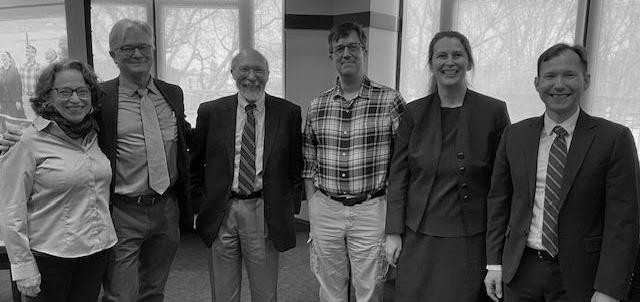
Program, Eve Keller, professor of English and director emeritus of the FCRH Honors Program, W. David Myers, professor of history and Stephen Holler, professor and chair of the department of physics and engineering physics.
The first to speak was Nasuti, who commented on his time within the program and its evolution over time.
Nasuti took the audience through a history of what was studied within the Honors Program throughout the years, noting that in the 1950s students were being asked to read works such as the “Iliad” in one week. He then shared that in the 1960s, students were given greater responsibility for their education and had more freedom under the Honors
Program. Moving on to the 1980s, he said that there was more structure, with courses on philosophy and great texts.
In 1993, Nasuti was asked to take over the program to mandate and revise it. Within this revision, he changed the Honors Program from taking place sophomore year to include first-years and their core curriculum.
Next, Keller spoke about her time as director of the program, noteably regarding the changes that have taken place.
“There will be a next step because curricula, they’re subjective things, and they are very much attached to the people who create them, and the values of those people, the value of the institution,” Keller said.
“But they’re also connected to the times.”
Myers and Holler wrapped up the conversation by providing their own experiences with the program as professors. In an email to The Ram, Myers commented on his personal involvement, noting his long history with teaching under the program.
“I started with the survey of early modern history, but since the revision under Eve Keller, my course has focused on ‘foundational topics in history,’” Myers said. “As to other participation, I was part of the committee that Professor Keller organized to revise the honors program into its current shape. Mostly, though, I like to teach in the program — the students are
smart, the classes fun. What’s not to like?”
Honors student Emily Caro, FCRH ’28, noted that even though she was unable to attend the panel discussion due to her class schedule, she played a part in putting together the exhibit in her role as honors program administrator. Caro also commented on the student perspective of the Honors Program as a whole through her personal lens.
“I received my Honors acceptance before I committed to Fordham, and Honors was a big reason I came here,” Caro said. “I was really drawn to the program’s social justice focus and small size, and also the sense of community the program fosters between students.”
to family-focused education and outreach, including parent workshops. Recently, these workshops have been held on Zoom, she noted.
“The thing I’m most proud of is the work that we’re able to continue to do [at Fordham],”
Howitt said. “I’ve been doing this for 20 years, different names, different acronyms, but my office, my staff … we’re all so committed to doing this kind of work.”
Elizabeth Manigan, associate vice president for Development and University Events, shared with The Ram the hard work that goes into celebrating the university’s faculty.
The timeline is meticulous and well thought out, Manigan explained, with event planning starting in the summer. Each honoree was introduced with a tribute speech written by their own colleagues, highlighting their outstanding contributions and qualities that positively impact Fordham.
According to Manigan, the personalized dedications are what make Convocation “much more special.”
“I think every single person in this room is devoted to our Jesuit values, and that’s really what we’re celebrating today,” Manigan said.
Manigan then continued with
acknowledging that the varied yet essential duties of Fordham faculty are aptly recognized:
The 1842 medal honors support staff and facilities workers, while the Bene Merenti medal is awarded to Fordham’s faculty.
“Whether they’re in a classroom, or raising money, or bringing in students through admission, or fixing things, because God knows it … the facilities folks are the most important,” Manigan said.
With the exception of a performance by the students in the Fordham University Choir, Keating’s first floor auditorium was filled entirely with the
honorees’ family, friends and colleagues applauding their dedication.
As according to Dorothy Marinucci, the university’s secretary to the Board of Trustees who oversaw the event, the event’s family-oriented environment was simply a reflection of Fordham’s values.
“It’s very family-centric, but University-centric. It’s what the University is about, and that’s what I think it is. It recognizes so much. And it’s a thank-you moment,” Marinucci said.
“You spend so much time with your colleagues that they do become family,” Manigan said in her conclusion.
FROM POLICY PAGE 4
written university policies with a complete ban on distributing contraceptives on campus property.
USG’s Contraceptive Policy Commission recently conducted an anonymous survey to gauge student opinion on contraceptives and contraceptive access at Fordham. The results, which included 87 respondents and indicated an overwhelming amount of support for USG’s proposal, were shared with The
Ram by Hjertberg.
said it is excellent.
The survey also had asked respondents how important it is that contraceptives are distributed at universities. Over 90% of respondents said it is either very or extremely important, while 8% said it is moderately or slightly important and 1% said it is not important at all.
Looking Forward
“So much of this is getting [and] gathering student support behind this specific change,” Hjerberg said. “Because without that, there’s no guarantee. And there still is no guarantee. But it’s the student support behind it that allows this to become an issue on the docket.” FROM
Regarding contraception at Fordham, 58% of respondents disagreed with the statement, “contraceptive resources are readily available to students,” while 21% agreed. Additionally, 64% disagreed, and 13% agreed with the statement “students have sufficient information about how to access contraceptive resources.” Regarding access to contraception at Fordham, 64% said access is poor, 20% said it is fair, 12% said it is good and 5%
Before the proposal can be shared with the administration, it must be voted on by USG, after which it will be brought
to Rose Hill Dean of Students Kevin Williams if it passes. From there, the administration will have discretion over changing the policy. Because the amendment requires a significant policy change, Hjertberg said he expects the proposal may go all the way to Fordham’s Board of Trustees before it could be implemented.
In the meantime, the USG’s Contraceptive Policy Commission is continuing to seek student support for the proposal. On
Friday, March 20, at 6 p.m. in the Great Hall in the McShane Student Center, they will table at USG’s State of the Student Address to talk with students and gather support.
By ETHAN BESS ASST. SPORTS EDITOR
Imperialism is a very wellknown word within academic and political circles; however, some can’t really define what it means. Imperialism is a policy of expanding a country’s force or dominance through diplomatic or military means. Over the past 132 years, especially since the end of the Second World War, the United States moved from a marginal imperial power in the western hemisphere to a world imperial power countering the Soviet Union. While U.S. leaders often said that this policy was about the containment of communism, government documents, such as NSC 68, say this is about maintaining global dominance. The overall sentiment of U.S. foreign policy
seems to contradict what comes out of the mouths of U.S. leaders. That mindset of dominance brings us to exactly where the U.S. currently sits. As it relates to Iran currently, the U.S. could be echoing earlier chapters of foreign policy.
On Feb. 28, the U.S., in collaboration with Israel, launched a joint strike on Iran that killed the grand Ayatollah Ali Khamenei, along with about 1,300 citizens of Iran. The U.S. and Israel have ultimately said this is intended to wipe out Iran’s nuclear capabilities, but this falls apart under minimal scrutiny. Many Iranian officials, including their foreign minister Abbas Araghchi, said that Iran doesn’t plan to build a nuclear weapon. Additionally, Iran formally agreed to a deal the U.S. helped facilitate in 2015, but eventually withdrew
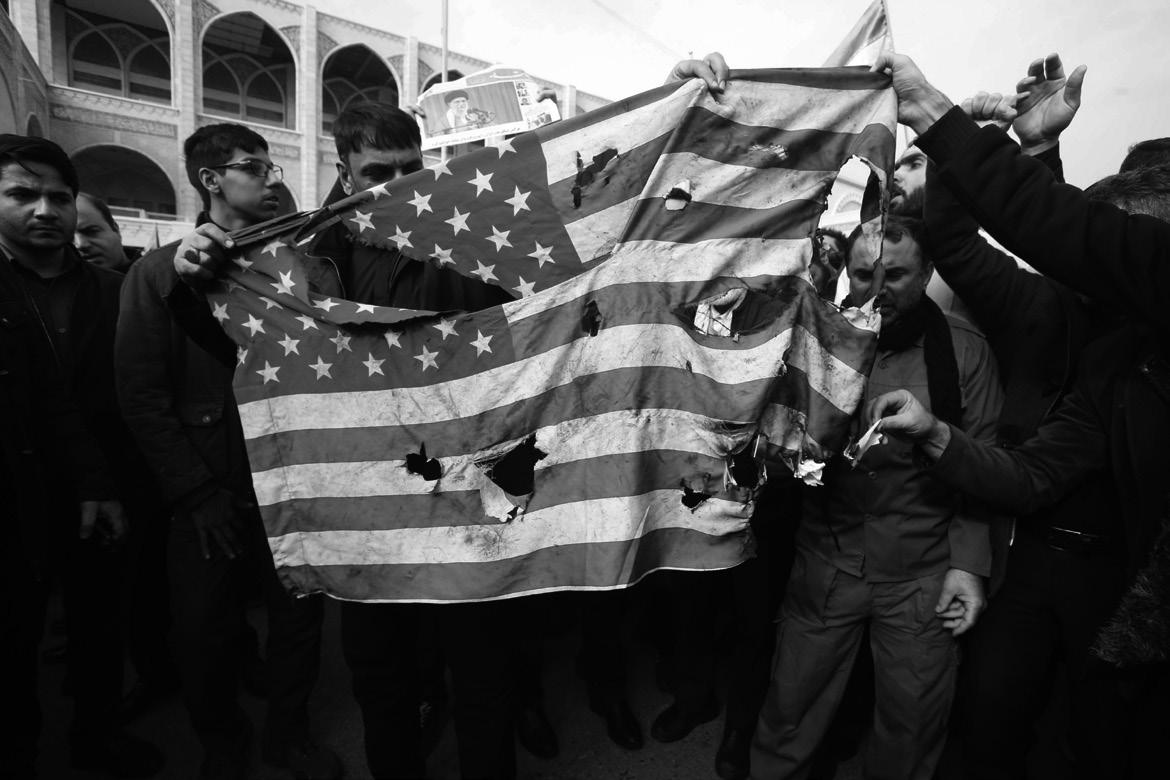
in 2018. This set the stage for inflamed tensions with the U.S. that were somewhat easing with this agreement. Furthermore, Prime Minister of Israel Benjamin Netanyahu has claimed many times that Iran is close to building a nuclear weapon. Let us now move into the implications of these words.
These claims have been implied before justifying invasions and overseas operations. In 2003, prior to the invasion of Iraq, the Bush administration said Saddam Hussein had weapons of mass destruction for about two years before the U.S. ultimately invaded. The Obama administration said it was a humanitarian effort to invade Libya before the operation took place in March 2011. Despite the intentions the Obama administration had put forward, it ultimately led to a power vacuum forming once Gaddafi was overthrown. With instability increasing, rebel forces eventually took over and created open slave markets.
To provide another historic example, Operation Mongoose was enhanced by John F. Kennedy in October 1962 to overthrow Fidel Castro after the failed Bay of Pigs invasion. Although Cuba posed no threat after Castro ultimately overthrew Fulgencio Batista in the 1959 Cuban Revolution, the U.S. tried everything in their power to overthrow him. Their stated objective was to overthrow
the communist regime of Castro and do it alongside Cuban rebel forces. While these examples are crucial in understanding U.S. geopolitical decisions, this is how they currently connect to present day warfare in Iran.
Although Iran has stated many times that they do not possess a nuclear weapon, nor do they want to, the U.S. and Israel have continued to disregard Iran’s word. It’s possible they do because Iran is a regional adversary to Israel. If Israel and the U.S. are successful in this war against Iran, Israel could move in on their greater Israel project they want complete.
As a prominent U.S. ally within the region, there are two things this could mean for the United States. It could mean that Israel could transform into a regional superpower and make the U.S. more influential within the region, or it could create more resentment and blowback against U.S. foreign policy decisions within the Middle East. White House Official Jarrod Agen has said, “the administration plans to get the oil out the hands of terrorists.” As I see it, it’s a repeat of what happened earlier this year with Venezuela.
The significance of these actions, both historically and currently, has serious implications for the American reputation and the American people. Although the Trump administration has explicitly stated that they want
to revive the Monroe Doctrine, there are three different historical doctrines in play with current U.S. foreign policy under the Trump administration. The first is Monroe-era style determent from the western hemisphere assuring U.S. domination, the second is Truman-era style containment of adversaries be it China or Russia as they both had ties to Venezuela and Iran and the third is Bush-era style preemptive war by attacking enemies and targets before they can mobilize. The current war in Iran could have deadly consequences (as it already), but it would be another chapter of U.S. foreign policy asserting dominance over the globe regardless of whether the administration is Republican or Democrat.
The offensive attack on Iran is not an isolated incident, but rather a continuation of historic U.S. foreign policy precedents that have been happening since the U.S. overthrow of the Hawaiian Kingdom in 1893. Although the Trump administration alleges the justification of preventing Iran from getting a nuclear weapon, we see that Iran clearly had no plans to. The only bigger question that follows is: What happens next now that Iran is fighting back?
By KELLY BUBAN CONTRIBUTING WRITER
On Feb. 24, President Donald Trump delivered a record-breaking State of the Union address, lasting nearly two hours, the longest in the United States’ history. Painting a “nation in the early stages of a historic boom,” Trump presented a vision of a revitalized America that many Americans simply do not recognize in their daily lives.
The State of the Union historically is a formal communication from the president to Congress in order to report on the current condition of the U.S. while simultaneously providing policy proposals for the upcoming legislative year. In theory, it is a moment for honesty and direction: a president explaining where the country stands and where it should go next. Trump’s speech, however, felt less like a roadmap and more like a campaign rally stretched to two hours.
At the center of the address was Trump’s insistence that the American economy is booming and that his administration is rapidly ending the affordability crisis.
“Our nation is back, bigger, better, richer and stronger than ever before,” he declared. He also blamed Democrats for raising prices in housing, healthcare, gasoline and everyday goods, claiming their policies “created the high prices.”
But this explanation is far too simple and in this day and age, frankly politically convenient for
Trump and the Republican party. Especially when, under his leadership, gas prices have recently jumped by about 10 cents a gallon in a single day, partly driven by rising tensions as the U.S. becomes further involved with conflicts in the Middle East.
The affordability crisis did not appear overnight, nor is it the product of just one party. Inflation surged globally following the pandemic due to supply chain disruptions, labor shortages and overall shifts in consumer demand.
Housing costs have climbed for years due to limited supply and restrictive zoning policies across the country. Healthcare prices have been rising for decades under administrations of both parties. Blaming Democrats for every dollar Americans spend at the grocery store might make for an easy applause line for Trump, but it doesn’t bring him or the country any closer to real solutions. If anything, some of Trump’s own policies complicate the picture. His aggressive use of tariffs intended to protect domestic industries can also raise costs for consumers by making imported goods more expensive. While tariffs may help certain sectors of the economy, they can also quietly push prices upward for everyday products, the very problem Trump claimed in this address that he is solving. To put it simply: Trump declaring victory over the affordability crisis does not mean us Americans truly feel it. During his reign of everything
from creating the Kennedy Center to building his own ballroom, Trump has been focusing on creating spectacle. Trump brought out the U.S. Men’s Hockey team during the address and awarded the Presidential Medal of Freedom to goalie Connor Hellebuyck. This follows him going viral on social media with the same team earlier that week due to not wanting to invite the additional gold medal winning team, the U.S. women's hockey team, to the White House. These moments were clearly designed to “energize” the room and generate viral headlines for those tuning in. This highlighted a broader trend in modern State of the Union addresses, while also showing how Trump’s government policy often takes a backseat to political theater. More troubling, however, were the divisive elements of the speech. Trump renewed attacks on immigrants in the U.S., accusing “illegal aliens” of costing taxpayers billions without presenting any evidence. These remarks reinforce a political strategy Trump has created that frames entire communities and cultures as problems rather than participants in American life.
If the goal of the State of the Union is to unify the country, even if done briefly, this year did the opposite. Still, the most revealing part of Trump’s speech was his repeated claim that America is experiencing a national “revival,” and a “turnaround for the ages.” These are appealing phrases.

Every president wants to convince Americans that the country is entering a new era of strength and prosperity. But offering revival whilst celebrating America’s 250th birthday raises the question: What exactly are we trying to bring back and accomplish? Is it economic stability? For Americans to afford housing, healthcare and education without constant financial anxiety? Is it faith in democratic institutions and the rule of law? Or is it something else entirely — an era that is defined more by political loyalty than by shared values? Trump’s version of revival seems largely rooted in political victory and cultural grievance. Yet the most important thing America should be focused on reviving should be defined by opportunity and holding the government accountable to work together to confront complex problems honestly.
While the U.S. is not on the brink of a total collapse, it is also certainly not experiencing the historic boom Trump described. Contrary to what Trump may have said during his address, Americans are still grappling with high costs, political polarization and uncertainty about the State of the Union as well as the future of the world.
A two-hour speech cannot solve these problems, but it should at least acknowledge them clearly. Instead, Trump offered a message built on confidence, blame, unnecessary applause and attention. For a country looking for serious solutions, after this speech, Trump is quickly becoming the biggest disconnect of all for the United States.

Serving the Fordham University campus and community since 1918
The Fordham Ram is the university journal of record. The mission of The Fordham Ram is to provide a forum for the free and open exchange of ideas in service to the community and to act as a student advocate. The Fordham Ram is published every Wednesday during the academic year to all campuses.
Website
TheFordhamRam.com
Email Address theram@fordham.edu
Editor-in-Chief
Sienna Reinders
Managing Editor
Ian Nelson
Production Editor
Sarah Verrastro
Editorial Director
Molly O’Connor
Multimedia Director
Hannah Sullivan
Business Director
Nishanth Aduma
News Editor
Emma Leonardi
Features Editor
Sidney Blasco
Assistant News Editors
Jordan Donegan
Kat Rossi
Opinion Editor
Loressa Zeqiraj
Assistant Opinion Editors
Erynn Sweeney
Gabriel Capellan
Culture Editors
Lara Ejzak
Makenzie Smith
Sports Editor
James Nelson
Assistant Sports Editors
Molly Friedman
Ethan Bess
Copy Chief
Indigo Towers
Executive Copy Editors
Emily Mitton
Uma Petzke
Emma Kelner
Elaina Gibson
Social Media Director
Haniyyah Usmani
Photo/Graphics Editors
Emily McCall
Wilson Speller
Digital Producers
Han Le
Marisa House
Advertising Directors
Violet Wallace
Juan-Pablo Valencia
Rishika Lingamdinne
Faculty Advisor
Beth Knobel
Editorial Policy
The Fordham Ram’s editorial reflects the editorial board’s opinions or views.
Opinion Policy
The opinions expressed in this publication are those of the authors. They do not necessarily reflect the opinions or views of The Fordham Ram.
Submission Policy
The Fordham Ram Reserves the right to reject or edit any submission for any reasion, without notice. Submissions become the exclusive property of The Fordham Ram. No part of The Fordham Ram may be reproduced without written consent.
Correction Policy
The Fordham Ram is committed to fair and accurate reporting. If you are aware of an error, please contact us at fordhamramonline@gmail.com
If you live in the United States, you are well aware of just how inadequate our non-car transit is: chances are, you’ve walked along a highway at least once, been frustrated by inadequate bus schedules or tried to walk somewhere only to find that you need to cross five lanes of traffic.
And then one goes abroad, or at least hears about what there is abroad. In Europe it is possible to get from Edinburgh to Warsaw, Rome or Seville and not set foot in a car, and do so in a reasonable amount of time. Indeed, going abroad always leads one to ask the question, “Why can’t we have this here?”
The question is, then, how does one go about fixing public transit in the U.S.? It is a daunting, almost Herculean task, to reassemble the network that was once the envy of the world and the pride of a nation. It is perhaps easy, owing to its daunting vastness, to simply write off the task. What I aim to do here is to sketch the means by which the hurdles of public transit — the physical plant, public ownership and funding — can be dealt with. I’m specifically discussing trains here because that is easier. With proper funding and time, we can, in fact, improve the system.
The immediate questions at hand are numerous. I, of course, assume that such transit is necessary — a fact beyond necessity of explanation — and that Amtrak, an entity poised for the fixing of public transit, is the most facile avenue for achieving this goal. Amtrak focuses on inter-city rail rather than commuter rail, and was formed precisely because
private industry either failed to provide that service at worst, which is why Amtrak exists in the first place, or actively destroyed it, as is the case with the General Motors Conspiracy.
Further, passenger economics have evolved to the point where it is necessary for such a rail company to operate at a loss in order that those vital services might be provided. In the interest of ensuring universal inter-city access, it is true that some lines would not be nearly as profitable, but their provision nonetheless allows affordable freedom of movement where cost would otherwise prohibit that. As support for this, I would like to submit the cost of an Amtrak ticket on the northeast corridor, which can cost as little as $26. By comparison, the cost of gasoline alone — notwithstanding the risk of accident, fatigue, snacks, lost productivity or tolls — can easily be up to $55, and the inclusion of those other costs can cause that number to increase dramatically. From those inter-city stations, there is a ready necessity for bus services to circulate people to and from the station, as well as within the city.
Privatization of those assets has been broached, but we would be best advised against doing so according to the lessons of the privatization of Soviet assets in general. But also, and more pertinently, according to the lesson of the privatization of British rail, which saw stark decreases in affordability and safety. It is in the interest of affordability that passenger rail remains a federally chartered
company like the United States Postal Service in the sense that we spend our taxes on affordable, reliable transportation just as we do for an affordable, reliable mail service. Furthermore, a national rail service builds on the economy of scale that railroads perform so admirably, and having multiple passenger carriers would only waste resources on duplicate service.
The projected cost of building up American high-speed rail infrastructure to modern standards is projected to run into the trillions of dollars, an eyewatering amount. This overlooks several aspects, though, including already existing infrastructure and the base necessity that service be regular and reasonable. It is not absolutely necessary that every line, for instance, run at 300 miles per hour with maglev trains. But it is necessary, for the support and expansion of intercity rail to that end, that a regular funding stream be established. A sufficient avenue for this would be a small gas tax.
A two-cent national gas tax, when accounting for lost demand, would generate perhaps $20 billion over 10 years, which is Amtrak’s entire budget in the same period. A
25-cent gas tax, which is less than the regular fluctuation in gas prices, would generate $300 billion over 10 years, more than adequate to at the very least establish that baseline service.
But, secondly, that gas tax provides an incentive to drive less, and therefore make that change to public transit which would, in turn, slash national carbon emissions. This would improve air quality immensely, as well as allow cheaper transportation to take up less space, allowing the environment to recover.
Last week’s From The Desk discussed the necessity of third spaces Affordable transportation is a crucial aspect of that: principally by promoting population density which can allow those spaces to more easily pop up, train stations represent one of those low-margin, high-lingering facilities (though, I must note, there is work to be done on this: see one of my prior articles on Penn Station’s hostile architecture). Even buses and trains themselves can serve as a third space, and while the monetary cost is significant, the benefits far exceed anything that can be quantified with money.
The U.S. and Israel attacked Iran on Feb. 28, beginning a violent war that has already killed hundreds with no positive outcomes, though nobody requested or approved it. More than 1,800 people have been killed so far, including 13 U.S. servicemembers and at least 175 students killed by U.S. missiles that struck an Iranian elementary school. This war is not for the benefit or safety of Iranians or Americans. Killing innocent civilians and putting our own citizens at risk in a war they did not ask for is not going to do anything positive for either country; it is simply a selfish ploy by President Donald Trump to further his international control and access to oil.
Though there was buildup in the form of verbal and written threats from Trump, when the time came to actually strike Iran, Trump gave Congress absolutely no notice, going against the constitutional guidelines for wartime. As the commander in chief of the armed forces, the president does have the ability to mobilize the military, but they must give Congress 48 hours’ notice, which Trump disregarded with his haphazard invasion. After the military’s deployment, according to the War Powers Resolution, the president has 60 days to get
congressional approval. But based on Trump’s public statements, it does not sound like he plans on stopping at the 60-day mark as long as Iran continues to retaliate. Additionally, only Congress has the power to declare war. Although Trump has not explicitly declared war, it is incredibly clear that this is what the current conflict is, and no alternative language can cover that up.
Trump’s actions show a gross abuse of power that cannot remain unchecked, yet Congress shows no sense of urgency in putting a stop to it. Senate Democrats have threatened to force daily votes to reevaluate the president’s war powers until hearings are scheduled with Secretary of War Pete Hegseth and other cabinet members. But Republicans are holding strong on the president’s side, even as some are growing wary of the increasing length of this conflict.
According to a Quinnipiac University National Poll, over half of registered voters oppose the United States’ military action against Iran, 74% oppose sending ground troops into Iran and 55% do not think that Iran posed an imminent threat to the U.S. before the strikes. Americans did not ask for this, and they do not
understand why it is happening — for good reason.
When it comes down to it, the true goal of U.S. international conflicts is almost always oil, and this war is no different. Since 1973, between 25% and 50% of all American international conflicts have been connected to oil interests. Through resource wars, petro-aggression and oil-market domination, oil exerts massive control over international conflicts, shaping power dynamics and sparking tensions. This is especially true in the U.S. after they bombed Kharg Island, Iran’s main oil export hub, on March 13. U.S. military officials have claimed that the attack was just directed at storage sites for missiles and mines, but Iranian officials had warned that attacks on the island would halt operations at the export hub, so the U.S. knew they would be influencing their oil exports. We continue to prove time and again that we value oil more than humanity, and international trade and money over the safety of our own country’s people.
The Trump administration’s continual willingness and even enthusiasm to work with the Israeli government, a government actively committing genocide against the Palestinian people and taking
away all of the rights that we so proudly boast in our constitution, is nothing short of disgusting. Intentions are everything when it comes to something as big as war, and the line between liberation and exploitation is thin. When our government actively chooses to align with international powers that have made explicit moves against the liberation of an oppressed nation, instead of further oppressing them and putting them at risk, it shows that the U.S. is not trying to change the regime for the Iranian people, but is instead taking advantage of them while they are most vulnerable. This is not to make a statement in support of the oppressive Iranian regime that has hindered its own people’s rights to freedom of speech and protest, but rather in support of the innocent Iranian people who are losing their lives while still being robbed of their liberation.
The Iranian people have been in danger for a long time now, and sending missiles and tanks to their home is only adding to their pain. The longer this war goes on, the more risk we put to innocent lives in America, Iran and beyond. The U.S. government needs to put a stop to this war before the implications are irreversible.
By CATHERINE PAYLEITNER CONTRIBUTING WRITER
On Feb. 26, New York City Mayor Zohran Mamdani returned to the White House for his second meeting with President Donald Trump. The encounter appeared more like a continuation of an unlikely political “bromance” than a tense negotiation between two men who spent the last year trading insults. But beneath the friendly optics, the meeting was driven by two urgent issues: a major affordable housing proposal in Queens and the sameday detention of a Columbia University student by federal immigration authorities. Mamdani raised concerns about the arrest and the student was released several hours later.
The long-stalled Sunnyside Yards project, which Mamdani is trying to revive with federal support, would create 12,000 housing units and 30,000
union jobs. During the meeting with Trump, Mamdani secured $21 billion in federal funding to move it forward. The meeting was described as cordial, productive and even friendly, which are not the words that most New Yorkers would have used to describe the relationship between the two men just a few months ago.
Last fall, when Mamdani was still mayor-elect, Trump labeled him “a communist,” which is a familiar insult from the man who once declared an entire Anti-Communism Week. Mamdani, for his part, used his victory speech to argue that defeating Trump required dismantling the conditions that allowed him to rise in the first place. Their agendas, constituencies and political vocabularies could not be more different. And yet, their second Oval Office meeting produced a smiling photo-op complete with props

of a mock Daily News cover reading “TRUMP TO CITY: LET’S BUILD!” modeled after the infamous 1975 “FORD TO CITY: DROP DEAD!” headline. Trump reportedly loved it. So what is going on here? How did two politicians who built their careers on polar opposite rhetoric end up in what seems like America’s strangest political bromance?
Political strategists have recently described both men as populist leaders of very different flavors. They appeal to different bases for different reasons, but each can command a fiercely loyal movement. When two politicians know that attacking each other won’t shake their supporters, the incentive to escalate the conflict weakens and the incentive to extract something useful from the other grows.
For Trump, it’s simple: He plays the role of dealmaker in-chief, reinforcing his preferred image as a builder, negotiator and a man who can get things done for New York (a city that never fully embraced him). The Sunnyside Yard project, with its scale and symbolism, allows him to claim credit for a generational investment in housing and comes with more prestige than changing the name of a building.
For Mamdani, the calculus is more complicated, but no less strategic. He needs federal funds to build the kind
of housing he campaigned for and he also needs to show that it is possible to stick to your values while still doing what it takes to get things done. If dangling a tabloid headline in front of Trump, like he’s a toddler in front of some keys is what unlocks billions of dollars for affordable housing, then the choice is clear. Mamdani understands that Trump responds to flattery, spectacle and media symbolism. So he uses those tools not to praise Trump’s politics, but to secure outcomes for New Yorkers. His supporters elected him to deliver real change, not just symbolic statements. If he has to sit in a meeting with a president who has mocked him multiple times to produce a positive outcome for his constituents, then Mamdani will do it. This is where the “bromance” begins to fall apart. Trump may genuinely enjoy the theatrics, but Mamdani’s posture is fundamentally different; Trump sees a partner where Mamdani sees an opportunity.
This also works because Trump is susceptible to flattery and symbolism. He responds to gestures that make him feel central, respected and indispensable. Mamdani’s team understands this better than many of Trump’s allies.
The mock headline made Trump feel like the hero of the story while Mamdani secured the actual prize.
Both men are populists,
but their populisms run on completely different fuel. Trump’s is grievance driven and personality-centered; Mamdani’s is policy-driven and coalition-centered. When they sit in the same room, Trump gravitates towards the performance of partnership, while Mamdani focuses on the transaction beneath it. In the end, both men walk away satisfied, but for different reasons. Trump gets to tell a story about bipartisan cooperation that flatters his ego and Mamdani gets to tell one about governing that delivers for his constituents. One is symbolic, the other is substantive.
And that’s exactly why this isn’t a bromance. It’s a mismatch of motivators that is a single motivator. Trump thinks he’s gaining a friend, and Mamdani knows he’s gaining leverage. The question now is whether Mamdani can keep the act up without giving Trump more than theatrics in return. The balance between strategy and spectacle will determine whether this odd political pairing remains useful, or whether Trump eventually realizes he’s not the one holding the keys.
By GABRIEL CAPELLAN ASST. OPINION EDITOR
If you ask me, snow is only fun for the first two days, especially in New York City. But the one thing I can appreciate about snow is that it brings all of us together. I love seeing the snow fall and thinking about how Rose Hill is enjoying their snow day. Every time it snows, Rose Hill never misses a snowball fight on Eddies; it’s become tradition. That same tradition is known to all New Yorkers, with snowball fights breaking out in Central Park, Washington Square Park, Union Square and every other open space across the city. If you ask me, it’s light-hearted fun. Well, not to the NYPD Commissioner Jessica Tisch.
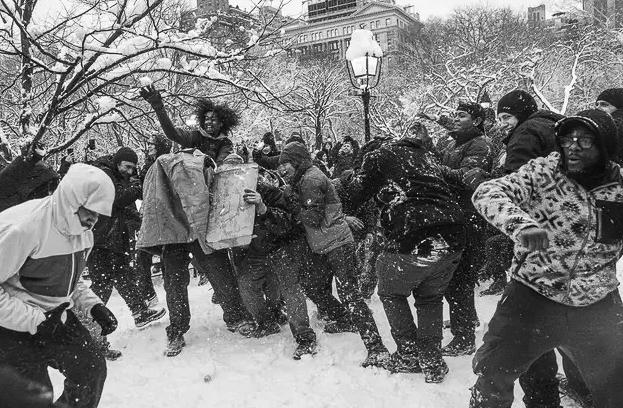
On Feb. 26, New Yorkers arrived at Washington Square Park to have a community snowball fight. The event was organized by the Instagram account SideTalk. They have created multiple viral videos the past couple of years, some of which featured former Mayor Eric Adams and current Mayor Mamdani. SideTalk is known to create large-scale events for entertainment of
both viewers at home and people present at the event. This snowball fight was nothing different.
The event escalated when the NYPD arrived on the scene trying to break up the fight. It’s ludicrous to think that someone called the police on a snowball fight, but I guess not everyone has that New York winter whimsy in them. When the NYPD arrived, some officers got injured from snowballs (which sounds even crazier) and that very day social media influencer Gusmane Coulibaly was charged with a misdemeanor because he was caught on video throwing a snowball at a police officer.
When Mamdani was asked on social media about his position on all of this, he tweeted, “From the videos I’ve seen, it looks like a snowball fight.” Tisch, to no one’s surprise, said this was “disgraceful” and “criminal.”
When we look at what actually happened, it was a routine snowball fight between New Yorkers. In this case, it was organized by a massive social media page, which, if you’ve
seen their videos, there’s a good chance you’d want to be in one. Their videos are electric and the people shown in them are what I would call true New Yorkers — people who have hustle, but also know how to have fun.
Tisch and Mamdani have a fragile relationship because they represent different stances: Mamdani holds anti-establishment beliefs, while Tisch supports proactive policing. Mamdani once held the stance “defund the police,” which goes against Tisch’s NYPD actions. This snowball fight is a small representation of what could be the relationship between the mayor and the commissioner. If the two can’t play nice, this will make handling crime in NYC much harder, even though it’s on the decline right now.
The situation was blown out of proportion by both sides. I believe that the people in attendance could’ve behaved better, but the NYPD also did not need to step in for something as simple as a snowball fight. The one thing I do agree with is the mayor’s stance that the NYPD overreacted
to this, especially in charging Coulibaly with a misdemeanor.
In other parts of the city, people were enjoying their snow day by building snowmen, having snowball fights, making snow angels and so much more. At Fordham Rose Hill’s campus, there was also a massive snowball fight on Eddies.
Hypothetically, if someone were to call Public Safety because a snowball were thrown at their face, Public Safety would come to break up the fight and also get a snowball thrown at them; it would be crazy for University President
Tania Tetlow to ban snowball fights because a Public Safety officer was hit with a snowball.
Students would say this would be an overexaggeration from Tetlow, and it’s impossible to imagine this ever actually happening. Therefore, Mamdani taking the opposing lane is a reasonable answer for a lot of people because no one deserves to be punished for having fun in a snowball fight.
By BRIDGETTE LEAHY STAFF WRITER
At some point in early adulthood, I find many people asking themselves a familiar question: “What is my aesthetic?” It’s quite similar to the question of what I want to do when I graduate. People are still figuring themselves out. Whether it’s scrolling through TikTok, Instagram or Pinterest boards, it can feel as if everyone is trying to figure out their style. Words like “preppy,” “clean-girl,” “minimalist,” “baddie,” “classy,” “old-money” and “Y2K” are often used to describe fashion identities. Other labels such as “boho-chic,” “punk,” “goth” and “Stockholm style” have gained popularity online.
Aesthetic labels stand for more than fashion; they shape entire lifestyles. But adopting only one may miss the point: A person’s individual style should be liberating, not restrictive. Fashion is most powerful when it empowers people to explore different aspects of themselves, not when it forces them into a single category. Fluidity in style choices supports authentic self-expression.
Society often places great importance on how people present themselves. Clothing, aesthetics and style influence how others perceive us, which is part of why many people feel pressure to define their aesthetic clearly. But the most authentic expression of style

By CATHERINE PAYLEITNER CONTRIBUTING WRITER
The first day of classes can be stressful for anyone, and unspoken rules can make it harder. Before we go through introductions and the syllabus is handed out, we must make a choice that will structure our entire semester: where to sit. It’s a small decision, but it carries more emotional weight than we might admit. By the second or third class, an unofficial seating chart has already formed. It’s usually not officially created, but it’s respected nonetheless.
I’ve always chosen my seat based on the fact that I wear glasses; I need to be close to the board, or else I’ll spend the class squinting. I give myself two or three class meetings to test out the room and find the best view, and once I’ve found my spot, I stick with it. I know I’m not alone — most students do this, even if they claim not to care. We like to think of ourselves as flexible, but the moment someone sits in “our” seat halfway through the semester, something inside us bristles.
“Unassigned-assigned seating” is one of the most universal, yet unspoken social contracts in college life. No one writes them down, but everyone knows the rules. In
may come from embracing change rather than resisting it. In the end, aesthetics are fun tools for creativity, but they should never feel like boundaries. Instead of confining personal style to a single label or trend, recognize that it can change and differ between individuals, expressed through their choices, hobbies and personality traits. For instance, someone with a “clean-girl” aesthetic might like neutral tones, wellness routines and classical music, while someone drawn to a punk aesthetic might gravitate toward darker colors, bold accessories and alternative music.
Aesthetics are a form of self-expression. Fashion lets people explore their identity and express their personality. Curating personal style in adulthood means making executive decisions about what feels authentic. Experimenting with styles can help clarify who you are. However, the idea of having a definite aesthetic can also create subtle pressures. Social media has definitely intensified the discussion of aesthetics. As soon as I open the app, TikTok search suggestions are categorized with Y2K, “girly-girl,” cleangirl aesthetics and so much more. These aesthetic groups present themselves visually,
making it seem as though everyone has to belong to a specific category. There is pressure to align with a particular aesthetic, which can feel limiting for self-expression. What if your aesthetic is actually a combination of multiple? Personally, I think I fit into a certain type, but again, there is more to me than just the way I dress, so I can’t say my aesthetic is 100% one way or another. I’m Asian and white, so growing up, I never felt that I identified with one cultural race that aligns well with my everyday aesthetic. When someone feels they must commit to a single vibe or lifestyle, they might avoid experimenting with styles that do not fit neatly within that particular identity. For example, someone who strongly identifies with a minimalist aesthetic might hesitate to wear bold colors, even if they genuinely like them.
Another challenge is the pressure of comparison. Social media exposes people to countless images of people who embody these certain aesthetics “perfectly.” The need to feel perfect can often be intimidating when expressing one’s aesthetic well. This can make individuals feel as though their own style is incomplete or not good enough. In reality, many of these images are carefully
the first week, all seats are fair game: the add/drop period is still open, and everyone is figuring out their routines. But once we’ve hit the third or fourth week, the seating chart has solidified. So, if someone takes our seat, we feel irritated and displaced. But do we confront that person? Do we have the right to?
Part of the answer lies in psychology; for example, the National Library of Medicine describes ownership as rooted in self-ownership — the idea that our brain extends our sense of self into the objects and spaces we regularly use.
A desk and a corner of a classroom become an extension of us simply because we’ve occupied it repeatedly. It’s not rational, but it’s deeply human; we claim things by habit.
Classrooms complicate this instinct because they are communal spaces. No one has a legitimate claim to a particular seat, but the emotional claim feels real. That tension between personal attachment and collective ownership is what makes the dynamic interesting. We know we don’t own the seat, yet we still feel that way.
Seating also shapes how we learn. For example, Yale’s Poorvu Center claims classroom layouts influence a variety of factors such as
motivation, participation, attention and relationships. At Fordham, many classrooms are small and therefore rigidly structured; seats are packed closely together. In some, there are rolling chairs, but those spark mixed feelings. I love the flexibility they provide for the setup, but others hate the wobbling and spinning. Even so, a room that allows movement makes group work together easier by providing a more conversational environment, and having fewer fixed rows feels less hierarchical.
Even the most thoughtfully designed classroom, however, can’t prevent the territorial instincts that emerge once students settle into their routine. This raises the question of how much claim we actually have on a classroom seat.
On one hand, the argument for respecting unassigned seating is simple: it maintains social harmony. When everyone sits in the same place every time, people are more comfortable. They know where their friends are and where the board is. Disrupting this pattern can feel like disrupting the class itself.
On the other hand, insisting that a seat is “yours” can slip into entitlement, as these are shared spaces. No one pays tuition for a specific seat. And
staged and edited, representing an idealized version of personal style rather than everyday reality and the real face.
The reality is that personal style is rarely fixed. What someone wore in high school might look completely different from how they dress in college or later in their career. Style often shifts alongside changes in personality, interests and confidence. Because of this, changing aesthetics should be embraced as normal. Switching between styles shows growth, not inauthenticity. Personal style is most authentic when it evolves with the individual. Despite these challenges, aesthetics can still play a valuable role in self-expression if approached flexibly. Rather than treating an aesthetic as a rigid identity, it may be more helpful to view it as a source of inspiration. A person can borrow elements from different styles, mix and match and influence others every day through their individualized and unique aesthetic.
sometimes, the person who takes your seat is new or simply unaware of the unwritten rules. Most importantly, they have as much right to the space as you do.
This doesn’t quell the sting, however, so the truth lies somewhere in between. We don’t have the right to a seat, but we do have the right to the sense of belonging that the seat represents. When someone takes our spot, it disrupts a small, stabilizing ritual. Especially in a chaotic environment like college, where everything else is constantly changing, our classroom seats become anchors.
The better question isn’t whether we own our seats, but why we feel the need to. What does it say about us that we cling to these small territories?
It could be a reminder that belonging isn’t just emotional or social but also spatial. We locate ourselves in the world by choosing a place to sit and returning to it each time. And that may be okay. The unofficial seating chart is less about territoriality and more about comfort, routine and the quiet ways we carve out space for ourselves on our campus.
Still, if you’re thinking about stealing someone’s seat as we come back from spring break, please don’t. Or at least be prepared for the silent, simmering resentment of the person whose sense of belonging you may have taken.
A.
ence
By HANNAH SULLIVAN MULTIMEDIA DIRECTOR
New York is home to a lot of interesting people. It’s one of the most diverse cities in the world, and a central hub for fostering culture and music. It’s expected to see a unique outfit, meet a new person who has some cool niche interest or spot a celebrity such as “Heated Rivalry”’s very own Hudson Williams mere blocks from Lincoln Center. What we don’t expect is for a singer to be sitting next to you in class.
Mia Lorelei is a senior from San Diego at Fordham Lincoln
Center, majoring in new media and digital design. She is also an accomplished singer, having released two EPs and played at various live venues around New York. If her name sounds familiar, it’s most likely because she opened for Lincoln Center’s annual Winter Fest this year. Despite not being anywhere close to Lorelei’s first show, as she has played in various venues around New York since her first EP, Winter Fest was by far her largest crowd. “It was the biggest week of my life,” she said. “I’ve heard so many artists talk about the energy of crowds and feeding

off of them, but there were so many people, and I was like, wait, this is awesome.”
This was Lorelei’s third year applying, and she was finally accepted to open in her last year at Fordham, impressing crowds with her music, which she describes as a 90s rock band covering a 60s folk song.
However, Lorelei has not always been this accomplished as an artist. She started to write songs during her freshman year of high school and spent those years practicing and editing demos in garage bands, but never considered pursuing it more seriously. When looking at colleges, she actually started her time at Fordham as a Gabelli student, majoring in marketing. In this first year, she realized how much music had been a part of her life now that she did not have the time to continue creating. She spent the winter break of her first year creating what would be her first EP, “All Star,” and everything after that is history.
Lorelei takes inspiration from artists like Arthur Russell and, surprisingly, writer J.D. Salinger. Lorelei herself takes inspiration from the small, mundane moments, with various songs coming from interactions she witnessed in her everyday life, and Salinger has been
a part of that. “His books are so descriptive on the smallest details that, hypothetically, would be so boring, but I view it more as it just gives small moments more value,” Lorelei said. This multimedia inspiration is not a surprise given her background, though. Outside of creating music, Lorelei also does videography, stop-motion animation videos and collaging. Video, alongside music, has been a long-term passion for her. Recently, she also learned how to crochet as a break from the constant grind of creating music, to keep it as something she loves. For her senior capstone project, she is even creating her own magazine, so be sure to be on the lookout for that. Involved with all aspects of music creation, Lorelei is also currently working


at a small record company, where she helps with social media, label coordination and distribution.
For advice to those interested in pursuing music, writing or producing, she recommends just going for it. “Something that I really passionately believe in is that regardless of the industry or field that somebody is pursuing, don’t wait for the tools that you think are needed,” she said. “If you have the passion and the integrity, regardless of what tools you’re using, that vision will carry through.”
Lorelei truly has made the most of her time at Fordham and utilizes her skills in multimedia in every aspect of her life. Make sure to give her music a listen on Spotify and try to catch one of her upcoming shows.

By GRACE KAWECKI CONTRIBUTING WRITER
Dearest gentle reader, I know you’ve been patiently waiting for the arrival of “Bridgerton” season four, so I have kindly provided you with a review. Do enjoy.
“Bridgerton” season four was split into two parts with the first part coming out on Jan. 29, and the second part coming out on Feb. 26. This new season followed the second eldest Bridgerton son Benedict and his love interest Sophie Baek. This season employed a “Cinderella” retelling with Sophie being portrayed as Cinderella and Benedict as the prince.
The first episode of the season mimics the classic story of Cinderella, with Sophie, a maid, secretly donning a silver gown and attending the first ball of the season, which just so happens to be a masquerade ball. Here, Sophie meets Benedict, who is immediately enchanted by her. They share a private dance and conversation until Sophie rushes away at midnight before she could remove her mask to reveal her identity, leaving Benedict with only her glove and the memory of her lips.
The following episodes pick up with Benedict searching for the elusive “Lady in Silver.” Ironically, he meets Sophie without recognizing her as his mysterious masquerade woman. They form a relationship that
quickly becomes romantic, but her lowly status prevents them from being together in courtly society. Eventually, the revelation of a lie about her heritage allows the pair to happily marry.
This season reinvigorated the show, especially after the let down that season three presented to viewers. The side stories in this season were also much more prominent than in other seasons, which took away from the main couple and their screentime, resulting in both positives and negatives.
Some of the side stories felt unnecessary or unfulfilling.
Violet Bridgerton and her relationship with Lord Marcus Anderson was one of those. They felt awkward together, and overall this story served no purpose as they ended their relationship at the conclusion of the season. It felt as if their relationship was mounting to something real before being cut off, leaving Violet independent again, as she had been ever since her husband Edmund passed away. The reason for breaking off this relationship was so that Violet can find herself independently of a man or children, but this plot feels unlikely to be followed through. As a widow with three remaining unmarried children, the chances of Violet taking a step back from the marriage mart are low.
Although that story came across as lacking, Lady Danbury
and Francesca Bridgerton’s side stories were exceptionally well done and contributed greatly to the success of the season.
Queen Charlotte’s arc was developed very well with her initial refusal to allow Lady Danbury to leave until her gradual acceptance. Their final goodbye scene was emotional and a beautiful portrayal of their deep-rooted friendship. It also showed a lot of Queen Charlotte’s character development to let go of her control and fear of being alone to permit Lady Danbury to leave her.
Francesca’s story was another side story this season that was as beautiful as it was heartbreaking. It was painful and tragic to see her finally fitting in with her
husband John and his cousin Michaela just to unexpectedly lose John and grapple with the grief that she had failed him.
The scene between Francesca and Violet where Francesca admits that she felt that she had failed John by not bearing a child to honor his legacy was a brutal portrayal of her feelings of inadequacy and failure.
Sophie’s resolution fell flat with the Bridgertons making up that she was the legitimate daughter of a noble cousin.
The whole season consisted of Benedict and Sophie being unable to be together because of her low social status, and then this problem was solved in mere minutes with a simple lie. I found it especially unfortunate because


Mrs. Mondrich had just given a speech to Queen Charlotte about accepting Sophie, rendering the lie unnecessary and taking away from Queen Charlotte the ability to choose to extend her good graces to Sophie and accept her even though she was only a maid. Instead, Queen Charlotte was simply made to believe this lie and Sophie’s true heritage and experiences were erased in the eyes of society rather than accepted.
This season did an excellent job of setting up the other Bridgerton siblings for their upcoming seasons, encouraging viewers to build attachments to characters and continue watching to see them develop in the coming seasons.
By ANTHONY KOROLOS CONTRIBUTING WRITER
Nobody cares about followers or likes anymore; the new goal is 500+ connections on LinkedIn. This number helps students feel well-connected and networked, making it easier for them to gain internship and job opportunities. Fordham’s “Internship Promise” ensures that all undergraduate students have the opportunity to gain an internship. However, this promise has added to the pressure for every student to start seeking and applying for internships for the future.
The shocking part about the internship hunt is how early students feel the need to look for and apply to them. Internships used to be something mainly upperclassmen and some sophomores would apply for, but as the job market has become increasingly competitive, students feel the need to get an internship as early as possible. I personally know first-years who started applying for internships during their first semester. The increasing hunt for internships, though, is further driven by the approaching summer months due to students wanting to feel productive and make their
summers feel worthwhile.
It also doesn’t help that we’re in New York City — a notoriously career-focused city — where people are driven to push their professions to the fullest potential. This mentality has come to Fordham, and now students want to achieve their dream careers, starting with the internship. The first step in one’s career is something everyone is constantly applying for and thinking about. How does one even come upon the perfect internship?
Although having an internship sounds ideal, having an unpaid, highly demanding internship is
glorified volunteering and not something a college student wants to spend their time doing. This makes the hunt for an internship even harder. It is also important to note the distinction between the internship hunt for Gabelli (GSB) students and Fordham College (FC) students. The internship hunt begins much earlier for Gabelli students, according to Genevieve Motolenich, GSB ’29. “You are expected to recruit and essentially receive a fulltime offer in the winter of your sophomore year,” Motolenich said. This ultimately “increases the pressure to find anything during your freshman year summer — any experience, any work or any distinction to set you apart from the large recruiting crowds,” she said. This recruiting aspect is definitely something GSB students have to pay more attention to than FC students, forcing finance students especially to seek out internship opportunities as early as possible.
Although it is important for FC students to get internships, there is truly no timeline like GSB students’ because they have their entire four years to gain experience. However, many FC students explore various opportunities in the humanities to gain hands-on experience, such as volunteer
work. Personally, I decided to volunteer last semester and work at polling sites to gain insight into elections, especially in a city like NYC.
Internships are highly coveted for college students trying to get their foot in the door, yet they are hard to come by due to the strenuous qualifications some require. For example, a dream internship for a finance major is to intern at Goldman Sachs, which has an acceptance rate of 0.7%. While many political science majors (like me) would love to intern on The Hill, this takes significant effort and connections, as practically every political science major in America applies to intern there during their sophomore and junior years. Another issue many students struggle with is that these internships require prior work experience, which many students don’t have because it’s their first internship. This causes them to feel more stressed and just apply to internships for the sake of applying.
The internship is a highly coveted opportunity that every student, no matter the major, wants to obtain during their four years of college; however, with the increasingly difficult job market, it has added great amounts of pressure to almost every student in college.
By EMILY MCCALL
PHOTO EDITOR
The Marketplace, the dining hall or “the Caf” — regardless of what you may choose to call it — is arguably the most social and active space on campus. At all times of the day, it is full of students sharing a meal, catching up and working on various assignments. In that way, it is a reliable and consistent place to spend your time. However, many believe that the consistency — or in this case, repetitiveness — of the food options can be a downside. I mean, how many slices of pizza or cheeseburgers does one person really want to eat a week? By thinking of the dining hall as offering only a few options as opposed to a kitchen with a plethora of ingredients, one misses out on some amazing meals.
The first step to enhancing one’s dining experience is not to limit oneself to a particular station each time they go. It is better to see what is good at each and build from there. If one has good protein while another has good vegetables, it is always an option to mix and match them as much as you would like. You can also get extra or smaller portions if you ask.
A consistent, though forgotten about, station is the salad bar, which is not on any sort of rotation aside from breakfast
time. The food items available here can be used to add onto other stations’ food to enhance the meal as a whole. Proteins or vegetables from the other stations can be added onto salads to switch it up, such as grilled chicken or roasted broccoli. Salads are both easy and limitless — there is so much variety to what can be in a salad that truly anything in the dining hall could be added on.
My personal favorite station that I feel is underrated is the smoothies. One of the things I miss since living in a dorm is being able to make my own food, and this part of the dining hall, along with the salads, is one of the only ones where you get to make a meal from scratch. The smoothies are quick and easy to make, with a range of ingredients to choose from. These ingredients are also useful for making other foods as well, such as taking the fruits for a salad, yogurt for a mid-day breakfast bowl or taking some berries to top off a sundae. You can even fill up a cup with ice cream from the dessert section and make yourself a milkshake. There is much more versatility to this station than just smoothies.
On the topic of desserts, one popular combination is making an ice cream sandwich by adding a scoop of ice cream between two cookies. This ice cream can also be added to
any one of the a wide range of sodas to make a float.
Another part of the dining hall that is often overlooked is the access to a microwave, which can be utilized anytime the food is just a little too cold or for any of your own personal creations.
A complaint that students sometimes have for choosing the dining hall over the other dining options is that unlike
these other locations, you can’t take it to go. However, now with the ReusePass, this issue is resolved. Students are able to pick up to-go containers upon entering and fill them up as much as they like before leaving. For anyone that wants food from the dining hall, but does not have time to sit down and eat, this is a convenient and simple alternative. When finished, they can return the
containers during their next visit to contribute to the dining hall’s sustainability mission. The dining hall can offer so much more than what is seen on the surface; it’s as much your kitchen as you choose to make it. You can either see it as just a few options to pick and choose from, or as an opportunity to try out new foods, mix and match different cuisines and expand your palate.

By MARY HAWTHORN MULTIMEDIA DIRECTOR EMERITUS
“Friendships at Fordham last a lifetime.” I have heard this sentiment time and time again, and I can say wholeheartedly that it is true. What makes Fordham so special is the sense of community that is fostered at Rose Hill and Lincoln Center respectively. Whether it is through a class, sports team, club or even a walk across campus, lasting friendships
can truly be found everywhere. It is a privilege to attend Fordham and be surrounded by such incredible people. When I arrived as a first-year in the fall of 2022, I knew I wanted to devote maximum effort to engaging with the campus community while simultaneously prioritizing my Jesuit education. I have loved being a part of an abundance of organizations on campus, ranging from vice president of Fordham College at Rose Hill to captain of the

By SARAH VERRASTRO PRODUCTION EDITOR
I’ve gotten a lot of questions about my tattoo over the past year. Ranging from specifics such as “what horoscope is that?” to as broad as “what constellation?” I always feel a bit silly when I have to explain that it’s not a real constellation. It’s from a book. But that book rewrote my life to the point that I imprinted it onto my skin to remind myself of its mark on me.
“The Invisible Life of Addie LaRue” by V.E. Schwab tells the story of a woman who makes a deal with the darkness. In her desperation to be free from the societal expectations of women in 1714 France, she makes a bargain of immortality and is cursed to be forgotten by everyone she meets.
Imagine talking to your best friend and they turn away for one second, just to catch a glimpse of whatever caught their eye before turning back with no idea who you are. Imagine your family throws you out because you return home and they no longer recognize you. Imagine you fall asleep next to your love and when they wake up they offer to pay you with no recognition in their eyes.
squash team. It was these positions over the course of four years that allowed me to meet some of my closest friends.
When reflecting upon the wonderful friendships I have made, I thought about my mom’s experience as a student at Fordham. It was in the halls of Alumni Court South that she met her best friend, who is now my godmother. Seeing their friendship, rooted in a shared appreciation of Jesuit values, is not only inspiring but reflective of the sense of community that Fordham promotes.
A piece of friendship advice I would give to a new student is to just be yourself. It may sound simple or cliché, but it is an important reminder. Doing what makes you happy is essential, and from there your Fordham friendships will grow! For me, I love writing, playing racket sports and volunteering. Once I established that, I was able to explore the abundance of academic, athletic and serviceoriented organizations on campus. These include The Fordham Ram, WFUV Sports, Circle K and the Curran Center for American Catholic studies. From there, it was much easier to meet friends while learning and growing.
Here are some Fordham students’ reflections about friendship on campus:
Sophie Maselli, FCRH ’26: “The best way to meet new people and make friends is to join clubs! Attending the club fair at the beginning of each semester is a great way to see what clubs you may be interested in — or whose members you think you’d share interests with. Then go to the meetings and see what sticks. Socialization helps keep you sane in college, and branching out to make new friends is the best way to do that. I always recommend getting the phone number of at least one person in each of your classes (especially as an underclassman) so you can bond over questions regarding assignments, or further class discussion. Class friends always have the opportunity to become true friends!”
Ava Cascella, FCRH ’26: “My advice to a new student looking to make friends is to remember that timing is everything. You never know when you will meet someone who will add to your life in positive ways, oftentimes it comes when you least expect it and when you aren’t necessarily looking for it. I do believe every Fordham student should actively put
Thus is the invisible life of Addie LaRue.
The reader follows Addie’s solitary life over 300 years, always placing significant emphasis on that terrible anniversary of her deal: July 29. While traveling the world and meeting influential people from different eras of history, she learns to leave a mark on the world in the only way she can — through art. Her own writing, painting and reciting are all magically erased, her voice ripped from her lungs. As she cannot create her own art, Addie exists as a muse for others, losing herself in her mission to be some small part of the world she traded away. Until everything changes in March 2014. Henry Strauss works in a tiny bookstore in New York City, navigating the uncertainty of midlife as a deeply emotional person in a perpetually uncaring world. When he runs after a girl who stole a book from the store he changes everything with three simple words: “I remember you.”
This is a story of loneliness, longing and lust for life. The prose is lyrical and personal, digging into the reader’s soul, releasing their deepest, locked up thoughts. It takes on a life of its own, lifting off the page to become something more than literature — something
wonderful and otherworldly. There’s something about this book that speaks to me in a way that no other ever has nor likely ever will. I first read it freshman year of high school, a time of inner turmoil, of uncertainty about who I was and who I wanted to be. A time when I wasn’t sure if I wanted to be heard.
The stories of Addie and Henry gave a quiet girl the courage to join her school newspaper, to work her way up to Editor-in-Chief, to continue in college and pursue her dreams of publishing by any means necessary.
I can not really say which character I identify with more. Addie and Henry are important to me in different ways; they have become a part of both my past and my future. Addie represents my fears — of being alone, of not making a mark. She has made me brave, made me prioritize my voice in a way I never imagined I could. And Henry represents my overthinking. Too much, not enough and everything in between. He has made me feel less alone in the sea of my own mind.
I think it’s very rare in this world to find something so perfectly raw and real that you feel seen in the most beautiful way. Because that’s what we all want, isn’t it? We want
themselves out there in new situations (even ones that may seem scary at first) because you never know who you will meet or who you will bond with.”
Hunter Gholson, GSB ’26: “Personally, I believe friendship is a cornerstone of the Fordham experience. By virtue of the Jesuit tradition, conversation and connection with others is core to a lot of the education we receive here, allowing for genuine friendship and connection to really be formed. You learn about others, their lives, their views and their values, all of which open the door for you to meet others. As cheesy as it may sound, be yourself! Giving people the opportunity to see you for who you are allows for connections to be formed. Also, being curious about others and giving people a platform to share their lived experiences really clears the way for great friendship!” Ultimately, my heart is filled with gratitude and joy when looking back on my Fordham experience. I am so thankful to have volunteered with meaningful service organizations, taken such insightful courses and made so many wonderful friendships that will certainly last a lifetime.
to be seen, which is why we chase what we think is love, but in reality is just attention. But “The Invisible Life of Addie LaRue” taught me that real love — being truly seen for who you are — is worth waiting for.
So the seven stars on the inside of my right arm are there to memorialize Addie and Henry, their stories and the mark they left on my life. All those July 29s and “little pink umbrellas” that make up one of my favorite pieces of literature.
By BRIDGETTE LEAHY STAFF WRITER
New York City’s dining scene feels like crossing a border with every bite of cuisine, and some of the most rewarding meals come from those that many Americans rarely encounter.
For example, Chama Mama is a cozy restaurant in the city that invites guests to try authentic Georgian food. Dinners are the ideal time to come, offering a communal, homey tradition, like being invited to your Georgian mama’s house. The Georgian cuisine originates from the Caucasus region, which is located between Eastern Europe and Western Asia, where the country Georgia lies as a culinary gem. Walking into any of their New York locations in Chelsea, the Upper West Side or Brooklyn Heights feels like a housewarming. The restaurant’s interior blends rustic wood tables and warm, dim lighting, creating an atmosphere of intimacy and liveliness — the ideal New York City dining experience. Classic Georgian-style instrumental music plays in the background as your sizzling food greets you at the table.
Georgian cuisine is built around hearty comfort foods, aromatic spices and unique
cooking styles. A must-try is the Khachapuri, the cheesiest cheese boat you can dream of.
I was literally dreaming about this dish before I even set foot into the restaurant. Openfaced bread, baked fresh to order in a hot iron dome, topped with blended cheese, a raw egg yolk and butter, mixed tableside in a breadboat. This is not your typical Panera mac’ and cheese breadbowl; this is a real breadboat. The cheese is so stretchy that it could probably reach your date across the table.
Another dish I recommend is the Georgian salad. The flavor is out of this world and leaves me wishing I could eat it every day. I think it’s best paired with a heavier dish, as it is very refreshing, similar to a Greek salad.
Campari tomato and Persian cucumber salad with cilantro, parsley, Georgian sunflower oil, white wine vinegar and pomegranate.
You must make sure to save some room for the Khinkali, which is Georgian dumplings filled with seasoned lamb and broth. These dumplings are larger than typical soup dumplings and meant to be eaten in a particular way: flip the dumpling upside down and sip the broth before finishing the rest. This is also a
no-utensil dish, so it’s not just a meal, but a small cultural ritual that immerses you in Georgian culture. Interactive and memorable, this dish will tell you a story. The filling was juicy and flavorful, with warm spices that added depth without overwhelming the palate.
If you have enough room for some sides, I recommend the imeruli khachapuri, mountain bread which has a pizza essence. It is another one of their classics stuffed with meat, and absolutely delicious. Moving on to entrees, the chicken skewers are by far the best entree, paired with their crispy smashed potatoes. The hint of pomegranate and mint in their flavor tops it off. This deserves a chef’s kiss 100 times over. It’s where all the flavors and spices they use complement each other, which really brings each dish to the next level.
End your night with their honey cake or honey cake ice cream. The honey cake is a layered cake marinated and drenched in honey, and the honey cake ice cream is a textural wonder. A sweet ending to your night of immense spices and flavors.
What makes Chama Mama particularly enjoyable is how the restaurant encourages a
journey to unfamiliar flavors without feeling pressured. In a place like New York, there are so many cuisines that expose you to a vast array of cultures you would not be introduced to otherwise. The menu offers detailed descriptions of their dishes, making it easier to approach and try if you’re a first-timer.
Like me, trying unfamiliar foods is fascinating, but slightly overwhelming, knowing I might not like them all. However, I will say Chama Mama has a specific flavor that stands out among most, combining different cuisines with its own in a beautiful fusion.
Meals like this remind diners that stepping outside their comfort zone often leads to the most memorable
dining experiences. Rather than ordering something familiar, you should choose a dish you’ve never heard of, which can open the door to discovering entirely new culinary favorites.
Restaurants like Chama Mama demonstrate why exploring global cuisines is so rewarding. Beyond the delicious food, the experience offers a glimpse into another culture’s history, traditions and way of sharing meals.
For adventurous eaters — and even hesitant ones — trying Georgian cuisine may just become the next great food discovery.
Take this as your sign to go out and try Georgian food. It’s dedicated to letting guests indulge in Georgian cuisine.

Across
2. Irish city featuring the Temple Bar and Trinity College.
5. The color of the beautiful sprawling hills of Ireland and your plastic parade beads.
6. The greatest country in the world.
10. What comes at the end of a rainbow (I hope).
11. Many shirts will say this at St. Patrick's Day parades.
12. Mischievous little irishman who might leave you chocolate coins.
1. The classic Irish beer that had the emblem of the harp before Ireland did.
3. Hit sitcom about a group of Northern Irish gals.
4. Lucky clover with four leaves, or a minty shake at McDonalds.
7. Horseshoes, clovers, gold coins and Claddaghs are all...
8. A wonderful arch of colors you might see after it rains, or when a leprechaun is about.
9. St. Patrick chased all of these out of Ireland.
10. The spud that caused devastation in the 19th century.
By JOE HENRY ASST. SPORTS EDITOR EMERITUS
In one of the coldest and snowiest winters on record in New York City, all Fordham Women’s Tennis needed was some sunshine to get back to its winning ways.
Despite a 3-8 start, the Rams rattled off three straight wins in balmy Hilton Head, South Carolina, opening Atlantic 10 (A-10) play in commanding fashion.
Fordham won their matches — the first outdoor competitions of the spring season — by a combined score of 15-0, a figure that fails to encapsulate the extent of the Maroon’s domination. Across 36 completed sets, Fordham beat their opponents 35-1.
The onslaught began with a doubleheader on Wednesday, including the first A-10 matchup of the season versus George Washington University (GW) and a non-conference showdown with South Carolina State University (SCSU).
Against GW, Preseason All A-10 Team members senior Nevena Kolarevic and junior Julianne Nguyen earned their second sweep of the year, taking No. 1 doubles, 6-0. The Rams Sophomore No. 3 doubles team, featuring Catalina Padilla and Paola Dalmonico, clinched the doubles point
with a 6-2 finish.
The Revolutionaries gave the Rams their biggest challenge of the week in singles, where the Revs scored two or more points in 11 of 12 sets, but failed to win a single one. Kolarevic, Dalmonico, freshman Valerija Kargina, Padilla, Nguyen and junior Lily Chitambar each grabbed the win, securing a 7-0 sweep in the match.
Fordham was even more dominant in its second battle of the day, taking down SCSU, 4-0. The same tandems won in the same spots in doubles — both Kolarevic/Nguyen and Dalmonico/Padilla took 6-2 results to earn the point.
In singles, Kolarevic and Nguyen got the match off, with Dalmonico sliding into the No. 1 spot for the third time in her career, winning 6-0, 6-3. Clinching a 4-0 win for the Rams were Kargina and junior Aya Matsunaga; Kargina took the No. 2 matchup, 6-2, 6-3, while Matsunaga scored a 6-0, 6-3 win in her first match of the day.
The Rams carried the momentum into Thursday, sweeping George Mason, 7-0, to move to 2-0 in the early conference season.
At doubles, Kolarevic and Nguyen scored their fifth straight win, 6-2, moving to 8-5 in the spring season after
advancing to nationals as a pairing during the fall. In the No. 2 spot, Chitambar and Kargina snagged the doubles point with a 6-3 win, their fifth of the year. Padilla and Dalmonico’s match went incomplete, but the sophomores have won eight of their last nine finishes, putting them at 9-3 on the season and 21-4 in their career.
The same three Rams took home the singles points on Thursday, with Dalmonico, Kargina and Matsunaga manning the No. 1, 2 and 5 spots, respectively, for the second straight time. Kargina posted her first career double bagel, while Dalmonico and Matsunaga won in straight sets.
Heating up across the board, Nguyen, Padilla, Dalmonico and Kargina each carry win
streaks of at least three matches in singles play. Even without Kolarevic in the No. 1 spot, the Rams still notched all six singles points across their final two matches of the week. They earned their top performers some rest finding while a groove to cap off an arduous travel season.
After 16 matches and two months of waiting, Fordham finally returns to its on-campus home, the Hawthorn/Rooney Tennis Courts, this Sunday at 3 p.m. for its outdoor home opener against St. Joseph’s University. The duel kicks off a six-match home streak to end the year, the longest since Head Coach Mike Sowter took over in 2021. Fordham will not travel again until A-10 Championships, hosted in sunny Orlando, Flordia.
By BOBBY SPENCER CONTRIBUTING WRITER
On Thursday, March 19, one of the greatest playoff formats in all of sports begins. Starting with 16 games a day for two days straight, March Madness offers a competitive, exciting and almost overstimulating experience that has been described as heaven for basketball fans. Now add a competitive challenge in bracket groups where friends, families and strangers partake, infusing the event with personal stakes and meaning. Suddenly, every upset, blown lead and buzzer-beater carries real consequences, turning casual viewers into deeply invested participants. Now knowing who is most likely to succeed and fail in the tournament becomes vital, as each prediction has both real-world and sentimental weight. My personal favorite to win is the Duke University Blue Devils, with their future NBA first-round picks Cameron Boozer and Patrick Ngongba II leading the way. The team enters the tournament as one of the most talented and wellcoached squads in the league. With a roster built around elite recruits and strong guard play, Duke combines athleticism and scoring ability with the program’s long tradition of success in March. If their young stars perform
under pressure, Duke has the depth and scoring versatility necessary to survive the tournament and make a deep championship run. However, the team enters March with several key injuries that could complicate their path. Starting point guard Caleb Foster recently suffered a fractured right foot and underwent surgery, leaving him out indefinitely and unlikely to return unless Duke makes a very deep tournament run.
Now, on the opposite end, I feel a likely upset can be seen in Kansas. Their central player, Darryn Peterson, is facing backlash because of the amount he plays and the lack of enthusiasm he brings to the court. The situation as a whole is reminiscent of Ben Simmons’ time with the Louisiana State University (LSU) Tigers. Simmons, especially after his time with the Brooklyn Nets, has been known to have a weak work ethic and was an enigma to LSU’s team as a whole, leading them to not even make the tournament. Knowing the effects and atmosphere a player like Peterson creates makes the playoff picture for Kansas increasingly unstable as the coaching game plan, team chemistry and momentum of the team are all negatively impacted.
Looking at the overall field, teams such as the University of Michigan, the University
of Arizona, Duke and the University of Florida are widely projected to earn No. 1 seeds. Each program has demonstrated strong regular-season performance and possesses the combination of coaching, experience and talent required to reach the Final Four. However, each of these contenders also carries unique strengths and weaknesses that will ultimately determine whether they can survive the unpredictability of March Madness.
The Michigan Wolverines arguably enter the tournament with the most impressive resume in the country. Michigan finished the regular season with a 29-2 record and a dominant 19-1 conference mark, setting a Big Ten record for conference wins while capturing the outright league championship. Their success has been driven by an extremely balanced roster and standout performances from forward Yaxel Lendeborg, who was named the Big Ten Player of the Year. Analysts note that Michigan’s biggest vulnerability lies in ball security and their guard depth, particularly after backup guard L.J. Cason suffered an unfortunate season-ending ACL injury. This leaves the teams with high defensive emphasis, particularly in the front court, to have the best match-up against this this
looming, threatening oppenent.
Arizona presents a different kind of championship contender. Under Head Coach Tommy Lloyd, the Wildcats have combined elite offensive production with strong rebounding and defensive pressure. Arizona captured the Big 12 regular-season title and built one of the best records in the country, starting the season with a historic 23-0 run. Recent performances have reinforced their dominance, including convincing tournament wins where the Wildcats controlled the pace and shot efficiently while limiting opponents from three-point range. Arizona’s depth and physical style make them extremely difficult to match up against, though critics argue they sometimes go overlooked when compared to other national contenders, despite their strong resume.
A team I would like to highlight is St. John’s University, as the program has regained national attention through strong recruiting and energetic play, positioning itself as a potential dark horse. Led by Rick Pitino, this old and experienced team out of Madison Square Garden has the grit, chemistry, gameplan and effort to go all the way.
With all this in mind, the unpredictability of March Madness cannot be understated, with each of the teams listed above having serious potential to lose and do nothing in the tournament. A Cinderella team no one’s heard of could just as easily reach the Sweet Sixteen again, leaving everyone’s bracket shattered. However, it’s the unpredictability of the event itself that gives it such appeal and I’ll be sure to watch every second of it.
Additionally, Florida has emerged as one of the most balanced teams among the top contenders. A disciplined offensive structure has helped the Gators maintain consistency throughout the season, putting them firmly in the race for a top seed. Florida’s biggest advantage is its ability to control tempo and avoid extended scoring droughts, which is often critical during the slower, more physical games that define the later rounds of the NCAA Tournament. Outside the top seeds, the Illinois Fighting Illini men’s basketball could emerge as a very dangerous No. 2 seed. Illinois has shown flashes of elite offensive production and a strong physical defense throughout the season. If they enter the tournament with momentum, they have the undeniable ability to challenge much higher-seeded teams and potentially reach the later rounds.
By JOE HENRY ASST. SPORTS EDITOR EMERITUS
In several ways, Fordham Men’s Basketball’s elimination loss to George Washington University (GW) in the second round of the Atlantic 10 (A-10) Championship last week told the story of the season in 40 minutes of game time.
As a team, the Rams’ start to the 2025-26 season couldn’t have been uglier. After a 21loss season and the dismissal of former Head Coach Keith Urgo, six Rams graduated and five more transferred, leaving the Rams without 99% of their production.
The Rams pivoted, hiring Mike Magpayo to take the reigns after his five years of unprecedented success with the University of California, Riverside. Weeks after that, an NCAA probe revealed that the prior administration had engaged in serial recruiting misconduct, resulting in penalties hurting Magpayo’s ability to build a team.
The Rams placed last in the A-10 preseason poll. At the start of the season, three players left the program — one due to injury, another due to playing time and a third due to conduct concerns. Fordham lost their first game in stunning fashion and battled through injuries in non-conference play. It opened A-10 play 1-6. Then it all came together.
Ultimately, the Rams’ season ended in poetic fashion on Thursday in Pittsburgh, Pennsylvania. In the face of a 24-point deficit behind its
worst start of the season, Fordham stormed all the way back to make it a two-point game, 61-59, before GW escaped with the win.
It was reminiscent of the team’s four-game rally during the A-10 season, which catapulted the Rams from the bottom of the conference to a first-round bye.
The same player who marshalled the in-season turnaround sparked the 22-point comeback that nearly kept Fordham’s odds-defying season alive: graduate student Dae Dae Reaves.
The A-10’s leading scorer led comeback after comeback during the Fordham’s eightwin conference slate, reaching double-digit points in every game — the first time a Fordham player has done so since 1999, the first year such data were available.
But on Thursday, Reaves struggled to start. He shot 2-for-8 in the first, tallying just five points; Fordham entered the break with a season-low 17 on the scoreboard.
At the half, Magpayo had
Each week, The Fordham Ram’s Sports section honors two athletes for their on-field performances as their “Athletes of the Week.”
Chloe Trimandilis Freshman

Chloe Trimandilis had an essential role in the Ram’s 15-7 win over the University of Dayton. The freshman catcher collected three hits, driving in a run and scoring two herself.
a simple message: “Show everybody what Fordham Basketball’s about.”
Reaves took it to heart and rose to the occasion — literally. Putting his body on the line, Reaves was routinely the first to dive for loose balls on defense, seeking contact and soaring to hit improbable layups on offense.
As Fordham’s season heated up, Reaves wasn’t alone. In every win, a second option emerged with a standout game. On Thursday, graduate student Marcus Greene stepped up.
Greene spent most of the year in a limited role. Playing his final game, he delivered his best performance of the season. Drilling two tide-shifting triples, Greene finished with 12 points and a steal.
Junior Akira Jacobs and freshman Roor Akhuar each knocked down two threes, while the team’s comeback bid began with back-to-back buckets from redshirt freshman forward Abass Bodija, who sparked a 17-4 run in the
second, reducing the Rams’ deficit from 24 to 11 with 13:16 on the clock.
With a window of hope, Reaves took over the game.
The Syracuse, New York, native dropped 18 points, three assists and two steals in the period to put the team into contention with its season on the line.
A Reaves layup brought it to 61-59 with 1:41 to go. Down 62-59 with 0:24, Revolutionaries sophomore Christian Jones lowered his shoulder into Reaves, sending him flying to the floor. The play went uncalled; Jones went on to hit game-sealing free throws off a drive to the cup.
Despite a Reaves and-one thereafter, the Rams couldn’t claw back, walking off the floor with a mixture of heartbreak and pride emblematic of a successful season’s close.
“I think this will go down as, perhaps, my favorite team,” reflected Magpayo, whose Rams finished the season 17-15. “I couldn’t be more proud of our guys. That second half was really emblematic of what Fordham Basketball was this year.”
“You just got to bet on yourself each and every day — keep your faith in God,” said Reaves, reflecting on one of the most impressive single-season displays in school history.
Fordham’s turnaround, both in terms of wins and future outlook, is beyond what anyone could have predicted.
“Change isn’t inevitable,” said Greene. “Change just doesn’t come randomly. It comes through hard work and it comes through the grind. And I think
as a team, coaching staff, managers, players, we’ve really been trying to live by that.” Fordham will have to embrace change in the backcourt entering 2026-27. Their five departing graduates leave the team without 50% of its scoring and 69.3% of their assists. Redshirt freshman Kingston Price could return, while sophomore Ryan Pettis entered the portal.
The next step for the Rams is clear: retention. Fordham’s five-man international frontcourt could be the foundation of an A-10 contender. Junior Rikus Schulte, who finished the season second in the conference in rebounding, will be a senior — he’ll command a hefty name, image and likeness (NIL) market, but seems inclined to return.
Standing at 6’11, center Jack Whitbourn missed most of the season, including the championship, with knee and back injuries, but boasted one of the best rebounding rates in the nation when playing. Jacobs, Bodija and Akhuar provide the team with elite length and glimmers of offensive superstardom — Magpayo confirmed that two of them will return next year, and intimated that all three will be back.
In the transfer portal and NIL era, retention is rare. In the Magpayo era, it’s where this team will carve out a unique and long-term advantage. As one of the most challenging 12-month spans in the Rams’ 123-year history comes to a close, a historically rare sense of optimism fills Rose Hill Gymnasium.
Junior shortstop Madden Ocko drove in five runs and scored two in Fordham’s 26-3 victory over Davidson College. Ocko clubbed a grand slam accounting for four of the 19 runs the Rams scored in the ninth inning.
Women’s Track
By KURT SIPPEL STAFF WRITER
To say that this season has been rough for the Fordham women’s basketball team would be an understatement. Head Coach Bridgette Mitchell had her work cut out for her at the start of the season with only four returning players from last year’s team and eight new players brought into the program.
Continuity is difficult for most college basketball teams now, in the age of name, image and likeness, and it takes time to build. The brand-new team looked promising at the beginning of the season, posting an 8-4 non-conference record.
The Ram’s suffered their first non-conference losses was to the New Jersey Institute of Technology, in which senior guard Alexis Black, one of Fordham’s transfer students, scored her then career-high 30 points. That was one of the first times Fordham fans got to see Black’s full scoring potential.
Black’s scoring ability was also on display when the Rams traveled to South Orange, New Jersey, to take on Seton Hall University. While the Rams came away with a loss in a double-overtime thriller
that featured Black breaking the Fordham Women’s Basketball scoring record, putting up 42 points in the loss and breaking the long-standing record of 40 points set by Jeanine Radice on Dec. 5, 1987.
Entering the conference season, Fordham looked poised for a possible March Madness run. Unfortunately, this was not the case. The Rams started conference play with a six-game losing streak.
One standout performer was Sophomore Carryn Easley distributed the ball well and showcased her scoring capabilities.
Fordham was finally able to break their losing streak, thanks to a 16-point performance by transfer junior guard Lakresha Edwards and returning sophomore Emma Wilson-Saltos. Easley joined this pair with a 10-point performance and seven assists.
As soon as things finally started to look up for the Rams, another six-game losing streak ensued. Then the Rams broke through for their second win against Saint Louis University.
Fordham went on another four-game losing streak to close the season as the 14th seed in the Atlantic 10 (A-10) tournament taking place in Henrico,
Virginia. The Rams faced a familiar foe in Saint Louis, who had been on a similar conference journey, entering the tournament on a 10-game losing streak, with their last win coming at the Rams’ expense.
Both teams were trying to salvage a very disappointing regular season. The squads matched up very evenly, both being near the bottom of the A-10 conference in offensive efficiency and bottom four in three-point percentage. Both of these teams like to dominate the paint. With the 6’ 6” A-10 rookie of the year Alyssa Koerkenmeier, Saint Louis is built to do that.
Fordham had their work cut out for them to try to shut down Koerkenmeier. The plan was clear from the opening tip: either double- or triple-team the dangerous Koerkenmeier every time she touched the ball.
The plan was upended as Saint Louis shot 50% from the three-point line, a far cry from their usual 26%. Saint Louis was up by 10 when the halftime buzzer rang.
Fordham was able to cut the third-quarter deficit to just five points thanks to stellar play by their freshmen. Easley dropped a new career high of 23 points, and London Liley, who was
plugged in off the bench, gave the Rams a spark with 10 points.
While Fordham was able to cut the Saint Louis lead to two, turnovers and fouls allowed the Billikens to pull away again. The Rams fouled 22 times and gave up 16 points at the freethrow line because of them. In addition, Fordham allowed 24 points off turnovers.
When the final buzzer rang, Fordham was sent back to the Bronx with a 68-60 loss. While this season was one that the Rams would rather forget, there were some bright spots.
Fordham’s freshmen Liley and Easley showed what fans could look forward to if the program is able to retain them. “Really proud of our freshmen showing the potential and future, playing with the tenacity and grit that they did,” Mitchell said to the press after the loss.
While the Rams might not have had the season they were hoping for this year, the future looks promising. Next year, Mitchell will be equipped with more returning players, allowing her to build on the experiences from this season. With a full summer to build their team, the Rams will look to go from the bottom to one of the top teams in the A-10.
By MOLLY FRIEDMAN ASST. SPORTS EDITOR
The playing field is no longer a neutral sanctuary; it is a geopolitical battleground. Political and bureaucratic tensions have direct impacts on international sporting competitions. Players are forced to sit out competition due to their country’s global political status or an inability to acquire a visa for entry. Athletes face public backlash when representing a controversial country, and public unrest has disrupted proceedings at multiple events. Persecuted groups are using the expansive reach and popularity of sports to make their issues heard, aiming to put themselves into the public eye, prompt action from lawmakers and gain traction in their movements. Athletes themselves use their platforms to spread messages, often jeopardizing their eligibility. Sports have become a new platform for protest.
Ahead of the Milano Cortina Winter Olympics, the audience was outraged to learn that officers from the United States Immigration and Customs Enforcement (ICE) would be at the games. According to The Athletic, the Mayor of Milan, Isko Moreno, vocalized his disagreement with this new installment, calling ICE “‘a militia that kills.’” Before the games, Italians gathered to protest the impending arrival of ICE, infuriated with the violation of Italian sovereignty. It turns out there was
a misconception about ICE’s role in Milan; the department that went to Italy was Homeland Security Investigations (HSI), which attends most major sporting events for security purposes.
Regardless, people were willing to publicly oppose ICE, despite the dubious validity of their arguments.
The Olympics were also an ideal stage for many to vocalize their dismay with the relentless conflict in Ukraine. Famously, Ukrainian athlete Vladyslav Heraskevych was banned from Olympic participation for depictions of fallen soldiers on his helmet. Olympic officials claimed this violated rules regarding prohibited political speech during competition.
According to NPR, Heraskevych was adamant to insist “‘The memory of fallen athletes, coaches, civilians and defenders of Ukraine cannot
and should not be considered a political demonstration.’”
This controversy drew a massive international audience. Ukrainian President Volodymyr Zelenskyy spoke out against the International Olympic Committee (IOC) and other Ukrainian athletes stood in solidarity with their teammate by way of their own displays of remembrance for fallen soldiers. Many were upset with the double standard being set by the IOC, as they allowed 20 Russian and Belarusian athletes to compete.
In December, protestors expressed their disapproval of FIFA President Gianni Infantino as he awarded President Donald Trump with the inaugural FIFA Peace Prize while he was in Washington, D.C. Protesters used the slogan “No ICE in my Cup,” calling out the continued violence inflicted by ICE agents. The
mix of soccer fans and activists were calling for Infantino to publicly denounce Trump’s white supremacy ahead of the 2026 FIFA World Cup taking place in Canada, the United States and Mexico. Protestors also flew a Palestinian flag to represent the at least 437 Palestinian soccer players murdered by Israeli forces.
Additionally, in relation to the impending World Cup, the Iranian National Soccer Team has hinted at boycotting the World Cup in response to the recent U.S. attacks on the country. U.S. and Israeli strikes have devastated areas of Iran, killing their Supreme Leader Ayatollah Ali Khamenei and upwards of 1,200 citizens. Communicating with the Iranian football officials has been challenging due to rolling blackouts across the country. This geopolitical forfeit of this largescale torment is Iran’s effort to protest the U.S. government.
The fight for gender equality has been brought into the stadium, where athletes and fans of women’s professional sports are demanding equality. Professional Women’s Hockey gained traction in its fight against inequity when Trump diminished the U.S. Women’s Hockey team’s efforts in the Olympics with a dismissive remark about women’s athletic capabilities. Hate only seems to have fueled the fire. In response, the hockey team rejected Trump’s invitation to attend the State of the Union ad -
dress. Celebrities and brands across the country came together to offer the team an even better experience, a Gold Medal Gala, in protest to Trump’s long-standing misogyny, overt sexism and blatant mistreatment and belittlement of women. Public support has been overwhelming for women’s hockey, and there has been an increased interest in the Professional Women’s Hockey League.
At the end of the day, the IOC can strip a helmet and Trump can make fun of women’s sports, but the media will ultimately have the final say. Within minutes of Heraskevych’s disqualification from his event, the controversy was trending globally. Social media is a neutral platform, not owned by large sports conglomerates, where fans are able to voice their discontent with discrimination in sports. Movements gain traction through hashtags, reposts and spreading awareness.
Sports are certainly in a time of disarray, often feeling the effects of bureaucratic tensions. I am not saying that politics do not belong in sports; I believe the athletes’ platform should be used to advocate for issues important to them. Professional athletes are people, too. While sports are often idealized as a sanctuary from global violence, the lines between the stadium and the battlefield have become increasingly, and perhaps permanently, blurred.