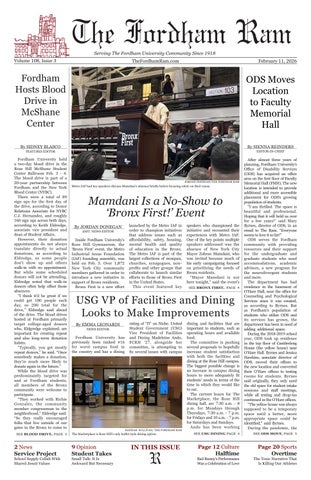

Fordham Hosts Blood Drive in McShane Center
By SIDNEY BLASCO FEATURES EDITOR
Fordham University held a two-day blood drive in the Rose Hill McShane Student Center Ballroom Feb. 3 - 4. The blood drive is part of a 20-year partnership between Fordham and the New York Blood Center (NYBC).
There were a total of 89 sign ups for the first day of the drive, according to Donor Relations Associate for NYBC C.J. Hernandez, and roughly 160 sign ups across both days, according to Keith Eldredge, associate vice president and dean of Student Affairs.
However, their donation appointments do not always translate directly to actual donations, as according to Eldredge, as some people don’t show up and others walk-in with no appointment. But while some scheduled donors will not be attending, Eldredge noted that walk-in donors often help offset those absences.
“I think it’d be great if we could get 100 people each day, so 200 total for the drive,” Eldredge said ahead of the drive. The blood drives hosted at Fordham primarily target college-aged donors who, Eldgredge explained, are important for creating repeat and also long-term donation habits.
“Typically, you get mostly repeat donors,” he said. “Once somebody makes a donation, they’re much more likely to donate again in the future.”
While the blood drive was predominantly targeted for and at Fordham students, all members of the Bronx community were welcome to participate.
“They worked with Richie Gonzalez, the community member congressman in the neighborhood,” Eldredge said.
“So they really encouraged folks that live outside of our gates in the Bronx to come to
SEE BLOOD DRIVE, PAGE 5
Mamdani Is a No-Show to ‘Bronx First!’ Event
By JORDAN DONEGAN ASST. NEWS EDITOR
Inside Fordham University’s Rose Hill Gymnasium, the ‘Bronx First’ event, the Metro Industrial Areas Foundation (IAF) founding assembly, was held on Feb. 5. Over 1,872 New York City community members gathered in order to introduce a new initiative in support of Bronx residents.
Bronx First is a new effort
launched by the Metro IAF in order to champion initiatives that address issues such as affordability, safety, housing, mental health and quality of education in the Bronx.
The Metro IAF is part of the largest collections of mosques, churches, synagogues, nonprofits and other groups that collaborate to launch similar efforts to those of Bronx First in the United States.
This event featured key
speakers who championed the initiative and recounted their experiences with Metro IAF.
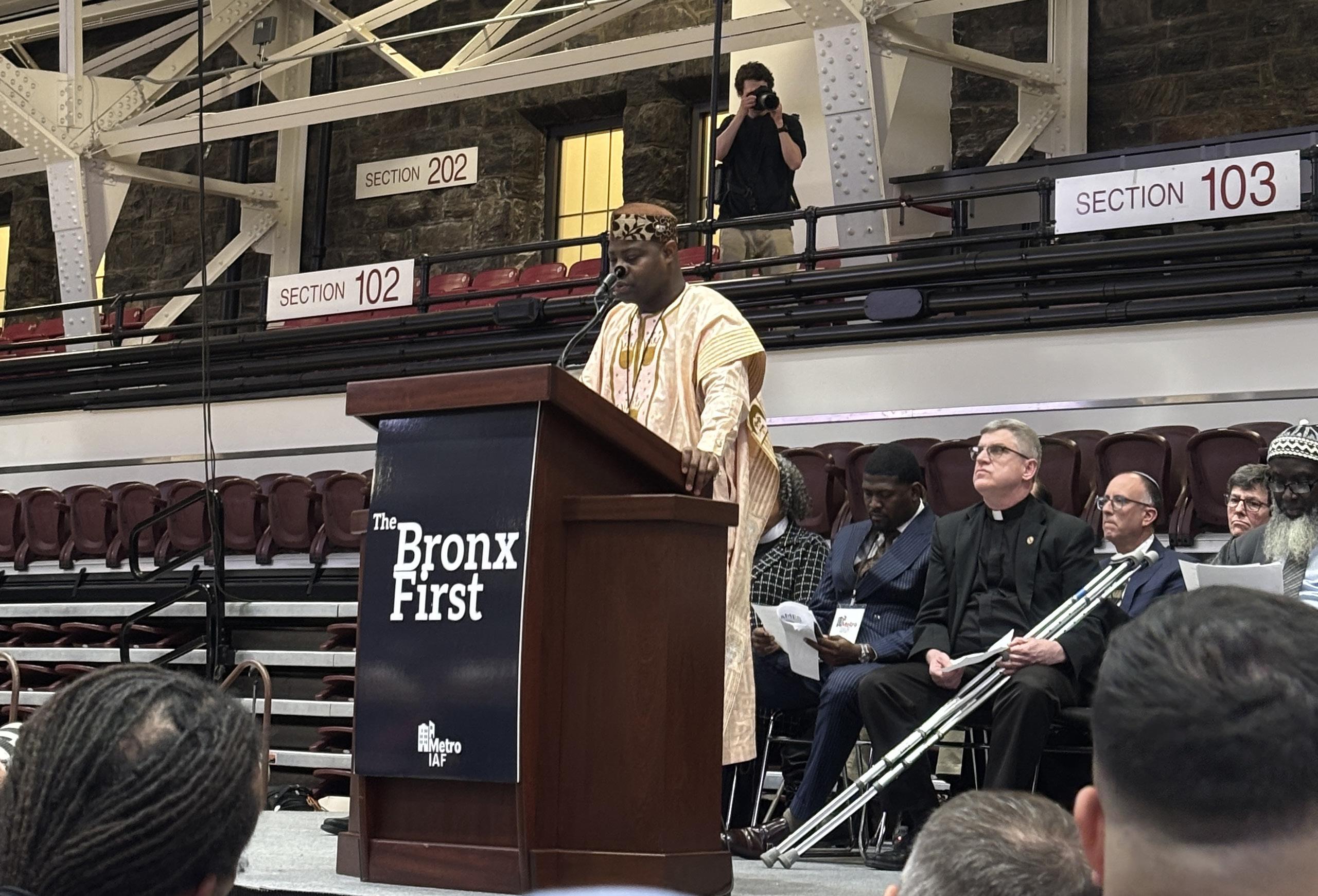
One of the key points multiple speakers addressed was the absence of New York City Mayor Zohran Mamdani, who was invited because much of his early campaigning focused on prioritizing the needs of Bronx residents.
“Mayor Mamdani is not here tonight,” said the event’s
USG VP of Facilities and Dining
Looks to Make Improvements
By EMMA LEONARDI NEWS EDITOR
Fordham University has previously been ranked #16 for worst campus food in the country and has a dining
rating of “D” on Niche. United Student Government (USG) Vice President of Facilities and Dining Madeleine Ando, FCRH ’27, alongside her committee, is attempting to fix several issues with campus
dining and facilities that are important to students, such as operating hours and available food.
The committee is pushing several proposals to hopefully increase student satisfaction with both the facilities and dining at the Rose Hill campus. The biggest possible change is an increase in campus dining hours to more adequately fit students’ needs in terms of the time in which they would like to eat.
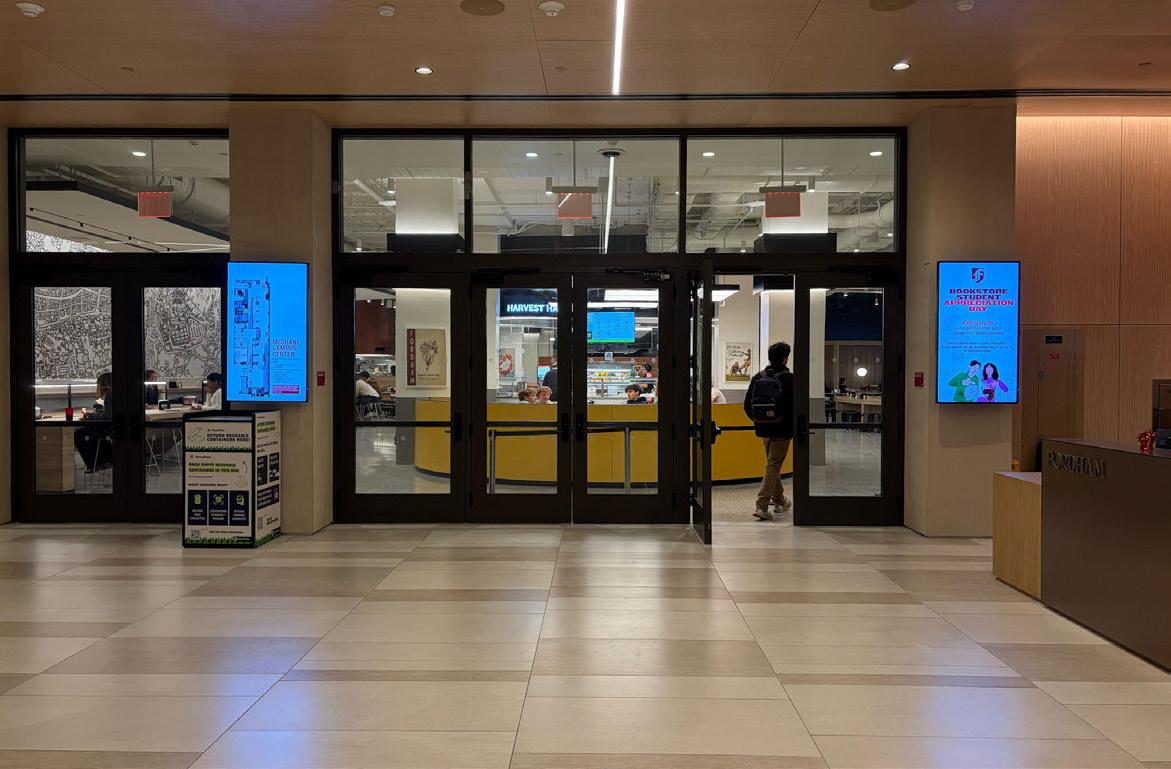
The current hours for The Marketplace, the Rose Hill dining hall, are 7:30 a.m. - 8 p.m. for Mondays through Thursdays, 7:30 a.m. - 7 p.m. for Fridays and 10 a.m. - 7 p.m. for Saturdays and Sundays.
Ando has been working
SEE USG DINING PAGE 4
ODS Moves Location to Faculty Memorial Hall
By SIENNA REINDERS EDITOR-IN-CHIEF
After almost three years of planning, Fordham University’s Office of Disability Services (ODS) has acquired an office area on the first floor of Faculty Memorial Hall (FMH). The new location is intended to provide additional and more accessible placement for ODS’s growing population of students.
“I am thrilled. The space is beautiful and professional. Hoping that it will hold us over for a few years!” said Mary Byrnes, director of ODS, in an email to The Ram. “Everyone seems to love it so far!”
ODS serves the Fordham community with providing resources and their support for the undergraduate and graduate students who need accommodations, academic advisors, a new program for the neurodivergent students and more.
The department has had residence in the basement of O’Hare Hall, near the office for Counseling and Psychological Services since it was created, as according to Byrnes. But as Fordham’s population of students who utilize ODS and its services has grown, the department has been in need of adding additional space.
During the 2018-2019 school year, ODS took up residence in the top floor of Cambreleng House (the yellow house) near O’Hare Hall. Byrnes and Jessica Hawkins, associate director of ODS, moved their offices to the new location and converted their O’Hare offices to testing rooms for students. Byrnes said originally, they only used the old space for student intake sessions and staff meetings, while all testing and drop-ins continued in the O’Hare offices.
“The yellow house was always supposed to be a temporary space until a better, more appropriate space could be identified,” said Byrnes.
During the pandemic, the
SEE ODS MOVE, PAGE 5
SEE BRONX FIRST, PAGE 4
Metro IAF had key speakers discuss Mamdani’s absence briefly before focusing solely on their cause.
JORDAN DONEGAN/THE FORDHAM RAM
The Marketplace is Rose Hill’s only buffet style dining option.
HANNAH SULLIVAN/ THE FORDHAM RAM
Parking Garage
Feb. 3
On Tuesday, Feb. 3, at 9:15 p.m., a student reported someone broke the window and ignition of their car which was parked in the garage. The supervisor responded and reviewed the video. An offender was observed near the car. The NYPD responded and prepared a report.
Off-Campus Harassment Feb. 7
On Saturday, Feb. 7, at 5 p.m., a student reported that a nonFordham community member banged on the front door of their off-campus apartment asking for money. The supervisor responded. The offender was not located. The reporter declined the NYPD.
Fire Alarm Feb. 9
On Monday, Feb. 9, at 5 p.m., there was a fire alarm in Loschert Hall. The supervisor and FDNY responded. The investigation revealed a sprinkler head burst triggering the alarm. Facilities personnel responded to make the necessary repairs.
Student Trapped in Elevator Feb. 9
On Monday, Feb. 9, at 8 p.m., there was an occupied elevator that got stuck in the Walsh Library. The supervisor responded and notified the elevator company. A technician responded and freed the student.
Follow The Fordham Ram on Instagram, Facebook, TikTok and X
This Week at Fordham PUBLIC SAFETY BRIEFS
Thursday
Feb. 12
Spreading Kindness
...
Marketplace 12 p.m.
Enjoy a Valentine’s Day themed meal at the Marketplace in McShane, and write a love note as part of their “take-one leave-one” activity.
School Supply Collab With Shared Jesuit Values

By SIDNEY BLASCO FEATURES EDITOR
Fordham University students and St. Ignatius Middle School (SIS) students came together to assemble school supply packs that were distributed to children in a New York City Housing Authority (NYCHA) after-school program. This event, which took place on Feb. 6, was part of a Campus Ministry service program.
Students took a Ram Van driven by Robert Parmach, senior director of Ignatian Mission and Education at Fordham, to the SIS as part of the event. This specific event was part of a larger series of programming done by Campus Ministry.
Participants worked in an assembly line to put together and fill backpacks donated by Fordham University’s summer session, according to Parmach, that read “Summer Leader.”
The students worked with SIS middle schoolers to put the packs together.
The packs were filled with rulers, pencils, magic markers, erasers, books, stickers and toys. These items were meant to serve as a motivation tool for the children in a NYCHA afterschool program and to provide them with supplies that can be used for their education, Parmach noted. Each backpack also contained a homemade card of affirmation written by both Fordham and SIS students.
This particular event was
Friday Feb. 13 “Wuthering Heights” ...
Meet in LL Lobby 6 p.m.
Fordham’s Commuting Students Association at LC is organizing a “Wuthering Heights” outing. Meet in the LL Lobby to travel as a group to the theaters!
funded by Ignatian Mission Initiatives through Campus Ministry. Parmach estimated the cost of this event to be $150.
“It’s not a huge amount, so we make our dollars stretch,” he said.
Rosy Harris, FCRH ’29, also participated in the event. She described noticing similarities between herself and the SIS students, as they all attend Jesuit schools.
“Working with the SIS middle school students,” Harris said, “I was able to get a glimpse into their lives while we came together to serve others. It was great to talk to the students and share what we are grateful for.” She thanked Parmach for putting the service opportunity together.
Samantha DeWeese, GSB ’27, who also participated in the event, said listening to the SIS students’ perspectives was impactful.
“Hearing from someone who grew up in a completely different environment with different opportunities made me feel like I understood our neighbors in the Bronx better,” she said.
Parmach continued to share about the connection between Fordham and SIS.
“We’re still both Jesuit schools that have certain principles that we share,” Parmach said. “So regarding teamwork and how we look out for one another and how we motivate each other … we talk about that to them to make sure that it’s
Wednesday Feb. 18
Relax with Yoga ... 2456 Belmont Ave 5-6 p.m.
Yoga at the Institute of International Affairs is hosting a one-hour class to help students relax, cope with stressful situations and learn breathing exercises.
making an impact.”
The programming done by Campus Ministry reflects the Fordham mission statement of cura personalis, care for the whole person, according to Parmach. The Ignatian mission statement is uniting the head, the hands and the heart. Parmach said this is reflected in the events they hold.
“We want to spark… your intellect, your imagination, your heart, your beliefs,” said Parmach. “To get out there in the world and do something, not just to sit on our hands as intellectual beings or ethical beings. We need to get out there in the world.”
Campus Ministry typically hosts 20 events in the fall and 20 in the spring, as well as some in the summer for both faculty and students, according to Parmach. While similar supply drives have been hosted on Fordham’s campuses, this was the first time the event was held at SIS.
Other events with SIS have included sandwich-making for a local food pantry and musicbased programming. Parmach is also the faculty advisor for the Ramblers, Fordham’s student male acapella group, which he said he brings into his work with Campus Ministry.
“We’ve gone there in the past,” Parmach said, “where the student musicians go there, perform a few songs, but also teach them about music and teamwork.”
Thursday Feb. 19 “Alice by Heart” ... Collins Auditorium 8 p.m.
Come see the Mimes and Mummers musical performance, “Alice by Heart,” the weekend of Feb. 19-22. Tickets are FREE for students on opening night.
One of the goals of these events is to expose the middle schoolers to higher education, which Parmach said is a great factor that allows everyone participating in the event to work as well as to learn from one another.
“We’re trying to encourage these middle school, Jesuiteducated students to have dreams to come to college, to excel, to do well,” said Parmach. Parmach said these programs are impactful for Fordham students and the SIS students.
“Prior to the event, we do a reflection together, the SIS students and the Fordham students,” Parmach said. He also said that students took part in a debrief discussion during the Ram Van ride back to campus, reflecting on what resonated with them. “I’m always enthusiastic and grateful for what they took from that event,” he said.
Jake Esposito, FCRH ’26, in his reflection of the event said speaking with some students about their values of respect and compassion gave him a drive to assist his community.
“Having the privilege to interact with and assist middle school students in their public service prospects provided me with a remarkable outlook on the future generations,” Esposito said.
The next campus ministry event, the St. Valentine’s Day Reflection and Spirituality Discussion, will take place on Feb. 12 at Rose Hill.
Saturday Feb. 21
Men’s Basketball ... Rose Hill Gymnasium 2 p.m.
Cheer on the men’s basketball team as they play against Davidson College. Take part in “Breakfast All Day” with free samples from Little Italy’s eateries.
SIS and Fordham students showing off the school supply packs.
ROBERT PARMACH FOR THE FORDHAM RAM
New Paid Psychology Research Study
By SIDNEY BLASCO FEATURES EDITOR
A Fordham University professor of psychology is recruiting undergraduate students to participate in a paid research study that aims to evaluate the feasibility of the online version of a mentoring program called “Connected Futures.” The ultimate goal of the study, according to Elizabeth Raposa, associate professor of psychology, is to determine whether the online or in-person course is more effective.
Connected Futures, which is based on MentorPRO and originally founded at the University of Massachusetts Boston, provides resources for college students curated to facilitate career- and education-oriented mentoring relationships.
According to its website, MentorPRO is an “all-in-one mentoring software platform designed to support program managers, mentors, and mentees.”
Sarah Dilchand, FCLC ’26, works as a research assistant for Raposa’s lab and worked on creating the online program based on MentorPRO for Fordham students.
“This research study is going to be a really good way for students to kind of just get a one-on-one reflection session with themselves,” said Dilchand.
Results from the study on MentorPRO were overall
positive, according to an article from The Chronicle, and showed that students who passed the course were over three times as likely to graduate in four years. The article also explained the reason for these results.
“Skills-based social capital interventions can substantially boost student retention and graduation by teaching students how to recruit mentors and navigate institutional relationships,” the article said.
In June 2024, Raposa and MentorPRO launched an online course, titled “Selfpaced Mentoring for Youth Mental Health,” according to the MentorPRO website. Raposa said the online format was created in order to make the course more accessible.
“The in-person intervention was really effective, but it was hard for people to access,” said Raposa. “So we put it on the internet … and so far the evidence is suggesting that it is [effective].”
The current study testing the online course took over a year to develop, according to Raposa. She said she received a grant last summer, which pushed the project forward.
All Fordham students are eligible to participate in the study, as long as they have internet access and fluency in English, Raposa said.
“You get free access to the course, and you also get reimbursed for your time answering questions about
the course,” said Raposa, “So you take a couple brief surveys before and after the course and we either pay you $40 or you can get research credit for one of your psychology courses.”
Benefits for students are expected to consist of having different skills and beliefs regarding students seeking help related to their professional or academic goals, according to Raposa.
“So much of what the course is trying to do is help you think through what you really wanna get out of your academic career,” said
Raposa. “Then [give] you the concrete skills you might need to network and develop social relationships that are critical to achieving those goals.”
Dilchand said programs like Connected Futures can be helpful for students navigating college life.
“College can be a very overwhelming place,” she said.“The fact that we can build communities through these interventions where we’re kind of telling students, ‘hey, you’re not alone’ … that’s something we really try to emphasize with our study.”
“I guess this is very
consistent with the idea of cura personalis, to reflect on what their own goals are for their time at Fordham and how they can best achieve those goals,” said Raposa. Raposa explained that the program is run by both undergraduate and graduate students who are under her supervision.
“We actually even have undergraduate students who have provided testimonials here at Fordham... that are included in the course, so some students may see familiar faces when they take it,” said Raposa.
USG Discusses Upcoming Events
By EMMA LEONARDI NEWS EDITOR
Fordham University’s United Student Government (USG) held their weekly meeting on Feb. 5 to hear a new club proposal, approve internal budget requests and listen to committee and senate updates.
The meeting began with a new club presentation. Gray Fraser, GSB ’29, Caeden Joyce, GSB ’29 and Will Barrios, GSB ’29, presented their idea for a Fordham spikeball club. Their pitch for the club said that it facilitates skill building and creates an inclusive space to encourage connection, as well as fun. They said they would like to offer competitive tournaments as well as casual sessions.
In their pitch, the trio also outlined the plans for their first few meetings. They will begin with a kickoff opening meeting, followed by a secondary one to learn the game before getting into casual practice in their third session.
In terms of budget, they shared that the club would need approximately $1,000, with these funds covering net sets, pumps, a first aid kit and small tournament prizes.
The biggest concern within USG about this proposal was
whether the budget would work. However, Vice President of Budget Peter Grimes, FCRH ’25, said that the request is something USG can handle.
The club was unanimously approved by USG.
There were several budget requests coming internally from USG. The Gabelli School of Business (GSB) Dean’s Council requested funding for their annual Valentine’s Day tabling event.
Vice President of Student Experience Luc Angus, FCRH ’26, requested money for the committee’s Beacon Exemplar event, where they would provide food for certificate holders and nominate a faculty member who will receive an award.
Vice President of Diversity and Inclusion Laila Sayegh, FCRH ’27, asked for funding for the Diversity Action Coalition’s fundraiser for their Terra Firma National event. All budget requests were unanimously approved.
USG also discussed a proposal from the fall semester, presented by Edwin Charles Quimby, GSB ’29, for a soft serve ice cream machine to be put in The Marketplace dining hall. According to USG, 97% of students said yes when asked if
they would like one, with 77% saying they would use it three times a week. Vice President for Facilities and Dining Madeleine Ando, FCRH ’27, said that Facilities and Dining also put up a form for general dining related concerns.
Ando also shared that there has not been a lot of change regarding the interactive campus map for students. According to her, Marketing, Information Technology (IT) and Facilities will begin working on it soon.
In discussing his executive updates, Executive President Lucas Hjertberg, FCRH ’26, shared that the USG retreat will take place on Feb. 21. He also noted that there is a proposal in the works to create a Fordham College at Rose Hill (FCRH) student mentoring program, an idea that was born out of a Student Life Council conversation with the career center.
Regarding some instances of budget requests being sent to external people, Senator Ava Cascella, FCRH ’26, said that she has had a lot of complaints about club sports budget requests, specifically with them being sent to everyone. Hjertberg said he has reached out to the Office of Student
Involvement about this issue, but hasn’t heard back.
In terms of other executive board reports, Vice President of Operations Tina Pathak, FCRH ’28, said that quite a few clubs have moved into the final review of the process. She also noted that one club that submitted a proposal needs to resubmit due to missing information.
Grimes shared that the university will be hosting actor Jordan Fisher for an event on Feb. 26. He also noted that his committee is looking to have more flexibility with funding so they can keep approving requests, as the current funding standings are not looking as ideal as they would like.
Vice President of FCRH Mary Hawthorn, FCRH ’26, said that her committee has an event scheduled for Feb. 12 at 1 p.m. in Freeman Hall, where there will be a research grant writing workshop supervised by professor Christopher Aubin, Ph.D.
Vice President of Health and Security Aidan Costella, FCRH ’27, announced that he met with Assistant Dean for Student Involvement Catharine McGlade to discuss how him and his committee could collaborate
more with the university’s department of marketing.
Costella also noted that there would be Title IX training with Title IX Coordinator Liz Fanelli on Feb. 9.
While Vice President of Sustainability Ayden Johnson was not in attendance, his committee updates were shared by Ando. According to her, Johnson is working on looking into the intense amount of bacteria supposedly found on RamFit cleaning wipes, with more information to come.
Costella also shared an update about the contraceptive policy reform committee he is leading. He noted that he, alongside Hjertberg and senator Henry Carstens, FCRH ’29, will be meeting with McGlade to talk about the town hall they are hoping to hold this semester. Costella said that there was a survey posted on the USG Committee on Sexual Misconduct Instagram page. In terms of senate reports, senator Megan Ruzicka, FCRH ’27, shared that she is working with the Office of Disability Services on an introductory workshop series in the fall semester for students battling chronic illnesses while transitioning to college.
USG meets next on Feb. 12.
COURTESY OF KOUZMANOF BAINTON ARCHITECTS
Fordham’s psychology department is located inside of Dealy Hall.
Metro IAF Holds It’s ‘Bronx First!’ Event
co-chair Haji Dukuray, in his opening speech. “We invited him, but he decided to ignore us. That’s a huge mistake made. But we don’t need him here to organize ourselves.”
In an interview with The Ram, Simone also drew on the power of community gathering, despite Mamdani not being present at the assembly.
The hosts spoke on the absence. “We invited Mayor Mamdani, and he’s not here, but we are, and we are all the guests of honor, and we’re happy to be organized in the community tonight,” she said.
Eileen Torres, the co-chair, opened the meeting by saying describing the initiative as “personal to her,” as a Bronx native with immigrant parents who struggled with housing during her childhood. She described some of the pressing matters the Bronx is currently facing.
“We understand that there is a housing crisis,” she said. “We know that Bronx schools are failing to teach us how to read or get jobs, and there’s a lack of preventative mental health, and we feel unsafe.”
Dukuray then recounted his experiences after arriving in the Bronx in 1988, describing it as “drug-infested.” He also described meeting a family who greeted him.
“He said, ‘welcome to my home. This is your home, this is the Bronx, the Bronx is your home. Let’s build it,’” he recounted.
One of the speakers was Nina Simone, associate executive director at New Settlement, who opened her speech by chanting “the Bronx, first, the Bronx first!” She expressed her support for the initiative and shared her family’s story with Metro IAF.
“I’m standing here tonight as a direct beneficiary of Metro
IAF leaders who shaped my family’s future,” Simone said. “Metro IAF and East Brooklyn congregations, organizers, pastors and leaders... saw potential where others saw abandonment.”
Simone also emphasized the potential impact of New York City increasing housing prices on the Bronx and the need for this effort.
“The Bronx is the last to stand in New York to produce truly affordable and safe houses to rent or own,” she said. “Some of us live in buildings that are in dire need of repair and upgrades … we’re going to fight to make sure every single person can have an affordable and safe place to call home.”
Reverend David K. Brawley, EBC, had been involved in the East Brooklyn congregation’s proposal of the Nehemiah Housing Strategy within the 1980s. He had described the hardships and opposition he faced when launching this initiative in interacting with city politicians.
“One top city hall official actually sneered at us. He said ‘First of all, you won’t be able to build homeless shelters, and if you build them, no one will buy them, and if they buy them, they will wreck them,’’’ Brawley described.
Near the end of the assembly, religious congregations and organizations began pledging money towards the initiative.
James Duckett, pastor of Fort Mount Baptist church in the South Bronx, gathered some fellow reverends to pledge a total of $10,000 to the effort to “make sure that we build the Bronx better, because the Bronx is going to win first.”
According to Torres’ closing remarks, the initiative received support and the commitment from 50 institutions, collecting over $100,000 in donations.
An audience member who is a home contractor explained
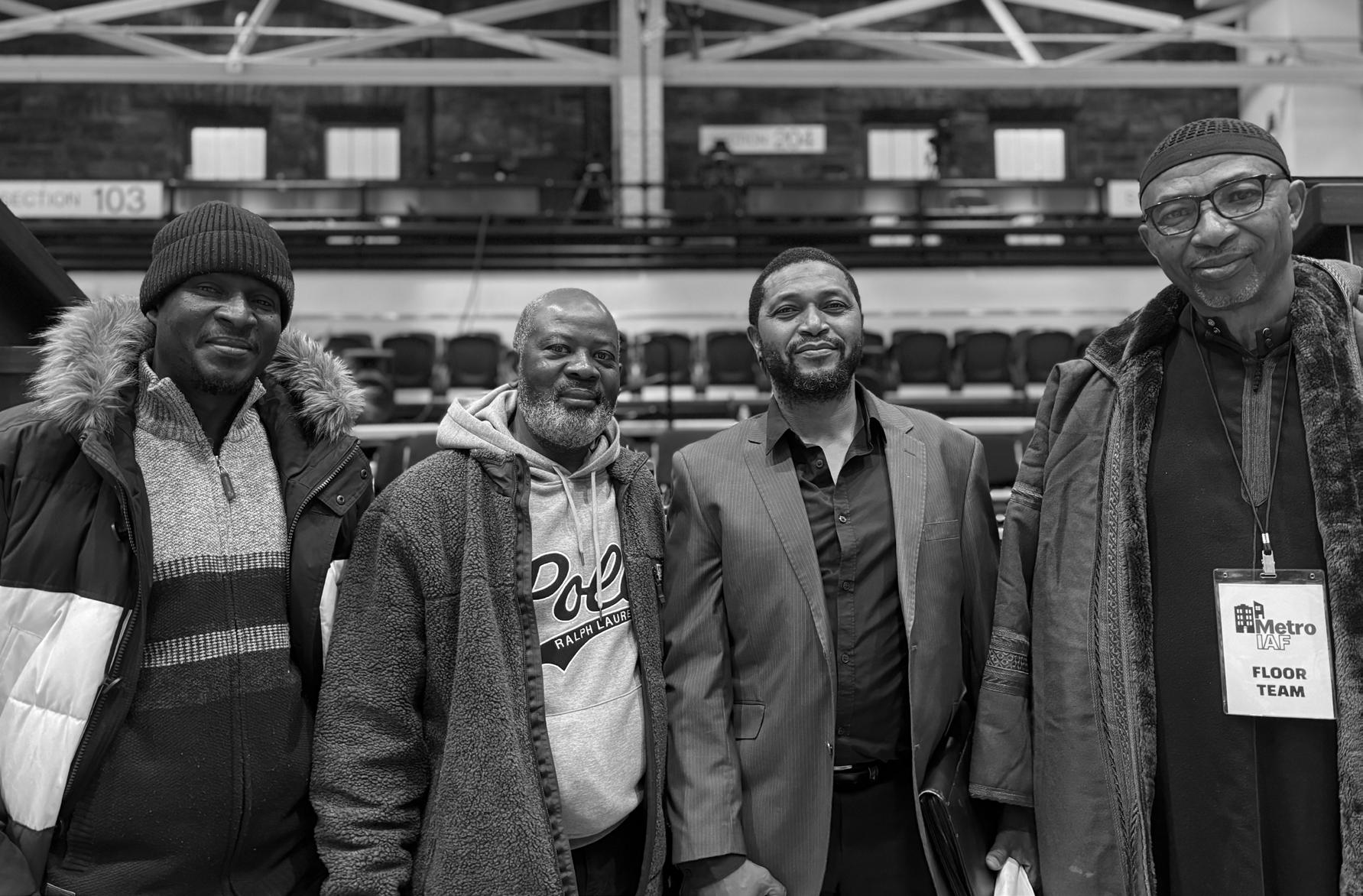
to The Ram that he wants to set up a program to help families in the Bronx earn their own contracting licenses, which he says is what drew him to the
event at Fordham.
He spoke on the appeal while there. “I came because I heard about organizations determined to do things in the
Bronx for a change, and I liked that, and I plan to get involved,” he said. “I’m excited, it’s just a matter of putting things forward. Less talk and more action.”

Students Comment on Potential Dining Changes
FROM USG DINING PAGE 1 closely with Fordham’s dining department on the proposal, who have since countered her committee’s proposal by offering a pilot program to see if students would actually use the hall during the extended hours. Ando reported that, ideally, the hours would change to a closing time of 9:30 or 10 p.m. on the weekdays and an opening time of 7:30 or 8 a.m. on Saturdays and Sundays.
According to Ando, the main concern from the department with permanently adjusting these hours is the lack of knowledge having to do with whether students will actually use the new hours combined with the cost it takes to keep the dining hall open. The department argued that many students use Urban Kitchen
as an alternative for late night meals, which Ando and her committee rebutted.
“They talk about how there are popular late night food places, Urban Kitchen, and we countered that by saying, ‘The reason Urban Kitchen gets so overwhelmed at night is because nothing else is open,’” said Ando. “Students want a more diverse sea of options.”
Ando also had noted that within the pilot program, the committee and the dining department have come to another compromise as well; their proposal now includes that only certain stations will be open during the extended hours. This is to assess the usage without a high cost addition, and if the change is made permanent, it will likely be the same long term.
Ella DeBonis, FCRH ’29, is of the opinion that the dining hall hours should be changed.
“I feel like the current dining hall hours are inadequate and aren’t tailored to everyone on campus. I know schools that keep their halls open later on weekends, and later in general, to help and conform to all students’ needs,” DeBonis said.
Leah Renshaw, FCRH ’27, recently moved off-campus and said the meal options were a reason for the switch from on-campus Fordham living.
“I honestly never go to the dining hall. I don’t think I’ve been since I was a freshman. I don’t like the food and I also don’t even know what the hours are,” Renshaw said.
“I do not have a meal plan because I have just moved off campus and I cook every meal.
It’s much better and much healthier than what’s offered on campus, so I felt like I didn’t need a meal plan anymore.”
Bridget Brady, GSB ’26, also lives off-campus but does have a meal plan.
“Even though I live off campus, I like the option to grab food on campus when in a pinch,” Brady explained. “The move [off-campus] didn’t totally have to do with food, but having a full kitchen is a life changer.”
Despite this difference, she still noted improvements to the dining options that could be made.
“I feel like most food places on campus have bad hours. Either opening too late or closing too early, the open times never really connect to my eating schedule,” said
Brady when discussing the current hours.
While this is one major project Ando is currently working on, there are other proposals in the works as well. These include, but are not limited to, an increase in student job opportunities, assisting Counseling and Psychological Services in rolling into a peer counseling program where they’re able to connect students with longer-term therapy care and a potential soft-serve machine for the dining hall.
If students have dining or facilities concerns or recommendations, they can fill out either of Ando’s form for dining feedback or attend one of USG’s weekly meetings (Thursdays at 5:30 p.m.) to bring up improvement ideas.
FROM BRONX
Students attended the event in support of its mission.
JORDAN DONEGAN/THE FORDHAM RAM
Community members gathered to hear the invited speakers present on the event’s mission.
JORDAN DONEGAN/THE FORDHAM RAM
ODS Finds Office Space Accessible To All
number of students registered with ODS increased drastically, causing them to need even more space. So ODS began using the entirety of the yellow house, purchasing furniture to create five new testing rooms, according to Byrnes. For a few years, they continued to use both the yellow house and the O’Hare location as offices and testing rooms. However, Byrnes said because the yellow house was not accessible to all students due to its steep and narrow stairs, they had to be intentional with the use of both places.
exams, and academic coaching spaces.”
Finally, ODS began plans to acquire a new location. They started construction for a new space in the Loyola Hall basement in the fall of 2023. However, construction became quickly delayed due to water issues, according to Byrnes. As a result, they once again began searching for a new office location.
Byrnes said ODS will keep their testing rooms in O’Hare and will continue to have access to the yellow house, should the additional space be needed, while using the new space in FMH as staff offices and to
accommodate their increasing number of students.
“We are very pleased with our new office,” Byrnes said. “There will be a number of tweaks made this summer as we figure out [if] any improvements are needed.” FROM ODS
Byrnes added that they are modifying the office in FMH to fit their needs, which includes obtaining two additional office spaces in FMH in summer, but
Byrnes discussed the move.
“During the pandemic, our office exploded with new registrants and finding acceptable space became a priority,” Byrnes said.
“The yellow house was not accessible so we used O’Hare for students whose disabilities prevented entry into the yellow house as well as overflow testing space during midterm and final
In the summer of 2025, they began plans to move into an office on the first floor of FMH; the former residents of the office space moved to the fifth floor. Byrnes said they chose the space because of its accessible entrance, proximity to a road where cars can drop people off and convenience for students and professors because the building is also used for classes. Byrnes also said she, Hawkins and Alexis Boykin, ODS office manager, were able to work with facilities to come up with the design for the new space.
that they are overall happy with the new location.

Fordham x NYBC Bi-Annual Blood Drive
FROM BLOOD DRIVE PAGE 1
campus for a blood drive.”
When they had admitted non-Fordham students into campus, public safety ensures proper protocol, according to Eldredge.
“If somebody came in and wanted to access the campus and it didn’t seem appropriate for them to do that, [if] they seemed like they were posing a threat to the community, public safety wouldn’t allow them on campus,” Eldredge said.
Hosting a blood drive that is open to the Bronx community
members and the Fordham students is very aligned with Fordham’s Jesuit mission, according to Eldredge. The act of donating blood reflects Fordham’s Jesuit values by encouraging students towards thinking about others besides themselves and to prioritizing service and care for others.
“Part of that should also be doing for others in some way, call it the Jesuit Catholic spirit,” said Eldredge.
Megan Kuck, GSB ’26, had donated blood at the event and said she donates blood for a simple reason.
“I have it, I might as well give it to other people,” she said. She also said she first became motivated to donate blood after a girl in her high school got into a fatal car accident. “I think of her whenever I donate blood,” Kuck said.
But not all students who attended Fordham’s drive were eligible to donate blood. Ella Pombo, GSB ’28, said she was told she has low hemoglobin, which prevented her from participating in the drive. Hemoglobin screenings are required to ensure donors have enough of healthy red
blood cells to safely give blood without risking their own health. She said she has donated blood three times before and that this is the first time she hasn’t been able to.
“It’s something I’ve been doing since high school,” she had said. “[It] just feels like something nice to do.” Fordham’s prospective donors must also complete health screenings and questionnaires administered by NYBC staff to ensure safety of donations, according to Eldredge.
Eldredge also had said that the collaboration between
Fordham and NYBC operates as a service-based partnership, with no financial benefit to either party.
“We don’t charge them to use the space … and they don’t pay us anything,” said Eldredge.
Fordham hosts one two-day drive per semester, with the exception of a one-day drive in the summer of 2025.
“We only do a one-day drive in the summer because we just know there’s not going to be that much demand to spread it out over two days,” said Eldredge on future drives.

Mary Byrnes, director of ODS, now has an office space accessible to all students.
MARY BYRNES FOR THE FORDHAM RAM
Fordham Biology Professor Champions Research
By JORDAN DONEGAN ASST. NEWS EDITOR
A Fordham professor of biology is spearheading the first study to examine the biological effects of menopause on mental health and brain chemistry. The study, funded by a $2.8 million grant from the National Institutes of Health (NIH), primarily aims to understand the molecular and cellular changes that take place in the brain during this period of transition.
The five-year study is led by professor Marija Kundakivic, Ph.D., who said that mental health has always been an area of great interest for her, which is what motivated her to pursue this project. She said that there is very little known about the transition into menopause and how it impacts mental health, which can be affected by a wide variety of symptoms.
“We know very little about this period that is called menopausal transition,” she said. “This period can be up to 10 years, and it is characterized by different symptoms. One of the characteristics of it, which has been so under explored, is that there’s increased risk for mental health disorders … particularly for depression.”
As the first person to conduct a research project aimed specifically at studying the connection between the menopause transition and
mental health, Kundakovic said that she is excited to lay the foundation for a most groundbreaking study.
“It feels really exciting,” she said. “I’m glad to be one of the pioneers in the field … and I feel this is exactly what we need to do .… I really [think] this whole menopausal transition period is so understudied, and the data are very strong on mental health problems. I just felt strongly that I should do this.”
In order to champion this project, Kundakovic said that she had to conduct several experimental trials so that she could receive the NIH grant, which was conditional on providing preliminary sets of data. She noted that her situation was rather rare, as she received the funding on the first trial she submitted to the NIH.
“I think it not only reflects the quality of the study, but also that people understand that it’s a very important area,” she said.
Prior to conducting the study, Kundakovic said that she used mice to examine the impacts of ovarian hormonal changes during the estrous cycle, which is very similar to menopause in humans, on the brain specifically focusing on how these hormonal fluctuations impacted the packaging of DNA in the brain. Kundakovic said her discoveries from these studies were fundamental in laying the groundwork for
her current project.
“We were previously able to show that these ovarian hormone chances that we see across the estrous cycle are actually changing the brain in many different levels,” Kundakovic said.
Having uncovered the fact that ovarian hormones can impact gene expression and organization, Kundakovic said she was able to determine that it can also impact one’s chromatin organization, which is the way cells pack strands of DNA into the nucleus, particularly within the brain and in neurons.
Utilizing similar methods as that of her previous study, she launched this study by obtaining 40 post-mortem brain samples of the anterior hippocampus from the
NIH brain bank of people who had been assigned female at birth. The anterior hippocampus, Kundakovic explained, is the region of the brain crucial to the regulation of emotional recollection and stress response.
“We are looking into this brain region and are trying to understand what exactly happens across the menopausal transition […] and whether we are going to see some changes in cell composition of this area as hormones are changing,” Kundakovic said.
One year into her five-year research project, Kundakovic said she and her team have discovered some biological markers within this particular region of the brain that can indicate which menstrual
stages the subjects of the post mortem brains were currently in at the time of their death. She noted that the ages range from 40-55 years old.
Within the next four years of this study, Kudnakovic explained that she hopes to be able to utilize her cutting edge technique that she said is “rich in data” to examine the results of her studies and then “actually find possible new targets for treatment.”
She detailed the potential future impact she hopes her findings could have on future research and remedies.
“I think overall, the legacy of this study might actually be really big and I always like to say, ‘Knowledge is power,’” she said. “I think the more we know about [the transition], the easier it will become.”
USG & SEAJ Work To Revive Garden Club
By KAT ROSSI ASST. NEWS EDITOR
Students are working to restore St. Rose’s Garden after several years of inactivity, launching an all-campus effort to restore the space to utilize as a functional garden and community area.
The initiative is being led by members of the Students for Environmental Action and Justice (SEAJ) and the United Student Government’s (USG) Sustainability Committee, amid uncertainty surrounding the current operational status of the St. Rose’s Garden Club. The Garden itself is located outside of the former Office of Disability Services building, behind the parking garage.
According to Vice President of the USG’s Sustainability Committee Ayden Johnson, FCRH ’27, the garden has not been officially transferred out of the Garden Club’s reach, but it has not been actively maintained since prior to the COVID-19 pandemic. Johnson described the club as “inactively active,” explaining that while it technically still exists, it has not tended to the Garden in recent years.
“There has not been an official transfer of the garden
away from the gardening club,” Johnson said in an email to The Ram. “At this time, the club exists, but it does not tend the garden at all.”
In response to the Garden Club’s prolonged inactivity, Johnson, along with SEAJ co-presidents Jenna Cain, FCRH ’27, Elizabeth Barker, FCRH ’27 and student Quincy Biddle, FCRH ’26, decided to move forward with a plan for restoration. Johnson noted that the effort is not intended to permanently take over the garden, but rather to revive a space that many students have expressed interest in using.
“As the leaders of the only sustainability and environmental organizations on campus, we [have taken it upon ourselves] to restore this garden to what it once was,” Johnson said.
Johnson said they attempted to collaborate with the e-board of the Garden Club before initiating restoration efforts. Johnson said that multiple attempts were made to contact the club’s president, but they went unanswered.
“A former member of our restoration team who transferred out (...) was on this e-board and tried to
coordinate with the rest of the board, but nothing came of it,” Johnson told The Ram.
Despite this, Johnson reiterated that SEAJ and the Sustainability Committee do not plan to replace or dissolve the Garden Club. Instead, once restoration is complete, the students who had been actively involved in reviving the garden will have the opportunity to assume leadership roles within the club through a formal election process.
“SEAJ and the Sustainability Committee do not plan to take over the garden,” Johnson said. “We are merely getting the club and space back on its feet. We will hold elections among those who participated in the restoration to establish their new e-board for the next academic year.”
Barker said that the idea of restoring the garden has been in development since the fall semester of 2025, initially sparked by conversations with Bechner. Since then, student leaders have been planning a phased approach to address both safety and infrastructure concerns.
“The garden hasn’t been in operation since pre-COVID-19, and it was once a beautiful
space,” Barker said. “We’re more than happy to restore it so that students now and after us can enjoy and maintain it.”
Organizers envision the garden as a multifunctional campus space which extends beyond just gardening alone. Planned activities in the renovated space include cleanup days and art events designed to make the area more welcoming and usable. Immediate priorities include both resolving present safety hazards and renovation.
“We’re looking to make the space habitable,” Barker said. “There are some safety things like loose wires and other trash that we’d need to sort out first. The goal is to make it a place students want to go, whether that’s to plant, hang out or compost.”
The first cleanup is scheduled for Feb. 21, with more cleanup and building days planned in future. The organizers invite interested students to participate in the garden’s restoration.

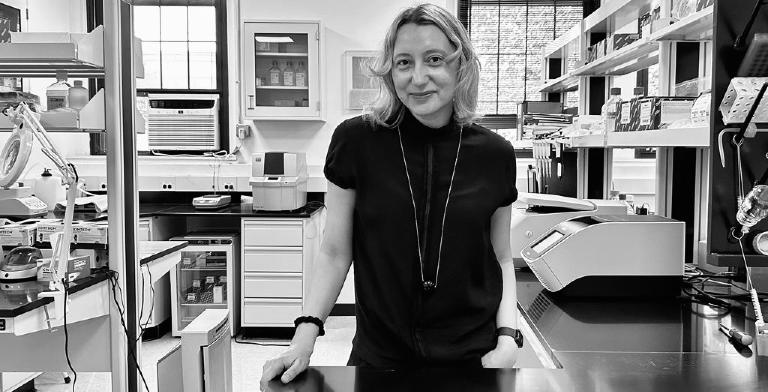
Marija Kundakovic in her lab at the Rose Hill campus
COURTESY OF FORDHAM NOW
St. Roses Garden in its current state. KAT ROSSI/THE FORDHAM RAM
OPINION

Serving the Fordham University campus and community since 1918
The Fordham Ram is the university journal of record. The mission of The Fordham Ram is to provide a forum for the free and open exchange of ideas in service to the community and to act as a student advocate. The Fordham Ram is published every Wednesday during the academic year to all campuses.
Website
TheFordhamRam.com
Email Address theram@fordham.edu
Editor-in-Chief
Sienna Reinders
Managing Editor
Ian Nelson
Production Editor
Sarah Verrastro
Editorial Director
Molly O’Connor
Multimedia Director
Hannah Sullivan
Business Director
Nishanth Aduma
News Editor
Emma Leonardi
Features Editor
Sidney Blasco
Assistant News Editors
Jordan Donegan
Kat Rossi
Opinion Editor
Loressa Zeqiraj
Assistant Opinion Editors
Erynn Sweeney
Gabriel Capellan
Culture Editors
Lara Ejzak
Makenzie Smith
Assistant Culture Editor
Paolo Liaci
Sports Editor
James Nelson
Assistant Sports Editors
Molly Friedman
Ethan Bess
Copy Chief
Indigo Towers
Executive Copy Editors
Emily Mitton
Uma Petzke
Emma Kelner
Elaina Gibson
Social Media Director
Haniyyah Usmani
Photo/Graphics Editor
Emily McCall
Wilson Speller
Digital Producers
Han Le
Marisa House
Advertising Directors
Violet Wallace
Juan-Pablo Valencia
Rishika Lingamdinne
Faculty Advisor
Beth Knobel
Editorial Policy
The Fordham Ram’s editorial reflects the editorial board’s opinions or views.
Opinion Policy
The opinions expressed in this publication are those of the authors. They do not necessarily reflect the opinions or views of The Fordham Ram.
Submission Policy
The Fordham Ram Reserves the right to reject or edit any submission for any reasion, without notice. Submissions become the exclusive property of The Fordham Ram. No part of The Fordham Ram may be reproduced without written consent.
Correction Policy
The Fordham Ram is committed to fair and accurate reporting. If you are aware of an error, please contact us at fordhamramonline@gmail.com.
The way many people view feminism today is perpetuating the normalization of misogyny in society. Generally, it is easy to call someone dramatic when you are in a position of privilege — that is, when you are not the one facing scrutiny, oppression and discrimination for circumstances outside of your control. Particularly, it is easy to call a woman dramatic when she discusses the unfair treatment she experiences solely because of her sex when you are not a woman yourself.
Lately, there has been a shift in the way not only men react to feminism, but also in how women approach it. For years, there has been statistically-proven hostility towards feminism from men, and now we are seeing this hostility being internalized as women hesitate to call themselves feminists.
Ignorance and lack of knowledge worsens misunderstanding, so here is a quick lesson. Sexism, misogyny and feminism all have different meanings and are used for specificity. Sexism is prejudice, stereotyping or discrimination on the basis of sex, and misogyny refers to a hatred of or contempt for women. Sexism, as it pertains to women, is a way of assuming women are inferior in certain ways, and this is where a lot of gender inequality stems from. Misogyny presents itself through behavior or actions, either from an individual attitude or systemic practices, designed to keep women in a subordinate status.
Instances of misogyny are harder to identify because misogynistic behavior can be disguised as a joke or is often excused because it purposefully undermines
From the Desk | Loresa Zeqiraj
Fundamentals of Feminism
and dismisses women and their opinions . Belittlement , constant disrespect and dismissive attitude, stereotyping, objectification and double standards are just a few instances of misogyny women face every single day.
A study conducted in the U.K. by academics at a college in London in collaboration with Ipsos found a clear disparity in how different genders perceived feminism and its impact. In 2024, when the study was conducted, nearly half of the respondents agreed that it was harder to be a woman than a man today. When asked what would be harder in 20 years, one in six of the men surveyed said it will be harder to be a man. In another survey of people from 30 countries, Ipsos found that one in three men believe feminism does more harm than good and 57% of men and 36% of women believe we have gone too far in promoting women’s equality.
Misogyny and this hostility towards feminism relate because it seems that some men think feminists hate men, hence their response to the ideology. To some, feminism can be seen as a way of discriminating against men. For those who believe women have already achieved equality, feminism is a way of asserting superiority and working towards female dominance. However, misogynists are presumably the ones with this notion and it’s this disdain for women that gets projected onto feminism When an ideology is causing so much negative discourse, it’s reasonable for both sexes to start being convinced that feminism might be doing more harm than good.
Misogynists view feminists as angry, aggressive and annoying because they can’t stand women, let alone women advocating for their rights. Unfortunately, women internalize misogyny as well. Due to centuries of sexist and misogynistic beliefs and systems, women subconsciously believe and impose sexist attitudes on themselves and other women.
A very recent example of this is the social media trend that uses the song “Just a Girl” by No Doubt. This trend essentially enables a female stereotype (such as women being bad drivers or clumsy) by saying “I’m just a girl” and having the song attached to the post. Gwen Stefani wrote this song and has made it clear that this song is an expression of her frustration with the inequality women face. The song is a feminist rock anthem and a symbol of empowerment and defiance, but that has been completely lost upon this generation, as exemplified by the trend. When the internalization of misogyny goes unnoticed, it’s concerning. The struggle for people to support feminism (the pursuit
Editorial | Mental Health
It’s Okay To Take A Break
of basic equal rights for women) is yet another demonstration of the scrutiny women are burdened with. Advocating for equal rights shouldn’t incite so much opposition. The ideology isn’t complicated enough to be being picked apart and misconstrued to the point of convincing people that it’s problematic. As long as Congress is still asking “what is a woman?” and not also contemplating “what is a man?” women are not equal. As long as female reproductive rights are changing every other year and men face no such regulation, women are not equal. As long as there is a gender pay gap, as long as women’s sports are underfunded and as long as female presidential candidates get their femininity thrown in their face as a flaw and reason for why they can’t take office, women are not equal. Yes, there have been great achievements in the last century, but there is still work to be done. It may be that feminists are loud and annoying, but American historian, Laurel Thatcher Ulrich, said it best: “Well-behaved women seldom make history.”
Here we are again in the dead of winter. The air is frigid, the wind is fierce, the days are short and it feels like we have come so far yet have so far to go (thanks, Punxsutawney Phil). The winter blues are back for many of us, making it more difficult to get work done, stay healthy and, if we’re honest, leave the dorm at all.
The winter blues, formally known as Seasonal Affective Disorder (SAD), or more commonly as seasonal depression, is a type of depression with symptoms lasting four to five months of the year. Besides typical depression symptoms, individuals with winter-pattern SAD can experience over-sleeping, over-eating and social withdrawal. If these sound like things you are dealing with, consider looking into some of the resources and activities you can use to get your spirits up.
Regardless of any professional diagnosis, you can still utilize campus resources if you are feeling low. Fordham Counseling and Psychological Services (CPS) offer a variety of services, including but not limited to crisis intervention,
extended counseling and group counseling. Outside of CPS, we have clubs and organizations like Campus Ministry and Health and Wellness Club that offer resources, activities and events that can help you feel more like yourself again and prioritize your mental well-being.
If you aren’t interested in CPS, or perhaps are a bit too nervous to reach out, there are so many things you can do for yourself to make the dark winter days a bit brighter. The Danish concept of hygge refers to taking time to step away from the hustle and bustle of everyday life to spend time alone or with the people you love to relax and enjoy life’s simple pleasures. During winter, hygge prioritizes coziness and warmth. If you are looking for some of that, try making a nice hot cup of tea or hot chocolate and cuddling up with a blanket and a nice book. You can even incorporate this into your homework routine, helping romanticize your responsibilities and motivate you to get things done.
Finding screen-free activities is especially important when you aren’t feeling your best. Things like reading, coloring, exercising for fun and taking time in nature (when it isn’t dangerously cold) can clear your mind and help you feel refreshed. Additionally, making an effort to be social can be a key factor in improving your mental health. As social creatures, humans require socialization and connection to help us regulate our moods and minimize our stress. A great way to stay social while at Fordham is to join one of our many student organizations (like The Ram!). Joining a club can not only help you stay social throughout the season, but also give you structure, something that many college students lack due to the flexibility of university schedules. While the winter blues can be undeniably affecting, they aren’t the only thing weighing on the mental health of our country right now. Every time we open our phones we are flooded with violence, corruption and tragedy. We must not stay ignorant of
what is happening in our country and the world, but doomscrolling doesn’t help anyone. When you notice that your scrolling is making you feel more anxious or upset and you are ending up in a vortex of negativity, don’t ignore it. Instead, put down your phone for a bit and pick up a book or a craft or anything else that makes you happy separately from your phone. Flooding your mind with bad news to the point that you are so upset you can’t get out of bed isn’t going to help anyone. You cannot know everything, and you cannot help everyone. The fate of the world does not rest on your shoulders alone. If you are struggling, you are not alone. There are resources that can help you, and though it can be hard to get started, please do not suffer in silence. Do what you can to help others and get your work done, but at the end of the day, it’s okay to take a break. If you are in immediate crisis, call or text the National Suicide Hotline at 988.
By EMILY MITTON EXEC. COPY EDITOR
With modern developments in how we can incorporate listening to music into our daily lives, I don’t believe it to be abnormal or concerning that we, as humans, now listen to more music as a result. I may not be the most neutral person to speak on this, though, as I have had an average of 100,000 listening minutes yearly on Spotify for the past few years. Despite this substantial streaming time, music did not steer my attention
100,000 Minutes Well-Spent
away from assignments or otherwise inconvenience anything in my life — it has only brought me positives.
To begin, I believe that one of the most popular arguments against listening to a lot of music is that it will prevent any work from being done while listening to it. In a sense, I do agree with this. As The National Library of Medicine found in a professionally conducted experiment, “College students completed tasks of verbal and visual memory, reading comprehension, and arithmetic under three

conditions: silence, instrumental music, and music with lyrics … Music with lyrics hindered verbal memory, visual memory, and reading comprehension.” As found in this study, listening to music with lyrics causes distractions from the primary items of focus for the subjects. This makes complete sense, as it is hard to focus your brain on constant words in your ears while trying to read or comprehend something entirely separate. The National Library of Medicine further stated, “Instrumental music (hip-hop lo-fi) did not credibly hinder or improve performance … Instrumental music was, however, sometimes perceived as beneficial.”
I, too, find that listening to music with lyrics while attempting to study, write or do anything else requiring my full attention can be very distracting. This is why I choose to listen to instrumental music instead in these moments. Therefore, it is the choice of the music listener to decide what works best for them while attempting to complete a task. I don’t believe that music itself is to blame for causing distraction but rather the type of music chosen. It can easily be played while completing work as long as you find what works best for your focus.
Given modern technology, it is now easier than ever before to find songs that are relatable to the listener. While going through substantial emotional events in life, whether they are happy, sad or angry, music can be a powerful, safe way to release these emotions into the universe. As stated by Tallahassee Memorial Healthcare, “Music can validate your current emotional state and influence your emotional destination … It works most effectively when we first find a song that matches our current feeling or mood … Knowing yourself and which music you pair with your emotions will improve self-regulation, or ‘feeling your feelings.’” One of the best ways to cope with struggles in life is to know that your feelings are validated. Listening to songs that seem to perfectly fit your situation can provide a feeling of comfort knowing that you are not the sole person to experience this situation, leading to feeling more content with any current emotions. Before music streaming platforms were created, I am sure that you could find a record with a song that somewhat fit your emotions. However, now that just about every song is accessible to us with the press of a button, it is much
easier to find one or many songs to help with this process. While it now may be inherently more “aesthetic” to listen to your favorite album on vinyl or cassette, it is wildly more convenient to simply press play on your phone and have the songs with you everywhere. It is nice to be able to play music in a different way other than music streaming services, but being able to have contwwwwrol over what you listen to at all times is a luxury that I think not many people recognize.
Overall, I do not believe that we are now listening to too much music; we simply have more access to it. The only way one could be considered to listen to “too much” of it would be if it interferes with other aspects of life in a negative way. Just because there is the possibility of abusing music does not mean that music consumption as a whole in modern times is inherently bad. It simply means that, like anything, people can abuse elements of life by not controlling how much they intake or the way they intake it.
Remember The Role of The Federal Reserve
By MICHAEL DUKE CONTRIBUTING WRITER
Politics bleed into everything. From sports, to morning shows, to the brands that we buy and the ones we choose not to, political issues have become as invasive in our lives as termites in wood.
However, it’s sometimes unavoidable, and in many ways it’s unnaturally unavoidable.
The easiest way to explain this is to think about this from an economic perspective. For example, after lengthy tirades are given on major news networks or on the floor of the House, Congress decides how much of your paycheck is taxed. Then, after the government generously allows you to keep a portion of your paycheck, you hold onto it tightly in your back pocket in case of a rainy day.
However, where it gets more political is when you realize that it doesn’t matter if you have five bucks or $5,000 in your pocket. What does matter is that at any point, that amount you hold can be worth more or substantially less than face value when you go to spend it.
If you think this is the extent of how politics affects your savings, you’re wrong. How your savings can be worth one amount one day and something significantly different the next is because of how your hard-earned money is at the mercy of political
decisions, or more accurately, one political decision. That decision is the choice a president makes for who serves as Chair of the Fed.
In 2013, former President Barack Obama appointed Janet Yellen, Ph.D., to serve as the 15th chair of the Federal Reserve. She’d previously served as the vice chair of the Fed and was chair of the Council of Economic Advisors. Since then, she served in former President Joe Biden’s cabinet as his Treasury Secretary.
When Obama nominated Yellen, he said that nominating a Fed chair is “one of the most important economic decisions” that he would make as president. Obama also said that nominating the Fed’s Chair is “one of the most important appointments that any president can make.”
Just to put that statement in perspective, Obama nominated three people to the Supreme Court, and had it not been for what a writer at “The Hill” calls an “unconstitutional” decision to lock up the third nomination by Senator Mitch McConnell, Obama would have gotten more than just two nominees onto the Court.
If you think about this in today’s perspective, you need to ask yourself if you also equate Supreme Court nominations, with all their important duties and roles, as being on par with the Chair of the Fed.
If you know anything about the Fed like an economist does,
you know that Obama’s assessment isn’t incorrect. The Federal Reserve is responsible for our country’s economic stability.
It’s accountable for keeping banks in line to make sure they don’t collapse overnight or lose the savings we trust them to hold. The Fed is also charged with keeping inflation at levels so affordability and financial stability are less of a dream and more of something that is achievable for all Americans.
But, these things are fiercely impacted by whoever is the Chair of the Fed. Right now, Jerome Powell is in that seat. He was nominated twice; once by President Donald J. Trump in 2017, and then re-upped for a second term by Biden in 2021. A man named Kevin Warsh is going to run the gauntlet to take over when Powell’s term ends in May.
This is important for a host of reasons. If you’re an investor, or have any investments, you know that the second the Fed Chair says at a podium “good morning” and announces decisions on interest rates, the Dow Jones Industrial Average, S&P 500 and Nasdaq either plummet or skyrocket. Outside of crises, presidential addresses or works of God, there are very few other events that can impact the state of the market like how the Chair of the Fed does when he’s in front of a camera. That amount of power is almost too much for one person to have. To

make things worse, 66% of people who lean towards the left say that the Fed favors Republicans, while 60% of people who lean right say it favors Democrats, as reported in a 2024 study from The University of Chicago. Even worse, that study was released before people got upin-arms about Trump putting pressure on the Fed to lower interest rates to stimulate economic activity and wrangle inflation. That study also came out before the New York Times stoked fear about how Trump mulled over the idea of firing Powell — something which is afforded to any president when they have “cause”— in a July 2025 article With all of this being said, we’ve yet again confirmed by our own actions that we’ve failed to look at things objectively. Like always, we’ve let pundits and politics evaporate
our trust in the system. On top of that, it’s because we’ve allowed these things to happen that things seem to get worse.
At the end of the day, who cares about what Trump, or any politician for that matter, says about anything? Action beats talk.
When we’re talking about the impact of actions of the Fed, we’re really talking about people’s livelihoods: their savings, retirement plans, future payments on their kid’s college education and everything else that Americans save up for.
To acknowledge that politics looms over the Fed is one thing, but to let it is another. We can do better, and we must.
Listening to music is accessible through a variety of streaming services.
EMILY MCCALL/THE FORDHAM RAM
Emily Mitton, FCRH ’29, is a journalism major from Lisbon, New Hampshire.
Michael Duke, GSB ’26, is a business administration major from Scottsdale, Arizona.
Jerome Powell is currently the Chair of the Federal Reserve.
COURTESY OF ABC NEWS
By EMMA KELNER EXEC. COPY EDITOR
Tuesdays at 3:20 p.m. mean one thing: it’s time to head over to The Ram’s production night. But as I make my way to the Ram Van loading station, I’m stopped in my tracks by piles of snow. Not just any piles of snow: sky-scraping heaps that put the Empire State Building to shame. To quote Michael Rosen’s “We’re Going on a Bear Hunt,” “Can’t go over it! Can’t go under it!” And so, I had to go around it.
The snow piles around the Ram Van loading station are not an anomaly — they’re all over the city, especially around entrances and exits to public transportation. On Staten Island, I had to wait on top of a foot-tall pile of snow for the Staten Island-Manhattan
OPINION
Trudging through the Snow
(SIM) express bus back to Manhattan. To board the bus, I had to step right into a puddle that I didn’t realize was there until I was ankle-deep in it.
Clearly, there’s one party to blame: Staten Island Chuck. He predicted that there would be six more weeks of winter, and as the groundhog with the highest accuracy rate in the country, he is at fault for this pileup of snow.
I jest! It is not Chuck’s fault — he is perfect and should never change. The actual culprits? New York City’s Department of Sanitation (DSNY).
I have to say that I am deeply disappointed by the DSNY’s initial response to the snow. Though I live in McKeon Hall at Fordham University Lincoln Center, I am a born-and-raised
Staten Islander, and I am appalled by the DSNY’s actions immediately following the biggest snowstorm in a decade. The Department of Sanitation moved Staten Island’s snow-removal crews to Brooklyn, even though Staten Island was still covered in snow. Borough President Vito Fossella went as far as to say to CBS, “Staten Island became second-class citizens a couple of days ago.” I don’t know if I’d go that far, but the response has undoubtedly shown that Staten Island is not high up on the city’s priority list.
However, I will add that since then, the DSNY has reinstated Staten Island back into its snow removal plan. Unfortunately, there’s still no end in sight: Though the DSNY has a plan for clearing the snow, it’s not a short-term remedy to the problems plaguing us. The DSNY’s current plan for clearing the snow involves moving massive piles of snow to snow “hot tubs.”
The DSNY only has five of these machines — one in each borough. Each hot tub can melt up to 240,000 pounds of snow per hour, and this melted snow (also known as water) will be spit out into the city’s sewer system. Honestly, this is not a bad plan — it’s all about implementation.
I’d say that the main cause of all these snow problems isn’t the DSNY’s response, but New York City’s snow infrastructure. NYC gets a big
snowstorm once a decade, so there isn’t much investment into things like snow hot tubs — again, NYC, a city of about 8 million people, has but five snow melters. Outside of infrastructure, the Department of Sanitation lacks the manpower to move all this snow to the city’s five snow melters. Even with crews working 12 hour shifts, the DSNY has called on New Yorkers to register as Emergency Snow Shovelers and help “remove snow and ice citywide from public areas like bus stops, crosswalks, and fire hydrants.”
Even with all this labor, the operation will certainly take a lot of time. Acting Commissioner of the New York City Department of Sanitation Javier Lojan said to CBS, “We plan on running this system for the next couple weeks. There’s a lot of snow out there.” Yes, Acting Commissioner Lojan, there is.
But this is New York City: the “city that never sleeps.” We don’t have time to wait. And that’s coming from me, a Fordham resident. I’m not affected by the snow all that much, but Fordham’s large commuter student population has been hit much harder.
“All types of transit were bad,” said Mia Bushlyar, FCLC ’29, in a text. “Pedestrian sidewalks were not maintained, making it hard to safely walk places in the borough … There were points when I almost got hit by a car on my way to school.”
And it doesn’t end there. “[Bus transport delays] combined with heavy traffic due to a general negligence of Staten Island … caused me to be late to my class by over an hour,” Bushlyar added.
“[The snow has] affected transit A LOT!!! … the bus would take 40 mins when it’s usually 15 and the trains would be delayed or run local, not express, and sometimes just stop out of nowhere,” said Santiago Porras Ruiz, FCLC ’29, in a text. “[Friday, February 7] was the first day I’ve been on time to an 8:30 a.m. class.”
Luckily, it seems as though Fordham professors have been sensitive to commuter students’ plight. “Professors have been understanding, even offering makeup quizzes for those who missed [them] because of the commute,” Ruiz added.
Overall, the DSNY bounced back after a terrible initial response to the snowstorm. But we still have a few weeks of snow-filled streets ahead of us. While the DSNY should invest in more snow melters for future blizzards, there is more to be done today. After all, you can help! So register online, bundle up, grab a shovel and help out!
Small Talk: Awkward but Necessary
By CATHERINE A. PAYLEITNER CONTRIBUTING WRITER
As an introvert, I despise small talk. It feels like the social equivalent of elevator music: mildly annoying but expected. I find the ritual exhausting, and as someone whose mouth often works faster than their brain, it doesn’t work out well for me. I can never come up with adequate answers and end up making a fool of myself. But as much as it sucks, it’s still a necessary part of our communication skills.
Small talk feels performative to me. People recycle the same phrases until the exchange becomes rehearsed and impersonal. We get rewarded for surface-level answers, and it often seems like the person asking doesn’t really care — so we learn to hide our responses behind polite, empty ones. It also demands a kind of instant sociability that not everyone is capable of doing. Not everyone (myself included) can be cheerful on command, especially at 8 a.m. on a Tuesday when we’re running on nothing but caffeine and stress.
There’s also the pressure of timing. Small talk usually happens in passing — in
hallways, before class starts or while waiting for a professor to arrive. You have around 10 seconds to come up with something that sounds normal and friendly, and for people who overthink everything, that can be a tall order. By the time I’ve thought of a decent response, the moment has usually passed, and I’m left replaying the interaction in my head like a bad movie trailer.
Because of all this, I often dismiss small talk as a meaningless way to pass the time. But it actually serves as a “social safety check.” It allows us to gauge someone’s mood, establish basic trust and create a shared context. Those quick exchanges about our weekend plans or class assignments can reveal more than we expect if we’re willing to push past the awkwardness. After all, we’ve spent most of our lives in school, constantly crossing paths with classmates and professors. In those moments, small talk acts as the social glue that keeps interactions civil and predictable. It’s a low-cost way to show respect and keep the social machinery running smoothly — even if the conversation itself isn’t.
I may compain, but it’s impossible to deny that small talk is a gateway to meaningful
connections. Some of my closest friendships have started with a throwaway comment about the weather, a shared complaint about homework or a random observation about something happening in our environment. Small talk is like knocking on a door — you never know what’s behind it until it opens. People who skip out on this ritual entirely risk missing these opportunities. In that sense, small talk is a social investment — tedious in the short term but potentially rewarding in the long term.
Another thing I’ve come to realize is that small talk isn’t just about the words themselves. It’s about signaling something: “I see you,” “I acknowledge you” and “I’m open to interacting with you.” It’s a tiny gesture of goodwill, even if clichés disguise it. In a world where people often feel isolated or overlooked, that gesture matters more than we think. A simple “How’s your day going?” can be the difference between someone feeling invisible and feeling noticed.
So how do we reconcile with this dislike? For me, the answer is to be intentional. I treat small talk as a tool, not a performance. Rather than relying on a script of noncommittal answers, I stay
honest. Authenticity keeps the encounter real and often invites the other person to be more genuine too. If I think of small talk as a skill rather than a social test, it becomes easier to practice active listening, notice others and build social capital.
It also helps to reframe what success looks like. Small talk doesn’t always have to be incredibly witty or profound. It doesn’t have to lead to a deep conversation; sometimes the goal is to acknowledge another human being and move on with your day. And if or when it does lead to something deeper, that relationship feels more natural because you’ve already built a small foundation of trust.
Small talk may never be my favorite thing, and I’ll probably always stumble over my words or overthink my responses, but I’ve stopped pretending it’s pointless. It’s a small, awkward bridge toward each other, and even if crossing it feels uncomfortable, it’s still a bridge worth crossing. In a time where everyone is busy, stressed and glued to their phones, these tiny moments of connection matter. They remind us that we’re part of a community, not just individuals rushing from one obligation to the next.

Simple questions can be the starting point of connection. HANNAH SULLIVAN/THE FORDHAM RAM
Emma Kelner, FCLC ’29, is an economics major from Staten Island, New York.
Catherine A. Payleitner, FCRH ’28, is a political science and journalism major from Chicago, Illinois.
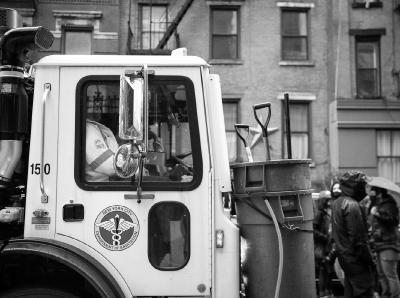
COURTESY OF @INSTA_DSNY
The Department of Sanitation has responded ineffectively to recent storms.
Ozempic Craze Marks a Health Care and Cultural Crisis
By JAYLIN SELDON CONTRIBUTING WRITER
In regard to the proliferation of GLP-1 agonists being pushed as weight loss drugs, I advise us not to direct anger at the substance itself, but at the misuse of it and the cultural force guiding it. To create this nuance, it is wise we first discuss diabetes — perhaps the most well-known, yet still misunderstood disease in the world.
Diabetes is no joke, schoolhouse insult or throw-away synonym for when you want to call someone fat. Diabetes is a killer. A prolific killer that claims millions of people globally every year, and of that number, many will die without ever knowing they had the disease. It is known as the silent disease, as it can creep up on you. Diabetes is
also, unfortunately, a highly politicized disease. Deeply ingrained in the public psyche is the belief that diabetes is a disease of the poor, fat and societal other.
Historically, diabetes has been known as Judenkrankheit, or “the Jewish Disease,” in 20th century Germany. Additionally, a relevant American example is diabetes being heavily associated with Black, Brown and Indigenous people; the nation’s poorest communities who notably also suffer with obesity issues, which is indeed linked to higher rates of diabetes. It is no shocker that when society envisions someone suffering from diabetes they aren’t picturing a white woman living in Tribeca; they’re likely picturing one of the many residents of America’s dilapidated slums.
Despite this politicalization,

great efforts have been made to advance the treatment of the disease, especially Type 2 diabetes. The most notable is GLP-1 receptor agonists such as Semaglutide, Exenatide and Dulaglutide all aimed to regulate blood sugar in the body. Unfamiliar with any of these? Well, I’m sure you’re familiar with one of Semaglutide’s brand names: Ozempic.
Ozempic is primarily a diabetes medication, but alongside Ozempic is Wegovy, a Semaglutide brand used instead for weight loss. This is due to the fact that GLP-1 agonists also have the effect of reducing one’s appetite. Now, none of this is bad on its own. As mentioned before, obesity is linked to diabetes and losing weight is a hard task that isn’t as simple as just exercising or eating less. There are real mental and physical aspects that prevent someone from losing weight — diabetes itself being one of them. These drugs have changed lives for the better and have made “The Silent Killer” a manageable, livable disease in the same way Antiretroviral Therapy has made HIV not the death sentence it once was.
So why are people who don’t need these drugs taking them? It’s quite odd to be taking such a crucial drug from those who need it; it’d be like taking a loaf of bread from a hungry child.
Those who turn to stimulant addiction despite not having any form of attention deficiency disorder largely do so due to a need to keep up with an increasingly fast-paced and demanding society. There’s a reason it is abused largely on college campuses and professional sectors; the workaholic nature and emphasis on a need for never-ending productivity of modern society indirectly breeds this behavior in people. It is far easier to overemphasize the social uses than it is to question why we have cultivated a culture that views humans as hamsters. The same rationale exists for those who find themselves drawn to abuse drugs like Ozempic and its equivalents when they do not need them. There is a similar pressure for one to conform to beauty standards — prestige, beauty, perceived moral superiority and general importance are thought to be gained the farther people get from “fatness.”
Think: How often have you heard someone use one’s weight as an insult? How often have you noticed certain aspects of life such as plane seats, desks and clothing seem to favor certain figures? It’s a blessing to just walk in and seamlessly slip in, isn’t it?
It is no wonder, then, why people often feel the need to lose weight by any means necessary. This is the natural result of a society that
asks, “Isn’t it awful to feel this way?”
However, it’s not your fault: you’ve been conditioned by a society that demonizes anything outside its norm of perfection. Pushing cure after cure to cleanse your so-called disease, once even encouraging you to destroy yourself to meet the standard — remember the “coke” era of modelling? It’s truly culturally-induced psychosis, hysteria at the thought of being anything but “ideal.” It’d be easy to tell you not to listen, but that’d be unrealistic with the ads these companies run being plastered all over social media and even public transit. Take, for example, how celebrities champion their usage and flaunt their new bodies.
It is not enough to “dislike” the way these companies such as Ro, Hims and Hers have turned this essential medicine into another instrument in the world’s crusade against undesirables. It is crucial one takes a moment to reflect on wider society and on themselves to recognize these companies aren’t just selling to an invisible buyer. We’ve built a culture of hate, one that will take more to overturn than just disavowing the companies profiting off of it.
Why Not All Fordham Students Choose a Semester Abroad
By KATE HERBERT CONTRIBUTING WRITER
During the past few weeks, campus has been buzzing with talk about study abroad, as acceptance emails roll in. At the same time, current juniors are studying abroad right now, posting on social media and enjoying the start of their semester. According to Fordham’s website and the 2025 IIE Open Doors Report, over 50% of Fordham undergraduate students study abroad. But what about the other 50%?
Because of the glamor and excitement of traveling and studying in another country, it’s easy to feel like you have to study abroad in order to have a successful college experience. Often, adults in my life have talked about how much they regret not studying abroad, but, at the same time, many students deliberately choose not to go abroad and instead to remain at Fordham for all four of their college years. This half of Fordham students are not simply a shadow of those who do study abroad.
“If I had left for a semester, I wouldn’t have been able to gain the experience for the leadership roles I now take on,” said Sean Surovsky, FCRH ’27. Surovsky is very active on campus, taking part in groups such as the Campus Activities
Board, Free Pizza Sketch Comedy, Orientation and the Senior Week Committee. He is the current captain of Sketch, a role he wouldn’t have been able to accept if he was away from campus for a semester or longer.
Surovsky chose to take part in Fordham’s “Documentary Photography” program in Rome where he was able to study in Italy for a month over the summer break. Many students take advantage of Fordham’s summer programs or independent study programs to get a taste of studying abroad outside of the traditional semesters abroad. “I realized that I only have four years in New York City, especially because I might never live here again,” said Surovsky. “I’d rather maximize my time here.”
Similarly, Clare Cummings, FCRH ’26, the president of the Ampersand literary magazine, reflected on her reasons for choosing not to study abroad. “I chose to be an English major at Fordham University in New York City,” she stated. She had considered attending Fordham London at one point but eventually decided against it because of her love for Ampersand. “I really wanted to lead the club,” she said. Due to their roles, the president and vice president of Ampersand are unable to
study abroad during their term because their presence is required at every meeting.
Sophie Maselli, FCRH ’26, the vice president of Ampersand and former production editor of The Ram, agreed with Cummings. From the beginning of her first-year, she knew she wanted to be on the staff of The Ram. Like many leadership roles, being on the staff of The Ram requires in person collaboration. “Another one of my goals was to get an internship,” Maselli added. Though one can obtain an internship and study abroad, it’s a lot harder when a chunk of your college experience isn’t in New York City.
As Maselli and Cummings approach the end of their time at Fordham, I asked if either of them regretted not studying abroad. Almost immediately, Cummings responded, “No. I loved leading Ampersand.” For Cummings, the connections she made through Ampersand and Black Sheep Poetry never made her feel like she was missing out as one half of her peers studied abroad. “It definitely would’ve been a great experience and I do think you learn a lot about yourself by studying abroad, but I don’t regret not going,” she said. She also added that for her, London would always be there, but her time at
Fordham wouldn’t be.
Maselli agreed and mentioned her experience at the recent Ampersand retreat to the Fordham Goshen house. “Going on the Ampersand retreat and spending a weekend with people I don’t usually hang out with almost felt like a mini study abroad experience,” she said. Fordham offers many similar retreats throughout each semester and also offers “Study Tour” classes. These classes are structured around a specific country or city’s culture and then include a week long trip to said city during spring break.
For Surovsky, Cummings and
Maselli, choosing not to study abroad for a semester wasn’t a difficult decision. The opportunities and connections with both their peers and New York as a whole were well worth sticking around. The good news is that no matter which path you chose, you will be surrounded by unique opportunities and communities to make your four years at Fordham special, whether that is remaining in the city or traveling abroad.
Herbert,
is an English and German literature/language double major from Baltimore, Maryland.
The rise of Ozempic signals alarm for both health care and culture.
COURTESY OF PREMIERE MEDICAL CENTER
Jaylin Seldon, FCRH ’27, is a philosophy major from Harlem, New York.
Kate
FCRH ’28,
Those who choose not to study abroad experience no shortage of memories.
HANNAH SULLIVAN/THE FORDHAM RAM
By EMMA KELNER EXEC. COPY EDITOR
You can’t really go anywhere. The ground is covered in snow and ice and the temperature is well below freezing. This is the perfect opportunity to get ahead on some homework, yet many college students still can’t fully focus.
Well, my lovely readers, that’s what I like to call the “winter blues.” No, it’s not a super-hip jazz tune; it’s a term for the feeling of lethargy that overtakes you in the winter months. I, too, suffer from the occasional lapse in my desire to be productive. While this is a completely normal reaction to wintertime, I know that we can rise above it!
Of course, that is easier said than done: As humans, our bodies react strongly to the natural world around us. Our circadian rhythms, or our innate sleep schedules, rely on cues from the sun. Your pineal gland relies on sunlight levels to regulate your body’s melatonin, or “sleep” hormone, concentrations. This means that as the sun sets, your pineal gland gets to work making melatonin. This is then shipped out to your hypothalamus, and once it receives the message, it begins its nighttime preparations. Your body temperature and blood pressure drop and you start feeling
How To Beat the Winter Blues
calmer. Melatonin doesn’t stop there: It also makes your retinas less responsive to light, helping you wind down and feel less alert. This reliance on the sun doesn’t always work in our favor. In the summer, the sun rises early in the morning and sets late in the evening, so our pineal glands don’t start producing excess melatonin until much later in the day. As a result, we feel energized almost the whole day. During the winter, however, the sun rises later and sets earlier, so our pineal glands have no choice but to begin this process much earlier in the day. That’s why, during the winter, we feel exhausted the second the clock hits 6 p.m.
This exhaustion makes things difficult. Normally, if your body is telling you to rest, I’d recommend winding down and enjoying a quiet evening in. But resting after 6 p.m. every day is a little excessive, especially when you have extensive assignments to submit, dense academic prose to read and long essays to write. This may seem hopeless, but it’s not! I swear! I’ve done my research and I’ve compiled a list of tips and tricks you can implement whenever the winter blues stop by and say hi.
First, you can go outside. I know, I know, it’s cold and icy and windy and just
generally terrible outside. But sunlight, especially in the morning, can help control your brain’s internal clock and increase production of serotonin, your body’s natural “feel good” chemical.
If you want to get really crazy, try exercising! Exercise has been proven to boost brain functions and improve sleep as well as reduce the risk of cognitive decline, certain cancers, heart disease and diabetes. I mean, it doesn’t get any better than that! I understand that going to the gym, especially one on campus, can feel awkward and a little frightening, but once you start looking — and focusing — like Arnold Schwarzenegger, you’ll thank me!
Second, eat winter foods. By that, I mean two things: one, eat foods that are in season. Foods that are in season typically contain more nutrients than foods that are not in season, and eating seasonally ensures you get a variety of foods throughout the year. Perhaps most importantly, eating foods in season is usually cheaper than eating those that have to be flown in from elsewhere.
Two, eat warm foods. I love Dunkin’s iced drinks as much as anybody — perhaps more — but winter is a time to drink warm beverages, like hot teas and coffees, and eat warm foods, like soups and
hot sandwiches. My personal recommendation is a grilled cheese sandwich with a tomato soup dipper from Freshens, but eat it sporadically, as it unfortunately has little to no actual nutritional value.
Last but not least, sleep. It may seem counterintuitive to productivity, but sleeping a little more will help you feel more energized during the day. Studies show that people need more sleep in winter than in summer. At St. Hedwig Hospital in Berlin, scientists found that patients slept about an hour longer in winter than in summer. Not only that, but participants in the study also got 30 more minutes of rapid eye movement (REM) sleep in the winter than they did in the summer — and more REM sleep has benefits that will last the whole season as well as your entire life,
including improved learning, better mood regulation, faster brain development and protection against dementia. By making time to go outside, eating well and giving yourself time to sleep, you too can embrace these winter months ahead. So bundle up, go for a walk, eat a warm grilled cheese sandwich and get your rest; with these tips, you’ll be ready not just to stay awake in class, but also to submit all your homework days in advance (but don’t hold me to that). When in doubt, just remember what my elementary school principal said on the loudspeaker whenever it was applicable: “It may be snowing outside, but it’s always sunny inside!”

Movies Deserve The Silver Screen
By EMILY MCCALL PHOTO EDITOR
The lights dimming, the smell of popcorn in the air, the screen reflecting back against watchers’ eyes, a certain stillness that is rare in such a large crowd. As you sit, clutching your fountain drink and candies that were snuck in past security, a wave of anticipation and excitement passes over you. Inching closer to the edge of your seat, you wait for that perfect moment when, after all the advertisements and trailers have come and gone, finally the title screen appears before your eyes and you can sit back and enjoy the film alongside all the other moviegoers.
Except that isn’t the case at all. Instead, you sit atop your bed surfing streaming sites looking for something, anything that peaks your interest. When you finally do, your roommate is back and you have to put on headphones, but now the WiFi is down and your laptop is basically running on fumes with all the homework tabs you left open. Whatever happened to the excitement of actually going out to see a film on the “big screen?”
Recently, moviemaking seems to be at an all time high With
films like “Sinners,” “Superman,” “Avatar: Fire and Ash” and “Marty Supreme,” the beauty and art of actually going to the theater is back on the rise. Being able to see films like these on the big screen with surround sound allows viewers to feel as if they are truly in the movies. They feel with the characters, flinch at the jumpscares and witness the cinematography up close. Not just that, but it is a shared moment of community between strangers united only by their desire to watch a movie. A third space, if you will. So why then, with all they have to offer, would people still rather choose to watch a movie on their phone or computer once it becomes available for streaming? The simple answer is cost.
Movie ticket prices can range anywhere from $10 to $25 and, living in New York City, we rest on the higher end of that scale. In comparison, a standard subscription to Netflix is $17.99 per month. It becomes a question of if you would rather spend $17 to watch one movie one time or just a dollar extra to watch thousands of movies and television shows anytime you want. The answer is obvious, right? I mean Netflix users
got to watch Guillermo del Toro’s “Frankenstein” the second it was released, without the added hassle of buying tickets and driving over to the theater. It seems utterly perfect for any film fanatic. But to be completely honest, as an amateur film watcher, all I could think about when watching this hauntingly beautiful adaptation of Mary Shelley’s work was that it would be such a good movie for the theaters.
Again, though, as a college student who is constantly budgeting, it is unrealistic to want to see every new movie in the theaters as intended. It is a complex dilemma of wanting to support theaters and take part in movie theater culture while also understanding that these prices are unattainable, and for many, a rare experience. Having actors and directors push the narrative of saving movie theaters and stepping away from streaming services is admirable and makes sense when considering these films as an art form; there is a big difference between going to a museum to see a piece of art versus looking up a photo. Yet all of the celebrities emphasizing this return are not worried about
the absurd ticket prices.
The solution I have come to is to make the “movie theater experience” myself. Gather up my friends, set up a projector and do anything that isn’t just watching a movie alone on my tiny phone screen. One of my most treasured memories since starting at Fordham actually was from going out and seeing a movie with my friends: the CAB showing of “The Devil Wears Prada” our first weekend at school. Everyone gathered on the lawn sharing snacks and stories from our first week of classes. It really showed me just how
important community is and how a showing of a single movie can have such an impact.
The feeling of the theater can be replicated even without the expensive price tag through spending time with others and really immersing oneself in the film, not just watching the scenes flicker by. Of course, every once in a while when a really exciting movie comes out it is fun to go back to the good old-fashioned cinemas.
Students gather on Edward’s Parade for a CAB hosted movie night.
EMILY MCCALL/THE FORDHAM RAM
Emma Kelner, FCLC ’29, is an economics major from Staten Island, New York.
Emily McCall, FCRH ’29, is a journalism major from Scotch Plains, New Jersey.
WILSON SPELLER/THE FORDHAM RAM
The winter blues can come from our daily routines, but they are reversible.
Bad Bunny’s Halftime Perfomance Was a Celebration of Love
By DOVE AJMANI STAFF WRITER
My roommates and I were eagerly waiting for the halftime show to start. We had been talking about this show for months, and it was finally here. And we weren’t the only ones on the edge of our seats: Over 135 million people tuned in to see Bad Bunny’s Super Bowl LX halftime show Sunday night, breaking the existing viewership record for the Super Bowl. From the choreography to the cinematography, each aspect of the show worked in harmony, crafting a performance that captivated viewers both visually and emotionally.
The performance was very narrative-focused, cohesively
unfolding across multiple sets that moved from the history of sugarcane fields, barbershops and boxing rings to a wedding altar, with every detail deliberately planned and each element adding deeper meaning to the storytelling.
The set opened with the Puerto Rican superstar paying homage to the ancestral roots of cane cutters who once worked in the island’s sugar fields, illustrating the realities of their labor. As Bad Bunny moved through the crowd, the football gently cradled in his arms introduced the larger political message that ran through his performance.
Bad Bunny even had many household Latin names dancing in La Casita. As the camera panned to each of them, my

By NORA MALONE EDITOR-IN-CHIEF EMERITUS
On my second night in Dublin (my first not spent sleeping off jet lag), I found myself surrounded by people speaking French. A Parisian, a Canadian, a Puerto Rican and a Minnesotan, all discussing accents. I, notably, do not speak French, and realized that as I sat at that dining table, I was having a quintessential study abroad experience, just not one I had been expecting.
While Ireland does have two official languages, most people primarily speak English rather than Irish. I knew this going in, and, as someone who is regrettably monolingual, it was a significant factor in my study abroad decision, alongside my fascination with old castles.
There are plenty of experiences I have had thus far that I expected. Learning a new transit system, figuring out where my classes were, exploring the city and trying (and failing) to split the G. These are the kinds of study abroad experiences everyone talks about and for good reason. I love Dublin. I love walking around and finding new cafes and thrift stores, standing in a circle on Grafton Street with a group of
roommates started yelling from out of the apartment, screams of “Oh my God, that is Cardi B!” “Look, it’s Pedro Pascal!” and my personal favorite, “Shut up. That is THE Jessica Alba!”
There was a huge emphasis on love and celebration of being human. A real couple took the stage and exchanged their wedding vows, with Bad Bunny and all of America serving as witnesses. The moment was filled with joy and abundance. Bad Bunny didn’t stop his personal touches there; he included subtle cultural touches, though some scenes, like the little boy dozing off in a chair, felt familiar to everyone.
Saying my whole dorm was shocked when Lady Gaga emerged is an understatement: we were baffled. However, her role revealed layers of symbolism and added depth to the performance. Gaga was wearing a beautiful blue dress as a nod to Puerto Rico’s national flower, showing she’s trying to embrace culture as a white woman.
Singing a rendition of her famous song “Die With a Smile,” with a salsa beat and dancing the night away with Bad Bunny, Gaga showed that embracing and honoring one another’s cultures is possible, and it was a truly beautiful sight. She served as a kind of spokesperson for the halftime
show, proving that Bunny’s all-Spanish set did not require any English to enjoy and appreciate.
While many celebrated Bad Bunny’s performance, Turning Point USA, a conservative political group, launched its own version of the halftime show, promising viewers that it would be entirely in English. Their halftime show drew in six million viewers. Where one performance celebrated love, culture and what it means to be human, the other focused on separating cultures and being against one another.
Close to the end of his set, Bad Bunny switched to English to say “God Bless America,” as he started naming countries like Chile, Colombia, The Dominican Republic, Argentina, Mexico, the United States, Canada and Puerto Rico, as dancers carried flags from nations across the Americas. I remember one of my roommates at the edge of her seat, waiting for Cuba to be called and screaming from excitement when it was; this moment perfectly captured what cultural reputation means. For her and so many others, seeing themselves represented on such a national stage wasn’t just amazing — it was affirming. It acted as a reminder that identity and heritage belong in the spotlight.
The jumbotron flashed: “The
No, I Didn’t Split the G
people I only met two weeks ago and even sharing a spice bag at 2 a.m. I love doing “Irish” stuff and learning about the culture.
But through that, I have somehow experienced dozens of different cultures. I have talked about “leverkaas” with an Austrian, been lectured on coffee by an Italian, learned about Cooper Pedy from an Australian and I even had a debate about the so-called “Montreal bagel” with a Canadian (don’t worry, New York bagel, I would never betray you). Despite remaining in Ireland, I feel like I have traveled the world through the people I’ve met. In all my preparation and research about studying abroad, I forgot about the most important thing: I’m not alone.
I knew conceptually that I would meet other study abroad students, but, rather close-mindedly, I did not consider how many there would be, or from how many places. University College Dublin is a massive university, with a huge population of international students, and study abroad students are no exception. There were at least 200 people at the various orientation events I attended my first week here, and that
was only a fraction of the total number of students. I have met more people than I can count, and it’s all a blur of Instagram handles and small talk. But it’s been the best part of my experience here.
The goal of all study abroad students is to experience more of the world. Whether they spend most of their time at their home base or jet off to a new country every weekend, they want to expand their horizons. I am much the same. When I make my return to New York this May, I want to feel different. But there’s more than one way to do that.
So I plan to travel, to explore as much of Ireland as I can, to get to know this country well and to do all those things alongside new people I never would have met otherwise. I want to experience new things with people from all over the world, because then I get to understand the experience from two perspectives. Seeing live Irish music in a pub is invigorating, but so is hearing about how it compares to the street music in Brussels from a Bruxellois.
When studying abroad, take advantage of not only the country you’re in, but the people you’re in it with. Meet new people and explore new places
only thing more powerful than hate is love.” And the icing on top, Bad Bunny revealed the writing on the football he was carrying, which read, “Together. We Are America.”
He spiked the football and my apartment was at a loss for words, still in awe of the beauty of the homage. The camera panned to the football, which was beautiful, and, of course, everyone was hyped for the closing song, “DtMF.” If people in my dorm weren’t dancing already, this was what finally did it.
Not only did Bad Bunny make history as the first solo Spanish-language Latino performer, but this was also a powerful delivery in the political climate. The use of music is political, but the amount of cultural pride and recognition shown in such a delicate and beautiful way was moving. While his performance choice has sparked division since its announcement, Bad Bunny didn’t appear to take any negativity to heart, instead using his platform to send a message of love and unity. He threw a party so good, so joyful and so alive that everyone was dancing by the end of his performance. He successfully reminded 135 million viewers that “America” is made up of the people and love surrounding all of us.
together — your perspective will change more than you thought possible. And, if you’re lucky, you might teach them a thing or two. Plus, when you’re on a pub
quiz team with a Swiss person and a Spaniard, and the question is “Albany is the capital of which U.S. state?” you’ll find that the knowledge and experience you bring is just as important.
Bad Bunny waves the Puerto Rican flag during his halftime performance.
COURTESY OF BBC
The Corner of O’Neills Pub & Kitchen in Dublin.
NORA MALONE FOR THE FORDHAM RAM
A Love Letter to Yourself: Solo Dates in NYC
By KELLY BUBAN CONTRIBUTING WRITER
Although it is the shortest month of the year, February is packed with pink, red, chocolate, snow storms and so much love. By the time Valentine’s Day itself rolls around, the world has split itself into two groups: those who get to have romantic dates, and the rest of us who lean into the “Galentine’s” Day aspect and make plans with friends. But hidden in plain sight is the arguably better option: a solo date. There is no need for reserving tables, coordinating plans and schedules or compromising on where to eat, and you are able to buy yourself flowers. Just you, New York City and the rare luxury of having a
weekend to do exactly what you want. With its endless museums, neighborhoods, restaurants and more, it may be the best place in the world to take yourself out.
If you’re like me, finding a new place for a sweet treat is always important.
Birdie’s Frozen Yogurt, a new establishment tucked away in the West Village, is the perfect spot. With its top notch customer service, quality frozen yogurt, house-made toppings and scoops of your own Swedish candy, Birdie’s gives you the opportunity to grab a cup, sit down and forget about how cold it is outside.
For a solo date for when you are in the mood to learn something new, head to the New York Public Library (NYPL). The Polonsky
Exhibition of The New York Public Library’s Treasures offers a deep dive into the institution’s artifacts, from the original Winnie the Pooh collection to a baseball signed in 1948 by Jackie Robinson to a Capitol Records award presented by Nat King Cole. Also at the NYPL is the “A Century of The New York” exhibit, which is centered around the magazine’s evolution and cultural impact, displaying original copies of their most famous editions, an original copy of Jamaica Kincaid’s short story “Girl” and a handedited manuscript of Truman Capote’s “In Cold Blood.” Both exhibitions are free, which gives you the chance to take your time, move at your own pace and settle into one of the library’s quiet corners before wrapping up at the gift shop.
For a classic bite, few places still embody old-school New York charm like J.G. Melon on the Upper East Side does. The menu is simple with their classic burgers, green and white tablecloths and a jukebox that has remained untouched since its initial opening in 1972. J.G. Melon provides customers with the quintessential burger experience. As a cash-only establishment that doesn’t take reservations, J.G. Melon is a place for a solo date where you can order a delicious burger, sit in simplicity and remember that sometimes the best solo dates are the ones
that don’t take too much effort to be happy.
For some uninterrupted time, wandering through a new museum is the perfect solo date. The Metropolitan Museum of Art (the MET) is a classic for a reason. Drift through familiar galleries, or explore an entirely new one. Without company, there is no need to rush past a painting you love or explain why you don’t care for another. Going to the MET solo gives you the opportunity to skip a checklist of art to see and to have a more relaxing experience. Downtown, the Whitney Museum of American Art is offering a new exhibit and experience called “High Wire: Calder’s Circus at 100.” The exhibition centers on Alexander Calder’s “Circus,” a miniature spectacle he began creating in Paris back in 1926. Crafted from wire, fabric, cork and string, the figures come alive through movement and performance. This exhibit reminds you that art doesn’t always have to be monumental or well-known to be meaningful.
Solo dates can also always be successful without a plan and wandering the East Village is perfect for this. On Bowery Street, you can visit Bonnie Slotnick Cookbooks, a treasure trove of vintage and used cookbooks, making it a perfect spot for anyone who loves cooking or just food in general. Just down the street, the John
Derian Company unfolds like three stores in one, with paper goods, knickknacks, linens, cake candles and any other objects you didn’t know you needed. Shopping solo allows you to linger for a bit longer and discover things you might not otherwise find.
As a true believer that breakfast is the best meal of the day, Bubby’s in Lower Manhattan is the perfect place for a solo breakfast date. There is something deeply affirming that comes with ordering two different breakfasts just for one simply because you can’t decide between the pancake flight and biscuits and gravy. Definitely get there early, as with an 8 a.m. opening, a line will form by 8:30 a.m. Cap off this solo date day at Westside Rare and Used Books on the Upper West Side. The narrow aisles and floor-to-ceiling shelves encourage slow browsing where you can read the blurb of any interesting book you see. Whether you leave with a first edition or a dog-eared paperback, a new book for Valentine’s Day is always the best gift one can give themselves, in my opinion. In 2026, Valentine’s Day doesn’t have to be about roses or romantic dinners. It can be about choosing yourself, wandering freely and finding pleasure in enjoying your own company. After all, New York City will always be ready whenever you are!
In ‘Hamnet,’ Shakespeare Isn’t Just Reimagined, He is Reborn
By OWEN THEBERGE STAFF WRITER
At the beginning of each new year, the nominations for the various award shows come out, and there’s always a few films that seem to top every list with nominations in every major category. Among blockbusters this year, such as “Bugonia,” “Marty Supreme” and “Sinners,” there was a quieter, smaller-in-scale film that seemed to rank among the best of these criticallyacclaimed films.
The movie “Hamnet,” starring powerhouses Jessie Buckley and Paul Mescal, brings the novel of the same name by Maggie O’Farrell to the big screen, documenting the creation of William Shakespeare’s famous play “Hamlet.” The film details the tragic passing of Shakespeare’s son Hamnet and how he and his wife Agnes process the loss. The film tackles themes of grief, acceptance and what it means to love someone unconditionally; it is beautiful, raw and gutwrenching. Frankly, it’s a masterpiece. Buckley gives a performance of a lifetime as Agnes. She plays a grieving mother so
powerfully, demanding the audience’s full attention with every scene. She wails in anguish but can also step back and allow for somber moments of quietness and stillness. Next to her is Mescal, who also has an incredible performance that blends pentup rage with an aloofness that is both complex and intriguing. These performances are incredible, making me completely believe everything I saw. It made the film even more heartbreaking and excruciating to sit through in the best way.
“Hamnet” doesn’t want you to feel good after watching it. In fact, it wants you to be in pain, drowning in a pool of your own tears. It’s a tough film to watch, with horrifying death and sorrow, but getting through it is incredibly rewarding, especially the film’s final scene, where Agnes watches Shakespeare’s “Hamlet.” The crowd of watchers reaches their hands towards the stage in a united moment of grief as the titular character dies on stage. She realizes that her son lives on through her husband’s play and that it was silly of her to ever think her husband did
not care about Hamnet’s death. It’s a reminder that we can never truly understand how others are feeling, and that we can’t judge people based on how we believe they should act. It’s a stunning final scene that caps off a beautiful movie with stellar acting, scenery and themes.
“Hamnet” isn’t a Hollywood spectacle, nor should it be. It exists in a darker corner than most of the other Oscar nominees, completely content with doing its own thing. It’s a reminder to be patient with each other, love unconditionally and probably make sure to talk to your wife if you’re going to be spending an extended period of time in London writing and producing a play about your late child.

Wall of merch at Birdie’s Frozen Yogurt.
KELLY BUBAN FOR THE FORDHAM RAM
“Hamnet” movie poster featuring Jessie Buckley as Agnes and Paul Mescal as Shakespeare.
The Preordained Pattern of Self-Destruction in ‘Giovanni’s Room’
By CAROLINE LEHMAN EXEC. COPY EDITOR EMERITUS
For their centennial, the Schomburg Center for Research in Black Culture’s Jean Blackwell Hutson Research and Reference Division released a list of 100 books celebrating 100 Black authors curated by some of today’s most celebrated Black writers, artists and luminaries, just in time for Black History Month. The list features many of my personal favorites, including my most recent read: “Giovanni’s Room” by James Baldwin.
Baldwin’s “Giovanni’s Room” centers on a young American man, David, in 1950s Paris.
David navigates a complicated affair with an Italian bartender with a troubled past, Giovanni, while his fiancée, Hella, is traveling in Spain.
The novel is a character study in avoidance and self-sabotage stemming from internalized homophobia, characterized by self-loathing and a lack of acceptance that ultimately hurts lovers, friends and innocent bystanders in the process.
An older gay man named Guillaume owns the gay bar where David is introduced to Giovanni by Jacques, another older, wealthy gay man and friend of his. Both Guillaume and Jacques are known for
pursuing — and in several cases taking advantage of — younger, penniless men.
David and Giovanni become friends and then lovers with David moving into Giovanni’s small, cramped and decrepit bedroom on the outskirts of Paris. The surface-level, outward excuse David gives for the move is monetary while he is simultaneously ignoring his father’s letters from America inquiring into his son’s life in Paris and return plans.
The titular setting for David and Giovanni’s love affair is undoubtedly poetic, operating as a space that permits their love to exist freely. However, it becomes far from flourishing in this conveniently hidden and compartmentalized bedroom that previously belonged to a maid.
Unsurprisingly, in his ongoing self-sabotage, David alienates everyone and ends up alone.
In a shame spiral fueled by his crippling fear of accepting his sexuality, David abandons Giovanni to return to Hella without giving any notice. In his preparation to do so, he transactionally takes advantage of an insecure woman named Sue.
David’s reckless desertion essentially causes an already vulnerable, damaged Giovanni’s demise. Meanwhile, guilt-ridden David facilitates the undoing of his engagement with Hella by cheating on her with a sailor in the South of France: this time failing to conceal it, thus prompting their breakup and her return to America.
Although David’s carelessness and disregard for the feelings of others are textbook ragebait, Baldwin’s portrayal makes it impossible to completely despise him as a character.
Giovanni and David are complex individuals with welldeveloped story arcs that allow readers to simultaneously reproach the characters’ selfish and self-centered nature while also feeling sympathy and pity for them.
The novel offers a gutwrenching conclusion with David completely isolated and still in denial, though at least somewhat aware of his devastating impact on Giovanni and others.
Baldwin’s imaginative style of storytelling comes together beautifully with a sense of morbid curiosity. Readers know early on how the novel may end and get a sense of David’s predictable pattern of disastrous, self-inflicted harm almost immediately.
The two are kindred spirits and soulmates in more ways than one. Giovanni shares a similar inherent propensity for self-sabotage to David, though his execution of it manifests quite differently.
Despite this, the reader can’t help but rubberneck and bear witness to the story — a testament to the eloquence of Baldwin’s prose. His ability to capture the nuances of the human psyche and the universal experience of unknowingly engaging with self-destructive behavior forces readers to empathize with these characters.
Setting aside intentional time in February to learn more about Black history and the contributions of Black trailblazers across every industry is a great way to honor and be a more active participant in Black History Month, but it should not be isolated to just 28 days out of the year.
Supporting and uplifting Black authors, musicians, filmmakers, performers, creators, actors, athletes and more is important for exposing yourself to diverse perspectives year-round.
If you are looking to read more Black literature, Schomburg’s list is an excellent starting point, and it has something for everyone.
Alice Walker’s “The Color Purple,” Zora Neale Hurston’s “Their Eyes Were Watching God” and Maya Angelou’s “I Know Why the Caged Bird Sings” are three more of my favorites from the list.
All of these are written by women and feature female protagonists who encounter adversity and grapple with patriarchal struggles, before later finding self-assurance, confidence, independence and empowerment through their individual, uplifting journeys. Don’t think you could finish all three in February? No worries, because these picks are the perfect segue into celebrating next month: Women’s History Month.
Whether you choose to read Ta-Nehisi Coates, Toni Morrison or Angela Y. Davis, every voice on Schomburg’s list is worth exploring.
Concrete Jungle Blooms at the New York Botanical Garden
By ONJALI GOMEZ CONTRIBUTING WRITER
Masked and mysterious, Mr. Flower Fantastic creates striking works that transform nature into storytelling architecture and curates immersive environments that feel both imaginative and deeply familiar. In his latest exhibition, orchids take center stage, not simply as flowers, but as a medium for memory, identity and place.
Now on display at the New York Botanical Garden (NYBG), “The Orchid Show: Mr. Flower Fantastic’s Concrete Jungle” reimagines everyday city spaces through abundant floral design. Inside the galleries are lifesized orchid-built structures: pizza shops, brownstones, car washes, laundromats, subway platforms, fire escapes, steam ducts and bus stops. The exhibition is both a tribute to New York City’s spirit and a celebration of the orchid’s versatility and beauty.
Walking through the exhibit feels like entering a dreamlike version of the city. My selfguided journey was through NYBG’s Haupt Conservatory, where I first encountered a familiar brownstone. Except, this one was painted black and
blooming with orchids. As Mr. Flower Fantastic said, “When you look at the brownstone and it’s painted black … it can be anyone’s home. It’s everyone’s home.” That theme of a shared experience runs throughout the exhibition.
What truly brings “Concrete Jungle” to life is its attention to detail. As you pass major installations like the car wash or pizza shop, smaller moments quietly capture your attention: a dumpster overflowing not with trash, but with cascading white orchids. These subtle choices blur the line between grit and beauty, reminding viewers that nature thrives even in overlooked spaces.
The exhibit also encourages learning among its viewers. Visitors can choose to simply take in the vibrant colors or slow down and engage with the educational elements that are placed throughout the gallery. Informational signs introduce orchid varieties such as Spathoglottis — grounddwelling orchids native to marshy regions of Australia and Southeast Asia, Paphiopedilum, known for its rich spotting, the playful Dancing Lady Orchid and many others.
One of the most immersive learning areas is the laundromat installation where eight washing machines respectively contain a miniature orchid world. On each machine is a barcode stating the price of a wash, and when you scan the barcode, it gives you information to learn more about the orchid.
“Each one of the places … have been magical moments in my life,” Mr. Flower Fantastic added. “This show shines a light on spaces and places that might get overlooked. There’s a beautiful chaos in the concrete jungle, and life in bloom. This show is my offering to you, a seed to plant in people’s hearts and minds.”
“The Orchid Show: Mr. Flower Fantastic’s Concrete Jungle” runs from Feb. 7 through April 26. Additionally, the NYBG will host Orchid Nights on select dates from March 21 to April 25. During these after-hours events, the lights dim, the music turns up and visitors can dance among the glowing blooms to April Hunt and Mixtape DJ sets.
“Concrete Jungle” invites us to look closer, find beauty in the everyday and reconnect with nature in the heart of the city.
Book cover of “Giovanni’s Room” by James Baldwin.
COURTESY OF NYPL
Example of one of Mr. Flower Fantastic’s orchid displays. ONJALI GOMEZ FOR THE FORDHAM RAM
I Am Finally Breathing the Same Air as Harry Styles
By EMILY MITTON EXEC. COPY EDITOR
If anybody who knows me is reading this, it will come as no surprise that I have taken this opportunity to speak with great adulation about Harry Styles. While Styles might be known simply as the “Watermelon Sugar” singer to many, to me he is a pillar marking the various eras of my life.
One of the first real memories I have is listening to One Direction’s “Up All Night” debut album with my sister in her bedroom. I was 3-yearsold when One Direction was formed, so as my sister quickly jumped on the “Directioner” bandwagon, I naturally followed. Up until the tragic, permanent hiatus announced in 2016, my sister and I would excitedly wait for a new album, tour, movie or interview to come out so that we could enjoy the band’s music together. While One Direction is not what Styles is solely known for today, I will always think of him as the member of a band that my sister and I love(d) so dearly.
Styles is at the scene of the crime for the first major encounters with emotions that I have felt in my life, particularly jealousy, sadness and adoration. I know for a fact that the first
‘Chicago’
By JACQUI LYSON CONTRIBUTING WRITER
time I ever felt true jealousy was when my sister received One Direction concert tickets for her birthday one year and I did not. Looking back now, I definitely don’t think that it would have been proper to send an 8-year-old to a concert with a bunch of teenagers. Even so, I could not feel anything but pure jealousy knowing that my sister was going to breathe the same air as One Direction and I was not.
Moving to sadness, I felt great despair in my preteen years when I realized that I would never have a chance with Styles, but nothing can compare to the devastation I felt when One Direction’s hiatus (break-up) was announced. At first I was confused as to why my sister said that they were taking a break, but as more time passed, my confusion turned to sadness. What was I to do without One Direction dropping new albums every year?
However, time moved on, and I grew up as each band member began their solo career, bringing me to adoration. While I followed (and still do follow) each member’s present career, I formed the greatest fixation with Styles, both musically and in terms of looks. From his catchy lyrics to his perfect
hair, what else was 12-yearold me to do but plaster my room with his face and watch edits of him on TikTok?
Styles didn’t just influence my developing years — he is also a fundamental reason as to why my best friend and I are as close as we are now.
I was still riding the high of Styles’ third studio album “Harry’s House” released in early 2022, when we met in our sophomore year of high school. After being sat next to each other in our British Literature class, she discovered my love for Styles early on, likely because I brought him up within our first conversation (shocker). I distinctly remember discussing our rankings for his three albums — “Harry Styles,” “Fine Line” then “Harry’s House” — and immediately respecting her when she agreed that while all three are good, “Harry Styles” is the best. I shared with her my dismay that, yet again, my sister attended Styles’ concert at the time and, again, I did not go. We still connect over Styles as an artist, recently calling each other to discuss — or more accurately, freak out — about his recent release of the song “Aperture,” announcement of his fourth album “Kiss All The Time. Disco, Occasionally” and his new tour, “Together, Together.”
As Styles has grown into a well-established solo artist, selling out arenas and stadiums around the world, he has given me not just music, but also some of the best relationships of my life. While I am excited to see what else Styles has to offer the world as an artist, I am equally excited to see what else he will coincidentally
influence in my life.
As a first-year in college, I may not be as easily recognizable as a “Harrie,” but just know that you will likely hear about him if after a few conversations.
And yes, I will be at Madison Square Garden on Oct. 3 at the “Together, Together” tour with my sister to finally breathe the same air as him together.
is Still Killer: Whitney Levitt Dazzles as Roxie Hart
“Chicago” continues to razzledazzle at the Ambassador Theatre with Whitney Levitt joining the cast as Roxie Hart from Feb. 2 to March 15.
Directed by Walter Bobbie and music by John Kander, this musical production, set in the 1920s, follows the story of two rival murderesses, Roxie Hart (Levitt) and Velma Kelly (Sophie Carmen-Jones), as they compete for fame and acquittal.
Having already seen the movie adaptation of “Chicago,” and loving the soundtrack, I always wanted to see it live on Broadway. When I learned Levitt (whom I am a fan of), was joining the cast, I knew it was the perfect time to do so.
From the reality TV show “Secret Lives of Mormon Wives” to season 34 of “Dancing with the Stars,” Levitt has risen to fame in recent years, landing her a role in the longest-running American musical in Broadway history.
“Chicago” has a tradition of celebrity casting notable names, such as Pamela Anderson and Lisa Rinna stepping into Roxie Hart’s heels. With its 29th year on Broadway, “Chicago” knows how to stay relevant and keep the production fresh with its unconventional casting tactic.
Stars like Levitt draw new audiences to the theatre but
it’s the immense talent of the cast that makes them stay.
The stunning dance numbers are iconic and immerse the audience into the late 1920s setting in Chicago, Illinois. “Chicago” draws choreography inspirations from 1920s jazz steps and burlesque style moves.
Bob Fosse’s uniquely styled jazz is characterized by turnedin knees, rolled shoulders and the iconic finger snapping. The sleek and sensual choreography of the opening number, “All That Jazz,” immediately sets the stage for the show’s dark elegance and captivating energy.
Each performer’s singing is filled with passion that makes the show unforgettable, especially when paired with outstanding dance numbers.
The performance of “Cell Block Tango,” with its powerful singing and energetic dance choreography, had the audience erupting with applause, making it one of, if not the most, memorable moments of the show.
The cast is incredible, but it would be wrong to not mention a pivotal part in the show: the orchestra. “Chicago” is unlike any other Broadway show as the orchestra is seated on a central structure on the stage, not hidden away. Keeping the orchestra on the stage reinforces the show’s central theme of 1920s jazz club-like entertainment by engaging the audience into the music.
A unique feature in “Chicago” is the stylistic choice of a fourth wall break, making the audience feel involved in the show. I found the stage production particularly compelling as they played into this fourth wall break by involving the orchestra, an aspect of Broadway musicals that is not usually seen. Similarly,
when the ensemble is done with their performance, they sit on chairs off to the side, remaining on stage at all times.
“Chicago” certainly brings “All That Jazz.” From strong performances to unique stage design, “Chicago” is a must-see performance. This show brings a level of entertainment and
glamor that I will remember for a long time. Levitt did not disappoint in her Broadway debut with her strong stage presence and showmanship. Whether you come to the show for the rising star from “Secret Lives of Mormon Wives” or because of your love for theater, you will not be disappointed.
Mitton and Styles posing in front of the same door.
EMILY MITTON/THE FORDHAM RAM
Playbill of “Chicago” featuring Whitney Levitt on the cover.
JACQUI LYSON FOR THE FORDHAM RAM
‘Notes from Underground’: The 1860s Internet Intellectual
By GRIFFIN STRAUSS CONTRIBUTING WRITER
In the age of Reddit intellectuals and X (formerly Twitter) rage-baiters, I couldn’t help but connect the dots of today’s anonymous educated society to the unnamed narrator of Fyodor Dostoevsky’s 1864 masterpiece novella “Notes from Underground.” In his novella, Dostoevsky paints an absurd portrait of an eternal archetype still seen online today: the asocial, educated egoist.
“Notes from Underground” is broken into two parts. Part one (labelled “Underground”) is a manifesto of sorts, written during the narrator’s time “underground” and away from society. It details the narrator’s anti-reason and pro-suffering mentality among many other things. Though occasionally tedious and always ridiculous, “Underground” serves less as a coherent philosophical practice and more as a transcription of the inner workings of a faux-intellectual’s mind.
Part two (labelled “Apropos of the Wet Snow”) acts as a chronicle of events prior to the transcribing of “Underground.”
These events, which include a hilariously petty attempt to bump into a police officer on the street, a dysfunctional dinner party and a lecture to a prostitute on the true nature of love, serve
to highlight how pathetic the narrator truly is. Every small infraction on his ego, whether intellectual or status-related, is equivalent to a punch in the face. One particularly funny moment is a series of blows dealt by the narrator’s elderly servant, Apollon, which mainly consist of him simply existing as a quiet worker and staring at the narrator. With every blank stare, the narrator spirals deeper into a self-conscious whirlwind of humiliation, mainly because the stare serves as an act of defiance against the narrator’s weak attempts at control.
The best moment of the novel comes in the final page when the narrator claims he does not wish to write anymore from “the Underground,” followed by an ellipsis. Below is a note from Dostoevsky to the reader explaining that the narrator couldn’t help but keep writing, but that Dostoevsky will end the book, since it “seems like a good place to stop.” By cutting off the narrator, Dostoevsky gets the last laugh, committing what may be the heaviest blow to the narrator’s ego in the whole book: Dostoevsky shuts the narrator up.
In the two sections, Dostoevsky paints a pitiful, though darkly comedic, picture of the male intellectual-narcissist. Though difficult to read at times due to how embarrassing the narrator’s
attempts to appeal his intelligence to the reader are, I couldn’t put the novella down. On every page I saw something familiar; the narrator is replicated everywhere in 2026. Just open X for five minutes and you’ll see it in every comment section. In the ill-informed posts about world issues that cite studies that do not exist. In the political commentators who pull false statistics from thin air to prove their point. In college classrooms, where the students try to prove their knowledge to the professor, and where the professor demands that he be called “Doctor.”
This intellectual narcissism, which protects the pride of the one spouting off their thoughts at all costs, is as much a virus in 2026 as it seems to have been in 1864, when Dostoevsky wrote his novella. Rather than engaging in intellectual dialogue we try to flaunt our own intelligence by referencing other thinkers, much like the narrator’s frequent invocations of writers and artists like Rousseau or George Sand. Do these quotations and references mean anything to the narrator? Of course not; they serve as proof that the narrator is “educated.” And more frequently than not, they mean nothing to the ones quoting them in 2026. They serve as bulwarks for our intellectual egos. The true brilliance of the novel is in the final page, where
Dostoevsky provides the antidote to this sickness. Just like Dostoevsky himself does to the narrator, the way to solve this issue is to simply cut this intellectual ego out. Dostoevsky literally interjects the novel, calling out the narrator as “paradoxical,” and in just a few lines, puts a stop to the narrator’s nonsense. Dostoevsky forces the reader to close the book on the narrator, making the reader ignore the narrator’s prideful ramblings.
Maybe we need an outside source to hit the brakes on our egos like how Dostoevsky pushed himself into the narrative to halt the narrator’s
absurdity. Or we can act as our own “Dostoevskys” and remove ourselves from our pride, allowing intellectual and personal challenge without being wounded. To do that, we can’t hole ourselves away in an anti-social haven for protection. We need to escape our keyboards and anonymous accounts. We need to confront others honestly and openly with a degree of humility. The narrator of “Notes from Underground” could easily be replaced with an unnamed Instagram account; so take a note from this masterwork, and let yourself be challenged.

Who’s That Kid | Cristina Stefanizzi, FCRH ’27
Inside Cristina Stefanizzi’s Sports Media Arena
By MAKENZIE SMITH CULTURE EDITOR
The biggest moments in sports are not made on the field alone. Creativity, work ethic and a vision strategically work behind the lines and in the stands to elevate the game. Cristina Stefanizzi, FCRH ’27, is the embodiment of this ambition for sports media and brings her A-game every time. Step into her arena and learn exactly what it takes to reach a platform as prestigious as the MLB.
As a political science and new media and digital design double major, Stefanizzi has experience in both written and visual forms of media. She knew from an early age that she would not be one to sit at a desk from 9 a.m. - 5 p.m. everyday, and her majors have given her the opportunity to escape such a fate by exploring different forms of media.
While Stefanizzi has a solid
background in news writing from the Pelham Examiner in high school and The Ram in college, her heart pushes her towards the more visual aspect of the media industry. The junior found that she can capture a lot more through her position as a Fordham University content creator. Her visual work can be seen across multiple platforms, including TikTok, Instagram and Facebook.
“There are certain things you just can’t capture with words,” said Stefanizzi.
Stefanizzi continues to transform her ambition to be even more specialized, as she gravitates more towards sports media due to its air of creativity compared to hard news.
“[Sports] is a very electric environment because it’s just when you go there it kind of feels like nothing else is happening and you’re just in the game,” said Stefanizzi. “I [also] love the
people. I feel like everyone’s really dedicated to what they are doing, whether they are playing or coaching or taking pictures or even behind the scenes running the scoreboards.”
Stefanizzi’s love for sports media was discovered thanks to her first-year orientation leader, Mary Kelly Prosky Gilbert, FCRH ’25.
“She basically started the athletics media department on her own,” said Stefanizzi.
After handling 22 sports teams by herself, Prosky Gilbert eventually recruited more people into the Fordham University athletics department media space, including Stefanizzi. Her ambition and dedication then began to blossom for the industry — so much so that Stefanizzi has yet to miss a football game in all of her three years working for the department.
Stefanizzi’s work as the Fordham Football social media manager and photographer has led to multiple viral moments that currently accumulate to 6.7 million views, 40,000 more followers and a 900% increase in engagement. To anyone else, these statistics are simply numbers, however, Stefanizzi feels gratified and even more motivated to keep going into such a demanding industry.
According to Stefanizzi, content creation can be easily misrepresented as an “easy” industry, but it is much more complex.
“Twenty other people are thinking of doing the same thing, so you want to be the person that comes up with the first,” said Stefanizzi.
Stefanizzi has achieved just that. In August 2025, Stefanizzi created her “Gold Star” video and posted it on TikTok and Instagram Reels. It garnered millions of views and reached multiple other teams, going as far as a recreation appearing on the Carolina Panthers social media.
Stefanizzi’s talent, coupled with a sprinkle of luck, caught the attention of two huge names in the sports world: the New York Islanders and MLB.
According to Stefanizzi, working with the Islander’s Creative Services Team over the summer and working currently as a special project coordinator for MLB “doesn’t feel real.”
Despite all her success, diving into the sports world is not without its challenges just like any other male-dominated industry. The first Wednesday of February brings National Girls & Women in Sports Day (NGWSD) centerfield in order to highlight female achievements, impacts and equality. Fordham participates by hosting a NGWSD youth clinic every year where student athletes and coaches dedicate time to teaching the next generation of young girls in their sport of interest. According to Stefanizzi, it is one of her
favorite days of the year.
“It’s wonderful seeing a bunch of people recognize that in such a male-dominated place, women still have a place,” said Stefanizzi.
The future of Stefanizzi is most definitely bright. She has felt it herself standing in MetLife Stadium during a Giants game in which she accompanied Ramses for a halftime Mascot vs. Kid football game.
“It was a surreal moment because that’s where I want to end up. I want to end up on that NFL field exactly where I was standing,” said Stefanizzi. “So, being able to be there as a junior in college, not even graduated yet, and being able to be so close to where I want to be was absolutely surreal.”
All of Stefanizzi’s accomplishments and talents were difficult to put into words, but her advice for her fellow Fordham students couldn’t be more comprehensive to put wonder in their minds and hearts.
“Have faith in yourself and push forward as much as you can because there is always going to be something trying to stop you,” said Stefanizzi.
As for those hoping to follow in Stefanizzi’s footsteps, she advised that “even though you are not on the field playing, you’re still a part of a great team. You want to uplift your colleagues and encourage people to be their very best self.”
Fyodor Dostoevsky’s “Notes from Underground” was published in 1864.
GRIFFIN STRAUSS FOR THE FORDHAM RAM
Cristina Stefanizzi took photos at the MetLife Stadium.
CRISTINA STEFANIZZI FOR THE FORDHAM RAM
The Quiet Weight of ‘The Great Divide’
By ADISA BALIC CONTRIBUTING WRITER
As an avid fan of Noah Kahan and his music, I had already heard the song that is now known as “The Great Divide” before its official release, which he performed live in concert. Even so, being able to finally hear the song clearly and in its finished form has only increased my appreciation for it. “The Great Divide” is one of those songs that feels emotionally familiar the moment it begins, almost as if it has been sitting quietly in your chest long before you had the language to identify it. From the opening moments, Kahan leans into what he does best: writing about distance, not merely as physical space, but as a slow emotional drift between people who once knew everything about each other. At its core, the song is about separation and self-reckoning. There is a quiet bitterness running throughout, though it never turns into anger. Instead, the tone is one of resignation and reflection. Kahan does not dramatize the divide he sings about; he observes it with a sense of weary honesty. This restraint is what gives the song

its emotional power. Rather than framing distance as a sudden rupture, “The Great Divide” suggests that separation often happens gradually, built through missed opportunities, unspoken needs and emotional hesitation.
One set of lyrics that stands out most is, “I hope you threw a brick right into that stained glass, / I hope you’re with someone who isn’t scared to ask.” These lines capture the complicated mix of resentment and reluctant care that defines the song. The imagery of stained glass is especially
striking. Stained glass often represents something sacred, beautiful and carefully preserved. Wanting it shattered implies a desire to break through appearances and false sanctity, even if it means destruction. The second line reveals a painful self-awareness: a hope that the other person finds someone emotionally braver, someone willing to ask the questions he could not. Rather than placing blame, Kahan turns inward, acknowledging his own limitations with honesty and regret. Musically, “The Great Divide”
mirrors its emotional themes through restraint. The production is subtle and understated, never overpowering the lyrics. This allows Kahan’s voice to remain at the center of the song, carrying its emotional weight with clarity and intimacy. His delivery feels conversational, almost confessional, as if he is thinking out loud rather than performing for listeners. The simplicity of the instrumentation reinforces the song’s reflective nature, giving listeners space to absorb both the lyrics and the
emotions behind them.
The song also fits seamlessly into Kahan’s broader body of work, which frequently explores themes of home, loss, identity and emotional distance. Like many of his songs, “The Great Divide” exists in the quiet spaces between people — where relationships are neither fully broken nor fully intact. It reflects the tension of wanting connection while recognizing that timing, growth or emotional readiness may stand in the way of achieving that.
Ultimately, “The Great Divide” is not about closure: It is about acknowledging distance and learning how to live with what cannot be repaired. It captures the experience of wanting someone to receive what you were unable to give them, even if that realization comes with discomfort. Painful, honest and deeply human, the song exemplifies Kahan’s ability to transform personal reflection into something universally resonant. In sitting with unresolved feelings rather than resolving them, “The Great Divide” reminds listeners that sometimes understanding matters more than finding answers.
The Fordham Ram Crossword - Winter Olympics Edition
Across
5. This spooky-sounding sport has athletes hurtling down an ice track head first.
7. This type of skating is a fan-favorite winter sport for Lightning McQueen.
8. Athletes from this sport are known for what the kids are calling “steeze.”
9. This type of skating is a fan-favorite winter sport for many young ballerinas.
Down
1. These skiers asked the question: What if we took skiing and made it more strenuous and also boring?
2. The host country for this year ’s Olympic Games.
3. Like five across, but feet first instead.
4. Regardless of where you’re from, everybody roots for Jamaica when it comes to this sport.
6. No zamboni needed after players of this sport sweep the ice.
7. Athletes of this sport fling themselves in the air while attached to two long boards.
Noah Kahan recently announced the release fo his new album ‘The Great Divide.’
COURTESY OF THE HOLLYWOOD REPORTER
Varsity Scores & Stats
The Redemption Bowl: Super Bowl LX
By KURT SIPPEL STAFF WRITER
They say that defense wins championships, and the Seattle Seahawks proved just that en route to hoisting their second Vince Lombardi Trophy in Super Bowl LX. Seahawks quarterback Sam Darnold completed quite the redemption story as a Super Bowl champion.
In the first half, the New England Patriots couldn’t buy yardage. New England completed just six out of 11 passes for 48 yards in the first half for a 2.2 average gain on each of their plays. Meanwhile, Darnold completed nine of 22 passes for 88 yards.
For Seattle, the scoring wasn’t done in the end zone but through the uprights, scoring three field goals for nine points in the first half. Including the Super Bowl, this season the Seahawks are 12-0 when they score first.
This is the first Super Bowl since LIII, when the Patriots took down the Rams 13-3, where a touchdown was not scored in the first half of the game.
The second half was not much better for New England, during which they gained only one first down in the entire third quarter as Seattle’s defense continued to apply pressure on Drake Maye. The Seahawks’

52.8% pressure rate was the highest in any Super Bowl since 2018.
The New England offensive line was made of swiss cheese, with rookie offensive tackle Will Campbell playing very poorly, allowing 14 QB pressures: the most pressures allowed by a player in a game this season.
The Seattle defense suffocated Maye: Four Seahawks edge rushers created at least five pressures each in the victory. Devon Witherspoon alone recorded four tackles, a sack, a tackle for loss, a forced fumble and three pass deflections.
While the Seahawks’ defense is the talking point many will discuss in the years to come, some credit should go to the Patriots defense that played hard despite their offense failing them.
Darnold finally broke through
the New England defense early in the fourth quarter. He threw a 16-yard completion to A.J. Barner for the game’s very first touchdown, giving Seattle a 19-0 lead.
Maye responded with a 35-yard touchdown to Mack Hollins to bringing the game to 19-7. But the Seahawks’ defense yet again had Maye seeing ghosts when he threw an interception to Uchenna Nwosu that resulted in a 44yard Seahawks touchdown, all but sealing the deal for Seattle.
Seahawks’ Head Coach Mike Macdonald’s defensive formula for his squad was all but perfect, reminiscent of the Seahawks “Legion of Boom” that led them to their first Super Bowl victory 12 years ago. The Seahawks only allowed 331 yards, most of which came in the fourth
quarter for New England.
While the Seahawks offense left much to be desired during the game, running back Kenneth Walker III came to play running for a staggering 135 yards. Walker generated a season high +42 rushing yards over expected during the Super Bowl. He forced nine missed tackles for 79 extra yards.
Walker was the motor that kept the Seahawks’ engine running throughout the game, and he deservingly took home the Super Bowl MVP.
The Seahawks didn’t play the prettiest or most action-packed game, but did enough to get the win. The Vince Lombardi trophy will sit in the Seahawks’ trophy case and the banner hanging from the rafters at Lumen Field for the rest of time will read Super Bowl LX champions.
Inside the Internal Brace: Changing UCL Injury Treatment
By ANAND SHARMA CONTRIBUTING WRITER
When a baseball pitcher suffers a serious elbow injury, the solution is almost always Tommy John surgery. Officially known as ulnar collateral ligament (UCL) reconstruction, the surgery involves replacing the damaged ligament with a tendon graft taken from elsewhere in the body. While the procedure has helped countless athletes return to the mound, it also comes with a long recovery process that can sideline players for more than a year.
However, in recent years, a different surgical approach has come to the forefront of the baseball world. It is known as UCL repair with an internal brace, and it offers a faster return to play for the right athletes.
According to Dr. Josh Dines, an orthopedic surgeon at Hospital for Special Surgery (HSS), the internal brace is best understood as a way to reinforce the body’s natural ligament rather than replace it. Instead of harvesting a graft, surgeons repair the existing UCL and strengthen it using a heavy-duty suture tape anchored between the humerus and the ulna. The added support acts as a stabilizing structure while the ligament heals.
Dines explained that while the materials themselves are not new, the innovation lies in how they are used. The internal brace functions much like a “belt-and-suspenders,”
preserving the ligament an athlete is born with, while adding an extra layer of protection to increase resistance to reinjury. In practice, the ligament is repaired back to the bone, and the suture tape reinforces the repair, effectively thickening the construct and reducing strain during early recovery.
The results have been promising. Not only have outcomes been strong, but recovery timelines have shortened considerably. While pitchers undergoing traditional UCL reconstruction typically require around 14 months before returning to competition, those who undergo a repair with an internal brace often return in six to eight months. For pitchers, that difference can amount to an entire season of missed time regained.
For this reason, the procedure has become increasingly common. Dines noted that repairs now account for a significantly larger share of UCL surgeries than they did just a few years ago, particularly in certain patient populations. Still, reconstruction remains the gold standard for MLB pitchers and high-level collegiate athletes with poor tissue quality or extensive ligament damage.
That distinction is critical.
The internal brace is not a universal solution and Dines emphasized that surgical decisions depend heavily on the condition of the ligament. Athletes with acute injuries, partial tears or avulsions — where the ligament pulls away from the bone
— tend to be better candidates for repair. In contrast, chronic degeneration or complete breakdown of the ligament often necessitates reconstruction.
In recent years, surgeons have also begun incorporating the internal brace into reconstructions themselves. If reinforcing a repaired ligament improves strength, the same logic applies to reconstructed ligaments. As a result, the internal brace is now being used not only as an alternative to Tommy John surgery, but also as an adjunct to it.
Despite growing public attention, Dines cautioned against oversimplifying surgical choices. High-profile cases can be misleading, as details of procedures are often unclear unless operative reports are made public. Surgeons may also differ in techniques based on experience, comfort and prior outcomes. There is no single “right” way to perform
UCL surgery; there is only what works best for a given patient, based on tissue quality, tear pattern and the surgeon’s judgment. Ultimately, return-to-play success rates are similar between UCL repairs with internal bracing and reconstructions, with one recent study by Dugas et al. finding that 98% of athletes in the repair group and 99% in the reconstruction group returned to their preinjury sport. However, the key difference lies in timing. When repair is appropriate, the shorter recovery window makes it a more appealing option, provided the ligament can withstand it.
Beyond surgery, nonoperative treatments such as platelet-rich plasma (PRP) injections also continue to play a role, particularly for athletes trying to avoid the operating room altogether. Their effectiveness varies widely
depending on the severity and location of the tear, as well as the athlete’s level of play. While PRP may be highly effective for younger or lower-level athletes with mild injuries, it is far less reliable for professionals with complete tears.
As throwing velocities increase and elbow injuries remain prevalent across all levels of baseball, the internal brace represents a shift toward more individualized care. Rather than choosing from a fixed menu of options, surgeons are increasingly tailoring treatment to the athlete in front of them.
For pitchers facing an uncertain future after a UCL injury, the internal brace is not a shortcut. For the right candidate, though, it may be the difference between losing a season and getting back on the mound sooner than expected.
COURTESY OF SPORTS ILLUSTRATED
Yankees ace, Gerrit Cole, underwent Tommy John surgery and got the internal brace.
COURTESY OF SEATTLE SEAHAWKS
The Seattle Seahawks hoist the Lombardi Trophy after Super Bowl LX.
Men’s Basketball Drops Two In Crunch Time
By JOE HENRY ASST. SPORTS EDITOR EMERITUS
Some losses sting more than others. Sometimes, losses sting all the same, but for different reasons — that was the story for Fordham in week six of the conference season.
On the heels of its two biggest wins of the season, Fordham Men’s Basketball dropped a pair of heartbreakers at home last week. Lategame miscues have haunted Fordham in Atlantic 10 (A-10) play, and the 3-8 Rams saw their fair share of them as two winnable games became losses.
The Rams’ 63-59 defeat at the hands of A-10 juggernaut Virginia Commonwealth University (VCU) last Tuesday was familiar: a squandered opportunity to take down one of the best but an effort to be proud of nonetheless.
“Credit to our guys for battling and making that a game,” reflected Rams Head Coach Mike Magpayo postgame. “I was proud of them to come out in the second half and find a way.”
Fordham was able to overcome a 16-point second-half deficit after falling behind 35-22 at the half. The Rams relied on their defense — now ranked 17th in the NCAA — to hang around. Fordham held VCU to 36.8% shooting from the field in the second half. The Rams did this without their starting center, sophomore Jack Whitbourn, who missed the second half due to back spasms.
Senior guard Dae Dae Reaves swiped his season-high four steals amid a 21-point outburst, furthering his A-10 lead in scoring. With Reaves

tallying six of Fordham’s last eight, the Rams clawed all the way up to within two points, 61-59, with 0:33 to go.
Fouling with 0:14 remaining, Fordham had a baseline inbound down 63-59. Senior Chris Henry looked to get it in, found no one and called a timeout — Fordham had no timeouts. As a penalty, the team was charged with a technical foul. Off of a missed free throw and a deadball rebound, VCU’s press defense forced another Henry turnover to seal the game.
“It’s something to build off,” said Magpayo, citing the team’s improvement after a dormant offensive first half. The Rams sought to do just that against St. Bonaventure University on Saturday, but the Bonnies had redemption on their mind.
When the teams first met, Reaves dropped a career-high 31 points to lead Fordham to its first A-10 win, 81-77, in enemy territory. Reaves’ Bonnies counterpart, explosive junior guard Buddy Simmons II, got
Athletes of the Week
Each week, The Fordham Ram’s Sports section honors two athletes for their on-field performances as their “Athletes of the Week.”

Holly Beeman
Senior Softball

Dae Dae Reaves
Graduate Student
Men’s Basketball
Rams senior pitcher Holly Beeman was dominant on the mound against Belmont University. Beeman tossed a complete game shutout; it was the 44th complete game of her career, the fifth most in Fordham history. Beeman struck out three and only walked one batter.
Graduate student Dae Dae Reaves continued his stellar offensive play against VCU last Tuesday. In 35 minutes of play, Reaves scored 21 points. In additon, Reaves snatched four steals and four rebounds. Reaves has scored doubledigit points in all 22 of his appearances this season.
his revenge in the rematch.
Playing the full 40 minutes, Simmons dropped 23 points and five assists, including a 14-foot floater to put the game away in its final minute.
After a Reaves triple gave Fordham a 67-63 edge, the Bonnies forced three crucial turnovers and held Fordham scoreless for the final 4:51 of regulation. Fordham trailed 70-67 with 1.3 seconds, needing to fire off an overtime-forcing three. Henry feathered an inbounds pass to junior Akira Jacobs in the left-side corner, who jumped to receive the pass, landed, lifted and fired a wild three that went halfway down the basket before bunny-hopping out — the final penstroke of a poetically backbreaking loss.
It was a tough setback for a Rams team that had seemingly just turned a corner the week prior. But for a Fordham team now 2-6 in A-10 games decided by single digits, this setback feels more
surmountable than those before it.
“One thing this team has done is learn. And we’ve grown,” said Magpayo, highlighting how much better the team has gotten at responding to tough losses.
Assuming Whitbourn, who missed Saturday’s contest, will be back soon, the team should be as healthy as it’s been all year as it barrels towards March. As they aim to peak at the right time, the Rams benefit from a number of individual contributors on an upward trajectory.
Chief among these risers is graduate wing Louis Lesmond. Once 0-for-16 from three during a long stretch of the season and hindered by a back ailment, Lesmond took months to blossom into the 3-and-D player Magpayo touted him as transferring from Harvard College. In recent weeks, he’s become that and more. The France native dropped 10 points on Saturday, including two
triples and a reverse alley-oop jam from Henry. Also blooming is freshman Roor Akhuar. After missing most of the first half of the A-10 campaign with an ankle injury, the 18-year-old has displayed what Magpayo calls the perfect blend of “fearlessness and naiveté.” Akhuar drilled four three-pointers in a career-best 16-point performance Against St. Bonaventure.
Fellow Australian freshman redshirt Abass Bodija has also rounded out his game in recent weeks. Bodija chipped in 11 points and five rebounds in Whitbourn’s absence Saturday. Once a pure post scorer, Bodija has begun to show no hesitancy in launching from long-range, even attacking closeouts and using his athletic 6-foot-10 frame to get downhill. Until then, Fordham has other priorities to tend to. The Rams head east to Kingston, Rhode Island, for a 12 p.m. Valentine’s Day duel with the University of Rhode Island on Saturday.
Varsity Calendar
Women’s
The Rams suffered two loses by four or less points.
COURTESY OF FORDHAM ATHLETICS
Alcaraz and Rybakina Take Home Hardware
By GRACE MCCARRON SPORTS EDITOR EMERITUS
The 2026 Grand Slam calendar opened Down Under on Jan. 17 with the opening round of the Australian Open in Melbourne. Two weeks later, two new champions were crowned at Rod Laver Arena. 26 year-old phenom Elena Rybakina defeated Belarus’ Aryna Sabalenka 6-4, 4-6, 6-4 to claim her first Australian Open title and her second career Grand Slam title, nearly four years after her first came at Wimbledon in 2022. Sabalenka, a four-time Slam champion, including twice in Australia in 2023 and 2024, remains the number one player in the world after her defeat, while Rybakina rises back to world No. 3, the highest ranking of her career she first achieved in June 2023.
Sabalenka’s absolute dominance in hard-court tournaments makes Rybakina’s win somewhat of an upset. Each of Sabalenka’s four Slam titles have been on hard courts — two in Australia

and two in the U.S. Open. On her road to the title, Rybakina defeated six-time Slam champion Iga Świątek in the quarterfinals. Defending champion Madison Keys was ousted by fellow countrywoman Jessica Pegula in the fourth round.
The men’s side of the tournament brought the drama.
The final day of the Happy Slam saw Spaniard Carlos Alcaraz defeated legendary Serbian Novak Djokovic 2-6, 6-2, 6-3, 7-5 to lift his first Norman Brooks Challenger
Cup for his first Australian Open title and seventh major title overall.
With the win, Alcaraz completed the Career Grand Slam, having won each of the four Slam tournaments, at just 22-years-old. Alcaraz has already won each of the other three Slams (the French Open, Wimbledon and the U.S. Open) twice, and he became the second Spanish man to complete the Career Slam on Feb. 1, after 22-time Slam champion Rafael Nadal. With his first-ever loss in an
Australian Open final after winning ten titles in Melbourne, Djokovic was once again thwarted on his quest to win a record-setting 25th Grand Slam title at age 38. Sixteen years separate Alcaraz and Djokovic, and it has become clear who will sit at the top for the foreseeable future.
Djokovic’s road to his 11th Australian Open final was somewhat unorthodox. He did not play a fourth round match after his opponent Jakub Menšík withdrew with an injury. He was then down two
sets in his quarterfinal match against Lorenzo Musetti before Musetti suffered an injury of his own and was forced to retire from the match.
Djokovic then made a statement in the semifinals, defeating two-time defending champion Jannik Sinner, who many had predicted to win a third straight title. Sinner and Alcaraz, while remaining friends off the court, have developed a rivalry in recent years as they have risen to the top of the men’s tennis circuit at the same time.
Tennis fans will have to wait a little while longer to see the next chapter of the Sinner-Alcaraz rivalry. Alcaraz, Sinner and Djokovic make up the top three in the men’s rankings following the Australian Open; two young guns and the elder statesman who still remains the greatest of all time.
The next major tournament on the calendar will be the French Open from May 24 - June 7. Alcaraz and Coco Gauff will look to defend their titles on the orange clay in Paris.
Overtime: The Toxic Narrative that is Killing Athletes
By MOLLY FRIEDMAN ASST. SPORTS EDITOR
Pain is your body’s desperate cry for you to stop and allow time for rest and recovery. However these days, it is common for athletes to push through overwhelming amounts of pain to continue competing in their sports. Their stories are then celebrated in the media for their determination and mental fortitude. This cycle of praise could be reiterating a negative feedback loop, encouraging athletes to constantly put themselves at risk. This perceived grit may ultimately force athletes to retire due an exacerbation of their injuries.
This pattern can be observed all throughout sports history. The most recent example is Lindsey Vonn’s turbulent downhill ski racing career. For those who do not follow ski racing as closely as I do, let me offer a brief overview of her timeline. Vonn has been on the Alpine World Cup Circuit since 2000 and competed in her first Olympics in 2002 in Salt Lake City. She found incredible success in the speed events (Downhill and Super-G) and earned a reputation as a risk-taker and extremely aggressive skier. Vonn won multiple medals in the 2010 Vancouver Olympics, including the gold in the downhill. However, following her Olympic success, Vonn began to struggle with a multitude of knee injuries that kept her in and out of the circuit. In 2019, she announced her retirement following an irreversible knee injury. Vonn was leaving her professional ski racing career holding multiple records. She had won four overall World Cup Titles, eight World Championship medals and 82 World

Cup wins, the most of any female ski racer at the time. After five years vacant from the World Cup competition, Vonn returned in the 2024 season to prove herself yet again on ski racing’s biggest stage. She found herself on the podium at the 2025 World Cup Finals in Sun Valley, Idaho. This season, Vonn made history as the oldest woman to ever win a World Cup race at 41-yearsold in Zauchensee, Austria. By qualifying for the 2026 Milano Cortina Winter Olympics, she has now attended the most Olympic Games of any U.S. female ski racer of all time.
The week before this year’s Olympics, Vonn crashed in a downhill race, rupturing her left ACL again, and was airlifted from the race course. Very soon after this news broke, she made it clear that this injury would not prevent her from competing in the upcoming Olympics. In the wake of this news, Vonn received overwhelming support from
fellow professional athletes and fans around the world. Vonn successfully completed two downhill training runs prior to race day. She was adamant that she felt strong and that her knee felt stable in a brace while skiing. With all of these positive messages coming from her team, many were confident that success was still a possibility. .
Unfortunately, Vonn’s dreams of a triumphant return came to an end 13 seconds into the women’s downhill race in Cortina d’Ampezzo. Due to the lack of support and stability, she was unable to handle the terrain of the hill, which would usually be easy for her. She caught far too much air off a roller, clipped a gate with her arm, got twisted around in the air and came down hard with her skis still attached to her legs. It is far safer for a racer’s skis to come off when they fall, as it minimizes injury risk. Vonn then came
to a stop on her back with both legs splayed at awkward angles. Her screams of pain could be heard over the broadcast, which was truly gut-wrenching as a viewer. The crowd, which had been waiting in anticipation, quickly fell silent. Vonn was airlifted from the course for the second time that week.
Later that day, her team shared that Vonn had suffered a fracture in her left leg but was in stable condition. It’s hard to believe she will return to professional ski racing following these traumatic events.
The path of forced retirement has been seen repeatedly in sports such as figure skating and gymnastics, especially among young female athletes. Both of these sports encourage high levels of competition at extremely young ages, often before athletes reach puberty. In figure skating, the window for athletes to
reach peak performance is extremely short, leading to high training loads and repetitive motions that can cause many injuries. Hip labral tears, stress fractures and ligament degradation are common among young figure skaters from repetitive jumps onto the hard ice. For many competitive gymnasts, elite training starts before puberty, so growth spurts during puberty can weaken their condition and increase injury risk.
The tough-it-out culture of playing through pain has been preached to young athletes for decades. It is now widely accepted in sports to replace rest and rehab with pain medication and shortterm solutions. This is creating a toxic environment for athletes who will not speak up about their injuries until it is too late, so as to not risk their position or standing. It is common for athletes to compete while injured and then have to face the consequences later in life.
Vonn’s story of forced retirement is not unique. The honest truth is that there are hundreds of stories similar to her own. Professional athletes have been praised their whole lives for their natural talent and hard work. Having the things you have built your selfworth around ripped away from you is unimaginable. Athletes will do whatever it takes to get back to that stage. This narrative is encouraging young athletes to work themselves into the ground. It must be rewritten, and longevity must be prioritized; they’re too young to throw their lives away for mere minutes of glory.
COURTESY OF CNN
U.S. Olympic skiier Lindsey Vonn worsened her injury while participating in the 2026 Winter Olympics.
COURTESY OF ABC NEWS
Carlos Alcaraz and Elena Rybakina won their respective brackets in the Australian Open.