A let ter to o ur read ers
Dear readers,
The staff of The Patriot has recently determined that there were some inaccuracies in a few articles that were published during the 2014-2015 academic year. While we’re choosing, at this time, not to identify the student(s) responsible, we regret those errors
While we aren’t sure if anyone else noticed them, it’s our responsibility to acknowledge that mistakes have been made Beyond that, it’s our job to get things right
When you take time to read the college newspaper, we realize you’re making a choice. And alongside that choice comes a certain level of trust you place in us as reporters You trust that every article, every quote, and every fact we publish is our best attempt at accuracy. Nothing less. We don’t take that trust for granted.
We expect every article that’s submitted to our paper to contain entirely original writing and for its author to pursue accuracy and clarity. Along the way, however, errors have happened.
Our hope at The Patriot is to create an environment where students are free to learn and try and succeed and (yes, even sometimes) fail as they pursue journalism.
And this failure has presented all of us with an opportunity
Mistakes happen in journalism, just like they do in every other area of life. The worst thing we can do is ignore them The best thing we can do is learn from them
So that’s our goal. To emerge better than we were before, holding ourselves to even higher standards as your campus newspaper We are going to be more vigilant
As this semester ’s executive staff at The Patriot, we each commit to accuracy, authenticity and integrity more than ever
So, thanks for sticking with us.
We take our work seriously.
We’re devoted to being the voice of the students on the campus of the University of the Cumberlands.


Sincerey,



O N T E N T S
The Patriot is the biweekly student publication of the University of the Cumberlands Our goal is to provide timely and original content by highlighting campus news and views
Award-winning member of the Kentucky Press Association
Jeremiah Massengale Natasha Jones Trenton Canada Ashton Rector
A Day without Stig ma
UC students par ticipate in the mental health awareness campaign
1. Go to: http://www.ucumberlands.edu//counseling-services
2. Click on “Client Portal” at the BOTTOM of the page
3. Click “Find an Appointment”
4. Then follow the step by step instructions
5. Counselors are located on the 2nd floor of the Correll Science Complex
Any other questions contact: Dawn Wesley (606)539-4655 or Michelle Helton, M. ED. LPPC. (606)539-3566
BY A SH T ON R E C T OR AssistantEditor
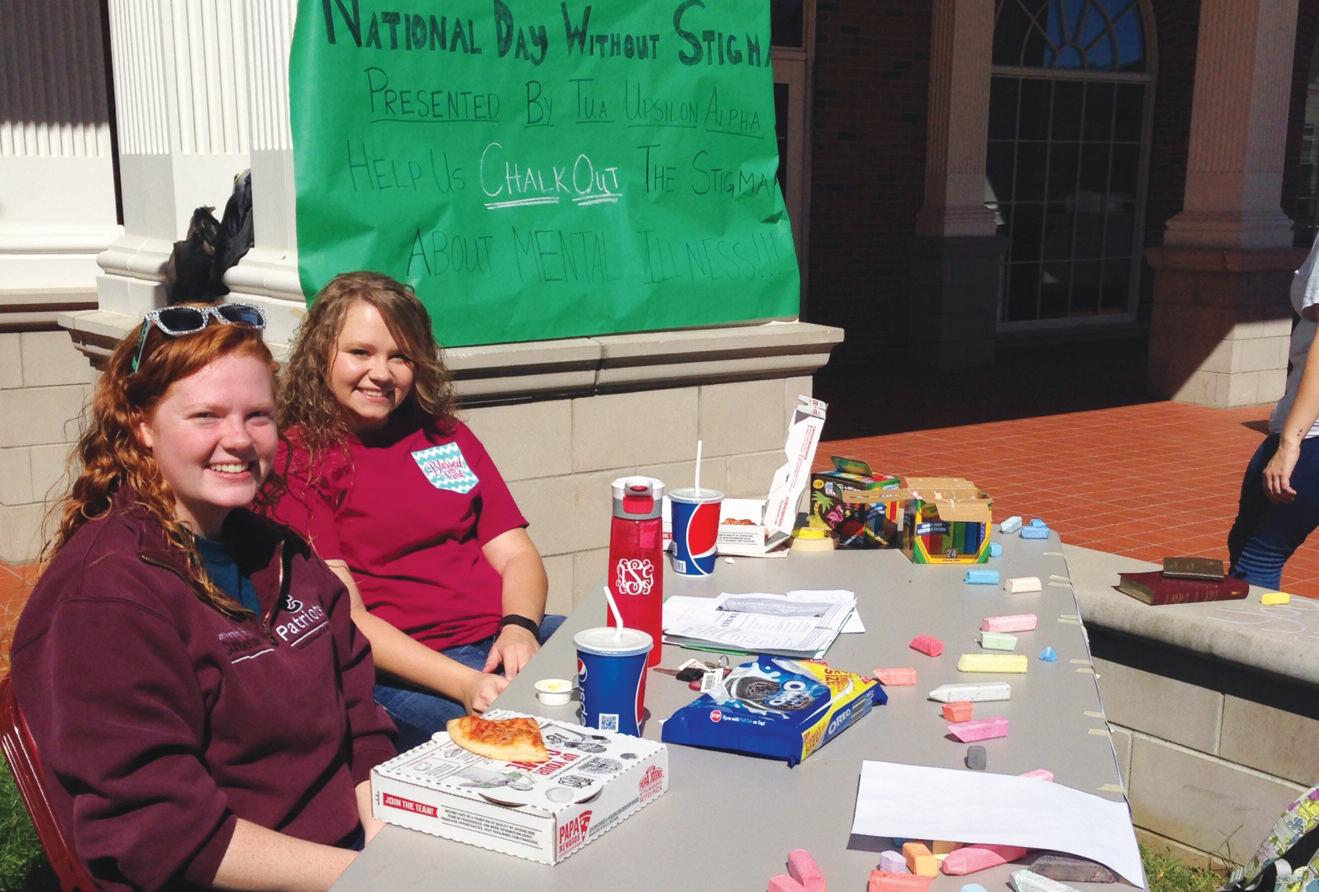
On Monday, October 5, sidewalks outside the Boswell Campus Center at the University of the Cumberlands were colored in chalk with positive phrases, verses of Scripture, and words of encouragement as a part of National Day Without Stigma According to the National Alliance on Mental Illness, October 4-10 is Mental Illness Awareness Week UC’s Tua Upsilon Alpha, human services honor society, sponsored the event to help combat the negative connotation that follows mental illness
Alex Schaich, president of Tua Upsilon Alpha says, “We hope to first of all break the stigma and second of all we just want to let people know that they’re not alone if they are dealing with something like anxiety or depression or anything like that it is very common ”
The quotes were written anonymously, by students, and among those on the sidewalk included “be strong,” “you are worth it,” and “you matter.” Along with the encouraging quotes, the statistic that stated, “one in four students have a mental disorder.”
As of the 2015 school year, UC has added counseling services on campus.
The services can be accessed through the university’s website Counselors, Dawn Wesley and Michelle Helton, are located in the Correll Science Complex on the second floor.
Chelsie Duncan, junior member of Tua Upsilon Alpha, says, “Whenever you’re dealing with a disorder, you’re not alone There’s always, out there, somebody with you with that same situation and they’re there to help you too. There’s always help ”
Another junior member of Tua Upsilon Alpha, Kaitlin DeJarnette adds, “Mental health awareness is really important because there is such a stigma related to that and it’s good to break down those barriers and just let people know that there is help out there and that you can get help and that it’s not embarrassing and its not something that should be avoided because that’s something that’s needed.”
Chelsie Duncan and Kaitlin DeJarnette help oversee the Day withoutStigma eventon UC’s campus.
Phot
BY A M A N DA K EL LY GuestWriter
The Life of a Writer: Q&A with Jamey Temple
Since she could string words together to create sentences and sentences together to create paragraphs, University of the Cumberlands’ English professor Jamey Temple has called herself a writer Temple, a published writer, is a graduate of Cumberlands and has a Masters of Fine Arts (MFA) in creative writing from Spalding University She doesn’t limit herself to one label as a writer or as a teacher. She’s worked in public relations and journalism, she’s had her prose, poetry and articles published in Still: The Journal, Kentucky Monthly and Repurposed Magazine and she’s passed her love for reading and writing on to every type of English student since joining the English department in 2008. Currently, Temple is working on her first novel
In this interview, she sits down to discuss what being a writer is about, her inspirations as a writer and an English professor and she also offers advice for the thriving and struggling students at Cumberlands.
AK: How long have you been writing professionally or just in general?
JT: I’ve always considered myself a writer ever since I could form sentences. My teachers would collect the poetry I had written and make books We would decorate the poster board, cut it out, and then they would hole-punch it and use yarn to tie it I’ve been fortunate to have people in my life along the way who have encouraged me, whether that be a teacher or… I was really close to my great-grandmother, who was an English teacher No surprise, right? She always loved to read my stories and comment on them. I’ve just been nurtured throughout Professionally, since I graduated college, I worked in public relations for a while; I was also working on the MFA, so I was working the creative side and the journalism side together
So, [I’ve been writing] for most of my life
AK: Who inspired you to become a writer?
JT: A couple of people: real people and fictional. I love “Little Women ” I actually have the book cover above my writing desk; I love Jo in that book because she loved to write so much and I identified with her; I thought I looked like her. I thought, “This is someone like me, someone who loves to make up stories and this is what she wants to do above all else; where everyone else wants to just get married and just do this, she has other aspirations.” So, she really inspired me to keep going. Back to my great-grandmother, I cherish my time with her and it always meant a lot to me for her to look at my stuff and to comment on it, so I would say those are my two biggest influences.
AK: Since you consider yourself a writer, what got you into teaching? What inspired you to become an English professor?
JT: I think I’ve always been teaching, but I’ve been fighting against it because I did [teach] naturally when I was playing and my teachers would notice. They would pair me up with the weaker students in class and say, “Oh, you ought to be a teacher” and I would say, “No, I don’t want to be teacher.” So, when I went through college, my major was communication arts I thought I was going to go into broadcast journalism or something like that until I became honest with myself. “You don’t really have the voice ” I sound like a small child; people call me and they are like, “Can I talk to your mom or your dad?” (laughing) So, I had to be realistic and that it may not be for me And I started taking some creative writing classes and getting back to my roots, I guess you could say. I started writing and it was like, “I could just keep
doing this ” Even after I graduated, I worked in admissions for a while, but then I would create work for myself I would write television scripts because I always wanted to write; it didn’t matter what type of writing I was doing. So I moved over to public relations and I did that for a while I had workstudy students and I would teach them how to write stories for the newspaper and whatnot. Dr. Cockrum was in the office and he commented one time He said, “Jamey, I think you would be a good teacher.” I was like, “Ugh, not this again.” Which is funny now looking back because most of the time when people get MFA’s, they get them to not only write, but also to be teachers. And that was not on my radar at all; I just liked to write. This was a fun way to be a professional student, I guess So, as you know, Dr. Cockrum went on to become the Dean and then the President. While he was in the Dean’s office, I had already completed my MFA and I had been an adjunct professor for a semester or two. He was like, “You know what, we need someone over here What do you think?” Now, I realize a lot of people want so badly to be college professors and are struggling and it just happened for me; that’s not lost on me at all I realize how fortunate I am to have this job and I love it. I don’t know why I fought so hard against it. (laughing) And that was a really long answer to this question.
AK: What advice would you give to a freshman in an English class here?
JT: I guess it would depend of the type of student We have students who have gaps in their education and who are terrified. Then, we have students who have had a good foundation and who are interested and do well. No student is the same.
So, my advice for the ones who come here and are struggling is to stick with it Even if you don’t enjoy reading, that doesn’t mean there isn’t something out there that won’t interest you. You just have to find it, but you have to keep practicing It’s all about perspective If you tell yourself, “I don’t like this; I’m no good at it,” then it’s going to be a self-fulfilled prophesy That’s going to be the trajectory that you’re on
But it if you come in and say, “I can do this; I can learn,” and you just shift your perspective just a little bit, I think that student would be surprised at how much they can change and how much they can learn. I guess that advice would go to students who already know, too Because if you go in with an attitude of “I already know this,” then you’re closed off and can’t learn anything else. We have a very talented faculty who are here because they want to teach, but it’s not all on the professor and it’s not all on the student. It’s a joint effort, so both have to be willing
AK: What advice would you give a student who wanted to explore writing further and possibly pursue an MFA with a writing emphasis?
JT: I have some of these students, even in my college writing class, which is the course before you get to English Composition 131, saying, “I love creative writing ” I always say to take an introduction to creative writing course; take all the writing courses you can. It’s usually students who like to write creatively already say “I’m a fiction writer or I’m a poet,” but as you know, sometimes you find that you can do other things, you can do other genres even better than the one you think you belong in So, don’t pick or box yourself in so early. Just play. Take a lot of classes. And when I say play, I mean take a fiction class, take a poetry class, take some of the writing classes in communications, take all of the different types of writing you can and kind of figure out from there what you want to do Or beyond that, ask a professor. If you have stuff written, if you have a notebook filled with things, schedule an appointment; get some advice We have talented writers, like Jeremiah [Massengale] over in commu-
nications who has written for Relevant, USA Today and all these publications Then you have Marianne Worthington, who is a fantastic poet and she’s in communications. You may not even know she’s a poet; most students may not even know So, reach out to us; it’s what we’re here for
AK: What would you say is the most important thing to know in order to be a writer?
JT: I think the most important thing to know is the difference between those who are successful at it and those who are not is that the successful writer has figured out a way to overcome resistance. And I get that term resistance from Pressfield’s “The War of Art” and I think it’s so true. Basically, you’ve figured out a way to stick with it; you sit your butt in the chair I mean, you can sit there and think about all these things that could happen, like “I could have a bestseller or I could do this,” but until you put the time in and actually do it, you’re not going to do anywhere. That resistance can come from that sort of thing, that daydreaming, but resistance can also be in the form of fear, that you’re not good enough You have to be kind to your creativity and your imagination and you can’t just expect it to show up any time you expect it to If you haven’t written in a month or so and then start writing, you can’t expect it to be on. It’s a relationship, you have to spend time with it Honestly, that’s how you get published That’s how you become successful because you just do it. That’s probably my number one piece of advice No matter what those little voices in your head are telling you, just do it.
AK: What kind of writer were you as an undergraduate compared to now as a professor with an MFA?
JT: I was a procrastinator to be honest because I had some natural ability, I would just put it off. I was one those students the other ones hated because we could have a 10-page paper and I would still get an A on it even though I didn’t spend as much time as someone else. I hate to even say that; that’s academic writing I could procrastinate more with academic writing than with creative writing. I would
procrastinate with creative writing, but sometimes that would make me work harder because it forced me to sit down. When I had so much time to write a scene, I would be like, “oh, I can do something else ” In those instances, I think it forced me to have output I think I was pretty typical in that way of a lot of students who procrastinate. I didn’t start writing a lot of creative work until my junior year and during those semesters, I was taking 18 5 hours, so it was rough. I didn’t have much of a social life now that I think about it Now, it’s always about figuring out when I can do it That changes when you’re a student and have all these different obligations and then when you graduate, you have a different set of obligations It’s all about when I can honor this desire that I have. I wish I could say it gets easier, but I don’t think it really does. I still have different types of obstacles, distractions and obligations I don’t know if that’s encouraging or not. (laughing) People will be like, “Why do you do this?”
AK: Is there anything you would have told your 20year-old self that you know now?
JT: I actually thought about this question or some variation of it because I sometimes wish I had waited to do my MFA With that being said, I know that if I didn’t have my MFA, I wouldn’t be teaching right now, so it’s one of those catch-22’s, but I don’t think I was really ready at that time to get my MFA It’s kind of like how, and I don’t know if you can relate to this, but I think it would have helped me more with my writing because I think about all those craft lectures I went to and I was there, but I wasn’t really present. Now, that’s all I want [craft lectures]. That’s all I want Sometimes I wish I knew that I didn’t have to rush to get there; you don’t have to charge ahead, you can take your time. Obviously, I didn’t have a bestseller by the time I was 30, because I’m passed that now, but I think that’s what I would do. Just live life because that’s how we get the material to write about Just live and don’t feel so rushed to get there.
tering the Stigma
Raising mental health awareness on campus

BY T R EN T ON CA N A DA AssistantEditor
The University of the Cumberlands recently participated in the National Day without Stigma, focused on raising awareness about mental health, but the increase in knowledge about this issue seems to be far from over Within recent years, the United States has seen an increase in the number of individuals concerned not only about their own mental health but the mental health of those surrounding them Across college campuses, UC included, this awareness is taking a more drastic shape.
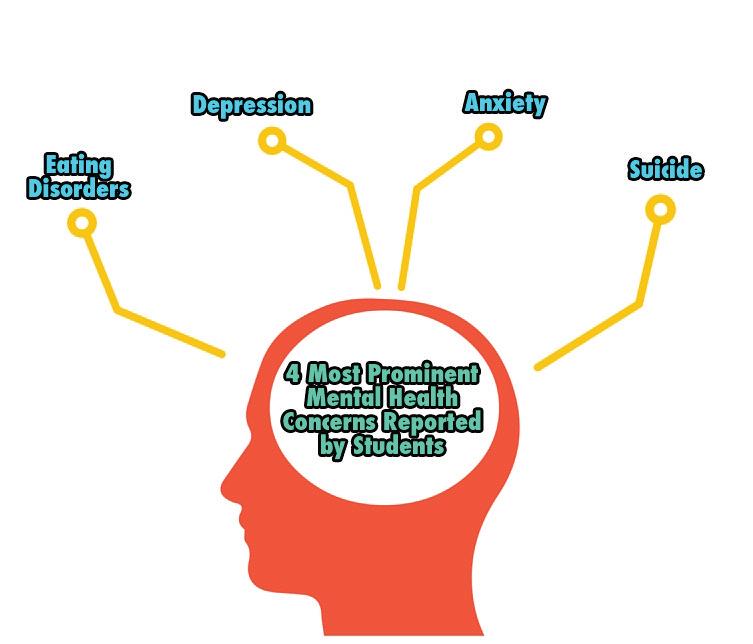
In a recent study conducted by the National Alliance on Mental Illness (NAMI), it was found that there were common mental health concerns across campuses. Among these, depression, anxiety, eating disorders and suicide ranked high. While some students may tend to believe that their campus is immune to such mental health issues, the statistics show otherwise That same study found that one in four young adults suffer from a diagnosable disorder.
Sydney Freeman, a UC senior, knows from experience just how difficult a battle with mental health can be “I have struggled with bulimia since I was a sophomore in high school,” Freeman shares. “I began taking medicine for depression and anxiety my freshman year in college… I know what it’s like to want to take my own life ”
NAMI concludes that 75 percent of mental health conditions that have a lifetime course have onset prior to the age of 24. Those are rough numbers to talk about, yet Michelle Helton, a licensed counselor with the UC counseling services program, believes that they have significance.
“What it should mean to students here at UC is that they’re not alone,” Helton comments “I know these problems exist, and they don’t go away when students come to college. They tend to actually worsen. But just because they’re suffering from a problem doesn’t mean that they’re the only one.”
Yet, those struggling with their mental health often do feel alone In a 2012 survey released by NAMI, 40 percent of students surveyed with a diagnosable mental health condition chose not to seek help. The common reason for this seems to be a general fear of the stigma associated with mental health concerns UC senior and president of the human services honor society, Alex Schaich,
agrees. Schaich was diagnosed with an anxiety disorder before attending college, yet was reluctant to seek help
“There was a stigma attached to it If you came out and said that you had anxiety or you were dealing with panic attacks or depression, it’s like saying you weren’t mentally tough enough or strong,” Schaich recalls. “Especially on a college campus, we’re taught to be strong and to deal with it, we’re going through a really weird phase right now. We’re learning to become adults and learning to deal with things on our own, to be on our own. With that comes a lot of stress and anxiety On college campuses, that’s something that’s not talked about enough.”
Yet, the questions remain: Why fear the stigma, and is the fear of the stigma alone enough to keep students from reporting their concerns? A unique component is placed on students and other individuals living in the South, where the culture is so highly dependent on self-reliance. Many may feel that if they cannot overcome the issue on their own, it isn’t something that can be helped Adding to that, there may also be an element at play given a high reverence for Christian principles.
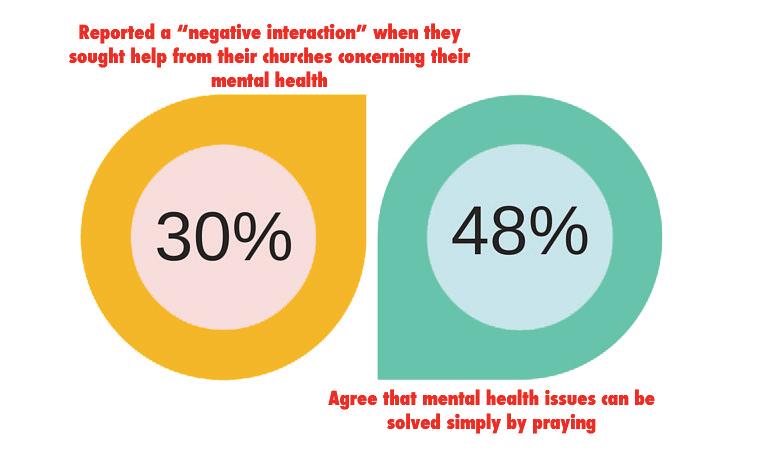
In an article titled “Can Prayer Cure Mental Illness?” published by Psychology Today, 48 percent of survey respondents who identified as Christian agreed that mental illness (things like depression, anxiety, bipolar disorder or even schizophrenia) could be cured simply by reading the Bible and prayer They reported that they believed there was no outside source needed to combat mental health concerns. Moreover, in a paper entitled “Demon or Disorder,” Dr. Matthew Stanford, of the department of psychology and neuroscience at Baylor University, presents that 30 percent of survey participants reported a “negative interaction” when they sought help from their churches concerning their mental health According to that report, these individuals were told that their mental health concerns were the result of sin or demonic forces. Moreover, a majority of the women who sought help from their churches were outright dismissed or counseled to not seek further help or medication
Schaich comments on how she has experienced some of these thoughts. “I was raised a Christian, and I am a Christian, but I think that in the church it’s kind of overlooked and not talked about,” she states “I was raised to pray about things, to go to my church, and I think to a certain point that helps, but there comes a point that you need someone else to reach out to. You need someone to acknowledge that this is something real, something that you’re going through You can only do so much on your own.”
Freeman adds, “I changed churches. I stopped condemning myself because I learned the Christ does not condemn me Learning who I am in Christ and what I have in Him has changed everything.”
Still, what is to be said about those who feel trapped? There are still those who suffer from mental health concerns yet simply do not seek treatment because they feel that prayer is enough. Helton has a response to them.
“Mental health is often stigmatized in church. It’s thought because you’re not praying enough or you’re not close enough with God That’s absolutely not the case. Even in the Bible, they sought counsel from other people. So, you’re coming to us just to talk things through.”
Following this thought further, there is help out there for UC students who feel overwhelmed. Under the direction of Dr. Emily Coleman and Debbie Harp, UC recently restructured its counseling services program, which is free to students and is located in the Correll Science Complex
Dr. Coleman states, “Regardless of what campus you’re at, mental health needs are growing. We’re very aware of that. We started asking ourselves, ‘What’s another way we could look at counseling services and increase our opportunities to support students’ needs?’ Now we have a website highlighting counseling services. We have a client portal, where students can make their own appointments They can even look at the profiles of our counselors to see who they may better connect with.”
Helton adds to this, “There are going to be some students who may not feel comfortable speaking with a female There may be some who are not comfort-
able speaking with a male. We can accommodate that. The one thing that I want to stress above anything else is that there is no judgment here.”
“Counseling is something that can help anybody Anyone can benefit from it at anytime. Help is here,” Helton confirms. “I often make the analogy that if you were diabetic or had high blood pressure, you wouldn’t hesitate at all to seek help Mental health should be no different ”
Counseling services’ online portal, which can be accessed through the university homepage, contains a list of outside sources of information about common mental health concerns and possible courses of treatment Also online, they list telephone hotline numbers for those severely depressed or considering suicide, an though there are students suffering from diagnosable illnesses, Helton assures that often time students simply need to talk about their stresses, though she is not the first one that students often reach out to. Students who feel overwhelmed or who feel that their mental health is suffering can reach out to any number of individuals, including friends, professors or even athletic directors.
“There are a lot of outlets on campus,” Dr. Coleman states. “If the students live in the residence halls, they can work with their residence hall directors I’ve even received referrals through coaches who think that a student could benefit from help. We’re here to receive those. We’re here to offer services to students if they’re in need ”
A Co ffee Co nundrum
Starbucks Perks Up to Save Coffee’s Future

BY L I Z GU I L L ER MO StaffWriter
On Tuesday, September 29, 2015 our nation celebrated what is personally my new favorite holiday, National Coffee Day. A day that is meant to keep you caffeinated and infatuated with the coffee chains that keep us going Many of the places that run our lives with coffee continued the trend of giving out free coffee in celebration of this great day. Many, except for Starbucks, who is arguably the leading name in coffee Don’t worry, they have not suddenly forgotten how the world works or how free coffee can be a call to all, instead Starbucks launched their new “One Tree for Every Bag” commitment where they will donate to plant one new coffee tree for every bag of coffee sold in their stores These are not just regular coffee trees, but trees that scientists have worked to make more effective in the fight against coffee rust. They want to ensure that National Coffee Day can be a holiday that people like me can jitterily celebrate for years to come
I do not wish to alarm you, so hold onto your mugs, but coffee is actually becoming less and less attainable as the years go by. This can be blamed on, Hemileia Vasatrix, or more simply put, coffee rust which, according to the American Phytopathological Society (it means science of plant diseases), is a rapidly increasing threat. No, Coffee Rust is not what happens when you forget to wash out your metal cup in the morning, it’s actually a fungus that is wiping out coffee bean trees making it harder to keep up with the demand. This coffee leaf disease affects innumerable trees every year and appears in splotches that

appear to rust away the leaves of the coffee trees. What does that mean for the coffee consumers of the world? Quite frankly, it means that supply is no longer meeting the demand and coffee is going extinct
I asked some other UC students how they felt about the impending blow that coffee rust promises to deliver and, such as I, they feel strongly about it. Senior Brody Nolan simply said, “This is literally the end of the world ” Senior Sydney Freeman answered with a deadpan, “I’m dead inside ” I know, I know, I too am frightened for what I will become should the java giant leave this world
In fact when I told my very own roommate, junior Amber Gastineau about the threat to coffee she immediately responded with, “I’m scared of what you’ll be without coffee. I didn’t know that coffee rust was a real thing, it doesn’t even sound real ”
However, I assure you, dear reader, that this threat is very real but thankfully the new “One Tree for Every Bag” commitment started out with an already donated one million trees and the promotion will run for one full year If you have ever needed any better excuse to go to Starbucks in the next year, go now. Because now you know and knowledge is power. You can invest in our future to help ensure that it involves coffee Only you can prevent coffee rust from wiping out the supply, only you can save the world.
All abo ut tha t bras s UC Football reflects on the Brass Lantern victor y
BY D J H I T E StaffWriter
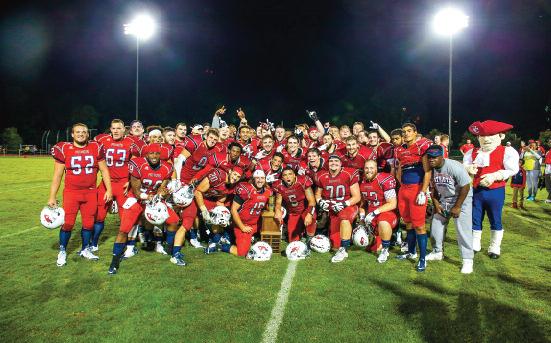
This past Saturday, September 26th, the University of the Cumberlands Patriots football team and the Union College Bulldogs football team took to the field, to battle for the Brass Lantern, a tradition that has been going on for years. The final score to the game was 42-29, with the Patriots getting the win to bring back the Brass Lantern trophy back to Williamsburg Matt Rhymer, UC’s head football coach explained, “It’s a historical game dating back to the early 1900s. I know the game means a lot to each of the two teams, their universities, and communities. The game is a significant game for recruiting purposes I have experienced this game as a football player and coach; it’s an awesome atmosphere.”
For both teams this game is not a regular game; there is a lot to play for including the Brass Lantern Trophy that is passed between both schools. According to the Union College athletics page, the Lantern represents the coal mining industry, paying homage to the major industry in Southeastern Kentucky where both colleges are located This game is always a crowd pleaser, with the stands being packed every year. “The game was packed. The amount of support from fans, student body, faculty and staff along with the community was great I believe performing in front of fans like ours should make our team play good every game. The energy passed from stands to the field and vice versa works out to our advantage, “ said Wendall Williams, starting wide receiver for the University of the Cumberlands.
Williams added, “The win affects me a lot being a senior. Losing to them last year how we did on their home field played a big role in the way we came out to play this year as a team I think the whole team was on the same page about the significands of the brass lantern and what it means to get it back to UC, “said Williams.
This is not it for the University of the Cumberlands, this win was big but there are many more games to be played and goals to accomplish.
“Each game we are trying to improve and with the adversities this game brought How we responded under those circumstances proves to us that being disciplined and having great character always prevails. Our goal is for this team do it’s very best with the talents and abilities that God has blessed us with We know that without the Lord we are nothing and can do nothing. We want to be great people, great students, and great competitors. Our football team always needs to reflect the pride, class, and character that this great University possesses, “ said Rhymer
On the bat tlefield
War Room
BY A SH T ON R E C T OR AssistantEditor

“War Room,” a recently released film by the same producers who brought us “Facing the Giants,” “Fireproof,” and “Courageous” is another successful story that teaches viewers of God’s everlasting grace. The film shows a family of three who lives in a nice home with two working parents and a young daughter The family may not struggle financially, but spiritually and emotionally they battle relentlessly.
The mother of the family, Elizabeth Jordan (Priscilla C. Shirer), works as a real estate agent and meets her newest client Miss Clara (Karen Abercrombie). The two women strike up a friendship after Miss Clara shows Elizabeth her favorite room in her house, her “war room.” This room is filled with prayers and bible verses Miss Clara has written on sheets of paper and placed them on the walls. Miss Clara talks to Elizabeth about her prayer life and encourages her to start a war room of her own.
The acting performance given by several actors in this film is phenomenal, especially that from Karen Abercrombie. She does an amazing job truly selling a pure hearted, authentic character to the audience. Her character is wise, honest, and humorous in a sense that viewers will feel like they have just left their grandmother ’s house as they exit the theater Also, at the close of the film she delivers a monologue, in prayer to God, which is inspirational to say the least
The various settings of the film are exceptional as well From the homes
to the husband’s corporate buildings the set really matches with the message the producers are trying to send to the audience For example, the homes of the two women match their personalities exceptionally well, which enhances the believability of the entire storyline. There is also a specific scene where the husband, Tony Jordan’s (T C Stallings), boss, Coleman Young (Alex Kendrick) is contemplating a very tough decision in regards to Tony. Coleman is gazing out the multiple stories high office window over the view of the city, which symbolizes the vastness of his answer to this situation
The film ends with the display of 2 Chronicles 7:14, “If my people who are called by My name will humble themselves, and pray and seek My face, and turn from their wicked ways, then I will hear from heaven, and will forgive their sin and heal their land.” Overall, “War Room” stays true to these words from scripture and captures over and over again the unending stream that God’s grace is The characters of the film display that through faith, prayer, and submission to God’s will, He can accomplish much more in your life than you could ever imagine.
Photo credit: David Whitlow, courtesy ofAFFIRMFilms/ProvidentFilms
How to s ucceed in Him
A devotional
BY SH Y A N N NOR R IS StaffWriter

Have you ever been so overtaken by the stress in your college career that you forget where God is? Have you ever been so beaten down when you are studying for a big exam that just cannot grasp the material? Have you ever stopped to think, “Have I prayed about it as much as I have studied it?” Sometimes life takes over so much that we leave God out of the stress thinking we can do it all alone, but we can’t Most of the time we just completely zone in to the test we have tomorrow but not the One who holds tomorrow. How can we focus so much on one little occurrence of the day but simply tell ourselves we do not have the time to focus on who has already overcome these small occurrences for us?
This is where we need to learn to reverse out study habits Take breaks to pray and be in the Word rather than to get coffee and donuts Take time to pray over the material rather than to vent to a friend. I, being a devoted stress-er, am even guilty of just venting to friends of how nervous I am or how unprepared I feel, yet still forgetting to just give God my fears and worries. We often forget to ask Him for the wisdom we need to take the exam (or whatever is stressing us at the time) and we forget to ask Him to calm us and give a peace like only He can This is where we are failing In Deuteronomy 11:15 (KJV), God says, “And I will send grass in thy fields for thy cattle, that thou mayest eat and be full.” This is God’s promise that He is enough and will give us what we need if we ask for it. He will “fill us up” with the knowledge we need and ask for.
Often in the most stressful times in our life is where we see the most improvement and success God tells us; however, that to see that success we must go through Him. Ecclesiastes 5:19 (KJV) says, “Every man also to whom God hath given riches and wealth, and hath given him to power to eat thereof, and to take his portion, and to rejoice in his labour; this is the gift of God.” I have too many times seen (even in myself) after a huge exam or paper that we try to exalt ourselves for the good grade we made and blame God for the poor grade we made Have you ever thought maybe it is the other way around? Maybe that poor grade was because God wasn’t in it and you saw no success Maybe the good grade you made was because you asked God to intervene but when it was all said and done you tried to take all the credit when in reality, God is the reason why you performed as well as you did
Sit back and evaluate yourself Let yourself go so that God shows through more Hide yourself behind the cross and let Him do the work In Psalm 28:7 it states that, “The Lord is my strength and my shield; my heart trust in him, and I am helped: therefore my heart greatly rejoiceth; and with my song will I praise him ” Let us all give God the glory Let go and let God