Letter from the Editor
Dear readers,
With the end of the semester quickly approaching and finals staring us in the face, it is certainly easy to become overwhelmed. In all honesty, I feel as if I have been overwhelmed with entire semester. Whoever said that senior year was easy clearly failed out of college. Still, amid all of the hustle and bustle of term papers and final preparations for project presentations, small reflections on the semester are healthy.
In truth, every December I reflect not only on the fall semester but also on the year as a whole. One of my most treasured possessions is a binder, which I call my memory book. Between each cover of this book are memories that I have collected over the years since graduating high school. Drawings from my younger sister, handwritten recipes from my mom, birthday cards from aunts who have passed on, scholarship acceptance letters and scholarship denial letters--I keep those things

that I have found value in, and at the end of each year, I take time to flip through the pages and recall the memories and experience the emotions associated with each item I’ve stashed away.
Truth be told, however, I keep these items out of both fear and hope. I fear that one day my memories will fade, that all of my experiences that I have stored away within my mind will slip from me. I keep that memory book in the hope that if this were to ever happen to me, flipping through those pages and touching the items pressed within will trigger a memory and elicit an emotional response within me.
Still, I sometimes find myself storing away memories for the future instead of living the experiences in the present. 2016 has been a tough year for many people, but it will soon be over. What’s done is done, and those experiences we’ve had in these past 12 months cannot be undone just as the breaths we’ve released cannot be regained.
I once read somewhere that at least once in our lives we are likely to breathe in a molecule of the same air that Julius Caesar gave up in his final, dying gasp. That, to me, is extremely humbling, to think that I am living from the breath of so many that came before me--Alexander the Great, Cleopatra, JFK, Maya Angelou, Marilyn Monroe. So many great and legendary figures throughout the course of history have given to me the breath that now fills my lungs and flows through my blood. We all borrow from the same air, only to return it in our final words spoken, in our last exhale. It makes me wonder if I’m making every breath count, if I’m utilizing each gasp of air to live in the moment and cherish those around me more than the items in some dusty memory book.
Yours,
Trenton Randall Canada

Editor-In-Chief
Trenton Canada
Faculty Advisor Jeremiah Massengale Staff Hope Austin Eric Ford Edwards
Assistant Editor Ashton Rector
Leanne Gregory DJ Hite
Alyssa Parrott
Zane Ross
Editorial Review Board
Lisa Bartram
Marianne Worthington
The Patriot is the biweekly student publication of the University of the Cumberlands. Our goal is to provide timely and original content by highlighting campus news and views.
Award-winning member of the Associated Collegiate Press and the Kentucky Press Association.
Biblical art: The trend of Bible journaling
BY ASHTON RECTOR
Assistant Editor
Traditionally, one could skim through the pages of a Bible and find hints of color. These specks of neon were a result of highlighting specific verses, or the occasional pen written message squeezed into any available open space. However, in recent months members of Christian communities have noticed the rise of not only highlighters and pens on the pages of Scripture, but also the blotting of stamp ink and watercolors deemed as the art of Bible journaling.
Bible journaling is best defined as the creation of art based directly on passages of Scripture. Sometimes these drawings are placed in the large margin that accompanies a Bible specifically for journaling purposes, or one can venture to other mediums such as canvas or even the tried and true scrap sheets of paper.
Emily Walker, college student and founder of blog, Instagram page, and Etsy shop Printed Praise, speaks about what lead her to begin journaling in her Bible and to form her online platforms. Walker explains she had not yet been exposed to the trend, but after this occurred she gained more interest.
“I had never seen anyone with one and wasn’t quite sure what I was doing, but art has always been a love of mine and I wanted to connect more with what I was reading,” says Walker.
On the Printed Praise Instagram page, one can find several different works of art that are held within Walker’s personal Bible. Some of these drawings range from watercolor flowers that are prefaced with words of Scripture, to an extended piece that stretches over two pages and features an abstract version of a world map. Not only does Walker post photographs of her compositions, but she also adds videos that show her creating the art and even features a quick flip through of her journal Bible to showcase the pieces she has completed thus far.
The art derived from journaling is individual to each person. For example, two people may read the same lines of Scripture, but maybe different phrases stand out to each of them. This is where numerous outlets for creativity have been produced and shown the artworks that result from the readings.
Walker also adds, “I’ve had many people thank me for some of my posts, but really they’re just things that God is teaching me that I’m sharing.”
In a post featured on Walker’s blog, she explains some of the essentials that are needed to begin Bible journaling. Some of the tools she uses are acrylic paints, calligraphy pens and washi tape. Though Walker also says that it sometimes can be challenging to find just the right supplies, as the pages of a Bible are typically very thin.

Bible journaling has not only become an outlet for artists, but has also become a conversation piece and opening to share verses of Scripture.
“My Bible has become a great conversation starter because people want see my artwork and it gives me the opportunity to show them the Scripture that goes along with it,” explains Walker.
University of the Cumberlands student Haley Haygood told in a recent profile story about her experience with Bible journaling and how this helped with the homesickness she and her roommate, Kristen Swords, sometimes feel.
“She has helped my [faith] grow closer than she could ever even know,” says Swords.
“Whenever stuff is going on in my life and I am able to channel it through writing it or drawing it, that’s just helped me deal with it,” Haygood says.
Bible journaling has allowed Haygood to dive deeper into her time of worship and she is then able to relay messages of God’s peace to her roommate.
“We start to worry and we remind each other constantly that it’s in God’s hands. God is in control,” Swords tells.
Though biblical art is a recent trend, its main purpose is not just to create beautiful works of art that are visually appealing.
Walker explains for her personally, “It’s never been about having a pretty Bible, it’s always been an outlet for me to learn and grow more in my faith by better connecting with what I’ve read.”
Haygood also echoes this as she mentioned she could never produce the continuous line of perfect pieces that seem to fill the Pinterest feed of any user, but rather her issue with this aspect is deeper than a pretty page.
“I recognized that I was trying to compare myself to other people or to a standard, and it’s not supposed to be about that. I’m reading the Bible. It’s supposed to help me grow not to put myself down,” Haygood explains.
However, a quick scroll through Pinterest, blogs, or any news feed can reveal several interpretations of Scripture that are now told through paintings, calligraphy, and illustrations.
Walker best explains this meshing between the two areas of art and faith as, “A tie between being more motivated to dig deep into God’s word and being able to inspire others to do so.”
These pictures may be coveted in some fashions, but their main purpose is to readily inspire the next wave of journalers to not only utilize their creativity, but to also spend more time with Scripture as they do so.
Courtesy of Flickr’s Brittany Gaddy. Used with permission.

Digital media in ministry:
UC offers new integrated studies course
BY LANDRY WOODS Guest Writer
According to UC missions and ministry professor Dr. Jefferson Calico, “One of the ideas in ministry is go where the people are.” The new integrated studies course Digital Media in Ministry wants to teach students how to do just that. “So where are the people,” Calico asked, “They’re on Twitter; they’re on Instagram; they’re on Facebook.” Students at the University of the Cumberlands will have an opportunity, this coming spring semester, to take a class that will look into how to use new media and digital content to minister to others in the world around them.
Christian ministry has always been a part of the course content at UC. It wasn’t until recently, though, that integrated digital communication became a part of that same content available for students. This course will be cotaught by Dr. Calico and communication professor Jordyne Carmack. While most students are familiar with the Missions and Ministry department, the university’s new integrated digital communication program may be somewhat unknown. IDC is the integrating of digital communications across different platforms and medias. Essentially, IDC helps students understand how to
properly market in this multimedia era. That is not only using the mediums or sites well, but also using the right one.
In this new class, students will learn how to use media to properly convey messages that are related in and around Christian ministry. With this being an integrated studies course, it is obvious both students from the missions and IDC programs will be present, but in a lot of ways they have the same goal.
“I always view marketing communication as the means to an end, not the end itself,” said Carmack, who added that IDC is only a “tool to meet the end.” Carmack says she wants the content learned in this class to be “the hammer in the pastor’s tool belt.”
With this course being offered for the first time next semester, many students have already signed up. In this age of digital media, this is yet another instrument ministry students can engage others through. Yet even students on the communication side can learn new and valuable skills in this course as well.
As Calico said, “It opens up potentially a whole new career option.”
Courtesy of Flickr’s Esther Vargas. Used with permission.
BY AMANDA KELLY
The future rests on the past: A look at UC’s “England” history class

In order to obtain a degree, students are mandated a certain number of hours within their chosen majors, minors, emphases and general education. While math, a science, English and a psychology class don’t always pique the interests of students, some electives target specific curiosities. For history majors, minors and social studies education majors, next semester offers a course about the history of England for any and all Anglophiles at University of the Cumberlands.
Dr. Nathan Coleman, associate professor of history, plans to teach the class. Coleman’s specialty field is English history from 1485-1815, but his Ph. D. is in Early American History. His passion and focus on constitutional, political and ideological development drives the content for this course.
“The U.S. is cultured around the revolution of English heritage,” Coleman says. “We study these three centuries of English history because it’s wrapped up in the founding of our country.”
“Dr. Coleman teaches his courses in such a way that the focus is on the ideological and intellectual motivations of the period, and largely how that took shape in political institutions and theories,” UC junior Olivia O’Malley says. “As a history major, I feel as though it is critical for me to expand my knowledge of ideological thought that carried an immense amount of influence on a global scale.”
Although the material may seem tough, Coleman says he will not stick to traditional methods of teaching. He says he won’t assign traditional exams during the semester, nor will he assign a major research paper.
“I believe in reading and writing,” Coleman says. “Grades will be based on analysis-based book reviews, not book reports, and smaller papers on document readings will be assigned instead of a lengthy research paper.”
The class is small with only 10 students currently enrolled. The small class opens up discussion and debate on the major themes Coleman plans to focus on. Most students taking the class are history majors or minors, but a few English majors are signed up too.
“I am interested in the England class because Dr. Coleman is an
incredibly knowledgeable professor with an animated and engaging lecture style,” Tristan New, senior history major, says. “I would also like to learn more about the English origins of American legal, constitutional, and intellectual traditions, which we have explored in his Early America class this semester.”
The study of history, as Coleman says, is an act of humility. Understanding the events of previous generations teaches the current generation about their own personal decisions and their reasoning behind it. History repeats itself when the current generation refuses to acknowledge the successes and failures of the regimes, peoples and ideas that came before.
“People lived and acted differently than today, and studying it helps us accept our own here and now,” Coleman says. “We’re all bound by time and place.”
Coleman says he plans to divide the semester’s studies into three major sections. The first era of English history focuses on the Tudor Dynasty. Starting with the conclusion of the War of the Roses and Henry VII’s victory, Coleman demonstrates England’s own Protestant Reformation with Henry VIII and his several marriages followed by the reign of his daughter, Queen Elizabeth I.
The second section highlights the reign of the Stuart family in England. During this time period, James I, a Scottish royal with blood ties to the Tudors, takes over as England’s Protestant King. Well into the Stuart family reign, the English Civil War breaks out, removing the monarchy for a short period, and then reinstating the crown in time for the Stuart line to be ousted during the Glorious Revolution of 1688.
The third section covers England’s rise to power, both commercially and militaristically, in the 18th century. England’s colonies prospered, making it the most powerful empire in the world with its power naval fleet and trade agreements across many oceans. Despite their power, Coleman shows how England changed with the outcomes of the American and French Revolutions during the latter part of the 18th century and into the 19th century
Guest Writer Courtesy of Flickr’s salomon10. Used with permission.
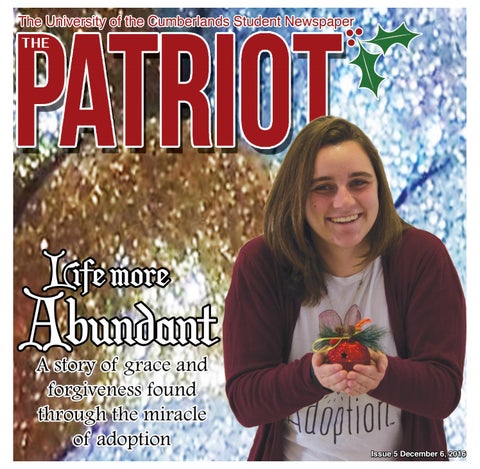
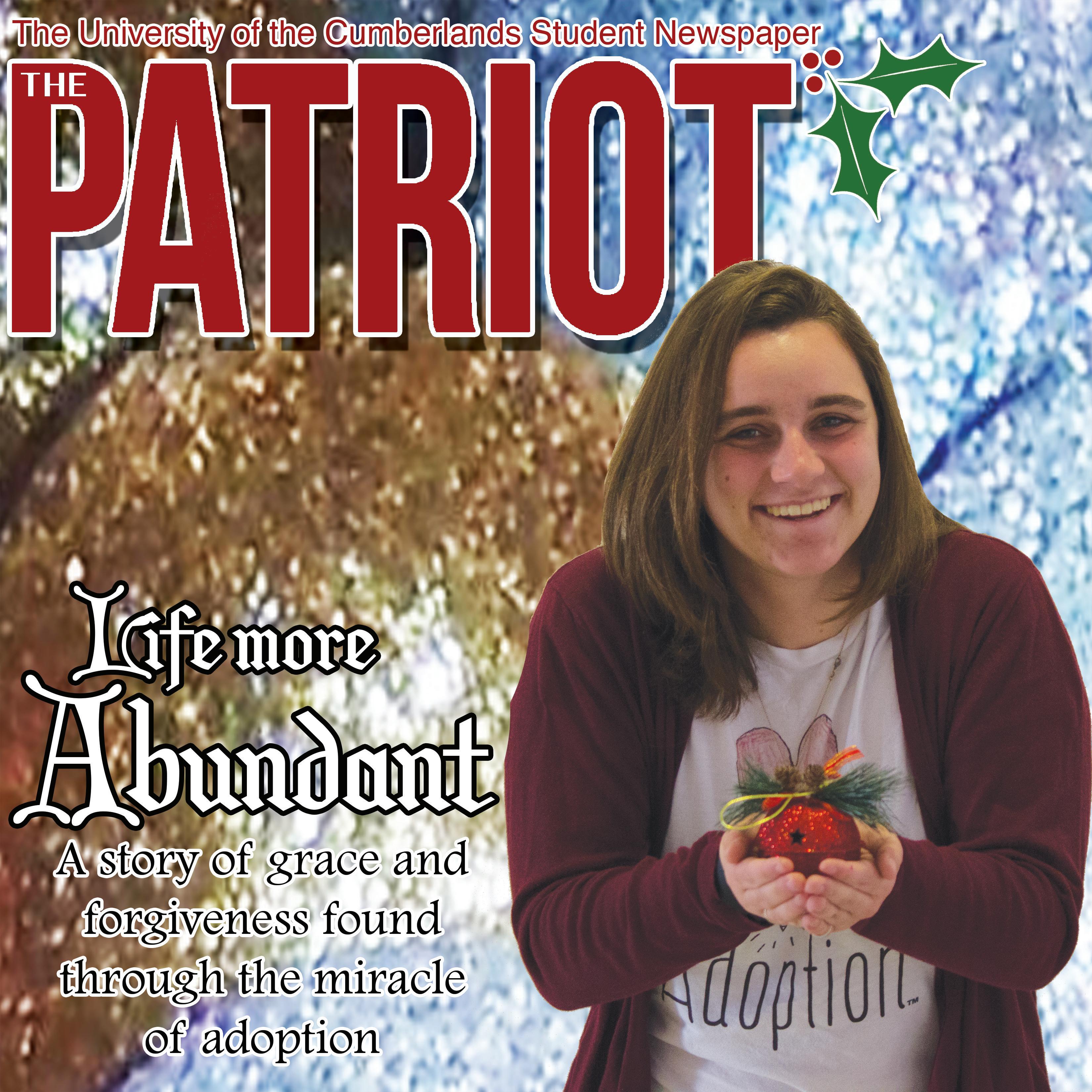
A life more abundant:
Sarah Smith’s story of grace found through adoption
BY TRENTON CANADA Editor-in-Chief
At the end of their high school careers, most students are focused on earning a higher ACT score, completing financial aid applications and submitting entrance essays to prospective colleges. What is typically not on that list is the thought of giving birth, of welcoming a new life into the world and taking on the role of a parent. Yet, that is exactly what was on UC junior Sarah Smith’s mind the summer before her freshman year at UC.
Smith’s is a popular face on UC’s campus. She’s involved in the Student Government Association and has served as a STAR for the Insights program. It’s reasonable to say that a lot of people know Sarah Smith, that a lot of her friends wave to her as she walks the sidewalks to and from classes, but her story extends far beyond the reaches of this campus. Smith’s story is bound in another’s--in a story of acceptance and adoption.
“I’m a birth mom,” she begins. She inhales deeply as she forms her next words, “My daughter’s and my life was dramatically changed by adoption.”
Her senior year in high school, Smith says that she found herself in the center of an abusive relationship.
“I didn’t know that he was abusive. I just assumed that’s how every relationship was,” she says. “He abused me physically, emotionally and sexually, and I was afraid to ask for help because then people would know. There was so much shame that I had.”
Eventually, she confided in a friend who encouraged her to leave the relationship. However, her abuser wasn’t ready to let her go.
“He started following me places,” she offers. She pauses, as if to gather her thoughts before continuing. “He broke into my house and assaulted me. This was breaking and entering. This was rape.”
Smith explains that this occurred two more times in the course of a year before she approached her high school guidance counselor about what was happening, and although she spoke to police and filed a report, she says that no convictions were ever handed down. The following month after breaking her silence about what had happened to her, Smith discovered that she was pregnant.
“My memories from when I went to the police to the time I found out I was pregnant are in black and white,” she recalls. “I don’t remember color. Everything was just dark. I would just sit in my room and just be alone.”
Yet, at the discovery of her pregnancy, Smith says something shifted within her. “The day I found out I was pregnant, I felt like there was a purpose. I thought, ‘You’re going to come out of this. You have someone to live for now.’”

Still, Sarah’s journey from pregnancy to adoption was not simple. Rather, it was long and complex and filled with difficult decisions.
“I knew the day I found out I was pregnant that I wasn’t supposed to parent her,” she says. “I don’t know. I just had a feeling.”
According to Smith, her parents were resistant to this feeling, though. They offered to help her raise her daughter, to care for the baby until Sarah finished school and could provide for her. Yet, Smith’s feeling that adoption was the right choice for her daughter persisted.
“I didn’t want her to have to live there where he knew where we were,” she recalls, referring back to her abuser. “I didn’t want her to feel trapped in the same situation.”
Ready to begin this journey, Smith reached out to a high school teacher who aided her in contacting a local pregnancy crisis center to explore just what adoption would mean. She was given an adoption counselor and the extensive paperwork began. She explains that the forms she had to complete were tedious, with questions ranging from past medical history to favorite genre of music. All the while, Smith was determined to finish high school and pursue a college education. That is where her story intersects with UC’s campus.
“I visited Patriot Preview Day while I was pregnant,” she explains. “I remember thinking that it was great, that I loved it, but I couldn’t see how it was possible. I didn’t even know if it would be possible.”
Smith chose to apply and made the decision to tell her UC admissions counselor, Amanda Walton, that she had been raped and was pregnant. She explained to Walton that while she wanted to enroll at UC, she felt there were too many things standing in her way. Still, Walton encouraged her.
“When you work in admissions,” Walton offers, “you meet so many great potential college students. Sarah really began to stand out to me.”
“She told me that she wanted to help,” Smith says. “She called me on the phone and said, ‘We’re praying for you. This is where you’re supposed to be.’ She worked so hard to clear the red tape so that I could go here.”
“I’ve had literally thousands of conversations with prospective students over the years, but I will never forget the courageous words Sarah said to me as we were wrapping up the phone conversation that day,” Walton explains. “She was in awe that all the people at UC would be so kind to help her in the midst of her circumstances, and I was in awe that a 17-year-old high school senior would have the courage to say that even though her circumstance wasn’t ideal, she was honored to be carrying someone else’s blessing.”
Photo by Eric Ford Edwards

With Walton aiding her in her college pursuit, Smith’s focus then turned to finding a home for her daughter, and she explains that her faith played into her decision.
“I felt that God had a different family for my daughter,” Smith continues. “So, I told my adoption counselor that she could start bring me profiles of prospective parent. It was horrifying,” she says.
“That was the hardest decision that I’ve ever made. Adoption wasn’t hard. I knew that it was what was best. But choosing her parents,” she pauses, “I’m not qualified for that. But I did.”
She recalls her first meeting with the adopting family and the speech that she had written out to say to them. She wanted to make it “official,” she recollects. She also remembers that from that first meetings, she knew that they were the ones she wanted to raise her daughter.
With UC chosen as her college and a family chosen for her daughter, Smith’s attention then focused on delivery. Ten days before she was set to move into the dorms at UC, Smith gave birth to her daughter.
“I got to be her mom--feed her, swaddle her, change her diapers--for three days in the hospital,” Sarah recounts.
“And then I left. Normally new mothers get wheeled out of the hospital with their baby in their arms, and I just walked out with a box of clothes and some flowers and without my baby,” she states. “But it was ok. I had peace about it. They loved her, and they loved me. I knew they would protect her and give her life. Not only life but life more abundant.”
She turns from telling her story at this point to recite UC’s Latin motto, “Vita Abundantior,” which in English means “Life more abundant.”
“That and the Bible verse [John 10:10] kept going through my head the whole time,” she continues. “But since then, there’s been a lot of healing and a lot of grief. I still feel confusion and guilt sometimes and grief definitely, but I don’t have to because I’ve accepted the love and forgiveness that Jesus offers.”
She sighs before saying, “Coming from a situation of abuse, you’re made to feel totally worthless. They tear you down and take away all of your power and all of your voice. You feel worthless and full of shame.” She lifts her head at this point to say, “But what Jesus has done for me by giving me my daughter and the option of adoption has been to say, ‘You matter. There are people fighting for you. I am fighting for you and died for you.’ That’s all grace, and I didn’t even have to ask for it. And because of that grace, because I have been forgiven, I don’t have to be ashamed.”
And ashamed of her story is something that Sarah Smith is not. She hasn’t shied away from telling it to those who are willing to listen. She confesses that in telling her story, she hopes someone else will be encouraged to think about adoption, to understand that there is a happier ending to those situations that may seem dark or undetermined.
Walton offers, “She was broken but hopeful that the Lord would someday use her story to bless other people.” Walton attributes Sarah’s strength to God by saying, “He is always capable of making beauty out of ashes”
Stories of adoption are not rare, yet those stories being told by the mothers that made the decision to grant a more abundant life to their children are. That sort of story is definitely rare at UC, as Smith points out.
“I’m probably the only one in my dorm who has given birth,” she chuckles.
Still, it is that distinction that propels her forward at UC.
“My motivation, first and foremost, is my daughter. I chose a life more abundant for her, so I have to live a life more abundant for me,” she offers. “That means being involved. That means making the four years that I’m at UC the best possible in helping others. Working with SGA is a part of that. Being a STAR is a part of that. Being part of Bible studies is a part of that. I’m living for her. She saved my life.”
Photo by Eric Ford Edwards


BY LEANNE GREGORY Staff Writer

Top five ways to end the semester
After months of waiting the end of the semester has descended on the campus. Christmas trees glisten on the sidewalks, the air is cool and crisp. The people around seem to smile more. It’s a season for giving, and the season for all night study sessions. Amidst all of the hustle and bustle it can be hard to find time to have some fun. In case you’ve reached the point where it feels like your textbooks are falling out of your ears, here are some suggestions for the top five ways that you can end the semester with a bang.
1. Have a pajama party with your friends and watch some classic television shows.
There is hardly anything more relaxing than sitting around with people you enjoy spending time with. Why not make the experience something to remember? Forget the party favors, and the extensive planning, and just grab your favorite sleep wear and lounge around in your dorm room all day flipping through Netflix or Hulu. You may be surprised at what you’ll find.
2. Take a walk.
With finals coming around the corner, life has a way of becoming unusually unpredictable. The studying never seems to end, the workplace always calls, and family and friends you haven’t heard from in months suddenly insert themselves back into your life. The worst part of it is, however, is that the usual de-stressors never seem to work. That’s why it’s always a great idea to go out and try something entirely new. One of the easiest ways to do this is by taking a walk. Walking can take you places you never even imagined existed, and, best of all, it’s completely free. So, the next time you feel like life might overwhelm you, go grab a coat and some winter boots and just let your feet
take you on an adventure.
3. Play in the local park.
Sometimes letting out your inner child can be very therapeutic, and there isn’t any better way to turn back time than running around in the park. If you’re ambitious, then swing on the swing sets, hang upside-down on the monkey bars, climb up the slides and laugh out loud until you can’t breathe. If you want some peace and quiet, then relax underneath the canopy of the trees with some hot beverages and snacks with a good book or some music and while the day away in the soft grass. The best thing about going to the local park is the chance for you to get to know the community and the world around you; so what’re you waiting for?
4. Learn something new.
Routine can be a comfort in these hectic times, but it can also feel boring. Why not shake things up and challenge yourself to learning something new every day? It can be something small, like how to make your own chocolate, or it can be something extensive like learning the names of all your extended family members. The choice is yours. There is so much knowledge out in the world, and so many different ways to use it, the only hard part is choosing what you want to learn first.
5. Smile.
It’s contagious. And it just might make someone’s day that much better.
Photo by DJ Hite
Five ways to maximize your intramural experience
BY LANDRY WOODS Guest Writer
Every year students at the University of the Cumberlands play dozens of different intramural sports as a way to have fun and enjoy some competition. However, the experience you have is completely up to your approach. Here are five tips any student can follow, no matter the intramural sport or situation, to improve their time playing IMs.
1. Don’t make enemies just to win a t-shirt.
With any IM game there will come the temptation to lose your cool. Everyone does it; I have on more than one occasion. However, the ability to fight this urge and keep a level head will enable you to make friends through this great experience, not create enemies.
2. Don’t make a super team.
It happens every year: the best athletes on campus get together and form a super team. They only take talented players and leave friends to the side. This is a huge mistake, however, as you lose much of the camaraderie you get when playing with close friends. While the super team may increase your chances to win, it wont be as fun as playing with your closest friends. Besides to win anything with those you care about is far more valuable than with those you don’t.
3. Don’t make it about you.
something many of us learned from a young age and that is that you should share. Yes, that is a pretty juvenile concept, but this isn’t the World Series. It’s okay to let your roommate score every now and then.
4. Don’t fight with the officials.
Okay, so up until this point I’m sure most everyone can agree. This, though, this gets a little personal. If there is one-thing UC students love to do it’s fight or argue with IM officials. Again, almost anyone who has played an intramural sport has, but fight the urge and just play. Most of the officials are work study students; our colleagues. So don’t yell at them when they’re just trying to work. They don’t yell at you when you’re cooking fries in the Grill or tutoring students in the ARC. So when it comes to the officials if you can’t say something nice, don’t say anything at all.

5. Use IMs as a way to relieve stress, not create it.
Intramurals are great after a long day in class, or a tough week of tests. They aren’t, however, designed to be an excuse to procrastinate doing homework. One of the best ways to enjoy intramural sports is to go in with a clean conscience. Don’t go in knowing you should be studying, that will just stress you more. Get your priorities in line first.
Often times in IMs, students like to be the star. Reliving glory days, or trying to have some for the first time is tempting to many. However, remember
While these five tips may not be everything UC students need to know about IMs, it is a start. By following these five steps any UC students can maximize an already great experience in intramurals. While not everyone will follow these five, it doesn’t mean you shouldn’t. So don’t let others deter you from having the best experience you can.
From player to coach
A Q&A with men’s assistant basketbal coach Ethan Faulkner
BY CEJAY JONES Guest Writer
From the small town of Sandy Hook, Kentucky, Ethan Faulkner is now living out a dream of coaching college basketball. Faulkner was once a star player at Elliot County High School. The basketball team that he played on happened to be a very successful team, winning over 65 games in the time he was there. The more impressive feat was the he got to play at the famous Rupp Arena three straight years.
Although Faulkner’s playing days are now over and his coaching career has begun he will always be a player at heart. He still plays as much basketball as he can, just not as competitively as what he was use to in high school and college. He plays on Wednesdays and Sundays at the local Williamsburg High School with about 10 to 15 other older guys who play for fun and to stay in shape.
Faulkner is the newest assistant coach at the University of the Cumberlands, which is a big deal in the community. He replaces a coach that was at the University of the Cumberlands for over a decade. As a new coach Faulkner has been learning his new responsibilities and role for success since taking the job this past summer.
Jones: When did you know you wanted to coach basketball?
Faulkner: Growing up it was always a thought, almost dreamlike because as a player you never think you’re playing career will be over. But it really started to become a reality in college towards the end of my playing career that I was going to coach.
Jones: Why coaching?
Faulkner: Coaching is a way to still be involved with the sport you love. You also get to share all the knowledge you’ve gained with other great basketball minds and learn even more. I enjoy getting to share that knowledge and my experiences with players and trying to help them reach their full potential in this sport.
Jones: How does your playing experience translate to coaching?
Faulkner: Just a few years ago I was playing, and I know what it takes to play at a high level so I can use those experiences to relate that to the kids I coach. I also have been fortunate enough to play for good coaches in high school and in college. I can always look back and take a page out of their book when I need to.
Jones: Since you’re only a few years removed from playing, do you still get the itch to be out there playing when you’re coaching?
Faulkner: Oh yeah, I can’t be sure that will ever go away. You play for so long, elementary, middle school, high school, and then fortunate enough to play in college is a lot of time and work to get that far so I will always want to play.
Jones: How did your first coaching job come about?
Faulkner: When my playing career was over at Northern Kentucky University, I immediately jumped at the opportunity to take a graduate assistant position there.
Jones: What was the hiring process like?
Faulkner: It’s actually a interesting story, the coach I played for at Northern Kentucky University, Dave Bezold, is really good friends with Coach Butcher, and when the position became available he recommended me to Coach Butcher and it was an opportunity I didn’t want to pass up on.
Jones: What is your knowledge of University of the Cumberlands basketball program?
Faulkner: Growing up in Kentucky, I have always known about University of the Cumberlands and the success of the basketball program. When a program is as successful as they have been people are going to talk about them and as a basketball fan you are going to want to go watch them play.
Jones: What are your expectations for your responsibilities as a new coach here?
Faulkner: I expect to have my hand in a little bit of everything, from recruiting, making scouting reports, individual workouts with players, to even doing the laundry.
Jones: Was there any other coaching vacancies you considered before deciding on Cumberlands?
Faulkner: I was coaching at Mount Vernon Nazarene University (in Ohio) before coming here and was happy there, but this was such a big opportunity.

The true gift of salvation
A devotional

BY HOPE AUSTIN Staff Writer
As the end of the semester is approaching, students realize one thing. It’s finally winter break, and the halfway point of finishing the school year. This means no classes until the beginning of next year, no staying up late to finish those papers and homework assignments due the next morning, and time to finally head home for some time to relax. Also, for most students, this means Christmas. People have different traditions around the world for this holiday. Some may open presents and have a large dinner, while others may go visit with their family and spend time with each other. While the traditions for Christmas may change, the meaning remains the same. Christmas is the day people celebrate the birth of the Lord and Savior Jesus Christ and have for many years. However, people tend to forget the true meaning of this holiday when the time comes. They tend to get wrapped up in the presents, food and other trivial things.
Stress seems to overrun families such as if there is enough food and dessert, if the presents are good enough, or if they look nice enough for the family or friends to come. In this, people tend to forget what they are really
celebrating. They forget to celebrate the birth of the one who brought forth our salvation. Without Jesus, we would not have the everlasting promise to one day join Him by the throne of God and feel His peace and happiness. The Bible tells us, “And she will bring forth a Son, and you shall call His name Jesus, for He will save His people from their sins,” Matthew 1:21 (NKJV).
Jesus is our gift from God that we may have life eternal with him. This is the greatest gift that has ever been given to us. We as children of Christ should not worry about the earthly gifts being given, but instead on the gift God sent us many years ago in the little manger in Bethlehem that went on to be crucified for the sins that we commit. While we sin many times a day, God is just to forgive us because Jesus went to the cross and died for each and every one we make.
This year as it comes closer to Christmas, remember this. Think about the real reason for the holiday. Remember to be thankful for your salvation and that God loved you enough to send his only Son to the cross so we may not perish but have everlasting life, like told in John 3:16.
Photo courtesy of Flikr’s Jeff Weese
BY LYDIA HUGGINS Guest Writer

UC seniors figuring out the future
During students’ senior year, there is a lot of stress in figuring out the next step of their lives. Almost every senior struggles with planning the future, especially when their ideas aren’t working out the way they imagined. Soon to be graduates are wondering and worrying about the future while they’re waiting to hear back from their dream jobs or graduate schools.
David Poore, a biology major at University of the Cumberlands, is one of those students. He is waiting to hear whether or not he got accepted into medical school. According to Poore, not knowing which door is open or closed can be extremely scary, but he’s learning to be patient and trust God during this time.
“It’s an everyday thing,” Poore said. “Being in the limbo of nothing’s open and nothing’s closed and you don’t have 100 percent assurance that you’re doing what you’re supposed to be doing is where I’m at.”
Many students don’t know what exactly comes next. Not only because of the fact that no one can predict the future, but also because some students don’t know exactly how they will use their major in the real world. Shantel Buchner, a human services and Spanish double major, is one of those students who doesn’t have immediate plans after graduation.
“Weirdly enough, I’m okay with it,” Buchner said. “I always looked at other seniors and thought they were crazy for not knowing what they’re going to do when they’re graduating in eight weeks. It seems like you should have a plan, but God has given me a lot of peace about not knowing what is happening next because there’s never been a time where He hasn’t provided a way of knowing what to do next.”
Buchner has many ideas of how to use her degree, gifts and knowledge in the field of international missions, social work or a combination of both. After living in Ecuador, she found a desire to share the gospel and glorify God in all she does. Another human services major and also a missions major, Kaitlin DeJarnette, has learned a lot from her majors’ departments and have put them to use during college through relationships and UC’s Appalachian Ministries.
“You get opportunities to meet a lot of different people on a spectrum of life,” said DeJarnette. “AM has allowed me to use that knowledge. There are a lot of kids dealing with different things in their families like drugs and divorce. The missions and ministry department helps me to share the gospel and human services does well to help me see their struggles, help them cope and let them know they’re not alone.”
DeJarnette encourages fellow students to experience as much as they can in college because there are so many good opportunities that could help them get a job in the future and have lots of fun.
Although not knowing what is going to happen next is stressful and scary, Dejarnette says it’s also freeing and exciting because anything can happen.
“God has been teaching me a lot through this,” said DeJarnette. “His plans are going to happen no matter what I do. I’m not going to be always this stressed out and confused about it. There’s eventually going to be a time where I’m doing something that He has led me to do, that I love doing.”
Photo courtesy of Flikr’s CollegeDegrees360