Interim National Executive Director
Projects & Systems Manager
Interim Accounting Manager
Membership Services Coordinator
Membership & Expansion Coordinator
KKΨ Chapter Field Representative
![]()

Interim National Executive Director
Projects & Systems Manager
Interim Accounting Manager
Membership Services Coordinator
Membership & Expansion Coordinator
KKΨ Chapter Field Representative
Dollie O’Neill
Aaron Moore
Daniel George, CPA
Debbie Morris
Mason Thomas Ari Wright
The PODIUM National Headquarters Kappa Kappa Psi/Tau Beta Sigma P.O. Box 849 Stillwater, OK 74076-0849 (405) 372-2333 www.kkytbs.org e-mail: podium@kkytbs.org
Articles must be prepared using common word processing software or submitted by e-mail. Photographs must have captions attached with all individuals identified. Detailed author’s guidelines can be found on the Podium Online website at: podium.kkytbs.org
May 1 December 1 Fall issue Spring issue
The PODIUM is produced at the National Headquarters of Kappa Kappa Psi & Tau Beta Sigma in Stillwater, Oklahoma, and printed and mailed by Modern Litho-Print, Jefferson City, Missouri.

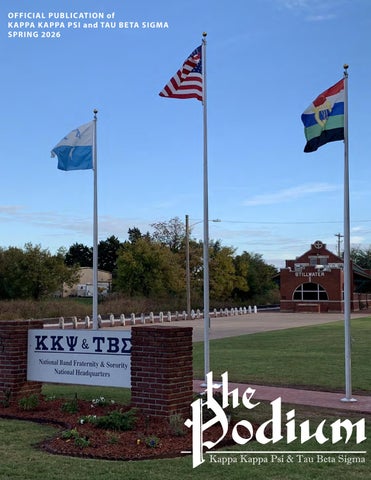
On the Cover:
at Stillwater Station during this cold winter. Photo by Steve
oneill@kkytbs.org moore@kkytbs.org george@kkytbs.org morris@kkytbs.org thomas@kkpsi.org cfrkky@kkpsi.org
March 6-7
• Northeast District Convention, Baltimore, MD
March 20-21
• Southeast District Convention, Greenville, SC
March 27-29
• North Central District Convention, Muncie, IN
• Southwest District Convention, Dallas, TX
April 10-12
• Midwest District Convention, Minneapolis, MN
• Western District Convention, Portland, OR
May 1
• Online deadline for articles being submitted to the Fall 2026 issue of The PODIUM
• Submission deadline for ΤΒΣ National Scholarship applications
May 15
• Deadline for all KKPsiAA Awards and Grants
June 1
• On-time deadline for Spring Activity Reports
July 1
• KKΨ Awards Deadline
July 18
• ΤΒΣ 80th Anniversary Gala, Oklahoma City, OK
September 30
• KKΨ & TBΣ Semester Schools submission deadline for Chapter Personnel Reports (must include approvals, completed policy acknowledgments, and submission of fees).
October 15

• TBΣ Quarter Schools submission deadline for Chapter Personnel Reports (must include approvals, completed policy acknowledgments, and submission of fees).
November 15
• KKΨ Quarter Schools submission deadline for Chapter Personnel Reports (must include approvals, completed policy acknowledgments, and submission of fees).


The National Headquarters accepts the Podium submissions via e-mail at podium@kkytbs.org and online at podium.kkytbs.org. In order to make processing of articles easier please use the following format:
Remember that articles must be received by May 1 for the fall issue and December 1 for the spring issue. Within the subject line include "Podium Article for (your) Chapter."
Feature articles should be 1-2 pages, not including photos. You can figure 600 words per page, so a 2-page article would be about 1,200 words. Try to keep your article to a multiple of 300 words, with a 600 word/1-page minimum.
Fraternity/sorority-wide news items should be one-half page/300-word minimum, not including photo(s).
Chapter news items should be one-quarter page/150-word minimum, not including photo(s).
Articles may be submitted as an attachment to an e-mail message; save the article as either a Microsoft® Word document or in Rich Text Format.
Be sure to send photos illustrating your story. Photos must be 300dpi or higher and attached separately from the article, not embedded. We assume that the writer of the article has full rights to the photos and grants a license to us for publication purposes. Submissions containing photographs will receive priority for publication.
Every photo must have a caption! Be sure to include the photo captions within the e-mail for the article you send and be sure you identify everyone in the photo.
Original photos are preferred, either color or blackand-white.
- Make your article interesting and exciting to read.
- Focus on one or two topics and expand upon it.
- Try not to write a chapter summary report for your article.
- We like to hear about extraordinary things such as successful fundraisers, unique socials, or service projects.

Like many of you, I’m more than ready to leave winter behind and welcome the warmth and sunlight of spring! At National Headquarters, our staff has been busy behind the scenes managing the daily cadence of operations—processing new initiates and preparing for the upcoming District Convention season to name a few. Our role is to support the National Leadership teams of both Kappa Kappa Psi and Tau Beta Sigma as they pursue their goals and bring their visions for the organizations to life.
Speaking of dreams becoming reality, I want to take a moment to applaud the Boards of Trustees of Kappa Kappa Psi and Tau Beta Sigma for their outstanding end-of-year giving efforts. These back-to-back campaigns exceeded their fundraising goals and generated vital support for national programming. It was incredibly exciting for the NHQ staff to support these initiatives and celebrate their success, which directly contributes to the longevity and growth of programming for both organizations. Be sure to read more about these achievements and their impact in The Podium.
And hooray for District Convention season! We are thrilled to be joining you at all six District Conventions this March and April. Last year, more than 2,000 members of Kappa Kappa Psi and Tau Beta Sigma attended District Conventions nationwide, and we hope to see that number continue to grow. The energy at these events is truly infectious, and connecting with so many dedicated members is always a highlight for our organizations.
I also want to reassure members, band directors, and sponsors that we remain in constant communication with convention sites as well as district and national leadership. The safety of our students is our highest priority at every convention and in every location.
Additionally, we are proud to partner with the NMDP (formerly Be the Match). Through this collaboration, we are raising awareness across our network and sharing stories that highlight how the band community can make a meaningful impact by supporting this cause. Here are two ways you can get involved:
1. Host an NMDP event on your campus between now and the end of the academic year.
2. Organize a “Swab the Band” presentation during summer band camp.
3. Get your chapter involved by emailing: College-Partners@nmdp.org
As we move into this Spring season, take time to rejuvenate within your band programs, chapters, and leadership circles. Focus on building meaningful relationships in your communities—because people are the heart and soul of our organizations. Through intentional recruiting, retention, and relationship-building, we continue to strengthen the foundation of what we do together. Continue to Strive For the Highest and to serve For Greater Bands!
With gratitude,

Dollie McDonald O’Neill
Interim National Executive Director
Kappa Kappa Psi & Tau Beta Sigma
TBSigma Life Member #2384 & KKPsi Life Member #5573

Kappa Kappa Psi Newly Installed Chapters
Gamma Xi University Of Maryland
RE-INSTALLED NOVEMBER 16, 2025
Iota Tau
Clark Atlanta University
RE-INSTALLED NOVEMBER 9, 2025
Xi Mu
Mercer University
INSTALLED NOVEMBER 8, 2025
Xi Nu
Roanoke College
INSTALLED FEBRUARY 15, 2026
Kappa Kappa Psi New Petitioning Groups
Eta Psi
Delaware State University Dover, Delaware
Theta Mu
Johnson C. Smith University Charlotte, North Carolina
Allen University Columbia, South carolina
Ithaca College Ithaca, New York
Lemoyne-Owen College Memphis, Tennessee

Tau Beta Sigma New Petitioning Groups
Eta Iota
Delaware State University Dover, Delaware
Theta Chi Stillman College Tuscaloosa, Alabama
By Dr. Thomas L. Jones, Jr. Director of Bands, Hampton University
It’s a story too many of us have heard before—one that begins with tradition and ends in tragedy. For members of the college band world, the name Robert Champion is more than just a headline; it’s a turning point. Champion, a drum major at Florida A&M University, died in 2011 as a result of hazing. His loss shook the HBCU and band communities to their core.
But where tragedy exists, so too does opportunity. In my dissertation research at North Carolina A&T State University, I explored what might be the most powerful tool we have in the fight against hazing: leadership. Not just any leadership—servant-leadership.
The question wasn’t simply, “How do we stop hazing?” We’ve tried rules, regulations, and reactive policies. But these haven’t been enough. The deeper question became, “What kind of culture allows hazing to grow—and how do we change it?”
The answer, I found, lies in rethinking our approach to leadership. Rather than enforce top-down rules, what if we developed leaders who placed the growth and safety of others first? What if our section leaders, drum majors, and band staff were trained not just to demand excellence, but to serve those they lead?
That’s the core of servant-leadership. It flips the script from authority to responsibility— where power is used not to control, but to uplift.
The case study focused on the “Blue and Gold Marching Machine” (BGMM) at NC A&T. Like many programs, the BGMM had its share of concerns about hazing culture. However, under the keen leadership of their director—a servant-leader, himself—and with a commitment to servant-leadership development, those concerns subsided.
Through interviews, focus groups, and internal reviews, I discovered that students responded best to the structured, safe, and meaningful rites of passage activities that were in place. These weren’t empty initiations or humiliating tasks—they were bonding experiences rooted in music, service,
teamwork, and challenge. At no point was the band experience watered down. In fact, the process of becoming a better band was difficult in itself—much more difficult than any hazing ritual alone could ever hope to be.
What emerged was a new culture—one where excellence was still expected, but never at the cost of human dignity.
As Director of University Bands at Hampton University, I now get to oversee the latest evolution of those concepts within the Hampton University “Marching Force” (HUMF). When freshmen enter our band program, they are treated with respect and dignity and given a voice. This, however, does not mean they are taking the easy road. They must earn their right to be called a Marching Pirate by learning band and school history, reciting the lyrics to the fight song and alma mater, executing all marching movements, and living up to the Marching Pirate acronym, the beginning of which is” Make the best possible effort.” Summers in Virgina are demoralizingly hot and humid—add to that, having to memorize 110+ songs and endure grueling physical training sessions (I’m also a former Army Drill Sergeant, and our University President is a former Army 3-star General who loves to work out with us!), and students find that there’s little time for any activity that isn’t directly related to band. Our chapters of Tau Beta Sigma (Theta Phi) and Kappa Kappa Psi (Nu Omega) ensure that the “onboarding” process is transparent, relevant, fun, and challenging. Each “ship” gives freshmen a chance to bond with their fellow bandmates, a bond that translates to the classroom as well—students hold each other accountable to ensure they are attending classes, studying, and making good grades. Over 80% of the band is on the Dean’s List as a result of our emphasis on academics.
As brothers and sisters of Kappa Kappa Psi and Tau Beta Sigma, we are champions of service, leadership, and the band experience. This issue affects us all—not just those at HBCUs or those who’ve seen hazing firsthand.
At the heart of the matter is the way we
define leadership in our programs. Do we pass down harmful rituals in the name of tradition? Or do we build new legacies— ones that center on compassion, mentorship, and growth?
At the end of the day, power can be wielded, or it can be shared. People raised on love will do anything for you, but people raised on survival will do anything to you.
We’ve long believed that struggle in and of itself breeds loyalty. But research challenges this idea. Loyalty and cohesion don’t have to come from fear or pain—they can grow from mutual respect, shared experience, and purpose.
Servant-leadership meets students where they are. It recognizes their need to belong, to earn their place, and to be challenged— but it does so in a way that affirms, rather than endangers.
Whether you’re a band director, student leader, alumni volunteer, or aspiring educator, here are a few ways you can start shifting the culture:
• Start with empathy: Learn your members’ needs, fears, and motivations.
• Mentor intentionally: Leadership isn’t just about calling commands—it’s about guiding growth.
• Promote healthy traditions: Create rites of passage that are rigorous, but respectful.
• Speak up: The silence around hazing is often what allows it to thrive.
Band life is sacred. It’s where many of us found our people, our purpose, and our voice. However, we can’t afford to let outdated ideas of perceived toughness overshadow the values we truly stand for.
If leadership is a journey, then servantleadership is the compass that points us forward.
Let’s make this generation of band students the most empowered—and the most protected—one yet.
Isha Madasu
Iota Lambda - TBΣ
University
of
North Carolina at Chapel Hill
This semester, due to unforeseen circumstances, Iota Lambda faced a shift in our delegation of leadership positions, which meant a lot of sisters were taking on roles they had never done before. Our Treasurer was now our Vice President of Membership, our Webmaster was now our Treasurer, and our Sisterhood and Social chair also became our Webmaster. This was also my first semester as Corresponding Secretary, but it assured me to know I was not alone in navigating the responsibilities of my new position. Despite this rapid change in leadership, I believe each of our officers rose to the challenge and was not afraid to fulfill their positions to the best of their ability. At the same time, they were also not afraid to ask for help when they needed it and lean on other sisters in times of need. Through our strong sisterhood and our passion for taking initiative, Iota Lambda was able to accomplish a lot this semester and have “Fortitude and courage to see an ideal, seize upon it, and follow it wherever it may lead you in Tau Beta Sigma”, despite many of us being new to our positions.
One important goal we needed to accomplish this semester was taking in a new line for our chapter. Having just elected a new Vice President of Membership, we were unsure of how to go about the membership education process and making sure we met the required deadlines for membership candidates. Luckily, our Vice President of Membership was not alone. With the help of the membership committee, assistant Vice Presidents of Membership, and other officers, we were successfully able to hold recruitment events such as Crochet Night, membership education classes, rituals, and presentations all within a timely manner. Thanks to our sisterhood and close bond with each other, we seized upon this ideal of taking in new members and followed through with it, as our Vice President of Membership was able to bring in 5 new members of our chapter this semester!
Some other important goals we needed to accomplish this semester were applying for funding from the Undergraduate Senate at UNC and finding creative fundraising opportunities to help out our chapter. Despite being on a tight deadline for
applying for funding, our newly elected Treasurer took action right away by taking the Treasurer’s test, attending the orientation meeting, submitting the application, and attending the hearing all by the required deadlines. In Iota Lambda, we don’t just do the bare minimum. We go above and beyond to stay on top of our deadlines and carry out our responsibilities to the fullest. By accomplishing so much in such a short time, our Treasurer was able to go above and beyond in successfully securing funding for us from the Undergraduate Senate for the Fall 2025 semester. We also had the task of coming up with fundraising ideas that would be beneficial to our chapter and easy to execute. Fortunately, our Treasurer was not alone in this task, and with the help of other sisters, we were able to successfully coordinate three fundraisers for our chapter, one of which allowed us to work together with our brother chapter Mu Eta of Kappa Kappa Psi to give back to the marching band in the form of a semi-formal. By working diligently and collaboratively, our Treasurer embodied fortitude in one of the most important aspects of our chapter, finances, and showed that no ideal is too difficult to seize.
As Corresponding Secretary, I was eager to give back to other chapters and show appreciation for our band staff. I already had a few ideas in mind for activities to do with other chapters and gifts to give to other chapters or the band office, but I wanted to expand the possibilities. Thankfully, I was able to work with my Corresponding Committee to come up with lots of fun ideas for gifts, many of which I was able to successfully execute. I was able to make a large banner for our meet-up with the Iota Kappa chapter at UVA consisting of both of our schools’ colors. I also made a “boo basket” for the band office in the spirit of Halloween, which consisted of candy, cards addressed to each of the staff, and crochet pumpkins made by

our very own sisters. Without the help of my committee, I wouldn’t have come up with these ideas, which is yet another example of how our sisterhood helped me seize the ideal of giving back and have the courage to see it through.
Overall, this semester has shown us that nothing is impossible with the help of our sisters and our passion for fulfilling our goals to the fullest potential. Whether that’s educating new members, executing fundraisers, or making banners for other chapters, no task is too big for the sisters of Iota Lambda. As members of Tau Beta Sigma, we are dedicated to having the courage to not only take on a responsibility, but go above and beyond to see it through.


Katelynn Turney-Rudisill
Beta Xi - TBΣ
University of Florida
The final semester of a Music Education degree is often described as an all-consuming experience. Truly a full immersion into the world of teaching, where future educators learn to teach in the schools and become worthy of the privilege of educating students in music. For me, that semester came with an added challenge and an unexpected harmony. While refining my teaching in Bay County Schools (Florida), I was also serving as the Southeast District Secretary-Treasurer for Tau Beta Sigma.
Many might see these commitments as competing forces. Instead, I found them to be perfectly in tune. Teaching young musicians during the day and supporting collegiate band programs by night shaped my identity as both an educator and a servant leader. The two roles complemented one another, forming a unified symphony of professional growth.
In my student teaching placement, my focus was on the development of confident, capable young musicians. This work mirrors the missions of Tau Beta Sigma and Kappa Kappa Psi to promote the joy and appreciation of music. Hopefully, someday, students in my classrooms will continue the legacy of sisterhood and brotherhood that we hold so near to us in the bond.
One highlight was my Impact Project: Unlocking the Key Signature, where I helped Middle School Advanced Band students build a stronger theoretical foundation based on Key Signatures and Scales as they prepared for All-County auditions and more challenging repertoire. Watching them take those concepts into their performance work reinforced the value of strong music literacy. It was so awesome to then have the opportunity to help judge blind auditions for these students and see ten of my students from Mowat get into the All-County Band.
My experiences also spanned a wide range of ensembles and ages. I introduced University Academy Elementary students to djembe rhythms and ukulele basics, and later stepped onto the podium to conduct during public performances such as the Echoes of Liberty patriotic concert. I helped University Academy Middle School students prepare, choreograph, and perform The Polar Express Dinner Theatre for their families and the Bay County Community.
Each new setting demanded adaptability and an ability to communicate clearly in order to lead each student with confidence, and keep them engaged even on the most chaotic days. Trust me when I say that I have grown tremendously with the fifth quality (Cultivation and maintenance of your emotional poise under all conditions) and the fourth factor (A cheerfulness at all times and under all circumstances, even in the face of great trial) throughout this balancing act of a semester.
My first formal observation was a true testament to the way I live by the principles of the sorority. I had a technical issue with my sound system that I had a wireless mic, Harmony Director, and speakers connected to, which I mustered up the poise to keep going and utilize my percussion students on the mallets to continue the class.

From troubleshooting sound equipment to managing energetic vocal classes, I learned to stay poised and focused. Those moments strengthened my resilience, creativity, and commitment to putting students first—qualities that lie at the heart of both great educators and dedicated sisters of Tau Beta Sigma.
When the school day ended, my work as a district officer began. I shifted from musical leadership to organizational stewardship, ensuring that collegiate bands have the support they need to flourish, really committing myself to a loyalty and dependability to those persons and institutions deserving of it.
As Secretary-Treasurer, I am working with chapter Treasurers and helping promote chapter financial literacy. Some of the things I worked on this past Fall included finalizing the S.E.D. Fund, creating its official application, and reviewing chapter budgets. These tasks were rooted in responsibility, honesty, and the desire to guarantee our district’s long-term success.
Communication also played a major role in my service. I worked consistently with my council team, including our counselors, to make things run smoothly. I published the monthly district newsletter, responded to chapter needs, and reached out individually to ensure every voice felt heard and supported. Additionally, I contributed to chapter and leadership development through financial workshops with Kappa Kappa Psi’s Southeast District Secretary-Treasurer Delaney Johnson and presentations at the Membership Education Retreat—strengthening the network of leaders who will continue to serve college bands.
Especially on the days that I was run down, I am deeply thankful to my council and counselors for their everlasting support. With


them, all the memories made as a council and smaller wins, such as coordinating social media content or celebrating each of the Southeast District’s Charter Days, held a deeper purpose: preserving the history, pride, and unity that define the Southeast District of Tau Beta Sigma.
Balancing student teaching and district leadership wasn’t always easy, but the dual experience taught me something invaluable: the best music educators understand that success requires both musicianship and service — whether that be service to my students or other institutions deserving of servant leadership.
The discipline I brought into the classroom, and the generosity of mind, heart, and hand that I offered to my students, reflected the same integrity and commitment I brought to Tau Beta Sigma. Whether leading a warm-up or drafting a financial document, I was contributing to the same overarching mission: supporting the existence and welfare of music.
This final semester, as an active sister and in college, didn’t just prepare me for a career—it helped shape the educator and leader I aspire to be. I left feeling confident in my ability to guide students through life’s score and to support the programs that give them a “baton” to lead with.
Music education is my passion, but service is the reason it endures. And together, they create a melody that will forever shape me as an educator and a sister. With this experience, I know that I have the fortitude and courage to do anything throughout my professional life.

Morganne Seitz Nu Chi - ΚΚΨ Wilkes University
Leadership, Musicianship, Service, Brotherhood, Celebration. The pillars that shape our organization and our individual Kappa Kappa Psi journeys. While we each have our own memories and experiences in our journeys, these are the things that bring us together to strengthen our bonds and uplift our mission. As my time as an active brother comes to an end, I’ve been able to reflect on these pillars and how they have shaped my journey.
Leadership:
When I was initiated into the Nu Chi chapter in Spring 2022, we were a chapter of just 5 brothers. I wasn’t expecting to dive into leadership so soon, but we needed to keep our chapter operating and I haven’t looked back since. During my journey, each new role and set of responsibilities taught me so much about not only myself, but how to lead a group and have an impact on those around me.
My time as Vice President of Membership taught me how to be confident in myself - through teaching and guiding others in their journey of becoming a brother. My time as Chapter President taught me how to be a leader in both the good and hard times - having difficult conversations when necessary but uplifting those around me and celebrating our wins. My time on the Northeast District Council taught me how to collaborate with my fellow brothers and sisters to execute something bigger than all of us - all for our common goal of a successful convention.
Throughout leadership roles in my life, I’ve struggled with imposter syndrome but these experiences have changed that for me. I’ve become more confident, more resilient, more adaptable; all because of the skills that Kappa Kappa Psi has taught me. I learned that a title doesn’t make a leader, it’s the work, passion, and dedication that makes you one.
Musicianship:
I’ve never been the best musician in the ensembles I’ve been in. I don’t have perfect pitch, I’m not great at music theory, and I don’t have a music major or minor. I always thought that musicianship was defined by making it into a state festival, being the best soloist, or receiving the most awards.
Joining Kappa Kappa Psi completely changed my viewpoint on musicianship and even the way I view myself as a musician. Following COVID and jumping back into ensemble rehearsals, I felt that my musical spark was missing. However, when I joined my chapter and started surrounding myself with other musicians who were passionate about what they were doing, the spark was back. I wanted to do nothing but music again. I pushed myself outside of my comfort zone by joining new ensembles and surrounding myself with people who have inspired me to be a better musician every day.
Most importantly, I’ve proved to myself that I don’t need to be the best to be a great musician. It doesn’t have to be about being the most musically talented or accomplished person in the world. Kappa
Kappa Psi has taught me that musicianship is about the heart and soul that you put into your work and that it’s about being the best that you can be and making yourself proud.
Service:
Serving others is something that has always been on my mind; hence why pharmacy is my major and why Kappa Kappa Psi’s mission is one that inspires me. My chapter’s mission is to have an impact on our University’s band, local high school music programs, and music in our community. Like many of us do, we’ve developed a variety of initiatives to make sure we meet our service goals and during my time as a brother, I’ve learned just how important our work is.
My favorite part about each of our service initiatives is how we get to promote music and how important it is in a variety of different spaces. My journey has taught me that through our service projects, we are showing people just how important music is to us and when I get to do just that, surrounded by my brothers, there is a great level of satisfaction knowing that no matter how big or small the project, we’re making a difference.
Brotherhood:
Coming into college in the midst of COVID was not an easy thing to do. I struggled to transition into college life but as soon as I joined Kappa Kappa Psi, I found my people. I found the thing that made me want to work to be my best in classes, ensembles, and in my chapter.
Over the years, my brothers have become everything to me and they are the ones who have been there for my wins, my losses, and everything in between.
From all the brothers in my chapter, the Northeast District, the National Leadership, and everyone who I’ve met from across the country; they have all impacted my journey and who I am as a brother today. While Leadership, Musicianship, and Service have shaped my journey, it would be nothing without Brotherhood and everyone who has been a part of it.
Celebration:
I used to never accept celebrations. I’ve always felt in my life that there is something more or there is more work to do to be the best that we can. But whether it be little wins, big wins, or wins that may be little to others but huge in my own eyes, I’ve learned to celebrate the hard work that my chapter, my brothers, and myself are able to put into anything we do.
I believe that little wins are the things that keep us going and uplifted during our busy, hectic lives. I know for me, it’s not always easy to see those little wins in the moment, but going back and finding time to reflect on them has allowed me to find joy in everyday life.
Just as important our are big wins, too. While these don’t come as
often as our everyday wins, these are the celebrations that change us and who we are.
For myself, I’ll never forget some of the most special wins that have shaped my journey. Whether it has been watching my chapter receive the Northeast District Governor’s Cup, hearing my name be called as I was voted onto District Council, and even the bittersweet moments, giving my final officer report at NEDCon. These have been the moments I come back to
when I think of celebrating my journey.
The pillars of Kappa Kappa Psi have shaped my journey and though it is truly bittersweet to end my active journey, I would not change my experiences for the world. Now, I can’t wait to see where my alumni journey takes me. My reflections have reminded me that every brother has a story to tell and our collective experiences shape and create the legacy of Kappa Kappa Psi. AEA


DistinguisheD scholar Cameron Sadler Epsilon Pi


DistinguisheD scholar Hannah Herring Pi

DistinguisheD scholar Kate Slavin Alpha Omega
DistinguisheD scholar Delaney Johnson Zeta Chi

DistinguisheD scholar Carmen Villarreal Theta

honoreD scholar Lauren Santino Iota Alpha

By Becky Carozza Alpha Zeta - ΚΚΨ Indiana University
Musicianship is one of our pillars and it is very important that we are always trying to foster and deepen our appreciation and level of musicianship, not only for our own chapter, but the bands at our university. November is the National Month of Musicianship and our Vice President for Programs, Kaitlyn Regan, really wanted our chapter to celebrate and make the most of this month. Within our chapter anyone is free to do a musical moment and perform a piece of music for the chapter at any point during the year. So, for this month of musicianship Kaitlyn encouraged each of our committees to perform a musical moment sometime during the month. It is a tradition within our chapter to sign a music stand after you perform your musical moment. This is a great way to pass on and get future brothers to continue to do musical moments and helps us recognize all of the people who publicly share their musicianship with the chapter.
We have had almost every committee perform a piece as well as a few individuals who wanted to perform a piece on their own. We had a variety of different types of music played throughout this month, and it was very fun to see what each committee group decided to do. We had one group take a more fun route and play the Thomas the Tank theme and the Mii Channel theme, which was very entertaining to see and hear performed. We also had a group play a song that we play for our basketball pep band, but some members switched instruments. Then we also had a few individuals perform, one of them played their solo piece for their senior recital which was the following day. It was great to have this variety and have some fun while also listening to beautiful performances.
I am currently serving as our Alumni Secretary and co-head of our Communications committee with our Secretary, Robbie Muñoz. As the Alumni Secretary, I also run the Instagram account and other social medias. So, for our committee, we decided we wanted to lead the chapter through the Fraternity Song and complete a crown pearl goal by putting it on our Instagram and tagging the Fraternity’s account. This was a great way to revisit the Fraternity Song as a chapter, as well as teach it to our new membership candidates. I also wanted to make a separate post about our month of musicianship highlighting each performance, while also hearing from some of our members. I sent out a quick anonymous form asking “What does music mean to you?” and “How does Psi support your musicianship and the bands at IU?” I got a lot of great responses, but I wanted to share a few. Here are some for that first question: “Music gives me a way to express myself, and a place and community to be welcome.” “Music, to me, is the core of what being human is— creating and experiencing art!” “Music is how I connect with the people in my life that I love.” Then here are some responses for the second question I asked, “Psi helps musicians connect with each other and build community among musicians both inside and outside of Jacobs (IU School of Music).” “Psi supports my musicianship and the bands at IU by giving me and my fellow band members safe, welcoming communities to thrive in, assisting the bands and band members in any way needed, and by helping us all grow, as people, musicians, and leaders.”
We had a fantastic and busy November celebrating Month of
Musicianship. I would encourage any chapters reading this to try having musical moments if your chapter doesn’t have something like this already in place. It was a great way to build brotherhood and musicianship within the chapter and doing it in groups or committees was a great way to take the pressure off performing by yourself. We will strive to continue this level of appreciation and commitment to music throughout the year after a great month focusing on music!


Rhiannon Wallace
Theta - TBΣ
University of Cincinnati
The big game between the Big 12’s University of Cincinnati, and Big 10’s University of Nebraska, was originally to be played during the 2020 football season at UC’s Nippert Stadium, but with the pandemic, it was postponed. Now, during the 2025 season, it was scheduled to be played in Lucas Oil Stadium in Indianapolis to be on neutral ground, but that was also soon changed.
The Kansas City Chiefs have been slowly working towards hosting more events, such as big college football games, at Arrowhead Stadium, to create a platform that highlights the stadium, so they offered to pay UC more than Lucas Oil was to hold the game at Arrowhead. Although the location move wasn’t preferable, it was a savvy business move with UC nearly doubling their revenue earned. Since the game ended up being so far from Ohio, the game was predominantly Nebraska fans.
Despite being called a “home game” for UC, it appeared there were fewer than 1000 UC fans in the crowd. That means the other 75 thousand seats were filled with Nebraska fans; loud, angry, hate UC with all their heart, Nebraska fans. As is tradition for the bearcat bands for every home game, the UC drumlines play down the drive as we march into the stadium, and after all it was a “home game”. Lining up in the middle of the walkway right outside the concession stands, surrounded by Nebraska fans, was a bit unsettling. As we marched through the stadium into the tunnel to get ready for our performance, we got the occasional boo or someone saying “UC sucks” but other than that, the people were surprisingly supportive. We would see the occasional UC or (even rarer) someone in a Nebraska shirt doing down the drive with us. Then we were in the tunnel getting ready to go on to the field to perform pregame. For a moment I thought to myself “Despite us being from Cincinnati and all of them being from Nebraska, maybe just maybe, they would love to hear the band play”. This sentiment was immediately disproven when we went out onto the field
NFL stadiums might not seem that big, until you’re on the field starting up at all 886 feet of Arrowhead stadium filled with 76,416 people (some of whom are drunk, most of whom hate you) the stadium feels unimaginably massive. Another note about Arrowhead stadium, is it one of the loudest stadiums on the planet. The loudest sound recorded in the stadium was 142.2 decibels, the sound of a shotgun going off is 150 decibels. It was so loud that even percussionists (yes the big drums) had a hard time hearing themselves. Nebraska fans were booing us the entire time, except for one part of the pre-game show, the national anthem. As soon as we said “please raise and remove your hats” a hush fell over the crowd, it felt like being in the eye of a storm. There was no yelling, no booing, just the Star-Spangled Banner. Which was immediately followed by applause, followed by more yelling and booing. Halftime was much of the same, however there were more supporters that we could see in the stands.
During the football game, the newly engaged Taylor Swift and Travis Kelce (University of Cincinnati alum ‘08-’12 and ‘22) made their first public appearance together. Previously in the spring of 2024, Travis
and Jason Kelce joined the graduates on stage to receive their degrees in Interdisciplinary Studies and Marketing. Alongside the couple was Travis’ brother, Jason (University of Cincinnati alum ‘06’10 and ‘22) and Patrick Mahomes in the press box watching as the Bearcats and the Cornhuskers battled on the field. Towards the end of the second quarter, Travis Kelce joined the Bearcats on the field to support the tough fight. A few TUCBIDG members even got photos with the alumni tight end just before their halftime performance.
To give some insight into the unique experience of the UC Bearcat Bands and how they operate, we must look to the 1980s and 1990s. Until 1993, the Bearcat Bands was a part of the College Conservatory of Music (CCM) at UC under the direction of Dr. Terrence Milligan. His successor, Mr. Matthew McInturf, who was a CCM graduate student at the time, headed the bands from 1993-1994. During 1993, the Bearcat Marching Band and the rest of the Bearcat Bands did not receive an operating budget and were severed from CCM affiliation. Thus, the Bearcat Bands were completely independent of university association and funding. The band program was eventually transferred to the Athletic Department.
The latter half of the 1990s was a more stable time for the band, as it saw the 13th director of the Bearcat Bands, Dr. Terren L. Frenz, Sr. take the position. He greatly improved the image of the band, giving it new uniforms, new instruments, and their first professional performances in a long time. Most critically, however, was that the Bearcat Bands was now officially a permanent unit within UC Student Affairs. Today, the Bearcat Bands and CCM are still separate entities, so Student Affairs still funds the majority of our band budget, along with donations from alumni and the community. Though UC Athletics funds us for some trips, or parts of trips, we have taken, it is mostly Student Affairs that funds us for non-bowl game trips. During the trip to Arrowhead Stadium, we were able to take a trip to Dave & Busters the night before the football game due to the support from Student Affairs. This excursion to Dave & Busters was very important for the band, as we had just had an extremely long bus ride. The morale getting off the bus was low, but the thought of free games and food flipped that real quick. This allowed the Bearcat Bands to go into the Nebraska game in high spirits to root on the Bearcats!

Jennifer B. Ryder, Epsilon Chi - TBΣ
Isaiah Carswell, Zeta Eta - KKΨ
The South Carolina State ITB Alumni Association proudly wrapped up a successful toiletry drive in support of the South Carolina State University Marching “101” Band. With a deep commitment to service, unity and Bulldog pride, we understand the long hours, intense practices, and continuous commitment required of our student musicians. The SC State ITB Alumni Association organized this initiative to ensure members had access to essential hygiene items throughout the season. Thanks to the generosity of our supporters and alumni, we collected a wide range of items— from deodorant and body wash to toothpaste, lotion, socks, and other personal care essentials.
These donations were delivered directly to the Marching 101 band members to help promote wellness, confidence, and comfort as the band continues to represent SC State University with excellence both on and off the field. These items will assist band members as they navigate demanding rehearsal schedules, performances, and travel commitments associated with their role as ambassadors of SCSU.
The SC State ITB Alumni Association remains dedicated to fostering meaningful support for current students and ensuring that they are equipped with the resources needed to excel both academically and artistically. Guided by the core principles of the organizations’ mottos, the Association proudly upholds the motto of Tau Beta Sigma—“Tau Beta Sigma for Greater Bands”—as well as the enduring creed of Kappa Kappa Psi—“Strive for the Highest.” These ideals reinforce the collective mission to support and elevate the “Marching 101” through meaningful service, sustained engagement, and unwavering commitment to excellence.
The SC State ITB Alumni Association extends its sincere appreciation to all donors and supporters for their generosity and commitment to student success. The SC State ITB Alumni Association remains steadfast in its dedication to service and the continued advancement of the University’s band program. Through collective effort, enduring commitment, and adherence to the guiding principles of Tau Beta Sigma and Kappa Kappa Psi, the Association proudly supports the legacy of excellence embodied by the Marching “101.” The organization looks forward to further opportunities to serve, uplift, and strengthen the students who carry forward the rich tradition of South Carolina State University.


Jessica B. Carswell, M.Ed., TBΣAA Epsilon Chi - TBΣ
South Carolina State University
The SC STATE ITB Joint Local Alumni Association of Kappa Kappa Psi and Tau Beta Sigma proudly introduced its new “Feed The Band” initiative during the 2025 summer band camp season—an effort that has already made a meaningful impact on band students across the region.
This inaugural year included feeding two high school bands during their summer camps, as well as providing support to the South Carolina State University Marching “101” at each of their home football games. Designed to promote health, community, and sustained support for young musicians, “Feed The Band” is rapidly becoming one of the chapter’s most beloved service projects.
Introducing: “The Fruit Stand” — A New Marching 101 Tradition
A standout feature of the initiative is the now-famous Fruit Stand, offering the Marching 101 fresh fruit as part of their pre- and postperformance meals during home games.
Beyond serving SCSU’s own musicians, the Fruit Stand also extended hospitality to visiting high school bands, students participating in Band Day, youth event attendees, and even passersby from the campus community.
The Fruit Stand’s success was made possible thanks to generous sponsorships from Cheney Brothers and The Food Academy, whose contributions ensured a consistent supply of fresh, high-quality fruit throughout the season.
A Welcoming Space at the Heart of Band Hall Culture
In just a short time, the Fruit Stand has cemented itself as a vibrant and essential part of home game culture at the beloved SCSU Band Hall.
Visitors are greeted with a warm, student-centered atmosphere featuring:
• Shaded tents,
• Comfortable tables and chairs,
• Proudly displayed Tau Beta Sigma and Kappa Kappa Psi flags, and
• The upbeat soundtrack of the day provided by committee chair Isaiah Carswell, affectionately known as “DJ Zeke.”
The rhythmic energy he brings sets the tone for community, camaraderie, and good spirits for all who stop by.
The Fruit Stand has also become the operational hub for all things food-related on home game days. Through strong collaboration with the Marching 101 Band staff, SCSU Campus Dining and the SC State University Alumni Band, the team efficiently provides and distributes nourishing pre- and post-event meals for the Marching 101.
This partnership ensures that band members are energized, supported, and appreciated—both on and off the field.
With its first season already making a lasting impression, the “Feed The Band” initiative is well on its way to becoming a cornerstone service project for the SCSTATEITB Joint Local Alumni Association. The organization looks forward to expanding its reach, strengthening partnerships, and continuing its mission of service to band programs across the region.

Dr. LaToya Webb
National Vice President for Professional Relations, TBΣ
The 2025 National Intercollegiate Band (NIB), sponsored by Kappa Kappa Psi and Tau Beta Sigma, welcomed Jason K. Fettig, Professor of Music and Director of Bands at the University of Michigan School of Music, Theatre, and Dance, as its conductor—bringing one of the nation’s most respected musical leaders to the podium for an unforgettable week of artistry, collaboration, and community.
Since 1947, the NIB has brought together exceptional college musicians from across the country to perform challenging and visionary repertoire. This year’s ensemble rose to the occasion with a program that showcased both tradition and innovation:
• Shoutout – Roshanne Etezady
• Poem de feu – Ita Gotkovsky
• Deciduous – Viet Cuong
• Lyric for Band – George Walker
• Comrades of the Legion – John Philip Sousa
• Symphony No. 2 – Kevin Day (World Premiere, NIB Commission)
In this exclusive Q&A, Maestro Fettig reflects on the experience, his partnership with composer Kevin Day, and his advice for the next generation of musicians and composers.
Describe your initial reaction to being asked to lead the 2025 National Intercollegiate Band. What were you looking forward to most?
“I have been aware of the long history and tradition of the National Intercollegiate Band, and I was very flattered to be asked to lead this wonderful ensemble. Having been inducted as an honorary member in both TBΣ and KKΨ over the last several years, I feel a kinship with my new brothers and sisters, and was very excited for the opportunity to make music with them!”
Fettig’s connection to the organizations runs deep, and this invitation represented an exciting moment to engage with a tradition he has admired for years.
Share your thoughts on collaborating with composer Kevin Day. What is most important to you in creating strong composer–conductor chemistry?
“One of the most meaningful aspects of my work has long been collaborating with living composers, and to have the opportunity to do so with Kevin was very special. Not only is he one of the most important voices writing for band today, he is a deeply generous soul and collaborator.”
He went on to express how the personal nature of Day’s Symphony No.

2 shaped the experience:
“The fact that the piece he wrote for this premiere was so personal and connected with his own relationship with our national fraternity and sorority was especially moving, and I could tell that the musicians also responded to that opportunity.”
Fettig believes that great collaborations grow from shared respect:
“The chemistry that is essential between composer and conductor stems from the unshakable respect for the art that emerges from these partnerships. Composers share their personal creations with performers, and conductors use the leadership opportunity to realize the composer’s message and intent with an equally personal commitment. When performers feel that synergy blossom, truly magical things can happen.”
What words of encouragement would you give to current and future musicians and composers?
“The world of bands and band music is thriving, and it is healthy because of the energy, excitement, and dedication that performers, composers, and conductors have infused in it.”
He encouraged young artists to engage boldly with the medium:
“My encouragement to our next generation is to lean into that energy, and take every opportunity to perform together, create together, and compose for this electric and relevant medium.”
And he emphasized the heart of what makes band unique:
“Band is about community, full stop. The generosity and empathy that we share with each other is what will sustain this artform, and if we continue to serve the art in the right way, audiences will continue to notice and respond to that very special quality in ‘band.’”
Do you have a message you’d like to share with the 2025 NIB participants?
“I am so grateful to the 2025 NIB for the wonderful effort and enthusiasm that you brought to our week together. I put a very emotionally and technically difficult program on your stands, and over the course of just a few days, you made those notes leap off of the page and the stage. It was an experience together that I will never forget, and I hope that I will cross paths with each of you many more times in the years to come.”
Based on your experience, why should musicians consider performing with the 2027 National Intercollegiate Band?
“There are many honor bands in this nation, and any experience making music with new friends is a good experience. That said, there is only one National Intercollegiate Band.”
He continued, highlighting the uniqueness of the NIB tradition:
“It brings together all of the elements that are essential for a special musical endeavor: commitment to a cause and an organization, passion for community as well as music, and a deep desire to achieve at the highest levels.”
And his encouragement was clear:
“I would encourage anyone who is eligible to put the NIB experience at the top of your list for a one-of-a-kind musical memory!”
A Leader, a Collaborator, and a Champion for Community
Maestro Fettig’s insights echo the core values at the heart of the National Intercollegiate Band: artistry, service, connection, and shared musical purpose. His partnership with Kevin Day and the musicians of the 2025 ensemble created a performance that honored history while lifting the NIB boldly into its future.


Bang T. Co
Immediate Past National President, KKΨ
There is an age-old question that eventually finds its way to every Brother. What does service look like once we become alumni? What does it mean to serve when the uniform is hung, the final concert has ended, and campus becomes a place we return to only in memories and moments? I have heard versions of this question for years in quiet conversations after conventions, in messages from Brothers seeking purpose beyond graduation, and in the reflections that rise during seasons of transition. And for a long time, I never felt like I had a true answer.
The obvious response is to give our time. To volunteer for a committee. To help with an event or step into a leadership role. That is the road I took. After graduating in 2016, I took a year off, then poured myself into founding the North Central District Alumni Association. In 2019, I ran for National Vice President for Student Affairs, beginning a six-year journey of national council service that eventually led to the honor of serving as your 49th National President. Time was the way I knew how to serve, and it shaped me in ways I will never forget. But I also learned that it is not the only way, and it cannot be the only answer. Not every Brother can give their time in that way. Life changes. Capacity shifts. Schedules fill. And if we say that service only counts when it looks like leadership or committee work, then we unintentionally create a story in which only a few can belong. That story is far too small for who we are.
It took stepping into my role as Immediate Past President, reflecting on my journey, and reconnecting with my passion for philanthropy to see the fuller truth. Service does not end at graduation. It evolves. It deepens. It asks new things of us. And it calls us to widen our understanding of how we can give back to the Brotherhood that shaped us. Philanthropy became the lens through which everything finally made sense.
Traditional philanthropy is often defined by transactions or shaped by donors’ ambitions rather than by the needs of the community. It can drift away from the very people it aims to support. Our new vision stands in direct contrast to that. KKPsilanthropy (KKPsi-lanthro-py) turns our attention in a new direction, grounding our giving in partnership, shared values, and the work of organizational healing and strengthening. Instead of looking upward, we look around. We see generosity as a partnership, as a meaningful relationship, as a shared commitment to the bands and students who carry our

ritualistic lessons and values forward every day. It shifts our focus from the priorities of a single moment in leadership to the needs of our community as a whole, grounding us in values shaped by our past and refined by our present.
Most importantly, KKPsilanthropy reminds us that every alumni member can serve, regardless of schedule, title, or circumstance Generosity comes in many forms, and each form carries the power to uplift our Fraternity. This is the heart of our new philanthropic culture. To help bring this vision to life, I invited the current and several past Chairs of the Kappa Kappa Psi Alumni Association to join me in exploring the many ways alumni can serve through what I call the Five Ts: Time, Talent, Ties, Testimonies, and Treasure. Because service is not a moment, it is a lifelong journey. And KKPsilanthropy gives us the path to walk it together.
Time is the most familiar form of service, offered through presence, participation, and support. It is the gift of showing up for the Brotherhood in the moments and spaces where you are needed most.
American author Harvey Mackay once said, “Time is free, but it’s priceless. You can’t own it, but you can use it. You can’t keep it, but you can spend it. Once you’ve lost it, you can never get it back.” This quote continues to resonate with me because it captures the nature of time perfectly. As we continue our journey through the Fraternity while managing our lives beyond it, we learn just how precious time truly is. Philanthropy is typically equated with dollar signs, but what people often overlook is the impact of time, which cannot be measured as easily as a financial gift. Time spent well can arguably cost more than a monetary donation. Taking a portion of your limited time and pouring it back into the Fraternity is one of the most admirable ways to stay engaged and give back as an alumni member.
Utilizing your time to support Kappa Kappa Psi can look different depending on where you are in your journey. Some alumni are blessed to have hours in the day and are called to serve in visible leadership roles. Others may only find 30 seconds to share a post on

social media, check in with a Brother, or amplify the organization’s work in small but meaningful ways. All of these acts matter. Giving your time to Kappa Kappa Psi is an investment. Many argue that if you are not donating financially, you are not truly giving back. To those individuals, I would say that you cannot always write away challenges with a check. Time, when given intentionally, has the power to strengthen relationships, build community, and sustain the Brotherhood in ways that money alone cannot.
– written by Brittany Biberston, AABOD Chair (2025-2027)
Talent is the sharing of skills, strengths, and lived experiences that uplift our students and strengthen our programs. It is the belief that what you know and what you have learned can help someone else grow.
Kappa Kappa Psi is a diverse fraternity shaped by an equally diverse range of lived experiences, and that diversity is one of our greatest strengths. The modern organization requires a great deal to remain relevant in today’s world, especially among today’s college students. We need thoughtful multimedia strategies to engage members online, a strong and consistent brand that elevates our mission, and leaders who can translate the skills gained through their professional journeys into tools that prepare our members for tomorrow. Because our members pursue many different paths, our Fraternity also has a wide range of needs, and meeting those needs requires a diverse set of talents.
The exciting part is that there are many ways to give your talents back to Kappa Kappa Psi. This can begin by serving on a committee, sharing professional expertise, or stepping into opportunities such as becoming a Founders’ Circle Speaker. What is not said often enough is that the Fraternity needs talent across every level of the organization, not only in highly visible roles like National Council or District Governor. The talents of dedicated committee members can be just as impactful as those of more public leaders.
If it were not for the talents of our members who are educators, programs like Road to Wisdom would not exist. If it were not for the talents of our members skilled in marketing and communications, our shared identity of Musicianship, Service, Leadership, and Brotherhood would not be as strong or recognizable. As an organization, we benefit immensely from our members’ talents. Sometimes, all it takes is someone willing to answer the call.
– written by Dr. Nicholas Rorrer, AABOD Chair (2019-2021)
Ties represent the relationships, networks, and connections that open doors for our members. It is the power of introducing the Fraternity to new opportunities, new partners, and new possibilities.
Our ties are the connections between our past and our future. They support us in our personal lives and careers, and as alumni, we have a responsibility to strengthen our networks so we can help others succeed. The Kappa Kappa Psi Alumni Association offers many opportunities for professional development and networking. Firepsi-de Chats, BOHTalks, and convention workshops all leverage the collective knowledge and expertise of our Brotherhood, allowing us to exercise our professional skills together. The Alumni Association has also recently completed a redesign and refresh of its mentorship program. Mentorship helps Brothers grow both professionally and fraternally through shared wisdom, and every member can benefit
from these relationships. Consider volunteering as a mentor, asking questions during a Fire-psi-de Chat livestream, or applying for a professional development grant. Each of these steps strengthens your professional ties to the organization.
Our Fraternity Song reminds us that Brotherhood is what binds us together. It will be strong and will never die, because it is built on love. My biennium as Chair began in the summer of 2021 with our first in-person convention in two years. I often think of the friends we lost during that time, as well as the stress and anxiety many of us carried, myself included. Yet those tears are now met with the memory of immense joy when we were finally reunited in the same space. As the National Council undertook a ReCharge that biennium, alumni played a vital role in modeling the joy and connection that Kappa Kappa Psi brings into our lives.
We must continue to keep these ties of Brotherhood strong. Attend district and national conventions. Spend time together. Join, or help start, a Local Alumni Association. Reconnect with your alumni bands. As alumni, let us never forget the ties that bind us together, so that love can remain an inspiration to all who follow in our footsteps.
– written by Greg Boike, AABOD Chair (2021-2023)
Testimonies are the stories we tell about how Kappa Kappa Psi shaped us. They are acts of service rooted in memory, reflection, and truth, carrying forward the legacy of our Brotherhood through our own voices.
In sharing our testimonies, we highlight the impact the Fraternity continues to have on our lives, personally, professionally, and fraternally. Were it not for the many Brothers who shared their testimonies over the years, I likely would not have imagined myself in leadership roles beyond the chapter level. Their stories were inspiring and rich with lessons drawn from honest reflection. I have heard Brothers express interest in serving in certain capacities simply because of stories they overheard at convention, sometimes while eavesdropping on conversations not meant for them. These moments remind us that our testimonies have the power to influence, motivate, and resonate, often calling others to serve in ways both direct and unexpected.
The same is true in our professional lives. Even as a kindergarten teacher, I can point to countless ways the Fraternity and our Brotherhood shaped who I am today. The values I bring to the classroom, the leadership I practice, and the care I show my students are deeply rooted in my Kappa Kappa Psi experience.
Your experiences and stories matter. When we listen with humility and curiosity, we create spaces where Brothers feel heard, seen, and connected. These spaces become bridges for growth that transcend generations. Together, our testimonies become living pieces of our Brotherhood’s legacy, continuing to echo long after the stories are told.
– written by Marina Peña Guiot,
AABOD Chair
(2023-2025)
Treasure is the financial generosity that fuels our programs and enables our work. It is the investment we choose to make in the future of college and university bands and in the Brothers who will carry our mission forward.
As alumni, Life, and Honorary Brothers of Kappa Kappa Psi, we often face different and greater demands on our time and focus after leaving active membership. Our obligations to family, work, and other communities naturally expand, and many of us struggle to find meaningful ways to remain engaged with the Fraternity. Financial contributions, regardless of size, type, or designated purpose, offer a vital way to continue living our ritual vows and sustaining the Brotherhood’s success for years to come.
There are no trivial donations to Kappa Kappa Psi. Every dollar shared with the Fraternity ripples through the lives of our Brothers, the programs led by our chapters, districts, and national organization, and the daily impact made on college bands across the country. Opportunities to give are accessible and flexible, whether through a few quick clicks online or a brief phone call to Stillwater. The Fraternity encourages and accepts a wide range of gifts, including:
• easy one-off payments by credit card,
• participation in donation events like the Kappa Kappa Psi Days of Giving,
• defined monthly donations through the Kappa Kappa Psi Giving Program,
• gifts of stocks and securities, and
• bequests within planned estate distributions.
These giving options also allow Brothers to align their generosity with the causes that resonate most with them. Alumni can designate gifts to advance national musicianship programs, such as support for the Stanley G. Finck Fund for the National Intercollegiate Band or future Intercollegiate Jazz Bands. Others may choose to support leadership programs, scholarships, critical initiatives, or general operations at the national level. Still others may focus their giving on their districts or home chapters. Together, these pathways ensure that alumni, life, and honorary Brothers can continue supporting the mission, people, programs, and purposes of Kappa Kappa Psi in meaningful and lasting ways.
– written by Daniel Miller, AABOD Chair (2017-2019)
If there is one truth I hope you carry from these reflections, it is this: alumni service is not reserved for the few with the most time, the
giving not as a single act but as a culture, grounded in partnership, guided by our values, and strengthened by the people we choose to become after graduation.
The Five Ts give us a simple way forward. Time reminds us that showing up matters, even in small moments. Talent challenges us to share what we know so others can grow. Ties call us to open doors and strengthen our networks for the Brothers coming behind us. Testimonies remind us that our stories are not just memories; they are invitations. Treasure ensures the work continues, not just for today, but for the next generation of bands, chapters, and leaders who will carry the torch.
Now, the question is not whether you can serve. It is how you will serve in this season of your life.
So here is my call to action. Choose your next step, and make it real Give 30 seconds to encourage a Brother or share an opportunity. Offer 30 minutes to mentor, review a resume, or support a local alumni gathering. Give a skill you have learned, a connection you can make, a story that might inspire someone else to step forward. And if you have the capacity, invest financially, not out of obligation, but out of belief in what Kappa Kappa Psi makes possible.
Start where you are. Give what you can. Grow as your capacity grows. And let your generosity meet your aspirations, not someone else’s expectations. Because KKPsilanthropy is not about perfection. It is about participation. It is about choosing to stay in relationship with the Brotherhood, and choosing to strengthen what we love through philanthropic action with a Kappa Kappa Psi lens.
Our founders gave us a legacy. Our Active members carry it forward. And as alumni, we have the privilege, and the responsibility, to sustain it.
Service is still calling. The question has simply changed.
What will your next act of generosity be?
*Want to continue the conversation?
Philanthropy looks different for every Brother, and we recognize that generosity can take many forms across a lifetime. If you are interested in learning more about annual giving, special funding opportunities, legacy or planned gifts, or simply want to explore how your aspirations


The Giving Program is a donation program designed for those who find monthly contributions to Kappa Kappa Psi more manageable than an annual donation. It is intended to build a “culture of giving” among Brothers, family, and friends of our Fraternity. The Program also allows individuals to earn life membership credits for themselves, or to gift to other brothers among other benefits and recognition. Whether you’ve given in the past or want to give for the first time, the best way to support the Fraternity is through the Giving Program. For more informtion, visit https://www.kkpsiaa.org/givingprogram
Thank You to the Following Donors Who Have Participated in the Giving Program
Donations through the Giving Program support the primary objectives of the organization, allocated as follows:
• 60% to Kappa Kappa Psi’s Fraternal and Alumni Association programs, initiatives, and activities
• 27.5% to the Fraternity’s Trust Fund
• 12.5% to the Fraternity’s general funds.
How Do I Earn Life Membership Credits?
“Life Member Credits” are a benefit you can only earn through the Giving Program. 60% of every dollar you contribute earns a Life Member Credit. Once you accumulate 500 credits, a Life Membership is yours. Each monthly contribution builds so that Brothers, even at the $10 level, will eventually earn a Life Membership in Kappa Kappa Psi. It’s the easiest way to both donate, support the Fraternity, and earn Life Membership simultaneously..
Giving Levels and Life Member Credits
Member
$10/month = 6 Credits per month = 84 Months to earn LM
Founder
$19/month = 11 Credits per month = 46 Months to earn LM
Chapter
$25/month = 15 Credits per month = 34 Months to earn LM
District
$40/month = 24 Credits per month = 21 Months to earn LM
Governor
$50/month = 30 Credits per month = 17 Months to earn LM
Council
$75/month = 45 Credits per month = 12 Months to earn LM
President
$100/month = 60 Credits per month = 9 Months to earn LM
Trustee
$250/month = 150 Credits per month = 4 Months to earn
LM
Evan Thompson Board of Trustees Chair, KKΨ
On November 24–26, 2025, Kappa Kappa Psi once again united to celebrate Founders’ Day through our second annual AEA Society and the 2025 Days of Giving. This year’s theme, The Power of 151, invited Brothers, donors, and friends to demonstrate what becomes possible when a community comes together in joy, love, generosity, and a shared commitment to advancing the college band experience.
As we celebrated 106 years since our founding on November 27, 1919, members across the country gave in the spirit of the AEA Way and renewed their dedication to our mission and values. The results were extraordinary.
We are grateful to the 180 individuals and businesses who gave a total of $39,653 to the Fraternity during the 2025 Days of Giving. Donations ranged from $10 to $1,525 and supported the General Fund, the Trust, District Funds, and AA programming, ensuring our students, leaders, and chapters have the resources they need to thrive and strive.
In addition to the generosity of donors nationwide, we were honored to have two former District Governors (Denali Pearce-Alt and Tammi Ramsey) offer matching challenges for the MWD and NCD up to $1,000. The energy and excitement created by these matching challenges spread quickly and these matches were exceeded within hours. We extend our sincere gratitude to these fantastic leaders for
Ron Adolph
Kimberly Ahokas
Dom Alati Jr.
Mark Almeida
Nick Annan
Kelton Ashcraft
Ema Ashley
Seferina Baca
Ali Beidler
Brittany Biberston
Michael Blander
Laura Borzellieri
Katie Boyer
Erwin Brown
Robert Brown
Byron J Bryson
Marie Burleigh Christina Campbell
Brent Cannon
Adam Cantley
Chris Carpenter
Sue
their continued commitment to the students of their districts.

We are excited to announce 171 members of the 2025 AEA Society, including 69 returning members who have continued their service of giving to Kappa Kappa Psi. Every AEA Society member embodies the AEA Way, and their gifts help us build a stronger, more vibrant Fraternity for tomorrow.

Our goal centered on the Power of 151: 151 individual gifts of $151. This benchmark honored the impact that collective generosity can have on shaping future leaders and advancing our mission. Not only did we meet this goal, we surpassed it with 171 individual donors, a powerful reminder of what can happen when Brothers, donors, and friends come together to invest in the future of college bands.
The success of this year’s campaign reflects the enduring strength of our Brotherhood and the passion our members share for college bands. We are grateful to each Brother, donor, and friend who chose to give joyfully and selflessly this year. We are strengthening our legacy and building a future worthy of our founding.
Kappa Kappa Psi would not be the fraternity it is today without the leadership, vision, and loyal support of our alumni and friends. Please accept our sincere thanks for your ongoing and loyal support. We want to make you aware that the donation lists you will see below are based on the last 20 years of computerized records. We value your contributions to the Fraternity and wish to have you recognized here accurately. If you have additions or corrections to this list, please contact Aaron Moore at moore@kkytbs.org.
Strive For The Highest Society
$50,000-$150,000
$1,000-$4,999
$20,000-
$10,000- $19,999
The
Circle
$5,000-$9,999


Campaign Goal:
Raise $300K
Funding Initiatives:
• Maintaining and Improving the Wava Memorial Garden ($50,000)
• Women in Music, Scholarships, and Leadership Development ($100,000)
• National Archives, Facilities, and Operational Resources ($150,000)
How to Donate:
Just as an oak tree thrives through years of care and support, our Chapters grow strong thanks to your generosity. In celebration of our anniversary, we invite you to plant the seeds for future success by contributing to the 80th Campaign. To begin or continue your giving journey, scan the QR code or visit the website listed below. https://www.tbsigma.org/80th
Planting Season:
We are pleased to share a significant update on our current fundraising campaign. Following our initial launch, we recorded $150,000 in donor intentions. We are excited to report that we have officially collected $84,000 of those intended donations to date.
This represents a 56% completion rate, achieved through a combination of generous one-time gifts and consistent monthly installments. We are incredibly grateful for this steady momentum, as these funds are already being put to work to support our mission. Thank you for your continued commitment to seeing these intentions through to the finish line!
Growing Season:
March 26, 2026 is Our Moment: Tau Beta Sigma Turns and Gives 80
For 80 years, Tau Beta Sigma has stood strong rooted in Service, Sisterhood, and Music. From late night rehearsals and early call times to lifelong friendships Tau Beta Sigma has shaped generations of sisters who continue to serve long after graduation.
On March 26, 2026, Tau Beta Sigma will celebrate its 80th Anniversary and is launching an annual Day of Giving. This is a day when sisters across the country come together to honor our past, invest in our future, and show pride in the Chapters that shaped us.
This isn’t just a fundraiser, or a duplication of #GivingTuesday .. It’s a
legacy moment.
This Day of Giving grows the 80th Anniversary Campaign: Rooted in Purpose. Reaching for Tomorrow. Together, these efforts ensure that what we love about Tau Beta Sigma continues to thrive for the next generation.
Here’s what makes March 26, 2026 special: We’re calling on all Alumni to help us celebrate this momentous occasion.
Alumni are encouraged to give in honor of their Chapter, turning pride into action and recognition. Every gift made helps write the next chapter of Tau Beta Sigma’s story. Local Chapters will receive campaign recognition for their Alumni donors who donate in their honor.
Give $80 or more in honor of your Chapter and your gift: Counts toward your Chapter’s giving total Earns campaign recognition for your Chapter
The Goal for this Day of Giving is to raise $13,000. To accomplish this goal we are aiming for 80 donors. $80 gifts. 80 Chapters being recognized!
Blooming Season:
Begin making your plans now to join us this summer for a truly special evening at the Will Rogers Theatre and Tasting Room in Oklahoma City, Oklahoma. On Saturday, July 18, we will gather for the Rooted in Purpose, Reaching for Tomorrow Gala, an unforgettable celebration bringing together friends, partners, and supporters from across our community. This milestone event will honor and commemorate Tau Beta Sigma’s 80 years of exceptional service to bands, reflecting on the legacy we have built together while also raising a glass to the exciting possibilities that lie ahead. Together, we will celebrate our shared history, our enduring mission, and a bright, purpose-driven future.
Tickets are on sale now. For more information please visit: events.kkytbs.org/event/home/tbs80 or scan the QR code.
Planting Seeds. Growing Legacy. Reaching Forward.
This campaign is about more than dollars – it’s about impact, legacy, and love for Tau Beta Sigma. Every gift plants a seed that will grow into new opportunities for students, stronger infrastructure to continue our Mission, and ensure Tau Beta Sigma thrives for generations to come.
Together, we are Rooted in Purpose, Reaching for Tomorrow.
On behalf of Tau Beta Sigma, we extend our deepest gratitude to each donor who has contributed to the 80th Anniversary Capital Campaign: Rooted in Purpose. Reaching for Tomorrow. Your generosity is instrumental in helping us achieve our $300,000 goal. With your support, we are nurturing our legacy and ensuring that the branches of our Sorority continue to grow strong for generations to come.
Thank you for standing with Tau Beta Sigma and the power of music.


Jason Dornbush Board of Trustees Member, TBΣ
For generations, Alumni networks have served as the living legacy of academic institutions, binding together individuals of diverse backgrounds, careers, and aspirations with the common thread of shared experience. As you reflect on your time at your alma mater whether it was the classroom discussions, latenight study sessions, lifelong friendships, or transformative opportunities your connection has shaped who you are today. Becoming a life member of Tau Beta Sigma National Honorary Band Sorority (Tau Beta Sigma) is not merely a transaction; it is a declaration of your commitment to sustaining and strengthening these bonds for years to come.
In this article, we explore why applying for Life Membership is one of the most meaningful decisions Alumni can make, how to complete the application process, the cost involved, and the extensive benefits available to our life members.
Life Membership is a testament to your lasting relationship with the organization and fellow Alumni. Unlike annual memberships, which require renewal and occasional re-engagement, a Life Membership is a permanent commitment that lasts through every stage of your journey. This enduring connection means you are always part of the community, involved in its growth, and recognized for your dedication. Life Membership is more than a set of privileges— it is a partnership with Tau Beta Sigma and its Alumni community. It is an investment in your own journey and in the future of generations to come. The connections you foster, the opportunities you help create, and the traditions you uphold will ripple outward, touching lives and shaping the organization’s legacy.
Supporting the Next Generation Life members play a crucial role in supporting the mission of Tau Beta Sigma. Life Membership
fees fund the TBS General Fund and TBS Trust providing continued. By becoming a life member, you directly contribute to the opportunities and development of future students and graduates, leaving a legacy that extends beyond your own academic achievements.
Tau Beta Sigma solicits our life members for leadership roles, committee positions, and input on significant decisions. As a life member, your voice is amplified, and your involvement in shaping the direction of the organization is welcomed and valued.
The application process for life membership is straightforward, designed to make it easy for alumni to join and start enjoying their benefits promptly.
Step 1: Visit Tau Beta Sigma National Honorary Band Sorority Website www.tbsigma.org
Step 2: Complete the Application Form & Payment www.tbsigma.org/life-membership
Once your application and payment are processed, you’ll receive confirmation of your life member status. Your membership materials will follow.
One-Time Payment: $850.00
Installment Plans: If you prefer not to pay the full amount upfront, go to the link below to setup monthly installments. www.tbsigma.org/life-membership-paymentplan/
Becoming a life member unlocks a host of exclusive benefits designed to enrich your professional, personal, and social life:

1. Ability to serve in formal National Leadership positions, including:
• Chapter Visitation Associate
• District Counselor
• National Council
• Board of Trustees
• TBSAA Executive Council
2. Ability to attend District and National Conventions
3. Ability to represent your Chapter as a Delegate at National Convention, if needed
4. A 1-year membership in the Tau Beta Sigma Alumni Association
5. Life Membership Card, Certificate, and Pin
6. Ability to vote for the Tau Beta Sigma Board of Trustees
7. Exclusive Life Member Merchandise Pop-Up Shops
8. Subscription to THE PODIUM
If you are considering Life Membership, now is the perfect time to act. Reach out to a current Board of Trustee member, explore the details, and join a distinguished group of individuals whose loyalty and generosity sustain our organization. Whether you graduated decades ago or just last year, your participation matters—and Life Membership is your lasting statement of pride, engagement, and commitment.
In closing, applying for Life Membership is simple and profoundly rewarding. It allows you to stay connected, make a difference, and enjoy the many advantages reserved for those who choose to remain a vital part of Tau Beta Sigma’s Alumni community for life. Take this step today and embrace all that Life Membership has to offer.

Celebrating all of our current monthly giving donors that have contributed to our financial capabilities to carry out the Mission and Ideals of Tau Beta Sigma’s legacy.
1946 Club Members
$19.46
Century Club Members
$9.00 or
Nwachukwu Oputa Jennifer Scott Donate to Tau Beta Sigma: www.tbsigma.org/donate/

We invite you to strengthen our mission by joining the 1946 Club—our exclusive community of monthly recurring donors. Named in honor of our founding year, the 1946 Club provides the steady, reliable foundation we need to expand our impact and support future generations of music leaders throughout the year.
Becoming a member is simple:
1. Visit our secure online donation portal at www.tbsigma.org/donate/.
2. Select Monthly as your donation frequency.
3. Choose a donation amount of $19.46 or greater.
4. Select “1946 Club” in the designate your gift drop-down menu. If you wish, opt to help cover transaction fees.
5. Click Donate Now to complete your enrollment.
Your monthly commitment directly empowers our members, enables new programs, and secures the future of music leadership.
Thank you for helping us fuel our mission and for considering becoming a pivotal member of the 1946 Club!
The rich history and legacy of Tau Beta Sigma thrives and continues to grow thanks to the loyalty and passion of all who have financially supported the organization. On behalf of the Tau Beta Sigma Board of Trustees, we wish to extend our sincerest gratitude to the following individuals for their total contributions across the years.
$20,000 - $49,000
Crown
Society
$10,000 - $19,999
$5,000
Allison Leemann National President, TBΣ
This spring, Tau Beta Sigma celebrates eighty years of service, leadership, musicianship, and Sisterhood. We honor the generations of members who have shaped our organization with vision, care, and dedication - and we recognize that the work of building a strong, inclusive, and sustainable future is now ours to carry forward. Rooted in purpose and guided by our Values, Tau Beta Sigma has grown, adapted, and thrived because each generation has nurtured both the people and the Mission that define us. As we mark this milestone, we reflect on our achievements and look forward together, ready to write the next chapter of our story.
Eighty years of history remind us that legacy is not a static achievement. It is living and evolving. Stewardship is the responsibility we carry: honoring what has come before while guiding the organization with intention into the future. It challenges us to consider how today’s decisions will shape Chapters, members, and the broader band community for decades to come. Stewardship is practical and collective; it exists in the systems we build, the programs we sustain, and the culture we cultivate, ensuring that the organization remains vibrant, resilient, and true to its Mission. It is expressed in the ongoing dedication of Chapters to serve their bands, in national initiatives that connect members across campuses, and in the countless ways members, alumni, and advisors support the organization through time, talent, and care.
At the heart of stewardship are inclusion and sustainability. Carrying Tau Beta Sigma forward means creating spaces that are welcoming, empowering, and accessible for all members. Inclusion is more than a policy, it is a daily practice: actively listening to every voice, providing meaningful opportunities for leadership, and fostering communities where all members feel seen, heard, and valued. Sustainability is about more than maintaining programs; it is about creating structures, systems, and traditions that endure, ensuring Chapters can thrive, national initiatives continue to grow, and every member has the support and resources to make a lasting impact. Stewardship, inclusion, and sustainability are intertwined: when we care for our people, we strengthen the organization, and when the organization is strong, members are empowered to serve, lead, and contribute in meaningful ways.
Stewardship is also reflected in the collective heartbeat of Tau Beta Sigma. It lives in the traditions that connect members across generations, in the partnerships between Chapters that strengthen the Sorority nationally, and in the programs that leave a lasting impact on the bands we serve. It is evident in the mentoring relationships that cross class years and campuses, in alumni who continue to support chapters long after graduation, and in the dedication of National Leadership Team and committees who ensure resources, guidance, and knowledge are shared widely. Every initiative, every act of service, and every collaborative effort contributes to the vitality of the organization. Together, these collective efforts form a resilient and enduring legacy, one that ensures Tau Beta Sigma continues to thrive for generations to come.

Looking back on the Sisters who came before us, we see a story of growth, adaptation, and purpose-driven action. Our Founders responded to the needs of their time, building an organization that could evolve while staying true to its Values. Over the decades, members have launched programs, developed resources, advocated for equity, and created lasting traditions that strengthened chapters and national initiatives alike. Today, we carry forward that spirit by addressing the evolving needs of Chapters, members, and communities. Whether through programs that deepen inclusion, systems that strengthen infrastructure, or mentorship that prepares future leaders, the choices we make today will define the organization for the next generation. To steward Tau Beta Sigma effectively, we must remain firmly rooted in purpose while reaching toward the future.
Celebrating our 80th anniversary under the theme “Rooted in Purpose, Reaching for Tomorrow” reminds us that our purpose anchors us while our Vision carries us forward. The Sisters who came before laid a foundation built on dedication, courage, and Ideals. It is now our privilege and responsibility to steward it thoughtfully. Every member contributes to shaping what Tau Beta Sigma will be for the next eighty years through service, leadership, music, mentorship, and care for one another. The decisions we make today - how we support Chapters, mentor new members, and strengthen programs - will define the next generation of Sisters and the organization they inherit.
As we look to the future, let us embrace this milestone with pride in our accomplishments, confidence in the decisions we make today, and excitement for the possibilities ahead. Stewardship is a shared responsibility, calling us to honor the past, embrace the present, and actively shape the future. It asks us to nurture Chapters, cultivate leaders, and foster communities that are inclusive, sustainable, and impactful. Together, we carry Tau Beta Sigma forward - rooted in purpose, reaching for tomorrow, and united in the work that ensures our organization continues to thrive.
May we celebrate our eighty years not as an endpoint, but as a springboard into the future. The legacy we carry is alive in every member, every Chapter, and every act of service. It is reflected in the accomplishments of our Chapters, the dedication of Alumni, and the continued engagement of members who invest in the Sorority’s Mission and culture. By stewarding this legacy thoughtfully, we create a Tau Beta Sigma that is stronger, more inclusive, and more transformative than ever before. Together, we will continue this journey - writing the next chapter of our story, carrying forward the lessons of the past, and shaping an organization prepared to thrive for generations to come, a living testament to the care, vision, and dedication of all who have walked this path before us.
Dr. Nic Rorrer
National President, KKΨ
As I began to prepare my materials to become the President of Kappa Kappa Psi I knew that I wanted to have my vision for the biennium to be rooted in our ritualistic values and to always end by talking about Joy. Whenever I think about Kappa Kappa Psi I am always reminded of those moments that bring me Joy - the singing of the hymn after third degree, the late night conversations, and the early morning airport rides.
Eventually during my candidate interview I was asked the question of “how exactly do you plan to uplift Joy throughout the Fraternity?” And while I think “The AEA Way of Joy” is an approach to meetings and interactions - I realized that this was an area where I needed a more firm plan. So in the months leading up to National Convention and even since then, I tried to come up with a way to uplift Joy that was a little bit more substantial and measurable than just a vibe.
And that was where the magic of Fraternity comes in. As I was struggling with a way to make our discussions about Joy a little bit more substantial, I was talking with Immediate Past President Bang T. Co and how we accomplish this. It started out with the small idea of building off the success of our National Convention of having a selection of student keynote speakers and wondering how we could bring that success across the biennium. And through our discussions and partnership (the magic of the Fraternity) we flushed out the idea of “The AEA Way of Joy.” Full disclaimer is that Past National President Co did the heavy lifting here, but I am excited to share with you all today “The AEA Way of Joy.”
Joy is something that is all pervasive through our experience as a Brother of Kappa Kappa Psi and as members of the Band Programs. As Brothers, we find Joy in those times we spend together - it is often that feeling that sticks with us longest after we have parted with our friends.
As musicians, the Universal Language of Music fills our rehearsal halls bringing together a range of emotions in which Joy is often the most memorable as it hangs on the final chord of our favorite song. Yet describing and putting that complex feeling to words is no easy task; however, in the tradition of our Fraternity we can find a way to fit it to our favorite letters - A,E, and A.

The first A in “The AEA Way of Joy” is Appreciation. As human beings this is probably what we are most familiar with, it is “Joy through moments that feel good.” It is those moments that bring a smile to your face. It is that deep belly laugh at joke. It is that sparkle in your eye as you masterfully play that solo in band. In the words of Past President Co “It sparks excitement and a sense of belonging, often serving as the “hook” that draws people into the KKPsi journey.” It is those moments that Kappa Kappa Psi makes you feel seen and uplifted.
While the first A of Joy is that initial spark of belonging and inspiration, the E in “The AEA Way of Joy” is Engagement. This is the Joy that we gain from being part of something and growing by our participation. This is the Joy that comes with being a servant leader in Kappa Kappa Psi. It is that Joy of utilizing our time, talent, treasurers, and testimonies towards something bigger than us (Go read ‘Rethinking Service as Alumni by Centering KKPsilanthropy in Our Lifelong Commitment for a deeper dive on this subject). It is found in those moments where Kappa Kappa Psi makes your work feel worthwhile.
The final A in “The AEA Way of Joy” is Alignment and perhaps the deepest because it is felt deep in our soul. It is that Joy that is found - not with leadership titles - but with shared purpose, values, and vision. It is a Joy that comes in that lifelong commitment to something that is bigger than ourselves alongside that realization that the work of Kappa Kappa Psi goes and will go beyond ourselves. While Appreciation may be temporary and Engagement lasts while we are doing the work, Alignment is what calls us home to Kappa Kappa Psi at the end of every day.
Brothers, as we go through this biennium we will celebrate “The AEA Way of Joy” throughout all of work. As we have our in person offerings, we will hear directly from our students about Their AEA of Joy. However, I hope that beyond this article and beyond this biennium, that Kappa Kappa Psi will bring Joy to the depths of your soul.
AEA, Always,

Marc Renaud
National Vice President for Membership & Expansion, KKΨ
As we install new leadership and bid farewell to our graduating seniors, the 2025–2026 school year moves from the present into our shared history. It is a natural time to look back on the concerts, service projects, fundraisers, and moments of brotherhood that we have shared. We should take immense pride in these achievements; they are the physical evidence of our commitment to the college band.
While reflecting on these celebrations is key, and we look forward to more of that during our June month of Celebration, it is only part of our work. To truly strive for the highest, we must have the Integrity to reflect on our struggles, our near-misses, and the obstacles that tripped us up. Reflection is the most powerful tool for growth, but it requires us to be more than just observers of our past—it aids us in creating a more fulfilling future.
I believe our most successful chapters are those that view the spring not as an ending, but as an opportunity for refinement. When we reflect on a project that failed or a communication breakdown within the brotherhood, we aren’t dwelling on negativity. We are identifying the exact points where we can improve our service to the music programs that mean so much to us.
Our Oaths of Office and Support are not seasonal commitments. They do not begin when the fall semester starts—they begin the moment we take office. Too often, chapters elect officers in April and then allow late spring and summer to pass without intentional planning. That pause becomes a trap.
Before we realize it, we are back on campus in August, immediately consumed by rehearsals, long days, and the rush of the first weeks of school. When this happens, officers enter survival mode - focused on getting through each day rather than leading with purpose. By then, we have failed to fully use the first four months of our term and have already surrendered our momentum.
This means real conversations cannot start until September. When a chapter waits this long to begin strategizing, it effectively spends half of its term reacting instead of leading. Officers run on autopilot, responding to problems as they arise rather than setting direction. If we are serious about fulfilling our Purposes, planning cannot wait for fall. Leadership is not something we pick up when classes begin, it is a responsibility we carry yearround. The work must start now.

Growth is an intentional act - and one that can be challenging. It is not easy to challenge tradition or do things differently. In an organization over 100 years old there is pressure to honor our roots. However, in order to lead into the next 100 years as Kappa Kappa Psi we need to be intentional. We are not seeking out change for the sake of novelty or making a self-proclaimed legacy, but for the sake of excellence within our organization and band programs that we serve. This might mean:
• Refining a long-standing project to make it more efficient.
• Innovating a new way to support our band members’ mental and musical well-being.
• Aligning our chapter goals so that every Brother knows exactly how they are contributing to the “best in music.”
When we use this time to set benchmarks and a strategic direction, we create a culture of mutual accountability. We owe it to our bands, our brothers, and all of our future Brothers to enter the fall with a clear vision of leaving a place better than we found it. Let us use this spring to reflect deeply, plan boldly, and ensure that our actions create a culture of constant improvement around us.

Monika Monk
National Vice President for Membership & Expansion, TBΣ
Change is rarely convenient and often arrives without warning. You never truly know when it will be your turn to step up and serve. In leadership, the call does not always come when you feel ready, and it rarely aligns perfectly with the plans you once imagined for yourself.
That uncertainty is exactly why strong officer transition plans matter.
When chapters intentionally discuss, document, and implement officer transition processes, they create stability that extends far beyond any single term. Leadership becomes less about individual personalities and more about sustainable systems. Ideally, every member should have a foundational understanding of how officer roles function, even if they do not currently hold a position. This shared knowledge minimizes disruption, supports continuity, and allows chapters to move forward with confidence rather than constantly rebuilding.
A strong transition plan directly impacts the overall health of chapter operations. When documentation is accessible, past decisions are clearly recorded, and expectations are clearly defined, chapters experience fewer recurring challenges and less disruption during leadership changes. Clear records provide context for why decisions were made, not just what was decided, which allows future officers to act with confidence rather than uncertainty. Instead of reacting to issues as they arise, leaders can build upon existing work, refining processes and improving outcomes over time rather than reinventing them. This continuity fosters stability, reduces burnout, and ensures that progress is sustained from one term to the next.
• Leadership often arrives unexpectedly, and readiness matters more than timing
• Strong officer transition plans create stability beyond a single term
• Shared understanding of officer roles reduces operational gaps
• Accessible documentation prevents chapters from starting over each year
• Officer guides should be living documents that are updated every term
• Preparation is about readiness, not ambition
• Unexpected leadership moments can strengthen both individuals and organizations
One of the most effective tools for supporting this continuity is a standard officer guide for each position. These guides should outline responsibilities, timelines, key contacts, and important policies. However, their value depends on active maintenance. Each officer has a responsibility not only to use the guide, but to update it throughout their term. University policies, organizational expectations, and chapter needs evolve over time. Without intentional updates, future leaders are left to guess. A well maintained officer guide becomes a living resource that empowers the next person stepping into the role rather than overwhelming them.
You might be thinking, “I am not a chapter officer. How does this apply to me?”

The reality is that leadership does not always come with advance notice. You may be asked to step into a role unexpectedly or support a transition sooner than planned. Having a basic understanding of officer responsibilities can make the difference between feeling unprepared and feeling capable. Curiosity goes a long way. Ask questions, connect with chapter or district officers, and take time to review the Chapter Operations Guidebook. Preparation is not about ambition. It is about readiness.
From my own experience, stepping into my current role still feels surreal. It was unexpected and not part of the path I had envisioned. Ascending so quickly brought a mix of responsibility, gratitude, and uncertainty. These were emotions I had to learn to hold all at once. That experience reinforced an important lesson. Leadership often calls us into growth before we feel fully prepared.
Another lesson this season of leadership has taught me is the importance of boundaries and grace. Stepping into a role unexpectedly can create pressure to be everything for everyone, all at once. I quickly learned that trying to meet every expectation without limits was unsustainable. Setting clear boundaries with others has allowed me to protect my time, energy, and capacity, while still showing up fully in my responsibilities. Boundaries are not about disengagement. They are about creating structure that allows leaders to serve effectively and sustainably.
Equally important has been extending grace to myself for circumstances outside of my control. Leadership often comes with unseen challenges, shifting expectations, and moments where the outcome is influenced by factors beyond preparation or effort. Allowing space for grace has helped me navigate uncertainty with greater confidence and self trust. It has reminded me that growth does not require perfection, and that learning curves are a natural part of stepping into new responsibility. When leaders balance accountability with grace, both for themselves and for others, they create healthier environments that support long term success.
Things do not always unfold the way we imagine, but when you are called to lead, there is purpose in that moment. Preparation, clear documentation, and trust in the transition process allow unexpected change to become an opportunity rather than a setback. This season has also taught me the value of setting healthy boundaries and extending grace, both to others and to myself. Leadership does not require constant availability or perfection, especially when circumstances exist outside of our control. By honoring boundaries and allowing room for grace, leaders can navigate uncertainty with clarity, resilience, and compassion. When these practices are paired with strong transition systems, unexpected leadership moments become not only manageable, but meaningful, strengthening both the individual and the organization as a whole.
Arupa Gopal-Campbell
National Vice President for Programs, KKΨ
During the first quarter of the biennium, our Programs Committee spent time reviewing all of our fraternity programming. This included examining each program and using past data to determine how much engagement there was and what kinds of adjustments should be made. This is an important process that we as a fraternity undertook to be sure we’re serving the needs of the current student population, and to avoid becoming stagnant. I’m beyond appreciative of the work of the committee and their time and dedication to make sure we continue moving forward.
As the committee reviewed our grants programs specifically, they made some relevant observations. Based on the number of applications and grants awarded, or lack thereof, it seemed like there was opportunity for improvement. This included reducing confusion, advertising more widely in new and different places, increasing engagement and clarifying goals. As a result, the National Council accepted the suggestions of the committee and will be implementing them starting in the upcoming academic year (2026-2027).
First, regarding the Matching Grant Program, it was found that although there have been applications somewhat often that do get awarded, we can increase our reach to make these funds available to more band programs. Currently, we mostly receive applications from schools with a chapter of Kappa Kappa Psi, but it is open to all band programs and we can be more focused in our efforts to get the word out. This includes taking advantage of our network of Band Directors and presence at inperson events (such as TMEA, Midwest Clinic, and the CBNDA Athletic Bands Symposium) to increase awareness.
Regarding the Chapter Development Grant and the Leadership Development Grant, which have received fewer applications, it was found that the current descriptions include language that makes it difficult to decide which is appropriate for certain projects. The goals aren’t quite clear, which have left them underutilized. To help alleviate this issue, these programs will be reframed to create clearer purposes. The Chapter Development Grant will focus on funding resources, including goods and materials to be used for fraternity activities. Then the Leadership Development Grant will focus on bringing speakers to campuses for not only leadership-focused presentations and workshops but other topics such as chapter operations. We will also develop updated titles for these two to make them more accessible.
This new language will be updated on the fraternity website (www. kkpsi.org/programs) and anywhere these programs are advertised. Additionally, the applications will transition from paper forms/PDFs to electronic submissions similar to several of our other programs. I’d like to once again thank the members of our Programs Committee for their great work and we hope these changes will help us further fulfill our mission and purposes.

NAME CHAPTER STATUS
Carrie Anderson Kappa Iota Life
Camren Artis Iota Xi Active
Mykaela Earnhardt Nu Mu Life
Mary Elliott Iota Kappa Life
Amber Ingraham Delta Upsilon Active
Donald Lee, Jr. Zeta Eta Life
Keenan Lind Alpha Eta Alumni
Karissa Longo-Stephen Zeta Epsilon Life
Devon McDonald Iota Zeta Life
Daniel Miller Omicron Life
Hunter Moreland Kappa Mu Life
Kate Phillips Kappa Mu Life
Christopher Rahn Lambda Pi Active
Haley Ross Beta Omicron Active
Macy Salem Iota Lambda Life
Dr. Tony Shelton Nu Kappa Alumni
Cade Skuse Nu Gamma Life
Clinton Wieden Alpha Life
Jason Ortiz (Chair) Alpha Eta Life
Arupa Gopal-Campbell (Advisor) Kappa Tau Life
David Alexander, Jr. National Vice President for Special Projects, TBΣ
Hello Tau Beta Sigma! My name is David Alexander, and I am honored to serve as your National Vice President for Special Projects. This is my first article for the Podium in this role, and I am excited to begin this journey with you—listening, learning, and working alongside chapters across the country as we continue to strengthen our programs, our engagement, and our impact.
Now, imagine this…
A first-year band student walks into their very first rehearsal. They don’t yet know what Tau Beta Sigma is. They don’t know our history, our rituals, our colors, or the legacy carried by the sisters who came before them. They haven’t heard our songs or our symbols. All they know is what they see in front of them: who is helping set the field, who is organizing sectionals, who is hosting leadership workshops, who is coordinating service projects, and who is showing up when the band needs support.
Before they ever learn our name, they experience our presence.
Before they ever wear our letters, they experience our programming.
That experience is our business card.
Every event we host, every workshop we facilitate, every service project we lead, and every national initiative we bring to life is quietly answering a powerful question for the people around us: Who are you, and why do you matter? Our programs are the way Tau Beta Sigma introduces itself to our bands, our campuses, and our communities. They are how we demonstrate our values, our professionalism, our heart for service, and our commitment to excellence.
Our National Programs are not “extras” or side activities. They are our mission in action and our reputation in motion. When a band director thinks about Tau Beta Sigma, they are often thinking about how your chapter supported rehearsals, mentored
students, or created meaningful learning experiences. When an administrator reflects on your organization, they remember the quality and consistency of your programs. When a community partner looks back on working with your chapter, they remember your organization, your reliability, and your impact. All of that begins with programming.
From the Women in Music Speaker Series, to leadership and professional development initiatives, to service and community engagement with Coda and Crescendo, to the Focus on Five campaign, each National Program is designed to do more than check a box. Each one is an opportunity to tell the story of who we are and what we stand for.
Focus on Five is more than a recognition system. It is a framework for holistic chapter development rooted in our mission and values. It encourages chapters to engage in programming that builds leadership, strengthens musicianship, fosters service, and deepens sisterhood. Because these experiences are meant to be shared, the National Programs Guide outlines an important expectation: at least two-thirds (2/3) of your active chapter members must participate in the program. This is important to remember when you are considering a program for a Focus on Five submission.
This requirement is not about numbers for the sake of numbers. It is about ensuring that our programs are not carried by only a small group of leaders, but experienced by the chapter as a whole. When two-thirds of your sisters are in the room, learning together, serving together, and growing together, new members feel welcomed, returning members feel invested, and leadership becomes visible and shared. Your chapter culture becomes stronger, more connected, and more sustainable.
And the impact extends far beyond your meeting space. When your band sees a full, engaged chapter showing up together, they see

unity and commitment. When your campus partners see strong attendance and participation, they see organization and reliability. When your community sees your chapter serving in numbers, they see an organization that is serious about making a difference. Engagement becomes visible leadership, and that leadership becomes part of our collective identity.
As your Vice President for Special Projects, my goal is to help you make your business card one that truly reflects the best of Tau Beta Sigma. I want to support chapters as they bring National Programs to life in ways that fit their unique cultures and campuses. I want to help officers feel confident and resourced as they plan, promote, and execute events. I want members to feel excited to attend, contribute, and take ownership of the experiences they are creating together.
As you look ahead to the programs you will host this semester and throughout the year, I invite you to reflect on one simple but powerful question: “If this were the first thing someone ever experienced from Tau Beta Sigma, what would it tell them about who we are?”
Let’s work together to make sure our answer is clear, confident, and compelling. Let’s make our programs a business card that showcases our excellence, our unity, and our unwavering commitment to serving with purpose.

Misty Lovejoy
National Vice President for Communication & Recognition, TBΣ
As members of Tau Beta Sigma, we all know the countless hours we dedicate to our chapter, our band, and our community. Whether it’s leading a service project, excelling in musical performance, or simply supporting our sisters behind the scenes, every contribution is vital to our success. But sometimes, amid the busy schedules and countless tasks, we forget just how powerful it can be to recognize and celebrate each other’s efforts.
Recognizing our chapter and band members isn’t just about handing out awards or saying “good job.” It’s about making people feel seen, valued, and appreciated. When someone receives a sincere acknowledgment for their leadership, dedication, or talent, it fuels their passion and inspires others to follow suit. It’s a simple act that can create a ripple effect, encouraging a stronger sense of community and mutual support within our organization.
Many of our members have seen firsthand how a word of appreciation or a small recognition can make a difference. Whether it’s a shoutout during a chapter meeting, a handwritten note, or an official award being presented, these moments remind us all that our efforts matter. They foster a sense of pride and belonging in our organization, making members more likely to stay engaged and take on new leadership roles. When members feel appreciated, they’re more motivated to give their best, which benefits not just individuals but the entire chapter and Tau Beta Sigma as a whole.
Recognition also helps build lasting bonds. Celebrating milestones like a successful event, a member’s personal growth, or even just a chapter anniversary turns ordinary moments into meaningful memories. These shared successes remind us that we’re part of something bigger than ourselves, such as an organization rooted in service, leadership, and musicianship. When we highlight each other’s achievements, we reinforce the values that make Tau Beta Sigma so special.
More importantly, recognizing members isn’t just good for morale. It’s essential for our chapter’s vitality. When members feel appreciated, they’re more likely to stay involved, volunteer for new projects, and develop leadership skills. This creates a positive cycle where everyone feels motivated to contribute, and our chapter continues to grow stronger.
So, I encourage all of us to make recognition a regular part of our chapter culture. Whether it’s a simple thank you, a shoutout, or chapter, district, or national award, these gestures build a supportive environment where everyone feels valued. When we celebrate each other’s achievements, we’re not just honoring individual efforts, we are also strengthening the heart of our sisterhood and ensuring that Tau Beta Sigma continues to thrive for generations to come.

The Baton Recognizes members who exhibit outstanding leadership in their chapters and/or districts. The Baton is the highest award that Tau Beta Sigma bestows upon student members for leadership. A member must have held Active status within the last calendar year to be eligible. Nominations are due January 1 of each year.
Service Certificate
Recognizes significant achievement by chapters in providing service to college and university bands. To be eligible, chapters must meet all report and fee deadlines. The deadline for this award is March 1 of each year
Academic Achievement Program
Honors outstanding academic achievement of both individual members and active chapters. Applications should be submitted to the National Headquarters with a copy of a grade report at the end of each academic term
Chapter Sponsor Award
Provides chapters an opportunity to recognize sponsors who have demonstrated outstanding service to the Sorority. Nominations should be submitted to the National Headquarters by March 1 preceding the convention year. Applications are reviewed by the National Council, and the award is presented at the District or National Convention.
For Greater Bands (Instrumental)
Awarded to outstanding musicians who have demonstrated excellence in their college band programs. This award is designed to recognize non–Tau Beta Sigma members. There is no deadline; nominations may be submitted at any time.
For Greater Bands (Visual)
Awarded to outstanding visual performers enrolled in or actively participating in a music-related group. This award is designed to recognize non–Tau Beta Sigma members. There is no deadline; nominations may be submitted at any time.
The Briolette Awards for Military Recognition
Recognize members of the Sorority and individuals within our bands who have served our country. The four levels of the Briolette Award represent varying degrees of involvement and sacrifice in the United States Armed Forces. There is no deadline; nominations may be submitted at any time.
JP Davis
National Vice President for Student Affairs, KKΨ
There will always be space between what we intend to do and what actually happens. The larger that space is, the less likely the desired outcome is to occur. That space is often invisible, and rarely gets smaller without intention.
To me, intention is what we choose to do on purpose. It is what we say out loud, the actions we take, the decisions we make. Intention is invisible until we make it visible, and therefore requires forethought and awareness.
Intention is a Rehearsed Skill
As musicians and performers, we know what is required to be successful. We practice, reflect, refine, and repeat. Constantly, we ask ourselves “Did what I want to happen actually happen? Did I communicate the idea clearly in what I performed? If not, what can I do next time to make it better?” Applying that same reflection process to daily actions helps strengthen the ability to act with intent. The goal here is to make progress building habits, not immediately being perfect.
When working to be more intentional, mistakes and unintended impacts will happen. Sometimes, a mistake will result in what Bob Ross calls “happy accidents”, other times there will be mistakes that cause negative consequences. It is common to grow frustrated when intention does not match the function of an action. This mismatch is natural and through reflection and practice it is also manageable. Using the same reflection questions as stated earlier is essential in connecting your intentions with your actions. These questions help reflect on behavior, not defend the intentions. If there is a misunderstanding in interactions with people, it is vital to seek feedback from others to help in the reflection process. Getting the real opinions of others is the only way to truly know if others can see your intentions. The feedback can be difficult to accept and cause discomfort, but it ultimately helps inform the next steps in being more intentional.
Just as great performances are the result of deliberate practice, intentional action is built the same way.
Intentional Interactions
(moved this section because I felt it broke up the flow from earlier) A small way to practice intention is to take at least a 1-second pause before responding to someone. By taking a brief pause, space is created that allows reflection to flourish and intentional control of what we choose to do next. In tense discussions, this pause stops reactions that have unintended and negative impacts in their tracks. In interviews, pausing transforms mental clutter into a pathway for mental clarity. The 1-second pause forces us to slow down. It affects more than how we think – it affects how we treat others.
When interacting with others, I find it to be extremely helpful to always lead with generous assumptions. Someone is speeding down the highway and cut me off? They probably have a bathroom emergency and need to make it home quickly. My friend just gave

me a short response? They must be in the middle of a busy day and are stressed because of reasons I don’t know about. Making a generous assumption is a conscious choice to believe the best about someone else. You force yourself to be in the shoes of someone else and give them the benefit of the doubt. It is important to know generous assumptions do not excuse bad behaviors or supersede your boundaries, to do so would be enabling those behaviors to continue. By practicing generous assumptions, we intentionally take a pause to assume the best of others and choose how we respond.
Striving for the highest is tough because it requires sustained choice – intent that is so foundational that nothing stands in the way of progress. It is easier to see a path than it is to follow that path. Striving does not fail due to a lack of ambition. It fails because the choice to strive has to be made again and again. When wanting to make an intentional change, it is easy to fall into routines and be comfortable, choosing a path we already know. What often follows is placing blame on things that are out of our control, such as energy and time.
Time is often used as a scapegoat for not striving for the highest. As leaders, we have a natural desire to serve, which may result in overbooking ourselves and spreading ourselves so thin that when an opportunity arises to make progress on our goals, we don’t take it. This inaction compounds over time until we are either stressed for the next deadline or completely miss it. When reflecting, the easy thing to say is “I did not have time,” but this stops reflection before it has a chance to truly begin. Rarely do we question if we really did not have time or if we did not make time. If the default response is “not having time,” it is the same as saying we have no control over our time; someone or something else determines how much time we have in a day. Shifting your mindset from “not having time” to “not making time” puts the responsibility in your hands. Choosing to make time for our goals, no matter how small, compounds over time into grand accomplishments. The more often we make that choice, the easier striving becomes.
Our intentions are the foundation of every choice we make. Acting with clear intention is strengthened through practice and reflection. It takes time. As you are growing and practicing acting with intention, I hope that you will be intentional about giving yourself grace. Allow yourself the room to try things and make mistakes. Forgive yourself for any shortcomings and praise yourself for your successes. You will mess up, and this is okay. Even though messing up is not a part of the plan, giving up can never be part of the plan.
Let’s Keep Striving. Intentionally.
Jessica Smith, Executive Council, Chairperson, TBΣAA
Rosalyn McDonald, Board of Trustees Member, TBΣ
As Tau Beta Sigma approaches its 80th Anniversary, the landscape of our sisterhood is evolving. To meet the needs of a modern, multi-generational membership, the Board of Trustees (BOT) and the TBSAA Executive Council (TBSAA EC) have entered a new era of radical collaboration. Together, these leadership bodies are streamlining the transition from active student to engaged alumna, ensuring that the ideals that support “For Greater Bands” remains a lifelong pursuit.
Here is an in-depth look at the strategic initiatives being launched to increase accessibility, diversify leadership, and enhance the value of your membership.
Life Membership has long been viewed as the pinnacle of commitment to the Sorority. However, the BOT & TBSAA EC recognizes that a single lump-sum payment is not always feasible for everyone.
To reduce the barrier to life membership, the BOT & TBSAA EC collaborated to create the Gold Star Life Membership Payment Plan. This new, flexible installment program allows sisters to secure their Life Membership through manageable, recurring payments. By spreading the cost over a longer period, we are making “Life” more accessible to those early in their careers or those managing family obligations, ensuring that financial timing never stands in the way of a lifelong bond.
The transition from the band field to the professional world is a critical moment. To better support our most recent graduates, the TBSAA EC is launching a New Alumni Membership Tier
This tier offers a reduced dues structure specifically for sisters during their first year after graduation. This initiative ensures that young professionals can stay connected to the national network, access mentorship, and enjoy alumni benefits at a price point that respects their transitional phase of life.
Empowering District Level Service: Affordable Access to Leadership
To increase leadership access for graduating seniors who want to serve their districts, the BOT, National Council, and TBSAA EC are piloting revised eligibility requirements. This pilot increases financial accessibility by offering the TBSAA Gold Star Membership as an eligibility option and ensures that all District Officers are covered by our risk management insurance while still supporting the integrity and expectations of District leadership.
By making sure these roles stay accessible to a broader range of members, we are inviting fresh perspectives and energetic leadership into our District structures. These changes ensure that our leadership truly reflects the diversity of our membership and provides more sisters with the opportunity to serve the Sorority at


a high level.
Membership is an investment, and the BOT and TBSAA EC are working tirelessly to increase the “Return on Sisterhood.” We are currently expanding the suite of benefits for both TBSAA and Life Members, including:
• Enhanced Professional Networking
• Exclusive 80th Anniversary Perks
• Expanded Educational Resources
Your Role in the Vision
The success of these programs and the Sorority depends on the strength of our alumni base. Alumni engagement and donations are the engine of this progress.Your engagement and contributions directly increase the value of membership by allowing the organizations to fund more scholarships, provide better resources, and execute higher-impact events like our national programs. We invite you to take action today:
• Join or Upgrade: Take advantage of the New Alumni and Gold Star Tiers of membership. https://www.tbsalumni.org/ membership/
• Recruit: Reach out to your line sisters and chapter alums. Help us bring them into the alumni fold and encourage the graduating seniors you know to join TBSAA and seek life membership. https://www.tbsigma.org/life-membership/
• Give Monthly: Join our Monthly Giving Programs to provide the consistent support needed for long-term planning and success. https://www.tbsigma.org/donate/
• Invest in History: Donate to the 80th Anniversary Gala to ensure our celebration in Oklahoma City is as historic as the milestone itself. Stay tuned for additional information via email and social media.
Together, the Board of Trustees and the Tau Beta Sigma Alumni Association are not just maintaining a tradition—we are building a sustainable and inclusive sorority where the bonds of sisterhood and the ideals of service, leadership, and musicianship thrive beyond collegiate enrollment.

David Alexander, Jr.
Mark Almeida
Venus Anderson
Abraham Anthony, III
Marissa Archuleta
Cindy Baker
Debbie Baker
Lex Baker
Asia Banks
Krystal Batchelor
Melissa Bays
Hannah Beegle
Ali Beidler
Akilah Bell
Stacy Bell
Deborah Bell-Harris
Pamela Bennett
Oria Berkley
Dani Blackwell
Greg Boike
Joanna Bonner
Brittany Brown
Sonja Butler
Harrison Calvert
Madison Calvert
Tammy Carethers
Linora Carr
Sue Carr
Kelly Carrington
Jessica Carswell
Reneé Cartee
Constance Castle
Kreshay Caswell
Lance Coochyouma
Ken Corbett
Patrick Corbett
Brandi Cousin Sims
April Cox
Debra Crawford
Lisa Croston
Jacquelyn Crutchfield
Deatrica Cummings
Kaitlyn Curley
The Executive Council of the TBSAA warmly thanks our members who generously contributed an additional donation through their Gold Star Club membership for 2025–2026. Their generosity has enabled the TBSAA to expand grants and scholarships, support Local Alumni Associations through targeted grants, and advance Tau Beta Sigma initiatives that strengthen our sisterhood and community impact. We celebrate these members for their dedication and philanthropy—their support empowers our success, accelerates our progress, and helps TBSAA thrive. To learn more about the Gold Star Club or join the the TBΣAA, visit www.tbsalumni.org
Tia Davis
Tiffani Davis
Vontraciya Davis
Darlene Davis Goodwine
Keelia Decker
Olivia DeFilippo
Asa DeShields
Jen DiBenedetto
Phaedra Dinkins
Emily Donovan
Jason Dornbush
Kelly Eidson
Harmona Epps
HaShawn Epps
Tony Falcone
Paige Fell
Gayle Ferguson
Helene Fisher
Chris Foster
Gwyn Fox Stump
Willie Frazier
Jailyn Funn
Mica Furlow
Shandy Gibbons
Ciara Gibbs
Pamela Gilmore
Shameka Golson
Shaniya Graham
Becky Grasser
Tonia Graves
Layla Gray
Tim Greenwell, Jr.
Araneetae Guy
Indya Hairston
Kaitlyn Hale
Erica Hamilton
David Hammond
Karon Hammond
Alan Harriet
Charlotte Harvey
Akierah Hatten
Quolitta Henderson
Sherronda Henderson
Tamara Henry
Tyler Hern
Carmen Hibbler
Maiya High
Jenny Hirt Renaud
LaShunda Hodges
Alyssa Hollingsworth
Kimberly Holloway
Shauna Holmes
Cynthia Hughey
Ashlie Igwe
Cherrief Jackson
Zobra Jackson
Kimberly Jackson-DeMoss
Wendy Jacques
VanTarsha Jenkins
Andrea Johnson
Kadejah Johnson
Evelyn Jones
Kimberly Jones
Marci Jones
Teresa Jones
Kathryn Kelly
Natalie Kimura
Randy Kitchens
Kimberly Knighton
Katie Langley
Jennifer Leak
Jada Lee
Lesleigh Lee
Sonya Lee
Lisa Legard
Kayla Lennon
Betsy Leventhal
Monica Lewis
Stephanne LHommedieu
Lueen Lindsay
Kim Littlejohn
Asia Long
Natalie Lott
Tamara Lovejoy
Christopher Lukasik
Nikki Lyons
Brooke Magstadt
Jennifer Malloy
Emily Marr
Heather Marshall
Ava Martin
Malinda Matney
Clara Mattheessen
Bridgett McBride
Ted McCadden, Jr.
Wendy McCann
Rosalyn McDonald
Jahnae McFarland
Rhonda McKinney
Kristin McMullen
Kyarha Meadows-Russell
Melanie Meehan
David Michael
Cathy Miles
Shera Mitchell
Monika Monk
Miya Moon
Aaron Moore
Destiny Moore
Ivania Morales
Caleb
Tundra Morris
Eric Morson
Ameenah Muhammad
Thea Murphy
Mimi Njoroge
Carmin Nowlin
Jayla Nowlin
Dollie O’Neill
Mike Osborn
Brandon Owens
Maisha Paggett
Salli-Tymna Parker
Ariel Paul
Starion Pender
Lindsay Pfannenstiel
Collinn Point
Theresa Powell
Chris Pratt
Adrienne Rall
Preston Ramsey
Candi Rankin
Chelsea Rasing
Netta Ratliff
Zack Rebarchek
Kelsey Reilly
Sara Remoy
Mellinna Ridout
Jennifer Ryder
Catrina Sally
Jynessa Sampson
Nicole Sanchez
Brittany Sandle
Savannah Sargent
Edward Savoy
Joyce Scarborough
Amber Scott
Carletta Scott
Crystal Scott
Jahn Scott
Jennifer Scott
Mariah Scott
Tori Seymour
Lenise Bostic
Sharae Sharp
Shuan Shepherd
ClinTonya Shorter
Zoey Lismon
Kimbi Sigle
Zara Simpson Muller
Greta Singleton
Kristina Sloan
Yvette Sloan
Jazzlyn Smith
Jessica Smith
Shirley Stamp
Wendy Stewart
Jacob Stover
Felecia Studimire
Regina Swanson
Lizzy Sykora
Ashley Tanksley
Senta Taylor
Jessica Thomas
Nyaesia Thompson
Ericka Thrower
Julia Tordo
Amber Tubbs
Omaria Tucker
Regina Tucker
Keishauna Turner
Andrea Walker
Jessica Walton
Georgette Washington
Shayla Watson
Kathy Webster
Bridgette Welch
Erica West Green
Braeden Weyhrich
Gloria White
Terri White
Leeann Wieser
Alexandria Williams
Katherine Williams
Nina Williams
Paula Williams
Shann Williams
Eireka Wright
Patrice Wyatt
Marcus Wyche
Tyra Yiare-Holloway
Chelsea Zuniga
Jessica Carswell, Executive Council, Special Projects
Director, TBΣAA
The Tau Beta Sigma Alumni Association (TBSAA) is proud to announce the 2026 For Greater Bands 5K, set for May 2, 2026! This annual virtual race invites band members, alumni, friends, and supporters from across the nation to run or walk 3.1 miles in celebration of music, community, and philanthropy.
Now in its second decade, the For Greater Bands 5K continues the tradition of philanthropy through fitness with a meaningful purpose: supporting the TBSAA National Intercollegiate Band (NIB) Student Welcome Experience. Race proceeds from the 2026 event will be directed toward enriching the experience for the 2027 NIB participants at the 2027 National Convention in Bethesda, Maryland — providing support and hospitality for participants when they arrive and throughout their NIB participation.
The For Greater Bands 5K began in 2015 as an in-person event in Maryland and quickly grew into a beloved virtual run/ walk program that engages alumni and supporters nationwide. Over the years, this event has raised funds for music education organizations such as VH1 Save the Music and the Mr. Holland’s Opus Foundation, bringing the wider band community together for a common cause.
The virtual format fosters inclusivity — enabling alumni and friends from all walks of life to participate on their own terms while supporting a shared mission.

REGISTER NOW & GET INVOLVED!
• Race Date: May 2–3, 2026 (Virtual)
• Entry Fee: $35
• Location: Your path, your pace!

Participants are encouraged to share photos, routes, and race experiences on social media using race hashtags #4Gr8rBands5k, #4Gr8rAlumni, and #WelcomeExperience, turning personal miles into collective momentum for a greater NIB experience.
Your participation, whether running, walking, donating, or cheering from the sidelines — amplifies the impact of our shared mission to promote music and support musicians everywhere.
Whether you jog around your neighborhood, power-walk through your local park, or log miles on the treadmill, participants can complete the 5K anywhere they choose during the event weekend.
To register, donate, or learn more about hosting a virtual run group in your area, visit the official race page located at https://runsignup.com/Race/OK/Stillwater/ForGreaterBands5K.
Venus Anderson, Executive Council, Finance Director. TBΣAA
Guided by the belief that alumni support fuels both individual growth and community impact, the Tau Beta Sigma Alumni Association continues to invest through its grant programs in support of Greater Bands.
Each year, TBSAA awards two types of grants to its members and Local Alumni Associations (LAAs). The TBSAA Grant Program, awarded each fall, supports professional development, service to music, and service to the sorority initiatives aligned with the mission and values of Tau Beta Sigma. The LAA Reimbursable Grant, awarded in both the spring and fall, provides financial support to LAAs by reducing

barriers and encouraging meaningful alumni service aligned with the missions of Tau Beta Sigma and TBSAA.
The 2025 Tau Beta Sigma Alumni Association Grant Recipient is Braeden Weyhrich. Braeden is pursuing her Master of Music in Wind Band Conducting at Georgia State University, where she studies under Dr. Robert J. Ambrose and serves as a Graduate Assistant. She also gives back as a Teacher Artist with the Atlanta Music Project, inspiring and mentoring young musicians while modeling leadership and service.
Evelyn Jones, Executive Council, Membership Director, TBΣAA
At the 2027 National Convention in Lexington, Kentucky, the Tau Beta Sigma Alumni Association (TBSAA) delegation approved several important updates affecting membership renewal, tiers, and dues. These changes align the Association more closely with Tau Beta Sigma Sorority and provide enhanced support for our alumni community.
Key Updates:
• Membership and Fiscal Year Alignment: The TBSAA membership year will now align with Tau Beta Sigma Sorority’s membership year. Similarly, the Association’s fiscal year will follow the Sorority’s fiscal year, running from September 1 to August 31.
• Renewal Deadline: Membership renewals are now due on or before September 30 each year.
• New Membership Tier: The TBSAA Executive Council has launched a New Alumni Tier to support recent graduates with reduced dues while keeping them connected and engaged.
• Updated Membership Dues: Membership dues have been adjusted across tiers to support sustainability and expanded alumni engagement.
• Effective Date: These updates will go into effect September 1, 2026.
These updates reflect TBSAA’s commitment to inclusivity, accessibility, and sustaining lifelong connections among our sisters. By phasing out the former LAA-only tier and introducing the New Alumni Tier, the Association ensures
Through the support of the TBSAA Grant, Braeden furthered her professional development by participating in the 2025 Columbus State University Schwob Conductors Workshop in Columbus, Georgia. This two-day symposium allowed her to collaborate with conductors from across the Southeast and learn from nationally renowned clinicians, gaining valuable mentorship and insight to support her growth as an educator and conductor.
A Life Member of the Alpha Chapter and active member of the Midwest and Southwest District Alumni Associations, Braeden continues to embody the spirit of Tau Beta Sigma through her musicianship, leadership, and commitment to uplifting others.
In addition to celebrating individual excellence, TBSAA is proud to spotlight the collective impact of our LAAs. The 2025 LAA Reimbursable Grants were awarded to four outstanding alumni associations whose members continue serving Tau Beta Sigma, supporting band programs, and making meaningful community impact.
The Southern University Tau Beta Sigma Alumni Association empowered more than 300 band students through Band Career Day, connecting them with industry professionals for mentorship,

that all members can remain engaged and supported throughout their postcollegiate journey.
We extend a heartfelt thank you to the over 650 alumni who continued their connection and commitment to Tau Beta Sigma as members of the TBSAA during the 2025–2026 membership year. Your dedication ensures the continued growth and impact of our alumni network. We look forward to serving even more alumni during the next membership year and invite all sisters to join or renew their membership to stay connected, engaged, and supported.

workshops, and career guidance in collaboration with the Zeta Nu Alumni Association. The Alpha Xi Alumni Association’s Falcon Flight Bags project supported the BGSU Falcon Marching Band’s international trip to Dublin, Ireland by providing personalized travel bags filled with essentials and treats. The KKPsi–TBSigma Greater Houston Alumni Association supported over 900 student musicians during the Houston Martin L. King, Jr. Day Parade by distributing water and sports drinks to keep bands hydrated and energized. The Atlanta Alumni Association of Kappa Kappa Psi & Tau Beta Sigma led the Band Together: Hydration Drive, supplying free hydration resources to under-resourced bands while promoting wellness, safety, and alumni engagement.
Together, these initiatives demonstrate the power of alumni investment. Through the TBSAA Grant and LAA Reimbursable Grant programs, the Tau Beta Sigma Alumni Association continues to accelerate sisterhood, leadership, and service—advancing our mission, helping our alumni community thrive, and supporting Greater Bands nationwide.


Kathy Rodeffer
Past National President, TBΣ
The band world lost a notable and significant pioneer in the band field on October 29th, 2025, at the age of 100. Called a Champion for Women in Music Education, Gladys Stone Wright was an educator, composer, author, a pioneer in the band field, and the founder of Women Band Directors International.
Gladys grew up in Oregon and began her life in music with clarinet and piano when she was a child. After spending a year at Willamette University, she graduated from the University of Oregon with a Bachelor’s and Master’s degree in Music Education. At a time when very few women were hired as band directors at any level anywhere, Gladys was hired as Director of Bands at Elmira Union High School where she taught from 1948-1953. She became the first woman in a high school band position in Oregon and was one of the first female members of the American School Band Directors Association. Gladys moved from Oregon to Indiana where she taught high school band from 1954-1984. Over her 3 decades of teaching, her ensembles regularly received “Superior” ratings at festivals/contests and her band at Otterbein High School was selected to perform at the Midwest Band and Orchestra Clinic in Chicago.
Throughout her long and prestigious career, Gladys received many honors including becoming one of the first female members of the American School Band Directors Association and first woman elected to the American Bandmasters Association. She was an active part of the Sousa Foundation and was the first woman guest conductor of the US Navy Band and the Goldman Band. Her achievements were also recognized with the National Band Association Citation of Excellence, being the first woman inducted into the National Hall of Fame of Distinguished Band Conductors, and the Tau Beta Sigma Outstanding Service to Music Award in 1971.
One final thing of note is Mrs. Wright’s connection to Purdue University. Her husband of 67 years, Dr. Al G. Wright was Director of Bands at Purdue from 1954 until his retirement in 1981 and was Director of Bands Emeritus until his death in 2020 at the age of 104.
My introduction to Gladys was at the 1981 Midwest Band and
Orchestra Clinic in Chicago. I had been elected to the National Council in July of that year and was one of the representatives of Tau Beta Sigma at that important gathering of band “folks”. My first impression of Gladys was that she was a FORCE and a little intimidating. She was a small woman with energy that could fill a concert hall! And EVERYONE knew her. I will never understand how she remembered the thousands of names of the people that she had met over the years. I only saw her once a year at Midwest but she always remembered my name (even when I wasn’t wearing my nametag!). Gladys was passionate about all that she did and she soon had me hooked into the organization that she founded in 1969 as the Women Band Directors National Association (WBDNA) which is now known as Women Band Directors International. This organization is dedicated to promoting, supporting, and mentoring women band directors. It offers scholarships and grants to students pursuing a music education degree and organizes professional development opportunities for its membership such as workshops and conferences. If you are majoring in music education or working as a band director, consider joining this valuable organization. You will find resources and valuable opportunities in WBDI.
Gladys leaves behind a legacy of advocacy for women in the band field and for advancement of music education. She will live on in all of the people whose lives she touched and who were inspired by her passion and dedication to “all things band”.
To learn more about many others like Gladys, look at our Outstanding Service to Music Award recipients. Did you know that both our Founder Wava Banes Henry and Past National President Janet West Miller (1955-57) were band directors in Texas? Learn and celebrate the outstanding women pioneers in the band world and spotlight them during your Chapter meetings!


Debra Miller Eakins Friedman died on October 12, 2025, at her home in Virginia with her husband, Joel Friedman at her side. Her passing came peacefully after a long and courageous battle with an ultra-rare cancer.
She was the proud mother of three children—Lauren Seiler (Nick), James Eakins, and Katharine Eakins—and the adoring grandmother of Henry Seiler, who brought her immeasurable joy. Through her marriage to Joel, Deb’s family grew to include children of the heart, Emily Friedman (Aubrey Young) and Ashley Friedman (Carly). Blending families was a gift that brought her deep happiness, and she treasured every moment spent together. Family meant everything to Deb, and her happiest moments were when everyone was together around a table, swapping stories, laughing, and enjoying her cooking.
Deb was born in Morgantown, WV. She earned a bachelor’s degree in multidisciplinary studies and a master’s degree in higher education administration from West Virginia University. Her heart was tied deeply to WVU and she carried those roots proudly and loudly—especially when cheering on her Mountaineers.
As an undergraduate in the fall of 1978, Deb became one of the first three women on the roster of the Omicron Chapter of Kappa Kappa Psi. She wasn’t looking to be a pioneer but felt that Omicron was where she could best serve WVU Bands. Deb was chapter vice president the next year and elected District IX Member at Large in 1980 and 1981, at a time when the fraternity was still predominantly male and women were considered a very dubious, unproven oddity. By then, she was known as “Killer” after accidentally loosening a trombone player’s front teeth. Not surprisingly, her correspondence was usually signed, “Hugs and Kisses, Killer.”
Deb went on to hold various national leadership roles including National Vice President for Programs (2001-03), while also serving as a sponsor of the Omicron Chapter for more than three decades. She touched countless lives, and will be remembered for her warmth, quick wit, and signature mix of honesty, encouragement, and tough love that somehow made you laugh even as you learned life lessons. “If you get
arrested, don’t use your quarter to call me.” (Yes, pay phones used to cost 25¢.)
Her enthusiasm for WVU Bands lasted throughout her life. She poured her heart into the WVU Alumni Band, where she served as president, coordinated overseas trips that carried the WVU spirit across the world, and helped establish an endowment to ensure the Marching Band’s future for generations to come. For Deb, the Alumni Band was family where rehearsals, parades, and reunions became touchstones that kept her connected to the rhythm and camaraderie she valued so deeply.
Her love of music extended beyond campus. She served on the Board of Directors for the West Virginia Wine and Jazz Festival, where she helped turn her passion for performance into meaningful support for students and community programs across her home state.
Deb had an interesting work history that included dancing in a dog suit during summers at Cedar Point and working as an EMT in Kentucky before going to work at West Virginia University. She retired from WVU Human Resources in 2006, moved to Virginia, and found a new home at Pearmund Cellars managing the Wine Club and helping the Barrel Club grow. It wasn’t just about wine – it was about people. She built friendships in tasting rooms and on vineyard walks, creating a circle of community that became her Virginia family. Just as Morgantown had shaped her first world, Virginia shaped her second, giving her both roots and joy in the final chapter of her life.
From a personal perspective, Deb and I went back almost 50 years. We met on the bus to band camp as freshmen and became partners in crime in KKPsi. Oh, the road trips! I was there when she first met Joel – decades before they reconnected and married. After her divorce, she spent her first Christmas without her kids with my family. When my mother was life-flighted to WVU Hospital for cardiac issues, Deb managed to get to CICU before my sister and I did.
We were family in the truest sense, and she is deeply missed.


DAVID SOLOMON ΚΚΨ &TBΣ
FORMER NATIONAL EXECUTIVE DIRECTOR OCTOBER 12, 2025

ANTHONY YANELLA NU OMICRON (ΚΚΨ) UNIVERSITY OF NEW HAVEN OCTOBER 7, 2025

SANDRA TURNER
NATIONAL (TBΣ)
WAVA’S DAUGHTER NOVEMBER 23, 2025

LYLE WHYBREW
BETA KAPPA (ΚΚΨ)
BOWLING GREEN STATE UNIVERSITY OCTOBER 19, 2025


GLADYS WRIGHT
BETA SIGMA (TBΣ)
PURDUE UNIVERSITY
OCTOBER 29, 2025
NU (ΚΚΨ)
UNIVERSITY OF MICHIGAN
JANUARY 30, 2026
Internationally recognized conductor, educator, author, and orchestrator H. Robert Reynolds passed away peacefully at his home in Ann Arbor, Michigan, on January 30, 2026, at the age of 91.
Born in Canton, Ohio, and raised in Meadville, Pennsylvania, Reynolds discovered his love of music at an early age, beginning formal study at nine. He later attended the University of Michigan, where he earned degrees in music education and performance and studied conducting with Elizabeth A. H. Green, whom he credited as his greatest teacher. His distinguished career began in public school education before launching a collegiate career that would span more than six decades and profoundly shape the wind band profession. Reynolds held major conducting posts at Long Beach State University, the University of Wisconsin–Madison, and his alma mater, the University of Michigan, where he served for 25 years as Director of University Bands and Henry F. Thurnau Professor of Music. He later joined the University of Southern California faculty as Principal Conductor of the Wind Ensemble, holding the H. Robert Reynolds Professorship in Wind Conducting for 19 years. For 35 years, he also served as conductor of the Detroit Chamber Winds and Strings and spent two decades at the Tanglewood Institute leading the Young Artists Wind Ensemble.
An internationally celebrated conductor, Reynolds appeared in Carnegie Hall, Lincoln Center, Orchestra Hall Chicago, Disney Concert Hall, and at leading venues across Europe, Asia, and Australia. His historic 1984 premiere of Stockhausen’s Samstag aus Licht at La Scala Opera House in Milan remains one of the most significant performances in wind band history. A passionate advocate for living composers, Reynolds transformed the wind ensemble into one of the most vital and progressive forces in contemporary music.
A devoted member and supporter of Kappa Kappa Psi, having joined as a student during his undergraduate years at the University of Michigan, Reynolds exemplified the Fraternity’s ideals of musicianship, leadership, and service, mentoring generations of brothers and student leaders. While he served locally as Nu Chapter president and later chapter sponsor, he was honored nationally with both the Distinguished Service to Music Medal and the Bohumil Makovsky Award. He brought what he learned in Kappa Kappa Psi to his esteemed career. His influence shaped thousands of conductors, educators, and performers, instilling artistry, professionalism, and compassion.
Among his many honors, Reynolds served as President of the College Band Directors National Association and became its first Lifetime Achievement Award recipient. In 2019, he became the first band conductor since John Philip Sousa inducted into the American Classical Music Hall of Fame. His final public performance took place in Hill Auditorium in April 2024, celebrating his 90th birthday and lifelong dedication to music education.
H. Robert Reynolds leaves behind an extraordinary legacy of artistry, mentorship, and leadership that will resonate through bands, classrooms, and concert halls worldwide. He is survived by his wife, Kristin, and his children, grandchildren, and great-grandchildren.
“I have lived a blessed life filled with great family, unbelievable friends, and charmed professional years.” — H. Robert Reynolds

The official publication of Kappa Kappa Psi & Tau Beta Sigma KAPPA
President Dr. Nicholas Rorrer nic@kkpsi.org
Vice President for Membership & Expansion Marc Renaud mrenaud@kkpsi.org
Vice President for Programs Arupa Gopal-Campbell arupa@kkpsi.org
Vice President for Student Affairs JP Davis jpdavis@kkpsi.org
Vice President for Professional Relations Dr. William L. Lake, Jr. wlake@gmu.edu
KKΨ Alumni Association Board of Directors Chair Brittany Biberston biberstonb@kkpsi.org
Immediate Past President Bang Co bangco@kkpsi.org
Board of Trustees
Evan Thompson, Chair; Jessica Lee, Vice Chair; Franklin “Frankie” JohnsonNorwood; Molly Kuchan; Preston Ramsey; Bang Co, Immediate Past President; Dr. Nicholas Rorrer (ex-officio)
KKΨ Alumni Association Board of Directors
Brittany Biberston, Chair; Miranda Cook, Vice Chair; Kelton Ashcraft, Michael Blander, Chris Carpenter, Liz Duncan, Jesse Jackson, Maddie Olmos, Franklin “Frankie” Johnson-Norwood (Board of Trustees Liaison), Dr. Nicholas Rorrer (ex-officio)
Midwest Việt Nguyễn vietnguyen@kkpsi.org
Dr. Anthony Walker walker@kkpsi.org
North Central Jack Gornick jackgornick@kkpsi.org
Akilah Thomas akilahthomas@kkpsi.org
Northeast
Rassii A. Elliott rassii.elliott@gmail.com
Marcia “Marci” Jones marci@kkpsi.org
Matthew Parent mattparentNED@gmail.com
Southeast Atia Aroonsakulwongse atiaaaroon@kkpsi.org
Shawn McNeill
smcneill@kkpsi.org
Kennedy Struck kennedy@kkpsi.org
Southwest Garret Gardenhire garret@kkpsi.org
Kadeem Sabari kadeemsabari@kkpsi.org
Dr. Derek Stoughton stoughton@kkpsi.org
Western
Lance Coochyouma lance@kkpsi.org
Brian Parker bcparker@kkpsi.org
President Allison Leemann allison@tbsigma.org
Vice President for Membership & Expansion Monika Monk mmonk@tbsigma.org
Vice President for Professional Relations Dr. LaToya Webb latoya.webb@tbsigma.org
Vice President for Special Projects
David Alexander, Jr. dlance479@tbsigma.org
Vice President for Communication & Recognition Misty Lovejoy mistylovejoy@tbsigma.org
TBΣ Alumni Association Executive Council Chairperson
Jessica Smith tbsaa-chair@tbsigma.org
Immediate Past President Leslie Gartin lesler@tbsigma.org
Board of Trustees
Adrienne Rall, Chairperson; Jonathan Markowski, Vice Chairperson; Jason Dornbush; Dr. Ted McCadden; Rosalyn McDonald; Zachary T. Rebarchek; Leslie Gartin, Immediate Past President; Allison Leemann (ex-officio)
TBΣ Alumni Association Executive Council
Jessica Smith, Chairperson; Dr. Thea Murphy, Vice Chairperson; Venus Anderson; Jessica Carswell; Evelyn Jones; Rhonda McKinney
Midwest
Abby Rogish Bodin abby@tbsigma.org
Sara Remoy sara_remoy@tbsigma.org
North Central Katie Langley katielangley@tbsigma.org
Jenny Hirt Renaud jrenaud@tbsigma.org
Northeast Indya Hairston indyahairston@tbsigma.org
Dr. Christopher Lukasik christopher@tbsigma.org
Southeast
Nikki Lyons nikki@tbsigma.org
Caleb Morris caleb@tbsigma.org
Holleyanna Tucker Nolen holleyanna@tbsigma.org
Amber Scott amberscott@tbsigma.org
Southwest Ciara Gibbs ciara@tbsigma.org
Chelsea Rasing rasingcr@tbsigma.org
Linnetta Ratliff linnetta@tbsigma.org
Western Camille Dhennin camilled@tbsigma.org
Julia Tordo jetordo@tbsigma.org
Don’t forget to notify the PODIUM of your new address
Change Service Requested


The Kappa Kappa Psi and Tau Beta Sigma history and Kappa Kappa Psi and is included in this indexing project.


The history of our organizations comes alive when you look back at older editions of the publications. As part of the process to document the history of Kappa Kappa Psi and Tau Beta Sigma, we are embarking on this project now so that by 2019 we will be in the position to provide a documented history of our organizations.

If you would like to assist in this project, please contact . You will be able to do this indexing on your on time and schedule.

You will be asked what edition of the Podium or Baton you would like to index (possibly the years you were an active member). We will send you that edition as a PDF document, along with an Excel file to document the issue, instructions, and an example issue.
Thank you for supporting Kappa Kappa Psi and Tau Beta Sigma. We hope you will see the value in this project and commit to indexing one or more issues.