news dailycardinal.com
Monday, November 7, 2016
l
3
Comedian Anders Holm delivers first “RED Talk” By Hannah Malone THE DAILY CARDINAL
BETSY OSTERBERGER/CARDINAL FILE PHOTO
Republican state Rep. Todd Novak is running on his bipartisan voting record against Democratic challenger Jeff Wright. Novak won a three-way race in 2014 by a mere 65 votes.
Novak fights challenge from Wright in state assembly race By Andrew Bahl THE DAILY CARDINAL
Each week, The Daily Cardinal will be taking a look at down-ballot races throughout the state. This week, we visit the 51st Assembly District in southwestern Wisconsin, where incumbent Todd Novak and educator Jeff Wright face off. If you look at State Rep. Todd Novak’s campaign website, you would be hard-pressed to identify what party he supports, as it makes no mention of his Republican status. The Dodgeville mayor has attempted to position himself as an independent voice representing the 51st Assembly District, which includes the towns of Monroe, Mineral Point and Spring Green. “I’m pretty much all over the place [in terms of voting record],” Novak told WisconsinEye. “I vote my district. I’ve got one of the most bipartisan voting records and people like that.”
But Novak’s opponent, Democrat Jeff Wright of Plain, said Novak has been a “teammate” of Gov. Scott Walker and Republican legislative leaders. While Novak voted against last session’s biennial budget, Wright cited his support of bills increasing voucher funding and altering the state’s campaign finance system. “[Novak] has a strategy, a decision to make him seem partyless, but he has voted 96 percent with Walker and his agenda,” Wright told The Daily Cardinal. The district is one that should lean Democrat, since President Barack Obama won the area by 20 points in 2012. But Republicans have managed to keep a grip on the district, with Novak winning by a mere 65 votes in a threecandidate 2014 election. Wright, the Assistant Superintendent for the Sauk Prairie School District, said repairing public schools in the district is a key issue. Calling Novak a “voucher champion,”
Wright said he would push to “make schools more innovative” and “match community needs.” Novak and Wright both agree more needs to be done to fight a decline in state support for rural schools, like those in the 51st Assembly District. “I just think that public school funding … we need to look at more options that are more localized,” Novak said. “We’ve become a rural versus urban divide on schools. And I think we need to shift more money to the rural schools to ease the pain.” In a year where outsider candidates up and down the ballot have found success, Wright said he has gotten support from members of his district who are upset with increasingly conservative Republicans. “I’ve heard from people that are pleased that I’m a newcomer to bring change to state government, “ Wright said. “We need to push back against one-party rule in Wisconsin.”
requirement from page 1 included emphasizing history’s impact on the present, encouraging students to recognize and question assumptions and building students’ awareness of themselves in relation to others, as well as stimulating participation in a multicultural society. Both Klein and Cheng agreed that these learning goals are the best guidelines to ensure that the curriculums are inclusive and the best way to address the topic of race. In Cheng’s course, Asian American History: Processes of Movement and Dislocation, she emphasizes the awareness of the impact of history on the present, one of the learning goals. “We are trying to retell U.S. history from a different perspective,” she said. Tim Yu, another UW-Madison professor and a member of the subcommittee, is in the process of redesigning the ethnic studies course, Comparative Ethnic and Indigenous Studies, for the upcoming semester to
MADELINE HEIM/THE DAILY CARDINAL
UW professor Cindy Cheng discussed why ethnic studies matter. better fit the learning outcomes. “The class will now give more of a sense of history from a range of different perspectives in order to better understand race and multicultural societies,” Yu explained. Cheng said she wants to ensure that within these courses, marginalized groups who have been underrepresented in the retellings of his-
tory are now “central characters.” “Students of color do not see their backgrounds reflected in curriculums or textbooks,” she said. “We want them to know that they are a part of history and that their experiences matter.” UW-Madison sophomore Brittany Fremder said the ethnic studies course she took, which
Comedy Central’s Anders Holm visited his alma mater Saturday to answer questions for students about his time at UW-Madison and the success he has had since graduating in 2003. The “RED Talk” event, which was led by Vice President of UW-Madison Homecoming Committee Natalie Ahern in Mills Concert Hall, was the first of its kind at UW-Madison. It was modeled after the scholarly “TED Talks” and was formatted as a question-and-answer session. Holm used humor he is best known for to recall the stress of finals and the adventures of being a student athlete as an undergraduate. Centered around his theme to “Keep It Real,” Holm opened up about the reality of sometimes failing and not fitting the image of what most teachers would consider the ideal student. Holm said that being a Badger influenced his life after graduating and moving to Los Angeles to pursue his dream of becoming a writer. “The times I had here were character building and friends here are friends for life,” Holm said. “It’s a great place and it’s easy to brag about.” When asked what stu-
dents should do to have the full UW-Madison experience before graduating, Holm said having oneon-one conversations with professors is an opportunity to grow. “Just find out, ‘Who are you? What do you do besides talk in front of us and teach us stuff?’” Holm said. “You might be surprised how interesting they are, because if they’re working here at this school and this school is the ‘the jam’ they are probably ‘the jam’ also.” Because questions were chosen prior to the interview, the event ended with a 20-minute questionand-answer from the audience. The Homecoming Committee was excited to host Holm at their kickoff event for the university’s Homecoming Week. Sophomore and member of the Marketing Committee for Homecoming Annie Staskunas said she got involved with the organization because it gives back to the school directly. “The biggest thing about Homecoming is students and alumni coming to events,” Staskunas said. “Being excited about this doesn’t mean anything if people don’t show up, so it was awesome to see students come tonight and it was great we got to secure Anders Holm.”
HANNAH MALONE/THE DAILY CARDINAL
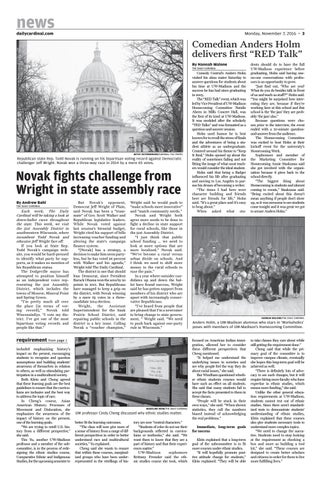
Anders Holm, a UW-Madison alumnus who stars in ‘Workaholics’ poses with members of UW-Madison’s Homecoming Committee. focused on American Indian immigration, allowed her to consider these different perspectives that Cheng mentioned. “It helped me understand the underlying issues in societies and see why people feel the way they do about racial issues,” she said. But Windham questioned whether ethnic students courses would have such an effect on all students. She said that many students fail to accept the facts presented to them in these classes. “People will be stuck in their own ways,” she said. “When shown statistics, they call the numbers biased instead of acknowledging the real problems.” Immediate, long-term goals for success Klein explained that a long-term goal of the subcommittee is to fit more courses under ethnic studies. “It will hopefully promote positive attitude change for students,” Klein explained. “They will be able
to take classes they care about while still getting the requirement done.” Cheng said that while the primary goal of the committee is to improve campus climate, eventually she hopes this long-term goal will be achieved as well. “There is definitely lots of advocacy to see such changes, but it will require hiring more faculty who have expertise in ethnic studies, which means more funding,” she said. Unlike the other general education requirements at UW-Madison, students cannot test out of ethnic studies. Since there aren’t standardized tests to demonstrate students’ understanding of ethnic studies, Klein explained that these courses also give students necessary tools to understand more complex topics. “We need to change the narrative. Students need to stop looking at the requirement as checking a box and more as building a tool kit,” she said. “These courses are designed to create better scholars and citizens in order for them to live more fulfilling lives.”