news dailycardinal.com
Weekend, April 6-9, 2017
l
3
Constitution change may give victims more rights By Claire Grummon THE DAILY CARDINAL
Crime victims could receive greater protections in the courtroom under a proposal announced Tuesday by state Republicans. The proposal is part of an amendment that would also allow victims to speak out at a greater number of court hearings and to refuse interviews with attorneys for suspects. The legislation, dubbed as “Marsy’s Law,” is part of an effort to increase victims’ rights nationwide. The law is named after Marsalee Nicholas, a California college student who was killed in 1983 by her exboyfriend. Her brother now advocates for victims’ rights laws across the country. Wisconsin was the first state to establish a “crime victim bill of rights” in 1980. Another amendment was later adopted in 1999 to afford victims more privacy. The new amendment, created by state Sen. Van Wanggaard, R-Racine, and state Rep. Todd Novak, R-Dodgeville, would expand on these rights. To become part of the state con-
BETSY OSTERBERGER/CARDINAL FILE PHOTO
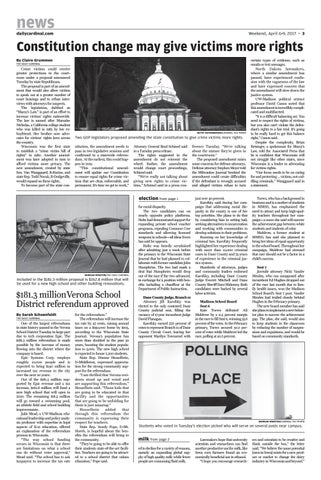
Two GOP legislators proposed amending the state constitution to give crime victims more rights. stitution, the amendment needs to pass in two legislative sessions and confirmed in a statewide referendum. At the earliest, this could happen in 2019. “This constitutional amendment will update our Constitution to ensure equal rights for crime victims that are clear, enforceable, and permanent. It’s time we get to work,”
Attorney General Brad Schimel said in a Tuesday press release. The rights suggested in the amendment do not reinvent the wheel. Rather, the amendment would change court proceedings, Schimel said. “We’re really not talking about giving new rights to crime victims,” Schimel said in a press con-
election from page 1
MORGAN WINSTON/THE DAILY CARDINAL
Included in the $181.3 million proposal is $162.8 million that will be used for a new high school and other building renovations.
$181.3 millionVerona School District referendum approved By Sarah Schoenfeldt THE DAILY CARDINAL
One of the largest referendums in state history passed in the Verona School District Tuesday in large part due to tech corporation Epic. The $181.3 million referendum is made possible by the increase of money flowing into the district where the company is based. Epic Systems Corp. employs roughly 10,000 people and is expected to bring $140 million in increased tax revenue to the city over the next 20 years. Out of the $181.3 million supported by Epic revenue and a tax increase, $162.8 million will fund a new high school that will open in 2020. The remaining $18.5 million will go toward a swimming pool, an athletic field and school building improvements. Julie Mead, a UW-Madison educational leadership and policy analysis professor with expertise in legal aspects of K-12 education, offered an explanation of the referendum process in Wisconsin. “The way school funding occurs in Wisconsin is that there are limitations on what a school can do without voter approval,” Mead said. “The school has to ask taxpayers to increase the tax rate
for the referendum.” The referendum will increase the tax rate by 42 cents, raising annual taxes on a $250,000 home by $105, according to the Wisconsin State Journal. Verona’s population has more than doubled in the past 30 years, boosting the student population to 5,000. The new high school is expected to house 2,200 students. State Rep. Dianne Hesselbein, D-Middleton, expressed appreciation for the strong community support for the referendum. “I am thrilled that Verona residents stood up and voted and are supporting this referendum,” Hesselbein said. “Those kids that are going to be educated in that facility and the opportunities that are going to be unfolding for them is just amazing.” Hesselbein added that through this referendum the community is expressing their respect for teachers. State Rep. Sondy Pope, D-Mt. Horeb, is hopeful about the benefits the referendum will bring to the community. “They’re going to be able to offer their students state-of-the-art facilities. Teachers are going to be attracted to a school district that values education,” Pope said.
for racial disparity. The two candidates ran on nearly opposite policy platforms. Holtz had demonstrated support for expanding private school voucher programs, repealing Common Core standards and allowing licensed weapons in schools—all ideas Evers has said he opposes. Holtz was heavily scrutinized after admitting just a week before the primary to the Wisconsin State Journal that he had planned to collaborate with former candidate John Humphries. The two had made a deal that Humphries would drop out of the race if the two advanced, in exchange for a position with benefits including a chauffeur at the Department of Public Instruction. Dane County Judge, Branch 12 Attorney Jill Karofsky was elected to the only contested Dane County judicial seat, filling the vacancy of 17-year incumbent Judge David Flanagan. Karofsky earned 57.6 percent of votes to represent Branch 12 of Dane County Circuit Court, leaving her opponent Marilyn Townsend with
ference Tuesday. “We’re talking about the stature they’re given in the courtroom.” The proposed amendment raises some concerns for defense attorneys. Defense attorney Stephen Meyer told the Milwaukee Journal Sentinel the amendment could create difficulties if the defendant is wrongly accused and alleged victims refuse to turn just over 40 percent. Karofsky said during her campaign that addressing racial disparity in the county is one of her top priorities. She plans to do that by considering bias in setting bail, seeking alternatives to incarceration and working with communities to develop solutions to their problems. Running on her knowledge of criminal law, Karofsky frequently highlighted her experience dealing with more than 10,000 criminal cases in Dane County and 25 years of experience in the criminal justice system. Hundreds of attorneys, judges and community leaders endorsed Karofsky, including Dane County Judge Everett Mitchell and Dane County Sheriff Dave Mahoney. Both candidates were backed by several labor activists. Madison School Board Seat 6 Kate Toews defeated Ali Muldrow by a 11.5 percent margin in the race to fill Seat 6, winning 55.6 percent of the votes. In the February primary, Toews secured 30.2 percent of votes while Muldrow led the race, polling at 40.2 percent.
certain types of evidence, such as emails or text messages. North Dakota lawmakers, where a similar amendment has passed, have experienced confusion with the vagueness of the law and have expressed concern that the amendment will slow down the justice system. UW-Madison political science professor David Canon noted that this amendment is incredibly complicated and multifaceted. “It is a difficult balancing act. You need to respect the rights of victims, but you also can’t violate the defendant’s rights to a fair trial. It’s going to be really hard to get this balance right,” Canon said. Despite the complexity, Brian Reisinger, a spokesman for Marsy’s Law, told the Associated Press that he is confident that Wisconsin will not struggle like other states, since Wisconsin is a leader in advocating for victims rights. “Our focus needs to be on caring for and protecting ... victims, not coddling criminals,” Wanggaard said in a statement. Toews, who has a background in business and is a mother of students in MMSD, has emphasized the need to attract and keep high-quality teachers throughout her campaign—a move she said will narrow the achievement gap between white students and students of color. Muldrow, a former student at MMSD, has said she planned to bring her ideas of equal opportunity to the school board. Throughout her campaign, Muldrow had stressed that race should not be a factor in a child’s success. Seat 7 Juvenile attorney Nicki Vander Meulen, who ran unopposed after incumbent Ed Hughes dropped out of the race last month due to family health issues, won the Madison School Board’s Seat 7 post. Vander Meulen had trailed closely behind Hughes in the February primary. The new board member has said she plans to implement a new behavior plan to narrow the achievement gap. The plan, she said, would aim to keep students in the classroom by reducing the number of suspensions and expulsions, and would be based on community standards.
MORGAN WINSTON/CARDINAL FILE PHOTO
Students who voted in Tuesday’s election picked who will serve on several posts near campus.
milk from page 2 ed to decline for a variety of reasons, namely an expanding global supply of high quality milk while fewer people are consuming fluid milk.
Lawmakers hope that university scientists and researchers can find another productive use for milk, like Iowa corn farmers found an economically beneficial use in ethanol. “I hope you encourage research-
ers and scientists to be creative and think outside the box,” the letter said. “We believe the same potential [seen in Iowa] exists for a new product or market to change the dairy industry in Wisconsin and beyond.”