



Hello again! There’s a wide range of article topics this issue, and some articles are online only, so please be sure to check out our website.
Our next editorial board meeting is Monday, Oct 21, 2024 in Riddell Centre room 227 from 4 p.m. to 5 p.m.. These meetings are meant to be spaces for students to come talk to our editors. This can be about things they like about the paper, things they dislike, things they think we should be putting in the paper, and even things they want to pursue as contributors to our paper. If no one has anything to say about the paper, we also can talk about anything else you want to! To attend the next Board of Directors meeting, please reach out to ziyang@ carillonregina for more information. We are planning our next Annual General Meeting, so keep an eye out for any information regarding that in the next few weeks!
Illegitimi non carborundum, mikayla tallon editor-in-chief
the staff
editor-in-chief mikayla tallon editor@carillonregina.com
executive director ziyang li business@carillonregina.com
production coordinator annika hadden production@carillonregina.com
web technician jebrael muhammad web@carillonregina.com
news editor allister white news@carillonregina.com
community editor kimberley kaufman community@carillonregina.com
op-ed editor hammad ali op-ed@carillonregina.com
staff writer amina salah
staff writer emma mcgill
news writer nazeemah noorally news writer shivangi sharma community writer pall agarwal
contributors michela sisti, harrison munro, william bessai-saul & lee lim
board of directors muhammad zuhruf muhammad zarooq, mohammad akib hossain, tayef ahmed, austin stadnyk, jeremy beam
the paper
227 Riddell Centre @ the University of Regina 3737 Wascana Parkway, Regina, SK, Canada S4S 0A2 www.carillonregina.com | (306) 586 8867
Printed by Star Press Inc, Wainwright, AB
The Carillon welcomes contributions.
Opinions expressed in the pages of the Carillon are entirely those of the author, and do not necessarily reflect those of The Carillon Newspaper Inc. Opinions expressed in advertisements appearing in the Carillon are those of the advertisers, and not necessarily of The Carillon Newspaper Inc. or its staff.
The Carillon is published no less than 11 times each semester during the fall and winter semesters and periodically throughout the summer. The Carillon is published by the Carillon Newspaper Inc., a non-profit organization.
land acknowledgement
The Carillon is written on Treaty 4 territory. As such, staff recognize that we are living, working, and telling stories on and of Indigenous lands. We recognize that we are on the traditional homelands of the Cree, Saulteaux, Nakota, Lakota, and Dakota peoples, along with the homeland of the Métis nation. The Carillon understands that it is pointless to acknowledge the land on which we work without demonstrating our commitment to telling stories and prioritizing voices that further the return of this land to its sacred place. the manifesto
In keeping with our reckless, devil-may-care image, our office has absolutely no concrete information on the Carillon’s formative years readily available. What follows is the story that’s been passed down from editor to editor for over sixty years.
In the late 1950s, the University of Regina planned the construction of several new buildings on the campus grounds. One of these proposed buildlings was a belltower on the academic green. If you look out on the academic green today, the first thing you’ll notice is that it has absolutely nothing resembling a belltower.
The University never got a belltower, but what it did get was the Carillon, a newspaper that serves as a symbolic bell tower on campus, a loud and clear voice belonging to each and every student. the people’s friend; the tyrant’s foe











nazeemah noorally news writer
As the educational landscape in Saskatchewan continues to evolve, tensions between the Saskatchewan Teachers’ Federation (STF) and the provincial government remain. Negotiations for a new three-year contract garnered significant attention, especially after teachers voted no to the contract.
The proposed contract included a salary increase of 3 per cent for each of the first two years, followed by a 2 per cent increase in the third year. While this might appear beneficial on the surface, the response from the STF suggested otherwise.
Samantha Becotte, the president of the STF, has emphasized the importance of presenting clear, factual information to teachers, stating, “We will be presenting those facts, the benefits, the potential consequences of voting in for and against and come to an informed decision on their own.”
This approach reflects the federation’s commitment to ensuring that teachers understand the implications of the proposed agreement. The backdrop of these negotiations has been marked by significant unrest among educators. After the beginning, and breakdown of negotiations, teachers engaged in job action, including picketing and withdrawing from extracurricular activities, which caused frustration for both students and parents.
The provincial government proposed
an article within the agreement that outlined the funding arrangements with the Saskatchewan School Boards Association. This article aimed to honor an accountability framework that ensures financial resources are directed toward benefiting students directly. However, many teachers viewed this as insufficient, arguing that it fails to address the fundamental issues affecting their working conditions and the quality of education.
As negotiations progressed, the STF’s concerns intensified. Teachers have voiced their frustrations regarding long-standing issues such as inadequate classroom resources, increased workload, and the overall state of public education funding in Saskatchewan. The federation’s protests and job actions were designed to send a clear message to the government: educators are advocating not just for salary increases but for a comprehensive overhaul of how education is funded and prioritized.
The situation has drawn attention from various stakeholders, including parents and community members. Many have rallied behind teachers, expressing solidarity with their demands for better working conditions and adequate support for students. Some parents have organized community forums to discuss the impact of the ongoing negotiations on their children’s education, highlighting the urgent need for a resolution that benefits both teachers and students.
On the other side of the negotiation table, Education Minister Jeremy Cockrill has expressed optimism regarding the

proposed agreement. He stated, “I think there’s some good things in this agreement that are good for teachers, good for the province. We don’t have sanctions going on for the extracurriculars.”
Cockrill believed that the agreement represented a step forward, emphasizing the need for a balanced approach that addresses the concerns of educators while also considering the province’s fiscal realities. The vote from teachers on the government’s offer was, according to Discover Moose Jaw, “a resounding ‘no’... from the teachers.” Discover Moose Jaw also reported that “92.2 per cent of members [casted]

As autumn has begun to sweep across Regina, the days have started to get shorter and the weather cooler. While some enjoy the nippy breezes and colorful hues of fall, to others it marks the end of long, warm summer days as the frigid winter months approach.
People’s mental health sometimes experience the effects of this seasonal transition. As the weather changes, and early winter comes closer, many also experience
what is known as Seasonal Affective Disorder (SAD).
The U.S. National Institute of Mental Health (NIMH), describes SAD as significant changes in mood and behavior as the seasons change. Cases of SAD range from mild to serious, but in any case, SAD “can affect how a person feels, thinks, and behaves.”
NIMH states that “in most cases, SAD symptoms start in the late fall or early win-
ter and go away during the spring and summer, known as winter-pattern SAD.” Winter-pattern SAD is more common.
SAD should not be confused or dismissed as “winter blues” or “holiday blues.” SAD is a clinical mental health condition. According to the Suicide Prevention Resource Centre, mental health conditions, such as SAD, “can affect many areas of students’ lives, reducing their quality of life, academic achievement, physical health, and satisfaction.”
There are ways to seek help and access treatment, and SAD can be managed to reduce severity. NIMH’s list of symptoms covers summer-pattern SAD, but those that are consistent with winter-pattern SAD include excessive sleeping or hypersomnia, overeating (with a particular craving for carbohydrates), and social withdrawal along with symptoms of depression.
Those experiencing symptoms of SAD can access help and treatment via Student Mental Health support services at the University of Regina (U of R).
The university also announced a new peer to peer support platform in addition to the previously available support services, called Togetherall. Togetherall is a U.K. based online mental health service that started in 2007 as the “Big White Wall” and was rebranded in 2020. In an email sent out in early July, Associate Vice President of Student Affairs, John D. Smith, announced the partnership with Togetherall.
“Togetherall is a unique platform that combines peer to peer support with monitoring by licensed clinicians to ensure students have access to the in-the-moment
their vote with 90 per cent voting to oppose the offer.”
According to a news release by the STF, “Dates have been finalized for arbitration proceedings between the Teachers’ Bargaining Committee and the Government-Trustee Bargaining Committee. The arbitration hearing will take place Dec 16 to 20 in Saskatoon.”
During this hearing, the STF says that “both sides will have the opportunity to submit written positions and make presentations on the two issues: wages and class complexity-accountability framework.”
support they need, as well as connections to additional resources, and is available to all students now,” Smith wrote.
There is a lack of awareness about the new platform amongst some students on campus, one of whom, in conversation with the Carillon revealed that they hadn’t heard of the program.
“I’ll be entirely honest with you; this is the first I’ve heard about it [...] I’ve known about the therapy or counselling offered through the university, but I only know it exists [...] I rarely hear much of anything about any mental health resources offered at the university,” said Tannor Magnuson, a third student majoring in English.
“I was not checking my university emails in July. I took the summer off. I had no idea about this, but it sounds like a good thing,” offered Lenitta Antony, a final year nursing student.
These two conversations with the students suggest that, although adding more resources to support student mental health is a positive step, more can be done in increasing awareness and availability of resources.
shivangi sharma news writer
What it is, why it’s important, and the TRC’s calls to action
nazeemah noorally news writer
Each year since 2021, on Sept 30, Canada observes the National Day for Truth and Reconciliation, a day dedicated to honoring the children who never returned home from residential schools, the survivors, and their families and communities.
It serves as a solemn reminder of the tragic and painful legacy of residential schools, while also encouraging Canadians to engage in meaningful conversations about reconciliation. This day is a crucial part of the broader reconciliation process, acknowledging the past and fostering healing.
The National Day for Truth and Reconciliation was established as a federal statutory holiday following legislative changes made by Parliament. Its creation was in direct response to the Truth and Reconciliation Commission’s (TRC) Call to Action (CTA) 80, which recommended a National Day of Commemoration to reflect on the legacy of residential schools.
The TRC issued 94 CTAs to address the legacy of residential schools and advance reconciliation between Indigenous and non-Indigenous Canadians. These recommendations aim to acknowledge the harms of the past and prevent future injustices.
The 94 CTAs are divided into two main sections: Legacy and Reconciliation.
Legacy (CTAs 1–42): Focus on addressing the historical impacts of residential schools, highlighting issues related to child welfare, education, language, culture, health, and justice. The goal is to fully recognize the genocide experienced by Indigenous Peoples.
Reconciliation (CTAs 43–94): Aim to dismantle systemic racism and create lasting change in areas such as government policy, education, media, sports, business, and legal equity for Indigenous Peoples. These CTAs also promote awareness through education to prevent future injustices.
Progress on implementing the CTAs has been slow. By June 2021, only 12 had been completed, as tracked by CBC’s “Beyond 94” project.
Implemented calls include:
CTA 13: Federal recognition of Indigenous language rights.
CTA 41: Inquiry into Missing and Murdered Indigenous Women and Girls.
CTA 48: Adoption of the UN Declaration on the Rights of Indigenous Peoples by churches.
CTA 72: Federal support for the National Centre for Truth and Reconciliation.
CTA 88: Long-term government support for the North American Indigenous Games.
According to APTN, former TRC commissioners “are sounding an alarm,” and calling out what has been “slow and uneven” progress in terms of implementing the calls to action.
“It is very concerning that the federal government still does not have a tangible plan for how they will work towards implementing the Calls to Action,” Murray Sinclair told APTN.
The commission, which Murray Sinclair was chair of, operated from 2008 to 2015, documented the experiences of Indigenous children forced into these schools, producing 94 Calls to Action aimed at addressing the historical and ongoing impacts of colonization.
The Shirt Day, an Indigenous-led grassroots movement that highlights the generational trauma caused by residential schools explains that the orange shirt symbolizes the stripping away of culture, identity, and self-esteem that Indigenous children endured. The origins of Orange Shirt Day trace back to Phyllis Webstad, whose orange shirt was taken from her on her first day at a residential school. Her story has since become a symbol of the cultural erasure experienced by thousands of Indigenous children.
In recognition of these experiences, people across the country are encouraged to wear orange on September 30 to hon-

our survivors and those who never made it home. The movement’s motto, “Every Child Matters,” serves as a reminder that the impacts of residential schools are still felt today, and it calls on people to wear orange as a sign of solidarity and remembrance.
Throughout Canada, communities, schools, and organizations host events to reflect on the history of residential schools. From public gatherings to virtual educational programs, settlers are provided opportunities to learn and engage with the stories of Indigenous Peoples.
The National Centre for Truth and Reconciliation, for example, offers free virtual programming during Truth and Reconciliation Week, which runs from September 23 to 27. This initiative invites students, educators, and the public to deepen their understanding of First Nations, Inuit, and Métis cultures and histories.
On September 30, major landmarks, including the Peace Tower and Senate Building on Parliament Hill, are illuminated in orange to honour the children and survivors.
This year, the National Day for Truth and Reconciliation commemorative gathering, Remembering The Children, was broadcast live from Parliament Hill. This 90-minute event, presented by APTN and the National Centre for Truth and Reconciliation, brings together diverse voices to honour those affected by residential schools.
For many Indigenous communities, September 30 can be a day of both reflection and emotional difficulty. Mental health supports are available for former residential school students through crisis referral services and helplines such as the Hope for Wellness Help Line, which provides counseling 24/7 for Indigenous peoples across Canada.
The National Day for Truth and Reconciliation is one of many steps toward addressing the harm caused by residential schools. The TRC’s final report, released in 2015, emphasized the need for continued efforts in acknowledging this history
and its lasting effects. The creation of the National Centre for Truth and Reconciliation ensures that the stories of survivors are preserved, offering ongoing education and advocacy for reconciliation.
One of the TRC’s CTAs specifically emphasizes the need for comprehensive education on Indigenous histories and cultures in schools.
CTA 62 calls on federal, provincial, and territorial governments to make age-appropriate curriculum on residential schools, treaties, and Indigenous contributions to Canada mandatory in all schools. This is a transformative shift in how Indigenous histories are taught in Canadian classrooms.
Historically, Indigenous Peoples’ stories were either omitted or presented through a colonial lens, which perpetuated stereotypes and misunderstandings. Integrating Indigenous perspectives into education at all levels – from elementary to post-secondary – helps to dismantle these biases and ensures that future generations grow up with a deeper understanding of the injustices faced by Indigenous Peoples by settler-colonialism and the Canadian government.
For example, some schools across Canada are now incorporating units on residential schools, often inviting Indigenous elders and speakers to share their lived experiences. These personal narratives can have a profound impact on students, helping them see beyond the textbooks and connect emotionally with the historical and ongoing effects of colonialism.
Educators also explore treaties, Indigenous governance systems, and cultural practices that had been undervalued or suppressed for decades. By engaging with these subjects, students can better appreciate the rich and diverse cultures of First Nations, Inuit, and Métis Peoples.
Canadians are thus urged to reflect on the legacy of residential schools and commit to meaningful action in the spirit of reconciliation.
“ It is very concerning that the federal government still does not have a tangible plan for how they will work towards implementing the Calls to Action.”
Murray Sinclair
emma mcgill staff writer
When flipping through the archive from the 1970s (which we discussed in an earlier Carillon through the ages article) to two decades later, it’s obvious that the Carillon looks different; the graphics are much more detailed, and the advertisements have gone from 60s-style clothing boutiques and Coca-Cola to Dr. Martens boots and 7-Up. Like now, ads are just one part of the picture, and the paper is made by the content that the student staff work to produce.
In 1990, the University of Regina (U of R) had been an autonomous university for 16 years. Though many of us are more familiar with products of this decade than those of the 70s, a lot has changed in the two decades between now and then… or has it?
An article from September 1990 states that “The U of R is busting at the seams. Sure you see a lot of construction going on…”
Today, we do see a large amount of construction going on – most notably in Ad-Hum and spaces left empty by Chartwells’ departure. The article from Sep-
tember 1990 only passively pointed out the inconvenience of construction to move forwards to a more pressing topic: the rapidly growing student population.
According to this piece, “The same buildings that held 5,000 students in 1973 now hold almost 11,000 students.” The U of R was in desperate need of more space, and this construction contributed greatly to campus as we know it today, and added “the new Language building,” now known as La Cité, to campus.
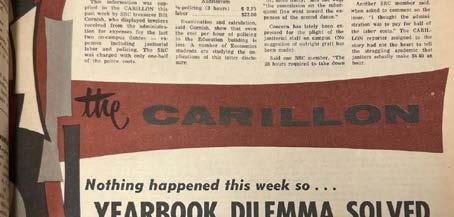
I wish we could report “DILEMMA SOLVED” rather than “DILEMMA” Every. Single. Issue.
In November, the headline “New building on the way” shared a page with construction plans for the building that was to be known as W.A. Riddell Hall which “would be located between College West and the Education Building,” and would be designed by a local architect. The student centre at the time had been built back in 1969 and was meant to be temporary.
In the same issue, a full page advertisement for the grand opening of the Lazy Owl Club told students to “Come to the Owl for great times.”
There is no denying that the
Carillon itself remained a newspaper by the students and for the students. There was a “Question of the Week” section, which asked something that was usually about university spending and management or pop culture, occasionally, and students’ opinions would be published alongside their picture, name, year, and major. One of these weekly questions was, “Did Dances With Wolves Deserve Best Picture, and if not which movie did?”
The Arts section of the paper at this time featured not only frequent updates as to what events in music, theatre, and film were

Welcome to the Carillon’s “Finance with Pall,” a news finance column covering important economic and financial news from Canada and around the world, focusing on explaining what that news means for students. From tuition costs to job markets, we’ll break down how these changes affect you, making finance easy to understand and relevant to your life. If you have any request for a topic or want me to highlight a stock price – shoot me an email
apall@carillonregina.com.
Disclaimer: The information in this column is intended for educational purposes and is not financial advice. For personalized financial guidance, please consult a licensed professional.
Terms of the week:
Credit score: “Credit score” is a term you may hear frequently when going to the bank, applying for loans, or discussing credit cards.
A credit score is a three-digit number that represents your cred-
itworthiness, meaning it reflects how likely you are to repay the borrowed money. It helps lenders like banks or credit card companies better understand the risk of lending you that money that you are seeking to borrow.
The higher your score, the more likely you are to get approved for loans or credit, and the better your chances are at getting lower interest rates. In Canada, financial institutions, credit card companies, phone companies, employers, and landlords are just
going on in Regina that week, but also many album reviews by students on new albums from artists like Pixies, Huey Lewis and the News, and Sarah McLachlan.
At this time, the staff were also selling Carillon t-shirts for $10 which said “Don’t Rock the Boat, Sink It!” In the early 90s, rocking the boat meant frequent reporting on rights updates for the gay, lesbian, and bisexual community, spreading awareness about domestic violence, date rape, and violence against women in general, as well as awareness about safe sex and AIDS prevention.
Students also seemed to be
quite concerned about the implementation of a campus no-smoking policy.
Issues in 1990 and 1991 were each around 25 pages long. One from October had a front page titled “WE’RE 28 YEARS OLD!” and featured a special spread of pictures, a timeline of important events in Carillon history, and news clippings from articles over the years. How strangely familiar…
some of the people who can use your credit report to view your credit score.
According to the federal government’s Financial Consumer Agency, Saskatchewan is one of three provinces where consent is not required to check a credit report. In other provinces, written consent is required Credit utilization: This is a percentage of your available credit that you’re currently using, which helps lenders assess how responsible you are with managing your money. For example, if your credit limit is $1,000 and you’ve used $300, your credit utilization is 30 per cent.
According to Equifax, keeping credit utilization as low as 30 per cent shows that you’re not overextending yourself financially, which can help maintain a good credit score. Why is this relevant? Keeping a healthy credit utilization rate reinforces a good credit score which at the end reflects your financial health and how you deal with paying back debt.
News of the week: You might have heard about interest rate cuts recently. Let’s explore what is new in the past month and discover what the experts have to say about October, especially whether or not they say there’ll be any further rate cuts.
According to Katherine Judge, an economist at the Canadian Imperial Bank of Commerce, “For the Bank of Canada’s October announcement, the up-
coming employment report will be key in determining whether a 25-basis-point or 50-basis-point cut is necessary, with today’s data not enough to sway us from our 25-basis-point call at this point.”
What does this mean? Judge is suggesting that the Bank of Canada’s decision in October about lowering interest rates will depend on the upcoming employment report.
This report will help the government decide if they should lower rates by 0.25 per cent (25 basis points) or 0.50 per cent (50 basis points). However, based on the data they have right now, they still think a smaller cut of 0.25 per cent is more likely.
This means that as interest rates would be lower, borrowers would be more willing to borrow money, incentivizing businesses to borrow money for expansion and hiring workers. Lower interest rates could give businesses greater access to capital investments, leading to economic growth and the possibility for potentially lower unemployment numbers.
pall agarwal community writer
TheBroadcastingAct gets an update
pall agarwal community writer
On June 4, 2024, The Canadian Radio-television and Telecommunications Commission (CRTC) took a step forward in implementing the Online Streaming Act, originally known as Bill C-11.
According to the Government of Canada’s news release, “The Online Streaming Act, which amended the Broadcasting Act, requires the CRTC to modernize the Canadian broadcasting framework and ensure that online streaming services make meaningful contributions to Canadian and Indigenous content.”
The Act is designed in such a way that it promotes Canadian content and cultural diversity, representing the true nature of what Canada is and ensuring that Canadian stories and music are widely available on digital platforms.
However, there were many debates held around this step. Some groups perceived it as a positive step with more contribution towards Canadian content, and others argued that the Act’s 5 per cent tax not only hurts consumers but also disrupts the critical role streaming services have played in promoting Canadian talent. One of the major industry stakeholders of this stance is the Digital Media Association (DIMA).
With more people turning to online platforms for music, movies, and shows, the government decided that it was time to update the rules governing digital platforms. The Act made sure there were no special rules for streaming platforms like Netflix, Spotify, and YouTube, and that traditional media companies in Canada, such as TV and radio broadcasters, support Canadian culture by making their content more accessible and discoverable on these platforms.
This was seen as of the utmost importance as this change considers the consumer’s, those who live in Canada’s, side. Investments are being made to local artists, musicians, and filmmakers by requiring streaming platforms to invest in Canadian content,
much like how radio stations must play a certain amount of Canadian music.
The Government of Canada’s charter statement on the Act stated, “amendments [to the Broadcasting Act] would further the values that underlie freedom of expression.” Furthering the people’s freedom of expression might help creators and artists who are looking to get out there in the Canadian ecosystem of media make their mark.
The Act also emphasizes updating the policies regarding making programs accessible to persons with disabilities. According to the charter statement, “Clause 5 would update the regulatory policy by adding that the broadcasting system should be regulated and supervised in a manner that facilitates the provision of programs that are accessible without barriers to persons with disabilities. The Commission’s power to make orders in clause 10 would include orders imposing conditions respecting access by persons with disabilities to programming, including the identification, prevention and removal of barriers to such access.”
The tax obligations made by online streaming services would be directed to areas of “immediate need in the Canadian broadcasting system, such as local news on radio and television, French-language content, Indigenous content, and content created by and for equity-deserving communities, official language minority communities, and Canadians of diverse backgrounds” as per the Government of Canada news release.
DIMA released a national campaign called “Scrap the Streaming Tax” to ensure that “online streaming remains affordable for all Canadians in the face of new costs brought on by the continued implementation of the Online Streaming Act (Bill C-11)” as per their release on Sept 30. The media release by the organization explains their stance on how the bill has led to increased costs for consumers, making music streaming services less affordable.
According to Graham Davies, President and CEO of

DIMA, “The streaming tax needs to be scrapped because Canadians are already feeling the pinch from rising inflation and economic pressures. The addition of a streaming tax is an unnecessary burden. This tax is not only a financial strain on consumers, but it also undermines the role that streaming services have played in promoting Canadian culture and artists and enabling the music sector’s investment in talent.”
DIMA created a separate website so that supporters of this campaign can send messages to Members of Parliament urging them to keep the affordability of these services as a priority when these policies are being evaluated. They further started a new hashtag called #ScrapTheStreamingTax so that it is open to the public to join this conversation and get their voices heard.
Other organizations like the Canadian Motion Pictures Association are in support of the bill as they believe that it has created a balance between the needs of Canadian producers, broadcasters, and major streaming platforms.
According to Damon D’Oliveria, “...with the government’s recognition of the significant contribution of the Canadian independent production sector, regulations must also ensure there is a foundation for fair negotiations between independent Canadian producers and huge broadcasters and global content companies.”
D’Oliveria is the partner of Conquering Lion Pictures and part of the CMPA Board of Directors.
There were further pushes against the new Bill from smaller companies and niche streaming services that may struggle to afford the new tax levied on them and may end up either increasing the subscription fees or limiting their availability in Canada, thereby moving their services somewhere else. There are still facts that are being clarified, including the balance between supporting Canadian culture and maintaining an affordable and accessible online streaming service landscape.
Meanwhile, Canadians are closely watching as the costs of streaming services rise. The conversation about whether the Act
is more beneficial or costly continues, weighing the benefits of keeping or removing the new Act on Canadian media.
If organizations like DIMA continue to lead and speak out, the Parliament may see further campaigns pushing for amendments to the new bill or at least some flexibility in its application. As Canada continues to navigate the evolving digital media landscape, the key challenges are balancing all of it to maintain the welfare of the people and also making the talent pool seen in the world.
Whether the Online Streaming Act will achieve this balance remains to be seen, but its longterm impact will shape the future of both the industry and Canadian culture in the digital era. This also includes the legal challenges and varied industry responses that will need to be kept in consideration to find a solution that satisfies both cultural objectives and economic realities.
“ With more people turning to online platforms for music, movies, and shows, the government decided that it was time to update the rules governing digital platforms.”
DidyouknowyoucancelebrateOktoberfestwithouttravellingtoGermany?
pall agarwal community writer
As autumn kicks off with crispy leaves and a chill in the weather, the streets of Regina come alive with the spirit of Oktoberfest. Oktoberfest is the world’s largest folk festival that originally made its mark in Munich, Germany in 1810.
This festival has found a special place in many people’s hearts around the globe, and Regina is no exception. The celebration of this festival involves craft beer tastings, traditional dancing, and live music. In Regina, the live music combines German heritage with Regina’s local charm, love, and community; bringing everyone together and creating a sense of community and joy.
The story which started this tradition in the entire world was the marriage of Bavarian Crown Prince Ludwig to Princess Therese of Saxony-Hildburghausen, according to Britannica Encyclopedia. The celebration of their marriage involved a lot of activities, including horse races and a large feast, which were so successful that they became an annual event for the people residing there.
Over time, the celebration has undergone many changes, like bringing in agricultural shows, carnival rides, and beer tents. Now, Oktoberfest is a festival broadly associated with Bavarian culture, something that people can immerse themselves in while they enjoy traditional German foods like bratwurst and pretzels. Some people even dress traditionally for the occasion, especially if they plan to celebrate Oktoberfest in Munich, Germany.
According to I Am Expat, traditional German clothing is referred to as Tracht, and while it used to indicate social status, nowadays, it represents German culture and pride. Women’s outfits include the Dirndl.
A Dirndl includes a dress with a bodice, skirt, shirt, and apron. Men’s outfits include Lederhosen, which are leather trousers, and “the complete outfit usually also consists of a classic shirt (usually white or checked) or a sweater made of linen or wool, suspenders, wool stockings, a jacket, a hat and country shoes.”
In Regina, people continued this celebration with different festivities across the city. Starting with the Regina German club, Oktoberfest was cele-
brated Oct 4 and 5 this year. Oktoberfest Auftakt started at 6 p.m. Oct 4 with a cocktail and kickoff dinner featuring German cuisine and was followed by the Mr. and Mrs. Oktoberfest competition at 9 p.m.. The event was hosted at 1727 St. John Street.
The next day continued the celebration as Oktoberkinderfest, which ran from 2 p.m. to 6 p.m. including fun activities and entertainment for families and children of all ages. The event featured a craft table, a petting zoo, and a special raffle basket for kids. This was the only event hosted by the Regina German Club where admission was free for Oktoberfest, the other days for the celebration of this festival had an entry fee to enjoy the activities.
The Oktoberkinderfest was followed by Oktoberfest on the same day. Oktoberfest included German cuisine, beer, and performances that filled the air with upbeat tunes and festive dances, transporting attendees to the heart of Munich.
The Regina German Club has also hosted Oktoberfest-themed fundraisers, like the Regina Rochdale NDP Oktoberfest Fundraiser held on Sept 14. Local businesses and restaurants also joined the fun with Rebel-

Tiger’s Blood by Waxahatchee
To steal a line from the album itself, which was released on Mar 22 and contains 12 fantastic tracks, “run it back, boys,” because this new Waxahatchee, the musical persona and hometown of Katie Crutchfield, is full of songs you’ll want to leave on repeat.
Crutchfield’s voice grabs and pulls you into a spinning and uplifting storm of alternative country sound covered in rightfully ambitious lyricism. Its debut single, “Right Back to It,” features North Carolina musician MJ Lenderman for a stirring and incredibly catchy duet. The album’s recently released bonus track, “Much Ado About Nothing,” offers more of Crutchfield’s
sound that Tiger’s Blood will leave you wanting.
Recommended for getting gas or sipping a slurpee on a sunny day.
Crash and Burn by The Whats
Moving into the heart of Regina, local indie rock band The Whats released their debut EP on Apr 20. Formed in 2021, they have been writing and recording in their drummer’s garage for three years now.
The project consists of four songs with themes, laid over electric guitar, of hating your hometown and descending into madness. Madness, that is, made fun.
A couple of lyrics that say it all:
“All of the kids are bored, there’s nothing here but grocery stores,” and, “I’m sick of the goddamn

lion Brewery hosting beer tasting events showcasing special Oktoberfest-themed brews.
These events highlighted Regina’s embrace of Oktoberfest traditions, offering attendees a chance to explore and enjoy something unknown to the usual Canadian culture through music, dance, food, and beer.
Oktoberfest in Regina has
proved to be more than just a celebration of beer and Bavarian culture. Instead, it was a vibrant reminder of the city’s ability to come together and celebrate community. As the final notes of the folk music faded, Oktoberfest in Regina had successfully brought a taste of Munich to the prairies, leaving attendees eagerly awaiting next year’s activities.
prairies.”
Recommended for sitting in your favourite parking lot or working on a new art project. All For Something by Tiny Habits
On May 24 of this year, the Boston singer-songwriter trio best known for their brain-tingling harmonies released their debut album, which is made up of 12 sweet songs. Made up of Cinya Khan, Maya Rae, and Judah Mayowa, Tiny Habits has released one other body of work, their EP Tiny Things.
They have brought their warm, honey-like tunes and voices on the road with Lizzy McAlpine, Ingrid Michaelson, and most recently, Sarah McLachlan, who they will be opening for this November in Saskatoon.
Recommended for taking a candle-lit bath or an autumnal walk around Wascana lake.
Rootin’ For Ya by Field Guide
Pulling our sound back a bit closer to home with this 10-track collection of rocking indie folk and pop, Field Guide, the musical persona of Dylan MacDonald, of Winnipeg, Manitoba tells a story of love and mutual compassion with Rootin’ For Ya
Currently on tour in the United States and Canada, Field Guide has previously released three other full-length albums, one of them being a cover album
of Coldplay’s Parachutes featuring duets with Lizzy McAlpine and fellow Winnipegger Begonia. This newest album lifts qualities of the previous albums and strengthens them, surrounding lyrics like “I don’t ever wanna keep you waiting” and “I guess we still have a fair bit of time” with grabbing guitar riffs.
Recommended for taking a long drive or making dinner.
That’s the Gods Talking by Slow Spirit
Slow Spirit, composed of duo Natalie Bohrn and Eric Roberts, released their fourth full-length album on July 26, and it really is what the second track advertises: an “Out of Body Experience.”
Their soundscapes combined with the imagery in the lyrics reflect the energy they take from their home base in Winnipeg, Manitoba.
Recommended for an early evening nature walk in any season.
Charm by Clairo
On a much more mainstream note, the charming Clairo released her third studio album on July 12. The 11 tracks that make up this project very much lean into the world of r&b while still upholding Clairo’s signature sound, although the indie pop of her 2019 style has both matured and softened.
Its first single, “Sexy to Some-
one,” was a great trailer for the entirety of the album; the blended bass and piano sound and floating lyrics combined with spotting of clarinet certainly inspire a kind of joy that one can only find in listening to Clairo.
Recommended for playing dress up or riding a bike.
We were born here, what’s your excuse? by The Secret Beach
Going back to Winnipeg with The Secret Beach, Micah Erenberg’s project which he has now released two albums under, we take a much different journey through 41 minutes of songs like sunlight through a garnet amp. Mastering the Manitoba indie rock ballad, Erenberg shares love songs and tributes to friends, sisters, and his home city, produced in his own studio with “vintage equipment and analog tape.”
Recommended for cruising into the weekend by taking a deep breath and grabbing a good treat.
Editor’s note: Space restrictions necessitated cutting this article short in print. An extended form of this article is available online at carillonregina.com
emma mcgill staff writer
michela sisti contributor
I first glimpsed them from my plane window at thirty-five thousand feet. I was leaving an old home overseas and on my way to an entirely new one here in Saskatchewan. The journey could not have been more surreal or illuminating.
I watched glaciers calving off the east coast of Greenland, saw Canadian skies aglow in the dull orange haze of wildfires.
And then, as we were flying over the table-top lands of the prairies, I beheld something wonderful: a multitude of shimmering gouges in the landscape, scattered far into the horizon like so many shards of a glittering mirror.
Despite having been born and raised in Canada, I knew nothing of these mysterious water-filled depressions. There was no cultural discussion, no frame of reference I could draw from.
I didn’t know I was looking at one of the most important ecosystems on the continent. Or that these ancient water-filled kettle holes, carved out of the land by kilometre-high glaciers of the last ice age, have sustained life on the prairies for over 10,000 years.
What I had seen was a view of the Prairie Pothole region: a dynamic ecosystem of millions of variously sized wetlands extending from the southern Canadian prairie provinces to Iowa, the Dakotas, and Montana. The majority of these pothole wetlands reside right here in Saskatchewan.
Yet within our province’s borders, they are being drained and cropped over on an industrial scale. Estimates from 2001 to 2011 tell us that this ancient ecosystem is disappearing at a rate of over 10,000 hectares per year, an area equivalent to 20,000 football fields.
This number is only likely to have grown since 2011. Most of these drainage projects are unauthorized, and yet the current provincial government has done little in the way of enforcing its rules. What is more, our Water Security Agency (WSA) is now developing
“
an Agricultural Water Stewardship Policy that will facilitate the drainage of up to 79 per cent of southern Saskatchewan’s remaining wetlands.
Let’s be clear about what we are losing. Prairie potholes are some of the most important waterfowl breeding grounds on the planet. They serve as vital migratory stopovers for so many of North America’s birds that must make the great journey from the Gulf of Mexico northwards each year.
The region also provides essential habitat for more than 50 at-risk species. In this time when insect populations around the globe are crashing, prairie potholes are precious havens for the pollinators that sustain our crops. These wetlands are also critical players in the story of climate change, storing staggering amounts of carbon in their depths and acting as mini air-conditioners on the landscape.
In a region that suffers from many water security pressures, prairie potholes are integral to sustaining our water supply well into the future. We on the prairies are prone to the extremes of drought and violent storms.
Our wetlands soak up runoff in times of heavy rain, blunting the impacts of flooding events. During dry periods, they release their water back to the atmosphere, feeding the cycle of cloud formation and rain.
They are an important site of water storage and groundwater recharge while acting as biofilters, cleaning our water supply of contaminants. A robust body of scientific literature has established that these ecosystem functions will be degraded if our wetlands continue to disappear.
Moreover, new modelling work out of the University of Saskatchewan (U of S) now allows scientists to put numbers on these losses. Dr. Colin Whitfield is an associate professor of environmental science at the U of S’s School of Environment and Sustainability. He and his colleagues have developed models to predict the effects of different levels of drainage on three metrics: water

storage, water quality, and biodiversity.
Even at low levels of additional pothole drainage, the predicted blow to biodiversity is severe. “At drainage levels of 20 or 30 per cent by area, we can expect to lose about half of wetland-associated birds and a variety of dabbling duck species,” said Dr. Whitfield.
Many of these migratory waterfowl are federally protected under the Migratory Birds Convention Act (1994). Yet the highest quality habitat for these species, which are small wetlands, do not have their own protection in this province.
In fact, Saskatchewan is the only province in Canada not to have its own wetland conservation policy. According to Dr. Whitfield, these areas of high-quality habitat are usually the first targets of drainage projects as they are the easiest to do away with.
No less eye-opening are Dr. Whitfield’s findings on how drainage impacts streamflow and water storage. “When we conducted our analysis, we were showed a result that we were a little surprised by,” said Dr. Whitfield. “Even at low levels of wetland drainage, 10 per cent and up, there were no-
table impacts to the hydrological behaviour of these small watersheds.”
Once wetlands are drained, using a system of ditches that funnel water into lakes and rivers, they are typically filled in with earth and converted to cropland.
“So, we’re losing water storage,” Dr. Whitfield explained, “We’re effectively short-circuiting the hydrologic function of the natural landscape. And that water is moving off much quicker into streams and lakes.”
In the short term, this export of water manifests itself as flooding events, so often reported on in the news, that cause damage to public infrastructure and private property. The University of Saskatchewan models support this understanding, predicting that even at low levels of additional drainage streamflow events that were once rare will become more common. In the long term, it could mean a much drier Saskatchewan in a future also impacted by climate change.
“With the certainty of warmer and the uncertainty of wetter, the precautionary principle would suggest maybe you shouldn’t drain all of the water off the surface because you don’t know if
it’s coming back,” said Dr. Peter Leavitt, Canada Research Chair at the Institute of Environmental Change and Society. “Given that most farmers lose money due to excess drought the idea of getting rid of water is really kind of ridiculous.”
Dr. Leavitt lectures on freshwater ecology here at the University of Regina along with his colleague, Dr. Kerri Finlay. Both professors have expressed similar concerns about the impact continued drainage may have on our groundwater supply.
“If the water’s flowing on the surface and it’s running downhill, it’s not going down into the ground, and so you will lose your groundwater,” Dr. Leavitt explained.
Drainage also impacts water quality. At current drainage levels in the province, Saskatchewan is now at the cusp of breaching the water quality agreements that we have with our downstream neighbours, Manitoba, Montana, and North Dakota, who are at the receiving end of our rivers.
Editor’s note: Space restrictions necessitated cutting this article short in print. An extended form of this article is available online at carillonregina.com
The last time we had a formal interaction with [the WSA], the final question was “What proportion of wetlands can we safely drain?” And the response of the scientists, across the board, was: none. Negative. You have to put them back on the landscape. Just like they’re doing in Manitoba. Just like they’re doing in Alberta.”
Dr. Peter Leavitt
Why are we obsessed with villains?
amina salah staff writer
When I was younger, I remember reading stories. These were often fairytales with a protagonist and an antagonist. There was the main character, and a villain.
As a young girl, I found myself drawn to the scary characters that I wasn’t meant to fawn over. As children, we are taught to trust good people, and stay away from evil people. Being exposed to these fairytales, I remember being conscious of the fact that I had always wanted to side with the good characters.
As I have gotten older, I have come to appreciate the beauty of nuance. People are not all that they seem to be. They are deeply flawed and, at times, misunderstood.
Heroes are misunderstood, but so are villains.
I blame The Vampire Diaries In the show, there is a character that everyone and their mother knows, and that is none other than the villainous Klaus. Klaus is brutal, cruel, and harsh. However, he is a beloved character in the fandom.
Nuance is ultimately what forces us to confront our biases and reflect on the grey areas of ethics, morality, and justice.
In the back of my mind, I think about how looks play into
our obsession with villains. Pretty privilege is very real, and it works in the same manner for men that it does for women. We love beautiful people. We don’t care how good they are or how evil they are.
The mere fact that they are beautiful excuses each and every single one of their abhorrent actions. That is just the harsh truth that we do not want to admit. Coupled with charisma and confidence, villains are able to charm the audience right into their trap.
On the other end of the spectrum, characters such as anti-heroes play a significant role in this discussion. Anti-heroes are unique as they lack many of the characteristics that we associate with heroes.
They often appear to lack courage, morals, ethics, and other similar characteristics.
Additionally, their perception of justice differs from that of the heroes. Anti-heroes do not fight because it is the right thing to do, rather they fight for their own selfish gain.
Examples of anti-heroes include the iconic and extremely vulgar yet self-serving Deadpool, as well as Walter White from Breaking Bad, and Tony Soprano, a mob boss who is manipulative and ruthless, yet draws viewers in due to his internal struggles with mental health
and his complicated family.
Our obsession with villains lies in the reality that they are often born from the most heart breaking and difficult circumstances. Their backstories are unique, compelling, and explain the reasons they have turned out to be villains.
It leads us to the issue of nature vs. nurture. Are we born evil, or do we turn out that way? Are villains born to be villains, or do their circumstances and life experiences shape them to be evil? The backstories of villains serve as explanations that lead the audience to emotionally connect with them.
Furthermore, villains teach us to let go of societal expectations, norms, and to question authority. Their ability to be able to do what the rest of us won’t is invigorating to experience. Villains at their core, have a side that is liberating.
We all wear masks in the world. We wear these masks because we do not want others to know how we truly feel deep down, or what we are thinking deep down. Villains roam the earth without a mask to conceal their true feelings or thoughts. They are unapologetically evil. They cause chaos and wreak havoc onto the earth without thoughts regarding consequences. In the end, villains are unapologetically themselves.
The reality is that villains are just more entertaining to watch than heroes. What’s more entertaining? Being subjected to ideas about doing the right thing and being “good” or watching a villain destroy everything and rant dramatically?
At times, I find popular villains come across as insincere and superficial. In other words, they appear to be pretentious. This can be applied to Patrick Bateman, a character from the popular film, American Psycho
Patrick Bateman is sometimes perceived as a satirical embodiment of the Wall Street obsessed man of the 1980s, or what is commonly known as the “finance bro” of our era. Patrick Bateman is adored for his charisma, wealth, and power, and this is where the obsession with villains and anti-heroes can cross limits as they are revered for the wrong reasons.
However, I can’t help but wonder, if people can adore heroes for all the “right” reasons, why can’t others fawn over Patrick Bateman for all the wrong reasons?
Patrick Bateman and Amy Dunne are two villainous characters who are the opposite sides of the same coin. Amy Dunne is a character from the novel turned film, Gone Girl. Amy is cunning, intelligent, and manipulative. She is a fan favourite
because of her intellect and calculative nature.
All villains gain their fame for different reasons. Amy Dunne is a beloved character because despite her horrible actions, she represents repression. She is the face of female rage.
Amy Dunne has been overlooked by her husband their entire marriage. She feels withdrawn from her husband. When she finds out he has been cheating on her, she is forced to confront herself.
She molded herself to be what her husband wanted her to be. She put on a mask to make him happy. And when she is faced with the ultimate betrayal, the mask drops and Amy discovers who she was meant to be. An angry, scorned woman who is meant to punish her husband. Amy Dunne is the representation of the Shakespeare quote, “hell hath no fury like a woman scorned.”
Female rage is overlooked in cinema. It is downplayed. Female rage challenges norms. It allows women to express their darkest emotions, emotions that they hide from the rest of the world.
In the end, rage is what we all have in common. We all have something to be angry about. Villains just express their rage unapologetically, with no restrictions.
“In the end, rage is what we all have in common. We all have something to be angry about. Villains just express their rage unapologetically, with no restrictions.”
Amina Salah


MONDAY
TUESDAY
WEDNESDAY
Red Barn Radio
6 – 7 am
Bean Water
7 – 9 am
Living Planet
9 – 9:30 am (spoken-word)
Environmental stories from around the globe
Science Unscripted
9:30 – 10 am (spoken-word)
Chinese Connection
10 – 11 am (spoken-word)
1 pm (spoken-word)
(repeat)
(repeat)
– 3:30 pm (spoken-word)
rock music
Graveyard Tapes
– 6:30 pm (spoken-word) WINGS 6:30 – 7 pm (spoken-word) Raising women’s voices through radio
– 8 pm Serendipity 8 – 9 pm Chillwave, indie rock and more Synesthesia
– 10 pm
10 – 11 pm
Operation Manatee
11 pm – 12 am
Phil’s Overnight Jam
12 – 5 am
Navaye Ashena (repeat)
5 – 6 am (spoken-word)
Get Chatty With Kathy 11 – 11:30 am (spoken-word)
A mixed bag of topics
Muzyka Ukraine
11:30 am – 12:30 pm
WINGS
12:30 – 1 pm (spoken-word)
Raising women’s voices through radio
Scotland Calling
1 – 3 pm
Mists of Thyme (repeat)
3 – 4 pm Wednesday Girl 4 – 6 pm
Spoiler Alert
6 – 7 pm (spoken-word) Old and new movies
My Electric 7 – 9 pm Current electronic music
Dodecahedron 9 – 10 pm Contemporary independent music Ribbon of Darkness 10 – 11 pm Country and western plus more Rock Mollusk Leaded 11 pm – 12 am
Avant-garde music
Phil’s Overnight Jam
12 – 5 am
THURSDAY
Daebak! (repeat)
5 – 7 am
The Mystic Voyage
7 – 9 am
The Book Show
9 – 9:30 am (spoken-word)
WINGS 9:30 - 10 am (spoken-word)
Raising women’s voices through radio Principal Prairie (repeat) 10 – 11 am Inside Europe 11 am – 12 pm
Bridge (repeat)
FRIDAY WoodSongs
SATURDAY
to
– 1 pm (spoken-word)
Stories from indigenous people in our community
East Coast Countdown
1 – 2 pm
Putumayo World Music Hour
2 – 3 pm
Spoiler Alert (repeat)
3 – 4 pm (spoken-word)
The Dog Run 4 – 6 pm
A musical menagerie
The Bridge 6
8 – 9 pm Rhythm ‘n Vibes
9 – 11 pm Afrobeat, amapiano, hip-hop, R&B Lunar Lounge 11 pm – 12 am
Cosmic mix of lo-fi, chill pop, electronic, jazz, neo soul Phil Haunts the Witching