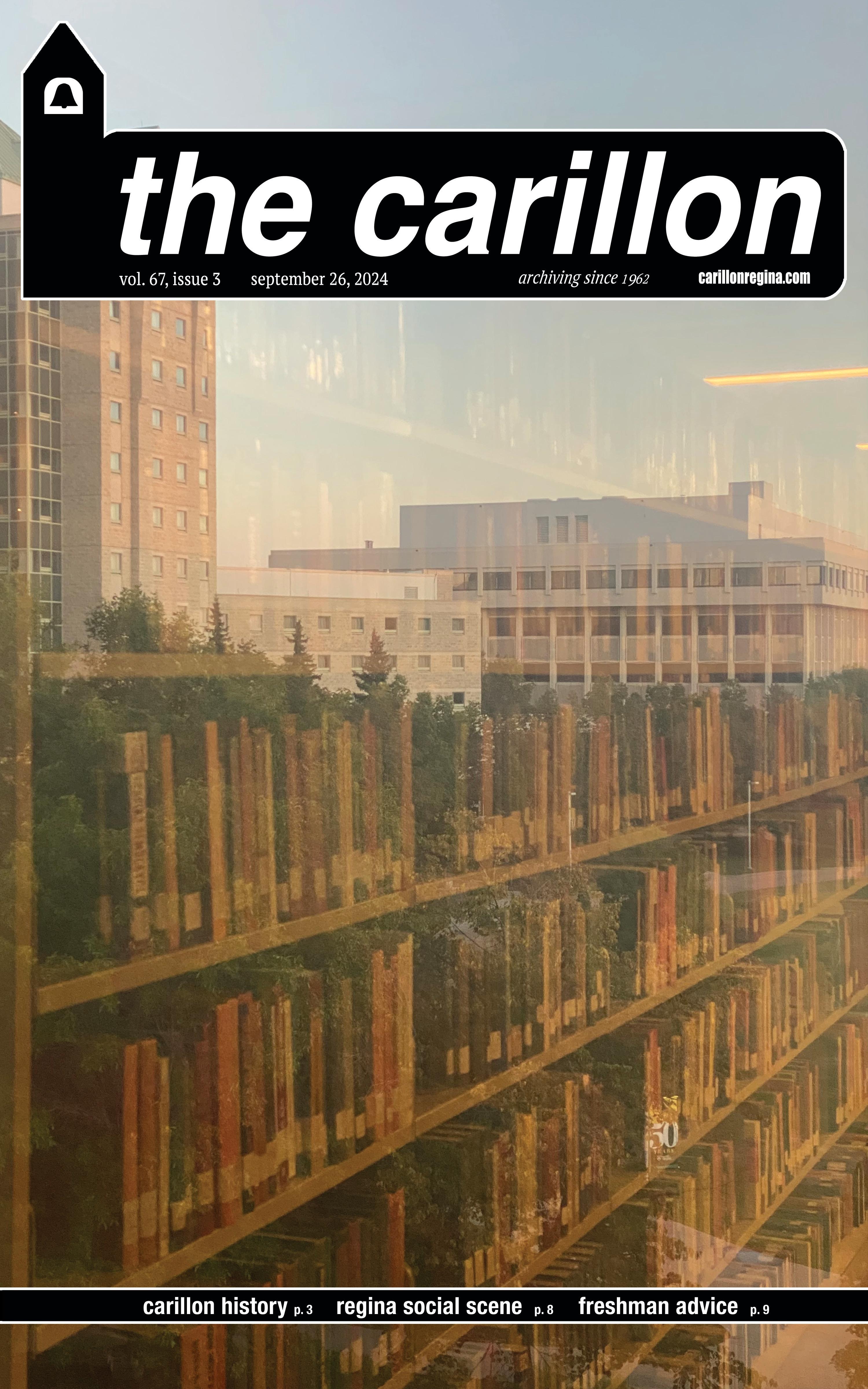



Hello again everyone, welcome to issue 3! I hope everyone’s first month of the semester has been going well. A lighter issue this time, with topics ranging from the Carillon’s very own history to Queer City Cinemas, campus updates, and more.
Our next editorial board meeting will be Monday, Oct 7, at 4 p.m. until 5 p.m. in Room 227 of the Riddell Centre. Our next Board of Directors meeting will be Oct 30 at 7 p.m. and is attendable through Zoom. For the link, please reach out to infotayef@ gmail.com. We’ve seen quite a few contributions this year already and I’m so thankful to each of our contributors. Thank you for doing your part to keep student journalism alive and well in the modern political landscape.
Illegitimi non carborundum, mikayla tallon editor-in-chief
the staff
editor-in-chief mikayla tallon editor@carillonregina.com
executive director ziyang li business@carillonregina.com
production coordinator annika hadden production@carillonregina.com
web technician jebrael muhammad web@carillonregina.com
news editor allister white news@carillonregina.com
community editor kimberley kaufman community@carillonregina.com
op-ed editor hammad ali op-ed@carillonregina.com
staff writer amina salah
staff writer emma mcgill
news writer nazeemah noorally
news writer shivangi sharma community writer pall agarwal
contributors jackson rennebohm, harrison munro, & william bessai-saul
board of directors muhammad zuhruf muhammad zarooq, mohammad akib hossain, tayef ahmed, austin stadnyk, jeremy beam
the paper
227 Riddell Centre @ the University of Regina 3737 Wascana Parkway, Regina, SK, Canada S4S 0A2 www.carillonregina.com | (306) 586 8867
Printed by Star Press Inc, Wainwright, AB
The Carillon welcomes contributions.
Opinions expressed in the pages of the Carillon are entirely those of the author, and do not necessarily reflect those of The Carillon Newspaper Inc. Opinions expressed in advertisements appearing in the Carillon are those of the advertisers, and not necessarily of The Carillon Newspaper Inc. or its staff.
The Carillon is published no less than 11 times each semester during the fall and winter semesters and periodically throughout the summer. The Carillon is published by the Carillon Newspaper Inc., a non-profit organization.
land acknowledgement
The Carillon is written on Treaty 4 territory. As such, staff recognize that we are living, working, and telling stories on and of Indigenous lands. We recognize that we are on the traditional homelands of the Cree, Saulteaux, Nakota, Lakota, and Dakota peoples, along with the homeland of the Métis nation. The Carillon understands that it is pointless to acknowledge the land on which we work without demonstrating our commitment to telling stories and prioritizing voices that further the return of this land to its sacred place.
the manifesto
In keeping with our reckless, devil-may-care image, our office has absolutely no concrete information on the Carillon’s formative years readily available. What follows is the story that’s been passed down from editor to editor for over sixty years.
In the late 1950s, the University of Regina planned the construction of several new buildings on the campus grounds. One of these proposed buildlings was a belltower on the academic green. If you look out on the academic green today, the first thing you’ll notice is that it has absolutely nothing resembling a belltower.
The University never got a belltower, but what it did get was the Carillon, a newspaper that serves as a symbolic bell tower on campus, a loud and clear voice belonging to each and every student. the people’s friend; the tyrant’s foe

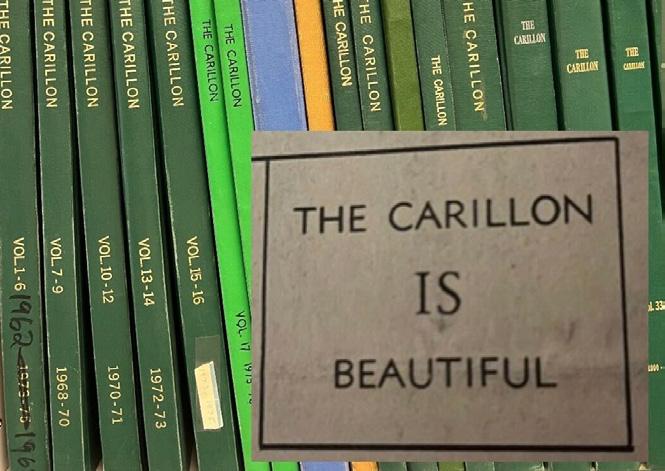









As campus becomes crowded and buzzes with scholarly minds once again, the newsstands around campus fill with the first issues of the 67th volume of the Carillon
The Carillon predates the university itself. Originally known and published as the Sheet, news for and about Regina’s post-sec-
ondary students began circulating in 1960. Before Regina College became independent from the University of Saskatchewan (U of S) and acquired accreditation, the Sheet sought to inform and make history of student life on College Avenue.
An early issue from February 1960 contains fun facts, humorous headlines and cutlines, reports on past events, emerging opportunities, a president’s message, editorials, advertisements, a section to doodle in, the sports section (with subsections for “Girls’ Sports” and “Cheerleading”), a comic, discussion of world issues, letters to the editors, an arts and science column, a poetry section, and photographs that give readers a glimpse into student life in Regina 64 years ago.
In an issue from January of 1962, there’s a box in the middle of the page that reads “Let’s show S’toon this Sports Weekend that there are TWO universities in Saskatchewan.” Just a few weeks ago, a large portion of the student body gathered to witness Saskatchewan’s two universities face off once again in the U-Prairie Challenge and
TUESDAY
WEDNESDAY
– 9:30 am (spoken-word) Environmental stories from around
globe Science Unscripted 9:30 – 10 am (spoken-word)
Chinese Connection
10 – 11 am (spoken-word)
Get Chatty With Kathy 11 – 11:30 am (spoken-word)
A mixed bag of topics
Muzyka Ukraine 11:30 am – 12:30 pm
WINGS
12:30 – 1 pm (spoken-word)
Regina, now much older than it was when that competitive message was first voiced, came out of the match victorious.
Much like the Carillon’s initiative to share detailed glimpses into campus life, the Sheet had a regularly published column titled “Round the Res,” though the Carillon doesn’t currently report on panty raids that occur in residence.
An issue from March 1962 highlights a “Photo of the Future,” the model of what the new U of S Regina Campus would look like once complete.
In 1965, the first two buildings standing on the new campus were the Classroom and Laboratory buildings. By this point, the Carillon, was officially given its name after Harvey Walker won a naming contest in October 1962. Though our school was still technically an offshoot of the U of S, the new Regina campus was beginning to develop a personality of its own.
In the past, staff organized obscure events for the student body. These included CASH! (the Carillon Annual Scavenger Hunt); with 50 truly outside-of-the-box items listed. Some of those items included a pair of black lace panties, a tuft of red hair in a blue envelope addressed “to the Carillon with love,” one kitchen sink, and four live goldfish in a bowl. The rest of the long list is just as, if not more, ridiculous.
During the 1960s, an event nicknamed ‘CHIT,’ or the Carillon Hotel Inspection Tour, also took place. This event involved student competitors consuming large amounts of beer and running in a marathon route planned around Regina’s hotels. It made the news in 1969 when a woman vouched to enter her name in the race. There was debate
THURSDAY
Daebak!
FRIDAY
(repeat)
and music
over adding a wine section for women, but a complaint from the student who’d entered, published in a later issue, hints that CHIT was not keen on the idea.
Also published were longer political editorial pieces. With the Vietnam war ongoing, news of protests on campuses and general unrest among student bodies across Canada were being reported on frequently.
One issue from the late 1960s covered complaints raised against tuition fee hikes that students have expressed dissatisfaction with in the much more recent past. According to a list that was published to show readers how much fees had gone up in about seven years, the cost of tuition in Arts and Education per year was $225 in 1962 and had reached $425 by 1969. In less than ten years, fees had almost doubled. Though the idea of paying only $425 for tuition in a whole year is more than appealing now, students have always actively expressed dissatisfaction at fee hikes.
Historically, the goal of the paper was to amplify student voices, even if those voices were complaining about the Carillon itself. Other complaints included those about parking services or the student’s union. Other popular news topics over the decade included who would be Campus Queen, a shortage of Cokes in the drink machines, the concept of communism, the Cougars and Cougettes, and even games of bridge.
From the 1960s to today, the Carillon archives hold pieces of history that Regina’s post-secondary students, staff, and faculty walk on and are upholding the legacy of. Can folks at the U of R expect the Carillon to do
emma mcgill staff writer
SATURDAY
(spoken-word)

In an article published in issue two of the Carillon, the IDF’s use of AI as a tool for assassination was covered. In brief, ‘Lavender’, alongside Israeli-made artificial intelligence systems have shifted the way targets are selected for assassination.
These systems, according to +972 Magazine are aided by mass surveillance, which is seemingly all compiled in the IDF’s database, called ‘Wolf Pack.’ Lavender is constantly fed this information.
Last issue the Carillon reported that Lavender “is programmed to detect potential ‘enemy militants’ in the Wolf Pack database. Lavender pulls names from the database and assigns a rating for the person (from 1 to 100) based on level of confidence that the person is a militant.”
IDF officers then choose a rating threshold. Anyone in the database with a higher rating “is, with almost no further IDF investigation, confirmed as an enemy militant and put on an assassination list.” Only “20 seconds” are allocated to investigating each alleged enemy militant. The IDF has a broad and ever-changing definition of enemy militants, evident with at least 35,000 Palestinian children now dead or missing, as confirmed by the UN.
Killing of civilians continues in Gaza. The UN has confirmed 254 aid workers have been killed. The Middle East Eye reports that at least 1,151 Palestinians “working in Gaza’s health sector” have been killed by Israeli forces. 986 have been named by the Palestinian health ministry. The names of others are still being confirmed.
According to Al Jazeera, “Human Rights Watch says aid workers’ convoys and facilities
have been targeted at least eight times since last October.” On September 6, Aysenur Eygi, a 26-year-old dual Turkish and American citizen, was unarmed at a protest in the West Bank when an IDF soldier fired a bullet into her head.
It’s possible, considering the widespread use of AI systems by the IDF reported by +972 Magazine, that ‘Lavender’ is selecting some of these targets.
American, English, and Canadian police and military forces are also in possession of advanced surveillance and AI tech. Euroforce reported that American police have been using AI to write their incident reports, despite concerns of racial bias. On September 11, BBC reported that Hampshire police have begun to pilot an AI facial recognition program.
In Canada, the RCMP have been using an AI tool called ‘Babel X.’ Babel X is developed by the American company under the name “Babel Street.” Similar to Lavender, Babel X sifts through massive amounts of information to “identify themes, entities, and categories, as well as detect relationships” which are searched for by the user.
Unlike Lavender, Babel X only uses publicly available data from the internet, dark web, and public records. Without premium features, Babel X could simply be described as an advanced search engine. The RCMP have not made it clear if they are using any of Babel X’s premium features, which each make the software more invasive.
Babel Street claims that Locate X, one of the premium features of Babel X, “provides access to a Data Feed enabling access to historical digital device location data.” Furthermore, Locate X Premium “offers [users]
access to additional metadata” not included in Locate X; a vague description.
The IDF used device-tracking tactics to carry out airstrikes on Lavender’s assassination targets in their homes.
Another Babel X premium feature is called Babel Synthesis. Babel Synthesis utilizes artificial intelligence to automate what Babel Street calls “social network and relationship mapping,” and can “tag influencer accounts based on their occupation, activities, demographics, and group affiliations to reveal insights into network dynamics and motivations.”
All of this data is visualized for the user by the Babel Synthesis AI, allowing users ease of access. While the data gathered by Babel Synthesis is presumably less thorough than a system such as the IDF’s ‘Wolf Pack,’ the inclusion of relationship maps of the people in the system, if used in tandem with information from a police database, becomes increasingly invasive.
Radio Canada International reported that at least 13 federal departments of the government, including the RCMP, were using spyware to gather information. Most Canadian citizens do not currently know the true extent of data that Babel X has access to.
According to Babel Street, another Babel X premium feature, called OASIS (Ontologically Assisted Search and Intelligence System) streamlines the search process of Babel X “by consolidating multiple identifiers for a single entity and then grouping multiple entities.”
These “entities” are people and their “identifiers” are whatever traits they exhibit significant to the OASIS user. The OASIS feature of Babel X is similar to the IDF’s
Lavender, allowing for large lists of “entities” to be created, based on whatever “identifiers” the OASIS user wishes to search for. It remains unclear whether or not the RCMP are currently using , or have used any of these premium features. In the Privacy Impact Assessment for the RCMP’s use of Babel X, none of the premium features are mentioned.
In February, Canada’s Privacy Commissioner, Philippe Dufresne, released a report recommending that the RCMP be more transparent about the collection of Canadians’ personal information.
According to CBC news, “the RCMP ‘was unwilling to commit’ to implementing the commissioner’s recommendations.” The recommendations in question included requests for RCMP to cease collection for personal information through Babel X. Dufresne’s report explained that the matter is unresolved, and “continuing contraventions and violations” of privacy rights by the RCMP may be ongoing.
jackson rennebohm staff writer
“ Similar to [the IDF’s] ‘Lavender’, Babel X sifts through massive amounts of information to “identify themes, entities, and categories, as well as detect relationships” which are searched for by the user.”
Jackson Rennebohm
The health of Treaty 4 waterways is being closely monitored
michela sisti contributor
The fate of Saskatchewan’s Prairie Pothole ecosystem is relevant to both urban and rural residents. Take an annual musty smell and taste occurring in tap water during what the Leader Post explains is “peak season for blue-green algae blooms,” for example.
In July, Saskatchewan’s Water Security Agency informed residents that the mustiness came from algae – more specifically, cyanobacteria – in the water supply. According to the Leader Post, the musty scent and taste of tap water was more noticeable this summer because of renovations being done to Buffalo Pound’s water treatment plant.
The cyanobacteria exists in levels too low to be harmful, but high enough to be recognized. Canada is a country with bountiful freshwater resources, yet, according to Frances Pick, who published an article titled “Blooming algae” in the Canadian Journal of Fisheries and Aquatic Sciences, cyanobacteria blooms in Canadian waters are increasing in frequency, intensity, and duration.
At their least harmful, these blooms make water taste bad. At their most dangerous, the neuro and liver toxins produced by high cyanobacteria levels can be life-threatening. Algae blooms are the reason why so many beaches
and lakes, such as Stoney Beach at Humboldt Lake, have had health advisories issued by the SHA warning about cyanobacteria toxins.
The Lands Resources Environment and Stewardship (LRES) department of the File Hills Qu’Appelle Tribal Council is monitoring the health of Treaty 4 waterways closely.
Leonard Keshane coordinates a team of youth intern scientists that tests water quality and tracks the bigmouth buffalo fish in the Qu’Appelle River System, a species that has declined dramatically. “Some of the water that we sample is basically like wastewater,” Leonard said in an interview with the Carillon, going on to explain that his team “did some sampling from some fish caught in the Qu’Appelle Chain of Lakes, and the meat that we took compared to some of the other lakes, was pretty well just straight green… It felt so terrible to see that.”
Dr. Kerri Finlay is a professor of aquatic ecology and biogeochemistry at the University of Regina. Much of her work focuses on the effects of human activities on water quality in the prairies.
“Normally the way I think about wetlands is that they’re small, they don’t have outflow, [...] and they grow a lot of vegetation,” Dr. Finlay explained. “They pick up all the nutrients and other potential contaminants and they sequester them into plant biomass. When the plants die [their bodies] get buried in the sediments… If you have mil-
lions of these wetlands, they’re each taking up a bit of [the pollutants] versus just funneling it all to Lake Winnipeg,” Finlay stated, describing the role of Saskatchewan wetlands.
“One lake can [absorb pollutants], but there’s going to be a certain capacity to it, right?” Dr. Finlay pointed out.
Despite the water quality issues we already face, the provincial government is now developing a policy that will facilitate the drainage of a significant proportion of our province’s remaining wetlands.
The Saskatchewan government’s new Ag Water Stewardship Policy does not have a provision for wetland conservation, and a letter written to the Star Phoenix says that the policy is “a drainage policy that will promote the drainage of two million acres of wetlands.”
The plan has alarmed many experts including Dr. Peter Leavitt, a limnologist at the University of Regina and Canada Research Chair in Environmental Change and Society.
“My estimate, as somebody who has worked in the area for nearly 40 years, is that this will degrade all the surface water in southern Saskatchewan,” Dr. Leavitt told me. “And it will do so in a way that will be very difficult to recover.”
Dr. Colin Whitfield is an associate professor of environmental science at the University of Saskatchewan’s School of Environment and Sustainability. In response to a strong demand to un-
derstand which wetlands are most vital, Whitfield classified watersheds across the prairies and developed a modelling approach to predict the typical behaviour of watersheds at different levels of drainage.
“At moderate drainage levels of 50 or 60 per cent, we’ll see approximately a doubling of the amount of phosphorus export, and that’s going to end up in our streams and downstream lakes,” Dr. Whitfield explained. “There are important concerns around that for the health of our aquatic ecosystems. These are nutrient-rich systems to begin with, and augmenting the nutrient export to these systems raises the risk of additional events like harmful algal blooms occurring. There’s also risks associated with the difficulty in treating water for drinking water when we have high solute loads, high nutrient loads.”
When it comes to First Nations Inherent and Treaty Rights, the damage from drainage practices on water quality is already present. Almost all Treaty 4 Nations border bodies of water. Clean water and clean fish should be abundant and accessible. Yet many Nations live with boil water advisories, and to exercise fishing rights, Indigenous people have to make the long journey elsewhere.
Birdie is a biology student at the University of Saskatchewan and one of the coordinators of the LRES Youth scientists. The contrast she’s witnessed between the waters of the Qu’Appelle and those further north, beyond the influence of drainage projects, has been eye-opening.
“It’s so different when you go up north. When we fish on the Churchill River [...] the water is just so nice [...] It’s like we’re catching fish in abundance. We are catching really good quality fish. We’re able to eat the fish up there. And it’s like something’s happening in between there and where our people live. Now it’s like there’s good fish [up north]. There’s just something happening to our fish.”
In other words, a different reality is possible. While the waters of the south are naturally more prone to algal blooms, it is Dr. Leavitt’s appraisal that, “They’ve never been as green as they are now and they’re not anywhere as green as they will be when climate change kicks in with increased fertilizer applications.”
Given the pressures currently faced by Saskatchewan water systems, it’s imperative for residents to do what we can to keep them clean, and preserving Saskatchewan’s wetlands is one way to do that.
“We used to be able to drink the water right from the lake [...] back in the day. That’s what we were told by our elders,” Birdie Thomson-Bear from Carry the Kettle Nakoda Nation explained. “And now it doesn’t even seem like it’s even possible, even if you filter it a hundred times, it’s just so sketchy.”
“ We used to be able to drink the water right from the lake [...] back in the day. That’s what we were told by our elders…and now it doesn’t even seem like it’s even possible, even if you filter it a hundred times, it’s just so sketchy.”
Birdie Thomson-Bear

Get out and about with these cool social activities!
Regina has a lot to offer outside of sports and a diverse community. It has a wealth of experiences that often fly under the radar, especially for fun, group-oriented activities. In a vibrant world of pub trivia, the city has a plethora of options to pick from that have been quietly thriving in the local restaurant and entertainment venues.
One of them is the popular Trivia and Karaoke Nights hosted at Tommy’s Speakeatery on Montague Street. Tommy’s serves as a perfect opportunity for friends and family to gather and share a fun time, make wonderful memories, participate in some friendly fire competition, and have a night of love, laughter and more.
Places like these were once just a casual place to have dinner.
professionals unwinding after work, and families seeking budget-friendly activities. Restaurants are not just a great place for food, but also a platform to embrace a more interactive and community-driven
what else they offer as a Gastro Pub. Tommy’s boasts on their Facebook local, freshly made food and Saskatchewan craft beer and spirits, perhaps another hidden gem to investigate.
and serious competitors. This place offers more than just trivia nights, like a Wednesday Night Folk with free admission. Enjoy an evening of local and touring artists playing a variety of musical genres cherished
Across all these venues, the unifying theme focuses on group interaction and fun. With special offers of student discounts or special deals during certain times, these places become a go-to after
“ Restaurants are not just a great place for food, but also a platform to embrace a more interactive and community-driven atmosphere.”
Pall Agarwal

Now they have transformed into an engaging and social experience, with events that appeal to a wide demographic like students looking for mid-week entertainment, young
atmosphere. The online reviews suggest it is a great night-out option for many people. Tommy’s has a Facebook page, so check it out if you’re interested in their activity nights or
Some other trivia nights around the city include the Bushwakker Restaurant, which hosts a trivia night with a $5 charge for participating teams. Their trivia nights often bring a mix of casual players
by Regina folks.
A scholar event occurs every third Thursday of the month called the Monthly Science Pub Series at the Bushwakker. This event, there are free lectures on scientific topics, including economics, biology, math, physics, and more. Though often enjoyed by students, this event is well-cherished by so many people of all different ages. Join the next one for engaging discussions and thought-provoking questions that could blow your mind.
If you’re looking for a thrilling evening full of mysteries and patching together clues, the Escape Manor at 1975 Broad Street might be the pick for you. Apart from hosting mind-bending adventures, they offer a variety of Trivia Thursdays where teams of up to six people are invited to compete for the title of champion with exciting prizes.
Their escape rooms are complete with their own themes and difficulty levels. This is the place to go if you want to test your problem-solving skills. Their menu also displays a Tuesday special with burger and fries for $16 and a Thursday special with pizza for $12.
Escape Manor also has the option to delve into online adventures, which a group could look into exploring for a chill night in.
If you’re interested in going with a group, their website has a “groups & corporate” section with instructions on how to book for larger groups. They recommend booking as soon as possible so you can get your desired date and time.
If your group is into doing something easier and with less mental gymnastics, check out the Come and Go Bingo events hosted by Sask Bingo in the north end of Regina. You could grab a cup of coffee, a light snack or even a home-cooked meal while playing a bingo game. This place appeals to people of all ages, including students, retirees, young professionals, and families. With prizes, a relaxed environment, and a sense of community, Bingo Night remains a staple for those looking for a fun, affordable night out.
a busy work or school day. While these events generally cater to an adult audience due to licensing restrictions, they are designed to be inclusive and welcoming to all adults seeking entertainment.
Other night-out options also include open mic nights, which are a great attraction to many young people and artists who are just testing the waters of their specialty. One of these places is The Cure, located in 2323 11th Ave, where they host open mic nights every Monday at 8 p.m.. Local stand-up comedians, singers, artists and more come together to give people a night they will remember.
While they remain hidden gems to some, the growing popularity of these events is signaling that Regina’s social and entertainment landscape is evolving, offering a range of unique and accessible ways to enjoy the city’s nightlife. These events offer socializing and involve healthy competition, providing a safe space to exercise their skills and excel at them.
The City of Regina remains committed to providing accessible recreational opportunities, including “the identification and removal of barriers to full participation in the community,” according to their website. Regina’s transit system is relatively reliable, and paratransit fills in the gaps in bus accessibility.
So, if you need help getting to and from these activities, the City of Regina may be able to help. There are many other features to accommodate individuals with disabilities beyond transit services, including senior and website accessibility, helping make Regina events more accessible to all.
From lively pubs like Tommy’s Speakeatery to places like Escape Manor and Sask Bingo, there’s something curated for everyone. All you need to do is give them a chance. These events are a perfect way for newcomers and long-time residents to immerse themselves in the local picture to cherish, enjoy and make new memories outside their regular lives.
emma mcgill staff writer
The Saskatchewan Science Centre has long been a hub of exploration and innovation for travelling around the province of Saskatchewan without leaving Regina. It is a significant cultural and educational institution contributing to the region’s rich history by promoting science and innovation.
Over the years, it has evolved to offer a wide range of activities, events, and become an experience that is enjoyed by all ages. This year it is completing 35 years since first opening its gate to its customers in 1989.
For the occasion, it is hosting a special event called “Eras of Inspiration” presented by Accenture.
It is a unique fundraising experience for “their closest friends and fans, allowing everyone the chance to reflect back on [their] past and celebrate the future of Saskatchewan Science Centre,” according to their event webpage. Their amazing milestone was celebrated Sept 20 from 6:30 p.m. to 9:30 p.m., with tickets starting at $175.
As the name suggest, the event featured unique tastes from local food and beverage partners. It was a night to enjoy high-energy networking, mingling with
industry leaders, and meet food lovers relishing over Sask-based beverage and food that sweeps you off your feet.
With a focus on increasing awareness of science and technology, this fundraising experience allowed everyone a chance to reflect on the innovation so far while supporting their STEAM (Science, Technology, Engineering, Arts, and Mathematics) initiative. It is more than just a dinner party – it’s an interactive and immersive journey where science meets cooking.
Attendees would get a chance to step into the world where culinary creations overpower expectations, presenting dishes that one can only imagine in their dreams. This night is, in a way, a reflection of what the Science Centre truly believes in – community – and at the same time supporting all that they have done in the past years and how far they have come.
The Saskatchewan Science Centre has grown into one of Saskatchewan’s largest family tourist attractions. It has undergone significant changes and expansions since its opening in 1989. It added the Kramer IMAX Theatre, which was later upgraded to IMAX 3D in 2010.
Regina’s IMAX was one of 30 theatres in the world showing the Oppenheimer movie. People from all across North America

were fighting for a ticket as no one had ever imagined Regina being a global spot for a movie. Still, with avenues like the IMAX – there is always room for surprise.
In a recent conversation with Tenielle Bogdan, Director of Development and Stewardship, the Carillon learned that the Saskatchewan Science Centre continues to ignite scientific curiosity, travel around the province to schools, and do its best to make itself accessible to everyone. She
also mentioned that the Fantasy Food experience is their largest fundraiser that engages and supports many initiatives with which the centre has been involved.
From the centre’s interactive exhibits exploring space, technology, and the environment to special programs like stargazing nights and coding workshops, the Science Centre offers something for everyone out there. Taking bold steps to modernize, the Saskatchewan Science Centre has
The Queer City Cinema festival began on Sept 12, 2024. The Regina Public Library Film Theatre showed a list of International and local short films, and the Dunlop Art Gallery hosted major performances from U.S.-based artists Dorian Wood and Derrick Woods-Morrow.
These were ‘’pay what you can’’ events centered around the chosen theme of “journey.” The films remained in my mind after the festival, many evoked a range of feelings like warmth, joy, and horror, and sometimes left me puzzled. I found myself noting down these two films with out-
standing visuals, which of course, my brief summary will not do any justice.
First is Emily Curtis’ All That Love Allows – a queer tale of two pirates, Ann Bonny and Mary Read. Secondly, Kalil Haddad’s The Taking of Jordan (All American Boy) shows an adult performer, who meets a chilling end in his many lives.
The performances after the film screenings were nothing short of remarkable. Dorian Wood, a multidisciplinary artist, came to conquer the Regina stage with Musa Cerdota. Upon entering the gallery, we were told to
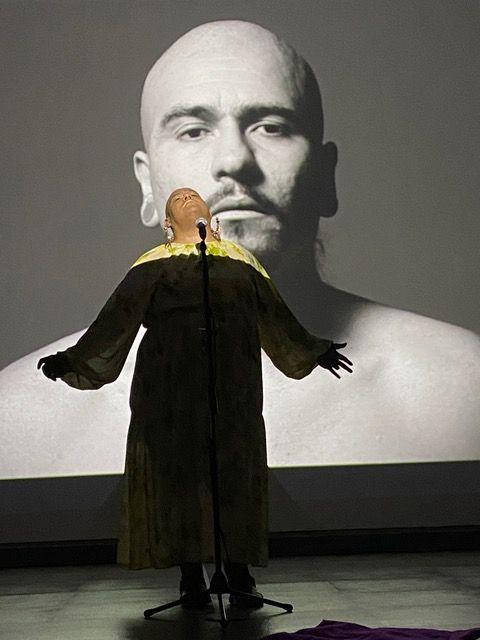
sit on any of the cushions spread around the space. Within a couple of minutes, Wood came out in their gorgeous attire - a patterned dress and big golden hoop earrings accompanied by shiny gold makeup.
Performing songs from her album REACTOR (2020), Wood entranced the audience not just with her vocals but with each sway of her body. In the background, a black and white video rotated between scenes of Wood and other performers, sometimes engaging in an intimate hug or kiss.
Wood teased the audience with the rising of their garment,
which was soon discarded halfway through the performance. Leaving the microphone, which I argue she did not need, Wood cascaded between the spectators.
When asked what she wanted the audience to feel from this performance, she responded with “sweaty.” Afterwards, Wood shared with me her gratitude for the space and credited the presence of the attentive and warmhearted audience for it. As I reminisce about that night, I feel nothing but appreciation for Wood’s ability to transport us to another world.
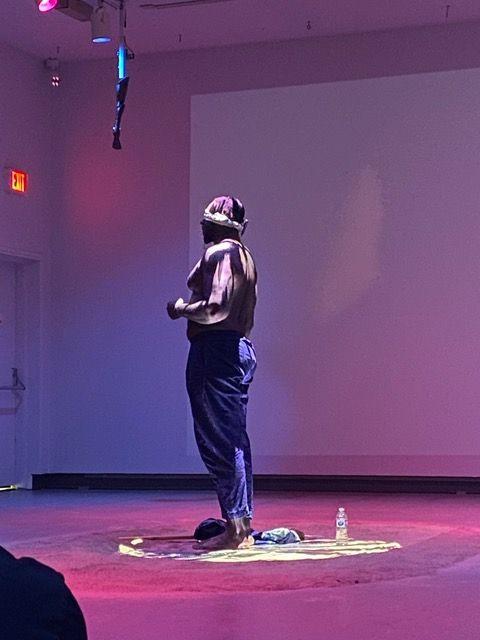
The final performance was titled, I Believe in the Future of ‘Small Countries’’ by Derrick Woods-Morrow. This was one whole hour of sensory stimulation and people trusting each other. First, we were individually greeted by Woods-Morrow at the door, who asked us to share about a pleasure we’ve had and download it by speaking towards our chosen part of his body.
Entering the gallery, I was hit with the smell of coffee and the deep colours of pink and purple illuminating the room. While blindfolded for most of his performance, Woods-Morrow interacted with both the space and the audience. He started by sweeping the sand on the floor, moving it in and out of its original state. Buckets full of soapy water and coffee
gone above and beyond to celebrate science and technology.
Known as one of the city’s beloved cultural landmarks, it has now become an indispensable part of the community. If someone is looking to quench their thirst for curiosity and have fun doing that, the Saskatchewan Science Centre is the place to be.
beans were also used to trigger our senses.
Then, Woods-Morrow transformed the spectators into collaborative participants by prompting us to interact with him – asking for someone to come up and perform a given task. I was curious about the takeaway from this performance, and he told me after the performance that he hoped the audience would leave with some type of appreciation for the pleasure they deserve, the joy they deserve, and the easy way you can tip sensation.
When asked what people missed that night, he shared, “They missed me covered in sand, trying something new, and being brave. They missed a few tears under the blindfold, and they missed me trying to find something I’ve been looking for a long time.”
This was my first taste of the festival, and it was an unforgettable weekend of queer stories and art. These events are important to celebrate because it doesn’t just stop at representing diverse artists. It cements that queer people have always been here and will take up space, regardless of its intolerance.
emma mcgill staff writer
With another new school year comes a big handful of changes for returning students to get used to as they reintroduce themselves to their studies as well as the hustle and bustle across the University of Regina (U of R) campus. As for student opinions on the shifting environment, attitudes vary.
For many, the most obvious differences have got to be the big white walls that have been erected in the Dr. William Riddell Centre and the Administration Humanities (Ad-Hum) building. When the U of R terminated its contract with Chartwells Foodservices in the spring of 2024, the hallways were buzzing with suspicion and guesses as to what everyone might return to, food-wise, in the fall.
Juanna, a second-year creative technologies student, shared, “I’m definitely lamenting over the loss of Tim Hortons right now. I’m going to miss their Boston Cream donuts and cream cheese bagels,” and pointed out that the construction in Ad-Hum is a bit of a nuisance.
Jabez, a fourth-year biology major agreed: “Everything is under construction. I want my Tim’s back.”
While students have said they are enjoying the new food vendors in the Riddell Centre, like Chick’N’Tendees, Java Junction, and Ultimate Rotisserie Experience, it is clear that it will take some time to adjust to the
absence of the places everyone had been so used to indulging at.
For some, the big white walls inspire greater suspicion and even conspiracy. Lucas Babcock, a thirdyear theatre student said, “They got rid of Tim Hortons. They put a big box there instead. They’re hiding something in there. They’ve probably got like a goblin creature living in there, but we can’t know until they release it. Until then, we’ve got the two chicken places.”
A somewhat controversial new addition has been the new campus Starbucks in front of the Dr. John Archer Library. Kanan, a business student, appreciates the addition. “That’s really good because most of the time it happens that, in the winters, students study late,” she said.
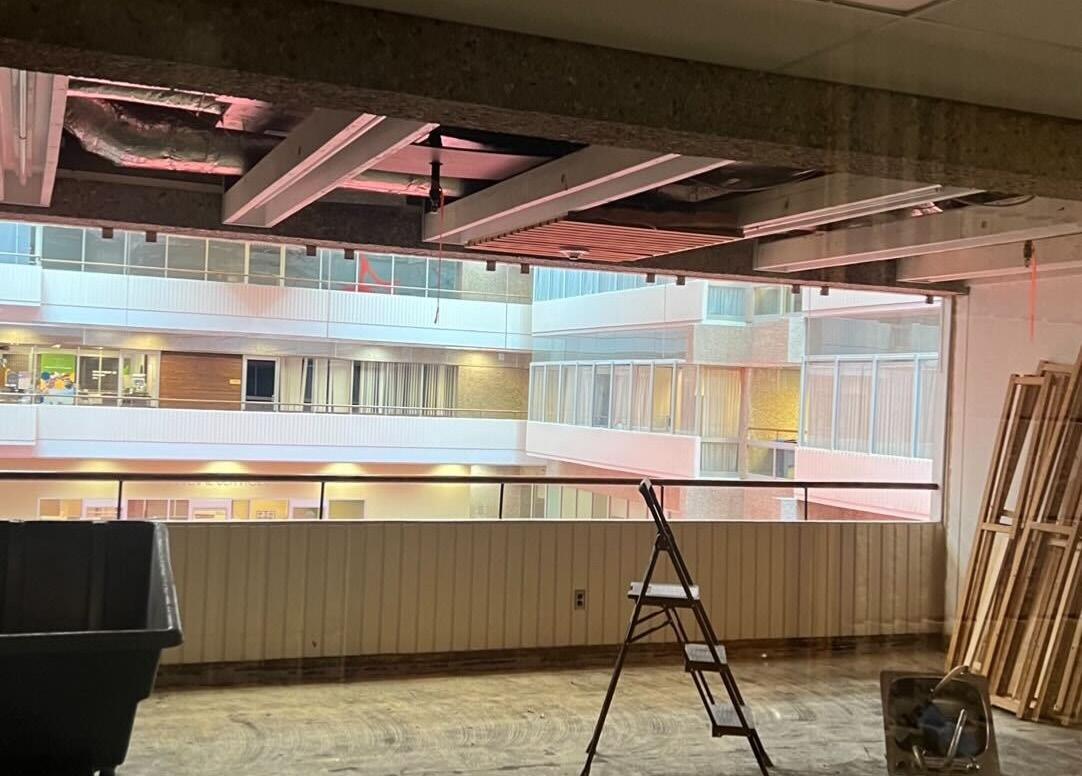
new options that are available on campus. I just wish that construction would finish because everything just feels very cramped right now.”
Other students disagree. “I enjoy some of the new food vendors, but I’m not a huge fan of the new Starbucks,” shared Annika Danielson, fourth-year devised theatre student. Danielson is also frustrated with the construction, especially with the Starbucks crowding such a busy hallway as Archer and creating a lag in traffic during prime coffee time.
Danielson said, “I do like the
With construction narrowing the halls, students have also noticed a peculiar population increase among the student body. Hannah Lawlor, a fourth-year biology student, has noticed this increase but theorizes that things may settle down as the semester carries on.
Mikkel O’Shaughnessy, a third-year theatre major, has also
noticed this change and shared, “I’ve noticed that we have a lot more people here at the university than we have had in prior years. I feel like we’re finally getting back into the full thing since before COVID. It’s been a lot more crowded.”
While a lot of speculation still surrounds what might come to surprise everyone when all the construction is done, it was confirmed in Student Affairs emails that the Ad-Hum pit will be unveiled in the summer of 2025 and that Da India Curry Xpress will
be coming to the
the
It seems that the narrowed halls and busier crowds, brand new food places and those closed off, and the location of Starbucks are the central topics on students’ minds when it comes to changes they’ve seen on the U of R campus.

A letter to my freshmen friends
A few words, from someone who was there once
amina salah staff writer
The weather is cooling down, the trees are changing their hues, and the crunch of the leaves with every step reminds us that we are on the brink of autumn. For some, this means pumpkin spiced lattes, apple scented candles, and warm blankets.
For others, it means doom. It is the unfortunate sign that it is back to school season. For some of us, the only thing to look forward to on campus would be the free mini donuts. Okay, maybe it’s just me. Free makes everything taste better, folks!
The hustle and bustle of campus takes me back to my first semester of university, all the way back in 2018 (God, I’m getting old). I was a naïve freshman. I was so excited for the future.
I thought I could defeat the burnout. The freshman fifteen was not going to get me. I was on top of my game. I was so certain of what I wanted to study. I had planned my major since I was in high school. I was unstoppable. I was entering the new semester indestructible, much like Thanos.
As I made my way to my first class, Psychology 100, which was also my major, I was looking forward to living my dream of being a university student. This class was in the education auditorium, jam packed with students. Eventually, class would start. An hour and 15 minutes later, the class was over.
As I walked out of the auditorium, I knew one thing for certain; this was not the path for me. This was not my major. This was not going to be what I would spend four years of my life studying. I was no longer interested in studying psychology. It took an hour and 15 minutes to debunk all my future plans I’d made up to that point in time.
Dear freshman, university will change you. Academia will change your entire perception of learning. Your interests will shift. You could spend your entire life being certain that you want to study English, or art, or justice studies, and the second you start university, you might find that you are no longer interested in your chosen major. This is completely normal.
It is absurd that we expect 18-year-olds to know what they want to do for the rest of their lives. There is so much pressure on young people to have it figured out, to know what they want to become, what they want to study, and to be well-prepared.
Dear freshman, nobody has it figured out. Nobody knows what they are doing.
Your fellow students are in the same boat.
Even your professors are in the same boat. And that is okay.
Academia is not linear, there is no destination. It is a journey. You owe it to yourself to embark on this journey with an open mind. Things will change. Your surroundings will change. Your classes will change. Your professors will change. You will change. This comes with many growing pains. You are thrown into a new world and are expected to immediately know how to navigate this new world.
Dear freshman, please be kind to yourself. It is okay to feel confused. It is okay to feel scared. It is okay to even feel unhappy. However, please remember that there are resources on campus and there are counselors and advisors who are here to assist you on this journey. At the end of the day, there is light at the end of the tunnel.
University will humble you. You might find yourself starting school with a large friend group, and a year, or two, or three, or four later, you might find yourself with a handful of friends. It happens. It is almost a part of the initiation into university.
Stay open to meeting different people. There are people with various lived experiences, from all over the place, on campus. Get to know them. Try to go out of your way to say hello to the people in your class so you will have people to study with or at least borrow notes from later on.
With the influx of students, university has a funny way of still being a lonely experience for many students. Dear freshman, please know that you are not the only one on this journey. There are so many of us who are currently in your shoes, or have been in your shoes before and have overcome it.
Call me Sabrina Carpenter because I am begging you, dear freshman, to please, please, please, apply for student grants. If you are eligible as a student, you will be able to receive grants from the local as well as the federal government. I find that many eligible students do not know that they have the chance for grants because these services are often not as advertised as they should be. This is money you do not have to pay back, people. Please consider applying. You can do so through the Government of Saskatchewan.
Also, please do not drop a class because the instructor is difficult. Many of us are so quick to drop a class we need at the slightest inconvenience. Unfortunately, some classes you just cannot dodge, especially if there is just the one instructor teaching them. Eventually you will be forced to take that class because you need it to graduate.

Save yourself the stress and just get it out of the way. A difficult instructor is not the end of the world. They exist amongst us. They’re like a paper cut. They hurt really bad. They’re not fun to have. But eventually, the pain will stop and you will forget about it. Think of a difficult professor as an opportunity to build your character. If you can get through a class with a difficult professor, you can get through anything in life.
“There is so much pressure on young people to have it figured out, to know what they want to become, what they want to study, and to be well-prepared.”
Amina Salah
A
zinia jaswal staff writer
The 2024 U.S. Election: A Showdown Between Donald Trump and Kamala Harris
As the 2024 U.S. presidential election draws near, the political landscape is dominated by the two candidates – former President Donald Trump and current Vice President Kamala Harris. This highly anticipated election is set against a backdrop of intense political polarization, economic challenges, and social movements, making the stakes higher than ever. The Candidates
Trump: A familiar face in American politics, Trump remains a polarizing figure. After losing the 2020 election to Joe Biden, Trump continues to claim that the election was marred by irregularities, which resonates with many of his supporters. Much of his campaign rhetoric focuses on themes of “America First,” promising to revive the economy. Trump’s strategy heavily relies on energizing his base while attempting to attract undecided voters concerned about inflation, crime, and national security.
Harris: Serving as Vice President under Joe Biden, Harris represents a significant shift in American politics as the first woman and first Asian-American to hold the office. Harris aims to build on Biden’s accomplishments while addressing pressing issues like racial and economic equity, women’s rights, and climate change. She has taken on
self as a champion of business growth and job creation.
He touts the success of his previous tenure in lowering unemployment rates and believes that his return to office would stimulate an economic revival, particularly as inflation continues to rise. His approach appeals to voters who prioritize economic expansion and fiscal conservatism, emphasizing traditional values and a strong emphasis on enhancing the business environment.
In contrast, Harris focuses on bolstering the middle class through substantial investments in infrastructure, healthcare, and education. She articulates a vision of equitable economic opportunities, striving to tackle systemic inequalities and elevate marginalized communities. This commitment to social equity resonates with voters concerned about wealth disparity and who advocate for a more inclusive economy.
Social justice is another stark dividing line between the two candidates. Trump frequently critiques movements like Black Lives Matter, arguing for a “law and order” approach wherein he suggests that an overemphasis on social justice has led to increased crime rates. He positions himself as a defender of traditional values and strong policing, resonating with voters prioritizing security over social change.
Conversely, Harris passionately advocates for social justice, focusing on dismantling systemic racism and championing women’s rights. Her policies emphasize criminal justice reform, police accountabili-

international cooperation and alliances. She supports a foreign policy that promotes democracy and human rights, positioning herself as a partner in addressing global issues, including climate change. Lastly, the candidates’ views on climate change further illustrate their ideological divides. Histori-
“The 2024 election is a defining moment for the nation, testing the resilience and direction of American democracy.”
Amina Salah
high-profile challenges such as immigration reform and gun control, positioning herself as a leader who will continue to advocate for social justice and democratic values.
Campaign Messages
As both candidates prepare for the campaign trail, their messages are designed to resonate with their respective bases while reaching out to undecided voters.
In the current political landscape, economic policy remains a central theme defining the electoral narratives of Trump and Harris. Trump advocates for tax reforms and deregulation, positioning him-
ty, and comprehensive immigration reform, attracting those who view systemic changes as essential for societal progress.
Foreign policy also highlights the candidates’ differing approaches. Trump presents himself as a strong leader committed to prioritizing American interests, frequently criticizing Biden’s foreign policies as weak. He advocates for a tough stance against adversaries, particularly China and Russia, appealing to a voter base that values national strength.
Harris, on the other hand, emphasizes diplomacy; advocating for
cally downplaying climate issues, Trump positions himself as an advocate for energy independence, arguing that overregulation stifles job creation. His focus on economic growth through energy production appeals to voters concerned about maintaining jobs in traditional energy sectors.
In stark contrast, Harris emphasizes the urgent need for environmental policies to combat climate change. She supports transitioning to renewable energy and aims to implement strategies that protect vulnerable communities from environmental degradation.
As the political discourse unfolds, these differing perspectives on economic policy, social justice, and foreign affairs highlight the contrasting visions each candidate offers to the American electorate.
The intense speculation surrounding the assassination attempts against Trump has captured public attention and heightened political tensions in the U.S., stirring a complex mix of emotions among voters. For many, these events have galvanized Trump’s base, reinforced their loyalty, and framed his narrative as one of resilience against corrupt political adversaries.
Conversely, for those opposed to Trump, the sensational nature of these threats may either generate increased anxiety regarding political violence or strengthen their resolve to oppose what they perceive as an authoritarian threat. The discourse surrounding these assassination attempts serves not only to amplify existing divisions but also to raise questions about the state of political discourse and its implications for the safety and integrity of democratic processes in the U.S.. As voters navigate these treacherous waters, the ramifications of such events are likely to play a crucial role in shaping public sentiment and influencing the outcome of future elections.
The outcomes of the 2024 U.S. presidential election, particularly between candidates like Trump and Harris, will have significant repercussions for Canada, a nation deeply intertwined with its southern neighbor economically, politically, and socially.
Economic policies proposed by the U.S. candidates can directly influence Canadian trade relations, which rely heavily on access to the American market. For instance, Trump’s potential focus on protectionist measures could lead to trade tensions, thereby affecting Canadian exports and industries reliant on
U.S. demand. Conversely, if Harris emphasizes inclusive growth and climate policies, Canada might find an ally in advancing shared goals, particularly regarding environmental initiatives and cross-border collaborations.
Politically, the U.S. stance on immigration may also impact Canada, especially given the country’s reputation for welcoming refugees and immigrants. Changes in U.S. foreign policy will redefine Canada’s relationships with other nations, compelling Canada to either ally with the U.S. or carve its own path.
Socially, prevailing issues such as social justice, healthcare, and climate change resonate on both sides of the border; how each candidate addresses these concerns will set the tone for public discourse in Canada, influencing domestic policies and activism.
As Canada closely watches the developments in the U.S. election, it must prepare for various outcomes that may reshape bilateral relations, trade agreements, and even cultural exchanges, highlighting the dependencies that bind the two nations. Thus, the political climate in the U.S. is not merely an American affair but a significant determinant of Canada’s future trajectory.
The showdown of Trump vs. Harris presents a contentious moment in American politics. Voters face a stark choice between two vastly different visions for the country’s future. The 2024 election is a defining moment for the nation, testing the resilience and direction of American democracy.
A reader shares some of her recently read titles
zinia jaswal contributor
Welcome to the literary escape of 2024! Whether you’re lounging around, running between classes, or dodging unsolicited advice from relatives, there’s nothing like a good book to transport you to another world. So, grab your reading glasses (or just your second pair of regular glasses) and let’s explore some of the best books to read this year! It Ends with Us by Colleen Hoover
Colleen Hoover takes readers on a rollercoaster of emotions, weaving a narrative that explores love, resilience, and the complexities of relationships. Hoover’s signature blend of heart-wrenching realism will keep you hooked, prompting late-night reading sessions with tears and laughter intermingled. This novel is a must-read for anyone seeking a captivating story that hits close to home while reminding us of the strength we find within ourselves.
The Lord of the Rings by J.R.R.
Tolkien
This one is an iconic high-fantasy trilogy consisting of The Fellowship of the Ring, The Two Towers, and The Return of the King
Set in the richly crafted world of Middle-earth, the story follows the journey of Frodo Baggins, a hobbit entrusted with the monumental task of destroying the One Ring, a corrupting force that embodies ultimate power. Alongside a diverse fellowship of characters, Frodo faces formidable challenges and moral dilemmas, highlighting themes of friendship, sacrifice, and the eternal struggle between good and evil.
Tolkien masterfully weaves intricate lore, detailed landscapes, and profound philosophical re-
flections throughout the narrative, making it not just a gripping adventure but also a timeless exploration of the human experience.
Young Man with a Horn by Dorothy Baker
Rick Martin was passionate about music, and the music, in turn, embraced him. His ability to grasp melodies effortlessly allowed him to fit in at the Cotton Club, even as a young white musician in a predominantly black scene.
Rising from the impoverished neighborhoods of Los Angeles, he climbed to the heights of fame in the vibrant speakeasies and nightclubs of New York City. Yet his remarkable talent and determination were not enough to help him navigate the complexities of life.
Whether you’re a jazz enthusiast or simply a lover of great storytelling, this novel offers a profound glimpse into the interplay between music and life.
The Shining by Stephen King
This serves as a gateway into the realm of the master of horror, highlighting his unparalleled ability to blend the supernatural with the everyday in his vast bibliography spanning decades.
Among his most celebrated works is The Shining, a haunting tale of the descent into madness faced by Jack Torrance, a struggling writer who takes a winter caretaker job at the eerie Overlook Hotel. As the hotel’s dark past intertwines with Jack’s personal demons, the chilling atmosphere and complex character dynamics create a psychological horror experience that lingers long after the last page is turned.
Everything You Wanted to Know About the Universe by Andrew Newsam.
This is a fascinating exploration of the cosmos that bridges the gap between complex scientific concepts and accessible, engaging narratives. Through an array of
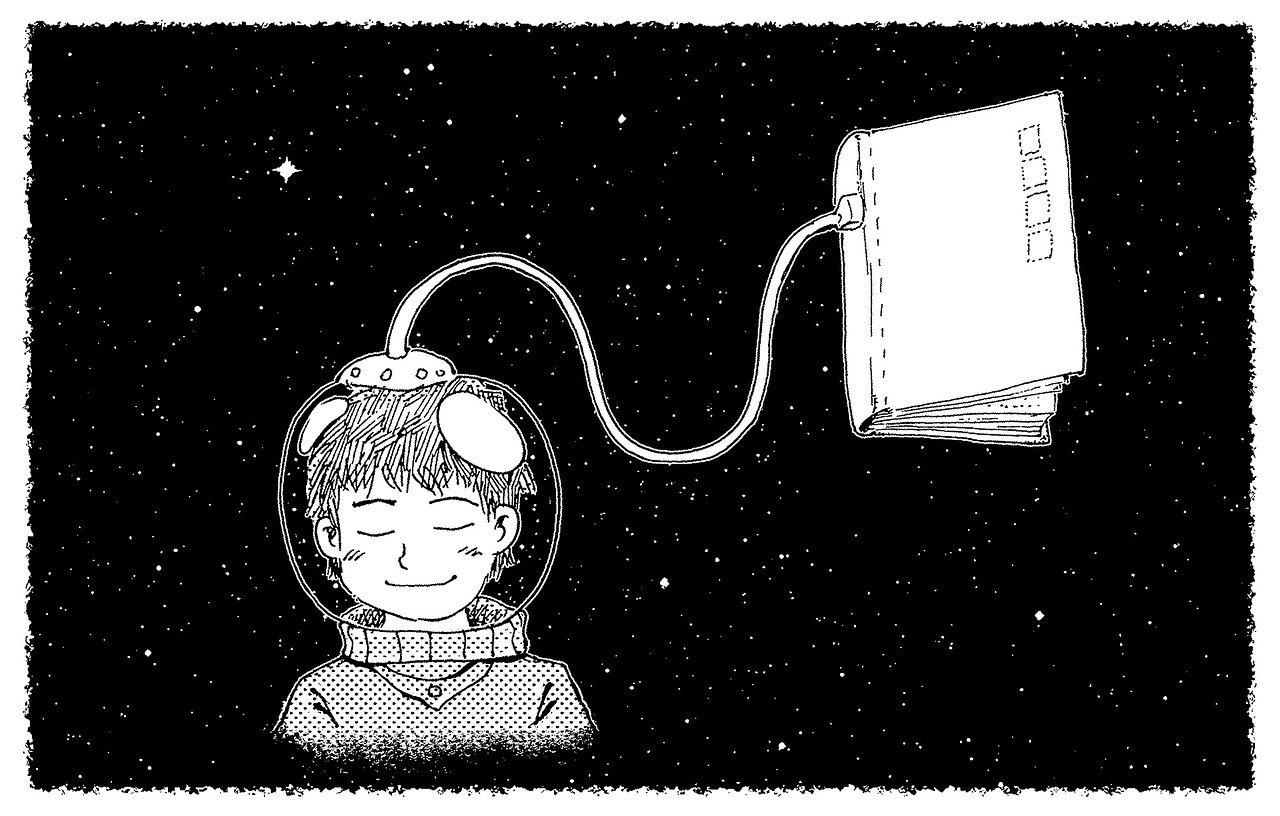
thought-provoking chapters, it addresses fundamental inquiries about black holes, dark matter, and the fabric of space-time, all while infusing humor and relatability into the discussion.
The author’s knack for storytelling makes it an enjoyable read, allowing even the most scientifically challenged readers to grasp the intricacies of the universe while also inspiring awe and curiosity about the vast, mysterious cosmos that surrounds us.
Atomic Habits by James Clear
This book is a transformative guide delving into the science of habit formation and how small, incremental changes can lead to remarkable improvements in one’s life. Clear presents a compelling argument that achieving significant personal growth doesn’t require monumental changes but rather the cultivation of tiny, positive habits that compound over time. The
book is underpinned by the idea that every action we take is a vote for the type of person we wish to become, making it crucial to align our daily routines with our longterm goals.
With practical strategies, ensgaging anecdotes, and a strong emphasis on the power of consistency, Clear provides readers with the tools to break bad habits, create good ones, and design a life that reflects their true aspirations. For anyone seeking to enhance their productivity, foster resilience, or make lasting changes, Atomic Habits serves as an invaluable resource that illuminates the path toward success through the power of small steps.
So, stock up on snacks, brew that coffee, prepare to take breaks (ahem), and give your bookshelf a new lease on life. Here’s to reading in 2024! personal growth doesn’t require monumental changes but rather the cultivation of tiny, pos-
itive habits that compound over time. The book is underpinned by the idea that every action we take is a vote for the type of person we wish to become, making it crucial to align our daily routines with our long-term goals.
With practical strategies, engaging anecdotes, and a strong emphasis on the power of consistency, Clear provides readers with the tools to break bad habits, create good ones, and design a life that reflects their true aspirations. For anyone seeking to enhance their productivity, foster resilience, or make lasting changes, Atomic Habits serves as an invaluable resource that illuminates the path toward success through the power of small steps.
So, stock up on snacks, brew that coffee, prepare to take breaks (ahem), and give your bookshelf a new lease on life. Here’s to reading in 2024!