



If you’re a student at the University of Regina then please pull your calendar out and block off Monday, November 20 from 3-4 p.m. so you can attend the Carillon’s Special General Meeting in the Multipurpose Room of the Riddell Centre! We’ll be speaking on actions of the publication as well as organization of our non-profit side, and as this meeting is a chance for students to have their say in our operations, we’ll be looking forward to seeing as many of you as can make it. All you need to bring is your student identification card and you can do your part by participating in our governance process. Illegitimi non carborundum holly funk
the staff
editor-in-chief holly funk editor@carillonregina.com
executive director vacant business@carillonregina.com
production manager shae sackman production@carillonregina.com
communications amin malakootikhah comms@carillonregina.com
web + advertising manager jaedyn whittal web@carillonregina.com
graphics editor lee lim graphics@carillonregina.com
copy editor emilie wren copyeditor@carillonregina.com
news editor mindy gregory news@carillonregina.com
a&c editor mikayla tallon arts@carillonregina.com
s&h editor kim kaufman sports@carillonregina.com
op-ed editor hammad ali op-ed@carillonregina.com
distribution manager vacant distribution@carillonregina.com
staff writer victoria baht
staff writer nazeemah noorally
staff writer maren savarese knopf
news writer shivangi sharma
a&c writer will bright
s&h writer pall agarwal
contributors william simon
board of directors
holly funk, tayef ahmed, harnisha bhatt, diya patel, mishree patel, and mikayla tallon.


the paper
227 Riddell Centre @ the University of Regina 3737 Wascana Parkway, Regina, SK, Canada S4S 0A2 www.carillonregina.com | (306) 586 8867
Printed by Star Press Inc, Wainwright, AB
The Carillon welcomes contributions.
Opinions expressed in the pages of the Carillon are entirely those of the author, and do not necessarily reflect those of The Carillon Newspaper Inc. Opinions expressed in advertisements appearing in the Carillon are those of the advertisers, and not necessarily of The Carillon Newspaper Inc. or its staff.
The Carillon is published no less than 11 times each semester during the fall and winter semesters and periodically throughout the summer. The Carillon is published by the Carillon Newspaper Inc., a non-profit organization.
land acknowledgement
The Carillon is written on Treaty 4 territory. As such, staff recognize that we are living, working, and telling stories on and of Indigenous lands. We recognize that we are on the traditional homelands of the Cree, Saulteaux, Nakota, Lakota, and Dakota peoples, along with the homeland of the Métis nation. The Carillon understands that it is pointless to acknowledge the land on which we work without demonstrating our commitment to telling stories and prioritizing voices that further the return of this land to its sacred place.
the manifesto
In keeping with our reckless, devil-may-care image, our office has absolutely no concrete information on the Carillon’s formative years readily available. What follows is the story that’s been passed down from editor to editor for over sixty years.
In the late 1950s, the University of Regina planned the construction of several new buildings on the campus grounds. One of these proposed buildlings was a belltower on the academic green. If you look out on the academic green today, the first thing you’ll notice is that it has absolutely nothing resembling a belltower.
The University never got a belltower, but what it did get was the Carillon, a newspaper that serves as a symbolic bell tower on campus, a loud and clear voice belonging to each and every student. the people’s friend; the tyrant’s foe






shivangi sharma news writer
How can University of Regina (U of R) students be sure of their personal safety while attending classes?
On October 17, 2023 an incident took place on the main U of R campus that framed this question from a new perspective. An unknown person entered a classroom where a psychology
class, Dr. Sarah Sangster, gave me a firsthand account of the events. […] This incident involved a single individual with a disorganized pattern of behaviour who made sexually inappropriate comments to the instructor and other female students.”
Security staff responded and intercepted the individual. Following their investigation, the person was escorted off the campus and the incident reported to the city police.
Smith explained, “Campus
students and staff are more capable of accurately assessing their environment and responding accordingly. The university website section on Campus Security agrees, listing the primary directives for UR Personal Safety as “be prepared” and “aware of your surroundings.”
Concerns also linger about how an incident such as this could end otherwise. Earlier this year, a man who was not a student entered a classroom of approximately 40 students at the
forming people.”
In a separate press release following the attack at Waterloo, Jeff Keshen, President of the University of Regina, stated that “our institutions – and indeed our communities writ large – must be safe for persons of all gender identities.” In the context of addressing the increasing risk for specific groups and the communities at large, the university has promised to invest itself in solutions.
In response, at the beginning
“It was difficult for me to know at the time if the person was a threat to anyone in the class.”
Dr. Sarah Sangster
lecture was about to take place and created a disturbance that led to the cancellation of the lecture for that day.
The professor of the class, Dr. Sarah Sangster, gave an account of the incident to the Carillon. Sangster recalled, “Someone presented themselves to me in class as though they were a student in our class. They exhibited some disorganized behaviour and said some inappropriate things to me. They also said some inappropriate things and behaved inappropriately to some students in the class. Because it was difficult for me to know at the time if the person was a threat to anyone in the class, I thought it was most prudent from a safety perspective to cancel class for the day.”
As a matter of campus safety, Sangster reached out to Campus Security so that they could investigate. “After discussing the incident with security, security found the person and engaged in an investigation about their behaviour and motives. They determined that the person was not affiliated with the university in any way, that is they were neither a student nor a staff member,” said Sangster.
She emphasized that Campus Security determined that the person did not intend to target the class, the room, or any one student. She assured her students that there was no reason for anyone in the class to feel particularly threatened or targeted.
Sangster elaborated: “From security’s perspective, the person, although exhibiting some disorganized and inappropriate behaviour, did not pose a significant threat to the safety of the class or anyone in the class. That is, they apparently weren’t there with an intent to hurt anyone.”
The Carillon also spoke with Austen Smith, an assistant professor in the Department of Psychology who was approached by Sangster. Smith followed up with details of the investigation that proceeded. “The instructor for the
short staffed as the university celebrates record student enrolment keeps increasing. In the ongoing climate of budget cuts and tuition hikes, the likeliness of hiring more members for Campus Security does not look promising. Therefore, it is essential for staff and students at the university to work together as a unit so that a more efficient and well-connected environment that promotes safety is established.
Looking at Dr. Sangster’s response as an example, knowing the right thing to do is as important as knowing the right time to act. Her decision to cancel the class immediately blocked any further disturbance that the person may have caused during the lecture. Her decision to inform Campus Security instead of shrugging it off helped uncover that the person was not a staff member or student.
As a further measure, Sangster decided to talk about some security precautions that can be implemented within her class so

Security gave a prompt response, finding the individual and escorting them off campus, informing Regina Police Service, and deeming the situation resolved. Further, Campus Security followed up with Dr. Sangster later that day to update her on the situation and ensure she did not have further concerns.”
Smith added that Campus Security will consider the person a trespasser if seen on campus again, therefore sightings should be reported. However, since information regarding the incident and investigation were not shared with the larger campus community, the Carillon questions the usefulness of such a measure.
Although no lasting harm was caused on this occasion, U of R administration may well consider greater transparency within the university community about events that do occur. Informed
University of Waterloo in Ontario and attacked the professor as well as students who came to her assistance. CBC News coverage from June 29, 2023, quoted Mark Crowell, Chief of the Waterloo Regional Police Service, describing the attack as a “senseless act of hate.”
The assaults in Waterloo were “planned and targeted” attacks on gender studies. In an increasing public atmosphere of hate and repression of the 2SLGBTQIA+ community and allies, hate-motivated crimes are of concern at U of R as well. Dr Shannon Dea, Dean of the Faculty of Arts, stated in an email to the U of R community following the Waterloo attack that “risks have intensified in recent years as populist political movements have driven hatred against 2SLGBTQ+ people, and especially trans and gender non-con-
of the Fall 2023 semester, the University of Regina withheld some of the class locations from course listings for Women’s and Gender Studies classes. A private email with that information was sent to registered students instead. Some students in these classes also noted an increased Campus Security presence near their classes at the same time.
On October 19, two days following the recent incident on U of R campus, an email was sent to students from Student Affairs announcing that the public ‘search for classes’ feature will no longer include instructor and location information in interests of safety and security.
In a previous article about Campus Security, the Carillon noted that security staff recognize that they cannot be everywhere on campus all the time. The potential for Campus Security to be
that they have a plan if something similar happens in the future.
The Carillon wants to relay that vigilance is of importance while on campus. Being aware of incidents that happen on campus and spreading the word about them can increase the general awareness and significantly reduce the chances of harm.
It is important to report any concerning incidents to Campus Security, who are available at all hours for the university community. They may be contacted at 306-585-4999 or in-person at their office located in the Research and Innovation Centre.
mindy gregory news editor
“Before we begin, I would like to say Tansi to everybody. To greet you in a good way,” Elder Lorna addressed the audience. “And I don’t know where to begin, so you’re all dismissed!”
“We like to bring laughter to people because it’s medicine. It loosens up your little spirit within you, and that’s the way to connect with one another, sitting in the circle because no one is better than the other.”
“We have to be comfortable in order to hear.”
Lorna Standingready, new Elder-in-Residence at Luther College, opened her Treaty Talk with this teaching on how to listen and learn. The talk took place in the Student Lounge area at noon on October 17 and was open to all who wished to attend.
The goal was to learn more about our shared experience of treaty from an Indigenous perspective. First, Elder Lorna introduced the book Treaties of Canada with the Indians of Manitoba and the North-West Territories. It has been the primary text for studying the context and intent of Treaties One to Seven. The author, Alexander Morris, Treaty Commissioner and Lieutenant-Governor recorded the view of the British Crown.
Elder Lorna is a great-granddaughter of one of the Indigenous signers of Treaty Four, which encompasses the land that the University of Regina is on. “He was a good negotiator, a good talker, and he understood a bit of the English language, but the English language can be twisted to say one thing, yet it could mean another thing. […] whereas First
Nations peoples said things in a very plain way.” Historically, Indigenous peoples understood treaties based on the spirit and intent of the discussion rather than the words partly due to language.
Cultural differences also played a role, including understanding the land as a gift to be respectfully used and shared, not sold. “I was brought up in what you would call a spirituality, very aware of my surroundings, Mother Earth, and the animals. We are no better than the animals, we are the most pitiful on Earth because […] we have to live off the gifts from Mother Earth. We looked after the land as best we could, […] it was a gift from the Creator to be here.”
Based on this spiritual worldview, treaties are sacred and binding agreements. For this reason, her relatives insisted that Treaty Four be signed when the sun was high and strong at a powerful time of the year, not first thing in the morning like the Commissioner wanted.
Spirituality in treaty making is rarely addressed in texts. “You’re not going to read that in the textbook because that has been handed down to me, and to others. The Commissioner made that treaty according to their language, but we had ours in our heart – how we understood the treaties – and now we’re trying to share that.”
“We did not give up the land; we gave it up to share with each other and to look after one another.”
Without treaties, the Canadian government would have no jurisdiction over much of the land currently in Canada.
Treaty making was followed by a dramatic shift in the relationship between colonizers and Indigenous peoples. Settlers began an aggressive campaign of assimilation which in-
cluded the forcible removal of Indigenous children from their homes into residential schools and non-Indigenous foster homes. “We grew up with no respect, shoved into residential
Elder Lorna concluded, “So, if you want to learn about treaties Alexander Morris’ way, good! At least you’ve got some kind of inkling about a treaty, but talk to an Elder too.”
why I say thank you, Miigwech.”
Elder Lorna’s office is room 111 in Luther College, and on Tuesdays her door is open to drop-ins from university students and staff.

schools, shoved into foster homes.”
“This treaty was signed in good faith, but the promises were broken.”
All people living in Canada are treaty people with their own sets of rights and responsibilities. Non-Indigenous people living on lands under treaty also have a responsibility to know and understand the treaty they are part of.
October, November, and December are known for celebrations and festivities all over the world. Locally, Thanksgiving, Halloween, and Christmas come in a wave of celebrations spreading beauty and colour through the crisp days of fall and snowy evenings of winter. Similarly, on the other side of the world, the country of India, and particularly the northern provinces of India, also enter celebrations in the month of October, beginning with the festival of Navratri.
Navratri translates directly to “Nine Nights” and is a festival that lasts for ten days. Celebrations continue for nine days, and the tenth day marks the end of the festival. The festival is also known as Dussehra (Defeating Ten Evil) or Durga Puja (Worshipping Goddess Durga) in different provinces.
The festival falls on different dates each year which are determined by the lunar calendar as per the Indian tradition. The tenth, or the final, day of the festival is celebrated on the tenth day of the month of Ashvina, the seventh month of the Hindu calendar, with the appearance of the full moon. This event known as Shukla Paksha means the “bright fortnight.” What is interesting about Navratri is that the same nine days have different significance in different provinces.
In the provinces of Gujarat and West Bengal, the festival celebrates all the nine forms of the deity Durga. In other provinces, the festival marks the victory of Lord Rama over the Demon God Ravana.
Different traditions are followed in respective provinces. In the Gujarati community, people come together perform “Garba,” a community dance where members of the community come together and dance in unison.
Speaking next of her college residency as an Elder, she continued, “We have a life together, and this is our home here – that’s the way I look at it – and I feel wonderful when I come here. I feel humbled that you are listening to me because at one time I couldn’t talk about this [treaties], I couldn’t talk about residential schools, but now today, […] that’s
“You have an Elder-in-Residence now, it is a different way, and it is a good way of reconciliation in this country.”
In the Bengali community, massive tents are constructed with huge idols of the goddess representing all of her nine forms. The streets are full of people who visit each tent, usually on foot. People flood the streets, tents are adorned with thousands of bright colours, peddlers sell their wares, the trees are lit up and nights come to life. In fact, these ceremonial tents in Kolkata, the capital city of West Bengal, are a global tourist attraction and people from all over the world pour in each year to witness the celebration. Similarly, the community dance of Garba in many cities of Gujarat has records for the largest number of people dancing together in unison. Various organizations of the Indian community in the City of Regina organize Navratri celebrations as well. For instance, the Gujarati Samaj of Saskatchewan organizes Garba nights during these nine days. The event passes are available for purchase on their websites. The Hindu Samaj of Southern Saskatchewan also hold events at the Hindu Temple on Pasqua Street.
India is known for its grand traditions and vivid colours, and Navratri celebrations are a sure shot way to witness them at their very best. I encourage everyone to be a part of these events at least once in their lifetime. Coming from India and having witnessed and grown up with these traditions, I certainly miss home a little more around this time of year.
shivangi sharma news writer
Students learn, honour, and reflect with Adnan Rashid during Islamic Heritage
nazeemah noorally staff writer
The new October scheduling of the university fall break provided students not only with a much-needed physical break from studies, but also a time for spiritual enrichment.
October is Islamic Heritage Month in Canada; established by the Federal Government in 2007 as an opportunity to learn, honor, and reflect upon the rich history of Islam and the global contributions of Muslims.
The University of Regina Muslim Students’ Association (URMSA) hosted a series of events over the break featuring scholar Adnan
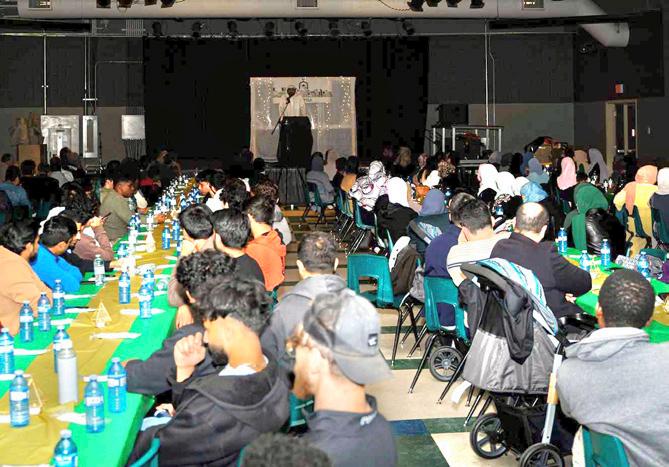
Events kicked off with an inaugural Fall Dinner on Wednesday, October 11. With a full attendance of 250 guests, the evening began with congregational prayers and an introductory address by URMSA, followed by Rashid as guest speaker and an open buffet dinner in the Multipurpose Room at the Riddell Centre. Moolla summed up the success of the dinner as “just the beginning of a series of enlightening sessions.”
On Thursday, October 12, the major talk unfolded at the university theatre where Rashid took the stage to discuss the interplay of the Qur’an, justice, peace, and progress.
Rashid, in his words, said, “There is no progress without peace, no peace without justice, and no justice without the Qur’an. This is the golden formula, what I call the golden chain
in fostering a deeper understanding and appreciation of cultural and religious heritage among attendees, reinforcing the sense of community and shared learning that URMSA continually seeks to promote.”
Rashid also highlighted the often-overlooked contributions of Muslim scholars in various fields, including algebra and trigonometry, the creation of encyclopedia, advancements in medicine, developments in cartography and geography, translation efforts from Arabic to other languages and the historical significance of the first notable library established in Europe by the early Muslim dynasty, among others. In summary, Rashid reiterated the legacy of Muslim thought and Islamic history. His talk wrapped up with a Q&A session, a captivating highlight for his audi-
Upon Him),” said Khan. “Knowing the different names of Muslim men and women who contributed to renaissance, science, math, and other fields of study is essential as it encourages us, as university students, to gain a better understanding of the achievements of Muslims in worldly progress.”
Moolla mentioned other notable initiatives undertaken by URMSA on campus. “Collaboration lies at the heart of URMSA’s ethos. By partnering with various on-campus clubs and off-campus organizations, we amplify the impact of our initiatives,” he said.
This collaborative spirit has been evident in URMSA’s various endeavors throughout the year such as the donations table set up at the university for the Turkey-Syria earthquake appeal, Morocco earthquake
affirms our commitment not only to the spiritual well-being of Muslim students but also to fostering an atmosphere of religious inclusion and respect within the broader university context.” Moolla added.
Ramla Jama, a current student at the University of Regina, acknowledged the positive impact of having a Muslim students’ association on campus. She stated, “Through URMSA, I feel connected to people with similar backgrounds. Those events help in educating myself on my faith and other nonfaith related topics such as mental health/self-care events.”
Jama mentioned the congregational Friday prayers, Islamic Awareness Week talks, self-care events, and the Islamic history and civilization seminar as standout events. To stay up to date on URMSA’s upcoming events,
“History has patterns and has things to offer. It is important to acknowledge our own civilization to make sense of what happened in the past.”
Adnan Rashid
Rashid. With over 93.1 million subscribers on YouTube, Rashid shares insights from decades of study in Islamic civilization, the traditions of the Prophet Muhammad (Sallallahu ‘Alaihi wa Sallam: Peace Be Upon Him) and comparative religion. Through the efforts of URMSA, the University of Regina (U of R) joined prestigious universities from the UK, Poland, and Lebanon in hosting his compelling seminar talks and interfaith dialogues.
On this occasion, the Carillon also had the opportunity to speak with Bashar Moolla, URMSA president, and conduct a survey to get students’ take on the events. We received a glimpse into Rashid’s visit to U of R, exploring the significance of Islamic history and highlighting the impact of URMSA as a platform for students to foster a sense of community on campus.
of events in the history of Islam.”
This statement underlined the theme of the scholar’s major talk.
Addressing an audience of both students and the public, he emphasized that this presentation served as a condensed form of a course that he typically delivers over an entire day.
Rashid provided a comprehensive overview of the history of Islam and the sequence of events that led to Muslim civilization, one closely tied to human civilization itself.
The significance of Islamic Heritage Month was emphasized by Rashid at one point during his talk.
“History has patterns and has things to offer. It is important to acknowledge our own civilization to make sense of what happened in the past,” he said.
Moolla added, “The scholar Adnan Rashid’s presentations on Islamic history were not only educative, but they were also instrumental
ence. One U of R alumnus who attended the talk shared their impression. “This presentation has been an eye-opener on how proud I should be of the Islamic civilization and its contributions to justice, leadership, and modern-day science. This is crucial in a time when Western media often paints a negative picture of it, which has regrettably been a major contributor to Islamophobia.”
Maliha Jabeen Khan, a pre-med student at U of R, found the event informative and a good way to connect with the community. ‘’The annual dinner with Ustadh [Scholar] Rashid was firstly a great way to connect the Muslim youth and Muslim families, […] most of us know the major life events from the Qur’an, the different prophets and their struggles, but none of us know about the history of Islam after the Prophet Mohammad (Sallallahu ‘Alaihi wa Sallam: Peace Be
relief, and Libya flood assistance, as well as their efforts for charity drives and community welfare.
Added to that, Moolla pointed out, “URMSA’s calendar is marked with community-centric events that resonate with our commitment to solidarity and awareness. These activities, often echoing global concerns and humanitarian efforts, not only serve to mobilize support but also instill a sense of responsibility and global citizenship among students.”
URMSA’s commitment to an accommodating university environment conducive to student’s observing their faith is emphasized. “As one of the most substantial non-faculty student groups, we ensure access to dedicated prayer spaces and uphold the sanctity of practices like the Jummah [Friday congregational] prayers through organized bookings and arrangements,” said Moolla.
“Our dedication in this regard
you can navigate to their official website: urmsa.org.
While you may be reading this article in the tranquility of your own space, let’s not forget the ongoing humanitarian crises on the other side of the world. In those regions, the significance of the words “justice” and “peace” cannot be understated, and their importance is more critical today than ever. Back to the focus of Adnan Rashid’s talk, let’s acknowledge that peace cannot be achieved until everybody is equal and until justice is served.
In Rashid’s words: “Any civilized society must offer impartial justice to everyone despite all the differences and all the profiles.”
Sips like these are made sweeter by the knowledge of their
maren savarese knopf staff writer
Morgana Turner is a third-year student at the University of Regina who is being supported by Campus for All.
This semester, Turner is taking a Psychology of Women course that explores the lived conditions of women globally and the systems that impact them. As part of the class, students had the option to, “either write a paper, or do a fundraiser, or a fundraiser and a paper. I chose the hard thing, but it sounded fun to do a fundraiser,” said Turner.
Turner, who is passionate about social justice and equity issues, chose to fundraise for women in Nepal. “[These women] have been in bad situations, or they don’t have education. So, they are learning how to
treated horribly. Different, but similar.”
Nepal is a landlocked country lying along the southern slopes of the Himalayan Mountain ranges. It is situated between India in the East, South, and West and Tibet in the North. Until the early 1950s, during a palace revolt, Nepal was marked by policies of isolation which ensured that the country remained closed to the outside world. In 1955 the country was incorporated within the United Nations and in 2008, after several decades of turbulent negotiations, the country was declared a democratic republic. The capital city Kathmandu is the largest urban sprawl in the Kathmandu Valley region. Nepal is home to a multi-ethnic population with diverse cultures. Moreover, there are approximately 123 languages spoken in Nepal, the major one being
had to wait for the company [I am working with] to get back to us. And then in Nepal they don’t have an address, so you just kind of have to ask people.”
Although the challenge of fundraising is a new one, Turner is well connected and supported by her friends who have previously worked with the company supporting her initiative.
“We were playing Dungeons & Dragons and I happened to interrupt and ask [about the class assignment]. And said I wanted to do fundraising,” Turner explains. “And then Annissa said ‘Well, we can do the tea fundraiser’ and then we got together and did the application.”
Funds raised through the tea sales will go to the Weaving for Life Project. Weaving for Life is a non-governmental non-profit women’s aid

make products by weaving, making purses and whatever else,” she said. As part of the class, students are learning about the situations of women in the world.
Turner says she was drawn to choose fundraising rather than a paper because “it bothers me the way [people] are treated. And if I can do something, I am going to.” Turner’s mother has had a large influence on their activism and concern with social justice issues “because she works in [the area] of Missing and Murdered Indigenous [Women].” Turner says that she sees connections between the MMIWG2S crisis in Canada and the women in Nepal, noting that, “the women in Nepal might have it a bit different than here, but they are both
Nepali, while others include Maithili, Tamag, Tharu, and Bhojpuri.
Working with the women in Nepal “was part of our class already, like my teacher had decided we were going to [support] them,” said Turner. This was based on already established relationships between the course instructor and the women supported by the Weaving for Life Project. As part of the class, students can choose to fundraise in any way and it was Turner who chose to do so through tea sales. Fundraising is new to Turner, who had no idea what to expect starting out, and says, “it’s a learning experience.”
Turner says the hardest thing thus far has been “[the] politics. So, we did the application, but then we
out her husband’s support, but she continued to sell tea and eventually reinvested her earnings to train women in weaving. Turner’s fundraising website is now live and accessible for those interested in supporting her initiative. In order to raise funds, Turner has partnered with the company Sipology. Sipology’s founding idea was that “one cup of tea can change a life.”
Each item is $15, and 40 per cent of the sale goes to the Weaving for Life Project. There are seven different tea blends available with names like raspberry cream soda, cinnamon bun, and unicorn kisses. In addition, Turner has several teaware items available for purchase.
According to Annissa, Turner’s friend who supported her in connecting with Sipology, those interested in the cinnamon bun blend should add a bit of milk to their cup for the best
experience of the flavour. For some of the more ‘fruity’ blends, like raspberry cream soda and bubbly cherry bomb, brewers should try making them as an iced tea and adding honey.
While the minimum fundraising goal is $150, Turner says, “I want to do $500 but I don’t know if that’s realistic.” The fundraiser will run from Oct. 22 to Nov. 5, 2023. Orders must be placed by November 5 with a two week wait for shipping time. For those interested in the fundraiser, but who do not drink tea, Turner is accepting donations that can be made directly to the Weaving for Life Project.
For more information, please scan the QR code or contact Morgana Turner directly at morganaturner@gmail.com.
“It bothers me the way [people] are treated. And if I can do something, I am going to.”
Morgana Turner
project based in Pokhara, Nepal. The project focuses on women and girls who have experienced social or economic neglect. These include women and girls who are widows, people with disabilities, or those fleeing situations of violence. Through various programming initiatives, the Weaving for Life Project provides access to education, health care, and a safe space to discuss topics such as menstruation, sexual violence, or experiences of trafficking.
The Weaving for Life Project was founded by Tara, a Nepali mother of three. After having undergone a surgery, she was sent to the countryside to recover. While there, Tara learnt the art of weaving and brought back the knowledge she gained to her home city. Tara’s first project was CHETNA and founded in Pokhara.
All of Tara’s efforts were made with-

Need some suggestions on what to do this Halloween? Read on!
victoria baht staff writer
Happy All Hallow’s Eve, also known as Halloween. Halloween is a wellloved holiday in society that is honestly so short, and it comes and goes before you even know it. Let’s talk about all things Halloween and Halloween-themed activities in and around Regina that you can enjoy before the holiday comes and goes.
First up, one of the best haunted houses that takes place in Regina, Saskatchewan, is Al Benesocky’s Shock House, more commonly known as just the Shock House. This haunted house tends to appear every year in the city and is currently located at 1230 Broad Street, with this being their final year at this location. They even claim the illustrious title of “Saskatchewan’s Largest Indoor Haunted Attraction.”
Typically, the Shock House has a theme that they tend to follow, apparent in surroundings of the house, the character’s costumes, design, and acting. The Shock House is made up of a team and actors that work to create a scene to scare and haunt the customers. As the customers walk through the house, they see a variety of different actors doing different things to scare them. Sometimes actors are crawling around, yelling, lying down, and pulling plenty of other spooky moves. You will have to attend
to get the full experience.
The fee to attend is a $25 basic fee and $35 for the speed pass, but keep in mind that they only take cash payment. They do not have any limitations on who can attend the house; they recommend no one under the
You can attend on October 26-29 and on Halloween, but for specific dates and times and more details, be sure to check out their Facebook page or website at theshockhouse.com.
Maybe getting scared is not your go-to family activity but you still want
around and look at all the Halloween decorations? Halloween is a great time of the year when lots of people decorate the outside of their houses for trick-or-treaters. The Z99 Radio Facebook page has a “Saskatchewan Haunts-Google, My Maps” link that

age of 11, but it is the parents’ call. Since you are seeing this just before Halloween happens, you may have limited options of when to attend.
to be in the Halloween spirit. Why not grab some of your family or friends and a nice beverage, maybe a hot chocolate, pop, or coffee and drive
shows you all the different houses to find with different decorations. Each house has registered to be located on this map and has different theme
names on how they decorated their house. This is a simple activity that can be fun, different, and not super scary but still get you involved in the Halloween spirit.
Speaking of the Halloween spirit, we cannot forget to talk about Spirit Halloween. Spirit Halloween is the largest Halloween store in North America. You can find everything you need by attending the store located at 1825 Victoria Avenue East. Get that last-minute costume for Halloween, walk through and see all the different decorations and costumes, or maybe throw a last-minute Halloween party and find all the goodies there.
Maybe you want to get in the Halloween spirit by getting all comfy with one of your favourite Halloween movies, and that is okay too. Actually, did you know that La Cité is hosting a movie night? Well, they are! Go and join other university students on October 26 for the “Ciné Club Halloween Edition.” They will be watching the French movie Teddy at 2 p.m. and 7 p.m., and they will be handing out popcorn and candy. This movie night will be taking place in the theatre at La Cité on the second floor in CT215.
Now you have some different ways to get into the Halloween spirit and different activities to partake in besides trick-or-treating. Have a safe and good All Hallow’s Eve.
“Watermelon Game” frenzy What is the Suika Game, where did it come from, and why is it so popular?

Stacking
If you’ve been in gaming spaces on the internet lately, you’ve probably seen a little game with a lot of fruit in a little rectangle. You’ve seen that all the text is in Japanese and you’ve probably wondered what exactly this game is.
Well, it’s called the Suika Game, but it’s more commonly known as the Watermelon Game. It exploded this October, and was only released worldwide on October 20, the day before I’m writing this. It was originally released in December of 2021, exclusively to the Japanese Nintendo eShop. The game sat quietly for nearly two years until it was picked up by livestreamers who began playing the game. I first saw the game on October 13 on Ludwig’s channel, the video titled “Beating the HARDEST Game in Japan in 1 Hour.” If you look up #suikagame on YouTube, Ludwig’s video is at the top. The current most viewed video when you just search “Suika Game” is from a Japanese
YouTuber named ピノの羽 (Pino no hane, or Pino’s Feathers) and their video has 2.2 million views. It was uploaded on Sept. 27, 2023. Looking up “Watermelon Game,” Ludwig’s is the fifth most viewed video as of writing this article.
But, what is the Suika Game?
It’s a single-player puzzle game reminiscent of Flash games from the late 2000s and the early 2010s. Your goal is to merge as many fruits as possible without having them spill over the top. The more fruit you merge, the higher your score becomes. Each fruit you merge creates a new fruit; except for the final fruit, watermelon, hence the name “Watermelon Game.” If two watermelons end up merging, they both disappear. It has a similar feel to Tetris, stacking things together while trying not to reach the top. As you create new fruit from merging fruit, the new fruit becomes bigger and bigger, taking up more space in the box. What makes the Suika Game especially difficult is the physics. The fruit does not sit nicely. They can bounce off of each other and roll off of each other. The built up pressure between fruits can cause fruit to launch out of the box, causing you to lose.
There are 11 fruits in total, ten that you can merge to, and the smallest, a cherry. After the cherry is a strawberry, then grapes, and then two orange fruits which are highly debated. One is believed to be an orange of some type and the other is seen to be a persimmon, though which is which is unclear. After the two orange fruits there are apples, pears, then peaches, before going into the biggest fruits like pineapples, melons, and watermelons.
The game will only provide you with the smallest five: cherry, strawberry, grape, orange fruit 1, and or-
ange fruit 2. In the official release of the game, you are able to see which fruit will come up next after you drop the one you’re on, which is not available in all versions of the game.
Not all versions of the game are official. There are several browser games modeled off the Suika Game, especially on smartphones. The most notable one is Synthetic Big Watermelon, a Chinese browser game that came before the Suika Game and acted as inspiration.
The big goal when the game started blowing up was to reach 3,000 points, which was reached fairly quickly. According to my switch, the highest score now is nearing 8,000, and I watched overnight the top score go from being in the 3,000s to the 7,000s.
Before the October 20 international release, the official Suika Game was notoriously difficult to get. You would need to access the Japanese eShop, which meant you needed a Japanese account. You also could not pay for the game using a credit card outside of Japan. Some reported success using PayPal, but I did not. Many resorted to buying Japanese eShop gift cards to purchase the game on the Japanese eShop, which is what I did to get the game.
The Suika Game is incredibly addicting. If you like puzzle games of any sort, get this one. It’s only $4.10 on the Canadian Nintendo eShop for the Nintendo Switch.
will bright a&c writer
Interviews with players reveal that the best teams are supportive and goal-oriented
pall agarwall s&h writer
The stereotype that soccer is traditionally a sport for men can prevent women from giving this passions their all; that’s definitely not the case for the University of Regina (U of R) Cougars women’s soccer team.
These skilled players have battled through this stereotype and conquered several games against different teams nationwide. This is due to the team’s supportive environment and their coach’s dedication to the team.
Their coach, Astrid Baecker, has been pushing her players to achieve their truest potential since her appointment in January 2022, earning her the love and respect of her players. “We’re going to ensure that everybody individually has an understanding of our principles,” said Coach Baecker in a women’s soccer update posted to Youtube by the University of Regina Cougars account one year ago. Her dedication to and love for the team motivates the team players to show up and give back to the sporting community.
The players are known for having each other’s backs and pushing each other to do better. As Sana Karam, the midfield and forward of the team, said, “They really help push myself to become a better person and player, and it’s really nice to experience everything at the university sport level.” Karam is a first-year at the U of R, and her team has been nothing but welcoming.
She explained her team’s culture and attitude from an inside perspective: “It’s very easy to fit in just because everyone is so welcoming and understanding. I think in our team culture of what I’ve seen so far, […] everyone strives to play for each other and together. So that’s a big motto in our team room, is to play for each other.” Progressing in the league has been a fun experience for Karam and a great learning curve, as she feels there is so much to know and grow from.
Kirsten Koellmel, team midfielder and all-arounder, said that the team has an empowering atmosphere. “I love being around the team so much. The girls are great but also the coaching staff is great – it’s mostly all women, which is really empowering, and they really relate to us. […] I think that just helps that they have all been through the university soccer experience too, a good tight-knit [group] of women that I love to be

around.” The empowering atmosphere encourages her and others to show up and give it their all.
Koellmel is in her fourth-year of soccer with the university, but she
has plans to stick around, polish her skills, and give back to the team by bringing more accolades. Koellmel started soccer at age eight, and has developed a passion for it ever since.
She attributes her younger-self’s interest in soccer to her brothers, who also played in the sport.
“I have met some of my greatest friends from this team,” said Koell-
mel. “We have a good array of girls, [...] from B.C. to Manitoba. We’re all very supportive of each other and we always push each other which only makes us better players and people. […] We are very close, […] we also hang out outside of soccer.”
“We show up every weekend for every game, everyone just puts their bodies on the line. […] Strive to do better than we did last season.” From Karam’s words, she explained that the team is always striving to meet and exceed their standards. “It’s been very good so far.” The U of R Cougars women’s soccer team always aims to “do more.”
As for prepping for games, “Individually, each person has their own pre-game routine,” said Karam. “Some people like to jump up and down, […] some people like to be quiet and be prepared for the game. Each person is different, but right before the game starts, we all come together as a team. Our coach, Astrid, gives us a pre-game talk that really pumps us up for the game.” This preparation for the game attributes to their success.
“Try your absolute hardest and put in 100 per cent of whatever you have that specific day. […] I think I’ve learned most of my lessons through being on the team,” Koellmel said. These lessons are ones that Koellmel feels are important for not just sports, but her personal life as well.
Both Koellmel and Karam report positive experiences with their team, with many life lessons that can be applied to their academic and personal lives. Karam said, “Just keep working hard. It can be [a] stressful process to try and get to play at a high level like U Sports, but if you keep working hard, coaches are able to notice that, […] and you just keep getting better. And, eventually, things work out.”
The Cougars women’s soccer team has come so far with dedicated players guided by even more determined coaches. The players put their best foot forward when they play a game, determined to continually improve and come out of their future games with flying colours. As the sports community at the U of R continues to fly flags higher, we should continue supporting them in their endeavours by extending love and support for the community. Doing so will only bring forth goodwill and richness to sports.
“I love being around the team so much. The girls are great but also the coaching staff is great –it’s mostly all women, which is really empowering, and they really relate to us.”
Kirsten Koellmel
From community-wide efforts to a campus focus, people rally together to support one another
As the temperatures dip, Regina witnesses the onset of winter. The season entails lots of layering of warm winter clothes to make it through the chilly wind. Many people rely on organizations that run year-round and seasonal winter clothing drives to provide warm winter clothing to residents of Regina.
These clothing drives help fulfil the basic needs of a person’s requirement for warmth when temperatures get life-threatening. Warm clothing consists of winter jackets, boots, sweaters, scarves, toques, gloves, mittens, and socks, among other items.
Organizations like Salvation Army run a year-round clothing drive. “We serve a lot of people who need to stay warm in the winters, and so having the ability to have a bank of warm winter clothing – whether it’s coats, boots, mitts, toques – all of that is really important because people often come in and are in need of those,” said Al Hoeft, Major, Divisional Secretary for Public Relations, Assistant Executive Director, Regina Waterston Ministries of the Salvation Army Prairie Division and the Salvation Army Alberta and Northern Territories Division. “One of the goals would be to always make sure that we have the capacity to give them what they need to stay warm, be healthy, be safe – all of those things.”
“We recognize that everybody is often serving a similar population, people who have similar needs in their own lives at this point for a variety of reason,” continued Hoeft about all the organizations in the city coming together to support the community in this time of need. Hoeft recommend-
MONDAY
ed dropping off any winter clothing in any of the Salvation Army thrift stores during the store’s hours as they accept donations throughout the year with an emphasis on the need of gloves, one of the most commonly required items.
“We just noticed that there is not a lot of support in the community, and we wanted to give back to people,” said Cherish Alexson, student and Indigenous Student Council member who is currently working at the ta-tawâw Student Centre. This centre at the University of Regina is currently running a winter clothing drive with bins for drop-off near its office in the Research and Innovation Centre. They believe in keeping it open for all, wishing to serve the community and bring people together. For those wanting to donate to a local community agency, the drive will be running from Oct. 16 to Dec. 1, 2023.
“We want to accumulate as much as possible through the local community and make a possible impact,” said Alexson. They will be distributing clothes to community organizations such as All Nations Hope and Sophia House in Regina. The Al Ritchie Community Association also accepts donations to their Second Chance Community Shop from 10 a.m. to 2 p.m. Monday-Friday.
Offering all we can to all we can.
TUESDAY

WEDNESDAY
THURSDAY
FRIDAY
SATURDAY
nazeemah noorally staff writer
Reading week is now behind us. I assume students must have seized the opportunity to relax and unwind but they must have also dedicated some time to prepare for the upcoming midterms awaiting them. And, as we talk about studying for exams, some questions that might come to mind are: “What are some great study spots on Campus? Or, what is the go-to spot if you are tired of doing homework and just want a quiet place to enjoy a nice book and a cup of tea?”
Well, for the main University of Regina (U of R) campus, the Carillon has got you covered. Whether you are into scenic views, peaceful vibes, or just want to be comfortable as you go headlong into the books, there is a spot that fits your style.
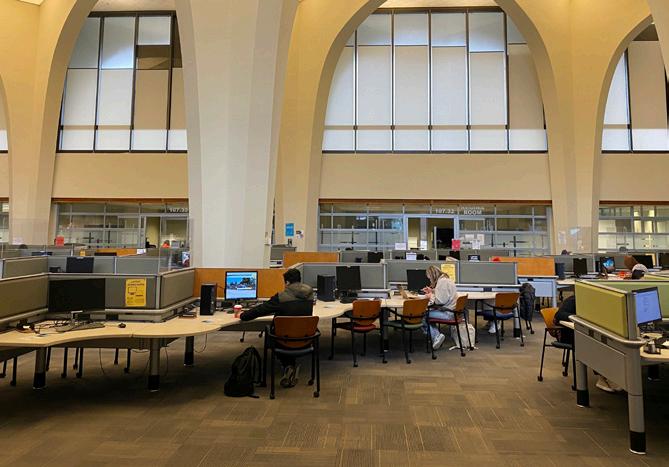
When we think about studying, the first obvious place that comes to mind is the library. The U of R’s John Archer Library is more than just a repository of books; it’s a hub of knowledge and resources, and an ideal place for those striving for academic excellence. If you’re looking for a view that can inspire your pursuit, the 5th floor of the library is your best bet. Consider this as a visual treat rather than a mere study session.
As you gaze out of the expansive windows from the 5th floor, you are greeted by a breathtaking view of Wascana Lake, and the view does not stop there. Looking further, you will catch a glimpse of Regina’s downtown Twin Towers and the highways. Turning attention back to the
campus itself, you can also witness the vibrant academic greens and the housing buildings from the 5th floor. Imagine sinking into that plush sofa or settling in at an ergonomic workstation that supports your posture and focus where you feel motivated to study for extended periods without feeling the usual strain.
Now, if you are more inclined towards solitary study sessions, you can book private study rooms at the library. Free from potential interruptions or distractions, the private study rooms are equipped with large monitors, whiteboards, and nice big desks where you can sprawl all your papers, notes, water bottles, and coffee mugs. What is great is that these specific rooms offer flexibility. You can book them for solo study sessions when you need some personal academic space.
Alternatively, they are also ideal when you are working on projects with a group of friends or on multimedia tasks. The process to book your spot is simple. Simply go to the web portal of the library at uregina.libcal.com/reserve/ studyrooms and choose the capacity, date, and times. Pro tip: Booking in advance is key. The popularity of these private study session rooms means that they fill up quickly, especially if you’re looking to secure one for the same day. As an add-on bonus, most of the study rooms come equipped with electrical outlets to plug in your phone, tablet, laptop, or any other devices you need to keep charged while you prepare your notes, complete that assignment, or dive into exam preparations. These are essential in this tech world, where staying connected and powered up is paramount.
While the John Archer Library is certainly a popular study spot on campus, it’s high time
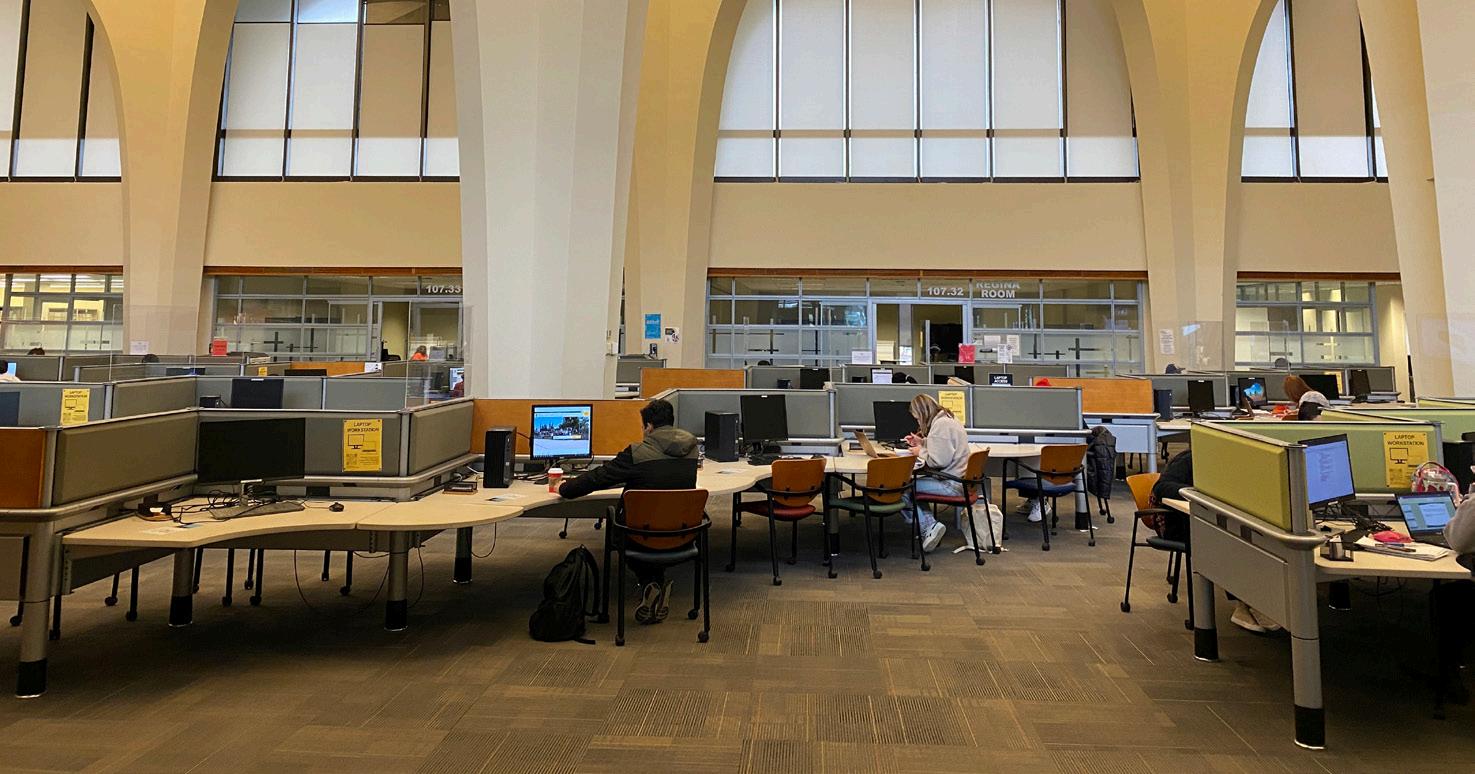
we also shed a spotlight on the hidden treasures of the federated colleges’ libraries which are often overlooked by students. The Campion and Luther Libraries as well as that of the First Nations University of Canada are libraries that students should have access to on campus.
Opening hours are usually 8:30 a.m. to 9 p.m. from Monday to Thursday, 8:30 a.m. to 4:30 p.m. on Friday, and 1 p.m. to 5 p.m. on weekends. The libraries’ materials can be borrowed by any registered student, staff, or faculty member as well as patrons with public access privileges. These libraries may not be as inthe-limelight as the John Archer Library, but they have their distinct advantages like the focused resources and smaller and cozier settings. Exploring these libraries can be a refreshing
Thought for food on campus Campus food options leave one hungry for more
For the first time since the pandemic, the campus is full of life this semester. There are people everywhere, space is once again at a premium, and slow walkers are once again blocking every single path from one classroom to another, walking at their slowest pace precisely when you are already running late.
Another big change is that all the food places on campus are once again open in full capacity, for longer hours, and serving a more
If you are looking to have a meal on campus, the different Chartwells locations are your best bet in terms of hours of operation. This semester, the Tim Horton’s at Riddell Centre is open until 7p.m. most days. This is a very welcome change compared to pre-pandemic years, when the store closed down at 4p.m. What sort of coffee place closes at 4p.m.? 4p.m. is when you are just about to give in and have your afternoon cup of coffee! A coffee
can compensate for the limited menu, the awful coffee, and the staff who look genuinely upset when you walk up to the counter to order something. I would have said I have never seen anyone grumpier about doing their job, but I know professors, so that would not be true.
Once I ordered an egg and cheese sandwich on a biscuit, and was given a sausage sandwich on an English muffin. That felt planned, honestly. I can believe someone getting one part of an

comprehensive menu. For those of us who had to witness the empty, post-apocalyptic campus during the pandemic years, even these crowds of slow walkers and loud talkers is a welcome sight. However, when it comes to food options on campus, things are still a little hit and miss.
shop closing at 4p.m. is like the United States Military leaving a country just as they find oil fields! It’s like the phone scammer hanging on you just as you give him the first six digits of your SIN!
Not that the longer hours of operation
order wrong, but when every aspect of the order is the opposite of what you asked for, someone is messing with you.
If you want more meal options, there’s always the couple of stores right behind the Tim’s. Word of warning though, unless you re-
change for those with an interest in heritage and culture. Take the First Nations University for example; you’re not just in a library, you’re in a living archive of Indigenous culture and history. It’s there waiting to be explored for both study and cultural exploration.
The next time you’re in search of the ideal study spot on campus, your quest ends here. Explore the different options you are entitled to receive as a U of R student from the renowned John Archer Library to the hidden gems of the federated colleges libraries which have an array of settings to personalize your study needs.
“Study while others are sleeping; work while others are loafing; prepare while others are playing, and dream while others are wishing.”- William Arthur Ward.
cently made it big in crypto investments, these might not be for you. Most of their full meal deals come in at over $15, or you could stay under $10 by getting a meagre slice of the most expensive pizza in the world and still be hungry afterwards.
One personal rant here. Every time I try to order something at the store right next to the burger place, the staff tries to talk me into buying the halal option. This cannot be a mere business tactic, since all their lunch items really cost the same. I can only surmise that they are concerned for my soul in the afterlife. I wish I could tell them that with all the other sins and transgressions I am guilty of, eating some halal meat is not going to get me into heaven. But bless them for trying, I guess.
The location of my workspace, and the laziness I was handed down from my ancestors and then perfected, means I hardly ever make it all the way to the lab café. During the pre-pandemic years, though, I used to frequent the Subway in that building. I eventually had to stop, because the staff there stopped taking orders at 6p.m. because, and I quote, “we are closing in an hour.”
Once that went down with the customers, I swear they kept moving up the order cutoff time to 5:30, 5, and eventually 4:30 p.m. Legend has it that at some point they will refuse to take orders at any time of the day, because, and someone swears a staff member said this, “why make a sandwich when the universe is doomed to perish?” Before you laugh it off as a joke, recall that maybe some philosophy major was working part-time on campus at the Subway.
Of course, I could talk about The Lazy Owl, but that has already been done to death. Instead, I close with a simple question – what sort of campus pub closes at 10 p.m.?
maren savarese knopf staff writer
The province of Saskatchewan is vast and covers almost half of the cultivated farmland in the country. It is a province marked by a settler culture of farming and harvesting. As such, many of us are familiar with the activity of harvesting various berries, fruits, or vegetables and turning them into some sort of preserve. A few of us might even have a certain friend who makes Saskatchewan renowned pickles or another who is known for their saskatoon berry jam.
The process of preserve making is a lot of work, and a labour of love. To begin you must boil your jars so they are sterilized, and while doing so begin on that which will fill the jars. Afterwards, the entire filled jar will have to boil a second time and be left to rest and set. This is a process that can take hours.
If you have ever been on the receiving end of having been gifted a jar of this precious jam, only to then feel obliged to return the notion, you may have participated in what anthropologists call a gift economy.
Anthropologists describe gift economies as systems of exchange from which goods and services circulate without explicit expectation of compensation. Someone can gift another freely without expectation of anything in return, not even a “thanks.” Gift economies are not regulated from an overseeing body but derive from a collective sense of equity, reciprocity, and accountability. In the book Sacred Economics, Charles Eisenstein explains, “Gifts cement the mystical realization of participation in something greater than oneself which, yet, is not separate from oneself. The axioms of rational self-interest change because the self has expanded to include something of the other.”
The underpinning currency of these exchanges involve in some ways a dissolution of self in favour of mutuality. Gift economies encompass systems of social and moral agreements for indirect reciprocity. So, that feeling of
having to return in kind the jam that was shared with you is part and parcel to gift economies.
Moreover, the world itself and its offerings can be understood as a gift. In fact, the words ecology and economy come from the same root, the Greek word ‘oikos,’ meaning ‘home’ or household. The common market economy that we’re used to and immersed in is certainly not the only model out there. In a small way, when we engage in the exchanges that occur between two ‘canners’ (someone who cans) at the end of harvest season, we participate in an alternative.
Market economies are often characterized by notions of scarcity with the end goal of maximizing return on private investments. The private owner of said investments is the sole benefactor of the accumulated return. For Eisenstein, he believes we have created a distorted economy which transforms what is beautiful and unique into money and currency which enables us to purchase things we don’t really need at the cost of destroying what we do.
Contrastingly, gift economies focus on the abundance of gifts from Earth, owned by no one and therefore meant to be shared. The act of sharing shapes relationships of goodwill and cements bonds to ensure the continuation of said relationships. Researchers have speculated on the challenges of implementing gift economies in urban sprawls, stating that while they might make sense in small and tight knit communities, larger areas where you may not know your neighbours pose a significant challenge.
However, that is also the power of the gift. Dropping the jar of jam or preserve on the door of a neighbour you do not know might begin a long-lasting relationship.
The next time you or someone you know begins the laborious process of making preserves, reflect on the fact that storing them in your pantry or in the bellies of your friends or unknown neighbour will combat hunger, but also have very different impacts.

During the reading week, one of the highlights at the University of Regina (U of R) was the eagerly anticipated annual Fall Open House. This event, held on October 13, 2023, stood out as an extraordinary event that showcased the campus’ warmth, hospitality, and opportunities it offers to prospective students. With the dedicated efforts of university staff, volunteers, and enthusiastic high school graduates, the event marked a return to pre-pandemic attendance,
with a total of 804 registrants and 616 attendees, excluding guests.
As Kayla Schmaus, Manager of Student Recruitment and Marketing, pointed out, “Because we had the event on the Friday due to the Fall Break, we had 11 high schools (both from Regina and outside of the city) bus students to campus. This is the first time in many years that we have been able to have that type of partnership with the schools for the event.”
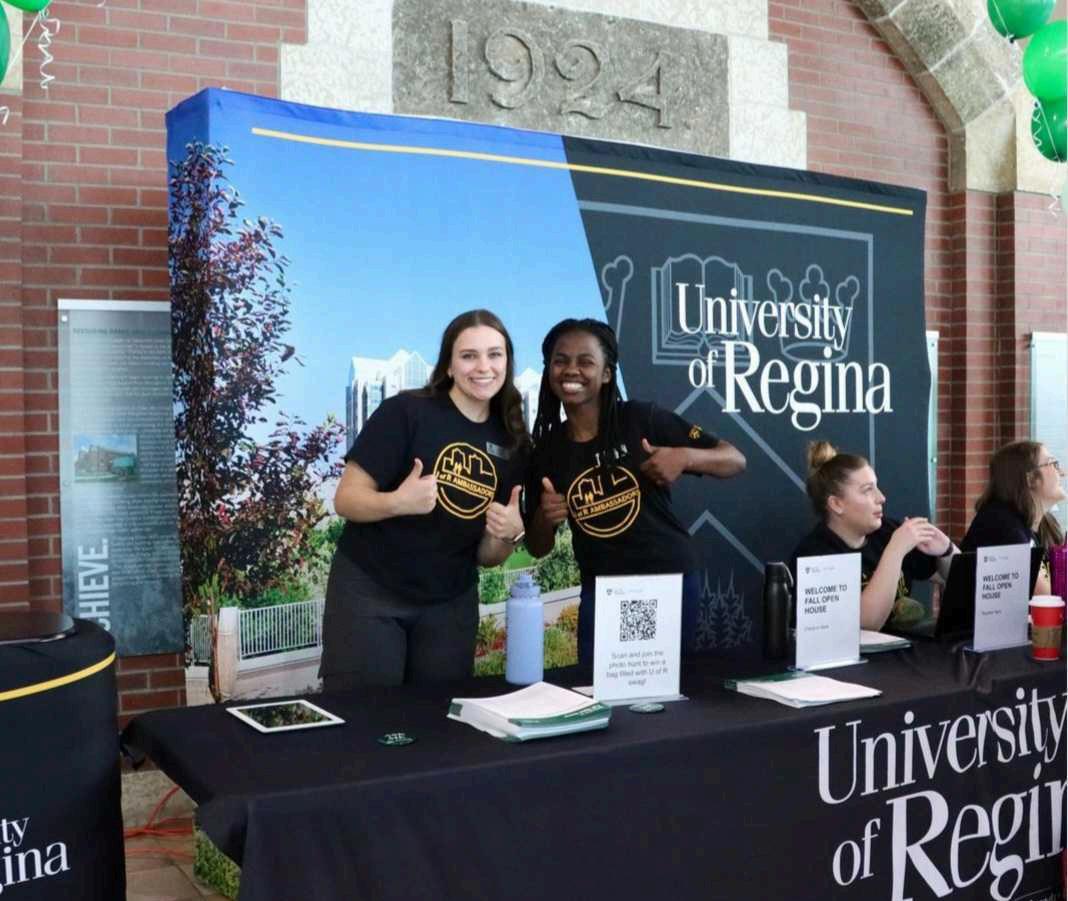
Added to that, the feedback from participants and visitors was overwhelmingly positive. Kayla Schmaus stated, “My team and I have heard back from many students, guidance counselors, and parents/supporters, that campus felt like home. The volunteers were approachable and friendly, and the students felt informed of our programs and supports.” This highlights the sense of community that those students felt with the collaborative effort between the University of Regina and other high schools in and outside Regina.
Taking a sneak peek at the event itself, the Fall Open House unfolded with the Welcome Session kicking off at 10 a.m., though check-in had already started in the Centre for Kinesiology, Health, and Sports an hour earlier. Hourly sessions running from 11 a.m. to 3 p.m. were designed to help familiarize students with the various faculties, programs, and services offered at U of R and the Federated Colleges.
The “Admission on the Spot” was one of the standout features of the Fall Open House. Students coming in-person could apply to the U of R on the spot with a reduced application fee of only $50 and receive an immediate decision regarding their application within hours on the same day. “The addition of the Admission on the Spot also ensured that students could feel supported through the application process, and celebrated when they received their admission to the U of R,” said Schmaus. “The joy in that space was contagious! It is no small feat to conduct this type of event and see the results that we did.”
The day’s schedule was thoughtfully organized to ensure attendees had a comprehensive understanding of what the U of R had to offer. While the students were waiting for their application decision during the Fall Open House, there were different events such as the campus tours, housing tours, and an expo featuring the various departments and student support ser-
vices to keep students and parents engaged and entertained. The prospective students could engage in fun and memorable activities, such as creating friendship bracelets or taking selfies.
Through this, one thing is clear; The Fall Open House was not just an opportunity to explore academic programs, it was a chance to experience the heart of the university, and that made all the difference. Notably, it was also a great experience for the student ambassadors, student assistants, volunteers, faculty, and staff members whose role extended beyond information dissemination; they were the welcoming face of the U of R and contributed to the university’s warm and collaborative spirit.
From greeting the attendees to facilitating their drop-off applications, the student assistants and staff members ensured that everyone felt welcomed and valued. As a student volunteer on that day, I felt connected with the prospective students and their families since I had been in the same position not too long ago, starting my academic journey at U of R. It was like reliving my own first-year experience through the eyes of the eager newcomers.
To crown it all, the Fall Open House during the Fall break was more than just an informative event; it was a heartwarming journey of shared experiences, dreams, and aspirations. Apart from the orientation day, the Fall Open House is the day when the university community opens its arms to provide educational prospects to the next generation of leaders.
“Education is not preparation for life; education is life itself.” - John Dewey
nazeemah noorally staff writer