


the staff editor-in-chief holly funk editor@carillonregina.com
executive director thomas czinkota business@carillonregina.com
production manager shae sackman production@carillonregina.com
communications amin malakootikhah comms@carillonregina.com
web + advertising manager jaedyn whittal web@carillonregina.com
graphics editor lee lim graphics@carillonregina.com
copy editor emilie wren copyeditor@carillonregina.com
news editor mindy gregory news@carillonregina.com
a&c editor mikayla tallon arts@carillonregina.com
s&h editor vacant sports@carillonregina.com
op-ed editor hammad ali op-ed@carillonregina.com
distribution manager sun sidhu distribution@carillonregina.com
staff writer victoria baht
staff writer nazeemah noorally
staff writer maren savarese knopf
news writer shivangi sharma
a&c writer will bright s&h writer pall agarwal
contributors allister white
board of directors thomas czinkota, holly funk, tayef ahmed, harnisha bhatt, diya patel, mishree patel, ghanshyam pravinbhai savaliya, rishi thakkar, mikayla tallon, and sun sidhu
the paper
227 Riddell Centre @ the University of Regina 3737 Wascana Parkway, Regina, SK, Canada S4S 0A2 www.carillonregina.com | (306) 586 8867
Printed by Star Press Inc, Wainwright, AB
The Carillon welcomes contributions.
Opinions expressed in the pages of the Carillon are entirely those of the author, and do not necessarily reflect those of The Carillon Newspaper Inc. Opinions expressed in advertisements appearing in the Carillon are those of the advertisers, and not necessarily of The Carillon Newspaper Inc. or its staff
The Carillon is published no less than 11 times each semester during the fall and winter semesters and periodically throughout the summer. The Carillon is published by the Carillon Newspaper Inc., a non-profit organization.
land acknowledgement
The Carillon is written on Treaty 4 territory. As such, staff recognize that we are living, working, and telling stories on and of Indigenous lands. We recognize that we are on the traditional homelands of the Cree, Saulteaux, Nakota, Lakota, and Dakota peoples, along with the homeland of the Métis nation. The Carillon understands that it is pointless to acknowledge the land on which we work without demonstrating our commitment to telling stories and prioritizing voices that further the return of this land to its sacred place.
the manifesto
In keeping with our reckless, devil-may-care image, our office has absolutely no concrete information on the Carillon’s formative years readily available. What follows is the story that’s been passed down from editor to editor for over sixty years.
In the late 1950s, the University of Regina planned the construction of several new buildings on the campus grounds. One of these proposed buildlings was a belltower on the academic green. If you look out on the academic green today, the first thing you’ll notice is that it has absolutely nothing resembling a belltower.
The University never got a belltower, but what it did get was the Carillon, a newspaper that serves as a symbolic bell tower on campus, a loud and clear voice belonging to each and every student. the people’s friend; the tyrant’s foe

, meaning we’re a quarter of the way through all issues we’ll be publishing this academic year (also, 666, heh heh heh). If you’ve been reading through these pages and the words have been prompting story ideas or have been instructive challenges to your own opinions, there are still several issues left this year to which you can contribute written or visual content.
One of the most important roles of a newspaper is to promote discourse, and what we’ve put out so far will be made all the better with the addition of your insights - make note of the section editors’ contact information above in case you wind up finding the gumption to chase an idea!









shivangi sharma news writer
The National Day for Truth and Reconciliation is approaching, and the entire nation is preparing to remember and honour the victims and survivors of the residential schools and their families and communities. The University of Regina (UofR) is organizing events and activities to educate more people on why the day is observed and to encourage Indigenous engagement on campus.
To outline the history of the day, the National Day for Truth and Reconciliation is a federal holiday observed on September 30 each year. It was established in 2021 to address Call 80 of the Truth and Reconciliation Commission of Canada’s Calls to Action. The intention is to recognize and commemorate the legacy of the residential school system in Canada and to honour the survivors, their families, and Indigenous communities affected by it.
The residential school system
within Indigenous communities.
The National Day for Truth and Reconciliation serves as a day of remembrance and reflection on the atrocities committed during a period that ended only recently; the last residential school closed in the late 1990s. It also provides an opportunity for citizens to educate themselves about the history and ongoing impacts of colonization in Canada, and to engage in reconciliation efforts with Indigenous peoples. The National Day for Truth and Reconciliation is observed on the same day as the earlier established Orange Shirt Day.
Orange Shirt Day is an Indigenous-led grassroots commemorative day to promote the concept of “Every Child Matters.” The orange shirt symbolizes the stripping away of culture, community, and self-determination experienced by Indigenous peoples over generations. People across the country are encouraged to wear orange to honour the survivors of the residential school system.
The Carillon met with

forcibly removed Indigenous children from their families and communities and placed them in government-sponsored and church-run schools. These schools were intended to destroy children’s cultural attachments and assimilate them into Euro-Western, Canadian culture. Abuse and neglect were also rife in many residential schools, leading to profound intergenerational trauma and loss
School system and a child from the Sixties Scoop generation. Campbell’s team has been working diligently to promote awareness and Indigenous engagement across the U of R campus. When asked about the most important advances made over the last year, she said, “Over the past year our office led the development of an Indigenous Engagement Strategic Plan and I think that’s the big thing of the last year. It stands out to me because we had done so much consultation and not only that, there was so much willingness from the students, staff, and faculty across the campuses and the community. It was just astounding that so many people were interested in having their voice heard on how we can do better, and that to me felt like a very good sign.”
Talking about the challenges that students from Indigenous communities face at the university, Campbell said, “There is a history of exclusion from universities and we still have many students who are first generation university students. Different barriers come
significantly. “Resources are tight everywhere. Not just universities but everywhere right now. Some of the things that we need to do cost money. We need to have more Indigenous staff and faculty representation and that will benefit Indigenous students but also non-Indigenous students,” said Campbell.
The core responsibilities of Campbell’s team are to provide leadership on strategic and policy development related to Indigenous initiatives, support campus-wide Indigenous activities, and coordinate the truth and reconciliation strategy. Campbell spoke to us about her team’s plans regarding the new semester: “I can tell you that on Tuesday [September 26] we are publicly launching our Indigenous Strategic Engagement Plan and there are 34 actions within and there are 14 areas. One is student success and places and spaces, so our campus and what it looks like and how its set up. Teaching and research are also in there. I try to focus on systemic things like policy, things that are not always as apparent in the forefront.
think about is international students and newcomers who have no history here and have a lot of questions. I have heard before from that demographic about how when they come to Canada, they want the full experience. They want to know lots of things, […] one of it [those things] is about Indigenous people here in Canada. I also see that demographic often times come from a very cultural background and so they are really drawn to engage with the people from the First Nations and Métis students. I think what the students will see is a campus-wide commitment to implement various actions that are outlined within that plan and I think that will impact students,” she said.
Speaking to Campbell about her team’s plan for encouraging Indigenous engagement on campus certainly creates excitement to get involved and learn more about the history and culture of Indigenous communities in Canada. After all, that is what truth and reconciliation is about: to actively learn, remember, commemorate,
“ There is a history of exclusion from universities, […] Different barriers come with that, like navigating the university system when you don’t come from a family where parents have gone to the university.”
Lori Campbell
Lori Campbell, Associate Vice-President of Indigenous Engagement at the University of Regina, to discuss the National Day for Truth and Reconciliation and what their office is doing to promote the day and encourage Indigenous engagement. Campbell is a Two-Spirit member of Montreal Lake Cree First Nation in Treaty 6 territory. She is also an intergenerational survivor of the Indian Residential
with that like navigating the university system when you don’t come from a family where parents have gone to the university.” Her team focuses on making the university experience more accessible and easier to navigate for these students.
Her team’s job, however, has not been without its challenges. Funds are tight and that has affected their endeavours for promoting engagement
Looking at things within the system that are disadvantaging Indigenous excellence to shine but also disadvantaging opportunity for non-Indigenous students, staff, and faculty to learn and engage with Indigenous people.”
She also mentions that she is focusing on getting more and more international students to engage with the Indigenous community and culture. “One particular demographic I really
and communicate. Survivors must be shown respect and have attention devoted to them.
If truly engaging with truth and reconciliation efforts, citizens promote the teaching that has guided the work of the National Centre for Truth and Reconciliation: that we are all in this together – we are all one, connected, and it is vital to work together to achieve reconciliation.
At what cost is truth and reconciliation being deemed “unfeasible?”
maren savarese knopf staff writer
In December 2022, news headlines detailed an arrest in Winnipeg, Manitoba. The individual was charged with the murder of Rebecca Contois, an Indigenous woman from Crane River First Nation. There are three additional women whose deaths the same person is suspected responsible for.
News of the possible whereabouts of the additional victims, Morgan Harris, Marcedes Myran, and Buffalo Woman (an unidentified victim who was named by Indigenous leaders), made headlines at the same time the Winnipeg police stated that conducting a search of the landfill where finding their remains may be “unfeasible.”
Kimberly Murray, a Mohawk woman working with Indigenous communities to investigate unmarked graves, stated that this refusal is “a breach of human dignity” and that under international convention families of the women have a “right to know.” On December 6, 2022, the daughters of Morgan Harris attended a news conference where they accused the Winnipeg police of gross negligence.
In 2021, only a year earlier, the Canadian government released the “Federal Pathway to Address Missing and Murdered Indigenous Women, Girls and 2SLGBTQQIA+ People
that is lasting, impactful, and accountable.”
In a 2022 press conference, Cambria Harris, daughter of Morgan Harris, asked why “the police won’t do anything,

(MMIWG2S)” which outlines the federal government’s contributions to the National Action Plan and their
commitments to ending the MMIWG2S epidemic. Within the 30-page document, Prime Minister Justin Trudeau is quoted saying, “Together, with families, survivors, Indigenous partners, and provincial and territorial governments, we will continue to respond to the National Inquiry’s Final Report in a way
Carillon on the move: textbook
What do students say about paying to borrow?
The semester is moving forward with astonishing speed and students both on and off campus are already gearing up for their midterm examinations. As exams approach, students feel the need for textbooks for their respective courses. Textbooks, however, can be very expensive.
Purchasing them may not seem an economically viable option, especially if the books are not required for more than a single semester. The University of Regina (U of R) Bookstore operated by Follett offers options where students can rent or purchase second-hand textbooks. The Carillon checks out the options that are available for textbook rentals and purchase, and what university students have to say about them.
The campus store located in the College West building allows students to rent textbooks which can be returned after the end of the semester. The students are allowed to take notes and make highlights in the rented textbooks, and they may pay less than half the price of new if they rent the textbooks. This can make rental an economical option.
“I have been at the university for around five semesters, and I have always rented my required textbooks,” said Maliha Jabeen Khan, a Pre-Med student at the U of R. “Being a science major, the textbooks required for our classes are usually very expensive. Having the option to
rent textbooks makes them much more affordable.”
The textbooks can be rented by visiting either the physical campus store location or online.
The staff at the bookstore can easily guide the students through the rental process when visited in person. “The people at the bookstore are very nice and
any questions that you may have about renting or buying books,” said Adam Wood, a second-year student pursuing a Philosophy, Politics, and Economics major at the university.
To rent the texts online, students can visit the bookstore’s website at bkstr.com/ ureginastore/home and search
option available for them and complete the purchase by adding the books to their shopping cart and choosing their preferred method of payment, similar to other online shopping websites.
The only thing different is that for renting textbooks, one must sign a rental agreement before completing the purchase, whether

friendly and not only that they are nice while talking to you. They are also very willing to help you with
for their textbooks using their course number and section. They can then choose the rental
Despite this, families and supporters of the call to search Prairie Green Landfill seek to put pressure on the provincial and federal governments to search for the women. Yet as of June 2023, the Manitoba Premier Heather Stefanson has remained firm in her stance not to search the landfill, citing safety issues outlined within a feasibility study. This comes despite proposals that the risks of conducting a search could be minimized.
Recently, people in at least 17 cities across Canada, including Ottawa, gathered as part of a day of action organized by Myran and Harris’s families. Rallies called for an immediate search of the landfill north of Winnipeg. Long Plain First Nation Chief Kyra Wilson stated that “people are not trash” in a September 18 news conference held in Ottawa with the families and the Assembly of Manitoba Chiefs Grand Chief Cathy Merrick.
Further, Chief Wilson said the following on the matter: “We need to make sure that we’re continuing that momentum and people know the importance of everyone coming together to make sure that we can bring these women home.”
and they say they won’t search because it’s not feasible, is human life not feasible?” A question that neither the federal nor provincial government seems willing to answer.
in-person or online.
The rental agreement highlights that the student must
return the rented textbook before the due date mentioned on the purchase receipt, and failure to do so will incur a late fee. Should students need to extend the period for the rentals, they can do that, or the rented textbook can be purchased before the due date by paying the difference. Should they end up dropping a class early after renting the required textbooks, the students can also get a full refund when they return the textbooks.
Textbooks rented online can also be shipped to the student’s house. “It was so convenient to have the books delivered to my place and not have to go to the store to get them,” said Ramla Said Ahmed, a student pursuing Biology at the university, who took classes for her summer semester online. In these cases, the textbooks can then be returned to the campus store or be shipped back to the store. The cost of shipping, however, is at the student’s own expense.
These students say that textbook rentals and used textbooks are economical and flexible in meeting their needs. The Carillon encourages students to explore their options and share in the larger conversation about what works and what doesn’t concerning textbook rentals. shivangi sharma news writer
sounds that anyone could “listen to… all day.”
special… it feels like it’s everyone all together.”
On September 20, Alexis Normand and Burnstick gave a powerful performance at Regina’s Artesian Performing Arts Centre. The performance blended two distinct styles. At first listen, Normand’s bright, contemporary style seems a harsh contrast to Burnstick’s gutsy, alternative folk. What unites the two styles, though, is the love and soul that both artists infuse their music with. The emotions of the night’s performance leave a lasting impression even days later.
The Artesian itself is a decades-long labour of love, imbued with soul of its own. It was built in 1950 and served as the Calvary Evangelical United Church until its closure. It first opened for rentals in 2011, and, in 2016, was reinvented by the Artesian Performing Arts nonprofit group. The Artesian states that today it is “a destination for new work development, […] a champion for the emerging artist, […] and [a] provide[r] [of] facility, production, and marketing support to the performing arts community in Regina.” The Artesian is more than a destination for the emerging artist, it is a home.
The small church perched on 13th Avenue on the edge of the Cathedral district and the talented performers within it are, without a doubt, one-ofa-kind. When empty, it has an unassuming but promising air to it. When full of smiling, excited faces and conversations which, on Wednesday, were flowing in a blend of English and French, the venue begins to feel like a warm,
“
When Burnstick’s rich, profound sound began filling the church walls, it became abundantly clear why the duo is so acclaimed. Having performed eleven times across the country
With such a distinct musical style and impactful mode of performance, there is no doubt that Burnstick deserves to be remembered for decades to come. When asked about what kind of
nourish [their] child, to protect him [and] to help him cultivate his cultural identity as well as the confidence to stand tall.”
Want to hear Burnstick live?
The couple’s tour with Alexis Normand culminated on the 22 at La Grange Laurier, in Manitoba.

two. “In my body, sometimes there [are] things I feel need to be said in French,” Alexis explained when discussing her song “The Night Before Je T’aime.” This intuitive use of language is present in the rest of her music as well. In “Tous Les Matins,” Normand offers a perspective on her upbringing in a bilingual prairie home.
On the subject of her latest album Mementos, Alexis explained to the crowd at The Artesian that “for the first time, I’ve written something that [captures] how I live my life… I think that’s beautiful.” Normand told listeners that she often felt as if she needed to divide the two parts of herself, but since the release of Mementos she “feel[s] like a complete person in all spaces, not just half.”
Alexis ended her act by paying homage to her days as onethird of Rosie and The Riveters. The concert closed when she performed the trio’s song “Life is Good Today” and effectively pulled at the heartstrings of the many Rosie and The Riveters fans in the crowd.
Through both performances, passion and love flowed like a current. Love for family and for life was evident in each and every piece, as was passion for the craft. One of the most heart-wrenching moments was Burnstick’s final song, a John Prine cover. In a church where hands once met each other in prayer, they met in collaboration and unity. That unity served as a testament to the venue itself.
The Artesian is far from unchanged by time. Yet, with each passing day, I learn that that doesn’t have to be a bad thing. In fact, it can be a beautiful thing. The Artesian is triumphant in the
Love for family and for life was evident in each and every piece, as was passion for the craft.”
busy home. As the lights dim, shadows fall upon the crowd, and Burnstick’s iconic “Some Kind of Hell” fills the church, the feeling shifts, ever so slightly, once more.
This time, the church feels as if it has become one with the music. It’s not just the venue that is a force of nature, but the instruments as well. When talking about his Weissenborn and guitars, Jason Burnstick –one half of the Burnstick duo – explained: “That’s the thing with instruments, there’s songs in them.” Jason brought a multitude of different guitars, some more than 100 years old, producing
over the past three months, there is no shortage of moments as touching and memorable as their music. When asked about these moments, Jason mentioned that when “[Burnstick] played in Edmonton” the evening was “really, really special.”
Friends that he hadn’t seen since high school, along with his family, were present at the show.
“It was beautiful,” he explained.
Nadia Burnstick, the other half of the duo, agreed while explaining that the moments most special to her are “when the crowds are so welcoming and warm – like tonight, it was really
legacy they’d like to leave behind, both echoed sentiments about their music, with Jason “hop[ing] that it puts smiles on people’s faces,” and Nadia explaining that she “really like[s] the idea of people seeing that [their] family is strong and that music helps that.”
Where others may see a challenge in finding work-life balance, Burnstick sees something that strengthens their family. This way of thinking is echoed in their album Kîyânaw, in the description of which Burnstick explains that they “choose to do [their] best to be kind to one another, to respect [them]selves and each other, to
Allister White
However, Burnstick does have a Manitoba performance planned for November 16. In terms of Saskatchewan performances, “spread the word to the Regina Folk Festival,” Nadia urged, stating that they’d be open to coming back next summer.
Shortly after Burnstick closed their act with John Prine’s “All The Best,” Alexis Normand’s set opened. The second Normand stepped on stage, her presence lit up the space. Her performance was unique and effortlessly combined the francophone aspects of her music with the English, weaving between the
face of time and change. It has been altered, covered, had pieces erased or removed, and been painted over. Nonetheless, it’s all the better for it. Why? Because still The Artesian stands, fir wood and warm spotlights nestled comfortably on 13th Avenue. A true home for performing arts in Regina.
If your interest in The Artesian is piqued, Begonia will be performing on October 12, Jordan Klassen and David Vertesi on the 13, and Slow Leaves on October 24, to name a few. More information can be found at artesianon13th.ca.
Some horror is scary, but what’s based in truth is downright
maren savarese knopf staff writer
Perhaps one of the best-known authors to discuss larger themes of social justice through speculative fiction is Octavia Butler. Butler, known as the mother of Afrofuturism, redefined the genre of science fiction and, in doing so,
continued to address important questions regarding social justice and inequities; in particular, speculative horror has acted as a medium from which to do so. As a genre, speculative horror possesses the ability to expose violent systems and intersecting forms of oppression through the lens of horror captured on page. The following is a short overview
Maeve Fly by CJ Leede
Maeve Fly follows the story of Maeve, an unhinged 20-something protagonist obsessed with depraved literature and Halloween. By day, Maeve works at the happiest place in the world as the favoured ice princess, while at night she haunts the neon
Maeve’s most prominent internal conflict is her own gendered experience in relation to her violent urges.
For example, she often speaks about how we as society have the desire and need to understand the reasoning of horrific acts. However, when men perform violence, it becomes a naturalized assumption that

I know my mental to-be-read list is starting to weigh me down, how’s yours?
Illustration: CDD20 via Pixabay, manipulated by lee lim
influenced a generation of writers to continue the work she started.
Butler, who was born in Pasadena, California, learned from a young age the solace that writing, particularly science fiction, offered. “I needed my fantasies to shield me from the world,” she once said.
Her work, while fictional, drew heavily on the world she knew and explored themes of power, identity, and inequity, featuring Black protagonists who face intersecting forms of discrimination. “You got to make your own worlds. You got to write yourself in. Whether you were part of a greater society or not, you got to write yourself in,” said Butler on her writing.
Butler became the first published Black woman to write science fiction in the states, having written over a dozen books. Some of her most wellknown titles include Parable of the Sower, Kindred, and Fledgling
Fledgling is the last novel published by Butler before her death in 2006. It is a thriller that follows Shori, an amnesiac 53-year-old Black vampire who is on a journey to reconnect with her past after waking up in darkness, alone, and without memories. On her journey to discover who she is and why she awoke with no memories she is led to a shocking discovery. As she reckons with this discovery, she must uncover who wanted to destroy her and those she loves. Butler’s Fledgling deals with the intimate connection of ‘otherness,’ power, racism, and autonomy.
“Or it’s happening because Shori is black, and racists…don’t like the idea that a good part of the answer to your daytime problems is melanin.” ― Octavia E. Butler, Fledgling Literary works of fiction have
of fictional works that address larger themes of social justice through the genre of speculative horror.
Tell me I’m Worthless by Alison Rumfitt
Tell me I’m Worthless follows the story of Alice and Ila. Alice is a trans woman who is haunted by the ghosts of her past and events that occurred in the House Ila is Alice’s former best friend and sometimes lover, now turned TERF.
The fictional work engages with themes of trauma, transphobia and antisemitism captured within the experiences of Alice and Ila While it is tense, tragic, and terrifying, it also explores the intimacies of unpacking and confronting fears. The larger story line invites questions of how violent ideologies rise and spread using the House as a metaphor. Rumfitt masterfully includes the point of view of that evil lurking structure that lures and tempts, known as the House. These tempting promises whispered by the House are analogues to the pervasive and violently discriminatory ideologies transmitted online.
“There are some who immediately feel safer, knowing that the House is there, and there are some who do not. For someone to be comfortable, another has to be uncomfortable.” ― Alison Rumfitt, Tell Me I’m Worthless
The result is a deeply unsettling story that boldly pulls the reader into the depths of modern discourse surrounding violent ideologies to explore the real-life horrors that impact queer life in the U.K. Readers are strongly encouraged to review the content warnings prior to picking up the book.
lit streets of LA and regularly frequents dive bars. Maeve lives with her dying grandmothers and her cat Lester who are central characters within the book.
Narratively, the story follows Maeve’s perspective, an often uncomfortable - if not troubling – positioning for the reader as she possesses an increasingly disturbed mind. Leede expertly incorporates larger questions of violence through a gendered lens.
“men are aggressive” and therefore less shocking. When the same acts are performed by women, however, it becomes a phenomenon so disturbing it is almost unbelievable.
“Men have always been permitted in fiction and in life to simply be what they are, no matter how dark or terrifying that might be. But with a woman, we expect an answer, a reason.”
― C.J. Leede, Maeve Fly


This is a work of gruesome, visceral prose situated between the dichotomy of Maeve’s split life. Readers are strongly encouraged to read the content warnings.
The Centre by Ayesha Manazir Siddiqi
The Centre is a dark and gothic debut novel that follows Anisa Ellahi, an inspiring Pakistani woman in her 30s living in London. While Anisa predominantly works to translate Urdu-English Bollywood films, she dreams of becoming a translator of “great works of literature.” When her ex-boyfriend Adam, who speaks upwards of 10 languages, refers her to the mysterious and inviteonly language school called The Centre, Anisa’s life begins to change. Soon after leaving The Centre and newfound success in her translation career, Anisa returned to the school where she develops an obsession with discovering the sinister truth of the language.
The plot hinges on the truth of The Centre but deals with larger themes of race and identity to displacement, patriarchy, and colonialism. In particular, the racial and gendered horrors lurking behind late-stage capitalism.
“Sometimes, it felt like I was cutting up my own tongue with a knife and fork before consuming it with that same tongue.”
― Ayesha Manazir Siddiqi, The Centre


As shrinkflation continues, how cheap is too cheap?
will bright a&c writer
Sometimes, all you want is some cheap food to make you feel full. We’re in a cost of living crisis, the cheaper the better. But, cheaper doesn’t mean it tastes better.
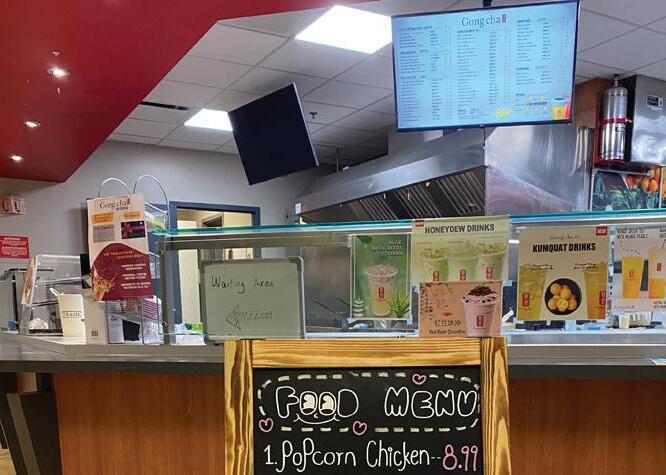
Gong-Cha in the Kinesiology Building on Campus is known for their bubble tea, but they also have a food menu. I had the opportunity to check out their food menu and actually try it.
Unlike my previous menu reviews of the Lazy Owl I actually ate this food, and this is about the food itself, not the menu presented.
When I went to Gong-Cha, the menu had six food items: popcorn chicken, dry ribs, chicken burrito, steak bourbon, french fries, and an egg waffle.
As for the preparation of the food, it’s frozen. If it wasn’t blatantly obvious by the taste, I watched the employees take food out of the freezer and put it into the fryer.
Starting with the popcorn chicken, the upside is that it was cooked. It wasn’t raw. It was, however, incredibly bland (which will become a theme with this menu). It was also advertised on posters

to be Taiwanese popcorn chicken, which it definitely wasn’t. The posters had the chicken with some sort of red coloring or sauce, and that wasn’t present on the chicken. For $8.99, it was edible. You can definitely eat it, but it would benefit from some kind of dip to make up for the blandness.
Next was the dry ribs for $9.99. I love dry ribs, one of my favorite foods, but oh my god –the amount of pepper on these dry ribs. It’s like taking pepper out of the shaker and just putting it in your mouth. But, some of the friends I was trying this menu with said that they couldn’t taste any pepper and it was incredibly bland, so it’s not evenly seasoned.
The chicken burrito was scary. It only costs $3.99 which was a red flag. Its size is indicative of the price, it’s small, but I had no idea what was in it. The filling was orange, so I assumed it would be less bland than some of the other things, and I was mistaken. It tasted like nothing. I have no idea what was in that burrito and honestly, I don’t think I want to.
The steak bourbon came in a different container than the rest of the food. It was in a little black tray, with cling film stuck to the top. I would bet money that it was
As fall is upon us, we are starting to spend more time inside, now spending more time away from the beautiful plants outside. However, even as the weather gets colder, it does not have to be like that. Let’s talk with a local plant shop, Rooted Living Designs, about some benefits of having plants inside the home and get to know plants a little bit better.
First off, I would like to introduce you to the owners of Rooted Living Designs. Tyler Polowy is co-owner of this business with Steven Derkson. As I chatted with Polowy, I got an insight into the store, got some education on plants, and good feelings about welcoming more plants into my home.
“Rooted Living Designs started about 4.5 years ago under the name YQR Plant Assistants,” said Polowy. “So, we started with succulent kits and yard maintenance, which then flourished into Rooted Landscaping and Design, then further name changes into Rooted Living Designs at our new location at 2100 Dewdney Ave. We sell house plants, house plant essentials, planters, home decor, candles, crystals, and essential oils.”
As for the draw of Rooted Living Design in particular, “We started our store to create an experience first and have the store next. So, as you walk in, the vibe is just immaculate; you don’t want to leave. The place is designed very well with your house plants
in one corner and your house plant essentials in the other. A lot of the draw-in is that we are great for gift-giving. [...] We plant for free when you come in, so if you find a plant and a planter, people know they can save time and get
store has the plants, they have plant holders, they have all the goods, and they will also have classes and workshops for you to partake in. What else could you ask for? The answer that comes to my mind is: nothing. This just
having big windows, south-facing windows in the store definitely puts you in a good mood.”
But not only do they help Polowy wake up and feel good in the morning, but he stated that plants do have scientific
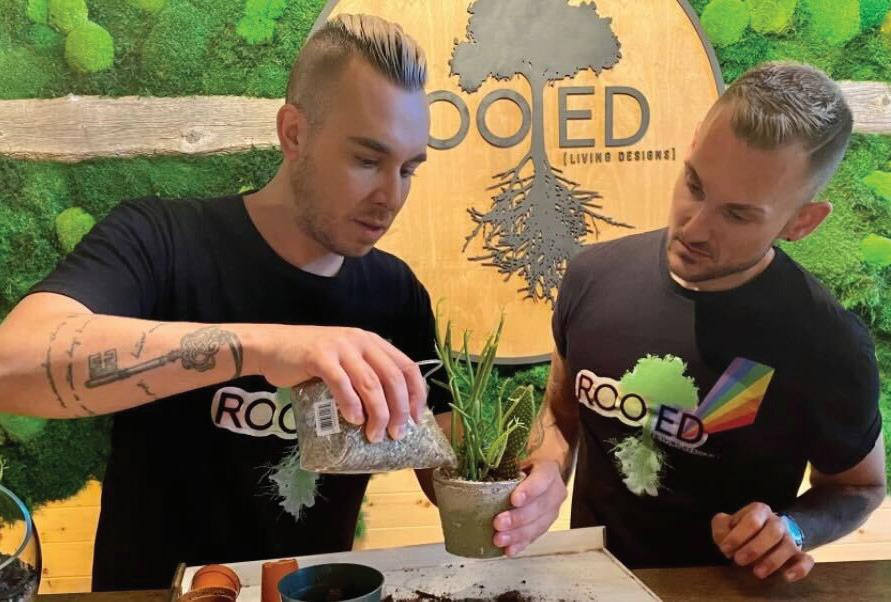
Starting to think it might be time to get another plant…
a one-stop shop. [...] Right now, we are working on expanding the back area to host workshops, Christmas parties, and work parties, and we are working on getting our liquor license and serving coffee and beverages.”
So, as Polowy stated, the
makes me want to spend some time in the store and with plants.
Now, let’s talk about plants a bit. According to Polowy, there are some nice benefits to having plants around all day.
“The oxygen in the room wakes me up immediately, [...]
a frozen microwave dinner. The steak itself wasn’t awful, it was cooked, it was edible. The green beans tasted like bad grass. For $5.99, it’s protein I guess. It’s not good protein, but it’s protein.
The french fries made me sad. They were so bland. They were undercooked. I watched them put the fries into the fryer, and yet they did not taste fried. The only redeeming quality to the fries was the Heinz ketchup it came with.
Finally, the egg waffle. Friends, it was raw. I bit into it, and it was raw. Just waffle batter. The common theme in this menu is a lack of seasoning, but these were bland too. Did I eat it? Yes. Did I feel bad about myself after?
Also yes.
All in all, the Gong-Cha menu is bland. But, it’s cheap. It’s cheap, it’s fast, it’s easy. We had six menu items ready for us in less than 10 minutes. It’s the epitome of girl dinner.
But, hey, at least the bubble tea is always good.
benefits as well. He stated, “I do believe that they passed multiple scientific reasons to have plants in your home. First, they are air purifying, which helps with allergies and sickness. Second, they improve focus and mood, which helps decrease anxiety.
[...] There are definitely a lot of scientific benefits to having plants in your home or in your dorm rooms.”
That is good to hear and to see that something so little can help us university students with our studies, makes it a fact to appreciate. Now, I personally am a little intrigued to get myself a plant to help me focus, but I live at home and have a dog. How can I know what plants are safe around pets?
Polowy stated that in their store, they have “pet-safe” stickers on certain plants to know what is safe and what is toxic to your little furry animals. This is great to hear and for sure a draw-in for others!
As we trudge towards colder weather, now’s the time to take a look at indoor plants. “The most popular are your bread-andbutter plants, they sell well. People come in and the want ZZs, snack plants, and money trees.”
Finally, Polowy wanted to add that he “would love to help people find the right plant for their house, dorm room for their school season, to add to their collection. [...] As well, follow our Instagram and Facebook @ Rootedld.”
Thank you so much Polowy for chatting with me, educating me, and giving me a true insight into loving plants!
pall agarwal s&h writer
2023 has been a brutal year for Canada for its wildfire and smoke impact on residents. Home to hundreds of species, the forest blanket has been priceless for generations. As the world starts to respond to climate change, it is important to note that for a
Additionally, 12 provinces and territories had been affected by wildfires.
According to IQAir.com and reported on by the Guardian, “Toronto and New York have been ranked as the most polluted urban areas affected by Canada’s wildfires.” People of all ages are affected health-wise due to this rising smoke caused by wildfires. But, according to Health Canada, seniors, pregnant individuals,
to have the greatest impact on the health and well-being of the communities,” said Redvers on the root cause of the health-impacts of the smoke from the wildfires. Lack of planning and strategic decisions are also responsible for the inability to curtail the spread of wildfires. “We have very little planning in place because of a lack of resources to be able to do that. […] We’ve seen fires that have occurred where there’s been
continent like North America, “temperatures will continue to rise, […] and in general it would be drier,” according to Emily Fischer, Climate Scientist, Colorado State University, in the Across the Sky Podcast. “Just that alone will facilitate more periods of time where large fires could occur,” said Fischer.
Wildfires are large, uncontrolled fires that happen in forests, grasslands, or other natural areas. Anything can trigger a wildfire – from a lightning strike to human activities, they are very sensitive. They spread very quickly and are destructive in nature. Being out of control, they emit smoke which can be harmful to breathing. As per the Government of Canada website, the country has experienced an “unprecedented” number of wildfires this year. As of June 19, 2023, 2,619 fires had been reported nationally with an estimated 5.3 million hectares burned, 15 times larger than the ten-year average for the time.
people who smoke, infants and young children, people who work outdoors or are involved with strenuous outdoor exercise, and those with pre-existing illness or chronic health conditions such as cancer, diabetes, and lung or heart conditions face higher risk of health problems following exposure to wildfire smoke.
The northern part of the nation has been facing difficulties recovering from these wildfires. The air quality index in Fort Smith, North West Territories was observed as 10+, a number that “skyrocketed past the top of the reference ranges,” according to Dr. Nicole Redvers, Associate Professor for the Schulich School of Medicine and Dentistry at The University of Western Ontario, an expert on the impact of forest fires on Indigenous communities in the Decibel podcast by the Globe and Mail.
“It’s not necessarily about the visibility of the smoke, it’s the amount of particulates that are in the air because that tends
with smoke-related events,” said Redvers.
The Government of Canada continues attempts to grow its resource accessibility to all communities in the nation.
Mentioned as the worst-ever season in 2023, Canada’s Prime Minister Justin Trudeau said, “There are hundreds of armed forces members now deployed. Additionally, the Canadian Armed Forces are helping with everything from delivering
call 911 in the case of a health emergency. It has also been mentioned that during wildfire smoke events, it is advised to drink lots of water, avoid outdoor exercises that cause shortness of breath, avoid going outside in the sun, take cool showers, and spray oneself with water bottle or wear an article of damp clothing to cool the body. Masking outdoors is also an effective way to protect oneself from the smoke.
Addressing these challenges
“ Clearly there’s a heavy burden on Indigenous communities dealing with smoke related events.”
Nicole Redvers
a delay in fire capacity being able to be mobilized to the community because the firefighters were busy on other fires.” Reconciliation is not just a goal but an ongoing journey to build bridges and stay united, impacting all areas of decision-making including steps and policies involving wildfire control and its impacts.
Climate change has not only resulted in wildfires but also floods, melting of permafrost, and extreme heat that has caused a global health impact on people. There have been various strategies that people have come up with in order to protect oneself from its impact due the direct threat of engulfment by the fire, rather than exposure to smoke.
“Based on the data from about 1980 to 2021 is that 2 per cent of smoke-related evacuations are for non-Indigenous communities which means 98 per cent of the smoke related evacuations are First Nations communities, so clearly there’s a heavy burden on Indigenous communities dealing
food and supplies to people in Mingaine, Quebec to providing logistics support for water bombers at CFB Greenwood.” There is still room for improvement in planning to handle this uprising of wildfires. Communities across the nation face disruption during work travels and due to lack of visibility, are victim to accidents on roads.
Health Canada advises that milder but more common symptoms of smoke exposure and inhalation include headaches, mild coughing, runny noses, production of phlegm, and irritation of the eyes, nose, and throat. However, more serious symptoms can include dizziness, chest pains, severe coughing, shortness of breath, wheezing and asthma attacks, as well as heart palpitations. In some cases, such symptoms can devolve into heart attacks, strokes, and even premature death.
Health care providers should be immediately consulted in the case of severe symptoms, or
often involves policy changes and overall community collaboration between federal and provincial governments. Public cooperation and engagement are also essential in the decision-making of these policies which can be done through voicing opinions, being more aware of the policies designed, and following guidelines laid out by specialists and health care providers. Acknowledging these challenges is the first step in the journey to striving for an environmentally sustainable Canada. The diverse workforce and mix of cultures could come together and pave the way to a healthier and safer country to live in. With these challenges, Canada possesses immense potential as well as room for growth and improvement. As a potential beacon of hope falls upon the land, Canada would be in the limelight amidst other nations.
pall agarwal s&h writer
A symbol of pride and source of inspiration for the community, the Cougars women’s hockey team at the University of Regina are known for their storied history and commitment to excellence.
“Our athletes are working hard, and we are in a good spot,” said Sarah Hodges, women’s hockey Head Coach.
Having started out well in their pre-season games, Cougars won with 2-1 against the University of Saskatchewan’s team, and then lost to them with 1-3 in the following game. Continuing to work hard, they couldn’t quite make it past the University of Manitoba with a final score of 1-3 for Manitoba. The team has set the tone for the game; “Those games were good opportunities to see where new players are at.”
With new players starting off in the team, those games were important to understand the style of play. Hodges mentioned that with hockey being slightly physical, it was essential to work on those aspects through the gameplay with different teams.
“It was a really physical game that
was difficult, but it was a good learning experience for the team because our Canada West games are typically physical like that, and we need to get used to them.”
the stage for success with their strategy and teamplay. “All of our players are recruited. Last year we struggled to win and we had a very young team and really
“We’ve really tried to increase the level of competition that we have brought on a daily basis just cause it’s not something you can switch on and off. […] They

I cannot fathom the courage needed to have one of these shot right at your face, helmets notwithstanding.
Hodges emphasized the style of play and getting comfortable with the physicality of the game as keys to achieving success. With three new players and 21 returning, Cougars’ hockey seemed to get started on setting
good, positive team environment. The athletes enjoyed that,” said Hodges. As the fall semester kicks off, the Cougars look forward to getting through the difficulties and minor losses paving the way to win with the returning team.
battle against each other. We also have fun, […] they play because they love it,” said Hodges. As they try to find the enjoyment side, competing at such levels could be stressful. With this commitment to hard
Get your blood pumping while plowing through papers
Beginning on November 28, 2020, videos began to be uploaded for URFit On Demand, an online option available to University of Regina (U of R) students for a variety of at-their-leisure fitness courses. Accessing these videos for registered students is as simple as heading to mediaspace. uregina.ca/, logging in with your regular U of R website login info, and searching “URFit” once
logged in.
At present there are nearly
150 total hours worth of instruction available split between 199 videos, with the most recent upload being from September 23, 2021. I counted no less than 20 different styles of fitness and workout walkthroughs including options like shift (HIIT), tabata, gentle stretching, P90X, zumba, pound, pilates, foam roll, and a
variety of bootcamp options to top it all off.
There’s also an incredible amount of yoga styles to explore: hatha, yin, ashtanga, fit fusion flow, multi-level, chair, and then a few just labeled “yoga” so I suppose you’ll have to follow through with those videos to learn which styles are used. I’d never tried chair yoga and admittedly didn’t know much about it before

work, adaptability, and the love for the game, the Cougars women’s hockey team seems to be positioned to make waves in the upcoming league next week. “Things are going to change next week when we do get into the regular season because it just gets harder.”
The gameplay changes as the league gets rolling. As some players play more while others play less, making their position and proving themselves in these pre-season games is essential. Hodges helps to keep up the morale of the team by recalling to them why they started playing and how much they love it. It was discussed how managing schoolwork on top of playing the sport can be such a grind, yet the girls are doing a great job, and the university is there to provide the support they need. “Push through the hard days because the reward’s really great at the end of it.”
The team under the coaching of Sarah Hodges is geared towards passion and love for the sport. As they leave an unforgettable mark on the world of ice hockey, the Cougars women’s hockey team reminds us of the journey worth undertaking in the pursuit of excellence.
preparing for this article, so I decided to give the video “Chair Yoga 4 Jessica” from December 20, 2020 a try.
To start the video review, I do have several compliments for Jessica Lewgood, the instructor for the video. They consistently throughout the 24-minute video remind viewers to be mindful of their posture to be sure they’re getting the most out of the poses and stretches they’re led through, and also offers modifications to positions that may otherwise put painful stress on people’s bodies if they have shoulder or wrist injuries. While I didn’t wind up having to use those modifications, I did greatly appreciate them being suggested.
One thing that I believe could have improved this video walkthrough would have been a list of supplies you’ll need before the video got underway. While it’s pretty obvious from the name that a chair is necessary, Lewgood also included the use of a strap to amplify impacts of arm and leg stretches. I didn’t have one handy and so had to pause the video, scramble through my room to find the waist tie from a housecoat, and then re-start the video so as to not disrupt the position flow or my headspace. Another helpful note would have been mentioning that a chair without arms is ideally what you’ll want to use; I found that some of the positions were a bit hard to pull off while sitting in my high-armed desk chair.
Overall I found that
Lewgood was great at explaining how to move your body to achieve each position, though used terms like “the ring of your ribcage” which meant, as someone not that familiar with yoga terminology, that I had to sit and think for a second (removing myself from the nice relaxed headspace I was in) before I could realize what they meant. Going over terminology like this prior to the start of the video would ensure more firsttimers like myself would be able to slip into the flow of things without interruption.
At the video’s end Lewgood leads viewers through a short relaxation meditation, focusing viewers on congratulating themselves for having taken the time to show their body and mind care – quite wholesome.
Overall I can say I’ll likely be running through this routine again in the near future – as a student I’m in a chair frequently anyhow, may as well get some motion in – and I’ll definitely be exploring the rest of what URFit On Demand has to offer.
nazeemah noorally staff writer
The University of Regina (U of R), like many institutions across Canada, attracts a good number of international students every year. As the international student population at the U of R swells, it appears to seemingly offset the dip in domestic enrollments. This increase in international students certainly adds to the diversity of the campus, but beneath the surface lies a pressing issue: the hidden yet significant costs of international education, particularly the housing problem.
This Fall 2023 semester at the Univer-
pushes students to seek off-campus housing, putting them headlong into a competitive rental market they might not be prepared for.
Local housing and rental markets are feeling the strain. There are many students who are finding it difficult to secure accommodations that are both close to the campus and within the budget. It has led to a situation where students agree to compromise on their living conditions to save a few bucks, and the housing problem has broader implications.
Over a month ago, during an interview with CTV News, the current housing, infrastructure, and communities minister Sean Fraser said that the rapidly increas-

sity of Regina has seen a record-breaking enrollment surge, totaling 16,860 domestic and international students. This impressively adds to the campus’ existing diversity, where international students make up 17.7 per cent of the total student body and 14.7 per cent declare as Indigenous. Yet, with this growth comes a set of challenges that the university and the city need to address.
The most pressing of these nowadays seems to be the housing accommodation. It’s obvious that as more international students flock to the university, demand for affordable and accessible housing has increased as well. While universities offer on-campus housing, the limited number of spaces often falls short of demand. This
sider.” This makes it clear that the housing problem is not just a localized issue but has garnered national attention.
A cap on international enrolment might seem like an immediate solution to the housing crisis, but it will potentially have long-term repercussions. International students bring more than just tuition fees to Canadian universities. They cultivate and endorse diverse perspectives, cultures, and experiences that enrich the campus life and academic environment. Beyond university, they fill critical jobs, contribute to innovation, and often establish businesses that create more jobs.
A cap on this number can impact Canada’s future talent pool. Coming back to the University of Regina, one of
“
ing number of international students does need to be examined as part of the bigger housing crisis picture. He adds on by saying that he thinks housing has instead become a national crisis for some, including students who live more than an hour away from where they study.
In the minister’s own words, “The International Student Program makes extraordinary economic and social contributions to Canada. It contributes to tens of billions of dollars to our GDP annually.”
But when asked whether the federal government was willing to put a cap on international students to address the current housing crunch, the minister let out that “it was one of the options we ought to con-
It’s crystal clear that this is not just about housing and is instead also about the ethics of enrolment. Institutions must make sure that they equip international students with practical resources as they join the academic community. Community and student awareness as well as ethical rental practices should be taken into account. Policy interventions, based on thorough cost-benefit analyses, can help provide structural solutions. One example could be introducing rental caps in student-dense areas or offering tax incentives to landlords providing affordable housing can make a tangible difference. I believe that there is not really a one-size-fits-all approach but such measures can help create a supportive and inclusive housing environment espe-
A cap on international enrolment might seem like an immediate solution to the housing crisis, but it will potentially have long-term repercussions.”
Nazeemah Noorally
its prominent on-campus housing spots is the Kīšik Towers. Built to accommodate domestic and international students, it has become increasingly sought after, and with the surge in international enrolments, the Kīšik Towers feel the pressure with waitlists growing longer each semester. This causes many students to venture into Regina’s rental market, often with limited knowledge about the intricacies of renting in Canada. International students may find themselves at a disadvantage in instances where landlords charge above-market rates or impose unfair conditions in rental agreements, especially if the former are unaware of their tenants’ rights. There may be students who do not know of the housing standards and may become hesitant to voice out for fear of eviction.
cially for international students. To conclude, the international student surge is not just a U of R phenomenon; it’s a trend seen across Canadian universities. The housing challenges offer valuable insights into the complexities of managing international enrolments while ensuring students have a holistic experience. The need for proactive planning, collaboration, and the commitment to ensuring that every student, domestic or international, has access to safe and affordable housing should be addressed. As the University of Regina continues its journey as a global educational hub, its response as well as the response of other institutions to this challenge will for sure be keenly watched and awaited!
nazeemah noorally staff writer
The sun shines a little brighter on campus this year. The echoes of laughter, the hum of conversations, and the sight of students bustling somehow create a sense of ‘new normality’ that seemed distant just a year ago. For many, the return to campus signifies more than just physical presence. It’s a return to the vibrant campus life that we once took for granted: the impromptu coffee chats, the heated classroom debates, the joy of spontaneous plans, and the simple pleasure of a face-to-face lecture with that one favorite lecturer. Yet, as we look forward to an optimistic future, yesterday’s lessons from the pandemic remain vivid.
Students who have been navigating remote learning are now actively participating in on-campus activities. A good education is more than just formal classroom training. It necessitates exploration, growth, and interaction with others that goes into living and learning
in and as part of the community. We can finally say that beyond the confines of virtual screens, students can fully participate in campus life at U of R.
One such instance was Orientation Day and Welcome Week held a few weeks ago. The atmosphere was that of excitement and anticipation. During the welcome week, students participated in different activities aimed to familiarize themselves with the campus and its offerings. The Riddell Centre hosted “Find your classes” sessions to help newcomers navigate the campus. The University of Regina Student Union hosted a delightful “Breakfast Owl” and for those seeking a challenge, an Escape Room event was set up at the Kīšik Towers.
While the University of Regina Alumni Association facilitated “Coffee and Connections,” both in-person and virtually, the club fair on the Academic Greens was another event that was a success. Rows of tents and tables were set up, each representing a different student club. The Carillon was also on the scene. With a prominent table set up, The Carillon
was actively engaging with students. It was a day of connection with students being familiar with the publications and even penning down their names as potential contributors.
Yet, amidst this resurgence of campus life, it’s crucial not to overlook the shadows the pandemic has left behind on our society, especially for students. Though the transition from remote learning back to in-person has largely been positive, it has also brought to light the significant mental health challenges that many students face. According to Mental Health Statistics Canada, prior to the pandemic, 74 per cent of Canadians rated their mental health as good or excellent. However, this figure dropped to 59 per cent in 2021 and those who felt stressed constantly saw a more than threefold increase, skyrocketing from 4 per cent pre-pandemic to 13 per cent post-pandemic.
The isolation and abrupt changes have left a mark that can’t be overlooked. The once familiar campus grounds might now seem overwhelming to some and the joy of interacting with others might be tinged

with anxiety for introverts or those still wary of infection. The disparity in access to resources during remote learning also highlights the struggle of some students who had to manage with inadequate technological resources, unstable internet connections, or even unsuitable learning environments at home. In this way, campus counselling, peer support groups, and mental health awareness are as important as ever.
As we move forward, it’s important to remember that while the physical threat of the virus might not be as staggering as it was at its height, the lessons that it has left behind should not be left in oblivion. The resilience and adaptability displayed by students, faculty, and staff have been nothing short of inspiring. Amidst all these, let’s remember to extend a hand, a listening ear, or a simple word of encouragement to those still finding their path in this new chapter. The post-pandemic world calls for a renewed sense of community, understanding, and empathy among the student community. Together we can go far, U of R!
“ A good education is more than just formal classroom training.”
Nazeemah Noorally