

IN ACTION FAITHFUL AND IN HONOR CLEAR
Midge McPhee Bowman '51

IN ACTION FAITHFULAND IN HONOR CLEAR
A Reminiscence
Midge McPhee Bowman '51

Helen Taylor Bush
Introduction
I did not intend to write this book! I was already well along in my own memoir when Tiffany Kirk, Bush Manager of Alumni and Donor Relations, invited me to join a group interviewing former faculty and alumni as part of the upcoming 2024 Centenary. I enjoyed being part of this effort and am grateful to all those who interviewed with me: Les and Nancy Larsen, Marilyn Warber Gibbs, Joan Marsh, Dee Dickinson '45, Peter Eising, Peggy Skinner and Michelle Purnell-Hepburn '75. The conversations were so valuable that I decided to include them with the "Bush years" material from my memoir in order to create a new volume which this Introduction begins. I want especially to thank Cali Vance, Bush Archivist and Centennial Coordinator, for her special support throughout the writing of this book and Carolyn Kato Bowman '79 for her expertise with all the photography. I am also grateful to Susan T. Egnor, Fifty Years-The Bush School, and Anne M. Will '68, The Bush School: The First 75 Years, for their excellent work.
My Bush story, which began at age twelve and continued as an alumna, faculty member, division head, parent of two Bush alums and ultimately Interim Head of School, is suddenly no longer solely about me and my experience. It has become a story of our growth as a community. In those early days of coeducation with John Grant and Les Larsen, our small school-while building on Helen Bush's legacy-was actually creating an enlarged and expanded vision: a new name and a new identity in the midst of challenging social issues and ground-breaking ideas in education, psychology and the arts. From my current perspective at ninety, I value even more the breadth of that curriculum and our impact on the broader community where we were brave enough to envision our small school in a larger context.
For that reason I have included documents-lectures, syllabi, meeting minutes, curriculum outlines and even some parts of the 1992-93 PNAIS evaluation-because I believe they represent groundbreaking ideas that should be preserved for historians of a future time. Although these materials may occasionally inhibit the flow of the narrative, I want to ensure that they are not lost.
The years from age five to eighteen (six of which I spent at Bush) are among the richest, most formative of our whole lives. The men and women who commit themselves to educating this age group deserve our highest gratitude and respect. Having been- at different times, at different schools-directly involved with this age range, I know that a quality education in these years positively affects the whole range of one's cognitive and emotional development.
This was certainly true in my own student experience. I remember as a sophomore sitting in Miss Haight's "Western Civ" class when she introduced Plato and Aristotle. She began with Plato's Allegory of the Cave that depicts a group of prisoners chained in a cave, unable to tum their heads away from shadow pictures thrown on the wall by the light from a large fire at the rear. What they couldn't know was that, all the time, the sun was shining outside in the real world, where it was possible to learn about truth and our responsibilities as citizens. Miss Haight did give Aristotle equal time, but Plato's vision never left me.
Today, in our current situation as a society, students are exposed to a new kind of cave wall-a screen where TV, movies, phones, and computers offer pictures, stories and information but where agreement on what constitutes consensus reality and truth is increasingly challenged. For me that means what a Bush education offers has never been more important.
A strong school never stays the same although it remains faithful to the vision of its Founder. I feel this is especially true as we celebrate our first Centenary. Percy Abram has lead Bush into its second hundred years with courage and vision that Helen Taylor Bush would applaud as do I.
In 1981, as Associate Head, I made a report on Experiential Education to the Board of Trustees since there was some question of the direction the curriculum was evolving. The closing paragraph I shared then seems equally relevant, if not more so, today:
"In the future, the educational institutions that will survive are those who have put down roots very deeply; who remain dedicated to handing down the wisdom of the past while anticipating the challenges of the future; who are not afraid to attempt the difficult task of educating the whole person; who see education as a moral responsibility in which the best of ourselves is nurtured for the sake of others. I feel strongly that Bush is such an institution and I am grateful to be a part of it."
Midge Bowman
Seattle, Washington, May 2024
Student Years 1945 - 1951
In 1945, my grandmother offered to send me to the Helen Bush School. I arrived at the front door in late August, a skinny little 12-year-old with thick glasses and a love of reading. The wooden buildings looked a little like barracks (it had been Lakeside School initially) and there was a sign with the School's name stuck rather haphazardly in the grass by the sidewalk. I remember being ushered into a small classroom (very small compared to my public school) and taking some kind of test.They told us the same day that I would be admitted and to order my school uniform: a rough dark blue tweed A-line skirt and blazer jacket with white Peter Pan blouse, from Frederick and Nelson's department store. Thus began my relationship with the Bush School. Little did I realize that it would continue throughout much of my life.
Bush was smaller and less imposing than my big brick public school with its smell of wax, construction paper and glue. It was built on a strange triangular piece of land where two streets, Harrison and Republican, almost intersected near the eastern end of the property. The School was built around a courtyard in the same triangular shape. The front entrance with the main office, classrooms and library, was dominated by a gymnasium directly behind-a reminder that this had been a boys' school. There was a "chem shack" at the western end of the courtyard and graduation was held in the center.
Parkside, the small coed elementary division, existed even then, but the main focus was "The Helen Bush School, a boarding-day school for girls in grades 7-12." Both Bush and Lakeside had boarding departments in those days.
There were three residential halls: Gracemont, initially for 7th-through! 0th-grade boarders, Taylor Hall for the older girls, and Dorothy Allen Hall with short-term lodging for elementary age children. Think of the luxury for parents to be able to board their children while they were away on trips! We had boarders from exotic places like Alaska and Montana, plus some local girls. Each day we joined with boarders in a family-style lunch at round tables in Dorothy Allen Hall. I remember our cook, Elsa Johnson, who provided a veritable feast at Thanksgiving and a festive spread of Scandinavian sweets at Christmas. We had assigned seating and sang "Noontime is here, the board is spread. Thanks be to God who gives us bread."
Mr. and Mrs. Bush ran the School, he as business manager and she as the academic head. Mrs. Bush had a low, throaty voice, quite beautiful really. She seemed uninterested in what she wore. All I remember were perennial dark blue dresses much like the one she wears in the picture by Walter Isaacs on the previous page. Mr. Bush's office at the end of the front hall, smelled of cigar smoke, spicing the otherwise female atmosphere of the place.
World War II officially ended with the Japanese surrender on September 2, 1945, the same month I entered Bush. I remember our class had a field trip that autumn to view a Red Cross train fitted out as an emergency facility at the King Street Station so there were still reminders of war.
My first year courses in grade seven were English, Latin, math, history, cooking, art, music and PE. I don't remember having any science until high school. I loved the academic work, did poorly in gym, couldn't figure out why we made white sauce in cooking and took private piano lessons with Dorothea Hopper Jackson during the school day.
At my young age, I didn't realize Helen Taylor Bush was an educational pioneer, a student of John Dewey and experiential education. She believed in global travel, math and science for women, and the importance of the arts. She also believed that students should be apprentices and work with actual artists, writers, dancers, scientists, linguists, poets, actors, athletes. This was before the advent of Science Education or Art Education where education majors in college supposedly learned how to "teach" subjects about which they had little real life experience. At Bush we worked with practicing professionals and absorbed, at least in small ways, their passion for their discipline. During my high school years, I studied with painters, Emily Morse and Windsor Utley, musician and composer, Karla Kantner, dancer, Eleanor King ( a student of Martha Graham, later winning a Fulbright to study dance in Japan), and drama with alumna, Dee Dickinson '45.
A sensitivity to beauty permeated the School. Mrs. Curtis, the head gardener (and mother of my classmate, Sarah) rented part of her home to the famous sculptor, Archipenko, and kept the School building full of beautiful flower arrangements. She once brought a small blossoming pear tree and set it up in the gym to grace our spring Fine Arts program. (It had been cut down as part of a landscaping project.)
School traditions had, for me, the quality of communal rituals. We opened each school year with Convocation at Epiphany Church in Denny Blaine and ended there with Baccalaureate. It was a
beautiful, tiny English Tudor-style church and my first contact with this religion. I loved Elmer Christy, the rector, and it is somehow congruent that I ended up being baptized as an adult at Epiphany and becoming closely involved with the Episcopal Church.
The school's three Ideals: Truth, Beauty, and Purpose, were always kept before us. During my six years as a student, I won office several times. Every time we were inducted, we had to give a short speech on one of the three Ideals. Bartlett's Familiar Quotations indeed became "familiar" to me. I believe the sculpture created by Liz Gall'38 to symbolize the Ideals still stands in the courtyard.
My first Bush Christmas program made an indelible impression. The gym had been transformed into a glorious medieval manor with cellophane "stained glass" windows and the smell of evergreen boughs and garlands everywhere. The whole School participated. As a seventh grader, my part was in a dance choreographed by Miss King. The beauty of the pageantry was impressive to my small person, but even more important was the awe of seeing all of us: faculty, students and parents sharing this experience. It gave me a new sense of family and of how intertwined our lives had become. I did not know then that, ultimately, I would be connected with all the first four Heads ofBush.
In 1948, my ninth grade year, Commencement was held in the gym and we realized the seriousness of Mrs. Bush's health as she was carried onto the stage. Ana Kinkaid, a Bush parent volunteer at the time, wrote the following reminiscence, later reprinted in the 2007 Bush Experience magazine:
THE LAST SPEECH: HELEN BUSH
It was a cold and rainy that day in June of 1948. Helen Bush for the first time was not going to be supervising the graduation ceremonies. A diagnosis of advanced cancer had forced her retirement the year before from the school that she had founded in 1924. Yet with great effort, she returned to give one last address to the students, parents, and faculty.
Many of her friends and colleagues thought she might be too ill to attend the ceremony, much less have the strength to give the keynote speech. Yet there she was. Too weak to walk in the graduation procession, she had to be carried into the gym and rested on a chaise lounge that was placed on the side of the stage. There she lay and waited for the students and staff to enter.
But if any in the audience were concerned about her strength, they need not have worried, for this was a remarkable woman. In 1902, when few women even attended college, she graduated from the University of Illinois, Urbana with Phi Beta Kappa honors. She studied mathematics, history, science, rhetoric, French and literature, and played on the University's basketball team. Upon graduation, she taught mathematics, traveled in Europe, married and started a family.
Like progressive educator John Dewey, Helen Bush maintained a deep and unending belief in the ability of children to learn and grow. When her husband John Bush lost his hearing, she decided to put her beliefs to the test and opened a school- a school dedicated to the joy of learning.
Twenty-four years later, the school had more students and teachers and was benefiting from new buildings and better books than when it opened. Many wondered what this woman would say at the graduation ceremony. Because, after so many years of success, wasn't this, well, the end?
Mrs. Bush waited as others spoke, then gathered her strength and went slowly to the podium. At first her voice was shaky. But as she continued, her strength returned. She spoke without notes of what had motivated her through the years-an unfailing belief in the great ability of children.
Mary "Sis" Pease remembered, "She believed we could do anything. She opened a world of possibilities, a world without limits to us. Sometimes we failed, but we were always empowered to try. That meant everything to us."
As Mrs. Bush continued to speak, many people there realized they were not listening to a farewell speech but an impassioned plea to believe in education as a beginning, a starting point from which to discover the wonder of life. Students who were present that day recall, "It just poured out of her. I remember being inspired. I can still hear her voice."
Today The Bush School continues to fulfill that legacy and stands up, as Mrs. Bush did, for what teaching and learning can truly be. Bush offers each of us an opportunity to continue voicing our support for teachers, staff and students to find excitement in learning and meaning in life. Mrs. Bush would have been the first to say, "Well done!"
BUSH PUPILS MODEL AT STYLE SHOW

Left to right-SALLY LANSER, l\lIDGE l\IcPIIEE, BETTY RUBLE AND DIANA YATES To D>car spring clothes at review
When the pupils of the seventhlPerry B. Johanson. The show willjq.1eline Lillard, Ann Rolfe Ann and eighth grades of the Helen be sponso_red by Fr~derick & Nel- Joh_nston, Elizabeth Haynes, Nancy Bush School present a style show son. Pupil models \';·ill be Iann Mc-:Wnght of Yakima, Roberta Frink, Wednesday afternoon at Grace- Gowan, Lucia Parker, Leshe Louise !June S~ef~lman and Molly McCush jPO\\ell Gary Reed, Sally Jo and of Bellmgham. There will be two mont, 408 Blame Blvd., the models Sandra De Long, Elizabeth JVlullan, performances one at 2 o'clock and \Vill include Mrs. John K. Bush, Bo_b. and Bilf England, Alita Davis. the other at 2:45 o'clock for pupils. principal of the school, and Mes- VV)lliam Meister, John 1IacKenzie, Tea will be served after each perdames F. C. Rippe Carl Bricken Betty Lou Sargent, Barbara Joseph, formance by Mrs. Simeon T. Can, • Dorothy Watson, Susan West, tnl, Mrs. D. S. McPhee, Mrs. J. L. Walter Isaacson, F. A, Tucker and Nancy Mott, Carole Badgley, Jae• Johnson and Mrs. John Lecocq.
I have only two newspaper clippings from my earliest years at Bush while Mrs. Bush was still alive and these were occasional "society page" photos in both the Seattle Times and the Seattle Post Intelligencer. I suppose these notices were good free publicity. The annual fashion show and tea, sponsored by the Mother's Club, opened with adult models, including Mrs Bush! I remember going down to Frederick & Nelson's department store to be fitted but don't remember what I wore. With 30 Bush student models and six adults, it was a big event! It took place in the Gracemont basement ''ballroom." (1947)

Collaborating on their music lessons at Helen Bush School are -!-he Misses Phillis Ballard (left) and Midge McPhee, two of the many students looking forward to the special concert for Seattle school children by Claudio Arrau, Chilean ianist, at IO o'clock, March 25,
Here we are at the piano in the living room of Dorothy Allen Hall where I took piano lessons from Dorothy Hopper Jackson during the school day. Several music teachers gave private music lessons in this way. It was a great help for families who lived a distance from the school.
Marjorie Chandler Livengood at Gracemont
"Mrs. L" as she was called, became Headmistress in 1949, the School's 25th anniversary. No one could have been more different from Mrs. Bush than Mrs. Livengood though she was always viewed as the heir apparent and the change in leadership was accepted without comment What was not obvious at first was that, long before Women's Lib, Marjorie Chandler Livengood had a new vision for women and that was perhaps her greatest gift to the School.
Although she had been teaching at Bush for several years, Marjorie experienced a larger, different world while serving in the Red Cross during the WWII. I remember she returned wearing her uniform which impressed us all. Her first actions were to strengthen science offerings and to provide a stronger college counseling program. She was a very able administrator, though rather distant emotionally, more respected by the faculty than liked. She also modeled a new type of professional woman: mil thin and erect, a1most military in bearing, beautiful clothes (while we were stuck in our scratchy uniforms) and a kind of humor that made us feel "in on the joke." At one assembly, she used her wartime experience of how "a thin dime held in the right place" would ensure the best posture!
The 1949 April Rambler included an article by Marjorie about Mrs. Bush's death and one Mrs. Bush had written for the Rambler the previous year. In reading the two articles on the following pages, it becomes easier to appreciate the essence and style of both women.
1924-49 Our Twenty-Fifth Anniversary

VOL. VI
For the strength of her character, the wisdom of her mind and the l ove of her spirit, hundreds of Bush graduates consi der Mrs. Bush the most inspirational of women. In the success of their lives lies her greatest tribute· by their achievements she is fulfilled. (Tykoe, 1948) '
MESSAGE FROM MRS. LIVENGOOD
We lost some of the joy of this momentous year with the sudden death last fall of our director and dear friend, Helen Taylor Bush. It places upon us old-timers, grads, and faculty who knew her, the responsibility and privilege of interpreting her vision, The Helen BushParkside School, to the public. I say her vision, instead of tnstltutlon or enterprise, because that Is what It was. I become more oonvtnced of this as I see schools all over the country emulating the educational practices and philosophies so basic in her thinking.

Since the words of the Master, "By their fruits ye shall know them," have become society's most reliable evaluative criteria, so I say that because of you, our graduates, do we deserve and keep our place on the educational hori2.on. While we talk and correspond with you too rarely, stW we are delighted by re· ports of your progeny and/or your contributions to your community. The few of you who have returned as faculty members have been invaluable. Occasionally someone has asked, "How do you cope


with these novices, so inexperienced in teach_ing methods?" The answer is, "Easily, as they are so well trained In the Bush tradition, its integrity and ap· preclatlon of the value of each Individual."
Since we feel that you are so much a part of us, why don't you come and visit us rmre often? We would wel come your reactions and suggestions. While our building program continues, thereby changing the physical environment the original plan of a quality schooi for three-year-olds to graduating seniors remains, with the enrollment reaching its capacity of three hundred students. our graduates oontinue to be desired members of college communities, and so we see no need for any basic changes here at Bush. Bus, just as our country Is in an important period of clearer definition of, as well as greater dedication to the prin• ciples of democracy, so do we ::Onstantly examlne and evaluate In order to keep our day-by-day achievements In perfect acoord with fundamental objectives. This was the wish of Mrs. Bush; not a bigger but a c-.ontinually better school. To this end must we all consecrate ourselves
FROM THE RAMBLER, JUNE 8, 1948 1Rtminiaring
llu lira. Jius~
Looking back over the twenty-four years of the Helen Bush School brings mostly smiles to my mind. The first class, which I was asked by my neighbors to talce on, was adorable. All the group were great readers. They loved their trlpg, about which they wrote stortes and drew pictures; they sang and danced on the lawn; they constructed much of their own equipment
Nature was all about us and we re· veled In It, but my own family did not share our love of nature in all its phases
When Mr. Bush came in the kitchen @r one dark night and crunched under foot many small crabs, escaped from the sink, he lttered sounds that .!!!!Y not have been bad but they were loud. At my request those first years Mr. Dudley Bur· chard kept us stocked In snakes All was well untU one on the loose one evening draped itself artistically over the back of Eleanor Bush's chair as she was entertaining one of the neiglmrhood boys Finally his fascinated gaze made her look around, whereupon her shrieks could be heard farther than her father's.
We were very casual in those days (Continued ori Page 2)
Memorial Scholarship
Dear Alumnae:
I am writing to you about a mem· orlal for Mrs Bush Last fall when she passed away, it came as such a terrible surprise to me. Way back here in Connecticut, I hadn't even known she'd been ill. Most of you were undoubtedl y struck in the same way and wanted very much to somehow r~pay your debt of affection and wisdom and sweetness I had never realized bow much I owed Mrs. Bush until there was no longer a way to show her I remembered.
Some people have plaques erected In _ho nor of their goodness and generosity. I don't think this would do at all (Continued on Page 7)
PUii.is.HiD IY TIH STUDIMTS Of THI H(UM IUSH S,C1HOOt., su.nu l, WAS~
Reminiscing by Mrs. Bush from The Rambler June 8, 1948
Looking back over the twenty-four years of the Helen Bush School brings mostly smiles to my mind. The first class, which I was asked by my neighbors to take on, was adorable. All the group were great readers. They loved their trips, about which they wrote stories and drew pictures; they sang and danced on the lawn; they constructed much of their own equipment. Nature was all about us and we reveled in it, but my own family did not share our love of nature in all its phases. When Mr. Bush came in the kitchen door one dark night and crunched under foot many small crabs, escaped from the sink, he uttered sounds that may not have been bad but they were loud. At my request those first years Mr. Dudley Burchard kept us stocked in snakes. All was well until one on the loose one evening draped itself artistically over the back of Eleanor Bush's chair as she was entertaining one of the neighborhood boys. Finally his fascinated gaze made her look around, whereupon her shrieks could be heard farther than her father's.
We were very casual in those days-we never asked anyone to come to school, we just received those who appeared. During the summer we went up to the University Biology Station, or some other interesting spot. We usually arrived home the day before school was to start, then opened the doors the next morning to see who would enter.
We began school in the big playroom of our home. The second year we put a floor over the cement in the garage and arranged for the kindergarten there. We expanded onto the enclosed front porch and finally took over several rooms upstairs. We were very grateful when Lakeside moved out into the country and let us have its plant in town.
It was wonderful when Mrs. Ostrander offered us her home for a residence, Rosemary Hall we called it. It was a thrill when we bought the Wurdemannn house for the same purpose. We named it Taylor Hall. And, of course, it was a delight to acquire Gracemont.
The Building Committee is now concentrating on the main school building. The new primary classrooms and Reed Memorial Gymnasium, just completed are about perfect, and make us feel very happy. We shall feel quite complete when we have our new upper school class rooms and library, our new dining hall and reception rooms, and our new auditorium.
However much we appreciate our new buildings, it is not these material things to which we look back with greatest pleasure. It is the personal contacts.
How can we ever forget the girls and boys we watched develop, those who achieved highly because they put not only brains but also steady perseverance into their work. It was a thrill to watch latent artistic talents become a beautiful reality. And what a pleasure to see the contented faces of those who learned to work with and lead their group! We have taken a little time off to reminisce but it must be short as there is much to be done to carry out our future plans.
Message from Mrs. Livengood from The Rambler June 8, 1948
We lost some of the joy of this momentous year with the sudden death last fall of our director and dear friend, Helen Taylor Bush. It places upon us old-timers, grads and faculty who knew her, the responsibility and privilege of interpreting her vision, The Helen Bush-Parkside School, to the public. I say her vision, instead of institution or enterprise, because that is what it was. I become more convinced of this as I see schools all over the country emulating the educational practices and philosophies so basic to her thinking.
Since the words of the Master, "By their fruits ye shall know them," have become society's most reliable evaluative criteria, so I say that because of you, our graduates, do we deserve and keep our place on the educational horizon. While we talk and correspond with you too rarely, still we are delighted by reports of your progeny and/or your contributions to your community. The few of you who have returned as faculty members have been invaluable. "How do you cope with these novices, so inexperienced in teaching methods?" The answer is, "easily as they are so well trained in the Bush tradition, its integrity and appreciation of the value of each individual."
Since we feel you are so much a part ofus, why don't you come and visit us more often? We would welcome your reactions and suggestions. While our building program continues, thereby changing the physical environment, the original plan of a quality school for three-year-olds to graduating seniors remains, with the enrollment reaching its capacity of three hundred students.
Our graduates continue to be desired members of college communities and so we see no need for any basic changes here at Bush. But, just as our country is in an important period of clearer definition of, as well as greater dedication to, the principles of democracy, so do we constantly examine and evaluate in order to keep our day-to-day achievements in perfect accord with fundamental objectives. This was the wish of Mrs. Bush; not a bigger but a continually better school. To this end we must all consecrate ourselves.
Upper School, Grades Nine through 12
We were a small class, only eleven by our sophomore year, but I made good friends: Nancy Fuhrer, Sarah Curtis, Patsy Gilbert, Ann McKay, Sahlie Merrill. That year, we had English with Miss Johnson (Meta O'Crotty) who knitted her own form-fitting woolen sheaths in dark green, royal blue, cranberry red and invited real poets into class to read from their work. In her class, I wrote a novel about my great-grandfather, Charles Henry Demaray, who defied his family to elope with his young wife only to have her die of the plague three months later. Miss Haight (Mary "Sis" Pease '51) taught us World History in 9th grade and U.S. History our Senior year. Both my children were fortunate to have Meta and Sis for teachers as well.
So many of the faculty remain etched in my memory: Effie Hinman, who mothered us all through 7th grade English; Odette Golden with her glorious curly red hair and her impeccable knowledge of French verbs; Mme. Chessex, who taught French II so vividly that I wrote poetry and dreamed in the language. I loved Latin with Mrs. Lister. Alas we could only go through Latin II. Bunny Worthington coached basketball and scared us all with the need for responsible use of the chemicals in her lab while Mimi Campbell somehow got me through Algebra II. Emily Morse, my art teacher in seventh grade, studied collage with well-known Seattle artist, Paul Horiuchi. Many years later, I purchased two of her collages. All these women were extraordinary teachers as was the atmosphere in class: open, encouraging, stimulating, demanding, and fun. I felt blessed to be a part of it.
In those days, the yearly Fine Arts Festival was an important event involving both Lower and Upper School performers. In musician Karla Kantner's class, three of us-Sarah Curtis, Nancy Fuhrer and I- actually composed the music and libretto for a chamber opera, The Little Prince, based on the Saint-Exupery novella. The following year, Mary Lockwood joined Sarah and me to create The Marble Boy, from a Mary Poppins episode. That score included a flute part for art teacher, Windsor Utley. See following pages.
Neither of these were "great works of art" but seeing them performed so enthusiastically by the students helped me appreciate and enjoy the process of bringing ideas into form. It seems remarkably like some of today's Senior Projects.

e THE UPPER SCHOOL students and faculty of the Helen Bush School are sponsoring a festival of arts Thursday night at 7:30 o'clock in the Reed Memorial Gymnasi um of the school. Miss Midge McPhee {left) will be the pianist and' Miss Kathryn Jensen (center) is one of the art exhibitors. Miss· Pat Peters (right) is choreographer for the dance program. . -(l'os;;-1ntelllgcncer Pl1oto by Clarence Rote,)
Kathryn Jensen and Pat Peters were seniors. Photo was taken sometime in March, 1950, the year we wrote and students performed The Little Prince.
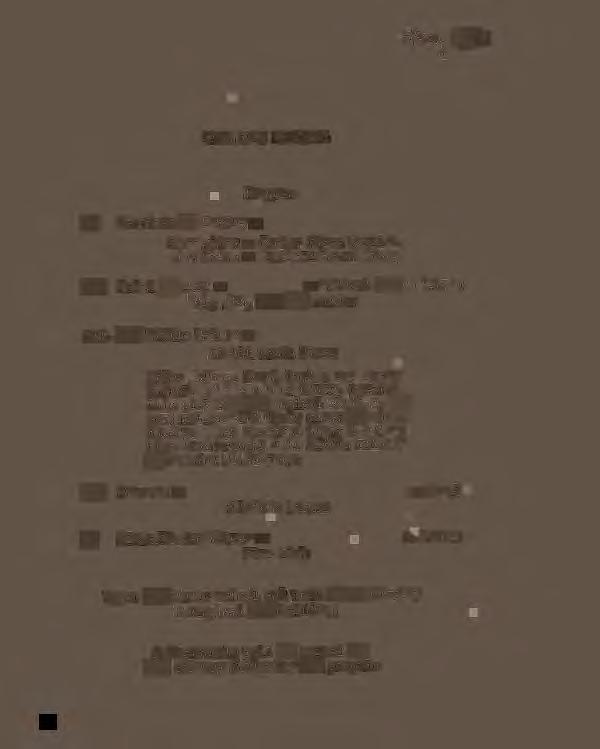
FINE ARTS FESTIVAL Program
I. Overture to SpringGray Skies - Junior Class Quartet Blue Skies - Freshman Dance Group
II. Trial by Jury - - Gilbert and Sullivan 4th, 5th, and 6th Grades
III. The Little PrinceEighth Grade Class
Midge McPhee, Sarah Curtis and Nancy Fuhrer, of the Junior Class, created this play and the musical setting, in conjunction v1ith their class in music theory~ They received their inspiration from reading " The Little Prince" by Antoine StaExupery.
IV. Pavanne - - Ravel ·
v. Patricia Peters Liebeslieder Walzer- Brahms Glee Club
Upper and lower school art work is on display throughout the building
Refreshments vdll be served in the Library following the program
Hay 25 t h
11 COME DON N TO KEJ.f 11
The He l en Bush - Par ks ide School
FINE ARTS FEST I VAL Pr ogram
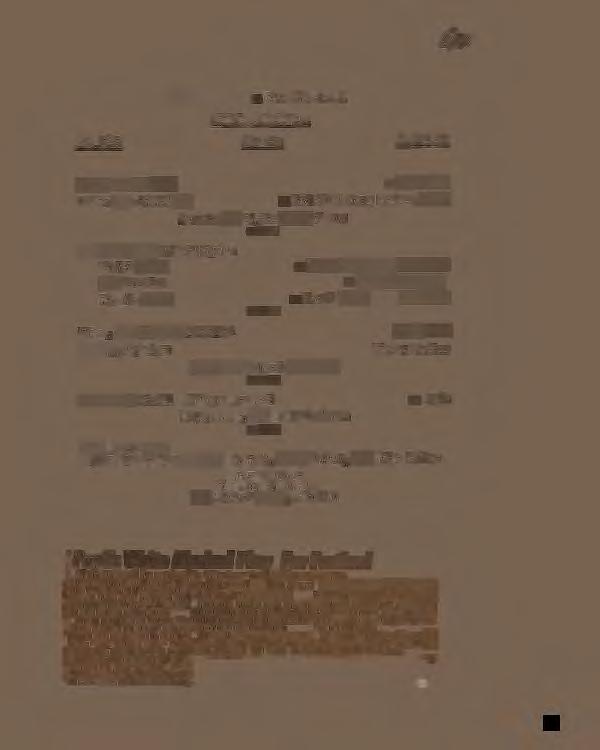
8 o 1 cl ock
" SUMER I S I 1CIB.1Ei~ BJII - Carl Deis
Twelfth Century Engl i s h Round
Seventh and Eight h Grade Chorus
MAY DAY ON THE VILLAGE SQUARE
Dani s h Danc e
Sea Chanties
Fifth Gra de Boys and Girls - Sixth Gr a d e Boys
M a yp ole Dance - Fourth Grade Boys a nd Girls
11 JESU , JOY OF l,IA.N1 S DES IRING"
11 THE NI GHTINGALE"
Hel en Bus h Sc hool Gl ee Club
11 TRIO I N C MA JOR11 - Allegr o Movement
M a ry } Sa lly , a nd Nancy Lockvmod
J. S Bach Thoma s Heelkes - Haydn
" THE MARBLE BOY 11
A cr eati ve pr cject by Ma ry Lo c kwood, Sarah Cu r t is, a nd Midge McPhee
Seventh Grade Hi gh School Singer s
Mr . W i ndso r Utl ey , Flauti s t
Pupils Write Musical Play For Festival
Music composed by pupils of 1by Windsor Utley and piano Kantner. the Helen Bush-Parks.ide School• . • . l will be included in the school's accompaniment by Mrs. Jamcs 1 Mrs. Beale will ~onduct choral _t annual Fine Arts Festival pro- M. Beale. faculty members. numbers by the high-school glee 3gram at 8 o'clock tomorrow night Parkside pupils will prt>-~ent club and junior-high singers. in the school gymnasium. Danish and Eng·Jish folk <lances Sixth-grade boys will sing sea 1 Sarah Curtis and Midge Mc- with choreography by Miss The• chanteys. conducted by Mrs. Mor' Phee, seniors in music theory, odosia Young, instructor. ton C. Wilhelm. ,wrote lhe score for a musical l Three sisters, Sally, Nancy and Painting and sculptures by play, "The Marble Boy." Mary'Mary Lockwood, will play Haydn pupils of Utley and Mrs. John M. i Lockwood, also a senior, wrotejtrios, directed by Miss Karla Morse will be exhibited. 1,the script. The play will be per-·liormed by seventh-grade girls. a T~ music will include flute solos~- ---- - -
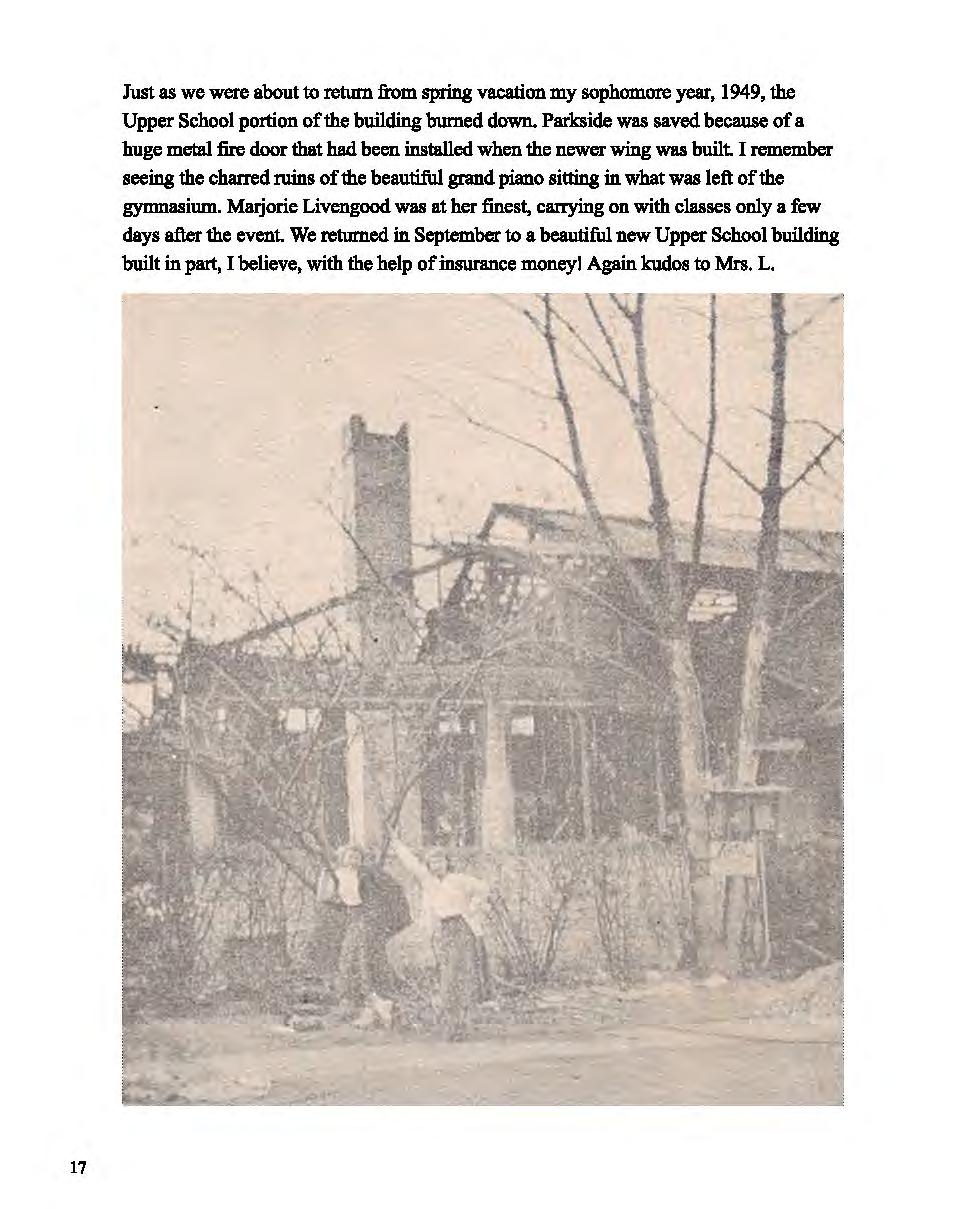
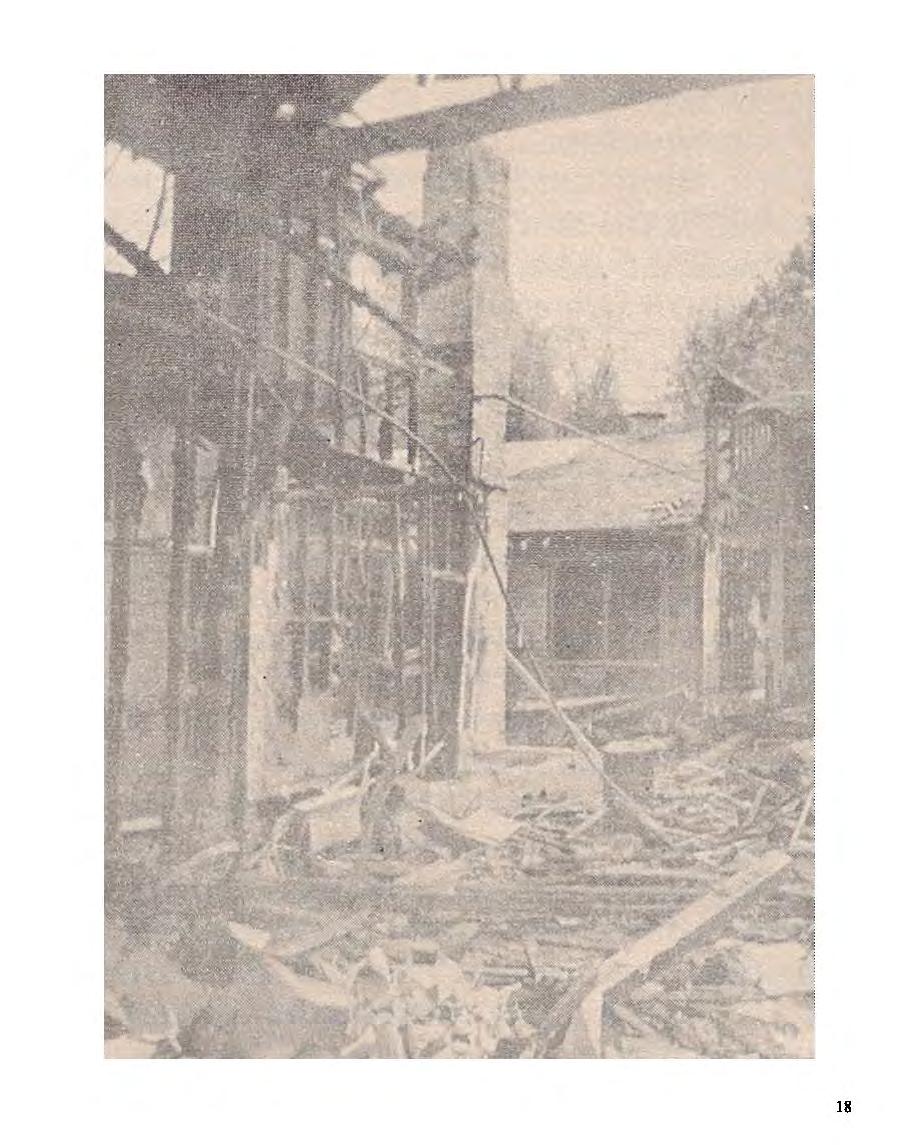
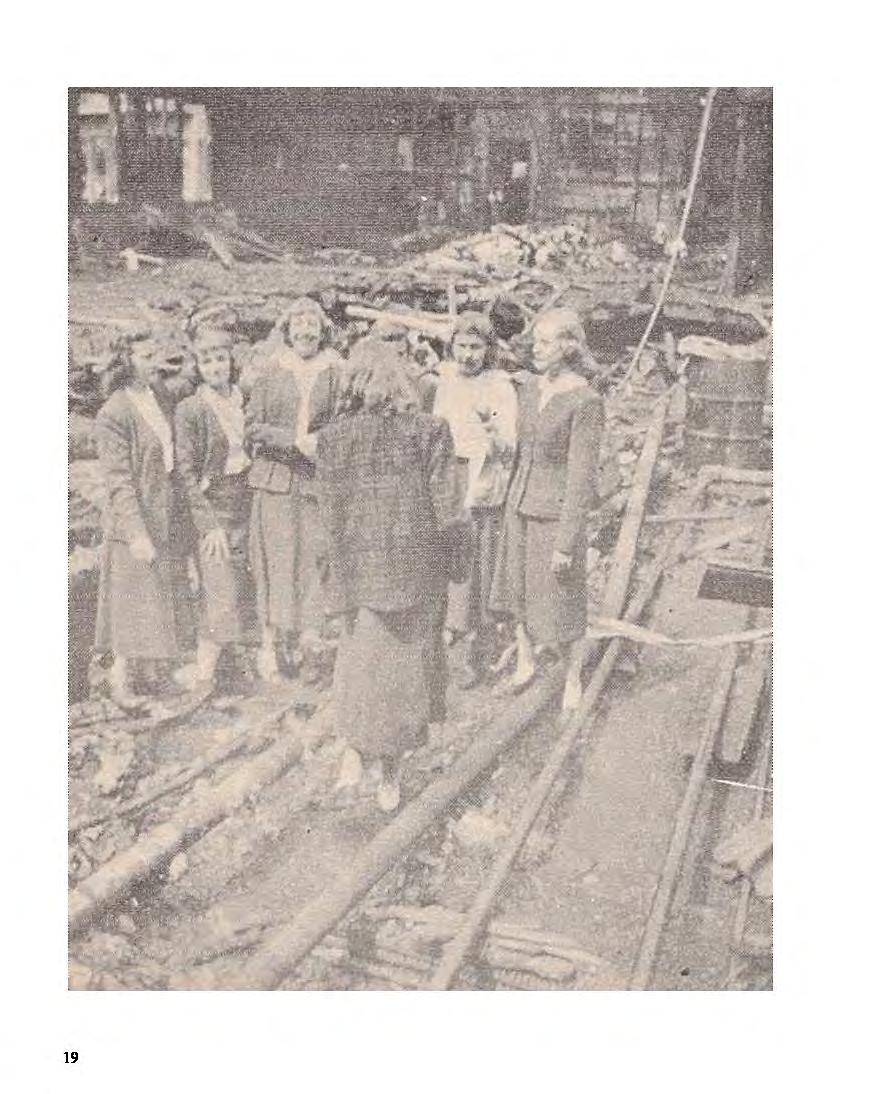
Just as we were about to return from spring vacation my sophomore year, 1949, the Upper School portion of the building burned down. Parkside was saved because of a huge metal fire door that had been instBlled when the newer wing was built. I remember seeing the charred rums of 1he beautiful giand piano sittins in what was left of the gymnasium. Marjorie Livengood was at her finest, carrying on with classes only a few days ai\er the event. We i:etumed in September to a beautiful new Upper School building built in part, I believe, with the help of insurance money! Again kudos to Mrs. L.

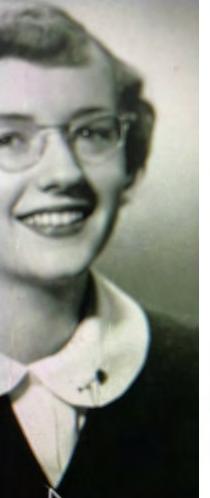
Senior year photo with "Court Pin" on my collar denoting vice-president of the student body. My later work in other girls' schools in the '80s and '90s, reinforced my belief in the continuing importance of female voices in leadership and governance.
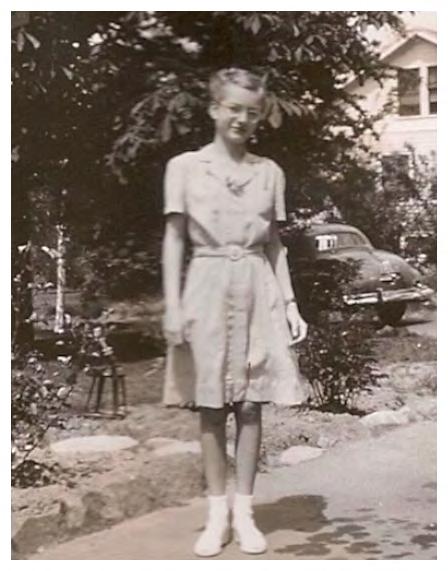
Spring uniform available in pink, green or blue if I remember correctly (circa 1949).



With classmate, Nancy Fuhrer Christmas, 1947

Junior Prom 1950
Pa t Gilbert. new P resident of the Student Body
As yo u can sec from the picture, 1 am stil l in a state of shock. It makes you fee l awful l y good to kn o w that people like you and have enough confi dence in you to give you such an honor. J just hope that I can live up to the standards set by the previous student body presidents.
SJ1,1h Ctirtis. next 1·car's Editor of llw l~amblff
I .1m most h,1pp\' I<> h.wc bcl'l1 dedcd l'l\' the 1ourn,1hsm d.1,, to tlw rd110,sh1p of llw l?amhler for t h,· ,om,ng yc,ir.
A school p.1prr. 1(k,1l ly. is tht· rdkc uon of the school itself. I will strive LQward a trn\' reprcsen1ation of Bush, and prom1w Lo follow the requests .ind dm1ands of the readers even though th,·se requests might Jl tunes range from. "\Ve gotta haw more gossip'." to "C:.111cha cut down on the gossip?"
l t is my hope that. with the cooper at10n of the staff. the Rambler will re main an 1ntercst1n g ,ind vital pJrl of Bush life.
llAA\llEtl
June I. 1950
The Fine Arts Festival
Spring again '. And with it CJme our annua l Fine Arts Festival. on Friday evening. May 26. The fcstivJ'I w,1s sponsored by the Mother's Club as its money raising project for this year. Proceeds will go toward some necessary improvements and additions to school equipment.
The an d isplay. which was in the new gymnasium. was under the supervis ion of Mr Utley. It w,1s a comprehensi ve showing of ,111 forms of work, such as painting. sculpture and ceramics, done by students in all departments.
An interesting hour's program was given in the Reed Mcmori,11 Gym under the direction of Mrs. Wilhelm 1t i ncluded a rifteen minute excerpt from Gilbert and Su l livan·s "Trial by Jury,'' presented by the founh. fifth and sixth grades. The eighth grade class in theory" prepared a musical fantasy called "The Little Prince.· ·and the Glee Club. under the d i rection of Miss Townsend. completed the program. These features were interspersed with acts drawn from the upper school talent assembly. including a Junior class quartet, and ,1 dance number by a group of frcshmrn Par Peters also chose one of the dances of her recent concert for her parti(ipa tion in the entertainment.
After the program. refreshmrnts wac served in the upper school libr.iry.
CARt CARAVAN
hv J dy Ktr11• C'om,· st,1g ,r d.,t,·. to on,· of the BIG f--VI NJ S of le (.lr 1 Im will be the \ssoci.ued B, ·s ( lubs cLince- 'CARE CARAVAN. to be held June 3rd, ,n the ( l\'IC Auditorium. The musIC is by Bumps Bl.ickwdl s sen ior band . "CARF CARAVAN' ,s the title of 1111s dann·. because the proceeds go to tlw CARE UNESCO book fund, to buy text books for college students 111 Lu rope.
On the committee. for this d,1ncc. :ire st udcnt reprcscntat ivcs from every high school in 1hc city. The c h,1pcroncs in clL1de Gov. l.anglic and Mayor Devin. 11 is easy to sec what a big project this (Continued on page >)
Midge McPh,·,·. n, w Vice Pres id ~nt of the Studrn t 13ody
From the wonckrfu l S\'nd off you·vc given m,•. I know that ll<'X l yc.lr is going to be stupendous: it will h.1w 10 be. to live· up 10 your cxpect.llions. I hop,· to bccom,· bett,·r ,1cqu.11n1nl with you .111. bu1 not ncc,·ss.nily in court~
N,lllcy l'uhra, next yc.ir's Lditnr of the T yko" I il..e .1 Prom program. thl' I yk,w r<' c,1l ls the 1nC1dl'ntS of schoo l 1,f<, wl11d1 Wl' w~1nt to n..·n1l·n1btr forl'Vt·r It l'i onr of the Inv pl,lCL'S where the SJ)ll'I( "' th,· school and the trd,ng of 1he studl'nts can re.il l y be cxpn·ssed. l:vn ,inn· I c.1me to l~ush. I Ii.we hoped I cou ld be conm·ctcd with the ,111nu.1l 111 som,· w.iy. I .1111 vc.....ry honon:d to h.1vt· b1.·t.·n rhost'n w take ch.1rg,· ol 11 .ind I .1m look111i lonv<1rd to <.hung lh'Xl year's ~lnnu.1I ev,·n m ore· t lun I h,1v,· .11 w ,I y\ en joyed re,1d111g those· wh1d1 <.llnr be·fnr,· i t.

Chatting over tea cups at the graduation tea at Helen Bush School are Seniors (L to R) Gretchen Harms, Nancy Fuhrer, Sarah Curtis, Midge Bowman. Commencement Day is June 8. (Seattle PI, May 27, 1951) Note: Pictured on the Gracemont stairs.

40 mij, &rattlt tittttt.d
PR OC ESSIONAL


PROGRAM


INVO CAT IO N

GREET I NG
MUSIC
Rev . Oswald W. Jeffe rson


M ar jo rie Chandl er Livengood
Th e N i gh ti ngal e . Thomas W eelke s Weep, 0 Mine Eye s..........................................................J oh n W ilbye
Now Is the Month of Mayi ng............................................Thomas M orley
The Glee Club


MESSAGE
Directions
C ontrol-Creativi t y ............................................ ................ ..N ancy Fuh rer


The Step Beyond............... .............................. ................ Midge Mc Ph ee
The Big ''We''.. ................................................................. Patricia Gilbert

Education for an Open Mind..............................................Sa rah Curti s
MESSAGE TO THE CLASS OF 1951
Dr. Sherman E. Lee
PRESENTATION OF GIFT
Mary Lockwood
PRESENTATION OF DIPLOMAS
Mr. Harry Henke, Jr.
MUSIC . Pan i s Angelicus............................................ ........ .. ........... .Cesar Franck
The Chorus
BENEDICTI ON
RECESSIONAL
SENIO R RECEPTION
Rev. Oswald W. Jefferso n
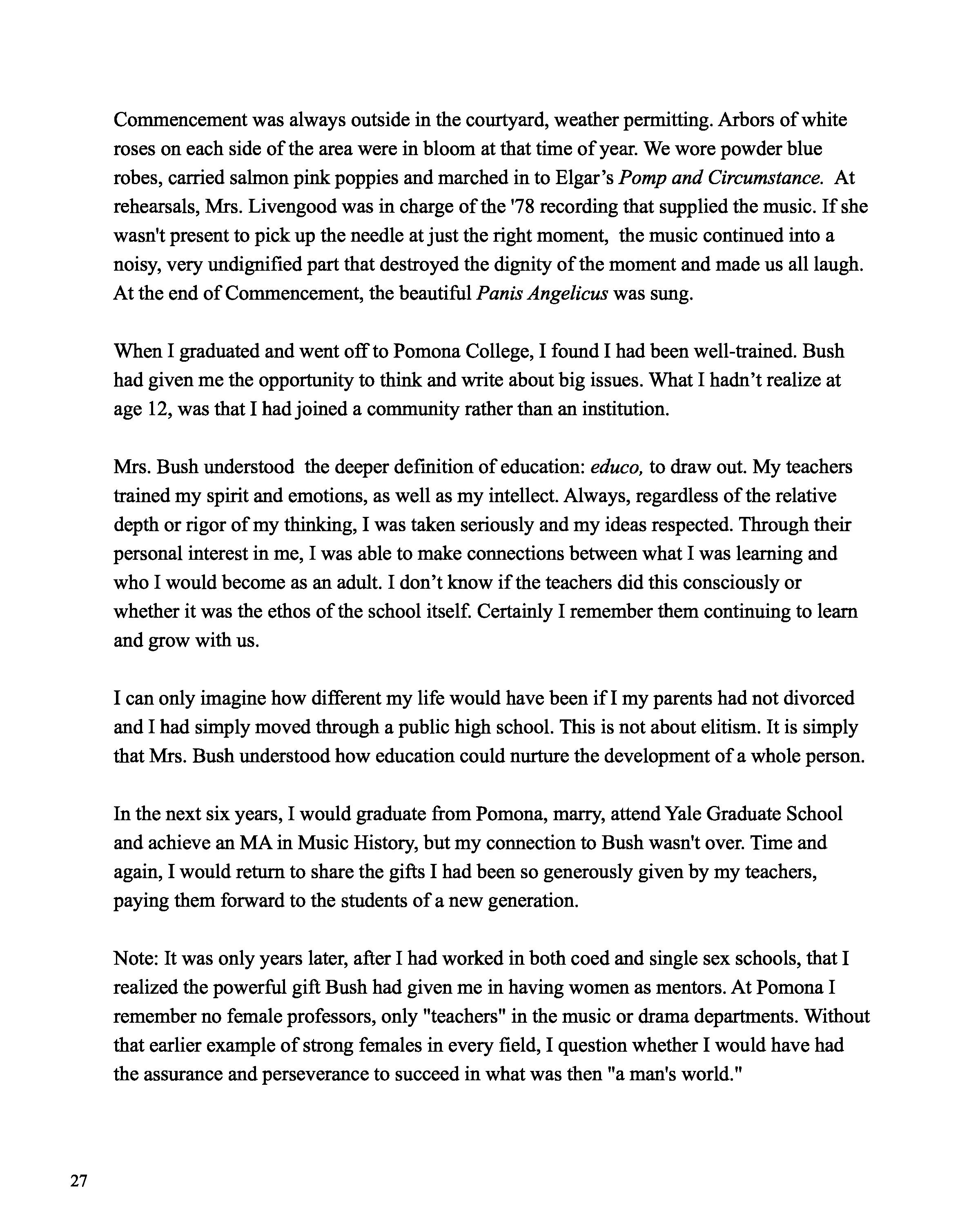
Commencement was always outside in the courtyard, weather permitting. Arbors of white roses on each side of the area were in bloom at that time of year. We wore powder blue robes, carried salmon pink poppies and marched in to Elgar's Pomp and Circumstance. At rehearsals, Mrs. Livengood was in charge of the '78 recording that supplied the music. If she wasn't present to pick up the needle at just the right moment, the music continued into a noisy, very undignified part that destroyed the dignity of the moment and made us all laugh. At the end of Commencement, the beautiful Panis Angelicus was sung.
When I graduated and went off to Pomona College, I found I had been well-trained. Bush had given me the opportunity to think and write about big issues. What I hadn't realize at age 12, was that I had joined a community rather than an institution.
Mrs. Bush understood the deeper definition of education: educo, to draw out. My teachers trained my spirit and emotions, as well as my intellect. Always, regardless of the relative depth or rigor of my thinking, I was taken seriously and my ideas respected. Through their personal interest in me, I was able to make connections between what I was learning and who I would become as an adult. I don't know if the teachers did this consciously or whether it was the ethos of the school itself. Certainly I remember them continuing to learn and grow with us.
I can only imagine how different my life would have been if I my parents had not divorced and I had simply moved through a public high school. This is not about elitism. It is simply that Mrs. Bush understood how education could nurture the development of a whole person.
In the next six years, I would graduate from Pomona, marry, attend Yale Graduate School and achieve an MA in Music History, but my connection to Bush wasn't over. Time and again, I would return to share the gifts I had been so generously given by my teachers, paying them forward to the students of a new generation.
Note: It was only years later, after I had worked in both coed and single sex schools, that I realized the powerful gift Bush had given me in having women as mentors. At Pomona I remember no female professors, only "teachers" in the music or drama departments. Without that earlier example of strong females in every field, I question whether I would have had the assurance and perseverance to succeed in what was then "a man's world."
Graduation, June 1951. The Senior Plaque, titled In action faithful and in honor clear, was awarded each year to one Senior for service to the School. All the students voted. It meant a great deal to me to be selected. Journalist Meg Greenfield '48 also held that honor. I am not sure when the tradition ended but it was still in existence in the 1970s. It seems both the original plaque and the tradition have disappeared.
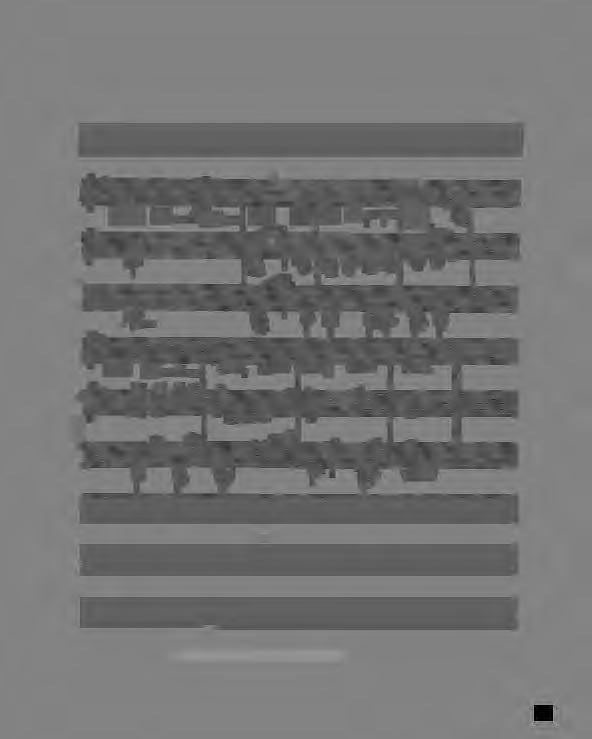
God of Truth, Give us sight into Thy wondrous laws ofmight. And out ofchaos, Let there be Thy perfect ordered harmony.
God ofBeauty, Help us to see
All that's fair in flower and tree
And let our ordered lives confess The Beauty of Thy holiness.
Oh God ofPurpose, Make us strong
To use our knowledge and our song. To make the world more true, more fair.
Oh God ofPurpose, Make us dare
To make the world more true, More true, more fair.
School Song Words: Helen Bush Music: Marjorie Livengood

Bush Again 1958 - 1960
My husband, David, and I left Yale for Seattle in February 1957. While he waited for the Bar Exam in July, I took a job in the library at the University of Washington Music School. It was a wonderful way to use all the knowledge from my Master's degree in Music History and to meet other musicians, composers and doctoral candidates, many of whom became my friends. When it was discovered that I played the piano, many of the students and some faculty asked me to accompany them. I also met composition student, David Lamb, who I later commissioned to write a piece for women's voices based on poetry by Gerard Manley Hopkins. (See page 36)
At the same time, I began to study dance with Martha Nishitani, a student of Eleanor King who had been my dance teacher at Bush in 1945. Martha was the choreographer for the UW Music School opera productions and I was invited to join her performing group. I danced in two operas: Weber's Orpheus and Eurydice and had two roles, the Manticore and the Virgin, in Menotti's madrigal opera, The Unicorn, the Gorgon and the Manticore, both at Meany Hall (photo next page). I would later choreograph part of this work for my dance class at Bush.
In September 1958, I was hired by Marjorie Livengood to teach chorus, music history, and dance. Many of the faculty from my student days-Mimi Campbell, Meta O'Crotty, Mary Rattray, and Dorothy Miller were still there. It was a little daunting to become a colleague of my former mentors, but returning to Bush as a faculty member solidified those relationships into lifelong friendships. In working for Marjorie, I found her to be a fine administrator, but there was no longer the joyful, relaxed, creative messiness of the Helen Bush years. Still, she was exactly what was needed at this transition time. Her long association with Helen Bush and the school was a testament to her love and commitment.
In leading the Upper School Glee Club I was able to use much of the choral music I had performed at Pomona and Yale, including Dvorak and Faure selections. One Senior told Mrs. Livengood that Glee Club had been her most important class that year! Several years later, for the Shaker tune, ' Tis the Gift to Be Simple, I designed and sewed simple dresses for the Glee Club to wear as they sang and danced the piece I had choreographed. Cathi Soriano '77 said much the same about that performance.
THE :\IYTHICAL :\lanticore, playe<l by Midge is one of three syrn,bolic beasts in Gian Carlo Bowman, l\ilenotti's be "The Unicorn, the Gorgon and the )lanticore," to presented at 8 p. m. Tuesday ancl Wednesday at l\ileany Han by the Unh·ersity of \Vashington Opera Theater. John Stipanela is the poet in the madrigal fable for chorus, dance-1·s and nine instrume nts. The Opera 'fheater also will present the thh-d act of "La Boheme" in commemoration of the centennial of Puccini's birth.

Seattle Times, 1958
FINE ARTS FESTIV AL
TiiE HELEN BUSH - PARKSIDE SCHOOL
Ma y 4 , 1959
" A Sr.tall Inhe ritance" , a one - a ct play by J anet Spa lding
George ••
Elizabeth ••
H G. • • • Two Souls •
Property Men , CAS T
, Katherine Bruenner
• Susa n Wright
Janet S palding
, Veronic a Johnston
Alison Skeel
, Myrna McElhany
Pa tricia Newton

"Philosophy"
"Let All Mortal Flesh Be Silent"
" lie Are Ma rching to Pr a etor ia"
Tra ditional
Holst arr Marais
The Helen Bush - Lakeside Glee Clubs
Conductor, Mr . Tom Wendel
Dances related to paintings • • , • •• Seventh Grade
Van Gogh : Portina ri : Miro :
Wade Ballinger, Lynn Bl umenthal , Ros a bel Landberg , Holly Nash
Barba r a Leede , Nora Skeel, Sarah Kip Robinson
Mina Brechemin , Kristin Djos, Diana Pad elford , Cynthia Phelps, Kitten Sheehan
Dances related to poems of Fdith Sitwell • • Eleventh and Twelfth Grades
" Aubade 11 : Alice Cox , Patricia Newton
"Th~ee Poor Witches" : Veronic a Johnston , Su san Rutherford , Janet Spalding
• 1Trio for Two Cats and a Trombone" : Alice Cox, Eliza beth Kaufman , Patricia Ne wton , Pame l a Purvi s, Li bb y Ru ch ,
" An Enterta inment"-music by John David Lamb writt en expres sly f or The Helen Bush Glee Club , August-September 1 958 , to poems by Gerard l1anley Hopkins . "Cuckoo" " S p rin g and Fall"
" A Nun Takes the Veil" "Inversnaid"
The Helen Bush Glee Club
Flutes : Viola : Cellos : Horn : Barbara Campb ell , Jayme Clise
Kristen Harks
Mrs . R. H, Allport, Jill Hering Walter F, Cole
Play directed by Mrs, R, Hugh Dickinson
Dances and Helen Bush Glee Club directed by Mrs , David Bowman
The 1959 Fine Arts Festival included our collaboration with the Lakeside Glee Club, directed by my friend, Tom Wendel; performances by students in two of my dance classes; and the commissioned Lamb work, An Entertainment, for voices and instruments. This program remains one of the high points of my teaching in the arts at Bush. We also performed the Lamb work at the UW and were mentioned by arts critic, Lou Guzzo, in his Seattle 1imes review May 1959 (next page).
Young Com·posers Rebel Against 'Vulgar' Music
By LOUIS R. GUZZO
FOUR young Seattle composers, who are disgusted with "the vulgar dadaistic breas t-beati ng that has characterized the bulk of art music the past 50 years," have joined to try to do something about it.
They are Ruth Lewis, Kenneth Benshoof, David Lamb and Richard Levin. The first three are graduates of the University of Washington ! School of Music a]ld Levin stead of for other composwas a 1954 Harvard Univer-1 ers ." sity graduate in chemistry.
•
The fourso~e has arr~~ged Program in Detail a program of its compot1t1ons for 8:30 next Tuesday night AT Tuesday's c o n c er t, in the recital hall of the uni- Lamb will be repreversity's Music Building. Its sented with five composi"concert of rebellion" has the tions, Miss Lewis with four, blessings of the School of Benshoof with two and Levin Music, under whose sponsor- with one. ship it will be presented. Students, graduate st u -
In a statement accompany- dents, faculty members and Ing a mimeographed program, the Helen Bush Glee Club the composers declared: are co - operating with the " ... The ideas we repre- four composers in arranging sent may be summarized by the concert. saying that we believe music The glee club and Walter s ho u Id contain memorable F. Cole, French horn, wi11 be tunes, c I e a r 1y d e f i n e d led by Elsa Bowman, conducrhythms, logical formal struc- tor, in a performance of ture and, if possible, a sense L a m b ' s "Entertainment," of humor. whose sections are titled
"This is to say we feel "Cuckoo," "Spring and Fall," music should be character- "A Nun Takes the Veil" and ized by the word 'delightful' "lnversnaid." and should be far removed Cole and Elizabeth Ward from the vulgar dadaistic will combine for two sets of breast-beating that has char- "Horn Duets" by Lamb, and acterized the bulk of art mu- John Budelman, flute, and sic the past 50 years.'' William Scott, cello, for his "'RArPfnnt

A CHRISTMAS TEA at the home of Dr. Trygve Buschmann ls scheduled by Ladies Musical Club Sunday, December 10. Mrs, David Bowman who is a member of the club and also teaches music at Helen Bush
School, rehearses carols with three of the school's glee club members who will be performing at the tea. Left to right, Sigrid Marks, Merrily Clark and Kathy Tytus. The glee club ls directed by Miss Helen Turner,
Endmgs & Beginnings, 1960-1967
The above photo was in December 1959 and I was already in maternity clothes. I made it through Graduation in June, 1960, and our daughter, Megan, was bom July 29th. Three years later our~ Matthew, joined her. By 1967, I was back at Bush teaching dance and music part-time, the same year Marjorie Livengood retired. In an unexpected moment prior to her departure, she asked me to consider being her successor. I was touched that she saw me in that role but I had the good sense to decline. At that point, I could not know that in 1996, I would be appointed Interim Head of School. In one sense, Marjorie had been correct.
4

EAST 2-7978
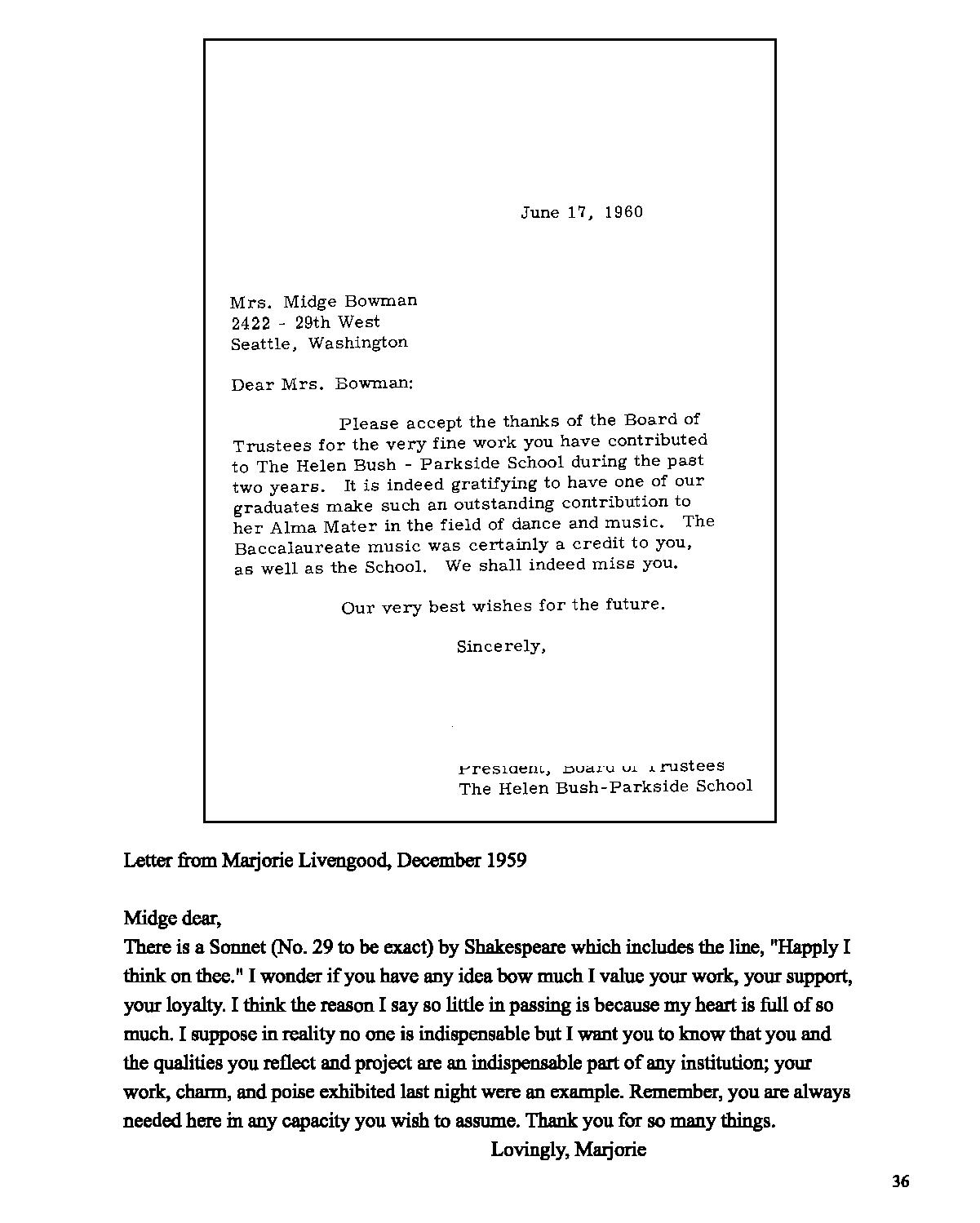
June 17, 1960
Mrs Midge Bowman
2422 - 29th West
Seattl e, Washington
Dear Mrs. Bowman:
Please accept the thanks of the Board of Trustees for the very fine work you have contributed to The Helen Bush - Parkside Schoo l during the past two years . It is indeed gratifying to have one of our graduates make such an outstanding contribut~on to her Alma Mater in the field of dance and music. The Baccal aureate music was certainly a credit to you, as well as the School. We shall indeed miss you.
Our very best wishes for the future

Sincerely, d;;;f.:f
President, Board of Trustees
The Helen Bush-Parkside School
Letter from Marjorie Livengoo~ December 1959
Midge dear,
There is a Sonnet (No. 29 to be exact) by Shakespeare which includes the line, "Happly I think on thee." I wonder if you have any idea how much I value your work, your support, your loyalty. I think the reason I say so little in passing is because my heart is full of so much. I suppose in reality no one is indispensable but I want you to know that you and the qualities you reflect and project are an indispensable part of any institution; your work, charm, and poise exhibited last night were an example. Remember, you arc always needed here in any capacity you wish to assume. Thank you for so many things.
Lovingly, Marjorie
f
Headmistress Will Be 'Graduated' 1n June
ing school homes) that the milestones of her life ar the cl ass pictures that remind her she has been o hand lo line the girls up for every graduati on.
Oh, there are other milestones, of course. An accompl ished violini st, Mar.iorie Livengood played w ith the Seattle Symphony Orchestra under Sir Thomas Beecham. She had a year (getting back in t im e for graduation) as an American Red Cross field director in the Pacific.
1\Jrs. Livengood. daughter or lhe late \ilr. and \lrs. Archie Chandler, was born in California, moved to Philadelphia with her parents for a number of \'e,irs and returned here. Her schools are the Uni~·ersit:·, of Washington. Mills College and Columbia Cniversity. where she got her master's degree 1 school administration.
While on a year's sabbatical leave from Bush. she studied violin with .Josef Roismann of the Budapest st ring quartet.
Mrs. Helen Taylor Bush opened her school in 19:U in her home near the Church of the Epiphany, incorporated it in 1929 and moved to the present site in 1935. (Mrs. Bush died in 1948.) Mrs. Livengood lived in Mrs Bush's home and was a parttime teacher al first, later taught full time and then became headmistress.
The school was severely damaged by the earthquake of 1949 and later most of the original buildings were destroyed by a fire thought to be a result o~ the earthquake. During Mrs. Livengood's adminis1ration two libraries, a gymnasium, a dining hall and class rooms have been built. in addition lo the new class building being completed !his year.

MRS. MARJORIE CHANDLER LIVENGOOD
By DOROTHY BRANT BRAZIER
r ( Womrri"s f'<ews Eclilor, The Times
( Nexl .I L111e·s graduation class al the llelen Ru~h P:u:kside School will be the last one Jvl r~. ~Via rjorie t Chandler Livengood. headmistress. 11·ill .-1l1Pndofficially, that is.
But knowing hrr ren1rd of having l)een al every graduation since the first class. in 1934. no mal_lcr , where she m1ghl han' 10 come trom. we are "tll111g : to hel she will be showing up at fulLtre ones.
If not in person, certainly in thought.
Not many headmistresses can say they have _knnwn every pupil since the school began. bul Mrs. Livengood can.
After 40 years teaching, 10 in the Seattle Public Schools and 30 at Helen Bush, 20 of those as headmistress, Mrs. Livengood has announced she will resign in June. 1967. Resign. not retire, because she began teaching very early in life and because she will be doing other things.
Under Mrs. Li1·engood's administration, the school has tripled its enrollment, is completing a tenyear building program with the construction nf a new class building thal 1\ill expand science laboratones. and has survived "earthquake. fire and Sputnik ·'
Lived There , Too
Mrs. Uvengoo<l has spf'nl so much lime al lhe srhool (she has made her home in one of Jhe adjoin-
She Carried On
Tn "\lrs. Bush's day, such schools were "priva1f': loday they are "independent." Mrs Livengood failh fullv has followed the program laid down by Mrs. Bush-high scholarshir> and character ideals :1nd a curriculum where science and math are hand-in-:,and with the arts.
(lvlrs. Livengood is a member of the Sea[t[e Arf :Vluseum. always visits major museums while travel ing, and has had on the Bush faculty such artists as Guy Anderson. Windsor Utley and .Jack Fletcher).
Ad1hission Lo the school is on a basis of character and scholarsh i p. not race or creed. Each year, one open competitive scholarship to Helen Bush School is availabl e to all girls entering high school.
"We are not for everybody," she says. "We have our special character and, for those who want us, we are here. We have never intended to be a large school."
During summers, she went on field trips for the school, to meet parents of new pupils, and one year took some pupils to Europe. Two years ago, under her leadership. Parkside became the first elementary school on lhe West Coast to adopt the Initial Teaching Alphabet. a phonetic approach lo reading and writing
The difficult job of finding a new administrator is in the hands of Mr. Peter Garret[. president of the boa1·d of trustees. and Mr .John H. Hauberg heads the "search committee."
They are not looking for a "replacement," ior !hev feel Mrs. Livengood cannot be replaced. They are· looking for a succes~or.
Bush Will Lose Mrs. Livengood
BY LAURA El\IORY GILMORE P-1 Women'• News Editor
Mrs. Marjorie C. Livengood, headmistress of Helen Bush-Parkside School will retlre next ,June. AnnounrPment was made Friday at the annual faculty-trustees lunrheon at Gracemount Hall on th e school campus. She won't make her own plans for the futun until a new admlnJstrator is found.
"U I u a 11 y it takes month, - sometimes even years to find a su cce ssor," she confided.
"I have several educational projects in mind and I am very Interested Jn musla and art. I am a lso a great outdoors pers on.
"I love to go to the beach and hike and I know exactly how long it Mrs. Mariorie Liv•ngoo d takes to walk around Green Lake."
Mn. Livengood ha, taught In SMtth1 for 40 years and has been headmistress of the Independent iichool for nearly 20 yean, having succeeded its founder, Mrs. Helen Taylor Bnsh
IN ANNOUNCING the nE'~, Mr. E. P eter Garrett, president of the board of trustees, noted that Rush enrollment has trebled under Mrs Llvengood's administration.
He said, "Mrs. Livengood has spent a life time guiding children In the most respon~ive and most important periods of their lives. She has built a school which Is a complex organization of students, faculty, parents and alumnae. We feel a keen sense of regret and a great loss to the school . . . "
Helen Bush School hu an enrollment of 350, pres chool through high school. With the construction of a new conference and instruction unit this fall, the s chool Is completing a 10 year building program which has included two libraries, a gymnasium, a dining hall and classrooms.
Mr. John Haubt'rg heads the committee to find a new a dministrator.
Unfortunately, former Heads are often "old news" so it was wonderful to read in the 1969 Bush Bulletin that Marjorie had "landed on her feet" at Castilleja.
MRS. LIVENGOOD AT CASTILLEJA
Mrs. Marjorie Livengood, former headmistress, now works as academic dean at Castilleja School, Palo Alto, California. She learned of the employment opportunity from her friend, Miss Margarita Espinosa, principal of the School, who was looking for someone who wished to 11expcriment linguistically" with some students in grade seven. Prior to her new appointment, Mrs. Livengood had been enrolled in the Graduate School of Education at the University of Pennsylvania during winter term last year. In her words, she was "preparing for some dogood work in any needy community, here or abroad, by reviewing and updating word skills such as reading and spelling. My course included Linguistics; at last my concerns oflong standing had reasonable, perceptive answers." She writes she was in the process of formulating a "PROJECT."

I am sad that I was not in touch with Marjorie in those final years. I think leaving Bush was difficult and perhaps not completely her choice. I am also not sure that, in those early days, the Board had even considered an adequate retirement program.
Mrs. Livengood Dies
Marjorie Chandler Livengood, headmistress of Bush from 1948 to 1967, died last Sunday in Palo Alto, California.
Headmaster Lesl ie l. Larsen, Jr., announced Mrs. Livengood's death to the school last Monday and remarked, "We at Bush who have known her also feel a sense of great loss to the school. Those who did not know her know her heritage lives on in enthusiasm and dedication of young children as they go through their lessons and experiences at Bush.''
Mrs. Livengood became very much a part of Bush in her four decades at the school. She was hired by Mrs. Helen Bush in 1936 to teach music. During World War II she left Bush to work with the Red Cross and then she went to Columbia Teachers College before being named headmistress after Mrs. Bush's death in 1948.
During her 19 years as head of Bush she had to deal with rebuilding the school after the fire in 1949 and the addition of the Library in 1967', which was later dedicated as the Livengood Library.
One of her decisions that affects Bush students was her hirin_g of Meta
• Marjorie Liven~ood O'Crotty in 1949. She recalls that Mrs. Livengood hired her on the front steps of Bush.
O'Crotty adds, "I frequently told her she saved my life. I might not· have become a teacher."
Mrs. Livengood's warm personality enabled her to make long friendships with Bush alums. She taught Mary Haight Pease, '41, Bush History teacher, violin at Bush and later they worked together at Bush, remaining friends for 40 years.
Midge McPhee Bowman, Lower School director and class of '51, paid the following tribute to her former headmistress: "I will miss her vital-

ity, her strength, her wit and her love of music.
"She wasn't afraid of hard work and dedication. They were her middle names. I will miss her, but her spirit touched my life and that will remain with me."
In 1967 Mrs. Livengood announced her retirement as headmistress, a title she disliked. She preferred "principal."
Also in 1967, she was honored by the Matrix Table of "Women in Communications." The citation read as follows: " She has a reputation of having academic excellence while introducing scholarships, exchange programs which have brought Bush national attention."
She moved to California, where she was for l0years a member of the California Bach Society and head of the upper school at Castilleja School, in Palo Alto. She retired in 1973.
Survivors include Mrs. Livengood's sister, Mrs. James B. Matthews of Mercer Island, and two nieces, Marjorie Matthews Boothe, '50, and Susan Matthews Hall, '56.
The family suggests remembrances be made to the Marjorie C. Livengood Fund at Bush.
Another milestone was Marjorie Livengood's death in Palo Alto, January 1980. Now both women who had been Headmistress/role models to me as a student were gone. From her obituary in The Seattle Times:
A graduate of the University ofWashington and Columbia Teacher's College, she came to Bush school in 1936 after being head of the music department of Garfield High School. During WWII she was a violinist with the Seattle Symphony Orchestra. She later served as a captain with the Red Cross in the Pacific. She became headmistress in 1948 retiring in 1967. She later became headmistress at Castilleja School in Palo Alto retiring in 1973.
Correction from article: Marjorie was not headmistress of Castilleja although she was employed there.
It seems appropriate to include Dee's comments on Marjorie Livengood here since her memories of that early time are so vivid and give a wonderful picture of Mrs. L. and her consistent focus on the arts as a primary element in a Bush education. Beginning in first grade, music, art, dance and drama were part of the curriculum at every level through senior year rather than as electives. As Dee said, "It was the way we learned everything ... the way we learned to learn."
Marjorie Livengood was Principal when I was in high school. She taught the choir and once we performed Handel's Messiah with the Seattle Symphony. I loved Mrs. L. She was so good at everything. She wanted to make sure that we had all the abilities that we needed to succeed. For example, public speaking was very important. She would stand at one end of the gym and we'd stand at the other end, and we had to project our voices to her at the other end of the gym. That was a really important thing to do. She was very sway-backed. When she was walking down the hall, if she saw me, she'd push me against the wall to make sure I stood up straight!
After the war, I was teaching Fourth Grade at Bush. I was dying to go to Europe, but had no money. Then I saw an ad in the paper for Special Services. I put in my application and received a telegram telling me to the report to Fort Ord with my bags packed for two years. I told Marjorie Livengood, what had happened and she said, "That's wonderful." From '51 to '53, I was in Germany with Special Services and created the Seventh Army Repertory Theater. A lot of the actors had been drafted from New York and Hollywood and we got them special leave to do the plays-scenes from Shakespeare and other different kinds of real plays. I said "we're not going to do that for the officers clubs. We're going to do it for the guys and the line outfits and truck drivers." We went on tour with these plays and when we came back, the Colonel in charge ran down the platform with his arms full of papers with all the reports about how wonderful it was. I learned how to do all that at the Bush School. When I was in England waiting for a ship to go home, I got a call from Marjorie Livengood. "The Head of my English department is pregnant. I want you to take over the department." I said, "Marjorie, I can't do that. I majored in French literature." She said, "'If you know French literature, you can do English literature." I agreed on the condition that I teach in the morning and in the afternoon work on a degree in English literature at the University of Washington. That's how I became the Head of the English department!
Note: Dee later developed the Northwest Arts Project with the Junior League to bring contemporary art works to public schools and founded New Horizons for Learning, an international network for educators. Her book, Teaching and Learning Through Multiple Intelligences, has been widely used. She credits all this work to her Bush education.



Transition: John B. Grant, Jr. 1967 - 1972
John Grant was hired as Headmaster in 1967. AB the first male Head of School, John brought new ideas and different ways of doing things. I'm not sure he fully understood the magnitude of the changes over which he was to preside and perhaps it was just as well that we plunged ahead.
Within a very short time frame, decisions had to be made about boarding, coeducation, location and diversity plus the need to raise money for faculty salaries, scholarships, and aging facilities-all while balancing the budget. Among my papers, I found a fragment of a letter Grant wrote in November, 1968. He begins with trying to frame Bush in the larger context of the educational changes that were taking place in the '60s. In the final paragraph, he outlines the challenges facing the school and here, I am struck by his repeated phrase, but not yet. It is as though he is trying to warn of the challenges facing Bush and the as yet inability of the school community to fully meet them:
...Not long ago, with the judgment day of Sputnik and the vast re-analysis of our national educational systems, Independent schools found themselves in the forefront of the renewed emphasis toward quality education. The solid academic curriculum, the Advanced Placement colll'Ses and the independent study programs of the Independent schools suddenly indicated a direction for others that has since become commonplace.
Now in this second wave I feel a similar model for more fruitful public schools can be found in the structure of Independent schools. Some elements of our schools represent
keys to the re-establishment of this "new humanism." Small classes which attempt to utilize the individual approach rather than processing quantities; faculties which are chosen for their individual contributions rather than arbitrary credentials and tenure; and parents groups which represent concerned and active participants and who do not shy from the high cost of quality education, are characteristics of the best independent schools.
Still, no one is going to seek the model of the independent school unless it truly deserves emulation and exudes the vitality necessary to command respect. Helen Bush/Parkside, for example, reaches out to its community with the stature of academic achievement, but not yet enough. We claim an emphasis on individual development, but not yet perfect. We try to bridge into our community with scholarships, but not yet adequately. We seek to use our independence to contribute to the development of educational advancement, but fall woefully short of this challenge. We seek personal and financial support from our parents and alumnae to strengthen our mandate for continued existence, but this is not certain. Parents and teachers together seek to find a meaningful and common relationship with our youth, which is still imperfect. Our entire school family seeks an active role in our community. How successful are we? Modestly so, I judge in all respects. I yearn for this school and this school family to meet all its obligations.
John B. Grant Jr.
Grant and the Board met these obligations to the best of their ability but his tenure was regrettably short. That is one reason I was grateful to interview faculty member, Peggy Skinner, and alumna, Michelle Purnell-Hepburn '75 since both came to Bush that last year we were girlsonly. Both shared some wonderful memories of John and those early days.
Peggy: As a student at the University of Washington, I tutored a Bush student. He was not a particularly strong science student, but a very engaging and interesting thinker. Anyway, after I graduated, I got a job in Shoreline School District, and that was the year, 1970/71, the levy failed. I lost my job through seniority. Then I saw a job opening at Bush School. I had a sense of Bush because of the student I had tutored and then met John Grant and liked him immensely. I remember being very engaged with the conversation that we had. And the School just seemed like such a good fit for me. I grew up in a very small town where everybody knew each other. And Bush was kind of like that: a sense of community, small faculty-maybe fifteen in the Upper School-and very interesting, engaging people.
At my job in a public school, I had a lot of people my age. And I just remember walking into this new environment with these experienced teachers that had been there for a long time. Dee Dickinson and Meta Johnson (later O'Crotty) were just wonderful mentors to a beginning teacher. Not in the sciences. I came in very confident in what I knew in the sciences, but just in terms of interacting with people and just being with experienced teachers. I remember faculty meetings in the library, well, I'm thinking not necessarily the first year, but a few years after that we had very talented people in the arts-people like Chip Luce and Dennis Evans and Norman Durkee-I think every single one of them was a practicing artist. When I think about my experience at Bush and the art teachers that were there, I remember these early faculty meetings in the library as not being tense. Sometimes we drank wine and laughed a lot.
In those early days, mid-morning, we had juice and graham crackers and apple juice or something out in the courtyard. Every day faculty and kids would stop and we would have this little snack. It was just a kind of a nice tradition. A lot of it, again, goes back to my small town upbringing. It was a small town kind of thing to just stop what you're doing and celebrate being with people.
I was the only one teaching Life Sciences when I began. There was another room for Chemistry. I taught sixth grade, a first year Biology class and an Advanced Biology course. And I loved it all. It was just really fun to have the opportunity to take the things I was interested in in college and then translate them so the students could use those same ideas. This was in the basement of what's now the Middle School. I remember in the winter, driving to school in the dark, teaching in a basement, driving home in the dark. But it was a wonderful kind of funky environment. After we built the new building, there were kids who came back just to go back and sit in those old rooms again.
Midge: Michelle, like Peggy, you arrived soon after John Grant was hired as the first male Head of School and just before Bush began to make several major changes.
Michelle: Let's see. I believe it was 1969 and I had come from Epiphany, so just up the hill, if you will. I knew that my time at Bush would be different than some of my neighborhood friends who would eventually attend Garfield or Franklin, near where I lived. Not only was Bush an allgirls school and a private school, yet in time, when boys were admitted, there were few boys of color. It added to the angst of being a teenager. That really shaped a lot of my experience at Bush and even when I entered college. At the same time, we saw more young women and young men of color come behind us.
I will say that starting seventh grade in 1969 and later as the class of 1975, we saw and experienced maximum change during our years there. Beginning with the uniform: Navy blue suits with the white Peter Pan collars and saddle shoes from Frederick and Nelson, then abolishing the uniform, becoming co-ed and admitting more students of color. Those were huge changes and on some level I don't think the School quite knew what to do with all ofus!
I was just talking with Sheri Stephens '75 recently and looking through our yearbooks. We were the 'bumper crop' class-that's what I've been calling ourselves as young women of color. Bush had never before had that many of us in one class. Starting with me in seventh grade were Marie Kurose, Helena Grant, Sheri Stephens, and Patricia Edmond. I believe Randi Dewitty and Risa Lavizzo-in 10th grade when we started-were the first women of color in the Upper School.
Midge: And then there was John Grant, the first male Head of School. What was he like?
Michelle: Coming from a school where headmasters were older Episcopal priests, John Grant was young, he smoked a pipe and had young children! He had a lovely sense of humor and he seemed to really, in an appropriate way, want to get to know and pay attention to the students. And I think he was quite outgoing. He would stop and talk to people in the hall. I thought John Grant was lovely. Then we came back in September to a new headmaster. It was like, what happened? Where did he go? There may have been some kind of issue around Mr. Grant leaving. I know I was too young to understand. I just thought he was lovely and missed him. So then we had to get acclimated to Les Larson. He was more introverted but he was fabulous also. Mrs. Larson was very gregarious and engaging too. If you saw her either in the school or walking down Harrison, she'd say, "Hi, how are you?" That kind of thing.
Midge: Was there still a Mothers' Club?
Michelle: The Mother's Club certainly was there when I started, and my mom was a Room Mother when I was in 10th grade. It must have been then because there were boys in our class by that time. My parents hosted a spaghetti feed and everyone loved my mom's cooking. It was fabulous! "Is your mom making spaghetti?" they would ask, and she was kind oflike the Room Mother from then on. As for as other activities, I was not on the school newspaper, but I was President of the Senior class.
Midge: Are there some teachers you especially remember?
Michelle: Sam Miller was my English teacher. I just loved her and cried when she left. One of the art teachers, Nelleke Langhout, drove a 923 Porsche.This was back in the 60's. I thought she was the coolest person in the world! And of course, Meta O'Crotty. She was so engaging. As I said, Bush wasn't totally ready for so many students of color in Upper School. However those teachers that made us feel welcome and made us feel that we belonged-we would do anything for them. I remember her reciting, "0 frabjous day! Callooh! Callay!" from Lewis Carroll. I still say those words when we have one of those beautiful Seattle days. I also had George Taylor for English. He was delightful and funny. Wonderful sense of humor, but also, you just knew how intelligent he was. Peggy Skinner was another teacher whose tender age resonated with me. She was approachable and committed to her craft.
I am so grateful my parents sent me to Bush. Grateful that I learned how to study, and that has carried me through to this day. I am grateful for the small classes since I'm an introvert. I know I present as an extrovert, but that is because I must. The fact that if you mention someone's name, even today, especially in my class or the class in front of us, I can remember their faces. And a person who will remain forever in my heart was my, what did they call them then? When Seniors adopted a seventh grader? Kathy Jarvis was my, if you will, my Big Sister. She would have graduated in 1970, and she was so kind to me.

Lifelong friends, Michelle Purnell-Hepburn, Sheri Stephens, and Patricia Edmond-Quinn, Bush Class of 1975.

The H el en Bush / Park side School 405 36th Ave n ue East Seatt le Washington 98102 A C d 206 3 , , , rea o e , 22-7978 May 12, 19 69
Dear Parksid e P a r e nt:
As you no d o ubt hav e heard , there Pa rksid e adm i ni s tration, b eg inn ing ne x t that s h e must move to a n othe r p osit i on chil d ren n ow live. '
will be a change in t he September Mrs. Hunt feels perhaps closer to where her
Among h er many s i g ni f i cant contributions to Parkside has been her invalu a ble aid in the transition between Mrs. Livengood ' s tenure and min e. We w i l l mi ss her capable handling of Parkside; and h e r many f r i e nds amon g t he students, parents and graduates of Park side wis h h er we ll
We were most fort u nate to find on our own staff a person qualified to t a k e o n thi s demanding post !>'irs. David Bowman (t--lidge) will assu me duti e s as Parkside Director in September.
Mr s Bowman i s a gradua t e of the Helen Bush School, receiving the S enior Plaqu e in 1 95 1 . She was graduated from Pomona College ~ agna Cum Lau d e in 195 5 . She attended Yale University on a Fellowship, earning her M.A in the History of ~usic in 1957.
Since her r e turn t o Seattl e, ~irs Bowman has engaged in many c ommunit y efforts in a d d i tion to her teaching at both the Little School and Hele n Bu s h / P arkside. Mrs. Bowman has instructed at the Creative Ac tivi t ies Ce nt er s in Seattle and Kirkland, the Y.W.C.A . Che r ry Street Br anch and t he Horace Mann Headstart Program.
Mr s. Bowman has mana g e d t he Concert Series for the Ladies Mu sical Club at the Seattl e Center for six years and has been the hostess for 1 4 o f the Chan ne l 9 series on the Seattle Symphony.
Perhaps the most si g nific ant qualifications for ~rrs . Bowman's app ointment are not found in su c h a clin i c a l listing as this Mrs. Bowma n knew the school and ~rr s . Bus h while a student and she has ta ught duri n g Mrs. Li vengo od ' s l eadership of the school. This gives her an o utstand i ng per spect iv e of the enduring values of t hese fi ne p e ople i n additi o n t o her own dynamic views of the possib i lit i es for Parkside in the fut ure.
S ince re l y\ J \L~l - -->~
J ohn B . Gr a
Headmaster
nt, J r.

J BG : sd
Parkside School Head
Selected

MRS. DAVID B. BOWMAN
Mrs. David B. Bowman will become director of the Parkside School, lower division of the Helen Bush-Parkside School, next fall, it was announced yesterday.
John B. Grant, headmaster, and Dr. Alexander H. Bill, president of the board of trustees, announced the appointment of Mrs. Bowman to head the 200-pupil co-educational independent school.
AN ALUMNA of the Bush School, Mrs. Bowman graduated from Pomona College, (' I are mo n t, Calif.. and earned a master's degree from Yale University. She is a member of Phi Beta Kappa, scholastic honorary, and Mortar Board, leadership honorary.
Mrs. Bowman has been on the school faculty since 1958 as a part-time instructor of musk and dance. She also ha.; taught at the Little S< hool and at Creative Activities Centers.
LAST YEAR, Mrs Bowman was hostess for the Seattle Symphony Orchestra p1 ograms on KCTS-TV, Ch.:.nnel 9.
Mrs. Bowman said she hopes to emphasize basic curic,1ium while developing enric:h~ent programs in art, music and languages.
The Bowmans and their two children reside at 7311 51st Ave. N. E. The new director will succeed Mrs. Constante Hunt.
THE BUSH LOWER SCHOOL 1969-1980
In short, there's simply not A more congenial spot For luzppily-ever-aflering than here In Camelot.
I was surprised and grateful that, in the Spring of 1968, Grant, offered me a position as Director of Parkside with no prior administrative experience! Still, I was on the faculty, had research tools gained in college and graduate school, a taste for innovation, and the ability to trust my instincts.
At that time, there were three divisions:
Helen Bush School for Girls: Upper School grades 7-12
Parkside: Coeducational grades 1-6
Helen Bush Preschoo1/Kindergarten at Gracemont
My early years as Director coincided with major institutional decisions that affected every aspect of the school including creation of a Middle Schooi doubling the size of the Lower School, increasing diversity and going coed
These actions gave me an unexpected opportunity to introduce changes in pedagogy and curriculum, class structure, team teaching, faculty development and parent involvement. In retrospect, those were my Camelot years, the happiest of my whole career in education!
In September, our son, Matt, was enrolled in Kindergarten and our daughter, Megan, in Grade Four. Thus began a wonderful 14 year odyssey for the three ofus. Both children graduated from Bush and I eventually became Assistant Head, later, Head of the Upper School and ultimately, Interim Head of School but that was all in the future!
A Key Board Decision, 1970
In 1969, the main focus was on all the decisions that the Board was making and how these choices were changing every aspect of the School. Within the space of a few years, the Board had to decide whether to co-educate, remain in Seattle, close the Preschool and address the financial issues of salaries, retirements and scholarships.
In 1970, the School's name was changed to The Bush School and the Upper School committed, in theory, to coeducation. No one seemed to remember the original agreement when Mrs. Bush bought the Lakeside property-that both schools would remain single sex. In 1971, when Lakeside joined with St. Nicholas School, Bush was faced with a dire situation. Many of our girls wanted to attend Lakeside, but boys were not as interested in coming to Bush. In that first year, we lost almost half the Senior class to Lakeside. Peggy Skinner remembers being hired at about $6,000 the previous year and being asked by the Board to freeze that salary and then take a further 10% cut!
I have often wondered if we would have independently decided to remain single-sex. When male schools and colleges co-educated twenty years ago, it was generally believed they were offering an ideal environment for teaching and learning. It was assumed that girls would simply be grateful recipients of the 'real-world environment' at these schools. This often meant a culture of hierarchy, competition, and athletics at the expense of the arts and humanities. There was little awareness that not all girls or boys might thrive solely in one educational environment.
The culture and values at girls' schools were different. When they co-educated, most of them retained their commitment to the arts and humanities; to cooperation rather than competition; a sense of connection between the disciplines; a valuing of relationships-all qualities that have more recently been identified as crucial in developing the leaders of the future and in creating powerful, positive learning environments.
In co-educating, Bush remained faithful to Mrs. Bush's original vision of an educational community. As we had always done, we continued to emphasize a close teacher-student relationship, the importance of experiencing other cultures, and encouraging students to find their passion. That is the legacy that Helen Bush left us and the School has never forgotten it.
More Board Decisions
The Board's decision to co-educate brought with it other changes. The Preschool was phased out with Kindergarten joining the Lower School. A Middle School of grades 6 -8 was created, making the Upper School a true high school. Most important, the decision to remain in Seattle made Bush the only K-12 independent school in the city at that time.
This was significant because a few years earlier, a group of Trustees had purchased acreage across Lake Washington near the Sahalee Country Club, suggesting the school consider relocating to a more rural location. At the time there was significant unrest in the Central Area and at one point, a "package" had been left at a side entrance of the school, requiring the police to deal with it as a possible bomb threat.
The Rev. John Gorsuch, a Bush parent and rector at Epiphany Church, wrote the Board thanking them for electing to remain in the city since he saw the school as an anchor for the community. The Board minutes noted:
The Board of Trustees felt no interest would be served by fleeing to the suburbs and that remaining in the city will enable us to serve the urban community and contribute to a solution of its problems. We are expanding our scholarship program and feel that these scholarships will be more relevant ifwe remain in the urban center.
There were yet further changes. In a small private school the desire for a larger peer group is often an issue and this was a factor in the Board decision to increase class size in the elementary division. In his 1972 letter to parents, Board Chair, Peter Eising, announced:
The Lower School will also expand its program to provide a second 5th grade. This expansion comes as the result of a substantial increase in applications. Since we cannot grow instantaneously to respond to enrollment demands at all levels, we have picked Grade 5 as the first Lower School grade to expand. We hope that we will be able to provide a second 3rd and second 4th grade soon.
That Board decision created huge changes for the Lower School, essentially doubling the size of our division. In implementing these changes, instead of creating two separate classes at each level, we created one class of 36 students and a two-teacher team. I was fortunate in finding truly exciting and committed teachers to join the strong faculty already in place.
Each homeroom teacher became a specialist in two disciplines: one responsible for Math and Science, the other for English and Social Studies. I cannot say enough about the value of team teaching. As our program developed, the mutual support and shared discussions about every aspect of the classroom, plus the professional friendships that arose, created a strong sense of collaboration and respect that made us a true learning community.
In addition, when the board phased out the Preschool and moved the Kindergarten to the Lower School, we decided to make it an all-day program like the rest of our division. Initially there was some question about the advisability of having an all-day program for children this age. As a mother of two young children, I was convinced that, with proper pacing, five year olds could easily survive an 8:30-3:00 school day. Indeed they could and did! To my knowledge, we were the first all-day kindergarten program in Seattle. Now, with the omnipresence of day care, all-day programs are offered for even younger children.
Given all the changes the Bush community was undergoing, it was almost easy to foment a revolution in the Lower School! The beauty of a small school like Bush was that we could innovate more easily instead of having to work through a huge bureaucracy. We were nimble! We could change! The faculty and I embarked on an odyssey of self-instruction and research, workshops, conferences, finding mentors and seeking linkages with other schools attempting similar reforms nearby and nationally. It was a heady time in education and the changes were welcomed by our parent body who quickly intuited that this kind of innovation was working for their children.
A word of gratitude to all the parents who served on the Bush Board of Trustees in those years of change: Peter Eising, Brooks Regan, Lou Lundquist, Cam Devore, Phil Padelford, Eric Furman and many others. The Board knew when to lead, when to follow, and when to roll ofup their sleeves. Noteworthy too, that several private school Heads, when they retired, joined either the Bush board: Dexter Strong (Lakeside) or faculty: Manville Schaufller, "Schauff''(Catlin Gabel), George Taylor (Lakeside), and Fred Goode (The School of Arts and Sciences, San Anselmo, CA).
Our Mr. Spock: Research on How Children Learn
In the early '60s, Marjorie Livengood introduced the ITA (Initial Teaching Alphabet) program to the Lower School where Ruth Nordeng taught it in First Grade. The ITA alphabet introduced reading as a phonics exercise using 44 symbols. Developed in Great Britain to help pupils avoid the confusing inconsistencies in the English language, it promised rapid progress for beginning readers. Transition to the traditional orthography was supposed to be completed by the end of the first year.
Unfortunately, the ability of first graders to learn one set of letter symbols and then transition the next year to a second set, proved difficult for many of the children and I made the decision to abandon the ITA program in favor of a phonics-based one. But where could I go for advice?
In public schools at that time, children had to be three years behind their peers before they could be referred for testing and extra help. I was always interested in children diagnosed with learning problems believing that perhaps they simply came with a different, but no less valuable, set of skills. Most schools were not set up to support these students.
A new method, Orton-Gillingham, was helping to identify different learning styles and assisting these children in reading and writing skills. Robert Spock, brother of the famous Dr. Benjamin Spock, was Headmaster at neighboring Epiphany School. Prior to that, he had been Head of Lakeside Lower School where Orton-Gillingham-trained tutors were available for student's identified as having a language learning disability.
Through Spock's leadership, Epiphany was applying the most recent research on dyslexia, as learning problems were then termed. He worked with pioneering teacher, Beth Slingerland, a disciple of Orton-Gillingham. I felt fortunate to live in an area where this kind of positive diagnosis and remediation was being offered and made it my goal to learn more about it.
Spock was an extremely shy and retiring man, but I was insistent and he patiently endured my visits! He taught me a great deal that I utilized in expanding tutoring and study skills in the Lower School. Beyond that, and even more valuable personally, was learning more of his educational philosophy: spare and rigorous, but totally committed to honoring the individual learning style of each child.
The program that evolved at Bush offered a strong support component, especially for the younger children. Connie Jones was one of the first tutors I hired Here is her memory of the program:
When I came to Bush, Sara Thiel, who had been a tutor at Lakeside, was the lead tutor. Helen Randles was also tutoring there and became my instructor in the Orton-Gillingham method. This sort of master and apprentice system was the standard method. After my period of training, I joined Sara and Helen on the Bush Lower School tutoring roster.
We were not paid by the school, but were given tutoring space. We billed the parents monthly for services. Sometime later I was employed part-time to work with needy students both in and outside the classroom. I think it was during the summer of 1979 that several faculty members were sent to Chaminade College in Hawaii to study an additional program, The Writing Road to Reading.
Much has changed since those early days. There are better and more subtle diagnoses now, and neurological research has taught us much about how the brain works. I only offer our experiences in recognition of and gratitude to those pioneers in the field. Below: three of our early tutors.




Connie Jones
Sally Lawless Beth Mason

Les Larsen, 1972 - 1987
Although several far-ranging decisions had been made before he arrived, the guardianship of Mrs. Bush•s legacy must be credited to Les Larsen who became Head when John Grant departed in 1972. Trustee Dexter Strong chaired the search committee while Meta O'Crotty and I represented the faculty. I am convinced that Les had an intuitive understanding of Helen Taylor Bush. Somehow he captured the essence of her teaching philosophy and recast it in terms of the educational issues of the 1970's. Mary Pease once told me that when Mrs. Livengood met Les, she said, ''He reminds me of Mrs. Bush."
Trained in the sciences and an ordained Presbyterian minister, Les brought both rigor and a strong sense of humanity to the school. In truth, Les ministered to all of us and, in so doing, created community. He performed marriages and funerals. I remember especially the memorial services and how these ceremonial events were woven into the fabric of our life in ways that are unforgettable. He had the heart of a peace-maker and a love of life and people that was endearing. Les and I were colleagues for ten years and I feel privileged to have worked alongside him.
As mentioned earlier, preparations for the Centenary year involved interviewing former faculty, ~mjnistrators, parents, alums, and trustees. It was my pleasure to speak with the Les and Nancy Larson about their years at Bush.
Les: And one of the things I remember vividly was Nancy and me and the kids-they were five and two-arriving in our camper and sitting on the front stairs of the school with the big green doors with little windows in them. I realized it's got to all be glass so everyone can see in and out. They were in the middle of changing the Master Plan, and we said, "Change the front doors!" So they did. Also, at that time, they changed the Upper School library into the dining area because I said, "You can't have little kids going across the street." So they reexamined and changed that too.
Midge: Nancy I wanted to include you in these interviews because you were so involved with the School, even teaching for awhile. You and Les had lived on campus at Thatcher School. What was it like moving into Taylor Hall? What shape was it in?
Nancy: I thought it was a magnificent house and they changed Taylor Hall (the Head's new residence) by remodeling the whole thing just exactly like we wanted it. Christian was about two and a half and a baby Ingrid was about nine months maybe, because I remember leaving her with Sharlee and Peter Eising (board chair) for a while. They were wonderful inclusive personalities. Took care of all our needs.
Les: In the beginning, one of my guideposts, was to go to meetings as the principal of a girls' school because after all, when I came to Bush, the whole middle and high school were women. I wanted to preserve the best part of women's of education because I do think they have intuitive qualities that need to be developed just like you develop writing and reading and emotional qualities in the Lower School.
Nancy: The other thing the whole school enjoyed at Convocation every year was Les beginning with a little story about an animal. That related to both little and big kids.
Les: I got that idea from Sherman Day, who had been a headmaster at Thatcher School. He died before we got there, but he left a tradition of starting school each year with a talk about Oliver Wendell Holmes' "Chambered Nautilus."
Note: More of this interview is woven into later sections.
New Programs
In the 1970's, not many high schools had moved beyond the standard curriculum to the degree that Bush had, even though society had changed radically in the previous decade. Looking back, I realize Les was ahead of his time. Like Mrs. Bush, he was a visionary. In retrospect, the breadth and depth of his vision and the major programs initiated during his tenure are remarkable.
Les: I was interested in experiential learning, and I was really taken with Mrs. Bush taking Seniors and Juniors to the concrete plant up in Concrete, Washington. And I thought, "This is what ought to be happening." I remember somebody giving me Mrs. Bush's cross-country skis saying that she would take the kids cross-country skiing as part of experiential learning. So, there was a precursor for the Wilderness and AMP programs, for experiencing life as a classroom. You learn what you need to learn in life if you have observation and clarification abilities.
Les: Rob Corkran was the real inspiration and energy for wilderness, all the way to proposing a Wilderness Camp that should be a place where kids could go and experience pristine wilderness. None of the ski resort type thing or luxury camping or anything, but to find trees and water, just the way they are. And that was finally fulfilled with Percy starting the program in the Methow.
Les foresaw the technology revolution and we were one of the first schools in the area to acquire computers in the classroom. He realized the importance of global education and instituted our SeaC/iste travel program led by faculty member, Bob Ellis. The first trip was a 15-month student bike trip around the world sponsored by Raleigh Bicycles.
His vision was also reflected in his commitment to diversity and a multicultural curriculum. For awhile we had a yearly theme of a country, its region and culture. All divisions of the School would study some aspect of that country, coming together for K-12 assemblies, festivals and celebrations.
He also saw the need to serve the broader community beyond our walls with service programs in all the grades. These helped to make Bush a real part of the surrounding community. Perhaps the most innovative new Upper School program was AMP, an acronym for Action Module Program, initially offering a multitude of often student-suggested experiential activities one period each week. The program was refined and changed several times but remained a key part of the curriculum as I remember it. The key aspect of success was powerful faculty involvement and leadership.
Further Issues for the Board
In the midst of all these successes, a larger issue for Bush arose again. In the autumn of 1975, the idea of a merger with Lakeside and Epiphany was suggested. I was part of a series of conversations with trustees and administrators from the three schools. I remember our Bush group (led by Headmaster Les and Trustee Brooks Regan) entered into the meetings with a very positive attitude but it became clear that the Lakeside contingent was not as enthusiastic.
In my research for this book, I found an article, "Can Bush School Survive Alone?" by Susan Fort in the January 1976 Argus magazine. In it Les is quoted extensively:
Last spring Bush seriously considered a merger with Lakeside and Epiphany. After much discussion, the merger did not take place. Critics claimed the combined school would have been too big-1400 students-and would have lacked diversity. Larsen and Regan both favored the merger. They cite education and economic advantages. The individual campuses would have offered the diversity of their own neighborhoods while providing the resources necessary to offer such creative programs as a school abroad, an upper school in a different language and meaningful urban programs. Economically a merger would have diverted funds now going into building endowments and scholarships. "I look at it as a conservationist," said Larsen. "A merger would have conserved resources."
Fifteen years from now a federation of independent schools might mean survival for individual struggling schools. Larsen believes that a merger would have helped to insure the future. He believes that a concern to preserve the heritage of the individual schools, fear among schools of relative loss of position, lack of commitment on the part of some of the schools and a lack of vision prevented the merger from occurring. He now describes the merger issue as dead and doubts it will take place during his tenure.
Note: It is interesting to me-from the vantage of almost fifty years-to see how each school has not only survived, but thrived in developing their individual missions in ways that have improved the overall quality of education throughout the area.
Revolution: British Primary Schools and the Integrated Day
When I became Director, the Lower School consisted of one class of 15-18 children in grades 1-6. The teaching was impressive on all levels. In Fifth Grade, Bryn Mawr graduate, Carol Hager, had been appointed in 1947. Ruth Nordeng, First Grade, was next senior,joining Bush in 1959, followed by Joan Marsh, Grade Four, in 1964 and Marilyn Warber, Grade Three, in 1967. There was additional enrichment by special teachers in music, art, PE and French. These brilliant teachers remained the core strength of our division throughout my tenure: open to new ideas, committed to their students and to the goal of excellence in all subjects.
The transformation we were envisioning in the Lower School fit beautifully with the educational philosophy of our new Headmaster. In the midst of all the physical changes taking place, I had become interested in the educational reforms happening in British Primary Schools. The Plowden Report (1967) urged primary schools "to develop a more informal, child-centred style of education with an emphasis on individualisation and learning by discovery: in short, a 'progressive' style of education." (Note British spelling.)
The Report relied heavily on the research of Jean Piaget, the Swiss developmental psychologist, who found that children move through clearly identifiable stages of cognitive development, each necessitating a specific environment for the acquisition of key skills. Elementary school children are at the stage of concrete operations, meaning they learn best working with objects they can see, hold and manipulate, much like a researcher in a laboratory. Called the Integrated Day, it meant an environment full of sensory enrichment: blocks, paints, cooking, music, science and drama, including plants and animals in the classroom. There were echoes of John Dewey and Helen Bush, but with further scientific documentation. Key ideas from the Plowden Report:
How can ... teachers arrange the internal working of each school and each class to meet...all the infinite varieties of talent and interest that lie between? Do children learn more through active cooperation than by passive obedience? In seeking answers to such questions we draw attention to the best practices we have found as a pointer to the direction in which all schools should move ...
At the heart of the educational process lies the child. No advances in policy, no acquisitions of new equipment have their desired effect unless they are in harmony with the nature of the child, unless they are fundamentally acceptable to him.
We know a little about what happens to the child who is deprived of the stimuli of pictures, books and spoken words.We are still far from knowing how best to identify in an individual child the first flicker of a new intellectual or emotional awareness, the first readiness to embrace new sets of concepts or to enter into new relations.
Piaget distinguishes four stages in intellectual development, which follow in sequence: sensori-motor, intuitive thought, concrete operations and formal operations. But a child does not switch suddenly from one stage to another, just as he does not suddenly walk. At first he supports himself for brief periods and mostly crawls; then he walks half the time and, later still, he walks as his principal mode of progression. So also with learning to think and to feel. The stages, too, are not irreversible; though a child (or an adult) may operate most of the time in the stage of concrete operations or formal operations, he may relapse into an earlier mode of behavior in play, or regress into it in confusion or under stress.
Now forty years later, it is difficult to surmise whether any of this ground-breaking theory remains in educational practice. I hope it has.
Piaget in America and at Bush
In 1971, Joseph Featherstone's Schools Where Children Learn related the Primary School revolution in Britain to its implications for American schools. He corroborated the research showing that young children learn best through hands-on learning, more relaxed age groupings and teacher-modeling of the thinking process. US architects began designing schools with large open spaces and few interior walls so children could move at their own pace between learning stations with the goal of becoming more independent learners.
Our headmaster understood the importance of experiential education and he was a great supporter of our Lower School evolution. He allowed us to tear down walls and double class size to achieve more academic flexibility and a larger social group for the kids. We created hands-on science experiments, used manipulatives in math and reading, offered the first Orff Kindermusik program in Seattle, and included journal writing, field trips, cooking and dramatic productions as a regular part of the program. There was a palpable excitement about learning. I like to think that enrollment applications increased because parents were also excited about our new innovative programs. Several parents said their kids wanted to come to school on Saturday!
Manville Schauffler and Les Bennett
Manville Schaufller, Headmaster of Catlin Gabel, our sister school in Portland, was similarly excited about the British Primary School philosophy. Schauffhad a degree from Black Mountain College, North Carolina. A little like Bush and Catlin, it had applied the principles of progressive education and the arts to the collegiate level. Although it lasted only 24 years, it clearly had made a lasting impression on him.
For several summers in the 1970s, Schauff brought Inspector Les Bennett and a group of teachers from Oxfordshire to demonstrate how to implement these new ideas. Though called an Education Inspector, Les was in fact a visionary, coach and supporter of teachers. We have nothing like his role in American education and are the poorer for it.
Bennett believed children should be surrounded with beauty and this aesthetic sense permeated the curriculum. The schools he advised in Oxfordshire always had classical music, beautiful flower arrangements and poems written in calligraphy at the entrance. In many of the British elementary schools, the children learned to write the alphabet in calligraphy instead of printing. Then there was no need to switch to cursive when they moved to the upper grades. All Bennett's letters to me over the years were in his beautiful calligraphy (see next page).
I spent several summers working with Bennett and in June 1974, six Lower School faculty and I, with our own children and a couple of dogs, caravaned to Portland to spend two weeks working with our English colleagues. As I remember, we stayed with a relative of Bush teacher, Flea Wales. The classes were wonderful but several of our kids came down with a virulent flu that spread to the others. Even the dogs got sick. Suddenly we were running an infirmary! After one very rough night, we bundled everyone up, drove back to Seattle, magically found sitters and returned to Portland for the second week! That sort of shared memory really binds a faculty together!
In 1976, Bennett invited me and two Bush trustees, Barbara White and Bess Temple, to travel to England to visit Primary Schools in London and Oxford. It was both exciting and reassuring that something important was happening with this method on both sides of the Atlantic.
When Schauff later left Catlin Gabel, he came to the Bush Middle School where he taught and led Wilderness trips. When I moved to California in 1983, he acted as Interim Director of the Upper School for the remainder of the year. He was a treasured mentor and friend.

Bennett remained a lifelong friend and our correspondence continued after I left Seattle. One of his last letters to me, Christmas 1983, was written, as always, in his beautiful calligraphy. He spoke of the trainings he was leading around the world and his belief in the importance of imagination:
I find it very hard to be pessimistic about the future. The politicians I see on TV or read about in the newspapers, of whatever nationality, are not a bit like the friends I have made-most of them teachers in Seattle, or Portland, or Baltimore, or Gaborone, or Madras, or Lisbon, or Bangalore, or Helsinki, or London, or Oxford Those of us who have the great good fortune to spend much of our time in the company of children have a much better chance to develop in humility and wisdom, in compassion and in imagination. Just as you ended your letter with Christopher Fry, so shall I, for he said it all so much better:
"So I would say that the first of our senses which we should take care never to let rust through disuse, is the sixth sense, the imagination. I don't mean the kind of charming talent which makes up fairy stories, or peoples the world with ghosts, or which can live in some nebulous utopia. I mean the wide open eye which leads us always to see the truth more vividly, to apprehend more broadly, to concern ourselves more deeply, to be, all our life long, sensitive and awake to the powers and responsibilities given to us as human beings." Could I wish us all anything better for 1984?
Love, Les Bennett
Westtown Schoo! Proudly Announces its First Annual EXPERIENCED TEACHER INSTITUTE
Things were progressing very well with the Lower School transformation, but then I met David Mallery when he visited Bush and my world shifted. David was the Executive Director of the Friends Council on Education, part of a consortium of Quaker schools. He had created a summer enrichment program for teachers at Westtown School in Pennsylvania. Designed to let teachers experience what education could mean beyond a narrow definition of themselves and thus of their students, it ran for over 25 years and the impact of David's vision for education and for the nurture of teachers changed every one of us who attended.
I attended Westtown in 1973. It was an extraordinarily beautiful campus and the teachers attending were a rich mix of backgrounds, school types and educational philosophies. Mallery was like a cook. He assembled experiential ingredients- an Akido class on how to grasp and transform opposition; an afternoon with Vic Miller on Shakespeare; Outward Bound to build trust in groups; theater games to stimulate creativity-combined with movies, discussion, writing. Then he quietly watched as something essential, previously unrealized, blossomed in each of us.
Westtown worked its magic on me. I had sensed a deeper purpose in education: the development of a community oflearners that honors the preciousness of life in all its expressions. I returned committed to sharing what I had experienced there with our faculty, parents and children.
I had an open door policy and many parents stopped by my office as they brought their children to school or in the afternoon before carpools. The informality of being able to come by without an appointment fostered a different kind of trust and openness. Many also wrote me notes sharing insights, asking questions, reporting on their child's development.
Looking back, I remember very little of the pressure and anxiety that seem to plague many schools these days. With few exceptions, there was a strong sense of teamwork between the parents and teachers-an understanding that we were united in the commitment to helping each child develop his or her unique skills and talents. I think Mrs. Bush would have loved the way the Lower School classrooms looked and with the education taking place there. I will always be grateful to the teachers for their flexibility, their dedication, and their support of new ideas.
By this time, I felt the Lower School parents and I had built a solid, supportive relationship. I was more comfortable sharing what being with the children really felt like. I wanted them to know that this was not a job but a mission, and that they were part of our accomplishing it.
Dear Lower School Parents:
I arose before dawn yesterday, the snow still on the ground and the Cascades outlined by a clear yellow sky. Low in the horizon, gleaming with an arresting brilliance, was the Morning Star. There was breakfast to prepare and a 7:30 meeting to attend, but I sat in the darkness of the kitchen, transfixed by the beauty of the scene. I was reminded of Job 38:7 "When the morning stars sang together and all the sons of God shouted for joy"and Bach's beautiful cantata on the melody, "How Brightly Shines the Morning Star."
Such experiences may not be rare, but they seem somehow miraculous. All of us can remember instances where an ordinary moment is transformed by an awareness of its beauty or uniqueness. I am reminded that the word "miracle" comes from an Old English word meaning "to wonder at." A person who continues to find small miracles-simple things to wonder at-is one for whom life will always be rich and full of meaning. Your children do this naturally. They observe, question, and cogitate, though we as adults may observe this only peripherally through their creative writing, projects or dialogs. Their natural curiosity and openness have much to teach us. Such attitudes need not atrophy in adulthood!
The past few months have been extraordinary-full of sun, color, and an elegiac quality that even the children seem to sense. Although we know better, one wonders if there can ever be an autumn of such beauty again. And so we pause, seeing each day as somehow unique. The snow has finally put an end to Fall, but in such a dramatic way that it seems a fair exchange. The teachers bundle against the cold while the children sport ruddy cheeks and display a jaunty courage in the face of snowball barrages.
In short, your children are blooming-an unlikely word for mid-winter, but apt nonetheless. The period of adjustment is past and the children have settled down to the business of childhood: study, play, learning to know themselves and others. The building is filled with sights and sounds of their art, music, creative writing, social studies reports, projects, and even math drills!
In the Lower School it has always been our intention to help children see that what they are learning has application to all parts of their experience: that the whole of life is their teacher and that none of us should ever stop questioning and seeking. As adults, we need to remind ourselves that our real goal for our children is to become the most fully developed and best human beings they can be. Let us rejoice with them in our mutual adventure, grateful for what we already know, unafraid of what we have yet to learn.
Midge Bowman
And sometimes I heard back from parents:
Dear Midge,
Your letter to all ofus parents was wrought with such rich and spiritual commitments that it surely deserves an answer. I use the word 'spiritual' in its simplest sense-for your goals can only illuminate our highest human sensibilities.
So often in the past I have yearned for a school situation which valued humans as does yours. I know it is an often exhausting and agonizing task for all teachers and staff to come daily to terms with such commitments ... But to know there are people now caring for the minds of my children who accept this quest with such energy, who will nurture questions about life's directions as well as its ends.This is as great energizer for me, one which has already strengthened me personally and directly. Thank you, Midge, for letting our family be nourished by the fruits of your own search.
Mrs. S. M.

The Integrated Day at Bush
Now, finally, after this lengthy introduction, let's take a tour of the Lower School on a typical day. We open each week with Monday Morning Meeting, an all-Lower School assembly for learning and sharing, often led by me or other teachers, other times by the children or guest speakers.
Kindergarten is right across from my office so I am very aware of a natural enthusiasm about learning emanating from there. In no way is this a traditional kindergarten where children are socialized to be quiet and "behave." Their teachers, Susan Moon and Sally Pritchard, welcome the raw intelligence and energy these children bring. The classroom is always filled with the excitement of new discoveries and the sheer pleasure of working with materials. Many times what a child brings to Show and Tell becomes a springboard for further study so the children actually help to create a curriculum around what interests and excites them. One Show and Tell led to their study of indigenous tribes. In Susan's words, "We wanted to keep alive that joy, that fire and love of learning they brought to the kindergarten."
Sally also teaches Drama in the Middle School and when the Livengood Learning Center was built, was instrumental in the addition of a long tunnel to hold the large number of costumes that had been accumulated since the early days of the school. Many small local theaters borrow from this wonderful collection. Note: In the course of writing this history, I learned that Sally died suddenly August 2022 at the age of 85. Susan and Sally had an extraordinary professional friendship. It is heartwarming to know that a few months before Sally's death, Susan had joined the same retirement community. They visited daily, friends to the end.
Sally Pritchard
Susan Moon
Excellence in the kindergarten
A day in the life of a Bush kindergartner begins at 8:30 a.m. and ends at about quarter to two in the afternoon What happens i ri between is as fresh and as exciting as a tale from a storybook for both the teachers and the youngsters.
Integrated Doy, the welding of every day experience and the learning process, is iust a term until you visit the room where Susan Moon and Sally Pritchard team teach 22 youngsters. There are also speci alty teachers for music, art, French, PE and library, which is new this year.
The intellectual make-up of the class is a real challenge. Four of the youngsters ore already fluent readers, one at fifth grade level; a few hove no working knowledge of reading yet (which is perfectly normal for that age) and the rest fall somewhere in between.
A typical morning begins with a class meeting and the student weatherperson for the week presenting the day's weather report. Other weekly j obs inc l ude plant and animal keepers, general helper. newskeeper and calendar person. These iobs allow the youngsters to be really on top of things and to rel ate to their environment. They also serve as springboards for deeper study. A weather report, for example, leads natural l y to a tri p outdoors for a look at, and c lassificati on of, clouds. It leads, in fact, t o a whole in-depth study unit on clouds.
Reading and math are morning pursuits, with l unch at 11, a 15-minute rest period and social studi es in the afternoon. After the December holiday, the 15-minute rest period w i ll be elimi nated except when the children request it.

Kindergarten youngsters work hard and learn we//.
Work boxes a re a dail y feature that intrigues a ll the kindergartners. Each box contains a skillbui lding task that involves decision-making and independence The rule is that a child must f i nish once he or she has begun.
There are five steps per box. Fi rst, students must decide which box. Second, they must accomplish the work alone. Third, they must hove the i r work checked by a teacher. Fourth, they must put the box away exactly as they found it. Fifth, they must select anot her box. It works like this: In one box ore some Fruit Loops and a series of empty prescription bottles wi t h instructions on how to fi l l each bottle with the proper number of loops and line them up in mathematical progression Th is box has a bonus. When the task is done , the student gets to eat the cereal.
Once a week, the class cooks and
Pritchard and Moon use the recipes as prob l ems in math and science . They mode applesauce , for example, from hand-pi cked apples and on ed i ble ploydough from honey , peanut butter, milk and raisins. A newsletter is produced and sent home once a week and inc lu des the week's recipe. Drama and creative drama t ics ore used as a way to teach the children about body motion and general space. They use movement to "dance" a fami l iar story. They also enjoy seasonal act iv i t i es such as a " listening wa l k " in the arboretum.
The c l ass mascot is Strawberry , a blind , 6-month -old rabbit named for a character in Watership Down He requ i res a lot of extra core from students and parents who volunteer to take him home over weekends The chi l dren are careful and compassionate in their treatment of the animal, who loves to be held.
Les mentioned how excited he had been with Susan Moon's shoebox projects (called work boxes above) for these very young children. He said it was directly from classical learning philosophy of investigating and acting upon the objects in the shoebox. The above article from Bush Bulletin gives more information.

The Primary Unit combines Grades I and 2 since at this early age, skills are acquired at different rates in different subjects. On a typical day, one group is learning about chemistry and math in the kitchen comer; others in the art area work on paintings modeled on the great artist they are studying that week. A few girls are working with building blocks. An informal drama is being performed on the puppet stage and, in the loft above it, some are reading independently while they wait for their one-on-one conference with their teacher.
These 36 children easily keep track of their assignments for the day, often working independently at their own pace. There are manipulative materials for every discipline including the creations of the French teacher, Mary Worthington, who teaches grammar via games and puzzles. Mrs. Lundquist has developed a wonderful curriculum using Latin and Greek roots to increase children's vocabulary and their knowledge ofAncient History.
Parents and faculty from the Upper School Science department, make frequent visits to share information. Below: Parent, Dr. Aimee Bakken, is excreting frog eggs as part of a study of tadpoles.





Other faculty served in the Primary over the years, but I found photos of only four.
Joegil Lundquist and student, Sara Noble Carter 190
Pat Overy
Susan Kese with son, Christopher
Carol Quillian
Marilyn Warber
Third Grade. This same atmosphere of active participation continues with Marilyn Warber where creativity and inter-disciplinary learning abound. Marilyn was already using Integrated Day techniques before any of us knew the tenn. Today some are rehearsing a play they have written about whales, others are writing for the class newspaper, and others inventing math games. This year, the class has learned about Operation Greenpeace, observed the capture of whales in Puget Sound, and visited the Governor in Olympia to voice their concerns.
Mrs. Warber's energy and imagination spark the whole Lower School community. She maintains a huge all-school bulletin board outside the Lower School office-always beautiful, always instructive-like having an in-house newspaper or town crier who makes sure we learn, even in our off-moments. One time, the class cons1ructed a map of the San Juan Islands and pasted on edible gold fish, popular as a snack at the time. The next day, all the fish had disappeared! A further mystery to be solved!
Les: I want to talk about Marilyn Warber in terms of curriculum that was investigation-based and experiential with the cultures of Native Americans. One of the 3rd grade parents built a Long House and she had it blessed by Native Americans. It was stunning and it remained in the courtyard for a long time. And whales, my gosh, if you mentioned whales, there would be Marilyn Warber's name. She was the greatest whale advocate ever. Still is probably.

Marilyn: We did so much work on Native Americans over the years. We did stuff that the kids could relate to and I think it opened up almost a whole new world for them. They had no idea that just North of Seattle, you could be on a Reservation and somebody would be teaching you about the Native Americans and they were just flabbergasted. We did that for many years. I also remember a little boy in Third Grade- David- who was fascinating. He just came up with things that you never expect. While we were doing Northwest Coast natives, his father walked in one day and said, "Oh, I have a Totem Pole in my attic. Would you like to have it in your room?" He brought it in and it stayed with us for about five years. Then he helped us build a Long House. Unfortunately, I didn't say anything about how it should look because he was so nice and the kids were measuring the wood, and hammering stuff together and making a lot of decisions. It really should have been a longer, "long house." Instead, it was just a house, but the kids loved it and they did a little totem pole on the front.
We did a trip to Allci Beach because of a story that Princess Angeline, as an old woman, didn't like to be disturbed when she walked on the beach every morning. She would throw rocks at the kids so they would go away and she could have the beach to herself. So there we were on that same beach imagining history.
Third Grade Long House in courtyard at Commencement
Each year, we would go down to Portland and stay overnight with Catlin Gable students and then we'd go to see the ChiefLelooska program. And the kids saw everything that we had talked about in pictures and books coming to life. All of a sudden, here was this big Chief speaking a language we didn't understand, and people dancing around him with their button-blankets.
Whales. We did a lot with whales. Pat Overy and I put together a whale slide-show that we presented to a few public schools in Seattle. We also took the kids to Olympia on behalf of the whales, about the fact that people were allowed to capture whales and sell to parks.
One time Flea and I took a busload of kids to Whidbey Island. It was horrible, raining and cold. We were so cold, and so wet. We got to this place on the road, and decided we had to have some coffee to get warm. We pulled over where there was this little tiny space-not a hill, even-down to the water. And of course, the water just came in a little bit. And we said, "You know what, kids? Why don't you go down and look real hard, at the water and see if you can find any whales."
So off they went and Flea and I went into the store and to get some coffee. We just were standing there ordering when all the kids came roaring into this little store saying, "There's a whale down there." Sure enough, the guy helping us looked at me and nodded his head and I said, "Well, we'd better go see it." And sure enough, there was a gray whale that came there almost every year. It just stayed in that little inlet. But it would go out to sea and then come back. Anyway it was really fun to be studying whales and have one show up.
Economics. I don't know where the idea came from but we formed a corporation and I think everybody had like $2 or something in their "bank account." And then we decided we were going to write a cookbook So we did. And it'd be somebody's turn to bring in a recipe and we'd make that recipe. And we sort of figured out the cost of the recipe and things like that. It was really fun. And then at the end, we put together a recipe book and the kids advertised it and sold it to their parents and their friends. They each made $5 from selling it. So they got $3 on a $2 investment. Then Teacher magazine contacted me and they wrote a big story about it in their magazine, which was really nice.
Drama. At Thanksgiving time, we always did a huge play and the kids picked the theme. One year they did "ET " where at the end in the movie, they went off past the moon, up in the sky on their bicycles. They were on their way home. And so we got as many bicycles as we could, and we recreated the scene. The moon was being held by somebody, and all the kids had bicycles and went around the gym on their bicycles, and the moon would just stay there while they went past it. Oh my gosh. That was so much fun.
Another time we did a play set in New York City and we had everybody in boxes. They were supposed to be buildings in New York. And we got Christmas lights that run on batteries, and set everybody up so that their lights would shine as big buildings at night. So they made these buildings out of cardboard and painted them and and then they were hooked up with lights to look like night time was coming, and all the lights went on except for one little boy. His lights did not go on. And I thought, oh my gosh, he's going to be so upset because he was a kid who would get upset about things, but this didn't upset him at all. He just went with it. And if somebody had told me that was going to happen, I would've been a wreck thinking, how is he going to react to that? But he did just fine, and it was a cute play.
One year, they picked "Annie," the show that had recently opened on Broadway. The way the kids chose what they did in the play was you pick their name out of a hat. We just say, "How many people are interested in being Annie?" Anybody who wanted to be Annie could put their name in the hat and you just hold your breath who got it. And they'd read the name and that person became Annie whether they could do it or not. In the beginning, I would think "Oh dear, oh dear," but by the time they came to do it, they always did a gorgeous job. And the kids did more reading, more having to figure out words and all that kind of stuff. And they would read that script, which was around 35 pages long. They would read it and read it and read it. Those kids not only knew their own part, they knew everybody else's part just from practicing and rehearsing. They were so excited about it. And when Leah Schneiderman sang "Annie," she was just, oh my gosh, it was just like on Broadway. It was wonderful.

Fourth Grade, taught by Joan Marsh and Flea Wales, is deep into their study of Greek history. Mrs. Loper, the Upper School librarian, tells the story of the Odyssey just as Homer might have told it-in weekly installments. Later in Spring, there will be the traditional Olympic Games, complete with laurel wreaths and togas.
In science, they are studying dinosaurs that they will replicate in clay at art class. The much-loved class menagerie contains gerbils and mice. There is a new emphasis on reportwriting in both science and social studies. One father, a scientist himself, was so impressed with the way science was being taught, he wrote a poem about his child's experience.
Les: Fourth grade was dear to my science background because they were the ones who collected owl pallets. Kids boiled them down in the classroom and sorted out what the owl had eaten. But the presence of animals mthe classroom bothered some parents. One claimed, "They have animals in the classroom and my child is allergic." And, as this parent is sitting there complaining to me, an animal comes and jumps on her lap. She could do nothing but pet it so she was converted and became a staunch supporter of the whole program.

Flea Wales, Math, Science
Joan Marsh, English, Social Studies
Joan: I'd come straight from London and teaching in London where the schools were very open. We sat around tables and there was a lot of movement and activities. When I got to Bush school, it was a small classroom with lots of windows looking out onto the road, which was very nice but the seats were all in rows, and they were heavy desks with the chairs attached, and the desks could open and you could tuck your things inside, which was surprising to me because I'd come from a very open education situation in London. When I first came to Bush in 1964, I would take the class, which was very small, I think 12 or 15 ofus, and we'd go down to the little park and we'd walk around the neighborhood and I would teach them the names of all trees. Somebody said, "Oh, that's what Mrs. Bush used to do." And I didn't know that. But I liked to get out because it's a very attractive neighborhood. Lots of trees, quiet, and the kids and I would escape from the classroom.
And also at Bush, I realized there was only one set of reading books. Instead of having hundreds of books all over the classroom, which I had in London. Of course, teaching in London is quite different because it's a big city, obviously, and they have much, much more money to spend on the schools. I don't think Bush had a great deal of money. Later we went to tables, round tables and individual chairs so they could move around.
Midge: Les said he loved the fact that Flea had the kids bring the boiled bones of their Thanksgiving turkeys to school and then try to reassemble the bones correctly as part of science class. Do you remember that?
Joan: I don't remember but I think that was one of Flea's projects. Another time when we were doing dinosaurs in the science class, art teacher, Polly Peterson, had the kids reproduce them in clay. She was wonderful-supporting whatever we were doing in the class. And when we were doing the Greeks, Mrs. Loper, our librarian, would come and tell part of the Odyssey each week. We had wonderful librarians.
Midge: Did you do any field trips that you remember? Joan: We took them on quite a few field trips. Flea and I took them to the Pacific Science Center. Where else did we go? I know we went to MO HAI (Museum of History and Industry) and the Arboretum because they're so close.
I must say, when I first came to Bush, I was horrified the way Americans wasted things. I lived in England after the War where you couldn't get anything. No meat, no cheese, no anything. I do remember, one of the years I took a field trip with the kids to Safeway, which is just up on the hill. With our papers and notebooks, we wrote down the price of apples. They did it by pounds in those days, pounds of apples and various things in the grocery store. We didn't buy anything. We didn't touch anything. We just took the prices of everything. Then we went back to school.
I think people brought their own lunches then and after lunch, we went through the garbage and we took all the apples thrown away, good apples. And I had scales, and we weighed them. So mathematically we found out how much money was thrown away with all these apples. And so it became a math thing. I wanted to show them what a waste of food and money it was. People weren't eating very well in America, as far as I was concerned. I'm American now, so I eat just as bad as everybody else.
Midge: Remember every Friday, each class in the Lower School would write a letter to their parents about what they had done in class that week. With the younger children, teachers would write, but often the older children wrote their own. How did you manage that? Did you assign it to kids or did you and Flea also write occasionally?
Joan: I think Flea did it sometimes. Sometimes we did the whole class together. But beyond Friday letters, I do remember making the children write thank-you letters constantly. Every time we went out or did something outside, I made the children write thank-you letters, which I mailed. We all wrote thank-you letters all the time, seemed to me. For some reason or other, we would always write. I wonder if it ever carried over.
Every Friday afternoon, I gave the children a spelling test of the words they'd misspelled, which were basic words like where and were, because they're terribly hard to learn and remember how to spell. So here we were, Friday afternoon, I had the budgerigar, what you Americans call a parakeet, which lived in the classroom, flying around. Of course, naturally, I was giving the spelling test, and here was this bird sitting on the top of my head. All the kids were absolutely quiet and still. And I was standing in the front, like a formal headmistress, when Les came in with the parents. I was mortified. I didn't know where to look. I thought, "Oh my God." Here I was with the bird on my head. And I heard later, that's when the parents said, "We're sending our kid to the Fourth Grade."
Flea teaching science (above) and Joan, social studies at opposite ends of the classroom.
Fourth Grade Olympic Games celebrated their study of ancient Greece with races and laurel leaves for winners. Above: Thank you notes from Miriam and Cairn. Miss Marsh in costume at the event.
Dear Mrs.B owman we feel that we are not being treated fairly . We do not like ..,,,,_, tre way ~.rs . .,reston is teachin~,like when we have Loto day out of a forty - five minute french class we only get five or ten minutes . On other days when we do not have Ioto Yrs Preston talks in french that we have not learned yet and expects us to understand it. When we go to f rench we always have to sit for A long time on a hard dirty f l oor.
PLEASE DO so~;TIHNG APOUT TliIS
Fifth Graders with Judy Thomas and David Douglas are working with the Ninth Grade History class to prepare a medieval feast where each student and teacher will appear in the costume of a historic character. (I'm coming as Joan of Arc!) Later they will reenact the Battle of Hastings. They are also planning for their Wilderness trip, the culmination of the final year in Lower School. Fifth graders are "friends" to the Kindergarten children and visit periodically to read together or work on projects. Mr. Douglas often visits the Kindergarten and Primary Unit with his guitar sing-alongs.




Luann Smith. The Lower School office was the nerve center of our division and Mrs. Smith was an important presence for parents and children. 'fypist, scheduler, "nurse" for skinned knees and a wise mediator in children's arguments, she was also my neighbor in ViewRidge, a Bush parent and a dear friend over many years.
David Douglas, English, Social Studies
Judy Thomas, Math, Science



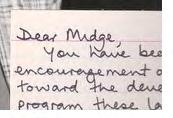




Hilary Aimers, French
Jan White, Physical Education
Aileen Whelgan, Art
Polly Peterson, Art
Ginger McCracken Luce, Strings
Lisa Parker, Orff Music
Midge in Orff class with child playing one of the xylophones.
Music in the Lower School. In the 1970's I was introduced to German composer, Carl Orff, and his music education program for young children. Orff had been director of music at the Gunther School ofGymnastics, Music and Dance in Munich from 1924 until his death in 1982. His book Music for Children was a truly new and ground-breaking approach to music education. His "orchestra" of simple instruments: recorders, drums, strings, and a whole range of xylophones, enabled young children to create and perform music-folk tunes, rhymes and rhythms--without spending years to develop skill on an instrument Gertrud Orff, a dance and music therapist, was married to Orff from 1939-1953 and was very involved in the creation of this program. Eleanor Siegl, Director of Little School, brought Gertrud to Seattle for a series of workshops while I was teaching in the pre-school there. Working with Gertrud was an inspiration and I am proud that a few years later, Bush was among the first to introduce the OrffSchulwerk curriculum to Seattle in our Lower School.
Kate Grieshaber. We were very fortunate to attract Kate to Bush in 1975 just as we were forming the program. She was talented, experienced in the Orff program, and totally committed to this form of music education. Initially, she and I shared some of the teaching. Later Ann Palmason and Lisa Parker joined Kate in growing the Orff program. Kate went on to become recognized as a national authority on Orff.

Kate Grieshaber

One of our main goals in the Lower School was to give parents insight into the workings of their children's minds-how cognition develops over time. The idea of Friday Letters arose to provide a sense of what was happening in the classroom in order to understand how curriculum is actually lived, to encourage follow-up conversations at home and to combat the Where did you go? Out. What did you do? Nothing syndrome. Friday letters were not Puritanical directives for homework but, rather, invitations to bring the delight of learning home-to give parents and their children an opportunity to discuss in greater depth the ideas and projects introduced in class.
Some of the upper elementary teachers had the students write the letters---a good way to help kids process in an orderly fashion the information they were getting each week. But in the earlier grades, the teachers were the correspondents. Over the years, I noted that the letters were treasures of information about how each grade was evolving-not just in curriculum and activities, but in attitudes toward learning that encompassed the family, the community, and the world.
Regrettably, I was unable to find many extant copies from the teachers I contacted so the following examples from Second Grade will have to suffice. I know that this kind of casual communication was very much enjoyed by the parents. I hope it has continued.
Dr. Bakken in the Primazy
Second Grade February 2, 1979
Dear Parents,
This week began with an interesting presentation at Monday Morning Meeting on nutrition by the 4th Grade. Examples of foods which are worth eating versus junk foods were shown as well as some "taste challenges" for soups, breads, etc. It was not too soon after breakfast for many of us to be very happy indeed to accept these snacks! Yum!
No new 'families of facts' for next week! We will be reviewing the 8's, 9's, 1O's, 11 's and 12's. We've been working on carrying too. The specific skills booklets which are coming home are for extra work done voluntarily-not required. No pressure needed. They have been brought home as a free choice.
We had a marvelous event in our class today! Dr. Aimee Bakken, (mother of Sarah in grade 3) brought us some frog eggs-in the frog! We watched the mother lay them before our very eyes and heard Dr Bakken discuss how eggs develop for all sorts of creatures--frogs, chickens and humans! It was fascinating!
We will be able to watch these eggs grow into tadpoles and then into frogs. While the frog and her eggs made an exciting focus for this lesson, Dr. Bakken with her loving respect for all life, gave us a sense of intangible yet very palpable valuing of what we are all really here to learn. Her understanding and joy seemed to pervade the attitude growing in the children. Heartfelt thanks from all ofus.
We started studying Vincent Van Gogh-a little about his life as a painter and a lot about the paintings themselves. He spent much time as a boy studying the work of great artists in museums near his home finally developing his own style using bold colors, large brush strokes, lines which formed not only the outlines of his figures but the shape of the figures as well. Sometimes he used bunches of dots or blobs very carefully so every little blob contributed something special to make the picture come alive! Many ofus have been trying out different techniques which we observed in Vincent's pictures. That's why the Art Area clean-up crew deserves special honorable mention this week!
Have a great weekend!
Note: The letter on the previous page refers to the above painting by Matti Aimers (age 7) in response to Van Gogh painting of wheat fields in the small inset, upper left. Young children, particularly before they are verbally adept in reading, writing and speaking, find the arts to be their natural vehicles of communication. But the arts also teach the skills of close observation in detail and organization. The art corner in Primary Unit was always open for children to come and work on projects in their free time. In these days when some parents structure every discretionary moment, for fear that their children will waste time, the Lower School has remained faithful to the belief that, given a safe and positive environment, children would make appropriate choices.
Over the years, the children studied the styles of famous artists and then created works of their own using those styles.They studied Seurat (Pointillism), Cezanne (Cubism), Monet (Impressionism) and exhibited their work alongside posters of the artist's work. One week, John brought a large book showing Michelangelo's Sistine Chapel ceiling and began to paint his own version. When art time was over, he stayed Reading time began and still he stayed. The teacher called him several times to leave his picture with no success. Finally he asked, "Well is this important or isn't itr I have never forgotten his question. Who are we to decide which areas of study are subordinate to others?
Second Grade, February 23, 1979
Dear Parents:
We have been interviewing each other! We realized that even though we all go to school together every day, many of us do not see each other after school. Some of us never really find time to talk to each other and find out special interests we may have in common. The interviews have been fun and helpful in getting better acquainted with each other.
This morning Stephen Egnor's father, who teaches science in Upper School, brought us a machine that helped us see in miniature what will be happening on Monday morning during the eclipse. He talked to us very seriously about not ever looking directly at the sun. He showed us how to use sun peeps and gave us plans for building viewing boxes. A copy of the plan is enclosed so you can make one at home if you wish.
A large mural showing the eclipse was done by Holly, Marissa, Kathy, Courtenay, Jaimee and Katie. It was so good, Mrs. Warber put it up on the bulletin board in the Lower School hall with her own eclipse picture and information. Congratulations, Eclipse Committee!
Mrs. Loper came in for our library story this morning and told about the Ojibway legend that during an eclipse, the sun was being extinguished. They shot arrows into the air hoping to rekindle its expiring light.
We wrote stories while listening to Tchaikovsky's 1812 Overture with some wonderful results.
Mrs Thomas (5th grade) and Mrs. Aimers (French) are starting a baby-care activity for grades 3-5 and would welcome visits from any babies a year old or younger whose mothers would be willing to bring them to school on a Tuesday or Thursday anytime between 2:30 and 3:30. Please let Mrs. Smith in the office know if you can oblige!
We hope to see you at the Bush Auction tomorrow night! Happy weekend!
The Arts at Bush
During much of my early tenure at Bush, I continued to teach dance and chorus in both Upper and Lower School. The art and drama departments were always better staffed with larger curricular offerings and an impressive artist/faculty who were making their own mark in the world. I don't feel qualified to describe them or their programs other than to say that, over the years, we have been truly fortunate to have attracted such impressive professional artist/teachers to our midst.
Les: I remember Dennis Evans and Bill Baber collaborating on the Sophocles' Oedipus Rex in the courtyard across the street around the Art building. They used the theme of-I think it was Sophocles- but I'm not remembering exactly. Anyway they adapted a Space theme, and they had rocket ships and everything going on. And it was amazing. It was so different, from any typical high school play. It was intellectual and emotional and just neat-another high point for me for sure.
Midge: As for music, what does one do when the student is more talented than the teacher? How did Mozart's or Beethoven's teachers feel? John Fiore came to us through Seattle Opera Director, Henry Holt, who wanted him to have a high school education that included languages, history and literature before embarking on his career which promised to be a big one.
With John and me it was as if the teacher/student relationship had been reversed. Playing a twopiano version of Stravinsky's Rite of Spring with him was like getting behind the wheel of a Mercedes Benz at 100 miles an hour.
Michael Hurshell was an equal pleasure. I accompanied him in a piano concerto for his senior Baccalaureate program. Les remembers walking past a classroom and seeing Michael and John writing on the blackboard. He asked what they were doing and they replied they were writing out the libretto of Wagner's opera, Parsifal, in English!
Both John and Michael have gone on to world-wide reputations as conductors, mostly in Europe. Michael is very well-known in Germany for his research and performance of Jewish composers, many of them lost during the Holocaust. John has made his name in opera. Both were musical wunderkinds and their presence at Bush was a gift.

1975. Once there were enough male students, we branched out into larger choral works. Purcell's Come Ye Sons ofArt for mixed chorus, strings and harpsichord was our greatest success.

Christmas programs were a big performance opportunity. From left in robes: Corrie Duryee, Michael Hurshell, Jeff Smith with David Bowman reinforcing the bass section. Ann Lippman speaking with me.
Another rehearsal. Joanne Furman? 2nd from left, Faculty: Phillip Rohrbaugh with beard. Margaret Judson visible to his left.



My musical studies at Pomona and Yale and my dance performances with Martha Nishitani in Seattle, deepened my work with students at Bush. I especially enjoyed the mutual creative work with Upper School girls in Dance. In one project, we focused on experimenting with their own choreography based on different premises: Haiku poetry, famous paintings, Platonic Solids they were studying in math. One class (above) used zinc ointment to create face masks to exemplify a character in movement. Meg Tocantins showing her work. Alden Garrett seated on far left.
In 1969 and 1970. I choreographed two large pieces based classical music.
1969. The Four Temperaments (Theme and Four Variations)............ Paul Hindemith
The Dance Group Midge Bowman, Choreographer
Note: According to an ancient theory (and in Shakespeare's time) there are four principal humors (liquids) in the body: phlegm, blood, choler (yellow bile) and black bile. When one of these predominates, it determines the temper of the mind and body; hence the expressions: sanguine, choleric, phlegmatic and melancholic. Paul Hindemith composed the music for The Four Temperaments in 1940. He divided the work into five sections: a theme and four variations, each of which portrays musically one of the four humors.
1970. Gian Carlo Menotti 's Madrigal Fable. (See next page.) We did performances at Bush and at Lakeside.
THE UNICORN, THE GORGON AND THE MANTICORE
A Madrigal Fable by
Gian Carlo Menotti, Choreography by Midge Bowman
The Poet ...............................
Jeri Cunningham
The Unicom ............................. Pam Jones
The Gorgon ............................. Becky Rawson
The Manticore ........................... Laura MacColl
The Countess ............................ Meg Tocantins
The Count .............................. Karen Jenkins
The Mayor .............................. Julie Udhus
The Mayor's Wife ........................ Robin Bedell
The Doctor
Laura Santi
The Doctor's Wife ........................ Alden Garrett
The Townspeople
Carol Foxworth, Zimmie Caner, Alice Flanagan, Migs Schuchart, Janna Fickenworth, Julia Weaver, Debbie LaZerte, Sheri Stephens
Lights and Props ........................
Leah Halpern, Helen Anderson
Grateful acknowledgment to Eighth Grade for help in making the animal masks and puppets.
The fable concerns a poet who shuns the prosaic life of his town and is in turn ridiculed by the people. He captures and tames a unicorn. The townspeople are shocked and ridicule him, but the Countess decides it would be fashionable to own a unicorn and coaxes her husband to buy her one. Soon every respectable person is seen parading a unicorn. The poet later appears with gorgon and later a manticore. The people assume each time that the poet has killed his animals and they do the same in an attempt to keep up with the fashion. Finally they decide to storm the poet's castle and bring him to justice for his crimes. They find the poet dying, surrounded by his animals. The poet addresses the people:
Oh foolish people, who feign to feel what other men have suffered. You, not I, are the indifferent killers of the poet's dreams. How could I destroy the pain-wrought children of my fancy? What would my life have been without their faithful and harmonious company? (He embraces each of his animals in turn)
Farewell, farewell. Equally well I loved you all, although the world may not suspect it. All remains intact within the poet's heart.
Farewell, farewell. Not even death I fear as in your arms I die. Farewell, farewell.

Unicorn cast pictured in some of the marvelous costumes designed and created over the years by Housemother, Louella Bodman. Our costume collection was so fine that many smaller theater companies rented them. The only dancers I can identify above are from left: Julie UdhusJ Alden Garrett, Laura Santi? Karen Jenkins? and Robin Bedell.

The Prince with Virgin. Gorgon and Unicom. Papier mache heads created by 8th grade artists. No photo of Manticore, unfortunately. Seep. 32 for the version I wore in the UW version.
Below: Lower School children


During my years at Bush there were three all-school productions involving faculty and students of all ages. Since we had no theater at the time, all performances were in the gym. Our first production coincided with the amval of several very talented Upper School students: singers, Gretchen Steffy and Margaret Judson, and pianists, Michael Hurshell and John Fiore.
We were also blessed with a community of parents and faculty with experience in professional theater. Both Joegil Lundquist and Sally Pritchard directed many productions over the years but to my knowledge there have been only three all-school productions and these were in the 1970s. The Little Sweep, was our first K-12 production. Les was very supportive of yet another new idea being introduced!
Above: Faculty, Harvey Sad.is & Tom Highsmith as Chimney Sweeps
1975 The Little Sweep, A Chamber Opera by Benjamin Britten



With Headmaster Les Larsen as the Coachman, other faculty and students playing various roles, scenery built by the students, costumes with the help of parent volunteers-the structure of future productions was forming. Above, Les (in top hat) and David Douglas, 5th grade, struggle with a trunk. Les remembers Shirley Loper working with him "to make sure I said my lines right and not backwards or something."
Gretchen Steffy: Rowan (Nursemaid) Shirley Loper: Miss Baggott (Housekeeper)

1976 Peter Pan was directed by second grade teacher and Bush parent, Joegil Lundquist. With the help of Peter Foy, who flew Mary Martin in the Broadway production, we brought Broadway to the Bush gym. I think J. M. Barrie would have loved the fact that our lost children and pirates were the same age as children who, over the years, have read the story. Above Joegil, Peter Foy and me; below Marilyn Warber and David Douglas as Mr. and Mrs. Darling. Crocodile: Margaret Luk.off.

Above: Peter flies in to find Mrs. Darling and Wendy: Jennie Kelso. Below: Darling children, John: David Overy, Michael: Michael Copeland, and Wendy.
Above: Lost Boys at Wendy's house. Capt Hook, (Mark Hale, Third Grade faculty) with Pirates spying above. Below: Boys showing Wendy the house they built out oflogs.

Aboard the Pirate ship
The King and I, May 1978. As far as I know, this was the final all-school production. Again, there were many children from the Lower School, but this time, major roles were taken by Upper School students and some faculty. Being such a popular musical, the audience knew all the songs and I remember seeing parents' lips moving along with the score!

Act I. Arrival in Bangkok. Anna: Megan Bowman and her son, Louis: Chris Ferris with Captain Orton: Steve Belvin. Opposite: Louis meets Prince Chulalongkom: Patrick Chin
Lady Tien: Shirley Loper introduces Anna to the Court wives.

Above: King Chulalongkom: Jeff Smith
Below (left) Royal children, Jenny Bornstein (L) and Nichola Furman (R), enter to welcome their new teacher. Below (right): Tuptim: Margaret Judson with Lun Tha: Bruce Campbell.

The Small House of Uncle Thomas sequence involved Lower School dancers and chorus. Above (left) Buddha: paraplegic, Dylan Young, tied onto a chair with Heather Black (L) and Shannon Moon (R). Above (right) Simon Legree: Rachel Meyer. Below: Buddha has sent an Angel: Lisette Womack (right), to urge Eliza: Lisa Finch(in red) to cross the river to safety.

Shall We Dance?
When John played the waltz scene, it was like having a 100 person orchestra in the gym. In that moment, the school became a community of souls where creativity was the breath of life and imagination reigned. Without benefit of TY, movies or rock festivals, we made our own magic.
Final Scene: Lady Tien, the King and Anna
Above: John Fiore, piano and Chris Monroe, percussion. Below (left): Jan White with helper, Adina Meyer, in costume as Guard. Below (right): Sally Pritchard applying makeup with Tuptim, Margaret Judson.
Dear Midge: Thank you for a wonderful King and I. (Child's name) participation was such an expanding experience. He was so enthused! The discipline of rehearsals and the opportunity to work with students of all ages has such special rewards. A bonus for him has been the fun of trying to play many of the songs on his cello! We hope future productions will involve as many students as possible for the rewards are so many for each participant.
Sincerely, Parent
Moral Development
"We are a small school, not widely known in the world at large, but ifwe can continue to define and live our commitment to a humane environment that nurtures the potential in young children - both their minds and their hearts- then our purpose takes on larger dimensions and our influence, qualitatively, will not be small."
From my letter to Lower School parents, August 1973
After Westtown, it was important to me that we include some form of character education as well as intellectual development in the curriculum. Les Larsen's background as an ordained minister and my own interest in teaching values coincided with a movement in the 1970's called "moral education." The 60's had been a time of debunking and throwing out what were seen as irrelevant or outmoded traditions and many of us in education were concerned about the values vacuum that had been created.
The faculty and I used the cognitive development theories of Jean Piaget in our classrooms. Now I found Piaget's theories had also been applied in the moral domain by Jerome Kohlberg, Carol Gilligan and James Fowler. I attended a summer course taught by Fowler at Harvard.
In the Lower School we used Viola Spolin's Theater Games in the Classroom and worked with the children on what was called "values clarification." Morning Meeting, a weekly gathering of the whole Lower School, also offered a wide range of programs about values.
Inside/Out was an excellent program on the local public television channel for several years. Each segment told a story with a "dilemma." Something happened that would need a resolution, but the story stopped before the ending. The purpose of the class was to talk about how the characters in the story might resolve the problem. This trained us all in how to consider situations that arose on the playground or in class in a similar way. An unexpected gift was that student's discussion of issues involving the environment, disappearing species, waste and sustainability, began to include a moral dimension. The crucial thing was to learn to talk about issues and listen to others. I often felt we adults were learning right alongside the children. Our whole society could benefit from this technique.
Examples of Bush as a Moral Community
Moral Leadership. Nowhere was our commitment to being a community clearer than when tragic events struck anyone in our school family. We responded by finding ways to bring the whole school-faculty, students and their families-together for support, healing and learning. Both Les' parents were deaf. As an infant, his mother slept with her hand on his cradle so she would know ifhe cried. As a child, he learned sign language. The last few years of her life, his mother lived with Les and Nancy on campus. Her funeral took place at Epiphany Church and Les did the whole service in sign language. It was a very moving learning experience for all ofus in the school community.
The Goldmark family. In his 2023 interview, Les spoke about the situation in Seattle in the 1980s:
These were some very rough times. People were losing their homes and suffering ...no money for tuition, just simply helping people get through. And the fact that we were in the city, I mean, it makes it even more important to realize what a stabilizing influence we were just being there as a school. Around this time, a Bush family was threatened by a gang coming from California so we had to invoke security throughout the school without letting anyone know.
But our most difficult experience was the murder of the Goldmark family on Christmas Eve, 1985. Twelve year-old Derek and ten year-old Colin were students at Bush. It was a hate crime because the intruder thought they were Jewish. I won't go into details, but not all four died at once. W e suffered through the other two dying slowly and everybody was really upset. It was a perhaps my most difficult time at Bush.
Note: Later two scholarships were created in honor of the Goldmark children.
Tanya Stasuk. Tanya and her sister, Larissa, were students in the Lower School. Tanya was diagnosed with cancer when she was in fourth grade. Coincidently, her physician was also a Bush parent with a child in the same grade. Tanya stayed in school as long as possible, then kept in touch with her teachers and classmates by email, continuing her studies at home. Near the end, Marilyn Warber and I visited her and her family in their home. It felt as though this nearness and support were the natural outgrowth of what we and our families had been learning as a community.
When Tanya died in November 1980, it was very difficult for her classmates, most of whom had never experienced the loss of someone close to them. Again Les and the Bush community came together to celebrate her short life. That spring, we used the values curriculum to work with the children on dealing with loss. Tanya had particularly loved playing with the pet rabbit that lived in the school courtyard, so a sculpture of a rabbit in Tanya's memory was commissioned. Bess Temple, a Bush parent and former Bush Trustee, was chosen. Tanya's rabbit sat in the Livengood Library until that building was tom down. It now sits in the Lower School Library.
The Kitchell Lectures. When I was Head of the Upper School, Sally Kitchell '68, recently returned from her home in France, called me and volunteered to assist with French classes. I was overjoyed to have her back at the school. What I did not know at the time was that she had returned to Seattle because she was terminally ill. That fact became evident as she endured rounds of chemotherapy, but continued to teach with a passionate intensity that was an inspiration. Two days before she died, she called me from the hospital asking if I would come down to pick up the papers she had corrected for the kids. I went and saw what deep satisfaction this work had given her at a time when she had little else. She remains in my memory as an example of how the dedication to teaching becomes a source of meaning in one's life. The Kitchell Lectures are in honor of her memory.
Tanya Stasuk (L) and Bess Temple, with her rabbit (R)

Cunningham House
Her senior year, Jerilee Cunningham danced the role of Jesus in my choreography of numbers from Jesus Christ Superstar for the Spring Fine Arts Festival in the gym. It was late afternoon and, quite unexpectedly, the sun cast the shadow of a cross behind her. Everyone thought I had planned it, but it was simply one of those mysteries that can happen in the arts.
None of us could know then that, a year later, in the autumn of 1971, Jerilee would lose her life in a fall from a mountainside during her Freshman year in college.The whole school was devastated. Jerilee was an only child and her parents had no church affiliation so Les gave the sermon at the funeral home and the Glee Club sang. The Carriage House was later named for her. It became a cherished spot for classes, seminars and plays. In her memory, Meta O'Crotty lovingly kept the window boxes filled with fresh plants each Spring. The building was razed in 1999 to make space for the construction ofWissner Hall.
Over the years, some parents responded to our efforts:
Dear Les Larsen and Midge Bowman,
February 21, 1974
I have really appreciated the energies and perceptions conveyed by the written reports on my two children. The comments and appraisals were in all cases so succinct and concerned that I felt overjoyed that the children's abilities and interests were being nurtured in the most humane of intellectual climates.
It may be possible that a number of parents understandably feel a desperate need to view the education of their children as a finite, measurable and marketable product, without hesitating to consider exactly how debilitating it might be to the human spirit to alphabetize into only five blocks any measurements of real personal growth and explorations of the mind.
Thank you both and your teachers in the Lower School for acting on beliefs that the way to discovering what it means to be truly human is not paved by prefabricated, pre-arranged markers and consumer indices.
Mr. Larsen, these teachers ARE indeed doing this (to glean your thoughts from your recent letter) and I fully support their efforts to enlarge all our worlds.
Sincerely, Mrs. R. M.
December 1, 1980
Dear Midge:
Thank you for your message in the December newsletter! Life can be a difficult experience at times and it takes a constant positive attitude in order to set a good example for our children.
The only answer that makes sense about our journey is to place our trust in God's goodness and mercy. I am so thankful my son is entrusted to the care of the wonderful Bush family.
Happy holidays, (Mr. B. M.)
Note concerning the Seattle Times article over the next two pages: In 1978 Bush joined the Network of Complimentary Schools, a national alliance of independent and public high schools, offering six-week exchanges during the school year. Les asked me to lead it. I was still Director of the Lower School but created a program in the arts involving several local arts organizations including Seattle Opera, Seattle Symphony and lntiman Theater.
Ne w arts-e x change progr
1magme sending a talented Seattle high-school student to Beverly Hills for a six-week course in filmmaking. Or to New York, to find out how Broadway shows are produced. Or to Washington D.C., to intern with The Washington Posr.
These dreams are coming true for high-school students in the National Network of Complementary Schools, a cooperative alliance of 30 private and public schools across the nation. Instead of sending the students to Europe on expensive exchange residencies, the Network is giving them a chance
Music
fflelinda Borgreen
Times staff reporter
to find out what other American schools have to offer.
The newest member of the Network is Seattle's Bush School, which has already brought students from Florida, Massachusetts and Virginia to Seattle to work with the Empty Space, First Chamber Dance Company, and the Seattle Opera.
The Bush School's current visitor, Pam Sebestyen, has participated behind the scenes in Seattle Opera's recent production of "Macbeth." She attended the rehearsals, learned about makeup and costuming, watched the chorus, the l ightfi,g director and the stagehands in action, and talked at l ength wi th the performers.
THE BUSH SC HOOL joined the Network last year, as the last participant in a closed membership of 30 In order to join, the school had to prove i t offered a program not available to any of the other Network school s across the country. Because of a strong commitment to Seattle arts by Les Larsen, the headmaster, the focus of the Bush School's program is the
Mid ge (Mrs. Davi d ) Bowman, left, disc usses a musical score with Pa m Sebestyen, a visi ti ng studn t fro m Virginia.
- Staff photo by Bruce Mc K im.
performing arts. The school offers visiting students the opportunity of concentrated study and production experience with a growing list of Seattle arts organizations (which now includes the Seattle Symphony and the Intiman Theater, in addition to those listed
above, and will soon include several more).
Network students have more than just the opportunity to gain practical experience in various comers of the country: they can also experience both private and public schools, and can make
r:,m reaps big rewards
some realistic discoveries about what they'd like to do with their lives - before they commit to a career choice in college.
THE COORDINATOR of the Network program at Bush School is Midge (Mrs. David) Bowman, a woman of enthusiasm and insight.
"We've had such a warm reception from the Seattle arts community," she explained. "Everyone seems anxious to work with our students and help them gain experience. No institution we've approached, in fact, has turned us down.
"We've been able to get kids out of the audience and into the process of performance. They learn about the arts, and they also learn about people and possibilities in different parts of the country.
"One of the best things about the Network program is that it's virtually cost-free. The visiting students stay with local families, and they can apply for grants from the Reader's Digest Foundation for transportation."
Pam Sebestyen, the Virginia student who interned with Seattle Opera, earned her round-trip plane ticket by giving piano lessons, tutoring, and even painting a house.
"I wasn't interested in opera at all before I came," she said, "just in musical comedy. But Seattle Opera really changed my mind. This exper:nce has helped me become a lot more directed and realistic about my career goals, and it's helped me assess the career possibilities in the arts."
STUDENTS INTERNING with Seattle arts organizations soon learn about the hard work and low pay behind the romantic careers of opera, dance, theater and concerts.
"Henry Holt, the Seattle Opera conductor, told me, 'If you can live without being a performer, don't become one.' I soon saw why. It's an immense amount of work. and very competitive. 1 also discovered, though, that there are
satisfying arts-related careers aside from performing on the stage. And I found out how to get a start in training for those careers."
The student is responsible for structuring his or her residency , with coopration from the host school and the participating arts agency. Ms. Sebestyen had the help of Ms. Bowman, Bush's J'ietwork coordinator, and J oAnn

returns tomorrow
Mnashe, Seattle Opera's education director. Since the final performance of "lVIacbeth," Ms. Sebestyen has worked with the Bill Evans Dane Company, taking classes in mime, tap, and modem dance.
"I'm also taking a chemistry class at the Bush School," she added. "When I get home, I'm going to be really behind in my studies, but it has been more than worth it."
a Paul Verhoeven film
Rutger Hauer • Edward Fox • Susan Penhaligon
Memorandum to: The Bush School Staff
From: Les Larsen
Date: January 14, 1980
Last Friday afternoon, Midge Bowman announced her resignation as the Lower School Head to the Lower School faculty. Midge has led the Lower School for eleven years, and has given much creative leadership and a great deal of depth to its program. She has seen the growth of the Lower School from about 110 student to its present number of 200.
I have asked Midge to undertake new leadership in the life of the school. Next year she will bear teaching and administrative responsibilities that will be consistent with her interests and a fuller development of the total school. I will announce a fuller description of her position in the near future.
To replace Midge, I have asked the Lower School to devote a number of faculty sessions to enumerate their priorities as a total faculty, so that their priorities and those of the total school well be reflected in our choice to lead the Lower School.
It is expected that we will bring candidates to school, and I anticipate they will be seen by the Lower School faculty members, department chairmen as possible, and division administrators.
I, of course, will make the final choice after consultation with Lower School faculty and input of other department and division directors.
Loss of a person in one area can be a very creative experience for many other areas. I hope we will all give this selection process our fullest thought. Anyone who knows of a candidate please inform me as soon as possible. We are commencing a broad, nation-wide request for candidates today.
Note: The change was announced in the school newspaper in February. Bush 5th grade teacher, David Douglas, was named as my replacement. As I remember, no other candidates ever appeared to be interviewed. There is no question that my years as Director of the Lower School were the happiest of my professional career.
Bowman Named Associate Head
The . change will allow both Bowman and Larsen to do more teaching. Bowman will be teaching, U.S. classes, probably in the arts, and Larsen hopes to teach U.S. science. The new arrang~ment lets each spend more time doing what each does best.
BEEZER Midge Bowman
by Allison Beezer
Both Midge Bowman, Lower School director, and Les L~rsen, headmaster, are excited about Bowman's upcoming switch in the administration. Starting next year she will be working with Larsen to handle a job that has grown too big for just one person. Her duties as associate head will entail primarily taking over some of Larsen's development work, expanding the current summer education program and publishing a teacher's trade journal featuring Bush - but allowing other teachers to submit material also.
"I've peen thinking about the switch for a long time - I really love this place,'' Bowman said, but added, "it's time for new blood."
As L.S. director, Bowman has made a number of changes in her 11year tenure. She feels the biggest changes have been instituting team- • teaching (two teachers teaching a large class of children), and putting an emphasis on children's creativity - specifically through the arts. Clearly Bowman has been successful as she has doubled L.S. enrollment since she started working at Bush. Bowman will take over the Bush summer program, in whiclr she will implement two major changes. First, workshops on teaching will be offered for teachers from Bush and other schools around the country. Second, the program will be expanded to use more fully all of the facilities, particularly the computer and the arts. It will be called the Bush Institute.
The journal she initjates will be sold to other schools and will have features on such topics as computer literacy and Bush's unique bicycle trips.
Bowman will also work evaluating the faculty and getting them to conferences on education. She may also set up a humanities program in the Upper School that would combine courses in history and English. Her replacement has not been selected.
Bowman is a Bush graduate and recipient of the senior plaque in 1951.
ALLISON
Dear Lower School parents,
When I was a student at Pomona College, Mortar Board sponsored a faculty series entitled, "Last Lectures." Professors were invited to distill the wisdom gained through his/her experiences at Pomona. For me, this will serve as my "Last Letter" to you, summing up what my eleven years in the Lower School have taught me.
I leave with the certain knowledge that there is a process in education and in life. The forces that impel us toward health, growth and wisdom, are powerful and affect all forms of life. Throughout history, discoveries in the arts and sciences have given evidence of an orderly universe. Piaget in developmental psychology showed us that human beings learn in a predictable and orderly way. Darwin and Teilhard de Chardin in science and religion agreed that evolution proceeds purposefully.
Recent research into the two hemispheres of the brain suggests that, in order to fully utilize our inborn talents, both sides of the brain must be trained. Too often we limit discussions of learning to the basic skills of reading, writing and computing without realizing that they are of value only if they ultimately lead us to explore the real question: "Who are we and why are we here?" The task of education is to work with the process and clear away whatever obstructs our sense of purpose or convinces us that we are insignificant in the great scheme of things. This is where the role of teachers and parents becomes crucially important.
I have always known that children are our most beautiful and valuable resource and my years in the Lower School have only reinforced my belief. This is not to say that children are perfect or that we need only step back and watch them grow. Our job is to be models of self-discipline and love. To quote Dr. M. Scott Peck in his recent book, The Road Less Traveled:
If a child sees his parents day in and day out behaving with self-discipline, restraint, dignity and a capacity to order their own lives, the the child will come to feel in the deepest fibers of his being that this is the way to live. Yet even more than role modeling is love. Not infrequently parents who are professional people----doctors, lawyers, club
women, philanthropists-who lead lives of strict orderliness and decorum, but lack love, send children into the world who are as undisciplined and destructive and disorganized as any child from an impoverished and chaotic home. Ultimately love is everything.
When one steps back for a broader perspective, an institution like Bush assumes a different role. Beyond the changes and refinements in curriculum, beyond aspirations for innovation, what emerges is a central idea: a commitment to value the uniqueness of each life. This should underlie all we do as parents and as teachers. An institution is hope made actual.
Life is a great adventure. Once we decide to work with the processes for growth, we become aware of a vast network of positive resources: people, experiences, communities, institutions. In a speech delivered at Columbia University in 1954, theoretical physicist, J. Robert Oppenheimer, spoke to this same issue:
This cannot be an easy life. We shall have a rugged time of it to keep our minds open and to keep them deep, to keep our sense of beauty and our ability to create it, and our occasional ability to see it in places remote and strange and unfamiliar. We shall have a rugged time of it, all of us, in keeping these gardens in our villages, in keeping open the manifold, intricate, casual paths, to keep them flourishing in a great, open, windy world; but this, as I see it, is the condition of man and in this condition we can help because we can love one another.
The parents, teachers and children in the Lower School have formed a network of caring, support, enrichment and learning. Though our paths may seem now to diverge, the essence of our relationships will remain. I am deeply grateful.
Midge Bowman April 1980
BUSH SUMMER SCHOOL
June 16 - August 12, 1980
THE BUSH SCHOOL SUMMER INSTITUTE
Two Concurrent Math Workshops:
COMPUTER LITERACY..!!!_ THE ELEMENTARY SCHOOL and IMPROVING SPATIAL ABILITIES
Session I: July 13- 18, 1980
Session II: July 20-25, 1980
IT'S THE FIRST SUMMER OF A NEW DECADE!
THE BUSH SCHOOL 405 - 36th Avenue East Seatt l e, Washington 98112
The summer of 1980, I created the first Bush Summer School, the first Summer Institute for Faculty, and wrote a chronological summary of Board of Trustees decisions. In September, I introduced myself to the whole faculty in a letter as Associate Head (pp. 120- 121).
Unidentified man Qeft), Matt Jenkins, me and Les at Bush on Harrison Street
During this time I worked closely with Les and Director of Development, Heidi Jensen Rabel'S7, on a facilities master plan that envisioned the construction ofBenaroya theater, Schuchart gym, a remodeled entrance courtyard and an Art building extension. Al Bumgardner, the architect with whom we worked, said the campus reminded him of an Italian hill town, full of surprising vistas and courtyards hidden behind residential facades, progressing from the Lower School up to Gracemont.
If Bush is a hill town, it is also an urban oasis. I remember so many late afternoons at my desk in the Upper School, watching the sun slant over the courtyard lawn. The Fourth grade resident rabbit would sneak out to chew on the tulips and kids would be sitting on the benches or under the trees. It remains for me an image of our school as a place of beauty and sanctuary.
Associate Head Speech
All-School Faculty Meeting, September 1980
Perhaps because it is the beginning of a new job for me and the beginning of a new decade in the life of the school, I feel an emerging sense of direction and dedication about this place. For new faculty-and there are many of you-Bush has been exceptionally prolific in creating and implementing new programs the past few years. I think there are no major ideas in education that have not been explored: the Integrated Day, open education, team teaching, experiential education, values clarification, the research of Piaget, Kohlberg, Heath, and Erickson, modular scheduling, wilderness, computer literacy, sports physiology, manipulatives in math, process drama, role-playing, and simulation games. Many faculty have been recognized for innovative methods of teaching. Through it all, the message we espouse is excellence in academics, a rich diet of experiential subjects and an environment that allows each student to discover and fulfill his/her potential.
I have thought a lot about the final part of that message: fulfill one's potential. For what? College admission? A good job? Happiness? Creativity? Security? Many of the answers seem quite narrowly selfish to me and perhaps to the kids as well. For all that we offer, I see a number of students who lack motivation, who seem unwilling to play the game, as though the rewards in the end aren't all that appealing.
As my friends in the Lower School know, I am addicted to reading. Since many of you don't always have time, I have devised another method: I read the books and tell you about them. It allows me to fulfill my missionary zeal!
This summer I read Robert Greenleaf's Se-rvant Leadership. It was so thought-provoking that I want to share some of his ideas and, with your help, apply them to our school. Greenleaf's concept of servant leadership seems to offer a way for us to articulate our larger goals as an institution. He says the title came to him after reading Herman Hesse's Journey to the East. In this story we see a band of men on a mythical journey. The central figure of the story is Leo, a servant who does menial chores but also sustains the group with his spirit and his songs. All goes well until Leo disappears. Soon the group falls into disarray and the journey is abandoned. They cannot make it without the servant, Leo.
Years later the narrator discovers the religious Order that had sponsored the journey. There he discovers that Leo was actually the Head of the Order, a great and noble leader, its guiding spirit. "Leo was actually the leader all the time but he was servant first because that was what he was deep down inside."
The rest of the book is an exploration of what servant-leaders would look like in our contemporary society and how their presence could change the institutions and the people they serve. The ultimate test of such leadership would be: Do those served grow as persons? Do they, while being served, become healthier, wiser, freer, more autonomous, more likely themselves to become servant leaders?
The goal of nurturing servant leadership in ourselves and our students would pull many of our programs into a common focus. It would make the school work program into an expression of caring and concern for our buildings and grounds; make Lila's urban internship program a form of community service as well as practical work experience. It would justify the AMP programs for giving kids experiences and skills needed for survival and service in the real world. It would put school-sponsored travel in the light of becoming sensitive to other cultures; learning to tum wilderness trips into laboratories where teamwork and the demands of the environment illuminate the process of leading and following. Nothing would change, but everything would because we would be doing it for a larger purpose that we could communicate to the world. I find that exciting and meaningful. I think kids and parents would too.
Greenleaf believes that currently only schools and churches have the potential for becoming exceptional institutions in which all of the people participating in them (from the janitor to the most esoteric scholar) can realize their potential as persons and as leaders.
This is the context in which I view our commitment to professional growth and teacher evaluation. My task is to serve you in whatever way I can in order for you to become better teachers and more whole as people. I want to share with, support, listen, question and just generally be present to you. I hope to find the same response in you toward your peers and your students. Each of us is on a journey. I feel privileged to share my journey with companions like you.
Midge Bowman
Update on the Travel Program: I found this undated draft letter, probably written around 1980 because it refers to "my new job" as Associate Head and I was still running the Network program that we began in 1979. I assume the letter below was to Upper and Middle School parents:
My new job has given me the opportunity to evolve an overview of the many different kinds of learning experiences currently offered at the Bush School. For many years, we have pioneered the importance of practical applications of abstract concepts. Nowhere is our commitment more clear than in the area of travel whether it is to the San Juan Islands; a Lower School field trip; exploring the greater Seattle area in the Upper School AMP, Seattle Neighborhoods, which Larry Muir and Bob Podkamminer run; a Middle School wilderness trip; or the granddaddy of all trips, the upcoming Seacliste IV with its three- month bicycle tour of France and North Africa next Spring.
The French bike trip used to be our only travel offering, but Bush teachers have really gotten involved and the program is burgeoning. Last Spring, Meta O'Crotty took a group to Greece. At present there are eight Bush students spending the fall trimester in Costa Rica with Spanish teacher, Eugenia Wheelwright, and Latin teacher, Lynn Ennis, is planning a Middle School archeology bike trip through Sicily and Italy next summer.
Closer to home, the Network program continues to place Bush students all over the United States. The program involves selecting a specialized learning situation at one of thirty private or public member schools for periods of three to eight weeks. There is no additional cost other than transportation since students stay with local families. To date we have placed students in Massachusetts, New York City, Washington DC, and this year, the Virgin Islands. Programs range from governmental internships to career exploration for women, anthropology, and history. We have hosted students from Florida, Colorado, Virginia and Massachusetts.
Recently we have become involved in two Sister-city programs: one with Nantes, France and one with Christchurch, New Zealand. It is our hope that we can arrange student exchanges to these countries.
Our purpose in all these opportunities goes beyond a kind of glorified tourism. The responses we are getting from students on these exchanges is impressive. Most of them feel that the experience has changed their lives and certainly their perspectives.
Kate Dyer wrote to Upper School Director, Lila Gordon, from Costa Rica last week: "At break time, I talked with everyone here en spanish and now it's so hard to spell or write in inglish because I really am thinking in Spanish.What a great feeling.We went snake/frog/bat hunting at night and I conquered all sorts of fears of holding bugs, moths, frogs. I took a bunch of pictures of the jungle.. .it's like a scene from Tarzan. I love it...I live in a very poor house.. .lt's incredible. I have such an "awe" feeling when I remember my house. Lord Mrs. G. we are lucky to have what we do ...this whole experience is unquestionably one of the best possible."
Technology is making communication and travel possible with all parts of the globe. Our children will live in what Marshall MacLuhan calls the "Global Village" and Bush students, because of their early experiences, will be able to feel at ease in almost any part of the world.
Midge Bowman, Associate Head

Note from Fred Goode: "What a fine legacy your vision and determination has left Bush, Lila! Forward, or as one student said, "Keep Plugging.""
Upper School Director, Lila Gordon (1978 - 1981)
In my first year as Associate Head, I was pleased to be invited by Fred Goode to be part of a new course, Senior Seminar. It felt as though George Taylor's REAL class* was being reincarnated and I was excited to be included. It was Fred's brainchild but involved faculty from many departments. Fred's hand-written note, so descriptive of his style and intellectual range, follows:
Thanks for help to date. As "advisors" I hope that you will do just that and help in some of the presentations either by getting speakers, films, etc., class presentations or your own. As you can see, this is getting students to know "of'' (not know) and "know about" some areas and ideas and people of the 20th cent. We can't just name every thing and person we "know"-we must select one or two for each "area" or topic. This as a catalyst, a spark for work here and in the future. The core of (6) needs your continued support and input. We are rushed, but it is a start for next year only.
CORE: Bowman, Evans, Goode, Gordon, Lewison, and Rabago. We need especially names of possible UW speakers, community and parents in these areas: readings, films, explanatory documentaries, sources, bibliographies. Applicable for our next year's Seniors. (Must be realistic!) Better to hit a few points each year than to "cover" (smother) another topic area. I have filled in names of those who might help us in the appropriate area-just suggestions-feel free to "move" in or out. IF you will join the Core, please do!
I'll be working through July and most of August on this (besides painting) so will be available. Our individual concerns, i.e. intolerance, prejudice, etc. can be very much part of this structure, esp. "Fall & Winter." The Arts are meant to "illustrate" certain themes or trends: simultaneity, chance, relativity, figure/ground, observer/observed relationships, conjunction of opposites/atonal/discords, etc ... So it's out of the Newtonian world and into the 20th even as late as the '80's.
*See pp. 197 and 206 for references to REAL.
Note: In reviewing this syllabus now decades later, I remember wondering how such a wide range of subject matter, presented in quick succession, could actually have? Judging from student responses on next page, the course was a success. I certainly enjoyed teaching/being part of the class and learned a lot myself!
SENIOR SEMINARS 1980 - 1981
1 - 30 weeks OUTLINE (Proposed)
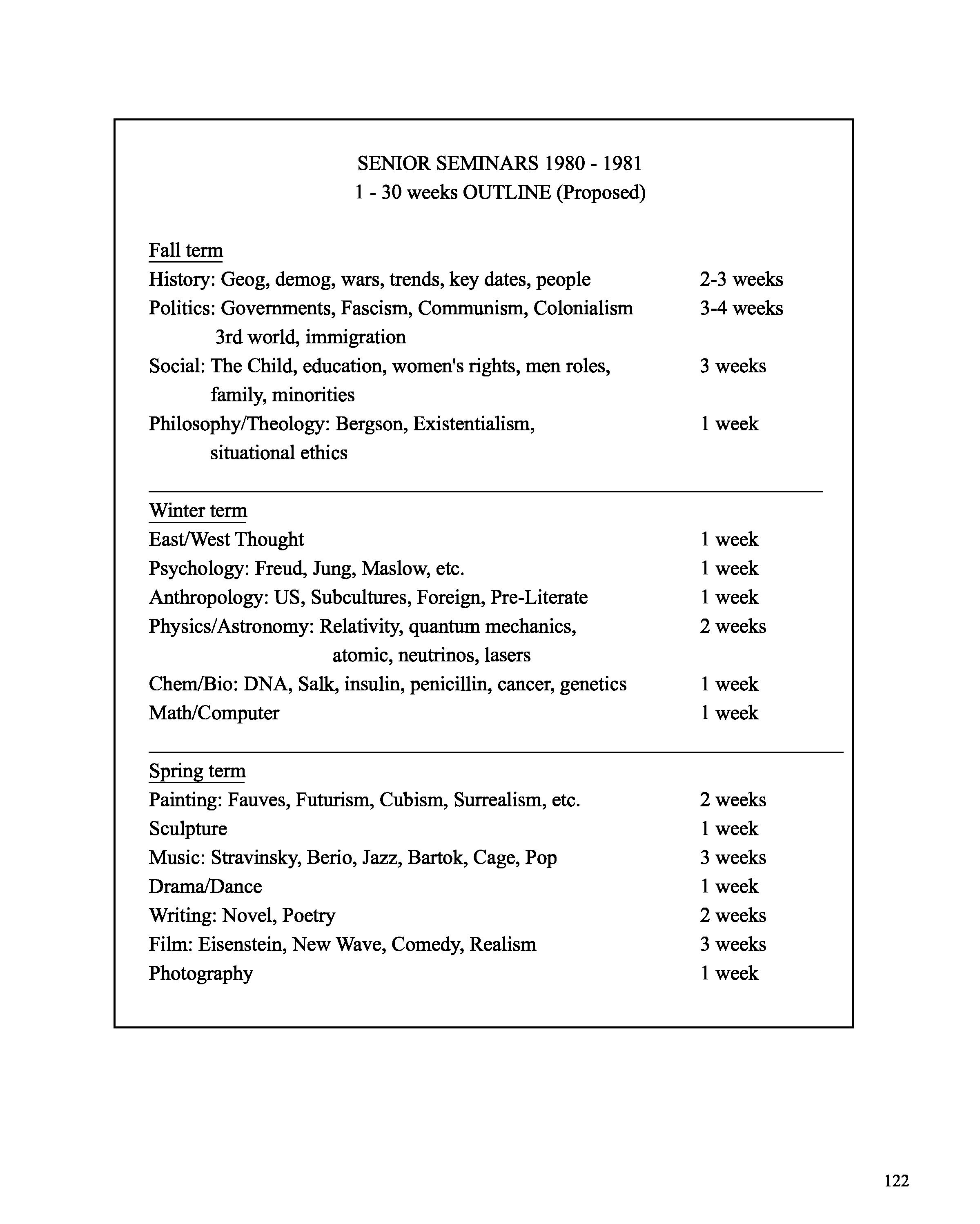
Fall term
History: Geog, demog, wars, trends, key dates, people
Politics: Governments, Fascism, Communism, Colonialism
3rd world, immigration
Social: The Child, education, women's rights, men roles, family, minorities
Philosophy/Theology: Bergson, Existentialism, situational ethics
Winter term
East/West Thought
Psychology: Freud, Jung, Maslow, etc.
Anthropology: US, Subcultures, Foreign, Pre-Literate
Physics/Astronomy: Relativity, quantum mechanics, atomic, neutrinos, lasers
Chem/Bio: DNA, Salk, insulin, penicillin, cancer, genetics
Math/Computer
Spring term
Painting: Fauves, Futurism, Cubism, Surrealism, etc.
Sculpture
Music: Stravinsky, Berio, Jazz, Bartok, Cage, Pop
Drama/Dance
Writing: Novel, Poetry
Film: Eisenstein, New Wave, Comedy, Realism
Photography
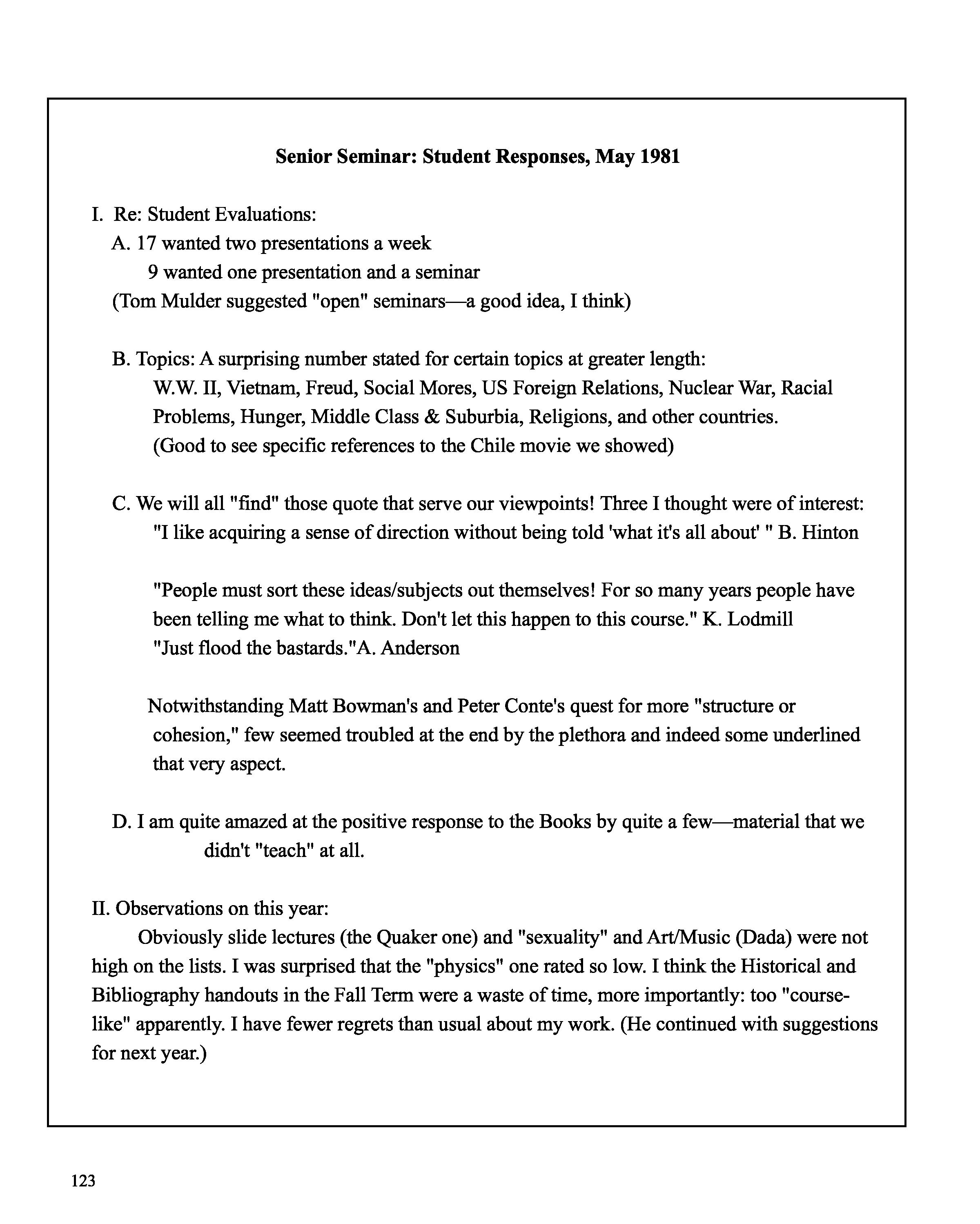
Senior Seminar: Student Responses, May 1981
I. Re: Student Evaluations:
A. 17 wanted two presentations a week 9 wanted one presentation and a seminar (Tom Mulder suggested "open" seminars-a good idea, I think)
B. Topics: A surprising number stated for certain topics at greater length: W.W. II, Vietnam, Freud, Social Mores, US Foreign Relations, Nuclear War, Racial Problems, Hunger, Middle Class & Suburbia, Religions, and other countries. (Good to see specific references to the Chile movie we showed)
C. We will all "find" those quote that serve our viewpoints! Three I thought were of interest: "I like acquiring a sense of direction without being told 'what it's all about' " B. Hinton
"People must sort these ideas/subjects out themselves! For so many years people have been telling me what to think. Don't let this happen to this course." K. Lodmill "Just flood the bastards."A. Anderson
Notwithstanding Matt Bowman's and Peter Conte's quest for more "structure or cohesion," few seemed troubled at the end by the plethora and indeed some underlined that very aspect.
D. I am quite amazed at the positive response to the Books by quite a few-material that we didn't "teach" at all.
II. Observations on this year:
Obviously slide lectures (the Quaker one) and "sexuality" and Art/Music (Dada) were not high on the lists. I was surprised that the "physics" one rated so low. I think the Historical and Bibliography handouts in the Fall Term were a waste of time, more importantly: too "courselike" apparently. I have fewer regrets than usual about my work. (He continued with suggestions for next year.)

Fred Goode and the Teilhard Society
Les: Fred (photo below) was very controversial in a lot of ways. I had to defend a lot of stuff I would never defend in a million years. Fred had founded a school in San Francisco and he was implementing a lot of interesting ideas. He came to lead a trustee retreat and he starts off saying, "I just rode on the worst ferry I ever rode on." He said the ferry was made of plastic and the color scheme was in some capitalistic style. He is talking about the Bainbridge Ferry and standjng in the middle of the home of a man who helped sponsor the ferry! And I thought, "Oh god, where's this going? If you hire him, you've got a whole bag of stuff." Still, I really felt that a lot of people had a bag of stuff that, when it was unveiled, people would responded to if you could control it.
French scientist/priest, Teilhard de Chardin, was a real intellectual hero for me. I even named one of my dogs, Teilhard. In a way, Fred was the inspiration for the Teilhard Society. The idea was to bring together trustees and interested faculty at Gracemont for evening lectures on intellectual and artistic subjects. So then I thought, since the program worked so well with people who were very different, why not try it with kids? So we brought some of our brightest faculty together and they talked from their perspective on a subject, and that was where Senior Seminar came from. Later, we tried it with Sophomore Seminar as well.
Midge: As I remember, Ginger Hunt Luce and I gave a violin-piano recital at one Society meeting. Later I offered a class on meditation.
In December 1980, as had been my practice in the Lower School, I wrote a letter to my new constituents, Upper School parents. I was rehearsal pianist for the production mentioned below.
Dear Parents,
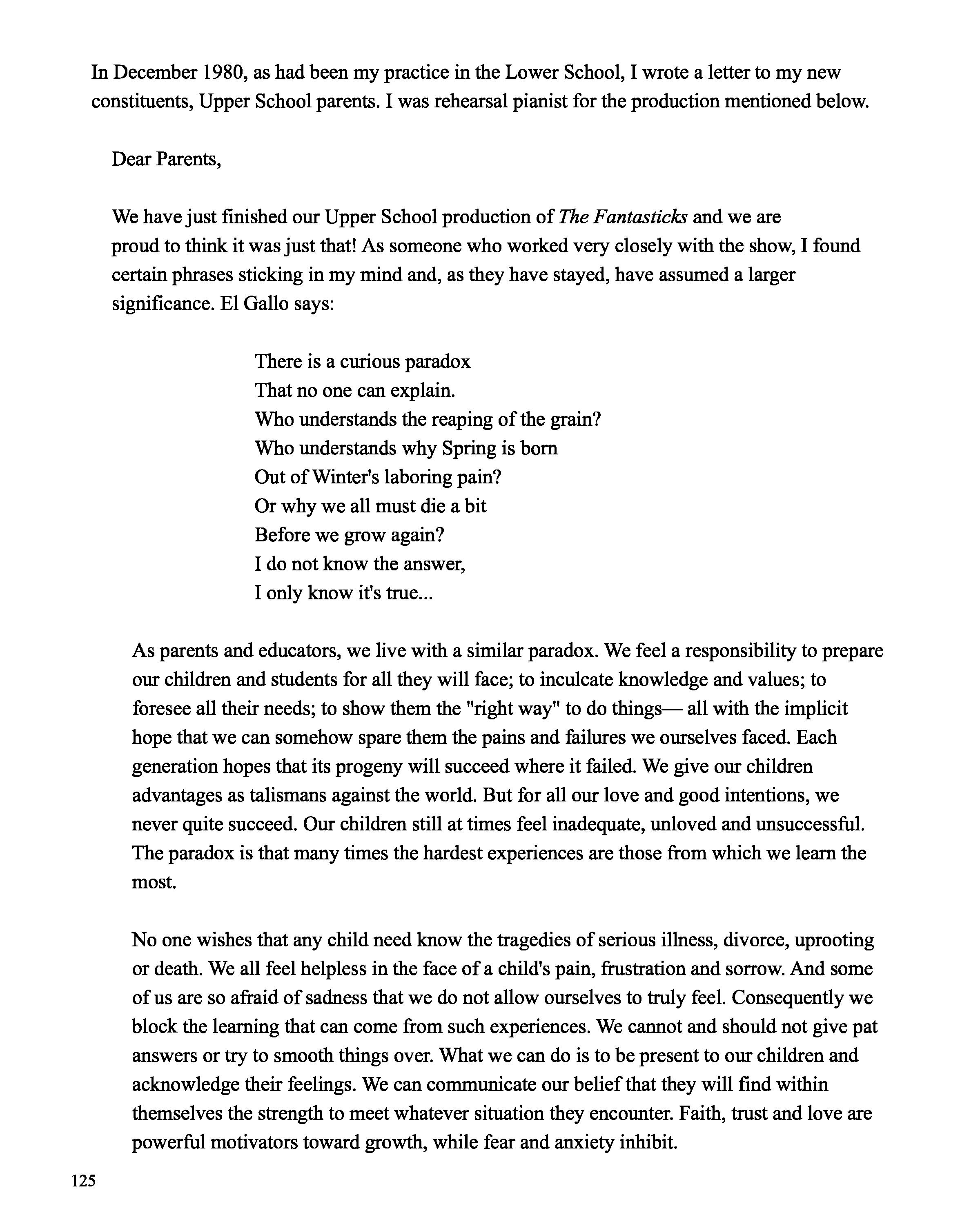
We have just finished our Upper School production of The Fantasticks and we are proud to think it was just that! As someone who worked very closely with the show, I found certain phrases sticking in my mind and, as they have stayed, have assumed a larger significance. El Gallo says:
There is a curious paradox That no one can explain.
Who understands the reaping of the grain?
Who understands why Spring is born Out of Winter's laboring pain?
Or why we all must die a bit
Before we grow again?
I do not know the answer, I only know it's true ...
As parents and educators, we live with a similar paradox. We feel a responsibility to prepare our children and students for all they will face; to inculcate knowledge and values; to foresee all their needs; to show them the "right way" to do things- all with the implicit hope that we can somehow spare them the pains and failures we ourselves faced. Each generation hopes that its progeny will succeed where it failed. We give our children advantages as talismans against the world. But for all our love and good intentions, we never quite succeed. Our children still at times feel inadequate, unloved and unsuccessful. The paradox is that many times the hardest experiences are those from which we learn the most.
No one wishes that any child need know the tragedies of serious illness, divorce, uprooting or death. We all feel helpless in the face of a child's pain, frustration and sorrow. And some of us are so afraid of sadness that we do not allow ourselves to truly feel. Consequently we block the learning that can come from such experiences. We cannot and should not give pat answers or try to smooth things over. What we can do is to be present to our children and acknowledge their feelings. We can communicate our belief that they will find within themselves the strength to meet whatever situation they encounter. Faith, trust and love are powerful motivators toward growth, while fear and anxiety inhibit.
At the end of the play, El Gallo sings:
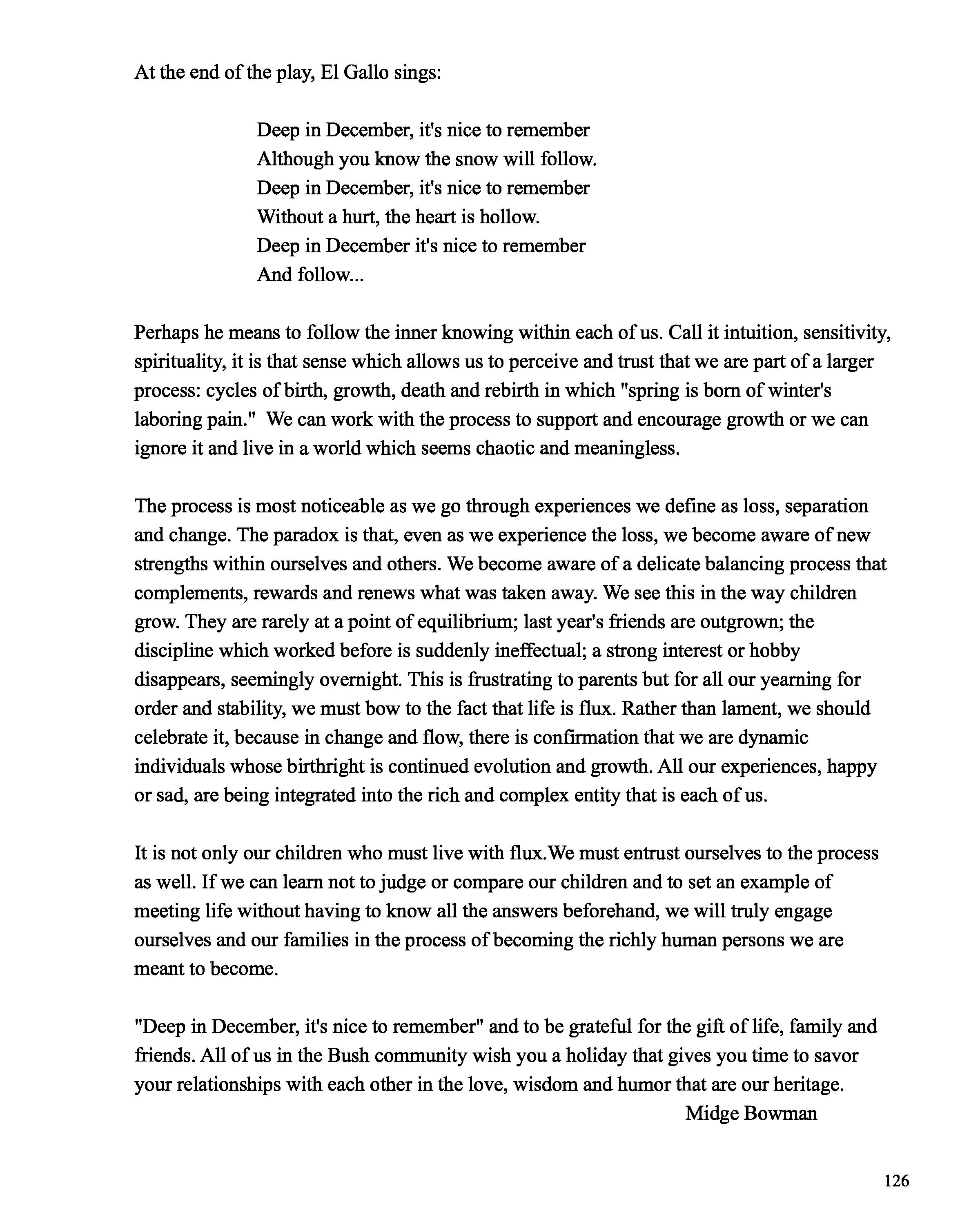
Deep in December, it's nice to remember Although you know the snow will follow.
Deep in December, it's nice to remember Without a hurt, the heart is hollow.
Deep in December it's nice to remember And follow...
Perhaps he means to follow the inner knowing within each of us. Call it intuition, sensitivity, spirituality, it is that sense which allows us to perceive and trust that we are part of a larger process: cycles of birth, growth, death and rebirth in which "spring is born of winter's laboring pain." We can work with the process to support and encourage growth or we can ignore it and live in a world which seems chaotic and meaningless.
The process is most noticeable as we go through experiences we define as loss, separation and change. The paradox is that, even as we experience the loss, we become aware of new strengths within ourselves and others. We become aware of a delicate balancing process that complements, rewards and renews what was taken away. We see this in the way children grow. They are rarely at a point of equilibrium; last year's friends are outgrown; the discipline which worked before is suddenly ineffectual; a strong interest or hobby disappears, seemingly overnight. This is frustrating to parents but for all our yearning for order and stability, we must bow to the fact that life is flux. Rather than lament, we should celebrate it, because in change and flow, there is confirmation that we are dynamic individuals whose birthright is continued evolution and growth. All our experiences, happy or sad, are being integrated into the rich and complex entity that is each ofus.
It is not only our children who must live with flux. We must entrust ourselves to the process as well. If we can learn not to judge or compare our children and to set an example of meeting life without having to know all the answers beforehand, we will truly engage ourselves and our families in the process of becoming the richly human persons we are meant to become.
"Deep in December, it's nice to remember" and to be grateful for the gift of life, family and friends. All of us in the Bush community wish you a holiday that gives you time to savor your relationships with each other in the love, wisdom and humor that are our heritage.
Midge Bowman
March 11, 1981
Dear Upper School Students and Parents:
It is with deep regret that I announce the resignation of Dr. Lila Gordon as Head of the Upper School. The age of her parents and the permanent location of both of her children in the Greater New York area has required this decision which in her words is "one of the most difficult" she has ever had to make. "I have been genuinely fulfilled and happy in my position and with my colleagues, but there comes a time when one's family obligations must prevail."
Lila brought focus to many aspects of the Upper School curriculum. She has never wavered in her dedication to excellence and the support of her faculty in achieving that excellence in their academic disciplines and activities.
Replacing Dr. Gordon will be our Associate Head, Midge Bowman. This selection has been made for a number of obvious reasons. Her leadership in academic affairs and the arts throughout the Pacific Northwest qualifies her in and of itself. She shares the uniqueness of a Bush education-the balance of traditional excellence in academics with the learning by doing commitment-and exemplifies it in her professional life. Mrs. Bowman is a graduate of Bush School, Pomona College and Yale University. She has been Director of the Bush Lower School for eleven years.
The Bush School is in its fifty-seventh year. The chain of school life is rich and connected. In these two women are the highest and best of the aspirations of the school. We are happy for both.
Leslie L. Larsen Jr.
Note: Lila Gordon's sudden decision was a shock to all ofus. I had not expected that Les would fill this position without a nation-wide search but the situation seemed to warrant it. I had enjoyed working with Lila. Fortunately my first year as Associate Head had put me in close contact with her and the Upper School faculty.
CREATING REALITY
by Midge Bowman
Although I was Associate Head for only one year, my lighter adminjstrative duties allowed me to do more research into learning styles. That resulted in a long paper for the Board of Trustees on Experiential Education, especially the different roles of right and left brain development in adolescents. Since it was written forty-three years ago, I did not initially intend to include it, assuming that right-left brain issues were not longer considered relevant in education. However, two important works on this very topic were recently published by Scottish scientist/philosopher, Iain McGilchrist: The Master and his Emissary (2019) and a magnificent two-volume magnum opus, The Matter with Things (2021). Clearly the issue is still very relevant and although Dr. McGilchrist does not address education directly, his impeccable research is all there for educators to utilize.
That same Spring, 1981, I was invited to give the Graduation address. Somehow I found the courage to write about all the reading I had been doing on the new discoveries in quantum physics and how that has changed the way we think about science, religion and the future. I couldn't have done it without the support and editorial help of Meta O'Crotty, my teacher from my high school days at Bush and later the teacher of both my children. Meta was a lifelong friend, mentor, advisor and role model. I am so grateful for our long association. Later that year, a shortened version titled "Creating Reality" was published in the Fall 1981 issue of Puget Soundings, a local magazine. See page 213 for this article as well as the Experiential Education paper.
Note: The interview below was about my new job as Upper School Director and provided an inkling of what I hoped to accomplish in this new position. At the time, I didn't know that my husband's job would mean leaving Seattle. Re-reading it now, I realize that ifl had been able to stay at Bush, it would have been an exciting and fulfilling part of my career. It has been heartening to see how much of my vision was implemented and developed without me. Excerpts from the interview follow:
The fundamental philosophy that compelled Mrs. Bush to start a school are still integral parts of Bush today. For instance, I cannot remember one single year when a new idea in curriculum or structure or educational philosophy hasn't emerged and been encouraged. Some didn't last long, but every idea was allowed to develop its own strength. Under all four Heads-who were very different individuals-Bush has stayed open to new ideas. It remains a very affirming and stimulating place.
For me the challenge of this new job is working with older students in those grades where the real world impinges more immediately. At about age fourteen, students experience their last major brain growth spurt-a very exciting developmental stage. Then, a little later in high school, almost every student gets it all together, realizing that he or she is ready to go out into the world and apply those learning experiences of the preceding few years. It happens for most during junior year, for others just before they walk out the door. It is very rewarding to watch that process evolve, particularly in students you come to know as well as we do here .
...Teachers play a different role for high school students. In the early grades, children look to their teachers as surrogate parents, but in Upper School, students look for mentors and role models. Older kids need to experience teachers who are intellectually dynamic with different personalities and interests. Because many of the faculty are also professionals-practicing their craft as artists, writers, actors, scientists---our students see educators who are productive in a variety of ways and that has a tremendous influence on them.
Bush has always been a place where the goodness and capabilities of kids are trusted. Teachers are encouraged to demonstrate and then step back to let students make their own variations on a theme. I believe that a leader's actions set the process in motion. If you want others to act responsibly and be accountable, then you must be accountable and responsible to them. School is a reflected image of the values that the leader models.
Commenting on what she would like to see accomplished in the Upper School, Midge said, "I want our feeling of community strengthened by revitalizing student government, expanding the advisor system, increasing class meetings and more activities that support the school community. I hope parents will feel even more a part of the process than they do now.
Schools today are asked to do many things that other parts of society did before. We simply must involve parents and acknowledge their part in the growing process. I don't believe that parents of older children have lost interest, but they need to be shown new ways to express it.
In the coming years, the Global Education program will grow even more because we will expand the areas of the world we study. Next fall we plan to embark on a two-year model program introducing an Asian component beginning with Japanese culture and language. I would like ethnomusicology to become part of the Upper School music curriculum. A little of that was done in the 60s through African drumming but it was just a beginning. Music is another language. I hope Bush will lead in this as we have in several other curricular areas.
A new course called Sophomore Seminar will be introduced this Fall. In a lecture/film/ discussion format modeled after Senior Seminar, students will become involved with ideas through multi-media and discussion rather than reading and writing. The course will deal with issues such as divorce, sexuality, drugs, alcohol, relationships-those issues which are essential to their lives. In ninth grade students take a specially designed communications course and many juniors take a trimester away from school through global education, so this ought to fit well into the curriculum pattern. ***
Note: Four facts gave me courage and excited me about leading the Upper School:
1. The openness and flexibility in programs already being offered.
2. My ongoing research into the nature of cognition-the hemispheres of the brain; right and left brain differences; male and female brains; brain growth spurts and plateaus- was equally applicable in the higher grades.
3. Our growing size and student diversity in learning styles was creating the need for more and different kinds of academic support and accommodation in Middle and Upper School students similar to what I had pioneered in the Lower School.
4. I was already known to the Upper School faculty from my year as Associate Head.
It is clear from the following unfinished notes, that, at the beginning of my tenure as Upper School Director, I wanted to open a conversation about looking more deeply into why some students might not be performing as well as expected. It was built on the work the faculty and I had already done in the Lower School. I think that many at Bush and elsewhere, were increasingly aware that current students were presenting a variety of learning styles and needs.
Upper School Faculty Speech: Learning Styles in Older Kids, September 1981
Since I am told that I speak very fast, I ask your patience in this short reprise of the Piagetian scheme and Feuerstein's observations on obstacles to learning. My hope is that we will begin to develop in many, if not all, of our disciplines, a systematic approach to certain kinds of work. Formal operational thinking may appear only sporadically in some of our students and perhaps in only one or two subjects. It may help to foster such thinking, however, if each discipline enunciates some part of the process and keeps emphasizing that this way of working is one of the aims of the course. Even more important than content, we should be teaching thinking.
Formal operational thinking is demonstrated in the ability to reason, not only about things but also about concepts and math equations. Such thinking should generate hypotheses, anticipate possible outcomes, state a group of principles about a set of objects or facts and explore the relationship between the principles. Formal operational thinking is "second order" thinking. It is capable of reflecting upon itself and getting new information from internal reflection.
Formal operational thinkers ideally will go through a process in an assignment: objectively map out the goal and how to get there, and then self-check and evaluate the result. Paul's work in mapping (from Thinking with Both Sides of the Brain) is one approach to this reflective, systematic way of working.
It is mentioned in several studies that training aids (better called thinking aids) are helpful in achieving formal operational thought. Even young children can be led to think in this manner in isolated cases. This may be equally important for those students who may not yet be at the formal operations stage in our upper school. Before assuming that they never will be, we should try to make them aware of the processes of learning. Most of you already do this. Through your interactions with your students, you are emphasizing thinking behaviors as well as content.
We know that formal thinkers are reflective. How might we get students to be objective about their work: to evaluate it, to be self-monitoring, to ask themselves the question: "Have I supported my arguments with logical statements, etc.?" In other words, how can we objectify the procedure and get them to think about that first.
Feuerstein's term "mediated experience" seems to fit in with what I'm trying to say. Teachers mediate when they explain, clarify, interpret, or rephrase the material of the class. In a sense we are modeling what we want from our students. Content must be circulated through the thinking process. Blocks to cognitive development according to Feuerstein are:
1. Impulsivity: the tendency to approach a task in an unsystematic trial and error fashion; looking for the answer before understanding the question; failure to learn deliberate behavior that follows a plan.
2. Failure to recognize problems: many intellectual problems involve recognizing discrepancies and inconsistencies.
3. Episodic grasp ofreality: some students see events and objects in isolation; they do not try to make connections, see relationships, or put things in context.
4. Failure to make comparisons: some students seldom use the words "like, similar, different, resembles."
5. Inadequate spatial orientation: some students have considerable difficulty learning the positions of squares in a grid or locations on a map. The reason may be that they do not orient themselves to the materials using proper terms.
Feuerstein notes a passive approach to the environment in most students who exhibit cognitive developmental lags. Many fail to recognize that their own intellectual efforts may contribute to the solution of a problem!
He postulates that while children can learn a great deal from ordinary interaction with the environment, such experiences are of limited value in the acquisition of mental skills. He has come to believe that many cognitive deficiencies are not due to lack of interaction with the environment, but due to a lack of instruction about those interactions. From the standpoint of intellectual development, what counts is not only direct experience, but also, mediated experience.
Note: This article in the Seattle Times was a great help in educating Bush parents.
Ninth Graders have more discipline problems than other students by Constantine Angelos and Lee Moriwaki, Times staff reporters.
(Copyright, 1982, The Seattle Times)
They are the most extraordinary collections of youngsters in Seattle-hooligans, dopers, and dopes, it would seem, trying to pass themselves off as your sons and daughters. Among them they account for proportionately more failing grades, more retentions and more discipline problems than any other group of youth in the city's public schools.
They are ninth graders-that awkward group of 13-15 year-olds undergoing the sheer upheaval of adolescence-and they have compiled a remarkable record in a short span of time . .. .In a recent report to the school board, Superintendent Donald J. Steele said district-wide figures show that the freshman class suffers the greatest discipline and academic problems of all the high school years.
Steele attributed those figures to the trauma of adolescence and the stresses of leaving sheltered middle schools for an entirely new educational atmosphere. Some educators and researchers look in another direction, toward human biology and psychology. They note that students with discipline problems often have trouble learning and say the answer may be less a matter of discipline than of shaping curricula in a way that entices youngsters to learn. One such area of research has to do with "brain-growth spurts" and plateaus and it suggests ninth-graders, as well as various other age groups, have some special needs.
Midge Bowman, head of grades 9 through 12 at The Bush School, a private school near the University of Washington arboretum, cited research in brain development that was pioneered a few years ago by Herman T. Epstein, a neurologist in Waltham Mass. and Conrad F. Toepfer, professor of education at the University of Georgia.
Bowman said the two found that the brain does not grow uniformly, as had been believed, but in spurts-"a period of fast growth, and then a plateau. Another fast spurt, and than a plateau." "When a kid is in a plateau, he is going to be working just as hard as the year before, but he's not going to be producing," Bowman said. Such conduct, she adds, may prompt a teacher to remark, "this kid is in a funk" or to blame the setbacks on peer pressure or lack of motivation. Though phases can vary several years among individuals, spurts are believed to come at around 3 to 10 months, 2 to 4 years, 6 to 8 years, 10 to 12 years and 14 to 16 years, with plateaus in between.
"Interestingly, 5 years olds are in a plateau period just when they are starting school," Bowman said. "All the people who are pushing their kids now for early kindergarten entry are going against the stream, as far as what the brain is doing at that point."
Another plateau period is the early mid-teens, the age that students are entering ninth grade, Bowman said. During spurt periods, it is believe that intellectual challenge will mean the most to youngsters. During plateaus, art, drama, and other fun-type classes and field trips may be best, along with repetition, reinforcement and rote learning.
Bush freshmen are having just as difficult a time adapting to the high school curriculum as ninth graders in other private and public high schools, Bowman said. She said Bush is aware of the research although it hasn't succeeded yet in shaping its curriculum to make the freshman transition easier.
Yet Bush's awareness of the brain-growth theory, as well as the cognitive development research of the Swiss psychologist Jean Piaget on the way children think, is helping to shape the school's approach to education-directions that public-school parents also might give some thought to.
In the elementary grades, for example, Bush uses manipulatives in math, games to teach reading and thinking, and movement and art to illustrate stories in line with the Piagetian premise that concepts should be made real through use of the senses, said Bowman, who headed Bush's elementary grades for 11 years.
One study showed that a group of kindergarteners who were read a story with a moral and who then acted it out, retained many more of the ideas for a longer time than those children who had merely had the story read to them and talked about it, Bowman said. That is one reason the arts are held is such high esteem at Bush and not viewed as frills.
Dee Dickinson, a former Bush teacher and now associate coordinator of New Horizons for Learning, a Seattle-based resource network for Pacific Northwest educators, agrees with Bowman. "Epstein says that during plateau periods, you consolidate earlier education and have hands-on, artsoriented activities, wilderness, ecology and nature experiences and lots of physical involvement.
"There may be kids who are ready for abstract thinking, but hands-on activity will not tum them off. And it won't tum off kids who aren't ready for abstract thinking," Dickinson said. Give a youngster the wrong kind of education at the wrong time-overly challenging material during a plateau period-you could tum the child off from learning, she added.
Note: In re-reading Anne Will's excellent history of our first 75 years, her description of the need to tighten policies about attendance, senior projects, and the way students treated each other during the Fred Dust years, echoed some of the issues the faculty raised early in my short tenure in the Upper School. Class attendance had become an issue and kids were skipping class with impunity. P lus <;a change, plus c'est la meme chose!




March 22, 1982
Dear Upper School Parents:
We are implementing a new attendance policy in the Upper School this Spring term and want to make sure that both students and their families understand the reasons for the change. As an administrator new to this division, I have felt the need to assess the balance we try to achieve between freedom and responsibility in our expectations of our students. Under our present system, class attendance is taken and students not present are reported to the Upper School Director who then follows up to ascertain why the student was absent. It has become obvious to me that the responsibility needs to be put back on the student. To this end, our new policy states:
1. There are no unexcused absences for any class. Any absence must be followed by a written excuse from the student's parent stating the reason for the absence. In case of illness, we have always requested that you call the school in the morning so that faculty may be informed. We also encourage you not to make medical appointments during school hours although we understand that orthodontists are notoriously difficult in this respect.
2. Teachers will report all class absences to the Upper School Director who will simply note the absence in the attendance book. There will be no follow-ups, but at the second absence, a warning will be sent to the parent. If the warning is ignored and a third absence takes place, the student will receive an incomplete and will have to repeat the course at another time. There will be no way to make up these absences.
It is our feeling that once students realize the very real consequences of lax attendance, the problem will cease. We would like to stress that only a very few Bush students have misused their freedom. However we want to be very clear about the importance of regular attendance. If you have any questions about this policy, we would appreciate your calling.
Midge Bowman Upper School Director

The preceding note to Upper School parents had been sent to Upper School faculty with the following memo about all of us going to Janice Osaka/Gardiner Vmnedge's new home near school. They had recently married and we all loved the new Osaka-Vmncdge team!
Above Janice and Gardiner with Peggy Skinner.
UPPER SCHOOL FACULTY: Here, a day late, the famous policy letter. Please edit and bring your comments to our faculty meeting today. We will stop the meeting at 4:45 and adjourn to the Osaka-Vmnedge home for a global meeting with Les from S:00-7:00. Pod is providing salmon, Janice and Gardiner the salad, Midge the wine. We would like to know how many of you plan to attend and would appreciate your bringing some salad fixing or ice cream topping for your share. Please let me know by noon Tuesday. Thanks.
Note: The next page shows the "game-like" diagram the faculty created about the new Sophomore Seminar to underscore a playful, non-threatening introduction to the course.
Sophomore Seminar
One of the things I was most excited about that first year in the Upper School had been my involvement in Senior Seminar. The following year, work began on Sophomore Seminar to deal with adolescent issues in a similar way. Though the subject matter was different, the purpose was to involve the whole class in broad topics of cultural and historical interest (Senior Seminar) or the adolescent challenges of sex, drugs, rock and roll (Sophomore Seminar) in order to encourage thought and discussion with their peers outside of class. Because I was in this new position only 18 months, I have few notes and planning documents. To my knowledge, these "seminars" were our first attempts at developing environments to bring the classes together around substantive issues and stimulate discussion with their peers rather than a focus on grades alone. For that reason, I am sharing the few materials I have, as well as my wonderful conversation with Peggy Skinner.
Peggy: Senior Seminar was one of the things that stimulated us to develop a Sophomore Seminar.
Midge: Both seminars were important. One of the things Bush does so well is the whole idea of seeing connections, giving kids the chance to think independently and come up with their own ideas. How long did the class actually last?
Peggy: I'm thinking less than ten years-probably seven or eight. And it went through different people. We started with Lee Neff, Philip Mallinson, Linda Malone, Jim May, and me. Phil and I had a heavy science/math connection which was interesting because of course, these were all social issues, but I think that our brains were consistent with working together. It was great fun, probably more fun for the teachers. I remember we met once a week in Jim May's office to plan, occasionally at pot luck dinners. We would sit and laugh our way through a planning period, just trying to find the best combination that was fun for the kids yet really engaging and thought-provoking. We had lots of films and speakers and of course, it was basically sex, drugs and rock and roll! Ultimately scheduling difficulties ended the program.
Note: Other faculty involved in Sophomore Seminar at different times were Esther Reiquam, Schauf,Tom Stanlick, John Ganz.
Midge: That got the kids interested. Right?
Peggy: The kids would sometimes roll their eyes. It was like, "Do we have to do this?" But I just remember telling the story of Alligator River, the decision-making exercise. So here's a fable, but who's the worst or best character? All of those ways to interact and think about life and decisions.
Midge: Was this in the sections, or did you have the whole class together?
Peggy: We were in Cunningham House. We would teach the whole class together. It was twice a week. We went through many, many different topics including suicide and dealing with stress of all different types, eating disorders and drug addiction. And we'd have speakers come in. Roger Rothman, a very prominent professor in terms of addiction studies from University of Washington, would come in every year and talk with the kids. I don't remember exactly how many years we did it. But it was really engaging.
But what changed, and this is interesting, we had started it not expecting any kind of compensation for it. We loved being together. We thought it was the right thing to do, and then a few people had to leave or something. I can't remember what the dynamic was but later people expected to be compensated. And that shifted things. There was a whole thing about 'are you doing this because you believe in it?' It's important for teachers to be respected and to be compensated for what they do, but it changed the dynamic.
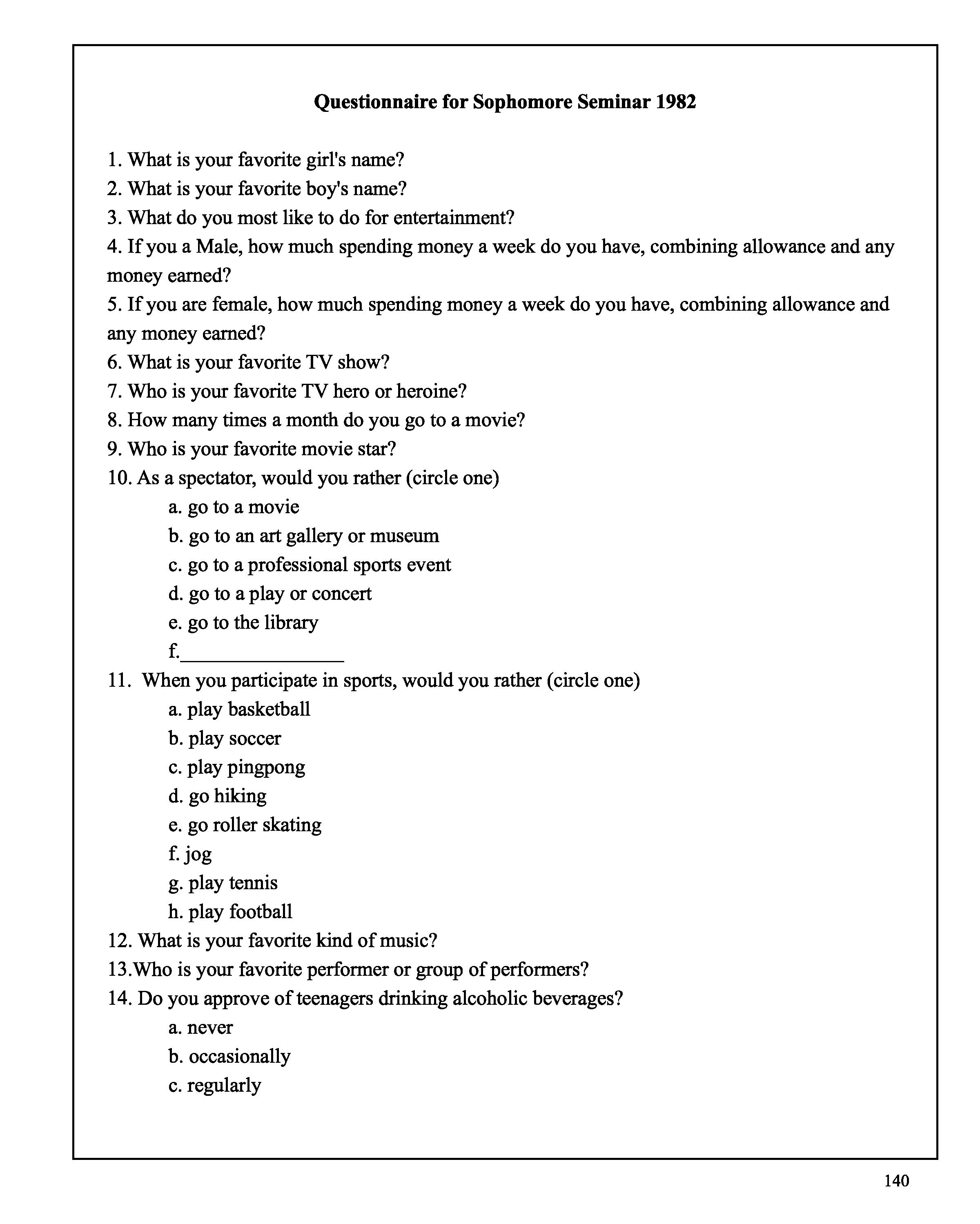
Questionnaire for Sophomore Seminar 1982
1. What is your favorite girl's name?
2. What is your favorite boy's name?
3. What do you most like to do for entertainment?
4. lfyou a Male, how much spending money a week do you have, combining allowance and any money earned?
5. If you are female, how much spending money a week do you have, combining allowance and any money earned?
6. What is your favorite TV show?
7. Who is your favorite TV hero or heroine?
8. How many times a month do you go to a movie?
9. Who is your favorite movie star?
10. As a spectator, would you rather (circle one)
a. go to a movie
b. go to an art gallery or museum
c. go to a professional sports event
d. go to a play or concert
e. go to the library
f.
11. When you participate in sports, would you rather (circle one)
a. play basketball
b. play soccer
c. play pingpong
d. go hiking
e. go roller skating
f.jog
g. play tennis
h. play football
12. What is your favorite kind of music?
13.Who is your favorite performer or group of performers?
14. Do you approve of teenagers drinking alcoholic beverages?
a. never
b. occasionally
c. regularly
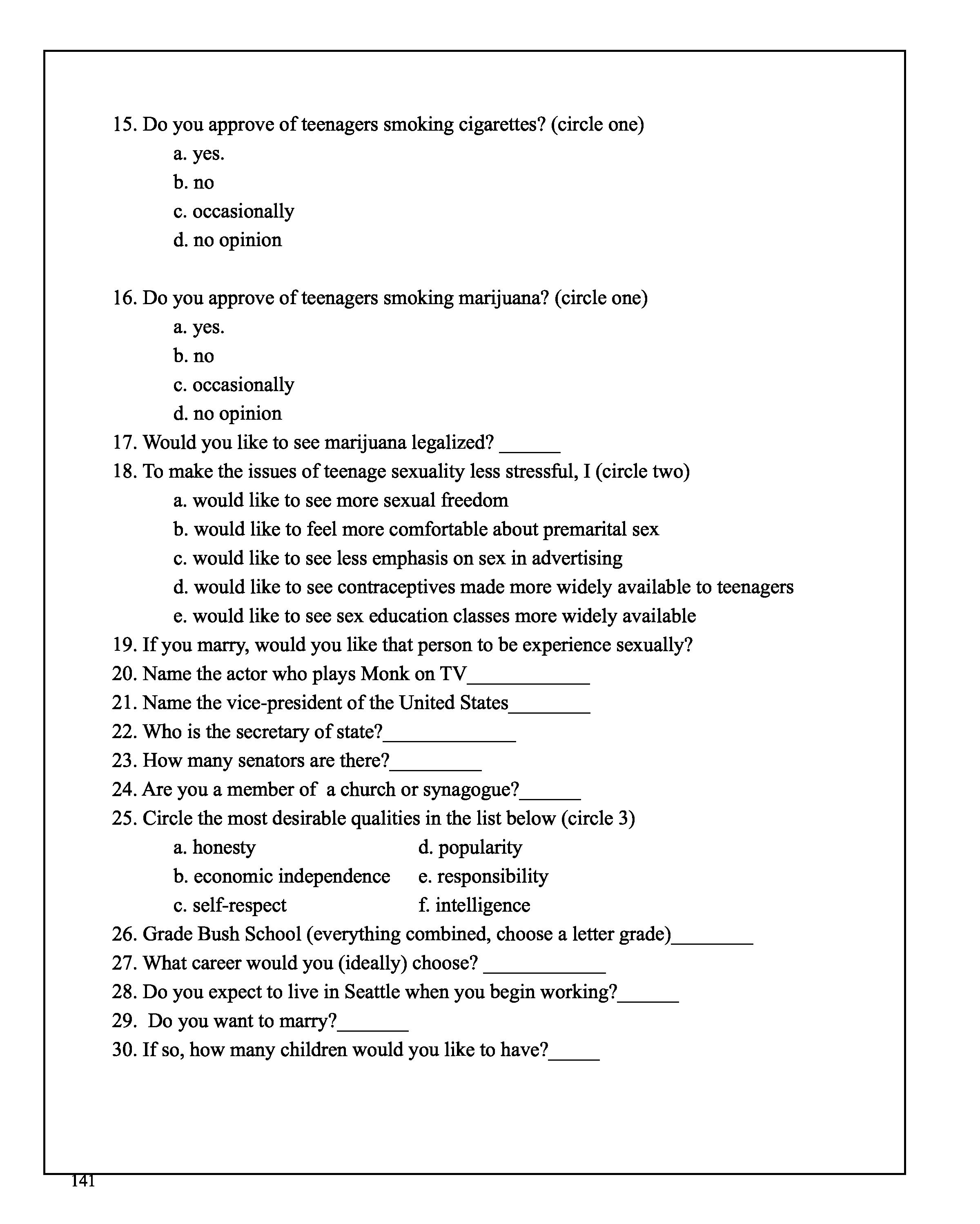
15. Do you approve of teenagers smoking cigarettes? (circle one)
a. yes.
b.no
c. occasionally d. no opinion
16. Do you approve of teenagers smoking marijuana? (circle one)
a. yes.
b.no
c. occasionally
d. no opinion
17. Would you like to see marijuana legalized? ___
18. To make the issues of teenage sexuality less stressful, I (circle two)
a. would like to see more sexual freedom
b. would like to feel more comfortable about premarital sex
c. would like to see less emphasis on sex in advertising
d. would like to see contraceptives made more widely available to teenagers
e. would like to see sex education classes more widely available
19. If you marry, would you like that person to be experience sexually?
20. Name the actor who plays Monk on TV _____
21. Name the vice-president of the United States ____
22. Who is the secretary of state? ______
23. How many senators are there? ____
24. Are you a member of a church or synagogue?___
25. Circle the most desirable qualities in the list below (circle 3)
a. honesty d. popularity
b. economic independence e. responsibility
c. self-respect f. intelligence
26. Grade Bush School (everything combined, choose a letter grade) ____
27. What career would you (ideally) choose? _____
28. Do you expect to live in Seattle when you begin working?___
29. Do you want to marry? ___
30. If so, how many children would you like to have? __
CLASS RULES
EVERYONE HAS A RIGHT TO REMAIN SILENT
NO SPECIFIC NAMES USED IN EXAMPLES
TAKE ALL COMMENTS SERIOUSLY (NO LAUGHING)
ALL OPINIONS SHOULD BE RESPECTED. EQUALITY OF OPINIONS
CONVERSATIONS STAY IN THE CLASSROOM
ONE PERSON TALKS AT A TIME: THE OTHERS LISTEN
OPINIONS SHOULD NOT BE FORCED ON ANYONE
NO CRITICISMS OF OPINIONS. CHALLENGES OF OPINIONS OK
CLARIFY ISSUES BY ASKING QUESTIONS
DO NOT INTERRUPT CONVERSATIONS
DO NOT FORCE ANYONE TO REVEAL PRIVATE INFORMATION
DO NOT ARGUE: DO NOT SPEAK LOUDLY
DO NOT DIRECT CERTAIN REVEALING QUESTIONS TO SPECIFIC PERSONS
EVERYONE SHOULD BE DIRECT AND HONEST
NO VIOLENCE
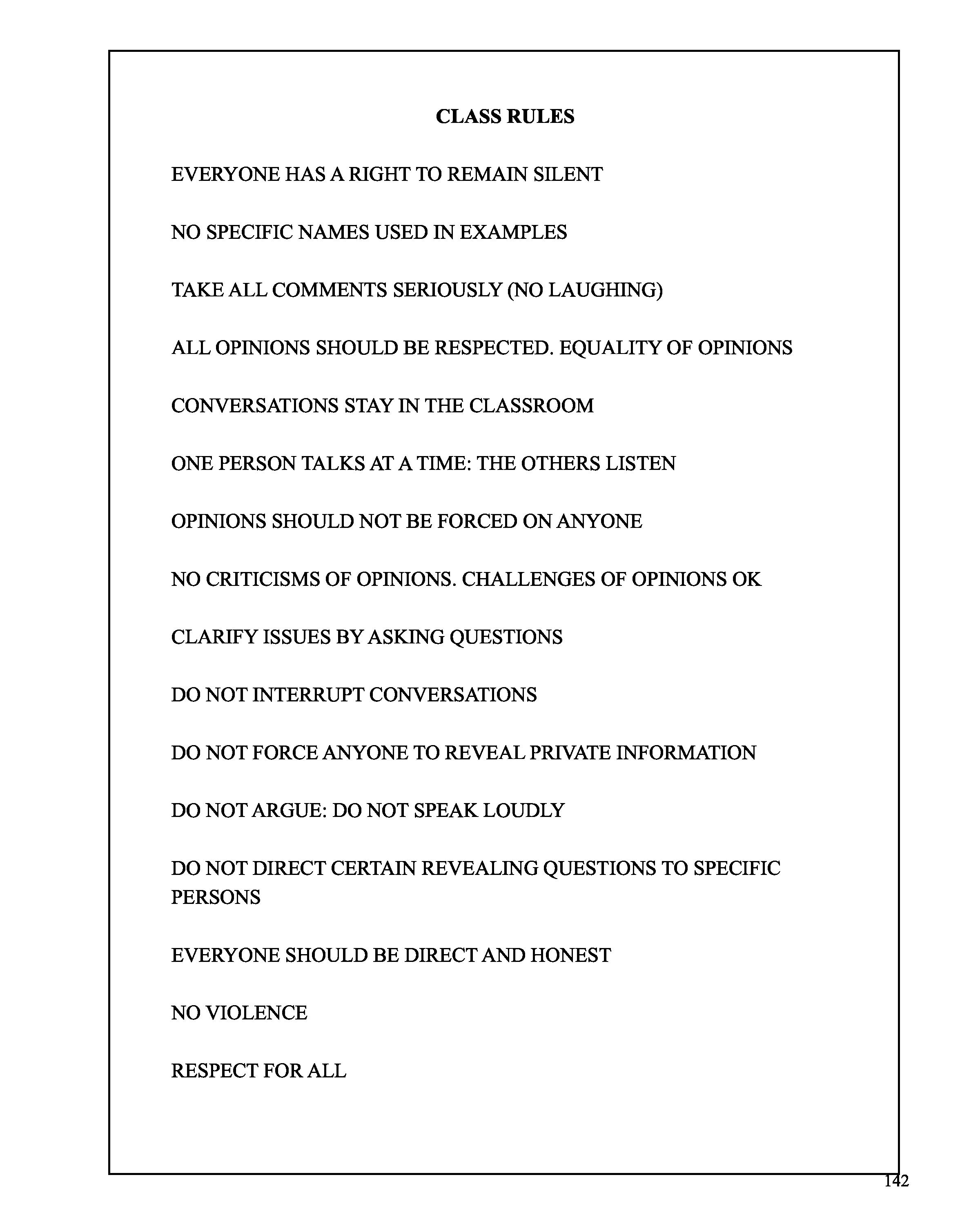
RESPECT FOR ALL
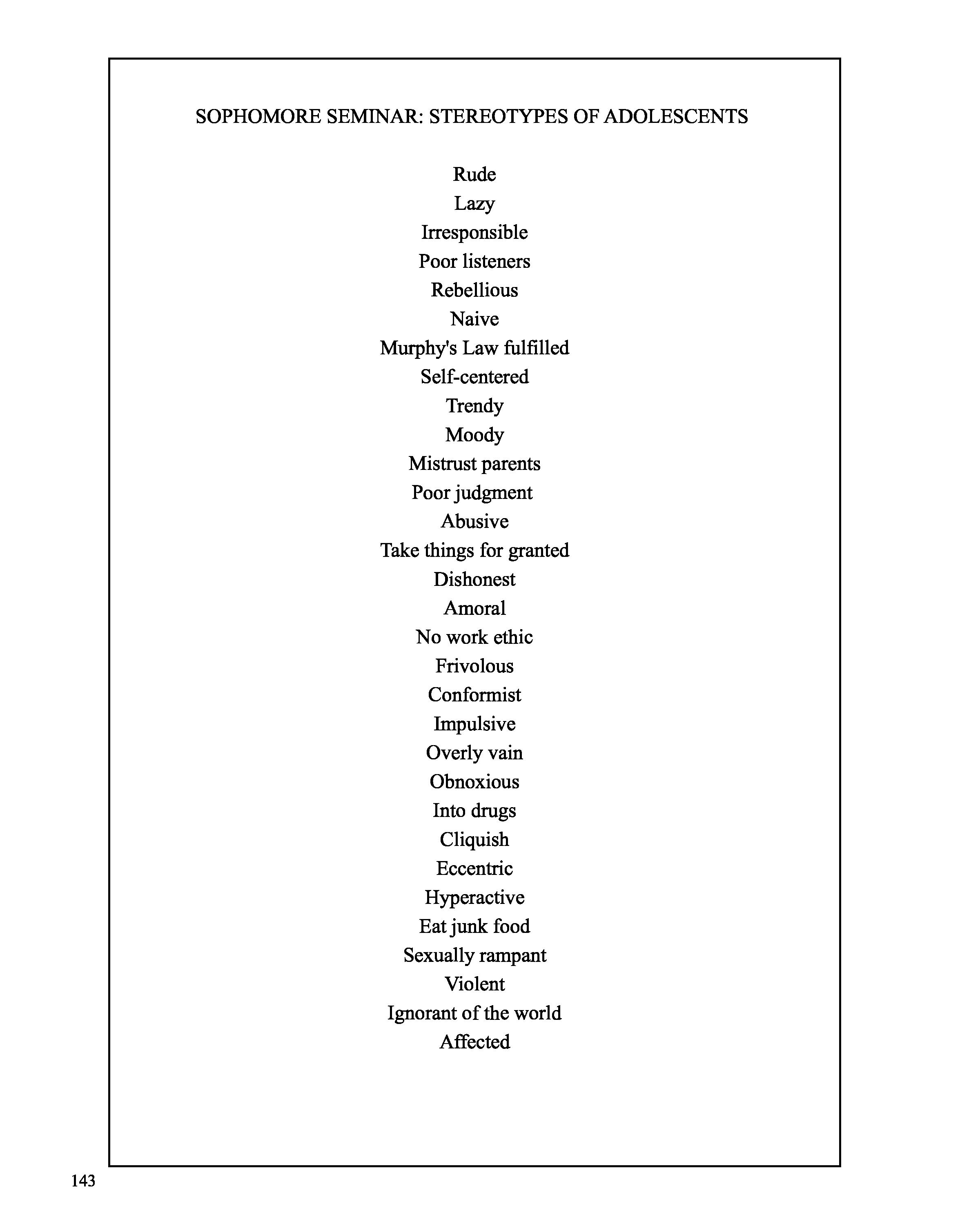
SOPHOMORE
SEMINAR:
STEREOTYPES OF ADOLESCENTS
Rude
Lazy
Irresponsible
Poor listeners
Rebellious
Naive
Murphy's Law fulfilled
Self-centered
Trendy
Moody
Mistrust parents
Poor judgment
Abusive
Take things for granted
Dishonest
Amoral
No work ethic
Frivolous
Conformist
Impulsive
Overly vain
Obnoxious
Into drugs
Cliquish
Eccentric
Hyperactive
Eat junk food
Sexually rampant
Violent
Ignorant of the world
Affected
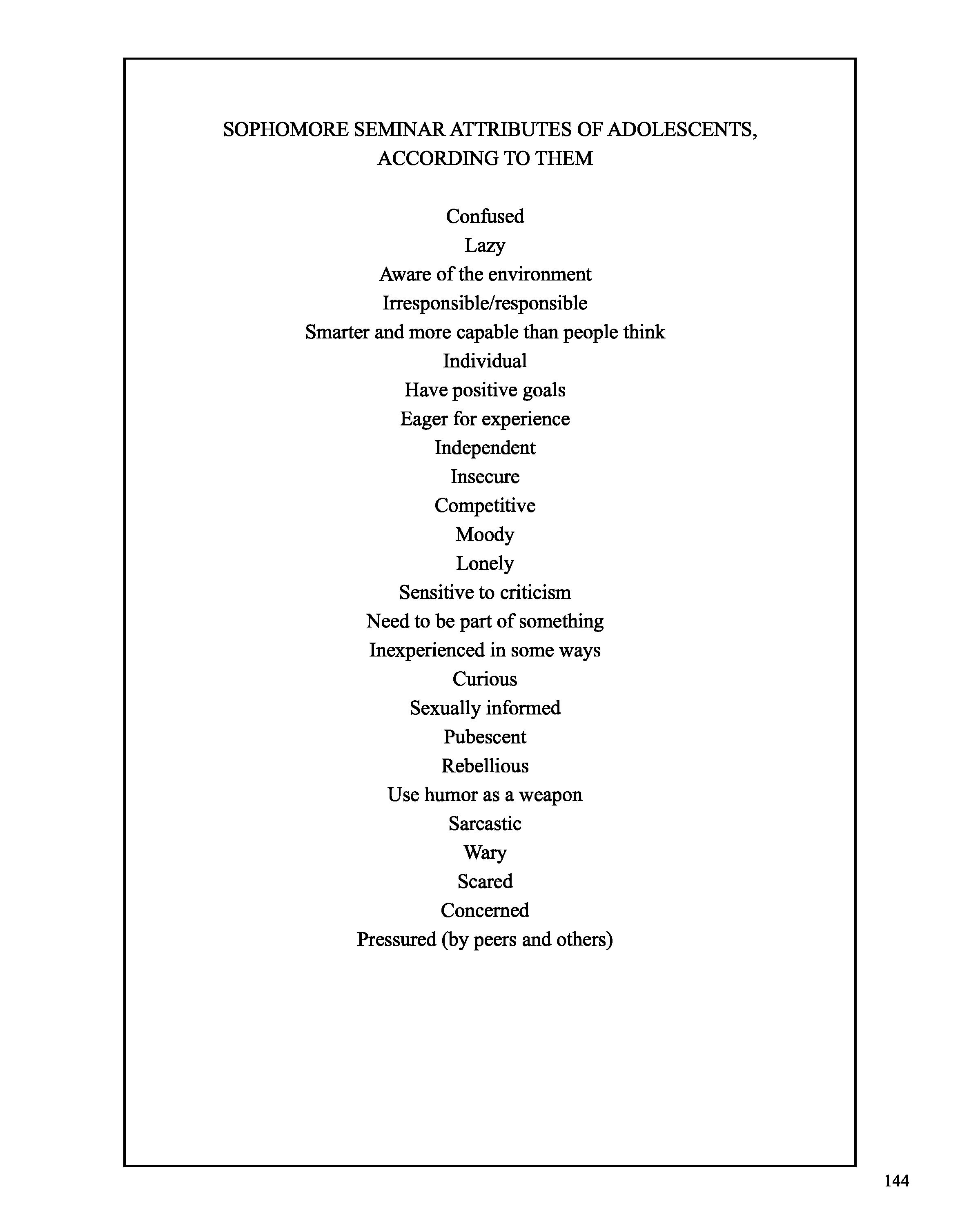
SOPHOMORE SEMINAR ATTRIBUTES
OF ADOLESCENTS, ACCORDING TO THEM
Confused
Lazy
Aware of the environment
Irresponsible/responsible
Smarter and more capable than people think
Individual
Have positive goals
Eager for experience
Independent
Insecure
Competitive
Moody
Lonely
Sensitive to criticism
Need to be part of something Inexperienced in some ways
Curious
Sexually informed
Pubescent
Rebellious
Use humor as a weapon
Sarcastic
Wary
Scared
Concerned
Pressured (by peers and others)
TENTH GRADE SEMINAR
Calendar for 10th grade Seminar, 1982-1983
Tuesday and Thursday 11 :45-12:45 Cunningham House
Midge Bowman, James May, Lee Neff, Manvel Schauffier, Peggy Skinner
DATE
#1 9/14
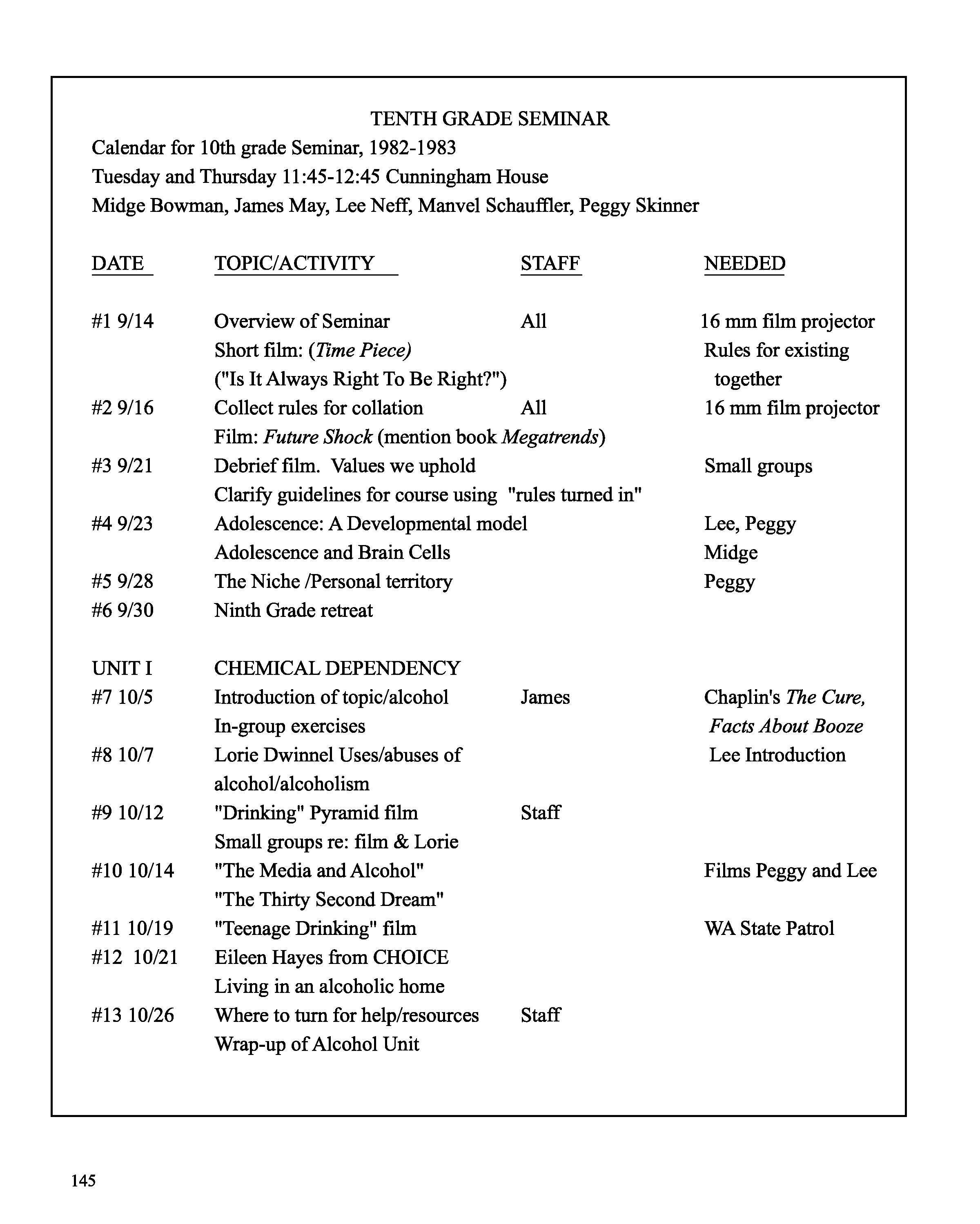
#2 9/16
#3 9/21
#4 9/23
#5 9/28
#6 9/30
UNIT I
#7 10/5
#810/7
#9 10/12
#10 10/14
#1110/19
#12 10/21
#13 10/26
TOPIC/ACTIVITY
Overview of Seminar
Short film: (Time Piece)
("Is It Always Right To Be Right?")
Collect rules for collation
STAFF
All
All
Film: Future Shock (mention bookMegatrends)
Debrief film. Values we uphold
Clarify guidelines for course using "rules turned in"
Adolescence: A Developmental model
Adolescence and Brain Cells
The Niche /Personal territory
Ninth Grade retreat
CHEMICAL DEPENDENCY
Introduction of topic/alcohol James
In-group exercises
Lorie Dwinnel Uses/abuses of alcohol/alcoholism
"Drinking" Pyramid film Staff
Small groups re: film & Lorie
"The Media and Alcohol"
"The Thirty Second Dream"
"Teenage Drinking" film
Eileen Hayes from CHOICE
Living in an alcoholic home
Where to turn for help/resources Staff
Wrap-up of Alcohol Unit
NEEDED
16 mm film projector
Rules for existing together
16 mm film projector
Small groups
Lee,Peggy Midge
Peggy
Chaplin's The Cure, Facts About Booze
Lee Introduction
Films Peggy and Lee
WA State Patrol
#14 10/28- Decision-Making and Problem-solving
Staff 11/4 3 days
#17 11/9 Introduction to Drugs In-group exercises
#18 11/23 Film Psychoactive with discussion
#19/ 11/30 Families and Communication
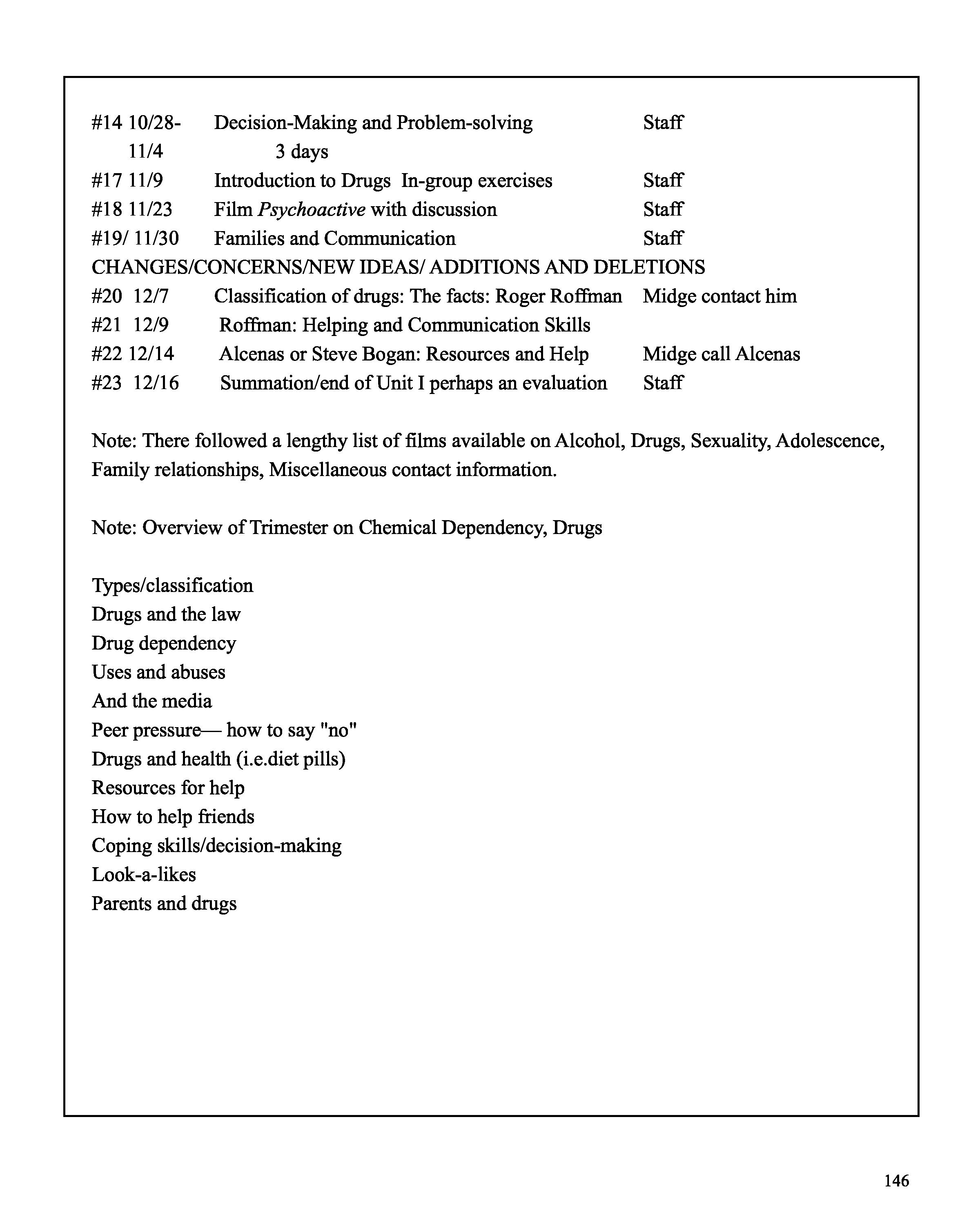
Staff
Staff
Staff
CHANGES/CONCERNS/NEW IDEAS/ ADDITIONS AND DELETIONS
#20 12/7
#21 12/9
#22 12/14
#23 12/16
Classification of drugs: The facts: Roger Roffman Midge contact him
Roffman: Helping and Communication Skills
Alcenas or Steve Bogan: Resources and Help
Summation/end of Unit I perhaps an evaluation
Midge call Alcenas Staff
Note: There followed a lengthy list of films available on Alcohol, Drugs, Sexuality, Adolescence, Family relationships, Miscellaneous contact information.
Note: Overview of Trimester on Chemical Dependency, Drugs
Types/classification
Drugs and the law
Drug dependency
Uses and abuses
And the media
Peer pressure---how to say "no"
Drugs and health (i.e.diet pills)
Resources for help
How to help friends
Coping skills/decision-making
Look-a-likes
Parents and drugs
In the course of our interview, Peggy and I discussed a wide range of topics. I share them here because she so ably describes what Bush was like during her long tenure.
Electives
Peggy: I loved the electives. So I ended up teaching just a whole bunch of different topics over the years. I was working on a research project at University of Washington in malaria research and worked in a lab in the summer, and then as much as I could during the year. And I was very, very interested in that. I went to Africa where I worked in a research lab for my sabbatical. I wanted to teach a course in microbes and disease. So I focused on four diseases: influenza, malaria, tuberculosis and polio and involved the kids in the different pathogens: viral, bacterial, and the parasite that causes malaria. In the study of polio, I involved kids in interviews with their parents and grandparents.
I took the kids into depth in four diseases to try to teach social issues, scientific issues, ethical issues. Can you put people in jail for not completing a tuberculosis treatment? It was amazing. What Bush really gave me was the freedom to just say, "OK, you want to teach about microbes? Do it. Just do it."
Team teaching
Peggy: My real love was when I could be teaching with another teacher. My best professional development of any kind was to be in the classroom with another teacher and watch that person teach, laugh, interact with kids and put them in a position of seeing things from different perspectives. Gardiner and I taught several classes together. We would choose a theme like water or wetlands, and I would do scientific aspects of it and he would do social or historical aspects of it. And then kids would design a research project, and we would come back at the end of the term and share.
And we'd draw these big Venn diagrams on the blackboard and one student would put their research topic up there, and then we'd say, "Who has something that relates to that?" So another student would have theirs up there and then another would come up and put an arrow to show the relationship. And we'd end up at the end with this blackboard full of projects and interactions. It was absolutely fascinating to see how our students could take what they had spent a term researching and show how it related to someone else's research.
Midge: Were you able to talk at this level with other teachers? Do you think other people felt as powerfully as you did about it?
Peggy: I think there were certain aspects and they may have found other attributes that they developed on their own. Probably the real benefit of Bush School is that the teachers brought their personal interests and strengths to the classroom. I think of Larry Muir teaching physics with a banjo, Susan Duffield with her love of animals, and Tom Duffield with his wilderness expenences.
The other thing is longevity. I think our department was together for at least 25 years. When you have years and years of experience, you don't necessarily agree with each other, but you respect the differences that each contributes. And I love the fact that we would take our ninth grade biology students and rotate them through the different teachers. We would say that's the one thing that you have to do is teach a section of ninth grade.
Then Tom and Susan Duffield and Larry Muir all retired the same year. And now, there's been so much turnover that it becomes a different working environment.
On having one's own children in class
Midge: I've often wondered if it was hard on our children to be in the same school with us. It never bothered me or my kids, but have yours ever mentioned anything about?
Peggy: I taught both my kids and they ended up in the sciences.They loved it. In Sam's class, many of them would call me Mom. I'd be in the middle of teaching something and hear them say, "Mom, Mom." Megan and Sam were very close, but I've often told people that it was to see your kids respond to what you know so well, to see how they learn. Or how they approach the one problem that was perplexing for somebody else. Megan and Sam learned very differently and I could see it. And it was a wonderful, wonderful experience.

On different learning styles
Midge: Some kids have more problems in school in part, because they learn differently. And we didn't know enough about that in those early days. We began a pretty strong study skills support program in the Lower School. How was it in the Upper School during your tenure?
Peggy: There were lots and lots of opportunities for kids to get help if they were having difficulty in a particular area. In the science department, we gave lots of opportunity for kids to do something on their own. When you work in a team or you have a lab partner oftentimes, and if you have difficulty, you depend on that person too much. But if you're each given something where you have to do it on your own, because you're designing that project, you realize that even the simplest experiment teaches somebody else something. And so it really empowers the individual thinker and the individual doer. And I think that's one of the things that I found the most satisfying in the way I would teach.
Peggy in Science classroom.

:'" ~ - Dear Parents and Students: =·t,
Many of you know that a dear and wonderful person will be departing our midst on October 15. Midge Bowman is a graduate of Bush School. Her two children have graduated from Bush School. She was a 1ong-t i me Head of the Lower Schoo 1, Associate Head of the school, and most recently was appointed Head of the Upper School .
.- • ..·_: Not on l y has she distinguished herself at -,,. .;;. :~~ Bush because of her extraordinary ability in ,. educational leadership, she is a person who is - -~~~r,Jght, full of ide as and is a real "spring time" r ~.flower in a time which seems like the "fall time" : , of civilization.
... ., • ·:. , "• . -· Midge and her husband are going to southern Ca 1iforn i a, where David has accepted a new executive position with the Lockheed Corporation. To honor her wonderful contributions to our school life, I have officially proclaimed October , 14 to be Midge Bowman Day. She will be given all the honors, accolades and glory which she so • .:.- richly deserves. Topping some i n-schoo 1 events will be a potluck dinner in the Bush School Commons for anybody and everybody who would like . to attend, from 5: 30 to 8: 30pm. This wi 11 be a ,.~ family affair so that all of us who have met her - in her various capacities will be able to give our thanks and wish her farewell.
I hope you who know Midge wi 11 mark this "·~ day on your calendars and be sure to parti cipate with -- us, knowing that the things she has done for us as i ndi vidua ls and for us ·as a schoo 1 wi 11 not 1eave with her, but continue to grow and be a· meaningful part of our live s . I am looking forward to seeing you at 5 :30 on Oct ob er 14. , . '
Le s lie I. Larsen, Jr. ., Headmaster

Then in the middle of all the exciting curriculum work happening, my husband was told he was being transferred to the corporate offices in Los Angeles. It meant a radical change for both of us. It was a very difficult time for me. After the changes of the past two years, I was finally feeling excited about being in the Upper School. David left for LA in June and it was planned that I would follow after getting the Upper School launched in September/October, 1982. Schauff generously offered to serve as Interim Head of Upper School until my successor could be found.
The farewell events were bittersweet. The faculty and many Bush families had been my friends and colleagues for a large part of my professional life. Although I subsequently found wonderful new acquaintances and colleagues, nothing ever compared to those exciting and satisfying years at Bush where we had built a true community.
BOWMAN BOPS FROM BUSH TO BURBANK
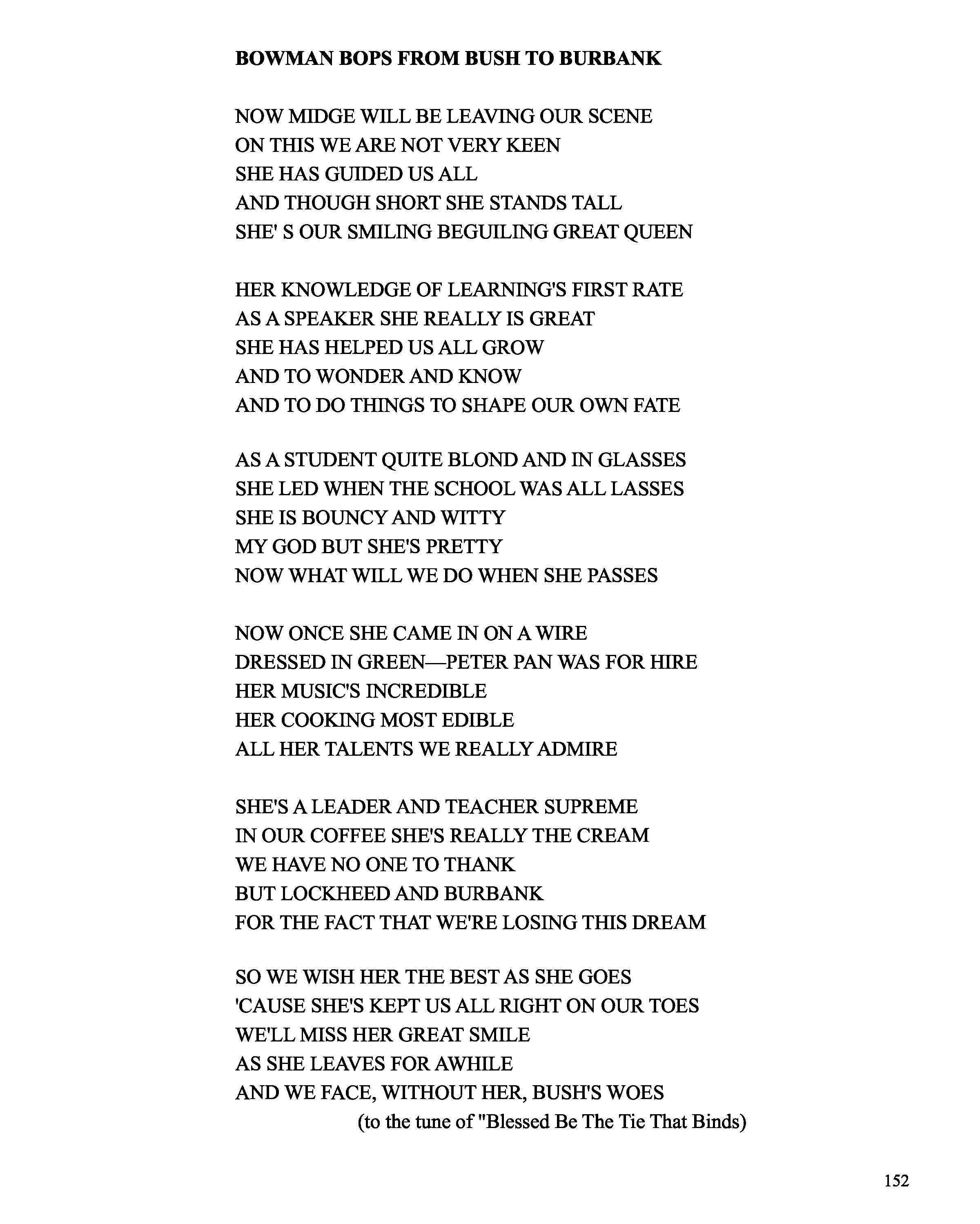
NOW MIDGE WILL BE LEAVING OUR SCENE ON THIS WE ARE NOT VERY KEEN SHE HAS GUIDED US ALL ANDTHOUGHSHORTSHESTANDSTALL SHE' S OUR SMILING BEGUILING GREAT QUEEN
HER KNOWLEDGE OF LEARNING'S FIRST RATE ASASPEAKERSHEREALLYISGREAT SHE HAS HELPED US ALL GROW AND TO WONDER AND KNOW AND TO DO THINGS TO SHAPE OUR OWN FATE
AS A STUDENT QUITE BLOND AND IN GLASSES SHE LED WHEN THE SCHOOL WAS ALL LASSES SHE IS BOUNCY AND WITTY MY GOD BUT SHE'S PRETTY NOW WHAT WILL WE DO WHEN SHE PASSES
NOW ONCE SHE CAME IN ON A WIRE DRESSED IN GREEN-PETER PAN WAS FOR HIRE HER MUSIC'S INCREDIBLE HER COOKING MOST EDIBLE ALL HER TALENTS WE REALLY ADMIRE
SHE'S A LEADER AND TEACHER SUPREME IN OUR COFFEE SHE'S REALLY THE CREAM WEHAVENOONETOTHANK BUT LOCKHEED AND BURBANK FOR THE FACT THAT WE'RE LOSING THIS DREAM
SO WE WISH HER THE BEST AS SHE GOES 'CAUSE SHE'S KEPT US ALL RIGHT ON OUR TOES WE'LL MISS HER GREAT SMILE AS SHE LEAVES FOR AWHILE AND WE FACE, WITHOUT HER, BUSH'S WOES (to the tune of "Blessed Be The Tie That Binds)

Above with Dennis Evans. On my departure, he gave me one of his amazing art works. The pleasure of knowing and working with him remains one of the high points of my years at Bush.
King Les "Knighting" Midge

Shirley Loper reading her poem: TO
MIDGE, A FAREWELL
A blonde from Seattle named Midge Who all kinds ofleaming could bridge, Did lectures and preaching So inspired and far-reaching, That they cheered from seashore to ridge.
Now she's headed for wicked LA, Where the idols are pure matinee, Though she'll smely get weak
From the smog and Val-spe~ Gag Midge with a spoon there's no way.
All Bush hearts with sorrow do swell For reasons too many to tell, We'll miss that sweet smile
Of our own bibliophile.
Good luck, Midge, Godspeed and farewell.
Bob and Shirley Loper
October 14, 1982

At No Other School Did We Find A Community So Empowering
Although that wonderful farewell event was the end of our working relationship, my friendship with Les and Nancy has continued to this day. We both found multiple leadership experiences in different places but Bush remained the best.
Midge: Of all the schools you led after your 18 years at Bush, what do you remember about Bush as opposed to all those other places?
Les: I have to say that of all the schools with which I was involved, my happiest times were at Bush. Bush was the touchstone for all the others. We got a lot of positive experiences at Bush because everyone was so empowering: parents, board, faculty and administration. It was a very happy time.
Midge: Bush really was an example of what is necessary to achieve innovation and change in a school. You need open-minded parents, a strong board and a creative faculty willing to support visionary leadership. I have to say that of all the other schools with which I was involved, my happiest times were at Bush too. Les, you are such a wonderful human being -a visionary but also a person who helps others implement their dreams. Many pay lip service to that idea, but few provide the kind of support that makes it happen.
Les and Midge Bellingham 2019
David and I arrived in Los Angeles in November 1982. As a new job was impossible in the middle of the school year, I applied to the Fielding Graduate School in Santa Barbara. Since no education degree was offered, I chose to concentrate on Human Development. It was an opportunity to study more deeply how children learn and develop in pre-school through high school but also the whole span of adult development. In the midst of that program I was offered a position as Assistant Head and Director of the High School at the Oakwood School in North Hollywood. Having held a similar position when I left Bush, it seemed a wonderful way to continue my work with adolescents. Two years later in 1985, Les invited me to return to Bush to accept the Distinguished Alumna Award. My acceptance speech follows:
Les asked me to talk today about being an alum. My involvement with Bush School has spanned so many years (indeed more than three decades now) that it is no small task to encapsulate my experience into five minutes but I accept the challenge.
As some of you know, I entered Bush when I was twelve years old. Mr. and Mrs. Bush were still running things, he from an office that smelled continually of cigar smoke and she from all over the school. One never knew where she would pop up next. I was a sophomore when part of the school burned down and I graduated right after the new school (much in the configuration it is now) was completed.
After college and graduate school, I returned as a teacher, left to raise our family, returned eight years later as Director of the Lower School. In 1981 became Associate Head and the following year, Director of the Upper School. Our two children graduated from Bush in 1978 and 1980. One can see how much ofmy life has been connected with Bush.
Quite suddenly in 1982, my husband, David, was transferred to Los Angeles and my long association with Bush School ceased, at least I thought so at the time. What I did not cease being was an alum-a category that has taken on new meaning. This short monologue on being an alum is dedicated to the class of 1985, a class for whom I have a special feeling since many of you were my students in the Lower School years ago and even more of you were my students in the Upper School in 1981.
I am now Assistant Head at the Oakwood School in Los Angeles. From the more distant vantage point of a new city and a new school, I think I am better able to assess those qualities that make Bush a very special place.
The maintenance and nurture of an independent school is the responsibility of all those who choose to be part of it: trustees, administrators, faculty/staff, students, parents, grandparents and alumni. All ofus have a part in helping to ensure that the vision of the Founder remains a relevant and living reality in the lives of each generation of Bush students.
The story of the alum who gave his school an enormous sum because, "The school has remained exactly the same as when I was a boy here 50 years ago," would not have pleased Mrs. Bush. I think she would be very unhappy to find her school the same as when she founded it. Rather, she would be pleased that our new directions have not lost touch with the emphasis on experiential learning, a commitment to the arts, and an enlarged view of the world. I mention this because one of the things I find most surprising in working with California kids is that most of them plan to remain in California for college. Many of them see themselves not as citizens of the world, but as citizens of Los Angeles. They lack an awareness of a larger context.
Bush has always understood that the campus is the center but not the circumference of our learning environment. In one sense, the Bush campus extends from N. America and Mexico to France, Japan, Neskowin, Mt. Rainier and the Eastern seaboard. I know ofno other school in the U.S. that has made this component a more integral part of the student experience and this is evident in the careers our alums are choosing: global issues, government, the environment and public service. As Colin put it last evening, "It's not only what you've learned here, but how you use it that will be proof of the values you acquired here."
In the years ahead, you may realize that the friendships you found here with other students and faculty will prove deeper and longer lasting than those from college. With apologies to Thomas Wolfe, "you can come home again" and you will be warmly welcomed.
"Departure and return" will be the pattern for most ofus. You are leaving part of yourselves here and you will find it waiting for you when you return as I have. Today's return has been especially meaningful for me. Thank you for this recognition.
A Difficult Decision: 1986
Independent schools in California are so numerous it is necessary to have two divisions: northern and southern. It also meant many more possibilities for jobs. After three years at Oakwood, I decided to seek a headship. Les had informed me of an opening at Westridge, an independent school for girls in grades 4-12, in Pasadena where he had once been Principal of the high school.
I was fairly far along in that search process, when Les announced his intention to leave Bush and I was invited to become an applicant. The possibility of being considered for a school I loved so deeply- and as the Head-would culminate all those years and the many roles I had held, so I flew to Seattle.
What followed was a kind of "love fest of return" but it also became evident to me that it would be better for the school to go through a typical search process where the many new parents could be part of the process.
I called from the airport with my decision and then cried on the plane all the way back to LA. As we deplaned, the stewardess informed me that members of the Board were on the next plane to LA to try to change my decision.
Their gesture was bittersweet. I felt truly honored by their midnight visit but I had a husband in a very stressful new job and ultimately my loyalties had to lie with him. I do believe that my truncated search process may have helped to clarify the importance of involving the whole school in a traditional search to define the leadership qualities desired in the new Head. How I wish things might have been different!
Later, Merrily Chick '61, Board chair, very kindly sent me the many letters of support from faculty during the search process. The one from Marilyn Hurley Bimstein was so perceptive that I am including it on the following page.
March 25, 1986
Merrily Chick and the Board of Trustees
Dear Friends:
I am writing to add my opinion to yours and others so that this difficult task before you may seem less lonely if not less hard. I applaud your courage for putting the interests of Bush ahead of all others, and I share your concerns if not your liability at a very real level.
I am a great believer in process, in doing what is fair and what is "seen to be fair." There are no guarantees that if we use the process each time we will get what we want, but we will at least know that we looked at several possibilities. Still there are no guarantees, and even the most dedicated and well-intentioned people make mistakes.
And here we have a choice which because of circumstances must put excellence against the process. In spite of my strong, long-held belief in the process, I find that excellence and vision and a deeply held commitment to Bush that we find in Midge Bowman, the likes of which may not be "findable" in our search, I choose excellence and vision.
Bush is in a win-win situation here, but Midge is certainly not, and I feel great compassion for what she had been through in these intense two days, and particularly regret that she was allowed to walk in "blind" in that she was not warned of the recent (and temporary I'm sure) break-down in some of our systems of mutual trust. In spite of all this hidden and even overt hostility (some landing squarely on her) she comported herself with incredible energy, wisdom and integrity.
Good luck, my friends, in your deliberations and know that I think you are terrific.
Marilyn Hurley Bimstein
A Class Act
by Bill Poll (Bush newspaper Spring 1986)
Midge Bowman's visit to the Bush School was a hectic and emotional experience for all ofus. In only two days Midge was interviewed and saw every facet that our school has to offer while everyone thought of the most obvious question, will and should she become the next Head Mistress of the Bush School? That single question raised an incredible amount of controversy and many people opposed to her candidacy seemed to have negative feelings toward Midge.
It is important to keep in mind that Midge was invited by the Board of Trustees to make such an appearance and consider the possibility of being the new Head. She was quite aware that the standard procedure of finding a new Head usually takes a year of intense investigation and analysis but the possibility of "fulfilling her life-time dream" seemed too good to pass up. Finally after the two day visit, just fifteen minutes prior to the Board's final decision, she withdrew her name from the job fearing controversy which may arise by not conducting a "formal search." Indeed, a lifetime goal shattered by the love of our school.
For many years, first as a student and then as a Lower and Upper School division Head, Midge Bowman was one of the most active members in the Bush community. She believed strongly in art, experiential learning, strong academics and, most of all, people. Unfortunately Midge, had to leave Bush in 1981 after her husband accepted a job in Southern California and she accepted a job as Assistant Head in another private school. What made her situation more complicated was the fact that she was applying to be Head of another school when Les announced his resignation. After the two day visit Midge had to respond to the job offer at the other school which chose her to be the new Head Mistress after a "formal search."
Ironically, it was Midge's love of Bush that caused her to decline the offer to be the new Head. Although she originally felt that she would be a healthy addition to the school, Midge didn't like the idea of beginning a new job surrounded by criticism. It is the caring nature in Midge Bowman that deserves attention. She has and always will love the Bush School even though she'll never be part of it again. Hopefully through the formal search we will find someone who has the maturity and understanding of Midge. It was a class act on Midge's behalf to decline and encourage the search as a growing experience for the entire Bush community. We all wish her the best ofluck in her up-coming endeavors.
Although I was not in contact with Bush during the 1986-1996 decade, my interview with Peggy touched on the 1992 PNAIS Self-Evaluation study she co-led with Gardiner Vinnedge during that period. I was deeply impressed by the magnitude of what had been envisioned. The fact that the whole faculty and staff committed themselves, over many months, to identifying the qualities of mind involved in true learning K-12-in addition to the traditional factual information transmitted-was too important a part of the School's history to be ignored. It is something that few schools have ever really attempted, but which Mrs. Bush would have understood immediately.
I had planned to contact Gardiner for his perspective. His recent death has been a huge blow to all ofus. With Peggy's concurrence, I have included the few documents in her possession that give some sense of the breadth of vision, the creative thinking and the tremendous amount of work done by the whole School community. Fred Dust's leadership should also be noted.
Peggy: When we went in for the new round of accreditation in 1992, Gardiner and I were the cochairs. And of course, we went off the rail and did something very different. It was such a Bush school thing to do. Our goal, with Fred Dust's interest and involvement, was to create a whole new way of evaluating a student's progress from Kindergarten through Senior Year. We were really ahead of our time. And it was K through 12. When you put people together and asked the right questions, there were some very, very interesting thinkers at Bush. Deep thinkers. People that cared about thinking differently and we trusted each other. We trusted each other to think differently.
We asked people to throw out their department's prior descriptions and instead to have different categories like flexibility, expressiveness, ability to interrelate, sense of self, capacity for inquiry and curiosity and awareness and responsibility. To say emotion or artistic expression is part of learning, to really think in a different way, is pretty important. Even if some new faculty came in, their minds were so fertile about thinking differently, that if someone offered a new idea or a new approach, it was not always accepted, but was certainly acknowledged for presenting something in a different way.
We took everybody out of their classrooms and said leave your biology behind, use it as your experience, but then just talk with people and develop these categories. And it was magical.
So we had this whole team come in and ask, "How do we develop inquiry and curiosity?" And they were looking in the kindergarten or they were looking in sixth grade English or they're looking in a science class. It was wonderful. It was absolutely wonderful.
Midge: I can see you were far ahead of current thinking. It was especially important because you were involving teachers across K through 12. It really highlighted one of the things that make Bush such a special place.
Peggy: I think working together with the faculty encouraged those projects that were K-12. My microbes and disease class would work with the fifth grade and the seventh grade. And we actually developed this little plan where the upper school students in my class would go listen to the presentations about mosquitoes in the fifth grade.
It was terrific. And then the younger kids would come up for a little field trip up to our classroom and look through the microscope. I think when you had a big project, like we had, it encouraged that collaboration.
It was really critical and fun because there was so much work that went into it, and it was stellar work. I think one of the greatest gifts we as teachers can give to students is for them to see how much we love what we are doing. The kids can't wait to get back into class the next day to see what's next.
Midge: All this work must have had a long-lasting impact, at least on faculty.
Peggy: Actually, it took us, I think, probably at least a year, if not two years, to get ready for the committee visit. And then I think lower school in particular, used those categories in their assessments-their written assessments- for a long time. I think they kept up the vocabulary longer than some of the other folks did. I bet if we polled the teachers at Bush now, how many of them would have any idea about this? I don't think it ended up being reinforced in any way, where you're encouraged to use the vocabulary of that evaluation project as you write your midterm evaluations or whatever.
It certainly affected me as a science educator a decade later with work on AP science practices for the College Board. I was able to share the work of Bush School faculty in a national conversation.
Note: In the following pages, I have included some of the documents Peggy retained in order to honor the work-and the vision- the assessment document represented. Because of Gardiner's recent death, I did not pursue trying to find further documentation.
#1. Letter to PNAIS Executive Director, Lee Neff. Background and rationale for what Bush hoped would be a fresh approach to the whole PNAIS Self-assessment process.
December 17, 1992
Dear Lee:
I just hung up the phone after talking with you so haven't had a chance to confirm dates with Peggy, but thought I would send you the enclosed newsletter.
Bush has been considering a new evaluation format for several years. Fred brought the idea to our Education Council (Board, faculty, parents and about 50% outside educators) three years ago. We wanted to avoid the all-too-typical twelve-month death march of paperwork and meetings culminating in a new document for the shelf. The idea was to take several years to define what a Bush-educated child should have at the end of thirteen years, see who is doing what (both at Bush and in the wide world) to achieve those results, design ways to measure whether or not we are being successful on a sufficiently broad scale and then to compile a record of the process. We imagine it will take four years to complete the process. As we will discuss in January, a lot has already been done, but Peggy and I are on board to lead the formal process.
The enclosed newsletter (first issue) will provide a few hints. We've met with Bob Minnerly and today I sent a note similar to this to Joan Beauregard at St. Thomas, as I understand she will be involved as well.
Thanks for your help. I look forward to our January meeting (there's so much we don't know!)
Gardiner
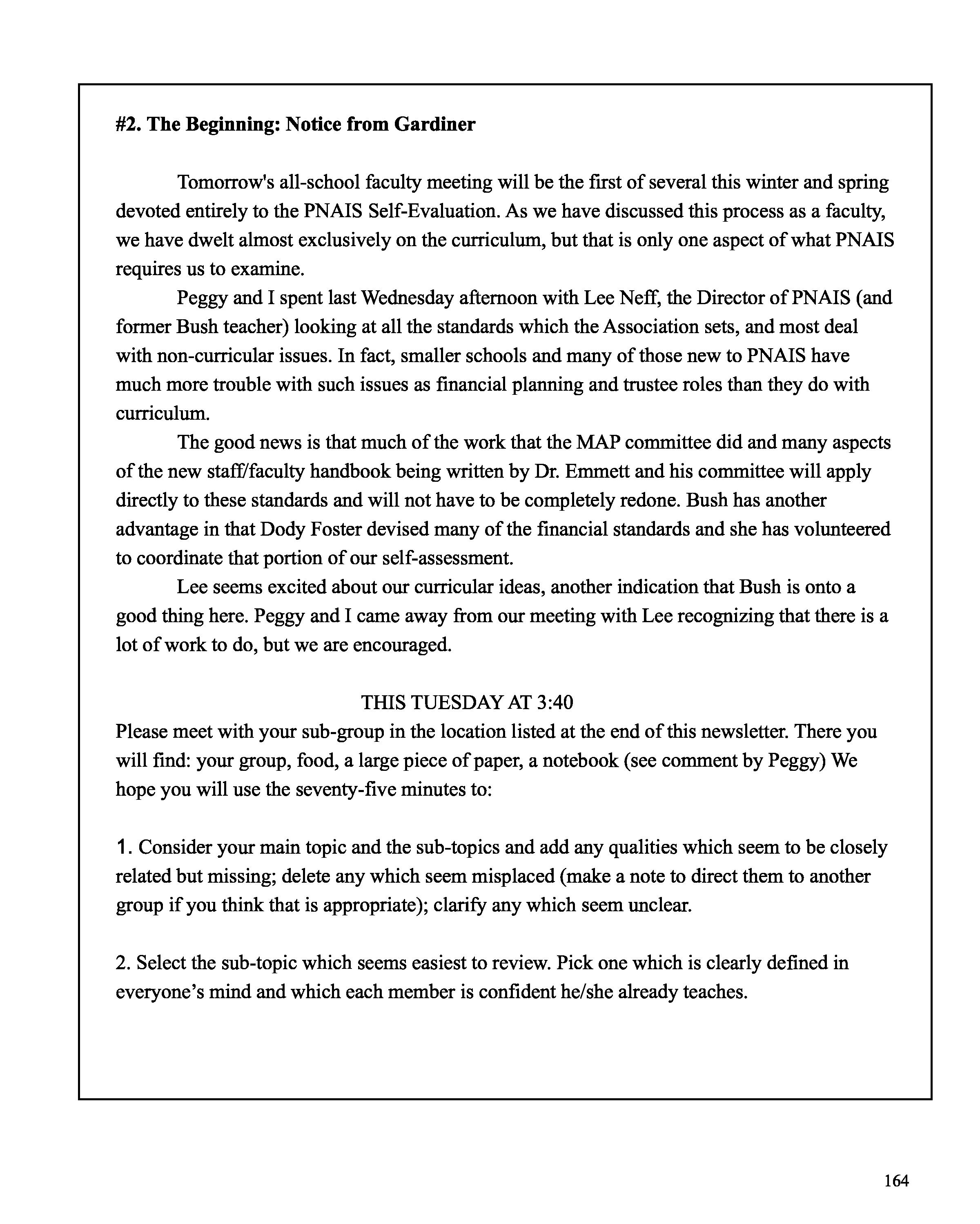
#2. The Beginning: Notice from Gardiner
Tomorrow's all-school faculty meeting will be the first of several this winter and spring devoted entirely to the PNAIS Self-Evaluation. As we have discussed this process as a faculty, we have dwelt almost exclusively on the curriculum, but that is only one aspect of what PNAIS requires us to examine.
Peggy and I spent last Wednesday afternoon with Lee Neff, the Director of PNAIS (and former Bush teacher) looking at all the standards which the Association sets, and most deal with non-curricular issues. In fact, smaller schools and many of those new to PNAIS have much more trouble with such issues as financial planning and trustee roles than they do with curriculum.
The good news is that much of the work that the MAP committee did and many aspects of the new staff/faculty handbook being written by Dr. Emmett and his committee will apply directly to these standards and will not have to be completely redone. Bush has another advantage in that Dody Foster devised many of the financial standards and she has volunteered to coordinate that portion of our self-assessment.
Lee seems excited about our curricular ideas, another indication that Bush is onto a good thing here. Peggy and I came away from our meeting with Lee recognizing that there is a lot of work to do, but we are encouraged.
THIS
TUESDAY AT 3:40
Please meet with your sub-group in the location listed at the end of this newsletter. There you will find: your group, food, a large piece of paper, a notebook (see comment by Peggy) We hope you will use the seventy-five minutes to:
1. Consider your main topic and the sub-topics and add any qualities which seem to be closely related but missing; delete any which seem misplaced (make a note to direct them to another group if you think that is appropriate); clarify any which seem unclear.
2. Select the sub-topic which seems easiest to review. Pick one which is clearly defined in everyone's mind and which each member is confident he/she already teaches.
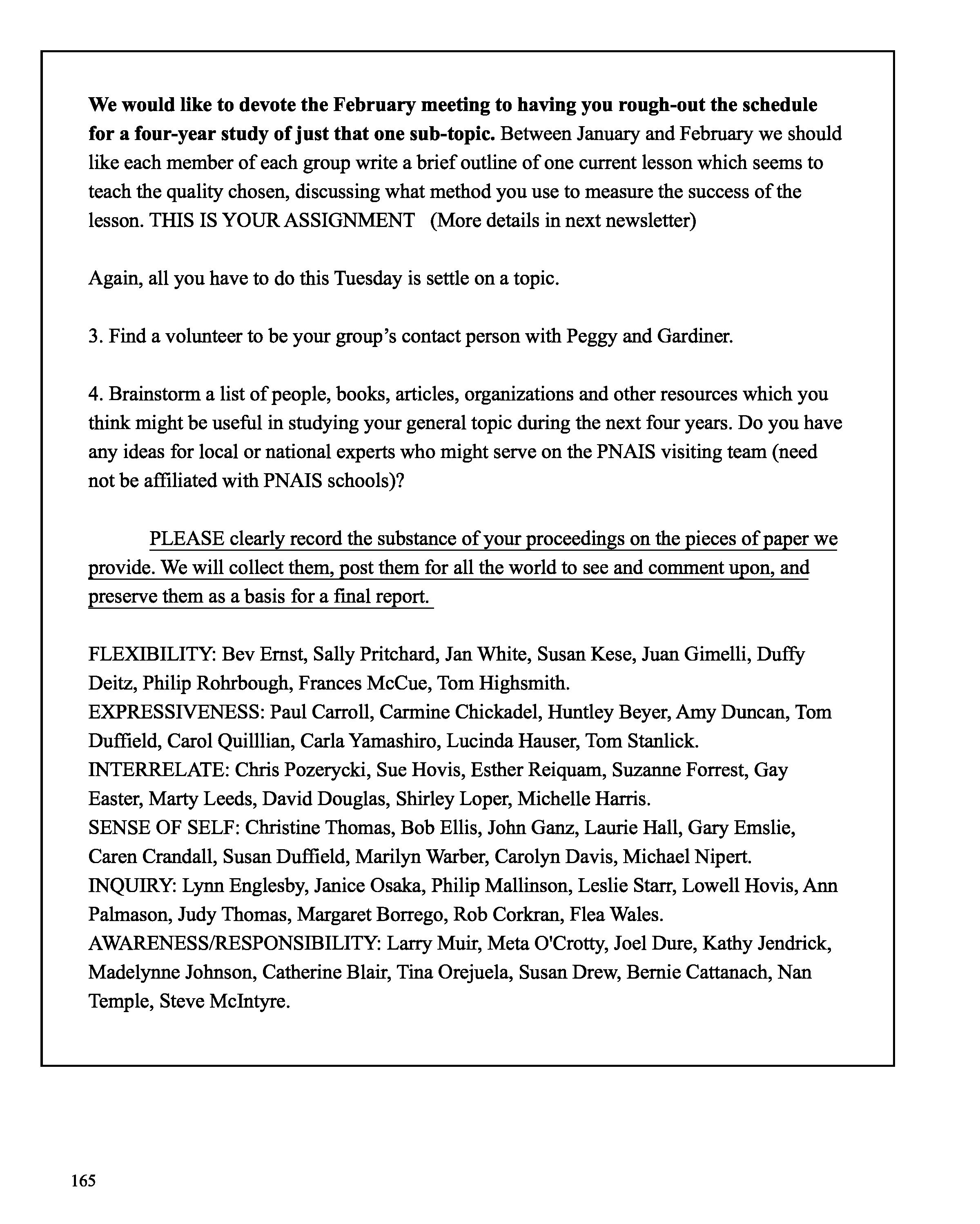
We would like to devote the February meeting to having you rough-out the schedule for a four-year study of just that one sub-topic. Between January and February we should like each member of each group write a brief outline of one current lesson which seems to teach the quality chosen, discussing what method you use to measure the success of the lesson. THIS IS YOUR ASSIGNMENT (More details in next newsletter)
Again, all you have to do this Tuesday is settle on a topic.
3. Find a volunteer to be your group's contact person with Peggy and Gardiner.
4. Brainstorm a list of people, books, articles, organizations and other resources which you think might be useful in studying your general topic during the next four years. Do you have any ideas for local or national experts who might serve on the PNAIS visiting team (need not be affiliated with PNAIS schools)?
PLEASE clearly record the substance of your proceedings on the pieces of paper we provide. We will collect them, post them for all the world to see and comment upon, and preserve them as a basis for a fmal report.
FLEXIBILITY: Bev Ernst, Sally Pritchard, Jan White, Susan Kese, Juan Gimelli, Duffy
Deitz, Philip Rohrbough, Frances McCue, Tom Highsmith.
EXPRESSIVENESS: Paul Carroll, Carmine Chickadel, Huntley Beyer, Amy Duncan, Tom Duffield, Carol Quilllian, Carla Yamashiro, Lucinda Hauser, Tom Stanlick.
INTERRELATE: Chris Pozerycki, Sue Hovis, Esther Reiquam, Suzanne Forrest, Gay Easter, Marty Leeds, David Douglas, Shirley Loper, Michelle Harris.
SENSE OF SELF: Christine Thomas, Bob Ellis, John Ganz, Laurie Hall, Gary Emslie, Caren Crandall, Susan Duffield, Marilyn Warber, Carolyn Davis, Michael Nipert.
INQUIRY: Lynn Englesby, Janice Osaka, Philip Mallinson, Leslie Starr, Lowell Hovis, Ann Palmason, Judy Thomas, Margaret Borrego, Rob Corkran, Flea Wales.
AWARENESS/RESPONSIBILITY: Larry Muir, Meta O'Crotty, Joel Dure, Kathy Jendrick, Madelynne Johnson, Catherine Blair, Tina Orejuela, Susan Drew, Bernie Cattanach, Nan Temple, Steve McIntyre.
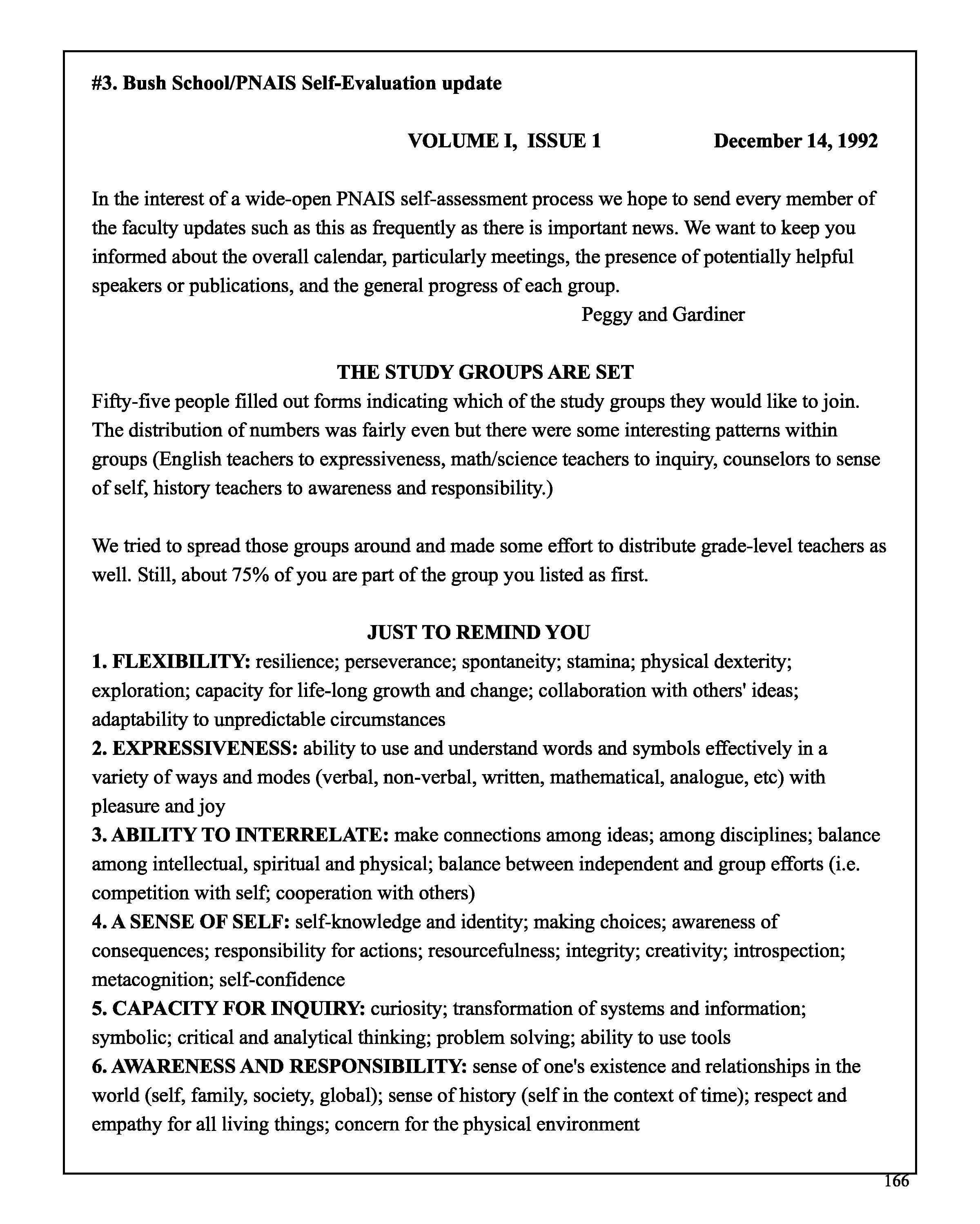
VOLUME I, ISSUE 1 December 14, 1992
In the interest of a wide-open PNAIS self-assessment process we hope to send every member of the faculty updates such as this as frequently as there is important news. We want to keep you informed about the overall calendar, particularly meetings, the presence of potentially helpful speakers or publications, and the general progress of each group.
Peggy and Gardiner
THE STUDY GROUPS ARE SET
Fifty-five people filled out forms indicating which of the study groups they would like to join. The distribution of numbers was fairly even but there were some interesting patterns within groups (English teachers to expressiveness, math/science teachers to inquiry, counselors to sense of self, history teachers to awareness and responsibility.)
We tried to spread those groups around and made some effort to distribute grade-level teachers as well. Still, about 75% of you are part of the group you listed as first.
JUST TO REMIND YOU
1. FLEXIBILITY: resilience; perseverance; spontaneity; stamina; physical dexterity; exploration; capacity for life-long growth and change; collaboration with others' ideas; adaptability to unpredictable circumstances
2. EXPRESSIVENESS: ability to use and understand words and symbols effectively in a variety of ways and modes (verbal, non-verbal, written, mathematical, analogue, etc) with pleasure and joy
3. ABILITY TO INTERRELATE: make connections among ideas; among disciplines; balance among intellectual, spiritual and physical; balance between independent and group efforts (i.e. competition with self; cooperation with others)
4. A SENSE OF SELF: self-knowledge and identity; making choices; awareness of consequences; responsibility for actions; resourcefulness; integrity; creativity; introspection; metacognition; self-confidence
5. CAPACITY FOR INQUIRY: curiosity; transformation of systems and information; symbolic; critical and analytical thinking; problem solving; ability to use tools
6. AWARENESS AND RESPONSIBILITY: sense of one's existence and relationships in the world (self, family, society, global); sense of history (self in the context of time); respect and empathy for all living things; concern for the physical environment
#4. Six Qualities
Expressiveness
Spoken
Dramatic
Musical
Written
Graphic
Body Movement
Ability to Interrelate/Integrate
Among topics, disciplines, curricula
Among themes and ideas
Among intellect, the physical, the aesthetic, the emotional
Sense of Self
A sense of empowerment
An understanding of one's learning style
An ability to develop relationships with others
A willingness to take risks
An understanding of one's sexuality
An understanding of one's culture
An understanding of one's ethnicity
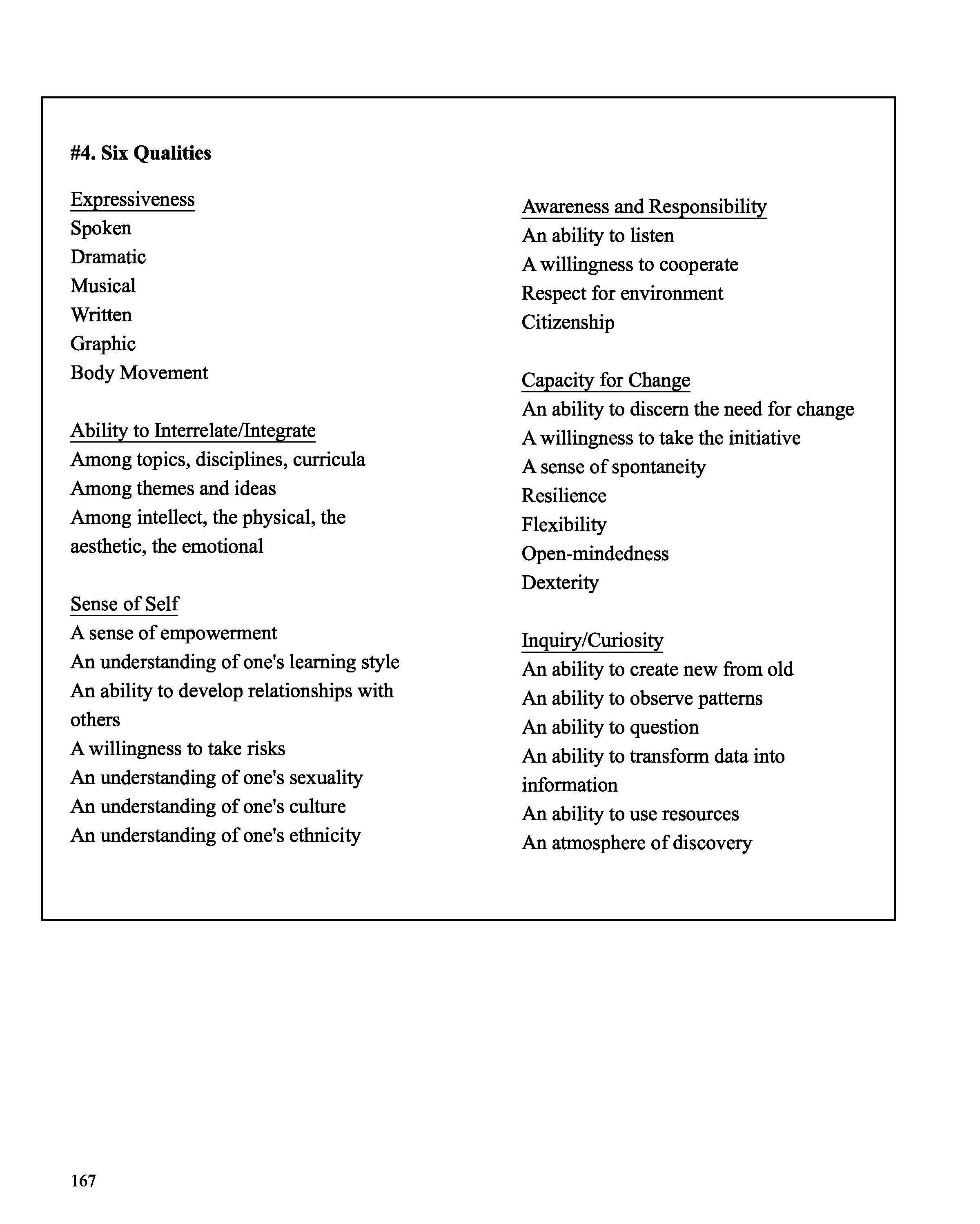
Awareness and Responsibility
An ability to listen
A willingness to cooperate
Respect for environment
Citizenship
Capacity for Change
An ability to discern the need for change
A willingness to take the initiative
A sense of spontaneity
Resilience
Flexibility
Open-mindedness
Dexterity
Inquiry/Curiosity
An ability to create new from old
An ability to observe patterns
An ability to question
An ability to transform data into information
An ability to use resources
An atmosphere of discovery
Abiltiy to Interrelate / Integrate
Note: I decided to include this transparency and those on the six following pages because they illustrate the actual work and thinking being done in the groups-including their colored-ink notes.The final page shows the application of these ideas in the format of a Lower School report.
Personal, Social and Intellectual Qualities Developed in a Bush Education
•bJ)Jty to us• •nd underst•nd words •nd symbols •ff•ctiv•ly in • v•riety of w•y• •nd mod•• (v•rb•l , non-verb•l, written, m•them•tic•J, •n•Jog, etc.); with ple•sure •nd Joy
EXPRESSIVENESS
.JI.ow e,r~¥,Mw ._. _.....,._:i;;, Use. ~w-,.,,:1;4,.,r (¢.- - -j6v..>) fU'xJM..I ',3'tll.J"I!~~ l~J~ 1u ~t. k.-~.) of ..9rovr.i'"A lfa}µt, + tttlCc vf~1 tA~c,f ()i°"-.u'v,~ ~. ~( ¥-4,/ 01'1.t,-O'\, o""- -fii.r,u.,.ft \/ 1 . 1.ul1~Lilu4~ · ,esS.t<11,v J:n~ w( 1 h.rlft ~!'.S stud..e,,q'" . f : 1 • C.-«<r1 (JJ.)JJJ, - v/J.JML (/K., • 1 Mf~ -Pi.(,; -reerpre&>vf'e. r;ou.~ c++~~- 4/tt.li> d,~1~ • I \ 1 I. h. ""'(~Vt';:r.:,(,:$V\ - ~oo,t>", •~f U/vV-<-il.'. ·i ;; Ct:.~ r 7 u I V ,.s. u.-< \V\ ,vw:>"\:. •

Personal, Social and Intellectual Qualities Developed in a Bush Educati on

m•k• conn,ctions b•tw••n , \_ id•••; b•tween disciplines; SoqQ..'tfA/ b•l•nc• •monr;; intellectual, e/}fU110 , r a,,j J1 J and physi Cill de,v~rnen.t.


• b• l •nc• between independent: •nd gro up efforts (i.e. comp,tit i on with •• l f; coop•r•t i on with oth•r•J
AcJ.u1'Sor~s o...S. /f.{,£, •• /JrM,fS., &,mm~ Se,N~ L..S. Families ., \:lS.lt)tl,lli"
M.Qic1Af)5 t...S. AcA,'v1~'es
Mct;\-d-J .· · 'n.r-,_ c.lo.sses0o.H • Gd..i)
AM.Ps '~ J. . s. MUS1(.At,;$
Personal, Social and Intellectual Qualities Developed in a Bush Education
.5 -rvc>cAJr /4-fK-Hc"l!. I!. ~,io
·Po1t£19AJ ,IUHIE.t...
• /t-MP / E:14.1'£12.eAI r, It L
• A-THt..l.fl ,.,
Hl•Mft,-) R.€"Llt7,o,J,. ("'1,i) /,t;>iV,DUIIL.. T'ERCl.#EJl-5 ,e"4lA+,;v7 Fott.,.,,,11 TJ (t!y Sr:"-' ,o "- P(J..o:J'Ec.-;- .s c.o,.,,'":''•"', r • ; ,~., l'1At5t.Jc. ftt1S<-, ·- re. ~,:.u r~ .-.JJ/SPr.t<P'J C,)J4-'l~p1.1VJ,,»;->f .e.w. 3 , ei,r
•>.$ /(JAUS GV~t., ev /#.1c, rlrt...J..,,f,v..WHAT •
o::~9L ~"I IS IT
A.IMl.fl,. V..: ?
alit. • Tl Al 1 •
SM'!'~ Ii. r/ S°'Ellv, c.EJ ,":, ,:- C 4-f Sufi>-, t... D,s·c.,,~.;
-,.~'"" t"' r, .,AJ J
s•lf-knowledge •nd id•ntity m•kint; choices; •w•reness of consequences; responsibility for ,;,ctions; resourcefulness; int•grity; cre•tivity; intro•p•ction; met•cor;ni tion; s•l fconfid11nce WHERE IS IT ? . OF
?
WHAT IS IT ?
Personal, Social and Intellectual Qualities Developed in a Bush Education
r11silience; p•r••v•r•nce; spor.t,1neity; •t•min•; physic•l dext•rity; explor•tion; c•p•city for lifelong growth •nd ch•nge; coll•bor•tion with oth•r• ' id•••I •d•pt•bility to unpredict•bl• circum•t•nc•• •
FLEXIBILITY
WHERE IS IT ?
ARE WE DOING IT ?
HOW CAN WE IMPROV:E ? .
• 1ch-~tkt:
• C-oL/YS&- offe~ ,;.,1 .
• luur1t-·ft've evil~tt:i-ro>v
• Ii..d cv·uf.uA. Rn~ -fe.t,tl,.; _ • ~1,MJ~ ~,evJJ,.
er ; (, n..:k--;•t /(4,(/ ~--1·efl ft.
- C()(,J1!!,rll f-,
#5. Evaluation for Grades 1, 2, 3
Teachers - please remember to outline classroom expectations so the child is more able to be successful.
Flexibility Moves from one task/area to another. Adaptable to new/unpredictable circumstances. Is flexible enough to make the visit a positive experience.
Ability to Interrelate Takes turns/waits for others. Makes connections. Response to being paired up. Reaction to games/activities.
Sense of Self Confidence. Comfort level.
Interview format: What do you think you're good at? What do you like to do on weekends? What do you like to do with your friends? What do you like to do with your family?
Enthusiasm?
Capacity for Inquiry How does he/she react to the room? What does he/she choose to do'i
Does the child attempt to problem-solve?
Awareness/Responsibility Follow directions. Help with snack.
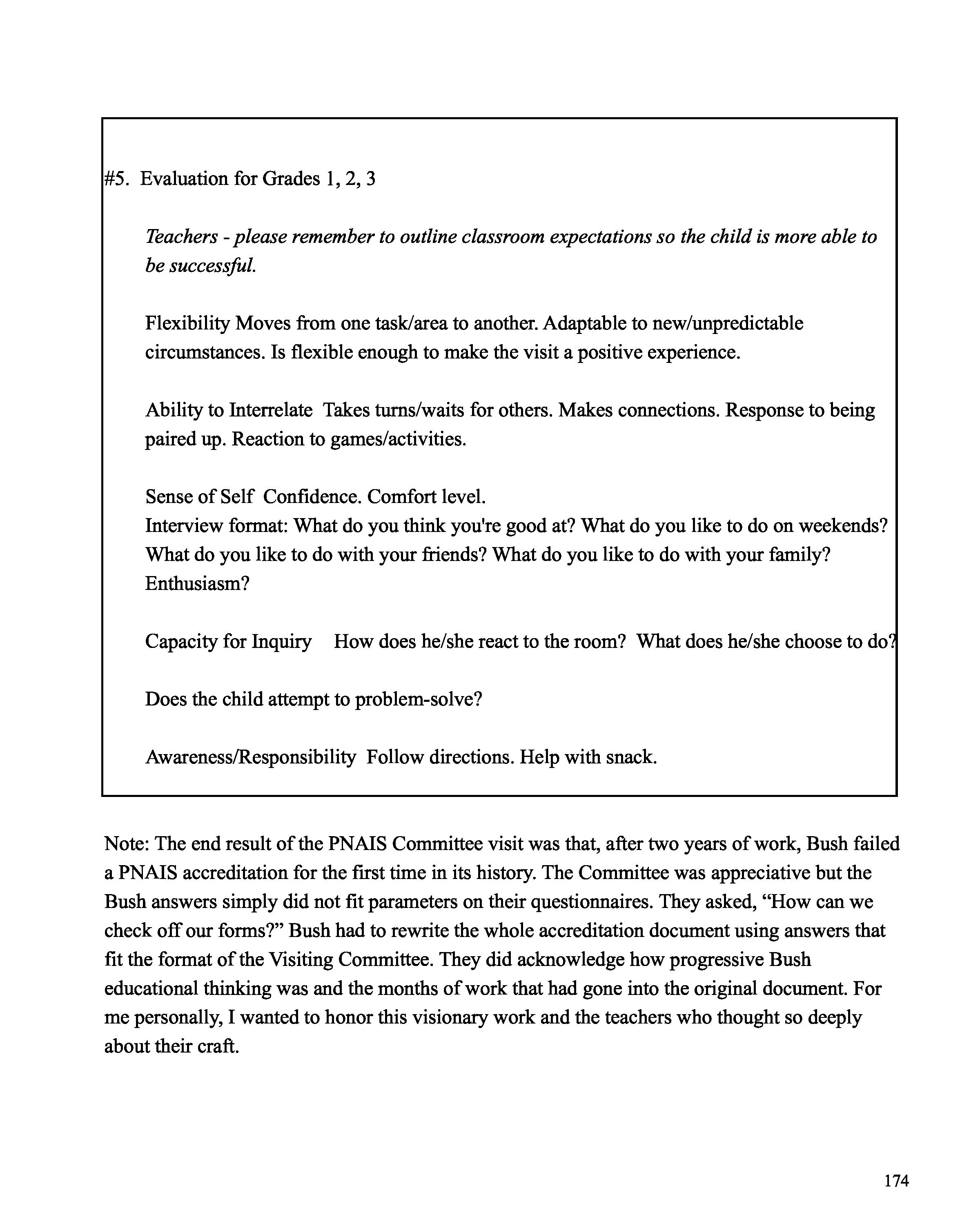
Note: The end result of the PNAIS Committee visit was that, after two years of work, Bush failed a PNAIS accreditation for the first time in its history. The Committee was appreciative but the Bush answers simply did not fit parameters on their questionnaires. They asked, "How can we check off our forms?" Bush had to rewrite the whole accreditation document using answers that fit the format of the Visiting Committee. They did acknowledge how progressive Bush educational thinking was and the months of work that had gone into the original document. For me personally, I wanted to honor this visionary work and the teachers who thought so deeply about their craft.
Back to Seattle 1994
We left Baltimore permanently in July 1994, but had a swift trip back to Seattle in June 1993, to attend the wedding of our son, Matthew, and Carolyn Kato. Both were Bush alums and wanted to have their wedding at Gracemont. I don't know how or why their wish was granted, but there could be no place on earth more special to them and to our family.
We returned the following July and although I was essentially retired, I was still on the boards of the National Coalition of Girls' Schools and the Council for Religion in Independent Schools. Within a few months, I became president of the Ladies Musical Club just as it began partnering with Meany Hall at the University of Washington in bringing all Seattle 4th graders to Meany for concerts in music and dance. I also trained as a National Operational Volunteer for the Girl Scouts to assist chapters throughout the US in strategic planning.
David and I had just returned from a trip to England and Italy when Doug True, current Chair of the Bush Board, took me to lunch to discuss becoming Interim Head while a search was conducted for a successor to Fred Dust, who had retired in June.
While it was completely unexpected, I was very happy with the possibility of actually completing my Bush career. How many people have the opportunity of returning, again and again, to their alma mater, each time bringing a wealth of new experiences in order to honor not only the school's past but also to participate in its future? I said yes immediately!
Unfortunately I have only a few documents from that year but I hope they will give some sense of what we all attempted. I was helped initially by wonderful support from the publications staff in introducing me to the Bush community.
Midge McPhee Bowman '51 Named Interim Head 1996 Alumni Magazine
Elsa "Midge" McPhee Bowman's memories of Bush span nearly a lifetime-beginning with entering the school at age 12 and realizing that being intelligent was not just OK, it was exciting and satisfying; to writing her first novel as a sophomore because "that's the kind of thing you did at this school"; to working with faculty as lower school director to implement cutting-edge educational practices such as team teaching, a hands-on curriculum, particularly in science and math, a strong arts program, "the Orff music teaching method" and an all-day kindergarten--all practices which continue to thrive at Bush today. "The beauty of all this was that it focused on how children learn. It was a very happy time because we were living out a curriculum based on sound pedagogical research and because philosophically we believed that it's the way children learn best."
Midge also remembers the pleasure of observing the impact of a Bush education on her daughter Megan '78 and son Matthew '80 who both began attending Bush in the lower school. A teacher of music and dance with a bachelor's degree from Pomona College and a master's degree from Yale University, one of her fondest memories as a Bush parent and teacher was working with Megan in the all-school production of The King and I. John Fiore '78 (now an internationally renowned opera conductor) played piano, lower school children dressed up in sarongs and library director Shirley Loper sang. "Everyone was involved," remembers Midge with a smile.
That kind of visually rich, intellectually stimulating and active learning environment is one that Midge has appreciated as a student, teacher, administrator, parent and alumna. Now as interim head, she hopes to sustain and nurture the enthusiasm and excitement she has always known to be part of the school. "I want to focus appreciation of faculty and help communicate the school's philosophy to the outside community. The real engine of a school is the faculty, and I want to be sure they feel supported so that they can continue to grow professionally and personally. When faculty members continue to learn, it is a wonderful model for their students and the kind of environment that will attract the best head."
Midge knows from experience what a candidate will be looking for: she has been head of two schools-Garrison Forest, a K- 12 day/boarding school for girls in Owings Mills, Maryland, and Westridge School, a girls' college preparatory day school in Pasadena, California. After serving more than ten years as lower and then upper school head at Bush, Midge continued with
her administrative career as the assistant head and secondary school principal at the Oakwood School, a coed day school of 500 students in North Hollywood, California (where Bush Upper School Director Fred Mednick had earlier been a teacher and administrator for 15 years) before assuming her first headship.
According to Midge, her lifelong commitment to education stems from both her intellectual interests and her spiritual convictions, a commitment she believes she shares with many dedicated teachers and administrators. "The greatest joy of education is committing yourself to a higher value," she says.
In a 1981 paper to the Bush board of trustees explaining the importance of experiential education, Midge wrote, "In the future, the educational institutions that will survive are those who have put down roots very deeply; who remain dedicated to handing down the wisdom of the past while anticipating the challenges of the future; who are not afraid to attempt the difficult task of educating the whole person; who see education as a moral responsibility in which the best of ourselves is nurtured for the sake of others. I feel strongly that Bush is such an institution and I am grateful to be part of it."
Midge believes that in recent years Bush has become even more courageous about putting into practice the educational philosophy envisioned by Helen Bush. Staying true to the school's philosophical roots even in the face of more conservative education trends, according to Midge, is not just admirable, it is critically important to society as a whole.
"A healthy society must have people who are willing to question and not follow the herd mentality. At Bush we're offering a powerful alternative. We're defining success and happiness in different ways. Our responsibility as an educational institution is much greater than preparing our students for admission to college, even though we understand that this is an important part of our program. We believe that education is valuable in and of itself; it is not simply a means to an end. When done well, education leads to a life of depth and dedication, to giving back for the greater good."
Living out those high educational values is exactly why Midge has returned to Bush as Interim Head. "In this way, I hope that I can give back to the community that has given me so much. It's really a way to say thank you."
WHAT I FOUND
My return to Bush felt a little like Rip Van Winkle. In many ways, the School was much as I remembered it but in certain respects, it had changed and so had I. By 1996, I had gained leadership experience in three other Independent schools, but never as an Interim Head. I needed to assess the situation quickly.
The good news was that there were still quite a few faculty who knew me, but initially, there were several problems needing immediate attention: a civil law suit and instances of anonymous hate mail directed at specific faculty; female alums who felt that a coed Bush had forgotten them; some inappropriate expectations from parents new to private education. A former faculty member summed it up, urging that the School "become a place of safety and trust." Establishing that environment at all levels became my most important task.
My interim year offered an opportunity to acknowledge these underlying issues with the goal of dealing with them openly and appropriately so that the whole school community could come together around a positive vision. My success would depend on how well I managed to set clear goals that were achievable in a relatively short time. From my message to the faculty: "As Bush's first Interim Head, it is important to clarify that an interim year is not a moratorium on moving forward, nor is it a wholesale move to change everything! It is more like spadework in a vegetable garden in preparation for seeding the next crop. I hope our year can be an example of the professional and personal satisfactions that result when people of good will work together on an exciting vision. I believe everything is in place for that to happen here. I want this to be a very good year for all of you."
I focused on four "clients":
1. Trustees: Doug True and I identified 12 goals, among them: admissions/marketing; improving alumni and parent relations; oversight of the projected math/science building; parking and a transportation study; a long-range plan for technology; the annual fund; a publications audit; and support for diversity. While it seemed an assortment of unrelated tasks, my study of systems theory reminded me that leading a school involves communicating the importance and interrelatedness of all these facets.
2. Faculty: Mentor faculty, create a supportive work environment-"a place of safety and trust."
3. Parents: Help parents become articulate supporters of Bush and more knowledgeable about progressive education in general.
4. Alumni/ae: Bring alums back in touch with the school through personal contacts and events.
It was impressive to return the Seattle after twelve years and see how the campus had evolved. In 1982, Master Plan architect, Al Bumgardner, had referred to our campus as an Italian hill town, full of surprising vistas and courtyards hidden behind residential facades, progressing from the Lower School up to Gracemont. It was a beautiful synchronicity to hear architect/current parent, Scott Wyatt, use the very same words to describe Bush in 1996--- another confirmation of the consistency of our vision.
I was glad to find that certain programs like AMP and the Network exchange-both begun during Les' years-had been joined by an Internship program and that the Middle School had a new Experiential Week plus travel opportunities similar to what already existed in the Upper School. Now students in grades 6-12 have the opportunity to enrich their education with firsthand experiences of other cultures. Best of all, the arts still remain at the heart of the school. It is not by chance, I think, that Benaroya Theater and the Music and Art departments are situated near the central courtyard that bridges the three divisions. The arts literally hold us together.
I have always been interested in the early identification of children who learn differently in order to create an optimum environment of academic support. When I left Bush in 1982, there seemed little interest in this issue beyond the Lower School. When I returned, I found learning specialists in all divisions and a much greater understanding, on the part of the faculty, that learning differences do not mean less able students. This represented an evolution in our educational philosophy that was very gratifying.
And finally, everyone seemed more aware that, as an institution, we were growing up! There was increased student and faculty interest in Bush history. The year I was Interim Head, we began oral history units in both Upper and Middle Schools and brought several groups of alums back for interviews. Not surprisingly, we discovered that there was very little accurate information about the early days of the school.
1.FACULTY

Opening Address, Faculty Retreat, Vashon Island, August 1996
We began with a wonderful two-day retreat on Vashon Island. When I found that a third of the faculty had been at Bush three years or less, I felt my first task was to share some of Bush's history from my vantage as a former student, faculty member, parent and administrator from 1945 to 1982; how we got to this place in our evolution from a small girls' school to a much larger coed institution; people who were important in the evolution of our philosophy and mission; and local and world events that affected us. While I shared a little of my own long history with the school, I focused mainly on the changes that began with Les Larsen. Following are short excerpts from an eleven-page document I wrote for that retreat:
"Like one of my heroes, Robert Coles, I believe in the power of stories. In that spirit, I want to weave together two stories this morning: my life journey and the school's history. I do this partly because over a third of our number have been at Bush three years or less. I also want to talk about this transition year and what we can accomplish together. This is not about nostalgia. Connecting to the past is a way of confirming the consistence of our mission over time. It may also help bring alumnae from our pre-coed days back to the school.
... Because so many of the programs the school now takes for granted began during Les Larsen's tenure, I want to mention a few. I am convinced that Les had an intuitive connection to Helen Bush. Somehow he captured the essence of her educational philosophy and recast it in terms of the educational issues of the 70s.
Les was way ahead of his time. He foresaw the importance of global education and instituted our travel program with a 15 month bike trip around the world sponsored by Raleigh Bikes. He saw the coming impact of technology and made us one of the first schools to acquire computers. His global vision was also reflected in his commitment to diversity and a multicultural curriculum. He was a fierce champion of financial aid and worked to make Bush a real part of the surrounding community through AMP projects and community service.
In the early 70s when I was director of the Lower School, I was interested in studies showing the positive effects of mixed-age learning groups, open classrooms and team teaching. Les' belief in the importance of experiential education made him a great supporter of this evolution. We tore down walls to double class size and allow team teaching. Our curriculum included manipulatives in math and reading, hands-on science, cooking, journal writing, Orff music and drama. It was a happy, productive time. There were also plays involving kids and faculty from all three divisions: Benjamn Britten's The Little Sweep with Les in the role of the Coachmaster, and later, Peter Pan and The King and I.
I think we felt like a real community during those years because of our conscious efforts not to separate into groups or divisions. Les began a tradition of inviting staff and maintenance crews to the opening of school dinner. I remember when Board Chair, Peter Eising and his wife, Sharlee, helped faculty and maintenance folks paint some of the new classrooms when we faced an opening of school deadline. Les stayed at Bush until 1986. Those final years included the construction of Schuchart gym, Benaroya Theater, the art building extension and the remodeling of Gracemont for classrooms. It is quite a legacy.
My husband was transferred to LA and I left Bush in October of 1982. The following spring, I enrolled in a doctoral program in human development across the lifespan. Where earlier I had focused on child and adolescent development, now I was immersed in the different stages occurring in adult development. It changed the way I subsequently worked with faculty and parents.
Similar to the earlier years, later developmental stages and the issues associated with them, occur quite predictably at certain chronological periods of adulthood. I am no longer surprised when some younger teachers confront a great deal of stress in their thirties even before they hit the well-known midlife crisis in their forties. Even if you don't go through a midlife crisis, many of you in your late forties and fifties are beginning to face the stress of caretaking responsibilities for aging parents just as your adolescent children are dealing with new issues of their own. In working with teachers, I have found it is helpful to provide a meaningful context for these periods of stress and to offer support for larger life issues that necessarily impact their work at school.
A year after I enrolled at Fielding, I was offered a position as Head of grades 7-12 at Oakwood School in North Hollywood, a position that Fred Mednick also held at a different time. We never actually worked together there, but share that experience. I was at Oakwood three years when Les informed me that the Headship at Westridge School for Girls in Pasadena (where he had once been Upper School Director) was available. As the new Head there, I began to speak on issues of adult development to parents and faculty. That research deepened when I moved to Baltimore to lead Garrison Forest, a K-12 boarding and day school for girls. There I embarked on a large research project with GFS alums, analyzing their accounts of issues they faced as women in their 20s through 90s. NAIS later published it.
... Throughout my many years and roles at Bush, it was always a place where teachers as well as students were learners-where education was seen as a shared enterprise. Bush has traditionally encouraged faculty to study for advanced degrees, explore innovative teaching methods and move with their students beyond the classroom into experiences in wilderness, political action, global travel, community service and the arts. We model for our students that learning is exciting and life-giving at any time-a vital part of being human .
... Once again this year, we will celebrate our faculty at the George Taylor dinner. New faculty may not know that, as Dean of the Faculty, George was an eloquent champion of teachers, constantly reminding the Headmaster and the Board that teachers are the heart of a school, deserving appreciation and recognition for their commitment to education. He died suddenly in 1976. His death was felt by all ofus and we wanted a memorial.
At the time, Bush had barely begun to build an endowment, but we had just received a grant from the E. E. Ford Foundation. Les contacted them asking ifwe might rename the gift to honor
George. They agreed and the George Taylor Fund has, for almost 20 years, made it possible for teachers to receive financial help with projects. This year, at the annual George Taylor dinner,we will honor six teachers who have each been at Bush for 25 years: Sally Pritchard, Rob Corkran, Judy Thomas, Bev Ernst, Peggy Skinner and Tom Highsmith.
It is truly unusual these days to have so many long-tenured faculty. In the public system, master teachers or principals are often moved from school to school to "spread the wealth." At Bush, this continuity of faculty has been like money in the bank. It has meant that Lower and Middle School children may look forward to working with teachers already known to them as they move through the divisions, yet stay connected to their former teachers .
. ..I recently met Bill Maynard, who integrated Seattle Public Schools in the 60s. He educated me about the importance of trust and teamwork- "the most powerful vehicles available for innovation and transformation." Unfortunately, people are often randomly placed in groups and called a team. Effective teamwork requires high levels of trust and respect, commitment to a common vision, mutual responsibility and accountability."
... One final observation: any school as complex as Bush runs the danger of fragmentation. The school day and year seem driven by centrifugal forces that push us away from the center, isolating us and keeping us from interacting with each other. On an emotional level, centrifugal forces keep us from honest disagreement, from being able to consider difficult questions as well as from comforting and supporting each other. Qualities like compassion, empathy, charity, openness and humor help to counteract the centrifugal and create a counterforce that brings us together.
My vision of community is an ever-widening circle that includes our school, our neighborhood and finally the world. We can remain inclusive by embracing the principle of dialog and the creative tensions of the middle ground. It is a goal worthy of us. I hope you will embrace it with me.
Dear Midge,
Your speech to the faculty on Wednesday morning was right on the mark. A number of teachers expressed their appreciation for some knowledgeable background about the school. The sense among newer faculty toward the end of the last year seemed to be one of rootlessness. You have made progress in giving them the feeling that Bush has had a coherent and reasonably consistent philosophical tradition, as well as being home to some extraordinary educators. Many thanks, RobC.
Dear Midge: Last week's George Taylor Dinner was such a revival of Bush spirit. It was the single best event I have ever been to since coming to Bush in '83. I'm holding you personally responsible for the inspiration and execution. I know many others helped but I feel your presence certainly directed it. Please let everyone else involved in putting it on know how wonderful a celebration it really was and how valuable a tradition it is. Thank you for all you're doing here at Bush during your all too short tenure. DZ
2. TRUSTEES
In 1995, the Board of Trustees hired Ed Schumacher of Third Sector Consulting to lead the Board through on a lengthy process to identify key initiatives facing the Board and the School. Some of the responses to the initial questionnaire included: need for increased Board unity and trust; clarification of boundaries between parent and trustee roles; concern that they were functioning under an "old style of board management where a small group of powerful trustees work with the Head making decisions without the active involvement of the whole group." Overall though, there was optimism for the coming year and the future process of seeking a new Head of School.
Schumacher's summary report was foundational in identifying how I could be most helpful during my interim year, including fostering greater understanding of the School's mission and the relationship between faculty and trustees. There was also work to be done in distinguishing trustee roles from parent roles for some Board members.
We began with a Board Retreat with Schumacher on September 15, 1996 at the Microsoft Redmond Campus Orcas Room
AGENDA
8:30 - 9:00 Coffee and roles in the Orcas room
Welcome - Doug True
9:00 -9:10 Board Progress September 1995-September 1996 - Doris Lock
9:10 - 11:00 The School Head Search- Diana Broze and Ed Schumacher
11 :00 - 11 :30 The Foundations and Philosophy of a Bush Education - Midge Bowman
11 :30 - 12:00 Lunch
12:30 - 3:30 Strategic Initiatives: review, additions and what's next - Ballard/Schumacher
From my Sept 9, 1996 letter to trustees informing them of the upcoming retreat:
.. .In order to ensure a successful Head search, two critical tasks need to be accomplished by the Board this year: reviewing the School's mission statement and developing a strategic plan. A mission statement contains, in as few words as possible, the essence of the school's philosophy and what makes it different from other schools. From that short mission flow a school's goals and objectives and, from those, its curriculum and programs. Bush faculty and administrators participated in an energetic discussion of the School's mission during a two-day retreat on Vashon Island the week before classes began. I look forward to sharing their insights and thoughts during our retreat on Sunday.
As you know, last year a Board committee chaired by Jon Ballard, began drafting strategic initiatives for the school under the guidance of development consultant, Ed Schumacher. This summer, Ed asked me to do further work on their draft in preparation for this Board retreat. Building on that document, the Board will develop a strategic plan. Before Sunday's retreat, please read over the draft which is included in this packet.
I would also like to take this opportunity to invite you to a Board/Faculty dinner on Monday Oct. 7th. The dinner is intended simply to give us all an opportunity to get to know one another better. Making these kinds of connections will be especially helpful as we continue our efforts to move the School forward during this transition year.
We have important work to do at Sunday's retreat. I look forward to getting to know each one of you better.
Note: Later that year, the Board passed an amendment stating any member of the Bush community could bring to the Board's attention situations where any Trustee ignored the confidentiality expectations of all Board members.
3.PARENTS
Upper School Parent Potluck Speech
September 17, 1996
The greatest difference between public and private education today is, I believe, the degree to which individual vision is allowed and supported. Large public school systems must purchase ready-made published curricula. An independent school like Bush allows for much greater latitude. We encourage teachers to create or alter curricula to meet the interests and needs of our students.
It is no secret that the Bush Upper School has an outstanding course of study-outstanding in its breadth, relevance and rigor. And that is the direct result of our faculty, many of whom have devoted their professional lives to this school. More than either of the other divisions, the Upper School faculty is truly senior, nine of whom have been here between 18 and 25 years. During their years here, they have continually reflected on their teaching practice: thinking about thinking. This has resulted in a curriculum that is reflective of our goal to give students the skills and knowledge necessary to achieve at their highest levels; to spark in them a lifelong passion for learning; a sense of the connectedness between academic areas through interdisciplinary courses and service to society. This is abundantly evident when one peruses the course description handbook or engages as I have in conversations with the faculty. Let me share a few observations and facts:
Janice Osaka, 22 years at Bush and Chair of the Math department, has seen the pendulum in educational trends swing back and forth more than once. She commented that the new math standards, begun in 1989, emphasize having students analyze what they're doing when solving a problem. This has resulted in kids who are much deeper and successful mathematical thinkers. Peggy Skinner of the Science department agrees. The emphasis on the process of learning in science produces a stronger understanding of basic principles and conceptual frameworks. Peggy's biology class was one of three chosen from across the nation to illustrate the importance of teaching "process thinking" for the College Board's new Thinking Series. It is an illustration of the impact our small school is having on the whole area of secondary school science teaching.
Over time, former Bush Headmaster, Les Larsen's vision of global and multicultural studies has evolved into a rich cross-fertilization between the History, Foreign Language, and English departments. Approximately twenty years ago, Gardiner Vinnedge and Philip Rohrbaugh seized on the idea of a World History curriculum beginning with an elective on Russia, then, over time, adding Islam, Mexico, South Africa, Japan and, most recently, the culture of Indonesia to complement our global study programs in France, Mexico, Costa Rica, and New Zealand. We are currently the only school to make cultural immersion a part of our curriculum by granting twelve weeks and credit for the experience. Additional components include our homestay programs in France, Spain and Tashkent, plus Sister City exchanges, our foreign language interns, and our two Multicultural Alliance Fellows.
There is also the factor of continuing education and professional development in our faculty. Carmine Chickadel is enrolled in an interdisciplinary Master's degree in Creativity. Frances McCue, our Klingenstein Fellow, has submitted her thesis, "The Poet in the Warehouse," on the use of creative writing as a tool of research, to Columbia University. There is already interest from a publisher.
The creation of new courses takes a tremendous amount of time, effort and creativity. Three new electives are being offered this year:
*Issues Around Salmon with Gardiner Vinnedge (History) and Peggy Skinner (Biology)
*Angels in America, a study of this new drama from a historical and dramatic perspective
*Inquiry into Truth: Psychology, Religion, Music, Poetry, Art with Huntley Beyer (Music) and Lois Fein (English)
Finally, wilderness journeys, community service, and AMP activities continue as part of local outreach. I hope this short overview will spark your conversations with your children's teachers this evening.
Note: The speech was an attempt to educate our parent body more deeply about their children's experience at Bush. In our monthly mailing, The Bush Bulletin, I wrote the lead article to provided parents with a broader view of education by referencing current books and specific programs at Bush.
Head's articles in Bush School Bulletin 1996 -1997
September Division Heads: Offering high-quality academic leadership
October Bush Library offers new resources: a book in every hand, a terminal for every user
November Habits of Mind: Preparing students for the next century
December Modeling the Future: Parents and teachers as role models
January Mary Pipher's The Shelter of Each Other: Rebuilding our families
February Responding to Crisis: Teamwork and Compassion at Bush
March 1997 George Taylor Dinner: A memorable celebration of teaching
April The Arts in Education: Eliot Eisner on Innovation and Imagination
May Raising our Children Together: The Village Schools Partnership
June The Power of Listening: A working relationship with hope
I truly enjoyed writing these articles and receiving answers from parents:
Dear Midge: A quick note to tell you how very much I enjoyed your article on Art in the Bush Bulletin this month. Your writing teaches me so much, makes me think, puts into order a lot of ideas & concepts that shape and support my parenting. Thank you for your thoughtfulness on so many subjects important to all ofus. Why I even read your articles before the New Yorker!
Dear Midge: I am a Bush parent and want you to know that your articles these past several months in the Bulletin have meant a great deal to me. I personally am sometimes staggered by the losses in warm, tangible inter-relationships that American society has suffered in the past several decades. It has sometimes left me sad and honestly fearful for what my children may be learning (or more truthfully, not learning). But the articulation of these serious, sometimes devastating difficulties in our country by you, your facing them openly with your own dismay and concern-that even we, whose children are fortunate enough to go to an engaged, honest, caring and vital school, even we realize and must grapple with these problems-this has helped me. I sincerely, personally thank you. You'll never know how much.
4.ALUMNI
"One of my goals this year is to build bridges between Bush alumni and current students, between the school's past and future through visits, conversations and events. I hope to bring you with me on a journey to share memories and fill in gaps in the School's historical records; to get to know the school again; to reconnect with classmates and former students, many of whom are now also Bush Parents and Trustees; to learn about your lives and use your talents in a variety of ways. Together we can proceed on this journey of linking a valuable past with an exciting future." Alumni magazine, Summer 1996
Creating an Oral History for Bush Alumni magazine, Winter 1997
When I was a child, my recurring refrain to both my parents was, "Tell me about when you were little." I was fascinated by the fact that they had grown up in a world very different from mine-a world that seemed even more interesting and magical because I could only imagine it.
Returning to Bush, I found the students, much like me as a child, wanting to know about the "olden days"-what the School was like years ago. Because they know I started at Bush when I was in the 7th grade, they have turned to me with their questions. They wonder why the Lower School was called Parkside; what Mrs. Bush was like; the history of Gracemont and when it was acquired; the story behind named buildings and memorial plaques that they find around the campus; what is was like to wear uniforms and what Bush was like as a girl's school.
I have told them all I remember, but they are thirsty for more. Because our 75th anniversary is only three years away, we have decided to begin an oral history project that will give our students a chance to ask all their questions and our alumnae/i a chance to answer them. A group of Upper School students is preparing a series of interviews. They started by having lunch with Ann Gould Hauberg '35 in the Sun Room at Gracemont, where she told them about her memories of Mrs. Bush and the School. It was a precious time for us all.
The students are poring over old Tykoes, identifying pictures of the campus in earlier incarnations, visiting Mrs. Bush's home where the School began and the Ostrander home, which was an alternate campus before the present property was purchased from Lakeside School.
They are even practicing a kind of amateur archeology, trying to imagine the layout of the School before the fire of 1947 and what Gracemont was like when it was a girls' dormitory. They need alumnae to help check the accuracy of their guesses.
We will continue to interview alums from each class, creating transcripts which will serve as a resource for a published history of the School. Of particular interest is the transition period when Bush went from being a girls' school to being a coeducational school: what was it like to be a male in those first coed classes?
The students are very enthusiastic about the project, and I can think of no better way for our alums to get a sense of the School as it is today than in this exchange between the generations. We expect to involve students from the Middle and Lower schools as well. We hope that any of you who are interested in meeting with the students and being interviewed by them will call Development Associate Dean Carrell at 326-7777.
As an older Bush alum, it is heartwarming to see the interest of this group of students in our past. I think it is great training for the time when they will be telling another younger generation about what Bush was like in the olden days of 1997. May this new tradition continue!
Midge
Bowman '51



Below with Anne Gould Hauberg '35 at a Gracemont lunch with current Bush students.
At Gracemont in the room where I took piano lessons in 1946! As I remember, the walls were a French blue then. Here with Director of Development, Deb Saxon, Sis Pease and Gardiner Vinnedge inspecting layouts of plans for projected future buildings. Below: Sis Pease and Jim May with Gretchen Steffy de Limur '77 at the premier of the Corrie Duryee '77 Language Arts.

Th.e Bmh School
1997 Sally Kitchell Lecture and Alumni Dinner
May 16, 1997
UW Arboretum Graham Visitors' Center
Recepdon
Welcome
Alden Garrett '73 Board of Trustees
Dinner
Doug True, President, Board of Trustees
Peggy O'Neill Skinner, Bush Faculty, 1971-pn::scnt
Midge Bowman '51, Head of School
Keynote Speaker
Perry Lorenzo
Director of Education, Seattle Opera
Closing
Midge Bowman
Above: Perry Lorenzo, left, Peggy Skinner and Midge
I am speaking on behalf of all the teachers at Bush who knew and worked with Sally. Sally came to Bush in the seventh grade. At that time we were a girls' school and the arts were an important part of the curriculum. Sally took music and art and she was in my dance class. I remember her as a skinny, coltish twelve year old. There was an alert, awake, quality about her that captured my attention. Many children do not "wake up" until much later.
Barbara Shorrock taught Sally in the ninth grade. She called me to share the vivid impressions she still has of Sally from that time. She said Sally was always in touch with reality. There was a sense of "presence" about her and of self-esteem. This did not stem from arrogance. Rather she viewed both the world and herself with objectivity and clearheadedness and acceptance. A remarkable combination in one so young.
Her senior year, Sally was a student of Mary Pease in U.S. History. Mary said Sally's outstanding characteristic was her questioning spirit. She refused to accept generalizations or platitudes. Her personal credo was built on a belief and trust in the validity of her own experience. She was a challenging student.
Mary hopes that Sally knew how much those qualities of independence and seeking were valued by her teachers.
Sally was also interested in the arts. She chaired the assembly committee and sang in the chorus and the madrigal group. Her quote in the Tykoe was, "There's magic in the music and the music's in me." It was a perfect quote for Sally.
Sally graduated as valedictorian of her class and entered Sarah Lawrence. After two years, she left for Paris and, for a decade, our contact was light. Barbara Shorrock said, "What a wonderful gift her parents gave her, allowing her to embrace the larger world and to build her own life apart from them."
Then, last Fall, Sally returned to us to work in the French department. Bush had changed more than Sally. She brought back her same intensity, dry humor and commitment to excellence. But there was a new quality: patience. One of our librarians mentioned how impressed she had been with Sally's patience in the face of a whole series of silly problems involved in getting a tape recorder for her class. Sally never showed any frustration. "Whatever it takes to get the job done" was her motto. She had reordered her priorities and simplified her commitments, a fine example for all of us in the teaching profession.
Mary Pease asked Sally how she felt about teaching when she joined us last Fall. Characteristically, Sally was tentative at first. She wanted to wait until she had worked with her students for awhile. Later, she spoke with the authority of experience: she loved teaching.
Such was her sense of responsibility that she called me just a few weeks ago from the hospital asking if I would come down so she could dictate her comments for the student reports. It was the last time I saw her and it was good. Her bright spirit remained. So, in the end, Sally discovered she was a teacher. She taught French, but she also taught us about courage and grace. We loved her very much.
I close this account of my Interim year with three letters from among the many I received at my departure. For all ofus who work in education, in whatever form, at whatever level, notes of appreciation mean a very great deal.
June 30, 1997
Dear Midge,
Thanks for your nice note. What I was too choked up to tell you following graduation is how fortunate I feel to have served on the Board during your too short tenure as head of school.
If the board does not immediately forget what you have taught-that Bush cannot afford to be without strong leadership-the capital campaign will deserve much more than the token support I've given. I'll get to work now to see that there is something to give when the time comes!
I'd love to try a San Francisco restaurant with you next Fall if you get down that way.
Sincerely,
Jon Ballard (Bush Board of Trustees)
June 3, 1997
Dear Midge:
Before we all scatter, I wanted to write a note of thanks for setting the tone, leading the troops, invigorating the participants and managing a truly terrific year for us! Your intelligence and hard, hard work are so appreciated by all of us fortunate enough to have our kids at Bush. Again, our thanks for strengthening and celebrating our school. With love, (Bush parent)
May 2, 1997
Dear Midge:
I am unable to attend this special gathering of admirers and well wishers. I'll be in Thailand thanks to your blessing, in order to establish international contacts for the school: exchanges, distance learning, new technology. (Besides, while this meeting is taking place, it will be tomorrow.) It's very exciting stuff-a combination between Brave New World and a Spanish magical realism novel. It has been your encouragement and faith in my work-your belief that joy comes from living in a world of ideas and in making contributions that has inspired me, given me energy and hope. You embody these qualities, Midge.
Midge there are certain times in one's life when one has an opportunity to meet remarkable people. You represented that serendipity for me in Los Angeles at the Oakwood School where we first met. We were going in different directions then, I to Santa Cruz to join my family and you to lead the secondary school at Oakwood. Whenever we met---on visits, at conferences, over the phone, I longed to work with you, for you, around you. Fifteen years ago, you told me: "If you ever want to leave the wilderness of LA, come up to Seattle and work at Bush." I never imagined that would happen, nor the joy I would experience in being around you.
You give the school history and optimism, sage advice and humor at the same time. You are a servant leader who, by wit and laughter, elegance and perspicacity, spirit and music, have moved us forward into an era of confidence. You assisted me with my growth plans for the Upper School, nourished my belief in the building project, fed me books and articles on multiculturalism, pedagogy, curriculum development, school design, adolescent research. You assisted conversations which, above all else, live out the true meaning of the word educare--to lead out, to bring forth, to develop character, to form.
You have led us, Midge: developed us, brought us forth, developed our character, helped us form ourselves. You have made an outstanding contribution to my life personally and professionally. You have touched us all.
With much, much love and a lifetime of admiration,
Fred Mednick Director, Upper School
MYTITANS
George Taylor, Meta O'Crotty, Mary Pease
Although they died in different decades, I have chosen to honor my three mentors together here. With so many excellent teachers at Bush over these 100 years, I may be faulted for choosing only these three yet, for those students and colleagues who knew them, there is no contest.

George W. Taylor Bush School, 1972 -1976
George left a long tenme at Lakeside to become Headmaster at Annie Wright School in Tacoma. He came to Bush in 1972 where he taught us all about excellence, grace and wit. The faculty room was usually filled with smoke when George was present, but there was also conversation about art, music, poetry, literature and writers. Being in his presence was an education in itself. He taught with passion and delight in the work. One of his classes titled REAL (Religion, Ethics, Art. Literature) was an exciting introduction to the broader aspects of culture and college-level pedagogy.
As Chair of the English department and Dean of the Faculty, he was an eloquent and forceful champion, constantly reminding the Head and the Board that teachers are the heart of the school, deserving appreciation, support and recognition for their commitment to education. We all learned from him and reveled in his humor and erudition as can be seen from the following selfevaluation, a process each faculty member had to complete periodically.
I saved several of George's writings: his wonderful commencement address, The Dangling Participle, 1973 (too long to include here); his above-mentioned hilarious response to his faculty evaluation, 1975; and, Suggestions and Comments for the Bush School, 1974, which follow.
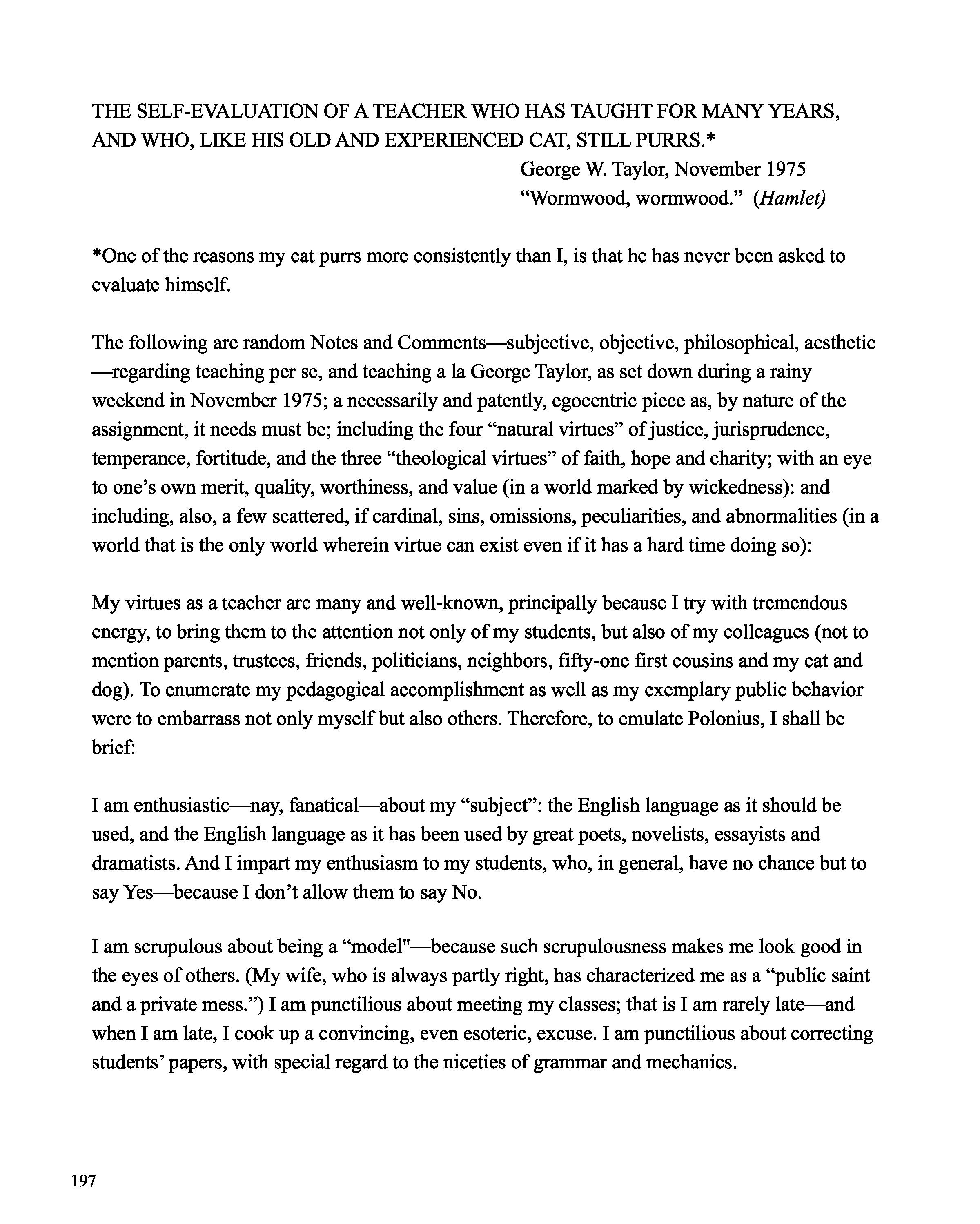
THE SELF-EVALUATION OF A TEACHER WHO HAS TAUGHT FOR MANY YEARS, AND WHO, LIKE HIS OLD AND EXPERIENCED CAT, STILL PURRS.*
George W. Taylor, November 1975 "Wormwood, wormwood." (Hamlet)
*One of the reasons my cat purrs more consistently than I, is that he has never been asked to evaluate himself.
The following are random Notes and Comments-subjective, objective, philosophical, aesthetic -regarding teaching per se, and teaching a la George Taylor, as set down during a rainy weekend in November 1975; a necessarily and patently, egocentric piece as, by nature of the assignment, it needs must be; including the four "natural virtues" of justice, jurisprudence, temperance, fortitude, and the three "theological virtues" of faith, hope and charity; with an eye to one's own merit, quality, worthiness, and value (in a world marked by wickedness): and including, also, a few scattered, if cardinal, sins, omissions, peculiarities, and abnormalities (in a world that is the only world wherein virtue can exist even if it has a hard time doing so):
My virtues as a teacher are many and well-known, principally because I try with tremendous energy, to bring them to the attention not only of my students, but also of my colleagues (not to mention parents, trustees, friends, politicians, neighbors, fifty-one first cousins and my cat and dog). To enumerate my pedagogical accomplishment as well as my exemplary public behavior were to embarrass not only myself but also others. Therefore, to emulate Polonius, I shall be brief:
I am enthusiastic-nay, fanatical-about my "subject": the English language as it should be used, and the English language as it has been used by great poets, novelists, essayists and dramatists. And I impart my enthusiasm to my students, who, in general, have no chance but to say Yes-because I don't allow them to say No.
I am scrupulous about being a "model"-because such scrupulousness makes me look good in the eyes of others. (My wife, who is always partly right, has characterized me as a "public saint and a private mess.") I am punctilious about meeting my classes; that is I am rarely late-and when I am late, I cook up a convincing, even esoteric, excuse. I am punctilious about correcting students' papers, with special regard to the niceties of grammar and mechanics.
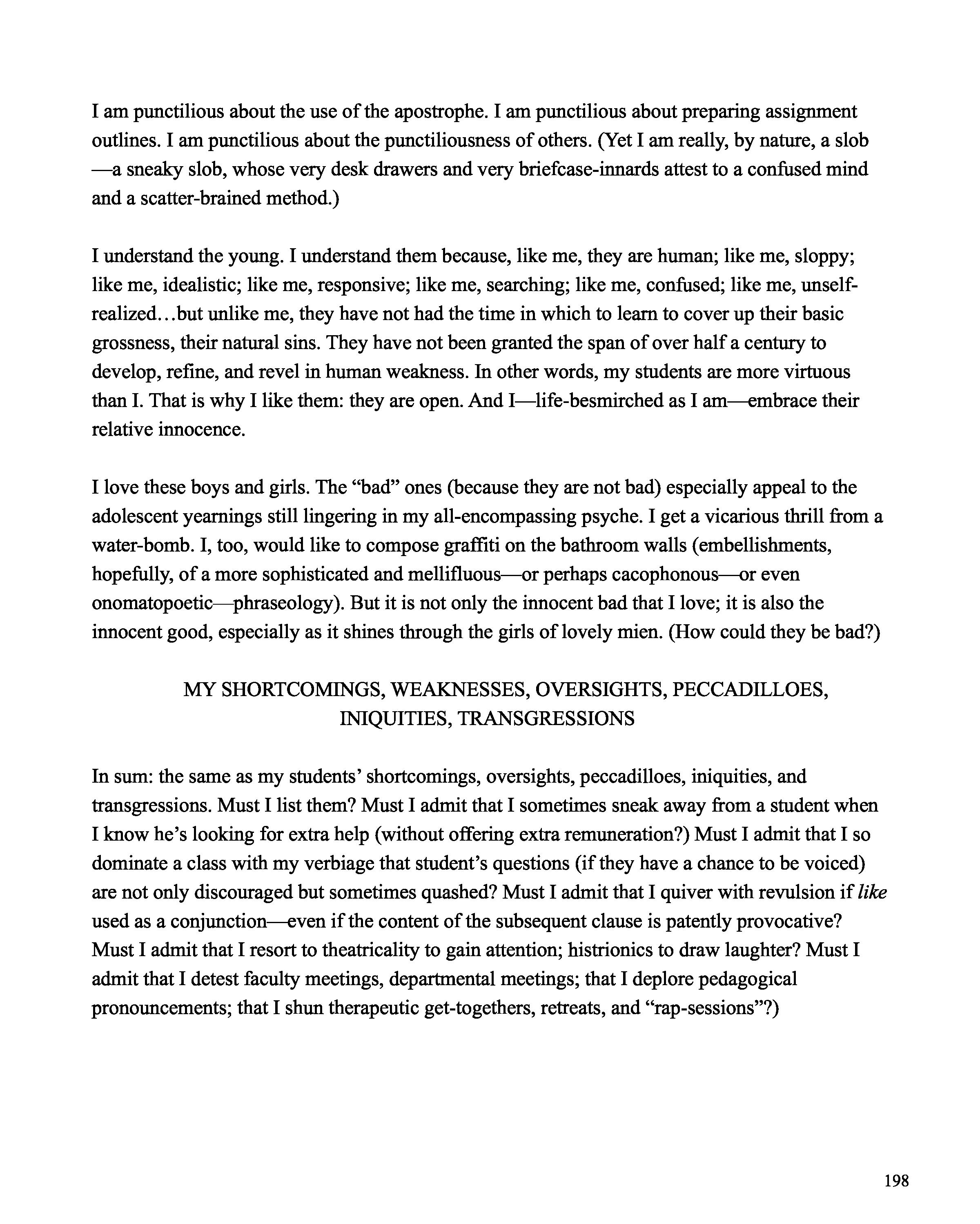
I am punctilious about the use of the apostrophe. I am punctilious about preparing assignment outlines. I am punctilious about the punctiliousness of others. (Yet I am really, by nature, a slob -a sneaky slob, whose very desk drawers and very briefcase-innards attest to a confused mind and a scatter-brained method.)
I understand the young. I understand them because, like me, they are human; like me, sloppy; like me, idealistic; like me, responsive; like me, searching; like me, confused; like me, unselfrealized ... but unlike me, they have not had the time in which to learn to cover up their basic grossness, their natural sins. They have not been granted the span of over half a century to develop, refine, and revel in human weakness. In other words, my students are more virtuous than I. That is why I like them: they are open. And I-life-besmirched as I am-embrace their relative innocence.
I love these boys and girls. The "bad" ones (because they are not bad) especially appeal to the adolescent yearnings still lingering in my all-encompassing psyche. I get a vicarious thrill from a water-bomb. I, too, would like to compose graffiti on the bathroom walls (embellishments, hopefully, of a more sophisticated and mellifluous-or perhaps cacophonous---or even onomatopoetic-phraseology). But it is not only the innocent bad that I love; it is also the innocent good, especially as it shines through the girls of lovely mien. (How could they be bad?)
MY SHORTCOMINGS, WEAKNESSES, OVERSIGHTS, PECCADILLOES, INIQUITIES, TRANSGRESSIONS
In sum: the same as my students' shortcomings, oversights, peccadilloes, iniquities, and transgressions. Must I list them? Must I admit that I sometimes sneak away from a student when I know he's looking for extra help (without offering extra remuneration?) Must I admit that I so dominate a class with my verbiage that student's questions (if they have a chance to be voiced) are not only discouraged but sometimes quashed? Must I admit that I quiver with revulsion if like used as a conjunction-even if the content of the subsequent clause is patently provocative? Must I admit that I resort to theatricality to gain attention; histrionics to draw laughter? Must I admit that I detest faculty meetings, departmental meetings; that I deplore pedagogical pronouncements; that I shun therapeutic get-togethers, retreats, and "rap-sessions"?)
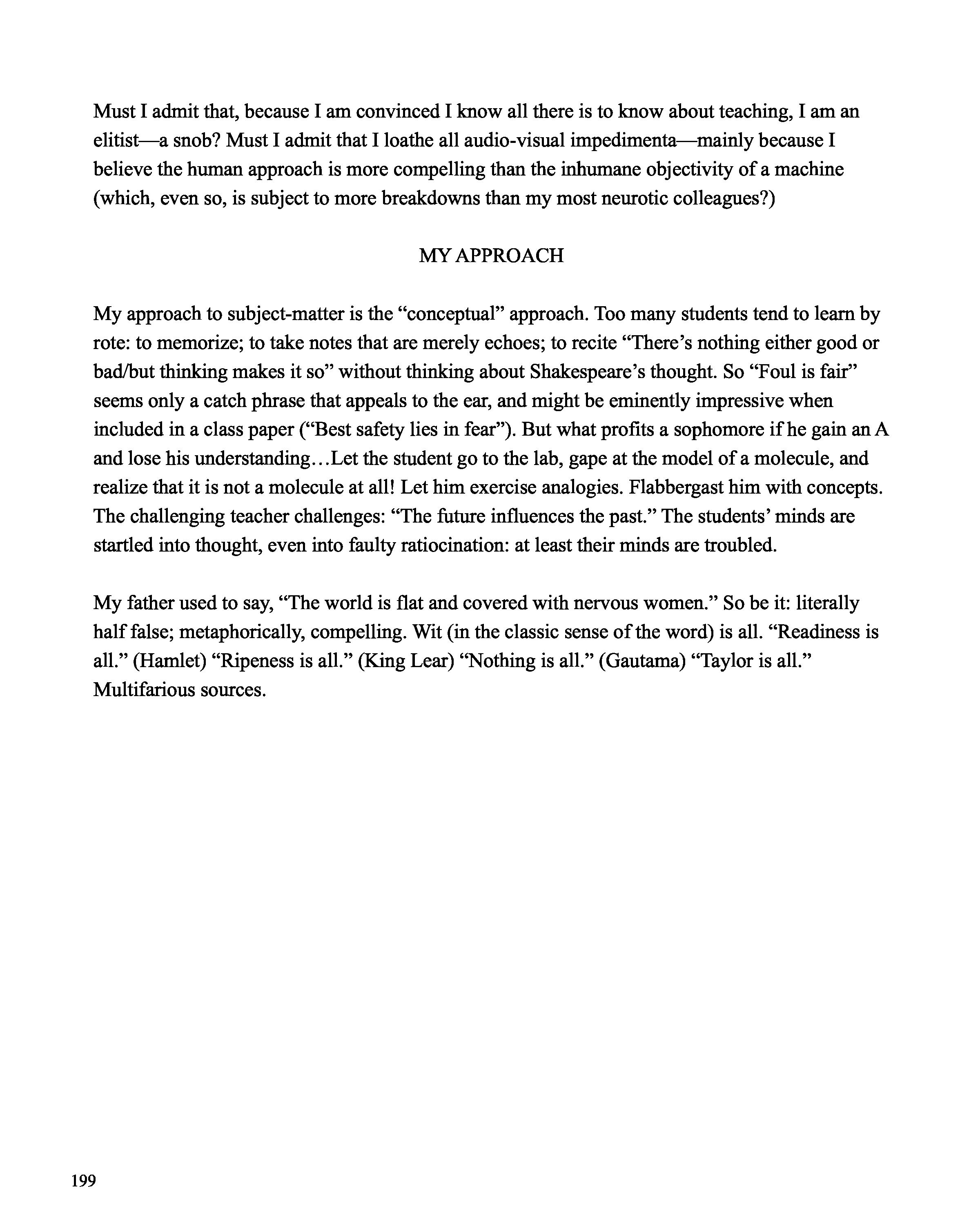
Must I admit that, because I am convinced I know all there is to know about teaching, I am an elitist-a snob? Must I admit that I loathe all audio-visual impedimenta-mainly because I believe the human approach is more compelling than the inhumane objectivity of a machine (which, even so, is subject to more breakdowns than my most neurotic colleagues?)
MY APPROACH
My approach to subject-matter is the "conceptual" approach. Too many students tend to learn by rote: to memorize; to take notes that are merely echoes; to recite "There's nothing either good or bad/but thinking makes it so" without thinking about Shakespeare's thought. So "Foul is fair" seems only a catch phrase that appeals to the ear, and might be eminently impressive when included in a class paper ("Best safety lies in fear"). But what profits a sophomore ifhe gain an A and lose his understanding ... Let the student go to the lab, gape at the model of a molecule, and realize that it is not a molecule at all! Let him exercise analogies. Flabbergast him with concepts. The challenging teacher challenges: "The future influences the past." The students' minds are startled into thought, even into faulty ratiocination: at least their minds are troubled.
My father used to say, "The world is flat and covered with nervous women." So be it: literally half false; metaphorically, compelling. Wit (in the classic sense of the word) is all. "Readiness is all." (Hamlet) "Ripeness is all." (King Lear) "Nothing is all." (Gautama) "Taylor is all." Multifarious sources.
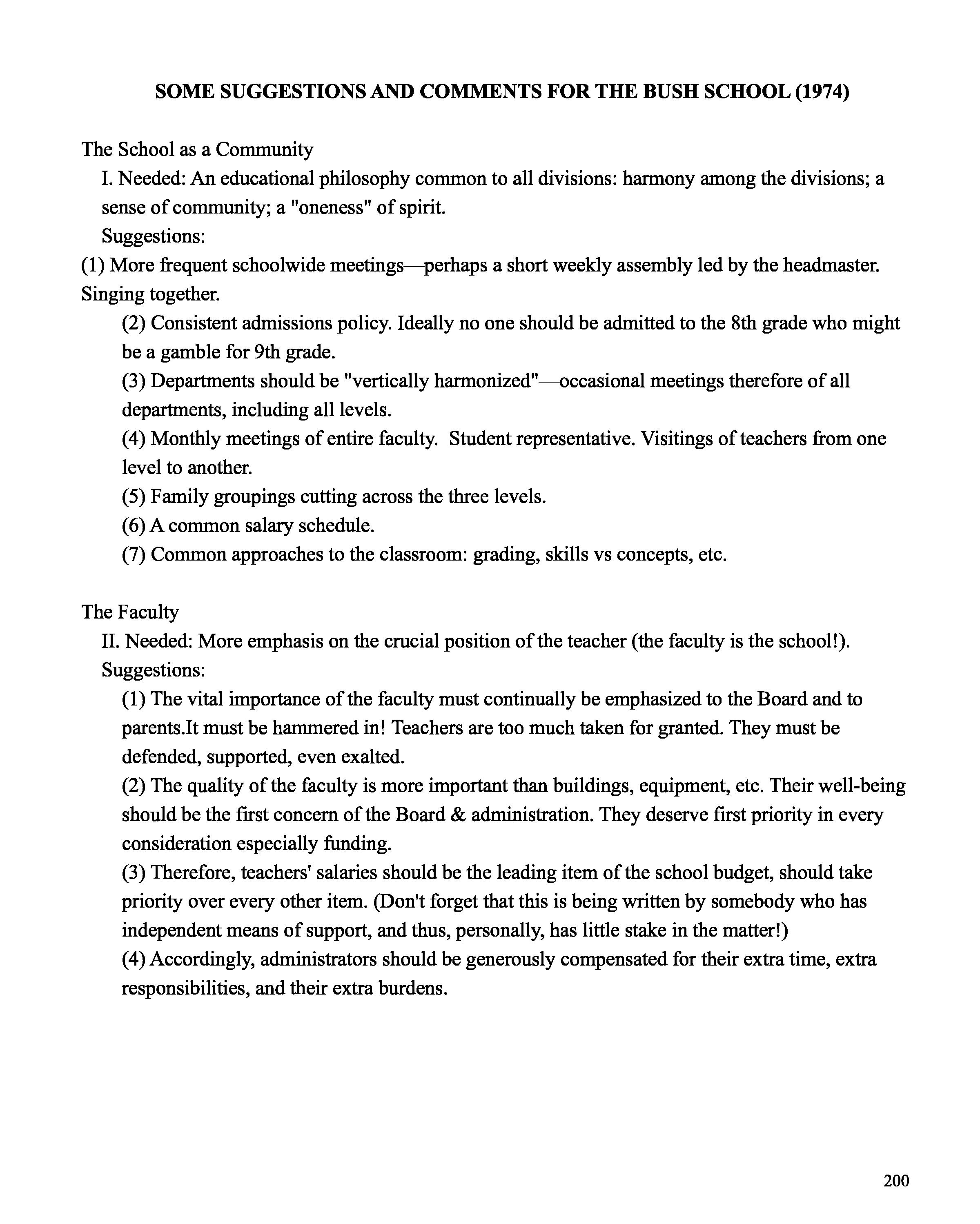
SOME SUGGESTIONS AND COMMENTS FOR THE BUSH SCHOOL (1974)
The School as a Community
I. Needed: An educational philosophy common to all divisions: harmony among the divisions; a sense of community; a "oneness" of spirit.
Suggestions:
(1) More frequent schoolwide meetings-perhaps a short weekly assembly led by the headmaster. Singing together.
(2) Consistent admissions policy. Ideally no one should be admitted to the 8th grade who might be a gamble for 9th grade.
(3) Departments should be "vertically harmonized"----occasional meetings therefore of all departments, including all levels.
(4) Monthly meetings of entire faculty. Student representative. Visitings of teachers from one level to another.
(5) Family groupings cutting across the three levels.
(
6) A common salary schedule.
(7) Common approaches to the classroom: grading, skills vs concepts, etc.
The Faculty
II. Needed: More emphasis on the crucial position of the teacher (the faculty is the school!).
Suggestions:
(1) The vital importance of the faculty must continually be emphasized to the Board and to parents.It must be hammered in! Teachers are too much taken for granted. They must be defended, supported, even exalted.
(2) The quality of the faculty is more important than buildings, equipment, etc. Their well-being should be the first concern of the Board & administration. They deserve first priority in every consideration especially funding.
(3) Therefore, teachers' salaries should be the leading item of the school budget, should take priority over every other item. (Don't forget that this is being written by somebody who has independent means of support, and thus, personally, has little stake in the matter!)
(4) Accordingly, administrators should be generously compensated for their extra time, extra responsibilities, and their extra burdens.
(5) There might be a Dean of the Faculty-or at least a representative (perhaps from each division) who could honestly and openly carry the concerns of teachers to the administration and who could, conversely carry the concerns of the administration back to the teachers.
(
6) There should be individual conferences between teacher and headmaster or teacher and division head at least once every trimester.
(7) Put more trust in faculty "corporate judgments" (such as are made in faculty meetings). Put certain decisions to a vote. Be wary of vetoes.
(8) "Old-timers" and experienced teachers could serve as mentors to the younger faculty.
Discipline
(
1) A few absolute rules (alcohol, drugs,) plus more "understandings" (class-cutting, offcampus expeditions, etc.) The "absolute rules" should be posted.
(2) Strengthening the advisor-advisee (teacher-student) relationship: this could be done by funneling more information through the adviser (so that he's the first to try to handle the student's problems) to the administrator (who should, of course, sound out the situation by conferring with the advisor).
(3) Might consider a student "senate" and student "court" (the latter being a rather touchy possibility, and needing, at the least, careful overseeing).
(4) More emphasis on the Honor System and all that it entails.
(5) Emphasis in the classroom on honesty (plagiarism, cheating, etc.)-plus such "minor" matters as defacing of desks. We should never let a student get away with a lie; more important, we should never put him in a position where he feels he must lie!
(
6) Ultimately, students respect those teachers who do have a sense of values.
(7) And we best "teach" values by our own example.
"Excellence"
ARISTOTLE: "The excellent becomes the permanent."
(1) GENERAL: In trying to "be everything," we sometimes fail in the particulars. The Urban and Wilderness programs are good concepts, and need our support: but we should never overlook the daily "little things" at school: the preparation, neatness of papers, deadlines, AND the quality of our English!
(2) It is in the performing arts that "excellence" is most essential; the standards must not be compromised. (We are doing much better this year with the high standards of Midge Bowman and Virginia Morgan.) Better Shakespeare than Neil Simon; Bach than Rock-no matter what the kids think!
(3) I believe we can also make our assemblies a "signal" that we are committed to excellence. Here again we allow shoddy performances, emotive displays, popular programs. (No criticism of Tom H. is intended.)
Random thoughts:
I am remarkably impressed with the faculty at Bush; rarely have I known such a pleasant group of people. They are fun to work with. Especially fine are those who have been at Bush for many years.
I am discouraged by the lack of intellectual excitement among the students. I suspect this has something to do with the patronage-Lakeside will attract professors' families, for instance, because Lakeside is not afraid of ideas: it's a school wherein there always seems to be philosophical ferment.
I think parents have too much to "say" at Bush. Imagine Exeter---or for that matter, Summerhill-being so much influenced. Or Groton! Or Horace Mann! Or Eton!
Boards of Trustees and Heads have too often been too scared about raising tuitions. No study that I know indicates that tuition raises per se mean a decline in enrollment. I feel that even a $300 hike would not significantly affect Bush's student population-indeed it might eliminate some of those families who would be unwilling to step down from a Cadillac to a Volvo-not to mention a Volkswagen! Amazing coincidence: my wife, a member of the Board at Epiphany, comes to my study announcing that Bob Spock last night reported an increase in applications-indeed a waiting list-for his school, which is also raising tuitions!)
Principal factor contributing to disunity is everybody's "doing his own thing." lfwe stress the Urban program, independent study, we must also stress the school as "home base"-the place where we share off-campus experiences.
What happens in a classroom is a process-not something that can be evaluated in a few visits by, for instance, the PNAIS. In a small school, the tradition of independent schools-perhaps the most important influence upon the students- is their relationships with the teachers. PROCESS & RELATIONSHIPS! Very healthy at Bush.
(Less lofty, but an important financial factor:) The Upper School curriculum is perhaps too much adjusted to the students' whims and choices; too many electives mean too many classes with fewer than nine students. The teaching-load of too many faculty is below par for good economics ... Don't overlook the possibility oflarger-than-fifteen sections for certain areas such as history lectures, grammar sessions, science groups. And perhaps there's too much one-toone instruction. (But individual attention is perhaps the school's greatest strength!)
Bush is a wonderful school-it should take more pride in itselfl
In 1976, George and his wife, Phyl, made a long anticipated trip to Africa. He sent Mary Pease a postcard observing how closely and truly life and death seemed related in that natural setting. There was a marked serenity in his message that, in hindsight, seemed to presage his death:
East Africa added a new dimension to our concept of the world; the great plains of the highlands; the lovely animals in their own freedom. The giraffes: how handsome, and in slow-motion stride, so beautiful. The elephants: the wise old mothers and their devoted young ones.
The warthogs (my favorite) running, comically, tails up, away from the road. And the gorgeous birds. And once, on a giant ant hill only a few feet away from us, proudly sat two lions observing, with feline satisfaction, the world about them. The great mystery of the continuation of the species was especially evident in our witnessing (literally being in the midst of) the semi-annual migration of the wildebeests-over a billion of these great animals making their way northward through the Serengeti Plains: all driven by some strange force.
Death, too, was revealed as something natural. We were not shocked to find, at close range, a lion making a meal of a young elephant. We saw that death is a natural and good and necessary part of the immortal cycle. So that your troubles and my troubles and the troubles of all of us are part of a larger, barely discernible, Grand Pattern that, being a pattern, has its beauty and its reason.
George never returned to Bush. His diabetes became exacerbated on the African trip and he died one month after his return. We were all part of his memorial service at the University Unitarian Church. His tenure at Bush was too short, but his impact on us all is unforgettable.
My remarks at his memorial service:
Ten years ago when Adlai Stevenson died, I wrote, "Now all my heroes are dead" but I was wrong. George Taylor is one of my latter day heroes. In his marvelous, witty, sometimes caustic, always affectionate way, he held this disparate school group together. He was our mentor, possessed of qualities we all wished to emulate-a man whose standards of scholarship and living made us all better for having known him.
George had a passion for excellence and his deep devotion was a source of joy. His teaching models were only the best: Shakespeare, J. S. Bach, Michaelangelo. There was no elitism here; rather his faith in the transforming effects of greatness. For him it wasn't so much a matter of achieving excellence (he would settle for competence in his students!) as having these great artists as polar stars toward which we could set our course. I miss George keenly, but what a man and what a privilege to have known him!
As mentioned earlier, prior to the Larsen years,, the school had no endowment program. George's death coincided with a Reader's Digest award intended for scholarship. With the school's outpouring of grief, Les wrote asking if the name could be changed to the George W. Taylor Faculty Endowment Fund.
Les: That endowment was established by finagling some money around to create the Taylor fund. I think it was after me that the scholarship endowment was formalized. At that time, the whole Board was very supportive: Pete Eising, of course, but also Brooks Regan, Don Rosen, Merrily Chick, Pat Franklin, Fifi Caner, and, in the background, always the Haubergs. Annie Hauberg was a real generator of ideas-a hands-on person all the way. She really was a force for scholarships and faculty growth. And Sheff Phelps, along with John Hauberg, funded a beginning endowment with the addition of money from the sale of the Appollonea stock from land across the Lake that had been purchased when there was talk of moving the school.
To Mr. Taylor
I remember you standing with your record-cleaning tie on Telling us about Bach's B Minor Mass and conducting without a baton voraciously.
I remember your encouragement
Telling me I really could write When no one else thought so. And cute remarks on late papers commenting wryly on my mental capabilities. You laughed with us if you made mistakes ( everyone's entitled to one) And brought out prints of famous paintings and told us we now had culture. You showed us worlds of undreamed-of beauty and made us sensitive to things
We never really knew existed.
I remember Kubla Khan and albatrosses
And Hesse and archery
And Melville and Beethoven
And the true meaning of life.
You were a romantic just like me
And you wondered and dreamed as I did You loved life and taught me to love it better.
I remember philosophy and deep discussions And craziness and watching plays and absorbing music
And the feeling of joy I always got when your class was next.
You took the time to let me get close and I saw how beautiful you were. So dear teacher, I cry for myself
To understand you or just to talk
You gave me so much love and enriched my life by your very presence.
I can only say how grateful I am
This world and I are better
Because you cared.
Note: This poem, written by Corrie Duryee '77, about her participation in the REAL class, speaks for all of us who were privileged to have known George. I have included it with her permission.




Meta Johnson O'Crotty 1924-1994


Teaclier, Mentor, Student, Traveler, Writer, Friend
Dear Midge:
Our celebration of Meta's life was yesterday and it was lovely. Shirley and I were in charge and there were a bit more than 350 people there. Les and Nancy were there and that was very nice. If only you could have been there. In your place I read the last paragraph of your letter to Meta. It was a lovely closing to all the wonderful tributes that were spoken by alumni, colleagues and students and family.
I will miss Meta terribly. I feel very fortunate that I was her friend
Love, Marilyn Warber Gibb
January 21, 1994
Dear Meta:
I always meant to write you this letter and now, suddenly, you're gone and I am left needing to say what is in my heart. I want you to know, wherever you are, that you will live in my memory as one of the people who helped me to become the person I am.
I had the privilege of knowing you as a teacher and as a colleague. I credit your example for my love of writing and literature. I remember reading Willa Cather with you my Sophomore year and being inspired to write a novel ofmy own. You brought poets to read their works to us and we saw that life is connected to art. You taught us all that life is exciting, meaningful, and meant to be lived to the fullest. How many teachers dare to bring such passion into their classroom? You did and I am grateful for it.
Our friendship spanned 45 years of teaching and learning together. When I finished graduate school and returned to Bush, you were one of the first to welcome me. I remember our many conversations on the back porch at Gracemont. My first year in Upper School as Associate Head, I was invited by the Seniors to give the Commencement address. I wanted to share my interest, as a lay person, in recent discoveries in quantum physics and consciousness studies. I needed help to ensure that my ideas were presented in a way that was appropriate for my audience. I felt very uncertain and asked you to be my editor. You selflessly spent many hours with me and there were echoes of our teacher/student relationship from earlier times. I am infinitely grateful for this gift to me. The work was later published in a local journal.
Teaching is an act of faith. One never knows the real impact of what happens in a classroom, but I can bear witness to your positive influence. And always, your maxim, To affect the quality of the day, was my lodestar. In one sense we were all your disciples and I have faith that the example of your life will live on in us.
Go well, dear friend, until we meet again.
Midge
The paragraphs below are taken from Roadmaps For Life-Notes From The Journey, a day-long retreat I lead at an independent school in Los Angeles in 2003. I was outlining the qualities I thought were needed in nurturing the moral life in a school. I used Meta as an example:
Generativity. We all know the frantic pace of life means that teachers must often assume a quasi-parental role especially with kids who may not feel close to their own parents. Generativity is about a concern for the next generation, including a desire to nurture one's students both in and out of the classroom. It may seem a small thing, but turning out for athletic events or recitals or school plays is a kind of generativity, showing an interest beyond your teacher/student relationship. It can also take the form of mentoring and support for a student's academic passion. One science teacher I know arranged to include some of her most interested students in her work with a cancer research lab.
My personal role model for generativity was Meta O'Crotty, my 10th grade English teacher and later my colleague at the Bush School. She taught there most of her professional life. Meta was not an administrator's dream. She was quirky, continued to smoke when everyone else stopped, was often late with her comments and was pig-headed about teaching what she wanted to teach the way she wanted to teach it. She was one of my favorite people because she loved kids and they knew it. She was generativity par excellence!
At some point in her career, Meta discovered that many of her 9th grade English students had not been read to by their parents when they were younger-no bedtime stories. She was horrified, feeling that they had been robbed of a whole piece of their childhood. Thereafter, she spent one period a week in each of her classes, reading aloud: Charlotte's Web, The Once and Future King, and any other title the kids brought up. To do this, she cut back on the standard curricular requirements and challenged her boss to stop her, which he did.
Meta fought retirement and ended up dying unexpectedly at 70. She left her class saying she felt unwell. Evidently she drove to her apartment, sat down in her favorite chair and left us. At her memorial, student after student spoke of the difference she had made in their lives because she cared about them and about her subject matter. Time spent in her classes fed their hearts as well as their minds.
Lest I become too serious, let me share Meta's essay, Do Be Do Be Do, from the 1991 Spring/ Summer issue of the Alumni magazine:
Although I've always quite disliked H. D. Thoreau (a touch self-righteous for my taste), he did have one clearly expressed and splendid insight: "To affect the quality of the day, that is the highest work of art."
We might make use of this because it is so positive and practical. Like what Tillie Olsen did for our days as she ironed. She is, as Wilbur said of Charlotte, 'a true friend and a good writer.' Now here is something we too can attempt to be each day. It is actually thrilling to clasp the idea that what we can do about integrity, loving, respecting or bravery is available for daily perusal.
However, ifwe believe old "To thine own self be true" Polonius, we don't have to do a thing about affecting the day. We can just assume that we are swell: our "self' is sufficient.
Wrong, Bucko. There can be real value in believing that 'virtue takes practice' and that the small things we do, even anonymously, affect our atmosphere and environment. Yet another way to enhance our lives is to cherish our capacity for wonder, as did Keats. "How do I wonder? Let me count the ways."
Lest I become a trifle self-righteous myself, I cease and desist. You alumni are among the world's most generous-hearted, curious and intelligent human beings.
You read me I'm sure. Ciao for now.
Midge Bowman, Mary Pease, Shirley Loper c.1971 Good friends for many years
MARY HAIGHT PEASE 1924-2021
The news of Mary Pease's passing opened a door full of memories. I realize that she and I were blessed with a friendship that lasted almost 80 years. She was Miss Haight when I first observed her from afar as a new student. Later we all would peek at the photo of her fiance, Otis Pease, in her office. Her class in World History my Sophomore year, with her skillful introduction to Plato and Aristotle and the assignment to argue their philosophies, awakened a deep, lifelong love of learning in me.
In 1966, Sis returned to Seattle from Stanford with Otis and their children. The following year, she became Dean of Students-the same year I was hired to lead the Lower School-but she soon became Director of the Upper School. From then on, through all the changes that life can bring, I knew her as a generous colleague, fellow administrator, and, finally, simply as an empathic, loving and joyful friend as we navigated the rigors of aging.
The photo above includes Shirley Loper, Sis's friend from Stanford years. Shirley joined us at Bush as Head Librarian and quickly built a program that was an integral part of all three divisions of the school. Shirley had a beautiful singing voice and had roles in several school productions. She was a very special friend and colleague.

After Sis retired in 1991, she built a large practice offering college counseling to public school students. I was especially grateful that the year I was Interim Head, she was often at Bush to support my goal of increasing alumni interest and involvement I always enjoyed visiting her in her lovely apartment near Volunteer Park.
Later, both Shirley and Sis lived at Horizon House. Marilyn Warber Gibb and I visited them several times bringing the four of us together for tea and goodies. We enjoyed what was our last visit in early 2020 just prior to the COVID-19 lock-down there. Shirley made her transition that February and Sis on April 25, 2021.
Mary holds what will probably prove to be the longest tenure in Bush history. She knew and/or worked with every Head from Helen Bush to Percy Abram. Of all these memories, what stays with me most deeply is the sense that, a little like the disciples, she embodied and continued the vision of Helen Bush so deeply and truly that her presence-whether as student, faculty, administrator, parent or trustee-kept the school grounded in the truths of its Founder in ways that blessed us all.
1997 Sis and Midge through a window at Gracemont
In Conclusion
I end this reminiscence with a story from 1997 as I was completing my year as Interim Head. Two British educators came to Bush interested in learning about independent education in the US. On very short notice, we arrived at the Upper School and were put into Michael Nipert's American Lit class. Michael didn't know we were coming, so what we saw was exactly what his class would be like on any school day. I can only say that Mrs. Bush would have been glowing with pride. Here was a class of teenagers, completely involved with the writings of Emerson and Thoreau, carrying on a dialogue about transcendental values with their teacher that evidenced both his deep commitment to teaching and their excitement and involvement in the subject. It is what all teachers hope for when they choose to become educators. I trust we would have found a similar atmosphere in any Bush classroom we visited.
I believe th.at, finally, my Bush education is complete. I stayed around a little longer than most but I hope that some alumni who have gone into teaching since my time, will return and finish their education here as I did. There is a tradition to be continued.
Past and Present Bush Heads plus Mary Pease, Honorary Trustee Emerita 90th Birthday 2014-2015
Top left: Les Larsen, Tim Bwns, Percy Abram
Bottom: Mary Pease, Frank Magusin, Midge Bowman, Fred Dust
(John Grant died in 2014)
CREATING REALITY
Midge Bowman
What is needed now is hope, a sense of adventure about the future, a commitment to the well-being of all people, a love of our planet and a faith ....
Since the eighteenth century, Western society has created and trusted a value system based on what seemed to be irrefutable scientific truths. Ever since Sir Isaac Newton and his apple, reality has been described as something we can weigh and measure. It is objective, outside ofus. It has a stable form and, when you deal with it in experiments, you can usually forecast results. Newton likened the universe to a giant machine, running according to laws. The more laws we discovered, the more we knew and the more we seemed to be able to control our environment. Newton unwittingly helped to make us an arrogant and comfortable species with a materialists's view of the world.
The idea of God, or a force beyond what can be seen or intellectualized, has not counted for much. In this age, it is the scientist who discovers truth and religion is called the "opiate of the masses." In this system possessions-money, fame, what can be seen-are what counts. So family takes second place to careers and happiness is forfeited for money. The ideal American has freedom in his personal and public life, looks out for number one and enjoys the good life.
What has happened? We have come to expect that life will continue to be easy. But now the news in government and business is sobering. Energy is scarce and scientists must consider whether the great machine is running down. We seem to be witnessing the collapse of the old order. And because the old rules are not working, some people conclude there are no rules.
Cultural historian, Joseph Campbell, says we are in a state of free fall, caught in a maelstrom of events with no traditional supports. Scientist, Jacques Monod, says, "Man knows at last that he is alone in the Universe's unfeeling immensity, out of which he emerged only chance." Is the world really going to the dogs?
No, because a quiet revolution is occurring in our midst. Truths live among us imperceptibly, often for a long time, before we are aware of their impact on our lives. The sense of meaninglessness that so many people now feel is the result of too little knowledge, not too much. It may be true that man seems to have evolved by chance, but the "idea of chance may be only a cover for our ignorance," as physicist, Freeman Dyson observes.
Why does it matter whether we live by chance in a world of unfeeling immensity? Because one of the main spurs to progress in all areas of human endeavor has been the feeling that what an individual does or expresses will be of value to the larger community; that what we do now affects the future; that we are part of something; that we make a difference. Otherwise, why should we bother to do more than survive at a primitive level?
Messages of Hope
If we can find evidence of our connectedness to each other as a species and as a species to the planet, and, in turn, as a planet, to the universe, then even if the old rules have been outmoded, we can live with the assurance that new and more appropriate ones will be forming in government, art, conduct and religion. This is not an either/or situation. Rather we are in a transition period where the present and past must be used as lessons and/ or resources in building a bridge to the future.
The transition is not likely to be easy, but there is a message full of hope and it comes from science rather than from religion or philosophy. Experiments in particle physics are providing important information during this transition period. Physicists are finding evidence that is forcing us to expand our definitions of what constitutes the real world. The research is disconcerting because it challenges all the assumptions we have grown up with: that the real world exists out there, that it has form, weight, is solid, liquid, or gas and that it can be seen and touched.
In subatomic physics, we see nothing we could call solid matter. It has been divided and divided until only particles of energy, tracked as particle or as waves, remain. In Newton's view, subatomic particles should be either particles or waves. But research is showing that sometimes they behave as either/or. And these experiments cannot be replicated the way Newton led us to expect.
Instead, the observer seems to be an important part of the observation. As Freeman Dyson says, "The notion of an electron existing in an objective state independent of the experimenter, is untenable." Somehow, the consciousness of the person doing the experiment is part of the experiment and affects what happens.
These findings come from the very discipline that only one hundred years ago said there was no way a man could affect reality; all he could was observe it as something separate from himself. It was easier then to see man as simply an isolated being using his brain-the organ that distinguishes him from most of the animal kingdom- to observe other isolated objects. Quantifiable, objective knowledge was the only source to be trusted for information, and there was no connection between a man and the object of his observation.
It was not always thus. In early Greece, the word physis-from which our word physics is derived-meant "essential nature." There was no split between thinking man and the external world or, to use the philosophical terms, between matter and spirit. Now we seem to be returning to that ancient view, at least at the subatomic level. Here Dyson tells us, "There is room for mind in the description for every molecule."
The excitement of these theories goes beyond the fact that they are important new advances in science. What is true for subatomic particles may also, in some way, be true for us. The implication is that we are not as isolated, objective and predictable as we seem. Rather, we may be interconnected in myriad subtle ways we do not yet fully understand. And it seems to be mind or consciousness that connects us.
Perhaps we affect our reality in unseens ways. Perhaps we should no longer pretend that what we think, feel, expect-in other words, our attitudes and beliefs---do not in some way affect our environment. Dr. Carl Simonton has proven that cancer patients who work with him to make their attitudes about themselves and their disease more positive, show significantly higher recovery rates than those patients who rely on medicine alone. The potentials of consciousness- man as a thinking being- have hardly begun to be explored. Now, with physicists implying that the mind has a place in the description of every molecule, we must go on to consider the information neurologists are finding about the human biocomputer called the brain.
Brain/mind research is providing new information about how we perceive reality. The impetus comes from hologram work in photography. Briefly, holographic photography records an image as a complex interference pattern on a photographic plate. It looks nothing like the object photographed. However, when laser light is passed through the plate, the result is a three dimensional picture of that object. And when the plate is broken into tiny pieces, light passed through any piece will produce the whole picture! The whole is contained in each of its parts.
Karl Pribram, a Stanford neurologist, has applied these theories to his work on brain functioning and has hypothesized that reality is actually interference patterns in the brain that are projected in threedimensional pictures, just like hologram photography. Again science is suggesting that there is no world out there, that reality is closer to being complicated mathematical relationships our computer brains translate into pictures. The brain makes objects out of frequencies.
Perhaps we are creating reality as we go along. Far from being inconsequential, man may be the container of the universe through the medium of his consciousness. We may be only a small part but, as a hologram, we potentially contain the whole, just as the DNA molecule contains the whole genetic code in a single unit.
We are confronted here by a huge paradox. Is it possible that each ofus, so insignificant physically when viewed by astronauts on the moon, is really a vehicle for the unlimited resources of the mind? Perhaps we are similar to subatomic particles: both physically insignificant and mentally and spiritual very significant. Are we only beginning to understand the infinity within us? Dyson says, "I do not claim that the architecture of the universe proves the existence of God. I claim only that the architecture of the universe is consistent with the hypothesis that mind plays an essential role in its functioning."
In an age that trusts scientific verification to show us truth, science is pointing out that the truths of religion and philosophy are not only true for believers, but consistent with the growing "scientific" definition of reality. We are thus living in a time that may witness the healing of the split between science and religion-the split in the way we see ourselves as separate from the world and each other. The physical world and the spiritual world are not opposites but merely different points on a continuum: different aspects of one whole.
The new discoveries in science tend to support the great truths identified by all the world's religions: that the unseen qualities of the mind and spirit-integrity, courage, fidelity, love-are as real and important as the visible and measurable. Neither is better; both are necessary. These theories will affect our lives greatly. And because of media sophistication, we will be more aware of change than in previous times.
Two notable philosophers foresaw many of the trends that are unfolding. One was Pierre Teilhard de Chardin (1881-1955), a French Jesuit priest who was trained as a geologist and paleontologist. He described the emergence of a unique human quality in our evolving brain: "the tendency of man to identify consciously with the others of his species and to cooperate in common work."
During the ensuing centuries of evolution, knowledge and technology expanded until now, in Teilhard's words, "humanity is in the process of becoming one single organism with a single nervous system, tightening its hold upon the planet." Geology had described the mineral crust of the earth as the lithosphere, the molten center as the barysphere and the layer of living things circling the globe, the biosphere. Teilhard foresaw a new layer: the noosphere which he termed the "thinking skin of the planet." It is at this level-the thinking, non-material, spiritual level-that evolution is still in progress:
Evolution has hardly begun. Mankind is at the threshold of higher forms of consciousness at both a personal and social level. The responsibility for further evolution lies now with man himself rather than with external forms.
For Teilhard, the breakdown of the old ways was overshadowed by the excitement of man's continuing evolutionary adventure. To him, it was a coherent, meaningful universe.
I do not know whether my second visionary knew my first, though both were living in the United States in the 1950s. R. Buckminster Fuller- "Bucky" to his millions of friends- was born in 1896. He was a poet, inventor, and genius. But for all his talents, he almost ended his life at the age of thirty-one.
Fuller had all the advantages-wealth, a Harvard education, a good marriage- but his only daughter, Alexandra, died at the age of four after a tragic series of illnesses. At about the same time, he had invested heavily in the stock market with disastrous results. He lost his job and began to drink heavily. Life had lost its meaning. He felt like a burden on his family and a failure in the world. Fuller decided to commit suicide by drowning. He walked to the shore of Lake Michigan but before jumping in, he found himself thinking:
You do not have the right to eliminate yourself. You do not belong to you. You belong to the universe. The significance of you will forever remain obscure to you, but you may assume you are fulfilling your significance if you apply yourself to converting all your experience to the highest advantage of others. You and all men are here for the sake of other men.
Fuller turned around and walked home, resolving to spend the rest of his life working to discover what he called "nature's system of patterned principles." He shut himself up in his apartment and, for the next two years, never left. His wife brought him all his meals. He did not worry about all those scientists who said that the universe was meaningless, purposeless and existed only by chance. Instead he simplified his life and focused all his being in what Teilhard called the noosphere, the "thinking layer."
In this way, Fuller pushed himself a little further than the rest of us in an evolutionary sense. He used his capacities to originate the concepts of synergy, the Dymaxion Map, the Geodesic Dome, and many theories and principles that reflect the coherence and order inherent in Nature.
It is interesting that while Teilhard was inventing the term noosphere, Fuller was visualizing the same idea as a wave of consciousness circling the globe. He suggested that at any time, approximately two-thirds of the inhabitants of the planet are awake and that this consciousness, following the sun, was creating a path of thought around the world. Fuller called this phenomenon Continuous Man:
Continuous Man is ultimately weightless. He is our unfaltering knowledge of all that we know. The things you tell me, the things I tell you, all the the dead have told us, all we vicariously share-Columbus'voyages, Homer's measure pulse beat-these and the idiosyncratic way each ofus metabolizes experience. These are humanity.
For both Fuller and Teilhard, life is a continuum from matter to consciousness. There is no split. Science and religion are describing the same reality and their descriptions are beginning to make sense to each other. To be whole, man must live in both these realities and see them as interconnected.
We are one universe and it is a conscious universe. Our place in it will evolve as our consciousness evolves. We now have the potential, through mass communication technology and artificial extensions of intelligence through computers, not only to become aware of our evolutionary course, but to affect it. In his most recent book, Critical Path, Fuller confirms this view:
For the first time in history [man] has the realistic opportunity to help evolution do what it is inexorably intent on doing: converting all humanity into one harmonious world family and making that family sustainingly, economically, successful.
Education, when it is evidenced as a search for truth, is inextricably connected to this evolution. There are times when education does not sense this purpose and becomes a dull repetition of partial truths whose effect is to preserve the status quo. In contrast, Fuller would say that education is all that "life has taught the individual by direct experience."
We experience the past through the study of art, history, literature, science and politics. We experience the present in laboratories, social action, personal relationships, wilderness and the arts by applying what we have learned. We have the possible experience of the future through the development of imagination and intuition, in religious disciplines and in this study of other cultures. The task of education, then, is not only to make us happy and successful in a career. It is also to enable us to reflect on experiences and to use what is learned to benefit those who touch our lives: to see the big picture, the cycles of growth, the processes at work on all levels of existence. Evolution is, in one sense, learning. And education, as it furthers evolution, should be a metaphor for the expansion of consciousness.
As consciousness expands, we experience a widening of our definitions of loyalty, love, family, and responsibility. We begin to see that "no man is an island entire unto himself." Once we begin to think globally instead of nationally, and in terms of service and self-sacrifice instead of narrow self-interest, we realize that perhaps we are like holograms. The whole is in each part; we are all interdependent and our greatest responsibility is to each other. As Fuller said, "You and all men are here for the sake of other men." One may dismiss him as as utopian idealist, but perhaps we should more readily dismiss leaders who are shortsighted, cynical and lacking in vision. We need dreams and many of Fuller's are practical visions.
Much time and money are being spent to preserve life through complicated medical procedures. Less attention is given to preserve the quality of life and yet, that is the only reason all the effort. The tacit assumption is that we preserve life with the expectation that each individual has the potential to add something of value to the evolution of humanity. But how many of us give ourselves the value we deserve? We sell ourselves short saying we have nothing to contribute, or that life is meaningless and we do not matter. Or that everything is chance or fate, so why bother? We become reactive instead of reflective.
The pessimists and cynics of this century have been persuasive and they have had their effect. However, I believe human experience will teach that happiness is to be found in living for others not because it is saintly, but because it is true. Being immersed in a cause larger than ourselves helps us understand that through actions-like the hologram- we contain all the parts of the whole. Thus we are truly one. We recognize ourselves in each other and we resonate to our common humanity.
During his recent visit to the United States, Prince Charles addressed the College of William and Mary saying, "Human beings seem to be able to endure anything except a loss of meaning." Wise words from a future king. Meaning is always there ifwe are willing to work to find it- ifwe are willing to involve our hearts as well as our minds in the search.
Teilhard foresaw that our further evolution would necessarily include a consciousness oflove. Not romantic passion or sexual attraction only, but what the New Testament calls charity, a cosmic kind of love that values and dignifies the role of each part of the universe. For me, cosmic love means placing our intellect, integrity, initiative-all that we are-in the service of goals larger than ourselves. Such love must be expressed in action. We must live what we believe.
So where does this story end? With another story about Fuller when I recently heard him speak here in Seattle. He stands on stage holding a piece of rope on which he creates a slip knot. He moves the knot up and down the rope. It is a pattern that uses the rope to be visible. That rope is necessary for the knot to be seen, but the idea of the knot exists before and after its manifestation as a knotted rope.
Man is such a pattern, using a body to interact with the material world. When the knot is untied, where does it go? When a man's body dies, where does he go? Fuller believes there is no end for man as idea.
At present, I am a traveler on spaceship Earth .. .I don't know what I am. I know that I am not a category, a high-bred specialization. I am not a thing-a noun. I am not flesh. You and I seem to be verbs-evolutionary processes. Are we not integral functions of the universe?
Man is a verb, a patterned integrity, a permanent spiritual inhabitant of the universe with the capability of infinite elaboration and variety.
What is needed now is hope, a sense of adventure about the future, a commitment to the well-being of all people, a love of our planet and a faith in the larger truths that science and religion are continuing to unfold. The next decade will see a crisis of nerve and will. We will need reasons for a hope and faith to carry us through the transition time. People like Fuller, Teilhard and many more have given us those examples and reasons.
It is time to become conscious of our heritage as Continuous Man and to welcome our evolutionary responsibilities. Our enterprise is truly exploration into the principle known as God.
Over the past few years, I have watched Les try to articulate to the Board, the faculty and parents, his belief in experiential education and his commitment to programs that go beyond what are termed the traditional literacies. While I have enthusiastically supported his goals, I have also recognized his difficulty convincing members of each of the School's constituencies of the reasons for such programs.
I believe that each of these groups needs a continuing education about the philosophy we espouse in order to become conversant with the solid research which has affected our thinking. Just as Mrs. Bush drew on what was then the very new research of John Dewey, we continue to keep abreast of current thinking in neurology, psychology and biology as well as the more expectable areas of the humanities, social sciences, the arts, and educational theory itself.
In the past education has been considered by many to be more an art than a science, but recent research in a variety of scientific fields has yielded information of great use to educators. I hope today to share with you some of this information and to give you solid factual evidence for supporting the school's philosophy. The five areas of research I want to discuss are:
1. Developmental psychology and the work of Jean Piaget
2. Neurological information about the nature of cognition
3. Hemisphericity of the brain: right-and left-brain differences
4. Sexual differences and their impact on the brain
5. Brain growth spurts and plateaus and their educational implications
Our century has seen several giants in the fields of psychiatry and psychology. A theorist who had a great impact on education was the Swiss psychologist, Jean Piaget (1896-1980) and his findings on cognitive development-the way children think. A recent overview of Piaget's theories in The Andover Review offers a helpful outline of the stages:
There are several important features of Piaget's observations. Perhaps the most important is the recognition of specific stages that each individual passes through, in the same sequential order though not necessarily at the same rate.
Starting with the sensorimotor stage from approximately birth to age two, in which the infant interacts with his environment only through direct stimuli of touch, sight, sound etc., the progression is to a preoperational stage, which will typically last from about age two to age six. In the preoperational period, a child can deal with real objects, even when they are out of sight, but cannot carry out mental transformations on such objects.
During a period that may be described for purposes of discussion as extending from about age six to age twelve or fifteen, the child is concrete operational. At this stage, mental operations become possible, and abstract quantities can be handled in limited ways. Arithmetic operations of
* This publishing company did not offer the use offootnote capability. Instead I have used the letter F and a number.
addition, subtraction, multiplication and division may be mastered. For the first time, cause-andeffect relationships are distinguished from simple associations. Elementary concepts of area and volume are acquired, but not to the extent that the differences in units are understood.
The stage of adult-like thinking which is expected to appear in the early teens is called formal operational. Initial signs of reaching this stage are a grasp of ratio and proportion and an ability to deal with relationships between abstract quantities. It is at this stage that algebra first becomes meaningful, cause and effect are grasped sufficiently that the nature of proof may be understood, and the ability to separate variables in a multi-variable problem becomes evident.
Another important finding of Piaget was that mental growth, or cognitive development, is caused to a significant extent by social interactions. Disagreements in interpretation between two individuals cause one or both to reconsider and to develop new mental models for understanding the phenomenon at issue. Cognitive development occurs at the frictional interface between conflicting ideas.
The separate pieces of the puzzle of cognitive development and intelligence now seem to fit together, with important implications for teaching. There is reason to believe that success in school is determined, to a significant extent, not only by "intelligence," as measured by standard tests, but also by the cognitive development stage as measured against Piaget's model. There is good evidence that intelligence in general and cognitive development in particular, is primarily (if not entirely) a consequence of environmental influences. (Fl)
Bush has made a good beginning in applying the Piagetian research to the Lower School curriculum, which spans those years when all children are at the concrete operational stage. At this stage, we need to make real through the senses, the concepts to be taught. This is the reason we use manipulatives in math, games to teach reading and thinking, and movement and art to illustrate a story. One study showed that a group ofK.indergarteners who were read a story with a moral and who then acted it out, retained many more of the ideas for a longer time than those children who had merely had the story read to them and then talked about it. The relationship between concrete objects which help us to learn through the senses also has solid backing in neurology. Piaget's insights about concrete operations are thus corroborated by recent brain research.
Neurologist, John Eccles, writing on the physiology of imagination, likens the brain to a telephone exchange with impulses coming in from sense organs to specific areas of the cerebral cortex, whose working units, neurons, branch into intricate branching fibers called dendrites:
Connections between neurons are established by the synapses, specializing junctions ... (whose) transmitting cells secrete highly specific substances whose high speed reaction carries the signal from one cell to the next. (F2)
What results are high speed patterns of knowing that are the direct consequence of sensory experience. Cortical patterns mirror sensory experience in a kind of congealed neuronal pattern called an "engram." Experience creates an ever-increasing wealth of engrams, promoted by synaptic connections. Eccles says synapses have a tendency to increase their function with usage. A richly experiential environment, then, creates a brain rich in connections----one with a wealth of knowledge gained from direct experience and encoded in the engrams.
We have found that sensory experiences (movement, cooking, acting-out stories, working with clay) enhance the forming of these brain patterns. Children who have difficulty remembering the sound associated with a certain letter are helped if they trace the letter in sand or follow the shape of the letter made from sandpaper while saying the accompanying sound. "Active experiences seem to be critically necessary for the reorganization of the central nervous system." (F3)
Children raised in impoverished or cognitively sterile environments suffer from a lack of stimulation and their brains lack not only the stored wealth of engrams, but also lack the ability to make connections and see relationships. It should be noted that one of the most important tools in brainwashing is sensory deprivation. The limiting of brain function is directly related to lack of information provided by the sensory environment. Woodburn Heron in The Pathology of Boredom says: A changing sensory environment seems essential for human beings. Without it, the brain ceases to function in an adequate way ... Variety is not the spice of life, it is the very stuff oflife. (F4)
Varieties of experience are also proving to be important because of the knowledge we are gaining about the very different kinds of tasks performed by the right and left hemispheres of the brain. In operations performed on epileptics, doctors isolated the two hemispheres by severing the corpus callosum, that band of tissue connecting the two sides of the brain. In subsequent tests, they found that the left side of the brain, controlled by the right physical side, is responsible for tasks which are verbal, sequential, analytic, and logical. The right side performs nonverbal, relational, spatial, and holistic functions. For example, a patient with a severed corpus callosum, if blindfolded and given an object to hold in the right hand, could answer questions about texture, but when it was placed in the left hand (which controls the right side of the brain) couldn't answer. The implication is that the center of language resides in the left brain.
School curricula have traditionally concentrated on left brain tasks which our technological society deems to be important. In the long run, our one-sided curriculum may be damaging even the subjects which they are presently teaching. In applying split brain implications to education, Roger Williams wrote in Saturday Review:
For the past decade or so, budget cutters and back-to-basics zealots have been hacking away at 'frills' in America's schools. Inevitably, the arts are among the first victims .... Important new evidence shows not only that the arts are beneficial in themselves, but also that their introduction into a school's curriculum causes marked improvement in math, reading, science and other subjects that the educationalists pronounce 'essential.' Indeed some researchers are now saying that the absence of arts programs can retard brain development in children. (F5)
Bush has always considered the arts to be an important part of its experiential programs. The arts are not frills in our school. We have known or some time that these right brain activities provide a wholeness and balance both intellectually and neurologically, and that the individual and our community are the richer for these experiences. Somehow art experiences stimulate the brain to make connections and to see relationships. Without these crucial abilities, all our left-brain knowledge can be misused. We need to see as a whole the big picture provided by our right brains or we will continue to live in polluted environments, working for short-term benefits, and paying an enormous cost in terms of the quality of our lives.
We must be careful not to split our curriculum into experiential or academic even if our intent is to create a balance of offerings. Instead we need to provide tasks that involve both hemispheres in all our courses, since it is the integration of the two sides which produces a truly educated person with a brain functioning at maximum potential. Carl Sagan says:
The process of genius involves a dominance of neither side of the brain, but rather a vision, or intuition, emanating from the right brain, which is then confirmed by the logical left brain and expressed in language or mathematical symbols .... No work of artistic or scientific genius has ever emanated first from the left brain; but always first a vision of the right brain, collaborated and proved logically by the left brain. (F6)
Hemispheric dominance is also affected by sex differences. Research in this area suggests that gender affects brain development, that we truly have either masculine or feminine brains. In the cerebral cortex of a male rat, the right hemisphere tissue is thicker than the left; in the female rat, the left is thicker than the right. Neurologists are suggesting that there is strong anatomical evidence that the cortex is different in men and women, largely because of hormones that early in life alter the organization of the two hemispheres:
In test after test, men excelled in spatial reasoning and women did better with language the right ear and eye are more sensitive in women, the left in men. (F7)
The right hemisphere seems to dominate in the masculine brain and the left hemisphere in the feminine. A neurologist at Harvard Medical School has found that:
Children reaching puberty earlier than normal have brains that are less lateralized; that is, their left and right hemispheres seem to share more tasks. Because girls generally reach puberty two years before boys, these findings have caused speculation that the bundle of
nerve connections, the corpus callosum, between the two hemispheres has less time to lateralize or draw apart, during puberty. If that is true .. .it could help to explain female intuition, as well as male superiority in mechanics and math. The two intimately connected hemispheres of the female brain would communicate more rapidly-an advantage in integrating all the detail and nuance in an intricate situation, but a disadvantage when it comes to homing in on just a few relevant details. With less interference from the left hemisphere, a man could use his right hemisphere more precisely in deciphering a map or finding a three-dimensional object in a twodimensional representation. (F8)
The onset of puberty also seems connected to brain growth spurts. Eugene Epstein, a neurologist, and Conrad Toepfer, a professor of education, have been working on periodization in brain growth, finding that cognitive development proceeds not in a smooth orderly fashion, but rather by spurts followed by plateaus. The traditional curriculum assumes that all children learn in a continuous pattern, acquiring knowledge in a stepwise manner. Instead, periods of brain growth occur between the ages of two to four, six to eight, ten to twelve and fourteen to sixteen plus. During these periods children can progress as many as forty months in a year, whereas during the plateau periods, their progress may slow to as little as seven months in a year.
The growth periods fit closely with Piaget's levels of cognitive development. The problem comes when we find we cannot always equate chronological age with developmental level. There can be a three-year difference either way. Such variations mean that it is almost impossible to find a group of students all at approximately the same developmental level. (Note: If you've ever looked at the differences in height in an eighth grade class, you will understand!) By balancing experiential programs with traditional academic expectations, we have the possibility of meeting the needs of those students not at the normal developmental level, while enriching those who are.
Developmental levels have nothing to do with intelligence! In fact, it is often with our brightest students that our expectations are the most out of sync with their development. When these expectations of bright youngsters in grades eight and nine fall during their plateau period, the resulting frustration and sense of failure is sometimes irreversible and we see children who are "turned off." Bush has few such students, but the rich diet of arts, wilderness and experiential offerings may be very powerful preventive medicine.
Toepfer and Epstein made another very important finding which has been corroborated in other studies. They found that the expected progression of cognitive levels from concrete to formal operations, occurring between ages fourteen and sixteen, in fact occurs only for forty percent of those students graduating from high school. While the percentage would surely be higher at a school like Bush, it is probable that even our students will exhibit a need for concrete learning experiences during high school. Such experiences again come from the experiential side of the curriculum. Toepfer also cautions against grouping students according to cognitive level:
This writer does not mean to suggest the possibility of grouping based on cognitive thinking level. The problems of elitism seen in separation of students alone does not recommend this. Since youngsters are gregarious and choose friends and learning and age-mates on a variety of bases, classes probably should include ranges of thinking styles. Few of us choose acquaintances on the basis of common thinking style! In a class setting, perhaps the teacher should present new material on the thinking level of the common denominator for the group. This is not 'boring' for the higher-level thinkers.They simply have a larger range of functional cognitive styles among which they can move. (F9)
In fact, higher level thinkers in such situations will probably be more likely to feel secure about making new engrams, new neuronal connections, through having the freedom to see new relationships in the material. Students who have a sense of mastery can begin to use it in creative and innovative ways.
A K-12 school is one of the few places in our society where the complete spectrum of cognitive development (along with brain growth spurts and plateaus) can be observed and facilitated. As a school, we are a "living laboratory"and we are always aware of the varying growth rates and learning styles of our students. It is especially gratifying to note that "late bloomers" are not summarily counseled out of Bush. The senior year is often a time of growth spurt and some students, who have not managed to achieve their potential earlier, "get it all together" in those final months.
A school like ours can also provide movement back and forth between cognitive levels. Even after a student reaches formal operational thinking, there is still a need to return to the concrete level for reinforcement or clarification of a concept. To facilitate this, our school library interfiles all non-fiction, making no distinction between elementary and high school books, so that students may work with a range of materials appropriate to their different cognitive levels.
In conclusion, the word "experiential" spans a wide spectrum of classes and activities in all divisions. These include, as one might expect, music, art, drama, movement, both in classroom situations and in the community; sports; wilderness trips (day-long, overnight and week-long); travel abroad and national exchanges (in both Middle and Upper school); urban internships and community service; field trips to city and country sites; political participation; practical skills (furniture and boat building, marine piloting); oral history; orienteering; and auto repair. The list changes each year. We have also instituted a yearly allschool study of a foreign culture such as China and Islam. Next year's choices are Mexico, Central America and the Caribbean. The culture is integrated into as many classes and activities as possible, culminating in a celebration and potluck for parents, students and faculty.
The experiential is also evident in our more traditional academic subjects. Interdisciplinary courses such as Geometric Art/Math in the Middle School and Turn of the Century in the Upper School, will foster seeing new connections while studying the same factual material from the different viewpoints of history and literature. The language program in every division is committed to making the study of a second language a total immersion experience through exposure to historical backgrounds, film, field trips, cultural experiences and conversation. The Middle School archeology field trip this summer will make
Latin a living language as students participate in an actual dig in Calabria, Italy, SeaCliste III and Costa Rica trips broadened those students' outlooks, challenged their assumptions and tested their physical stamina and courage. Our society tends to produce people insulated from the world and therefore uncertain about their ability to survive physically and psychologically in unfamiliar or difficult situations. Travel and wilderness participants have mentioned repeatedly that they have acquired a kind of physical assurance they lacked previously.
Each May, most Seniors (having been accepted at college and having fulfilled 99.9% of the course requirements) are given the opportunity to use this final month on a project of their own devising. Each proposal is submitted to the faculty for approval and, at the end of the month, the class gathers to share their experiences with each other and the faculty. The following are some of the projects completed this May: two seniors went on the Network Exchange- one to Washington DC for a political internship, the other to Utah and California on a wilderness photography trip; several seniors rehearsed intensively for a full production of Philadelphia Story; four produced and acted in Sartre's No Exit; one composed and produced an original rock opera based on Milton's Paradise Lost. Others worked on original films, learned sign language for the deaf, studied Hebrew, went rock-climbing, biked through the San Juans studying the local history and, of course, participated in the SeaCliste III trip.
It is evidently easy for some people to dismiss these activities because there seem to be no direct intellectual applications. But given the evidence I have shared in this paper, I feel we have ample justification for our programs both pedagogically and scientifically. The breadth of our course offerings, the variety of experiences, the opportunities for individual interaction, the validation of physical and character development-all create an environment that enhances neurological stimulation (and thus connections), promotes balanced use of both hemispheres of the brain and provides experiences which nurture the growth of the appropriate cognitive levels at the different stages of development. There is interesting research that implies a connection between adult achievement and non-academic strengths: The adult accomplishments were found to be uncorrelated with academic talent, including test scores, high school grades and college grades. However, the adult accomplishments were related to high school nonacademic (extracurricular) accomplishments. This suggests that there were many kinds of talents related to later success which might be identified and nurtured by educational institutions. (Fl0)
It is clear that part of Bush's philosophy going back to Mrs. Bush, is to identify and nurture such qualities. Our responsibility as an educational institution is much greater than preparing our students for admission to college although we understand that this is an important part of our program. Our responsibility is to build a learning community that is rich, varied, responsive; that utilizes the newest information available through research to improve and refine our methods of helping our students to become developmentally mature and independent thinkers, able to function without fear in the face of the unknown whether the unknown be the next phase of algebra or the challenges of outer space.
Jacob Bronowski, in his chapter, "The Long Childhood" from The Ascent of Man, puts education in this larger perspective. He describes:
the extended period of time-longer relative to our lifespan than for any other species - in which young humans are dependent on adults and exhibit immense plasticity that is, the ability to learn from their environment and their culture. Most organisms on Earth depend on their genetic information, which is "prewired" into their nervous systems, to a much greater extent than they do on their extragenetic information, which is acquired during their lifetimes. For human beings and indeed for all mammals, it is the other way around. While our behavior is still significantly controlled by our genetic inheritance, we have, through our brains, a much richer opportunity to blaze new behavioral and cultural pathways on short time scales. We have made a kind of bargain with nature: our children will be difficult to raise, but their capacity for new learning will greatly enhance the chances of survival of the human species. (F 11)
As parents, most ofus would agree that our children are difficult (and costly) to raise, but we feel that their education is of immense importance to them and to our species. Maintaining the 'plasticity" means that schools must provide new learnings and support students to remain open to new ideas and experiences. The present 'back-to-basics' movement, touted by fundamentalist church schools, rejects the whole idea of education through experience. A recent newspaper article describes one such school. Its version of individualized education puts children into individual study carrels, going through pencil and paper workbook materials. There is little interaction with either the teacher or other students; no questioning; no discussion. (Think back to this paper's earlier quote about cognitive development depending on the 'frictional interface between conflicting ideas.') Such robot-like drill on facts is not education; it is closer to indoctrination and it can only produce people who are capable of nothing more than unthinking obedience to authority. If education does not accept the responsibility for experiences in social skills, communication, and various forms of expression, we will run the risk of becoming a nation of automatons and our experiment as a participatory democracy is doomed.
Carl Sagan speaks to this point in The Dragons of Eden:
Particularly today, when so many difficult and complex problems face the human species, the development of broad and powerful thinking is desperately needed ... the future belongs to those societies that...enable the characteristically human components of our nature to flourish; to those societies that encourage diversity rather than conformity; to those societies willing to invest resources in a variety of social, political, economic and cultural experiments and prepared to sacrifice short-term advantage for long-term benefit; to those societies that treat new ideas as delicate, fragile and immensely valuable pathways to the future. (F12)
In the future, the educational institutions that will survive are those who have put down roots very deeply; who remain dedicated to handing down the wisdom of the past while anticipating the challenges of the future; who are not afraid to attempt the difficult task of educating the whole person; who see education as a moral responsibility in which the best of ourselves is nurtured for the sake of others. I feel strongly that Bush is such an institution and I am grateful to be part of it.
FOOTNOTES (F)
1. Robert P. Bauman, "Teaching for Cognitive Development," Andover Review, Spring, 1978, 86-90
2. John C. Eccles, 'The Physiology of Imagination' in "Altered States of Awareness" Readings from Scientific American) San Francisco: W. H. Freeman, 1972, p. 32
3. Marianne Frostig "Neuropsychological Contributions to Education," Journal of Learning Disabilities, Oct. 1979, 43
4. Woodburn Heron, 'The Pathology of Boredom' in "Altered States of Awareness".Readings from Scientific American, San Francisco:W. H. Freeman, 1972, p. 64
5. Roger M. Williams, "Why Children Should Draw" Saturday Review Sept.3, 1977
6. Quoted in Richard Louv,"Which side of your Brain Are You On?" p. 207
7. Pamela Weintraub, "The Brain: His and Hers" Discover April 1981 p. 20
8. Ibid
9. Conrad F. Toepfer, Jr., "Brain Growth Periodization Research: Curricular Implications for Nursery Through Grade 12 Learning" Unpublished paper, p. 34
10. Joseph S. Renzulli, "What Makes Giftedness?" Phi Delta Kappan Nov. 1978, p. 182
11. Jacob Bronowski, "The Long Childhood" The Ascent of Man BBC books, 1973
12. Carl Sagan, Dragons of Eden, New York, Random House, 1977, pp. 192-193