Flu threat declines, risk remains
by Reginal Fields Staff Writer
The number of flu-related deaths in Oklahoma this season has risen to 173 since September 2017, according to the Oklahoma State Department of Health’s Feb. 22 flu update. With classes back in session, Rose State students, faculty and staff are more susceptible to the virus.
Most health care providers state the flu virus can be spread by coming into contact with a person with the flu or through contact with the germs in which the flu resides. Schools are especially susceptible to the spreading of illness because of the close quarters and shared workspaces.
Influenza is a contagious virus that mainly affects the nose, throat, lungs and air passages. Senior citizens, young children, pregnant women and caregivers (teachers, health care
workers and childcare providers) are groups that are most likely to contract the flu. They should take extra measures to protect themselves from contracting the influenza virus during the flu season, which began in September and continues through May. Individuals are encouraged to keep their hands sanitized, avoid touching their eyes or nose and get plenty of rest and good nutrition. It is also advised that hard surfaces be sanitized frequently.
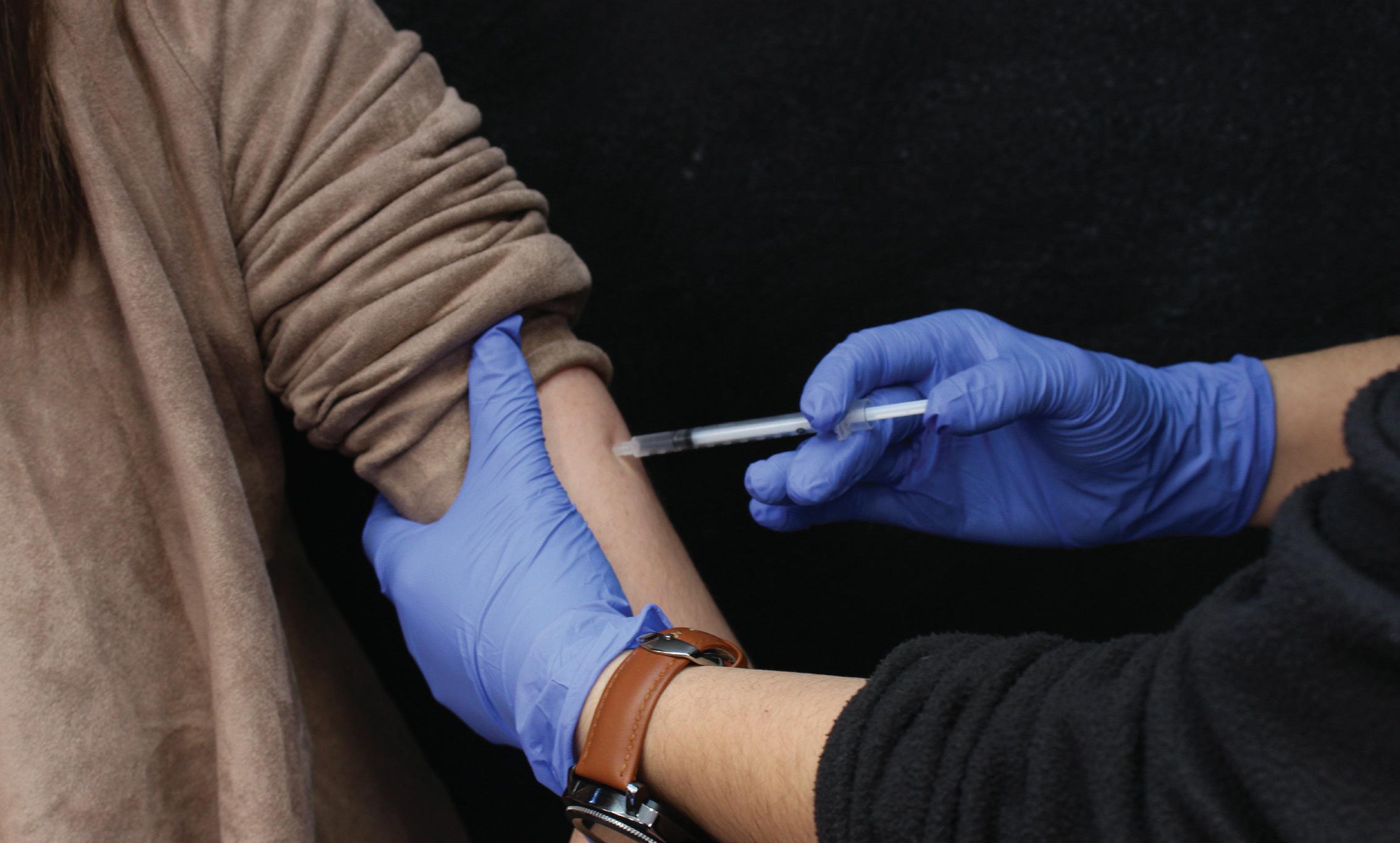
However, according to doctors, the best defense is the flu vaccination. The flu shot is still available at most doctors’ offices and pharmacies in the metro area, and most insurances cover the full cost of the vaccination. According to a local pharmacist, the flu shot becomes the most effective after two weeks.
Symptoms of the flu can set in from one to five days after infection, and last for one to two weeks and can range in severity. According to the Cen-
ters for Disease Control, this is the most cases of the flu doctors have seen in more than a decade, with more than 2,000 individuals being hospitalized in the state of Oklahoma alone. However, some individuals will not experience any symptoms but could still be carriers and spread the virus.
Not everyone needs medical care or drugs to get through a mild flu case. High fever, nausea, headaches and chills are common symptoms. Rapid or very labored breathing, bluish skin color and decreased social interaction are serious symptoms and may mean a need for medical attention.
A recent study at the University of Maryland School of Public Health showed people can be contagious without having signs of the illness.
“People with [the] flu generate infectious aerosols (tiny droplets that stay suspended in the air for a long time) even when they are not coughing, and especially
during the first days of illness,” said Professor Donald K. Milton, who holds doctorates in medicine and philosophy as well as lead researcher of the University of Maryland study. “When someone is coming down with influenza, they should go home and not remain in the workplace and infect others.”
According to the Oklahoma State Department of Health, there are two formulations of the flu vaccine for the 20172018 flu season: Trivalent and quadrivalent.
The trivalent vaccine contains three strains that are considered most likely to spread in the United States. Trivalent protects via a standard dose for those aged 6 months and older or a high dose recommended only for those age 65 years and older.
Quadrivalent, as the name suggests, protects against four strains of influenza, with a standard dose for children as young as 6 month.
Those most susceptible are encouraged to receive the flu vaccine. Individuals can also strengthen their immune system by limiting exposure to the elements, reducing stress levels and increasing physical fitness. A humidifier has also been shown to decrease the risk of the flu because the virus prefers dry climates.
Those who contract the flu should drink plenty of fluids to avoid dehydration and satisfy any appetite with crackers, toast and rice. Avoid public places and social events until the symptoms are gone.
“Out of an abundance of caution for the health of Rose State staff and faculty, an email was released from the Rose State Administration on Jan. 23, 2018,” said Tamara Pratt, Vice President of External Affairs and Marketing at Rose State. “The message was simple, reminding everyone of the flu epidemic and to be cautious about reporting to work sick.”
Photo by JaNae Williams
Flu shots are available at most clinics and pharmacies. The shot becomes most effective two weeks after receiving the vaccination.
Major Focus: Criminal justicepolice science
by Bailey Bussell Multimedia Editor
There are more than 60 degree programs at Rose State, and with so many options at one’s disposal, it can be overwhelming.
The Criminal Justice - Police Science program has been around for at least 20 years, and for the last 15 years it has been managed by Professor of Criminal Justice Arnold R. Waggoner. The program is geared toward students who wish to pursue a career in law enforcement.
Though the Police Science program falls under the same category as Criminal Justice, there is a difference between the two majors. The Police Science program follows a different course track than traditional Criminal Justice.
Completion of the Criminal Justice - Police Science program is not just earning an Associate of Arts degree, but it is also certified by the Council on Law
Enforcement Education and Training, a program that provides one way for obtaining the education and training that is needed to become a police officer in the state of Oklahoma. By receiving accreditation from this program, Rose State is able to offer a degree that can help students start their careers shortly after graduation.
“There are over 200 students enrolled in both Criminal Justice and Criminal Justice - Police Science,” Waggoner said.
These numbers, combined with the fact Rose State also has a partnership with OSUOKC, shows the success of the program. This partnership allows police science students the opportunity to receive the skills training portion of the program, which is not offered at Rose State. Rose State requires students to take a minimum of 12 hours for these skills courses, including: Traffic, firearms, patrol procedures, defensive tactics, emergency vehicle operation and survey police sciences.
Once students have finished their hours at OSU-OKC, they can bring their transcript back to Waggoner and he will then incorporate the hours with the student’s current transcript at Rose State. Once all the hours are completed, Waggoner creates what he calls a “package” to send off to CLEET to show the student has taken the required courses. CLEET will then determine whether the student is eligible to take a certification test to become a police officer in the state.
Not only can students who wish to pursue a career in law enforcement earn a degree in this program, but officers who have already started in workforce can also complete the program. After current police officers complete 15 hours at Rose State, they can receive up to 37 hours of college credit for free.
Earning an associate degree in Police Science will also qualify he individual for “pro-pay,” which will raise the pay about $50 per check just from earning a degree. Rose State also gives
college credit to already existing police officers who have taken courses through CLEET but who did not receive college credit. Because Rose State is certified by CLEET, the classes taken through CLEET can be transferred as college credits, giving the officer credits for their real-life experience.
Just as with any other degree program, Police Science students are held to high standards. Each student must maintain at least a 2.0 GPA and follow a specific dress code when taking courses at OSU-OKC. Once students have completed the hours necessary to earn their degree and their package has been approved by CLEET to take their certification test, the student is able to take their next step into the future.
For more information about the Criminal Justice - Police Science program, contact Waggoner at awaggoner@rose.edu or 7360238, or Academic Adviser Cathy Ogle at 733-7409 or cogle@rose. edu.
Professor Talks: Terry Byers
by Kat Tabak Features Editor
Students are likely to hear numerous professor names mentioned during advisement, in classes or when asking about who teaches what classes. However, many students may not know anything else about the professor aside from their name and the subject they teach.
This monthly spotlight will feature Q&A-style interviews with professors from different divisions so students can learn more about educators.
Professor Terry Byers teaches Computer Information Technology classes.
How long have you been a professor at Rose State College?
“I came to be a professor at Rose State in 2001. I had friends I knew who worked at Rose already and they encouraged me to come teach here.”
What made you choose to be a professor?
“I decided to become a professor back during my time in the Air Force. Part of what I did was work as an instructor, giving lectures and instructing, which I found I really enjoyed doing.”
How did you get into computer

science?
“I failed five times to get my associate degree, before I decided to
stick with journalism. I joined the military shortly after. It was during this time that I became interested
in computers while on duty and [that was] the leading reason for my decision to pursue my master’s degree in computer science.”
Why did you feel you succeeded in getting your degree?
“The professors that I had at Kent State University were one of my biggest reasons for my success. They were a great support and helped to encourage me while I worked towards getting my degree.”
What are some success tips you would give to students?
“I highly recommend that students use the Cornell note-taking method; it helps to give structure to notes taken in class so that they are less confusing when it comes to looking back over them later. I also recommend reaching out to your professor. It never hurts to ask them for help if there is a concept you do not understand or just need to be sure of something. It can only be beneficial to student success.”
What kind of teaching policy do you have?
“If one or more students do not understand something, I will try my best to teach them another way to explain and help them understand what it is I am trying to teach them. I also encourage all of my students to stop by my office to see me if they need extra help.”
Photo by JaNae Williams
Professor Terry Byers spends his office hours helping students achieve their goals.
Faculty step up to fill tutoring void
by Kat Tabak Staff Writer
Rose State’s Tutoring Center is continuing its search to find English tutors to help students. In the meantime, several English professors have stepped forward to devote their time by stationing themselves in the Writing Lab, located in Humanities, Room 137.
“Given the current education environment in Oklahoma, all these professors are working excessive hours already; for them to commit this time is a real act of dedication to our students,” English Professor Toni Castillo said.
There are a total of six pro -
fessors who volunteer their time in the Writing Lab. From now until the end of the semester the following professors will be in the lab at the mentioned times:
Monday: 3:45-5:45 p.m.
Professor Toni Castillo
Tuesday: 11 a.m. - noon
Professor Sandy Keneda 2-3 p.m.
Professor Trixie Walther 3-4 p.m.
Professor R.J. Woods
Wednesday: 9-10 a.m.
Professor Lacey Veazey-Daniel 2-3 p.m.
Professor Lacey Veazey-Daniel
Thursday: 8-9 a.m.
Professor Trixie Walther 11 a.m. -noon -
3-4 p.m.
Professor
The Writing Lab is open to all students Monday through Thursday from 8 a.m. until 8 p.m. Appointments are not
required, and students are free to spend as much time as they need in the Writing Lab to receive help and work on their assignment. For more information, call 733-7384 or email skeneda@rose.edu.
Student Union to Provide ‘one-stop shop’
by Yesenia Gonzalez Staff Writer
Rose State’s Student Center will undergo major construction soon. Since 2011, a $22 million bond issue has covered the costs of renovating bathrooms, 11 buildings on campus and the Learning Resources Center. However, the upcoming renovation is not part of the same bond issue that Mid-Del voters approved in 2011; rather, it is part of a master lease program from the Oklahoma State Regents for Higher Education. According to Senior Director for Renovations Richard Andrews, the multimillion-dollar project is tentatively scheduled to begin in August, once the old building is removed.
“I think there [are] a lot of changes that students and faculty will see,” Andrews said. “One of the emphases on the new building will be a one-stop shop. And we’re bringing enrollment, student engagement, student advisement all under one roof. So a student can come in and talk to the adviser, get enrolled, go into Student Services Building and get their financial aid. They can go across the hall in the building and get their books, and then they can buy a hot dog and a Coke while they’re here. So it’s really, truly a one-stop shop.”
Vice President for Administrative Services Dr. Kent Lashley said the State Regents master lease program is different from the bond issue passed in 2011, because the master lease program pools the

projects of multiple college campuses together to maximize the bond funds, rather than Rose State requesting a bond issue by itself. Over time, the school’s capital fund and student facility fees will pay back the cost of the bonds allocated to Rose State for the new Student Union. According to Andrews, the master lease program allotted $18 million for the renovation but the actual cost for the building cannot be determined until the project is bid.
The Student Union is currently being emptied and renovations are to follow in the near future. Members of the surrounding community often used the building’s conference rooms and banquet hall, which will be included in the renovation of the Student Center. The new Student Union building will have two stories, with the upper floor including a 400-seat ballroom and many conference rooms for community use.
“So the community, we hope, will
be coming back to us,” said Tamara Pratt, Vice President for External Affairs and Marketing, expressing her thoughts on the upcoming project. “They’ll be a little inconvenienced right now while we don’t have much space for the community, but it’s gonna be really great and beautiful when they’re finally done ... and we’ll have these two beautiful bookends for the campus. The east and the west side, the LRC on the east side and the new Student Union on the west side.”
Rose State first opened for class in 1970. In recent years, the school has undergone various construction projects aimed at modernizing the campus, such as renovating the restrooms to be compliant with the Americans with Disabilities Act regulations. LED-efficient lighting, new floors, new paint and upgrades to the interiors of classrooms are other evident changes to the campus.
“If you’ve seen the progression that we’ve taken from Rose State
College over the last couple of years, everything that we have been trying to do is to be about fostering this community,” Daniel Beck, Rose State director of marketing, said. “I mean, going back to when we built the housing, building an on-campus community for students to be able to engage with Rose State in a way that had never been done before [makes Rose State the] only urban community college in Oklahoma that has on-campus housing. Then, with the new LRC, bringing in the addition of a cafe [fostered a sense of community]. Trying to build this community [is the goal], and so the Student Union is just the next step of that and just trying to [showcase] what makes it ‘Greater to be a Raider.’”
The renovations across campus bear testament to a new era at Rose State. The Student Union will continue to be a gathering place for students and the Mid-Del community; the only difference is an upgrade to its design.
Professor Sherri Mussatto
R.J. Woods
Photo by Kat Tabak
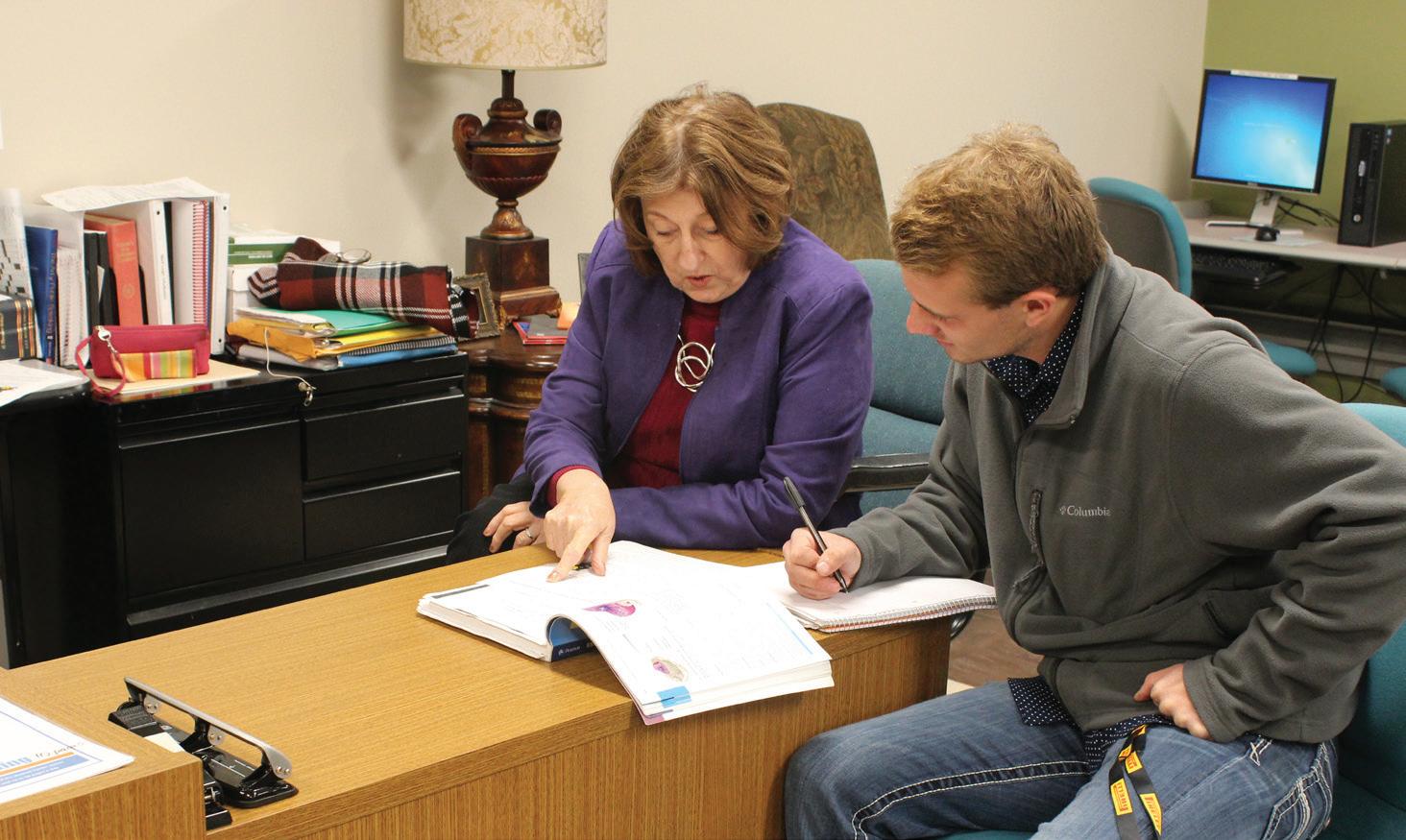
Beverly DeWitt, adjunct speech professor, assists a student with his homework.
The new Student Union is estimated to cost about $18 million once it is completed.
Image courtesy of Beck Design
Campus Chat
What are your plans for spring break?
by Mina Onar
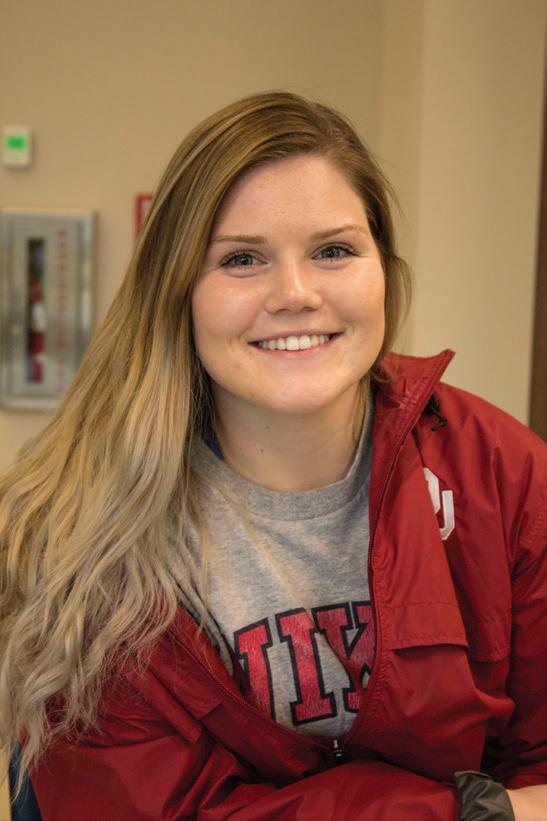
Mikayla Arnold Dental Hygiene major
“During spring [break] I am planning on going to the gym and work. We have a debate paper assignment, so I will be doing homework as well.”
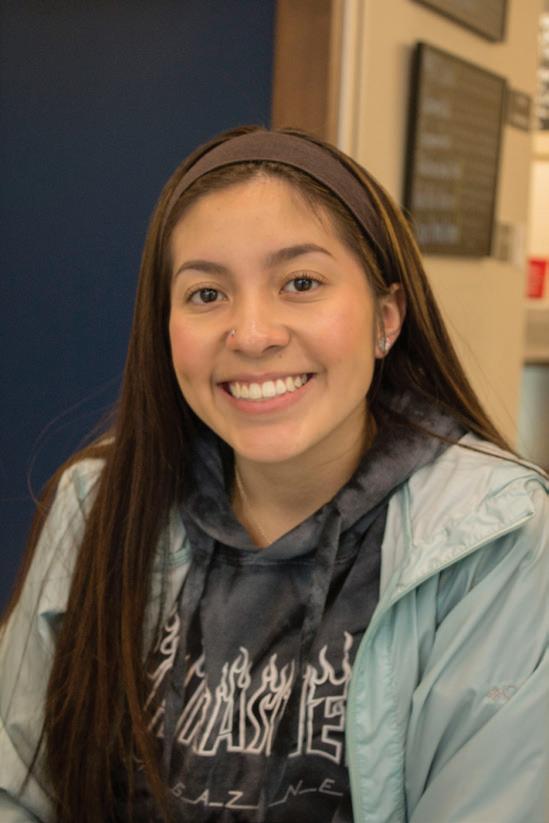
Saenz Dental Hygiene major
“I will go to work and do homework.”
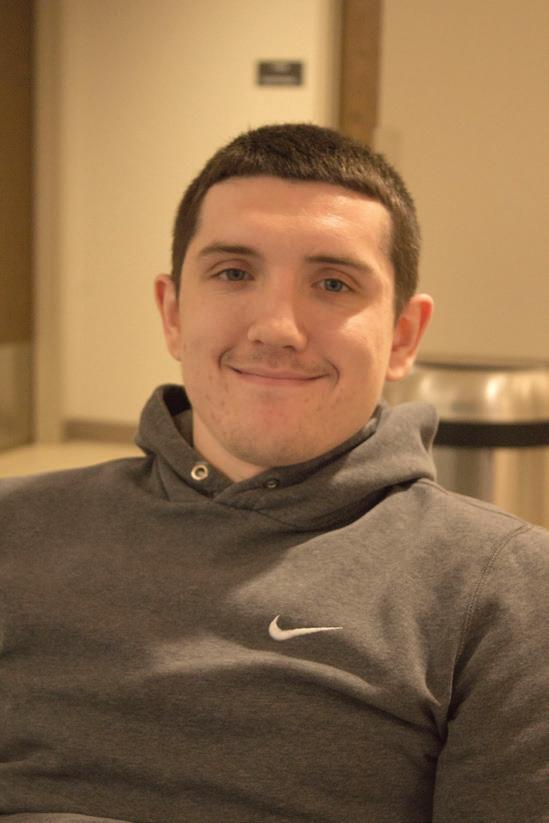
Davis Pre-Education
“I will spend time with my family.”
Vroom, Vroom! Here Comes The Rowdy Rover
by Madi Zick Staff Writer
On the first week of the spring semester, Raiders may have spotted President Jeanie Webb riding around in a golf cart, taking students to their classes. At most large universities, students don’t often see the school’s president walking around the campus, let alone driving a golf cart. That is part of what separates Rose State from other universities and community colleges. But why was she driving around? What was the point of it?
“If you look at Rose State College in comparison to other community colleges in the area, some of the larger universities in the region, the feel of Rose State is very much that of a family … that comes from President Webb,” explained Daniel Beck, Rose State director of marketing. Beck and other members of the External Affairs and Marketing team wanted students at Rose State to meet Webb and see that she genuinely cares for them.
The team’s goal was to “showcase from the marketing perspective on social media that this is the environment [and] attitude for Rose, that it is a little bit more casual … but all about students,” Beck said.
When asked about the Rowdy Rover, Webb explained it was meant “to show that we’re human, we care, we’re family-oriented and we want to get to know all of our students and that all of
our students are important.”
Webb also described every college freshman’s emotions when first arriving on campus. She said it can be intimidating to ask someone where a building or class is, especially when the student thinks they know the answer. However, with the renovations occurring across campus, it can lead to confusion from students. The Rowdy Rover provided some reassurance to new students and allowed them a chance to get to know the school’s president.
“Stuff like this makes Rose State unique; we aren’t your typical college,” Webb said. “We’re your college that really cares and will reach out. We really want you to be successful and graduate.”
Webb said she had a lot of fun because she was able to talk to and learn about some students whom she might not have otherwise had the chance to meet. But once she introduced herself, students relaxed and thoroughly enjoyed the ride.
Beck and Webb are open to
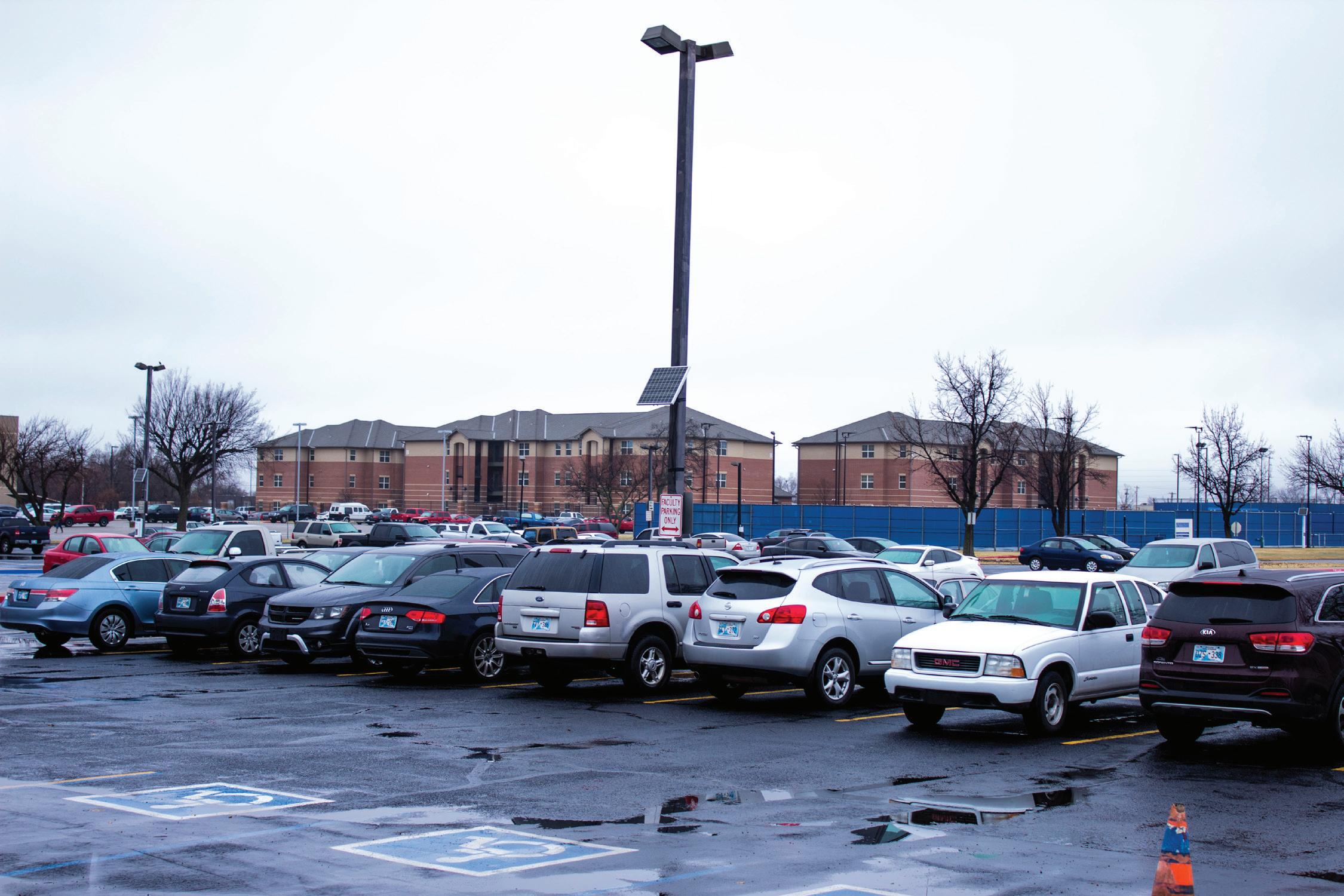
suggestions for future rides, and encourage students to speak out. There is nothing planned for the immediate future, but be on the lookout for the next time the Rover makes its rounds. Webb has aimed to drive to the farther parts of the parking lots to pick up students, so for those interested in getting picked up, park as far out as possible. Suggestions have even been made for a golf cart karaoke. If they are lucky enough, a student might get to sing a song or two with the one and only President Webb.
by
Celeste
Dakota
Photo
Mina Onar
The Rowdy Rover allows students to interact with President Jeanie Webb in a fun, unique way.
Income Inequality: Experts weigh in
by Bailey Walker Staff Writer
Circulation Manager
Williams
Social Sciences Professor James Davenport’s fourth installment of the Great Debates: Power, Politics, and People featured intellectuals of Oklahoma discussing income inequality in the United States. Panelists included Gene Perry, communications and strategy director of the Oklahoma Policy Institute, a center-left, Tulsa-based think tank; Craig Dawkins, Rose State professor of economics and personal finance; and Dr. John Wood, political science professor at the University of Central Oklahoma.
One spirited audience member was welcomed into the discussion by Davenport, bringing an impromptu working class perspective to the discussion. His concerns included improving schools as a means of mitigating wealth and income inequality, as well as issues of expensive childcare. Though generally in agreement, for the first time in this debate series the panelists clashed

in ideas.
Perry asserted “distortions of democracy” occur when income inequality becomes as high as it is in the U.S.. According to economist and former Secretary of Labor Robert Reich, the country has between the second and fourth highest rate of income inequality in the world, measuring up near notoriously corrupt nations, Russia and Ukraine. Perry argued that such a rift in resources between the rich and poor, coupled with current campaign finance laws, means the wealthy are the agenda setters for politics. For example, lowwage workers often have schedules only a week in advance, so long-term or short-term planning is nearly impossible. Issues like schedule control are not considered political matters, as corporate tax cuts have dominated recent congressional news.
Wood shared Perry’s views on the influence of money in politics, citing power of interest groups and campaigns funded by super Political Action Committees. Wood called for reform, noting that the biggest booms of innovation and economic equality came during the ‘50s and ‘60s, a time in which the wealthiest were taxed at above 90 percent. The top

and bottom of the income spectrum are largely fixed, with 42 percent of people in the bottom one-fifth of income staying in that bottom fifth, Wood explained. CNN reports a more grim picture, claiming 70 percent of those born to low income families stay in the low income bracket. He also emphasized that the Fortune 400, the wealthiest people in the U.S., are most often born into money. According to Wood, 65 percent of the people on this list were born into wealth or inherited their money, while 35 percent did not.
Dawkins moved to counter Wood about the rigidity of the extremes of the income spectrum by citing two examples of wealthy people losing their fortunes: Mike Tyson and an NFL player. This somewhat bolstered Wood’s statistical analysis when only two specific counterexamples were offered instead of contrasting data, though it is true the rich can lose their fortunes due to mismanagement. Conversation about the lives of the wealthy stayed limited; instead the panel moved to address issues ordinary people face, such as education.
A student approached to ask the panelists a question about their
opinions on a universal basic income, or a UBI. A UBI is essentially an amount of money given to each U.S. citizen with no strings attached. All panelists supported the idea of a UBI, but they differed in how the UBI would be implemented. Wood and Perry leaned closer to the UBI being set at the poverty line, sacrificing all welfare programs in the process but ensuring all people a standard of living above poverty. Dawkins suggested a UBI that does not meet the poverty line, but still assists people. UBI pilot programs are currently being tested in Finland, Kenya and several other nations.
Income inequality is an issue with catastrophic impacts. While there are many different methods of addressing the problem, it appears all of the paths require radical change, whether that be in redistributing wealth from the top .01%, implementing a UBI or overhauling campaign finance laws to even start discussing solutions. Davenport brings great minds on campus with this Great Debates series, the next of which will be over the great Wealth Explosion, 1800s-present, at 2 p.m. March 6 in the LRC.
OP-ED: A deeper look at religious stereotypes
by Mina Onar Assistant Editor
As humans, feeling connected to something or someone greater than ourselves makes us feel secure and like we have a goal in life. This is why religion plays such a big role in people’s lives. However, even if someone has beliefs on a specific religion, as we all know, that does not mean that there is only one true religion. There are roughly 4,200 religions in the world, but the most common religions are Christianity, Islam, Judaism, Hinduism and Buddhism. Since people do not feel the need do further research on things that they hear on a daily basis, it is easy to assume things are true without doing any kind of fact checking. There are many misconceptions about every religion which can be offensive to the believers of those religions. Dec. 25 is celebrated by many people as Jesus Christ’s birthday; however, other countries who do not celebrate Christmas think it is the celebration of the New Year. And even though we think they are, atheists are not necessarily anti-religious. So how educated are we, really?
As the 15th Street News Staff, we realized there are a lot of stereotypes when it comes to religion. We would
like to open this column for anyone who would like to share his/her experiences based on religious topics. For this issue, I would like to share my own experiences, and would like to share my own knowledge. I have never considered myself a religious person, though my parents raised me to be respectful of all people who have different ideas and beliefs. I do not consider myself a Muslim, but I carry the culture with me, and I grew up learning different aspects of Islam.
There are about 50 countries that are Muslim-majority. The Republic of Turkey is one them. I was born in Ankara, the capital city of Turkey. Turkey is located between Eastern Europe and Western Asia and has borders with Syria, Iraq and Iran. Contrary to popular belief, Turkey does not have a main religion, but 98 percent of the population is Muslim. In fact, it is the only popularly Muslim country that has no state religion. The Constitution guarantees religious freedom and tolerance is the rule.
Most people who did not grow up in a diverse environment directly assume that Islam has specific rules, which a Muslim person should be following: If that person is female, she has to be covered. He or she cannot eat pork or any meat outside his or her country because the meat is not halal, or cannot drink alcohol. Basically, many people assume that
Islam is based off of these restrictions and nothing else. This is not necessarily true.
People often make these assumptions largely based off portrayals by the media. Unfortunately, we have witnessed many incidents that have escalated stereotyping, whether it’s toward Muslims, refugees, immigrants or different cultures. Starting with 9/11, the world began to look at Muslims as if they were terrorists, radicals or unacceptably different from other people. One of the main and disturbing forms of stereotyping is considering every Muslim person and ISIS militants or supporters of ISIS as equal. What we do not realize is this is the same as considering every Christian as a supporter of Irish Republican Army or other Christian terrorist groups. We do not see the media covering such things, so why are Muslims the target?

The main question I am asked is where I am from, which is understandable since I have an accent that reveals I am foreign. When I say I am from Turkey and studying in Oklahoma, most people get excited. Some people start asking me questions, and while I do not normally mind answering questions, I think the questions should be educated ones, which leads us to this column. When people find out I am Turkish, some look directly at my hair and ask me why I do not cover it. I kindly inform them that not every
Muslim female or a female who grew up in a Muslim country has to cover her hair.
Another form of stereotyping people practice, even though their only intention is to be kind, is informing me about the meat when I eat around them. I am told what kind of meats are my options. They say I should be careful because there might be pork inside the food that I am eating or ordering, because they assume I certainly cannot have pork. So, they always warn me about the food in front of me. To be honest, pork is not my favorite meat of choice; however, I grew up eating it occasionally. In my family or when I am with my friends, it is never an issue.
It should be understood that many people only take some parts of a religion, and regulate it according to their own personal views. Or maybe the culture they grew up in has strict rules and their religion has nothing to do with it.
Even though I do not take any questions or concerns personally, some other person might. Stereotyping can grow into wrong information, and even racism. We all should be less biased and more kind to each other, not just when it comes to religion but also when it comes to politics, personal views or just the characteristic features of ourselves. We are not the same person, but we are equal.
Photo illustration by JaNae
MLB Season Preview
by Brayden Conover & Danny Fritts Advertising Director & Sports Editor
American League
New York Yankees: The Yankees have made the biggest splash during the offseason, acquiring Giancarlo Stanton from the Miami Marlins in a steal of a trade. They also hired former Yankee Aaron Boone to replace manager Joe Girardi. They were one win short of reaching the World Series last season, losing to the Houston Astros in Game 7. The addition of Stanton makes their lineup very lethal. Aaron Judge, Gary Sanchez and Stanton will most likely be the heart of the order all season. All three of which can be penciled in for 40 home runs.
The Yankees pitching staff is full of veterans that can eat up a ton of innings to allow the bullpen to keep the staff fresh for another deep postseason run. The staff is led by CC Sabathia and Luis Severino, while the bullpen is anchored with hard-throwing closers Aroldis Chapman and Dellin Betances. Last season, The Yankees finished second in the AL East as a young team; however, this year they are primed to win it all. With a long ball threat on offense and solid pitching, you can expect to see the Yankees play in late October.
second AL Cy Young award last season and will lead a deadly rotation that also includes Trevor Bauer, Danny Salazar and Carlos Carrasco. The Tribe’s bullpen is anchored by Andrew Miller and Cody Allen. The pitching staff will be looking to continue their dominance they had last season, boasting a 3.30 team ERA, which led the entire MLB. As long as the Indians stay healthy, Cleveland will have an October to remember.
Houston Astros: Managed by Midwest City High School alumnus AJ Hinch, the 2018 Houston Astros look ready to defend their World Series title. Behind Tulsa native and 2015 Cy Young award winner Dallas Kuechel, 2011 AL Cy Young and AL MVP Justin Verlander lies a very stacked

Cleveland Indians: The Cleveland Indians led the AL with a 102-60 record. They exited the playoffs early after losing the American League Division series to the New York Yankees. After the 2016 World Series loss in Game 7 to the Cubs, the Indians were 2017 World Series favorites. Once again, the Tribe looks to make it back to October baseball. With Francisco Lindor, José Ramirez and Michael Brantley at the top half of the order, the Indians will have plenty of runs scored. Corey Kluber won his
pitching staff. The infield is full of guys capable of winning gold gloves. Jose Altuve, Alex Correa and Alex Bregman are all Gold Glove and Silver Slugger contenders. The Astros are the cream of the crop in the American League and will have one of the best title defenses in years.
National League
Washington Nationals: The Washington Nationals look like an All-Star team from top to bottom. Bryce Harper, Trea Turner, Max Scherzer, Stephen Strausburg and David Murphy are all guys that will most likely be playing in the midseason classic. The Nats are tired of early exits in the playoffs. Their All-Star caliber roster combined with what is the easiest division in baseball, makes the Nationals a lock for October baseball.
Chicago Cubs: The Chicago Cubs, coming off their first World Series title since 1908 back in 2016, fell short in the National League Championship Series to the NL Champion Los Angeles Dodgers. They signed starting pitcher Yu Darvish to a six-year, $126 million deal to help bolster their loaded pitching staff. The Cubs finished top ten in the majors in most pitching categories. Offensively, the Cubs looked inept at times throughout the season. Although they hit 223 home runs as a team, they struck out over 1,400 times. They have franchise players in Kris Bryant and Anthony Rizzo who are the heart and soul of the clubhouse. Bryant had a down year compared to what he did in 2016, but he was still impressive. He went from 102 RBIs to 73, but he struck out 26 fewer times and increased his batting average from .292 to .295. Los Angeles Dodgers: Coming off a heartbreaking loss in the World Series, the Dodgers will still be the favorite to come out of the competitive NL West. Clayton Kershaw will make his eighth Opening Day start, a Dodgers record. Kershaw is arguably the best pitcher in all of baseball and the leader of the Dodgers. Los Angeles is also equipped with one of the best farm systems in all of baseball. Pitcher Walker Buehler, a top 10 prospect according to MLB.com, is expected to arrive sometime this season. The Dodgers had the second-best ERA last season at 3.38, and closer Kenley Jansen had 51 saves, which proved to be third most in the majors. In 2016, shortstop Corey Seager was a breakout star. Last season, Cody Bellinger jumped onto the scene and stole the show. As a rookie, Bellinger hit for a .267 batting average, 39 home runs, 97 RBIs and posted a .933 OPS. Not only was he an allstar, he was also chosen as the NL Rookie of the Year. The future looks brighter than the Hollywood Walk of Fame.
AL East
1. Yankees (98-64)
2. Red Sox (94-70)
3. Blue Jays (82-80)
4. Orioles (78-84) 5. Rays (63-99)
AL Central
1. Indians (102-60)
2. Twins (86-76)
3. Royals (84-78)
4. Tigers (76-86)
5. White Sox (70-92)
AL West
1. Astros (104-58)
2. Angels (83-79)
3. Mariners (79-83)
4. Rangers (72-90)
5. Athletics (65-97)
NL East
1. Nationals (97-65)
2. Mets (87-75)
3. Phillies (84-78)
4. Braves (75-87)
5. Marlins (60-102)
NL Central
1. Cubs (92-70)
2. Brewers (83-79)
3. Cardinals (83-79)
4. Reds (69-93)
5. Pirates (68-94)
NL West
1. Dodgers (100-62)
2. Diamondbacks (88-74)
3. Rockies (87-75)
4. Giants (81-81)
5. Padres (75-87)
Photo courtesy of The Chased
SunTrust Park Opening Day 2017 Atlanta, Georgia.
Athlete Spotlight: Baseball
by Brayden Conover Advertising Director
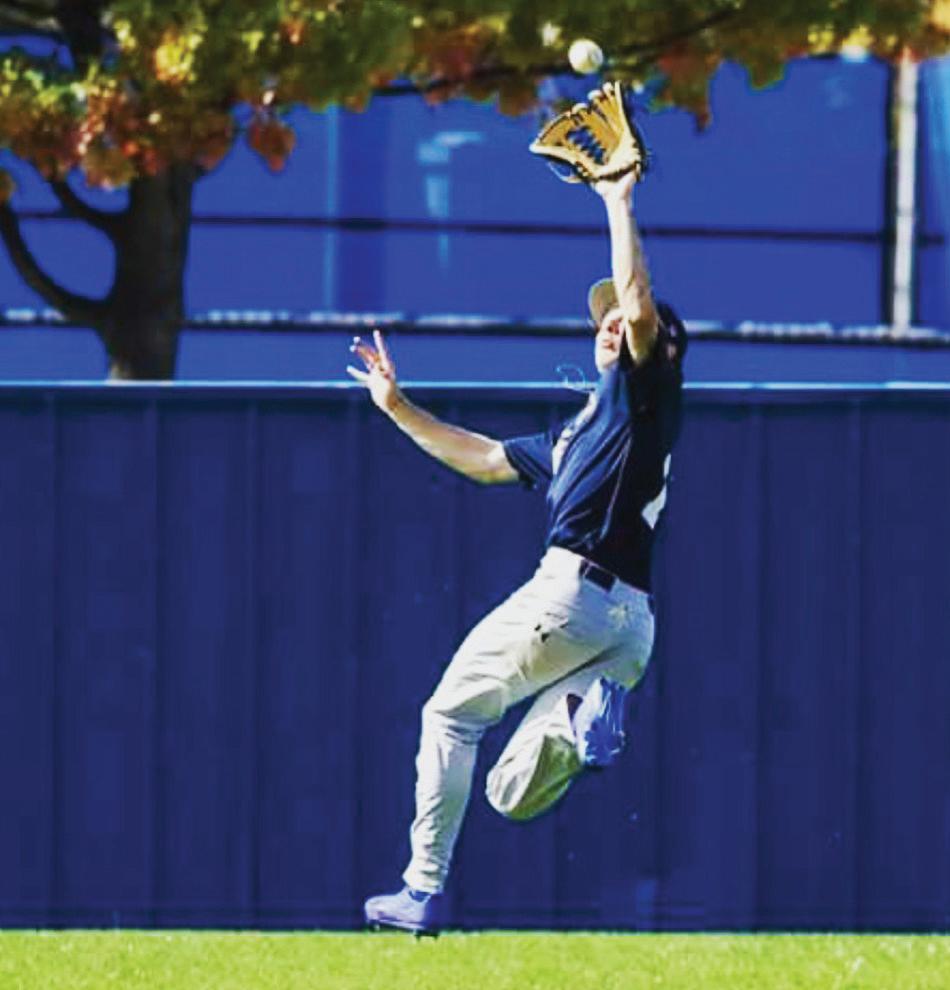
This month’s feature athlete is Raider Outfielder Landon Decker, number 7.
You haven’t played baseball competitively since your senior year at Carl Albert High School. What made you take a break from the game? What made you want to come back to baseball?
At the beginning of my senior year, my dad passed away. That made playing baseball hard, seeing as he was my biggest fan. He went to every game and called me after each game to talk with me. After all, he was my original coach. But not having him at the games or being able to talk to him after the games made baseball a lot harder. After my senior year, I walked away from the game and never had an urge to go back and play. I joined a softball league a year and a half later and one of the players on the team was a former player at Rose. Throughout the summer, he kept telling me to try out for Rose. I kept putting it off because I had already started a life past high school, and I wouldn’t be able just to drop everything and play ball again. I finally gave in and decided to try out and ended up making the team. I had to move back home, give up my full-time job, and cut ties with all of the extra activities I did. It wasn’t easy
to just drop everything, but it was very much worth it. This second chance has changed my attitude towards almost everything in my life.
How much has the game changed from your point of view? Has the speed of the game felt faster than when you last played?
The game for me has changed almost entirely. In high school, I was a hot-head and only cared about my personal goals. However, getting this second opportunity made me re-evaluate the game and the way I approach it. I still have the same competitiveness and fight I had in high school but I’ve learned that my teammates are more important than myself. I’ve learned that in order to truly succeed I have to listen to my coaches and learn from my teammates. I was very intimidated when I first started playing again. I was scared that I would be facing much faster pitching, catchers with better arms, and hitters with much more power. All of those components are true, but it becomes a bit easier to face when you’re seeing it every day. I’ve adjusted very nicely to the change of speed from high school to college, but it wasn’t easy. What’s the biggest obstacle you’ve had to overcome this past offseason to get back into shape for a rigorous and long season?
I’ve always been in great cardio-
vascular shape, so the running and training that comes along with the title of “college athlete” didn’t surprise me at all; however, I wasn’t ready to play four to six games a week, or even playing 18 innings a day. In high school, games only lasted seven innings and there [are] only three or four [games] a week. That had a huge toll [on] me about a month into the season. I love to play and compete; I’d even love to play seven days a week, but I learned that it’s hard to stay focused and compete 100 percent every day. I just have to keep reminding myself why I’m here and what my goals are. A lot of players lose focus on that and become complacent. Complacent is something I never wanna be in anything that I do.
How have you adjusted your play to fit the competition you’ll be facing this season?
After many months of practicing and playing with this team, I’ve learned what my job here is. We have plenty of power hitters and plenty of guys that spread the ball around the field, so what I try to do up at the plate is simply just get on base so teammates can drive me in. Whether that be by a bunt or taking a walk, getting on base is my goal. Of course, I would love to hit the long ball or be the hero every game, but I know that I’m better player and teammate by just going out and competing for my guys every opportunity I get.
What challenge are you most excited about facing this season?
I love to face adversity, I know that sounds weird, but when someone can come through for their team while the odds are stacked against them, then imagine what they can do when they are relaxed in the game. I’m most excited to see how I hit the ball. I am very confident in my defense and throwing ability but swinging the bat has always been my weakness. I have already come a long way on the offensive side just from the help of my coaches, so I can’t wait to see where I end up towards the end of the season; it’s a challenge that I believe every hitter on this team would love to accomplish as well.
What are your plans once you graduate Rose State?
Right now, I am very happy with my coaches and professors at Rose State, so I honestly haven’t given much thought of where I would like to go after Rose, but my plan as of right now is to go to any university that would take me. My education is more important than my baseball career, so if I can land a scholarship at a university and get my English degree then I would be more than happy with where my baseball career ended and ready to start my actual career. (Also, my backup plan is to go to the MLB, but we’ll see which one is easier in a few years from now).

Landon Decker reaches out for a catch in center field during a Rose State Raiders home game.
Decker watches the ball of his bat during a game last summer.
Hot Spots in Oklahoma
Everyone Assemble At The Jones Assembly
by Haley Humphrey Social Media Coordinator
There are innumerable places to visit in Downtown Oklahoma City that fit different tastes. A new hot spot can be found in the Film Row district. The area of businesses, restaurants and lofts that were once home to major film conglomerates has experienced many renovations and new additions. Oklahomans and out-of-towners wanting to experience a modern atmosphere that acknowledges its past need look no further.
A historical recap of Film Row will have people walking down memory lane with David Wanzer, designer of the urban area, and Bradley Wynn, planner of expanding the landscape to form a district.
According to Steve Lackmeyer, writer for NewsOK, Wanzer and Wynn were heroic in pulling Film Row out of the dust in 2003. The area became dilapidated through years of drugs and prostitution and was overrun by the homeless population in the 1980s. Wanzer and Wynn had a vision in mind but they could not do it alone. They gained support from Oklahoma City Council members like Ann Simank, who was the city councilwoman at the time, and organizations like DEADCENTER Film Festival that brought artistic interest back to the grounds where Hollywood stars once walked. Soon, word spread to property owners who got on board with their own revival ideas. One of OKC’s biggest transformations was in full swing.
Since 2006, Film Row has

progressed to new heights. Each development located on Sheridan Avenue has a unique flair to share with the public. One of the newest additions is The Jones Assembly, which opened its doors in July 2017. The multi-functional space was named for the Fred Jones Manufacturing Company, which was established in 1922 in the same building. Fred Jones brought the first Ford dealership to Oklahoma City and The Jones Assembly finds the history endearing.
“We’ve had a lot of fun playing off that; we use phrases like ‘keeping up with the Joneses’ or ‘time to assemble,’” Annie Tucker, marketing coordinator for The Jones Assembly, said.
The members of The Jones Assembly have achieved keeping the automobile history alive in

the location where Fred Jones’ Model Ts flourished. From the brick and garage doors to the lights and original markings, almost every piece that makes The Jones unique, has been repurposed.
The plan to bring diverse music to OKC was effective with the vast, authentic space, which has housed 12 concerts and counting. However, the space needed food to tie it all together. The Jones Assembly menu has a range of choices. From light dips and spreads to wood-fired pizzas and scallops, they have something for nearly every palate. The desserts are designed to accommodate chocolate or banana lovers, with the restaurant making its own homemade vanilla wafers.
Tucker insisted customers
should not leave The Jones until they have tried the okra, served with their Jones sauce that is “spicy, tangy and creamy,” a triple threat that Oklahomans cannot resist.
The 21-and-older crowd is encouraged to try a cocktail with their decadent meals. The Jones serves original cocktails upstairs in their restaurant, while downstairs they put their own twist on the classics. The main difference being the catchy names not found on the menu in the upstairs lounge.
“Every dish, every cocktail, every dessert, every concert we book and every design element was extremely thought out,” Tucker said.
The Jones Assembly is a whirlwind of music, food and history in one restaurant experience.

Photo courtesy of The Jones Assembly
Customers are able to enjoy Oklahoma’s weather in the patio space on Film Row.
The Jones Assembly provides signature twists on classic drinks.
Behind the bar, The Jones Assembly crew creates their customers’ orders.
Photo courtesy of The Jones Assembly
Photo courtesy of The Jones Assembly
A twist on an Italian classic: Tiramisu
by Payton Haynes Online Editor
It is a rich dessert made from layers of coffee-soaked shortbread cookies, mascarpone custard, rum and velvety whipped cream.
Prep time: 35 minutes
Cook time: 4-6 hours
Serves: 8-10
Ingredients:
• 6 egg yolks
• ¾ cup sugar
• 1 cup milk
• 1¼ cup heavy cream
• ½ teaspoon heavy whipping cream
• ½ teaspoon vanilla extract
• 1 pound mascarpone cheese
• ¼ cup strong-brewed coffee, or espresso, room temperature
• 2 Tablespoons rum or rum extract (Marsala, Brandy, Kahlua, or Baileys may also be used)

• 2 3-oz packages shortbread cookies (ladyfingers may be used instead, but the shortbread cookies may be easier to find)
• 1-5 Tablespoons unsweetened cocoa powder
• Chocolate shavings or curls for garnish (optional)
Items Needed:
• 7” x 11” rectangular pan or baking dish
• Electronic hand-mixer
• Whisk
• Medium saucepan Directions:
• In a medium saucepan, whisk together egg yolks and sugar until well-blended.
• Whisk in milk and cook over medium heat, stirring constantly until mixture reaches a boil. Boil gently for 1 minute, then remove from heat. Allow the mixture to cool slightly. Cover tightly and chill in refrigerator for 1 hour.
• Once the yolk mixture is chilled,
whisk mascarpone into the mixture until smooth. In a medium bowl, beat cream with vanilla until stiff peaks form. (An electronic hand-mixer is great for whisking extra air into both mixtures and making sure they are thoroughly blended.)
• In another bowl, combine the coffee and rum. Lay out shortbread cookies on a pan or plate and drizzle lightly with coffee mixture. Don’t oversaturate the cookies, as you need to be able to pick them up and lay them in the pan.
• Arrange half of the soaked shortbreads in the bottom of the baking dish. Spread half of egg yolk-mascarpone mixture over the cookies, then half of the whipped cream over that. Repeat layers and sprinkle with cocoa and chocolate shavings.
• Cover and refrigerate 4-6 hours, until set.
Serve and enjoy.
Annual Summit Celebrates ‘difference makers’
Story & photo by Shaun Beck Staff Writer
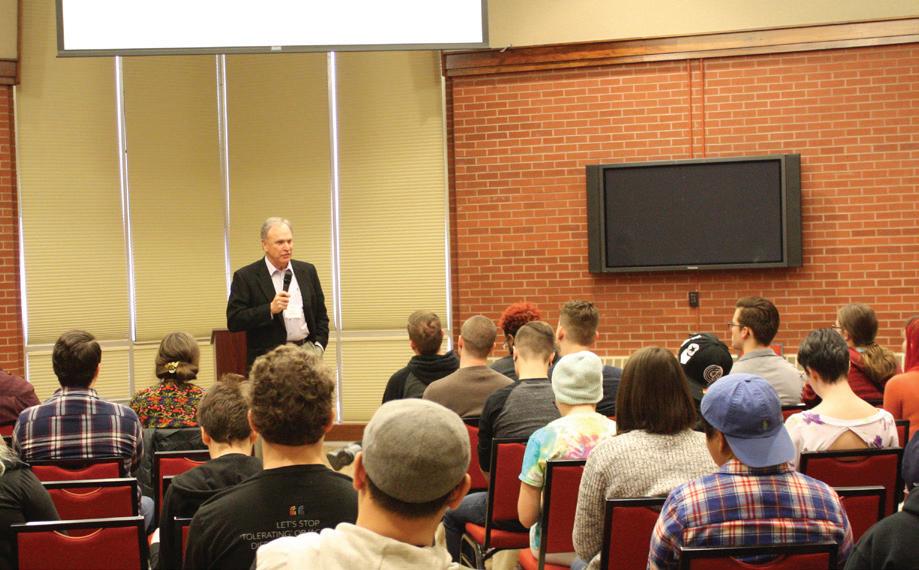
Freedom Oklahoma’s sixth annual LGBTQ College Leadership Summit was hosted Feb. 3 at the University of Oklahoma in Norman. The event brought many college students together to learn about LGBTQ rights and how to further LGBTQ inclusion in colleges around the state. The Summit showed LGBTQ individuals how their voices can be heard on their campuses and how allies’ voices can help promote inclusion.
The keynote speaker for the summit was Don Holladay, a law professor at OU, who played a crucial role in the marriage equality decision. .
“We are difference makers,” Holladay said in reference to his part in the historical event.
Holladay continued to discuss where the state of Oklahoma and America as a whole is on LGBTQ rights.
“America is not ready to go back 50 plus years,” Holladay said on the state of new legislation targeted against LGBTQ protections.
However, Holladay’s main points focused on speaking up.
“It’s important for voices to be heard,” he said. “Power yourself individually and collectively.”
The Summit was held at the Jim Thorpe Multicultural Center. Students who pre-registered for the event were provided with one free meal voucher for use at the Couch Restaurants on OU’s campus, as
well as a free T-shirt and a tote bag full of goodies from the campus’ offices, which were helping to put on the event.
Attendees had an opportunity to participate in several mini breakout sessions that provided information on how to survive as an LGBTQ college student in housing. Students learned from two of the housing representatives that there are many resources to help LGBTQ students navigate housing safely. The representatives also explained that it is important for students to feel safe where they are living.
A queer sex education class was held as well, in which students explained where STDs come from and how they can be prevented. They also emphasized how to properly apply a condom and how HIV is spread and treated/ prevented.
Sarah Hoss, Rose State health sciences professor and Spectrum faculty adviser, described her involvement with LGBTQ rights on and off campus and how she hopes to further the LGBTQ cause. What made you interested in LGBTQ+ activism?
One of my dearest friends woke me up to the inequalities she faced living in Oklahoma as a married lesbian. (This was before same-sex
marriage was legalized nationwide.) It hurt me to see my friend treated as a second-class citizen and so I began speaking up for the LGBTQ community. In 2015, the Oklahoma Legislature introduced 26 anti-LGBT bills and I became actively involved in helping shut them down. Through this, I made a lot of friends and colleagues in the LGBTQ community. When I got hired at Rose full-time, one of my priorities was to make sure there was a LGBTQ student organization on campus. What influenced you to sponsor Spectrum Alliance Club?
Oklahoma is hostile towards the LGBTQ community. I wanted to advocate
and support our LGBTQ youth and being a professor at Rose State gave me that platform. What was the most influential part of the summit?
I enjoy networking and hanging out with LGBTQ folks and allies from all over Oklahoma. It makes me feel like we’re not alone. What would you like to see happen to further LGBTQ+ activism within colleges?
I would like to see more visibility. Colleges in Oklahoma may be inclusive and supportive but they are not as visible or vocal in showing their advocacy as they need to be.
Was there a breakout session you enjoyed the most? Why?
I enjoyed the “Know Your Rights” session in which participants shared their experiences of harassment and discrimination. It’s a reminder that problems faced by the LGBTQ community are real and need to be consistently and constantly addressed.
What did you get out of the summit as a sponsor for Spectrum Alliance Club?
I love Spectrum members, and I loved giving them the opportunity to attend. The fact that most people really enjoyed themselves at the Summit made the trip worth its while. What advice would you like to send to the LGBTQ+ students at Rose who maybe haven’t heard about Spectrum?
We welcome everybody. You don’t have to be a member of the LGBTQ community to join. We’re a group that is accepting and tolerant of all people. Spectrum meetings are a place in which everybody can be themselves.
What Advice would you have for non-LGBTQ+ individuals on how to get involved with LGBTQ+ issues and why is it important?
The LGBTQ community is marginalized in our society and many members face fear of discrimination and violence. Non-LGBTQ individuals have the power and privilege to speak up and create the most change and progress. It is safer for a “straight person” to speak out and be the voice than an LGBTQ person. LGBTQ allies are vital for advocacy and activism.
Preventing Tragedy: When preparing isn’t enough
JaNae Williams Circulation Manager
Since April 20, 1999, when Eric Harris and Dylan Klebold entered Columbine High School and went on a shooting spree that lasted 49 minutes, there have been a number of shootings, in schools and elsewhere - many of which have gone unreported by major news outlets. Typically, only government-defined instances of “mass shootings” make it into the headlines.
What determines a “mass shooting?” There is a bit of a disagreement amongst groups that weigh in on the matter.
The FBI offers no definition of what constitutes a mass shooting, only a mass killing or mass casualty event: Three or more killings in a single incident.
Other institutions suggest different definitions. Mother Jones, a non-profit investigative news organization, defines mass shootings as “indiscriminate rampages in public places resulting in four or more victims killed by the attacker.” They exclude more conventional crimes such as armed robbery or gang violence. Mass Shooting Tracker, an online, crowd-sourced database states: “We define a mass shooting to be an incident of violence in which four or more people are shot.” Gun Violence Archive’s definition is similar, but they do not include the shooter in the number of victims.
With so many definitions available, it is hard to know how to differentiate a mass shooting from a casualty event. By only considering the number of people killed, some of these sources negate the severity of the situation, often ignoring those who do not lose their lives. Brushing aside instances in which fewer than three people are killed - while dozens are injured - does a disservice to many victims. After facing major trauma, the human body takes months or even years to fully recover. For the human mind, full rehabilitation may never occur.
A Google search reveals countless lists of preparatory measures for college campuses. Preparation is emphasized enough, it seems. But are we really as prepared as we think we are?
First and foremost is the funding. As school districts in some states are struggling to even pay instructors a competitive wage or have resorted to four-day school weeks, it is unclear from where the additional money would come. Many teachers have vocalized their personal aversions to the idea of being armed.
Ken Trump, president of National School Safety and Security Services and a 30-year veteran school safety expert (no relation to the president), said in an article that “it is short-sighted for those supporting the idea to believe that educators who enter a profession to teach and serve a supportive, nurturing role with children could abruptly kick into the mindset to kill someone in a second’s notice.”
In light of events that occurred during the Stoneman Douglas shooting, there is also the question of whether law enforcement is even prepared for this task, yet the call to do so is now being placed on educators and those with no training, without regard to the repercussions.
The responsibility and potential liabilities involved “are beyond the expertise, knowledge-base, experience, and professional capabilities of most school boards and administrators,” added Ken Trump.
Who is liable if a student discharges a teacher’s weapon, harming others, accidentally or otherwise? What if school personnel shoot someone mistakenly? The whole idea lacks common sense. It’s no surprise that creating actual legislation for it has since been regarded as the responsibility of the states, despite the idea originating on the federal level.
“If you see something, say something.” The adage penned by advertising executive Allen Kay the day after 9/11 is one most of us have grown up hearing regularly. It gets mentioned after every major tragedy in the U.S. and many international incidents as well. It stands as a reminder that when we all take an active part in being aware of the world around us, we have the power to prevent tragedy. But are there better methods of prevention that are overlooked?
won’t infect us. Yet, mass shootings, their causes and the means by which perpetrators obtain weapons are readily ignored by government officials and lawmakers.
The U.S. has up to 310 million guns legally owned within its borders - nearly one for every man, woman and child, according to a 2013 Pew Research survey. The same survey, however, also shows that same number of guns is owned by only about 37 percent of the population. That means roughly 120 million Americans own nearly three times as many firearms.
While a minority of people are owning guns, a Gallup poll from 2015 shows 86 percent of people surveyed would favor “a law which would require universal background checks for all gun purchases in the U.S. using a centralized database across all 50 states,” and a separate 2011 poll showed that the top two ways Americans believed would prevent mass shootings were via stricter gun control laws and better mental health screening and support, respectively.
Despite overwhelming numbers of Americans wanting reform, Congress remains resistant to change. After all, “guns don’t kill people, people kill people,” according to the ever-popular first line of defense for gun lobbyists and Second Amendment advocates. While it’s true guns are not the perpetrators, there is obviously work to be done.
Without significant work on issues regarding mental health, the problem will remain. However, there is no evidence showing mental illness alone is enough to make a person a threat for violent behavior. Many of those involved in past mass shootings showed no signs of mental illness, were able to pass background checks or merely exploited loopholes in the current laws and systems to obtain their weapons.
The Second Amendment states, “a well regulated Militia, being necessary to the security of a free State, the right of the people to keep and bear Arms, shall not be infringed.” But what does that mean and how does it apply to preventing mass shootings?

In the wake of the most recent mass shooting at Marjory Stoneman Douglas High School in Parkland, Florida, President Donald Trump pushed for arming teachers as a way to prepare schools for these situations, even proposing bonus pay for those teachers willing to commit to training. This suggestion is flawed for a number of reasons.
With the existence of law enforcement agencies at the local, state and federal level, the Amendment lacks the pertinence of the 18th century. Weaponry, ammunition, modifications and enhancements have advanced dramatically since the Amendment was created. During Revolutionary times and the decades that followed, muskets and pistols could only be fired three to four times per minute because of the time reloading required, and their effective range was less than 300 yards.
Today’s weapons can fire upwards of 45 rounds per minute, and certain enhancements can increase that number to hundreds of rounds per minute. Effectiveness can range up to 1,900 yards and reloading takes less than a second, compared to 15-20 seconds per shot. The Second Amendment was clearly not written with this kind of weaponry in mind. Most proponents of gun laws are not advocates of the seizure of all weaponry, but rather the limitation of access of certain and specific weapons, modifications and ammunition. Armor-piercing ammunition, used in the Las Vegas shooting, is available today, rendering the protections of our military and law enforcement useless.

Whenever a shooting occurs, there is an instant reaction from some people to argue it is “too soon” after the tragedy to talk about legislation and change. While we are all implored to give the families time to grieve, the reality is once a mass shooting has occurred, it’s too late to talk about prevention. Prevention is a result of proactivity. Fire prevention does not come from pretending fire isn’t real. Theft prevention doesn’t come by pretending robberies cannot occur. Disease prevention isn’t based on the idea that germs are just figments of our imagination and that if we ignore them, they
“A well regulated Militia” is what is called for, but regulated by whom, and under what circumstances does it come into play when providing for the “security of a free State?” We no longer live in a time when the states have their own organized militias, a system that existed when the country’s military, state and local law enforcement lacked the organization, funding, skills and mobility of today. Instead, the majority of modern militias operate on anti-government sentiments focused only on their own security, stating that they will defend their right to bear arms in both federal and state governments.
Meanwhile, high-capacity magazines further increase the lethal threat of assailants. Modifications such as bump-stocks that allow semi-automatic weapons to fire at rates closer to fully automatic speeds nullify the few pieces of legislation currently in place, which prohibit the purchase of automatic weapons. Loopholes in laws surrounding gun shows and private purchases, a lack of accountability for registration due to arguments over privacy, and the flaws in the country’s effectiveness in maintaining those methods are all easily modified with legislation. Many bills already exist that could make changes that would save lives. We require all vehicles to be legally registered and owners to be tested, even maintain licenses and liability insurance with penalties for failure to do so. Yet, anyone over the age of 18 can purchase weapons, modifications, ammunition in mass quantities with zero federal, state or local intervention.
With preparedness fully in question and a lack of viable options on the table, the common sense idea would seem to be preventing rather than just preparing for tragedy. Students from Stoneman Douglas have become vocal following their experiences, advocating for change from law makers that eliminate the threat rather than merely anticipating it. For their sake, and the sake of all Americans, let’s hope we don’t continue to ignore this very real and pressing matter.
Photo and story by
Calendar of Events
Coming up @ Rose State
Be a part of Raider Life at these on-campus events:
March 6: Jazz Band Concert 8-9 p.m. - HB Atkinson Theatre
March 12: Student Recital Hour 3:30-4:30 p.m. - Hudiburg Chevrolet Center, CC 128
March 13: Wind Ensemble Concert 7:30-8:30 p.m. - Hudiburg Chevrolet Center Lobby
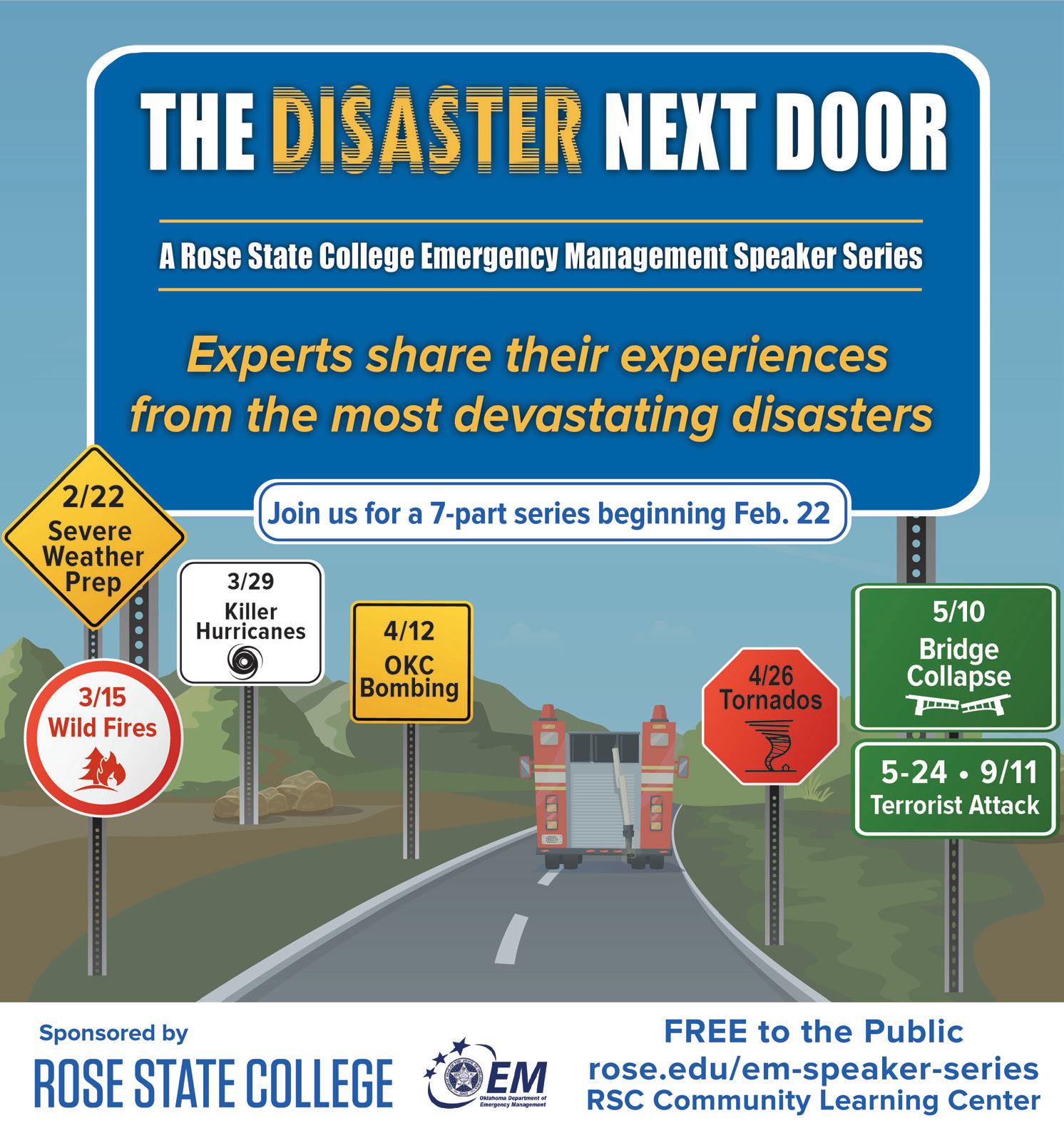
March 15: Emergency Management Speaker Series - Wildfires: Know the Risk 6:30-8 p.m. - Community Learning Center
March 29: Emergency Management Speaker Series - Killer Hurricanes 6:30-8 p.m. - Community Learning Center
April 3: The Long March of Liberalism: Individualization Debate 2-3 p.m. - Learning Resources Center

April 6-7: SHORT AND SWEET: A TEN-MINUTE PLAY FESTIVAL 7:30 p.m. - Fine Arts Building, Room 108
April 9: Student Recital Hour 3:30- 4:30 p.m. - Hudiburg Chevrolet Center, CC 128
**Check out the Baseball and Softball Schedules at 15thstreetnews.org for RAIDER Sports Events

Get out on the town!
March 7-25: Junie B Jones: The Musical at Lyric on The Plaza - $25-40
March 9: 4th annual Oklahoma Cine Latino Film Festival in Historic Capitol Hill - $25
March 9-10: 405 Pitstop at Tower Theatre Music Showcase - www.towertheatreokc.com for ticket info.
March 10-12: OKC Auto Show at State Fair Park - $10
Easter is April 1 Spring Break: March 19-23
March 17: WinterJam at Chesapeake Energy Arena - $15 at the door
March 19-25: Three Sisters Celebration at Chickasaw Cultural Center - FREE
March 25: 30th Anniversary Celebration of the Myriad Botanical Gardens & Crystal Bridge - FREE
March 31: Egg Hunt 5K at Stars & Stripes Park - $35 April 6: ACM@UCO Metro Music Festival in Bricktown - FREE April 6-8: 42nd Annual Medieval Fair at Reaves Park in Norman - FREE; $5 Parking Through June 22- ‘Elevate’ the Momentum Spotlight Artists Preview at 21c Hotel - FREE

Thunder Up!
Now is your chance to get out and catch an OKC Thunder home game:
March 6: Houston Rockets
March 8: Phoenix Suns
March 10: San Antonio Spurs
March 12: Sacramento Kings
March 16: Los Angeles Clippers
March 23: Miami Heat
March 25: Portland Blazers
March 30: Denver Nuggets
April 3: Golden State Warriors

NCAA March Madness : March 11 - April 2


a habit of it!
events in and around the OKC Metro:
Night Classics at Harkins Bricktown 7 p.m. - $5 Wine Down Wednesday at O Bar in the Ambassador Hotel 2-10 p.m. - $5
Art After 5 at Oklahoma City Museum of Art - $5
Night Jamboree at Red Rooster Bar & Grill 8-11 p.m. - FREE
First Wednesday Karaoke at HeyDay Bricktown 8-11 p.m. - FREE
First Fridays on the Paseo 6-10 p.m. - FREE
Second Friday Norman Art Walk 6-9 p.m. - FREE
Second Friday Live on the Plaza 7-11 p.m. - FREE
Last Thursday Wine Tasting at HeyDay Bricktown 6:30-8:30 p.m. - $20
Staff Members
Editor-in-Chief, Graphic Artist
Michelle Rojano
Assistant Editor
Mina Onar
Multimedia Editor
Bailey Bussell
News Editor
Emily Siddiqui
Online Editor
Payton Hayes
Circulation Manager
JaNae Willams
Social Media Coordinator
Haley Humphrey
Advertising Director
Brayden Conover
Sports Editor
Danny Fritts
Sports Reporters
Scott Sharkey
Madi Zick
Staff Writers
Ariel Bryant
Courtney Burleigh
Katie Duer
Reginal Fields
Yesenia Gonzalez
Joshua Rojo
Bailey Walker
Bella Kok
Kaitlyn Burden
Shaun Beck
Adviser
Darcy Delaney
Letters to the Editor
The 15th Street News welcomes and encourages letters to the editor. Letters should be a maximum of 300 words and are subject to editing for obscenity, clarity and space. Submissions must include name, major and phone number. 15th Street News reserves the right to not publish submitted letters.
Letters to the editor may be hand-delivered to FA110.
Policies
The 15th Street News is published monthly and is a designated public forum. Student editors have the authority to make all content decisions without censorship or advance approval. Columns, commentaries and letters to the editor are personal opinions of the writers and do not necessarily reflect the views of 15th Street News or other students, faculty or administrators of the college.
Anyone having a complaint may contact the Editor-in-Chief, 733-7400.
15th Street News is a member of OCMA, OPA, ACP, Great Plains Journalism Association, and the Society of Professional Journalists.
This publication is printed by the Edmond Sun, issued by RSC and authorized by the Advisor of Student Publications.
RSC in compliance with Titles VI and VII of the Civil Rights Act of 1964, as amended, Executive Order 11246, as amended, Title IX of the Education Amendments of 1972, Americans with Disabilities Act of 1990 and other federal laws and regulations does not discriminate on the basis of race, color, sex, age, national origin, religion, disability, sexual orientation or status as a veteran in any of its policies, practices or procedures.
This includes, but is not limited to, admissions, employment, financial aid and educational services.
Sudoku