Chicopee first in state to launch bus stop-arm program
Starting April 1, any vehicle that fails to stop for a bus in Chicopee will be caught on camera and later fined a minimum of $250.
Page 4
SOUTH HADLEY
South Hadley residents support potential tax override
With town-altering cuts proposed for fiscal year 2027 and beyond, South Hadley residents met on Feb. 25 during a Special Town Meeting to voice their support for a Proposition 2 1/2 override.
Page 5
HOLYOKE
Neal announces federal funding for wastewater system
On Feb. 27, U.S. Rep. Richard Neal joined Mayor Joshua Garcia, state Rep. Patricia Duffy, and local officials at the Holyoke Water Pollution Control Facility to announce $800,000 in federal funding for the city’s combined sewer overflow system and sewer separation project.
Page 6
Officials, advocates clash over rent control
By Trent Levakis tlevakis@thereminder.com
HOLYOKE — Lighthouse Holy-
oke’s Divine Theater was the site for a Feb. 25 press conference hosted by leaders from Holyoke and Springfield to share their opinions about the rent control initiative that looms across the state this year.
The conference was led by Housing for Massachusetts, a broad coalition of state residents, small property owners, family-owned real estate companies, affordable housing developers, housing advocates, and business leaders concerned about the housing affordability and availability across the state.
Holyoke Mayor Joshua Garcia, Springfield City Councilor Mike Fenton, small property owners and Pioneer Valley Developers joined the event to speak out against the proposed rent control ballot question and highlight unintended consequences from the statewide proposal.
The current statewide ballot initiative proposes a cap on annual residential rent increases at 5%, or by the Consumer Price Index, whichever is lower. If passed, the policy would repeal a law passed by Massachusetts voters in 1994 to ban rent control and would apply to virtually all privately owned rental housing across the Pioneer Valley that is not owner-occupied, a point expressed repeatedly by speakers during the press conference.
Members of Springfield No One Leaves and other local protesters attended in response to the campaign, arguing the ballot question is one of the few protections available for tenants facing drastic increases to rent. According to a recent Bay State Poll conducted by the University of New Hampshire Survey Center, 56%
of respondents either somewhat or strongly support the proposed ballot question.
In December, Gov. Maura Healey told Boston Public Radio she was against the initiative and said that rent control was not going to solve the state’s housing affordability crisis, arguing that the current proposal would “effectively halt production.” Healey also noted then that she has noticed that investors in housing are already pulling out of the state due to concerns with the looming ballot question.
During the conference, Chair of Housing for Massachusetts Conor Yunits explained that while the initiative was well intentioned, it was not a solution to the state’s housing crisis. Instead, he argued that in order to really start combating the issue, the state simply needs to develop more housing.
“Everyone here is concerned about housing. We know there is an affordability crisis, and that’s why many of us have been working with the governor, with the Legislature, with mayors, city councilors and policy leaders for years, to build more housing. Because when you look around the country and you see where housing prices are falling, like in Austin, Texas, where rents are down 6%, or in Phoenix, where rents are down 4%, it’s because they are building housing,” said Yunits. “They have more supply than demand, here, we have significantly more demand than we have supply. Cities and states that build new quality housing see prices fall.”
Yunits also pointed out that the cap of rental rate increases does not include any exceptions for building renovations and no appeal process for property owners to recover costs for upgrades or
improvements. He noted that if increases could only match the rate of inflation, as measured by the consumer price index, most rent increases would fall well below the 5% cap, based on the average 2.6% seen over the last 20 years in inflation.
“We all know that we need to pick up the pace of housing creation, and that’s why we all support solutions that remove barriers to affordable and market rate housing, and [we] would welcome new ideas that spark construction. But we also know that any policy that constricts supply will take us backwards, and that’s what this ballot question will do,” added Yunits.
Yunits said similar efforts for rent control across the country have yielded negative consequences. Proponents of the measure have said “this is not your father’s rent control,” to which Yunits said, that is correct, it is a worse policy.
“This question, with some
minor exemptions, will apply to every single residential dwelling unit that is rented out in Massachusetts. Not just every apartment building, not just housing in every city, every single residential dwelling unit in every community in Massachusetts,” Yunits said. He shared that the measure would leave landlords unable to cover rising costs of upkeep and would give no incentive for a property owner to manage or invest, and that these issues could also lead to an eroded local tax base from reduced property values.
“And what happens when rents are capped? The value of the property is also capped. Then the property tax revenue that the property generates for the local community is also capped,” said Yunits.
Garcia added similar sentiments, saying that rent control would only discourage rent de-
See RENT on page 2
Chair of Housing for Massachusetts Conor Yunits explained that while the initiative was well intentioned, it was not a solution to the state’s housing crisis.
Reminder Publishing photos by Trent Levakis
STRM: Gionfriddo and Sullivan discuss the upcoming Big Broadcast
By Tyler Garnet tgarnet@thereminder.com
SOUTH HADLEY — On the latest episode of “So That Reminds Me,” hosts Ryan Feyre and Dennis Hackett sat down with Mount Holyoke College Jazz Ensemble Director Mark Gionfriddo and Maureen Sullivan, who handles public relations for the Big Broadcast, to discuss the upcoming event on Saturday, March 7. According to the organizers, performances for the event are at 2 p.m. and 7:30 p.m. in Chapin Auditorium at Mount Holyoke College, 50 College St.
This year marks the 21st year of the showcase, which Gionfriddo started because he thought it would be fun to do something “a little bit different.”
“We were noticing that there was really nothing like this around, and especially for a college jazz program to put something like this on is really kind of unusual right from the bottom up of writing the whole thing and costuming it, and they do the hair and the makeup and all of that stuff,” he said.
Gionfriddo, who is reprising his role as bandleader “Matt Morgan,” and the college’s jazz ensembles are polishing the best Big Band songs, solos and com-
Continued from page 1
velopment, something a Gateway City like Holyoke cannot afford.
“We face big city challenges with small town revenue,” said Garcia, adding the city relies heavily on responsible private investment to rebuild neighborhoods and expand its tax base. “Development slows, revenue slows, and that limits our ability to invest in public spaces, infrastructure and our schools,” he said.
Garcia shared that Holyoke is number one in the state when it comes to housing stock per capita dedicated to affordable housing.
He highlighted one protester standing in the back of the room with a sign saying, “The Rent is Wicked High.” Garcia said it was a statement that he agrees with and that there are dramatic rent increases that communities face all over the state, but while this ballot question was well-intended, he argued that there needs to
mercials from the 1940s.
“It’s kind of our idea of what it would be like to be in the audience of a 1940s radio variety show; this one particularly happening at a remote location,” Gionfriddo said when describing the show.
The idea was conceived after students approached Gionfriddo about how the theater department at the college only conducts a musical every four years. They asked if he ever thought of doing a semi-theatrical production.
Gionfriddo used to produce a show with a cabaret group in the 1990s called “Puttin on the Ritz,” which was a fictitious radio variety show that took place at a radio station where singers would appear as “stars” of that era to sing on the air.
After he began directing in the Jazz program at Mount Holyoke College in 1999, Gionfriddo said he felt like himself, and his students were ready to take on a similar project. The Jazz Ensembles produced the first “Big Broadcast” in 2006.
Regarding the location of the broadcast, Gionfriddo said Chapin Auditorium looks “very, very period.” He later found out that The Glenn Miller Band performed on the same stage as the Big Broadcast in February 1939.
be a different approach.
“The real question for me comes down to, how do we work together to establish better rent control, and the real answer is not as simple as it sounds, but it is what it is: we do need more housing development here in our community and across the commonwealth,” said Garcia.
“Families, they’re all feeling the pressure [from the housing crisis] across the spectrum, and we must acknowledge that reality, no question. But this issue is a rather complex one.”
Garcia added that the pressures may be shared, but the conditions for each community vary.
“We need thoughtful, balanced solutions, not policies that are risky for communities already working hard to rebuild, and I’m talking in particular about gateway cities like Holyoke,” said Garcia. “There’s no guarantee that a rent-controlled unit would go to a low-income family or our most vulnerable residents. And this just kind of speaks to when I say there’s always unintended
The Glenn Miller Band and Andrew Sisters are two bands that Gionfriddo says he focuses on for the production, among other artists of the time period.
Besides the music from the 1940s, Mount Holyoke College students help write the show, including the introductions and outros for TV22 meteorologist Brian Lapis, who emcees as “Fred Kelly.” The students also select period commercials and news stories from the period for the production.
Gionfriddo mentioned how it is a great way for the students to learn about music and stories from the 1940s.
During the first few years of the show, he said a majority of the crowd were those who grew up in the time period of the 1940s and 1950s, but as the years have gone on, more students have attended the performance, with some expressing interest in helping.
Sullivan talked about the audience and atmosphere from the past few years, sharing, “I have to say that over the years being in the front of the house that people, when they come in, that they’re just in such great moods. People are happy to be there, and it’s always a great audience.”
She added, “Some of these songs from the Great American
consequences.”
Fenton said Western Massachusetts has an affordability crisis.
He argued that the idea of rent control is an admirable one, but the problem with the referendum was in the nuances of the details.
“For cities like Springfield, we’re trying to grow and maintain our market rate housing. We can’t afford uncertainty and discouragement of investment in housing,” Fenton said. “There’s nothing in this proposal that incentivizes property owners to reinvest in the maintenance and repairs of their homes. We can all agree that we need solutions to the housing crisis, but this proposal will not solve it.”
Despite this opposition, not everyone at the press conference was against the measure. Katie Talbot, an organizer with Springfield No One Leaves told Reminder Publishing the rent control measure is needed because it serves as a “tourniquet” for the larger housing crisis.
“Our larger housing crisis stems from the ability of corpo-
Songbook have been done by a lot of artists over the years, so I think that younger people would be surprised to hear some of them and realize, ‘oh actually I know that song.’”
At the beginning of the program, the Big Broadcast makes sure to note that they are not glorifying or promoting the themes of the time period, according to Gionfriddo.
Tickets are available at the Odyssey Book Shop in South Hadley, and online at mhc.ludus. com and at the door.
To hear the full episode, visit thereminder.com/our-podcast or search “So That Reminds Me” on your favorite podcasting platform.
Gionfriddo also talked about why the focus of the production is on the 1940s. “We like the [1940s] because big hairstyles, and there was a lot of stuff going on,” he stated. “Obviously it’s very, very different from contemporary times, so it’s very interesting because some of the student, they’re kind of like, ‘oh, wow there’s a lot of stereotyping, there’s a lot of provincial, some of it is rather offensive,’ but they all understand that it’s kind of a historical piece, like a typical theatre piece.”
rate and LLC landlords to make egregious profit. That’s where it stems from; when we started allowing corporations and companies to buy out homes and make a profit off it, things shifted,” said Talbot. “I don’t think rent control is the say all, be all, end all of the housing crisis. It’s not. But it allows our people to stop hemorrhaging money, to actually be able to adjust to a reasonable rent increase annually, and it also keeps our people in our communities.”
Talbot said that, while working with Springfield No One Leaves, she has heard from various tenants that they have had to move out of their communities after facing large increases in monthly rent from landlords. She said that she feels there is a disconnect from those who don’t understand what it’s like to rent in the current landscape.
“I think there’s a real out-oftouch analysis from the opponents of rent control. None of them on that stage are renters, none of them have been renters
for a long time. So, I think there are a lot of folks that are pushing back against rent control that really don’t know what it’s like to be a renter these days,” said Talbot.
Talbot said it has been encouraging to see things, like the passage of the Affordable Homes Act last year, and some investments made by the state into municipal housing. She argued that more effort should be made in these areas alongside the rent control initiative.
“Tenants need it. Homeowners are identifying the need for rent control because they’re having their adult children move back home because of rent increases. We’re seeing across the country home ownership is not happening until people are 40, and that’s because they can’t save money because of rent,” said Talbot. “The folks that are opposed to it are the landlord lobby, the developer lobby and the real estate lobby, who all profit off housing, so I think it’s just a very telling and a very stark difference.”
Maureen Sullivan (front left) Mark Gionfriddo (back left) sits down with “So That Reminds Me” hosts Ryan Feyre and Dennis Hackett. Reminder Publishing photo by Tyler Garnet
Moulton would focus on affordability, abolishing ICE
By Sarah Heinonen sheinonen@thereminder.com
SPRINGFIELD — U.S. Rep.
Seth Moulton wants the Pioneer Valley to know that he has a plan.
Moulton, who is running to unseat U.S. Sen. Ed Markey this fall, visited three cities in the Pioneer Valley as part of a listening tour. The Feb. 20 stops in Holyoke, Springfield and Westfield gave Moulton a chance to present himself to voters outside of the 6th District, which includes Salem, Gloucester and Andover. Roughly 35 people gathered at Socialite Coffee Bar in Springfield to hear Moulton’s positions and share their concerns.
“I don’t think we can afford to wait six more years for new leadership,” Mouton told them. While he said that he had “great respect” for Markey, he added, “There comes a time to pass the torch to a new generation.” Markey was first elected to the House of Representatives in 1976, two years before Moulton was born. He has served in the Senate since 2013. Moulton was elected to the U.S. House of Representatives in 2014.
Moulton laid out the issues he sees in the country. “There’s really two Americas,” he said. “There’s an America for the wealthy and the well connected, with the airline miles and the hotel perks and the tax loopholes, and if you’re really wealthy, you get to fly your private plane to Washington and get a pardon for any law you break.”
He continued, “And then there’s America for everyone else. That’s struggling to pay rent, that maybe has a college graduate that just moved back home because he or she can’t get a job, that’s turning down their thermostats as it gets cold out because they can’t afford their electricity bills or their gas or oil bills.”
Moulton presented himself as a more progressive candidate than Markey with messaging that will resonate with voters. “Everyone knows we’re opposed to Trump,” he said. “But we also have to stand for something ourselves.” His three-pronged affordability platform focuses on housing, health care and education, which he said are “human rights.”
Referring to President Barack Obama’s signature legislation, the Affordable Care Act, by its nickname, Moulton said, “Obamacare dramatically expanded health care. Millions of Americans have health care, so it’s a huge step in the right direction, but it’s not perfect.” Moulton is in favor of a public option. “That means that you can have Medicare if you want it. It doesn’t mean we’re going to force you onto Medicare,” he said, adding that a public option would drive down the cost of commercial health insurance plans and improve the efficien-
cy and outcomes. He said, “We need that force in the market because health insurers, frankly, are extracting way too much out of the system.”
Moulton also spoke about eliminating pharmacy copays, saying their purpose is to ensure people don’t abuse medicine.
“But we should trust our doctors to just give you the medicine that you actually need,” he said, adding that there is inequality built into how much people pay based on what insurance they have.
Moulton later told Reminder Publishing, “I think the reality is a lot of Republicans look at Democrats and say, ‘All they want is Medicare for all.’ And this is a compromise. A public option is not Medicare for all. I actually think it’s a better compromise because it preserves competition.”
A teenager asked Moulton about the dismantling of the Department of Education. While not in favor of eliminating the department, he told them that the 50-year-old department has not changed much even though education has. He said he was in favor of universal preschool and expanded vocational training, because people ask for it. While computer programmers might have jobs taken by artificial intelligence, he said plumbers would always be needed. When rebuilding the department, he said, “We got to rebuild it for the future, for the jobs for the next 30 years.”
The representative also called for the abolition and prosecution of Immigration and Customs Enforcement. “You can’t be above the law if you think you can enforce the law,” he said. He touted legislation he has sponsored to allow people to sue ICE officers for violating their constitutional rights and to impeach Secretary of Homeland Security Kristi Noem.
Moreover, Moulton pointed to
legislation he had introduced that would prohibit federal troops in polling places without congressional approval, as Trump ally Steve Bannon has pushed for. Federal law already prohibits this and punishes anyone who “has under his authority or control any troops or armed men at any place where a general or special election is held” with a fine and not more than five years in prison, as well as disqualification from holding office.
Moulton said he is “absolutely” concerned that the Trump administration may try to invalidate or otherwise influence the 2026 election. “I think it’s a very legitimate threat. And that’s why I’m proposing legislation to address this. We’ve got to be all on our toes and doing what we can to fight it.” He admitted it would be hard to secure enough votes to pass it but said making elected officials declare their position furthers the discussion. “It’s very hard to argue that we should have troops in our election centers,” he said.
Taking a poll of the room, Moulton asked how many people could describe the Democrats’ immigration policy. No hands went up. He laid out his ideas, including streamlining legal immigration as an alternative for those who would otherwise come into the country through other means. For those already in the United States, particularly those brought here as children, he was in favor of a pathway to citizenship.
When asked by a voter what he would do differently from Markey, Moulton said Markey and Senate Minority Leader Chuck Schumer have not put forward “an aggressive agenda on affordability.” He said, “It’s all next generation leaders coming up with these ideas.” Among them, he named himself, New
York City Mayor Zohran Mamdani and newly elected Virginia Gov. Abigail Spanberger.
“We also, as Democrats, have to look ourselves in the mirror and said, ‘Why are we losing touch with working people?’” He said many people see the Democratic party as being for the “ultra-rich and the ultra-poor.” He said the party only began talking about affordability in the past year.
“I am not going to get elected on a platform of next generation leadership in Massachusetts and go to Washington and support Chuck Schumer,” as leader of the Senate, Moulton said. “I don’t think people look at Chuck Schumer and think, ‘He’s going to figure out AI,’” Moulton said, adding that he is concerned with the issue because it will affect future generations, including his young children. He said, “I’m thinking about where we’re going to be in a century, not just where we’re going to be in six years.”
Moulton does not think that an emphasis on “next generation leadership” will split the Democratic party. “I think Democratic unity really matters, and I’m very proud to have a lot of voices in the Democratic party,” he said. “If we really want to win, we need to reach out to some of these independents who do feel alienated who used to vote Democratic, you know, a lot of these union guys who voted for Obama and then voted for Trump, and say, ‘Hey, you’re welcome back in, we want you.’” Democrats may not agree on everything, he said, but it is important to “build a team.”
In 2018, Moulton started the Serve America political action committee to support Democrats running for congressional seats held by Republicans across the country. Since its inception, 24
Operations Director: Curtis Panlilio
Executive Editor: Chris Maza
Managing Editors: Dennis Hackett, Ryan Feyre
Staff Writers: Sarah Heinonen, Deb Gardner, Amy Porter, Trent Levakis, Cliff Clark, Tyler Garnet, Peter Tuohy
Graphic Design Manager: Beth Thurber
Graphic Design Department: Leigh Catchepaugh, Lorie Perry, Sophia McClellan, Susan Bartlett, Jim Johnson-Corwin, Molly Arnio
Sales Manager: Scott Greene
Account Executives: Matt Mahaney, Paula Dimauro, Lisa Nolan, Jeanette Grenier, Paul Poutre, Andy Shaw, Laura Tassistro
Classified Account Managers: Roxanne Miller-Longtin, Evan Marcyoniak, Shannon Spada
U.S. Rep. Seth Moulton, who is running for Senate, speaks with voters at Socialite Coffee Bar in Springfield.
Reminder Publishing photo by Sarah Heinonen
Chicopee first in state to launch bus stop-arm program
By Ryan Feyre rfeyre@thereminder.com
CHICOPEE — Starting April 1, any vehicle that fails to stop for a bus in Chicopee will be caught on camera and later fined a minimum of $250.
One year after Gov. Maura Healey signed into law a bill that allows video monitoring for school bus safety enforcement, the city of Chicopee says it is the first in the commonwealth to take advantage of the program.
“We’re launching a new school bus stop-arm safety program to better protect the students and families here in Chicopee,” Mayor John Vieau said at a Feb. 25 press conference introducing the new technology.
“School buses in Chicopee will now be equipped with school bus violation detection monitoring systems. So, when that [stop sign] bar pops out and a vehicle passes it, that person will be receiving a ticket.”
The city, along with various community leaders, officially announced the signing of a contract with BusPatrol, the North American school bus safety program that partners with school districts, municipalities, and law enforcement to “reduce illegal stop-arm violations and protect students on their journeys to and from school.”
According to its website, the program uses AI-powered stoparm and fleet safety technology to catch people who aren’t stopping for school buses.
Although Chicopee says they are the first in the state to officially utilize BusPatrol’s technology for this program following Healey’s bill, this is not the first time BusPatrol has worked with municipalities in Massachusetts.
During the 2024-25 school year, the organization partnered with Peabody and Salem on a pilot program where 18 buses were equipped to capture data on how many vehicles were unlawfully passing stopped buses.
In just the first six weeks of the school year, around 1,800 vehicles failed to stop for school buses between the two cities, which means there were an average of three illegal passes per day during that time period.
“That’s scary,” Vieau said, in response to the numbers.
“Each illegal passing represents a moment where a child’s life is needlessly put at risk, and we can’t ignore that here.”
According to people with BusPatrol, when a vehicle illegally passes a stopped bus, cameras on front, side and back of the bus will capture the plate and vehicle. Once that happens, BusPatrol will process that information and get it to the Police Department so the proper citation can be issued.
The technology never cap-
tures people’s faces, and only the person whose name is registered under the vehicle will receive the citation, according to BusPatrol. News outlets witnessed a demonstration of the camera’s capabilities during the Feb. 25 press conference.
“As superintendent, there are many responsibilities that come with leading the school district,” said Chicopee Public Schools Superintendent Marcus Ware. “Academic achievement, staffing, budgets, facilities, but none of them carry more weight than the safety of our children.”
During the press conference, which was held at Chicopee Comprehensive High School, Ware emphasized the importance of the new technology.
“This technology is not about punishment. It’s about
prevention,” Ware said. “It’s about accountability. And it’s more importantly about protection. By adding this layer of safety, we are sending a clear message. When that red stop sign is extended, our children are crossing.”
According to BusPatrol, the cameras are only triggered when the stop sign arm is extended on the bus. Vieau said a “warning period” will begin on March 3 so Chicopee residents can get acquainted with the new program. Enforcement will officially begin on April 1. He also said that the program is fully violator-funded, which means that it is coming at no cost to the taxpayers or the school district, and that the full 74-bus fleet will have the cameras by summer. As of
right now, cameras have been implemented on 10 of the city’s school buses.
Violators of the bus stop arm safety program will have to pay a minimum of $250 for a first offense, according to Massachusetts state law. Before these cameras, Vieau said the only way people could get caught illegally driving past a bus is if police officers caught them in real time.
As of right now, the new program is not associated with Chicopee’s Real Time Information Center, according to Vieau.
“This program is about changing behavior, raising awareness and sending a clear message,” Vieau said. “In Chicopee, you know what we do? We stop for our school buses every single time.”
Mayor John Vieau (left), CPS Superintendent Marcus Ware (middle) and Chicopee interim Police Chief Eric Watson announce a new technology that aims to stop drivers from illegally passing school buses during a Feb. 25 press conference at Chicopee Comprehensive High School.
Reminder Publishing photo by Ryan Feyre
South Hadley residents support potential tax override
By Tyler Garnet tgarnet@thereminder.com
SOUTH HADLEY — With town-altering cuts proposed for fiscal year 2027 and beyond, South Hadley residents met on Feb. 25 during a Special Town Meeting to voice their support for a Proposition 2 ½ override to save jobs, town buildings and extracurricular activities.
For months, South Hadley has warned the public about the upcoming budget deficits that would potentially cause the elimination of positions within town services and the School Department. Additionally, the potential cuts could lead to the closure of municipal buildings and the removal of extracurricular activities from the school system, including all sports.
In an effort to find solutions to the town’s budget deficit, South Hadley formed the Budget Task Force to gather data, gain public input and construct a report with problems and recommended/potential solutions.
The budget gap for FY27 is approximately between $3.15 million and $3.55 million. The executive summary from the Budget Task Force stated, “the budget deficit is not attributable to a single issue, rather, it is the cumulative result of several decades of contributing factors.”
An override would allow the town to increase property taxes beyond the 2.5% annual increase cap enforced by Proposition 2 ½.
After presenting the report to the Selectboard and other town departments on Feb. 9 and 10, which included solutions to increase revenue, a no override option and different tax override options,
the town decided to host a Town Meeting to get the public’s input.
At Town Meeting, South Hadley voters weighed in on whether to raise the tax levy further than currently allowed, and by how much. The decision, however, will ultimately be made by the Selectboard.
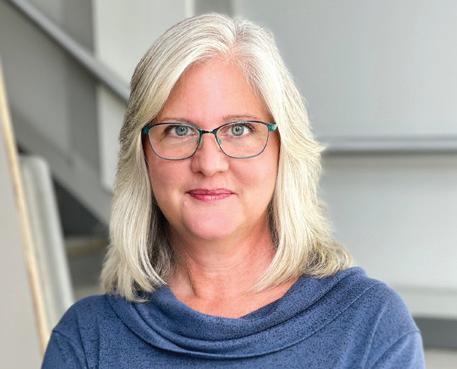
Town Administrator Lisa Wong talked with Reminder Publishing after the Special Town Meeting and shared her thoughts on the process, the meeting and the next steps.
She said, “I thought there was very robust conversation from a lot of residents who feel very deeply engaged and will feel the impact either way, so, if there is an override that doesn’t pass or there is an override, they really shared how much they’ll be affected by the lost services.”
Over 90% of Town Meeting members voted against Article 2 at Special Town Meeting. which would’ve allowed Town Meeting to approve the budget without fully funding services at the Annual Town Meeting in May.
A budget without an override would have resulted in the loss of five school district administration positions and 17 student facing positions, the reduction of two police positions, the loss of six full-time and two part-time dispatchers, the reduction in hours of 10 positions at the library and two positions at the Town Hall, the reduction of two staff members at Town Hall, the reduction of two staff members at the Senior Center and the reduction of two public works employees. It also would have eliminated town services, including sports, extracurricular programs, advanced
military and how his actions have “eroded” NATO.
placement courses and some school support services. Furthermore, a budget without an override would increase class sizes, close spray parks, reduce highway and parks maintenance, increase response time to public safety calls and/or increase in overtime to offset reduction in patrol officers, reduce customer service facing staff in public buildings as a result of reductions of clerical positions, eliminate a school resource officer and close Gaylord Library.
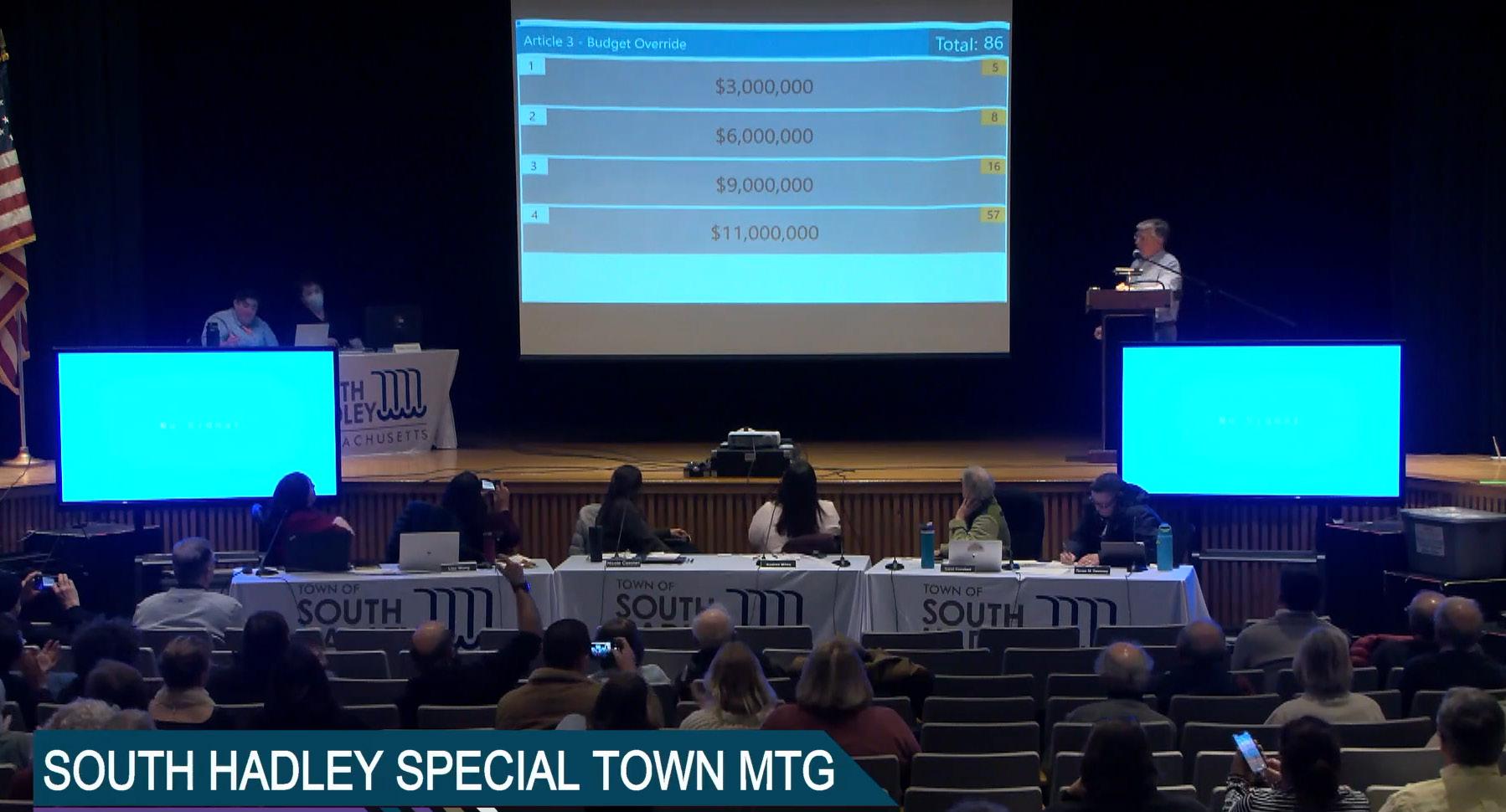
There were 86 representative Town Meeting members who voted for a tax override preference: 66% voted for the $11 million override option, 19% voted for $9 million override, 9% voted for $6 million override and 6% voted for $3 million override.
War I Battle of Belleau Wood were “suckers.”
Wong did not say which option she prefers.
“I think my role is really just supervise as much information as possible and no matter what the outcome is, is to run the town the best I can with the resources we have,” Wong said. “I’m prepared for every possible scenario.”
All the reports can be found at southhadley.org. The chart breaks down how much an average single family household is projected to pay and what each override scenario looks like.
The Selectboard will discuss placing an override question or questions on the ballot during its meeting on March 3. The annual town election is April 14.
The Annual Town Meeting, which is set to take place in May,
is “when this body will actually appropriate a budget for the following year based on the levy limit that is either going to stay the same or increase if there is an override vote,” Wong stated.
Looking ahead to other important budget dates in March, the Selectboard will host a budget public hearing on Tuesday, March 3 and a budget vote on Tuesday, March 17. The School Committee will host their budget public hearing on Wednesday, March 11 before voting on Wednesday, March 25. There is also a community meeting scheduled for Saturday, March 28. Wong said the meeting will serve as an opportunity for residents to hear more extensive reports on the budget and provide comment.
of those candidates have been elected and another four are mounting challenges in the 2026 race. Moulton said, “We can have better leadership here in Massachusetts, but if we don’t win majorities in the House and Senate, we’re not going to be able to advance this agenda.”
Moulton, who is a U.S. Marine Corps veteran, was asked how he feels about Trump’s use of the
“It’s hard to think of something that frustrates me more,” Moulton told the person. He said the trust in the military has fallen since Trump’s first term began in 2016. “He is directly abusing the military for his own purposes,” he said, referring to National Guard troops being sent into American cities. He referenced a 2018 quote by the president, who said the American soldiers buried at Aisne-Marne American Cemetery were “losers” and the Marines who died in the World
“What’s lacking in Washington isn’t intelligence, it’s just courage. It’s the courage to take the right vote, to do the right
thing, even when you’ve got political pressure in the other direction,” Moulton said. “And it really pisses me off, frankly, when I see colleagues of mine show a lot less courage in a very com-
fortable seat in the Senate or the House of Representatives than our 18-year-old soldiers, sailors, airmen, marines, guardsmen show every single day on the front lines.”
South Hadley Town Meeting members vote for their preferred potential tax override scenario in the town.
Photo credit: SHCTV15
HOLYOKE
Neal announces federal funding for wastewater system
By Tyler Garnet tgarnet@thereminder.com
HOLYOKE — On Feb. 27, U.S.
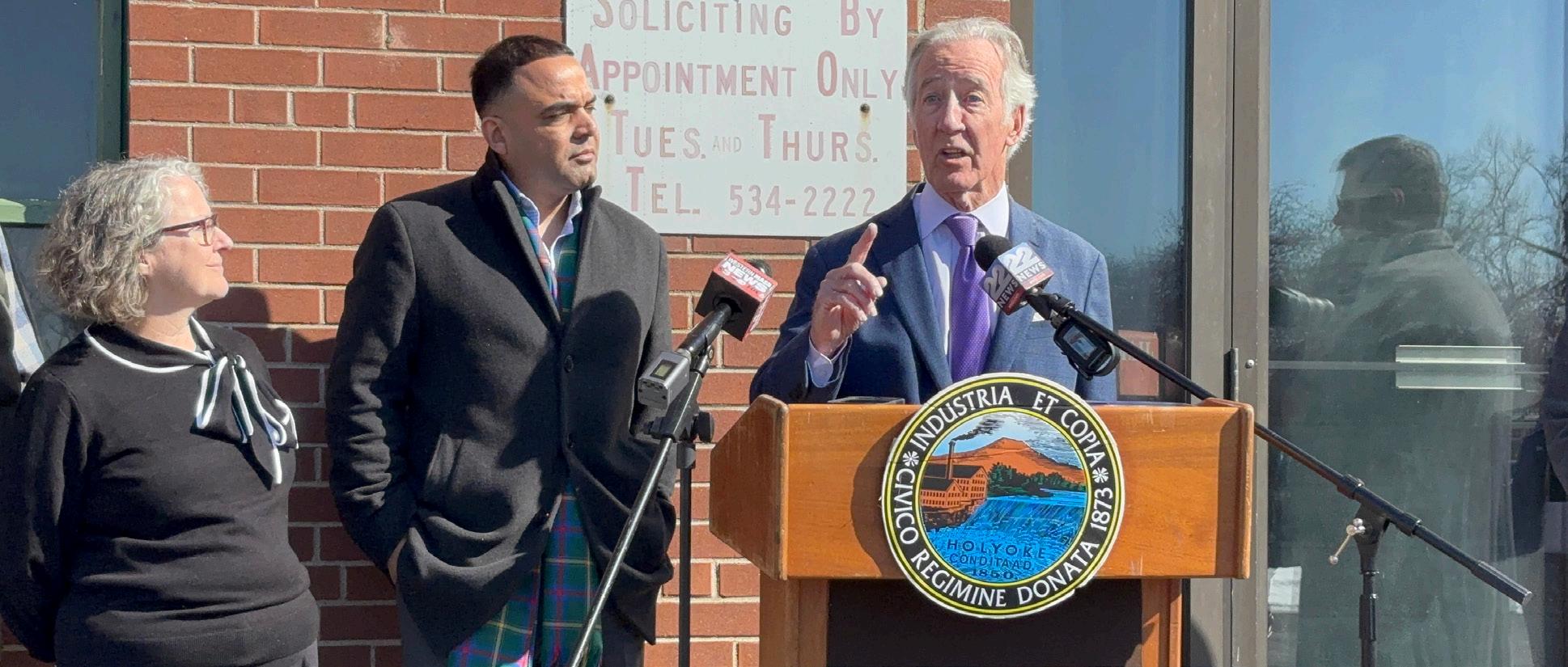
Rep. Richard Neal joined Holyoke Mayor Joshua Garcia, state Rep. Patricia Duffy and local officials at the Holyoke Water Pollution Control Facility to announce $800,000 in federal funding for the city’s combined sewer overflow system and sewer separation project.
The funding will be applied to the city’s ongoing combined sewer overflow projects, including consideration for capital improvements in both the wastewater treatment plant and sewer collection system.
Garcia said the plan is to invest in “critical upgrades,” including purchasing a new centrifuge. “This advanced equipment will significantly reduce our power and sludge disposal costs, improve operations at the plant [and] enhance our systems resiliency,” he explained.
The award recognizes the significant financial commitment the city’s ratepayers have already made and will help ease the burden placed on residents, according to the city. Investments supported by this funding will strengthen the city’s infrastructure, ensure compliance with the city’s consent decree, maintain water quality and protect public health.
Garcia added, “Most importantly, it will help us better control CSO [Combined Sewer
Overflows] overflows, protecting our environment and community health.”
The allocation was made possible through congressionally-directed spending from the U.S. Environmental Protection Agency and will help support vital upgrades to the city’s wastewater and sewer infrastructure.
Neal included funding for this project in the fiscal year 2026 spending bill.
Garcia thanked Neal for his continued partnership and stated how this funding will help support Holyoke’s ongoing efforts to modernize and improve its wastewater treatment plant and sewer collection system.
“It’s a big step forward for environmental stewardship and public health,” Garcia said. “Today’s announcement of federal funding for our combined sewer overflow system, what we call CSOs, mark an important step forward, not just for our city, but communities downstream of the Connecticut River.”
Neal shared how investments like the one in Holyoke are essential to modernizing aging infrastructure and protecting water quality in the Connecticut River.
He explained, “It’s generally not a topic, as you know, is front and center in everyday conversations, but 100 years ago, the valley was the most prosperous part of America, singularly, the valley, all the way to Hartford, and it was because of the Connecticut River,
but the outcome in part was also that as more and more factories located near the valley and the Connecticut river, it lent itself to a lot of discharge, and part of it is wat we’re still dealing with 100 years later.”
Holyoke has shown progress in addressing its sewer and stormwater challenges, according to Neal.
“This is why I am pleased to support the city’s continued work to build a cleaner, healthier future,” he said. “Clean water and reliable infrastructure are fundamental to a strong community, and these investments will help Holyoke continue building the strong, resilient infrastructure that families and businesses de-
serve and rely on every day.”
Garcia and Neal also thanked U.S. Senators Ed Markey and Elizabeth Warren for their support of the funding for this project.
In October 2025, the city of Holyoke and Veolia North America entered into a new 10-year contract to continue to operate Holyoke’s wastewater treatment plant for the city, providing high standards of environmental security and professional operation.
Veolia has served Holyoke since 2005, and the new contract will continue Veolia’s partnership with the city and its DPW through 2035. The organization emphasizes energy recovery, economic development, investment in the existing infrastructure and
incentives for Veolia to work with the city to identify new revenue sources.
David Connors, the president for contract operations for Veolia, shared his appreciation for the federal help with the project.
“We’re proud to be the operating partner of the facility in the city,” Connors said. “The needs are critical here, and we’re very thankful that the representatives and congressmen here that have spoken previously have recognized that and happy to be a part of this.”
Following the announcement, Neal joined Garcia and others for a tour of the city’s Pollution Control Facility, located at 1 Berkshire St.
City of Holyoke Office for Community Development Draft FY2026 Annual Action Plan
Community Development Block Grant (CDBG) Holyoke-Chicopee-Westfield HOME Consortium (HOME)
Public hearing, review and comment of the draft prior to submission to the United States Department of Housing and Urban Development on how the City of Holyoke and the Consortium intend to allocate Federal funds.
Public Hearing on Monday March 16, 2026, at 1:00 p.m.
Virtual: https://us02web.zoom.us/j/84266843088 OR +13017158592,,84266843088# US (Washington DC)
Public Hearing on Monday March 16, 2026, at 5:00 p.m.
In Person: Holyoke Public Library, Community Room 250 Chestnut Street, Holyoke MA
Draft available at www.holyoke.org, in person by appointment, or will be emailed upon request starting March 9, 2026. Public comment on the draft is welcome until April 13, 2026 at 4:00pm EST. Send comments to zoellera@holyoke.ma.us or call 413-322-5610. Translation or accessibility services upon request.
Borrador del Plan de Acción Anual para el año fiscal 2026 de la Oficina de Desarrollo Comunitario de la Ciudad de Holyoke
Subvención Bloqueada para el Desarrollo Comunitario (CDBG) Consorcio HOGAR Holyoke-Chicopee-Westfield (HOGAR)
Audiencia pública, revisión y comentarios del borrador antes de su presentación al Departamento de Vivienda y Desarrollo Urbano de los Estados Unidos sobre cómo la ciudad de Holyoke y el Consorcio pretenden asignar fondos federales.
Audiencia pública el lunes 16 de marzo de 2026 a la 13:00 horas. Virtual: https://us02web.zoom.us/j/84266843088 OR +13017158592,,84266843088# US (Washington DC)
Audiencia pública el lunes 16 de marzo de 2026 a las 17:00 horas. En persona: Biblioteca Pública de Holyoke, Sala Comunitaria 250 Chestnut Street, Holyoke MA
El borrador está disponible en www.holyoke.org, en persona con cita previa, o se enviará por correo electrónico a solicitud a partir del 9 de marzo de 2026. Se aceptan comentarios públicos sobre el borrador hasta el 13 de abril de 2026 a las 16:00 EST. Envíe sus comentarios a zoellera@holyoke.ma.us o llame al 413-322-5610. Servicios de traducción o accesibilidad bajo solicitud.
Congressman Richard Neal (right) joined Holyoke Mayor Joshua Garcia (middle) and state Rep. Patricia Duffy (left) to discuss federal funding the city will receive to improve its sewer overflow system. Reminder Publishing photo by Tyler Garnet
Soto agrees to three-year contract as schools’ chief of finance
By Ryan Feyre rfeyre@thereminder.com
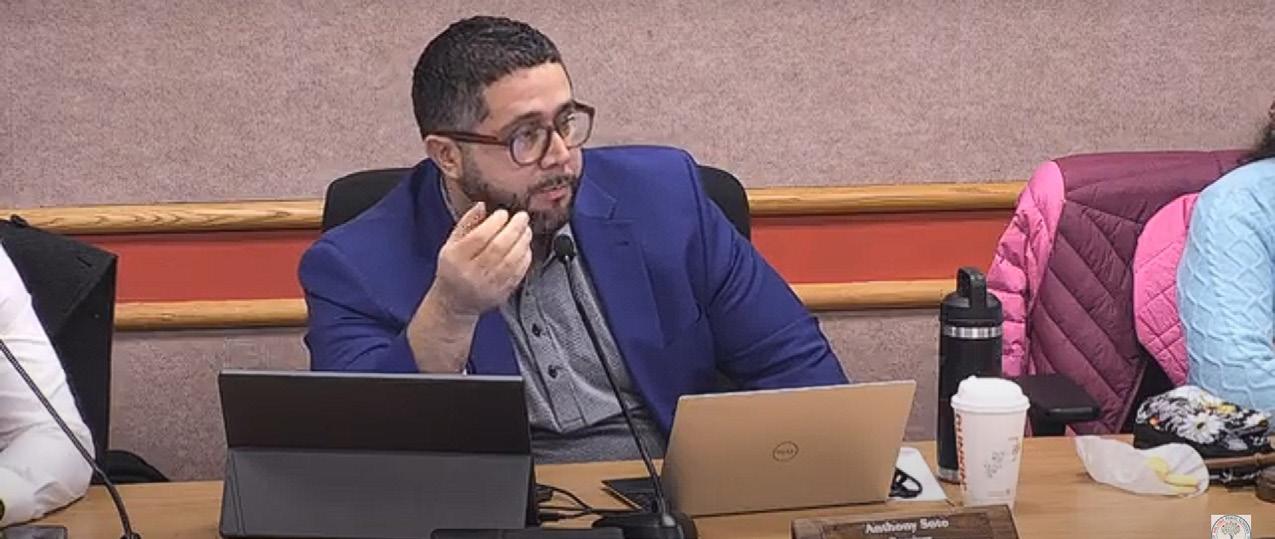
HOLYOKE — In what was a relatively swift Feb. 23 meeting, the Holyoke School Committee granted a three-year contract to Anthony Soto that allows him to begin his tenure as the School Department’s chief of finance and operations on July 1. Soto, who currently serves as the interim superintendent for Holyoke Public Schools, will be the department’s permanent chief of finance from July 1, 2026, to June 30, 2029, according to the contract approved by the committee. The unanimous approval came with no discussion by the committee or any comments from
Soto during the Feb. 23 meeting, which was held remotely as the region was recovering from a major snowstorm.
The new contract comes just over one year after Soto was named the interim superintendent of HPS and almost five years after he last served in the chief of finance role. The Department of Elementary and Secondary Education appointed him as the receiver in 2021, a title he held onto during his time as interim superintendent. According to past Reminder Publishing reporting, he was the department’s third receiver during HPS’s 10 years under state receivership.
He took the role of interim superintendent last July when local
governance of the school district was restored. Soto chose not to apply for the permanent superintendent position when it was posted in December 2025.
The School Committee embarked on an “intensive search” and interview process that included three finalists for the permanent superintendent role. After a round of interviews across three days, current Assistant Superintendent Jackie Glasheen was appointed by the School Committee as the district’s next superintendent, a position she will helm on July 1 after contract negotiations ensue and a salary is finalized.
Aside from serving as receiver and interim superintendent, Soto was previously the School De-
partment’s chief financial and operations officer from 2016-2021.
He also worked in Springfield Public Schools for 10 years prior to coming to Holyoke, where he began as a financial analyst
before he was promoted to budget director. According to the contract that the School Committee approved, Soto will have an annual salary of $190,000.
Carlos Vega Fund for Social Justice mini grants mark 15th year
HOLYOKE — Local nonprofits and individuals are invited to apply for funding between March 9 and the April 20 deadline, by completing the application form available at www.carlosvegafund.org. All applicants must have either 501c3 status or be fiscally sponsored by a 501c3 organization.
For more than 40 years, Carlos Vega fought for social justice in the Greater Holyoke area. In 2010, a small group of family
and friends started the fund to support the kind of social justice initiatives that were important to Carlos.
This year the Carlos Vega Fund for Social Justice will provide grants amounting up to $2,000 to be used for one-time programing or project that focuses on the fundamental primary causes of injustice, fosters change, and promotes self-help and empowerment.
The purpose of the grants is to
support the efforts of those who are addressing issues of poverty and oppression, and involve people who are socially and economically marginalized in the Greater Holyoke area.
Previous mini grants have supported a variety of organizations including: Girls Inc. of the Valley, Granby Public Schools, The Gray House, Holyoke Public Schools, Holyoke Safe Neighborhood Initiative, Holyoke Senior Center, Home City Devel-
opment, OneHolyoke CDC, The Performance Project, Lorraine’s Kitchen in Chicopee, Common Wealth Murals, Seeds of a Father, The Care Center, Eagle Eye Institute, Wellspring Cooperative and Wistariahurst Museum.
The Carlos Vega Fund for Social Justice is administered through the Community Foundation of Western Massachusetts and is overseen by an advisory committee. Since 2012, the fund has
awarded more than $90,000 to more than 50 organizations in the greater Holyoke area. Grant Awardees and the 2026 Social Justice Award recipient will be publicly announced at an event on May 28.
For further information and/ or to obtain an application, visit the Carlos Vega Fund for Social Justice website at http:// www.carlosvegafund.org or contact Aaron Vega at carlosvegafund.413@gmail.com.
Auto dealer Gary Rome joins HCC fundraising campaign for sixth year
HOLYOKE — Auto dealer Gary Rome is again partnering with the HCC Foundation for a one-day campaign to raise money for student support programs and academic resources at Holyoke Community College.
The sixth annual “Together HCC: Drive to Change Lives” campaign is set for Wednesday, March 4, and will run for 24 hours from 12:01 a.m. to midnight. With a goal of 500 donors, this year’s success would put the campaign’s six-year cumulative support total over $1 million.
“What makes this campaign special is seeing all our community members come together in a single day to tell our students, ‘We see you, we believe in you, and we’re invested in your success,’” said Julie Phillips, HCC executive director of development.
Donations can be made through a secure portal on the HCC website: hcc.edu/drive.
The campaign supports six critical areas that directly support HCC students: academic excellence and innovation; scholarships; the Thrive Center and Food Pantry; the President’s Student Emergency Fund; the President’s Fund for Opportunity; and the HCC Foundation’s general fund.
The campaign has already received pledges for challenges and matching funds in excess of $125,000.
Rome, who is a member of the HCC Foundation’s Board of Directors, has pledged an additional $50 for every first-time donor. To
help promote the event, Rome will be visiting the “Together HCC” celebration on campaign day from 11 a.m. to noon on the second floor of the HCC Campus Center.
“My father always said that no one can ever take away what you put between your ears,” said Rome. “That lesson has stayed with me my whole life, and it’s exactly why community college matters so much to me. HCC gives people the chance to build something no one can take away — education — and that’s worth showing up for, year after year.”
Additionally, longtime supporters Peg Wendlandt ‘58 and Gary Wendlandt will provide $100,000 in challenge gifts throughout the day. Alumni Myke Connolly ‘04, founder of the Launch and Stand Out marketing agency, and Dylan Pilon ‘12, founder of Cloud 9 Marketing Group, have pledged $10 each for every alum who makes a gift.
The HCC Foundation launched “Together HCC: A Campaign for Caring” in March 2020 to build community support and raise money for students experiencing financial distress during the pandemic. As part of that campaign, members of the HCC community — students, staff, faculty, alumni, relatives and college friends — were asked to use the hashtag #TogetherHCC to share stories and images on social media that demonstrated the resilience of the college community in response to the COVID-19 crisis.
In its first year, the campaign
raised $40,000 for the president’s Student Emergency Fund and was selected as a finalist for a national Bellwether award. In 2021, with Rome signed on, HCC added the “Drive to Change Lives” theme and has so far raised more than $900,000 for student support programs over the past five years.
“Our students are driven, and they are just getting started,” said Phillips. “A gift to ‘Together HCC’ will help make sure nothing gets in their way.”
Curtis Blake Day School announces upcoming closure
By Miasha Lee Correspondent
HOLYOKE
— The Curtis Blake Day School, a private educational day school that has helped students with language-based learning disabilities, will close at the end of the current school year.
The Positive Regard Network, who’s been in partnership with the school, made the announce-
ment. Chief Operating Officer Chris Duff said, “Curtis Blake Day School has been through a bunch of transitions. Throughout the years, the school has experienced a decline in the number of students referred out of districts for this specialized programming. As a result of this shift, the decision was made to close the school at the conclusion of this academic year. It was home to many fam-
ilies, so we’re going to take our time and do everything that’s right by our students and staff.”
For over 40 years, the Curtis Blake Day School has supported generations of students and families by providing specialized academic and language-based instruction focused on reading, writing, math and social-emotional development designed to help students achieve success in
their educational journeys. The school was founded in 1981 by the late co-founder of Friendly’s Ice Cream/philanthropist Curtis Blake. The school first partnered with American International College in Springfield. Then moved to the Children’s Study Home in Springfield and later relocated to Holyoke in 2022, partnering with the Positive Regard Network as part of the Center School campus.
The Curtis Blake Day School recognizes the significant impact this closure will have on communities and will assist families with transition planning, including placement support, records transfer, and access to additional resources. Families, staff, and sending districts will receive detailed information regarding timelines, resources and next steps in the coming weeks.
Resilient Valley Coalition celebrates community in Holyoke
HOLYOKE — On Wednesday, Feb. 11, more than 70 nonprofit leaders, donors, and community advocates gathered at De La Luz in Holyoke for the Resilient Valley Community Lunch.
The event was a celebration of collective power, marking a major milestone in a grassroots movement to unlock philanthropic dollars for the valley. Resilient Valley was born from a simple but urgent realization — organizations are stron-
ger when they collaborate rather than compete for dwindling resources. During the lunch, the coalition announced that its “Match My DAF” (Donor Advised Fund) campaign received 73 grant submissions totaling $228,810 — with $91,610 of that being eligible for matches — to support the critical work happening across Franklin, Hampshire and Hampden counties. More than $100,000 has been raised so far for the matching pool thanks
to individual donors, Greenfield Savings Bank and PeoplesBank.
“Resilient Valley grew out of a potluck lunch and a shared fear of losing federal funding, but it has turned into a powerful statement of community resilience,” said Julia Riseman, director of philanthropy for CET, a coalition member. “Today wasn’t just about the numbers; it was about the energy in the room and the firm belief that we can keep our valley’s communities, landscapes and shared future thriving if we act together.”
The campaign’s first lottery, held on Feb. 2, distributed just under $75,000 in matching funds. The recipients represent a diverse cross-section of our communities, spanning environmental conservation, food justice, education, the arts and social services.
One such recipient, the Amherst Survival Center, was able to turn its $1,000 gift into a
TheReminder.com
Every week we will provide you with a complete listings of deaths from the preceding week from throughout Greater Springfield. We are doing this as a convenience to our readers in case you miss an obit in the daily paper. We hope you find this useful and that you will refer to it weekly.
CHICOPEE
Ronald N. Gilpatrick
Louis A. Lajeunesse
Roger D. Landry
Alice P. Forget
Cary Gray
Christos Lolos
Sheila C. Moore
Carol Ann Sakiewicz
Dorothy E. Sinkowski
Ronald A. Shunaman
EAST LONGMEADOW
Antoinette Caliento
Gerard Josef De Blok
Earl A. DeRusha Jr.
Marcia M. Kessler
Margaret A. Miller
Dolores M. Scibelli
HOLYOKE
Janet C. Douyard (Powers)
John Alan Kelleher
INDIAN ORCHARD
Stacia J. Falkowski
Gloria M. Mitchell
LONGMEADOW
Janice S. Boyer
Joanne M. Carroll
Barbara E. Morrison
Frank S. Podgurski
Stephen A. Wichrowski Jr.
LUDLOW
Kathleen V. Garand
David Henriques Sr.
Ruth F. Pancotti
SOUTH HADLEY
Dr. Francis M. Croke
Thomas Norman Hazen
Hugh Parker Hutton
Kelli
Theresa Quesnel
Charles H. Turner III
SPRINGFIELD
Carl Robert Cadogan
Dennis Anthony Clarke Sr.
Raymond N. Dagenais Jr.
Leon A. Lemieux
Sandra J. Murray
Gail A. O’Brien
Joan E. Rhone
Dolores P. Santinelli
Linda A. Scibelli
Sandra A. Sullivan
WILBRAHAM
Terris J. Burnor
Nancy P. O’Neill
$6,000 gift through the matching pool lottery.
“This kind of collective generosity strengthens our entire community,” said Bianca Walker, Development Director at the Amherst Survival Center. “It allows us to meet growing needs with dignity and consistency, and it reminds us that when people come together, the impact is far greater than any one gift alone.”
The organizations that won a match award include: Abortion Rights Fund of Western MA, All Out Adventures, Amherst Survival Center, CET: Center for EcoTechnology, Center for New Americans, Community Foundation of Western MA, Community Legal Aid, Conway School of Landscape Design, Downtown Amherst Foundation, Family Diversity Project, Franklin County DIAL SELF, Friends of Forbes, Grow Food Northampton, Hampshire County United Way, Hampshire Support Alliance, Historic Northampton, Hitchcock Center, Jewish Family Services of Western MA, Kestrel
JUDE’S NOVENA
Land Trust, Manna Soup Kitchen, Inc., Massachusetts Audubon Society, New England Public Media, Northampton Center for the Arts, Northampton Community Arts Trust, Northampton Community Music Center, Northampton Education Foundation, Northampton Musical Booster, Northampton Survival Center, Perugia Press, Pioneer Valley Workers Center, Red Gate Farm, Scarlet Sock Foundation, Tapestry Health Systems, The Literacy Project, Transhealth, Western Mass Asylum Support Network, Young at Heart Chorus and Young Scholars Fund. Resilient Valley is continuing the momentum as they build toward the final matching lottery after May 1. All remaining matching funds will be distributed to organizations randomly selected for dollar-for-dollar matches of up to $5,000. They are encouraging people to support local organizations through their DAFs and nominate those gifts for a match. Any DAF gifts given to a valley organization from Dec. 2, 2025, until May 1, 2026, could be eligible. They are also continuing to raise funds for the matching pool. The coalition includes: All Farmers, Amherst Survival Center, Cancer Connection, CET (Center for EcoTechnology), CISA, Grow Food Northampton, Hilltown Land Trust, Hitchcock Center, Kestrel Land Trust, Northampton Survival Center, Nuestras Raices, Peace Development Fund and the Stone Soup Café.
DINING ENTERTAINMENT
Agawam Cinemas to premiere new cult horror movie ‘Dark Places’
By Peter Tuohy ptuohy@thereminder.com
AGAWAM — On March 14, the local independent film production company Xposse Productions will be premiering “Dark Places” at Agawam Cinemas at 7 p.m. Tickets can be found for $9.75 on Agawam Cinemas’ website.
The film follows college student Natalie Parker, who grew up homeschooled and is now nervously on her own for the first time. When she meets and begins dating another introverted student, Jason Evans, college professors begin to be murdered. The two team up to figure it out, which leads to an attempt to take down the cult behind it all.
Writer and Director Geno McGahee is an award-winning filmmaker based out of Western Massachusetts and is the mind behind “Dark Places.” He first picked up a camcorder at 12 years old and released his first feature-length film, “Evil Awakening,” in 2001.
“I was always a writer, so I ended up seeing a film called ‘Galaxy Invader,’” McGahee said. “It’s a terribly low budget film, but it’s terribly charming as well … it’s really silly but it made me want to film.”
He got the idea while working on the set of one of his friend’s films, a romance comedy, where he also met the star of “Dark Places,” Lindsey DeLand.
“This idea came into my head of something darker, of putting them into a scenario where there was a looming force,” McGahee said. “It was a moment of inspiration. I’ve always wanted to do a good cult movie. Many years ago, I made a cult movie, but I wasn’t experienced enough to really get the message out that I wanted.”
McGahee said he’s always been a fan of horror movies and cult films like “Race with the Devil,” so making a film like this has always been in the back of his mind. As far as his approach went,
SPRINGFIELD — The Springfield Symphony Orchestra will offer a celebration of women at its next performance during Women’s History Month, “MendelSpringfield Symphony Orchestrahn, Gershwin, & A Woman’s Voice,” on Saturday, March 14, at 7:30 p.m. at Springfield Symphony Hall.
Tickets for the March 14 concert are now on sale, starting at $25, online at SpringfieldSymphony.org, or by calling the box fffice at 413-733-2291.
At the March 14 performance, the Springfield Symphony Orchestra will hold its fourth annual Fearless Women Awards, honoring local women who embody courage, resilience and empowerment. Since its inception, the Springfield Symphony Orchestra’s Fearless Women Awards have recognized more than 20 women in the region, nominated by their peers. A pre-concert reception will be held in the Mahogany Room at Symphony Hall, and the Fearless Women awardees will be recognized on-stage at the start of the performance.
This concert will feature women composers and performers celebrating Women’s History Month. Guest conductor and Springfield Symphony Orchestra Artistic Advisor Mei-Ann Chen will appear for her second performance of the 2025-26 season and will include the return of a Springfield favorite, pianist Claire Huangci, to Symphony Hall.
The Springfield Symphony Orchestra’s nonprofit community partner for the March 14 performance is The Gray House, and concertgoers are encouraged to bring diapers, wipes, gift cards and monetary donations, all much-needed items to help families in the community. The Gray House is a small neighborhood human service non-
he said it was “Scream” inspired.
“Directing and shooting it, it was such a great experience,” McGahee said. “I have the best team in the world. We’ve worked together now for five years, this great group of people I’ve assembled. Every shoot we do is just like, I won’t say a party atmosphere, but it feels like a family atmosphere.”
He added that putting a film together is always a crazy process with the ups and downs,
profit located in Springfield whose mission is “to help its neighbors facing hardships to meet their immediate and transitional needs by providing food, clothing and educational services in a safe, positive environment in the North End of Springfield.”
The concert will open with Fanny MendelSpringfield Symphony Orchestrahn Hensel’s “Overture in C major,” her sole surviving orchestral work that only in recent years has earned well-deserved recognition in the symphonic musical world. Huangci will also perform George Gershwin’s “Piano Concerto in F” to close out the first half.
The second half will feature a piece by Fanny MendelSpringfield Symphony Orchestrahn Hensel’s younger brother, Felix MendelSpringfield Symphony Orchestrahn, “Symphony No. 3, Op.56, A minor.” He was inspired to create a masterwork after visiting the ruins of the Palace of Holyroodhouse, where Mary Stuart, Queen of Scots, lived and loved.
According to Heather Caisse-Roberts, president and CEO of the Springfield Symphony
from getting the schedules right and shooting in the forest through 20-degree weather. At one point during filming, the person in charge of the film’s gore couldn’t make it to the set. This led McGahee and the team to get creative with how certain things were shot, resulting in “the most impactful death scene that I’ve ever shot,” according to McGahee. McGahee utilized places to film all over Western Massachusetts, such as a Holyoke school,
Orchestra, “March 14 is a celebration in the truest sense. It is a night where the brilliance, strength and artistry of women fill every corner of Symphony Hall. From the extraordinary music of Fanny MendelSpringfield Symphony Orchestrahn to the dynamic leadership of Mei-Ann Chen and the breathtaking artistry of Claire Huangci, this program reflects what happens when talent and vision are given the space they deserve. And when we honor our Fearless Women from right here in our community, we are reminded that leadership, resilience and creativity are alive all around us. The Springfield Symphony Orchestra is proud to be a stage where women are not an afterthought. They are the story.”
Chen, an internationally-acclaimed conductor and one of Musical America’s 2015 Top 30 Influencers, began serving as Artistic Advisor for the Springfield Symphony Orchestra in its 202425 season. In this position, Maestra Chen serves as the Orchestra’s artistic face, curating programs, selecting guest soloists and facilitating other artistic needs. In addition to this performance, Chen con-
as well as the Enfield Mall in Connecticut. He said he is a low budget guy, making films out of his own pocket, so he relies on the kindness of other people allowing him to use their homes or businesses. He said he is super excited for the premiere and to have something to present to an audience. He also looks forward to getting back with the team behind “Dark Places” to see it on the big screen.
“It’s open to the public, so it’s
ducted the season’s Opening Night concert on Oct. 11.
Chen has served as Music Director of the MacArthur Award-winning Chicago Sinfonietta since 2011, and her contract has been extended through the end of the 2028-2029 season. She is also Chief Conductor of Austria’s Recreation — Grosses Orchester Graz at Styriarte. Highly regarded as a compelling communicator, Chen is a sought-after guest conductor, and has appeared with distinguished orchestras throughout the Americas, Europe, Taiwan, The United Kingdom, and Scandinavia, (over 150 orchestras to date). Chen is a recipient of a League of American Orchestras Helen M. Thompson Award, a Taki Concordia Fellowship, several ASCAP awards and is the only woman in the history of the Malko Competition to have been named First Prize Winner.
Renowned for her “radiant virtuosity, artistic sensitivity, keen
nice to get feedback from people that weren’t involved,” McGahee said. “It’s a super exciting night. I love premieres because it’s just a party, you don’t have to do anything. You don’t have to set up lights, you don’t schedule anything, you just get to show up.”
He thanked the entire team behind “Dark Places,” and Agawam Cinemas for their generosity in holding the premiere. The film will stream on Tubi, Fawesome and Amazon Prime Video.
interactive sense and subtle auditory dramaturgy” (Salzburger Nachrichten), American pianist Claire Huangci showcases her versatility across a wide range, from Bach and Scarlatti to German and Russian romanticism, and contemporary works by Bernstein, Amy Beach and Samuel Barber. Huangci has performed in many of the world’s most prestigious halls, including Carnegie Hall, Suntory Hall Tokyo, Paris Philharmonie, Vienna Konzerthaus and more. Huangci’s extensive discography showcases her artistic versatility. Her newest recording, “HEROINES,” with Alpha Classics, features the virtuosic music of female composers Fanny Hensel, Amy Beach, Clara Schumann and Florence Price, and is scheduled for release in January 2026. A Springfield favorite, this performance will mark Huangci’s fourth time performing with the Springfield Symphony Orchestra.
CHICOPEE COMP VS ST. MARY’S
Chicopee Comp Colts girls basketball team played St. Mary's Saints Feb. 13,
Trinity McCarthy shoots over St. Mary's defenders.
Sheyenne Santiago tries to stop Leilani Baez Montanez' shot.
St. Mary's Saints and Chicopee Comp Colts battle during their February 13 game.
Caitlin Belanger is guarded by Maddie Szemela.
Trinity McCarthy shoots high, guarded by Genieva Cataldo.