
Latino students maintain culture on campus
By AMANDA GRAY News Writer
Senior Nicole Medina said the first time she ever experienced “culture shock” was when she stepped onto Notre Dame’s campus.
“Speaking for myself [as a minority], you know you’re different than anyone else,” she said.
Medina said she identifies herself as part of Notre Dame’s Latino community. Though the culture is growing on campus, a minority of 10 percent of the student body identified itself as Latino, according to Institutional Research. Latino students on campus said they are trying to identify with two sometimes-conflicting identities — their ethnicity and their place at Notre Dame.
“We bring something that other students haven’t been exposed to,” she said. “We’re all made very aware of our background.”
Sometimes it may seem like students are acting “super cultural” when they celebrate their background, Medina said.
“When we’re back home, we don’t have to think about our culture everyday,” she said.
“Coming here, we have to fight to preserve our culture.”
Medina is one of the outgoing presidents for the Movimiento Estudiantil Chicano de Aztlan (MEChA), a Latino student activist group promoting social reform. The other outgoing president, senior Marco Rosales, said Notre Dame’s Latino culture is different than on other campuses, mainly because of the demographic’s small numbers at the University.
“We have an obligation and a responsibility to represent our people well, and we try to do that,” Rosales said.
Allert Brown-Gort, associate director for the Institute for Latino Studies (ILS) said Notre Dame made strides in the last 12 years toward a more diverse
student body. ILS opened in 1999, and students and faculty look to the institute to increase awareness of Latino culture on campus.
“If you look at the U.S. Catholic Church, it’s becoming increasingly Latino,” BrownGort said. “One out of every three members is Latino, and under 35, one out of every two are
Professor given Sheedy Excellence in Teaching award
By SAM STRYKER News Editor
When Professor Thomas F.X. Noble heard Notre Dame would present him with the 2011 Sheedy Excellence in Teaching Award April 13, he said his first emotion was pure astonishment.
Once he overcame the shock, Noble said he felt appreciation for those who nominated him.
“It’s enormously gratifying to think the people you work for and
with think well of you. It’s not like winning a contest,” Noble said. “I didn’t apply for this. It came as a complete surprise, a welcome surprise.”
Noble, who serves as the chair of the Department of History, specializes
in late antique and early medieval history. The Sheedy Award is presented annually to an outstanding professor in the College of Arts and Letters.
Noble began teaching at Notre Dame in Jan. 2001. He said even after 37 years of teaching over 7,000 students he finds inspiration from their vigor.
“I’ve spent my whole adult life with students. I think that keeps you young, it keeps you grounded. It keeps you excited about things,” he said. “You can just draw on the
energy of students.”
Noble said he has always enjoyed reading and history, and these passions led to his career as a professor.
“I often kid with students, ‘My mother dropped me off at kindergarten and I never left,’” he said. “I’ve always been an academic.”
One of his college professors pulled him aside and told him he could be a history professor, pushing him towards the profession, Noble said. His career decision was not made instantly, though.
“Probably most people suppose there was this blinding moment of inspiration, and it didn’t happen that why,” he said. “It was a slow process.”
When he gives career advice to pupils, Noble said he tells students to combine their passions with their skills.
“Figure out what you really want to do, and figure out what you’re good at and try to find a way to bring those two together,”
Engineering students take flight Edward Larkin named
By KRISTEN DURBIN News Writer
A team of Notre Dame engineering students put months of hard work into flight this weekend when they brought their remote-controlled airplane to the 2011 Design/Build/Fly competition in Tucson, Ariz and finished in 28th place.
Sophomore Matt Kudija was among six undergraduate members of the 20-person design team that traveled to Tucson Thursday. The 15th annual competition sponsored by the American Institute of Aeronautics and Astronautics
Foundation included 96 teams from universities around the country. Kudija said the team’s placement reflected the fact that it
was composed primarily of sophomore engineering students.
valedictorian for 2011
Edward Larkin, a biological sciences major from East Lansing, Mich., was named valedictorian of the Class of 2011 Tuesday, according to a University press release.
Larkin will deliver the valedictory address during Commencement ceremonies May 22 at Notre Dame Stadium.
Larkin acheived a 4.0 grade point average, according to the release. He will also earn a supplementary major in classical civilization. Larkin is an active member of the Haiti Working Group at Notre
Dame, and he writes a bi-weekly column for The Observer on the intersection of science, technology and society.
After graduation, Larkin will spend the summer in Olympia, Greece, to study cross-cultural interaction through Harvard University. He will then spend one year at the London School of Economics to receive a Master of Science degree in philosophy and public policy before attending the Yale University School of Medicine. Michelle Maurin, a mathematics major from Houston, will offer the Commencement invocation.
ASHLEY DACY/ The Observer
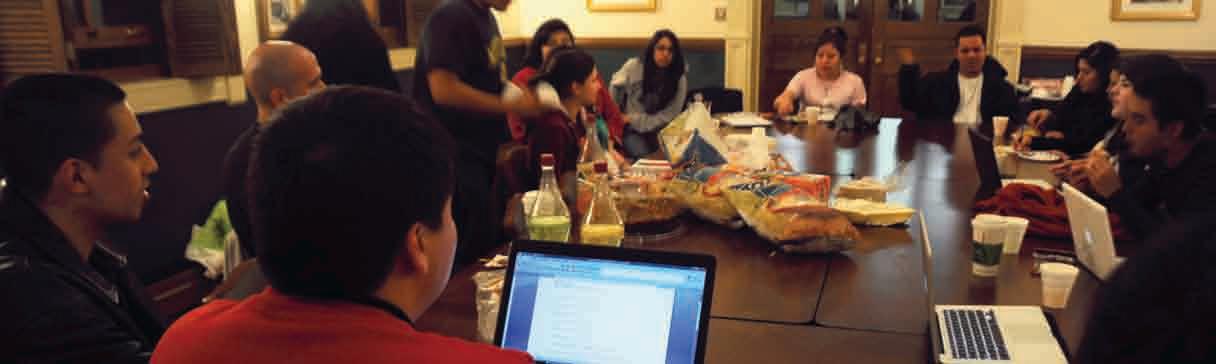
MEChA members listen to “san Jarocha” folk music from Veracruz, Mexico during a club meeting. The music was written as a protest against opppression in Oxaca, Mexico.
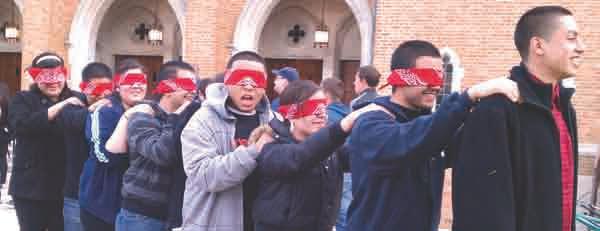
Photo courtesy of Amanda Meza Students participate in a trust walk outside of South Dining Hall as part of a MEChA initiation exercise.
Photo courtesy of Matt Kudija
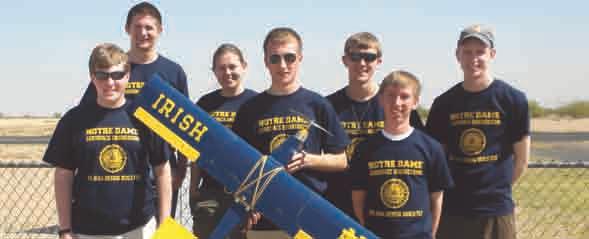
Sophomore Matt Kudija (center) and six other engineering students pose with their remote-controlled airplane.
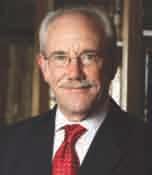
Noble
see LATINO/page 4
see NOBLE/page 5
see PLANE/page 5
Observer Staff Report
THE OBSERVER
P.O. Box 779, Notre Dame, IN 46556
024 South Dining Hall, Notre Dame, IN 46556
EDITOR-IN-CHIEF
Douglas Farmer
MANAGING EDITOR
Sarah Mervosh
ADVERTISING
Allan Joseph SPORTS EDITOR: Maija Gustin SCENE EDITOR: Katherine Lukas
OFFICE MANAGER & GENERAL INFO (574) 631-7471 FAX (574) 631-6927 ADVERTISING (574) 631-6900observad@nd.edu
EDITOR-IN-CHIEF (574) 631-4542 dfarmer1@nd.edu
MANAGINGEDITOR (574) 631-4541 smervosh@nd.edu
ASSISTANT MANAGING EDITORS (574) 631-4324 apratt@nd.edu, cmasoud@nd.edu
BUSINESS OFFICE (574) 631-5313
NEWS DESK (574) 631-5323 obsnews.nd@gmail.com
VIEWPOINT DESK (574) 631-5303 obsviewpoint@gmail.com
SPORTS DESK (574) 631-4543 observersports@gmail.com SCENE DESK (574) 631-4540 mgustin@nd.edu
SAINT MARY’S DESK chousl01@saintmarys.edu PHOTO DESK (574) 631-8767 obsphoto@gmail.com SYSTEMS & WEB ADMINISTRATORS (574) 631-8839
www.ndsmcobserver.com
POLICIES
The Observer is the independent, daily newspaper published in print and online by the students of the University of Notre Dame du Lac and Saint Mary’s College. Editorial content, including advertisements, is not governed by policies of the administration of either institution. The Observer reserves the right to refuse advertisements based on content.
The news is reported as accurately and objectively as possible. Unsigned editorials represent the opinion of the majority of the Editor in Chief, Managing Editor, Assistant Managing Editors and department editors. Commentaries, letters and columns present the views of the authors and not necessarily those of The Observer.
Viewpoint space is available to all readers. The free expression of all opinions through letters is encouraged. Letters to the Editor must be signed and must include contact information.
Questions regarding Observer policies should be directed to Editor-in-Chief Douglas Farmer.
QUESTIONOFTHE DAY: IFYOUWEREANINFOMERCIALPRODUCTWHATWOULDYOUBE?
Albert Garcia junior Off Campus
“BROflex.”
Bryan Dimas sophomore Stanford
“Billy Mays’ OxiClean.”

Grace Welte freshman Farley
“A shake weight!”
Lydia Baek graduate student O’Hara-Grace
“Food processor.”
As
OFFBEAT
Group reports record trash haul from NJ beaches
SANDY HOOK, N.J. – A record amount of trash was picked up along New Jersey beaches last year, including a kitchen sink.
STAFF
Clean Ocean Action has been doing beach sweeps for 25 years and says in a report to be released Tuesday that more than 475,000 pieces of litter were removed from the shoreline last year. They included a bag of heroin, a 10-gallon gas tank, five pairs of underwear, a duck caller and a plastic cow, in addition to the sink.
There also were four
televisions, a plastic Easter egg with $3 in it, a fire extinguisher, a toilet seat lid and an MP3 player.
Also found were 84 whole tires, nearly 1,400 aerosol cans and more than 1,300 strands of fishing line, which can kill sea life that gets tangled in it.
Lost goat wanders into Idaho music store
AMMON, Idaho – Stop me if you’ve heard this one: A goat walks into a music store.
It sounds like the start of a bad joke, but that’s exactly what happened at the Piano Gallery in the southeastern Idaho town of Ammon.
CORRECTIONS


KIFI-TV reports the goat followed a woman and her child into the store on Monday. Maybe it was looking for some sheeeet music.
Clerk Lorri Bridges says the goat was just adorable. The staff corralled it in a bathroom until animal control arrived.
The goat, dubbed Beethoven for its apparent love of music, is being held at the Idaho Falls Animal Shelter. If it isn’t claimed, someone is ready to adopt it.
Information compiled from the Associated Press.
Tam Nguyen sophomore Duncan
“A Snuggie, because it’s time to get cozy.”
IN BRIEF
Pauline Yu , President of the American Council of Learned Societies (ACLS) will be giving a talk entitled “ State of the Humanities” at 3:30 p.m. today in the Eck Center Auditorium. The talk will be immediately follwed by a reception in the Eck Center Atrium
Professor Kelly HooleyBockelmann from Vanderbuilt University will be offering a lecture titled “Physics Colloquium: Growing the Lightest Supermassive Black Holes: An Nbody Mechanic’s Perspective.” located in Room 118 in Nieuwland Science Hall from 4 to 5 p.m. this evening.
Robin Kirkpatrick, Professor of Italian and English Literatures and Fellow of Robinson College at the University of Cambridge will be giving a lecture from 5 to 6:30 p.m. tonight on Shakespeare and Dante entitled “Turning to a Joy...” in Room 202 of the Hesburgh Library.
Robin Kirkpatrick will also be guiding a collective of Notre Dame and local artists to deepen exploration of the relationship between divinity and comedy as found in Dante and Shakespeare. This performance will be held in The DeBartolo Performing Arts Center from 8 to 9:30 p,m. tonight.
Tonight, Howard Hall will have their last Mass of their 30 day chapel crawlat 10 p.m. in the Log Chapel. Root beer floats will follow at the Coleman Morse Center.
To submit information to be included in this section of The Observer, email detailed information about an event to obsnews.nd@gmail.com

CHRISTIE AHN/The Observer
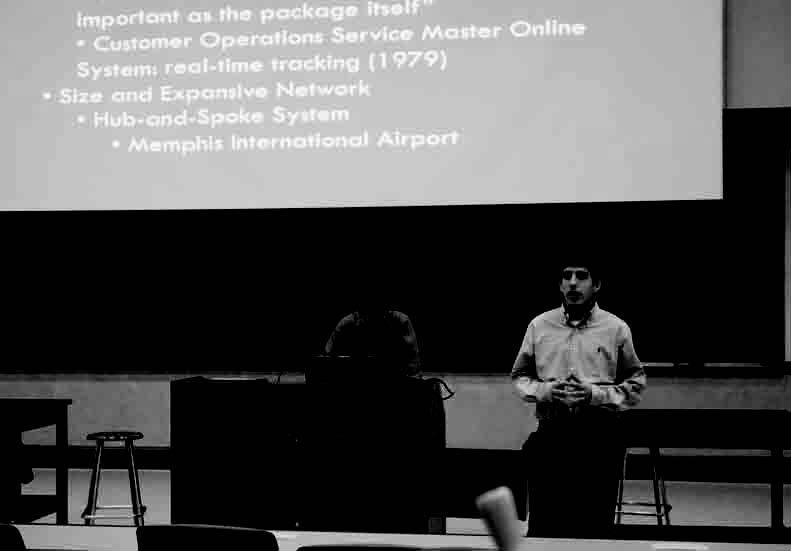
Sophomores Andrew Romero, left, and Carlos Herrera present at the final round of the Entrepreneurship Society's Case Bowl 2011 Tuesday at Jordan Hall of Science.
the winner of the three remaining teams, Herrera and Romero earned $1,000.
SMC student to showcase College fashion sense
By JILLIAN BARWICK News Writer
This summer, Saint Mary’s senior Christina Grasso will highlight women at Saint Mary’s as trendsetters in the larger world of fashion as a Style Guru for CollegeFashionista.com.
“As a college student in the Midwest, my access to the fashion industry is limited to the Internet most of the time,” Grasso said. “I am so inspired by great street style blogs as they capture everyday people with unbridled selfexpression in their sense of dress.”
brush with fasion as a 14-yearold while walking through her local mall. A scout for Elite Model Management expressed interest in Grasso and her friend and encouraged them to investigate Elite when they were older.
In years to follow, Grasso particpated in multiple internships with Elite. She said these positions gave her the opportunity to attend New York Fashion Week twice and see collections from top international designers.
“Collegefashionista.com is for real girls and guys in college focusing on real life fashion, not just collections from Paris and London.”
Amy
Levin founder and creative director
collegefashionista.com
CollegeFashionista.com is a website that showcases trends on college campuses. Grasso said she experienced her first
“I have seen fashion in its raw form and learned so much from my interactions with many of fashion’s elite,” Grasso said.
“Sometimes I have to pinch myself because I am this little Catholic girl from the middle of nowhere experiencing all of this excitement. I feel like Alice in Wonderland.”
As a Style Guru for CollegeFashionista.com, Grasso
said she will take her experiences in high-end fashion and share the styles she witnesses as a Saint Mary’s student.
“CollegeFashionista.com provides links to all featured campuses, so beginning in May, Saint Mary’s will be among these schools and the public can access information about style here at SMC,” Grasso said. “It speaks volumes about our campus because it’s a fairly competitive screening process.”
Amy Levin, founder and creatived director of CollegeFashionista.com, will be Grasso’s editor.
Levin said she receives 30 applications per week from people for the Style Guru position. Students reach out to the website from schools already listed on the site as well as new schools that want to be recognized for their outstanding fashion sense.
“I felt that no one was really addressing the college demographic for fashion trends,” Levin said.
“CollegeFashionista.com is for real girls and guys in college focusing on real life fashion, not just collections from Paris and
London.”
Style Gurus post photos on CollegeFashionista.com of trends they see at their schools. Beginning in May, Grasso will post photos that she will collect in the next few weeks on the campus on the College’s page along with discussions of popular styles. In the fall, junior Caitlin Guffy will assume the Style Guru internship position in Grasso’s place.
“I chose Christina to be a Style Guru because I believe that she has a good understanding for fashion, a good eye for what is in style, and excellent photography skills. She is also very tapped into social media like Twitter, Facebook and Tumblr,” Levin said. “I really like bringing something new to the site, which is why I picked Christina and Saint Mary’s to launch a page in May. While we have mostly bigger campuses, Saint Mary’s will definitely add something different to CollegeFashionista.com.”
CollegeFashionista.com also launches video interviews with major stylists in the fashion industry, Levin said. The videos have been successful so far and
received nearly 50,000 views in roughly one week.
While Grasso is just beginning her journey with CollegeFashionista.com, she said she enjoyed her experiences thus far in the fashion industry.
“Fashion is one of the most competitive industries to pursue. It is very tough, extremely demanding, and quite eccentric. But, if you live and breathe fashion and are prepared to work hard under pressure, learn fast, stand by your convictions, persevere, and still love fashion at the end of each day, it can be done,” Grasso said.
Grasso said she hopes to continue to work in fashion after she leaves her position with CollegeFashionista.com.
“I am still nowhere near my ultimate goal of working as the fashion director or marketing editor for a major fashion publication in New York, but whatever happens, I could not be more excited to continue my journey in the fashion industry as I genuinely enjoy the ride,” she said.
Contact Jillian Barwick at jbarwi013@saintmarys.edu

Howard Hall hosts month-long Chapel Crawl
By ANNA BOARINI News Writer
Freshmen Justin Sena has visited 30 chapels all over campus in the past month as a part of Howard Hall’s Chapel Crawl
“This event is a testament to the Catholic identity of the university that there exists a group of students who take time out of t h e r e d
the Eucharist and fellowship,” Sena said “I enjoyed experiencing the fellowship of the other ‘ C
neyed on our pilgrimage together ” S e n
crawl was a great way to spend time reflecting on the penitential s e a s
time on unproductive activities, like Facebook
Former Howard Hall President
create an event that reached out to the campus at large
We wanted to have an event
campus, ” Keneally said
dance and be a fun opportunity for students to pray together
crowd
other organizers talked to
Campus Ministry Mass schedule
t
Rosary at the Grotto and mass at the Log Chapel were included in
S
Hall and a Taize prayer service in Walsh Hall
We wanted to go when dorms were having their fun Masses
W
‘Milkshake Mass’ and Sorin for the ‘Chili Mass,’” she said
dents a glimpse inside the vari-
o
c l o s e s t c a m p u s e x p e r i e n c e t o what she is used to in her home life and culture At the retreat, u n d e r
Latino ” H e s a i d t h i s p o p u l a t i o n growth is one of the main reasons Notre Dame should be put-
t i n g a g r e a t e r e m p h a s i s o n Latino culture on campus
“ [ I L S ] i s h e r e t o h e l p t h e
U n i v e r s i t y ” B r o w n - G o r t s a i d
“We’re here to be a resource for the University
I L S r e s e a r c h e s b a s i c i s s u e s surrounding the Latino population and provides opportunities
f o r t h e c o m m u n i t y t o l e a r n more about the culture, BrownGort said
“We provide cultural competency we put what people are studying into context,” he said “We also aim to provide a sense
o f c o m m u n i t y f o r L a t i n o a n d Latino-focused people on campus
” In 2008, University President Fr John Jenkins reviewed two reports about diversity on campus, and Notre Dame published its Diversity Response
“As a Catholic university, we a t N o t r e D a m e b e l i e v e e v e r y human being possesses the dign i t y o f b e i n g m a d e i n G o d ’ s i m a g e , a
approaches and frames of
amined assumptions
g e s t a s s e t s t o
L a t i n o s t u d e n t s i s L a t i n o F r e s h m a n R e t r e a t h o s t e d b y Campus Ministry, Medina said
H e l d i n t h e f a l l o f f r e s h m a n year, the retreat helps first-year Latino students build community and friendships according to the Campus Ministry website S o p h o m o r e S t e p h a n i e
A g u i l e r a s a i d t h e L a t i n o Freshman Retreat provided the
i n g o f a c u l t u r a l f a m i l y between older and younger students
“It’s modeled after our actual culture ” she said “You get put
Latino culture] is like having a family here You look after each other
Aguilera, who lives in Dallas, Texas, said she found a substitute family on campus through MEChA Aguilera will serve as n
Diversity Council and is currentl y t r y i n g t o e s t a b l i s h a L a t i n o Honors Society “I grew closer to my culture by moving away from the border,” she said Aguilera said she also attends a Spanish Mass on Sundays at 1:30 p m in St Edward’s Hall
T h
m o r e i n t i m a t e , ” s h e s a i d
Instead of shaking hands, you g e t a h u g a n d k i s s o n t h e cheek ”
Before attending Notre Dame Aguilera said she also attended
A d m i s s i o n s when prospective minority students are invited to spend time on campus with a host student
J u n i o r A m a n
multicultural recruitment coor-
Admissions In this position, she works at recruiting high-achievi n g m i n o
m across the country
“During the fall semester, we c o n c e n t r a t e o
Dame students by encouraging
college in general,” she said Meza said her family’s experi-

Notre Dame’s campus Keneally said she loved seeing the differ-
experiencing the unique beauty in each spot
I
how different they all are Even chapels that were built around
Keneally said
Howard Hall hosted the first
crawl
Keneally said seeing her hall’s chapel filled with so many people was a special moment
“We had no idea how it would
she said
To
count their attendance through-
their card for every Mass
than 12 stamps can enter a raffle after the last Mass
The Mass card was our rec-
ences have defined Latino for her
daughters and the first to move
United States, she said I must say that their struggle to offer m
s i s t e r s a n
I
c h a n c e f o r higher education has been my driving motivation for a better future It is almost a tangible
pride for our culture of perseverance and strength ”
Meza said she sometimes feels i s o
Notre Dame
“Though Notre Dame is one of
tor’s idea ” Keneally said “We really wanted a lot of attendance and this was a way to get people
the most national schools, I feel that the majority of the students on campus still wind up thinking exactly the same I am not j u s t t a l k i n g a b o u t d i v e r s i t y i n the sense of race and ethnicity e i t h e r, b u t a l s o d i v e r s i t y i n thought and beliefs, she said
“As a Latina, I at times feel stifled in my classes and can’t help but think there is no way that my voice or what I have to say w i l l c h a n g e w h a t t h e y t h i n k The problem is, no one else sees it It is a shared struggle with not only my community but also other minority communities ”
Medina said the Notre Dame c o m m u n i t y c o u l d o n l y c h a n g e
o n c e d i a l o g u e b e g a n b e t w e e n everyone on campus, no matter
what cultural background students claim “ We d o n
“We’re trying to educate everyo n e e l s e I
come
The goal of outreach groups is
cultures Rosales said
types,” he said “We would

SUZANNA
continued from page 1
he said “Do you have the fire in the belly? Do you really want to do this?” Noble said he urges students not to base career decisions on what they will earn in terms of money, but instead on happiness
He said while being a history prof
material value, they’ve got moral value ” W i n n i n g t h e a w a r d i s a n immense honor, Noble said “If you have been around Notre D
u know this is really a wonderful a
s award a very humbling award ” he said “You think of all the great people who have won this award, and you think you have been put in that club that is pretty special ”
ing the world over to good people ” Noble said the culture of students at the University is unlike anywhere he has taught “There is an ethos here that is d i
s e There is this very powerful sense of family ” he said “People talk a b o u t
You d have to be utterly without senses not to feel it ”
ple that I meet who are connected to this place in lots of different ways, whether they are alums, parents, students, Noble said N
Institute for his first eight years at Notre Dame then became chair o
three years ago After an upcoming year of leave, he said he anticipates returning to teach at the University
back from my leave I am really excited for that ” Noble said “I have a couple of ideas for new classes I might teach Noble said he has reexamined h
award and still appreciates the opportunity he has been granted “In some ways I can’t believe people pay me to do this,” he said It s a real privilege
“I’ve never been just a professor at Notre Dame so when I come
Contact Sam Str yker at sstr yke1@nd.edu
work he never regrets his career choice “ I g e
a m
excited I don’t think everybody can say that, Noble said There is a payoff The pleasures that come along with this don’t have
continued from page 1
“A lot of the teams we competed against are in senior design classes at their schools so we were a little outmatched on the design and detail analysis aspects of the competition,” he said “Our goal was to create a plane that would successfully complete all three missions ”
Kudija said each plane flown in the competition had to meet a specific set of requirements and successfully complete three miss i o n s T h e m i s s i o n s t e s t e d t h e plane for speed and the ability to carry a payload of steel or golf balls
The balsa and plywood plane also had to fit inside a suitcase when broken down into its components and be reassembled in five minutes or less during the
Seeing future leaders as they begin their careers is a favorite aspect of his job, Noble said One of the things that teaching young people over all these years has done is make me optimistic or confident ” he said “We’re hand-
team used computer-aided design
(
plane
We were given four attempts to complete the three missions, but on the first attempt, our suitcase dimensions were too big ”
K
proud because the team was able
minute to overcome that obstacle and make the remaining three attempts successful ”
Kudija said the team faced a serious obstacle when their original prototype plane was severely damaged in a test crash just a week and a half prior to the competition
“ We h a
designing the plane since before Christmas, and we started building it after winter break, Kudija said “Then we had to rebuild the plane and make design changes to it after the crash but we had
Interacting with other members of the University family has been the most defining aspect of his experience as a professor at Notre Dame, Noble said “I can ’t think of one moment that just stands out to me, but the picture that kept playing on my mind’s screen was all these peo-
serious concerns about the original prototype being able to be built in time anyway ”
Sophomore Greg Obee felt the team s work under pressure provided him with a unique learning opportunity
“It was definitely a big learning experience, especially because it s our first year, most of us are sophomores and we didn’t have a lot of experience,” he said “We were very happy to finish 28th and we learned a lot that we can
Nelson served as the project advisor along with two graduate students, Kudija said
Contact Kristen Durbin at kdurbin@nd.edu

Viewpoint
Taco Bell’s delivery
There are certain eternally-perplexing questions that have troubled humanity since the inception of rational thought. What is the ultimate nature of reality? What is the purpose of our existence? And perhaps most confusing — why doesn’t Taco Bell deliver?
All of us in our post-parietal haze have asked this age-old question, and all of us have been left empty-handed and hungry, pining for the warm, zesty touch of a cheesy gordita crunch and a steak quesadilla.
Matthew Robison Sports Production Editor
So why must we be forbidden that which we so desire? Sure, we could just get in a car and drive to Taco Bell. But with the modern convenience of delivery, why exert the extra effort?
From a safety standpoint, there are positive externalities to the creation of a delivery system for Taco Bell. The majority of Taco Bell’s latenight consumers have been consuming beverages or other substances that may have them at a level of impairment that hinders them from properly operating a vehicle. Therefore, Taco Bell’s delivery drivers would be taking a considerable number of unsafe drivers off the road. Also, with energy prices skyrocketing and the impact of car emissions becoming better understood, having a driver reach several customers in one sweep would be a much more efficient option than all those customers making individual trips to the drive-thru.
Further, Taco Bell cannot pretend to be oblivious to the fact that they are serving this type of population. They have an entire marketing campaign directed toward them. By advertising the “fourthmeal” latenight option with drive-thru windows open until 4 a.m. or later, Taco Bell is playing right into the hands of a food-craving, latenight snacking market segment.
I can understand why Taco Bell and its parent company Yum! Brands would not want to associate their marketing campaigns (or their products in general) with serving an inebriated population, but they cannot deny that they’ve already done so with their “fourthmeal” campaign. So, to better serve their most loyal customers, Taco Bell needs to reevaluate their current practice of not delivering. The positive social benefits seem to outweigh any negative impact that a delivery system could have. Taco Bell will see greater revenues as they will gain sales from those customers who choose not to drive, either because they know they should not be on the road or because they do not have access to a vehicle.
Once Taco Bell wisens up and puts some gentlemen in a fleet of mid1990s Japanese hatchbacks to deliver their precious pseudo-Mexican cuisine, all will seem right in the world. Then, we can all go back to pondering the other eternal perplexities of the universe.
The views expressed in this Inside Column are those of the author and not necessarily those of The Observer.
Contact Matthew Robison at mrobison@nd.edu
Health outside the hospital: Medicine in the 21st century
Healthcare policy occupied a central position in the national discourse during the reform efforts of 2009 and 2010. That it has maintained this position more than a year later reflects a variety of factors.
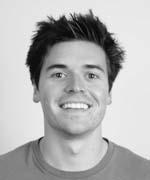
First, no one was truly satisfied with the compromise that culminated in the Affordable Care Act. Liberals bemoaned the lack of any real push for a single-payer system, or even a governmentrun public insurance option. Conservatives decried the bill as an entrenchment of the status quo — a ruinously expensive entitlement plan that does nothing to fundamentally address the skewed incentives that are driving healthcare costs ever upwards in a seemingly unstoppable march.
Second, in addition to the acrimony over the ACA, Medicare (and healthcare more generally) figures prominently in the new national preoccupation — the national debt.
Healthcare is an incredibly tricky issue to deal with from a policy front. Would free market mechanisms reduce healthcare costs? Most likely. But healthcare resists the alluringly passive logic of market mechanics. Many of us have an innate feeling that healthcare is an inalienable right, something to which all citizens, especially of a developed nation, deserve access. We reject the notion that patients should have to decide between bankruptcy and the best cancer treatment available. We hope that our culture has progressed to a point of refinement and civility enough to value making sure people can at least enjoy their health — the most basic, yet most important pillar of happiness.
And so we are stuck. There’s no perfect policy prescription waiting to be plucked out of the ether. Stanford University physician Walter Bortz goes so far as to say in his new book “Next Medicine” that current medicine is “irrelevant,” and claims that there exists a “basic mismatch between human biology and capitalism.”
Quotes such as these make the situation seem quite grim indeed. All sorts of solutions have been proposed by technocrats — accountable care organizations (ACOs) to better coordinate care between specialists and to put an end to the ruinous incentives engendered by the fee-for-service system; greater training of primary care physicians; insurance exchanges. Yet each of these solutions leaves a vague feeling of dissatisfaction. You can put lipstick on a pig, but it’s still a pig.
There is one cause for great hope
QUOTEOFTHE DAY
“They always talk who never think.”
Matthew Prior English diplomat & poet
amidst the bleakness: information technology.
But how can information technology possibly bend the cost curve, especially given the fact that expensive technologies are one of the main contributory factors to rising costs? The answer is in the prevention of hospital visits, and more broadly, the prevention of illness itself. Developments in information technology promise not only to improve care in hospitals, but to keep patients out of hospitals in the first place. This is the goal of 21st century medicine: prevention. In this paradigm, going to the hospital in the first place is a failure of the healthcare system, no matter how superbly coordinated the care once there.
This is a grand idea: We’re talking about not only the typical refrains about information technology in healthcare (electronic medical records), but also using IT to fundamentally alter the way we interact with sickness and health.
Imagine that you feel sick. If the discomfort is severe enough, you’ll eventually go to the hospital. The doctor will see you, diagnose the problem, recommend treatment and you’ll leave, minus $100 or more if you visit the emergency room (most of which you don’t see, since you only deal with the insurance co-pay).
Inject information technology into the equation. You type your symptoms into an app on your smart phone or computer. Computers immediately analyze gigantic data sets of similar patient presentations (Columbia University is already attempting to incorporate IBM’s “Watson” technology from game show fame on Jeopardy into the clinic) and doctors remotely give a preliminary diagnosis. For some cases, this will be very straightforward. The doctor sends an electronic prescription, you go to the pharmacy, get your medicine and that’s that. No hospital visit required. There’s already a name for this movement: mobile health, or mHealth.
This conception of healthcare is very attractive. But the above example is still reactionary — you get sick first and then take action. The real seduction of information technology is its capability to prevent illness in the first place. Bell’s law & Moore’s law dictate that computers will continually become smaller and more powerful.
Researchers at the University of Michigan recently designed the first complete millimeter-scale computer device: a pressure sensor for glaucoma patients that can be implanted into the eye. It contains a radio that communicates with the outside world, letting clinicians know when pressure in the eye reaches high levels. Imagine this paradigm applied to other fields of health — we could have tiny devices that recognize characteristics of disease or sickness in our bodies with wireless communication capabilities. Before we even con-


sciously realize we are sick, our computer, wirelessly connected to the devices inside our body, tells us something is wrong. Prevention becomes a whole lot easier.
Medicine is a funny profession. Its ultimate goal is to make itself irrelevant — to eliminate sickness and cure diseases. Think about the inherent oddness of that. It’s one of the few occupations where participants actively strive towards — and hope — that their craft will one day be unnecessary. It’s an idea as masochistic as it is noble. Medicine is currently at a bizarre point in its history, its future densely clouded with uncertainty.
On one side, analysts foresee an upcoming shortage of physicians as the population ages, counseling medical schools to expand enrollment. Others believe that advances in biotechnology and nanotechnology will essentially end medicine as we know it — Ray Kurzweil predicts that in the 2030s we will have tiny little “nanobots” coursing through our bloodstream and keeping us healthy. Others think that we will eventually be able to swallow a few pills of robotic parts that can assemble inside our body and perform surgery.
These ideas are both highly speculative and controversial, but they are indicative of a larger uncertainty in the medical community. Where are we going? Will medicine bankrupt us? Where will advances in biotechnology and robotics take us? What will doctors do in fifty years?
Regardless of the larger questions surrounding where medicine is headed, true reform should strive for boldness, for a visionary rethinking of the way in which we deal with health and sickness. The system we have in place is a product of the 20th century — a time when diagnostics were in their nascent phases, the intricacies of disease were mostly shrouded and “internet” was an unknown word. We are moving rapidly into 21st century biomedicine, with further refinements in our control of genetics, further advances in both the accessibility and scale of computing and further precision of diagnostic tools. These developments will allow us to conceptualize medicine not as a battle against sickness, but a battle to maintain health. Using expensive 21st century tools in a 20th century system — getting sick and then going to the hospital — is unsustainable. As technology advances, so too must medicine. This crucial paradigm shift is necessary to extend equitable and affordable care to everyone. Call it the Affordable Care Age.
Edward Larkin is a senior majoring in biological sciences and classical civilization. He can be reached at elarkin1@nd.edu
The views expressed in this column are those of the author and not necessarily those of The Observer.
QUOTEOFTHE DAY
“A preoccupation with the future not only prevents us from seeing the present as it is but often prompts us to rearrange the past.”
Eric Hoffer American writer & philosopher
Edward Larkin Scientific Notation
Wednesday, April 20, 2011
Is this good enough?
Philip Langthorne Guest Columnist
At a time in the semester when I know that I ought to be focusing on my papers and exams, an email arrived in my inbox Monday morning that I could not ignore (“Message from Fr. John Jenkins,” April 18). Reviewing in disbelief the press release on the University’s investigation into the death of Declan Sullivan last October, and then the full report with similar incredulity, I could not help but think back to the Charlie Weiss era and his ill-fated proclamation, “9-3 is not good enough.”
Following the internal investigation led by Executive Vice President John Afleck-Graves (the appropriateness of which I still contest on the grounds of a serious conflict of interest), the four factors that the University portends as the “primary” causes of the accident include one regarding the weather, two regarding the nature and condition of the lift at the time and a fourth describing the “staff members’ lack of knowledge regarding on-the-field wind speeds.” I have a hard time accepting characterizations of the wind as “sudden and unexpected” in the press release and “unusual” in the report, given that the campus was in fact in the midst of a meteorologically foreseen windstorm at the time (one would be hard-pressed to qualify rain in a rainstorm as “unexpected” or snow in a snowstorm as “unusual”). Even still, my concern with these materials extends far more deeply in that I
LETTERSTOTHE EDITOR
believe they reveal a frightening resistance on the part of the University administration to address this tragedy in any meaningful way.
Consider the recommendations of the investigation report, which, as the press release quickly points out, our heroic leader in the President’s Office has already accepted. A few highlights:
Item I: Adoption of Specific Wind Limit. Is there a reason why the University had not adopted the 28 mph guideline of the International Standards Organization before?
Item IV: Appointment of Athletic Department Safety Contacts. Does this mean that nobody was responsible for the safety of students 40 feet in the air?
Item V: Establishment of PracticeSafety Protocol. What happens if the protocol fails, and what will be the University’s response to future violations?
In an environment in which students are not (formally) allowed to drive even their own cars to University-approved events, I cannot believe that the Office of Risk Management and Safety had not considered the possibility of a fall accident before October 2010. In fact, I know that they had, because I myself was trained on a lift back in the day.
So my question becomes, “Why was the Athletic Department, the football program especially, allowed to operate under the radar, using lifts that had not been registered with Risk Management, defining their own usage standards and all, without designating specific individuals whose responsibility it was to approve stu-
dent use of the equipment each time a student left the safety of the ground?” (For a discussion of the diffusion of responsibility this situation may have also created, see Anita Kelly’s Psychology Today post, “How a Notre Dame Student Could Die So Senselessly,” Nov. 8) Was it because of Director of Football Video and Film’s Tim Collins’ 20th year of service in his current role, or because of the monogram he was accorded in 2004? In no case, however, does this lack of proper individuals and workplace practices mitigate what happened to Declan Sullivan. Instead, it renders his death all the more grievous, and we must ask ourselves what concrete actions the University has taken in the wake of his death to demonstrate its recommitment to student safety. And the answer, as related in the investigation report, apart from $77,500 paid to IOSHA (and undoubtedly an undisclosed settlement with the Sullivan family), is a resounding silence.
All we have as students are recommendations and talking points. And promises. And apology-laden emails from Fr. Jenkins, likely having passed first through the Office of the General Counsel, just to be sure. Heads bowed down and wrists held out for a slap. But the implications for every single one of us here at the University are enormous.
What if students in a chem or physics lab were let into a restricted area by someone who should have known about the heightened danger and an accident occurred? Would that person be fired? Based on precedent, we cannot say.
University response to Declan Sullivan tragedy
Careful analysis of the report reveals that a low ranking official — with insufficient information on the severity of the weather — authorized an action. Lacking severe weather protocol or senior advisement, the low ranking official’s clearance resulted in a Notre Dame student dying. In official statements following the tragic event, Notre Dame’s administration publically committed to taking any and all steps to prevent a tragedy like this from ever happening again. Unfortunately, the above description aptly portrays separate events that led to Notre Dame students dying. In January 1991, the Midwest was in the midst of a severe blizzard. After a swim meet in Chicago, a call to the University was made requesting advisement on whether the women’s swim team should wait out the snow in Chicago overnight or come home to South Bend. The team was instructed to come home. Shortly before arrival the bus hit an ice patch and repeatedly flipped. Colleen Hipp and Megan Beeler perished, while Haley Scott was temporarily paralyzed.
In 2010, unnamed football team managers viewed a weather service report during a day of high winds. Their untrained analysis led them to conclude that the conditions were “unremarkable.” They were further aware that the staff preferred outdoor practice, and they chose to have Declan Sullivan film practice from a scissor lift. With that decision, approximately 20 years later Notre Dame suffered a second preventable tragedy.
On Notre Dame’s Snow Day in February this year, Business Professor Jim Davis left his house prior to the University announcing school cancellation. Professor Davis’ trip to school took in excess of an hour due to icy road conditions. He made it to school to find no students and travelled home safely that night.
My questions to the University are, “What specific improvements to the school’s severe weather action plan are being made to engage the challenges caused by South Bend’s often adverse weather conditions?”
“Does having tragedy only once every 20 years, with countless risks taken in between, represent a significant
enough savings to justify not spending the funding required to put in place a system protecting the students and employees of the University?”
At this moment, I have not seen a satisfactory answer to the first question. Moreover, I don’t believe the administration or anyone believes the answer to the second question should be, “Yes.”
My suggestions are simple, expensive and implementable.
— Create a position or further broaden the responsibilities of an existing Campus Severe Weather Advisor.
— Qualify this advisor as a safety expert pertaining to severe weather and severe weather activities.
— Put in place parameters to describe “severe weather.” Have these parameters audited to ensure they are sufficient.
— Task the weather advisor with careful daily analysis of weather conditions. During periods of severe weather, have this expert utilize technology to communicate advisement on best practices to students of the University.
— Debrief the expert immediately on University sanctioned activities whenever weather classified as “severe” arises. These activities will include sports and sports travel, campus events, construction and, likely, much more.
— Require University endorsed activities to submit risk mitigation plans during severe weather.
— Have advisor or advisors review and sign off on all submitted plans as sound.
— Put in place clear consequences when this process is not followed.
Certainly, these steps provide only a basic framework. However, the steps do create an actual strategy to better ensure this type of incident “never happens again.” Without a plan, Notre Dame’s promises for prevention ring hollow, and future students are at a greater risk of something like this happening again.
What if student workers in the dining hall were uncomfortable with a piece of equipment that seemed to be malfunctioning, were told to use it anyway and subsequently got hurt? Would the person who was responsible for keeping the equipment properly maintained continue to work for the University? No idea.
What if students in a theatre production were hurt by unsafe scenery, or athletes were injured by equipment that had not been set up correctly or students using University vehicles experienced an accident due to improper maintenance? Would the people responsible be released, to make room for real change, or would we grieve, gather at the Basilica, write some letters to the Viewpoint section and then proceed to largely ignore the underlying problem?
All the evidence suggests that nothing would change. And although the above situations are highly improbable, and although the departments above all have excellent safety records, we have to remember that Athletics did too before October 2010.
I therefore encourage all members of the Notre Dame family, and especially the students who like me, wore pins bearing the initials “DS” into the stands for the Tulsa game last season, to read the contents of the press release at the minimum and ask ourselves, “Is this really good enough for us?”
Philip Langthorne is a senior. He can be contacted at plangtho@nd.edu
The views expressed in this column are those of the author and not necessarily those of The Observer.
Michael Martin grad student off campus


By ANKUR CHAWLA Scene Writer
What would you do if you could tap the entirety of your mind? In “Limitless,” an intelligent but mind-blocked science fiction writer is offered a pill that will grant him boundless intelligence. Bradley Cooper (“The Hangover”) plays the run-down New York City writer Eddie Morra, who transforms himself into a financial mastermind.
The movie starts with a glimpse of Morra’s battered life —he lives in a run down apartment, is unable to overcome writer’s block and was just dumped by his girlfriend. Lost in the city, he runs into his former brother-in-law and is offered the fateful pill. Bottoming out, Morra resorts to taking the drug and turns his life around.
Morra comprehends the unimaginable, picking up languages in hours, learning to play the piano in a day and mastering the financial markets, quintupling his money each day for five days in a row. This quickly gets the attention of Wall Street bigwig Carl Van Loon (Robert De Niro), who recruits Morra to analyze and discuss a major merger.
However, Morra runs into complications with a loan shark, supply shortages and serious withdrawal when he
runs out of the pills. Overall, “Limitless” is a decent mindthriller that keeps its audience intrigued through the ending. Still, there are a lot of plot flaws you would expect someone with “limitless” brain function to be able to think through.
Some of the most bothersome keys were how late it occurred to Morra that at some point he would run out of the drugs, and that there might be side effects to an underground pill few knew about. Also, why would an artsy science fiction writer move into the finance world? It was a fairly arbitrary choice.
Despite the shortcomings, though, the movie is still more than worthwhile and something I would suggest renting or watching when it’s inevitably on FX over finals week next winter.
Contact Ankur Chawla at achawla@nd.edu
‘Limitless’ Relativity Media
Director: Neil Burger
Starring: Bradley Cooper, Robert De Niro




Rain is an utter disaster on the day you get your new TOMS in the mail. Yes, gentle readers, I received a brand-spanking-new pair of TOMS for my birthday and they arrived on a day ridden with raindrops. How am I supposed to flaunt my eco-friendly, socially conscious, trendy, comfortable kicks when any venture beyond my dorm requires fording Lake O’Neill? I bemoan my current state! Oh, woe are my feet! Woe, I say!
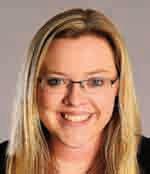
I will, however, concede that rain is somewhat poetic, especially at this time of year. Spring-cleaning washes away the old, the rusty and the dusty. It forces us to re-examine everything — from our course load (finals on the horizon!) to our relationships (summer is coming, or more pertinently, graduation).
When April begins to turn, general academic panic begins to set in, but it always rides hand-inhand with renewal. I worked out
for the first time in a month (a month!) yesterday, after spending the weekend on a quest to see the top of my desk, which has been stealthily guarded by books, bananas and unopened mail for a few weeks. It was a tough job, but my healthy, cleanly mentality made me far more poised to meet the fast-approaching scholastic onslaught (and I’m sure my roommate appreciates it, too). So bah humbug, rain. But at least its symbol of seasonal renewal got me cleaning.
So where does the poetry of rain really get me? Though I am frustrated by it, it has left me better off. Which is, of course, the backhanded reality of poetry. Poetry riddles our lives, from the lyrics of songs on U93 to the hymns we sing in dorm Mass. Chances are, at some point in your Domer career, you’ve been forced to analyze poetry. (Or, if you’re an English major, you “received welcome invitation to revel in the structural complexity of a well-ordered vernacular.” See, now everybody’s happy.)
I have a friend who I was convinced was incapable of understanding poetry. Early last semester at twilight, I said the trees in
front of my dorm looked like someone had uprooted them and stuck their heads in the ground, leaving their roots sticking up. He said that was silly, because they were trees. I was horribly affronted, and proceeded to explain how the lack of a single poetic bone in his body would leave him ugly and alone. (Well, I didn’t actually say that. I shrugged it off and went into my dorm, thinking it loudly.)
The situation struck me as a reality check — perhaps not everyone is prone to seeing things from the inside-out, or upside-down, as it were.
But then this friend of mine went to see a slam poet at Legends. Suddenly, he decided he wanted to write poetry. Scoff. Scoff, scoff, scoff from me. Oh, so NOW you think it’s okay to be poetic? NOW you want to step into the shoes of flavored text? Well, go to monsieur! See if I read your silly little poems! Which I of course did — I am weak.
I was sent a very long poem, cowritten by him and a friend. They’d sent stanzas back and forth with no real set form. It did, however, have a very distinct form, because poetry lends itself to repetition. With a simple premise, “I
am running,” repeated before every stanza, the poem covered everything from graduation to career discernment to God. And it was, dare I say, good. I mean, as good as one amateur can say of another. It drew me in, it went somewhere and it didn’t suck. I was slightly flabbergasted. My “trees only grow one way” friend had co-written something lyrical, rhythmic and quite poignant from one senior to another. There was poetry inside of him, as in everyone, even if I dismissed it. Just because he can’t fathom the joy of reading a Shakespearean sonnet and stares at a book of collected Billy Collins poems like it’s a barnacle stuck on the table, doesn’t mean he can’t feel something deeply and express it with a beautifully laid out text — even if he says he has no idea what he’s doing. That’s kind of the point, though, isn’t it? If we all knew how to write poetry perfectly, there would be no need for rain.
The views expressed in this column are those of the authors and not necessarily those of The Observer.
Stephanie DePrez can be contacted at sdeprez@nd.edu
Scene Around the World
Going abroad? Chronicle your travels in a photo slideshow or video and send your clip to Scene. We’ll post it on The Observer website and a preview will appear in the Scene section of the print edition.
Email Scene Editor Mary Claire O’Donnell at modonne5@nd.edu for more information, or check out ndsmcobserver.com/scene to see other student’s videos.
Social Media
Follow Scene on Facebook and Twitter to hear about our latest coverage of campus entertainment and pop culture at large.


Stephanie DePrez Scene Writer
Irish come back against the Golden Eagles
By MEGAN FINNERAN Sports Writer
The season’s final away game brought No. 22 Notre Dame success, as the team took home a 6-1 victory over Marquette. This weekend, the Irish (12-9) look to have similar results in their last home game.
The Irish swept the singles competition against Marquette after starting behind when the Golden Eagles won the doubles round of play.
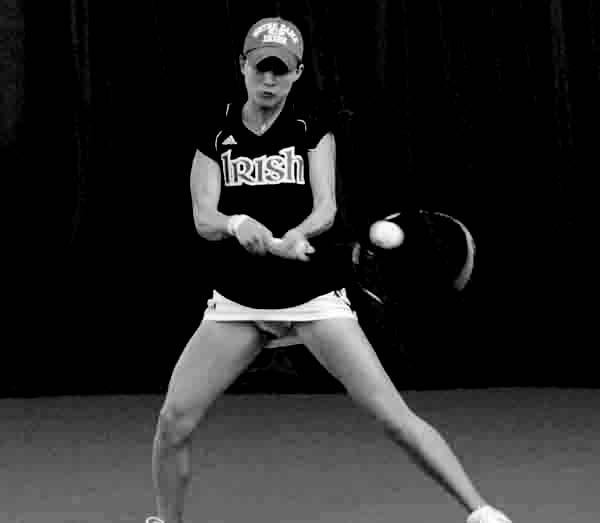
“Losing the doubles point against Marquette was definitely tough and I think that motivated us even more to win not just four singles, but all six singles matches,” junior Kristy Frilling said.
Facing DePaul this weekend, the Irish look to end a threegame winning streak.
While the records of these two teams may closely resemble
each other, closer examination of their respective schedules tells a different story. Notre Dame and DePaul have shared seven mutual competitors throughout the season. Of these seven matches, the Irish have only lost one, while the Blue Demons have only won one.
The lone win of these for DePaul came with a 4-3 victory over Marquette.
Senior Katarina Milinkovic leads DePaul in the No. 1 singles position. Milinkovic holds 23 wins this year on the singles court, 15 of which came from the No. 1 position.
“DePaul is a good team and losing the doubles point is something we cannot afford this weekend,” Frilling said. “It’s really important for everyone to step up individually.”
The Irish bring leadership from many sources, beginning with 15th-ranked Frilling in both singles and doubles play.
of 221 strokes (five over par).
continued from page 16
two-time defending champion.
“This win was really big for us,” Irish senior captain Katie Conway said. “Louisville was the two time defending champion going into the week, and we’ve been preparing to earn back the title all season.”
The seniors were proud to finish their Big East careers with a title.
“Winning
championships is the way you leave your mark on a program. The team worked hard to leave that mark. ”
“On a personal level, this championship meant more to me than it did in previous years because it was my final time teeing it up in Big East play,” Conway said. “Winning championships is the way you leave your mark on a program. The team worked hard to leave that mark.”
Nhim finished just one stroke behind them at six over par, and Irish junior Becca Huffer came in fourth overall with a stroke total of 223 (seven over par). Senior So-Hyun Park took seventh place with a score of 229 (13 over par), Conway finished in 11th after shooting 233 (17 over par) over three rounds, and freshman Nicole Zhang wrapped up her first Big East Championship appearance tied for 12th with a score of 234.
Katie Conway Senior captain
While Notre Dame put on an impressive show on the Palm Harbor, Fla., course, the Irish will not grow complacent with their success.
Notre Dame finished with a total of 902 strokes, 13 fewer than runner-up Louisville. The 13-stroke spread is the fourthlargest margin of victory in the history of the Big East tournament. Host South Florida was third with a grand total of 934 shots, followed by Georgetown with 951.
AnnaKarin Ljungstrom of Louisville and Harin Lee of St. John’s needed a playoff to determine the Big East individual champion after both finished with a three-round total
“Besides winning the tournament, we were able to take away from this competition that we could’ve done much better since we left a lot of shots out there all three days,” Park said.
“We’re really excited for the rest of the season, especially hosting regionals at home on the Warren,” Conway said. “If we play the way we’re capable of playing, we should definitely be making a trip to nationals.”
The Irish will enjoy the homecourse advantage when they host the NCAA Central Regional championship at Warren Golf Course from May 5 to May 7.
Contact Vicky Jacobson at vjacobse@nd.edu.
Individually Frilling holds a 162 record. Junior Shannon Mathews, ranked 64th in the No. 2 position for the Irish, joins Frilling at No. 1 doubles..
Freshman Jennifer Kellner, ranked 95th, has improved greatly over the course of the season. Beginning in the No. 5 slot for Notre Dame, she has since moved up to the No. 3 position, where she has worked her way to a 6-1 record.
This final home match marks the end of the regular season, but leads into continued play for the Irish.
“As we head into tournament play every point, every match matters so we need to be as prepared as possible,” Frilling said.
Play against DePaul begins at 1 p.m. Saturday at the Eck Tennis Pavilion.
Contact Megan Finneran at mfinnera@nd.edu
Aquamarine Anniversary Ring Lost in ladies room of North Dining Hall.
If you or someone you care about has been sexually assaulted, we can help. For more information, visit Notre Dames website: http://csap.nd.edu
Tampa Bay manager Joe Maddon could sense early on that James Shields was heading for a big game.
Shields struck out nine in a four-hitter and the surging Rays beat the Chicago White Sox 2-1 on Tuesday night for their seventh win in eight games.
“It was really fun to watch,” Maddon said. “He kept his tempo. He kept his pace. The quality of the locations was severe. On the money all night long. I could tell he was on right from jump street.”
Shields (1-1) outpitched John Danks and walked one in his sixth career complete game, and first since June 10, 2008, against the Los Angeles Angels.
bined on a four-hitter in a 5-0 win over the White Sox on Monday night.
Danks (0-2) gave up two runs and seven hits in seven innings for the White Sox, who have lost six in a row. The left-hander struck out five and hit two batters.
“It’s a shame when you’re wasting good pitching,” Chicago manager Ozzie Guillen said.
Danks held the Rays without a hit in six at-bats — including a pair of strikeouts by B.J. Upton — with runners in scoring position through three innings, and 0 for 8 overall.
“Joe had some faith in me. I was crusing through the game. It’s exciting. I got the [complete game]. It’s been a long time.”
James Shields Rays pitcher
“I wanted it, that’s for sure,” Shields said. “Joe had some faith in me. I was cruising through the game. It’s exciting. I got the CG. It’s been a long time.”
It was the second straight outstanding pitching performance for Tampa Bay. David Price and Joel Peralta com-
UNPLANNED PREGNANCY? Don't go it alone.
Notre Dame has many resources in place to assist you.
If you or someone you love needs confidential support or assistance, please call Sr. Sue Dunn at 1-7819. For more information, visit ND's website at: http://pregnancysupport@nd.edu
The White Sox, who have scored just 29 runs over the last 10 games, tied it at 1 in the fifth. Carlos Quentin hit a leadoff double and scored on A.J. Pierzynski’s one-out single to center.
“It’s a combination of both,” Guillen said. “Shields pitched very well and we’re not swinging the bat well. We’re struggling right now at the plate, big time.”
The Rays went back in front in the bottom half of the fifth on Sean Rodriguez’s run-scoring
triple.
Shields got some defensive help in the seventh from catcher Kelly Shoppach, who picked Paul Konerko off at first after Quentin struck out.
Chicago designated hitter Adam Dunn went 0 for 4, including three strikeouts. He has two hits in his last 27 atbats.
Guillen said he might drop Dunn, who missed six games after having an emergency appendectomy on April 6, down in the lineup from his current third spot.
“Just so he can relax,” Guillen said. “When you’re out for a few days, it takes you a little while to come back and regroup.”
Shields ended the game by striking out Dunn and Konerko with Juan Pierre on second.
“It’s awesome,” Maddon said. “He was very confident the last three innings.”
Tampa Bay grabbed the lead in the first when Ben Zobrist tripled and scored on a grounder by Felipe Lopez, who had three RBIs in Monday’s game. Zobrist entered hitless in 10 at-bats against Danks.
Designated hitter Johnny Damon (bruised left ring finger tip) and first baseman Dan Johnson (sore left forearmwrist) were out of the Rays’ lineup. Both could start again in the next couple days.
"You don't understand! I coulda had class. I coulda been a contender. I could've been somebody, instead of a bum, which is what I am." -On the Water Front
ADOPTION
Happily married, professional couple wishes to start family. Can offer child lots of love and stability.
Expenses paid. We are fully certified (adoption attorney enlisted and home study completed) to adopt in the United States Please call Maria and Michael. 1-800-513-4914
"Louis, I think this is the beginning of a beautiful friendship." -Casablanca
"One morning I shot an elephant in my pajamas. How he got in my pajamas, I don't know." -Animal Crackers
This is the story of how I died. Did I ever tell you I’ve got a thing for brunettes? — I have made the decision to trust you. — A horrible decision really. The Observer accepts classifieds every business
"Cinderella story. Outta nowhere. A former greenskeeper, now, about to become the Masters champion. It looks like a mirac...It's in the hole! It's in the hole! It's in the hole!" -Caddyshack
ASHLEY DACY/The Observer
Freshman Julie Sabacinski returns a ball against Texas A&M April 2. The Irish won 6-1.
Associated Press
Belles set to play Hope twice today
Observer Staff Report
Saint Mary’s postponed its doubleheader against Hope Tuesday. The game was postponed due to inclement weather and is rescheduled for today at 3:30 p.m. on the Belles home field.
The last two games on Saint Mary’s schedule have been rescheduled in response to the cold and the rainy weather that has blanketed South Bend. The first was against Olivet College, a home field doubleheader that is rescheduled for April 29. This is the second time this season that multiple games in a row have been affected by poor weather.
In their last faceoff during the 2010 season, Saint Mary’s and Hope split the series, Hope winning game one 5-4 and the Belles clenching the second game 8-4. Senior Ashley Peterson claimed her record breaking eighth home run of the season in the second game.
The Belles are currently 1211 on the season and 1-5 in MIAA play. They have struggled in the conference, gaining their only conference victory against Adrian 1-0.
The next regularly scheduled game for the Belles will be Saturday against Kalamazoo at 1 p.m. Last year, the Belles defeated Kalamazoo soundly in both games, winning 23-5 and 30-6 respectively.
The Belles Senior Day will be Wednesday, April 27.
SMC Tennis
Rainy conditions and scheduling conflicts forced the Saint Mary’s and Indiana Wesleyan match at Saint Mary’s tennis courts to be cancelled Tuesday afternoon.
Normally, inclement conditions would move the match to the indoor Eck Tennis Pavilion after 6 p.m. However, a later start time proved impractical for the Wildcats (21-1) due to the travel distance.
After winning seven of their last eight games to climb into third place in the MIAA, the Belles (12-6, 5-2) were looking forward to a challenge from NAIA opponent Indiana Wesleyan, ranked No. 17 in the recent NAIA coaches’ poll. Instead the Belles will use the extra time to prepare for their final match of the regular season against MIAA foe Kalamazoo College on April 26. Following the match against the Hornets (6-10, 3-3), the Belles will compete in the MIAA conference tournament April 29-30.



By KATE GRABAREK Sports Writer
champion Louisville this weekend.
L o u i s v
starters from last year’s No. 12
round of 16,” Irish coach Bobby B
especially tough at home — and in particular, indoors.”
Senior Dan Stahl is riding an eight-match win streak, including a win over the Buckeyes. A
pretty good players, as the doubles was very competitive and w
N
Bayliss said.
The Irish lost to Louisville in the finals of the Big East tourn
look to redeem themselves this year
B
s
and making a dent in the top of Louisville’s lineup will be crucial if the Irish expect to have success against the Cardinals.
Notre Dame has been injury-
plagued all season With many
make before the tournament.
East we need to have
great
need to make decisions regarding roster management because w
most of the year and the roster n
before play begins.”
J
available to play for the Irish on
S
which may give Notre Dame a much-needed boost.
Last year in the match against
L
defeat Robert Hall in three sets for one of two Irish victories.
T
Dame will likely get the No 1 seed in next weekend’s Big East tournament that will be held in South Bend. T
set for 1 p.m. and will return to South Bend to host the Big East championships beginning April 28.
Contact Kate Grabarek at kgraba02@saintmar ys.edu



GRANT TOBIN/The Observer
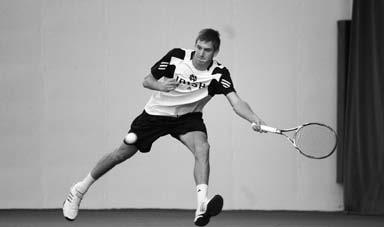
Junior Sam Keeton hits the ball back against Duke on Febr uar y 6. The Irish lost 5-2, though Keeton won his match.
Of fense
continued from page 16
t h e c o n f e
given continued development in practice
“The key for us is to just cont i n u e t o i m p r o v e , e s p
offensively,” Aoki said “I really f e e l
almost for a tournament type of format than the grind of the regular season If we can get that fourth, fifth, sixth seed in t h e B i g E a s t t o u r n a m e n t , I think we can be a really tough out ” Ti e d f o r s e c o n d i n t h e B i g East standings, St John’s (1913, 8-4) has positioned itself for a t o p - s e e d i n t h e c o n f e r e n c e tournament on the back of its outstanding defense The Red Storm have committed just 32 errors all season, good enough for the conference’s best fielding percentage at 974
St John’s also features one of the conference’s premiere hitters in shortstop Joe Panik The shortstop has amassed a 395 batting average, 31 RBIs and a conference-best 27 walks, leading the Red Storm to a team batting average of 272 comp a r e d t o N o t r e D a m e
s 2 3 9 , the lowest mark in the conference
“We can really pitch it That’s the strength of the team ” senior infielder Mick Doyle said “The hitting has been kind of a process for us Coach has a few
things we ’ ve worked on consis-
Undefeated
continued from page 16
and the goal has always been to b
Senior infielder Greg Sherry
echoed his teammate s sentiments
“The pitching has been great the whole year ” Sherry said
“The hitters are starting to get
three weeks We’re going to get it rolling We’re starting to play confidently
Notre Dame looks to improve
road Aoki will tap his trio of
Dupra, Cole Johnson and Todd Miller to subdue the Red Storm offense
“We can be a team that not a whole heck-of-a-lot of people want to play, especially if we can make some improvement offensively, Aoki said We ve pitched it pretty well and we ’ ve defended it for the most part
these one and two-run games should start going our way if we can improve ”
John’s this weekend in a threegame series
Kevin Corrigan said “So I think i t s a g
o d y that ever played here to know that, at some point, we made it ” The achievement almost never was, however, as the Irish nearly squandered the opportunity to earn the top spot in the rankings when they played St John’s Saturday Notre Dame trailed 52 at the half before outscoring the Red Storm 8-2 in the final
record When the Irish travel to Providence (3-8, 0-3 Big East),
another scare I think that we need to learn,
John’s] we got down early but I know that we are going to come
week to make sure that we do not overlook Providence
dropped seven of its last eight
that the Friars’ record is a poor i
actually are In Saturday’s 13-3
game, as they trailed 4-3 at half a n d 5 - 3
s , but faltered in the fourth quarter “If you aren’t paying attention, you look at them and you think ‘their record is not very good
this is a team that’s gone from not being a very good team at
t h e course of the last five weeks,” Corrigan said “You really see a t e a m t h a t i s s t a r t i n g t o g r o w and develop and get better and o n e t h a t w e k n o w w e c a n ’ t a f f o r d t o n o t b e p r e p a r e d against ”
Being pegged as the country’s best team certainly offers plenty of distractions for a team, but C o r r i g a n s a i d h i s p l a y e r s a r e h a n d l i n g t h e d i s t i n c t i o n t h e right way
“I think our guys are just very

focused on what we need to do day-to-day,” he said “If we can k e e p t h e f o c u s t h e r e , t h e n I
d o n ’ t t h i n k [ t h e r a n k i n g ] i s going to add a lot of pressure
Again, we started the year with high goals and high aspirations, a n d s o I d o n ’t t h i n k t h i s i s a shock to be in this position but we know it doesn’t mean anyt h i n g w h e n w e s t e p o n t h e field ”
Ridgway added that the team s m a i n g o a l r e m a i n s a b e r t h i n
t h e n a t i o n a l c h a m p i o n s h i p , which will be played on May 30
“ I d o n ’ t t h i n k a n y t h i n g changed as far as what we do [as a result of the ranking],” he said “It is a cool recognition to be number one but it does not r e a l l y m a t t e r u n t i l M e m o r i a l Day Notre Dame has played except i o n a l l y w e l l r e c e n t l y, a n d t h e conference is taking notice The I r i s h s w e p t t h e m o s t r e c e n t round of the Big East player of
the week awards, as senior midf i e l d e r D a v i d E a r l w a s n a m e d offensive player of the week and s
took the
award for the
goals and registered four total points Kemp recorded 11 saves
the
and their
faceoff is scheduled for Saturday at noon

Big East
continued from page 16
and how they competed,” he said. “They really battled hard, even when most would admit they weren’t on their ‘A’ game.”
Junior Max Scodro led the Irish again en route to winning the individual title. He carded rounds of 70, 73 and 69, respectively, to finish with a one under par 212 for the tournament. Kubinski said he took pride in the junior’s effort.
“Max played extremely well to win it all and become our first individual champion since 2005,” Kubinski said. “I’m really proud of him. He deserves it.”
With junior number one golfer Tom Usher unable to compete, the Irish needed contributions from each member of their top five. Kubinski said every golfer on his squad stepped up at a crucial time.
“Paul [McNamara III] played really well for us as a sophomore in his first [Big East championship],” he said. “He had to battle through an injury and really gutted it out. [Senior] Connor [Alan-Lee] gave us a really good round on Monday. We needed his 73. [Junior] Chris [Walker] didn’t play like he’s capable, but still played some good stretches.”
Perhaps the most impressive effort came from freshman Niall Platt, who capped his first season of college golf by carding a five over par 218. Kubinski said his freshman, who finished in a tie for sixth place individually, played confidently.
“Niall also played well,” Kubinski said. “He was tremendous, really, all tournament except for his first nine or 10 holes. To play his last eight holes at one under was a huge factor for us going from a pretty close lead to winning by six shots. And having a freshman do it is outstanding.”
Their effort in the Big East tournament positioned the Irish for a berth in the NCAA regional tournament for the first time since 2006. Kubinski said he initially hoped to just get back to the national stage, but now thinks his team might be able to advance beyond regionals.
“This season, I was really hoping we could get some experience in the NCAA’s for next season,” he said. “With how well our top guys are playing and us getting Tom back healthy, I think we have a chance to make some noise.”
This season will have farreaching effects. Kubinski said his current squad’s NCAA berth will improve the future of the program.
“[Appearing on the national stage is] tremendous for the program,” he said. “It’s something that every junior golfer is looking at and that all of our recruits mentioned. They want to have a chance to play for the national title. It will be good to get back to the NCAAs for the first time in a few years and hopefully make it to the championships, which this program hasn’t done in 45 years.”
Contact Cory Bernard at cbernard@nd.edu


ASHLEY DACY/The Observer
Irish junior Max Scodro lines up a putt during the Battle at the Warren on Notre Dame’s Warren Golf Course April 12.


THE OBSERVER
Published Monday through Friday, The Observer is a vital source of information on people and events in the Notre Dame and Saint Mary’s Community.
Join the more than 13,000 readers who have found The Observer an indispensible link to the two campuses. Please complete the accompanying form and mail it today to receive The Observer in your home.
Make

Enclosed is $130 for one academic year
Enclosed is $75 for one semester
JUMBLE
JEFF KNUREK MIKE ARGIRION
PLEASANDVILLE
TUESDAY VARIETY SHOW
LAURA McGINN
JAMES SOLLITTO, CODY ECKERT and JOHN FLATLEY
April 20, 2011
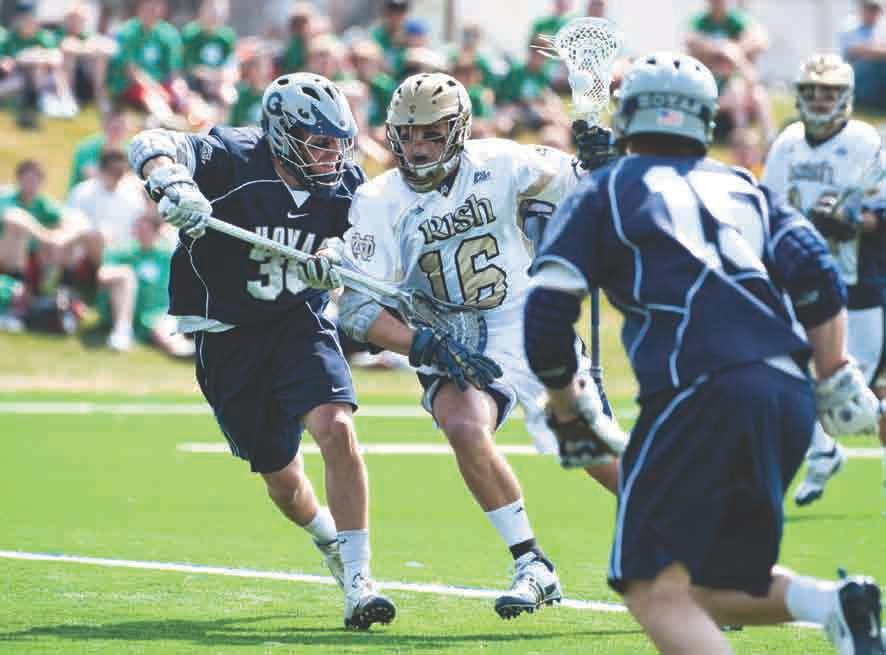
MEN’S LACROSSE
A program first
Notre Dame to face Big East foe Providence
By JOSEPH MONARDO Sports Writer
After taking over the top spot in both the Inside Lacrosse media poll and the USILA coaches poll for the first time in program history, the No. 1 Irish will have to defend the nation’s only remaining undefeated record against Providence Saturday.
The Irish (9-0, 4-0 Big East) spent multiple weeks in the top five before ascending to the top of the rankings following Syracuse’s 11-6 loss to No. 3 Cornell on April 12. Syracuse dropped from No. 1 to No. 4 following the defeat, opening the door for the Irish to take the No. 1 ranking for the first time in the program’s 30-year history.
“I’m not going to act like it doesn’t mean anything, because we’ve been playing lacrosse and working at this for a long time
WOMEN’S LACROSSE
By CORY BERNARD Sports Writer
Last spring, the Irish ended the Big East championship in agonizing fashion, finishing one stroke behind first-place Georgetown. This year, however, they left no doubt that they were the victors.
Notre Dame was in a tie for first after Sunday’s initial round, then grabbed sole possession of the lead after the second round Monday. It completed the wire-to-wire victory Tuesday and claimed the program’s seventh Big East title and first since 2006. The Irish finished with a 24 over par 876. Runner-up Louisville carded a 30 over par 882. Irish coach Jim Kubinski said his team never wavered despite some rough stretches “I’m really proud of the guys
Squad looks to even record against stiff competition
By MATTHEW DEFRANKS Sports Writer
As the season winds down, each lacrosse game becomes more and more important. For the Irish, each game becomes tougher as well.
After beating Connecticut 155 Saturday, Notre Dame will battle No. 20 Vanderbilt in Nashville before returning home to play Big East leader No. 17 Georgetown.
In the win over Connecticut,
Irish junior attack Maggie Tamasitis tied a Notre Dame (6-7, 3-2 Big East) single-game record with six assists. Meanwhile, senior midfielder Shaylyn Blaney led the Irish attack with four goals.
“[Notre Dame-Vanderbilt] is a huge rivalry, we play them every year,” Irish coach Tracy Coyne said. “We don’t have trouble getting psyched to play them. It will be good prep for the Georgetown game.”
Vanderbilt (7-7) is coming off a string of close games, with
its last three contests decided by just one score. Most recently, the Commodores lost to then-No. 6 Florida 8-7, holding the Gators to their lowest offensive output of the season.
Junior attack Courtney Kirk leads the Commodores with 47 points, including 26 assists. Junior midfielder Ally Carey has also had a solid season, scooping up 3.57 ground balls per game, the fourth-highest total in the country.
“Our attack matches up with their defensive weaknesses
Irish ready for St. John’s
By CHRIS MASOUD Sports Writer
Tuesday’s rainout gave Notre Dame an additional day of rest before the team travels to Queens, N.Y., for a three-game set against St. John’s. But after dropping four of its last six games at Frank Eck Stadium, the team also lost a chance to improve its overall record through a nonconference contest against MAC foe Toledo.
After showing signs of life in a 14-4 outburst against Connecticut April 10, the offense has gone cold once again, averaging just over three runs in its past four games. Irish coach Mik Aoki remains positive and believes Notre Dame (14-18-1, 5-7 Big East) can be a threat in

and our defensive personnel matches up well with their key players,” Coyne said. “We have a good game plan and an edge in all categories, I think.”
On offense, Georgetown (7-5, 5-0) boasts two 20-goal scorers in senior attack Jordy Kirr and sophomore midfielder Sophia Thomas. Kirr and Thomas also lead the Hoyas in assists.
The Hoyas carry an opportunistic team defense that causes nearly 11 turnovers a game, the fourth-highest mark nationally. Freshman goalie
Barb Black has anchored the Georgetown defense, playing over 500 minutes and allowing 9.71 goals per game.
“We recruit the same players and they are always competitive year in, year out,” Coyne said. “We need to improve in transition and have less turnovers.”
The Irish, however, can cause some turnovers as well. Senior defender Jackie Doherty ranks third nationally
TURNOVERS/page 13
By VICKY JACOBSEN Sports Writer
Freshman Kristina Nhim insists that the pressure of being atop the leaderboard did not affect her play as she led the No. 25 Irish to their fourth Big East conference title.
In fact, Nhim, who finished third overall, was not aware that she was even one of the leaders.
“I had no idea I was near the lead,” she said. “I had some really unlucky breaks in the beginning of my round, so I actually counted myself out of it.”
Nhim was tied for first place
at five over par going into the last hole, which she bogeyed.
“I didn’t know until I finished my last hole that I missed out on the playoff by one. Then I was super upset, because I thought Louisville caught up to us, not that I missed out on first. Then I realized that I lost on the last hole, but I got over it,” Nhim said. “Winning with the team is way better.”
The conference championship, the first for Notre Dame since 2008, was especially sweet as it came at the expense of rival No. 36 Louisville, who came into the Big East championship as the
see NHIM/page 10
JULIE HERDER/The Observer Irish senior infielder Mick Doyle lays down a bunt in a game against West Virginia April 17.
GRANT TOBIN/The Observer
Sophomore midfielder Steve Murphy splits the defense during Notre Dame’s game against Georgetown April 10. The Irish are currently ranked No. 1 for the first time in program history.