THE INDEPENDENT NEWSPAPER SERVING NOTRE DAME, SAINT MARY’S AND HOLY CROSS
FRIDAY, MARCH 20, 2026 | VOL. LX, NO. 52
FRIDAY, MARCH 20, 2026 | VOL. LX, NO. 52
By Mara Hall and Matthew Morin Associate News Editors
Former Notre Dame Football head coach Lou Holtz, who led the team to a national championship in 1988, died on March 4, 2026. He was 89.
A devout Catholic his entire life, the ceremonies celebrating the life of Lou Holtz began on Sunday at 7 p.m. with a visitation in the Sacred Heart Basilica. The University confirmed that for the two days of events, over 1,000 people attended. Students and faculty, former players and well-wishers came to pay their respects. The visitation was scheduled for three hours, had a two-hour long line and was staged in the Main Building due to inclement weather. The Holtz family greeted every person individually to thank them for their attendance.
His celebration of life began at 1 p.m. on Monday, with members of the public who wished to attend
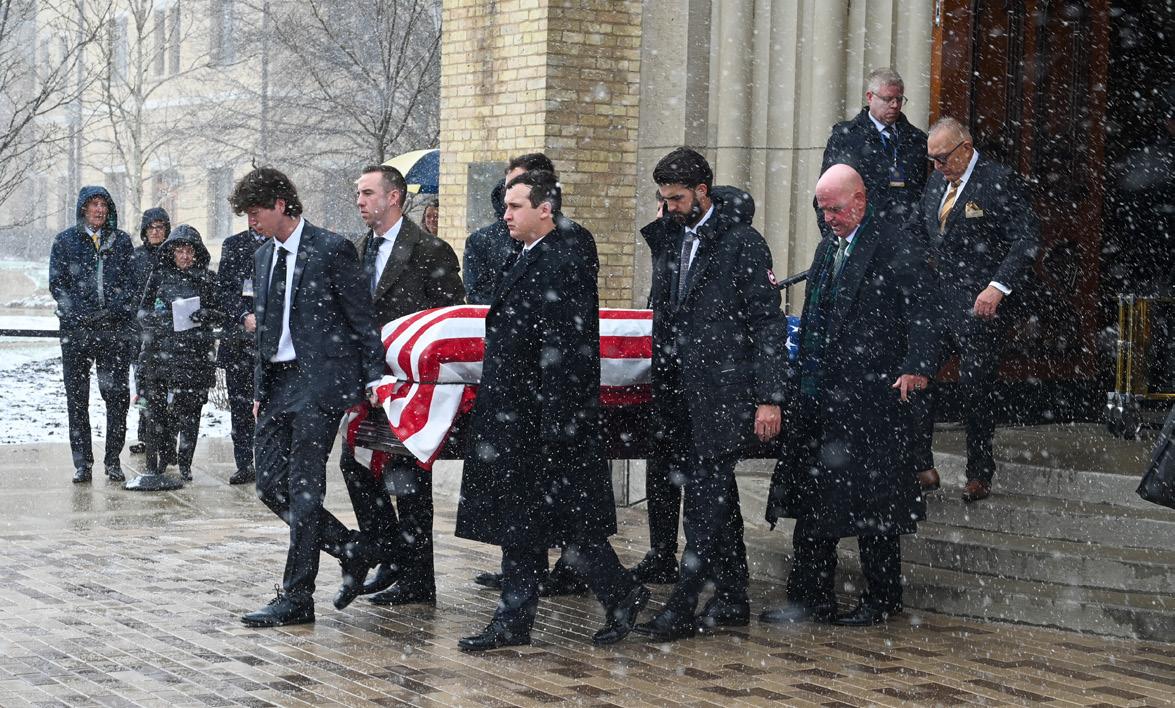
JONATHAN KARR | The Observer
Skip Holtz, Kevin Holtz, Try Holtz, Chad Holtz, Aaron Holtz, Zach Messaglia and Jacob Messaglia carry Holtz’s casket out of the Basilica.
waiting in line for several hours to gain entrance to the Basilica. The earliest member of the public arrived at 4:30 a.m.
“There’s some things you only get to do once. You can skip a class. There’s going to be class on Wednesday. God forbid a football game, there will be more next year; but you only get to memorialize
such a great person as coach Holtz one time,” freshman Ben Place, an attendee at the funeral Mass, said.
“I was a long-term employee. He was my first football coach, and I always just held him in high regard,” Lori Maurer, a Notre Dame retiree of the office of human resources,
see “Funeral” on page 4
By Observer News Staff
In a March 19 press release, the University of Notre Dame announced that Sr. Raffaella Petrini, F.S.E., will serve as the University’s primary speaker for the 181st commencement ceremony and receive an honorary degree.
“Sister Raffaella is an extraordinary leader who works tirelessly for the common good and radiates the peace, love and hope of Christ. As the highest-ranking woman in the Vatican, she embodies the future of women’s leadership in the Church, having served Pope Francis and now
Pope Leo with deep wisdom, unfailing dedication and true humility,” said University President Fr. Robert Dowd in the press release. Dowd continued, “It is a privilege to have her address the members of the
see “Petrini” on page 5
By Observer News Staff
Saint Mary’s College President Katie Conboy announced the keynote speaker for the College’s 179th commencement ceremony, as well as recipients who will be receiving an honorary degree and the President’s Medal on May 16 at Le Mans Green.
NEWS | PAGE 4
Laetare Medal
Timothy Shriver, chairman of Special Olympics, will receive medal at ND commencement.
The statement was provided to Saint Mary’s students and faculty through an email Monday afternoon.
Anne Thompson, who serves as the chief environmental affairs correspondent at NBC News, will be delivering the commencement speech for the class of 2026 and receive an honorary
OPINION | PAGE 6
Lessons post-Kirk
Columnist Amaris O’Connor discusses what has been learned from Charlie Kirk’s death.
doctorate of humane letters. She worked as a general assignment reporter at WNDUTV while a student at Notre Dame, graduating in 1983. Since 2010, she has served as part of the University’s Board of Trustees and in 2019 received the Rev.
see “Thompson” on page 5
SCENE | PAGE 9
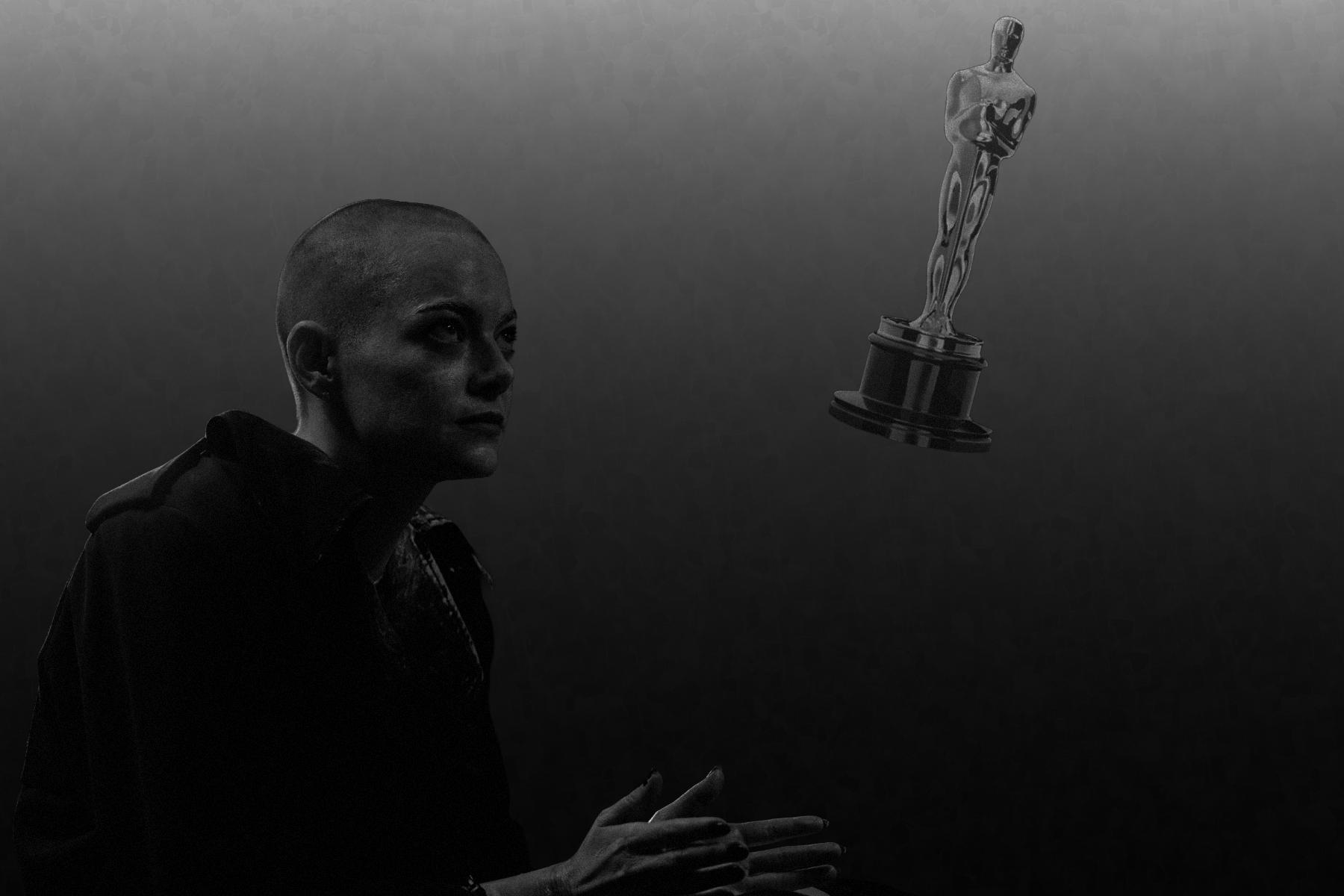
Burgonia snubbed
The Yorgos Lanthimos film was not recognized at this year’s Oscar award ceremony.
By Observer News Staff
In fall 2024, the University launched the Pathways to Notre Dame program, which removed loans from financial aid packages and chartered a path to be need-blind while meeting 100% of demonstrated financial need. Today, the Office of Media Relations announced the program is expanding again.
According to a University press release, “Beginning in the 2026-27 academic year, Notre Dame will ensure that families with annual income below $150,000 will receive needbased financial aid that covers the cost of tuition. Families with income below $200,000 will receive need-based aid that covers half the cost of tuition. In addition, most students from families with annual income below $60,000 will receive needbased financial aid that covers tuition, fees, housing and food.”
Micki
Kidder, vice president
By Berhan Hagezom
Saint Mary’s News Editor
As students prepare to vote on Thursday, the sole ticket for Saint Mary’s student government is focused on increasing representation and improving campus life through a series of initiatives.
Juniors Daniela Rivera and Mila Curtis say their campaign aims to strengthen how the student government association serves students both within the organization and across campus.
Rivera, a math and civil engineering major and current director of internal affairs in SGA, pointed to her leadership experience as preparation for the role. She cited her work in the Residence Hall Association as a freshman and two years with the Belles Against Violence office.
“I have worked there for
SPORTS | PAGE 12
Women’s basketball No. 6 Irish face No. 11 Fairfield in the first round of the NCAA tournament in Columbus, Ohio.
for undergraduate enrollment, said the changes are intended to make financial aid more transparent and accessible for families.
“With this announcement, we reiterate our unwavering commitment to ensuring that cost will never be a barrier between a promising student and a Notre Dame education,” Kidder said in the press release. “By implementing income-based scholarship thresholds, we are providing the clarity families need to see that a world-class education is within their reach.”
“Since Pathways was first introduced, the University has committed over $40 million in additional annual recurring funds to ensure a Notre Dame education remains affordable for our undergraduate students,” Kidder wrote in a statement to The Observer. “Every year, over 50% of first-year
see “Financial Aid” on page 3
the past two years, and I feel like that has prepared me in a sense of what being a Smick means,” Rivera said. “Being in a leadership position is kind of like leading with purpose and doing your leadership with a certain purpose that leads toward service with heart.”
Curtis, an accounting major and SGA’s director of external affairs, said her experience has prepared her to advocate for students and navigate the demands of student leadership.
“Each of these roles has prepared me to serve effectively as student body vice president,” Curtis wrote in a statement to The Observer. “I have learned how to stay organized in fast-paced and often unpredictable environments, pivot when plans change and communicate effectively with diverse groups
see “Rivera-Curtis” on page 5
SPORTS | PAGE 16
ND baseball
Notre Dame baseball prepares to face powerhouse No. 19 Clemson at home in ACC opener.
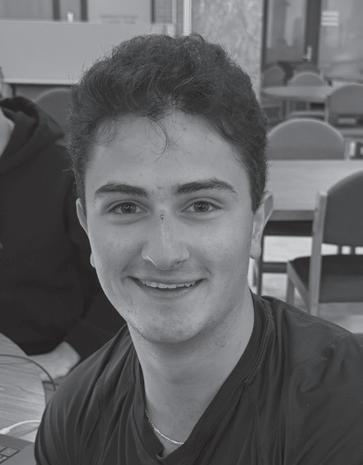
Will Vittiglio sophomore Morrissey Manor “Florida.”
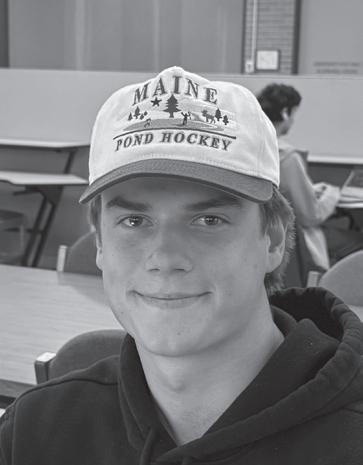
Griffen Ward sophomore Baumer Hall “Arizona.”
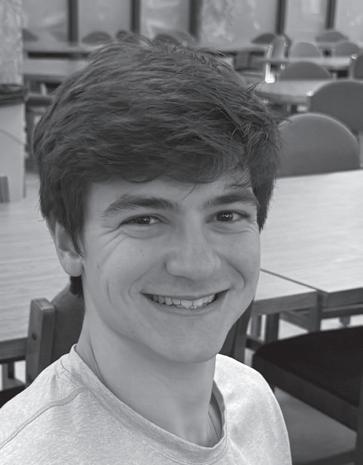
Jack Caldara sophomore Keenan Hall “Michigan.”
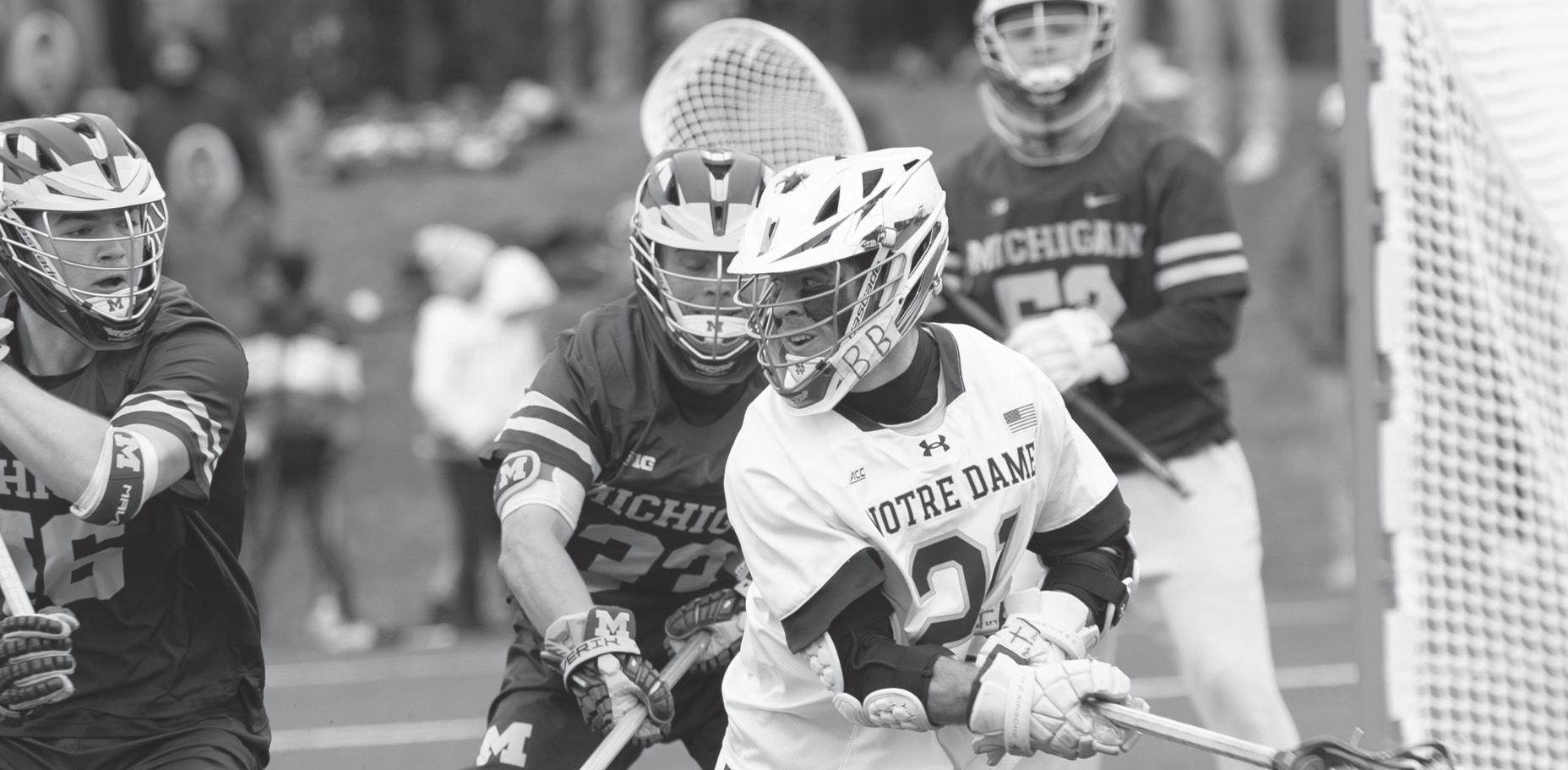


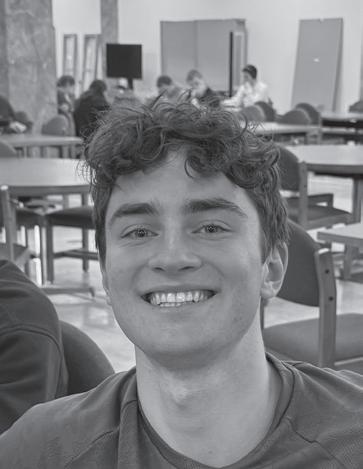
Finn Murphy sophomore Morrissey Manor “Nebraska.”
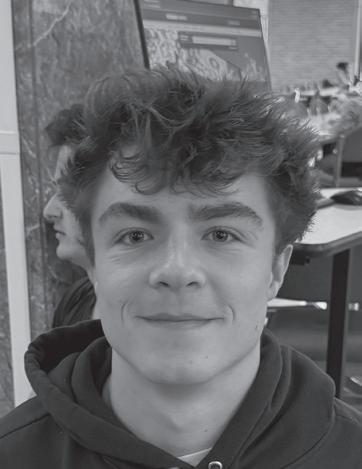
CJ Roeder sophomore Morrissey Manor “Duke.”
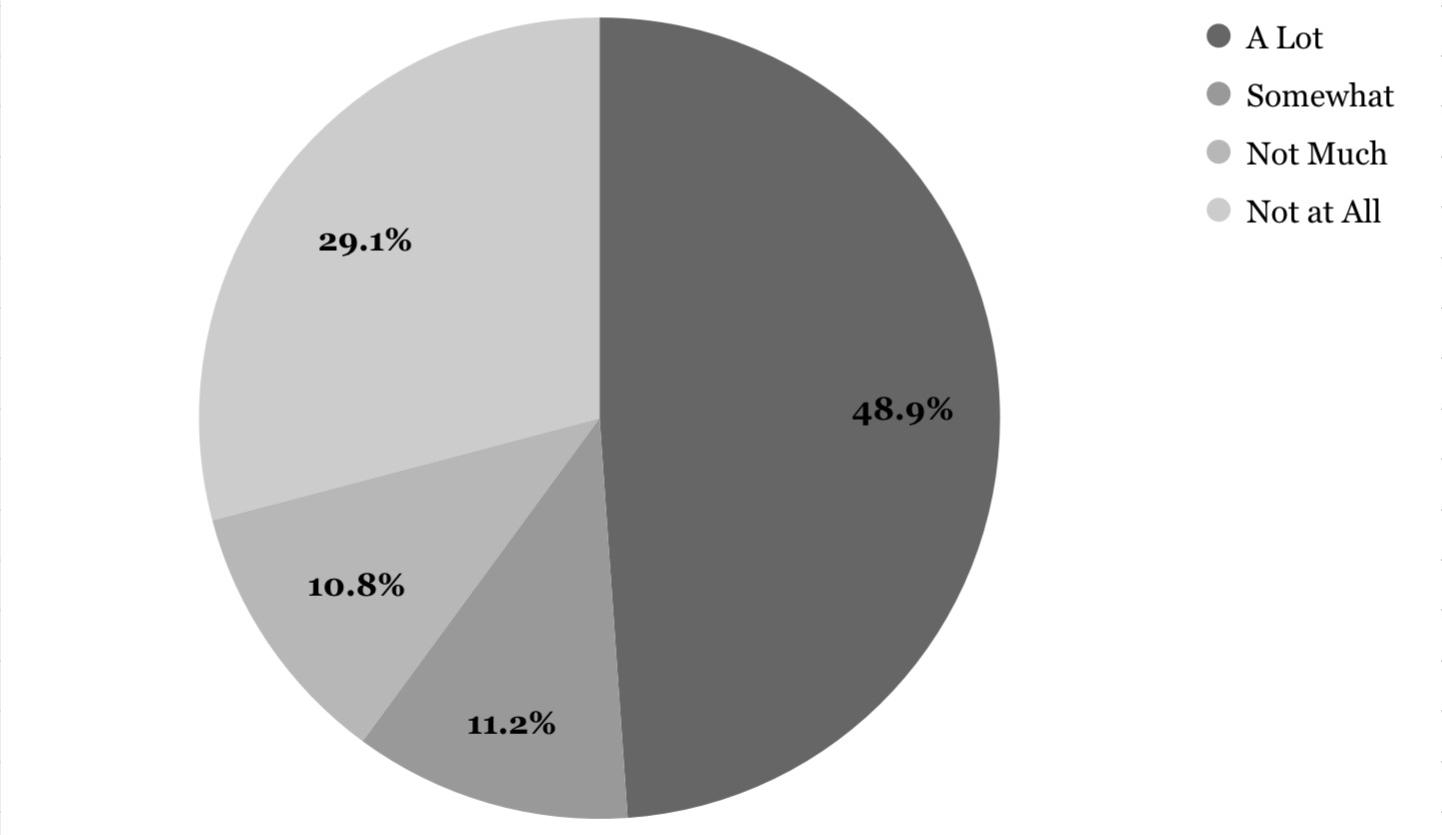
How much would Notre Dame’s recent financial aid expansion have influenced your college decision?
Friday
Notre Dame Glee Club concert
The Glee Club presents a variety of music in its annual concert. Leighton Concert Hall
8 p.m. - 9:30 p.m.
Saturday
Notre Dame women’s lacrosse vs. Florida State The Irish face the Seminoles in their Daughters for Dads game. Arlotta Stadium 1 p.m.
Sunday
Documentary: “Mr Nobody Against Putin” A teacher must share propaganda as Russia invades Ukraine. Browning Cinema 4 p.m.
Monday
“Democracy and Global Catholicism: The View from History” John McGreevy explores faith, democracy and human rights. Hesburgh Center for International Studies Auditorium 5 p.m. - 6:15 p.m.
Tuesday
Book launch with professor Rebecca Lehmann Lehmann celebrates her debut novel, “The Beheading Game.” Carroll Auditorium 7 p.m. - 8:30 p.m.
By Chloe Hanford News Writer
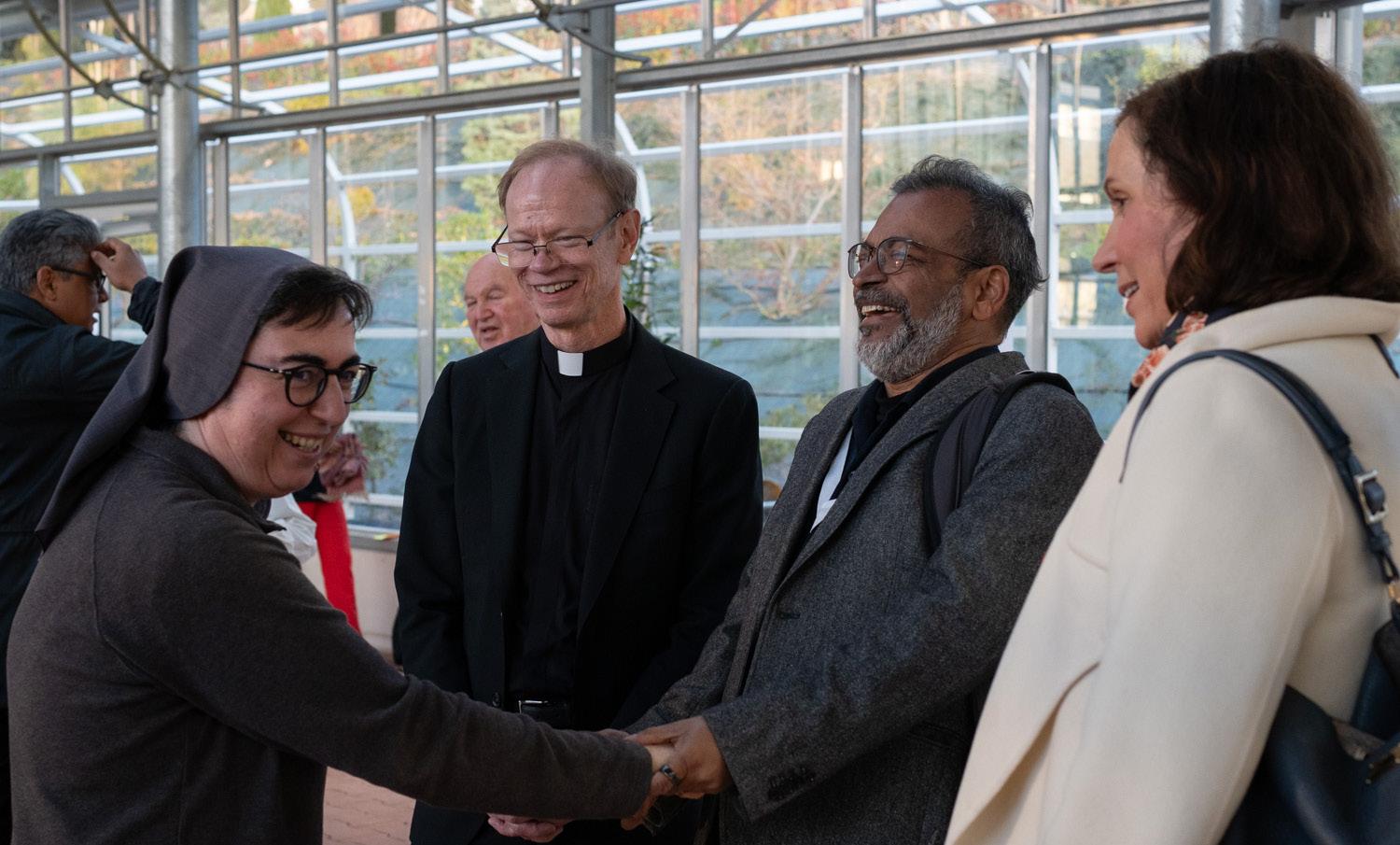
In the picturesque gardens of Castel Gandolfo’s Apostolic Palace, representatives from Notre Dame, the Vatican and over 60 universities from 30 countries gathered on March 9-10 to brainstorm the future of education on sustainability, celebrating the birth of the Global Alliance for Laudato si’.
The alliance emerged from over two years of partnership between Notre Dame’s Just Transformations to Sustainability Initiative, the Laudato si’ Center for Higher Education and the Holy See’s Dicastery for Promoting Integral Human Development.
The Global Alliance aims to “convene a global community to advance Pope Francis’s vision of caring for our common home — bringing people together across disciplines, cultures and commitments,” Fr. Dan Groody said in a comment. Groody, Notre Dame’s vice president and associate provost for undergraduate education, was one of 15 faculty and University leadership representatives Notre Dame sent to the inauguration, due to his work with the Dicastery
for Promoting Integral Human Development.
Groody said the partnership “presents a unique opportunity to bring the research needs of the Church in the world together with the research engine of Notre Dame.”
Kevin Fink, managing director of the Notre Dame Just Transformations to Sustainability Initiative, said the development formalizes the groups’ work through the Laudato si’ model, but isn’t a departure from previous efforts.
“The core mission of this alliance is to bring together work that right now is siloed and fragmented at a time when Laudato si’ can provide such a transformative framework for pursuing sustainability and teaching about sustainability,” he said.
The initiative was inspired by Pope Francis’ call for an increased focus on integral ecology, outlined in his papal encyclical Laudato si’, which means “praise be to you” and comes from a canticle by St. Francis of Assisi.
In Laudato si’, Pope Francis explains that integral ecology is not just the study of how humans relate to their environment but
is “inseparable from the notion of the common good, a central and unifying principle of social ethics.”
The conference unites groups from around the world who have been inspired by the encyclical in the 10 years since its publication. During the conference, the alliance formed six working groups, each focused on researching and planning solutions surrounding a specific sustainability issue. At the end of the second day, each group presented its plans for the following year.
The Global Alliance has implemented the encyclical in a working group that is researching the nexus of water, energy and food security.
“One of the key risks ... is that the solutions that we advance are the ones that continue to put vulnerable and marginalized peoples more on the fringes, and I think especially when we think about water, energy and food security, the risk is that as we advance, the people who are most marginalized are going to be the most harmed by those solutions,” Fink said.
Integral ecology asks sustainability problem-solvers to consider justice and equality,
so these were important focal points for working groups. Fink called it a framework for “making sure that we’re not keeping issues of humanity out of that equation” and making sure “that we’re looking holistically at solutions that can preserve the environment while preserving the dignity of the world’s most vulnerable.”
Working groups also covered other topics, such as developing a Laudato si’-inspired sustainability curriculum in higher education, which will eventually extend to early childhood education.
This emphasis on
sustainability in higher education is evident in a new summer abroad course offering from Notre Dame. This summer, the University will offer a weeklong immersive learning course at the Laudato si’ Village, taught by Groody and professor Arun Agrawal, where students will learn to address sustainability challenges through the lens of integral ecology. The course includes both hands-on experience, classroom instruction and possible visits to various Vatican museums.
Contact Chloe Hanford at chanford@nd.edu
By Observer News Staff
Holy Cross College announced March 9 that John McKiernan will serve as its new executive vice president and chief operating officer.
McKiernan obtained a bachelor’s degree in philosophy and a law degree both from the University of Notre Dame,
where he was an assistant rector in O’Neill Hall from 2003 to 2005. He earned a postgraduate diploma in theology from the University of Oxford in 2006 and later a master of business administration from the University of Scranton, where he was a residence hall director from 2007 to 2010. He later worked as a residence hall
director at Seattle University. McKiernan has also served as the director of academic counseling and programming at Yale Law School and has also served as an assistant vice president and assistant secretary to the Board of Trustees at Loyola University Maryland. He started his position as chief of staff to the president at Wilmington
College in 2022.
“John brings a thoughtful, mission-driven approach to leadership and a deep understanding of Catholic higher education,” Holy Cross College President Marco Clark stated.
“He has demonstrated an ability to bring people together across divisions and help institutions translate strategic priorities

into meaningful progress.”In his new role, McKiernan will be directly involved in the president’s executive council, while overseeing specific administrative departments, including finance, human resources, campus operations and information technology.
“I come to Holy Cross at a time when there is so much physical, academic, and enrollment growth happening at the same time. I’m deeply inspired and called by its strategic mission, momentum, and vision. Together with Dr. Clark, we will catalyze the College’s operational strength and move toward our goal of cementing Holy Cross as a premier Catholic higher education institution,” McKiernan stated. He will begin the senior leadership role in May.
Continued from page 1
“Every year, over 50% of firstyear undergraduate students receive need-based financial aid.”
According to the Notre Dame admissions website, 70% of undergraduates receive some form of financial aid. With this expansion, the University’s financial aid commitment will exceed $1 billion over the next four years, according to the press release.
By Observer News Staff
Notre Dame announced Timothy Shriver, chairman of Special Olympics, will receive the 2026 Laetare Medal at its 181st commencement ceremony May 17.
The Laetare Medal is billed by Notre Dame as “the oldest and most prestigious honor given exclusively to American Catholics.”
Established at Notre Dame in 1883, it recognizes individuals whose work reflects the ideals of the Catholic Church and contributes to society.
Shriver has led Special Olympics as chairman of its international board of directors,
overseeing what the organization describes as its largest expansion. During his tenure, the movement has grown from approximately 1 million athletes to more than 4 million participants across over 200 countries and territories.
“Drawing on his deep faith, Tim has devoted his life to being a force for good,” University President Fr. Robert Dowd said. “Whether through his leadership of Special Olympics, his work in education or his commitment to fostering civil discourse, he is a tireless advocate for human dignity.”
Special Olympics, founded in 1968 by Shriver’s mother, Eunice Kennedy Shriver, aims to end discrimination against people with
intellectual and physical disabilities through sports, health, education and leadership programs. Shriver’s father, Robert Sargent Shriver, also previously led the organization.
Shriver joined Special Olympics in 1996 and has expanded initiatives such as Healthy Athletes, which has provided free health screenings to more than 2 million participants in over 135 countries, and the Unified Sports initiative, which brings together athletes with and without intellectual disabilities.
“I look at the work of the last half century of the Special Olympics movement as largely shifting the lens from, ‘What’s wrong with
them?’ to ‘How much can we accomplish if it’s us, not us versus them?’” Shriver said.
Beyond Special Olympics, Shriver co-founded UNITE, a nonprofit focused on bridging political divides, and helped develop the Dignity Index, a tool designed to evaluate whether public language reflects respect or contempt.
The Laetare Medal is announced annually on Laetare Sunday, the fourth Sunday of Lent. Its name comes from the Latin word for “rejoice,” and the medal bears the inscription “Magna est veritas et praevalebit,” meaning “Truth is mighty, and it shall prevail.”
Previous recipients include
Dorothy Day, Joe Biden and Sister Helen Prejean. Last year, the medal was awarded to Kerry Alys Robinson, president and CEO of Catholic Charities USA.
Shriver is the only recipient in University history whose parents also received the honor. Eunice Kennedy Shriver was awarded the medal in 1988, and Robert Sargent Shriver received it in 1968. His uncle, President John F. Kennedy, was honored in 1961.
“I know I don’t belong in the company of many of the people who have received this medal,” Shriver said. “I’m a good channel for people who deserve it, and I’m grateful to be able to be that channel.”
By Annelise Demers Notre Dame News Editor
The University celebrated the 20th anniversary of its “What Would You Fight For?” campaign by bringing together faculty, students and media professionals to reflect on its storytelling impact and future.
University President Fr. Robert Dowd opened the event, followed by a panel moderated by NBC Sports host Mike Tirico. Panelists included NBC Sports coordinating producer Rob Hyland, supervising producer Lindsay Schanzer, aerospace and mechanical engineering professor Meenal Datta and sophomore Lauren Eglite.
The “What Would You Fight For?” campaign, launched two decades ago, highlights research and initiatives at Notre Dame through short video segments aired during NBC broadcasts of Notre Dame football games. Speakers emphasized the campaign’s role in connecting
Continued from page 1
said. “I just felt that this would be an opportunity that I didn’t want to pass up.”
The service, celebrated by University President Rev. Robert Dowd aided by a homily by former University President John Jenkins, was concelebrated by roughly 30 members of the Congregation of Holy Cross, including Arthur Colgan, Auxiliary Bishop of Chosica, Peru, and Daniel Jenky, Bishop Emeritus of Peoria, Illinois.
The Holtz family participated as well, with Beth Messaglia lectoring the first reading, Wisdom 3:19, Katherine Holtz lectoring the second, Romans 8: 3:6-35, 37-39 and Liz Messaglia ’22, Lou Holtz’s youngest daughter, reading the Prayers of the Faithful.
In the homily, Jenkins reflected on the former coach’s character, illustrating the multitude of ways his commitment to faith was demonstrated in his actions.
academic work with a national and global audience.
The series has received national recognition, winning a Sports Emmy in 2024 for outstanding public service content. The WWYFF team expects to learn next week whether the series has been nominated again this year.
Hyland said the campaign was designed to move beyond traditional university advertisements and instead focus on humancentered storytelling.
“Twenty years ago, Notre Dame came to NBC and said, ‘Let’s do something different,’” Hyland said.
Hyland added that the goal is to capture viewers’ attention quickly during broadcasts and highlight meaningful stories tied to the University’s mission.
Schanzer said the production process begins well in advance, with teams reviewing faculty research and selecting a limited number of stories each year.
“We receive pitches from across Notre Dame’s research
“Even that relentlessly demanding side of Lou Holtz came from a place of love,” Jenkins said. “As his son, Skip, put it, Lou demanded so much of you because he believed in you even more than you believed in yourself. Lou’s tough love was indeed genuine and deep. He wanted you to be the very best version of yourself and refused to accept anything less.”
Jenkins noted that this care toward his players extended beyond their time playing for him. Lou Holtz traveled across the country to support his players’ endeavors in other aspects of life, from speaking at campaigns to attending dinners. Among all the teams he coached, Jenkins argued that the most important team was his family. As a devout husband, Lou Holtz walked with Beth through a two-decade battle with cancer, including 83 radiation treatments.
Describing their relationship, Jenkins said, “Lou Holtz made the people around him better. Beth Holtz made Lou better.”
Following Communion, Skip
faculty,” Schanzer said. “We can only do six pieces each year, and we decide which work best for the medium that we have.”
Each season, the series features six two-minute segments, making selection highly competitive among the University’s faculty and student researchers. Schanzer said the storytelling approach prioritizes emotional connection, combining research with personal narratives to engage viewers. Datta said being featured in the campaign allowed her research to reach audiences beyond academia.
“As a faculty member, your work gets out in journals or publications that most of the public is not reading,” Datta said. “It was an incredible opportunity to reach everyone.”
Datta added that the campaign also generated responses from patients and families impacted by her research, reinforcing its real-world significance.
“What touched me the most was communication from
Holtz, who also made a career in college football coaching, delivered a eulogy.
“He was a complicated man ... everyone in this church has seen a different side of him,” Skip Holtz said. “He believed circumstances don’t define who you are, but choices do.”
Recounting his father’s coaching career, he said, “He built his life on trust, commitment and love. He was a builder. He found a way to believe in you more than you believed in yourself with a positive attitude and an incredible passion.”
The lesson of Holtz’s life, Skip Holtz said, is “to care more about doing for others than you do for yourself. When you think of Lou Holtz, find the persons closest to you and ask them, ‘What can I do for you?’ If we can all do that, we will continue his legacy by making this a little warmer, better place than we found it. Yes, he was successful, but most of all, he was incredibly significant and he changed people’s lives for the better. He made you want to be a
patients and their families,” Datta said. “Remembering that what we do is for people was a very important reminder.”
Student panelist Lauren Eglite, a sophomore studying chemical engineering, said the campaign influenced her academic path and connection to the University. She recalled seeing a WWYFF segment about peanut allergy research while attending a Notre Dame football game as a child.
“I remember seeing it and thinking there might be a cure for something I had struggled with my whole life,” Eglite said.
Eglite said the experience eventually led her to study chemical engineering at Notre Dame and participate in a follow-up video for the campaign.
“I think this video series really drew me to Notre Dame,” Eglite said. “It inspires hope and shows what people here are able to do.”
Speakers also emphasized the campaign’s broader reach beyond football broadcasts. Datta
better Christian, a better person, a better husband, a better father, a better student.”
He concluded, saying, “If you met him, you were happy. If you interacted with him, you were lucky. If you were friends with him, you were favored. If you were coached by him, you were fortunate. If he was your dad, you were blessed. I love you dad. Rest in peace.”
Lou Holtz’s casket was carried by his son, Skip Holtz, and grandsons, Kevin Holtz, Try Holtz, Chad Holtz, Aaron Holtz, Zach Messaglia and Jacob Messaglia from the Basilica while the tunes “Notre Dame, Our Mother,” and “Amazing Grace” were sung by the congregation. Arriving at the main circle, the trumpet section of the Band of the Fighting Irish played the Alma Mater. Led by a Notre Dame Police Department car, the hearse drove down Notre Dame Avenue to Cedar Grove Cemetery, followed by the Holtz Family, Dowd, Jenkins, Basilica rector Brian Ching and members of former football teams among others.
said the segments are amplified through social media, University websites and continued audience engagement.
“For me, it feels like the campaign never ended,” Datta said. “It continues to reinforce the story in different ways.”
Tirico said the campaign’s placement during Notre Dame football games allows it to reach a wide audience and connect sports viewers with academic work.
“It’s more than just a football team and a commercial,” Tirico said. “It’s a story of what an institution is all about.”
Panelists concluded by highlighting the campaign’s role in fostering connection and pride within the Notre Dame community and beyond.
“It’s about connecting people with people’s stories,” Tirico said. “And finding others who care.”
Contact Annelise Demers at ademers@nd.edu
Mike Nolan, a friend of Lou Holtz since about 1991, said, “I got to know his whole family. It was a thrill to be on the sideline, in the locker room and all that, but priceless to see him as a husband, a father, a friend and as a veteran. That was the greatest blessing of all.” Freshman Colin Gibbons, who attended the funeral and watched the procession, said, “Both of my parents were Notre Dame alumni, class of ‘95, when Lou was still coaching on campus, and it would’ve meant a lot to them to be able to go to this and to be able to be present and support such a great man who had really shaped their time at Notre Dame and I think the time of many at Notre Dame.”
As the hearse entered the gates of the cemetery, a lone bagpiper played a final tribute to the Irish legend.
Contact Mara Hall at mhall27@nd.edu and Mattthew Morin at mmorin2@nd.edu
Continued from page 1
while advocating for student needs. Most importantly, I have developed the ability to listen intentionally and lead with empathy and purpose.”
The pair said they chose to run together because of their shared goals and complementary leadership styles.
“Our position is kind of shared, and we work so well together. We are such a dynamic duo,” Rivera said. “We both have passions for the same things and similar viewpoints. We see these leadership positions as a service opportunity and a way to give ourselves to students in a purposeful, fulfilling way.”
Curtis echoed that sentiment, emphasizing that their collaboration strengthens their campaign.
“Our collaboration has shown that we work exceptionally well as a team,” she wrote in a statement to The Observer. “We challenge each other’s ideas, build on one another’s strengths and approach problems with both
Continued from page 1
a privilege to have her address the members of the Class of 2026 and their loved ones who are sure to be inspired by her words and prophetic witness.”
This will be Petrini’s second speaking engagement at the University. Three years ago, she spoke at a lecture entitled “Integral Human Development Through a Leadership of Care” for the Nanovic Institute’s yearly Keeley Vatican Lecture.
Continued from page 1
Edward Fredrick Sorin, C.S.C., Award, one of the University’s highest honors, for her work and service to the institution.
“Anne Thompson has been an inspiring role model for women for many years,” Conboy stated in the announcement. “As a veteran correspondent, her distinguished and award-winning portfolio includes reporting on complex topics ranging from the environment, to the papacy, to the Boston Marathon bombing, among others. Her story, her experience, and her perspective as a leading woman’s voice in broadcast journalism will resonate with our graduates and the Commencement audience. We are pleased to confer upon her the degree of
creativity and practicality. What makes us the best fit is our balance. We bring leadership experience and a strong understanding of how student government operates, while also offering different perspectives that complement one another.”
Their campaign slogan is “Lead with purpose, serve with heart,” and their platform is built on three pillars: transparency and accountability, inclusion and belonging and innovation and campus experience.
Rivera said transparency is a key priority, particularly when it comes to student awareness of SGA decisions and funding.
“I know, for example, every year SGA donates something to the school and many students are not aware of those things,” Rivera said. “Since it’s their tuition money, they should be able to know what’s being done with it.”
To address this, the campaign proposes creating a centralized website hub where students can access updates, contact representatives and submit feedback.
The platform would be developed over the summer and
On the occasion of Petrini’s speech at the Nanovic Institute in 2023, then University President John Jenkins said in a press release, “As a leader rooted in her faith and with a deep commitment to human flourishing, Sr. Petrini has much to teach us.”
In November 2021, Petrini was appointed secretary general of the Vatican City State by Francis.
In February 2025, the late Pope appointed Petrini as president of the Pontifical Commission and Governorate of Vatican City State, an appointment
Honorary Doctor of Humane Letters.“
Her stories have been featured on the Today Show, NBC Nightly News with Tom Llamas and NBC News Now, where she covered environmental and economic topics. She has reported on the election of Pope Leo XIV and the 2000 presidential campaign coverages of former Sen. Bill Bradley and former Sen. John McCain. Thompson was nominated for four Emmy awards during her time as NBC News’ chief financial correspondent from 2005 to 2007 alone and won five others through her position as a correspondent. Other notable accomplishments from Thompson include winning the Gerald Loeb Award and the Alfred I. duPont-Columbia University Journalism Award for her follow coverage on Hurricane Katrina.
launched in the fall.
Their second pillar, inclusion and belonging, focuses on building connections across class years and increasing access to student government.
“We want to get freshmen involved within student government so they can foster that inclusion and get a head start on what SGA entails,” Rivera said. “Student government is a big part of that inclusive environment, and we want to strengthen that across different groups and classes.”
The pair plans to introduce an apprenticeship program to give freshmen insight into SGA before officially joining as sophomores.
Under their third pillar, innovation and campus experience, Rivera and Curtis outlined several initiatives aimed at improving student life.
“We want to have more purposeful events that help students grow inside and outside of the classroom,” Rivera said. “We also want to give students opportunities to advocate for the mission of the College as mission ambassadors.”
which was later reconfirmed by Leo. She is the first woman to hold these two top leadership roles within the Vatican structure of governance.
In this position, Petrini heads the administrative operations of the Vatican including “managing public services; overseeing security, health care and the Vatican Museums; chairing the Pontifical Commission for Vatican City State; and ensuring that all operations align with the pope’s mission,” the Thursday press release stated.
Colombian Chemist Jennifer Holmgren, the CEO of LanzaTech Global, a carbon recycling company that uses carbon emissions to create sustainable products, will be awarded a doctorate degree of science for her work. In her role, she has steered the company to develop alternative jet fuel, which led to the creation of LanzaJet. She formerly served as the vice president and general manager of the Renewable Energy and Chemicals business unit at Honeywell UOP, where she oversaw alternative aviation biofuels. Holmgren obtained her bachelor’s degree in 1981 from Harvey Mudd College and later earned her doctorate from the University of Illinois at Urbana-Champaign in addition to her master’s of business administration from the University of Chicago. She is involved in 30
Dining services are a major focus within this pillar. They would like to work to ensure that Noble Family Dining Hall is opened during breaks as well as increase flexible dining options. They want the dining hall to have later hours during midterms and final weeks. Rivera said this was one of the major concerns shared by students with their campaign’s suggestion form, along with improved meal plan options.
“I know our main concern right now is meal plans,” Rivera said. “People want to see more flex points and fewer meal swipes. Not all students use all their swipes, and they would rather have more flexible dining options.”
Rivera also highlighted challenges students face during breaks, particularly for those who remain on campus.
“During breaks, there are not a lot of food options available,” she said. “Sometimes you have to go to Notre Dame to get food and that can be inconvenient.”
Mental health programming is another priority. Curtis said the campaign hopes to expand current
Additionally, she serves as a member of the Dicastery of Bishops, the Administration of the Patrimony of the Apostolic See and the Commission for Reserved Matters. She is a professor of welfare economics and sociology at the Pontifical University of St. Thomas Aquinas - Angelicum. Petrini is a religious sister of the Franciscan Sisters of the Eucharist Congregation. She received her undergraduate degree in political science with a specialization in industrial relations from Luiss University in Rome, as well as a master’s degree of
scientific publications as an author and co-author and has served on various boards and councils in leadership or as a member.
Her notable accolades includes the 2021 Edison Achievement Award for excellence in innovative designs, the William C. Holmberg Award for Lifetime Achievement in the Bioeconomy from Biofuels Digest in 2017 and being featured in Time Magazine’s TIME100 Climate 2023 list.
Conboy will also be awarding the President’s Medal to Carmi and Chris Murphy for their work and contributions toward the local community. Carmi has been a part of Saint Mary’s Board of Trustees for 15 nonconsecutive years.
During her two terms, she advised on the 2003 Presidential Search Committee following former President Carol Ann Mooney’s tenure
efforts into a weeklong initiative during Mental Health Awareness Week.
“Mental health is something Dani and I are deeply passionate about,” Curtis wrote in a statement to The Observer. “While the College currently has a day dedicated to mental health, there is not a full set of events or initiatives during that week. We want to collaborate with the College to create meaningful programming such as workshops, panels and awareness campaigns that both educate and support students.”
Beyond specific initiatives, Rivera and Curtis emphasized their broader goal of strengthening student engagement and ensuring students feel heard.
“Your vote matters. Your voice matters,” Rivera said. “I am very excited to lead with purpose and serve with heart alongside students and create a more accessible, inclusive environment and a stronger campus experience.”
Student body election results are expected to be announced Friday.
Contact Berhan Hagezom at bhagezom01@saintmarys.edu
science in organization behavior at the Barney School of Business within the University of Hartford. She attended the Pontifical University of St. Thomas Aquinas, writing a thesis titled “The Contribution of Franciscan Hospice Care to a Culture of Solidarity.” She wrote her doctoral thesis, titled “Health, Equity and Care Through the End of Life,” in 2014. Petrini has previously received honorary degrees from Gonzaga University and Seton Hall University.
and the Down the Avenue Steering Committee that recognized students in local volunteering. She follows her mother and aunt in being an honorary recipient and serving within these committees. The College made her an honorary alumna, class of 2011, for her contributions to the academic institution.
Carmi and Chris have previously donated funds to the Murphy Faculty Award for Senior Comprehensive Mentorship and toward the establishment of Murphy’s Cafe at Angela Athletic and Wellness Complex. In 2013, they were inducted into the South Bend Community Hall of Fame and were honored with the Rev. Edward Frederick Sorin, C.S.C., Award last year for their involvement and philanthropy in local projects, such as the Raclin Murphy Museum of Art.
By Amaris O’Connor Columnist, “Filibustered”
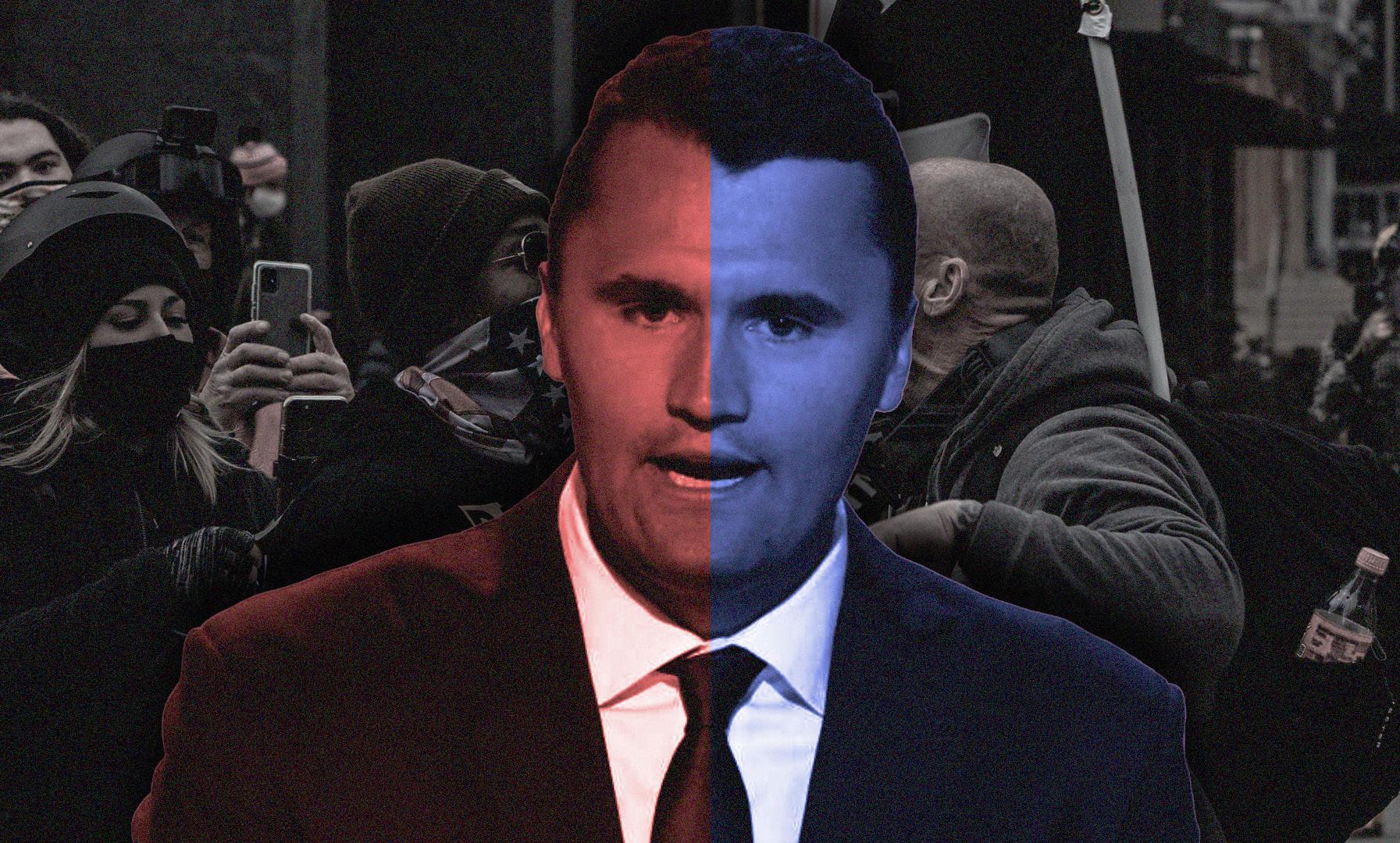
The six months after the assassination of Charlie Kirk have allowed me to reflect on its lessons with the gift of time. When conservative activist and podcaster Charlie Kirk was killed on Sept. 10, 2025, it sent shockwaves through the United States and the world. To me, it seemed that the mounting polarization had finally reached its pinnacle, and as I watched the media, politicians and the country in the following days, I was waiting for something miraculous to happen. I was waiting for unity. Yet, no one could agree on anything.
First, it was the events of the assassination itself. Who shot him? Why? What was their political leaning? Did his family see the events in the flesh? To me, these questions only served one purpose: to distract and to pull people apart. If we spend more time researching the facts of a case, rather than pondering the death of the deceased, we immediately become desensitized. Rumors of Kirk’s family being in attendance were spread over various media platforms, including the BBC, before they changed it.
For many, the lie about his family came off as an attempt to elicit sympathies from the people who did not agree with Kirk. Yet, this only did the opposite. Upon the discrediting of this rumor, the discrediting became the focus. When a public figure is polarizing, sympathy is often generated by emphasizing their proximity to widely accepted symbols of innocence or virtue — family life, charity or church attendance, to name a few examples. These associations are usually meant to soften or
complicate public judgment. I don’t doubt that there is evidence of Charlie Kirk being associated with any number of these things, but the fabrication of it in this instance was worse than its absence. For many, it raised a confounding question. If the presence of his family at the assassination was needed to earn sympathy, was the sympathy deserved?
Survivors of school shootings, who witnessed the death of their fellow friends and classmates, may find Kirk’s comments that gun deaths are
LETTER TO THE EDITOR
a “prudent deal” of the Second Amendment, at the very least, in poor taste. Avid defenders of the Second Amendment might understand his point. I could go on in the same fashion for any number of statements he made, but a person’s value should not be measured by the rhetoric they spew. It should be valued by the fact that they are human.
The lesson I learned from the assassination was how far from unity society is. No one is blameless, nor does any one group hold the entirety
of the blame. Death by targeted shooting or assassination in politics is always sad. It shows that society is unable to be tolerant. Tolerance is a necessity to democracy. Any act of political violence shows intolerance. Yet, as Kirk himself said, “You will never live in a society when you have an armed citizenry and you won’t have a single gun death. That is nonsense. It’s drivel. But I am — I think it’s worth it.”
Even in a society that treats gun deaths as the price of certain freedoms, they should still be recognized as an evil — albeit a necessary one to some. Looking back to the lessons America has learned from the killing of Kirk, I struggle to find one. When misinformation, further polarization and disunity are the effects of political violence, and no moral lessons about the dignity of the human person are derived, it shows the inability of society to come together, even for a moment.
The views expressed in this column are those of the author and not necessarily those of The Observer.
Contact Amaris O’Connor at aoconn27@nd.edu
The most famous woman to ever bear a child — Mary, the Mother of Jesus — is remembered daily at the school that bears her name, the University of Notre Dame. That tribute made the school’s betrayal of Christian values and of women all that much more atrocious when school officials offered Professor Susan Ostermann leadership of its Liu Institute of Asia and Asian Studies.
It’s not enough that she has since stepped back from a promotion. Ostermann needs to be fired.
Notre Dame proclaims itself the “leading global Catholic research university,” listing that mission first in its staff values. Ostermann’s continued employment at the University gives her influence over students and the institution, allowing an avid abortion activist and former member of the Population Council (ironically a leading force behind the One-Child Policy resulting in the killing of tens of millions of Chinese babies) to have a voice on school values and policy.
There is precedent for removing her completely. Indiana Catholic schools have taken measures
in the past against staff utilizing in vitro fertilization (IVF) and living in states of divorce without annulment, same sex “marriage,” and cohabitation, all practices in contradiction with the Catholic Church’s teachings.
These efforts to defend schools’ religious integrity made national headlines in 2018 with the employment terminations of Shelly Fitzgerald and Lynn Starkey at Roncalli Catholic High School. Both counselors were engaged in separate same sex “marriages,” in contradiction with Catholic teaching.
Both counselors went to court against the Archdiocese. The 7th Circuit upheld rulings in the Archdiocese’s favor in both Fitzgerald’s and Starkey’s cases, citing the “ministerial exception,” which allows religious institutions to make staffing decisions according to the upholding of religious beliefs.
With its clear Catholic mission statement and religious foundation, Notre Dame could absolutely follow suit in terminating Ostermann’s employment — and win any court case she might bring as a result. Yes, going to court is expensive; so is losing faithfully Catholic students and donors.
Outside of money, Notre Dame retains a nationwide influence in religious academia, an influence that, in light of this scandal, begs further scrutiny.
The Notre Dame Diocesan Scholars Program, which provides diocesan students nationwide with full-tuition scholarships to the University, advertises the creation of “a lasting bridge between your diocese and Notre Dame, opening doors for future generations of faithful scholars to study, grow, and lead for the good of the Church and the world.”
Yet the University’s refusal to defend the Church’s teachings in its hiring practices — and beyond — betrays the possible wolf in sheep’s clothing conflict in this program, bringing bright young minds from Catholic schools into a morally corrupted institution parading as preeminent Catholic higher education. Further evidence of this corruption moral code is found in the response to remarks made by Catholic former Notre Dame football coach Lou Holtz. “People have taught me that to murder an unborn child at nine months is illegal,” Holtz
had said regarding former President Joe Biden. “That’s not part of the Catholic faith.” University President Fr. John Jenkins renounced the remarks as not an indication of University agreement with Holtz’s views.
This reaches beyond Notre Dame’s own South Bend campus, and even beyond higher education. Through its Alliance for Catholic Education (ACE), the University influences Catholic schools and their teachers nationwide. Notre Dame can’t be trusted to “integrate academic excellence and spiritual growth” at its own institution. How can it be trusted to do so for our youngest minds?
Archbishop Charles Thompson of Indianapolis set the example in 2019 when two more Archdiocese of Indianapolis high school teachers were found to be in a gay “marriage,” one at Cathedral High School and one at Brebeuf Jesuit Preparatory School. Thompson demanded the schools uphold Catholic values at the risk of severing ties with the Archdiocese.
Cathedral ultimately consented, cutting ties with the
teacher to retain its Catholic identity and ongoing relationship with the Archdiocese. When Brebeuf refused, Thompson followed through and cut ties with the school.
Bishops around the country condemned Notre Dame’s promotion of Ostermann and her blatant pro-abortion advocacy. It is time for them to also step up in the same spirit of Archbishop Thompson, ending their diocesan partnerships with the University if serious changes are not made.
Any bridge built on the deaths of preborn children ought to be burned. Notre Dame must face the music: Uphold Catholic values or lose all ties with America’s dioceses.
Our Lady, the Virgin Mary, the namesake of Notre Dame, carried the preborn Christ child in her womb. Notre Dame must not continue to betray its namesake and the beautiful motherhood she so perfectly exemplifies. If it does, it is time to officially strip the University of its claim to Catholicism.
Kristan Hawkins Founder and President, Students for Life of America
March 20
By Redmond Bernhold Opinion Editor Emeritus
Notre Dame would die before giving us ‘Sex and the City.’”
My friend’s text was spot on. She saw Northwestern’s announcement on Instagram, and she was annoyed. Annoyed not only because she was somewhat jealous that Sarah Jessica Parker is their commencement speaker. Annoyed because she was reminded of Notre Dame’s past. Annoyed at political controversies staining a day of celebration.
She sent a screenshot, which ignited a group chat into a flaming debate — who should Notre Dame invite as commencement speaker?
“I feel like they need to do someone who is either an immigrant or immigration advocate,” someone wrote.
“At this point, I kinda want someone not in politics,” another said. “Lorde would be ideal.”
(No, I did not write that one or any of these.)
In a different group chat, I asked the same question.
Rachel Sennott, someone said. Odessa A’Zion. Wendy Williams. Zendaya. Someone texted Drew Barrymore.
“No, she’d flirt with undergrads.”
The only consensus my friends had: We don’t want politicians. We know how that will play out.
In 2009, some graduates staged a walk out during
President Barack Obama’s speech. In 2017, dozens of students fled commencement when Vice President Mike Pence began addressing students. Many other presidents have been invited as commencement speakers: Dwight Eisenhower, Jimmy Carter, Ronald Reagan, George H. W. Bush and George W. Bush. These announcements and ceremonies, too, have been controversial.
Last year, too many debates were spurred in this newspaper. An editorial called for President Trump to speak, and a dissenting editorial called for the opposite. Letters to the editor followed suit, intensifying the already palpable polarization.
Right now, polarized
politics prevail. They show the worst in ourselves, our neighbors, our society in an attempt to achieve an ideal, just society. But we know what happens when we invite politicians to the stadium.
This academic year, Charlie Kirk’s assassination and Susan Ostermann’s brief appointment taught me many lessons as opinion editor. The biggest perception: Campus is too fragile for most advocates or politicians — even a moderate of any party — to stand in front of us 2,000-something graduates on a sunny Sunday in May.
No political figure can heal a broken America, certainly not through a graduation speech. Commencement

is not an invitation for fiery rhetoric. It’s a moment for the class to be together, hearing one voice that was thoughtfully chosen to represent the pursuit of the common good.
That’s why I’m suggesting Dr. Robert Winn, a Notre Dame alum of 1987. Winn is the first elected minority president of the Association of American Cancer Institutes, director of Virginia Commonwealth University Massey Comprehensive Cancer Center and board member of the American Cancer Society. He’s also not a political figure.
His research illuminates the societal and physical factors that may lead to healthcare disparities, especially for those diagnosed with lung cancer. His efforts to connect disempowered communities to medicine are something I hope all of the Notre Dame family can find consensus.
An address from Winn would show Notre Dame’s commitment to uplifting voices that are known but not always seen as much as they should be. Many commencement speakers are examined and scrutinized for their social stances and past controversial remarks. Choosing Winn, or someone with similar credibility and attention from the public eye, would preserve the intent of graduation.
The Observer’s majority editorial last year said, “Notre Dame’s relationship with the civil fabric of this nation — and its head of state — is a special one.” I agree. Everyone should respectfully engage with each other on campus in an open dialogue, and politicians are at the forefront of that priority.
However, May 17 is not the day for Notre Dame to give a microphone to politics or attempt to heal the social veil of a broken nation. One commencement can’t do that. Any politician risks sparking dialogue that distracts from the true meaning of graduation. Graduation should be about our grit, accomplishments, family, friends and faith.
It’s not about Iran or Gaza. It’s not about abortion, guns or elections.
It’s not about a Democrat or Republican.
It’s not about politics.
The views expressed in this column are those of the author and not necessarily those of The Observer.
By Ana Prestamo Columnist, “Mind the Gap”
Philosophy has always been an unconventional choice for a major — at least within my social circle. Everyone I know has opted for a more traditional route — pursuing finance, business analytics, or economics — my entire family included. That being said, I’ve watched my brothers pursue successful careers in private equity, and most of my friends land jobs at top-tier investment banking firms — the ultimate step for Wall Street aspirants. And, while I am well aware that their initial
base salaries are way beyond what I could ever dream of, I don’t regret my choice at all. Studying philosophy, or any of the humanities for that matter, has given me something that artificial intelligence cannot replace: a closer understanding of what makes us human. And in a time when AI can solve almost any technical problem, understanding what makes us uniquely human becomes all the more valuable.
Seeing a “data-driven decision” that was actually a value judgment in disguise. Translating a complex situation into a framing
that makes everyone in the room suddenly understand it — because rhetoric was your training ground. Knowing how to think, how to write, how to communicate, which questions to ask — these things, I believe, will be the crux of life when AI has overtaken all realms except that of humanity.
This might be my internal coping mechanism trying to face the fact that I won’t become a millionaire any time soon, but I truly believe that now is the time when the humanities regain their longlost relevance in society.
Now is the time when
questions like: “What would Bostrom think?”, “What would Confucius’ advice be?”, “What dystopia would Orwell predict?” and “What tragedy might Wilde illustrate?” need to take precedence over questions like “How do I use Excel to calculate this?,” “How do I maximize my ROI?”, and “How do I compile a market size report?”.
Seeking answers to the former produces meaning; seeking answers to the latter produces output.
Humanities — the world is finally asking the questions only you can answer. Encourage
society to turn to you when seeking purpose and meaning. Remind us of our worth and value in a world that seems to convince us that we are replaceable. Ironically, as AI gets stronger, so too will you.
Philosophy, you’ve done a great job at preparing me for what’s to come. Thank you.
The views expressed in this column are those of the author and not necessarily those of The Observer.
Contact Ana Prestamo at apresta2@nd.edu
By Patrick Kompare Columnist
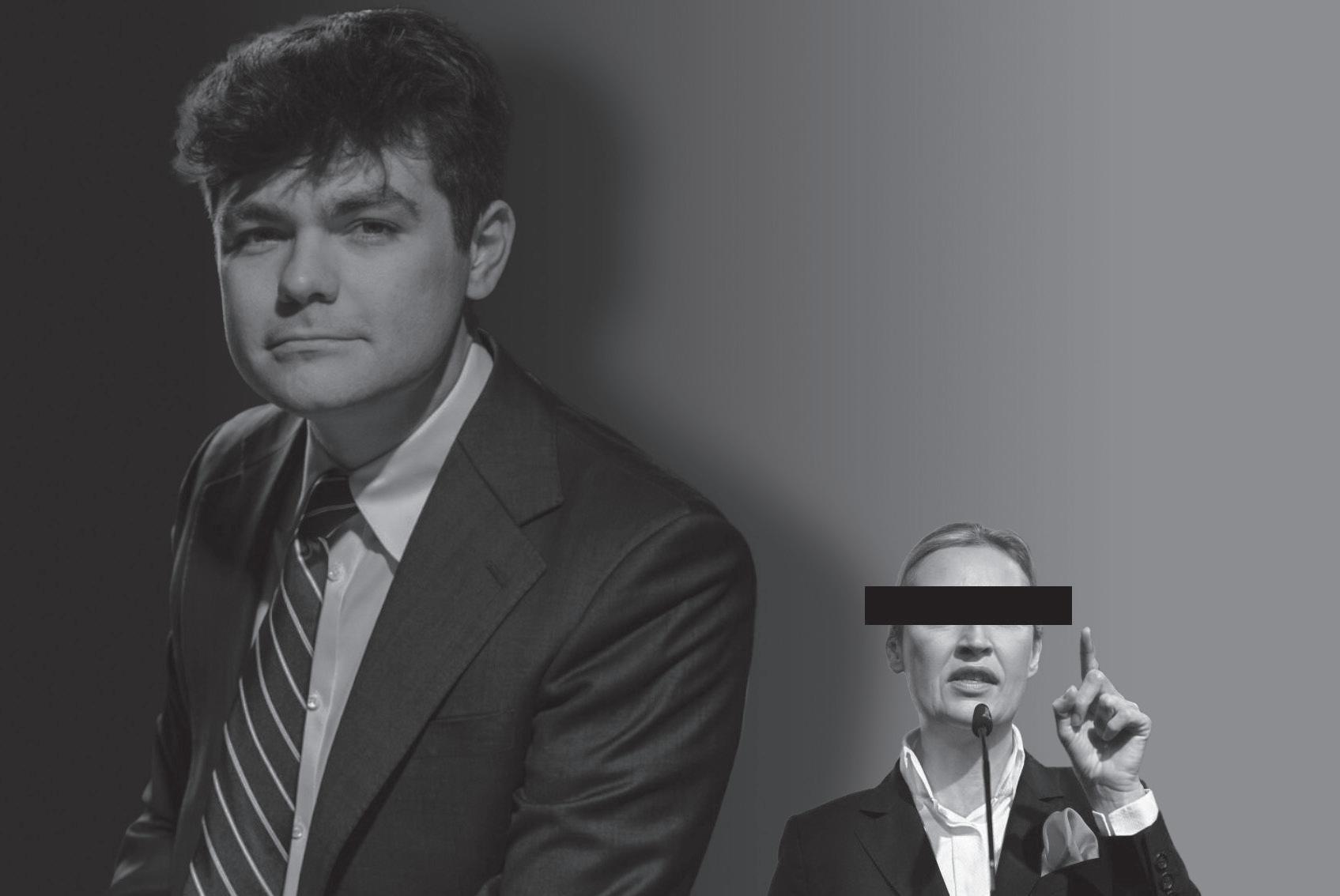
Germany is in crisis. The Alternative for Deutschland, the German far-right party, has climbed in popularity, while almost every other political party has declined in support. It is currently neck and neck in the polls with the CDU/CSU, Germany’s center-right political alliance. The AfD, which has been classified as “right extremist” by Germany’s domestic intelligence agency and which was caught discussing plans with neo-Nazis to deport German citizens descended from migrant groups, is a threat, but currently has no path to power. German political parties, institutions and the general public have all refused to cooperate with the AfD, denying them the ability to put their anti-democratic policies into practice. Germany is in crisis, and the Germans know it and act like it. This is miles away from how the United States has responded to a growing ideology that devalues life and is incompatible with democracy and Catholicism.
This sounds right now like another column about polarization and radicalization, in which I make an argument about how the Republicans are so right-wing, which will invite a response from a Republican about how the Democrats are the real radicals, and nothing of substance will be gained. This “both-sidesism” does have some truth to it: Republicans and Democrats have both shifted further to the right and left, respectively. This is a natural part of politics. However, I believe that there is a form of radicalization which is inherently malignant, and which is becoming more apparent in the upper echelons of power: the devaluation of life and expansion of government violence.
Violence is, to an extent, inherent to government. For a government’s actions to have any meaning, they need to be backed by force, but that force is usually a last resort. Unfortunately,
our government is resorting to violence more and more. At home, U.S. Immigration and Customs Enforcement has become increasingly violent. LAst year saw the most deaths in ICE facilities in 20 years. Since Trump took office, eight people have been killed, and 19 have been wounded in shootings by ICE and Border Patrol agents.
Abroad, the United States is engaged in a war with Iran that Cardinal Robert McElroy, the archbishop of Washington, has characterized as “not morally legitimate.” The war is being led by a defense secretary who promised, “maximum lethality, not tepid legality,” and has delivered with a war that has killed over 1,000 Iranians, including over 100 children in a school attack. Cardinal Blase Cupich of Chicago has criticized the Trump administration for showing footage of the war cut with action movie scenes, lamenting the “gamification” of war.
This cavalier attitude toward death at the highest echelons of power is occurring at the same time that an older ideology with an inherent disrespect toward life makes a resurgence: fascism. Nick Fuentes, a white
supremacist who has praised Adolf Hitler and claims Jews run the world, has a growing and increasingly influential fanbase. According to a poll by the Manhattan Institute, an estimated 50% of Republican men under 50 agree with Fuentes that the Holocaust didn’t happen or was exaggerated. College Republicans — the national organization, not our campus chapter — recently appointed a Fuentes fan as political director.
The Trump administration is expanding the circumstances under which the government is willing to use violence, while a nascent fascist movement is rapidly expanding in numbers and influence. It would be disingenuous to suggest that no one is opposing this movement, but there is much to be desired. Confronted with the rise of right-wing extremism, German society has moved to ensure that the AfD is as far from power as possible. Every other major German political party, representing 74% of German voters, has refused to work with the AfD at the federal, state and local levels, preventing them from influencing government in a coalition. A number of German stores have signs asking AfD
members to take their business elsewhere.
These measures may seem extreme if Germany were not a country littered with reminders of the cost of doing otherwise. In Germany,
the streets are littered with small golden bricks called Stolpersteine. These stones sit outside the homes of people abducted by the Nazis. You can walk the streets of Berlin and see the cost of far-right extremism on your street, in the neighbors lost and families torn apart. An ideology of death cannot be reasoned with. It cannot be compromised with. Those who would sentence their fellow citizens to death for being a political inconvenience will rot the foundations of democracy with any modicum of power. If we are a Catholic university that upholds the sanctity of life, we must oppose the expansion of violence under the current administration, and we must strongly oppose the slow creep of fascism from the shadows.
The views expressed in this column are those of the author and not necessarily those of The Observer.
Contact Patrick Kompare at pkompare@nd.edu

By Luke Foley Scene Editor
Awards season has finally ended, and most people treat this as an opportunity to finally move on to next year’s slate of films. However, before we look ahead, I want to look back and celebrate one film from last year that didn’t get the love it deserved and sadly walked away with zero Oscar wins: “Bugonia.”
“Bugonia” is the third film in three years from renowned director Yorgos Lanthimos, and his rapid pace might be the reason for its somewhat muted response; people got their Lanthimos kick with “Poor Things,” had their dessert with “Acts of Kindness” and were then simply too stuffed for “Bugonia.” However, I think this is a shame, as “Bugonia” is a refined evolution of Lanthimos’ singular style. In “Bugonia,” his direction is mature yet still displays his trademark quirkiness and discombobulation. Off-kilter shots and weird lenses abound, but they never feel gratuitous. The eerie direction and gorgeous VistaVision cinematography are all in service of a brilliant script from Will Tracy that is urgent, empathetic and profound.
“Bugonia” is about two conspiracy theorists, Teddy (Jesse Plemons) and his intellectually disabled cousin Don (Aidan Delbis), who kidnap Michelle Fuller (Emma Stone), the CEO of the pharmaceutical conglomerate Auxolith, because they believe she is an alien destroying Earth. It’s a simple premise, but the film explores it as a symptom of the larger social crisis we face, arriving at the most precise diagnosis I’ve seen in any recent movie or show. The film accurately posits that these two men have been pushed to the brink by a society full of alienation and exploitation. The never-ending march of the technocratic paradigm, its narrow focus on output and gain, has eviscerated the world;
technological and economic progress is not ordered towards humanity but towards itself, leading to the collapse of all other spheres of life.
The film’s clever motif of bees and colony collapse disorder illustrates this crisis. Teddy says the elites want everyone to become like bees: “A dead colony. Broken. Atomized in a trillion directions with no way home again.”
Teddy is full of rage and desperate for some explanation behind the death spiral. Yes, he’s mad about the environmental destruction threatening his beekeeping hobby, but his rage is much more personal than that. Teddy’s mom, a victim of the opioid crisis, was promised a cure by Auxolith — the very kind of pharmaceutical company that created the crisis to begin with. Yet their cure only made her condition worse, and the only recompense he got was a meager payout and empty promises from Michelle that Auxolith would do better.
In his effort to make sense of such a cruel and broken world, Teddy cycled through the full gamut of ideologies before arriving at the
conspiracy theory that Michelle and her alien race from the Andromeda Galaxy are destroying the planet. While this could have easily landed as a farce, it doesn’t because Plemons gives one of the best performances I’ve ever seen in a film — really. He plays Teddy with remarkable vulnerability, teetering between violent rage and heartbreaking despair, and it’s this vulnerability that keeps the character from becoming a caricature of a backward populist. Because of Plemons’ deeply felt performance, Teddy’s indignation toward the world is one that many Americans can relate to at this moment.
The current status quo has led to moral chaos, widening wealth inequality, environmental destruction, “enshittification” and increasing loneliness, all the while our leaders largely ignore these things and gloat about continued GDP growth. There is an undeniable disconnect between the interests of our leaders and the common good, and you don’t have to be a conspiracy theorist to acknowledge that. The standoff between Michelle and Teddy throughout the film is
a microcosm for this tension. You have the paternalistic technocrats like Michelle on one end, insisting that the angry masses are delusional and have been worked up in a frenzy by online disinformation. As such, Stone’s performance as Michelle is bone-chilling. She perfectly captures the glib corporate talk and seething contempt that elites like Michelle have towards the Americans they’ve steamrolled. And then you have the raging populists like Teddy on the other end, convinced of their enlightenment and willing to engage in extreme violence. I don’t think the film is a full-throated endorsement of populism, but it shows that people’s disillusionment with the current order is valid, even if their reaction takes on unproductive and dangerous forms. This makes the film the most thoughtful entry in the recent (and slightly oversaturated) slew of class conflict films from Hollywood, offering a radically empathetic and unflinching treatment of populist rage while steering clear of a neat solution.
Despite the film’s impeccable direction, cinematography,
performances, script and score, it left the Oscars empty-handed. In fact, Plemons wasn’t even nominated for best actor. In my opinion, his snub is one of the biggest Oscar injustices in recent history. He gave a better performance than everyone who was actually nominated and deserved recognition for bringing to life a character that powerfully captured the cycle of political despair and anger many Americans are caught in right now. And while Coogler’s script for “Sinners” is fantastic and a worthy enough winner of best original screenplay, I do wish the category went to standalone screenwriters like Tracy more often. Hollywood doesn’t appreciate them enough, and always giving the award to directors who write their own screenplays feels a little cheap. And does Ludwig Göransson really need a third Oscar? Ultimately, I think “Bugonia” was too challenging and uncomfortable a film for the academy to swallow. While people certainly had an appetite for political films this year – “One Battle After Another” did win best picture, after all – I think “Bugonia” was just too bleak with its assessment of America for some. While this was a very strong year for film, with many formidable peers, I really do wish “Bugonia” had gotten more love and attention. You often hear complaints that Hollywood is “out of touch” and detached from “real” America: it’s Hollyweird, full of coastal navelgazing! Yet “Bugonia” unflinchingly examines the brokenness at the heart of the country and extends genuine empathy to Americans who have succumbed to despair and extremism. So before you move on to this year’s slate, you should check out this brave, deeply incisive film that refuses to look away.
Contact Luke Foley at lfoley2@nd.edu
By Sheila-Marie Manyara Scene Writer
With the Oscars quickly approaching, I decided it was time to stop procrastinating and watch the animated short and feature-length films that have been nominated. Once again, the Browning Cinema at the DeBartolo Performing Arts Center had multiple different screenings of the shorts, and I ended up seeing the last showing earlier this afternoon. All five nominated shorts were screened as well as a bonus short film called “Èiru,” which I would highly recommend.
The short films were screened in the following order: “The 3 Sisters,” “Forever Green,” “The Girl Who Cried Pearls,” “Butterfly” and “Retirement Plan.” My personal favorite was “Forever Green.” It had a very simple plot, but I thought the style and animation really made up for it. “Retirement Plan” and “The 3 Sisters” were
really funny, and I liked “The Girl Who Cried Pearls” enough, except for the last part. I do, however, think that the Academy Award will and should go to “Butterfly.”
The film looked like a painting, using the colors to drip, blend and swirl to transition into different parts of the story. It also wasn’t too afraid to be very visually abstract at times, and this made it all the more striking. The story is based on the real life of Alfred Nakache, an Olympic swimmer and Holocaust survivor. This film was both haunting and beautiful, and I would be shocked if it doesn’t win tomorrow night.
My thoughts on the featurelength films are slightly more complex this year. I was already slightly frustrated when the nominees were announced and “Ne Zha 2” did not make the cut. The two films not from a major animation studio are “Arco” and “Little Amelie or the Character of Rain,” and I must say I am very happy
that there are two 2-D animated films nominated this year. “Arco” tells a story of childhood and change through time travel, and the characters were really fun and well written.
Of all the films nominated, “Little Amelie or the Character of Rain” is the most beautiful. It looks like a painting that has come to life, and somehow each character feels highly expressive despite the few details on their faces. If the award was to go to a more indie film, I think this film should win.
In this category, “Elio” and “Zootopia 2” are the weakest, in my opinion. “Elio” was not as bad as some critics made it out to be, but, that being said, I do not believe that either “Elio” or “Zootopia 2” had that strong of an impact in terms of animated visuals or even their stories.
“K-Pop Demon Hunters” is one of many examples of a film that went from popular to hated in what felt like the blink of an eye, so
I can understand that some people might not like the idea of this movie taking home best animated film, but I still think it deserves the win. This movie, in my opinion, is the strongest contender in the category in terms of its visuals, creative and expressive animation and, of course, its soundtrack. Not only were the songs good, but the way that these songs were utilized in the film and transitioned between speaking and singing struck a chord for a musical theater nerd like myself.
Of the major Western animation studios, I have a soft spot for Sony Animation for good reason.
The 2D/3D hybrid style of animation that they used in “Into the Spiderverse” was groundbreaking for the industry. All this to say that it would be great for Sony Animation to have its next win tomorrow night. But if it goes to “Little Amelie or the Character of Rain,” I can make peace with it.
When “K-Pop Demon Hunters”
won for best animated feature, my first thought was “I’m always right.” But then “The Girl Who Cried Pearls” won for best animated short, and I realised that maybe I can be wrong. The choice for animated short film really threw me off. I can’t say that I was angry about it, but I will admit I don’t understand that decision.
What I was even happier about was “Golden” winning for best original song (making it the first K-Pop song to win an Oscar). It’s always a celebration when animated films win outside of the animated categories. This joy was soured, however, when one of the songwriters, Yu Han Lee, was cut off before he could even say thank you. I understand why speeches get cut off at the Oscars, but exceptions have been made, and I think there was a better way of handling that.
Contact Sheila-Marie Manyara at smanyara01@saintmarys.edu
By Natalie Swiderski Scene Copy Editor
Our king is back, ladies, gentlemen and emotionally deprived One Direction fans. Fresh off the success of his newly released single “Aperture,” marathon aficionado and parttime singer-songwriter Harry Styles delivered his fourth studio album on March 6, titled “Kiss All The Time, Disco Occasionally.”
It seems Styles’ time apart from the music industry has led him to the club for this album, as the traditional pop and rock leanings of Styles are put on hold. By no means does it reach the levels of “Brat” electropop and hyperpop that are currently dominating the charts. It is certainly a new direction for Styles, and for that I have to commend him.
As a club album relies heavily on the instrumental backing
of each track, it is evident that Styles has really put his longtime producer, Kid Harpoon, to work. The album is a masterclass in production, and I truly believe that the tracks could function alone without lyrics and vocals and still be just as successful. This does say something about the depth of the lyrics in many of the songs, and I can concede that this is not Styles’ most lyrically complex album. One might think that his four-year hiatus would have given him more things to say, but nevertheless the album is certainly still excellent.
“American Girls” was the track I had been most excited to listen to because, as a girl from Wisconsin, I certainly can fit the demographic of the title. This track did not disappoint in the least. Inspired by artists like Blood Orange and Tame Impala, the song is
soft and subdued in its verses, while coming to a sharp climax in the refrain. Styles sings of his experiences with the idea of American girls, noting that most of his friends have ended up marrying them. As Styles is currently involved with American actress Zoe Kravitz, he may just fall right into this pattern as well.
Another incredible song off the album is “Taste Back.”
A track most similar to the bubbly pop bravado of 2022’s “Harry’s House,” “Taste Back,” explores the emotions surrounding a person unexpectedly coming back into Styles’ life after many years apart. Throughout the song, Styles ponders if the person has come back for a full-fledged reunion, or simply “a little love.” The song is both extremely honest and touching, yet it still has the potential to find itself as a number one summer pop hit,
similar to the success of “As It Was” back in 2022.
“Dance No More” does not contain such emotional depth, but it is the track most conducive to the album’s title. Styles takes disco to a whole new level with this song, abandoning the smooth jazz-like disco of the ’70s with the Bee Gees and Donna Summer, rather categorizing disco as meaning anything a person might dance to. And dance to it we will. The beat is truly addictive, with its phenomenal mixing of synths with drums providing the most perfect stimulus for a night out on the town.
Styles brings his album back to the metaphorical and metaphysical genius of “Fine Line” in the final track of the album, titled “Carla’s Song.” Struck by witnessing a friend’s first experience listening to the music of Paul Simon, Styles takes this song to remark on the world
around him. Repeating the line of “It’s all waiting there for you,” Styles seems to be in awe of the infinite possibilities present in our daily lives. The song is deep and contemplative, furthered by an upbeat and almost urgent collection of backing instrumentals, the perfect track for a night drive. Therefore, I can confidently say that Harry Styles’ fourth album, “Kiss All The Time, Disco Occasionally,” is unequivocally a success. Though I do wish that Styles hadn’t taken four years to come out with this album, as an overwhelmed college student, I can certainly understand the need for a little time off. And if that is truly my biggest complaint about his latest work, one can be assured that Styles has very much still got it.
Contact Natalie Swiderski at nswider2@nd.edu
By Luke Foley Scene Writer
The film awards season is both exciting and exhausting. It’s a time to watch your favorite filmmakers and actors receive awards that are authoritative testaments to their excellence, but it’s also a time for insufferable discourse and tribalism that turns cinephilia into a deeply politicized endeavor. This past awards season finally concluded Sunday evening with the 2026 Oscars. The dramatic narratives heading into the ceremony — Paul Thomas Anderson’s long-overdue Oscar, the populist enthusiasm behind “Sinners” and Timothée Chalamet’s brazen quest for a best actor win — made for one of the more exciting ceremonies in recent years. So now that the dust has settled for a few days, did the academy get it right?
Anderson’s “One Battle After Another” has been the top dog this entire awards season, and rightfully so. It’s a brilliant, madcap adventure that sends up the current rise of authoritarianism and white nationalism in our country. The eccentric characters, hilarious comedy and the sweet father-daughter relationship at its core make for an urgent political satire that remains freewheeling and heartwarming. It’s one of — if not the — best in Anderson’s impeccable career and made an undeniable case to finally end his infamous Oscar dry spell. While there were some limp attempts to take down the film for being secretly racist, it still won every major precursor leading up to the Oscars. However, many, including myself, still thought it wasn’t a definite shoo-in for
best picture thanks to Ryan Coogler’s “Sinners.”
“Sinners” is a miraculous film on many fronts. Its everything but the kitchen sink approach shouldn’t work on paper — a vampire historical drama musical about the Jim Crow south and capitalist exploitation sounds ludicrous — yet Coogler masterfully handled its genre mashups and abundance of ideas with ease. It’s a crowdpleasing blockbuster with sex, gnarly vampire slaying and a catchy soundtrack that is still more intellectually stimulating than most arthouse fare. Not only was it an artistic triumph, but also a commercial triumph, becoming one of the highestgrossing original films of the past decade. Given its horror elements and early March release, it initially didn’t seem like a serious contender for awards season, but a record-breaking 16 Oscar nominations and an overwhelming surge of grassroots support later, many thought it could upset “One Battle After Another” at the Oscars.
Now, even though I love both films, I am deferential to “One Battle After Another” and believed Anderson and crew deserved to win in most categories. The academy smartly agreed to split the difference. “One Battle After Another” took home the top prize of best picture, alongside Anderson winning best director and best adapted screenplay. Meanwhile, Coogler won for best original screenplay. I think this was the best outcome possible. Both men and their excellent films got much-deserved wins, and both films’ fandoms can walk away from this ceremony very pleased. Moreover, I am not
worried at all about Coogler having another chance at best director or best picture; he is still very young, and I’m sure he’ll receive whatever funding and resources he desires for his next bold original film following the third “Black Panther” film. The other big narrative heading into Sunday was the best actor race. This was one of the most competitive lineups in recent years, with several actors giving incredible, dynamic performances. But the actor who seemed most poised to come out ahead was Chalamet for his performance as Marty Mauser in “Marty Supreme.” It was a beguiling performance, as Chalamet assumed the role of a man with a monomaniacal pursuit of greatness, but the line between performance and reality blurred during his awards season campaign. He was feral for that Oscar glory and unleashed a flurry of promotional tactics to promote the film and his central performance. And while these viral antics helped propel the film to become A24’s highest-grossing of all time, I think they left a bad taste in voters’ mouths. Some of these promotions came off as arrogant and unbecoming — hosting a career retrospective celebration at the ripe age of 30 is definitely crazy on the face of it. The cards are already stacked against you in this category if you are a young, handsome and ambitious heartthrob — just look at how the academy snubbed Leonardo DiCaprio for decades, only relenting after he nearly killed himself in frozen rivers and animal carcases for “The Revenant.”
Chalamet’s swagger and selfconfidence were always going to
rub Oscar voters the wrong way and make an improbable win an impossible win, no matter how good a performance he gave. This hubristic persona — as well as a scandalous expose about “Marty Supreme” director Josh Safdie and all the “Sinners” goodwill — ultimately allowed the more veteran Michael B. Jordan to swoop in and win best actor. Now, Jordan wasn’t bad in “Sinners” but he wasn’t outstanding either; he gave a good performance. But I think every other actor nominated in the category gave a better performance than him; I even think there were performances not nominated that were better than Jordan’s (the injustice of the Jesse Plemmons snub will reverberate for decades to come). Nevertheless, Jordan is a very affable, upstanding guy who has been putting in solid work for decades, and it’s hard to get too mad about someone whose very first words in his acceptance speech were “God is good.” I hope this loss spurs Chalamet to keep choosing daring projects and delivering captivating performances. His time will come soon enough, but he just needs patience and a better PR strategy.
Besides those big thread lines, there were lots of other great moments throughout the night. Sean Penn winning his third Oscar for best supporting actor despite barely campaigning and giving his previous statues to Ukraine so they could be melted down into bullets to “kill Russians” was oddly satisfying. It was a reminder that the raw power of a performance is sometimes all it takes to win; also, his skipping the ceremony for a meeting with Zelensky made
the whole win even more amusing. Jessie Buckley’s completely expected win for best actress for her devastating performance in “Hamnet” was still a pleasure to witness. Amy Madigan’s win for best supporting actress for her villainous turn in “Weapons” was somewhat surprising. I think Teyana Taylor should have won for imbuing a relatively thin character with an explosive mystique, but Madigan still gave a very strong performance. Between her win and host Conan O’Brien devoting his opening monologue to riffing on the film, Hollywood clearly adores “Weapons,” making its total shutout from every other category something of a mystery. And lastly, Autumn Durald Arkapaw’s historic win for best cinematography in “Sinners” was both highly deserved and an embarrassingly overdue moment for representation. The night was not perfect: Chalamet losing a worthy best actor win while enduring constant derision from Conan and winners’ speeches made the night feel like a cruel humiliation ritual for a young star that Hollywood should be immensely grateful to have; “Bugonia” and “Marty Supreme” walking away with zero wins definitely stung and the abrupt cutoff of the acceptance speech from the “Golden” songwriters was shockingly rude. But overall, the academy demonstrated sound judgment in its decisions this year. This is the third year in a row I’ve been pleased overall with the Oscars; I’m cautious of this hot streak and fully bracing myself for a terrible 2027.
Contact Luke Foley at lfoley2@nd.edu
By Zach Jones Sports Writer
Like the majority of Notre Dame students, Notre Dame baseball spent their spring break away from campus. However, rather than lounging at the beach or resting with family at home, the squad was hard at work on the road.
They played weekend series against ACC sides Duke and Louisville, and faced Queens University of Charlotte in the midweek. That’s seven games in 10 days. The men in green returned to South Bend with a 4-3 record on the trip, taking two games out of three at Duke and beating Queens in the Tar Heel State before posting a 1-2 record in Louisville.
Duke
Notre Dame began the slate with three games at Duke. Under Shawn Stiffler, the Irish hadn’t won an ACC opener and were 1-8 in ACC opening series games, but they got a monkey off their back with a 2-1 series win in Durham. Stiffler’s team won bookend games on Friday and Sunday, by scores of 10-4 and 2-0, respectively, while dropping a close one on Saturday, 6-5.
Irish staff ace Jack Radel led the charge on Friday night with another stellar outing, carrying the Irish to a 10-4 victory. The 6-foot-4 workhorse allowed one run on four hits in seven innings of work, striking out nine. Radel showcased a lively fastball in the 92-96 mph range and dominated the zone all night.
Notre Dame’s bats came out hot, tacking on five runs in the fifth and putting up crooked numbers in the third, eighth and ninth as well. Graduate outfielder Drew Berkland and sophomore left fielder Bino Watters each led
the lineup with three hits. Watters flashed his power with two doubles and a homer, recording eight total bases on the night.
The Irish looked poised to take the series on Saturday, leading Duke for most of the game until a ninth-inning rally put the Devils ahead 6-5. Freshman lefty Caden Crowell had the best start of his Irish career, giving up two runs over five solid innings. The Irish took the lead after a three-run second and carried a 5-3 advantage into the bottom of the ninth, but were walked off on a hot shot to third base off the bat of Duke DH Kaden Smith. The Irish recorded seven hits on the night, each coming from a different hitter. Duke recorded 10 hits and played a clean game while the Irish’s lone error came in the pivotal ninth inning.
After Saturday’s gut-wrenching loss, the Irish grinded out a gutsy 2-0 victory in Sunday’s rubber match. Similarly to Saturday’s contest, the Irish got a solid performance out of their starter and leaned on their relievers to close out the game. Senior righty Ty Uber recorded 5.2 scoreless innings before handing it over to the bullpen in a 0-0 ballgame.
The Irish held a two-run lead after seven, while the bullpen trio of freshman Dylan Singleton, graduate Eli Thurmond and senior Noah Rooney worked some magic by stranding an astronomical eight runners in the final three innings to blank the Devils. Rooney came on in the ninth with men on second and third and two outs in a near identical situation to the previous night when he was walked off by Duke. Rooney, however, slammed the door on the Devils with a punchout, giving the Irish a 2-0 victory and an ACC series win.
Facing the Queens University Royals in Kannapolis, N.C., on Tuesday, Notre Dame won a sloppy 11-6 affair in which the Irish committed four errors and issued six free passes. It was a reliever parade on the mound for the Irish with five pitchers toeing the rubber and none going more than 2.2 innings. At the plate, the Irish totaled eleven hits. Sophomore right fielder Jayce Lee and sophomore first baseman Parker Brzustewicz each homered in the contest.
Notre Dame ended their road trip with a back-and-forth weekend series loss at ACC foe Louisville. The Irish took Friday’s opener 14-11 but dropped Saturday’s game 8-7 in another bullpen heartbreaker, before losing Sunday’s rubber match 21-12.
The Cardinals, who opened the season ranked No. 8 nationally by D1Baseball after a trip to the College World Series last year, entered the contest at 12-5 and recently got top slugger Zion Rose back in the lineup after a preseason foot injury. Led by Rose, the Louisville offense was the best lineup Notre Dame had faced all season. The Cardinals lineup proved a formidable adversary for the Irish pitching staff, jumping all over the usually-solid Irish starters and stretching Notre Dame’s bullpen thin.
Radel got the start for the Irish on Friday night but wasn’t his usual dominant self, giving up six runs, four of which were earned, through three innings of work. Facing a six-run deficit after three innings, the Irish offense exploded for two grand slams in the fourth inning. Here’s how the frame unfolded: single, single,
single, walk, home run, walk, walk, hit by pitch, hit by pitch, home run.
Louisville responded with a two-run bomb in the bottom of the frame, but the Irish put up runs in the sixth, seventh, eight and ninth to hold on for a 14-11 win. Sophomore shortstop Noah Coy and junior DH Davis Johnson each blasted grand slams in the fourth. Johnson went 3-5 at the plate and ended a triple short of the cycle, recording seven total bases and five RBI on the night to lead the Irish in both categories.
Just as against Duke, Notre Dame looked poised to take the series on Saturday until a late inning rally by the Redbirds put the game out of reach. Crowell got the starting nod for Notre Dame and gave up five runs over five innings. Johnson stayed hot with a two-run shot in the second and Brzustewicz added two more with a double in the third. The Irish were down 5-4 when Crowell exited the game but tied it up with a run in the sixth.
Another double by Brzustewicz put the Irish up two, but the Cardinals struck for three runs in the bottom of the eighth and fended off a ninth-inning Irish rally to take the game 8-7. Brzustewicz went 3-5 at the plate and paced the lineup with four RBI. Freshman second baseman Mason Barth went 3-4 with a walk, reaching four times on the night and stealing a base as well.
If Saturday’s game against Louisville resembled the Saturday Duke game, Sunday’s game against the Cardinals was anything but Notre Dame’s rubber match versus the Blue Devils. Notre Dame lost an exciting, offense-heavy affair 21-12, in a game that saw six lead changes.
The score sat at 7-5 in favor of Louisville after three innings and was knotted at nine apiece after four. Louisville held a 14-12 lead after seven innings, and after that the Irish bats went cold and their relief pitching faltered, giving up seven more runs for the 21-12 final score. Johnson performed well at the plate, going 2-5 with two homers and six RBI, while Lee collected three singles for a 3-6 performance.
Notre Dame baseball returned to South Bend with a 3-3 ACC record and a solid 4-3 mark on the trip. While the two Saturday losses sting, as the bullpen gets more experienced those close losses will become wins. A 3-3 start to ACC play is nothing for the Irish to fret over. Louisville went .500 in the ACC last year and made it to the College World Series semifinals. 3-3 also represents the best start to conference play the Irish have recorded under Shawn Stiffler. With a gauntlet of Clemson, North Carolina, NC State, Virginia and Florida State — all teams ranked inside the top 20 nationally going into the Louisville weekend per D1baseball.com — upcoming, it was essential for the Irish to pick up wins against Duke and Louisville, and they largely succeeded in that task.
Notre Dame takes on Central Michigan at home this Tuesday, St. Patrick’s Day, at 4:30 p.m. This weekend, the Irish will host Clemson for three games, with first pitches scheduled for 4:30 p.m., 2 p.m. and 1 p.m. on Friday, Saturday and Sunday, respectively.
Contact Zach Jones at zjones3@nd.edu
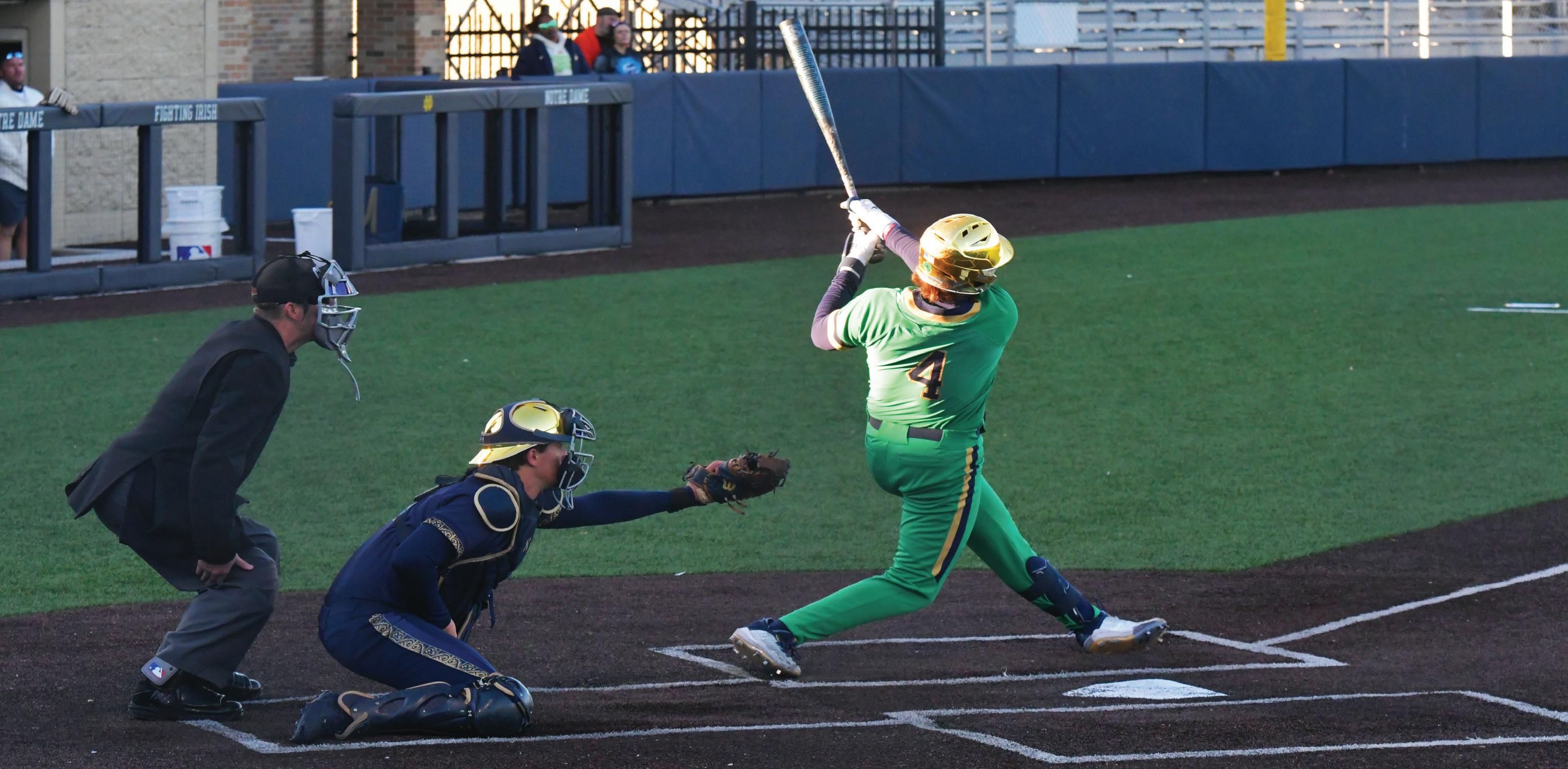
By Ben Hicks Sports Editor
After finishing the regular season with five consecutive victories, along with two more in the ACC Tournament, head coach Niele Ivey’s Notre Dame women’s basketball team earned a No. 6 seed into the NCAA Tournament. It is the fifth consecutive postseason berth for the Irish under Ivey, whose lone absence from the March Madness tournament came in her first year with the former national champion player at the helm. The previous four tournament appearances have resulted in trips to the Sweet 16, but the Irish have advanced no further under Ivey’s reign.
Ivey said she felt pleased with the draw given to her team last Sunday during the Selection Show. “We were super excited about the seed. I thought that February into March was a great time for our team,” she stated. Peaking at the right time, the Irish were assigned to the Columbus regional, hosted by No. 3 Ohio State. The last time Notre
Dame competed in Columbus, the Irish captured the 2018 National Championship thanks to back-to-back game winning shots from Arike Ogunbowale to beat UConn and Mississippi State, respectively. Additionally, the last time the Irish were a No. 6 seed, they advanced all the way to the 1997 Final Four in Cincinnati.
“Outside of being able to host, I thought being in that market was great for us. It’s close for our fans, only about a four-hour drive. For me, it’s just a blessing to be in the tournament, so we never take it for granted,” Ivey said.
Addressing the challenges of having to hit the road for the NCAA Tournament, Ivey noted that the ACC gauntlet was proper preparation. “The ACC prepared us to have that road warrior mentality. My second year we had to go to Oklahoma, so we know what it feels like to come in with that different mindset.”
Sitting at 22-10, the 6thseeded Irish will take on No. 11 Fairfield in round one. Hailing from the Metro Atlantic Athletic Conference, the Stags have been
one of the sport’s most consistent mid-major programs this decade. Led by fourth-year head coach Carly Thibault-DuDonis, Fairfield claimed both the conference regular season and tournament championships for the third straight season and fourth time in the last five campaigns.
Despite its recent success, this year might be the best team Fairfield has ever had. The program has never won an NCAA Tournament game, but the program earned its highest seed ever this year after a 28-4 season. Fairfield also collected wins over perennial postseason contender South Florida, and an NCAA Tournament No. 10 seed in Villanova.
Ivey offered high praise for the Stags. ”They are a very high octane team. They average 11 made-threes a game, which is first in the country. They live and die by the three, but they are also very disciplined,” she said. Ivey also noted Fairfield’s lack of size, which is an area in which Notre Dame can exploit the matchup. The team’s leading rebounder is 6-foot sophomore road runner
Cyanne Coe. If you are wondering what a “road runner” is, you are not alone. Describing the road runner position, which is unique to Fairfield’s women’s program, graduate guard Janelle Brown said, “Our road runners are just stupid athletic. Like, they can defend, they can play offense. It doesn’t matter. They’re just everywhere.”
Essentially, the road runners are the size of typical forwards or post players in women’s basketball. But Fairfield’s breakneck pace emphasizes spacing and three-point shooting, a style of positionless basketball which aims to not relegate any player to inside the arc.
The Stags high-powered attack is spearheaded by junior guard Kaety L’Amoreaux, who averages over 17 points per game on a wildly efficient 47% from the field, 37% from beyond the arc, and 89% from the stripe. Junior road runner Meghan Andersen also pours in over 16 points per game, shooting over 40% from three and 90% from the line.
“We have our hands full, but we have played against this five-out style before, so we just
have to lock in defensively on the three-point line and put a lot of pressure on them,” Ivey commented.
But if any team can keep up with this speed and style, it is the Irish team led by junior guard Hannah Hidalgo. The ACC Defensive Player of the Year and overall Player of the Year leads the nation in steals with over 5.4 a game, and also ranks third nationally at 25.2 points a night. When the pesky two-way guard plays efficiently, her relentless energy is infectious and the otherwise average Irish become difficult to beat. Complementing Hidalgo is senior guard Cassandre Prosper, who averages 13.8 PPG and 6.8 rebounds per game.
If the Irish are to overcome the Stags, they will take on the winner of Saturday’s second game between the No. 3 Buckeyes and the No. 14 Howard Bison. Notre Dame and Fairfield are set to tip off at 2:00 p.m. from Value City Arena, with the game being broadcasted nationally on ESPN as the Irish look to advance.
Contact Ben Hicks at bhicks2@nd.edu
By Nikki Stachurski Associate Sports Editor
The first season of Notre Dame hockey under coach Brock Sheahan — a kaleidoscope of highs, low and uncertainty — is through.
The Irish completed their ninth season in the Big Ten, the most competitive collegiate hockey conference in the nation. Notre Dame recorded a 9-23-5 overall record, and a good-for-last-place 5-17-2 record in conference play. It was the first team eliminated from the Big Ten playoffs after its loss to No. 1 Michigan on March 11.
The most promising among this year’s freshmen were forwards Cole Brown, Will Belle and Dashel Oliver. On defense, Caeden Carlisle and Drew Mackie stood out as a continuation of the Irish desire to be a force to be reckoned with protecting the crease.
In total, the seven players in the freshmen class totaled 17 goals and 35 assists for 52 points in total. While their statistics may be less than that of the top lines consisting of juniors and seniors, this freshmen group proved they were unafraid to let their hunger for on-ice success shine through. If the players remain with the Irish, their growth will be a
major factor in the cultivation of Irish hockey that can become dangerous in postseason action.
As promising freshmen are rising in the ranks, committed players are leaving the roster altogether. Defenseman Michael Mastrodomenico and Axel Kumlin, along with goaltender Jack Williams and forward Niko Jovanovic, have donned the Irish sweater for the last time. Mastrodomenico was a prominent leader on and off the ice, and Kumlin was one of the best producers on offense. The remaining players will have large expectations as they step up to fill such roles, but the junior presence for the Irish is strong.
There were two graduate students on the Irish roster this year, forward Sutter Muzzatti and goaltender Luke Pearson. Muzzatti was a team captain and a strong presence on the Notre Dame bench, and has excelled after transferring from RPI.
Although a junior this season, forward Cole Knuble will not be returning to play for the Irish next season. Knuble signed a two-year entry level contract with the Philadelphia Flyers that begins with the 2026-2027 season. He recorded 22 assists and 9 goals in 36 games with the Irish this season, and had a
43% success rate at the face-off circle. Knuble’s fast-paced style of play will pair well with the Flyers vision for their rebuild, and he will represent Notre Dame at the highest level.
In a year of unimpressive offensive performances, it was Notre Dame’s goaltending that was its greatest strength. Sophomore goaltender Nick Kempf played 34 of 37 games this season, and emerged with a .893 save percentage. While Williams and Pearson earned some playing time this season, they will not be returning, which means the burden of Irish goaltending falls on Kempf’s shoulders once again next year.
Even if incoming freshmen have promising talent in the crease, the experience of Kempf will be difficult to beat. However, for the hopeful longterm success of Notre Dame under Sheahan’s guidance, it would serve the team to give Kempf some reliable help between the posts. The Irish do not want to overplay Kempf and give him reason to transfer, as he is a standout talent that will lead the Irish in the coming seasons.
Notre Dame started the season strong, earning three nonconference wins and one tie.
However, it did not earn a conference victory until Jan. 24. The Irish simply cannot afford to have another season with such a slow, grueling start in conference play. However, in the latter half of the season, the Irish earned all five of their conference wins. They beat Ohio State three out of the four times they played this season, but the most impressive Irish win came in a 4-3 overtime victory over then-No. 5 Penn State. Although Notre Dame was eliminated in the first round of conference playoffs, the Irish proved they could earn conference victories. The victories were confidence boosters for a team that desperately needed them, and they reminded the other Big Ten powerhouses that they were not invincible.
As this was Sheahan’s first season, many unfairly expected him to turn the recent slumps around. But change takes time, and Sheahan laid strong groundwork that he will need to improve upon for next season. However, there was visible reliance on the veterans of the team to carry on offensive attacks, and the team placed too much pressure on the junior and senior groups to create offensive success. The team would have benefited greatly from mixing age groups on lines to share the experience of
the returning players with the youthful determination of the freshmen and sophomores. Similarly, the Irish seemed to give up on themselves early into the game. Until the end of January, a visible tension was present on the bench, and the Notre Dame players appeared as if they had given up on any chance of securing a game, sometimes before the second period was over. This mindset is a bench and locker room issue, and the Irish must implement a leadership group that will work to uplift the attitude of the players. But the responsibility also falls on the coaches, as they have to set the example for how their team carries themselves.
When considering the circumstances surrounding Notre Dame’s season, it is important to recognize the team demonstrated significant growth from October through March. At their current pace, the Irish will be an even stronger team when preseason action begins in seven months. But as Sheahan looks to begin his second season as head coach, all eyes are on the team to see if they can pull themselves out of their current struggles and establish a new era of Fighting Irish hockey.

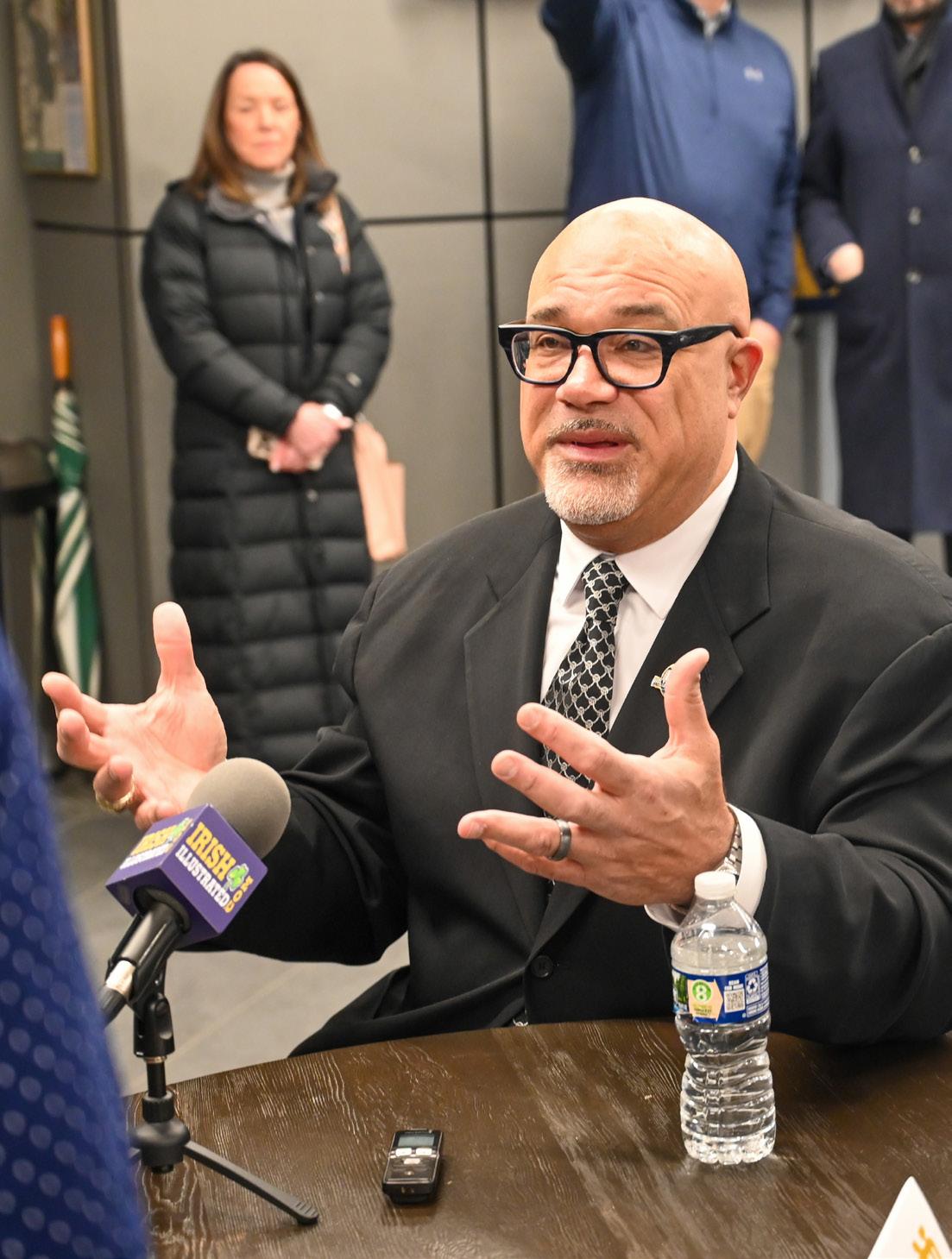
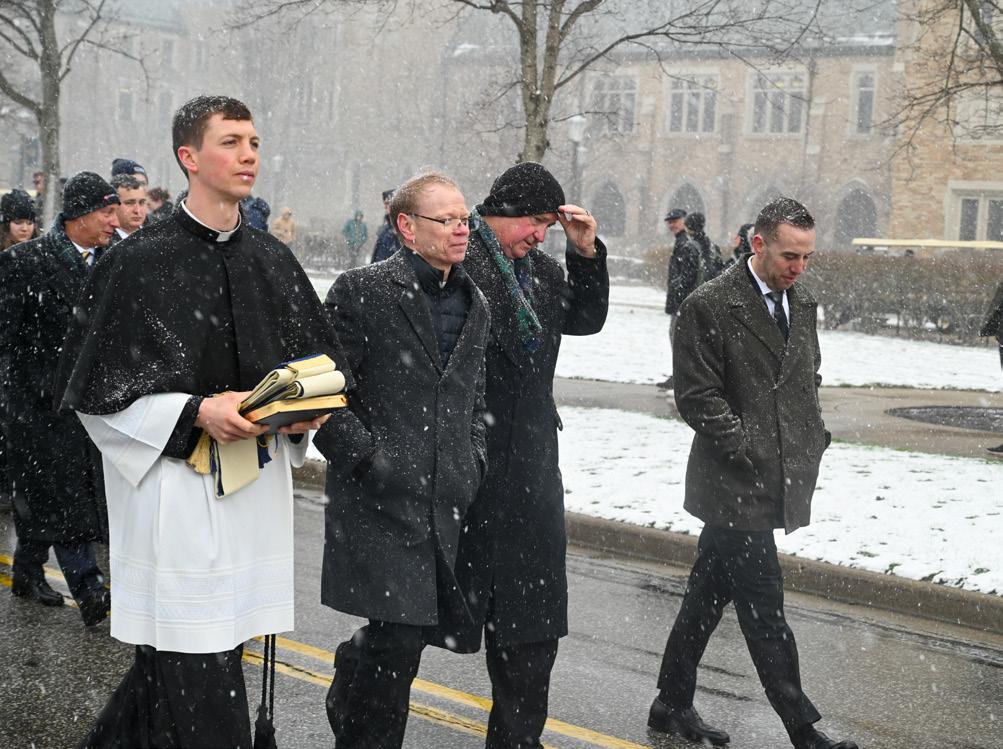
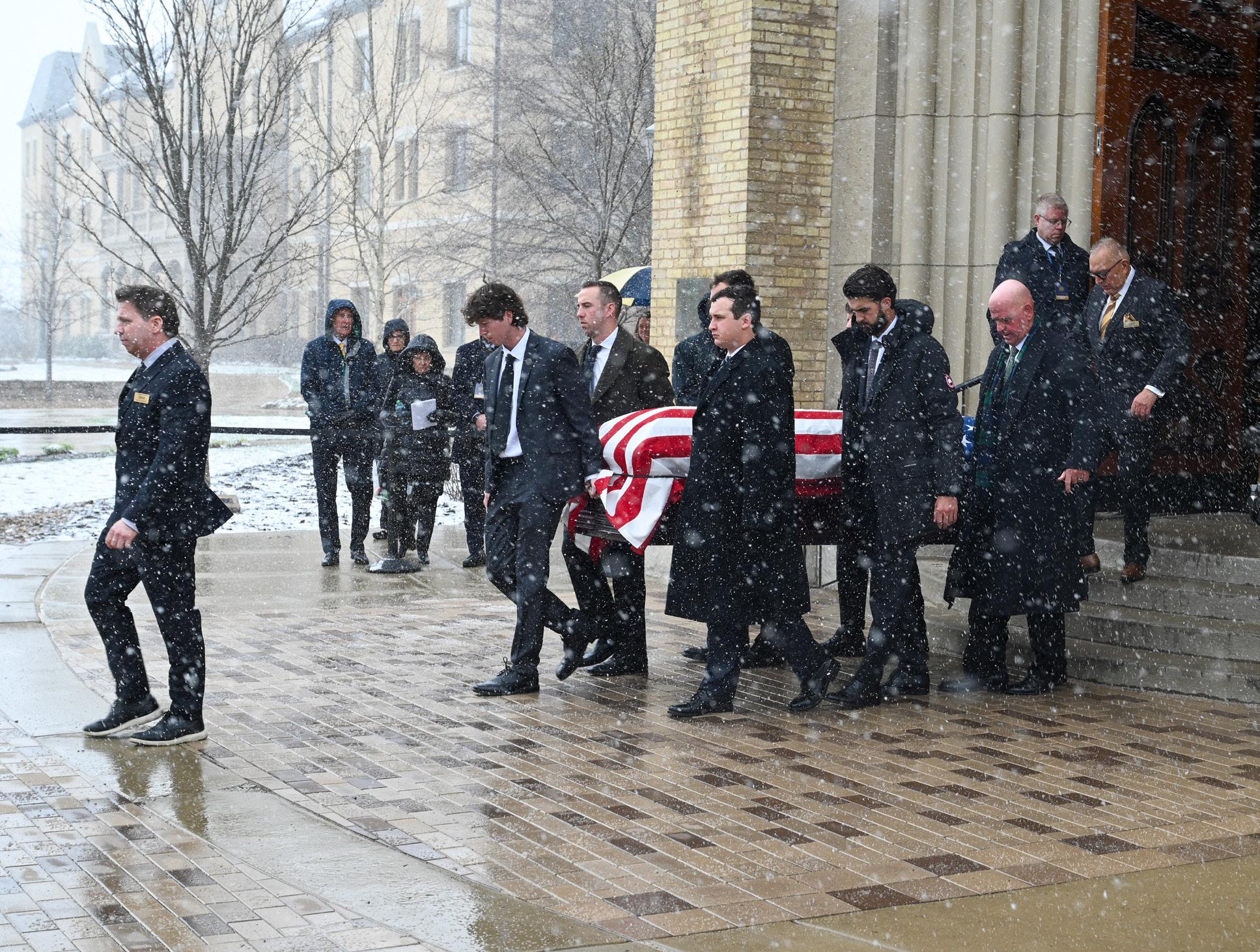
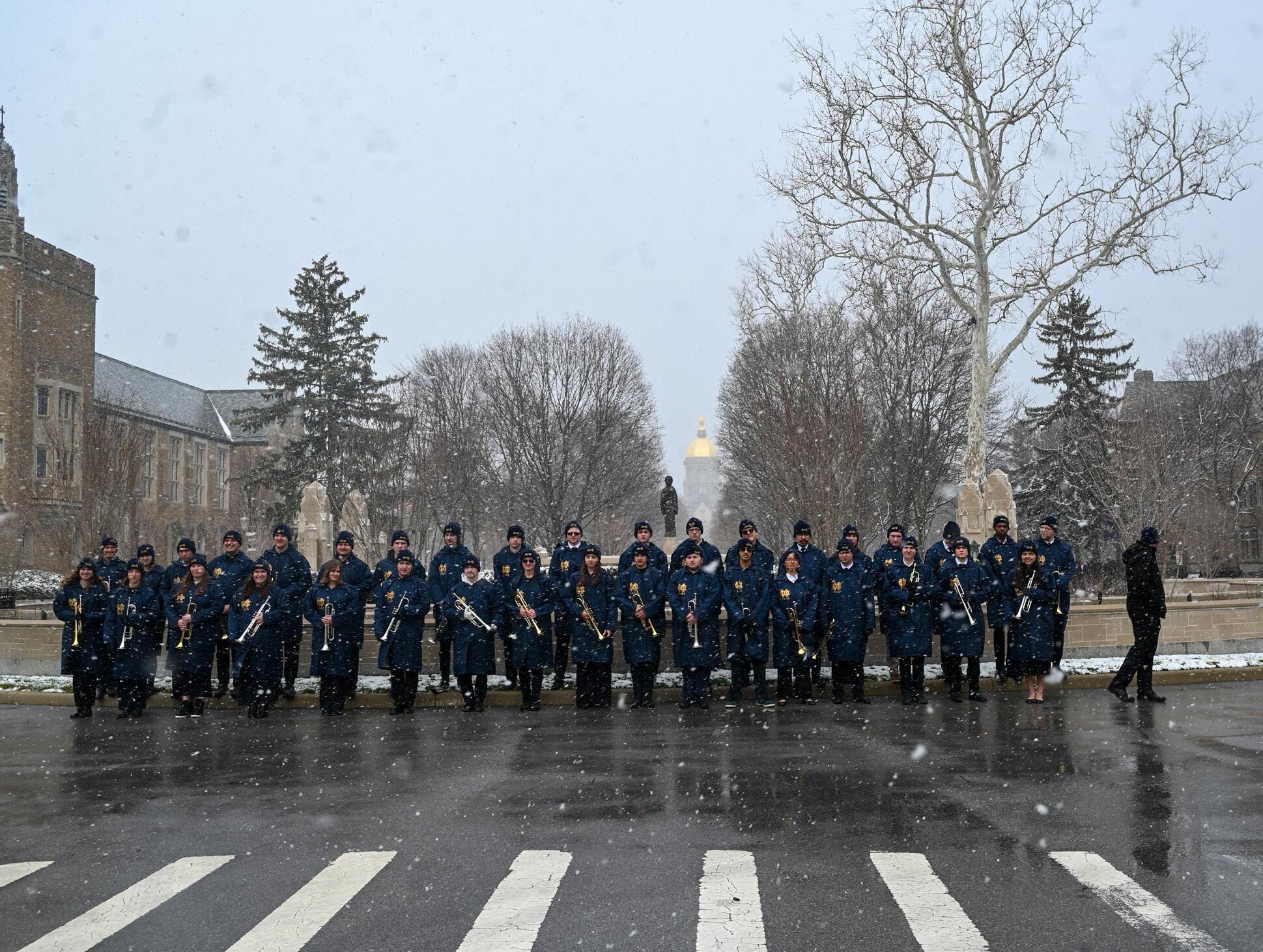
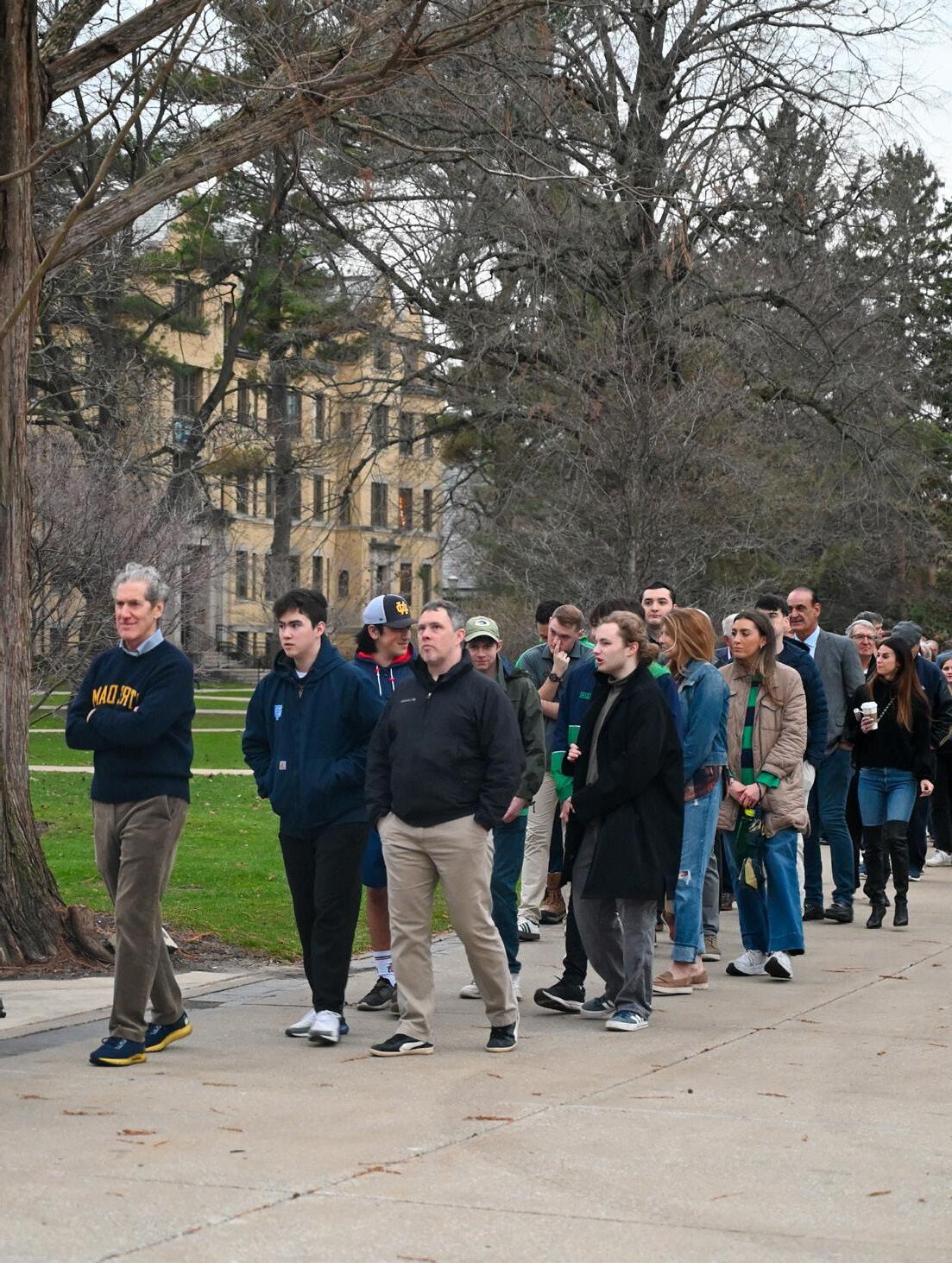
By Claire Watson Associate Sports Editor
“What is Notre Dame football, and why is it so important to everyone on campus?”
A question that I asked myself when I arrived on campus for the first time back in 2023.
I will say, with no doubt, having been a part of The Observer for about two and a half years now, one of my favorite sports to cover is football. From features to games, I find it intriguing and I always feel like I am on the edge of my seat, never knowing what is going to happen next. However, it was not always this way with my college experience and its alignment with Notre Dame football.
The majority, if not all, of my family, comes from South Bend, meaning being a Notre Dame fan runs deep in my family’s history, including having two family members who attended — my grandfather, who graduated in 1959 with a bachelor’s degree in commerce, and my mom, who followed suit graduating with a bachelor’s
degree in English and computer science. Having this rich history with Notre Dame and my family’s enthusiasm for football, I tried to understand football more strategically.
Needless to say, that failed. In my freshman year, I stood in the student section like all students did, though I never actually stayed the entire game, ultimately leading to my downfall in learning what Notre Dame football is all about. I expressed this in an article that, to my surprise, was popular but for the wrong reasons. I criticized the student section for being loud and tight. I ranted about how I did not understand what was actually going on in the game and I felt lost. I felt that I did not belong.
Fast-forward to my sophomore year: I decided to try again. I studied the rules, kind of understanding what was happening; I stayed at the games longer and took the time to learn at least some of the players’ names. I then decided, because the football team was advancing in the playoffs.
I was going to write my first real story, a preview of Notre Dame vs. Penn State. I succeeded (for the most part), as the article went well overall. In the second semester of my sophomore year, I joined the football beat team. I was nervous, especially when it came to covering the annual BlueGold game. I thought I knew it all, but I was wrong … again. I had no clue where I was going. All of the rules change. I was lost … again.
Jump ahead one more time to junior year. I felt a lot more confident in myself. I had the honor of covering the first home game of the season, Notre Dame vs. Texas A&M, the first home game of the season, but I let my confidence get the better of me, overworking myself and more. As the season went on, I found more passion for the game and a deeper love for and understanding of what it really means to be a part of the Notre Dame football family.
The moment that truly changed my life was sitting down with former running
back Jeremiyah Love at a postgame press conference and asking him two questions after the Notre Dame vs. Syracuse game. Despite having interviewed dozens of college players and coaches, I was terrified of messing up — and I did — but Love was patient, listened and gave me the best response I could have asked for when it came to talking about the success of younger guys on the team. “You know everybody wants to shine and everybody deserves the opportunity to shine,” he said. “So whenever anybody in my room goes out there and, you know, does what they got to do and gets to shine, I love it.”
This is when I learned the most important lesson that college will ever teach me: Football is not all fancy statistics. It is much more than that.
I think of my late grandfather, who watched football with me, and my mom, who would take me to games, taught me all the cheers, comes to campus to tailgate on Saturdays and tells me stories from when she was at Notre Dame, sitting in
the student section. Football season isn’t just a time of year when you support your favorite college team; that is just a small piece of it.
It is the time of year when people from all over the country come together for one cause: to support the Irish. I look around South Bend, Mishawaka and other surrounding areas, many of which make special events just to celebrate an Irish win or just to host a bigger event for people to watch the game. I realize this year, after covering Notre Dame football extensively, that it is not just defined as players and statistics; it is also about the culture, about the family you make, the random people whom you meet at games, the long traditions of dancing in the student section and even rushing the field.
Notre Dame football has shaped my experience not only as a writer, but as a student and as a Notre Dame fan, which will continue to last forever.
Contact Claire Watson at catson7@nd.edu

By Jocelyn Fulcher Sports Writer
On Tuesday, March 17, general manager of the Indianapolis Colts Chris Ballard signed University of Notre Dame men’s basketball graduate Carson Towt. While having numerous years of basketball under his belt, Towt does not have any experience on the football field. While this decision may come as a surprise to most, this is not the first time the Colts have signed a basketball player. Most recently, they signed VCU basketball graduate Mo Alie-Cox in 2017, though Alie-Cox had high
school football experience.
Towt started his career at Gilbert High School in Arizona, where he ranks second in school record for rebounds. He led his team to win the 5A Arizona state Championship in 2019, the school’s first title since 2003, which greatly helped his recruitment to play at Northern Arizona University.
Towt decided to redshirt his freshman year, so he hit the court in the 2020-2021 season. That season, he ranked second again in rebounds with an average of 4.6 and an average of 5.6 points. His sophomore year, he started every game where his
average rebounds almost doubled at 8.8 per game and 280 for the whole season. Junior year he led the Lumberjacks in assists, rebounds and blocks. During 2023-2024, what should have been Towt’s senior year, he did not play due to an injury but finished out his final year the next season. In his final year donning the Lumberjacks jersey, Towt led the nation in rebounds with a whopping 12.4 per game, 423 for the season as a whole. In total, Towt has 1,357 career rebounds and 1,383 points.
For his graduate year at Notre Dame, Towt did not disappoint the Irish with his rebounding
abilities. He averaged nine per game and led with the most per game 23-31 times.
Towt’s addition to coach Micah Shrewsberry’s roster did not go unnoticed to Irish fans and apparently also to the Indianapolis Colts.
The Colts hope to train 6-foot-8, 250-pound Towt to be a tight end. With his impressive background of rebounds, it sets him up as a good candidate to play the position due to his stature and ability to catch a ball. However, with no previous football experience, it will be interesting to see how Towt performs and where he falls on
the roster. This deal also opens up the possibility of more college basketball players putting themselves up as free agents instead of going to the NBA or other basketball leagues, a development which could impact the future of collegiate and professional athletics alike.
Towt said in the Colts’ news release that he is “excited to see where we can all go,” and Notre Dame fans will hopefully be able to cheer on another Notre Dame alum in the big leagues this upcoming NFL season.
Contact Jocelyn Fulcher at jfulche3@nd.edu
By Ethan Laslo Sports Writer
It is among the best times of the year in all of sports. Some may even argue the very best. March has arrived, we have a bracket and suddenly everyone is a college basketball expert. Myself included.
I know just as well as anyone else that my bracket won’t be perfect, but that won’t stop me from hoping. So, having spent the last week and a half contemplating the insanity of conference tournaments and the bracket, I feel qualified. Without further ado, here are my “expert” picks on upsets, Cinderellas and the Final Four. Copy at your own risk.
Upset picks
My first pick takes us to Greenville, S.C., and the South region. Hubert Davis and the No. 6 seed North Carolina Tar Heels take on the Atlantic 10 Champion the No. 11-seeded VCU Rams. The Heels are notably without star freshman Caleb Wilson, sporting a 5-3 mark over the eight games they’ve played since his injury. Meanwhile, VCU is rolling. The Rams enter the tournament on a six-game winning streak that saw them blitz through the A-10 tournament. This game comes down to three-point shooting and turnovers, both of which VCU has a notable advantage in. They have just an 8% turnover percentage in their last five games — the nation’s best. Simultaneously, North Carolina has forced noticeably fewer turnovers since losing Wilson. The Rams have also shot 39% from beyond the arc in their last five, an ominous matchup for the Tar Heels’ No. 300-ranked threepoint defense. I’ve got VCU taking down the blue blood in this one.
Up next, one of the hottest upset picks of the tournament brings us to Buffalo, N.Y., and
the East region, to another 6-11 matchup. The No. 11 AAC champion South Florida Bulls are among the hottest teams in the country, averaging a 14.7-point margin of victory over that span. On the other hand, the No. 6 Louisville Cardinals are 4-4 in their last eight games.
I was originally hesitant to pick the Bulls, but it feels much more plausible with the announcement that Louisville’s star freshman Mikel Brown Jr. is out with a back injury. Statistically, the matchup favors USF. Both teams are fastpaced, but the Cardinals rank No. 61 while the Bulls rank No. 15. Similar to the UNC-VCU matchup, three-point shooting also factors in. Louisville has the fifth-most three-point attempts per game in the nation, but USF holds opponents to just 33.9% from downtown. Another interesting tidbit is that South Florida ranks No. 3 in offensive rebounds per game and averages 17.8 second-chance points per game. It may be a trendy pick, but it certainly looks like USF has what it takes to dance into round two.
My third and final big upset pick arrives in beautiful Tampa, Fla., where I’ve got the No. 12-seeded Akron Zips upending the No. 5-seeded Texas Tech Red Raiders in what looks to be a great Midwest region draw for Zippy. Akron enters the tournament after an unprecedented third straight MAC tournament championship but is without a win in its last two appearances. The Zips are due and have got exactly what it takes to take down the JT Toppin-less Red Raiders. Since losing the first-team All-American, Texas Tech has struggled mightily. It rides a three-game losing skid into the tournament and now faces an offensively dominant Akron team. The Zips are No. 7 in the nation in scoring with 88.4
points per contest and No. 5 in offensive efficiency, ahead of Midwest No. 1 seed Michigan. They’re also a top 50 rebounding squad. This season, it looks like the third time will be the charm for Akron in the tournament.
Cinderella picks
No term is more synonymous with March Madness than “Cinderella.” Almost every year, the clock waits to strike midnight on at least one underdog in the NCAA Tournament. Sometimes it’s a mid-major that shocks the world, while others are simply lower-seeded power conference teams. So, let’s take a look at one team I could see making a run in each region.
South: No. 5 Vanderbilt
The Vanderbilt Commodores are just as hot as any team in college basketball and have proved that they can beat the best of the best. They had an impressive 91-74 win over Florida in the Southeastern Conference Tournament and looked to have what it took to beat Arkansas despite falling short 86-75 the following night. Statistically, the Commodores take care of the ball just as well as any team in the country. They’re top 25 in overall turnovers per game and No. 11 over their last three matchups. In the tournament, I’ve got them taking down Florida in the Sweet 16 rubber match before falling to Houston in the Elite Eight.
East: No. 7 UCLA
The UCLA Bruins are among college basketball’s historical elites. The days of coach John Wooden may be long past, but I think this team has what it takes to make a run. Guard Donovan Dent appears poised to return healthy in the tournament and is a definite impact player. The Bruins will have to take down UConn in
round two, but if they get past the Huskies, they’ve shown they can beat Tom Izzo and Michigan State. Then, I’ve got them upsetting UConn and finally falling to Duke in the Elite Eight.
Midwest: No. 12 Akron
As I said before, this Akron Zips team is due. Beyond their contest with Texas Tech, they face a favorable matchup no matter who wins Alabama’s game against Hofstra. The Tide’s recent controversy around guard Aden Holloway has left them vulnerable, and I could see Akron matching up well with either them or Hofstra. I think they make a Sweet 16 run, but No. 1 Michigan might be too much for them.
West: No. 7 Miami (FL)
Of the two Miami teams in the tournament, I think the Canes have the better odds of making a run. First-year head coach Jai Lucas is among the nation’s best young basketball minds. The team as a whole is physical, which could be its best or worst quality. It needs to do two things: make free throws and stay out of foul trouble. If the Canes can shock Purdue in round two and escape St. Louis, I see them making an Elite Eight run.
Final Four picks
Last year was just the second time in NCAA Tournament history that the Final Four had all four No. 1 seeds. This year, I don’t see it happening again. So, who’s battling it out in Indianapolis for the national championship?
East: No. 1 Duke
The Duke Blue Devils, national championship favorites, are the top dog for a reason. The dynamic Cameron and Cayden Boozer twins powered them to a 32-2 regular season record and Coach
Jon Scheyer’s second straight Atlantic Coast Conference tournament title. I think they get out of the loaded East and will be the Final Four’s most battle-tested team.
South: No. 2
Coach Kelvin Sampson is among the best in the business. This Houston Cougars team will want to avenge last year’s national championship loss to Florida, and they’ve got the perfect opportunity. This year, they have home-court advantage, as the South Regional is in Houston. I think they capitalize and return to the biggest stage.
West: No. 1 Arizona
This season, the Arizona Wildcats have been arguably the nation’s most consistent team. Since the beginning, they’ve had one of the highest floors in the country and were the final unbeaten team among the power conferences. To me, the West region is the weakest, and Arizona will capitalize.
Midwest: No. 2 Iowa State
The Iowa State Cyclones dropped a heartbreaker to Arizona in the Big 12 tournament on a buzzer-beater. But they obliterated everyone in their path up to that point and will be looking to make their first Elite Eight since 2000 and first Final Four since 1944. If any team can take down Michigan in the Midwest, it’s ISU.
National champion: Duke
Iowa State will avenge its loss to Arizona in the semifinals, but the favorite Blue Devils take down Houston and win it all in a back-and-forth national championship battle game with the Cyclones, and show why they’ve been the team to beat all season.
Contact Ethan Laslo at elaslo@nd.edu
By Zach Jones Sports Writer
After its matchup against Central Michigan on Tuesday was postponed due to cold weather, Notre Dame baseball hosts the Clemson Tigers for a three-game conference series this weekend at Frank Eck Stadium. The Irish own an 11-6 record and a 3-3 mark in ACC play, coming off a series at Louisville in which they won the opener but lost the final two games.
Clemson, ranked No. 19 nationally by d1baseball.com, comes to South Bend, owners of a 17-4 overall record and a 1-2 mark in Atlantic Coast Conference play, after last weekend’s conference series opener loss against Georgia Tech. The Tigers claimed a 3-1 midweek victory over College of Charleston on Tuesday and will face The Citadel on Wednesday night before flying north to South Bend. The Tigers have dominated the Irish as of late. The Irish are 2-7 against the Tigers under Coach Shawn Stiffler and lost last year’s series 1-2 at Clemson. First pitch Friday is scheduled for 4:30 p.m., while Saturday’s and Sunday’s contests are slated for 2 p.m. and 1 p.m., respectively.
Clemson staff ace Aidan Knaak projects to start for the Tigers on Friday. Knaak ranked No. 55 on D1Baseball’s preseason MLB prospect rankings after posting a 9-1 record and a 4.18 ERA over 16 starts last year, earning allACC First Team Honors for the second year in a row. The Tigers right-hander, however, has had a bit of a rough go of it this season, sporting a 0-2 record and a 5.29 ERA in four appearances.
Knaak has found success against the Irish in the past, though.
Last year, he outpitched thensophomore Jack Radel, pitching seven scoreless innings in a 2-0 Tigers victory. As a freshman in 2024, he introduced himself to the Irish batters with seven innings of two-run ball.
Lefty Michael Sharman is Saturday’s probable starter for the Tigers, and he’s been stellar in 2026. The 6-foot-1 southpaw owns a 1.47 ERA over 30.2 innings of work and has commanded the strike zone all season, evidenced by his 29-3 strikeouts per walk ratio. Expect Sharman to challenge Irish hitters in the zone with his high-80s fastball and lean on his deceptive changeup against righties and a
curve/slider mix against lefties in put-away situations.
Drew Titsworth started Sunday against the Yellow Jackets and projects to shoulder starting duties Sunday against the Irish. Titsworth, a junior out of Frankenmuth, M.I., started the year on the injured list with an arm strain and has been working up to starting games after pitching in more of a swingman role for coach Erik Bakich last year. He boasts a 3.72 ERA in four appearances (one start) over 9.2 innings and attacks hitters with an unorthodox sidearm delivery. Titsworth figures to be kept on a short leash due to his early-season injury, so watch for Tigers relievers Justin LeGuernic (1.23 ERA, 14.2 IP); Dion Brown (1.74 ERA, 10.1 IP); and Danny Nelson (1.17 ERA, 2 SVs) to play a big role Sunday and throughout the weekend.
On offense, the Tigers are anchored by leadoff man Jarren Purify, an on-base machine who reaches base at a .478 clip and has earned 15 walks this season. He’s followed up by three-hole catcher Nate Savoie, who is 6-10 in his last three games with four home runs in that span. He’s slashing a stellar .408/.483/.829
on the year. Savoie also leads the Tigers in hits (31), RBIs (31) and home runs (nine). Keep an eye on designated hitter Jacob Jarrell, who bats fifth and is a power threat with eight homers in 18 games played.
Georgia Tech’s offense jumped all over the Tigers’ starters last weekend and challenged their bullpen in a way they hadn’t been challenged before by virtue of the Tigers’ relatively weak nonconference schedule. Notre Dame’s offense will look to replicate the Georgia Tech blueprint against the Tigers with another productive weekend at the plate after scoring 33 runs against Louisville. Look especially for Davis Johnson to continue hitting well after slugging 4 homers and 13 RBIs against the Cardinals last weekend. On the mound, the Irish need more depth from their starters than they got against Louisville to compete with Clemson. Both Radel and Ty Uber went only three innings, and those short starts stretched the Irish bullpen thin, making it hard to protect the leads the offense built up.
While those short starts tested the bullpen, it’s also on the
bullpen to shut the door when handed a lead late in games. The Irish dropped a pair of games over spring break, one to Duke and the other to Louisville, due to late-game bullpen implosions. For the Irish to succeed against the Tigers, they need someone like graduate righty Eli Thurmond or senior Noah Rooney, who’s largely handled closing duties, to step up and protect close leads. Thurmond had two scoreless innings against Louisville on Friday, and Rooney came on in the ninth with the Irish up 2-0 on Sunday at Duke and got the Devils’ three-hole hitter to strike out looking. The talent is there for the Irish bullpen; they just need to perform.
Radel’s and Uber’s long starts on Friday and Sunday against Duke put the Irish in positions to win. If Stiffler can get solid innings out of Radel and Uber and quality performances from the bullpen, and if the offense continues its productive ways, the Irish will be in great shape to win their first home ACC series of the season.
Contact Zach Jones at zjones3@nd.edu