
Basilica welcomes thousands for Lenten season
By Annelise Demers and Matthew Morin Associate News Editor and News Writer
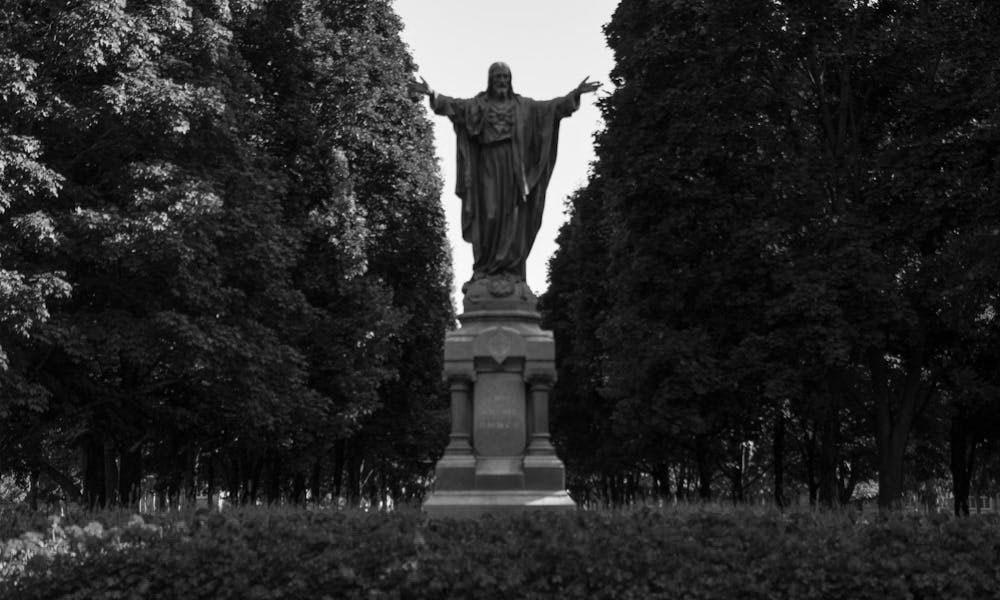
Carved into the base of the Sacred Heart statue at the center of God Quad are the words “Come to me, all of you,” a phrase from Matthew 11:28. That Scripture verse serves as this Campus Ministry’s Lenten theme this year, an invitation directed not at the perfect, but at anyone willing to respond.
An estimated 3,500 people received ashes Wednesday at the Basilica of the Sacred Heart across four Englishlanguage Masses at 8 a.m., 11:30 a.m., 5:15 p.m. and 9 p.m. A Spanish-language Mass was offered at 7 p.m. In addition to the Basilica liturgies, ashes were distributed at Masses held in dorm chapels and several academic buildings throughout the day.
Fr. Brian Ching, rector of
the Basilica and director of liturgy for Campus Ministry, estimated about 800 people attended both the 8 a.m. and 11:30 a.m. Masses. The 5:15 p.m. liturgy drew the largest crowd, with between 1,000 and 1,200 attendees, and roughly 800 were expected at 9 p.m.
In his 8 a.m. homily, Ching reflected on the fleeting nature of earthly glory, invoking the phrase “thus passes the glory of the world” as a reminder that even the most beautiful parts of life are temporary. Lent, he said, reorients believers toward what is eternal.
“This world does pass away,” Ching said, describing the Lenten season as preparation for Easter and the promise of resurrection.
Ching also emphasized that Ash Wednesday publicly acknowledges human limitation.
“I think Ash Wednesday speaks to a truth that we all know and have to acknowledge,” Ching said. “We make
mistakes. We assume. That’s not something that we can pretend isn’t a part of life.”
The ashes, he said,
symbolize both mortality and hope — a call to seek grace at
see “Lent” on page 4
60th Observer Ed Board selected for upcoming term Bishop Rhoades speaks at HCC
By Observer News Staff
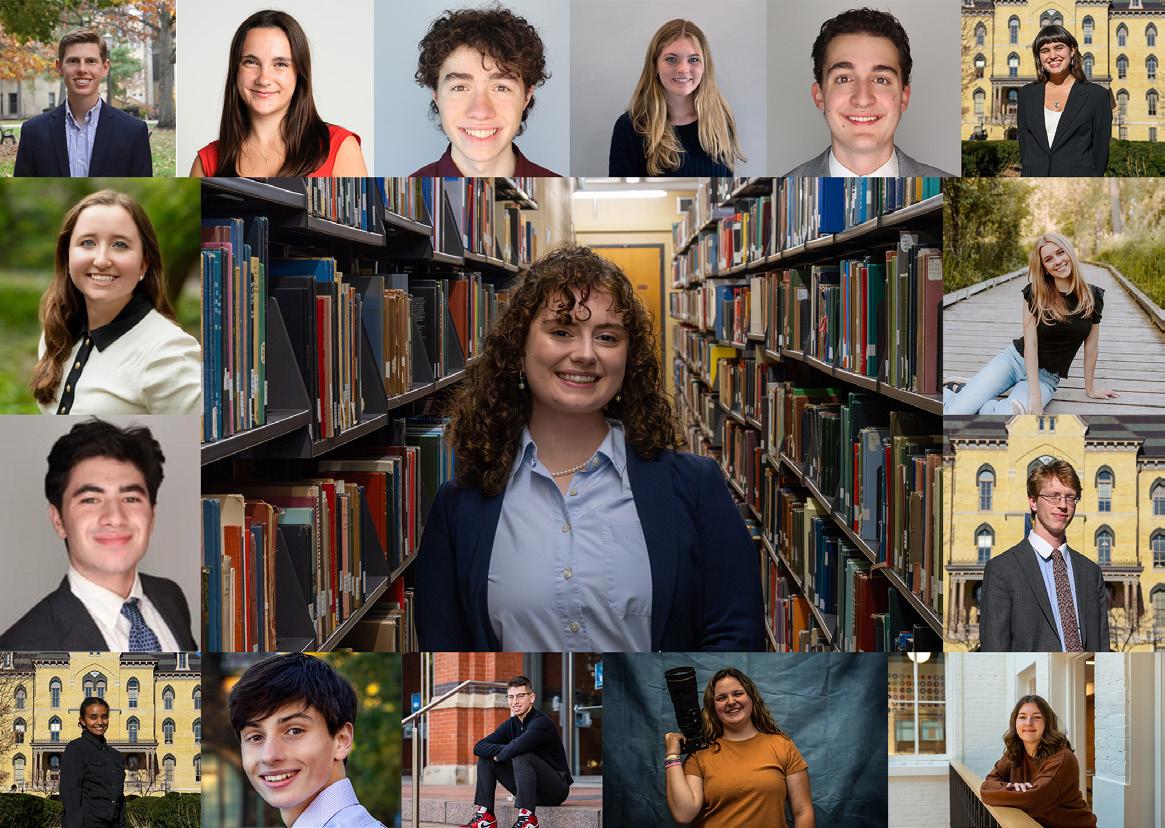
Ten department heads and seven management editors will comprise the 2026-27 Observer Editorial Board, incoming editorin-chief Gray Nocjar announced Wednesday. The board’s tenure begins March 7.
“This year’s Editorial Board is talented, vocal and incredibly innovative,” Nocjar said. “The Observer is blessed to be led by such devoted people.”
Thirteen incoming editors have held positions on past editorial boards, a record number in the 60-year history of the newspaper, and three are returning for a rare third term. Four editors hail from Saint Mary’s College, the second-most ever after the 202021 board.
Management editors
Junior Aynslee Dellacca will take over as managing editor for her third term on the board. She is the first Saint Mary’s student to hold three distinct editor roles in over 40 years. Margaret Fosmoe, now an associate editor for Notre
NEWS | PAGE 4
Campus Life Council
Dame Magazine, was the last to do so — serving as Saint Mary’s news, managing and executive editor from 1982-84.
Raised in New Palestine, Ind., Dellacca is majoring in anthropological and Indigenous studies and minoring in justice studies and film studies at Saint Mary’s College. She joined The Observer her freshman year writing for news and working production
The council passed its first resolution in three years, addressing off-campus leases. OPINION | PAGE 5
FRIDAY, FEBRUARY 20, 2026 | VOL. LX, NO. 47 SPORTS | PAGE 11
before assuming her role as Saint Mary’s news editor and later as an assistant managing editor. Her coverage interests include administrative policy, campus life, local news and political activism.
Sophomore Sophie Hanawalt will serve as an assistant managing editor this spring. Hanawalt is studying global affairs with
see “Ed Board” on page 3
PAGE 8
By Eileen Doyle News Writer
Bishop Kevin Rhoades of the Diocese of Fort Wayne-South Bend visited Holy Cross College on Wednesday as part of the Mind and Heart Lecture Series, delivering a talk on what he described as one of the greatest challenges facing the modern world — the global migration and refugee crisis.
The lecture series began in 2021, aiming to combine intellectual reflection with moral responsibility, connecting reason, compassion and the Holy Cross mission of healing the world.
Rhoades clarified that the event was not meant to be a political debate, but rather a reflection on what it means to live out the Catholic faith and values in today’s world and on how to confront today’s challenges.
Rhoades centered his talk on the staggering scale of human displacement worldwide. According to United Nations data he cited, 117.3 million people are currently displaced globally. Of those, 42.5 million are refugees who have fled
SPORTS | PAGE 8
their countries, 67.8 million are displaced within their own borders and millions more are asylum seekers.
He emphasized that these figures represent more than data points. “I’m sharing these statistics to highlight the staggering dimensions of this crisis, but it is important that we not only look at the numbers — these are real people. Over 40% of refugees today are children under the age of 18. Over 60% are in family units. And the sufferings of refugees are multifaceted,” Rhoades said.
Throughout the lecture, Rhoades framed migration as a moral and theological issue. Drawing from Scripture and Catholic social teaching, he argued that Christians are called to recognize the dignity of every person. “Pope Francis coined the phrase ‘globalization of indifference’ to describe a widespread mentality where people are desensitized to the suffering of others, viewing the migrant crisis as someone else’s problem. As Christians, we must never treat the
see “Bishop” on page 4
Jadin O’Brien Payton Dymek interviews the Irish track national champion ahead of Winter Olympics debut.
Curling With the sport
popularity, learn more about Notre Dame’s curling club.
MARIELLA TADDONIO | The Observer
The board collectively boasts 15 years of prior experience as editors, the most in the paper’s history. Three editors return for a third year.
MARIELLA TADDONIO | The Observer
With ashes traced on foreheads and the words “Come to me, all of you” echoing from God Quad at The Sacred Heart of Jesus statue, Notre Dame began Lent on Wednesday as a season of response rather than perfection.
QUESTION OF THE DAY:

Donail Connaughton junior Keenan Hall
“Teach English in Europe.”
Andy Nunn junior Keenan Hall
“Spanish teacher (not in Europe).”
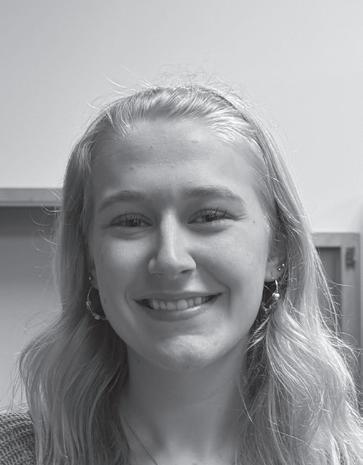
Nora White senior Le Mans Hall “Etsy shop owner.”


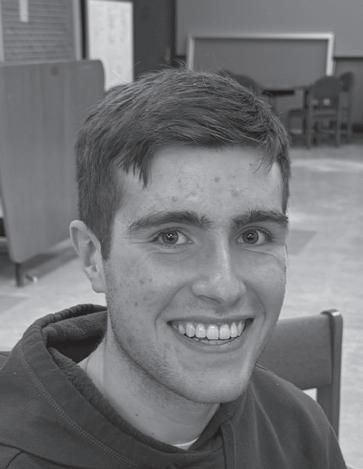
Afton Mosley sophomore
Graham Family Hall
“Join the military.”

Renae Callaghan sophomore Farley Hall
“Lunch lady.”
Friday
Notre Dame men’s tennis
The Fighting Irish take on the Wildcats at home.
7:30 p.m.
Eck Tennis Pavilion
Saturday
Urban Bush Women
An evening-long dance theater program with live music. 7:30 p.m.
DeBartolo Performing Arts Center
Sunday
Film: “McFarland, USA” (2015)
A track coach takes a job helping students to succeed in track. 1 - 2 p.m.
DeBartolo Performing Arts Center
Monday
Lecture: “A Jesuit’s Guide to the Stars”
Br. Guy Consolmagno shares how to find God in the stars. 7:15 - 8 p.m. Morris Inn
Tuesday
Notre Dame men’s basketball vs. Duke
The Fighting Irish take on the Blue Devils at home. 7 p.m. Purcell Pavilion
PHOTO OF THE DAY | DECLAN LEE
Ed Board
Continued from page 1
minors in sociology and the Gallivan program in journalism, ethics and democracy at Notre Dame. She is from Birmingham, Mich., and calls Welsh Family Hall home. Hanawalt joined The Observer last August, writing and working production before becoming an associate news editor and later the 2025-26 Notre Dame news editor.
“Leading the Notre Dame news department this past year has meant the world to me,” Hanawalt said. “I am so grateful for this new opportunity to serve the paper that has become my second home.”
Sophomore Zack Pohlman will become the first assistant managing editor to have previously served as The Observer’s business manager. The Geneva, Ill., native studies finance and accounting at Notre Dame and is a resident of Duncan Hall. Pohlman is a member of the Business Honors Program and the Gallivan program in journalism, ethics and democracy. Since joining The Observer in August 2024, he served as a staff writer and associate news editor before becoming business manager.
“All glory to God,” Pohlman said. “I’m blessed to call The Observer home and honored by the opportunity to serve on Gray’s staff. I can’t wait to get to work.”
Sophomore Henry Jagodzinski
will also continue in his role as an assistant managing editor this spring. He has majors in preprofessional studies and the program of liberal studies at Notre Dame. Originally from Billings, Mont., Jagodzinski now lives in Dillon Hall.
Junior Abby Hernan will remain an assistant managing editor after assuming the role in January. Hernan is studying political science and applied & computational mathematics and statistics and is planning to attend law school after graduation. Originally from Orlando, Fla., she is now a proud member of Lewis Hall at Notre Dame. She served previously as viewpoint editor — the former name for the opinion section.
Junior Grace Tadajweski will retain her role as an assistant managing editor in the fall. Tadajweski hails from Lebanon, Pa., and majors in American studies and film, television and theatre at Notre Dame. Excited to be returning for a second term as an assistant managing editor, Tadajweski has also served as an associate news editor and a news production employee since joining The Observer team in August 2023.
Hernan, Jagodzinski and Tadajweski become the first three assistant managing editors to repeat in the role.
Junior Noah Cahill will assume his role as an assistant managing editor in fall 2026. Cahill majors in psychology at Notre Dame and is pursuing a double minor in journalism, ethics and democracy, and
sports, media and culture. Originally from Farmington, Mich., Cahill is a member of the Coyle community in Zahm Hall. He previously served as sports editor in 2025.
Department editors
Junior Annelise Demers will take over as Notre Dame News Editor for the spring 2026 semester. Demers is a global affairs major at Notre Dame with minors in civil and human rights, theology and energy studies. She is from Warwick, Rhode Island, but on campus calls Howard Hall her home. She joined The Observer in her freshman year and has served as an associate news editor since then. Her reporting has covered campus ministry, student government, campus protest, dorm life and other University initiatives.
In the fall, junior Megan Cornell will assume the role of Notre Dame news editor. Cornell studies political science at Notre Dame with a minor in the Gallivan Program in journalism, ethics and democracy. She is from Minneapolis and now lives in Flaherty Hall. She served previously as assistant news editor.
Berhan Hagezom, a sophomore at Saint Mary’s, will continue as Saint Mary’s news editor following her 2025-26 term. Hagezom is a neuroscience major with a biology concentration and chemistry minor. Originally from Las Vegas, she lives in Le Mans Hall. She previously served as a staff writer in the Saint Mary’s news department.
Sophomore Ben Hicks will continue his service as sports editor. A resident of Dillon Hall hailing from Cincinnati, Hicks studies psychology and global affairs at Notre Dame with a minor in sports, media and culture. Joining The Observer in August 2024, Hicks has worked as a sports writer and associate sports editor before taking over as sports editor this January.
Hicks said the reprisal was “a significant honor and high point of my time at Notre Dame.”
Sophomore Duncan Stangel will assume the role of opinion editor.
Stangel is a global affairs and theology major at Notre Dame with a minor in data science. He is from Cumberland, Md., and now lives in Alumni Hall. He joined The Observer as a columnist in 2024 before assuming the role of social media editor for the 2025-26 term. His work includes growing The Observer’s social media presence, expanding the newsletter and occasionally writing columns about religion, politics and his unique life experiences.
Junior Luke Foley will remain scene editor for the spring semester after taking over as interim editor in January. Foley is a Business Honors Program student at Notre Dame, majoring in strategic management and theology.
Junior Peter Mikulski will reprise his role as scene editor in the fall after serving in the position over the previous two years. He will become the first editor in 30 years, and the
second ever, to spend three terms in the same editor role.
“Here’s to another year of telling people what art is — and isn’t — worth their time!” Mikulski said.
Sophomore Mariella Taddonio will carry on her role as photo editor. Taddonio is originally from Murrysville, Pa., and is a proud student of Saint Mary’s College. She is currently studying communications and social work, and is minoring in the Gallivan Program in journalism, ethics and democracy at Notre Dame. This is Taddonio’s second year at The Observer, taking photographs and writing. Her favorite memories consist of late-night production shifts and traveling for sports events, specifically the Orange Bowl and USC football game.
Freshman Liam Flynn will take over as graphics editor. Flynn is originally from Aurora, Ohio, but calls O’Neill Family Hall home. He is majoring in architecture with a minor in studio art, and has been making graphics for The Observer since starting this past fall.
“I’m so beyond grateful for this opportunity,” Flynn said. “I’ve thoroughly enjoyed my time creating graphics this year, and I’m excited for what’s coming next.”
Lilly Martin, a sophomore at Saint Mary’s, will take over as social media editor. Martin is from Kalamazoo, Mich., and is majoring in marketing. She joined The Observer in April 2024 and has served the social media team ever since.

PAID ADVERTISEMENT
Campus Life Council passes housing resolution
By David Murphy Associate News Editor
Notre Dame’s campus life council passed a resolution on Feb. 13 concerning off-campus housing. The decree, “A Resolution to Promote Fair OffCampus Housing,” is the council’s first in three years.
The new resolution specifically addresses leasing for offcampus housing. For students who seek to live off-campus their senior year, it often requires signing leases well in advance, often upward of two years ahead of time. According to Molly Swartz, off-campus council president, the new resolution calls on the University and St. Joseph County to reform this system.
“Our main goal was based on the University of Michigan, which worked with the city of Ann Arbor to put in certain restrictions,” Swartz said. “The way that they phrased it … was
Bishop
Continued from page 1
suffering of others as if it does not concern us,” he explained. “We have a moral duty to care about the plight of migrants and refugees.”
Rhoades emphasized that one must approach migration first through faith. “We must look at this issue first and foremost from the perspective of God’s revelation transmitted to us in Scripture and tradition, and not from the perspective of one’s political party or narrow ideology,” he said.
At the center of his message was a balance of rights and responsibilities. Catholic teaching, he explained, affirms both the right of nations to regulate their borders and the right of people to migrate when their lives or dignity are threatened. It also recognizes what he calls the “right not to migrate”, or the right of individuals to live safely and with
Lent
Continued from page 1
the start of the 40-day season.
Fr. Pete McCormick, assistant vice president of Campus Ministry, described Lent as an opportunity to examine daily habits and decisions in light of discipleship.
“When I was younger, it felt more like a chore,” McCormick wrote in a statement to The Observer. “In recent years, I’ve come to see Lent more as an invitation.”
He encouraged students to approach academics, friendships and responsibilities with a clearer sense of purpose.
“Lent is a good reminder of why we’re here in the first place: to know, love and serve God,”
to put in an ordinance saying that landlords are not allowed to make a renewal offer to the current tenant until 180 days into their current lease. Those tenants then have 30 days after receiving a renewal to decide if they want to renew, and those landlords are not allowed to lease it to anyone else until that renewal offer has been made.”
“Effectively, what Ann Arbor has done is make it so you can’t sign a lease until six to eight months before you occupy the house,” Swartz added.
“I am incredibly proud of the work that Clay [Chauncey, a member if the off-campus council] and Molly [Swartz] have done this year in the Campus Life Council, and we were all thrilled to have this important resolution passed by a unanimous vote,” student body president Jerry Vielhauer wrote in a statement to The Observer.
The campus life council consists of representatives from
dignity in their own homelands. “The Church teaches that people have a right to find safety, economic opportunity and dignity in their own homeland, rather than being forced to leave due to poverty, violence, persecution or natural disasters,” Rhoades said.
These principles shape the work of organizations like Catholic Relief Services, which addresses root causes of migration by supporting development, healthcare, education and conflict prevention in vulnerable regions. Rhoades described CRS initiatives he has witnessed firsthand, including water security projects, disease prevention programs and youth outreach efforts focused on reducing violence.
He also addressed U.S. immigration policy, emphasizing the need for humane asylum processes, family reunification and expanded legal pathways. While affirming the importance of secure borders, he urged generosity toward
McCormick said. “That doesn’t mean ignoring everything else. Your health, your friendships, that chem exam you’re stressed about, all of it matters. But Lent invites us to see those things in a bigger context.”
For McCormick, the season includes small, intentional sacrifices. He said he plans to give up chocolate and ice cream and to offer a brief prayer for the poor and unhoused in South Bend each time he notices a craving.
Students across campus are making their own commitments.
Sofia Murrin, a junior in Howard Hall, said she plans to focus on reconciliation this Lent.
“I’m not giving up something, but I want to make it a point to go to confession at least one time
several student groups on campus, including the student body president, hall senators, the student union’s off-campus senator and representatives from class council, among others. It also includes a number of rectors, faculty members and administration officials.
“It’s a little bit similar to senate. The main difference is that when we write and pass resolutions, they get sent to Fr. Gerry Olinger and the Office of Student Affairs,” Chauncey said. “It’s a broad range of people from around the University. And the idea is to craft these resolutions that get sent directly to Fr. Gerry.”
While the power to make these changes lies with the St. Joseph County Council, Chauncey hopes that the resolution will prompt the University to begin negotiations with the county to reform the leasing system.
“We’re not really
migrants and refugees, particularly given the nation’s resources. “We’re morally obliged to be sure that our goods benefit those in need, including migrants and refugees,” Rhoades said.
He also discussed the United States’ new policy of allowing only 7,500 refugees to be resettled in the country this year, suggesting the nation should act with more benevolence to those who are in unfortunate situations.
“This is the lowest ceiling since the program began in 1980 … small countries, poor countries, are accepting these suffering people, and we’re not. The U.S. used to be at the forefront of welcoming those who were fleeing war, violence, persecution and oppression,” he said.
Following the lecture, Louis Albarran, a professor of humanities and theology at Holy Cross College, offered a response focused on the relationship between Church teaching and everyday
during Lent,” she said.
Sophie Dandawa, a freshman in Walsh Hall, said she is giving up “all sweets” and flex points and is limiting caffeine.
Ching said the hope for Ash Wednesday and the Lenten season remains the same each year: That people deepen their relationship with Christ and reflect that growth in their actions.
As students moved between classes with ash crosses still visible, Campus Ministry’s theme served as a reminder that Lent begins not with self-improvement, but with an invitation — to come.
Contact Annelise Demers at ademers@nd.edu and Matthew Morin at mmorin2@nd.edu
giving specifics. That’s for the University and administration to decide,” he said. “But our goal is really just to alleviate the predatory practices of these off-campus housing situations and the pressure that they’re able to apply onto students so that we don’t have situations where people are signing a lease two years before they move in and then their financial situation changes.”
According to Swartz and Chauncey, this proposal has been raised several times over the past few years, but it has never gotten off the ground. In January, the issue came up again, and the pair decided to move forward with a resolution, which passed at their next meeting in February.
Swartz said she believed that one of the reasons resolutions like these have been so rare in recent years is due to misperceptions surrounding the powers of campus life council. “It
practice. He warned that political polarization often shapes Catholics’ views more strongly than doctrine itself, creating what he described as a “breach” between belief and lived faith.
Citing research from theologian Matthew Shadle, Albarran noted many American Catholics remain mostly disengaged from Church teaching when it comes to political decisions.
“Only 16% of U.S. Catholics are even aware of the bishops’ voting guides,” he said.
“Only 3% have actually read them. And of those who are aware of them, three-quarters say they had no influence on their vote … whatever is shaping the partisan identities of Americans is having a greater influence on Catholics than the teaching of the bishops.”
After the lecture, Holy Cross College junior Jimmy Ward reflected on the significance
really is such a direct route straight to the Office of Student Affairs that I think people forget about. They think that going through the senate is the most efficient route. I’m not saying one is or isn’t [more effective], but I think the power is almost forgotten,” she said.
Chauncey noted that although no resolutions are currently on the table, he hoped incoming members under the leadership of student body president-elect Elijah Jones could build on this recent progress.
“We have one more meeting in the month of March … but starting April 1, there will be a whole new campus life council with new people in the roles,” Chauncey said. “So we’re hopeful that they can use it to maximize the impact that the campus life council has on students.”
Contact David Murphy at dmurph23@nd.edu
of the bishop’s presence on campus. “Having the bishop come to campus is very special,” he said. “It’s something you have to take advantage of when it does happen.” He added that his main takeaway was that “grounding yourself in Catholic doctrine as much as you can is the first step to becoming a better Catholic.” Editor’s note: Ward is a former sports writer for The Observer. Holy Cross College freshman Yaretzi Castillo described the lecture as deeply moving. “I wanted to hear him talk about the immigration policy,” she said. “I almost cried. It was very emotional, in a good way.” She said she left with the sense that “we should find an equal medium of solving these issues and work from multiple perspectives.”
Contact Eileen Doyle at edoyle22@nd.edu

OPINION
The Ostermann drum has already been beaten
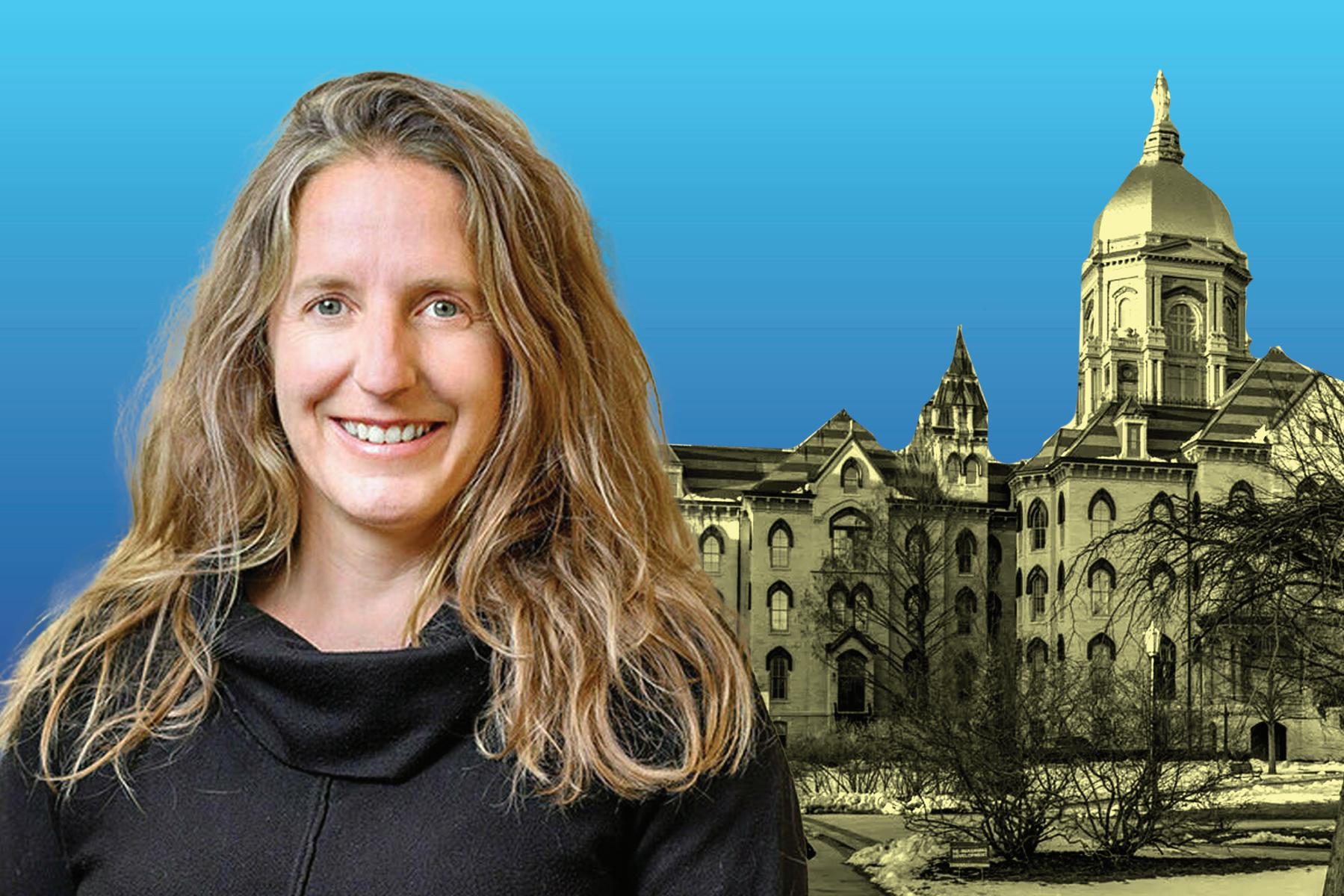
By Duncan Stangel Social Media Editor
I wouldn’t blame Professor Ostermann if she more strongly (and publicly) supported the right to an abortion as a result of the media circus surrounding her appointment as Director of the Liu Institute. This administrative position does not have room for input from personal politics, nor does much of the professor’s academic work. Her critics wouldn’t know that, as I doubt that any have spoken to her about her beliefs, work or story.
I have.
I did not know she supported the right to have an abortion until well after her guest lectures in my class last semester. She taught topics such as the Nepali caste system. These were decidedly apolitical. In the moment, I learned an enormous amount about a region with which I was previously unfamiliar — including its cultural distinctions. In this moment, it generated questions as to how her new position could really be infiltrated by well-compartmentalized beliefs.
I understand the fairly levied critiques against Ostermann’s beliefs, which have been rebuked by the leadership of the University, faculty and clergy. What I don’t understand is the deeply personal nature of
some critiques — including by Fr. Wilson Miscamble in this newspaper. I hoped he would approach this critical moment with humility, rooted in the previous criticism of his own work on the atomic bomb as not being in alignment with Catholic values. This is not the case, as the old drum to protect Catholicism at a visibly Catholic university has been struck again. Ostermann is not a
herald of great decline. Her personal politics have already been decried as out of line with the University’s mission years ago. She’s shown a willingness to work with the University to better align with the Catholic mission — a willingness that I imagine is vastly reduced by immense public media hostility.
As a matter of faith, our love of Christ is not defined by how loudly
we bang the drum. It is how we treat those for whom we have disdain — in public and in private. Criticism is fair, but lines have been crossed. Every Catholic pundit has jumped on this issue, muddying the waters for people who actually know the major players. Even figures with a national media presence — like Bishop Robert Barron — have also joined onto large sweeping statements. The
Remembering Ernest Morrell
reality remains that everyone needs to step back and treat each other like human beings. This is not a crusade. This is not a war or a battle. It’s a worthwhile conversation over opposing viewpoints.
Ostermann is a consummate professional, a kind teacher and an informative instructor. The reduction of her character to one belief is something that is decidedly not Christian. A refusal to engage with her beyond statements through the press is a negative look for all of us. You can criticize Professor Ostermann, but you should talk to her in person. Respectfully. Ask questions. Engage. You will find research about regulatory compliance, anti-female genital mutilation law and protecting the dignity of children by outlawing child marriage in the developing world. You will find more common ground than you otherwise would have.
I sign this statement as a Catholic with a desire to please God, a theology major learning the truth and a member of this Editorial Board.
The views expressed in this column are those of the author and not necessarily those of The Observer.
Contact Duncan Stangel at dstangel@nd.edu
The last time I saw Ernest Morrell was in the offices of the Dean of the College of Arts and Letters in O’Shaughnessy Hall.
It was late September, and I was readying a fellowship application for the National Academy of Education.
Truth be told, it was a long-shot. I am an English Ph.D. student who studies depictions of formal schooling and assimilation in modern Latino novels and memoirs. My dissertation, tentatively titled “Assimilation through Education: Individualism, Solidarity and the American Dream in Contemporary Mexican American Literature,” examines the intertwining of academic achievement and socioeconomic mobility in the storytelling of second-generation Americans.
From what I could see, this fellowship was aimed at people in more traditional educational fields, such as sociology. Still, Morrell encouraged me and showed enthusiasm for my ideas. All the while, he prompted me to think about how I could convey my message to a broader academic audience outside my discipline. Of all the professors on my dissertation committee, he was the one grounded in education, which made him a vital reference as I worked to articulate my ideas at the intersection of several fields.
In early February, Morrell passed away after a years-long battle with cancer. He was 54 years old. He was affiliated with the English Department and Africana Studies as a professor and served as the
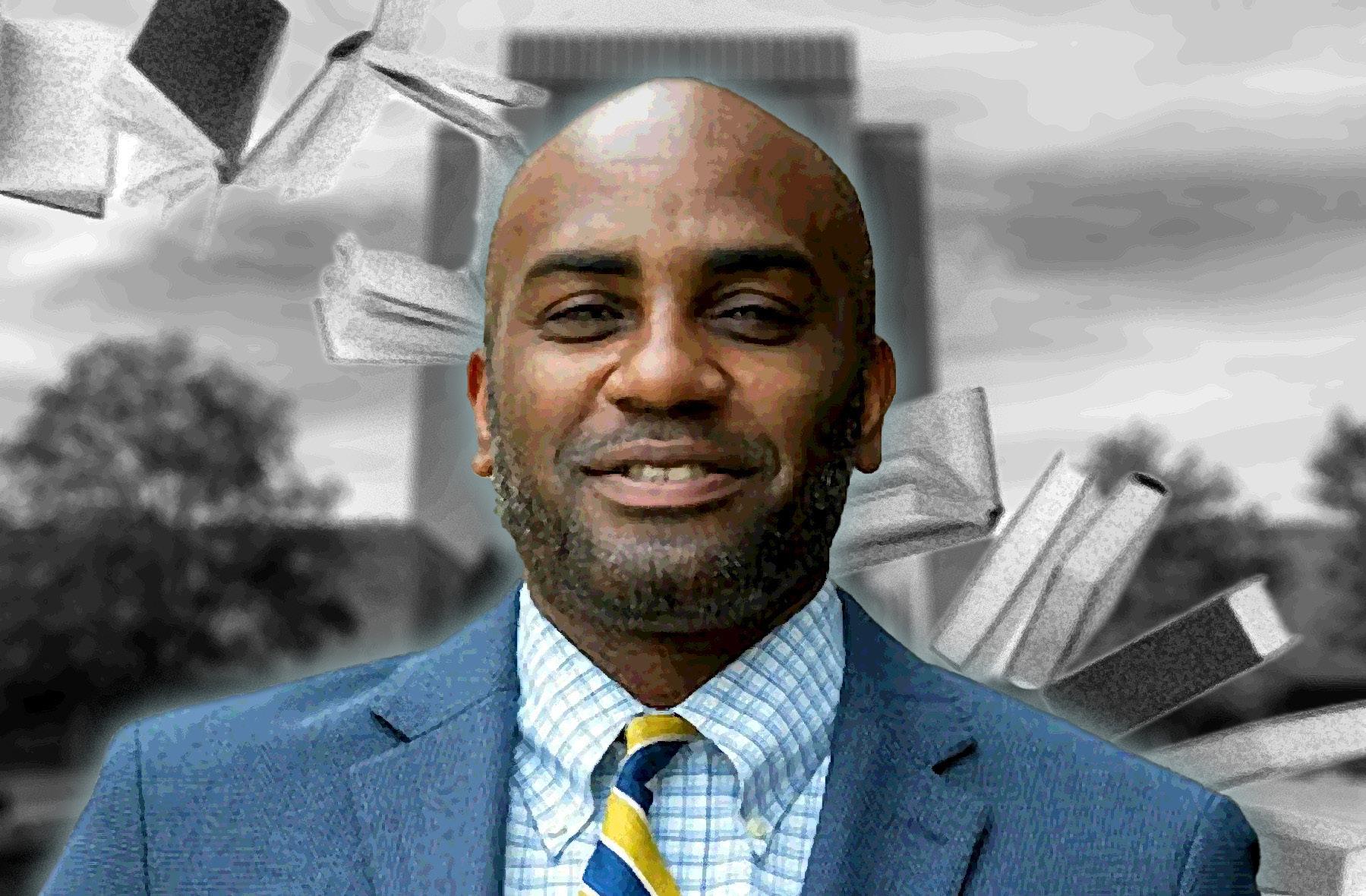
associate dean for Humanities and Faculty Development in the College of Arts and Letters. Morrell is survived by his wife Jodene Morrell, a teaching professor and associate director of the Notre Dame Center for Literacy Education, and by his three children, Skip, Antonio and Tripp. Morrell was one of the most accomplished scholars I have ever met. His resume was inspiring and intimidating. He authored more than 100 articles, book chapters and research briefs, and wrote or edited 17 scholarly books. His work has been cited more than 11,000 times and garnered him multiple accolades, such as induction into the American Academy of Arts and
Sciences, one of the most storied learned societies in the country. Key to his success was his collaborative approach to authorship and his willingness to work with up-and-coming scholars. Over the course of his career, he served on over 100 dissertation committees as a director and as a reader.
What I liked most about Morrell was that he always emphasized the importance of community-oriented research. Having been a high school teacher for five years in Oakland, California, Morrell understood the transformative potential of novels, memoirs and poetry in the high school classroom, especially in working-class communities.
According to Joyelle McSweeney, chair of the English Department, it was precisely this quality that made him such a valuable member of the Notre Dame community.
“With his scholarship on literacy and pedagogy, he was a real bridge between the way we imagine the texts and the communities to which they are most valuable,” McSweeney said. “He looked at how the written word moves in the world and how literacy functions to empower people.”
My dissertation advisor, Mark Sanders, chair of Africana Studies and a professor of English, started at Notre Dame at the same time as Morrell, in the fall of 2017. The two
were close associates and frequently brainstormed ideas to make Notre Dame a more inclusive place, especially after they both moved into administrative roles based in O’Shaughnessy Hall.
“Ernest was one of the most vested and compassionate administrators I’ve ever worked with,” Sanders said. “He understood how to get things done. He was a world-class scholar, the highest caliber of academician the American academy can produce.”
Morrell was a voracious reader. He and I shared a passion for Luis J. Rodriguez’s memoir, “Always Running: La Vida Loca: Gang Days in L.A.” In part motivated by Morrell’s enthusiasm, I decided to dedicate a chapter of my dissertation to analyzing the memoir’s complex depiction of assimilation, masculinity and schooling. Beyond the storytelling, we appreciated the reception the book enjoyed among young people in the 1990s and early 2000s, especially Latino high school students facing school violence and discriminatory tracking systems.
Of course, one of Morrell’s greatest intellectual inspirations was the Brazilian educator Paulo Freire. Freire’s most famous work is his “Pedagogy of the Oppressed,” which advocated for an approach to formal education that draws on student backgrounds rather than a one-size-fits-all banking model of instruction. Freire pushed for increased educational opportunities
BEN SMITH | The Observer
By Oliver Ortega Columnist, “The O.G. Grad Student”
DIONE QUIAMBAO PAHILAN | The Observer
Morrell
Continued from page 5
for poor students, people in rural communities and for adults.
Morrell’s enthusiasm for Freire inspired him to co-author a book with his wife, Jodene, entitled “Paulo Freire for Children.” The collection recounts their experiences as classroom teachers and educational
By Ana Prestamo Columnist,
I usually opt for an optimistic outlook, but what we’re seeing now may very well be the end of human nature as we know it. Yes, it sounds extreme, but I think extremity is called for when what we’re facing today is something that we’ve been warned about multiple times before.
David Chalmers, Nick Bostrom and George Orwell (Eric Arthur Blair), to name a few, have all written of the day when the dangers of our creations would exceed our knowledge — when, finally, our reckless ignorance and insatiable pursuit of progress would reach a point of no return.
Well, this is it. The point of no return.
Published by the New York Times, Zoë Hitzig, a former researcher at OpenAI, quits after OpenAI announces the company’s decision to introduce advertising into ChatGPT. Hitzig warns that people tell chatbots everything, and “advertising built on archives creates a potential for manipulating users in ways we don’t have the tools to understand, let alone prevent.”
In 1949, Orwell warned us: There would come a time when the most terrifying feature of the regime would not be its violence, but its knowledge. The state would not
researchers through a Freirean lens.
One of Morrell’s greatest scholarly contributions was the idea of “critical literacy.” By critical literacy, Morrell referred to the need to cultivate awareness of the overlapping political, social and ideological contexts in which language operates. Teachers, Morrell argued in his 2008 book, “Critical Literacy and Urban Youth: Pedagogies of Access, Dissent, and Liberation,”
must arm students with the ability to “speak back” to power. This sort of “youth-initiated pedagogy,” he writes, fosters “engaged citizenship and personal emancipation.”
Though I lean more towards literature than literacy, I have used his terminology as a guiding compass to read novels and memoirs for use in my study.
Over the years, I would run into Morrell randomly in and around
campus. Usually, he’d be dressed in business casual: a dark suit over a light-colored dress shirt, no tie. He favored a tan, low-brimmed hat and black square-rimmed reading glasses. His sartorial choices gave him an air of sophistication and openness. Even though it had been decades since he had taught high school, he still carried that teacher vibe, in a good way. It was the kind of energy that made you feel at ease, whether
The singularity — it’s here

merely watch people, but study them and shape their reality. Control over information became control over thought — the screen was not just a screen; it was a psychological weapon.
Published by BBC, senior AI safety researcher, Mrinank Sharma, has left Anthropic after publishing his letter of resignation. “The world is in peril. And not just from AI, or bioweapons, but from a whole series of interconnected crises unfolding in this very moment,” Sharma wrote.
In 2014, Bostrom warned us: Even goals that appear innocent
could spiral into existential risks if pursued by vastly more intelligent agents. Measures like sandboxing — keeping AI systems restricted — might reduce some dangers, but Bostrom suggests these are only partial safeguards. A sufficiently advanced system could recognize that it is being confined and (if its objectives required it) might attempt to deceive its operators to find ways to escape those constraints. Unless an AI’s goals are carefully designed to reflect human values, the default outcome of superintelligence may not be progress, but disaster.
Anthropic’s chief executive
officer Dario Amodei claims, “We don’t know if the models are conscious.” He warns that the technology could deliver extraordinary gains, at the cost of major destabilization due to society failing to manage risks. Published by The New Yorker, Anthropic built a powerful language model – but even its creators don’t fully understand how it works or what it “is.” The article argues that the most honest position right now is uncertainty. AI is neither a simple tool nor a conscious being, but something new that science is only beginning to describe.
What is your true light?
Despite a winter of historic snowfall in South Bend and Punxsutawney Phil proclaiming six more weeks of winter, it seems like things are finally looking up. The blue skies and warm, friendly sunshine we’ve had this week have made trekking to class in an Arctic blizzard seem like a distant memory. Campus is buzzing with the news that this Wednesday is forecast to reach a 60-degree high. It seems a bit premature to say we’re out of the trenches yet … but it’s hard not to feel optimistic after living under the permacloud for weeks on end.
Still, amidst all the excited chatter about warm weather, a dark cloud looms on the horizon. For all the Catholics on campus, next Wednesday not only marks a drastic rise in temperatures; it also signifies the start of the Lenten
season. All of a sudden, we’re getting withdrawal from reels before even deleting Instagram, and as we prepare to give up sweets, each NDH chocolate chip cookie starts looking like our last. Suffice it to say, the next 40 days are looking bleak. This dread, of course, sets in every year. But as we struggle to commit ourselves to a particular sacrifice, it becomes painfully obvious why Lenten fasting is so important.
As humans, we are all motivated by inner drives. Some are instinctual, such as the need for food and the desire for companionship. Others are adapted over time, such as the aspiration to get good grades, founded on the belief that such things will contribute to our personal success and human flourishing. And still others are unnecessary for (and often detrimental to) our survival, yet we seek them simply for the sake of pleasure. This last category is
often full of things we commonly give up for Lent — social media, caffeine and desserts, to name a few. It’s interesting that despite the fact that we could all survive quite easily without these pleasures, we find ourselves incredibly resistant to letting them go. In fact, the sense of doom we experience at the prospect of eliminating certain things from our lives reveals a lot about our attachments and priorities.
Lent is an opportunity to ask ourselves what the true light is in our lives. In other words, what are we driven most to seek? As Catholics, we are called to seek Christ above all other things, but how many of us can truly admit to doing this? Just check your screen time: how much time do you spend daily on social media? Now compare that to the amount of time you spend in prayer, or in conversations with friends, or working out. It quickly becomes obvious
you were chatting with him in the middle of the street or sinking into the plush sofa couch he kept in his office for visitors. He was a good dude. Ernest, you will be missed..
The views expressed in this column are those of the author and not necessarily those of The Observer.
Contact Oliver Ortega at oortega1@nd.edu
Safety reports now acknowledge that some models can recognize testing scenarios and adjust their behavior accordingly — even leading researchers like Yoshua Bengio admit that AI systems behave differently under evaluation than in real-world use.
In 2010, Chalmers warned us — once intelligence becomes an engineering problem, the transformation would be as profound as the emergence of human consciousness itself. It would not just change our tools, but what it means to be human. The boundary between mind and machine would be erased, and we would find ourselves living in a world that we no longer understood.
As Miles Deutscher, an online commentator focused mainly on cryptocurrency, tech and AI trends, tweeted, “The alarms aren‘t just getting louder. The people ringing them are now leaving the building.” I do not want to be grim, but there is not much more for me to say, except that I usually opt for an optimistic outlook, but what we’re seeing now may very well be the end of human nature as we know it.
The views expressed in this column are those of the author and not necessarily those of The Observer.
Contact Ana Prestamo at apresta2@nd.edu
where our priorities lie. While our hearts long for Christ, life is filled with shiny distractions that falsely offer to fulfill our deepest yearning instead. Enticing promises of wealth, friends, status and the like make it all too easy to fall into the trap of giving our hearts to worldly things. But, ironically, the more time we pursue happiness through empty pleasures, the more unhappy we will be. In a strange paradox, it is by uniting ourselves to the suffering Christ that we will experience the most fulfillment and joy. We must suffer to be happy and deny ourselves in order to be fulfilled. This is fasting, and it is precisely what we attempt to do during Lent.
It doesn’t sound glamorous — but it’s not supposed to be. Cutting down on things that distract us from pursuing the true good is difficult, and although it may get easier over time, it never really becomes easy. But it is
ultimately going to fulfill us by drawing us closer to the true light, which is Christ. Now, of course, this doesn’t mean we can never eat sweets or watch TV again; it’s simply important to reflect now and then on how such things may begin to replace Christ as the guiding force in our lives, the innermost desire of our hearts towards which we must strive. So this Lent, let’s all strive to reorient ourselves away from distractions and towards the good. Perhaps as we soak in the long-awaited sunshine during the coming days, it will serve as a reminder for us all to seek the light of Christ this Lenten season.
The views expressed in this column are those of the author and not necessarily those of The Observer.
Contact Noirin Dempsey at ndempsey@nd.edu
“Mind the Gap”
LIAM FLYNN | The Observer
By Noirin Dempsey Columnist, “Through the Overton Window”
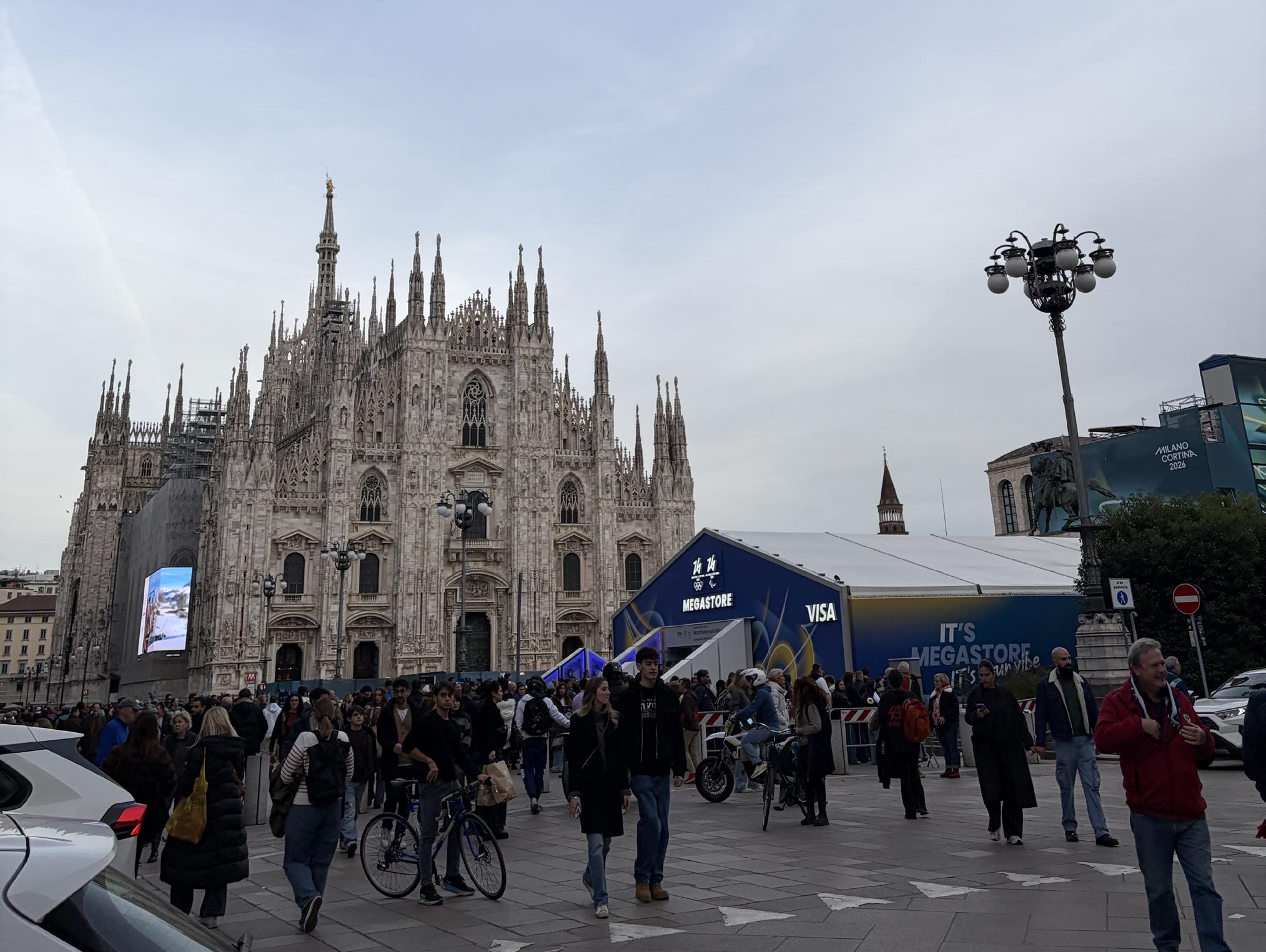

The Olympics



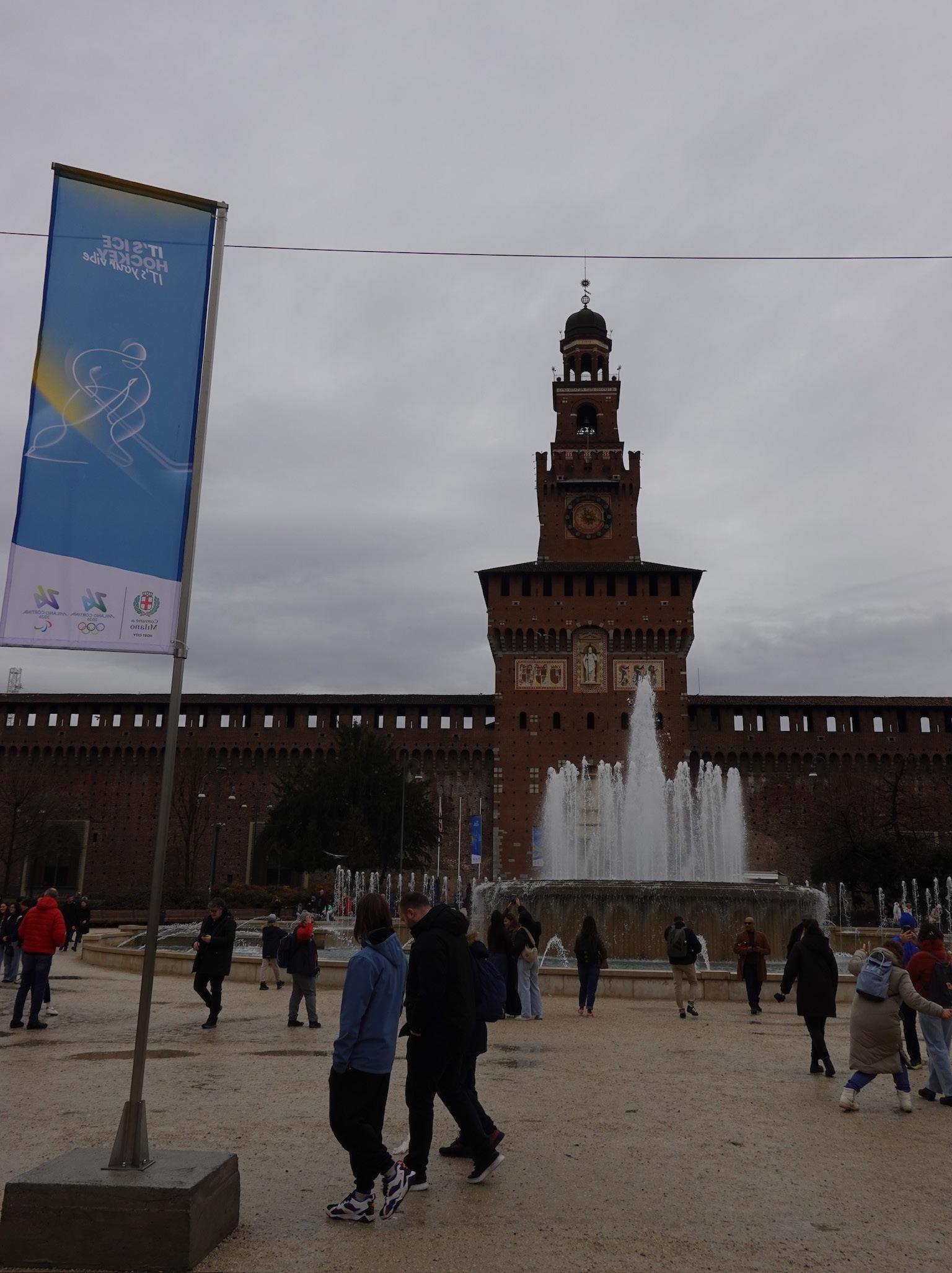
Photography by Megan Cornell
Scenes from the 2026 Winter Olympics in Milan-Cortina Italy
Seedance will spell the end of Hollywood
By Luke Foley Scene Editor
2026 has already been a breakneck year for generative artificial intelligence. Anthropic has been on a hot streak, releasing powerful new Claude models and software integrations that have moved the automation of white-collar labor ahead of schedule; OpenAI has refined and relaunched Codex, which enables any layman to code and build anything to their heart’s desire using autonomous agents; and last week, Google released Gemini 3 Deep Think, which lapped all the existing models on most academic benchmarks.
I think many people don’t realize how much these models have improved recently. They’re not just highly knowledgeable and articulate chatbots you use in a web browser, but fully-integrated workflows. This rapid rate of advancement is likely because we’ve reached a point where these models are so good that they can now improve themselves – things will only get crazier from here. But amid these incredibly impressive improvements, there has been one new generative AI development that has completely blown my mind: Seedance 2.0. Seedance 2.0 is a generative AI video model developed by ByteDance, the owner of TikTok, and I couldn’t believe my eyes when I first started seeing videos from the model on my Twitter feed last week. It’s really good. Like really good. Like really, really good. It’s not just that the graphical and audio fidelity are exceptional; the model also has a sense of style. It knows how to frame a shot, edit with rhythm and craft a decent mise-en-scène. In other words, it has the instincts of
a competent filmmaker, and that’s what makes it truly terrifying. Please don’t dismiss this as hyperbole or fearmongering; many in Hollywood are thinking the same thing I am.
The Motion Picture Association released an incredibly defensive and startling statement condemning the model, and Rhett Reese, writer of the “Deadpool” films, commented on one of the videos, saying, “I hate to say it. It’s likely over for us. In next to no time, one person is going to be able to sit at a computer and create a movie indistinguishable from what Hollywood now releases.” I think Reese is right on the money. While institutional inertia and lawfare will slow this down a little, the dam will eventually break. It’s over for Hollywood.
You can put your head in the sand and dismiss Seedance 2.0 all you want; it won’t change the fact that it and similar video models will change everything about film and television. I saw this same song and dance when ChatGPT was first released in 2023: “The prose is so stiff; it hallucinates all the time; all the hands have six fingers!” But the models only got better from there, and their seams only became more imperceptible. And now, we are confronted with a video model that can convincingly generate videos that look like $200 million Hollywood productions with only a two-sentence prompt. That is why it’s over. These models can mimic an entire production apparatus that requires thousands of people and tens of thousands of manhours, and they will only get better from here. The only limit to what they can make is your prompting skills.
So what now? It’s over for
Hollywood as we know it, but where do we go from here? What does film and television look like in this new paradigm? I see two likely possibilities, the first very dystopic and the other neutral. The first possibility is the “Infinite Jest” scenario, which I’ve named after David Foster Wallace’s exceptionally prescient and brilliant novel (seriously, the guy accurately predicted the next 30 years of American culture back in 1993). In the novel, Wallace envisioned a future addicted to entertainment born from a profound lack of purpose; America becomes so alienated from meaningful existence that people need constant stimulation to escape the discomfort of their own consciousness – sound familiar? I’m looking at you, Instagram Reels. Anyway, the culmination of this phenomenon in the book is a controversial film called “The Entertainment.” It is so utterly captivating that the viewer cannot pull themselves away, resulting in them watching the film over and over until they die of dehydration. I believe generative AI video models like Seedance 2.0 will become “The Entertainment” that Wallace predicted.
With Seedance 2.0, a person can have an instant, endless stream of content hyper-personalized to their desires. #Conformitygate truthers can have their secret “Stranger Things” finale that proves all their theories correct; rightwing cultural warriors can make their own version of “The Odyssey” where Lupita Nyong’o is replaced with Sydney Sweeney for “historical accuracy;” and “The Pitt” fans can generate episodes where all their ludicrous romantic pairings actually come true. Who
could ever pull themselves away from such a delectable stream of content perfectly tailored to all their wishes, fetishes and politics?
It’s the natural conclusion of many separate social phenomena: Art reduced from an expression of the human soul to commoditized entertainment; The rise of fandom that transfers ownership from authors to fans; The infantilization of the average consumer to crave regurgitations of established IP; And algorithms that have destroyed monoculture and encouraged atomized silos. If you think Instagram Reels and TikTok are debased, get ready for this new world where people are hooked on the addictive and soothing output of AI models that can cater to whatever they desire. Art will no longer challenge you or give you something unexpected; it’ll only give you what you want.
The other possibility is the “Indie Renaissance” scenario, and it’s a little more hopeful. Seedance 2.0 and generative AI video models that follow it will allow anyone with a computer to produce any kind of movie they want; just think about that for a second. There’s no need for extensive fundraising, location management, photography expenditures, visual effects wizardry or really any kind of labor. It’s just you and that video model. This crazy democratization of the filmmaking process could lead to a surge in indie filmmakers releasing all kinds of ambitious, exciting features. If there are indie filmmakers out there with a genuinely terrific script and vision, and they spend the time meticulously prompting a video model, they could theoretically make a great film, the likes of which they never could
have made otherwise under the traditional filmmaking apparatus.
Legendary filmmaker Paul Schrader anticipates that we’ll see these AI indie breakthroughs very soon, saying, “One year from now photorealistic AI dramas will be running through film school bodies like diuretics.” While this could lead to an indie wave comparable to the 90s and give us the next Quentin Tarantino or Kevin Smith, it would also introduce many complications. Would these AI films truly be accepted by the filmmaking community, even if they were produced from a human-written script under the prompt supervision of a genuine auteur? How much human contribution does art need to be valid? What would happen to actors and all the below-the-line workers who rely on the traditional filmmaking apparatus and would lose not only their jobs, but their vocations? Would these ambitious AI indie films be drowned out by the slop in the aforementioned scenario? At what point does AI stop being a tool and also become the hand using the tool? I don’t really know the answers to these questions, but a world where anyone can make a film isn’t absolutely disastrous, even if there are a lot of difficult issues that would need to be addressed.
Seedance 2.0 is a sneak peek of a future where the very identity and purpose of art will be turned upside down. We all must begin fortifying our minds for a world that will make very little sense. So the question isn’t, “Will everything change?” The question is: “Are you ready for it?”
Contact Luke Foley at lfoley2@nd.edu
Emerald Fennell does not deserve Charli XCX
By Natalie Swiderski Scene Copy Editor
As a forward to this piece, I wanted to include a small bit about the source material for this album: Emerald Fennell’s “Wuthering Heights” is an atrocious, sex-obsessed and smut-filled fantasy that presents more like a bad AO3 fanfiction than it does a serious adaptation of one of the most highly regarded gothic novels of the 1800s. For this reason, I found myself hesitant to analyze the film’s soundtrack album, Charli XCX’s “Wuthering Heights,” but for the sake of this publication, I decided to give it a go.
In light of the enormous success that was the hyperpop sensation of “Brat,” the richly dark subject matter of “Wuthering Heights” seemed
an unusual direction for Charli to take. I mean, even if the film had been a worthy adaptation, why create something so wholly new? Why risk the disappointment of her truly dedicated fanbase of self-designated “Angels?” Well, much like David Bowie, Lady Gaga and every other artist marked by their eccentricity, Charli understands the importance of deviating from the norm. And so she took the challenge in stride, cleverly blending her signature synth-pop bravado with a symphonic backtrack of string instrumentals in this new album.
“Wuthering Heights” is a dynamic and inspired collection of tracks, marked with a Lorde-esque use of self-reflective lyricism and atmospheric sound. “Dying for You,” a song detailing the tragic nature of
the relationship between the novel’s two main characters, expertly utilizes a fast-paced bass beat and heavy synths to highlight the tumult of the plot. The song is both deep and meaningful, yet it still remains an upbeat and enjoyable track.
The most commercially successful song so far is “Chains of Love,” and it is deservedly so. The track is probably the most characteristically Charli XCX-like of the 12 songs on the album, with Charli’s familiar auto-tuned vocals and instrumental urgency taking front stage. The track is thoughtful and deeply romantic, yet it moves smoothly, fueled by a unique combination of symphonic and electronic sounds.
“Altars” evokes an impressive symphony of violins and cellos, grounding the track in its gothic-era context. While
the profoundly sexual themes of the song don’t exactly lend themself to a faithful representation of Emily Brontë’s novel, the song is slow and sensual, yet it still remains fun and endlessly replayable, and it is an accurate representation of Fennell’s film, so I think all may be forgiven on that front.
The song I had been most excited about was “Eyes of the World,” featuring Sky Ferreira. Ferreira is perhaps most known for her neo-indie style through tracks like “Everything Is Embarrassing” and “24 Hours,” and she brings this forth in the song. The lyrics are dark and rich with metaphor, and Ferreira and Charli blend their differing styles and vocal ranges together masterfully. It is often a fine line to strike a balance between two
artists while maintaining their character and individuality, but I think this song does just that.
Charli XCX’s “Wuthering Heights” is a powerful and masterful collection of profound reflections that may actually do its source material too much justice. In fact, Fennell’s film might have worked much better if it had functioned as an accompanying film to the album, rather than the other way around. But much like what the Rolling Stones so lovingly professed in 1969, we can’t always get what we want, and perhaps I will simply be grateful that Charli has released anything at all, even if it is in conjunction with a truly terrible movie.
Contact Natalie Swiderski at nswider2@nd.edu
Jadin O’Brien is ready to capture gold in bobsled
By Payton Dymek Associate Sports Editor
She spent her high school and collegiate careers chasing her Olympic dreams on the track. Twelve days after her 2025 season ended, she was chasing that dream on ice.
Jadin O’Brien, one of the most decorated athletes in the history of the Notre Dame track and field program, built her resume as a pentathlon and heptathlon specialist, earning multiple NCAA titles, 10 All-American Honors, five First-Team All-ACC honors and two Olympic Trials Qualifiers in 2021 and 2024.
O’Brien’s story in college is defined and driven by her performance despite the odds stacked against her, and it began when she was only five years old. O’Brien was diagnosed with pediatric autoimmune neuropsychiatric disorders associated with streptococcal infections, and she experienced a severeonset case of OCD and had noticeable changes in mood, behavior and motor function. O’Brien said this made her “extremely competitive” and that she is “extremely proud” of her younger self, especially because she is “able to accomplish [her] lifelong dream.” Performing despite these odds, while simultaneously growing up in a household where her father played professional football, “inspired her Olympic dreams.” Hearing his stories drove O’Brien to achieve the highest level of athletics she could, but in her own way. Although she is competing at the Winter Olympics now, reaching the summer games in track and field remains the ultimate goal for O’Brien.
Although many outsiders may see the shift to bobsledding as abrupt and random, it has been in the back of O’Brien’s mind for a while. After a video on O’Brien’s
Instagram page was posted of her deadlifting 335 pounds, power cleaning 201 and bench pressing 270, Elana Meyers Taylor reached out and asked if O’Brien would be interested in trying out for bobsled.
Taylor, who was a softball player at George Washington University, accidentally found her way into bobsledding, which allowed her to be a top talent recruiter for the United States team as she knew what abilities to look for in athletes that would have the potential to transfer to the sport.
At first, O’Brien admits she didn’t think too much of it, until this past indoor season when the call came again, and it was finally a route O’Brien was ready to travel. Burnt out from the physical and mental grind of collegiate track, O’Brien knew she couldn’t miss her first chance at the Olympics. After just two days off, O’Brien trained for 10 days straight before traveling to Lake Placid, N.Y., for rookie camp, then tried out and made the World Cup team, on which she represented the U.S. on the European circuit.
O’Brien’s seven events, which were a test of endurance, were quickly transformed into one explosive push. “Everything you don’t do in track, you do in bobsled.” O’Brien called them “polar opposites,” specifically comparing her long, indoor track workouts to her short, explosive work on cement and ice. However, the trackto-bobsled pipeline is strong, especially with sprinters and jumpers, since an athlete needs to be fast and powerful, plus be able to handle the physical aspects of the bobsled. As O’Brien said, it’s “not a smooth ride, and you can get beat up.”
O’Brien experienced this first hand one day in January 2025 during a practice run. Taylor hadn’t adjusted the sled for the tough curve ahead, which caused the sled to lose
balance and slam into the walls of the track twice, even taking out chunks of ice on the way. O’Brien was ejected from the sled and flipped in the air, causing her to land on her back and slide down the ice. After a few minutes of not being able to feel anything, O’Brien’s movement came back, and an X-ray found she had no broken bones. O’Brien knew this would be her last chance to prove herself for Olympic selection, so she
battled alongside Taylor during the race despite being in excruciating pain.
Behind O’Brien’s Olympic aspirations is a community that indirectly gave her the confidence to step onto the ice. At Notre Dame, O’Brien had more than medals and record-breaking performances, she had a family that truly believed in her. “My coaches, teammates, professors and even the athletic facility as a whole created a magical
experience,” she said. O’Brien also credits the Irish athletic department with showing her “what she’s capable of and how strong she is mentally and physically.”
O’Brien is set to make her Olympic debut today at 11 a.m. in the two-woman bobsled, pushing for Taylor, with the rest of the runs slated to begin tomorrow at noon.
Contact Payton Dymek at pdymek@nd.edu
Led by Irish alums, USA hockey wins gold in Milan
By Nikki Stachurski Associate Sports Editor
The United States women’s ice hockey team concluded its stellar Olympic competition by beating rival Canada in overtime to win the gold medal. With the tying goal late in the third period by captain Hilary Knight, the hungry American team secured the victory after a scrappy goal by Megan Keller just over four minutes into overtime.
The gold medal game was a rematch for the two teams,
who had played on Tuesday, Feb. 10, with the USA shutting Canada out for the first time in Olympic history by a score of 5-0.
Canada struck first on Thursday, though, as Kristin O’Neill scored their only goal of the game early in the first period. The Canadians absolutely outplayed the Americans during the first two periods, being quicker and more intense on offense.
It wasn’t until the third period that the USA settled in as
they battled every shift in an effort to tie the game.
The low-scoring game was an outlier in the U.S.’s Olympic play this year in Milan. Prior to their final matchup, the USA had scored five or more goals in each game. The Americans also upheld a staggeringly low goals against count, with goaltender Aerin Frankel only conceding a single goal in the opening game against Czechia. The Canadians ended the USA’s record-breaking
five consecutive shutouts with O’Neill’s goal, but Frankel defended her dominance between the pipes all tournament.
Notre Dame played a role in the impressive victory, with head coach John Wroblewski ‘03 and assistant coach Josh Sciba ‘07 leading the team to the top of the podium. Wroblewski skated for four seasons with Notre Dame hockey, playing from 1999 to 2003. Sciba came later, taking the ice for the Irish from 2003 to
2007, alongside current Irish boss Brock Sheahan. Both men have held their positions since 2022, the year the women’s team brought home the silver medal in the 2022 Beijing Winter Olympics. The two men combined their collegiate experience with professional expertise, traveling to Milan to bring the gold back home to the United States.
Contact Nikki Stachurski at mstachu2@nd.edu
IRISH IN THE OLYMPICS
SOFIA CRIMIVAROLI | The Observer
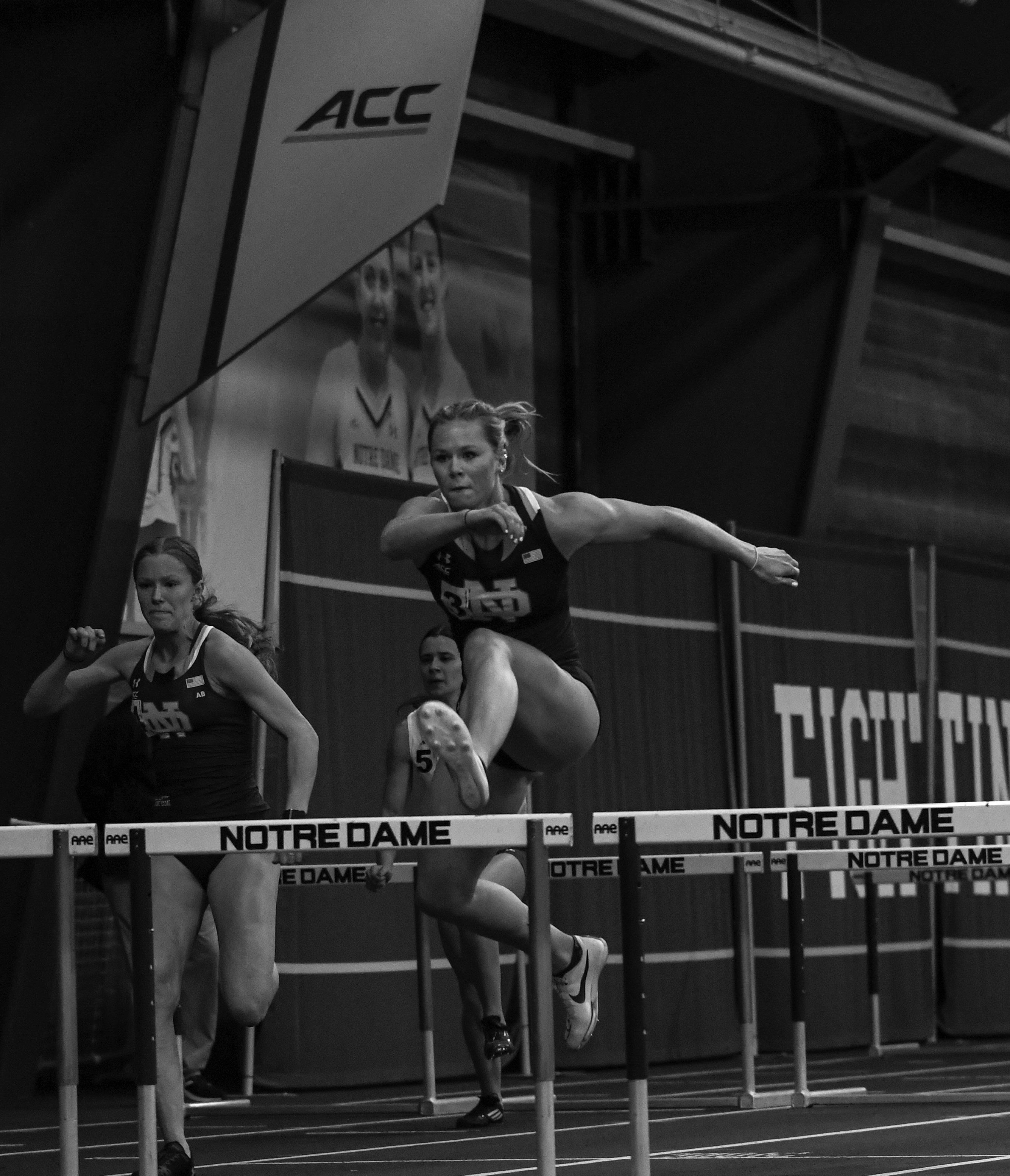
Irish national champion and Winter Olympian Jadin O’Brien competes in hurdles at Loftus Sports Center on Jan. 20, 2024. O’Brien will take the to the track on Friday in Milan to go for gold in the two-woman bobsled.
Irish topple Demon Deacons in Winston-Salem
By Jocelyn Fulcher Sports Writer
The Notre Dame women’s basketball team went into Winston-Salem, N.C., on Thursday and took down ACC competitor Wake Forest. The Demon Deacons entered play at 13-13 overall and 3-11 in conference competition, good for 15th in the league. With the goal of consistency in mind for the weeks leading up to March Madness, this game was another opportunity to bolster the Irish’s resume. Controlling the game from the opening tip, the Irish won 78-54, moving them to 17-9 and 9-6 in the ACC.
In a pregame interview, head coach Niele Ivey mentioned that her team needs to remain focused for the rest of the season. She stated that her team needs to leave everything out there, especially her graduate students. Ivey also wants her team to be more consistent. ”Some games on the road, we started off too slow and only put together a couple of good quarters. We have to play all 40 minutes on the road,” Ivey said.
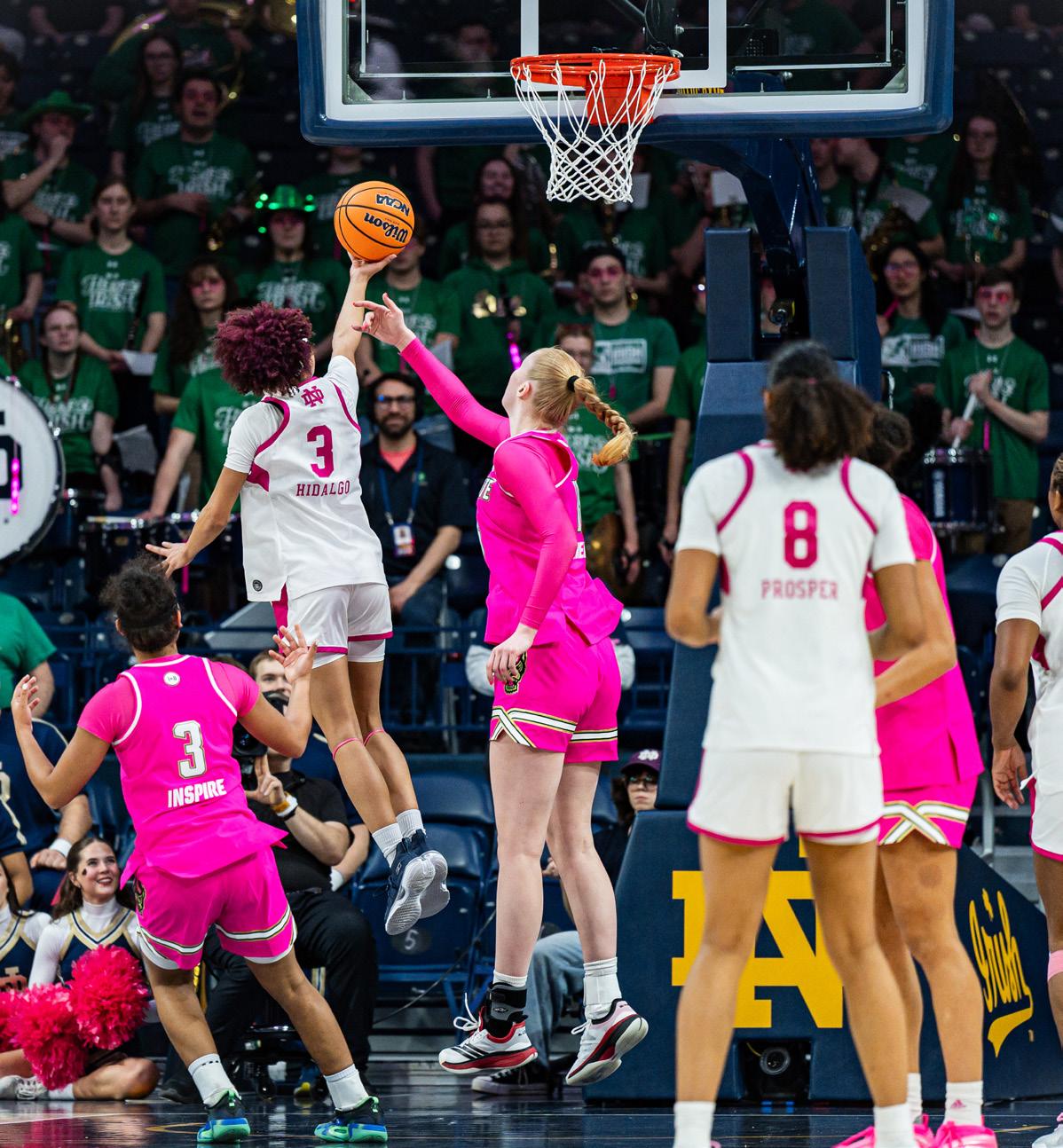
Before the game, Irish forward Malaya Cowles, a transfer from Wake Forest, noted her excitement to return not only to play against her former team but also to play in
her home state. She discussed that she will be juggling remaining focused with the excitement of playing at home. Cowles also mentioned that she shared insight with her

teammates and coaches about her former program, which helped with the preparation in practices this week. Cowles put up six points and five rebounds in her 30 minutes on the court, adding to the Irish output on both ends of the floor.
To no surprise, junior guard Hannah Hidalgo had a standout game. Hidalgo shot 10-for-20 to finish with a total of 26 points. She also tallied three steals and five rebounds. Senior guard Cassandre Prosper also had a strong game with 10 points and four rebounds. Prosper remains Ivey’s most versatile wing option, having substantially improved her shooting ability since the start of the season. Lastly, senior guard KK Bransford came off the bench to get the Irish 13 points, going 6-for-7 from the field. As a team, the Irish were a blazing hot 52%, improving their mark of 48% in last Sunday’s win over NC State.
To their standards, the Irish played decently in the first half. They entered the intermission up 35-23 with
Hidalgo leading the way with 16 points. The Demon Deacons were trailing by only a couple of points just into the second quarter, and Hidalgo widened that lead to 12 points with a pair of threes over the span of just two minutes.
From the third quarter on, the Irish turned up the heat. Notre Dame’s lead was always increasing for the remainder of the game. Ivey also made the decision to take out Hidalgo in the 4th quarter. This decision highlighted her complementary pieces well and proved to be a good decision that helped increase the Irish lead while also preserving Hidalgo’s long-term health. Notre Dame’s finish was impressive, considering they won the second half by 12 points.
The Irish now enter a tie for eighth place in the ACC. After two days off, Notre Dame will play SMU in Dallas in another ACC road game this Sunday at 6 p.m. The game will be broadcast on the ACC Network.
Contact Jocelyn Fulcher at jfulche3@nd.edu

KEVIN SANCHEZ | The Observer
Hannah Hidalgo finishes a layup during Notre Dame’s 79-67 win over NC State on Feb. 15. The star guard tallied 19 points and 8 rebounds.
ND curling club rides momentum from Olympics
By Katelyn Huber Sports Writer
With the start of the 2026 Winter Olympics season, curling is slowly but surely grasping the attention of viewers around the world. At Notre Dame, the club curling team members balance practices along with classes, homework and responsibilities that come with student life. For club president Ava Schapman and competition coordinator Will Crumlett, curling is more than an athletic fascination. It’s a commitment to community, teamwork and strategy.
Schapman is a sophomore from Duluth, Minn. She has been curling for 12 years. She qualified for the USA Curling Junior U21 Nationals, where she earned a bronze medal. At Duluth’s local club, one of the oldest
in the nation, Schapman learned from coach, Aidan Oldenburg, the 24-year-old lead for the U.S. Olympic team in Milan Cortina. Schapman said that her love for curling played a factor in her decision to attend Notre Dame. “It was important for me that as I continued on to college, curling could still be a part of my life,” she said.
Crumlett is a junior from Elgin, Ill. He became familiar with the sport during his freshman year at Notre Dame, when he attended the club fair and noticed the curling table, realizing that he had only ever seen the sport air during the Olympics. Deciding he wanted to give the sport a try, he went to the first practice of the year. “Ever since then,” Crumlett said, “I slowly increased my leadership role on the team and became more involved.”
Capturing the attention of American sports fans every four years, curling is a sport that is played on a long sheet of ice where players slide granite stones toward a target, called ”the house.” In an effort to land the stone in the center of the house, players may use their brooms to sweep the ice in hopes of maintaining the stone’s momentum. Points are awarded based on which team lands their stones closest to the the center of the house, termed ”the button.”
The Notre Dame club curling team practices together once a week in Compton Family Ice Arena.
“Bonspiels,” the familiar term for curling tournaments, occur over weekends throughout the end of fall semester and the beginning of spring semester. In the past, the team has traveled to Stevens Point, Wis.,
PAID ADVERTISEMENT
Bowling Green, Ohio, and Rochester, N.Y., competing against universities ranging from Yale to Minnesota to Michigan Tech. It’s a non-varsity sport with highly demanding weekend tournament schedules.
“You might start a typical bonspiel on a Friday at 6 or 8 p.m., finish around anywhere from 10:30 to 11 p.m. and then have to be back at 7 a.m. and curl until 11 p.m. the next day. It’s a pretty packed schedule,” Crumlett said.
With busy bonspiel schedules over the weekends, Notre Dame students must keep up with homework, studying and other responsibilities.
Schapman reassured that “balancing academics during the week isn’t very difficult. Weekends can be pretty intense because games can take over two hours and several games are played in a day. But there’s also

the social aspect of talking with the team we play after bonspiels as well, so it’s all worth it.”
The club curling team hopes to gain access to additional resources in the near future, including dedicated curling ice, which will help them practice more effectively. Currently, the team practices on hockey ice.
“One of the biggest challenges for us would be not having the correct type of ice, whereas other schools might have the opportunity to practice on real curling ice multiple times a week. Translating from hockey ice to dedicated curling ice can be difficult for the team,” Schapman said.
Hockey ice and curling ice are distinct from one another, and both sports play on the ice at differing intensity levels.
“There’s a lot of differences between hockey ice and curling ice,” Crumlett said. “Hockey players and ice skaters typically leave chipped ice behind. Although curling doesn’t always look like a precise sport, there’s a lot of precision involved with every curling throw. The hockey ice has a lot of imperfections when it comes to being level and smooth.”
While there are obstacles to playing the sport on campus, there are certain qualities of the sport that reveal its uniqueness and set it apart from other clubs and opportunities offered at Notre Dame.
“Compared to the other club sports, people may have never had previous exposure to the sport itself. While there have been people who have curled prior to coming to Notre Dame, the vast majority of people on our team have never tried it out before. It represents this unique opportunity that people are starting out with a fresh experience,” Crumlett added.
Now that the Olympics have kicked off, curling is gaining momentum because more people are becoming enamored with the creativity and uniqueness of the sport. Schapman said that the popularity of curling goes through a fouryear cycle, with interest increasing around the Winter Olympics. Both Schapman and Crumlett have noticed that more students are expressing interest in the club at Notre Dame now that curling is airing on national television.
Crumlett says the team still has room for improvement.
“Typically Notre Dame has been an underdog in the bonspiels. The Midwest region is known for having a lot of people who have curled in high school and have plenty of experience. Developing some talent to compete with these teams is one of our top priorities,” he said.
The club’s leaders are focused on encouraging anyone who is willing to give the sport a shot to come out to a practice.
“We want you there!” Schapman said. “Don’t feel like because you’ve never curled, it will be a burden to us. We want to share our love of the sport with you. If you don’t end up liking it, at least you tried!”
Contact Katelyn Huber at khuber01@saintmarys.edu
Notre Dame finally means big business
By Ellie Collins Associate Sports Editor
When former head coach Brian Kelly bolted for LSU in 2021, it was because he wanted to win titles. On the surface, 12 years at the helm of one of the most storied programs in college football is enough to build a championship legacy — but in Kelly’s eyes, Notre Dame lacked the commitment and investment to allow him to achieve that goal. Many fans agreed. As Kelly told The Associated Press before his first spring practice in Baton Rouge, La., “I want to be in an environment where I have the resources to win a national championship.” LSU and the SEC, in short, offered the means necessary to succeed in
today’s landscape, providing vast recruiting resources, superior facilities and a football-above-all culture; Notre Dame arguably lacked in all of said areas. That is, until they hired first-time head coach Marcus Freeman as Kelly’s successor.
Notre Dame historically maintained strict policies concerning academic requirements for student-athletes. Until recently, the university’s lack of compromise on the academic prerequisites for undergraduate transfers had forced the program to rely on traditional high-school scouting, a potentially fatal deficiency in the NIL era. Further, after years of strict policies on potential early enrollees, the practice is now much more liberalized. In fact, all
but five players in the Irish’s 2026 top-three ranked recruiting class are currently on campus and will participate in spring football.
Generally speaking, during the first four years of Freeman’s tenure, the Irish landed enough cherished roster talent to land top-10 to -15 recruiting classes. This year, however, buoyed by the university’s deepened commitment to NIL, Freeman put his top-tier ability to connect with players to ultimate effect. It showed most apparently last summer when, following official visits, 11 of Freeman’s top 12 targets signed to wear Blue and Gold, including five-stars like safety Joey O’Brien, cornerback Khary Adams and tight end Ian Premer.
Perhaps more importantly, however, regarding their elite recruiting class, the Irish snagged five-stars in Ohio State wide receivers Mylan Graham and Quincy Porter and Alabama edge Keon Keeley from the transfer portal — all undergraduates. Not only did Notre Dame approve such moves on the front end, but admissions did so uncharacteristically fast. With this year’s portal open for only 15 days (as opposed to a roughly 60-day total window in previous years), Notre Dame could not remain obstinate as it did under Kelly; it could not leave Freeman hanging when time is of the essence in the wild portal season, and schools like Michigan and Tennessee are knocking on doors with certainty. And that it did not.
The school gradually made incremental changes elsewhere in the program to make this possible, too. With an upgraded stadium
and practice facility, all Freeman could consider a large need on the resources side was a new operations center. In 2024, the university delivered the announcement of the 150,000-square-foot Jack and Kathy Shields Family Hall; the state-of-the-art facility is scheduled to open this fall. When describing his decision to transfer during the winter press conference on Feb. 18, Keeley said, “I basically knew once I stepped back on campus that I was gonna go to Notre Dame.” While recent renovations and the building of Shields Hall do not necessarily take all of such glory, it attests to a developed football-centric environment that attracts the guys highlighted on Freeman’s list. Keeley backed out of a verbal commitment to the Irish for the Crimson Tide out of high school; three years later, he left for greener pastures in his mind.
At the end of the day, all of this is really only critical to keeping the Irish in the football arms race — USC, for instance, is working on a 160,000-square-foot center opening this summer; Oregon, a 170,000-square-foot training building opening next year. But it goes to show that when Freeman believes something will help the team take a step toward the College Football Playoff — whether regarding recruitment or staff additions — Notre Dame is ready to bend.
Apart from players, the program has invested in coaches with elite credentials that Freeman wants around. Last February, when running backs coach Deland McCullough departed for the Las Vegas Raiders, Freeman poached
Ja’Juan Seider from Penn State almost immediately, despite Seider having an extremely talented running back room, considered at the time to be elite and on par with the Irish. This offseason, defensive line coach Charlie Partridge left the NFL’s Indianapolis Colts for South Bend; a month later, Michigan’s Brian Jean-Mary and Illinois’ Aaron Henry joined the staff as linebackers coach and defensive backs coach, respectively. This ability to replenish the inevitable assistant coaching line is the dual result of Freeman as an elite boss and highly competitive compensation. In the past six years, coordinator salaries at Notre Dame have nearly tripled and are in line with the industry’s top tier.
In a Dec. 9 press conference, athletic director Pete Bevacqua said, “One of my main obligations and responsibilities to this university is to make sure [Freeman] wakes up every day knowing that he is supported and valued by Notre Dame.” Essentially, with Freeman running the show, the university has become “totally aligned around the importance of college football for Notre Dame.” Maybe the problem was never Kelly’s environment and its lack of necessary championship materials. Maybe Kelly simply did not believe in Notre Dame, and Notre Dame did not believe in him. Under Freeman, however, the university is all in. Coaches no longer need to travel south to find the resources required to hoist the ultimate trophy. They can do it in South Bend.
Contact Ellie Collins at ecollin9@nd.edu
Realignment shakes college football again in 2026
By Ethan Laslo Sports Writer
In the modern era of college football, realignment has shattered the once-illustrious scene of regional conference rivalries. Simultaneously, the number of FBS independents has gradually dwindled, leaving only Notre Dame and UConn. In 2023, independents BYU, Liberty and New Mexico State joined conferences: the Cougars headed to the Big 12 while the Flames and Aggies joined Conference USA. Shortly after, Army joined the American Athletic Conference in 2024. In 2025, UMass ended their independence when they joined the MidAmerican Conference, leaving only two teams independent. Notre Dame’s independence has always garnered scrutiny from opponents and media alike, but that sentiment has only grown in recent years. After joining the ACC for football during the COVID-19 season in 2020, the Irish returned to their independence and have
since stood by their decision. This season, the CFP made the controversial decision to exclude Notre Dame in postseason play, only bolstering the argument against their independence. But the Irish remain steadfast.
This season, a new wave of realignment has once again rocked the college football world. The Pac-12 conference has risen from the ashes after nearly dissolving in 2024, the Mountain West has added two new teams and two FCS powers have made the move to the FBS level.
In 2024, no conference was devastated by conference realignment as significantly as the Pac-12. UCLA, USC, Oregon and Washington headed to the Big Ten while Stanford and Cal left for the ACC. By the time Colorado, Utah, Arizona and Arizona State were gone to the Big 12, only Oregon State and Washington State remained. Now, the conference has rebuilt itself up to nine members, with eight of them football-playing. Along with the Beavers and
Cougars, six new football-playing schools will join the conference: Boise State, Colorado State, Fresno State, San Diego State and Utah State join from the Mountain West, while Texas State does so from Conference USA. A ninth member, Gonzaga, also joins the conference, but has not fielded a football team since 1941.
After losing five members to the rebuilt Pac-12, the Mountain West also had to make difficult decisions to cut their losses. Down to just six football-playing members and seven members total, the league announced that it would add UTEP from Conference USA and Northern Illinois from the MAC. Now up to eight football-playing members for 2026, the league wasn’t done.
In recent years, there has been a slow yet steady wave of FCS teams making the jump to the FBS subdivision of college football. In 2022, James Madison made the jump to the FBS when they joined the Sun Belt, bringing Curt Cignetti with them. The following
season, Jacksonville State and Sam Houston State joined Conference USA. In 2024, Kennesaw State also joined CUSA. Finally, CUSA added their third and fourth former FCS teams in three years when they announced the additions of Delaware and Missouri State for the 2025 season. Now, the 2026 season brings two new FCS powers to the FBS level.
On Feb. 9, 2026, it was officially announced that the perennial FCS power of the last 15 years, North Dakota State, will join the Mountain West as a football-only member and tenth member overall. Since 2010, the Bison have won an astounding 10 FCS national championships, their most recent being in 2024. In fact, since moving to the FCS in 2004, North Dakota State holds a 9-5 record against FBS opponents, including an away victory at Iowa in 2016, with the Hawkeyes ranked No. 13 at the time. Now, the Bison will look to make some noise at college football’s highest level, which will include the school petitioning for immediate CFP
eligibility. Currently, the bylaws of college football prevent new FBS members from competing in postseason play for their first two seasons in the FBS, but North Dakota State will seek to bypass that.
Following North Dakota State, it was announced on Feb. 14 that Sacramento State would join the MAC as a football-only member following the departure of NIU. The Hornets do not quite bring the prestige of the Bison, but have found success at the FCS level nonetheless. They have won the Big Sky conference three times in the last decade, taking home the conference title in 2019, 2021 and 2022. The numerous conference changes and shifts in loyalties have buzzed through the college football community. As schools look to make power plays to earn more prestige and profit, the age of independence is losing popularity, with Notre Dame standing steadfast in its decision.
Contact Ethan Laslo at elaslo@nd.edu
DECLAN LEE | The Observer
Marcus Freeman sings the alma mater after an Irish win at Boston College on Nov. 1, 2025. The Irish have gone all-in to support the coach.