
Ostermann declines directorship after backlash
‘March on the Dome’ protest to be continued on Friday, despite Ostermann turning down position from the Liu Institute
By Observer News Staff
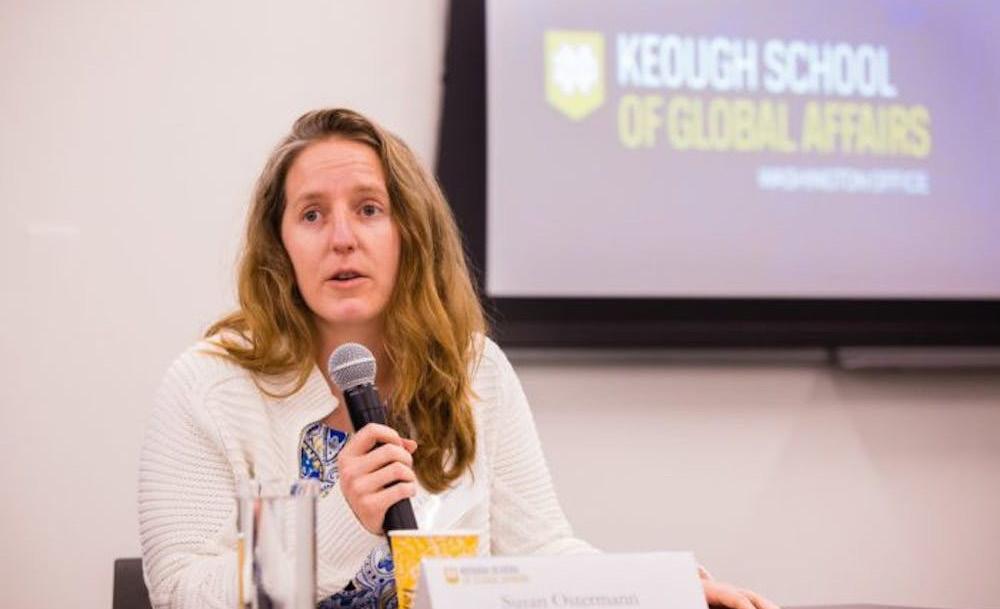
Associate professor of global affairs Susan Ostermann has decided to reject her appointment to lead the Liu Institute for Asia and Asian Studies. The decision was announced in an email to students of Notre Dame’s Keough School of Global Affairs from the school’s dean, Mary Gallagher, Thursday morning. Ostermann will remain a faculty member of the Keough School.
“Professor Susan Ostermann, a member of the Keough School faculty who was recently appointed director of the Liu Institute for Asia and Asian Studies, has decided not to move forward as director,” Gallagher wrote. “I am grateful for her willingness to serve and for the thoughtfulness with which she approached this decision.”
Ostermann was announced as
incoming director by the University on Jan. 8, with her appointment effective July 1, 2026. Since then, Ostermann has faced backlash from 15 bishops and two cardinals, multiple campus groups and a number of professors for her outspoken abortion rights advocacy in multiple articles in the Chicago Tribune and elsewhere.
“The Liu Institute remains ... committed to supporting its faculty, students and staff as they carry forward this important work,” Gallagher wrote.
A demonstration to advocate for the University’s Catholic identity and protest Ostermann’s appointment was organized for this upcoming Friday by sophomore Luke Woodyard and junior Gabriel Ortner along with multiple student group sponsors. Woodyard confirmed to
see “Ostermann” on page 3
Protest shifts to prayer service

By Observer News Staff
Student organizers of the “March on the Dome,” protest have changed course for the event and now plan to hold a prayer service today at 6 p.m. The protest was originally planned in response to the appointment of Susan Ostermann to lead the Liu
NEWS | PAGE 5
Holy Half waitlist
Over 800 people are on the waitlist for this year’s Holy Half Marathon as preparation begins.
Institute for Asia and Asian Studies. Ostermann’s appointment had received significant pushback over the professor’s abortion rights advocacy.
While student leaders from Catholic and conservative groups on campus initially
see “Protest” on page 5
OPINION | PAGE 6 CReps on democracy
FRIDAY, FEBRUARY 27, 2026 | VOL. LX, NO. 49 SPORTS | PAGE 16
A columnist was wrong in the CReps response. Republicans must save the republic.
professor Susan
on Jan. 8. However, due
International students receive benefits with finance
By Zack Pohlman and Zach Ford Associate News Editor and News Writer
In an email to the Mendoza College of Business’ undergraduate student body on Oct. 27, 2025, assistant dean Andrew Wendelborn announced that in January 2026, the College’s most popular major comes with additional benefits for international students.
“I’m pleased to share that Mendoza’s finance major recently
received a STEM designation from the U.S. Department of Homeland Security. This means that the finance major is officially recognized as aligning with one or more fields in science, technology, engineering, or mathematics. Specifically, the finance major qualifies as STEM by being designated as financial mathematics,” the email read.
DHS keeps a list of majors that qualify for work authorization benefits after graduation. It’s up to the University to assign each
major a CIP code aligned with the curriculum, and the finance major’s code was updated in the most recent review.
“All F-1 students who complete a degree are eligible to apply for 12 months of work authorization - or Optional Practical Training (OPT), and those with a STEM-designated degree, per Department of Homeland Security, are eligible to apply for an additional 24 months
see “Finance” on page 4
Holy Cross announces housing update for fall 2026
By Eileen Doyle News Writer
As Holy Cross College prepares to open its new residence hall in fall 2026, administrators have outlined several updates that will reshape campus housing. While plans for the $12 million residence hall were first announced in May
SCENE | PAGE 9 Punch the monkey
2025, recent decisions clarify how the space will be structured and how other housing will adjust.
The new residence hall will open as an all-male dorm housing students from multiple class years. Pulte Hall, currently a coed residence with women on the second floor and men on the first floor, will transition to an all-female
The internet’s favorite lonely monkey captures the typical college experience of loneliness. SPORTS | PAGE 14 Josh Yago
residence hall.
The college will also reduce its use of off-campus housing at University Edge, reserving approximately 80 beds with preference given to seniors. In addition, sixperson apartments in Legacy Hall will convert to four-person units.
see “Holy Cross” on page 4
The Air Force alum has piloted the Irish attack as Notre Dame lacrosse soars to No. 2.
Duke demolition
Sports Editor Ben Hicks explains why men’s basketball blowout loss is a wakeup call.
Courtesy of the Keough School of Global Affairs
Associate
Ostermann had previously been appointed to serve as director of the Liu Institute
to recent backlash, had recently declined the position in an email sent to students.
Megan Cornell | The Observer
March on the Dome protest, originally held due to Susan Ostermann’s appointment, has shifted its focus to a prayer service at the Grotto.

Kirra Halfman sophomore Le Mans Hall “Punta Cana.”

Shannon Dudy sophomore Holy Cross Hall
“Florida with SMC tennis team.”
What are your spring break plans?

Elizabeth Krueger sophomore Farley Hall “Walking the Camino.”


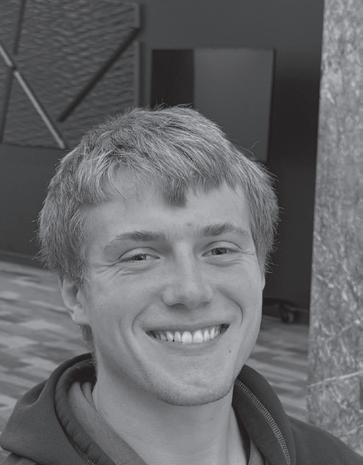
Jake Huspen sophomore Duncan Hall “Tennessee.”

Pat Teson sophomore Duncan Hall “Uganda.”
Friday
Concert: Notre Dame Symphony Orchestra
NDSO performs Tchaikovsky’s Symphony No. 4.
8 - 9:30 p.m.
DeBartolo Performing Arts Center
Saturday
Fiestang 2026: ‘A Midnight Harana’ Filipino American Student Organization hosts showcase 7 - 9 p.m. Washington Hall
Sunday
Battle of the Belles
SMC spirit assembly with free food, games and prizes 6 - 9 p.m.
Angela Athletic and Wellness Complex
Monday
Notre Dame men’s tennis vs. IU Indy
The Irish take on the Jaguars
5 p.m. Eck Tennis Pavilion
Tuesday
Concert: Will Liverman
Grammy Award-winning baritone performs 6 - 7:30 p.m.
LaBar Recital Hall, O’Neill Hall of Music
Berhan Hagezom
PHOTO OF THE DAY | DEBRA DE ST. JEAN
Professors share reaction on SCOTUS decision
By Matthew Morin News Writer
On Feb. 20, the Supreme Court released a decision on tariffs instituted by President Donald Trump under the International Emergency Economic Powers Act. In a 6-3 ruling, the court held that the president does not have the authority under the act to unilaterally issue tariffs. Notre Dame professors in the departments of political science and economics reacted to the decision and discussed what they believe may occur in the near future as a result.
The International Emergency Economic Powers Act, enacted in 1977, authorizes the president to “regulate a variety of economic transactions following a declaration of national emergency.”
In its opinion, the majority quoted the Constitution, which states, “The Congress shall have Power To lay and collect Taxes, Duties, Imposts and Excises.” Chief Justice John Roberts authored the opinion, joined by Justices Sonia Sotomayor, Elena Kagan, Neil Gorsuch, Amy Coney Barrett and Ketanji Brown Jackson. Justices Gorsuch, Barrett, Jackson and Kagan also wrote concurring opinions.
Justices Clarence Thomas and Brett Kavanaugh dissented. Justice Samuel Alito joined Kavanaugh’s dissent. Robert C. Johnson, the Brian and Jeannelle Brady associate professor of Economics, noted that taxation authority rests with
Ostermann
Continued from page 1
to The Observer that the protest will continue as planned.
“This is great news, but although we won the battle, the war wages on. The fact that this pro abortion professor could ever be appointed signifies a much deeper
Congress.
“Congress remains the big question mark — it is endowed with taxation power, including authority over tariffs,” Johnson said in a statement to The Observer. “It has delegated limited powers to the president through various laws over time, and it has taken back some of those powers in the past.”
Richard Clark, assistant professor of political science, said the ruling may not dramatically shift trade policy in the short term.
“In the short run, I don’t expect the Supreme Court’s decision striking down the administration’s IEEPA-based tariffs to dramatically alter the trajectory of U.S. trade policy,” Clark said in a statement to The Observer. “Before the ruling, the administration had imposed a 10 percent baseline tariff on most countries, with higher rates up to 50 percent for high trade deficit countries, pushing the average effective tariff rate to around 17 percent, the highest level in roughly 90 years.”
Clark noted that immediately after the decision, the average rate would have fallen to roughly 9%, but the White House has already moved to impose tariffs through other legal mechanisms, including Section 122 of the Trade Act of 1974 and Section 232 national security provisions.
“As a result, the ruling seems more of a legal detour than a policy reversal,” Clark said.
In recent days, Trump announced new duties at a 10% rate for goods
Split between the students, deans, and administration,” he wrote in a statement to The Observer.
“The spirit in which we ‘March on the Dome’ was never just [Ostermann], it was making sure nothing like this shocking appointment is ever tolerated at Notre Dame,” he continued.
Ostermann shared the following statement at the end of the email.
Undergraduate Opportunities with ECG
entering the United States from foreign countries. He has also signaled that the rate could increase to 15%, though that figure has not yet been formally published.
Johnson said there was initial confusion about the new surcharge.
“There was some confusion about what the new surcharge would be, 10 versus 15 percent, but the executive order came into effect today with the 10 percent rate,” Johnson wrote. “Section 122 authorizes a timelimited tariff surcharge of up to 15 percent, which allows the president to manage fundamental international payments problems, including balance-of-payments deficits, prevent depreciation of the dollar or coordinate with other countries on payment issues.”
Eugene Gholz, associate professor of political science, said the administration is complying with the court’s ruling while pursuing alternative authorities.
“The president is obeying the Supreme Court ruling in that the IEEPA tariffs are no longer being enforced,” Gholz said in a statement to The Observer. “Instead, the president has announced new temporary tariffs using another dubious authority. The new tariffs are at a lower rate than the previous tariffs under IEEPA, and they can only remain in force for a short time, so there may not be time to fully litigate them before they expire.”
The United States’ history of tariffs began early in the nation, with
“My only goal in accepting the Liu Institute Directorship was to serve as a steward for the Institute’s world-class faculty, students and staff; it is not a position I applied for, but I was truly honored to take it on,” Ostermann said. “At present, the focus on my appointment risks overshadowing the vital work the Institute performs, which it should be allowed to pursue
PAID ADVERTISEMENT


the Tariff Act of 1789, known as the Hamilton Tariff, being a primary early example of taxation on a large quantity of imported goods.
Tariffs have played a significant role in U.S. economic policy since the nation’s founding. The Tariff Act of 1789, often called the Hamilton Tariff, marked one of the first major federal revenue measures. The Tariff of 1828, sometimes referred to as the Tariff of Abominations, imposed rates between 38% and 45% and sparked intense political opposition.
Protectionist policies continued through the late 19th century, including the McKinley Tariff of 1890. After the ratification of the 16th Amendment in 1913, which established the federal income tax, tariffs became a less central source of government revenue. The SmootHawley Tariff of 1930 marked another major protectionist shift. Broad tariffs reemerged during Trump’s first administration.
Johnson said Congress should reclaim tariff authority.
“My view is that it should take those powers back up now,” Johnson said. “It is time for a good and robust public debate about how the U.S. wants to engage with the rest of the world on trade, tariffs and other foreign policy fronts.”
He added that while the president can seek congressional authorization for tariffs, the administration appears to be relying on temporary measures while considering
without undue distraction. At the same time, it has become clear that there is work to do at Notre Dame to build a community where a variety of voices can flourish. Both academic inquiry and the full realization of human dignity demand this of us. Towards both of these ends, I have decided not to move forward as Director. Instead, I look forward to collaborating with
Apprenticeships in Virtue-Rooted Leadership
This program will help you grasp the fundamentals of good leadership and live them well right now. It’s designed to help you gain vision and develop the tools you will need to be a good leader in any arena throughout your life.
Ethics Research Fellowships
Immersive, three-year experiences that include a fully-funded Fall Break trip to England, a $1,300 stipend, research mentorship, and a supportive community that helps you thrive
longer-term strategies.
Clark also emphasized the economic impact of tariffs.
“Economically, tariffs are largely borne by Americans,” Clark said. “Research suggests roughly 90% of the cost is passed through to U.S. firms and consumers, with estimates of around $1,300 per household in 2026 if current policies persist.”
While both political parties have adopted more protectionist positions in recent years, particularly in response to China, Clark said broad tariffs remain a costly policy tool.
“So while I don’t expect a return to the pre-2016 free-trade equilibrium anytime soon, policymakers would be wise to consider more targeted tools, such as investment incentives or subsidies that encourage domestic production, rather than relying primarily on tariffs,” Clark said.
Gholz said the courts face limits in constraining presidential power and that Congress is unlikely to intervene.
“Even if Congress passed a bill to restrain the president, the president would generally be able to veto that bill, and Congress cannot come close to overriding such a veto,” Gholz said. “The real potential check on overextension of presidential power is the public — a drop in the president’s approval rating or sanction at the ballot box on Election Day.”
Contact Matthew Morin at mmorin2@nd.edu
colleagues across the university to build a campus community where all can speak openly on the issues that matter to them most, and to continuing collaborations with colleagues at the Liu Institute and beyond.”
In a statement to The Observer, the University said, “We respect Professor Ostermann’s decision to decline the directorship of the Liu Institute. We appreciate her deep commitment to the Institute’s mission and her desire to advance its important work. She remains a highly valued member of our faculty, and we are grateful for her continued contributions as a scholar-teacher and member of the Notre Dame community.”
In a statement, Bishop Kevin Rhoades of the Diocese of Fort Wayne-South Bend said he was grateful to hear that Ostermann had declined the appointment.
“Clearly Notre Dame is reaffirming its fidelity to a core truth of Catholic social teaching that is central to the Church’s commitment to integral human development. I see Notre Dame living out this commitment through its many classes, activities, and programs which promote human life and dignity. That mission commitment is compromised when a Catholic university appoints leaders or bestows honors on those who act or speak against fundamental teachings of the Church,” he said.
Editor’s Note: This is an evolving story and will be updated as new information becomes available.
Finance
Continued from page 1
of authorization, or the STEM OPT Extension” Leah Zimmer wrote in a statement to The Observer. Zimmer is the director of the office for International Student and Scholar Affairs.
International students that are granted OPT can apply for an H-1B visa — nonimmigrant visas for skilled workers — each year they are working in the United States. Since the visa application is essentially a lottery, extra chances to apply during the STEM OPT Extension increase the odds of landing a visa.
In an interview with an international student studying finance and economics, who was granted anonymity, they said they hadn’t yet experienced the mathematical rigor in the finance major.
“And I say that because from what I know, right, the required classes don’t seem to be very mathematics intensive. That’s my understanding, obviously
Holy Cross
Continued from page 1
Allen Machielson, dean of student engagement, said the decision to designate the new building as allmale reflects enrollment trends and long-standing housing goals.
“We strive to have single-sex residence halls,” Machielson said. “We hear this preference both from families coming in through admissions and from students here. The reason for it being male is that we have 60% males and only 40% females.”
Machielson said enrollment data from the past five years informed the decision and that if projections remain steady, the new residence hall will fill quickly. He described the designation as a “natural” response to current demographics and said the College could consider an all-female residence hall in the future, as well as the possibility of a mixed-use building.
The transition will mark the first time Pulte Hall operates as an all-female dorm. In recent years, the hall has housed students of both genders on separate floors. Prior to that, it served as an all-male residence.
Katherine Steele, a freshman living in Pulte Hall, said she was “ecstatic” when she heard the news.
“I love Pulte to death,” Steele said. “When I found out, I was excited.”
Steele said she hopes the shift will strengthen community among residents.
“I have hopes that it will cause a stronger community within the girls,” she said. “We’ll have an upstairs and downstairs and it’ll just feel more like a sisterhood.”
Steele acknowledged that some students may initially question why the new residence hall is designated for men.
“I think there will be a few students who are annoyed, like ‘Why don’t the girls get the new dorm?’” she said. “But realistically, Pulte is a nice dorm, too.”
The College’s reduced reliance on University Edge also reflects a
I haven’t done many of the requirements and I don’t know if I can fully comment on that with that knowledge that I have,” the student said.
According to Wendelborn, the designation change has no effect on the required coursework for students in the finance major.
“The STEM designation recognizes programs that include an enhanced level of quantitative and technical rigor,” the email read.
With the new designation going into effect, the student plans to drop their economics major, citing a lack of interest. Now that both majors have the STEM designation, they are free to focus on their primary interest, finance.
“I personally don’t have that interest and I’m dropping it. And so from my perspective the value, a lot of the value of that major was the visa extension,” the student said.
International students majoring in finance can use any major designated as STEM to gain the OPT extension. However, economics and ACMS are two of the
broader goal of increasing on-campus engagement, Machielson said.
“In order to create an engaged community, we really want as many students on our main campus as possible,” he said. “Students who settle in at Edge for the night don’t necessarily want to come back for activities here.”
Machielson added that while offcampus housing can be a positive option for seniors, keeping underclassmen on campus encourages involvement.
“Having more first-years and sophomores and some juniors on campus will start to create that greater community on our direct campus,” he said.
Carlos Vera, a junior living at University Edge, said the change has financial and community implications.
“By bringing more students back on campus, Holy Cross can save funds, and that money can be reinvested into campus and into future projects,” Vera said.
Vera noted that University Edge offers greater independence, including private bedrooms, kitchens and living spaces.
“You can really make that place your own home,” he said.
However, he said living off campus can present logistical challenges.
“If you don’t have a car, it’s definitely difficult,” Vera said. “Last year, I didn’t have a car and I had to walk in the weather, rain or snow. Even relying on the shuttle could be difficult sometimes.”
Machielson acknowledged that some students may find the transition back to campus housing challenging but said he anticipates mostly positive outcomes.
Another point of discussion has been the limited number of single rooms in the new residence hall, which will carry a $1,000 upcharge.
Machielson said the pricing reflects trends at other institutions and the premium nature of new facilities.
“A brand-new building, a single room being a lot nicer, it’s kind of like a premium, like getting a better
most common choices because of the way they complement the finance curriculum.
“If you think about international students as a subset of the school it’s such a small portion, and then of those people being finance and econ, finance and ACMS it’s just not a lot of people,” the student said. “But I would think that more people are dropping it than not. I don’t know if that’s based on any statistical evidence, but that’s just my opinion.”
The student added that their view wasn’t necessarily shared by everyone in their position and that many international students have a genuine interest in their STEM majors. Even with multiple economics classes under their belt, the student said they don’t feel compelled to finish the major.
“You know, I have done quite a few of the requirements over the past couple of years. But it’s also at the point where it’s just anecdotally, in my experience, I don’t think it’s worth it,” the student said. “I just don’t want to do the
seat on an airplane,” he said.
Only a small number of single rooms will be available outside of resident assistant assignments. Students with documented medical needs will not be charged the additional fee.
Machielson also addressed past concerns regarding the housing lottery process.
“We’re trying to make it as clear as possible about how we give

classes in econ and that’s just it.”
The change comes in uncertain times for immigrants and international students in the United States. ISSA helps students at Notre Dame deal with that uncertainty.
“For F-1 or J-1 student related immigration status questions, it’s important to remember that students are navigating different priorities and circumstances, and their immigration status is intersecting with those,” Zimmer wrote.
H-1B visas in particular have been subject to discussion in the past year as they’ve come under scrutiny from the Trump administration.
“There has been a systemic issue of underpaying foreigners so that they can undercut domestic ones. That is an issue. But when you again look at it from the perspective of someone who was educated in the US and then is trying to stay, that just doesn’t apply the same, right? Like every bank is paying about the same money, right?” the student said.
ISSA doesn’t work with
priorities,” he said. “There have been issues in the past with mistakes, lottery numbers and systems not working the way we want them to. We’re really trying to work through all the bugs ahead of time.”
Despite the changes, administrators and students expressed optimism.
“The thing about college is, it’s not just the education portion, it’s the campus life,” Vera said. “By having
students on H-1B visas, but they do work with students on F-1 and J-1 student visas, helping to advise them throughout their time at Notre Dame.
“So we are constantly monitoring changes in the landscape, along with other entities on campus, and we keep students informed as changes impact them. For that reason, we prioritize one-on-one advising and working with students individually to navigate their questions,” Zimmer wrote.
The student said that the number of employers sponsoring H-1B visas has been decreasing, further creating uncertainty about working stateside after graduation.
“It’s obviously very hard to predict policy changes, so we’ll set that aside, but even from a perspective of increased uncertainty that’s something that employers are not willing to take on,” the student said.
Contact Zack Pohlman at zpohlma2@nd.edu and Zach Ford at zford@nd.edu
more people here, there’s more activity and vibrancy.”
Machielson echoed that sentiment.
“Living on campus is central to fully engaging in our college,” he said. “We’re excited about what these changes mean for our growing community.”
Contact Eileen Doyle at edoyle22@nd.edu
Notre Dame Swab Week


Holy Half registration fills up with full waitlist
By Mara Hall News Writer
This year’s Holy Half Marathon has not yet reached the starting line, but technical difficulties have already complicated the race. After a surge in website traffic caused a server crash during registration, more than 800 people remain on the event’s waitlist as organizers prepare for race weekend.
Nadia Grierson, a freshman in Pasquerilla West Hall, said she logged on shortly after registration opened but was unable to secure a spot.
“I was hoping to register, but unfortunately I logged on too late and everything had already filled up,” Grierson said. “I was kind of bummed about that.”
Grierson said the registration site initially malfunctioned. After organizers sent an email announcing it was back online, she logged in about five minutes later, only to find student registration had already closed.
Cecilia Pino, co-president of the Holy Half Marathon, said high traffic overwhelmed the system.
“There was such high traffic that there was actually a nationwide crash on the server,” Pino said. “SAO was awesome and worked with us to create an entirely new website for the second round of registration.”
Katherine Millett, a sophomore in Welsh Family Hall, secured her bib as a SoleMate charity runner but said many of her friends struggled to register.
“It was just a mess,” Millett said. “When they rescheduled to drop the link, it was in the middle of a really busy class time, and everyone was really upset.”
Pino said registration was moved from a Saturday last year to a Tuesday this year after previous directors warned that weekend registration made
troubleshooting more difficult.
When asked how quickly bibs sold out, Pino said “minutes.”
Nora Cronin, Pino’s co-president, estimated student spots filled in under 20 minutes and all entries closed within about 30 minutes.
After registration closed, organizers launched a waitlist, which Pino explained was created in order to help people who wanted to run the marathon still but were unsure what to do after the crash.
Pino later clarified that while the waitlist is not new this year, demand has surged.
Within two minutes of going live, 300 people had joined. As of Feb. 2, 880 people were on the waitlist.
“I actually did not know there was a waitlist,” Grierson said.
Pino said organizers are working with the Notre Dame Police Department to determine whether additional runners can be accommodated, though safety limits pose challenges.
“We would have the whole student body run if we could,” Pino said. “It’s just not up to us.”
Keri Kei Shibata, assistant vice president for campus safety and chief of police, emphasized safety considerations in an email statement.
“With any large event, the maximum number of participants is determined in close collaboration with a number of stakeholders,” Shibata wrote. “From a Campus Safety perspective, our No. 1 priority is ensuring we have the necessary resources to support the safety and security of everyone involved.”
Some students have discussed running without registering. Pino discouraged that approach.
“If you run without a ticket, you are not getting a shirt. You are not getting a pre-race package,” Pino said. “It is not the right thing to do.”

Race details and beneficiaries
The race will follow the same route as last year. The 10K will complete one lap, and the half marathon will complete two, looping around the lakes, near the Grotto and past the Dome, Cronin said.
This year’s race supports four beneficiaries: Girls on the Run Michiana, the Andrew McDonough B+ Foundation, Center for the Homeless and A Rosie Place for Children.
All beneficiaries receive a portion of bib sale proceeds. Girls on the Run Michiana will also have 30 to 40 SoleMates raising additional funds specifically for the organization.
Girls on the Run Michiana
Laurel Hamilton, a sophomore in Walsh Hall and student intern for Girls on the Run Michiana, described the program as an after-school initiative for girls in grades three through five.
“It teaches young girls in the South Bend–St. Joseph County community ways to be their authentic selves,” Hamilton said. “It helps them form relationships and navigate those awkward years of childhood.”
Ruth Roeber, development director for Girls on the Run Michiana, described how their organization utilizes these funds.
“In 16 years, we have never turned a girl away for her inability to pay,” Roeber said. “Every year we give away about $92,000 in scholarships, and a good chunk of that comes from Holy Half.”
The partnership has lasted five or six years, Roeber said.
Ellie Carroll, a sophomore in Welsh Family Hall running as a SoleMate, said the cause resonated with her.
“It is super fun and a great cause,” Carroll said. “I am all about female empowerment and sports.”
Andrew McDonough B+ Foundation
Ashley Wagner, senior program manager for college
Protest
Continued from page 1
planned to speak on what they see as Notre Dame’s failure to live up to its Catholic mission, those speeches will not be delivered as originally planned, organizer Luke Woodyard said. Instead, those leaders will seek to publish their thoughts in The Observer and other publications at a later date.
In a statement to The Observer, Notre Dame Right to Life president Anna Kelley confirmed the change in plans.

preparation begins for the 2026-27
being put on a
partnerships at the Andrew McDonough B+ Foundation, said the pediatric cancer nonprofit provides direct financial assistance to families.
“We do direct bill payment in the form of mortgage payments, rent payments, car payments — whatever we can do to subsidize a family’s income while their child is in treatment,” Wagner said.
This is the organization’s second year partnering with the Holy Half. Wagner said the foundation also hosts a pasta dinner the night before the race for runners.
Andrew McDonough, the foundation’s namesake, dreamed of playing soccer at Notre Dame before his death from cancer at age 14, Wagner said. The organization’s connection to the University has remained meaningful.
Center for the Homeless
Steve Camilleri, executive director of Center for the Homeless, said the organization’s primary mission is “to break the cycle of homelessness.”
From Nov. 1 to May 1, the center operates a weather amnesty program, increasing nightly capacity to between 200 and 300 people. In January, Camilleri said, the center saw an additional 120 people per night during extreme cold.
“After internal discussions, Notre Dame Right to Life and all listed co-sponsors will continue to gather on South Quad for a prayerful procession in gratitude for the recent decision of the withdrawal of Professor Susan Ostermann. Student leaders will no longer address their concerns with the University at the demonstration. Rather, we will be focusing on uniting in prayer and thanksgiving for the true Catholic identity of Notre Dame shining through in the hope to continue this strong presence in all things we do moving forward,” she said.
Woodyard characterized
The organization aims to keep federal funding below 20% of its $4 million annual budget, relying heavily on diversified community support.
Camilleri said Center for the Homeless was a beneficiary in the race’s early years and is “blessed to be part of it” again.
A Rosie Place for Children
Mark Waltz, executive director of A Rosie Place for Children, said the organization provides respite care for families of medically complex children.
“At A Rosie Place, we provide respite for families of medically complex children,” Waltz said. “There is no cost ever to families.”
The six-bedroom, 10-bed facility operates as a licensed specialty hospital but is designed to feel like a home. Children from infancy to age 21 can stay for three- to fivenight visits.
The organization relies primarily on philanthropy and receives minimal federal funding due to the unique nature of its services, Waltz said.
This is its first year partnering with the Holy Half.
“We are very excited and quite honored,” Waltz said.
Contact Mara Hall at mhall27@nd.edu
Ostermann’s decision to decline her appointment as a victory. He added the prayer service is intended to be celebratory and said that participants would process with blessed candles to the Grotto singing Marian hymns. It’s a unifying victory that we just achieved. And in the spirit of the ice chapel Mass, we want to show Notre Dame that we’re still Catholic, and everything we do is out of love,” Woodyard said, referencing an outdoor Mass in a student-built ice chapel held earlier this month that attracted significant media attention and drew thousands of students.
Jonathan Karr | The Observer
As
Holf Half Marathon, over 800 students are
waitlist for the run due to a server crash.
OPINION
Republicans fight for the Constitution
Grayson Beckham penned an opinion piece in The Observer on Feb. 24. In the article, Beckham casts numerous aspersions about Notre Dame College Republicans (NDCR), all of which fail to find their mark. It is gratifying to see the meticulous attention our Democratic colleague devotes to the Notre Dame College Republicans’ communications. As the preeminent political organization on campus, we welcome such scrutiny — it highlights our central role in fostering substantive discourse amid widespread superficiality. Unfortunately, Beckham’s column relies on cherry-picked excerpts and inflammatory caricatures rather than engaging our actual arguments. His argument is functionally a strawman, a misrepresentation of what our position actually is. A fairer reading would expose the inconsistencies in his narrative, revealing not Republican bias, as he claims, but a deliberate evasion of inconvenient truths.
Beckham attacks what he falsely portrays as the Republican position, asserting that the NDCR “openly rejects the existence of constitutional norms.” He similarly criticizes our view that debating the far left has become futile, and he hypocritically asks, “Is there a debate left to be had with the modern right?” These are grave charges that deserve serious consideration. When I reached out to ND College Democrats as president of BridgeND, hoping to conduct another debate with NDCR as was held in the fall, their president declined. If Beckham feels NDCR is unwilling to debate with the progressive left, perhaps he should consult with the CDems’ board. Where NDCR debated in the fall and is willing to debate again, CDems are dodging.
The immediate trigger for Beckham’s piece was our recent post urging President Trump to defy the Supreme Court’s Feb. 20, 2026, ruling in Learning Resources, Inc. v. Trump, which struck down tariffs imposed under the International Emergency Economic Powers Act. Democrats have framed this decision as a noble defense of constitutional order, but that framing assumes — without proving — that the judiciary’s interpretation is supreme. Beckham implies the court’s view is not merely authoritative, but unquestionably sovereign — a position deeply at odds with American tradition. We categorically reject judicial supremacy untethered from the other branches. As Hamilton explained in “Federalist No. 78”, the

judiciary is the “least dangerous” branch precisely because it lacks enforcement power. The separation of powers was crafted to preserve equilibrium among the branches — not to enthrone one as ultimate arbiter over the others.
As Justice Clarence Thomas wrote in his concurrence in Gamble v. United States, “When faced with a demonstrably erroneous precedent, my rule is simple: We should not follow it.” We have the obligation to uphold the law as it is, not as an obviously erroneous ruling mistakes it to be.
History confirms this view. At the outset of the Civil War, Abraham Lincoln suspended habeas corpus to counter rebellion. When Chief Justice Roger Taney declared the suspension unlawful in Ex parte Merryman and ordered a prisoner’s release, Lincoln refused to comply. He justified his action to Congress as essential to preserve the Union, asking whether all laws but one should be ignored while the government collapsed. Lincoln arrested Maryland’s Legislature and held its members captive. One may debate Lincoln’s choices, but they cannot be dismissed as anticonstitutional. It was an assertion that constitutional interpretation does not belong exclusively to the courts.
The same principle applies today. If the executive, acting under delegated emergency authority, concludes that the Court has overreached into foreign policy and economic security, immediate compliance is not the only constitutional option. Inter-branch
tension is not lawlessness; it is inherent to our system, which Beckham ignores.
This episode illuminates a deeper hypocrisy: Democrats act with sanctimonious insistence on unyielding legal rigor for Republicans, even as they systematically dismantle those norms to consolidate power. They want strict rules for us but none for themselves — blatant double standard that poisons the well of governance. Their playbook is rife with affronts to constitutional order — routinely obstructing U.S. Immigration and Customs Enforcement (ICE) operations to harbor lawbreakers at taxpayer expense; erecting sanctuary jurisdictions that brazenly flout federal statutes and endanger communities; issuing unilateral edicts to erase student debt sans legislative consent, in flagrant disregard of separation of powers; prosecuting political adversaries via invented legal contortions, as seen in the partisan witch hunt of New York’s case against President Trump; engaging in warrantless surveillance of opponents through abuses like the Crossfire Hurricane fiasco; weaponizing the FBI to harass devout Catholics under the guise of combating “extremism”; and endorsing activist jurisprudence that fabricates phantom rights to familykilling abortion and same-sex marriage. This tramples the proper role of the judiciary and democratic accountability. Beckham demonstrates an incomprehensibly entrenched double standard
with his selective outrage.
Such duplicity erodes the foundation of fair play, which Beckham claims to value. As the metaphor from NDCR’s remarks aptly captures, it’s like playing soccer with your feet tied to the rules while your opponents brazenly handball at will, expecting you to pretend it’s a level field. Democrats do not merely bend rules — they shatter them, expecting conservatives to capitulate in the name of decorum. If they truly cared about the rule of law, their governors would cease obstructing ICE, repeal the unconstitutional judicial overreach of Obergefell v. Hodges, enforce the Supreme Court’s affirmative action decision, dismantle sanctuary city policies and cease support for Soros-backed prosecutors who unilaterally abrogate their responsibility to enforce the law in the name of progressive partisan politics.
The Constitution has not failed, and Republicans do not oppose it; regrettably it is Democrats who have failed it through relentless institutional subversion and selective outrage. This asymmetry — where one side adheres scrupulously to the rules while the other flouts them at every turn — inevitably consigns the rule-followers to perpetual defeat, allowing Democrats to rack up so-called “cultural victories” that have ravaged the fabric of American society. In this breach, Republicans are compelled to invoke the imperative of necessity — a doctrine enshrined in common law and articulated by
Thomas Jefferson: “The laws of necessity, of self-preservation, of saving our country when in danger, are of higher obligation” than rote compliance in the face of tyranny. Constitutionalism is an admirable ideal, but it is no suicide pact. Democrats protest now only because Republicans are finally willing to use their own playbook against them. To adhere to constitutional norms is more than to blindly obey legal fiction put forth by leftist outrage; rather it is to defend the larger American system as laid out by the document Beckham fails to cite once.
To our counterparts across the aisle: Spare us the feigned mirage of patriotism while your party foments division through unchecked, anti-American radicalism. We reject not the rule of law, but its perversion at the hands of those who prioritize ideological conquest over shared governance. Ultimately, the Constitution depends on people who believe in it, and it works only when both sides agree on its fundamental principles. But for decades, this sacred compact has been defiled by Democrats through their ceaseless assaults on its integrity, leaving Republicans with no choice: We will now do anything necessary to save the republic, unhindered by Democratic abandonment of the rules.
Sam Marchand Notre Dame College Republicans Class of 2027 Feb. 26
LIAM FLYNN | The Observer
OPINION
Pregnancy resource centers deserve better
As a proud graduate of the University of Notre Dame and president of the March for Life, I’m grateful for the way my alma mater formed both my intellect and my conscience. Notre Dame taught me that truth matters, that human dignity is not negotiable and that where we see an injustice being done, we should work to right it. It is in the spirit of what I learned at Notre Dame that I must address an ongoing controversy at the University.
I share the many serious concerns raised about Notre Dame’s recent decision to promote professor Susan Ostermann to a leadership role. Others have compellingly articulated concerns about what this means for the University’s Catholic character. I will respond specifically to professor Ostermann’s repeated claims about pregnancy resource centers, which cannot be permitted to stand — especially with the name of Our Lady’s University attached to them. Her allegations are inflammatory, unsupported and deeply
irresponsible. In a May 2024 Chicago Tribune commentary, professor Ostermann and her coauthors described pregnancy resource centers as “antiabortion rights propaganda sites” that “provide false information to women who are lured to them believing they will receive legitimate medical care.” In an earlier piece, she asserted that PRCs are “specifically designed to deceive pregnant people,” calling their work “coercive.”
These are serious claims. They are also wrong.
Across the United States, more than 2,700 PRCs provide essential care to women.
Most are nonprofit organizations staffed by a combination of licensed medical professionals and trained volunteers. According to data released in 2025 by the Charlotte Lozier Institute, PRCs nationwide provided more than $350 million in free medical services, material assistance and support to over one million clients in a single year. That included millions of diapers, baby
formula and clothing items, and hundreds of thousands of free ultrasounds, STI testing, parenting classes, housing referrals and ongoing case management.
These services are offered at no cost to women, regardless of their income, background or ultimate decision. They are not billed to Medicaid or private insurance. These organizations are not profit-making enterprises. They are a community response to women facing unexpected or difficult pregnancies. And they exist precisely because many women want practical support in carrying a pregnancy to term.
To dismiss these institutions that serve women in need as “propaganda sites” is not only inaccurate; it is demeaning to the women who seek them out.
It is also dangerous.
In the months following the Supreme Court’s Dobbs decision, more than 100 pregnancy resource centers and pro-life organizations were attacked. In some cases, facilities were burned to the ground.
Words matter. When respected academics repeatedly characterize PRCs as fraudulent, coercive and harmful, it feeds a narrative that these organizations are illegitimate and even deserving of hostility. No one is responsible for the criminal actions of others. But people who wade into the public square bear responsibility for the climate they help create.
I have visited PRCs across our nation. I have seen firsthand the essential care they provide. I have met women whose lives have been transformed by the services and support they received at PRCs. In addition to providing practical, tangible support, PRCs offer a vital but less visible service: restoring women’s dignity and confidence by treating them with respect and affirming their capacity to be mothers.
As an alumna, I expect my beloved university to be a place that lives up to the values it taught me: where truth matters; where the dignity of every human person, whether
born or preborn, is defended not only in theory, but in practice; and where wrongs are righted — even when that means making hard decisions.
PRCs are not the caricature professor Ostermann describes. They are an expression of civil society at its best, and, more than any other type of organization, they prepare pregnant women to make a free and unfettered choice. Not every woman who walks into a PRC ultimately chooses to carry her pregnancy to term. But every single one is treated with dignity and respect.
Notre Dame should not reward reckless rhetoric with a promotion. PRCs and the countless women who have been help ed by them deserve better than the baseless smears promulgated by professor Ostermann.
Jennie Bradley Lichter Class of 2004 President of the March for Life Feb. 25
Balancing education and tradition
By Molly Wu
A recent law in California banned legacy admissions at private universities, arguing that students should not receive an advantage simply because their parents attended the same school. The policy reflects growing concern that admissions systems should be fair and based on individual curiosity, efforts and achievements. Yet Stanford University has chosen to continue considering legacy status, even if doing so means stepping away from a state financial aid program connected to the law. The disagreement highlights a broader question that goes beyond admissions policy: what role should education play in society?
One common view sees higher education as a system of opportunity. Under this perspective, universities are meant to identify talent and allow students from different backgrounds to compete on equal terms. For generations, education has been portrayed as a pathway for mobility and discovery. If admissions decisions include factors like family connections, then the system risks favoring those who already possess social and economic advantages, thus undermining the assumption that all students are equally capable of excelling. At the same time, education has never been only about individual advancement. Universities
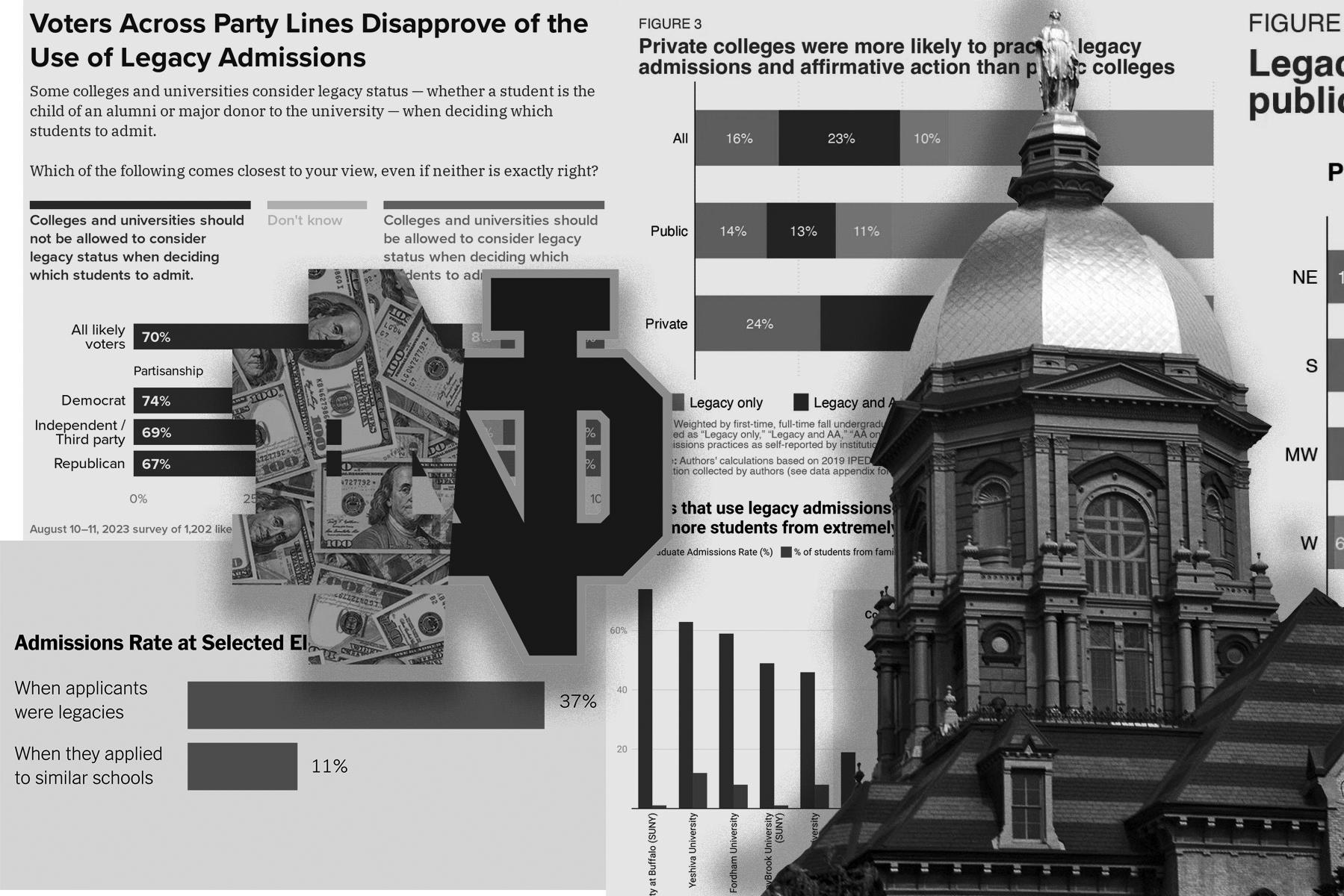
are also socially constructed communities that extend across generations. Alumni networks, traditions and long-standing relationships form part of the identity of many institutions. Families sometimes see attending the same university as a continuation of shared experiences and values. From this perspective, legacy admissions are not only about privilege but also about maintaining connections that bind a community together over time.
Supporters of legacy policies often emphasize this sense of continuity. Alumni who feel personally connected to a university may contribute financially,
mentor current students or support programs that benefit the broader campus. These relationships can shape the culture and identity of a school over time. In some ways, they show that education is not only about individual success but also about belonging to a community that lasts across generations.
I began to understand this idea through my own experience. As an international student, when I first came to the United States to attend a boarding school in rural New Jersey, I often felt homesick and unsure about whether I had made the right decision to move so far away. Over time, however, the school became more than just
a place to study. In fact, my own definition of “education” was no longer only about mastering certain concepts. Through friendships, mentorship from teachers and the routines of everyday campus life, I developed a sense of attachment to the community around me. Even the physical spaces on campus began to feel familiar and meaningful. Experiences like these helped me see that education can function not only as a competitive system but also as a social institution that carries traditions, relationships and memories forward.
The tension between these two ideas is not easy to resolve. On one hand, universities present
themselves as places that reward intellectual ability and effort. On the other hand, they operate within networks of history, loyalty and community. Policies like California’s ban attempt to prioritize equal access, while Stanford’s decision reflects a belief that institutions should retain flexibility in defining their values and relationships.
The debate over legacy admissions is not simply about fairness versus privilege. It is also about how society understands the purpose of education. Should universities focus primarily on creating opportunities for individuals who have earned it? Or, should they also recognize their role as communities that connect past, present and future generations?
In reality, higher education likely contains elements of both. Universities educate students, but they also build traditions and relationships that last long after graduation. The challenge is finding a balance between these goals, and this discussion around legacy admissions is one example of how institutions continue to negotiate that balance in a changing social and political environment.
The views expressed in this column are those of the author and not necessarily those of The Observer.
Contact Molly Wu at lwu5@nd.edu
Columnist, “Bro Meets World”
LIAM FLYNN | The Observer
A different kind of commencement for some
We often joke about Notre Dame being in a bubble. And there is some truth to that. Sometimes we can be oblivious to the world around us. One thing that we should not be oblivious to is this.
This year, commencement will be different for some of our graduating seniors. The U.S. administration continues to target differently documented people living in the United States. It continues to dehumanize them, encouraging us to think of them as criminals, rapists and drug dealers. Nothing could be further from the truth.
Because of the need to travel with a REAL ID, many parents and family members of graduating seniors will not be able to come to Notre Dame to celebrate college graduation. This is so sad for so many reasons,
but especially because it does not have to be.
My grandparents immigrated to the United States from Sicily and from Syria. All four left their home countries because there was no work, which means no food, which means no education, which means no future. They came here looking for a better way of life for their children. And they have enriched the United States in countless ways.
Today, differently documented people, who are our sisters and brothers, came to this country looking for a better life for their children. Most of us cannot begin to imagine what they go through for their children.
If your parents are traveling to campus for commencement, I’m very happy for you.
I invite you, however, to think
for a few moments what the weekend would be like without your parents and family, without the people who supported you from the moment you were conceived, who made countless sacrifices so that you could arrive at this day. They deserve to celebrate this day with you and with your friends. You deserve to have them celebrate with you. I’m glad that they can join you.
But there are other parents who have supported their children from the first moment of their conception, who have made countless sacrifices so that they could arrive at this day, who deserve to celebrate this day with their children, but they cannot be present because they cannot travel or because they are too afraid to travel.
Our country is in a very dark
spot. In the Gospel of St. John, darkness is not the opposite of light. Rather it is the rejection of the light that is Jesus Christ.
I believe that we are living in a moment when many in our country are actively rejecting the light of the world, who is Jesus Christ.
These few words invite the reader to do something about the terrible injustices being inflicted on our sisters and brothers. They invite those students whose parents will join them to consider how sad they would be if their parents could not come to graduation.
This will be the case for some of our graduating seniors. Say a prayer for them. If you know someone whose parents are unable to come to graduation, you might consider inviting that student to join you and your
family for some of the events. Or you might consider not as king personal questions as to where their parents are.
For the four years that you have been here, Notre Dame has invited you to be a force for good in the world. Here’s one more chance. Take advantage of it.
Pray for a conversion of heart for those who do not respect immigrants and refugees. Pray for immigration reform. And pray for your classmates whose parents and family cannot join them.
Fr. Joe Corpora, CSC Associate director, Transformational Leaders Program Priest-in-Residence, Dillon Hall Feb. 25.
Asian Americans like me still struggle to belong
By Jonah Tran Columnist, “Esto basatus”
My nationality is American: I was born in Tampa at St. Joseph’s Hospital South, to be specific. I speak English and eat cheese with my burgers and ketchup with my fries. I stand and place my right hand over my heart to the same song and flag as anybody else. I even pray to the same God and practice the same religion as the majority of other students at Notre Dame do. On the other hand, racially I am Asian, ethnically Vietnamese. Growing up in Tampa, I was exposed to a mixture of white, African American and Hispanic peoples and cultures. My parents chose not to teach me Vietnamese; we neither practiced any Vietnamese traditions nor engaged with the small Vietnamese community in Tampa. They taught me English and spoke to me in English only. And so, from a young age, by just pure inertia, I became attached to the behaviors and customs of my peers around me. I learned more about barbecue, country music and the NFL before I even realized I was Vietnamese.
Coming to Notre Dame, the diversity was a culture shock for me. My graduating high school class of
200 had two Vietnamese students, both of whose last names were Tran. I was well aware of my ignorance of my own culture and strove to make that change, so I immediately joined the Vietnamese Student Association, a small community of Vietnamese people at Notre Dame. I made friends, great ones. I danced (or at least attempted to) and performed in cultural showcases. I became the president of the club and later directed those showcases. Looking back on my four years with VSA and the Asian community at ND, I am incredibly thankful for the wonderful friendships and memories I’ve made. Engagement with other Asian students will be one of the top highlights of my time at ND. But at the same time, I know and have come to accept that I am an outsider. People in the community (my friends included) hold prejudices against me for not being “Vietnamese enough.”
They taunt, criticize and at times blame me for not knowing how to speak Vietnamese, as if they themselves mastered the Vietnamese and English languages while they couldn’t even change their own diapers. One memorable remark was: “Jonah, I think you’re about 70% white and 30% Vietnamese.” I’ve been told that no Vietnamese
woman would want to marry me because I’m too white. For four full years, I have dodged conversations in Vietnamese and when I couldn’t, I repeated my same bashful excuse that my parents just never taught me. The furrowed eyebrows always respond the same.
On the other hand, I have made amazing friendships with white or non-Asian people. We share hobbies, preferences, high school experiences, values and even the same God. However, I realize that I do not fit into the Midwestern, white, Catholic, Notre Dame student paradigm. I am an outsider, and nobody is slow to let me know that either. Slurs and “jokes” about samurai, sushi, gochujang, ramen, Asian flush and China are usual, though none of them apply to me, I would like to think. I just smile through it and shake it off. To white people, I realize that I am their token Asian friend, a personal “exotic” pet onto whom they can offload all their distrust and condemnation of anything that isn’t American or European.
I live a double life: half white and half Vietnamese. Half my friends are white, the other Asian. Half the food I eat is American, the other Asian. Half the extracurricular activities I do are with white people, the other with Asians. I know better than to
Finis
mix these groups or share experiences from one community with the other. However, this 50-50 split is the best that I have been able to do. I’ll never be Asian or Vietnamese enough to be fully accepted in the Asian/Vietnamese community. I’ll never be white enough to be fully accepted in the white community. And so, I bear the negative views against me so long as I can belong to a community.
I will admit that this is not what ND admissions or any ND office wants to hear from a student because the lived realities of Asian American wstudents do not correspond to what the fancily written text reads on a brochure or website. Community is the most important word starting with “C” to Notre Dame, and it would be a hard pill for them to swallow that their utopic vision of community isn’t so utopian. Moreover, I hold absolutely no resentment toward any friends, acquaintances or peers, who, though they have disappointed me in the past, inspired me to articulate my thoughts into this reflection. I know that God works through people and experiences, even though they may be uncomfortable.
My four years at ND have been spent attempting to reconcile my own cultural ambiguities and to
promote dialogue and unity between the Asian community and the broader non-Asian community. Each community has its problems; they are composed of humans at the end of the day. I believe in and hope for a diversity at Notre Dame that is beautiful, transcendent and reflective of the many aspects and qualities of God. Diversity can and should be a beautiful thing, but, admittedly, it can be ugly at times. Moreover, I know that the Asian American experience at Notre Dame has so much potential and so much more to offer. I know that my experience is not uncommon: To varying degrees other Asian students at Notre Dame have similar struggles and experiences. I am only one person to articulate his experience at Notre Dame, and I hope and pray that more will too.
If I am not white enough for white people, and if I am not Asian enough for Asian people, then what am I? I don’t have a good answer, yet.
The views expressed in this column are those of the author and not necessarily those of The Observer.
Contact Jonah Tran at jtran5@nd.edu
By Liam Kelly Editor-in-Chief
To the happy few who have spent countless late nights in the basement of South Dining Hall and the ninth floor of Hesburgh Library, no explanation of The Observer is necessary.
A bond is formed in these walls, amid the many cups of coffee, the many stories edited and the utter lack of a proper sleep schedule. This newspaper is a labor of love for those who undertake it, and I am proud
to have worked toward its improvement and perpetuation in the past year.
In every word we’ve written, every sentence we’ve strung together, every story we’ve edited and every edition we’ve published, this editorial board has striven toward something greater than merely putting out content five nights a week; we have undertaken the unyielding pursuit of the truth.
This pursuit is a messy enterprise. Uncovering the truth takes time,
dedication and an unwavering resolve. Reporting it accurately takes prudence, critical thinking and care. However, it is a task fundamentally necessary for any great university.
The founders of this newspaper, 60 years ago, declared that the University needed an independent, student-run organization dedicated to the “all-encompassing search for the truth, both in fact and opinion.” They recognized that power must be accountable to honest criticism and that establishing truth is necessary
to pursue the good. At times, this paper has imperfectly achieved this mission, beholden to ideology and unwilling to engage in serious dialogue. At its best, however, it can be an institution that advocates for the fundamental values that make this Catholic university great, creates an environment of free speech where the great debates of the day can take place, and reports the news with the utmost accuracy and impartiality.
For the past three and a half years,
I have picked up my pen to try to move this newspaper toward this goal and serve this University. I now set it down with hope for this newspaper and this University, both of which I love beyond measure.
The views expressed in this column are those of the author and not necessarily those of The Observer.
Contact Liam Kelly at lkelly8@nd.edu
By Ainslie McKenna Scene Writer
By now, hundreds of news stories and social media posts have shared the story of Punch, a young monkey in the Ichikawa City Zoo in Japan. Abandoned by his mother, Punch was given a stuffed monkey to cope with because the other monkeys wouldn’t accept him either. As a freshman in college, I relate to Punch the monkey on a deep level. I wasn’t abandoned by my mother at birth, but coming to college is essentially that; it’s a forced separation from family, and my only hope was and is to find new people.
Punch has his stuffed IKEA monkey that he retreats to anytime his attempts at making new friends fail. When they beat him up and push him away, his monkey is there. If you’re anything like me and Punch, you also have your version of the monkey. For me, it’s — occasionally to the dismay and confusion of others — a 15-yearold Lotso Bear from “Toy Story 3”. Yes, I get it, he’s the villain or something, but that’s an article for another time. I was worried about having a stuffed bear in college. I feared the judgment from my new roommate, my new friends and all the people I might meet in
We are all Punch the monkey

college. Even writing this article puts anxiety deep into my stomach as I think about the people reading this knowing that I — an 18-year-old woman — still have a stuffed animal in college. But then I got here, and not only my roommate, but also my friends and my RA have one or more stuffed animals scattered across their rooms.
People of all age groups and locations post about theirs on Fizz. The truth is, sometimes we need that little reminder of comfort,
makes a new place feel like home. Punch was beaten and rejected numerous times by the other bigger monkeys in the enclosure. He, like any of us, just wants to make friends and feel connections. Many of us can relate to this one. Remember those friends you made at The Rally? Welcome Weekend? The ones you thought would stick around all four years? Yeah, how’s that going? For most people, those first college friends come and go,
and we feel disheartened when they do. We feel like we’re out of place, a loner in the enclosure, when all the other monkeys have friends. But honestly, we are all Punch. Even the person that you think has a ton of friends all the time is Punch. Everyone faces that rejection and that loneliness, at least once, but more often multiple times throughout the year. But luckily for Punch and us, the story doesn’t end there. With time, Punch made a friend.
God Loves a ‘Prizefighter’
The friend didn’t change who Punch is but adapted to Punch and his Ikea monkey mother; a recent video shows Punch and his friend cleaning bugs off the stuffed monkey together. When we find our people, the ones we clean bugs with, suddenly the world feels a lot less isolated.
As I go through college, I’m sure I will feel the loneliness Punch felt again. But for now, I can always remember that even that little monkey persevered and made friends. He was knocked down and thrown around, but he didn’t give up, so why should I? Why should any of us? But when we do feel those low points, at least we have our monkeys. Maybe not everyone has a stuffed animal — maybe it’s the photos on your wall, an extra comfy sweatshirt or sometimes just your dorm bed, but the point is, everyone has some point of comfort that they retreat to when the going gets tough. These objects remind us that we’re not alone. A stuffed monkey can’t beat you up and can’t push you away. Maybe we don’t have our mothers (or fathers or guardians) with us in college, but we can still find that comfort we crave.
Contact Ainslie McKenna at amckenn6@nd.edu
By Sydney Jansen Scene Writer
The Lenten season has commenced, presenting many of us with the opportunity for self-reflection, deep prayer and fasting from some of life’s comforts in solidarity with the turmoil Jesus faced for the 40 days leading up to Easter. And while I have been anticipating the new Mumford & Sons album “Prizefighter” for far more than 40 days, it was a pleasant surprise to discover the unexpected relationship between this new piece and the season.
The album was released Feb. 20 — only two days after Ash Wednesday — and was co-produced by Mumford & Sons and Aaron Dessner, who most recently produced Florence + the Machine’s album “Everybody Scream” along with many of Taylor Swift’s best albums to date. Recorded at Dessner’s Long Pond Studios in New York, the group branched outside their typical practices, featuring multiple artists on the album and writing “more songs than [they] had in the last seven years combined.”
The album opens with “Here,” with Chris Stapleton: a heavenly pairing of talented voices, instantly drawing me in. Mumford’s vocals are crisp and cutthroat as he vulnerably lays all of his cards on the table through this song, opening the disc with a confessionary track. Once we are presented with his personal confessions of past mistakes, pride,
blame and lies, frontman Marcus Mumford foreshadows the album’s instigation when stating, “I had lies like you wouldn’t believe / Brought to my knees.”
“Rubber Band Man,” with Hozier, opens with gentle instrumentals, juxtaposing the devastating lyrics soon to follow. Both Mumford and Hozier have claimed to have complicated relationships with the Church throughout their lives, adding an interesting spin to this track. They continue weaving what can be interpreted as religious imagery into the work by addressing the ephemeral nature of human life, a large focus in Catholic teaching. While taking into consideration the artist’s continued struggles with religion, the listening experience becomes all the more interesting and personal.
We are then presented with “The Banjo Song”: a catchy, Lumineers/Noah Kahan-esque sound that slightly strays from classic Mumford & Sons tracks. It’s not their worst work, by any means, but it does resemble an overplayed radio pick that may throw off frequent Mumford & Sons listeners. But this is quickly saved by “Run Together,” reviving their folk talent with a song that belongs in a coming-of-age film and falls back on religious themes. Whether expressing a relationship with God or another individual, Mumford expresses deep devotion within the song’s chorus line “I am yours, and yours, and ever.” This devotion
is further played out as falling to one’s knees and freedom in emptiness, two things I and many others are focusing on throughout the season.
“Conversation With My Son (Gangsters & Angels),” one my favorite tracks, asks the selfreflective question the Lenten season calls to: “Who am I away from the fire?” This track points out humanity’s frequent weakness when it comes to choosing “the machine” rather than “the cross,” busying ourselves with everyday life and neglecting the spiritual. Mumford then leaves us with the message we all need to hear in such a polarized world: “But love your crooked neighbor / With your crooked heart.”
Next, the band plays with creative instrumentals and staccato verses in “Alleycat” and “Prizewinner,” two strong but lowkey tracks of the album. These two both showcase Dessner’s quirky producing skills with thoughtful lyricism and The National-esque rhythms, while still remaining true to the band.
As the next song “Begin Again” played on my first listen of the album, I instantly knew the religious direction I’d take with this analysis. With lines stating “We’re made of the same dust / can you see a way out?” and “What happened to your good faith,” Mumford directly interacts with faith in an explorative and curious way. The close reference of Ash Wednesday in “Begin Again” toys with the idea of death
as a way of “shedding one’s skin” and wiping away their father’s sins, similar to the Catholic beliefs of one’s soul leaving their body after death and awaiting the life of the world to come.
I try to keep tabs on many artists at a time, but Gigi Perez has never come across my table. Her feature on “Icarus” transformed this already beautiful piece into the otherworldly serenade this album yearned for, and I’m so glad this was my first impression of her. The piece contributes to the idyllic themes of the album as it walks us through the narrator’s mistakes he’d made in youth, told through the story of Icarus as he flew too close to the sun and brought his death upon himself.
“Stay” is another one of Mumford’s stomp-clap songs of yearningly missing a past love, wondering if they will take his new self back and offer redemption. It ties back to the opening song “Here” with its vulnerability and guilt-ridden lyricism, demonstrating the lingering sense of dread the narrator carries regarding his lost love.
Underwhelmingly, the album proceeds with “Badlands” featuring Gracie Abrams. Not only does the song lack a dynamic structure, but the Abrams feature does nothing but muddy the crisp vocals we are served throughout the rest of the album. The doubled vocals of Mumford and Abrams don’t allow any room for Abrams to showcase personal talents like the features of Gigi Perez, Chris
Stapleton and Hozier. Abrams, although a frequent visitor of Dessner’s production studio, was not a great fit for this album in the first place.
On the contrary, “Shadow of a Man” broke me down and built me back up again. It expresses the pains of life and responsibility within society, hopelessly and on the brink of death. But just as the distress troubles us enough, the line “There’s reason to believe / I feel it pull too tight / Wrap its arms around me” makes us believe again. There’s much we can take from Mumford’s reflections on how little the pain of life should burden us, and “thank God [we’re] just a shadow of a man.”
To close out the album, are “I’ll Tell You Everything” and “Clover” (a very Irish goodbye). Both pieces center around love, but “I’ll Tell You Everything” progresses through yearning for redemption in becoming a better man to “Clover” then appreciating the relationship the narrator is in. “Clover” juxtaposes the previously mentioned “Alleycat” with the narrator’s newfound “farm cat” with whom he has found love.
Long awaited, “Prizefighter” lives up to any and all expectations and leaves us with lots to consider for the remainder of these forty days. But now, “The chase is over, my love.”
Contact Sydney Jansen at sjansen01@saintmarys.edu
‘Rockne: Life & Legacy’: A holistic portrait of a coach
By Harry Penne Scene Copy Editor
Notre Dame’s football program is one of tradition, legend and lore, and much of its legacy is thanks to coach Knute Rockne. His name is all over campus, from the Rockne Memorial on South Quad to the Notre Dame Stadium’s main gate. But how much do you know about the man’s life beyond football? Right now, The History Museum, located in downtown South Bend, is having a special exhibition on the coach: “Rockne: Life & Legacy.” Rockne’s life was far deeper than athletics, and the exhibit wonderfully provides a holistic view of a man who forever changed Notre Dame.
I thoroughly enjoyed my trip to The History Museum, spending nearly an hour and half in the Rockne exhibit. Whether going as a Notre Dame history buff, football enthusiast or out of pure curiosity, there is so much to take in.
I appreciated how the exhibition portrays Rockne beyond his football accomplishments, offering a complete view of his life. In my opinion, the most interesting stories were about his academic and business careers. He majored in the department of pharmacy and was a skilled chemist, working in Fr. Julius Nieuwland’s lab — Nieuwland notably discovered synthetic rubber — and holding a chemistry professorship before becoming football coach. A unique item in the collection was Rockne’s chemistry lab book, and it was fascinating to read his procedures and diagrams and see the burns and chemical spills on the pages. Certainly, his scientific, analytical writing influenced his written football plays, which are also on display.
Additionally, football was not Rockne’s first sports ambition. He was a skilled track athlete,
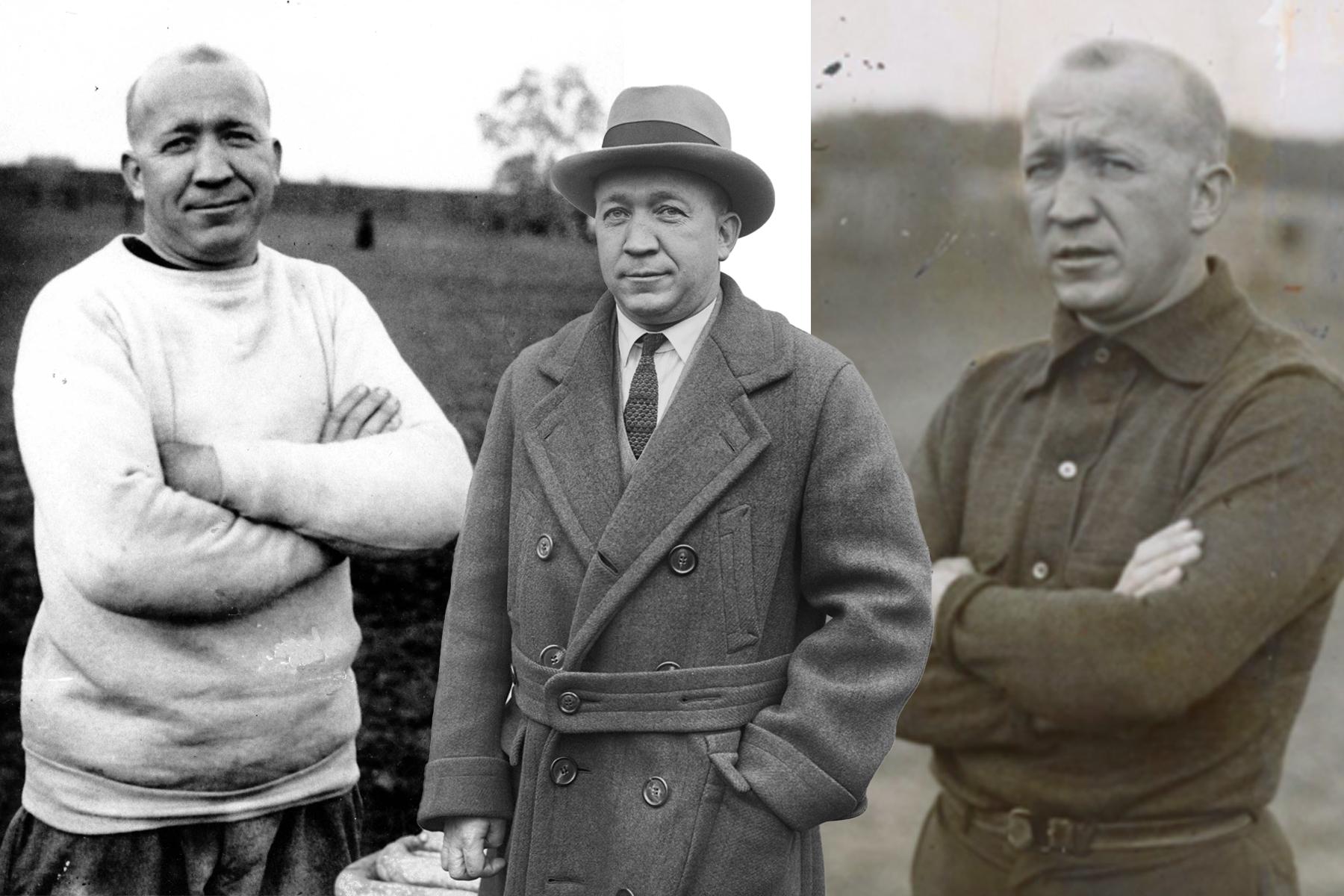
participated in rowing and founded a boxing tournament that would become Bengal Bouts.
Rockne was quite mischievous in undergrad. Allegedly, he and his roommate, quarterback Gus Dorais, charged students wishing to escape parietals a toll to use their Corby Hall room’s first floor window.
With 2026 being an Olympic year, I was amused by “Knute Rockne’s Olympic Tour.” In summer 1928, Rockne was the “tour guide” of a luxury European tour with sightseeing across the continent as well as admission to the Games.
It isn’t a trip into South Bend without seeing a Studebaker. Rockne was, for a while, employed as a spokesman for the company and, before his death, was going to be an officer of Rockne Motors, an affiliate. The “Rockne” car was built from 1932 to 1933 by Studebaker following the coach’s death, and the museum has the most refurbished Rockne Model 10 in existence. It was wonderful to see Rockne’s involvement with South Bend beyond the
University, showing his dedication to the community and its success.
The exhibit features AV components with several videos on repeat. Among them are authentic interviews with the coach interspliced with in-the-moment footage of him at practices, old tapes of Notre Dame games and the 1950s documentary “The Rock of Notre Dame.” Between these videos was an image slideshow accompanied by a recording of the “Notre Dame Victory March” circa the 1920s, and this soundtrack added an aesthetic layer to the whole gallery. There were also some tactile, interactive exhibits, encouraging encounters with history.
Don’t let me understate the presence of football in the exhibition; Rockne is one of the greatest coaches in history. Part of Rock’s enduring legacy is how he revolutionized — not invented — the forward pass. One summer, Dorais and Rockne were lifeguarding at Cedar Point resort in Ohio, and, during their breaks, they practiced the technique before implementing it at the famous 1913
Army game, forever changing how football is played.
The early legends of Notre Dame were all present: George Gipp, the Four Horsemen and Jack Elder. Game tickets, handwritten plays and period posters were on display. I was honestly surprised that Gipp wasn’t featured more, receiving pretty much only an information board. There weren’t many artifacts of his nor was the “Win one for the Gipper” speech deeply covered.
At Scene, arts and culture are our focus, so I was delighted to discover Rockne was an avid patron. As a student, he played flute in the band, founded the Monogram Club Absurdities (a Follies-style show featuring athletes singing and dancing) and was known for his acting abilities. A humorous photo is on display of Rockne in costume as Mrs. Smith (being pre-1972 Notre Dame) in “David Garrick.”
Some of the fashion of Rockne’s day was highlighted, including, varsity sweaters, a leather helmet, the coach’s crewneck he sported at
practice – displayed with a photo of him wearing it – and one of his signature fedoras on display.
Tragically, Rockne passed away on March 31, 1931 in a plane crash. The museum has a model of the plane, photographs of the crash, pieces of the plane and the cuff links worn by Rockne at the time of the crash on display. His funeral was held in the Basilica of the Sacred Heart on April 4, 1931. Rockne’s death stunned the nation and the cultural impact was evident in the many newspaper clippings and telegrams sent to his widow, Bonnie, on display. Notably, CBS broadcasted the Mass over the radio, making it the first funeral to be broadcast nationally over the radio.
Rockne’s legacy was a major theme of the exhibition. Leaving the museum, I had the impression that the coach’s reach goes far beyond football. He is portrayed in the exhibit as an all-around American hero, shaping the culture of sportsmanship and the importance of emphasizing the student in studentathletics. Through reading newspapers and interviews, one gets the sense that Rockne was dedicated to the success of others: a devoted father, coach and loyal son of Notre Dame. Before “Rudy,” the signature campus film was “Knute Rockne, All American,” starring Pat O’Brien as Rockne and Ronald Reagan as Gipp. As a Scene writer, I was particularly interested in the film memorabilia present, including Lloyd Bacon’s director chair, a Notre Dame football uniform costume and a contract signed between Warner Brothers and University representatives. Overall, I highly recommend a trip over to The History Museum this semester to see “Rockne: Life & Legacy” before it closes on May 31.
Contact Harry Penne at hpenne@nd.edu
Margaritaville mindset: Lessons from fool’s spring
By Matt Norton Scene Writer
Last week, we were blessed with a glimpse of summer — a marvelous two days hitting over 65 degrees. Every moment we spent awake those two days felt like paradise. We were given a few hours to recapture that feeling of the first few weeks of the fall semester, where the quads were verdant, spikeball games were plentiful and pants were yet to be ingrained in campus fashion. And while fool’s spring has come and gone, the vibes of warm weather and summer feelings don’t have to depart with it.
I don’t know why, but social media has begun adding the suffix “-maxxing” into the popular nomenclature to describe living a mindset heavy on whatever subject you happen to be maxing out. Looksmaxxing is an obvious example, but recently, many have taken to emphasizing living the mindset of a particular person or character. Proponents of a mindset such as TonySopranomaxxing come

to mind (though I wouldn’t encourage standing next to the fridge, eating cold cuts in a robe and cheating on your spouse daily). For me, recent warm weather awoke a mindset of mine that’s been dormant since August: JimmyBuffettmaxxing.
If you feel a little homesick in this climate, follow my simple instructions: Buy a cheap beach cruiser bike off Facebook Marketplace. One with a cupholder, preferably. Get a JBL clip-on speaker, some aviators and you’re in business. Is it 30 degrees
out? No matter. Warmth is a state of mind. Relish those thoughts of summer, internalize them and live them out in your daily actions. Take care of business during the day and get your work done, but feel free to be a little bit of a beach bum from time to time.
Music plays a huge role in this Jimmy Buffett mindset of tropical escapism. I implore you to make the most of student-discounted Spotify Premium and download every playlist with Buffett, Beach Boys, Eagles and Van Morrison you can find. Every Notre Dame false spring that interrupts long, harsh winters reminds us that warmth and comfort are possible, even if it’s temporary. To a certain extent, these bursts of warmth go beyond the physical comfort they provide — finding small pockets of joy like these among what can seem to be an eternal struggle can be a watershed moment for many of us.
At the end of the day, your mindset is what dictates your feelings. Choose to be happy in this weather, and you will be. Choose to be the beach bum of Indiana (without disregarding your GPA), and your mental wellbeing will reap the rewards. Choose the Jimmy Buffett pill.
Contact Matt Norton at mnorton3@nd.edu
ALYSSA SIRICHOKTANASUP | The Observer
LIAM FLYNN | The Observer
Ryan Sachire is building the standard
By Jacek Kawczynski Sports Writer
In the summer of 2013, Notre Dame’s preeminent tennis player of the ’90s, Ryan Sachire, took over the men’s head coaching job from Bobby Bayliss, marking a new chapter for a team with a long and respected history at college’s highest level. The following spring, the Irish ended the season ranked No. 13 in the ITA rankings, their best finish in decades. In the NCAA Championship, Notre Dame reached the Sweet 16, another testament to the success of the Sachire method.
Since his first season coaching, Sachire has helped the Irish reach 12 NCAA Championship tournament appearances, as well as guiding players to six All-ACC honors, among other accomplishments. More importantly, Sachire has instilled a culture of discipline and unity within Notre Dame’s tennis community, intangibles that eclipse the results or numbers on a scoresheet.
Ryan Sachire began his tennis journey in Canfield, Ohio, where he won two state championships during his high school career. He went on to have a legendary career as a Notre Dame player, finishing second on the all-time wins list and making the final
of the 1998 ITA Championships, where he lost to future ATP world No. 4 James Blake. Sachire helped the Irish go 67-33 during his tenure as a player, leading them to the 1999 Big East Conference Championship. After graduating with an economics degree in 2000, Sachire attempted to make his mark on the professional tour. While he never entirely broke through at the highest level, Sachire still found success. In July 2003, he was ranked No. 391 in singles, while in June 2004, he reached a career-high of No. 184 in doubles. During his stint on the ATP, Sachire won 16 doubles titles, including two ATP Challenger events. He faced off against the legendary American doubles duo, the Bryan Brothers, numerous times, including in two finals. Sachire retired from the pro tour in 2005, but didn’t hang his racket up for very long. He had a brief coaching gig at Baylor before receiving the assistant coaching job at Notre Dame in 2006, which he held until Bobby Bayliss retired in 2013. While professional experience is not required to be a highlevel tennis coach, it certainly helps improve the experience and performance of players on a high-level team. “I think the pro experience has certainly helped
me interact with our guys, with recruits, because obviously many of them have the aspirations to play at the next level. Yes, I did have success and then did have a good career, but I also didn’t fully ‘make it’ to that highest tier on tour, and so I think as much as trying to help our guys with what I did successfully, I also help our guys not make the same mistakes I made and maybe have a better chance of success on tour,” Sachire explained. College tennis is no longer a destination for players, but rather an elite organization forging top ATP prospects. “I think the stat is something like, college tennis has produced more top pros currently than any other than any federation, than any country. There’s very little difference between playing the top 200 ATP tennis and playing No. 1 for Notre Dame,” Sachire revealed. Strategy and fundamentals have always been important, but team management is becoming increasingly relevant on the college scene, and the team’s recent success has served as testimony to Sachire’s experience navigating the pro landscape that is now intertwined with the college one.
While the Irish have been largely successful during Sachire’s tenure, they had a bit of
HCC MEN’S TENNIS
a down year last season, at least from a results standpoint. The team went 14-15 overall, including 1-12 in ACC matches. After the collegiate season ended in May, all of the Notre Dame players returned to court, grinding out ITF matches throughout the summer and fall. The offseason was a successful one, and two months into the 2026 season, the men’s team is 9-2, with the only losses coming to Wisconsin and No. 1 Ohio State.
“Last year, we had a number of those situations where we didn’t quite get across the finish line. This season, we returned a lot of guys from last year’s team, and the message was that we needed to go through that experience to learn what it takes to get over that hump and win ... to turn a 4-3 loss into a 4-3 win. So much of it is mental. It’s that deeper level of confidence to be able to play your best tennis when it’s required. It’s so easy to say that, but it’s hard to do, and so much of accumulating that ability takes failing at first and learning from it,” Sachire said of the offseason. From the looks of it, the team has learned from the defeats of 2025. The players have remained cool under pressure, and other than against Ohio State, most of the important points have gone their way. Sachire’s focus on the
mental aspect of the sport has allowed the Irish to adapt and grow from the low points they experienced. As a result, the team looks to be on its way to a turnaround season.
Ahead of Notre Dame lies one of the hardest schedules in the country. “You can’t get too high, you can’t get too low, because you’re gonna have a great challenge the very next weekend. It’s about focusing on what’s ahead of us at the moment, and not looking too far down the road, not looking behind us, just taking one day at a time. You try to have the best day you can have, knowing that you’re gonna have some setbacks along the way, as well as some great moments. Regardless of how today went, tomorrow, we gotta come back and do the same thing,” Sachire said.
The men’s tennis team still has a long way to go this spring, but Irish fans can relax, knowing it’s in safe hands. Sachire made his mark at Notre Dame as a player, and he is slowly but surely making his mark as a coach and mentor. With experience at the helm and a strong team, Notre Dame tennis is trending up this year.
Contact Jacek Kawczynski at jkawczyn@nd.edu
O’Sullivan overcomes surgeries to return to court
By Chris Dailey Sports Writer
Fourteen surgeries.
That’s the number of operations
Holy Cross senior Hugh O’Sullivan has had throughout the past four years. Despite moving halfway across the world, countless nights spent “staring at the ceiling” and constant uncertainty, O’Sullivan never wavered in his mission.
To play college tennis.
“I spent a lot of time sitting, staring at the wall, thinking about what could’ve been,” O’Sullivan said. “It sort of ruins you mentally if you keep thinking ‘what if.’”
A highly touted prospect from Cork, Ireland, O’Sullivan committed to play for Holy Cross in late 2021. With Holy Cross offering top class facilities and a pathway to finish with a graduate degree from the University of Notre Dame, O’Sullivan was buzzing for the opportunity to play tennis on scholarship in the United States.
One week after signing his letter of intent, everything changed.
O’Sullivan broke his fibula and tibia while playing Gaelic football. Instantly, his college tennis dreams were put on hold.
“I was meant to come in January of 2022. I ended up prolonging that and coming in the fall because I thought by then it would be healed. I came in August, and I was still so
far away. My bone wasn’t healing properly,” O’Sullivan said.
What was supposed to be a sixmonth recovery turned into a fouryear process.
“The tibia, there was a gap in it. It wasn’t healing like a normal, young, healthy person would heal,” O’Sullivan said.
O’Sullivan underwent surgery after surgery, but none seemed to provide permanent relief.
“I had nerve issues. Then, I ended up having a big frame called the Taylor Spatial frame. That ended up getting infected in my bone, and it went all wrong,” O’Sullivan said.
During the entirety of O’Sullivan’s seemingly neverending journey of recovery, he remained a constant presence on the sidelines. Taking on the role of “hype man and assistant coach,” O’Sullivan’s ear-to-ear smile and loud cheer provided the Saints with a spark that lifted the team up, on and off the court.
“I can say that for someone else in his situation, it would be heartbreak,” O’Sullivan’s teammate, Calvin Golmei, said. “But Hugh always carried himself well, and more than that, he supported us. That’s the biggest thing. He was always there for us, even though he was in a brace.”
Despite being known by his teammates as upbeat and full of spirit, it wasn’t always that easy for
O’Sullivan.
“Sometimes I remember, in the middle of the night, when we were meant to be lengthening the bone so the callus would form, I was frozen with pain – I couldn’t move an inch. If I did, it would be absolute agony, the worst thing I’ve ever experienced,” O’Sullivan described.
No matter how long it took to recover, he could never find it within himself to quit.
“Some moments I thought maybe it’s time to hang the boots up, per se, but I always wanted to come back,” O’Sullivan said. “I always had that little bit of hope and that fight. As tennis players, we do have an ego and want to prove people wrong. I definitely wanted to do that, so I had a little fight in me.”
Every day for nearly four years, O’Sullivan chipped away at his goal of returning to the court, spending long hours in Holy Cross’ gym at the Pfeil Center.
If he wasn’t working out, he would be talking to doctors, on the sideline supporting his team or working toward his degree in mathematics.
“Hugh never missed a day of rehab. It’s insane,” Holy Cross’ head tennis coach Eric Mahone said. “Every time I would be in the Pfeil, he would be in there by himself, lifting, working out. Who does that?
It’s a rare thing for a 40-year-old to have that kind of perseverance, let
alone an 18 to 19-year-old kid.”
Four years of consistent perseverance finally culminated in the breakthrough O’Sullivan had been praying for.
“I ended up getting surgery, and they had to take a bone graft from my upper thigh and put it into the gaps, and it ended up healing,” O’Sullivan said.
From there, O’Sullivan slowly but surely began his journey back to playing. To get up to match fitness was a challenge, but if he had come this far, there was no stopping him now.
On Feb. 13 in Rome, Ga., at ITA Indoor Nationals, 4,300 miles away from his home in Cork, O’Sullivan returned to the court.
A week later, he made his longawaited home debut at the Eck Tennis Pavilion.
Apart from a compression sleeve on his leg, O’Sullivan showed zero signs that he had been injured for four years. The former Irish youth national champion delivered several key hits for the Saints, helping lead Holy Cross to an important win over Huntington College.
Most importantly, he had a grin on his face.
“It’s just an unbelievable feeling to be back on the court,” O’Sullivan said. “I spent a lot of the last four years watching my favorite player, Gaël Monfils, and liked to live vicariously through him and pretend
I’m playing. But, there’s literally nothing you can do to recreate that feeling.”
O’Sullivan’s comeback, an entire collegiate career in the making, is improbable. To have 14 surgeries requires a physical and mental toll that is simply unheard of.
“At the end of the day, everyone else would’ve given up,” Mahone said. “At least by the third or fourth surgery, nobody does 14 surgeries over four years.”
O’Sullivan’s girlfriend, Sophia Rocha, a sophomore on the Holy Cross women’s tennis team, echoed a similar sentiment.
“It’s always going to be my goal in life to have the same mindset as him because thinking about everything he went through, it’s amazing to see that he’s still here. With everything that he went through, he never lost his hope,” Rocha said.
With plenty of tennis left to play, O’Sullivan has his eyes set on becoming a fixture for Holy Cross on the court. Regardless of what happens, he understands that he’s living out a dream deemed impossible by many.
“I could’ve easily gone home and started again in Ireland,” O’Sullivan said. “But I always wanted to live this out, and I’m glad I did.”
Contact Chris Dailey at cdailey2@nd.edu

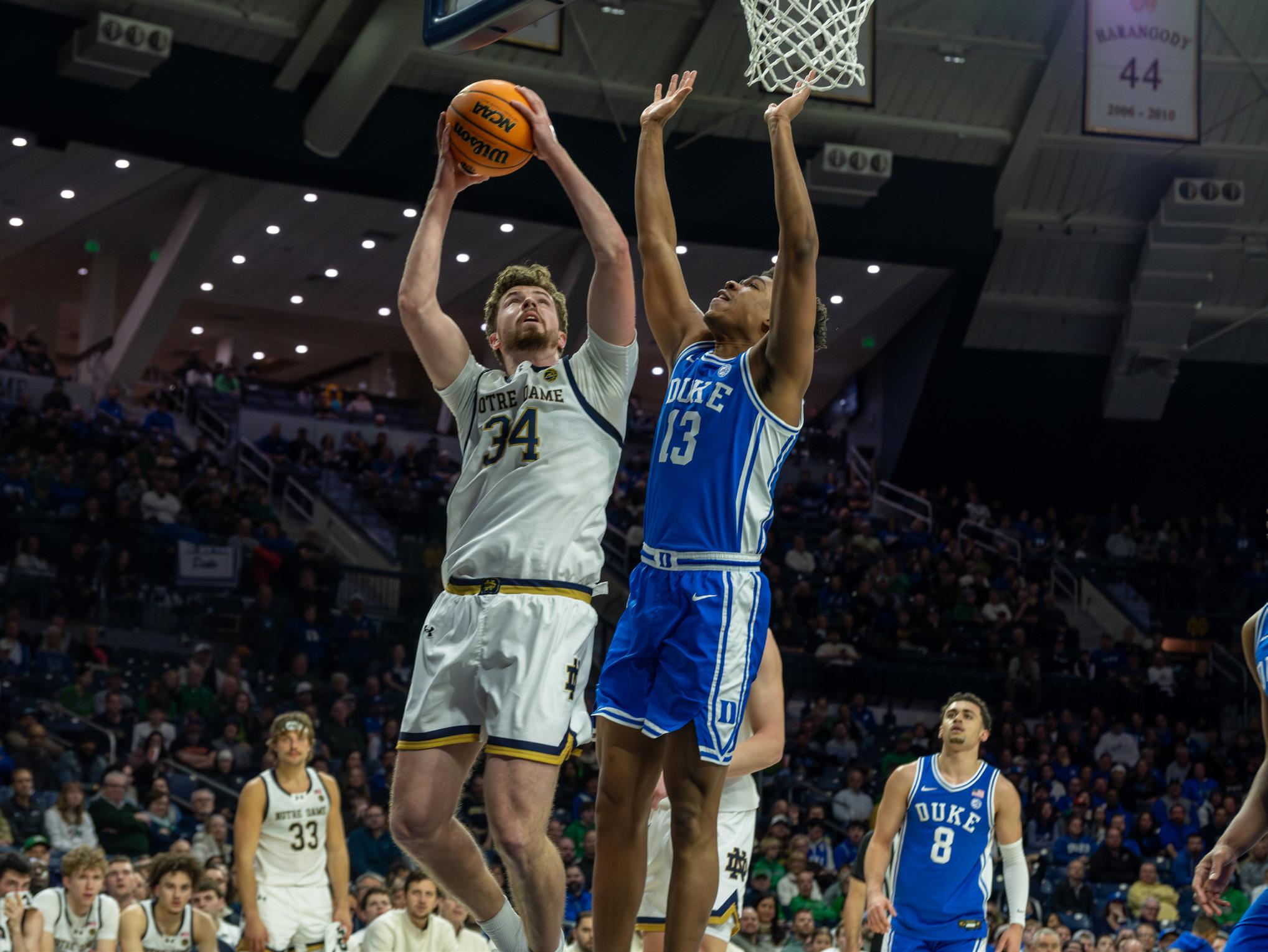
Men’s basketball vs. Duke
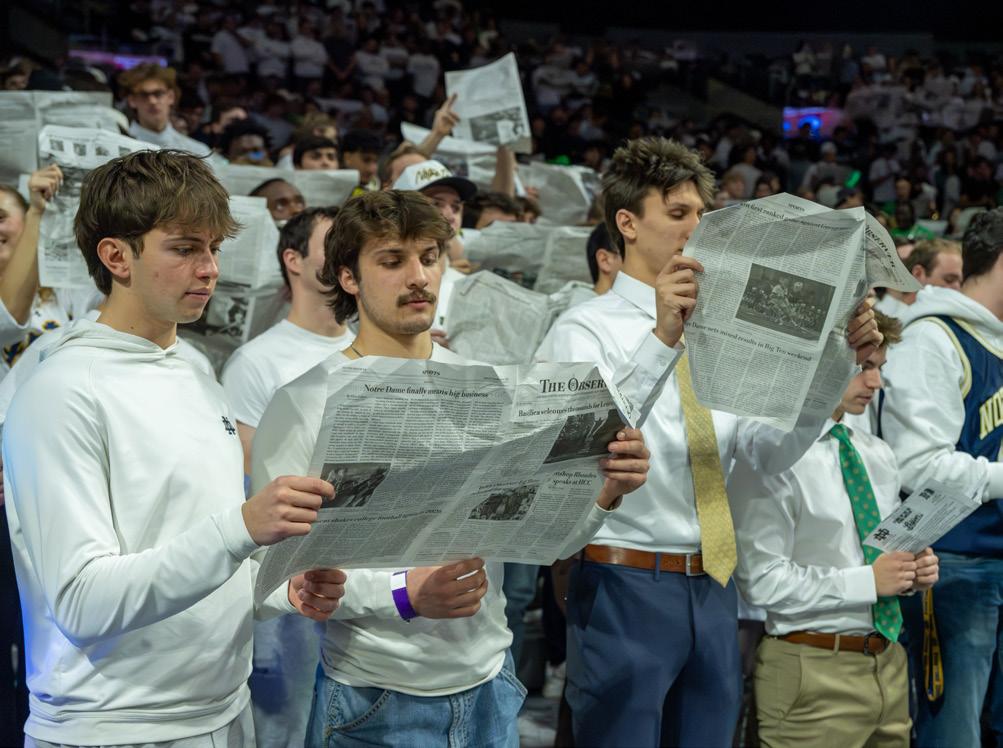
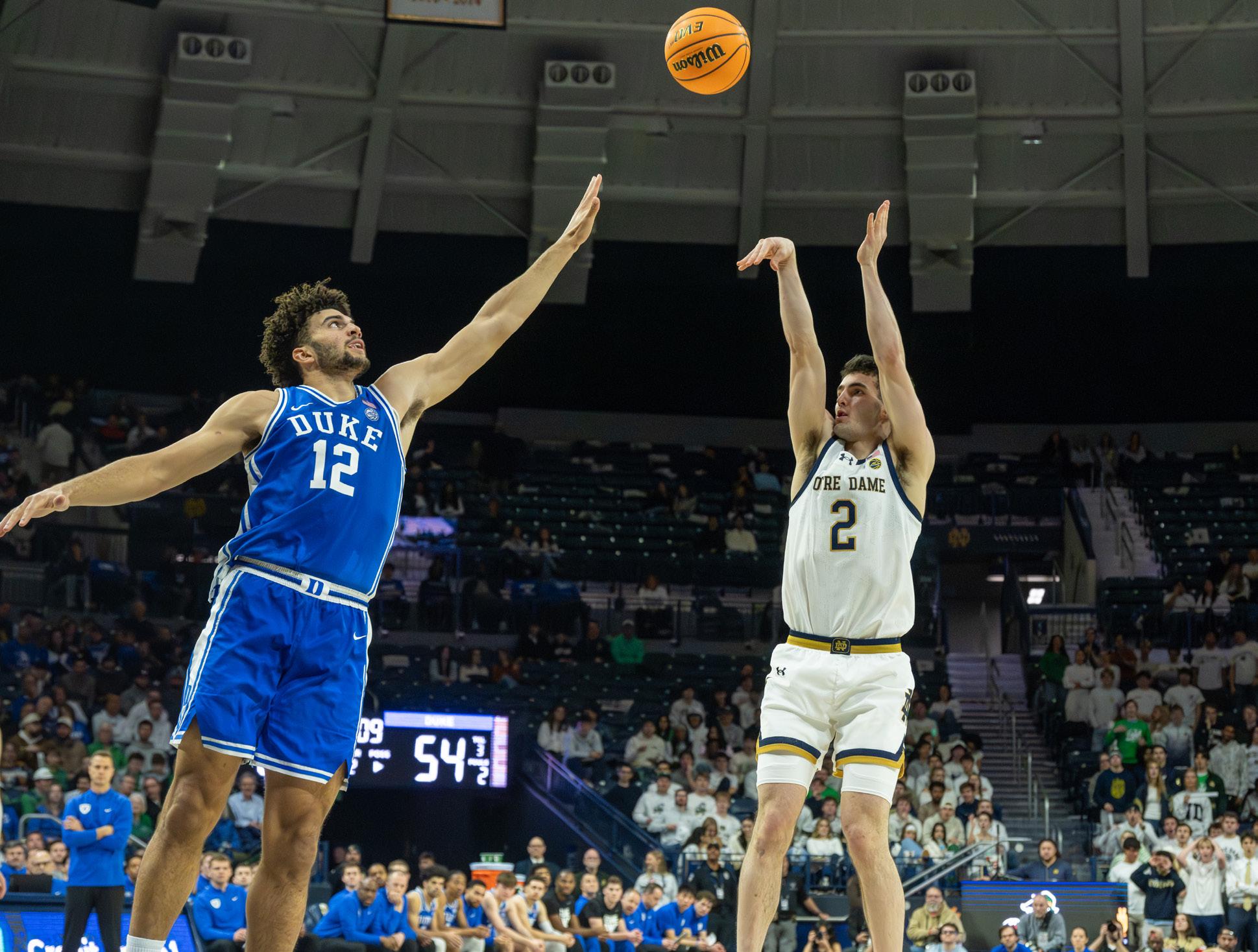
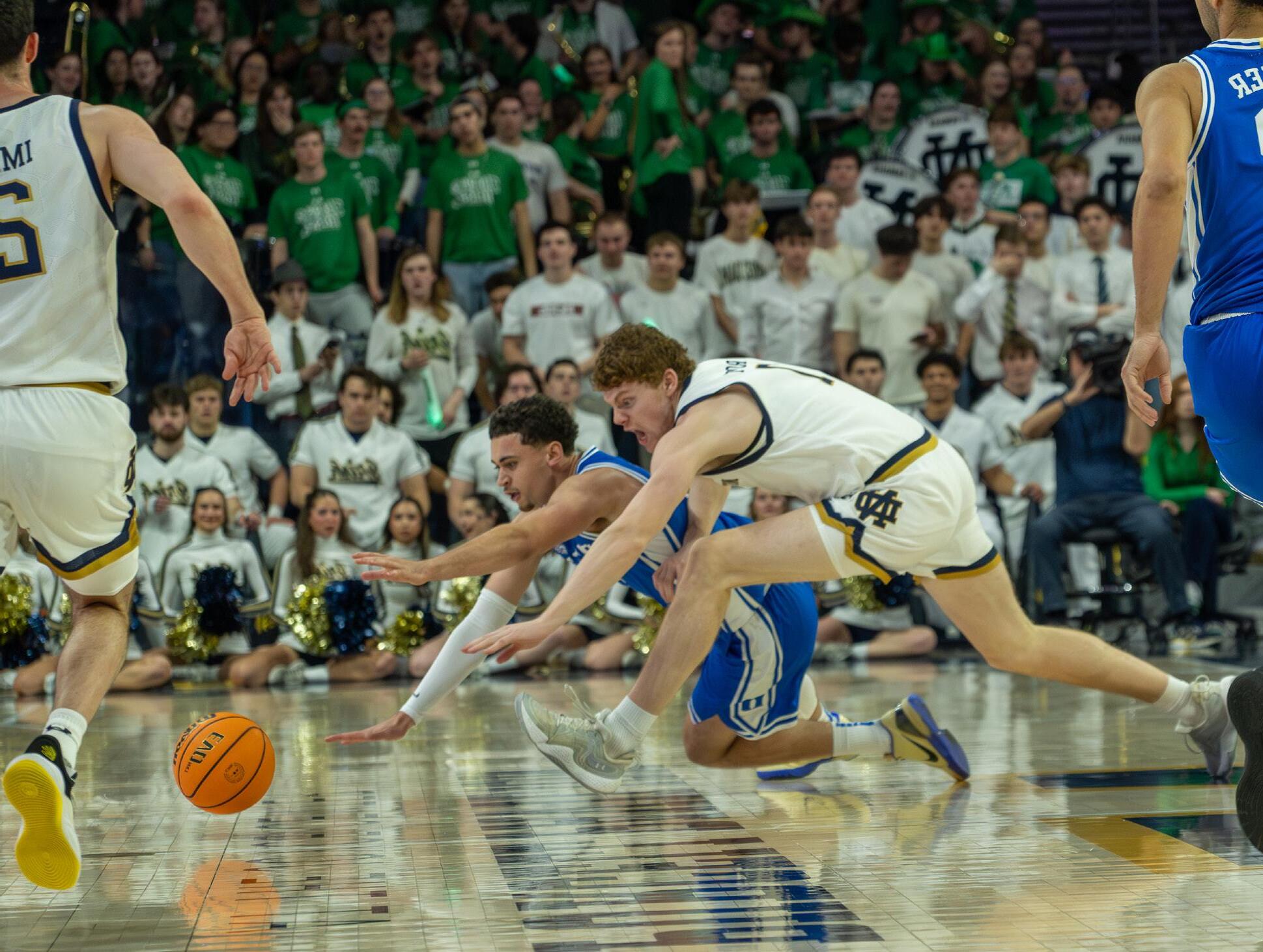
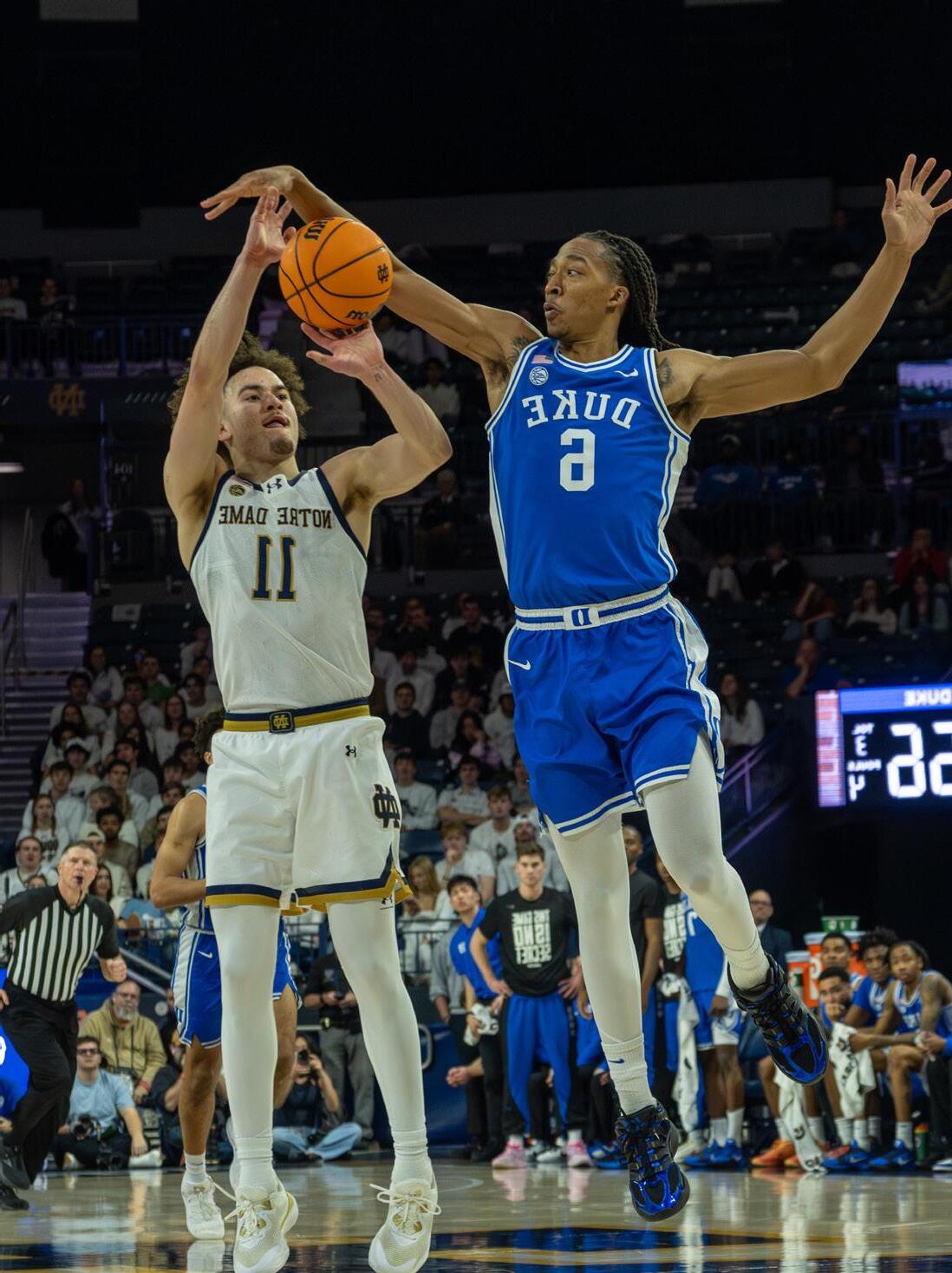
The Notre Dame men’s basketball team lost 10056 to the No. 1 Duke Blue Devils on Wednesday in Purcell Pavilion. It was the most lopsided home loss since the Chicago First Regiment in 1898.
Photography by Mariella Taddonio
SPORTS
Josh Yago pilots Irish lacrosse to early success
By Jack Muething Sports Writer
After losing all three attacking starters from their previous season, the 2026 Notre Dame men’s lacrosse team was going to need someone to step up on offense. For the first three games of the season the solution has been a graduate transfer from Air
Force, forward Josh Yago. He has nine goals and four assists this year and has been the key leader for an offense that now leads college lacrosse in goals per game.
In his debut outing for Notre Dame, Yago led the team in goals, collecting four, all of which came in the second half. He was the key factor in icing that game against

Marquette, as his first goal started an 8-3 run and gave the Irish a 1611 win. In the team’s next contest against Bellarmine, the Irish broke a program record for most goals in a game in the 29-10 win over the Knights. Yago contributed two goals and two assists. Then, against the first ranked opponent of the season, Yago contributed a hat trick and two assists to beat No. 4 Georgetown 15-9.
If one was asked to name a star on this offense, Yago is surely the attacker to pick. However, the stats show that there isn’t a true star on this Notre Dame team. The Irish have gotten goals from eight or more players in all three of their games this season and having that many different weapons to get scoring from is huge for the team’s success. After the Georgetown game, Yago was asked about what has allowed him to be so successful this year, and he mentioned the team’s chemistry and selflessness. “We all share the ball. It’s not a 1-on-1 matchup for anybody. We’re playing 6-on-6. You
HOCKEY
look at the box scores, and everyone is contributing, whether it’s the fifth attackmen or our sixth middie,” Yago said.
38th-year head coach Kevin Corrigan also praised Yago’s performance. More specifically, he talked about Yago’s versatility, adding, “the thing I like most about him is the variety of plays he can make. He’s good on the wing, he’s good up top, he’s good with the ball in his stick, he’s good off-ball and he’s good inside.”
The coach mentioned the experience Yago brings to an inexperienced group of attackers. “There are not a lot of guys who have that kind of skillset and also the maturity that comes with playing at Air Force the past couple years, and that makes him a really tough cover,” he said.
Corrigan also praised the many options that the team has and how a big part of the reason Yago earned favorable matchups was because the Irish had so many threats for the Georgetown long-stick defenders to take on. Overall, Corrigan was very pleased with Yago’s performance
against Georgetown, and how he has fared in favorable midfield matchups through the start of the campaign. The Irish were ranked No. 7 heading into the Georgetown game, and Irish players may have taken that personally. “We, as a group, feel like we are being overlooked right now,” Yago said. “We’re here to play. We’re gonna show the world that, and today I think we did,” he said.
It’s safe to say that the Irish are no longer being overlooked, as the newest rankings by Inside Lacrosse ranked the Blue and Gold at No. 2.
The games ahead do not get much easier though, as the team’s next contest is a tough matchup against the No. 9 Maryland Terrapins, who finished as the runners-up just last season. The Irish have a lot of different weapons offensively, and Yago will be as important as any of them for the team to continue its success throughout the remainder of the year.
Contact Jack Muething at jmuethin@nd.edu
Irish to host Penn State for last home weekend
By Ryan Murphy Sports Writer
When Notre Dame hockey breaks out the green jerseys, it’s a telltale sign that spring break is on the horizon.
The Irish only wear their green alternates once annually, when they honor their seniors on the last home game of the season.
That time is now for the 202526 Irish, as Notre Dame prepares to host No. 5 Penn State on Friday and Saturday at Compton Family Ice Arena. At the end of a difficult transition season under first-year head coach Brock Sheahan, Notre Dame will recognize its four seniors — defensemen Michael Mastrodomenico and Axel Kumlin, forward Niko Jovanovic and goaltender Jack Williams — in a pregame ceremony before Saturday’s puck drop.
“[The seniors], they’re so important to what we’ve been doing this year. Their buy-in and their ability to show up every day and try to do what we’re asking, it’s been there. If that’s not there, it makes a miserable existence and a disconnected hockey team,” Sheahan told the media Wednesday.
At many points this year, Notre Dame has looked like a disconnected hockey team. The Irish lost 16 of 17 games between October and mid-January, including their first 13 Big 10 conference games.
But they’ve looked anything but disconnected of late, even if the results haven’t followed suit.
The Irish went on the road to top-ranked Michigan State last weekend and played arguably
their best game of the season. The Irish lost 4-2 anyway and followed up the performance with a lackluster 8-2 loss that saw them start well before falling apart in the second half of the game.
“Thursday night, we probably play our best game, and again unfortunately, we just don’t get over the hump,” Sheahan said. ”[Friday,] the year as a whole plays a role and guys kind of shut down a bit, which is disappointing.”
The Irish will have no easier task this weekend against the Nittany Lions, who will arrive with one of the nation’s hottest power plays. Led by the projected first overall choice in this year’s NHL draft, freshman forward Gavin McKenna, Penn State remains in the mix for a top four seed in the NCAA tournament. After a winless two weeks against No. 1 Michigan State and No. 2 Michigan, the Nittany Lions rebounded with 11-4 and 5-4 wins over Ohio State last weekend.
Penn State brings an especially potent transition game. They’re now scoring the third most goals-per-game in the nation, with 3.9 tallies per contest. McKenna himself leads the team in points with 43, good for fifth nationally. The Nittany Lions also have five players who have scored double-digit goals. Junior forward Matt DiMarsico leads all Nittany Lions with 17 lamp-lighters, while freshman defenseman Jackson Smith leads all defenseman with 10.
“We have to play behind them. We have to play in their end and take away their transition, because that’s where they’re really
good,” Sheahan said. “We want to make the game an O-zone game for us so that when they get tired, they’re getting off the ice and not
going up the ice on line rush.”
This is an abbreviated version of this story. The full version of this story can be read at
ndsmcobserver.com
Contact Ryan Murphy at rmurph22@nd.edu

MARIELLA TADDONIO | The Observer
Josh Yago attempts a pass during a 15-9 win over Georgetown on Feb. 22. The Air Force transfer leads the unbeaten Irish with nine goals.
Juniors lead Irish at the plate and on the mound
By Ethan Laslo Sports Writer
Baseball season in South Bend is off and running. So far, the Irish are 3-3 through their first two weeks of play, including a series win at Florida Atlantic two weeks ago. Last weekend at the Live Like Lou Jacksonville Baseball Classic, the Irish battled against UCF and LSU before emerging with a Sunday victory over in-state rival Indiana. Over the first six games, two juniors have emerged as both leaders and stars for the Irish this season: pitcher Jack Radel and catcher Mark Quatrani.
Jack Radel
Going into the season, it was widely known that Jack Radel would be Notre Dame’s ace pitcher and would start most Fridays. In his
preseason press conference, head coach Shawn Stiffler explained that with Radel on the mound, he believed that his Irish squad was as good as any team in the nation. Following the departure of Rory Fox, Radel spent the offseason developing his offspeed pitches and has already seen results in just two weeks of play. Against UCF last Friday, Radel threw an astounding six perfect innings, not allowing a single Knight on base. He tossed nine strikeouts over the six frames, tying the second-most in a game in the tournament’s history. Radel was also incredibly efficient, requiring only 68 pitches.
As a result of his stellar performance against UCF, the ACC announced on Feb. 23 that Jack Radel was their Pitcher of the Week. He was also named to the All-Tournament Team. Despite the
Irish’s loss to the Knights, Radel’s incredible outing still earned him his first in-season recognition of 2026, with more likely to come for the Irish ace.
Radel has also emerged as a leader of the Notre Dame pitching staff. The junior native of Sioux Falls, S.D., has now spent three years with Shawn Stiffler and his staff. As a result, he now finds himself as something of a mentor to the younger guys in the room. Freshmen Caden Crowell and Aiden Zerr, sophomores Oisin Lee and Kellan Klosterman and more have now all come into the program with Radel as an older pitcher to learn from. As the years go on, Radel is only improving on the mound. But his leadership off the field is just as special for a young staff that will look to take Notre Dame far this season and for seasons to come.
Mark Quatrani
Unlike Jack Radel, catcher Mark Quatrani is brand new to Notre Dame this season. The Philadelphia native joined the Irish after spending his freshman and sophomore seasons with the Cornell Big Red. There, he earned First Team AllIvy League honors twice while also becoming just the third Cornell baseball player to earn Ivy League Rookie of the Year honors after the 2024 season. After transferring to Notre Dame, he instantly inserted himself into conversations to be the team’s starting catcher, ultimately winning the job prior to the season.
After starting all six games, Quatrani leads the Irish in most hitting stats. Currently, he posts a slash line of .522/.600/.783, all three being the best on the team. His 12 hits and eight runs scored also pace the Irish order, while his two home
runs are tied with sophomore outfielder Jayce Lee for the team lead. He’s also been outstanding behind the dish: He boasts a perfect 1.000 fielding percentage and has caught two of the six runners that have attempted to steal a base on him. While Quatrani may be new to Notre Dame baseball, his impact has been felt just as quickly as he arrived. He has shown so far that he has the potential to be the best hitter in the Irish lineup for the duration of the season. Moreover, he has cemented himself as a force to be reckoned with behind the plate. While many of the Irish pitchers get a lot of credit, Quatrani will look to play a crucial role this season in the Irish’s pitching success while also pacing them at the plate.
Contact Ethan Laslo at elaslo@nd.edu
Irish look ahead to weekend at Tennessee Tech
By Zach Jones Sports Writer
The Notre Dame baseball team will play its last non-conference weekend series before May this weekend, heading south for three games hosted by the Tennessee Tech Golden Eagles. In Cookeville, the Irish will take on Alabama A&M, University of IllinoisChicago and Tennessee Tech.
Friday
Notre Dame opens the weekend with a Friday matchup against Alabama A&M. This is the first time the two programs have met on the field. Head coach Louis Whitlow’s squad has a 2-5 overall record, but are coming off a successful 2-1 weekend during which they defeated New Orleans and the University of Louisiana at Monroe. The Bulldogs will host Illinois State on Wednesday before heading north to Cookeville.
At the plate, the Bulldogs lineup is anchored by junior outfielder
Tarris Murray and graduate outfielder Tervell Johnson, a power threat who leads the team with seven RBI and two homers. Junior Edyn Barber is likely to start on the mound against the Irish. The 6-4 righty out of Cranbrook, British Columbia sports a lively fastball and a put-away slider. He’s struck out 11 through six innings this year. Barber will duel Irish ace Jack Radel, who is coming off six perfect innings in Jacksonville last Friday. Radel will look to extend his current streak of eight scoreless innings against a Bulldog lineup that is slashing just .244/.375/.369 on the year.
Saturday
Notre Dame will match up against Illinois-Chicago Saturday. Like the Irish, the Flames have opened their season in warmer environs. Coach Sean McDermott’s squad has played three Texas teams to open their season and owns a 3-4 overall record. Brandon Bak has started the second game in
both of UIC’s series and projects to be the Irish’s initial adversary on the mound. The senior southpaw has had an effective year, sporting a 2.19 ERA over 12.1 innings of work. Bak pitches off of a high-70s slider that he throws nearly 40% of the time. He’ll be hoping to induce weak contact and keep the Irish lineup off-balance. The Notre Dame lineup would do well to jump on Bak early and force UIC to deploy some of their weaker arms out of the bullpen. Irish freshman Caden Crowell projects to get the starting nod on Saturday. He’s looking for a getright start after being roughed up by a potent LSU lineup last weekend, and Saturday might provide the perfect opportunity. UIC is averaging a paltry 3.9 runs per game and is slashing a collective .219/.320/.299.
Sunday
The Irish conclude their stay in Cookeville with a Sunday game against host Tennessee Tech. The
ND MEN’S BASKETBALL
Golden Eagles sport a 5-4 overall record and are coming off a Tuesday run-rule loss to Middle Tennessee. Coach Matt Bragga challenged his team by scheduling an away series at Texas A&M to open the season. While the Golden Eagles were swept by the Aggies, they emerged battle-tested and are not a team to be taken lightly. The Golden Eagles won 37 games last year and Bragga has postseason experience, leading the Golden Eagles to a Super Regional final in 2018.
At the plate, look out for senior infielder Eddie Garza, redshirt sophomore infielder Owen Lee and senior outfielder Jorsixt Jimenez. Garza leads the team in hits with 12 through nine games, while Lee and Jimenez lead the team in home runs and RBI, respectively. The trio are the only Golden Eagles batsmen hitting over .275. Tennessee Tech has mixed up their rotation this year, making projecting a starter difficult. Last Sunday’s starter Jaxson Pease had a solid outing against Ohio, going 6.2 innings and
allowing two runs. If it’s not Pease on the bump against the Irish, it’ll probably be Logan Moller, a 6-foot-5 sophomore who started on Sunday against Texas A&M. Sunday’s game will be streamed on ESPN+, with first pitch scheduled for 2 p.m. Eastern.
Irish Outlook
Notre Dame Friday ace Radel was unhittable last weekend in Jacksonville and earned ACC Pitcher of the Week honors for his efforts. He’ll set the tone for the Irish against Alabama A&M on Friday. At the plate, keep an eye on junior catcher Mark Quatrani, who’s been red hot to start the year with a slash line of .522/.600/.783. Watch and see if graduate outfielder and catcher Drew Berkland carries the good vibes forward from his stellar game last Sunday against Indiana in which he had three RBI and an extra-inning walk-off single.
Contact Zach Jones at zjones3@nd.edu
Irish vie for spot in postseason against NC State
By Chris Dailey Sports Writer
Fresh off a season-defining blowout loss to No. 1 Duke, the Notre Dame men’s basketball team returns to Purcell Pavilion this Saturday for a noon clash against NC State.
The Wolfpack prove to be another tall challenge for the struggling Irish, as Will Wade’s squad boasts a 19-9 record overall with a 10-5 mark in conference play. After its 100-56 loss to the Blue Devils, Notre Dame sits at 12-16 overall and 3-12 in the ACC.
Against Duke, Notre Dame shot 36.5% from the field and 57.9% from
the charity stripe. To make matters worse, the Irish were outrebounded 47-26. While they were down two superstars in junior guard Markus Burton and freshman guard Jalen Haralson, head coach Micah Shrewsberry’s injury-ridden team was poor regardless.
If Shrewsberry is to get his team back on track, sophomore guard Cole Certa needs to string together another productive afternoon. The crafty guard has progressively gotten better this season, culminating in a 43-point performance against Virginia in late January and 37-point outburst against Georgia Tech earlier this month. Although Certa has had trouble
finding consistency with efficiency from the field, there is no doubt his shifty play has provided the Irish with a boost during a tough string of losses. Confident with the ball in his hands, Certa can make something out of nothing. While he has forced shots at times, Certa has still solidified himself as Notre Dame’s leading man as of late. Freshman forward Brady Koehler has also stepped up in the absence of Burton and Haralson. Against the Blue Devils, Koehler notched 14 points and shot 5-9 from the field.
In a rare stroke of good luck for the Irish, Haralson is expected to be healthy enough to return by
Saturday’s matinee tip-off. On the flip side of the coin, NC State comes to town as one of the best teams in the ACC. Led by first-year head coach Wade, the Wolfpack have picked up big wins over the likes of No. 18 North Carolina, Clemson and SMU. They also lost by one score to both Miami and No. 14 Kansas.
NC State’s big-time performances can largely be attributed to their potent offense. The Wolfpack have four players averaging at least 13.5 points per game. As a collective, the team is averaging 84 points per game.
At the center of NC State’s attack is senior forward Darrion Williams.
After being named Mountain West Freshman of the Year at Nevada before spending two years at Texas Tech, where he was named an All Big-12 First Team selection last season, Williams has been terrific this season. The 6-foot-6 playmaker is averaging 14.2 points per game. However, his stellar offensive play has coincided with a fair bit of criticism for his lack of intensity on defense.
This is an abbreviated version of this story. The full version of this story can be read at ndsmcobserver.com
Contact Chris Dailey at cdailey2@nd.edu
Hicks: Duke domination should be a wakeup call
By Ben Hicks Sports Editor
Not so long ago, Notre Dame was a place for athletic prosperity across the board, not just on the gridiron inside Notre Dame Stadium. Those days, especially for the University’s second most financially important and historically successful athletic program, are no more.
On Tuesday night, top-ranked Duke, a self-identified academic and athletic peer of Notre Dame, came into Purcell Pavilion and absolutely blasted the sputtering Irish. The “sellout” crowd, a first for this season, was lifeless from the tipoff. Once again without its top two players, the team looked disconcerted and disoriented. In what seems to be a trend dating back to the end of the Brey era, students couldn’t be bothered to stay more than 10 minutes. One word can describe the general attitude surrounding Notre Dame men’s basketball: apathy.
The problems for this program are systemic, running much deeper than just the head coach. Although every keyboard warrior on social media has called for Micah Shrewsberry’s job since he charged at an official following an astonishingly awful call that cost Notre Dame a game at Cal in early January, I truly believe the thirdyear boss has done the best he can with the hand he’s been dealt.
Simply put, men’s basketball has not been made a priority at Notre Dame, a sad reality for a program ESPN listed in its top 20 all time just 15 years ago. It hasn’t always been this way, but in the revenue-sharing venture capitalist era of college athletics, it may be unavoidable.
By Ellie Collins Associate Sports Editor
Twenty-five years ago, Notre Dame hoisted its first national championship in program history under head coach Muffet McGraw and behind all-American point guard Niele Ivey. The trophy came after five of 23 consecutive Irish tournament appearances and was followed by a second title in 2018. Now, Ivey sits at the helm in her sixth season as head coach — and for the past two, she has been blessed with arguably the greatest player in Notre Dame history in junior point guard Hannah Hidalgo. However, though the Irish earned tourney berths in five out of Ivey’s six years and each of Hidalgo’s first-team AllAmerican seasons, the program has not displayed the same level of excellence that McGraw made characteristic of the program. Thus far in this campaign, the trend of “good but not great” continues.
I understand that basketball at Duke is the number one priority, just as football is at Notre Dame. But success in the two sports isn’t and shouldn’t be mutually exclusive. That is especially true for an athletics department with as deep of pockets and as insatiable a desire to succeed as Notre Dame.
According to data compiled by nil-ncaa.com, Notre Dame paces the Atlantic Coast Conference in athletic department operating expenses at north of $200 million. In December, athletic director Pete Bevacqua boldly stated that Notre Dame would provide the resources necessary for Marcus Freeman’s football program to compete for national championships. In a world where football pays the bills and serves as the University’s most public-facing entity, Bevacqua’s decision is logical and reasonable.
But at the same time, it is fair to ask whether the decision to go “all in” on football has left Shrewsberry and his program behind the eight ball in a rapidly evolving college basketball landscape.
As Notre Dame now positions itself at the top of college football spenders, ready to compensate its student-athletes at and beyond the revenue-sharing cap, its resourcing on the hardwood has fallen behind. With Duke spending upward of $10 million on their roster, and other schools such as Kentucky and Louisville reportedly pushing toward $20 million, Shrewsberry shouldn’t be expected to compete on that level unless his program is funded to a similar level.
Despite these financial inequities between the programs both within the University and in the greater context of the ACC, competing in
both revenue-generating sports shouldn’t be an impossibility. Schools of differing levels of prowess, from Alabama and Michigan to BYU and Miami (OH), have adapted to the professionalization of intercollegiate athletics and positioned both football and men’s basketball to sustainable success. Even the hated Blue Devils, perhaps Notre Dame’s most indistinguishable resemblance, have thrived with both the pigskin and the roundball.
Let’s look at Duke football as a comparison for Notre Dame men’s basketball. Although the Blue Devils football program has never reached the heights that Digger Phelps led Irish hoops to in the 1970s and ‘80s, Manny Diaz has guided Duke to consecutive ninewin campaigns over his first two seasons. That impressive 18-9 mark is a stark contrast with the 40-54 record posted by Shrewsberry’s Irish.
Instead of demanding for Shrewsberry to be fired, Irish faithful should exhibit the same pragmatic approach demonstrated by Duke head coach Jon Scheyer in his postgame press conference. “Obviously, that’s not Notre Dame’s team. You know they’ve had terrible injuries this year,” Scheyer said.
And it’s true, at full strength, the Irish were 8-3 with three quality wins over Power Five opponents. Despite a limited budget, Shrewsberry seemed to have constructed a competitive roster around star guard Markus Burton. It’s just that without Burton, the glaring holes from an under-resourced roster have been exposed, hurling 202526 into “a season from hell,” as
ND WOMEN’S BASKETBALL
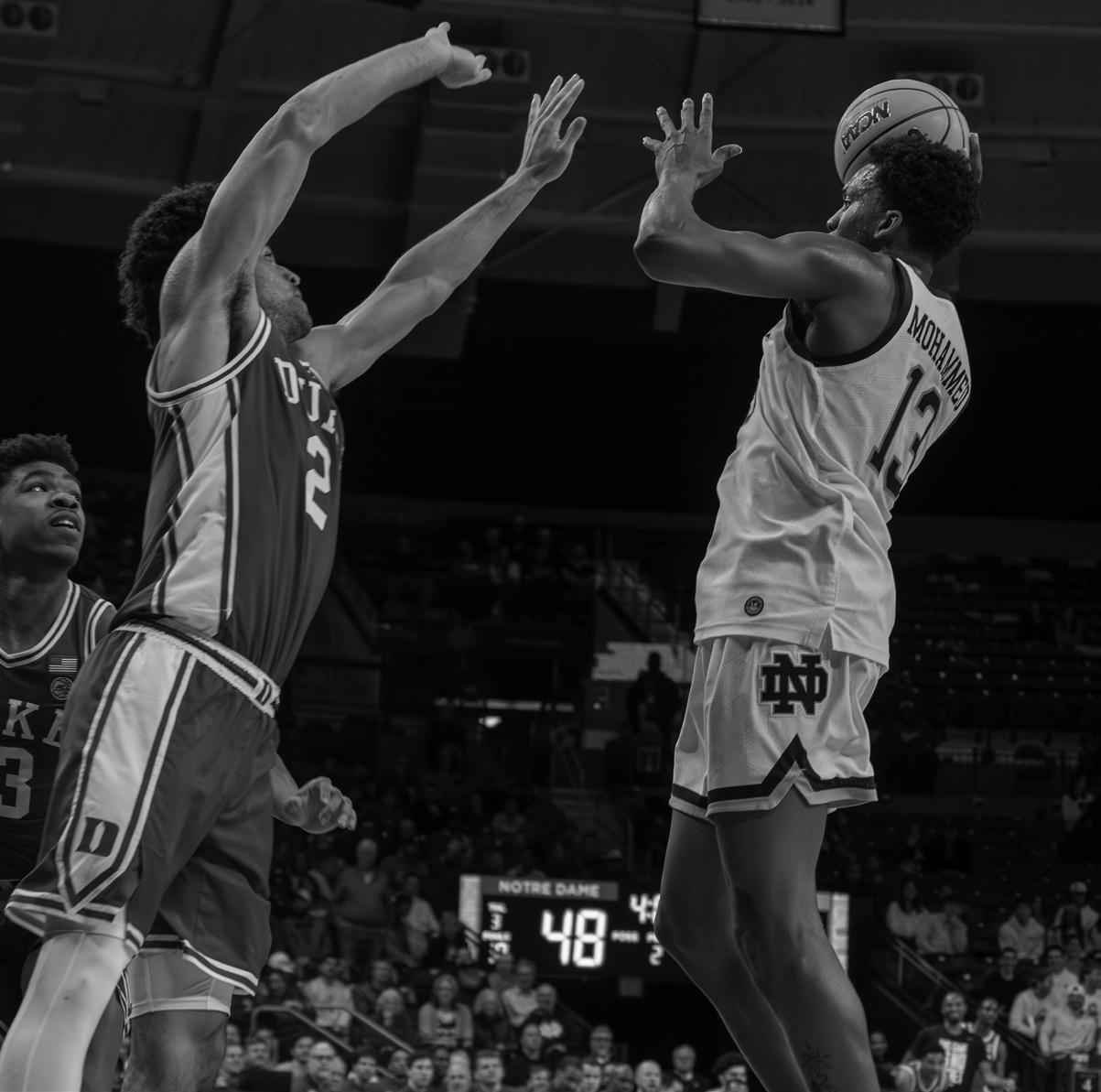
Sir Mohammed tries to pass through Duke star Cameron
during Notre Dame’s 100-56 loss on Feb. 24. Mohammed scored 11 points.
Shrewsberry described it following Tuesday’s defeat. According to reports by ESPN’s Jeff Borzello, Notre Dame will retain Shrewsberry for a fourth season. It’s a wise decision, as slashing the four remaining years on his contract and eating the nearly $15 million he would be owed would set the program back even further. But the decision to retain the coach can’t be the only smart financial decision Notre Dame makes this basketball offseason. It has to demonstrate a level of investment similar to what it ensured Freeman in December 2025 and similar to what its peer institutions have ensured their own basketball coaches.
Losing by 44 on your home
Collins: Has Ivey hit her ceiling?
McGraw turned water into wine with Notre Dame women’s basketball. In her 33-year tenure, she took an unfledged program and transformed it into a national powerhouse, amassing a 77.1% win percentage and nine Final Four appearances. Granted, Ivey assumed the team after a difficult last season under her legendary predecessor, but she inherited the resources McGraw fostered to build back to an elite level.
To her credit, Ivey has proven to be an excellent recruiter capable of ensuring a high level of talent is on the roster. Just last year, Notre Dame boasted a plethora of elite ability arguably equal to some of McGraw’s most successful teams. In addition to Hidalgo, the Irish had senior guard Sonia Citron, a future top-three WNBA draft pick, and graduate forwards Maddy Westbeld and Liatu King, both of whom also heard their names called last April. That even fails to mention second-team
All-American Olivia Miles, who decided to transfer for her senior season. Yet, the Irish struggled down the stretch and bowed out in the Sweet 16 in a 71-62 defeat to Texas Christian. Though the fact that the Irish made it past the opening weekend for the fourth straight time under Ivey should not be discounted, they certainly did not achieve success commensurate with their overall ability, and yet again could not get over the hump to advance any further.
Entering this season with Hidalgo, the reigning ACC Player of the Year, leading the way, the Irish held high preseason expectations and a Top-15 ranking. Hidalgo has been sensational as expected, currently leading the ACC with 24.9 points per game and the country with an astounding 5.6 steals per contest. Despite yet another likely firstteam All-American selection, the team sits at an unremarkable 18-9 and a pedestrian ninthplace 10-6 ACC record. Now,
while Hidalgo merits the praise she garners, not all of Notre Dame’s glory rests with her, nor do its relative failures fall on her teammates, who may not be as talented as the 2024-25 unit but still rate highly. Rather, I pose a question concerning a trend of success but not greatness under Ivey about whether the inability to take the next step relates to her ceiling as a coach or inevitable growing pains similar to McGraw’s struggles to break through as an NCAA tournament force.
Along with Hidalgo, Notre Dame maintains an elite guard trio rounded out by senior Cassandre Prosper and graduate Iyana Moore; the three are averaging a combined 51.5 points per game. I would argue that there is not an issue of depth, but one of chemistry. As aforementioned, last year, the Irish seemed out of sync by the end of the season, culminating in the loss of Miles to the Horned Frogs, another blow from TCU. The same type
floor and sitting idle while chants of “Let’s Go Duke” reverberate across Purcell Pavilion is not only unacceptable; it is embarrassing. Alongside its revered post in football lore, Notre Dame boasts a storied men’s basketball tradition. It’s a tradition at risk of fading away and fermenting into afterthought. It’s time to not only go “all in” on football, but also for the student-athletes of the University’s other 25 varsity programs. If Notre Dame doesn’t start to pay like a champion, its basketball program may never play like a champion again.
Contact Ben Hicks at bhicks2@nd.edu
of consistent cohesion issues seem to be a problem this season. With the talented trio, there is no reason the Irish should fall so hard when they do. In their nine losses, the average margin is 16.1 points.
The returns from Ivey’s first five seasons are certainly commendable, given her initial need to develop on the sideline. But now she should have enough experience to lead the Irish back to their prior standard of ACC champion and Final Four threat. Currently projected to be a seventh seed on ESPN Bracketology for next month’s Selection Sunday, the Irish will not be in many predicted Final Four brackets and the lack of outstanding interior play could limit them in the wrong matchup. However, a fifth straight trip to the regional semifinals would be a sweet end to an inconsistent campaign.
Contact Ellie Collins at ecollin9@nd.edu
MARIELLA TADDONIO | The Observer
Boozer