Print Edition for The Observer for Tuesday, March 24, 2026
By Chris Dailey Sports Writer
As name, image and likeness rules reshape college athletics, more programs across the country are cutting Olympic sports teams. In turn, the very essence of college athletics is becoming lost.
This is a shame.
The point here is not to criticize football, basketball, hockey or any other revenue sport. Instead, it’s an ode to what college athletics once was and still is, thanks to non-revenue Olympic sports.
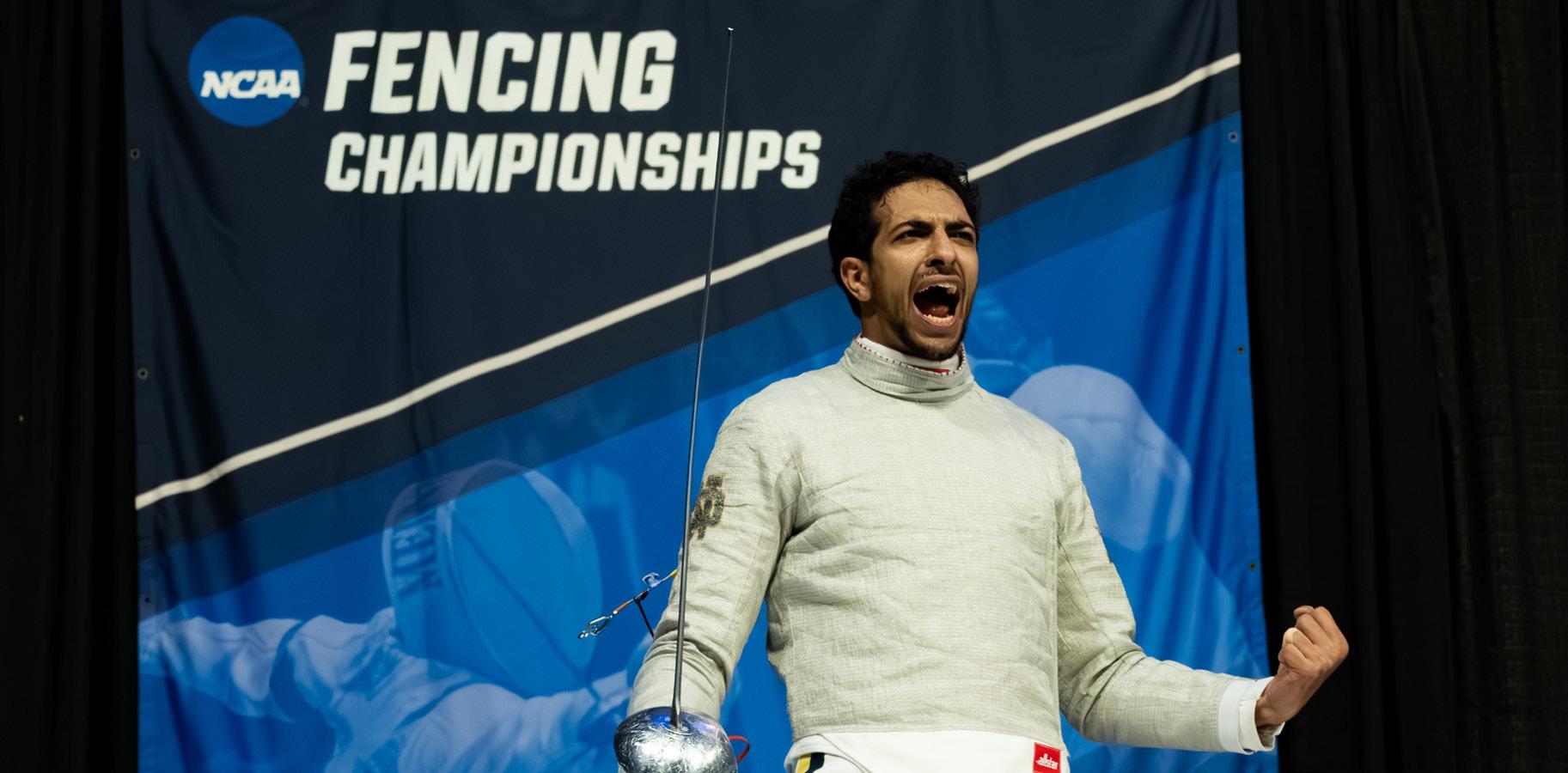
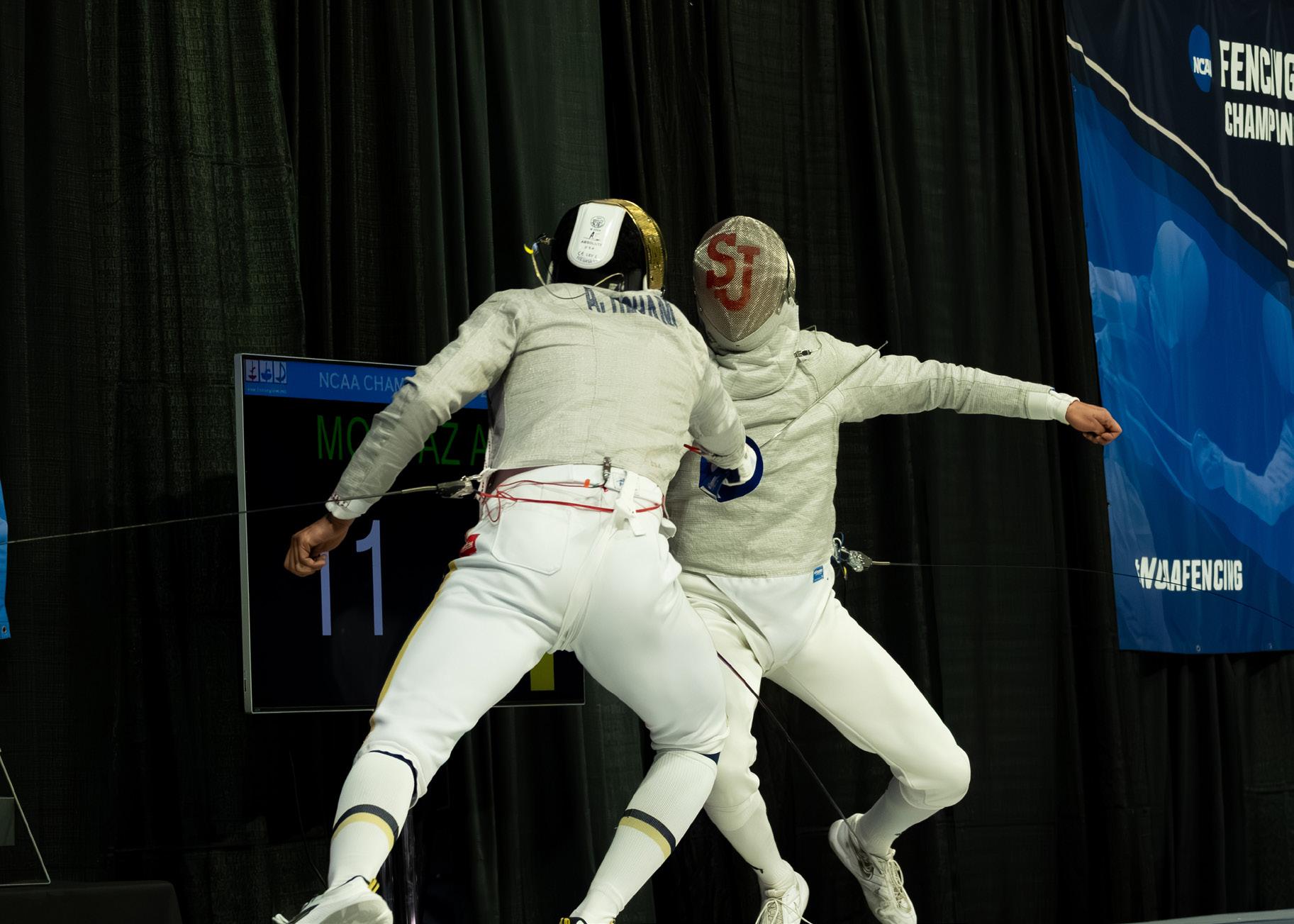
Thursday through Sunday, the University of Notre Dame hosted the 2026 NCAA National Fencing Championships at the Joyce Center. Hundreds of young men and women flocked to South Bend with a dream to win a medal, and over four long days, they competed relentlessly. Athletes from all around the world left it all out on the strip as family, teammates, coaches and friends watched on with a palpable excitement.
Sitting back and watching this mayhem unfold was nothing short of a delight. To see the fencers scream after a big win was a treat. To see the skill they competed with was amazing. And the best part?
Seeing young men and women who have dedicated their lives to a craft compete at the highest level.
An ode to Olympic sports
Sports are beautiful in that way.
But as the tournament continued to progress throughout the day, one thought kept creeping into my mind: Where is this going to be in 20 years?
With the increasing amount of money being poured into NIL deals for major revenuedriving sports, Olympic programs are at a crossroads. After the House settlement on college sports in June 2025, which allowed schools to directly pay college athletes, an estimated 32 Division I Olympic sports programs have been cut — a number only expected to rise in the coming years.
Roster sizes have also been trimmed significantly, and many athletes who committed to schools have had their offers revoked. St. Francis University, for instance, a Division I program across all sports, decided to move down to Division III.
I’m no legal expert and don’t have any practical way for the NCAA to go about this, but I believe the idea of saving Olympic sports at all costs should be at the forefront of its mind. Instead, the NCAA seems fixated on a different question: How much money can we make today?
Olympic sports provide the unique opportunity not only to pave the way for stars such as Notre Dame senior fencer Eszter Muhari to qualify
for the Olympics, but also to shape more well-rounded individuals. Isn’t that the job of the university system — to form holistic individuals?
The dismantling of Olympic sports would do the opposite. Such sports provide a platform for thousands of student-athletes to learn how
to be graceful in victory and strong in defeat.
Evident from this long weekend in South Bend, these sports also teach athletes how to be exemplary teammates.
With only a limited number of fencers obtaining spots in nationals, each and every fencer on the strip had an
army behind them. Although some of these young men and women may have been frustrated with how their respective seasons went, perhaps missing out on a spot in nationals by a small margin, they were still there to cheer on their teammates.
Olympic sports also have a unique, magical ability to bring people from vastly different backgrounds together. Just look at Notre Dame’s fencing team.
In men’s competition, the three competitors in the individual championships were sophomore Ahmed Hesham from Egypt, freshman Kruz Schembri from the U.S. Virgin Islands and junior Chase Emmer from the United States. In the women’s competition, two Americans and a Hungarian represented the Irish.
This same dynamic is present across nearly all Olympic sports. People who grew up in completely different worlds are coming together in pursuit of a shared purpose.
If Olympic sports are lost, the NCAA doesn’t just lose programs. Athletes don’t just lose opportunities. Instead, we collectively lose a forum where young men and women from all corners of the world come together to pursue something greater than themselves.
And in doing so, we lose a crucial piece of what collegiate athletes were always meant to be.
Contact Chris Dailey at cdailey2@nd.edu
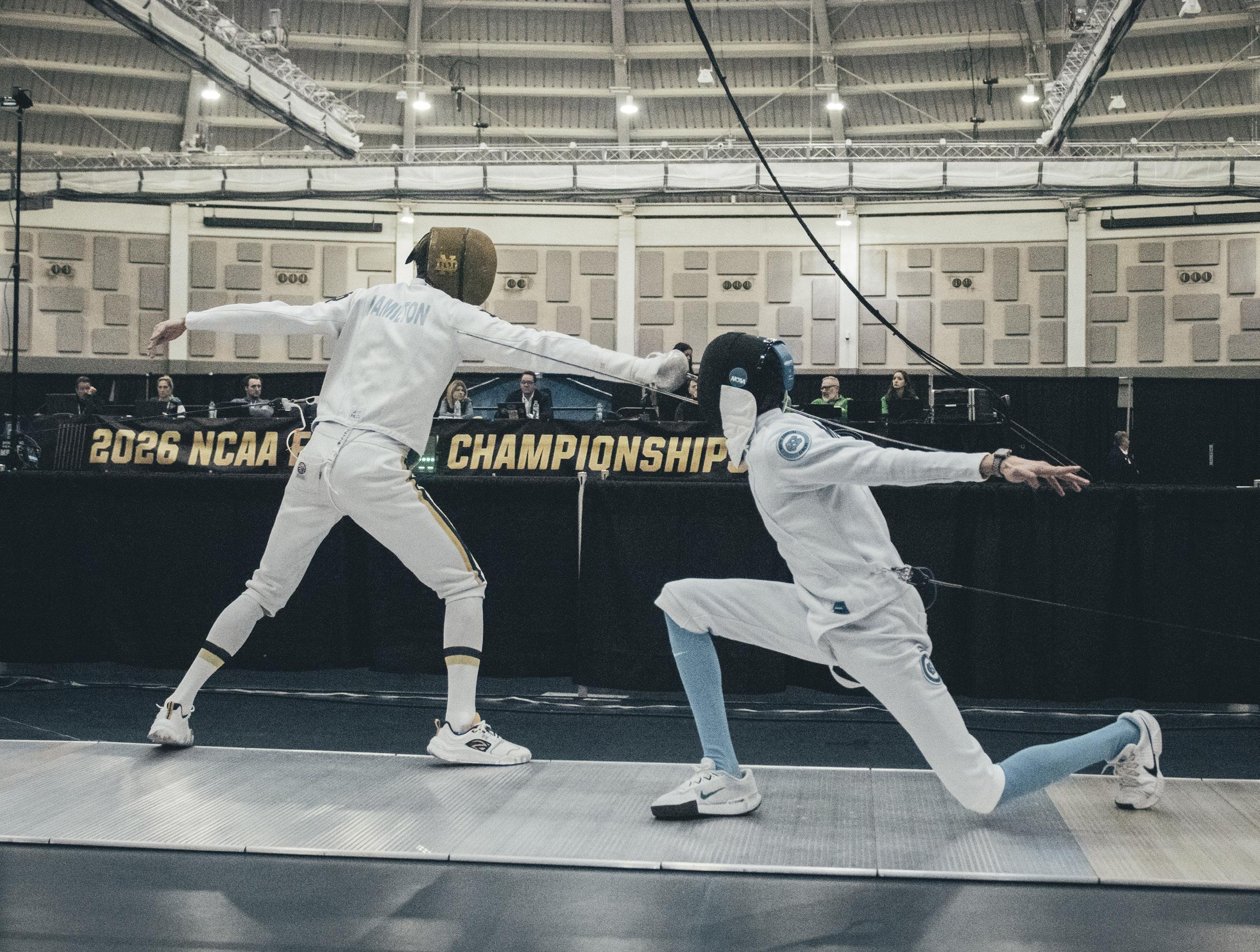
ABRAHAM MEDINA | The Observer
Notre Dame senior Jonathan Hamilton-Meikle battles a University of North Carolina opponent during the 2026 NCAA Fencing Championships on March 20. Hamilton-Meikle contributed a No. 14 standing in men’s epee to ND’s dominant performance and the program’s 16th national title.
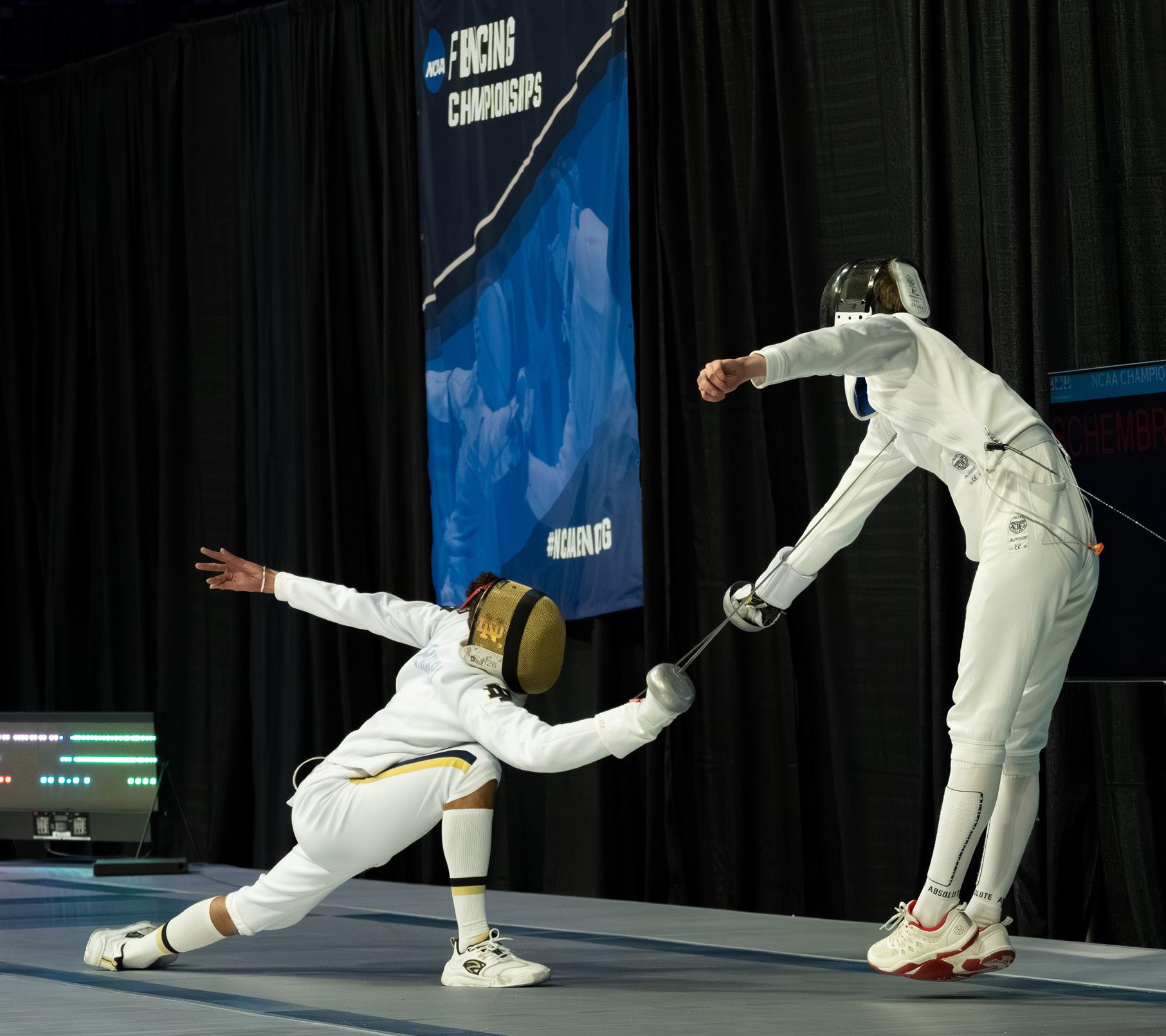
KEIRA JONES | The Observer
Irish freshman Olympian Kruz Schembri attacks LIU junior opponent Soma Somody during the NCAA Fencing Championships on March 22 in the Joyce Center. Schembri earned the silver medal for men’s epee.
THE INDEPENDENT NEWSPAPER SERVING NOTRE DAME, SAINT MARY’S AND HOLY CROSS
TUESDAY, MARCH 24, 2026 | VOL. LX, NO. 53
Students host demonstration to support immigrants
By Mara Hall Associate News Editor
In light of current politics and an event with the American Civil Liberties Union over winter break, a group of Notre Dame students came together with a vision to host a protest on campus celebrating immigrants on Saturday, March 21.
In an interview with The Observer ahead of the event, freshman Dario Romero described the goal of the event as a chance to “create unity through solidarity” in line with the call for students to be “a force for good.”
Freshman Eric Facundo said in an interview, “Honestly, the catalyst has really been politics.” He went on to explain that previous administrations, including the Obama administration, have deported immigrants, but their objections focused on the current administration’s methods. He cited there are “safe zones” for immigrants such as schools, but under the Trump administration, this is “something that we see slowly going away.”
Facundo explained that they
wanted clubs from Notre Dame to help, but none that were contacted were willing to do so. Because the demonstration was not sponsored by a club, the group was unable to put up posters and instead engaged in outreach through social media.
Prior to the event, freshman Militza Algredo-Huerta noted that the protest was happening at the same time as a St. Patrick’s Day social event, but thought they could still draw a crowd because it was a topic that people cared about.
Around 50 people were in attendance.
Scheduled speakers included Fr. Joseph Corpora, Romero, Sonia Lumley, Tiffany Gervacio, Luis Fraga and Facundo, with Bennett Witherell serving as the emcee throughout.
Corpora, a Holy Cross priest and associate director of the Transformational Leaders Program, opened the event with prayer, saying, “Merciful God, we pray to you for all the men, women and children who have died after leaving their homelands in search
of a better life. Though many of their graves bear no name, to you each one is known, loved and cherished.”
Corpora gave his speech following his opening prayer, offering a perspective of hope. Amid living in a time of darkness, he said darkness should not be considered the opposite of light; rather, “darkness is the active rejection of light.” To counter darkness, Corpora pointed out people need to witness to the light, and while John the Baptist is long dead, individuals today can carry on this testimony.
Corpora previously wrote a letter to the editor in The Observer related to immigration.
Romero was the first student speaker. Although the graphic the organizers had been circulating online ahead of the event noted he was a member of the Student Coalition for Immigration Advocacy, SCIA was not a sponsor of the event.
He emphasized the call to be a force for good and noted,
see “Protest” on page 3
SMC renames science center to Mathile Science Hall
By Observer News Staff
To offer recognition to the original family of a $10 million donation made in 2011 toward renovations of the Science Hall, completed in 2016, Saint Mary’s College hosted a renaming ceremony Friday morning and presented the new title of the building as Mathile Science Hall. The Mathile family’s donation is considered the largest single private gift in the College’s history.
According to an email invite to faculty and staff from College provost and vice president Megan Zwart, the name change “is in honor of Clayton and MaryAnn Mathile, along with their daughter, Jennifer Mathile Prikkel ’95.” Prikkel, a member of the board of trustees and tri-chair of the upcoming capital campaign,
NEWS | PAGE 3
SMC SGA election
Daniela Rivera and Mila Curtis ran unopposed and received 95% of the vote.
Ring Out Ring True, was recently recognized as a benefactor of the newly established Prikkel Advising, Career and Experience Center after making a separate multimilliondollar gift.
Zwart provided context for the Mathile family’s gift from 2011 in the invite by stating the donation led to the “expansion and upgrades to biology and chemistry labs, a dedicated floor for our physics department, as well as a greenhouse to support environmental science and plant biology.”
The Mathile name was originally not recognized in the Science Hall’s renovations at the family’s request. According to director of communications Lisa Knox, however, conversations reopened during the finalizations of the PACE Center. The specific
OPINION | PAGE 5
Engage, Don’t Avoid David Noone, class of ‘87, discusses religious conformity and the need for dissent at ND.
ND acceptance rate
remains at 9%
By Observer News Staff
Notre Dame’s acceptance rate held steady at a recordlow 9% for the second year in a row.
Notre Dame received 36,102 applications, 701 more than last year. For the last two years, the number of admitted students has not been reported by the University.
Notre Dame’s acceptance rate was unchanged compared to last year, but has fallen significantly in recent years. It has fallen by more than half since 2016.
Admitted students will be offered newly increased financial aid through the Pathways to Notre Dame program, which covers tuition for families making under $150,000.
The admissions office will offer a variety of opportunities for admitted prospective students to engage with the Notre Dame community before the May 1
decision day deadline.
“In the coming weeks, admitted students will be invited to engage with Notre Dame through a range of in-person and virtual events highlighting the University’s academic, residential, and spiritual life. The University will also host admitted students and their families on campus for The Rally (Admitted Student Days) on April 19–20, 2026,” the press release stated.
While most of demographic data has not been provided at this time, the press release stated, “This year’s applicant pool reflects the global reach and inclusive spirit of the University of Notre Dame, representing students from all 50 states, the District of Columbia, five U.S. territories, and 183 countries.”
The University shared that more details about the class of 2030 are expected in August.
Fr. Greg Haake to lead mission office
timing of the ceremony also coincided with the board of trustees’ March meeting, which occurred this week, and ensured the presence and recognition of outgoing trustee Mike Mathile.
College President Katie Conboy offered a brief history of the building as part of her remarks. After a fire resulting in the destruction of previous science laboratories located in Holy Cross Hall, the original Science Hall building was completed in 1955. Science Hall received its first set of renovations between 1985 and 1987, which doubled the size of the building, allowed greater space for growth in enrollment at the time, and facilitated expansion into new areas of scientific study. The renovations
see “Science Hall” on page 4
SCENE | PAGE 7
Project Hail Mary Ryan Gosling shines in an epic interstellar adventure journey through the cosmos.
By Henry Jagodzinski Assistant Managing Editor
For the last five years, the Office of Mission Engagement and Church Affairs at the University of Notre Dame, responsible for interfacing with the Catholic Church and stewarding Notre Dame’s Catholic and Holy Cross mission, has
SPORTS | PAGE 8
Basketball advances
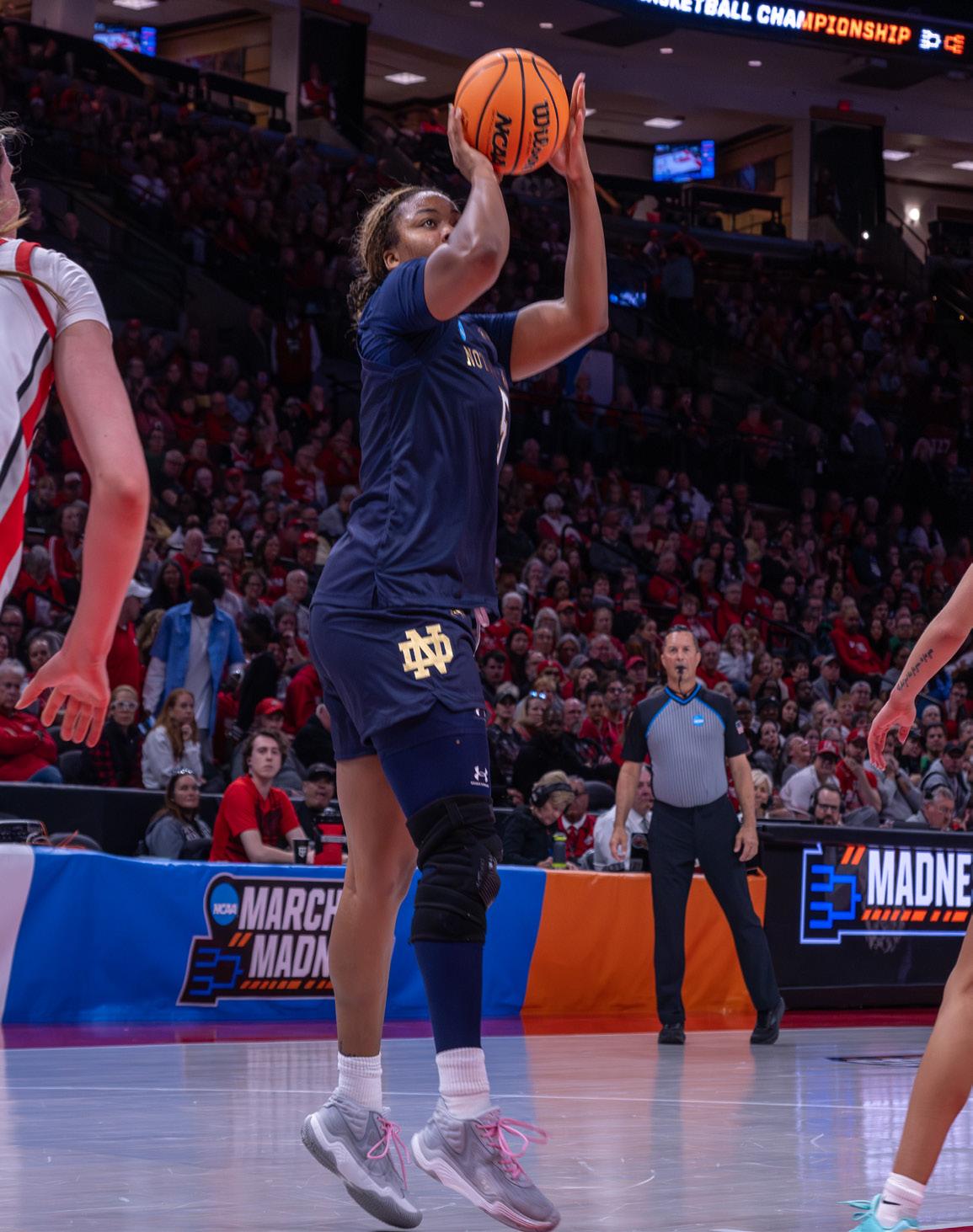
Notre Dame’s women’s basketball advances after an 8373 victory over No. 3 Ohio State.
been led by Fr. Austin Collins, a priest and art professor whose contemporary monochromatic sculptures dot around campus and South Bend.
In June, associate French professor and priest Fr. Gregory Haake will succeed Collins as vice
see “Haake” on page 3
SPORTS | PAGE 11 Baseball
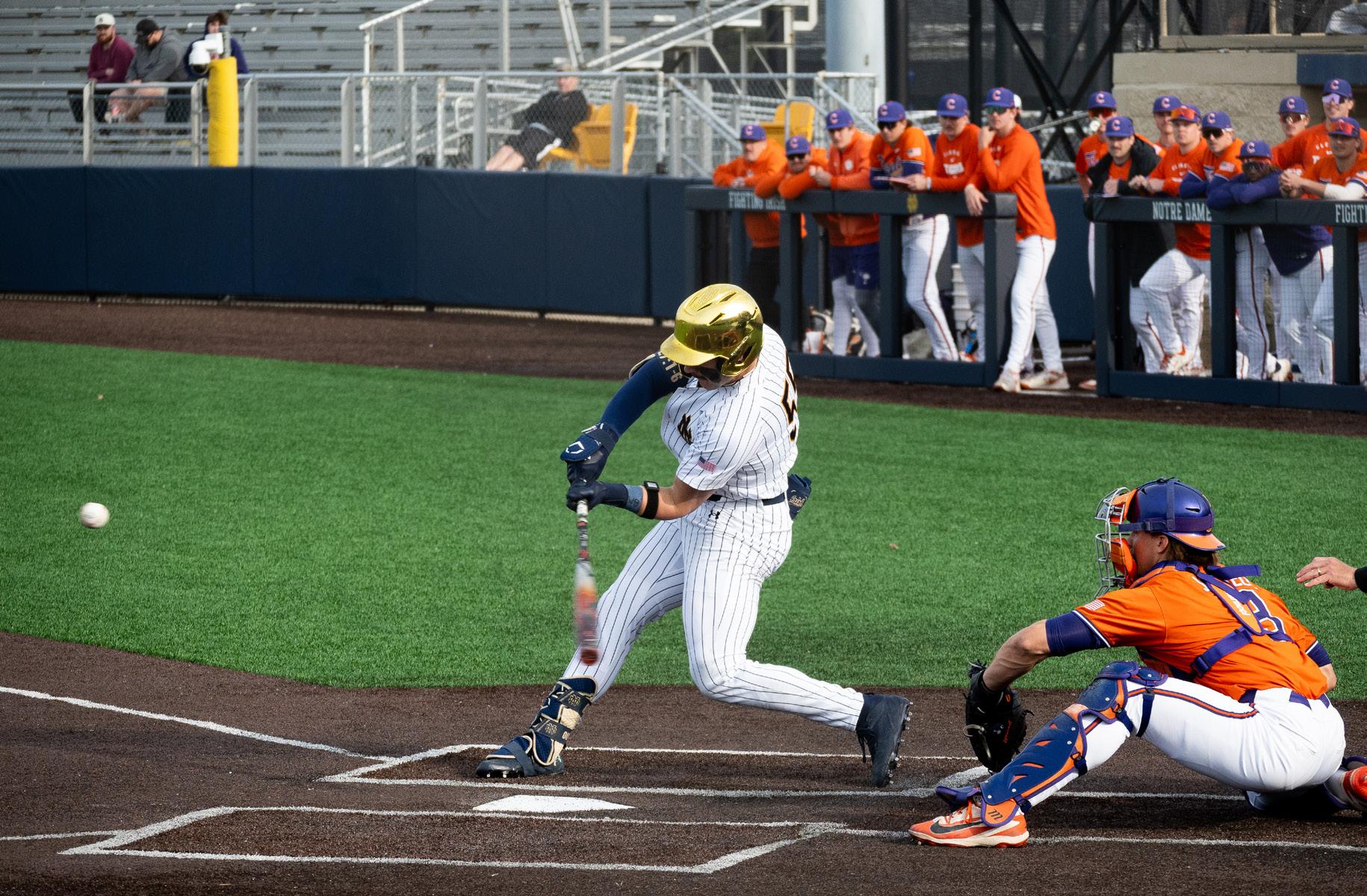
Notre Dame takes down No. 19 Clemson to advance to 14-6 on the season.
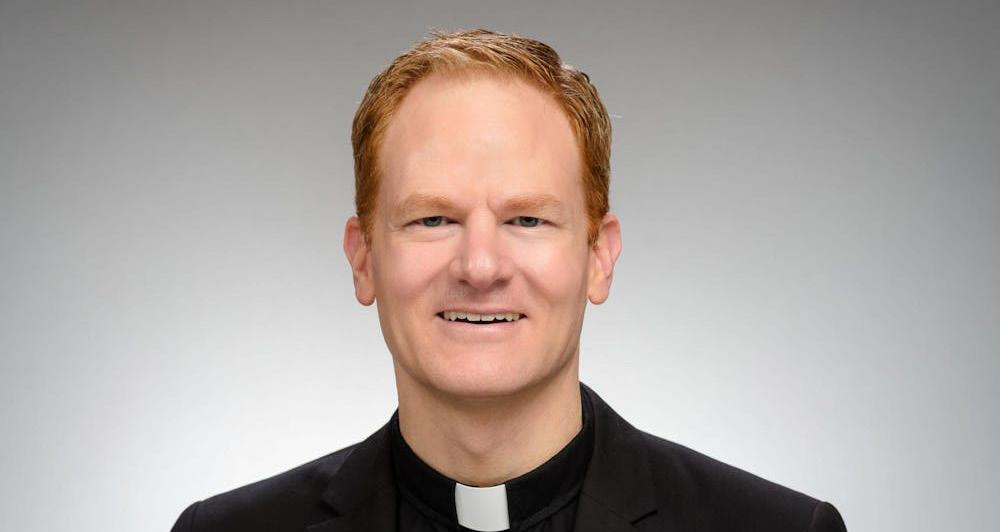
Photo courtesy of Fr. Gregory Haake
Fr. Gregory Haake will lead the Office for Mission Engagement and Church Affairs starting in June, succeeding Fr. Austin Collins.
QUESTION OF THE DAY:
Sammy Krahl Sophomore Ryan Hall
“Oh oh the ratlinborg.”
Lauren Weniger Sophomore Ryan Hall
“White borg wasted.”
What would your borg name be?
Chris Orta Sophomore Keenan Hall
“The borgs are back.”
Ellie Fischer Freshman
Johnson Family Hall
“Lowborgenuinely.”
Sophie Helzner Freshman
Johnson Family Hall “Borg on main.”
Are you likely to vote in a student election with one ticket?
Tuesday
Saint Mary’s softball vs. Aurora
The Belles face off with the Spartans in a doubleheader. 3:30 and 5:30 Purcell Athletic Fields
Wednesday
Concert film: “Stop Making Sense”
View the 1984 performance of the famous Talking Heads. 7:30 p.m. Browning Cinema, Debartolo Performing Arts Center
Thursday
As You Like It
Watch those of the high court try to navigate the simple
7 p.m. Washington Hall
Friday
Notre Dame baseball vs North Carolina The Irish battle the Tar Heels at home. 4:30 p.m. Frank Eck Stadium
Saturday
Symposium: “Service Members in Society” ND Law School discuss aiding veterans’ return to post-war life. 8 a.m - 2 p.m. Downes Ballroom
PHOTO OF THE DAY | KEIRA JONES
Rivera-Curtis ticket secures SGA presidency
By Observer News Staff
Juniors Daniela Rivera and Mila Curtis, who had been campaigning unopposed throughout the week, were announced as the 2026-27 Saint Mary’s Student Government Association student body president and vice president respectively Friday morning via email.
Students received a link to a voting form on Belle Tower for the election at 9 a.m. Thursday morning in their inboxes and were given 15 hours to cast their
Demonstration
Continued from page 1
“Immigration enforcement, like it or not, is an issue that affects each and every one of us.”
“Stand up for those who are most marginalized, give the voiceless a voice and create solidarity for unity to combat these pressing issues of our time,” Romero said.
Gervacio, a key student organizer for this event, began by saying she came to this space with a heavy heart and yet is filled with hope for the power of this moment. She said the University is “a predominantly white institution” and allows its community to live “in a bubble.”
“But outside of this bubble, our reality is harsher. While we sit in classrooms and write papers and attempt to go about our daily lives, our loved ones are being targeted at home. Our communities are
Haake
Continued from page 1
president for mission engagement and Church affairs. Twenty years younger than his predecessor, Haake is the first clergyman University President Fr. Robert Dowd has named as vice president. He has named four other vice presidents during his term.
In a press release, Dowd praised Haake for his dedication to the University and expanding their Catholic mission.
“Father Greg is widely admired for his scholarly achievements, his deep commitment to Notre Dame’s mission, and his pastoral gifts. He is uniquely situated to work closely with me and with colleagues across the University to steward and deepen Notre Dame’s Catholic mission and to forge strategic partnerships both at the University and beyond in service of the Church,” he said.
Haake currently serves as superior of the priests and brothers of Holy Cross at Notre Dame, a role he describes as “pastor the pastors.” He is also an ex-officio member of the Notre Dame Board of Trustees and Board of Fellows. He lives on campus as a priest in residence in Coyle Hall.
In an interview with The Observer,
vote before the form closed at 11:59 p.m. Thursday night.
According to Shay Jolly Schneider, associate dean of students, Rivera and Curtis received 95% of the student votes, while 5% of voters chose to abstain.
In an interview with The Observer, Schneider said she was excited for the year to come under Rivera and Curtis’ leadership.
Rivera also commented on her new role in a written statement to The Observer, “I am incredibly honored to be elected
filled with ICE agents who bring fear into everyday lives. Fear when someone knocks at the door. Fear when someone leaves their home just to buy groceries. Fear of existing in brown skin,” Gervacio said. “Our families are being separated by our borders. Not just physical borders, but emotional ones, psychological ones, generational ones. Our families are being separated. Our bodies are here in Indiana, but our hearts, our hearts are back home with our families, with our people, our communities. Worried. Waiting. Wondering if the next phone call will change everything.”
Gervacio said she has been a part of this movement since 2006, when she was in the womb and her mother was attending protests. She reminded attendees, “power is the ability to effect change. That power does not belong to any administration. It does not belong to any government
he said that he was surprised by the invitation to serve in the leadership but also “honored and humbled that Father Bob has that kind of confidence” in him.
On campus, Haake is the regular celebrant at Notre Dame’s only weekly Traditional Latin Mass, which takes place on Sundays in Alumni Hall.
The office Haake will lead is responsible for serving as a liaison between the University and the Catholic Church at multiple levels, including the Vatican. Collins described Notre Dame’s engagement with Rome as growing.
“We have never been more involved with the Vatican, with the dicasteries, than we are now,” he said.
Senior University leadership officials, including Collins and Dowd, met with Pope Leo XIV in November. Collins will serve as a special adviser to Dowd after his term as vice president ends.
Haake’s appointment comes after more than a dozen bishops publicly criticized Notre Dame earlier this year for its appointment of professor Susan Ostermann to lead the Liu Institute for Asia and Asian Studies because of her advocacy for legal abortion. Ostermann’s appointment prompted a protest to be planned focused on what organizers described as Notre Dame’s failure to live up
as your student body president. I would like to sincerely thank you all for giving me the opportunity to serve this community that has given me so much.”
“As I step into this role, I am committed to serving every student alongside my vice president Mila Curtis,” she continued. “Together, we are committed to making sure that every student feels heard, represented and valued, while fostering a campus built on belonging and purposeful leadership.”
that tries to silence us. That power belongs to us.”
Fraga, a political science professor, called upon Bishop Mark Seitz’s March 15 pastoral letter on mass deportation and mass detention, specifically highlighting the section about Pope Leo XIV personally asking him to “stand in solidarity with suffering migrant families and not to remain silent.” Additionally, he noted “the current national campaign of mass detention and deportations is a grave moral evil.”
Mentioning an article from Commonweal magazine, he said this moment has led to protests, and more importantly, increased “neighboring.” Calling upon the reflections of Martin Luther King Jr., he noted that only in darkness are the stars visible. From this, he invited people to pray daily for the healing of communities.
Following Fraga’s speech, Witherell allowed anyone who felt
to its Catholic mission. Organizers shifted that protest to a prayer service after Ostermann declined her appointment.
As vice president, Haake will be responsible for maintaining relationships between Notre Dame and the American episcopate and for ensuring that “University decisionmaking and initiatives are informed by Notre Dame’s Catholic and Holy Cross character,” according to the office’s website.
Collins shared that he believed Notre Dame’s relation to the Church has “never been better.”
“That has nothing to do really with me. It has to do with the administration, faculty and staff and students of this University that have really taken the Catholic mission, in its broadest sense,” he said.
Haake also said he viewed Notre Dame as being important to life of the Church in both the United States. and globally.
“I don’t think it’s too bold to say that that we have a significant contribution to make to the Church in the United States and throughout the world,” he said.
He explained that the University embraces different beliefs while still remaining faithful to Catholic principles.
“Notre Dame is a really special place,” he added. “I see it as being
called to share to do so.
Freshman Tyler Castano then spoke, highlighting the pain of being forced to speak the English language, and argued that simply by being in America, a person is American.
Castano brought up the principles of a republic, calling out that even if “only for a certain people at a certain amount of time,” the principle of a republic, going back to Ancient Rome, is “the voice of the people,” and at the end of the day all are “human beings.”
“In a republic, we do not have kings. We do not have tyrants. We do not have princes. Except for those of us who may be Christians, in which our only rule is the king of the universe and the prince of peace, Jesus Christ,” Castano said.
While freshman Algredo-Huerta was invited to be a part of organizing this event, she opted not to because of other commitments. In an interview with The Observer, she said, “If
very welcoming and open to a lot of different points of view, a lot of different perspectives, but also firmly within the heart of the Church. And I think that’s a great place to be. It’s a great opportunity for Notre Dame and for the Church.”
Haake also emphasized the office’s role in deepening faculty and staff understanding of the University’s Catholic mission. He said he hoped to “invite people, no matter what their relationship with the church is” into the institution’s Catholic mission.
“The University is an instrument of the gospel of Jesus Christ,” he said.
Fr. Gerry Olinger, who was vice president of mission engagement and Church affairs from 2018-2021, described Haake as “academically gifted” and said he believed Haake’s experience as a tenured faculty member would be beneficial to him in his new role.
“I think that will give him a really nice opportunity to have had some excellent relationships with faculty, with academic administration,” he stated.
The position of vice president for mission engagement and Church affairs was created by then University President Fr. John Jenkins in 2012.
“He wanted someone waking up each day and thinking about Notre Dame’s relationship to the Church,”
I wanted to be a part of this, I wanted to do it in a way that was giving my 100 percent, and I just knew that I was not at the capacity to do that in this present moment.” She did, however, end up speaking, and told her story of her parents being forced to work instead of going to school, but giving her the opportunity to come to Notre Dame.
Facundo spoke after the final speech, reminding people, “It takes a lot of bravery and courage, especially in a school like this, to come out and show out for the immigrant community, to show your love and advocacy for them.”
Freshman Lesly Calixto closed out the event by leading a call and response chant in which she said, “Show me what democracy looks like,” and the crowd responded, “This is what democracy looks like.”
Contact Mara Hall at mhall27@nd.edu
Collins said.
Fr. William Lies was the first to hold the role from 2012-2018. In a statement to The Observer, he expressed his support for Haake’s appointment.
“Fr. Greg Haake is an exceptional priest and colleague — bright, thoughtful, kind, and deeply pastoral. He serves on my provincial council, where he consistently offers wise and measured judgment. He is an excellent choice for this role,” he stated.
Lies had previously appointed Haake to his current position as religious superior and share that it was not a surprise he was chosen.
“Fr. Greg was an obvious choice because of his steady leadership, pastoral sensitivity, good judgment, and the respect he enjoys among his brothers and faculty colleagues. He brings a collaborative style and a deep commitment to community and university life,” he stated. Collins was likewise effusive in his support for his successor.
“New energy and new ideas are exactly what this role needs,” Collins said. “I think he’s going to be a wonderful addition. He’s a good and holy priest, and he’s been a very successful professor at the University.
Contact Henry Jagodzinski hjagodzi@nd.edu
SMC welcomes first edition Dickens novels
By Sophie Lewandowski News Writer
On March 20, the CushwaLeighton Library of Saint Mary’s College hosted a reception to celebrate the donation of Charles Dickens’ works by Lenore Hennebry Madden and her family. Hennebry Madden’s family, students and faculty gathered on the third floor of the library to see an exhibit of the collection created by senior Rebecca Holm.
Dickens, a prolific English writer in the 1800s, was the author of many classic novels, including “Bleak House,” “Great Expectations” and “A Christmas Carol,” among others. Many of his original novels were published in small sections called serials and released over the course of a long period of time. These serials passed from person to person, telling Dickens’ famous stories to a vast audience. Through this donation, four of his original serial novels, along with other first editions and Dickens memorabilia, have arrived at Saint Mary’s.
The new collection is intended to be a learning resource for Saint Mary’s students. Jill Hobgood, the reference and rare books librarian at Saint Mary’s College, said that the new books have the potential to open doors of study for students from a variety of majors, not only English, but also communications and art.
“It’s of use to communication students, maybe, who are looking into serialized presentation, how this was done originally. I like to think of it as really, really slow
Netflix. That’s kind of what it was in the 19th century. It’s of interest to marketing students. All of those advertisements show how things were marketed in the 19th century,” said Hobgood. “We have had classes in the art department, which have covered graphic arts and fonts, and the way that images were printed and what those images were, and those are of use. So, besides just the English department, it is something that will continue to be used and enjoyed by students across the board here at Saint Mary’s.”
The collection includes four serialized editions of Dickens’ work: “Bleak House,” “Little Dorrit,” “Dombey and Son” and “Mystery of Edmund Drood,” which Dickens did not complete. A first edition of “A Christmas Carol” with colored plates is also available for viewing in the collection, along with three letters, two of which are written by Dickens himself, a check belonging to Dickens and pieces of art related to his work, among many other things.
The collection has already been used in a variety of classes, including Max Chapnick’s English course, where his students read “Bleak House” and then explored the impact of serialized editions on storytelling with the opportunity to explore the original copies of the text for themselves.
Additionally, Holm’s curatorial work for the Dickens exhibit was a part of her independent study with Dr. Sarah Noonan. Holm shared that the exhibition itself
allowed her the opportunity to engage in curation and museum work, which is what she hopes to pursue after graduation.
Holm’s experience working with the donation included creating all of the display cabinets for the exhibit and researching background information to create plates that further explain the materials on display. The experience helped her to gain confidence in herself and her future career.
“I think I gained a lot of confidence in myself. I came into this not knowing a ton about Dickens personally,” Holm said. “I had worked with archives and whatnot before, but I had never been pretty much in charge of figuring out what goes where and what to say about it. And, so, kind of having that experience where I was the one who had to make all the decisions really gave me a lot of confidence that I can do this, and it really reinforced that this is what I want to do with my life.”
Hennebry Madden’s children and grandchildren attended the reception. Lenore Madden McCartney, one of Hennebry Madden’s daughters and a Saint Mary’s alumna from the class of 1988, said her mom had a deep love of Charles Dickens’ work and his inclination to address social justice issues of his time. Madden McCartney said her father always gave her Dickens’ books and collectibles as gifts, and the collection grew over time.
Hennebry Madden had always wanted the collection to end up at Saint Mary’s, according to
Madden McCartney.
“She made it clear to us during her lifetime. She wanted her collection of Dickens’ first editions of books donated to the college when she was no longer here with us. And so, I always knew this would ultimately be where they would end up. You know, the library is the perfect place where they can take care of them appropriately.
And mom was a librarian,” Madden McCartney said.
Grace and Molly Hayes, two of Hennebry Madden’s granddaughters who attended the reception, explained the importance of the donation for their family. The educational enrichment that the Dickens collection is able to provide was important for Hennebry Madden, Grace Hayes explained, as her grandmother deeply valued access to education.
“I think for her, for my grandma, and for her three grandchildren that are here right now, at least, the access to education is something that’s really important. And I believe that everybody not only has the right to education — I think she has instilled that belief in me — but, the [right] of people taking the time to study the things that they like, as well as studying those primary examples and comparing it using your own rationalization to come up with ideas, beliefs and theories. I think that is incredible. And so the fact that her personal rare book collection is being used to elevate that with other students is just fantastic, and I know that’‘s exactly what she would want,” Grace Hayes said.
“I feel like it’s a kind of closure, as well, with our grandmother passing a long time ago. She was in her 60s when she died. Our grandpa passed away a year and a half ago. And, you know, she always wanted it to come back to Saint Mary’s, where it should be, and it’s great that it’s here now. And she was a librarian as well, and it means a lot to her that future students, for God knows how long, will be able to use these in their education classes, in their education. I know that would mean the world to her,” Molly Hayes said.
The collection will be displayed in the library for a few days this week, before being moved down to the rare books room for preservation. It will be available for use by students and classes.
Madden McCartney hopes that Hennebry Madden’s collection will continue to make an impact on Saint Mary’s education in a place where it can be safely preserved.
“I hope, and now I think it’s pretty clear that this will provide the college itself, on a broader scope, someexposuretomaybesomeother scholars coming in, seeing the collection, studying the collection. And then, in a more neuro sense, hopefully, the English department, maybe some other departments, will be able to use the collection, and then it will ultimately be better preserved,” McCartney said.
Contact Sophie Lewandoski at slewandowski@saintmarys.edu
Women Inspired to Serve hosts conference
By Maria Alice Souza Maria News Writer
The Women Inspired to Serve Conference, held Friday, provided an opportunity for students and professors to contribute ideas about women’s leadership in international security. Throughout the conference, two panels were hosted, as well as a keynote address by Raquel Bono, director of the Defense Health Agency.
The first of the two panels was titled “Civilian Leadership in National Security,” with speakers Kristin St. Peter, a deputy general counsel and secretary at the Aerospace Corporation; Sarah Budds, a strategy and organization consultant; and Sarah Spence, an intelligence officer at the Defense Intelligence Agency.
The second panel, titled “Courageous Leadership: Lessons from the Field,” hosted speakers Bernadette Alway,
Science Hall
Continued from page 1
helped the College further
a former supervisory special agent in the FBI; Michael Anne Casey Tyler, a former senior intelligence executive in the CIA; Adriana Brazelton, a lieutenant colonel in the U.S. Army; and Austin Shultz, a former command sergeant major in the U.S. Army. Each discussed difficulties and the role of women in international security.
“There are very few women in the field that we are in, or that we are choosing to go into, and then within that, the pressures of moving up into a leadership position,” said Alway. “The way to combat it is knowledge. Being knowledgeable, being good at what you do, taking pride in what you do and not taking any kind of shortcut. Or, you know, some people say, I rise by pushing other people down. I’ve always been bringing the team up.”
“I just had some great male mentors, who are the majority, who all they did was just give me an opportunity and because
expand the “level of research, collaboration and technological sophistication that modern science required,” according to Conboy.
they’re sitting at the table, they believe that both men and women have an equal chance to be able to be successful. So I had to perform and be competent,” Brazelton said. “Don’t self-select out and don’t quit.”
“This conference provides the opportunity to see what a future in these careers could look like. What are the skills that I need to build? Who can I talk to? It’s a beautiful, beautiful networking event where you need to go, how upperclassmen can help with internship applications, how these professionals can help you in the real world and give you connections actually in D.C. or wherever you eventually want to end up, or the sector, or the department you want to go towards,” said junior Sophia Almeida, an attendee of the conference each year since 2023.
Ryn Weiss, the president of the Women in International Security club and one of the organizers of the conference,
“We are especially grateful that the Mathile family has now allowed us to name the building in their honor. We can fully recognize their
spoke with The Observer about the event. The conference, he said, began in 2021 as a partnership between the University of Notre Dame Research and Women in Defense.
Since 2023, the Women in International Security club has hosted the conference, with the exception of 2025, when the conference was cancelled due to funding constraints.
“I think there are a lot of girls at Notre Dame who are interested in the international security space, but find that frequently the speakers that Notre Dame brings in, to no fault of its own, they’re all men, which of course is fine and they’re great resources, but I think there is like an element of being a woman in that space that you miss out on by not including them,” said Weiss.
“We’re definitely hoping that this conference brings together both men and women, even though I think the main target is women interested in this space. I hope that girls, women, students and faculty come away from the conference, feeling empowered and definitely inspired. Additionally, I want people to have mentors. I want the networking to happen. I want people to also know about spaces that they might not have otherwise,” said Weiss.
Contact Maria Alice Souza Maia at msouzama@nd.eu
The Women in International Security club is dedicated to women’s inclusion and leadership in the peace and security fields. It provides resources and services to build a global network of women in International Security and has members who are both women and men in 47 countries. Its members work in governments, NGOs and think tanks, among other fields.
extraordinary generosity and the values that inspired it,” Conboy said during the ceremony. “Clay and Mary Mathile built a life guided
by humility, generosity, hard work and a belief in helping others succeed. Those values continue today through their children and grandchildren.
OPINION
LETTER TO THE EDITOR
Catholic institutions should engage, not avoid
The recent letter to the editor by Kristan Hawkins calling for the dismissal of a University of Notre Dame professor makes a forceful case, but it rests on several assumptions — legal, institutional and theological — that deserve closer examination.
At its core is the claim that Notre Dame not only could, but should, terminate a faculty member for views at odds with Catholic teaching, and that doing so would clearly be upheld in court. That argument leans heavily on the “ministerial exception,” a doctrine developed in cases involving religious schools and employees directly responsible for faith formation.
But the comparison is not as straightforward as presented. The cases often cited involve high school teachers or counselors whose roles are explicitly tied to the religious mission of their schools. A university professor — particularly one working in a research institute unrelated to theology — occupies a different position. Courts have been far more cautious about applying the ministerial exception in higher education, especially outside religious instruction. To suggest that a dismissal here would be legally certain overstates the case.
More broadly, the editorial reflects a narrow understanding of what it means to be a Catholic university. Notre Dame does identify itself as a leading Catholic institution, but Catholic higher education has never required strict ideological uniformity among all faculty. The Church’s own guidance has long called for a balance: fidelity to its
teachings alongside a genuine commitment to intellectual inquiry.
That balance is not always comfortable, but it is central to the university’s purpose.
A Catholic university is not a seminary, nor is it a dioc esan high school. It is a place where ideas are examined, argued and tested. The pres ence of faculty whose views diverge from Church teaching does not automatically signal a failure of mission. It reflects the reality that universities exist within a broader intel lectual world — one Catholic institutions are meant to en gage, not avoid.
The letter also leans on guilt by association in link ing an individual’s work to the Population Council and, by extension, to China’s “one-child” policy. questions surrounding that policy are serious. But assign ing its full weight to any in dividual connected to a large and multifaceted research organization oversimplifies a complicated history. The Population Council has been involved in a wide range of global health and demographic work, and the connection drawn here is more rhetorical than precise.
Beneath these points lies a more important question: What is a Catholic university for?
If the answer is that it must enforce strict conformity among its faculty on all contested moral questions, then institutions like Notre Dame would cease to function as universities in the fullest sense. They would become something narrower and more controlled. That may be a coherent vision,
but it is not the one that has shaped the Catholic intellectual tradition. That tradition has long been marked by engagement rather than withdrawal. From Augustine’s encounter with classical thought to Aquinas’s Aquinas’ integration of Aristotle, Catholic thinkers have operated with the confidence that truth can withstand scrutiny. Exposure to competing ideas has not been seen as a threat, threat but as an opportunity for deeper understanding.
None of this means Catholic identity is unimportant or endlessly flexible. On the contrary, it requires clarity and seriousness. But those qualities are best demonstrated
through the strength of an institution’s teaching and witness, not through attempts to eliminate disagreement. A university that cannot tolerate internal differences risks becoming insular. One that loses its moral center risks something worse. The task is to hold both concerns in tension.
The language of the letter — speaking of betrayal, corruption and wolves in sheep’s clothing — may be effective rhetorically, but it closes off the kind of engagement a Catholic university is meant to foster. It treats disagreement as disloyalty and complexity as compromise.
Notre Dame, like any serious institution, will continue to face difficult questions
about how it lives out its mission. Those questions deserve careful and good-faith debate. They are not well served by arguments that overstate legal certainty or reduce the university’s role to ideological enforcement. If Notre Dame falls short, it will not be because it allowed disagreement within its faculty. It will be because it failed to articulate and live out its own convictions with clarity and confidence. The challenge is not to silence dissent, but to ensure that its Catholic voice remains thoughtful, credible and persuasive in the midst of that dissent.
David J. Noone Class of 1987 March 20, 2026
The virtues of being a cat person
By Oliver Ortega Columnist, “The O.G. Grad Student”
I became a cat person five years ago. My then-wife and I were making our way to the side door of our apartment building in downtown South Bend when an emaciated gray tabby suddenly wrapped itself around her legs. After taking the kitten to the vet for a checkup and making sure no one was looking for her, we adopted the cat and named her Fidelina, or Lina, in English. Then, thinking she could use some company, we went to the Cat Cafe at the Commerce Center in South Bend and brought home Nemo, a dark, grayish cat with a white spot above his chest like a bow tie on a tuxedo.
When my ex and I split in late 2024, she moved back to Mexico, and I stayed in South Bend with the cats. I told her she could take Lina and Nemo with her, but she thought it would be too much of a hassle to cross international borders with them. I also thought there was another reason she didn’t want to take the cats. For most of her life, my ex had been a dog person. Me, I had had no pets in my life other than goldfish and ants when I was a child. And those, in my view, don’t really count. So, it seemed I was a prime candidate to become a single cat parent.
Cat people, especially men, are often portrayed unflatteringly in literature and pop culture. In fact, the most-read
American short story of the last decade features a single man in his thirties with a cat as its chief antagonist. Published online in The New Yorker magazine around the time of the #MeToo movement, Kristen Rupoenian’s 2017 short story “Cat Person” went viral for its portrayal of a bad romance between a female college student and a man a decade her elder. Roupenian spins a yarn about bad sex, stalking and texting that embodied the feminist grievances at the core of #MeToo. Rupoenian later garnered bad press after it was revealed she had based the story on real people without their consent. Additionally, the man who inspired the character of Robert, the guy with the cat,
died suddenly in the early years of the pandemic, adding to the paratextual controversy around the story.
On the other side of the gender binary, there is the stereotype of the crazy cat lady. “The Simpsons,” for instance, occasionally shows a disheveled older woman ambling through the streets and spouting nonsense while a cat sits perched on her shoulder.
In one of my favorite books, Sandra Cisneros’ collection of vignettes, “The House on Mango Street,” protagonist Esperanza Cordero describes her neighbor Cathy as the “queen of cats.” Cathy, the child narrator says, has “baby cats, big cats, skinny cats. Cats asleep like little donuts. Cats on top of the refrigerator.
Cats taking a walk on the dinner table. Her house is like cat heaven.” Cathy is not crazy, per se, but the narrative paints her as a racist seeking to leave amid the Latino influx into their Chicago neighborhood. In the world-making of the text, racism functions as a kind of paranoia akin to mental illness, one closely linked to Cathy’s obsession with cats. And then, of course, there is the association of cats with bad luck, superstition and even witchcraft.
According to a book on cats that I bought shortly after becoming a cat dad, these stereotypes were especially pronounced during the Middle Ages in Europe.
DIONE QUIAMBAO PAHILAN | The Observer
Virtues
Continued from page 5
Cats were believed to be in cahoots with the devil and were often blamed for all sorts of misfortunes and maladies. On the other hand, in ancient Egypt, cats were supposedly revered for their beauty and physical abilities. In the 2004 film “Catwoman,” starring Halle Berry as the titular superhero, the main character, Patience, a shy graphic designer, drowns after unwittingly discovering corporate malfeasance and being chased by security guards at a giant cosmetics company. A rare Egyptian Mau cat bestows upon her supernatural powers, and Patience is reborn as Catwoman, a leather-clad, whip-wielding badass who fights crime in the city but who also has a penchant for stealing jewelry.
So far, I haven’t developed superhuman abilities and I haven’t yet become a witch or a witcher. But I’ve found myself musing about how taking care of Nemo and Lina has changed me. For one, I’ve become more attentive to the importance of keeping a normal schedule. I start my work day early and try to be
home by five or six so that they don’t spend too much time alone. Twice a week I clean out their litterbox, and four times a day I give them food — two servings in the morning before leaving for work and two servings in the evening when I come back home. I have to keep a steady supply of both canned meat and clay litter around. I also have to clean more than I would ordinarily given how much fur Lina sheds and the mess that tends to develop around the litter box. My cats are my anchors, reminding me of my daily responsibilities and the importance of keeping myself disciplined in order to get my work and chores done. Truly, it’s a blessing to have them at home. Lina’s fur and purring are luxurious, and Nemo delights me with his crazy antics. Both of them, though, make me pay for keeping them cooped up in my apartment. Lina likes to bite at my ankles when she gets hangry and she often swipes at me when I pass through my bedroom threshold. Nemo has a penchant for hopping onto my back and shoulders, leaving bloody scratches all over my torso. I have to put him in the bathroom when I eat and cook because otherwise he is all over my food. When I go
to sleep, I close my door so that they don’t wake me up in the middle of the night to feed them. They’re a joy to have, but they’ve also taught the virtue of patience and gentleness. I nurture them, and they nurture me. Of course, I can’t help but wonder whether all this is
symptomatic of the modern malaise of dysfunctional relationships and falling birthrates. At my age, I should have a family, with real kids, in addition to pets, I guess. And a house in the suburbs, why not? That, after all, is the American Dream. But for now, I guess I’ll settle
for being a cat person. A good one. Peace.
The views expressed in this column are those of the author and not necessarily those of The Observer.
Write to Oliver Ortega at oortega1@nd.edu
Not good enough is a good thing
By Noirin Dempsey
Recently, while I was sitting in the CoMo chapel, I came across a prayer called the Litany of Humility in the pages of my book. Intrigued, I resolved to pray it. But almost immediately, I found myself stumbling over the words. Phrases like “From the desire of being loved, deliver me, Jesus” and “That, in the opinion of the world, others may increase, and I may decrease, Jesus, grant me the grace to desire it” made me do a double take. For a moment, I had to stop and ask myself: Do I really want to be asking for these things to happen to me?
Although I wanted to pray for humility, a knot of misgiving prevented me from continuing. I found myself wrestling with the concept of asking for my efforts to be overlooked, especially in favor of others. It would be difficult to forgo credit, praise and recognition — or even to never see the fruits of my labor — and still find motivation to pursue success. Yet my hesitation made me reconsider what truly drives my actions: Am I motivated by personal gain or by a desire to serve others?
Many people familiar with the Litany of Humility would agree that it is a challenging prayer. At first glance, the things we are asking for don’t exactly seem appealing. We
all want to be esteemed, loved and honored, as the Litany says. We all fear humiliation, ridicule and even being forgotten. It seems unnatural to desire to be less than others instead of more. And yet, despite how difficult it is to pray for such things, there is a peace that comes from asking God to free us from our anxiety about the world’s opinion. Imagine the relief of relinquishing control and allowing our actions to be motivated by pure goodness rather than by a feverish drive to maintain constant approval.
Of all people, Notre Dame students understand the pressure to live up to high expectations. In an environment bursting with driven, hardworking and high-achieving individuals, it becomes all too easy to compare ourselves to others and begin to see ourselves as not smart enough, not involved enough, etc. This comparison reinforces our desire to improve ourselves, which is not inherently bad — but if unchecked, it can morph into an obsession with being better than others rather than becoming better for others. Soon enough, praise and recognition become our primary motivators, steering us away from what should be our ultimate goal: pursuing the common good for its own sake.
That is why humility is especially important on this
campus. It sounds counterintuitive, but we have to start with others as the center of our lives — not ourselves. No matter how hard we try, our work will only really be fruitful if we remember that its purpose is not for us, but in service to the world. Once we remove personal prestige from the equation and come to see our lives as instruments through which to achieve the common good, it becomes easier to celebrate others’
successes without worrying about how our own compare. We can experience gratitude for and satisfaction with our state in life and be content with the work we do, despite the fact that our best might not be the best.
Back in CoMo, I finally decided to finish praying the Litany. The last line reads, “That others may become holier than I, provided that I may become as holy as I should, Jesus, grant me the
grace to desire it.” It’s a good reminder to focus not on success, not for competition’s sake, but rather to uplift others, embracing humility as we seek to grow the good at Notre Dame and in the wider world.
The views expressed in this column are those of the author and not necessarily those of The Observer.
Write to Noirin Dempsey at ndempsey@nd.edu
MEG HAMMOND | The Observer
Columnist, “Through the Overton Window”
DIONE QUIAMBAO PAHILAN | The Observer
‘Project Hail Mary’ is a delightful sci-fi adventure
By Luke Foley Scene Editor
Phil Lord and Christopher Miller are some of my favorite people working in Hollywood. Their long, diverse careers as a creative duo have given us nothing but bangers: the cult classic “Clone High” TV show, the zany “Cloudy with a Chance of Meatballs”, the hysterical “21 Jump Street” and “22 Jump Street” and the brilliant “The Lego Movie.” Unfortunately, their careers hit a speed bump when Disney fired them from directing “Solo: A Star Wars Story” midway through filming in 2017. I can’t imagine how scarring that experience must have been for the two, and they’ve mostly focused on behind-the-scenes production and writing since then. However, the duo finally returned to the director’s chair(s) with “Project Hail Mary,” released this past weekend, and thank God they’re back: The film sees their trademark wit and warmth infused into a delightful sci-fi adventure through the cosmos.
“Project Hail Mary” is an adaptation of the very popular book by Andy Weir, whose other novel, “The Martian,” also received a big-screen translation. The film’s core premise has shades of “Interstellar”: Earth
faces an extinction-level event, forcing biologist Ryland Grace to embark on a daring space adventure to save it. But “Project Hail Mary” could not be farther tonally from that film. Whereas Christopher Nolan’s space adventure was solemn and grave, “Project Hail Mary” is upbeat and spirited. That’s not to say the stakes aren’t high in the film: The main threat of sun-eating microbes — dubbed astrophage — causing a permanent ice age is scarily plausible due to the film’s clever use of real science. But it never indulges in doom and gloom, and that’s partly due to the infectious performance at the center of the film from Ryan Gosling.
Gosling plays Grace, one of the scientists selected to board the Hail Mary spaceship, investigate a far-off star inexplicably immune to the astrophage and hopefully discover a solution to our Sun’s decay.
Unfortunately, when he reaches the star and wakes up from his induced coma, he discovers all his crewmates died during the journey, leaving the fate of humanity solely on his shoulders. Lord and Miller expertly handle this setup, embracing both the sadness and the comedic absurdity of a scientist all alone in space and tasked with the impossible. The Hail Mary feels tactile
and intimate, and watching Gosling bumble around the ship as he tries to make sense of his crazy circumstance is highly amusing to watch. Gosling finds the perfect balance between self-effacing and intelligent with Grace: He’s competent, but he’s also super goofy and sweet, making him a very easy protagonist to root for. However, the film really takes off once Grace meets an extraterrestrial being who was also sent from his dying home planet to investigate the immune star.
Grace’s discovery of the alien effectively lands as an otherworldly moment. The inspired design of his spaceship and gadgets makes it really feel like an encounter with a completely foreign mode of civilization. Grace eventually finds himself face to face with the alien, a rock-like creature who interfaces through echolocation; Grace ingeniously names him Rocky. Across linguistic and physiological barriers, the two strike up a friendship and work together to solve the astrophage crisis.
This unlikely friendship is the beating heart of the film, transforming it into a buddy comedy reminiscent of the “Jump Street” films. Gosling’s charisma is so powerful that he manages to have chemistry with a literal rock, but Rocky is also very charming in his own right,
PAID ADVERTISEMENT
with his child-like exuberance and amusingly stilted English. He is also brought to life through intricate puppetry rather than CGI, making him feel all the more real. Grace and Rocky have lots of silly moments, but they also share a mutual sadness about their loneliness and the pressure to save their respective species. Their friendship is so effortlessly fun that it almost feels like the movie is cheating, but that’s just the Lord and Miller magic! The film is at its best when embracing this sentimental strength. Its attempts at spellbinding visuals of the cosmos and tense action were not as compelling to me, despite the legendary Greig Fraser handling cinematography.
As Grace’s space hijinks unfold, the film flashes back to the lead-up to the Hail Mary space launch. We see how Grace, a middle school science teacher, was recruited by a top government official to help address the astrophage crisis. While this non-linear narrative structure largely exists to explain the shocking twist of how Grace ended up on the ship, there are still many highlights along the way, including Gosling’s rapport with Lionel Boyce and Sandra Hüller’s surprisingly raw karaoke performance of “Sign of the Times”.
As Rocky and Grace concoct a perilous mission to solve the astrophage mystery, we see their friendship pushed to the test. But amid the film’s many heart-tugging moments, it maintains an indefatigable optimism. “Project Hail Mary” offers a very refreshing outlook for a modern film, affirming the goodness of humanity, the ability of human ingenuity to solve any crisis, the cosmos as a source of wonder rather than horror and humanity’s role as steward of all creation. And that’s the true source of the film’s greatness. Lord and Miller can take us on a grand adventure through the cosmos, fraught with danger and difficulty, yet still make it an all-around upbeat and exciting experience.
It’s hard not to fall for “Project Hail Mary,” with its clever science fiction and Gosling turning up the charm to 11. The film has also crushed all expectations at the box office with a remarkable $80.5 million opening weekend in North America. Let’s hope Hollywood treats this as a sign that moviegoers will show up for high-quality films that explore new worlds and trust artists to cook on a large-scale.
Contact Luke Foley at lfoley2@nd.edu
Irish topple Buckeyes to return to Sweet 16
By Ben Hicks Sports Editor
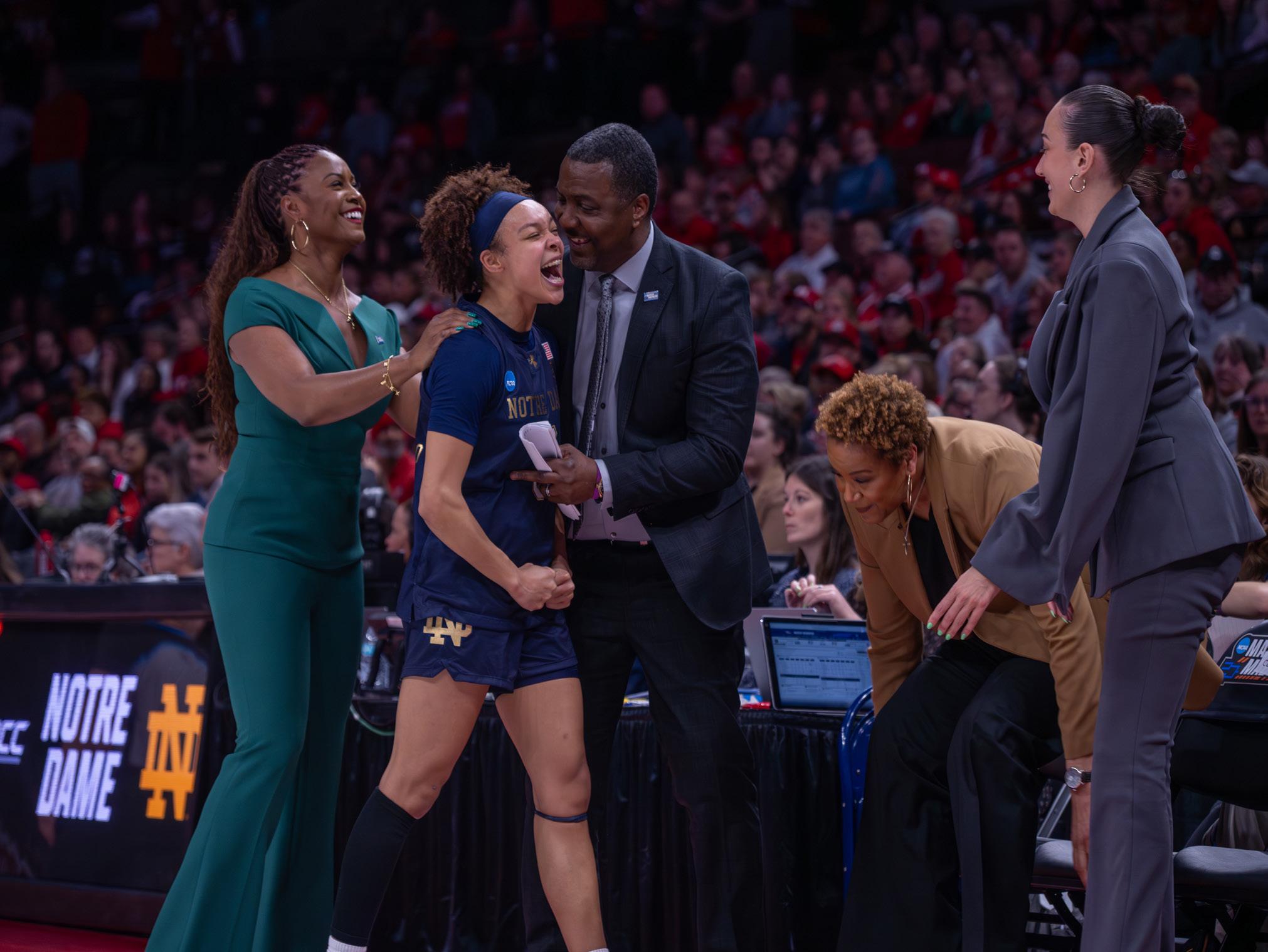
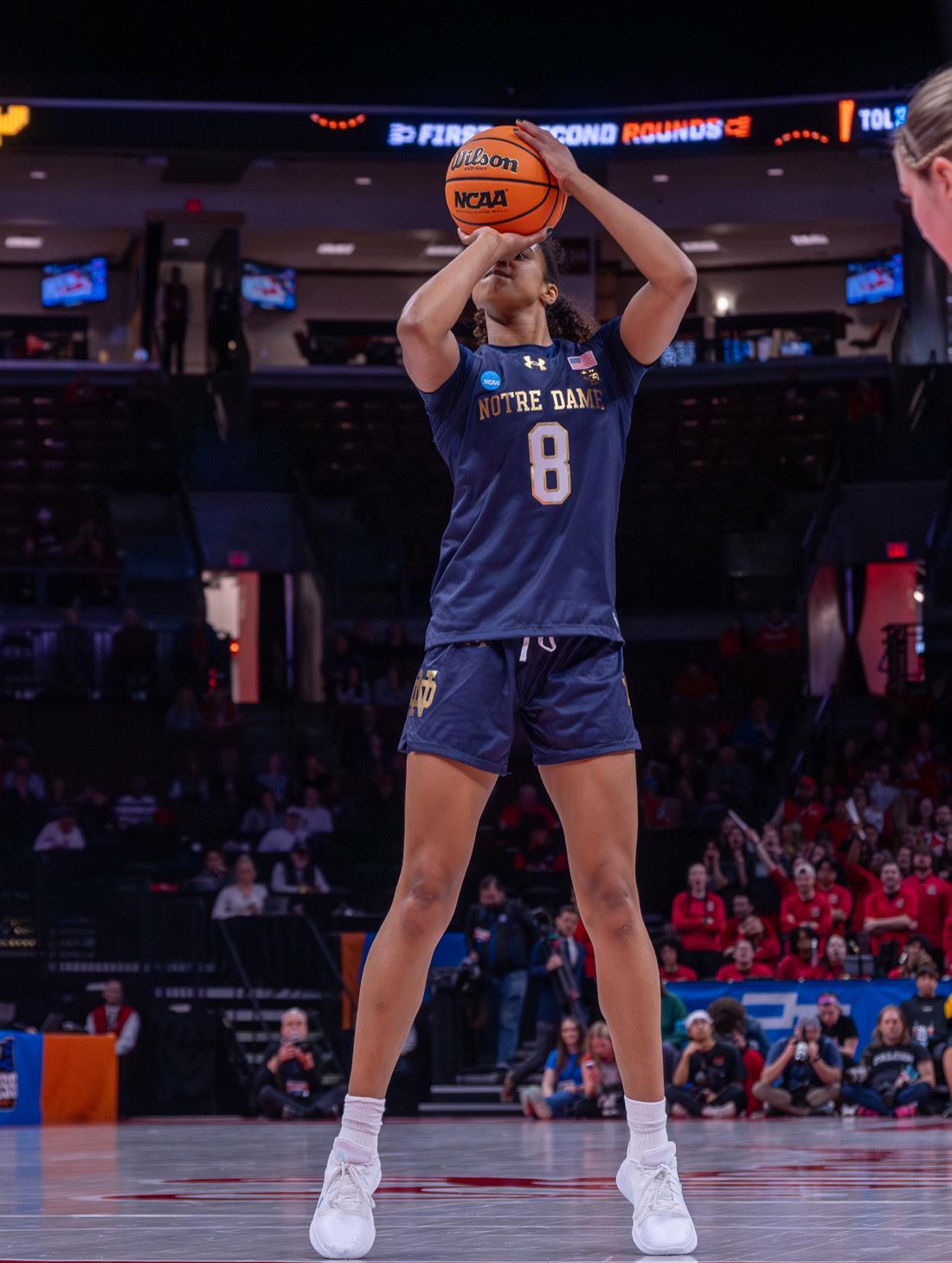
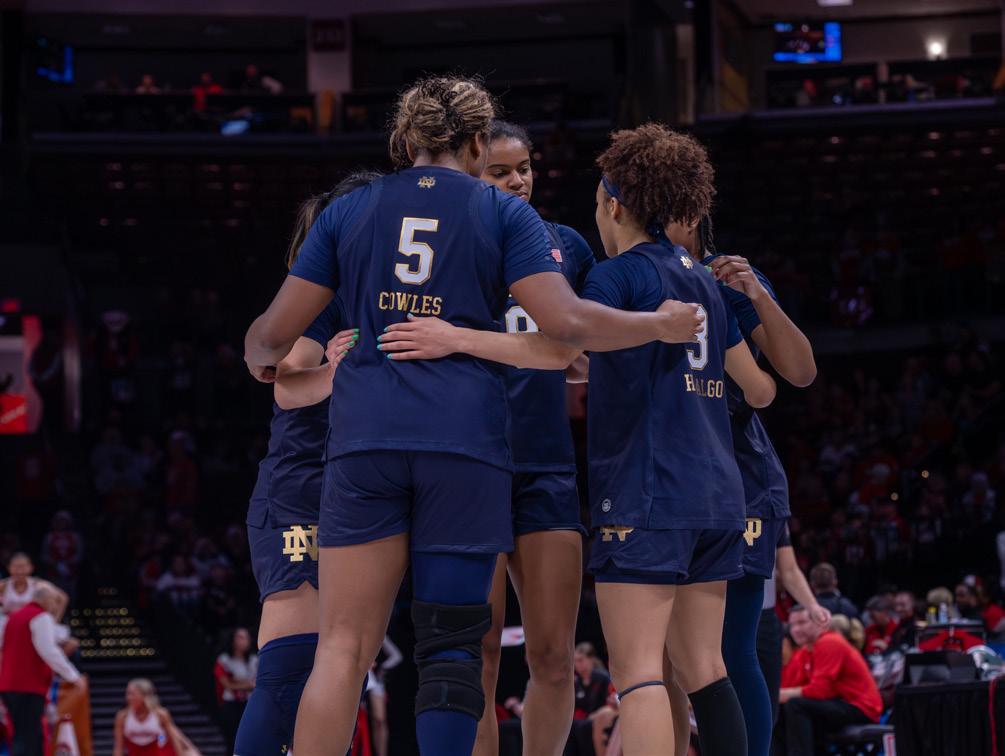
If she hadn’t done so already, Hannah Hidalgo proved on Monday afternoon why she is the best two-way player in college basketball. With Notre Dame’s season and potentially Hidalgo’s collegiate career on the brink, the star junior guard steered Niele Ivey’s Irish to an 8373 second-round victory over No. 3 Ohio State in Columbus.
Just 48 hours after posting an astounding 23-point, 9-rebound, 6-assist and 8-steal statline in the 7960 first-round victory over No. 11 Fairfield, Hidalgo was back inside the Schottenstein Center to outdo herself once more. The ACC and Defensive Player of the Year brought the energy in front of a raucous Buckeye crowd, leaving the court with a smile and her hands held high, booking a spot in the Sweet 16.
“It’s that standard, that standard of excellence that we’re always trying to get back to,“ Ivey said post-game, flanked by Hidalgo.
Led by 13th-year head coach Kevin McGuff, a former assistant and 2001 national champion at Notre Dame under hall-of-famer Muffet McGraw, Ohio State advanced to the second round via a comfortable 75-54 win over No. 14 Howard on Saturday morning. Despite their omission from the preseason AP Poll, the Buckeyes remained a consistent winner and reached the Big Ten Championship game, earning the right to host in the NCAA Tournament for their fourth straight campaign.
On the floor, the Scarlet and Gray have been led all season by sophomore guard Jaloni Cambridge. The 2025 Big Ten Freshman of the Year entered Monday’s action averaging 22.7 points and 5.6 rebounds per game. She poured in a career-high 41 at Illinois back in January and led a quartet of Buckeyes in double-figures against the Bison with 21.
The aforementioned Hidalgo entered play ranked third nationally in scoring at 25.2 points per game, while leading the country in steals with more than five a night. Hidalgo’s running mate is the ACC’s Most Improved Player, senior guard Cassandre Prosper — averaging 13.9 points and 6.8 rebounds per contest on efficient 49% shooting.
In front of a solid but not sold-out crowd inside the Schottenstein Center, the Buckeyes blitzed Notre Dame to start, opening up a 9-0 lead in the first two minutes of action. Cambridge connected
on her first three jumpers, and sophomore center Elsa Lemmilä denied the first two Irish looks from the interior, prompting Ivey to burn a quick timeout.
Speaking on Notre Dame’s regrouping during that break, senior guard Vanessa de Jesus said, “It was a loud crowd, they have a lot of fans here. We knew it was a big game coming in. So for us, it was taking a breath, staying patient and knowing that we put the work in. So, just going out there and playing as Notre Dame.”
The full-court pressure forced another Irish turnover and breakaway layup before senior guard Iyana Moore canned threes on consecutive possessions to ease the Irish into the game. The frenetic pace continued throughout much of the first quarter, with three Hidalgo steals on four Buckeye turnovers allowing the Irish transition offense to find easy buckets and trim the lead to 3.
Hidalgo found Ohio native KK Bransford on a nice dime to end the first frame; the senior guard’s quickness and athleticism allowed the Irish to claw back to just a 2220 deficit after one. Yet, the squad was still without a defensive answer for Cambridge, who led all scorers with 9 points in the quarter. That solution came with drop coverage from senior forward Malaya Cowles, who sagged off of Lemmilä and prevented Cambridge from getting downhill. A forced turnover early into the second quarter
led to a runout for de Jesus. Notre Dame had its first lead at 26-24.
“It’s funny because I was looking to try to ice her, keep her to one side of the floor. I had to change it up because she’s an amazing guard at 41 points,” Ivey said of that decision. “So I was just trying to throw some different things at her. So sometimes it was drop, sometimes we switched.”
After a trio of free throws by de Jesus, Ohio State’s defense responded by forcing three turnovers to draw the Buckeyes back within two, but a 6-0 run by Notre Dame capped off a 19-point turnaround. The Irish led 43-35 at the intermission, led by Hidalgo’s 10 points, 4 rebounds and 3 steals. Prosper and Bransford each also added 8, while Cambridge led the Bucks with 13.
“We’ve been through moments where we’ve had rough starts and we had to crawl back,” Hidalgo said of her team’s response to Ohio State’s hot start. “Because of that adversity, because of how we started this season, we’ve been able to figure it out.”
Coming out of the locker room, the Irish quickly picked up where they left off, as Hidalgo forced a turnover on the first Buckeye possession, leading to a three-pointer from de Jesus to push the lead to double digits. Hidalgo’s intensity did not waver, as a rebound over the 6-foot-6 Lemmilä resulted in a tough finish on the other end, forcing McGuff to call a timeout
minutes until Cambridge connected on a late triple. All told, the Bucks committed seven turnovers and just nine field goal attempts across the quarter. “It started with turnovers, which they really made us pay. Hannah had eight steals. But when you’re giving up layups off of turnovers, it’s just really hard to overcome,” McGuff saidc post-game. Hidalgo finished with 26 points, bringing her season total to 856 for the most ever in a Notre Dame season, and added 13 rebounds. “I try not to be the villain. But it’s fun., ” she said. Notre Dame also received balanced scoring from the rest of the lineup, with de Jesus adding 15 and Prosper and Moore each totaling 13. Cambridge was phenomenal for the Buckeyes in the losing effort, pouring in 41 points on 13-25 shooting from the floor and 5-8 from deep. “41 doesn’t matter with an L. You want to win. If I could have scored zero and got a win, I would have been satisfied,” Cambridge said.
with Notre Dame leading 50-37.
McGuff got through to both his team and the officiating crew. Notre Dame was whistled for four quick off-ball fouls, as the Buckeye defense locked in on Hidalgo; the ensuing three-minute scoring drought led to a 10-0 Buckeye spurt. A 6-0 run solely from Cambridge pulled the Bucks back to within one and took Hidalgo with her third personal. Ivey elected to trust her star, and it paid dividends as Hidalgo steered clear of a fourth and scored twice, bringing the score to 58-54 Irish after the third.
Notre Dame started the final quarter with triples from Moore and de Jesus in succession, pushing the edge back up to 8 and forcing another Buckeye timeout. The break only gave Hidalgo more of a jolt, as she immediately recorded her sixth steal and turned it into an and-one on the other end. A few possessions later, the New Jersey native drilled a moonball three, and you could feel the energy slowly drain out of the Schott.
Hidalgo’s fourth foul turned out not to be the lifeline the Buckeyes needed, and after Prosper back-cut for yet another hoop plus the harm, the Scarlet and Gray faithful started heading to the exits with 2:30 remaining. Hidalgo then equaled her own NCAA Tournament record of 8 steals and cashed in a pair of free throws to make it a 7559 advantage.
Ohio State was held without a field goal for over eight
McGuff was more complimentary of her performance, however, saying, “She’s a great kid, and we obviously love having her here, and we rely on her quite a bit. But she’s also extremely competitive, and I think everyone could see she gave it everything she had tonight. We came up short as a team, but it certainly wasn’t for what Jaloni was giving us and contributing to our team.”
With the victory, Notre Dame moves to 5-1 all-time against Ohio State, including 2-0 in the NCAA Tournament following its 99-76 Sweet 16 victory back in 2017. Ohio State wraps up its season at 27-8, its fifth straight season with at least 25 wins, but also the third consecutive year of failing to reach past the second weekend in March.
As for Notre Dame, the Irish now move on to their fifth consecutive Sweet 16. The program has advanced no further under Ivey but will try to eclipse its plateau and reach the Elite Eight for the first time since 2019, when Notre Dame advanced to the National Championship Game before ultimately falling by one to Baylor.
The Irish will head to Fort Worth later this week to prepare for Friday’s Sweet 16 showdown with secondseeded Vanderbilt, which will enter play at 29-4 overall. Tipoff time from Dickies Arena has yet to be determined, but the game will be broadcast nationally on the ESPN Family of Networks.
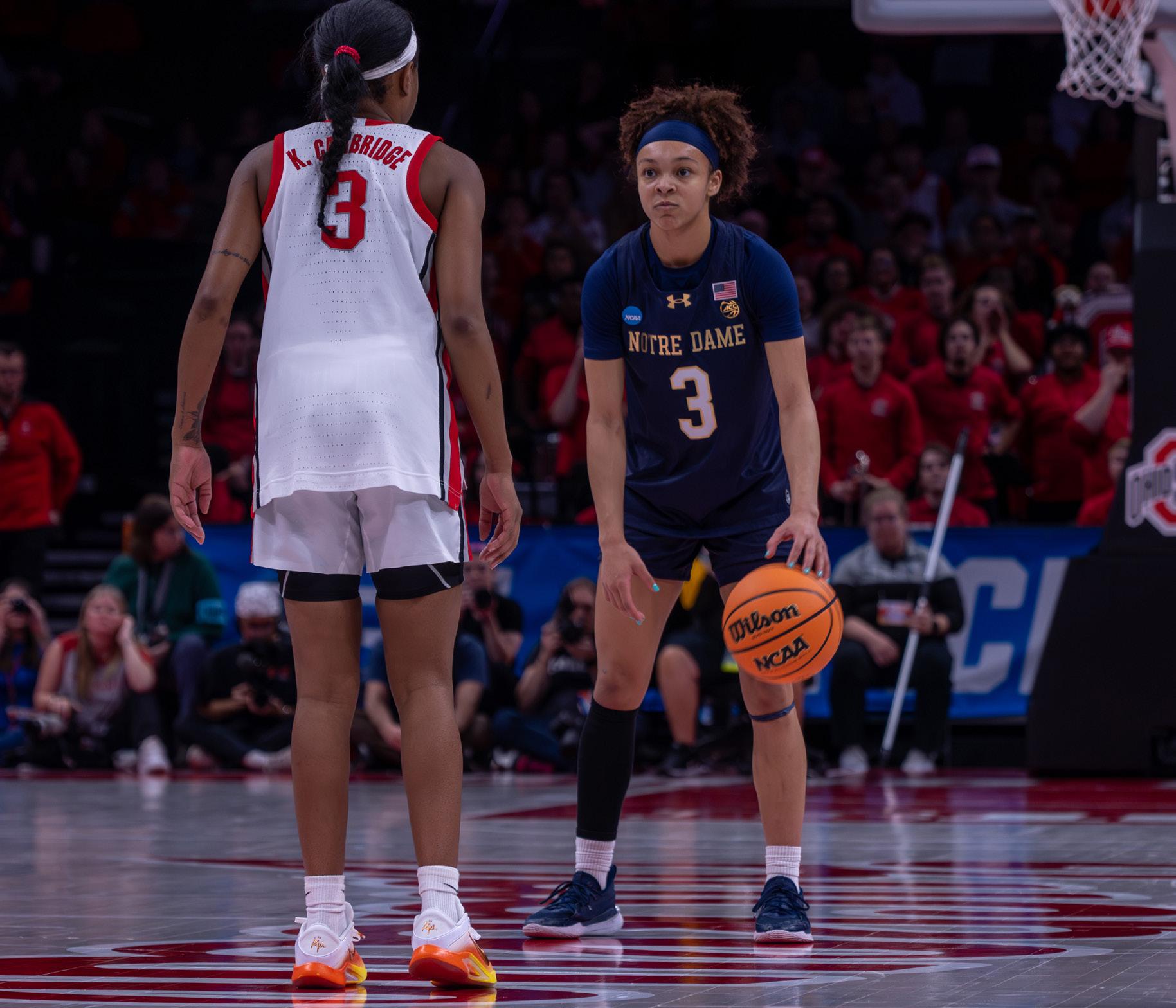
MARIELLA TADDONIO | The Observer
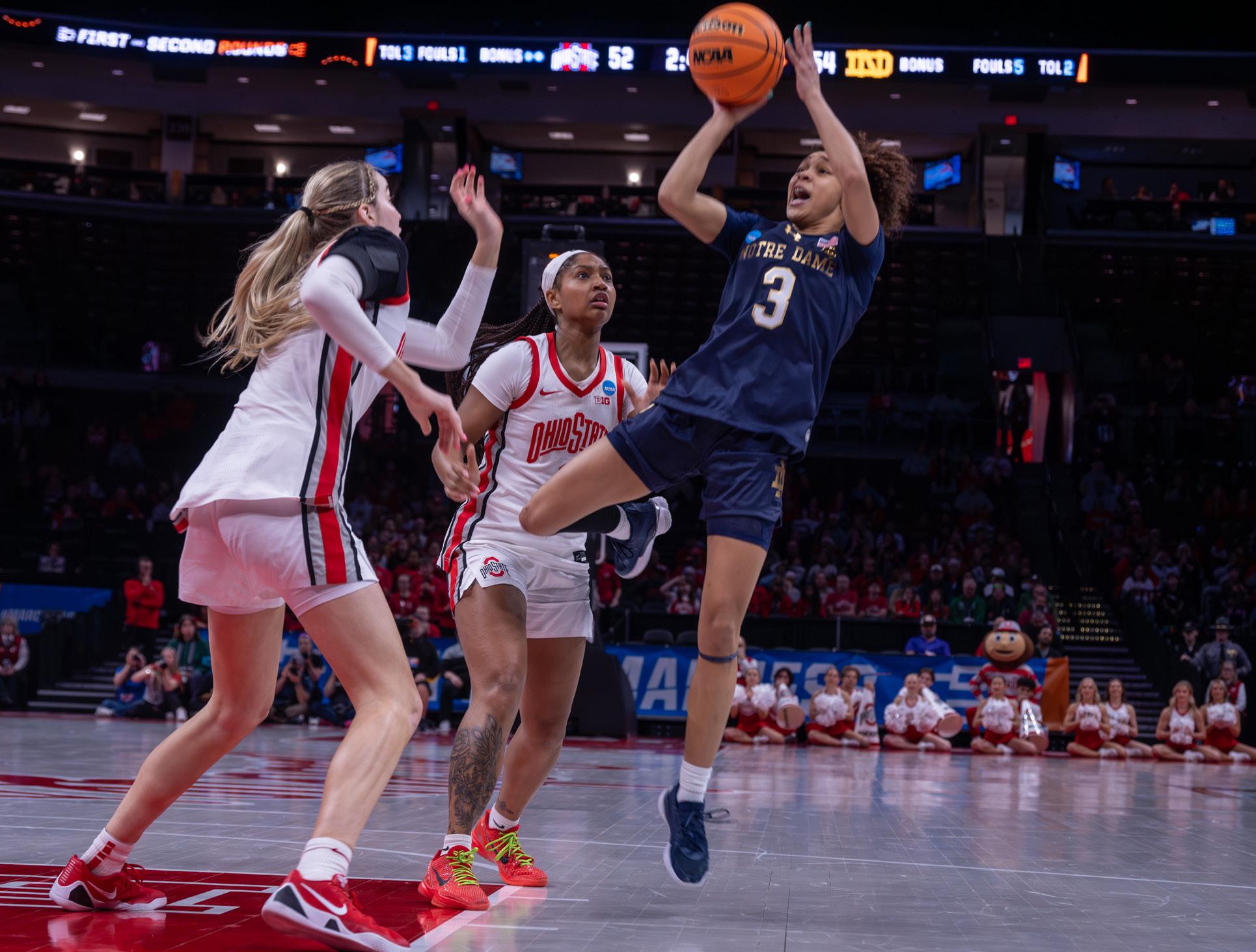
Irish junior guard Hannah Hidalgo faces star Buckeye sophomore Jaloni Cambridge during Notre Dame’s 83-73 win over Ohio State on March 23 in the Schottenstein Center. Hidalgo paced the squad with 26 points.
Women’s basketball vs. Ohio State
Notre Dame women’s basketball defeated Ohio State in Columbus to advance to the Sweet Sixteen. The Irish defeated the Buckeyes 83 - 73.
Photography by photo editor Mariella Taddonio
Offensive power allows the Irish to sweep Tigers
By Zachary Jones Sports Writer
The University of Notre Dame baseball swept Clemson last weekend in its first Atlantic Coast Conference home series of the 2026 campaign. It won Friday’s contest 6-0 and walked off the Tigers on Saturday, 8-7, before taking Sunday’s game 7-4.
It was perfect baseball weather on Friday as Notre Dame welcomed its Atlantic Coast Conference foe, Clemson, to South Bend for game one against the Tigers. With the warm mid-March sun shining down on Frank Eck Stadium, the Irish looked sharp in their white pinstripes and radiant golden helmets and were certainly up to the task of facing a strong Clemson squad.
Clemson rolled into South Bend as the owners of an 18-4 overall record and a 1-2 mark in conference play. Coach Erik Bakich’s Tigers bested College of Charleston and The Citadel in the midweek before heading north to face the Irish.
Notre Dame workhorse Jack Radel (2-1, 2.77 ERA) dueled Clemson ace Aidan Knaak (02, 5.29 ERA) on Friday. Radel got the better of Knaak, shoving for nine scoreless innings compared with Knaak’s five innings of two-run ball. Radel looked masterful throughout the performance, scattering four hits over 117 pitches, striking out eight and walking none.
Radel displayed a plus-plus slider with great downward break. The 6-foot-5 righty seemed to get more comfortable as the game went on, retiring 12 of his last 13 batters faced. It was the first nine-inning shutout
performance by an Irish pitcher since 2021.
Radel got run support in the third from a solo shot from freshman second baseman Mason Barth and in the fourth off an RBI single by sophomore first baseman Parker Brzustewicz. The Irish added on four more in the bottom of the seventh, highlighted by a three-run oppositefield home run off the bat of freshman third baseman Jamie Zee, who slugged an 0-2 inside fastball halfway up the rightfield netting. The game would end 6-0 Irish. In total, the Irish collected two walks and swatted five hits on the afternoon.
With an opportunity to win the series Saturday, the Irish came out swinging with three runs in the first inning.
Graduate center fielder Drew Berkland’s solo homer put the Irish up 4-1 through two complete, but the Tigers scored one in the third and three in the fifth to take a 5-4 advantage through five. Junior designated hitter Davis Johnson added one to the Irish tally in the sixth with a solo homer, but Clemson padded its lead with two runs in the seventh, making the score 7-5 at the seventh-inning stretch.
With the Irish down two in the bottom of the eighth, sophomore right fielder Jayce Lee slugged a clutch two-run homer to deep left, scoring himself and Johnson to knot the score at 7 apiece. Freshman right-hander Will Jaisle and graduate righty Eli Thurmond were nails out of the bullpen, holding the Tigers scoreless in the eighth and ninth with a clean frame each.
The Irish bats entered the bottom of the ninth in prime position for a walk-off with the score tied at seven and loaded the
bases with two singles and an intentional walk. With one out, Brzustewicz hit a roller to short, setting up a double play for the Tigers that looked to end the inning with no runs scored.
The Tigers got the force out at home, but Tigers catcher Nate Savoie’s throw to first ricocheted off Brzustewicz’s back, allowing him to reach safely. Irish junior catcher Mark Quatrani, who was at second base when the play began, scored on the errant throw. His run put the Irish up 8-7, giving the Irish the series win and a chance to sweep the Tigers on Sunday.
Berkland led the Irish offense with a 3-4 performance. He recorded seven total bases and ended a triple short of the cycle. Freshman lefty starter Caden Crowell spun 3.2 innings of
two-run ball, giving up four hits along the way.
The Irish and the Tigers clashed for a final time Sunday afternoon. While Friday’s and Saturday’s contests enjoyed sunny weather in the high 60s, a gray, overcast sky and a stiff leftto-right breeze chilled Sunday’s getaway game. Undaunted by the familiar cloud cover and colder temps, Notre Dame raced out to a 3-1 lead after three innings.
Irish graduate starter Ty Uber was excellent on the mound, giving up one run on five hits in five innings of work. Uber struck out six Tigers batsmen with two clutch strikeouts coming in the top of the fifth to strand a runner at third. The Irish scored multiple runs in the fifth and sixth innings to take a 7-2 lead
through seven complete.
Senior Noah Rooney picked up where Uber left off and stifled the Tigers with three innings of one-run ball, escaping jams in all three innings. Thurmond closed the game with a two-run ninth, ending the game at 7-4 Irish and giving the Irish their first ACC home sweep since April 2025.
Irish coach Shawn Stiffler has got to be pleased with how his charges performed this weekend. The offense continued its productive ways, notching 21 runs on 24 hits over the weekend, but it’s the improvement on the mound that really shines for the men in green. Against the Cardinals, none of the Irish three starters went longer than three innings. In their sweep of the Tigers, Radel set the tone with nine lights-out innings in a complete game shutout. In total, the three Irish starters provided 17.2 innings of three-run ball on the weekend against a strong Tigers lineup. Rooney, Thurmond and Jaisle had clutch performances out of the pen as well.
Radel’s draft stock will continue to skyrocket after his shutout performance on Friday. He owns a 3-1 record, a 2.06 ERA and is limiting opposing batters to a .143 average. For the offense, underclassmen continue to drive the Irish lineup, with six out of nine hitters being freshmen or sophomores. Out of the Irish 18 total RBIs on the weekend, underclassmen claimed 13 of them.
Notre Dame will host Western Michigan on Tuesday, Mar. 24, with first pitch scheduled for 4:30 p.m. ACC play continues next weekend with a home series against North Carolina.
Contact Zachary Jones at zjones3@nd.edu
KEIRA JONES | The Observer
Irish junior outfielder Davis Johnson swings at the ball in Notre Dame’s 6-0 win against Clemson on March 20 at Frank Eck Stadium. Johnson batted twice during the Irish’s dominant victory over the No. 19 Tigers.
Notre Dame faces SMU in a fierce matchup
By Katelyn Huber Sports Writer
On Sunday, the Notre Dame women’s tennis team faced SMU at The Eck Pavilion. This marked Notre Dame’s first time playing back on campus since Feb. 22. The team had unfortunately lost to No. 24 Duke, 0-4, a week prior. While great effort was made, No. 52 Notre Dame fell short to No. 32 SMU with a final score of 3-4.
Heading into the matchup, Notre Dame had obtained a record of 12-6 overall. Despite the tough competition both Duke and North Carolina have brought this year, the
team has demonstrated their strengths with a doubles win against Duke.
The SMU team has claimed a 12-5 record during the 2026 season. This match against the Irish would come to define their abilities as a team and predict their success throughout the rest of the season.
The matches were off to a great start for the Irish, as Notre Dame freshman Gabriella Rawles and sophomore Rylie Hanford won 6-3 in doubles against SMU Natalie Stasny and Sophie Llewellyn. Soon enough, Notre Dame sophomore Bianca Molnar along
with senior Bojana Pozder demonstrated phenomenal teamwork in doubles and obtained a top-10-ranked victory defeating No. 10 Caroline McGinley and Amelie Van Impe 6-3 to secure the doubles point. Molnar and Pozder have become a respectable duo this season, and this accomplishment distinguished their sixth-ranked win of the year.
Even though the scores were initially encouraging for the Irish, singles play was their ultimate downfall. SMU immediately tied the score without losing a single set. Freshman Sophia Holod fought back to the challenge
ND MEN’S TENNIS
by defeating Stasny, 6-1, 6-4. In an impressive response to SMU’s comeback, Holod now has 11 singles dual victories. This is the largest number of singles dual victories out of everyone on the team.
Despite the Irish’s attempt to secure the victory against the Mustangs, SMU’s Ellie Mireles tied the match again by winning all sets. Next, Molnar placed Notre Dame only one point away from winning the match. Molnar went on to defeat Llewellyn 6-2, 6-3.
On court six, SMU tied 3-3 which stirred anticipation for the set against Pozder and McGinley. Pozder won the
first set 6-4, and McGinley triumphed in the second set, 6-3. During the third set, both players held serve and made it 2-2. Then, Pozder won 4-2 before securing the 6-2 clincher.
In the next few weeks, the Irish will remain at home and host Stanford on Mar. 27, as well as Cal on March 29. As the team prepares for the ACC tournament, scheduled for Apr. 14 through Apr. 19, the next few matches are key in order to display their undeniable talent as a team.
Contact Katelyn Huber at khuber01@saintmarys.edu
Irish men’s tennis turns the tables
By Jacek Kawczynski Sports Writer
Following a grueling road trip, which included a 4-0 loss to No. 4 Wake Forest and a heartbreaking 4-3 collapse against No. 20-ranked NC State, the Notre Dame men’s
team traveled back to South Bend for a three-dual weekend. It seems the tight schedule only motivated the Irish, who defeated perennial NCAA Championship contenders Stanford 4-2 on Friday before sweeping Berkeley and Marist in Sunday’s double-header.
Notre Dame is now 17-4 and well on its way to causing some damage at the end-ofyear championships.
The showdown with Stanford started off on a high note, with No. 53-ranked sophomore pair Luis Llorens Saracho and Peter Nad taking
down No. 6-ranked Stanford duo of sophomore Alex Razeghi and graduate student Alex Chang. The upset was followed by a 6-3 win for Notre Dame senior Sebastian Dominko and graduate student Perry Gregg over senior Samir Banerjee and freshman Jagger Leach. The convincing doubles performances served as a catalyst for the dominance shown throughout the weekend.
On the singles side, Stanford junior Nico Godsick tied things up, defeating fellow junior Kyran Magimay 6-3, 6-2. Razeghi gave Stanford the lead, beating sophomore Giuseppe Cerasuolo 7-5, 6-1. Nad outdueled junior Hudson Rivera in a tight match, 7-6(3), 6-3, and Llorens Saracho restored the Irish lead in a 4-6, 7-5, 6-3 win over Leach. Gregg once again showed his cool under pressure, clinching the dual for Notre Dame with a 7-5, 7-6(3) victory over Chang.
Celebrations were shortlived, as the Irish returned to court Sunday morning to face a strong Berkeley squad. Llorens Saracho and Nad continued their strong play, defeating junior Alex Aney and senior Tiago Silva 6-4. Gregg and Dominko secured the team’s doubles point with a 6-4 win against Berkeley junior Timofey Stepanov and sophomore Fryderyk Lechno-Wasiutynski.
Cerasuolo kicked off the singles matchplay with a 6-1, 6-4 victory over Silva. Gregg followed suit with a 6-3, 6-4 win against Stepanov, and Dominko put the dual to rest in a 4-6, 6-2, 6-2 comeback win over Lechno-Wasiutynski.
A few hours later, freshman Nicholas Patrick and junior Evan Lee gave Notre Dame the lead against Marist, beating
graduate students Jose Catala and Danté Despontin 6-1. Llorens Saracho and Nad completed their weekend sweep and coasted to a 6-3 win over senior Nick Suhanitski and junior Thomas Bevan. In singles play, Patrick defeated Bevan 6-3, 6-0, followed shortly by Gregg, who defeated Catala 6-1, 6-4. Irish junior Chase Thompson took the winning match for the Irish, beating sophomore Ian Layton 6-1, 6-4. Cerasuolo took out Marist freshman Alejandro Abella Fernandez 6-0, 7-5, and Irish freshman Nolan Balthazor grinded out a 6-4, 6-4 win over sophomore Gregor Heinemann. Lee ensured a sweep for the Irish, beating Anirudh Nallaparaju in a nail-biter, 7-6(1), 6-3. Overall, the weekend was a resounding success for Notre Dame. Last season, the team struggled to dig itself out of deficits and also lost numerous ACC duals by coming up short in key moments. The close loss against NC State the week prior was cause for some concern, but the team quelled those worries with the comeback win over a dangerous Stanford squad. With two singles heavyweights in Dominko and Gregg, a strong No. 1 doubles in Nad and Llorens Saracho, and a deep lineup across the board, the Irish are looking like one of the most dangerous teams in the country going into postseason play.
Notre Dame heads to Dallas Friday to take on SMU. Look out for a thrilling match between No. 13-ranked Dominko and SMU’s Trevor Svajda, who is currently the No. 1 singles player in the nation. Matchplay begins at 6 p.m. EST.
Contact Jacek Kawczynski at jkawczyn@nd.edu
DECLAN LEE | The Observer
Irish junior Kyran Magimay serves the ball during his match against Stanford’s Nico Godsick on March 20 in Eck Tennis Pavilion. Though Magimay fell 6-3, 6-2, Notre Dame won 4-2 overall against the Cardinal.
Irish fencers capture NCAA crown
By Paul Stevenson Sports Editor, 1976-77
Editor’s Note: This story was originally published on March 28, 1977.
A national championship is an event which occurs only once in a great while. For the Notre Dame fencers, their “great while” became a reality this past weekend during the NCAA tournament held at the Athletic and Convocation Center.
Notre Dame. who defeated 54 opposing schools en route to their NCAA crown, was tied with New York University at the termination of regular tournament play. Both teams had compiled 114 points and were required to compete in a fenceoff for the title.
The order of the fence-off was to be sabre, foil and epee. The school which was victorious in two of the three bouts would be crowned national cham pions.
Mike Sullivan, who captured the gold m edal in sabre, started the fence-off against Miklos Benedek of NYU. The sophomore standout responded with a thrilling 3-5 victory, giving the Irish a 1-0 lead in fence-off bouts.
Foil was the next w eapon, an event which pitted Notre Dame’s Pat Gerard against NYU’s Tom Valijacic. Gerard never gave
Valigacic a stab at a win, as the junior foil specialist raced to a 0-5 victory to give the Irish a 2-0 margin in bouts.
Because of the back to back victories in sabre and foil, there was no need for a fenceoff in epee. Thus, the Fighting Irish won the fence-off 2-0 and captured the national title for the first time in Notre Dame history.
Gerard was probably Notre Dame’s most surprising performer. The Irish fencer claim ed the gold medal with 18 victories against 4 losses during his 22 bout performance.
The Notre Dam e junior was matched against some rigid com petition, expecially in Robert Marx of Portland State. Marx was named the 1977 “ Foil Fencer of the Y ear.”
In addition, Marx was ranked number one on the Olympic squad. However, Gerard performed his first NCAA com petition, defeating Marx 1-5.
Meanwhile, Sullivan grabbed the sabre title with 20 victories while only allowing two defeats. Sullivan beat Wayne State’s Yuri Rabinovitch for top honors.
Rabinovitch had beaten Sullivan only two weeks earlier in the Great Lakes Tournament and was also the only opponent to defeat Sullivan during his
collegiate career. In epee, Irish All-America fencer Tim Glass captured fourth place.
The Notre Dame senior accum ulated a 16-7 mark. Although fencing well, the Irish epee specialist did not perform as expected.
Capturing the gold m edal in epee was Hans Wieselgren of NYU with a 21-2 record. The second and third place finishes belonged to Robert Frensom of Rutgers and Jim Neale of Princeton respectively.
Notre Dame fencers were not the only ones to achieve NCAA honors. Head Coach Mike DeCicco was named NCAA “ Coach of the Year.” In addition to tournament victories, DeCicco, since becoming head coach of the Irish in 1962, has compiled 291 wins while only suffering 32 defeats.
Following Notre Dame and NYU in the final standings w as Wayne State with 103 points. The U niversity of Pennsylvania and Harvard University rounded out the top five.
The NCAA cham pionship w as a goal , th at Coach DeCicco and his fencers have been working for since 1962. N otre Dame finished their season with a 23-0 m ark. This record gives the Irish their second consecutive undefeated season, and
FENCING
extends th eir unbeated string to 67 matches.
All three Irish fencers performed like professionals. “Pat Gerard was the Cinderella guy of this tournament,” an ecstatic DeCicco stated. “He had to defeat all the top seeded fencers in the tournament during the final rounds.”
Gerard had accum ulated three defeats after two days of action. The Irish foil specialist, however, was dow ned only once on Saturday to end the tournament with a mere four defeats and a first place-gold medal finish.
Sullivan overcame the obstacles of Rabinovitch of Wayne State and Benedek of NYU to capture first place. “I lost some dumb bouts,” Sullivan commented. “I’d beat the top seeded players and then lose to som e of the bottom seeds.”
A lthough Sullivan was disappointed about some matches which he believe he should not have lost, Glass reflected on the tournament a bit differently.
“The tournament was really a team effort,” Glass explained. “Sullivan and Gerard were the best fencers in the tournam ent. They were also the best clutch fencers. They won all of their crucial bouts when they had to.”
For the Irish, one could not ask for a more phenom enal
season. NYU returned their winning trio from last year’s NCAA championship squad. Yet, Notre Dame, undaunted, proved NYU could be beaten. Notre Dame will have their two individual national champions returning to next year’s squad. Sullivan, a sophomore, and Gerard, a junior, will aid the Irish in sabre and foil once again next season.
Sullivan’s record stan d s at 100-2 during his two year sabre role at Notre Dame. Meanwhile, Gerard has compiled a 115-16 mark during his three year term with the foil.
Senior All-American Tim Glass will be lost to graduation. Glass ends his Notre Dam e career with a 160-26 ledger. The Irish epee specialist w as also a two-time Great Lakes Tournament gold medal w inner.
The top six fencers in everyweapon are given All-America distinction. The 1977 NCAA tournament makes Sullivan and second-time A ll-America candidate, while Gerard claim s the same honors for the first occasion.
The fencing season has ended. Already there has been talk of repeating their feat next year. For now, however, they should just enjoy the distinction they’ve earned--National Champions.
Women win first-ever national title
By Terry Lynch Sports Writer,
1986-87
Editor’s Note: This story was originally published on March 24, 1987.
It was the fulfillment of a 13year-old promise and the culmination of years of building, but when the women’s fencing team won the national championship Friday at the ACC, there was an eerie feeling that the niche the team had carved for itself on the collegiate fencing map had only started to grow.
Paced by the strong fencing of sophomore Kristin Kralicek and junior all-American Molly Sullivan, the women’s fencing team went undefeated Friday, knocking off top-seeded Temple in the final meet, 9-3, to claim the first national title in a women’s varsity sport in Notre Dame history.
Defending individual champion Molly Sullivan finished third in the individual standings behind Columbia’s Katy Bilodeaux and Wisconsin’s Isabelle Hamori on Saturday, but second-year Head Coach Yves Auriol was more pleased with the team championship.
“My goal this year was to win with the team,” said Auriol. “I was more relaxed on Saturday
after the team won, but the individual fencing was tough.
“Katy (Bilodeaux) knew Molly would be off, and she really went at her on Saturday.”
Bilodeaux beat Sullivan, 8-1, and eventually went on to claim the individual title on Saturday.
“She fenced well when we really needed it,” Auriol said of Sullivan. “She beat Katy, 5-3, on Friday, and that was a key bout for the team.”
Perhaps the biggest wins in Friday’s team tournament came from Kralicek.
“I think the most consistent girl of the year was Kristin,” said Auriol. Kralicek came up with a big win over Wayne State’s Loredana Ranza, and once that happened, it was apparent that the women had the inertia to win the tournament.
For men’s head coach Mike DeCicco, the women’s title marked the end of a long building process to establish the kind of women’s team he had already built with the men.
“It started in ’74 when Father (Edmund) Joyce came up and asked me if we were ready for a varsity women’s program,” said DeCicco. “ I didn’t think we were ready then - we had a team, yes - but we didn’t have a team that was in league with
our men.
“He stood by us and gave us support financially. He did something that very few people give him credit for - he elevated women to varsity status on this campus long before Title IX ever came into vogue. Title IX forced a lot of schools to add
women to varsity sports.
“He did it because we had enrolled women, and he saw their role carrying over to the athletic field as w ell,” said DeCicco.
But for all this talk of building, all four of the NCAA fencers
- Janice Hynes, Anne Bar reda, Sullivan and Kralicek - will be
returning next year.
“We had more pressure this year than we w ill next year,” said Auriol. “Bilodeaux’s a senior, and a lot of other teams have people graduating. It looks like we’ll have the same team, and we’ll be better next year.”
It’s a frightening thought.
SUSAN COENE | The Observer
The Irish women’s fencing team won the first-ever national championship in a women’s varsity sport at Notre Dame on March 20, 1987, after defeating Temple 9-3. That year, the men’s team finished fourth in the nation.
Freshman Kruz Schembri shines for the Irish
By Chris Dailey Sports Writer
Kruz Schembri is an anomaly.
After finishing with a silver medal in epee at NCAA Nationals, the Irish freshman left no doubt that he is one of the brightest young talents in the sport.
Before arriving in South Bend, Schembri had already established himself on the global scene. At 17 years old, he became the first fencer from the U.S. Virgin Islands to compete at the Olympics in 40 years; he was even given the honor of serving as the nation’s flagbearer at the opening ceremony.
Just three weeks before Nationals, Schembri won gold at the Pan American Cadet and Junior Championships. A year prior, he won a historic gold medal for the U.S. Virgin Islands at the 2025 Junior Pan American Games.
All of the great success
Schembri has garnered is made even more impressive when considering he’s one of the few fencers who specialize in two weapons.
You see, Schembri achieved all of these previous accolades in foil. When the prodigy arrived on campus in the fall, legendary head coach Gia Kvaratskhelia needed a fencer to step up in epee. There was no man better suited for the job than the freshman Olympian.
Throughout the season, Schembri improved each day in epee. While foil rewards speed and precision, which Schembri possesses tenfold, epee is slower and more deliberate.
“The reason I focused on epee is because the team needed me for epee. So building with the epee guys and bonding with them, working together, has helped me so much,” Schembri said. “This is why I am standing here with second place and a team title. I love these guys.”
Winning silver as a freshman in a specialty that was
never his primary focus was no easy feat. Teams can only bring two fencers per weapon to nationals. From there, the tournament’s long format provides both a physical and a mental hill for fencers to climb.
“NCAA Championships is a very unique format. You have to face everyone in the roundrobin,” said Schembri. “By the time you get to the semi-finals, you already have 23 bouts under your feet, so it’s just about trusting the process. That’s really what you have to do in these situations.”
The round-robin bouts are to five touches with a three-minute clock. The semifinals and finals are set to 15 with three five-minute periods.
Schembri won 17 of his round-robin bouts, registering 100 touches to only 71 received.
In the semi-finals, Schembri got past Soma Somody of Long Island University 15-10. In the finals, he went down early to Youssef Shamel of the
University of North Carolina before pulling back in. Shamel ultimately came out on top, 15-7.
A fierce competitor, Schembri’s rapid rise through the ranks of collegiate epee, despite it not being his primary specialty, is a testament to his wizardly talent.
For Schembri, it’s all made true by the culture instilled within Kvaratskhelia’s team.
“I love these guys. They’re my best friends, they’re my family,” said Schembri. “Working with them every single day gives us the confidence to compete against the other top schools in the nation.” He continued, “[Coach] Cedric and Gia are amazing. The culture here really brings us up, and that’s what makes it so special at Notre Dame.”
The culture Schembri highlighted is undoubtedly elite. The Irish’s triumph in women’s and men’s team competitions gives them their 15th and 16th national championships.
The freshman phenom isn’t done yet, either. With three more years left competing for Notre Dame, Schembri has his eyes set on extending Notre Dame’s dynasty and going for gold.
But beyond the medals and accolades, Schembri is driven by something even bigger: growing the sport he loves in the place he loves.
“I go back every break and every summer to teach fencing in the Virgin Islands and help develop the sport,” said Schembri. “That’s my end goal when I’m done and put down the blades, so I’m really looking forward to going back this summer.”
Already an Olympian, NCAA silver medalist and role model off the strip at just 19 years old, Schembri has accomplished more than most do in a lifetime.
And he’s just getting started.
Contact Chris Dailey at cdailey2@nd.edu
Ahmed Hesham takes home gold in the individual
By Payton Dymek Associate Sports Editor
Ahmed Hesham stood on a makeshift raised strip in Purcell Pavilion, in front of a roaring crowd, one point away from a national championship. Family, fencers and spectators from the best collegiate programs in the country, some of whom boast Olympic or World Championship medals, looked on.
Hesham stood the en garde line with his saber ready, darting over the line at the word “fence.” Dropping his saber down and using his 6-foot3 frame to his advantage, Hesham lunged at his opponent and just tipped their shoulder with his extended blade. In that moment, he turned and dropped his golden helmet, celebrating as an NCAA national champion.
Hesham, a sophomore, secured the title of 2026 Men’s Sabre NCAA Champion and the hardware that comes with it.
Hesham fenced against 23 other sabre fencers in 5-touch bouts before he found himself entering the final ranked No. 3. No. 1 sophomore William Morrill (Columbia University), No. 2 sophomore Colin Heathcock (Harvard) and No. 4 senior Adham Moataz (St. John’s) rounded out the bracket, with the first to 15 touches in each match to win. While fencing against Heathcock, despite raucous cheers from the Harvard women’s fencing
team throughout the bout, Hesham made a historic comeback. After taking a short rest and watching fellow teammates, senior foilist Chase Emmer and freshman epeeist Kruz Schembri, take second in their respective brackets, Hesham came back chasing the gold, not only for himself but for his team.
Hesham fenced against Moataz in the championship, a bout the world has seen quite a few times during their careers and in practice, as the two both represent Egypt on the international stage. Moataz came out strong, forcing Hesham to change his fencing plan and adapt quickly. Hesham bested his international teammate 15-12.
Post-championship bout, Hesham said, “It feels great to be a national champion … especially [in front of] the biggest home crowd [he’s] seen.” Not only was he gushing about his experience during this championship, but also about his overall time at Notre Dame, noting this is the “most hardworking team in the country, and everyone, whether they fence or not, put in the effort.”
Winning the national championship was monumental for Hesham’s collegiate career, following his 15-5 victory over Elden Wood (University of North Carolina) to claim the 2026 ACC Men’s Individual Sabre title earlier this year. This year’s campaign in itself was a revenge run for Hesham
after winning silver at the 2025 ACC Men’s Individual Sabre competition and bronze at the NCAA Championships; Hesham also earned First Team All-American honors and All-ACC academic honors during that time.
Although he has been training with the Irish and is currently in the middle of his collegiate years, Hesham works hard to maintain his international fencing rank, participating in a handful of Grand Prix and World Championships. Only nine
weeks ago, he was in Tunisia participating in the Tunis Grand Prix, taking home bronze, his second Grand Prix decoration and third consecutive medal of the season. In December 2025, he won the Youth Sabre Fencing World Cup in Germany and placed third at the Grand Prix in Orleans, France. Additionally, before the academic year started, Hesham competed in his first senior world championships in Tbilisi, Georgia, where he earned bronze, and in the African Fencing
Championships in Lagos, Nigeria, where he won gold. His 2026 NCAA runner-up took second.
While Hesham has finished his sophomore year competitions, to maintain his world ranking, he will soon begin traveling again to continue earning points for Egypt. Although no schedule has been solidified, Hesham is sure to find international success after dominating the NCAA.
Contact Payton Dymek at pdymek@nd.edu
KEIRA JONES | The Observer
Irish sophomore Ahmed Hesham hits No. 4 senior Adham Moataz of Saint John’s University during the 2026 Men’s Sabre NCAA Championship on March 22 in the Joyce Center. Hesham took home the individual title.