

Club president Phil Pollice reflects on Bouts
By Ben Hicks Sports Editor
Since its inception in 1920 by the legendary Knute Rockne, boxing at Notre Dame has served the mission of bolstering both the strength and spirits of the men who tirelessly devote their efforts to a cause bigger than any one of them. Toiling through twohour practices six days a week, Bengal Bouts boxers aren’t only transforming their own minds, bodies and spirits, but also leading fundraising efforts for the Holy Cross missions educating and serving those in Bangladesh living in extreme poverty. After three years as a standout boxer inside the ring and devoted fundraiser outside the ropes, Phil Pollice has taken over as president of the club with the mission of sustaining and furthering Bengal Bouts’ remarkable legacy.
A senior from Pittsburgh, Pollice studies finance and Italian with a minor in real estate. The former Baumer Hall resident won the 148-pound division championship as a freshman in 2023, and has now added club president to his docket of Bengal Bouts accomplishments.
A talented two-way football player in high school, Pollice had to step away from the sport due to injury. “I had to quit football because I tore both of my labrums. My football coach sat me down and basically said, ‘I don’t want you to be in this type of pain when you are 40.’ But I still needed a sport,” Pollice recalled.
Searching for a way to stay active, Pollice turned to a Filipino-owned boxing club not far from Pittsburgh. “I decided I’ll give boxing a shot, not knowing if I’d compete, but I immediately fell in love with it,” he said.
There, Pollice learned technique, bag work and sparring, honing his skills despite never actually stepping into the ring to compete prior to arriving in South Bend. Bengal Bouts was actually one of the reasons Pollice ended up at Notre Dame. “When I heard that Notre Dame had a boxing club, I thought that would be my avenue. It was like, now I want to go to this school. So even before I stepped on campus, I could envision being there and what my freshman year would look like,” he recalled.
Once on campus in the autumn of 2022, Pollice immediately found a home in the club, while also finding what he described as “a hilarious” amount of success. He developed a strong relationship with one of the junior captains that year, realizing that much of his success was due to the leadership, investment and devotion
demonstrated by the upperclassmen in the club. Despite reaping all the individual rewards one can as a freshman in Bengal Bouts, Pollice said that the positive leadership of the club allowed him to recognize that individual success isn’t the goal of Bengal Bouts. Instead, he became committed to helping pursue the collective mission of the organization over his next three years.
“What really matters is the fact that you did this as a fulfillment of service to a Catholic community across the world.
I think that’s so special and is what largely kept me in the club,” Pollice said of the club’s mission.
Pollice went on to explain that one of his main responsibilities as president is to ensure that the boxers understand the commitment they are making to their brothers in the club and in Bangladesh. He said that, naturally, most people join Bengal Bouts for selfish reasons, either to get in shape or find a community on
campus, but that the character development from the mission work is what truly allows the club to flourish.
Pollice also described the joy he takes in being a part of the Bengal Bouts brotherhood. In his role as president, he has now stepped up to provide the guidance given to him as a freshman. “It is extremely humbling and rewarding when you see someone come up to you because it’s extremely vulnerable. For someone to recognize that part of their game is missing, and ask how I do it well, that takes courage,” he explained.
That brotherhood not only promotes the growth of the group, but also presents itself as the medium for selfimprovement. Pollice believes that the lessons and relationships built through the community of Bengal Bouts don’t ever leave a boxer, saying, “If you are a boxer and you’ve done this, you have that characteristic of constantly needing to improve. That part of
you never goes away.”
As a dedicated man of faith, Pollice attests that the trials and triumphs of Bengal Bouts are an experience deeply unique to Notre Dame and its mission as a University.
“Fundraising for the fight of the Holy Cross missions in Bangladesh, while also balancing everything we try to get out of it, is what Notre Dame tries to invoke in its students, all rolled into one activity,” he said. “The education of the mind, body and spirit, and it happens all within a five-week period. Because of Bengal Bouts, I can confidently say I went to Notre Dame.”
Harkening back to his high school football days as a cornerback, Pollice sees a continuity between the mindset required for both sports. He compared the feeling of being alone in the ring to being placed on an island as a corner and to the responsibility shouldered by a president.
The allure and difficulty of one-on-one competition is
what drew him to boxing and what kept him coming back. “It’s the hardest sport to learn and do consistently,” he said. He knows his role is difficult, not only the boxing, but also the leadership. Pollice has led by example inside and outside the ring, letting his faith guide him in his mission. Raising over $320,000 last year to fund education to combat poverty and injustice in Bangladesh, Bengal Bouts is halfway to its 2026 goal of beating that previous high watermark.
After kicking off last week, Bengal Bouts will continue Tuesday night at 7 p.m. with the semifinals taking place inside Dahnke Ballroom atop Duncan Student Center. The 96th edition of the tournament will then conclude after spring break, with the finals occurring on Saturday, March 28, at 7 p.m., hosted at Purcell Pavilion.
Contact Ben Hicks at bhicks2@nd.edu
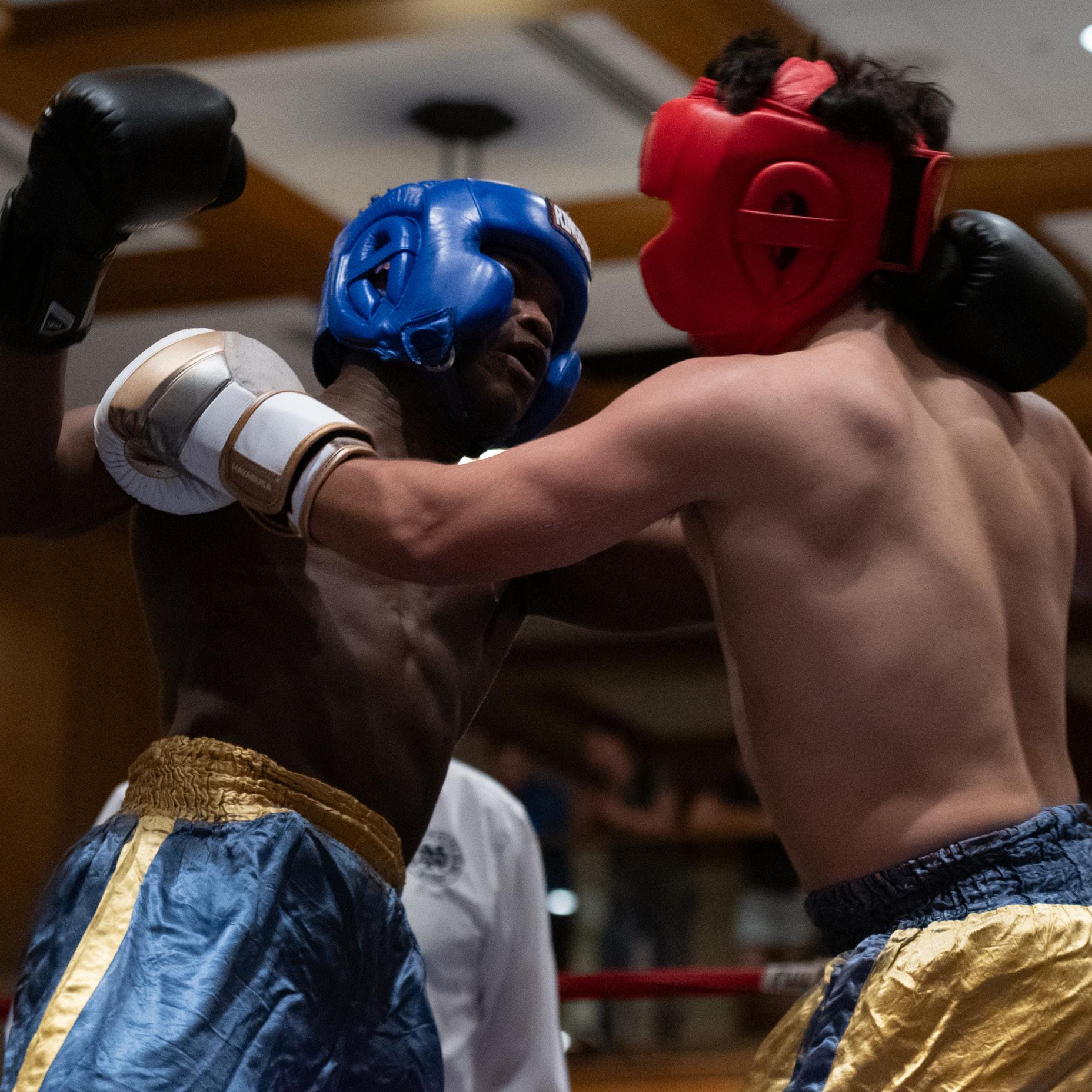
GABRIELLA MARTIN | The Observer
Two boxers meet in the center of the ring during the quarterfinals of Notre Dame’s 96th annual Bengal Bouts tournament on Feb. 17, in Dahnke Ballroom. In addition to being one of the world’s largest amateur college boxing tournaments, the club raises money for Holy Cross missions.

THE INDEPENDENT NEWSPAPER SERVING NOTRE DAME, SAINT MARY’S AND HOLY CROSS
University boosts lobbying amid policy shifts
By Sophie Hanawalt and Grace Sullivan Notre Dame News Editor and News Writer
Despite its distance from our nation’s capital, Notre Dame, like many other elite universities, maintains a presence in Washington, D.C.
Beyond sharing the University’s research and institutional values with policymakers, Notre Dame utilizes its own registered lobbyists and the help of outside lobbying firms to advocate on behalf of the University as decisions are made on the Hill.
As the Trump administration has enacted a slew of policies changing the landscape of higher education, from taxes on University endowments to executive orders aiming to eliminate diversity, equity and inclusion programming, Notre Dame and prominent universities across the country have increased their spending on lobbying efforts.
Inside Higher Ed reported in January that major research universities spent over $37 million on federal lobbying efforts in 2025, up from $28.1 million in 2024.
The Observer’s analysis of 2025 federal lobbying disclosure reports found that Notre Dame ranked 19th amongst schools in the
HENRY JAGODZINSKI| The Observer
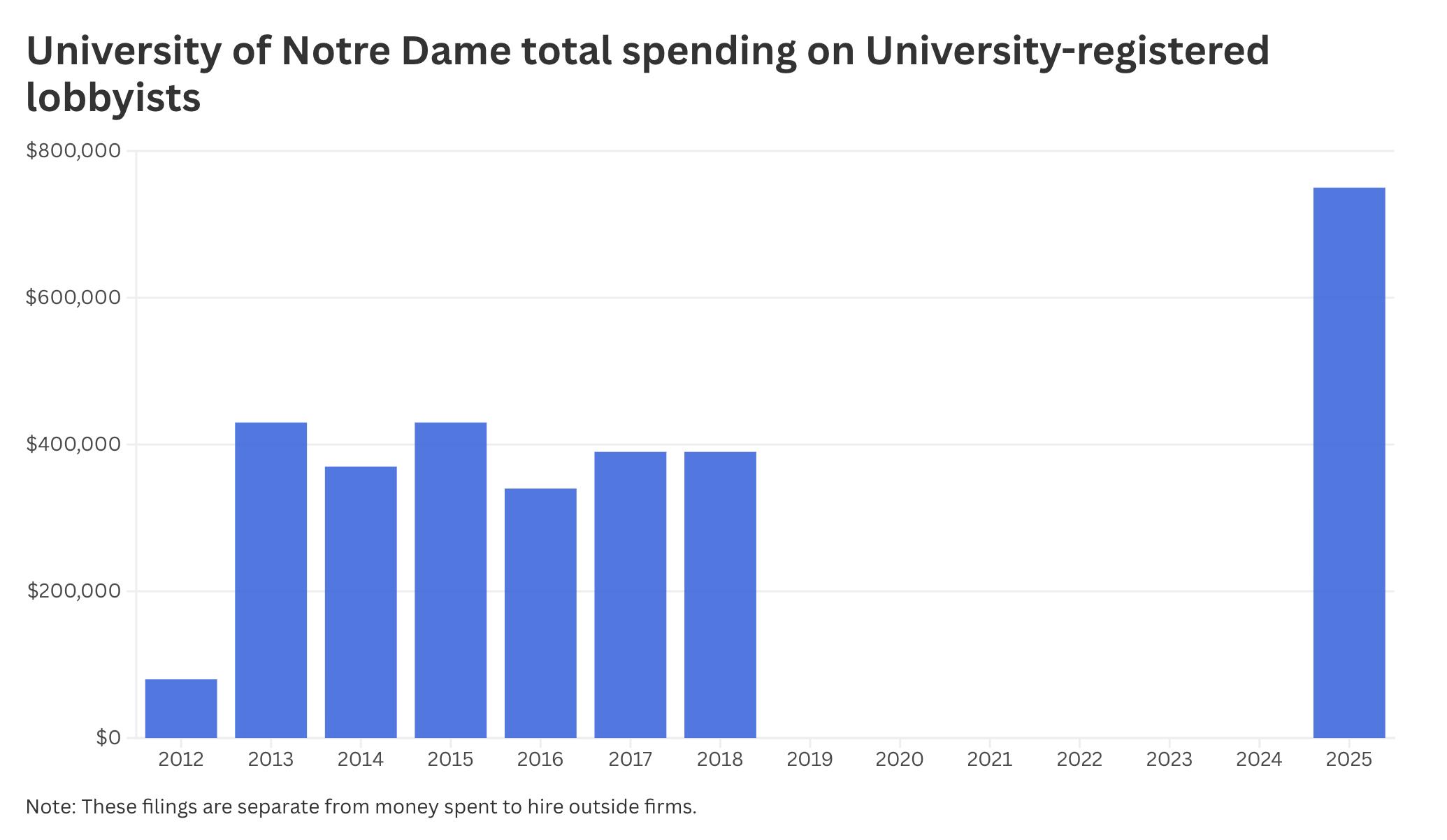
Notre Dame reported spending $750,000 on their registered lobbyists in 2025, with the University expressing it’s intentions to carry out its purpose as a force for good through engagement in Washington.
American Association of Colleges and Universities for expenditures on university-registered lobbyists.
Notre Dame reported spending $750,000 on its lobbyists in 2025. The University of California system topped the list, spending $2,775,000, followed by the University of Washington with
$1,341,000, the University of Florida with $1,334,000 and the University of Pennsylvania with $1,320,000. Indiana University came in fifth with $1,314,000.
These disclosures reveal that Notre Dame’s lobbying efforts have focused on a wide range of issues pertaining to research, athletics and
Junior Parents Weekend centers on hope, community
By Mara Hall News Writer
With hundreds of parents arriving to campus on Friday for Junior Parents Weekend at the University of Notre Dame, the Class of 2027 was able to participate in Mass and the president’s dinner afterwards, with other events and workshops that ran all weekend long.
Class of 2027 Mass Mass, held in the Purcell Pavilion of the Joyce Center, featured many priests from across campus, with University President Fr. Robert Dowd presiding and Fr. Ed Dolphin, rector of Dillion Hall, giving the homily. Other rectors, the Magnificat Choir, folk choir and a string quartet were also present for the event.
Dolphin’s homily, which used an allusion of the Bible’s bookends on God’s salvation, centered on love. He connected this to the ways in
NEWS | PAGE 3
Holy Cross brother
Br. James Kozak, chaplain for the Holy Cross soccer teams, passed away at 82 on Jan. 20.
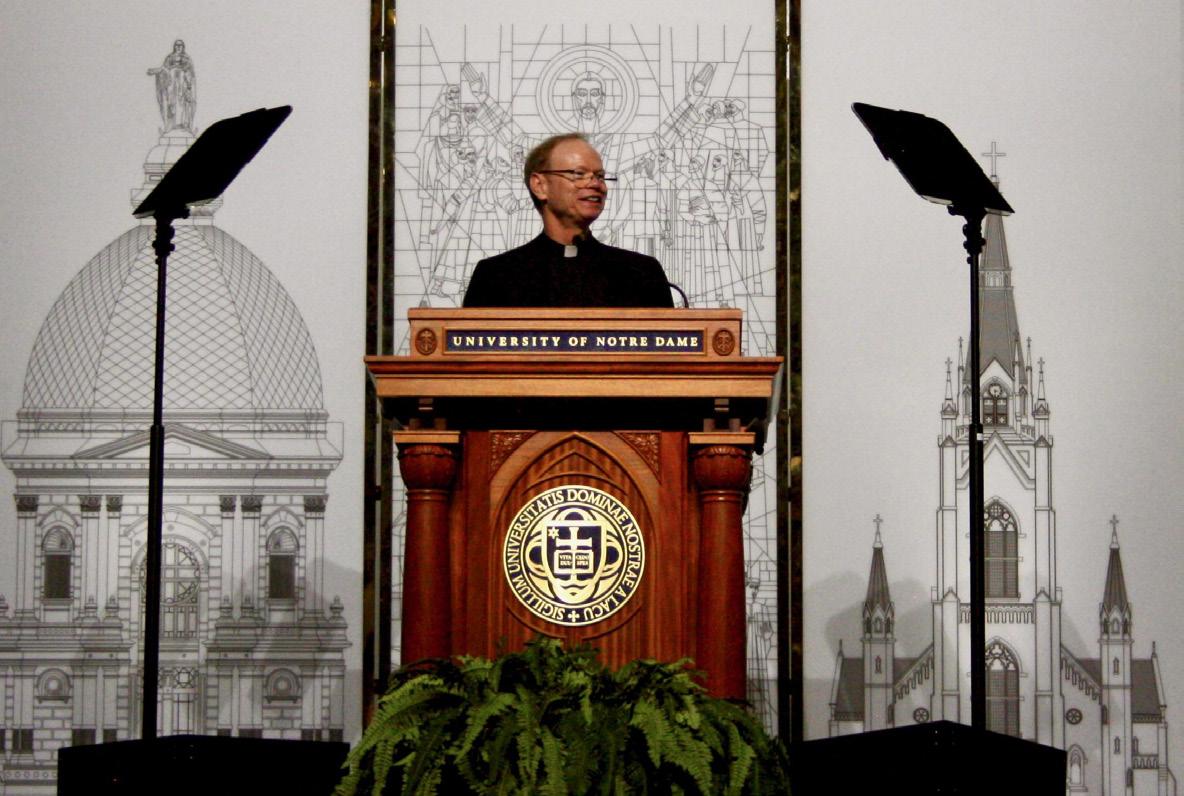
University President Fr. Robert Dowd giving an address to the Class of 2027 students and their families during Junior Parents Weekend.
which families build the foundation and how Notre Dame adds onto that framework.
“Juniors, you have accumulated two and a half years of wisdom, knowledge and life experience here on campus … You did not come to
OPINION | PAGE 6 Against isolation
Columnist Sienna Stephens argues for more meaningful social interaction on campus.
campus empty-handed,” Dolphin said. “You brought the lessons from your parents, grandparents, the sacrifice of your family members, the guidance of your teachers and
see “Parents” on page 4
SCENE | PAGE 7
Prediction markets
Should we be worried about a culture that gambles on everything?
Government Affairs. In 2025, Notre Dame decreased its spending at both firms, spending $240,000 and $140,000 at each firm, respectively.
The University also maintains membership in a variety of organizations which advocate for higher education in Washington as part of their work, including the AAU and the American Council on Education.
Notre Dame in Washington
Notre Dame’s office in Washington enhances, “the national and international visibility of our community’s vision, mission and priorities,” per the office’s website. Lobbying is just one facet of the work done by the office’s staff. The office serves to connect Washington with the University, bringing the University’s voice and research to D.C. while also holding public facing events.
immigration, among others. Notre Dame also hires outside firms to advocate on its behalf and reports this spending separate from their own lobbyists.
In 2024, Notre Dame spent $320,000 on services from BGR Government Affairs and $220,000 on services from Cornerstone
Notre Dame Magazine recently reported that Notre Dame’s leadership frequents the office to make the University more present in Washington, with University President Fr. Robert Dowd meeting with over 70 U.S.
see “Lobbying” on page 3
Students plan Ostermann protest
By Observer News Staff
On Friday at 7:30 p.m., student leaders from Catholic and conservative groups across campus will host “March on the Dome,” a protest in response to the appointment of Susan Ostermann to lead the Liu Institute for Asia and Asian Studies.
Ostermann’s appointment has sparked criticism from Notre Dame Right to Life, Bishop Kevin Rhoades of Fort Wayne-South Bend and other groups on campus over op-eds she has written in the past in favor of abortion rights. Two professors cut ties with the Institute following her appointment.
The University has maintained its support for Ostermann amidst the criticism.
SPORTS | PAGE 8
Irish in the Olympics
A look into two Irish alumni competing and coaching in the 2026 Olympic Games in Milan.
“Professor Susan Ostermann was appointed director of the Liu Institute for her expertise in Asian studies, particularly her research on regulatory compliance in areas such as conservation, education, and child labor. She has stated clearly that she respects the University’s position on the sanctity of life, and that as director, she understands her role is to support the diverse research of the Institute’s scholars and students, not advance a personal political agenda,” a University spokesperson wrote.
A tweet from the Sycamore Trust served as the news release for the protest, reading, “The demonstration, ‘March on the Dome,’ calls on the Dowd administration
see “Protest” on page 3
SPORTS | PAGE 10
Men’s basketball
Irish ready for challenging upcoming battle against No.1 Duke Blue Devils.
MARA HALL | The Observer
What is your favorite Observer department??
Valentina Morillas Senior Lewis Hall “Opinion.”
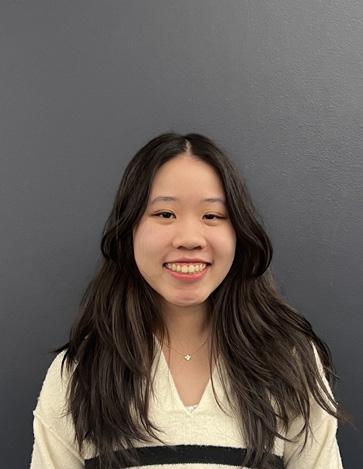
Nicole Lee Freshman Walsh Hall “Graphics.”
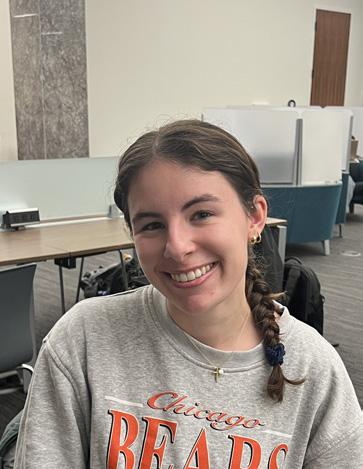
Natalie Starmann Junior Breen-Phillips Hall “Graphics.”
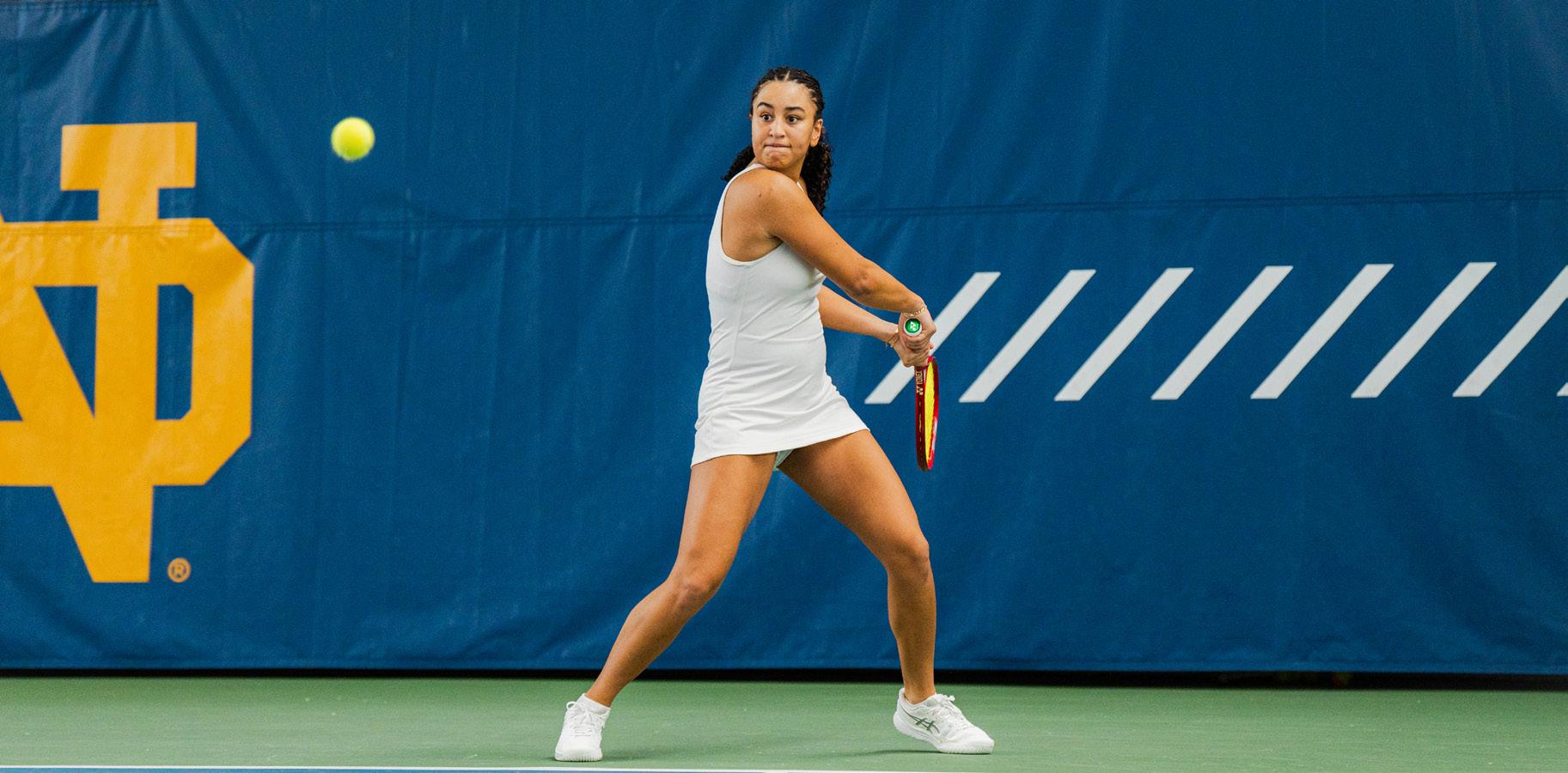

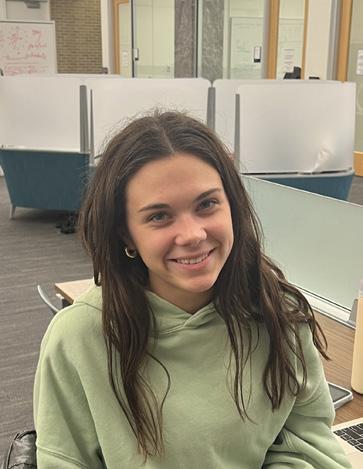
Lilah Robinson Freshman Ryan Hall “News.”
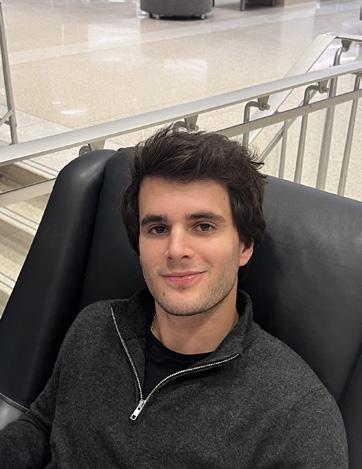
Franco Garcia-Morillo Junior Sorin College “ Sports.”
Tuesday
Bengal Bouts Semifinals
The second round of the 96th annual Bengal Bouts.
7 p.m. Dahnke Ballroom in Duncan Student Center
Wednesday
“School of Rock” (2003) Jack Black rocks out as supposed substitute music teacher. 7:30 p.m.
Browning Cinema in DeBartolo Peforming Arts Center
Thrusday
Women’s basketball vs. Syracuse
The Fighting Irish take on the Orange at home.
7 p.m. Purcell Pavillion
Friday
Swan Lake at Saint Mary’s The Gran Kyiv Ballet perform a beloved classic. 7 p.m. O’Laughlin Auditorium
Saturday
Notre Dame Hockey vs. Penn Irish wear green for senior night against the Quakers. 6 p.m. Compton Family Ice Arena
PHOTO OF THE DAY | CREDIT
Protest
Continued from page 1
to rescind the appointment and urges University President Father Robert Dowd, CSC, to exercise his authority to enforce Notre Dame’s Catholic mission.”
The Sycamore Trust is a coalition of alumni and friends of the University who describe their mission as advocating to maintain the Catholic character of the University.
Lobbying
Continued from page 1 representatives and senators just last year.
Vice president of public affairs and communications Pedro Ribeiro explained that only two out of the eight people on staff at the office are registered lobbyists and they dedicate less than 20% of their time to lobbying.
Under the federal Lobbying Disclosure Act, individuals must be registered as lobbyists if they lobby for more than one issue and spend more than 20% of their time on lobbying activities. Under the LDA, time spent lobbying entails direct communication with elected officials as well as the time spent researching and preparing for these conversations.
John Sturm, a former Notre Dame lobbyist from 2012 to 2019, was the first lobbyist hired and registered on behalf of the University. He shared in an interview with The Observer that his hiring marked a decision by the University to be more involved in Washington.
Ribeiro explained the reasoning behind the University’s decision to have two registered lobbyists on staff.
“This decision was made to ensure transparency in our efforts, formally signal our commitment to issues shaping the evolving higher education landscape, and decisively add Notre Dame’s voice to policy conversations that influence ongoing regulation and future decisions, ultimately determining the scope and quality of higher education for generations to come,” Ribeiro wrote.
He explained that the University sees engagement in Washington as “a moral and institutional obligation” in line with the University’s mission to be a force for good.
“The political landscape requires direct, professional participation in the legislative and regulatory processes that profoundly affect our students, our research, and the future of higher education in the United States and abroad,” Ribeiro wrote.
He clarified how the University approaches this engagement in Washington, writing, “Our primary engagement in Washington centers on cultivating enduring bipartisan
The march is set to begin at main circle before proceeding to a stage on South Quad.
“The Bishop did not urge us to sit silently and watch our Lady’s University fall before our eyes; he gave us a clear call to action,” Luke Woodyard, one of the co-organizers of the march, said in the news release. Woodyard is the director of operations for Notre Dame Right to Life and the politics editor at the Irish Rover.
In a statement to The Observer, Woodyard wrote that the protest had been approved
relationships to proactively share the distinct expertise of our faculty, the intellectual tradition of the Catholic Church, and the practical needs of our students, faculty, and staff. This thoughtful and professional presence ensures that the Catholic intellectual tradition—a vital source of profound wisdom on justice, ethics, and human development—is a consistent and persuasive voice in the complex conversations that shape our nation’s future.”
According to Ribeiro, the University’s top priorities in Washington are to:
• “Sustain Student Access and Success: Ensure robust financial aid and equitable access to education for all students, especially the vulnerable and underserved.”
• “Advance Research and Discovery: Champion federal funding that supports fundamental scientific inquiry and humanities research, guided by an ethical framework that respects life and human flourishing.”
• “Protect Religious Liberty: Uphold the constitutional freedoms necessary for faith-based institutions to maintain their identity and contribute uniquely to the pluralistic American system of higher education.”
These priorities are currently carried out by Crystal Martinez and Allessandra S. Nepola, who both registered as lobbyists in 2025. Martinez previously worked for Democratic senators including Dianne Feinstein, Tom Udall and Barack Obama, and Nepola has previously worked for Republican politicians including senator Mitch McConnell and representative James Comer. Under the disclosure detailing their registration, specific issue areas for general lobbying included budget/appropriations, education and taxation/internal revenue code.
Inside Notre Dame’s spending
The University’s spending in 2025 on individual lobbyists marked a shift from years prior. The University did not register individual lobbyists from 2018 to 2025 apart from Laura McAleer in 2019, who lobbied on the National Defense Authorization Act. McAleer works at the Washington office as the associate vice president
by the Student Activities Office (SAO), which granted the event an exemption from the University’s 15-minute rule for protests by designating it an SAO event.
SAO did not immediately respond to a request for comment.
“The University of Notre Dame remains steadfast in its unwavering commitment to the inherent dignity of the human person and to the sanctity of life at every stage,” a University spokesperson wrote in a statement for The Observer. “We
for federal and Washington relations.
During those years without registered lobbyists, the University maintained its hiring of outside K Street firms, specifically Van Scoyoc Associates, Cornerstone Government Affairs and BGR Government Affairs.
Prior to the $750,000 the University spent on its own lobbyists in 2025, the University spent $390,000 in both 2017 and 2018 and $340,000 in 2016. Spending in 2015 totaled $430,000.
Lobbying disclosures are filed on a quarterly basis, with the specific issues listed under the total amount of the lobbying activity for the given quarter. In the third quarter of 2012, Notre Dame spent $20,000 on lobbying for the reauthorization of the Higher Education Act, to monitor higher education related issues, the reauthorization of the Elementary and Secondary Education Act and tax reform for charitable deduction issues. Typically, each quarterly lobbying disclosure contains at least ten issues that are being lobbied for.
Sturm described working closely with the University’s research department, the University’s financial offices and athletics, as well as close work with administrators. Other specifics of his lobbying included defense research, student aid, education and the endowment tax.
Notre Dame has lobbied on issues related to defense in 2013, 2016, 2017, 2018 and 2025. One of the bills Notre Dame has repeatedly lobbied for is the H.R. 4016 Department of Defense Appropriations Act. This bill provides appropriations to the Department of Defense (DOD) for military activities including but not limited to military personnel, operation and maintenance and the Defense Health Program.
The University has consistently lobbied for the Departments of Labor, Health and Human Services and Education, as well as the Related Agencies Appropriations Act, which primarily focuses on student aid and student athlete labor related issues. Notre Dame explicitly lobbied for these issues in 2013, 2014, 2015 and 2025.
The Higher Education Act (HEA) was consistently present
respect the perspectives of our students and their desire to be heard; this event is an example of the vibrant and deeply engaged community that makes Notre Dame a special place.”
The march’s other co-organizer, Gabe Ortner, said that the appointment was “the last straw in a long series of University actions counter to Notre Dame’s Catholic identity.” Ortner is the chancellor of the Knights of Columbus.
The two organized the protest alongside the Knights of
in the disclosures until the second quarter of 2016. The HEA is supposed to be reauthorized every 5 years, but it has not been reauthorized by Congress since 2008. The federal law is intended to strengthen the educational resources of colleges and universities and also provide financial aid assistance. While Congress continues to fund the programs under the HEA, the nearly 20 year reauthorization delay makes the legislation outdated as significant changes — such as increasing tuition and changes to federal student aid programs — continue to shift the landscape of higher education.
Title IX resides under the HEA, prohibiting sex-based discrimination in any educational program or activity that is federally funded. Notre Dame has consistently lobbied for the Campus Accountability and Safety Act, which seeks to expand upon Title IX to implement various mechanisms to address sexual assault on college campuses, including but not limited to increased campus support services for student survivors, survey transparency requirements and enforceable penalties.
Since 2015, Notre Dame has lobbied against an endowment tax 13 times, with the most recent disclosure report testifying to this in January, 2026. Sturm affirmed this finding, explaining that the University has long been lobbying on issues related to the endowment tax.
Notre Dame advocated for the inclusion of an exemption for religious institutions from the recent endowment tax hike. This exemption passed the House of Representatives; however, the Senate’s version of the bill, which it passed on July 1, removed the religious exemption to comply with the Senate parliamentarian’s ruling that it could not be included in the bill. However, it set more modest endowment tax increases than those included in the House’s version. Notre Dame Magazine reported that the University is continuing to advocate for a religious exemption.
At the time, a University spokesperson told The Observer, “We are deeply disappointed by the removal of language protecting religious institutions of higher education from the endowment tax before passage of the final bill. The Constitution
Columbus Council 1477, The Irish Rover, Notre Dame Right to Life, Students for ChildOriented Policy, Militia of the Immaculata and Children of Mary.
Woodyard and Ortner will address the crowd alongside Lucy Spence, editor in chief of The Irish Rover, Anna Kelley, the president of Notre Dame Right to Life, Theo Austin, president emeritus of SCOP and Fr. Bill Miscamble, who has called for the rescinding of Ostermann’s appointment.
guarantees freedom of religion, and Congress and the courts have historically protected and even expanded that freedom — to the substantial benefit of society. Any expansion of the endowment tax threatens to undermine the ability of a broad range of faith-based institutions to serve their religious purpose. We are proud to have stood with a coalition of these institutions against that threat, and we are encouraged by the strong support for a religious exemption received from both chambers. We believe that faith-based colleges and universities occupy an important and distinctive place in the landscape of U.S. higher education directly connected to their religious nature.”
Sturm reflected on his work on the endowment tax and expressed disappointment in the raise of the rate.
“The initial iteration of the endowment tax was an unfortunate loss for the … 30 universities who got caught up in it. Without going into great depth, at the time that came into effect in the original Trump tax bill, which was inaptly named the TCJA [Tax Cuts and Jobs Act] … carried the initial 1.4% endowment tax,” Sturm said. “It ended up [taking effect at] 30 universities. And I will tell you, and there’s no secret about this, this was a bunch of Republican congressmen who wanted to stick their fingers in the eyes of every Ivy League school. That’s what the object was, the Ivies, or the ones that look like Ivies and Notre Dame got caught in that crossfire.”
The total value of Notre Dame’s endowment is $20.072 billion, according to the 2025 Annual Report. This makes the University’s endowment the 9th largest in the nation.
“[I]t’s going to be around for a long period of time, is the endowment tax. One way or another, once the federal government gets in your pocket, they never leave. I can guarantee you,” Sturm said.
Reflecting on his work as a lobbyist, Sturm said, “It’s absolutely essential for a firstclass university, like Notre Dame, to be part of having a seat at the table.”
Contact Sophie Hanawalt at shanawal@nd.edu and Grace Sullivan at gsulli22@nd.edu
Br. James Kozak passes away at Holy Cross
By Observer News Staff
Br. James Kozak ‘64, who resided in Columba Hall at the University of Notre Dame, passed away at age 82 on Jan. 20 at Holy Cross College. He served as a chaplain for the men’s and women’s soccer teams, a capstone evaluator and an assistant rector in Pulte Hall.
Following his studies at Notre Dame as an undergraduate majoring in English, he pursued a master’s degree in pastoral studies at Loyola University. From 1965 to 1977, he taught in schools abroad and within the United States, such as Sacred Heart Military Academy in Watertown, Wis., St. Patrick High School in Monrovia, Liberia and St. John’s School in Sekondi-Takoradi, Ghana. He previously was a youth
Parents
Continued from page 1
mentors, because long before Notre Dame ever had the chance to for you, they did. Their love example has laid the foundation on which everything else here has been built.”
President’s Dinner
Following Mass, families ventured to the North Dome for the president’s dinner, which featured speeches from junior class president Aleah Applin, JPW co-chairs Ethan Chiang and Passion Hood and Dowd. Junior Joshua Johnson, the president’s dinner chair, introduced each of the speakers.
He opened by reminding parents of the Welcome Mass two years ago, when Fr. Pete McCormick told parents to “Go home and entrust your children to the care of Our Lady’s University.” But now, Johnson reflected, they invite them back two and a half years later to witness the home they have built.
Applin acknowledged the difficulty of speaking to such a diverse range of families before sharing her “Why Notre Dame” story, emphasizing the role her parents played in getting her to apply to Notre Dame.
“While God led me to Notre Dame, I would not have made this decision, let alone apply, if it were not for my parents’ belief, encouragement and support,” Applin said.
In his speech, Chiang noted the opportune timing of JPW, allowing students to recognize how far they’ve come and how much they have to look forward to.
“By now, the frantic energy of freshman year has long faded, but the looming finality of senior year has not quite taken hold. We are no longer using Google maps to find our classes, but we have not yet gotten to our lasts like our last home game or our last visit to the Grotto,” Chiang said.
Dowd then spoke on the ways he learns new things about this University every day, despite being a part of the community for a long time.
Making a joke about loving all the
minister at St. Martin’s Parish in Chicago, a diocesan chaplain for the youth and later, the executive director of the diocesan health committee in Sunyani, Ghana. Kozak also worked as the director of formation in the former district of West Africa.
After his service as a pastoral associate at St. Felicitas Catholic Church, he became a program associate for Life Directions. He worked at the Boysville of Michigan boarding school from 1995 to 2005 and then taught at Archbishop Hoban High School in Akron, Ohio. Most recently, he worked at different campus functions and departments within Holy Cross.
He was also part of the Forever Learning Institute, a nonprofit in the South Bend community dedicated to fostering lifelong learning among students aged 50 and
residence halls equally, the video cut to a photo of him in a Cavanaugh Hall sweatshirt. He went on to say that there is a place in his heart for all of the residence halls he has been a part of: Grace Hall as a student, Flanner Hall as an Assistant Rector and a priest-in-residence at Dillon Hall, St. Edward’s Hall, and now Cavanaugh Hall.
Using baseball rivalry as a bridge to Pope Leo XIV, he thanked the Holy Father “for all that he does to lead the church and inspire all of us.”
After a nod to the ice chapel, Dowd went on to share a video of him trying to find the comfort K9s on campus, Órla and Finn. From asking a squirrel to trekking around campus from Main Building to North Dining Hall and Hammes Mowbray Hall, he eventually found them in his office.
He connected this experience to the lesson of making life bigger than just oneself, which he said he learned throughout this time as a part of the Notre Dame community
older.
Kozak’s death came unexpectedly when he was in Pulte Hall. Students at Holy Cross were immediately notified of the passing that same day with an email from College president Marco Clark to the student body.
“Brother Jim was a beloved member of our Holy Cross family, and his presence on campus was a gift. Many of us will remember his ever-present smile, his gentle spirit, and the quiet way he made others feel seen, supported, and loved,” the email read.
According to sophomore Kiko Medrano IV, who lived in Pulte Hall last year, the late assistant rector was easy-going and made himself available to students. He explained his reaction to the email that was sent by the College.
“I found out more details through
and hopes Notre Dame is inspiring juniors to realize as well.
“Take it from someone whose college graduation was many years ago. As you age, you come to realize how blessed you are by the people in your lives who have taught you by their example, the value of moving beyond your comfort zone in service of others,” Dowd said. “In one way or another, we are all called to move beyond our comfort zones. Doing so is the only way we grow intellectually, socially and spiritually.”
He closed by reflecting that the students have already grown a lot since their time arriving at Notre Dame, and that this weekend offers a chance for expressions of gratitude and love for the ways families have supported them throughout this journey.
Institute for Social Concerns Lecture
The Institute for Social Concerns hosted New York Times bestselling author Ayana Mathis for a lecture
the current RA of Pulte about what happened,” he said. “I live off campus now [but] hearing that, it’s definitely kind of heartbreaking.”
Freshman Andrew Koshakji, a forward on the men’s soccer team, said that the team noticed that Kozak was absent from practice one day.
“He didn’t show up for practice, so we went and investigated his room, and one of the RAs found him, unfortunately,” he stated. “Obviously difficult, he was our chaplain [and] said a chaplet before every game. We grew close to him [and] kind of saw him as like a father or grandpa figure.”
Freshman Sebastian Douglas, a resident of Pulte Hall, mentioned that the visitation helped the community recognize the presence
on her book, “The Twelve Tribes of Hattie” on Friday evening.
Mathis provided reflections on hope, where she explored the concept to be deeper than what it is normally portrayed as.
“The version of hope that we most frequently encounter, which is something like upbeat optimism, does not quite seem to cut it. This version of hope is a little bit hollow, a little bit facile, not merely capacious or robust enough to meet the moment’s trials and demands,” Mathis explained.
In reconsidering the meaning of hope, she turned to her own books. The specific problems she raises with hope show it is synonymous with optimism and focused on the future, rather than based on present action.
“Hope then needs to do something, it needs to address not just anticipation of the future, but the moment in which we live now. Hope needs to separate itself from the relentless positive that belies the


and impact that Kozak had in their lives. He added that it provided a moment of solace and peace for his passing.
“The stories that we were able to tell with each other, I feel, definitely hit us hard with a sense of calming. Brother James was an amazing guy and we were able to cherish the moments that we weren’t present for, but just hearing them just was impactful,” he reflected. “I think that was definitely one of the most impactful moments, getting together as a community in the chapel and being able to speak freely about him, about all the good things that we remember about him.”
A visitation and funeral Mass were held at St. Joseph Chapel at Holy Cross on Jan. 30. Kozak is buried at St. Joseph Cemetery of Holy Cross Village.
crises of the moment,” she claimed. “Hope needs to uncouple from certainty that the things hoped for will actually happen … Hope needs to embrace uncertainty, which is also where imagination lives. Hope without imagination is just a platitude.”
Grappling with this notion and pulling from the work of civil rights activist James Baldwin and other theologians, she reached the conclusion that hope is necessary towards being alive. From this understanding, she offered that relationships are seen as precious “because they are fleeting.” Connecting it back to JPW, Mathis closed by explaining that families cannot know where their student will end up, but can hope for their future to persist.
This is an abbreviated version of this story. The full version can be read online at ndsmcobserver.com.
Contact Mara Hall at mhall@nd.edu
Apprenticeships in Virtue-Rooted Leadership
This program will help you grasp the fundamentals of good leadership and live them well right now. It’s designed to help you gain vision and develop the tools you will need to be a good leader in any arena throughout your life.
Ethics Research Fellowships
Immersive, three-year experiences that include a fully-funded Fall Break trip to England, a $1,300 stipend, research mentorship, and a supportive community that helps you thrive
Off the Dome: Steve Krojniewski
“It’s been a hard road, right? Yeah, [there’s been] a lot of ups and downs.”
“You are here.”
The words hang in the air. I close my eyes as a blanket of quiet settles over the space. All the tension in my shoulders unfurls as the room takes a collective sigh. It’s 5 p.m., and for the first time that day – between the blur of classes and meetings and office hours – I do feel unequivocally, positively here.
It feels great.
That’s the effect of a yoga class taught by Steve Krojniewski – or “Yoga Steve,” if you’re talking to one of his regulars. You can usually find him leading yoga in Studio 4 of the Duncan Smith Center; this is the sanctuary where he provides students and faculty a reprieve from the busyness of campus life.
Krojniewski has changed into normal clothes by the time we sit down for our interview – apparently even yogis have to wear shoes in public. We sip on cups of Hagerty coffee as I try to unlock the secret to his perpetual calm demeanor.
“I’m human too,” he laughs.
By Hannah Alice Simon Columnist, “Eyedentity”
“See me, the blind girl standing tall, not alone. See me and my mother, holding onto each other, rebelling together, our bodies shaking with laughter, our hearts contained in a world of our own making.”
I still remember the dark shape of her, standing between the window and my eyes. I can still feel the nauseating weight of her silent gaze.
I was alone that day, in my mother’s office, taking my 11th grade final online.
My mother’s colleagues walked in and out of the room. I heard their footsteps; most of them introduced themselves with light and hurried smiles.
I continued to sit at a desk, resolutely working on my essay. Perhaps it was when I lifted my head to gather fresh ideas from the ceiling, that I noticed that her shape was blocking the window.
She stood very few inches away from me, unmoving, silent. My eyes, which are perceptive to light and shadow and large objects, made out her shape framed against the window, but told me nothing else. I don’t know why I even continue to believe that it was a woman, but I knew what this unmoving silence was about.
She was testing me. She wanted to know how much the blind girl could actually see. Or she was staring at me, the girl with the monstrous eyes. How am I so sure of this? Because this is not the first time that something
The yogi is likely remembering his late mother, Carol Krojniewski. She was diagnosed with cancer when Steve was just eleven years old, passing away a year later and leaving him with his sisters and dad.
In the aftermath, the young Krojniewski sought refuge where he’d always found it: the St. Joseph River. The banks of the winding river were a regular hangout spot for him and his friends, but drawn to the sound of its running water, Krojniewski increasingly found himself going there alone when he needed an escape.
“I could sit and be still and feel safe. I felt like I had a healing experience there every time I would go,” he explains. Unbeknownst to him, the young Krojniewski was learning a practice that would become central to his future career: how meditation could be a grounding force. But at the same time, another passion was developing – one quite different from meditation.
“Right after my mom passed,
my dad was like, ‘Well, what do you want? What can I get for you?’” he says. Krojniewski’s answer?
A drum set.
Little did I know that most people know him not as “Yoga Steve,” but as “Krojo” the drummer.
Krojniewski’s interest in music stems from years spent in his basement listening to his parents’ records. When his dad agreed to buy him a drum set, he and his neighbor decided to start their own band. “The Mushroomhead Experience” began to put on concerts in the living room whenever his neighbor’s parents left for the weekend.
It wasn’t uncommon for hundreds of locals from their school – from the baseball team to the theatre kids – to show up. People would spill into the backyard as Krojniewski’s dad sat right across the street, supporting from a distance.
“It was a way of bringing people together who wouldn’t normally hang out. We [were] always trying to create this safe space, right? How can you bring all
those people together, have everybody get along, and get to understand each other?”
Today, Krojniewski proves that yoga and drumming aren’t so different, after all. As the lead yoga sports coach at Notre Dame for 20 years now, Krojniewski has brought yoga to nearly every corner of campus – from the football team to trauma survivors at St. Liam’s – while still finding time to create original music for rock lovers.
At the heart of both passions is getting to share what saved his own life. For Krojniewski, yoga and drumming weren’t just hobbies; they were survival mechanisms during years of depression, clinical diagnoses and emotional instability.
In an era when national studies report a mental health crisis on college campuses and Notre Dame’s Wellness Center tackles record demand, Krojniewski offers something rare: not a productivity hack or a downloaded wellness app, but the quiet work of showing up to practice. Practicing how to ground yourself, day after day, even when everything else feels unmoored.
Another kind of rebellion
like this has happened to me. The first time is so far back that I can’t even remember it. What I remember are fingers held up two inches from my eyes, dancing shadows with waving hands. What I remember is my parents telling me about people who stood still and simply stared. What I remember is the children vocalizing their stares into screams of terror.
These memories clog my throat as I sit in the lonely silence of that room, the woman still looming over me, staring, willing my eyes to respond. The angry part of me wants to slam my fist down and say, “What do you think you are doing!” But the other part of me, the part that cannot even trust my eyes, the biggest part of me that just feels numb, wants me to become invisible. So I choose the middle-ground. I school my face into a mask of rigidity. I keep my stare blank. I pretend that the looming shape does not exist, that it’s just me in that silent room filled with the light from the windows. She continues standing for a few moments, then finally leaves.
When women got tired of constantly feeling burdened by the invasive eyes of men, they coined the word “male gaze.” And in doing so, they made the act visible, bringing attention to the disgust and anger that it had avoided until then.
If there is such a thing as a “male gaze,” what am I the victim of? An “ableist gaze”? Is there even such a thing? I don’t know if there is, but I certainly feel it, even in its absence.
The idea that I am a strange object that draws attention is something I internalized as a child. As a little girl, I would walk into a crowd, and just know that people were staring at me. Perhaps my knowledge was just assumptions, but tell that to a six-year-old who had felt the pressing weight of real eyes so many times that she could no longer separate the real from the unreal. Even now, on my worst emotional days, when I am most vulnerable, I feel the invisible weight of a thousand stares. In those moments, I just want to close my eyes tight, as though the act of shutting out the world will magically make me disappear.
But growing up has taught me that I cannot afford to be silent. Fighting for myself is a necessity that I must embody to survive, to make myself heard in this world. But what must I do when rebellion feels like the hardest, most impossible thing?
I do have a few memories of the times I rebelled. But they give me no sense of triumph, not even a sense of quiet steady peace. Almost every time I spoke up against someone who invaded my privacy, I was met with explanations, justifications and sometimes even anger because I dared to feel hurt when they were simply being “friendly” or “curious,” when they “just wanted to know more about me.” If rebellions are about taking back power, why do I feel so drained at the end? Why do they get to walk away without even an apology, leaving me with
Creating spaces for people to do this has become his life’s mission: “When I come here, it’s not about me anymore. I walk into that classroom [or stage] and it’s: how do I serve you?” It’s the only way, he believes, people can connect with their most authentic selves and inspire others to do the same. “I want to teach people to be original. Because if you’re thriving … then whoever you show up for is going to thrive.” Young Krojniewski couldn’t have predicted how the St. Joseph River would launch a career where he’d touch so many lives. But perhaps that’s the point: Healing is rarely a linear process. For Steve, it started as survival, became practice and –through his own commitment –transformed into service. A ripple effect that my mind, muscles and ears alike are grateful for.
The views expressed in this column are those of the author and not necessarily those of The Observer.
Contact Allison Elshoff at aelshoff@nd.edu
irrational guilt, because what if I was overreacting? What if I made them uncomfortable?
All these times I spoke up, I felt so alone. The people around me went on laughing and talking, as pain flared from my body in waves. My open wounds were so invisible to them that it made me wonder if all that I felt was nothing. Why does no one tell you that rebellion is often a desolate thing?
There isn’t going to be an end to this story, to these violent stares of apparent curiosity.
And I really don’t know if there will ever be a time when rebellion will feel easy. Perhaps this time will indeed come. I am only 22, after all.
But what do I hold onto for strength in the meantime?
Perhaps this memory?
Amma and I stand on the escalator together. “Hannah, there’s a man who has been staring at you for a while now,” she says.
Both of us know that he is not staring at my girl-woman’s body, but at the strangeness of my blind eyes. Looking at the surprising, even shocking presence of my disabled body in a crowded shopping mall full of non-disabled people.
I feel anger flood my body in waves. Beside me, I feel my mother radiate red heat.
“I want to do something!” I declare, buoyed by our shared rage.
We turn toward each other like conspirators.
“I want to stare back at him!” I say.
“OK! Hannah, he’s right
behind you. On the count of three, turn back and give him the hardest, angriest stare you’ve got! One, two.”
“Wait, wait! I’m not ready. I want to practice with you once.”
“OK, show me.” I turn to her with bulging eyeballs, and an intensely wrinkled up forehead. But there is a strange, bubbling lightness to my body that pushes the anger away into small corners.
The silence is shredded by peals of laughter. “Hannah, that is not how you stare angrily at someone!”
I can’t help it. My face crumbles, and my lips twitch upwards. Finally, the anger leaves my body with the lightness of laughter.
Everything is so ridiculous now, the man and his stupid stare. My mother and I float buoyantly. Our laughter makes us feel cool, powerful.
At some point, I remember the strange man, and I think, “See me now, the blind girl, living, taking up so much space, making herself at home where she does not belong. See me, the blind girl standing tall, not alone. See me and my mother, holding onto each other, rebelling together, our bodies shaking with laughter, our hearts contained in a world of our own making.”
The views expressed in this column are those of the author and not necessarily those of The Observer.
Contact Hannah Alice Simon at hsimon2@nd.edu
By Allison Elshoff Columnist, “Off the Dome”
By
As a first-year college student, I am constantly surrounded by people at school. From professors and classmates within the walls of my classrooms, the neighbors who live next door to my dorm room, the club members I see at organization gatherings, the people I pass by on my walks to Notre Dame and the students I meet by chance through social media. Even though I am surrounded by these people, building connections with people who truly want to know the whole you is rare.
I have noticed through most conversations when talking to someone residing within the usual safe boundaries of social interaction, “Where are you from?” “What dormitory do you live in?” “Do you like your major?” While I am not saying the general icebreakers are bad when you are just meeting someone, these safe boundaries often never seem to go deeper.
People know each other’s schedules, names, roles they play, some likes and dislikes, but not how their minds work, how they think, how they see the world, what they feel and what they experience. To me, it seems that people accept the temporary, surface-level information and interaction with another person rather than taking the time to truly know someone for who they are. People give them
Our lack of interest in others
barely any time or chance for them to break down their layers to reveal the roots of their soul, what makes them who they are, before the person turns their head and is off to the next one.
The lack of genuine interest in getting to know others has created a quiet form of dehumanization, where individuals are seen as temporary or replaceable, rather than complex human beings with thoughts, emotions, experiences, inner worlds and a soul that was carefully crafted by the hands of God.
Would anyone really care that I have such a strong passion for art that I spent my winter break making a 3D whale shark out of cardboard? The reason why my favorite movie of all time is Coraline? Why I believe there is a God? Or why do I hold onto my morals so tightly? Was that stuff that people wanted to know about me, or are they satisfied with the person I presented on the outside, without the information that created who I was?
Curiosity is a gift of having the strong desire to learn and understand something or someone; a value that humans lack when getting to know people. Conversations with others, words being exchanged, becoming predictable like something someone could read from a script. Asking how someone is doing, yet not waiting for the true answer or not going deeper when the truth is told. Learning the facts behind someone’s life,
yet not taking the time to learn the meaning behind them. Why do they feel that way? How do they react in that situation? They do not ask what shaped someone into who they are today, what they fear or what they believe in. It is as if knowing the surface of a person is considered enough, when in reality, it is only a small fraction of who they truly are. And sometimes, that small fraction could not even be the truth, just one of the many versions they put on so people will be interested in talking to them. When people stop being curious about others, they stop seeing them as individuals with depth and complexity.
Part of this dehumanization comes from the fact that truly understanding someone requires effort and vulnerability. It requires listening, asking meaningful questions, desiring to go deeper past those safe boundaries and caring about the answers that are presented before them.
It requires patience to see someone as they really are, not just how they appear on the outside. However, many people avoid this effort because it is easier to stay on the surface. It is easier to accept shallow relationships than to risk emotional closeness and the hurt that could come from it. But in choosing what is easy, people lose the opportunity to form real, meaningful human connections.
This lack of deep connection leads to a sense of isolation, even when surrounded by others. A person can be physically present among friends, classmates or coworkers, and still feel unknown. Being seen is not the same as being understood. When no one takes the time to understand how someone thinks or feels, it can make them feel invisible, as if their inner self does not exist to others, that the only acceptable version of themselves is the one who locks away their true selves. This feeling is not caused by being alone, but by being uns een in a deeper, more human way.
I often feel frustrated with this in terms of relationships. In college, it is easy to become a victim of the party scene and hookup culture, and often form relationships where it is more transactional than meaningful. When getting into a relationship, it means you are willing to truly get to know someone for who they are as a person, to connect with them without having the same blood run through your veins.
You learn to love that person, how they carry themselves, their likes and dislikes, what they “nerd out” about, what drives them, what their morals are and what they believe in. You find yourself wanting to know everything about them and desiring them to see you the same way, yet society created the concept of
transactional relationships. The relationships that make people replaceable, getting what they want and then moving on to the next, with no emotions or meaning behind it.
Human beings are complex and beautiful, shaped by their experiences, thoughts, emotions and struggles. Every person has an inner world that deserves to be understood, not ignored. When people take the time to truly listen and understand one another, they restore the humanity that shallow relationships often take away. They show that a person is not replaceable, but unique and valuable.
In a world where shallow connections have become normal, choosing to truly understand someone has become rare. Yet it is one of the most important things a person can do. Taking the time to know someone beyond the surface is what transforms relationships from temporary interactions into meaningful human connections. When people begin to see and understand each other fully, they begin to restore the humanity that has slowly been lost.
The views expressed in this column are those of the author and not necessarily those of The Observer.
Contact Sienna Stephens at sstephens01@saintmarys.edu
Our Constitution is worth fighting for
Much ink has been spilled regarding the current state of political discourse on American college campuses. Having chimed in myself, I acknowledge that adding original insight is likely impossible. However, in light of the Supreme Court’s recent decision to deny the legality of many of President Trump’s tariffs, certain groups on campus appear to have lost their mind.
Full disclosure: I’m a Democrat. I’m a dues-paying member of the College Democrats and would be a card-carrying member of the Kentucky Democratic Party (if we had cards). I understand that the subsequent body of this column will likely be perceived as biased or perhaps symptomatic of my terminal Trump Derangement Syndrome. I say this to show that I have nothing to hide, although I am attempting to write with a spirit of objectivity and honest dialogue.
The Notre Dame College Republicans, the self-proclaimed “largest political group on campus,” have been on a posting spree for the spring
semester. Posting from their official club account on X, the College Republicans have argued with Notre Dame Holy Cross priests about Catholic morality, reposting a graphic claiming that immigration causes the downfall of “everything else” and calling the recent Supreme Court decision “genuinely evil” and “the worst decision since Obergefell.”
Thankfully, however, the College Republicans are “not against the rule of law in principle” and only want President Trump to defy the Court because “he who saves his country violates no law.”
The College Republicans also called Trump appointee Jeremy Carl, who has claimed that George Floyd was “looking up from hell” after being murdered by a Minnesota police officer and called Juneteenth a “race hustling and white-shaming” holiday, a “patriot” who “should be confirmed.” Carl, who published a book with the subtitle “How Anti-White Racism is Tearing America Apart,” is now facing bipartisan opposition to his appointment and will likely be denied by the Senate. Why are the College Republicans dying on the hill of a white
nationalist? Is the so-called “destruction of white culture” the biggest threat to the United States?
College Republicans co-president Shri Thakur authored a letter to The Observer last fall titled “There is no debate left to be had with the far-left.”
Thakur argues that “the marketplace of ideas only works when its participants agree on a common set of principles, rules and boundaries that must be adhered to,” claiming that the far-left has abandoned a commitment to the basic principles that have provided for 250 years of American democracy. Openly urging President Trump to defy the Supreme Court (which he already has stated his intentions to do) is definitionally rejecting the common rules and boundaries of the American Constitution. A follow-up tweet to their call for President Trump to defy his oath of office asserts that “the constitutional order requires a set of assumptions, practices, and norms to properly exist … Those norms are dead.”
When our campus’s largest political group openly rejects the existence of constitutional norms, I must ask: Is there a
debate left to be had with the modern right? I hesitate to call the radical views expressed by the College Republicans as “the far-right,” given that they represent themselves as college representatives of the current governing party in the United States. They are the mainstream right. They are the future party leaders and politicians of the Republican Party.
A rejection of fundamental American ideals of the rule of law, good-faith debate and constitutional checks and balances makes it impossible to come to any agreement or compromise. It’s hard not to feel demoralized or helpless when the youth wing of the country’s majority party openly rejects the Constitution. I urge my Republican colleagues and friends to realize that what is going on is not normal.
Ideals have seeped into mainstream discourse that are fundamentally opposed to American patriotism. America is not a nation founded as a “people.” It’s a nation of ideas. A nation of noble and lofty ideas.
A nation that has unfortunately never lived up to its ideas. But a nation that still tries nonetheless.
Despite what the
largest political group on campus claims, America as we know it is still worth saving. I’m a patriot — call me naive. Claiming that America’s norms and rule of law are dead when your party suffers a loss is not patriotic. Nor are the nativist, racist and conspiratorial claims that the organization seems to support.
I believe that the United States is the greatest country in the world. I love politics, and I love political debate. I’m not asking my Republican colleagues and friends to abandon their good-faith values and conservative principles. Measured disagreement is the backbone of democracy. I merely urge the leadership of the largest political group on campus to ask itself whether it believes more in the fundamental principles of American democracy or the partisan lies and authoritarianism promoted by the Trump administration. To me, the answer is clear.
The views expressed in this column are those of the author and not necessarily those of The Observer.
Contact Grayson Beckham at gbeckham@nd.edu
By Grayson Beckham Columnist, “Citizen Gray”
Sienna Stephens Columnist, “Not Your Average Post”
Prediction markets: The world is now your casino
By Matt Norton Scene Writer
Gambling is pretty fun. For people who like watching sports and tracking statistics, sports betting can be a low-stakes way to monetize their knowledge and be a little more invested in a game than usual. Poker and blackjack can be fun games to learn and play with friends in a casual environment. As long as you recognize your limits, you can have a good time. The key is moderation.
But what would happen if you took the brakes off and started gambling on literally everything from the palm of your hand on an app linked to your checking account? That’s basically what a prediction market website is, and if you’re a college student under 21, you’re probably intimately familiar with websites like Kalshi and Polymarket.
Prediction market apps hold a unique place in today’s culture. Are they betting apps, or are they just investment platforms? After all, isn’t trading on the stock market a form of betting on real-life outcomes through their effect on a stock’s price? The definitions are murky, and regulation on these platforms is slow.
Regardless of whether or not they’re actually just glorified betting apps, the main selling point of these websites is that they can

be used by people under the age of 21, unlike traditional sports bet ting apps. Thus, college students have flocked to them as easy-toaccess digital outlets for their gambling needs.
The crux of the issue these apps cause can best be described through a short anecdote. As of Feb. 22, if you go on the Polymarket website and navigate to the market “What will happen before Grand Theft Auto VI?” You’ll find around a dozen propositions like “China invades Taiwan” and “New Rihanna Album” that you can wager on occurring or not before the
game “Grand Theft Auto VI.” But the most valuable proposition within this market would probably be “Jesus Christ returns,” which currently sits at 49% happening, 52% not happening before GTA VI. As of right now, you can bet that the Son of God will not return before GTA VI drops, and you’ll nearly double your money, supposing that Jesus doesn’t come back before then. It’s free money — just ignore the potential theological ramifications of betting on the timing of the Second Coming.
The point is, many bets like this exist on these prediction market sites: They seem certain to the point of being rationalized as investments, and that’s where people get burned. Unlike most opportunities in the stock market, prediction markets are by definition a zero-sum game. Your position is either correct, or it isn’t. You can cash out at any time, but people will often ride out their position until it reaches 100% or 0% certainty. It’s enticing, to say the least, especially for a college student. Only one of your incredibly unlikely bets on
“What will Boeing mention during their earnings call?” or “What will be 7th on Netflix’s top shows this week?” needs to hit to potentially multiply your money 100 times and cover expenses for the semester. A $5 bet here and there won’t hurt, but those can add up quickly and leave your bank account drained.
I think most of us will agree that it is common sense that young college students probably shouldn’t be given unmoderated access to websites that enable them to excessively bet their savings on pop culture events and political outcomes. But the problem goes far beyond Notre Dame’s campus. There is an ethical question here: should these sites really exist? They allow betting on military actions, geopolitical tensions and other real-life events with real consequences. Could insiders in world governments be tempted to shift real events with real consequences for millions of people towards their own financial favor? Only time will tell, so if you truly enjoy the ability to bet on anything in the world from your phone, I guess I’d tell you to make hay while the sun shines before the Federal Trade Commission changes their minds regarding regulation.
Contact Matt Norton at mnorton3@nd.edu
U2 returns with vigor on ‘Days of Ash’
By Luke Foley Scene Editor
U2 is obsessed with America; the country is a frequent inspiration for many of their songs and even entire albums (“Rattle and Hum” is essentially them awkwardly role-playing as American blues artists). They’re fascinated by the promise of America, a land of liberty, creativity and hope — things that their homeland of Ireland struggled with during the peak of The Troubles. And U2 is also obsessed with politics. Much of the scorn directed toward the band over the years has focused on their activism, or, more specifically, Bono’s tendency to pontificate about world issues. For example, during their Zoo TV Tour in the ‘90s, they would interrupt their boisterous shows for live satellite transmissions from people in war-torn Sarajevo, shaming the audience for indulging in hedonistic thrills while so many in the world were suffering. One night, a group of Sarajevan women told Bono and the entire stadium, “We know you’re not going to do anything for us. You’re going to go back to a rock show. You’re going to forget that we even exist. And we’re all going to die.” Once the call ended, Bono turned to the stunned stadium and said, “Tonight, we should all be ashamed to be

European.” I’m sure that really set the mood for the rest of the show.
Knowing these two eternal truths about U2, it’s no surprise that they’re upset about what’s happening in our world today and want to speak their mind about it. Enter “Days of Ash,” the newest EP from the band that shadow dropped Wednesday. In a press release, Bono said, “The songs on ‘Days of Ash’ are very different in mood and theme to the ones we’re going to put on our album later in the year. These EP tracks couldn’t wait; these songs were impatient to be out in the world. They are songs of defiance
and dismay.” U2 usually tortures themselves about releasing new music, constantly tinkering and questioning every move, so the fact that they rushed to get these new songs out says a lot about their confidence.
The politically charged EP kicks off with the bluntly titled “American Obituary.” Following in the footsteps of Bruce Springsteen, it’s a protest song about Operation Metro Surge in Minneapolis and the killing of Renée Good. The uproarious song kicks off with The Edge ripping a sick guitar riff and Adam Clayton laying down a bouncy bass line. The lyrics are
BEN SMITH | The Observer
incredibly on the nose and frequently clichéd, but it works. The sing-along chant at the end also lands well. But the thing that really stood out to me on this song was the energy; U2 sounds invigorated and hungry. The next song, “The Tears of Things,” is much more cerebral. Sung from the perspective of Michelangelo’s David, the song is hauntingly beautiful and builds to a classically grand U2 ending. It also has a fantastic guitar solo from The Edge that wails with unresolved anguish.
Next is “Song of the Future,” a tightly constructed pop song with breezy playing and a very
catchy melody. Following the odd sound collage interlude of “Wildpeace” is “One Life At A Time.” The song’s repeated aphorisms and rhetorical questions remind me of the book of Proverbs, and they really make the listener question the stance they’re taking in an incredibly tumultuous world. It’s probably the most effective political moment on the album, trading in didacticism for thoughtful provocation that doesn’t steer you to an easy conclusion. And then the EP ends on “Yours Eternally,” a crowd-pleasing stadium anthem featuring Ed Sheeran, who fits in very nicely on the song.
“Days of Ash” is U2’s first collection of new songs since 2017’s “Songs of Experience,” and it reaffirms that the band still has something vital to offer. The playing is as tight and electrifying as ever; the songwriting and production remain grand and earnest in that unmistakable U2 fashion, and these tracks carry a verve that very few bands can summon this deep into their careers. My decision to be a Zoomer U2 fan continues to pay dividends. If this is the caliber of material the band is currently producing, then I’m super hyped for their forthcoming album this year.
Contact Luke Foley at lfoley2@nd.edu
Irish alumni compete in Winter Olympics
By Payton Dymek
Associate Sports Editor
The 2026 Winter Olympics came to an end on Feb. 22, with the United States setting a new national record with 12 gold medals. In addition to displays of national excellence, two former Irish athletes represented Notre Dame in Milan; a bobsledder and a head hockey coach, securing their names on a long list of the University’s athletic legends. Here is how they got there and how they shined.
Jadin O’Brien
Jadin O’Brien, one of the most decorated athletes in the history of the Notre Dame Track and Field program, built her resume as a pentathlon and heptathlon specialist. She earned three NCAA Indoor National Championships in the pentathlon (2023, 2024 and 2025) and was NCAA Outdoor runner-up in the heptathlon in 2024 and 2025.
O’Brien was also a ten-time All-American and five-time First-Team All-ACC honoree and earned many other honors, including the 2024 ACC Women’s Indoor ScholarAthlete of the Year and both the 2025 Indoor and Outdoor Great Lakes Region Field Athlete of the Year awards. In addition to her dominance, she qualified for two Olympic trials in 2021 and 2024. Shortly after finishing second in the heptathlon with a personal record and best score in program history at the NCAA Outdoor Championships (6,256 points), O’Brien began her training for the Winter Olympics in bobsled. After taking two days off, she spent 10 days pushing herself in training that was completely different from what she had grown up doing in track, before traveling to Lake Placid, N.Y., for rookie camp. O’Brien made the World Cup team and, alongside her driver, Elena Myers Taylor, traveled across Europe competing in only two bobsled races before being selected for the Olympic team.
O’Brien’s Olympic competition began on Friday, Feb. 20 at noon, where she was the pusher for Taylor in Heat One of the two-woman bobsled. Taylor was riding high on winning a gold medal in the Women’s Monobob a few days prior, and fans had high hopes for the two. After three heats to determine standing, heat four is the final race that could determine medal standing. After their heat one race, the pair fell to fifth place, finishing in 57.14 seconds, 0.22 seconds behind the Team USA pair of Kaillie Armbruster Humphries and Jasmine
Jones, who took first place in this heat.
After heat two, Taylor and O’Brien finished in 12th place, with a total time of 1 minute 55.13 seconds, and after heat three, Taylor and O’Brien finished in sixth place with a total time of 2 minutes 52.7 seconds. In their final race of the 2026 Olympics, Taylor and O’Brien finished in seventh place with a final race time of 57.79 seconds, making their total time 3 minutes and 50.49 seconds. The German pair
Laura Nolte and Deborah Levi took first, another German pair of Lisa Buckwitz and Neele Schuten took second and the Team USA pair Humphries and Jones took third.
Despite O’Brien being in the Olympics for bobsled, her ultimate goal is to get to the Summer Olympics in 2028 for Track and Field, and she will continue to train for the next two years to reach her goal.
John Wroblewski
John Wroblewski was a hockey player for Notre Dame throughout the 1999-2003 seasons and put up big numbers for the Irish. Before playing for Notre Dame in 1997, Wroblewski played for the
U.S. National Under-18 Team, where he played in only five games and was goalless, yet learned crucial game development skills that helped him make the USA Hockey National Team Development Program (USNTDP) Under-18 Team the season after, where he played in 42 games and scored nine goals and nine assists. In his final year of developmental play, Wroblewski was back on the U.S. National Under-18 Team, where he played in 56 games, scoring 19 goals. With the Irish, Wroblewski scored only two goals during his first two seasons, despite playing in 66 total games; however, the second half of his time was very successful, with 10 goals in 38 games his junior year and 17 goals in 40 games his senior year. In 2003, Wroblewski was drafted to the Fresno Falcons, where he played in 273 games over four seasons and scored 65 goals.
Wroblewski’s coaching career began in 2009, when he returned to the U.S. National Under-18 Team as an assistant coach, before entering his era of professional East Coast Hockey League (ECHL) coaching. In 2010-2011, Wroblewski was the assistant coach for
the Wheeling Nailers before becoming the head coach of the Gwinnett Gladiators for two seasons, during which they won 84 of their 130 games and made in to the playoffs each season. From 2013-2015, Wroblewski was the assistant coach for the Rochester Americans. He then became the head coach of the Youngstown Phantoms in 2015 before returning to the United States Hockey League (USHL) development programs. Wroblewski alternated between the U.S. National Under-18 Team and Under-17 team until 2020, when he became the head coach of the Ontario Reign until 2022.
At the end of the 2022 season, Wroblewski was named the head coach of the United States women’s national ice hockey team for the 2022 IIHF Women’s World Championship, where Canada defeated the United States in the finals 2-1 to win their 12th title. Wroblewski continued to work with the Women’s Ice Hockey team and found himself traveling to the 2026 Winter Olympics as the head coach.
The team started playing on Feb. 5, when they defeated Czechia 5-1, giving
them confidence heading into their weekend match against Finland on Feb. 7, which the U.S. won 5-0. The U.S. continued its preliminary-round play the following week, on Monday and Tuesday, defeating Switzerland 5-0 and Canada 5-0, respectively. The quarterfinal game was on Feb. 13 against Italy, where the U.S. once again won 6-0, followed by the semifinal game on Feb. 16 against Sweden, which the U.S. won 5-0. The U.S. found itself in the same situation as it did in 2022, heading into the final round against Canada. With the game going into overtime due to a 1-1 tie, Megan Keller took a pass from Taylor Heise, moved past a defender, and scored on a backhand shot, securing the Olympic gold medal for Team USA.
Wroblewski was deeply emotional following the win and praised the players for their resilience in only allowing two goals scored their entire Olympic run, but made sure to emphasize that he wanted to make these women’s dreams come true, not win himself a medal.
Contact Payton Dymek at pdymek@nd.edu
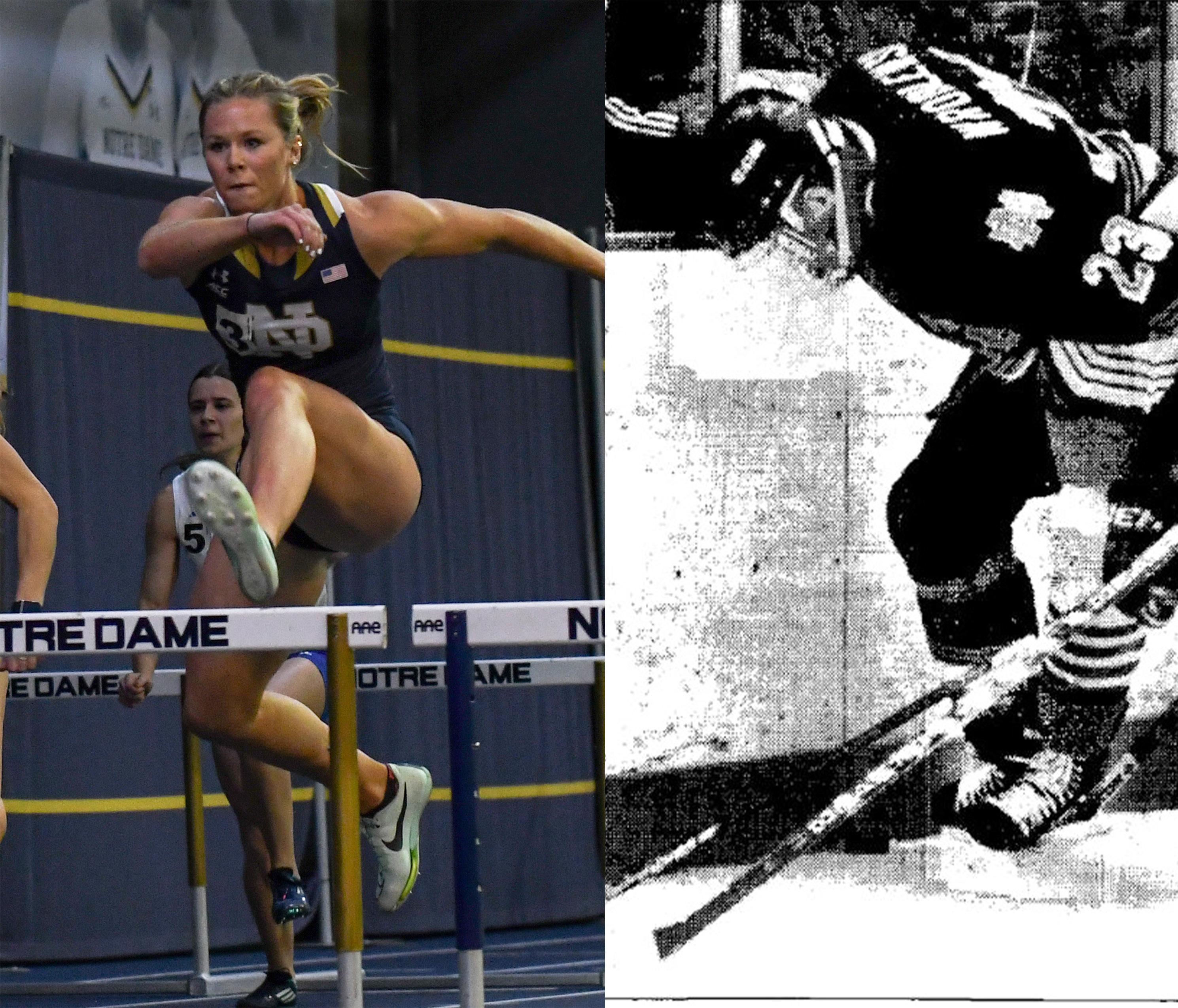
MARIELLA TADDONIO | The Observer
Former Notre Dame track and field star Jadin O’Brien and hockey player John Wroblewski participated in the 2026 Winter Olympics. O’Brien competed as a bobsledder and Wroblewski led U.S. women’s hockey as head coach; the two are the first Irish alumni to reach the winter games.
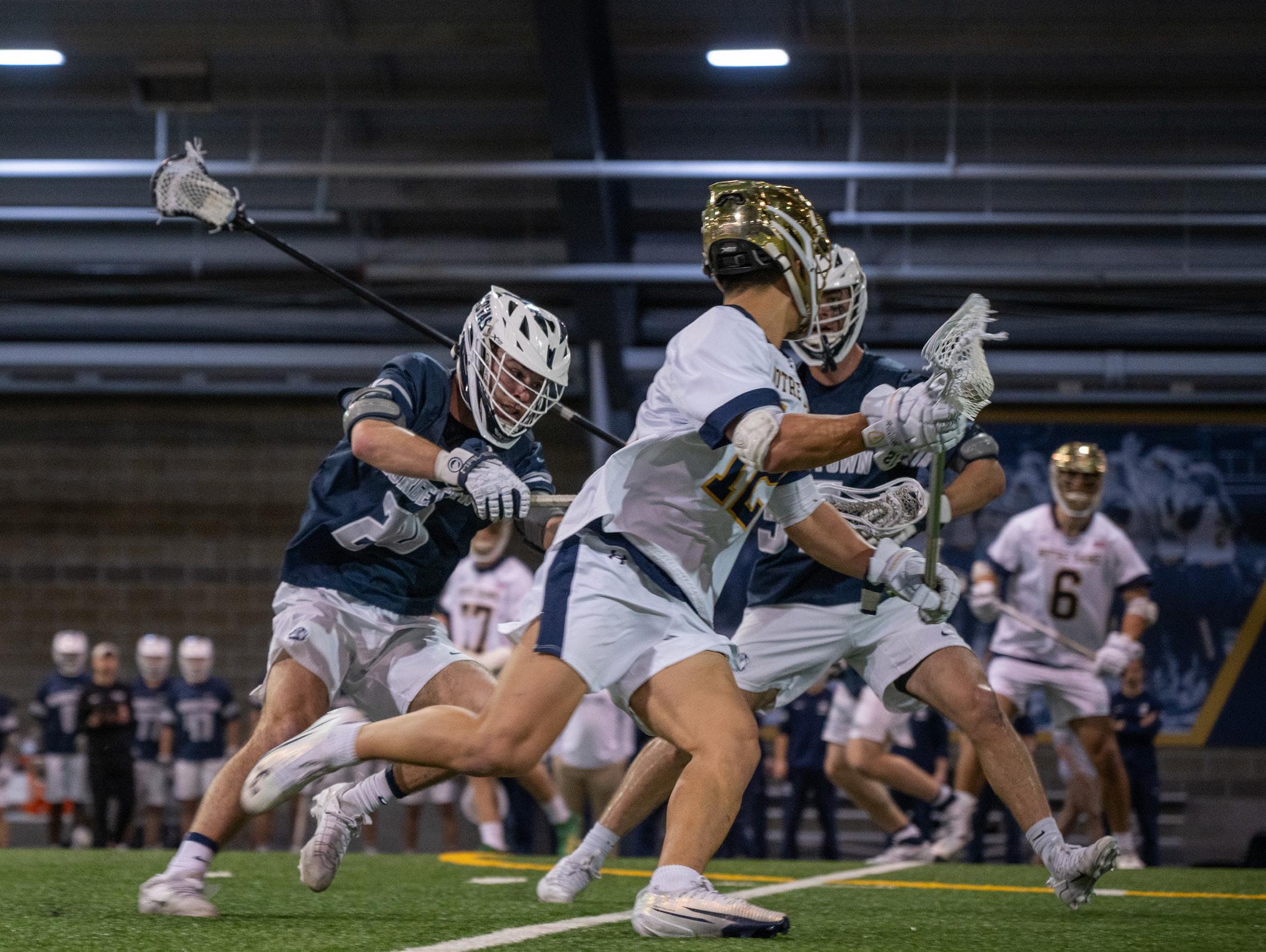
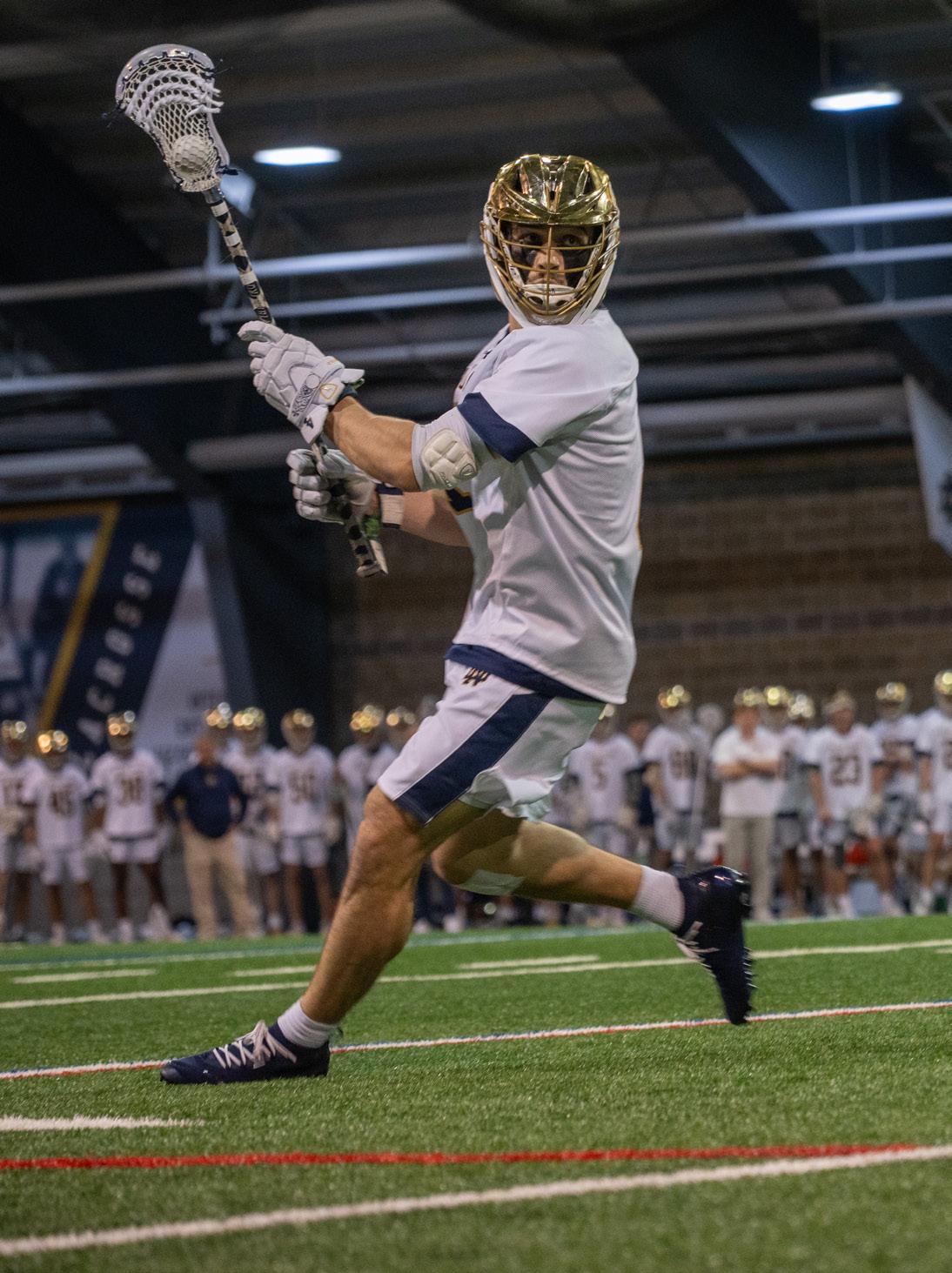
lacrosse vs. Georgetown
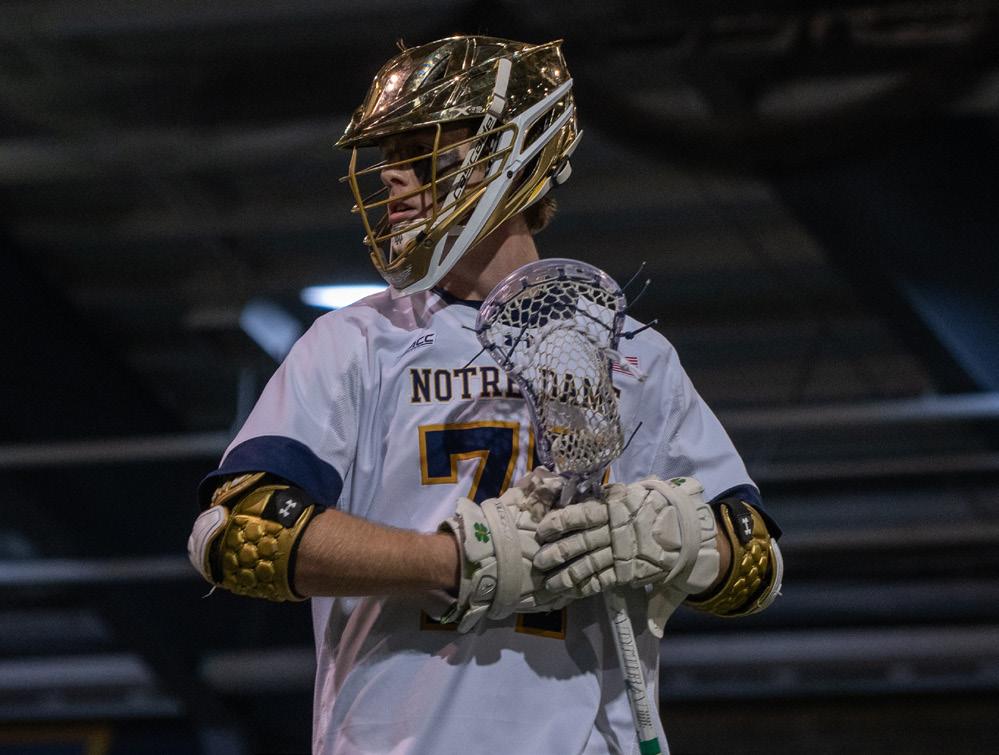
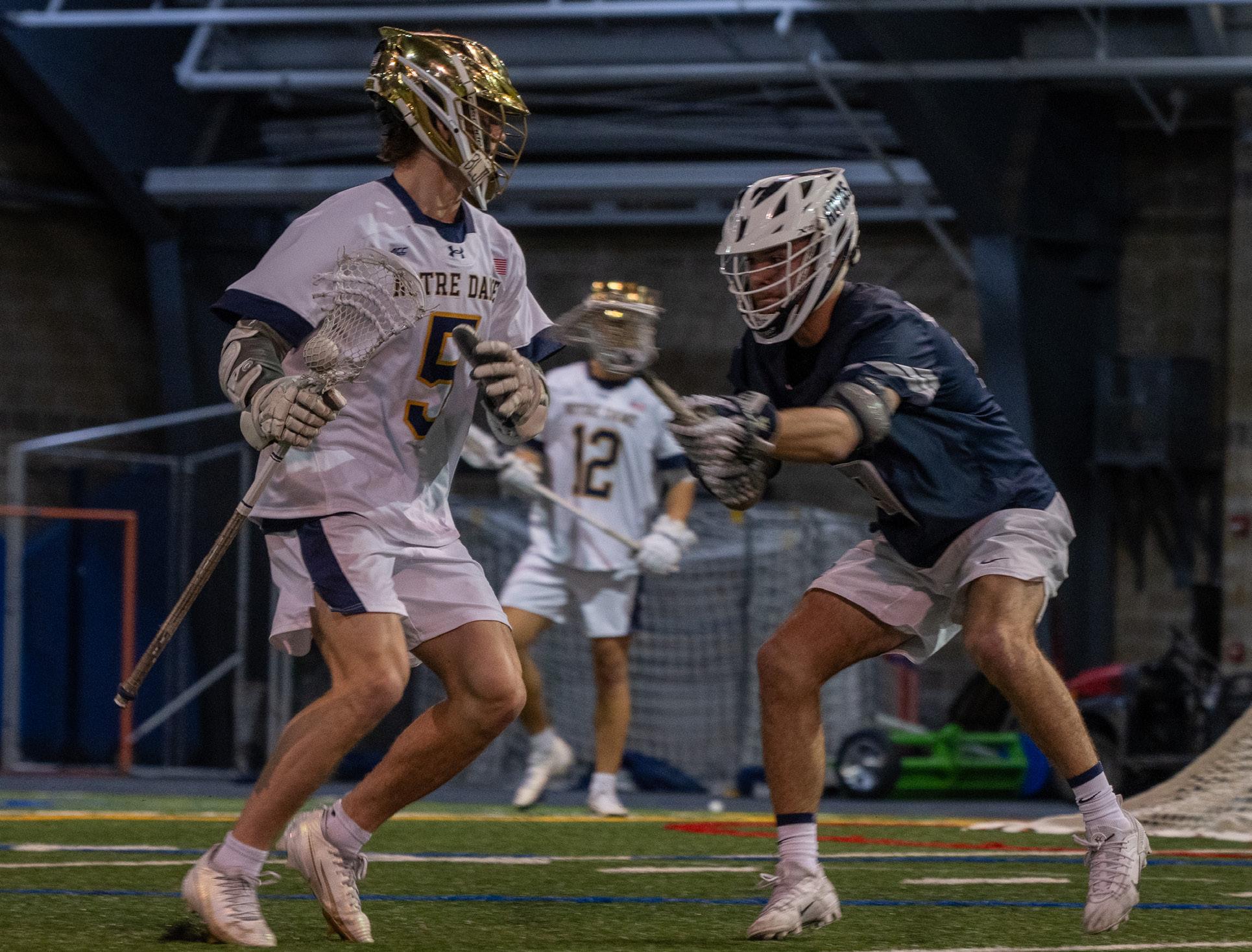
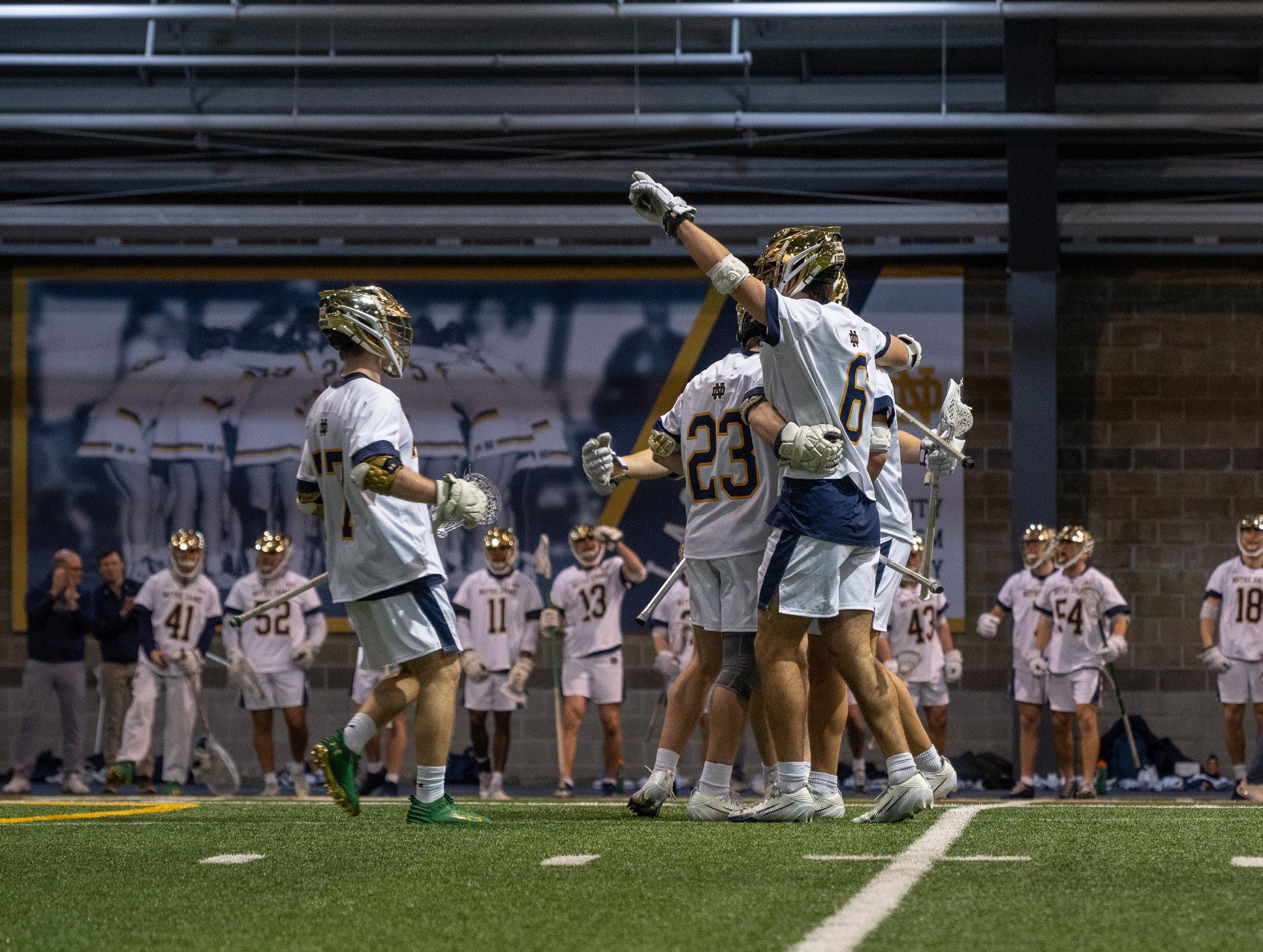
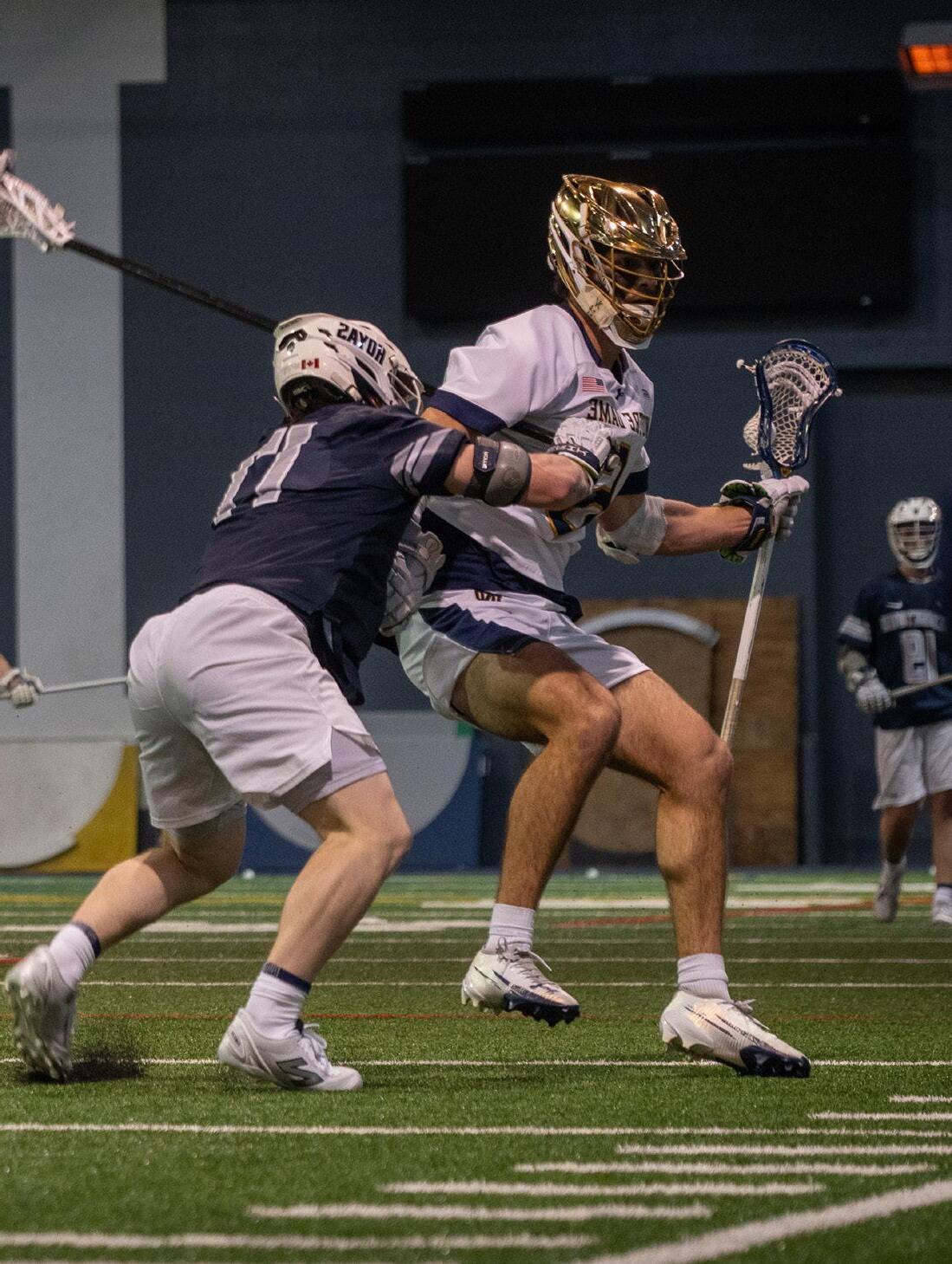
The Fighting Irish upset the No. 3 Georgetown Hoyas on Sunday, 15-9.
By Photo Editor Mariella Taddonio
SPORTS
Irish seek to stay competitive against Duke
By Henry Lytle Associate Sports Editor
On Tuesday evening, Notre Dame will take on its biggest challenge of the season in Purcell Pavilion with No. 1 Duke, led by freshman Cameron Boozer. The 25-2 Blue Devils are heading to South Bend after arguably the best college basketball win of the season, a 68-63 victory over then-No. 1 Michigan as the underdogs. Anyone might write this game off as an instant loss, but Notre Dame has shown its ability to be competitive against highcaliber opponents.
Notre Dame is entering this game after a rough month-long stretch. Since its Boston College win on Jan. 24, the Irish have won only once, against Georgia Tech, which sits at the bottom of the ACC. It took a careerhigh 37 points from sophomore guard Cole Certa and the Irish shooting 50% from beyond the arc to bring home the 89-74 victory. Freshman guard Jalen Haralson, who has led the team in scoring since junior guard Markus Burton’s early-season injury, has missed the last two games due to an ankle injury. His status remains unclear for the contest against Duke, but the Irish would love to have his dynamic scoring ability back against the top ACC defense. At home, Notre Dame is 9-5 but has struggled mightily in ACC play. The Irish have managed three conference wins, coming against Stanford on the road, Boston College and Georgia Tech. If you take a closer look, however, Notre Dame has multiple other close losses, such as the 72-71 fiasco against Cal, the 100-97 double overtime heartbreak against No. 14 Virginia and, most recently, the 82-79 home loss to Florida State. If Notre Dame has a chance to win this game, it will certainly be an opportunity late in a close game, considering Duke has not lost by more than three points this season.
Last season, Notre Dame traveled to Durham, N.C., in a Carolina ice storm and gave Duke a challenging game. The Irish stormed back in the second half and, despite their eventual 67-59 loss, had the game within five points in the last five minutes against the No. 1 team in the country. During the game, Duke’s Cooper Flagg set a freshman ACC scoring record, scoring 42 points and eventually going No. 1 in the NBA draft the following summer. This season, without Burton and injured senior forward Kebba Njie, the Irish will have to find a way to replicate the close game formula against Jon Scheyer’s Blue Devils.
The only recipe to beat Duke
this season has been elitelevel scoring by forwards and centers who can attack the paint. In the first Duke loss, Texas Tech forward TJ Toppin led the Red Raiders over the Devils with a 19-point double-double. Alongside guard Christian Anderson, who tallied 27 points, the Red Raiders stormed back, overcoming a 14-point second-half deficit, and still only eked out an 8281 victory. The other Duke loss came at the hands of rival North Carolina, which had another sensational freshman performance out of forward Caleb Wilson with 23 points. More importantly, though, the Tar Heels erased another second-half lead, overcoming a double-digit deficit with a buzzer-beater Seth Trimble three-pointer for the first lead of the game. Can Duke be beaten? Yes, but it has taken magic in the final moments of the game.
These are the only two losses of the season for Duke, and they both can reveal something. The Red Raiders and Tar Heels had the personnel to attack Duke’s inexperienced front court in the second half. Carolina had Wilson and center Henri Veesaar, the latter earning a double-double with 13 points in the second half. UNC forced starting Duke center Patrick Ngongba II to foul out, and pushed backup forward Maliq Brown into foul trouble with four fouls. This allowed the Tar Heels to attack Boozer on defense, where he can be vulnerable compared to the rest of his game. The 6-foot-9, 250-pound freshman is averaging 22.6 points, 10 rebounds and four assists while shooting
nearly 40% from three-point range. Notre Dame has to find a way to attack Boozer in the paint and score difficult shots to remain competitive.
Texas Tech did a fantastic job of limiting the other Duke top scorers, sophomores Isaiah Evans and Ngongba II, to be largely non-factors offensively.
Evans, a presumptive firstround draft pick, is averaging 2.5 made three-pointers per game with 14.7 points as a do-it-all wing scorer. Duke’s limitation might be depth, as it relies heavily on Boozer’s broad shoulders to carry the offensive load when other players can’t step up. Duke plays only seven or eight players significant minutes, which has allowed the best teams to attack the frontcourt and force
players into foul trouble. It is imperative that the Irish discover a way to exploit any minor Blue Devil flaw.
The Irish will require another heroic shooting performance from junior guard Braeden Shrewsberry or Certa to keep this contest competitive. Certa has averaged 17 points over the last 10 games and will need to be a threat from distance. The biggest problem for the Irish scoring is the Blue Devil defense. Duke’s defense is third in the country, holding opponents to 63 points and under 40% shooting; in the last 10 games, they have held opponents to only 58 points.
Head coach Micah Shrewsberry has never won a ranked game for Notre Dame. The Irish are currently tied
for third-to-last in the ACC. Only the top 15 teams will even make the ACC tournament. In other words, the pressure is on for Shrewsberry. Notre Dame controls its own destiny with three consecutive home games against Duke, NC State and Stanford before finishing on the road at Boston College. The Irish will have to win at least two of these final four to guarantee a spot in the ACC tournament. Is it possible to beat Duke? Maybe, but few, not even No. 1 Michigan, have been able to do so.
The contest against Duke will tip off at 7 p.m. on Tuesday, Feb. 24, and will be broadcast on ESPN.
Contact Henry Lytle at hlytle@nd.edu
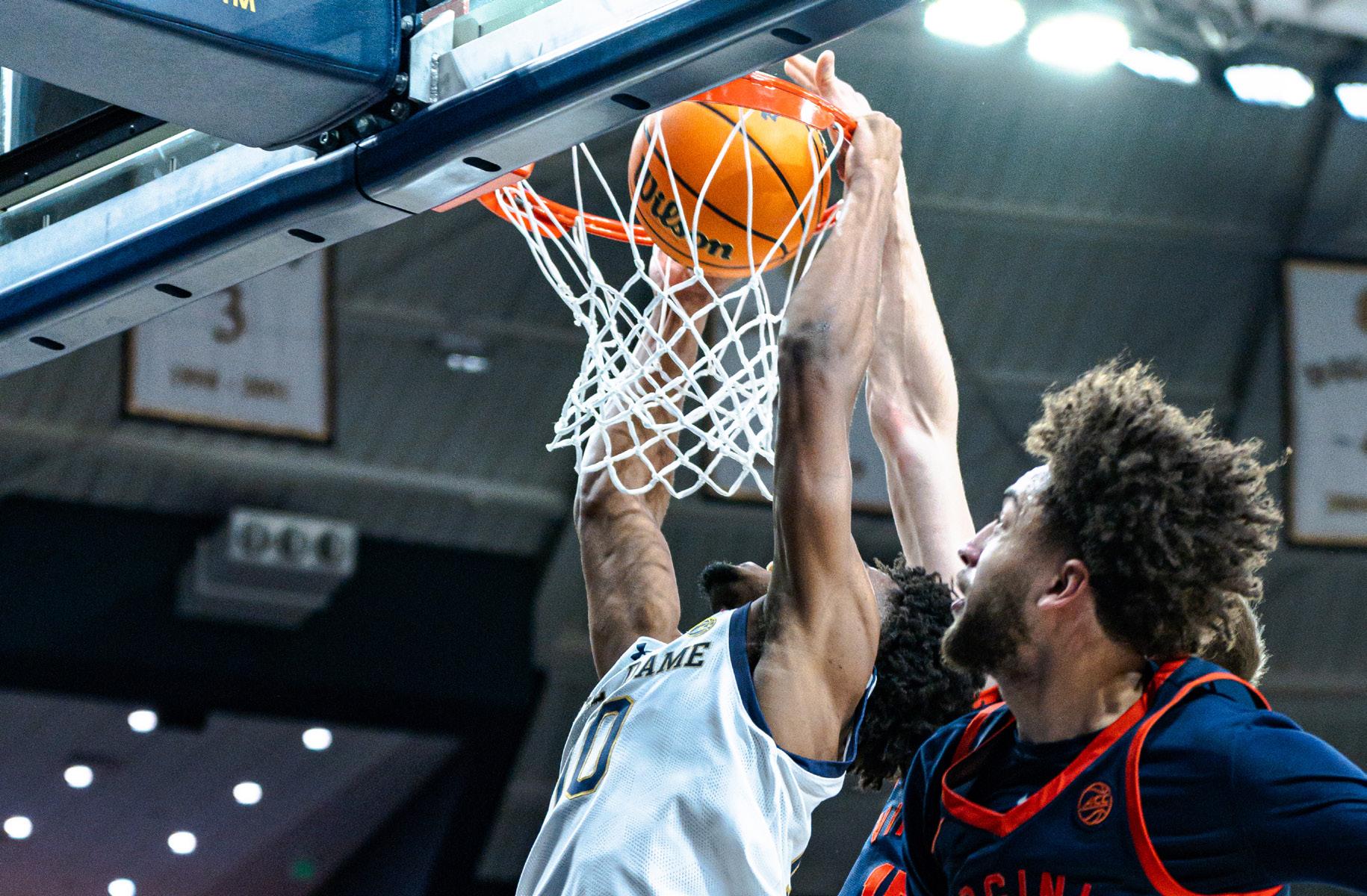
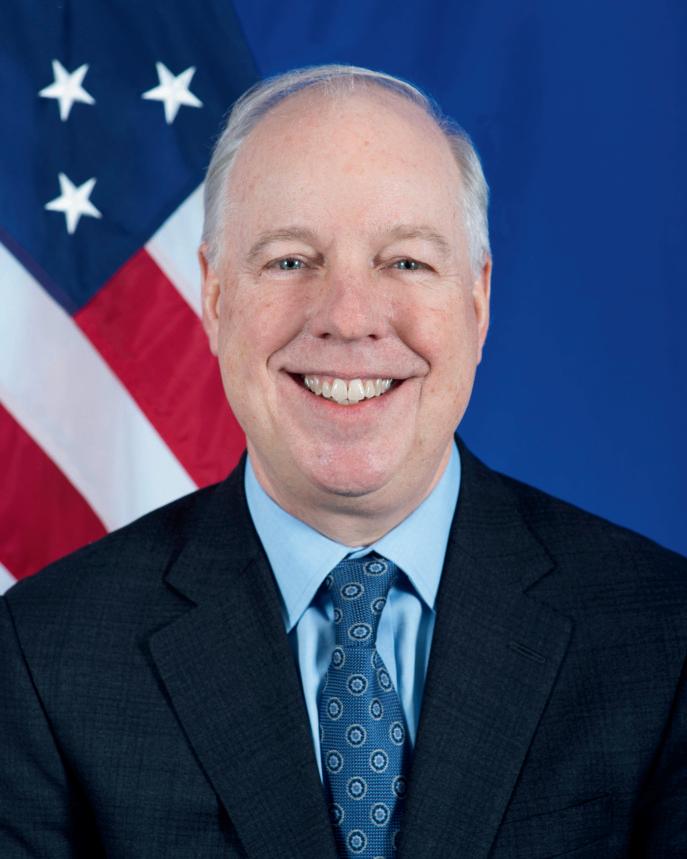
DECLAN LEE | The Observer
Irish freshman guard Jalen Haralson dunks the ball amidst Cavalier defenders in Notre Dame’s 100-97 double-overtime defeat against Virgina on Jan. 27 in Purcell Pavilion. Haralson tallied 20 points for the Irish.
HOCKEY
No. 1 Michigan State sweeps Notre Dame
By Ryan Murphy Sports Writer
The swell of hope came crashing down to disappointment again this weekend for Notre Dame hockey. Swept on the road by No. 1 Michigan State, the Irish competed fiercely in a 4-2 loss Thursday, only to see their missed opportunities turn into an 8-2 thrashing on Friday at Munn Ice Arena.
Results aside, Notre Dame (6-224, 2-17-1 Big Ten) entered this series hoping to build off the momentum it found with a 1-0-1 weekend against Minnesota. In the lead-up to their showdown with the top-ranked Spartans (24-6-0, 15-5-0 Big Ten), the Irish consistently stated that their focus was on building towards the Big Ten Tournament in two weeks, which all Big Ten teams qualify for.
And after conceding the first goal of the game for the 25th time this season on Thursday night, Notre Dame seemed to make good on that
aim. Once Spartan junior defenseman Maxim Štrbak walked down the slot and roofed the first chance of the game past Irish sophomore starting goaltender Nicholas Kempf, Notre Dame took over the play. The Irish responded just over two minutes later when freshman forward Dashel Oliver’s first career goal beat Spartan junior goaltender Trey Augustine.
The Spartans again took the lead early in the second period, and the Irish again answered within two minutes. After Michigan State senior forward Charlie Stramel potted his 19th goal of the season on the power play, Irish junior forward Cole Knuble scored on a man advantage of their own to underscore Notre Dame’s resilience against the nation’s top team. The Irish had plenty of hope in this contest.
But the series’ most pivotal moment had yet to come. That moment arrived at 12:59 of the middle frame, when Spartan senior forward Tiernan Shoudy took a pass from
freshman Anthony Romani and went hard to the blue paint, bumping into Kempf. Kempf would leave the game and did not return for the rest of the series.
Yale graduate transfer Luke Pearson entered the game in goal for Notre Dame and saw Spartan senior Gavin O’Connell’s shot go off his glove and into the net for a power-play goal with 1:38 to play in the period. O’Connell’s marker would become the game-winning goal. Freshman forward Porter Martone notched an empty-netter in the third, and the game finished 4-2. Notre Dame never led.
The Irish did not lose because of Pearson’s play. With only one full game of experience this season, Pearson still stopped eight of nine shots against the nation’s best team, and the Irish did well to limit the number of chances he had to face. Instead, Notre Dame’s failure to finish on its offensive chances again came back to haunt them. They failed to strike while the iron was hot
BASEBALL
– especially on the power play, where the Irish went one-for-five – and the Spartans eventually took the game back over.
Those missed chances looked especially unrealized in light of Friday’s contest, when the Spartans did what they do best: put teams away. After another 1-1 first period, Michigan State scored four second-period goals and three third-period goals en route to an 8-2 beatdown. Martone led the onslaught, scoring a hat trick to reach the 20-goal mark as a freshman. Fellow first-year forward Ryker Lee added a pair, while fourthliners Tommi Mannisto and Griffin Jurecki also scored. Sophomore defenseman Owen West’s power-play goal with 1:02 to play in the second period provided the nail in the coffin, making the score 5-2 before two periods were complete.
With Kempf out of the game again, Pearson did not look good on several Spartan goals. It is fair to wonder whether the Irish would have fared better in Friday’s contest with their
regular starting netminder between the pipes, but Notre Dame also did not play as well in front of Pearson as it had the night before. He faced 42 shots, the fifth most given up by Notre Dame all year.
The series was marred by penalty trouble on both nights. Big Ten officials doled out 83 penalty minutes over the course of the series, almost all minor penalties. That includes an absurd 17 individual penalties and 63 penalty minutes on Friday night. Both teams are top-five nationally in penalty minutes per game.
Kempf – who has started every game this season that he has been available for – was listed as day-today on Friday, indicating some hope that he can return this weekend for Notre Dame’s final home series against Penn State. The Irish will host Senior Night festivities during Saturday’s contest, when they usually wear their green alternate jerseys.
Contact Ryan Murphy at rmurph22@nd.edu
Irish cap off Jacksonville trip with Sunday walk-off
By Zachary Jones Sports Writer
This weekend, the Notre Dame baseball team played in the Live Like Lou Jax College Baseball Classic in Jacksonville, Florida. They posted a 1-2 record with a win over Indiana, dropping games to UCF and LSU. Irish head coach Shawn Stiffler turned to junior ace Jack Radel to open the weekend on Friday night against Central Florida. Radel dominated the Golden Knights hitters, serving up six perfect innings while striking out nine. Radel sat down 18 consecutive batters without allowing a baserunner before being pulled rather conservatively after six innings and 68 pitches. The Irish were held scoreless until the bottom of the fifth, when Notre Dame freshman designated hitter Dylan Passo drove a 2-1 offering over the right-field fence for a solo home run. In the following frame, Irish sophomore shortstop Noah Coy singled in sophomore right fielder Jayce Lee to make the score 2-0 Irish after six innings. A two-run lead would be the high-water mark for the Irish, though, as the game slipped away without Radel on the mound. After a scoreless seventh inning, UCF cut the Irish lead in half in the top of the eighth when pinch-hitting third baseman Javier Crespo scored first baseman Landon Moran, who had reached on a walk. In the ninth, Notre Dame sophomore reliever Oisin Lee allowed an unearned run after pinch-hitter Stephen Chucka reached base on a fielding error by Irish sophomore first baseman Parker Brzustewicz and scored on a triple off the bat of UCF right fielder Andrew Williamson. The Irish bats went three-up, three-down in the bottom of the ninth, setting the stage for extra innings with the score tied 2-2 after nine. In the top of the 10th,
Irish sophomore two-way player
Chase Van Ameyde gave up a single and hit a batter. Both runners would advance on a wild pitch before Van Ameyde was replaced by graduate reliever Eli Thurmond, who promptly gave up a single through the right side, giving UCF a two-run lead. The Irish struck out three times in the bottom of the 10th, ending the game at 4-2 UCF. The Irish bullpen collective of senior Noah Rooney, Lee, Van Ameyde and Thurmond followed Jack Radel’s six perfect innings with four regrettable ones, combining to surrender four runs on three earned while giving up four hits and a walk, striking out three. Notre Dame’s batters would finish the night with two runs on seven hits and no walks.
Passo and Coy each recorded an RBI, while Brzustewicz led the team in hits with two singles.
Looking to get back on track after Friday night’s disappointment, on Saturday the Irish faced off against LSU. The Tigers, defending national champions and ranked No. 2 nationally, would prove to be tough customers, consistently grinding out tough at-bats and stringing together hits. True freshman and Valparaiso, Indiana, native Caden Crowell got the starting nod for the Irish. He was roughed up over 2.1 innings of work but showed poise and competitiveness, striking out four LSU hitters. In total, Crowell gave up five runs, all earned, while allowing seven hits and issuing one free pass. LSU jumped out ahead of the Irish early, taking a 7-0 lead by the end of the fourth inning. LSU starter and Kansas transfer Cooper Moore had an effective day on the mound, going 5.2 innings while giving up three runs on eight hits and issuing one free pass. He held the Irish scoreless until a single from graduate outfielder Drew Berkland through the left side plated Coy in the
top half of the fifth inning to make the score 7-1 LSU.
The Irish wouldn’t go down easily, though. In the top of the sixth, Lee’s two-run bomb to deep center added a pair of runs to the Irish tally, and the Irish would chase Moore with two more singles in the inning. LSU scored twice more in the bottom half of the frame, making the score 9-3 through six innings. The Irish plated one more run in the top of the seventh when Brzustewicz earned a basesloaded walk, scoring freshman third baseman Jamie Zee. Neither team would score in the eighth or ninth, making the final score 9-4 LSU. The Tigers scored nine runs on 12 hits and collected five free passes. They went 6-18 with men in scoring position and left nine on base. The Irish finished with four runs on nine hits and four walks, going 2-9 with runners in scoring position and leaving eight stranded. Coy and junior catcher Mark Quatrani both had two hits, while Lee led the lineup with two RBI.
On Sunday, Notre Dame faced off against in-state rival Indiana in an effort to salvage the weekend. After four relatively calm innings, the game became an offensive slugfest that culminated in an extra-innings victory for the Irish. Irish graduate starter Ty Uber gave up two runs in four innings of work, allowing four hits and a walk while striking out two. Notre Dame scored once in the bottom of the second and once more in the bottom of the fourth, making the score 2-2 after four.
In the top of the fifth, Indiana’s offense jumped all over Irish senior reliever Xavier Hirsch. The Hoosiers loaded the bases with two singles and a walk, then hit a bases-clearing triple and another single, making the score 6-2 going into the bottom of the fifth. The Irish immediately responded with a leadoff homer by
Quatrani, cutting the deficit to three runs. Indiana would add two more in the top of the seventh, but Notre Dame’s offense matched Indiana’s two runs with five of its own in the bottom half of the inning. Quatrani led off the offensive explosion with another homer. The Irish kept rolling with Brzustewicz scoring on a Coy single, before both Coy and Jayce Lee scored on a single off the bat of pinchhitting second baseman Mason Barth. Van Ameyde came in to score on a Berkland sacrifice fly, tying the game at eight runs apiece after seven innings. Both teams would go scoreless in the eighth and ninth, setting the stage for extra innings tied at eight runs apiece.
With Lee on the mound shutting down the Hoosiers, the Irish struck in the bottom of the eleventh. With two outs and the bases loaded, Berkland hit a walk-off single to left-center, making the final score 9-8 Irish. In total, the Irish scored nine runs on 15 hits and four walks, leaving 11 men on base. Indiana managed eight runs on 13 hits and three walks, stranding eight. At the plate, Quatrani and Berkland both swatted four hits, and Berkland led the Irish with three RBI. Quatrani finished the day with 10 total bases, swatting two home runs and two singles, a huge day at the plate in a game the Irish needed to win.
With Sunday’s victory over the Hoosiers, Notre Dame finished with a 1-2 record on the weekend. Though Friday’s extra-inning loss stings, Coach Stiffler must be encouraged by the Irish’s resolve in Sunday’s contest. Down 8-3 going into the bottom of the seventh, the Irish scraped out a win with timely hitting and quality performances out of the bullpen. UCF, Indiana and LSU are likely to be the Irish’s toughest non-conference opponents, so it was crucial to pick up
at least one win to show the Irish can compete with quality power-conference teams.
A question to be monitored going forward is how short a leash Stiffler gives his starting pitchers. Stiffler treated his starters rather conservatively this weekend, pulling Radel on Friday after six perfect innings and 68 pitches and replacing Uber on Sunday after four quality innings and only 51 pitches. Both these decisions came back to bite him. On Friday, the bullpen gave up four runs in four innings after being trusted with a 2-0 lead, and on Sunday, with a 2-2 tie after four, the Irish bullpen dug themselves in a 8-3 hole until the offense battled back.
On the season, Irish starters have gone 23.1 innings over six games and posted a 3.86 ERA. The bullpen has taken care of 31.2 innings but has only managed an ERA of 5.40. The starters have managed just under four innings per start, meaning the bullpen has averaged just over five innings a game. Just doing some back-of-thenapkin averages, the starters are averaging about 0.2 runs per inning fewer than the bullpen. If the starters averaged two more innings per start, going from just under four innings to around six innings, the Irish could save almost a half a run per game –a real difference. Last year, the Irish played 22 games in which their starter went 5-plus innings, and they won 18 of them. This season, Stiffler likely wants to preserve his starters for the rest of the season and figure out the bullpen pecking order. However, his cautious approach made it harder for the Irish to win this weekend, and he’ll have to make adjustments when ACC conference play opens in two weekends.
Contact Zachary Jones at zjones3@nd.edu
Irish win first ranked game against Georgetown
By Jack Muething Sports Writer
The Notre Dame men’s lacrosse team came away with a 15-9 victory against the Georgetown Hoyas in a highly anticipated ranked battle at the Loftus Sports Center on Sunday. The Irish came into the match ranked No. 7 by Inside Lacrosse, while the Hoyas were ranked No. 4. This result, along with others in college lacrosse this week, has the chance to really shake up the rankings.
The game started off as a defensive masterclass with both teams only getting two goals by the end of the first quarter. Senior attackman and midfielder Will Maheras and sophomore attackman Luke Miller got on the board for the Irish while brothers Liam Connor and Rory Connor scored for the Hoyas. The first quarter was foreshadowing, though, as it was largely dominated in other categories by the Irish. Notre Dame took 10 shots that period compared to Georgetown, which only took three, and the Irish also forced seven turnovers compared to Georgetown, which only forced four. The MVP of the first quarter for the Hoyas was junior goalkeeper Anderson Moore, as he picked up four of his 11 total saves in that quarter.
The second quarter started badly for the Irish as Rory Connor scored his second goal of the game to give the Hoyas their first lead of the game. However, it was shortlived, as it only took six seconds for the Irish to tie it up
at three. Freshman FOGO Aidan Diaz-Matos won the faceoff, passed it to graduate attackman Josh Yago, and Yago got it to freshman midfielder Miguel Iglesias, who converted on the shot attempt to tie it up. It ended the Irish’s 11-minute scoring drought, and from that point, the Irish didn’t look back. The Irish went on a 5-1 scoring run to end the second quarter, getting a goal from graduate midfielder Will Angrick, freshman attackman Teddy Lally, junior midfielder Brock Behrman, and two goals from Yago. Angrick, Lally and Yago also picked up assists in that stretch. The Irish went into the halftime locker room up 8-4.
The third quarter was evenly played from both teams, the Hoyas ultimately winning the quarter by a score of 4-3. Angrick picked up two goals in the quarter for the Irish to give him a hat trick on the night, and Miller got back on the scoresheet as well. While the second quarter featured the Irish finding opportunities off of passes, the third quarter presented players creating chances for themselves, with only one of those goals being assisted. Sophomore midfielder Kevin Miller had three of the four goals in that quarter for the Hoyas, and they went into the fourth quarter within reach of the lead. However, the Irish closed out the game incredibly well, winning the fourth quarter 4-1, the only goal they allowed being very near the end of the game. Graduate midfielder Jalen
Seymour picked up his first goal while Maheras, Yago and Lally all added to their totals. Lally also picked up an assist in the quarter, giving him four points on the night. That strong finish allowed the Irish to close out this one by a score of 15-9.
Yago was the star for the Irish, picking up his second hat trick of the year. He now leads the team in goals this season with nine on the year. Yago was also excellent for the Irish defensive ride, causing two turnovers and picking up two ground balls, one of which turned into a goal for the Irish. The Hoyas only went 19-26 on clearances, showing the success of the Irish ride. Will Angrick
also had his best game of the season, picking up two goals and two assists, and Lally also contributed four points. On the defensive side, senior Will Gallagher was everywhere for the Irish, causing two turnovers and picking up four ground balls. Senior AllAmerican LSM Will Donovan also caused two turnovers and had three ground balls, and junior All-American defenseman Shawn Lyght caused three turnovers and had two ground balls. For the Hoyas, Rory Connor had four goals and Miller had three goals, but the Hoyas turned it over 26 times and only forced eight, ultimately leading to their demise. Even though each team won 14 faceoffs,
the Irish came away with the win as they only had 19 turnovers compared to the Hoyas, who had 26, and that led to the Irish having 38 shots compared to the Hoyas, who had 26.
In lacrosse this week, No. 1 Syracuse, No. 2 Maryland and No. 4 Georgetown all lost, meaning that Notre Dame has a chance to really jump in this week’s rankings. Georgetown will play No. 9 Ohio State in its next contest, while Notre Dame will play the aforementioned Maryland, looking for revenge after the 11-10 loss to the Terrapins last year.
Contact Jack Muething at jmuethin@nd.edu
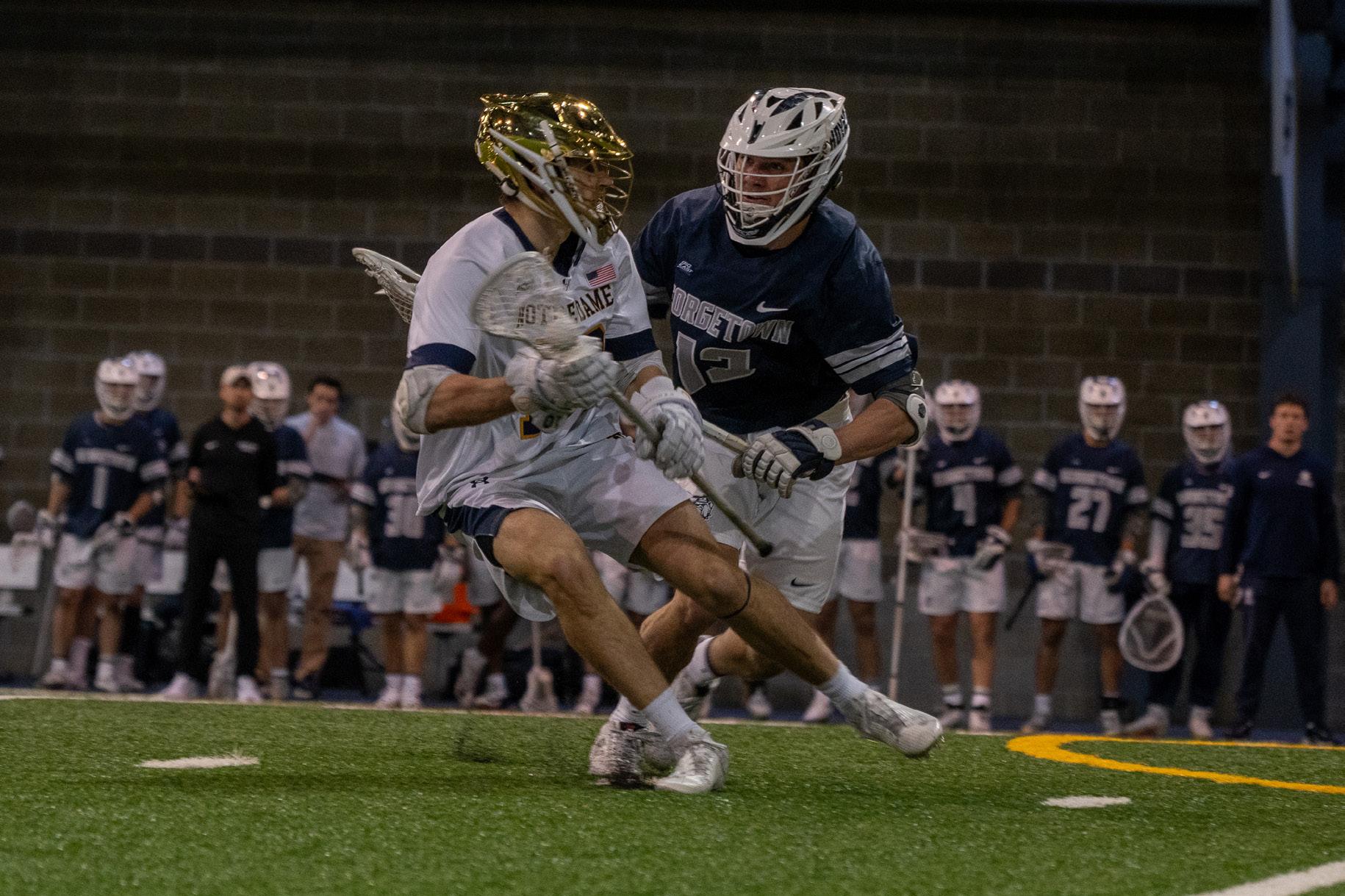
Notre Dame nets mixed results in Big Ten weekend
By Jacek Kawczynski Sports Writer
After an impressive win aAfter an impressive win against Illinois the week before, Notre Dame men’s tennis turned up the difficulty this past weekend, taking on a fiery Northwestern team on Friday before traveling to Columbus to face No. 1 Ohio State. The Irish dominated the first duel of the weekend, sweeping Northwestern 4-0, but fell short against an impervious Buckeyes squad, losing 5-0 on Sunday. Despite the one-sided scoreline from Sunday, all matches were highly competitive and proved that this year’s Irish team has truly righted the ship.
Ahead of the looming battle on Sunday, Notre Dame had to pass a stern test from a Northwestern team on a nine-match win streak.
Northwestern junior Greyson Casey and sophomore Carter
Pate shocked sophomores
Peter Nad and Luis Llorens Saracho, winning the onedoubles battle 6-3. Notre Dame senior duo of Sebastian Dominko and Noah Becker set things even, defeating sophomore Vincent Yang and senior Chad Miller 6-3. Freshman Nicholas Patrick and graduate student Perry Gregg snagged the doubles point for the Irish, with a 6-4 victory over juniors Ethan Schiffman and Cyrus Mahjoob.
On the singles side, Llorens Saracho defeated Miller 7-6(2), 6-1. No. 14-ranked Dominko doubled the Irish lead after a tough 7-6(4), 6-4 battle against Pate. Notre Dame sophomore Giuseppe Cerasuolo faced off against Schiffman, and after losing the first set 6-1, he roared back, winning the following
sets 6-2, 6-1 to hand the Irish a 4-0 sweep. Nad, Junior Evan Lee and No. 72-ranked Gregg were all up a set before their matches were abandoned.
There was no rest for the weary, as Notre Dame travelled to Columbus for Sunday’s showdown at high noon. Dominko and Nad topped the doubles lineup for the Irish, but faced a daunting challenge against the No. 1-ranked doubles team in the nation, sophomores Nikita Filin and Brandon Carpico. Notre Dame was broken early, and after failing to convert a break point at 2-4 40-30, ultimately lost 6-3. No. 17-ranked junior duo Bryce Nakashima and Aidan Kim clinched the doubles point for the Buckeyes, defeating Patrick and Becker 6-2.
The singles match of the day was between Dominko and No. 8-ranked Kim. After going
down a break early, Dominko answered back with a stunning down-the-line forehand, setting the match even. Kim broke right back, however, and controlled the match from that point, winning 6-4, 6-4 to double the lead for the Buckeyes. No. 20-ranked Ohio State junior Preston Stearns put the Buckeyes on the brink of victory, defeating Nad 6-3, 6-2. Ohio State graduate student Loren Byers won the duel for Ohio State, beating Llorens Saracho 7-6(3) 6-3 at the five-singles spot. Senior Alexander Bernard defeated Lee 6-4, 6-3, putting the duel to an emphatic finish.
Despite the lopsided result against the Buckeyes, there were plenty of positives to go around. The singles matches were kept quite close across the board, while the doubles matches showed potential against a lineup with three
of the nation’s top 10 pairs. Gregg, who has been rock solid for the Irish this year, led opponent Jack Anthrop 6-4, 4-4 before his match was abandoned. Cerasuolo looked to be down and out after a 3-6 first-set loss against Nakashima, but fought back 6-2 in the second. The match against Ohio State was a solid test for the Irish and a preview of the level the Irish will encounter during their brutal March schedule.
Notre Dame heads back home this week, where they will face Florida State on Friday, before a double header against Miami and IU Indy on Sunday. Currently 9-2, the next few matches will be crucial in determining what direction the rest of the season takes.
Contact Jacek Kawczynski at jkawczyn@nd.edu
ND MEN’S TENNIS
MAIELLA TADDONIO | The Observer
An Irish player attacks on offense beside a Hoya defender during Notre Dame’s 15-9 victory over Georgetown on Feb. 22 at the Loftus Center. Since their Feb. 14 opener against Marquette, the Irish have gone 3-0.
Bengal Bouts: more than just boxing
By Payton Dymek Associate Sports Editor
With Bengal Bouts now in full swing, with the next round on Feb. 24, senior vice president Michael Nilsen reflected on what the club has meant to him throughout his time as both a boxer and coach, as well as the impact that the organization has had beyond Notre Dame’s campus.
Bengal Bouts has drawn a large crowd this year, with Nilsen saying he “[hasn’t] seen it that full in all four years being here.”
The first group of people Bengal Bouts has an impact on are the men that choose to sign up to train and compete. In practices, Nilsen explained how they are taught how to “basically protect themselves.” The “more overlooked part,” however, is their mental development of learning “to face their fears and anxieties by stepping into the ring, and it takes a lot to get there whether you’re a four-year or first-year boxer.”
Nilsen also highlighted a common analogy they bring up in practices of the hero and the coward by explaining how “both of them are equal in terms that they are both scared, but the hero steps into the ring and the coward doesn’t.” In addition to developing its own boxers, Bengal Bouts helps those involved in the Holy Cross Congregation in Bangladesh, with the funds the boxers raise going to building “schools, science labs or dining halls.” Nilsen said the charitable aspect of the club is “extremely fulfilling” to him.
Nilsen stressed how important it is to stay in shape for boxing and explained how training is “half the battle.” He thinks staying healthy and not getting sick was hard because it can set him back a couple of weeks in training. Nilsen discussed how steady breathing is key, which is why “you have to do a lot of cardio,” specifically “a lot of burpees, which get the plyometric, cardio and calisthenic workout in.” Technique training, which can be done through shadowboxing or drills with partners, helps boxers visualize facing their opponents and where their combinations are landing. It is the physicality that Nilsen believes is one of the biggest challenges for new boxers, noting that the first practice is usually a “wakeup call” because they don’t realize the full physicality that goes into boxing.
Getting involved in Bengal Bouts was simple for Nilsen, and he started off just as one of the boxers after discovering the club at the same time as the current president, Phil Pollice, at a club event. Nilsen has always been involved in athletics and saw this as an avenue to “keep active and in shape.” In terms of his leadership role, Nilsen said he didn’t
expect it but that he was “super honored” because he loves the time and effort he’s put into this organization. Taking the position was a “no brainer,” he said. “[It’s] incredibly fulfilling when helping and coaching. When they get their hand raised is the best feeling I ever.”
Nilsen has seen how much impact Bengal Bouts has had through the donations it raises, with this year the goal being “north of $300,000, around $350,000.” Nilsen said he hopes the popularity of the club continues to grow even after he graduates.
Contact Payton Dymek at pdymek@nd.edu
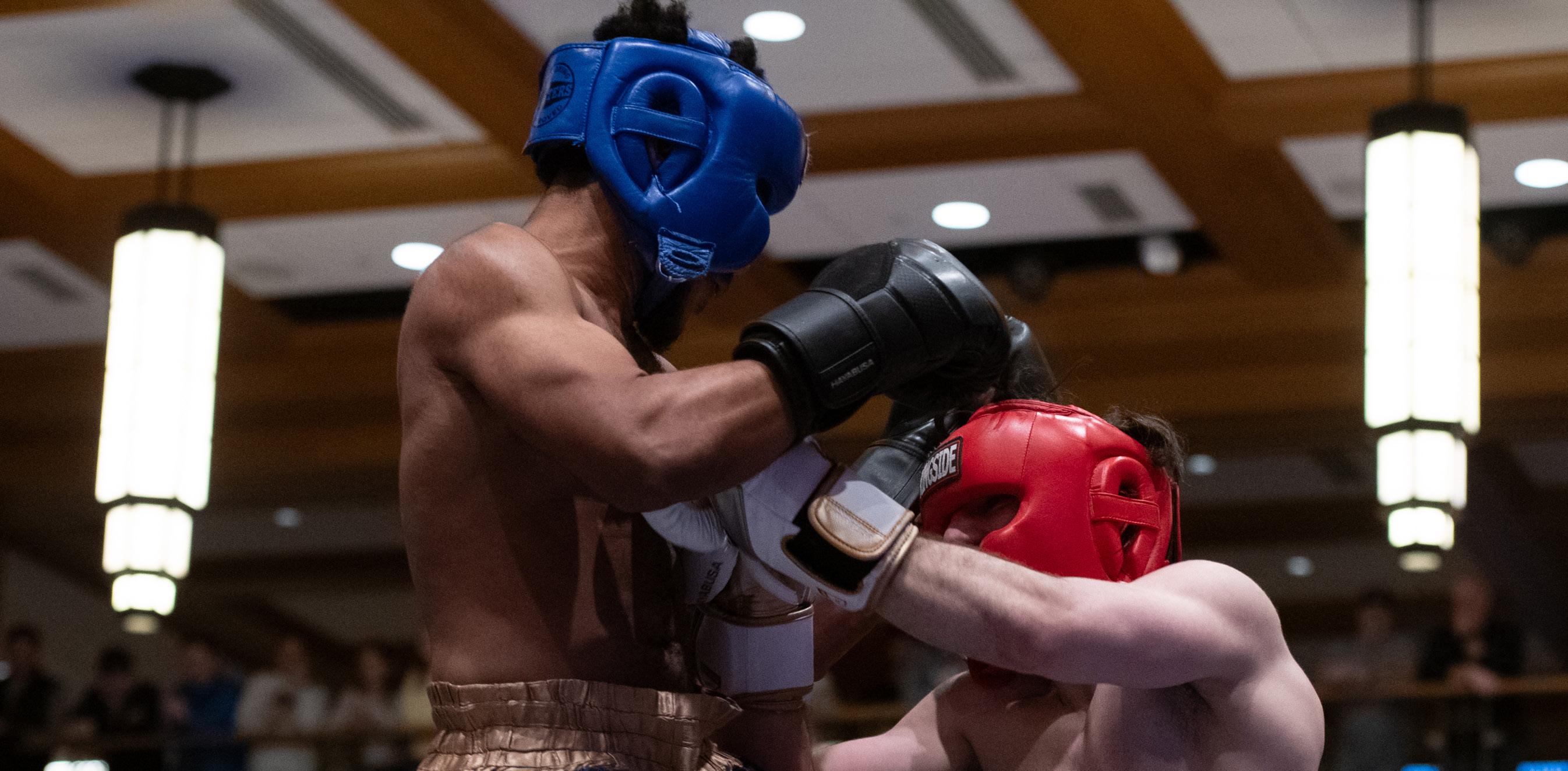

PAID ADVERTISEMENT
GABRIELLA MARTIN | The Observer
Bengal Bouts boxers exchange jabs during the tournament’s quarterfinals on Feb. 17, in Dahnke Ballroom. The club’s 96th campaign will conclude after spring break, with the final round set for Saturday, March 28.
Brotherhood: from the Bouts to Bangladesh
By Nikki Stachurski Associate Sports Editor
In their 96 years on campus, the Bengal Bouts have cultivated a strong culture that makes their group one of the most well-known extracurriculars at Notre Dame. The Bengal Bouts is a men’s organization that comes together to teach, train and develop boxing skills that are then displayed in their annual tournament. The focus of the group is not just boxing, but also fundraising for Holy Cross missions in Bangladesh, and it hosts a beloved campus event that raises hundreds of thousands of dollars to support Catholic missions. Two junior captains sat down to speak about their experiences in the club, explaining its success and the foundational strengths that have kept the Bouts prominent for almost a hundred years.
A junior from Houston, Texas, Jackson Amorosa is a chemical engineering student living in Duncan Hall. For the Bouts, he is a workout captain and designs workouts and training exercises in collaboration with the strength coordinator. He is crucial to the physical fitness and operation of the boxing
aspect of the club, and his skills help him develop the talents of boxers with varying levels of fitness and experience.
Currently a resident of Coyle Hall, William Johnson is an environmental science student from Scottsdale, Ariz. He is one of three fundraising captains who work with the club’s members to achieve philanthropic goals. His duties consist of totaling, rewarding the section or pod of the club that raises the most money each week and developing methods for the club to continuously raise funds. Their goal this year is to earn $350,000, and although the donations are still piling in as the 96th annual tournament is underway, Johnson was pleased with the club’s progress as the second semester began.
The leadership efforts from the two have been outstanding throughout the season, but both spoke on what led them to the Bengal Bouts. Like many, Amorosa was a dedicated, highachieving athlete in high school who wasn’t competing in college but wanted to stay fit and active. He joined the club in his freshman year and enjoyed the camaraderie and community aspect.
“Participating in the tournament freshman year,” Amorosa said. “The nerves and excitement are unreal, and you don’t really experience it anywhere else.”
Johnson had a similar story. He joined his freshman year with a cross-country and tennis background before college. He was inspired by the people from his high school who constantly tried new sports and did things outside of the box. Coming from mostly non-contact sports, he explained that boxing was a different mentality that really challenged him.
Their sister club, the Baraka Bouts, has a similar tournament in the fall semester to raise funds for their organization of choice, which is a success every year. But in the spring semester, the buzz is all about the Bengal Bouts. Hundreds of people gather in the Dahnke Ballroom over various days to watch qualifying rounds of the tournament and even showcase competitions. Amorosa spoke of the unbelievable support they witness each year from the Notre Dame community.
“The support from dorms, community at fight nights, lots of people in [the boxer’s]
BENGAL BOUTS
corner, [it’s] a very special feeling that makes it all worth it,” he said. “The students really show out, and every year, everything increases. People realize the courage it takes to even get in there, and that’s another big thing we try to communicate. Win or lose, just getting in there is what’s important.”
Although the club attracts a large community and welcomes new members each year, many people never try it themselves. When asked what advice could only be learned from stepping into the ring as a Bengal, the captains had different but powerful responses. Johnson spoke on the self-assuredness he has learned.
“In other sports, there are lots of other factors that could impact you,” he said. “But in the ring, it is just you against them, and it’s just down to you.”
He emphasized the importance of having a lot of faith and trust in yourself. He claimed that the Bouts were a “celebration of your hard work, [and] as all things in life, you’ve put in the time and now it’s time to show it off.”
For Amorosa, his journey as a Bengal taught him different lessons that he will carry moving forward.
“Now, when I do other stressful things, they are not as stressful as getting into the ring, and it builds courage and makes other things easier,” he said. “It’s not like the Rocky movies, and you often fall to the level of training you put in. No one gets in there and doesn’t do well who hasn’t trained really hard. It goes into all other aspects of life.”
While the two captains have not been to Bangladesh themselves to see the ways their funds have helped the Holy Cross missions, they are unbelievably proud of the members of the club who consistently go out of their way to fight for a cause bigger than themselves.
The passion and pride these two take in their roles for the Bengal Bouts is undeniable, and they are always willing to talk about the club. Amorosa encouraged those who would not normally try boxing to give it a shot, no matter what year you are in school or your level of experience, because it is never too late to join.
Contact Nikki Stachurski at mstachu2@nd.edu
Senior captains lead club into its 96th campaign
By Dan Kilcoyne Sports Writer
As Notre Dame men’s boxing club enters its 96th year, a new team of senior captains will look to continue Bengal Bouts’ historic legacy, both in and out of the ring.
Bengal Bouts describes itself first and foremost as a “service club”, looking to execute this service through athletics as the world’s largest intercollegiate boxing tournament. As a charitable organization, their main goal is to support Holy Cross Missions in Bangladesh, and all funds from the tournament go toward funding education for Bangladeshi children, a cause very close to the hearts of many in the Notre Dame community.
Bengal Bouts is one of Notre Dame’s most storied organizations and represents what it means to be Irish. The club dates back to 1920, when Knute Rockne first organized boxing here at the University and it gained its lasting identity in 1931 when it began raising funds for Holy Cross Missions in Bangladesh. In its early days, it was legendary coach Dominic “Nappy” Napolitano who sat at the heart of the organization, embodying the motto “Strong bodies fight, that weak bodies may be nourished”. The organization has only blossomed since
its founding, growing into the club it is today, which carries forth the traditions of sportsmanship, safety and competitive spirit upon which it was built.
For senior captain Ryan Lally, Bengal Bouts is a family affair, as he claims his earliest Notre Dame memories are of coming to watch his brother compete in the event. When the St. Louis native, who currently resides as an RA in Coyle Community in Zahm Hall, arrived at Notre Dame in 2022, he was unsure whether boxing was for him. However, in his own words, “curiosity killed the cat,” and he went to a practice and has not looked back since.
When asked about how being a captain has changed his Bengal Bouts experience, Lally highlighted how participation in the club makes you realize it serves a purpose much bigger than yourself. His role as social captain has enhanced this, showing him that “as a leader you can’t ask or encourage people to do something you aren’t willing to do yourself, whether it be in fundraising, in sparring, in our mission or in the tournament itself.”
When senior Isaac Culp turned up to Bengal Bouts with his freshman-year random roommate four years ago, it is likely he could not have foreseen the impact it would have on his
time here at Notre Dame. In an attempt to avoid the dreaded freshman fifteen and meet some new people in the process, Culp found Bengal Bouts and, in turn, a brotherhood that has provided him with a support network that runs deeper than mere teammates. Culp shined a light on how the club brings men together, both through boxing and service, stating “you develop a lot of bonds real quick, because it is pretty brutal, and then you kind of get that community aspect going, and then you learn about the actual purpose of the club in regard to the missions in Bangladesh — it’s very unifying.”
The idea that “every punch you’re throwing has a chain reaction response, which manifests in the service we do across the world” is something which seemed to resonate strongly with Culp, as he stressed that “the harder we train our club members, the better boxing that we can present that drives the entertainment, which makes it a more attractive charity event, which means that we raise more money.”
Senior Richie Mistichelli has been thriving in his role as workout captain for the club this year, and his workouts are likely as brutal as the one he described from his first-ever practice, which “just got right into
doing [High-Intensity Interval Training] workouts that you’ve never done before in your life.”
The neuroscience major out of Keenan Hall is planning on going to dental school next year, but he still has a few more months of grueling workout plans ahead of him and he tries to persistently instill the mental strength and discipline he found in Bengal Bouts within himself.
Mistichelli highlighted the camaraderie the club fosters, explaining, “I also met one of my best friends there, so we kept each other accountable day by day, showing up together, training together in the mornings before practice.” He also stressed the role Bengal Bouts has played in growing his Catholic faith by giving back to the world through boxing.
As for fundraising captain senior Dylan Cha, an Illinois native and former Dunne Hall resident, he balances his role in the club with the relentless schedule of an engineer. For Cha, he was encouraged to join after taking a class in his first semester called “Boxing in America,” in which Bengal Bouts head coach Nate Walker was a guest lecturer. “Through learning from the course, as well as Nate, he convinced me to come to a couple practices, and I fell in love with it ever since,” Cha reminisced.
Cha spoke enthusiastically about his role as a captain, saying it has taught him “the importance of consistency in everything that we do, to be a full-fledged member, we require consistency and attendance, and as captains, that extends to our leadership.” He added how this consistency can impact the younger members of the club, saying, “It’s not just going to be one day or one thing you say that’s gonna stick with someone, it’s gonna be those messages day in day out that create a lasting impact in whatever aspect of the club.”
Ijeh Nwaezeapu, the technique captain and two-time Bengal Bouts champion, is a psychology major from Keough Hall, originally hailing from Chicago. Nwaezeapu joined the club as a freshman and has excelled ever since, becoming a junior captain last year and continuing as one of this year’s senior captains. “Being a captain means teaching and learning the skill of patience,” Nwaezeapu said, again displaying how these men take pride in developing leadership through the club.
The 96th Bengal Bouts finals will be held on March 28 at 7 p.m. at the Purcell Pavilion.
Contact Dan Kilcoyne at dkilcoyn@nd.edu