Print Edition of The Observer for Tuesday, November 8, 2016
‘If your mother loves you, check it out’
Faculty, alumni remember beloved Fundamentals of Journalism professor F. Richard Ciccone
By RACHEL O’GRADY
a ssociate news e ditor
f richard ciccone’s fundamentals of Journalism was known for being one of the toughest journalism classes at notre dame, but it also served as the spark for many future journalists.
“in the toughness, there was the reality that, if we went into journalism, it was going to be a demanding field. we were going to have demanding editors, you’re going to have difficult deadlines and impossible assignments, but if you couldn’t really cut that in the
classroom, you probably weren’t cut out for journalism in the real world,” monica yant Kinney, class of 1993 graduate and a former columnist at the philadelphia inquirer, said. “if you were into journalism though, and that’s what you wanted to do, it was an incredible thing.”
ciccone died wednesday at age 76 of complications from a malignant tumor in his leg at evanston northwestern hospital.
“scores of notre dame students benefited from his talents as an editor and as an educator,” robert schmuhl, professor of american
speaker promotes empowerment
Warshaw, co-founder of Mission
By SYDNEY DOYLE news writer
a nnie warshaw, c hief
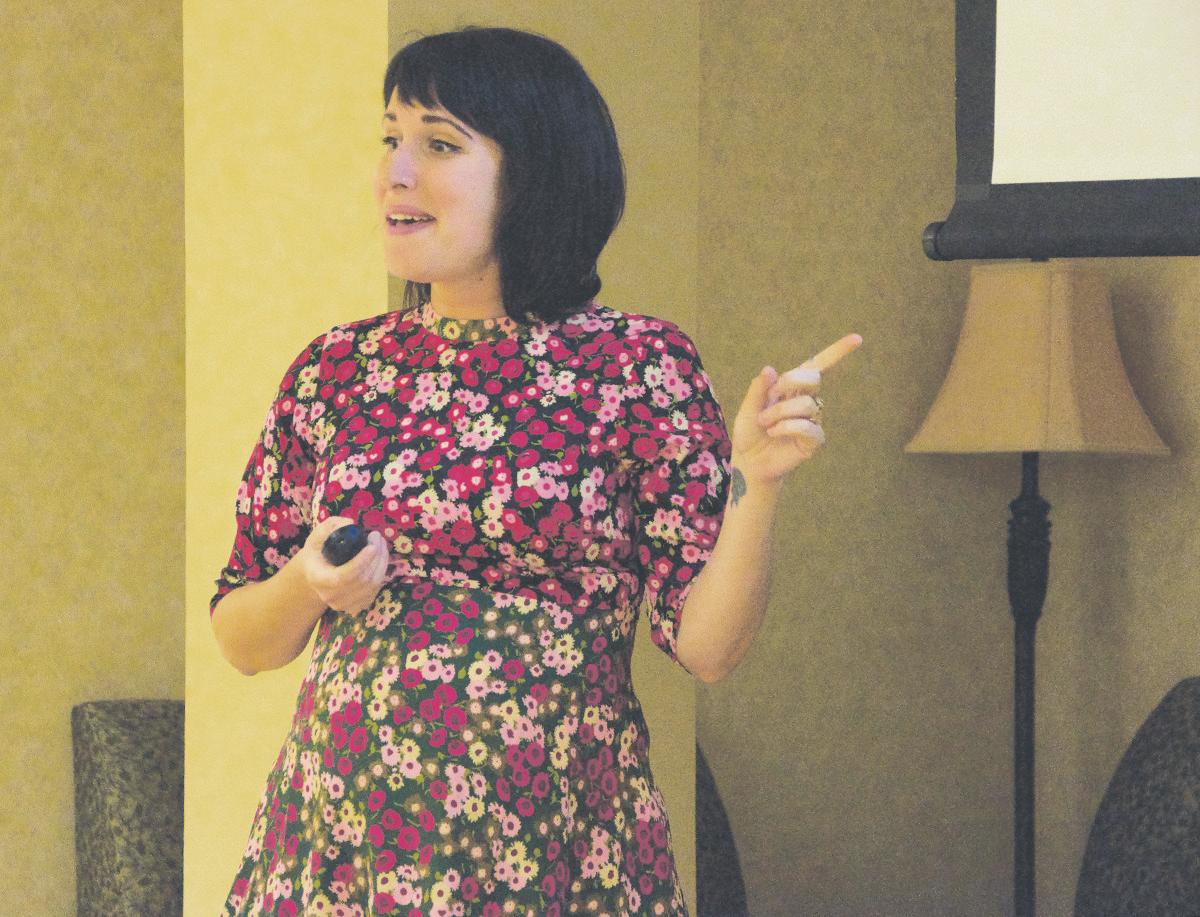
e xecutive o fficer and co-founder of m ission p ropelle, spoke monday at saint mary’s about her company and how to follow one’s passion. m ission p ropelle is a company with a goal to empower girls from a young age by offering them exercises at their elementary schools.
warshaw said that she was abused by her father as a young girl and that this experience severely affected her ability to harness her own voice. she said
by high school, she felt like she didn’t have one.
warshaw said that finally changed when she went to college and was able to use her voice in an effective way on campus.
“i n college i ... had the knowledge and the tools,” warshaw said.
warshaw said she found involvement on campus with feminist groups and became an activist in light of the iraq war. not knowing exactly what she wanted to do, warshaw said she
see empower PaGe 3
studies and Journalism, said in an email. “The university and the gallivan program were very lucky he was willing to devote himself to developing young, ethically-sensitive journalists the last decades of his life.”
despite ciccone’s tough exterior, chris hine, class of 2009 graduate and chicago blackhawks beat writer for the chicago Tribune, said ciccone had a big heart.
“i remember walking into the first day of class and you had heard all of these stories about him, about how tough he was, and you prepared to have your work trampled
on by him,” hine said. “what i really liked about him was that he would always criticize your work in a public way, but he always had a hint of a smile as he was doing it, or that little glimmer in his eye, almost telling you that it was nothing personal, that he was just trying to make it better.”
The fundamentals of Journalism is the gateway course for everyone in the Journalism, ethics and democracy program, and hine said the lessons he learned in ciccone’s classroom stayed with him far beyond graduation.
“one of the things he said to me
once and just stuck with me was ‘never turn down an assignment,’” hine said. “when an editor gives you something, you go do it.” another major lesson hine said ciccone emphasized was a certain degree of fearfulness in reporting.
“The other thing he always preached was that a good reporter was always a little fearful,” hine said. “a good reporter is always going to be a little fearful that they’re going to get scooped, that they’re going to get something wrong, but that fear was a healthy thing for a
Petition opposes inviting next US president to ND
By KATIE GALIOTO news e ditor
in the past, when a new u s president was elected, notre dame has extended an invitation for him to speak at the university’s commencement ceremony in may.
This year, some notre dame seniors are asking university president fr. John Jenkins to reconsider this tradition.
senior cody devine wrote and published a petition on change.org requesting that Jenkins and the university
board of Trustees not extend an invitation to either hillary clinton or donald Trump, the democratic and republican presidential candidates.
devine said he believes selecting either individual — whoever wins the presidential election — as notre dame’s commencement speaker would be a discredit to the mission of the university.
“i believe this is important because this institution is unlike the other institutions in — arguably — the world,” he said. “it stands for something that
is more than just the pursuit of knowledge, and it stands for something that is more than just the pursuit of our faith.
“it is a great intersection of those two ideas. a nd i think a lot of other institutions either don’t try to emulate or can’t.”
The petition is not a political statement, devine said. That’s why he plans to remove it from the website and send it to Jenkins before the election is decided.
“i think few people would
see peTiTion PaGe 3
Students abroad vote, keep updated on race
By SELENA PONIO news writer
Toledo, spain — amid immersing themselves in a new culture and planning whirlwind weekend trips to other countries, students studying abroad have also been preoccupied with a topic much closer to home: the 2016 election cycle.
anna lyons, a junior and participant in the Toledo, spain, program, said keeping up with the election
was not that challenging since it was something she was interested in prior to studying abroad.
“The biggest challenge is it’s been harder to vote,” lyons said.
“but as far as my experience being abroad, it definitely hasn’t changed my perspective on who i’m voting for.”
Junior John linczer, a student in the london program, said he has been following the election closely and that during his time abroad, he has realized it is not
only americans interested in this particular election. he said studying in london has made him realize how invested some foreigners are in american politics.
“i’ve found that many londoners are eager to both share their two-cents and also get mine on the presidential election,” linczer said. “They seem to understand the conundrum most americans are facing with two
see voTing PaGe 4 see Journalism PaGe 4
KELLY VAUGHAN | The Observer
Annie
Propelle, spoke Monday at Saint Mary’s about her work empowering young girls to have a voice.
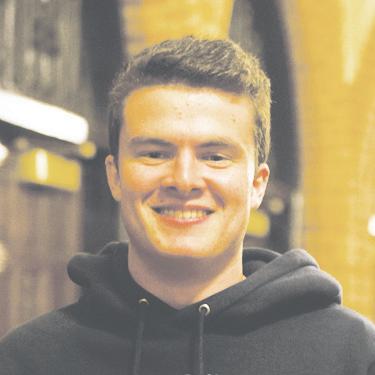
Patrick Hollander freshman Knott hall “patrick Kincaid.”
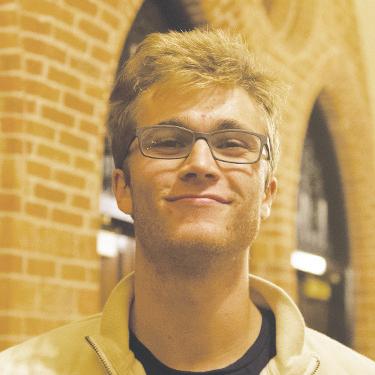
Bobby Becker freshman Knott hall “gandolf.”
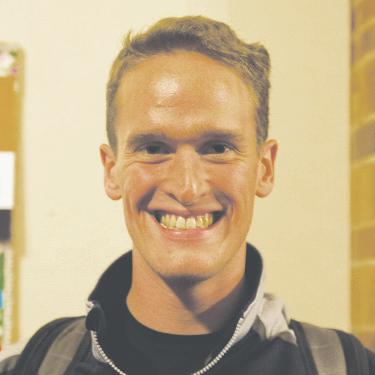
Chris Jarocki senior off campus “g errianne w ilkenson.”
Today’s Staff
Corrections
The observer regards itself as a professional publication and strives for the highest standards of journalism at all times. we do, however, recognize that we will make mistakes. i f we have made a mistake, please contact us at (574) 631-4541 so we can correct our error.
Lecture: Can We Eat Enough?
Lecture: “The Rise of Transnational Insurgent Citizenship in African Diaspora”
Lecture: “The Dynamic Psyche: Italian Pragmatism and Fascism”
ROSIE LoVOI | The Observer
Speaker analyzes historic effects of socialism
By AIDAN LEWIS news writer
g eorge harbison spoke about the dangers he sees in socialist ideology during his talk titled “v ictims of socialism” on monday night at debartolo hall. harbison, the c hief financial officer at unitek i nformation services, said his goal is to warn people of the atrocities a socialist regime can cause.
“This evening, we’re going to tear the veneer off intellectual, self-serving pathology and shine a bright light on the reality of the terror, death and destruction inflicted on the world by the perpetrators of this hideous ideology,” he said.
harbison focused largely
on a few specific examples of socialist societies gone awry, rather than on flaws in the ideology. one prominent example of communism’s failings, harbison said, was the reign of communism in russia for much of the 20th century, starting in 1917 with v ladimir l enin’s rise to power.
“l enin and his fellow communists nationalized industries, seized private land property from their owners, and redistributed the property to peasants,” harbison said. “religion was officially eliminated from russian society, as russians were forced at gunpoint to worship the power of the state.”
harbison said the evils only
increased under Joseph stalin, l enin’s successor. according to harbison, one of the most catastrophic aspects of stalin’s rule was his forced collectivization of soviet agriculture.
“under collectivization, peasants were forbidden to eat even their own crops, which were deemed socialist property,” he said. “The resultant and inevitable upheaval in agriculture disrupted food production, and directly led to the catastrophic soviet famine of 1932 and 1933, known as the holodomor.”
similar famines have occurred in other socialist societies, harbison said, including c hina under mao Zedong.
“[Zedong] forced the collectivization of c hina’s
agricultural sector in an attempt to accelerate growth in the country’s industrial sector,” harbison said. “not surprisingly, the expropriation of private farms, and with it, the elimination economic incentives to produce food, led to famine and mass starvation.”
because of this, harbison said he considers Zedong “the greatest mass murderer of the 20th century.”
harbison said cambodia under the rule of pol pot further demonstrates the menaces of communist regimes. pol pot attempted to institute a system of agricultural collectivization similar to that under stalin and Zedong.
“To make way for pol pot’s
vision of an agrarian utopia, money was abolished, books were burned and most of the countries teachers, merchants and intellectual elite were murdered, as they were viewed as potential enemies of the state,” he said. “one need only be seen wearing eyeglasses to be branded an intellectual and shot.”
harbison said he strongly disagrees with the argument that capitalism could lead to similarly horrific regimes.
“To deny socialism’s evils, or to invoke the argument of capitalism’s moral equivalency, is to engage in abject intellectual dishonesty,” he said.
Contact Aidan Lewis at alewis9@nd.edu
argue that this election is truthful, honest — or say it has integrity, it’s faith-filled. i think those things are understood that this election is not,” he said.
The petition has 64 signatures, though not all of them are from members of the class of 2017. it has been shared on facebook and promoted by word of mouth. devine said he decided to write the petition after talking with senior amanda Janouch, who had been discussing the topic with her friends.
“we want — or at least i, personally, would like — the main focus of commencement to be on accomplishments and what we’ve done here at notre dame over these past four years, without all of this controversy that’s going to come if one of these candidates comes and speaks,” Janouch said.
Janouch said she has friends who work in the university’s
student phone center and still hear angry remarks from alumni about the selection of president barack obama as the 2009 commencement speaker. distractions aside, devine said he doesn’t think many people questioned obama’s personal integrity. The same, he argued, could not be said about this year’s candidates.
“people disagree vehemently with obama about a host of issues,” devine said. “but they still respect him as a person. They respect him as president. i think we’re lacking that with these candidates.”
obama was the sixth u s president to speak at a notre dame commencement ceremony. he was preceded by dwight eisenhower, Jimmy carter, ronald reagan, george h w bush and george w bush. still, many seniors are asking the same question: wouldn’t it be cool to have the u s. president at graduation?
Janouch said she sees their point — but still thinks
other speakers could make the commencement experience more special to graduates.
“i feel like if we can get the president of the united states to come here, then we can also get someone else who’s of that caliber who might not cause as much controversy — and might do a better job of celebrating what we’ve done here,” she added. ultimately, devine said he sees the university as a role model for other institutions around the world.
“This university — and its position as a great model of catholic higher education — cannot serve in a reactionary role,” devine said. “it has to be a proponent of the good that the mission of this university teaches its students, and that the students go out into the world and emulate.”
“it has to be a proponent of those values,” he added. “To be a proponent, you sometimes have to stand above the fray.”
Contact Katie Galioto at kgalioto@nd.edu
paid a dverT isemen T
joined Teach for a merica, and she said she was excited for a stable job. however, she noticed some girls in her second-grade class were hard to reach. she said her first year teaching on the south side of chicago was the most important year of her life.
“i noticed the problems girls were facing started very, very early,” warshaw said. “[ so i asked] how can i take ownership of my future and do what i am passionate about — empowering women?”
warshaw decided to create her own company. w ith the help of another teacher, she figured out how to grow a business that was focused on empowering young girls to let them know they had a voice.
“i needed to empower women,” warshaw said, “i had coffee with feminist groups all over chicago and i thought, ‘i can to
that.’”
warshaw said mission propelle started working with eight schools in the fall of their first year, while both of its founders were still working full time as teachers. The company works with girls from first to fifth grade after school. warshaw said they focus on mentoring, doing yoga exercises and reading books with female protagonists.
“we wrote and illustrated 115 books on topics that every girl goes through,” warshaw said. “a nd then we use them as topics for discussion.”
warshaw said her startup company does not have any outside investors and is, therefore, free to make all decisions independently.
“you always have a choice at any point in your life to take action,” warshaw said.
warshaw’s company now has 45 teachers working for it. she said she is happy she is doing what she is passionate about and that her company is giving these young girls the opportunity to grow up to be empowered women.
“in a perfect world, you would bring your passions and skills together together to reach your goal,” warshaw told attendees. “so how can you bring them together?”
Junior Julia sturges said she felt better about her own future after listening to warshaw’s story.
“it was nice to hear that a nnie didn’t [do] what she was doing right out college,” sturges said. “she was able to find what she could be passionate about after she graduated. it all fell into place after trial and error.”
Contact Sydney Doyle at sdoyle01@saintmarys.edu
unlikeable candidates.”
Junior molly Knapp was an ndvotes commissioner last semester and said this provided her with the opportunity to learn more about the process of absentee voting. currently also in the Toledo program, she said while she thought this put her at an advantage it was not until she was abroad that she became aware of the added challenges of voting overseas.
Knapp said aside from keeping up with her regular news outlets she has been keeping up with the election through another medium as well: social media.
“i think social media has definitely allowed me to keep up with maybe the more controversial aspects of this election,” Knapp said.
Junior Jp bruno, a participant in the washington d c. program, said taking an american political journalism class this semester led to a lot of thought-provoking
discussion about the election.
“everything is so politicized here,” he said. “it’s definitely tense, but i haven’t been able to compare that to how it is in other parts of the country. it gets brought up in every conversation and it’s impossible to escape.”
Knapp said being abroad during a presidential election provided her with the opportunity to look at both candidates through a more international lens. she said living with a host family has provided her with the opportunity to get an idea of what foreigners thought of both candidates and how the results of the election could affect not only america, but other countries too.
“i think it has given me a different perspective especially when talking with my host family here in Toledo,” she said. “Their opinions about [the election] and the way international relations would change if either candidate was elected has definitely been interesting.”
Contact Selena Ponio at sponio@nd.edu
he was trying to drill those fundamentals of good reporting into us. w hen he actually liked something, that stuck with you too.”
reporter, and he believed it made you a better reporter.
“if you don’t have a little bit of fear, then you’re either going to screw something up or you’re going to miss out on something.”
Tim logan, class of 2001 graduate and current boston globe reporter, said ciccone taught him the value of writing for the reader.
“he tried to give students a sense of what it was like to work in a newsroom. he was kind of old school. he was serious about editing and making sure your stuff was clean and was good and was written for the readers, basically, which is something i think that takes people time to wrap their heads around as journalism students,” logan said. “one thing that sticks in my head is that … the point of the first sentence of the story is to get the reader to read the second sentence of the story and so forth.”
Jack colwell, interim director of the gallivan program at notre dame, said ciccone was a classic example of an old-school journalist.
“he came up through the city bureau in chicago and worked with people who were like that — people who emphasized ‘if your mother loves you, check it out,’” he said. “i think that’s a lesson he’s tried to impart on his students.”
sarah childress, class of 2003 graduate and senior digital reporter for frontline, said ciccone was “pretty tall, imposing, and he always had that raised eyebrow, skeptical approach to everything that we did.”
“he would read our stuff aloud, and he would tear us apart. and he would ask why we included what we did, why we used that quote, and it was terrifying and he was ruthless, but you learned from that,” childress said. “you learned a lot, and the lesson stuck, especially when he was calling your name out in class. he was deeply committed to good reporting, and
hine said ciccone helped him recognize journalism as a potential career path.
“he was such a nice man, inside and outside of the classroom, and i’m really glad that was my first [journalism] class here because i learned so much from him and he was a big help in helping me realize i could do this for a living,” he said.
yant Kinney also launched her career in journalism with help and guidance from ciccone.
“i had had brief flirtations with applying to advertising agencies, and i was like i don’t even know what i would be doing,” yant Kinney said. “i don’t think i had my plans set, and i didn’t know where to go. and he was incredibly generous with his time, with his expertise, with helping me weigh options, and that didn’t end when i graduated. ... Throughout my career, he really remained a trusted advisor, and as i got older, i really knew him as a friend.”
sheila flynn, class of 2004 graduate and current associate features editor at irish daily mail, said ciccone encouraged her to pursue journalism further as well.
“[his class] was absolutely fabulous. i went to notre dame knowing i wanted to do something in writing. i was thinking perhaps [public relations] or magazine feature writing. his class made me fall in love with the news,” flynn said.
ciccone’s death is a loss to the notre dame journalism department, flynn said.
“it’s a huge loss to the journalism program and the journalism world in general,” flynn said. “he was a great writer and a great reporter and a great teacher. he was one of the last of a dying breed, and everyone who took that class, i know it was their favorite class.”
Contact Rachel O’Grady at rogrady@nd.edu
paid a dverT isemen T
paid a dverT isemen T
w hen can we celebrate c hristmas?
w hen it comes to the holidays, the world is starkly divided into two groups: those who listen to c hristmas music by the cozy fireplace while sipping on a peppermint mocha from their red holiday s tarbucks cups on n ov. 1, and those who despise the aforementioned people. There is no in-between. i happen to fall into the first category and here’s why.
i love Thanksgiving. i love being surrounded by family and friends. i love the traditions of running in my hometown’s annual five-mile d rumstick d ash on Thanksgiving morning. i love coming home to watch the m acy’s Thanksgiving d ay p arade and smell the lovely aroma of pumpkin pie, stuffing and turkey cooking. i love being able to stuff my face with as much mashed potatoes and green bean casserole as humanely possible afterwards. i love it all.
h owever, many people think that by listening to c hristmas music in early n ovember, i must not care at all about Thanksgiving and want to gloss right over the season completely in favor of its bigger, older brother.
This is simply not the case.
i consider Thanksgiving to be just as big a part of the holiday season as c hristmas, mainly because both seasons are about so much more than what is advertised. i know we hear this all the time, but the holidays truly are about more than just gift-giving and receiving. i t’s about more than writing a list to s anta, picking out a c hristmas tree, decorating cookies or trying to get the best deals while b lack f riday shopping. s ure it’s nice to celebrate with themed movies, parties, decorations and food; but for me, the holidays are really about bringing people together.
m any movies poke fun at the whole “family” aspect of the holidays. They usually go something like this: an older couple is so excited to finally have their kids and their families all under one roof until they realize living with your family is hard. i can relate to this coming from a family of 29 aunts and uncles, over 60 cousins, 18 cousins-in-law and over 22 second cousins. n eedless to say the holidays can get a bit hectic in my family, but that’s what makes me love c hristmas even more. c hristmas is the time when everyone returns; when i get to make up for lost time by talking to aunts and uncles i haven’t seen in a while. i know this may seem a bit cliche but it’s true: The holidays bring me so much joy just from spending time with the people i love. b eing away at college has only increased this desire for cozy nights spent sipping hot cocoa with my family while watching “ n ational l ampoon’s c hristmas vacation” (which just so happens to summarize these “family” movies to a ‘T’). i celebrate c hristmas early because i can’t wait to be reunited with the people i love most. n o matter when you decide it’s socially acceptable to start celebrating c hristmas, i think we can all agree one thing: i t’s never too early to get excited about reconnecting with your family.
Contact Emma O’Brien at eobrien03@nd.edu
The views expressed in the Inside Column are those of the author and not necessarily those of The Observer.
letters to tHe edItor
The right to health in America
o n July 4, 1776, our founding fathers declared that men “are endowed by their c reator with certain unalienable r ights, that among these are l ife, l iberty and the pursuit of h appiness.” Today, many people are, due to a lack of access to readily available health care services, prevented from pursuing their natural rights because of the inefficiency and waste of the united states health care system.
The united states does not have a single-payer health care system. it operates on a market-based health care system which is supplemented by medicaid and medicare. o f the people who are insured, it is estimated that 54 percent of the population receives health insurance from employment-based programs. a nother 16 percent of the population is covered by medicare, a federal program established to cover the elderly, and almost 20 percent of people are covered by medicaid, a program created to insure people in poverty. under this system, almost 10 percent of the population is uninsured, and in the a merican health care system, being uninsured can carry some severe consequences. i f a person without health insurance happens to become sick or injured, they will have to pay for their procedures and medicine on their own, and medical expenses in the united states are not cheap. for example, a heart bypass surgery in the united states costs $75,345. This price is over $30,000 more than in a ustralia, the country with the second highest price. o ther procedures like appendectomies, mri s, and c T scans follow the same trends. i n addition, pharmaceuticals are also routinely more expensive in the united states. p eople without health insurance often flounder under these heavy medical costs, and when they go bankrupt, the u s . taxpayers pick up the bill. The a ffordable c are a ct went some way to fix this problem. Through medicaid expansion, allowing people under the age of 26 to stay on their parent’s health insurance, and the coverage of people with pre-existing conditions, the a ffordable c are a ct has helped 20 million people gain access to health insurance, but even with this reduction in the number of people who are uninsured, there are still far too many people who are left without access to quality health insurance.
The bargaining power a single-payer health care system would provide would drive down medical costs just like it has in countries like a ustralia, c anada, d enmark, f rance, g ermany, Japan, netherlands, new Zealand, norway, s weden, s witzerland and the united Kingdom. The united states spends more on health care than all of these countries. i n 2013, the united states spent 17.1 percent of its gdp on health care costs. That is almost 50 percent more than the its closest competitor. its average per capita spending is $9,086 compared to the next highest of $6,325. The united states spends more public money on health care than every country except norway and the netherlands, and private spending is higher in the u s . than in any other country. These statistics are simply astonishing when you take into account the united states’ comparatively low life expectancy (78.8 years) and surprisingly high infant mortality rate (6.1 deaths per 1,000 live births). i n addition, u s citizens have access to fewer hospitals and visit their physicians fewer times than their peers in other countries.
however, it does not have to be this way. The adoption of a single payer health care system would allow the government to bargain with medical companies to ensure we are getting the best prices possible. it is believed high health care costs are one of the main reasons for the united states’ ridiculous overspending on health care, and this would go a long way toward fixing this problem. a single-payer system would also insure the 10 percent of people who live without health insurance and with the fear they might become sick and find themselves in financial ruin while also improving public health. s tudies have also shown that people who have health insurance tend to take less sick days, so economic productivity will also be benefited. a ll in all, moving to a single payer health care system will allow many people to finally enjoy their right to “life” and “the pursuit of happiness” while also driving down health care costs for every single a merican.
vote against tyranny
The d eclaration of i ndependence put it simply: “a p rince whose character is thus marked by every act which may define a Tyrant, is unfit to be the ruler of a free people.” o ur nation was founded on the principle that an individual who is not accountable to the people has no right to rule the people. The man now in question is just such an individual. h e is accountable to no one but himself. h e does and says whatever he wants because he knows that he can do and say anything and his base will still support him — and almost no one in his party in c ongress has shown the backbone to stand up to him. h e does whatever he wants to women, regardless of what the law says, because he believes that his wealth and power put him above the law: “ w hen you’re a star, they let you do it. you can do anything.” a nother time he said, “ i could stand in the middle of f ifth avenue and shoot somebody and i wouldn’t lose any voters, okay? i t’s like incredible.”
i magine what a narcissist who believes he “can do anything” to anyone would do if he held
the powers of the most powerful office politically in the history of human civilization, if he became c ommander in c hief of the most powerful military in world history, if he had the explicit power to do whatever he wanted with our nuclear arsenal.
you don’t have to “feel good” about voting for her. voting isn’t about making yourself feel good. i t’s about you performing your constitutionally-protected right and duty as a citizen of the u nited s tates of a merica to do your part to ensure that the next leader of the f ree w orld is a person who is dedicated to defending the democratic principles of liberty and equality and who is not a megalomaniacal tyrant — a right and duty for which hundreds of thousands of a mericans over the course of more than two centuries have sacrificed their lives. vote.
Steven Higgins freshman sept. 20
Emma O’Brien news writer
Joseph Raabe
Cannibalism then and now
i n 1563 m ichel de m ontaigne met three cannibals. i t wasn’t until 1580, however, that he published “ o f c annibals,” offering an analysis of the stories told by these three b razilian natives at the court of c harles i X. The most memorable part of their entire testimony, of course, is the bit about ritual human consumption. b elow is a particularly vivid section (excuse the dated translation):
“ e very [native] for a trophy brings home the head of an enemy he has killed, which he fixes over the door of his house. a fter having a long time treated their prisoners very well, and given them all the regales they can think of, he to whom the prisoner belongs, invites a great assembly of his friends. They being come, he ties a rope to one of the arms of the prisoner, of which,
it’s
at a distance, out of his reach, he holds the one end himself, and gives to the friend he loves best the other arm to hold after the same manner; which being done, they two, in the presence of all the assembly, despatch him with their swords. a fter that, they roast him, eat him amongst them, and send some chops to their absent friends.”
b rutal stuff. w hat makes m ontaigne so great, however, is that his essay isn’t really about the native’s anthropophagy, which, to be sure, is a horrific practice regardless of shared symbolic value. That would be too easy, too moralizing of a claim to make.
i nstead, the author takes cannibalism as a point of departure inwards, towards a critique of the religious schism and cruelty pervasive in 16th-century e urope. There is a sort of hypocrisy, he argues, in condemning the “barbarous horror of [cannibalism]” when people are “so blind to [their] own” forms of barbarism.
m ontaigne goes so far as to say that native
practices are more humane than the e uropean’s. w hereas the former involves the consumption of an already deceased body, the latter devours man alive by rack or by roasting by degrees. Technology offers more and more creative possibilities for inflicting pain upon others.
a nd so does religion. f or m ontaigne, unfortunately, such a claim borders on truism. w hat else could you say in a time when the most brutal violence was reserved not for “inveterate and mortal enemies,” but “among neighbors and fellow-citizens,” between c atholics and p rotestant reformers and even among these reformers themselves? h arsh words for a harsh time. c annibalism, m ontaigne concludes, isn’t found deep in some remote island-jungle. i t’s found next door. o r within.
Contact Jeremy Capello Lee at Jeremy.CapelloLee.1@nd.edu
The views expressed in this column are those of the author and not necessarily those of The Observer.
finally over, but have we learned?
f inally. Today is the day that it all comes to an end. we can finally watch T v in s outh b end without having e van b ayh, Todd young, John g regg and e ric h olcomb talk to us. we can finally look on the internet and not see our crazy high school classmate’s post about how he think d onald Trump will save a merica and h illary c linton is the a ntichrist. a nd you all can finally pick up the o bserver in two weeks and not see me ranting about a toupewearing reality star. b ut with the election winding down, it’s time to look ahead — ahead to what it all means for the future of our country, our politics and our policy.
The impact that this election will have is undeniable. it’s been an unprecedented year and a half, and our country’s future looks much different because of it. The primary season showed us that populism, which has risen throughout different times in our country, has suddenly taken hold of one of our political parties. w ithout populism, there quite simply would be no d onald Trump. f or everything that he is, he has tapped into the sentiment of many people around the united s tates — and that should hold some worth. yes, he has tapped into some racist, discriminatory and degenerate people. b ut there are also plenty of people who have real gripes with the way our country is run. w hatever happens, the next president and the
next government as a whole has to find a way to figure out what exactly people are frustrated with and how their anger can be addressed.
This election has also seen the status-quo twoparty system of the united s tates overturned. w ill we still see d emocrats and r epublicans dominate elections for years to come? d efinitely. b ut we will see differences that this election cycle has exhibited. we’ve seen in this cycle a vehement sense of disapproval and anger toward the so called “establishment” of both parties. f or r epublicans, this is what brought about the nomination of d onald Trump — a set of people who feel like their issues, problems and grievances were never considered. d onald Trump won the nomination and gained legitimacy because people believed he was the only person who could restore “greatness” that many people who were left on the sidelines once had. o n the other side, the anti-establishment and antistatus quo sentiments were obviously exhibited through b ernie s anders. a lthough b ernie didn’t win, the vast majority of people who supported him pulled h illary c linton to the left, changed d emocratic p arty politics and gave new legitimacy to a much more liberal and activist d emocratic p arty. a dditionally, we have seen and will see record number of young voters continue to reject the two-party system through protest votes to third party candidates — whether this trend will continue or is merely a product of this election remains to be seen.
f inally, this election has also seemed to upset
the norms of united s tates policy in many ways. b efore this election, a vast majority of a merican politicians and citizens extolled the positives of free trade. i n this election, however, both major candidates and many down-ballot candidates reject the idea of free trade in some manner, reflecting the positions of many citizens today. f urthermore, some things that have seemed to be partisan positions have achieved some sort of consensus between the two parties — paid family leave, the need to reform our entitlement programs and criminal justice reform. a lthough they differ on how government involvement should look, the two parties are closer than ever on realizing the importance of these issues.
This election will be historic regardless of who wins, and its impact will be felt immediately because of how historic it figures to be. The irregularity of this cycle, however, will have repercussions that extend far beyond the next four years. it’s been a trying and sometimes annoying cycle, yes. b ut it’s been a historic cycle, one that promises to shape the future of our country.
Neil Joseph is a senior from Columbus, Ohio, majoring in Political Science and Economics. He hopes that you don’t use these articles against him when he’s running for School Board one day. He welcomes all compliments at njoseph2@nd.edu, and sometimes responds to those who criticize him.
The views expressed in this column are those of the author and not necessarily those of The Observer.
Jeremy Capello Lee l ost in Translation
Neil Joseph moderately o pinionated
Baylor needs to leave Briles behind
Just under a month ago in this column, i wrote about former b aylor head coach a rt b riles and said teams looking for a new coach for 2017 need to stay away from the man who ignored what was nothing short of a rape epidemic while coaching the b ears.
b ut recent development in the scandal compelled me to write about it again and with a different focus. w hat i had overlooked last time was the one team who need to distance themselves from what happened at b aylor football the most: b aylor.
a fter the latest stories detailing the full extent of the scandal — allegedly 17 victims of rape by 19 football players, with b riles supposedly knowing explicitly about one gang rape and creating a system designed to avoid knowledge of the others, according to the “ w all s treet Journal” — much of the rest of the college football world should all have agreed that what happened at b aylor was inexcusable.
yet during s aturday’s 62-22 defeat to rival T cu , fans lined up to buy a shirt honoring b riles. o ne fan in a suite at m c l ane s tadium unfurled a banner in support of b riles. The team even made the interesting decision to wear black — the color that was already chosen for the shirts in support of the coach — on what was supposed to be a “ g reen out” game, although they denied there was any connection.
b ut what the honoring of a rt b riles really shows is not just that the school still sees the coach who brought the b ears to football relevance as a hero. i t reflects the culture throughout the entire u niversity of continuing to ignore what has taken place, as does the continued presence of most of b riles’ coaching staff, who reports claim would have also had knowledge of the culture at the u niversity.
w hat b aylor needs to do is make a serious statement that the u niversity regrets what occurred. That means more than simply removing a few big-name figures and letting the program carry on as normal. l ast week, h arvard ended its men’s soccer team’s season despite an expected ncaa
tournament berth because of a sexually explicit ninepage document about members of the women’s team. c anceling b aylor football’s season with games to go may not be the right option, as it would have an impact on the other schools the b ears are to play, including outside playoff shot w est v irginia.
b ut that level of action — something that makes it clear b aylor understands how serious the complaints it faces are — is the only thing that can make the u niversity look like it cares. a t the very least, b aylor should remove everyone who had any connection to what went on while b riles was coach, starting with all of b riles’ remaining assistants, while self-imposing a postseason ban. i f b aylor continues to employ only window-dressing punishments for one of the worst scandals this sport has ever seen, the ncaa needs to consider its greatest punishment — the “ d eath p enalty” that was handed out to smu in the 1980s. i t may take the threat of canceling football for an entire year to finally ensure the u niversity gives this scandal the reaction it deserves. f ootball may be far more important to a school than soccer, especially when we compare b aylor football to h arvard soccer, but what happened at b aylor is certainly orders of magnitude worse than what happened at h arvard and needs that kind of response.
g iven the opportunity, b aylor may not be the only school that would put a successful athletics department ahead of the safety of its students. w hat happened in w aco, Texas, may well just be a symptom of a larger problem in colleges across the country as successful sports teams become immune to consequences for their actions. i f b aylor can get away with window-dressing punishments for those involved, other schools in similar situations know that they face only minimal fallout for their actions. The ncaa needs to make it clear that the nuclear option is on the table if b aylor doesn’t take larger steps to fix its culture.
Contact Daniel O’Boyle at doboyle1@nd.edu
The views expressed in this Sports Authority are those of the author and not necessarily those of The Observer.
w s occer
con T inued from page 12
we’re excited about where we’re at and i ’m just hoping we can improve upon the little details and step on the field f riday as the best version of ourselves.”
s hould they win, the i rish will go on to face either Kent s tate or n orthwestern, with the i rish having already tied the latter in a preseason exhibition game. The first seeded team that could await the i rish is third-seeded d uke. n otre d ame did not play the b lue d evils in conference play this year, but the two teams contested for the acc regular season title, with d uke finishing third and the i rish first. a nother potential option in the first three rounds is m ichigan, who defeated the i rish, 2-0, in a nn a rbor in a ugust.
The top seed in n otre d ame’s region is west v irginia, who boast the
Interhall
con T inued from page 10
no. 1 welsh Family def. no. 8 Flaherty, 13-6
By RYAN LOKHORST sports writer
n o. 1 w elsh f amily rode a suffocating defensive performance to a 13-6 victory over n o. 8 f laherty. The w hirlwinds never trailed, yet it was a hard fought battle the entire game.
i n the first quarter, w elsh f amily moved the ball well but was unable to convert once it reached the red zone twice due to a turnover on downs and an interception. The scoring opened up in the second quarter as two w hirlwind sacks set their offense up with good field position. They took advantage with a touchdown pass on the ensuing drive. f ollowing a f laherty interception, w elsh f amily was
best record in college soccer this season at 19-1-1.
i f the i rish can advance past d uke, they are likely to play m ountaineers in m organtown, provided the top seed advances past n o. 4 ucla and into the quarterfinals themselves. h owever, r omagnolo said later-round games aren’t worth thinking about until the i rish know if they’ll be playing them.
“Those are many games away,” r omagnolo said. “The ncaa tournament is about winning many games at a time, so right now it’s about beating siue and making sure we put forth our best performance.”
“ you can’t get ahead of yourself. e veryone’s good, everyone’s up for every game. you’ve got to concentrate on being your best each day.”
The second seed is the highest the i rish have been awarded since 2009, when they achieved the same seeding. That year the i rish
able to double its lead with another touchdown pass to make the score 13-0 headed into half.
The second half was evenly matched as the b ears made adjustments on defense to slow the w hirlwind offense, and the f laherty passing attack began to find success. h owever, timely sacks and an interception by w elsh f amily kept f laherty scoreless.
The b ears finally got on the board on a long touchdown drive near the end of the fourth quarter, which made the final score 13-6.
f laherty still came away satisfied with its performance, as b ears senior captain h eather l ystad said she was disappointed in the result of the season, but felt that the touchdown made the loss easier to take.
“Things just didn’t go our way today,” l ystad said.
“ w e played really well and we played hard. ... The score
made it to the c ollege c up semifinals after beating f lorida s tate, but lost to n orth c arolina.
r omagnolo said she tried not to think too much about her team getting the second seed.
“ i thought it was possible,” r omagnolo said. “ i try not to read too much into it or think too much about it because it’s out of our control. we do the work up to that point and then at the end of the day it’s up to the committee. s o i thought it was possible, i think it’s a great reward for the body of work that we put in at the regular season. b ut now at this point there’s all good teams in the tournament, so you’ve got to be up for every game and be ready to put forth your best effort.”
The i rish and the c ougars kick off at a lumni s tadium on f riday at 7 p.m.
Contact Daniel O’Boyle at doboyle1@nd.edu
without that touchdown wouldn’t really reflect how close that game actually was.”
w hirlwinds senior captain a riel n avotas said she was especially impressed by her team’s defense and is looking forward to its semifinal match-up.
“ o ur defense continues to limit big plays and apply pressure on the [quarterback],” n avotas said. “ o ffensively, we need to focus on cleaning up our routes and securing the catch. d efensively, we need to place emphasis on flag pulling and tracking down any Q b runs.”
w hile the b ears have been eliminated from the playoffs, the w hirlwinds play n o. 5 b reen- p hillips in the semifinals at 8 p.m. Tuesday at l a b ar p ractice c omplex.
Contact Ryan Lokhorst at rlokhors@nd.edu
Daniel O’Boyle sports writer
EMMET FARNAN | The Observer
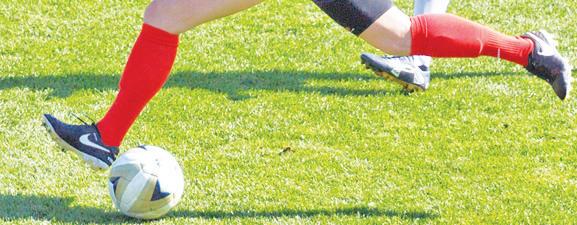
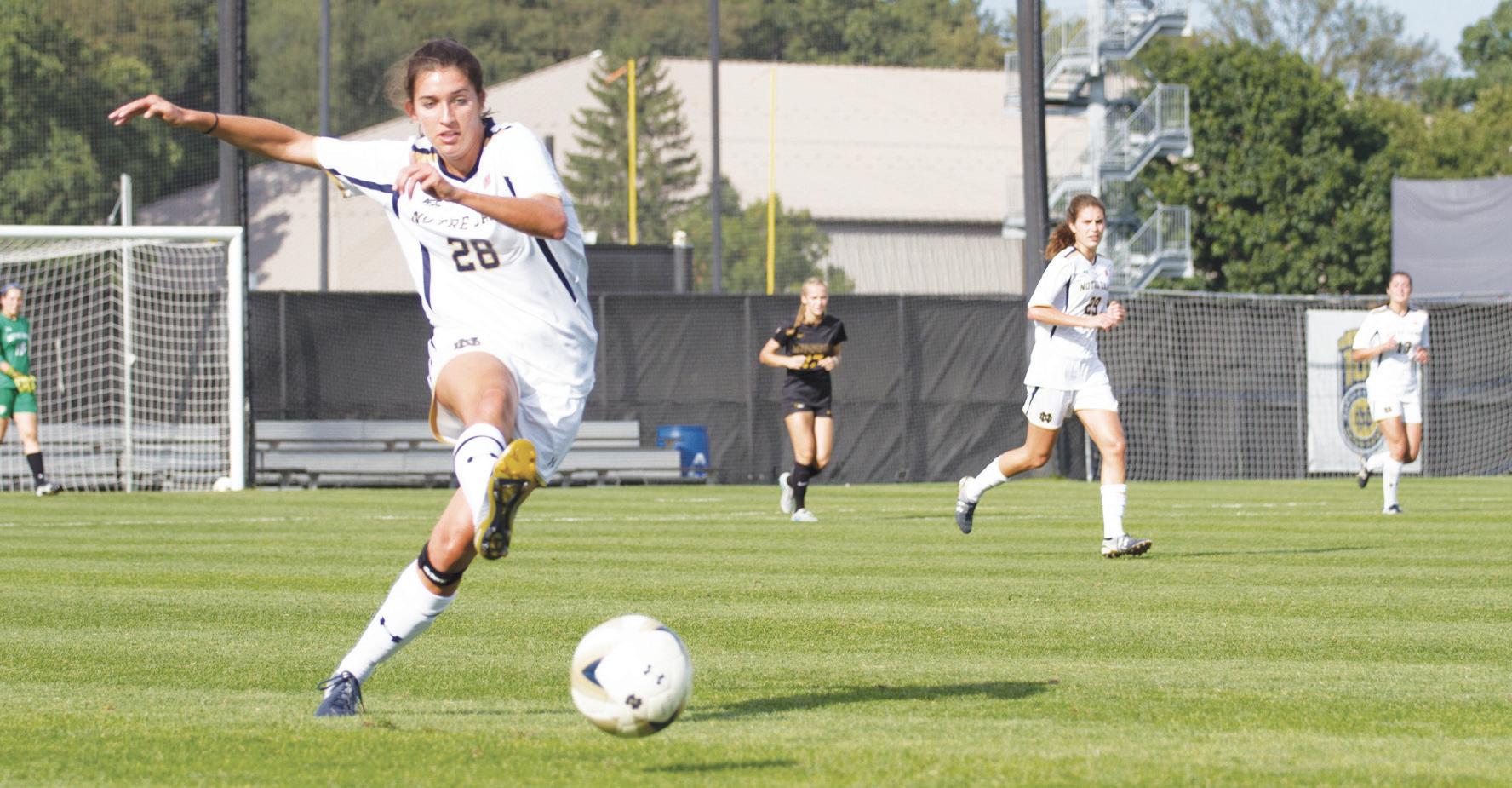
Irish junior forward Kaitlin Klawunder kicks the ball during Notre Dame’s 1-0 victory over Missouri on Sept. 4 at Alumni Stadium. Klawunder is the third leading point-scorer on the team this season.
Interhall
con T inued from page 12
forward to it.”
stanford plays second-seeded Keenan in the semifinals on sunday at 1 p.m. at l a bar p ractice c omplex.
Contact Darcy Dehais at ddehais@nd.edu
no. 2 keenan def. no. 7 siegfried, 6-2
By MEAGAN BENS sports writer
w ithin the final two minutes, Keenan scored the only touchdown of the game resulting in a 6-2 victory over siegfried.
The no. 7 r amblers (2-2) and no. 2 Knights (4-0) were evenly matched and both struggled to put points on the board throughout the game due to each team’s strong defensive lines. Keenan senior captain m ichael Koller said his team knew what it needed to fix at halftime to get the win.
“a t halftime, siegfried was up 2-0 due to the safety, and we realized we had a slow start,” Koller said. “ we weren’t exploding as much as we thought we would, and they brought it harder than we did. we wanted to clean up our line to give our quarterback a little less pressure and that’s what we did the second half, which opened up our passing game a lot.”
siegfried continued to lead 2-0 until Keenan’s final possession of the game.
“ w hen siegfried’s punter’s knee touched the ground, the game changed right there,” Koller said. “it gave us the ball where he stood before punting, and that’s a 50-yard game changer. we ended up starting on the 30 [yard-line], and it eventually led to sophomore l ukas c epkauskas catching a pass in the end zone. he tends to get a lot of touchdowns in the playoffs. l ast year we had two playoff games and we won both of them by one touchdown, and he had both. he continues to show up during the playoffs, and he is definitely a highlight-reel type of player.”
d espite the season coming to an end in the first round of the playoffs, siegfried senior captain mark egan said the r amblers had a good run.
“ we played a great game and we worked hard all season,” e gan said. “ we came out to play today and i am proud of the team. it was a long, good season, and we should have our heads held up high, and good luck to Keenan.”
Keenan moves on to the semifinals of the playoffs to face rival no. 3 stanford in the ‘b attle for the c hapel’ at 1 p.m. on sunday at l a b ar p ractice c omplex.
Contact Meagan Bens at mbens@nd.edu no. 1 st. e dwards def. no. 8 Carroll, 7-6
By PATRICK SKRINE sports writer
Top-seeded st. edward’s edged no. 8 carroll, 7-6, on sunday in the quarterfinals of the interhall playoffs.
The gentlemen (4-0) escaped with the win after a hard fought contest in which the vermin (2-21) failed on a 2-pt conversion attempt to take the lead.
it was a battle of the defenses as both teams found the end zone just once. st. edward’s scored first with a run up the middle in the first quarter on fourth down. in the second quarter, carroll got on the board with a touchdown pass through the air but could not connect on the two-point try.
The game saw no more scoring due to solid defensive play from both teams. st. edward’s senior captain phineas a ndrews thought his team contained the vermin on offense.
“our defense did a good job of keeping them out of the end zone towards the end,” a ndrews said. “They had a couple of drives where they were definitely threatening to take the lead.”
The gentlemen executed on special teams and were able to make some key plays on both sides of the ball. a ndrews said he likes where his team stands going into the next round but knows his team has to keep building.
“we’re always looking to improve our execution on offense and we need to communicate a little better in coverage on defense,” a ndrews said.
vermin senior captain a nthony vallera was happy with the way his team played despite a tough loss.
“we fought hard considering the game was 7-6,” vallera said. “our defense played really well and for the most part we were able to drive the ball on offense.”
vallera said the gentlemen did a good job limiting the vermin passing game.
“defensively they didn’t let the
big ball happen,” vallera said. “They played off zone and didn’t let anything behind them which made it really difficult for us.”
overall, vallera said he is proud of the effort his team put forth this season and likes the way they battled, especially in both games against st. edward’s.
w hile carroll’s playoff run has come to an end, st. edward’s moves onto the next round and plays no. 5 duncan sunday at 2:30 p.m. at la bar practice complex.
Contact Patrick Skrine at pskrine@hcc-nd.edu
no. 5 duncan def. no. 4 a lumni, 27-14
By MIA BERRY sports writer
a strong second half helped no. 5 duncan earn its first playoff victory in dorm history by defeating no. 4 alumni, 27-14.
early in the game, senior captains from both teams went down with injuries that forced them to miss the rest of the game. despite the unexpected injury to highlanders junior captain Thomas staffieri, duncan started off strong with two touchdown runs by sophomore micah rensch to give duncan a 14-0 lead at the end of the first quarter.
duncan sophomore running back micah rensch said he was proud of how his team responded after its captain went out with a concussion.
“This is for sure the best game we’ve played all season,” rensch said. “offensively, we clicked and scored four touchdowns and only had to punt once. our defense also played great despite that one mishap on the punt. right now offense and defense are playing lights out. obviously we have our eyes on playing in the stadium. we’re hoping to get there, but to get the first playoff win for duncan football is huge and history making for sure.”
alumni capitalized on a special teams error by duncan when
junior linebacker Joseph Jared ran in a blocked punt late in the second quarter to cut duncan’s lead to 14-6.
alumni did not carry this momentum into the second half as duncan dominated, outscoring alumni 13-0 in the third quarter. alumni attempted a comeback back in the fourth quarter when sophomore receiver nick waytula caught a 30-yard touchdown pass, but the alumni effort was cut short as duncan ran the remaining time off the clock for the win.
alumni senior captain nicholas lund said he was proud of how his team responded in his absence.
“of course i wish i hadn’t gotten hurt, but i’m proud of how our defense responded,” lund said. “after i went out, a few plays later they were able to get a stop. our team played well. duncan was just able to stop our run that we had been feeding off of most of the season.”
despite alumni’s playoff loss, lund said he is optimistic about the future of alumni’s interhall program.
“considering how much we actually practice, i would say we are definitely one of the better teams i’ve been on at alumni,” lund said. “i have no doubt that they will rebound next year and finish what we’ve started.”
next week duncan hopes to continue its playoff journey when it faces top-seeded st. edward’s in the semifinals, which takes place at 2:30 p.m. sunday at labar practice complex.
Contact Mia Berry at mberry1@nd.edu
no. 5 breen Phillips def. no. 4 Cavanaugh, 20-19
By KYLE BARRY sports writer
no. 5 breen phillips score late in the game to defeat no. 4 cavanaugh, 20-19, in the quarterfinals at labar practice complex on sunday night.
The chaos (4-3) started the first
quarter firing on all cylinders as senior wide receiver and captain a lyssa a nton was responsible for the chaos’ first two touchdowns to take a 12-0 lead.
The babes (5-2), led by senior quarterback and captain emily a ffinito, overcame a 12-point deficit as a ffinito scored two touchdowns of her own, including a 35-yard keeper to put the babes up 13-12 late in the third quarter. with the babes down six points in the fourth quarter, a ffinito scrambled for seven yards to tie the game up at 19. The babes completed the point after with a pass from a ffinito to junior michele pennala to take a 20-19 lead.
with the chaos driving to take the lead before the game ended, babes’ freshman Kristina bonnet came up with an interception to secure the victory. a ffinito said she was pleased with the result of the game.
“we did very well today,” a ffinito said. “it took us a while to get used to the playoff environment, but i’m so proud of how we played tonight.”
a ffinito said the defining point of the game was when pennala caught the game winning conversion in the corner of the end zone. in order to be successful in the semifinals, a ffinito wants to add more plays to mix their calls and throw opposing team off balance.
on the losing side, a nton said she was proud of cavanaugh’s effort.
“i couldn’t be prouder of our team this season,” a nton said. “for a young team, i thought we did very well. The girls enjoyed it, which is the most important, and i can’t wait to see how this group does next season.”
The babes move on to the semifinals to play top-seeded welsh family on Tuesday at 8 p.m.
Contact Kyle Barry at kbarry@hcc-nd.edu see inTerhall PaGe 9
paid a dverT isemen T
Kelly seeks clarification on controversial penalty
By BEN PADANILAM
a ssociate sports e ditor
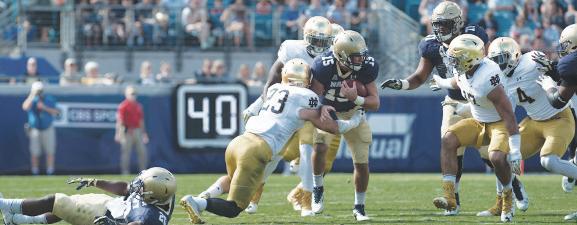
following notre dame’s 28-27 loss to navy on saturday, irish head coach brian Kelly was tasked with answering questions about special teams miscues during his weekly sunday teleconference.
This week, Kelly was asked about a controversial 12-men-on-thefield penalty on a fourth-and-6 which ultimately cost the irish (36) a defensive stop late in the third quarter, extending a drive for the midshipmen (6-2, 4-1 aac) that allowed them to take a lead they would not relinquish.
“The rule clearly states that if he is one step from the sideline, then that is not a reviewable play,” Kelly said of the call sunday. “very similar to when i had asked earlier in the game for a review on a [senior running back] Tarean folston run, i was told by the official on the field because his forward progress was deemed stopped. … This could have been a similar situation where
see Kelly PaGe 11
Irish junior Drue
stanford advances over dillion
no. 3 stanford def. no. 6 dillon, 18-7
By DARCY DEHAIS sports writer
no. 3 stanford defeated no. 6 dillon by a score of 18-7 in the first round of the interhall playoffs, eliminating the big red.
The griffins (4-1) scored a rushing touchdown on the opening drive, and their offense was difficult to stop the rest of the game. dillon (2-2) threw an interception and fumbled the ball once in the first half, allowing stanford to gain an early edge. dillon junior captain John walsh said the big red’s simple mistakes cost them the game.
“i thought we fought hard,” walsh said. “a few plays decided this one. we were all over the field on offense and defense and did some stupid things. we didn’t go all the way, but it was a fun year.”
The griffins relied heavily on the run throughout the game, and freshman running back brandon garcia had a standout performance for stanford. griffins senior captain Kevin Kohler said he thought his team played well throughout the game, despite giving up points in the third quarter.
“we came out and got off to a hot start, going into halftime up 15-0,”
Kohler said. “we got a little sluggish in the third quarter when we allowed a touchdown drive, but we came back and got a field goal. we weathered the storm when dillon was starting to come back a little. i was happy about that, and we stayed tough.”
walsh said the big red was riddled by mistakes on offense and defense, preventing them from being efficient on the field.
“we knew what we were doing, but a few times we just made stupid errors — dropping balls, missing tackles and not wrapping up,” walsh said.
looking forward to the next game, Kohler said the griffins will not alter their game strategy and are ready to take on their rival hall Keenan.
“we don’t need to improve anything in particular,” Kohler said.
“we’ll just be doing the same stuff: moving the ball on offense, stopping the run and pass on defense. we’re pretty excited to play Keenan because they’re our biggest rival on campus. it’ll be the ‘battle for the c hapel.’ we’re looking
FARNAN | The Observer
By MANNY DE JESUS sports writer
before opening up the regular season this saturday against bryant at home, notre dame followed up last week’s 61-point preseason win over mercy with a 103-48 win over catholic on Tuesday night at purcell pavilion.
The irish were carried by a barrage of 3-pointers and a stout defense that held the cardinals to just 30 percent shooting from the field. senior forward captain steve vasturia led the charge, draining all three of his 3-pointers in the first 10 minutes of the game. he finished the game with 14 points, all in the first half. senior forward captain v.J. beachem led the team with 20 points on 8-of-13 shooting while connecting on a 3-pointer in each half.
Junior forward captain bonzie colson got his fair share of opportunities from beyond the arc, connecting on two of his four attempts. colson finished second in scoring with 17 points and led the irish with 13 rebounds.
matchup
a noticeable improvement from the team’s captains was the drop in turnovers from the first exhibition game — during which the captains committed seven turnovers — to Tuesday’s performance, where they gave up only two turnovers. The team protected the ball, all while recording 28 assists, which irish head coach mike brey was pleased to see. “i saw it this summer,” brey said. “[moving the ball] is part of our culture, and we’re really proud of it. it’s really a fun way to play and our young guys have come into it and have absorbed it and learned from the older guys this summer that this is how we play.”
Junior guard matt farrell, who is seeing his first minutes as a starter since the ncaa tournament, led the team in assists against the cardinals with eight, while committing just a single turnover. he also added eight points to the team’s high-scoring performance.
Notre Dame earns No. 2 seed in NCAA tournament
By DANIEL O’BOYLE sports writer
n otre d ame ensured home advantage for the first three rounds of the ncaa tournament by earning a n o. 2 seed for the competition.
The i rish (13-3-4, 7-1-2 acc ) will open the competition against o hio v alley c onference champion s outhern i llinois u niversity e dwardsville ( siue ). The game will be played on f riday evening at a lumni s tadium. i rish head coach Theresa r omagnolo said she can’t be sure yet of what to expect from the c ougars (10-7-4, 6-3-1 o hio valley), but she added if her team focuses on themselves they should fare well.
“ i haven’t had a chance to look at [ siue ],” r omagnolo said. “ w e’re just going to try and get some info on them and figure that out tomorrow, but i think we’re focused on ourselves and continuing to grow and develop at this point in the season. i think
see m bball PaGe 11
EMMET
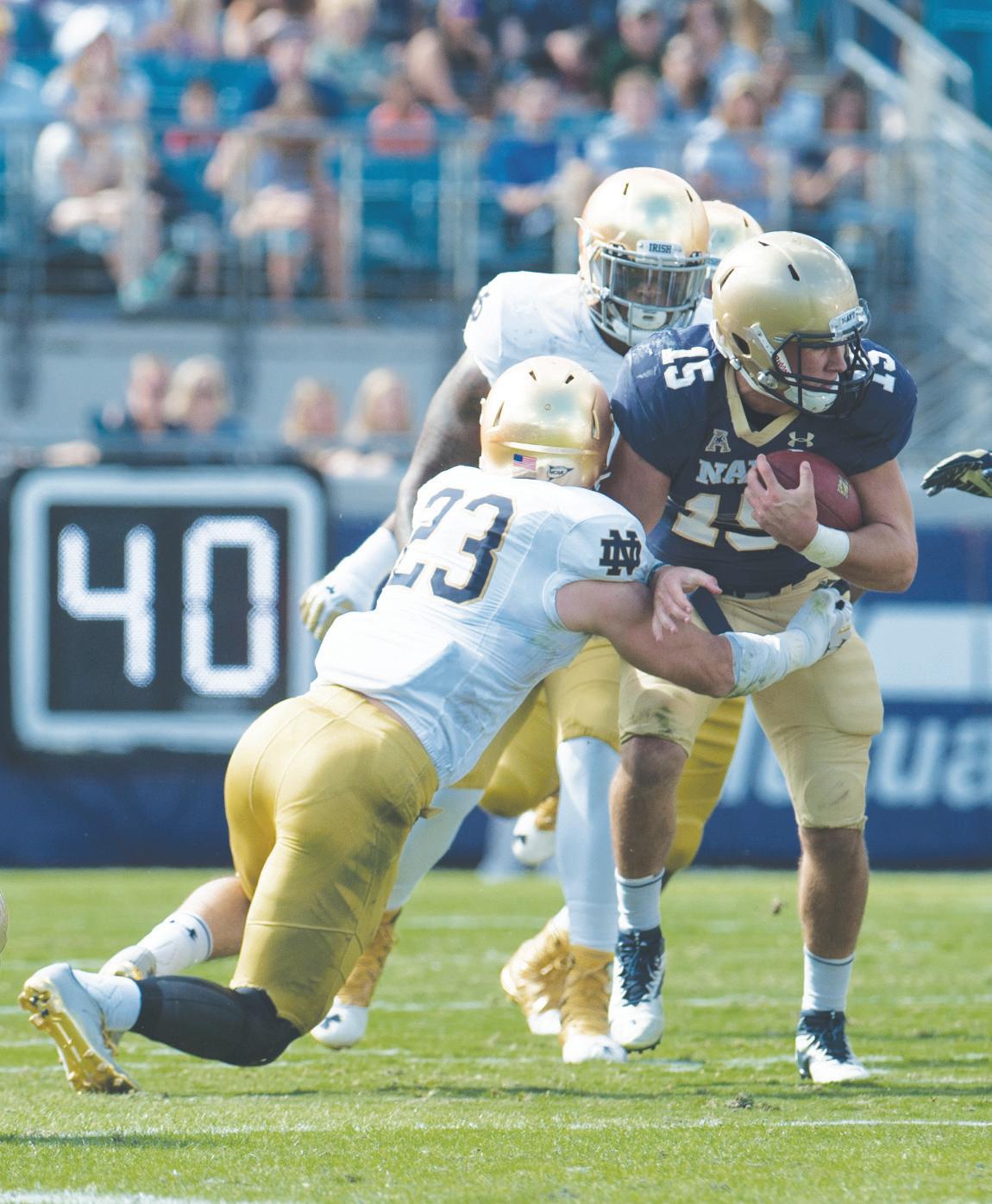
Tranquill tackles the ball carrier during Notre Dame’s 28-27 loss to Navy on Saturday at EverBank Field.
GRACE TOURVILLE | The Observer
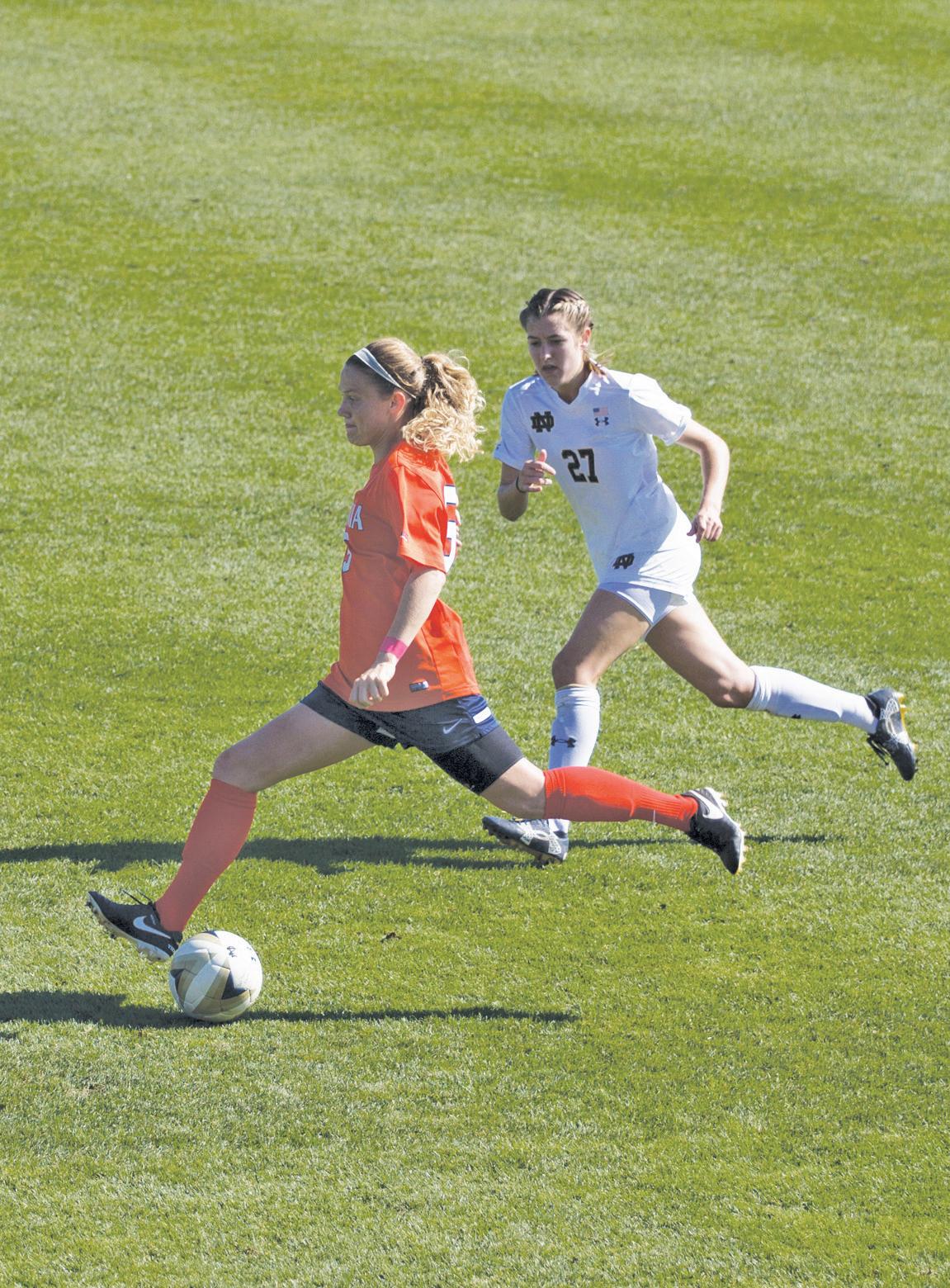
Senior forward Kaleigh Olmstead chases down the ball during Notre Dame’s 1-0 loss to Virginia on Oct. 9 at Alumni Stadium.