
Students plan week of events designed to spark conversations about mental health on campus
By KATIE GALIOTO news writer
Editor’s Note: This is the first installment of a five-day series discussing mental health at Notre Dame in recognition of Mental Illness Awareness Week.
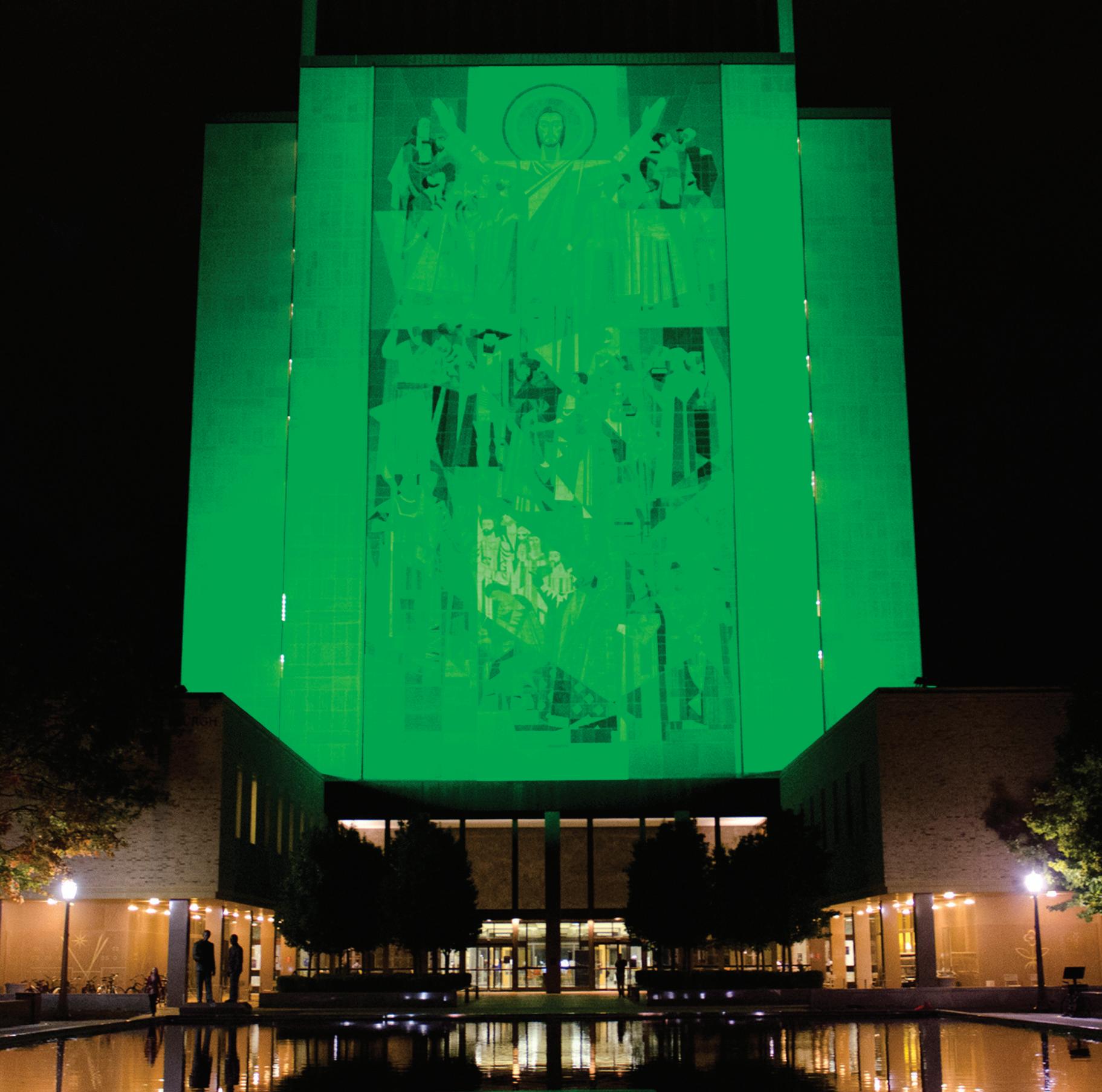
each night during the first week of october, a green light illuminates touchdown Jesus on hesburgh library. but the light isn’t meant to cheer on the irish football team.
the green light marks the annual irish state of mind week, the university’s recognition of national mental health awareness week.
events this week, planned by notre dame’s chapter of the national alliance on mental illness (nami-nd), were designed to raise awareness and spark conversations across campus about mental illness.
Junior Katie paige, president of nami-nd, said the purpose of the week is to encourage discussions about mental illness, with the ultimate goal of increasing mental health throughout the notre dame community.
“through irish state of mind, nami joins the fight to end stigma, provide support, educate the notre dame and the south bend community and stand in solidarity with those who are struggling with mental illness,” paige said.
Junior Joseph yoon, service coordinator for nami-nd, said he believes irish state of mind week provides an outlet for individuals to talk about mental health.
“i don’t think there’s any tangible goal,” he said. “it’s about being able to provide different events that anyone can go to. it’s about being able to provide a week where we can focus on different aspects of dealing with mental health and being able to reach out to the community in every way we can.”
For monday night, nami-nd organized “Food for thought,” a dinner and discussion led by susan steibe-pasalich, director of the university counseling center (ucc), and erica Kelsey, a consultant for the campus assessment and response education team. the event will be held at 6 p.m. in Jordan 105.
yoon said nami aims to educate students about the resources available on campus through the event. the club will host “in our own words” on tuesday night in the laFortune ballroom. paige said the event, where 10 notre dame students will share their own stories describing the ways in which mental illness has affected their lives, proved successful last year.
“i think that it’s a really tangible way to break down the stigma, to have notre dame students be
senior explains implications of title iX for lgbtQ students
By ALLISON SANCHEZ news writer
this week’s installment of the college’s Justice Fridays lecture series focused on explaining how title iX protects students of all gender identities and sexual orientation from sex-based discrimination.
saint mary’s senior bri o’brien led the conversation, focusing on how title iX can benefit the lgbtQ community on college campuses. she offered a concise explanation of how title iX works.
“title iX extends to claims of discrimination based on gender

identity or failure to conform to stereotypical notions of masculinity or femininity,” o’brien said.
“men, women, transgender students anybody of any gender iden-

tity or sexual orientation cannot be discriminated on that basis because that all originates from sex.”
“you cannot discriminate on

the basis of sex in any educational institutions that receive public funds … from that they [title iX] elaborate onto sex-based harassment, gender based harassment, sexual violence and sexual harassment,” o’brien said.
while saint mary’s does an excellent job informing students of their rights when sexual assault occurs, o’brien said, there is less focus on how title iX protects the lgbtQ community.
“we [saint mary’s] don’t really touch on the lgbtQ part of it,” o’brien said.

ESPN analyst funds scholarship
By MELISSA RIORDAN news writer
espn college basketball analyst dick vitale and his wife, lorraine, donated $1 million to notre dame, the university announced in late september. their gift will fund the creation of the dick vitale Family spirit scholarship.
a lthough neither dick vitale nor his wife attended the university, vitale said they both have strong ties to notre dame.
“i formed a connection to notre dame because both of my daughters, terri and sherri,
became students at notre dame in the mid-90s and loved the school so much that they became ‘double domers,’” vitale said. “notre dame runs deep in our family.” the scholarship fund is geared towards undergraduate students who have demonstrated need, and preference is given to those who are members of spirit groups on campus such as the marching band, irish guard, irish dance team and the cheerleading squad.
“i love the university — i
see vitale PAGE 5

WEI LIN | The Observer
The iconic mural affectionately called “Touchdown Jesus” is lit up green for National Mental Illness Awareness Week, a week dedicated to addressing the issues and stigmas that surround mental illnesses.
O’Brien senior
wlin4@nd.edu
Business
News
(574) 631-5303 viewpoint@ndsmcobserver.com Sports Desk (574) 631-4543 sports@ndsmcobserver.com
Scene Desk (574) 631-4540 scene@ndsmcobserver.com Saint Mary’s Desk hehmse01@saintmarys.edu
Photo Desk (574) 631-8767 photo@ndsmcobserver.com
Systems & Web Administrators (574) 631-8839
Policies
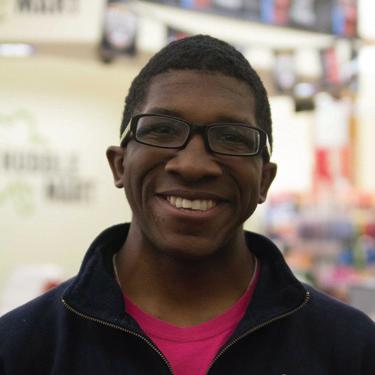
Question of the Day:
Chris Syers junior Knott hall
“t his photographer.”
Katie Laskey junior lewis hall
“pls majors.”
Hannah Chiarella senior Farley hall
“t he north quad duck couple.”
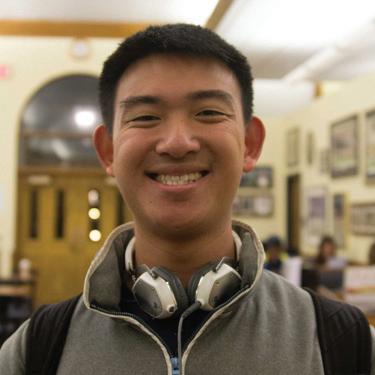

Alex Berry junior stanford hall
“t he marching band.”
Tim Chang junior st. edward’s hall “t he nd geese.”
Claire O’Donnell senior pasquerilla west hall
“g od quad squirrels.”
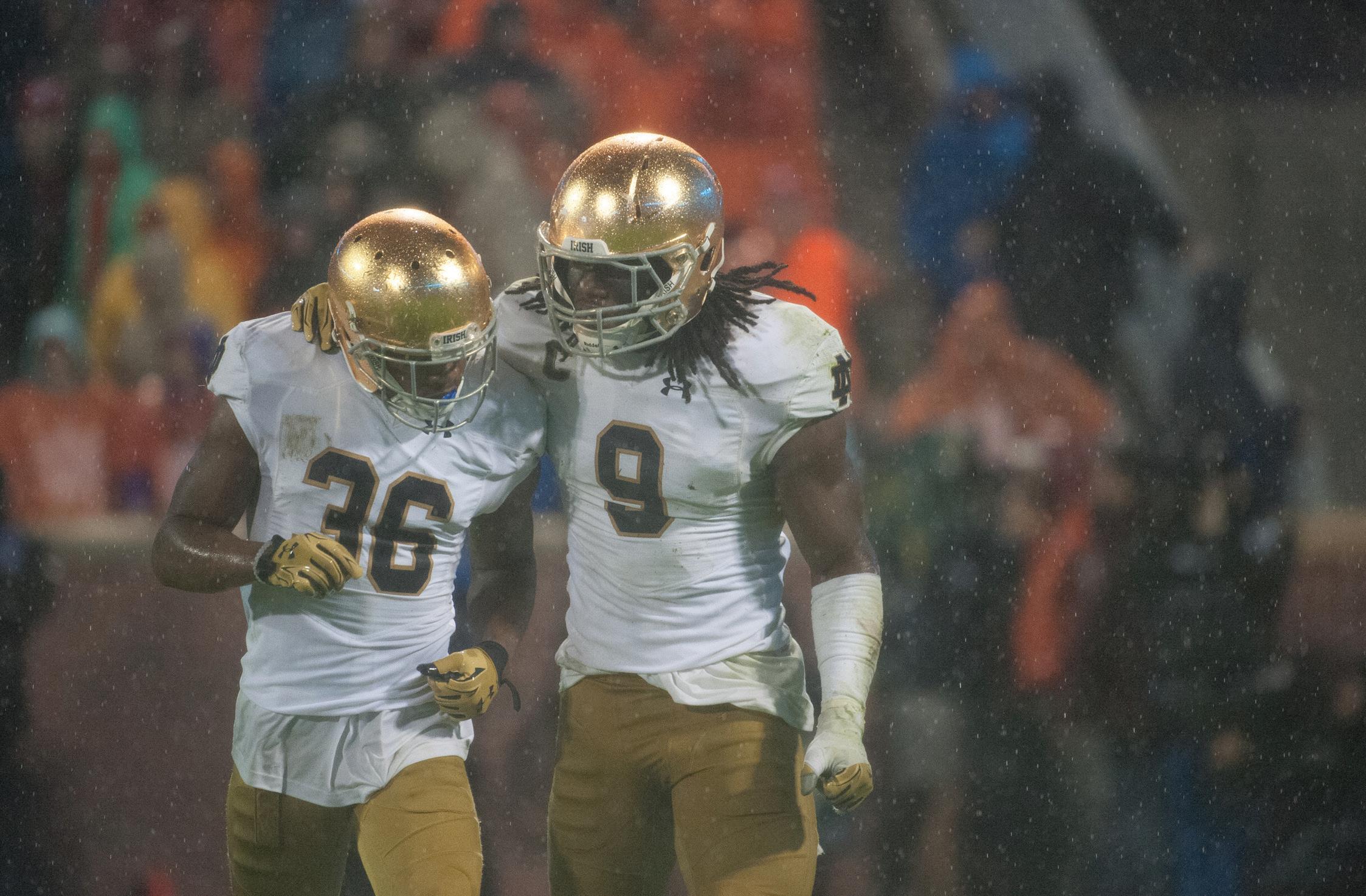
Irish junior cornerback Cole Luke and junior linebacker Jaylon Smith prepare for a play in Notre Dame’s game against Clemson Memorial Stadium. The Tigers defeated the Irish, 24-22, dropping the Irish to 4-1 on the season.
Today’s Staff
News margaret hynds
Graphics
susan Zhu
Photo
Corrections
i n the oct. 2 edition of t he observer, the article “men of nd compete for c harity” incorrectly identified the author. a line i rihamye wrote the article. t he observer regrets this error.
ND Votes ‘16
Geddes Hall
7 p.m.-9 p.m.
Learn about political responsibility and register to vote.
Book Talk
DeBartolo Hall
7 p.m.-8:30 p.m.
“Truth overruled: The Future of Marriage and Religious Freedom.”
Tuesday
Blood Drive
Grace Hall
10 a.m.-2 p.m.
Participants will receive a free T-shirt and piece of fruit.
Cookies and Conversation
Hesburgh Library
3:30 p.m.-5:30 p.m.
Learn to Curl Compton Family Ice Arena
1 p.m.-2:30 p.m.
Enjoy a study break with cookies. Wednesday
Curl with the graduate school faculty.
ND Men’s Soccer Alumni Stadium
7 p.m.-9 p.m.
The Irish take on the Wolverines in a nonconference match.
Thursday
Dante Lecture Hesburgh Library
4:30 p.m.-6 p.m.
Lecture on the 750th anniversary of Dante’s birth.
Bonfire, S’Mores and Cemetary Tours
Holy Cross Hill
8 p.m.-10 p.m.
Fr. Neil Wack will lead the tours.
Friday
A “Divine Comedy”
Flashmob campus-wide
2 p.m.-5 p.m.
CHRIS COLLINS | The Observer
Professor lectures on media, sex trafficking
By MEGAN VALLEY news writer
i n the keynote address of a symposium sponsored by n otre d ame l aw s chool, adjunct professor of law a lexandra l evy said the drama of sex trafficking makes it a “good story" for news outlets to cover. i n the lecture, l evy sought to answer the question "why is sex trafficking be a crime?"
“ m aybe more than any other crime, sex trafficking makes a great story,” she said. “ t he popular narrative that is told and repeated by the media shocks us with its gory details and seduces us with its promise of justice. i t’s an entertaining story, as far as it’s all drama
and violence and greed and rescue.
" i t’s a satisfying story because, at least in the most popular discourse, it has bad guys who are very bad and good guys or girls who are very good. i t’s an addictive story, because it’s about sex and virtue and protection.”
i n her presentation, l evy detailed the three models the law community considers when discussing sexual trafficking: the traditional model, the rescue model and the labor model.
First, l evy compared the traditional model and the rescue model, both of which argue that commercial sex, even if it isn’t trafficking, is harmful to societal values. t hey differ, however, in
how women are involved — the traditional model holds women accountable for being prostitutes whereas the rescue model does not.
“ u nlike the traditional model, the rescue model as -
and efficiency, they cannot be subject to punishment,” she said.
l evy explained the difference by using an example case in which a pimp and his “bottom” girl, or most
“The popular narrative that is told and repeated by the media shocks us with its gory details and seduces us with its promise of justice. It’s an entertaining story, as far as it’s all drama and violence and greed and rescue.”
Alexandra Levy adjunct professor of law
sumes that women cannot consent to participation in commercial sex, that they are direct victims and therefore, as a matter of justice
trusted prostitute, worked together to bring an underaged girl into prostitution. u nder the traditional model, the “bottom” girl can be


punished, but under the rescue model, she cannot because she is also a victim. t he first two models were also put into historical context. a ccording to l evy, sex trafficking used to be considered almost anything outside the sexual norm: i nterracial relationships, religious-based polygamy and other nonconformist sexual behavior was considered sex trafficking. l evy said interracial relationships in particular were frowned upon, with some even calling sex trafficking the “white slave trade.”
“ t he women and children were nominal victims — their interests were rarely considered and never talked about,” she said. “ i nstead, the same ‘common good’ trumpeted by the b itty court [ us v. b itty, 1908] animated the talk against the ‘white slave trade’ and also the talk against prostitution.”
t he final model, the labor model, is different from the first two in that it does not see the existence of consensual commercial sex as problematic. r ather, it is only sex trafficking that is the problem. l evy said this model views commercial sex as a labor the prostitute should be paid for and, in the case of of sex trafficking, receive restitution for. l evy said the story of sexual trafficking, as the media presents it, is contradictory in nature because it is designed to pull viewers in to witness a sensitive and private topic.
“ i t’s an alluring story because it’s a bit pornographic,” she said. “ b ut it’s a great story because it’s a story about sexual assault determination told in the language of pornography. i t’s a story that calls on us to turn away, to respect boundaries by resisting the voyeuristic allure.”
Contact Megan Valley at mvalley@nd.edu
SMC hosts Sophomore Parents Weekend
By MARTHA REILLY news writer
parents of saint mary's sophomores visited the college on Friday and saturday as part of the annual sophomore parents weekend.
sophomore class vice president courtney weston said the class board teamed up with student a ffairs to coordinate the weekend's activities.
"seeing that everyone enjoyed that time with their parents was a nice feeling," she said. "t his weekend gave parents a chance to be with their children at their second home."
weston said events such as information sessions about different majors helped parents better understand their daughters' lives at the college.
"we came up with events to try to help the parent and child bond," weston said. "sophomore parents weekend is a time for them to hang out with their children. t he parents actually got to come here, see their kids' rooms, be with their friends and see where they go to class everyday."
sophomore class board member morgan matthews also said parents were able to get a better idea of what their daughters do
in their daily lives.
"a ll the parents got to know each other and to know their daughters' friends," matthews said. "parents weekend incorporates our normal lives. it's showing them what happens on campus on a day that's not move-in day."
according to matthews, the weekend was scheduled at an opportune time of the semester.
"w ith fall break coming up, we need a little bit of home here to feel calmer about finishing up the rest of this quarter," she said.
sophomore Fiona van a ntwerp, whose mother
and father visited her from dearborn, m ichigan, said this weekend strengthened her relationship with her parents.
"seeing my parents before fall break took my mind off the amount of schoolwork i have,"
van a ntwerp said. "it was uplifting because it gave me an outlet to just relax and enjoy my parents' company."
van a ntwerp said she appreciated the opportunity to thank her parents for their support over the years.
"it's not until you get to college that you can fully appreciate everything your parents have done for you," van
a ntwerp said. "it reminded me how much my parents are constantly there for me and how much they will always back me up in life."
according to weston, sophomore parents weekend served as the perfect reminder of all that parents do to help their children succeed.
"it's always nice to recognize that parents make such sacrifices for us to attend this school," weston said. "parents help you not sink through all the stressful times."
Contact Martha Reilly at mreilly01@saintmarys.edu
p rofessor examines ethics of reconciliation
By EMMA BORNE news writer
last Friday, notre dame political science professor dan philpott presented his ethic of reconciliation in times of gross injustice as part of a series on the holocaust currently taking place at the university.
“remembrance: the holocaust in a global context” is a series of lectures, films and discussions planned to commemorate the 70th anniversary of the liberation of auschwitz. philpott said his time living in germany and studying its reconciliation efforts in the aftermath of holocaust and communism helped inform his ethic.
philpott's lecture was based on a book he wrote, he said, with the central question being: "w hat is the meaning of justice in the wake of massive injustice?" he said he aimed to answer that question in a more comprehensive way than others had done before by creating his ethic of reconciliation.
philpott said reconciliation confronts many difficult
foreign policy dilemmas in peace building.
"is it justifiable to forgo the prosecution of war criminals in order to elicit a peace settlement? can conditional amnesties be justified? may leaders apologize or forgive on behalf of entire states or nations? on behalf of dead people? do states owe reparations to representatives of victims of past generations? how are amounts to be determined? is forgiveness justifiable, or does it indefensibly sacrifice just punishment?" philpott said.
reconciliation confronts these dilemmas holistically, he said, by attempting to restore right relationship, address a wide array of wounds and involve all actors proper to the political order — ordinary citizens, state leaders, victims and perpetrators. in order to put these concepts into action, philpott said it is important to understand the injustices. he said there are at least six kinds of wounds from which victims suffer: the violation of the victim's basic human rights, the different kinds of harms to the person of the victim (death,
permanent injury, lasting psychological and emotional damage, etc.), ignorance of the source of circumstances of the political injustices that harm the victim, failure of the community to acknowledge the suffering of the victim, standing victory of the political injustice and the wound to the perpetrator himself that the crime inflicts, philpott said.
philpott said his ethic of reconciliation proposes six matching practices to these wounds, aimed at restoration of the victims and of right relationship.
"First, building socially just government institutions based on human rights and respect for international law," he said.
" ... second, acknowledgement of the suffering of victims of the community through restorative political processes. ... third, reparations in the form of material compensation to victims. ... Fourth is punishment, which takes place in the form of national or international courts. ...
"Fifth practice is apology, which is conferred by perpetrators for their own misdeeds and by political officials for acts done in the name of a political order. ... the sixth practice is forgiveness, which is purported by individual victims and, in theory but rarely in practice, by a political official on behalf of a group," philpott said.
paid a dvertisement
the inclusion of both punishment and forgiveness in the six practices is often seen as a point of tension, philpott said. however, he said both are necessary to address the array of wounds afflicted by political injustices.
"the fundamental contention of the ethic is that addressing the range of wounds of injustice both for their own sake, and because they may lead to further injustices, is itself a matter of justice — the justice of right relationship. so too, it is a matter of peace and a matter of mercy," philpott said.
Contact Emma Borne at eborne@nd.edu
she said administrators should be trained and treat same-sex sexual harassment the same as heterosexual sexual harassment.
“recently, the [ office of civil r ights’s] elaborated guidance on title i X specifically said that administrators, faculty, staff, title i X coordinators, deputy coordinators, mandated reporters; all these people have to have specified training on how to work with lgbtQ students.
“w hen it comes to same sex assault, title i X mandates the process should be the same for same sex assaults as it is for nonsame sex assaults. so that means it shouldn’t look any different, you shouldn’t be asked any different questions,” o’brien said.
Junior sarah bastian said she had a better understanding of title i X after the talk.
“i learned that title i X applies
to every single student, regardless of sexual identity, who is a victim of sexual assault or harassment,” she said. “a lso, there are women here at saint mary’s who sexually harass fellow students, but that is not discussed. the discussions mostly revolve around women being victimized by men. neither situation should be ignored.”
o’brien concluded the talk by advising students to know their rights and to let the administration know they know their rights under title i X to avoid miscommunication.
bastian said a basic knowledge of title i X would enable students to more effectively navigate the system should they become a victim of sexual discrimination or harassment.
“if you don’t know your rights, you cannot fully stand up for yourself,” she said.
Contact Allison Sanchez at asanch01@saintmarys.edu

actually talking about their own experiences,” she said.
wednesday night, students will gather at the grotto to celebrate mass during “an evening of prayer and remembrance for those whose lives have been touched by mental illness,” according to the namind Facebook page.
Kevin breel, a tedx talk speaker, will talk about his own experiences with depression thursday at 7 p.m. in debartolo 102. breel will share his message of hope in the face of mental illness, yoon said.
“[breel] has millions of views on his ted talk,” he said. “being able to bring someone who’s actually been public about his struggle with mental illness is, i think, a great way to bring everybody in because he’ll be a great speaker and be able to draw a lot of attention to the week.”
nami-nd and student government will wrap up the week by screening “inside out” in washington hall at 7 p.m. Friday. paige said she hopes irish state of mind week will have long-lasting effects by changing the way students discuss the topic of mental health on campus.
“i think that a lot of people don’t know how to approach mental health,” she said. “it’s very taboo. people aren’t sure how to give their
friends help, and they aren’t sure how to ask for help. i just want people to start talking about it and be more open about it.”
nami-nd began planning and fundraising for irish state of mind week last spring with the help of student government, the ucc and other organizations from notre dame and south bend, paige said.
university president emeritus Fr. edward “monk” malloy reflected on his personal experiences with mental illness at the irish state of mind kickoff event Friday.
malloy described his time working at st. elizabeth’s hospital in washington d c., a federal psychiatric facility for patients with severe cases of mental illness.
“i got to know people who were in jail initially for murder and rape and arson and robbery and any kind of thing that you can imagine,” malloy said. “by reading their files, i saw some of the horrible things they had done, but i also came to appreciate that many of them seemed like everyone else that i knew.
“i learned that you just don’t know by reading the file or what they’re accused of doing what potential they have for establishing a new life at some point in the future.”
malloy said it is important to consider the different degrees of mental illness, noting that a number of students at the university suffer from some level of anxiety,
depression or addiction, among other mental illnesses.
“no matter who you’re talking about or what dorm you live in … there are people at any given moment who are struggling with one kind of level of mental illness or another,” he said.
the notre dame residence hall system helps provide support for students struggling with mental illness, malloy said.
“i know in orientation, we try to make the case that whatever you’re struggling with — whether it’s homesickness or some problem in your family or personal health issues or whatever it might be — there are people available, willing and able to be there for you and to be motivated to maintain those kinds of relationships in the long term,” he said.
malloy said irish state of mind week should encourage students to reach out to others who may feel alone, abandoned, stigmatized, forgotten or unworthy, using Jesus’ healing ministry as an example for action.
“the tangible symbol … of green on touchdown Jesus is a colorful way of expressing [that] we are trying to evolve into a community of caring, of tender concern and of light for those who sometimes are overwhelmed by the darkness,” he said.
Contact Katie Galioto at kgalioto@nd.edu
paid a dvertisement
love everything it stands for,” v itale said. “i believe in notre dame’s quality of education. t he young people that go there put together such an incredible résumé to be able to be admitted to the university, and i just wanted to maybe be able to bring a little happiness to some youngster who needed financial help.”
t he focus on athletic spirit groups stems from v itale’s long-time involvement in collegiate athletics.
v itale graduated from seton hall university in 1963 and received his master’s degree in education from w illiam paterson university. he coached basketball at the university of detroit from 1973-1977 and went on to be head coach of the detroit pistons in 1978.
v itale said both of his daughters were also involved in athletics during their time at notre dame.
“t hey played tennis on the varsity tennis team and were scholarship athletes and married two guys that were also students at notre dame,” v itale said.
v itale said his connection to notre dame remains among
his few favorites, despite the ties he has created to many other universities and colleges throughout his career.
“i am very proud that i received an honorary alumni degree in 1997 and have been very active speaking at the pep rallies and on the campus on a regular basis as much as i can,” v itale said. “it is everything about people who really, really want to make something of their lives, who have really put together a dedicated plan to the game of life and are really dedicated to pursuing their dreams to the best of their abilities.”
v itale said his hope is that this scholarship fund will allow students to accomplish great things in both athletics and in spirit activities, just as v itale has been able to do himself.
“i have been blessed in my life financially and in many ways,” he said. “i just love giving back. notre dame represents all that’s good about an education. i hope that these students go on to chase their dreams and goals and pursue them to the best of their ability and be able to, later in life, do the same for someone else — to be able to give back.”
Contact Melissa Riordan at mriordan@nd.edu

The life you save may be your own
rags to riches?
Adam Ramos s cene writer
a s far as the “a merican dream” goes, my father has lived through it all. a fter losing almost all of their possessions to a communist cuban regime, his family packed what little they could carry and arrived in u s, the land of opportunity, when he was just three years old. w hat would come proved to be a struggle, as my grandparents worked menial jobs to provide what little they could for their three boys. despite the challenges, the family quickly assimilated to their new homeland, learning a new culture and its customs, all while speaking a new language.
w ith the understanding that education is the key to escaping poverty, my grandparents put all three boys through college. t hrough hard work and discipline, my father made it all the way through medical school while working multiple jobs and taking out multiple loans. somewhere in the process i came to be, and my dad continued to work hard, providing for me every opportunity our great land has to offer, and for that i’m eternally thankful.
yet, after years of hearing my father’s story and reveling in his success, i have always felt a twang of guilt when thinking about my own accomplishments. sure, i have a lot to be proud of, but i certainly have to attribute some of it to my privileged background. t he “rags to riches” story could never be a reality for me, as well as the honor that goes with it, or so i thought. t hankfully, with maturity came a realization: Feeling guilty helps no one. t he best way to pay tribute to the “a merican dream” is to help preserve it. p rivilege should not imply dishonor. i nstead, it should imply duty. Just because you were born with a silver spoon in your mouth doesn’t mean you can’t be part of the “a merican dream.” unfortunately statistics will tell you the idea of the “a merican dream” is beginning to fade. our nation in rooted in the idea that anyone who is ready to sacrifice can make it here, but it seems as though that may no longer be realistic. t his is where we privileged first-worlders come in. by using the same principles that illuminated my father’s path out of poverty, we can help those in the same position my father was many years ago. w ith sacrifice, discipline and most of all hard work, we can keep the “a merican dream” alive. one thing i do to help preserve the “a merican dream” is using my ability to speak spanish to help tutor at a local, predominantly spanish-speaking middle school. but everyone has a different talent to provide, and in doing so we can accomplish a lot. l ife can get busy sometimes, but making a little time to give back goes a long way. a fter all, it is not right to hoard the advantages you were given. use them to help others, and in doing so help our great nation become great again.
Contact Adam Ramos at aramos6@nd.edu
The views expressed in the Inside Column are those of the author and not necessarily those of The Observer.
i ’m a big fan of browsing shelves. i do this all the time, compulsively. i ’ll enter an office, lounge or dorm room, and before i know it, i ’m scanning the bookcases in the room. a novel by vonnegut, a pre-calc practice book, a copy of the i gnatius b ible. you can inform yourself about a person fairly well by knowing what titles that person keeps on the shelves.
a nother variant of this compulsion is just the plain old “wandering of the stacks.” t he added feature here is that every now and then you actually slide a volume from the shelf and take a look inside. i did that today on h esburgh’s fourth floor ( pr - p Z l anguages and l iteratures) in preparation for this column. b oy, was it informative.
b ut informative in a very unexpected way. i n stack wandering and shelf browsing, serendipity is the name of the game.
i had never heard of a manda c ross, much less read any of her dozen books. b ut i was intrigued by the title “ d eath in a tenured p osition.” i t sounded serious and foreboding but also clever. i t can be hard to come across both seriousness and cleverness married in a single volume. b ooks tend to either dryly discuss important issues or lavishly boast about their own ingenuity.
t he first pages of “ d eath in a tenured p osition” fell into neither of the above extremes. t his a manda c ross, whoever she was, was a talented yet unpretentious writer. t he novel opens with the (fictional) letters of several male academics searching for a new female professor so that their university will receive special funding. t his token woman is professor Kate Fansler, the protagonist of the book. From what little i ’ve read, i understand Fansler’s character to be insightful, pragmatic and oppressed. c onsider this pearl of wisdom from page six: “ o dd, Kate thought, the years it took to learn one simple fact: that the prize just ahead, the next job, publication, love affair, marriage always seemed to hold the key to satisfaction but never, in the longer run, sufficed.” s he is a character who acknowledges the sources of her own dissatisfaction and wishes to “move the world, however slightly, in the direction of humaneness.”
a s w ikipedia informs me, this mysterious writer was not unlike her novel’s protagonist. a manda c ross, however, is just a pen name for c arolyn g old h eilbrun, who, like the fictional Fansler, was a “professor of literature at one of n ew york’s largest and most prestigious universities,” namely, c olumbia u niversity. i ndeed, she was the first tenured female professor in its literature department. h eilbrun was an accomplished woman, but at the age of 77, on a routine walk with her fellow
academic m ary a nn c aws, she said, “ i feel sad.” w hen asked why, she responded, “ t he universe.” t he next day she was discovered in her apartment with a plastic bag over her lifeless head. h eilbrun wrote in a book of hers decades prior that she would prefer to die at 70, knowing that “there is no joy in life past this point, only to experience the miserable endgame.” w ith a note beside her body that read “ t he journey is over. l ove to all,” h eilbrun joined a sad list of writers to die from suicide, among them d avid Foster w allace, the h emingway brothers ( e rnest and l eicester) and her feminists-at-arms v irginia w oolf and s ylvia p lath. m aybe h eilbrun felt a sorrow similar to that of her novel’s protagonist: t he sense that nothing would suffice; that oppression, in this case the oppression of aging and senescence, would gradually inflict its terrible decay unabatedly. s he thought that choosing one’s death was a right all people should have. yet in her chosen demise, i see the unachieved possibility of another great 20th century female writer, the southern c atholic Flannery o ’ c onnor, whose story title “ t he l ive you s ave m ay b e your o wn” i have borrowed for this column. o f course, o ’ c onnor would eschew such classifications, preferring to be known not as a c atholic writer or a female writer but just a writer, thank you.
u nlike h eilbrun, o ’ c onnor died young. s he suffered from a debilitating lupus disease that ran in her family. h ad she lived to h eilbrun’s 77, i doubt self-chosen escape would have even crossed her mind. h eilbrun certainly had her reasons for fleeing the dilapidation of old age, “the miserable endgame,” as she called it. b ut the consequences for her husband, at the time still living, for her children and what writing she might have had left, seem a heavy price to pay for self-determination. h eilbrun’s end reminds me of another book i once perused while wandering the shelves. i t was a short story collection by vonnegut, “ w elcome to the m onkey h ouse,” which described a futuristic world in which the elderly are encouraged to choose euthanasia to stabilize the planet’s rising human population. t he issue of suicide, whether out of autonomy or desperation, is a tough one. l ast week’s display of discarded backpacks on s outh Quad, part of a suicide awareness imitative, is one way to confront it. i just happened across it wandering the shelves, where you can never be quite sure of what you will find.
Charlie Ducey is a senior studying the languages of G. K. Chesterton (English) and Edith Stein (German). Please contact him with questions, comments, complaints, appraisals, invitations, prognostications and prestidigitations at cducey@nd.edu
The views expressed in this column are those of the author and not necessarily those of The Observer.
Charlie Ducey e nglish, c hanneled
you break it, you own it
For weeks, the s yrian civil war has dominated headlines. t he conflict has taken more than 320,000 lives and left more than 6.5 million internally displaced. m ore than 4 million people have sought refuge elsewhere. w ith so many refugees, more affluent nations have stepped up to the plate to assist. g ermany just announced it would accept nearly 800,000 s yrian refugees this year. s ecretary of s tate John Kerry announced the u s . would accept 100,000 refugees by 2017, most of whom will be s yrian. s ince m arch 2011, only 1,584 refugees have been relocated to the u s s eeing as the u s is a big reason why there are so many refugees in the first place, we ought to keep our word this time around.
t he s yrian civil war began in early 2011, as democratic protestors demanded p resident b ashar a la ssad step down. w hat began as protests turned into a full-blown civil war between the a ssad government and the democratic rebels. v iolence has ripped the nation to shreds. t he war has turned into a proxy battle, as the u s ., u K., France and r ussia have all contributed to one side or the other in the past five years. isis has joined in as well in an effort to take s yria for themselves. a nd if the conflict couldn’t get more complicated, r ussia has made headlines this past week by targeting civilians with its own air strikes.
a turning point in the u s . approach to this crisis was when p resident o bama said in a ugust 2012 that a ssad’s use of chemical weapons would cross the “red line.” o ne year later, a ssad employed
chemical weapons in an attack, killing 1,400 in four hours, including more than 400 children, yet o bama sat silent. h e claimed a ssad had given up all other chemical weapons, so we had nothing to worry about anymore. h owever, since the initial attack, s yria has launched chemical weapon attacks so often that, according to a rescue worker on the ground, “ p eople are so used to it, they know from the sound.” a ssad clearly still has chemical weapons and is willing to deploy them.
“ we have moved assets in place to be able to fulfill and comply with whatever option the president wishes to take,” d efense s ecretary c huck h agel said days after confirming a ssad ordered the attacks. h e added that there were a range of options available, and should the order be given, u s . forces were “ready to go, like that.” we even had allies to go in alongside us, like turkey and s audi a rabia. t his situation is far more dire than that presented by the l ibyan crisis, and the u s . intervened with strong force on that occasion. c onsequently, it makes sense to intervene now more aggressively in s yria. t he military was ready, but the p resident was not.
s ince we’re already the top financial contributor to the conflict, spending an estimated $1.15 billion to date, aid could be rearranged to sponsor more refugees’ entrance into the country. o ur financial support in s yria presently has little impact. b ribes, kickbacks and illegal taxes imposed by isis troops led some u s . aid to land in the hands of terror groups. r estructuring our system of aid distribution could help control where the money is actually going and ensure it is truly helping where it is most needed. s pending it domestically on helping refugees rebuild their lives in a merica will ensure
we know exactly where our aid is going. l awmakers opposed to bringing in refugees argue they could potentially be terrorists. p eter t. King ( r-ny ) claims that, “o ur enemy now is i slamic terrorism, and these people are coming from a country filled with i slamic terrorists. we don’t want another b oston m arathon bombing situation.” t hose who are concerned about this are missing the bigger picture. a ccording to s tacie b lake of the united s tates c enter for r efugees and i mmigration, “ we’re talking about people who have been tortured, about children who have not been able to attend school for four years and about women who have been living not even in refugee camps but in urban settings in abject poverty without adequate water, blankets or heat in the winter.” c ritics also ignore the fact that there is an extensive background check process performed to ensure our safety from potential terrorists. h ad the u s . gone into s yria like planned, perhaps these persons would not be displaced.
e specially given r ussia’s recent actions in the region, it’s clear the conflict is only going to escalate. t hose people need help, and it is the moral obligation of the u s . to lead with helping hands. c olin p owell’s remarks on the invasion of i raq and consequential influx of refugees can be applied here too: “ you break it, you own it.” it’s time we take responsibility for what we didn’t do.
Jordan Ryan, sophomore resident of Lyons Hall, studies political science and peace studies along with minors in Constitutional studies and business economics. She can be reached at jryan15@nd.edu
The views expressed in this column are those of the author and not necessarily those of The Observer.
Making the most of a short-term mission
the night before i boarded my flight to china for the international summer service learning program (isslp), i read an article entitled “the cost of short-term missions” at 3 a.m. in retrospect, that wasn’t a very smart decision before my 14-hour flight, but i just couldn’t sleep. i was so caught up in the rush of last-minute packing, the prospect of spending two months in guizhou, china, and all the nerves that came with embarking on a journey that strayed quite a bit from the typical internship or summer job. after so much anticipation, i was finally going to be leaving home, and that was equal parts terrifying and exhilarating. as i read that article, i found myself wondering, not for the first time, if i was really ready for this. i found myself worrying about becoming a part of the “voluntourism” trend and not making enough of an impact. i felt like i should have a plan, a clear goal to accomplish within my eight weeks, and, well, i didn’t. it seemed then that the only way to validate my time in china was to produce a clear result or product, and i didn’t even know where to begin. in short, i was overwhelmed, but i boarded that plane anyway and then went on to spend the next two months discovering exactly what it meant to be on a short-term mission and to serve others.
First and foremost, i learned there is so much more to learn, more than i could have accomplished in eight weeks. i learned about working in a non-profit organization in
china, about the large impact of issues such as environmental degradation and urbanization on the poor, about centuries-old chinese traditional handicrafts and, most importantly, i learned about those around me — the poor, the marginalized, the change-makers and world-shakers. those i came in contact with in china were not just poor or marginalized entities, but people with hopes and struggles, people with stories. perhaps the greatest lesson i walked away with is the importance of taking the time to make relationships. more often than not, the best way i could serve was to listen to others and be willing to share in their lives, which isn’t as easy as it sounds but almost always worth it. the problems that had always been so foreign and distant to me before became personal, and people all the way on the other side of the world became friends. the relationships i made were absolutely integral to my understanding of the poor in china and my ability to effectively serve the poor, not as if they are another entity, but as they are — our fellow human beings.
w hen i first approached the isslp, i had this vague desire to go out into the world and help an even more vague “people.” looking back, i can’t help but smile at how unoriginal and simplistic an idea that was. at the time, i was driven by an admittedly emotional response to the great injustices in the world i had only begun to learn about. in my time in guizhou, i came to learn a little more about the world and about myself. my greatest worry when i boarded that plane to china was that i wouldn’t make enough of an impact, that eight weeks wasn’t enough time. now, two months after my isslp, my greatest advice for those embarking on
a short-term mission would be to put it all in perspective. your eight weeks will not solve issues that are deep-rooted, persistent and oftentimes cultural, but you are part of a vast network of the people before you, the people to come and those right beside you, including those you are trying to serve. all these people are part of the effort to create positive change. you are not alone, and you cannot do it all alone, so focus instead on how you can learn and be a part of that group effort. i had to let go of the concept of making an individual “impact” in order to be part of an effort much greater and more powerful than any one person alone. acknowledge you don’t know and it would be naive to walk in with a preconceived notion of the needs of people whom you’ve never even met. do not try to thrust upon them your beliefs because it won’t work; be open to having conversations instead. and most of all, make good use of the time, no matter how “short-term” your mission is. in my experience, short-term missions are meant first for learning, though learning and doing are not mutually exclusive, and effective service is more about asking the right questions than coming in with the right answers, which rarely ever happens. and last, but certainly not least, do not discount the relationships you will have made and the community you will have formed — a community of people who were moved to action and who, through action, became better individuals now more able to act in mind and heart.
Contact Elle Huang at QiWen.Huang.102@nd.edu
The views expressed in this column are those of the author and not necessarily those of The Observer.

Jordan Ryan words of w isdome
Elle Huang guest c olumnist

By MATT McMAHON
s cene writer
ten years ago, s aturday n ight l ive’s s eason 31 included a cast of featured players composed of Kristen w iig, Jason s udeikis, b ill h ader and a ndy s amberg. w hen the four were all bumped up to repertory players the following season, they — along with then-recent additions Fred a rmisen, w ill Forte, Kenan t hompson and s eth meyers — ushered in a new era of s aturday n ight l ive, one that had the uniquely difficult task of following in the wake of w ill Ferrell, t ina Fey and a my p oehler’s legacies.
e pitomized by d igital s horts like “l azy s unday” and the amazingly lowbudget “l aser c ats” series, this era of s aturday n ight l ive not only lived up to the task but was able to carve out its own identity amidst what could have been a crisis-inducing talent exodus. however, on the lead of the alienating personalities and ideas of h ader, s amberg and Forte, this era developed a unique, insular sense of humor. a ppealing to a young, coming-of-age — at least comedically so — audience looking for a drastic style of their own onto which they could latch, the three goofy underdogs used their immature
skill sets to grow a dedicated fanbase. a s a result, these years of snl were as much the now college-aged crowd as they were any other age groups’. now, ten years later, after each former snl cast member has starred in his own movie (“ t he s keleton twins,” “hot rod,” “m ac g ruber”), to varying degrees of reception, all three currently head their own television series. h ader co-stars in i F c ’s “d ocumentary now!” and s amberg and Forte each lead young but critically acclaimed Fox series “b rooklyn n ine-n ine” and “ t he l ast m an on e arth,” respectively. i n each show, the comedic treasures have etched out their own space to showcase their marked sensibilities within the context of broader, richly rewarding television. o f the three, workaholic b ill h ader disappears most into his recent television roles, which in a way remains part and partial to his style. Known best for his peculiar, weirdly deep character work on s aturday n ight l ive, h ader reteamed with costar a rmisen and head writer meyers to create “d ocumentary now!,” which just ended its first season last week. h ader and company parodied everything from “g rey g ardens” to vice news in the show’s promising six-episode first season.
h ader’s chameleonic qualities are so on display in “d ocumentary now!,” it’s both easy to lose him in his utter commitment to his portrayals and impossible to completely separate him as the actor behind his characters. meanwhile, s amberg stars as the affable, but skilled detective Jake peralta in the best network sitcom currently on air, “b rooklyn n ine-n ine.” s amberg maintains a strong rapport with the ensemble cast, able to play off of every single character based on his own unique, established relation, however deep or shallow that relationship may be. t hrough p eralta, the often-contentious s amberg exhibits a range previously untapped in his acting career, so much so that he earned a b est a ctor win at the g olden g lobes. i n the show’s previous two seasons, he has shown he can play the subtle, serious moments just as well as the goofy, juggling bullpen antics and a romantic relationship with a defense attorney. t he most insular out of the three comedic actors, Forte centers “ t he l ast m an on e arth” as the title’s sake p hil m iller. m iller, like many of Forte’s most noteworthy roles — read m ac g ruber — is ugly, often holds a whiny disposition and maintains a rather onetracked mind. a s the show’s focal
point, much of the humor comes either through Forte’s perfection of the form, or, thankfully, at his expense. however, Forte has matured, perhaps as a result of his dramedic (dramedy) turn in a lexander p ayne’s “nebraska.” m iller finds redemption in very reserved, limited quantities, especially through his odd relationship with lastwomen-on-e arth c arol p ilbasian, portrayed by the great Kristen s chaal. t he three comedian-actors have grown to reject symbolic categorizations, such as “the sensitive one,” “the goofy one,” and “the smart one,” as their respective shows continually call on them to encapsulate varying personas. e ach star more than lives up to the challenges of their current television roles, exhibiting range merely hinted at, or often very drastically exaggerated, in their tenure at s aturday n ight l ive. a s snl enters another year confused as to what it wants to be, it’s comforting to know some of the show’s most reliably funny recent graduates can be found on dependable series that have quickly found their footing and retained much of their stars’ charm.
Contact Matt McMahon at mmcmaho7@nd.edu

By KELLY McGARRY
s cene writer
l ast t hursday, i went to washington hall to support the women of walsh hall at the annual m r. nd pageant (read: find bae). t he contestants introduced themselves by detailing their perfect date and their opinion on pluto’s bump from planet-status, resulting in many mentions of s outh d ining hall, an invocation of “size doesn’t matter” and references to pluto the dog. s etting aside my dismay at their misinformation and unoriginal jokes, i sat back to enjoy the talents of men from every dorm on campus. b ae was found quickly when the first to perform his talent, m r. a lumni — who had earlier described his perfect date as “recker’s, t hursday 3 a.m., she swipes” — demonstrated his extreme athletic ability by shoving a large slice of pizza and a full banana in his mouth and swallowing.
i was swept off my feet by the talents of the remaining contestants. t he only other place i’ve seen so many heart throbs is in chick flicks, which made me consider the m r. nd contestants most suited for some of my favorite chick flicks:
• t he l eonardo d ic aprio in “t itanic” award goes to m r. Keenan, who brought up a lady from the audience to draw like one of his French girls.
• t he Kevin b acon in “Footloose” award goes to m r. d illon, his tank top and dance moves … also he looks a lot like Kevin b acon.
• t he a nna Kendrick in “p itch perfect” award goes to m r. Keough for his i pad mash-up.
• i have been informed that “pokémon” is not a chick flick, so m r. st. e dward’s, who sang and played the ukulele in a p ikachu onesie, walks away with nothing.
i n addition to thoughts of “p itch perfect,” i was inspired by the dJ skills of m r. Keough to think of some mashups that would get the m r. nd contestants collaborating:
• m r. c arroll’s poem about his love life, written by his friends, rapped over m r. Keough’s i padproduced beats.
• m r. Fisher, winner of the l east l ikely to s weat the technique award, break-dancing to m r. stanford’s classical piano masterpiece.
• m r. Knott drawing to e vanescence’s “bring me to l ife” was a little intense, but i think he’d draw softer lines to m r. Zahm’s acoustic rendition of “b aby g ot b ack.”
• m r. s orin may need to brush up on his ribbon-dancing skills before accompanying the beautiful harmonica work of m r.
morrissey.
you may have noticed that i have yet to mention m r. d uncan. t hat’s because, like the m r. nd judges, i only wish to mention him in honorable terms. h is booming voice and intense patriotism fit his rendition of toby Keith’s “c ourtesy of the red, w hite and blue” perfectly. standing tall in his navy rotc uniform, he took the cringe-worthy “ w hich branch of the army are you in?” question like a champ.
m r. d illon was named m r. walsh, m r. Zahm was named m r. Fan Fave, and m r. siegfried took the coveted title of m r. nd, charming the judges with his original piano piece about the joys of being an ra . Finally, all 15 contestants share the most obnoxious Friends award, which definitely needs to be taken into account when seeking bae.
Contact Kelly McGarry at kmcgarry@nd.edu
Sloppy, soaked, stymied
Notre Dame’s four turnovers in bad weather prove too much to overcome
Handful of mistakes ruin solid games by defense, Kizer

Klonsinski sports e ditor
t here were two reasons
n o. 6 n otre d ame even had the opportunity to make a comeback bid s aturday night against c lemson: the defense and sophomore quarterback d e s hone Kizer.
If I had known last week n otre d ame would go into d eath valley and only give up 24 points, I would have said the Irish were going to win that football game.
a nd with the way Kizer played, they should have.
d espite allowing c lemson and sophomore quarterback
d eshaun Watson to march into the end zone on their first two drives of the game, the Irish defense more than made up for a slow start, holding c lemson to 10 points the rest of the way.
a nd seven of those points came following a fumble by freshman receiver c .J.
see KlonsInsKI PAGe 3
On the receiving
By ZACH KLONSINSKI sports e ditor
For three quarters, it looked like notre dame’s undefeated season was unquestionably over.
trailing 21-3, the no. 15 Irish (4-1) had looked like anything but a team that was capable of handling no. 6 clemson’s stout rush defense, death valley and Hurricane Joaquin’s unrelenting deluge.
that’s when sophomore quarterback deshone Kizer found senior running back c.J. Prosise along the sideline for a 56-yard touchdown pass. after a failed two-point conversion, the deficit was 21-9, with 14:13 remaining in the game.
the Irish defense held clemson (4-0) to a field goal: 249, 10:56 left.
Kizer found senior wide receiver chris brown for 33 yards on a drag route to penetrate deep into clemson territory, and the quarterback finished the fourplay drive with a three-yard keeper off the right edge.
the score was 24-16, and the clock read 9:03, plenty of time to finish the comeback.
notre dame’s defense forced the tiger offense into a threeand-out and got the ball back to the offense with more than six minutes left, down only one possession despite an interception and a fumble by brown on clemson’s
Player of the game
deshone kizer
Ir I sh sophomore quarterback
d espite losing, Kizer outdueld his c lemson counterpart d eshaun Watson. Kizer threw for 321 yards and rushed for 60 while leading a fourth quarter charge.
two-yard line on the ensuing two drives, notre dame still found itself with a chance to tie the game with 1:05 on the clock and the ball at clemson’s 32-yard line. Kizer first found senior receiver amir carlisle for 20 yards on third-and-16 to move the ball to the 18-yard line, then Prosise for 16 yards to the two.
Kizer then connected with junior receiver torii Hunter Jr. just inside the right edge of the end zone, and the Irish needed just a two-point conversion to complete the comeback.
Instead, notre dame watched its hopes of an undefeated season run into an orange wall, a
“We’re not here for moral victories.”
Irish head coach brian Kelly, when asked what the message was to his team after their near come from behind victory after trailing by 18 points in the fourth quarter.
Veteran receiving corps fails to support Kizer
By BRIAN PLAMONDON sports Writer
t hroughout the week leading up to s aturday’s game, there was much sparring on social media between the n otre d ame receivers and the c lemson defensive backs.
o n the field s aturday, the t igers got the better of their Irish counterparts for the most part, but the Irish receivers didn’t help themselves with mistakes of their own.
a s rain pummeled the state of s outh c arolina the entire weekend, n otre d ame receivers struggled to hold onto the football in tough conditions.
a ll told, the group dropped six of sophomore quarterback d e s hone Kizer’s passes. a nd while the weather undoubtedly had an impact, Irish receivers instead took the blame.
“ t here were some drops today,” junior receiver Will Fuller, who had one of his
CHRIS COLLINS | The Observer
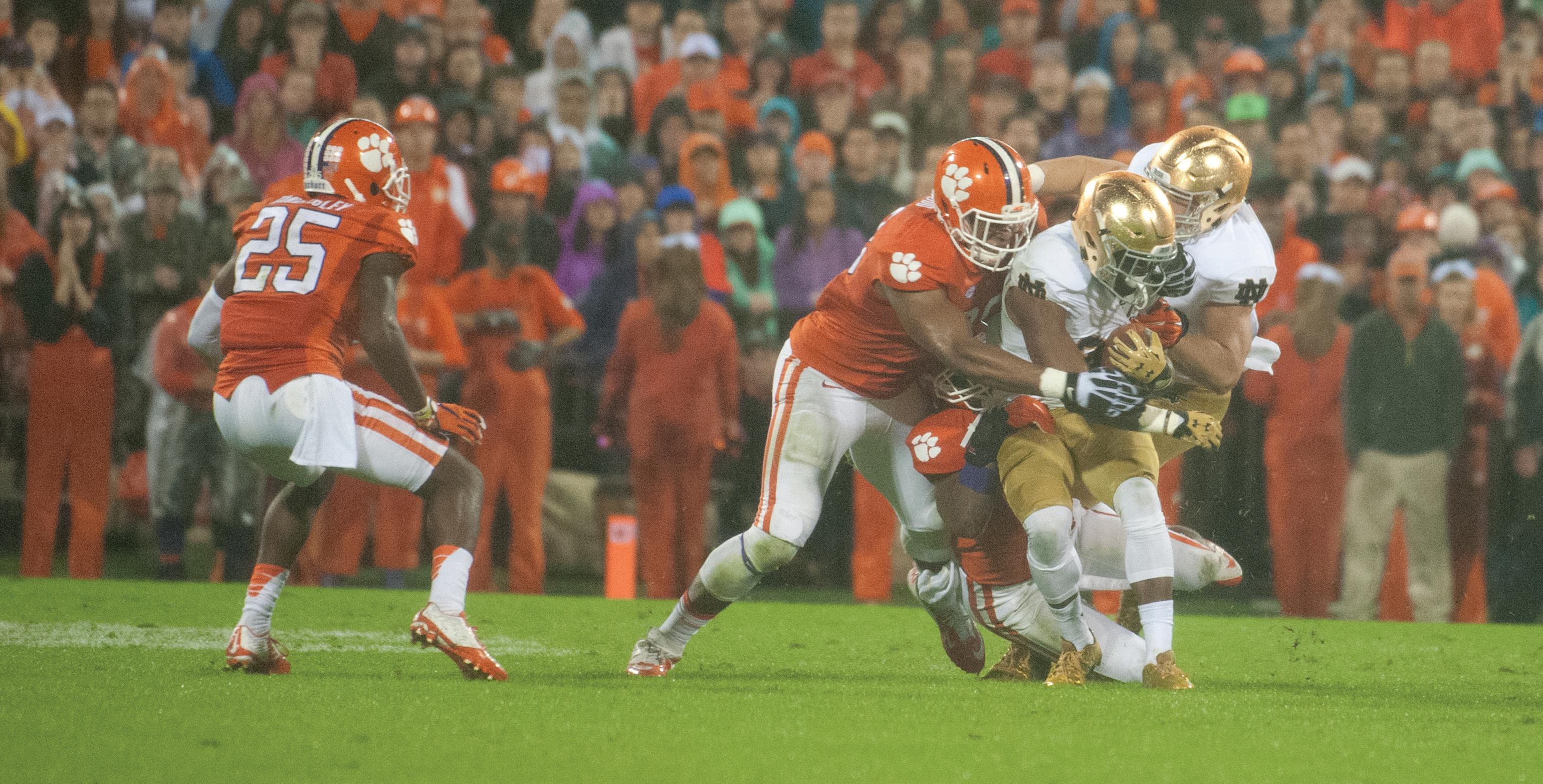
Irish senior running back C.J. Prosise is smothered by the Clemson defense in Notre Dame’s 24-22 loss Saturday at Memorial Stadium. Prosise ended the game with only 50 yards rushing, well below his average of 150.
end, however, Prosise hauled in four passes for a total of 100 yards, including a 56-yard touchdown.
Zach
mIstaKes
QUarterBaCks
making his first career road start, deshone Kizer showed poise beyond his years when dealing with a deafening crowd in addition to a torrential downpour. although he certainly didn’t play mistake-free, drops from Kizer’s receivers hurt his numbers. He led a charge in the fourth quarter and finished 19-for-34 for 321 yards, adding 60 yards on the ground.
rU nning BaCks
c.J. Prosise’s first six rushes went for a combined negative five yards before he finished the day with by far a season low of 50 yards. although some of the problems had to do with the push up front, Prosise didn’t help his cause by fumbling in the third quarter.
reCeivers
the Irish receiving corps tallied six drops in all, failing to support their young quarterback on the road. Will Fuller was all but shut down by clemson’s mackensie alexander, while the tight ends failed to record a reception.
offensive line
It was a tale of two halves for this unit, at least as far as run blocking is concerned. by the time they started to open up holes, the Irish were behind and needed to throw. the line had a handful of penalties early, but settled down. the group was steady in pass protection for the most part.
defensive li ne
the defenisve front for the Irish had a so-so day against a clemson offensive line with five new starters, allowing 4.7 yards per carry. sheldon day was disruptive, however, while Isaac rochell totaled seven tackles.
line BaCkers
the linebackers weren’t necessarily flashy, but they didn’t make any big mistakes, either. the group failed to contain deshaun Watson on the outside a few times, but otherwise looked solid. Jaylon smith led the way with nine tackles.
defensive BaCks
the Irish secondary had a solid peformance overall. although Keivarae russell seemed to struggle, elijah shumate and max redfield had their best games of the season. on top of that, cole luke intercepted a pass for the second straight week.
sP eCial teams
tyler newsome’s first punt sailed only 15 yards, giving clemson a short field to take a 14-0 lead early. later, after returner c.J. sanders showed his speed and patience with a 46-yard return, he fumbled away the second half kickoff to set up another clemson score. Kicker Justin Yoon was the lone bright spot, connecting on a career long 46-yard field goal in tough conditions.
CoaChing
brian Kelly’s team came out flat to put themselves in a hole early, something that is hard to come back from on the road. credit Kelly for not throwing on every down after the run game stalled, but the rest of his play calling was a question mark. Kelly went for two with 14:13 left in the fourth, while the final play was a Kizer run that never had a chance.
give the Irish credit for not quitting after four deflating turnovers. but notre dame still did not look like a championship team on saturday. It was less clemson exploiting notre dame’s weaknesses and more the Irish hurting themselves – with the death valley crowd and the rain proving to be big factors. the defense as a whole came out flat before settling in and playing well. a lthough Kizer played a good game at the helm, he lacked the weapons he’s had in recent weeks.
Play of the game
d eshone kizer stU ffed on two P oint C onversion attem Pt
With seven seconds left in the game, Kizer found receiver torii Hunter Jr. to pull the Irish within two. on the conversion attempt, brian Kelly gave Kizer a run-pass option. the quarterback took the snap and ran to his right but was stymied by the clemson defensive front.
Mistakes
single yard short.
Kizer, who finished the game 19-of-34 for 321 yards, two touchdowns and an interception through the air while tacking on another 60 yards and a score with his legs, chose to run the ball on a play similar to the same one he scored on earlier in the quarter.
clemson’s defense, which had dominated the Irish offense for three quarters but suddenly turned porous in the final stanza, came up with the biggest play of the game when it mattered most, stuffing Kizer at the one-yard line and preserving its 24-22 lead.
“run-pass option. the run option was there. at that point in time it’s man vs. man, heart vs. heart,” Kizer said of the decision to keep the ball on the conversion attempt. “and we got there, and we blocked it the way we were supposed to block it, just didn’t get the drive that we were supposed to get, and I didn’t lower my shoulder when I should have, and we didn’t get in the end zone.”
“[Kizer] has the option to throw it or run it, depending on what the numbers are,” Irish head coach brian Kelly said. “He had fair numbers. He’s reading it at the line of scrimmage.
“and it was the right call.”
the run ended a long day for notre dame’s offensive line, which spearheaded a rushing attack that averaged more than 250 yards per game this season entering saturday night but failed to establish any push against clemson’s front seven. Prosise, who was averaging 150 yards per game, could not find any room to operate against the tigers, finishing with just 50 yards on 15 carries. the notre dame offense as a whole had 116 yards on the
ground.
“We got behind there and really couldn’t come back,” Kelly said when asked about the performance of the offensive line.
“I thought the second half of the game was closer. We were probably going to get the things we needed in the running game, but we had to throw it way too much. We couldn’t be balanced when we needed to be.”
notre dame fell behind early after clemson sophomore quarterback deshaun Watson jumped-started his squad on the game’s opening drive. on the very first play from the ling of scrimmage, he called his own number on a quarterback draw that went for 38 yards and put the tigers in Irish territory, where clemson would run its next ten plays spanning two drives.
Watson capped the drive by rolling left to find junior tight end Jordan leggert at the 10-yard line, who turned upfield and dove into the end zone to put the tigers up, 7-0.
the clemson defensive line dominated notre dame’s first possession, forcing a threeand-out. Irish sophomore tyler newsome then shanked a 15yard punt off the side of his foot.
Watson marched the tigers from the Irish 40-yard line to the end zone in four plays, culminating in a pass to sophomore receiver artavis scott. scott bounced off two Irish defenders and walked across the goal line to increase notre dame’s deficit to 14-0. the Irish did manage to strike back on the next drive. on the kickoff, freshman receiver c.J. sanders broke free to the Irish 49-yard line. Freshman kicker Justin Yoon drilled a 46-yard field goal to put the Irish on the board with 5:32 remaining in the first quarter.
notre dame’s defense settled
in following Yoon’s field goal, stymieing the tiger offense on four consecutive drives to end the first half.
notre dame’s offense, however, failed to find the same groove. Five penalties for 30 yards — including a delay of game-false start-delay of game sequence that changed a second-and-seven situation to second-and-22 after the Irish had picked up a first down — killed any momentum the offense mustered.
Irish graduate student linebacker Joe schmidt said he was especially disappointed by how slowly the team started.
“We just didn’t execute. I didn’t execute,” schmidt said. “We need to be better at executing the game plan. We need to tackle the ball carrier, take grass and get them on the ground. eliminate big plays.
“We need to be better across the board.”
Kelly also said the Irish came out flat.
“We started poorly defensively,” Kelly said. “ … there are no moral victories, and we can’t go on the road and be tentative defensively to start a game. We didn’t get off to a good start.
“We’re not here for moral victories. We’re too far along in our program. We’ve got to come down here and beat clemson..” the Irish now turn their attention to navy and its triple-option attack that visits notre dame stadium this saturday.
“We have to look forward. We have to move on to the next game,” schmidt said. “obviously we have to look back at this game and learn from it. but there isn’t a guy in there with a smile on his face, and we’re not going to smile for the next week.”
Contact Zach Klonsinski at zklonsin@nd.edu
CHRIS COLLINS | The Observer
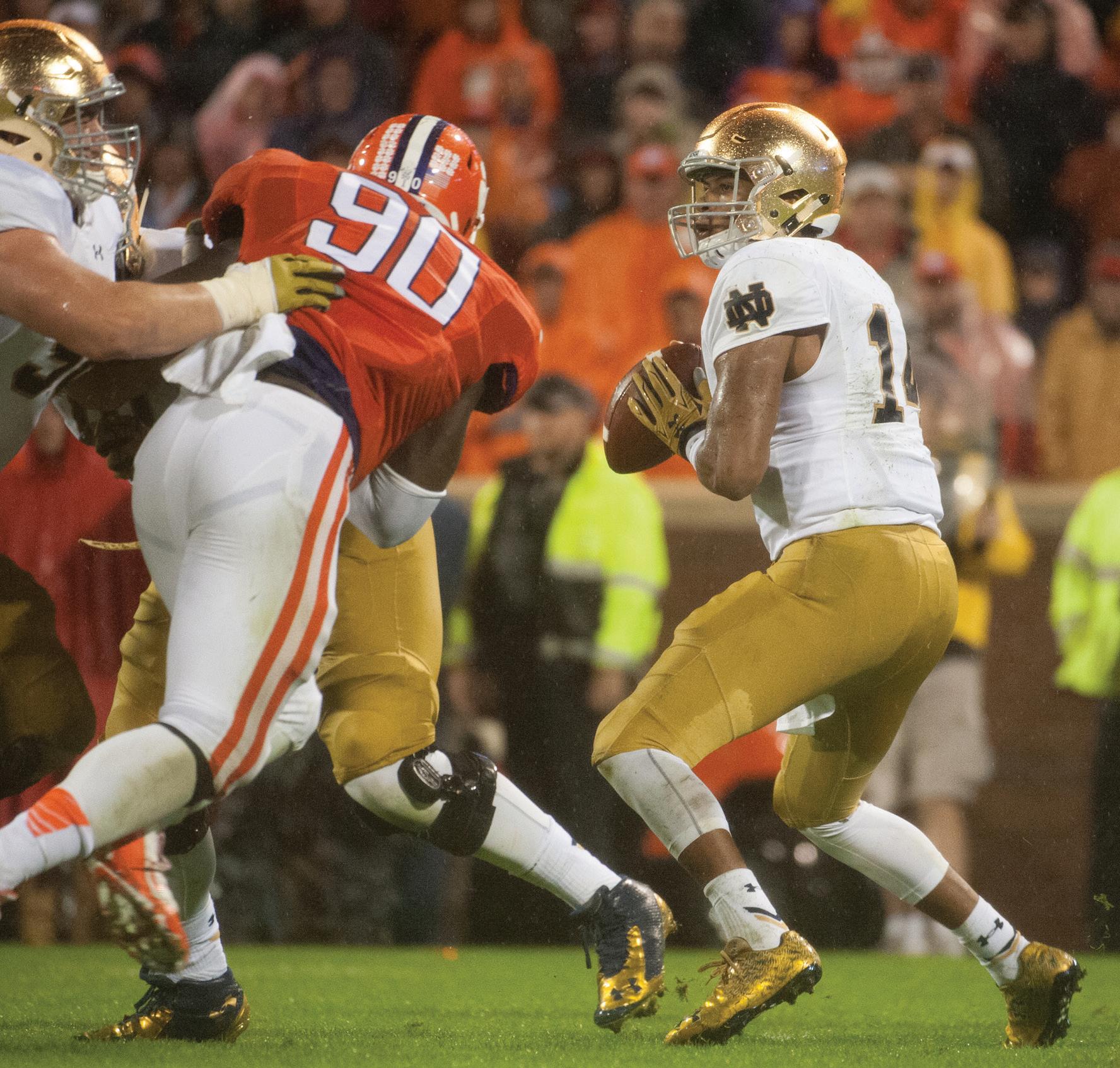
Irish sophomore quarterback DeShone Kizer looks to pass during Notre Dame’s 24-22 loss at Memorial Stadium. Kizer completed 19 of 34 passes for 321 yards Saturday.
own, said. “ b ut we’re not going to make that excuse about the weather. We knew there was going to be some wet ball conditions, and we had been practicing with it all week. s o we had to come down with the catches.”
For a team featuring veterans such as Fuller, senior c hris b rown and junior c orey r obinson, the Irish failed to adjust to the deluge, making life under center harder for Kizer in his first career road start. t hat trio — who hauled in a combined 155 catches last year — was held to just seven catches total, including at least a drop each.
r obinson particularly struggled, failing to come down with a long pass from Kizer that would have set the Irish up at the c lemson oneyard line and also missing on a two-point conversion pass that went off his hands.
“We had way too many offensive mistakes with penalties and with missed passes — whether it be a bad ball or a drop,” Kizer said. “It all comes down to us not
Klonsinski
s anders on the opening kickoff of the second half that gave the t igers the ball on the n otre d ame 29-yard line.
s ure, it’s a fair criticism to say the defense should have held the t igers to just a field goal attempt, at best.
e xcept that’s exactly what the defense did on two other occasions. t he first came after senior running back c .J. Prosise’s fumble on n otre d ame’s first offensive snap of the half following s anders’ fumble. t he c lemson offense got the ball on n otre d ame’s 35 with a chance to blow the game wide open.
Instead, the Irish held the t igers to one yard on three plays and forced a punt.
t he second stand came in the fourth quarter with the game on the line.
Following t iger senior linebacker b .J. g oodson’s interception with n otre d ame trailing 24-16 and only 6:36 remaining in the game, n otre d ame’s defense held the t igers to eight yards on three plays and forced a field goal attempt into Hurricane Joaquin’s fury from c lemson freshman kicker g reg Huegel. Huegel hooked it wide left, and the Irish had yet another chance.
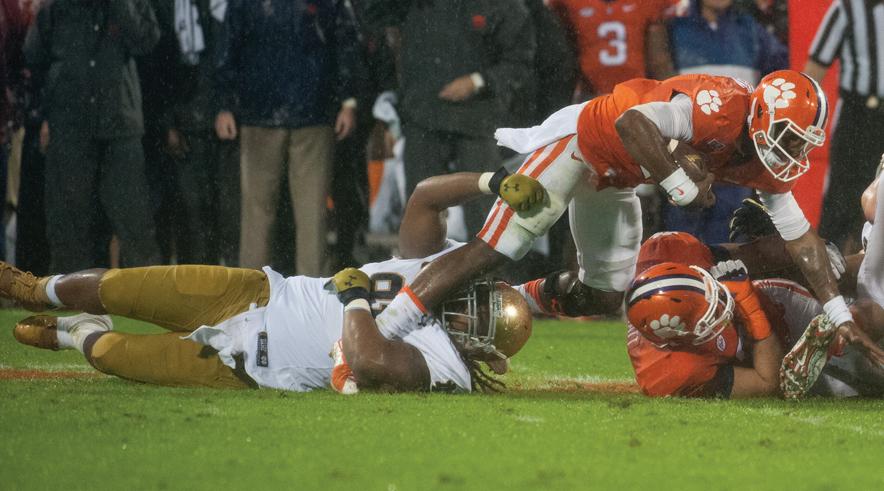
a nd it looked as if n otre d ame would take advantage, too, until senior receiver c hris b rown fumbled at c lemson’s two-yard line
executing the way the game plan had set for us.”
t he most obvious missing component was Fuller, who entered the game with six touchdowns while averaging 113.5 yards per game.
Fuller was matched up with redshirt sophomore cornerback m ackensie a lexander all game, a player who only allowed 20 receptions all of 2014.
“I wasn’t expecting him to play me [different],” Fuller said. “Just what he showed me on film. b ut they threw a lot of different coverages.”
“a s a quarterback I didn’t necessarily exploit their weaknesses of them doubling up with Will until later in the game,” Kizer said.
“ e ach team we play is going to have their own way of coping for a great receiver in Will Fuller and we figured that it would be some sort of over the top help. We game planned against it.”
a lthough the Fullera lexander story line drew the most attention heading into the game, it was b rown’s fumble that was arguably the biggest mishap for n otre d ame’s receiving corps. With the Irish driving to tie the game in the fourth
with 2:09 remaining and his team down eight.
a gain, though, the defense stepped up, forcing a three-and-out to get the ball back in Kizer’s hands with 1:05 remaining.
Kizer threw for 321 yards in what amounted to a tropical storm s aturday night. a nd it should have been more, too.
s ure, Kizer missed some easy throws, especially early. b ut as Irish head coach b rian Kelly pointed out in his s unday teleconference, n otre d ame left somewhere in the area of 125 yards on the turf because of dropped passes.
Junior receiver c orey r obinson had the two most notable.
t he first was a bomb from Kizer in the second quarter that would have either been a touchdown or put the Irish at c lemson’s one-yard line with a chance to close the deficit to 14-10; t he other came on n otre d ame’s first two-point conversion attempt of the night.
Yet r obinson was far from the only culprit: Fellow junior receivers Will Fuller and torii Hunter Jr. joined the drop parade. Fuller had a third-down pass go directly between his hands midway through the second quarter. Hunter’s drop with lots of green space in front of him came late in the third quarter when the Irish needed a big play.
a nd the butterfingers wasn’t just limited to receivers: s anders and senior running back c .J. Prosise
quarter, b rown lost the football on c lemson’s two-yard line to turn it over with 2:09 remaining.
“I was just trying to make a play,” b rown said. “I was just trying to score. I tried to do too much, and I paid the cost for it.”
d espite the struggles of the Irish receivers, Kizer performed well in the minds of his coaches and teammates.
“I wish we could have supported him better,” Irish head coach b rian Kelly said. “ r eally proud of him. Proud of the way he competed. He … played well enough for us to win, let’s put it that way.”
“He can do it all,” added b rown. “He continues to just stay poised and never get down on himself. He continues to get better.”
b ecause of their struggles, the Irish receivers are hungry to make up for their mistakes but won’t alter their goals for this season, Fuller said.
“We’re going to continue to play hard for one another,” Fuller said. “Wherever that takes us we’ll be happy with that.”
Contact Brian Plamondon at bplamond@nd.edu
each coughed up the football inside n otre d ame territory to start the second half when the Irish needed to seize momentum, not throw it away.
a nd don’t forget about b rown, in his homecoming game, trying to do too much and fumbling at c lemson’s two-yard line.
o f course, Kizer was far from perfect. His worst mistake was forcing the pass that got intercepted late in the game.
b ut, like I already said, the defense took care of business after the interception.
l osing control of the ball twice inside the opponent’s five-yard line and scoring zero points on those two drives, on the other hand?
t hat hurts.
Kizer, the sophomore quarterback making his third career start — and first true road start in one of the hardest places to play in the country during some of the worst football conditions we’ll see in a long time — was the most poised, composed and, simply put, best player on the field s aturday night.
In the words of Irish head coach b rian Kelly after the game:
“I wish we could have supported him better. … He played well enough for us to win.”
Contact Zach Klonsinski at zklonsin@nd.edu
The views expressed in this column are those of the author and not necessarily those of The Observer.

C lemson 7, notre dame 0
Jordan leggett 6-yard pass from deshaun Watson (greg Huegel kick)
12:19 remaining
Drive: Seven plays, 64 yards 2:41 elapsed
Clemson 14, notre dame 0
artavis scott 13-yard pass from Watson (Huegel kick)
8:43
remaining
Drive: Four plays, 40 yards, 1:35 elapsed
C lemson 14, notre dame 3
Justin Yoon 46-yard field goal
5:32remaining
Drive: Nine plays, 22 yards, 3:11 elapsed
C lemson 21, notre dame 3
Watson 21-yard run (Huegel kick)
14:14
remaining
Drive: Three plays, 29 yards, 0:46 elapsed
C lemson 21, notre dame 9
c.J. Prosise 56-yard pass from deshone Kizer (Kizer pass failed)
14:13
remaining
Drive: Four plays, 80 yards, 1:48 elapsed
C lemson 24, n otre dame 9
Huegel 35-yard field goal
10:56 remaining
Drive: Six plays, 50 yards, 3:17 elapsed
Clemson 24, notre dame 16
Kizer 3-yard run (Yoon kick)
9:03 remaining
Four plays, 64 yards, 1:53 elapsed
Clemson 24, notre dame 22
torii Hunter Jr. 1-yard pass from Kizer (Kizer rush failed)
0:07 remaining
Six plays, 32 yards, 0:58 elapsed
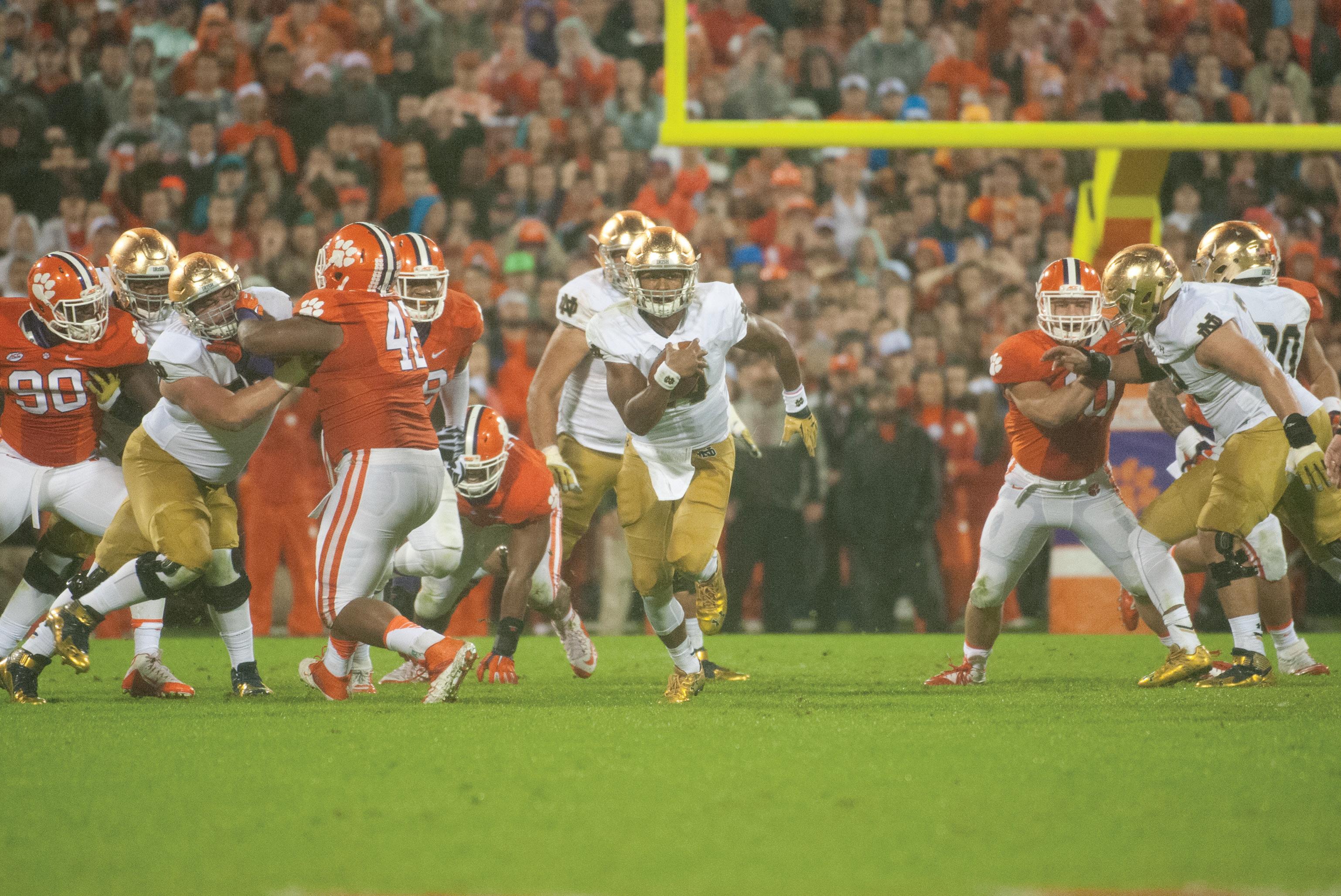
quarterback DeShone Kizer takes off up the middle during Notre Dame’s 24-22 loss to Clemson. In his first career road start, Kizer picked up 321 yards through the air while throwing two touchdowns and one interception. On the ground, Kizer added a touchdown to go along with 60 yards on 15 carries.
no ComeBaCk against Clemson

After surrendering 14 points and 104 yards in the first seven minutes, the Irish defense buckled down and only allowed Clemson to gain 192 yards the rest of the way. But that was all Clemson needed, as the Irish spotted the Tigers four turnovers. Notre Dame rallied for 19 fourth quarter points, but fell a two-point conversion shy of overtime when sophomore quarterback DeShone Kizer was stuffed on the 1-yard line.


CHRIS COLLINS| The Observer
Irish sophomore
CHRIS COLLINS | The Observer
Clemson players run down “The Hill” during their famous intro sequence against Notre Dame. The intro also includes rubbing Howard’s Rock at the top of “The Hill” for luck.
CHRIS COLLINS | The Observer
Senior running back C.J. Prosise receives a handoff Saturday at Memorial Stadium.
CHRIS COLLINS | The Observer
Senior Sheldon Days tackles Clemson’s Deshaun Watson during Saturday’s 30-22 Irish win.
CHRIS COLLINS | The Observer
Irish junior receiver Will Fuller turns upfield during the fourth quarter as Tigers’ redshirt junior linebacker Travis Blanks gives chase.
it seems that every few years — at the meeting point of society and the individual, under the duress of variables all set to serendipity — the world stumbles upon an otherwise unassuming artifact that satisfies a thirst the world did not know it had.
i n the mid-90s, a new generation wobbled forward on overgrown pubescent legs into a world that was drastically different from anything they – or anyone else, for that matter – had ever known or conceived. w hile the outside world rebuilt itself after a series of political collapses at the turn of the decade, a totally new virtual world was spinning its invisible web in a canopy of cables and wires above their heads. t he mood was not hopeful, nor was it hopeless; it was simply uncertain and paranoid.
e nter radiohead’s “oK computer,” an album that, in its struggle with these themes, found itself hailed by a mass of sympathizers. its fans were those who, on the eve of that new era and under the pressure of their own accidental leadership within it, retreated to nights of dimly-lit highway overpasses and hallucinatory sojourns at friends-of-friends’ basements. w hile these are extremes, they, in their frightening plausibility, revealed the ever-thinning line dividing the ordinary and the misfit, a divide that increasingly took on the shape of a bridge. but even in fans who didn’t match these anti-social archetypes, the album struck at those corners of the heart that caved under pressure to withdraw from the world into a hibernation long enough to survive the m illennial moment and emerge on the other side as wellrested and scratch-free as possible. i f nothing else, the album was an apology for self-defense.
but then, three years later, in 2000, the old millennium was put to rest. at its wake, radiohead introduced the long-awaited follow-up to “oK computer” to an audience of
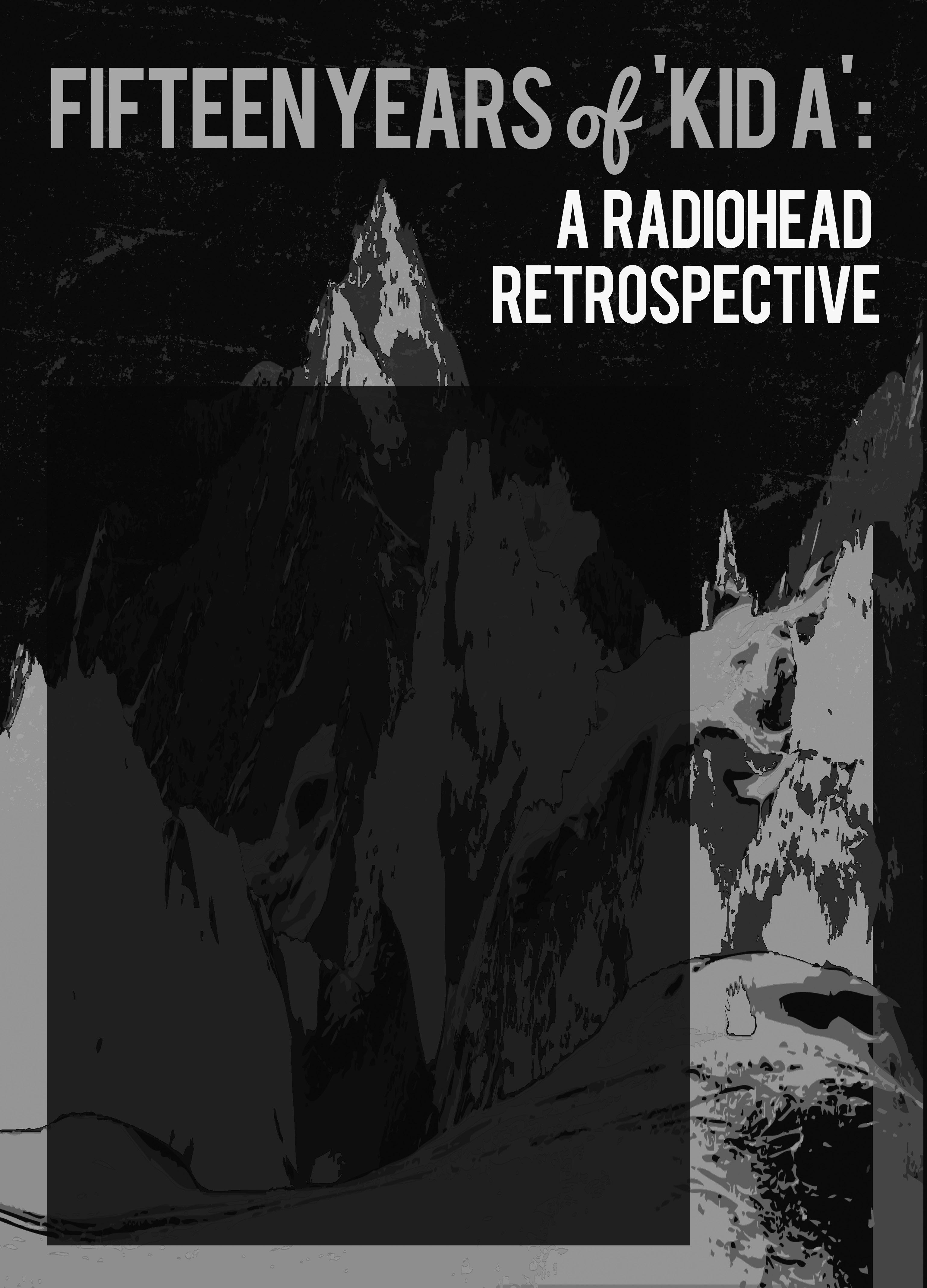
furrowed eyebrows. w hat the heck was “Kid a”?
i mmediately upon its release, the contentious album was drenched in a punch bowl of labels: odd, disappointing, brilliant, confusing, a gimmick. everyone was trying to wrap their minds around how this creaking, buzzing automaton had risen from the awkward, tin-foil paranoiac that inhabited “oK computer.” but more often than not, these explanations relied on assumptions, either of the band’s motivations, of the band’s label or of the changing music industry in general.
t he way i see it, however, there is a far more straightforward explanation, simple in that it assumes nothing. i n a word, “Kid a” was simply inevitable.
t he lyricism of the album best illustrates this. not because of the existence of some rich undercurrent of symbolic significance but for the total lack thereof. i n fact, lyrics were picked almost literally from a hat, chopped up and reassembled. t hey are phrases that even t hom yorke, the band’s leading creative force, has said are fundamentally inseparable from the music they strive to describe. but if this is indeed their purpose, then they accomplish it effortlessly. t his underscores the reason why “Kid a” could not have been assembled any other way: t he album is disjointed, chaotic and perpetually moody like the troubled audience that first laid hands on it. it is the extension of a parallelism begun with “oK computer.” t he forces that compel a successful rock band to create an electronic album brimming with dark ambience are the same as those that push a misfit to devolve into some confused re-assemblage of himself. i ndeed, the writing block the band experienced after “oK computer” was something like the silent mental breakdown of a lost individual centered about a dangerous question: w here to go from here? but “Kid a” only answers with additional questions and in this way accurately captures the mood of its generation, just as its predecessor had
done only a few years before. i ndeed, the album is not as confusing as it is confused, internally at conflict. t he paranoiacs inhabiting the world of “oK computer” have emerged on the other side of the millennium squeezed through the oppressive advance of technology with a sense of ambivalent acceptance. t he mood of “Kid a” reflects this when segments of animalistic electronic blips, explosive fanfare and melancholic wallowing are featured in turn, as if the band were scrolling through options like a confused soul aching to understand its role in and response to a wholly new environment. on “oK computer,” the metastasizing digital world was presented as something to be feared, a counterpoint to the humanity of the people who live among these empowered machines. given the nature of its aesthetic, it would be easy to say that on “Kid a ,” these devices — and the unpredictable future they represent — are embraced. but the truth is far more ambiguous. i ndeed, “Kid a” is perhaps the most precise musical interpretation of the socratic paradox, and this is arguably what has made the album so captivating to fans since its inception. a fter all, this paradox would be central to understanding and surviving in such a new, radically different era for mankind.
radiohead’s admission that they know nothing, so to speak — and their willingness to breach new ground until they do — is the sign of artistic maturity that has solidified the band’s role as a major player in the alternative rock realm. but more importantly, it is the anti-epiphany that, by entirely avoiding the critical question, brings its generation a sense of peace.
t hey ask: “w hat now? w here do we go from here?”
“w ho knows?” the band responds. “a nd that’s fine too.”
Contact Adrian Sanchez at asanchez11@nd.edu
The views expressed in this column are those of the author and not necessarily those of The Observer.
Adrian Sanchez s cene writer
Playing the punting odds
l ate in the first half of its 34-27 home loss to no. 1 ohio state on saturday, i ndiana was driving with a chance to extend a 10-6 lead.
on fourth-and-1 from midfield, hoosiers head coach Kevin w ilson “rolled the dice,” and went for it, picking up the first down on a three-yard rush. Four plays later, i ndiana faced another fourth down, this time with two yards to go from the ohio state 39-yard line.
a nd w ilson opted to punt. w hy? w hat’s the point of going for it the first time if you’re not going to on the second?
so, because i’m a statistics nerd, we’re going to talk about math today — and how teams often don’t play to the odds on fourth down.
conventional football wisdom has always dictated teams concede possession when they hit fourth down. e ither they’ll try a field goal if in range or punt the ball away if not. but what if conventional wisdom isn’t wise here?
p unting the ball is what we’d generally consider the safe call in almost any situation; by backing up the opponent deep into its own territory, the punting team has minimized the chance it will give up points on the next drive. it makes a certain level of sense — going for it and failing on fourth down puts a team in its least-advantageous situation, giving the opponent a short field to work with, increasing their chances of scoring.
t hat’s the idea of avoiding the worst-case scenario. but it means coaches rule out a different scenario: the best-case one.
l et’s quickly introduce a concept: expected points. t he idea builds off basic probability theory — from any game situation, a team has a certain chance of scoring a touchdown, kicking a field goal, turning it over, etc. take a specific outcome’s point effect, say touchdowns, worth around 6.97 points in college football when factoring for missed extra points and failed and converted two-point tries, and multiply it by its probability. do this for all outcomes, add them all up, and you’ve got an “expected points” value for that drive.
of course, there’s another layer to it: w hat happens after your drive is over? i f it’s a touchdown or a field goal, you have to kick off to the other team, giving it the ball and a chance to score points; dependent on the specific
model, a team can expect to score around 0.7 points on a drive started by receiving a kickoff. t hus, a touchdown is truly worth around 6.3 points, while a field goal is worth 2.3. it’s a different way of thinking about the game, and it leads to different results. l et’s set up an easy scenario to demonstrate the idea.
a team is facing fourth-and-2 from its own 49-yard line midway through the first quarter. t he game situation isn’t such that it’d change the coach’s motives.
t here are, realistically speaking, two options.
t he first is the conventional one: punting the ball. t his effectively means the team is giving up any hope of scoring on that possession, while its opponent gets the ball with a chance to score. i f the team has an average punter it can expect a net of 37 yards on the punt, setting its opponent up on its own 14, an admittedly good defensive situation.
t he second is the alternative one: going for it. t he scenario chosen makes the math easy — if the team converts with a twoyard gain, it has first-and-10 on its opponent’s 49-yard line. if it fails with no gain, its opponent has the exact same scenario. both situations have, effectively, the same number of expected points, so the problem then becomes one of probability.
t hat’s where the alternative call wins. most models predict a conversion ratio better than 50 percent for fourth-andshort, and teams will convert around 60 percent of fourthand-two plays. if we take that value, it’s more likely the team “rolling the dice” gets its first down than is stopped, and thus, going for it has a “positive” net expected points on the decision, the opposite of the case with the punt. granted, the variance (and thus the probability of allowing a touchdown or field goal) is higher, but coaches should fundamentally play to maximize their point differential in the game.
various situations — protecting a lead, coming back from a deficit, having the ball coming out of halftime, etc. — complicate the analysis (late-game situations should focus on maximizing win probability, not expected points), but at the end of the day, coaches could learn a lot from looking at the math.
Contact Alex Carson at acarson1@nd.edu
The views expressed in this Sports Authority are those of the author and not necessarily those of The Observer.
rodgers, packers beat 49ers to stay undefeated
santa clara , calif. — once a aron rodgers and co. warmed up in the second half, the green bay packers kept their unbeaten start rolling. rodgers passed for 224 yards and a touchdown, ran 17 yards to set up a key second-half score, and the packers beat the hapless san Francisco 49ers 17-3 on sunday for their first 4-0 start in four years.
r ichard rodgers caught a 9-yard touchdown pass on the game’s opening drive before rodgers got his team going in the second half after a slow start to snap a four-game losing streak to san Francisco, which included a pair of playoff defeats.
c lay matthews added his own flair to this one. w hen he sacked colin Kaepernick in the third quarter, he kissed his right biceps Kaepernick-style to punctuate the play — one of
green bay’s six sacks. w hile methodical with nothing fancy, green bay (40) seemed unfazed with a short week and long trip west after beating Kansas city last monday night. t his is the team’s first 4-0 start since winning the initial 13 games in 2011.
t he packers certainly hope their trip to l evi’s stadium will be the first of two this season. t he super bowl comes to the second-year, $1.3 billion bay a rea venue in four months for its 50th year celebration.
Kaepernick threw his fifth interception in two games and the 49ers (1-3) have been limited to 28 total points over three games while giving up 107 points. t he quarterback, sacked six times, was booed in the fourth quarter along with rookie punter bradley p inion.
t he packers capitalized shortly after san Francisco’s reggie bush was stuffed for
no gain trying to go up the middle on third-and-11 in a play call that was immediately scrutinized.
on the ensuing drive, James Jones caught a 38-yard pass on the left sideline by barely staying in bounds. rodgers then scrambled 17 yards to set up John Kuhn’s 1-yard scoring burst.
green bay made just enough plays. t he packers sacked Kaepernick on consecutive snaps late in the first half, and the niners settled for phil dawson’s 33-yard field goal in their best scoring opportunity of the day.
Jones wound up with five receptions for 98 yards in the fifth meeting between the rivals since 2012, while randall cobb had his streak of seven games with either a touchdown or 100-plus yards receiving snapped. eddie l acy ran for 90 yards and converted two fourth downs.
Astros headed to playoffs despite loss to Arizona
Associated Press
phoeni X — houston astros manager a.J. hinch gathered his players around, took a puff from his victory cigar and told everyone to quiet down.
“you can say a lot of things about this team, but one thing they’re going to say forever: we’re a ... playoff team,” hinch told them while standing in puddles of beer and champagne.
it’s hard to blame Finch and the astros for letting loose. their 10-year wait is over.
a 5-3 loss to the a rizona diamondbacks on sunday wasn’t enough to spoil what they’ve done this season. the astros are headed to the al wild card, their first playoff appearance since facing the chicago w hite sox in the 2005 world series and, yes, it feels awfully good.
hits for the second time in his career. “now we are the team that everybody wants to be.”
the astros had two straight 100-loss seasons to end their tenure in the national league, tacked on another after switching to the al in 2013. last season was only marginally better; houston lost 92 games.
given little chance this season, houston overcame a midseason slide by playing some of its best baseball down the stretch. the astros won six of seven to take a one-game lead over the los a ngeles a ngels headed into sunday and clinched in the eighth inning, when they learned texas had beaten the a ngels.
the astros shared a few high fives in the dugout when the a ngels score was posted and really let loose in the clubhouse, spraying champagne and beer in the air while several chants broke out.
playoff game tuesday night, against the new york yankees at yankee stadium.
“it’s only the tip of the iceberg for us,” astros outfielder Jake marisnick said. “this is kind of the first leap into the postseason, but hopefully this is going to be routine.”
a rizona went 79-83 in its first season under general manager dave stewart and manager chip hale, a 15-game improvement from finishing with baseball’s worst record in 2014.
paul goldschmidt hit a tworun homer off chad Qualls (35) and a.J. pollock had a solo shot among his three hits for a rizona. daniel hudson (4-3) got the final two outs of the seventh inning and brad Ziegler recorded six outs for his 28th straight save, matching the team record set by J.J. putz from 2011-12.
“we didn’t have the results a couple of years ago that we wanted, but we worked hard to be at this point,” said houston’s Jose a ltuve, who reached 200
“we saw so much individual and team improvement,” goldschmidt said. “not just the wins, but the way guys were playing.” mlb |
houston finished 86-76 to reach the postseason and will play its first a merican league
Alex Carson a ssociate sports e ditor
Associated Press
WomEn’s IntErhAll
cavanaugh to take on w ildcats
By MAUREEN SCHWENINGER sports writer
c avanaugh faces r yan on tuesday night in a game with significant playoff implications as both teams hit midseason.
c avanaugh (2-2) is hoping to keep the momentum from its sunday matchup with lyons. s enior captain Katie Kaes said defense has been a focus in c avanaugh’s practice this week.
“ we’re still working with it all, especially switching between offense and defense,” Kaes said. “ we’ve got some girls that are playing both. we have to work with going from one mentality to the next at that game speed.”
r yan (3-0) is facing major adjustments in practice after losing its starting quarterback in its last game. Freshman Jenny moore went home this weekend for an mri
“she has at least an mcl tear, possibly an mcl and acl tear,” senior captain and
receiver e rin c lark said. “it’s a big loss. obviously making sure we have someone solid at quarterback this weekend is key.”
it is likely the w ildcat offense will use two or more quarterbacks in relief this week, c lark said. i n light of these changes, c lark said it is important for the defense to step up.
“ we had some struggles last time,” c lark said. “g oing into our game against c av, it’ll be really good for us to put a lot of defensive pressure on them.”
Kaes said c avanaugh is determined to avoid another loss.
“ we’re just trying to work off of our win last weekend and keep the momentum,” Kaes said. “i think we all kind of liked the feeling of winning. we want to have that again.”
c avanaugh and r yan go head-to-head tuesday at r iehle Fields at 7 p.m.
Contact Maureen Schweninger at mschenwi@nd.edu
Postseason unaffected as Yankees lose to Orioles 9-4
Associated Press
baltimore — a s they head into the playoffs, the new york yankees won’t spend much time thinking about what occurred during the regular season.
a ll that matters now is what happens next.
t he yankees stumbled into home-field advantage in the al wild-card game, falling to the baltimore orioles 9-4 sunday after a loss by houston made the outcome meaningless.
new york will enter tuesday’s winner-take-all game against the a stros with little positive momentum after being swept in three games by baltimore and losing six of its final seven regular-season games.
to that, the yankees say: so what?
“tuesday is a new day,” manager Joe girardi said. “we wake up tomorrow, and it’s a new day and we’re where we want to be — we’re in the playoffs.” on sunday, the yankees fell behind 7-1 in the fifth inning
paid a dvertisement
and stranded 11 runners. new york was 4 for 31 with runners in scoring position over the weekend, including 1 for 12 in the finale.
“you learn in baseball, to turn the page,” first baseman greg bird said. “i f anything, it will be easier because now only one thing matters: the next game. it doesn’t matter what we did for the last 162 games.”
a fter clinching a playoff berth on t hursday, new york needed just one win at camden yards to assure itself a game at yankee stadium on tuesday. t hat victory never came, but that’s partly because girardi tried to balance the importance of winning against resting his starters and relievers. it all worked out perfectly for the yankees, anyway, as a rizona’s 5-3 victory over houston ended the a stros’ bid to host on tuesday. had new york (87-75) and the a stros (86-76) finished tied, houston would have won the tiebreaker
for home field based on headto-head record.
“it’s nice that we’re going home,” girardi said. “t he big thing is we’re playing and we have a shot just like the other nine teams do.”
yankees starter m ichael p ineda (12-10) lasted only 3 2-3 innings, allowing four runs and six hits. t he right-hander has yielded a total of 11 runs in his last two outings. e ight relievers followed, none of whom pitched more than an inning.
major league home run leader c hris davis connected twice for baltimore, giving him 47 for the season. he also struck out for the 208th time, fifth-most in one season in big league history. playing perhaps his final game with the orioles, davis hit a two-run shot off bryan m itchell in the fifth and a two-run drive against caleb cotham in the eighth. t he slugger will enter free agency coming off a season in which he drove in 117 runs.

Irish prepare for two-day Nebraska tournament
By DAISY COSTELLO sports writer
t he i rish look to continue their recent run of success this week at the c hip-n c lub i nvitational, hosted by nebraska at the country c lub of l incoln in l incoln, nebraska. t he field will play 36 holes monday and an 18-hole round tuesday.
notre dame is coming off two consecutive top-five finishes at the mary Fossum i nvitational in l ansing, m ichigan, and the schooner Fall c lassic in norman, oklahoma. strong performances from senior captain talia campbell and freshman e mma a lbrecht led the i rish to success in both competitions.
t he field at the c hip-n c lub i nvitational includes nebraska and Kansas. Kansas finished one stroke ahead of the i rish at the schooner Fall c lassic two weeks ago, finishing in fourth place overall.
nfl | broncos 23, viKings 20
Jayhawks sophomore yupaporn
Kawinpakorn finished in first place individually at the schooner Fall c lassic, posting an 11-under-par score of 131 for the weekend.
g oing up against Kawinpakorn, campbell leads the i rish with an average of 71.80 strokes per round so far this season. a lbrecht has also risen to the top of the i rish lineup with strong play the past few tournaments. she finished tied for ninth place at the mary Fossum i nvitational and was the highest finisher for the i rish at the schooner Fall c lassic, coming in 12th place. her stroke average is just one shot behind campbell at 72.80 and is the third-lowest average on the team.
“i feel confident with my game,” a lbrecht said. “i don’t see why i can’t win it individually, and that’s what i’ll have in mind this weekend.”
defending tournament champion ohio state is not
in the field this year, offering the i rish a chance to contend for the title. tournament host nebraska has won six of the last 12 tournaments, with its last victory coming in 2013.
t he i rish enter the c hip-n c lub i nvitational as the highest ranked team in the field at no. 46, according to g olfweek, followed by Kansas ( no. 81) and summit l eague opponent south dakota state ( no. 112). a lbrecht said if everyone does their job, the i rish can be successful at the c hip-n c lub i nvitational and possibly win.
“i f we just play our own game and stick with our individual goals, i think we will be happy with the outcome at the end of the weekend,” a lbrecht said.
t he i rish begin the c hip-n c lub i nvitational on monday at the country c lub of l incoln in l incoln, nebraska. shotgun start is scheduled for 10 a.m.
Contact Daisy Costello at mcostel4@nd.edu
broncos stay unbeaten with win over m innesota
Associated
Press
denver — bursting through the line for jaw-dropping plays is quickly becoming the denver broncos’ calling card.
only this time, the offense joined the party that’s been “pass rushers only” until sunday.
ronnie h illman raced around the left sideline on a classic stretch play for a 72-yard touchdown run, and the league’s topranked defense collected seven more sacks in a 23-20 victory over the m innesota v ikings.
“we had three bad weeks of running the ball and tonight we got it started,” h illman said after his third career 100-yard game. “t his week it was just me and c .J. (a nderson) got tired of everyone trying to tell us that we can’t run the ball.”
t he unbeaten broncos (4-0) revved up their ground game behind h illman and it came in handy on a day the v ikings (22) picked off peyton manning twice and turned the takeaways into 10 points.
t he broncos came into the game averaging just 57 yards rushing. w ith manning in the pistol formation behind a patchwork offensive line and two tight ends lined up on the left side, h illman went left, gathered in manning’s pitch, hit the crease and was gone down the sideline.
it was the longest touchdown run by a broncos running back in 15 years.
“i knew nobody was going to catch him,” teammate demaryius t homas said. “i was happy. it’s good for the offense, gives guys confidence we can hit those long runs.”
h illman finished with 103
yards on 11 carries for his third career 100-yard game.
denver’s top-ranked defense limited adrian peterson to 81 yards on 16 carries — when peterson was the mvp in 2012, his lowest output was 86 yards against the texans and wade phillips, now denver’s defensive coordinator.


for them to learn and try to figure out how to better manage the crowds.”
o n the men’s side, the i rish finished in 10th place behind first-place utep, second-place n orth c arolina s tate and thirdplace c olorado s tate. s enior m ichael c levenger led the way for the i rish, finishing 12th in a time of 24:01.3 on the five-mile course. s enior t im b all and junior c hris m arco rounded out the top three for the i rish, finishing 24th and 35th with times of 24:19.2 and 24:28.5, respectively.
s parks said he was particularly pleased with his top three men’s runners this week.
“ t here’s light at the end of the tunnel for the men’s program,” s parks said. “ e ven though we were 10th ... there’s still a lot of positives to take away. t hose front three were strong ... i don’t know who had a stronger top three than ours. o ur top three were as good as anybody’s, we just need that four and five to perform and we feel like we’re as competitive as anybody in our region.”
w ith the Joe p iane i nvitational under their belts, the i rish look forward to the adidas w isconsin i nvitational in two weeks,
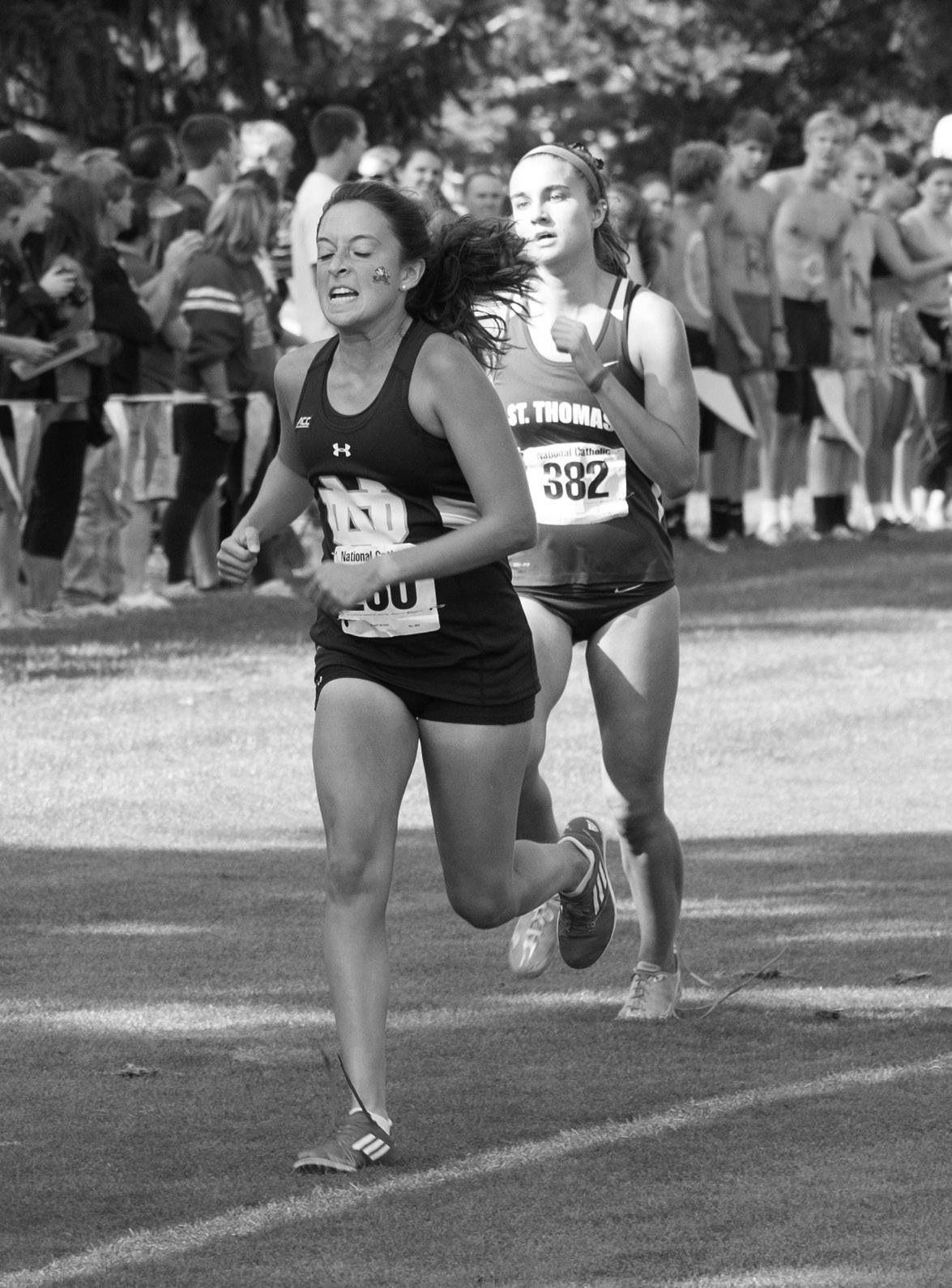
but s parks said he is already looking ahead to the acc championship. “ we’re starting to look towards conference now,” s parks said. “ we’re still a month away from the conference meet, but we got a taste of what nc s tate is all about today. a nd we’re going to get to see them along with several other conference foes in
paid a dvertisement
two weeks at w isconsin, so maybe we can turn the table on them a little bit at that time.”
n otre d ame next takes the course at the adidas w isconsin i nvitational in m adison, w isconsin, on o ct. 16.
Contact Marek Mazurek at mmazurek@nd.edu

t he potential certainly showed in n otre d ame’s second game of the weekend against s yracuse. t he i rish took the o range (12-3, acc 3-1) to a fifth set s unday at p urcell p avilion despite eventually losing 3-2 (28-26, 21-25, 25-27, 25-21, 13-15).
t he first set featured nine lead changes, and the i rish won after capitalizing on an error by the o range and a couple of kills by sophomore outside hitter s ydney Kuhn to win the set.
i n the second set, n otre d ame led for most of the match, fending off s yracuse’s attempt at a comeback.
a lthough s yracuse tied the match on eight occasions, the i rish continued to hold strong offensively. h owever, the o range pulled away at the end of the set with the help of three errors committed by n otre d ame to win the set.
t he third and fourth sets were also close, but s yracuse took advantage of several key n otre d ame mistakes. t he third set ended with three
straight errors by the i rish, which allowed s yracuse to pull away and win in a 2725 thriller. d espite staying within four points throughout the fifth set, n otre d ame fell to the o range 13-15 to lose in one of the more productive matchups for the i rish in recent history.
n otre d ame had a total of 87 digs, which was the most they have had in the last three years. Freshman libero r yann d eJarld led the charge on defense, collecting 28 digs on the day.
d espite the recent string of losses, Fry said she thinks the team is only getting better with more exposure to acc competition.
“ i don’t think having a young team is a disadvantage at all,” Fry said. “ t his just means we have more time to develop and get better. e very match is challenging. p laying against the competitive teams in the acc will only make us that much better.” n otre d ame will continue to look for its first acc win of the year with a trip to c lemson on Friday.
Contact Manny De Jesus at mdejesus@nd.edu
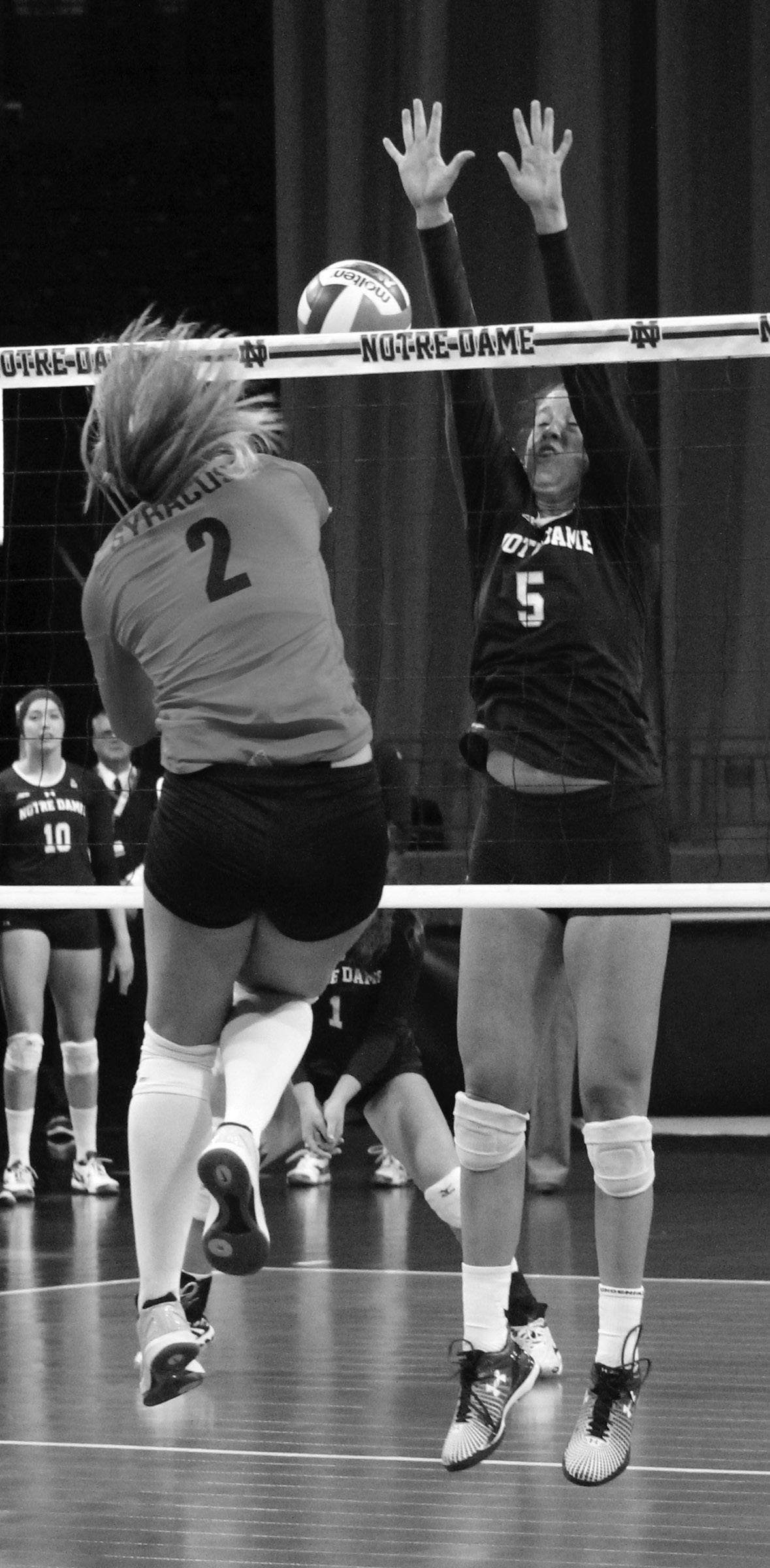
WEI LIN | The Observer
Senior Gabby Gonzalez runs at Notre Dame Golf Course in the National Catholic Championships on Sept. 19, 2014.
SARAH OLSON | The Observer
Sophomore outside hitter Sydney Kuhn jumps to block a hit during Notre Dame’s 3-2 loss to Syracuse on Sunday at Purcell Pavilion.
“ very windy,” c lark said. “ i t was a strong wind, but it was dry, with no rain. t he field was in good condition, and considering all of the heavy rain that they’ve had, the grounds crew did a very good job.”
s ophomore forward Jon g allagher managed his seventh goal of the 2015 season in the 34th minute, and the i rish rode that momentum into halftime. h owever, a great deal of the game was spent at n otre d ame’s end of the pitch, as the wolfpack kept the n otre d ame’s time of possession low and outshot the i rish 11-1 in the first 45 minutes. s till, the i rish defense held and was able to make the one-goal lead stand firm into the second half.
Junior goalkeeper c hris h ubbard saved five of the six shots directed on goal, including a dangerous look from nc s tate in the 98th minute. c lark was quick to praise h ubbard’s efforts on the afternoon and called the one shot that did manage its way past him a thing of beauty.
“c hris had a terrific day today,” c lark said. “ h e was very, very good. h e handled a great game – the one shot that went in was a phenomenal goal. i t was a fantastic goal. a bicycle kick, side volley … not much to be done about that one.”
t he angled shot came from nc s tate sophomore midfielder Zach Knudson, with an assist from freshman midfielder Julius d uchscherer, who chipped the ball forward. d espite the allowed goal, though, c lark praised his team’s defensive effort overall. a lthough the wolfpack held a 23-9 advantage in shots, they managed only six attempts on goal to n otre d ame’s two.
“ t he whole team defended very well,” c lark said. “ we had the better chances in the game despite the shot count. i f you look at the game as a whole, we had some very good chances. i t was a funny game because they had a lot of possession, they kept us in our half of the field, but c hris had some very good saves.”
t he tie with nc s tate leaves the i rish in second place in the acc coastal division, just ahead of n o. 11 v irginia. t hey are two games back of undefeated n o. 2 n orth c arolina, with conference matchups against n o. 6 wake Forest, d uke, v irginia tech and p ittsburgh looming as the regular season begins to wind down.
t he i rish return home to host regional rival m ichigan on wednesday night at 7 p.m.
Contact Brett O’Connell at boconne1@nd.edu
F rom page 16
more shots than the entire hurricanes team with seven, three of which were on goal.
corner kicks were also lopsided in notre dame’s favor, as the irish earned eight to miami’s one.
“we were a little bit off, but we had plenty of opportunities,” romagnolo said. “we didn’t finish our chances. i think [miami] worked hard and they got numbers behind the ball, but in the end we have to convert on those chances.”
miami sophomore goalkeeper catalina perez had six saves on the night, while irish junior goalie Kaela little had two.
romagnolo praised the irish defense, especially senior captain and defender Katie naughton, for keeping the hurricanes out of the offensive zone for much of the night.
she also said sophomore midfielder taylor Klawunder, who played all 106 minutes and recorded one shot on goal, stood out as a fill-in for injured senior midfielder glory williams.
“taylor did a great job in the midfield, breaking plays defensively and pushing the point of attack for us,” romagnolo said. “taylor coming in and playing well as a sophomore while glory is injured has been big for us.”
the matchup was the first acc win for the hurricanes and the second consecutive conference letdown for the irish, who fell 1-0 at home to no. 2 Florida state last week following a 1-0 upset of then-no. 1 virginia in double overtime.
notre dame’s other acc loss was also in double overtime, a 1-0 result against clemson on sept. 19.
“we’re disappointed, but
this is an opportunity to learn and get better,” romagnolo said. “we need to get our ws. …
“our opponents have been very competitive, but this is a team that can get to the Final Four. we need to continue to put everything together.”
the irish will get a chance to bounce back at home against syracuse on thursday. the orange have yet to earn an acc victory this season.
Contact Renee Griffin at rgriffi6@nd.edu
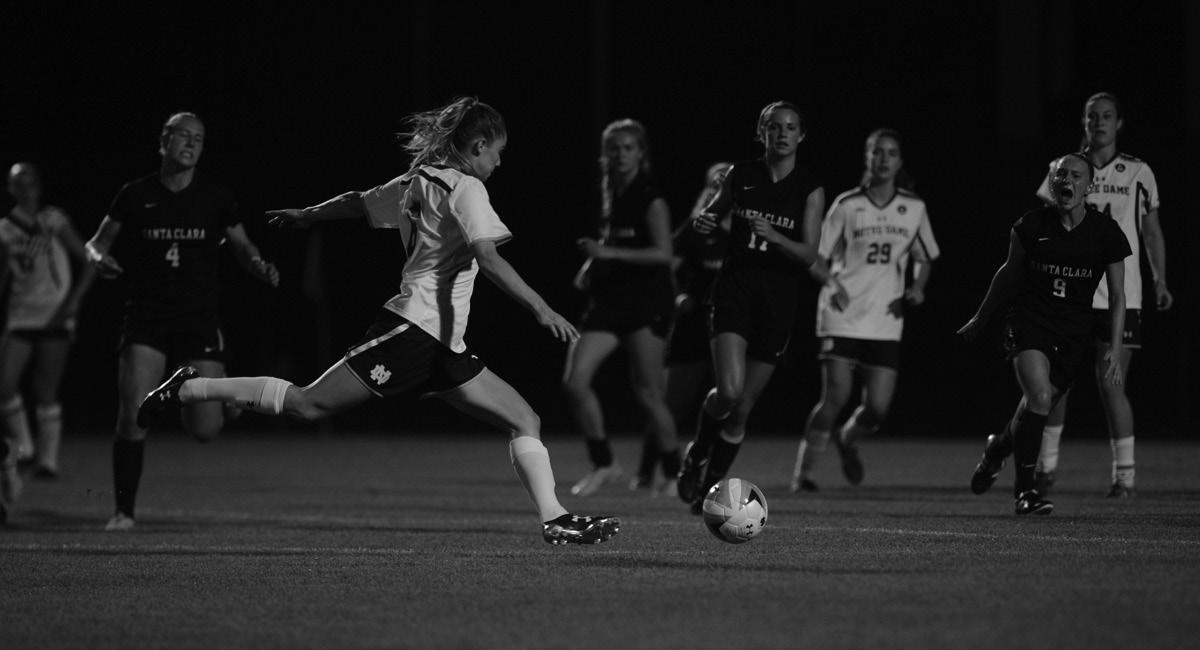


MICHAEL YU | The Observer Senior forward Anna Maria Gilberston looks to shoot during a 2-1 victory over Santa Clara on Aug. 28 at Alumni Stadium.
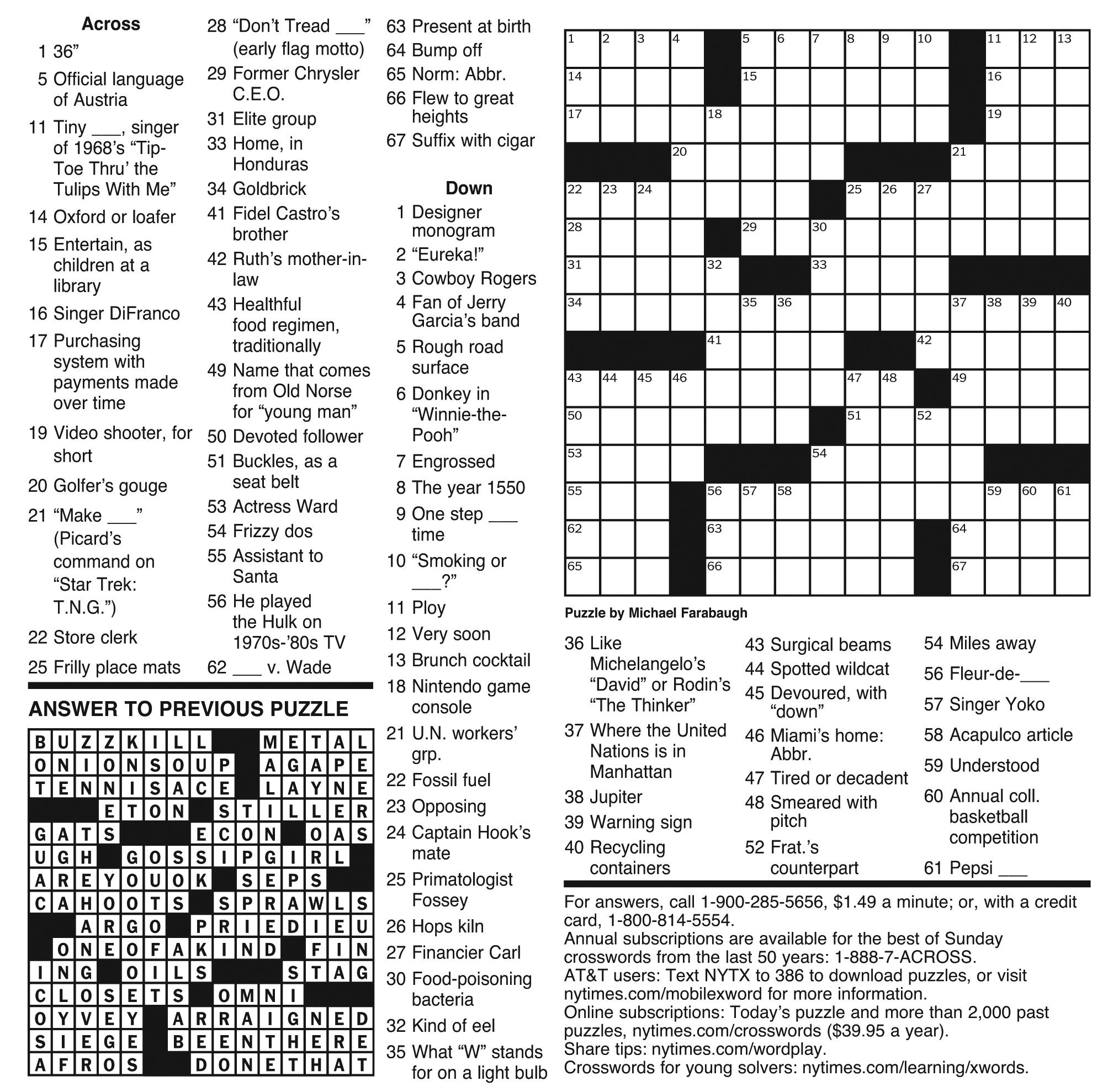
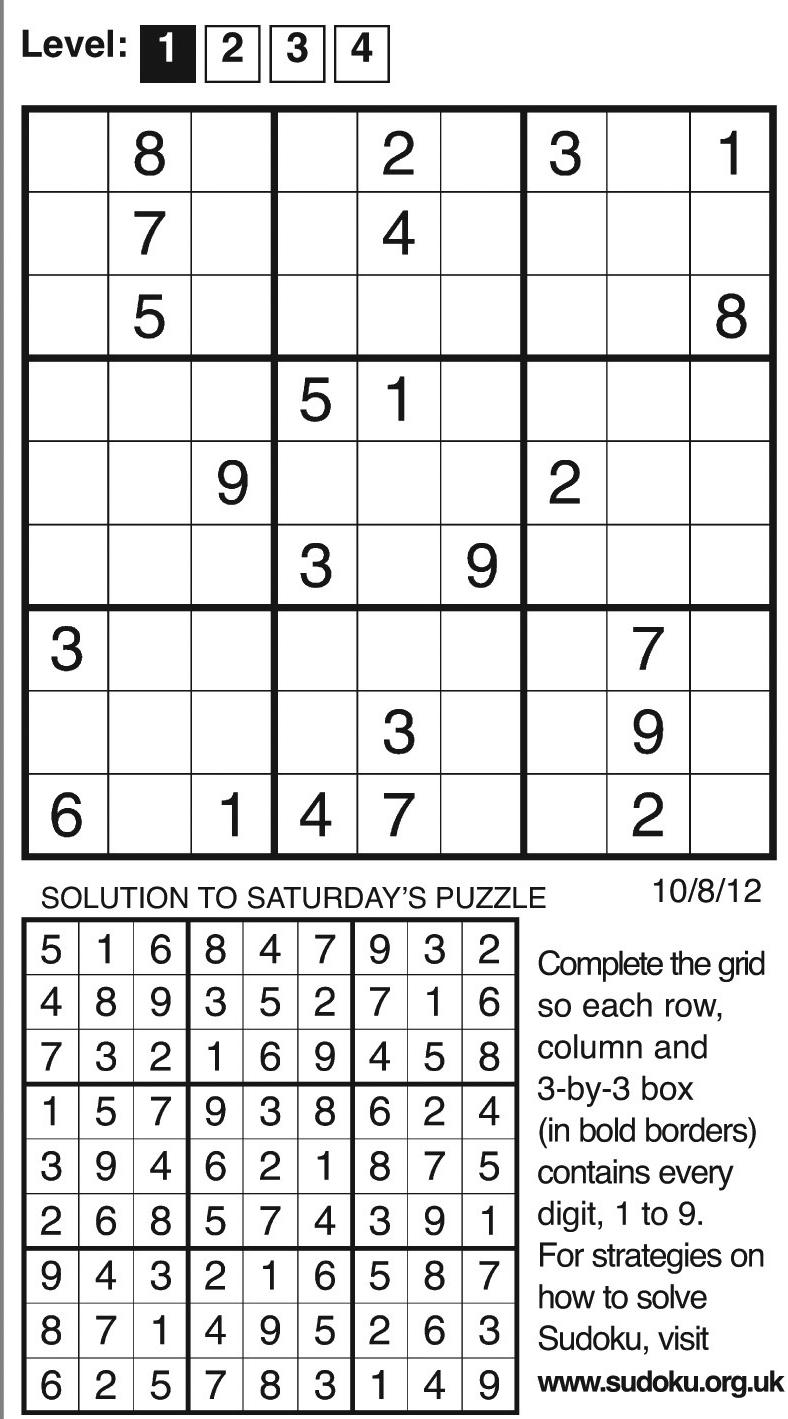
Happy Birthday: it’s up to you to bring about change. don’t put up with situations that are grating on your nerves and causing you to miss opportunities. put emotional matters to rest and focus on bringing about your own good fortune. you’ll get a good response from those who truly care about you. weed out the takers from the givers. your numbers are 4, 10, 13, 20, 26, 32, 49.
ARIES (March 21-April 19): avoid an emotional meltdown. Focus on a task that needs to be completed. arguing will only lead to more problems. do your best to get along and to work toward a positive solution. love conquers all, so make love, not war.
TAURUS (April 20-May 20): you are right on target, so make the move that will allow you to expand your interests and engage in rewarding pastimes with people you enjoy being with. make a strong effort, and you will get the results you are looking for.
GEMINI (May 21-June 20): remember your dreams. take a walk down memory lane and revisit the ideas and plans you left behind, and you’ll find a practical way to revise what you wanted to do. the time is right to invest in yourself and your talents.
CANCER (June 21-July 22): acceptance will help you get ahead. you may not like the changes those around you are making, but if you fight the inevitable, you will be left out or left behind. be receptive to ideas and you’ll find a way to contribute.
LEO (July 23-Aug. 22): travel, participate and discuss new possibilities. you can make positive changes that will enhance your life as well as the lives of the people you love the most. greater stability will be yours if you make decisions and take action.
VIRGO (Aug. 23-Sept. 22): put greater emphasis on personal happiness. it’s important to be true to what you need and want, but don’t let emotions take over, causing you to put your reputation or a friendship on the line. be smart, not stubborn.
LIBRA (Sept. 23-Oct. 22): Keep your emotions in check. if you waffle, you will miss out on an opportunity to advance. a change within an important relationship can be positive if you strive to keep things equal using diplomacy and the willingness to meet halfway.
SCORPIO (Oct. 23-Nov. 21): a window of opportunity is open if you make the effort to connect with people who have something you want. it’s up to you to make the first move and also to be innovative enough to persuade others to make a contribution.
SAGITTARIUS (Nov. 22-Dec. 21): be decisive and quick to make your move. the less you share with regard to your plans, the easier it will be to get your way and do what you want. bring about change and don’t look back. romance will lead to happiness.
CAPRICORN (Dec. 22-Jan. 19): partnerships will need to be addressed in a practical and compromising manner. expect to face opposition. be willing to offer solutions that are fair, or you’ll end up in a stalemate that’s costly and difficult to resolve.
AQUARIUS (Jan. 20-Feb. 18): get involved in a joint venture. Financial gains look promising if you do your part. innovative ideas coupled with realistic expectations will lead to success. be receptive to last-minute changes.
PISCES (Feb. 19-March 20): put yourself first and do something that will make you feel good. a spa day for two or putting your chores out of sight so you can relax and spend time with someone you love will improve your relationship. Birthday Baby: you are kind, sensitive and imaginative. you are helpful and articulate.
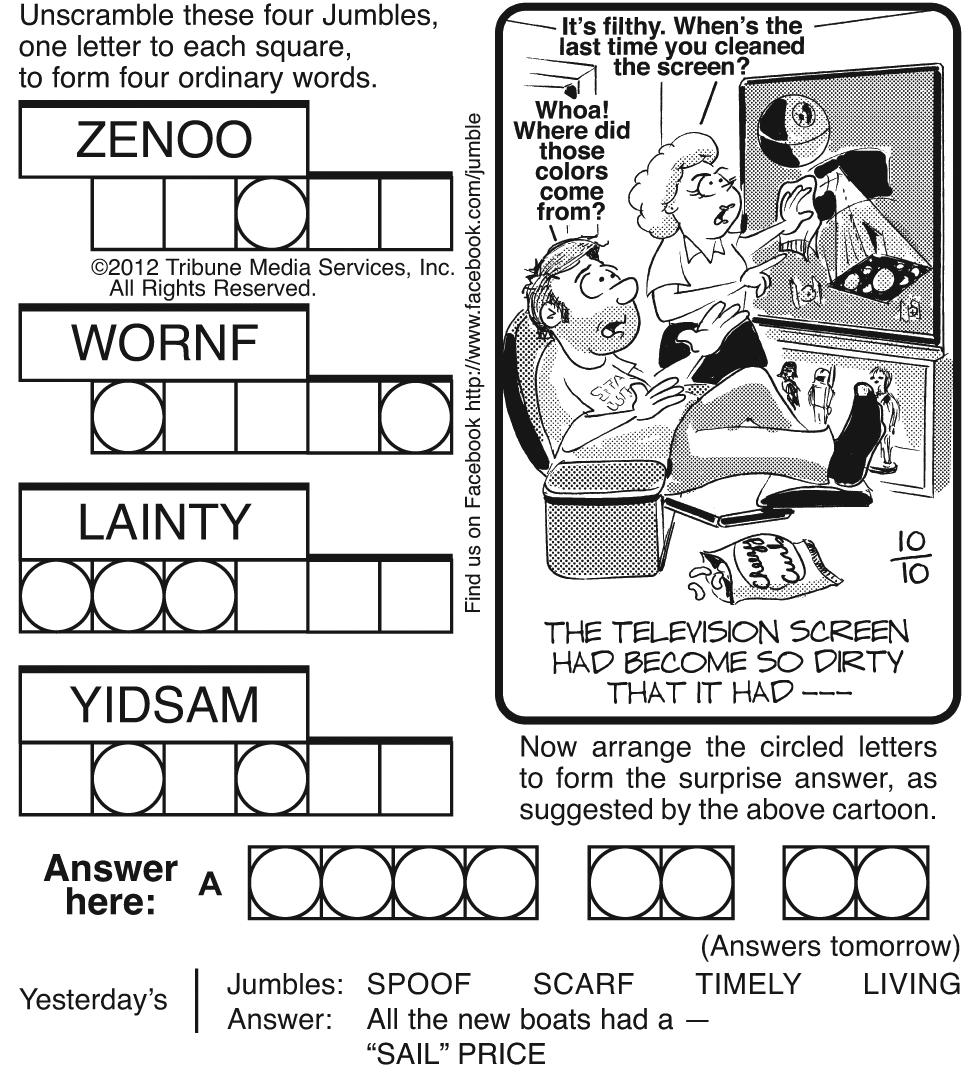
JumblE | david hoyt and JeFF KnureK
sudoku | the mepham group
Just Add WAtEr | eric carlson & John roddy
soccEr | nd 1, north carolina state 1
Late Wolfpack goal forces overtime, Irish earn tie
By BRETT O’CONNELL sports writer
t he i rish got another stingy performance in goal, but a bicycle kick in the 75th minute forced overtime and proved to be the game’s decisive score, as n o. 7 n otre d ame tied conference foe n orth c arolina s tate 1-1 on s unday afternoon in r aleigh, n orth c arolina.
t he conference matchup between the i rish (7-22, 2-2-1 acc ) and the host wolfpack (6-2-2, 1-1-2 acc ) benefited from a surprisingly cooperative string of weather. t hough the winds were significant throughout the afternoon, the day stayed dry and the field was wellmaintained despite record rainfalls in the area as a result of h urricane Joaquin. i rish head coach b obby c lark praised the efforts of the athletic staff and grounds crew at nc s tate for the favorable field conditions.
syracuse, bc best notre dame
By MANNY DE JESUS sports writer
d espite the home court advantage, n otre d ame has now lost four straight acc matchups to kick off conference play.
t he i rish (5-11, 0-4 acc ) started their weekend home stand against b oston c ollege on Friday, and the e agles (9-7, 1-3 acc ) swept n otre d ame 3-0 (12-25, 19-25, 1725). t hroughout the match, the i rish were only able to collect one ace and allowed seven errors on the serve.
t he second set showcased n otre d ame’s best play. t he i rish started off with a 4-1 lead after a couple of kills from sophomore outside hitter s am Fry and two attack errors from b oston c ollege. t he e agles were able to recover quickly and tie the set at eight, at which point they went on a 10 to 4 run to take an 18-12 lead. n otre d ame scored four straight points, but it wasn’t enough to keep the game close as b oston
c ollege finished the game on a seven to three run to win the set.
t he third set was all b oston c ollege. t he e agles went up by as much as eight points and were led by sophomore outside hitter s ol c alvete, who scored 16 of the team’s 54 total points throughout the three sets.
d espite hitting for a .114 attack percentage , n otre d ame was highlighted by Fry, who had another 10kill game. s he has accumulated at least 10 kills in nine games this season.
Fry said she believes the team needs to show more confidence and play up to the potential of their talent.
“ i think we all need to work on being more confident,” Fry said. “ e very girl on the team is very talented but sometimes we do not play like we know that. m ore confidence will come from more practice and winning more games.”
nd cross country | Joe piane invitational
nd women take third place
By MAREK MAZUREK sports writer
the irish received their first test of the season Friday, with the women’s team finishing third and the men’s team finishing 10th as 10 nationally ranked teams competed in the Joe piane invitational.
a ll-a merican senior molly seidel and freshman a nna rohrer led the 20th-ranked irish women in the five-kilometer race. seidel finished third with a time of 16:28.3, and rohrer finished eighth with a time of 16:46.8.
both seidel and rohrer battled illnesses early in the week, and irish coach matthew sparks said he was content with the pair’s result.
“talk about a stressed out week for the coach,” sparks said. “molly seidel, we made a gametime decision for her to even run. she’d been sick the first three days of school this week with the flu, didn’t run monday, tuesday, wednesday. we hit the brakes with her in the middle of the race. ... her running at 90 percent
was still good enough for third place today.
“if you’d asked me on monday, i’d have thought a nna [would not run], but molly would have been fine,” said sparks. “[rohrer] recovered well throughout the week. our first exams at notre dame were two weeks ago, two weeks later all that sickness catches up with them.”
in addition to facing illness, the irish were up against tough competition; top-ranked new mexico and no. 16 north carolina state took first and second in the women’s meet. sparks said his team can learn from the experience, despite finishing behind the two squads.
“it was a good experience for the freshmen girls, who have never been in this type of field before,” sparks said. “most of these girls haven’t been beat for a couple of years, even at the state level, not just a nna, but a nnie [heffernan] and rachel [da damio]. a nd for them to get lost in the shuffle, it’s a bad experience, but it’s a good experience
nd
soccEr | miami 1, nd 0
Hurricanes stun Irish with double overtime goal
By RENEE GRIFFIN sports writer
Joaquin was not the only hurricane to affect notre dame athletics this weekend: miami junior forward gracie lachowecki scored on no. 14 notre dame 105 minutes and 31 seconds into their Friday night matchup at cobb stadium to earn the unranked hurricanes a 1-0 win. the goal by lachowecki — sister of irish graduate student defender max lachowecki — ended the third contest of the last four for the irish (8-3-1, 1-3-0 acc) to extend into double overtime.
“it was our third corner kick in a row, and on the transition they just beat us to the ball,” romagnolo said of the hurricanes’ go-ahead goal.
Failures to finish on the attack spelled disaster for the irish, romagnolo said. notre dame outshot miami (4-7-0, 1-3-0 acc) 16 to six, including four in the first overtime period. senior forward and team-leading scorer a nna maria gilbertson had
mEn’s
EMMET FARNAN | The Observer
Senior midfielder Evan Panken dribbles down the field during a 3-1 victory over Virginia on Sept. 25 at Alumni Stadium.
WomEn’s
see Xc PAGE 13
MICHAEL YU | The Observer
Senior forward Anna Maria Gilbertson fights for the ball during a 2-1 win over Santa Clara at Alumni Stadium on Aug. 28.
nd VollE ybAll | bc 3, nd 0; syracuse 3, nd 2